EP4520631A1 - Zahnstangenführung - Google Patents
Zahnstangenführung Download PDFInfo
- Publication number
- EP4520631A1 EP4520631A1 EP23831136.9A EP23831136A EP4520631A1 EP 4520631 A1 EP4520631 A1 EP 4520631A1 EP 23831136 A EP23831136 A EP 23831136A EP 4520631 A1 EP4520631 A1 EP 4520631A1
- Authority
- EP
- European Patent Office
- Prior art keywords
- lubricant
- rack
- rack guide
- rack bar
- lubricant retaining
- Prior art date
- Legal status (The legal status is an assumption and is not a legal conclusion. Google has not performed a legal analysis and makes no representation as to the accuracy of the status listed.)
- Pending
Links
Images


Classifications
-
- B—PERFORMING OPERATIONS; TRANSPORTING
- B62—LAND VEHICLES FOR TRAVELLING OTHERWISE THAN ON RAILS
- B62D—MOTOR VEHICLES; TRAILERS
- B62D3/00—Steering gears
- B62D3/02—Steering gears mechanical
- B62D3/12—Steering gears mechanical of rack-and-pinion type
- B62D3/126—Steering gears mechanical of rack-and-pinion type characterised by the rack
-
- B—PERFORMING OPERATIONS; TRANSPORTING
- B62—LAND VEHICLES FOR TRAVELLING OTHERWISE THAN ON RAILS
- B62D—MOTOR VEHICLES; TRAILERS
- B62D3/00—Steering gears
- B62D3/02—Steering gears mechanical
- B62D3/12—Steering gears mechanical of rack-and-pinion type
- B62D3/123—Steering gears mechanical of rack-and-pinion type characterised by pressure yokes
-
- F—MECHANICAL ENGINEERING; LIGHTING; HEATING; WEAPONS; BLASTING
- F16—ENGINEERING ELEMENTS AND UNITS; GENERAL MEASURES FOR PRODUCING AND MAINTAINING EFFECTIVE FUNCTIONING OF MACHINES OR INSTALLATIONS; THERMAL INSULATION IN GENERAL
- F16H—GEARING
- F16H19/00—Gearings comprising essentially only toothed gears or friction members and not capable of conveying indefinitely-continuing rotary motion
- F16H19/02—Gearings comprising essentially only toothed gears or friction members and not capable of conveying indefinitely-continuing rotary motion for interconverting rotary or oscillating motion and reciprocating motion
- F16H19/04—Gearings comprising essentially only toothed gears or friction members and not capable of conveying indefinitely-continuing rotary motion for interconverting rotary or oscillating motion and reciprocating motion comprising a rack
Definitions
- the present invention relates to a rack guide for a steering device for changing a steering angle of a tire, and particularly to a rack guide for guiding a rack bar in a bar longitudinal direction.
- a rack guide for guiding a rack bar in a longitudinal direction
- a rack guide comprising a multilayer sliding piece having: a pair of inclined surface portions facing each other; a pair of flat surface portions continuous with these corresponding inclined surface portions; a bottom surface portion continuous with each of the flat surface portions; and a hollow protrusion portion extending at the center of this bottom surface portion toward a backing metal side, the multilayer sliding piece being configured to support the rack bar (for example, see Patent Literature 1).
- Patent Literature 1 JP2006-116994A (particularly, see fig. 2 .)
- Recessed portions in the inclined surface portions of the multilayer sliding piece of the rack guide as described above are filled with a lubricant, and when the rack bar moves in the rack bar longitudinal direction, the lubricant filling the recessed portions is supplied to the rack bar, whereas it is possible that the lubricant is insufficiently fed to the recessed portions so that the lubricant is drained from the recessed portions.
- the present invention is to solve the problem of conventional technologies as described above and it is an object of the present invention to provide a rack guide which achieves both a stable feed of a lubricant from a rack bar to a lubricant retaining groove and a stable supply of the lubricant from the lubricant retaining groove to the rack bar when the rack bar slides against the rack guide.
- the invention according to claim 1 is to solve the above problem by a rack guide for a steering device, comprising a supporting surface for supporting a sliding surface provided behind a meshing surface formed on a rack bar having a D-shaped cross section, the rack bar being configured to mesh with a pinion formed on a steering shaft to convert a rotational motion of the steering shaft into a linear motion, the rack guide being configured to guide the rack bar in a bar longitudinal direction of the rack bar to change a steering angle of a tire, in which the sliding surface of the rack bar is a curved surface formed to have a single radius of curvature, the supporting surface is a curved surface having a contact area configured to come into slidable contact with the rack bar and a spaced facing area configured to face the rack bar with a space therebetween, the contact area is located between the spaced facing area on an inner side closer to a rack guide longitudinal center axis configured to extend in a rack guide longitudinal direction parallel to a sliding direction of the rack bar and the spaced facing area on an outer side farther
- the invention according to claim 2 is to further solve the above problem by, in addition to the configuration of the invention according to claim 1, a feature in which the lubricant retaining groove is formed to be deeper in accordance with bulging of the lubricant retaining groove.
- the invention according to claim 3 is to further solve the above problem by, in addition to the configuration of the invention according to claim 1 or claim 2 , a feature in which the lubricant retaining groove is formed by a straight portion perpendicular to the contact area of the supporting surface, the contact area extending in the rack guide longitudinal direction, and a bulge portion passing both ends of the straight portion and the apex.
- the invention according to claim 4 is to further solve the above problem by, in addition to the configuration of the invention according to claim 1 or claim 2 , a feature in which the pair of lubricant retaining grooves are formed to be line-symmetrical, and groove depths of the pair of lubricant retaining grooves are equal to each other.
- At least one pair of lubricant retaining grooves configured to retain a lubricant interposed between the rack bar and the supporting surface and face each other in the rack guide longitudinal direction extend in a rack guide transverse direction perpendicular to the rack guide longitudinal direction and are arranged on the supporting surface in such a shape as to bulge away from each other in the rack guide longitudinal direction, and an apex of each of the lubricant retaining grooves in the rack guide longitudinal direction is located in the contact area, whereby, while the rack bar slides in the bar longitudinal direction, even when the lubricant retained near the apex of the lubricant retaining groove is dragged by the lubricant adhering to the rack bar so as to flow out from the lubricant retaining groove to the exterior of the lubricant retaining groove, in accordance with such outflow of the lubricant near the apex of the lubricant retaining groove, the lubricant in the spaced facing area
- the lubricant retaining groove is formed to be deeper in accordance with bulging of the lubricant retaining groove, which makes it easier for the lubricant to accumulate at an outer end side of the lubricant retaining groove with a great groove depth and makes it easier for the lubricant to flow out of an inner end side of the lubricant retaining groove with a shallow groove depth, and when the rack bar slides to the outer end side of the lubricant retaining groove, in accordance with outflow of the lubricant from the outer end side of the lubricant retaining groove due to sliding of the rack bar, the lubricant in the spaced facing area on the inner side and in the spaced facing area on the outer side flows into the lubricant retaining groove and is retained at the outer end side of the lubricant retaining groove, so that when the rack bar slides to the inner end side of the lubricant retaining groove,
- the lubricant retaining groove is formed by a straight portion perpendicular to the contact area of the supporting surface, the contact area extending in the rack guide longitudinal direction, and a bulge portion passing both ends of the straight portion and the apex, which makes it easier for the lubricant retained near the straight portion of the lubricant retaining groove to adhere to the rack bar rather than flowing in the rack guide transverse direction when the rack bar slides toward a straight portion side of the lubricant retaining groove, so that when the rack bar slides against the rack guide, the lubricant can be stably supplied from the lubricant retaining groove to the rack bar, which can consequently make it easier to achieve both a stable feed of the lubricant from the rack bar to the lubricant retaining groove and a stable supply of the lubricant from the lubricant retaining groove to the rack bar.
- the pair of lubricant retaining grooves are formed to be line-symmetrical, and groove depths of the pair of lubricant retaining grooves are equal to each other, so that an inflow amount of the lubricant into the pair of lubricant retaining grooves and an outflow amount of the lubricant out of the pair of lubricant retaining grooves balance with each other, which can make it easier to keep constant a total amount of the lubricant retained by the rack guide.
- a rack guide for a steering device comprises a supporting surface for supporting a sliding surface provided behind a meshing surface formed on a rack bar having a D-shaped cross section, the rack bar being configured to mesh with a pinion formed on a steering shaft to convert a rotational motion of the steering shaft into a linear motion, the rack guide being configured to guide the rack bar in a bar longitudinal direction of the rack bar to change a steering angle of a tire, in which the sliding surface of the rack bar is a curved surface formed to have a single radius of curvature, the supporting surface is a curved surface having a contact area configured to come into slidable contact with the rack bar and a spaced facing area configured to face the rack bar with a space therebetween, the contact area is located between the spaced facing area on an inner side closer to a rack guide longitudinal center axis configured to extend in a rack guide longitudinal direction parallel to a sliding direction of the rack bar and the spaced facing area on an outer side farther from the rack
- the rack guide according to the present invention is configured to be mounted in a rack and pinion steering device of a four-wheeled vehicle, and then the four-wheeled vehicle may be not only a gasoline vehicle or a diesel vehicle but also an electric vehicle or the like.
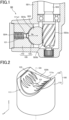
- fig. 1 is a cross-sectional view of a rack and pinion steering device in which a rack guide according to an embodiment of the present invention is installed.
- the rack guide 100 is configured to be mounted in a rack and pinion steering device SD of a four-wheeled vehicle.
- This rack and pinion steering device SD is configured to change a steering angle of tires (unillustrated) and includes a device housing SD1, a steering shaft SD2 configured to rotate integrally with a steering wheel, a rack bar SD3 configured to mesh with this steering shaft SD2 to convert a rotational motion of the steering shaft SD2 into a linear motion, a rack guide 100 configured to guide this rack bar SD3 in a bar longitudinal direction of the rack bar SD3, and a biasing spring SD4 configured to press this rack guide 100 against the rack bar SD3.
- a tip of the steering shaft SD2 is provided with a pinion SD2a configured to mesh with the rack bar SD3 which thus rotates integrally with the steering shaft SD2.
- the rack bar SD3 has a sliding surface SD3a which is a curved surface formed to have a single radius of curvature Rb and a meshing surface SD3b which is provided behind this sliding surface SD3a to serve as rack teeth configured to mesh with the steering shaft SD2, and thus the rack bar SD3 has a D-shaped cross section.
- the biasing spring SD4 is interposed between the device housing SD1 and the rack guide 100.
- Fig. 2 is a perspective view of the rack guide illustrated in fig. 1
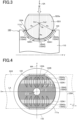
- fig. 3 is a side view illustrating a positional relationship between the rack guide and a rack bar illustrated in fig. 1
- fig. 4 is a plan view of the rack guide as seen from the IV direction in fig. 3
- fig. 5 is an end view of a lubricant retaining groove in the V-V cross section in fig. 4 .
- the rack guide 100 is provided with a rack guide body 110 and a seat 120.
- the rack guide body 110 is a cylindrical member made of a metal.
- this rack guide body 110 there is formed a seat placement groove 111 configured to extend in a seat placement groove longitudinal direction (x direction in fig. 2 ) perpendicular to a direction in which a longitudinal center axis of the rack guide body 110 (rack guide center axis GA) extends (z direction in fig. 2 ).
- a cross-sectional shape of this seat placement groove 111 is semicircular.
- a facing surface 111a of the seat placement groove 111 which faces the sliding surface SD3a of the rack bar SD3 is provided with a seat engagement hole 111a1 configured to engage with a convex portion 121 of the seat 120.
- the seat 120 is a member made of a resin having an excellent self-lubricating property (for example, a fluororesin, such as PTFE, a nylon resin or a polyacetal resin, such as POM) and has a substantially uniform thickness as illustrated in fig. 3 .
- a resin having an excellent self-lubricating property for example, a fluororesin, such as PTFE, a nylon resin or a polyacetal resin, such as POM
- the seat 120 has the convex portion 121 formed at the center in a plan view and configured to protrude toward the rack guide body 110.
- the seat 120 is integrated with the rack guide body 110 by inserting the convex portion 121 into the seat engagement hole 111a1 of the rack guide body 110 and allowing the same to engage therewith.
- the facing surface 111a of the rack guide body 110 which faces the sliding surface SD3a of the rack bar SD3 is arranged at a position farther away from the rack bar SD3 than a supporting surface 120A of the seat 120 which supports the sliding surface SD3a of the rack bar SD3 as illustrated in fig. 3 .
- the supporting surface 120A of the seat 120 is symmetrical with respect to a seat longitudinal center axis LA configured to pass through the center of the convex portion 121 and extend in a seat longitudinal direction (X direction in fig. 4 ) and also with respect to a seat transverse center axis WA configured to pass through the center of the convex portion 121 and extend in a seat transverse direction (Y direction in fig. 4 ).
- the seat longitudinal center axis LA and the seat transverse center axis WA are perpendicular to the rack guide center axis GA.
- the seat longitudinal direction of the seat 120 is the same direction as the seat placement groove longitudinal direction of the rack guide body 110 and the longitudinal direction (sliding direction) of the rack bar SD3, and the seat longitudinal center axis LA is coaxial with the rack guide longitudinal center axis.
- the seat transverse direction of the seat 120 is perpendicular to the seat longitudinal direction of the seat 120, and the seat transverse center axis WA is coaxial with a rack guide transverse center axis.
- the supporting surface 120A has two centers of curvature Os1, Os2.
- these centers of curvature Os1, Os2 are arranged with the rack guide center axis GA therebetween in the Y direction, while being arranged at approximately the same position in the z direction.
- a radius of curvature about the center of curvature Os1 and a radius of curvature about the center of curvature Os2 are the same radius of curvature Rs.
- the supporting surface 120A is formed not by a single curved surface, such as the sliding surface SD3a of the rack bar SD3, but by two curved surfaces combined together.
- the supporting surface 120A has a contact area 120A1 configured to come into slidable contact with the rack bar SD3 and a spaced facing area 120A2 configured to face the rack bar SD3 with a space therebetween as illustrated in fig. 3 and fig. 4 .
- the supporting surface 120A of the seat 120 is provided with a plurality of lubricant retaining grooves 122 interposed between the sliding surface SD3a of the rack bar SD3 and the supporting surface 120A of the seat 120 to retain a lubricant for allowing the rack bar SD3 to smoothly slide against the seat 120.
- these lubricant retaining grooves 122 are arranged in the supporting surface 120A in such a manner as to be symmetrical with respect to the seat longitudinal center axis LA and the seat transverse center axis WA.
- the lubricant retaining grooves 122 form a pair in the seat longitudinal direction (about the seat transverse center axis WA), and the pair of lubricant retaining grooves 122 are formed to be line-symmetrical with respect to the seat transverse center axis WA.
- each of the lubricant retaining grooves 122 is configured to extend in the seat transverse direction (rack guide transverse direction), while bulging in the seat longitudinal direction (rack guide longitudinal direction) and in a direction farther away from the seat transverse center axis WA.
- each of the lubricant retaining grooves 122 arranged line-symmetrically with respect to the seat transverse center axis WA bulge in a direction farther away from each other, and each of the lubricant retaining grooves 122 is formed by a straight portion 122A extending in a direction perpendicular to the contact area 120A1 extending in the seat longitudinal direction (i.e., the seat transverse direction) and a bulge portion 122B bulging from both ends of this straight portion 122A.
- an apex 122B1 of this bulge portion 122B in the seat longitudinal direction is located in the contact area 120A1.
- a cross-sectional shape of this lubricant retaining groove 122 is illustrated in fig. 5 , and the lubricant retaining groove 122 is formed by a vertical wall surface 122a which forms the bulge portion 122B and an inclined surface 122b which connects this vertical wall surface 122a and the supporting surface 120A with each other.
- the straight portion 122A is a boundary between the inclined surface 122b and the supporting surface 120A.
- the vertical wall surface 122a extends in a thickness direction of the seat 120 and has a height maximum near the apex and minimum near both ends of the straight portion 122A as illustrated in fig. 2 .
- the lubricant retaining groove 122 is formed to be deeper in accordance with bulging of the lubricant retaining groove 122. That is to say, in the seat longitudinal direction, an outer end side (bulge portion 122B) of the lubricant retaining groove 122 farther away from the seat transverse center axis WA is formed to be deeper than an inner end side (straight portion 122A) of the lubricant retaining groove closer to the seat transverse center axis WA.
- groove depths of the pair of lubricant retaining grooves 122 arranged line-symmetrically with respect to the seat transverse center axis WA are equal to each other.
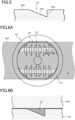
- Fig. 6A is a plan view illustrating a positional relationship of the rack guide and the rack bar illustrated in fig. 1 and the lubricant
- fig. 6B is an end view of the lubricant retaining groove in the VIB-VIB cross section of fig. 6A
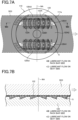
- fig. 7A is a plan view illustrating a flow of the lubricant when the rack bar is moved to the right of the page
- fig. 7B is an end view of the lubricant retaining groove in the VIIB-VIIB cross section of fig. 7A
- fig. 8A is a plan view illustrating a flow of the lubricant when the rack bar is moved to the left of the page
- fig. 8B is an end view of the lubricant retaining groove in the VIIIB-VIIIB cross section of fig. 8A .
- the lubricant G is applied to the rack bar SD3, so that when the rack bar SD3 slides against the rack guide 100, the lubricant G is interposed between the rack bar SD3 and the rack guide 100 as illustrated in fig. 6A and fig. 6B .
- the lubricant G on the seat 120 side also starts to flow due to the viscosity of the lubricant G.
- the lubricant G on the seat 120 side in an area in which the lubricant retaining groove 122 of the seat 120 is not provided flows to the right side of the page, i.e., toward the lubricant retaining groove 122 and flows from the straight portion 122A of the lubricant retaining groove 122 into the interior of the lubricant retaining groove 122.
- the lubricant G retained in the spaced facing area 120A2 of the lubricant retaining groove 122 is drawn into the direction of low flow resistance, i.e., toward the contact area 120A1 rather than climbing over the vertical wall surface 122a, so that the lubricant G is retained most near the apex 122B1 in the lubricant retaining groove 122.
- the lubricant G retained in the lubricant retaining groove 122 adheres to the rack bar SD3 most in the contact area 120A1, i.e., most near the apex 122B1 in the lubricant retaining groove 122.
- the lubricant G retained in the lubricant retaining groove 122 flows out to the right side of the page, i.e., from the straight portion 122A of the lubricant retaining groove 122 to the exterior of the lubricant retaining groove 122.
- the lubricant G on the seat 120 side also starts to flow due to the viscosity of the lubricant G, and then the seat 120 is configured to be symmetrical with respect to the seat transverse center axis WA, so that the behavior of the lubricant G on the rack bar SD3 side and the lubricant G on the seat 120 side is exactly the same as that when the rack bar SD3 moves to the right of the page as illustrated in fig. 7A and fig. 7B , while the direction of movement of the rack bar SD3 is different.
- a pair of lubricant retaining grooves 122 configured to retain the lubricant G interposed between the rack bar SD3 and the supporting surface 120A and face each other in the rack guide longitudinal direction extend in the seat transverse direction (rack guide transverse direction) perpendicular to the seat longitudinal direction (rack guide longitudinal direction) and are arranged on the supporting surface 120A in such a shape as to bulge away from each other in the seat guide longitudinal direction, and the apex 122B1 of each of the lubricant retaining grooves 122 in the seat longitudinal direction is located in the contact area 120A1, whereby, while the sliding surface SD3a of the rack bar SD3 slides in the bar longitudinal direction, even when the lubricant G retained near the apex 122B1 of the lubricant retaining groove 122 is dragged by the lubricant G adhering to the rack bar SD3 so as to flow out from the lubricant retaining groove 122 to the exterior of the lub
- the lubricant G adhering to the sliding surface SD3a of the rack bar SD3 is evenly used, which can extend the lifetime of the rack guide 100.
- the lubricant retaining groove 122 is arranged in all the contact area 120A1 of the supporting surface 120A, whereby the lubricant can be evenly supplied to the rack bar SD3.
- a groove depth of each of a pair of lubricant retaining grooves 122 becomes greater toward a direction in which each of the lubricant retaining grooves 122 bulges, which makes it easier for the lubricant G to accumulate at an outer end side of the lubricant retaining groove 122 with a great groove depth and makes it easier for the lubricant G to flow out of an inner end side of the lubricant retaining groove 122 with a shallow groove depth, and when the rack bar SD3 slides to the outer end side of the lubricant retaining groove 122, in accordance with outflow of the lubricant G from the outer end side of the lubricant retaining groove 122 due to sliding of the rack bar SD3, the lubricant G in the spaced facing area 120A2i on the inner side and in the spaced facing area 120A2o on the outer side flows into the lubricant retaining groove 122 and is retained at the outer end side of the lubricant retaining groove 122, so that when the rack bar
- the lubricant retaining groove 122 is formed by the straight portion 122A perpendicular to the contact area 120A1 of the supporting surface 120A, the contact area extending in the seat longitudinal direction, and the bulge portion 122B passing both ends of this straight portion 122A and the apex 122B1, which makes it easier for the lubricant G retained near the straight portion 122A of the lubricant retaining groove 122 to adhere to the rack bar SD3 rather than flowing in the seat transverse direction when the rack bar SD3 slides toward a straight portion 122A side of the lubricant retaining groove 122, so that when the rack bar SD3 slides against the rack guide 100, the lubricant G can be stably supplied from the lubricant retaining groove 122 to the rack bar SD3, which can consequently make it easier to achieve both a stable feed of the lubricant G from the rack bar SD3 to the lubricant retaining groove 122 and a stable supply of the lubricant G from the lubricant
- the rack guide according to an embodiment of the present invention has been described above, but the rack guide according to the present invention is not limited to the rack guide according to the above embodiment.
- the rack guide body 110 is made of a metal, but the material of the rack guide body is not limited to a metal, and the rack guide body may be made of, for example, a resin.
- the seat 120 has a uniform thickness, but the seat thickness may be non-uniform.
- the number of lubricant retaining grooves 122 in the seat 120 is eight, but the number of lubricant retaining grooves arranged in the seat is not limited to eight as long as the lubricant retaining grooves are arranged symmetrically with respect to the seat longitudinal center axis LA and the seat transverse center axis WA.
- the rack guide 100 is made from two members, i.e., the rack guide body 110 and the seat 120, but the rack guide body and the seat may be integrally formed.
- the pair of lubricant retaining grooves 122 are positionally aligned in the seat transverse direction, but the pair of lubricant retaining grooves is not limited to this configuration as long as the lubricant retaining grooves form a pair in the rack guide longitudinal direction, and the pair of lubricant retaining grooves may be offset, for example, in the seat transverse direction.
- the lubricant retaining groove 122 formed in the seat 120 is formed by the straight portion 122A and the arc-shaped bulge portion 122B as illustrated in fig. 4 , but the shape of the lubricant retaining groove is not limited to the above embodiment as long as the lubricant retaining groove bulges in the rack guide longitudinal direction and has an apex located in the contact area, and the lubricant retaining groove may have a shape, for example, as illustrated in fig. 9A to fig. 9C .
- a lubricant retaining groove 222 may be formed by a straight portion 222A and a broken line bulge portion 222B, similarly to a rack guide 300 as illustrated in fig. 9B which is a plan view of a rack guide according to a second variant of the present invention, a lubricant retaining groove 322 may be formed by two arc-shaped bulge portions or similarly to a rack guide 400 as illustrated in fig. 9C which is a plan view of a rack guide according to a third variant of the present invention, a lubricant retaining groove 422 may be formed to have a diamond shape.
- the pair of lubricant retaining grooves 122 formed in seat 120 are arranged about the seat transverse center axis WA, but the pair of lubricant retaining grooves according to the present invention are not limited to this configuration as long as the lubricant retaining grooves form a pair in the rack guide longitudinal direction.
- a pair of lubricant retaining grooves 522 may be formed about an axis of symmetry A parallel to the seat transverse center axis WA.
Landscapes
- Engineering & Computer Science (AREA)
- General Engineering & Computer Science (AREA)
- Mechanical Engineering (AREA)
- Chemical & Material Sciences (AREA)
- Combustion & Propulsion (AREA)
- Transportation (AREA)
- Transmission Devices (AREA)
- Bearings For Parts Moving Linearly (AREA)
Applications Claiming Priority (2)
| Application Number | Priority Date | Filing Date | Title |
|---|---|---|---|
| JP2022102333A JP2024003297A (ja) | 2022-06-27 | 2022-06-27 | ラックガイド |
| PCT/JP2023/022287 WO2024004688A1 (ja) | 2022-06-27 | 2023-06-15 | ラックガイド |
Publications (2)
| Publication Number | Publication Date |
|---|---|
| EP4520631A1 true EP4520631A1 (de) | 2025-03-12 |
| EP4520631A4 EP4520631A4 (de) | 2026-04-29 |
Family
ID=89382127
Family Applications (1)
| Application Number | Title | Priority Date | Filing Date |
|---|---|---|---|
| EP23831136.9A Pending EP4520631A4 (de) | 2022-06-27 | 2023-06-15 | Zahnstangenführung |
Country Status (6)
| Country | Link |
|---|---|
| US (1) | US12485953B1 (de) |
| EP (1) | EP4520631A4 (de) |
| JP (1) | JP2024003297A (de) |
| KR (1) | KR20250028257A (de) |
| CN (1) | CN119365376A (de) |
| WO (1) | WO2024004688A1 (de) |
Family Cites Families (17)
| Publication number | Priority date | Publication date | Assignee | Title |
|---|---|---|---|---|
| JPS5083938A (de) | 1973-11-27 | 1975-07-07 | ||
| JPH0296268U (de) * | 1989-01-13 | 1990-07-31 | ||
| JPH0535543U (ja) * | 1991-09-09 | 1993-05-14 | 株式会社アツギユニシア | ステアリング装置のラツクガイド構造 |
| JP2002370654A (ja) | 2001-06-14 | 2002-12-24 | Koyo Seiko Co Ltd | ラックピニオン式舵取装置 |
| JP3909832B2 (ja) | 2002-04-23 | 2007-04-25 | 株式会社ジェイテクト | ラックピニオン型動力舵取装置 |
| FR2851540B1 (fr) | 2003-02-21 | 2006-02-24 | Soc Mecanique Irigny | Poussoir pour direction a cremaillere de vehicule automobile |
| JP4525291B2 (ja) | 2004-10-19 | 2010-08-18 | オイレス工業株式会社 | ラックガイド及びそれを具備したラックピニオン式舵取装置 |
| JP4631535B2 (ja) * | 2005-05-18 | 2011-02-16 | 株式会社ジェイテクト | ラックガイド及びこのラックガイドを具備したラックピニオン式ステアリング装置 |
| JP2007245828A (ja) | 2006-03-14 | 2007-09-27 | Jtekt Corp | ラック受けシート、サポートヨーク及び舵取装置 |
| JP6603931B2 (ja) | 2015-07-24 | 2019-11-13 | 大豊工業株式会社 | ラックガイド、及び、ラックピニオン式舵取装置 |
| JP2019039496A (ja) | 2017-08-25 | 2019-03-14 | 大豊工業株式会社 | すべり軸受 |
| US11198466B2 (en) * | 2017-11-03 | 2021-12-14 | Steering Solutions Ip Holding Corporation | Wedge adjuster plug |
| DE102019109651A1 (de) * | 2019-04-11 | 2020-10-15 | Zf Automotive Germany Gmbh | Vorrichtung für eine Lenkung eines Kraftfahrzeugs |
| JP2021079886A (ja) | 2019-11-21 | 2021-05-27 | オイレス工業株式会社 | ラックガイドおよびギア機構 |
| TWM604850U (zh) | 2020-07-20 | 2020-12-01 | 上銀科技股份有限公司 | 支撐潤滑結構及使用其之電動助力轉向裝置 |
| KR20220080921A (ko) | 2020-12-08 | 2022-06-15 | 현대모비스 주식회사 | 차량 조향 장치의 랙바 지지 장치 |
| JP2025083938A (ja) | 2023-11-21 | 2025-06-02 | 東芝テック株式会社 | 画像形成装置 |
-
2022
- 2022-06-27 JP JP2022102333A patent/JP2024003297A/ja active Pending
-
2023
- 2023-06-15 KR KR1020247040627A patent/KR20250028257A/ko active Pending
- 2023-06-15 CN CN202380044495.5A patent/CN119365376A/zh active Pending
- 2023-06-15 WO PCT/JP2023/022287 patent/WO2024004688A1/ja not_active Ceased
- 2023-06-15 US US18/872,740 patent/US12485953B1/en active Active
- 2023-06-15 EP EP23831136.9A patent/EP4520631A4/de active Pending
Also Published As
| Publication number | Publication date |
|---|---|
| JP2024003297A (ja) | 2024-01-15 |
| EP4520631A4 (de) | 2026-04-29 |
| WO2024004688A1 (ja) | 2024-01-04 |
| CN119365376A (zh) | 2025-01-24 |
| US12485953B1 (en) | 2025-12-02 |
| KR20250028257A (ko) | 2025-02-28 |
| US20250368253A1 (en) | 2025-12-04 |
Similar Documents
| Publication | Publication Date | Title |
|---|---|---|
| US5058448A (en) | Rack and pinion steering device | |
| WO1984001194A1 (en) | Linear operation ball bearing | |
| CN1455840A (zh) | 推力球滑动式门制动器 | |
| US20060023980A1 (en) | Rolling guide unit | |
| EP2549133A1 (de) | Schienenschiebevorrichtung für einen Fahrzeugsitz | |
| DE102008028206A1 (de) | Kettenführung, insbesondere für einen Motor | |
| CN105365607A (zh) | 车辆用座椅滑动装置 | |
| EP4520631A1 (de) | Zahnstangenführung | |
| DE60020666T2 (de) | Linearführungseinheit | |
| EP4520632A1 (de) | Zahnstangenführung | |
| EP2505876B1 (de) | Führungsbauteil aus Kunststoff zum Führen einer Endloskette eines Kettentriebs | |
| US6575646B1 (en) | Printer carriage bushing | |
| JP5550918B2 (ja) | 直動案内ユニット | |
| JP4469705B2 (ja) | 直動案内ユニット | |
| JP6565668B2 (ja) | 車両用オイルレシーバ | |
| EP1344030B1 (de) | Füllstandssensor | |
| JP5824259B2 (ja) | チェーンおよびチェーンへの給油方法 | |
| DE102014204536A1 (de) | Kettenführung | |
| CN111350753B (zh) | 止推垫圈 | |
| DE20018880U1 (de) | Gleitlager mit einer Dochtschmierung | |
| CN117062990A (zh) | 线性引导件 | |
| JP3673912B2 (ja) | ラック軸の支持構造 | |
| CA2355489C (en) | Roller cage | |
| EA035831B1 (ru) | Калибровочное устройство, способ калибровки и способ изготовления калибровочного устройства | |
| JPH07323850A (ja) | ラックピニオン式ステアリング装置 |
Legal Events
| Date | Code | Title | Description |
|---|---|---|---|
| STAA | Information on the status of an ep patent application or granted ep patent |
Free format text: STATUS: THE INTERNATIONAL PUBLICATION HAS BEEN MADE |
|
| PUAI | Public reference made under article 153(3) epc to a published international application that has entered the european phase |
Free format text: ORIGINAL CODE: 0009012 |
|
| STAA | Information on the status of an ep patent application or granted ep patent |
Free format text: STATUS: REQUEST FOR EXAMINATION WAS MADE |
|
| 17P | Request for examination filed |
Effective date: 20241206 |
|
| AK | Designated contracting states |
Kind code of ref document: A1 Designated state(s): AL AT BE BG CH CY CZ DE DK EE ES FI FR GB GR HR HU IE IS IT LI LT LU LV MC ME MK MT NL NO PL PT RO RS SE SI SK SM TR |
|
| DAV | Request for validation of the european patent (deleted) | ||
| DAX | Request for extension of the european patent (deleted) |