EP4517455A1 - Procédé de correction pour une machine de coupe dentaire et machine de coupe dentaire - Google Patents
Procédé de correction pour une machine de coupe dentaire et machine de coupe dentaire Download PDFInfo
- Publication number
- EP4517455A1 EP4517455A1 EP23796209.7A EP23796209A EP4517455A1 EP 4517455 A1 EP4517455 A1 EP 4517455A1 EP 23796209 A EP23796209 A EP 23796209A EP 4517455 A1 EP4517455 A1 EP 4517455A1
- Authority
- EP
- European Patent Office
- Prior art keywords
- axis directions
- correction
- cutting machine
- measurement
- axis
- Prior art date
- Legal status (The legal status is an assumption and is not a legal conclusion. Google has not performed a legal analysis and makes no representation as to the accuracy of the status listed.)
- Pending
Links
Images



Classifications
-
- A—HUMAN NECESSITIES
- A61—MEDICAL OR VETERINARY SCIENCE; HYGIENE
- A61C—DENTISTRY; APPARATUS OR METHODS FOR ORAL OR DENTAL HYGIENE
- A61C13/00—Dental prostheses; Making same
- A61C13/12—Tools for fastening artificial teeth; Holders, clamps, or stands for artificial teeth
-
- A—HUMAN NECESSITIES
- A61—MEDICAL OR VETERINARY SCIENCE; HYGIENE
- A61C—DENTISTRY; APPARATUS OR METHODS FOR ORAL OR DENTAL HYGIENE
- A61C13/00—Dental prostheses; Making same
- A61C13/0003—Making bridge-work, inlays, implants or the like
- A61C13/0004—Computer-assisted sizing or machining of dental prostheses
-
- A—HUMAN NECESSITIES
- A61—MEDICAL OR VETERINARY SCIENCE; HYGIENE
- A61C—DENTISTRY; APPARATUS OR METHODS FOR ORAL OR DENTAL HYGIENE
- A61C13/00—Dental prostheses; Making same
- A61C13/0003—Making bridge-work, inlays, implants or the like
- A61C13/0006—Production methods
-
- A—HUMAN NECESSITIES
- A61—MEDICAL OR VETERINARY SCIENCE; HYGIENE
- A61C—DENTISTRY; APPARATUS OR METHODS FOR ORAL OR DENTAL HYGIENE
- A61C13/00—Dental prostheses; Making same
- A61C13/0003—Making bridge-work, inlays, implants or the like
- A61C13/0022—Blanks or green, unfinished dental restoration parts
-
- G—PHYSICS
- G05—CONTROLLING; REGULATING
- G05B—CONTROL OR REGULATING SYSTEMS IN GENERAL; FUNCTIONAL ELEMENTS OF SUCH SYSTEMS; MONITORING OR TESTING ARRANGEMENTS FOR SUCH SYSTEMS OR ELEMENTS
- G05B19/00—Program-control systems
- G05B19/02—Program-control systems electric
- G05B19/18—Numerical control [NC], i.e. automatically operating machines, in particular machine tools, e.g. in a manufacturing environment, so as to execute positioning, movement or co-ordinated operations by means of program data in numerical form
- G05B19/401—Numerical control [NC], i.e. automatically operating machines, in particular machine tools, e.g. in a manufacturing environment, so as to execute positioning, movement or co-ordinated operations by means of program data in numerical form characterised by control arrangements for measuring, e.g. calibration and initialisation, measuring workpiece for machining purposes
-
- G—PHYSICS
- G05—CONTROLLING; REGULATING
- G05B—CONTROL OR REGULATING SYSTEMS IN GENERAL; FUNCTIONAL ELEMENTS OF SUCH SYSTEMS; MONITORING OR TESTING ARRANGEMENTS FOR SUCH SYSTEMS OR ELEMENTS
- G05B19/00—Program-control systems
- G05B19/02—Program-control systems electric
- G05B19/18—Numerical control [NC], i.e. automatically operating machines, in particular machine tools, e.g. in a manufacturing environment, so as to execute positioning, movement or co-ordinated operations by means of program data in numerical form
- G05B19/404—Numerical control [NC], i.e. automatically operating machines, in particular machine tools, e.g. in a manufacturing environment, so as to execute positioning, movement or co-ordinated operations by means of program data in numerical form characterised by control arrangements for compensation, e.g. for backlash, overshoot, tool offset, tool wear, temperature, machine construction errors, load, inertia
-
- B—PERFORMING OPERATIONS; TRANSPORTING
- B23—MACHINE TOOLS; METAL-WORKING NOT OTHERWISE PROVIDED FOR
- B23Q—DETAILS, COMPONENTS, OR ACCESSORIES FOR MACHINE TOOLS, e.g. ARRANGEMENTS FOR COPYING OR CONTROLLING; MACHINE TOOLS IN GENERAL CHARACTERISED BY THE CONSTRUCTION OF PARTICULAR DETAILS OR COMPONENTS; COMBINATIONS OR ASSOCIATIONS OF METAL-WORKING MACHINES, NOT DIRECTED TO A PARTICULAR RESULT
- B23Q15/00—Automatic control or regulation of feed movement, cutting velocity or position of tool or work
- B23Q15/20—Automatic control or regulation of feed movement, cutting velocity or position of tool or work before or after the tool acts upon the workpiece
- B23Q15/22—Control or regulation of position of tool or workpiece
-
- B—PERFORMING OPERATIONS; TRANSPORTING
- B23—MACHINE TOOLS; METAL-WORKING NOT OTHERWISE PROVIDED FOR
- B23Q—DETAILS, COMPONENTS, OR ACCESSORIES FOR MACHINE TOOLS, e.g. ARRANGEMENTS FOR COPYING OR CONTROLLING; MACHINE TOOLS IN GENERAL CHARACTERISED BY THE CONSTRUCTION OF PARTICULAR DETAILS OR COMPONENTS; COMBINATIONS OR ASSOCIATIONS OF METAL-WORKING MACHINES, NOT DIRECTED TO A PARTICULAR RESULT
- B23Q17/00—Arrangements for observing, indicating or measuring on machine tools
- B23Q17/20—Arrangements for observing, indicating or measuring on machine tools for indicating or measuring workpiece characteristics, e.g. contour, dimension, hardness
-
- G—PHYSICS
- G05—CONTROLLING; REGULATING
- G05B—CONTROL OR REGULATING SYSTEMS IN GENERAL; FUNCTIONAL ELEMENTS OF SUCH SYSTEMS; MONITORING OR TESTING ARRANGEMENTS FOR SUCH SYSTEMS OR ELEMENTS
- G05B2219/00—Program-control systems
- G05B2219/30—Nc systems
- G05B2219/45—Nc applications
- G05B2219/45167—Dentist, dental manufacture
Definitions
- the present invention relates to a correction method for a dental cutting machine and a dental cutting machine.
- Patent Document 1 JP2021-178372A
- This application provides a method for correcting errors in a dental cutting machine encountering operational errors. This application also provides a dental cutting machine with a configuration advantageous for executing the provided method.
- a correction method for a dental cutting machine disclosed here includes: a program step of inputting a machining program of a correction piece to a dental cutting machine; a mounting step of mounting a material for the correction piece to the dental cutting machine to which the machining program has been input; a machining step of machining the correction piece from the material by the dental cutting machine based on the machining program; a measurement step of measuring a dimension of a predetermined portion of the correction piece machined in the machining step; a calculation step of calculating a correction value based on the dimension measured in the measurement step; and an input step of inputting the correction value calculated in the calculation step to the dental cutting machine.
- the correction piece is produced and dimensions of a predetermined portion of the correction piece are measured so that it is possible to perform correction to the dental cutting machine based on actual dimensions of the correction piece. Accordingly, operational errors of the dental cutting machine can be corrected.
- a dental cutting machine disclosed here includes: a tool holder that holds a cutting tool; a workpiece holder that holds a machined object; a mover that moves at least one of the tool holder and the workpiece holder to thereby move the cutting tool relative to the workpiece holder; and a controller that controls the mover.
- the controller includes a program register in which a machining program of a correction piece for correcting a position of the mover is registered, a machining controller that controls the mover based on the machining program and machines the correction piece, an input section to which a measurement result of a dimension of a predetermined portion of the correction piece is input, a calculator that calculates a correction value to be set in the mover based on the result input to the input section, and a corrector that sets the correction value calculated in the calculator in the mover.
- the program register in which the machining program of the correction piece is previously registered, the calculator that calculates the correction value when a measurement result of dimensions of the correction piece is input, and the corrector that sets the calculated correction value to the mover make it possible to perform correction of the dental cutting machine easily.
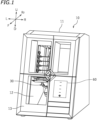
- FIG. 1 is a perspective view of a dental cutting machine 10 (hereinafter referred to simply as a "cutting machine 10") according to one embodiment.
- a direction away from the cutting machine 10 will be referred to as forward, and a direction toward the cutting machine 10 will be referred to as rearward.
- Left, right, up, and down respectively refer to left, right, up, and down when the cutting machine 10 is seen from the front.
- Characters F, Rr, L, R, U, and D in the drawings represent front, rear, left, right, up, and down, respectively.
- the cutting machine 10 is a cutting machine that performs machining on a disc-shaped machined object held by an adaptor.
- FIG. 2 is a plan view of a machined object 1 and an adaptor 5.
- the cutting machine 10 herein is a device that produces dental products such as crown prosthetics such as crowns, bridges, copings, inlays, onlays, veneers, and custom abutments, artificial teeth, denture bases, and other products, by cutting the machined object 1.
- the cutting machine 10 according to this embodiment is a dry-type cutting machine using no coolant.
- constituents of the machined object 1 include resins such as PMMA, PEEK, glass fiber reinforced resin, and hybrid resin, ceramic materials such as glass ceramic and zirconia, metal materials such as cobalt-chromium sintered metal, wax, and gypsum.
- resins such as PMMA, PEEK, glass fiber reinforced resin, and hybrid resin
- ceramic materials such as glass ceramic and zirconia
- metal materials such as cobalt-chromium sintered metal, wax, and gypsum.
- zirconia as a material for the machined object 1
- semi-sintered zirconia is used, for example.
- the machined object 1 herein has a disc (disk) shape.
- the machined object 1 may have another shape such as a block shape (e.g., cube or rectangular solid) .
- the adaptor 5 holds the disc-shaped machined object 1.
- the adaptor 5 herein is a flat-plate adaptor in which a substantially circular insertion hole 5a corresponding to the machined object 1 is formed at the center. The machined object 1 is inserted in the insertion hole 5a to be thereby held by the adaptor 5. The machined object 1 is housed in the cutting machine 10 and machined while being held by the adaptor 5.
- the cutting machine 10 includes a box-shaped casing 11.
- FIG. 3 is a longitudinal cross-sectional view of the cutting machine 10 when seen from the left.
- the cutting machine 10 includes a cutter 20 that holds a rod-shaped cutting tool 6 and rotates the cutting tool 6 about an axis, a workpiece holder 30 that holds a machined object 1 (see FIG. 2 ), a mover 40 that moves the cutter 20 and the workpiece holder 30 to thereby move the cutting tool 6 relative to the workpiece holder 30, and a controller 60 (see FIG. 1 ).
- the mover 40 includes a rotator 50 that changes orientation of the workpiece holder 30 relative to the cutting tool 6 in addition to a device that translates the cutter 20 relative to the workpiece holder 30.
- the cutter 20, the workpiece holder 30, the mover 40 including the rotator 50, and the controller 60 are housed in the casing 11.
- the cutter 20 includes the cutting tool 6 such that the axis thereof extends in predetermined Z-axis directions.
- the cutter 20 is an example of a tool holder that holds the cutting tool 6.
- the Z-axis directions herein are oblique top-bottom directions that tilt rearward.
- the workpiece holder 30 is located below the cutter 20.
- the workpiece holder 30 is located in a machining chamber 12 in which machining is performed on the machined object 1.
- a machining chamber door 13 is attached to a front opening portion of the machining chamber 12 to be freely opened and closed.
- the mover 40 includes a Z-axis direction mover 40Z that moves the cutter 20 in the Z-axis directions.
- the mover 40 further includes a Y-axis direction mover 40Y that moves the cutter 20 in Y-axis directions and an X-axis direction mover 40X that moves the workpiece holder 30 and the rotator 50 in X-axis directions.
- the X-axis directions are orthogonal to the Z-axis directions, and are herein oblique front-rear directions that tilt downward toward the rear.
- the Y-axis directions are orthogonal to the Z-axis directions and the X-axis directions, and are herein the left-right directions.
- the cutter 20 includes a main shaft 21 that grips and rotates the cutting tool 6.
- the main shaft 21 includes a spindle unit 22 and a gripper 23 located at a lower end portion of the spindle unit 22.
- the spindle unit 22 extends in the Z-axis directions.
- the spindle unit 22 rotates the gripper 23 about an axis parallel to the Z-axis directions.
- the spindle unit 22 is a unit incorporating a motor herein.
- the spindle unit 22 may be connected to, for example, an external motor by a belt or the like.
- the gripper 23 is, for example, an air-driven collet chuck.
- the type of the gripper 23 is not particularly limited.
- FIG. 4 is a plan view of the workpiece holder 30 and the rotator 50.
- the workpiece holder 30 includes a pair of left and rightward arms 31.
- the adaptor 5 is inserted between the pair of arms 31 to be thereby held by the workpiece holder 30.
- the workpiece holder 30 herein holds the machined object 1 through the adaptor 5.
- the workpiece holder 30 may directly hold the machined object 1 without intervention of other members.
- directions along which the rotation shaft 51B extends will be also referred to as B-axis directions, and rotation about the rotation shaft 51B will be also referred to rotation about the B axis.
- the B-axis directions are parallel to the Y-axis directions.
- the rotator 50B will be also referred to as a B-axis rotator 50B.
- the B-axis rotator 50B includes a B-axis rotation motor 52B (see FIG. 5 ) that rotates the rotation shaft 51B.
- the B-axis rotator 50B supports the A-axis rotator 50A, and rotates the A-axis rotator 50A about the B axis.
- the A-axis rotator 50A supports the workpiece holder 30, and rotates the workpiece holder 30 about the A axis.
- the rotation range of the A-axis rotator 50A is a full circumference (360 degrees), whereas the rotation range of the B-axis rotator 50B is smaller than 360 degrees.
- the angles of the rotation shaft 51A and the rotation shaft 51B at which one surface of the machined object 1 extends in the X-axis directions and the Y-axis directions (orthogonal to the Z-axis directions) in a machining program will be hereinafter referred to as 0 degrees. However, this designation is merely defined for convenience.
- the Z-axis direction mover 40Z supports the cutter 20 such that the cutter 20 is movable in the Z-axis directions.
- the Y-axis direction driving motor 43Y is driven, the ball screw rotates, and the Y-axis direction moving body 42Y, the Z-axis direction mover 40Z, and the cutter 20 move in the Y-axis directions along the Y-axis guide rails 41Y.
- the Z-axis direction mover 40Z also has a configuration similar to that of the Y-axis direction mover 40Y.
- the X-axis direction mover 40X is located at the right of a right wall 12R of the machining chamber 12.
- the X-axis direction mover 40X also includes guide rails extending in the X-axis directions, an X-axis direction moving body slidably engaged with the guide rails, an X-axis direction driving motor 43X (see FIG. 5 ), and a ball screw.
- the X-axis direction moving body supports the rotator 50. When the X-axis direction driving motor 43X is driven, the ball screw rotates, and the rotator 50 and the workpiece holder 30 move in the X-axis directions, together with the X-axis direction moving body.
- the configuration of the controller 60 is not particularly limited.
- the controller 60 is, for example, a microcomputer.
- a hardware configuration of the microcomputer is not particularly limited.
- the microcomputer may include, for example, an interface (I/F) that receives cutting data and other data from external equipment such as a host computer, a central processing unit (CPU) that executes an instruction of a control program, a read only memory (ROM) that stores programs to be executed by the CPU, a random access memory (RAM) that is used as a working area where programs are developed, and a storage such as a memory that stores the programs, the data, and so forth.
- I/F interface
- CPU central processing unit
- ROM read only memory
- RAM random access memory
- storage such as a memory that stores the programs, the data, and so forth.
- the machining controller 62 controls the cutter 20 and the mover 40 based on the machining program and causes the correction piece 100 to be machined.
- a measurement result of dimensions of a predetermined portion of the correction piece 100 is input to the input section 63.
- the calculator 64 calculates a correction value to be set in the mover 40 based on a result input to the input section 63.
- the corrector 65 sets the correction value calculated by the calculator 64 in the mover 40.
- the controller 60 may include other machining parts, but these parts are neither illustrated nor described herein.
- the cutting machine 10 may be configured such that a correction value calculated in an external unit based on measured dimensions of the correction piece 100 can be input to the cutting machine 10.
- a main part for calculating a correction value may be, for example, a calculator in which software for calculating a correction value is installed or an operator who performs correction work.
- a correction method for the cutting machine 10 includes: a program step of inputting a machining program of the correction piece 100 to the cutting machine 10; a mounting step of mounting a material (machined object 1 herein) for the correction piece 100 to the cutting machine 10 to which the machining program has been input; a machining step of machining the correction piece 100 from the material by the cutting machine 10 based on the machining program; a measurement step of measuring a dimension of a predetermined portion of the correction piece 100 machined in the machining step; a calculation step of calculating a correction value based on the dimension measured in the measurement step; and an input step of inputting the correction value calculated in the calculation step to the cutting machine 10.
- a main part or a method that performs each step is not particularly limited.
- the correction process of the cutting machine 10 includes a first stage including a first mounting step, a first machining step, a first measurement step, a first calculation step, and a first input step, and a second stage including a second mounting step, a second machining step, a second measurement step, a second calculation step, and a second input step.
- the second stage is performed after the first stage. First, the first stage will be described.
- FIG. 6 is a flowchart of the first stage.
- the first stage includes a program step S10, a first mounting step S11, a first machining step S12, a first measurement step S13, a first calculation step S14, and a first input step S15.
- the program step S10 is included in the first stage for convenience of the drawing, but does not need to be performed in every correction work, and basically only needs to be performed once.
- a machining program of the correction piece 100 is input to the cutting machine 10.
- the machining program includes a first machining program for machining a first correction piece 100A (see FIG. 7 ) produced in the first machining step S12, and a second machining program for machining a second correction piece 100B (see FIG. 11 ) from the first correction piece 100A in the second stage.
- a material for the correction piece 100 which is a disc-shaped machined object 1 attached to the adaptor 5 herein, is mounted to the cutting machine 10 to which the machining program of the correction piece 100 has been input.
- the material for the machined object 1 is preferably an easy-cutting material, for example, wax.
- the easy-cutting material refers to a material having high dimensional reproducibility after cutting and is less likely to cause wear on the cutting tool 6.
- Mounting orientation (bottom and top, front and rear, and left and right orientations) of the machined object 1 to the cutting machine 10 is not particularly limited.
- FIG. 7 is a plan view of the first correction piece 100A.
- FIG. 8 is a cross-sectional view of the first correction piece 100A. As illustrated in FIGS. 7 and 8 , in the first correction piece 100A, recesses 101Rr through 101L are machined in the 0 o'clock, 3 o'clock, 6 o'clock, and 9 o'clock positions, with the rearward direction along the X-axis directions considered as the 0 o'clock position.
- the recess in the 0 o'clock position will be also referred to as a rear recess 101Rr
- the recess in the 3 o'clock position will be also referred to as a right recess 101R
- the recess in the 6 o'clock position will be also referred to as a front recess 101F
- the recess in the 9 o'clock position will be also referred to as a left recess 101L.
- the right recess 101R is located rightward of the rotation shaft 51A (represented as the axis A in FIG.
- the right recess 101R and the left recess 101L herein are symmetrically located in the left-right direction with respect to the rotation shaft 51A.
- the front recess 101F is located forward of the rotation shaft 51B (represented as the axis B in FIG. 7 ) of the B-axis rotator 50B in the X-axis directions, and the rear recess 101Rr is located rearward of the rotation shaft 51B in the X-axis directions.
- the front recess 101F and the rear recess 101Rr are symmetrically located in the front-rear direction (symmetrically in the front-rear direction along the X-axis directions) with respect to the rotation shaft 51B.
- FIG. 8 is a longitudinal cross-sectional view of the first correction piece 100A taken along a plane passing through the right recess 101R and the left recess 101L and extending in the Z-axis directions.
- a bottom portion 102R of the right recess 101R and a bottom portion 102L of the left recess 101L are flat.
- the bottom portion 102R of the right recess 101R and the bottom portion 102L of the left recess 101L extend in the X-axis directions and the Y-axis directions, respectively.
- the cross section is not shown, similarly, the bottom portions of the front recess 101F and the rear recess 101Rr are also flat.
- a bottom-side right recess 103R and a bottom-side left recess 103L corresponding to the right recess 101R and the left recess 101L are formed on the bottom sides of the right recess 101R and the left recess 101L.
- a bottom portion 104R of the bottom-side right recess 103R and a bottom portion 104L of the bottom-side left recess 103L are also flat.
- the right pair of upper and lower bottom portions 102R and 104R defines an upper end and a lower end of an uncut portion between the bottom portions, and defines a thickness TR of the uncut portion.
- the left pair of upper and lower bottom portions 102L and 104L defines an upper end and a lower end of an uncut portion of the bottom portions, and defines a thickness TL of the uncut portion.
- the cross section is not shown, similar recesses are also formed on the bottom sides of the front recess 101F and the rear recess 101Rr.
- the first machining program forms one or more first flat surfaces extending in the X-axis directions and the Y-axis directions on each of one side and the other side of the rotation shaft 51A in the Y-axis directions (right side and left side herein) by the cutting tool 6 in a state where the workpiece holder 30 is held at a predetermined first angle about the rotation shaft 51A of the A-axis rotator 50A. Accordingly, the bottom portion 102R of the right recess 101R and the bottom portion 102L of the left recess 101L are formed as the first flat surfaces.
- the first machining program herein forms the first flat surfaces 102R and the 102L (bottom portions 102R and 102L) at the right and left of the rotation shaft 51A by the cutting tool 6 in a state where the workpiece holder 30 is held in a 0-degree position about the rotation shaft 51A.
- the first angle is not limited to 0 degrees.
- the first flat surfaces 102R and 102L (bottom portions 102R and 102L) only need to sandwich the rotation shaft 51A and do not need to be symmetrically located in the left-right direction with respect to the rotation shaft 51A.
- the first machining program forms second flat surfaces extending in the X-axis directions and the Y-axis directions on the bottom sides of the plurality of first flat surfaces by the cutting tool 6 in a state where the workpiece holder 30 is held at a second angle shifted from the first angle by 180 degrees.
- the bottom portion 104R of the bottom-side right recess 103R and the bottom portion 104L of the bottom-side left recess 103L are formed as the second flat surfaces.
- the first machining program herein forms the second flat surfaces 104R and 104L (bottom portions 104R and 104L) on the bottom sides of the first flat surfaces 102R and 102L (bottom portions 102R and 102L) by the cutting tool 6 in a state where the workpiece holder 30 is held in the 180-degree position about the rotation shaft 51A.
- the first machining program also forms the front recess 101F, the rear recess 101Rr, an unillustrated bottom-side front recess, and an unillustrated bottom-side rear recess in a similar manner.
- the rotation angle of the B-axis rotator 50B is set at 0 degrees.
- the work of turning over the machined object 1 is performed by rotation about the A axis by the A-axis rotator 50A.
- the thicknesses TR and TL are measured and a difference between the thicknesses is obtained, thereby calculating a shift of the rotation angle of the A-axis rotator 50A.
- a correction value for correcting the shift of the rotation angle of the A-axis rotator 50A is calculated.
- the correction value concerning the rotation angle of the A-axis rotator 50A calculated in the first calculation step S14 is input to the cutting machine 10.
- the terms "calculation" and "input” of a correction value can include automatic calculation and automatic input of a correction value by the cutting machine 10.
- the correction value includes a correction value concerning the rotation angle about the rotation shaft 51A of the A-axis rotator 50A, and this correction value is a correction value for eliminating a difference between the thicknesses TR and TL measured in the first measurement step S13.
- This correction value is set in the cutting machine 10 so that a shift of the rotation angle about the rotation shaft 51A of the A-axis rotator 50A can be thereby corrected.
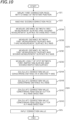
- FIG. 10 is a flowchart of the second stage.
- the second stage includes a second mounting step S21, a second machining step S22, a second measurement step S23, a second calculation step S24, and a second input step S25.
- the cutting machine 10 obtains the second correction piece 100B from the first correction piece 100A by machining.
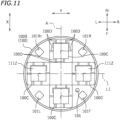
- FIG. 11 is a plan view of the second correction piece 100B.
- the front measurement piece 100C and the rear measurement piece 100C are symmetrically located in the front-rear direction (front-rear direction along the X-axis directions) with respect to the rotation shaft 51B (represented as the line L1 in FIG. 11 ).
- the measurement pieces 100C are separated from the disc by cutting a support 100D. Although not shown, identification signs are machined on the four measurement pieces 100C.
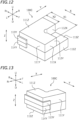
- FIG. 12 is a perspective view of the measurement piece 100C seen from the front.
- FIG. 13 is a perspective view of the measurement piece 100C seen from the rear.
- the measurement pieces 100C includes two planes 111X and 112X having different coordinates in the X-axis directions and each extending in the Y-axis directions and the Z-axis directions. These two planes will be hereinafter referred to as a first measurement surface 111X in the X-axis directions and a second measurement surface 112X in the X-axis directions.
- a coordinate of the first measurement surface 111X in the X-axis directions is a first X coordinate
- a coordinate of the second measurement surface 112X in the X-axis directions is a second X coordinate.
- the second machining program forms the first measurement surface 111X whose coordinate in the X-axis directions is the first X coordinate and the second measurement surface 112X whose coordinate in the X-axis directions is the second X coordinate by the cutting tool 6 on the second correction piece 100B.
- the measurement piece 100C in a manner similar to the X-axis directions, in the Y-axis directions, the measurement piece 100C includes two planes 111Y and 112Y having different coordinates in the Y-axis directions and each extending in the X-axis directions and the Z-axis directions. These two planes will be hereinafter referred to as a first measurement surface 111Y in the Y-axis directions and a second measurement surface 112Y in the Y-axis directions.
- a coordinate of the first measurement surface 111Y in the Y-axis directions is a first Y coordinate
- a coordinate of the second measurement surface 112Y in the Y-axis directions is a second Y coordinate.
- the second machining program forms the first measurement surface 111Y whose coordinate in the Y-axis directions is the first Y coordinate and the second measurement surface 112Y whose coordinate in the Y-axis directions is the second Y coordinate by the cutting tool 6 on the second correction piece 100B.
- the measurement piece 100C includes a first measurement surface 111Z, a second measurement surface 112Z, and a third measurement surface 113Z having different coordinates in the Z-axis directions and each extending in the X-axis directions and the Y-axis directions.
- a coordinate of the first measurement surface 111Z in the Z-axis directions is a first Z coordinate
- a coordinate of the second measurement surface 112Z in the Z-axis directions is a second Z coordinate
- a coordinate of the third measurement surface 113Z in the Z-axis directions is a third Z coordinate.
- the second machining program forms the second measurement surface 112Z whose coordinate in the Z-axis directions is the second Z coordinate by the cutting tool 6 in a state where the workpiece holder 30 is held in the 180-degree position shifted from the 0-degree position by 180 degrees.
- the second measurement surface 112Z is formed in a state where the workpiece holder 30 reversely rotates about the A axis by 180 degrees from the state in forming the first measurement surface 111Z and the third measurement surface 113Z.
- the first Z coordinate and the second Z coordinate may be the same coordinate as long as these coordinates are seen as coordinates in the Z-axis directions. However, the first measurement surface 111Z and the second measurement surface 112Z formed on the measurement piece 100C are located at different positions in the Z-axis directions.
- the second machining program forms the second inspection surface 114Y extending in the Z-axis directions by the cutting tool 6 on the second correction piece 100B in a state where the workpiece holder 30 is held at an angle shifted from the predetermined angle by 180 degrees and is held in the predetermined position in the Y-axis directions (the same position as when the first inspection surface 113Y is formed). That is, the first inspection surface 113Y and the second inspection surface 114Y are formed with the workpiece holder 30 inversely rotated about the A axis.
- the first inspection surface 113Y and the second inspection surface 114Y are flush with each other. If the position of the Y-axis origin relative to the rotation shaft 51A of the A-axis rotator 50A is shifted, in the second correction piece 100B, a shift occurs between the position of the first inspection surface 113Y in the Y-axis directions and the position of the second inspection surface 114Y in the Y-axis directions. As a result, a step occurs between the first inspection surface 113Y and the second inspection surface 114Y.
- a correction value concerning a distance in the X-axis directions, a correction value concerning a distance in the Y-axis directions, a correction value concerning a distance in the Z-axis directions, a correction value concerning a position of the cutter 20 in the Z-axis directions relative to the rotation shaft 51A of the A-axis rotator 50A, and a correction value concerning a position of the cutter 20 in the Y-axis directions relative to the rotation shaft 51A are calculated.
- step S24A the step of calculating a correction value concerning a distance in the X-axis directions and a correction value concerning a distance in the Y-axis directions
- step S24B The step of calculating a correction value concerning a distance in the Z-axis directions
- step S24C and step S24D The step of calculating a correction value concerning a position of the cutter 20 in the Y-axis directions relative to the rotation shaft 51A.
- the correction values concerning the distances in the X-axis directions and the Y-axis directions in step S24A are herein calculated after correction concerning the rotation angle of the A-axis rotator 50A.
- the correction concerning the rotation angle of the A-axis rotator 50A is performed in the first input step S15 in the first stage.
- the correction values concerning the distances in the X-axis directions and the Y-axis directions do not depend on accuracy of the rotation angle of the A-axis rotator 50A, and thus, the correction values concerning the distances in the X-axis directions and the Y-axis directions may be calculated before correction concerning the rotation angle of the A-axis rotator 50A.
- the steps are performed in the order described above to perform the machining step through the input step as efficiently as possible.
- step S24A a correction value for adjusting the distance between the first measurement surface 111X and the second measurement surface 112X in the machining program to an actually measured value of the distance between the first measurement surface 111X and the second measurement surface 112X (X1-X2 in the case illustrated in FIG. 12 ) is calculated.
- the distance between the first measurement surface 111X and the second measurement surface 112X in the machining program is, in other words, a difference in coordinate value between the first X coordinate and the second X coordinate.
- the correction value of the distance in the X-axis directions is a correction value for adjusting the difference in coordinate value between the first X coordinate and the second X coordinate to the distance measured in the second measurement step S23.
- step S24B a process similar to that in step S24A is performed for the Z-axis directions.
- step S24B a correction value for adjusting a distance between the first measurement surface 111Z and the third measurement surface 113Z in the machining program to an actually measured value of the distance between the first measurement surface 111Z and the third measurement surface 113Z is calculated.
- the correction value concerning the distance in the Z-axis directions does not depend on accuracy of the rotation angle of the A-axis rotator 50A, either.
- the correction value concerning the distance in the Z-axis directions may also be calculated before correction concerning the rotation angle of the A-axis rotator 50A.
- a correction value concerning the position of the cutter 20 in the Z-axis directions relative to the rotation shaft 51A is calculated.
- the correction value concerning the position of the cutter 20 in the Z-axis directions is preferably calculated after correction concerning the angle of the workpiece holder 30 and correction of the distance in the Z-axis directions, as in this embodiment. Calculation of the correction value concerning the position of the cutter 20 in the Z-axis directions may be performed independently of correction of the distance in the Z-axis directions.
- FIG. 14 is a schematic value illustrating a case where the position of the cutter 20 in the Z-axis directions relative to the rotation shaft 51A is shifted. As illustrated in FIG.
- the first measurement surface 111Z is located above the position in the machining program (indicated by chain double-dashed lines) in the Z-axis directions by Z1.
- the correction value concerning the position of the cutter 20 in the Z-axis directions is the amount of shift of the origin position in the Z-axis directions.
- the second measurement surface 112Z is also located above the position in the machining program by Z1 in the Z-axis directions (where the second measurement surface 112Z is located below the position in the machining program in FIG. 14 ).
- step S24D a correction value concerning the position of the cutter 20 in the Y-axis directions relative to the rotation shaft 51A is calculated.
- the correction value concerning the position of the cutter 20 in the Y-axis directions is preferably obtained after correction concerning the distance in the Y-axis directions in step S24A, as in this embodiment.
- Calculation of the correction value concerning the position of the cutter 20 in the Y-axis directions may be performed independently of correction of the distance in the Y-axis directions.
- FIG. 15 is a schematic view illustrating a case where the position of the cutter 20 in the Y-axis directions relative to the rotation shaft 51A is shifted.
- a coordinate of the rotation shaft 51A in the Y-axis directions coincides with the origin coordinate in the Y-axis directions (represented as the Z axis in FIG. 15 ).
- the coordinate position in the Y-axis directions relative to the second correction piece 100B changes between the state where the rotation shaft 51A is located in the 0-degree position and the state where the rotation shaft 51A is located in the 180-degree position.
- step S24D from an actually measured value Y1 of a step between the first inspection surface 113Y and the second inspection surface 114Y having the same coordinate in the Y-axis directions, a shift of the origin position in the Y-axis directions relative to the rotation shaft 51A is calculated.
- the correction value herein is equal to a half Y1/2 of a measured dimension Y1 of the step.
- the correction value is the amount of shift of the origin position in the Y-axis directions.
- the correction value concerning the position of the cutter 20 in the Y-axis directions is a correction value for eliminating the shift measured in step S23D.
- step S25 the correction value calculated in the second calculation step S24 is input to the cutting machine 10.
- the distance in the X-axis directions, the distance in the Y-axis directions, the distance in the Z-axis directions, the position of the cutter 20 in the Z-axis directions relative to the rotation shaft 51A, and the position of the cutter 20 in the Y-axis directions relative to the rotation shaft 51A are corrected.
- This configuration enables a product as designed according to the machining program can be produced again.
- the cutting machine and the correction method of the cutting machine according to one embodiment have been described above.
- the technique disclosed here can be carried out as other embodiments.
- the shape of the correction pieces and the correction work described above are merely examples, and can change depending on the configuration of the cutting machine.
- correction of portions that may include errors and correction of portions where errors are less likely to occur may be omitted.
- Correction not performed in the embodiment described above may be performed when it is preferable to perform the correction in consideration of the configuration of the cutting machine.
- the configuration of the cutting machine is not particularly limited.
- the A-axis rotator 50A and the B-axis rotator 50B are mounted on the X-axis direction moving body and moves along the X-axis directions together with the X-axis direction moving body.
- the origin position in the X-axis directions relative to the A-axis rotator 50A is less likely to be shifted, and does not need correction.
- the A-axis rotator and the B-axis rotator may not be moved by the X-axis direction mover.
- the A-axis rotator and the B-axis rotator may be fixed and the cutting tool may move also in the X-axis directions. In this case, the origin position in the X-axis directions relative to the rotation shaft (e.g., rotation shaft 51B) of the rotator may be corrected.
- the rotator may not change orientation of the workpiece holder and may change orientation of the cutting tool.
- the embodiment does not limit the present invention.
- the machined object may not be held by the cutting machine through the adaptor, and may be held directly by the cutting machine.
- the machined object as a material for the correction piece may not be a disk-shaped disc.
Landscapes
- Health & Medical Sciences (AREA)
- Engineering & Computer Science (AREA)
- General Health & Medical Sciences (AREA)
- Animal Behavior & Ethology (AREA)
- Veterinary Medicine (AREA)
- Public Health (AREA)
- Life Sciences & Earth Sciences (AREA)
- Oral & Maxillofacial Surgery (AREA)
- Dentistry (AREA)
- Epidemiology (AREA)
- Manufacturing & Machinery (AREA)
- Physics & Mathematics (AREA)
- Human Computer Interaction (AREA)
- Automation & Control Theory (AREA)
- General Physics & Mathematics (AREA)
- Numerical Control (AREA)
- Milling Processes (AREA)
- Automatic Control Of Machine Tools (AREA)
- Instructional Devices (AREA)
Applications Claiming Priority (2)
| Application Number | Priority Date | Filing Date | Title |
|---|---|---|---|
| JP2022075072A JP7839683B2 (ja) | 2022-04-28 | 2022-04-28 | 歯科用切削加工機の補正方法および歯科用切削加工機 |
| PCT/JP2023/015668 WO2023210467A1 (fr) | 2022-04-28 | 2023-04-19 | Procédé de correction pour une machine de coupe dentaire et machine de coupe dentaire |
Publications (2)
| Publication Number | Publication Date |
|---|---|
| EP4517455A1 true EP4517455A1 (fr) | 2025-03-05 |
| EP4517455A4 EP4517455A4 (fr) | 2025-08-13 |
Family
ID=88518651
Family Applications (1)
| Application Number | Title | Priority Date | Filing Date |
|---|---|---|---|
| EP23796209.7A Pending EP4517455A4 (fr) | 2022-04-28 | 2023-04-19 | Procédé de correction pour une machine de coupe dentaire et machine de coupe dentaire |
Country Status (4)
| Country | Link |
|---|---|
| US (1) | US20250041032A1 (fr) |
| EP (1) | EP4517455A4 (fr) |
| JP (1) | JP7839683B2 (fr) |
| WO (1) | WO2023210467A1 (fr) |
Families Citing this family (1)
| Publication number | Priority date | Publication date | Assignee | Title |
|---|---|---|---|---|
| KR102825713B1 (ko) * | 2025-01-09 | 2025-06-25 | 김은석 | 임플란트용 어버트먼트 가공 장치 및 방법 |
Family Cites Families (4)
| Publication number | Priority date | Publication date | Assignee | Title |
|---|---|---|---|---|
| US20150320524A1 (en) * | 2014-05-06 | 2015-11-12 | Custom Automated Prosthetics, LLC | Cnc machine calibration |
| DE102017124536A1 (de) | 2017-10-20 | 2019-04-25 | Homag Gmbh | Verfahren zum Betrieb zumindest einer Bearbeitungsvorrichtung sowie Bearbeitungsanlage |
| JP2021170230A (ja) | 2020-04-15 | 2021-10-28 | Dgshape株式会社 | 切削加工機および収容部の位置座標の補正方法、並びにコンピュータプログラム |
| JP7493381B2 (ja) | 2020-05-12 | 2024-05-31 | Dgshape株式会社 | 切削加工機 |
-
2022
- 2022-04-28 JP JP2022075072A patent/JP7839683B2/ja active Active
-
2023
- 2023-04-19 WO PCT/JP2023/015668 patent/WO2023210467A1/fr not_active Ceased
- 2023-04-19 EP EP23796209.7A patent/EP4517455A4/fr active Pending
-
2024
- 2024-10-23 US US18/924,007 patent/US20250041032A1/en active Pending
Also Published As
| Publication number | Publication date |
|---|---|
| WO2023210467A1 (fr) | 2023-11-02 |
| JP7839683B2 (ja) | 2026-04-02 |
| JP2023163869A (ja) | 2023-11-10 |
| US20250041032A1 (en) | 2025-02-06 |
| EP4517455A4 (fr) | 2025-08-13 |
Similar Documents
| Publication | Publication Date | Title |
|---|---|---|
| EP2325711A1 (fr) | Procédé de commande d'une machine outil | |
| CN102608955B (zh) | 五轴控制机床的控制装置和控制方法、模具 | |
| US7824183B2 (en) | Measured object mounting tool and production method of three-dimensional shape data of dental prosthesis using that tool | |
| KR20200096832A (ko) | 창성 기계 가공 공구를 측정하기 위한 방법 및 장치 | |
| JP2002320626A (ja) | 歯科医療加工物を製造するための切削/研削機 | |
| CN108073132A (zh) | 用于补偿多轴制造系统的系统和方法 | |
| US7204032B2 (en) | Production method of three-dimensional shape data of dental prosthesis | |
| EP3566809B1 (fr) | Dispositif d'usinage et procédé de détermination de valeur de correction | |
| US20250041032A1 (en) | Correction method for dental cutting machine, and dental cutting machine | |
| US7518329B2 (en) | Method and device for cutting freeform surfaces by milling | |
| JP2020183007A (ja) | 切削加工機および補正方法 | |
| CN112045443A (zh) | 一种四轴机床偏心装夹工件加工方法 | |
| JP2005309673A (ja) | Nc工作機械および補正加工方法 | |
| WO2000078503A1 (fr) | Procede de traitement d'une reproduction, par exemple un appareil de prothese dentaire | |
| JP2014074956A (ja) | 並進回転誤差補正量作成装置 | |
| JP7835060B2 (ja) | 歯車加工方法 | |
| CN118922789A (zh) | 被加工物的加工方法及被加工物的加工系统 | |
| EP4559432A1 (fr) | Dispositif et procédé de traitement de dent artificielle | |
| JP2020183006A (ja) | 切削加工機および原点の設定方法 | |
| JP7233947B2 (ja) | デンタル加工機のエラー履歴表示システム | |
| KR20180034897A (ko) | 3d 치아 형상 보철물 데이터 정합 및 보철물 마진 자동생성과 형성 데이터 보간 방법 | |
| CN109108728B (zh) | 一种五轴cnc精度调整方法 | |
| US20250224706A1 (en) | Computer-implemented method and manufacturing system for manufacturing by machining an ophthalmic device | |
| JP2005122332A (ja) | 自由曲面加工装置及び自由曲面加工方法 | |
| CN115106835B (zh) | 一种试切试找四轴旋转中心方法 |
Legal Events
| Date | Code | Title | Description |
|---|---|---|---|
| STAA | Information on the status of an ep patent application or granted ep patent |
Free format text: STATUS: THE INTERNATIONAL PUBLICATION HAS BEEN MADE |
|
| PUAI | Public reference made under article 153(3) epc to a published international application that has entered the european phase |
Free format text: ORIGINAL CODE: 0009012 |
|
| STAA | Information on the status of an ep patent application or granted ep patent |
Free format text: STATUS: REQUEST FOR EXAMINATION WAS MADE |
|
| 17P | Request for examination filed |
Effective date: 20241023 |
|
| AK | Designated contracting states |
Kind code of ref document: A1 Designated state(s): AL AT BE BG CH CY CZ DE DK EE ES FI FR GB GR HR HU IE IS IT LI LT LU LV MC ME MK MT NL NO PL PT RO RS SE SI SK SM TR |
|
| DAV | Request for validation of the european patent (deleted) | ||
| DAX | Request for extension of the european patent (deleted) | ||
| A4 | Supplementary search report drawn up and despatched |
Effective date: 20250716 |
|
| RIC1 | Information provided on ipc code assigned before grant |
Ipc: G05B 19/404 20060101AFI20250710BHEP Ipc: A61C 13/38 20060101ALI20250710BHEP Ipc: G05B 19/401 20060101ALI20250710BHEP Ipc: A61C 13/00 20060101ALI20250710BHEP Ipc: A61C 13/12 20060101ALI20250710BHEP Ipc: B23Q 15/22 20060101ALN20250710BHEP Ipc: B23Q 17/20 20060101ALN20250710BHEP |
|
| GRAP | Despatch of communication of intention to grant a patent |
Free format text: ORIGINAL CODE: EPIDOSNIGR1 |
|
| STAA | Information on the status of an ep patent application or granted ep patent |
Free format text: STATUS: GRANT OF PATENT IS INTENDED |
|
| RIC1 | Information provided on ipc code assigned before grant |
Ipc: G05B 19/404 20060101AFI20260402BHEP Ipc: A61C 13/38 20060101ALI20260402BHEP Ipc: G05B 19/401 20060101ALI20260402BHEP Ipc: A61C 13/00 20060101ALI20260402BHEP Ipc: A61C 13/12 20060101ALI20260402BHEP Ipc: B23Q 15/22 20060101ALN20260402BHEP Ipc: B23Q 17/20 20060101ALN20260402BHEP |
|
| RIC1 | Information provided on ipc code assigned before grant |
Ipc: G05B 19/404 20060101AFI20260415BHEP Ipc: A61C 13/38 20060101ALI20260415BHEP Ipc: G05B 19/401 20060101ALI20260415BHEP Ipc: A61C 13/00 20060101ALI20260415BHEP Ipc: A61C 13/12 20060101ALI20260415BHEP Ipc: B23Q 15/22 20060101ALN20260415BHEP Ipc: B23Q 17/20 20060101ALN20260415BHEP |
|
| INTG | Intention to grant announced |
Effective date: 20260422 |
|
| GRAS | Grant fee paid |
Free format text: ORIGINAL CODE: EPIDOSNIGR3 |