EP4517293A1 - Verfahren zur beurteilung von verzögerten brucheigenschaften einer formkomponente und verfahren zur herstellung einer formkomponente - Google Patents
Verfahren zur beurteilung von verzögerten brucheigenschaften einer formkomponente und verfahren zur herstellung einer formkomponente Download PDFInfo
- Publication number
- EP4517293A1 EP4517293A1 EP23811877.2A EP23811877A EP4517293A1 EP 4517293 A1 EP4517293 A1 EP 4517293A1 EP 23811877 A EP23811877 A EP 23811877A EP 4517293 A1 EP4517293 A1 EP 4517293A1
- Authority
- EP
- European Patent Office
- Prior art keywords
- stress
- delayed fracture
- strain
- formed component
- forming
- Prior art date
- Legal status (The legal status is an assumption and is not a legal conclusion. Google has not performed a legal analysis and makes no representation as to the accuracy of the status listed.)
- Pending
Links
Images



Classifications
-
- G—PHYSICS
- G01—MEASURING; TESTING
- G01N—INVESTIGATING OR ANALYSING MATERIALS BY DETERMINING THEIR CHEMICAL OR PHYSICAL PROPERTIES
- G01N3/00—Investigating strength properties of solid materials by application of mechanical stress
- G01N3/20—Investigating strength properties of solid materials by application of mechanical stress by applying steady bending forces
-
- G—PHYSICS
- G01—MEASURING; TESTING
- G01N—INVESTIGATING OR ANALYSING MATERIALS BY DETERMINING THEIR CHEMICAL OR PHYSICAL PROPERTIES
- G01N3/00—Investigating strength properties of solid materials by application of mechanical stress
- G01N3/08—Investigating strength properties of solid materials by application of mechanical stress by applying steady tensile or compressive forces
-
- G—PHYSICS
- G01—MEASURING; TESTING
- G01N—INVESTIGATING OR ANALYSING MATERIALS BY DETERMINING THEIR CHEMICAL OR PHYSICAL PROPERTIES
- G01N2203/00—Investigating strength properties of solid materials by application of mechanical stress
- G01N2203/0014—Type of force applied
- G01N2203/0016—Tensile or compressive
- G01N2203/0017—Tensile
-
- G—PHYSICS
- G01—MEASURING; TESTING
- G01N—INVESTIGATING OR ANALYSING MATERIALS BY DETERMINING THEIR CHEMICAL OR PHYSICAL PROPERTIES
- G01N2203/00—Investigating strength properties of solid materials by application of mechanical stress
- G01N2203/0014—Type of force applied
- G01N2203/0023—Bending
-
- G—PHYSICS
- G01—MEASURING; TESTING
- G01N—INVESTIGATING OR ANALYSING MATERIALS BY DETERMINING THEIR CHEMICAL OR PHYSICAL PROPERTIES
- G01N2203/00—Investigating strength properties of solid materials by application of mechanical stress
- G01N2203/0058—Kind of property studied
- G01N2203/006—Crack, flaws, fracture or rupture
- G01N2203/0067—Fracture or rupture
-
- G—PHYSICS
- G01—MEASURING; TESTING
- G01N—INVESTIGATING OR ANALYSING MATERIALS BY DETERMINING THEIR CHEMICAL OR PHYSICAL PROPERTIES
- G01N2203/00—Investigating strength properties of solid materials by application of mechanical stress
- G01N2203/0058—Kind of property studied
- G01N2203/0069—Fatigue, creep, strain-stress relations or elastic constants
- G01N2203/0075—Strain-stress relations or elastic constants
-
- G—PHYSICS
- G01—MEASURING; TESTING
- G01N—INVESTIGATING OR ANALYSING MATERIALS BY DETERMINING THEIR CHEMICAL OR PHYSICAL PROPERTIES
- G01N2203/00—Investigating strength properties of solid materials by application of mechanical stress
- G01N2203/02—Details not specific for a particular testing method
- G01N2203/026—Specifications of the specimen
- G01N2203/0262—Shape of the specimen
- G01N2203/027—Specimens with holes or notches
-
- G—PHYSICS
- G01—MEASURING; TESTING
- G01N—INVESTIGATING OR ANALYSING MATERIALS BY DETERMINING THEIR CHEMICAL OR PHYSICAL PROPERTIES
- G01N2203/00—Investigating strength properties of solid materials by application of mechanical stress
- G01N2203/02—Details not specific for a particular testing method
- G01N2203/026—Specifications of the specimen
- G01N2203/0262—Shape of the specimen
- G01N2203/0278—Thin specimens
- G01N2203/0282—Two dimensional, e.g. tapes, webs, sheets, strips, disks or membranes
Definitions
- the present invention is a technology of assessing the delayed fracture characteristics in a sheared end surface of a formed component manufactured by forming, such as press forming.
- the present invention is a technology related to a method for assessing the delayed fracture characteristics of a formed component and a method for manufacturing a formed component using the method.
- an end surface obtained by applying shearing processing to a metal sheet is referred to as the sheared end surface.
- the present invention is a technology suitable particularly for formed components containing high-strength steel sheets having a tensile strength of 980 MPa or more (high-tensile strength steel sheets).
- steel sheets having a tensile strength of 1470 MPa or more among the high-strength steel sheets are referred to as ultrahigh-strength steel sheets.
- the high-strength steel sheets are used for the vehicle body.
- the high-strength steel sheets having a tensile strength of 980 MPa or more have begun to be applied to the vehicle body.
- a delayed fracture is mentioned.
- the delayed fracture occurring from the sheared end surface is a significant problem.
- the sheared end surface is an end surface after shearing processing. This problem is particularly problematic in the ultrahigh-strength steel sheets having a tensile strength 1470 MPa or more among the high-strength steel sheets.
- PTL 1 assesses the occurrence of the delayed fracture as follows. More specifically, PTL 1 applies compression processing in the sheet thickness direction by rolling to the sheared end surface of the test piece. Thereafter, the test piece is placed in a hydrogen entry environment, and the occurrence of the delayed fracture is assessed.
- a test is supposed in which the sheared end surface kept as-sheared is placed in a hydrogen entry environment under no load. Even when the delayed fracture does not occur in this test, the delayed fracture sometimes occurs when the test is performed while a stress is being applied from the outside. This is because a load stress from the outside is added to the large tensile stress remaining in the sheared end surface. Therefore, in PTL 2, for example, a constant load by tension is loaded to an assessment sample including the sheared end surface, the assessment sample is placed in a hydrogen entry environment in a restrained state, and the delayed fracture characteristics are assessed.
- a test piece is placed in a hydrogen environment in a state where a load by bending is being loaded to the test piece, and the delayed fracture characteristics are assessed.
- the sheared end surface is not targeted, and the principal object is to assess the delayed fracture characteristics in the front surface of the test piece. Therefore, in PTL 3, the front surface of the sheared end surface of an assessment sample is sealed by a resin coating, and the sheared end surface is excluded from an assessment target.
- the present inventors have conducted various examinations and obtained the following findings. More specifically, the present inventors have obtained a finding that there is another problem with prediction or prevention of the occurrence of the delayed fracture based on these delayed fracture assessment techniques for actual automotive components.
- the introduction of a strain by rolling as in PTL 1 has the following problem. More specifically, there is such a problem that the introduction of a strain by rolling as in PTL 1 deviates from a deformation state in a forming strain introduced by press forming, which is used for automotive components. In the press forming, uniaxial tension and compression and a bending deformation by a combination of the uniaxial tension and compression are introduced into the sheared end surface. Therefore, the assessment technique as in PTL 1 does not achieve sufficient assessment. PTLS 2, 3 do not consider changes in the delayed fracture characteristics by plastic deformation after shearing processing of the sheared end surface. Therefore, the assessment is not sufficient as a delayed fracture assessment in formed components where various forming strains are generated in the sheared end surface.
- the viewpoint is the degree of margin in the conditions of the hydrogen entry environment or the stress with respect to the occurrence of the delayed fracture, as compared with the hydrogen entry environment or the stress in actual automotive components.
- the present inventors have obtained the following finding. More specifically, in the actual automotive components, forming strains different among the formation places of the sheared end surfaces are introduced into a metal sheet to be processed. The present inventors have obtained a finding that the forming strain causes a change in the delayed fracture characteristics by plastic deformation. Further, the present inventors have obtained a finding that, in the sheared end surface, a load stress after press forming is added to a residual stress by shearing, so that the delayed fracture is likely to occur.
- the present inventors have obtained the following finding. More specifically, a case is supposed in which a forming residual stress is loaded to the sheared end surface into which a forming strain is introduced in a certain hydrogen entry environment. In this case, the present inventors have obtained a finding that it is very important to assess the degree of margin to the occurrence of the delayed fracture in the sheared end surface of a formed component. More specifically, the present inventors have obtained a finding that such an assessment is very important in avoiding the delayed fracture in the sheared end surfaces in automotive components.
- the sheared end surface properties change by plastic deformation by press forming in automotive components.
- the present invention focuses on the above-described point and aims to enable a more accurate assessment of the delayed fracture characteristics in the sheared end surface in the formed components in use.
- the present invention aims to enable the manufacture of formed components in which the delayed fracture is suppressed.
- one aspect of the present invention is a method for assessing delayed fracture characteristics of a formed component for assessing the delayed fracture characteristics in a sheared end surface of a formed component, the formed component being manufactured by forming a metal sheet containing a high-strength steel sheet and being assembled to another component for use, the method including: a first step of determining a stress margin being an allowance value of an external load stress, in which a delayed fracture in a sheared surface of the metal sheet does not occur, with an amount of strain as a variable based on results of a test including a step of restraining the metal sheet in a state where a predetermined load stress is loaded to the sheared surface of the metal sheet and a step of placing the metal sheet for a predetermined time in a predetermined hydrogen entry environment in the restrained state; a second step of performing forming analysis of forming the metal sheet into the formed component and determining a residual stress and the amount of strain in the sheared end surface of the formed component generated when the metal sheet is
- the forming is press forming, for example.
- the aspect of the present invention more accurately assesses the delayed fracture characteristics in the sheared end surface in the formed component in a state of being placed in a use environment. As a result, the formed component in which the delayed fracture is suppressed can be manufactured.
- the stress margin that is an index of the delayed fracture assessment has a stress as a unit and enables the assessment from the viewpoint of the margin by stress. Therefore, when the high-strength steel sheets are applied to various components, such as panel components and structural and frame components, of automobiles, for example, the following can be achieved. More specifically, the aspect of the present invention enables the prediction of the occurrence of the delayed fracture for the formed component, including the margin having a stress dimension.
- the aspect of the present invention enables a reduction in weight of an automobile body by expanding the application range of ultrahigh-strength steel sheets, for example.
- the present inventors have found the following findings (1) to (3) in assessing the delayed fracture in a sheared end surface.
- the present disclosure defines the allowance of the external load stress, in which the delayed fracture does not occur, corresponding to the amount of strain possessed by the sheared end surface as the "stress margin".
- FIGS. 1A and 1B illustrate conceptual views for explaining (1) to (3) above.
- FIG. 1A illustrates the state of the load stress at the limit when no forming strain is applied, for a metal sheet having a sheared end surface formed by shearing an end part.
- FIG. 1B illustrates the state of the load stress at the limit when the forming strain is applied after the sheared end surface is formed.
- FIGS. 1A and 1B illustrate examples of a case where the residual stress decreases by applying the forming strain to the metal sheet before the metal sheet is press formed.
- the delayed fracture occurs when the total of the residual stress by shearing and the load stress from the outside reaches the threshold for the occurrence of the delayed fracture. Accordingly, when the residual stress of the sheared end surface changes by the forming strain, the limit load stress in which the delayed fracture occurs also changes.
- the limit load stress is a difference between the residual stress of the sheared end surface and the threshold for the occurrence of the delayed fracture, and is the external load stress at the limit where the sheared end surface does not cause the delayed fracture.
- the index of the stress margin is prescribed as follows. More specifically, the present disclosure defines the allowance of the external load stress in which the delayed fracture does not occur considering the forming strain to be applied in the sheared end surface as the "stress margin". More specifically, this embodiment prescribes the allowance of the external load stress by the index of the stress margin with the forming strain as a variable.
- the residual stress in the sheared end surface by shearing is present only in a very small region of the extremely surface layer about 100 ⁇ m from the front surface of the sheared end surface. Therefore, changes in the residual stress are difficult to calculate by common CAE using a shell element or the like. Stress in microscopic regions can be measured by X-ray stress measurement or the like. However, there are such a problem that the measured value changes depending on the measurement range and such a problem that the measurement depth is limited to the top layer of a material. Accordingly, the large or small of the measured value sometimes does not necessarily correspond to a risk of the delayed fracture.
- the correspondence can be achieved by the use of a technique of experimentally determining the "stress margin" above with the forming strain as a variable by a delayed fracture test in a stress loaded state. More specifically, an index for directly assessing the risk of the delayed fracture can be obtained for a formed component without causing such problems with the calculation and the measurement.
- the stress margin itself can be regarded as the margin until the occurrence of the delayed fracture in the sheared end surfaces of the automotive components.
- the stress margin has the stress as the unit, and is expressed by the stress. Therefore, the stress margin can be presumed even when the external load stress to be applied to components in assembly, use, or the like, is added, in addition to the residual stress by the forming of the components. More specifically, it can be presumed that the delayed fracture does not occur unless the stress margin is exceeded.
- the index of the stress margin that is the allowance of the external load stress in which the delayed fracture does not occur and that corresponds to the amount of strain is simple.
- the index is an excellent assessment index of the delayed fracture, the index which allows the assessment as the margin having a stress dimension.
- the technique has a problem with the addition of the external load stress by the deformation of components in assembly or in use, for example, to the residual stress by the forming of the components described above. More specifically, the technique is less useful in that the assessment of the margin is impossible as compared with a case of using the stress as the standard.
- the forming strain above is a strain in the extension direction of the sheared surface.
- the limit load stress in which the delayed fracture occurs is determined by changing the amount of the forming strain applied to the metal sheet after shearing processing, loading stress to the metal sheet, and setting the metal sheet under a hydrogen environment. This makes it possible to set the stress margin as a function of the amount of the forming strain.
- a uniaxial tensile deformation or a uniaxial compressive deformation is desirable. This is for the following reasons.
- springback after forming results in almost zero residual stress after forming in a portion other than the sheared end surface. Thus, it is because the influence is negligible.
- the application of the forming strain by the uniaxial tension or compression is advantageous in the following point. More specifically, the external load stress at the limit where the delayed fracture occurs in the sheared end surface after additional processing can be assessed as the "stress margin" as it is, which is the simplest.
- test piece obtained by laboratory-like shearing may be used.
- the sheared end surface of a formed component after press forming may be partially cut out.
- the present inventors have devised the following technique as a method for assessing and predicting the occurrence of the delayed fracture in the sheared end surface in formed components with automobile components in mind using the "stress margin" thus obtained.
- An example of the technique is described in the first to third items below.
- a test is applied using by methods (4) and (5) above to a test piece, and the stress margin corresponding to the amount of strain by tension and compression is measured. Then, the stress margin with the amount of strain as a variable is determined.
- the hydrogen entry environment and the placement time in the environment are preferably set to such conditions that the amount of hydrogen entering the test piece is the target hydrogen entry amount.
- the target hydrogen entry amount is the amount of entering hydrogen preset as the allowable upper limit in actual automotive components.
- the amount of strain of the forming strain to be applied to the sheared end surface is preferably set to 0.1% or more considering the amount having sufficient influence on the delayed fracture characteristics. As the amount of strain having a greater degree of influence, the amount of strain is 0.5% or more.
- the amount of the plastic strain to the sheared end surface can be set as the assessment index in place of the forming strain.
- any parameter related to stress such as first principal stress or Mises stress, can be used in the present disclosure.
- a forming analysis (simulation analysis by a computer) by CAE of the formed component is performed by known methods. Then, the amount of the forming strain by tension and compression and the residual stress after forming in various places of the sheared end surface in the formed component are calculated.
- the assumed external load stress to the formed component in assumed assembly of the formed component to another component or in use after the assembly is added to the residual stress after forming. This determines the total stress of the residual stress after forming and the external load stress.
- the stress margin corresponding to the amount of strain by tension and compression and the total stress of the residual stress after forming and the external load stress in the formed component are compared with each other.
- a place where the stress margin is exceeded in various places of the sheared end surface is determined to have a risk of the delayed fracture.
- the stress margin can be set to be smaller than an actually measured value considering a safety factor.
- a metal component shape and a manufacturing step (forming conditions) such that is predicted that the delayed fracture does not occur, referring to the stress margin.
- forming conditions the addition of a press step to relieve the residual stress can be mentioned as an example.
- the method for assessing the delayed fracture in the formed component according to the present disclosure is suitable for a pressed component (formed component) constituting automotive components.
- the application target is not limited to the pressed component.
- the method is applicable to various metal components having a sheared end surface and having the risk of the delayed fracture.
- the application to the manufacture of metal components by various forming methods including roll forming, incremental forming, bulge forming, hot stamping, hammer forging, forming to tailored blank articles, and the like is assumed.
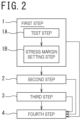
- the method for assessing delayed fracture characteristics of this embodiment includes a first step 1, a second step 2, a third step 3, and a fourth step 4 as illustrated in FIG. 2 .
- the first step 1 includes a test step 1A and a stress margin setting step 1B.
- the test step 1A is a step of carrying out an actual experiment, and includes a step of restraining a metal sheet in a state where a predetermined load stress is loaded to a sheared surface of the metal sheet. Further, the test step 1A includes a step of placing the metal sheet for a predetermined time in a predetermined hydrogen entry environment in the restrained state.
- a load stress at the limit where the delayed fracture in the sheared surface of the metal sheet does not occur is determined for each amount of strain based on the results of the test by the test step 1A. Then, in the stress margin setting step 1B, the stress margin being an allowance value of an external load stress in which the delayed fracture does not occur, corresponding to the amount of strain is determined by the determined information.
- the "stress margin" which is an index newly set in the present disclosure, is determined as an assessment index for the method for assessing delayed fracture characteristics.
- the "stress margin" in the present disclosure is the allowance of the external load stress, in which the delayed fracture does not occur, corresponding to the amount of strain possessed by the sheared end surface.
- the external load stress is a stress that occurs in press forming into a desired product shape or in restraining when the product is assembled.
- the stress margin is set as a value (function) in which a forming strain, which is one parameter of test conditions, is set as a variable.
- the stress margin containing the limit stress load may be a value obtained by multiplying the limit stress load determined by the test by a predetermined safety factor.
- the stress margin containing the limit stress load may also be set to a value smaller than the limit stress load determined from the test by the safety margin.
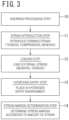
- the first step 1 includes five steps as illustrated in FIG. 3 , for example.
- the reference numerals 10 to 13 correspond to the test step 1A and a step denoted by the reference numeral 14 corresponds to the stress margin setting step 1B.
- the test step 1A known methods may be adopted.
- a shearing processing step 10 is a step of preparing a test piece from a metal sheet having the same conditions as those of the metal sheet to be processed into the formed component.
- the shearing processing step 10 prepares a test piece having a sheared end surface. This step 10 is performed for applying shearing processing to a metal sheet containing the same material and having the same thickness as those of the metal sheet to be assessed and determining the stress margin.
- a strain introduction step 11 is a step of applying a forming strain to at least a part of the sheared end surface of the test piece.
- the forming strain to be applied is a strain along the extension direction of the sheared end surface.
- the forming strain to be applied has a magnitude of 0.1% or more, for example.
- the application of the forming strain is carried out by applying uniaxial tension or uniaxial compression to the test piece, for example.
- the application of the forming strain is carried out by bending the test piece in the sheet thickness direction, for example.
- a loading step 12 is a step of loading a predetermined external load stress to the sheared end surface of the test piece and restraining the test piece in the loaded state.
- a method for loading a stress is performed by loading a tensile stress or loading a bending stress, for example. In this case, a method for loading a bending stress using a jig is particularly desirable from the viewpoint of simplicity.
- a hydrogen entry step 13 the test piece which has been restrained after the loading of the external load in the loading step 12 is placed for a predetermined time in a predetermined hydrogen entry environment. Then, the hydrogen entry step 13 is a step of assessing the occurrence state of cracking with the test piece in that state.
- the hydrogen entry environment and the placement time are preferably set to conditions under which a target hydrogen entry amount is achieved.
- the target hydrogen entry amount is the hydrogen entry amount equivalent to the amount of hydrogen that is estimated to enter in an environment in which the material to be assessed is actually used, for example.
- the placement of the test piece in the hydrogen entry environment is performed by immersing the test piece in a bath containing an acid solution, such as hydrochloric acid or an aqueous NH 4 SCN solution, for example.
- an acid solution such as hydrochloric acid or an aqueous NH 4 SCN solution, for example.
- concentration of the acid solution and the immersion time are set to achieve a condition under which hydrogen in the amount preset as the allowable upper limit enters the test piece.
- the strain introduction step 11 to the hydrogen entry step 13 above are carried out while the conditions of the forming strain to be applied and the load stress to be loaded are changed.
- a stress margin determination step 14 the limit load stress, which is a load stress at the limit where the delayed fracture in the sheared surface of the metal sheet does not occur, is assessed based on the results of the test above. Then, the stress margin to the occurrence of the delayed fracture in the sheared end surface of the metal sheet is determined based on the limit load stress. Specifically, the limit load stress is set as the stress margin under the test conditions.
- the external load stress in which cracking occurs and a value of the limit stress load are determined based on the test conditions of each test piece and the assessment results of the occurrence or non-occurrence of cracking in the sheared end surface.
- the test conditions as used herein are the conditions of the forming strain and the external load stress, for example.
- the external load stress in which cracking occurs refers to an external load stress, in which cracking occurs, to the same forming strain.
- the value of the limit stress load is a value of the limit stress load that is the boundary value with an external load stress in which no cracking occurs.
- the boundary value is the maximum value of the external load stress in which no cracking occurs, for example, or the like.
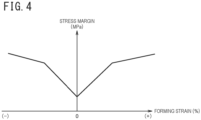
- the stress margin is the allowance value of the external load stress, in which the delayed fracture does not occur, corresponding to the strain. More specifically, the stress margin is described as a function with the forming strain by tension and compression as a variable, for example.
- FIG. 4 illustrates a case where the stress margin of the delayed fracture increases when the absolute value of the forming strain is larger. However, it is also assumed that the stress margin of the delayed fracture conversely decreases by the forming strain, depending on the material or the state of the sheared end surface. This occurs due to the occurrence of cracking or damage in the sheared end surface by the forming strain to be applied, for example.
- a comparison with the stress margin determined as described above enables the following assessment. More specifically, a test piece having a sheared end surface, which was not used for the assessment of the stress margin, can also be assessed for a possibility of the delayed fracture without performing the test.
- the possibility of the delayed fracture is the possibility of the delayed fracture to the external load (load stress) to be load to the metal sheet.
- a forming analysis (CAE analysis) is performed for processing of press forming a metal sheet into a target formed component. Then, processing of determining the residual stress and the amount of strain in various places of the sheared end surface of the formed component is carried out, the residual stress and the amount of strain being generated by forming a metal sheet into the formed component.
- the load stress is determined which is to be loaded to various places of the sheared end surface of the formed component by assembling the formed component to another component.
- the load stress is generated by assembling the formed component while the formed component is being deformed by the amount of springback in mold release.
- the deformation of the formed component generated in assembly is smaller than a deformation in press forming. Therefore, a strain generated in assembly was ignored.
- the formed component is an automotive structural component
- the formed component is assembled to a frame of an automobile singly or after assembled to another component.
- the formed component is assembled to another component or assembled to the frame of an automobile.
- the formed component is sometimes assembled in a state where a predetermined load stress is applied as an external load.
- the external load is determined as the load stress.
- the load stress is measured by assembling an actually manufactured formed component in a state where a gauge or another sensor is attached to the formed component, for example.
- a stress to be input when a target formed component is assembled to another component may also be determined by carrying out a known CAE analysis.
- the delayed fracture targeted by the present disclosure occurs by the use with time of the formed component.
- the delayed fracture targeted by the present disclosure is not a phenomenon that occurs immediately after the formed component is assembled to another component. Therefore, it is also possible to determine the external load after actual assembly.
- the margin of the delayed fracture in the formed component is assessed based on the stress margin and the total stress of the metal sheet.
- the stress margin of the metal sheet is the stress margin of the metal sheet with the amount of strain determined in the second step 2 as a variable.
- the total stress is a total stress of the residual stress determined in the second step 2 above and the load stress determined in the third step 3 above.
- the residual stress and the load stress from which the total stress is calculated, the residual stress and the load stress generated in the same region (same place) in the sheared end surface are combined. More specifically, the total stress is calculated for each of various places of the sheared end surface.
- the total stress may be calculated only for a portion where the amount of strain is equal to or larger than a predetermined threshold.
- the fourth step 4 it is carried out for each of various places of the sheared end surface, for example.
- the stress margin corresponding to the amount of strain determined in the second step 2 and the total stress of the residual stress by CAE of the formed component and the external load stress in assembly is assessed by the comparison.
- the stress margin containing a difference between the stress margin and the total stress is calculated and the degree of the stress margin to the delayed fracture is assessed.
- a strain in a direction parallel to the sheared end surface is preferably used in the present disclosure.
- parameters related to other strains such as a plastic strain, may also be used.
- a first principal stress is desirably used also for the residual stress and the load stress. Further, parameters related to other stresses, such as Mises stress, may also be used.
- the stress margin corresponding to the forming strain determined in the first step 1 is stored in a storage unit. Then, a computer is caused to refer to the stored stress margin, and the value of the stress margin corresponding to the input amount of strain of the forming strain is determined. Then, the computer is caused to execute processing of assessing the possibility of the delayed fracture to the amount of strain of the input forming strain and the external load stress.
- This processing flow is described referring to FIG. 5 .
- the formed component can be more efficiently assessed for the delayed fracture.
- the example illustrated in FIG. 5 includes a stress margin calculation unit 20, an assessment main unit 30, a storage unit 40, and a reviewing unit 50.
- Processing flows of performing processing of the stress margin calculation unit 20 and the assessment main unit 30 are stored in the storage unit 40, such as a RAM or a ROM, of a computer. Each processing is executed by the computer.
- the storage unit 40 includes a recording medium, such as a database.
- the storage unit 40 stores data of a stress margin d determined with the forming strain as a variable, with the test conditions as variables for each of metal sheet material conditions, hydrogen environment conditions, and shearing conditions.
- the data are acquired by repeating the test from the shearing processing step 10 to the stress margin determination step 14 while the amount of the forming strain is being variously changed.
- the stress margin calculation unit 20 corresponds to the first step 1.
- the stress margin calculation unit 20 first prompts an input of the basic conditions of the assessment in Step S10, and then acquires the input by an input operation of an operator.
- the basic conditions of the assessment are material type (steel grade and thickness) conditions, hydrogen environment conditions (acidity and placement time), which are delayed fracture conditions, and the like.
- Step S20 an input of the shearing conditions is promoted, and the input is acquired by an input operation of an operator.
- Step S30 a data group matched with the conditions input in Step S10 and Step 20 are acquired from the storage unit 40.
- the data group is a data group of the stress margin to each amount of strain.
- the data group is also a set of data of amount of strain, stress margin value.
- an input of the data group of the stress margin to each amount of strain determined by the test is prompted, and the input information is acquired by an input operation of an operator.
- the acquired data are stored in the storage unit 40.
- Step S40 the data group of the stress margin to the amount of strain acquired in Step S30 is referred to. Then, in Step S40, arithmetic processing of determining the stress margin d as a function f (x) with the amount of strain x as a variable is executed by a known processing system.
- Step S50 the function of the stress margin d determined in Step S40 is changed to an equation considering a safety factor s (: 0 ⁇ s ⁇ 1) as in the following equation.
- d s ⁇ f(x)
- the assessment main unit 30 first prompts an input of conditions of an actual component to be assessed in Step S100.
- the conditions of the actual component include, for example, component conditions, such as material types and forming shapes of the actual component, metal sheet conditions, such as shearing conditions, forming conditions, and hydrogen environment conditions, which are delayed fracture conditions. Then, the input is acquired by an input operation of an operator.
- component conditions such as material types and forming shapes of the actual component
- metal sheet conditions such as shearing conditions, forming conditions
- hydrogen environment conditions which are delayed fracture conditions.
- the input is acquired by an input operation of an operator.
- the material types are a steel grade and a thickness, for example.
- the hydrogen environment conditions are acidity and placement time, for example.
- Step S110 a forming analysis by CAE is carried out based on the conditions of the metal sheet and the shearing processing acquired in Step S100, the shape information of the actual component to be formed, and the like.
- Step S120 the amount of strain x and the residual stress g are determined for all sheared end surface parts of the actual component from the processing results of the forming analysis in Step S110.
- Step S130 an input of a load stress h in assembly or in use is prompted, and the load stress h is acquired by an input of an operator.
- Step S140 the information of the function "s ⁇ f (x)" of the stress margin d matched with the conditions input in Step S100 is acquired from the storage unit 40. Then, for each sheared end surface place, the stress margin d and the total stress (g + h) are compared with each other.
- the stress margin d is the stress margin d corresponding to the amount of strain x input in Step S110.
- the total stress (g + h) is the total stress of the residual stress g output in Step S120 and the load stress h input in Step S130. Then, it is determined whether there is the risk of the delayed fracture based on the comparison.
- Step S140 in FIG. 5 it is determined whether there is the risk of the delayed fracture.
- the stress margin calculation unit 20 it may be acceptable that calculation processing is separately carried out, and a function of the stress margin d with the input values in Steps S10 to S20 as conditions. Then, the determined function may be input in the storage unit 40 as data with the input values in Steps S10 to S20 as a key.
- the reviewing unit 50 carries out reviewing processing to the forming conditions and the component shapes and outputs the changed forming conditions and component shapes by the reviewing to Step S120.
- the forming conditions or the component shapes are changed such that the residual stress decreases by the amount of stress that exceeds the absolute value of the margin.
- the residual stress is relieved by increasing the number of steps of a press step, for example.
- the assessment performed by the processing flow as illustrated in FIG. 5 enables an automatic and efficient assessment.
- the forming conditions can also be repeatedly reviewed until it is determined that there is no risk of the delayed fracture.
- the test material X was sheared by shearing processing to prepare a test piece having a 100 mm long straight sheared end surface.
- the width of the test piece in shearing was set to 30 mm, and the test piece was formed into a 100 mm ⁇ 30 mm strip shape.
- a clearance in the shearing processing was set to 12% with respect to the sheet thickness.
- the description in the embodiment above the description is given taking the case where a single shearing condition is used as an example. However, when the shearing conditions, such as the clearance in the shearing processing, change, the assessment corresponding to the change is possible. More specifically, the stress margin under the shearing condition may be determined.
- the magnitude of the load stress was determined as follows. A first principal stress-first principal strain relation in each of a width center part and a tip part of the test piece was determined by CAE. Then, the measurement was performed by measuring and associating the amount of strain when the test piece was actually bent.
- the case of the four-point bending is described as a method for loading stress.
- the other bending loading methods and loading methods such as uniaxial tension, results having similar tendency are obtained.
- a tensile stress was loaded with the burr side in shearing as the outside of the bending in stress loading.
- the surface on the side opposite to the burr side can also be similarly assessed.
- test pieces loaded with the load stress were immersed for 96 hours in a bath of a thiocyanate solution having a pH of 6, and then, the delayed fracture characteristics were assessed based on the occurrence or non-occurrence of cracking by a delayed fracture after 96 hours.
- Each table shows the occurrence or non-occurrence of the delayed fracture for each load stress different depending on the amount of strain with the tension being positive and the compression being negative.
- the limit load stress with the forming strain as a variable is the stress margin.
- the stress margin is determined from the load stress at the limit where the delayed fracture did not occur and the stress margin is illustrated as the function of the strain.
- Example 1 An example of the delayed fracture determination using the stress margin corresponding to the forming strain after shearing determined in Example 1 is described.
- Example 2 an actual component in an automotive component was assumed, and an actual component having a sheared end surface having the shape illustrated in FIG. 7 was assumed. Then, press forming into the shape of the actual component was performed using the test material X. In the component shape illustrated in FIG. 7 , a strain is input into an end surface.
- CAE the calculation by CAE was performed for ten places of representative places A to J (not illustrated) in a representative sheared end surface part in the component after forming. More specifically, the forming strain and the residual stress on the front surface on the burr side in shearing were calculated by CAE.
- a 1.0 mm square shell element was used for the CAE, and a forming and springback step was calculated by a dynamic explicit method.
- the actual component illustrated in FIG. 7 is illustrated as an example. However, without being limited to the component, a similar assessment is possible insofar as it is a component having a sheared end surface of a material having a risk of the delayed fracture.
- a delayed fracture test was applied to the actual component after forming.
- the actual component was immersed in a bath of a thiocyanate solution having a pH of 6, and the delayed fracture was assessed based on the occurrence or non-occurrence of cracking by a delayed fracture after 96 hours.
- FIG. 8 the forming strain after shearing, the residual stress, and the occurrence or non-occurrence of the delayed fracture shown in Table 12 are plotted with the stress margin in FIG. 6 for comparison.
- FIG. 8 showed that the occurrence or non-occurrence of the delayed fracture in the sheared end surface in the actual component can be predicted based on whether the stress margin line is exceeded.
- the external stress load in assembly or in use of the actual component was assumed to be 300 MPa at maximum in all places.
- the maximum amount of the external load stress in assembly or in use was estimated by measuring, using a strain gauge, the amount of an elastic deformation of the actual component in assembly or in assumed use.
- FIG. 9 illustrates that it was plotted with the stress margin in FIG. 6 for comparison together with the occurrence or non-occurrence of the delayed fracture in the as-sheared state.
- Table 13 is an example that aims to prevent the occurrence of the delayed fracture even when the stress in assembly or in use was considered referring to the stress margin. Therefore, the example is an example in which an intermediate forming step is newly provided before a final forming step for the same formed component. The forming strain and the residual stress in the representative places A to J of the component when the stress and the amount of strain were changed by providing the intermediate forming step are expressed.
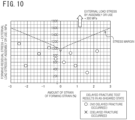
- FIG. 10 illustrates that an assembly stress assumed to be 300 MPa at maximum was loaded and a comparison with the stress margin in FIG. 6 was performed for the component places in Table 13.
- the stress margin is not exceeded even when the stress in assembly or in use are considered. This predicts that the risk of the delayed fracture is low. It was found that the use of the stress margin as a reference makes it possible to design automotive components and manufacturing steps thereof that do not cause the delayed fracture as described above.
- the present disclosure can take the following configurations.
Landscapes
- Physics & Mathematics (AREA)
- Health & Medical Sciences (AREA)
- Life Sciences & Earth Sciences (AREA)
- Chemical & Material Sciences (AREA)
- Analytical Chemistry (AREA)
- Biochemistry (AREA)
- General Health & Medical Sciences (AREA)
- General Physics & Mathematics (AREA)
- Immunology (AREA)
- Pathology (AREA)
- Investigating Strength Of Materials By Application Of Mechanical Stress (AREA)
- Testing Resistance To Weather, Investigating Materials By Mechanical Methods (AREA)
Applications Claiming Priority (2)
| Application Number | Priority Date | Filing Date | Title |
|---|---|---|---|
| JP2022085553A JP7736628B2 (ja) | 2022-05-25 | 2022-05-25 | 成形部品の遅れ破壊特性評価方法、及び成形部品の製造方法 |
| PCT/JP2023/019489 WO2023229005A1 (ja) | 2022-05-25 | 2023-05-25 | 成形部品の遅れ破壊特性評価方法、及び成形部品の製造方法 |
Publications (2)
| Publication Number | Publication Date |
|---|---|
| EP4517293A1 true EP4517293A1 (de) | 2025-03-05 |
| EP4517293A4 EP4517293A4 (de) | 2025-07-23 |
Family
ID=88919442
Family Applications (1)
| Application Number | Title | Priority Date | Filing Date |
|---|---|---|---|
| EP23811877.2A Pending EP4517293A4 (de) | 2022-05-25 | 2023-05-25 | Verfahren zur beurteilung von verzögerten brucheigenschaften einer formkomponente und verfahren zur herstellung einer formkomponente |
Country Status (7)
| Country | Link |
|---|---|
| US (1) | US20250362213A1 (de) |
| EP (1) | EP4517293A4 (de) |
| JP (1) | JP7736628B2 (de) |
| KR (1) | KR20250006162A (de) |
| CN (1) | CN119234139A (de) |
| MX (1) | MX2024014156A (de) |
| WO (1) | WO2023229005A1 (de) |
Families Citing this family (2)
| Publication number | Priority date | Publication date | Assignee | Title |
|---|---|---|---|---|
| WO2025215877A1 (ja) * | 2024-04-11 | 2025-10-16 | Jfeスチール株式会社 | 遅れ破壊評価方法、プレス成形品の製造方法、及びプログラム |
| JP7670253B1 (ja) * | 2024-04-11 | 2025-04-30 | Jfeスチール株式会社 | 遅れ破壊評価方法、プレス成形品の製造方法、及びプログラム |
Family Cites Families (8)
| Publication number | Priority date | Publication date | Assignee | Title |
|---|---|---|---|---|
| JPS5748614Y2 (de) | 1975-01-31 | 1982-10-25 | ||
| JPS5971058U (ja) | 1982-11-01 | 1984-05-14 | 岡田 高明 | ライタ− |
| JPH07146225A (ja) * | 1993-11-24 | 1995-06-06 | Nippon Steel Corp | 高張力鋼板の遅れ破壊特性評価方法 |
| JP2010107297A (ja) | 2008-10-29 | 2010-05-13 | Jfe Steel Corp | 薄鋼板の遅れ破壊特性の評価方法および応力付加治具 |
| JP7234544B2 (ja) | 2018-09-07 | 2023-03-08 | 日本製鉄株式会社 | 水素脆化特性評価方法 |
| JP7327313B2 (ja) | 2020-07-28 | 2023-08-16 | Jfeスチール株式会社 | 金属板の遅れ破壊特性評価方法、及びプレス部品の製造方法 |
| JP7577981B2 (ja) | 2020-11-27 | 2024-11-06 | セイコーエプソン株式会社 | 可塑化装置、射出成形装置および三次元造形装置 |
| KR20230098835A (ko) | 2020-12-03 | 2023-07-04 | 제이에프이 스틸 가부시키가이샤 | 지연 파괴 특성 평가 방법, 및 프로그램 |
-
2022
- 2022-05-25 JP JP2022085553A patent/JP7736628B2/ja active Active
-
2023
- 2023-05-25 US US18/868,031 patent/US20250362213A1/en active Pending
- 2023-05-25 WO PCT/JP2023/019489 patent/WO2023229005A1/ja not_active Ceased
- 2023-05-25 EP EP23811877.2A patent/EP4517293A4/de active Pending
- 2023-05-25 KR KR1020247038347A patent/KR20250006162A/ko active Pending
- 2023-05-25 CN CN202380041637.2A patent/CN119234139A/zh active Pending
-
2024
- 2024-11-14 MX MX2024014156A patent/MX2024014156A/es unknown
Also Published As
| Publication number | Publication date |
|---|---|
| US20250362213A1 (en) | 2025-11-27 |
| MX2024014156A (es) | 2024-12-06 |
| CN119234139A (zh) | 2024-12-31 |
| JP2023173359A (ja) | 2023-12-07 |
| EP4517293A4 (de) | 2025-07-23 |
| JP7736628B2 (ja) | 2025-09-09 |
| WO2023229005A1 (ja) | 2023-11-30 |
| KR20250006162A (ko) | 2025-01-10 |
Similar Documents
| Publication | Publication Date | Title |
|---|---|---|
| EP4513165A1 (de) | Verfahren zur beurteilung verzögerter brucheigenschaften gescherter endflächen, programm und verfahren zur herstellung von automobilkomponenten | |
| EP3689491A1 (de) | Verfahren zur bewertung der verformungsgrenze, rissvorhersageverfahren und verfahren zum entwurf einer pressmatrize | |
| EP4517293A1 (de) | Verfahren zur beurteilung von verzögerten brucheigenschaften einer formkomponente und verfahren zur herstellung einer formkomponente | |
| Chongthairungruang et al. | Experimental and numerical investigation of springback effect for advanced high strength dual phase steel | |
| RU2505793C1 (ru) | Способ, устройство и программа для анализа разрушения для точечно-сваренной части и машиночитаемый носитель данных | |
| US20090177417A1 (en) | Fracture prediction method, device, a program arrangement and computer-accessible medium therefor | |
| EP3939712B1 (de) | Verfahren zur herstellung eines gepressten bauteils | |
| EP4239313B1 (de) | Verfahren und programm zur beurteilung von verzögerten brucheigenschaften | |
| JP6246074B2 (ja) | 高張力鋼板の引張圧縮試験方法 | |
| JP2022024814A (ja) | 金属板の遅れ破壊特性評価方法、及びプレス部品の製造方法 | |
| Norman et al. | Evaluation of scale invariance in fatigue crack growth in metallic materials | |
| EP3932578B1 (de) | Verfahren zur bewertung eines biegerisses, system zur bewertung eines biegerisses und verfahren zur herstellung einer pressgeformten komponente | |
| JP7384262B2 (ja) | プレス成形品の遅れ破壊予測方法、装置及びプログラム、並びにプレス成形品の製造方法 | |
| EP4382223A1 (de) | Verfahren zur bestimmung von pressformrissen, vorrichtung zur bestimmung von pressformrissen und programm zur bestimmung von pressformrissen und verfahren zur unterdrückung von pressformrissen | |
| JP7772225B2 (ja) | 遅れ破壊特性評価方法、遅れ破壊予測方法、プログラム、及びプレス成形品の製造方法 | |
| JP7563657B1 (ja) | プレス成形用の金属板の遅れ破壊特性評価方法、プレス成形品の製造方法、及びプログラム | |
| KR20250168420A (ko) | 지연 파괴 특성 평가 방법, 지연 파괴 예측 방법, 프로그램, 및 프레스 성형품의 제조 방법 | |
| JP7541657B1 (ja) | 遅れ破壊の評価方法、遅れ破壊の予測方法、プレス成形品の製造方法、及びプログラム | |
| WO2025022721A1 (ja) | プレス成形用の金属板の遅れ破壊特性評価方法、プレス成形品の製造方法、及びプログラム | |
| KR20240154022A (ko) | 프레스 성형품의 지연 파괴 예측 방법, 장치 및 프로그램, 그리고 프레스 성형품의 제조 방법 | |
| WO2025163984A1 (ja) | 金属板の遅れ破壊評価方法、それに使用する試験片、及び自動車部品の製造方法 | |
| WO2025062721A1 (ja) | 遅れ破壊の評価方法、遅れ破壊の予測方法、プレス成形品の製造方法、及びプログラム | |
| KR20250168462A (ko) | 지연 파괴 특성 평가 방법, 지연 파괴 예측 방법, 프로그램, 프레스 성형품의 제조 방법, 및 전단 가공 장치 | |
| WO2024224677A1 (ja) | 遅れ破壊特性評価方法、遅れ破壊予測方法、プログラム、プレス成形品の製造方法、及びせん断加工装置 | |
| CN118922705A (zh) | 冲压成型件的延迟破坏预测方法、装置和程序以及冲压成型件的制造方法 |
Legal Events
| Date | Code | Title | Description |
|---|---|---|---|
| STAA | Information on the status of an ep patent application or granted ep patent |
Free format text: STATUS: THE INTERNATIONAL PUBLICATION HAS BEEN MADE |
|
| PUAI | Public reference made under article 153(3) epc to a published international application that has entered the european phase |
Free format text: ORIGINAL CODE: 0009012 |
|
| STAA | Information on the status of an ep patent application or granted ep patent |
Free format text: STATUS: REQUEST FOR EXAMINATION WAS MADE |
|
| 17P | Request for examination filed |
Effective date: 20241125 |
|
| AK | Designated contracting states |
Kind code of ref document: A1 Designated state(s): AL AT BE BG CH CY CZ DE DK EE ES FI FR GB GR HR HU IE IS IT LI LT LU LV MC ME MK MT NL NO PL PT RO RS SE SI SK SM TR |
|
| A4 | Supplementary search report drawn up and despatched |
Effective date: 20250625 |
|
| RIC1 | Information provided on ipc code assigned before grant |
Ipc: G01N 3/20 20060101AFI20250618BHEP Ipc: G01N 3/08 20060101ALI20250618BHEP Ipc: G01N 17/00 20060101ALI20250618BHEP |
|
| DAV | Request for validation of the european patent (deleted) | ||
| DAX | Request for extension of the european patent (deleted) |