EP4516637A1 - Lenksteuerungsvorrichtung und lenksteuerungsverfahren - Google Patents
Lenksteuerungsvorrichtung und lenksteuerungsverfahren Download PDFInfo
- Publication number
- EP4516637A1 EP4516637A1 EP22940216.9A EP22940216A EP4516637A1 EP 4516637 A1 EP4516637 A1 EP 4516637A1 EP 22940216 A EP22940216 A EP 22940216A EP 4516637 A1 EP4516637 A1 EP 4516637A1
- Authority
- EP
- European Patent Office
- Prior art keywords
- steering
- torque
- current
- gain
- proportional
- Prior art date
- Legal status (The legal status is an assumption and is not a legal conclusion. Google has not performed a legal analysis and makes no representation as to the accuracy of the status listed.)
- Pending
Links
Images



Classifications
-
- B—PERFORMING OPERATIONS; TRANSPORTING
- B62—LAND VEHICLES FOR TRAVELLING OTHERWISE THAN ON RAILS
- B62D—MOTOR VEHICLES; TRAILERS
- B62D6/00—Arrangements for automatically controlling steering depending on driving conditions sensed and responded to, e.g. control circuits
- B62D6/008—Control of feed-back to the steering input member, e.g. simulating road feel in steer-by-wire applications
-
- B—PERFORMING OPERATIONS; TRANSPORTING
- B62—LAND VEHICLES FOR TRAVELLING OTHERWISE THAN ON RAILS
- B62D—MOTOR VEHICLES; TRAILERS
- B62D5/00—Power-assisted or power-driven steering
- B62D5/04—Power-assisted or power-driven steering electrical, e.g. using an electric servo-motor connected to, or forming part of, the steering gear
- B62D5/0457—Power-assisted or power-driven steering electrical, e.g. using an electric servo-motor connected to, or forming part of, the steering gear characterised by control features of the drive means as such
- B62D5/046—Controlling the motor
- B62D5/0463—Controlling the motor calculating assisting torque from the motor based on driver input
-
- B—PERFORMING OPERATIONS; TRANSPORTING
- B62—LAND VEHICLES FOR TRAVELLING OTHERWISE THAN ON RAILS
- B62D—MOTOR VEHICLES; TRAILERS
- B62D5/00—Power-assisted or power-driven steering
- B62D5/04—Power-assisted or power-driven steering electrical, e.g. using an electric servo-motor connected to, or forming part of, the steering gear
- B62D5/0457—Power-assisted or power-driven steering electrical, e.g. using an electric servo-motor connected to, or forming part of, the steering gear characterised by control features of the drive means as such
- B62D5/046—Controlling the motor
Definitions
- the present disclosure relates to steering control devices and steering control methods.
- Patent Document 1 describes a control device that performs feedback control to control, to a target value, steering torque that is torque to be applied to a steering wheel.
- Patent Document 1 Japanese Unexamined Patent Application Publication No. 2014-223832 ( JP 2014-223832 A )
- the issue with performing such feedback control on torque is to balance stability and responsiveness.
- An aspect of the present disclosure provides a steering control device configured to operate a motor mechanically connected to an operation member to be operated by a driver to steer a vehicle.
- the motor is a drive source for a plant mounted on the vehicle.
- the steering control device is configured to perform a torque feedback process, an operation process, and a characteristic change process.
- the torque feedback process includes a process of calculating a manipulated variable for controlling steering torque to target steering torque by feedback control.
- the steering torque is torque input to the operation member.
- the operation process is a process of operating a drive circuit for the motor based on the manipulated variable.
- the characteristic change process is a process of changing a response characteristic of the feedback control according to a plant state of the plant.
- the steering control method includes performing a torque feedback process, performing an operation process, and performing a characteristic change process.
- the torque feedback process includes a process of calculating a manipulated variable for controlling steering torque to target steering torque by feedback control.
- the steering torque is torque input to the operation member.
- the operation process is a process of operating a drive circuit for the motor based on the manipulated variable.
- the characteristic change process is a process of changing a response characteristic of the feedback control according to a plant state of the plant.
- a steering system 10 mounted on a vehicle includes a reaction force actuator Ar and a steering actuator At.
- the steering system 10 of the present embodiment has a structure in which a power transmission path between a steering wheel 12 that is an operation member and steered wheels 44 is mechanically disconnected. That is, the steering system 10 includes a steer-by-wire steering device.
- the reaction force actuator Ar is an actuator that applies a steering reaction force to the steering wheel 12.
- the steering reaction force refers to a force that acts in an opposite direction to a direction in which the steering wheel 12 is operated by a driver. Applying the steering reaction force to the steering wheel 12 can provide a suitable tactile feedback to the driver.
- the reaction force actuator Ar includes a speed reduction mechanism 16, a reaction force motor 20, and a reaction force inverter 22.
- the reaction force motor 20 is a three-phase brushless motor.
- the reaction force motor 20 is a surface permanent magnet synchronous motor.
- a rotating shaft of the reaction force motor 20 is connected to the steering shaft 14 via the speed reduction mechanism 16.
- the reaction force inverter 22 is a power conversion circuit that converts a voltage VB of a battery 24 that is a direct current voltage source to an alternating current voltage and applies the alternating current voltage to the reaction force motor 20.
- the reaction force motor 20 is an example of a drive source for the reaction force actuator Ar.
- a steered shaft 40 extends in a vehicle width direction that is a left-right direction in FIG. 1 .
- the right and left steered wheels 44 are connected to both ends of the steered shaft 40 via tie rods 42.
- the steered angle of the steered wheels 44 is changed as the steered shaft 40 makes a linear motion.
- the steering actuator At includes a speed reduction mechanism 56, a steering motor 60, and a steering inverter 62.
- the steering motor 60 is a three-phase brushless motor.
- a rotating shaft of the steering motor 60 is connected to a pinion shaft 52 via the speed reduction mechanism 56.
- Pinion teeth of the pinion shaft 52 mesh with rack teeth 54 of the steered shaft 40.
- the pinion shaft 52 and the steered shaft 40 with the rack teeth 54 form a rack and pinion mechanism.
- Torque of the steering motor 60 is applied as a steering force to the steered shaft 40 via the pinion shaft 52.
- the steered shaft 40 moves in the vehicle width direction that is the left-right direction in FIG. 1 in response to rotation of the steering motor 60.
- the steering motor 60 is an example of a drive source for the steering actuator At.
- the steering system 10 includes a control device 70.
- the control device 70 is an example of a steering control device that controls a steering device. More specifically, the steering wheel 12 of the steering device is a controlled object of the control device 70.
- the control device 70 operates the reaction force actuator Ar in order to control the steering reaction force that is a controlled variable for the controlled object.
- An operation signal MSs for the reaction force inverter 22 is shown in FIG. 1 .
- the steered wheels 44 of the steering device are also controlled objects of the control device 70.
- the control device 70 operates the steering actuator At in order to control the steered angle of the steered wheels 44 that is a controlled variable for the controlled objects.
- the steered angle is a turning angle of tires.
- An operation signal MSt for the steering inverter 62 is shown in FIG. 1 .
- the control device 70 refers to steering torque Th detected by a torque sensor 80, namely input torque to the steering shaft 14, in order to control the controlled variable.
- the torque sensor 80 includes a torsion bar connected to the steering shaft 14, and a sensing element that detects a torsion angle of the torsion bar.
- the control device 70 also refers to a rotation angle ⁇ a of the rotating shaft of the reaction force motor 20 detected by a rotation angle sensor 82.
- the control device 70 also refers to currents iu1, iv1, and iw1 flowing through the reaction force motor 20.
- the currents iu1, iv1, and iw1 are quantified as voltage drops across shunt resistors provided in legs of the reaction force inverter 22.
- the control device 70 refers to a rotation angle ⁇ b of the rotating shaft of the steering motor 60 detected by a rotation angle sensor 84 in order to control the controlled variable.
- the control device 70 also refers to currents iu2, iv2, and iw2 flowing through the steering motor 60.
- the currents iu2, iv2, and iw2 are quantified as voltage drops across shunt resistors provided in legs of the steering inverter 62.
- the control device 70 also refers to a vehicle speed V detected by a vehicle speed sensor 86.
- the control device 70 includes a PU 72, a storage device 74, and peripheral circuits 76.
- the PU 72 is a software processing device such as a CPU, a GPU, and a TPU.
- the storage device 74 includes a storage medium such an electrically rewritable nonvolatile memory and a disk medium.
- the storage device 74 stores a steering control program 74a.
- the peripheral circuits 76 include a circuit for generating a clock signal that regulates internal operations, a power supply circuit, and a reset circuit.
- the control device 70 controls the controlled variables by the PU 72 executing the steering control program 74a stored in the storage device 74.
- FIG. 2 shows part of processes that are performed by the control device 70.
- a steering angle calculation process M10 is a process of calculating a steering angle ⁇ h that is a rotation angle of the steering wheel 12 by using the rotation angle ⁇ a as an input.
- the steering angle calculation process M10 includes a process of converting the rotation angle ⁇ a to, for example, a cumulative angle including a range exceeding 360° by counting the number of revolutions of the reaction force motor 20 from a neutral steering position that is the position of the steering wheel 12 when the vehicle is traveling straight.
- the steering angle calculation process M10 includes a process of calculating the steering angle ⁇ h by multiplying the cumulative angle obtained by the conversion by a conversion factor that is based on a rotational speed ratio of the speed reduction mechanism 16.
- the steering angle ⁇ h is positive when it is an angle to the right of the neutral steering position, and is negative when it is an angle to the left of the neutral steering position.
- a pinion angle calculation process M12 is a process of calculating a pinion angle ⁇ p that is a rotation angle of the pinion shaft 52 by using the rotation angle ⁇ b as an input.
- the pinion angle calculation process M12 includes a process of converting to, for example, a cumulative angle including a range exceeding 360° by counting the number of revolutions of the steering motor 60 from a neutral rack position that is the position of the steered shaft 40 when the vehicle is traveling straight.
- the pinion angle calculation process M12 includes a process of calculating the pinion angle ⁇ p that is an actual rotation angle of the pinion shaft 52 by multiplying the cumulative angle obtained by the conversion by a conversion factor that is based on a rotational speed ratio of the speed reduction mechanism 56.
- the pinion angle ⁇ p is positive when it is an angle to the right of the neutral rack position, and is negative when it is an angle to the left of the neutral rack position.
- the steering motor 60 and the pinion shaft 52 operate in conjunction with each other via the speed reduction mechanism 56. Therefore, there is a one-to-one correspondence between a cumulative value of the rotation angle ⁇ b of the steering motor 60 and the pinion angle ⁇ p.
- the pinion angle ⁇ p can be obtained from the rotation angle ⁇ b of the steering motor 60 using this correspondence.
- the pinion shaft 52 meshes with the steered shaft 40. Therefore, there is also a one-to-one correspondence between the pinion angle ⁇ p and the amount of movement of the steered shaft 40.
- the pinion angle ⁇ p is an example of information that can be acquired in the steering actuator At and is an example of a converted steered angle.
- a target pinion angle calculation process M14 is a process of calculating a target pinion angle ⁇ p* as a target steered angle by using the steering angle ⁇ h and the vehicle speed V as inputs.
- the target pinion angle ⁇ p* is a target value of the pinion angle ⁇ p according to the operation of the steering wheel 12 by the driver.
- the target pinion angle calculation process M14 includes a process of variably setting a steering angle ratio Dr according to the vehicle speed V. Accordingly, the value of the target pinion angle ⁇ p* output through the target pinion angle calculation process M14 varies according to the vehicle speed V even when the input steering angle ⁇ h is the same.
- a pinion angle feedback process M16 is a process of calculating a steering torque command value Tt* as a steering manipulated variable in order to control the pinion angle ⁇ p to the target pinion angle ⁇ p* by feedback control.
- the steering torque command value Tt* is a command value for the torque of the steering motor 60.
- the pinion angle feedback process M16 is an example of a steering feedback process.
- a steering operation process M18 is a process of outputting the operation signal MSt for the steering inverter 62 by using the steering torque command value Tt*, the currents iu2, iv2, and iw2, and the rotation angle ⁇ b as inputs.
- the steering operation process M18 includes a process of calculating dq-axis current command values It* as target steering currents based on the steering torque command value Tt*.
- the steering operation process M18 includes a process of calculating dq-axis currents It as actual steering currents based on the currents iu2, iv2, and iw2 and the rotation angle ⁇ b.
- the steering operation process M18 includes a process of calculating the operation signal MSt in order to operate the steering inverter 62 so that the dq-axis currents It are brought to the current command values It*. That is, the steering operation process M18 is an example of an operation process for performing a steering current feedback process for the dq-axis currents It. In the present embodiment, the operation signal MSt is an example of a steering current manipulated variable.
- An axial force calculation process M19 includes a process of calculating an axial force Taf by using the steering torque command value Tt* as an input.
- the axial force Taf is a force in the axial direction that is applied to the steered shaft 40.
- the axial force calculation process M19 may use the current command values It* or the dq-axis currents It as the input.
- a base target torque calculation process M20 is a process of calculating, based on the axial force Taf, base target torque Thb* that is a base value of target steering torque Th* to be input to the steering shaft 14 by the driver via the steering wheel 12. Since the axial force Taf is a quantity according to a lateral force acting on the steered wheels 44, the lateral force can be known from the axial force Taf. It is desirable that torque to be input to the steering shaft 14 by the driver via the steering wheel 12 be determined according to the lateral force. Therefore, the base target torque calculation process M20 is a process of calculating the base target torque Thb* according to the lateral force known from the axial force Taf.
- the base target torque calculation process M20 is a process of variably setting an absolute value of the base target torque Thb* according to the vehicle speed V even when an absolute value of the axial force Taf is the same.
- This process may be a process of calculating the absolute value of the base target torque Thb* so that the absolute value of the base target torque Thb* when the vehicle speed V is small is equal to or less than the absolute value of the base target torque Thb* when the vehicle speed V is large.
- this can be implemented by the PU 72 calculating the base target torque Thb* through a map calculation using map data stored in advance in the storage device 74.
- the map data is data whose input variables are the axial force Taf or a lateral acceleration known from the axial force Taf and the vehicle speed V and whose output variable is the base target torque Thb*.
- the map data is a data set of discrete values of the input variables and values of the output variable corresponding to the values of the input variables.
- the map calculation may be a process in which, when the values of the input variables match any of the values of the input variables in the map data, a corresponding value of the output variable in the map data is output as a calculation result.
- the map calculation may be a process in which, when the values of the input variables do not match any of the values of the input variables in the map data, a value obtained by interpolating a plurality of values of the output variable included in the map data is output as a calculation result.
- the map calculation may be a process in which, when the values of the input variables do not match any of the values of the input variables in the map data, the value of the output variable in the map data that corresponds to the values of the input variables in the map data closest to the values of the input variables, out of the plurality of values of the output variables included in the map data, is output as a calculation result.
- a target reaction force calculation process M22 is a process of calculating a target reaction force Ts* according to the steering reaction force to be applied to the steering wheel 12, by using the steering torque Th and the target steering torque Th* as inputs.
- the target reaction force Ts* is actually a command value for the torque of the reaction force motor 20.
- the steering reaction force is a value obtained by multiplying the target reaction force Ts* by a coefficient according to the reduction ratio of the speed reduction mechanism 16.
- the target reaction force calculation process M22 is an example of a torque feedback process.
- a reaction force operation process M24 is a process of outputting the operation signal MSs for the reaction force inverter 22 by using the target reaction force Ts*, the currents iu1, iv1, and iw1, and the rotation angle ⁇ a as inputs.
- the reaction force operation process M24 includes a process of calculating dq-axis current command values Is* as target currents based on the target reaction force Ts*.
- the reaction force operation process M24 includes a process of calculating dq-axis currents Is as actual currents based on the currents iu1, iv1, and iw1 and the rotation angle ⁇ a.
- the reaction force operation process M24 includes a process of calculating the operation signal MSs in order to operate the reaction force inverter 22 so that the dq-axis currents Is are brought to the current command values Is*. That is, the reaction force operation process M24 is an example of an operation process for performing a current feedback process for the dq-axis currents Is. In the present embodiment, the operation signal MSs is an example of a current manipulated variable.
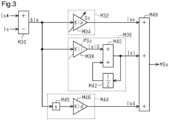
- FIG. 3 shows details of the reaction force operation process M24.
- a current deviation calculation process M30 is a process of calculating a current deviation ⁇ ls that is a value obtained by subtracting the dq-axis currents Is from the current command values Is*.
- a current proportional element M32 is a process that takes the current deviation ⁇ ls as an input and outputs a current proportional output value Isp that is a value proportional to the current deviation ⁇ ls. More specifically, a current proportional gain multiplication process M34 is a process of multiplying the current deviation ⁇ ls by a current proportional gain Kip.
- the current proportional gain Kip is a value that changes based on a state variable Sc.
- the state variable Sc is the result of identifying the state of the vehicle or the steering system 10.
- the state of the vehicle is, for example, the magnitude of the vehicle speed V.
- the state of the steering system 10 is, for example, at least one of the heat generation state of the reaction force motor 20, the magnitudes of the dq-axis currents Is, the state of the voltage VB of the battery 24, the magnitude of the steering angle ⁇ h, and the magnitude of a derivative of the steering angle ⁇ h.
- the state variable Sc may be calculated based on related information, or may be input from another process for calculating the state variable Sc based on a related state.
- a current proportional gain multiplication process M34 is a process in which, for example, when the state variable Sc refers to the vehicle speed V, the current proportional gain Kip when the value of the state variable Sc is large is equal to or greater than the current proportional gain Kip when the value of the state variable Sc is small.
- This process may be, for example, a process in which the PU 72 calculates the current proportional gain Kip through a map calculation using map data stored in advance in the storage device 74.
- the map data is data whose input variable is the state variable Sc and whose output variable is the value of the current proportional gain Kip.
- a current integral element M36 is a process that takes the current deviation ⁇ ls as an input and outputs a current integral output value Isi that is a value obtained by integrating the current deviation ⁇ ls. More specifically, a current integral gain multiplication process M38 is a process of outputting a base value Isi0 that is a value obtained by multiplying the current deviation ⁇ ls by a current integral gain Kii.
- the current integral gain Kii is, for example, a fixed value other than 0 (zero).
- the current integral gain Kii may be a value that changes based on the state variable Sc similarly to the current proportional gain Kip.
- An integration process M40 is a process of adding together the base value Isi0 and a previous value of the current integral output value Isi and outputting the sum as the current integral output value Isi.
- the previous value of the current integral output value Isi is a value held during the process in a previous cycle through a previous value holding process M42.
- a current derivative element M44 is a process that takes the current deviation ⁇ ls as an input and outputs a current derivative output value Isd that is a value proportional to the first-order time derivative of the current deviation ⁇ ls. More specifically, a linear operator M45 is a process of calculating the first-order time derivative of the current deviation ⁇ ls.
- a current derivative gain multiplication process M46 is a process of multiplying an output value of the linear operator M45 by a current derivative gain Kid.
- the current derivative gain Kid is, for example, a fixed value other than 0 (zero).
- the current derivative gain Kid may be a value that changes based on the state variable Sc similarly to the current proportional gain Kip.
- the current proportional gain Kip, the current integral gain Kii, and the current derivative gain Kid are examples of a current control gain.
- An addition process M48 is a process of outputting, as the operation signal MSs, a value obtained by adding together the output value of the current proportional element M32, the output value of the current integral element M36, and the output value of the current derivative element M44.
- FIG. 4 shows details of the target reaction force calculation process M22.
- a torque deviation calculation process M50 is a process of calculating a torque deviation ⁇ Th that is a value obtained by subtracting the target steering torque Th* from the steering torque Th.
- a torque proportional element M60 is a process that takes the torque deviation ⁇ Th as an input and outputs a value proportional to the torque deviation ⁇ Th. More specifically, a torque proportional gain multiplication process M62 is a process of multiplying the torque deviation ⁇ Th by a torque proportional gain Kp.
- a torque proportional variable gain calculation process M64 is a process of calculating a torque proportional variable gain Gp by using the value of the current proportional gain Kip as an input. The torque proportional variable gain calculation process M64 is, for example, a process in which the torque proportional variable gain Gp when the value of the current proportional gain Kip is large is equal to or less than the torque proportional variable gain Gp when the value of the current proportional gain Kip is small.
- This process may be, for example, a process in which the PU 72 performs a map calculation of the torque proportional variable gain Gp using map data stored in advance in the storage device 74.
- the map data is data whose input variable is the value of the current proportional gain Kip and whose output variable is the value of the torque proportional variable gain Gp.
- the torque proportional variable gain calculation process M64 is an example of a characteristic change process.
- the torque proportional variable gain Gp is a constant value when the value of the current proportional gain Kip is equal to or less than a first threshold value Kip1 and equal to or greater than a second threshold value Kip2.
- the value of the torque proportional variable gain Gp differs between the case where the value of the current proportional gain Kip is equal to or less than the first threshold value Kip1 and the case where the value of the current proportional gain Kip is equal to or greater than the second threshold value Kip2.
- the torque proportional variable gain Gp is a value that monotonically decreases according to the value of the current proportional gain Kip.
- a torque proportional variable gain multiplication process M66 is a process of multiplying the output value of the torque proportional gain multiplication process M62 by the torque proportional variable gain Gp.
- a torque proportional output value Tsp that is the output value of the torque proportional variable gain multiplication process M66 is the output value of the torque proportional element M60. That is, the gain of the torque proportional element M60 is a value obtained by multiplying the torque proportional gain Kp by the torque proportional variable gain Gp.
- a torque derivative element M70 is a process that takes the torque deviation ⁇ Th as an input and outputs a value proportional to the first-order time derivative of the torque deviation ⁇ Th. More specifically, a linear operator M72 is a process of calculating the first-order time derivative of the torque deviation ⁇ Th.
- a torque derivative gain multiplication process M74 is a process of multiplying the output value of the linear operator M72 by a torque derivative gain Kd.
- a torque derivative variable gain calculation process M76 is a process of calculating a torque derivative variable gain Gd by using the value of the current proportional gain Kip as an input.
- the torque derivative variable gain calculation process M76 is, for example, a process in which the torque derivative variable gain Gd when the value of the current proportional gain Kip is large is equal to or less than the torque derivative variable gain Gd when the value of the current proportional gain Kip is small.
- This process may be, for example, a process in which the PU 72 performs a map calculation of the torque derivative variable gain Gd using map data stored in advance in the storage device 74.
- the map data is data whose input variable is the value of the current proportional gain Kip and whose output variable is the value of the torque derivative variable gain Gd.
- the torque derivative variable gain calculation process M76 is an example of the characteristic change process.
- the torque derivative variable gain Gd is a constant value when the value of the current proportional gain Kip is equal to or less than a third threshold value Kip3 and equal to or greater than a fourth threshold value Kip4.
- the value of the torque derivative variable gain Gd differs between the case where the value of the current proportional gain Kip is equal to or less than the third threshold value Kip3 and the case where the value of the current proportional gain Kip is equal to or greater than the fourth threshold value Kip4.
- the torque derivative variable gain Gd is a value that monotonically decreases according to the value of the state variable Sc.
- the first threshold value Kip1 and the third threshold value Kip3 may be the same.
- the second threshold value Kip2 and the fourth threshold value Kip4 may be the same.
- a torque derivative variable gain multiplication process M78 is a process of multiplying the output value of the torque derivative gain multiplication process M74 by the torque derivative variable gain Gd.
- a torque derivative output value Tsd that is the output value of the torque derivative variable gain multiplication process M78 is the output value of the torque derivative element M70. That is, the gain of the torque derivative element M70 is a value obtained by multiplying the torque derivative gain Kd by the torque derivative variable gain Gd.
- An addition process M80 is a process of adding together the torque proportional output value Tsp of the torque proportional element M60 and the torque derivative output value Tsd of the torque derivative element M70 and outputting the sum as a PD manipulated variable Tspd.
- a second manipulated variable calculation process M82 is a process of calculating a second manipulated variable Tsi that is a manipulated variable other than the PD manipulated variable Tspd and is used for controlling the steering torque Th to the target steering torque Th*.
- the second manipulated variable calculation process M82 may include, for example, at least one of processes (A) to (H) described below.
- the process (A) is a process of calculating a manipulated variable according to a cumulative value of a value obtained by subtracting the steering torque Th from an estimated axial force.
- the estimated axial force is a value equivalent to the torque of the reaction force motor 20.
- the estimated axial force is a value calculated by the PU 72 inputting the currents iu1, iv1, and iw1.
- the process (B) is a process of calculating, as a manipulated variable, a cumulative value of a value obtained by multiplying the difference between the steering torque Th and the target steering torque Th* by an integral gain.
- the process (C) is a process of calculating a manipulated variable for controlling steering torque estimated by a disturbance observer to the target steering torque Th*.
- the process (C) takes, as inputs, the steering angle ⁇ h, the torque of the reaction force motor 20 calculated from the currents iu1, iv1, and iw1, etc.
- the process (D) is a process of calculating an open loop manipulated variable in which the steering torque Th is taken as an input.
- the process (E) is a process of calculating an open loop manipulated variable in which the target steering torque Th* is taken as an input.
- the process (F) is a process of, when the magnitude of the pinion angle ⁇ p is equal to or greater than a predetermined value, calculating a manipulated variable for applying to the steering shaft 14 a force against the magnitude of the pinion angle ⁇ p becoming any greater.
- the process (G) is a process of, when the magnitude of the steering angle ⁇ h is equal to or greater than a predetermined value, calculating a manipulated variable for applying to the steering shaft 14 a force against the magnitude of the steering angle ⁇ h becoming any greater.
- the process (H) is a process of calculating a manipulated variable for controlling the steering angle ⁇ h to a converted steering angle obtained by converting the pinion angle ⁇ p to the steering angle ⁇ h by feedback control.
- the converted steering angle is calculated by the PU 72 based on the steering angle ratio determined according to the vehicle speed V by the target pinion angle calculation process M14 and the pinion angle ⁇ p.
- the stability of the feedback control on the steering torque Th changes depending on a plant state. This is because the responsiveness of the feedback control on the steering torque Th changes depending on the plant state.
- the feedback control on the steering torque Th is related to the plant to be controlled, and the stability decreases when the responsiveness decreases or increases depending on the plant state.
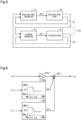
- FIG. 5 schematically shows the control configuration of the steering system 10.
- the steering system 10 includes a reaction force controller Cr, a reaction force plant Pr, a steering controller Ct, and a steering plant Pt.
- the reaction force controller Cr includes a process of calculating the operation signal MSs to operate the reaction force inverter 22, and also includes the steering angle calculation process M10, the axial force calculation process M19, the base target torque calculation process M20, the target reaction force calculation process M22, and the reaction force operation process M24.
- the reaction force plant Pr includes the reaction force actuator Ar. That is, the reaction force plant Pr includes the reaction force motor 20 and the reaction force inverter 22.
- the steering controller Ct includes a process of calculating the operation signal MSt to operate the steering inverter 62, and also includes the pinion angle calculation process M12, the target pinion angle calculation process M14, the pinion angle feedback process M16, and the steering operation process M18.
- the steering plant Pt includes the steering actuator At. That is, the steering plant Pt includes the steering motor 60 and the steering inverter 62.
- the process performed by the reaction force controller Cr is an example of a reaction force process.
- the process performed by the steering controller Ct is an example of a steering process.
- the reaction force plant Pr and the steering plant Pt are examples of a plant.
- the closed loops in the control of the steering system 10 include a closed loop R1, a closed loop R2, and a closed loop R3.
- the closed loop R1 includes the reaction force controller Cr and the reaction force plant Pr.
- the closed loop R1 forms a loop in which the output of the reaction force plant Pr obtained as a result of the reaction force controller Cr operating the reaction force plant Pr based on the operation signal MSs is returned to the input of the reaction force controller Cr.
- the input and output of the closed loop R1 are, for example, the steering torque Th.
- the closed loop R2 includes the steering controller Ct and the steering plant Pt.
- the closed loop R2 forms a loop in which the output of the steering plant Pt obtained as a result of the steering controller Ct operating the steering plant Pt based on the operation signal MSt is returned to the input of the steering controller Ct.
- the input and output of the closed loop R2 are, for example, the pinion angle ⁇ p obtained from the rotation angle ⁇ b of the rotating shaft of the steering motor 60.
- the closed loop R3 includes the reaction force controller Cr, the reaction force plant Pr, the steering controller Ct, and the steering plant Pt.
- the closed loop R3 forms a flow in which the output of the reaction force plant Pr obtained as a result of the reaction force controller Cr operating the reaction force plant Pr based on the operation signal MSs is input to the steering controller Ct.
- the closed loop R3 further forms a loop in which the output of the steering plant Pt obtained as a result of the steering controller Ct operating the steering plant Pt based on the operation signal MSt is returned to the input of the reaction force controller Cr.
- the output of the reaction force plant Pr and the input of the steering plant Pt are, for example, the steering angle ⁇ h obtained from the rotation angle ⁇ a of the rotating shaft of the reaction force motor 20.
- the output of the steering plant Pt and the input of the reaction force plant Pr are, for example, the dq-axis currents It flowing through the steering motor 60.
- the stability of the closed loop R1 changes depending on the state of the reaction force plant Pr.
- the stability of the closed loop R2 changes depending on the state of the steering plant Pt.
- the stability of the closed loop R3 changes depending on the states of the reaction force plant Pr and the steering plant Pt.
- the feedback control on the steering torque Th is affected by the stability of the closed loop R1 and the stability of the closed loop R1 and the closed loop R3.
- the steering system 10 is designed to reduce the effect of the feedback control on the steering torque Th on the stability of the closed loop R1.
- the state of the reaction force plant Pr that causes the change in the stability of the closed loop R1 changes depending on the state of the vehicle or the steering system 10. This causes a change in the state variable Sc and a change in the current proportional gain Kip in the reaction force operation process M24.
- Such a change in the current proportional gain Kip changes the level of the stability of the feedback control on the steering torque Th in the reaction force controller Cr.
- the PU 72 performs the torque proportional variable gain calculation process M64 and the torque derivative variable gain calculation process M76 that change the response characteristic of the feedback control in order to suppress a decrease in the stability of the feedback control on the steering torque Th.
- the torque proportional variable gain calculation process M64 is a process in which the torque proportional variable gain Gp when the value of the current proportional gain Kip is large is equal to or less than the torque proportional variable gain Gp when the value of the current proportional gain Kip is small.
- the torque proportional variable gain calculation process M64 is a process of reducing the torque proportional variable gain Gp in response to the characteristic of the steering system 10 that the stability of the closed loop R1 decreases as the current proportional gain Kip increases. This corresponds to increasing the stability by reducing the response characteristic of the feedback control in response to the change in the state of the reaction force plant Pr that reduces the stability of the feedback control on the steering torque Th.
- the torque proportional variable gain calculation process M64 is a process of increasing the torque proportional variable gain Gp in response to the characteristic of the steering system 10 that the stability of the closed loop R1 increases as the current proportional gain Kip decreases.
- the reaction force operation process M24 is configured to perform the feedback process for the dq-axis currents Is.
- the feedback control on the dq-axis currents Is includes the process of calculating the operation signal MSs based on the current proportional output value Isp obtained by multiplying the current proportional gain Kip.
- the target reaction force calculation process M22 includes the torque proportional variable gain calculation process M64 and the torque derivative variable gain calculation process M76. Therefore, it is possible to change the response characteristic so as to suppress a significant decrease in the stability of the feedback control on the steering torque Th in response to the change in the state of the reaction force plant Pr caused by the change in the current proportional gain Kip.
- the stability of the feedback control on the steering torque Th can be ensured when the state of the reaction force plant Pr changes due to the change in the current proportional gain Kip.
- the target reaction force calculation process M22 includes the process of calculating the target reaction force Ts* based on the torque proportional output value Tsp obtained by multiplying the torque proportional gain Kp.
- the torque proportional variable gain calculation process M64 includes the process of changing the torque proportional gain Kp in order to change the response characteristic of the feedback control on the steering torque Th. Therefore, it is possible to change the response characteristic so as to suppress a significant decrease in the stability of the feedback control on the steering torque Th in response to the change in the state of the reaction force plant Pr.
- the target reaction force calculation process M22 includes the process of calculating the target reaction force Ts* based on the torque derivative output value Tsd obtained by multiplying the torque derivative gain Kd.
- the torque derivative variable gain calculation process M76 includes the process of changing the torque derivative gain Kd in order to change the response characteristic of the feedback control on the steering torque Th. Therefore, it is possible to change the response characteristic so as to suppress a significant decrease in the stability of the feedback control on the steering torque Th in response to the change in the state of the reaction force plant Pr.
- the current integral gain Kii is a value that changes based on the state variable Sc similarly to the current proportional gain Kip.
- the current integral gain multiplication process M38 is a process in which, for example, when the state variable Sc refers to the vehicle speed V, the current integral gain Kii when the value of the state variable Sc is large is equal to or greater than the current integral gain Kii when the value of the state variable Sc is small.
- This process may be, for example, a process in which the PU 72 calculates the current integral gain Kii through a map calculation using map data stored in advance in the storage device 74.
- the map data is data whose input variable is the state variable Sc and whose output variable is the value of the current integral gain Kii.
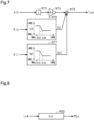
- FIG. 6 shows details of the torque proportional element M60 according to the present embodiment.
- a torque proportional variable gain calculation process M65 is a process of calculating a torque proportional variable gain Gpi by using the value of the current integral gain Kii as an input.
- the torque proportional variable gain calculation process M65 is similar to the torque proportional variable gain calculation process M64.
- the torque proportional variable gain calculation process M65 is an example of the characteristic change process.
- the torque proportional variable gain Gpi is a constant value when the value of the current integral gain Kii is equal to or less than a first threshold value Kii1 and equal to or greater than a second threshold value Kii2.
- the value of the torque proportional variable gain Gpi differs between the case where the value of the current integral gain Kii is equal to or less than the first threshold value Kii1 and the case where the value of the current integral gain Kii is equal to or greater than the second threshold value Kii2.
- the torque proportional variable gain Gpi is a value that monotonically decreases according to the value of the current integral gain Kii.
- a torque proportional variable gain multiplication process M67 is a process of multiplying the output value of the torque proportional gain multiplication process M62 by the torque proportional variable gain Gp and the torque proportional variable gain Gpi. That is, the gain of the torque proportional element M60 is a value obtained by multiplying the torque proportional gain Kp by the torque proportional variable gain Gp and the torque proportional variable gain Gpi.
- FIG. 7 shows details of the torque derivative element M70 according to the present embodiment.
- a torque derivative variable gain calculation process M77 is a process of calculating a torque derivative variable gain Gdi by using the value of the current integral gain Kii as an input.
- the torque derivative variable gain calculation process M77 is similar to the torque derivative variable gain calculation process M76.
- the torque derivative variable gain calculation process M77 is an example of the characteristic change process.
- the torque derivative variable gain Gdi is a constant value when the value of the current integral gain Kii is equal to or less than a third threshold value Kii3 and equal to or greater than a fourth threshold value Kii4.
- the value of the torque derivative variable gain Gdi differs between the case where the value of the current integral gain Kii is equal to or less than the third threshold value Kii3 and the case where the value of the current integral gain Kii is equal to or greater than the fourth threshold value Kii4.
- the torque derivative variable gain Gdi is a value that monotonically decreases according to the value of the state variable Sc.
- the first threshold value Kii1 and the third threshold value Kii3 may be the same.
- the second threshold value Kii2 and the fourth threshold value Kii4 may be the same.
- a torque derivative variable gain multiplication process M79 is a process of multiplying the output value of the torque derivative gain multiplication process M74 by the torque derivative variable gain Gd and the torque derivative variable gain Gdi. That is, the gain of the torque derivative element M70 is a value obtained by multiplying the torque derivative gain Kd by the torque derivative variable gain Gd and the torque derivative variable gain Gdi.
- the feedback control on the dq-axis currents Is includes the process of calculating the operation signal MSs based on the current integral output value Isi obtained by multiplying the current integral gain Kii.
- the torque proportional element M60 of the target reaction force calculation process M22 includes the torque proportional variable gain calculation process M65 and the torque derivative variable gain calculation process M77.
- the torque proportional variable gain calculation process M65 is a process of reducing the torque proportional variable gain Gpi in response to the characteristic of the steering system 10 that the stability of the closed loop R1 decreases as the current integral gain Kii increases.
- the embodiment described above further has the following functions and effects in addition to effects according to (1-2) and (1-3) of the first embodiment.
- the target reaction force calculation process M22 includes the torque proportional variable gain calculation processes M64, M65 and the torque derivative variable gain calculation processes M76, M77. Therefore, it is possible to change the response characteristic so as to suppress a significant decrease in the stability of the feedback control on the steering torque Th in response to the change in the state of the reaction force plant Pr caused by the changes in the current proportional gain Kip and the current integral gain Kii.
- a third embodiment will be described below with reference to the drawings, focusing on the differences from the first embodiment.
- the same configurations as those in the first embodiment are denoted by the same signs as those in the first embodiment, and description thereof will be omitted.
- the reaction force operation process M24 includes an open loop manipulated variable calculation process M90 for performing feedforward control on the dq-axis currents Is instead of performing feedback control on the dq-axis currents Is.
- the open loop manipulated variable calculation process M90 is a process that takes the current command values Is* as an input and outputs current open loop output values Isor that are values proportional to the current command values Is*. More specifically, the open loop manipulated variable calculation process M90 is a process that takes the current command values Is* as an input and multiplies the current command values Is* by a current open loop gain Kor. The current open loop gain Kor is a value that changes based on the state variable Sc.
- the current open loop output values Isor may be calculated by using the target reaction force Ts* as an input instead of the current command values Is*. In the reaction force operation process M24, the operation signal MSs is calculated based on the current open loop output values Isor.
- the open loop manipulated variable calculation process M90 is an example of a current open loop process.
- the torque proportional variable gain calculation process M64 is a process of calculating the torque proportional variable gain Gp by using the current open loop gain Kor as an input instead of the value of the current proportional gain Kip.
- the torque proportional variable gain calculation process M64 is similar to the process when the value of the current proportional gain Kip is input.
- the torque derivative variable gain calculation process M76 is a process of calculating the torque derivative variable gain Gd by using the current open loop gain Kor as an input instead of the value of the current proportional gain Kip.
- the torque derivative variable gain calculation process M76 is similar to the process when the value of the current proportional gain Kip is input.
- the reaction force operation process M24 is configured to perform the feedforward control on the dq-axis currents Is.
- the feedback control on the dq-axis currents Is includes the process of calculating the operation signal MSs based on the current open loop output values Isor obtained by multiplying the current open loop gain Kor.
- the target reaction force calculation process M22 includes the torque proportional variable gain calculation process M64 and the torque derivative variable gain calculation process M76 for calculating the gains Gp, Gd for changing the response characteristic of the feedback control on the steering torque Th by using the current open loop gain Kor as the input.
- the torque proportional variable gain calculation process M64 is a process of reducing the torque proportional variable gain Gp in response to the characteristic of the steering system 10 that the stability of the closed loop R1 decreases as the current open loop gain Kor increases. Therefore, it is possible to change the response characteristic so as to suppress a significant decrease in the stability of the feedback control on the steering torque Th in response to the change in the state of the reaction force plant Pr caused by the change in the current open loop gain Kor. The same applies to the torque derivative variable gain calculation process M76.
- the embodiment described above has effects according to (1-2) and (1-3) of the first embodiment.
- a fourth embodiment will be described below with reference to the drawings, focusing on the differences from the first embodiment.
- the same configurations as those in the first embodiment are denoted by the same signs as those in the first embodiment, and description thereof will be omitted.
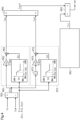
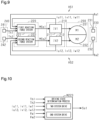
- FIG. 9 shows details of the steering system 10 according to the present embodiment.
- the steering system 10 includes winding groups of a plurality of systems constituting a reaction force motor 200.
- the steering system 10 also includes reaction force inverters of the plurality of systems constituting a reaction force inverter 210.
- the steering system 10 also includes a plurality of reaction force control systems constituting a reaction force control system 220.
- the steering system 10 also includes rotation angle sensors of the plurality of systems constituting a multi-system rotation angle sensor 230.
- the steering system 10 also includes torque sensors of the plurality of systems constituting a multi-system torque sensor 240.
- the reaction force motor 200 includes winding groups of two systems, namely a first winding group 201 and a second winding group 202.
- the multi-system reaction force inverter 210 includes winding groups of two systems, namely a first reaction force inverter 211 and a second reaction force inverter 212.
- the multi-system reaction force control system 220 includes a first reaction force control system 221 and a second reaction force control system 222.
- the multi-system rotation angle sensor 230 includes a first rotation angle sensor 231 and a second rotation angle sensor 232.
- the multi-system torque sensor 240 includes a first torque sensor 241 and a second torque sensor 242.
- the first winding group 201, the first reaction force inverter 211, the first reaction force control system 221, the first rotation angle sensor 231, and the first torque sensor 241 constitute a first reaction force system HS1 in cooperation.
- the second winding group 202, the second reaction force inverter 212, the second reaction force control system 222, the second rotation angle sensor 232, and the second torque sensor 242 constitute a second reaction force system HS2 in cooperation.
- the first reaction force control system 221 and the second reaction force control system 222 have the same configuration and include various processes M10, M19, M22, and M24.
- the target reaction force calculation process M22 of the first reaction force control system 221 refers to a first steering torque Th1 detected by the first torque sensor 241. Therefore, the first reaction force control system 221 is a process of calculating a first target steering torque Th1* and also calculating a first target reaction force Ts1*.
- the reaction force operation process M24 of the first reaction force control system 221 refers to first currents iu11, iv11, and iw11 flowing through the first winding group 201. This process further refers to a first rotation angle ⁇ a1 of the rotating shaft of the reaction force motor 200 detected by the first rotation angle sensor 231.
- the first reaction force control system 221 is a process of outputting a first operation signal MSs1 to the first reaction force inverter 211.
- the second reaction force control system 222 refers to a second steering torque Th2 detected by the second torque sensor 242. Therefore, the second reaction force control system 222 is a process of calculating a second target steering torque Th2* and also calculating a second target reaction force Ts2*.
- the second reaction force control system 222 refers to second currents iu12, iv12, and iw12 flowing through the second winding group 202.
- the second reaction force control system 222 further refers to a second rotation angle ⁇ a2 of the rotating shaft of the reaction force motor 200 detected by the second rotation angle sensor 232. Therefore, the second reaction force control system 222 is a process of outputting a second operation signal MSs2 to the second reaction force inverter 212.
- the multi-system reaction force control system 220 includes a driving state determination process M223.
- the driving state determination process M223 is a process that takes the state variables obtained from the steering system 10 as an input and outputs a driving state signal Sst.
- the driving state signal Sst is calculated as information indicating a power supply mode for the reaction force motor 200, that is, the first winding group 201 and the second winding group 202.
- the power supply modes for the first winding group 201 and the second winding group 202 include two-system drive and one-system drive.
- the two-system drive is a power supply mode in which both the first reaction force control system 221 and the second reaction force control system 222 operate and electric power is supplied to both the first winding group 201 and the second winding group 202.
- the one-system drive is a power supply mode in which only either of the first reaction force control system 221 and the second reaction force control system 222 operates and electric power is supplied to only either of the first winding group 201 and the second winding group 202.
- the power supply modes for the first winding group 201 and the second winding group 202 include conditions based on the state variables.
- the state variables include, for example, the voltage VB of the battery 24, the first currents iu11, iv11, and iw11, the second currents iu12, iv12, and iw12, the first rotation angle ⁇ a1, the second rotation angle ⁇ a2, the first steering torque Th1, and the second steering torque Th2.
- the conditions based on the state variables include a condition based on the results of comparison of the state variables with threshold values, and a condition based on the result of comparison of the plurality of state variables. These conditions are set from the viewpoint of whether the normal state can be maintained when the two-system drive is set as the normal state and the one-system drive is set as the backup state.
- FIG. 11 shows details of the target reaction force calculation process M22 according to the present embodiment.
- the first reaction force control system 221 and the second reaction force control system 222 include the same target reaction force calculation process M22. Only the first reaction force control system 221 will be described, and the description of the second reaction force control system 222 will be omitted.
- the torque proportional element M60 includes a torque proportional variable gain calculation process M240.
- the torque proportional variable gain calculation process M240 is a process of calculating the torque proportional variable gain Gp by using the value of the driving state signal Sst as an input.
- the torque proportional variable gain calculation process M240 is, for example, a process in which the torque proportional variable gain Gp of "Gp1" when the value of the driving state signal Sst is “1" is equal to or greater than the torque proportional variable gain Gp of "GP2" when the value of the driving state signal Sst is "0.”
- the value of the torque proportional variable gain Gp differs between the case where the value of the driving state signal Sst is "1" and the case where the value of the driving state signal Sst is "0.”
- This process may be, for example, a process in which the PU 72 calculates the torque proportional variable gain Gp using table data stored in advance in the storage device 74.
- the table data is data whose input variable is the value of the driving state signal Sst and whose output variable is the value of the torque proportional variable gain Gp.
- the torque proportional variable gain calculation process M240 is an example of the characteristic change process.
- the table data is a data set of the input variables and the output variables corresponding to the input variables.
- the output value of the torque proportional variable gain calculation process M240 is input to a gradual change process M242.
- the gradual change process M242 is a process of reducing the rate of change in the output variable relative to the change in the input variable.
- the gradual change process M242 may be, for example, a first-order lag filtering process.
- the output value of the gradual change process M242 is input to the torque proportional variable gain multiplication process M66.
- the torque derivative element M70 includes a torque derivative variable gain calculation process M250.
- the torque derivative variable gain calculation process M250 is a process of calculating the torque derivative variable gain Gd by using the value of the driving state signal Sst as an input.
- the torque derivative variable gain calculation process M250 is, for example, a process in which the torque derivative variable gain Gd of "Gd1" when the value of the driving state signal Sst is “1” is equal to or greater than the torque derivative variable gain Gd of "Gd2" when the value of the driving state signal Sst is "0.”
- the value of the torque derivative variable gain Gd differs between the case where the value of the driving state signal Sst is "1" and the case where the value of the driving state signal Sst is "0.”
- This process may be, for example, a process in which the PU 72 calculates the torque derivative variable gain Gd using table data stored in advance in the storage device 74.
- the table data is data whose input variable is the value of the driving state signal Ss
- the output value of the torque derivative variable gain calculation process M250 is input to a gradual change process M252.
- the gradual change process M252 is a process of reducing the rate of change in the output variable relative to the change in the input variable.
- the gradual change process M252 may be, for example, a first-order lag filtering process.
- the output value of the gradual change process M252 is input to the torque derivative variable gain multiplication process M78.
- the multi-system reaction force control system 220 includes the process of operating the multi-system reaction force inverter 210 so as to supply electric power to the first winding group 201 and the second winding group 202.
- the power supply modes for the first winding group 201 and the second winding group 202 include the two-system drive and the one-system drive.
- the target reaction force calculation process M22 includes the torque proportional variable gain calculation process M240 and the torque derivative variable gain calculation process M250 for changing the response characteristic of the feedback control on the steering torque Th by using the driving state signal Sst as the input. The same applies to both the first reaction force control system 221 and the second reaction force control system 222.
- the torque proportional variable gain calculation process M240 is a process of reducing the torque proportional variable gain Gp in response to the characteristic of the steering system 10 that the stability of the closed loop R1 decreases during the one-system drive. Therefore, it is possible to change the response characteristic so as to suppress a significant decrease in the stability of the feedback control on the steering torque Th in response to the change in the state of the reaction force plant Pr caused by the change in the power supply mode for the first winding group 201 and the second winding group 202. The same applies to the torque derivative variable gain calculation process M250.
- the target reaction force calculation process M22 includes the gradual change processes M242, M252. Therefore, in the target reaction force calculation process M22, the gain of the torque proportional element M60 is set according to the value obtained by gradually changing the value of the torque proportional variable gain Gp by the gradual change process M242. This makes it possible to suppress an abrupt change in the gain. The same applies to the value of the torque derivative variable gain Gd, that is, the gain of the torque derivative element M70.
- the torque proportional element M60 includes a proportional phase controller M260 and a proportional characteristic variable process M262.
- the proportional phase controller M260 performs a low-pass filtering process for reducing a high-frequency component of the output value of the torque proportional gain multiplication process M62. More specifically, the proportional phase controller M260 is a first-order lag filter shown below.
- the cutoff frequency Fp is set, for example, such that the cutoff frequency Fp of "Fp1" when the value of the driving state signal Sst is “1” is equal to or greater than the cutoff frequency Fp of "Fp2" when the value of the driving state signal Sst is “0.”
- the value of the cutoff frequency Fp differs between the case where the value of the driving state signal Sst is "1” and the case where the value of the driving state signal Sst is "0.”
- This process may be, for example, a process in which the PU 72 calculates the time constant Tp using table data stored in advance in the storage device 74.
- the table data is data whose input variable is the value of the driving state signal Sst and whose output variable is the value of the time constant Tp.
- the derivative characteristic variable process M272 is a process of changing the phase compensation characteristic of the derivative phase controller M270 according to the value of the driving state signal Sst. More specifically, the derivative characteristic variable process M272 changes the above predetermined frequency component according to the value of the driving state signal Sst.
- This process may be, for example, a process in which the PU 72 calculates the time constant Td or the variable ad using table data stored in advance in the storage device 74.
- the table data is data whose input variable is the value of the driving state signal Sst and whose output variable is the value of the time constant Td or the variable ad.
- the target reaction force calculation process M22 includes the proportional phase controller M260 and the derivative phase controller M270.
- the power supply modes for the first winding group 201 and the second winding group 202 include the two-system drive and the one-system drive.
- the target reaction force calculation process M22 includes the proportional characteristic variable process M262 and the derivative characteristic variable process M272 for variably setting the frequency characteristic of the torque proportional element M60 and the frequency characteristic of the torque derivative element M70 by using the driving state signal Sst as the input. The same applies to both the first reaction force control system 221 and the second reaction force control system 222.
- the embodiment described above further has the following functions and effects in addition to effects according to (1-2) and (1-3) of the first embodiment and (4-1) of the fourth embodiment.
- the proportional characteristic variable process M262 is a process of increasing the cutoff frequency Fp in response to the characteristic that the stability of the closed loop R1 decreases in the case of one-system drive. Therefore, it is possible to change the response characteristic so as to suppress a significant decrease in the stability of the feedback control on the steering torque Th by reducing the responsiveness of the torque proportional element M60 in the steering system 10 in which control is unstable in the case of one-system drive.
- the derivative characteristic variable process M272 is a process of variably setting the characteristic of the derivative phase controller M270 depending on whether the drive is the two-system drive or the one-system drive. Therefore, the frequency characteristic of the torque derivative element M70 can be set to an appropriate characteristic according to the frequency characteristic of the torque proportional element M60.
- a sixth embodiment will be described below with reference to the drawings, focusing on the differences from the first embodiment.
- the same configurations as those in the first embodiment are denoted by the same signs as those in the first embodiment, and description thereof will be omitted.
- FIG. 13 shows details of the pinion angle feedback process M16 according to the present embodiment.
- a pinion angle deviation calculation process M280 is a process of calculating a pinion angle deviation ⁇ p that is a value obtained by subtracting the pinion angle ⁇ p from the target pinion angle ⁇ p*.
- a pinion angle proportional element M282 is a process that takes the pinion angle deviation ⁇ p as an input and outputs a pinion angle proportional output value Ttp that is a value proportional to the pinion angle deviation ⁇ p. More specifically, a pinion angle proportional gain multiplication process M284 is a process of multiplying the pinion angle deviation ⁇ p by a pinion angle proportional gain Kpp.
- the pinion angle proportional gain Kpp is a value that changes based on a state variable Sct.
- the state variable Sct is the result of identifying the state of the vehicle or the steering system 10.
- the state of the vehicle is, for example, the magnitude of the vehicle speed V.
- the state of the steering system 10 is, for example, at least one of the heat generation state of the steering motor 60, the magnitudes of the dq-axis currents It, the state of the voltage VB of the battery 24, the magnitude of the pinion angle ⁇ p, and the magnitude of a derivative of the pinion angle ⁇ p.
- the state variable Sct may be calculated based on related information, or may be input from another process for calculating the state variable Sct based on a related state.
- the pinion angle proportional gain multiplication process M284 is a process in which, for example, when the state variable Sct refers to the vehicle speed V, the pinion angle proportional gain Kpp when the value of the state variable Sct is large is equal to or greater than the pinion angle proportional gain Kpp when the value of the state variable Sct is small.
- This process may be, for example, a process in which the PU 72 calculates the pinion angle proportional gain Kpp through a map calculation using map data stored in advance in the storage device 74.
- the map data is data whose input variable is the state variable Sct and whose output variable is the value of the pinion angle proportional gain Kpp.
- a pinion angle integral element M286 is a process that takes the pinion angle deviation ⁇ p as an input and outputs a pinion angle integral output value Tti that is a value obtained by integrating the pinion angle deviation ⁇ p. More specifically, a pinion angle integral gain multiplication process M288 is a process of outputting a base value Tti0 that is a value obtained by multiplying the pinion angle deviation ⁇ p by a pinion angle integral gain Kpi.
- the pinion angle integral gain Kpi is, for example, a fixed value other than 0 (zero).
- the pinion angle integral gain Kpi may be a value that changes based on the state variable Sct similarly to the pinion angle proportional gain Kpp.
- An integration process M290 is a process of adding together the base value Tti0 and a previous value of the pinion angle integral output value Tti and outputting the sum as the pinion angle integral output value Tti.
- the previous value of the pinion angle integral output value Tti is a value held during the process in a previous cycle through a previous value holding process M292.
- a pinion angle derivative element M294 is a process that takes the pinion angle deviation ⁇ p as an input and outputs a pinion angle derivative output value Ttd that is a value proportional to the first-order time derivative of the pinion angle deviation ⁇ p. More specifically, a linear operator M295 is a process of calculating the first-order time derivative of the pinion angle deviation ⁇ p. A pinion angle derivative gain multiplication process M296 is a process of multiplying the output value of the linear operator M295 by a pinion angle derivative gain Kpd. The pinion angle derivative gain Kpd is, for example, a fixed value other than 0 (zero).
- the pinion angle derivative gain Kpd may be a value that changes based on the state variable Sct similarly to the pinion angle proportional gain Kpp.
- the pinion angle proportional gain Kpp, the pinion angle integral gain Kpi, and the pinion angle derivative gain Kpd are examples of a steering control gain.
- An addition process M298 is a process of outputting, as the steering torque command value Tt*, a value obtained by adding together the output value of the pinion angle proportional element M282, the output value of the pinion angle integral element M286, and the output value of the pinion angle derivative element M294.
- the torque proportional variable gain calculation process M64 is a process of calculating the torque proportional variable gain Gp by using the pinion angle proportional gain Kpp as an input instead of the value of the current proportional gain Kip.
- the torque proportional variable gain calculation process M64 is similar to the process when the value of the current proportional gain Kip is input.
- the torque derivative variable gain calculation process M76 is a process of calculating the torque derivative variable gain Gd by using the pinion angle proportional gain Kpp as an input instead of the value of the current proportional gain Kip.
- the torque derivative variable gain calculation process M76 is similar to the process when the value of the current proportional gain Kip is input.
- the steering system 10 is designed to reduce the effect of the feedback control on the steering torque Th on the stability of the closed loop R3.
- the state of the steering plant Pt that causes the change in the stability of the closed loop R3 changes depending on the state of the vehicle or the steering system 10. This causes a change in the state variable Sct and a change in the pinion angle proportional gain Kpp in the pinion angle feedback process M16.
- Such a change in the pinion angle proportional gain Kpp changes the level of the stability of the feedback control on the steering torque Th in the reaction force controller Cr.
- the PU 72 performs the torque proportional variable gain calculation process M64 and the torque derivative variable gain calculation process M76 that change the response characteristic of the feedback control in order to suppress a decrease in the stability of the feedback control on the steering torque Th.
- the torque proportional variable gain calculation process M64 is a process of reducing the torque proportional variable gain Gp in response to the characteristic of the steering system 10 that the stability of the closed loop R3 decreases as the pinion angle proportional gain Kpp increases. Therefore, it is possible to change the response characteristic so as to suppress a significant decrease in the stability of the feedback control on the steering torque Th in response to the change in the state of the steering plant Pt caused by the change in the pinion angle proportional gain Kpp. The same applies to the torque derivative variable gain calculation process M76.
- the embodiment described above has effects according to (1-2) and (1-3) of the first embodiment.
- a seventh embodiment will be described below with reference to the drawings, focusing on the differences from the first embodiment.
- the same configurations as those in the first embodiment are denoted by the same signs as those in the first embodiment, and description thereof will be omitted.
- FIG. 14 shows details of the steering operation process M18 according to the present embodiment.
- a steering current deviation calculation process M300 is a process of calculating a steering current deviation ⁇ lt that is a value obtained by subtracting the dq-axis currents It from the dq-axis current command values It*.
- a steering current proportional element M302 is a process that takes the steering current deviation ⁇ lt as an input and outputs a steering current proportional output value Itp that is a value proportional to the steering current deviation ⁇ lt. More specifically, a steering current proportional gain multiplication process M304 is a process of multiplying the steering current deviation ⁇ lt by a steering current proportional gain Ktp. The steering current proportional gain Ktp is a value that changes based on the state variable Sct. In the steering operation process M18, the state variable Sct may be calculated based on related information, or may be input from another process for calculating the state variable Sct based on a related state.
- the steering current proportional gain multiplication process M304 is a process in which, for example, when the state variable Sct refers to the vehicle speed V, the steering current proportional gain Ktp when the value of the state variable Sct is large is equal to or greater than the steering current proportional gain Ktp when the value of the state variable Sct is small.
- This process may be, for example, a process in which the PU 72 calculates the steering current proportional gain Ktp through a map calculation using map data stored in advance in the storage device 74.
- the map data is data whose input variable is the state variable Sct and whose output variable is the value of the steering current proportional gain Ktp.
- a steering current integral element M306 is a process that takes the steering current deviation ⁇ lt as an input and outputs a steering current integral output value Iti that is a value obtained by integrating the steering current deviation ⁇ lt. More specifically, a steering current integral gain multiplication process M308 is a process of outputting a base value Iti0 that is a value obtained by multiplying the steering current deviation ⁇ lt by a steering current integral gain Kti.
- the steering current integral gain Kti is, for example, a fixed value other than 0 (zero).
- the steering current integral gain Kti may be a value that changes based on the state variable Sct similarly to the steering current proportional gain Ktp.
- An integration process M310 is a process of adding together the base value Iti0 and a previous value of the steering current integral output value Iti and outputting the sum as the steering current integral output value Iti.
- the previous value of the steering current integral output value Iti is a value held during the process in a previous cycle through a previous value holding process M312.
- a steering current derivative element M314 is a process that takes the steering current deviation ⁇ lt as an input and outputs a steering current derivative output value Itd that is a value proportional to the first-order time derivative of the steering current deviation ⁇ lt. More specifically, a linear operator M315 is a process of calculating the first-order time derivative of the steering current deviation ⁇ lt.
- a steering current derivative gain multiplication process M316 is a process of multiplying an output value of the linear operator M315 by a steering current derivative gain Ktd.
- the steering current derivative gain Ktd is, for example, a fixed value other than 0 (zero).
- the steering current derivative gain Ktd may be a value that changes based on the state variable Sct similarly to the steering current proportional gain Ktp.
- the steering current proportional gain Ktp, the steering current integral gain Kti, and the steering current derivative gain Ktd are examples of a steering current control gain.
- An addition process M318 is a process of outputting, as the operation signal MSt, a value obtained by adding together the output value of the steering current proportional element M302, the output value of the steering current integral element M306, and the output value of the steering current derivative element M314.
- the torque proportional variable gain calculation process M64 is a process of calculating the torque proportional variable gain Gp by using the steering current proportional gain Ktp as an input instead of the value of the current proportional gain Kip.
- the torque proportional variable gain calculation process M64 is similar to the process when the value of the current proportional gain Kip is input.
- the torque derivative variable gain calculation process M76 is a process of calculating the torque derivative variable gain Gd by using the steering current proportional gain Ktp as an input instead of the value of the current proportional gain Kip.
- the torque derivative variable gain calculation process M76 is similar to the process when the value of the current proportional gain Kip is input.
- the steering system 10 is designed to reduce the effect of the feedback control on the steering torque Th on the stability of the closed loop R3.
- the state of the steering plant Pt that causes the change in the stability of the closed loop R3 changes depending on the state of the vehicle or the steering system 10. This causes a change in the state variable Sct and a change in the steering current proportional gain Ktp in the steering operation process M18.
- Such a change in the steering current proportional gain Ktp changes the level of the stability of the feedback control on the steering torque Th in the reaction force controller Cr.
- the PU 72 performs the torque proportional variable gain calculation process M64 and the torque derivative variable gain calculation process M76 that change the response characteristic of the feedback control in order to suppress a decrease in the stability of the feedback control on the steering torque Th.
- the torque proportional variable gain calculation process M64 is a process of reducing the torque proportional variable gain Gp in response to the characteristic of the steering system 10 that the stability of the closed loop R3 decreases as the steering current proportional gain Ktp increases. Therefore, it is possible to change the response characteristic so as to suppress a significant decrease in the stability of the feedback control on the steering torque Th in response to the change in the state of the steering plant Pt caused by the change in the steering current proportional gain Ktp. The same applies to the torque derivative variable gain calculation process M77.
- the embodiment described above has effects according to (1-2) and (1-3) of the first embodiment.
- the derivative phase controller M270 is not limited to that shown in the above embodiments.
Landscapes
- Engineering & Computer Science (AREA)
- Chemical & Material Sciences (AREA)
- Combustion & Propulsion (AREA)
- Transportation (AREA)
- Mechanical Engineering (AREA)
- Steering Control In Accordance With Driving Conditions (AREA)
Applications Claiming Priority (1)
| Application Number | Priority Date | Filing Date | Title |
|---|---|---|---|
| PCT/JP2022/019261 WO2023209940A1 (ja) | 2022-04-28 | 2022-04-28 | 操舵制御装置および操舵制御方法 |
Publications (2)
| Publication Number | Publication Date |
|---|---|
| EP4516637A1 true EP4516637A1 (de) | 2025-03-05 |
| EP4516637A4 EP4516637A4 (de) | 2025-06-18 |
Family
ID=88518088
Family Applications (1)
| Application Number | Title | Priority Date | Filing Date |
|---|---|---|---|
| EP22940216.9A Pending EP4516637A4 (de) | 2022-04-28 | 2022-04-28 | Lenksteuerungsvorrichtung und lenksteuerungsverfahren |
Country Status (5)
| Country | Link |
|---|---|
| US (1) | US20250256768A1 (de) |
| EP (1) | EP4516637A4 (de) |
| JP (1) | JP7743926B2 (de) |
| CN (1) | CN119053506A (de) |
| WO (1) | WO2023209940A1 (de) |
Family Cites Families (7)
| Publication number | Priority date | Publication date | Assignee | Title |
|---|---|---|---|---|
| JP4737402B2 (ja) * | 2005-09-21 | 2011-08-03 | 株式会社ジェイテクト | 電動パワーステアリング装置 |
| JP5482680B2 (ja) | 2011-02-02 | 2014-05-07 | トヨタ自動車株式会社 | トルク検出装置および電動パワーステアリング装置 |
| JP5760086B2 (ja) | 2011-08-04 | 2015-08-05 | 本田技研工業株式会社 | 電動パワーステアリング装置 |
| JP6036538B2 (ja) | 2013-05-15 | 2016-11-30 | 株式会社ジェイテクト | 電動パワーステアリング装置 |
| JP2019127214A (ja) * | 2018-01-26 | 2019-08-01 | 株式会社ジェイテクト | 転舵制御装置 |
| JP7153239B2 (ja) | 2019-04-15 | 2022-10-14 | 日本精工株式会社 | 車両用操向装置 |
| JP7136029B2 (ja) * | 2019-07-18 | 2022-09-13 | 株式会社デンソー | ステアリング制御装置 |
-
2022
- 2022-04-28 CN CN202280095156.5A patent/CN119053506A/zh active Pending
- 2022-04-28 JP JP2024517754A patent/JP7743926B2/ja active Active
- 2022-04-28 WO PCT/JP2022/019261 patent/WO2023209940A1/ja not_active Ceased
- 2022-04-28 EP EP22940216.9A patent/EP4516637A4/de active Pending
- 2022-04-28 US US18/856,946 patent/US20250256768A1/en active Pending
Also Published As
| Publication number | Publication date |
|---|---|
| EP4516637A4 (de) | 2025-06-18 |
| US20250256768A1 (en) | 2025-08-14 |
| CN119053506A (zh) | 2024-11-29 |
| WO2023209940A1 (ja) | 2023-11-02 |
| JPWO2023209940A1 (de) | 2023-11-02 |
| JP7743926B2 (ja) | 2025-09-25 |
Similar Documents
| Publication | Publication Date | Title |
|---|---|---|
| JP2020029194A (ja) | 操舵制御装置 | |
| EP3730382B1 (de) | Drehsystem | |
| EP4119422B1 (de) | Lenkungssteuerungsvorrichtung | |
| EP3680148A1 (de) | Lenksteuergerät und lenksteuerungsverfahren | |
| WO2015181948A1 (ja) | 操舵制御装置 | |
| EP3871951B1 (de) | Steuerungsvorrichtung für lenksystem | |
| JP7314636B2 (ja) | 転舵制御装置 | |
| EP4516637A1 (de) | Lenksteuerungsvorrichtung und lenksteuerungsverfahren | |
| EP4474249A1 (de) | Lenksteuerungsvorrichtung und lenksteuerungsverfahren | |
| EP3663165B1 (de) | Lenksteuergerät und lenksteuerungsverfahren | |
| EP4470879A1 (de) | Lenksteuervorrichtung | |
| EP4474248A1 (de) | Lenksteuerungsvorrichtung und lenksteuerungsverfahren | |
| JP7294813B2 (ja) | 転舵制御装置 | |
| US12497101B2 (en) | Steering control device and steering control method | |
| EP4582331A1 (de) | Lenksteuerungsvorrichtung und lenksteuerungsverfahren | |
| JP7772104B2 (ja) | 操舵制御装置、および操舵制御方法 | |
| EP4470882A1 (de) | Lenksteuervorrichtung | |
| EP4474246A1 (de) | Lenksteuervorrichtung | |
| JP7782587B2 (ja) | 操舵制御装置、および操舵制御方法 | |
| JP2024130883A (ja) | 操舵制御装置および操舵制御方法 | |
| JP7786478B2 (ja) | 操舵制御装置 | |
| JP2020179832A (ja) | 転舵制御装置 | |
| US20240400134A1 (en) | Steering control device |
Legal Events
| Date | Code | Title | Description |
|---|---|---|---|
| STAA | Information on the status of an ep patent application or granted ep patent |
Free format text: STATUS: THE INTERNATIONAL PUBLICATION HAS BEEN MADE |
|
| PUAI | Public reference made under article 153(3) epc to a published international application that has entered the european phase |
Free format text: ORIGINAL CODE: 0009012 |
|
| STAA | Information on the status of an ep patent application or granted ep patent |
Free format text: STATUS: REQUEST FOR EXAMINATION WAS MADE |
|
| 17P | Request for examination filed |
Effective date: 20241125 |
|
| AK | Designated contracting states |
Kind code of ref document: A1 Designated state(s): AL AT BE BG CH CY CZ DE DK EE ES FI FR GB GR HR HU IE IS IT LI LT LU LV MC MK MT NL NO PL PT RO RS SE SI SK SM TR |
|
| A4 | Supplementary search report drawn up and despatched |
Effective date: 20250520 |
|
| RIC1 | Information provided on ipc code assigned before grant |
Ipc: B62D 5/04 20060101ALI20250514BHEP Ipc: B62D 6/00 20060101AFI20250514BHEP |
|
| DAV | Request for validation of the european patent (deleted) | ||
| DAX | Request for extension of the european patent (deleted) |