EP4516356A2 - Verwendung von pridopidin zur behandlung von funktionalem verfall - Google Patents
Verwendung von pridopidin zur behandlung von funktionalem verfall Download PDFInfo
- Publication number
- EP4516356A2 EP4516356A2 EP25152698.4A EP25152698A EP4516356A2 EP 4516356 A2 EP4516356 A2 EP 4516356A2 EP 25152698 A EP25152698 A EP 25152698A EP 4516356 A2 EP4516356 A2 EP 4516356A2
- Authority
- EP
- European Patent Office
- Prior art keywords
- bid
- pridopidine
- baseline
- patient
- placebo
- Prior art date
- Legal status (The legal status is an assumption and is not a legal conclusion. Google has not performed a legal analysis and makes no representation as to the accuracy of the status listed.)
- Pending
Links
Images






















Classifications
-
- A—HUMAN NECESSITIES
- A61—MEDICAL OR VETERINARY SCIENCE; HYGIENE
- A61K—PREPARATIONS FOR MEDICAL, DENTAL OR TOILETRY PURPOSES
- A61K31/00—Medicinal preparations containing organic active ingredients
- A61K31/33—Heterocyclic compounds
- A61K31/395—Heterocyclic compounds having nitrogen as a ring hetero atom, e.g. guanethidine or rifamycins
- A61K31/435—Heterocyclic compounds having nitrogen as a ring hetero atom, e.g. guanethidine or rifamycins having six-membered rings with one nitrogen as the only ring hetero atom
- A61K31/44—Non condensed pyridines; Hydrogenated derivatives thereof
- A61K31/445—Non condensed piperidines, e.g. piperocaine
- A61K31/451—Non condensed piperidines, e.g. piperocaine having a carbocyclic group directly attached to the heterocyclic ring, e.g. glutethimide, meperidine, loperamide, phencyclidine, piminodine
-
- A—HUMAN NECESSITIES
- A61—MEDICAL OR VETERINARY SCIENCE; HYGIENE
- A61K—PREPARATIONS FOR MEDICAL, DENTAL OR TOILETRY PURPOSES
- A61K9/00—Medicinal preparations characterised by special physical form
- A61K9/0012—Galenical forms characterised by the site of application
- A61K9/0053—Mouth and digestive tract, i.e. intraoral and peroral administration
-
- A—HUMAN NECESSITIES
- A61—MEDICAL OR VETERINARY SCIENCE; HYGIENE
- A61P—SPECIFIC THERAPEUTIC ACTIVITY OF CHEMICAL COMPOUNDS OR MEDICINAL PREPARATIONS
- A61P25/00—Drugs for disorders of the nervous system
- A61P25/14—Drugs for disorders of the nervous system for treating abnormal movements, e.g. chorea, dyskinesia
Definitions
- Huntington's disease is a fatal neurodegenerative disorder with an autosomal dominant mode of inheritance.
- the disease is associated with a triad of motor, behavioral, and cognitive symptoms.
- Motor disturbances are the defining feature of the disease, with chorea the most evident motor symptom.
- chorea is a poor marker of disease severity. Rather, disability and disease severity best correlate with negative motor features such as impairment in fine motor skills, bradykinesia, and gross motor coordination skills, including speech difficulties, gait, and postural dysfunction (Mahant 2003).
- Dopamine is widely regarded as an important neurotransmitter modulating several aspects of brain functions including motor function (Nieoullon 2003).
- a disrupted dopaminergic signaling has been implicated in a number of neurological and psychiatric conditions, (Zhan 2011, Dunlop 2007) and there is considerable clinical and preclinical evidence suggesting that dopaminergic functions are also compromised in HD (Kung 2007, Huot 2007).
- Pridopidine (4-[3-(methylsulfonyl)phenyl]-1-propyl-piperidine) (formerly known as ACR16) is a drug under development for treatment of Huntington's disease. Pridopidine has been shown to modulate motor activity by either suppressing hyperactivity or enhancing hypoactivity.
- the neuroprotective properties of pridopidine are suggested to be attributed to its high affinity to the sigma-1 receptor (S1R, binding IC50 ⁇ 100nM), while the motor activity of pridopidine may be mediated primarily by its low-affinity, antagonistic activity at the dopamine D2 receptor (D2R) (binding IC50 ⁇ 10 ⁇ M) (Ponten 2010). Pridopidine shows low-affinity binding to additional receptors in the micromolar range.
- the S1R is an endoplasmic reticulum (ER) chaperone protein which is implicated in cellular differentiation, neuroplasticity, neuroprotection and cognitive function in the brain.
- ER endoplasmic reticulum
- transcriptomic analysis of rat striatum showed that pridopidine treatment activates expression of the BDNF, dopamine receptor 1 (D1R), glucocorticoid receptor (GR), and the serine-threonine kinase protein kinase B (Akt)/phosphoinositide 3-kinase (PI3K) pathways, known to promote neuronal plasticity and survival and to be impaired in HD.
- D1R dopamine receptor 1
- GR glucocorticoid receptor
- Akt serine-threonine kinase protein kinase B
- PI3K protein 3-kinase
- pridopidine gene expression profile showed a reversed pattern of the HD disease gene expression profile in a Q175 knock-in (Q175 KI) HD mouse model (Geva 2016).
- Pridopidine also enhances secretion of the neuroprotective brain-derived neurotrophic factor (BDNF) in a neuroblastoma cell line, in a S1R-dependent manner (Geva 2016).
- BDNF brain-derived neurotrophic factor
- This invention provides a method of maintaining functional capacity, improving functional capacity, or lessening the decline of functional capacity in a human patient comprising periodically orally administering to the patient a pharmaceutical composition comprising pridopidine such that a dose of 90-225 mg of pridopidine is administered to the patient per day, so as to thereby maintain functional capacity, improve functional capacity, or lessen the decline of functional capacity in the human patient.
- the method includes a dose of 90 mg or 180 mg of pridopidine administered to the patient per day.
- the method includes a dose of 90 mg of pridopidine administered to the patient per day.
- the patient is a Huntington's disease (HD) patient.
- HD Huntington's disease
- This invention provides a method of maintaining functional capacity, improving functional capacity, or reducing the rate of decline of functional capacity in a human patient comprising periodically orally administering to the patient a pharmaceutical composition comprising pridopidine such that a dose of 90-225 mg of pridopidine is administered to the patient per day, so as to thereby maintain functional capacity, improve functional capacity, or reduce the rate of decline of functional capacity in the human patient.
- the method includes a dose of 90 mg or 180 mg of pridopidine administered to the patient per day.
- the method includes a dose of 90 mg of pridopidine administered to the patient per day.
- the patient is a HD patient.
- the invention additionally provides a method of slowing the clinical progression of HD as measured by total functional capacity in a human patient comprising periodically orally administering to the patient afflicted with HD a pharmaceutical composition comprising pridopidine such that a dose of 90-225 mg of pridopidine is administered to the patient per day, so as to thereby slow the clinical progression of HD in the patient as measured by total functional capacity.
- the method includes a dose of 90 mg or 180 mg of pridopidine administered to the patient per day.
- the method includes a dose of 90 mg of pridopidine administered to the patient per day.
- the 90 mg daily dose is administered to the patient as 45 mg bid.
- a method of decreasing functional decline in a human HD patient comprising periodically orally administering to the patient a pharmaceutical composition comprising pridopidine such that a dose of 90-180 mg of pridopidine is administered to the patient per day, so as to thereby decrease the functional decline in the patient.
- functional decline from baseline in comparison to placebo is decreased by at least 10%, by at least 15%, by at least 20%, by at least 25%, by at least 30%, by at least 35% or by at least 40%.
- the method includes a dose of about 90mg to about 180 mg of pridopidine administered to the patient per day.
- the method includes a dose of 90 mg of pridopidine administered to the patient per day.
- the 90 mg dose is administered to the patient as 45 mg bid.
- the pridopidine is administered orally.
- the administration continues for at least 26 weeks, at least 52 weeks, about 78 weeks or at least 78 weeks.
- the HD patient is an adult patient.
- HD patient is classified as an early stage patient, for example, as a stage 1 or stage 2 HD (HD1 or HD2) patient.
- the patient has a baseline TFC score of 7-13 or at least 7, at least 8, at least 9, at least 10, at least 11, at least 12, 13 or 7-10 or 11-13.
- functional capacity of a patient is measured using the Total Functional Capacity (TFC) scale of the Unified Huntington's Disease Rating Scale (UHDRS), UHDRS-TFC or TFC.
- TFC Total Functional Capacity
- UHDRS Unified Huntington's Disease Rating Scale
- TFC Total Functional Capacity
- UHDRS-TFC Unified Huntington's Disease Rating Scale
- TFC Total Functional Capacity
- a method of achieving a reduced change from baseline in the UHDRS-TFC score in a human HD patient comprising periodically orally administering to the patient a pharmaceutical composition comprising pridopidine such that a dose of 90-180 mg of pridopidine is administered to the patient per day, so as to thereby effect a change in the UHDRS-TFC score in the patient when compared to a HD subject not receiving pridopidine.
- the method includes a dose of about 90 mg to about 180 mg of pridopidine administered to the patient per day.
- the method includes a dose of 90mg of pridopidine administered to the patient per day.
- the administration continues for at least 26 weeks, or at least 52 weeks or about 78 weeks or at least 78 weeks.
- the HD patient is classified as a stage 1 or stage 2 HD patient based on the patient's UHDRS-TFC score.
- the patient has a baseline TFC score of 7-13 or at least 7, at least 8, at least 9, at least 10, at least 11, at least 12, 13 or 7-10 or 11-13.
- the difference in change from baseline in the UHDRS-TFC score, when compared to a HD subject not receiving pridopidine is reduced by at least 0.2 points over a period of 26 weeks or by at least 0.3 points over 52 weeks or by 0.5 over 78 weeks.
- the difference in change from baseline in the UHDRS-TFC score, when compared to a HD subject not receiving pridopidine is a decrease in the rate of TFC decline by at least 20%, by at least 30% by at least 40% or by at least 50% at 78 weeks.
- TFC includes one or more of maintaining occupation, taking care of finances, domestic chores, requiring low level of care and activities of daily living (ADL).
- ADL daily living
- the invention additionally provides a method of achieving a reduced change from baseline in the Timed Up and Go (TUG) test in a human HD patient comprising periodically orally administering to the patient a pharmaceutical composition comprising pridopidine such that a dose of 90-180 mg of pridopidine is administered to the patient per day, so as to thereby reduce the change in the TUG test in the patient compared to a HD subject not receiving pridopidine.
- TUG Timed Up and Go
- the invention additionally provides a method of achieving a reduced change from baseline in the TUG test in a human HD patient comprising periodically orally administering to the patient a pharmaceutical composition comprising pridopidine such that a dose of 90-180 mg of pridopidine is administered to the patient per day, so as to thereby reduce the change in the TUG test in the patient compared to a HD subject not receiving pridopidine.
- the invention additionally provides a method of achieving a reduced change from baseline in the Symbol Digit Modalities test (SDMT) test in a human HD patient comprising periodically orally administering to the patient a pharmaceutical composition comprising pridopidine such that a dose of 90-180 mg of pridopidine is administered to the patient per day, so as to thereby reduce the change in the SDMT test in the patient compared to a HD subject not receiving pridopidine.
- SDMT Symbol Digit Modalities test
- the invention additionally provides a method of achieving a reduced change from baseline in the Stroop Word test in a human HD patient comprising periodically orally administering to the patient a pharmaceutical composition comprising pridopidine such that a dose of 90-180 mg of pridopidine is administered to the patient per day, so as to thereby reduce the change in the Stroop Word test in the patient compared to a HD subject not receiving pridopidine.
- the invention additionally provides a method of achieving a reduced change from baseline in the UHDRS-Independence Scale (UHDRS-IS) in a human HD patient comprising periodically orally administering to the patient a pharmaceutical composition comprising pridopidine such that a dose of 90-180 mg of pridopidine is administered to the patient per day, so as to thereby reduce the change in the UHDRS-IS in the patient compared to a HD subject not receiving pridopidine.
- UHDRS-IS UHDRS-Independence Scale
- the invention additionally provides a method of achieving a reduced change from baseline in the gait and balance score as defined by the sum of the UHDRS-Total Motor Score (UHDRS-TMS) domains gait, tandem walking and retropulsion pull test in a human HD patient comprising periodically orally administering to the patient a pharmaceutical composition comprising pridopidine such that a dose of 90-180 mg of pridopidine is administered to the patient per day, so as to thereby reduce the change in the gait and balance score in the patient compared to a HD subject not receiving pridopidine.
- UHDRS-TMS UHDRS-Total Motor Score
- the invention additionally provides a method of achieving a reduced change from baseline in the UHDRS-TMS chorea subscore in a human HD patient comprising periodically orally administering to the patient a pharmaceutical composition comprising pridopidine such that a dose of 90-180 mg of pridopidine is administered to the patient per day, so as to thereby reduce the change in the UHDRS-TMS chorea subscore in the patient compared to a HD subject not receiving pridopidine.
- This invention also provides a method of maintaining or improving a human patient's ability to perform activities of daily living comprising periodically orally administering to the patient a pharmaceutical composition comprising pridopidine such that a dose of 90-225 mg of pridopidine is administered to the patient per day, so as to thereby maintain or improve the human patient's ability to perform activities of daily living.
- the invention further provides a method of reducing dystonia or maintaining a level of dystonia in a human patient comprising periodically orally administering to the patient a pharmaceutical composition comprising pridopidine such that a dose of 90-225 mg of pridopidine is administered to the patient per day, so as to thereby reduce dystonia or maintain a level of dystonia in the human patient.
- the invention also provides a method of treating limb Dystonia in a human patient comprising periodically orally administering to the patient a pharmaceutical composition comprising pridopidine such that a dose of 90-225 mg of pridopidine is administered to the patient per day, so as to thereby treat the limb dystonia in the human patient.
- the invention further provides a method of improving or maintaining, a human patient's gait and balance comprising periodically orally administering to the patient a pharmaceutical composition comprising pridopidine such that a dose of 90-225 mg of pridopidine is administered to the patient per day, so as to thereby improve or maintain, a human patient's gait and balance.
- a method of improving, maintaining, or slowing the decline of, a human patient's gait and balance comprising periodically orally administering to the patient a pharmaceutical composition comprising pridopidine such that a dose of 90 mg of pridopidine is administered to the patient per day, so as to thereby improve, maintain, or slow the decline of, a human patient's gait and balance.
- the invention also provides a method of improving or maintaining, a human patient's independence comprising periodically orally administering to the patient a pharmaceutical composition comprising pridopidine such that a dose of 90-225 mg of pridopidine is administered to the patient per day, so as to thereby improve or maintain a human patient's independence.
- the invention also provides a method of improving, maintaining, or slowing the decline of, a human patient's independence comprising periodically orally administering to the patient a pharmaceutical composition comprising pridopidine such that a dose of 90 mg of pridopidine is administered to the patient per day, so as to thereby improve, maintain, or slow the decline of, a human patient's independence.
- the invention also provides a method of improving or maintaining a human patient's cognitive domains comprising periodically orally administering to the patient a pharmaceutical composition comprising pridopidine such that a dose of 90-225 mg of pridopidine is administered to the patient per day, so as to thereby improve or maintain the human patient's cognitive domains.
- a method of improving, maintaining, or slowing the decline of, a human patient's cognitive domains comprising periodically orally administering to the patient a pharmaceutical composition comprising pridopidine such that a dose of 90 mg of pridopidine is administered to the patient per day, so as to thereby improve, maintain, or slow the decline of, a human patient's cognitive domains.
- a patient's cognitive domains may also be the patient's cognitive performance across a variety of domains
- the human patient's cognitive domains may be measured, for example, by the cognitive assessment battery (CAB) and/or the Hopkins Verbal Learning Test - Revised (HVLT-R).
- the cognitive domains may also be measured by the trail making test B (TMT-B).
- TMT-B trail making test B
- the cognitive domains may also be measured by the HD Cognitive Assessment Battery (HD-CAB), which includes 6 tests.
- the invention also provides a method of reducing the severity of the sustained or intermittent muscle contractions associated with dystonia in a human patient comprising periodically orally administering to the patient a pharmaceutical composition comprising pridopidine such that a dose of 90-225 mg of pridopidine is administered to the patient per day, so as to thereby reduce the severity of the sustained or intermittent muscle contractions associated with dystonia in the human patient.
- the patient is afflicted with HD.
- the severity of the sustained or intermittent muscle contractions associated with dystonia in a human patient may be measured by, for example, the UHDRS TMS Dystonia score.
- a method of improving or maintaining motor ability in a human patient comprising periodically orally administering to the patient a pharmaceutical composition comprising pridopidine such that a dose of 90-225 mg of pridopidine is administered to the patient per day, so as to thereby improve motor ability in the human patient.
- the motor ability may be measured, for example, by the UHDRS Total Motor Score (TMS) score, the UHDRS TMS score excluding chorea or UHDRS TMS score excluding dystonia.
- TMS UHDRS Total Motor Score
- the invention also provides a method of reducing or maintaining the level of chorea in a human patient comprising periodically orally administering to the patient a pharmaceutical composition comprising pridopidine such that a dose of 90-225 mg of pridopidine is administered to the patient per day, so as to thereby reduce or maintain the level of chorea in a human patient.
- the level of chorea may also be slowed. Accordingly, the invention provides a method of reducing, maintaining, or slowing the increase of, chorea in a human patient comprising periodically orally administering to the patient a pharmaceutical composition comprising pridopidine such that a dose of 90 mg of pridopidine is administered to the patient per day, so as to thereby reduce, maintain, or slow the increase of, chorea in a human patient.
- the human patient's chorea may be measured by the UHDRS TMS chorea score.
- the invention further provides a method of improving or maintaining a human patient's behavior and/or psychiatric state comprising periodically orally administering to the patient a pharmaceutical composition comprising pridopidine such that a dose of 90-225 mg of pridopidine is administered to the patient per day, so as to thereby improve or maintain the human patient's behavior and/or psychiatric state.
- the human patient's behavior and/or psychiatric state may be measured, for example, by the Problem Behaviors Assessment total score.
- the human patient's behavior and/or psychiatric state may also be measured by the Problem Behaviors Assessment for depressed mood.
- the human patient's behavior and/or psychiatric state may also be measured by the Problem Behaviors Assessment for irritability.
- the human patient's behavior and/or psychiatric state may also be measured by the Problem Behaviors Assessment for lack of initiative or apathy.
- the human patient's behavior and/or psychiatric state may be measured, for example, by the Problem Behaviors Assessment for obsessive-compulsiveness.
- the human patient's behavior and/or psychiatric state may also be measured by the Problem Behaviors Assessment for disoriented behavior.
- a method of improving or lessening decline of lack of initiative or apathy in a human HD patient comprising periodically orally administering to the patient a pharmaceutical composition comprising pridopidine such that a dose of 90-225 mg of pridopidine is administered to the patient per day, so as to thereby improve or lessen decline of lack of initiative or apathy in the patient.
- the invention also provides a method of reducing or maintaining a human patient's involuntary movements comprising periodically orally administering to the patient a pharmaceutical composition comprising pridopidine such that a dose of 90-225 mg of pridopidine is administered to the patient per day, so as to thereby reduce or maintain a human patient's involuntary movements.
- the invention further provides method of improving or maintaining a human patient's mobility comprising periodically orally administering to the patient a pharmaceutical composition comprising pridopidine such that a dose of 90-225 mg of pridopidine is administered to the patient per day, so as to thereby improve or maintain the human patient's mobility.
- This invention also provides a method of improving or maintaining a human patient's ability to perform physical tasks comprising periodically orally administering to the patient a pharmaceutical composition comprising pridopidine such that a dose of 90-225 mg of pridopidine is administered to the patient per day, so as to thereby improve or maintain the human patient's ability to perform physical tasks.
- a dose of 90 mg or 180 mg of pridopidine is administered to the patient per day. In some embodiments of the methods disclosed above, a dose of 90 mg of pridopidine administered to the patient per day. In preferred embodiments of the methods disclosed above, the dose of 90 mg of pridopidine administered to the patient per day is administered to the patient as 45 mg bid.
- the patient is administered 45 mg pridopidine qd for about one to two weeks and 45 mg pridopidine bid thereafter.
- the administration continues for at least 12 weeks, at least 26 weeks, more than 26 weeks, at least 52 weeks or at least 78 weeks. In some embodiments of the methods disclosed above, the administration continues for 52 weeks or 78 weeks.
- the HD patient is an early stage HD patient and has a baseline TFC score of at least 7, at least 8, at least 9, at least 10, at least 11, at least 12, 13, or 7-10 or 11-13. In some embodiments of the methods disclosed above, the HD patient has been diagnosed as having at least 36 CAG repeats in the huntingtin gene.
- the HD patient has been diagnosed as having at least 44 repeats in the huntingtin gene.
- the HD patient is an adult patient and is at least 18 years old or is at least 21 years old.
- the HD patient is an early stage HD patient.
- the patient is a stage 1 HD (HD1) patient or stage 2 HD (HD2) patient.
- the patient is HD1 patient and is experiencing one or more symptom of HD.
- the HD patient is not a pre-manifest HD patient.
- a pharmaceutical composition comprising pridopidine for use in lessening the decline of functional capacity in a human patient wherein the pharmaceutical composition is to be periodically orally administered to the patient such that a dose of 90-225 mg of pridopidine is to be administered to the patient per day.
- functional capacity is total functional capacity.
- the daily dose is 90 mg pridopidine. In some embodiments the daily dose is 45 mg bid.
- a pharmaceutical composition comprising pridopidine for use in maintaining functional capacity in a human patient wherein the pharmaceutical composition is to be periodically orally administered to the patient such that a dose of 90-225 mg of pridopidine is to be administered to the patient per day.
- functional capacity includes activities of daily living (ADL).
- ADL activities of daily living
- functional capacity includes ADL.
- a pharmaceutical composition comprising pridopidine for use in slowing the clinical progression of HD as measured by total functional capacity in a human patient wherein the pharmaceutical composition is to be periodically orally administered to the patient such that a dose of 90-225 mg of pridopidine is to be administered to the patient per day.
- the pharmaceutical composition is administered for more than 26 weeks or (b) a titration dose of an amount different from the intended dose is administered for a period of time at the start of the periodic administration, or (c) the human patient is afflicted with early stage Huntington's disease
- TFC includes one or more of maintaining occupation, taking care of finances, domestic chores, requiring low level of care and activities of daily living (ADL).
- ADL daily living
- a use of an amount of pridopidine in the manufacture of a medicament for slowing the clinical progression of HD as measured by total functional capacity in a human patient wherein the medicament is formulated for periodic oral administration to the patient such that a dose of 90-225 mg of pridopidine is to be administered to the patient per day.
- a pharmaceutical composition comprising pridopidine for use in maintaining a human patient's ability to perform activities of daily living in a human patient wherein the pharmaceutical composition is to be periodically orally administered to the patient such that a dose of 90-225 mg of pridopidine is to be administered to the patient per day.
- pridopidine in the manufacture of a medicament for use in maintaining a human patient's ability to perform activities of daily living in a human patient wherein the medicament is formulated for periodic oral administration to the patient such that a dose of 90-225 mg of pridopidine is to be administered to the patient per day.
- a pharmaceutical composition comprising pridopidine for use in reducing dystonia or maintaining a level of dystonia in a human patient wherein the pharmaceutical composition is to be periodically orally administered to the patient such that a dose of 90-225 mg of pridopidine is to be administered to the patient per day.
- dystonia includes limb dystonia.
- dystonia includes limb dystonia.
- a pharmaceutical composition comprising pridopidine for use in treating limb dystonia in a human patient wherein the pharmaceutical composition is to be periodically orally administered to the patient such that a dose of 90-225 mg of pridopidine is to be administered to the patient per day.
- pridopidine in the manufacture of a medicament for use in treating limb dystonia in a human patient wherein the medicament is formulated for periodic oral administration to the patient such that a dose of 90-225 mg of pridopidine is to be administered to the patient per day.
- a pharmaceutical composition comprising pridopidine for use in improving or maintaining gait and balance in a human patient wherein the pharmaceutical composition is to be periodically orally administered to the patient such that a dose of 90-225 mg of pridopidine is to be administered to the patient per day.
- the administration slows the decline of a patients gait and balance.
- pridopidine in the manufacture of a medicament for use in improving or maintaining, a human patient's gait and balance in a human patient wherein the medicament is formulated for periodic oral administration to the patient such that a dose of 90-225 mg of pridopidine is to be administered to the patient per day. In some embodiments the administration slows the decline of a patients gait and balance.
- a pharmaceutical composition comprising pridopidine for use in improving, maintaining, or slowing the decline of gait and balance in a human patient wherein the pharmaceutical composition is to be periodically orally administered to the patient such that a dose of 90mg of pridopidine is to be administered to the patient per day. In some embodiments the administration slows the decline of a patients gait and balance.
- pridopidine in the manufacture of a medicament for use in improving, maintaining, or slowing the decline of, a human patient's gait and balance in a human patient wherein the medicament is formulated for periodic oral administration to the patient such that a dose of 90mg of pridopidine is to be administered to the patient per day. In some embodiments the administration slows the decline of a patients gait and balance.
- a pharmaceutical composition comprising pridopidine for use in improving or maintaining independence in a human patient wherein the pharmaceutical composition is to be periodically orally administered to the patient such that a dose of 90-225 mg of pridopidine is to be administered to the patient per day.
- pridopidine in the manufacture of a medicament for use in improving or maintaining, a human patient's independence wherein the medicament is formulated for periodic oral administration to the patient such that a dose of 90-225 mg of pridopidine is to be administered to the patient per day.
- a pharmaceutical composition comprising pridopidine for use in improving or maintaining or slowing the decline of a human patient's independence wherein the pharmaceutical composition is to be periodically orally administered to the patient such that a dose of 90 mg of pridopidine is to be administered to the patient per day.
- pridopidine in the manufacture of a medicament for use in improving or maintaining, or slowing the decline of a human patient's independence wherein the medicament is formulated for periodic oral administration to the patient such that a dose of 90 mg of pridopidine is to be administered to the patient per day.
- a pharmaceutical composition comprising pridopidine for use in improving or maintaining a human patient's cognitive domains wherein the pharmaceutical composition is to be periodically orally administered to the patient such that a dose of 90-225 mg of pridopidine is to be administered to the patient per day.
- pridopidine in the manufacture of a medicament for use in improving or maintaining a human patient's cognitive domains wherein the medicament is formulated for periodic oral administration to the patient such that a dose of 90 mg of pridopidine is to be administered to the patient per day.
- a pharmaceutical composition comprising pridopidine for use in improving or maintaining or slowing the decline of a human patient's cognitive domains wherein the pharmaceutical composition is to be periodically orally administered to the patient such that a dose of 90 mg of pridopidine is to be administered to the patient per day.
- pridopidine in the manufacture of a medicament for use in improving or maintaining or slowing the decline of a human patient's cognitive domains wherein the medicament is formulated for periodic oral administration to the patient such that a dose of 90-225 mg of pridopidine is to be administered to the patient per day.
- a pharmaceutical composition comprising pridopidine for use in reducing the severity of the sustained or intermittent muscle contractions associated with dystonia in a human patient wherein the pharmaceutical composition is to be periodically orally administered to the patient such that a dose of 90-225 mg of pridopidine is to be administered to the patient per day.
- pridopidine in the manufacture of a medicament for use in reducing the severity of the sustained or intermittent muscle contractions associated with dystonia in a human patient wherein the medicament is formulated for periodic oral administration to the patient such that a dose of 90-225 mg of pridopidine is to be administered to the patient per day.
- a pharmaceutical composition comprising pridopidine for use in improving or maintaining motor ability in a human patient wherein the pharmaceutical composition is to be periodically orally administered to the patient such that a dose of 90-225 mg of pridopidine is to be administered to the patient per day.
- pridopidine in the manufacture of a medicament for use in improving or maintaining motor ability in a human patient wherein the medicament is formulated for periodic oral administration to the patient such that a dose of 90-225 mg of pridopidine is to be administered to the patient per day.
- a pharmaceutical composition comprising pridopidine for use in reducing or maintaining the level of chorea in a human patient wherein the pharmaceutical composition is to be periodically orally administered to the patient such that a dose of 90-225 mg of pridopidine is to be administered to the patient per day.
- pridopidine in the manufacture of a medicament for use in reducing or maintaining the level of chorea in a human patient wherein the medicament is formulated for periodic oral administration to the patient such that a dose of 90-225 mg of pridopidine is to be administered to the patient per day.
- a pharmaceutical composition comprising pridopidine for use in reducing or maintaining or slowing the increase of chorea in a human patient wherein the pharmaceutical composition is to be periodically orally administered to the patient such that a dose of 90 mg of pridopidine is to be administered to the patient per day.
- pridopidine in the manufacture of a medicament for use in reducing or maintaining or slowing the increase of chorea in a human patient wherein the medicament is formulated for periodic oral administration to the patient such that a dose of 90 mg of pridopidine is to be administered to the patient per day.
- a pharmaceutical composition comprising pridopidine for use in improving or maintaining a human patient's behavior and/or psychiatric state wherein the pharmaceutical composition is to be periodically orally administered to the patient such that a dose of 90-225 mg of pridopidine is to be administered to the patient per day.
- pridopidine in the manufacture of a medicament for use in improving or maintaining a human patient's behavior and/or psychiatric state wherein the medicament is formulated for periodic oral administration to the patient such that a dose of 90-225 mg of pridopidine is to be administered to the patient per day.
- a pharmaceutical composition comprising pridopidine for use in reducing or maintaining a human patient's involuntary movements wherein the pharmaceutical composition is to be periodically orally administered to the patient such that a dose of 90-225 mg of pridopidine is to be administered to the patient per day.
- pridopidine in the manufacture of a medicament for use in reducing or maintaining a human patient's involuntary movements wherein the medicament is formulated for periodic oral administration to the patient such that a dose of 90-225 mg of pridopidine is to be administered to the patient per day.
- a pharmaceutical composition comprising pridopidine for use in improving or maintaining a human patient's mobility wherein the pharmaceutical composition is to be periodically orally administered to the patient such that a dose of 90-225 mg of pridopidine is to be administered to the patient per day.
- pridopidine in the manufacture of a medicament for use in improving or maintaining a human patient's mobility wherein the medicament is formulated for periodic oral administration to the patient such that a dose of 90-225 mg of pridopidine is to be administered to the patient per day.
- a pharmaceutical composition comprising pridopidine for use in improving or maintaining a human patient's ability to perform physical tasks wherein the pharmaceutical composition is to be periodically orally administered to the patient such that a dose of 90-225 mg of pridopidine is to be administered to the patient per day.
- a use of an amount of pridopidine in the manufacture of a medicament for use in improving or maintaining a human patient's ability to perform physical tasks wherein the medicament is formulated for periodic oral administration to the patient such that a dose of 90-225 mg of pridopidine is to be administered to the patient per day.
- the methods, compositions and uses disclosed herein are applicable, for example, to a human patient afflicted with Huntington's disease.
- the human patient is afflicted with HD and has a baseline TMS score which is in the least severe quarter of the overall population of patients afflicted with Huntington's disease; or
- the pridopidine or a pharmaceutically acceptable salt thereof is pridopidine hydrochloride.
- a pharmaceutical composition comprising pridopidine or a pharmaceutically acceptable salt thereof, for example pridopidine hydrochloride, is to be periodically orally administered to the patient such that a dose of 90-225 mg of pridopidine is to be administered to the patient per day.
- a dose of 90 mg or 180 mg of pridopidine is to be administered to the patient per day.
- a dose of 90mg of pridopidine is to be administered to the patient per day.
- the dose of 90 mg of pridopidine to be administered to the patient per day is to be administered to the patient as 45 mg bid.
- the patient is to be administered 45 mg pridopidine once daily (qd) for about one to two weeks and 45 mg pridopidine bid thereafter.
- the administration continues for at least 12 weeks, at least 26 weeks, at least 52 weeks or at least 78 weeks. In some embodiments of the methods disclosed above, the administration continues for 52 weeks or 78 weeks.
- the HD patient is a stage 1 or stage 2 HD patient and has a baseline TFC score of at least 7, at least 8, at least 9, at least 10, at least 11, at least 12, 13, or 7-10 or 11-13.
- the HD patient has been diagnosed as having at least 36 CAG repeats in the huntingtin gene. In some embodiments of the methods disclosed above the HD patient is 21 years old or older.
- the HD patient is a HD1 or HD2 patient and is not a pre-manifest HD patient.
- Pre means predose and "post” mean post dose.
- V2 means visit 2
- V3 means visit 3, etc.
- Wk2 means second week
- Wk3 means third week, etc.
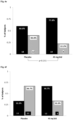
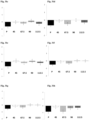
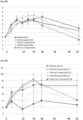
- Figure 2 Pridopidine concentration in patient's blood (ng/mL).
- Post-dose (+/-sd) at Steady State.
- CV % coefficient variation
- TMS Total Motor Score
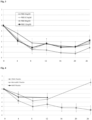
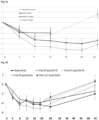
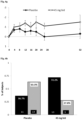
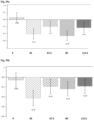
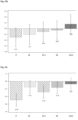
- FIGS 5a and 5b Change from baseline in TMS.
- Figure 5a Using historical placebo in HART and MermaiHD clinical trials, TMS (change from baseline) results are significant for both 45mg pridopidine bid and 90mg pridopidine bid. A lower number indicates improvement.
- Figure 5b Change from baseline UHDRS-TMS full analysis set plotted over time. PRIDE-HD replicates previous data in TMS changes from baseline as the change from baseline values were similar to those in HART and MermaiHD. In this graph, a decrease in TMS change from baseline indicates improvement.
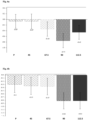
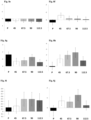
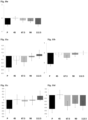
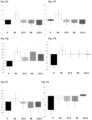
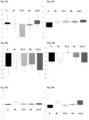
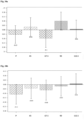
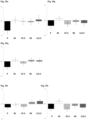
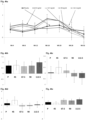
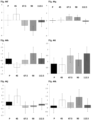
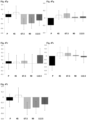
- FIG. 6a, 6b and 6c Total Dystonia at week 12 (6a); at week 20 (6b); and at week 26 (6c) in patient groups administered different doses of pridopidine.
- Y-axis is change in dystonia from baseline. All data refer to adjusted means ⁇ SE of change in dystonia in full analysis set. A lower number indicates improvement.
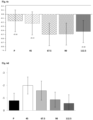
- Figures 6d-6h show data relating to various aspects of dystonia.
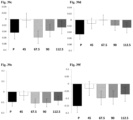
- Figure 6d Comparison of patients with baseline (BL) dystonia score of ⁇ 4 at 52 weeks after dosage with either placebo, 45 mg pridopidine b.i.d, 67.5 mg pridopidine b.i.d., 90 mg pridopidine b.i.d., or 112.5 mg pridopidine b.i.d.
- placebo 45 mg pridopidine b.i.d
- 67.5 mg pridopidine b.i.d. 90 mg pridopidine b.i.d.
- 112.5 mg pridopidine b.i.d Within the full analysis set, no clinically meaningful changes from baseline were noted for patients at Week 26 or Week 52 in the dystonia score across the placebo and all active treatment groups (not shown).
- Figure 6e Percentage of subjects with UHDRS TMS dystonia ( ⁇ 0) receiving either placebo or 45 mg pridopidine b.i.d. that were either responders or non-responders. Of those patients with baseline (BL) dystonia score of ⁇ 4 who completed 52 weeks of treatment with either placebo or 45 mg pridopidine b.i.d., the percentage who were categorized based on the change in UHDRS TMS dystonia from BL to 52 weeks as responders (improved or no change, e.g. change ⁇ 0) or non-responders (worsened, change ⁇ 0).
- Figure 6f Of those patients with baseline (BL) dystonia score of ⁇ 4 who completed 52 weeks of treatment with either placebo or 45 mg pridopidine b.i.d., the percentage who were categorized based on the change in UHDRS TMS dystonia from BL to 52 weeks as responders (improved, e.g. change ⁇ 1) or non-responders (worsened or no change ⁇ 1).
- Results of the Responder Analysis for dystonia items further support this trend toward improvement by showing that a greater percentage of patients were categorized as Responders within the dystonia items in the 45 mg bid treatment group compared to the placebo group (14 patients [77.8%] and 18 patients [60.0%], respectively) and the chorea + dystonia items in the 45 mg bid treatment group compared to the placebo group (14 patients [77.8%] and 20 patients [66.7%], respectively) (not shown).
- Figure 6g Plot of change in UHDRS Dystonia score over time for subjects pooled from MermaiHD, HART and Pride-HD studies with baseline (BL) dystonia ( ⁇ 4) who received either placebo or 45 mg pridopidine b.i.d.
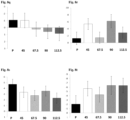
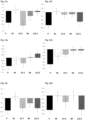
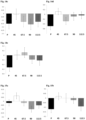
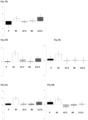
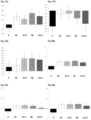
- FIG. 7a Change in dystonia in limbs (UHDRS-dystonia limbs) at week 12;
- Figure 7b Finger Taps and Pronate-Supinate (P/S) hands at week 20;
- Figure 7c Finger Taps and P/S hands at week 26.
- Y-axes are change from baseline for characteristic listed above the table.
- X-axes are dose whereby P means “placebo”, 45 means “45mg bid,” 67.5 means “67.5 mg bid,” 90 means “90mg bid,” and 112.5 means “112.5 mg bid.”
- improvement is in the direction from bottom of the graph to top of the graph.
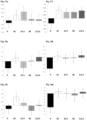
- figure 8b shows the average difference in the UHDRS TMS score of the indicated group of patients (i.e. patients having a TFC score of 11-13 at baseline, i.e. HD1) between the score at baseline and the score after 26 weeks of administration of pridopidine (at week 26).
- the 90mg bid dose shows the greatest improvement because its data point is the top most data point in the figure, showing an approximately 8 point improvement compared to baseline (i.e. a -8 UHDRS TMS score at week 26 compared to baseline).
- the table below the description of figure 8b shows that the 90mg bid group had 11 patients ("N" row) and an average UHDRS TMS score of 39.1 at baseline ("Baseline” row).
- the table below the description of figure 8b also shows that the 90mg bid group's change from baseline (about -8, shown in figure, not shown in table) is 6.15 points better (-6.15) than the placebo group's change from placebo (about -2, shown in figure, not shown in table)(" ⁇ to placebo" row).
- HD1 refers to an early stage HD patient with a baseline TFC score of 11-13.
- HD2 refers to an early stage HD patient with a baseline TFC score of 7-10.
- Figure 8a Change from baseline in UHDRS TMS Week 26 ALL The table below and figure 8a show no significant improvement in UHDRS TMS in all pridopidine treated patients at 26 weeks compared to placebo. Improvement is evidenced by a more negative value in the UHDRS TMS score.
- Figure 8e Change from baseline in UHDRS TMS Gait and Balances Week 52. The table below and figure 8e show no significant improvement in UHDRS TMS gait and balances in all pridopidine treated patients at 52 weeks.
- Figure 8f Change from baseline in UHDRS TMS Gait and Balances Week 52 Stage 1 BL TFC 11-13. The table below and figure 8f show a trend towards improvement in UHDRS TMS gait and balances in HD1 pridopidine treated patients at 52 weeks with significance for patients receiving 45 mg bid pridopidine.
- Figure 8i Change from baseline in UHDRS TMS Dystonia Week 26 ALL. The table below and figure 8i show a trend towards improvement in UHDRS TMS dystonia in all pridopidine treated patients at 26 weeks.
- Figure 8j Change from baseline in UHDRS TMS Dystonia Week 26 Stage 1 BL TFC 11-13.
- the table below and figure 8j show a trend towards improvement in UHDRS TMS dystonia in HD1 pridopidine treated patients at 26 weeks with significance for patients receiving 90mg bid pridopidine.
- Figure 81 Change from baseline in UHDRS TMS Dystonia Week 52 Stage 1 BL TFC 11-13 The table below and figure 81 show a trend towards improvement in UHDRS TMS dystonia in HD1 pridopidine treated patients at 52 weeks with significance for patients receiving 45mg bid pridopidine.
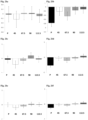
- Figure 8r Change from baseline in UHDRS TMS Excluding Chorea Week 52 Stage 1 BL TFC 11-13. The table below and figure 8r show a trend towards improvement in UHDRS TMS excluding chorea in HD1 pridopidine treated patients at 52 weeks, in particular in the 45 mg bid and 90 mg bid treated patients.
- Figure 9b Change from baseline in UHDRS Total Functional Assessment Week 26 Stage 1 BL TFC 11-13. The table below and figure 9b show a trend towards improvement in UHDRS TFC in HD1 pridopidine treated patients, at 52 weeks, in particular in the 45 mg bid treated patients.
- Figure 9d Change from baseline in UHDRS Independence Scale Week 26 Stage 1 BL TFC 11-13. The table below and figure 9d show improvement in UHDRS IS in 45 mg bid treated HD1 patients, after 26 weeks.
- Figure 10d Change from baseline in UHDRS Total Functional Capacity Week 52 Stage 1 BL TFC 11-13. The table below and figure 10d show statistically significant reduced functional decline as measured by TFC in HD1 patient, receiving 45mg bid pridopidine for 52 weeks.
- FIG. 11a Change from baseline in UHDRS TFC Finance ADL Week 26 ALL.
- the table below and figure 11a show a trend towards improvement in ADL finance as measured as part of the UHDRS TFC score in all patients receiving pridopidine for 26 weeks.
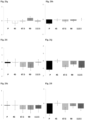
- Figure 11e Change from baseline in UHDRS TFC Finance ADL Week 52 Stage 1 BL TFC 11-13. The table below and figure 11e show statistically significant improvement in ADL finances as measured as part of the TFC score in HD1 patients, receiving 45 mg bid pridopidine for 26 weeks.
- Figure 11f Change from baseline in UHDRS TFC Finance ADL Week 26 Stage 2 BL TFC 7-10. The table below and figure 11f show statistically significant improvement in ADL finances as measured as part of the TFC score in HD2 patients, receiving 45 -90 mg bid pridopidine for 26 weeks.
- Figure 12b Change from baseline in UHDRS TFC Finances Week 26 Stage 1 BL TFC 11-13. The table below and figure 12b show statistically significant improvement in UHDRS TFC finances in HD1 patients, receiving ⁇ 67.5 mg bid pridopidine for 26 weeks.
- Figure 12c Change from baseline in UHDRS TFC Finances Week 52. The table below and figure 12c show statistically significant improvement in TFC finances in HD1 patients, receiving 45 mg bid pridopidine for 52 weeks.
- Figure 12d Change from baseline in UHDRS TFC Finances Week 52 Stage 2 BL TFC 7-10.
- the table below and figure 12b show statistically significant improvement in UHDRS TFC finances in HD2 patients, receiving 45 and 90 mg bid pridopidine for 26 weeks.
- Figure 13d Change from baseline in UHDRS TFC Domestic Chores Week 52 Stage 1 BL TFC 11-13. The table below and figure 13d show statistically significant improvement in TFC domestic chores in HD1 patients receiving 45 mg bid pridopidine for 52 weeks.
- Figure 14b Change from baseline in UHDRS TFC ADL Week 26 Stage 1 BL TFC 11-13. The table below and figure 14b show statistically significant improvement in UHDRS TFC ADL in HD1 patients receiving 45 mg bid, 90 mg bid and 112.5 mg bid pridopidine for 26 weeks.
- Figure 14d Change from baseline in UHDRS TFC ADL Week 52 Stage 1 BL TFC 11-13. The table below and figure 14d show statistically significant improvement in UHDRS TFC ADL in HD1 patients receiving 45 mg bid or 112.5 mg bid pridopidine for 52 weeks.
- Figure 15b Change from baseline in UHDRS TFC Care Level Week 52 Stage 2 BL TFC 7-10.
- the table below and figure 15b show statistically significant improvement in UHDRS TFC care level in HD2 patients receiving 45 mg bid pridopidine for 52 weeks.
- Figure 16b Change from baseline in HD-QoL Participant Total Score Week 26 Stage 2 BL TFC 7-10. The table below and figure 16b show significant improvement in HD-QoL in 67.5 mg bid pridopidine treated HD2 patients at 26 weeks.
- Figure 17e PBA Change from baseline in Total Score Week 52 Full analysis set. The table below and figure 17e show trend to improvement in PBA total score in 45 mg bid pridopidine treated patients at 52 weeks.
- Figure 171 PBA Change from baseline in PBA Lack of Initiative (Apathy), Severity x Frequency Week 52 1 BL TFC >7. The table below and figure 171 show trend towards improvement in PBA apathy in HD1 and HD2 pridopidine treated patients for 52weeks.
- Figure 17p Change from baseline in PBA Obsessive-Compulsive, Severity x Frequency Week 52 Stage 1 BL TFC 11-13.
- Figure 17r Change from baseline in PBA Disoriented Behavior, Severity x Frequency Week 26 Stage 1 BL TFC 11-13. The table below and figure 17r show significant improvement in PBA Disoriented Behavior in HD1 patients receiving 45 mg bid or 112.5 mg bid pridopidine at 26 weeks.
- Figure 18a Change from baseline in Timed Up and Go Test (see) Week 26 ALL. The table below and figure 18a show no significant improvement in Timed up and go test in all pridopidine treated patients at 26 weeks.
- Figure 19e Change from baseline in Walk-12 Total Score Week 52 Stage 1 BL TFC 11-13. The table below and figure 19e show statistically significant improvement in the Walk-12 TS in 90 mg bid pridopidine treated HD1 patients at 52 weeks.
- Figure 20d Change from baseline in UHDRS Independence Scale Week 52 BL TFC ⁇ 7. The table below and figure 20d show statistically significant improvement in the UHDRS IS in 90 mg bid pridopidine treated HD1 and HD2 patients at 52 weeks.
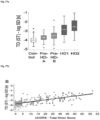
- FIGS. 21a-21p , 22a-22b , 23a-23b, 24a-24b are graphs comparing characteristics in early stage (TFC ⁇ 7, HD1 and HD2) or late stage (TFC ⁇ 7) HD patients.
- Figure 21a Change from baseline in UHDRS Total Functional Capacity Week 26 BL TFC ⁇ 7. The table below and figure 21a show no significant improvement in the UHDRS TFC in pridopidine treated late stage patients, at 26 weeks.
- FIGS. 25a-25e show bar graphs of changes in UHDRS TMS Finger Tap scores in 26 and 52 week patient groups.
- Figure 25a Change from Baseline in UHDRS TMS Finger Taps ALL Week 26.
- the table below provides P-Values corresponding to Figure 25a .
- the table below and figure 25a show no significant improvement in the UHDRS TMS finger taps in all pridopidine treated patients, at 26 weeks.
- the table below provides the P-Values corresponding to Figure 25d .
- the table below and figure 25d show statistically significant improvement in the UHDRS TMS finger taps in 45 mg bid pridopidine treated patients who completed 52 weeks, at 26 weeks.
- Figures 25e Change from baseline in UHDRS TMS Finger Taps: Patients who have completed 52 weeks of treatment: UHDRS TMS Finger Tap score at week 52.
- the table below provides the P-Values corresponding to Figure 25e .
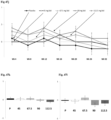
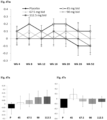
- Figures 31a and 31b show change from baseline in UHDRS TFC score over time.
- Y axes represents change in TFC score
- X axes represents pridopidine treatment time, in weeks.
- Figure 31a shows the trend in full analysis set after 52 weeks.
- Figure 31c Change from baseline in UHDRS Total Functional Capacity for patients with BL CAG Repeats ⁇ 44 at week 26. The table below provides the P-Values corresponding to Figure 31c .
- FIG. 33a , 33b, and 33c Change from baseline in TFC score in pridopidine treated HD patients. Doses at week 12 ( Fig. 33a ), week 20 ( Fig. 33b ) and week 26 ( Fig. 33c ). Score is adjusted means ⁇ SE of change in TFC for full analysis set.
- Figures 34a, 34b , and 34c Change from baseline in TFC ADL & Finances score in pridopidine treated HD patients. Doses at week 12 (34a), week 20 (34b) and week 26 (34c). Score is adjusted means + SE of change in TFC Finance and ADL for full analysis set.
- Figures 35a-35s are bar graphs showing changes from baseline of UHDRS TFC Finances and UHDRS TFC Finances and ADL scores in 26 and 52 week patient groups according to quartiles.
- Figure 35a Change from baseline in UHDRS TFC Finances score for patients with TMS 1st Q (first least severe TMS quarter) at week 26. The table below provides the P-Values corresponding to Figure 35a .
- Figure 35g Change from baseline in UHDRS TFC Finance and ADL score for patients with BL TFC ⁇ 9 at week 26. The table below provides the P-Values corresponding to Figure 35g . Significant improvement in TFC finance and ADL was observed in 45 mg bid and 90 mg bid pridopidine administered patients having with baseline TFC greater than or equal to 9, for 26 weeks.
- Placebo 45 mg bid 67.5 mg bid 90 mg bid 112.5 mg bid N 21 24 20 25 15 Baseline 4.9 4.8 5 4.8 5.3 ⁇ to placebo 0.63 0.5 0.63 1.1 p value 0.038 0.1136 0.0342 0.0024
- Figure 35o Change from baseline in UHDRS TFC Finance and ADL score for patients with TMS 1st Q at week 52. The table below provides the P-Values corresponding to Figure 35o . Significant improvement in TFC finance and ADL was observed in 45 mg bid pridopidine administered patients with TMS first quarter, for 52 weeks.
- Figure 35s Change from baseline in UHDRS TFC Finance and ADL score for patients with TMS 1st 3Qs at week 52. The table below provides the P-Values corresponding to Figure 35s . Significant improvement in TFC finance and ADL was observed in 45 mg bid pridopidine administered patients with TMS first three quarters, for 52 weeks.
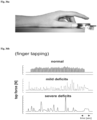
- FIG. 36a and 36b General information regarding Finger tapping (Q-motor tap measurements).
- Figure 36a shows a drawing of subject's arm with tapper.
- Figure 36b shows normal and aberrant tapping measurements.
- Figures 37a and 37b Q-motor tap measurements: A well-validated objective measure. (Bechtel 2010).
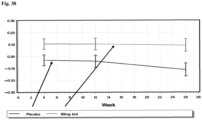
- Figure 38 Q-Motor Tap-Speed-Frequency. 90mg pridopidine administered bid demonstrated consistent improvement from baseline.
- the data for 90 mg bid is shown by the top line in this graph and the data for the placebo is shown by the bottom line in this graph. Difference in p-value of 90 mg bid from placebo was 0.0259 at week 4, 0.0365 at week 12, and 0.0056 at week 26. Increase in tap speed indicates improvement.
- the unit of measurement of the Y-axis is Frequency (Hz).
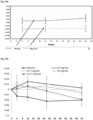
- Figures 39a and 39b Q-Motor Tap Speed Inter Onset Interval (IOI).
- IOI Q-Motor Tap Speed Inter Onset Interval
- 90mg pridopidine administered bid demonstrated consistent and significant improvement from baseline for 90mg bid.
- the data for 90 mg pridopidine bid is shown by the bottom line in this graph and the data for the placebo is shown by the top line in this graph.
- FIG. 39a shows change from baseline in Tap-Speed-Inter-Onset-interval-MN-Hand-L (sec) over time (weeks) for full analysis set.
- Figure 39c Improvement in objective pharmacodynamic measures of motor control: change from baseline in Q-Motor: Tap-Speed-Inter-Onset-interval-MN-Hand (sec), Week 52 FAS.
- the table below provides data and the P-Values corresponding to Figure 39c .
- Figure 39e Improvement in objective pharmacodynamic measures of motor control, change from baseline in Q-Motor: Pro-Sup-Frequency-MN-Hand (Hz), Week 52 FAS. The table below provides the data and P-Values corresponding to Figure 39e . A trend towards improvement was noted in 45 mg bid treated patients.
- Figure 39f Improvement in objective pharmacodynamic measures of motor control, change from baseline in Q-Motor: Pro-Sup-Frequency-MN-Hand (Hz), Week 52 Week 52 in pridopidine treated HD1 and HD2 patients. The table below provides the data and P-Values corresponding to Figure 39f . A trend towards improvement was noted in 45 mg bid treated patients.
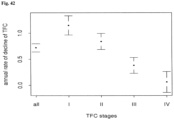
- Figure 42 Annual rates of decline (y axis) in TFC are higher in earlier stages of disease (Marder 2000).
- the dark line with diamond represents placebo; line with open circle represents 45 mg bid, line with triangle represents 67.5 mg bid, line with grey diamond represents 90 mg bid, line with square represents 112.5 mg bid.
- Y axis represents change from baseline in TFC score from baseline, x axis represents treatment time in weeks.
- Figures 44a-44c are graphs which show multiple ambulation-related endpoints demonstrating trends favoring pridopidine in early HD (stage 1-2 patients). Data for TMS showed a strong placebo effect. A trend towards improvement in TMS was observed at 52 weeks.
- Figure 44a UHDRS TMS Gait: Early HD at 52 weeks. The table below provides data and the P-Values corresponding to Figure 44a . Placebo 45 mg bid 67.5 mg bid 90 mg bid 112.5 mg bid N 62 59 54 56 58 Baseline 0.9 1.1 1 1.1 1 Wk52 ⁇ to placebo -0.21 -0.17 -0.17 -0.06 p value 0.0855 0.168 0.1521 0.628
- Figure 44b Timed Up and Go Test (sec): Pridopidine treated HD1 and HD2 patients.at 52 weeks. The table below provides data and the P-Values corresponding to Figure 44b .
- the table below provides the data and P-Values corresponding to Figure 44e .
- Figures 45a-45b Figure 45 : Change from baseline in TMS plotted over time in TMS full analysis set plotted over time in PRIDE-HD.
- Y axis represents change from baseline in TMS from baseline, x axis represents treatment time in weeks.
- Figure 45b Change from baseline in TMS plotted over time in HD1 patients. Line with dark diamond represents placebo; line with open circle represents 45 mg bid, line with triangle represents 67.5 mg bid, line with grey diamond represents 90 mg bid, line with square represents 112.5 mg bid. 45 mg bid shows improvement in TMS score after 52 weeks.
- Y axis represents change from baseline in TMS from baseline, x axis represents treatment time in weeks.
- Figures 46a-46v and 47a-47y show ambulation related Modified Physical Performance Test (mPPT) data.
- mPPT Modified Physical Performance Test
- the table provided below each graph provides data and P-values corresponding to the graph.
- Figure 46a Change from baseline in mPPT Total Score, Full Analysis Set from week 4 of treatment through week 52.
- the mPPT quantifies the patient's performance in physical and functional tasks using a standardized 9-item test. Line with dark diamond represents placebo; line with open circle represents 45 mg bid, line with triangle represents 67.5 mg bid, line with grey diamond represents 90 mg bid, line with square represents 112.5 mg bid. Administration of 45 mg bid shows improvement on mPPT score after 52 weeks.
- Y axis represents change from baseline in mPPT from baseline, x axis represents treatment time in weeks.
- Figure 46b mPPT Total Score - Change from Baseline, Full Analysis Set, week 26. The table below provides the data and P-Values corresponding to Figure 46b .
- Figure 46c mPPT Total Score - Change from Baseline, Full Analysis Set, week 52. The table below provides the data and P-Values corresponding to Figure 46c .
- Placebo 45 mg bid 67.5 mg bid 90 mg bid 112.5 mg bid N 19 16 25 25 23 Baseline 21.5 21.4 23.3 23.1 21.3 ⁇ to placebo 1.57 -1.37 -2.73 -0.49 p value 0.4267 0.4515 0.1288 0.7822
- Figure 46n Graph showing change from baseline in mPPT standing static balance scores, full analysis set from week 4 of treatment through week 52. Line with dark diamond represents placebo; line with open circle represents 45 mg bid, line with triangle represents 67.5 mg bid, line with grey diamond represents 90 mg bid, line with square represents 112.5 mg bid.
- Figures 46o mPPT standing static balance scores, full analysis set at 26 weeks. The table below provides the data and P-Values corresponding to Figure 46o .
- Figure 46v Change from baseline in mPPT Lift a Book and Put it on the Shelf scores, full analysis set at 52 weeks.
- Placebo 45 mg bid 67.5 mg bid 90 mg bid 112.5 mg bid N 19 16 25 25 23 Baseline 2.5 2.5 2.4 2.3 2.5 ⁇ to placebo 0.19 -0.3 -0.26 -0.15 p value 0.5914 0.3609 0.4198 0.6539
- Figure 47u Graph showing change from baseline in mPPT Climb Stairs (Flights Up and Down) scores full analysis set from week 4 of treatment through week 52. Line with dark diamond represents placebo; line with open circle represents 45 mg bid, line with triangle represents 67.5 mg bid, line with grey diamond represents 90 mg bid, line with square represents 112.5 mg bid.
- Figures 47v Change from baseline in mPPT Climb Stairs (Flights Up and Down) scores, full analysis set at 26 weeks.
- This invention provides a method of maintaining functional capacity, improving functional capacity, or lessening the decline of functional capacity in a human patient in need thereof comprising periodically orally administering to the patient a pharmaceutical composition comprising pridopidine or a pharmaceutically acceptable salt thereof such that a dose of 90-225 mg of pridopidine is administered to the patient per day, so as to thereby maintain functional capacity, improve functional capacity, or lessening the decline of functional capacity in the human patient.
- the method comprises maintaining functional capacity, improving functional capacity, or lessening the decline of functional capacity.
- This invention provides a method of maintaining functional capacity, improving functional capacity, reducing the rate of decline of functional capacity, or slowing the rate of functional decline in a human patient in need thereof comprising periodically orally administering to the patient a pharmaceutical composition comprising pridopidine or a pharmaceutically acceptable salt thereof such that a dose of 90-225 mg of pridopidine is administered to the patient per day, so as to thereby maintain functional capacity, improve functional capacity, reduce the rate of decline of functional capacity or slow the rate of functional decline in the human patient.
- the method comprises maintaining functional capacity, improving functional capacity, or reducing the rate of decline of functional capacity.
- the method comprises maintaining function capacity. In another embodiment, the method comprises improving functional capacity. In some embodiments, the functional capacity is maintained or improved, for at least 12 weeks, at least 20 weeks, at least 26 weeks, at least 52 weeks, at least 78 weeks, at least 3 years, or at least 5 years.
- the functional capacity is total functional capacity (TFC) measured by UHDRS-TFC and the human patient has an improvement of one (1) or more points in the UHDRS TFC.
- the human patient has an improvement of one (1) or more points in the UHDRS TFC after 52 weeks of administration of pridopidine.
- the rate of functional decline is less than one (1) point as measured by the UHDRS TFC after 52 weeks of administration of pridopidine.
- the method comprises lessening the decline of functional capacity. In another embodiment, the method comprises lessening the decline of functional capacity and (a) the pharmaceutical composition is administered for more than 26 weeks or (b) the human patient is afflicted with early stage HD. In one embodiment, the method comprises reducing the rate of decline of functional capacity. In another embodiment, the method comprises reducing the rate of decline of functional capacity and (a) the pharmaceutical composition is administered for more than 26 weeks or (b) the human patient is afflicted with early stage HD. In some embodiments, the method comprises lessening functional decline. In some embodiments, the decline in functional capacity is lessened by or the rate of functional decline is slowed for at least 20%, at least 30%, at least 40%, at least 50%, or at least 80%.
- the rate of the decline in functional capacity is reduced for at least 12 weeks, at least 20 weeks, at least 26 weeks, at least 52 weeks, at least 78 weeks, at least 3 years, or at least 5 years.
- rate of functional decline is slowed in functional capacity is reduced for at least 12 weeks, at least 20 weeks, at least 26 weeks, at least 52 weeks, at least 78 weeks, at least 3 years, or at least 5 years.
- the functional capacity is total functional capacity (TFC).
- the total functional capacity may be measured by UHDRS-TFC.
- the total functional capacity may also be measured by the UHDRS Functional Assessment Scale (UHDRS-FAS).
- the functional capacity is maintained for at least 12 weeks, at least 20 weeks, at least 26 weeks, at least 52 weeks, or at least 78 weeks.
- the human patient has no deterioration of functional capacity. In other embodiments, the human patient has no deterioration of functional capacity for at least 52 weeks.
- the invention additionally provides a method of slowing the clinical progression of HD in a human patient comprising periodically orally administering to the patient afflicted with HD a pharmaceutical composition comprising pridopidine or a pharmaceutically acceptable salt thereof such that a dose of 90-225 mg of pridopidine is administered to the patient per day, so as to thereby slow the clinical progression of HD in the patient.
- the clinical progression of HD is measured by total functional capacity. In one embodiment, the clinical progression of HD is slowed by at least 20%, at least 30%, at least 50%, at least 80%, or between 20% and 90%. In another embodiment, the clinical progression of HD is slowed for at least 12 weeks, at least 20 weeks, at least 26 weeks, at least 52 weeks, at least 3 years, or at least 5 years. In a further embodiment, the total functional capacity is measured by the UHDRS-TFC.
- This invention also provides a method of reducing functional decline as measured by UHDRS Total Functional Capacity, in a human patient in need thereof comprising periodically orally administering to the human patient a pharmaceutical composition comprising pridopidine or a pharmaceutically acceptable salt thereof such that a dose of 90-225 mg of pridopidine is administered to the patient per day, so as to thereby reduce functional decline in the human patient, wherein the human patient is afflicted with HD and has a baseline TFC score of 11-13.
- functional decline is measured by UHDRS-TFC.
- the method comprises reducing functional decline for at least 12 weeks, at least 20 weeks, at least 26 weeks, at least 52 weeks, at least 78 weeks, at least 3 years, or at least 5 years.
- This invention also provides a method of maintaining, improving, or lessening the decline of, a human patient's ability to perform activities of daily living, comprising periodically orally administering to the human patient in need thereof a pharmaceutical composition comprising pridopidine or a pharmaceutically acceptable salt thereof such that a dose of 90-225 mg of pridopidine is administered to the patient per day, so as to thereby maintain, improve, or lessen the decline of the human patient's ability to perform activities of daily living.
- This invention also provides a method of maintaining, improving, or reducing the rate of decline of, a human patient's ability to perform activities of daily living, comprising periodically orally administering to the human patient in need thereof a pharmaceutical composition comprising pridopidine or a pharmaceutically acceptable salt thereof such that a dose of 90-225 mg of pridopidine is administered to the patient per day, so as to thereby maintain, improve, or reduce the rate of decline of the human patient's ability to perform activities of daily living.
- the human patient's ability to perform activities of daily living is maintained, improved, or the decline is lessened over a period of at least 12 weeks, at least 20 weeks, at least 26 weeks, at least 52 weeks, or at least 78 weeks. In one embodiment, the human patient's ability to perform activities of daily living is maintained, improved, or the rate of decline is reduced for at least 12 weeks, at least 20 weeks, at least 26 weeks, at least 52 weeks, or at least 78 weeks. In another embodiment, the method comprises maintaining the human patient's ability to perform activities of daily living. In an embodiment, the ability to perform activities of daily living is measured by the Activities of Daily Living (ADL) domain of the TFC.
- ADL Activities of Daily Living
- the invention also provides a method of maintaining, improving, or lessening the decline of, a human patient's ability to manage finances, comprising periodically orally administering to the human patient in need thereof a pharmaceutical composition comprising pridopidine or a pharmaceutically acceptable salt thereof such that a dose of 90-225 mg of pridopidine is administered to the patient per day, so as to thereby maintain, improve, or lessen the rate of decline of the human patient's ability to manage finances.
- the invention also provides a method of maintaining, improving, or reducing the rate of decline of, a human patient's ability to manage finances, comprising periodically orally administering to the human patient in need thereof a pharmaceutical composition comprising pridopidine or a pharmaceutically acceptable salt thereof such that a dose of 90-225 mg of pridopidine is administered to the patient per day, so as to thereby maintain, improve, or reduce the rate of decline of the human patient's ability to manage finances.
- administering further maintains, improves, or lessens the decline of the human patient's ability to manage finances.
- the human patient's ability to manage finances is maintained, improved, or the decline of is lessened for at least 12 weeks, at least 20 weeks, at least 26 weeks, at least 52 weeks, or at least 78 weeks.
- administering further maintains, improves, or reduces the rate of decline of the human patient's ability to manage finances.
- the human patient's ability to manage finances is maintained, improved, or the rate of decline is reduced for at least 12 weeks, at least 20 weeks, at least 26 weeks, at least 52 weeks, or at least 78 weeks.
- the method comprises maintaining the human patient's ability to manage finances.
- the method comprises improving the human patient's ability to manage finances.
- the ability to manage finances is measured by the Managing Finances domain of the TFC.
- the invention also provides a method of maintaining, improving, or reducing the rate of decline of, a human patient's ability to perform domestic chores, comprising periodically orally administering to the human patient in need therefore a pharmaceutical composition comprising pridopidine or a pharmaceutically acceptable salt thereof such that a dose of 90-225 mg of pridopidine is administered to the patient per day, so as to thereby maintain, improve, or reduce the rate of decline of the human patient's ability to perform domestic chores.
- administering further maintains, improves, or reduces the rate of decline of, the care level of the human patient. In another embodiment, administering further maintains, improves, or lessens the decline of, the care level of the human patient.
- the invention also provides, a method of maintaining, improving, or reducing the rate of decline of, a human patient's care level, comprising periodically orally administering to the human patient in need thereof a pharmaceutical composition comprising pridopidine such that a dose of 90-225 mg of pridopidine is administered to the patient per day, so as to thereby maintain, improve, or reduce the rate of decline of the human patient's care level.
- a dose of 135 mg of pridopidine is administered to the patient per day, a dose of 180 mg of pridopidine is administered to the patient per day, or a dose of 225 mg of pridopidine is administered to the patient per day.
- a dose of 180 mg of pridopidine is administered to the patient per day, or a dose of 225 mg of pridopidine is administered to the patient per day.
- a dose of 90 mg of pridopidine is administered to the patient per day, a dose of 135 mg of pridopidine is administered to the patient per day, or a dose of 180 mg of pridopidine is administered to the patient per day.
- a dose of 90 mg of pridopidine is administered to the patient per day. In another embodiment, a dose of 90 mg of pridopidine is administered to the patient per day in unit doses of 45 mg twice per day. In another embodiment, a dose of 135 mg of pridopidine is administered to the patient per day. In another embodiment, a dose of 135 mg of pridopidine is administered to the patient per day in unit doses of 67.5 mg twice per day. In another embodiment, a dose of 180 mg of pridopidine is administered to the patient per day. In another embodiment, a dose of 180 mg of pridopidine is administered to the patient per day in unit doses of 90 mg twice per day. In another embodiment, a dose of 225 mg of pridopidine is administered to the patient per day. In another embodiment, a dose of 225 mg of pridopidine is administered to the patient per day in unit doses of 112.5 mg twice per day.
- the invention further provides a method of reducing dystonia or maintaining a level of dystonia in a human patient in need thereof comprising periodically orally administering to the patient a pharmaceutical composition comprising pridopidine such that a dose of 90-225 mg of pridopidine is administered to the patient per day, so as to thereby reduce dystonia or maintain a level of dystonia in the human patient.
- dystonia is measured by the UHDRS TMS Dystonia score.
- the level of dystonia in the human patient is reduced or maintained for at least 12 weeks, at least 20 weeks, at least 26 weeks, at least 52 weeks, or at least 78 weeks.
- the dystonia is limb dystonia.
- the invention also provides a method of treating limb dystonia in a human patient in need thereof comprising periodically orally administering to the patient a pharmaceutical composition comprising pridopidine such that a dose of 90-225 mg of pridopidine is administered to the patient per day, so as to thereby treat the limb dystonia in the human patient.
- a pharmaceutical composition is administered for more than 26 weeks or
- a titration dose of an amount different from the intended dose is administered for a period of time at the start of the periodic administration or
- the human patient is afflicted with early stage HD
- a dose of 135-225 mg of pridopidine is administered to the patient per day.
- a dose of 135 mg of pridopidine is administered to the patient per day, a dose of 135 mg of pridopidine is administered to the patient per day, a dose of 180 mg of pridopidine is administered to the patient per day, or a dose of 225 mg of pridopidine is administered to the patient per day.
- a dose of 135 mg of pridopidine is administered to the patient per day, a dose of 180 mg of pridopidine is administered to the patient per day, or a dose of 225 mg of pridopidine is administered to the patient per day.
- a dose of 180 mg of pridopidine is administered to the patient per day, or a dose of 225 mg of pridopidine is administered to the patient per day. In another embodiment, a dose of 180 mg of pridopidine is administered to the patient per day. In another embodiment, a dose of 90 mg of pridopidine is administered to the patient per day.
- the pharmaceutical composition is administered for at least 12 weeks, at least 20 weeks, at least 26 weeks, more than 26 weeks, at least 52 weeks, at least 54 weeks, at least 78 weeks, at least 104 weeks or more.
- the treating limb dystonia comprises preventing the slowing, the reduction in amplitude, or the impairment of the human patient's finger tapping ability and/or preventing the slowing or the irregular performance of the Pronate-Supinate Hands test in the human patient.
- This invention also provides a method of preventing the slowing, the reduction in amplitude, or the impairment of the human patient's finger tapping ability and/or preventing the slowing or the irregular performance of the Pronate-Supinate Hands test in a human HD patient comprising periodically orally administering to the patient a pharmaceutical composition comprising pridopidine such that a dose of 90-225 mg of pridopidine is administered to the patient per day so as to thereby prevent the slowing, the reduction in amplitude, or the impairment of the human patient's finger tapping ability and/or prevent the slowing or the irregular performance of the Pronate-Supinate Hands test in the human patient.
- the invention further provides a method of improving or maintaining, a human patient's gait and balance comprising periodically orally administering to the human patient in need thereof a pharmaceutical composition comprising pridopidine such that a dose of 90-225 mg of pridopidine is administered to the patient per day, so as to thereby improve or maintain, a human patient's gait and balance.
- a dose of 90 mg, 135 mg, 180 mg, or 225 mg of pridopidine is administered to the patient per day. In another embodiment, a dose of 90 mg of pridopidine is administered to the patient per day. In another embodiment, a dose of 180 mg of pridopidine is administered to the patient per day. In another embodiment, a dose of 135 mg or 180 mg of pridopidine is administered to the patient per day.
- a method of improving, maintaining, or lessening the decline of, a human patient's gait and balance comprising periodically orally administering to the human patient in need thereof a pharmaceutical composition comprising pridopidine such that a dose of 90 mg of pridopidine is administered to the patient per day, so as to thereby improve, maintain, or lessen the decline of, a human patient's gait and balance.
- Also provided is a method of improving, maintaining, or slowing the decline of, a human patient's gait and balance comprising periodically orally administering to the human patient in need thereof a pharmaceutical composition comprising pridopidine such that a dose of 90 mg of pridopidine is administered to the patient per day, so as to thereby improve, maintain, or slow the decline of, a human patient's gait and balance.
- the human patient's gait and balance is measured by the UHDRS gait and balance score. In some embodiments, the human patient's gait and balance is improved or maintained or the decline is lessened for at least 12 weeks, at least 20 weeks, at least 26 weeks, at least 52 weeks, or at least 78 weeks.
- the human patient's gait and balance is measured by the UHDRS gait and balance score. In some embodiments, the human patient's gait and balance is improved or maintained or the decline is slowed for at least 12 weeks, at least 20 weeks, at least 26 weeks, at least 52 weeks, or at least 78 weeks.
- the invention also provides a method of improving or maintaining, a human patient's independence comprising periodically orally administering to the human patient in need thereof a pharmaceutical composition comprising pridopidine such that a dose of 90-225 mg of pridopidine is administered to the patient per day, so as to thereby improve or maintain a human patient's independence.
- a dose of 90 mg, 135 mg, 180 mg, or 225 mg of pridopidine is administered to the patient per day. In another embodiment, a dose of 90 mg of pridopidine is administered to the patient per day. In another embodiment, a dose of 225 mg of pridopidine is administered to the patient per day.
- the invention also provides a method of improving, maintaining, or lessening the decline of, a human patient's independence comprising periodically orally administering to the human patient in need thereof a pharmaceutical composition comprising pridopidine such that a dose of 90 mg of pridopidine is administered to the patient per day, so as to thereby improve, maintain, or lessen the decline of, a human patient's independence.
- the invention also provides a method of improving, maintaining, or slowing the decline of, a human patient's independence comprising periodically orally administering to the human patient in need thereof a pharmaceutical composition comprising pridopidine such that a dose of 90 mg of pridopidine is administered to the patient per day, so as to thereby improve, maintain, or slow the decline of, a human patient's independence.
- the human patient's independence is measured by the UHDRS Independence score. In some embodiments, the human patient's independence is improved or maintained, or the decline is slowed for at least 12 weeks, at least 20 weeks, at least 26 weeks, at least 52 weeks, or at least 78 weeks. In one embodiment, the human patient's independence is improved or maintained, or the decline is lessened for at least 12 weeks, at least 20 weeks, at least 26 weeks, at least 52 weeks, or at least 78 weeks.
- the invention also provides a method of improving or maintaining a human patient's cognitive domains comprising periodically orally administering to the human patient in need thereof a pharmaceutical composition comprising pridopidine such that a dose of 90-225 mg of pridopidine is administered to the patient per day, so as to thereby improve or maintain the human patient's cognitive domains.
- a patient's cognitive domains may also be the patient's cognitive performance across a variety of domains
- a dose of 90-180 mg of pridopidine is administered to the patient per day. In another embodiment, a dose of 90 mg, 135 mg, or 180 mg of pridopidine is administered to the patient per day. In another embodiment, a dose of 90 mg, or 180 mg of pridopidine is administered to the patient per day.
- a method of improving, maintaining, or lessening the decline of, a human patient's cognitive domains comprising periodically orally administering to the human patient in need thereof a pharmaceutical composition comprising pridopidine such that a dose of 90 mg of pridopidine is administered to the patient per day, so as to thereby improve, maintain, or lessen the decline of, a human patient's cognitive domains.
- Cognitive domains may be understood as cognitive performance across a variety of domains.
- a method of improving, maintaining, or slowing the decline of, a human patient's cognitive domains comprising periodically orally administering to the human patient in need thereof a pharmaceutical composition comprising pridopidine such that a dose of 90 mg of pridopidine is administered to the patient per day, so as to thereby improve, maintain, or slow the decline of, a human patient's cognitive domains.
- Cognitive domains may be understood as cognitive performance across a variety of domains.
- the human patient's cognitive domains may be measured, for example, by the cognitive assessment battery (CAB).
- the human patient's cognitive domains may also be measured by the Hopkins Verbal Learning Test - Revised (HVLT-R).
- the human patient's cognitive domains may additionally be measured by the Paced Tapping test, the Montreal Cognitive Assessment (MoCA) scale or the Symbol Digit Modalities Test (SDMT).
- the human patient's cognitive domains may additionally be measured by trail making test B (TMT-B).
- TMT-B trail making test B
- the human patient's cognitive domains is maintained or improved, or the decline is slowed for at least 12 weeks, at least 20 weeks, at least 26 weeks, at least 52 weeks, or at least 78 weeks.
- slowing the decline of a human patient's cognitive domains comprises slowing the rate of cognitive decline.
- the human patient's cognitive domains is maintained or improved, or the decline is lessened for at least 12 weeks, at least 20 weeks, at least 26 weeks, at least 52 weeks, or at least 78 weeks.
- the invention also provides a method of reducing the severity of the sustained or intermittent muscle contractions associated with dystonia in a human patient in need thereof comprising periodically orally administering to the patient a pharmaceutical composition comprising pridopidine such that a dose of 90-225 mg of pridopidine is administered to the patient per day, so as to thereby reduce the severity of the sustained or intermittent muscle contractions associated with dystonia in the human patient.
- a pharmaceutical composition is administered for more than 26 weeks or
- a titration dose of an amount different from the intended dose is administered for a period of time at the start of the periodic administration and/or
- the human patient is afflicted with early stage HD.
- the severity of the sustained or intermittent muscle contractions associated with dystonia in a human patient may be measured by, for example, the UHDRS TMS Dystonia score.
- a method of improving or maintaining motor ability in a human patient in need thereof comprising periodically orally administering to the patient a pharmaceutical composition comprising pridopidine such that a dose of 90-225 mg of pridopidine is administered to the patient per day, so as to thereby maintain or improve motor ability in the human patient.
- the motor ability may be measured, for example, by the UHDRS TMS score, the UHDRS TMS score excluding chorea or UHDRS TMS score excluding dystonia.
- a dose of 90 mg, 135 mg, 180 mg, or 225 mg of pridopidine is administered to the patient per day.
- a dose of 90 mg of pridopidine is administered to the patient per day.
- a dose of 180 mg of pridopidine is administered to the patient per day.
- the motor ability is maintained or improved for at least 12 weeks, at least 20 weeks, at least 26 weeks, at least 52 weeks, at least 78 weeks.
- the invention also provides a method of reducing or maintaining the level of chorea in a human patient in need thereof comprising periodically orally administering to the patient a pharmaceutical composition comprising pridopidine such that a dose of 90-225 mg of pridopidine is administered to the patient per day, so as to thereby reduce or maintain the level of chorea in a human patient.
- a dose of 90 mg, 135 mg, 180 mg, or 225 mg of pridopidine is administered to the patient per day. In another embodiment, a dose of 90 mg of pridopidine is administered to the patient per day. In another embodiment, a dose of 135 mg or 180 mg of pridopidine is administered to the patient per day. The level of chorea may also be reduced.
- the invention also provides a method of reducing, maintaining, or lessening the increase of, chorea in a human patient in need thereof comprising periodically orally administering to the patient a pharmaceutical composition comprising pridopidine such that a dose of 90 mg of pridopidine is administered to the patient per day, so as to thereby reduce, maintain, or lessen the increase of, chorea in a human patient.
- the invention also provides a method of reducing, maintaining, or slowing the increase of, chorea in a human patient in need thereof comprising periodically orally administering to the patient a pharmaceutical composition comprising pridopidine such that a dose of 90 mg of pridopidine is administered to the patient per day, so as to thereby reduce, maintain, or slow the increase of, chorea in a human patient.
- the chorea in the human patient is improved, or maintained, or the increase is slowed for at least 12 weeks, at least 20 weeks, at least 26 weeks, at least 52 weeks, or at least 78 weeks. In an embodiment, the chorea in the human patient is improved, or maintained, or the increase is lessened for at least 12 weeks, at least 20 weeks, at least 26 weeks, at least 52 weeks, or at least 78 weeks.
- the human patient's chorea may be measured by the UHDRS TMS chorea score.
- the invention further provides a method of improving, maintaining, reducing or lessening the decline of a human patient's behavior and/or psychiatric state comprising periodically orally administering to the human patient in need thereof a pharmaceutical composition comprising pridopidine such that a dose of 90-225 mg of pridopidine is administered to the patient per day, so as to thereby improve, maintain, reduce, or lessen the decline of the human patient's behavior and/or psychiatric state.
- the method comprises maintaining a human patient's behavior and/or psychiatric state. In another embodiment, the method comprises improving the human patient's behavior and/or psychiatric state. In another embodiment, the human patient's behavior and/or psychiatric state is improved, maintained or the decline is reduced or lessened for at least 12 weeks, at least 20 weeks, at least 26 weeks, at least 52 weeks, or at least 78 weeks.
- the human patient's behavior and/or psychiatric state may be measured by the Problem Behaviors Assessment (PBA) total score.
- the human patient's behavior and/or psychiatric state may also be measured by the Problem Behaviors Assessment-short form (PBA-s).
- the human patient's behavior and/or psychiatric state may also be measured by the Problem Behaviors Assessment for depressed mood.
- the human patient's behavior and/or psychiatric state may also be measured by the Problem Behaviors Assessment for irritability.
- the human patient's behavior and/or psychiatric state may also be measured by the Problem Behaviors Assessment for lack of initiative or apathy.
- the human patient's behavior and/or psychiatric state may also be measured by the Problem Behaviors Assessment short form apathy sub-item.
- the human patient's behavior and/or psychiatric state may also be measured by the Apathy Evaluation Scale (AES).
- AES Apathy Evaluation Scale
- the human patient's behavior and/or psychiatric state may be measured by the Problem Behaviors Assessment for obsessive-compulsiveness.
- the human patient's behavior and/or psychiatric state may also be measured by the Problem Behaviors Assessment for disoriented behavior.
- the human patient's behavior and/or psychiatric state is measured by the Problem Behaviors Assessment short form apathy sub-item or the Problem Behaviors Assessment-short form (PBA-s).
- the invention also provides a method of reducing or maintaining a human patient's involuntary movements comprising periodically orally administering to the human patient in need thereof a pharmaceutical composition comprising pridopidine such that a dose of 90-225 mg of pridopidine is administered to the patient per day, so as to thereby reduce or maintain a human patient's involuntary movements.
- the human patient's involuntary movements are reduced or maintained for at least 12 weeks, at least 20 weeks, at least 26 weeks, at least 52 weeks, or at least 78 weeks.
- the patient's involuntary movements may be measured by UHDRS TMS Involuntary Movements score.
- the invention further provides method of improving or maintaining a human patient's mobility comprising periodically orally administering to the human patient in need thereof a pharmaceutical composition comprising pridopidine such that a dose of 90-225 mg of pridopidine is administered to the patient per day, so as to thereby improve or maintain the human patient's mobility.
- the human patient's mobility is improved, or maintained for at least 12 weeks, at least 20 weeks, at least 26 weeks, at least 52 weeks, or at least 78 weeks.
- the human patient's mobility may be measured by the Timed Up and Go Test.
- the human patient's mobility may also be measured by the Walk-12 Total Score.
- the human patient's mobility may further be measured by the patient's walking ability.
- This invention also provides a method of improving or maintaining a human patient's ability to perform physical tasks comprising periodically orally administering to the human patient in need thereof a pharmaceutical composition comprising pridopidine such that a dose of 90-225 mg of pridopidine is administered to the patient per day, so as to thereby improve or maintain the human patient's ability to perform physical tasks.
- the human patient's ability to perform physical tasks is improved, or maintained for at least 12 weeks, at least 20 weeks, at least 26 weeks, at least 52 weeks or at least 78 weeks. In one embodiment, the human patient's ability to perform physical tasks is measured by the modified physical performance test (mPPT).
- mPPT modified physical performance test
- the human patient's ability to perform physical tasks is measured by the mPPT stairs climbing test. In another embodiment, the human patient's ability to perform physical tasks is measured by the mPPT total score. In another embodiment, the human patient's ability to perform physical tasks is measured by the mPPT standing static balance test. In another embodiment, the human patient's ability to perform physical tasks is measured by the mPPT chair rise test. In another embodiment, the human patient's ability to perform physical tasks is measured by the mPPT lift a book and put it on a shelf test. In another embodiment, the human patient's ability to perform physical tasks is measured by the mPPT put on and remove a jacket test.
- Neurofilament light proteins may be used as a biomarker of neurodegeneration in HD patients (Byrne 2017). NfL concentrations in plasma were found to increase with advancing HD disease. Thus, NfL concentrations in plasma of HD patients may provide a means for assessing and predicting neural damage in patients with HD (Byrne 2017). Additionally, results suggest that NfL in the blood could provide a reliable estimate of the concentration of NfL in the CSF (Byrne 2017).
- the invention further provides a method of predicting clinical responsiveness to pridopidine therapy in a subject afflicted with HD, the method comprising administering an amount of pridopidine and evaluating the amount of a neurofilament light protein in the subject, so as to thereby predict clinical responsiveness to pridopidine.
- the subject is thereafter administered a pharmaceutical composition comprising pridopidine.
- a dose of 90 mg, 135 mg, 180 mg or 225 mg of pridopidine is administered to the patient per day. In another embodiment, a dose of 90 mg, 135 mg, or 225 mg of pridopidine is administered to the patient per day. In another embodiment, a dose of 90 mg of pridopidine is administered to the patient per day. In another embodiment, a dose of 135 mg of pridopidine is administered to the patient per day. In another embodiment, a dose of 180 mg of pridopidine is administered to the patient per day. In another embodiment, a dose of 225 mg of pridopidine is administered to the patient per day.
- the human patient is afflicted with HD.
- a unit dose of the pharmaceutical composition contains 45 mg, 67.5 mg, 90 mg, or 112.5 mg of pridopidine.
- the pharmaceutical composition is administered twice per day. In another embodiment, an equal amount of the pharmaceutical composition is administered at each administration. In an embodiment, the two doses are administered at least 6 hours apart, at least 7 hours, at least 8 hours, at least 9 hours, at least 10 hours, at least 11 hours apart. In some embodiments, the pharmaceutical composition is administered for at least 12 weeks, at least 20 weeks, at least 26 weeks, more than 26 weeks, at least 52 weeks, or at least 78 weeks.
- the patient has a UHDRS-TMS score ⁇ 25 before beginning treatment. In another embodiment, the patient has a UHDRS-IS (UHDRS-Independence Scale) score below 90% before beginning treatment. In another embodiment, the patient has greater than or equal to 36 CAG repeats in the huntingtin gene. In another embodiment, the human patient has greater than 44 CAG repeats in the huntingtin gene. In another embodiment, the human patient has less than 44 CAG repeats in the huntingtin gene. In another embodiment, the human patient is afflicted with early stage HD. In another embodiment, the human patient has a baseline TFC score which is greater than or equal to 9. In another embodiment, the human patient has a baseline TFC score which is greater than or equal to 7.
- the human patient has a baseline TFC score of 11-13. In another embodiment, the human patient has a baseline TFC score of 7-10. In another embodiment, the human patient has a baseline TFC score of 0-6. In another embodiment, the human patient is afflicted with HD and has a baseline TMS score which is in the least severe quarter of the overall population of patients afflicted with HD. In another embodiment, the human patient is afflicted with HD and has a baseline TMS score which is in the two least severe quarters of the overall population of patients afflicted with HD. In another embodiment, the human patient is afflicted with HD and has a baseline TMS score which is in the three least severe quarters of the overall population of patients afflicted with HD.
- the human patient is afflicted with HD and has a baseline TMS score which is in the three least severe quarters of the overall population of patients afflicted with HD or a baseline TFC score which is greater than or equal to 9.
- the human patient is afflicted with HD and has a baseline TMS score which is in the three least severe quarters of the overall population of patients afflicted with HD or a baseline TFC score which is greater than or equal to 9 or less than 44 CAG repeats in the huntingtin gene.
- the human patient is afflicted with HD and has a baseline TMS score which is in the two least severe quarters of the overall population of patients afflicted with Huntington's disease.
- the human patient is afflicted with HD and has a baseline TFC score which is greater than or equal to 9 or greater than 44 CAG repeats in the huntingtin gene.
- the human patient is afflicted with HD and has a baseline TMS score which is in the three least severe quarters of the overall population of patients afflicted with HD or less than 44 CAG repeats in the huntingtin gene.
- the human patient is afflicted with HD and has a baseline TFC score which is greater than or equal to 9 or a baseline TMS score which is in the three least severe quarters of the overall population of patients afflicted with HD.
- the pridopidine is pridopidine hydrochloride.
- a titration dose of an amount different from the intended dose is administered for a period of time at the start of the periodic administration. In some embodiments, the titration dose is half the amount of the intended dose. In another embodiment, the titration dose is administered in one administration per day and the intended dose is administered in two administrations per day. In one embodiment, the titration dose is administered for 7-21 or 7-14 days prior to the administration of the intended dose. In another embodiment, the titration dose is administered for 7 days, 14 days, or 21 days prior to the administration of the intended dose. The titration dose is preferably administered for fourteen days prior to the administration of the intended dose.
- the method further comprises no worsening of the human patient's other HD symptoms compared to baseline. In an embodiment, the method further comprises no worsening of another symptom of HD in comparison to a human patient not administered pridopidine. In another embodiment, the symptoms are not worsened for at least 12 weeks, at least 20 weeks, at least 26 weeks, at least 52 weeks or at least 78 weeks.
- a pharmaceutical composition comprising pridopidine for use in maintaining functional capacity in a human patient wherein the pharmaceutical composition is to be periodically orally administered to the patient such that a dose of 90-225 mg of pridopidine is to be administered to the patient per day.
- functional capacity includes ADL.
- pridopidine in the manufacture of a medicament maintaining functional capacity in a human patient wherein the medicament is formulated for periodic oral administration to the patient such that a dose of 90-225 mg of pridopidine is to be administered to the patient per day.
- functional capacity includes ADL.
- a pharmaceutical composition comprising pridopidine for use in slowing the clinical progression of HD as measured by total functional capacity in a human patient wherein the pharmaceutical composition is to be periodically orally administered to the patient such that a dose of 90-225 mg of pridopidine is to be administered to the patient per day.
- a use of an amount of pridopidine in the manufacture of a medicament for slowing the clinical progression of HD as measured by total functional capacity in a human patient wherein the medicament is formulated for periodic oral administration to the patient such that a dose of 90-225 mg of pridopidine is to be administered to the patient per day.
- a pharmaceutical composition comprising pridopidine for use in maintaining a human patient's ability to perform activities of daily living in a human patient wherein the pharmaceutical composition is to be periodically orally administered to the patient such that a dose of 90-225 mg of pridopidine is to be administered to the patient per day.
- pridopidine in the manufacture of a medicament for use in maintaining a human patient's ability to perform activities of daily living in a human patient wherein the medicament is formulated for periodic oral administration to the patient such that a dose of 90-225 mg of pridopidine is to be administered to the patient per day.
- a pharmaceutical composition comprising pridopidine for use in reducing dystonia or maintaining a level of dystonia in a human patient wherein the pharmaceutical composition is to be periodically orally administered to the patient such that a dose of 90-225 mg of pridopidine is to be administered to the patient per day.
- dystonia includes limb dystonia.
- dystonia includes limb dystonia.
- a pharmaceutical composition comprising pridopidine for use in treating limb dystonia in a human patient wherein the pharmaceutical composition is to be periodically orally administered to the patient such that a dose of 90-225 mg of pridopidine is to be administered to the patient per day.
- pridopidine in the manufacture of a medicament for use in treating limb dystonia in a human patient wherein the medicament is formulated for periodic oral administration to the patient such that a dose of 90-225 mg of pridopidine is to be administered to the patient per day.
- a pharmaceutical composition comprising pridopidine for use in improving or maintaining gait and balance in a human patient wherein the pharmaceutical composition is to be periodically orally administered to the patient such that a dose of 90-225 mg of pridopidine is to be administered to the patient per day.
- the administration slows the decline of a patients gait and balance.
- pridopidine in the manufacture of a medicament for use in improving or maintaining, a human patient's gait and balance in a human patient wherein the medicament is formulated for periodic oral administration to the patient such that a dose of 90-225 mg of pridopidine is to be administered to the patient per day. In some embodiments the administration slows the decline of a patients gait and balance.
- a pharmaceutical composition comprising pridopidine for use in improving, maintaining, or slowing the decline of gait and balance in a human patient wherein the pharmaceutical composition is to be periodically orally administered to the patient such that a dose of 90 mg of pridopidine is to be administered to the patient per day. In some embodiments the administration slows the decline of a patients gait and balance.
- an amount of pridopidine in the manufacture of a medicament for use in improving, maintaining, or slowing the decline of, a human patient's gait and balance in a human patient wherein the medicament is formulated for periodic oral administration to the patient such that a dose of 90 mg of pridopidine is to be administered to the patient per day.
- the administration slows the decline of a patients gait and balance.
- a pharmaceutical composition comprising pridopidine for use in improving or maintaining independence in a human patient wherein the pharmaceutical composition is to be periodically orally administered to the patient such that a dose of 90-225 mg of pridopidine is to be administered to the patient per day.
- pridopidine in the manufacture of a medicament for use in improving or maintaining, a human patient's independence wherein the medicament is formulated for periodic oral administration to the patient such that a dose of 90-225 mg of pridopidine is to be administered to the patient per day.
- pridopidine in the manufacture of a medicament for use in improving or maintaining a human patient's cognitive domains wherein the medicament is formulated for periodic oral administration to the patient such that a dose of 90 mg of pridopidine is to be administered to the patient per day.
- pridopidine in the manufacture of a medicament for use in reducing or maintaining the level of chorea in a human patient wherein the medicament is formulated for periodic oral administration to the patient such that a dose of 90-225 mg of pridopidine is to be administered to the patient per day.
- a pharmaceutical composition comprising pridopidine for use in improving or maintaining a human patient's mobility wherein the pharmaceutical composition is to be periodically orally administered to the patient such that a dose of 90-225 mg of pridopidine is to be administered to the patient per day.
- the invention also provides, a method of maintaining, or improving a human patient's ability to manage finances, comprising periodically orally administering to the patient a pharmaceutical composition comprising pridopidine such that a dose of 90 or 180 mg of pridopidine is administered to the patient per day, so as to thereby maintain, or improve the human patient's ability to manage finances as measured by Managing Finances domain of the UHDRS-TFC for at least 26 or 52 weeks, wherein the human patient is afflicted with HD.
- a dose of 90 mg of pridopidine is administered to the patient per day.
- the human patient has a baseline UHDRS-TFC score of 11-13.
- the human patient has a baseline UHDRS-TFC score of 7-10.
- the human patient has a baseline TMS score which is in the two least severe quarters of the overall population of patients afflicted with HD.
- the human patient has a baseline TMS score which is in the three least severe quarters of the overall population of patients afflicted with HD.
- the invention also provides, a method of maintaining, improving, or lessening the decline of, a human patient's care level as measured by the Care Level of the UHDRS TFC, comprising periodically orally administering to the patient a pharmaceutical composition comprising pridopidine such that a dose of 90 mg of pridopidine is administered to the patient per day, so as to thereby maintain, improve, or lessen the decline of, the human patient's care level, wherein the human patient is afflicted with HD and has a baseline TFC score of 11-13.
- the invention also provides, a method of improving or maintaining a human patient's behavior and/or psychiatric state comprising periodically orally administering to the human patient afflicted with HD a pharmaceutical composition comprising pridopidine such that a dose of 90 or 180 mg of pridopidine is administered to the patient per day, so as to thereby improve or maintain the human patient's behavior and/or psychiatric state for at least 26 weeks or at least 52 weeks as measured by the Problem Behaviors Assessment for irritability or for disoriented behavior.
- the human patient has a baseline TFC score of 0-6, the human patient's behavior and/or psychiatric state is measured by the Problem Behaviors Assessment for irritability and the human patient's behavior and/or psychiatric state is improved or maintained for at least 52 weeks.
- the human patient has a baseline TFC score of 11-13, the human patient's behavior and/or psychiatric state is measured by the Problem Behaviors Assessment for disoriented behavior and the human patient's behavior and/or psychiatric state is improved or maintained for at least 26 weeks.
- the invention also provides, a method of maintaining:
- the invention also provides, a method of improving:
- the invention also provides, a method of reducing:
- the invention also provides a method of reducing:
- the invention also provides a method of lessening:
- the invention also provides a method of:
- the invention also provides a method of:
- the invention further provides a pharmaceutical composition comprising pridopidine for use in (1) (a) maintaining functional capacity, improving functional capacity, or lessening functional decline in a human patient in need thereof, (b) slowing the clinical progression of HD, (c) reducing dystonia or maintaining a level of dystonia in a human patient in need thereof, (d) treating limb dystonia in a human patient in need thereof, (e) preventing the slowing, the reduction in amplitude, or the impairment of the human patient's finger tapping ability and/or preventing the slowing or the irregular performance of the Pronate-Supinate Hands test, (f) improving or maintaining, a human patient's gait and balance in a human patient in need thereof, (g) improving or maintaining, a human patient's independence in a human patient in need thereof, (h) improving or maintaining a human patient's cognitive performance across a variety of domains in a human patient in need thereof, (i) lessening the severity of the sustained or intermittent muscle contractions associated with dystonia
- the invention also provides the use of an amount of pridopidine in the manufacture of a medicament for (1) (a) maintaining functional capacity, improving functional capacity, or lessening functional decline in a human patient in need thereof, (b) slowing the clinical progression of HD, (c) reducing dystonia or maintaining a level of dystonia in a human patient in need thereof, (d) treating limb dystonia in a human patient in need thereof, (e) preventing the slowing, the reduction in amplitude, or the impairment of the human patient's finger tapping ability and/or preventing the slowing or the irregular performance of the Pronate-Supinate Hands test, (f) improving or maintaining, a human patient's gait and balance in a human patient in need thereof, (g) improving or maintaining, a human patient's independence in a human patient in need thereof, (h) improving or maintaining a human patient's cognitive performance across a variety of domains in a human patient in need thereof, (i) lessening the severity of the sustained or intermittent muscle contractions
- the invention additionally provides the use of an amount of pridopidine for (1) (a) maintaining functional capacity, improving functional capacity, or lessening functional decline in a human patient in need thereof, (b) slowing the clinical progression of HD, (c) reducing dystonia or maintaining a level of dystonia in a human patient in need thereof, (d) treating limb dystonia in a human patient in need thereof, (e) preventing the slowing, the reduction in amplitude, or the impairment of the human patient's finger tapping ability and/or preventing the slowing or the irregular performance of the Pronate-Supinate Hands test, (f) improving or maintaining, a human patient's gait and balance in a human patient in need thereof, (g) improving or maintaining, a human patient's independence in a human patient in need thereof, (h) improving or maintaining a human patient's cognitive performance across a variety of domains in a human patient in need thereof, (i) lessening the severity of the sustained or intermittent muscle contractions associated with dystonia in
- an amount effective to achieve an end means the quantity of a component that is sufficient to yield an indicated therapeutic response without undue adverse side effects (such as toxicity, irritation, or allergic response) commensurate with a reasonable benefit/risk ratio when used in the manner of this disclosure.
- an amount effective to maintain functional capacity or lessen decline in functional capacity.
- the specific effective amount varies with such factors as the particular condition being treated, the physical condition of the patient, the type of mammal being treated, the duration of the treatment, the nature of concurrent therapy (if any), and the specific formulations employed and the structure of the compounds or its derivatives.
- to "treat” or “treating” encompasses, e.g., reducing a symptom, inducing inhibition, regression, or stasis of the disorder and/or disease.
- inhibittion of disease progression or disease complication in a subject means preventing or reducing the disease progression and/or disease complication in the subject.
- administering to the subject means the giving of, dispensing of, or application of medicines, drugs, or remedies to a subject/patient to relieve, cure, or reduce the symptoms associated with a condition, e.g., a pathological condition.
- the administration can be periodic administration.
- Periodic administration means repeated/recurrent administration separated by a period of time.
- the period of time between administrations is preferably consistent from time to time.
- Periodic administration can include administration, e.g., once daily, twice daily, three times daily, four times daily, weekly, twice weekly, three times weekly, four times a week and so on, etc.
- maintaining functional capacity in a human patient means that the functional capacity score after a period of administration of pridopidine ("the after administration score") is unchanged compared to the human patient's functional capacity score immediately prior to the period of administration ("the baseline score").
- the after administration score is considered to be unchanged if the difference between the baseline score and the after administration score is not statistically significant.
- the functional capacity score can be measured as described herein and includes subsets of the functional capacity score.
- the functional capacity score after a period of administration of pridopidine (“the after administration score”) is improved compared to the human patient's functional capacity score immediately prior to the period of administration ("the baseline score”).
- the functional capacity score of a human patient afflicted with HD can decrease over time.
- the rate of such decrease can be referred to as a rate of decline of the functional capacity score or a rate of decline of functional capacity or a rate of functional decline.
- the rate of functional decline or the reduction in TFC score is faster for early stage HD patients (TFC score 7-13) than for advanced stage patients (TFC score of ⁇ 7) .
- the decline is about 0.8-1.2 points per year in early stage HD patients, less than 1/2 (about 0.2-0.3) point per year for patients with TFC 3-6; and less than 0.1 for patients with TFC 0-2 (Marder 2000). Therefore, TFC is most sensitive to change in the earlier stages of disease.
- the total functional capacity score can be measured as described herein and includes subsets of the functional capacity score. This decline may also be referred to as the natural decline or the untreated decline in functional capacity.
- reducing the rate of decline of functional capacity means that the rate of decline of the functional capacity score after a period of administration of pridopidine ("the after administration score") is slowed, reduced or decreased compared to the functional capacity score of a patient who has not received the same treatment with pridopidine.
- “maintaining a human patient's ability to perform activities of daily living” means that the activities of daily living (ADL) score after a period of administration of pridopidine ("the after administration score") is unchanged compared to the human patient's activities of daily living score immediately prior to the period of administration ("the baseline score").
- the after administration score is considered to be unchanged if the difference between the baseline score and the after administration score is not statistically significant.
- the activities of daily living score is a subset of the total functional capacity score and can be measured as described herein.
- ADL eating, bathing, dressing, toileting, transferring (functional mobility) and continence.
- the after administration score is unchanged compared to the human patient's finances score immediately prior to the period of administration ("the baseline score").
- the after administration score is considered to be unchanged if the difference between the baseline score and the after administration score is not statistically significant.
- the finances score is a subset of the total functional capacity score and can be measured as described herein.
- no worsening of other HD symptoms compared to baseline means that the severity of each of the human patient's HD symptoms after a period of administration of pridopidine is equal to or less than the severity of the symptom immediately prior to the start of the period of administration (baseline).
- pridopidine for each baseline score discussed above, in one embodiment, there is no administration of pridopidine to the patient prior to attainment of the baseline score. In another embodiment, an amount of pridopidine is administered to the patient prior to attainment of the baseline score. In a further embodiment, the amount of pridopidine administered to the patient prior to attainment of the baseline score is less than or more than the amount of pridopidine administered to the patient after the attainment of the baseline score.
- an “amount” or “dose” of pridopidine as measured in milligrams refers to the milligrams of pridopidine present in a preparation, regardless of the form of the preparation.
- a “dose of 90 mg pridopidine” means the amount of pridopidine acid in a preparation is 90 mg, regardless of the form of the preparation.
- the weight of the salt form necessary to provide a dose of 90 mg pridopidine would be greater than 90 mg due to the presence of the additional salt ion.
- any range disclosed herein it is meant that all hundredth, tenth and integer unit amounts within the range are specifically disclosed as part of the invention.
- 0.01 mg to 50 mg means that 0.02, 0.03 ... 0.09; 0.1; 0.2 ... 0.9; and 1, 2 ... 49 mg unit amounts are included as embodiments of this invention.
- pridopidine means pridopidine base or a pharmaceutically acceptable salt thereof, as well as derivatives, for example deuterium-enriched version of pridopidine and salts. Examples of deuterium-enriched pridopidine and salts and their methods of preparation may be found in U.S.
- pridopidine is a pharmaceutically acceptable salt, such as the HCl salt or tartrate salt.
- the pridopidine is in the form of its hydrochloride salt.
- Deuterium-enriched means that the abundance of deuterium at any relevant site of the compound is more than the abundance of deuterium naturally occurring at that site in an amount of the compound. The naturally occurring distribution of deuterium is about 0.0156%. Thus, in a “deuterium-enriched” compound, the abundance of deuterium at any of its relevant sites is more than 0.0156% and can range from more than 0.0156% to 100%.
- Deuterium-enriched compounds may be obtained by exchanging hydrogen with deuterium or synthesizing the compound with deuterium-enriched starting materials
- the active compounds for use according to the invention may be provided in any form suitable for the intended administration. Suitable forms include pharmaceutically (i.e. physiologically) acceptable salts, and pre- or prodrug forms of the compound of the invention.
- Examples of pharmaceutically acceptable addition salts include, without limitation, the non-toxic inorganic and organic acid addition salts such as the hydrochloride, the hydrobromide, the L-tartrate, the nitrate, the perchlorate, the phosphate, the sulphate, the formate, the acetate, the aconate, the ascorbate, the benzenesulphonate, the benzoate, the cinnamate, the citrate, the embonate, the enantate, the fumarate, the glutamate, the glycolate, the lactate, the maleate, the malonate, the mandelate, the methanesulphonate, the naphthalene-2-sulphonate, the phthalate, the salicylate, the sorbate, the stearate, the succinate, the tartrate, the toluene-p-sulphonate, and the like.
- Such salts may be formed by procedures well known and described in the art.
- the compounds for use according to the invention may be administered in the form of the raw compound, it is preferred to introduce the active ingredients, optionally in the form of physiologically acceptable salts, in a pharmaceutical composition together with one or more adjuvants, excipients, carriers, buffers, diluents, and/or other customary pharmaceutical auxiliaries.
- the invention provides pharmaceutical compositions comprising the active compounds or pharmaceutically acceptable salts or derivatives thereof, together with one or more pharmaceutically acceptable carriers therefore, and, optionally, other therapeutic and/or prophylactic ingredients know and used in the art.
- the carrier(s) must be "acceptable” in the sense of being compatible with the other ingredients of the formulation and not harmful to the recipient thereof.
- the pharmaceutical composition of the invention may be administered by any convenient route, which suits the desired therapy.
- Preferred routes of administration include oral administration, in particular in tablet, in capsule, in dragé, in powder, or in liquid form, and parenteral administration, in particular cutaneous, subcutaneous, intramuscular, or intravenous injection.
- the pharmaceutical composition of the invention can be manufactured by the skilled person by use of standard methods and conventional techniques appropriate to the desired formulation. When desired, compositions adapted to give sustained release of the active ingredient may be employed.
- ALT alanine aminotransferase
- ADL Activities of Daily Living
- AR Autoregressive
- AUC area under the concentration-time curve
- bid or b.i.d. twice daily
- BL Baseline
- CAB cognitive assessment battery
- CAB HVLT-R Cognitive Assessment Battery Hopkins Verbal Learning Test, revised
- CGI-C Clinical Global Impression of Change
- CGI-S Clinical Global Impression of Severity
- CI confidence interval
- CIBIC-Plus Clinician's Interview-based Impression of Change plus Caregiver Input
- CIBIS Clinician's Interview-based Impression of Severity
- CIOMS Council for International Organizations of Medical Sciences
- Cmax maximum observed plasma drug concentration
- CNS central nervous system
- CRF case report form
- CRO contract research organization
- CS Compound Symmetry
- C-SSRS Columbia-Suicide Severity Rating Scale
- CYP cytochrome P450
- TUG timed up and go
- UHDRS Unified Huntington's Disease Rating Scale
- ULN upper limit of the normal range
- US United States
- WBC white blood cell
- WHO World Health Organization
- WHO Drug World Health Organization (WHO) drug dictionary
- ⁇ HR change from baseline in heart rate
- ⁇ QTcF change from baseline in QTcF
- ⁇ HR placebo-corrected change from baseline in heart rate
- ⁇ QTcF placebo-corrected change from baseline in QTcF, wk: week
- EQ5D-5L European Quality of Life-5 Dimensions (5 levels).
- Example 1 A Phase II, Dose-finding, Randomized, Parallel-Group, Double-Blind, Placebo-Controlled Study, Evaluating the Safety and Efficacy of Pridopidine 45 mg, 67.5 mg, 90 mg, and 112.5 mg Twice-Daily versus Placebo for Symptomatic Treatment in Patients with HD ("PRIDE-HD”)
- the present study assessed the efficacy of pridopidine 45 mg to 112.5 mg twice daily (bid) on motor impairment in patients with HD over at least 52 weeks of treatment using the UHDRS TMS.
- the study also assessed the effect of at least 52 weeks of treatment with pridopidine 45 mg bid to 112.5 mg bid on the Modified Physical Performance Test (mPPT).
- the study also assessed the effect of at least 52 weeks of treatment with pridopidine 45 mg bid to 112.5 mg bid on UHDRS measures for total function capacity (TFC) and cognitive assessment battery (CAB).
- TFC total function capacity
- CAB cognitive assessment battery
- the study also compared data from all patients to those obtained in HD subpopulations.
- the study also (i) evaluated the safety and tolerability of a range of pridopidine doses in patients with HD during at least 52 weeks of treatment, (ii) explored the pharmacokinetics (PK) of pridopidine in the study population and (iii) investigated the relationship between exposure to pridopidine and outcome measures (e.g., clinical efficacy and toxicity parameters).
- PK pharmacokinetics
- the primary efficacy variable and endpoint for this study was change from baseline in the UHDRS TMS (defined as the sum of all UHDRS motor domains ratings) at Week 26 or Week 52.
- the primary measure of motor impairment is the UHDRS motor assessment section, which was administered by a trained examiner.
- the first part of the motor assessment consisted of five TMS subscores, provided below.
- the sum total of all the 31 items is referred to as the Total Motor Score (TMS).
- TMS Total Motor Score
- the secondary efficacy variable and endpoint was change from baseline in the mPPT at Week 26 or Week 52.
- the mPPT quantifies the patient's performance in physical tasks (Brown 2000). It is a standardized 9-item test (standing static balance, chair rise, lift a book and put it on a shelf, put on and remove a jacket, pick up a penny from floor, turn 360 degrees, 50 feet walk, climb one flight of stairs, climb stairs test (flights up and down)). that measures the patient's performance on functional tasks. Both the speed and accuracy at which the patients complete the items are taken into account during scoring. The maximum score of the test is 36, with higher scores indicating better performance.
- the Multiple Sclerosis Walking Scale (MSWS-12) was adapted to become a generic measure of walking and mobility and renamed the Walk-12.
- Safety variables and endpoints include the following: AEs throughout the study; Changes from baseline in QTcF and other ECG parameters throughout the study; Clinical safety laboratory (clinical chemistry, hematology, and urinalysis) throughout study; Changes from baseline C-SSRS throughout the study; Vital signs throughout the study.
- Tolerability variables and endpoints include the following: the number (%) of patients who failed to complete the study; and the number (%) of patients who failed to complete the study due to AEs.
- the primary PK measure was determination of plasma concentration of pridopidine. Concentrations were also incorporated into a pridopidine population PK model and individual exposure for the study patients (Cmax and AUC) was calculated.
- Pridopidine as pridopidine hydrochloride
- Placebo was presented as white hard gelatin capsules matching the 22.5 mg or 45 mg pridopidine capsules but containing no active ingredient, only the excipients (silicified microcrystalline cellulose and magnesium stearate).
- the UHDRS comprises a broad assessment of features associated with HD (Huntington Study Group 1996). It is a research tool which has been developed to provide a uniform assessment of the clinical features and course of HD.
- the TMS component of UHDRS comprises 31 assessments from the 15 items of the UHDRS, with each assessment rated on a 5-point scale from 0 (normal) to 4 (maximally abnormal).
- the secondary efficacy variable and endpoint quantifies the patient's performance in physical tasks (Brown 2000). It is a standardized 9-item test that measures the patient's performance on functional tasks. Assistive devices are permitted for the tasks that require a standing position (items 6 to 9). Both the speed and accuracy at which the patients complete the items were taken into account during scoring. The maximum score of the test is 36, with higher scores indicating better performance.
- the CIBIC-Plus (version ADCS-CGIC) was developed, validated, and is commonly used in studies of anti-dementia drugs in Alzheimer's disease (Jext 2000).
- An independent rater evaluated the patient's overall disease severity prior to the initiation of pridopidine or placebo. This assessment, known as the CIBIS, rates the patient on a 7-point Likert scale from extremely severe HD to no symptoms of HD.
- the CIBIC-Plus was administered by the same independent rater, but without knowledge of other endpoint assessments or the AEs experienced by the patient during the study (so as not to confound the rating of CIBIC as an efficacy measure or to unblind the study).
- the independent rater exclusively considers observations of the patient's cognitive, functional, and behavioral performance obtained through interviewing the patient and the caregiver. The rater then compared those findings to the baseline assessment.
- the inclusion of caregiver input is particularly critical for a global assessment as previous studies have demonstrated that patients have limited awareness and recognition of their deficits.
- the PDS was used during the study as a measure of disability. Patients were scored on a scale from 10 ("Fixed posture requiring total care - gastrotomy, catheterization") to 100 ("Normal; no disease evident”) (Myers 1991).
- the TFA scale of the UHDRS assessed functionality in 25 tasks of daily living (e.g., "Could patient engage in gainful employment in his/her accustomed work?"). Each question was answered with 'yes' or 'no.
- CGI-S was assessed at baseline and CGI-C is used at all subsequent time points to assess changes from baseline.
- the CGI-C scale measures the change in the patient's clinical status from a specific point in time, using a 7-point scale, ranging from 1 (very much improved) to 7 (very much worse), with a score of 4 indicating no change.
- TFC UHDRS Total Functional Capacity
- the TFC scale of the UHDRS is a standardized scale used to assess 5 functional domains associated with disability shown below (occupation, finances, domestic chores (e.g. laundry, washing dishes), activities of daily living, and care level).
- the TFC score has a range of 0-13 and is a well-established endpoint for trials aiming disease progression.
- the TFC score has been developed and deployed by the Huntington Study Group (HSG, 1996) in multiple trials over 2 decades.
- HSG Huntington Study Group
- the TFC score is accepted by regulators and often considered the most widely accepted tool for disease procession in HD patients.
- TFC is considered the gold standard for measuring HD rate of functional decline.
- no drug has been shown to slow the decline of TFC despite many attempts.
- the floor and ceiling effects make TFC scores more sensitive to change in early stage HD than in late stage HD.
- the independence scale of the UHDRS is a rating scale where the patient's degree of independence was given in percentage, from 10% (tube fed, total bed care) to 100% (no special care needed). Scores must end in 0 or 5 (e.g., 10%, 15%, 20% etc.). Patients with a UHDRS-IS score >90% at the screening visit were not eligible for the study.
- the HD-QoL is a standardized instrument for measuring health-related quality of life. (Hocaoglu 2012). It is a validated disease-specific measure designed for HD, and can provide a summary score of overall health-related quality of life, as well as scores on several discrete scales.
- HD-QoL is for people who are living with HD; this includes people who are at risk for HD, people who have tested positive for the huntingtin gene but do not have symptoms, and also for people at early through to late stages of disease. HD-QoL can be used across the full spectrum of HD.
- the gait and balance score is defined as the sum of UHDRS domains gait, tandem walking and retropulsion pull test.
- the UHDRS-mMS is defined as the sum of following domains from UHDRS-TMS: dysarthria, tongue protrusion, finger taps, pronate-supinate hands, luria, rigidity, bradykinesia, gait, tandem walking, and retropulsion pull test.
- the percentage of responders defined as patients with UHDRS-TMS change from baseline ⁇ 0 at Week 26.
- the Multiple Sclerosis Walking Scale (MSWS-12) was adapted to become a generic measure of walking and mobility and renamed the Walk-12.
- the EQ5D 3 level version (EQ5D-3L) was introduced in 1990 (EuroQol Group 1990). It essentially consists of the EQ5D descriptive system and the EQ visual analogue scale (EQ VAS).
- the EQ5D-3L descriptive system comprises the following 5 dimensions: mobility, self-care, usual activities, pain/discomfort and anxiety/depression.
- the 5-dimensional structure of the original EQ5D-3L was retained but the levels on each dimension were expanded to 5-levels based on qualitative and quantitative studies conducted by the EuroQol Group.
- the labels for each of the dimensions are: no problems, slight problems, moderate problems, severe problems, and unable to/extreme problems.
- the EQ-VAS is still an integral part of the EQ5D-5L but has been adapted to make it more user-friendly.
- the respondent is asked to indicate his/her health state choosing the most appropriate statement in each of the 5 dimensions.
- the EQ VAS records the respondent's self-rated health on a vertical, visual analogue scale where the endpoints are labeled ⁇ Best imaginable health state' and ⁇ Worst imaginable health state'. This information can be used as a quantitative measure of health outcome as judged by the individual respondents. It should be noted that the numerals 1-3 have no arithmetic properties and should not be used as a cardinal score.
- the EQ5D can be completed by the patients with caregiver/informant assistance if needed.
- Q-Motor assessments are based on the application of precalibrated and temperature controlled force transducers and 3-dimensional position sensors with very high sensitivity and test-retest reliability across sessions and sites in a multicenter clinical study. Q-Motor measures thus aim to reduce the limited sensitivity of categorical clinical rating scales, the intra- and inter-rater variability, and placebo effects observed in scales such as UHDRS-TMS. In addition, Q-Motor assessments allow for the objective monitoring of unintended motor side-effects in clinical studies. Thus, Q-Motor is an objective, reliable, and sensitive measure of motor function that is free of rater bias and limits placebo effect influence.
- Figure 36 shows the Q-motor tap measurements for a normal patient, a patient with mild defects and a patient with severe defects.
- Track-HD the largest natural history study of pre-manifest and early stage HD Q-motor tapping deficits correlated with clinical scores as well as regional brain atrophy ( Figures 36 and 37 and Bechtel 2010).
- TD tap durations
- IPI inter peak intervals
- ITI inter tap intervals
- TF peak tapping forces
- Req tapping frequency
- This task assessed the coordination of isometric grip forces in the precision grip between the thumb and index finger.
- Grip forces are assessed during grip initiation, object transport, and in a static holding phase. Patients are instructed to grasp and lift a device equipped with a force transducer and 3-dimensional position sensor in the precision grip between thumb and index finger and hold it stable adjacent to a marker 10-cm high. Grip forces and 3-dimensional position and orientation of the object are recorded.
- the duration and variability of TD, IOI, IPI, and ITI are the exploratory outcome measures for speeded tapping.
- variability of peak TF is calculated as coefficient of variation, and the tapping Freq, i.e., the number of taps between the onsets of the first and the last tap divided by the time in between, is determined. Five trials of 10 seconds duration are performed with each foot.
- the TUG is a simple test used to assess a person's mobility and requires both static and dynamic balance. It uses the time that a person takes to rise from a chair, walk 3 meters, turn around, walk back to the chair, and sit down. During the test, the person is expected to wear their regular footwear and use any mobility aids that they would normally require.
- the TUG is used frequently in the elderly population, as it is easy to administer and can generally be completed by the majority of older adults. The test is quick, requires no special equipment or training, and is easily included as part of the routine medical examination (Podsiadlo 1991). The use of the TUG test in conjunction with UHDRS has been recommended for clinical studies of HD (Rao 1991).
- CAB HD-Cognitive Assessment Battery
- the CAB may be used to detect symptomatic, "pro-cognitive” effects (6 months-1 year) and slowing rate of cognitive decline (> 1 year). It in 6-12 months after beginning treatment, the CAB is especially useful to measure "pro-cognitive” effects and in more than 1 year the CAB is especially useful to detect the slowing rate of cognitive decline.
- the CAB covers domains most impacted in HD, using tests with good psychometric properties. The following six sections describe the tests that are part of the CAB brief.
- the SDMT is a paper-and-pencil test of psychomotor speed and working memory. Participants view a 'key' at the top of the page containing symbols paired with numbers. The remainder of the page displays rows of symbols, and the participant has 90 seconds to write the corresponding number that matches each symbol.
- Emotion recognition of facial expressions of emotions is examined using computerized presentations of photographs depicting 6 basic emotions or a neutral expression. Participants are asked to indicate the emotion expressed in each photograph by selecting from the words fear, disgust, happy, sad, surprise, angry, and neutral (10 stimuli per emotion).
- Trail Making test which consists of 25 circles on a standard sheet of paper.
- Trail A participants are required to connect, as quickly as possible, circles containing numbers in ascending numerical order.
- Trail B participants are to connect, as quickly as possible, circles containing numbers and letters, alternating between numbers and letters in ascending order (e.g., 1, A, 2, B, 3, C, etc.).
- Trail A is used only as part of the training. (Bowie 2006). Trail A is used only as part of the training.
- the HVLT-R offers a brief assessment of verbal learning and memory (recognition and recall). It is easy to administer and score and is well tolerated even by significantly impaired individuals. Its use has been validated with brain-disordered populations (e.g., Alzheimer's disease, HD, amnestic disorders) as a measure of verbal learning and memory.
- Each form consists of a list of 12 nouns (targets) with 4 words drawn from each of 3 semantic categories. The semantic categories differ across the 6 forms, but the forms are very similar in their psychometric properties.
- Raw scores are derived for Total Recall, Delayed Recall, Retention (% retained), and a Recognition Discrimination Index.
- the HVLT-R has high test-retest reliability, and its construct, concurrent, and discriminant validity have been well established.
- Raw scores are derived for Learning Trials 1-3 (i.e., Total Recall) and Trial 4 (e.g., Delayed Recall Trial).
- a Paced Tapping test also known as PTAP. Participants tap on left and right mouse buttons, alternating between thumbs, at 3.0 Hz. They first listen to a tone presented at the desired tapping rate, and then begin tapping to the tone. After 11 taps with the tone, the repetition of the tone is discontinued, and participants attempt to continue tapping at the same rate until the end of the trial (31 taps later).
- OTS is a spatial planning task which gives a measure of frontal lobe function.
- OTS is a variant of the Stockings of Cambridge task, and places greater demands on working memory as the participant has to visualize the solution.
- the participant was shown 2 displays containing 3 colored balls.
- the displays are presented in such a way that they can easily be perceived as stacks of colored balls held in stockings or socks suspended from a beam. This arrangement makes the 3 dimensional concepts involved apparent to the participant, and fits with the verbal instructions.
- the participant must then complete 3 further problems, 1 each of 2 moves, 3 moves, and 4 moves. Next, the participant is shown further problems, and must work out in their head how many moves the solutions to these problems require, then touch the appropriate box at the bottom of the screen to indicate their response.
- the PBA-s Because of the prominence of psychiatric symptoms in HD, it was recommended that the PBA-s form be used in all HD studies with any need for behavioral assessment as a comprehensive screen for the most common psychiatric symptoms in HD. (Craufurd 2001, Kingma 2008)
- the PBA-s also includes questions concerning suicidal behavior, a particular concern in HD.
- the PBA-s is based on the same set of core behavioral symptoms as the UHDRS Behavioral questions, which were used previously as the global psychiatric measure in most HD studies.
- the PBA-s has more detailed questions and more specific guidance on administration and scoring
- the PBA-s is a brief semi-structured interview covering the most common behavioral and psychiatric manifestations of HD.
- the interview is not restricted to a single construct, but rather covers several broad symptom domains relevant to HD, comprising 11 items: low mood, suicidal ideation, anxiety, irritability, anger/aggressive behavior, loss of motivation, perseverative thinking or behavior, obsessive-compulsive behaviors, paranoid thinking, hallucinations, behavior suggestive of disorientation.
- Analyses include CAG repeats, CYP2D6 status, and genetic long QT syndrome, or any other genetic analyses related to pridopidine response or HD.
Landscapes
- Health & Medical Sciences (AREA)
- Chemical & Material Sciences (AREA)
- Medicinal Chemistry (AREA)
- Pharmacology & Pharmacy (AREA)
- Life Sciences & Earth Sciences (AREA)
- Animal Behavior & Ethology (AREA)
- General Health & Medical Sciences (AREA)
- Public Health (AREA)
- Veterinary Medicine (AREA)
- Epidemiology (AREA)
- Physiology (AREA)
- Nutrition Science (AREA)
- Bioinformatics & Cheminformatics (AREA)
- Biomedical Technology (AREA)
- Neurology (AREA)
- Neurosurgery (AREA)
- Chemical Kinetics & Catalysis (AREA)
- General Chemical & Material Sciences (AREA)
- Nuclear Medicine, Radiotherapy & Molecular Imaging (AREA)
- Organic Chemistry (AREA)
- Engineering & Computer Science (AREA)
- Psychology (AREA)
- Pharmaceuticals Containing Other Organic And Inorganic Compounds (AREA)
- Medicinal Preparation (AREA)
- Medicines That Contain Protein Lipid Enzymes And Other Medicines (AREA)
Applications Claiming Priority (6)
| Application Number | Priority Date | Filing Date | Title |
|---|---|---|---|
| US201662379175P | 2016-08-24 | 2016-08-24 | |
| US201662395263P | 2016-09-15 | 2016-09-15 | |
| US201662411511P | 2016-10-21 | 2016-10-21 | |
| US201662416685P | 2016-11-02 | 2016-11-02 | |
| PCT/US2017/048461 WO2018039477A1 (en) | 2016-08-24 | 2017-08-24 | Use of pridopidine for treating functional decline |
| EP17844433.7A EP3504187B8 (de) | 2016-08-24 | 2017-08-24 | Verwendung von pridopidin zur behandlung von funktionalem verfall |
Related Parent Applications (2)
| Application Number | Title | Priority Date | Filing Date |
|---|---|---|---|
| EP17844433.7A Division EP3504187B8 (de) | 2016-08-24 | 2017-08-24 | Verwendung von pridopidin zur behandlung von funktionalem verfall |
| EP17844433.7A Division-Into EP3504187B8 (de) | 2016-08-24 | 2017-08-24 | Verwendung von pridopidin zur behandlung von funktionalem verfall |
Publications (2)
| Publication Number | Publication Date |
|---|---|
| EP4516356A2 true EP4516356A2 (de) | 2025-03-05 |
| EP4516356A3 EP4516356A3 (de) | 2025-05-14 |
Family
ID=61241181
Family Applications (2)
| Application Number | Title | Priority Date | Filing Date |
|---|---|---|---|
| EP17844433.7A Active EP3504187B8 (de) | 2016-08-24 | 2017-08-24 | Verwendung von pridopidin zur behandlung von funktionalem verfall |
| EP25152698.4A Pending EP4516356A3 (de) | 2016-08-24 | 2017-08-24 | Verwendung von pridopidin zur behandlung von funktionalem verfall |
Family Applications Before (1)
| Application Number | Title | Priority Date | Filing Date |
|---|---|---|---|
| EP17844433.7A Active EP3504187B8 (de) | 2016-08-24 | 2017-08-24 | Verwendung von pridopidin zur behandlung von funktionalem verfall |
Country Status (17)
| Country | Link |
|---|---|
| US (1) | US11207310B2 (de) |
| EP (2) | EP3504187B8 (de) |
| JP (2) | JP6912574B2 (de) |
| CN (2) | CN109923102B (de) |
| AU (2) | AU2017315783C1 (de) |
| BR (1) | BR112019003732A2 (de) |
| CA (2) | CA3151507C (de) |
| CL (2) | CL2019000485A1 (de) |
| DK (1) | DK3504187T3 (de) |
| ES (1) | ES3025836T3 (de) |
| FI (1) | FI3504187T3 (de) |
| HU (1) | HUE071008T2 (de) |
| IL (1) | IL311081A (de) |
| MX (2) | MX390627B (de) |
| PL (1) | PL3504187T3 (de) |
| PT (1) | PT3504187T (de) |
| WO (1) | WO2018039477A1 (de) |
Families Citing this family (18)
| Publication number | Priority date | Publication date | Assignee | Title |
|---|---|---|---|---|
| WO2012028635A1 (en) | 2010-09-03 | 2012-03-08 | Nsab, Filial Af Neurosearch Sweden Ab, Sverige | Deuterated analogs of pridopidine useful as dopaminergic stabilizers |
| US11090297B2 (en) | 2013-06-21 | 2021-08-17 | Prilenia Neurotherapeutics Ltd. | Pridopidine for treating huntington's disease |
| SG11201509729YA (en) * | 2013-06-21 | 2015-12-30 | Teva Pharmaceuticals Int Gmbh | Use of high dose pridopidine for treating huntington's disease |
| TW201613859A (en) * | 2014-06-30 | 2016-04-16 | Teva Pharma | Analogs of PRIDOPIDINE, their preparation and use |
| US11471449B2 (en) | 2015-02-25 | 2022-10-18 | Prilenia Neurotherapeutics Ltd. | Use of pridopidine to improve cognitive function and for treating Alzheimer's disease |
| EP3854785A1 (de) | 2015-02-25 | 2021-07-28 | Prilenia Neurotherapeutics Ltd. | Verwendung von pridopidin zur behandlung von depression oder angst |
| CA3035099C (en) | 2016-08-24 | 2023-01-17 | Prilenia Therapeutics Development Ltd. | Use of pridopidine for treating dystonias |
| FI3504187T3 (fi) | 2016-08-24 | 2025-04-05 | Prilenia Neurotherapeutics Ltd | Pridopidiinin käyttö toiminnallisen heikkenemisen hoitoa varten |
| WO2018052772A1 (en) | 2016-09-15 | 2018-03-22 | Boehringer Ingelheim International Gmbh | Heteroaryl carboxamide compounds as inhibitors of ripk2 |
| US12102627B2 (en) | 2016-09-16 | 2024-10-01 | Prilenia Neurotherapeutics Ltd. | Use of pridopidine for treating rett syndrome |
| CN111343982A (zh) | 2017-09-08 | 2020-06-26 | 普瑞尼亚神经治疗有限公司 | 用于治疗药物诱发的异动症的普利多匹定 |
| US12036213B2 (en) | 2017-09-08 | 2024-07-16 | Prilenia Neurotherapeutics Ltd. | Pridopidine for treating drug induced dyskinesias |
| EP4559390A3 (de) * | 2019-01-31 | 2025-08-06 | F. Hoffmann-La Roche AG | Digitaler biomarker |
| US12357624B2 (en) | 2019-02-04 | 2025-07-15 | Prilenia Neurotherapeutics Ltd. | Low dose pridopidine for Parkinson's Disease and other diseases associated with parkinsonism |
| EA202193190A1 (ru) | 2019-06-12 | 2022-03-24 | Прилиния Ньюротерапьютикс Лтд. | Композиция, включающая придопидин и его аналог, для лечения болезни гентингтона и ее симптомов |
| AU2021266476B2 (en) * | 2020-05-04 | 2024-10-10 | Prilenia Neurotherapeutics Ltd. | Treatment of viral infection, disease or disorder using a selective S1R agonist |
| CA3214354A1 (en) * | 2021-04-14 | 2022-10-20 | Michael Hayden | Treatment of prodromal huntington disease |
| WO2025164698A1 (ja) * | 2024-01-31 | 2025-08-07 | 株式会社ケイファーマ | ハンチントン病治療剤及び治療用組成物 |
Citations (3)
| Publication number | Priority date | Publication date | Assignee | Title |
|---|---|---|---|---|
| US20130197031A1 (en) | 2010-09-03 | 2013-08-01 | IVAX International GmbH | Deuterated analogs of pridopidine useful as dopaminergic stabilizers |
| WO2014205229A1 (en) | 2013-06-21 | 2014-12-24 | IVAX International GmbH | Use of high dose pridopidine for treating huntington's disease |
| WO2018039477A1 (en) | 2016-08-24 | 2018-03-01 | Teva Pharmaceuticals International Gmbh | Use of pridopidine for treating functional decline |
Family Cites Families (41)
| Publication number | Priority date | Publication date | Assignee | Title |
|---|---|---|---|---|
| SE9702716D0 (sv) | 1997-07-15 | 1997-07-15 | Ross Nicholas Waters | Substituted phenylazacycloalkanes in the treatment of cognitive disorders |
| USRE46117E1 (en) | 1999-12-22 | 2016-08-23 | Teva Pharmaceuticals International Gmbh | Modulators of dopamine neurotransmission |
| SE9904724D0 (sv) | 1999-12-22 | 1999-12-22 | Carlsson A Research Ab | New modulators of dopamine neurotransmission I |
| WO2005053703A1 (en) * | 2003-12-02 | 2005-06-16 | Leslie James Sheldon | Combination therapy for dementia, depression and apathy |
| GT200500063A (es) | 2004-04-01 | 2005-10-14 | Metodo para tratar la esquizofrenia y/o anormalidades glucoregulatorias | |
| MX2007004215A (es) | 2004-10-13 | 2007-12-12 | Neurosearch Sweden Ab | Proceso para la sintesis de 4-(3-metansulfonilfenil)-1-n- propilpiperidina. |
| PE20071092A1 (es) | 2005-12-08 | 2007-12-10 | Aventis Pharma Inc | Composicion farmaceutica que comprende un antagonista de cb1 y un agente antisicotico |
| EP1815857A1 (de) | 2006-02-02 | 2007-08-08 | LEK Pharmaceuticals D.D. | Pharmazeutische Zusammensetzung enthaltend Perindopril |
| US20070286902A1 (en) | 2006-06-07 | 2007-12-13 | Abrika Pharmaceuticals | Dosage forms comprising a short acting sedative-hypnotic or salt thereof |
| DK2146961T3 (da) | 2007-04-12 | 2014-04-28 | Ivax Int Gmbh | N-oxid- og/eller di-N-oxidderivater af dopaminreceptorstabilisatorer/modulatorer udvisende forbedrede cardiovaskulære bivirkningsprofiler |
| WO2010008486A2 (en) * | 2008-06-24 | 2010-01-21 | Parkinsons Institute | Pluripotent cell lines and methods of use thereof |
| US8384755B2 (en) | 2009-08-26 | 2013-02-26 | Intouch Technologies, Inc. | Portable remote presence robot |
| CN102665697B (zh) | 2009-09-24 | 2014-07-09 | 比利时胶囊公司 | 耐酸的胶囊 |
| US20110206782A1 (en) | 2010-02-24 | 2011-08-25 | Auspex Pharmaceuticals, Inc. | Piperidine modulators of dopamine receptor |
| WO2011107583A1 (en) * | 2010-03-04 | 2011-09-09 | Nsab, Filial Af Neurosearch Sweden Ab, Sverige | Substituted 4-phenyl-n-alkyl-piperidines for preventing onset or slowing progression of neurodegenerative disorders |
| CN103080343A (zh) | 2010-07-02 | 2013-05-01 | Skf公司 | 机械部件和用于表面硬化的方法 |
| US8703763B2 (en) | 2011-03-02 | 2014-04-22 | Hoffmann-La Roche Inc. | Bridged piperidine derivatives |
| EP2710041A4 (de) | 2011-05-18 | 2014-11-05 | Parkinson S Inst | Assay zur bestimmung der lrrk2-aktivität bei morbus parkinson |
| BR112014005389A8 (pt) | 2011-09-07 | 2018-04-03 | Ivax Int Gmbh | Sal cloridrato de 4- (3-metanossulfonil-fenil) -1- propil-piperidina em uma forma cristalina, composição farmacêutica compreendendo o mesmo e usos do dito sal |
| MX347209B (es) | 2011-12-08 | 2017-04-19 | Teva Pharmaceuticals Int Gmbh | La sal de bromhidrato de pridopidina. |
| US9744155B2 (en) * | 2012-03-28 | 2017-08-29 | Ixcela, Inc. | IPA as a therapeutic agent, as a protective agent, and as a biomarker of disease risk |
| CN104470585A (zh) | 2012-04-04 | 2015-03-25 | 爱华克斯国际有限公司 | 用于联合疗法的药物组合物 |
| CN104902958A (zh) | 2012-09-27 | 2015-09-09 | 梯瓦制药工业有限公司 | 用于治疗神经退行性疾病的拉喹莫德和普利多匹定 |
| HK1211483A1 (en) | 2012-09-27 | 2016-05-27 | Teva Pharmaceutical Industries Ltd. | Combination of rasagiline and pridopidine for treating neurodegenerative disorders, in particular huntington's disease |
| US11090297B2 (en) | 2013-06-21 | 2021-08-17 | Prilenia Neurotherapeutics Ltd. | Pridopidine for treating huntington's disease |
| WO2015112601A1 (en) | 2014-01-22 | 2015-07-30 | IVAX International GmbH | Modified release formulations of pridopidine |
| TW201613859A (en) | 2014-06-30 | 2016-04-16 | Teva Pharma | Analogs of PRIDOPIDINE, their preparation and use |
| JP2018505147A (ja) | 2014-12-22 | 2018-02-22 | テバ・ファーマシューティカルズ・インターナショナル・ゲーエムベーハー | プリドピジンのl−酒石酸塩 |
| EP3854785A1 (de) | 2015-02-25 | 2021-07-28 | Prilenia Neurotherapeutics Ltd. | Verwendung von pridopidin zur behandlung von depression oder angst |
| WO2016138135A1 (en) | 2015-02-25 | 2016-09-01 | Teva Pharmaceuticals International Gmbh | Sigma-1 receptor modulators for treating huntington's disease |
| WO2017015615A1 (en) | 2015-07-22 | 2017-01-26 | Teva Pharmaceuticals International Gmbh | Pridopidine base formulations and their use |
| AR105434A1 (es) | 2015-07-22 | 2017-10-04 | Teva Pharmaceuticals Int Gmbh | Proceso para preparar pridopidina |
| WO2017048457A1 (en) | 2015-09-18 | 2017-03-23 | Teva Pharmaceuticals Industries Ltd. | Combination of laquinimod and pridopidine to treat multiple sclerosis |
| AU2017223838B2 (en) | 2016-02-24 | 2022-09-29 | Prilenia Neurotherapeutics Ltd. | Treatment of neurodegenerative eye disease using pridopidine |
| CA3035099C (en) | 2016-08-24 | 2023-01-17 | Prilenia Therapeutics Development Ltd. | Use of pridopidine for treating dystonias |
| JP2019529411A (ja) | 2016-09-15 | 2019-10-17 | プリレニア ニューロセラピューティクス リミテッド | 不安症およびうつ病の治療のためのプリドピジンの使用 |
| MX388845B (es) | 2016-09-16 | 2025-03-20 | Prilenia Neurotherapeutics Ltd | Uso de pridopidina para tratar el sindrome de rett. |
| WO2018053275A1 (en) | 2016-09-16 | 2018-03-22 | Teva Pharmaceuticals International Gmbh | Use of pridopidine for the treatment of familial dysautonomia |
| IL268125B2 (en) | 2017-01-20 | 2023-04-01 | Prilenia Neurotherapeutics Ltd | Pridopidine for the treatment of fragile x syndrome |
| ES3054187T3 (en) | 2017-08-14 | 2026-01-30 | Prilenia Neurotherapeutics Ltd | Treating amyotrophic lateral sclerosis with pridopidine |
| WO2019046568A1 (en) | 2017-08-30 | 2019-03-07 | Teva Pharmaceuticals International Gmbh | DOSAGE FORMS WITH HIGH CONCENTRATION OF PRIDOPIDINE |
-
2017
- 2017-08-24 FI FIEP17844433.7T patent/FI3504187T3/fi active
- 2017-08-24 EP EP17844433.7A patent/EP3504187B8/de active Active
- 2017-08-24 IL IL311081A patent/IL311081A/en unknown
- 2017-08-24 ES ES17844433T patent/ES3025836T3/es active Active
- 2017-08-24 CA CA3151507A patent/CA3151507C/en active Active
- 2017-08-24 CN CN201780066778.4A patent/CN109923102B/zh active Active
- 2017-08-24 MX MX2019002265A patent/MX390627B/es unknown
- 2017-08-24 HU HUE17844433A patent/HUE071008T2/hu unknown
- 2017-08-24 AU AU2017315783A patent/AU2017315783C1/en active Active
- 2017-08-24 CA CA3035092A patent/CA3035092C/en active Active
- 2017-08-24 PT PT178444337T patent/PT3504187T/pt unknown
- 2017-08-24 EP EP25152698.4A patent/EP4516356A3/de active Pending
- 2017-08-24 US US15/685,993 patent/US11207310B2/en active Active
- 2017-08-24 WO PCT/US2017/048461 patent/WO2018039477A1/en not_active Ceased
- 2017-08-24 JP JP2019531547A patent/JP6912574B2/ja active Active
- 2017-08-24 DK DK17844433.7T patent/DK3504187T3/da active
- 2017-08-24 PL PL17844433.7T patent/PL3504187T3/pl unknown
- 2017-08-24 BR BR112019003732-2A patent/BR112019003732A2/pt not_active Application Discontinuation
- 2017-08-24 CN CN202211419342.8A patent/CN115671103A/zh active Pending
-
2019
- 2019-02-22 CL CL2019000485A patent/CL2019000485A1/es unknown
- 2019-02-25 MX MX2022003072A patent/MX2022003072A/es unknown
- 2019-12-31 CL CL2019003924A patent/CL2019003924A1/es unknown
-
2020
- 2020-08-27 AU AU2020223736A patent/AU2020223736B2/en active Active
-
2021
- 2021-05-06 JP JP2021078504A patent/JP2021119186A/ja active Pending
Patent Citations (6)
| Publication number | Priority date | Publication date | Assignee | Title |
|---|---|---|---|---|
| US20130197031A1 (en) | 2010-09-03 | 2013-08-01 | IVAX International GmbH | Deuterated analogs of pridopidine useful as dopaminergic stabilizers |
| US20160095847A1 (en) | 2010-09-03 | 2016-04-07 | Teva Pharmaceuticals International Gmbh | Deuterated analogs of pridopidine useful as dopaminergic stabilizers |
| US20160166559A1 (en) | 2010-09-03 | 2016-06-16 | Teva Pharmaceuticals International Gmbh | Deuterated analogs of pridopidine useful as dopaminergic stabilizers |
| WO2014205229A1 (en) | 2013-06-21 | 2014-12-24 | IVAX International GmbH | Use of high dose pridopidine for treating huntington's disease |
| US20140378508A1 (en) | 2013-06-21 | 2014-12-25 | IVAX International GmbH | Use of high dose pridopidine for treating huntington's disease |
| WO2018039477A1 (en) | 2016-08-24 | 2018-03-01 | Teva Pharmaceuticals International Gmbh | Use of pridopidine for treating functional decline |
Non-Patent Citations (46)
| Title |
|---|
| "Exploratory Population Pharmacokinetic Modeling and Simulations With Pridopidine", PHARSIGHT CONSULTING SERVICES, 10 July 2013 (2013-07-10) |
| "Huntington Study Group", UNIFIED HUNTINGTON'S DISEASE RATING SCALE: RELIABLILITY AND CONSISTENCY, MOVEMENT DISORDERS, vol. 11, no. 2, 1996, pages 136 - 142 |
| "Huntington Study Group. Dosage effects of riluzole in Huntington's disease: a multicenter placebo-controlled study", NEUROLOGY, vol. 61, no. 11, 9 December 2003 (2003-12-09), pages 1551 - 6 |
| "Huntington Study Group. Tetrabenazine as antichorea therapy in Huntington disease: a randomized controlled trial", NEUROLOGY, vol. 66, no. 3, 14 February 2006 (2006-02-14), pages 366 - 72 |
| "Open-label Extension Study of Pridopidine (ACR16", SYMPTOMATIC TREATMENT OF HUNTINGTON DISEASE, 13 September 2016 (2016-09-13) |
| "The EuroQol Group. EuroQol-a new facility for the measurement of health-related quality of life", HEALTH POLICY, vol. 16, 1990, pages 199 - 208 |
| ALEXANDER GEDELONG MRSTRICK PL: "Parallel organization of functionally segregated circuits linking basal ganglia and cortex", ANNU REV NEUROSCI, vol. 9, 1986, pages 357 - 81 |
| BECHTEL, N. ET AL.: "Tapping linked to function and structure in premanifest and symptomatic Huntington disease", NEUROLOGY, vol. 75, no. 24, 14 December 2010 (2010-12-14), pages 2150 - 60, XP055773601, DOI: 10.1212/WNL.0b013e3182020123 |
| BEZDICEK OMAJEROVA VNOVAK MNIKOLAI TRUZICKA EROTH J.: "Validity of the Montreal Cognitive Assessment in the detection of cognitive dysfunction in Huntington's disease", APPL NEUROPSYCHOL ADULT, vol. 20, no. 1, 2013, pages 33 - 40 |
| BOWIE CRHARVEY PD: "Administration and interpretation of the Trail Making Test", NAT PROTOC., vol. 1, no. 5, 2006, pages 2277 - 81 |
| BROWN MSINACORE DRBINDER EFKOHRT WM: "Physical and performance measures for the identification of mild to moderate frailty", J GERONTOL A BIOL SCI MED SCI, vol. 55, no. 6, June 2000 (2000-06-01), pages 350 - 5 |
| BYRNE, LM ET AL.: "Neurofilament light protein in blood as a potential biomarker of neurodegeneration in Huntington's disease: a retrospective cohort analysis", LANCET NEUROL, 7 June 2017 (2017-06-07) |
| CARLSSON ALINDQVIST M: "Effect of chlorpromazine or haloperidol on formation of 3-methoxytyramine and normetanephrine in mouse brain", ACTA PHARMACOL TOXICOL, vol. 20, 1963, pages 140 - 4 |
| CEPEDA CCUMMINGS DMANDRE VMHOLLEY SMLEVINE MS: "Genetic mouse models of Huntington's disease: focus on electrophysiological mechanisms", ASN NEURO, vol. 2, no. 2, 7 April 2010 (2010-04-07), pages e00033 |
| CRAUFURD DTHOMPSON JCSNOWDEN JS: "Behavioral changes in Huntington Disease", NEUROPSYCHIATRY NEUROPSYCHOL BEHAV NEUROL, vol. 14, no. 4, September 2001 (2001-09-01), pages 219 - 26 |
| DUNLOP BWNEMEROFF CB: "The role of dopamine in the pathophysiology of depression", ARCH GEN PSYCHIATRY, vol. 64, no. 3, March 2007 (2007-03-01), pages 327 - 37 |
| DYHRING TNIELSEN EØSONESSON CPETTERSSON FKARLSSON JSVENSSON PCHRISTOPHERSEN PWATERS N: "The dopaminergic stabilizers pridopidine (ACR16) and (-)-OSU6162 display dopamine D(2) receptor antagonism and fast receptor dissociation properties", EUR J PHARMACOL., vol. 628, no. 1-3, 25 February 2010 (2010-02-25), pages 19 - 26, XP026851642 |
| GUY W: "US Department of Health, Education", vol. 1976, US GOVERNMENT PRINTING OFFICE, article "Clinical Global Impression: ECDEU assessment manual for psychopharmacology. Publication ADM-76-338", pages: 217 - 22 |
| HOBART JCRIAZI ALAMPING DLFITZPATRICK RTHOMPSON AJ: "Measuring the impact of MS on walking ability: the 12-Item MS Walking Scale (MSWS-12", NEUROLOGY, vol. 60, no. 1, 14 January 2003 (2003-01-14), pages 31 - 6 |
| HOCAOGLU MBGAFFAN EAHO AK: "The Huntington's Disease health-related Quality of Life questionnaire (HDQoL): a disease-specific measure of health-related quality of life", CLIN GENET, vol. 81, no. 2, February 2012 (2012-02-01), pages 117 - 22 |
| HUNTINGTON: "Study Group TREND-HD Investigators. Randomized controlled trial of ethyleicosapentaenoic acid in Huntington disease: the TREND-HD study", ARCH NEUROL, vol. 65, no. 12, December 2008 (2008-12-01), pages 1582 - 9 |
| HUOT PLÉVESQUE MPARENT A: "The fate of striatal dopaminergic neurons in Parkinson's disease and Huntington's chorea", BRAIN, vol. 130, January 2007 (2007-01-01), pages 222 - 32 |
| JOFFRES CGRAHAM JROCKWOOD K: "Qualitative analysis of the clinician interview-based impression of change (Plus): methodological issues and implications for clinical research", INT PSYCHOGERIATR, vol. 12, no. 3, September 2000 (2000-09-01), pages 403 - 13 |
| KIEBURTZ KKOROSHETZ WMCDERMOTT M ET AL.: "A randomized, placebo-controlled trial of coenzyme Q10 and remacemide in Huntington's disease", NEUROL, vol. 57, no. 3, 14 August 2001 (2001-08-14), pages 397 - 404 |
| KINGMA EMVAN DUIJN ETIMMAN RVAN DER MAST RCROOS RA: "Behavioural problems in Huntington's disease using the Problem Behaviours Assessment", GEN HOSP PSYCHIATRY, vol. 30, no. 2, March 2008 (2008-03-01), pages 155 - 6 |
| KRISHNAMOORTHY, ACRAUFURD, D: "Treatment of Apathy in Huntington's Disease and Other Movement Disorders", CURRENT TREATMENT OPTIONS IN NEUROLOGY, vol. 13, no. 5, 2011, pages 508 - 19, XP019946875, DOI: 10.1007/s11940-011-0140-y |
| KUNG VWHASSAM RMORTON AJJONES S: "Dopamine-dependent long term potentiation in the dorsal striatum is reduced in the R6/2 mouse model of Huntington's disease", NEUROSCIENCE, vol. 146, no. 4, 8 June 2007 (2007-06-08), pages 1571 - 80, XP025973548, DOI: 10.1016/j.neuroscience.2007.03.036 |
| LANDWEHRMEYER BMARDER KBIILMANN RONN BHAGLUND M: "Huntington's Disease", 11 September 2011, SOCIETY OF AMERICAS, article "on behalf of the MermaiHD and HART study investigators. Effects of the dopaminergic stabilizer pridopidine on motor symptoms in Huntington's disease: a meta-analysis" |
| MAHANT NMCCUSKER EABYTH KGRAHAM S: "Huntington Study Group. Huntington's disease: clinical correlates of disability and progression", NEUROLOGY, vol. 61, no. 8, 28 October 2003 (2003-10-28), pages 1085 - 92 |
| MARDER K, ZHAO H, MYERS RH, CUDKOWICZ M, KAYSON E, KIEBURTZ K, ORME C, PAULSEN J, PENNEY JB JR,SIEMERS E, SHOULSON I.: "Jr,Siemers E, Shoulson I.", NEUROLOGY, vol. 54, 2000, pages 452 - 58 |
| MARIN RSBIEDRZYCKI RCFIRINCIOGULLARI S: "Reliability and validity of the Apathy Evaluation Scale", PSYCHIATRY RES, vol. 38, no. 2, 1991, pages 143 - 62 |
| MARTINEZ-HORTA SPEREZ-PEREZ JVAN DUIJN EFERNANDEZ-BOBADILLA RCARCELLER MPAGONABARRAGA J ET AL.: "Neuropsychiatric symptoms are very common in premanifest and early stage Huntington's Disease.", PARKINSONISM RELAT DISORD, vol. 25, 2016, pages 58 - 64, XP029480820, DOI: 10.1016/j.parkreldis.2016.02.008 |
| MESTRE TFERREIRA JCOELHO MMROSA MSAMPAIO C: "Therapeutic interventions for disease progression in Huntington's disease", COCHRANE DATABASE SYST REV, no. 3, 8 July 2009 (2009-07-08) |
| MESTRE TFERREIRA JCOELHO MMROSA MSAMPAIO C: "Therapeutic interventions for symptomatic treatment in Huntington's disease", COCHRANE DATABASE SYST REV, no. 3, 8 July 2009 (2009-07-08) |
| MYERS RHSAX DSKOROSHETZ WJMASTROMAURO CCUPPLES LAKIELY DKPETTENGILL FKBIRD ED: "Factors associated with slow progression in Huntington's disease", ARCH NEUROL, vol. 8, no. 8, 4 August 1991 (1991-08-04), pages 800 - 4 |
| NATESAN SSVENSSON KARECKLESS GENOBREGA JNBARLOW KBJOHANSSON AMKAPUR S: "The dopamine stabilizers (S)-(-)-(3-methanesulfonyl-phenyl)-1-propyl-piperidine [(-)- OSU6162] and 4-(3-methanesulfonylphenyl)-1-propyl-piperidine (ACR16) show high in vivo D2 receptor occupancy, antipsychotic-like efficacy, and low potential for motor side effects in the rat", J PHARMACOL EXP THER, vol. 318, no. 2, August 2006 (2006-08-01), pages 810 - 8, XP002497995, DOI: 10.1124/JPET.106.102905 |
| NIEOULLON ACOQUEREL A: "Dopamine: a key regulator to adapt action, emotion, motivation and cognition", CURR OPIN NEUROL, December 2003 (2003-12-01), pages 3 - 9 |
| PODSIADLO DRICHARDSON S: "The timed ''Up & Go'': a test of basic functional mobility for frail elderly persons", AM GERIATR SOC, vol. 39, no. 2, February 1991 (1991-02-01), pages 142 - 8, XP008141753 |
| PONTEN HKULLINGSJ6 JLAGERKVIST SMARTIN PPETTERSSON FSONESSON CWATERS SWATERS N: "In vivo pharmacology of the dopaminergic stabilizer pridopidine", EUR J PHARMACOL., vol. 644, no. 1-3, 10 October 2010 (2010-10-10), pages 88 - 95 |
| POSNER KBROWN GKSTANLEY BBRENT DAYERSHOVA KVOQUENDO MACURRIER GWMELVIN GAGREENHILL LSHEN S: "The Columbia-Suicide Severity Rating Scale: initial validity and internal consistency findings from three multisite studies with adolescents and adults", AM J PSYCHIATRY, vol. 168, no. 12, December 2011 (2011-12-01), pages 1266 - 77 |
| RAO AKMURATORI LLOUIS EDMOSKOWITZ CBMARDER KS: "Clinical measurement of mobility and balance impairments in Huntington's disease: validity and responsiveness", GAIT POSTURE, vol. 29, no. 3, April 2009 (2009-04-01), pages 433 - 6, XP025958693, DOI: 10.1016/j.gaitpost.2008.11.002 |
| REUBEN DBSIU AL: "An objective measure of physical function of elderly outpatients", THE PHYSICAL PERFORMANCE TEST. J AM GERIATR SOC, vol. 38, no. 10, October 1990 (1990-10-01), pages 1105 - 12 |
| STOUT JCQUELLER SBAKER KNCOWLISHAW SSAMPAIO CFITZER-ATTAS CBOROWSKY B: "HD-CAB Investigators. HD-CAB: a cognitive assessment battery for clinical trials in Huntington's disease", MOV DISORD, vol. 29, no. 10, 2014, pages 1281 - 8 |
| STROOP JR: "Studies of interference in serial verbal reactions", J EXP PSYCHOL, vol. 18, 1935, pages 643 - 62 |
| WATERS SPETTERSSON FDYHRING TSONESSON CTEDROFF JWATERS N ET AL.: "Pharmacology of the dopaminergic stabilizer pridopidine (ACR16", CLIN GENET, vol. 76, no. 1, 2009, pages 74 |
| ZHAN LKERR JRLAFUENTE MJMACLEAN ACHIBALINA MVLIU BBURKE BBEVAN SNASIR J: "Altered expression and coregulation of dopamine signalling genes in schizophrenia and bipolar disorder", NEUROPATHOL APPL NEUROBIOL, vol. 37, no. 2, February 2011 (2011-02-01), pages 206 - 19 |
Also Published As
Similar Documents
| Publication | Publication Date | Title |
|---|---|---|
| AU2020223736B2 (en) | Use of pridopidine for treating a subject with early stage huntington disease | |
| US20240075021A1 (en) | Use of pridopidine for treating dystonias | |
| EP3010506B1 (de) | Pridopidin in der behandlung der huntington-krankheit | |
| US20230181548A1 (en) | Use of pridopidine for treating functional decline | |
| HK40115915A (en) | Use of pridopidine for treating functional decline | |
| HK40009736A (en) | Use of pridopidine for treating functional decline | |
| HK40009736B (en) | Use of pridopidine for treating functional decline | |
| US20250319076A1 (en) | Use of pridopidine and analogs for treating symptoms of huntington disease | |
| NZ751156B2 (en) | Use of pridopidine for treating functional decline | |
| US20230355595A1 (en) | Use of pridopidine for treating functional decline | |
| US20230330073A1 (en) | Use of pridopidine for treating functional decline | |
| NZ791717A (en) | Use of pridopidine for treating functional decline | |
| US20250082619A1 (en) | Use of pridopidine for treating functional decline | |
| EA041256B1 (ru) | Применение придопидина для лечения ухудшения функциональной способности |
Legal Events
| Date | Code | Title | Description |
|---|---|---|---|
| PUAI | Public reference made under article 153(3) epc to a published international application that has entered the european phase |
Free format text: ORIGINAL CODE: 0009012 |
|
| STAA | Information on the status of an ep patent application or granted ep patent |
Free format text: STATUS: THE APPLICATION HAS BEEN PUBLISHED |
|
| AC | Divisional application: reference to earlier application |
Ref document number: 3504187 Country of ref document: EP Kind code of ref document: P |
|
| AK | Designated contracting states |
Kind code of ref document: A2 Designated state(s): AL AT BE BG CH CY CZ DE DK EE ES FI FR GB GR HR HU IE IS IT LI LT LU LV MC MK MT NL NO PL PT RO RS SE SI SK SM TR |
|
| REG | Reference to a national code |
Ref country code: DE Ref legal event code: R079 Free format text: PREVIOUS MAIN CLASS: A61P0025140000 Ipc: A61K0031451000 |
|
| PUAL | Search report despatched |
Free format text: ORIGINAL CODE: 0009013 |
|
| REG | Reference to a national code |
Ref country code: HK Ref legal event code: DE Ref document number: 40115915 Country of ref document: HK |
|
| P01 | Opt-out of the competence of the unified patent court (upc) registered |
Free format text: CASE NUMBER: APP_14694/2025 Effective date: 20250326 |
|
| AK | Designated contracting states |
Kind code of ref document: A3 Designated state(s): AL AT BE BG CH CY CZ DE DK EE ES FI FR GB GR HR HU IE IS IT LI LT LU LV MC MK MT NL NO PL PT RO RS SE SI SK SM TR |
|
| RIC1 | Information provided on ipc code assigned before grant |
Ipc: A61P 25/14 20060101ALI20250407BHEP Ipc: A61K 31/451 20060101AFI20250407BHEP |
|
| STAA | Information on the status of an ep patent application or granted ep patent |
Free format text: STATUS: REQUEST FOR EXAMINATION WAS MADE |
|
| 17P | Request for examination filed |
Effective date: 20251113 |