EP4512736A1 - Verbundfolie für beutel, beutel und verfahren zur herstellung einer verbundfolie - Google Patents
Verbundfolie für beutel, beutel und verfahren zur herstellung einer verbundfolie Download PDFInfo
- Publication number
- EP4512736A1 EP4512736A1 EP23791474.2A EP23791474A EP4512736A1 EP 4512736 A1 EP4512736 A1 EP 4512736A1 EP 23791474 A EP23791474 A EP 23791474A EP 4512736 A1 EP4512736 A1 EP 4512736A1
- Authority
- EP
- European Patent Office
- Prior art keywords
- adhesive
- layer film
- intermediate layer
- film
- slit
- Prior art date
- Legal status (The legal status is an assumption and is not a legal conclusion. Google has not performed a legal analysis and makes no representation as to the accuracy of the status listed.)
- Pending
Links
Images

Classifications
-
- B—PERFORMING OPERATIONS; TRANSPORTING
- B32—LAYERED PRODUCTS
- B32B—LAYERED PRODUCTS, i.e. PRODUCTS BUILT-UP OF STRATA OF FLAT OR NON-FLAT, e.g. CELLULAR OR HONEYCOMB, FORM
- B32B27/00—Layered products comprising a layer of synthetic resin
- B32B27/06—Layered products comprising a layer of synthetic resin as the main or only constituent of a layer, which is next to another layer of the same or of a different material
- B32B27/08—Layered products comprising a layer of synthetic resin as the main or only constituent of a layer, which is next to another layer of the same or of a different material of synthetic resin
-
- B—PERFORMING OPERATIONS; TRANSPORTING
- B32—LAYERED PRODUCTS
- B32B—LAYERED PRODUCTS, i.e. PRODUCTS BUILT-UP OF STRATA OF FLAT OR NON-FLAT, e.g. CELLULAR OR HONEYCOMB, FORM
- B32B3/00—Layered products comprising a layer with external or internal discontinuities or unevennesses, or a layer of non-planar shape; Layered products comprising a layer having particular features of form
- B32B3/10—Layered products comprising a layer with external or internal discontinuities or unevennesses, or a layer of non-planar shape; Layered products comprising a layer having particular features of form characterised by a discontinuous layer, i.e. formed of separate pieces of material
- B32B3/18—Layered products comprising a layer with external or internal discontinuities or unevennesses, or a layer of non-planar shape; Layered products comprising a layer having particular features of form characterised by a discontinuous layer, i.e. formed of separate pieces of material characterised by an internal layer formed of separate pieces of material which are juxtaposed side-by-side
-
- B—PERFORMING OPERATIONS; TRANSPORTING
- B32—LAYERED PRODUCTS
- B32B—LAYERED PRODUCTS, i.e. PRODUCTS BUILT-UP OF STRATA OF FLAT OR NON-FLAT, e.g. CELLULAR OR HONEYCOMB, FORM
- B32B3/00—Layered products comprising a layer with external or internal discontinuities or unevennesses, or a layer of non-planar shape; Layered products comprising a layer having particular features of form
- B32B3/26—Layered products comprising a layer with external or internal discontinuities or unevennesses, or a layer of non-planar shape; Layered products comprising a layer having particular features of form characterised by a particular shape of the outline of the cross-section of a continuous layer; characterised by a layer with cavities or internal voids ; characterised by an apertured layer
- B32B3/266—Layered products comprising a layer with external or internal discontinuities or unevennesses, or a layer of non-planar shape; Layered products comprising a layer having particular features of form characterised by a particular shape of the outline of the cross-section of a continuous layer; characterised by a layer with cavities or internal voids ; characterised by an apertured layer characterised by an apertured layer, the apertures going through the whole thickness of the layer, e.g. expanded metal, perforated layer, slit layer regular cells B32B3/12
-
- B—PERFORMING OPERATIONS; TRANSPORTING
- B32—LAYERED PRODUCTS
- B32B—LAYERED PRODUCTS, i.e. PRODUCTS BUILT-UP OF STRATA OF FLAT OR NON-FLAT, e.g. CELLULAR OR HONEYCOMB, FORM
- B32B37/00—Methods or apparatus for laminating, e.g. by curing or by ultrasonic bonding
- B32B37/12—Methods or apparatus for laminating, e.g. by curing or by ultrasonic bonding characterised by using adhesives
-
- B—PERFORMING OPERATIONS; TRANSPORTING
- B32—LAYERED PRODUCTS
- B32B—LAYERED PRODUCTS, i.e. PRODUCTS BUILT-UP OF STRATA OF FLAT OR NON-FLAT, e.g. CELLULAR OR HONEYCOMB, FORM
- B32B37/00—Methods or apparatus for laminating, e.g. by curing or by ultrasonic bonding
- B32B37/14—Methods or apparatus for laminating, e.g. by curing or by ultrasonic bonding characterised by the properties of the layers
- B32B37/16—Methods or apparatus for laminating, e.g. by curing or by ultrasonic bonding characterised by the properties of the layers with all layers existing as coherent layers before laminating
- B32B37/20—Methods or apparatus for laminating, e.g. by curing or by ultrasonic bonding characterised by the properties of the layers with all layers existing as coherent layers before laminating involving the assembly of continuous webs only
- B32B37/203—One or more of the layers being plastic
-
- B—PERFORMING OPERATIONS; TRANSPORTING
- B32—LAYERED PRODUCTS
- B32B—LAYERED PRODUCTS, i.e. PRODUCTS BUILT-UP OF STRATA OF FLAT OR NON-FLAT, e.g. CELLULAR OR HONEYCOMB, FORM
- B32B38/00—Ancillary operations in connection with laminating processes
- B32B38/04—Punching, slitting or perforating
-
- B—PERFORMING OPERATIONS; TRANSPORTING
- B32—LAYERED PRODUCTS
- B32B—LAYERED PRODUCTS, i.e. PRODUCTS BUILT-UP OF STRATA OF FLAT OR NON-FLAT, e.g. CELLULAR OR HONEYCOMB, FORM
- B32B7/00—Layered products characterised by the relation between layers; Layered products characterised by the relative orientation of features between layers, or by the relative values of a measurable parameter between layers, i.e. products comprising layers having different physical, chemical or physicochemical properties; Layered products characterised by the interconnection of layers
- B32B7/02—Physical, chemical or physicochemical properties
- B32B7/022—Mechanical properties
-
- B—PERFORMING OPERATIONS; TRANSPORTING
- B32—LAYERED PRODUCTS
- B32B—LAYERED PRODUCTS, i.e. PRODUCTS BUILT-UP OF STRATA OF FLAT OR NON-FLAT, e.g. CELLULAR OR HONEYCOMB, FORM
- B32B7/00—Layered products characterised by the relation between layers; Layered products characterised by the relative orientation of features between layers, or by the relative values of a measurable parameter between layers, i.e. products comprising layers having different physical, chemical or physicochemical properties; Layered products characterised by the interconnection of layers
- B32B7/04—Interconnection of layers
- B32B7/12—Interconnection of layers using interposed adhesives or interposed materials with bonding properties
-
- B—PERFORMING OPERATIONS; TRANSPORTING
- B65—CONVEYING; PACKING; STORING; HANDLING THIN OR FILAMENTARY MATERIAL
- B65D—CONTAINERS FOR STORAGE OR TRANSPORT OF ARTICLES OR MATERIALS, e.g. BAGS, BARRELS, BOTTLES, BOXES, CANS, CARTONS, CRATES, DRUMS, JARS, TANKS, HOPPERS, FORWARDING CONTAINERS; ACCESSORIES, CLOSURES, OR FITTINGS THEREFOR; PACKAGING ELEMENTS; PACKAGES
- B65D65/00—Wrappers or flexible covers; Packaging materials of special type or form
- B65D65/38—Packaging materials of special type or form
- B65D65/40—Applications of laminates for particular packaging purposes
-
- B—PERFORMING OPERATIONS; TRANSPORTING
- B65—CONVEYING; PACKING; STORING; HANDLING THIN OR FILAMENTARY MATERIAL
- B65D—CONTAINERS FOR STORAGE OR TRANSPORT OF ARTICLES OR MATERIALS, e.g. BAGS, BARRELS, BOTTLES, BOXES, CANS, CARTONS, CRATES, DRUMS, JARS, TANKS, HOPPERS, FORWARDING CONTAINERS; ACCESSORIES, CLOSURES, OR FITTINGS THEREFOR; PACKAGING ELEMENTS; PACKAGES
- B65D75/00—Packages comprising articles or materials partially or wholly enclosed in strips, sheets, blanks, tubes or webs of flexible sheet material, e.g. in folded wrappers
- B65D75/26—Articles or materials wholly enclosed in laminated sheets or wrapper blanks
-
- B—PERFORMING OPERATIONS; TRANSPORTING
- B65—CONVEYING; PACKING; STORING; HANDLING THIN OR FILAMENTARY MATERIAL
- B65D—CONTAINERS FOR STORAGE OR TRANSPORT OF ARTICLES OR MATERIALS, e.g. BAGS, BARRELS, BOTTLES, BOXES, CANS, CARTONS, CRATES, DRUMS, JARS, TANKS, HOPPERS, FORWARDING CONTAINERS; ACCESSORIES, CLOSURES, OR FITTINGS THEREFOR; PACKAGING ELEMENTS; PACKAGES
- B65D75/00—Packages comprising articles or materials partially or wholly enclosed in strips, sheets, blanks, tubes or webs of flexible sheet material, e.g. in folded wrappers
- B65D75/52—Details
- B65D75/58—Opening or contents-removing devices added or incorporated during package manufacture
-
- B—PERFORMING OPERATIONS; TRANSPORTING
- B65—CONVEYING; PACKING; STORING; HANDLING THIN OR FILAMENTARY MATERIAL
- B65D—CONTAINERS FOR STORAGE OR TRANSPORT OF ARTICLES OR MATERIALS, e.g. BAGS, BARRELS, BOTTLES, BOXES, CANS, CARTONS, CRATES, DRUMS, JARS, TANKS, HOPPERS, FORWARDING CONTAINERS; ACCESSORIES, CLOSURES, OR FITTINGS THEREFOR; PACKAGING ELEMENTS; PACKAGES
- B65D75/00—Packages comprising articles or materials partially or wholly enclosed in strips, sheets, blanks, tubes or webs of flexible sheet material, e.g. in folded wrappers
- B65D75/52—Details
- B65D75/58—Opening or contents-removing devices added or incorporated during package manufacture
- B65D75/5805—Opening or contents-removing devices added or incorporated during package manufacture for tearing a side strip parallel and next to the edge, e.g. by means of a line of weakness
-
- B—PERFORMING OPERATIONS; TRANSPORTING
- B32—LAYERED PRODUCTS
- B32B—LAYERED PRODUCTS, i.e. PRODUCTS BUILT-UP OF STRATA OF FLAT OR NON-FLAT, e.g. CELLULAR OR HONEYCOMB, FORM
- B32B38/00—Ancillary operations in connection with laminating processes
- B32B38/04—Punching, slitting or perforating
- B32B2038/045—Slitting
-
- B—PERFORMING OPERATIONS; TRANSPORTING
- B32—LAYERED PRODUCTS
- B32B—LAYERED PRODUCTS, i.e. PRODUCTS BUILT-UP OF STRATA OF FLAT OR NON-FLAT, e.g. CELLULAR OR HONEYCOMB, FORM
- B32B2307/00—Properties of the layers or laminate
- B32B2307/30—Properties of the layers or laminate having particular thermal properties
- B32B2307/31—Heat sealable
-
- B—PERFORMING OPERATIONS; TRANSPORTING
- B32—LAYERED PRODUCTS
- B32B—LAYERED PRODUCTS, i.e. PRODUCTS BUILT-UP OF STRATA OF FLAT OR NON-FLAT, e.g. CELLULAR OR HONEYCOMB, FORM
- B32B2307/00—Properties of the layers or laminate
- B32B2307/50—Properties of the layers or laminate having particular mechanical properties
- B32B2307/54—Yield strength; Tensile strength
-
- B—PERFORMING OPERATIONS; TRANSPORTING
- B32—LAYERED PRODUCTS
- B32B—LAYERED PRODUCTS, i.e. PRODUCTS BUILT-UP OF STRATA OF FLAT OR NON-FLAT, e.g. CELLULAR OR HONEYCOMB, FORM
- B32B2307/00—Properties of the layers or laminate
- B32B2307/50—Properties of the layers or laminate having particular mechanical properties
- B32B2307/542—Shear strength
-
- B—PERFORMING OPERATIONS; TRANSPORTING
- B32—LAYERED PRODUCTS
- B32B—LAYERED PRODUCTS, i.e. PRODUCTS BUILT-UP OF STRATA OF FLAT OR NON-FLAT, e.g. CELLULAR OR HONEYCOMB, FORM
- B32B2307/00—Properties of the layers or laminate
- B32B2307/70—Other properties
- B32B2307/732—Dimensional properties
- B32B2307/737—Dimensions, e.g. volume or area
- B32B2307/7375—Linear, e.g. length, distance or width
- B32B2307/7376—Thickness
-
- B—PERFORMING OPERATIONS; TRANSPORTING
- B32—LAYERED PRODUCTS
- B32B—LAYERED PRODUCTS, i.e. PRODUCTS BUILT-UP OF STRATA OF FLAT OR NON-FLAT, e.g. CELLULAR OR HONEYCOMB, FORM
- B32B2439/00—Containers; Receptacles
- B32B2439/40—Closed containers
- B32B2439/46—Bags
Definitions
- Patent Document 1 JP 2016-150772 A
- the pouch has impaired impact resistance or the like. Therefore, to avoid impaired impact resistance, the present applicant has considered forming a slit portion constituting the cut guide line not in the outer layer film but in the intermediate layer film.
- the intermediate layer film has various barrier properties such as barrier properties against gas like oxygen and water vapor in the air.
- forming the slit portion constituting the cut guide line in the intermediate layer film causes barrier performance of the intermediate layer film to decrease, which is a problem.
- the present invention has been made to solve the problem described above, and an object of the present invention is to provide a laminated film for a pouch, a pouch, and a method for manufacturing a laminated film, which can favorably facilitate opening using a cut guide line while suppressing a decrease in barrier performance with a simple configuration.
- a laminated film according to the present invention is a laminated film, for a pouch, including an intermediate layer film, an inner layer film, and an outer layer film, the intermediate layer film being disposed between the inner layer film and the outer layer film, the pouch being formed with a cut guide line.
- the cut guide line is constituted by a slit portion formed from an outer surface of the intermediate layer film toward an inner surface side of the intermediate layer film.
- the intermediate layer film includes a pair of slit-side end surfaces facing each other with the slit portion therebetween, and an interposed adhesive portion formed of an adhesive interposed between and in contact with both the pair of slit-side end surfaces is provided in at least a part of the slit portion formed in the intermediate layer film.
- a pouch according to the present invention includes a plurality of the laminated films formed into a bag shape by thermally welding the inner layer films to each other.
- a method for manufacturing a laminated film according to the present invention is a method for manufacturing a laminated film, for a pouch, including an intermediate layer film, an inner layer film, and an outer layer film, the intermediate layer film being disposed between the inner layer film and the outer layer film, the pouch being formed with a cut guide line.
- the method includes preparing the inner layer film and the intermediate layer film layered with an inner adhesive layer therebetween, forming a slit-shaped half-cut portion constituting the cut guide line by inserting a cutter blade, in a film thickness direction, from an outer surface of the intermediate layer film toward an inner surface side of the intermediate layer film until the cutter blade reaches the inner adhesive layer, introducing an adhesive constituting the inner adhesive layer into the half-cut portion to cause the adhesive to be disposed in the half-cut portion formed in the intermediate layer film; and subsequently layering and fixing the outer layer film onto the outer surface side of the intermediate layer film.
- an interposed adhesive portion constituted by an adhesive interposed between and in contact with a pair of slit-side end surfaces, it is possible to suppress widening of the gap between the pair of slit-side end surfaces, that is, the width of a slit portion caused by bending of the laminated film, for example.
- the gap between the pair of slit-side end surfaces can be stabilized by the interposed adhesive portion, it is possible to suppress distortion of the shape of the slit-side end surface, that is, distortion of the cut guide line. Thus, it is possible to facilitate opening using the cut guide line.
- the slit portion is constituted by a slit-shaped half-cut portion, which is cut from the outer surface of the intermediate layer film toward the inner surface side of the intermediate layer film, it is possible to prevent formation of a melted protrusion, which is formed as a result of the intermediate layer film being melted and bulging from the surface around the slit portion due to laser heat. This occurs, for example, when the slit portion is formed by laser processing. As a result, various states of the intermediate layer film, such as the gap between the pair of slit-side end surfaces, can be easily controlled.
- the interposed adhesive portion is constituted by an adhesive identical to the adhesive constituting the inner adhesive layer and is formed continuously with the inner adhesive layer, at a time of manufacturing the laminated film, the interposed adhesive portion can be easily formed by introducing the adhesive constituting the inner adhesive layer into the half-cut portion. Thus, the interposed adhesive portion can be formed while suppressing an increase in manufacturing load.
- the slit portion is constituted by the slit-shaped half-cut portion, which is cut from the outer surface of the intermediate layer film so as to reach the inner adhesive layer, compared with a case where the slit portion is formed by laser processing or the like, the gap between the slit-side side surfaces on the inner adhesive layer side, that is, on the deep end side in a cutting direction, becomes narrower. This makes it easier for the capillary phenomenon to occur.
- the capillary phenomenon causes the adhesive constituting the inner adhesive layer to be introduced into the gap between the slit-side end surfaces.
- a state where the adhesive is disposed in the slit portion formed in the intermediate layer film can be obtained without increasing manufacturing load.
- the interposed adhesive portion is constituted by the adhesive identical to the adhesive constituting the inner adhesive layer and the outer adhesive layer and is formed continuously with the inner adhesive layer and the outer adhesive layer, at the time of manufacturing the laminated film, it is possible to introduce the adhesive constituting the outer adhesive layer, in addition to the adhesive constituting the inner adhesive layer, into the half-cut portion.
- the interposed adhesive portion can be easily and reliably formed while suppressing an increase in the manufacturing load.
- the adhesive constituting the interposed adhesive portion is constituted by a solvent-free adhesive that has a high fluidity in a pre-curing state and is in a range from 2000 to 30000 mPa ⁇ S/25°C, at the time of manufacturing the laminated film, the adhesive constituting the inner adhesive layer can be favorably guided to the half-cut portion while preventing the adhesive from dripping and adhering to peripheral equipment or the like.
- the adhesive constituting the interposed adhesive portion is formed to entirely fill the inside of the slit portion, the above-described effects of suppressing the deterioration in the barrier performance and stabilizing the shape of the cut guide line, which are achieved by the formation of the interposed adhesive layer, can be favorably obtained.
- the gap between the pair of slit-side end surfaces on the outer surface side of the intermediate layer film is 20 ⁇ m or less over the entire region, in the longitudinal direction, of the cut guide line, it is possible to favorably suppress a decrease in the barrier performance caused by the intermediate layer film.
- the gap between the pair of slit-side end surfaces can be maintained to be narrow by causing the intermediate layer film to follow the motion of the shape recovery of the inner layer film, which has been elastically deformed by being pressed by the cutter blade.
- the inner layer film and the intermediate layer film layered with the inner adhesive layer therebetween are prepared, the slit-shaped half-cut portion constituting the cut guide line is formed by inserting the cutter blade, in the film thickness direction, from the outer surface of the intermediate layer film toward the inner surface side of the intermediate layer film until the cutter blade reaches the inner adhesive layer, the adhesive constituting the inner adhesive layer is introduced into the half-cut portion to cause the adhesive to be disposed in the half-cut portion formed in the intermediate layer film, and subsequently, the outer layer film is laminated and fixed onto the outer surface side of the intermediate layer film.
- the invention claimed in claim 12 by performing processing to form the half-cut portion in a state where the inner layer film and the intermediate layer film are layered onto each other, the following formability problem can be avoided. That is, after forming a cut section, which serves as the half-cut portion, in the intermediate layer film in a single-layered state, when an attempt is made to layer the inner layer film or the like on the cut section, if portions around the cut sections of the intermediate layer films overlap each other in the vertical direction at a time of bonding, an appearance defect occurs as a result of a backbone-like bulging portion being formed at a time of winding. As a result, a formability problem occurs, such as slackening that needs to be adjusted for every batch of raw material. With the invention claimed in claim 12, by performing the processing to form the half-cut portion in the state where the inner layer film and the intermediate layer film are layered on each other, such a formability problem can be avoided.
- the adhesive constituting the inner adhesive layer can be favorably guided to the half-cut portion while preventing the adhesive from dripping and adhering to peripheral equipment or the like.
- a pouch 10 according to an embodiment of the present invention will be described below with reference to the drawings.
- the pouch 10 is formed into a bag shape by forming an outer edge seal portion (heat-sealed portion) that is obtained by thermally welding inner layer films 30 of stacked laminated films 20 at outer edges of the stacked laminated films 20.
- the pouch 10 is designed to accommodate food or the like in an accommodating portion formed inside the pouch 10.
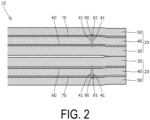
- each of the laminated films 20 includes the inner layer film 30 disposed on the innermost side of the pouch 10, an intermediate layer film 40 formed on the outer surface side of the inner layer film 30, an outer layer film 50 formed on the outer surface side of the intermediate layer film 40, an inner adhesive layer 60 that bonds the inner layer film 30 and the intermediate layer film 40 together, an outer adhesive layer 70 that bonds the intermediate layer film 40 and the outer layer film 50 together, a cut guide line 80 constituted by a slit portion (half-cut portion) 81 for guiding cutting (opening) when a user opens the pouch 10, and an interposed adhesive portion 90 made of an adhesive interposed between slit-side end surfaces 41 of the intermediate layer film 40.
- the inner layer film 30 will be described as follows.
- the inner layer film 30 is formed as a so-called sealant film. As illustrated in FIG. 2 , each of the inner layer films 30 is disposed on the innermost side facing the other laminated film 20 in a state where the pouch 10 is formed into the bag shape, and is thermally welded to the inner layer film 30 of the other laminated film 20.
- the material of the inner layer film 30 various known materials can be used.
- polyolefin having heat sealability can be used.
- polyolefin examples include low-density, medium-density or high-density polyethylene, linear low-density polyethylene, isotactic polypropylene, syndiotactic polypropylene, ethylene-propylene copolymer, polybutene-1, poly(4-methyl-1-pentene), ethylene-butene-1 copolymer, propylene-butene-1 copolymer, ethylene-propylene-butene-1 copolymer, ethylene-vinyl acetate copolymer, ion-crosslinked olefin copolymer (ionomer), and ethylene-acrylic ester copolymer.
- These materials can be used alone or in combination of two or more as a blended material.
- a propylene-based polymer is suitable, and homo-polypropylene, or a random copolymer or a block copolymer mainly composed of propylene can be used.
- the inner layer film 30 may be formed as one layer, or may be formed by layering two or more layers made of different materials.
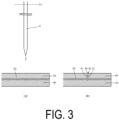
- the inner layer film 30 is preferably formed so that the tensile elastic modulus of the inner layer film 30 is 0.9 GPa or less. That is, when the tensile elastic modulus of the inner layer film 30 is set to 0.9 GPa or less, as illustrated in FIG.
- the shape of the inner layer film 30, elastically deformed by being pressed by the cutter blade C can be favorably restored to its original shape (flat plate shape).
- the gap W between the pair of slit-side end surfaces 41 can be made narrow.
- the intermediate layer film 40 will be described as follows.
- the intermediate layer film 40 is disposed between the inner layer film 30 and the outer layer film 50, and is formed as a film having barrier properties such as gas barrier properties, moisture barrier properties, and aroma component barrier properties (aroma retention properties).
- the intermediate layer film 40 includes a base layer and a barrier layer.
- the material of the base layer of the intermediate layer film 40 various known materials can be used, and examples thereof include polyamide and polyester.
- polyamide examples include nylon 6, nylon 66, nylon 46, nylon 69, nylon 610, nylon 612, nylon 11, nylon 12, and nylon MXD6. From the viewpoint of ease of handling, nylon 6 or nylon 66 is preferable.
- polyester a condensation polymer, which is obtained by polymerization of monomers containing an aromatic dicarboxylic acid or an aliphatic dicarboxylic acid, and a diol, as components, such as polyethylene terephthalate (PET) and polybutylene terephthalate (PBT), is preferable.
- PET polyethylene terephthalate
- PBT polybutylene terephthalate
- PBT polybutylene terephthalate
- PET polyethylene terephthalate
- intermediate layer film 40 may be formed as one layer (base layer), or may be formed by layering two or more layers (base layers).
- the barrier layer of the intermediate layer film 40 is a layer for imparting, to the laminated film 20, various barrier properties such as gas barrier properties and moisture barrier properties.
- the barrier layer is formed as a vapor-deposited layer in which an inorganic substance or an inorganic oxide, such as aluminum oxide (alumina, Al 2 O 3 ), silicon (Si), or aluminum (Al), is vapor-deposited on the outer surface side of the base layer.
- an inorganic substance or an inorganic oxide such as aluminum oxide (alumina, Al 2 O 3 ), silicon (Si), or aluminum (Al)
- the type of the barrier layer is not specifically limited to the vapor-deposited layer as described above. Any layer may be used as the barrier layer as long as it can impart various barrier properties.
- a resin film such as polyvinylidene chloride, polyacrylonitrile, or an ethylene vinyl alcohol copolymer may be bonded to the base layer as the barrier layer.
- the barrier layer of the intermediate layer film 40 is formed on the outer surface side of the base layer, but the position at which the barrier layer is formed is not limited thereto.
- the barrier layer may be formed on the inner surface side of the base layer.
- barrier layer of the intermediate layer film 40 only one of the barrier layers may be formed, or two or more of the barrier layers may be formed at arbitrary positions.
- the slit portion (half-cut portion) 81 is formed extending through the intermediate layer film 40 in the film thickness direction (from the outer surface side to the inner surface side of the intermediate layer film 40), namely, so as to cut the barrier layer described above.
- the intermediate layer film 40 includes the pair of slit side end surfaces 41 facing the slit portion (half-cut portion) 81, and facing each other with the slit portion (half-cut portion) 81 therebetween.
- the adhesive constituting the interposed adhesive portion 90 is disposed between the pair of slit-side end surfaces 41.
- the intermediate layer film 40 is formed of a multilayer structure including the base layer and the barrier layer, but the specific type of the intermediate layer film 40 may be any type as long as the intermediate layer film 40 has barrier properties.
- the intermediate layer film 40 may have a single-layer structure formed of a material having barrier properties, such as polyester having aroma component barrier properties (aroma retention properties).
- the material of the outer layer film 50 various known materials can be used, and examples thereof include polyamide and polyester.
- polyamide examples include nylon 6, nylon 66, nylon 46, nylon 69, nylon 610, nylon 612, nylon 11, nylon 12, and nylon MXD6. From the viewpoint of ease of handling, nylon 6 or nylon 66 is preferable.
- polyester a condensation polymer, which is obtained by polymerization of monomers containing an aromatic dicarboxylic acid or an aliphatic dicarboxylic acid, and a diol, as components, such as polyethylene terephthalate (PET) and polybutylene terephthalate (PBT), is preferable.
- PET polyethylene terephthalate
- PBT polybutylene terephthalate
- PBT and PET are particularly preferable.
- nylon or PBT is used for the outer layer film
- a biaxially stretched film formed by a tubular method is preferable.
- the biaxially stretched film has high isotropy in addition to properties such as strength, heat resistance, and transparency, and thus a difference in quality due to the position where the film is taken up is unlikely to occur.
- outer layer film 50 may be formed as one layer, or may be formed by layering two or more layers made of different materials.
- a barrier layer similar to the barrier layer of the intermediate layer film 40 described above may be formed in the outer layer film 50.
- the inner adhesive layer 60 is formed between the outer surface of the inner layer film 30 and the inner surface of the intermediate layer film 40, and bonds the outer surface of the inner layer film 30 and the inner surface of the intermediate layer film 40 together.
- An adhesive constituting the inner adhesive layer 60 is composed of a solvent-free adhesive, which will be described later in detail.
- the adhesive constituting the inner adhesive layer 60 is preferably an adhesive having an initial shear strength of 0.1 N/15 mm or more. That is, when the inner adhesive layer 60 is formed of an adhesive having an initial shear strength of 0.1 N/15 mm or more, as illustrated in FIG.
- the intermediate layer film 40 can be caused to follow the motion of the shape recovery of the inner layer film 30, which has been elastically deformed by being pressed by the cutter blade C, and thus, the gap W between the pair of slit-side end surfaces 41 can be made narrow.
- the initial shear strength described above is a shear strength immediately after bonding (immediately after coating and before an aging treatment) measured by a method of measuring the shear strength with the tensile shear load parallel to the bonding surface, under the conditions of a bonded area of 15 x 15 mm and a tensile speed of 5 mm/min according to the test procedure of JIS K 6850.
- the lamination strength between the inner layer film 30 and the intermediate layer film 40 is preferably set to 1.0 N/15 mm or more.
- outer adhesive layer 70 will be described as follows.
- the outer adhesive layer 70 is formed between the outer surface of the intermediate layer film 40 and the inner surface of the outer layer film 50, and bonds the outer surface of the intermediate layer film 40 and the inner surface of the outer layer film 50 together.
- An adhesive constituting the outer adhesive layer 70 is formed of a solvent-free adhesive, which will be described later in detail.
- a different adhesive from the adhesive constituting the inner adhesive layer 60 may be used as the adhesive constituting the outer adhesive layer 70.
- various adhesives including adhesives such as a solvent adhesive other than the solvent-free adhesive may be used as the adhesive constituting the outer adhesive layer 70.
- various settings such as settings for treatment conditions in the aging treatment for promoting the curing of the adhesive, become easier.
- the same adhesive can be introduced into the slit portion (half-cut portion) 81 from the outer surface side of the intermediate layer film 40 by the capillary phenomenon or the like, the slit portion (half-cut portion) 81 can be reliably filled with the same adhesive.
- the solvent-free adhesive constituting the adhesive layers 60 and 70 is a two-part reaction curable adhesive composed of a main agent and a curing agent to be described below.
- the main agent constituting the solvent-free adhesive it is preferable to use a polyester-based resin having good adhesion to the films 30, 40, and 50 and excellent lamination strength and impact resistance, and a polyester polyol resin is particularly preferable.
- the polyester polyol resin may be produced by an esterification reaction between a polybasic acid such as succinic acid, adipic acid, azelaic acid, sebacic acid, phthalic acid, isophthalic acid, or terephthalic acid and a polyhydric alcohol such as ethylene glycol, 1,2-propanediol, 1,3-butanediol, 1,4-butanediol, 3-methyl-1, 5-pentanediol, 1,6-hexanediol, 1,4-cyclohexanedimethanol, neopentyl glycol, 3,3-bis(hydroxymethyl)heptane, diethylene glycol, dipropylene glycol, glycerin, or trimethylolpropane.
- a polybasic acid such as succinic acid, adipic acid, azelaic acid, sebacic acid, phthalic acid, isophthalic acid, or terephthalic acid
- polyester polyol resin examples include (1) adipate-based polyester glycols such as polyethylene adipate), poly(diethylene adipate), polypropylene adipate), poly(tetramethylene adipate), poly(hexamethylene adipate), and poly(neopentylene adipate), (2) polycaprolactone-based polyester glycols such as poly- ⁇ -caprolactone, and (3) other polyester polyol resins such as poly(hexamethylene sebacate) and poly(hexamethylene carbonate).
- adipate-based polyester glycols such as polyethylene adipate), poly(diethylene adipate), polypropylene adipate), poly(tetramethylene adipate), poly(hexamethylene adipate), and poly(neopentylene adipate
- polycaprolactone-based polyester glycols such as poly- ⁇ -caprolactone
- other polyester polyol resins such as poly(hexamethylene se
- a polyurethane-based compound may be contained as the main agent.
- a main agent when an ink layer is provided in contact with the adhesive layers 60 and 70, adhesion to the ink layer can be ensured because the ink layer usually contains a urethane component.
- the number average molecular weight of the resin constituting the main agent is preferably 400 to 1500, and more preferably 500 to 1000.
- the number average molecular weight of the resin constituting the main agent is less than 400, the viscosity of the solvent-free adhesive decreases, and as a result, suitability for continuous lamination may deteriorate when manufacturing the laminated film 20.
- the number of terminal reactive groups increases, it is necessary to increase the amount of the curing agent. As a result, there is a problem in that the hardness of the obtained adhesive layers 60 and 70 increases due to an increased amount of cross-links and the impact resistance of the adhesive layers 60 and 70 deteriorates.
- the number average molecular weight of the resin constituting the main agent is more than 1500, the impact resistance of the obtained adhesive layers 60 and 70 is improved, but the viscosity of the solvent-free adhesive increases. As a result, a wetting failure may occur when applying the solvent-free adhesive, thereby causing an appearance defect or reduction in the lamination strength of the obtained laminated film 20.
- an isocyanate compound particularly a mixture of an aliphatic isocyanate and an araliphatic diisocyanate.
- butane-1,4-diisocyanate 1,6-hexamethylene diisocyanate (HDI)
- isopropylene diisocyanate methylene diisocyanate, 2,2,4-trimethylhexamethylene diisocyanate, m-tetramethylxylylene diisocyanate, lysine diisocyanate, dimer diisocyanate obtained by converting a carboxyl group of dimer acid into an isocyanate group, and the like
- HDI 1,6-hexamethylene diisocyanate
- aromatic aliphatic diisocyanate constituting the curing agent
- aromatic aliphatic diisocyanate examples include 1,3-xylene diisocyanate, 1,4-xylene diisocyanate, or their mixtures (XDI), 1,3-tetramethylxylene diisocyanate, 1,4-tetramethylxylene diisocyanate, or their mixtures (TMXDI), and ⁇ , ⁇ '-diisocyanate-1,4-diethylbenzene.
- the number average molecular weight of the resin constituting the curing agent is preferably 400 to 1500, and more preferably 500 to 1000.
- the number average molecular weight of the resin constituting the curing agent is less than 400, the viscosity of the solvent-free adhesive decreases, and as a result, suitability for continuous lamination may deteriorate when manufacturing the laminated film.
- the number of terminal reactive groups increases, it is necessary to increase the amount of the main agent. As a result, there is a problem in that the hardness of the obtained adhesive layers 60 and 70 increases due to an increased amount of cross-links and the impact resistance of the adhesive layers 60 and 70 deteriorates.
- the number average molecular weight of the resin constituting the curing agent is more than 1500, the impact resistance of the obtained adhesive layers 60 and 70 is improved, but the viscosity of the solvent-free adhesive increases. Thus, a wetting failure may occur when applying the solvent-free adhesive, thereby causing an appearance defect or reduction in the lamination strength of the obtained laminated film 20.
- the curing agent is preferably contained in a range from 30 to 200 parts by mass, and is particularly preferably in a range from 30 to 70 parts by mass.
- the ratio of the curing agent is too small, the obtained adhesive layers 60 and 70 are insufficiently cross-linked, and the lamination strength of the obtained laminated film 20 may deteriorate.
- the ratio of the curing agent is too large, the main agent and the curing agent are not sufficiently mixed, and thus the obtained adhesive layers 60 and 70 include a mixture of an insufficiently cross-linked portion and an excessively cross-linked portion. As a result, the lamination strength and the impact resistance of the obtained laminated film 20 may deteriorate.
- an adhesive having a viscosity of 2000 to 30000 mPa ⁇ S/25°C (in a state before the aging treatment) is preferably used.
- the viscosity of the solvent-free adhesive is less than 2000 mPa ⁇ S/25°C, the solvent-free adhesive may drip, or a transfer failure between rolls may occur during coating of the solvent-free adhesive, which results in "transfer unevenness".
- the viscosity of the solvent-free adhesive is higher than 30000 mPa ⁇ S/25°C, the fluidity of the solvent-free adhesive cannot be ensured. In particular, the capillary phenomenon described later cannot be favorably generated.
- the solvent-free adhesive may contain a polyurethane-based compound in addition to the main agent and the curing agent.
- the solvent-free adhesive may further contain various additive agents such as a filler, a softener, an antioxidant, a stabilizer, an adhesion promoter, a leveling agent, an anti-foaming agent, a plasticizer, an inorganic filler, a tackifying resin, a fiber, a colorant such as a pigment, or a lifetime extender.
- additive agents such as a filler, a softener, an antioxidant, a stabilizer, an adhesion promoter, a leveling agent, an anti-foaming agent, a plasticizer, an inorganic filler, a tackifying resin, a fiber, a colorant such as a pigment, or a lifetime extender.
- the solvent-free adhesive may contain an adhesion promoter.
- an adhesion promoter a coupling agent such as a silane coupling agent, a titanate-based coupling agent, or an aluminum-based coupling agent, an epoxy resin, or the like can be used.
- silane coupling agent examples include aminosilanes such as ⁇ -aminopropyltriethoxysilane, ⁇ -aminopropyltrimethoxysilane, N- ⁇ (aminoethyl)- ⁇ -aminopropyltrimethoxysilane, N- ⁇ (aminoethyl)- ⁇ -aminopropyltiimethyldimethoxysilane, and N-phenyl- ⁇ -aminopropyltrimethoxysilane, epoxy silanes such as ⁇ -(3,4-epoxycyclohexyl)ethyltrimethoxysilane, ⁇ -glycidoxypropyltrimethoxysilane, and ⁇ -glycidoxypropyltriethoxysilane, vinylsilanes such as vinyltris( ⁇ -methoxyethoxy)silane, vinyltriethoxysilane, vinyltrimethoxysilane, and ⁇ -me
- titanate-based coupling agent examples include tetraisopropoxytitanium, tetra-n-butoxytitanium, butyl titanate dimer, tetrastearyltitanate, titanium acetylacetonate, titanium lactate, tetraoctylene glycol titanate, titanium lactate, and tetrastearoxytitanium.
- aluminum-based coupling agent examples include acetoalkoxyaluminum diisopropylate.
- epoxy resin examples include various commercially available epoxy resins such as epibis-type, novolac-type, ⁇ -methyl epichlo-type, cyclic oxirane-type, glycidyl ether-type, glycidyl ester-type, polyglycol ether-type, glycol ether-type, epoxidized fatty ester-type, polyvalent carboxylic ester-type, aminoglycidyl-type, and resorcinol-type epoxy resins. Cut Guide Line 80
- cut guide line 80 will be described as follows.
- the pouch 10 is formed with the cut guide line 80, which serves as a weakened portion that is weaker than the portion around the weakened portion.
- the cut guide line 80 guides the user when cutting (opening) the pouch 10 when the user opens the pouch 10.
- the cut guide line 80 is formed as a linear portion extending continuously in a straight line in a plan view of the laminated film 20, connecting notches 10a formed in both side portions of the pouch 10.
- the notch 10a is formed in a notch shape or a slit shape at the outer edge of an outer edge seal portion (heat-sealed portion) used for forming the pouch 10 into a bag, in order to facilitate opening of the pouch 10.
- the cut guide line 80 is constituted by the slit portion 81 formed from the outer surface of the intermediate layer film 40 toward the inner surface side of the intermediate layer film 40.
- the cut guide line 80 is constituted by the slit-shaped half-cut portion 81, which is cut from the outer surface of the intermediate layer film 40 toward the inner surface side of the intermediate layer film 40 (cutting of the half-cut portion 81 does not involve any material removal, or involves almost no material removal).
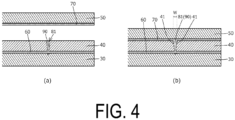
- the half-cut portion 81 is formed from the outer surface of the intermediate layer film 40 toward the inner surface side of the intermediate layer film 40 by inserting the cutter blade C of a cutter (in the example illustrated in FIG. 4 , a rotary cutter rotating about a rotation axis C1) in the film-thickness direction from the outer surface of the intermediate layer film 40 toward the inner surface side of the intermediate layer film 40.
- the half-cut portion 81 is formed as a slit having a V-shaped (or substantially V-shaped) cross section, so that the width W on the outer surface side of the intermediate layer film 40 is wider than the width on the inner surface side of the intermediate layer film 40.
- the slit portion (half-cut portion) 81 is not formed in the outer layer film 50 (and the outer adhesive layer 70), and the tip of the slit portion (half-cut portion) 81 (a tip portion thereof on the side away from the outer surface of the intermediate layer film 40, that is, the lower end in FIGS. 3 and 4 ) reaches the inner adhesive layer 60.
- the tip of the slit portion (half-cut portion) 81 is formed so as to just reach the inner layer film 30, but the tip of the half-cut portion 81 may be formed so as not to reach the inner layer film 30. Further, even when the tip of the slit portion (half-cut portion) 81 is formed so as to reach the inner layer film 30, the slit portion (half-cut portion) 81 is formed so as not to reach the inner surface side of the inner layer film 30.
- the width W of the slit portion (half-cut portion) 81 illustrated in FIG. 4(b) is preferably set to 20 ⁇ m or less, more preferably 10 ⁇ m or less over the entire region in the longitudinal direction of the cut guide line 80 in a state where the laminated film 20 (on which the outer layer film 50 is laminated) is in a flat state (specifically, in a state where the laminated film 20 is placed on a flat surface), from the viewpoint of suppressing a deterioration in barrier performance caused by the intermediate layer film 40.
- width W of the slit portion (half-cut portion) 81 is also desirable from the viewpoint of the design of the pouch 10. That is, when the width W is 20 ⁇ m or less, it is difficult to visually determine whether the slit portion (half-cut portion) 81 has been processed, and it is thus possible to prevent the appearance of the pouch 10 from being impaired by the processing.
- width W of the slit portion 81 on the outer surface side of the intermediate layer film 40 is preferably set to 20 ⁇ m or less (10 ⁇ m or less). That is, the width of the inner surface side of the intermediate layer film 40 and also the width of an intermediate portion between the outer surface and the inner surface of the intermediate layer film 40 is preferably set to 20 ⁇ m or less (10 ⁇ m or less).
- interposed adhesive portion 90 will be described as follows.
- the interposed adhesive portion 90 is a portion made of an adhesive interposed in at least a part (in the present embodiment, the whole) of the slit portion (half-cut portion) 81 formed in the intermediate layer film 40.
- the adhesive constituting the interposed adhesive portion 90 is formed so as to entirely fill the inside of the slit portion (half-cut portion) 81.
- the adhesive constituting the interposed adhesive portion 90 is interposed in the slit portion (half-cut portion) 81 in a state of being in contact with both of the pair of slit-side end surfaces 41 so as to connect the pair of slit-side end surfaces 41 facing each other with the slit portion (half-cut portion) 81 therebetween.
- the interposed adhesive portion 90 is made of the same adhesive as the adhesive constituting the inner adhesive layer 60, and is formed continuously with the inner adhesive layer 60.
- the outer adhesive layer 70 be made of the same adhesive as the adhesive constituting the inner adhesive layer 60
- the interposed adhesive portion 90 be made of the same adhesive as the adhesive constituting the inner adhesive layer 60 and the outer adhesive layer 70, and be formed continuously with the inner adhesive layer 60 and the outer adhesive layer 70.
- the interposed adhesive portion 90 does not prevent the laminated film 20 from being cut along the cut guide line 80.
- the inner layer film 30 and the intermediate layer film 40 which are layered with the inner adhesive layer 60 therebetween, are prepared.
- the inner layer film 30 and the intermediate layer film 40 are bonded to each other by a solvent-free laminating (non-solvent laminating) method using the solvent-free adhesive described above.
- a solvent-free laminating (non-solvent laminating) method using the solvent-free adhesive described above.
- the outer surface of the inner layer film 30 or the inner surface of the intermediate layer film 40 is coated with the solvent-free adhesive constituting the inner adhesive layer 60 (the above-described solvent-free adhesive in which the curing agent is mixed with the main agent), and then the inner layer film 30 and the intermediate layer film 40 are layered and bonded to each other.
- the cutter blade C is inserted in the film thickness direction from the outer surface of the intermediate layer film 40 toward the inner surface side of the intermediate layer film 40, so as to reach the inner adhesive layer 60, thereby forming the slit portion (half-cut portion) 81.
- the inner layer film 30 and the intermediate layer film 40 are supported by a flat support surface (not illustrated) from the inner surface side of the inner layer film 30.
- the curing reaction of the adhesive constituting the inner adhesive layer 60 has not yet progressed (the aging treatment for promoting the curing reaction has not been performed), and the adhesive is in a fluid state.
- the adhesive constituting the inner adhesive layer 60 is introduced into (enters) the slit portion 81 by the capillary phenomenon, and the adhesive is disposed inside the slit portion 81.
- the viscosity of the adhesive constituting the inner adhesive layer 60 is preferably 30000 mPa ⁇ S or less at the time when the adhesive constituting the inner adhesive layer 60 is introduced into the slit portion 81, to ensure the fluidity of the adhesive. More specifically, as the adhesive constituting the inner adhesive layer 60 (solvent-free adhesive), an adhesive having a viscosity of 30000 mPa ⁇ S/25°C or less (before the aging treatment) is preferably used.
- the temperature of the adhesive constituting the inner adhesive layer 60 is about 25°C at the time when the adhesive constituting the inner adhesive layer 60 is introduced into the slit portion 81. More specifically, the temperature of the adhesive constituting the inner adhesive layer 60 is about 25°C from the time when the solvent-free adhesive constituting the inner adhesive layer 60 is applied to either the outer surface of the inner layer film 30 or the inner surface of the intermediate layer film 40, at least up to the time when the outer layer film 50 to be described later is layered on the outer surface side of the intermediate layer film 40. Note that the temperature setting of the adhesive constituting the inner adhesive layer 60 at each time may be set as desired according to the embodiment.
- the viscosity of the adhesive constituting the inner adhesive layer 60 is preferably 2000 mPa ⁇ S or more. More specifically, as the adhesive constituting the inner adhesive layer 60 (solvent-free adhesive), an adhesive having a viscosity of 2000 mPa ⁇ S/25°C or more (before the aging treatment) is preferably used.
- the width (cross-sectional area) of the slit portion (half-cut portion) 81 may be set to be narrow enough to cause the capillary phenomenon (capillary phenomenon for introducing the adhesive constituting the inner adhesive layer 60 into the half-cut portion 81) to occur.
- the material of the intermediate layer film 40 may be determined such that the water repellency of the slit-side end surface 41 is high enough to cause the capillary phenomenon to occur.
- the outer layer film 50 whose inner surface side is coated with the adhesive constituting the outer adhesive layer 70 (in the present embodiment, the above-described solvent-free adhesive in which the curing agent is mixed with the main agent) is layered on the outer surface side of the intermediate layer film 40.
- the adhesive constituting the outer adhesive layer 70 may be applied to the outer surface side of the intermediate layer film 40, and then the intermediate layer film 40 and the outer layer film 50 may be bonded to each other.
- the viscosity of the adhesive constituting the outer adhesive layer 70 at the time when the outer layer film 50 is layered on the outer surface side of the intermediate layer film 40 is preferably 30000 mPa ⁇ S or less to ensure the fluidity of the adhesive. More specifically, as the adhesive constituting the outer adhesive layer 70 (solvent-free adhesive), an adhesive having a viscosity of 30000 mPa ⁇ S/25°C or less (before the aging treatment) is preferably used.
- the viscosity of the adhesive constituting the outer adhesive layer 70 is preferably 2000 mPa ⁇ S or more at the time when the outer layer film 50 is layered on the outer surface side of the intermediate layer film 40. More specifically, as the adhesive constituting the outer adhesive layer 70 (solvent-free adhesive), an adhesive having a viscosity of 2000m Pa S/25°C or more (before the aging treatment) is preferably used.
- the aging treatment for promoting the curing reaction (promoting the curing) of the solvent-free adhesives constituting the adhesive layers 60 and 70 is performed to cure the adhesives.
- the laminated film 20 in which the inner layer film 30, the intermediate layer film 40, and the outer layer film 50 are layered and fixed in this order can be manufactured.
- the specific temperature setting and treatment time period of the aging (curing) treatment may be determined as required, but it is preferable that the temperature of the aging (curing) treatment be set to 30 to 70°C, and the treatment time period of the aging (curing) treatment be set to 12 to 120 hours.
- the pouch 10 may be configured by arbitrarily combining respective configurations of the above-described embodiment and embodiments and modified examples to be described below.
- the pouch 10 of the present invention is not limited to the four-sided seal type pouch illustrated in FIG. 1 and can be applied to various types of pouches such as a standing pouch, a flat pouch, a three-sided seal type, a pillow type pouch, and a gusset type pouch.
- the cut guide line 80 is formed as the linear portion extending in a straight line, but the specific type of the cut guide line 80 is not limited thereto.
- the cut guide line 80 may be formed extending in a curved shape, or may be formed in an intermittently formed dotted line shape.
- one cut guide line 80 is formed, but, for example, a plurality of the cut guide lines 80 may be provided in the laminated film 20 in a state of being arranged parallel to each other.
- the slit portion 81 constituting the cut guide line 80 is constituted by the slit-shaped half-cut portion 81 formed using the cutter blade C, but the specific type of the slit portion 81 is not limited thereto.
- the slit portion 81 may be formed by laser processing from the outer surface of the intermediate layer film 40 toward the inner surface side of the intermediate layer film 40.
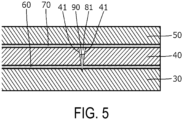
- the adhesive constituting the interposed adhesive portion 90 is formed to entirely fill the inside of the slit portion 81, but, as illustrated in FIG. 5 , the interposed adhesive portion 90 may be formed such that the adhesive constituting the interposed adhesive portion 90 is disposed only in a part of the slit portion 81. In the example illustrated in FIG. 5 , the interposed adhesive portion 90 is formed continuously with the inner adhesive layer 60.
- the adhesive constituting the interposed adhesive portion 90 is formed to entirely fill the inside of the slit portion 81, that is, the interposed adhesive portion 90 is formed to entirely fill the inside of the slit portion 81 over the entire region of the cut guide line 80 in the longitudinal direction of the cut guide line 80.
- the interposed adhesive portion 90 may be formed only in a partial section of the cut guide line 80 in the longitudinal direction of the cut guide line 80.
- the adhesive constituting the inner adhesive layer 60 (and the outer adhesive layer 70) is introduced into the slit portion 81 by the capillary phenomenon, but the adhesive may be introduced into the slit portion 81 by a method other than the capillary phenomenon.
- the adhesive may be introduced into the slit portion 81 using gravity.
- an adhesive different from the adhesive constituting the inner adhesive layer 60 (or the outer adhesive layer 70) may be introduced (injected) into the slit portion 81.
- the inner adhesive layer 60 and the outer adhesive layer 70 are formed of the solvent-free adhesive, but the inner adhesive layer 60 and the outer adhesive layer 70 may be formed of an adhesive other than the solvent-free adhesive, such as a solvent adhesive.
- an anchor coat layer made of a polyester-based polyurethane resin or a polyether-based polyurethane resin, an overcoat layer (top coat layer) made of a urethane-based resin or a polyester-based resin, a print layer made of printing ink, or the like may be provided as necessary on the laminated film 20.
Landscapes
- Engineering & Computer Science (AREA)
- Mechanical Engineering (AREA)
- Laminated Bodies (AREA)
- Wrappers (AREA)
Applications Claiming Priority (2)
| Application Number | Priority Date | Filing Date | Title |
|---|---|---|---|
| JP2022069009A JP2023158938A (ja) | 2022-04-19 | 2022-04-19 | パウチ用の積層フィルム、パウチ、および、積層フィルムの製造方法 |
| PCT/JP2023/001491 WO2023203817A1 (ja) | 2022-04-19 | 2023-01-19 | パウチ用の積層フィルム、パウチ、および、積層フィルムの製造方法 |
Publications (2)
| Publication Number | Publication Date |
|---|---|
| EP4512736A1 true EP4512736A1 (de) | 2025-02-26 |
| EP4512736A4 EP4512736A4 (de) | 2026-04-01 |
Family
ID=88419518
Family Applications (1)
| Application Number | Title | Priority Date | Filing Date |
|---|---|---|---|
| EP23791474.2A Pending EP4512736A4 (de) | 2022-04-19 | 2023-01-19 | Verbundfolie für beutel, beutel und verfahren zur herstellung einer verbundfolie |
Country Status (7)
| Country | Link |
|---|---|
| US (1) | US20240417150A1 (de) |
| EP (1) | EP4512736A4 (de) |
| JP (1) | JP2023158938A (de) |
| KR (1) | KR20240089610A (de) |
| CN (1) | CN118973921A (de) |
| AU (1) | AU2023258155B2 (de) |
| WO (1) | WO2023203817A1 (de) |
Family Cites Families (8)
| Publication number | Priority date | Publication date | Assignee | Title |
|---|---|---|---|---|
| JPS6197149U (de) * | 1984-11-30 | 1986-06-21 | ||
| JP4447075B2 (ja) * | 1999-07-01 | 2010-04-07 | 大日本印刷株式会社 | 易開封性包装袋の製造方法 |
| JP6573147B2 (ja) | 2015-02-18 | 2019-09-11 | 大日本印刷株式会社 | ガスバリア性と易開封性を備えた袋 |
| CN109890427B (zh) * | 2016-09-21 | 2021-03-26 | 佐贝勒控股股份公司 | 挥发性物质散发装置及其制造方法 |
| FR3075214B1 (fr) * | 2017-12-19 | 2019-12-27 | Bostik Sa | Adhesif polyurethane bi composant pour lamination |
| US12454115B2 (en) * | 2018-09-21 | 2025-10-28 | Toyo Seikan Co., Ltd. | Easy-open packaging bag, and easy-open laminate film and pouch having gas barrier properties |
| JP7293632B2 (ja) * | 2018-12-17 | 2023-06-20 | 東洋製罐株式会社 | フィルムおよびパウチ |
| JP7426195B2 (ja) * | 2019-01-30 | 2024-02-01 | 東洋製罐株式会社 | 易開封性包装袋 |
-
2022
- 2022-04-19 JP JP2022069009A patent/JP2023158938A/ja active Pending
-
2023
- 2023-01-19 KR KR1020247015670A patent/KR20240089610A/ko active Pending
- 2023-01-19 EP EP23791474.2A patent/EP4512736A4/de active Pending
- 2023-01-19 AU AU2023258155A patent/AU2023258155B2/en active Active
- 2023-01-19 WO PCT/JP2023/001491 patent/WO2023203817A1/ja not_active Ceased
- 2023-01-19 CN CN202380014322.9A patent/CN118973921A/zh active Pending
-
2024
- 2024-08-28 US US18/817,584 patent/US20240417150A1/en active Pending
Also Published As
| Publication number | Publication date |
|---|---|
| US20240417150A1 (en) | 2024-12-19 |
| JP2023158938A (ja) | 2023-10-31 |
| WO2023203817A1 (ja) | 2023-10-26 |
| EP4512736A4 (de) | 2026-04-01 |
| AU2023258155B2 (en) | 2025-10-02 |
| KR20240089610A (ko) | 2024-06-20 |
| AU2023258155A1 (en) | 2024-05-30 |
| CN118973921A (zh) | 2024-11-15 |
Similar Documents
| Publication | Publication Date | Title |
|---|---|---|
| JP5397584B2 (ja) | 無溶剤型接着剤を使用した多層フィルム、その製造方法および包装容器 | |
| KR101904558B1 (ko) | 적층 필름 | |
| TWI895321B (zh) | 硬化劑、二液型接著劑、接著劑組成物、硬化物、積層體及其製造方法、包裝材、以及包裝體 | |
| JP2733180B2 (ja) | フレキシブル包装用ラミネート、その製造方法及びそれに用いる接着剤 | |
| JP6753210B2 (ja) | 接着剤組成物 | |
| JP4660677B2 (ja) | 無溶剤2液硬化型接着剤組成物 | |
| JP2002249745A (ja) | 2液硬化型無溶剤系接着剤組成物 | |
| JP7030271B2 (ja) | 接着剤組成物 | |
| JP6672586B2 (ja) | リチウム電池用外装材 | |
| JP5362341B2 (ja) | 高耐久性ポリウレタン系接着剤の主剤および高耐久性ポリウレタン系接着剤 | |
| EP4512736A1 (de) | Verbundfolie für beutel, beutel und verfahren zur herstellung einer verbundfolie | |
| JP2020050727A (ja) | 食品包装フィルム用接着剤組成物及び食品包装フィルム | |
| JP4978126B2 (ja) | リチウム電池用包材 | |
| JP2001288408A (ja) | 蒸着コーティング液 | |
| EP4559678A1 (de) | Verfahren zur herstellung eines mehrschichtigen films und mehrschichtiger film | |
| EP4494770A1 (de) | Verfahren zur herstellung einer verbundfolie, verbundfolie und verpackungsbehälter | |
| JP7793949B2 (ja) | 無溶剤型接着剤を使用した多層フィルムおよびその製造方法並びに包装容器 | |
| EP4670970A1 (de) | Mehrschichtfolie mit lösungsmittelfreiem klebstoff, verfahren zur herstellung davon und verpackungsbehälter | |
| JPH0858013A (ja) | フレキシブル包装用ラミネート | |
| JPH11172223A (ja) | 無溶剤2液硬化型接着剤組成物及びそれを用いたラミネートフイルム | |
| JP4933080B2 (ja) | 蓄光塗料保護皮膜の接着方法及び蓄光塗料板 |
Legal Events
| Date | Code | Title | Description |
|---|---|---|---|
| STAA | Information on the status of an ep patent application or granted ep patent |
Free format text: STATUS: THE INTERNATIONAL PUBLICATION HAS BEEN MADE |
|
| PUAI | Public reference made under article 153(3) epc to a published international application that has entered the european phase |
Free format text: ORIGINAL CODE: 0009012 |
|
| STAA | Information on the status of an ep patent application or granted ep patent |
Free format text: STATUS: REQUEST FOR EXAMINATION WAS MADE |
|
| 17P | Request for examination filed |
Effective date: 20240328 |
|
| AK | Designated contracting states |
Kind code of ref document: A1 Designated state(s): AL AT BE BG CH CY CZ DE DK EE ES FI FR GB GR HR HU IE IS IT LI LT LU LV MC ME MK MT NL NO PL PT RO RS SE SI SK SM TR |
|
| DAV | Request for validation of the european patent (deleted) | ||
| DAX | Request for extension of the european patent (deleted) | ||
| A4 | Supplementary search report drawn up and despatched |
Effective date: 20260303 |
|
| RIC1 | Information provided on ipc code assigned before grant |
Ipc: B65D 65/40 20060101AFI20260225BHEP Ipc: B65D 75/62 20060101ALI20260225BHEP Ipc: B32B 7/022 20190101ALI20260225BHEP Ipc: B32B 7/12 20060101ALI20260225BHEP Ipc: B32B 3/18 20060101ALI20260225BHEP |