EP4512295A1 - Reinigungsvorrichtung und reinigungsroboter - Google Patents
Reinigungsvorrichtung und reinigungsroboter Download PDFInfo
- Publication number
- EP4512295A1 EP4512295A1 EP23791057.5A EP23791057A EP4512295A1 EP 4512295 A1 EP4512295 A1 EP 4512295A1 EP 23791057 A EP23791057 A EP 23791057A EP 4512295 A1 EP4512295 A1 EP 4512295A1
- Authority
- EP
- European Patent Office
- Prior art keywords
- cleaning
- water
- drum
- cleaning drum
- squeezing
- Prior art date
- Legal status (The legal status is an assumption and is not a legal conclusion. Google has not performed a legal analysis and makes no representation as to the accuracy of the status listed.)
- Pending
Links
Images




Classifications
-
- A—HUMAN NECESSITIES
- A47—FURNITURE; DOMESTIC ARTICLES OR APPLIANCES; COFFEE MILLS; SPICE MILLS; SUCTION CLEANERS IN GENERAL
- A47L—DOMESTIC WASHING OR CLEANING; SUCTION CLEANERS IN GENERAL
- A47L11/00—Machines for cleaning floors, carpets, furniture, walls, or wall coverings
- A47L11/29—Floor-scrubbing machines characterised by means for taking-up dirty liquid
- A47L11/292—Floor-scrubbing machines characterised by means for taking-up dirty liquid having rotary tools
-
- A—HUMAN NECESSITIES
- A47—FURNITURE; DOMESTIC ARTICLES OR APPLIANCES; COFFEE MILLS; SPICE MILLS; SUCTION CLEANERS IN GENERAL
- A47L—DOMESTIC WASHING OR CLEANING; SUCTION CLEANERS IN GENERAL
- A47L11/00—Machines for cleaning floors, carpets, furniture, walls, or wall coverings
- A47L11/40—Parts or details of machines not provided for in groups A47L11/02 - A47L11/38, or not restricted to one of these groups, e.g. handles, arrangements of switches, skirts, buffers, levers
-
- A—HUMAN NECESSITIES
- A47—FURNITURE; DOMESTIC ARTICLES OR APPLIANCES; COFFEE MILLS; SPICE MILLS; SUCTION CLEANERS IN GENERAL
- A47L—DOMESTIC WASHING OR CLEANING; SUCTION CLEANERS IN GENERAL
- A47L11/00—Machines for cleaning floors, carpets, furniture, walls, or wall coverings
- A47L11/40—Parts or details of machines not provided for in groups A47L11/02 - A47L11/38, or not restricted to one of these groups, e.g. handles, arrangements of switches, skirts, buffers, levers
- A47L11/4013—Contaminants collecting devices, i.e. hoppers, tanks or the like
- A47L11/4016—Contaminants collecting devices, i.e. hoppers, tanks or the like specially adapted for collecting fluids
-
- A—HUMAN NECESSITIES
- A47—FURNITURE; DOMESTIC ARTICLES OR APPLIANCES; COFFEE MILLS; SPICE MILLS; SUCTION CLEANERS IN GENERAL
- A47L—DOMESTIC WASHING OR CLEANING; SUCTION CLEANERS IN GENERAL
- A47L11/00—Machines for cleaning floors, carpets, furniture, walls, or wall coverings
- A47L11/40—Parts or details of machines not provided for in groups A47L11/02 - A47L11/38, or not restricted to one of these groups, e.g. handles, arrangements of switches, skirts, buffers, levers
- A47L11/4013—Contaminants collecting devices, i.e. hoppers, tanks or the like
- A47L11/4025—Means for emptying
-
- A—HUMAN NECESSITIES
- A47—FURNITURE; DOMESTIC ARTICLES OR APPLIANCES; COFFEE MILLS; SPICE MILLS; SUCTION CLEANERS IN GENERAL
- A47L—DOMESTIC WASHING OR CLEANING; SUCTION CLEANERS IN GENERAL
- A47L11/00—Machines for cleaning floors, carpets, furniture, walls, or wall coverings
- A47L11/40—Parts or details of machines not provided for in groups A47L11/02 - A47L11/38, or not restricted to one of these groups, e.g. handles, arrangements of switches, skirts, buffers, levers
- A47L11/4027—Filtering or separating contaminants or debris
-
- A—HUMAN NECESSITIES
- A47—FURNITURE; DOMESTIC ARTICLES OR APPLIANCES; COFFEE MILLS; SPICE MILLS; SUCTION CLEANERS IN GENERAL
- A47L—DOMESTIC WASHING OR CLEANING; SUCTION CLEANERS IN GENERAL
- A47L11/00—Machines for cleaning floors, carpets, furniture, walls, or wall coverings
- A47L11/40—Parts or details of machines not provided for in groups A47L11/02 - A47L11/38, or not restricted to one of these groups, e.g. handles, arrangements of switches, skirts, buffers, levers
- A47L11/4036—Parts or details of the surface treating tools
- A47L11/4041—Roll shaped surface treating tools
-
- A—HUMAN NECESSITIES
- A47—FURNITURE; DOMESTIC ARTICLES OR APPLIANCES; COFFEE MILLS; SPICE MILLS; SUCTION CLEANERS IN GENERAL
- A47L—DOMESTIC WASHING OR CLEANING; SUCTION CLEANERS IN GENERAL
- A47L11/00—Machines for cleaning floors, carpets, furniture, walls, or wall coverings
- A47L11/40—Parts or details of machines not provided for in groups A47L11/02 - A47L11/38, or not restricted to one of these groups, e.g. handles, arrangements of switches, skirts, buffers, levers
- A47L11/4063—Driving means; Transmission means therefor
- A47L11/4069—Driving or transmission means for the cleaning tools
-
- A—HUMAN NECESSITIES
- A47—FURNITURE; DOMESTIC ARTICLES OR APPLIANCES; COFFEE MILLS; SPICE MILLS; SUCTION CLEANERS IN GENERAL
- A47L—DOMESTIC WASHING OR CLEANING; SUCTION CLEANERS IN GENERAL
- A47L11/00—Machines for cleaning floors, carpets, furniture, walls, or wall coverings
- A47L11/40—Parts or details of machines not provided for in groups A47L11/02 - A47L11/38, or not restricted to one of these groups, e.g. handles, arrangements of switches, skirts, buffers, levers
- A47L11/408—Means for supplying cleaning or surface treating agents
- A47L11/4088—Supply pumps; Spraying devices; Supply conduits
-
- A—HUMAN NECESSITIES
- A47—FURNITURE; DOMESTIC ARTICLES OR APPLIANCES; COFFEE MILLS; SPICE MILLS; SUCTION CLEANERS IN GENERAL
- A47L—DOMESTIC WASHING OR CLEANING; SUCTION CLEANERS IN GENERAL
- A47L11/00—Machines for cleaning floors, carpets, furniture, walls, or wall coverings
- A47L11/40—Parts or details of machines not provided for in groups A47L11/02 - A47L11/38, or not restricted to one of these groups, e.g. handles, arrangements of switches, skirts, buffers, levers
- A47L11/4094—Accessories to be used in combination with conventional vacuum-cleaning devices
-
- A—HUMAN NECESSITIES
- A47—FURNITURE; DOMESTIC ARTICLES OR APPLIANCES; COFFEE MILLS; SPICE MILLS; SUCTION CLEANERS IN GENERAL
- A47L—DOMESTIC WASHING OR CLEANING; SUCTION CLEANERS IN GENERAL
- A47L9/00—Details or accessories of suction cleaners, e.g. mechanical means for controlling the suction or for effecting pulsating action; Storing devices specially adapted to suction cleaners or parts thereof; Carrying-vehicles specially adapted for suction cleaners
- A47L9/28—Installation of the electric equipment, e.g. adaptation or attachment to the suction cleaner; Controlling suction cleaners by electric means
- A47L9/2805—Parameters or conditions being sensed
-
- A—HUMAN NECESSITIES
- A47—FURNITURE; DOMESTIC ARTICLES OR APPLIANCES; COFFEE MILLS; SPICE MILLS; SUCTION CLEANERS IN GENERAL
- A47L—DOMESTIC WASHING OR CLEANING; SUCTION CLEANERS IN GENERAL
- A47L2201/00—Robotic cleaning machines, i.e. with automatic control of the travelling movement or the cleaning operation
Definitions
- the present disclosure relates to the field of cleaning robots, and in particular to a cleaning device and a cleaning robot.
- the main problems of this mechanism are: 1. since the rag does not have the function of automatic cleaning, it will easily get dirty after working for a period of time and needs to be removed and cleaned manually, which will cause secondary pollution to the room if continuing to work without cleaning; 2. the amount of water is not controlled, and it continues to drip when it is not needed, which will damage or pollute the floor of the room; 3. the rag does not have the function of automatic cleaning. During actual use, the user needs to frequently remove and wash it, which seriously reduces the practicality of the smart sweeper.
- a purpose of an embodiment of the present disclosure is to provide a cleaning device that can solve the above-mentioned problems existing in the prior art.
- Another purpose of the embodiments of the present disclosure is to provide a cleaning robot that has good cleaning effect, is easy to use, requires little manual intervention, and is highly practical.
- a cleaning device which includes a cleaning drum and a water injecting device, a water squeezing device and a sewage recovery device arranged on periphery of the cleaning drum, where the water injecting device, the water squeezing device and the sewage recovery device are arranged in sequence in a rotation direction of the cleaning drum, and the sewage recovery device includes a water collecting tank, and the water collecting tank has a notch facing the cleaning drum.
- a cleaning robot which includes the cleaning device as described above.
- a cleaning drum is provided as a mopping device, and the cleaning drum cleans the ground during the rolling process, and a water injecting device is provided to provide clean water to the cleaning drum.
- the cleaning drum is wetted, and the clean water is transferred to the ground through the cleaning drum to facilitate wiping of the dirt on the ground;
- the dirt adsorbed by the cleaning drum is brought out of the cleaning drum under the squeezing action of the clean water of the water injecting device and the squeezing action of the water squeezing device, which can realize the self-cleaning of the cleaning drum, so that the cleaning drum can be kept in a clean state at all times, thereby improving the ground cleaning effect.
- the above device can reduce the manual cleaning of the cleaning drum, reduce the manual participation in the cleaning work of the cleaning device itself, and improve practicality;
- the first filtering device can filter out larger impurity particles in the sewage and only allow sewage containing smaller impurities to enter the water collecting tank 300, so that the sewage is filtered and can be recycled.
- the overall volume of the water tank is inconvenient, the cruising range of the cleaning device can be extended.
- cleaning device 10
- cleaning drum 11, fixing hole; 12, first positioning structure; 13, inner top wall; 15, sealing edge; 20, baffle; 21, abutting edge; 22, leading edge;
- 100 water injecting device; 110, weep hole; 200, water squeezing device; 210, squeezing part; 211, open slot; 212, third positioning structure; 220, diversion part; 221, first diversion section; 222, second diversion section; 230, fixing part; 300, water collecting tank; 310, notch; 320, first filtering device; 330, sewage pump; 340, second filtering device; 350, rubber plug; 400, dirt scraping comb; 50, mounting bracket; 510, cover plate; 520, swing arm; 530, drum driving motor; 610, clean water pipe; 620, sewage pipe; 630, compression spring; 641, circumferential limiter; 642, limiting buckle; 70, sealing member; 701, second positioning structure; 702, fourth positioning structure; 80, supporting plate.
- connection and “fixed” should be broadly understood, for example, it may be fixed connections, detachable connections, or integrated; or it may be a mechanical connection or an electrical connection; or it may be directly connected or indirectly connected through an intermediate medium; or it may be a connection within two components or an interaction relationship between two components.
- connection and “fixed” should be broadly understood, for example, it may be fixed connections, detachable connections, or integrated; or it may be a mechanical connection or an electrical connection; or it may be directly connected or indirectly connected through an intermediate medium; or it may be a connection within two components or an interaction relationship between two components.
- a first feature “above” or “below” a second feature may include direct contact between the first and second features, or may include contact between the first and second features through another feature between them instead of direct contact.
- the first feature being “above”, “over”, and “on” the second feature includes the first feature being directly above and diagonally above the second feature, or simply indicating that the first feature is horizontally higher than the second feature.
- the first feature being “below”, “underneath”, and “under” includes the first feature being directly below and diagonally below the second feature, or simply indicating that the first feature is horizontally lower than the second feature.
- An embodiment of the present disclosure provides a cleaning device, and the cleaning device is mainly used when a cleaning robot mops the floor, and is used to recover the sewage generated by mopping the floor while mopping the floor.
- the cleaning device may also be mounted on other devices and equipment, such as a handheld cleaning device.
- the embodiment of this description takes the example of the cleaning device being mounted on a cleaning robot for explanation.
- the cleaning device 1 includes a cleaning drum 10 and a water injecting device 100, a water squeezing device 200 and a sewage recovery device arranged on periphery of the cleaning drum 10.
- the water injecting device, the water squeezing device and the sewage recovery device are arranged in sequence in a rotation direction of the cleaning drum 10.
- the cleaning drum 10 is provided as a mopping device.
- the cleaning drum 10 cleans the ground during the rolling process.
- the water injecting device 100 is provided to provide clean water for the cleaning drum 10.
- the cleaning drum 10 is wetted, and the clean water is transferred to the ground through the cleaning drum 10 to facilitate wiping of the dirt on the ground.
- the dirt adsorbed by the cleaning drum 10 is brought out of the cleaning drum 10 under the action of the clean water of the water injecting device 100 and the water squeezing device 200, which can realize self-cleaning of the cleaning drum 10, so that the cleaning drum 10 can be kept in a clean state at all times, thereby improving the ground cleaning effect.
- the above device can reduce the manual cleaning of the cleaning drum 10, reduce the human participation in the cleaning work of the cleaning device 1 itself, and improve practicality.
- the water injecting device 100 injects water on the cleaning drum 10
- the position of the cleaning drum 10 with a large amount of water rotates to the water squeezing device 200.
- the water squeezing device 200 and the cleaning drum 10 are arranged to interfere with each other, and the water squeezing device 200 is usually made of a material with strong rigidity, so that after the two are in contact, the cleaning drum 10 is squeezed and deformed, and the water inside it carries the dirt therein to form sewage and flows out together.
- the outflowing sewage continues to flow along the rotation direction of the cleaning drum 10 and flows to the sewage recovery device and is recovered by the sewage recovery device. On the one hand, it avoids the sewage dripping onto the ground, which causes secondary pollution of the ground.
- the sewage can be filtered and recycled. Under the condition of the same water tank volume, the cruising range of the water tank is extended.
- the water injecting device 100, the water squeezing device 200 and the sewage recovery device are arranged in sequence along the rotation direction of the cleaning drum 10, so that when the cleaning drum 10 rotates, water is first injected by the water injecting device 100, then squeezed by the water squeezing device 200, and finally flows into the sewage recovery device.
- the clean water will not be contaminated by the squeezed sewage, thereby ensuring the cleaning effect of the cleaning drum 10 and improving the floor cleaning effect.
- the sewage recovery device includes a water collection groove 300.
- the water collection groove 300 has a notch 310 facing the cleaning drum 10.
- a first filtering device 320 is disposed at the notch 310.
- the first filtering device 320 may filter out larger impurity particles in the sewage and only allow sewage containing smaller impurities to enter the water collecting tank 300, so that the sewage is filtered and may be recycled.
- the overall volume of the water tank is inconvenient, the cruising range of the cleaning device 1 can be extended.
- the water collecting tank 300 may be used as a temporary storage container for accumulated water.
- a sewage pump 330 is provided within the water collecting tank 300.
- the sewage in the water collecting tank 300 accumulates to a certain extent, it may be pumped out by the sewage pump 330 and discharged into the sewage tank integrated in the cleaning robot or directly discharged into the sewer.
- a second filtering device 340 is disposed at the water inlet of the sewage pump 330, and the second filtering device 340 is used to filter the sewage again.
- the second filtering device can filter impurities with a smaller volume than the first filtering device, further preventing the impurities from being sucked into the sewage pump 330 and causing damage to the sewage pump 330.
- the impurity content therein will be greatly reduced, making it easier to recycle.
- the first filtering device 320 and the second filtering device 340 are both filter screens, and the aperture of the second filter screen is smaller than that of the first filter screen, so that the second filter screen can filter smaller impurities.
- the second filtering device 340 may be filter cotton in addition to the filter mesh, or a combination of the filter mesh and the filter cotton.
- Impurities filtered out by the second filtering device 340 will accumulate near the second filtering device 340.
- the impurities accumulate to a certain amount, the sewage will not be able to pass through the second filtering device 340 and be extracted by the sewage pump 330. Therefore, in this embodiment, a cleaning port is provided at the water collecting tank 300 and located adjacent to the second filtering device 340. The accumulated impurities can be cleaned through the cleaning port to prevent the second filtering device 340 from being blocked.
- a rubber plug 350 is detachably provided at the cleaning port in this embodiment.
- the rubber plug 350 is mounted in the cleaning port to seal the cleaning port.
- the rubber plug 350 may be removed from the cleaning port and the rubber plug 350 may be mounted back after cleaning the impurities inside the water collecting tank 300.
- the water injecting device 100 in this embodiment is a water supply pipe, an axial direction of the water supply pipe is parallel to an axial direction of the cleaning drum 10, and a plurality of weep holes 110 are arranged on the water supply pipe in the axial direction.
- the weep hole 110 is arranged on the side of the water supply pipe facing the cleaning drum 10.
- the water supply pipe is arranged above the cleaning drum 10, and the weep hole 110 is arranged at the bottom of the water supply pipe.
- Each weep hole 110 on the water supply pipe is connected to the inside of the water supply pipe. During use, water is supplied to the water supply pipe, and the water in the water supply pipe flows out through the weep hole 110 and drips onto the cleaning drum 10 to wet and clean the cleaning drum 10.
- the weep holes 110 may be uniformly or non-uniformly arranged on the water supply pipe, and the number of the weep holes 110 may be reasonably designed based on the actual length and rotation speed of the cleaning drum 10, which is not specifically limited in this solution.
- the weep holes 110 are arranged unevenly, the weep holes 110 in the middle of the water supply pipe may be arranged more densely, while the weep holes 110 near the end may be arranged more sparsely. In this way, more water in the middle will gradually diffuse to both ends. In this way, in addition to ensuring that the cleaning drum 10 as a whole obtains enough water flow and is fully cleaned, it can also avoid excessive water flow at both ends of the cleaning drum 10 causing overflow of cleaning water.
- the cleaning drum 10 can prevent the cleaning drum 10 from being squeezed by the squeezing device when it contains a large amount of water, and the water suddenly overflows and untimely drainage will from if being untimely guided.
- the diffusion of more water in the middle to both ends also helps to discharge the dirt in the middle to both ends, thus preventing the dirt from accumulating in the middle and being difficult to clean.
- the weep holes 110 may be evenly arranged in number along the length direction of the water supply pipe, and in terms of the size of the weep holes 110, the weep holes 110 near the middle position of the water supply pipe are larger in size, and a larger amount of water may flow out through them, while the weep holes 110 near the end positions of the water supply pipe are smaller in size, and a smaller amount of water may flow out through them.
- the water squeezing device in this solution may be in various forms.
- the water squeezing device 200 is a water pressing rod arranged against the cleaning drum 10 along the axial direction of the cleaning drum 10, and the length of the water pressing rod in the axial direction of the cleaning drum 10 is greater than or equal to the length of the cleaning drum 10. That is, the water pressing rod may cover the entire length direction of the cleaning drum 10, so that during the rotation of the cleaning drum 10, the water absorbed at various positions along the length direction can be squeezed out.
- the water pressing rod is one, and its length is the same as that of the cleaning drum 10.
- the axial direction of the water pressing rod is parallel to the axial direction of the cleaning drum 10, and the two ends of the water pressing rod are respectively aligned with the two ends of the cleaning drum 10.
- the water pressing rod may also have other shapes or arrangements.
- the water pressing rod may be arranged in a V-shaped structure or an arc-shaped structure, and the water pressing rod gradually inclines toward a side away from the water injecting device from the middle to both ends.
- the middle position of the water pressing rod first contacts the cleaning drum 10, and the sewage squeezed out by the cleaning drum 10 flows to both sides along the body of the water pressing rod, and mixes with the sewage squeezed out by the bodies of the water pressing rods on both sides to form a larger water flow, which can flush away the dirt that is larger in volume or more tightly adhered to the cleaning drum 10.
- the water pressing rod described in this solution is not limited to the above-mentioned structure of arranging only one water pressing rod.
- the water pressing rod may be multiple water pressing rods, and the multiple water pressing rods are sequentially arranged along the axial direction of the cleaning drum 10.
- the sum of the lengths of all the water pressing rods may be the same as the total length of the cleaning drum 10, that is, each water pressing rod may squeeze water from a section of the cleaning drum 10, or the sum of the lengths of all the water pressing rods is greater than the total length of the cleaning drum 10, and adjacent water pressing rods are parallel and staggered, and two adjacent water pressing rods partially overlap in the length direction of the cleaning drum 10.
- the extrusion force exerted by the water pressing rod on the cleaning drum 10 is directed to the axis of the cleaning drum 10 from different directions. Compared with only providing one columnar water pressing rod, this solution can disperse the force on the cleaning drum 10 and avoid applying excessive extrusion force on the cleaning drum 10 in one direction, which may affect the rotation of the cleaning drum 10.
- the water pressing rod in this embodiment is a columnar aluminum rod.
- the shape of the water pressing rod includes but is not limited to a circular, elliptical, hexagonal, pentagonal, rectangular, square, triangular and other shapes in cross section. It may also be of a special shape, as long as it has an action line or action surface that can exert a squeezing force on the cleaning drum 10.
- the material of the water pressing rod is not limited to aluminum.
- a plastic rod or a nylon rod may also be used as the water pressing rod.
- the water pressing rod may be fixed, or the water pressing rod may be rotatable relative to the cleaning drum 10.
- the relative rotation of the water pressing rod and the cleaning drum 10 is preferably synchronous relative rotation.
- the water pressing rod only squeezes the cleaning drum 10 to squeeze out the water inside it.
- This solution preferably adopts that the rotation of the water pressing rod is in contact with the cleaning rolling surface, and the rolling friction force of the cleaning drum 10 drives the water pressing rod to rotate.
- the rotation of the water pressing rod is not limited to being driven only by the friction force of the cleaning drum 10.
- a rotational driving force may be provided separately for the cleaning drum 10, and the rotation of the cleaning drum 10 and the rotation of the water pressing rod may be arranged to be synchronized, so that the surfaces of the cleaning drum 10 in contact with the water pressing rod do not slide relative to each other.
- the water pressing rod and the cleaning drum 10 may rotate relative to each other asynchronously, that is, a rotational driving force is provided to the water pressing rod alone so that the rotation between the two is asynchronous.
- the surface of the water pressing rod may also slide relative to the surface of the cleaning drum 10, thereby further scraping off dirt on the surface of the cleaning drum 10.
- the water squeezing device 200 in the present disclosure is not limited to a rod-shaped structure.
- a water-pressing scraper may also be used as the water squeezing device 200.
- the water-pressing scraper has a squeezing surface facing the cleaning drum 10, and the squeezing surface is parallel to the axis of the cleaning drum 10.
- the sewage recovery device in this embodiment is used to collect sewage containing dirt squeezed out from the cleaning drum 10 by the squeezing device 200.
- the sewage recovery device includes a water collecting tank 300.
- the water collecting tank 300 has a notch 310 facing the cleaning drum 10.
- the notch 310 is provided with a first filtering device 320.
- the filtering device can filter larger impurity particles in the sewage and only allows sewage containing smaller impurities to enter the water collecting tank 300.
- the cleaning device 1 further includes a mounting bracket 50, and the water injecting device 100, the water squeezing device 200 and the sewage recovery device are all mounted on the mounting bracket 50.
- the cleaning device 1 is mounted on the cleaning robot through the mounting bracket 50. That is, in this solution, the cleaning drum 10 may be rotationally arranged relative to the mounting bracket 50, and the side of the cleaning drum 10 facing the ground protrudes from the mounting bracket 50, so that it can fully contact the ground during operation.
- the mounting bracket 50 in this embodiment includes a cover plate 510 and swing arms 520 extending from both ends of the cover plate 510 to the same side, and the cleaning device 1 is movably mounted on the cleaning robot through the swing arms 520.
- the swing arm 520 is hinged to the cleaning robot, and the axis of the cleaning drum 10 and the axis of the hinge axis of the swing arm 520 and the cleaning robot are arranged parallel to each other, so that the cleaning drum 10 may swing around the hinge axis so that the interference amount between the cleaning drum 10 and the ground and whether it is in contact with the ground may be adjusted. Moreover, when the cleaning robot passes over an obstacle, the roller may pass over the obstacle by swinging.
- a dirt scraping comb 400 is further provided at upstream of the water injecting device 100 in the rotation direction of the cleaning drum 10.
- the dirt scraping comb 400 is used to clean larger dirt adhered to the surface of the cleaning drum 10, for example, it can remove hair adhered to the cleaning drum 10.
- the cleaning device 1 in order to realize the rotation of the cleaning drum 10, the cleaning device 1 according to this embodiment further includes a drum driving motor 530 and a transmission device.
- the cleaning drum 10 is rotated by the drum driving motor 530.
- the transmission device is disposed between the cleaning drum 10 and the drum driving motor 530, and is used to transmit the rotation of the power output shaft of the drum driving motor 530 to the cleaning drum 10 and adjust the rotation speed.
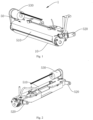
- Fig. 8 is a structural perspective view of the cleaning device according to this embodiment
- Fig. 9 is a exploded view of a structure of the cleaning device shown in Fig. 8
- Fig. 10 is a top view of the cleaning device shown in Fig. 8
- Fig. 11 is a cross-sectional view of the cleaning device shown in Fig. 10 along the A-A direction.
- the cleaning device includes a mounting bracket 50, a cleaning drum 10, a baffle 20, a sewage recovery device including a water collecting tank 300, a water squeezing device 200 and a water injecting device 100.
- the water injecting device 100, the water squeezing device 200 and the sewage recovery device are arranged in sequence, and the water collecting tank 300 has a notch 310 facing the cleaning drum 10, and the sewage enters the water collecting tank 300 through the notch 310.
- the cleaning drum 10 is rotationally connected to the mounting bracket 50, and the baffle 20 is arranged at both ends of the cleaning drum 10.
- the baffle 20 is provided with an abutting edge 21.
- An abutting edge 21 of the baffle 20 squeezes the cleaning drum 10 to prevent the sewage on the cleaning drum 10 from passing through the baffle 20 along the axial direction of the cleaning drum 10.
- the water collecting tank 300 is disposed at a side of the cleaning drum 10, and the water squeezing device 200 is disposed between the baffles 20 on both ends of the cleaning drum 10.
- the water squeezing device 200 squeezes the cleaning drum 10 and extends toward the water collecting tank 300.
- the water injecting device 100 is opposite to the cleaning drum 10, and the water injecting device 100 may inject the cleaning liquid toward the cleaning drum 10.
- the orientation or position relationship shown in Fig. 11 is used for exemplary description.
- the water squeezing device 200 is located at the upper right of the cleaning drum 10.
- the cleaning drum 10 rolls along a first direction D1 around its own axis, the cleaning drum 10 drives the cleaning device 1 forward.
- the circumferential outer side of the cleaning drum 10 continuously rolls in contact with the ground and wipes the ground.
- the circumferential outer side of the cleaning drum 10 also continuously rolls in contact with the water squeezing device 200.
- the part of the cleaning drum 10 that contacts the water squeezing device 200 leaks sewage under the squeezing action of the water squeezing device 200, and flows to the water squeezing device 200, and is guided to the water collecting tank 300 through the water squeezing device 200.
- the water collecting tank 300 temporarily stores the sewage introduced by the water squeezing device 200, so that the cleaning device 1 can recover the sewage generated on the cleaning drum 10 while mopping the ground.
- the first direction is the clockwise direction.
- the water injecting device 100 may inject cleaning liquid toward the cleaning drum 10. After the cleaning liquid falls into the cleaning drum 10, it mixes with the dirt on the cleaning drum 10 and becomes sewage.
- the cleaning drum 10 shown in Fig. 11 is for illustration only.
- the circumferential outer side of the cleaning drum 10 has a fluffy structure, and the circumferential outer side of the cleaning drum 10 abuts against the abutting edge 21.
- the squeezed portion of the cleaning drum 10 may be compressed and the outer diameter becomes smaller accordingly.
- the baffle 20 is arranged at the two ends of the cleaning drum 10, and the abutting edge 21 of the baffle 20 squeezes the cleaning drum 10 and blocks the sewage on the cleaning drum 10 from passing through the baffle 20 along the axial direction of the cleaning drum 10, thereby limiting the sewage adsorbed on the cleaning drum 10 between the baffles 20 at the two ends of the cleaning drum 10, preventing the sewage on the cleaning drum 10 from flowing to the ground from the two ends of the cleaning drum 10, and the water squeezing device 200 is arranged between the baffles 20 on the two ends of the cleaning drum 10.
- the sewage seeps out under the squeezing of the water squeezing device 200 and flows downstream to the water squeezing device 200, and is then guided to the water collecting tank 300 by the water squeezing device 200.
- the loss rate of sewage on the cleaning drum 10 is reduced, and the cleaning device 1 effectively collects the sewage on the cleaning drum 10.
- the circumferential outer side of the cleaning drum 10 can be compressed by making the abutting edge 21 of the baffle 20 squeeze the cleaning drum 10.
- the part of the cleaning drum 10 squeezed by the abutting edge 21 presses against the abutting edge 21 under the action of its own elastic force, thereby eliminating the gap between the two parts of the abutting edge 21 and the cleaning drum 10 that contact each other, so that the two parts of the abutting edge 21 and the cleaning drum 10 that contact each other are relatively close, effectively blocking the sewage from passing through the two parts of the abutting edge 21 and the cleaning drum 10 that contact each other.
- the part of the cleaning drum 10 squeezed by the abutting edge 21 may also be compacted, so that the part of the cleaning drum 10 squeezed by the abutting edge 21 is relatively dense, effectively blocking the sewage from passing through the part of the cleaning drum 10 squeezed by the abutting edge 21. In this way, the blocking effect of the baffle 20 on the sewage on the cleaning drum 10 is guaranteed.
- the baffle 20 is perpendicular to the cleaning drum 10, and the abutting edge 21 is an arc, and the arc is matched with the circumferential outer side of the cleaning drum 10.
- the abutting edge 21 and the cleaning drum 10 are more closely matched when they contact each other.
- the abutting edge 21 squeezes the cleaning drum 10, the abutting edge 21 as a whole may be firmly attached to the cleaning drum 10 along the outer circumference of the cleaning drum 10, and the center of the abutting edge 21 coincides with the axis of the cleaning drum 10, that is, the abutting edge 21 is always firmly attached to the cleaning drum 10 from one end to the other end, avoiding water leakage due to a gap between the abutting edge 21 and the cleaning drum 10.
- the sewage between the two ends of the cleaning drum 10 can basically only be transferred to the water squeezing device 200 with the cleaning drum 10, and seep out and flow to the water collecting tank 300 under the squeezing of the water squeezing device 200.
- the arc shape being adapted to the circumferential outer side of the cleaning drum 10 means that when the abutting edge 21 of the baffle 20 squeezes the cleaning drum 10, the portion of the cleaning drum 10 squeezed by the abutting edge 21 is compressed and the corresponding outer diameter becomes smaller. At this time, the outer diameter of the portion of the cleaning drum 10 squeezed by the abutting edge 21 is equal to the diameter of the abutting edge 21.
- the portion of the cleaning drum 10 to be squeezed by the abutting edge 21 is in a fluffy state, gradually enters a squeezing region from one end of the abutting edge 21, and enters a compressed state; as the cleaning drum 10 continues to roll, the portion squeezed by the abutting edge 21 is in a compressed state, gradually withdraws from the squeezing region corresponding to the abutting edge 21 from the other end of the abutting edge 21, and returns to the fluffy state.
- the portion of the cleaning drum 10 to be squeezed by the abutting edge 21 is in a fluffy state and is difficult to directly enter the squeezing region from one end of the abutting edge 21, and may even get stuck.
- the baffle 20 is further provided with a leading edge 22, one end of the leading edge 22 is tangent to one end of the abutting edge 21, and the other end of the leading edge 22 extends in a direction away from the axis of the cleaning drum 10 and toward the downward direction, the distances between each point on the abutting edge 21 and the axis of the cleaning drum 10 are equal everywhere, and the distances between each point on the leading edge 22 and the axis of the cleaning drum 10 increase with the increase of the extension length of the leading edge 22 at the point.
- the leading edge 22 can pre-extrude the part of the cleaning drum 10 to be squeezed by the abutting edge 21, and smoothly introduce the part of the cleaning drum 10 to be squeezed by the abutting edge 21 into the squeezing region corresponding to the abutting edge 21, so that the cleaning drum 10 can still maintain smooth rolling under the squeezing action of the baffle 20, thereby avoiding the part of the cleaning drum 10 to be squeezed by the abutting edge 21 from being stuck at one end of the abutting edge 21.
- the leading edge 22 is arc-shaped.
- the leading edge 22 has a straight line shape.
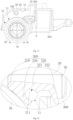
- Fig. 12 is a partial enlarged view of portion B of the cleaning device 1 shown in Fig. 11 .
- the water squeezing device 200 includes a squeezing part 210 and a diversion part 220.
- the squeezing part 210 presses the cleaning drum 10.
- the diversion part 220 includes a first diversion section 221 and a second diversion section 222.
- the first diversion section 221 extends from the squeezing part 210 to above the water collecting tank 300.
- the second diversion section 222 extends downwardly and obliquely from one end of the first diversion section 221 away from the squeezing part 210 into the water collecting tank 300.
- the part of the cleaning drum 10 that contacts the squeezing part 210 leaks sewage under the squeezing action of the squeezing part 210.
- the sewage flows over the squeezing part 210 and is introduced into the water collecting tank 300 through the first diversion section 221 and the second diversion section 222 in sequence.
- the sewage may follow the second diversion section 222 to fall into the water collecting tank 300 in a downward tilt.
- the sewage that has separated from the second diversion section 222 falls into the water collecting tank 300 roughly along a direction parallel to the second diversion section 222.
- the sewage flies horizontally into the water collecting tank 300 after separating from the water squeezing device 200, thereby reducing the noise of sewage falling.
- the guiding effect of the second diversion section 222 can make the sewage fall into a preset position in the water collecting tank 300, and the preset position may be an outer region of the filter structure in the water collecting tank 300. That is, after the sewage falls into the preset position, the sewage may pass through the filter structure and enter the inner region of the filter structure, thereby realizing the filtration of the sewage and avoiding the sewage from falling directly from the water squeezing device 200 into an inner region of the filter structure.
- the squeezing device 200 is disposed at the outer side of the cleaning drum 10 in the circumferential direction and parallel to the axial direction of the cleaning drum 10.
- the first diversion section 221 extends along the forward direction of the cleaning drum 10 and extends downwardly to the top of the water collecting tank 300
- the second diversion section 222 extends along the forward direction of the cleaning drum 10 and extends downwardly to the water collecting tank 300, and the inclination angle of the second diversion section 222 is greater than the inclination angle of the first diversion section 221. It should be further explained that there may be an angle between the first diversion section 221 and the second diversion section 222, and the angle may be set according to actual needs/situations.
- the water squeezing device 200 further includes a fixing part 230, and the fixing part 230 is fixedly connected to the squeezing part 210 and/or the diversion part 220, and the fixing part 230 is provided with an open slot 211.
- the mounting bracket 50 is provided with a fixing hole 11, and the fixing hole 11 is opposite to and communicates with the open slot 211.
- the open slot 211 and the fixing hole 11 are used to cooperate with each other to allow an external fixing member to penetrate, so that the water squeezing device 200 is fixed on the mounting bracket 50.
- screws may be screwed into the fixing holes 11 and the open slots 211 in sequence, thereby fixing the water squeezing device 200 on the mounting bracket 50. It is understandable that providing an annular closed hole on the water squeezing device 200 to cooperate with the screw is relatively difficult in terms of manufacturing process. However, adopting an open slot 211 structure to cooperate with the fixing hole 11 may reduce the difficulty of the manufacturing process of the water squeezing device 200. In addition, the open slot 211 structure can not only radially limit the screw, but also radially expand and deform to adapt to screws with larger outer diameters.
- the open slot 211 may be a U-shaped groove.
- the fixing part 230 is disposed below the squeezing part 210 and the first diversion section 221, and is fixedly connected to the squeezing part 210 and the first diversion section 221. Therefore, after the fixing part 230 is fixed to the mounting bracket 50 by screws or the like, it can provide better support for the water squeezing device 200 as a whole, optimize the force structure of the water squeezing device 200, and resist the force from the cleaning drum 10.
- the water injecting device 100 is arranged along the axis parallel to the cleaning drum 10, and the water injecting device 100 is provided with a plurality of water inject holes spaced along its own axis.
- the plurality of water inject holes are located between the baffles 20 on both ends of the cleaning drum 10, and the orifices of the water inject holes face the cleaning drum 10.
- the cleaning liquid may be clean water, detergent or a mixture of clean water and detergent.
- Fig. 13 is a partial enlarged view of portion C of the cleaning device 1 shown in Fig. 9 .
- the cleaning device 1 further includes sealing members 70, and the sealing members 70 are respectively arranged at both ends of the water squeezing device 200.
- the sealing member 70 seals the gap between the baffle 20 and the water squeezing device 200.
- the sealing member 70 can block the sewage on the water squeezing device 200 from passing through the sealing member 70 along the length direction of the water squeezing device 200.
- the sewage on the cleaning drum 10 can flow only to the water squeezing device 200 as much as possible, and is limited between the sealing members 70 on both ends of the water squeezing device 200, preventing the sewage on the cleaning drum 10 from losing from the gap between the baffle 20 and the water squeezing device 200, so that the sewage flowing through the water squeezing device 200 flows only to the water collecting tank 300 as much as possible, thereby reducing the sewage loss rate and ensuring the effective collection of sewage by the cleaning device 1.
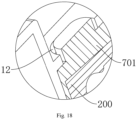
- Fig. 14 is a perspective cross-sectional view of the mounting bracket 50 shown in Fig. 11 .
- the mounting bracket 50 is provided with a first positioning structure 12, and the sealing member 70 is provided with a second positioning structure 701.
- the first positioning structure 12 and the second positioning structure 701 are matched with each other to achieve rapid positioning and assembly between the sealing member 70 and the mounting bracket 50, so that the installation angle of the sealing member 70 relative to the mounting bracket 50 is fixed.
- the first positioning structure 12 and the second positioning structure 701 that are positioned with each other can play a certain limiting role on the sealing member 70, so that the sealing member 70 is firmly assembled between the mounting bracket 50 and the water squeezing device 200.
- the first positioning structure 12 is a positioning groove
- the second positioning structure 701 is a positioning protrusion
- the positioning protrusion is inserted into the positioning groove.
- the first positioning structure 12 is a positioning protrusion
- the second positioning structure 701 is a positioning groove
- the positioning protrusion is inserted into the positioning groove
- the sealing member 70 may be made of a soft rubber material, and the soft rubber may allow the sealing member 70 to be in an interference fit state when sealing the baffle plate 20 and the water squeezing device 200, thereby providing better sealing and waterproofing effects.
- the baffle 20 extends from the inner top wall 13 of the mounting bracket 50 toward the cleaning drum 10 and the sealing member 70, and forms an abutting edge 21 above the cleaning drum 10, and forms a sealing edge 104 above the sealing member 70.
- the sealing edge 104 is sealed with the sealing member 70.
- the baffle 20 can play a better role in isolating the sewage on the cleaning drum 10 and the water squeezing device 200, preventing the sewage on the cleaning drum 10 and the water squeezing device 200 from splashing out from the two ends of the cleaning drum 10 and the two ends of the water squeezing device 200 respectively.
- Fig. 15 is a perspective view of a structure of the water squeezing device 200 and the sealing member 70 shown in Fig. 13 from another angle.
- the water squeezing device 200 is provided with a third positioning structure 212
- the sealing member 70 is provided with a fourth positioning structure 702.
- the third positioning structure 212 and the fourth positioning structure 702 are matched with each other to achieve rapid positioning and assembly between the water squeezing device 200 and the sealing member 70, so that the installation angle of the water squeezing device 200 relative to the sealing member 70 is fixed.
- the third positioning structure 212 and the fourth positioning structure 702 that are positioned with each other can play a certain limiting role on the water squeezing device 200, so that the water squeezing device 200 is firmly assembled on the mounting bracket 50.
- the third positioning structure 212 is a first step surface, and the first step surface is arranged at the end position of the water squeezing device 200, the fourth positioning structure 702 is a second step surface, and the second step surface is arranged at the end position of the sealing member 70.
- the first step surface and the second step surface fit together so that after the water squeezing device 200 is assembled with the sealing member 70, the part of the water squeezing device 200 used to squeeze the cleaning drum 10 is facing the cleaning drum 10, that is, the squeezing part 210 of the water squeezing device 200 is facing the cleaning drum 10, thereby realizing rapid positioning and assembly of the water squeezing device 200, and moreover, playing an fool-proofing effect to prevent the water squeezing device 200 from being mounted upside down, causing the squeezing part 210 to face away from the cleaning drum 10.
- the first step surface is arranged at the end surface position of the squeezing part 210, and the second step surface is arranged on the side of the sealing member 70 close to the cleaning drum 10.
- the first step surface and the second step surface need to correspond to and cooperate with each other so that the water squeezing device 200 and the sealing member 70 can be mounted and matched, so that the squeezing part 210 of the water squeezing device 200 is facing the cleaning drum 10 during installation.
- the distance between the second step surfaces of the sealing member 70 corresponding to the two ends of the water squeezing device 200 is equal to the longitudinal length of the squeezing part 210.
- the water squeezing device 200 may be prevented from being accidentally mounted upside down during the installation process. It should be noted that when the water squeezing device 200 and the sealing member 70 are assembled, if the first step surface and the second step surface do not correspond to each other, when the water squeezing device 200 cooperates with the sealing member 70 at an angle with its squeezing part 210 facing away from the cleaning drum 10, since the distance between the end surfaces of the sealing member 70 corresponding to the two ends of the water squeezing device 200 is smaller than the longitudinal length of the squeezing part 210, the water squeezing device 200 and the sealing member 70 cannot be cooperated and mounted.
- the longitudinal length of the squeezing part 210 is parallel to the axial length of the cleaning drum 10.
- the sealing member 70 may be first mounted on the two ends of the mounting bracket 50 through the mutual cooperation of the positioning groove and the positioning protrusion, and then, through the mutual cooperation of the first step surface and the second step surface, the two ends of the water squeezing device 200 are respectively equipped with the sealing member 70 on the two ends of the mounting bracket 50. Moreover, the water squeezing device 200 is pressed against the baffle 20, so that the sealing member 70 is pressed between the baffle 20 and the water squeezing device 200, thereby forming an interference fit.
- Fig. 16 is a cross-sectional view of the cleaning device 1 shown in Fig. 10 along the E-E direction.
- the cleaning device 1 further includes a supporting plate 80, and the supporting plate 80 is supported on the top of the water squeezing device 200, so that the water squeezing device 200 as a whole may be pressed against the cleaning drum 10 to resist deformation of the water squeezing device 200 caused by the force of the cleaning drum 10.
- the first direction D1 is opposite to the second direction D2.
- the second direction D2 is the counterclockwise direction.
- the abutment plate 80 extends from the inner top wall 13 of the mounting bracket 50 toward the first diversion part 220 and the second diversion part 220, and the abutment plate 80 abuts against the first diversion part 220 and the second diversion part 220, so that the water squeezing device 200 as a whole is always pressed against the cleaning drum 10 in the vertical and horizontal directions, preventing the cleaning drum 10 from rolling around its own axis and the force generated by the cleaning drum 10 on the water squeezing device 200 forcing the water squeezing device 200 to warp up or bend horizontally.
- the abutting plate 80 abuts against a middle position of the water squeezing device 200.
- a cleaning robot is further provided, the cleaning robot includes a robot body and the cleaning device 1 as described above.
- the cleaning robot according to the embodiment of the present disclosure also has the advantages of the cleaning device 1 described above, which will not be described in detail here.
- the cleaning device 1 is arranged on the side of the robot body facing the ground, and a compression spring 630 is arranged between the robot body and the cleaning device 1.
- the compression spring 630 is configured to always apply a force to the cleaning device 1 toward the ground.
- a clean water pipe 610 and a sewage pipe 620 are provided at the robot body. The clean water pipe 610 is connected to the water injecting device, and the sewage pipe 620 is connected to the sewage recovery device.
- the compression spring 630 is disposed at the cover plate 510, and a spring fixing member is disposed at the cover plate 510.
- the compression spring 630 is detachably mounted on the cover plate 510 through the spring fixing member.
- the spring fixing member includes a plurality of circumferential limiting members 641, the plurality of circumferential limiting members 641 enclose a spring installation groove at the bottom of the cover plate 510 , and a limiting buckle 642 is arranged between adjacent two circumferential limiting members 641, so that the compression spring 630 may be clamped in the spring installation groove.
- the cleaning device 1 is hinged to the bottom of the cleaning robot body through the swing arm 520, and the pressure applied by the compression spring 630 enables it to fully contact the ground.
- clean water flows into the water supply pipe from the clean water pipe 610, and drips onto the surface of the cleaning drum 10 through the weep hole 110 on the water supply pipe.
- the cleaning robot starts to move and the cleaning drum 10 rotates under the drive of the drum driving motor 530.
- the cleaning drum 10 adsorbed with clean water passes through the water pressing rod in turn as it rotates to discharge excess water.
- the discharged water enters the water collecting tank 300 through the first filtering device 320, and the cleaning drum 10 continues to rotate to squeeze out excess water.
- the cleaning drum 10 When the cleaning drum 10, which is still moist, is in contact with the ground, it cleans the ground and continues to rotate after being adhered to dirt. When it reaches the dirt scraping comb 400, larger dirt is blocked by the dirt scraping comb 400 and falls off, while smaller dirt continues to rotate along with the cleaning drum 10 through the dirt scraping comb 400 to the water supply pipe.
- the water injected from the water supply pipe can moisten the cleaning drum 10. After that, when the cleaning drum 10 passes through the water pressing rod again, the water pressing rod squeezes out the sewage to clean the cleaning drum 10.
- the cleaned sewage enters the water collecting tank 300 after being filtered by the first filtering device 320, and is pumped into the sewage tank through the sewage pump 330 in the water collecting tank 300 for recycling.
Landscapes
- Engineering & Computer Science (AREA)
- Mechanical Engineering (AREA)
- Cleaning By Liquid Or Steam (AREA)
- Cleaning In General (AREA)
Applications Claiming Priority (2)
| Application Number | Priority Date | Filing Date | Title |
|---|---|---|---|
| CN202210425282.4A CN116965735A (zh) | 2022-04-21 | 2022-04-21 | 一种清洁装置及清洁机器人 |
| PCT/CN2023/087284 WO2023202402A1 (zh) | 2022-04-21 | 2023-04-10 | 一种清洁装置及清洁机器人 |
Publications (2)
| Publication Number | Publication Date |
|---|---|
| EP4512295A1 true EP4512295A1 (de) | 2025-02-26 |
| EP4512295A4 EP4512295A4 (de) | 2026-01-14 |
Family
ID=88419070
Family Applications (1)
| Application Number | Title | Priority Date | Filing Date |
|---|---|---|---|
| EP23791057.5A Pending EP4512295A4 (de) | 2022-04-21 | 2023-04-10 | Reinigungsvorrichtung und reinigungsroboter |
Country Status (6)
| Country | Link |
|---|---|
| EP (1) | EP4512295A4 (de) |
| JP (1) | JP2025513324A (de) |
| KR (1) | KR20250008069A (de) |
| CN (1) | CN116965735A (de) |
| AU (1) | AU2023258090A1 (de) |
| WO (1) | WO2023202402A1 (de) |
Families Citing this family (4)
| Publication number | Priority date | Publication date | Assignee | Title |
|---|---|---|---|---|
| USD1105672S1 (en) | 2023-08-30 | 2025-12-09 | Sharkninja Operating Llc | Vacuum cleaner and vacuum nozzle |
| CN120052770A (zh) * | 2023-11-29 | 2025-05-30 | 广州视源电子科技股份有限公司 | 清洁模组、清洁机器人及清洁系统 |
| WO2025201421A1 (zh) * | 2024-03-29 | 2025-10-02 | 江苏美的清洁电器股份有限公司 | 清洁设备以及清洁系统 |
| USD1113019S1 (en) | 2024-05-31 | 2026-02-10 | Sharkninja Operating Llc | Steam cleaner |
Family Cites Families (15)
| Publication number | Priority date | Publication date | Assignee | Title |
|---|---|---|---|---|
| CN105982621B (zh) * | 2016-04-14 | 2019-12-13 | 北京小米移动软件有限公司 | 自动清洁设备的风路结构和自动清洁设备 |
| CN207886170U (zh) * | 2017-11-14 | 2018-09-21 | 勤耕云智能科技(深圳)有限公司 | 一种用于智能扫地机上的具有拖地效果的机构 |
| US11166611B2 (en) * | 2018-02-13 | 2021-11-09 | Hizero Technologies Co., Ltd. | Cleaning robot and roller cleaning device |
| CN111466841B (zh) * | 2020-04-30 | 2024-08-16 | 美智纵横科技有限责任公司 | 一种滚筒装置及清洁设备 |
| CN111493759A (zh) * | 2020-06-03 | 2020-08-07 | 江苏美的清洁电器股份有限公司 | 拖地机的自清洁方法、计算机可读存储介质和拖地机 |
| CN111568326A (zh) * | 2020-06-16 | 2020-08-25 | 深圳市泰博智能机器人有限公司 | 用于扫地机器人拖地滚筒的升降装置 |
| CN111557621A (zh) * | 2020-06-17 | 2020-08-21 | 深圳市泰博智能机器人有限公司 | 用于扫地机器人的清洗装置 |
| CN212368899U (zh) * | 2020-06-17 | 2021-01-19 | 深圳市探博智能机器人有限公司 | 用于扫地机器人的清洗装置 |
| CN213696740U (zh) * | 2020-09-25 | 2021-07-16 | 广州科语机器人有限公司 | 拖地自清洗单元及智能清洁设备 |
| CN112914440A (zh) * | 2021-03-24 | 2021-06-08 | 北京享捷科技有限公司 | 一种扫地机器人 |
| CN215534027U (zh) * | 2021-04-19 | 2022-01-18 | 深圳市宇辰智能科技有限公司 | 一种拖地清洁装置及其智能清洁机器人 |
| CN113455968A (zh) * | 2021-07-29 | 2021-10-01 | 杰瑞华创科技有限公司 | 一种清洁设备 |
| CN113440061A (zh) * | 2021-08-11 | 2021-09-28 | 宁波洒哇地咔电器有限公司 | 一种自洁滚筒系统以及具有该系统的扫地机器人 |
| CN113558541A (zh) * | 2021-09-06 | 2021-10-29 | 由利(深圳)科技有限公司 | 一种智能拖扫一体机器人的污水处理结构 |
| CN217801807U (zh) * | 2022-05-05 | 2022-11-15 | 广州视源电子科技股份有限公司 | 一种污水回收系统及清洁机器人 |
-
2022
- 2022-04-21 CN CN202210425282.4A patent/CN116965735A/zh active Pending
-
2023
- 2023-04-10 AU AU2023258090A patent/AU2023258090A1/en active Pending
- 2023-04-10 WO PCT/CN2023/087284 patent/WO2023202402A1/zh not_active Ceased
- 2023-04-10 JP JP2024561753A patent/JP2025513324A/ja active Pending
- 2023-04-10 KR KR1020247038632A patent/KR20250008069A/ko active Pending
- 2023-04-10 EP EP23791057.5A patent/EP4512295A4/de active Pending
Also Published As
| Publication number | Publication date |
|---|---|
| KR20250008069A (ko) | 2025-01-14 |
| AU2023258090A1 (en) | 2024-12-05 |
| JP2025513324A (ja) | 2025-04-24 |
| WO2023202402A1 (zh) | 2023-10-26 |
| EP4512295A4 (de) | 2026-01-14 |
| CN116965735A (zh) | 2023-10-31 |
Similar Documents
| Publication | Publication Date | Title |
|---|---|---|
| EP4512295A1 (de) | Reinigungsvorrichtung und reinigungsroboter | |
| CN210493962U (zh) | 一种扫拖一体机的拖地清洁机构 | |
| JP3230741U (ja) | ロボット掃除機に用いられるクリーニング装置 | |
| WO2016109908A1 (zh) | 地面清洁器 | |
| CN113633229B (zh) | 一种清洁装置、洗地机和扫地机 | |
| CN212800857U (zh) | 一种碱减量机 | |
| CN217772210U (zh) | 一种自清洁滚筒结构 | |
| CN219700929U (zh) | 一种消防水管清洗装置 | |
| CN218528619U (zh) | 清洁机器人 | |
| CN108814471B (zh) | 平板拖把挤水清洁装置 | |
| CN215583990U (zh) | 一种擦窗机的清污机构 | |
| CN216933090U (zh) | 一种清污分离平板拖把清洁工具 | |
| CN218011298U (zh) | 一种用于污水处理的渗漏滤清装置 | |
| CN216020851U (zh) | 一种清洁装置、洗地机和扫地机 | |
| CN215838726U (zh) | 清洁机构及清洁机器人 | |
| CN218899329U (zh) | 一种洗地机 | |
| CN216020850U (zh) | 一种停机防回流的表面清洁机 | |
| CN210695862U (zh) | 一种蔬菜高效清洗系统 | |
| CN209360601U (zh) | 一种拖把头清洗部及清洗桶 | |
| CN221046820U (zh) | 一种玻璃瓶洗瓶机清洁水循环机构 | |
| CN216286142U (zh) | 一种便于除尘的投影仪幕布 | |
| CN219150990U (zh) | 一种室内智能保洁设备 | |
| CN221385446U (zh) | 一种洗毛机用洗液循环利用装置 | |
| CN218009576U (zh) | 一种防异味清洁滚筒机构及清洁器具 | |
| CN222024680U (zh) | 一种用于脱脂纱布在线水洗装置 |
Legal Events
| Date | Code | Title | Description |
|---|---|---|---|
| STAA | Information on the status of an ep patent application or granted ep patent |
Free format text: STATUS: THE INTERNATIONAL PUBLICATION HAS BEEN MADE |
|
| PUAI | Public reference made under article 153(3) epc to a published international application that has entered the european phase |
Free format text: ORIGINAL CODE: 0009012 |
|
| STAA | Information on the status of an ep patent application or granted ep patent |
Free format text: STATUS: REQUEST FOR EXAMINATION WAS MADE |
|
| 17P | Request for examination filed |
Effective date: 20241119 |
|
| AK | Designated contracting states |
Kind code of ref document: A1 Designated state(s): AL AT BE BG CH CY CZ DE DK EE ES FI FR GB GR HR HU IE IS IT LI LT LU LV MC ME MK MT NL NO PL PT RO RS SE SI SK SM TR |
|
| DAV | Request for validation of the european patent (deleted) | ||
| DAX | Request for extension of the european patent (deleted) | ||
| RIC1 | Information provided on ipc code assigned before grant |
Ipc: A47L 11/292 20060101AFI20250804BHEP Ipc: A47L 11/40 20060101ALI20250804BHEP |
|
| A4 | Supplementary search report drawn up and despatched |
Effective date: 20251217 |
|
| RIC1 | Information provided on ipc code assigned before grant |
Ipc: A47L 11/292 20060101AFI20251211BHEP Ipc: A47L 11/40 20060101ALI20251211BHEP |