EP4501609A1 - Rippenverstärkter formkörper und verfahren zur herstellung davon - Google Patents
Rippenverstärkter formkörper und verfahren zur herstellung davon Download PDFInfo
- Publication number
- EP4501609A1 EP4501609A1 EP23774853.8A EP23774853A EP4501609A1 EP 4501609 A1 EP4501609 A1 EP 4501609A1 EP 23774853 A EP23774853 A EP 23774853A EP 4501609 A1 EP4501609 A1 EP 4501609A1
- Authority
- EP
- European Patent Office
- Prior art keywords
- rib
- resin
- fibers
- molded product
- fiber
- Prior art date
- Legal status (The legal status is an assumption and is not a legal conclusion. Google has not performed a legal analysis and makes no representation as to the accuracy of the status listed.)
- Pending
Links
Images







Classifications
-
- B—PERFORMING OPERATIONS; TRANSPORTING
- B29—WORKING OF PLASTICS; WORKING OF SUBSTANCES IN A PLASTIC STATE IN GENERAL
- B29C—SHAPING OR JOINING OF PLASTICS; SHAPING OF MATERIAL IN A PLASTIC STATE, NOT OTHERWISE PROVIDED FOR; AFTER-TREATMENT OF THE SHAPED PRODUCTS, e.g. REPAIRING
- B29C43/00—Compression moulding, i.e. applying external pressure to flow the moulding material; Apparatus therefor
- B29C43/02—Compression moulding, i.e. applying external pressure to flow the moulding material; Apparatus therefor of articles of definite length, i.e. discrete articles
-
- B—PERFORMING OPERATIONS; TRANSPORTING
- B32—LAYERED PRODUCTS
- B32B—LAYERED PRODUCTS, i.e. PRODUCTS BUILT-UP OF STRATA OF FLAT OR NON-FLAT, e.g. CELLULAR OR HONEYCOMB, FORM
- B32B3/00—Layered products comprising a layer with external or internal discontinuities or unevennesses, or a layer of non-planar shape; Layered products comprising a layer having particular features of form
- B32B3/26—Layered products comprising a layer with external or internal discontinuities or unevennesses, or a layer of non-planar shape; Layered products comprising a layer having particular features of form characterised by a particular shape of the outline of the cross-section of a continuous layer; characterised by a layer with cavities or internal voids ; characterised by an apertured layer
- B32B3/30—Layered products comprising a layer with external or internal discontinuities or unevennesses, or a layer of non-planar shape; Layered products comprising a layer having particular features of form characterised by a particular shape of the outline of the cross-section of a continuous layer; characterised by a layer with cavities or internal voids ; characterised by an apertured layer characterised by a layer formed with recesses or projections, e.g. hollows, grooves, protuberances, ribs
-
- B—PERFORMING OPERATIONS; TRANSPORTING
- B29—WORKING OF PLASTICS; WORKING OF SUBSTANCES IN A PLASTIC STATE IN GENERAL
- B29C—SHAPING OR JOINING OF PLASTICS; SHAPING OF MATERIAL IN A PLASTIC STATE, NOT OTHERWISE PROVIDED FOR; AFTER-TREATMENT OF THE SHAPED PRODUCTS, e.g. REPAIRING
- B29C45/00—Injection moulding, i.e. forcing the required volume of moulding material through a nozzle into a closed mould; Apparatus therefor
- B29C45/14—Injection moulding, i.e. forcing the required volume of moulding material through a nozzle into a closed mould; Apparatus therefor incorporating preformed parts or layers, e.g. injection moulding around inserts or for coating articles
- B29C45/14778—Injection moulding, i.e. forcing the required volume of moulding material through a nozzle into a closed mould; Apparatus therefor incorporating preformed parts or layers, e.g. injection moulding around inserts or for coating articles the article consisting of a material with particular properties, e.g. porous, brittle
- B29C45/14786—Fibrous material or fibre containing material, e.g. fibre mats or fibre reinforced material
-
- B—PERFORMING OPERATIONS; TRANSPORTING
- B29—WORKING OF PLASTICS; WORKING OF SUBSTANCES IN A PLASTIC STATE IN GENERAL
- B29C—SHAPING OR JOINING OF PLASTICS; SHAPING OF MATERIAL IN A PLASTIC STATE, NOT OTHERWISE PROVIDED FOR; AFTER-TREATMENT OF THE SHAPED PRODUCTS, e.g. REPAIRING
- B29C70/00—Shaping composites, i.e. plastics material comprising reinforcements, fillers or preformed parts, e.g. inserts
- B29C70/04—Shaping composites, i.e. plastics material comprising reinforcements, fillers or preformed parts, e.g. inserts comprising reinforcements only, e.g. self-reinforcing plastics
- B29C70/06—Fibrous reinforcements only
- B29C70/08—Fibrous reinforcements only comprising combinations of different forms of fibrous reinforcements incorporated in matrix material, forming one or more layers, and with or without non-reinforced layers
- B29C70/083—Combinations of continuous fibres or fibrous profiled structures oriented in one direction and reinforcements forming a two dimensional structure, e.g. mats
-
- B—PERFORMING OPERATIONS; TRANSPORTING
- B29—WORKING OF PLASTICS; WORKING OF SUBSTANCES IN A PLASTIC STATE IN GENERAL
- B29C—SHAPING OR JOINING OF PLASTICS; SHAPING OF MATERIAL IN A PLASTIC STATE, NOT OTHERWISE PROVIDED FOR; AFTER-TREATMENT OF THE SHAPED PRODUCTS, e.g. REPAIRING
- B29C70/00—Shaping composites, i.e. plastics material comprising reinforcements, fillers or preformed parts, e.g. inserts
- B29C70/04—Shaping composites, i.e. plastics material comprising reinforcements, fillers or preformed parts, e.g. inserts comprising reinforcements only, e.g. self-reinforcing plastics
- B29C70/06—Fibrous reinforcements only
- B29C70/10—Fibrous reinforcements only characterised by the structure of fibrous reinforcements, e.g. hollow fibres
- B29C70/16—Fibrous reinforcements only characterised by the structure of fibrous reinforcements, e.g. hollow fibres using fibres of substantial or continuous length
- B29C70/20—Fibrous reinforcements only characterised by the structure of fibrous reinforcements, e.g. hollow fibres using fibres of substantial or continuous length oriented in a single direction, e.g. roofing or other parallel fibres
-
- B—PERFORMING OPERATIONS; TRANSPORTING
- B29—WORKING OF PLASTICS; WORKING OF SUBSTANCES IN A PLASTIC STATE IN GENERAL
- B29C—SHAPING OR JOINING OF PLASTICS; SHAPING OF MATERIAL IN A PLASTIC STATE, NOT OTHERWISE PROVIDED FOR; AFTER-TREATMENT OF THE SHAPED PRODUCTS, e.g. REPAIRING
- B29C70/00—Shaping composites, i.e. plastics material comprising reinforcements, fillers or preformed parts, e.g. inserts
- B29C70/04—Shaping composites, i.e. plastics material comprising reinforcements, fillers or preformed parts, e.g. inserts comprising reinforcements only, e.g. self-reinforcing plastics
- B29C70/28—Shaping operations therefor
- B29C70/30—Shaping by lay-up, i.e. applying fibres, tape or broadsheet on a mould, former or core; Shaping by spray-up, i.e. spraying of fibres on a mould, former or core
- B29C70/34—Shaping by lay-up, i.e. applying fibres, tape or broadsheet on a mould, former or core; Shaping by spray-up, i.e. spraying of fibres on a mould, former or core and shaping or impregnating by compression, i.e. combined with compressing after the lay-up operation
-
- B—PERFORMING OPERATIONS; TRANSPORTING
- B29—WORKING OF PLASTICS; WORKING OF SUBSTANCES IN A PLASTIC STATE IN GENERAL
- B29C—SHAPING OR JOINING OF PLASTICS; SHAPING OF MATERIAL IN A PLASTIC STATE, NOT OTHERWISE PROVIDED FOR; AFTER-TREATMENT OF THE SHAPED PRODUCTS, e.g. REPAIRING
- B29C70/00—Shaping composites, i.e. plastics material comprising reinforcements, fillers or preformed parts, e.g. inserts
- B29C70/04—Shaping composites, i.e. plastics material comprising reinforcements, fillers or preformed parts, e.g. inserts comprising reinforcements only, e.g. self-reinforcing plastics
- B29C70/28—Shaping operations therefor
- B29C70/40—Shaping or impregnating by compression not applied
- B29C70/42—Shaping or impregnating by compression not applied for producing articles of definite length, i.e. discrete articles
-
- B—PERFORMING OPERATIONS; TRANSPORTING
- B29—WORKING OF PLASTICS; WORKING OF SUBSTANCES IN A PLASTIC STATE IN GENERAL
- B29C—SHAPING OR JOINING OF PLASTICS; SHAPING OF MATERIAL IN A PLASTIC STATE, NOT OTHERWISE PROVIDED FOR; AFTER-TREATMENT OF THE SHAPED PRODUCTS, e.g. REPAIRING
- B29C70/00—Shaping composites, i.e. plastics material comprising reinforcements, fillers or preformed parts, e.g. inserts
- B29C70/04—Shaping composites, i.e. plastics material comprising reinforcements, fillers or preformed parts, e.g. inserts comprising reinforcements only, e.g. self-reinforcing plastics
- B29C70/28—Shaping operations therefor
- B29C70/40—Shaping or impregnating by compression not applied
- B29C70/42—Shaping or impregnating by compression not applied for producing articles of definite length, i.e. discrete articles
- B29C70/46—Shaping or impregnating by compression not applied for producing articles of definite length, i.e. discrete articles using matched moulds, e.g. for deforming sheet moulding compounds [SMC] or prepregs
-
- B—PERFORMING OPERATIONS; TRANSPORTING
- B29—WORKING OF PLASTICS; WORKING OF SUBSTANCES IN A PLASTIC STATE IN GENERAL
- B29C—SHAPING OR JOINING OF PLASTICS; SHAPING OF MATERIAL IN A PLASTIC STATE, NOT OTHERWISE PROVIDED FOR; AFTER-TREATMENT OF THE SHAPED PRODUCTS, e.g. REPAIRING
- B29C70/00—Shaping composites, i.e. plastics material comprising reinforcements, fillers or preformed parts, e.g. inserts
- B29C70/04—Shaping composites, i.e. plastics material comprising reinforcements, fillers or preformed parts, e.g. inserts comprising reinforcements only, e.g. self-reinforcing plastics
- B29C70/28—Shaping operations therefor
- B29C70/40—Shaping or impregnating by compression not applied
- B29C70/50—Shaping or impregnating by compression not applied for producing articles of indefinite length, e.g. prepregs, sheet moulding compounds [SMC] or cross moulding compounds [XMC]
- B29C70/504—Shaping or impregnating by compression not applied for producing articles of indefinite length, e.g. prepregs, sheet moulding compounds [SMC] or cross moulding compounds [XMC] using rollers or pressure bands
- B29C70/506—Shaping or impregnating by compression not applied for producing articles of indefinite length, e.g. prepregs, sheet moulding compounds [SMC] or cross moulding compounds [XMC] using rollers or pressure bands and impregnating by melting a solid material, e.g. sheet, powder, fibres
-
- B—PERFORMING OPERATIONS; TRANSPORTING
- B29—WORKING OF PLASTICS; WORKING OF SUBSTANCES IN A PLASTIC STATE IN GENERAL
- B29C—SHAPING OR JOINING OF PLASTICS; SHAPING OF MATERIAL IN A PLASTIC STATE, NOT OTHERWISE PROVIDED FOR; AFTER-TREATMENT OF THE SHAPED PRODUCTS, e.g. REPAIRING
- B29C70/00—Shaping composites, i.e. plastics material comprising reinforcements, fillers or preformed parts, e.g. inserts
- B29C70/04—Shaping composites, i.e. plastics material comprising reinforcements, fillers or preformed parts, e.g. inserts comprising reinforcements only, e.g. self-reinforcing plastics
- B29C70/28—Shaping operations therefor
- B29C70/40—Shaping or impregnating by compression not applied
- B29C70/50—Shaping or impregnating by compression not applied for producing articles of indefinite length, e.g. prepregs, sheet moulding compounds [SMC] or cross moulding compounds [XMC]
- B29C70/52—Pultrusion, i.e. forming and compressing by continuously pulling through a die
-
- B—PERFORMING OPERATIONS; TRANSPORTING
- B29—WORKING OF PLASTICS; WORKING OF SUBSTANCES IN A PLASTIC STATE IN GENERAL
- B29C—SHAPING OR JOINING OF PLASTICS; SHAPING OF MATERIAL IN A PLASTIC STATE, NOT OTHERWISE PROVIDED FOR; AFTER-TREATMENT OF THE SHAPED PRODUCTS, e.g. REPAIRING
- B29C70/00—Shaping composites, i.e. plastics material comprising reinforcements, fillers or preformed parts, e.g. inserts
- B29C70/68—Shaping composites, i.e. plastics material comprising reinforcements, fillers or preformed parts, e.g. inserts by incorporating or moulding on preformed parts, e.g. inserts or layers, e.g. foam blocks
-
- B—PERFORMING OPERATIONS; TRANSPORTING
- B29—WORKING OF PLASTICS; WORKING OF SUBSTANCES IN A PLASTIC STATE IN GENERAL
- B29D—PRODUCING PARTICULAR ARTICLES FROM PLASTICS OR FROM SUBSTANCES IN A PLASTIC STATE
- B29D99/00—Subject matter not provided for in other groups of this subclass
- B29D99/001—Producing wall or panel-like structures, e.g. for hulls, fuselages, or buildings
- B29D99/0014—Producing wall or panel-like structures, e.g. for hulls, fuselages, or buildings provided with ridges or ribs, e.g. joined ribs
-
- B—PERFORMING OPERATIONS; TRANSPORTING
- B32—LAYERED PRODUCTS
- B32B—LAYERED PRODUCTS, i.e. PRODUCTS BUILT-UP OF STRATA OF FLAT OR NON-FLAT, e.g. CELLULAR OR HONEYCOMB, FORM
- B32B5/00—Layered products characterised by the non- homogeneity or physical structure, i.e. comprising a fibrous, filamentary, particulate or foam layer; Layered products characterised by having a layer differing constitutionally or physically in different parts
- B32B5/22—Layered products characterised by the non- homogeneity or physical structure, i.e. comprising a fibrous, filamentary, particulate or foam layer; Layered products characterised by having a layer differing constitutionally or physically in different parts characterised by the presence of two or more layers which are next to each other and are fibrous, filamentary, formed of particles or foamed
- B32B5/24—Layered products characterised by the non- homogeneity or physical structure, i.e. comprising a fibrous, filamentary, particulate or foam layer; Layered products characterised by having a layer differing constitutionally or physically in different parts characterised by the presence of two or more layers which are next to each other and are fibrous, filamentary, formed of particles or foamed one layer being a fibrous or filamentary layer
- B32B5/26—Layered products characterised by the non- homogeneity or physical structure, i.e. comprising a fibrous, filamentary, particulate or foam layer; Layered products characterised by having a layer differing constitutionally or physically in different parts characterised by the presence of two or more layers which are next to each other and are fibrous, filamentary, formed of particles or foamed one layer being a fibrous or filamentary layer another layer next to it also being fibrous or filamentary
-
- D—TEXTILES; PAPER
- D04—BRAIDING; LACE-MAKING; KNITTING; TRIMMINGS; NON-WOVEN FABRICS
- D04H—MAKING TEXTILE FABRICS, e.g. FROM FIBRES OR FILAMENTARY MATERIAL; FABRICS MADE BY SUCH PROCESSES OR APPARATUS, e.g. FELTS, NON-WOVEN FABRICS; COTTON-WOOL; WADDING ; NON-WOVEN FABRICS FROM STAPLE FIBRES, FILAMENTS OR YARNS, BONDED WITH AT LEAST ONE WEB-LIKE MATERIAL DURING THEIR CONSOLIDATION
- D04H3/00—Non-woven fabrics formed wholly or mainly of yarns or like filamentary material of substantial length
- D04H3/002—Inorganic yarns or filaments
-
- D—TEXTILES; PAPER
- D04—BRAIDING; LACE-MAKING; KNITTING; TRIMMINGS; NON-WOVEN FABRICS
- D04H—MAKING TEXTILE FABRICS, e.g. FROM FIBRES OR FILAMENTARY MATERIAL; FABRICS MADE BY SUCH PROCESSES OR APPARATUS, e.g. FELTS, NON-WOVEN FABRICS; COTTON-WOOL; WADDING ; NON-WOVEN FABRICS FROM STAPLE FIBRES, FILAMENTS OR YARNS, BONDED WITH AT LEAST ONE WEB-LIKE MATERIAL DURING THEIR CONSOLIDATION
- D04H3/00—Non-woven fabrics formed wholly or mainly of yarns or like filamentary material of substantial length
- D04H3/02—Non-woven fabrics formed wholly or mainly of yarns or like filamentary material of substantial length characterised by the method of forming fleeces or layers, e.g. reorientation of yarns or filaments
- D04H3/04—Non-woven fabrics formed wholly or mainly of yarns or like filamentary material of substantial length characterised by the method of forming fleeces or layers, e.g. reorientation of yarns or filaments in rectilinear paths, e.g. crossing at right angles
-
- D—TEXTILES; PAPER
- D04—BRAIDING; LACE-MAKING; KNITTING; TRIMMINGS; NON-WOVEN FABRICS
- D04H—MAKING TEXTILE FABRICS, e.g. FROM FIBRES OR FILAMENTARY MATERIAL; FABRICS MADE BY SUCH PROCESSES OR APPARATUS, e.g. FELTS, NON-WOVEN FABRICS; COTTON-WOOL; WADDING ; NON-WOVEN FABRICS FROM STAPLE FIBRES, FILAMENTS OR YARNS, BONDED WITH AT LEAST ONE WEB-LIKE MATERIAL DURING THEIR CONSOLIDATION
- D04H3/00—Non-woven fabrics formed wholly or mainly of yarns or like filamentary material of substantial length
- D04H3/08—Non-woven fabrics formed wholly or mainly of yarns or like filamentary material of substantial length characterised by the method of strengthening or consolidating
- D04H3/10—Non-woven fabrics formed wholly or mainly of yarns or like filamentary material of substantial length characterised by the method of strengthening or consolidating with bonds between yarns or filaments made mechanically
- D04H3/115—Non-woven fabrics formed wholly or mainly of yarns or like filamentary material of substantial length characterised by the method of strengthening or consolidating with bonds between yarns or filaments made mechanically by applying or inserting filamentary binding elements
-
- D—TEXTILES; PAPER
- D04—BRAIDING; LACE-MAKING; KNITTING; TRIMMINGS; NON-WOVEN FABRICS
- D04H—MAKING TEXTILE FABRICS, e.g. FROM FIBRES OR FILAMENTARY MATERIAL; FABRICS MADE BY SUCH PROCESSES OR APPARATUS, e.g. FELTS, NON-WOVEN FABRICS; COTTON-WOOL; WADDING ; NON-WOVEN FABRICS FROM STAPLE FIBRES, FILAMENTS OR YARNS, BONDED WITH AT LEAST ONE WEB-LIKE MATERIAL DURING THEIR CONSOLIDATION
- D04H3/00—Non-woven fabrics formed wholly or mainly of yarns or like filamentary material of substantial length
- D04H3/08—Non-woven fabrics formed wholly or mainly of yarns or like filamentary material of substantial length characterised by the method of strengthening or consolidating
- D04H3/12—Non-woven fabrics formed wholly or mainly of yarns or like filamentary material of substantial length characterised by the method of strengthening or consolidating with filaments or yarns secured together by chemical or thermo-activatable bonding agents, e.g. adhesives, applied or incorporated in liquid or solid form
-
- B—PERFORMING OPERATIONS; TRANSPORTING
- B29—WORKING OF PLASTICS; WORKING OF SUBSTANCES IN A PLASTIC STATE IN GENERAL
- B29C—SHAPING OR JOINING OF PLASTICS; SHAPING OF MATERIAL IN A PLASTIC STATE, NOT OTHERWISE PROVIDED FOR; AFTER-TREATMENT OF THE SHAPED PRODUCTS, e.g. REPAIRING
- B29C43/00—Compression moulding, i.e. applying external pressure to flow the moulding material; Apparatus therefor
- B29C43/02—Compression moulding, i.e. applying external pressure to flow the moulding material; Apparatus therefor of articles of definite length, i.e. discrete articles
- B29C43/18—Compression moulding, i.e. applying external pressure to flow the moulding material; Apparatus therefor of articles of definite length, i.e. discrete articles incorporating preformed parts or layers, e.g. compression moulding around inserts or for coating articles
- B29C2043/189—Compression moulding, i.e. applying external pressure to flow the moulding material; Apparatus therefor of articles of definite length, i.e. discrete articles incorporating preformed parts or layers, e.g. compression moulding around inserts or for coating articles the parts being joined
-
- B—PERFORMING OPERATIONS; TRANSPORTING
- B29—WORKING OF PLASTICS; WORKING OF SUBSTANCES IN A PLASTIC STATE IN GENERAL
- B29C—SHAPING OR JOINING OF PLASTICS; SHAPING OF MATERIAL IN A PLASTIC STATE, NOT OTHERWISE PROVIDED FOR; AFTER-TREATMENT OF THE SHAPED PRODUCTS, e.g. REPAIRING
- B29C43/00—Compression moulding, i.e. applying external pressure to flow the moulding material; Apparatus therefor
- B29C43/32—Component parts, details or accessories; Auxiliary operations
- B29C43/56—Compression moulding under special conditions, e.g. vacuum
- B29C2043/561—Compression moulding under special conditions, e.g. vacuum under vacuum conditions
-
- B—PERFORMING OPERATIONS; TRANSPORTING
- B29—WORKING OF PLASTICS; WORKING OF SUBSTANCES IN A PLASTIC STATE IN GENERAL
- B29K—INDEXING SCHEME ASSOCIATED WITH SUBCLASSES B29B, B29C OR B29D, RELATING TO MOULDING MATERIALS OR TO MATERIALS FOR MOULDS, REINFORCEMENTS, FILLERS OR PREFORMED PARTS, e.g. INSERTS
- B29K2101/00—Use of unspecified macromolecular compounds as moulding material
- B29K2101/12—Thermoplastic materials
-
- B—PERFORMING OPERATIONS; TRANSPORTING
- B29—WORKING OF PLASTICS; WORKING OF SUBSTANCES IN A PLASTIC STATE IN GENERAL
- B29K—INDEXING SCHEME ASSOCIATED WITH SUBCLASSES B29B, B29C OR B29D, RELATING TO MOULDING MATERIALS OR TO MATERIALS FOR MOULDS, REINFORCEMENTS, FILLERS OR PREFORMED PARTS, e.g. INSERTS
- B29K2105/00—Condition, form or state of moulded material or of the material to be shaped
- B29K2105/06—Condition, form or state of moulded material or of the material to be shaped containing reinforcements, fillers or inserts
- B29K2105/08—Condition, form or state of moulded material or of the material to be shaped containing reinforcements, fillers or inserts of continuous length, e.g. cords, rovings, mats, fabrics, strands or yarns
- B29K2105/10—Cords, strands or rovings, e.g. oriented cords, strands or rovings
- B29K2105/101—Oriented
- B29K2105/105—Oriented uni directionally
- B29K2105/106—Oriented uni directionally longitudinally
-
- B—PERFORMING OPERATIONS; TRANSPORTING
- B29—WORKING OF PLASTICS; WORKING OF SUBSTANCES IN A PLASTIC STATE IN GENERAL
- B29K—INDEXING SCHEME ASSOCIATED WITH SUBCLASSES B29B, B29C OR B29D, RELATING TO MOULDING MATERIALS OR TO MATERIALS FOR MOULDS, REINFORCEMENTS, FILLERS OR PREFORMED PARTS, e.g. INSERTS
- B29K2995/00—Properties of moulding materials, reinforcements, fillers, preformed parts or moulds
- B29K2995/0037—Other properties
- B29K2995/0046—Elastic
-
- B—PERFORMING OPERATIONS; TRANSPORTING
- B32—LAYERED PRODUCTS
- B32B—LAYERED PRODUCTS, i.e. PRODUCTS BUILT-UP OF STRATA OF FLAT OR NON-FLAT, e.g. CELLULAR OR HONEYCOMB, FORM
- B32B2262/00—Composition or structural features of fibres which form a fibrous or filamentary layer or are present as additives
- B32B2262/10—Inorganic fibres
- B32B2262/106—Carbon fibres, e.g. graphite fibres
Definitions
- the present invention relates to a rib-reinforced molded product and a method for producing the same.
- Carbon fibers are used as a reinforcing fiber material and combined with a variety of matrix resins into fiber-reinforced plastics. These fiberreinforced plastics are widely used in various fields and applications. In the aerospace and general industrial fields where high mechanical properties, high heat resistance, etc., are required, unidirectional continuous fibers are used along with a thermoplastic resin that serves as a matrix resin
- a conventional composite material of a resin and unidirectional continuous fibers is, e.g., a prepreg that is obtained by fully impregnating a carbon fiber base material with resin.
- a prepreg that is obtained by fully impregnating a carbon fiber base material with resin.
- Patent Document 1 proposes a molded product that is produced by impregnating strengthening fibers with a matrix resin to form a prepreg, injection molding a thermoplastic resin into a lattice shape on one surface of the prepreg, and joining and integrating the lattice-shaped reinforcing ribs with the prepreg.
- Patent Document 2 discloses a carbon fiber composite molded product that is produced by injection molding a thermoplastic resin layer with a thickness of 0.01 to 30 mm onto the surface and/or the intermediate layer of a single- or multi-layer flexible carbon fiber composite material plate with a thickness of 0.01 to 2.0 mm, and joining and integrating the thermoplastic resin layer with the carbon fiber composite material plate.
- Patent Document 3 proposes a molded product that is produced by impregnating strengthening fibers with a matrix resin to form a prepreg, heating the prepreg in a die, injecting a molten thermoplastic resin into the die to fill a groove, and integrally molding the injection-molded reinforcing ribs with the prepreg.
- the present invention provides a rib-reinforced molded product that is thin, but still has high strength and high rigidity, and a method for producing the rib-reinforced molded product.
- An aspect of the present invention relates to a rib-reinforced molded product that is an integrally molded product of a reinforcing rib and a molded main body containing a resin.
- the reinforcing rib contains reinforcing fibers and a thermoplastic resin.
- the reinforcing fibers include continuous fibers that are arranged in a longitudinal direction of the reinforcing rib.
- An aspect of the present invention relates to an example of a method for producing the rib-reinforced molded product of the present invention.
- the method includes performing vacuum pressure molding or injection molding, thereby molding a molded main body and a reinforcing rib in one piece.
- the vacuum pressure molding includes: heating and softening a stack in which a reinforcing rib is disposed on a material that makes up a molded main body containing a resin; vacuum molding the stack in a lower die having a vacuum line; and pressure pressing the stack with compressed air supplied from an upper die having a pressure line to the lower die.
- the injection molding includes: positioning the reinforcing rib in a cavity of a molding die; and subsequently injecting the material that makes up a molded main body, including a molten resin, into the cavity.
- An aspect of the present invention relates to another example of a method for producing the rib-reinforced molded product of the present invention.
- the method includes: arranging a plurality of base material sheets in layers, each of which is a material of a base material layer that contains a resin and makes up a molded main body; disposing a rib member as a reinforcing rib between any two adjacent layers of the base material sheets, the rib member containing reinforcing fibers and a thermoplastic resin; and molding the rib member and the layered base material sheets in one piece by vacuum molding, pressure molding, or vacuum pressure molding so that a ridge that corresponds to a contour of the rib member is formed on one principal surface of the rib-reinforced molded product.
- the rib-reinforced molded product of the present invention includes the reinforcing rib that is integrally molded with the molded main body containing a resin.
- the reinforcing fibers constituting the reinforcing rib include continuous fibers that are arranged in the longitudinal direction of the reinforcing rib. Therefore, the reinforcing rib itself has high strength and high rigidity. This can provide a rib-reinforced molded product with high strength and high rigidity even if the molded main body is thin.
- the reinforcing rib and the material that makes up a molded main body can be molded in one piece by vacuum pressure molding or injection molding in addition to the general hot press molding. Therefore, this method can produce the rib-reinforced molded product efficiently.
- a plurality of base material sheets are arranged in layers, each of which contains a resin, and the rib member containing reinforcing fibers and a thermoplastic resin is disposed between any two adjacent layers of the base material sheets.
- the rib member and the layered base material sheets are molded in one piece by vacuum molding, pressure molding, or vacuum pressure molding. Therefore, this method can provide the rib-reinforced molded product of the present invention with high strength, high rigidity, and various shapes.
- the present invention relates to a rib-reinforced molded product that is an integrally molded product of a reinforcing rib and a molded main body containing a resin
- the reinforcing rib contains a thermoplastic resin and can be integrally molded with a material that makes up the molded main body containing a resin.
- the reinforcing rib contains, as reinforcing fibers, continuous fibers that are arranged in the longitudinal direction of the reinforcing rib. Therefore, the reinforcing rib itself has high strength and high rigidity.
- the phrase "arranged in the longitudinal direction of the reinforcing rib" as used herein means that the longitudinal direction of the continuous fibers as a whole is along the longitudinal direction of the reinforcing rib.
- the "continuous fibers that are arranged in the longitudinal direction of the reinforcing rib” are not limited to the continuous fibers that are linearly arranged in the longitudinal direction of the reinforcing rib, but also include the continuous fibers that are arranged in a spiral or zigzag fashion.
- the reinforcing rib is preferably a fiber-reinforced resin pultruded product (also abbreviated as a "pultruded product” in the following) that has been formed before being integrally molded with the material of the molded main body.
- the pultruded product is preferably obtained by pultruding a fiber sheet so that the fiber sheet is folded into, e.g., an irregular shape, filling the inside of the folded fiber sheet and the spaces between overlapping portions of the folded fiber sheet with a resin, and integrating the resin with the fiber sheet.
- the converged fiber sheet is allowed to pass through a die (pultrusion die) to form the pultruded product.
- This pultruded product is solid because the fiber sheet is irregularly folded within the pultruded product, and the thermoplastic resin constituting the fiber sheet melts and fills the inside of the fiber sheet and the spaces between overlapping portions of the fiber sheet, thereby functioning as a matrix resin.
- the term "fill” as used herein means that the thermoplastic resin is impregnated into the fiber sheet and occupies the spaces between overlapping portions of the fiber sheet.
- the pultruded product thus formed has few voids.
- the fiber sheet is irregularly folded within the pultruded product, there will be non-directional and uniform stress on the cross section perpendicular to the longitudinal direction of the pultruded product.
- the pultruded product is suitable as a reinforcing material.
- the fiber sheet is preferably a semi-preg sheet that contains reinforcing fibers and a thermoplastic resin, that is highly flexible, and that is unimpregnated with resin and/or semi-impregnated with resin. This is because the pultrusion properties are good.
- the fiber sheet is more preferably a semi-preg sheet in which a thermoplastic powder resin serving as a matrix is fused to the fiber surface of the fiber sheet. The use of this semi-preg sheet makes the pultrusion properties better and enables continuous molding of the pultruded product.
- the fiber sheet is further preferably a semi-preg sheet in which a thermoplastic powder resin that will be a matrix of the pultruded product to be formed is fused to the fiber surface of unidirectional continuous fibers (spread fiber sheet) obtained by spreading a group of continuous fibers (reinforcing fibers) and aligning the continuous fibers in parallel in one direction.
- the pultrusion method is a versatile molding method and can form pultruded products of various shapes, which have good secondary processability and can easily be processed into curved linear objects or parts such as rivets.
- the reinforcing fibers constituting the pultruded product may be either or both of short fibers and continuous fibers.
- the reinforcing fibers preferably include at least one type of continuous fibers selected from the group consisting of carbon fibers, glass fibers, and highly elastic fibers with an elastic modulus of 380 cN/dtex or more.
- the highly elastic fibers include aramid fibers, particularly para-aramid fibers (elastic modulus: 380 to 980 cN/dtex), polyarylate fibers (elastic modulus: 600 to 741 cN/dtex), heterocyclic polymer (PBO, elastic modulus: 1060 to 2200 cN/dtex) fibers, high molecular weight polyethylene fibers (elastic modulus: 883 to 1413 cN/dtex), and polyvinyl alcohol fibers (PVA, strength: 14 to 18 cN/dtex). These fibers are useful as resin reinforcing fibers.
- the carbon fibers are particularly useful in terms of weight reduction.
- thermoplastic resin constituting the fiber sheet examples include, but are not limited to, polyamide-based resin, polycarbonate-based resin, polypropylene-based resin, polyester-based resin, polyethylene-based resin, acrylic-based resin, phenoxy-based resin, polystyrene-based resin, polyimide-based resin, polyetheretherketone-based resin, and polyphenylene sulfide resin.
- the thermoplastic resin contained in the fiber sheet preferably has a higher softening point than the resin constituting the molded main body.
- the reinforcing rib is preferably at least one type of rod selected from the group consisting of a square rod, a round rod, a flat rod, and a plate-like rod.
- the cross section of the pultruded product can be in various shapes in accordance with the shape of the die used in the production process of the pultruded product.
- the molded main body may be composed of only resin, but preferably contains strengthening fibers in terms of improving the strength and rigidity of the rib-reinforced molded product.
- the strengthening fibers may be either or both of short fibers and continuous fibers.
- the resin contained in the molded main body may be either a thermosetting resin or a thermoplastic resin, but is preferably a thermoplastic resin.
- the thermoplastic resin include, but are not limited to, polyamide-based resin, polycarbonate-based resin, polypropylene-based resin, polyester-based resin, polyethylene-based resin, acrylic-based resin, phenoxy resin, polystyrene-based resin, polyimide-based resin, and polyetheretherketone-based resin.
- the proportions of the resin and the strengthening fibers are as follows, provided that the total of the resin and the strengthening fibers is 100% by volume: the volume fraction (Vf) of the strengthening fibers is preferably 20 to 65% by volume and the volume fraction of the thermoplastic resin is preferably 35 to 80% by volume; and the volume fraction (Vf) of the strengthening fibers is more preferably 25 to 60% by volume and the volume fraction of the thermoplastic resin is more preferably 40 to 75% by volume.
- the strengthening fibers preferably include at least one type of fibers selected from the group consisting of carbon fibers, glass fibers, and highly elastic fibers with an elastic modulus of 380 cN/dtex or more. Specific examples of the highly elastic fibers are the same as those of the highly elastic fibers listed for the reinforcing fibers.
- the molded main body may be composed of a single layer of a fiber-reinforced resin sheet containing the strengthening fibers or multiple layers of the fiber-reinforced resin sheets that are integrated together.
- the fiber-reinforced resin sheet which is the material of the molded main body, may be either a prepreg sheet or a semi-preg sheet.
- the fiber-reinforced resin sheet is preferably a semi-preg sheet in which a thermoplastic powder resin is fused to the fiber surface of unidirectional continuous fibers (spread fiber sheet) obtained by spreading a group of continuous fibers and aligning the continuous fibers in parallel in one direction.
- the continuous fibers are preferably carbon fibers in terms of weight reduction.
- the rib-reinforced molded product is preferably a hot press molded product, a vacuum molded product, a pressure molded product, a vacuum pressure molded product, or an injection molded product.
- the reinforcing rib and the molded main body can be molded in one piece by at least one molding method selected from the group consisting of hot press molding, vacuum molding, pressure molding, and vacuum pressure molding.
- This molding method is preferably any one of vacuum molding, pressure molding, and vacuum pressure molding, and particularly preferably vacuum pressure molding.
- the vacuum pressure molding is a molding method that includes, e.g., creating a vacuum between a lower die having a vacuum line and a molding material that has been heated and softened, sucking the molding material down into the lower die (vacuum molding), and pressing the heated and softened molding material against the lower die with compressed air supplied from an upper die having a pressure line to the lower die (pressure pressing).
- the material of the molded main body is, e.g., a single layer of the semi-preg sheet or multiple layers of the semi-preg sheets
- the resin constituting the semi-preg sheet fills the inside of the semi-preg sheet and the space between the adjacent semi-preg sheets, and thus functions as a matrix resin of the molded main body.
- the vacuum pressure molding can shape the molding material into various forms while integrating the molding material, and therefore is suitable as a molding method of a thin molded product.
- Injection molding which is also referred to as in-mold molding, has a high molding speed and can mold a thermoplastic resin or a thermoplastic resin containing short fibers at a high molding speed.
- the hot press molding may be performed in the following manner. For example, a reinforcing rib is placed in a lower die having a groove for positioning the reinforcing rib, and a plurality of the semi-preg sheets are stacked on the reinforcing rib. Then, the reinforcing rib and the semi-preg sheets are sandwiched and pressed between the heated lower die and the heated upper die. This molding method can improve the positional accuracy of the reinforcing rib.
- the method for producing the rib-reinforced molded product of the present invention preferably includes: heating and softening a stack in which a reinforcing rib is disposed on top of multiple layers of the semi-preg sheets; vacuum molding the stack in a lower die having a vacuum line; and pressure molding the stack with compressed air supplied from an upper die having a pressure line to the lower die.
- the rib-reinforced molded product is preferably produced by a method including the following steps (a) to (d) using a vacuum pressure molding machine that includes the lower die, a bagging film, and the upper die:
- the bagging film is also called a vacuum bagging film.
- the stack is placed in the lower die with the semi-preg sheets facing the lower die.
- the temperature equal to or higher than the softening point is a temperature at which the resin softens or melts.
- the reinforcing rib is preferably a fiber-reinforced resin pultruded product that is obtained by pultrusion of a fiber sheet
- the fiber sheet is preferably a semi-preg sheet in which a thermoplastic powder resin is fused to the surface of unidirectional continuous fibers obtained by spreading a group of continuous fibers and aligning the continuous fibers in parallel in one direction.
- An aspect of a method for producing the fiber-reinforced resin pultruded product preferably includes the following:
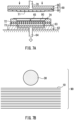
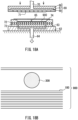
- FIG. 13A is a schematic perspective view of a fiber-reinforced resin pultruded product used in an aspect of the present invention.
- FIG. 13B is a schematic cross-sectional view of the fiber-reinforced resin pultruded product.
- a pultruded product 30 is a rod-shaped molded product, and a fiber sheet is folded into an irregular shape in cross section.
- a thermoplastic resin fills the inside of the fiber sheet and the spaces between overlapping portions of the fiber sheet and is integrated with the fiber sheet
- a matrix resin component 31 of the pultruded product 30 is a thermoplastic resin; the fiber sheet is impregnated with the thermoplastic resin and the spaces between overlapping portions of the fiber sheet are also filled with the thermoplastic resin.
- the pultruded product has a pultrusion mark on the surface. Moreover, at least some of the fibers constituting the fiber sheet, which is the material of the pultruded product, are present on the surface of the pultruded product. When the fiber sheet is converged and pulled through a die, a pultrusion mark remains on the surface of the resulting molded product. The pultrusion mark makes it possible to determine whether the fiber sheet has been pultruded or not
- the fiber sheet which is the material of the pultruded product 30, contains a resin and strengthening fibers in the following proportions, provided that the total of the resin and the strengthening fibers is 100% by volume: the volume fraction (Vf) of the reinforcing fibers is preferably 20 to 70% by volume and the volume fraction of the thermoplastic resin is preferably 30 to 80% by volume; and the volume fraction (Vf) of the reinforcing fibers is more preferably 25 to 60% by volume and the volume fraction of the thermoplastic resin is more preferably 40 to 75% by volume.
- Vf volume fraction of the reinforcing fibers
- the volume fraction (Vf) of the reinforcing fibers is more preferably 25 to 60% by volume and the volume fraction of the thermoplastic resin is more preferably 40 to 75% by volume.
- the pultruded product 30 is continuous or is cut to a predetermined length.
- the cross-sectional diameter or thickness of the pultruded product is preferably 0.2 to 15 mm, and more preferably 1 to 10 mm.
- the pultruded product 30 may have any cross-sectional shape such as round, square, C-shape, H-shape, or L-shape.
- the pultruded product 30 may be, e.g., in a linear, rod, or plate form.
- the fiber sheet is preferably a semi-preg sheet in which a thermoplastic powder resin that will be a matrix resin of the pultruded product is applied and thermally fused to the surface of the unidirectional continuous fibers.
- a thermoplastic powder resin that will be a matrix resin of the pultruded product is applied and thermally fused to the surface of the unidirectional continuous fibers.
- the thermoplastic resin on the surface fills the inside of the fiber sheet and the spaces between overlapping portions of the fiber sheet.
- the pultruded product thus obtained can have excellent formability (moldability) and few voids.
- the fiber sheet contains bridging fibers as secondary fibers extending in directions that cross the unidirectional continuous fibers, and that the thermoplastic resin integrates the unidirectional continuous fibers with the bridging fibers.
- the primary fibers constituting the fiber sheet are the unidirectional continuous fibers that have been spread and aligned in parallel in one direction.
- the thermoplastic resin used to form the fiber sheet is preferably a powder. It is preferable that the thermoplastic powder resin is applied to the unidirectional continuous fibers and the bridging fibers from above, is thermally fused to the surface of the unidirectional continuous fibers or its vicinity, and integrates the unidirectional continuous fibers with the bridging fibers. Since the unidirectional continuous fibers and the bridging fibers are integrated by the thermally fused thermoplastic resin, the fiber sheet has good handleability and also good operability when converged, pultruded, and heat molded
- the mass fraction of the unidirectional continuous fibers is preferably 75 to 99% by mass, more preferably 80 to 97% by mass, and further preferably 85 to 97% by mass and the mass fraction of the bridging fibers is preferably 1 to 25% by mass, more preferably 3 to 20% by mass, and further preferably 3 to 15% by mass, provided that the total of the unidirectional continuous fibers and the bridging fibers in the fiber sheet is 100% by mass.
- the fiber sheet has high integrity and high tensile strength in the width direction.
- the average length of the bridging fibers is preferably 1 mm or more, and more preferably 5 mm or more.
- the upper limit of the average length of the bridging fibers is preferably 1000 mm or less, and more preferably 500 mm or less. When the average length of the bridging fibers is within the above range, the fiber sheet has high strength in the width direction and excellent handleability.
- the mass per unit area of the fiber sheet is preferably 10 to 500 g/m 2 , more preferably 20 to 400 g/m 2 , and further preferably 30 to 300 g/m 2 .
- the mass of the fiber sheet is within the above range, the fiber sheet is easy to handle during converging and pultrusion.
- the fiber sheet may also contain an auxiliary yarn arranged in a direction different from the direction of the unidirectional continuous fibers.
- the auxiliary yarn serves to maintain a fixed orientation of the fiber sheet.
- the auxiliary yarn include glass fibers, aramid fibers, polyester fibers, nylon fibers, and vinylon fibers.
- FIG. 10 is a schematic perspective view of a carbon fiber sheet 1 as an example of the semi-preg sheet.
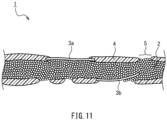
- FIG. 11 is a schematic cross-sectional view of the carbon fiber sheet 1 in FIG. 10 .
- bridging fibers 3 are arranged in various directions on the surface of spread unidirectional carbon fibers 2.
- a thermoplastic resin 4 is melt-solidified and attached to the surface of the unidirectional carbon fibers 2 and its vicinity.
- the unidirectional carbon fiber sheet is not impregnated with or is partially impregnated with the resin 4. As illustrated in FIG.
- bridging fibers 3a, 3b are present on the surface of the unidirectional carbon fibers 2.
- the whole of the bridging fiber 3a is located on the surface of the unidirectional carbon fibers 2.
- a portion of the bridging fiber 3b is located on the surface of the unidirectional carbon fibers 2 and the other portion of the bridging fiber 3b enters and crosses the unidirectional carbon fibers 2.
- the term "cross” as used herein includes entanglement.
- all or part of the bridging fibers 3 are present inside the unidirectional continuous fibers and three-dimensionally cross the unidirectional continuous fibers.
- the resin 4 allows the bridging fibers 3 to adhere to the surface of the unidirectional carbon fibers 2.
- the carbon fiber sheet 1 has portions to which the resin 4 is attached and portions 5 to which no resin is attached.
- the portions 5 to which no resin is attached provide passages through which air inside the carbon fiber sheet 1 escapes when the fiber sheet is heated and pultruded, and facilitate the impregnation of the resin on the surface into the entire fiber sheet.
- the resin 4 serves as a matrix resin of the pultruded product.
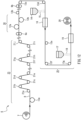
- FIG. 12 is a schematic process diagram illustrating a method for producing the semi-preg sheet.
- Carbon fiber filament groups (tows) 8 are drawn from a number of feed bobbins 7 and pass through spreader rollers 21a to 21j so that the tows are spread (i.e., a roller spreading step 23).
- Air spreading may be used instead of roller spreading.
- the spreader rollers may be fixed or rotated or may vibrate in the width direction.
- the spread tows are nipped between nip rollers 9a and nip rollers 9b while they are passing through bridge rollers 12a and 12b, located between the nip roller pairs 9a and 9b, and being held under a tension of e.g., 2.5 N to 30 N per 15,000 filaments (corresponding to a carbon fiber filament group fed from a single feed bobbin), thereby producing bridging fibers (i.e., a bridging fiber producing step 24).
- the bridge rollers may be rotated or may vibrate in the width direction.
- the bridge rollers may be, e.g., a plurality of rollers with satin, uneven, or mirror-finished surfaces, and produce the bridging fibers by subjecting the carbon fiber filament groups to bending, fixing, rotating, vibrating, or a combination thereof.
- Reference numerals 13a to 13g denote guide rollers.
- a predetermined tension is applied to the spread carbon fiber filament groups to produce the bridging fibers from the carbon fiber filament groups. Therefore, some bridging fibers are also present inside the fiber sheet and extend in a direction across the fiber sheet Consequently, such bridging fibers three-dimensionally cross the unidirectional continuous fibers.
- a dry powder resin 15 is sprinkled on the surface of a spread fiber sheet from a powder supply hopper 14.
- This sheet in an unpressurized state is fed into a heating device 16 and heated to melt the dry powder resin 15, and then is cooled through the guide rollers 13e to 13g.
- a dry powder resin 18 is also sprinkled on the back surface of the spread fiber sheet from a powder supply hopper 17.
- This sheet in an unpressurized state is fed into a heating device 19 and heated to melt the dry powder resin 18, and then is cooled and wound onto a take-up roller 20 (i.e., a powder resin applying step 25).
- the dry powder resins 15 and 18 are each, e.g., a polyphenylene sulfide resin (melting point: 290°C).
- the temperature in each of the heating devices 16 and 19 is, e.g., 5 to 60°C above the melting point or the resin flow temperature of the resin, and the residence time is, e.g., 4 seconds for each heating device. Under these conditions, the carbon fiber sheet has a high strength in the width direction and can be handled as a sheet without causing the constituent carbon fibers to fall apart.
- the powder resin may be applied by, e.g., powder coating, electrostatic coating, spraying, or fluidized-bed coating.
- the powder coating is preferred, in which a powder resin is dropped on the surface of the spread fiber sheet.
- a dry powder resin may be sprinkled over the spread fiber sheet.
- the bridging fibers may be dropped on the spread fiber sheet
- the bridging fibers may be present on one side or both sides of the spread fiber sheet.
- the bridging fiber producing step 24 can be omitted from the production method in FIG. 12 .
- a pultrusion die 37 includes a heating section 34, a molding section 35, and a cooling section 36 in this order along the traveling direction of a fiber sheet.
- a fiber sheet 32 is converged by passing through a guide 33 and fed into the heating section 34 of the pultrusion die 37.
- the fiber sheet 32 is heated to a temperature equal to or higher than the melting point or the resin flow temperature of the thermoplastic resin present on at least the surface of the fiber sheet 32.
- the resin flow temperature refers to a temperature at which the resin begins to flow.
- the fiber sheet is compressed while being pulled in the traveling direction and molded into a shape of the inner cavity of the heating section 34. Then, the fiber sheet is drawn in the molding section 35, shaped into a shape of the inner cavity of the molding section 35, and stabilized in that shape in the molding section 35.
- the die temperature in the molding section 35 is preferably equal to that in the heating section 34. Then, the fiber sheet is oooled in the cooling section 36 to fix its shape.
- the die temperature in the molding section 35 is, e.g., equal to or higher than the melting point or the resin flow temperature of the thermoplastic resin. Water cooling is an efficient cooling system in the cooling section 36.
- the resulting molded product is pulled out of the pultrusion die 37 by pulling rollers 38a and 38b, and then is either wound up if the molded product is thin or cut as desired with a blade 39 to a predetermined length, thus providing a fiber-reinfor ⁇ d resin pultruded product 40.
- the method for producing the pultruded product that is used to form the rib-reinforced molded product of the present invention uses, as a material of the pultruded product, a fiber sheet (semi-preg sheet) in which a thermoplastic powder resin that will be a matrix resin of the pultruded product is fused to the surface of the unidirectional continuous fibers and its vicinity.
- the production method includes the following steps:
- one or more than one fiber sheet is used. It is preferable that the fiber sheet is fed into the heating section in at least one converged state selected from the group consisting of a folded state, a wound state, and a state in which strip-shaped sheets are stacked.
- the planar fiber sheet can be brought closer to a three-dimensional molded product having a rod shape or the like, and the fiber sheet is irregularly folded within the pultruded product.
- the term "converge” as used herein means that the fiber sheet will be gathered or bunched and made ready for molding. This includes, e.g., folding of the fiber sheet, winding of the fiber sheet, and stacking of the strip-shaped sheets, as described above.
- FIG. 15A illustrates a fiber sheet 41 in a folded state
- FIG. 15B illustrates a fiber sheet 42 in a wound state
- FIG. 15C illustrates a fiber sheet 43 that is a stack of strip-shaped fiber sheets.
- the fiber sheet 42 may be wound obliquely.
- the strip-shaped fiber sheets may be staggered in the length direction, as illustrated in FIG. 15C , so that an endless pultruded product with no length limitation can be obtained.
- the guide 33 (see FIG. 14 ) etc. may be used as a converging means of the fiber sheet 32.
- the fibers may be oriented at any angle when the fiber sheet is converged.
- a sheet further may be wrapped around the wound fiber sheet
- the fiber sheet may be wound at any angle.
- a plurality of fiber sheets may be stacked and the angle between the layers can be set as desired, such as 0°, 45°, or 90°.
- each fiber sheet is laid at 0° in the longitudinal direction (one direction).
- the angle of "0°" means that the longitudinal direction of the unidirectional continuous fibers of the fiber sheet is the same as the pulling direction in pultrusion (i.e., the longitudinal direction of the molded product).
- the amount of insertion of the semi-preg sheet in the pultrusion die can be changed according to the target diameter and the mass per unit length of the pultruded product.
- the heating temperature of the fiber sheet (the die temperature in the heating section 34) is, e.g., equal to or higher than the resin melting temperature, and the pulling speed is preferably 10 mm/min to 100 m/min.
- the melting of the thermoplastic resin, the impregnation of the thermoplastic resin into the spaces between the fibers, and the molding of the fiber sheet can be controlled by the two conditions of the temperature and the pulling speed.
- the internal space of the heating section 34 may be tapered off, with its diameter decreasing in the traveling direction of the fiber sheet, or may be in the form of a trumpet Specifically, an inlet diameter (D1) of the heating section 34 is preferably larger than the target diameter of the pultruded product, and an outlet diameter (D2) of the heating section and a diameter (D3) of the molding section are preferably the same as the target diameter.
- the outlet diameter (D2) of the heating section 34 and the diameter (D3) of the molding section 35 are each, e.g., 1 to 15 mm.
- the ratio (D1/D2) of the inlet diameter (D1) of the heating section 34 to the outlet diameter (D2) of the heating section 34 is preferably 1.5 times or more, more preferably 2 times or more, and further preferably 2.5 times or more.
- D1/D2 is preferably 10 times or less, and more preferably 8 times or less.
- the fiber sheet 32 which is the material of the pultruded product, is compressed by the pulling force in the heating section 34. In other words, the fiber sheet 32 is compressed while being pulled in the traveling direction.
- a diameter (D4) of the die in the cooling section 36 is preferably the same as the outlet diameter (D2) of the die in the heating section 34 and the diameter (D3) of the molding section 35.
- a series of steps from the feeding step to the pulling step is continuously performed.
- the continuous steps can improve the production efficiency and reduce the production cost.
- a long-pultruded product obtained after the cooling step may be continuously wound up if the pultruded product is thin enough to be wound, or may be cut to a predetermined length.
- the production method of the pultruded product in an aspect of the present invention is characterized in that the semi-preg sheet is directly molded.
- the fiber sheet (semi-preg sheet) used is flexible and has excellent formability, can be inserted directly into the heating section 34, and does not require preheating.
- the prepreg is hard and cannot be folded as it is.
- the choice of the thermoplastic resin is limited in the conventional method for producing a wire rod, in which fiber bundles are bound with a binding material and then dipped into a thermoplastic resin solution to form a wire rod.
- the above production method of the pultruded product uses the fiber sheet to which a resin is attached, and thus can employ almost any resin that is a thermoplastic resin used for general molding.
- a thermoplastic resin powder is dropped on the fiber surface of the unidirectional continuous fibers (spread fiber sheet) and then melt-solidified. Therefore, the resin can be heated, melted, and subsequently cooled with efficiency while the pultruded product is being formed, resulting in good moldability and a high molding speed for the pultruded product.
- the fiber-reinforced resin sheet is the material of the molded main body.
- the fiber-reinforced resin sheet is preferably a semi-preg sheet that contains fibers and a thermoplastic resin, that is highly flexible, and that is unimpregnated with resin and/or semi-impregnated with resin.
- the fiber-reinforced resin sheet is more preferably a semi-preg sheet in which a thermoplastic powder resin is fused to the fiber surface of unidirectional continuous fibers (spread fiber sheet) obtained by spreading a group of continuous fibers and aligning the continuous fibers in parallel in one direction.
- the thermoplastic powder resin serves as a matrix (base material) resin of the molded main body and joins the molded main body and the reinforcing rib together so that they are integrated.
- the fiber-reinforced resin sheet may further contain bridging fibers as secondary fibers extending in directions that cross the unidirectional continuous fibers.
- the thermoplastic resin preferably integrates the unidirectional continuous fibers with the bridging fibers.
- the semi-preg sheet which is to be the molded main body in the process of forming the rib-reinforced molded product, has the same configuration as the semi-preg sheet that has been described as an example of the fiber sheet (which is the material of the pultruded product) with reference to FIGS. 10 and 11 , except that the resin constituting the semi-preg sheet and/or the volume fractions of the resin and the fibers are the same or different.
- the semi-preg sheet can be produced by the method described with reference to FIG. 12 .
- the bridging fiber producing step 24 can be omitted from the production method in FIG. 12 .
- the fiber-reinforced resin sheet can be produced by the method for producing a resin-integrated fiber sheet as disclosed in WO 2021/095626 .
- the thermoplastic resin contained in the fiber-reinforced resin sheet preferably has a lower softening point than the thermoplastic resin constituting the pultruded product.
- the volume fraction (Vf) of the fibers is preferably 20 to 65% by volume and the volume fraction of the thermoplastic resin is preferably 35 to 80% by volume; and the volume fraction (Vf) of the fibers is more preferably 25 to 60% by volume and the volume fraction of the thermoplastic resin is more preferably 40 to 75% by volume.
- the mass fraction of the unidirectional continuous fibers is preferably 75 to 99% by mass, more preferably 80 to 97% by mass, and further preferably 85 to 95% by mass and the mass fraction of the bridging fibers is preferably 1 to 25% by mass, more preferably 3 to 20% by mass, and further preferably 5 to 15% by mass, provided that the total of the unidirectional continuous fibers and the bridging fibers is 100% by mass.
- the mass fractions of these fibers are within the above respective ranges, the fiber-reinforced resin sheet has high integrity and high tensile strength in the width direction.
- the average length of the bridging fibers is preferably 1 mm or more, and more preferably 5 mm or more.
- the upper limit of the average length of the bridging fibers is preferably 1000 mm or less, and more preferably 500 mm or less.
- the fiber-reinforced resin sheet has high strength in the width direction and excellent handleability.
- the mass per unit area of the fiber-reinforced resin sheet is preferably 10 to 3000 g/m 2 , more preferably 20 to 2000 g/m 2 , and further preferably 30 to1000 g/m 2 .
- the thickness ofone fiber-reinforced resin sheet is preferably 0.01 to 5.0 mm.
- the fiber reinforced resin sheet having a thickness within this range is suitable for vacuum pressure molding.
- the number of layers of the fiber-reinforced resin sheets is preferably 2 to 70, and more preferably 2 to 50 in the vacuum pressure molding.
- FIGS. 1A to 1C are each a schematic cross-sectional view of a rib-reinforced molded product in an aspect of the present invention.
- FIG. 1A illustrates a rib-reinforced molded product 51a that includes a molded main body 52 and reinforcing ribs 53.
- the molded main body 52 contains a resin or a resin and strengthening fibers (short fibers).
- the reinforcing ribs 53 are disposed on one principal surface (i.e., the lower surface) of the molded main body 52.
- FIG. 1A illustrates a rib-reinforced molded product 51a that includes a molded main body 52 and reinforcing ribs 53.
- the molded main body 52 contains a resin or a resin and strengthening fibers (short fibers).
- the reinforcing ribs 53 are disposed on one principal surface (i.e., the lower surface) of the molded main body 52.
- FIG. 1A illustrates
- FIG. 1B illustrates a rib-reinforced molded product 51b in which portions of the reinforcing ribs 53 are embedded in the molded main body 52 and the remaining portions of the reinforcing ribs 53 protrude from one principal surface (i.e., the lower surface) of the molded main body 52.
- FIG. 1C illustrates a rib-reinforced molded product 51c in which portions of the reinforcing ribs 53 are embedded in the molded main body 52 and the remaining portions of the reinforcing ribs 53 protrude from the other principal surface G.e., the upper surface) of the molded main body 52.
- the reinforcing ribs 53 are integrated with the molded main body 52.
- two or more of the configurations illustrated in FIGS. 1A to 1C may be used in combination.
- the entire reinforcing rib may be embedded in the molded main body 52.
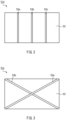
- FIG. 2 is a schematic underside view of a rib-reinforced molded product 51d in another aspect of the present invention.
- the rib-reinforced molded product 51d includes reinforcing ribs 53a to 53c that are integrally molded with the molded main body 52.
- the reinforcing ribs 53a to 53c are disposed in parallel with each other on the back surface of the molded main body 52.
- FIG. 3 is a schematic underside view of a rib-reinforced molded product 51e in another aspect of the present invention.
- the rib-reinforced molded product 51e includes reinforcing ribs 53a, 53b that are integrally molded with the molded main body 52.
- the reinforcing ribs 53a, 53b intersect on the back surface of the molded main body 52.
- FIG. 4 is a schematic underside view of a rib-reinforced molded product 51fin another aspect of the present invention.
- the rib-reinforced molded product 51fin cludes reinforcing ribs 53a to 53d that are integrally molded with the molded main body 52.
- the reinforcing ribs 53a to 53d are disposed in a W shape on the back surface of the molded main body 52.
- FIG. 5 is a schematic underside view of a rib-reinforced molded product 51g (housing) in another aspect of the present invention.
- the rib-reinforced molded product 51g is a housing and includes a box-like molded main body with a bottom 52e and sides 52a to 52d.
- the rib-reinforced molded product 51g includes reinforcing ribs 53a to 53j that are integrally molded with the molded main body. Two reinforcing ribs are disposed in parallel with each other on each of the outer surfaces of the bottom 52e and the sides 52a to 52d.
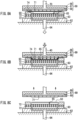
- FIG. 6 is a schematic cross-sectional view of a vacuum pressure molding machine used in a method for producing a rib-reinforced molded product in an aspect of the present invention.
- FIGS. 7 to 8 are schematic process diagrams illustrating each step in the method for producing a rib-reinforced molded product in an aspect of the present invention.
- a vacuum pressure molding machine 60 includes a lower die 63 having a vacuum line 64 and an upper die 69 having a pressure line 70.
- the lower die 63 is fixed on a base 61 and a die base 62, and the vacuum line 64 extends to a molding surface 65.
- a vacuum pump (not shown) is connected to the vacuum line 64.
- the upper die 69 has an upper die main body 66 including the pressure line 70.
- the upper die 69 can supply compressed air downward (toward the lower die 63) through an air groove 67 and air holes 71 in a faceplate 68.
- a compressor (not shown) is connected to the pressure line 70.
- the lower die 63 is heated with a heater 72 (using, e.g., electromagnetic induction heating, resistance wire heating, infrared heating, or wire heating) and cooled with a water-cooled tube 73, and thus can be controlled at a predetermined temperature.
- a heater 72 using, e.g., electromagnetic induction heating, resistance wire heating, infrared heating, or wire heating
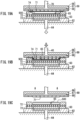
- FIG. 7 illustrate a preparation step.
- FIG. 8A illustrates a heating and temperature rise step
- FIG. 8B illustrates a heating and vacuum pressure molding step
- FIG. 8C illustrates a cooling and demolding step.
- a stack 90 in which a plurality of semi-preg sheets 10 are arranged in layers and a reinforcing rib 30 is disposed on top of them is placed on the molding surface 65 of the lower die 63.
- the stack 90 is placed with the semi-preg sheets 10 facing the molding surface 65.
- the lower die 63 is covered with a bagging film 74 so that a closed space is formed under the bagging film 74, in which a vacuum atmosphere can be created.
- the upper die 69 is placed on the bagging film 74.
- the air inside the lower die 63 (the closed space) is sucked from the vacuum line 64 to reduce the pressure in the closed space, and the stack 90 is drawn down to the lower die 63 and brought into close contact with the lower die 63.
- the temperature of the lower die 63 is increased by the heater 72.
- the temperature rise of the lower die 63 may begin simultaneously with the start of the depressurization or may begin either before or after the start of the depressurization.
- the stack 90 under the reduced pressure, the stack 90 is heated to a temperature equal to or higher than the softening point of a thermoplastic resin constituting the semi-preg sheets 10 to soften the thermoplastic resin, and at the same time the stack 90 is pressurized with compressed air from above the bagging film 74 and pressed against the lower die. Finally, as illustrated in FIG. 8C , the resulting molded product is oooled while the pressure conditions in FIG. 8B are maintained. After cooling, the pressure applied to the closed space is released, and a rib-reinforced molded product 50 (vacuum pressure molded product) is demolded.
- a rib-reinforced molded product 50 vacuum pressure molded product
- the degree of depressurization (i.e., the degree of vacuum) in the closed space due to exhaust from the vacuum line 64 of the lower die 63 is preferably 0 to 0.1 MPa, and the air pressure of the compressed air supplied from the pressure line 70 of the upper die 69 is preferably 0.1 to 2.0 MPa.
- the bagging film include fluororesin films such as a polytetrafluoroethylene film, and heat resistant films such as a polyimide resin film and a silicone rubber sheet.
- FIG. 9A illustrates an in-mold (injection) molding machine 80 used in a method for producing a rib-reinforced molded product of this aspect.
- the molding machine 80 includes an upper die 81 and a lower die 82.
- the upper die 81 and the lower die 82 are illustrated as being located apart from each other. A gap is formed when these dies are aligned and laid one on top of the other, and the gap serves as a cavity.
- Grooves 83a to 83c for positioning reinforcing ribs are provided in the surface of the lower die 82 that defines the cavity.
- Reference numeral 84 denotes an injection port for a molten resin. As illustrated in FIG.
- reinforcing ribs 85a to 85c are disposed in the grooves 83a to 83c, respectively.
- the upper die and the lower die are aligned and laid one on top of the other, and subsequently a molten resin 86 is injected through the injection port 84.
- the molten resin is molded into a molded main body 87 and is integrated with the reinforcing ribs 85a to 85c in the cavity between the upper die 81 and the lower die 82.
- the molded main body is a laminated base material composed of a plurality of base material layers, each of which contains a resin
- the reinforcing rib is a rib member that is disposed inside the laminated base material.
- the rib-reinforced molded product has a ridge on one principal surface that corresponds to the contour of the rib member disposed inside the laminated base material.
- an aspect of the rib-reinforced molded product of the present invention includes a laminated base material composed of a plurality of base material layers, and a rib member that contains reinforcing fibers and a thermoplastic resin and is disposed inside the laminated base material.
- the reinforcing fibers include continuous fibers that are arranged in the longitudinal direction of the reinforcing rib.
- a ridge that corresponds to the contour of the rib member is formed on one principal surface of the rib-reinforced molded product. Since the rib member contains the reinforcing fibers, the strength and rigidity of the ridge are increased, which in turn increases the strength and rigidity of the rib-reinforced molded product. Because of the increased strength and rigidity of the ridge, it is possible to provide a rib-reinforced molded product with high strength and high rigidity even if the laminated base material is thin.
- the rib member is preferably a fiber reinforced resin pultruded product that contains reinforcing fibers and a thermoplastic resin.
- the pultruded product may be the same as that described in Embodiment 1.
- the fiber sheet used to form the pultruded product, the reinforcing fibers and the thermoplastic resin constituting the fiber sheet, the shape of the pultruded product, and the production method of the pultruded product are the same as those described in Embodiment 1.
- the thermoplastic resin contained in the fiber sheet preferably has a higher softening point than the resin constituting the base material layers.
- a base material sheet which is the material of the base material layer constituting the laminated base material, is not particularly limited and may be, e.g., a resin sheet, a fiber-reinforced resin sheet containing strengthening fibers, a metal sheet, or a cellulose-based sheet.
- the base material sheet is preferably at least one resin containing sheet selected from the group consisting of a resin sheet and a fiber-reinforced resin sheet containing strengthening fibers.
- the resin containing sheet is not particularly limited as long as it can be integrally molded with the rib member, but is more preferably a fiber-reinforced resin sheet in terms of forming a high-strength rib-reinforced molded product.
- the resin contained in the base material layer and the resin containing sheet may be either a thermosetting resin or a thermoplastic resin, but is preferably a thermoplastic resin.
- the thermoplastic resin include, but are not limited to, polyamide-based resin, polycarbonate-based resin, polypropylene-based resin, polyester-based resin, polyethylene-based resin, acrylic-based resin, phenoxy resin, polystyrene-based resin, polyimide-based resin, and polyetheretherketone-based resin.
- the resin-reinforced resin sheet may be the same as the fiber-reinforced resin sheet that is the material of the molded main body described in Embodiment 1.
- the rib-reinforced molded product of this aspect is preferably a hot press molded product, a vacuum molded product, a pressure molded product, or a vacuum pressure molded product.
- the rib-reinforced molded product of this aspect can be produced by integrally molding the rib member with a plurality of base material sheets using any of the molding methods such as hot press molding, vacuum molding, pressure molding, and vacuum pressure molding.
- the molding method is preferably any one of vacuum molding, pressure molding, and vacuum pressure molding, and particularly preferably vacuum pressure molding.
- the vacuum pressure molding can shape the constituent materials into various forms while integrating the constituent materials, and therefore is suitable as a molding method of a thin molded product.
- the method for producing the rib-reinforced molded product of the present invention preferably includes: heating and softening a stack in which a plurality of resin containing sheets are arranged in layers and a rib member is disposed between any two adjacent layers of the resin containing sheets, vacuum molding the stack in a lower die having a vacuum line; and pressure molding the stack with compressed air supplied from an upper die to the lower die.
- the rib-reinforced molded product is preferably produced by a method including the following steps (a) to (d) using a vacuum pressure molding machine that includes the lower die, a bagging film, and the upper die:
- the temperature equal to or higher than the softening point is a temperature at which the resin softens or melts.
- the resin containing sheet is preferably a fiber-reinforced resin sheet, and the thickness of one fiber-reinforced resin sheet is preferably 0.01 to 5.0 mm.
- the fiber-reinforced resin sheet having a thickness within this range is suitable for vacuum pressure molding.
- the number of layers of the fiber-reinforced resin sheets is preferably 5 to 70, and more preferably 8 to 50 in the vacuum pressure molding.
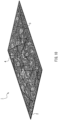
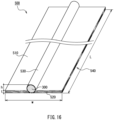
- FIG. 16 is a schematic perspective view of a rib-reinforced molded product 500 in an aspect of the present invention.
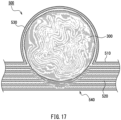
- FIG. 17 is a schematic partially enlarged cross-sectional view of the rib-reinforced molded product 500 in FIG. 16 .
- the rib-reinforced molded product 500 is in the form of a plate and has a ridge 530 on one principal surface 510.
- the rib-reinforced molded product 500 includes a laminated base material 540 composed of a plurality of base material layers 520, and a rib member 300 that serves as a reinforcing rib and is disposed inside the laminated base material 540.
- the rib member 300 is disposed between the second and third base material layers 520 from the principal surface 510, so that the rib member 300 and the base material layers 520 are stacked and integrated.
- the base material layer 520 that is arranged closer to the principal surface 510 than the rib member 300 covers the rib member 300 so as to conform to the outer surface of the rib member 300.
- the ridge 530 that corresponds to the contour of the rib member 300 is formed as a rib on the principal surface 51.
- the rib member 300 is disposed between the base material layers 520 and is not exposed on the surface of the rib-reinforced molded product 500, but is embedded in the rib-reinforced molded product 500.
- Both the base material layers 520 and the rib member 300 contain a thermoplastic resin. Therefore, in the production process of the rib-reinforced molded product 500, resin containing sheets 100 (see FIG. 18B ), which will be molded into the base material layers 520, can be laminated and integrated with each other, and the rib member 300 can be integrally molded with the resin containing sheets 100.
- the ridge 530 is formed according to the contour of the rib member 300 containing reinforcing fibers, and thus has high strength and high rigidity. Consequently, the presence of the rib member 300 in the rib-reinforced molded product 500 improves the strength and rigidity of the rib-reinforced molded product 500.
- the number of layers of the base material layers 520 is not particularly limited and is preferably 5 to 70, and more preferably 8 to 50.
- the position of the rib member 300 in the stacked base material layers 520 is not particularly limited.
- the rib member 300 is preferably disposed two or more layers below one principal surface of the rib-reinforced molded product 500 on which the ridge 530 is formed, because the pultrusion mark or fibers on the surface of the pultruded product and the constituent fibers of the fiber-reinforced resin sheets that are to be formed into the base material layers 520 can be covered with the resin, thus improving the smoothness of the principal surface of the rib-reinforced molded product 500.
- a base material layer 52 is made of a fiber-reinforced resin sheet containing unidirectional continuous fibers (spread fiber sheet)
- a plurality of fiber-reinforced resin sheets may be stacked by changing the direction of the unidirectional continuous fibers.
- the direction of the unidirectional continuous fibers may be changed to 0°/ 45°/ 90°/ 135°/ 180°/..., 0°/ 90°/ 180°/..., etc. This can provide a molded product with the required mechanical properties.
- the rib-reinforced molded product 500 includes one rib member 300, but the number of rib members 300 is not particularly limited and may be appropriately determined depending on, e.g., the size, shape, use, and required strength of the rib-reinforced molded product 500.
- the rib-reinforced molded product 500 may include at least two rib members, and the rib members may be arranged in parallel with each other, or one of the rib members may be angled with respect to the other.
- the rib-reinforced molded product 500 may include rib members that are diagonal to each other.
- the production method of the rib-reinforced molded product of this aspect also uses the vacuum pressure molding machine 60 described in Embodiment 1, and the explanation of the vacuum pressure molding machine 60 will not be repeated.
- the production method of the rib-reinforced molded product 500 of this aspect is the same as the production method of the rib-reinforced molded product described with reference to FIGS. 7 and 8 in Embodiment 1, except that the stack 900 in FIG. 18B is used instead of the stack 90 in FIG. 7B .
- a stack 900 (see FIG. 18B ) in which a plurality of resin containing sheets 100 are arranged in layers and a rib member 300 is disposed between any two adjacent layers of the resin containing sheets 100 is placed on the molding surface 65 of the lower die 63.
- the stack 900 is placed on the molding surface 65 with the rib member 300 facing away from the molding surface 65.
- the lower die 63 is covered with the bagging film 74 so that a closed space is formed under the bagging film 74, in which a vacuum atmosphere can be created.
- the upper die 69 is placed on the bagging film 74.
- the air inside the lower die 63 (the closed space) is sucked from the vacuum line 64 to reduce the pressure in the closed space, and the stack 900 is drawn down to the lower die 63 and brought into close contact with the lower die 63.
- the temperature of the lower die 63 is increased by the heater 72.
- the temperature rise of the lower die 63 may begin simultaneously with the start of the depressurization or may begin either before or after the start of the depressurization.
- the stack 900 under the reduced pressure, the stack 900 is heated to a temperature equal to or higher than the softening point of a thermoplastic resin constituting the resin containing sheets 100 to soften the thermoplastic resin, and at the same time the stack 900 is pressurized with compressed air from above the bagging film 74 and pressed against the lower die. Finally, as illustrated in FIG. 19C , the resulting molded product is cooled while the pressure conditions in FIG. 19B are maintained. After cooling, the pressure applied to the closed space is released, and a rib-reinforced molded product 500 (vacuum pressure molded product 500) is demolded.
- a rib-reinforced molded product 500 vacuum pressure molded product 500
- the preferred degree of depressurization i.e., the degree of vacuum
- the preferred air pressure of the compressed air supplied from the pressure line 70 of the upper die 69 is the same as that described in Embodiment 1.
- the bagging film 74 used can be the same as that used in Embodiment 1.
- Unspread carbon fiber tows manufactured by Mitsubishi Chemical Corporation (product number: PYROFIL TR 50S15L, shape: regular tow, filament count: 15K (15,000 filaments), single fiber diameter: 7 pm) were used.
- An epoxy compound was attached to carbon fibers of the unspread carbon fiber tows as a sizing agent
- the unspread carbon fiber tows were spread by the spreading means illustrated in FIG. 12 .
- the tension of the carbon fiber filament groups (tows) was set to 15 N per 15,000 filaments.
- the unspread tows were formed into a spread fiber sheet with a carbon fiber filament count of 15K, a spread width of 500 mm, and a thickness of 0.08 mm.
- the bridging fibers accounted for 3.3% by mass.
- a PPS resin powder (manufactured by Solvay SA, polyphenylene sulfide resin, melting point: 290°C) was used as a dry powder resin.
- the dry powder resin had an average particle size of 350 ⁇ m.
- This resin powder was applied at an average of 29.7 g on one side and at an average of 59.4 g on both sides per 1 m 2 of the carbon fibers (i.e., the spread fiber sheet).
- the temperature in each of the heating devices 16 and 19 was 380°C, and the residence time was 4 seconds for each heating device.
- the resulting semi-preg sheet (fiber sheet) had a mass of 139.6 g/m 2 , a fiber volume fraction (Vf) of 50% by volume, and a PPS resin volume fraction of 50% by volume.
- the die temperature in the heating section 34 and the molding section 35 was 400°C
- the die temperature in the cooling section 36 was 15°C
- the pulling speed was 72 mm/min.
- the resulting pultruded product (CFRTP) was in the form of a rod having a substantially circular cross section with a diameter of 2.5 mm.
- Unspread carbon fiber tows manufactured by Mitsubishi Chemical Corporation (product number: PYROFIL TR 50S15L, shape: regular tow, filament count: 15K (15,000 filaments), single fiber diameter: 7 ⁇ m) were used.
- An epoxy compound was attached to carbon fibers of the unspread carbon fiber tows as a sizing agent
- the unspread carbon fiber tows were spread by the spreading means illustrated in FIG. 12 .
- the tension of the carbon fiber filament groups (tows) was set to 15 N per 15,000 filaments.
- the unspread tows were formed into a spread fiber sheet with a carbon fiber filament count of 15K, a spread width of 500 mm, and a thickness of 0.08 mm.
- the bridging fibers accounted for 3.3% by mass.
- a PA12 resin powder (manufactured by UBE Corporation, polyamide 12, melting point 176°C) was used as a dry powder resin.
- the dry powder resin had an average particle size of 340 pm. This resin powder was applied at an average of 22.5 g on one side and at an average of 45.0 g on both sides per 1 m 2 of the carbon fibers (i.e., the spread fiber sheet).
- the temperature in each of the heating devices 16 and 19 was 240°C, and the residence time was 4 seconds for each heating device.
- the resulting semi-preg sheet fiber-reinforced resin sheet) had a mass of 125 g/m 2 , a fiber volume fraction (Vf) of 50% by volume, and a PA12 resin volume fraction of 50% by volume.
- Example 1 Using the vacuum pressure molding machine illustrated in FIGS. 6 to 8 , a rib-reinforced molded product of Example 1 was produced in the following procedure.
- the vacuum pressure molded product included the molded main body and the reinforcing rib that were molded in one piece.
- the rib-reinforced molded product of Example 1 was substantially in the form of a plate and included one reinforcing rib.
- the molded main body had a length of 300 mm, a width of 300 mm, and a thickness (wall thickness) of 1 mm.
- the height of the reinforcing rib from the surface of the molded main body i.e., the surface from which the reinforcing rib protruded
- a pultruded product was prepared, which was the same as the pultruded product used to form the rib-reinforced molded product of Example 1.
- Example 2 Using the in-mold (injection) molding machine illustrated in FIGS. 9A to 9C , a rib-reinforced molded product of Example 2 was produced.
- reinforcing ribs were disposed in the grooves provided in the surface of the lower die that defines a cavity.
- the upper die and the lower die were aligned and laid one on top of the other, and a polypropylene resin (melting point: 160°C) that had been heated to 220°C and melted was injected into the cavity through the injection port.
- the upper die and the lower die were water-oooled to 30°C, and a rib-reinforced molded product (injection molded product) was demolded.
- the resulting rib-reinforced molded product included the molded main body and the reinforcing ribs that were molded in one piece.
- the molded main body had a length of 300 mm, a width of 300 mm, and a thickness (wall thickness) of 1 mm.
- portions of the reinforcing ribs were embedded in the molded main body and the remaining portions of the reinforcing ribs protruded outward from one principal surface (i.e., the lower surface) of the molded main body.
- the height of the reinforcing ribs from the surface of the molded main body i.e., the surface from which the reinforcing ribs protruded
- a pultruded product was prepared, which was the same as the pultruded product used to form the rib-reinforced molded product of Example 1.
- a semi-preg sheet was prepared, which was the same as the semi-preg sheet used to form the molded main body of the rib-reinforced molded product of Example 1.
- Example 3 Using the vacuum pressure molding machine illustrated in FIGS. 6 to 8 , a rib-reinforced molded product of Example 3 was produced in the following procedure.
- the rib-reinforced molded product of Example 3 included a plurality of base material layers and the pultruded product that were molded in one piece. A ridge that corresponded to the contour of the pultruded product was formed as a reinforcing rib on one principal surface of the rib-reinforced molded product.
- FIG. 20 is a photograph of the rib-reinforced molded product of Example 3 that was produced as described above. The right side of the photograph was taken from one principal surface of the rib-reinforced molded product and the left side of the photograph was taken from the other principal surface of the rib-reinforced molded product.
- the ridge of the rib-reinforced molded product of Example 3 had a height h of 2 mm, a width w of 30 mm, a thickness (wall thickness) t of about 1 mm, and a length L of 300 mm (see FIG. 1 ).
- the ridge was formed by embedding the pultruded product containing reinforcing fibers in the molded product. Therefore, the ridge itself had high strength and high rigidity, compared to, e.g., a ridge that was formed by injection molding of a thermoplastic resin, so that the rib-reinforced molded product also had high strength and high rigidity.
- the reinforcing rib has high strength and thus exhibits a high reinforcing effect on the molded main body. Therefore, the rib-reinforced molded product of the present invention is useful for a variety of applications such as frames, plates, shelves, wall surfaces, and housings. Moreover, the rib-reinforced molded product of the present invention can be widely used in, e.g., aviation, space, automobiles, sports, three-dimensional printers, industrial applications, building materials, windmills, bicycles, railways, or ships.
Landscapes
- Engineering & Computer Science (AREA)
- Mechanical Engineering (AREA)
- Chemical & Material Sciences (AREA)
- Composite Materials (AREA)
- Textile Engineering (AREA)
- Manufacturing & Machinery (AREA)
- Inorganic Chemistry (AREA)
- Chemical Kinetics & Catalysis (AREA)
- General Chemical & Material Sciences (AREA)
- Architecture (AREA)
- Civil Engineering (AREA)
- Structural Engineering (AREA)
- Moulding By Coating Moulds (AREA)
- Laminated Bodies (AREA)
Applications Claiming Priority (3)
| Application Number | Priority Date | Filing Date | Title |
|---|---|---|---|
| JP2022050522 | 2022-03-25 | ||
| JP2022050523 | 2022-03-25 | ||
| PCT/JP2023/010832 WO2023182258A1 (ja) | 2022-03-25 | 2023-03-20 | リブ補強成形体及びその製造方法 |
Publications (2)
| Publication Number | Publication Date |
|---|---|
| EP4501609A1 true EP4501609A1 (de) | 2025-02-05 |
| EP4501609A4 EP4501609A4 (de) | 2025-07-09 |
Family
ID=88100942
Family Applications (1)
| Application Number | Title | Priority Date | Filing Date |
|---|---|---|---|
| EP23774853.8A Pending EP4501609A4 (de) | 2022-03-25 | 2023-03-20 | Rippenverstärkter formkörper und verfahren zur herstellung davon |
Country Status (6)
| Country | Link |
|---|---|
| US (1) | US20250205938A1 (de) |
| EP (1) | EP4501609A4 (de) |
| JP (1) | JPWO2023182258A1 (de) |
| CN (1) | CN119013136A (de) |
| TW (1) | TW202402510A (de) |
| WO (1) | WO2023182258A1 (de) |
Family Cites Families (16)
| Publication number | Priority date | Publication date | Assignee | Title |
|---|---|---|---|---|
| JPS51126262A (en) * | 1975-04-24 | 1976-11-04 | Sumitomo Electric Industries | Method of manufacture of fiber reinforced plastic material |
| US4752513A (en) * | 1987-04-09 | 1988-06-21 | Ppg Industries, Inc. | Reinforcements for pultruding resin reinforced products and novel pultruded products |
| JP3035409B2 (ja) | 1992-06-30 | 2000-04-24 | 三菱レイヨン株式会社 | 炭素繊維複合成形品の製法 |
| JPH0747556A (ja) * | 1993-08-03 | 1995-02-21 | Mazda Motor Corp | 液晶樹脂複合体のプレス成形方法 |
| US20020014302A1 (en) * | 2000-07-13 | 2002-02-07 | Kazak Composites, Incorporated | Method for incorporating rigid elements into the core of composite structural members in a pultrusion process |
| JP5651925B2 (ja) | 2009-04-24 | 2015-01-14 | 三菱レイヨン株式会社 | 繊維強化複合材料成形品とその製造方法 |
| JP2013176876A (ja) * | 2012-02-28 | 2013-09-09 | Teijin Ltd | 成形体の製造方法 |
| LT3024644T (lt) * | 2013-07-24 | 2018-08-10 | Integrated Composite Products Inc. | Sudėtinis konstrukcinis gaminys |
| US11911933B2 (en) * | 2015-03-30 | 2024-02-27 | Mitsubishi Chemical Corporation | Molded body and manufacturing method therefor |
| JP6574106B2 (ja) * | 2015-06-01 | 2019-09-11 | 株式会社Subaru | 繊維強化樹脂構造体及び繊維強化樹脂構造体の製造方法 |
| CN113474139A (zh) * | 2019-02-14 | 2021-10-01 | 仓敷纺绩株式会社 | 纤维增强树脂成形体及其中所用的碳纤维片的制造方法 |
| JP7249404B2 (ja) * | 2019-03-29 | 2023-03-30 | 川崎重工業株式会社 | 複合材料製パネル構造体およびその製造方法 |
| US12319047B2 (en) * | 2019-11-13 | 2025-06-03 | Kurashiki Boseki Kabushiki Kaisha | Fiber reinforced resin molded body and method for producing the same |
| JP7589256B2 (ja) * | 2020-10-06 | 2024-11-25 | 倉敷紡績株式会社 | 繊維補強樹脂引抜成形体及びその製造方法 |
| CN112356462B (zh) * | 2020-10-16 | 2023-03-24 | 中国商用飞机有限责任公司北京民用飞机技术研究中心 | 复合材料u型长桁加筋壁板结构的整体成型工装及工艺 |
| CN113119491A (zh) * | 2021-04-01 | 2021-07-16 | 常州市宏发纵横新材料科技股份有限公司 | 一种碳玻混平板及其应用方法 |
-
2023
- 2023-03-20 EP EP23774853.8A patent/EP4501609A4/de active Pending
- 2023-03-20 US US18/849,822 patent/US20250205938A1/en active Pending
- 2023-03-20 JP JP2024510157A patent/JPWO2023182258A1/ja active Pending
- 2023-03-20 WO PCT/JP2023/010832 patent/WO2023182258A1/ja not_active Ceased
- 2023-03-20 CN CN202380030382.XA patent/CN119013136A/zh active Pending
- 2023-03-22 TW TW112110585A patent/TW202402510A/zh unknown
Also Published As
| Publication number | Publication date |
|---|---|
| EP4501609A4 (de) | 2025-07-09 |
| US20250205938A1 (en) | 2025-06-26 |
| CN119013136A (zh) | 2024-11-22 |
| TW202402510A (zh) | 2024-01-16 |
| JPWO2023182258A1 (de) | 2023-09-28 |
| WO2023182258A1 (ja) | 2023-09-28 |
Similar Documents
| Publication | Publication Date | Title |
|---|---|---|
| KR101411169B1 (ko) | 열가소성 수지 보강 시트재, 열가소성 수지 다층 보강 시트재 및 그 제조 방법, 및 열가소성 수지 다층 보강 성형품 | |
| KR102452272B1 (ko) | 열가소성 복합 구조물들 및 이에 사용되는 프리프레그 테이프를 제조하는 방법 | |
| EP1731282B1 (de) | Vorformling, frp und herstellungsverfahren dafür | |
| JP4324649B2 (ja) | 繊維強化熱可塑性樹脂シート及びそれを用いた構造材並びに繊維強化熱可塑性樹脂シートの製造方法 | |
| KR101449204B1 (ko) | 연속 탄소섬유 강화 열가소성 프리프레그의 제조 방법 | |
| JP5135616B2 (ja) | 熱可塑性樹脂補強シート材、熱可塑性樹脂多層補強シート材及びその製造方法、並びに熱可塑性樹脂多層補強成型品 | |
| EP0271026A2 (de) | Pultrusionsgerät, Verfahren und Produkt | |
| KR20180104706A (ko) | 유동층에서 열가소성 중합체로 사전함침된 섬유 재료의 제조 방법 | |
| CA2656541A1 (en) | Multiaxially reinforced laminated moldings and process for production thereof | |
| US12434449B2 (en) | Fiber-reinforced resin pultruded product and method for producing same | |
| WO2007041782A1 (en) | A method of binding dry reinforcement fibres | |
| US20140175694A1 (en) | Manufacturing method for fiber-reinforced resin sheet and manufacturing device therefor | |
| EP2733161A1 (de) | Thermoplastisches harz-prepreg, gegossene vorform und gegossener verbundstoff damit sowie verfahren zur herstellung einer gegossenen vorform und eines gegossenen verbundstoffes | |
| EP0391970A1 (de) | Multidirektionales, starkes, leichtes, verflochtenes material und verfahren zu seiner herstellung | |
| EP1685947A1 (de) | Herstellung faserverstärkter Verbundwerkstoffen | |
| JP4341419B2 (ja) | プリフォームの製造方法および複合材料の製造方法 | |
| CN111699210A (zh) | 纤维铺放用干式带材料及其制造方法、以及使用其的增强纤维层叠体及纤维增强树脂成型体 | |
| EP4501609A1 (de) | Rippenverstärkter formkörper und verfahren zur herstellung davon | |
| KR101594655B1 (ko) | 강선 및 연속섬유 강화 열가소성 복합재 및 이를 이용한 복합 판재 | |
| CN114728439B (zh) | 真空成形用树脂一体化纤维片、采用其的成形体和成形体的制造方法 | |
| Okine | Processing of thermoplastic matrix composites | |
| JP2023048312A (ja) | 繊維強化樹脂成形体及びその製造方法 | |
| KR20230075273A (ko) | 탄소섬유복합소재 | |
| CN112041491A (zh) | 一种丝结构 |
Legal Events
| Date | Code | Title | Description |
|---|---|---|---|
| STAA | Information on the status of an ep patent application or granted ep patent |
Free format text: STATUS: THE INTERNATIONAL PUBLICATION HAS BEEN MADE |
|
| PUAI | Public reference made under article 153(3) epc to a published international application that has entered the european phase |
Free format text: ORIGINAL CODE: 0009012 |
|
| STAA | Information on the status of an ep patent application or granted ep patent |
Free format text: STATUS: REQUEST FOR EXAMINATION WAS MADE |
|
| 17P | Request for examination filed |
Effective date: 20241023 |
|
| AK | Designated contracting states |
Kind code of ref document: A1 Designated state(s): AL AT BE BG CH CY CZ DE DK EE ES FI FR GB GR HR HU IE IS IT LI LT LU LV MC ME MK MT NL NO PL PT RO RS SE SI SK SM TR |
|
| DAV | Request for validation of the european patent (deleted) | ||
| DAX | Request for extension of the european patent (deleted) | ||
| A4 | Supplementary search report drawn up and despatched |
Effective date: 20250611 |
|
| RIC1 | Information provided on ipc code assigned before grant |
Ipc: D04H 3/12 20060101ALI20250604BHEP Ipc: D04H 3/04 20120101ALI20250604BHEP Ipc: B29C 70/50 20060101ALI20250604BHEP Ipc: B29C 70/52 20060101ALI20250604BHEP Ipc: B29C 70/46 20060101ALI20250604BHEP Ipc: B32B 5/26 20060101ALI20250604BHEP Ipc: B29C 45/14 20060101ALI20250604BHEP Ipc: B29C 70/34 20060101ALI20250604BHEP Ipc: B29C 70/20 20060101ALI20250604BHEP Ipc: B29C 70/08 20060101ALI20250604BHEP Ipc: B32B 3/30 20060101ALI20250604BHEP Ipc: B29D 99/00 20100101ALI20250604BHEP Ipc: B29C 70/42 20060101ALI20250604BHEP Ipc: B29C 70/68 20060101AFI20250604BHEP |