EP4501366A1 - Verfahren und vorrichtung zur dampfsterilisation von primärpackmitteln - Google Patents
Verfahren und vorrichtung zur dampfsterilisation von primärpackmitteln Download PDFInfo
- Publication number
- EP4501366A1 EP4501366A1 EP23189301.7A EP23189301A EP4501366A1 EP 4501366 A1 EP4501366 A1 EP 4501366A1 EP 23189301 A EP23189301 A EP 23189301A EP 4501366 A1 EP4501366 A1 EP 4501366A1
- Authority
- EP
- European Patent Office
- Prior art keywords
- hpa
- steam sterilization
- pressure
- temperature
- steam
- Prior art date
- Legal status (The legal status is an assumption and is not a legal conclusion. Google has not performed a legal analysis and makes no representation as to the accuracy of the status listed.)
- Granted
Links
Images
Classifications
-
- A—HUMAN NECESSITIES
- A61—MEDICAL OR VETERINARY SCIENCE; HYGIENE
- A61L—METHODS OR APPARATUS FOR STERILISING MATERIALS OR OBJECTS IN GENERAL; DISINFECTION, STERILISATION OR DEODORISATION OF AIR; CHEMICAL ASPECTS OF BANDAGES, DRESSINGS, ABSORBENT PADS OR SURGICAL ARTICLES; MATERIALS FOR BANDAGES, DRESSINGS, ABSORBENT PADS OR SURGICAL ARTICLES
- A61L2/00—Disinfection or sterilisation of materials or objects, in general; Accessories therefor
- A61L2/02—Disinfection or sterilisation of materials or objects, in general; Accessories therefor using physical processes
- A61L2/04—Heat
- A61L2/06—Hot gas
- A61L2/07—Steam
-
- A—HUMAN NECESSITIES
- A61—MEDICAL OR VETERINARY SCIENCE; HYGIENE
- A61J—CONTAINERS SPECIALLY ADAPTED FOR MEDICAL OR PHARMACEUTICAL PURPOSES; DEVICES OR METHODS SPECIALLY ADAPTED FOR BRINGING PHARMACEUTICAL PRODUCTS INTO PARTICULAR PHYSICAL OR ADMINISTERING FORMS; DEVICES FOR ADMINISTERING FOOD OR MEDICINES ORALLY; BABY COMFORTERS; DEVICES FOR RECEIVING SPITTLE
- A61J1/00—Containers specially adapted for medical or pharmaceutical purposes
- A61J1/14—Details; Accessories therefor
-
- A—HUMAN NECESSITIES
- A61—MEDICAL OR VETERINARY SCIENCE; HYGIENE
- A61L—METHODS OR APPARATUS FOR STERILISING MATERIALS OR OBJECTS IN GENERAL; DISINFECTION, STERILISATION OR DEODORISATION OF AIR; CHEMICAL ASPECTS OF BANDAGES, DRESSINGS, ABSORBENT PADS OR SURGICAL ARTICLES; MATERIALS FOR BANDAGES, DRESSINGS, ABSORBENT PADS OR SURGICAL ARTICLES
- A61L2/00—Disinfection or sterilisation of materials or objects, in general; Accessories therefor
- A61L2/26—Accessories
-
- B—PERFORMING OPERATIONS; TRANSPORTING
- B01—PHYSICAL OR CHEMICAL PROCESSES OR APPARATUS IN GENERAL
- B01J—CHEMICAL OR PHYSICAL PROCESSES, e.g. CATALYSIS OR COLLOID CHEMISTRY; THEIR RELEVANT APPARATUS
- B01J3/00—Processes of utilising sub-atmospheric or super-atmospheric pressure to effect chemical or physical change of matter; Apparatus therefor
- B01J3/04—Pressure vessels, e.g. autoclaves
-
- A—HUMAN NECESSITIES
- A61—MEDICAL OR VETERINARY SCIENCE; HYGIENE
- A61L—METHODS OR APPARATUS FOR STERILISING MATERIALS OR OBJECTS IN GENERAL; DISINFECTION, STERILISATION OR DEODORISATION OF AIR; CHEMICAL ASPECTS OF BANDAGES, DRESSINGS, ABSORBENT PADS OR SURGICAL ARTICLES; MATERIALS FOR BANDAGES, DRESSINGS, ABSORBENT PADS OR SURGICAL ARTICLES
- A61L2103/00—Materials or objects being the target of disinfection or sterilisation
- A61L2103/23—Containers other than laboratory or medical, e.g. bottles or mail
-
- A—HUMAN NECESSITIES
- A61—MEDICAL OR VETERINARY SCIENCE; HYGIENE
- A61L—METHODS OR APPARATUS FOR STERILISING MATERIALS OR OBJECTS IN GENERAL; DISINFECTION, STERILISATION OR DEODORISATION OF AIR; CHEMICAL ASPECTS OF BANDAGES, DRESSINGS, ABSORBENT PADS OR SURGICAL ARTICLES; MATERIALS FOR BANDAGES, DRESSINGS, ABSORBENT PADS OR SURGICAL ARTICLES
- A61L2202/00—Aspects relating to methods or apparatus for disinfecting or sterilising materials or objects
- A61L2202/10—Apparatus features
- A61L2202/12—Apparatus for isolating biocidal substances from the environment
- A61L2202/122—Chambers for sterilisation
-
- A—HUMAN NECESSITIES
- A61—MEDICAL OR VETERINARY SCIENCE; HYGIENE
- A61L—METHODS OR APPARATUS FOR STERILISING MATERIALS OR OBJECTS IN GENERAL; DISINFECTION, STERILISATION OR DEODORISATION OF AIR; CHEMICAL ASPECTS OF BANDAGES, DRESSINGS, ABSORBENT PADS OR SURGICAL ARTICLES; MATERIALS FOR BANDAGES, DRESSINGS, ABSORBENT PADS OR SURGICAL ARTICLES
- A61L2202/00—Aspects relating to methods or apparatus for disinfecting or sterilising materials or objects
- A61L2202/10—Apparatus features
- A61L2202/14—Means for controlling sterilisation processes, data processing, presentation and storage means, e.g. sensors, controllers, programs
-
- A—HUMAN NECESSITIES
- A61—MEDICAL OR VETERINARY SCIENCE; HYGIENE
- A61L—METHODS OR APPARATUS FOR STERILISING MATERIALS OR OBJECTS IN GENERAL; DISINFECTION, STERILISATION OR DEODORISATION OF AIR; CHEMICAL ASPECTS OF BANDAGES, DRESSINGS, ABSORBENT PADS OR SURGICAL ARTICLES; MATERIALS FOR BANDAGES, DRESSINGS, ABSORBENT PADS OR SURGICAL ARTICLES
- A61L2202/00—Aspects relating to methods or apparatus for disinfecting or sterilising materials or objects
- A61L2202/10—Apparatus features
- A61L2202/17—Combination with washing or cleaning means
-
- B—PERFORMING OPERATIONS; TRANSPORTING
- B01—PHYSICAL OR CHEMICAL PROCESSES OR APPARATUS IN GENERAL
- B01J—CHEMICAL OR PHYSICAL PROCESSES, e.g. CATALYSIS OR COLLOID CHEMISTRY; THEIR RELEVANT APPARATUS
- B01J2219/00—Chemical, physical or physico-chemical processes in general; Their relevant apparatus
- B01J2219/00049—Controlling or regulating processes
- B01J2219/00051—Controlling the temperature
-
- B—PERFORMING OPERATIONS; TRANSPORTING
- B01—PHYSICAL OR CHEMICAL PROCESSES OR APPARATUS IN GENERAL
- B01J—CHEMICAL OR PHYSICAL PROCESSES, e.g. CATALYSIS OR COLLOID CHEMISTRY; THEIR RELEVANT APPARATUS
- B01J2219/00—Chemical, physical or physico-chemical processes in general; Their relevant apparatus
- B01J2219/00049—Controlling or regulating processes
- B01J2219/00162—Controlling or regulating processes controlling the pressure
Definitions
- the present disclosure relates to a process and device for steam sterilization of primary packaging means as well as to a primary packaging means processed by the process.
- Primary packaging means such as cartridges, vials, syringes, ampules, or other containers, may be used for pharmaceutical and cosmetic packaging applications.
- the sterilization process provides reduced water marks on the corresponding primary packaging means.
- a typical packaging configuration for the transport from a manufacturer of pharmaceutical primary packaging means to a pharmaceutical company using the same comprises a tub or tray holding a multitude of the primary packaging means which is sealed with a non-woven.
- the non-woven is usually a flash spun plexifilamentary film-fibril structure made of high density polyethylene, which is known under the trademark Tyvek ® of the company DuPont, or a spunbonded very fine filaments non-woven.
- Tyvek ® of the company DuPont
- selectively permeable non-wovens allow for the sterilization by means of gas or vapor, like ethylene oxide, steam, or hydrogen peroxide, even after closing the packaging. While being permeable for the sterilizing gas or vapor, the selectively permeable non-woven is essentially impermeable for microbes and thus forms a microbial barrier.
- gas or vapor like ethylene oxide, steam, or hydrogen peroxide
- the selectively permeable non-woven is essentially impermeable for microbes and thus forms a microbial barrier.
- the term "essentially impermeable for microbes" within this context refers to a Microbial Barrier measured according to ASTM F1608-16 of 2 to 6 Log Reduction Value (LRV).
- the standard steam sterilization processes for solid products cannot be used without an increased risk of the loss of the integrity of the sterile barrier (tub/Tyvek ® seal seam) with the packaging configuration used in the market for RTU containers, particularly when made of glass.
- the standard process is characterized by a large number of vacuum pulses to remove trapped air, which might hinder effective steam penetration to the product and, consequently, efficient sterilization.
- a frequent and fast pressure variation results in high stress on the seal seam between the tub and the Tyvek ® layer because the pressure exchange through the non-woven Tyvek ® membrane is slower than in the chamber.
- the slower pressure equilibration inside the tub promotes a ballooning of the Tyvek ® seal (when pressure is decreased) or its adhesion to the packaged items (when pressure is increased).
- the sterilization step is usually carried out at an increased pressure which is reduced back to ambient pressure after the sterilization process. Since the seal seam between the tub and the Tyvek ® layer is obtained by hot melting of a glue with a softening point close to steam sterilization conditions, the seal seam does not withstand the stress of pressure variation at high temperatures.
- RTU containers Another disadvantage for the RTU containers is that the saturated steam penetrates in the tub and condensates on surfaces, such as the nest, the glass or polymer, and the tub or bag, so that the tub may contain a high load of water which needs to be removed at the end of the sterilization procedure.
- Document WO 2018/029590 A2 discloses a steam sterilization procedure for glass articles which uses a pulsed feed of steam for a reduction of white patches on the glass and damage to the physical and chemical structure of the glass.
- the steam flow inside the treatment chamber is oscillating in temperature and pressure and, thus, never has a constant mass. It is underlined that there are no sterilization steps in which pressure and/or temperature reach static sterilization steps and that the system is an open mass system.
- the pressure is varied in a range of from 0.2 bar to 1.15 bar.
- document US 3,598,516 A discloses a sterilizing process which is carried out in a sealed container or autoclave wherein air in the chamber is displaced with steam while the chamber is maintained at vacuum condition.
- the steam is fed in at a rate no greater than the capacity of the vacuum pump so that the pump will maintain the desired pressure in the chamber.
- a needle valve in the steam line is used to set the approximate flow rate.
- An additional solenoid valve is placed in the steam line in series with the needle valve and a thermostatic control is placed in the chamber drain line to turn the solenoid valve on and off to maintain the desired load temperature at approximately 130 °F (54 °C).
- the turning on and off of the solenoid valve to modulate the drain line temperature sets up a pulsing flow of steam and steam pressure condition of approximately 25 to 30 in. Hg (847 hPa to 1,016 hPa) which helps to purge the load of entrained air thereby heating the load more rapidly.
- Hg 847 hPa to 1,016 hPa
- a microbiocidal chemical sterilizing gas is admitted to the sterilizing chamber.
- the disclosure relates to a process for steam sterilization of primary packaging means in a steam sterilization device comprising the steps of
- Setting a drying pressure in the steam sterilization device slightly lower than the predetermined pressure p s can mean that the pressure is reduced from p s by at most 75 hPa or at most 50 hPa or at most 25 hPa and/or by at least 5 hPa or at least 10 hPa or at least 20 hPa.
- the disclosure relates to a process for steam sterilization of primary packaging means in a steam sterilization device comprising the steps of
- Setting a drying pressure in the steam sterilization device slightly lower than the predetermined pressure p s can mean that the pressure is reduced from p s by at most 75 hPa or at most 50 hPa or at most 25 hPa and/or by at least 5 hPa or at least 10 hPa or at least 20 hPa.
- the disclosure relates to a process for steam sterilization of primary packaging means in a steam sterilization device comprising the steps of
- Setting a drying pressure in the steam sterilization device slightly lower than the predetermined pressure p s can mean that the pressure is reduced from p s by at most 75 hPa or at most 50 hPa or at most 25 hPa and/or by at least 5 hPa or at least 10 hPa or at least 20 hPa.
- the disclosure relates to a device for steam sterilization of primary packaging means, the device comprising
- the disclosure relates to a product, a primary packaging means, processed with a steam sterilization process according to at least one of aspects one to three.
- the primary packaging means can be a cartridge, vial, syringe, ampule, or other container. It can for example be used for pharmaceutical and cosmetic packaging applications.
- the primary packaging means can have a sterility assurance level of equal to or less than 10 -6 according to Ph. Eur. 5.1.1.
- the primary packaging means can be optically defect free, in other words not visible, in terms of water marks according to Ph. Eur. 2.9.20.
- the primary packaging means can be at least partially coated on either the inner and/or outer surface.
- the disclosure relates to usage of a primary packaging means according to the fifth aspect, wherein the primary packaging means is suitable for storing a pharmaceutical composition or drug.
- Water marks in the sense of this disclosure can be residuals that appear on the surface of sterilized containers when sterilization and front-end processes are not properly optimized. They can usually appear in the form of more or less prominent irregular white or whitish spots with a typical size range of 0.005 - 0.01 mm 2 and eventually even up to about 7 mm 2 . They can comprise silicone residues with different molecular weights and/or borates, sodium, calcium, sulfur salts, nitrates, and/or other glass components.
- Ph. Eur. 5.1.1 When referring to "Ph. Eur. 5.1.1", this refers to chapter 5.1.1 of the 11th edition of the European Pharmacopoeia defining sterilization methods for medical products and the sterility assurance level to be reached. Sterility is defined there as the absence of viable micro-organisms, as expressed by a sterility assurance level equal to or less than 10 -6 . Hence, Ph. Eur. 5.1.1 requires demonstrating the sterility assurance level of 10 -6 through the correlation of pressure, time, and temperature. This is performed by measuring the temperature in the chamber and in the product, together with the biological assessment using suitable biological indicators during validation.
- the inventors have surprisingly found that simply reducing the contamination by silicone residues and smelter dust on the outside and/or inside of the packaging means in a washing step conducted before the sterilization procedure, which washing step can include washing inner and/or outer surfaces of the packaging means, will not be sufficient for an effective suppression of the water marks. Only a mitigation of the occurrence of the water marks upon water condensation and drying in the steam sterilization process was achieved.
- the relative humidity in the chamber is reduced from about 100 % to ⁇ 50 % while the drying pressure in the steam sterilization device is maintained constant or set slightly lower than the predetermined pressure p s (sterilization pressure). Only subsequently in the cooling phase the temperature and the pressure are actively decreased.
- the relative humidity in the chamber may be reduced from about 100 % to ⁇ 50 % or from about 100 % to ⁇ 40 % or from about 100 % to ⁇ 30 %.
- drying pressure slightly lower than the predetermined pressure p s a temperature drop of the primary packaging means below the chamber temperature can be avoided so as to avoid condensation thereon.
- Setting a drying pressure in the steam sterilization device slightly lower than the predetermined pressure p s can mean that the pressure is reduced from p s by at most 75 hPa or at most 50 hPa or at most 25 hPa and/or by at least 5 hPa or at least 10 hPa or at least 20 hPa.
- the RTU containers and tubs of this disclosure are sufficiently heated up in a first phase.
- the temperature T p to which they are heated is at least equal to the 15 °C below dew point temperature T dp of the steam at the conditions of the steam sterilization, preferably at least equal to a dew point temperature T dp of the steam at a predetermined pressure p s and predetermined temperature T s at which the steam sterilization is to be performed, and/or is at least 50 °C. If they have at least the dew point temperature, the steam will no longer condense on their surfaces. As a general rule it has been found that a temperature of at least 50 °C may be used.
- the temperature may be at least 50 °C, at least 60 °C, at least 70 °C, at least 80 °C, or at least 85 °C.
- the temperature may be at most the temperature at which the steam sterilization is to be performed.
- the temperature may be chosen depending on the type of the primary packaging means. For example, for certain primary packaging means a minor pre-heating to a temperature of at least 50 °C or at least 60 °C may be sufficient, whereas for other primary packaging means a higher pre-heating to a temperature of at least 70°C, at least 80 °C, or even at least 85 °C may be required. With this approach, the condensation before sterilization can be minimized or avoided.
- a washing step as described above may be installed in addition to these two measures but is insufficient when used in combination with either of them alone.
- the primary packaging means may be further packaged in a secondary packaging container, such as a tub or tray, sealed with a non-woven, wherein the secondary packaging container optionally includes a nest and/or optionally holds a multitude of the primary packaging means.
- the disclosed process may be used with the primary packaging means directly placed in a suitable device for steam sterilization or with the common packaging for RTU containers in the form of a tub sealed with a non-woven, in particular with Tyvek ® .
- the pre-heating in step a) may executed for 0.5 h to 3 h or for 0.75 h to 2.5 h or for 1 h to 2 h.
- the pre-heating in step a) may executed for at least 0.5 h or for at least 0.75 h or for at least 1 h.
- the pre-heating in step a) may executed for at most 3 h or for at most 2.5 h or for at most 2 h.
- the primary packaging means in step a) can be pre-heated to a temperature T p of at least 50 °C or at least 60 °C or at least 70 °C or at least 85 °C.
- the primary packaging means can be pre-heated to a temperature T p of at most the temperature T s at which the steam sterilization is to be performed or of at most T s - 5 °C or of at most T s - 10 °C or of at most T s - 15 °C or of at most T s - 20 °C or of at most T s - 25 °C or of at most 100 °C.
- These temperatures have been found to be suitable for preventing or reducing condensation on the surfaces of the primary packaging means sufficient for preventing the formation of water marks in combination with the other measures taken.
- the steam sterilization in step b) may be executed for a time t s of at least 1.5 h or at least 1.0 h or at least 0.75 h or at least 0.5 h or at least 0.3 h and/or at a temperature T s in the range of from 120 °C to 127 °C or from 120 °C to 125 °C or from 121 °C to 124 °C.
- the steam sterilization in step b) may be executed for a time t s of at most 5 h or of at most 4 h of at most 3 h. This has been found to reliably provide the common sterilization level of 10 -6 .
- the steam sterilization in step b) may be executed at a pressure p s which is above ambient pressure, in particular in a range from 1,100 hPa to 2,500 hPa or in a range from 1,400 hPa to 2,400 hPa or in a range from 1,800 hPa to 2,300 hPa.
- the steam sterilization in step b) may be executed at a pressure p s which at least 1,100 hPa or at least 1,400 hPa or at least 1,800 hPa.
- the steam sterilization in step b) may be executed at a pressure p s which at most 2,500 hPa or at most 2,400 hPa or at most 2,300 hPa.
- Moderate support pressure can be approx. 100 hPa above an absolute saturated steam pressure.
- moderate support pressure can be approx. 2,200 hPa for saturated steam pressure of about 2,100 hPa absolute.
- the adjusting of the pressure in the cooling phase in step c) may be executed at a rate of at most 500 hPa/min or at most 250 hPa/min or at most 100 hPa/min or at most 75 hPa/min or at most 50 hPa/min. If the rate is selected too high the stress on the sealing seam of the non-woven might cause a loss of integrity.
- the pressure in the steam sterilization device may be reduced to a range of 100 hPa to 1,000 hPa or reduced to a range of 250 hPa to 1,000 hPa or reduced to a range of 500 hPa to 1,000 hPa or reduced to a range of 700 hPa to 1,000 hPa or reduced to a range of 800 hPa to 975 hPa or reduced to a range of 900 hPa to 975 hPa, optionally at a rate of at most 500 hPa/min or at most 250 hPa/min or at most 100 hPa/min or 75 hPa/min or at most 50 hPa/min or at most 25 hPa/min.
- the pressure in the steam sterilization device may be reduced to not less than 100 hPa or reduced to not less than 250 hPa or reduced to not less than 500 hPa or reduced to not less than 700 hPa or reduced to not less than 800 hPa or reduced to not less than 900 hPa.
- the pressure in the steam sterilization device may be reduced to not more than 975 hPa or not more than 950 hPa or not more than 925 hPa or not more than 900 hPa. This helps reducing the stress on the sealing seam of the non-woven, in particular when adjusted at the mentioned rates.
- the temperature in the steam sterilization device may be reduced from T s to a temperature in the range of from 120 °C to 90 °C or from 115 °C to 95 °C or from 110 °C to 100 °C and/or the pressure in the steam sterilization device is held constant or only slightly lower than the predetermined pressure p s (sterilization pressure).
- the temperature in the steam sterilization device may be reduced from T s to a temperature of at most 120 °C or at most 115 °C or at most 110 °C.
- the temperature in the steam sterilization device may be reduced from T s to a temperature of at least 90 °C or at least 95 °C or at least 100 °C.
- temperature can be at least 100 °C.
- Temperature can be reduced by setting the drying pressure in the steam sterilization device slightly lower than the predetermined pressure p s (sterilization pressure), steam can be released, and thereby relative humidity can be reduced, while avoiding ingress of a large amount of compressed air. Thereby, temperature drop in the steam sterilization device can be minimized so as to avoid cooling down the primary packaging means too much and too fast.
- p s sterilization pressure
- Setting a drying pressure in the steam sterilization device slightly lower than the predetermined pressure p s can mean that the pressure is reduced from p s by at most 75 hPa or at most 50 hPa or at most 25 hPa and/or by at least 5 hPa or at least 10 hPa or at least 20 hPa.
- the pressure in the steam sterilization device may be reduced from p s by at most 75 hPa or at most 50 hPa or at most 25 hPa.
- a slight reduction of the pressure before initiating the drying phase may be beneficial for drying.
- An only slight reduction of the pressure before initiating the drying phase may be beneficial for avoiding large temperature drop due to introduction of too much compressed air.
- an additional washing step may be executed comprising a rinsing of the outer surface of the primary packaging means with water and/or a polar organic solvent.
- a washing step alone will not be sufficient to avoid the formation of water marks.
- it can be used as an additional step to reduce the surface contamination and in doing so improve the reduction or elimination of water marks.
- the device may for this purpose further comprise a washing station for rinsing of the outer surface of the primary packaging means with water and/or a polar organic solvent.
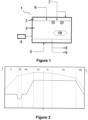
- FIG. 1 shows a schematic view of a device 1 for steam sterilization.
- the device 1 comprises a chamber 2 for receiving the primary packaging means to be sterilized. In the figure, they are shown in a secondary packaging container 10 which is sealed with a non-woven layer.
- the chamber 2 is surrounded by a heating and cooling jacket 3 which enables a programmed heating and cooling of the chamber 2 by means of the controller 4 for temperature and pressure.
- the heating and cooling jacket 3 is connected to a supply of cooling water 5 for cooling and a supply of steam 7 for heating.
- the chamber 2 is connected to a supply of steam 7, a supply of pressurized air 6, and a vacuum pump 8.
- the supply of pressurized air 6 may provide hot or cold air and can further be used to set the temperature and pressure in the chamber 2.
- Condensed water may be removed from the chamber 2 through the drain 9. Further indicated are two ventilators of the chamber 2 which help to homogenize the atmosphere within the chamber 2.
- the controller 4 for temperature and pressure within the chamber 2 and of the supply of steam 7 and the supply of pressurized air 6 is configured to perform a steam sterilization process according to this disclosure.
- FIG. 2 shows a schematic diagram of the temperature and pressure during a steam sterilization process according to this disclosure.
- the temperature is shown by the dashed line and pressure by the solid line.
- Indicated by the vertical dashed lines are seven program steps i) to vii) of the steam sterilization process.
- the presented example uses a pre-vacuum of 900 hPa and an increased pressure of 2,200 hPa for the sterilization phase of cartridges made of glass as the primary packaging means which are placed in a tub sealed with a non-woven as the secondary packaging container 10. All pressure changes were made at a rate of 50 hPa/min.
- pre-heating step i the chamber 2 with the primary packaging means within the secondary packaging container 10 is pre-heated at constant pressure to a temperature T p of, for example, 85 °C for 1.5 h. At the end of step i), the pressure is reduced to 900 hPa.
- pre-vacuum step ii) the pressure and temperature are held constant for a time sufficient to equilibrate the pressure inside the secondary packaging container 10, such as 5 min.
- the pressurization step iii) heating of the chamber 2 is started, and the pressure is first increased back to ambient pressure, held constant for a time, such as 5 min, and finally increased to the sterilization pressure p s , i.e., in this example 2,200 hPa.
- the set temperature T s may, for example, be 122 °C.
- the system may again be given some time, such as 5 min, to equilibrate before the sterilization treatment is performed at constant pressure and temperature for, for example, 1 h in order to reach the sterilization level of 10 -6 .
- the drying step v while the pressure is constant, the relative humidity is decreased to slightly above 30 % while the heating is still turned on. Hence, only a slight decrease in temperature occurs in this step which may be executed, for example, for 30 min.
- the relative humidity is further slightly decreased, stabilizing in this example around a constant value of about 30 %.
- the heating is deactivated in this step which may be executed, for example, for 60 min.
- the temperature may be decreased to 110 °C, whereas the pressure is still held constant.
- the cooling is activated, and the pressure is released.
- the pressure is back to ambient pressure and the temperature below 75 °C. In the shown example, the temperature is also brought back to ambient temperature of about 23 °C.
- the cartridges were examined at the end of the sterilization process and found to be free of water marks.
Landscapes
- Health & Medical Sciences (AREA)
- Life Sciences & Earth Sciences (AREA)
- Animal Behavior & Ethology (AREA)
- General Health & Medical Sciences (AREA)
- Public Health (AREA)
- Veterinary Medicine (AREA)
- Epidemiology (AREA)
- Chemical & Material Sciences (AREA)
- Organic Chemistry (AREA)
- Chemical Kinetics & Catalysis (AREA)
- Pharmacology & Pharmacy (AREA)
- Apparatus For Disinfection Or Sterilisation (AREA)
Priority Applications (5)
| Application Number | Priority Date | Filing Date | Title |
|---|---|---|---|
| EP23189301.7A EP4501366B1 (de) | 2023-08-02 | 2023-08-02 | Verfahren und vorrichtung zur dampfsterilisation von primärpackmitteln |
| US18/739,962 US20250041465A1 (en) | 2023-08-02 | 2024-06-11 | Process and device for steam sterilization of primary packaging means |
| CN202410809538.0A CN119424694A (zh) | 2023-08-02 | 2024-06-21 | 用于对初级包装物进行蒸汽灭菌的方法和设备 |
| US18/786,660 US20250041815A1 (en) | 2023-08-02 | 2024-07-29 | Process and device for steam sterilization of primary packaging means |
| EP24191371.4A EP4516324A1 (de) | 2023-08-02 | 2024-07-29 | Verfahren und vorrichtung zur dampfsterilisation von primärpackmitteln |
Applications Claiming Priority (1)
| Application Number | Priority Date | Filing Date | Title |
|---|---|---|---|
| EP23189301.7A EP4501366B1 (de) | 2023-08-02 | 2023-08-02 | Verfahren und vorrichtung zur dampfsterilisation von primärpackmitteln |
Publications (2)
| Publication Number | Publication Date |
|---|---|
| EP4501366A1 true EP4501366A1 (de) | 2025-02-05 |
| EP4501366B1 EP4501366B1 (de) | 2025-07-23 |
Family
ID=87554959
Family Applications (2)
| Application Number | Title | Priority Date | Filing Date |
|---|---|---|---|
| EP23189301.7A Active EP4501366B1 (de) | 2023-08-02 | 2023-08-02 | Verfahren und vorrichtung zur dampfsterilisation von primärpackmitteln |
| EP24191371.4A Pending EP4516324A1 (de) | 2023-08-02 | 2024-07-29 | Verfahren und vorrichtung zur dampfsterilisation von primärpackmitteln |
Family Applications After (1)
| Application Number | Title | Priority Date | Filing Date |
|---|---|---|---|
| EP24191371.4A Pending EP4516324A1 (de) | 2023-08-02 | 2024-07-29 | Verfahren und vorrichtung zur dampfsterilisation von primärpackmitteln |
Country Status (3)
| Country | Link |
|---|---|
| US (2) | US20250041465A1 (de) |
| EP (2) | EP4501366B1 (de) |
| CN (1) | CN119424694A (de) |
Citations (4)
| Publication number | Priority date | Publication date | Assignee | Title |
|---|---|---|---|---|
| US3598516A (en) * | 1969-01-02 | 1971-08-10 | James J Shull | Method of sterilizing |
| US5277875A (en) * | 1989-09-26 | 1994-01-11 | Mdt Corporation | Self-contained sterilizer with duty-cycle heater |
| WO2018029590A2 (en) | 2016-08-08 | 2018-02-15 | Nuova Ompi S.R.L. | An autoclave sterilisation process for primary containers made of glass |
| US11432571B2 (en) * | 2017-06-20 | 2022-09-06 | Tetra Laval Holdings & Finance S.A. | Method of heat-treatment of a product in a sealed container of a packaging material |
Family Cites Families (6)
| Publication number | Priority date | Publication date | Assignee | Title |
|---|---|---|---|---|
| DE3045950C2 (de) | 1980-12-05 | 1984-03-01 | Sortimat Creuz & Co Gmbh, 7057 Winnenden | Verfahren und Vorrichtung zum Silikonisieren reibend beanspruchter Flächen von Spritzenzylindern |
| US4767414A (en) | 1985-05-16 | 1988-08-30 | Becton, Dickinson And Company | Ionizing plasma lubricant method |
| DE19753766A1 (de) | 1997-12-04 | 1999-06-17 | Schott Glas | Länglicher Kunststoff-Hohlkörper und Verfahren zu seiner Herstellung |
| DE19934841C1 (de) | 1999-07-24 | 2001-03-01 | Vetter & Co Apotheker | Verfahren zur Beschichtung von Primärpackmitteln und Vorrichtung zur Durchführung des Verfahrens |
| DE102018122001A1 (de) | 2018-09-10 | 2020-03-12 | Schott Ag | Packmittel mit Gleitschicht und Verfahren für pharmazeutische und kosmetische Stoffe und Zubereitung zu dessen Herstellung |
| EP3824926B1 (de) | 2019-11-21 | 2024-01-31 | SCHOTT Pharma AG & Co. KGaA | Behälter für pharmazeutische verpackung mit einer abgestuften schmiermittelschicht |
-
2023
- 2023-08-02 EP EP23189301.7A patent/EP4501366B1/de active Active
-
2024
- 2024-06-11 US US18/739,962 patent/US20250041465A1/en active Pending
- 2024-06-21 CN CN202410809538.0A patent/CN119424694A/zh active Pending
- 2024-07-29 US US18/786,660 patent/US20250041815A1/en active Pending
- 2024-07-29 EP EP24191371.4A patent/EP4516324A1/de active Pending
Patent Citations (4)
| Publication number | Priority date | Publication date | Assignee | Title |
|---|---|---|---|---|
| US3598516A (en) * | 1969-01-02 | 1971-08-10 | James J Shull | Method of sterilizing |
| US5277875A (en) * | 1989-09-26 | 1994-01-11 | Mdt Corporation | Self-contained sterilizer with duty-cycle heater |
| WO2018029590A2 (en) | 2016-08-08 | 2018-02-15 | Nuova Ompi S.R.L. | An autoclave sterilisation process for primary containers made of glass |
| US11432571B2 (en) * | 2017-06-20 | 2022-09-06 | Tetra Laval Holdings & Finance S.A. | Method of heat-treatment of a product in a sealed container of a packaging material |
Non-Patent Citations (1)
| Title |
|---|
| "Ph. Eur. 2.9.20" |
Also Published As
| Publication number | Publication date |
|---|---|
| EP4501366B1 (de) | 2025-07-23 |
| US20250041815A1 (en) | 2025-02-06 |
| US20250041465A1 (en) | 2025-02-06 |
| CN119424694A (zh) | 2025-02-14 |
| EP4516324A1 (de) | 2025-03-05 |
Similar Documents
| Publication | Publication Date | Title |
|---|---|---|
| US4512951A (en) | Hydrogen peroxide liquid film sterilization method | |
| CN103491985B (zh) | 用于注射和/或滴注的医疗器械的灭菌 | |
| US7727464B2 (en) | Process for operating a packaging transport system | |
| US4637916A (en) | Sterilization method employing a circulating gaseous sterilant | |
| US4764351A (en) | Sterilization method and apparatus using a gaseous agent | |
| US7713463B1 (en) | Method of manufacturing embroidered surgical implants | |
| EP1146915B1 (de) | Verfahren zur sterilisierung eines gegenstands und zertifizierung des gegenstandes als steril | |
| KR101524042B1 (ko) | 멸균장치 및 이를 이용한 멸균방법 | |
| JP6323819B2 (ja) | 滅菌装置の真空排気システム | |
| JPH05504285A (ja) | 化学的殺菌機構 | |
| KR101758077B1 (ko) | 멸균장치 및 이를 이용한 멸균방법 | |
| EP3041519A1 (de) | Sterilisationsverfahren und vorrichtung sowie adaptive regelung dafür | |
| RU2440827C2 (ru) | Способ и устройство для стерилизации сосудов | |
| JP5607037B2 (ja) | 予備滅菌可能な支持システムの中でデュアルチャンバシステムを充填するための方法ならびに予備滅菌可能な支持システム | |
| EP1040840A1 (de) | Methode zum Entgasen von absorbierbaren Nahtmaterialien | |
| JP4791579B2 (ja) | 滅菌装置、滅菌方法、蒸発システム及びそのような蒸発させるシステムの使用方法 | |
| US20240082443A1 (en) | Process and device for sterilizing gas filtration means, in particular blowing air | |
| EP4501366B1 (de) | Verfahren und vorrichtung zur dampfsterilisation von primärpackmitteln | |
| JP5074330B2 (ja) | プレフィルドシリンジの除染方法 | |
| CN1498118A (zh) | 用于物品消毒的方法 | |
| KR20160095413A (ko) | 과산화수소수 공급장치 | |
| KR20190039033A (ko) | 유리로 만든 제 1 콘테이너들의 오토클레이브 살균 프로세스 | |
| JP4660084B2 (ja) | 除染方法、及び連設無菌装置 | |
| KR100845522B1 (ko) | 사용이 용이한 플라즈마 멸균장치 | |
| WO1992009310A1 (en) | Process for sterilizing heat-labile material |
Legal Events
| Date | Code | Title | Description |
|---|---|---|---|
| STAA | Information on the status of an ep patent application or granted ep patent |
Free format text: STATUS: EXAMINATION IS IN PROGRESS |
|
| PUAI | Public reference made under article 153(3) epc to a published international application that has entered the european phase |
Free format text: ORIGINAL CODE: 0009012 |
|
| 17P | Request for examination filed |
Effective date: 20230802 |
|
| AK | Designated contracting states |
Kind code of ref document: A1 Designated state(s): AL AT BE BG CH CY CZ DE DK EE ES FI FR GB GR HR HU IE IS IT LI LT LU LV MC ME MK MT NL NO PL PT RO RS SE SI SK SM TR |
|
| GRAP | Despatch of communication of intention to grant a patent |
Free format text: ORIGINAL CODE: EPIDOSNIGR1 |
|
| STAA | Information on the status of an ep patent application or granted ep patent |
Free format text: STATUS: GRANT OF PATENT IS INTENDED |
|
| INTG | Intention to grant announced |
Effective date: 20250314 |
|
| P01 | Opt-out of the competence of the unified patent court (upc) registered |
Free format text: CASE NUMBER: APP_17056/2025 Effective date: 20250408 |
|
| GRAS | Grant fee paid |
Free format text: ORIGINAL CODE: EPIDOSNIGR3 |
|
| GRAA | (expected) grant |
Free format text: ORIGINAL CODE: 0009210 |
|
| STAA | Information on the status of an ep patent application or granted ep patent |
Free format text: STATUS: THE PATENT HAS BEEN GRANTED |
|
| AK | Designated contracting states |
Kind code of ref document: B1 Designated state(s): AL AT BE BG CH CY CZ DE DK EE ES FI FR GB GR HR HU IE IS IT LI LT LU LV MC ME MK MT NL NO PL PT RO RS SE SI SK SM TR |
|
| REG | Reference to a national code |
Ref country code: GB Ref legal event code: FG4D |
|
| REG | Reference to a national code |
Ref country code: CH Ref legal event code: EP |
|
| REG | Reference to a national code |
Ref country code: DE Ref legal event code: R096 Ref document number: 602023004977 Country of ref document: DE |
|
| REG | Reference to a national code |
Ref country code: IE Ref legal event code: FG4D |
|
| PGFP | Annual fee paid to national office [announced via postgrant information from national office to epo] |
Ref country code: DE Payment date: 20250820 Year of fee payment: 3 |
|
| PGFP | Annual fee paid to national office [announced via postgrant information from national office to epo] |
Ref country code: IT Payment date: 20250901 Year of fee payment: 3 |
|
| PGFP | Annual fee paid to national office [announced via postgrant information from national office to epo] |
Ref country code: FR Payment date: 20250922 Year of fee payment: 3 Ref country code: AT Payment date: 20251020 Year of fee payment: 3 |
|
| REG | Reference to a national code |
Ref country code: NL Ref legal event code: MP Effective date: 20250723 |
|
| PG25 | Lapsed in a contracting state [announced via postgrant information from national office to epo] |
Ref country code: PT Free format text: LAPSE BECAUSE OF FAILURE TO SUBMIT A TRANSLATION OF THE DESCRIPTION OR TO PAY THE FEE WITHIN THE PRESCRIBED TIME-LIMIT Effective date: 20251124 |
|
| PG25 | Lapsed in a contracting state [announced via postgrant information from national office to epo] |
Ref country code: NL Free format text: LAPSE BECAUSE OF FAILURE TO SUBMIT A TRANSLATION OF THE DESCRIPTION OR TO PAY THE FEE WITHIN THE PRESCRIBED TIME-LIMIT Effective date: 20250723 |
|
| REG | Reference to a national code |
Ref country code: AT Ref legal event code: MK05 Ref document number: 1815742 Country of ref document: AT Kind code of ref document: T Effective date: 20250723 |
|
| PG25 | Lapsed in a contracting state [announced via postgrant information from national office to epo] |
Ref country code: IS Free format text: LAPSE BECAUSE OF FAILURE TO SUBMIT A TRANSLATION OF THE DESCRIPTION OR TO PAY THE FEE WITHIN THE PRESCRIBED TIME-LIMIT Effective date: 20251123 |
|
| PG25 | Lapsed in a contracting state [announced via postgrant information from national office to epo] |
Ref country code: NO Free format text: LAPSE BECAUSE OF FAILURE TO SUBMIT A TRANSLATION OF THE DESCRIPTION OR TO PAY THE FEE WITHIN THE PRESCRIBED TIME-LIMIT Effective date: 20251023 |
|
| REG | Reference to a national code |
Ref country code: LT Ref legal event code: MG9D |
|
| PG25 | Lapsed in a contracting state [announced via postgrant information from national office to epo] |
Ref country code: AT Free format text: LAPSE BECAUSE OF FAILURE TO SUBMIT A TRANSLATION OF THE DESCRIPTION OR TO PAY THE FEE WITHIN THE PRESCRIBED TIME-LIMIT Effective date: 20250723 |
|
| PG25 | Lapsed in a contracting state [announced via postgrant information from national office to epo] |
Ref country code: FI Free format text: LAPSE BECAUSE OF FAILURE TO SUBMIT A TRANSLATION OF THE DESCRIPTION OR TO PAY THE FEE WITHIN THE PRESCRIBED TIME-LIMIT Effective date: 20250723 |
|
| PG25 | Lapsed in a contracting state [announced via postgrant information from national office to epo] |
Ref country code: HR Free format text: LAPSE BECAUSE OF FAILURE TO SUBMIT A TRANSLATION OF THE DESCRIPTION OR TO PAY THE FEE WITHIN THE PRESCRIBED TIME-LIMIT Effective date: 20250723 |
|
| PG25 | Lapsed in a contracting state [announced via postgrant information from national office to epo] |
Ref country code: GR Free format text: LAPSE BECAUSE OF FAILURE TO SUBMIT A TRANSLATION OF THE DESCRIPTION OR TO PAY THE FEE WITHIN THE PRESCRIBED TIME-LIMIT Effective date: 20251024 |
|
| PG25 | Lapsed in a contracting state [announced via postgrant information from national office to epo] |
Ref country code: SE Free format text: LAPSE BECAUSE OF FAILURE TO SUBMIT A TRANSLATION OF THE DESCRIPTION OR TO PAY THE FEE WITHIN THE PRESCRIBED TIME-LIMIT Effective date: 20250723 |
|
| PG25 | Lapsed in a contracting state [announced via postgrant information from national office to epo] |
Ref country code: LV Free format text: LAPSE BECAUSE OF FAILURE TO SUBMIT A TRANSLATION OF THE DESCRIPTION OR TO PAY THE FEE WITHIN THE PRESCRIBED TIME-LIMIT Effective date: 20250723 |
|
| PG25 | Lapsed in a contracting state [announced via postgrant information from national office to epo] |
Ref country code: PL Free format text: LAPSE BECAUSE OF FAILURE TO SUBMIT A TRANSLATION OF THE DESCRIPTION OR TO PAY THE FEE WITHIN THE PRESCRIBED TIME-LIMIT Effective date: 20250723 Ref country code: BG Free format text: LAPSE BECAUSE OF FAILURE TO SUBMIT A TRANSLATION OF THE DESCRIPTION OR TO PAY THE FEE WITHIN THE PRESCRIBED TIME-LIMIT Effective date: 20250723 |
|
| PG25 | Lapsed in a contracting state [announced via postgrant information from national office to epo] |
Ref country code: RS Free format text: LAPSE BECAUSE OF FAILURE TO SUBMIT A TRANSLATION OF THE DESCRIPTION OR TO PAY THE FEE WITHIN THE PRESCRIBED TIME-LIMIT Effective date: 20251023 |
|
| PG25 | Lapsed in a contracting state [announced via postgrant information from national office to epo] |
Ref country code: ES Free format text: LAPSE BECAUSE OF FAILURE TO SUBMIT A TRANSLATION OF THE DESCRIPTION OR TO PAY THE FEE WITHIN THE PRESCRIBED TIME-LIMIT Effective date: 20250723 |
|
| PG25 | Lapsed in a contracting state [announced via postgrant information from national office to epo] |
Ref country code: RO Free format text: LAPSE BECAUSE OF FAILURE TO SUBMIT A TRANSLATION OF THE DESCRIPTION OR TO PAY THE FEE WITHIN THE PRESCRIBED TIME-LIMIT Effective date: 20250723 |
|
| PG25 | Lapsed in a contracting state [announced via postgrant information from national office to epo] |
Ref country code: SM Free format text: LAPSE BECAUSE OF FAILURE TO SUBMIT A TRANSLATION OF THE DESCRIPTION OR TO PAY THE FEE WITHIN THE PRESCRIBED TIME-LIMIT Effective date: 20250723 |
|
| PG25 | Lapsed in a contracting state [announced via postgrant information from national office to epo] |
Ref country code: DK Free format text: LAPSE BECAUSE OF FAILURE TO SUBMIT A TRANSLATION OF THE DESCRIPTION OR TO PAY THE FEE WITHIN THE PRESCRIBED TIME-LIMIT Effective date: 20250723 |
|
| PG25 | Lapsed in a contracting state [announced via postgrant information from national office to epo] |
Ref country code: LU Free format text: LAPSE BECAUSE OF NON-PAYMENT OF DUE FEES Effective date: 20250802 |
|
| PG25 | Lapsed in a contracting state [announced via postgrant information from national office to epo] |
Ref country code: CZ Free format text: LAPSE BECAUSE OF FAILURE TO SUBMIT A TRANSLATION OF THE DESCRIPTION OR TO PAY THE FEE WITHIN THE PRESCRIBED TIME-LIMIT Effective date: 20250723 |
|
| REG | Reference to a national code |
Ref country code: DE Ref legal event code: R097 Ref document number: 602023004977 Country of ref document: DE |
|
| PG25 | Lapsed in a contracting state [announced via postgrant information from national office to epo] |
Ref country code: SK Free format text: LAPSE BECAUSE OF FAILURE TO SUBMIT A TRANSLATION OF THE DESCRIPTION OR TO PAY THE FEE WITHIN THE PRESCRIBED TIME-LIMIT Effective date: 20250723 Ref country code: EE Free format text: LAPSE BECAUSE OF FAILURE TO SUBMIT A TRANSLATION OF THE DESCRIPTION OR TO PAY THE FEE WITHIN THE PRESCRIBED TIME-LIMIT Effective date: 20250723 |
|
| REG | Reference to a national code |
Ref country code: BE Ref legal event code: MM Effective date: 20250831 |
|
| PLBE | No opposition filed within time limit |
Free format text: ORIGINAL CODE: 0009261 |
|
| STAA | Information on the status of an ep patent application or granted ep patent |
Free format text: STATUS: NO OPPOSITION FILED WITHIN TIME LIMIT |
|
| REG | Reference to a national code |
Ref country code: CH Ref legal event code: L10 Free format text: ST27 STATUS EVENT CODE: U-0-0-L10-L00 (AS PROVIDED BY THE NATIONAL OFFICE) Effective date: 20260604 |
|
| PG25 | Lapsed in a contracting state [announced via postgrant information from national office to epo] |
Ref country code: MC Free format text: LAPSE BECAUSE OF FAILURE TO SUBMIT A TRANSLATION OF THE DESCRIPTION OR TO PAY THE FEE WITHIN THE PRESCRIBED TIME-LIMIT Effective date: 20250723 Ref country code: LT Free format text: LAPSE BECAUSE OF FAILURE TO SUBMIT A TRANSLATION OF THE DESCRIPTION OR TO PAY THE FEE WITHIN THE PRESCRIBED TIME-LIMIT Effective date: 20250723 |
|
| 26N | No opposition filed |
Effective date: 20260424 |
|
| PG25 | Lapsed in a contracting state [announced via postgrant information from national office to epo] |
Ref country code: BE Free format text: LAPSE BECAUSE OF NON-PAYMENT OF DUE FEES Effective date: 20250831 Ref country code: IE Free format text: LAPSE BECAUSE OF NON-PAYMENT OF DUE FEES Effective date: 20250802 |