EP4484409A1 - No-donor-verbindung, herstellungsverfahren dafür, pharmazeutische zusammensetzung damit und verwendung davon - Google Patents
No-donor-verbindung, herstellungsverfahren dafür, pharmazeutische zusammensetzung damit und verwendung davon Download PDFInfo
- Publication number
- EP4484409A1 EP4484409A1 EP23758969.2A EP23758969A EP4484409A1 EP 4484409 A1 EP4484409 A1 EP 4484409A1 EP 23758969 A EP23758969 A EP 23758969A EP 4484409 A1 EP4484409 A1 EP 4484409A1
- Authority
- EP
- European Patent Office
- Prior art keywords
- compound
- donor compound
- hypoxia
- preparation
- pharmaceutical composition
- Prior art date
- Legal status (The legal status is an assumption and is not a legal conclusion. Google has not performed a legal analysis and makes no representation as to the accuracy of the status listed.)
- Pending
Links
Images


Classifications
-
- C—CHEMISTRY; METALLURGY
- C07—ORGANIC CHEMISTRY
- C07C—ACYCLIC OR CARBOCYCLIC COMPOUNDS
- C07C243/00—Compounds containing chains of nitrogen atoms singly-bound to each other, e.g. hydrazines, triazanes
- C07C243/04—N-nitroso compounds
-
- A—HUMAN NECESSITIES
- A61—MEDICAL OR VETERINARY SCIENCE; HYGIENE
- A61P—SPECIFIC THERAPEUTIC ACTIVITY OF CHEMICAL COMPOUNDS OR MEDICINAL PREPARATIONS
- A61P9/00—Drugs for disorders of the cardiovascular system
- A61P9/10—Drugs for disorders of the cardiovascular system for treating ischaemic or atherosclerotic diseases, e.g. antianginal drugs, coronary vasodilators, drugs for myocardial infarction, retinopathy, cerebrovascula insufficiency, renal arteriosclerosis
-
- A—HUMAN NECESSITIES
- A61—MEDICAL OR VETERINARY SCIENCE; HYGIENE
- A61K—PREPARATIONS FOR MEDICAL, DENTAL OR TOILETRY PURPOSES
- A61K31/00—Medicinal preparations containing organic active ingredients
- A61K31/185—Acids; Anhydrides, halides or salts thereof, e.g. sulfur acids, imidic, hydrazonic or hydroximic acids
- A61K31/19—Carboxylic acids, e.g. valproic acid
- A61K31/195—Carboxylic acids, e.g. valproic acid having an amino group
- A61K31/196—Carboxylic acids, e.g. valproic acid having an amino group the amino group being directly attached to a ring, e.g. anthranilic acid, mefenamic acid, diclofenac, chlorambucil
-
- A—HUMAN NECESSITIES
- A61—MEDICAL OR VETERINARY SCIENCE; HYGIENE
- A61K—PREPARATIONS FOR MEDICAL, DENTAL OR TOILETRY PURPOSES
- A61K31/00—Medicinal preparations containing organic active ingredients
- A61K31/655—Azo (—N=N—), diazo (=N2), azoxy (>N—O—N< or N(=O)—N<), azido (—N3) or diazoamino (—N=N—N<) compounds
-
- C—CHEMISTRY; METALLURGY
- C07—ORGANIC CHEMISTRY
- C07C—ACYCLIC OR CARBOCYCLIC COMPOUNDS
- C07C241/00—Preparation of compounds containing chains of nitrogen atoms singly-bound to each other, e.g. hydrazines, triazanes
-
- C—CHEMISTRY; METALLURGY
- C07—ORGANIC CHEMISTRY
- C07C—ACYCLIC OR CARBOCYCLIC COMPOUNDS
- C07C243/00—Compounds containing chains of nitrogen atoms singly-bound to each other, e.g. hydrazines, triazanes
- C07C243/04—N-nitroso compounds
- C07C243/06—N-nitroso-amines
-
- Y—GENERAL TAGGING OF NEW TECHNOLOGICAL DEVELOPMENTS; GENERAL TAGGING OF CROSS-SECTIONAL TECHNOLOGIES SPANNING OVER SEVERAL SECTIONS OF THE IPC; TECHNICAL SUBJECTS COVERED BY FORMER USPC CROSS-REFERENCE ART COLLECTIONS [XRACs] AND DIGESTS
- Y02—TECHNOLOGIES OR APPLICATIONS FOR MITIGATION OR ADAPTATION AGAINST CLIMATE CHANGE
- Y02P—CLIMATE CHANGE MITIGATION TECHNOLOGIES IN THE PRODUCTION OR PROCESSING OF GOODS
- Y02P20/00—Technologies relating to chemical industry
- Y02P20/50—Improvements relating to the production of bulk chemicals
- Y02P20/55—Design of synthesis routes, e.g. reducing the use of auxiliary or protecting groups
Definitions
- the present disclosure relates to NO donor compound and preparation method, pharmaceutical composition and use thereof, and in particular, to NO donor compound prepared as drug for treating myocardial hypoxic damage disease and preparation method, pharmaceutical composition, and application thereof.
- Coronary heart disease is myocardial damage caused by myocardial tissue ischemia (cellular hypoxia) due to organic stenosis or obstruction of the coronary arteries, also known as ischemic heart disease.
- cellular hypoxia myocardial tissue ischemia
- ischemic heart disease organic stenosis or obstruction of the coronary arteries
- Nitric oxide (NO) donor drugs are often used to treat coronary heart disease caused by ischemia because the NO donor drug is capable of releasing exogenous NO molecules in the body to promote vasodilation.
- existing drugs lack selectivity for hypoxia and cannot release sufficient NO in the hypoxic area, thus causing serious side effect.
- hypoxia-activated prodrugs have attracted extensive attention, which can promote selective release of active drug groups in hypoxic microenvironment, thereby reducing off target toxicity.
- hypoxia is an important factor causing myocardial injury
- applying this design concept to the structural design of NO donor drugs to obtain hypoxia-activated prodrugs is an effective method to improve the efficacy of such drugs and reduce side effect.
- Nitroreductase (NTR) exists in the heart, liver, kidney, lung, and brain tissues of mammals, which can catalyze the reduction of nitroaromatic compounds with hydrogen provided by NADPH and NADH under anaerobic condition.
- nitroaromatic compounds are recognized as hypoxia-activated group, which may be used in the design of hypoxia-activated prodrugs.
- NTR in hypoxic cells can selectively reduce the nitro group on the aromatic ring, thereby promoting the release of active drug groups from prodrugs through intramolecular electron transfer. Since NTR is highly expressed in hypoxic cells, it can effectively promote the concentrated release of active drug groups from prodrugs in the hypoxic microenvironment, and thus, considering its hypoxia-activated properties, nitroaromatic compounds are combined with NO donors to obtain prodrugs that can release sufficient amounts of NO under hypoxia activation, which is of great significance for the treatment of cardiovascular diseases such as coronary heart disease.
- the purpose of the present dislcosure to solve the problems of poor efficacy and serious side effect of existing NO donor drugs in treating myocardial hypoxic damage disease, the present disclosure aims to provide NO donor compound that can effectively improve myocardial hypoxic damage in the hypoxic microenvironment, preparation method, pharmaceutical composition, and use thereof.
- the NO donor compound has a structure of formula I: wherein when R1 is nitro group, R2 is hydrogen, halogen, or C1-C4 alkyl, and R3 is hydrogen, halogen, or C1-C4 alkyl; or when R2 is nitro group, R1 is hydrogen, halogen, or C1-C4 alkyl, and R3 is hydrogen, halogen, or C1-C4 alkyl.
- the nitroaromatic compound, as hypoxia-activated group is bonded with NO donor molecule through connecting group to obtain a hypoxia-activated NO donor compound.
- R1 is nitro group
- R2 is hydrogen, halogen, or methyl
- R3 is hydrogen
- the NO donor compound is selected from any of following compounds:
- the preparation method of the NO donor compound comprises obtaining NO donor compound I by acylation reaction between compound 1 and compound 2, including following steps.
- BTC bis(trichloromethyl) carbonate
- DIPEA N, N-diisopropylethylamine
- DCM dichloromethane
- R1, R2, and R3 are defined as above.
- the pharmaceutical composition comprises the NO donor compound and a pharmaceutically acceptable carrier.
- the NO donor compound may be added to a pharmaceutically acceptable carrier to prepare common pharmaceutical preparations, such as tablets, capsules, syrups, suspensions, or injections.
- the preparations may be added with common pharmaceutical excipients such as spices, sweeteners, liquid/solid fillers, diluents, etc.
- the NO donor compound and the pharmaceutical composition may be prepared as drugs for treating myocardial hypoxic damage disease.
- the NO donor compound is a hypoxia-activated NO donor compound, which is used to improve the viability of cells under the hypoxic condition, and specifically used to treat coronary heart disease.
- the NO donor compound may release NO in cells in the hypoxic microenvironment, effectively improving myocardial hypoxic damage.
- 4-Hydroxy(N-methyl) aniline hemisulfate (1.722 g, 10.0 mmol) was added to 50 mL of acetic acid under the dirk condition and dissolved to obtain a mix solution by ultrasound.
- Sodium nitrite solution which was obtained by dissolving sodium nitrite (1.380 g, 20.0 mmol) in 10 ml of water, was added dropwise to the mixed solution in an ice-water bath for reaction, and the reaction was continued for 3 h in the ice-water bath after the addition was complete.
- reaction solution was transferred to a beaker, 50 mL of water was added into the beaker, the pH of the solution in the beaker was adjusted to 7 with saturated sodium bicarbonate solution, then the solution was extracted with ethyl acetate to obtain organic phases, and the organic phases were combined, dried with anhydrous sodium sulfate, and spin dried to obtain 1.46 g of the product with a yield of 96%.
- reaction solution was concentrated, and a small amount of anhydrous tetrahydrofuran was used to remove excess phosgene in the reaction solution, and anhydrous dichloromethane was added into the concentrated solution to obtain anhydrous dichloromethane solution for using directly in the next step reaction.
- reaction solution was washed 3 times with 0.5M dilute hydrochloric acid, water, and saturated saline solution, respectively, to separate the organic phase, the organic phase was dried overnight with anhydrous sodium sulfate, and then concentrated by rotary evaporation to obtain a yellow solid.
- the yellow solid was recrystallized with a mixed solvent of ethyl acetate and petroleum ether to obtain 285 mg of light-yellow crystal with a yield of 86%.
- Example 12 Detection of NO release level of the compound after interacting with H9c2 cells under normoxia or hypoxia condition using Griess method
- H9c2 cells were revived, cultured with DMEM medium, and placed in a carbon dioxide incubator to allow the cells to adhere to the wall for growth. After the cells grew to reach an appropriate density, cells were inoculated in a multi-well plate and placed in the carbon dioxide incubator for culture for 24 h at 37 °C, 5% CO 2 , and saturated humidity until the cells adhered to the wall, the supernatant was discarded, and 2 mL of fresh DMEM medium was added. Then, a certain concentration (5, 10, 15 ⁇ M) of compounds and the reference drug of isosorbide dinitrate were added.
- the NO release amount of cells after being treated with different concentrations of compounds under the normoxia condition are very small, which are all lower than the maximum release amount of compound I2 ( ⁇ 3.34%, 10 ⁇ M).
- the compounds I1-I4 can effectively cause release of NO in the cells, with the NO release amount ranging from 20.15% to 45.45%, indicating hypoxia-activated NO donors.
- the reference drug of isosorbide dinitrate (ISDN) releases a certain amount of NO in the cells after treating cells under the normoxia or hypoxia condition.
- the isosorbide dinitrate causes a large NO release amount (up to 41.63%, (10 ⁇ M)) in the cells under the normoxia condition.
- the isosorbide dinitrate also cause a NO release amount in the cells under the hypoxia codition, but the NO release amount is less than that under the normoxia condition, and lower than the NO release amount of compounds I2 and I3 under the hypoxia codition.
- the cells were washed twice with 5 mL PBS, 1 mL trypsin was added to digest the monolayer cultured H9c2 cells, a single cell suspension was prepared with serum-containing culture medium, and 5000-10000 cells per well were inoculated in a 96-well culture plate.
- the volume of culture medium per well is 100 ⁇ L, and the edge wells are filled with sterilized pure water.
- the culture plate was moved into a carbon dioxide incubator for culture for 24 h at 37 °C, 5% CO 2 , and saturated humidity until the cells adhere to the wall. 100 ⁇ L culture medium in the well was aspirated, 50 ⁇ L fresh culture medium was added into the well, and different concentrations of compounds and reference drug isosorbide dinitrate were given respectively to the well.
- concentration gradient of the drug is 10, 1, 0.1, 0.01, 0.001 ⁇ M.
- the normoxic group was incubated in a normal incubator at 5% CO 2 and 37 °C for 4 h; and the hypoxic group was incubated in a hypoxic incubator (concentration of O 2 ⁇ 1%) at 37 °C for 4 h.
- 10 ⁇ L CCK8 reagent was added to each well and the normoxic group and the hypoxic group continued to be cultured in a normoxic incubator for 4 h, and the culture was terminated.
- the absorbance of each well was measured at 450 nm with a microplate reader to calculate the cell survival rate of cells at different concentrations, as shown in FIGs. 1A and 1B .
- the control drug isosorbide dinitrate does not improve the cell viability under the normoxic condition, and has a certain improvement on the cell viability at high concentration under the hypoxic condition, but not as good as compounds I1-I4.
- the hypoxia-activated NO donor compounds I1-I4 can effectively release NO under the hypoxic condition and improve the viability of cells in a certain concentration range, and the activity of the compounds I1-I4 is better than that of the existing drug isosorbide dinitrate. This beneficial effect has also been verified in animal level experiments.
- Example 14 Detection of NO release level of compound I1 in the heart of mouse hypoxia model using NO detection kit
- NO detection kit (Biyuntian Biotechnology Co., Ltd., Shanghai), heart tissue homogenate of hypoxia modeling and drug-given mouse, and blank control group mouse, and 6-8-week-old male Kunming mouse.
- NO has chemical activity and is rapidly converted into NO 3 - and NO 2 - in the body, and NO 2 - is further converted into NO 3 - .
- NO 3- is reduced to NO 2 - using Griess reagent, NO 2 - has characteristic absorption at 540 nm, the absorbance is detected at 540 nm by a microplate reader, and the NO concentration is calculated using a standard curve.
- the NO level in the heart of the compound I1 group is significantly higher than that of the other two groups.
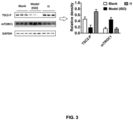
- the changes of protein expression levels are analyzed based on Western Blot bands.
- protein samples were extracted from the hearts of blank group mouse, hypoxia model mouse, and drug-given and hypoxia modeling mouse for Western blot experiments.
- the downregulation of TSC2-P expression in the hypoxia model group causes a significant upregulation of mTORC1 protein expression, indicating that the hypoxia model group had obvious myocardial damage.
- the expression of mTORC1 in the hearts of mouse pretreated with 20 mg/kg compound I1 is restored to near a level of the normal group, indicating that the compound I1 has excellent anti-myocardial hypoxic damage effect.
Landscapes
- Health & Medical Sciences (AREA)
- Chemical & Material Sciences (AREA)
- Organic Chemistry (AREA)
- Bioinformatics & Cheminformatics (AREA)
- Engineering & Computer Science (AREA)
- Life Sciences & Earth Sciences (AREA)
- Animal Behavior & Ethology (AREA)
- General Health & Medical Sciences (AREA)
- Public Health (AREA)
- Veterinary Medicine (AREA)
- Medicinal Chemistry (AREA)
- Pharmacology & Pharmacy (AREA)
- Nuclear Medicine, Radiotherapy & Molecular Imaging (AREA)
- Vascular Medicine (AREA)
- Cardiology (AREA)
- Heart & Thoracic Surgery (AREA)
- Chemical Kinetics & Catalysis (AREA)
- General Chemical & Material Sciences (AREA)
- Urology & Nephrology (AREA)
- Epidemiology (AREA)
- Organic Low-Molecular-Weight Compounds And Preparation Thereof (AREA)
- Acyclic And Carbocyclic Compounds In Medicinal Compositions (AREA)
Applications Claiming Priority (2)
| Application Number | Priority Date | Filing Date | Title |
|---|---|---|---|
| CN202210160994.8A CN116675620B (zh) | 2022-02-22 | 2022-02-22 | No供体化合物及其制备方法、药物组合物和应用 |
| PCT/CN2023/074113 WO2023160344A1 (zh) | 2022-02-22 | 2023-02-01 | No供体化合物及其制备方法、药物组合物和应用 |
Publications (2)
| Publication Number | Publication Date |
|---|---|
| EP4484409A1 true EP4484409A1 (de) | 2025-01-01 |
| EP4484409A4 EP4484409A4 (de) | 2026-02-25 |
Family
ID=87764785
Family Applications (1)
| Application Number | Title | Priority Date | Filing Date |
|---|---|---|---|
| EP23758969.2A Pending EP4484409A4 (de) | 2022-02-22 | 2023-02-01 | No-donor-verbindung, herstellungsverfahren dafür, pharmazeutische zusammensetzung damit und verwendung davon |
Country Status (6)
| Country | Link |
|---|---|
| US (1) | US12275686B2 (de) |
| EP (1) | EP4484409A4 (de) |
| JP (1) | JP7683872B2 (de) |
| KR (1) | KR20240140132A (de) |
| CN (1) | CN116675620B (de) |
| WO (1) | WO2023160344A1 (de) |
Families Citing this family (2)
| Publication number | Priority date | Publication date | Assignee | Title |
|---|---|---|---|---|
| CN117304203A (zh) * | 2023-09-28 | 2023-12-29 | 郑州原理生物科技有限公司 | 一种美罗培南侧链中间体硫醇内酯的制备方法 |
| CN120329323B (zh) * | 2025-04-16 | 2026-01-13 | 黄冈鲁班药业股份有限公司 | 一种头孢吡普酯侧链的制备方法及应用 |
Family Cites Families (5)
| Publication number | Priority date | Publication date | Assignee | Title |
|---|---|---|---|---|
| JPH11222474A (ja) * | 1998-02-04 | 1999-08-17 | Microbial Chem Res Found | 糖尿病治療薬 |
| FR2815030A1 (fr) * | 2000-10-05 | 2002-04-12 | Lipha | Derives nitroso de la diphenylamine, compositions pharmaceutiques les contenant et leur utilisation pour la preparation de medicaments |
| ZA200507752B (en) * | 2003-03-28 | 2007-01-31 | Threshold Pharmaceuticals Inc | Compositions and methods for treating cancer |
| GB2463883A (en) * | 2008-09-25 | 2010-03-31 | Pharma Patents Ltd | A pharmaceutical composition comprising an A-SMase inhibitor and an NO-donor |
| CN105832725A (zh) * | 2016-04-19 | 2016-08-10 | 马苏州 | 一种抗缺氧药物组合物及其制备方法和应用 |
-
2022
- 2022-02-22 CN CN202210160994.8A patent/CN116675620B/zh active Active
-
2023
- 2023-02-01 WO PCT/CN2023/074113 patent/WO2023160344A1/zh not_active Ceased
- 2023-02-01 KR KR1020247028308A patent/KR20240140132A/ko active Pending
- 2023-02-01 JP JP2024548543A patent/JP7683872B2/ja active Active
- 2023-02-01 EP EP23758969.2A patent/EP4484409A4/de active Pending
-
2024
- 2024-08-22 US US18/812,980 patent/US12275686B2/en active Active
Also Published As
| Publication number | Publication date |
|---|---|
| EP4484409A4 (de) | 2026-02-25 |
| KR20240140132A (ko) | 2024-09-24 |
| JP2025506061A (ja) | 2025-03-05 |
| US12275686B2 (en) | 2025-04-15 |
| US20240409500A1 (en) | 2024-12-12 |
| WO2023160344A1 (zh) | 2023-08-31 |
| JP7683872B2 (ja) | 2025-05-27 |
| CN116675620B (zh) | 2025-01-10 |
| CN116675620A (zh) | 2023-09-01 |
Similar Documents
| Publication | Publication Date | Title |
|---|---|---|
| US12275686B2 (en) | NO donor compound, preparation method thereof, pharmaceutical composition comprising same, and use thereof | |
| CN110563703B (zh) | 基于crbn配体诱导parp-1降解的化合物及制备方法和应用 | |
| Sethi et al. | Carbonic anhydrase inhibitors: Synthesis and inhibition of the human carbonic anhydrase isoforms I, II, VII, IX and XII with benzene sulfonamides incorporating 4, 5, 6, 7-tetrabromophthalimide moiety | |
| WO2012162912A1 (zh) | 苯并噻嗪硫酮衍生物及其制备方法和用途 | |
| CN111559991A (zh) | 一种萘胺类化合物及其盐的制备方法和应用 | |
| CN114133390A (zh) | 一种去氢骆驼蓬碱衍生物及其制备方法和应用 | |
| CN115594655B (zh) | 色酮肟类衍生物及其制备方法和应用 | |
| EP3403651A1 (de) | Isocorydinderivate, herstellungsmethode und verwendung | |
| CN115636817A (zh) | 含三唑环的靛红类衍生物及其制备方法与应用 | |
| EP3275881A1 (de) | Verbindung von durch aryloxy oder heterooxy substituiertem 5-hydroxyl-1,7-naphthyridin, herstellungsverfahren dafür und pharmazeutische verwendung davon | |
| EP3542796B1 (de) | Verbindung mit krebshemmender wirkung sowie herstellungsverfahren dafür und verwendung davon | |
| US20240287003A1 (en) | Ethacrynic acid derivatives as inhibitors of mpro protease and sars-cov-2 replication | |
| CN109369620A (zh) | 吡啶类化合物及其制备方法与抗胃癌应用 | |
| CN104230787B (zh) | N-(1,3-二氧代异吲哚啉)芳酰胺类化合物及其制备方法和应用 | |
| CN108484637A (zh) | 靶向抗癌新药x-76成盐化合物及其用途、制备方法 | |
| CN113816924B (zh) | 一种基于炔基连接臂的苯并噻嗪酮衍生物及其制备方法与应用 | |
| CN115594675B (zh) | 一种 β-卡巴林-肉桂酸骨架衍生物及制备方法和用途 | |
| US11351151B2 (en) | Compound having anticancer activity and preparation method and application | |
| CN109400597B (zh) | 一种基于vegfr-2抑制剂abt-869的蛋白降解靶向嵌合体及制备方法和应用 | |
| CN114560813B (zh) | 一种苯并咪唑类mk2变构抑制剂及其制备方法和应用 | |
| JPH01273598A (ja) | ミクソコッカスからの新規抗生物質 | |
| Assoni et al. | Synthesis and Preliminary Evaluation of Tanshinone Mimic Conjugates for Mechanism of Action Studies | |
| CN109293663B (zh) | Kdm5b抑制剂及其制备方法 | |
| TW201938539A (zh) | 一種具有抗癌作用的化合物及其製備方法和應用(二) | |
| CN106632338A (zh) | 一种9‑取代‑n‑(2‑氯苄基)嘌呤‑6‑胺类衍生物及其制备方法和应用 |
Legal Events
| Date | Code | Title | Description |
|---|---|---|---|
| STAA | Information on the status of an ep patent application or granted ep patent |
Free format text: STATUS: THE INTERNATIONAL PUBLICATION HAS BEEN MADE |
|
| PUAI | Public reference made under article 153(3) epc to a published international application that has entered the european phase |
Free format text: ORIGINAL CODE: 0009012 |
|
| STAA | Information on the status of an ep patent application or granted ep patent |
Free format text: STATUS: REQUEST FOR EXAMINATION WAS MADE |
|
| 17P | Request for examination filed |
Effective date: 20240920 |
|
| AK | Designated contracting states |
Kind code of ref document: A1 Designated state(s): AL AT BE BG CH CY CZ DE DK EE ES FI FR GB GR HR HU IE IS IT LI LT LU LV MC ME MK MT NL NO PL PT RO RS SE SI SK SM TR |
|
| DAV | Request for validation of the european patent (deleted) | ||
| DAX | Request for extension of the european patent (deleted) | ||
| A4 | Supplementary search report drawn up and despatched |
Effective date: 20260128 |
|
| RIC1 | Information provided on ipc code assigned before grant |
Ipc: C07C 243/06 20060101AFI20260122BHEP Ipc: A61K 31/196 20060101ALI20260122BHEP Ipc: A61P 9/10 20060101ALI20260122BHEP |