EP4480918A1 - Verfahren zur gewinnung von lithiumhydroxid - Google Patents
Verfahren zur gewinnung von lithiumhydroxid Download PDFInfo
- Publication number
- EP4480918A1 EP4480918A1 EP23180147.3A EP23180147A EP4480918A1 EP 4480918 A1 EP4480918 A1 EP 4480918A1 EP 23180147 A EP23180147 A EP 23180147A EP 4480918 A1 EP4480918 A1 EP 4480918A1
- Authority
- EP
- European Patent Office
- Prior art keywords
- lithium
- solution
- chloride
- process according
- hydroxide
- Prior art date
- Legal status (The legal status is an assumption and is not a legal conclusion. Google has not performed a legal analysis and makes no representation as to the accuracy of the status listed.)
- Withdrawn
Links
Images

Classifications
-
- C—CHEMISTRY; METALLURGY
- C01—INORGANIC CHEMISTRY
- C01D—COMPOUNDS OF ALKALI METALS, i.e. LITHIUM, SODIUM, POTASSIUM, RUBIDIUM, CAESIUM, OR FRANCIUM
- C01D15/00—Lithium compounds
- C01D15/02—Oxides; Hydroxides
-
- C—CHEMISTRY; METALLURGY
- C01—INORGANIC CHEMISTRY
- C01D—COMPOUNDS OF ALKALI METALS, i.e. LITHIUM, SODIUM, POTASSIUM, RUBIDIUM, CAESIUM, OR FRANCIUM
- C01D1/00—Oxides or hydroxides of sodium, potassium or alkali metals in general
- C01D1/04—Hydroxides
- C01D1/28—Purification; Separation
- C01D1/40—Purification; Separation by electrolysis
-
- C—CHEMISTRY; METALLURGY
- C01—INORGANIC CHEMISTRY
- C01D—COMPOUNDS OF ALKALI METALS, i.e. LITHIUM, SODIUM, POTASSIUM, RUBIDIUM, CAESIUM, OR FRANCIUM
- C01D15/00—Lithium compounds
- C01D15/04—Halides
-
- C—CHEMISTRY; METALLURGY
- C25—ELECTROLYTIC OR ELECTROPHORETIC PROCESSES; APPARATUS THEREFOR
- C25B—ELECTROLYTIC OR ELECTROPHORETIC PROCESSES FOR THE PRODUCTION OF COMPOUNDS OR NON-METALS; APPARATUS THEREFOR
- C25B1/00—Electrolytic production of inorganic compounds or non-metals
- C25B1/01—Products
- C25B1/34—Simultaneous production of alkali metal hydroxides and chlorine, oxyacids or salts of chlorine, e.g. by chlor-alkali electrolysis
- C25B1/46—Simultaneous production of alkali metal hydroxides and chlorine, oxyacids or salts of chlorine, e.g. by chlor-alkali electrolysis in diaphragm cells
-
- C—CHEMISTRY; METALLURGY
- C25—ELECTROLYTIC OR ELECTROPHORETIC PROCESSES; APPARATUS THEREFOR
- C25B—ELECTROLYTIC OR ELECTROPHORETIC PROCESSES FOR THE PRODUCTION OF COMPOUNDS OR NON-METALS; APPARATUS THEREFOR
- C25B15/00—Operating or servicing cells
- C25B15/08—Supplying or removing reactants or electrolytes; Regeneration of electrolytes
- C25B15/081—Supplying products to non-electrochemical reactors that are combined with the electrochemical cell, e.g. Sabatier reactor
-
- C—CHEMISTRY; METALLURGY
- C25—ELECTROLYTIC OR ELECTROPHORETIC PROCESSES; APPARATUS THEREFOR
- C25B—ELECTROLYTIC OR ELECTROPHORETIC PROCESSES FOR THE PRODUCTION OF COMPOUNDS OR NON-METALS; APPARATUS THEREFOR
- C25B1/00—Electrolytic production of inorganic compounds or non-metals
- C25B1/01—Products
- C25B1/02—Hydrogen or oxygen
- C25B1/04—Hydrogen or oxygen by electrolysis of water
Definitions
- the present invention relates to a process for producing lithium hydroxide (LiOH) from a lithium-containing starting material, the process comprising chlor-alkali electrolysis.
- Lithium hydroxide is required, among other things, as a starting material for the production of lithium ion batteries.
- the demand for lithium for the production of batteries, especially for electric vehicles, is already very high and is expected to increase in the next few years up to 2030 from the current level of around 500,000 tonnes per year to around seven times that amount, from 3.5 million tonnes per year.
- Enormous investments in new plants for the production of lithium hydroxide will therefore be required to create the necessary capacities, with the lithium hydroxide required for use in batteries having a high degree of purity of more than 99%, which is referred to as "battery grade”.
- Due to the high demand the price of lithium hydroxide (LiOH*H2O) has already risen considerably in the last two years.
- lithium hydroxide In the classic methods for producing lithium hydroxide, either a lithium carbonate is reacted with Ca(OH)2 or lithium sulfate is reacted with barium hydroxide to form lithium hydroxide.
- the lithium ore used as the starting material can also be leached with sulfuric acid and cleaned with Ca(OH)2 to remove interfering metal cations such as aluminum, iron, calcium, magnesium or sodium ions, whereby the lithium sulfate (Li2SO4) that is initially formed is converted to LiOH by reacting with the lye.
- the disadvantage of this conventional process is that yields of only around 85% are usually achieved and the process has an unfavorable CO2 footprint due to the roasting processes. Large amounts of sulfuric acid are required for the reaction in the acidic range. In addition, The process produces large quantities of sodium sulfate, which is a comparatively low-value product.
- the ore can be digested using alkali, roasted with calcium carbonate, cleaned with calcium hydroxide and converted to LiOH.
- this variant only achieves yields of around 90% and, because of the roasting of the ore, energy consumption is high and the CO2 footprint is also negative.
- this process uses a lot of the reagent calcium carbonate.
- Hydrochloric acid can also be used instead of sulphuric acid when leaching lithium ores, but the yield of lithium hydroxide in this process is only around 85%. This process produces a wet, contaminated residue. In addition, the electrolysis of the lithium chloride (LiCl) produced during leaching is technically very difficult.
- Lithium salts can also be obtained from zinnwaldite (lithium iron mica), which, however, has only a low lithium oxide content of about 3% to 4.5% by weight, so that only about 1 ton of lithium carbonate is obtained from about 25 tonnes of zinnwaldite, with the process consuming large quantities of natural gas for the roasting process as well as steam and cooling water.
- zinnwaldite lithium iron mica
- the US 11,339,481 B1 describes a process for producing LiOH in which a potassium chloride solution (KCl) is first electrolyzed to produce a KOH solution, a dilute KCl solution, chlorine gas and hydrogen, the KOH solution is then reacted with a LiCl solution to produce a reciprocal salt system containing KOH, LiCl, KCl, LiOH and water, and the KCl and LiOH are then precipitated from the reciprocal salt system to obtain LiOH crystals and KCl crystals.
- the resulting chlorine gas is not used to chlorinate lithium-containing ores, clay or slag. Therefore, there is no lithium extraction from primary raw materials.
- the EP 0571 273 A1 describes a process for producing an alkali metal chlorate by electrolysis in a membrane cell of an anolyte, in which a brine of an alkali metal chloride is electrolyzed in a chlor-alkali electrolysis cell, whereby chlorine gas and a concentrated solution of the alkali metal hydroxide are produced, then this chlorine gas and the solution of the alkali metal hydroxide are transferred to a decomposition column and reacted with each other and the brine thus obtained is recovered in order to use it as anolyte in the membrane cell.
- chlorine gas and alkali hydroxide react as follows: 6 MeOH + 3 Cl 2 ⁇ 3 MeCl + 3 MeClO + 3 H 2 O
- this reaction also produces a chlorate of the alkali metal.
- the salt solution is then used as an anolyte in a membrane cell, with the electrolysis taking place at a weakly acidic pH value of 2 to 5 and an elevated temperature of between 50 °C and 100 °C.
- the alkali metal hydroxide solution obtained during the electrolysis in the membrane cell can be transferred to the decomposition column, as can the chlorine gas produced during the electrolysis.
- this well-known cyclic process involves the production of an alkali metal chlorate and the purification of an alkali metal chloride by means of electrolysis. The extraction of the alkali metal hydroxide, however, is not the focus of the process.
- the object of the present invention is to provide an improved process for the production of lithium hydroxide (LiOH), in which the energy requirement and the consumption of resources with regard to the substances used, the cooling water, etc. are lower, in which a higher yield can be achieved and the disadvantages of the direct electrolysis of LiCl described above are avoided.
- LiOH lithium hydroxide
- the process according to the invention starts from a lithium-containing starting material, for example a lithium-containing ore, which is first converted with chlorine gas to lithium chloride.
- this lithium chloride is not itself subjected to chlor-alkali electrolysis, but is first converted with potassium hydroxide (KOH) to LiOH and KCl.
- KOH potassium hydroxide
- the KCl obtained in this way can then be electrolyzed by chlor-alkali electrolysis, which is a tried and tested process that is already widely used on an industrial scale.
- the difficulties associated with the direct electrolysis of LiCl therefore do not arise here.
- lithium chloride is first produced from the starting material, such as a lithium-containing ore, by chlorination
- This lithium chloride could "theoretically" be electrolyzed using chlor-alkali electrolysis, which would give LiOH.
- This electrolysis is proposed in the prior art, but is associated with considerable technical difficulties that prevent it from being carried out on an industrial scale with reasonable effort and cannot be implemented in an economically viable process.
- the invention therefore proposes taking a detour and first producing KCl from the LiCl, which is then used as a type of carrier material and electrolyzed instead of the LiCl.
- This electrolysis of KCl is technically easy to implement, and knowledge from many years of industrial experience in this process can be used.
- the LiOH desired as a product is obtained by reacting the lithium chloride with potassium hydroxide in step B and can be extracted from the resulting solution.
- the subsequent electrolysis of the KCl (the carrier material) produces both the potassium hydroxide, which is required for the reaction in step B, and the chlorine gas, which is used for the chlorination of the starting material in step A.
- the method according to the invention is therefore a type of circulatory process in which essentially no reagents need to be added from outside to be consumed in the process. The energy consumption and the consumption of resources are significantly reduced compared to the previously known methods.
- the potassium hydroxide obtained in the electrolysis in process step C is at least partially reused as a reactant in step B in the reaction with lithium chloride.
- the potassium hydroxide is required as a reactant in the reaction of the lithium chloride in step B, so that it is particularly advantageous if the potassium hydroxide obtained in the electrolysis in step C is recycled to the reaction according to step B.
- a preferred development of the method according to the invention also provides that the chlorine gas produced in the electrolysis in process step C is at least partially reused as a reactant in step A in the reaction of the lithium-containing starting material with chlorine gas.
- chlorine gas is required, which is produced in step C of the method and according to this preferred variant of the method can also be reused in the process itself by introducing it into the chlorination according to step A.
- Direct recirculation of the chlorine gas enables "dry" chlorination. This produces a dry, chlorine-free residue, which is a usable residue, in contrast to conventional methods that produce a moist filter cake with residues from the acid digestion.
- the substances lithium hydroxide and potassium chloride contained in the solution in step B are selectively separated from the solution.
- the substances lithium hydroxide and potassium chloride contained in the solution in step B are separated from the solution via reciprocal solubility.
- the procedure is such that the lithium hydroxide is first crystallized out of the solution in a first crystallization step at an elevated temperature T1 and then, in a second crystallization step at a temperature T2 which is lower than the temperature T1, the potassium chloride is crystallized out of the solution remaining after the lithium hydroxide has been separated.
- Lithium hydroxide has a slightly lower solubility in aqueous solution at elevated temperatures than at low temperatures. The opposite is true for potassium chloride, the solubility increases considerably with increasing temperature, it roughly doubles when the temperature of the solution is increased from, for example, about 0 °C to about 90 °C.
- a temperature T1 of between about 50 °C and about 100 °C, preferably from about 70 °C to about 100 °C, is preferably selected for the first crystallization step, at which the lithium hydroxide largely precipitates, while the potassium chloride in solution remains.
- the crystallized portion of the lithium hydroxide can then be separated as a product.
- the filtrate of this solution is then cooled more, for example to a temperature T2 in the range of about 40 °C to about -10 °C, preferably to about 20 °C to about -10 °C, and in this way a significant portion of the potassium chloride crystallizes out of the solution, which can then be separated, for example, by filtration.
- the filtrate of this second crystallization step which still contains a portion of lithium hydroxide that was not previously precipitated, as well as the remaining potassium chloride, can then be returned to the first crystallization step and in this way further portions of lithium hydroxide can be obtained from this combined solution in a further cycle.
- the starting material for the process according to the invention in step A comprises a lithium ore, preferably a lithium ore which contains the mineral spodumene.
- Spodumene is a chain silicate from the group of pyroxenes which crystallizes in the monoclinic crystal system and has the chemical composition LiAl[Si2O6]. Spodumene is an important lithium ore which occurs in various locations, including the Alpine region, Scandinavia, Canada and Russia, and spodumene sometimes forms very large crystals.
- Lithium also occurs in minerals in lithium pegmatites, for example the minerals amblygonite, lepidolite, petalite and cryolithionite, whereby these minerals usually have a lithium content of up to 9% by weight.
- Lithium chloride also occurs in brines, mostly in salt lakes, and can also be used to extract lithium hydroxide.
- a preferred development of the process according to the invention provides that the hydrogen produced during the conversion of potassium chloride by means of chlor-alkali electrolysis to potassium hydroxide is used at least partially as an energy carrier for generating process heat in the process itself or another process and/or as a reactant in another conversion process.
- the starting material for the process according to the invention in step A comprises at least one loam, one clay or one slag.
- starting materials can thus be used partially or, if appropriate, exclusively for the extraction of lithium chloride in step A. which are of lower quality than lithium ores and which may only have a lower lithium content than, for example, spodumene.
- the global demand for lithium is very high due to its use in batteries for electric vehicles, which is why it makes economic sense to also use loam, clay or even slag, for example from metallurgical processes, for the extraction or recovery of lithium.
- step A digestion with chlorine gas to extract lithium chloride takes place in step A in a similar way to the procedure when using lithium ores.
- Loam, clay or slag can therefore also be used together in a mixture with lithium ores as a starting material in the process.
- the method comprises at least one method step preceding method step A, in which the starting material is prepared, in particular in which the starting material is calcined.
- calcination is advantageous. This calcination is a heat treatment, usually in the presence of air or oxygen. If the starting material is, for example, a lithium-containing ore, volatile components can be separated in this way and/or individual components can be broken down by thermal decomposition, for example.
- a preferred development of the method according to the invention provides for at least one step A1 between the chlorination according to step A and the reaction of the lithium chloride with potassium hydroxide according to step B, in which the lithium chloride is purified.
- the chlorination according to step A generally produces a mixture which, in addition to the lithium chloride, contains other metal chlorides and other components such as silicates. These components can be separated off in one or more purification steps according to A1, with those components which are not metal chlorides preferably being separated off first, with this separation resulting in a mixture of metal chlorides which also contains the lithium chloride, which is then preferably further purified in at least one further step in order to obtain a lithium chloride in a desired degree of purity for further reaction in the subsequent process steps.
- the purification of the lithium chloride according to step A1 comprises at least one separation step in which by-products of metal chlorides formed during chlorination are separated.
- These non-chloride by-products can, for example, be at least one silicate, in particular an aluminum silicate or a zeolite, if a lithium-containing ore is used as the starting material.
- the separation step A1 comprises a treatment in a vacuum evaporator.
- chlorides are obtained in a gas phase, while the less volatile silicates preferably remain in a solid phase that can be separated from the gas phase.
- a preferred development of the method according to the invention provides that after a separation step, for example by means of a vacuum evaporator, metal chlorides present in a gas phase are condensed with water in a step A2 and are then present in aqueous solution.
- This aqueous solution then advantageously contains the lithium chloride and other metal chlorides, each as salts in dissolved form, so that these can then be separated from the lithium chloride.
- a preferred development of the process according to the invention thus provides, after a separation step A1, at least one further separation step A2 in which metal salts, in particular metal chlorides, present in aqueous solution are separated from lithium chloride.
- a preferred development of the process according to the invention provides that in this separation step A2 the metal chlorides are separated from the lithium chloride by precipitation. After this precipitation, a lithium chloride of sufficient purity is obtained, which is preferably present in an aqueous solution and which can then be reacted with potassium hydroxide in step B of the process according to the invention to obtain a solution of potassium hydroxide, lithium chloride, potassium chloride and lithium hydroxide in water.
- This reaction can be carried out, for example, in a reaction vessel in which, after the reaction, the product lithium hydroxide present in solution and optionally also the potassium chloride can be selectively crystallized by reciprocal precipitation.
- the precipitated lithium hydroxide is then preferably present as a solid in crystalline form, is separated from the reaction vessel and, if necessary, then further purified in one or more steps.
- the potassium chloride accumulating in the reaction vessel can also be transferred, for example in aqueous solution, from the reaction vessel directly into an electrolysis device in which the subsequent chlor-alkali electrolysis of the potassium chloride takes place according to step C of the process according to the invention.
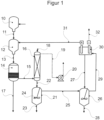
- the following is based on the process diagram of Figure 1 an exemplary method according to the invention for obtaining lithium hydroxide from a lithium-containing starting material is explained.
- the method starts from a lithium-containing ore such as spodumene, which is introduced into a container 10 and is activated in a first step in this container 10 by calcination.
- the calcination can be carried out, for example, at ambient pressure and at temperatures in the range of, for example, 1100 °C to 1500 °C for a period of about one hour.
- the spodumene from which it is started can be present in various modifications, in particular as ⁇ , ⁇ or ⁇ -spodumene, whereby an activated ⁇ or ⁇ -spodumene is present after activation.
- the activated spodumene is then transferred via line 11 to a second container 12 in which a dry chlorination of the spodumene is carried out using chlorine gas.
- the chlorination can be carried out, for example, at a pressure of 1 bar (a) and a temperature in the range of about 1000 °C to about 1100 °C, with a treatment time of, for example, about two hours.
- the chlorinated spodumene is transferred via line 13 to a vacuum evaporator 14, in which a separation of the products formed during chlorination takes place at a reduced pressure of, for example, about 20 mbar (a) to about 50 mbar (a) and, for example, at a temperature of approximately 1050 °C, with metal chlorides being formed as the main product of the chlorination, which are transferred from the vacuum evaporator 14 to a condenser 16 via line 15, while the aluminum silicates or zeolites which arise as valuable by-products in the vacuum evaporator 14 are separated and discharged from the vacuum evaporator 14 via a further line 17 in the lower area, forming a commercially tradable product and can therefore contribute to the added value of the process as a whole.
- a vacuum evaporator 14 in which a separation of the products formed during chlorination takes place at a reduced pressure of, for example, about 20 mbar (a) to about 50 mbar (a) and, for
- the metal chlorides that are evaporated in the vacuum evaporator 14 pass into the condenser 16, to which water is supplied via line 18 and in which the metal chlorides are dissolved as salts in aqueous solution. If necessary, water vapor can be discharged from the condenser 16 via a line 19 to which a vacuum pump 20 is connected.
- the condensed dissolved metal chlorides are then transferred via line 22 into another container 21 in which the precipitation of impurities takes place, which can be discharged from the container 21 via line 23.
- This container 21 for the precipitation of the impurities is preferably equipped with a stirring device 24 so that the medium contained in this container 21 can be thoroughly mixed.
- a further line 25 extends from this container 21, via which the aqueous solution purified after the impurities have been separated can be discharged, which contains the LiCl in a concentration of, for example, about 30% by weight to about 40% by weight, preferably with a LiCl content in the range of about 35% by weight.
- This LiCl solution is fed via line 25 to a reaction container 26, in which the reaction of the LiCl with KOH takes place according to step B of the process according to the invention.
- a solution of potassium hydroxide, lithium chloride, potassium chloride and lithium hydroxide in water is formed.
- the KOH required for the reaction with the LiCl can be fed to the reaction vessel 26 via line 27 in the form of an aqueous alkaline solution of KOH, which is generated in the process itself during electrolysis.
- the reaction vessel 26 serves as a crystallizer in which the various salts contained in the solution can each be precipitated separately.
- the desired product of this reaction in the reaction vessel 26 is the LiOH, which can be discharged from the vessel via line 28 after precipitation.
- the KCl also obtained during the reaction is selectively crystallized via the reciprocal solubility and discharged from the reaction vessel 26 and fed to the electrolysis device 30 via line 29.
- the chlor-alkali electrolysis of KCl takes place in the electrolysis device 30 according to step C of the method according to the invention.
- the KCl is converted to KOH, and chlorine gas and hydrogen are also produced.
- the chlorine gas produced at the anode in the electrolysis device is fed via line 31 to the second container 12, in which the dry chlorination of the starting material, for example the spodumene, takes place.
- the hydrogen produced at the cathode in the electrolysis device 30 can be discharged via line 32 and used for another purpose, wherein the hydrogen can serve, for example, as an energy carrier or as a reactant in another process.
- the KOH solution produced during the electrolysis in the electrolysis device 30 is fed via line 27 to the reaction container 26, in which the selective crystallization and separation of LiOH and KCl takes place.
- the KOH as well as the chlorine gas produced during electrolysis are reused in the process itself, so that overall it is a circular process in which no additional reagents need to be added from outside.
- FIG. 2 shows a schematic representation of the material flows during the reaction in the reaction vessel 26, in which the previously described reaction of the lithium chloride with potassium hydroxide according to step B and the subsequent crystallization of the lithium hydroxide (explained here as an example for 1 kg) take place.
- the material flows into and out of the reaction vessel 26 are shown in each case.
- An aqueous lithium chloride salt solution with 40 wt.% LiCl enters the reaction vessel 26 via line 25, the entire material flow having a mass of 2.8 kg.
- an aqueous potassium hydroxide solution with 30 wt.% is fed to the reaction vessel 26 via line 27.
- the total material flow fed to the reaction vessel 26 via line 27 is 4.9 kg.
- the potassium chloride-enriched material flow 3 obtained during the reaction in the reaction vessel 26, which was enriched with potassium chloride by selective crystallization using the reciprocal solubility and is discharged from the reaction vessel 26 and fed to the electrolysis device 30 via line 29, has a total mass of 2 kg, the proportion of potassium chloride being 97 wt.%.
- the filtrate obtained after the separation of the KCl according to material stream 3, which predominantly contains water, can be recycled to the reaction vessel 26 for further separation of the residual salts still contained therein.
- This material stream 4 has a total mass of 18.4 kg, with the proportion of lithium hydroxide being 8% by weight and the proportion of potassium chloride being 17% by weight.
- the reaction vessel 26 used for crystallization can be operated, for example, at the boiling point of the salt solution (at a temperature of about 100 - 105 °C).
- the solutions mentioned also form a vapor phase in the reaction vessel 26, which consists almost exclusively of water vapor.
- a vapor stream (material stream 5) containing 4.5 kg of water vapor is formed and discharged from the reaction vessel 26.
- a suspension containing both the product lithium hydroxide and the potassium chloride can first be discharged from the reaction vessel 26 as material stream 6, wherein this suspension contains 10 wt.% LiOH, which is present as a solid (LiOH*H2O) above the solubility limit.
- Material stream 6 can be separated using a solid/liquid separation, producing a filtrate that predominantly contains potassium chloride with a proportion of 25% by weight.
- the lithium hydroxide product separated as a solid during the solid/liquid separation is discharged as material stream 8. This consists of the solid LiOH*H2O (purity >99% by weight) and a certain amount of residual moisture.
- the proportion of residual moisture for example between 3 and 10% by weight, depends on the filtration method used. A centrifuge is preferably selected, thus achieving a residual moisture content of between 3 and 5% by weight.
- the potassium chloride is then crystallized out of the filtrate solution according to material stream 7 at low temperature, for example in the range of about 0 °C, and the suspension obtained is separated by a solid-liquid separation.
- the solid thus obtained (material stream 3), in the present example 1.9 kg (KCl) with a high degree of purity of >98 wt.%, is then fed into the electrolysis device 30.
- the resulting filtrate (material stream 4), a salt solution, in this case 18.4 kg with a content of 17 wt.% KCl and 7.5 wt.% LiOH, is fed to the reaction vessel 26 as recyclate.
Landscapes
- Chemical & Material Sciences (AREA)
- Organic Chemistry (AREA)
- Engineering & Computer Science (AREA)
- Materials Engineering (AREA)
- Inorganic Chemistry (AREA)
- Chemical Kinetics & Catalysis (AREA)
- Electrochemistry (AREA)
- Metallurgy (AREA)
- Electrolytic Production Of Metals (AREA)
- Electrolytic Production Of Non-Metals, Compounds, Apparatuses Therefor (AREA)
Abstract
-A: Umsetzung (12) des Lithium-haltigen Ausgangsmaterials mit Chlorgas zum Erhalt von Lithiumchlorid;
-B: Umsetzung (26) des Lithiumchlorids mit Kaliumhydroxid zum Erhalt einer Lösung von Kaliumhydroxid, Lithiumchlorid, Kaliumchlorid und Lithiumhydroxid in Wasser;
-C: Umsetzung des Kaliumchlorids mittels Chlor-Alkali-Elektrolyse (30) zu Kaliumhydroxid sowie Chlorgas und Wasserstoff;
-D: Gewinnung mindestens des Lithiumhydroxids aus der in Schritt B erhaltenen Lösung.
Description
- Die vorliegende Erfindung betrifft ein Verfahren zur Herstellung von Lithiumhydroxid (LiOH) aus einem Lithium-haltigen Ausgangsmaterial, wobei das Verfahren eine Chlor-Alkali-Elektrolyse umfasst.
- Lithiumhydroxid wird unter anderem als Ausgangsmaterial für die Herstellung von Lithiumlonen-Akkumulatoren benötigt. Der Bedarf an Lithium für die Herstellung von Batterien, insbesondere für Elektrofahrzeuge ist bereits sehr hoch und wird nach Schätzungen voraussichtlich in den nächsten Jahren bis 2030 von derzeit etwa 500.000 Tonnen pro Jahr auf etwa das Siebenfache von 3,5 Millionen Tonnen pro Jahr steigen. Es werden somit enorme Investitionen in neue Anlagen zur Produktion von Lithiumhydroxid erforderlich, um die notwendigen Kapazitäten zu schaffen, wobei das Lithiumhydroxid bei einer Verwendung in Batterien in einem hohen Reinheitsgrad von insbesondere mehr als 99 % benötigt wird, der als "battery-grade" bezeichnet wird. Wegen der hohen Nachfrage ist der Preis für Lithiumhydroxid (LiOH*H2O) in den letzten beiden Jahren bereits erheblich gestiegen.
- Bei den klassischen Methoden zur Herstellung von Lithiumhydroxid wird entweder ein Lithiumcarbonat mit Ca(OH)2 umgesetzt oder Lithiumsulfat wird mit Bariumhydroxid zu Lithiumhydroxid umgesetzt. Es kann auch das als Ausgangsmaterial dienende Lithiumerz mit Schwefelsäure ausgelaugt und mit Ca(OH)2 gereinigt werden, um störende Metallkationen, wie Aluminium-, Eisen-, Calcium-, Magnesium- oder Natrium-Ionen zu entfernen, wobei das zunächst entstehende Lithiumsulfat (Li2SO4) durch Reaktion mit der Lauge zu LiOH umgesetzt wird. Bei diesem herkömmlichen Verfahren ist es nachteilig, dass in der Regel nur Ausbeuten im Bereich von etwa 85 % erzielt werden und das Verfahren aufgrund der Röstprozesse einen ungünstigen CO2-footprint aufweist. Bei der Umsetzung im sauren Bereich werden große Mengen an Schwefelsäure benötigt. Zudem fallen in dem Verfahren große Mengen an Natriumsulfat an, welches ein vergleichsweise geringwertiges Produkt ist.
- Alternativ kann das Erz auch alkalisch aufgeschlossen, mit Calciumcarbonat geröstet und mit Calciumhydroxid gereinigt und zu LiOH umgesetzt werden. Bei dieser Variante werden jedoch auch nur Ausbeuten von etwa 90 % erzielt und wegen des Röstens des Erzes ist der Energieverbrauch hoch und der CO2-footprint ist ebenfalls negativ. Zudem ist bei diesem Verfahren der Verbrauch an dem Reagenz Calciumcarbonat hoch.
- Man kann auch beim Auslaugen der Lithiumerze anstelle von Schwefelsäure Salzsäure verwenden, jedoch liegt dann die Ausbeute an Lithiumhydroxid in dem Verfahren auch nur bei etwa 85 %. Bei diesem Verfahren entsteht ein nasser, kontaminierter Rückstand. Zudem ist die Elektrolyse des hier beim Auslaugen entstehenden Lithiumchlorid (LiCl) technisch sehr schwierig.
- Lithiumsalze können auch aus Zinnwaldit (Lithiumeisenglimmer) gewonnen werden, welches jedoch nur einen geringen Gehalt an Lithiumoxid von etwa 3 % bis 4,5 Gew.-% aufweist, so dass aus etwa 25 Tonnen Zinnwaldit nur etwa 1 Tonne Lithiumcarbonat gewonnen wird, wobei in dem Verfahren große Mengen an Erdgas für den Röstvorgang sowie an Dampf und Kühlwasser verbraucht werden.
- Aus der
DE 10 2017 221 268 A1 ist ein Verfahren zur Herstellung von Lithiumhydroxid aus lithiumhaltigem Erz mittels Chlorierung und Chloralkali-Prozess bekannt, bei dem man von dem Lithium-Mineral Spodumen, einem Lithium-Aluminium-Silikat, ausgeht, dieses mit Chlor chloriert, dann mit Wasser auslaugt zur Herstellung einer LiCI-Lösung, die insbesondere durch Entfernung von Kationen gereinigt und dann einer Chlor-Alkali-Elektrolyse unterzogen wird, wobei es sich um eine Membran-Elektrolyse handelt, bei der außer LiOH als Nebenprodukte Chlorgas und Wasserstoff entstehen. Bei dem bekannten Verfahren müssen in dem Reinigungsschritt Natrium-, Kalium-, Calcium-, Magnesium- und gegebenenfalls Eisen-Ionen weitestgehend entfernt werden, da die LiCI-Lösung bei der Elektrolyse in hochreiner Form vorliegen muss, das heißt Verunreinigungen dürfen nur noch in einem ppb-Bereich (parts per billion) vorliegen. Aus diesem Grund ist die praktische Umsetzung dieses Verfahrens im industriellen Maßstab sehr schwierig. Es gibt hierzu auch keine Erfahrungen aus vergleichbaren Verfahren, die als Grundlage herangezogen werden könnten. - Die
US 11,339,481 B1 - Die
EP 0571 273 A1 beschreibt ein Verfahren zur Herstellung eines Alkalimetall-Chlorats durch Elektrolyse in einer Membranzelle eines Anolyten, bei dem man eine Salzlake eines Alkalimetallchlorids in einer Chlor-Alkali-Elektrolysezelle elektrolysiert, wobei Chlorgas und eine konzentrierte Lösung des Alkalimetallhydroxids entstehen, man dann dieses Chlorgas und die Lösung des Alkalimetallhydroxids in eine Abbaukolonne überführt und miteinander zur Reaktion bringt und die so erhaltene Salzlösung wiedergewinnt, um sie als Anolyt in der Membranzelle einzusetzen. In der Abbaukolonne reagieren Chlorgas und Alkalihydroxid wie folgt:
6 MeOH + 3 Cl2 → 3 MeCl + 3 MeClO + 3 H2O
- Es bilden sich somit ein Alkalimetallchlorid und das entsprechende Alkalimetallhypochlorit. Anschließend disproportioniert das Alkalimetallhypochlorit gemäß der folgenden Reaktion:
3 MeClO → 2 MeCl + MeClO3
- Es entsteht somit bei dieser Reaktion neben dem Chlorid noch ein Chlorat des Alkalimetalls. Die Salzlösung wird dann als Anolyt in einer Membranzelle eingesetzt, wobei die Elektrolyse bei einem schwach sauren pH-Wert von 2 bis 5 und einer erhöhten Temperatur von zwischen 50 °C und 100 °C erfolgt. Die bei der Elektrolyse in der Membranzelle erhaltene Alkalimetallhydroxid-Lösung kann in die Abbaukolonne überführt werden, ebenso wie das bei der Elektrolyse entstehende Chlorgas. Im Prinzip geht es bei diesem bekannten zyklischen Prozess um die Herstellung eines Alkalimetallchlorats sowie die Reinigung eines Alkalimetallchlorids mittels der Elektrolyse. Die Gewinnung des Alkalimetallhydroxids steht hingegen nicht im Fokus des Verfahrens.
- Ausgehend von dem zuvor geschilderten Stand der Technik besteht die Aufgabe der vorliegenden Erfindung darin, ein verbessertes Verfahren zur Gewinnung von Lithiumhydroxid (LiOH) zur Verfügung zu stellen, bei dem der Energiebedarf und der Verbrauch an Ressourcen hinsichtlich der eingesetzten Substanzen, des Kühlwassers etc. geringer sind, bei dem eine höhere Ausbeute erzielbar ist und die oben geschilderten Nachteile der direkten Elektrolyse von LiCl vermieden werden.
- Die Lösung der vorgenannten Aufgabe liefert ein erfindungsgemäßes Verfahren mit den Merkmalen des Anspruchs 1.
- Gegenstand der Erfindung ist ein Verfahren zur Herstellung von Lithiumhydroxid aus einem Lithium-haltigen Ausgangsmaterial, umfassend wenigstens die nachfolgend genannten Schritte:
- A: Umsetzung des Lithium-haltigen Ausgangsmaterials mit Chlorgas zum Erhalt von Lithiumchlorid;
- B: Umsetzung des Lithiumchlorids mit Kaliumhydroxid zum Erhalt einer Lösung von Kaliumhydroxid, Lithiumchlorid, Kaliumchlorid und Lithiumhydroxid in Wasser;
- C: Umsetzung des Kaliumchlorids mittels Chlor-Alkali-Elektrolyse zu Kaliumhydroxid sowie Chlorgas und Wasserstoff;
- D: Gewinnung mindestens des Lithiumhydroxids aus der in Schritt B erhaltenen Lösung.
- Bei dem erfindungsgemäßen Verfahren wird von einem Lithium-haltigen Ausgangsmaterial, beispielsweise einem Lithium-haltigen Erz ausgegangen und dieses wird zunächst mit Chlorgas zu Lithiumchlorid umgesetzt. Dieses Lithiumchlorid wird jedoch anders als bei bekannten Verfahren nicht selbst einer Chlor-Alkali-Elektrolyse unterzogen, sondern zunächst mit Kaliumhydroxid (KOH) zu LiOH und KCl umgesetzt. Das auf diese Weise erhaltene KCl lässt sich anschließend durch Chlor-Alkali-Elektrolyse elektrolysieren, wobei es sich hier um ein erprobtes Verfahren handelt, welches bereits vielfach in industriellem Maßstab angewandt wird. Die bei der direkten Elektrolyse von LiCl gegebenen Schwierigkeiten treten hier somit nicht auf.
- Bei dem erfindungsgemäßen Verfahren wird zwar zunächst aus dem Ausgangsmaterial, wie beispielsweise einem Lithium-haltigen Erz durch Chlorierung ein Lithiumchlorid hergestellt. Dieses Lithiumchlorid ließe sich "theoretisch" mittels Chlor-Alkali-Elektrolyse elektrolysieren, wobei ein LiOH erhalten würde. Diese Elektrolyse wird im Stand der Technik vorgeschlagen, ist jedoch mit erheblichen technischen Schwierigkeiten verbunden, die einer Durchführung im industriellen Maßstab mit vertretbarem Aufwand entgegenstehen und lässt sich nicht in einem wirtschaftlichen sinnvollen Verfahren realisieren. Die Erfindung schlägt daher vor, quasi einen Umweg einzuschlagen und aus dem LiCl zunächst ein KCl herzustellen, welches somit als eine Art Trägermaterial benutzt wird und anstelle des LiCl elektrolysiert wird. Diese Elektrolyse des KCl ist technisch problemlos umzusetzen, wobei auf Erkenntnisse aus langjähriger industrieller Erfahrung in diesem Verfahren zurückgegriffen werden kann. Das als Produkt angestrebte LiOH wird bei der Umsetzung des Lithiumchlorids mit Kaliumhydroxid gemäß Schritt B erhalten und kann aus der dabei entstehenden Lösung gewonnen werden. Bei der anschließenden Elektrolyse des KCl (des Trägermaterials) entsteht zum einen das Kaliumhydroxid, welches bei der Umsetzung gemäß Schritt B benötigt wird, als auch das Chlorgas, welches bei der Chlorierung des Ausgangsmaterials gemäß Schritt A eingesetzt wird. Somit handelt es sich bei dem erfindungsgemäßen Verfahren um eine Art Kreislaufprozess, bei dem im Wesentlichen keine Reagenzien von außen zugeführt werden müssen, die im Verfahren verbraucht werden. Der Energieverbrauch sowie der Verbrauch an Ressourcen werden im Vergleich zu den vorbekannten Verfahren erheblich reduziert.
- Gemäß einer bevorzugten Weiterbildung des erfindungsgemäßen Verfahrens wird das in dem Verfahrensschritt C bei der Elektrolyse erhaltene Kaliumhydroxid mindestens teilweise als Edukt in Schritt B bei der Umsetzung mit Lithiumchlorid wieder eingesetzt. Das Kaliumhydroxid wird als Edukt bei der Umsetzung des Lithiumchlorids in Schritt B benötigt, so dass es besonders vorteilhaft ist, wenn das bei der Elektrolyse in Schritt C anfallende Kaliumhydroxid in die Umsetzung gemäß Schritt B zurückgeführt wird.
- Eine bevorzugte Weiterbildung des erfindungsgemäßen Verfahrens sieht zudem vor, dass auch das in dem Verfahrensschritt C bei der Elektrolyse entstehende Chlorgas mindestens teilweise als Edukt in Schritt A bei der Umsetzung des Lithium-haltigen Ausgangsmaterials mit Chlorgas wieder eingesetzt wird. Bei der Chlorierung zum Aufschluss des Ausgangsmaterials gemäß Schritt A wird Chlorgas benötigt, welches in Schritt C des Verfahrens erzeugt wird und gemäß dieser bevorzugten Variante des Verfahrens ebenfalls im Prozess selbst wieder eingesetzt werden kann, indem es in die Chlorierung gemäß Schritt A zurückgeführt wird. Durch das direkte Rezirkulieren des Chlorgases ist eine "trockene" Chlorierung möglich. Dadurch entsteht ein trockener, chlorfreier Rückstand, der im Gegensatz zu den herkömmlichen Methoden, die einen feuchten Filterkuchen mit Rückständen des Säureaufschlusses erzeugen, einen verwertbaren Rückstand darstellt.
- Gemäß einer bevorzugten Weiterbildung des Verfahrens werden die in Schritt B in der Lösung enthaltenen Substanzen Lithiumhydroxid und Kaliumchlorid aus der Lösung selektiv abgetrennt.
- Vorzugsweise werden die in Schritt B in der Lösung enthaltenen Substanzen Lithiumhydroxid und Kaliumchlorid über die reziproke Löslichkeit aus der Lösung abgetrennt.
- Insbesondere erfolgt diese selektive Trennung von LiOH und KCl aus der Lösung über die reziproke Löslichkeit jeweils durch Kristallisation dieser Substanzen. Das so entstehende LiOH stellt das Produkt dar. Das ebenfalls entstehende KCl wird durch eine am Markt vielfach erprobte Chlor-Alkali-Elektrolyse gemäß Verfahrensschritt C wieder zu KOH, welches als Edukt benötigt wird, sowie Chlorgas (Cl2) und Wasserstoff (H2) umgesetzt. Das so gewonnene Chlorgas wird vorzugsweise zur Herstellung des LiCl rezykliert und der entstehende Wasserstoff kann bevorzugt für weitere Zwecke verwendet werden.
- Bei der selektiven Trennung von LiOH und KCl aus der Lösung durch Kristallisation geht man beispielsweise so vor, dass zunächst in einem ersten Kristallisationsschritt bei einer erhöhten Temperatur T1 das Lithiumhydroxid aus der Lösung auskristallisiert wird und danach in einem zweiten Kristallisationsschritt bei einer Temperatur T2, welche niedriger ist als die Temperatur T1, das Kaliumchlorid aus der nach Abtrennung des Lithiumhydroxid verbliebenen Lösung auskristallisiert wird. Das Lithiumhydroxid hat bei erhöhten Temperaturen eine etwas geringere Löslichkeit in wässriger Lösung als bei niedrigen Temperaturen. Bei dem Kaliumchlorid ist es umgekehrt, die Löslichkeit nimmt mit zunehmender Temperatur nicht unerheblich zu, sie verdoppelt sich in etwa bei Erhöhung der Temperatur der Lösung von beispielsweise etwa 0 °C auf etwa 90 °C. Vorzugsweise wählt man daher für den ersten Kristallisationsschritt eine Temperatur T1 von zwischen etwa 50 °C und etwa 100 °C, vorzugsweise von etwa 70 °C bis etwa 100 °C, bei der das Lithiumhydroxid zum großen Teil ausfällt, während das Kaliumchlorid in Lösung bleibt. Den auskristallisierten Anteil des Lithiumhydroxids kann man dann als Produkt abtrennen. Das Filtrat dieser Lösung kühlt man dann stärker ab, beispielsweise auf eine Temperatur T2 im Bereich von etwa 40 °C bis etwa - 10 °C, vorzugsweise auf etwa 20 °C bis etwa - 10 °C und kristallisiert so einen wesentlichen Anteil des Kaliumchlorids aus der Lösung aus, welches man dann beispielsweise durch Filtration abtrennen kann. Das Filtrat dieses zweiten Kristallisationsschritts, welches noch einen Anteil an Lithiumhydroxid enthält, das zuvor nicht ausgefällt wurde, sowie auch das restliche Kaliumchlorid enthält, kann man dann zurückführen in den ersten Kristallisationsschritt und man kann so in einem weiteren Zyklus weitere Anteile an Lithiumhydroxid aus dieser vereinigten Lösung gewinnen.
- Vorzugsweise umfasst das Ausgangsmaterial für das erfindungsgemäße Verfahren in Schritt A ein Lithiumerz, vorzugsweise ein Lithiumerz, welches das Mineral Spodumen enthält. Bei Spodumen handelt es sich um ein Kettensilikat aus der Gruppe der Pyroxene, welches im monoklinen Kristallsystem kristallisiert und die chemische Zusammensetzung LiAl[Si2O6] hat. Spodumen ist ein wichtiges Lithiumerz, welches an diversen Fundorten vorkommt, unter anderem auch im Alpenraum, in Skandinavien, Kanada und Russland und Spodumen bildet teilweise sehr große Kristalle aus.
- Lithium kommt auch in Mineralen in Lithium-Pegmatiten vor, beispielsweise sind die Minerale Amblygonit, Lepidolith, Petalit und Kryolithionit zu nennen, wobei diese Minerale in der Regel einen Lithiumgehalt von bis zu 9 Gew.-% aufweisen. Daneben kommt Lithiumchlorid auch in Salzlaugen, zumeist in Salzseen vor und kann ebenfalls zur Gewinnung von Lithiumhydroxid eingesetzt werden.
- Eine bevorzugte Weiterbildung des erfindungsgemäßen Verfahrens sieht vor, dass der bei der Umsetzung des Kaliumchlorids mittels Chlor-Alkali-Elektrolyse zu Kaliumhydroxid entstehende Wasserstoff wenigstens teilweise als Energieträger zur Erzeugung von Prozesswärme im Verfahren selbst oder einem anderen Verfahren und/oder als Edukt in einem anderen Umsetzungsprozess verwendet wird.
- Vorzugsweise umfasst das Ausgangsmaterial für das erfindungsgemäße Verfahren in Schritt A mindestens einen Lehm, einen Ton oder eine Schlacke. Bei dieser bevorzugten Variante des Verfahrens können somit für die Gewinnung des Lithiumchlorids in Schritt A teilweise oder gegebenenfalls auch ausschließlich Ausgangsmaterialien eingesetzt werden, die weniger hochwertig sind als Lithiumerze und die gegebenenfalls nur einen geringeren Gehalt an Lithium aufweisen als beispielsweise Spodumen. Die weltweite Nachfrage nach Lithium ist wegen der Verwendung in Akkumulatoren für Elektrofahrzeuge sehr hoch, weshalb es wirtschaftlich sinnvoll ist, auch Lehm, Ton oder auch Schlacken beispielsweise aus metallurgischen Prozessen für die Gewinnung bzw. Rückgewinnung von Lithium zu nutzen. Bei teilweisem oder vollständigen Einsatz dieser Ausgangsmaterialien in dem erfindungsgemäßen Verfahren erfolgt in Schritt A analog zur Vorgehensweise beim Einsatz von Lithiumerzen ein Aufschluss mit Chlorgas zur Gewinnung von Lithiumchlorid. Daher können Lehm, Ton oder Schlacke auch gemeinsam im Gemisch mit Lithiumerzen als Ausgangsmaterial in dem Verfahren eingesetzt werden.
- Eine bevorzugte Weiterbildung des erfindungsgemäßen Verfahrens sieht vor, dass das Verfahren wenigstens einen dem Verfahrensschritt A vorgeschalteten Verfahrensschritt umfasst, in dem das Ausgangsmaterial aufbereitet wird, insbesondere in dem das Ausgangsmaterial kalziniert wird. Bevor in dem Verfahrensschritt A die Chlorierung des Lithium-haltigen Ausgangsmaterials erfolgt, ist eine Kalzinierung vorteilhaft. Bei dieser Kalzinierung handelt es sich um eine Wärmebehandlung in der Regel in Gegenwart von Luft oder Sauerstoff. Wenn es sich bei dem Ausgangsmaterial beispielsweise um ein Lithium-haltiges Erz handelt, können auf diese Weise flüchtige Komponenten abgetrennt werden und/oder durch eine thermische Zersetzung können beispielsweise einzelne Komponenten aufgeschlossen werden.
- Eine bevorzugte Weiterbildung des erfindungsgemäßen Verfahrens sieht zwischen der Chlorierung gemäß Schritt A und der Umsetzung des Lithiumchlorids mit Kaliumhydroxid gemäß Schritt B wenigstens einen Schritt A1 vor, in dem eine Reinigung des Lithiumchlorids erfolgt. Bei der Chlorierung gemäß Schritt A wird in der Regel ein Gemisch enthalten, welches neben dem Lithiumchlorid weitere Metallchloride sowie andere Komponenten wie beispielsweise Silikate enthält. In einem oder mehreren Reinigungsschritten gemäß A1 können diese Komponenten abgetrennt werden, wobei man bevorzugt zunächst solche Komponenten abtrennt, bei denen es sich nicht um Metallchloride handelt, wobei sich nach dieser Abtrennung ein Gemisch von Metallchloriden ergibt, in dem auch das Lithiumchlorid enthalten ist, welches dann vorzugsweise in wenigstens einem weiteren Schritt weiter gereinigt wird, um ein Lithiumchlorid in einem gewünschten Reinheitsgrad für die weitere Umsetzung in den nachfolgenden Verfahrensschritten zu erhalten.
- Eine bevorzugte Weiterbildung des erfindungsgemäßen Verfahrens sieht vor, dass die Reinigung des Lithiumchlorids gemäß Schritt A1 wenigstens einen Trennschritt umfasst, in dem Nebenprodukte von bei der Chlorierung entstandenen Metallchloriden abgetrennt werden. Bei diesen nicht chloridischen Nebenprodukten kann es sich, wenn man von einem Lithium-haltigen Erz als Ausgangsmaterial ausgeht, beispielsweise um wenigstens ein Silikat, insbesondere um ein Aluminiumsilikat oder um einen Zeolith handeln.
- Eine bevorzugte Weiterbildung des erfindungsgemäßen Verfahrens sieht vor, dass der Trennschritt A1 eine Behandlung in einem Vakuumverdampfer umfasst. Bei einem solchen Trennschritt werden Chloride in einer Gasphase erhalten, während die weniger flüchtigen Silikate vorzugsweise in einer Feststoffphase verbleiben, die von der Gasphase abgetrennt werden kann.
- Eine bevorzugte Weiterbildung des erfindungsgemäßen Verfahrens sieht vor, dass nach einem Trennschritt, beispielsweise mittels eines Vakuumverdampfers, in einer Gasphase vorliegende Metallchloride in einem Schritt A2 mit Wasser kondensiert werden und danach in wässriger Lösung vorliegen. Diese wässrige Lösung enthält dann in vorteilhafter Weise das Lithiumchlorid sowie weitere Metallchloride jeweils als Salze in gelöster Form, so dass diese anschließend von dem Lithiumchlorid getrennt werden können.
- Eine bevorzugte Weiterbildung des erfindungsgemäßen Verfahrens sieht somit nach einem Trennschritt A1 wenigstens einen weiteren Trennschritt A2 vor, in dem in wässriger Lösung vorliegende Metallsalze, insbesondere Metallchloride von Lithiumchlorid abgetrennt werden.
- Eine bevorzugte Weiterbildung des erfindungsgemäßen Verfahrens sieht vor, dass in diesem Trennschritt A2 die Metallchloride durch Fällung von dem Lithiumchlorid abgetrennt werden. Nach dieser Fällung wird ein Lithiumchlorid in einem ausreichenden Reinheitsgrad erhalten, welches vorzugsweise in einer wässrigen Lösung vorliegt und welches nun in Schritt B des erfindungsgemäßen Verfahrens mit Kaliumhydroxid umgesetzt werden kann, zum Erhalt einer Lösung von Kaliumhydroxid, Lithiumchlorid, Kaliumchlorid und Lithiumhydroxid in Wasser. Diese Umsetzung kann beispielsweise in einem Reaktionsbehälter erfolgen, in dem nach der Umsetzung das in Lösung vorliegenden Produkt Lithiumhydroxid sowie gegebenenfalls auch das Kaliumchlorid durch reziproke Fällung selektiv kristallisiert werden können. Das ausgefällte Lithiumhydroxid liegt dann vorzugsweise als Feststoff in kristalliner Form vor, wird aus dem Reaktionsbehälter abgetrennt und bei Bedarf anschließend gegebenenfalls in einem oder mehreren Schritten weiter gereinigt. Das im Reaktionsbehälter anfallende Kaliumchlorid kann auch beispielsweise in wässriger Lösung vorliegend aus dem Reaktionsbehälter direkt in eine Elektrolysevorrichtung überführt werden, in der die nachfolgende Chlor-Alkali-Elektrolyse des Kaliumchlorids gemäß Schritt C des erfindungsgemäßen Verfahrens erfolgt.
- Die Erfindung sowie das technische Umfeld werden nachfolgend anhand der Figuren näher erläutert. Es ist darauf hinzuweisen, dass die Erfindung durch die gezeigten Ausführungsbeispiele nicht beschränkt werden soll. Insbesondere ist es, soweit nicht explizit anders dargestellt, auch möglich, Teilaspekte der in den Figuren erläuterten Sachverhalte zu extrahieren und mit anderen Bestandteilen und Erkenntnissen aus der vorliegenden Beschreibung und/oder Figuren zu kombinieren. Insbesondere ist darauf hinzuweisen, dass die Figuren und insbesondere die dargestellten Größenverhältnisse nur schematisch sind. Gleiche Bezugszeichen bezeichnen gleiche Gegenstände, so dass ggf. Erläuterungen aus anderen Figuren ergänzend herangezogen werden können. Es zeigen:
-
Figur 1 ein mögliches Verfahrensschema für die Gewinnung von Lithiumhydroxid aus einem Lithium-haltigen Ausgangsmaterial gemäß einem Ausführungsbeispiel der vorliegenden Erfindung; und -
Figur 2 ein Blockfließdiagramm eines beispielhaften erfindungsgemäßen Verfahrens mit den Massenströmen. - Nachfolgend wird anhand des Verfahrensschemas von
Figur 1 ein beispielhaftes erfindungsgemäßes Verfahren zur Gewinnung von Lithiumhydroxid aus einem Lithium-haltigen Ausgangsmaterial erläutert. Es wird in dem Verfahren ausgegangen von einem Lithium-haltigen Erz wie beispielsweise Spodumen, welches in einen Behälter 10 eingebracht wird und in einem ersten Schritt in diesem Behälter 10 aktiviert wird, indem eine Kalzinierung vorgenommen wird. Die Kalzinierung kann beispielsweise bei Umgebungsdruck und bei Temperaturen im Bereich von beispielsweise 1100 °C bis 1500 °C für die Zeitdauer von etwa einer Stunde durchgeführt werden. Das Spodumen, von dem ausgegangen wird, kann in verschiedenen Modifikationen vorliegen, insbesondere als α, β oder γ-Spodumen, wobei nach der Aktivierung ein aktiviertes β oder γ-Spodumen vorliegt. - Das aktivierte Spodumen wird dann über die Leitung 11 in einen zweiten Behälter 12 überführt, in dem eine trockene Chlorierung des Spodumens mittels Chlorgas durchgeführt wird. Die Chlorierung kann beispielsweise bei einem Druck von 1 bar (a) und einer Temperatur im Bereich von etwa 1000 °C bis etwa 1100 °C vorgenommen werden, bei einer Behandlungszeitdauer von beispielsweise etwa zwei Stunden. Nach der Chlorierung wird das chlorierte Spodumen über die Leitung 13 in einen Vakuumverdampfer 14 überführt, in dem eine Auftrennung der bei der Chlorierung entstandenen Produkte bei verringertem Druck von beispielsweise etwa 20 mbar (a) bis etwa 50 mbar (a) und beispielsweise bei einer Temperatur von ungefähr 1050 °C erfolgt, wobei zum einen als Hauptprodukt der Chlorierung Metallchloride entstehen, die über die Leitung 15 aus dem Vakuumverdampfer 14 in einen Kondensator 16 verbracht werden, während die als wertvolle Nebenprodukte im Vakuumverdampfer 14 anfallenden Aluminiumsilikate oder Zeolithe abgetrennt und über eine weitere Leitung 17 im unteren Bereich aus dem Vakuumverdampfer 14 abgeführt werden, wobei sie ein kommerziell handelbares Produkt bilden und daher zur Wertschöpfung des Verfahrens insgesamt beitragen können.
- Die Metallchloride, die in dem Vakuumverdampfer 14 verdampft werden, gelangen in den Kondensator 16, dem über die Leitung 18 Wasser zugeführt wird und in dem die Metallchloride als Salze in wässriger Lösung gelöst werden. Gegebenenfalls kann Wasserdampf über eine Leitung 19, an die eine Vakuumpumpe 20 angeschlossen ist, aus dem Kondensator 16 abgeführt werden. Die kondensierten gelösten Metallchloride werden anschließend über die Leitung 22 in einen weiteren Behälter 21 überführt, in dem die Ausfällung von Verunreinigungen erfolgt, die über die Leitung 23 aus dem Behälter 21 abgeführt werden können. Dieser Behälter 21 für die Ausfällung der Verunreinigungen ist vorzugsweise mit einer Rührvorrichtung 24 ausgestattet, so dass eine Durchmischung des in diesem Behälter 21 enthaltenen Mediums möglich ist. Von diesem Behälter 21 geht eine weitere Leitung 25 aus, über die die nach Abtrennung der Verunreinigungen gereinigte wässrige Lösung abgeführt werden kann, welche das LiCl in einer Konzentration von beispielsweise etwa 30 Gew.-% bis etwa 40 Gew.-%, vorzugsweise mit einem LiCI-Gehalt im Bereich von etwa 35 Gew.-%, enthält. Diese LiCI-Lösung wird über die Leitung 25 einem Reaktionsbehälter 26 zugeführt, in dem die Umsetzung des LiCl mit KOH gemäß Schritt B des erfindungsgemäßen Verfahrens erfolgt.
- Bei diesem Umsetzungsschritt B in dem Reaktionsbehälter 26 entsteht eine Lösung von Kaliumhydroxid, Lithiumchlorid, Kaliumchlorid und Lithiumhydroxid in Wasser. Das für die Reaktion mit dem LiCl benötigte KOH kann dem Reaktionsbehälter 26 über die Leitung 27 in Form einer wässrigen alkalischen Lösung von KOH zugeführt werden, welche im Prozess selbst bei der Elektrolyse erzeugt wird. Der Reaktionsbehälter 26 dient als Kristallisator, in dem die verschiedenen in der Lösung enthaltenen Salze jeweils separat ausgefällt werden können. Das gewünschte Produkt dieser Reaktion in dem Reaktionsbehälter 26 ist das LiOH, welches nach der Ausfällung über die Leitung 28 aus dem Behälter abgeführt werden kann. Das bei der Reaktion ebenfalls erhaltene KCl wird über die reziproke Löslichkeit selektiv kristallisiert und aus dem Reaktionsbehälter 26 abgeführt und über die Leitung 29 der Elektrolysevorrichtung 30 zugeführt.
- In der Elektrolysevorrichtung 30 erfolgt die Chlor-Alkali-Elektrolyse des KCl gemäß Schritt C des erfindungsgemäßen Verfahrens. Dabei wird das KCI zu KOH umgesetzt, wobei außerdem Chlorgas und Wasserstoff entstehen. Das in der Elektrolysevorrichtung an der Anode entstehende Chlorgas wird über die Leitung 31 dem zweiten Behälter 12 zugeführt, in dem die trockene Chlorierung des Ausgangsmaterials, beispielsweise des Spodumens, erfolgt. Der in der Elektrolysevorrichtung 30 an der Kathode entstehende Wasserstoff kann über die Leitung 32 abgeführt und einer anderen Verwendung zugeführt werden, wobei der Wasserstoff beispielsweise als Energieträger oder als Edukt in einem anderen Prozess dienen kann. Die bei der Elektrolyse in der Elektrolysevorrichtung 30 erzeugte KOH-Lösung wird über die Leitung 27 dem Reaktionsbehälter 26 zugeführt, in dem die selektive Kristallisation und Trennung von LiOH und KCI erfolgt. Auf diese Weise werden auch das KOH ebenso wie das bei der Elektrolyse entstehende Chlorgas im Prozess selbst wieder eingesetzt, so dass es sich insgesamt um einen Kreislaufprozess handelt, bei dem keine zusätzlichen Reagenzien von außerhalb zugeführt werden müssen.
- In dem nachfolgenden Beispiel werden beispielhafte Reaktionsbedingungen und Stoffströme bei der Durchführung der Umsetzung gemäß Schritt B des erfindungsgemäßen Verfahrens näher erläutert. Die
Figur 2 , auf die nachfolgend Bezug genommen wird, zeigt eine schematische Darstellung der Stoffströme bei der Umsetzung in dem Reaktionsbehälter 26, in dem die zuvor beschriebene Umsetzung des Lithiumchlorids mit Kaliumhydroxid gemäß Schritt B und die anschließende Kristallisation des Lithiumhydroxids (hier beispielhaft für 1 kg erläutert) erfolgen. Es sind dabei jeweils die Stoffströme in den Reaktionsbehälter 26 hinein bzw. aus diesem heraus dargestellt. - Über die Leitung 25 gelangt eine wässrige Lithiumchlorid-Salzlösung mit 40 Gew-% LiCl in den Reaktionsbehälter 26, wobei der gesamte Stoffstrom eine Masse von 2,8 kg aufweist. Zudem wird dem Reaktionsbehälter 26 über die Leitung 27 eine wässrige Kaliumhydroxid-Lösung mit 30 Gew.-% zugeführt. Der gesamte Stoffstrom, der dem Reaktionsbehälter 26 über die Leitung 27 zugeführt wird, beträgt 4,9 kg. Der bei der Umsetzung in dem Reaktionsbehälter 26 erhaltene mit Kaliumchlorid angereicherte Stoffstrom 3, welcher unter Ausnutzung der reziproken Löslichkeit durch selektives Auskristallisieren mit Kaliumchlorid angereichert wurde und aus dem Reaktionsbehälter 26 abgeführt und über die Leitung 29 der Elektrolysevorrichtung 30 zugeführt wird, weist eine Gesamtmasse von 2 kg auf, wobei der Anteil an Kaliumchlorid 97 Gew.-% beträgt. Das nach der Abtrennung des KCl gemäß Stoffstrom 3 erhaltene Filtrat, welches überwiegend Wasser enthält, kann zur weiteren Abtrennung der darin noch enthaltenen Restsalze in den Reaktionsbehälter 26 rezykliert werden. Dieser Stoffstrom 4 weist eine Gesamtmasse von 18,4 kg auf, wobei der Anteil an Lithiumhydroxid 8 Gew.-% und der Anteil an Kaliumchlorid 17 Gew.-% beträgt. Der zur Kristallisation dienende Reaktionsbehälter 26 kann beispielsweise am Siedepunkt der Salzlösung (bei einer Temperatur von etwa 100 - 105 °C) betrieben werden. Aus den genannten Lösungen entsteht im Reaktionsbehälter 26 auch eine Dampfphase, die praktisch ausschließlich aus Wasserdampf besteht. In dem vorliegenden Ausführungsbeispiel entsteht ein aus dem Reaktionsbehälter 26 abgeführter Dampfstrom (Stoffstrom 5) mit 4,5 kg Wasserdampf.
- Aus dem Reaktionsbehälter 26 kann zunächst eine Suspension als Stoffstrom 6 abgeführt werden, die sowohl das Produkt Lithiumhydroxid als auch das Kaliumchlorid enthält, wobei diese Suspension 10 Gew.-% LiOH enthält, welches über der Löslichkeitsgrenze als Feststoff (LiOH*H2O) vorliegt.
- Über eine Fest/Flüssig-Trennung kann der Stoffstrom 6 aufgetrennt werden, wobei ein Filtrat entsteht, welches überwiegend das Kaliumchlorid mit einem Anteil von 25 Gew.-% enthält. Der Anteil an Lithiumhydroxid in dem Stoffstrom 7, der hierbei eine Gesamtmasse von 20 kg aufweist beträgt 7 Gew-%. Das bei der Fest/Flüssig-Trennung als Feststoff abgetrennte Produkt Lithiumhydroxid wird als Stoffstrom 8 abgeführt. Dieser besteht aus dem Feststoff LiOH*H2O (Reinheit >99 Gew.-%) und einer gewissen Restfeuchte. Der Anteil der Restfeuchte beispielsweise zwischen 3 und 10 Gew.-% ist abhängig von der eingesetzten Filtrationsmethode. Vorzugsweise wählt man eine Zentrifuge und erreicht so eine Restfeuchte zwischen 3 und 5 Gew.-%.
- Aus der Filtratlösung gemäß Stoffstrom 7 wird sodann das Kaliumchlorid auskristallisiert bei tiefer Temperatur, beispielsweise im Bereich von etwa 0 °C und die erhaltene Suspension wird durch eine Fest-Flüssig-Trennung aufgetrennt. Der so erhaltene Feststoff (Stoffstrom 3), im vorliegenden Beispiel 1,9 kg (KCI) mit einem hohen Reinheitsgrad von >98 Gew.-% wird sodann in die Elektrolysevorrichtung 30 geleitet. Das entstehende Filtrat (Stoffstrom 4), eine Salzlösung, in diesem Fall 18,4 kg mit einem Gehalt von 17 Gew.-% KCI und 7,5 Gew.-% LiOH wird als Rezyklat dem Reaktionsbehälter 26 zugeführt.
-
- 1
- Stoffstrom
- 2
- Stoffstrom
- 3
- Stoffstrom
- 4
- Stoffstrom
- 5
- Stoffstrom
- 6
- Stoffstrom
- 7
- Stoffstrom
- 8
- Stoffstrom
- 10
- Behälter
- 11
- Leitung
- 12
- Behälter
- 13
- Leitung
- 14
- Vakuumverdampfer
- 15
- Leitung
- 16
- Kondensator
- 17
- Leitung
- 18
- Leitung
- 19
- Leitung
- 20
- Vakuumpumpe
- 21
- Behälter für die Ausfällung
- 22
- Leitung
- 23
- Leitung
- 24
- Rührvorrichtung
- 25
- Leitung
- 26
- Reaktionsbehälter
- 27
- Leitung
- 28
- Leitung
- 29
- Leitung
- 30
- Elektrolysevorrichtung
- 31
- Leitung
- 32
- Leitung
Claims (17)
- Verfahren zur Herstellung von Lithiumhydroxid aus einem Lithium-haltigen Ausgangsmaterial, umfassend wenigstens die nachfolgend genannten Schritte:- A: Umsetzung des Lithium-haltigen Ausgangsmaterials mit Chlorgas zum Erhalt von Lithiumchlorid;- B: Umsetzung des Lithiumchlorids mit Kaliumhydroxid zum Erhalt einer Lösung von Kaliumhydroxid, Lithiumchlorid, Kaliumchlorid und Lithiumhydroxid in Wasser;- C: Umsetzung des Kaliumchlorids mittels Chlor-Alkali-Elektrolyse zu Kaliumhydroxid sowie Chlorgas und Wasserstoff;- D: Gewinnung mindestens des Lithiumhydroxids aus der in Schritt B erhaltenen Lösung, wobeidas in dem Verfahrensschritt C bei der Elektrolyse entstehende Chlorgas mindestens teilweise als Edukt in Schritt A bei der Umsetzung des Lithium-haltigen Ausgangsmaterials mit Chlorgas eingesetzt wird.
- Verfahren nach Anspruch 1, dadurch gekennzeichnet, dass das in dem Verfahrensschritt C bei der Elektrolyse erhaltene Kaliumhydroxid mindestens teilweise als Edukt in Schritt B bei der Umsetzung mit Lithiumchlorid eingesetzt wird.
- Verfahren nach einem der Ansprüche 1 oder 2, dadurch gekennzeichnet, dass die in Schritt B in der Lösung enthaltenen Substanzen Lithiumhydroxid und Kaliumchlorid aus der Lösung selektiv abgetrennt werden.
- Verfahren nach Anspruch 3, dadurch gekennzeichnet, dass die in Schritt B in der Lösung enthaltenen Substanzen Lithiumhydroxid und Kaliumchlorid über die reziproke Löslichkeit aus der Lösung abgetrennt werden.
- Verfahren nach Anspruch 3 oder 4, dadurch gekennzeichnet, dass die die in Schritt B in der Lösung enthaltenen Substanzen Lithiumhydroxid und Kaliumchlorid aus der Lösung selektiv jeweils durch Kristallisation abgetrennt werden.
- Verfahren nach Anspruch 5, dadurch gekennzeichnet, dass zunächst in einem ersten Kristallisationsschritt bei einer erhöhten Temperatur T1 das Lithiumhydroxid aus der Lösung auskristallisiert wird und danach in einem zweiten Kristallisationsschritt bei einer Temperatur T2, welche niedriger ist als die Temperatur T1, das Kaliumchlorid aus der nach Abtrennung des Lithiumhydroxid verbliebenen Lösung auskristallisiert wird.
- Verfahren nach einem der Ansprüche 1 bis 6, dadurch gekennzeichnet, dass das Ausgangsmaterial in Schritt A ein Lithiumerz umfasst, vorzugsweise ein Lithiumerz, welches das Mineral Spodumen enthält.
- Verfahren nach einem der Ansprüche 1 bis 7, dadurch gekennzeichnet, dass das Ausgangsmaterial in Schritt A mindestens einen Lehm, einen Ton oder eine Schlacke umfasst.
- Verfahren nach einem der Ansprüche 1 bis 8, dadurch gekennzeichnet, dass der bei der Umsetzung des Kaliumchlorids mittels Chlor-Alkali-Elektrolyse zu Kaliumhydroxid entstehende Wasserstoff wenigstens teilweise als Energieträger zur Erzeugung von Prozesswärme im Verfahren selbst oder einem anderen Verfahren und/oder als Edukt in einem anderen Umsetzungsprozess verwendet wird.
- Verfahren nach einem der Ansprüche 1 bis 9, dadurch gekennzeichnet, dass dieses wenigstens einen dem Verfahrensschritt A vorgeschalteten Verfahrensschritt umfasst, in dem das Ausgangsmaterial aufbereitet wird, insbesondere in dem das Ausgangsmaterial kalziniert wird.
- Verfahren nach einem der Ansprüche 1 bis 10, dadurch gekennzeichnet, dass zwischen der Chlorierung gemäß Schritt A und der Umsetzung des Lithiumchlorids mit Kaliumhydroxid gemäß Schritt B wenigstens ein Schritt A1 vorgesehen ist, in dem eine Reinigung des Lithiumchlorids erfolgt.
- Verfahren nach Anspruch 11, dadurch gekennzeichnet, dass die Reinigung des Lithiumchlorids gemäß Schritt A1 wenigstens einen Trennschritt umfasst, in dem Nebenprodukte von bei der Chlorierung entstandenen Metallchloriden abgetrennt werden.
- Verfahren nach Anspruch 12, dadurch gekennzeichnet, dass in dem Trennschritt A1 wenigstens ein Silikat, insbesondere ein Aluminiumsilikat oder ein Zeolith abgetrennt wird.
- Verfahren nach einem der Ansprüche 12 oder 13, dadurch gekennzeichnet, dass der Trennschritt A1 eine Behandlung in einem Vakuumverdampfer umfasst.
- Verfahren nach einem der Ansprüche 12 bis 14, dadurch gekennzeichnet, dass nach einem Trennschritt in einer Gasphase vorliegende Metallchloride in einem Schritt A2 mit Wasser kondensiert werden und danach in wässriger Lösung vorliegen.
- Verfahren nach einem der Ansprüche 12 bis 15, dadurch gekennzeichnet, dass nach einem Trennschritt A1 wenigstens ein weiterer Trennschritt A2 vorgesehen ist, in dem in wässriger Lösung vorliegende Metallsalze, insbesondere Metallchloride von Lithiumchlorid abgetrennt werden.
- Verfahren nach Anspruch 16, dadurch gekennzeichnet, dass in dem Trennschritt A2 die Metallchloride durch Fällung von dem Lithiumchlorid abgetrennt werden.
Priority Applications (2)
| Application Number | Priority Date | Filing Date | Title |
|---|---|---|---|
| EP23180147.3A EP4480918A1 (de) | 2023-06-19 | 2023-06-19 | Verfahren zur gewinnung von lithiumhydroxid |
| PCT/EP2024/067121 WO2024261072A1 (de) | 2023-06-19 | 2024-06-19 | Verfahren zur gewinnung von lithiumhydroxid aus einem lithium-haltigen erz |
Applications Claiming Priority (1)
| Application Number | Priority Date | Filing Date | Title |
|---|---|---|---|
| EP23180147.3A EP4480918A1 (de) | 2023-06-19 | 2023-06-19 | Verfahren zur gewinnung von lithiumhydroxid |
Publications (1)
| Publication Number | Publication Date |
|---|---|
| EP4480918A1 true EP4480918A1 (de) | 2024-12-25 |
Family
ID=86899393
Family Applications (1)
| Application Number | Title | Priority Date | Filing Date |
|---|---|---|---|
| EP23180147.3A Withdrawn EP4480918A1 (de) | 2023-06-19 | 2023-06-19 | Verfahren zur gewinnung von lithiumhydroxid |
Country Status (2)
| Country | Link |
|---|---|
| EP (1) | EP4480918A1 (de) |
| WO (1) | WO2024261072A1 (de) |
Citations (3)
| Publication number | Priority date | Publication date | Assignee | Title |
|---|---|---|---|---|
| EP0571273A1 (de) | 1992-05-20 | 1993-11-24 | Elf Atochem S.A. | Verfahren zur Herstellung von Alkalimetall-Chlorat und Vorrichtung zur deren Durchführung |
| DE102017221268A1 (de) | 2017-02-28 | 2018-08-30 | Sms Group Gmbh | Verfahren zur Herstellung von Lithiumhydroxid aus lithiumhaltigem Erz mittels Chlorierung und Chloralkali-Prozess |
| US11339481B1 (en) | 2021-08-06 | 2022-05-24 | Lithium Ark Holding B.V. | Production of lithium hydroxide and lithium carbonate |
-
2023
- 2023-06-19 EP EP23180147.3A patent/EP4480918A1/de not_active Withdrawn
-
2024
- 2024-06-19 WO PCT/EP2024/067121 patent/WO2024261072A1/de active Pending
Patent Citations (3)
| Publication number | Priority date | Publication date | Assignee | Title |
|---|---|---|---|---|
| EP0571273A1 (de) | 1992-05-20 | 1993-11-24 | Elf Atochem S.A. | Verfahren zur Herstellung von Alkalimetall-Chlorat und Vorrichtung zur deren Durchführung |
| DE102017221268A1 (de) | 2017-02-28 | 2018-08-30 | Sms Group Gmbh | Verfahren zur Herstellung von Lithiumhydroxid aus lithiumhaltigem Erz mittels Chlorierung und Chloralkali-Prozess |
| US11339481B1 (en) | 2021-08-06 | 2022-05-24 | Lithium Ark Holding B.V. | Production of lithium hydroxide and lithium carbonate |
Non-Patent Citations (1)
| Title |
|---|
| L.I. BARBOSA ET AL: "Lithium extraction from [beta]-spodumene through chlorination with chlorine gas", MINERALS ENGINEERING, vol. 56, 1 February 2014 (2014-02-01), AMSTERDAM, NL, pages 29 - 34, XP055468949, ISSN: 0892-6875, DOI: 10.1016/j.mineng.2013.10.026 * |
Also Published As
| Publication number | Publication date |
|---|---|
| WO2024261072A1 (de) | 2024-12-26 |
Similar Documents
| Publication | Publication Date | Title |
|---|---|---|
| EP3589763B1 (de) | Verfahren zur herstellung von lithiumhydroxid aus lithiumhaltigem erz | |
| DE69829994T2 (de) | Verfahren zur reinigung von lithiumcarbonat | |
| CA3086843C (en) | Methods for treating lithium-containing materials | |
| US8691169B2 (en) | Method for the production of battery grade lithium carbonate from natural and industrial brines | |
| DE69200006T2 (de) | Verfahren zur elektrolytischen Herstellung von Alkalimetall-Chlorat und chemische Hilfsverbindungen. | |
| DE2450259B2 (de) | Verfahren zur Reinigung von Elektrolysesole | |
| US4980136A (en) | Production of lithium metal grade lithium chloride from lithium-containing brine | |
| EP3589762B1 (de) | Verfahren zur herstellung von lithiumhydroxid aus lithiumhaltigem erz mittels chlorierung und chloralkali-prozess | |
| EP0638518B1 (de) | Verfahren zur Elektrolyse einer wässrigen Kaliumchlorid-Lösung | |
| DE3834807A1 (de) | Verfahren zur herstellung von kohlensauren salzen von alkalimetallen | |
| EP1843977A1 (de) | Verfahren zur herstellung von cesiumhydroxidl\sungen | |
| DE102015221759B4 (de) | Verfahren zur CO2-Behandlung von getemperten lithiumhaltigen Materialien zur Herstellung von Lithiumcarbonat | |
| US4334885A (en) | Production of potassium chloride from langbeinite | |
| EP4480918A1 (de) | Verfahren zur gewinnung von lithiumhydroxid | |
| US2758912A (en) | Process for producing a substantially sulfate-free and potassium-free magnesium chloride solution | |
| US5273735A (en) | Process for the preparation of sodium dichromate | |
| DE102012003485B3 (de) | Verfahren zur Herstellung von Natriumbicarbonat | |
| DE102006037400A1 (de) | Verfahren zur Elektrolyse von Alkalichloriden | |
| EP0160171B1 (de) | Verfahren zur Herstellung von ammonsalzhaltigen Mangan(II)-Salzlösungen | |
| DE2126175A1 (de) | Gewinnung von Metallen aus dem Meeres boden | |
| DE4013335A1 (de) | Verfahren zur herstellung von natriumdichtromat | |
| EP0368066B1 (de) | Verfahren zur Herstellung von Natriumdichromat | |
| DE426832C (de) | Verfahren zur Gewinnung von Tonerde und Kalisalzen aus leucitischen Gesteinen | |
| DE10311277A1 (de) | Verfahren zur Gewinnung von Kaliumsulfat und Aluminiumoxid aus Alunit | |
| DE102014017579A1 (de) | Verfahren zur selektiven Ausschleusung von Bromiden aus Salinenmutterlaugen |
Legal Events
| Date | Code | Title | Description |
|---|---|---|---|
| STAA | Information on the status of an ep patent application or granted ep patent |
Free format text: STATUS: EXAMINATION IS IN PROGRESS |
|
| PUAI | Public reference made under article 153(3) epc to a published international application that has entered the european phase |
Free format text: ORIGINAL CODE: 0009012 |
|
| 17P | Request for examination filed |
Effective date: 20230619 |
|
| AK | Designated contracting states |
Kind code of ref document: A1 Designated state(s): AL AT BE BG CH CY CZ DE DK EE ES FI FR GB GR HR HU IE IS IT LI LT LU LV MC ME MK MT NL NO PL PT RO RS SE SI SK SM TR |
|
| P01 | Opt-out of the competence of the unified patent court (upc) registered |
Free format text: CASE NUMBER: APP_12111/2025 Effective date: 20250312 |
|
| STAA | Information on the status of an ep patent application or granted ep patent |
Free format text: STATUS: THE APPLICATION HAS BEEN WITHDRAWN |
|
| 18W | Application withdrawn |
Effective date: 20250527 |