EP4472055A1 - Schwingungsaktuator - Google Patents
Schwingungsaktuator Download PDFInfo
- Publication number
- EP4472055A1 EP4472055A1 EP22924225.0A EP22924225A EP4472055A1 EP 4472055 A1 EP4472055 A1 EP 4472055A1 EP 22924225 A EP22924225 A EP 22924225A EP 4472055 A1 EP4472055 A1 EP 4472055A1
- Authority
- EP
- European Patent Office
- Prior art keywords
- vibration
- contact body
- contact
- damping member
- actuator according
- Prior art date
- Legal status (The legal status is an assumption and is not a legal conclusion. Google has not performed a legal analysis and makes no representation as to the accuracy of the status listed.)
- Pending
Links
Images









Classifications
-
- H—ELECTRICITY
- H10—SEMICONDUCTOR DEVICES; ELECTRIC SOLID-STATE DEVICES NOT OTHERWISE PROVIDED FOR
- H10N—ELECTRIC SOLID-STATE DEVICES NOT OTHERWISE PROVIDED FOR
- H10N30/00—Piezoelectric or electrostrictive devices
- H10N30/20—Piezoelectric or electrostrictive devices with electrical input and mechanical output, e.g. functioning as actuators or vibrators
- H10N30/204—Piezoelectric or electrostrictive devices with electrical input and mechanical output, e.g. functioning as actuators or vibrators using bending displacement, e.g. unimorph, bimorph or multimorph cantilever or membrane benders
- H10N30/2047—Membrane type
-
- H—ELECTRICITY
- H02—GENERATION; CONVERSION OR DISTRIBUTION OF ELECTRIC POWER
- H02N—ELECTRIC MACHINES NOT OTHERWISE PROVIDED FOR
- H02N2/00—Electric machines in general using piezoelectric effect, electrostriction or magnetostriction
- H02N2/0005—Electric machines in general using piezoelectric effect, electrostriction or magnetostriction producing non-specific motion; Details common to machines covered by H02N2/02 - H02N2/16
- H02N2/001—Driving devices, e.g. vibrators
- H02N2/0015—Driving devices, e.g. vibrators using only bending modes
-
- B—PERFORMING OPERATIONS; TRANSPORTING
- B25—HAND TOOLS; PORTABLE POWER-DRIVEN TOOLS; MANIPULATORS
- B25J—MANIPULATORS; CHAMBERS PROVIDED WITH MANIPULATION DEVICES
- B25J9/00—Program-controlled manipulators
- B25J9/10—Program-controlled manipulators characterised by positioning means for manipulator elements
- B25J9/12—Program-controlled manipulators characterised by positioning means for manipulator elements electric
-
- H—ELECTRICITY
- H02—GENERATION; CONVERSION OR DISTRIBUTION OF ELECTRIC POWER
- H02N—ELECTRIC MACHINES NOT OTHERWISE PROVIDED FOR
- H02N2/00—Electric machines in general using piezoelectric effect, electrostriction or magnetostriction
- H02N2/0005—Electric machines in general using piezoelectric effect, electrostriction or magnetostriction producing non-specific motion; Details common to machines covered by H02N2/02 - H02N2/16
- H02N2/005—Mechanical details, e.g. housings
-
- H—ELECTRICITY
- H02—GENERATION; CONVERSION OR DISTRIBUTION OF ELECTRIC POWER
- H02N—ELECTRIC MACHINES NOT OTHERWISE PROVIDED FOR
- H02N2/00—Electric machines in general using piezoelectric effect, electrostriction or magnetostriction
- H02N2/02—Electric machines in general using piezoelectric effect, electrostriction or magnetostriction producing linear motion, e.g. actuators; Linear positioners ; Linear motors
- H02N2/026—Electric machines in general using piezoelectric effect, electrostriction or magnetostriction producing linear motion, e.g. actuators; Linear positioners ; Linear motors by pressing one or more vibrators against the driven body
-
- H—ELECTRICITY
- H02—GENERATION; CONVERSION OR DISTRIBUTION OF ELECTRIC POWER
- H02N—ELECTRIC MACHINES NOT OTHERWISE PROVIDED FOR
- H02N2/00—Electric machines in general using piezoelectric effect, electrostriction or magnetostriction
- H02N2/02—Electric machines in general using piezoelectric effect, electrostriction or magnetostriction producing linear motion, e.g. actuators; Linear positioners ; Linear motors
- H02N2/028—Electric machines in general using piezoelectric effect, electrostriction or magnetostriction producing linear motion, e.g. actuators; Linear positioners ; Linear motors along multiple or arbitrary translation directions, e.g. XYZ stages
-
- H—ELECTRICITY
- H02—GENERATION; CONVERSION OR DISTRIBUTION OF ELECTRIC POWER
- H02N—ELECTRIC MACHINES NOT OTHERWISE PROVIDED FOR
- H02N2/00—Electric machines in general using piezoelectric effect, electrostriction or magnetostriction
- H02N2/10—Electric machines in general using piezoelectric effect, electrostriction or magnetostriction producing rotary motion, e.g. rotary motors
- H02N2/103—Electric machines in general using piezoelectric effect, electrostriction or magnetostriction producing rotary motion, e.g. rotary motors by pressing one or more vibrators against the rotor
-
- H—ELECTRICITY
- H02—GENERATION; CONVERSION OR DISTRIBUTION OF ELECTRIC POWER
- H02N—ELECTRIC MACHINES NOT OTHERWISE PROVIDED FOR
- H02N2/00—Electric machines in general using piezoelectric effect, electrostriction or magnetostriction
- H02N2/10—Electric machines in general using piezoelectric effect, electrostriction or magnetostriction producing rotary motion, e.g. rotary motors
- H02N2/16—Electric machines in general using piezoelectric effect, electrostriction or magnetostriction producing rotary motion, e.g. rotary motors using travelling waves, i.e. Rayleigh surface waves
- H02N2/163—Motors with ring stator
-
- H—ELECTRICITY
- H10—SEMICONDUCTOR DEVICES; ELECTRIC SOLID-STATE DEVICES NOT OTHERWISE PROVIDED FOR
- H10N—ELECTRIC SOLID-STATE DEVICES NOT OTHERWISE PROVIDED FOR
- H10N30/00—Piezoelectric or electrostrictive devices
- H10N30/80—Constructional details
- H10N30/88—Mounts; Supports; Enclosures; Casings
- H10N30/886—Additional mechanical prestressing means, e.g. springs
Definitions
- the present invention relates to a vibration actuator in which a vibration body and a contact body move relative to each other, a contact body unit, an actuator unit using the vibration actuator, an apparatus, a multi-axis stage unit, and an articulated robot.
- a vibration actuator that obtains thrust between a vibration body and a contact body by generating, in the vibration body, vibration in which different vibration modes are combined; and a vibration actuator that changes a frictional force between a vibration body and a contact body by causing excitation in a single vibration mode.
- PTL 1 discloses, regarding a vibration motor (corresponding to a vibration actuator) including a vibrator (corresponding to a vibration body) that generates an elliptic motion in which a plurality of different vibrations are synthesized, a configuration with which a vibration generated in a relative movement member (corresponding to a contact body) due to the elliptic motion generated by the vibrator is absorbed by providing a vibration-absorbing member between the relative movement member and a second base member.
- a vibration motor corresponding to a vibration actuator
- a vibrator corresponding to a vibration body
- the output power per volume or per weight tends to be small, and the configuration has a problem in space efficiency.
- a first reason for this is that the second base member is necessary.
- the second base member which is illustrated to be larger than the relative movement member, increases the size of the entirety of the vibration motor and makes reduction in size difficult.
- a second reason is that a limitation is imposed on an embodiment of the vibration motor. Since the vibration-absorbing member is provided between the relative movement member and the second base member, a surface that can be used for frictional sliding of the relative movement member is inevitably limited. Therefore, the vibration-absorbing member is affixed to a surface that faces a frictional sliding surface, and the surface cannot be used for driving.
- the present invention has been made against the background described above, and an object thereof is to suppress unnecessary vibration generated in a vibration actuator and to prevent output power per volume or per weight from becoming small.
- a vibration actuator includes: a vibration body including an elastic body and an electric-mechanical energy conversion element joined to the elastic body; and a contact body that contacts the vibration body.
- the vibration body and the contact body move relative to each other in a predetermined direction.
- a vibration-damping member is provided on a predetermined surface of the contact body that is different from a contact surface that contacts the vibration body.
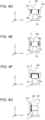
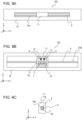
- Figs. 1A to 1C are views illustrating schematic configurations of a vibration body 1 of the vibration actuator.
- Fig. 1A is a plan view of the vibration body 1
- Fig. 1B is a front view of the vibration body 1
- Fig. 1C is a side view of the vibration body 1.
- an orthogonal coordinate system having an x-axis (x-direction), a y-axis (y-direction), and a z-axis (z-direction) is set for the vibration body 1.
- the z-direction is the thickness direction of the vibration body 1 and is a protruding direction of projecting portions 2a (described below in detail) that are provided at two positions.
- the y-direction is the longitudinal direction of the vibration body 1 and is a direction connecting the two projecting portions 2a.
- the x-direction is the transversal direction (width direction) of the vibration body 1 and is a direction perpendicular to the y-direction and the z-direction.
- a direction from the start point toward the end point of an arrow indicating the direction is defined as a positive direction (+direction)
- a direction from the end point toward the start point is defined as a negative direction (-direction).
- the vibration body 1 includes an elastic body 2 and an electric-mechanical energy conversion element 3 joined to the elastic body 2.
- the electric-mechanical energy conversion element 3 is, for example, a piezoelectric element that converts a voltage to a force by using an inverse piezoelectric effect, and electrodes to which a predetermined voltage is applied are provided on the front and back surfaces of rectangular thin-plate-shaped piezoelectric ceramics.
- the elastic body 2 includes the projecting portions 2a, suspending support portions 2b, support end portions 2c, and a base portion 2d.
- the base portion 2d has a rectangular flat-plate-like shape, and the electric-mechanical energy conversion element 3 is joined to the base portion 2d.
- the two projecting portions 2a are provided on the base portion 2d so as to protrude in the +z-direction from a surface opposite to a surface to which the electric-mechanical energy conversion element 3 is joined.
- the projecting portions 2a may be formed by press working the elastic body 2 (the base portion 2d) or by joining projecting members to the base portion 2d by using a predetermined method.
- the suspending support portions 2b are rectangular flat-plate-shaped portions that are provided at both ends of the base portion 2d in the y-direction and that serve to connect the base portion 2d and the support end portions 2c.
- the support end portions 2c are rectangular flat-plate-shaped portions for fixing the vibration body 1 to a holding portion 8 described below.
- Fig. 2C is a cross-sectional view illustrating a schematic structure of the projecting portion 2a.
- a friction material 2f is provided on a surface of a parent material 2e of the projecting portion 2a.
- the material of the parent material 2e is the same as that of the base portion 2d.
- martensitic stainless steel it is possible to use electroless nickel plating, chrome plating, a quench-hardened layer, a nitride film formed by ion nitriding treatment, or the like as the friction material 2f.
- parent material 2e By using a fiber-reinforced engineering plastic such as PEEK-CF30 or hard ceramics as the parent material 2e, it is also possible to use a configuration such that the parent material 2e serves also as the friction material 2f (in this case, there is no distinction between the parent material 2e and the friction material 2f).
- a fiber-reinforced engineering plastic such as PEEK-CF30 or hard ceramics
- the parent material 2e serves also as the friction material 2f (in this case, there is no distinction between the parent material 2e and the friction material 2f).
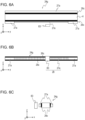
- FIG. 2A is a view for describing a first vibration mode
- Fig. 2B is a view for describing a second vibration mode.
- deformation of the vibration body 1 is illustrated with exaggeration.
- a contact body 4 that contacts the vibration body 1 and receives thrust (frictional driving force) from the vibration body 1 is illustrated.
- the contact body 4 is a member that contacts the projecting portions 2a of the vibration body 1. Due to vibration generated in the vibration body 1, the vibration body 1 and the contact body 4 move relative to each other in the y-direction as described below. Contact between the vibration body 1 and the contact body 4 is not limited to direct contact such that another member is not interposed between the vibration body 1 and the contact body 4. As long as the vibration body 1 and the contact body 4 move relative to each other due to vibration generated in the vibration body 1, contact between the vibration body 1 and the contact body 4 may be indirect contact such that another member is interposed between the vibration body 1 and the contact body 4.
- the first vibration mode illustrated in Fig. 2A is a secondary out-of-plane bending vibration mode in which three nodal lines that are substantially parallel to the x-direction are generated in the base portion 2d. Due to the first vibration mode, vibrations that become displaced in the y-direction are generated at end portions of the two projecting portions 2a.
- the second vibration mode illustrated in Fig. 2B is a primary out-of-plane bending vibration mode in which two nodal lines that are substantially parallel to the y direction are generated in the base portion 2d. Due to the second vibration mode, vibrations that become displaced in the z-direction are generated at the end portions of the two projecting portions 2a.
- a static frictional force between the projecting portions 2a and the contact body 4 serves as a holding force for maintaining the relative positions of the vibration body 1 and the contact body 4.
- adjusting the amplitude of vibration generated in the vibration body 1 by adjusting a voltage applied to the electric-mechanical energy conversion element 3 it is possible to adjust the contact time between the projecting portions 2a and the contact body 4 to change apparent frictional force.
- generating only vibration in the second vibration mode in the vibration body 1 and controlling the amplitude of the vibration it is possible to change a frictional force generated between the projecting portions 2a and the contact body 4.
- the end portions of the two projecting portions 2a contact the contact body 4.
- a friction material 4a is provided on a surface the contact body 4 that is a contact surface (frictional sliding surface) that contacts the projecting portions 2a.
- the friction material 2f is provided on the surface of the projecting portions 2a.
- the material of the friction material 4a and a method of forming the friction material 4a may be similar to those of the friction material 2f.
- Examples of the material of the elastic body 2 of the vibration body 1 include martensitic stainless steel whose vibration loss is small and high-toughness ceramics such as partially-stabilized zirconia (PSZ).
- Other examples the material include engineering plastics (FRP) such as polyether ether ketone (PEEK-CF30) reinforced by carbon fiber of about 30 wt%, semiconductors such as silicon carbide (SiC), and aluminum alloys.
- FRP engineering plastics
- PEEK-CF30 polyether ether ketone
- SiC silicon carbide
- Examples of the material of the electric-mechanical energy conversion element 3 of the vibration body 1 include piezoelectric ceramics such as lead zirconate titanate (PZT).
- Examples of the material of the contact body 4 include martensitic stainless steel, aluminum alloys, FRP such as PEEK-CF30, and fine ceramics such as PSZ or alumina (aluminum oxide).
- the materials of the vibration body 1 and the contact body 4 are not limited to those listed here.
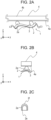
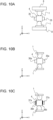
- Figs. 3A to 3D are views for describing the vibration actuator according to the first embodiment, and schematically illustrate the vibration body 1 and the contact body 4.
- Fig. 3A is a front view of the contact body 4 and one vibration body 1 pressed against (in pressed contact with) the contact body 4.
- an x-direction, a y-direction, and a z-direction are set as illustrated in Figs. 3A to 3D .
- the y-direction is defined as the left-right direction of the vibration actuator
- the +y side is defined as the right side
- the -y side is defined as the left side
- the z-direction is the up-down direction of the vibration actuator
- the +z side is defined as the upper side
- the -z side is defined as the lower side.
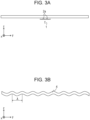
- Fig. 3B is a front view of the contact body 4, illustrating, with exaggeration, the vibration form of an out-of-plane bending mode generated in the contact body 4.
- a natural vibration mode is excited in the contact body 4 if the drive frequency is close to the natural frequency of the natural vibration mode of the contact body 4.
- an out-of-plane vibration mode that vibrates in the z-direction at a wavelength ⁇ with respect to a plane parallel to the xy-plane as illustrated in Fig.
- the projections 2a of the vibration body 1 and the contact body 4 intermittently repeat a contact state and a non-contact state.
- contact between the projections 2a and the contact body 4 becomes unstable, and, in addition, beating noise is generated and thrust decreases.
- the difference between a drive frequency exited in the vibration body 1 and the natural frequency of the natural vibration mode of the contact body 4 generates noise, and thrust may decrease.
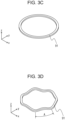
- Fig. 3D is a perspective view of the contact body 91 in which an out-of-plane bending mode generated in the contact body 91 is illustrated with exaggeration. Also in this case, when vibration is exited in the vibration body 1, a natural vibration mode is excited in the contact body 91 if the drive frequency of the vibration is close to the natural frequency of the natural vibration mode of the contact body 91.
- the excited out-of-plane vibration forms a progressive wave to become an amplified unnecessary vibration, and causes decrease in performance due to similar unnecessary vibration.
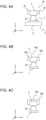
- Figs. 4A to 4G are right-side views for describing examples of a contact body unit and the vibration body 1 pressed against the contact body unit.
- Figs. 5A to 5C are bottom views illustrating schematic configurations of some of the contact body units illustrated in Figs. 4A to 4G .
- Fig. 4A is a view illustrating the basic configuration of a contact body unit according to the first embodiment, which is a configuration such that one vibration body 1 is pressed against the contact body 4 of a contact body unit 24.
- the contact body unit 24 is configured by joining a vibration-damping member 25 to a predetermined surface of the contact body 4 that is different from the contact surface, which is both side surfaces of the contact body 4 in the x-direction here.
- the vibration-damping member 25 is provided on both of the side surfaces of the contact body 4 in the x-direction that are connected to the contact surface and face each other.
- each of the vibration-damping members 25 is configured to be located above a lower end of the contact body 4, that is, the contact surface in the z-direction.
- the vibration-damping member 25 is constituted by a viscoelastic body or by a combination of a viscoelastic body and a reinforcement member.
- Figs. 4B to 4G are views for describing exemplary configurations of the vibration-damping member, illustrating configurations such that one vibration body 1 is pressed against the contact body 4 of the contact body unit.
- Fig. 4B is a view illustrating a contact body unit 24a, which is an example in which the vibration-damping member includes only a viscoelastic body 26a.
- Fig. 5A is a bottom view of the contact body unit 24a.
- the viscoelastic body 26a is joined to both side surfaces of the contact body 4 in the x-direction. It is assumed that the mechanical quality factor Q of the viscoelastic body 26a is lower than that of the contact body 4.
- a material having both of viscosity and elasticity such as rubber or resin is suitable.
- butadiene rubber, butyl rubber, silicon rubber, or the like having high vibration-damping performance is suitable.
- internal strain is generated in the viscoelastic body 26a in accordance with strain of the joining surface generated in accordance with deformation of the contact body 4 in a natural vibration mode excited in the contact body 4 as unnecessary vibration.
- Fig. 4C is a view illustrating a contact body unit 24b, which is an example in which the vibration-damping member includes only a viscoelastic body 26b that is joined also to a back surface of the contact body 4, which is a surface opposite to the contact surface.
- a bottom view which is similar to Fig. 5A , is omitted.
- the viscoelastic body 26b is joined to three surfaces (both side surfaces in the x-direction and the back surface) of the contact body 4 by fitting the contact body 4 into a groove portion in the viscoelastic body 26b having a recessed cross-sectional shape.
- rubber or resin is suitable as the material the viscoelastic body 26b.
- the contact body unit 24b may be configured by using a resin material having a large attenuation coefficient and by fitting the contact body 4 and viscoelastic body to each other.
- a resin material having a large attenuation coefficient By joining the viscoelastic body 26b to the three surfaces of the contact body 4, it is possible to increase region for absorbing vibration energy in accordance with strain generated in accordance with deformation of the contact body 4 and to increase the effect of suppressing unnecessary vibration compared with the contact body unit 24a.
- Fig. 4D is a view illustrating a contact body unit 24c, which is an example in which the vibration-damping member includes a combination of a viscoelastic body 26c and a reinforcement member 27a.
- Fig. 5B is a bottom view of the contact body unit 24c.
- the viscoelastic body 26c is joined to both side surfaces of the contact body 4 in the x-direction, and the reinforcement member 27a is joined to the viscoelastic body 26c. In this way, the viscoelastic body 26c is interposed between the contact body 4 and the reinforcement member 27a.
- rubber or resin is suitable as the material of the viscoelastic body 26c, and a double-sided tape or an adhesive may be used additionally. It is assumed that the mechanical quality factor Q of the viscoelastic body 26c is lower than that of each of the contact body 4 and the reinforcement member 27a.
- a material whose elastic modulus is sufficiently higher than that of the viscoelastic body 26c is suitable. For example, various metals, ceramics, engineering plastic, and the like are usable, and the material may be the same as that of the contact body 4.
- both side surfaces of the viscoelastic body 26c are joined to the contact body 4 and the reinforcement member 27a. Since the displacement distribution of the viscoelastic body 26c is restrained at the joint surface with the reinforcement member 27a having a larger elastic modulus, it is possible to absorb vibration energy by generating shearing strain of the viscoelastic body 26c due to deformation of the contact body 4 and to reduce the vibration amplitude of unnecessary vibration generated in the contact body 4.
- Fig. 4E is a view illustrating a contact body unit 24d, which is an example in which the vibration-damping member has a multilayer structure in which a plurality of viscoelastic bodies 26d and a plurality of reinforcement members 27b are alternately arranged.
- Fig. 5C is a bottom view of the contact body unit 24d.
- a viscoelastic body 26d and a reinforcement member 27b are joined from both sides of the contact body 4 in the x-direction and another set of a viscoelastic body 26d and a reinforcement member 27b are further joined.
- the materials of the viscoelastic body 26d and the reinforcement member 27b are similar to those described with reference to Fig. 4D .
- the vibration-damping member has a multilayer structure in which the plurality of the viscoelastic bodies 26d and the plurality of the reinforcement members 27b are alternately arranged, it is possible to increase vibration energy to be absorbed by generating shearing strain. Thus, it is possible to more effectively reduce the vibration amplitude of unnecessary vibration generated in the contact body 4. Moreover, compared a case of the contact body unit 24c, it is possible to reduce the thickness of the viscoelastic body 26d in the x-direction. By reducing the thickness of the viscoelastic body 26d, it is possible to reduce displacement of the vibration-damping member in the xy-plane when an external force is applied to the contact body unit 24d via the reinforcement member 27b.
- a linear guide that linearly guides the contact body unit 24d is configured by supporting the reinforcement member 27b that is exposed on a side surface, it is possible to improve the rigidity of the linear guide, compared with a case of the contact body unit 24c. Thus, it is possible to position the contact body 4 with high precision.
- Fig. 4F is a view illustrating a contact body unit 24e, which is an example in which the vibration-damping member includes a combination of a viscoelastic body 26e and a reinforcement member 27c and is joined also to the back surface of the contact body 4.
- a bottom view which is similar to Fig. 5B , is omitted.
- the viscoelastic body 26e is joined to three surfaces (both side surfaces in the x-direction and the back surface) of the contact body 4 by fitting the contact body 4 into a groove portion of the viscoelastic body 26e having a recessed cross-sectional shape.
- the reinforcement member 27c is joined to three surfaces (both side surfaces in the x-direction and the back surface) of the viscoelastic body 26e by fitting the viscoelastic body 26e into a groove portion of the reinforcement member 27c having a recessed cross-sectional shape. That is, this is an example of a combination of the configuration of the contact body unit 24b illustrated in Fig. 4C and the configuration of the contact body unit 24c illustrated in Fig. 4D .
- the materials of the viscoelastic body 26e and the reinforcement member 27c are similar to those described with reference to Fig. 4D .
- Advantageous effects due to this configuration are also similar to those described with reference to Fig. 4C and Fig. 4D .
- Fig. 4G is a view illustrating a contact body unit 24f, which is an example in which the vibration-damping member includes a combination of a viscoelastic body 26f and a reinforcement member 27d.
- the viscoelastic body 26f is joined to one side surface of the contact body 4 in the x-direction (the left side surface in the illustrated example), and the reinforcement member 27d is joined to the viscoelastic body 26f.
- an adhesive is used as the viscoelastic body 26f, and due to the wettability of the adhesive, the viscoelastic body 26f spreads to two flat surfaces (the contact surface and the back surface) of the contact body 4 that are parallel to the xy-plane.
- the amount of the adhesive to become the viscoelastic body 26f is controlled so that the adhesive may not contact the projection 2a of the vibration body 1.
- the reinforcement member 27d has a length in the z-direction that exceeds the thickness of the contact body 4 so as to receive the adhesive. In this way, end portions of the vibration-damping member (end portions of the viscoelastic body 26f, end portions of the reinforcement member 27d) protrude further than the contact surface and the back surface.
- the material of the reinforcement member 27d is similar to that described regarding the contact body unit 24c with reference to Fig. 4D .
- the contact body unit 24f it is possible to obtain the advantageous effect of suppressing unnecessary vibration by absorbing excitation energy by using shearing strain of the viscoelastic body 26f. Since the viscoelastic body 26f spreads to two flat surfaces of the contact body parallel to the xy-plane, the adhesive strength of the reinforcement member 27d is increased, and absorption of excitation energy is performed as internal strain is generated in the viscoelastic body that has spread. Thus, it is possible to reduce the vibration amplitude of unnecessary vibration generated in the contact body 4.
- various contact body units and vibration-damping members (viscoelastic bodies, reinforcement members) described with reference to Figs. 4A to 4G may be referred to as the contact body unit 24, the vibration-damping member 25, the viscoelastic body 26, and the reinforcement member 27 by using representative numerals. It is also possible to provide the vibration-damping member 25 with a function other than suppression of unnecessary vibration.
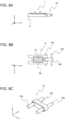
- FIGs. 6A, 6B, and 6C are respectively a plan view, a front view, and a right-side view illustrating the positional relationship between a contact body unit 24g and a detector 83.
- the viscoelastic body 26c is joined to both side surfaces of the contact body 4 in the x-direction
- the reinforcement member 27a is joined to the viscoelastic body 26c
- a part of the reinforcement member 27a is replaced with a scale 27e.
- the scale 27e is a reflective diffraction grating and has a pattern of reflective portions and non-reflective portions formed by removing a metal film, deposited on a glass surface, by etching or laser processing.
- the scale 27e is joined to the viscoelastic body 26c, and thus constrains a side surface of the viscoelastic body 26c and functions as a reinforcement member. In this way, a part of the vibration-damping member 25 constitutes the scale 27e.
- the detector 83 is set at a position that is separated by a gap from the scale 27e in the x-direction and that does not physically interfere with the scale 27e.
- the detector 83 includes a light source and a light receiver, and can read the scale 27e by emitting light from the light source to the scale 27e and receiving reflection of the light with the light receiver.
- the detector 83 and the scale 27e constitute a displacement-detecting portion 28 and functions as a linear encoder that detects displacement in the y-direction.
- the scale 27e can have the effects and the functions of both of the vibration-damping member 25 and the displacement-detecting portion 28.
- the viscoelastic body 26c serves as a vibration insulator that makes it difficult for vibration of the contact body 4 to be transmitted the scale 27e, and thus it is possible to reduce displacement detection error due to vibration of the scale 27e.
- the scale 27e in the z-direction is illustrated to be less than that of the contact body 4 in Figs. 6A to 6C , as described above with reference to Fig. 4G , the scale 27e may be configured to overhang toward the contact surface side of the contact body 4. When the scale 27e overhangs, the area of the viscoelastic body 26 is increased, and it is possible to further increase the vibration-damping effect. As described below with reference to Fig.
- the scale 27e and the reinforcement member 27a are illustrated as independent bodies in Figs. 6A to 6C , a film-shaped scale may be affixed to a side surface of the reinforcement member. It may be possible to form a scale by performing vapor deposition or printing on a side surface of the viscoelastic body. Although an exemplary configuration such that a scale is affixed to a side surface of the contact body via a viscoelastic body has been described above, this is not a limitation.
- the contact body may be formed from a metal, protruding/recessed shapes may be formed on a side surface of the contact body by etching or electroforming, and a viscoelastic body may be injected into recessed portions.
- a shape such that the viscoelastic body is disposed in the recessed portion is periodically repeated in the y-direction, the protruding portions serve as reflective portions and the viscoelastic body injected into the recessed portions serve as non-reflective portions.
- a function equivalent to that of a scale is realized, and it can be expected that the injected viscoelastic body suppresses unnecessary vibration in the same way as described above.
- the contact body units 24 described with reference to Figs. 4A to 6C are examples in which the vibration-damping member 25 is joined to the contact body 4 over the entire area in the y-direction.
- this is not a limitation, and the vibration-damping member 25 may be joined to the contact body 4 in a part in the y-direction.
- providing the vibration-damping member 25 over the entire area in the y-direction is effective in suppression of unnecessary vibration
- providing the vibration-damping member 25 in a part in the y-direction makes it possible to achieve reduction in size, weight, and space, prevention of interference with other components, cost reduction, and the like.
- a first criterion is that the sum total of the length of the vibration-damping member 25 in the y-direction is greater than or equal to 1/2 of the wavelength of a natural vibration mode excited in the contact body 4 (greater than or equal to 1/2 ⁇ in Figs. 3A to 3D ).
- a second criterion is that the sum total of the length of the vibration-damping member 25 in the y-direction is greater than or equal to the length of the interval between adjacent nodal lines of a vibration mode excited in the vibration body 1.
- a third criterion is that the sum total of the length of the vibration-damping member 25 in the y-direction is greater than or equal to the center-to-center distance between the projections 2a of the elastic body 2.
- a fourth criterion is that the vibration-damping member 25 is provided at a position including an antinode of a natural vibration mode excited in the contact body 4.
- the vibration-damping member 25 on a side surface of the contact body 4, it is possible to suppress unnecessary vibration generated in the vibration actuator and to prevent output power (thrust) per volume or per weight from becoming small.
- the width of the contact body unit 24 in the x-direction is illustrated to be greater than the width of the vibration body 1 and less than the width of the holding portion 8 in Figs. 4A to 4G , this is not a limitation.
- the shape and the material of the viscoelastic body 26 and the reinforcement member 27 of the vibration-damping member 25 it is also possible to further reduce the width dimension of the contact body unit 24 and to set the width dimension to be, for example, less than the width dimension of the vibration body 1. In this way, it is possible to reduce the size of the vibration actuator.
- the present invention is effective for another natural vibration mode such as an in-plane vibration mode, a torsional vibration mode, or the like. Also for vibration such as in-plane vibration and torsional vibration, it is possible to suppress the vibration in the same way as for out-of-plane vibration by providing the vibration-damping member 25 so as to include an antinode with large strain.
- vibration-damping member 25 by appropriately changing the disposition of the vibration-damping member 25 and the configuration of the vibration-damping member 25, it is possible to suppress unnecessary vibration due to any vibration mode, for a plurality of vibration modes whose positions of portions (antinodes) where strain of the vibration mode is large differ.
- the viscoelastic body 26 does not cover an end portion of the contact body 4 including a surface parallel to the xz-plane. Even when the viscoelastic body 26 covers the end portion of the contact body 4, the effect of suppressing unnecessary vibration is not likely to decrease, and such a configuration is not beyond the scope of the present invention. However, since only a small effect of suppressing unnecessary vibration is obtained by covering a surface parallel to the xz-plane where strain is not generated with respect to unnecessary vibration of the contact body 4, examples in each of which the vibration-damping member is joined to a side surface of the contact body 4 have been described in the present embodiment.
- the contact surface of the contact body 4 is to be protruded with respect to the vibration-damping member 25 or the vibration-damping member 25 is to be provided at a position of an antinode of a specific natural vibration mode, it is necessary to assemble the contact body unit 24 after determining the relative positions of the contact body 4 and the vibration-damping member 25 with high precision. In such a case, it is possible to efficiently assemble the contact body unit 24 by providing the vibration-damping member 25 and the contact body 4 with a positioning structure such as a positioning pin, a parallel key, any other protruding/recessed shape or mark, or the like.
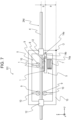
- Fig. 7 is a front view illustrating a schematic configuration of a vibration actuator 101 according to the first embodiment.
- Figs. 8A to 8C are views for describing configurations of a vibration body unit 5 of the vibration actuator 101 according to the first embodiment.
- the vibration actuator 101 includes one vibration body unit 5 and the contact body 4 that contacts the vibration body 1 of the vibration body unit 5.
- the contact body unit 24d described above (referred to as the contact body 4 in the following description) is used in order to suppress unnecessary vibration generated in the contact body 4.
- Various components of the vibration actuator 101 are assembled on a support member 15 that is a base member.
- the vibration body unit 5 includes the vibration body 1, a nonwoven cloth 16, a pressing portion 7, the holding portion 8, a reaction-force receiving portion 9, and a rotation support portion 10.
- the vibration body unit 5 has a pressing support structure that can excite vibration in the vibration mode described with reference to Figs. 2A to 2C .
- the support end portions 2c of the elastic body 2 are fixed to an upper surface of a wall portion on the y-direction side, which is a side wall of the holding portion 8.
- the nonwoven cloth 16 is disposed on the back surface side (a surface opposite to a surface joined to the elastic body 2) of the electric-mechanical energy conversion element 3.
- the nonwoven cloth 16 is a cloth-like member made of a nonwoven cloth material such as wool felt, glass wool, or the like, and supports the vibration body 1 while maintaining a vibration mode generated in the vibration body 1.
- the pressing portion 7 presses the vibration body 1 against the contact body 4 via the nonwoven cloth 16, the projecting portions 2a of the vibration body 1 contact the contact body 4.
- the vibration body 1 is fixed to the holding portion 8, and the holding portion 8, integrated with the vibration body 1, is pressed toward the contact body 4.
- Fig. 8A is a front view of a main part of the vibration body unit 5
- Fig. 8B is a bottom view corresponding to Fig. 8A .
- a through-hole 8e extending therethrough in the z-direction is provided, and the electric-mechanical energy conversion element 3 is in a state of being exposed from the through-hole 8e when the holding portion 8 is seen from the -z-direction side in a state in which the vibration body 1 is held by the holding portion 8.
- the nonwoven cloth 16 (the hatched region in Fig. 8B ) is set inside of the through-hole 8e so as to be in contact with the electric-mechanical energy conversion element 3.
- a flexible wiring board (not shown) for supplying electric power to the electric-mechanical energy conversion element 3 is attached to the back surface (surface on the -z-direction side) of the electric-mechanical energy conversion element 3.
- the nonwoven cloth 16 is set so as to be in contact with the flexible wiring board attached to the electric-mechanical energy conversion element 3.
- the pressing portion 7 presses the projecting portions 2a of the vibration body 1 against the contact body 4 via the nonwoven cloth 16 with a predetermined pressing force.
- the pressing portion 7 includes an elastic component having an elastic force such as a coil spring, a plate spring, a coned disc spring, a wave washer, rubber, an air tube, or the like that exhibits a restoring force in the z-direction. It is also possible to configure a pressing portion that uses a magnetic force instead of an elastic force, and a magnet or the like can be used in this case. In the present embodiment, a compression coil spring is used as the pressing portion 7.
- the reaction-force receiving portion 9 is disposed so as to contact the back surface (a surface opposite to the contact surface) of the contact body 4, and receives a reaction force of a pressing force that presses the projecting portions 2a of the vibration body 1 against the contact body 4.
- Two reaction-force receiving portions 9 that face each other are provided in the negative y-axis direction with respect to the vibration body unit 5, and thus three reaction-force receiving portions 9 and one vibration body unit 5 support the contact body 4 in the z-direction.
- each of the reaction-force receiving portions 9 includes a roller that is supported by the rotation support portion 10, which is attached to the support member 15, so as to be rotatable around an axis parallel to the x-axis.
- the support member 15 is fixed a frame or the like of an apparatus in which the vibration actuator 101 is mounted, and that the contact body 4 moves in the y-direction relative to the support member 15 (the vibration body unit 5) whose position does not change in the apparatus.
- the contact body 4 is supported by the support member 15 in a state of being movable in the y-direction due to thrust that the contact body 4 receives from the vibration body 1 included in the vibration body unit 5.
- the support member 15 four rollers that are rotatable around axes parallel to z-axis are provided as contact-body support portions 12 that movably support the contact body 4.
- the four contact-body support portions 12 function as a linear guide that allows the contact body 4 to move in the y-direction in a state in which the degree of freedom of the contact body 4 in the x-direction is constrained.
- Fig. 8C is a perspective view illustrating a schematic configuration of the coupling portion 14.
- the coupling portion 14 includes a link member 14b (linking portion) in which two holes are formed at a predetermined interval so as to extend therethrough in the x-direction and cylindrical pins 14a (shaft) that are respectively inserted into the two holes of the link member 14b and substantially parallelly attached to the link member 14b.
- Two pins 14a are fixed to the link member 14b in the respective holes of the link member 14b.
- the two pins 14a and the link member 14b may be integrally (seamlessly) formed in an H-shape as seen from the z-direction.
- One of the two pins 14a is positioned at a position that is separated by a distance a in the +z-direction from a reference origin O of the support member 15 illustrated in Figs. 4A to 4G , and thus the coupling portion 14 has a degree of rotational freedom around a central axis of the pin 14a positioned with respect to the support member 15.
- the center of the contact body 4 is positioned at a position that is separated by a distance b in the +z-direction from the center of the pin 14a positioned with respect to the support member 15.
- the contact body 4 is positioned, with high precision, at a position that is separated by a distance a + b from the reference origin O of the support member 15 in the +z-direction.
- the vibration body unit 5 it is possible for the vibration body unit 5 to slide in the z-direction, and it is possible to press the vibration body unit 5 against the contact body 4 as the vibration body unit 5 conforms to the shape of the contact body 4 even if the contact body 4 has a shape having undulation in the yz-plane due to a manufacturing error or the like.
- Figs. 9A to 9C are views illustrating schematic configurations of another vibration actuator 102 according to the first embodiment.
- Fig. 9A is a plan view of the vibration actuator 102
- Fig. 9B is a front view of the vibration actuator 102.
- the vibration actuator 102 includes one vibration body unit 11 and the contact body 4 that contacts the vibration body 1 of the vibration body unit 11, the contact body 4 is fixed to the support member 15, and the vibration body 1 performs relative movement.
- the contact body unit 24d described above (referred to as the contact body 4 in the following description) is used in order to suppress unnecessary vibration generated in the contact body 4.
- Constituent elements of the vibration actuator 102 that correspond to those of the vibration actuator 101 (see Fig. 7 ) will be denoted by the same names and numerals, and descriptions of common configurations and functions will be omitted.
- the vibration body unit 11 includes a holding portion 18 in which the holding portion 8, a pressing portion 13, the reaction-force receiving portion 9, and the rotation support portion 10 are integrated as a unit.
- a spacer 19 to which the nonwoven cloth 16 is affixed is disposed inside of the holding portion 18.
- the support end portions 2c at ends of the vibration body 1 in the y-direction are fixed to the holding portion 18.
- Fig. 9C is a right-side view illustrating a schematic configuration for describing the supporting relationship between the vibration body unit 11 and the contact body 4.
- An opening 18a is formed in the holding portion 18.
- the dimension of the opening 18a in the x-direction is set to be greater than the width dimension of the contact body 4 in the x-direction, and, since an appropriate gap is provided, the opening 18a functions as a linear guide that allows the vibration body unit 11 to move in the y-direction.
- the reaction-force receiving portion 9 is provided opposite to the contact surface between the contact body 4 and the projecting portions 2a (above (on the +z side of) the contact body 4), and receives a reaction force of a force that presses the vibration body 1 (the projecting portions 2a) against the contact body 4.
- the reaction-force receiving portion 9 is supported by a rotation support portion 10 (not shown) equivalent to the rotation support portion 10 of the vibration actuator 101 so as to be rotatable around an axis parallel to the x-axis, and a compression coil spring is disposed as the pressing portion 13 for the rotation support portion 10.
- the reaction-force receiving portion 9 is pressed against the contact body 4 and the end portions of the two projecting portions 2a of the vibration body 1 are pressed against the contact body 4.
- the vibration actuator 102 With the vibration actuator 102, it is possible for the vibration body unit 11 to move in the y-direction.
- an opening 15a in the support member 15 As illustrated in Fig. 9A , it is possible to expose the upper surface of the vibration body unit 11 to the outside, and it is possible to connect an object to be driven to the upper surface.
- vibration-damping member 25 that is an independent body is joined to a side surface of the contact body 4
- this is not a limitation.
- Exemplary configurations for providing the contact body with a vibration-damping member include the following examples.
- a vibration-damping member by dipping, which is a coating method in which a contact body is immersed in a liquid rubber or a liquid resin.
- dipping for portions (for example, the contact surface and the like) where some inconvenience occurs if the viscoelastic body adheres, it is possible to avoid covering with the viscoelastic locally by providing a mask on the contact body beforehand and removing the mask after the dipping process.
- vibration-damping member by insert molding, which is a method of performing integral molding by setting the contact body and the reinforcement member in a die and injecting a resin material that has been heated and melted into a space between the contact body and the reinforcement member.
- the contact body and the viscoelastic body by double molding.
- PEEK polyetheretherketone
- carbon fiber carbon fiber
- an elastomer may be used as the viscoelastic body as secondary forming.
- These configurations can not only increase mass-productivity and allow the viscoelastic body to be configured at low cost but also provide an effect of increasing cohesion between the viscoelastic body and the contact body to prevent removal and positional displacement of the viscoelastic body.
- the viscoelastic body is to be formed by using a die, it is possible to determine the relative positions of the contact body and the reinforcement member with high precision and to configure a viscoelastic body having a complex shape.
- the contact body 4 has a linear shape having the y-direction as the longitudinal direction
- this is not a limitation. It is possible for the contact body to have any curved shape, and, it is possible to suppress unnecessary vibration by providing a vibration-damping member also in a curved contact body. Also when a curved contact body is used, it is possible to fix the vibration body and to cause the contact body to be on the driven side. At this time, it is preferable to configure a contact-body support portion having a shape conforming with the shape of the contact body. Conversely, it is also possible to fix the contact body and to cause the vibration body to be on the driven side, and, in this case, the vibration body unit performs relative movement along the curved contact body.
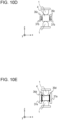
- Figs. 10A to 10E are right-side views illustrating examples of a contact body unit and the vibration body 1 pressed against the contact body unit.
- Fig. 10A is a view illustrating the basic configuration of the contact body unit according to the second embodiment, which is a configuration such that two vibration bodies 1 facing each other are pressed against the contact body 4 of a contact body unit 34. That is, the contact body 4 has contact surfaces on the upper and lower sides (in the positive z-direction and the negative z-direction) thereof.
- the contact body unit 34 is configured by joining a vibration-damping member 35 to both side surfaces of the contact body 4 in the x-direction.
- An upper end and a lower end of the vibration-damping member 35 are respectively configured to be located below and above an upper end and a lower end of the contact body 4 in the z-direction.
- the vibration-damping member 35 is constituted by a viscoelastic body or by a combination of a viscoelastic body and a reinforcement member.
- Figs. 10B to 10E are views for describing exemplary configurations of the vibration-damping member, illustrating configurations such that two vibration bodies 1 facing each other are pressed against the contact body 4 of the contact body unit.
- Fig. 10B is a view illustrating a contact body unit 34a, which is an example in which the vibration-damping member includes only a viscoelastic body 36a, as with the contact body unit 24a described with reference to Fig. 4B .
- the viscoelastic body 36a is joined to both side surfaces of the contact body 4 in the x-direction.
- the characteristics and the materials of the vibration-damping member and the mechanism for suppressing unnecessary vibration are similar to those of the contact body unit 24a, and descriptions thereof will be omitted here.
- Fig. 10C is a view illustrating a contact body unit 34b, which is an example in which the vibration-damping member includes a combination of a viscoelastic body 36b and a reinforcement member 37a, as with the contact body unit 24c described with reference to Fig. 4D .
- the viscoelastic body 36b is joined to both side surfaces of the contact body 4 in the x-direction, and the reinforcement member 37a is joined to the viscoelastic body 36b.
- the characteristics and the materials of the vibration-damping member and the mechanism for suppressing unnecessary vibration are similar to those of the contact body unit 24c, and descriptions thereof will be omitted here.
- Fig. 10D is a view illustrating a contact body unit 34c, which is an example in which the vibration-damping member has a multilayer structure in which a plurality of viscoelastic bodies 36c and a plurality of reinforcement members 37b are alternately arranged, as with the contact body unit 24e described with reference to Fig. 4E .
- a viscoelastic body 36c and a reinforcement member 37b are joined from both sides of the contact body 4 in the x-direction, and another set of a viscoelastic body 36c and a reinforcement member 37b are further joined.
- the characteristics and the materials of the vibration-damping member and the mechanism for suppressing unnecessary vibration are similar to those of the contact body unit 24e, and descriptions thereof will be omitted here.
- Fig. 10E is a view illustrating a contact body unit 34d, which is an example in which the vibration-damping member includes a combination of a viscoelastic body 36d using an adhesive and a reinforcement member 37e, as with the contact body unit 24f described with reference to Fig. 4G .
- the example illustrated in 4G is an example in which the vibration-damping member is provided on only one side surface of the contact body 4 in the x-direction, here, the vibration-damping member is provided on both side surfaces of the contact body 4 in the x-direction.
- the characteristics and the materials of the vibration-damping member and the mechanism for suppressing unnecessary vibration are similar to those of the contact body unit 24f, and descriptions thereof will be omitted here.
- contact body units and vibration-damping members (viscoelastic bodies, reinforcement members) described with reference to Figs. 10A to 10E may be referred to as the contact body unit 34, the vibration-damping member 35, the viscoelastic body 36, and the reinforcement member 37 by using representative numerals.
- the vibration-damping member 35 on a side surface of the contact body 4, it is possible to suppress unnecessary vibration generated in the vibration actuator and to prevent output power (thrust) per volume or per weight from becoming small.
- Fig. 11 is a front view illustrating a schematic configuration of a vibration actuator 201 according to the second embodiment.
- the vibration actuator 201 includes two vibration body units 21 and the contact body 4 that contacts the vibration bodies 1 of the vibration body units 21.
- the contact body unit 34c described above (referred to as the contact body 4 in the following description) is used in order to suppress unnecessary vibration generated in the contact body 4.
- Various components of the vibration actuator 201 are assembled on the support member 15 that is a base member.
- Each vibration body unit 21 includes two vibration bodies 1, the nonwoven cloths 16, a pressing portion 17, and the holding portions 8.
- the vibration bodies 1 facing each other are pressed against the contact body 4 by hooking ends of the pressing portion 17 on hooks 8a provided on side surfaces of the holding portions 8.
- a tension spring is used as the pressing portion 17.
- each holding portion 8 is attached to the support member 15 via the coupling portion 14 to perform positioning of the contact body 4 in the z-direction, and the vibration bodies 1 and the holding portions 8 are slidable in the z-direction.
- This configuration is a configuration such that the three sets of reaction-force receiving portions 9 and rotation support portions 10 of the vibration actuators 101 are replaced with the vibration bodies 1 and the holding portions 8.
- the projections 2a of the vibration body 1 serve as the reaction-force receiving portions 9.
- the contact body 4 is supported by the support member 15 in a state of being movable in the y-direction due to thrust that the contact body 4 receives from the vibration body 1 included in each vibration body unit 21.
- the support member 15 four rollers that are rotatable around axes parallel to z-axis are provided as contact-body support portions 12 that movably support the contact body 4.
- the four contact-body support portions 12 function as a linear guide that allows the contact body 4 to move in the y-direction by constraining the degree of freedom of a side surface of the reinforcement member 37b in the xy-plane.
- the vibration actuator 201 having such a configuration, it is possible to reduce constituent elements such as the reaction-force receiving portion 9 and the rotation support portion 10 by supporting the contact body 4 in the z-direction by using four vibration bodies 1. Moreover, it is possible to increase the thrust of the vibration actuator 201 by using the vibration body unit 21 instead of the reaction-force receiving portion 9 and the rotation support portion 10. If the vibration body 1 used in the vibration actuator 101 and the vibration body 1 used in the vibration actuator 201 have the same performance, the vibration actuator 201 can obtain thrust that is four times larger than the thrust obtained by the vibration actuator 101. With the configuration of the contact body unit 34c described above, it is possible to increase the effect of suppressing unnecessary vibration generated in the contact body 4 and to prevent generation of noise and decrease of performance due to unnecessary vibration.
- the thickness of the viscoelastic body in the x-direction compared with the contact body units 34a and 34b.
- By reducing the thickness of the viscoelastic body it is possible to reduce displacement of the vibration-damping member in the xy-plane when an external force is applied to the contact body unit 34c via the reinforcement member 37b, and it is possible to increase rigidity as a linear guide.
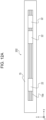
- Figs. 12A and 12B are views illustrating schematic configurations of another vibration actuator 202 according to the second embodiment.
- Fig. 12A is a plan view of the vibration actuator 202
- Fig. 12B is a front view of the vibration actuator 202.
- the vibration actuator 202 includes three vibration body units 22 and the contact body 4 that contacts the vibration bodies 1 of the vibration body units 22, the contact body 4 is fixed to the support member 15, and the vibration bodies 1 perform relative movement.
- the contact body unit 34c described above (referred to as the contact body 4 in the following description) is used in order to suppress unnecessary vibration generated in the contact body 4.
- Constituent elements of the vibration actuator 202 that correspond to those of the vibration actuator 201 (see Fig. 11 ) will be denoted by the same names and numerals, and descriptions of common configurations and functions will be omitted.
- the vibration body unit 22 is a unit such that the reaction-force receiving portion 9 and the rotation support portion 10 of the vibration body unit 11 used in the vibration actuator 102 are replaced with the vibration body 1 and the spacer 19.
- the vibration bodies 1 facing each other are pressed against the contact body 4 by hooking ends of the pressing portion 17 on hooks 19a provided on the spacer 19.
- the two vibration bodies 1 are supported by the holding portions 18 to be slidable in the z-direction, and the degree of freedom other than that in the z-direction is constrained with respect to the holding portions 18.
- the opening 18a is provided in the holding portion 18 and functions as a linear guide that allows the vibration body unit 22 to move in the y-direction.
- the vibration body unit 22 on the left side can be driven in the y-direction.
- the vibration body units 22 at the center and at the right end are coupled to each other by the coupling portion 14 via the holding portion 18 to be slidable relative to each other in the z-direction.
- the coupling portion 14 be provided to be offset in the x-direction so as not to interfere with the contact body 4. It is possible to drive the vibration body unit group 23, which is constituted by the two coupled vibration body units 22, together in the y-direction.
- the vibration actuator 202 it is possible for the left vibration body unit 22 and the vibration body unit group 23 to move independently in the y-direction.
- By providing an opening 15b in the support member 15 as illustrated in Fig. 12A it is possible to expose the upper surfaces of the left vibration body unit 22 and the vibration body unit group 23 to the outside, and it is possible to connect an object to be driven to the upper surfaces.
- the vibration actuator 202 configured as described above, it is possible to independently drive the plurality of vibration body units 22 or the vibration body unit group 23 via one contact body 4. At this time, by using the contact body unit 34c, it is possible to effectively suppress unnecessary vibration excited in the contact body. Moreover, since the two vibration body units 22 are coupled to constitute the vibration body unit group 23, it is possible for the vibration body unit group 23 to generate thrust that is four times larger than that of the vibration body unit 11.
- each vibration body 1 conforms to the contact body 4 with respect to deformation of the contact body in the longitudinal direction (in the yz-plane), and thus it is possible to reduce variation in pressing reaction force applied to each vibration body 1. Thrust decreases in a vibration body 1 to which a relatively small pressing reaction force is applied, and a risk of wear due to overload or the like occurs in a vibration body 1 to which a relatively large pressing reaction force is applied.
- the vibration body unit group 23 it is possible to reduce variation in pressing reaction force and to efficiently generate thrust in each vibration body 1.
- Figs. 13A to 13F are right side views for describing examples of a contact body unit and the vibration bodies 1 pressed against the contact body unit.
- Fig. 13A illustrates a configuration such that two vibration bodies 1 facing each other support the contact body 4, which is a configuration similar to those described with reference to Figs. 10A to 10E .
- Fig. 13B illustrates a configuration such that a contact body 74b having a polygonal cross section is supported by disposing vibration bodies 1 on four side surfaces of the contact body 74b.
- Four vibration-damping members 75a are joined to the contact body 74b at positions displaced from the vibration bodies 1 to constitute a contact body unit having a rectangular cross section.
- the vibration-damping members 75a are similar to the vibration-damping members 25 and 35 described above.
- Fig. 13C illustrates a configuration such that a side surface (curved surface) of a contact body 74c having a substantially circular cross section is supported by three vibration bodies 1 that are arranged at substantially 120° interval in the zx-plane.
- Three fan-shaped vibration-damping members 75b are joined to the side surface of the contact body 74c to constitute a contact body unit having a circular cross section.
- the vibration-damping members 75b are similar to the vibration-damping members 25 and 35 described above.
- Fig. 13D illustrates a configuration such that a contact body 74d having a polygonal (here, hexagonal) cross section is supported by disposing vibration bodies 1 on three side surfaces that are not adjacent to each other, among the side surfaces of the contact body 74d.
- Three vibration-damping members 75c are joined to the other three side surfaces of the contact body 74d against which the vibration bodies 1 are not pressed.
- the vibration-damping members 75c are similar to the vibration-damping members 25 and 35 described above.
- Fig. 13E illustrates a configuration such that a side surface (curved surface) of a contact body 74e having a substantially circular cross section is supported by vibration bodies 1 and 81 whose size and thrust differ from each other.
- two fan-shaped vibration-damping members 75b are joined to the side surface of the contact body 74e to constitute a contact body unit having a circular cross section.
- Fig. 13F illustrates a configuration such that a side surface (curved surface) of the contact body 74e having a substantially circular cross section is supported by two vibration bodies 1 and two reaction-force receiving portions 9.
- two fan-shaped vibration-damping members 75b are joined to the side surface of the contact body 74e to constitute a contact body unit having a circular cross section.
- vibration bodies By appropriately combining these configurations, it is possible to appropriately support a contact body having any of various cross-sectional shapes by using vibration bodies. By providing vibration-damping members on the side surface of the contact body, it is possible to suppress unnecessary vibration generated in a vibration actuator and to prevent output power (thrust) per volume or per weight from becoming small.
- Fig. 14 is a front view illustrating a state in which a displacement-detecting portion 87 is attached to the vibration body unit 22.
- the vibration body unit 22 is described here, it is also possible to mount the displacement-detecting portion 87 on another vibration body unit.
- the displacement-detecting portion 87 includes a scale 82 and the detector 83.
- the scale 82 is attached to the contact-body support portion 12, which is provided on the holding portion 18, at a position that does not physically interfere with (does not contact) the contact body 4 (not shown in Fig. 14 ).
- the scale 82 rotates together with the contact-body support portion 12 in accordance with displacement of the contact body 4.
- the detector 83 detects the movement amount of the contact body 4 in the y-direction by reading the rotational displacement of the scale 82.
- the detector 83 includes a light source and a light receiver, and can read the rotational displacement of the scale 82 by emitting light from the light source to the scale 82 and receiving reflection of the light with the light receiver. Based on the movement amount of the contact body 4 in the y-direction output by the detector 83, it is possible to control drive parameters such as the position, the velocity, the acceleration, and the like of the contact body 4.
- the displacement-detecting portion 87 various types such as an optical type, a magnetic type, a capacitance type, and the like can be used. Although the displacement-detecting portion 87 described here is of a reflective optical type, a transmissive optical type can also be used. Moreover, instead of the displacement-detecting portion 87 of a rotational type, a linear displacement-detecting portion in which a linear scale is disposed on the contact body 4 and a detector is disposed in the vibration body unit may be used.
- a third embodiment will be described.
- an actuator unit in which a vibration actuator is unitized (packaged) by using an outer member will be described.
- Constituent elements of the vibration actuator that are similar to those of the first embodiment will be denoted by the same names and numerals, and descriptions of common configurations and functions will be omitted. It is assumed that the orthogonal coordinate system is similar to that in the first embodiment.
- Figs. 15A to 15D are views illustrating schematic configurations of an actuator unit 401 according to the third embodiment.
- Figs. 15A to 15D are respectively a plan view (top view), a side view, a front view, and a perspective view of the actuator unit 401.
- the actuator unit 401 is formed by unitizing the vibration actuator 201 by using an outer member 86.
- the support member 15 of the vibration actuator 201 is movably fixed to an inner bottom surface of the outer member 86.
- Motive power of the contact body 4 is output as the contact body 4 moves in the y-direction in a state of extending through an end surface (the zx-plane) of the outer member 86. That is, a part of the contact body unit 34c of the vibration actuator 201 is led to the outside of the outer member 86 to allow connection of a load.
- Fig. 15C the vibration body unit 21 and the like, which are covered by the outer member 86 and invisible, are shown by broken lines.
- the vibration actuator 201 is unitized by using an outer member without exception.
- the outer member may be integrated with the support member 15 and/or the like.
- a fourth embodiment will be described.
- an actuator unit in which a vibration actuator is unitized (packaged) by using an outer member will be described.
- Constituent elements of the vibration actuator that are similar to those of the first embodiment will be denoted by the same names and numerals, and descriptions of common configurations and functions will be omitted. It is assumed that the orthogonal coordinate system is similar to that in the first embodiment.
- Figs. 16A to 16D are views illustrating schematic configurations of an actuator unit 402 according to the fourth embodiment.
- Fig. 16A , 16C, and 16D are respectively a plan view (top view), a side view, and a perspective view of the actuator unit 402.
- Fig. 16B is a plan view in which outer members 90 and 92 and a displacement suppressing portion 29 are not illustrated.
- the actuator unit 402 three vibration body units 40 are held by a cylindrical outer member 92.
- the holding portions 8 that respectively hold the vibration bodies 1 are coupled by coupling portions 14h described below and are disposed on the circumference of the outer member 92.
- the contact body 91 has an annular (ring-like) shape and one of xy-surfaces thereof contacts the projecting portions 2a of the three vibration bodies 1 in a state in which the contact body 91 is rotatably supported by a rotational support mechanism (not shown).
- the rotational support mechanism of the contact body 91 is, for example, an axial support mechanism including a ball-and-roller bearing, a plain bearing, or the like.
- the outer member 90 is attached to the other xy-surface of the contact body 91.
- the actuator unit 402 when the vibration body units 40 are driven, the contact body 91 and the outer member 90 rotate in an integrated manner relative to the outer member 92 around an axis that passes through the center of the xy-surface of the outer member 90 and that is parallel to the z-axis. That is, the actuator unit 402 outputs the rotational motion of the outer member 90 to the outside as motive power.
- the vibration body unit 40 includes the holding portion 8, the vibration body 1, the pressing portion 7, and a spacer to which a nonwoven cloth (not shown) is affixed.
- a structure with which the vibration body 1 is pressed against the contact body 91 by using the pressing portion 7 is similar to the structure with which the vibration body 1 is pressed against the contact body 4 by using the vibration body unit 5, which has been described regarding the vibration actuator 101 (see Fig. 7 ).
- the vibration bodies 1 of the three vibration body units 5 can become displaced to follow the deformation of the contact body 4 even if deformation such as warping or the like has occurred in the contact body 4 in the circumferential direction.
- the coupling portion 14h is constrained by the displacement suppressing portion 29 fixed to the outer member 92.
- the actuator unit 402 is configured by using three vibration body units 40 has been described with reference to Figs. 16A to 16D , it is possible to provide a similar actuator unit by using an annular vibration body 98 instead of the vibration body 1 as illustrated in Figs. 17A to 17C .
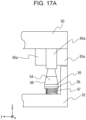
- Figs. 17A to 17C are views illustrating schematic configurations of another actuator unit according to the fourth embodiment.
- Figs. 17A and 17B are sectional views of the actuator unit
- Fig. 17C is a perspective view of the vibration body 98.
- the vibration body 98 includes a ring-shaped elastic body 94 and an electric-mechanical energy conversion element 95 joined to a bottom surface of the elastic body 94.
- the elastic body 94 has a comb-tooth shape in which a plurality of grooves are provided on the upper surface side (the elastic body 94 side) in the circumferential direction.
- a flexible substrate (not shown) is joined to the electric-mechanical energy conversion element 95, and a nonwoven cloth 96 is provided below the flexible substrate in the z-axis direction.
- a pressing portion 97 is inserted below the nonwoven cloth 96 in the z-axis direction.
- the pressing portion 97 includes a plurality of coil springs arranged in the circumferential direction, a coned-disc spring, a wave washer, or the like.
- the elastic body 94 is pressed against a contact body 84a.
- a vibration-damping member 85a is joined to each of an inner peripheral surface and an outer peripheral surface of the contact body 84a.
- the vibration-damping member 85a is similar to the vibration-damping members 25 and 35 described above.
- the elastic body 94 is pressed against a contact body 84b.
- the rigidity of a contact portion 84d in the z-direction is reduced by providing the contact body 84b with a flange portion 84c where the contact body 84b is cut out in the circumferential direction.
- a vibration-damping member 85b is joined to each of an inner peripheral surface and an outer peripheral surface of the contact body 84b.
- the vibration-damping member 85b is similar to the vibration-damping members 25 and 35 described above.
- the actuator unit by selecting the configuration of the vibration actuator in accordance with the specifications of an apparatus to which the actuator unit is to be applied and by appropriately adjusting the arrangement and the number of vibration body units.
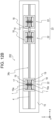
- FIG. 18 is a plan view illustrating a schematic configuration of an apparatus 501 according to the fifth embodiment.
- the apparatus 501 includes six vibration actuators 102 and a support member 350.
- the six vibration actuators 102 are fixed to the support member 350 via the support member 15 and with the support member 15 as a reference position.
- the support member 350 corresponds to the support member 15 magnified in the xy-plane, and is configured as one member.
- the six vibration actuators 102 it is easy to arrange the six vibration actuators 102 to be aligned on a plane. For example, it is easy to align and arrange the six vibration actuators 102 so as to be separated from a reference position J of the support member 350 by a distance d in the y-direction and so that the arrangement interval between adjacent support members 15 in the x-direction is a distance e. In this case, it is possible to make the intervals between the contact bodies 4 of the vibration actuators 102 that are adjacent in the x-direction be the same distance f.
- the vibration body units 11 of the six vibration actuators 102 may be coupled to one drive component (load) or may be coupled to different drive components (loads).
- the apparatus 501 described here includes the six vibration actuators 102, and it is possible to configure a similar apparatus by using any plurality of vibration actuators 102. Depending on the configuration of the apparatus, a plurality of vibration actuators can be disposed at different positions on the same plane or on different planes.
- the vibration actuator 102 As described above, it is possible to set the width dimension of the contact body 4 in the x-direction as small as possible and to suppress unnecessary vibration by using the vibration-damping member 35. Accordingly, it is possible to reduce the size of the apparatus when the plurality of vibration actuators 102 are arranged in the x-direction and used as in the apparatus 501. Moreover, it is possible to further reduce the size by arranging the vibration actuators 102 so as to contact each other as illustrated in Fig. 18 .
- the support member 15 and the support member 350 of the vibration actuator 102 are formed as an integrated component to make the dimension of the support member in the x-direction as small as possible in a range such that the vibration body unit 11 does not interfere.
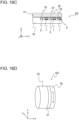
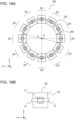
- Figs. 19A and 19B are views illustrating schematic configurations of an apparatus 502 according to the sixth embodiment.
- Fig. 19A is a plan view of the apparatus 502
- Fig. 19B is a side view illustrating a schematic configuration of a vibration actuator 201 of the apparatus 502.
- the apparatus 502 includes twelve vibration actuators 201 and a support member 360.
- the support member 360 is formed by integrating twelve support members 15 of the twelve vibration actuators 201 into one member having a prismatic shape so that the cross section thereof perpendicular to the y direction has a substantially regular dodecagonal shape centered at a point K with the y direction as the axial direction.
- the twelve vibration actuators 201 are radially fixed respectively to twelve side surfaces (surfaces parallel to the y-axis) corresponding to the sides of the substantially regular dodecagonal shape of the zx cross section of the support member 360 via the support members 15 and with reference to the support members 15.
- the apparatus 502 it is possible to arrange the plurality of contact bodies 4 with high precision on the circumference of a pitch circle 370 that has a diameter g and that is centered at the point K as seen from the y-direction.
- the width dimension of the contact body 4 as small as possible and suppressing unnecessary vibration by using the vibration-damping member, it is possible to set the diameter g small and to reduce the size of the apparatus 502.
- the support member 15 and the support member 360 of the vibration actuator 102 as an integrated component, it is possible to substantially reduce the size.
- the vibration actuators 201 are disposed on all side surfaces of the support member 360 in the apparatus 502, the vibration actuators 201 can be disposed at any positions on any side surfaces.
- the support member 360 is not limited to a dodecagonal prism and can be changed to any polygonal prism.
- a seventh embodiment will be described.
- a multi-axis stage including a vibration actuator will be described.
- Fig. 20 is a plan view illustrating a schematic configuration of a multi-axis stage 503 according to the seventh embodiment.
- the multi-axis stage 503 includes a fixed portion 41, an x-stage 42, a y-stage 43, and an xy-stage 44.
- the degree of freedom of the fixed portion 41 is constrained in all directions, and the fixed portion 41 is immovable.
- four actuator units 401 (see Figs. 15A to 15D ) are arranged in the y-direction and fixed to the fixed portion 41.
- Four contact bodies 4 of the four actuator units 401 fixed to the fixed portion 41 are movable in the x-direction in Figs. 15A to 15D , and a right end of each of the contact bodies 4 is fixed to the x-stage 42.
- the x-stage 42 is movable only in the x-direction, the degree of freedom in the other directions are constrained, and the x-stage 42 is driven in the x-direction by the four actuator units 401 fixed to the fixed portion 41.
- Two actuator units 401 are fixed to the x-stage 42 to be arranged in the x-direction.
- Two contact bodies 4 of the two actuator units 401 fixed to the x-stage 42 are movable in the y-direction in Fig. 20 , and an upper end of each of the contact bodies 4 is fixed to the y-stage 43.
- the y-stage 43 is movable only in the y-direction, the degree of freedom in the other directions are constrained, and the y-stage 43 is driven in the y-direction by the two actuator units 401 fixed to the x-stage 42.
- the xy-stage 44 is fixed to the y-stage 43.
- the xy-stage 44 moves in the xy-plane in accordance with the movement of the x-stage 42 and/or the y-stage 43.
- a mass that the actuator units 401 provided on the fixed portion 41 move is larger than a mass that the actuator units 401 provided on the x-stage 42 move.
- the number of actuator units 401 to be disposed on the fixed portion 41 and the number of actuator units 401 to be disposed on the x-stage 42 may be set in correspondence with the mass of an object be moved.
- the multi-axis stage 503 is configured as an xy-stage having two degrees of freedom, it is possible to realize a stage having any degrees of freedom by using a plurality of actuator units 401.
- the multi-axis stage 503 is configured so that the plurality of actuator units 401 move an object to be driven in a predetermined direction, generation of a moment in a plane parallel to the xy-plane is suppressed. As a result, it is possible to move the xy-stage 44 with high precision in the xy-plane.
- an eighth embodiment will be described.
- an articulated robot including a vibration actuator as a driving source will be described.
- Fig. 21 is a plan view illustrating a schematic configuration of an articulated robot 505 according to the eighth embodiment.
- the articulated robot 505 is an example of an articulated robot using an antagonistic drive method.
- the articulated robot 505 includes a first joint 52, a fixed portion 54, a first pulley 55, a first link 56, a second link 57, a second joint 58, a second pulley 59, a third pulley 60, a wire 51e, and a wire 53e.
- the actuator units 401 will be denoted with symbols E1, F1, E2, and F2.
- the first joint 52 has a rotational degree of freedom such that the first joint 52 is rotatable around an axis parallel to the z-axis and centered at a point L.
- the second joint 58 has a rotational degree of freedom such that the second joint 58 is rotatable around an axis parallel to the z-axis and centered at a point M, and is constrained by motion of the first link 56.
- the first pulley 55 shown by a broken line, is constrained by the first link 56, and is provided to be rotatable around the first joint 52.
- the second link 57 is provided to be rotatable around the second joint 58 via the second joint 58.
- the second pulley 59 is constrained by the second link 57.
- the third pulley 60 is provided to be rotatable around the first joint 52.
- the wire 51e is wound around the first pulley 55, one end thereof is linked to the contact body 4 of the actuator unit F1, and the other end thereof is linked to the contact body 4 of the actuator unit E1.
- the wire 53e is wound around the third pulley 60, one end thereof is linked to the contact body 4 of the actuator unit F2, and the other end thereof is linked to the contact body 4 of the actuator unit E2.
- a wire 53a has an endless shape (loop shape) and is looped over the second pulley 59 and the third pulley 60.
- the actuator units E1 and F1 are each disposed so that the movement direction of the contact body 4 is the y-direction in Figs. 16A to 16D , and drive the wire 51e in the y-direction.
- the actuator units E1 and F1 generate thrusts in the y-direction so that the wire 51e may not slacken, a frictional force is generated between the wire 51e and the first pulley 55 due to the difference between the generated thrusts, and it is possible to rotate the first link 56 around the first joint.
- the actuator units E1 and F1 can generate a displacement of the first link 56 at an angle ⁇ 1 with respect to the x-axis.
- the actuator units E2 and F2 are each disposed so that the contact body 4 is movable in the x-direction in Fig. 21 , and drive the wire 53e in the x-direction.
- the actuator units E2 and F2 generate thrusts in the x-direction so that the wire 53e may not slacken, a frictional force is generated between the wire 53e and the third pulley 60 due to the difference between the generated thrusts. Due to the frictional force, the third pulley 60 rotates, the second pulley 59 moves together via the wire 53a, and it is possible to drive the first link 56 and the second link 57 around the first joint 52 and around the second joint 58.
- the vibration actuators E2 and F2 it is possible for the vibration actuators E2 and F2 to generate a displacement of the first link 56 at an angle ⁇ 1 with respect to the x-axis and to generate a displacement of the second link 57 at an angle ⁇ 2 with respect to the first link 56. Moreover, it is also possible to generate only the displacement of the second link 57 at the angle ⁇ 2 by driving the vibration actuators E1 and F1 so as to cancel the displacement of the first link 56 at the angle ⁇ 1 generated due to driving of the vibration actuators E2 and F2.
- the articulated robot 505 can cause a leading end N of the second link 57 to reach a target position in the xy-plane.
- the articulated robot 505 By performing antagonistic motion in a state in which a tension is constantly applied so that the wires 51e and 53e may not slacken, it is possible to suppress generation of deviation due to wobbling around a joint or buckling of the wires 51e and 53e. As a result, it is possible to increase torsional rigidity around each joint and to position the leading end N with high precision.
- a ninth embodiment will be described.
- an articulated robot including a vibration actuator as a driving source will be described.
- Fig. 22 is a plan view illustrating a schematic configuration of an articulated robot 506 according to the ninth embodiment.
- the articulated robot 506 operates by using a driving method in which a wire is pushed and pulled in a range of thrust such that a wire does not buckle.
- the articulated robot 506 includes the apparatus 502 and a wire-driven manipulator 504.
- Fig. 23 is a perspective view illustrating a schematic configuration of the wire-driven manipulator 504.
- the wire-driven manipulator 504 is, for example, equivalent to that described in PTL 2.
- the wire-driven manipulator 504 includes a linear-member guide portion 61 and two bending sections 66a and 66b.
- a linear member 62 can change the curvatures of the bending sections 66a and 66b by sliding in a hollow portion of a guide tube 65, which is provided in the linear-member guide portion 61, without buckling.
- the linear-member guide portion 61 may be flexible as illustrated in Fig. 22 .
- three linear members 62 are provided for each bending section.
- leading ends of three linear members are fixed to a guide member 63a, one linear member is fixed to guide members 64a, and the other two linear members are driven to change the curvature of the bending section 66a.
- leading ends of the remaining three linear members 62 are fixed to a leading end member 63b, one of the linear members is fixed to guide members 64b, and the other two linear members are driven to change the curvature of the bending section 66b.
- the apparatus 502 (see Figs. 19A and 19B ) is used as a driving source of the wire-driven manipulator 504.
- the contact bodies 4 of the vibration actuators 201 of the apparatus 502 are linked to the linear members 62, and are used as a driving source for changing the curvatures of the bending sections 66a and 66b of the wire-driven manipulator 504.
- the articulated robot 506 by driving the wire-driven manipulator 504 by using the apparatus 502, it is possible to control the curvatures of the bending sections 66a and 66b with high precision. Moreover, by using the apparatus 502 as a driving portion that drives the wire-driven manipulator 504, it is possible to reduce the size and weight of the driving portion to improve operability. Furthermore, by increasing and decreasing the number of vibration body units in the apparatus 502, it is possible to easily comply with output power required for the bending sections 66a and 66b. In addition, by using a direct-drive vibration actuator to drive the linear member 62 of the wire-driven manipulator 504, it is possible to improve responsivity compared with a case where a driving unit in which an electromagnetic motor and a speed reduction mechanism are combined.
- the plurality of vibration actuators 201 of the apparatus 502 include a plurality of vibration body units 20 using common components, it is possible to change the output power from each of the vibration actuators 201 by increasing and decreasing the vibration body units 20. Moreover, by changing the amplitude ratio of vibrations in a plurality of vibration modes excited in the vibration body 1, it is also possible to control the magnitude of thrust for driving (deforming) the bending sections 66a and 66b and driving speed. When a voltage is not applied to the electric-mechanical energy conversion element 3, it is possible to maintain the postures of the bending sections 66a and 66b by using a frictional force that acts between the projecting portions 2a and the contact body 4.
- the articulated robot 506 is applicable to, for example, an industrial endoscope, a medical endoscope, and a surgical instrument such as a catheter used in medical practices such as treatment, biopsy, and inspection.
- the articulated robot 506 has four degrees of freedom with the two bending sections 66a and 66b, the number of bending sections, that is, the degree of freedom can be set to any appropriate number.
- the shape of the support member 360, the diameter g of the pitch circle 370, and the number and the disposition of the vibration actuator 201 may be set to any appropriate conditions with respect to the apparatus 502, in accordance with the number of bending sections and the diameter of the guide member.
- an object to be coupled which is to be coupled with the vibration body unit via the coupling portion
- an object to be coupled is not limited to any of these and may be any portion or component that is movable relative to the contact body.
- the multi-axis stage 503 and the articulated robots 505 and 506 have been described as examples of an apparatus to which the vibration actuator and the actuator unit according to each of the embodiments are applied, an apparatus to which the vibration actuator and the actuator unit are appliable is not limited to any of these.
- an apparatus includes: various stage apparatuses for a microscope, a machine tool, and a measurement apparatus; and robots such as a vertical articulated robot, a parallel-link robot, and the like having a larger degree of freedom than the articulated robot 505.
Landscapes
- Engineering & Computer Science (AREA)
- Robotics (AREA)
- Mechanical Engineering (AREA)
- General Electrical Machinery Utilizing Piezoelectricity, Electrostriction Or Magnetostriction (AREA)
Applications Claiming Priority (2)
| Application Number | Priority Date | Filing Date | Title |
|---|---|---|---|
| JP2022009653A JP2023108498A (ja) | 2022-01-25 | 2022-01-25 | 振動型アクチュエータ |
| PCT/JP2022/048454 WO2023145378A1 (ja) | 2022-01-25 | 2022-12-28 | 振動型アクチュエータ |
Publications (2)
| Publication Number | Publication Date |
|---|---|
| EP4472055A1 true EP4472055A1 (de) | 2024-12-04 |
| EP4472055A4 EP4472055A4 (de) | 2026-01-07 |
Family
ID=87471094
Family Applications (1)
| Application Number | Title | Priority Date | Filing Date |
|---|---|---|---|
| EP22924225.0A Pending EP4472055A4 (de) | 2022-01-25 | 2022-12-28 | Schwingungsaktuator |
Country Status (4)
| Country | Link |
|---|---|
| US (1) | US20240381777A1 (de) |
| EP (1) | EP4472055A4 (de) |
| JP (1) | JP2023108498A (de) |
| WO (1) | WO2023145378A1 (de) |
Family Cites Families (8)
| Publication number | Priority date | Publication date | Assignee | Title |
|---|---|---|---|---|
| JPH09289785A (ja) * | 1996-04-19 | 1997-11-04 | Olympus Optical Co Ltd | 超音波モータ駆動装置 |
| JP2000324865A (ja) | 1999-03-11 | 2000-11-24 | Nikon Corp | 振動モータ及び光ファイバースイッチ |
| JP5843469B2 (ja) * | 2011-04-26 | 2016-01-13 | キヤノン株式会社 | 振動波モータ |
| WO2016203354A1 (en) | 2015-06-19 | 2016-12-22 | Semiconductor Energy Laboratory Co., Ltd. | Semiconductor device, manufacturing method thereof, and electronic device |
| JP7039174B2 (ja) | 2017-02-28 | 2022-03-22 | キヤノン株式会社 | ワイヤ駆動マニピュレータ |
| JP6643288B2 (ja) * | 2017-08-14 | 2020-02-12 | キヤノン株式会社 | 振動波モータ及び振動波モータを有したレンズ駆動装置 |
| JP7254630B2 (ja) * | 2019-05-31 | 2023-04-10 | キヤノン株式会社 | 振動型アクチュエータ、装置、多軸ステージユニット、および多関節ロボット |
| JP7362366B2 (ja) * | 2019-08-30 | 2023-10-17 | キヤノン株式会社 | 振動型アクチュエータ、光学機器および電子機器 |
-
2022
- 2022-01-25 JP JP2022009653A patent/JP2023108498A/ja active Pending
- 2022-12-28 EP EP22924225.0A patent/EP4472055A4/de active Pending
- 2022-12-28 WO PCT/JP2022/048454 patent/WO2023145378A1/ja not_active Ceased
-
2024
- 2024-07-22 US US18/779,501 patent/US20240381777A1/en active Pending
Also Published As
| Publication number | Publication date |
|---|---|
| US20240381777A1 (en) | 2024-11-14 |
| WO2023145378A1 (ja) | 2023-08-03 |
| EP4472055A4 (de) | 2026-01-07 |
| JP2023108498A (ja) | 2023-08-04 |
Similar Documents
| Publication | Publication Date | Title |
|---|---|---|
| JP5709413B2 (ja) | 振動型駆動装置 | |
| US9391257B2 (en) | Actuator, robot hand, robot, electronic component carrying device, electronic component inspection device, and printer | |
| EP1665336B1 (de) | Ultraschall-gewindespindelmotor | |
| CN101681986A (zh) | 使用基于机械放大器的惯性马达的精确定位系统 | |
| TWI558085B (zh) | 致動器、機器人手部、機器人、電子零件搬送裝置、電子零件檢查裝置及印表機 | |
| US20110018394A1 (en) | Vibratory actuator | |
| JP5810303B2 (ja) | 駆動装置 | |
| US11290031B2 (en) | Vibration-type actuator with vibration body and contact body relatively moving, apparatus, multi-axis stage unit, and articulated robot | |
| CN110537077A (zh) | 载荷支承结构 | |
| WO2015104402A1 (en) | Positioning device | |
| EP4472055A1 (de) | Schwingungsaktuator | |
| US8314533B2 (en) | Vibratory actuator | |
| JPH02111271A (ja) | X−yステージ | |
| JP2012253921A (ja) | モーター、ロボットハンドおよびロボット | |
| US11336211B2 (en) | Vibration wave motor and driving apparatus using vibration wave motor | |
| US12088220B2 (en) | Vibrating actuator, multi-axis stage, articulated robot, and continuum robot | |
| EP4224698B1 (de) | Vibrationsaktuator zur reduzierung der kraftänderung zwischen kontaktkörper und vibrationskörper, mehrachsiger mehrstufiger mehrgelenkroboter und vorrichtung | |
| JP7353815B2 (ja) | 振動型アクチュエータ、装置、多軸ステージユニット、および多関節ロボット | |
| Schmitt et al. | Stick and slip actuators (SSA) | |
| JP6914740B2 (ja) | 把持装置 | |
| JP6076142B2 (ja) | 超音波電動ステージおよび顕微鏡 | |
| JP2012200050A (ja) | モータ装置及びロボット装置 | |
| JP5883177B2 (ja) | 振動型駆動装置 | |
| JPH11136971A (ja) | 振動アクチュエータ | |
| JP2669646B2 (ja) | 振動式案内機構 |
Legal Events
| Date | Code | Title | Description |
|---|---|---|---|
| STAA | Information on the status of an ep patent application or granted ep patent |
Free format text: STATUS: THE INTERNATIONAL PUBLICATION HAS BEEN MADE |
|
| PUAI | Public reference made under article 153(3) epc to a published international application that has entered the european phase |
Free format text: ORIGINAL CODE: 0009012 |
|
| STAA | Information on the status of an ep patent application or granted ep patent |
Free format text: STATUS: REQUEST FOR EXAMINATION WAS MADE |
|
| 17P | Request for examination filed |
Effective date: 20240826 |
|
| AK | Designated contracting states |
Kind code of ref document: A1 Designated state(s): AL AT BE BG CH CY CZ DE DK EE ES FI FR GB GR HR HU IE IS IT LI LT LU LV MC ME MK MT NL NO PL PT RO RS SE SI SK SM TR |
|
| DAV | Request for validation of the european patent (deleted) | ||
| DAX | Request for extension of the european patent (deleted) | ||
| A4 | Supplementary search report drawn up and despatched |
Effective date: 20251209 |
|
| RIC1 | Information provided on ipc code assigned before grant |
Ipc: H02N 2/04 20060101AFI20251203BHEP Ipc: H02N 2/02 20060101ALI20251203BHEP Ipc: H02N 2/10 20060101ALI20251203BHEP Ipc: H02N 2/16 20060101ALI20251203BHEP Ipc: B25J 9/12 20060101ALI20251203BHEP |