EP4467612A2 - In-situ herstellung von thermoplastischen polyurethan-weichschaumstoffen mit niedriger dichte - Google Patents
In-situ herstellung von thermoplastischen polyurethan-weichschaumstoffen mit niedriger dichte Download PDFInfo
- Publication number
- EP4467612A2 EP4467612A2 EP24182745.0A EP24182745A EP4467612A2 EP 4467612 A2 EP4467612 A2 EP 4467612A2 EP 24182745 A EP24182745 A EP 24182745A EP 4467612 A2 EP4467612 A2 EP 4467612A2
- Authority
- EP
- European Patent Office
- Prior art keywords
- foam
- range
- reactive
- isocyanate
- reactive mixture
- Prior art date
- Legal status (The legal status is an assumption and is not a legal conclusion. Google has not performed a legal analysis and makes no representation as to the accuracy of the status listed.)
- Pending
Links
Images
Classifications
-
- C—CHEMISTRY; METALLURGY
- C08—ORGANIC MACROMOLECULAR COMPOUNDS; THEIR PREPARATION OR CHEMICAL WORKING-UP; COMPOSITIONS BASED THEREON
- C08G—MACROMOLECULAR COMPOUNDS OBTAINED OTHERWISE THAN BY REACTIONS ONLY INVOLVING UNSATURATED CARBON-TO-CARBON BONDS
- C08G18/00—Polymeric products of isocyanates or isothiocyanates
- C08G18/06—Polymeric products of isocyanates or isothiocyanates with compounds having active hydrogen
- C08G18/08—Processes
- C08G18/10—Prepolymer processes involving reaction of isocyanates or isothiocyanates with compounds having active hydrogen in a first reaction step
-
- C—CHEMISTRY; METALLURGY
- C08—ORGANIC MACROMOLECULAR COMPOUNDS; THEIR PREPARATION OR CHEMICAL WORKING-UP; COMPOSITIONS BASED THEREON
- C08G—MACROMOLECULAR COMPOUNDS OBTAINED OTHERWISE THAN BY REACTIONS ONLY INVOLVING UNSATURATED CARBON-TO-CARBON BONDS
- C08G18/00—Polymeric products of isocyanates or isothiocyanates
- C08G18/06—Polymeric products of isocyanates or isothiocyanates with compounds having active hydrogen
- C08G18/08—Processes
- C08G18/16—Catalysts
- C08G18/22—Catalysts containing metal compounds
- C08G18/24—Catalysts containing metal compounds of tin
- C08G18/244—Catalysts containing metal compounds of tin tin salts of carboxylic acids
-
- C—CHEMISTRY; METALLURGY
- C08—ORGANIC MACROMOLECULAR COMPOUNDS; THEIR PREPARATION OR CHEMICAL WORKING-UP; COMPOSITIONS BASED THEREON
- C08G—MACROMOLECULAR COMPOUNDS OBTAINED OTHERWISE THAN BY REACTIONS ONLY INVOLVING UNSATURATED CARBON-TO-CARBON BONDS
- C08G18/00—Polymeric products of isocyanates or isothiocyanates
- C08G18/06—Polymeric products of isocyanates or isothiocyanates with compounds having active hydrogen
- C08G18/28—Polymeric products of isocyanates or isothiocyanates with compounds having active hydrogen characterised by the compounds used containing active hydrogen
- C08G18/30—Low-molecular-weight compounds
- C08G18/32—Polyhydroxy compounds; Polyamines; Hydroxyamines
- C08G18/3203—Polyhydroxy compounds
- C08G18/3206—Polyhydroxy compounds aliphatic
-
- C—CHEMISTRY; METALLURGY
- C08—ORGANIC MACROMOLECULAR COMPOUNDS; THEIR PREPARATION OR CHEMICAL WORKING-UP; COMPOSITIONS BASED THEREON
- C08G—MACROMOLECULAR COMPOUNDS OBTAINED OTHERWISE THAN BY REACTIONS ONLY INVOLVING UNSATURATED CARBON-TO-CARBON BONDS
- C08G18/00—Polymeric products of isocyanates or isothiocyanates
- C08G18/06—Polymeric products of isocyanates or isothiocyanates with compounds having active hydrogen
- C08G18/28—Polymeric products of isocyanates or isothiocyanates with compounds having active hydrogen characterised by the compounds used containing active hydrogen
- C08G18/30—Low-molecular-weight compounds
- C08G18/32—Polyhydroxy compounds; Polyamines; Hydroxyamines
- C08G18/3225—Polyamines
- C08G18/3246—Polyamines heterocyclic, the heteroatom being oxygen or nitrogen in the form of an amino group
-
- C—CHEMISTRY; METALLURGY
- C08—ORGANIC MACROMOLECULAR COMPOUNDS; THEIR PREPARATION OR CHEMICAL WORKING-UP; COMPOSITIONS BASED THEREON
- C08G—MACROMOLECULAR COMPOUNDS OBTAINED OTHERWISE THAN BY REACTIONS ONLY INVOLVING UNSATURATED CARBON-TO-CARBON BONDS
- C08G18/00—Polymeric products of isocyanates or isothiocyanates
- C08G18/06—Polymeric products of isocyanates or isothiocyanates with compounds having active hydrogen
- C08G18/28—Polymeric products of isocyanates or isothiocyanates with compounds having active hydrogen characterised by the compounds used containing active hydrogen
- C08G18/30—Low-molecular-weight compounds
- C08G18/38—Low-molecular-weight compounds having heteroatoms other than oxygen
- C08G18/3819—Low-molecular-weight compounds having heteroatoms other than oxygen having nitrogen
- C08G18/3842—Low-molecular-weight compounds having heteroatoms other than oxygen having nitrogen containing heterocyclic rings having at least one nitrogen atom in the ring
- C08G18/3851—Low-molecular-weight compounds having heteroatoms other than oxygen having nitrogen containing heterocyclic rings having at least one nitrogen atom in the ring containing three nitrogen atoms in the ring
-
- C—CHEMISTRY; METALLURGY
- C08—ORGANIC MACROMOLECULAR COMPOUNDS; THEIR PREPARATION OR CHEMICAL WORKING-UP; COMPOSITIONS BASED THEREON
- C08G—MACROMOLECULAR COMPOUNDS OBTAINED OTHERWISE THAN BY REACTIONS ONLY INVOLVING UNSATURATED CARBON-TO-CARBON BONDS
- C08G18/00—Polymeric products of isocyanates or isothiocyanates
- C08G18/06—Polymeric products of isocyanates or isothiocyanates with compounds having active hydrogen
- C08G18/28—Polymeric products of isocyanates or isothiocyanates with compounds having active hydrogen characterised by the compounds used containing active hydrogen
- C08G18/40—High-molecular-weight compounds
- C08G18/42—Polycondensates having carboxylic or carbonic ester groups in the main chain
- C08G18/4236—Polycondensates having carboxylic or carbonic ester groups in the main chain containing only aliphatic groups
- C08G18/4238—Polycondensates having carboxylic or carbonic ester groups in the main chain containing only aliphatic groups derived from dicarboxylic acids and dialcohols
-
- C—CHEMISTRY; METALLURGY
- C08—ORGANIC MACROMOLECULAR COMPOUNDS; THEIR PREPARATION OR CHEMICAL WORKING-UP; COMPOSITIONS BASED THEREON
- C08G—MACROMOLECULAR COMPOUNDS OBTAINED OTHERWISE THAN BY REACTIONS ONLY INVOLVING UNSATURATED CARBON-TO-CARBON BONDS
- C08G18/00—Polymeric products of isocyanates or isothiocyanates
- C08G18/06—Polymeric products of isocyanates or isothiocyanates with compounds having active hydrogen
- C08G18/28—Polymeric products of isocyanates or isothiocyanates with compounds having active hydrogen characterised by the compounds used containing active hydrogen
- C08G18/40—High-molecular-weight compounds
- C08G18/48—Polyethers
- C08G18/4825—Polyethers containing two hydroxy groups
-
- C—CHEMISTRY; METALLURGY
- C08—ORGANIC MACROMOLECULAR COMPOUNDS; THEIR PREPARATION OR CHEMICAL WORKING-UP; COMPOSITIONS BASED THEREON
- C08G—MACROMOLECULAR COMPOUNDS OBTAINED OTHERWISE THAN BY REACTIONS ONLY INVOLVING UNSATURATED CARBON-TO-CARBON BONDS
- C08G18/00—Polymeric products of isocyanates or isothiocyanates
- C08G18/06—Polymeric products of isocyanates or isothiocyanates with compounds having active hydrogen
- C08G18/28—Polymeric products of isocyanates or isothiocyanates with compounds having active hydrogen characterised by the compounds used containing active hydrogen
- C08G18/40—High-molecular-weight compounds
- C08G18/48—Polyethers
- C08G18/4854—Polyethers containing oxyalkylene groups having four carbon atoms in the alkylene group
-
- C—CHEMISTRY; METALLURGY
- C08—ORGANIC MACROMOLECULAR COMPOUNDS; THEIR PREPARATION OR CHEMICAL WORKING-UP; COMPOSITIONS BASED THEREON
- C08G—MACROMOLECULAR COMPOUNDS OBTAINED OTHERWISE THAN BY REACTIONS ONLY INVOLVING UNSATURATED CARBON-TO-CARBON BONDS
- C08G18/00—Polymeric products of isocyanates or isothiocyanates
- C08G18/06—Polymeric products of isocyanates or isothiocyanates with compounds having active hydrogen
- C08G18/28—Polymeric products of isocyanates or isothiocyanates with compounds having active hydrogen characterised by the compounds used containing active hydrogen
- C08G18/65—Low-molecular-weight compounds having active hydrogen with high-molecular-weight compounds having active hydrogen
- C08G18/66—Compounds of groups C08G18/42, C08G18/48, or C08G18/52
- C08G18/6633—Compounds of group C08G18/42
- C08G18/6637—Compounds of group C08G18/42 with compounds of group C08G18/32 or polyamines of C08G18/38
-
- C—CHEMISTRY; METALLURGY
- C08—ORGANIC MACROMOLECULAR COMPOUNDS; THEIR PREPARATION OR CHEMICAL WORKING-UP; COMPOSITIONS BASED THEREON
- C08G—MACROMOLECULAR COMPOUNDS OBTAINED OTHERWISE THAN BY REACTIONS ONLY INVOLVING UNSATURATED CARBON-TO-CARBON BONDS
- C08G18/00—Polymeric products of isocyanates or isothiocyanates
- C08G18/06—Polymeric products of isocyanates or isothiocyanates with compounds having active hydrogen
- C08G18/28—Polymeric products of isocyanates or isothiocyanates with compounds having active hydrogen characterised by the compounds used containing active hydrogen
- C08G18/65—Low-molecular-weight compounds having active hydrogen with high-molecular-weight compounds having active hydrogen
- C08G18/66—Compounds of groups C08G18/42, C08G18/48, or C08G18/52
- C08G18/6633—Compounds of group C08G18/42
- C08G18/6637—Compounds of group C08G18/42 with compounds of group C08G18/32 or polyamines of C08G18/38
- C08G18/664—Compounds of group C08G18/42 with compounds of group C08G18/32 or polyamines of C08G18/38 with compounds of group C08G18/3203
-
- C—CHEMISTRY; METALLURGY
- C08—ORGANIC MACROMOLECULAR COMPOUNDS; THEIR PREPARATION OR CHEMICAL WORKING-UP; COMPOSITIONS BASED THEREON
- C08G—MACROMOLECULAR COMPOUNDS OBTAINED OTHERWISE THAN BY REACTIONS ONLY INVOLVING UNSATURATED CARBON-TO-CARBON BONDS
- C08G18/00—Polymeric products of isocyanates or isothiocyanates
- C08G18/06—Polymeric products of isocyanates or isothiocyanates with compounds having active hydrogen
- C08G18/28—Polymeric products of isocyanates or isothiocyanates with compounds having active hydrogen characterised by the compounds used containing active hydrogen
- C08G18/65—Low-molecular-weight compounds having active hydrogen with high-molecular-weight compounds having active hydrogen
- C08G18/66—Compounds of groups C08G18/42, C08G18/48, or C08G18/52
- C08G18/6666—Compounds of group C08G18/48 or C08G18/52
- C08G18/667—Compounds of group C08G18/48 or C08G18/52 with compounds of group C08G18/32 or polyamines of C08G18/38
-
- C—CHEMISTRY; METALLURGY
- C08—ORGANIC MACROMOLECULAR COMPOUNDS; THEIR PREPARATION OR CHEMICAL WORKING-UP; COMPOSITIONS BASED THEREON
- C08G—MACROMOLECULAR COMPOUNDS OBTAINED OTHERWISE THAN BY REACTIONS ONLY INVOLVING UNSATURATED CARBON-TO-CARBON BONDS
- C08G18/00—Polymeric products of isocyanates or isothiocyanates
- C08G18/06—Polymeric products of isocyanates or isothiocyanates with compounds having active hydrogen
- C08G18/28—Polymeric products of isocyanates or isothiocyanates with compounds having active hydrogen characterised by the compounds used containing active hydrogen
- C08G18/65—Low-molecular-weight compounds having active hydrogen with high-molecular-weight compounds having active hydrogen
- C08G18/66—Compounds of groups C08G18/42, C08G18/48, or C08G18/52
- C08G18/6666—Compounds of group C08G18/48 or C08G18/52
- C08G18/667—Compounds of group C08G18/48 or C08G18/52 with compounds of group C08G18/32 or polyamines of C08G18/38
- C08G18/6674—Compounds of group C08G18/48 or C08G18/52 with compounds of group C08G18/32 or polyamines of C08G18/38 with compounds of group C08G18/3203
-
- C—CHEMISTRY; METALLURGY
- C08—ORGANIC MACROMOLECULAR COMPOUNDS; THEIR PREPARATION OR CHEMICAL WORKING-UP; COMPOSITIONS BASED THEREON
- C08G—MACROMOLECULAR COMPOUNDS OBTAINED OTHERWISE THAN BY REACTIONS ONLY INVOLVING UNSATURATED CARBON-TO-CARBON BONDS
- C08G18/00—Polymeric products of isocyanates or isothiocyanates
- C08G18/06—Polymeric products of isocyanates or isothiocyanates with compounds having active hydrogen
- C08G18/28—Polymeric products of isocyanates or isothiocyanates with compounds having active hydrogen characterised by the compounds used containing active hydrogen
- C08G18/65—Low-molecular-weight compounds having active hydrogen with high-molecular-weight compounds having active hydrogen
- C08G18/66—Compounds of groups C08G18/42, C08G18/48, or C08G18/52
- C08G18/6666—Compounds of group C08G18/48 or C08G18/52
- C08G18/667—Compounds of group C08G18/48 or C08G18/52 with compounds of group C08G18/32 or polyamines of C08G18/38
- C08G18/6681—Compounds of group C08G18/48 or C08G18/52 with compounds of group C08G18/32 or polyamines of C08G18/38 with compounds of group C08G18/32 or C08G18/3271 and/or polyamines of C08G18/38
- C08G18/6685—Compounds of group C08G18/48 or C08G18/52 with compounds of group C08G18/32 or polyamines of C08G18/38 with compounds of group C08G18/32 or C08G18/3271 and/or polyamines of C08G18/38 with compounds of group C08G18/3225 or polyamines of C08G18/38
-
- C—CHEMISTRY; METALLURGY
- C08—ORGANIC MACROMOLECULAR COMPOUNDS; THEIR PREPARATION OR CHEMICAL WORKING-UP; COMPOSITIONS BASED THEREON
- C08G—MACROMOLECULAR COMPOUNDS OBTAINED OTHERWISE THAN BY REACTIONS ONLY INVOLVING UNSATURATED CARBON-TO-CARBON BONDS
- C08G18/00—Polymeric products of isocyanates or isothiocyanates
- C08G18/06—Polymeric products of isocyanates or isothiocyanates with compounds having active hydrogen
- C08G18/70—Polymeric products of isocyanates or isothiocyanates with compounds having active hydrogen characterised by the isocyanates or isothiocyanates used
- C08G18/72—Polyisocyanates or polyisothiocyanates
- C08G18/74—Polyisocyanates or polyisothiocyanates cyclic
- C08G18/76—Polyisocyanates or polyisothiocyanates cyclic aromatic
- C08G18/7657—Polyisocyanates or polyisothiocyanates cyclic aromatic containing two or more aromatic rings
- C08G18/7664—Polyisocyanates or polyisothiocyanates cyclic aromatic containing two or more aromatic rings containing alkylene polyphenyl groups
- C08G18/7671—Polyisocyanates or polyisothiocyanates cyclic aromatic containing two or more aromatic rings containing alkylene polyphenyl groups containing only one alkylene bisphenyl group
-
- C—CHEMISTRY; METALLURGY
- C08—ORGANIC MACROMOLECULAR COMPOUNDS; THEIR PREPARATION OR CHEMICAL WORKING-UP; COMPOSITIONS BASED THEREON
- C08J—WORKING-UP; GENERAL PROCESSES OF COMPOUNDING; AFTER-TREATMENT NOT COVERED BY SUBCLASSES C08B, C08C, C08F, C08G or C08H
- C08J9/00—Working-up of macromolecular substances to porous or cellular articles or materials; After-treatment thereof
- C08J9/04—Working-up of macromolecular substances to porous or cellular articles or materials; After-treatment thereof using blowing gases generated by a previously added blowing agent
- C08J9/12—Working-up of macromolecular substances to porous or cellular articles or materials; After-treatment thereof using blowing gases generated by a previously added blowing agent by a physical blowing agent
-
- C—CHEMISTRY; METALLURGY
- C08—ORGANIC MACROMOLECULAR COMPOUNDS; THEIR PREPARATION OR CHEMICAL WORKING-UP; COMPOSITIONS BASED THEREON
- C08J—WORKING-UP; GENERAL PROCESSES OF COMPOUNDING; AFTER-TREATMENT NOT COVERED BY SUBCLASSES C08B, C08C, C08F, C08G or C08H
- C08J9/00—Working-up of macromolecular substances to porous or cellular articles or materials; After-treatment thereof
- C08J9/04—Working-up of macromolecular substances to porous or cellular articles or materials; After-treatment thereof using blowing gases generated by a previously added blowing agent
- C08J9/12—Working-up of macromolecular substances to porous or cellular articles or materials; After-treatment thereof using blowing gases generated by a previously added blowing agent by a physical blowing agent
- C08J9/122—Hydrogen, oxygen, CO2, nitrogen or noble gases
-
- C—CHEMISTRY; METALLURGY
- C08—ORGANIC MACROMOLECULAR COMPOUNDS; THEIR PREPARATION OR CHEMICAL WORKING-UP; COMPOSITIONS BASED THEREON
- C08J—WORKING-UP; GENERAL PROCESSES OF COMPOUNDING; AFTER-TREATMENT NOT COVERED BY SUBCLASSES C08B, C08C, C08F, C08G or C08H
- C08J9/00—Working-up of macromolecular substances to porous or cellular articles or materials; After-treatment thereof
- C08J9/04—Working-up of macromolecular substances to porous or cellular articles or materials; After-treatment thereof using blowing gases generated by a previously added blowing agent
- C08J9/12—Working-up of macromolecular substances to porous or cellular articles or materials; After-treatment thereof using blowing gases generated by a previously added blowing agent by a physical blowing agent
- C08J9/14—Working-up of macromolecular substances to porous or cellular articles or materials; After-treatment thereof using blowing gases generated by a previously added blowing agent by a physical blowing agent organic
- C08J9/143—Halogen containing compounds
- C08J9/144—Halogen containing compounds containing carbon, halogen and hydrogen only
- C08J9/146—Halogen containing compounds containing carbon, halogen and hydrogen only only fluorine as halogen atoms
-
- C—CHEMISTRY; METALLURGY
- C08—ORGANIC MACROMOLECULAR COMPOUNDS; THEIR PREPARATION OR CHEMICAL WORKING-UP; COMPOSITIONS BASED THEREON
- C08L—COMPOSITIONS OF MACROMOLECULAR COMPOUNDS
- C08L83/00—Compositions of macromolecular compounds obtained by reactions forming in the main chain of the macromolecule a linkage containing silicon with or without sulfur, nitrogen, oxygen or carbon only; Compositions of derivatives of such polymers
- C08L83/04—Polysiloxanes
-
- C—CHEMISTRY; METALLURGY
- C08—ORGANIC MACROMOLECULAR COMPOUNDS; THEIR PREPARATION OR CHEMICAL WORKING-UP; COMPOSITIONS BASED THEREON
- C08G—MACROMOLECULAR COMPOUNDS OBTAINED OTHERWISE THAN BY REACTIONS ONLY INVOLVING UNSATURATED CARBON-TO-CARBON BONDS
- C08G2110/00—Foam properties
- C08G2110/0008—Foam properties flexible
-
- C—CHEMISTRY; METALLURGY
- C08—ORGANIC MACROMOLECULAR COMPOUNDS; THEIR PREPARATION OR CHEMICAL WORKING-UP; COMPOSITIONS BASED THEREON
- C08G—MACROMOLECULAR COMPOUNDS OBTAINED OTHERWISE THAN BY REACTIONS ONLY INVOLVING UNSATURATED CARBON-TO-CARBON BONDS
- C08G2110/00—Foam properties
- C08G2110/0041—Foam properties having specified density
- C08G2110/005—< 50kg/m3
-
- C—CHEMISTRY; METALLURGY
- C08—ORGANIC MACROMOLECULAR COMPOUNDS; THEIR PREPARATION OR CHEMICAL WORKING-UP; COMPOSITIONS BASED THEREON
- C08G—MACROMOLECULAR COMPOUNDS OBTAINED OTHERWISE THAN BY REACTIONS ONLY INVOLVING UNSATURATED CARBON-TO-CARBON BONDS
- C08G2110/00—Foam properties
- C08G2110/0041—Foam properties having specified density
- C08G2110/0058—≥50 and <150kg/m3
-
- C—CHEMISTRY; METALLURGY
- C08—ORGANIC MACROMOLECULAR COMPOUNDS; THEIR PREPARATION OR CHEMICAL WORKING-UP; COMPOSITIONS BASED THEREON
- C08G—MACROMOLECULAR COMPOUNDS OBTAINED OTHERWISE THAN BY REACTIONS ONLY INVOLVING UNSATURATED CARBON-TO-CARBON BONDS
- C08G2110/00—Foam properties
- C08G2110/0041—Foam properties having specified density
- C08G2110/0066—≥ 150kg/m3
-
- C—CHEMISTRY; METALLURGY
- C08—ORGANIC MACROMOLECULAR COMPOUNDS; THEIR PREPARATION OR CHEMICAL WORKING-UP; COMPOSITIONS BASED THEREON
- C08G—MACROMOLECULAR COMPOUNDS OBTAINED OTHERWISE THAN BY REACTIONS ONLY INVOLVING UNSATURATED CARBON-TO-CARBON BONDS
- C08G2110/00—Foam properties
- C08G2110/0091—Aerogels; Xerogels
-
- C—CHEMISTRY; METALLURGY
- C08—ORGANIC MACROMOLECULAR COMPOUNDS; THEIR PREPARATION OR CHEMICAL WORKING-UP; COMPOSITIONS BASED THEREON
- C08G—MACROMOLECULAR COMPOUNDS OBTAINED OTHERWISE THAN BY REACTIONS ONLY INVOLVING UNSATURATED CARBON-TO-CARBON BONDS
- C08G2350/00—Acoustic or vibration damping material
-
- C—CHEMISTRY; METALLURGY
- C08—ORGANIC MACROMOLECULAR COMPOUNDS; THEIR PREPARATION OR CHEMICAL WORKING-UP; COMPOSITIONS BASED THEREON
- C08G—MACROMOLECULAR COMPOUNDS OBTAINED OTHERWISE THAN BY REACTIONS ONLY INVOLVING UNSATURATED CARBON-TO-CARBON BONDS
- C08G77/00—Macromolecular compounds obtained by reactions forming a linkage containing silicon with or without sulfur, nitrogen, oxygen or carbon in the main chain of the macromolecule
- C08G77/04—Polysiloxanes
- C08G77/14—Polysiloxanes containing silicon bound to oxygen-containing groups
- C08G77/16—Polysiloxanes containing silicon bound to oxygen-containing groups to hydroxy groups
-
- C—CHEMISTRY; METALLURGY
- C08—ORGANIC MACROMOLECULAR COMPOUNDS; THEIR PREPARATION OR CHEMICAL WORKING-UP; COMPOSITIONS BASED THEREON
- C08J—WORKING-UP; GENERAL PROCESSES OF COMPOUNDING; AFTER-TREATMENT NOT COVERED BY SUBCLASSES C08B, C08C, C08F, C08G or C08H
- C08J2201/00—Foams characterised by the foaming process
- C08J2201/02—Foams characterised by the foaming process characterised by mechanical pre- or post-treatments
- C08J2201/022—Foams characterised by the foaming process characterised by mechanical pre- or post-treatments premixing or pre-blending a part of the components of a foamable composition, e.g. premixing the polyol with the blowing agent, surfactant and catalyst and only adding the isocyanate at the time of foaming
-
- C—CHEMISTRY; METALLURGY
- C08—ORGANIC MACROMOLECULAR COMPOUNDS; THEIR PREPARATION OR CHEMICAL WORKING-UP; COMPOSITIONS BASED THEREON
- C08J—WORKING-UP; GENERAL PROCESSES OF COMPOUNDING; AFTER-TREATMENT NOT COVERED BY SUBCLASSES C08B, C08C, C08F, C08G or C08H
- C08J2203/00—Foams characterized by the expanding agent
- C08J2203/06—CO2, N2 or noble gases
-
- C—CHEMISTRY; METALLURGY
- C08—ORGANIC MACROMOLECULAR COMPOUNDS; THEIR PREPARATION OR CHEMICAL WORKING-UP; COMPOSITIONS BASED THEREON
- C08J—WORKING-UP; GENERAL PROCESSES OF COMPOUNDING; AFTER-TREATMENT NOT COVERED BY SUBCLASSES C08B, C08C, C08F, C08G or C08H
- C08J2203/00—Foams characterized by the expanding agent
- C08J2203/16—Unsaturated hydrocarbons
- C08J2203/162—Halogenated unsaturated hydrocarbons, e.g. H2C=CF2
-
- C—CHEMISTRY; METALLURGY
- C08—ORGANIC MACROMOLECULAR COMPOUNDS; THEIR PREPARATION OR CHEMICAL WORKING-UP; COMPOSITIONS BASED THEREON
- C08J—WORKING-UP; GENERAL PROCESSES OF COMPOUNDING; AFTER-TREATMENT NOT COVERED BY SUBCLASSES C08B, C08C, C08F, C08G or C08H
- C08J2205/00—Foams characterised by their properties
- C08J2205/04—Foams characterised by their properties characterised by the foam pores
- C08J2205/05—Open cells, i.e. more than 50% of the pores are open
-
- C—CHEMISTRY; METALLURGY
- C08—ORGANIC MACROMOLECULAR COMPOUNDS; THEIR PREPARATION OR CHEMICAL WORKING-UP; COMPOSITIONS BASED THEREON
- C08J—WORKING-UP; GENERAL PROCESSES OF COMPOUNDING; AFTER-TREATMENT NOT COVERED BY SUBCLASSES C08B, C08C, C08F, C08G or C08H
- C08J2205/00—Foams characterised by their properties
- C08J2205/06—Flexible foams
-
- C—CHEMISTRY; METALLURGY
- C08—ORGANIC MACROMOLECULAR COMPOUNDS; THEIR PREPARATION OR CHEMICAL WORKING-UP; COMPOSITIONS BASED THEREON
- C08J—WORKING-UP; GENERAL PROCESSES OF COMPOUNDING; AFTER-TREATMENT NOT COVERED BY SUBCLASSES C08B, C08C, C08F, C08G or C08H
- C08J2300/00—Characterised by the use of unspecified polymers
- C08J2300/22—Thermoplastic resins
-
- C—CHEMISTRY; METALLURGY
- C08—ORGANIC MACROMOLECULAR COMPOUNDS; THEIR PREPARATION OR CHEMICAL WORKING-UP; COMPOSITIONS BASED THEREON
- C08J—WORKING-UP; GENERAL PROCESSES OF COMPOUNDING; AFTER-TREATMENT NOT COVERED BY SUBCLASSES C08B, C08C, C08F, C08G or C08H
- C08J2375/00—Characterised by the use of polyureas or polyurethanes; Derivatives of such polymers
- C08J2375/04—Polyurethanes
-
- C—CHEMISTRY; METALLURGY
- C08—ORGANIC MACROMOLECULAR COMPOUNDS; THEIR PREPARATION OR CHEMICAL WORKING-UP; COMPOSITIONS BASED THEREON
- C08J—WORKING-UP; GENERAL PROCESSES OF COMPOUNDING; AFTER-TREATMENT NOT COVERED BY SUBCLASSES C08B, C08C, C08F, C08G or C08H
- C08J2375/00—Characterised by the use of polyureas or polyurethanes; Derivatives of such polymers
- C08J2375/04—Polyurethanes
- C08J2375/06—Polyurethanes from polyesters
-
- C—CHEMISTRY; METALLURGY
- C08—ORGANIC MACROMOLECULAR COMPOUNDS; THEIR PREPARATION OR CHEMICAL WORKING-UP; COMPOSITIONS BASED THEREON
- C08J—WORKING-UP; GENERAL PROCESSES OF COMPOUNDING; AFTER-TREATMENT NOT COVERED BY SUBCLASSES C08B, C08C, C08F, C08G or C08H
- C08J2375/00—Characterised by the use of polyureas or polyurethanes; Derivatives of such polymers
- C08J2375/04—Polyurethanes
- C08J2375/08—Polyurethanes from polyethers
-
- C—CHEMISTRY; METALLURGY
- C08—ORGANIC MACROMOLECULAR COMPOUNDS; THEIR PREPARATION OR CHEMICAL WORKING-UP; COMPOSITIONS BASED THEREON
- C08J—WORKING-UP; GENERAL PROCESSES OF COMPOUNDING; AFTER-TREATMENT NOT COVERED BY SUBCLASSES C08B, C08C, C08F, C08G or C08H
- C08J2375/00—Characterised by the use of polyureas or polyurethanes; Derivatives of such polymers
- C08J2375/04—Polyurethanes
- C08J2375/12—Polyurethanes from compounds containing nitrogen and active hydrogen, the nitrogen atom not being part of an isocyanate group
-
- C—CHEMISTRY; METALLURGY
- C08—ORGANIC MACROMOLECULAR COMPOUNDS; THEIR PREPARATION OR CHEMICAL WORKING-UP; COMPOSITIONS BASED THEREON
- C08K—Use of inorganic or non-macromolecular organic substances as compounding ingredients
- C08K5/00—Use of organic ingredients
- C08K5/54—Silicon-containing compounds
Definitions
- the present invention relates to processes for forming low density thermoplastic polyurethane foams, more in particular thermoplastic flexible foams having a predominantly open-cell structure and preferably having elastomeric properties.
- the present invention further relates to reactive mixtures for making the low density thermoplastic foams according to the invention.
- the present invention relates to thermoplastic low density polyurethane foams with a predominantly open-cell structure, a hard-block content in the range 15 up to 65 %, an apparent density ⁇ 200 kg/m 3 measured according to ISO 845 and improved mechanical properties such as tear strength.
- Conventional flexible polyurethane foams with an open-cell structure are typically produced using isocyanate reactive compounds with a functionality higher than 2 in order to have stability during foaming and to achieve the required mechanical properties. It is known that the use of isocyanate reactive compounds with a functionality higher than 2 will give rise to a cross-linked polyurethane matrix. Furthermore, most of these foams are chemically blown using water, giving rise to urea-hard-blocks with a degradation temperature lower or close to its melt temperature. These two traits of conventional flexible polyurethane foams render them thermoset materials rather than thermoplastic which means that conventional (typically water blown) flexible polyurethane foams cannot be melted after service life and recycled like a thermoplastic material. Typically, this type of conventional flexible polyurethane foams are usually shredded and bonded together to make low quality foam products after their service life.
- US 3769245 discloses the production of a thermoplastic polyurethane (TPU) foam using dicarboxylic acids as (chemical) blowing agent. High density foams are obtained (400 kg/m 3 ) having an amide hard-block structure.
- TPU thermoplastic polyurethane
- CN10592461 describes thermoplastic polyurethane (TPU) which can be used to produce closed-cell extruded TPU foams (also referred to as expanded TPU or eTPU) with high density and heat resistance.
- TPU thermoplastic polyurethane
- the process starts from TPU pellets and a cellular structure is attained using a foam extrusion process which involves melt-processing of the TPU pellets.
- the density of the expanded TPU foam in CN10592461 is in the range between 400 and 600 kg/m 3 .
- the technology for producing these eTPUs gives closed-cell foams thereby limiting their application in several fields. Expanding TPU to form eTPU is also a cumbersome process with several intermediate processes requiring excess energy.
- the ultimate goal would be to achieve a low density polyurethane flexible foam which is
- the present invention discloses low density ( ⁇ 200 kg/m 3 ) flexible polyurethane foams with a predominantly open-cell structure (open-cell content of at least 50% by volume) which are easily melt-reprocessable and recyclable after use.
- These flexible polyurethane foams are thermoplastic polyurethane (TPU) foams which are polymerised and blown in-situ and which can be recycled after service-life (use) towards TPU starting materials similar to TPU materials made using state of the art TPU manufacturing processes by means of a thermal treatment above the melt temperature of the thermoplastic polyurethane material.
- TPU thermoplastic polyurethane
- the present invention discloses a method and reactive mixture for making a thermoplastic flexible polyurethane foams with a predominantly open-cell structure.
- the reactive mixture of the invention used to make said foam is blown using non-reactive blowing agents, preferably physical blowing agents.
- the physical blowing agents are volatile compounds (low boiling inert liquids)
- the blowing agents are evaporated or activated using the heat of the foaming reaction.
- the low density thermoplastic polyurethane (TPU) flexible foam according to the invention is an injection moulded foam.
- the ingredients used to form the reactive mixture according to the invention are combined at an isocyanate index between 90 and 110, preferably at an isocyanate index from 90 up to 105, more preferably at an isocyanate index from 98 up to 102.
- the low density TPU flexible foam according to the invention has an open-cell content of ⁇ 50 % by volume, preferably ⁇ 60 % by volume, more preferably ⁇ 75 % by volume calculated on the total volume of the foam and measured according to ASTM D6226-10).
- the polyisocyanate composition used to make the low density TPU flexible foam according to the invention comprises at least 75 % by weight, at least 85 % by weight, at least 95 % by weight difunctional isocyanate compounds calculated on the total weight of all isocyanate compounds in the polyisocyanate composition.
- Preferred polyisocyanate compositions are those containing at least 50 wt%, more preferably at least 70 wt%, most preferably at least 85 wt% of 4,4'-diphenylmethane diisocyanate or its hydrogenated derivative.
- the isocyanate reactive composition used to make the low density TPU flexible foam according to the invention is having an average hydroxyl functionality in the range 1.9 up to 2.1.
- the isocyanate reactive composition comprises at least 75 % by weight difunctional polyols, more preferably at least 85 % by weight difunctional polyols, most preferably at least 90 % by weight difunctional polyols calculated on the total weight of all isocyanate reactive compounds in the isocyanate reactive composition.
- the difunctional polyols in the isocyanate reactive composition are selected from at least one linear high molecular weight difunctional polyol having a molecular weight in the range 500-20000 g/mol and at least one low molecular weight difunctional chain extender having a molecular weight ⁇ 500 g/mol and the amount of linear high molecular weight difunctional polyol is at least 80 wt%, more preferably at least 85 wt%, most preferably at least 90 wt% calculated on the total weight of the isocyanate reactive composition.
- the low density polyurethane foam has a hardblock content in the range 30 % up to 65 %, preferably in the range 40 % up to 65 %, more preferably in the range 40 % up to 55 % and the difunctional polyols in the isocyanate reactive composition are selected from at least one linear high molecular weight difunctional polyol having a molecular weight in the range 500-20000 g/mol and at least one low molecular weight difunctional chain extender having a molecular weight ⁇ 500 g/mol and the amount of linear high molecular weight difunctional polyol is in the range 50-95 wt%, more preferably in the range 60-90 wt% calculated on the total weight of the isocyanate reactive composition.
- the high molecular weight difunctional polyol used in the isocyanate reactive composition has a molecular weight of between 500 g/mol and 20000 g/mol, preferably in the range 500 g/mol up to 10000 g/mol, more preferably in the range 500 g/mol up to 5000 g/mol, most preferably in the range 650 g/mol up to 4000 g/mol.
- the high molecular weight difunctional polyol are selected from linear polyester polyols, polyether polyols, and/or polyether-polyester polyols (including speciality polyester diols such as polycaprolactone diols). Mixtures of said polyols may be used in such ratios that at least 75 wt% of the total polyol composition is difunctional.
- the high molecular weight difunctional polyol may comprise and/or may be selected from a silica based diol such as dihydroxyl-terminated polydimethylsiloxane (PDMS-diol), a dihydroxyl terminated polybutadiene (HTPB-diol), fatty acids dimer-based polyester diols and mixtures thereof.
- a silica based diol such as dihydroxyl-terminated polydimethylsiloxane (PDMS-diol), a dihydroxyl terminated polybutadiene (HTPB-diol), fatty acids dimer-based polyester diols and mixtures thereof.
- Suitable initiator compounds contain 2 active hydrogen atoms and include water, butanediol, ethylene glycol, propylene glycol, diethylene glycol, triethylene glycol, dipropylene glycol, 1,3-propane diol, neopentyl glycol, 1,4-butanediol, 1,5-pentanediol, 2-methyl-1,3-propanediol, 1,6-pentanediol and the like. Mixtures of initiators and/or cyclic oxides may be used.
- the at least one low molecular weight difunctional isocyanate reactive compound (chain extender) in the isocyanate reactive composition have a molecular weight ⁇ 500 g/mol, preferably a molecular weight in the range 45 up to 500 g/mol, more preferably in the range 50 up to 250 g/mol.
- Suitable difunctional chain extenders in the isocyanate composition include diols, such as aliphatic diols like ethylene glycol, 1,3-propanediol, 2-methyl-1,3-propanediol, 1,4-butanediol, 1,5-pentanediol, 1,6-hexanediol, 1,8-octanediol, 1,9-nonanediol, 1,10-decanediol, 1,12-dodecanediol, 1,2-propanediol, 1,3-butanediol, 2,3-butanediol, 1,3-pentanediol, 2-ethyl-butanediol, 1,2-hexanediol, 1,2-octanediol, 1,2-decanediol, 3-methylpentane-1,5-diol, 2-methyl-2,
- difunctional chain extenders include aminoalcohols such as ethanolamine, N-methyldiethanolamine and the like, diamines, hydrazines, triazines such as caprinoguanamine (6-Nonyl-1,3,5-triazine-2,4-diamine) and hydrazides and mixtures thereof.
- the difunctional chain extenders are selected from 1,6 hexanediol, 1,4-butanediol or ethylene glycol. 1,4-Butanediol is most preferred.
- terephthalic acid with glycols having 2 to 4 carbon atoms, e.g. terephthalic acid bis(ethylene glycol) or bis-1,4-butanediol, and hydroxyalkylene ethers of hydroquinone, and polyoxytetramethylene glycols having molecular weights ⁇ 500 g/mol are also suitable difunctional chain extenders.
- the difunctional chain extenders are selected from 1,6-hexanediol, 1,4-butanediol and/or ethylene glycol, most preferably 1,4-butanediol in an amount of at least 2 wt% calculated on the total weight of the isocyanate reactive composition. More preferably the amount of chain extenders is in the range 2-20 parts by weight calculated on the total weight of the isocyanate reactive composition.
- the difunctional chain extenders are selected from at least 90 wt % of 1 type of chain extender compound which is beneficial for the phase separation.
- said chain extender compound is selected from 1,6-hexanediol, 1,4-butanediol or ethylene glycol, most preferably 1,4-butanediol in an amount of at least 2 wt% calculated on the total weight of the isocyanate reactive composition. More preferably the amount of chain extenders is in the range 2-10 wt% calculated on the total weight of the isocyanate reactive composition.
- the difunctional chain extenders may be selected from 0.5-2 wt % caprinoguanamine (6-Nonyl-1,3,5-triazine-2,4-diamine) and 6-8 wt% of 1,6-hexanediol, 1,4-butanediol and/or ethylene glycol.
- caprinoguanamine 6-Nonyl-1,3,5-triazine-2,4-diamine
- the presence of small amounts of caprinoguanamine (0.5-2 wt % calculated on the total weight of the isocyanate reactive composition) in addition to low molecular weight diol chain extenders (such as 1,4-butanediol) may be beneficial for the stability of the obtained foam.
- the isocyanate reactive composition might further comprise solid polymer particles such as styrene-based polymer particles.
- styrene polymer particles include so-called "SAN" particles of styrene-acrylonitrile.
- polymer polyols may be added as an additional polyol in the isocyanate reactive composition.
- HYPERLITE ® Polyol 1639 is a Polyether polyol modified with a styrene-acrylonitrile polymer (SAN) with a solid content of approximately 41 wt% (also referred to as polymer polyol).
- the reactive mixture and/or isocyanate reactive composition may comprise fillers such as wood chips, wood dust, wood flakes, wooden plates; paper and cardboard, both shredded or layered; sand, vermiculite, clay, cement and other silicates; ground rubber, ground thermoplastics, ground thermoset materials; honeycombs of any material, like cardboard, aluminium, wood and plastics; metal particles and plates; cork in particulate form or in layers; natural fibers, like flax, hemp and sisal fibers; synthetic fibers, like polyamide, polyolefin, polyaramide, polyester and carbon fibers; mineral fibers, like glass fibers and rock wool fibers; mineral fillers like BaSO 4 and CaCO 3 ; nanoparticles, like clays, inorganic oxides and carbons; glass beads, ground glass, hollow glass beads; expanded or expandable beads; untreated or treated waste, like milled, chopped, crushed or ground waste and in particular fly ash; woven and non-woven textiles; and combinations of two or more of these materials
- thermoplastic elastomeric foam according to the invention may be used in making the thermoplastic elastomeric foam according to the invention.
- additives and/or auxiliaries include surfactants, flame proofing agents, fillers, pigments, stabilizers and the like.
- the surfactant used is selected from a silicon surfactant.
- suitable commercially available surfactants are Tegostab ® B8494, Tegostab ® B8466 and Tegostab ® B8416.
- All reactants can be reacted at once or can be reacted in a sequential manner. By prior mixing all or part of the isocyanate-reactive compounds solutions or suspensions or dispersions are obtained.
- the various components used in the manufacture of the compositions of the invention can in fact be added in any order.
- the process can be selected from a bulk process, either batch or continuous process including cast process.
- the low density TPU flexible foam according to the invention is a low apparent density TPU flexible foam with a predominantly open-cell structure, preferably the open-cell content is at least 50 % by volume, more preferably at least 65 % by volume, more preferably at least 75 % by volume calculated on the total volume of the foam and measured according to ASTM D6226-10.
- the low density thermoplastic polyurethane (TPU) flexible foam has an apparent density in the range 100-200 kg/m 3 .
- the low density thermoplastic polyurethane (TPU) flexible foam has an apparent density below 100 kg/m 3 , preferably in the range 10-100 kg/m 3 , more preferably in the range 15-100 kg/m 3 , most preferably in the range 25-100 kg/m 3 .
- the low density TPU flexible foam according to the invention is a low apparent density foam with a predominantly open-cell structure, a hardblock content in the range 15 up to 65 %, an apparent density in the range 100-200 kg/m 3 measured according to ISO 845.
- the low density TPU flexible foam according to the invention is a low apparent density foam with an open-cell structure having a core apparent density below 100 kg/m 3 .
- Examples of these foam have core densities of around 70 kg/m 3 , around 80 kg/m 3 , around 45 kg/m 3 and around 35 kg/m 3 .
- the low density TPU flexible foam according to the invention is a low density foam having a hardblock content in the range 15 up to 65 %, preferably in the range 20 % up to 60 %, more preferably in the range 30 % up to 65 %, most preferably in the range 40 % up to 65 % and even most preferably in the range 40 % up to 55 %.
- the low density TPU flexible foam according to the invention is a low apparent density foam with an open-cell structure having an open-cell content of at least 60% by volume, such as at least 75% by volume, such as 60 to 99% or 75 to 99% by volume, measured according to ASTM D6226-10.
- the low density TPU flexible foam according to the invention is a low density foam having an apparent density below 100 kg/m 3 , preferably in the range 10-100 kg/m 3 , more preferably in the range 15-100 kg/m 3 , most preferably in the range 25-100 kg/m 3 with a predominantly open-cell structure having a CLD 40 hardness in the range 0.05 up to 500 kPa, more preferably in the range 1 up to 100 kPa measured according to ISO 3386/1.
- low density TPU flexible foam according to the invention is a low density foam having a density below 100 kg/m 3 preferably in the range 10-100 kg/m 3 , more preferably in the range 15-100 kg/m 3 , most preferably in the range 25-100 kg/m 3 with a predominantly open-cell structure having a CLD 40 hardness ⁇ 100 kPa, preferably in the range 1 up to 50 kPa and most preferably in the range 2 up to 25 kPa at 40 % compression measured according to ISO 3386/1.
- Suitable low apparent density TPU flexible foams according to the invention may have a CLD of 7 kPa, 10 kPa, 11 kPa, 15 kPa, 20 kPa and 25 kPa.
- low density TPU flexible foam according to the invention is a low density foam having a density in the range 100-200 kg/m 3 with a predominantly open-cell structure, having a hardblock content in the range 15 up to 65 % and having a CLD hardness in the range 2 up to 2000 kPa at 40 % compression measured according to ISO 3386/1, e.g. a CLD 40 hardness of 300 kPa at 40 % compression measured according to ISO 3386/1.
- low density TPU flexible foam according to the invention is a low density foam having a density in the range 100-200 kg/m 3 having a predominantly open-cell structure, a hardblock content in the range 30 % up to 65 %, preferably in the range 40 % up to 65 % and having a CLD hardness in the range 10 up to 1000 kPa at 40 % compression measured according to ISO 3386/1.
- low density TPU flexible foam according to the invention is a low density foam having a density in the range 100-200 kg/m 3 having a predominantly open-cell structure, a hardblock content in the range 40 % up to 55 % and having a CLD hardness in the range 10 up to 500 kPa at 40 % compression measured according to ISO 3386/1.
- low density TPU flexible foam according to the invention is a low density foam having a density in the range 100-200 kg/m 3 having a predominantly open-cell structure, a hardblock content > 50% and having a CLD hardness in the range 10 up to 2000 kPa, preferably 25 up to 1000 kPa, more preferably 50 up to 1000 kPa at 40 % compression measured according to ISO 3386/1.
- the low density TPU flexible foam according to the invention is a low apparent density thermoplastic elastomer foam with a predominantly open-cell structure having
- the low density TPU flexible foam according to the invention is a low apparent density thermoplastic elastomer foam with a predominantly open-cell structure having:
- low density TPU flexible foam according to the invention is a low density foam having a density in the range 35-100 kg/m 3 , more preferably in the range 50-100 kg/m 3 with a predominantly open-cell structure having a trousers tear strength > 1000 N/m, preferably > 1500 N/m measured according to DIN 53356.
- An example of a low density TPU flexible foams according to the invention may have a density in the range 70 up to 100 kg/m 3 , a hardblock content in the range 30-65 %, preferably in the range 40 % up to 65 % and a trousers tear strength > 1500 N/m measured according to DIN 53356.
- the low density TPU flexible foam according to the invention is a low apparent density thermoplastic elastomer foam with a predominantly open-cell structure having a resilience (rebound) of more than 20%, preferably more than 40% measured according to ISO 8307.
- the low density TPU flexible foam according to the invention is a low apparent density thermoplastic elastomer foam with a predominantly open-cell structure having a resilience (rebound) of less than 40%, preferably less than 20% as measured according to ISO 8307.
- the low density TPU flexible foam according to the invention is a low apparent density thermoplastic elastomer foam with a predominantly open-cell structure having a resilience (rebound) of more than 20%, preferably more than 40%, more preferably in the range 40% up to 99% as measured according to ISO 8307.
- the low density TPU flexible foam according to the invention is a low apparent density thermoplastic elastomer foam with an open-cell structure having a resilience (rebound) in the range 25% up to 99% as measured according to ISO 8307.
- Suitable low apparent density TPU flexible foams according to the invention may have a resilience of 25%, 40%, 45%, 50%, 70%, 75%, 80%.
- the low density TPU flexible foam according to the invention is a low apparent density thermoplastic elastomer foam with an open-cell structure having a resilience (rebound) of ⁇ 40%, preferably ⁇ 20%, more preferably ⁇ 10%, more preferably ⁇ 5% measured according to ISO 8307.
- the low density TPU flexible foam according to the invention is a low apparent density flexible foam having a core apparent density in the range 25-80 kg/m 3 which may be used as cushioning material in furniture and automotive seating and in mattresses, as carpet backing and as packaging foam. Due to the melt-reprocessability of the low apparent density TPU flexible foam according to the invention it is possible to create a density and/or hardness gradient in the foam.
- the upper part (surface) of the foam might have a heat treatment such that a denser top layer is achieved. This might be beneficial e.g. to give the foam a comfortable design or shape.
- the foam Due to the open-cell structure of the low density TPU flexible foam according to the invention it is possible to use the foam for acoustic applications, e.g. sound absorption.
- the low density TPU flexible foam according to the invention might be used in automotive seating and thinner seats might be produced having similar and/or improved dynamic properties compared to state of the art thicker (thickness of the foam) automotive seats automotive seating.
- Using the low apparent density TPU flexible foam of the invention makes it possible to make thinner seats (cushioning) with improved or at least similar dynamic properties compared to state of the art thicker automotive seats.
- the low density TPU flexible foam according to the invention might be used in footwear as midsoles and shoe uppers.
- the possibility of giving the midsole a specific design/shape by means of a heat treatment might be beneficial (e.g. for orthopaedic reasons).
- the low density TPU flexible foam according to the invention might be used for hot-wire cutting.
- the invention further provides a process for recycling and/or remelting the thermoplastic elastomeric foam according to the invention into non-foamed thermoplastic materials without significantly deteriorating the thermoplastic polymer matrix compared to state of the art recycled and/or remelted thermoplastic polyurethane (TPU) materials.
- TPU thermoplastic polyurethane
- the remelting / recycling of the thermoplastic elastomeric foam according to the invention is performed by a heat and/or compression process at temperatures above the melting temperature of the thermoplastic material of the elastomeric foam.
- the remelting / recycling of the thermoplastic elastomeric foam according to the invention is performed in an extruder at temperatures above the melting temperature of the thermoplastic material.
- a blowing agent in the extruder a foamed recycled TPU foam might be achieved with closed cells.
- Foam slabs cut from the center of the foam bun had an apparent density of 84 kg/m 3 , a CLD hardness at 40 % compression measured according to ISO 3386/1 of 11.7 kPa and a resilience of 25 %.
- Foam slabs cut from the center of the foam bun had an apparent density of 72 kg/m 3 , a CLD hardness at 40 % compression measured according to ISO 3386/1 of 10.9 kPa and a resilience of 25%.
- Foam slabs cut from the center of the foam bun had an apparent density of 38 kg/m 3 , a CLD hardness at 40 % compression measured according to ISO 3386/1 of 11.81 kPa and a resilience of 25%.
- the polyurethane foam was prepared by weighing in a plastic cup 54.26g of the polyol blend, 0.765g of Tegostab ® B8494 solution and 12.7g of Opteon ® 1100. These chemicals were mixed gently before addition of 46.9g of the prepolymer and 0.25g of catalyst solution. The reactive mixture was then mixed vigorously for about 7 seconds and allowed to rise freely in the cup. The foam bun was subsequently post-cured for 16 hours in an oven set at 90°C.
- the polyurethane formulation has a hard-block content of 23.6wt% and an isocyanate index of a 105.0%.
- a foam slab cut from the center of the foam bun had an apparent density of 78 kg/m 3 , a CLD hardness at 40 % compression measured according to ISO 3386/1 of 7.96 kPa and a resilience of 72%.
- a foam slab cut from the centre of the foam bun had an apparent density of 81 kg/m 3 , a CLD hardness at 40 % compression measured according to ISO 3386/1 of 15.51 kPa and a resilience of 45%.
- a Foam slab cut from the centre of the foam bun had an apparent density of 80.6 kg/m 3 , a CLD hardness at 40 % compression measured according to ISO 3386/1 of 15.5kPa and a resilience of 45%.
- a Foam slab cut from the centre of the foam bun had an apparent density of 72 kg/m 3 , a CLD hardness at 40 % compression measured according to ISO 3386/1 of 23.85kPa, a resilience of 33% and a trouser tear strength of 1887 N/m measured according to DIN 53356.
- a polyol blend was prepared by mixing 509.86g Terathane ® 2000, 88.94g 1,4-butanediol and 0.7501g Tegostab ® B8466.
- a catalyst solution was prepared by combining 0.5027g Dabco ® S, 4.9850g Terathane ® 2000, 0.4953g Tin(II)octoate, 1.0021g Coscat ® 83 and 13.4928g dioctyladipate.
- 2.054g catalyst solution and 11.0g Opteon ® 1100 were mixed in a 400ml cardboard cup. Afterwards 52.38g prepolymer was added to the cup, followed by vigorous mixing for about 12 seconds.
- the reactive mixture contains no added water.
- the reactive mixture was poured in a 1L plastic cup, where the foam rose freely.
- the polyurethane formulation of the foam has a hard-block content of 34.9wt% and an isocyanate index of a 100.0%.
- a polyol blend was prepared by mixing 521.76g Terathane ® 2000, 70.04g 1,4-butanediol, 0.8184g Tegostab ® B8466 and 6.752g distilled water.
- a catalyst solution was prepared by combining 0.5027g Dabco ® S, 4.9850g Terathane ® 2000, 0.4953g Tin(II)octoate, 1.0021g Coscat ® 83 and 13.4928g dioctyladipate.
- 1.997g catalyst solution and 5.55g Opteon ® 1100 were mixed in a 400ml cardboard cup.
- the reactive mixture contains 0.5 wt% water calculated on the total weight of the reactive mixture.
- the reactive mixture was poured in a 1L plastic cup, where the foam rose freely.
- the polyurethane formulation of the foam has a hard-block content of 35.2wt% and an isocyanate index of a 100.3%.
- a polyol blend was prepared by mixing 535.96g Terathane ® 2000, 48.04g 1,4-butanediol, 0.87g Tegostab ® B8466 and 14.44g distilled water.
- a catalyst solution was prepared by combining 0.5027g Dabco ® S, 4.9850g Terathane ® 2000, 0.4953g Tin(II)octoate, 1.0021g Coscat ® 83 and 13.4928g dioctyladipate.
- 2.033g catalyst solution and 5.54g Opteon ® 1100 were mixed in a 400ml cardboard cup.
- the reactive mixture contains 1 wt% water calculated on the total weight of the reactive mixture.
- the reactive mixture was poured in a 1L plastic cup, where the foam rose freely.
- the polyurethane formulation of the foam has a hard-block content of 35.5wt% and an isocyanate index of a 100.2%.
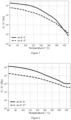
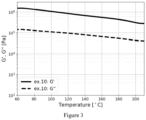
- Figures 1-3 show the temperature dependent rheological properties, G' and G" curves, from 60 °C to 230 °C for the example 8, example 9 and example 10, respectively.
- Figure 2 and Figure 3 corresponding to foams made using a reactive mixture with 0.5 wt% water (example 9) and 1 wt% water (example 10) calculated on the total weight of the reactive mixture, clearly show the typical behaviour of a chemically cross-linked polymer, i.e. thermoset material, with a stable plateau of G' and G" up to 120 °C followed by a gradual decrease of moduli' values at high temperatures. The two materials do not show any melting and the samples are still in their solid state.
- Figure 1 corresponding to a foam made using a reactive mixture with no added water (example 8) shows the typical temperature dependent behaviour of uncross-linked partially crystalline polymer, i.e. thermoplastic material, with a rubber-elastic plateau between 60 °C and 120 °C followed by a very sharp decrease of both G' and G" and an increase of ration of G" to G'. Moreover, around 210-220 °C the polymer is so much viscous that G" becomes higher than G', i.e. melting region.
Landscapes
- Chemical & Material Sciences (AREA)
- Health & Medical Sciences (AREA)
- Chemical Kinetics & Catalysis (AREA)
- Medicinal Chemistry (AREA)
- Polymers & Plastics (AREA)
- Organic Chemistry (AREA)
- Engineering & Computer Science (AREA)
- Materials Engineering (AREA)
- Polyurethanes Or Polyureas (AREA)
- Manufacture Of Porous Articles, And Recovery And Treatment Of Waste Products (AREA)
Applications Claiming Priority (3)
| Application Number | Priority Date | Filing Date | Title |
|---|---|---|---|
| EP19208441 | 2019-11-12 | ||
| PCT/EP2020/081438 WO2021094239A1 (en) | 2019-11-12 | 2020-11-09 | In-situ formation of low density thermoplastic polyurethane flexible foams |
| EP20800681.7A EP4058494B1 (de) | 2019-11-12 | 2020-11-09 | In-situ herstellung von thermoplastischen polyurethan-weichschaumstoffen mit niedriger dichte |
Related Parent Applications (2)
| Application Number | Title | Priority Date | Filing Date |
|---|---|---|---|
| EP20800681.7A Division EP4058494B1 (de) | 2019-11-12 | 2020-11-09 | In-situ herstellung von thermoplastischen polyurethan-weichschaumstoffen mit niedriger dichte |
| EP20800681.7A Division-Into EP4058494B1 (de) | 2019-11-12 | 2020-11-09 | In-situ herstellung von thermoplastischen polyurethan-weichschaumstoffen mit niedriger dichte |
Publications (2)
| Publication Number | Publication Date |
|---|---|
| EP4467612A2 true EP4467612A2 (de) | 2024-11-27 |
| EP4467612A3 EP4467612A3 (de) | 2024-12-18 |
Family
ID=68581172
Family Applications (2)
| Application Number | Title | Priority Date | Filing Date |
|---|---|---|---|
| EP24182745.0A Pending EP4467612A3 (de) | 2019-11-12 | 2020-11-09 | In-situ herstellung von thermoplastischen polyurethan-weichschaumstoffen mit niedriger dichte |
| EP20800681.7A Active EP4058494B1 (de) | 2019-11-12 | 2020-11-09 | In-situ herstellung von thermoplastischen polyurethan-weichschaumstoffen mit niedriger dichte |
Family Applications After (1)
| Application Number | Title | Priority Date | Filing Date |
|---|---|---|---|
| EP20800681.7A Active EP4058494B1 (de) | 2019-11-12 | 2020-11-09 | In-situ herstellung von thermoplastischen polyurethan-weichschaumstoffen mit niedriger dichte |
Country Status (15)
| Country | Link |
|---|---|
| US (1) | US20220363858A1 (de) |
| EP (2) | EP4467612A3 (de) |
| CN (1) | CN114630851B (de) |
| BR (1) | BR112022008435A2 (de) |
| CA (1) | CA3158223A1 (de) |
| DK (1) | DK4058494T3 (de) |
| ES (1) | ES2991469T3 (de) |
| FI (1) | FI4058494T3 (de) |
| HU (1) | HUE068596T2 (de) |
| MX (1) | MX2022005733A (de) |
| PL (1) | PL4058494T3 (de) |
| PT (1) | PT4058494T (de) |
| RS (1) | RS66056B1 (de) |
| TW (1) | TWI891677B (de) |
| WO (1) | WO2021094239A1 (de) |
Families Citing this family (3)
| Publication number | Priority date | Publication date | Assignee | Title |
|---|---|---|---|---|
| CN113999363B (zh) * | 2021-11-30 | 2022-10-21 | 江苏钟山新材料有限公司 | 一种高承载低温不敏感慢回弹海绵的制备方法 |
| PL4448610T3 (pl) | 2021-12-16 | 2026-01-19 | Basf Se | Termoplastyczna elastyczna otwartokomórkowa pianka poliuretanowa |
| CN118185124A (zh) | 2023-12-28 | 2024-06-14 | 巴斯夫新材料有限公司 | 聚氨酯发泡体系、可热回收聚氨酯泡沫及其制备方法 |
Citations (3)
| Publication number | Priority date | Publication date | Assignee | Title |
|---|---|---|---|---|
| US3769245A (en) | 1972-05-30 | 1973-10-30 | Goodrich Co B F | Thermoplastic polyurethane foam |
| US20100124652A1 (en) * | 2005-05-27 | 2010-05-20 | Bayer Materialscience Llc | Carbon dioxide blown low density, flexible microcellular polyurethane elastomers |
| CN105924610A (zh) | 2016-06-29 | 2016-09-07 | 郭舒洋 | 一种酯化抗性淀粉改性湿强剂的制备方法 |
Family Cites Families (9)
| Publication number | Priority date | Publication date | Assignee | Title |
|---|---|---|---|---|
| MX234819B (es) * | 2000-10-24 | 2006-03-13 | Dow Global Technologies Inc | Proceso de preparacion para espuma polimerica termoplastica multimodal. |
| EP1979401B1 (de) * | 2006-01-18 | 2010-09-29 | Basf Se | Schaumstoffe auf basis thermoplastischer polyurethane |
| US9624336B2 (en) * | 2011-07-25 | 2017-04-18 | Inoac Corporation | Polyurethane foam |
| US8975335B2 (en) * | 2011-09-23 | 2015-03-10 | Bayer Materialscience Llc | Process for the production of high air flow polyether foams and the foams produced by this process |
| EP3298070B1 (de) * | 2015-08-19 | 2019-04-10 | NIKE Innovate C.V. | Verfahren zur herstellung von thermoplastischem elastomerschaum |
| CN105884998A (zh) * | 2016-04-14 | 2016-08-24 | 美瑞新材料股份有限公司 | 一种发泡型热塑性聚氨酯弹性体材料及其制备方法 |
| CN110402263B (zh) * | 2017-03-15 | 2022-06-07 | 科思创有限公司 | 具有降低的温度敏感性的粘弹性聚氨酯泡沫 |
| CN109694494B (zh) * | 2018-12-21 | 2020-09-18 | 山东一诺威聚氨酯股份有限公司 | 可生物降解热塑性聚氨酯弹性体发泡珠粒及其制备方法 |
| CN109942774B (zh) * | 2019-02-22 | 2021-05-25 | 四川大学 | 一种分子链硬段阻燃聚氨酯泡沫 |
-
2020
- 2020-11-09 HU HUE20800681A patent/HUE068596T2/hu unknown
- 2020-11-09 BR BR112022008435A patent/BR112022008435A2/pt active IP Right Grant
- 2020-11-09 WO PCT/EP2020/081438 patent/WO2021094239A1/en not_active Ceased
- 2020-11-09 RS RS20241141A patent/RS66056B1/sr unknown
- 2020-11-09 FI FIEP20800681.7T patent/FI4058494T3/fi active
- 2020-11-09 MX MX2022005733A patent/MX2022005733A/es unknown
- 2020-11-09 PL PL20800681.7T patent/PL4058494T3/pl unknown
- 2020-11-09 US US17/770,853 patent/US20220363858A1/en active Pending
- 2020-11-09 DK DK20800681.7T patent/DK4058494T3/da active
- 2020-11-09 CN CN202080078608.XA patent/CN114630851B/zh active Active
- 2020-11-09 EP EP24182745.0A patent/EP4467612A3/de active Pending
- 2020-11-09 PT PT208006817T patent/PT4058494T/pt unknown
- 2020-11-09 CA CA3158223A patent/CA3158223A1/en active Pending
- 2020-11-09 EP EP20800681.7A patent/EP4058494B1/de active Active
- 2020-11-09 ES ES20800681T patent/ES2991469T3/es active Active
- 2020-11-12 TW TW109139505A patent/TWI891677B/zh active
Patent Citations (3)
| Publication number | Priority date | Publication date | Assignee | Title |
|---|---|---|---|---|
| US3769245A (en) | 1972-05-30 | 1973-10-30 | Goodrich Co B F | Thermoplastic polyurethane foam |
| US20100124652A1 (en) * | 2005-05-27 | 2010-05-20 | Bayer Materialscience Llc | Carbon dioxide blown low density, flexible microcellular polyurethane elastomers |
| CN105924610A (zh) | 2016-06-29 | 2016-09-07 | 郭舒洋 | 一种酯化抗性淀粉改性湿强剂的制备方法 |
Also Published As
| Publication number | Publication date |
|---|---|
| PT4058494T (pt) | 2024-10-25 |
| MX2022005733A (es) | 2022-08-17 |
| EP4058494A1 (de) | 2022-09-21 |
| CN114630851A (zh) | 2022-06-14 |
| PL4058494T3 (pl) | 2024-11-18 |
| DK4058494T3 (da) | 2024-10-21 |
| ES2991469T3 (es) | 2024-12-03 |
| RS66056B1 (sr) | 2024-11-29 |
| CA3158223A1 (en) | 2021-05-20 |
| US20220363858A1 (en) | 2022-11-17 |
| WO2021094239A1 (en) | 2021-05-20 |
| CN114630851B (zh) | 2024-05-28 |
| TWI891677B (zh) | 2025-08-01 |
| EP4467612A3 (de) | 2024-12-18 |
| HUE068596T2 (hu) | 2025-01-28 |
| EP4058494B1 (de) | 2024-07-31 |
| BR112022008435A2 (pt) | 2022-07-19 |
| FI4058494T3 (fi) | 2024-10-24 |
| TW202128805A (zh) | 2021-08-01 |
Similar Documents
| Publication | Publication Date | Title |
|---|---|---|
| CA2599090C (en) | Rigid polyurethane foams with low thermal conductivity and a process for their production | |
| US5312847A (en) | Polyurethane foam containing a particulate organic solid and a process for the preparation thereof | |
| EP4058494B1 (de) | In-situ herstellung von thermoplastischen polyurethan-weichschaumstoffen mit niedriger dichte | |
| KR20150042242A (ko) | 조합 발포체 | |
| CN107531931A (zh) | 泡沫、可发泡组合物和制造连皮泡沫的方法 | |
| CA2947458A1 (en) | Flexible, open-cell thermoset foams and blowing agents and methods for making same | |
| HUP0000202A2 (hu) | Új flexibilis poliuretán habok | |
| JP2007500284A (ja) | 改善された特性を有する硬質ポリウレタンフォーム | |
| EP4240783B1 (de) | Elastomerer polyurethan-polyharnstoff mit wassergetriebenem schaumstoff mit verbesserten mechanischen eigenschaften | |
| EP4240782B1 (de) | Reaktive formulierungen zur bildung eines starken polyurethan-polyharnstoffs mit wassergetriebenem schaum | |
| RU2829440C1 (ru) | Формирование in situ термопластичных полиуретановых эластичных пен низкой плотности | |
| US20240279379A1 (en) | Open cell flexible isocyanate-based foams having a low exotherm during foaming | |
| RU2765788C2 (ru) | Полиольные композиции | |
| JPH01225611A (ja) | 発泡合成樹脂の製造方法 | |
| JP4747766B2 (ja) | 硬質ポリウレタンフォームの製造方法 |
Legal Events
| Date | Code | Title | Description |
|---|---|---|---|
| PUAI | Public reference made under article 153(3) epc to a published international application that has entered the european phase |
Free format text: ORIGINAL CODE: 0009012 |
|
| STAA | Information on the status of an ep patent application or granted ep patent |
Free format text: STATUS: THE APPLICATION HAS BEEN PUBLISHED |
|
| REG | Reference to a national code |
Ref country code: DE Ref legal event code: R079 Free format text: PREVIOUS MAIN CLASS: C08L0083040000 Ipc: C08G0018100000 |
|
| PUAL | Search report despatched |
Free format text: ORIGINAL CODE: 0009013 |
|
| AC | Divisional application: reference to earlier application |
Ref document number: 4058494 Country of ref document: EP Kind code of ref document: P |
|
| AK | Designated contracting states |
Kind code of ref document: A2 Designated state(s): AL AT BE BG CH CY CZ DE DK EE ES FI FR GB GR HR HU IE IS IT LI LT LU LV MC MK MT NL NO PL PT RO RS SE SI SK SM TR |
|
| AK | Designated contracting states |
Kind code of ref document: A3 Designated state(s): AL AT BE BG CH CY CZ DE DK EE ES FI FR GB GR HR HU IE IS IT LI LT LU LV MC MK MT NL NO PL PT RO RS SE SI SK SM TR |
|
| RIC1 | Information provided on ipc code assigned before grant |
Ipc: C08L 83/12 20060101ALI20241113BHEP Ipc: C08K 5/54 20060101ALI20241113BHEP Ipc: C08J 9/14 20060101ALI20241113BHEP Ipc: C08G 77/46 20060101ALI20241113BHEP Ipc: C08G 18/76 20060101ALI20241113BHEP Ipc: C08G 18/66 20060101ALI20241113BHEP Ipc: C08G 18/48 20060101ALI20241113BHEP Ipc: C08G 18/42 20060101ALI20241113BHEP Ipc: C08G 18/32 20060101ALI20241113BHEP Ipc: C08G 18/24 20060101ALI20241113BHEP Ipc: C08G 18/10 20060101AFI20241113BHEP Ipc: C08G 101/00 20060101ALN20241113BHEP Ipc: C08L 83/04 20060101ALI20241113BHEP Ipc: C08G 77/16 20060101ALI20241113BHEP Ipc: C08J 9/12 20060101ALI20241113BHEP |
|
| STAA | Information on the status of an ep patent application or granted ep patent |
Free format text: STATUS: REQUEST FOR EXAMINATION WAS MADE |
|
| 17P | Request for examination filed |
Effective date: 20250618 |
|
| STAA | Information on the status of an ep patent application or granted ep patent |
Free format text: STATUS: EXAMINATION IS IN PROGRESS |
|
| 17Q | First examination report despatched |
Effective date: 20260216 |