EP4240782B1 - Reaktive formulierungen zur bildung eines starken polyurethan-polyharnstoffs mit wassergetriebenem schaum - Google Patents
Reaktive formulierungen zur bildung eines starken polyurethan-polyharnstoffs mit wassergetriebenem schaum Download PDFInfo
- Publication number
- EP4240782B1 EP4240782B1 EP21801945.3A EP21801945A EP4240782B1 EP 4240782 B1 EP4240782 B1 EP 4240782B1 EP 21801945 A EP21801945 A EP 21801945A EP 4240782 B1 EP4240782 B1 EP 4240782B1
- Authority
- EP
- European Patent Office
- Prior art keywords
- range
- isocyanate
- reactive
- compounds
- mol
- Prior art date
- Legal status (The legal status is an assumption and is not a legal conclusion. Google has not performed a legal analysis and makes no representation as to the accuracy of the status listed.)
- Active
Links
Classifications
-
- C—CHEMISTRY; METALLURGY
- C08—ORGANIC MACROMOLECULAR COMPOUNDS; THEIR PREPARATION OR CHEMICAL WORKING-UP; COMPOSITIONS BASED THEREON
- C08J—WORKING-UP; GENERAL PROCESSES OF COMPOUNDING; AFTER-TREATMENT NOT COVERED BY SUBCLASSES C08B, C08C, C08F, C08G or C08H
- C08J9/00—Working-up of macromolecular substances to porous or cellular articles or materials; After-treatment thereof
- C08J9/04—Working-up of macromolecular substances to porous or cellular articles or materials; After-treatment thereof using blowing gases generated by a previously added blowing agent
- C08J9/12—Working-up of macromolecular substances to porous or cellular articles or materials; After-treatment thereof using blowing gases generated by a previously added blowing agent by a physical blowing agent
- C08J9/125—Water, e.g. hydrated salts
-
- C—CHEMISTRY; METALLURGY
- C08—ORGANIC MACROMOLECULAR COMPOUNDS; THEIR PREPARATION OR CHEMICAL WORKING-UP; COMPOSITIONS BASED THEREON
- C08G—MACROMOLECULAR COMPOUNDS OBTAINED OTHERWISE THAN BY REACTIONS ONLY INVOLVING UNSATURATED CARBON-TO-CARBON BONDS
- C08G18/00—Polymeric products of isocyanates or isothiocyanates
- C08G18/06—Polymeric products of isocyanates or isothiocyanates with compounds having active hydrogen
- C08G18/28—Polymeric products of isocyanates or isothiocyanates with compounds having active hydrogen characterised by the compounds used containing active hydrogen
- C08G18/40—High-molecular-weight compounds
- C08G18/48—Polyethers
- C08G18/4854—Polyethers containing oxyalkylene groups having four carbon atoms in the alkylene group
-
- C—CHEMISTRY; METALLURGY
- C08—ORGANIC MACROMOLECULAR COMPOUNDS; THEIR PREPARATION OR CHEMICAL WORKING-UP; COMPOSITIONS BASED THEREON
- C08G—MACROMOLECULAR COMPOUNDS OBTAINED OTHERWISE THAN BY REACTIONS ONLY INVOLVING UNSATURATED CARBON-TO-CARBON BONDS
- C08G18/00—Polymeric products of isocyanates or isothiocyanates
- C08G18/06—Polymeric products of isocyanates or isothiocyanates with compounds having active hydrogen
- C08G18/08—Processes
- C08G18/10—Prepolymer processes involving reaction of isocyanates or isothiocyanates with compounds having active hydrogen in a first reaction step
-
- C—CHEMISTRY; METALLURGY
- C08—ORGANIC MACROMOLECULAR COMPOUNDS; THEIR PREPARATION OR CHEMICAL WORKING-UP; COMPOSITIONS BASED THEREON
- C08G—MACROMOLECULAR COMPOUNDS OBTAINED OTHERWISE THAN BY REACTIONS ONLY INVOLVING UNSATURATED CARBON-TO-CARBON BONDS
- C08G18/00—Polymeric products of isocyanates or isothiocyanates
- C08G18/06—Polymeric products of isocyanates or isothiocyanates with compounds having active hydrogen
- C08G18/08—Processes
- C08G18/10—Prepolymer processes involving reaction of isocyanates or isothiocyanates with compounds having active hydrogen in a first reaction step
- C08G18/12—Prepolymer processes involving reaction of isocyanates or isothiocyanates with compounds having active hydrogen in a first reaction step using two or more compounds having active hydrogen in the first polymerisation step
-
- C—CHEMISTRY; METALLURGY
- C08—ORGANIC MACROMOLECULAR COMPOUNDS; THEIR PREPARATION OR CHEMICAL WORKING-UP; COMPOSITIONS BASED THEREON
- C08G—MACROMOLECULAR COMPOUNDS OBTAINED OTHERWISE THAN BY REACTIONS ONLY INVOLVING UNSATURATED CARBON-TO-CARBON BONDS
- C08G18/00—Polymeric products of isocyanates or isothiocyanates
- C08G18/06—Polymeric products of isocyanates or isothiocyanates with compounds having active hydrogen
- C08G18/08—Processes
- C08G18/16—Catalysts
- C08G18/161—Catalysts containing two or more components to be covered by at least two of the groups C08G18/166, C08G18/18 or C08G18/22
- C08G18/163—Catalysts containing two or more components to be covered by at least two of the groups C08G18/166, C08G18/18 or C08G18/22 covered by C08G18/18 and C08G18/22
-
- C—CHEMISTRY; METALLURGY
- C08—ORGANIC MACROMOLECULAR COMPOUNDS; THEIR PREPARATION OR CHEMICAL WORKING-UP; COMPOSITIONS BASED THEREON
- C08G—MACROMOLECULAR COMPOUNDS OBTAINED OTHERWISE THAN BY REACTIONS ONLY INVOLVING UNSATURATED CARBON-TO-CARBON BONDS
- C08G18/00—Polymeric products of isocyanates or isothiocyanates
- C08G18/06—Polymeric products of isocyanates or isothiocyanates with compounds having active hydrogen
- C08G18/08—Processes
- C08G18/16—Catalysts
- C08G18/18—Catalysts containing secondary or tertiary amines or salts thereof
- C08G18/20—Heterocyclic amines; Salts thereof
- C08G18/2009—Heterocyclic amines; Salts thereof containing one heterocyclic ring
- C08G18/2027—Heterocyclic amines; Salts thereof containing one heterocyclic ring having two nitrogen atoms in the ring
-
- C—CHEMISTRY; METALLURGY
- C08—ORGANIC MACROMOLECULAR COMPOUNDS; THEIR PREPARATION OR CHEMICAL WORKING-UP; COMPOSITIONS BASED THEREON
- C08G—MACROMOLECULAR COMPOUNDS OBTAINED OTHERWISE THAN BY REACTIONS ONLY INVOLVING UNSATURATED CARBON-TO-CARBON BONDS
- C08G18/00—Polymeric products of isocyanates or isothiocyanates
- C08G18/06—Polymeric products of isocyanates or isothiocyanates with compounds having active hydrogen
- C08G18/08—Processes
- C08G18/16—Catalysts
- C08G18/18—Catalysts containing secondary or tertiary amines or salts thereof
- C08G18/20—Heterocyclic amines; Salts thereof
- C08G18/2045—Heterocyclic amines; Salts thereof containing condensed heterocyclic rings
- C08G18/2063—Heterocyclic amines; Salts thereof containing condensed heterocyclic rings having two nitrogen atoms in the condensed ring system
-
- C—CHEMISTRY; METALLURGY
- C08—ORGANIC MACROMOLECULAR COMPOUNDS; THEIR PREPARATION OR CHEMICAL WORKING-UP; COMPOSITIONS BASED THEREON
- C08G—MACROMOLECULAR COMPOUNDS OBTAINED OTHERWISE THAN BY REACTIONS ONLY INVOLVING UNSATURATED CARBON-TO-CARBON BONDS
- C08G18/00—Polymeric products of isocyanates or isothiocyanates
- C08G18/06—Polymeric products of isocyanates or isothiocyanates with compounds having active hydrogen
- C08G18/08—Processes
- C08G18/16—Catalysts
- C08G18/22—Catalysts containing metal compounds
- C08G18/222—Catalysts containing metal compounds metal compounds not provided for in groups C08G18/225 - C08G18/26
-
- C—CHEMISTRY; METALLURGY
- C08—ORGANIC MACROMOLECULAR COMPOUNDS; THEIR PREPARATION OR CHEMICAL WORKING-UP; COMPOSITIONS BASED THEREON
- C08G—MACROMOLECULAR COMPOUNDS OBTAINED OTHERWISE THAN BY REACTIONS ONLY INVOLVING UNSATURATED CARBON-TO-CARBON BONDS
- C08G18/00—Polymeric products of isocyanates or isothiocyanates
- C08G18/06—Polymeric products of isocyanates or isothiocyanates with compounds having active hydrogen
- C08G18/28—Polymeric products of isocyanates or isothiocyanates with compounds having active hydrogen characterised by the compounds used containing active hydrogen
- C08G18/30—Low-molecular-weight compounds
- C08G18/302—Water
-
- C—CHEMISTRY; METALLURGY
- C08—ORGANIC MACROMOLECULAR COMPOUNDS; THEIR PREPARATION OR CHEMICAL WORKING-UP; COMPOSITIONS BASED THEREON
- C08G—MACROMOLECULAR COMPOUNDS OBTAINED OTHERWISE THAN BY REACTIONS ONLY INVOLVING UNSATURATED CARBON-TO-CARBON BONDS
- C08G18/00—Polymeric products of isocyanates or isothiocyanates
- C08G18/06—Polymeric products of isocyanates or isothiocyanates with compounds having active hydrogen
- C08G18/28—Polymeric products of isocyanates or isothiocyanates with compounds having active hydrogen characterised by the compounds used containing active hydrogen
- C08G18/30—Low-molecular-weight compounds
- C08G18/32—Polyhydroxy compounds; Polyamines; Hydroxyamines
- C08G18/3203—Polyhydroxy compounds
- C08G18/3206—Polyhydroxy compounds aliphatic
-
- C—CHEMISTRY; METALLURGY
- C08—ORGANIC MACROMOLECULAR COMPOUNDS; THEIR PREPARATION OR CHEMICAL WORKING-UP; COMPOSITIONS BASED THEREON
- C08G—MACROMOLECULAR COMPOUNDS OBTAINED OTHERWISE THAN BY REACTIONS ONLY INVOLVING UNSATURATED CARBON-TO-CARBON BONDS
- C08G18/00—Polymeric products of isocyanates or isothiocyanates
- C08G18/06—Polymeric products of isocyanates or isothiocyanates with compounds having active hydrogen
- C08G18/28—Polymeric products of isocyanates or isothiocyanates with compounds having active hydrogen characterised by the compounds used containing active hydrogen
- C08G18/65—Low-molecular-weight compounds having active hydrogen with high-molecular-weight compounds having active hydrogen
- C08G18/66—Compounds of groups C08G18/42, C08G18/48, or C08G18/52
- C08G18/6666—Compounds of group C08G18/48 or C08G18/52
- C08G18/667—Compounds of group C08G18/48 or C08G18/52 with compounds of group C08G18/32 or polyamines of C08G18/38
- C08G18/6674—Compounds of group C08G18/48 or C08G18/52 with compounds of group C08G18/32 or polyamines of C08G18/38 with compounds of group C08G18/3203
-
- C—CHEMISTRY; METALLURGY
- C08—ORGANIC MACROMOLECULAR COMPOUNDS; THEIR PREPARATION OR CHEMICAL WORKING-UP; COMPOSITIONS BASED THEREON
- C08G—MACROMOLECULAR COMPOUNDS OBTAINED OTHERWISE THAN BY REACTIONS ONLY INVOLVING UNSATURATED CARBON-TO-CARBON BONDS
- C08G18/00—Polymeric products of isocyanates or isothiocyanates
- C08G18/06—Polymeric products of isocyanates or isothiocyanates with compounds having active hydrogen
- C08G18/28—Polymeric products of isocyanates or isothiocyanates with compounds having active hydrogen characterised by the compounds used containing active hydrogen
- C08G18/65—Low-molecular-weight compounds having active hydrogen with high-molecular-weight compounds having active hydrogen
- C08G18/66—Compounds of groups C08G18/42, C08G18/48, or C08G18/52
- C08G18/6666—Compounds of group C08G18/48 or C08G18/52
- C08G18/667—Compounds of group C08G18/48 or C08G18/52 with compounds of group C08G18/32 or polyamines of C08G18/38
- C08G18/6674—Compounds of group C08G18/48 or C08G18/52 with compounds of group C08G18/32 or polyamines of C08G18/38 with compounds of group C08G18/3203
- C08G18/6677—Compounds of group C08G18/48 or C08G18/52 with compounds of group C08G18/32 or polyamines of C08G18/38 with compounds of group C08G18/3203 having at least three hydroxy groups
-
- C—CHEMISTRY; METALLURGY
- C08—ORGANIC MACROMOLECULAR COMPOUNDS; THEIR PREPARATION OR CHEMICAL WORKING-UP; COMPOSITIONS BASED THEREON
- C08G—MACROMOLECULAR COMPOUNDS OBTAINED OTHERWISE THAN BY REACTIONS ONLY INVOLVING UNSATURATED CARBON-TO-CARBON BONDS
- C08G18/00—Polymeric products of isocyanates or isothiocyanates
- C08G18/06—Polymeric products of isocyanates or isothiocyanates with compounds having active hydrogen
- C08G18/70—Polymeric products of isocyanates or isothiocyanates with compounds having active hydrogen characterised by the isocyanates or isothiocyanates used
- C08G18/72—Polyisocyanates or polyisothiocyanates
- C08G18/74—Polyisocyanates or polyisothiocyanates cyclic
- C08G18/76—Polyisocyanates or polyisothiocyanates cyclic aromatic
- C08G18/7657—Polyisocyanates or polyisothiocyanates cyclic aromatic containing two or more aromatic rings
- C08G18/7664—Polyisocyanates or polyisothiocyanates cyclic aromatic containing two or more aromatic rings containing alkylene polyphenyl groups
- C08G18/7671—Polyisocyanates or polyisothiocyanates cyclic aromatic containing two or more aromatic rings containing alkylene polyphenyl groups containing only one alkylene bisphenyl group
-
- C—CHEMISTRY; METALLURGY
- C08—ORGANIC MACROMOLECULAR COMPOUNDS; THEIR PREPARATION OR CHEMICAL WORKING-UP; COMPOSITIONS BASED THEREON
- C08G—MACROMOLECULAR COMPOUNDS OBTAINED OTHERWISE THAN BY REACTIONS ONLY INVOLVING UNSATURATED CARBON-TO-CARBON BONDS
- C08G2101/00—Manufacture of cellular products
-
- C—CHEMISTRY; METALLURGY
- C08—ORGANIC MACROMOLECULAR COMPOUNDS; THEIR PREPARATION OR CHEMICAL WORKING-UP; COMPOSITIONS BASED THEREON
- C08G—MACROMOLECULAR COMPOUNDS OBTAINED OTHERWISE THAN BY REACTIONS ONLY INVOLVING UNSATURATED CARBON-TO-CARBON BONDS
- C08G2110/00—Foam properties
- C08G2110/0008—Foam properties flexible
-
- C—CHEMISTRY; METALLURGY
- C08—ORGANIC MACROMOLECULAR COMPOUNDS; THEIR PREPARATION OR CHEMICAL WORKING-UP; COMPOSITIONS BASED THEREON
- C08G—MACROMOLECULAR COMPOUNDS OBTAINED OTHERWISE THAN BY REACTIONS ONLY INVOLVING UNSATURATED CARBON-TO-CARBON BONDS
- C08G2110/00—Foam properties
- C08G2110/0041—Foam properties having specified density
- C08G2110/0066—≥ 150kg/m3
-
- C—CHEMISTRY; METALLURGY
- C08—ORGANIC MACROMOLECULAR COMPOUNDS; THEIR PREPARATION OR CHEMICAL WORKING-UP; COMPOSITIONS BASED THEREON
- C08G—MACROMOLECULAR COMPOUNDS OBTAINED OTHERWISE THAN BY REACTIONS ONLY INVOLVING UNSATURATED CARBON-TO-CARBON BONDS
- C08G2110/00—Foam properties
- C08G2110/0083—Foam properties prepared using water as the sole blowing agent
-
- C—CHEMISTRY; METALLURGY
- C08—ORGANIC MACROMOLECULAR COMPOUNDS; THEIR PREPARATION OR CHEMICAL WORKING-UP; COMPOSITIONS BASED THEREON
- C08J—WORKING-UP; GENERAL PROCESSES OF COMPOUNDING; AFTER-TREATMENT NOT COVERED BY SUBCLASSES C08B, C08C, C08F, C08G or C08H
- C08J2203/00—Foams characterized by the expanding agent
- C08J2203/10—Water or water-releasing compounds
-
- C—CHEMISTRY; METALLURGY
- C08—ORGANIC MACROMOLECULAR COMPOUNDS; THEIR PREPARATION OR CHEMICAL WORKING-UP; COMPOSITIONS BASED THEREON
- C08J—WORKING-UP; GENERAL PROCESSES OF COMPOUNDING; AFTER-TREATMENT NOT COVERED BY SUBCLASSES C08B, C08C, C08F, C08G or C08H
- C08J2375/00—Characterised by the use of polyureas or polyurethanes; Derivatives of such polymers
- C08J2375/02—Polyureas
-
- C—CHEMISTRY; METALLURGY
- C08—ORGANIC MACROMOLECULAR COMPOUNDS; THEIR PREPARATION OR CHEMICAL WORKING-UP; COMPOSITIONS BASED THEREON
- C08J—WORKING-UP; GENERAL PROCESSES OF COMPOUNDING; AFTER-TREATMENT NOT COVERED BY SUBCLASSES C08B, C08C, C08F, C08G or C08H
- C08J2375/00—Characterised by the use of polyureas or polyurethanes; Derivatives of such polymers
- C08J2375/04—Polyurethanes
Definitions
- the present invention relates to processes and reactive foam formulations for forming a polyurethane-polyurea comprising water blown foam having an apparent density in the range 30-700 kg/m 3 measured according to ISO 845 and having a tensile strength (measured according to DIN 53504) over apparent density ratio of at least 10 kPa.m 3 /kg.
- the present invention further relates to foams having elastomeric behaviour and improved mechanical properties such as tensile strength and ball rebound which make them very suitable for use in footwear and automotive and more in particular in applications aiming for consumer comfort.
- conventional low density elastomeric flexible polyurethane foams are typically produced using isocyanate reactive compounds with a functionality higher than 2 and with very high water contents in order to have stability during foaming and to achieve the required mechanical properties and density. It is known that the use of isocyanate reactive compounds with a functionality higher than 2 will give rise to a cross-linked polyurethane matrix. This renders conventional low-density flexible polyurethane foams behaving as thermoset materials rather than thermoplastic materials. Furthermore, the combination of typical compounds used to form said foams result in materials having very low tensile strength. Typical examples of low-density foams can be found in CA2337913A1 .
- elastomeric flexible foam which has improved mechanical properties such as tensile strength and ball rebound for a given density.
- the solution provided to solve this problem still allows formulators a large degree of freedom.
- a specific version of the elastomeric polyurethane flexible foam can be made which is thermoplastic and thereby is thermally recyclable (e.g. via extrusion) and/or melt reprocessable after its service-life.
- the goal is to achieve an elastomeric polyurethane flexible foam which has for a given density a higher tensile strength (measured according to DIN 53504) and higher ball rebound (measured according to ISO 8307 and also referred to as resilience) compared to state of the art elastomeric polyurethane foams.
- a higher tensile strength measured according to DIN 53504
- higher ball rebound measured according to ISO 8307 and also referred to as resilience
- the ultimate goal is to develop an elastomeric polyurethane flexible foam having a density in the range 200-300 kg/m 3 which has a tensile strength, a ball rebound and/or compression set which is typical for state of the art elastomeric polyurethane flexible foams having densities in the range 300-500 kg/m 3 .
- the improved characteristic of the foam according to the invention having a higher tensile strength at a given density is indicated as a tensile strength over apparent density ratio.
- thermoplastic polyurethane flexible foam which is thermally recyclable (e.g. via extrusion) and/or melt reprocessable after its service-life.
- the present invention is defined by the appended claims.
- the present invention discloses polyurethane-polyurea comprising water blown foams which have surprisingly good mechanical properties such as tensile strength and ball rebound and are easily melt-reprocessable and recyclable after use.
- These flexible polyurethane foams are foams which are polymerised and blown in-situ and which can be recycled after service-life (use) by means of a thermal treatment above the melt temperature of the (thermoplastic) polyurethane material.
- the present invention discloses a method and reactive mixture for making the elastomeric polyurethane-polyurea comprising water blown foams.
- the reactive mixture of the invention used to make said foam is blown using predominantly water as blowing agents.
- the use of the reactive mixture according to the invention will lead to a micro-phase separated polymer morphology, more in particular the formation of distinctive crystalline hard block phases and a soft block phase. This phase separation contributes to the superior properties of the foam compared to state-of-the-art elastomeric flexible foams.
- an elastomeric polyurethane-polyurea comprising water blown foam (referred herein after as "PU/PUR foam") having an apparent density in the range 30-700 kg/m 3 measured according to ISO 845 and having a tensile strength (measured according to DIN 53504) over apparent density ratio of at least 10 kPa.m 3 /kg, said method comprising mixing at an isocyanate index in the range 75 up to 125 in situ at least following ingredients to form a reactive foam formulation:
- the D equivalents of low molecular weight (MW) urethane forming compounds containing hydroxyl functional groups and having a molecular weight ⁇ 500 g/mol and having a hydroxy functionality in the range 1 up to 8 refers to the sum of the urethane forming equivalents of polyol chain extender compounds and/or polyol crosslinker compounds and/or mono-alcohol compounds used.
- the required equivalents of compounds B up to E are first combined (to form the so-called "b-side") and then reacted with the polyisocyanate composition.
- the isocyanate index of the reactive foam formulation is in the range 75 up to 125, in the range 80 up to 120, in the range 85 up to 120, in the range 88 up to 120, in the range 90 up to 120, in the range 90 up to 110, in the range 92 up to 110, in the range 95 up to 110, in the range 95 up to 105, in the range 98 up to 105, in the range 98 up to 102.
- the process for making the elastomeric PU/PUR foam according to the invention comprises at least the steps of:
- the step of mixing of the polyisocyanate composition with the pre-mixed composition obtained in step i) to form a reactive foam formulation is performed using a 2-component mixing system.
- the mixing system is a pressure mixing system.
- the pressure mixing system is a high pressure mixing system that uses impingement to mix materials.
- the step of mixing of the polyisocyanate composition with the pre-mixed composition obtained in step i) to form a reactive foam formulation is performed using a 2-component dynamic mixing system.
- the step of mixing of the polyisocyanate composition with the pre-mixed composition obtained in step i) to form a reactive foam formulation is performed using a combination of impingement and dynamic mixing.
- no external heat is preferably added to the reactive foam formulation, the reaction exotherm is sufficient to obtain a foamed structure.
- the step of allowing the reactive foam formulation obtained in step ii) to foam is performed in a mould and the mould temperature may be altered to affect skin properties. Elevated mould temperature may also prevent excessive heat loss, hereby helping conversion/molecular weight build-up during polymerisation.
- the method for making the elastomeric PU/PUR foam according to the invention is performed at an isocyanate index in the range 75 up to 125, in the range 80 up to 120, in the range 85 up to 120, in the range 88 up to 120, in the range 90 up to 120, in the range 90 up to 110, in the range 92 up to 110, in the range 95 up to 110, in the range 95 up to 105, in the range 98 up to 105, in the range 98 up to 102.
- the number of urea forming equivalents of water C is smaller than 0.08, smaller than 0.07, smaller than 0.06, smaller than 0.055, smaller than 0.05, smaller than 0.045, smaller than 0.04, in the range 0.02 up to 0.04 calculated on 100 gram reactive foam formulation.
- the number of equivalents low MW urethane forming compounds D is greater than 0, greater than 0.005, greater than 0.008, greater than 0.01, greater than 0.012, greater than 0.015, greater than 0.017, greater than 0.02 or greater than 0.025 calculated on 100 gram reactive foam formulation.
- the number of equivalents low MW urethane forming compounds D is smaller than 0.06, smaller than 0.055, smaller than 0.05, smaller than 0.045, smaller than 0.04 or smaller than 0.035 calculated on 100 gram reactive foam formulation.
- the number of urea forming equivalents of low molecular weight (MW) urea forming compounds containing amine functional groups E is greater than 0 calculated on 100 gram reactive foam formulation (not optional).
- the amount of low MW urea forming compounds might be at least 5%, 10%, 15%, 20%, 25%, or 30% by weight calculated on the total amount of low MW urea forming compounds and low MW urethane forming compounds in the reactive formulation.
- Increasing the amount of low MW urea forming compounds in the reactive formulation might be beneficial to lower the free rise density of the foam.
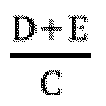
- the ratio D + E C in the reactive foam formulation is smaller than 1.4, smaller than 1.3, smaller than 1.2, smaller than 1.1, smaller than 1 or smaller than 0.9.
- the ratio D + E C in the reactive foam formulation is larger than 0, greater than 0.05, greater than 0.1, greater than 0.13, greater than 0.15, greater than 0.2, greater than 0.25, greater than 0.3, greater than 0.40, greater than 0.50, greater than 0.55, greater than 0.6, greater than 0.65 or greater than 0.7.
- the blowing agent composition comprises at least 20 wt%, preferably > 40 wt%, more preferably > 60 wt%, more preferably > 80 wt%, more preferably > 90 wt% water based on the total weight of all blowing agents used.
- physical blowing agents may be added to the reactive foam formulation used to make the elastomeric PU/PUR foam according to the invention. Addition of physical blowing agents may help to further reduce the density of the foam formulation while maintaining an optimal ratio D + E C .
- suitable physical blowing agents may be selected from isobutene, methylformate, dimethyl ether, methylene chloride, acetone, t-butanol, argon, krypton, xenon, chloro fluoro carbons (CFCs), hydro fluoro carbons (HFCs), hydro chloro fluoro carbons (HCFCs), hydro fluoro olefins (HFO's), Hydro Chloro Fluoro Olefins (HCFO's), and hydrocarbons such as pentane, isopentane and cyclopentane and mixtures thereof.
- the physical blowing agents are selected from at least CO 2 and/or N 2 .
- the physical blowing agents may be selected from HFO blowing agents and/or HCFO blowing agents and/or hydrocarbons such as cyclopentane.
- HFO blowing agents may be selected from 3,3,3-trifluoropropene, 1,2,3,3,3 - pentafluoropropene, cis- and/or trans-1,3,3,3-tetrafluoropropene and/or 2,3,3,3-tetrafluoropropene, and/or 1,1,1,4,4,4-hexafluorobut-2-ene, and/or 1-chloro-3,3,3-trifluoropropene, and/or 2-chloro-3,3,3-trifluoropropene and mixtures thereof.
- the amount of blowing agents used in the reactive foam formulation can vary based on, for example, the intended use and application of the foam product and the desired foam stiffness and density.
- the amount of water and optionally further blowing agents used in the reactive foam formulation is in the range 0.1 to 25 parts by weight, more preferably from 0.25 to 15 pbw per hundred weight parts isocyanate reactive compounds (polyol) in order to produce a low density flexible foam having a density ⁇ 500 kg/m 3 , e.g. a low density foam having densities in the range 50-500 kg/m 3 .
- the isocyanate composition used to make the PU/PUR foam according to the invention has a molecular number average isocyanate functionality in the range 1.8 up to 2.4, in the range of 1.8 up to 2.2, more preferably in the range of 1.9-2.1, more preferably in the range of 1.95-2.05, more preferably in the range of 1.95-2.02, more preferably in the range of 1.95-2.015, more preferably in the range of 1.95-2.012, even more preferably in the range of 1.98-2.01 and most preferably in the range of 1.98-2.005.
- the isocyanate composition has an NCO value in the range 3 up to 50, an NCO value in the range 5 up to 33.56, an NCO value in the range 8 up to 30, an NCO value in the range 10 up to 26 or an NCO value in the range 13 up to 23.
- the isocyanate composition used to make the elastomeric PU/PUR foam according to the invention comprises at least 80 % by weight, at least 85 % by weight, at least 90 %, at least 95 % by weight difunctional isocyanate compounds calculated on the total weight of all isocyanate compounds in the isocyanate composition.
- the isocyanate composition contains at least 80 wt%, at least 85 wt%, at least 90 wt%, at least 95 wt%, and most preferably at least 98 wt% 4,4'- diphenylmethane diisocyanates calculated on the total weight of the isocyanate composition.
- the difunctional isocyanates may be selected from aliphatic diisocyanates selected from hexamethylene diisocyanate, isophorone diisocyanate, methylene dicyclohexyl diisocyanate and cyclohexane diisocyanate and or from aromatic diisocyanates selected from toluene diisocyanate (TDI), naphthalene diisocyanate, tetramethylxylene diisocyanate, phenylene diisocyanate, toluidine diisocyanate and, in particular, diphenylmethane diisocyanate (MDI).
- TDI toluene diisocyanate
- MDI diphenylmethane diisocyanate
- the isocyanate composition used in the process of the present invention contains essentially (at least 95 % by weight, more preferably at least 98 % by weight calculated on the total weight of the polyisocyanate composition) pure 4,4'-diphenylmethane diisocyanate.
- the isocyanate composition used in the process of the present invention contains mixtures of 4,4'-diphenylmethane diisocyanate with one or more other organic diisocyanates, especially other diphenylmethane diisocyanates, for example the 2,4'-isomer optionally in conjunction with the 2,2'-isomer.
- the isocyanate compounds in the polyisocyanate composition may also be an MDI variant derived from a isocyanate composition containing at least 95 wt% 4,4'-diphenylmethane diisocyanate.
- MDI variants are well known in the art and, for use in accordance with the invention, particularly include liquid products obtained by introducing carbodiimide groups into said polyisocyanate composition and/or by reacting with one or more polyols.
- the isocyanate compounds in the isocyanate composition may also be isocyanate-terminated prepolymer which is prepared by reaction of an excessive amount of the isocyanate having at least 80 wt%, at least 85 wt%, at least 90 wt%, at least 95% of 4,4'-diphenylmethane diisocyanate with a suitable difunctional polyol in order to obtain a prepolymer having the indicated NCO value.
- Methods to prepare prepolymers have been described in the art.
- the relative amounts of isocyanate and polyol depend on their equivalent weights and on the desired NCO value and can be determined easily by those skilled in the art.
- the NCO value of the isocyanate-terminated prepolymer is preferably above 3%, preferably above 5%, more preferably above 8% and most preferably above 10%.
- the molecular number average functionality of the total of the high MW isocyanate reactive compounds in the reactive formulation into account is in the range 1.8 up to 2.4, in the range of 1.8 up to 2.2, more preferably in the range of 1.9-2.1, more preferably in the range of 1.95-2.05, more preferably in the range of 1.95-2.02, more preferably in the range of 1.95-2.015, more preferably in the range of 1.95-2.012, even more preferably in the range of 1.98-2.01 and most preferably in the range of 1.98-2.005.
- the molecular number average functionality of the blend of all isocyanate reactive compounds is in the range of 1.8 up to 2.4, in the range of 1.8 up to 2.2, more preferably in the range of 1.9-2.1, more preferably in the range of 1.95-2.05, more preferably in the range of 1.95-2.02, more preferably in the range of 1.95-2.015, more preferably in the range of 1.95-2.012, even more preferably in the range of 1.98-2.01 and most preferably in the range of 1.98-2.005.
- the molecular number average functionality of the blend of all reactive components is in the range of 1.8 up to 2.4, in the range of 1.8 up to 2.2, more preferably in the range of 1.9-2.1, more preferably in the range of 1.95-2.05, more preferably in the range of 1.95-2.02, more preferably in the range of 1.95-2.015, more preferably in the range of 1.95-2.012, even more preferably in the range of 1.98-2.01 and most preferably in the range of 1.98-2.005.
- the isocyanate reactive compounds in the reactive foam formulation comprising the high MW isocyanate reactive compounds, the low MW urethane forming compounds and low MW urea forming compounds are selected from at least 75 % by weight difunctional polyols, more preferably at least 85 % by weight difunctional polyols, most preferably at least 90 % by weight difunctional polyols calculated on the total weight of all isocyanate reactive compounds in the reactive mixture.
- the isocyanate reactive compounds in the reactive foam formulation comprising the high MW isocyanate reactive compounds, the low MW urethane forming compounds and low MW urea forming compounds are selected from at least 90 % by weight difunctional polyols, more preferably at least 95 % by weight difunctional polyols, most preferably at least 98 % by weight difunctional polyols calculated on the total weight of all isocyanate reactive compounds in the reactive foam formulation.
- the high MW isocyanate reactive compounds having a molecular weight > 500 g/mol are selected from polyether based polyols wherein the polyether backbone is at least 50 w% based on a butyleneoxide polyol, preferably at least 70 w% based on a butyleneoxide polyol, more preferably at least 80 w% based on a butyleneoxide polyol and most preferably at least 90 w% based on a butyleneoxide polyol.
- the high MW isocyanate reactive compounds having a molecular weight > 500 g/mol are selected from polyester diols, polyether polyols and/or polyester polyether polyols having a molecular weight in the range 500 g/mol up to 10000 g/mol, preferably in the range 500 g/mol up to 5000 g/mol, more preferably in the range 650 g/mol up to 4000 g/mol.
- the high MW polyols having a molecular weight > 500 g/mol are selected from at least one linear high molecular weight difunctional polyol having a molecular weight in the range 500-20000 g/mol and the amount of linear high molecular weight difunctional polyol is at least 80 wt%, more preferably at least 85 wt%, most preferably at least 90 wt% calculated on the total weight of the high MW polyols.
- said difunctional polyols are selected from linear polyester polyols, polyether polyols, and/or polyether-polyester polyols (including speciality polyester diols such as polycaprolactone diols).
- the high MW (difunctional) polyol may comprise and/or may be selected from a silica based diol such as dihydroxyl-terminated polydimethylsiloxane (PDMS-diol), a dihydroxyl terminated polybutadiene (HTPB-diol), fatty acids dimer-based polyester diols and mixtures thereof.
- a silica based diol such as dihydroxyl-terminated polydimethylsiloxane (PDMS-diol), a dihydroxyl terminated polybutadiene (HTPB-diol), fatty acids dimer-based polyester diols and mixtures thereof.
- the elastomeric PU/PUR foam according to the invention may be fabricated using mainly high molecular weight difunctional polyol(s) selected from polyester diols. These elastomeric PU/PUR foam will have excellent compatibility with PVC and other polar plastics.
- the elastomeric PU/PUR foam according to the invention may be fabricated using mainly high molecular weight difunctional polyol(s) selected from polyether diols. These elastomeric PU/PUR foams will have excellent low temperature flexibility and hydrolysis resistance, making them suitable for applications where water is a consideration.
- the low MW urethane forming compounds have a molecular weight ⁇ 500 g/mol, preferably a molecular weight in the range 45 g/mol up to 500 g/mol, more preferably in the range 50 g/mol up to 250 g/mol and are selected from 1,6-hexanediol, 1,4-butanediol, monoethylene glycol, diethylene glycol, triethyleneglycol, tetraethyleneglycol, propylene glycol, dipropylene glycol, tripropylene glycol, 1,3-propanediol, 1,-3-butanediol, 1,5-pentanediol, Polycaprolactone diol, 2-methyl-1,3-propanediol, neopentyl glycol, 1,4-cyclohexanedimethanol, hydroquinone bis (2-hydroxyethyl) ether (HQEE), 1,3-Bis (2-hydroxyethyl
- the low MW urethane forming compounds or the low MW urea forming compounds have a molecular weight in the range 45 g/mol up to 500 g/mol, more preferably in the range 100 g/mol up to 500 g/mol, more preferably in the range 200 g/mol up to 500 g/mol, more preferably in the range 300 g/mol up to 500 g/mol, more preferably in the range 350 g/mol up to 500 g/mol, most preferably in the range 350 g/mol up to 450 g/mol.
- the low MW urethane forming compounds are selected from at least 90 wt% of 1 type of compound which is beneficial for the phase separation.
- said low MW urethane forming compounds are selected from 1,6-hexanediol, 1,4-butanediol or ethylene glycol, most preferably 1,4-butanediol.
- the hardblock content of the reactive foam formulation is in the range 12 up to 65 %, preferably in the range 12 % up to 50 %, more preferably in the range 12 % up to 40 %, more preferably in the range 14 % up to 35 %, more preferably in the range 14 % up to 30 %, more preferably in the range 14 % up to 27 %, more preferably in the range 15 % up to 25 %, most preferably in the range 17 % up to 22 %.
- the water, low MW urea forming compounds (and possibly the low MW urethane forming compounds) will form urea hardblock units after reaction in the obtained foam and wherein at least 5% of the theoretical equivalents in said urea hardblock originate from water, more preferably 10%, 20%, 30%, 40%, 50%, 60%, 70%, 75% of the theoretical equivalents in said urea hardblock originate from water.
- the reactive foam formulation may further comprise solid polymer particles such as styrene-based polymer particles.
- styrene polymer particles include so-called "SAN" particles of styrene-acrylonitrile.
- small amounts of polymer polyols may be added as an additional polyol in the isocyanate reactive composition.
- An example of a commercially available polymer polyol is HYPERLITE ® Polyol 1639 which is a Polyether polyol modified with a styrene-acrylonitrile polymer (SAN) with a solid content of approximately 41 wt% (also referred to as polymer polyol).
- the reactive foam formulation may comprise fillers such as wood chips, wood dust, wood flakes, wooden plates; paper and cardboard, both shredded or layered; sand, vermiculite, clay, cement and other silicates; ground rubber, ground thermoplastics, ground thermoset materials; honeycombs of any material, like cardboard, aluminium, wood and plastics; metal particles and plates; cork in particulate form or in layers; natural fibers, like flax, hemp and sisal fibers; synthetic fibers, like polyamide, polyolefin, polyaramide, polyester and carbon fibers; mineral fibers, like glass fibers and rock wool fibers; mineral fillers like BaSO 4 and CaCO 3 ; nanoparticles, like clays, inorganic oxides and carbons; glass beads, ground glass, hollow glass beads; expanded or expandable beads; untreated or treated waste, like milled, chopped, crushed or ground waste and in particular fly ash; woven and non-woven textiles; and combinations of two or more of these materials.
- fillers such as wood chips, wood dust
- additives and/or auxiliaries may be used in making the elastomeric PU/PUR foam according to the invention.
- these include surfactants, flame proofing agents, fillers, pigments, stabilizers and the like.
- the surfactant used is preferably selected from a silicon surfactant.
- suitable commercially available surfactants are Tegostab ® B8494, Tegostab ® B8905, Tegostab ® B8993, Tegostab ® B8948, Tegostab ® B8017, Tegostab ® B8930, Tegostab ® B8950, Tegostab ® B8960, Vorasurf ® DC193, Vorasurf ® 5382, Niax ® L1500, Niax ® L1550, Niax ® L1542, Niax ® UAX 7061, Niax ® UAX 6897, Niax ® UAX 6639, Niax ® UAX 7061, Tegostab ® B8466 and Tegostab ® B8416.
- suitable catalysts accelerate in particular the reaction between the NCO groups of the diisocyanates a) and accelerate the hydroxyl groups of the isoreactive compounds and are selected from those known in the prior art such as metal salt catalysts, such as organotins, and amine compounds, such as triethylenediamine (TEDA), N-methylimidazole, 1,2-dimethylimidazole, N-methylmorpholine, N-ethylmorpholine, triethylamine, N,N'-dimethylpiperazine, 1,3,5-tris(dimethylaminopropyl) hexahydrotriazine, 2,4,6-tris(dimethylaminomethyl)phenol, N-methyldicyclohexylamine, pentamethyldipropylene triamine, N-methyl-N'-(2-dimethylamino)-ethyl-piperazine, tributylamine, pentamethyldiethylenetriamine, hexamethyltri
- the catalyst compound should be present in the reactive composition in a catalytically effective amount, generally from about 0 to 5 % by weight, preferably 0 to 2 -% by weight, most preferably 0 to 1 -% by weight, based on total weight of all reactive ingredients used.
- All reactants in the reactive foam formulation can be reacted at once or can be reacted in a sequential manner.
- the various components used in the manufacture of the compositions of the invention can in fact be added in any order.
- the process can be selected from a bulk process, either batch or continuous process including cast process.
- an elastomeric deformable PU/PUR comprising water blown foam made using the reactive formulation of the invention.
- Said foam having an apparent density in the range 30-700 kg/m 3 measured according to ISO 845 and having a tensile strength (measured according to DIN 53504) over apparent density ratio of at least 10 kPa.m 3 /kg.
- the elastomeric PU/PUR foam disclosed herein is having a tensile strength (measured according to DIN 53504) over apparent density (ISO 845) ratio of at least 10 kPa.m 3 /kg, at least 10.5 kPa.m 3 /kg, at least 11 kPa.m 3 /kg, at least 11.5 kPa.m 3 /kg, at least 12 kPa.m 3 /kg, at least 12.5 kPa.m 3 /kg, at least 13 kPa.m 3 /kg, at least 13.5 kPa.m 3 /kg, at least 14 kPa.m 3 /kg.
- the elastomeric PU/PUR foam disclosed herein has an apparent density in the range 30-700 kg/m 3 , in the range 30-600 kg/m 3 or in the range 30-500 kg/m 3 measured according to ISO 845.
- the elastomeric PU/PUR foam disclosed herein has apparent density in the range 85-700 kg/m 3 , in the range 100-600 kg/m 3 , in the range 120-500 kg/m 3 , in the range 130-500 kg/m 3 ,in the range 140-500 kg/m 3 , in the range 150-500 kg/m 3 measured according to ISO 845.
- the elastomeric PU/PUR foam disclosed herein has urethane hard-block species formed from urethane forming isocyanate reactive species having a molecular weight ⁇ 500 g/mol and urea hard-block species formed from urea forming isocyanate reactive species having a molecular weight ⁇ 500 g/mol.
- the elastomeric PU/PUR foam disclosed herein has urethane and urea hard-block species formed from D equivalents urethane forming isocyanate reactive compounds having a molecular weight ⁇ 500 g/mol, E equivalents urea forming isocyanate reactive compounds not being water having a molecular weight ⁇ 500 g/mol, and C equivalents urea forming compounds selected from water and wherein the ratio calculated as D + E C is smaller than 1.4, smaller than 1.2, smaller than 1.1, smaller than 1, smaller than 0.9.
- the elastomeric PU/PUR foam disclosed herein has urethane and urea hard-block species formed from D equivalents urethane forming isocyanate reactive compounds having a molecular weight ⁇ 500 g/mol, E equivalents urea forming isocyanate reactive compounds not being water having a molecular weight ⁇ 500 g/mol, and C equivalents urea forming compounds selected from water and wherein the ratio calculated as D + E C is larger than 0, larger than 0.05, larger than 0.1, larger than 0.13, larger than 0.15, larger than 0.2, larger than 0.25, larger than 0.3, larger than 0.4, larger than 0.5 , larger than 0.55, larger than 0.6, larger than 0.65 or larger than 0.7.
- the elastomeric PU/PUR foam disclosed herein has urethane and urea hard-block species formed from D equivalents urethane forming isocyanate reactive species having a molecular weight ⁇ 500 g/mol, E equivalents urea forming isocyanate reactive species not being water having a molecular weight ⁇ 500 g/mol, and C equivalents urea forming compounds selected from water wherein the ratio calculated as D + E C is in the range of 0.5 up to 1.4, in the range 0.55 up to 1.2 in the range 0.6 up to 1.1, in the range 0.65 up to 1.0, in the range 0.7 up to 0.9.
- the elastomeric PU/PUR foam disclosed herein is an injection moulded foam.
- the elastomeric PU/PUR foam disclosed herein is a free risen foam or slabstock foam (performed in e.g. an open mould or conveyor belt).
- the elastomeric PU/PUR foam disclosed herein is a sprayed foam using state of the art spray technology for polyurethane foaming.
- the elastomeric foam disclosed herein is having thermoplastic properties.
- the invention therefore further provides a process for recycling and/or remelting the elastomeric thermoplastic foam according to the invention into non-foamed thermoplastic materials without significantly deteriorating the thermoplastic polymer matrix compared to state of the art recycled and/or remelted thermoplastic polyurethane (TPU) materials.
- TPU thermoplastic polyurethane
- the remelting / recycling of the thermoplastic elastomeric foam disclosed herein is performed by a heat and/or compression process at temperatures above the melting temperature of the thermoplastic material of the elastomeric foam.
- the remelting / recycling of the thermoplastic elastomeric foam disclosed herein is performed in an extruder at temperatures above the melting temperature of the thermoplastic material.
- a blowing agent in the extruder a foamed recycled TPU foam might be achieved with closed cells.
- thermally reformed material based on the foam disclosed herein.
- the density of the thermally reformed material is at least > 1.5 times the original density of the foam, more preferably > 2 times the original density of the foam, more preferably > 3 times the original density of the foam, most preferably > 4 times the original density of the foam.
- thermoplastic PU/PUR foam according to the invention as a shoe sole cushioning material (footwear midsole) and wherein the thermally reformed/recycled foam material is used as a footwear outsole material.
- Isocyanate 2 is prepared by loading 53.5 w% isocyanate 1 to a reactor at 60°C, adding 0.001 w% thionylchloride and stirring the mixture.
- the reactor contains a rotating mixing blade, thermometer and is continuously flushed by nitrogen using an in- and out-let. Then 46.499w% of Polymeg ® 2000 at 60°C is added in 30 minutes while stirring. After the addition of all components (100 w%) the mixture was heated to a temperature of 80°C for 2 hours while continuously stirring. The reaction mixture was then cooled to room temperature and the NCO value of 16% was determined the next day.
- Isocyanate 3 preparation can be found in US2012/0095122A1 and is incorporated herein as reference. It is prepared by loading 60 w% isocyanate 1 to a reactor together with 1.7w% of a 2000g/mol polycarbonate polyol and 32.3 w% Bayflex ® 2003E.
- the reactor contains a rotating mixing blade, thermometer and is continuously flushed by nitrogen using an in-and out-let. The material is stirred at 70°C and allowed to react for 2 hours before being cooled to 65°C. Thereafter 6 w% carbodiimized MDI is charged to the reactor which is mixed for 30 minutes at 65°C to obtain the full mixture (100 w%). The reaction mixture was then cooled to room temperature and the NCO value of 19.5% was determined the next day.
- the overpack factor (or ratio) is calculated by the ratio of the "moulded density” over the “free rise density” and is >1,0. To ensure the examples have a similar moulded density, even though they have a different free rise density, we varied the overpack ratio. To take into account any possible density variations in the examples, the tensile strength (measured according to DIN 53504) over apparent density ratio was calculated.
- the definition section includes the method of calculating the "urea forming equivalents" and “urethane forming equivalents” denoted by C, D and E; but also covers the other tested parameters shown in table 1 and the methods used.
- the formulation of the examples is split in 2 separate blends, called the “isocyanate blend” and the “isocyanate reactive blend”.
- the isocyanate reactive blend (as shown in the examples) refers to all other ingredients besides the isocyanate and thus contains polyols, crosslinkers, chain extenders, catalysts and surfactants (but could also contain other ingredients as described in certain embodiments).
- Example 1A is according to the invention while examples 1B and 1C are comparative examples.
- composition and data of comparative example 1D taken from reference US2012/0095122A1 where it can be found as example 6 in Table 2 Table 1:
- bracket section after the material shows the urethane/urea forming equivalent weight and if it contributes to A, B, C, D or E (see definitions section) Urethane and urea forming equivalents on 100gr reactive foam formulation for each of the used materials.
- the experimental data shown in table 1 clearly shows the improved tensile strength and ball resilience of the foam according to the invention. This is clearly visible by the calculated tensile strength (measured according to DIN 53504) over apparent density ratio reaching values > 10 kPa.m 3 /kg. The invention thereby allows to make significantly stronger foams at a given density, or a lower density foam with a similar tensile strength.
- example 1A having an optimal D/C ratio (or (D+E)/C ratio) allows to make the strongest foam with the highest resilience.
Landscapes
- Chemical & Material Sciences (AREA)
- Health & Medical Sciences (AREA)
- Chemical Kinetics & Catalysis (AREA)
- Medicinal Chemistry (AREA)
- Polymers & Plastics (AREA)
- Organic Chemistry (AREA)
- Engineering & Computer Science (AREA)
- Materials Engineering (AREA)
- Polyurethanes Or Polyureas (AREA)
- Manufacture Of Porous Articles, And Recovery And Treatment Of Waste Products (AREA)
Claims (15)
- Reaktive Schaumformulierung zum Bilden eines Polyurethan-Polyharnstoff umfassenden, mit Wasser aufgetriebenen Schaums, wobei die reaktive Schaumformulierung mindestens umfasst:- eine Isocyanatzusammensetzung, umfassend A Äquivalente an Isocyanatverbindungen, wobei die Isocyanatzusammensetzung einen NCO-Wert im Bereich von 3 bis zu 50 und eine zahlenmittlere Isocyanatfunktionalität im Bereich von 1,8 bis zu 2,5 aufweist, und- B Äquivalente isocyanatreaktiver Verbindungen mit einem Molekulargewicht > 500 g/mol und einer Funktionalität im Bereich von 1,8 bis zu 2,5 und- C harnstoffbildende Äquivalente von Wasser und- optional D urethanbildende Äquivalente von niedermolekularen urethanbildenden Verbindungen mit Hydroxylfunktionsgruppen und einem Molekulargewicht < 500 g/mol und einer Hydroxyfunktionalität im Bereich von 1 bis zu 8, und- optional E harnstoffbildende Äquivalente von niedermolekularen harnstoffbildenden Verbindungen mit Amin-Funktionsgruppen und einem Molekulargewicht < 500 g/mol und einer Funktionalität im Bereich von 1 bis zu 8 und- mindestens eine Katalysatorverbindung und- optional weitere Additive, zusätzliche Treibmittel neben Wasser und/oder Füllstoffen, wobei- C im Bereich von 0,02 bis zu 0,08, berechnet auf 100 Gramm reaktiver Schaumformulierung beträgt und- D im Bereich von 0 bis zu 0,07, berechnet auf 100 Gramm reaktiver Schaumformulierung beträgt und- D + E größer als 0 ist und D+E-
 - der Isocyanatindex im Bereich von 75 bis zu 125 liegt, wobei die harnstoffbildenden Äquivalente und urethanbildenden Äquivalente wie in der Patentschrift definiert berechnet werden.
 - Reaktive Schaumformulierung nach dem vorstehenden Anspruch, wobei C kleiner ist als 0,07, kleiner ist als 0,06, kleiner ist als 0,055, kleiner ist als 0,05, kleiner ist als 0,045, kleiner ist als 0,04, im Bereich von 0,02 bis zu 0,04 ist, berechnet auf 100 Gramm reaktiver Schaumformulierung.
- Reaktive Schaumformulierung nach einem der vorstehenden Ansprüche, wobei D größer als 0,005, größer als 0,008, größer als 0,01, größer als 0,012, größer als 0,015, größer als 0,017, größer als 0,020 oder größer als 0,025 ist, berechnet auf 100 Gramm reaktive Schaumformulierung, und/oder wobei D kleiner als 0,06, kleiner als 0,055, kleiner als 0,05, kleiner als 0,045, kleiner als 0,04 oder kleiner als 0,035 ist, berechnet auf 100 Gramm reaktive Schaumformulierung.
- Reaktive Schaumformulierung nach einem der vorstehenden Ansprüche, wobei die zahlenmittlere Isocyanatfunktionalität im Bereich von 1,8 bis zu 2,4, im Bereich von 1,8 bis zu 2,2, mehr bevorzugt im Bereich von 1,9 bis zu 2,1, mehr bevorzugt im Bereich von 1,95 bis zu 2,05, mehr bevorzugt im Bereich von 1,95 bis 2,02, mehr bevorzugt im Bereich von 1,95 bis 2,015, mehr bevorzugt im Bereich von 1,95 bis 2,012, noch mehr bevorzugt im Bereich von 1,98 bis 2,01 und am meisten bevorzugt im Bereich von 1,98 bis 2,005 liegt.
- Reaktive Schaumformulierung nach einem der vorstehenden Ansprüche, wobei die zahlenmittlere isocyanatreaktive Wasserstofffunktionalität, die aus allen isocyanatreaktiven Verbindungen B, C, D, E und sogar aus isocyanatreaktiven Verbindungen stammt, die zum Herstellen von A verwendet werden, im Bereich von 1,8 bis zu 2,4, im Bereich von 1,8 bis zu 2,2, mehr bevorzugt im Bereich von 1,9 bis zu 2,1, mehr bevorzugt im Bereich von 1,95 bis zu 2,05, mehr bevorzugt im Bereich von 1,95 bis 2,02, mehr bevorzugt im Bereich von 1,95 bis 2,015, mehr bevorzugt im Bereich von 1,95 bis 2,012, noch mehr bevorzugt im Bereich von 1,98 bis 2,01 und am meisten bevorzugt im Bereich von 1,98 bis 2,005 liegen.
- Reaktive Schaumformulierung nach einem der vorstehenden Ansprüche, wobei das Verhältnis

- Reaktive Schaumformulierung nach einem der vorstehenden Ansprüche, wobei die Isocyanatzusammensetzung einen NCO-Wert im Bereich von 5 bis zu 33,56, einen NCO-Wert im Bereich von 8 bis zu 30 oder einen NCO-Wert im Bereich von 10 bis zu 26 aufweist.
- Reaktive Schaumformulierung nach einem der vorstehenden Ansprüche, wobei die Isocyanatverbindungen in der Isocyanatzusammensetzung aus aromatischen Isocyanatverbindungen ausgewählt sind, wobei die Isocyanatzusammensetzung vorzugsweise mindestens 80 Gew.-%, mindestens 85 Gew.-%, mindestens 90 Gew.-%, mindestens 95 Gew.-% und am meisten bevorzugt mindestens 98 Gew.-% 4,4'-Diphenylmethandiisocyanate enthält, berechnet auf das Gesamtgewicht der Isocyanatzusammensetzung.
- Reaktive Schaumformulierung nach einem der vorstehenden Ansprüche, wobei das molekulare Zahlenmittel von isocyanatreaktivem Wasserstoff + Isocyanatfunktionalität, die aus allen Isocyanatverbindungen und isocyanatreaktiven Verbindungen A, B, C, D und E in der Formulierung stammt, im Bereich von 1,8 bis zu 2,4, im Bereich von 1,8 bis zu 2,2, mehr bevorzugt im Bereich von 1,9 bis 2,1, mehr bevorzugt im Bereich von 1,95 bis 2,05, mehr bevorzugt im Bereich von 1,95 bis 2,02, mehr bevorzugt im Bereich von 1,95 bis 2,015, mehr bevorzugt im Bereich von 1,95 bis 2,012, noch mehr bevorzugt im Bereich von 1,98 bis 2,01 und am meisten bevorzugt im Bereich von 1,98 bis 2,005 liegt, wodurch die reaktive Schaumformulierung thermisch recycelbar wird.
- Reaktive Schaumformulierung nach einem der vorstehenden Ansprüche, wobei der Hartblockgehalt der reaktiven Schaumformulierung im Bereich von 12 bis zu 65 %, vorzugsweise im Bereich von 12 % bis zu 50 %, mehr bevorzugt im Bereich von 12 % bis zu 40 %, mehr bevorzugt im Bereich von 14 % bis zu 35 %, mehr bevorzugt im Bereich von 14 % bis zu 30 %, mehr bevorzugt im Bereich von 14 % bis zu 27 %, mehr bevorzugt im Bereich von 15 % bis zu 25 %, am, am meisten bevorzugt im Bereich von 17 % bis zu 22 % liegt.
- Reaktive Schaumformulierung nach einem der vorstehenden Ansprüche, wobei das Wasser und die niedermolekularen harnstoffbildenden Verbindungen nach der Reaktion im erhaltenen Schaum Harnstoff-Hartblockeinheiten bilden und wobei mindestens 5 % der theoretischen Äquivalente in dem Harnstoff-Hartblock aus Wasser stammen, mehr bevorzugt 10 %, 20 %, 30 %, 40 %, 50 %, 60 %, 70 %, 75 % der theoretischen Äquivalente in dem Harnstoff-Hartblock aus Wasser stammen.
- Reaktive Schaumformulierung nach einem der vorstehenden Ansprüche, wobei die isocyanatreaktiven Verbindungen mit einem Molekulargewicht > 500 g/mol ausgewählt sind aus (i) Polyolen auf Polyetherbasis, wobei das Polyethergerüst zu mindestens 50 Gew.-% auf einem Butylenoxidpolyol basiert, vorzugsweise zu mindestens 70 Gew.-%, mehr bevorzugt zu mindestens 80 Gew.-% und am meisten bevorzugt zu mindestens 90 Gew.-% auf einem Butylenoxidpolyol basiert, und/oder (ii) Polyesterdiolen, Polyetherpolyolen und/oder Polyesterpolyetherpolyolen mit einem Molekulargewicht von über 500 g/mol bis 10.000 g/mol, vorzugsweise von über 500 g/mol bis 5.000 g/mol, mehr bevorzugt von über 650 g/mol bis 4.000 g/mol.
- Reaktive Schaumformulierung nach einem der vorstehenden Ansprüche, wobei der Isocyanatindex der reaktiven Schaumformulierung im Bereich von 80 bis zu 120, im Bereich von 85 bis zu 120, im Bereich von 88 bis zu 120, im Bereich von 90 bis zu 120, im Bereich von 90 bis zu 110, im Bereich von 92 bis zu 110, im Bereich von 95 bis zu 110, im Bereich von 95 bis zu 105, im Bereich von 98 bis zu 105, im Bereich von 98 bis zu 102 liegt.
- Reaktive Schaumformulierung nach einem der vorstehenden Ansprüche, wobei die niedermolekularen urethanbildenden Verbindungen Kettenverlängererverbindungen mit einem Molekulargewicht < 500 g/mol, vorzugsweise einem Molekulargewicht > 45 g/mol und < 500 g/mol, mehr bevorzugt > 50 g/mol und < 250 g/mol aufweisen und ausgewählt sind aus 1,6-Hexandiol, 1,4-Butandiol, Monoethylenglykol, Diethylenglykol, Triethylenglykol, Tetraethylenglykol, Propylenglykol, Dipropylenglykol, Tripropylenglykol, 1,3-Propandiol, 1,3-Butandiol, 1,5-Pentandiol, Polycaprolactondiol, 2-Methyl-1,3-propandiol, Neopentylglykol, 1,4-Cyclohexandimethanol, Hydrochinon-bis-(2-hydroxyethyl)ether (HQEE), 1,3-Bis-(2-hydroxyethyl)ether Resorcin (HER), Ethanolamin, Methyldiethanolamin und/oder Phenyldiethanolamin.
- Verfahren zum Herstellen eines Polyurethan-Polyharnstoff umfassenden, mit Wasser aufgeschäumten Schaums durch Vermischen und Umsetzen der Verbindungen der reaktiven Formulierung nach einem der vorstehenden Ansprüche 1 bis 14.
Priority Applications (1)
| Application Number | Priority Date | Filing Date | Title |
|---|---|---|---|
| EP25179517.5A EP4653492A2 (de) | 2020-11-05 | 2021-11-04 | Reaktive formulierungen zur bildung eines starken polyurethan-polyharnstoffs mit wassergetriebenem schaumstoff |
Applications Claiming Priority (2)
| Application Number | Priority Date | Filing Date | Title |
|---|---|---|---|
| EP20205808 | 2020-11-05 | ||
| PCT/EP2021/080677 WO2022096598A1 (en) | 2020-11-05 | 2021-11-04 | Reactive formulations for forming a strong polyurethane-polyurea comprising water blown foam |
Related Child Applications (1)
| Application Number | Title | Priority Date | Filing Date |
|---|---|---|---|
| EP25179517.5A Division EP4653492A2 (de) | 2020-11-05 | 2021-11-04 | Reaktive formulierungen zur bildung eines starken polyurethan-polyharnstoffs mit wassergetriebenem schaumstoff |
Publications (2)
| Publication Number | Publication Date |
|---|---|
| EP4240782A1 EP4240782A1 (de) | 2023-09-13 |
| EP4240782B1 true EP4240782B1 (de) | 2025-06-11 |
Family
ID=73138626
Family Applications (2)
| Application Number | Title | Priority Date | Filing Date |
|---|---|---|---|
| EP21801945.3A Active EP4240782B1 (de) | 2020-11-05 | 2021-11-04 | Reaktive formulierungen zur bildung eines starken polyurethan-polyharnstoffs mit wassergetriebenem schaum |
| EP25179517.5A Pending EP4653492A2 (de) | 2020-11-05 | 2021-11-04 | Reaktive formulierungen zur bildung eines starken polyurethan-polyharnstoffs mit wassergetriebenem schaumstoff |
Family Applications After (1)
| Application Number | Title | Priority Date | Filing Date |
|---|---|---|---|
| EP25179517.5A Pending EP4653492A2 (de) | 2020-11-05 | 2021-11-04 | Reaktive formulierungen zur bildung eines starken polyurethan-polyharnstoffs mit wassergetriebenem schaumstoff |
Country Status (10)
| Country | Link |
|---|---|
| US (1) | US20230399482A1 (de) |
| EP (2) | EP4240782B1 (de) |
| CN (1) | CN116390963A (de) |
| CA (1) | CA3198967A1 (de) |
| DK (1) | DK4240782T3 (de) |
| ES (1) | ES3037932T3 (de) |
| MX (1) | MX2023004798A (de) |
| PL (1) | PL4240782T3 (de) |
| PT (1) | PT4240782T (de) |
| WO (1) | WO2022096598A1 (de) |
Families Citing this family (1)
| Publication number | Priority date | Publication date | Assignee | Title |
|---|---|---|---|---|
| CN118185124A (zh) * | 2023-12-28 | 2024-06-14 | 巴斯夫新材料有限公司 | 聚氨酯发泡体系、可热回收聚氨酯泡沫及其制备方法 |
Citations (4)
| Publication number | Priority date | Publication date | Assignee | Title |
|---|---|---|---|---|
| US6291538B1 (en) | 1998-12-24 | 2001-09-18 | Kao Corporation | Process for preparing polyurethane foam |
| EP2275465A2 (de) | 2009-07-13 | 2011-01-19 | Basf Se | Haltbare, weiche Einleger für Schuhsohlen |
| WO2013107717A1 (de) | 2012-01-18 | 2013-07-25 | Basf Se | Niedrigdichte polyurethanschuhsohlen oder sohlenteile mit hohen rückprallelastizitäten und niedrigem druckverformungsrest |
| EP3556787A1 (de) | 2018-04-19 | 2019-10-23 | Covestro Deutschland AG | Hochelastisches schuhsohlenmaterial und dessen verwendung |
Family Cites Families (5)
| Publication number | Priority date | Publication date | Assignee | Title |
|---|---|---|---|---|
| TW568921B (en) | 1998-08-07 | 2004-01-01 | Huntsman Int Llc | Process for preparing a moulded flexible polyurethane foam |
| US8436064B2 (en) * | 2007-09-11 | 2013-05-07 | Momentive Performance Materials Inc. | Open-cell polyurethane foam and process for its manufacture |
| CN101857670B (zh) | 2009-04-10 | 2013-04-03 | 拜耳材料科技(中国)有限公司 | 聚氨酯微孔弹性体及其制备方法和应用 |
| JP5687118B2 (ja) * | 2011-04-15 | 2015-03-18 | 富士紡ホールディングス株式会社 | 研磨パッド及びその製造方法 |
| EP3727828A1 (de) * | 2017-12-20 | 2020-10-28 | Basf Se | Neue polyurethanweichschaumstoffe |
-
2021
- 2021-11-04 EP EP21801945.3A patent/EP4240782B1/de active Active
- 2021-11-04 US US18/032,243 patent/US20230399482A1/en active Pending
- 2021-11-04 DK DK21801945.3T patent/DK4240782T3/da active
- 2021-11-04 ES ES21801945T patent/ES3037932T3/es active Active
- 2021-11-04 WO PCT/EP2021/080677 patent/WO2022096598A1/en not_active Ceased
- 2021-11-04 PT PT218019453T patent/PT4240782T/pt unknown
- 2021-11-04 CN CN202180074816.7A patent/CN116390963A/zh active Pending
- 2021-11-04 CA CA3198967A patent/CA3198967A1/en active Pending
- 2021-11-04 PL PL21801945.3T patent/PL4240782T3/pl unknown
- 2021-11-04 EP EP25179517.5A patent/EP4653492A2/de active Pending
- 2021-11-04 MX MX2023004798A patent/MX2023004798A/es unknown
Patent Citations (4)
| Publication number | Priority date | Publication date | Assignee | Title |
|---|---|---|---|---|
| US6291538B1 (en) | 1998-12-24 | 2001-09-18 | Kao Corporation | Process for preparing polyurethane foam |
| EP2275465A2 (de) | 2009-07-13 | 2011-01-19 | Basf Se | Haltbare, weiche Einleger für Schuhsohlen |
| WO2013107717A1 (de) | 2012-01-18 | 2013-07-25 | Basf Se | Niedrigdichte polyurethanschuhsohlen oder sohlenteile mit hohen rückprallelastizitäten und niedrigem druckverformungsrest |
| EP3556787A1 (de) | 2018-04-19 | 2019-10-23 | Covestro Deutschland AG | Hochelastisches schuhsohlenmaterial und dessen verwendung |
Also Published As
| Publication number | Publication date |
|---|---|
| PL4240782T3 (pl) | 2025-09-08 |
| DK4240782T3 (da) | 2025-08-04 |
| EP4240782A1 (de) | 2023-09-13 |
| CN116390963A (zh) | 2023-07-04 |
| MX2023004798A (es) | 2023-05-10 |
| WO2022096598A1 (en) | 2022-05-12 |
| PT4240782T (pt) | 2025-08-26 |
| US20230399482A1 (en) | 2023-12-14 |
| ES3037932T3 (en) | 2025-10-08 |
| EP4653492A2 (de) | 2025-11-26 |
| CA3198967A1 (en) | 2022-05-12 |
Similar Documents
| Publication | Publication Date | Title |
|---|---|---|
| DK2109637T3 (en) | HYBRID SYSTEMS OF FOAMED THERMOPLASTIC ELASTOMERS AND POLYURETHANES | |
| CN100513450C (zh) | 制备聚异氰脲酸酯聚氨酯材料的方法 | |
| EP1124875B1 (de) | Verfahren zum herstellen von mikrozellulären polyurethanelastomeren | |
| EP1726612B1 (de) | Niedrige Dichte aufweisender mikrozellulärer Carbondioxid geblasener Polyurethanelastomerweichschaum | |
| KR20150042242A (ko) | 조합 발포체 | |
| CN106459338A (zh) | 软质开孔热固性泡沫和发泡剂及其制造方法 | |
| CA2960952A1 (en) | Flexible, open-cell thermoset foams and blowing agents and methods for making same | |
| EP4058494B1 (de) | In-situ herstellung von thermoplastischen polyurethan-weichschaumstoffen mit niedriger dichte | |
| EP4240782B1 (de) | Reaktive formulierungen zur bildung eines starken polyurethan-polyharnstoffs mit wassergetriebenem schaum | |
| EP4240783B1 (de) | Elastomerer polyurethan-polyharnstoff mit wassergetriebenem schaumstoff mit verbesserten mechanischen eigenschaften | |
| RU2829440C1 (ru) | Формирование in situ термопластичных полиуретановых эластичных пен низкой плотности | |
| WO2017127462A1 (en) | Flexible, open-cell thermoset foams and blowing agents and methods for making same | |
| EP4352124B1 (de) | Offenzellige flexible isocyanatbasierte schaumstoffe mit niedriger exothermie beim schäumen | |
| WO2025132018A1 (en) | A foam composition for producing a polyurethane-based foam comprising an additive to prevent or reduce phenolic yellowing | |
| JP2024098903A (ja) | ポリオール組成物、軟質ポリウレタンフォーム形成性組成物および軟質ポリウレタンフォーム | |
| JPH01139613A (ja) | 発泡合成樹脂の製造方法 |
Legal Events
| Date | Code | Title | Description |
|---|---|---|---|
| STAA | Information on the status of an ep patent application or granted ep patent |
Free format text: STATUS: UNKNOWN |
|
| STAA | Information on the status of an ep patent application or granted ep patent |
Free format text: STATUS: THE INTERNATIONAL PUBLICATION HAS BEEN MADE |
|
| PUAI | Public reference made under article 153(3) epc to a published international application that has entered the european phase |
Free format text: ORIGINAL CODE: 0009012 |
|
| STAA | Information on the status of an ep patent application or granted ep patent |
Free format text: STATUS: REQUEST FOR EXAMINATION WAS MADE |
|
| 17P | Request for examination filed |
Effective date: 20230418 |
|
| AK | Designated contracting states |
Kind code of ref document: A1 Designated state(s): AL AT BE BG CH CY CZ DE DK EE ES FI FR GB GR HR HU IE IS IT LI LT LU LV MC MK MT NL NO PL PT RO RS SE SI SK SM TR |
|
| DAV | Request for validation of the european patent (deleted) | ||
| DAX | Request for extension of the european patent (deleted) | ||
| GRAP | Despatch of communication of intention to grant a patent |
Free format text: ORIGINAL CODE: EPIDOSNIGR1 |
|
| STAA | Information on the status of an ep patent application or granted ep patent |
Free format text: STATUS: GRANT OF PATENT IS INTENDED |
|
| INTG | Intention to grant announced |
Effective date: 20250331 |
|
| GRAS | Grant fee paid |
Free format text: ORIGINAL CODE: EPIDOSNIGR3 |
|
| GRAA | (expected) grant |
Free format text: ORIGINAL CODE: 0009210 |
|
| STAA | Information on the status of an ep patent application or granted ep patent |
Free format text: STATUS: THE PATENT HAS BEEN GRANTED |
|
| AK | Designated contracting states |
Kind code of ref document: B1 Designated state(s): AL AT BE BG CH CY CZ DE DK EE ES FI FR GB GR HR HU IE IS IT LI LT LU LV MC MK MT NL NO PL PT RO RS SE SI SK SM TR |
|
| P01 | Opt-out of the competence of the unified patent court (upc) registered |
Free format text: CASE NUMBER: APP_21231/2025 Effective date: 20250507 |
|
| REG | Reference to a national code |
Ref country code: GB Ref legal event code: FG4D |
|
| REG | Reference to a national code |
Ref country code: CH Ref legal event code: EP |
|
| REG | Reference to a national code |
Ref country code: DE Ref legal event code: R096 Ref document number: 602021032211 Country of ref document: DE |
|
| REG | Reference to a national code |
Ref country code: IE Ref legal event code: FG4D |
|
| REG | Reference to a national code |
Ref country code: NL Ref legal event code: FP |
|
| REG | Reference to a national code |
Ref country code: DK Ref legal event code: T3 Effective date: 20250728 |
|
| REG | Reference to a national code |
Ref country code: PT Ref legal event code: SC4A Ref document number: 4240782 Country of ref document: PT Date of ref document: 20250826 Kind code of ref document: T Free format text: AVAILABILITY OF NATIONAL TRANSLATION Effective date: 20250819 |
|
| REG | Reference to a national code |
Ref country code: DE Ref legal event code: R026 Ref document number: 602021032211 Country of ref document: DE |
|
| PLBI | Opposition filed |
Free format text: ORIGINAL CODE: 0009260 |
|
| REG | Reference to a national code |
Ref country code: ES Ref legal event code: FG2A Ref document number: 3037932 Country of ref document: ES Kind code of ref document: T3 Effective date: 20251008 |
|
| PG25 | Lapsed in a contracting state [announced via postgrant information from national office to epo] |
Ref country code: FI Free format text: LAPSE BECAUSE OF FAILURE TO SUBMIT A TRANSLATION OF THE DESCRIPTION OR TO PAY THE FEE WITHIN THE PRESCRIBED TIME-LIMIT Effective date: 20250611 |
|
| REG | Reference to a national code |
Ref country code: LT Ref legal event code: MG9D |
|
| PG25 | Lapsed in a contracting state [announced via postgrant information from national office to epo] |
Ref country code: NO Free format text: LAPSE BECAUSE OF FAILURE TO SUBMIT A TRANSLATION OF THE DESCRIPTION OR TO PAY THE FEE WITHIN THE PRESCRIBED TIME-LIMIT Effective date: 20250911 Ref country code: GR Free format text: LAPSE BECAUSE OF FAILURE TO SUBMIT A TRANSLATION OF THE DESCRIPTION OR TO PAY THE FEE WITHIN THE PRESCRIBED TIME-LIMIT Effective date: 20250912 |
|
| PG25 | Lapsed in a contracting state [announced via postgrant information from national office to epo] |
Ref country code: BG Free format text: LAPSE BECAUSE OF FAILURE TO SUBMIT A TRANSLATION OF THE DESCRIPTION OR TO PAY THE FEE WITHIN THE PRESCRIBED TIME-LIMIT Effective date: 20250611 |
|
| PG25 | Lapsed in a contracting state [announced via postgrant information from national office to epo] |
Ref country code: HR Free format text: LAPSE BECAUSE OF FAILURE TO SUBMIT A TRANSLATION OF THE DESCRIPTION OR TO PAY THE FEE WITHIN THE PRESCRIBED TIME-LIMIT Effective date: 20250611 |
|
| PG25 | Lapsed in a contracting state [announced via postgrant information from national office to epo] |
Ref country code: RS Free format text: LAPSE BECAUSE OF FAILURE TO SUBMIT A TRANSLATION OF THE DESCRIPTION OR TO PAY THE FEE WITHIN THE PRESCRIBED TIME-LIMIT Effective date: 20250911 |
|
| 26 | Opposition filed |
Opponent name: PLIXXENT HOLDING GMBH Effective date: 20250922 |
|
| PG25 | Lapsed in a contracting state [announced via postgrant information from national office to epo] |
Ref country code: LV Free format text: LAPSE BECAUSE OF FAILURE TO SUBMIT A TRANSLATION OF THE DESCRIPTION OR TO PAY THE FEE WITHIN THE PRESCRIBED TIME-LIMIT Effective date: 20250611 |
|
| PGFP | Annual fee paid to national office [announced via postgrant information from national office to epo] |
Ref country code: PT Payment date: 20251021 Year of fee payment: 5 |
|
| PGFP | Annual fee paid to national office [announced via postgrant information from national office to epo] |
Ref country code: NL Payment date: 20251124 Year of fee payment: 5 |
|
| REG | Reference to a national code |
Ref country code: AT Ref legal event code: MK05 Ref document number: 1802271 Country of ref document: AT Kind code of ref document: T Effective date: 20250611 |