EP4465631A2 - Bildcodierung mit geringer verzögerung - Google Patents
Bildcodierung mit geringer verzögerung Download PDFInfo
- Publication number
- EP4465631A2 EP4465631A2 EP24186070.9A EP24186070A EP4465631A2 EP 4465631 A2 EP4465631 A2 EP 4465631A2 EP 24186070 A EP24186070 A EP 24186070A EP 4465631 A2 EP4465631 A2 EP 4465631A2
- Authority
- EP
- European Patent Office
- Prior art keywords
- slice
- symbol probabilities
- picture
- slices
- coding
- Prior art date
- Legal status (The legal status is an assumption and is not a legal conclusion. Google has not performed a legal analysis and makes no representation as to the accuracy of the status listed.)
- Pending
Links
Images
















Classifications
-
- H—ELECTRICITY
- H04—ELECTRIC COMMUNICATION TECHNIQUE
- H04N—PICTORIAL COMMUNICATION, e.g. TELEVISION
- H04N17/00—Diagnosis, testing or measuring for television systems or their details
-
- H—ELECTRICITY
- H04—ELECTRIC COMMUNICATION TECHNIQUE
- H04N—PICTORIAL COMMUNICATION, e.g. TELEVISION
- H04N19/00—Methods or arrangements for coding, decoding, compressing or decompressing digital video signals
-
- H—ELECTRICITY
- H04—ELECTRIC COMMUNICATION TECHNIQUE
- H04N—PICTORIAL COMMUNICATION, e.g. TELEVISION
- H04N19/00—Methods or arrangements for coding, decoding, compressing or decompressing digital video signals
- H04N19/10—Methods or arrangements for coding, decoding, compressing or decompressing digital video signals using adaptive coding
- H04N19/102—Methods or arrangements for coding, decoding, compressing or decompressing digital video signals using adaptive coding characterised by the element, parameter or selection affected or controlled by the adaptive coding
- H04N19/129—Scanning of coding units, e.g. zig-zag scan of transform coefficients or flexible macroblock ordering [FMO]
-
- H—ELECTRICITY
- H04—ELECTRIC COMMUNICATION TECHNIQUE
- H04N—PICTORIAL COMMUNICATION, e.g. TELEVISION
- H04N19/00—Methods or arrangements for coding, decoding, compressing or decompressing digital video signals
- H04N19/10—Methods or arrangements for coding, decoding, compressing or decompressing digital video signals using adaptive coding
- H04N19/102—Methods or arrangements for coding, decoding, compressing or decompressing digital video signals using adaptive coding characterised by the element, parameter or selection affected or controlled by the adaptive coding
- H04N19/13—Adaptive entropy coding, e.g. adaptive variable length coding [AVLC] or context adaptive binary arithmetic coding [CABAC]
-
- H—ELECTRICITY
- H04—ELECTRIC COMMUNICATION TECHNIQUE
- H04N—PICTORIAL COMMUNICATION, e.g. TELEVISION
- H04N19/00—Methods or arrangements for coding, decoding, compressing or decompressing digital video signals
- H04N19/10—Methods or arrangements for coding, decoding, compressing or decompressing digital video signals using adaptive coding
- H04N19/169—Methods or arrangements for coding, decoding, compressing or decompressing digital video signals using adaptive coding characterised by the coding unit, i.e. the structural portion or semantic portion of the video signal being the object or the subject of the adaptive coding
-
- H—ELECTRICITY
- H04—ELECTRIC COMMUNICATION TECHNIQUE
- H04N—PICTORIAL COMMUNICATION, e.g. TELEVISION
- H04N19/00—Methods or arrangements for coding, decoding, compressing or decompressing digital video signals
- H04N19/10—Methods or arrangements for coding, decoding, compressing or decompressing digital video signals using adaptive coding
- H04N19/169—Methods or arrangements for coding, decoding, compressing or decompressing digital video signals using adaptive coding characterised by the coding unit, i.e. the structural portion or semantic portion of the video signal being the object or the subject of the adaptive coding
- H04N19/17—Methods or arrangements for coding, decoding, compressing or decompressing digital video signals using adaptive coding characterised by the coding unit, i.e. the structural portion or semantic portion of the video signal being the object or the subject of the adaptive coding the unit being an image region, e.g. an object
- H04N19/172—Methods or arrangements for coding, decoding, compressing or decompressing digital video signals using adaptive coding characterised by the coding unit, i.e. the structural portion or semantic portion of the video signal being the object or the subject of the adaptive coding the unit being an image region, e.g. an object the region being a picture, frame or field
-
- H—ELECTRICITY
- H04—ELECTRIC COMMUNICATION TECHNIQUE
- H04N—PICTORIAL COMMUNICATION, e.g. TELEVISION
- H04N19/00—Methods or arrangements for coding, decoding, compressing or decompressing digital video signals
- H04N19/10—Methods or arrangements for coding, decoding, compressing or decompressing digital video signals using adaptive coding
- H04N19/169—Methods or arrangements for coding, decoding, compressing or decompressing digital video signals using adaptive coding characterised by the coding unit, i.e. the structural portion or semantic portion of the video signal being the object or the subject of the adaptive coding
- H04N19/17—Methods or arrangements for coding, decoding, compressing or decompressing digital video signals using adaptive coding characterised by the coding unit, i.e. the structural portion or semantic portion of the video signal being the object or the subject of the adaptive coding the unit being an image region, e.g. an object
- H04N19/174—Methods or arrangements for coding, decoding, compressing or decompressing digital video signals using adaptive coding characterised by the coding unit, i.e. the structural portion or semantic portion of the video signal being the object or the subject of the adaptive coding the unit being an image region, e.g. an object the region being a slice, e.g. a line of blocks or a group of blocks
-
- H—ELECTRICITY
- H04—ELECTRIC COMMUNICATION TECHNIQUE
- H04N—PICTORIAL COMMUNICATION, e.g. TELEVISION
- H04N19/00—Methods or arrangements for coding, decoding, compressing or decompressing digital video signals
- H04N19/10—Methods or arrangements for coding, decoding, compressing or decompressing digital video signals using adaptive coding
- H04N19/169—Methods or arrangements for coding, decoding, compressing or decompressing digital video signals using adaptive coding characterised by the coding unit, i.e. the structural portion or semantic portion of the video signal being the object or the subject of the adaptive coding
- H04N19/188—Methods or arrangements for coding, decoding, compressing or decompressing digital video signals using adaptive coding characterised by the coding unit, i.e. the structural portion or semantic portion of the video signal being the object or the subject of the adaptive coding the unit being a video data packet, e.g. a network abstraction layer [NAL] unit
-
- H—ELECTRICITY
- H04—ELECTRIC COMMUNICATION TECHNIQUE
- H04N—PICTORIAL COMMUNICATION, e.g. TELEVISION
- H04N19/00—Methods or arrangements for coding, decoding, compressing or decompressing digital video signals
- H04N19/42—Methods or arrangements for coding, decoding, compressing or decompressing digital video signals characterised by implementation details or hardware specially adapted for video compression or decompression, e.g. dedicated software implementation
- H04N19/436—Methods or arrangements for coding, decoding, compressing or decompressing digital video signals characterised by implementation details or hardware specially adapted for video compression or decompression, e.g. dedicated software implementation using parallelised computational arrangements
-
- H—ELECTRICITY
- H04—ELECTRIC COMMUNICATION TECHNIQUE
- H04N—PICTORIAL COMMUNICATION, e.g. TELEVISION
- H04N19/00—Methods or arrangements for coding, decoding, compressing or decompressing digital video signals
- H04N19/46—Embedding additional information in the video signal during the compression process
-
- H—ELECTRICITY
- H04—ELECTRIC COMMUNICATION TECHNIQUE
- H04N—PICTORIAL COMMUNICATION, e.g. TELEVISION
- H04N19/00—Methods or arrangements for coding, decoding, compressing or decompressing digital video signals
- H04N19/46—Embedding additional information in the video signal during the compression process
- H04N19/463—Embedding additional information in the video signal during the compression process by compressing encoding parameters before transmission
-
- H—ELECTRICITY
- H04—ELECTRIC COMMUNICATION TECHNIQUE
- H04N—PICTORIAL COMMUNICATION, e.g. TELEVISION
- H04N19/00—Methods or arrangements for coding, decoding, compressing or decompressing digital video signals
- H04N19/50—Methods or arrangements for coding, decoding, compressing or decompressing digital video signals using predictive coding
- H04N19/503—Methods or arrangements for coding, decoding, compressing or decompressing digital video signals using predictive coding involving temporal prediction
-
- H—ELECTRICITY
- H04—ELECTRIC COMMUNICATION TECHNIQUE
- H04N—PICTORIAL COMMUNICATION, e.g. TELEVISION
- H04N19/00—Methods or arrangements for coding, decoding, compressing or decompressing digital video signals
- H04N19/60—Methods or arrangements for coding, decoding, compressing or decompressing digital video signals using transform coding
- H04N19/61—Methods or arrangements for coding, decoding, compressing or decompressing digital video signals using transform coding in combination with predictive coding
-
- H—ELECTRICITY
- H04—ELECTRIC COMMUNICATION TECHNIQUE
- H04N—PICTORIAL COMMUNICATION, e.g. TELEVISION
- H04N19/00—Methods or arrangements for coding, decoding, compressing or decompressing digital video signals
- H04N19/70—Methods or arrangements for coding, decoding, compressing or decompressing digital video signals characterised by syntax aspects related to video coding, e.g. related to compression standards
-
- H—ELECTRICITY
- H04—ELECTRIC COMMUNICATION TECHNIQUE
- H04N—PICTORIAL COMMUNICATION, e.g. TELEVISION
- H04N19/00—Methods or arrangements for coding, decoding, compressing or decompressing digital video signals
- H04N19/90—Methods or arrangements for coding, decoding, compressing or decompressing digital video signals using coding techniques not provided for in groups H04N19/10-H04N19/85, e.g. fractals
- H04N19/91—Entropy coding, e.g. variable length coding [VLC] or arithmetic coding
-
- H—ELECTRICITY
- H04—ELECTRIC COMMUNICATION TECHNIQUE
- H04N—PICTORIAL COMMUNICATION, e.g. TELEVISION
- H04N19/00—Methods or arrangements for coding, decoding, compressing or decompressing digital video signals
- H04N19/90—Methods or arrangements for coding, decoding, compressing or decompressing digital video signals using coding techniques not provided for in groups H04N19/10-H04N19/85, e.g. fractals
- H04N19/96—Tree coding, e.g. quad-tree coding
-
- H—ELECTRICITY
- H04—ELECTRIC COMMUNICATION TECHNIQUE
- H04N—PICTORIAL COMMUNICATION, e.g. TELEVISION
- H04N19/00—Methods or arrangements for coding, decoding, compressing or decompressing digital video signals
- H04N19/90—Methods or arrangements for coding, decoding, compressing or decompressing digital video signals using coding techniques not provided for in groups H04N19/10-H04N19/85, e.g. fractals
- H04N19/98—Adaptive-dynamic-range coding [ADRC]
-
- H—ELECTRICITY
- H04—ELECTRIC COMMUNICATION TECHNIQUE
- H04N—PICTORIAL COMMUNICATION, e.g. TELEVISION
- H04N19/00—Methods or arrangements for coding, decoding, compressing or decompressing digital video signals
- H04N19/50—Methods or arrangements for coding, decoding, compressing or decompressing digital video signals using predictive coding
- H04N19/593—Methods or arrangements for coding, decoding, compressing or decompressing digital video signals using predictive coding involving spatial prediction techniques
Definitions
- the present invention is concerned with low delay coding of pictures
- Entropy Slices (former Light Weight Slices) Tiles and WPP (Wavefront Parallel Processing) are contained as tools for parallelization.
- picture-level partitioning has several advantages compared to other approaches.
- picture partitions were only possible with regular slices with a high cost in terms of coding efficiency.
- For scalable parallel H.264/AVC decoding it is necessary to combine macroblock-level parallelism for picture reconstruction and frame-level parallelism for entropy decoding. This approach, however, provides limited reduction in picture latencies and high memory usage.
- new picture partition strategies have been included in the HEVC codec.
- Current reference software version (HM-6) contains 4 different approaches: regular or normal slices, entropy slices, wavefront parallel processing (WPP) sub-streams and tiles.
- those picture partitions comprise a set of Largest Coding Units (LCUs), or, in a synonymous wording, Coding Tree Units (CTU), as defined in HEVC or even a subset of those.
- LCUs Largest Coding Units
- CTU Coding Tree Units
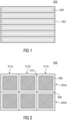
- Figure 1 shows as a picture 898 exemplarily positioned into regular slice 900 per row 902 of LCUs or macroblocks in a picture.
- Regular or normal slices (as defined in H.264 [1]) have the largest coding penalty as they break entropy decoding and prediction dependencies.
- Entropy slices like slices, break entropy decoding dependencies but allow prediction (and filtering) to cross slice boundaries.
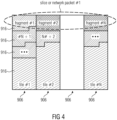
- Figure 2 exemplarily shows a picture 898 divided up into two rows 904, 904b of horizontally partitioning tiles 906.
- Tiles define horizontal 908 and vertical boundaries 910 that partition a picture 898 into tile columns 912a,b,c and rows 904a,b. Similar to regular slices 900, tiles 906 break entropy decoding and prediction dependencies, but does not require a header for each tile.
- the number of partitions can be freely chosen by the encoder. In general having more partitions leads to higher compression losses. However in WPP the loss propagation is not so high and therefore the number of picture partitions even can be fixed to one per row-. This leads also to several advantages. First, for WPP bitstream causality is guaranteed. Second, decoder implementations can assume that a certain amount of parallelism is available, which also increases with the resolution. And, finally, none of the context selection and prediction dependencies have to be broken when decoding in wavefront order, resulting in relative low coding losses.
- parallel processing concepts such as wavefront parallel processing
- WPP processing concept may be made more efficiently if the slices' start syntax portions are used to locate WPP entry points.
- Minimization of the end to end video delay from capturing to display is one of the main aims in applications such as video conferencing and the like.
- the signal processing chain for digital video transmission consists of camera, capturing device, encoder, encapsulation, transmission, demultiplexer, decoder, renderer and display. Each of these stages contributes to the end to end delay by buffering image data before its serial transmission to the subsequent stage.
- Some applications require minimization of such delay, e.g. remote handling of objects in hazardous areas, without direct sight to the handled object, or minimal invasive surgery.
- a whole video frame is buffered within a processing stage, e.g. to allow for intra frame processing.
- Some stages gather data in order to form packets which are forwarded to the next stage.
- the processing inside the camera does not necessarily require intra-frame signal processing, so the minimum delay is given by the integration time of the sensor, which is bounded by the frame rate, and some design choices by the hardware manufacturer.
- the camera output is typically related to the scan order which usually starts processing in the top left corner, moves over to the top right corner and continues line by line to the bottom right corner. Consequently, it takes about one frame duration until all data is transferred from the sensor to the camera output.
- the capturing device could forward the camera data immediately after reception; however it will typically buffer some data and generate bursts in order to optimize data access to memory or storage.
- the connection between camera/capturer and memory of the computer is typically limiting the bitrate for forwarding the captured image data to the memory for further processing (encoding).
- cameras are connected via USB 2.0 or soon with USB 3.0, which will always include a partial transport of the image data to the encoder. This limits the parallelizability on the encoder side in extreme low-delay scenarios, i.e. the encoder will try to start encoding as soon as possible, when data becomes available from the camera, e.g. in a raster-scan order from top to bottom of the image.
- the encoder uses data which has already been sent to predict the image to be subsequently encoded. In general, the difference between the actual image and the prediction can be encoded with fewer bits than would be needed without prediction. This prediction values need to be available at the decoder, thus prediction is based on previously decoded portions of the same image (intra-frame prediction) or on other images (inter-frame prediction) which have been processed earlier.
- Pre-HEVC video encoding standards use only the part of the image above or in the same line, but left - which has been previously encoded - for intra-frame prediction, motion vector prediction and entropy coding (CABAC).
- Parallel processing requires the identification of picture areas which can be processed independently. For practical reasons, contiguous regions such as horizontal or vertical rectangles are chosen which are often called "tiles". In the case of low delay constraints, those regions should allow for parallelized coding of the data incoming from the capturer to the memory, as soon as possible. Assuming a raster-scan memory transfer, vertical partitions of the raw data make sense, in order to start encoding immediately. Inside such tiles, which divides the picture into vertical partitions (cf. figure below), intra-prediction, motion vector prediction and entropy coding (CABAC) can lead to reasonable coding efficiency. In order to minimize the delay, only part of the picture, starting from the top, would be transferred to the frame memory of the encoder, and parallel processing should be started in vertical tiles.
- CABAC entropy coding
- Another way of allowing parallel processing is to use WPP within a regular slice, that would be compared to tiles, a "row" of tiles included in a single slice.
- the data within that slice could be also parallel encoded using WPP substreams , within the slice.
- the picture separation into slices 900 and tiles/WPP substreams 914 is shown in Fig. 3 / 1 form of examples.
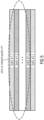
- Fig. 3 shows the assignment of parallel encoded partitions such as 906 or 914 to a slice or network transport segment (a single network packet or multiple network 900 packets).
- NAL Network Abstraction Layer
- the transport layer may re-order picture partitions for tiles in order to allow for low delay transmission, meaning to send out fragments as shown in Fig. 4 as they are encoded.
- Those fragments may be also not fully encoded slices, they may be a subset of a slice, , or may be contained in a dependent Slice.
- each fragment can be determined in terms of a fixed image region, such as marcroblocks, LCUs or in terms of a maximum data as shown in Fig. 4 .
- Fig. 4 shows a generic fragmentation of a frame with tile coding approach for minimum end-to-end delay.
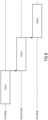
- Fig. 5 shows a fragmentation of a frame with WPP coding approach for minimum end-to-end delay.
- the transmission may add further delay, e.g., if additional block oriented processing is applied, such as Forward Error Correction codes increasing the robustness of the transmission.
- additional block oriented processing such as Forward Error Correction codes increasing the robustness of the transmission.
- the network infrastructure (routers etc.) or the physical link can add delay, this is typically known as latency for a connection.
- the transmission bitrate determines, the time (delay) for transferring the data from Party a to Party b, in a conversation as shown in Fig. 6 which uses video services.
- encoded data blocks are transmitted out of order, reordering delay has to be considered.
- the decoding can start as soon as a data unit has arrived, assumed that other data units which have to be decoded prior to this are available.
- a tile can be decoded immediately. If fragments have been produced of a tile, such as separate slices per each fragment as shown in Fig 4 , the fragments can be directly transported, as soon as they are encoded respectively their contained LCUs or CUs have been encoded.
- the renderer assembles the outputs of parallel decoding engines and forwards the combined picture line by line to the display.
- the display does not necessarily add any delay, but in practice may do some intra frame processing before the image data is actually displayed. This is up to design choices by the hardware manufacturer.
- Fig. 7 shows encoding, transmission and decoding for tiles with generic subsets with minimum end-to-end delay
- Fig. 8 illustrates a commonly achieved end-to-end delay.
- HEVC allows the use of slice partitioning, tile partitioning, and in the following way.
- the samples are processed in units of coding treeblocks.
- the luma array size for each treeblock in samples in both width and height is CtbSize.
- the width and height of the chroma arrays for each coding treeblock are CtbWidthC and CtbHeightC, respectively.
- a picture may be divided into two slices as shown in the next figure.
- a picture may be divided into three tiles as shown in the second following figure.
- tiles are always rectangular and always contain an integer number of coding treeblocks in coding treeblock raster scan.
- a tile may consist of coding treeblocks contained in more than one slice.
- a slice may comprise coding treeblocks contained in more than one tile.
- Fig. 9 illustrates a picture 898 with 11 by 9 coding treeblocks 918 that is partitioned into two slices 900a,b.
- Fig. 10 illustrates a picture with 13 by 8 coding treeblocks 918 that is partitioned into three tiles.
- Each coding 898 treeblock 918 is assigned a partition signaling to identify the block sizes for intra or inter prediction and for transform coding.
- the partitioning is a recursive quadtree partitioning.
- the root of the quadtree is associated with the coding treeblock.
- the quadtree is split until a leaf is reached, which is referred to as the coding block.
- the coding block is the root node of two trees, the prediction tree and the transform tree.
- the prediction tree specifies the position and size of prediction blocks.
- the prediction blocks and associated prediction data are referred to as prediction unit.
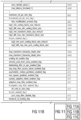
- Fig. 11 shows an exemplary sequence parameter set RBSP syntax.
- the transform tree specifies the position and size of transform blocks.
- the transform blocks and associated transform data are referred to as transform unit.
- the splitting information for luma and chroma is identical for the prediction tree and may or may not be identical for the transform tree.
- the coding block, the associated coding data and the associated prediction and transform units form together a coding unit.
- a process for a conversion of a coding treeblock address in coding treeblock raster order to tile scan order could be as follows: Outputs of this process are
- the array CtbAddrTS[ ] is derived as follows:
- the array TileId[ ] is derived as follows:
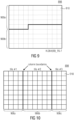
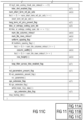
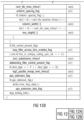
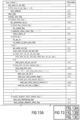
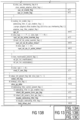
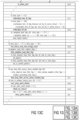
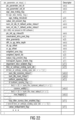
- FIG. 11 A corresponding, exemplary syntax is shown in Figs. 11 , 12 and 13 , wherein Fig. 12 has an exemplary picture parameter set RBSP syntax. Fig. 13 shows an exemplary slice header syntax.
- tiles_or entropy_coding_sync_idc shall be in the range of 0 to 2, inclusive.
- uniform_spacing _flag 1 specifies that column boundaries and likewise row boundaries are distributed uniformly across the picture.
- uniform spacing _flag 0 specifies that column boundaries and likewise row boundaries are not distributed uniformly across the picture but signalled explicitly using the syntax elements column_width[ i ] and row_height[ i ].
- RowHeight[ i ] specifying the height of the i-th tile row in units of coding treeblocks
- RowBd[ i ] specifying the location of the top row boundary of the i-th tile row in units of coding treeblocks, are derived as follows:
- each subset shall contain all coded bits of one or multiple complete tiles, and the number of subsets shall be equal to or less than the number of tiles in the slice.
- tiles_or_entropy_coding_sync_idc is equal to 2 and num_entry_point_offsets is greater than 0
- subset k for each of all the possible k values, shall contain all bits to be used during the initialization process for the current bitstream pointer k.
- a CABAC parsing process for slice data could be as follows: This process is invoked when parsing syntax elements with descriptor ae(v).
- Inputs to this process are a request for a value of a syntax element and values of prior parsed syntax elements.
- Output of this process is the value of the syntax element.
- the current bitstream pointer is set to BitStreamTable[ 0 ].
- the mininum coding block address of the coding treeblock containing the spatial neighbor block T, ctbMinCbAddrT is derived using a location ( x0, y0 ) of the top-left luma sample of the current coding treeblock such so, for example, as follows.
- variable availableFlagT is obtained by invoking an appropriate coding block availability derivation process with ctbMinCbAddrT as input.
- An initialization process could be as follows: Outputs of this process are initialised CABAC internal variables.
- Output of this process are variables TableStateSync and TableMPSSync containing the values of the variables m and n used in the initialization process of context variables that are assigned to syntax elements except for the end-of-slice flag.
- Synchronization process for context variables could be as follows: Inputs of this process are variables TableStateSync and TableMPSSync containing the values of the variables n and m used in the memorization process of context variables that are assigned to syntax elements except for the end-of-slice flag.
- Outputs of this process are the CABAC context variables indexed by ctxIdx.
- the corresponding context variables pStateIdx and valMPS are initialized to the corresponding entries n and m of tables TableStateSync and TableMPSSync.
- Fig. 14 exemplifies a picture 10 for WPP into a regular slice 900 (reg. SL), and, for low delay processing, into dependent slices(OS) 920.
- HEVC standard offers two types of partitioning in terms of slices.
- regular (normal) slice and entropy slice are completely independent picture partition except some dependencies that may be available due to deblocking filter process on slice boundaries.
- the entropy slice is also independent but only in terms of entropy coding.
- the idea of Fig. 14 is to generalize the slicing concept.
- the upcoming HEVC standard should offer two general types of slices: independent (regular) or dependent. Therefore, a new type of slice, a Dependent Slice, is introduced.
- Dependent Slice is a slice that has dependencies to previous slice.
- the dependencies are a particular data that can be utilized between slices in entropy decoding process and/or pixel reconstruction process.
- each dependent slice 920 shall do the same procedure - keep data for forthcoming dependent slice in the same picture.
- Fig. 5 illustrates possible changes in picture parameter set RBSP syntax
- Picture parameter set semantics for dependent slices could be as follows: dependent_slices_present_flag equal to 1 specifies that the picture is containing dependent slices and the decoding process of each (regular or dependent) slice shall store states of entropy decoding and data of intra and motion vector prediction for next slice that may be a dependent slice that may also follow the regular slice. The following dependent slice may reference that stored data.
- Fig. 16 shows a possible slice_header syntax with the changes relative to HEVC's current status.
- Fig. 17 the difference between normal and dependent slices is shown.
- FIG. 18 A possible coding and transmission of WPP substreams in dependent slices (DS) as illustrated with respect to Fig. 18 compares an encoding for low delay transport of tiles (left) and WPP/DS (right).
- the bold continuously drawn crosses in Fig. 18 show the same time point of time for the two methods assuming that the encoding of the WPP row take the same time as the encoding of a single tile. Due to the coding dependencies, only the first line of WPP is ready, after all tiles have been encoded. But using the dependent slice approach allows the WPP approach to send out the first row once it is encoded.
- substream is defined for WPP as a concatenation of CU rows of slice to be WPP decoded by the same decoder thread, i.e. the same core/processor.
- a substream per row and per entropy slice would also have been possible before, the entropy slice breaks the entropy coding dependencies and has therefore lower coding efficiency, i.e. the WPP efficiency gain is lost.
- Fig. 19 illustrates a WPP coding with pipelined low delay transmission.
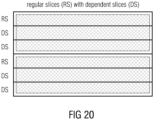
- FIG. 20 illustrates that robustness improving is achieved by using Regular Slices (RS) as anchors.
- RS Regular Slices
- DS dependent slices
- the (regular) slice acts as an anchor to break the dependencies to preceding slices, hence more robustness is provided at such insertion point of a (regular) slice. In principal, this is not different from inserting (regular) slices anyway.
- Fig. 21 shows a possible slice header syntax.
- variable SliceCtbAddrRS specifying the coding tree block in which the slice starts in coding tree block raster scan order.
- SliceCtbAddrRS ( slice_address >> SliceGranularity )
- SliceCbAddrZS specifying the address of first coding block in the slice in minimum coding block granularity in z-scan order, is derived as follows.
- SliceCbAddrZS slice _ address ⁇ log 2 _ diff _ max _ min _ coding _ block _ size ⁇ SliceGranularity ⁇ 1
- the slice decoding starts with the largest coding unit possible, or, in other terms, CTU, at the slice starting coordinate.
- each subset shall contain all coded bits of exactly one tile, and the number of subsets (i.e., the value of num_entry_point_offsets + 1) shall be equal to or less than the number of tiles in the slice.
- each slice must include either a subset of one tile (in which case signalling of entry points is unnecessary) or an integer number of complete tiles.
- each subset k with k in the range of 0 to num_entry_point_offsets - 1, inclusive shall contain all coded bits of exactly one row of coding tree blocks
- the last subset (with subset index equal to num_entry_point_offsets) shall contain all coded bits of the remaining coding blocks included in the slice, wherein the remaining coding blocks consist of either exactly one row of coding tree blocks or a subset of one row of coding tree blocks
- the number of subsets i.e., the value of num_entry_point_offsets + 1) shall be equal to the number of rows of coding tree blocks in the slice, wherein a subset of one row of coding tree blocks in the slice is also counted.
- a slice may include a number of rows of coding tree blocks and a subset of a row of coding tree blocks. For example, if a slice include two and a half rows of coding tree blocks, the number of subsets (i.e., the value of num_entry_point_offsets + 1) shall be equal to 3.
- the corresponding picture parameter set RBSP syntax could be selected as shown in Fig. 22 .
- the picture parameter set RBSP semantics could be as follows:
- cabac_independentflag and depedent_slice_flag are both equal to 1 for a slice, the slice is an entropy slice.
- the last coding block in the slice shall belong to the same row of coding tree blocks as the first coding block in the slice slice.
- uniform_spacing _flag 1 specifies that column boundaries and likewise row boundaries are distributed uniformly across the picture.
- uniform_spacing _flag 0 specifies that column boundaries and likewise row boundaries are not distributed uniformly across the picture but signalled explicitly using the syntax elements column_width[ i ] and row _height[ i ].
- the vector colWidth[ i ] specifies the width of the i-th tile column in units of CTBs with the column i ranging from 0 to num_tile_columns_minus1, inclusive.
- the vector CtbAddrRStoTS[ ctbAddrRS ] specifies the conversation from a CTB address in raster scan order to a CTB address in tile scan order with the index ctbAddrRS ranging from 0 to (picHeightInCtbs * picWidthInCtbs) - 1, inclusive.
- the vector CtbAddrTStoRS[ ctbAddrTS ] specifies the conversation from a CTB address in tile scan order to a CTB address in raster scan order with the index ctbAddrTS ranging from 0 to (picHeightInCtbs * picWidthInCtbs) - 1, inclusive.
- the vector TileId[ ctbAddrTS ] specifies the conversation from a CTB address in tile scan order to a tile id with ctbAddrTS ranging from 0 to (picHeightInCtbs * picWidthInCtbs) - 1, inclusive.
- colWidth, CtbAddrRStoTS, CtbAddrTStoRS and TileId are derived by invoking a CTB raster and tile scanning conversation process with PicHeightInCtbs and PicWidthInCtbs as inputs and the output is assigned to colWidth, CtbAddrRStoTS and TileId.
- MinCbAddrZS[ x ][ y ] specifying the conversation from a location (x, y ) in units of minimum CBs to a minimum CB address in z-scan order with x ranging from 0 to picWidthInMinCbs - 1, inclusive, and y ranging from 0 to picHeightInMinCbs - 1, inclusive, is dervied by invoking a Z scanning order array initialization process with Log2MinCbSize, Log2CtbSize, PicHeightInCtbs, PicWidthInCtbs, and the vector CtbAddrRStoTS as inputs and the output is assigned to MinCbAddrZS.
- a derivation process for the availability of a coding block with a minimum coding block address could be as follows: Inputs to this process are
- Output of this process is the availability of the coding block with mininum coding block address cbAddrZS in z-scan order cbAvailable.
- a CABAC parsing process for slice data could be as follows: This process is invoked when parsing certain syntax elements with descriptor ae(v).
- Inputs to this process are a request for a value of a syntax element and values of prior parsed syntax elements.
- Output of this process is the value of the syntax element.
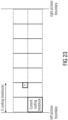
- Fig. 23 illustrates as to how a spatial neighbor T is used to invoke the coding tree block availability derivation process relative to the current coding tree block (informative).
- the minimum coding block address of the coding tree block containing the spatial neighbor block T ( Fig. 23 ), ctbMinCbAddrT, is derived using the location ( x0, y0 ) of the top-left luma sample of the current coding tree block as follows.
- ctbMinCbAddrT MinCbAddrZS x ⁇ Log 2 MinCbSize y ⁇ Log 2 MinCbSize
- variable availableFlagT is obtained by invoking a coding block availability derivation process with ctbMinCbAddrT as input.
- the arithmetic decoding engine is initialised as follows.
- the binarization for the syntax element and the sequence of parsed bins determines the decoding process flow.
- a context index ctxIdx is derived.
- the resulting sequence ( b0..bbinIdx ) of parsed bins is compared to the set of bin strings given by the binarization process after decoding of each bin. When the sequence matches a bin string in the given set, the corresponding value is assigned to the syntax element.
- the decoding engine is initialised after the decoding of any pcm_alignment_zero_bit, num_subsequent_pcm, and all pcm_sample_luma and pcm_sample_chroma data.
- a decoder as shown in Fig. 24 .
- This decoder which is generally indicated by reference sign 5, reconstructs a picture 10 from a data stream 12 into which the picture 10 is coded in units of slices 14 into which the picture 10 is partitioned, wherein the decoder 5 is configured to decode the slices 14 from the data stream 12 in accordance with a slice order 16.
- decoder 5 is not restricted to serially decode the slices 14. Rather, the decoder 5 may use wavefront parallel processing in order to decode the slices 14, provided the pictures 10 partitioning into slices 14 is appropriate for wavefront parallel processing.
- decoder 5 may, for example, be a decoder which is able to decode slices 14 in parallel in a staggered manner with starting the decoding of the slices 14 by taking the slice order 16 into account so as to allow wavefront processing as it has been described above and will be described below, too.
- Decoder 5 is responsive to a syntax element portion 18 within a current slice of the slices 14 so as to decode the current slice in accordance with one of at least two modes 20 and 22.
- the current slice is decoded from the data stream 12 using context adaptive entropy decoding including a derivation of context across slice boundaries, i.e. across the dashed lines in Fig. 24 , i.e. by using information stemming from coding/decoding of other "in slice order 16 preceding slices".
- decoding the current slice from the data stream 12 using the first mode 20 comprises a continuous update of symbol probabilities of the codec and an initialization of the symbol probabilities at the beginning of the decoding of the current slice, which depends on saved states of the symbol probabilities of a previously decoded slice. Such dependency was described above, for example, in connection with the "synchronization process for codec variables".
- the first mode 20 also involves predictive decoding across the slice boundaries. Such predictive decoding across slice boundaries may, for example, involve intra-prediction across slice boundaries, i.e. predicting sample values within the current slice on the basis of already reconstructed sample values of an "in slice order 16", preceding slice, or a prediction of coding parameters across slice boundaries such as a prediction of motion vectors, prediction modes, coding modes or the like.
- the decoder 5 decodes the current slice, i.e. the slice currently to be decoded, from the data stream 12 using context adaptive entropy decoding with restricting, however, the derivation of the contexts so as to not cross the slice boundaries. If ever, for example, a template of neighboring positions used for deriving the context for a certain syntax element relating to a block within the current slice extends into a neighboring slice, thereby crossing the slice boundary of the current slice, the corresponding attribute of the respective portion of the neighboring slice, such as the value of the corresponding syntax element of this neighboring portion of the neighboring slice, is set to the default value in order to inhibit interdependencies between the current slice and the neighboring slices.
- the initialization of the symbol probabilities in the second mode 22 is independent of any previously decoded slice. Further, the predictive decoding is performed with restricting the predictive decoding so as to not cross the slice boundaries.
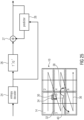
- Fig. 25 shows a possible implementation of decoder 5 in a more structural sense than compared to Fig. 24 .
- the decoder 5 is a predictive decoder using context adaptive entropy decoding for decoding the data stream so as to obtain, for example, the prediction residual and prediction parameters.
- the decoder 5 may comprise an entropy decoder 24, a dequantization and inverse transform module 26, a combiner 28 implemented, as shown in Fig. 25 , for example, as an adder and a predictor 28.
- Entropy decoder 24, module 26 and adder 27 are serially connected between input and output of decoder 5 in the order of their mentioning, and predictor 28 is connected between an output of adder 28 and a further input thereof in order to form the prediction loop along with combiner 27.
- the decoder 24 has its output additionally connected to a coding parameter input of predictor 28.
- Fig. 25 provides the impression that the decoder serially decodes the current picture
- the decoder 5 may, for example, be implemented so as to decode picture 10 in parallel.
- the decoder 5 may, for example, comprise multiple cores each operating according to elements 24-28 in Fig. 25 .
- the parallel processing is optional and a serially operating decoder 5 is also able to decode the data stream inbound at the input of entropy decoder 24.
- Coding blocks 30 are, for example, leaf blocks into which coding tree blocks or largest coding blocks 32 are partitioned by recursive multitree partitioning such as quadtree partitioning.
- the code treeblocks 32 may be regularly arranged in columns and rows so as to form a regular partitioning of picture 10 into these code treeblocks 32.
- Fig. 25 the code treeblocks 32 are shown with continuous lines, whereas coding blocks 30 are shown with dashed lines.
- the data stream 12 may comprise a syntax portion signaling as to how picture 10 is partitioned into the code blocks 30.
- the data stream 12 conveys, for each coding block 30, syntax elements which reveal as to how modules 24 to 28 are to recover the picture content within that coding block 30.
- syntax elements comprise:
- the entropy decoder 24 is responsible for obtaining the just-mentioned syntax elements from the data stream. To this end, the entropy decoder 24 uses context adaptive entropy decoding. That is, the entropy decoder 24 provides several context. In order to derive a certain syntax element from the data stream 12, the entropy decoder 24 selects a certain context among the possible contexts. The selection among the possible contexts is performed depending on an attribute of a neighborhood of the portion of picture 10 to which the current syntax element belongs. For each of the possible contexts, the entropy decoder 24 manages symbol probabilities, i.e., a probability estimate for each possible symbol of the symbol alphabet based on which the entropy decoder 24 operates. The "managing" involves the aforementioned continuous updates of the symbol probabilities of the contexts so as to adapt the symbol probabilities associated with each context to the actual picture content. By this measure, the symbol probabilities are adapted to the actual probability statistics of the symbols.
- predictor 28 may predict picture content or such parameters from the aforementioned neighborhood so as to obtain the written signal which is then combined with the prediction residual as obtained by module 26 from data stream 12.
- predictor 28 may use syntax elements contained within the data stream as prediction residuals so as to obtain the actual value of the prediction parameter.
- predictor 28 uses the latter prediction parameter value in order to obtain the just-mentioned prediction signal to be combined with the prediction residual in combiner 27.
- the aforementioned "neighborhood” primarily covers the upper left-hand part of the circumference of the current portion to which the syntax element currently to be entropy-decoded or the syntax element to be currently predicted belongs. In Fig. 25 , such neighborhood is illustrated at 34 exemplarily for one coding block 30.
- a coding/decoding order is defined among the coding blocks 30: at a coarsest level, the code treeblocks 32 of picture 10 are scanned in a scan order 36, here illustrated as a raster scan leading row-wise from top to bottom. Within each code treeblock, the coding blocks 30 are scanned in a depth first traversal order such that, in each hierarchy level, the code treeblock 32 is substantially scanned also in a raster scan leading row-wise from top to bottom.
- the coding order defined among the coding blocks 30 harmonizes with the definition of the neighborhood 34 used for deriving an attribute in the neighborhood so as to select contexts and/or perform spatial prediction in that the neighborhood 34 mostly covers portions of picture 10 which have already been subject to decoding in accordance with the coding order.
- a portion of neighborhood 34 covers non-available portions of picture 10 default data is, for example, being used instead.
- a neighborhood template 34 may extend outside picture 10. Another possibility is, however, that the neighborhood 34 extends into a neighboring slice.
- Slices divide-up, for example, picture 10 along a coding/decoding order defined along the coding blocks 30, i.e. each slice is a continuous non-interrupted sequence of coding blocks 30 along the aforementioned coding block order.
- the slices are indicated with dash-dot-lines 14.
- the order defined among the slices 14 results from their composition of runs of sequential coding blocks 30 as outlined above. If the syntax element portion 18 of a certain slice 14 indicates that same is to be decoded in the first mode, then entropy-decoder 24 allows the context adaptive entropy decoding to derive contexts across slice boundaries. That is, the spatial neighborhood 34 is used in order to select contexts in entropy decoding data concerning the current slice 14.
- slice number 3 may be the currently decoded slice, and in entropy-decoding syntax element concerning coding block 30 or some portion contained therein, the entropy decoder 24 may use attributes stemming from decoding portions within the neighboring slice such as slice number 1.
- the predictor 28 behaves the same: for slices being of the first mode 20, predictor 28 uses spatial prediction across the slice boundary encircling the current slice.
- entropy decoder 24 and predictor 28 restrict the derivation of entropy contexts and predictive decoding to depend on attributes relating to portions lying within the current slice only. Obviously, the coding efficiency suffers from this restriction.
- slices of the second mode 22 allow for disrupting interdependencies between the sequence of slices. Accordingly, slices of the second mode 22 may be interspersed within picture 10 or within a video to which picture 10 belongs in order to allow for resynchronization points. It is not necessary, however, that each picture 10 has at least one slice in the second mode 22.
- first and second mode 20 and 22 also differ in their initialization of the symbol probabilities.
- Slices coded in the second mode 22 result in the entropy decoder 24 re-initializing the probabilities independent of any previously decoded slice, i.e. previously decoded in the sense of the order defined among the slices.
- the symbol probabilities are, for example, set to default values known to both encoder and decoder side, or initialization values are contained within slices coded in a second mode 22.
- the initialization of the symbol probabilities performed by entropy decoder 24 depends on saved states of symbol probabilities of a previously decoded slice.
- a slice coded/decoded in a first mode 20 has its beginning, for example, positioned other than the left-hand side of picture 10, i.e. not at the side from where the raster scan 36 starts running row-wise before stepping to the next row bottom-wards, the symbol probabilities as resulting at the end of entropy decoding the immediately preceding slice are adopted. This is illustrated, for example, in Fig. 2 by an arrow 38 for slice no. 4.
- entropy decoder 24 adopts, in initializing the symbol probabilities, the symbol probabilities which were obtained in entropy decoding the immediately preceding slice, i.e. slice no. 3, until the end thereof, i.e. including the continuous update of symbol probabilities during the entropy decoding of slice 3 until its end.
- Slices having the second mode 22 associated therewith which have, however, the beginning at the left-hand side of picture 10 such as, for example, slice no. 5, do not adapt the symbol probabilities as obtained after finishing the entropy decoding of the immediately preceding slice no. 4, because this would prevent decoder 5 from parallelly decoding picture 10 by use of wavefront processing. Rather, as outlined above, the entropy decoder 24 adapts the symbol probabilities as obtained after finishing entropy decoding the second - in encoding/decoding order 36 - code treeblock 32 in the immediately preceding -in encoding/decoding order 36 - code treeblock row as illustrated by an arrow 40.
- picture 10 was exemplarily partitioned into three rows of code treeblocks and four columns of coding tree root blocks 32 and each code treeblock row was sub-divided into two slices 14, so that the beginning of every second slice coincides with the first coding unit in coding unit order of a respective code treeroot block row.
- the entropy decoder 24 would, accordingly, be able to use wavefront processing in decoding picture 10, by decoding each code tree root block row in parallel, with commencing decoding these code tree root block rows in a staggered manner, starting with a first or topmost code tree root block row, then the second, and then the third.
- blocks 32 could be called "coding blocks" as well. That is, more generally speaking, picture 10 may be partitioned into coding blocks 32 arranged in rows and columns and having a raster scan order 36 defined among each other, and the decoder 5 may be considered to associate each slice 14 with a continuous subset of the coding blocks 32 in the raster scan order 36 so that the subsets follow each other along the raster scan order 36 in accordance with the slice order.
- the decoder 5 or, more specifically, the entropy decoder 24 may be configured to save symbol probabilities as obtained in context adaptive entropy decoding any slice up to a second coding block in a coding block row in accordance with the raster scan order 36.
- the decoder 5, or, more specifically, the entropy decoder 24 checks as to whether a first coding block 32 of the continuous subset of coding blocks 32 associated with the current slice is a first coding block 32 in a coding block row in accordance with the raster scan order 36.
- the symbol probabilities for the context adaptive entropy decoding of the current slice is initialized as explained with respect to arrow 40, namely depending on the saved symbol probabilities as obtained in context entropy decoding the previously decoded slice up to the second coding block in coding block row in accordance with the raster scan order 36. If not, initialization of the symbol probabilities for the context adaptive entropy decoding of the current slice is performed depending on symbol probabilities as obtained in context adaptive entropy decoding the previously decoded slice up to the end of the previously decoded slice, i.e. according to arrow 38.
- the decoder may be configured to be responsive to the syntax element portion 18 within the current slice of the slices 14 so as to decode the current slice in accordance with one of at least three modes. That is, there may be a third mode 42 beside the other ones 20 and 22.
- the third mode 42 may differ from the second mode 22 in that prediction across slice boundaries is allowed, whereas entropy coding/decoding is still restricted so as to not cross slice boundaries.
- the syntax element portion 18 is formed by dependent_slice_flag individually, while in the other embodiment, the combination of dependent_slice_flag and no_cabac_reset_flag forms the syntax element portion.
- the decoder would reconstruct picture 10 from datastream 12 into which the picture is coded in units of slices 14 into which the picture (10) is partitioned, wherein the decoder is configured to decode the slices 14 from the datastream 12 in accordance with a slice order 16 and the decoder is responsive to a syntax element portion 18, namely dependent_slice_flag within a current slice of the slices, so as to decode the current slice in accordance with one of at least two modes 20, 22.
- the picture 10 may be partitioned in coding blocks 32 arranged in rows and columns and having a raster scan order 36 defined among each other, and the decoder is configured to associate each slice 14 with a continuous subset of the coding blocks 32 in the raster scan order 36 so that the subsets follow each other along the raster scan order 36 in accordance with the slice order.
- an encoder is able to set the above presented syntax accordingly in order to enable the decoder to gain the above outlined advantages.
- the encoder may a parallel processing, such as a multi-core, encoder, but does not need to be.
- the encoder would be configured to encode the slices 14 into the datastream 12 in accordance with slice order 16.
- the encoder would determine syntax element portion 18 for, and code same into, a current slice of the slices so that the syntax element portion signals the current slice to be coded in accordance with one of the at least two modes 20, 22, and if the current slice is to be coded in accordance with a first 20 of the at least two modes, encode the current slice into the datastream 12 using context adaptive entropy encoding 24 including a derivation of contexts across slice boundaries, a continuous update of symbol probabilities of the contexts and an initialization 38, 40 of the symbol probabilities depending on saved states of symbol probabilities of a previously enecoded slice, and predictive encoding across the slice boundaries, and if the current slice is to be coded in accordance with a second 22 of the at least two modes, encode the current slice into the datastream 12 using context adaptive entropy encoding with restricting the derivation of the contexts so as to not cross the slice boundaries, a continuous update of symbol probabilities of the contexts and an initialization of the symbol probabilities independent on any previously encoded
- the encoder may be configured to associate each slice 14 with a continuous subset of the coding blocks 32 in the raster scan order 36 so that the subsets follow each other along the raster scan order 36 in accordance with the slice order.
- the encoder may be configured to save symbol probabilities as obtained in context adaptive entropy encoding the previously encoded slice up to a second coding block 32 in a row in accordance with the raster scan order 36, and, in initializing the symbol probabilities for the context adaptive entropy encoding of the current slice in accordance with the first mode, check as to whether a first coding block of the continuous subset of coding blocks 32 associated with the current slice is a first coding block 32 in a row in accordance with the raster scan order, and, if so, initialize 40 the symbol probabilities for the context adaptive entropy encoding of the current slice depending on the saved symbol probabilities as obtained in context adaptive entropy encoding the previously encoded slice up to a second coding block in a row in accordance with the raster scan order 36, and, if not, initialize 38 the symbol probabilities for the context adaptive entropy encoding of the current slice depending on symbol probabilities as obtained in context adaptive entropy encoding
- the encoder may be configured to be code the syntax element portion (18) into the current slice of the slices (14) so that the current slice is signaled to be coded thereinto in accordance with one of at least three modes, namely in the one of the first (20) and a third mode (42) or a second mode (22), wherein the encoder is configured to ** in accordance with the third mode (42), encode the current slice into the datastream using context adaptive entropy encoding with restricting the derivation of the contexts so as to not cross the slice boundaries, a continuous update of symbol probabilities of the contexts and an initialization of the symbol probabilities independent on any previously encoded slice, and predictive coding across the slice boundaries, wherein the encoder distinguishes between the one of the first and third modes being using a syntax element, namely cabac_independentflag, for example.
- a syntax element namely cabac_independentflag
- the encoder may be configured to determine a generic syntax element such as dependent_slices_present_flag and write same into the datastream with operating in one of at least two generic operating modes depending on the generic syntax element, namely, with, according to a first generic operating mode, performing coding the syntax element portion for each slice, and, according to a second generic operating mode, inevitably using a different one of the at least two modes other than the first mode.
- the encoder may be configured to according to the first and second modes, inevitably und uninterruptedly continue continuously updating the symbol probabilities from a beginning to an end of the current slice.
- the encoder ay be configured to save symbol probabilities as obtained in context adaptive entropy encoding the previously encoded slice up to an end of the previously encoded slice, and, in initializing the symbol probabilities for the context adaptive entropy encoding of the current slice in accordance with the first mode, initialize the symbol probabilities for the context adaptive entropy encoding of the current slice depending on symbol probabilities saved.
- the encoder may, in the first and second mode, restrict the predictive encoding within tiles into which the picture is sub-divided.
- Predictor 70 operates almost the same as predictor 28, i.e. performs the prediction, but also determines, by optimization, for example, the coding paramters including the prediction parameters and modes. Modules 26 and 27 also occur in the decoder.
- Subtractor 72 determines the lossless prediction residual which is then, lossy - by use of quantization and, optionally, using spectrally decomposing transformation -, coded in the transformation and quantization module 74.
- Entropy coder 76 performs the context adaptive entropy encoding.
- dependent slices are not only "dependent” in that same allow for exploiting knowledge known from outside its boundary, such as, as outlined above, have the entropy contexts adapted faster, or achieve a better spatial prediction due to allowance of crossing its boundary.
- dependent slices adopt a part of the slice header syntax from previous slices, i.e. this slice syntax header portion is not transmitted again for dependent slices. This is shown for example, in Fig. 16 at 100 and in Fig. 21 at 102, according to which the slice type, for example, is adopted from the previous slice.
- the sub-division of a picture into slices such as an independent slice and dependent slices, as less expensive in terms of bit-consumption expensive.
- slices are defined as unit portions of a picture at which slice header syntax is individually settable. Accordingly, slices are composed of one - using the nomenclature above - independent/regular/normal slice, now called independent slice segment and no, one or more - using the nomenclature above - dependent slices, now called dependent slice segments.
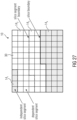
- Fig. 27 shows a picture to be partitioned into two slices, one formed by slice segments 14 1 to 14 3 and the other solely formed by slice segment 14 4 .
- the indices 1 to 4 show the slice order in coding order.
- Fig. 28a and b show different example in case of a sub-division of picture 10 into two tiles, with, in case of Fig. 28a , one slice formed by all five slice segments 14, covering both tiles 50i and 50 2 - the index again raising in coding order -, and, in case of Fig. 28a , two slices formed by slice segments 14 1 and 14 2 and 14 3 and 14 4 , respectively, subdividing tile 50i, and another slice formed by slice segments 14 5 -14 6 covering tile 50 2 .
- dependent slice segment und “independent slice segment”
- PPS a syntax element could be used to signal as to whether usage of dependent slices is made or not for a certain picture of even a sequence for certain pictures:
- entropy_coding_sync_enabled_flag 1 specifies that a specific synchronization process for context variables is invoked before decoding the coding tree unit which includes the first coding tree block of a row of coding tree blocks in each tile in each picture referring to the PPS, and a specific storage process for context variables is invoked after decoding the coding tree unit which includes the second coding tree block of a row of coding tree blocks in each tile in each picture referring to the PPS.
- entropy_coding_sync_enabled_flag 0 specifies that no specific synchronization process for context variables is required to be invoked before decoding the coding tree unit which includes the first coding tree block of a row of coding tree blocks in each tile in each picture referring to the PPS, and no specific storage process for context variables is required to be invoked after decoding the coding tree unit which includes the second coding tree block of a row of coding tree blocks in each tile in each picture referring to the PPS.
- entropy_coding_sync_enabled_flag When entropy_coding_sync_enabled_flag is equal to 1 and the first coding tree block in a slice is not the first coding tree block of a row of coding tree blocks in a tile, it is a requirement of bitstream conformance that the last coding tree block in the slice shall belong to the same row of coding tree blocks as the first coding tree block in the slice.
- entropy_coding_sync_enabled_flag When entropy_coding_sync_enabled_flag is equal to 1 and the first coding tree block in a slice segment is not the first coding tree block of a row of coding tree blocks in a tile, it is a requirement of bitstream conformance that the last coding tree block in the slice segment shall belong to the same row of coding tree blocks as the first coding tree block in the slice segment.
- the coding/decoding order among the CTBs 30 leads in raster manner row-wise from top to bottom starting with scanning the first tile with then visiting the next tile, if more than one tile is present in the picture.
- the decoder 5 - and the encoder accordingly - acts as follows in entropy decoding (coding) the slice segments 14 of the picture:
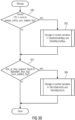
- synEI is the first syntax element of a slice segment 14 or tile 50. If yes, the contexts are initialized independent from any previous slice segment in step 202. If no, is checked 204 whether synEI is the first syntax element of a row of CTBs 30 and entropy_coding_sync_enabled_flag equals one. If yes, it is checked 206 whether in the previous line of CTBs 30 of equal tile, the second CTB 30 is availble (see Fig. 23 ). If yes, a context adoption according to 40 is performed in step 210 using the currently stored context probabilities for type 40 adoptions. If not, contexts are initialized independent from any previous slice segment in step 202.
- step 212 If the ckeck 204 reveals no, then it is checked in step 212, whether synEl is the first syntax element in the first CTB of a dependent slice segment 14 and whether dependent slice_segement_flag equals one, and if yes, context adoption according to 38 is performed in step 214 using the currently stored context probabilities for type 38 adoptions. After any of steps 214, 212, 210 and 202, the decoding/coding is actually commenced.
- step 300 it is checked in step 300 whether the coded/decoded synEl is the last syntax element of a second CTB 30 of a row of CTBs 30, and entropy_coding_sync_enabled_flag equals one. If yes, the current entropy contexts are stored in step 302, i.e. the entropy coding probabilities of the contexts, in a storage which is spcific for adoptions à la 40. Similarly, it is checked in step 304, in addition to steps 300 or 302, whether the coded/decoded synEl is the last syntax element of a a slice segment 14, and dependent_slice_segement_flag equals one. If yes, the current entropy contexts are stored in step 306, i.e. the entropy coding probabilities of the contexts, in a storage which is spcific for adoptions la 38.
- any check querying as to whether a syntax element is the first synEl of a CTB row exploits for example, the syntax element slice_adress 400 within the slice segment's headers, i.e. a start syntax element revealing a position of a begin of the respective slice segment along the deocoding order.
- the decoder In reconstructing the picture 10 from the datastream 12 using WPP processing, the decoder is able to exploit exactly the latter start syntax portion 400 so as to retrieve the WPP substream entry points. Since each slice segment comprises a start syntax portion 400 indicating the position of a decoding begin of the respective slice segment within the picture 10, the decoder is able to identify the entry points of the WPP substreams into which the slice segments are grouped, by identifying, using the slice segments' start syntax portions 400, slice segments starting at a left hand side of the picture. The decoder may then, in parallel, decode the WPP substreams in a staggered manner with sequentially commencing the decoding of the WPP substreams in accordance with the slice order.
- the slice segments may even be smaller than one picture width, i.e. one row of CTBs, so that their transmission may be interleaved among the WPP substreams so as to further reduce the overall transmission end-to-end delay.
- the Encoder provides each slice (14) with a start syntax portion (400) indicating a position of a coding begin of the respective slice within the picture (10) and would group the slices into WPP substreams so that for each WPP substream, the first slice in slice order starts at a left hand side of the picture.
- the encoder may even, by itself, use WPP processing in encoding the picture: the encoder parallel encodes the WPP substreams in a staggered manner with sequentially commencing the encoding of the WPP substreams in accordance with the slice order.
- the latter aspect of using the slice segment's start syntax portions as a means for locating the WPP substream's entry points may be used without the dependent slice concept.
- each which uses WPP would be composed of a slice having one or more dependent slice segments, and the check in step 300 and 208 would refer to the second CTB in the above CTB row in the same tile, just as steps 204 and A1 would refer to the first CTB 30 in the CTB 30 row of the current tile!
- Embidment 2 allows the following processing: Syntax level tiles_or_entropy_coding_sync_idc per picture 0 1 2 3 cabac_independent_flag per slice not present not present not present 0/1 dependent_slice_flag per slice 0/1 0/1 0/1 0/1 Picture subdivision into tiles No Yes No No Slice subdivision with entry points to indicate start of WPP substream or Tile No Yes Yes No parallel processing possible in slices in Tiles WPP Entropy coding of slices
- tiles_or_entropy_coding_sync_idc is equal to 4, each, but the first row of CTBs shall be contained in a different slice with dependent slice flag set to 1. CTBs of different rows must not be present in the same slice. There may be more than one slice present per CTB row.
- tiles_or entropy_coding_sync_idc is equal to 5
- the CTBs of each, but the first tile must be contained in different slice.
- CTBs of different tiles must not be present in the same slice. There may be more than one slice present per tile.
- WPP Wavefront Parallel Processing
- a signaling has been presented which describes the level of parallelization in coding and transport.
- a decoder for reconstructing a picture 10 from a datastream 12 into which the picture is coded in units of slices 14 into which the picture 10 is partitioned is configured to decode the slices 14 from the datastream 12 in accordance with a slice order 16 and the decoder is responsive to a syntax element portion 18 within a current slice of the slices, so as to decode the current slice in accordance with one of at least two modes 20, 22, and in accordance with a first 20 of the at least two modes, decode the current slice from the datastream 12 using context adaptive entropy decoding 24 including a derivation of contexts across slice boundaries, a continuous update of symbol probabilities of the contexts and an initialization 38, 40 of the symbol probabilities depending on saved states of symbol probabilities of a previously decoded slice, and predictive decoding across the slice boundaries, and in accordance with a second 22 of the at least two modes, decode the current slice from the datastream 12 using context adaptive entropy decoding with restricting the derivation of the context
- the picture 10 is partitioned in coding blocks 32 arranged in rows and columns and having a raster scan order 36 defined among each other, and the decoder is configured to associate each slice 14 with a continuous subset of the coding blocks 32 in the raster scan order 36 so that the subsets follow each other along the raster scan order 36 in accordance with the slice order.
- the decoder is configured to save symbol probabilities as obtained in context adaptive entropy decoding the previously decoded slice up to a second coding block 32 in a row in accordance with the raster scan order 36, and, in initializing the symbol probabilities for the context adaptive entropy decoding of the current slice in accordance with the first mode, check as to whether a first coding block of the continuous subset of coding blocks 32 associated with the current slice is a first coding block 32 in a row in accordance with the raster scan order, and, if so, initialize 40 the symbol probabilities for the context adaptive entropy decoding of the current slice depending on the saved symbol probabilities as obtained in context adaptive entropy decoding the previously decoded slice up to a second coding block in a row in accordance with the raster scan order 36, and, if not, initialize 38 the symbol probabilities for the context adaptive entropy decoding of the current slice depending on symbol probabilities as
- the decoder is configured to be responsive to the syntax element portion 18 within the current slice of the slices 14, so as to decode the current slice in accordance with one of at least three modes, namely in the one of the first 20 and a third mode 42 or a second mode 22, wherein the decoder is configured to in accordance with the third mode 42, decode the current slice from the datastream using context adaptive entropy decoding with restricting the derivation of the contexts so as to not cross the slice boundaries, a continuous update of symbol probabilities of the contexts and an initialization of the symbol probabilities independent on any previously decoded slice, and predictive decoding across the slice boundaries, wherein the one of the first and third modes is selected depending on a syntax element.
- the decoder is configured to be responsive to a generic syntax element in the datastream so as to operate in one of at least two generic operating modes, with, according to a first generic operating mode, performing the responsiveness to the syntax element portion for each slice, and, according to a second generic operating mode, inevitably using a different one of the at least two modes other than the first mode.
- the decoder is configured to according to the first and second modes, inevitably und uninterruptedly continue continuously updating the symbol probabilities from a beginning to an end of the current slice.
- the decoder is configured to save symbol probabilities as obtained in context adaptive entropy decoding the previously decoded slice up to an end of the previously decoded slice, and, in initializing the symbol probabilities for the context adaptive entropy decoding of the current slice in accordance with the first mode, initialize the symbol probabilities for the context adaptive entropy decoding of the current slice depending on symbol probabilities saved.
- the decoder is configured to, in the first and second mode, restrict the predictive decoding within tiles into which the picture is sub-divided.
- the decoder is configured to, in the first and second mode, read information from current slice revealing a subdivision of the current slice into parallel subsections, cease the context adaptive entropy decoding at the end of the first parallel subsection and resume the context adaptive entropy decoding anew at a beginning of any subsequent parallel subsection including, in the first mode, an initialization of the symbol probabilities depending on saved states of symbol probabilities of the preceding parallel subsection and, in the second mode, an initialization of the symbol probabilities independent from any previously decoded slice and any previously decoded parallel subsection.
- the decoder is configured to, in accordance with the first 20 of the at least two modes, copy for the current slice a portion of a slice header syntax from a preceding slice decoded in the second mode.
- the decoder is configured to reconstruct the picture 10 from the datastream 12 using WPP processing, wherein each slice 14 comprises a start syntax portion 400 indicating a position of a decoding begin of the respective slice within the picture 10 and wherein the decoder is configured to identify entry points of WPP substreams into which the slices are grouped, by identifying, using the slices' start syntax portions, slices starting at a left hand side of the picture, and parallel decoding the WPP substreams in a staggered manner with sequentially commencing the decoding of the WPP substreams in accordance with the slice order.
- an encoder for encoding a picture 10 into a datastream 12 in units of slices 14 into which the picture 10 is partitioned is configured to encode the slices 14 into the datastream 12 in accordance with a slice order 16 and the encoder is configured to determine a syntax element portion 18 for, and code same into, a current slice of the slices so that the syntax element portion signals the current slice to be coded in accordance with one of at least two modes 20, 22, and if the current slice is to be coded in accordance with a first 20 of the at least two modes, encode the current slice into the datastream 12 using context adaptive entropy encoding 24 including a derivation of contexts across slice boundaries, a continuous update of symbol probabilities of the contexts and an initialization 38, 40 of the symbol probabilities depending on saved states of symbol probabilities of a previously enecoded slice, and predictive encoding across the slice boundaries, and if the current slice is to be coded in accordance with a second 22 of the at least two modes,
- the picture 10 is partitioned in coding blocks 32 arranged in rows and columns and having a raster scan order 36 defined among each other, and the encoder is configured to associate each slice 14 with a continuous subset of the coding blocks 32 in the raster scan order 36 so that the subsets follow each other along the raster scan order 36 in accordance with the slice order.
- the encoder is configured to save symbol probabilities as obtained in context adaptive entropy encoding the previously encoded slice up to a second coding block 32 in a row in accordance with the raster scan order 36, and, in initializing the symbol probabilities for the context adaptive entropy encoding of the current slice in accordance with the first mode, check as to whether a first coding block of the continuous subset of coding blocks 32 associated with the current slice is a first coding block 32 in a row in accordance with the raster scan order, and, if so, initialize 40 the symbol probabilities for the context adaptive entropy encoding of the current slice depending on the saved symbol probabilities as obtained in context adaptive entropy encoding the previously encoded slice up to a second coding block in a row in accordance with the raster scan order 36, and, if not, initialize 38 the symbol probabilities for the context adaptive entropy encoding of the current slice depending on
- the encoder is configured code the syntax element portion 18 into the current slice of the slices 14 so that the current slice is signaled to be coded thereinto in accordance with one of at least three modes, namely in the one of the first 20 and a third mode 42 or a second mode 22, wherein the encoder is configured to in accordance with the third mode 42, encode the current slice into the datastream using context adaptive entropy encoding with restricting the derivation of the contexts so as to not cross the slice boundaries, a continuous update of symbol probabilities of the contexts and an initialization of the symbol probabilities independent on any previously encoded slice, and predictive coding across the slice boundaries, wherein the encoder distinguishes between the one of the first and third modes using a syntax element.
- the encoder is configured to determine a generic syntax element and write same into the datastream with operating in one of at least two generic operating modes depending on the generic syntax element, namely, with, according to a first generic operating mode, performing coding the syntax element portion for each slice, and, according to a second generic operating mode, inevitably using a different one of the at least two modes other than the first mode.
- the encoder is configured to according to the first and second modes, inevitably und uninterruptedly continue continuously updating the symbol probabilities from a beginning to an end of the current slice.
- the encoder is configured to save symbol probabilities as obtained in context adaptive entropy encoding the previously encoded slice up to an end of the previously encoded slice, and, in initializing the symbol probabilities for the context adaptive entropy encoding of the current slice in accordance with the first mode, initialize the symbol probabilities for the context adaptive entropy encoding of the current slice depending on symbol probabilities saved.
- the encoder is configured to, in the first and second mode, restrict the predictive encoding within tiles into which the picture is sub-divided.
- a decoder for reconstructing a picture 10 from a datastream 12 into which the picture is coded in units of slices 14 into which the picture 10 is partitioned, using WPP processing is configured to decode the slices 14 from the datastream 12 in accordance with a slice order 16, wherein each slice 14 comprises a start syntax portion 400 indicating a position of a decoding begin of the respective slice within the picture 10 and the decoder is configured to identifying entry points of WPP substreams into which the slices are grouped, by identifying, using the slices' start syntax portions 400, slices starting at a left hand side of the picture, parallel decoding the WPP substreams in a staggered manner with sequentially commencing the decoding of the WPP substreams in accordance with the slice order.
- an encoder for coding a picture 10 into a datastream 12 into which the picture is coded in units of slices 14 into which the picture 10 is partitioned, using WPP processing is configured to encode the slices 14 into the datastream 12 in accordance with a slice order 16, wherein the encoder is configured to provide each slice 14 with a start syntax portion 400 indicating a position of a coding begin of the respective slice within the picture 10 and the encoder is configured to group the slices into WPP substreams so that for each WPP substream, the first slice in slice order starts at a left hand side of the picture, and parallel encode the WPP substreams in a staggered manner with sequentially commencing the encoding of the WPP substreams in accordance with the slice order.
- a method for reconstructing a picture 10 from a datastream 12 into which the picture is coded in units of slices 14 into which the picture 10 is partitioned comprises decoding the slices 14 from the datastream 12 in accordance with a slice order 16 and the method is responsive to a syntax element portion 18 within a current slice of the slices, so as to decode the current slice in accordance with one of at least two modes 20, 22, wherein in accordance with a first 20 of the at least two modes, the current slice is decoded from the datastream 12 using context adaptive entropy decoding 24 including a derivation of contexts across slice boundaries, a continuous update of symbol probabilities of the contexts and an initialization 38, 40 of the symbol probabilities depending on saved states of symbol probabilities of a previously decoded slice, and predictive decoding across the slice boundaries, and in accordance with a second 22 of the at least two modes, the current slice is decoded from the datastream 12 using context adaptive entropy decoding with restricting the derivation of the
- a method for encoding a picture 10 into a datastream 12 in units of slices 14 into which the picture 10 is partitioned comprises encoding the slices 14 into the datastream 12 in accordance with a slice order 16 and the method comprises determining a syntax element portion 18 for, and code same into, a current slice of the slices so that the syntax element portion signals the current slice to be coded in accordance with one of at least two modes 20, 22, and if the current slice is to be coded in accordance with a first 20 of the at least two modes, encoding the current slice into the datastream 12 using context adaptive entropy encoding 24 including a derivation of contexts across slice boundaries, a continuous update of symbol probabilities of the contexts and an initialization 38, 40 of the symbol probabilities depending on saved states of symbol probabilities of a previously enecoded slice, and predictive encoding across the slice boundaries, and if the current slice is to be coded in accordance with a second 22 of the at least two modes, en
- a method for reconstructing a picture 10 from a datastream 12 into which the picture is coded in units of slices 14 into which the picture 10 is partitioned, using WPP processing comprises decoding the slices 14 from the datastream 12 in accordance with a slice order 16, wherein each slice 14 comprises a start syntax portion 400 indicating a position of a decoding begin of the respective slice within the picture 10 and the method further comprises identifying entry points of WPP substreams into which the slices are grouped, by identifying, using the slices' start syntax portions 400, slices starting at a left hand side of the picture, parallel decoding the WPP substreams in a staggered manner with sequentially commencing the decoding of the WPP substreams in accordance with the slice order.
- a method for coding a picture 10 into a datastream 12 into which the picture is coded in units of slices 14 into which the picture 10 is partitioned, using WPP processing comprises encoding the slices 14 into the datastream 12 in accordance with a slice order 16, and providing each slice 14 with a start syntax portion 400 indicating a position of a coding begin of the respective slice within the picture 10 and further grouping the slices into WPP substreams so that for each WPP substream, the first slice in slice order starts at a left hand side of the picture, and parallel encoding the WPP substreams in a staggered manner with sequentially commencing the encoding of the WPP substreams in accordance with the slice order.
- a twenty-sixth aspect relates to a computer program having a program code for performing, when running on a computer, a method according to the twenty-second or twenty-fifth aspect.
- aspects have been described in the context of an apparatus, it is clear that these aspects also represent a description of the corresponding method, where a block or device corresponds to a method step or a feature of a method step. Analogously, aspects described in the context of a method step also represent a description of a corresponding block or item or feature of a corresponding apparatus.
- Some or all of the method steps may be executed by (or using) a hardware apparatus, like for example, a microprocessor, a programmable computer or an electronic circuit. In some embodiments, some one or more of the most important method steps may be executed by such an apparatus.
- embodiments of the invention can be implemented in hardware or in software.
- the implementation can be performed using a digital storage medium, for example a floppy disk, a DVD, a Blu-Ray, a CD, a ROM, a PROM, an EPROM, an EEPROM or a FLASH memory, having electronically readable control signals stored thereon, which cooperate (or are capable of cooperating) with a programmable computer system such that the respective method is performed. Therefore, the digital storage medium may be computer readable.
- Some embodiments according to the invention comprise a data carrier having electronically readable control signals, which are capable of cooperating with a programmable computer system, such that one of the methods described herein is performed.
- embodiments of the present invention can be implemented as a computer program product with a program code, the program code being operative for performing one of the methods when the computer program product runs on a computer.
- the program code may for example be stored on a machine readable carrier.
- inventions comprise the computer program for performing one of the methods described herein, stored on a machine readable carrier.
- an embodiment of the inventive method is, therefore, a computer program having a program code for performing one of the methods described herein, when the computer program runs on a computer.
- a further embodiment of the inventive methods is, therefore, a data carrier (or a digital storage medium, or a computer-readable medium) comprising, recorded thereon, the computer program for performing one of the methods described herein.
- the data carrier, the digital storage medium or the recorded medium are typically tangible and/or non-transitionary.
- a further embodiment of the inventive method is, therefore, a data stream or a sequence of signals representing the computer program for performing one of the methods described herein.
- the data stream or the sequence of signals may for example be configured to be transferred via a data communication connection, for example via the Internet.
- a further embodiment comprises a processing means, for example a computer, or a programmable logic device, configured to or adapted to perform one of the methods described herein.
- a processing means for example a computer, or a programmable logic device, configured to or adapted to perform one of the methods described herein.
- a further embodiment comprises a computer having installed thereon the computer program for performing one of the methods described herein.
- a further embodiment according to the invention comprises an apparatus or a system configured to transfer (for example, electronically or optically) a computer program for performing one of the methods described herein to a receiver.
- the receiver may, for example, be a computer, a mobile device, a memory device or the like.
- the apparatus or system may, for example, comprise a file server for transferring the computer program to the receiver.
- a programmable logic device for example a field programmable gate array
- a field programmable gate array may cooperate with a microprocessor in order to perform one of the methods described herein.
- the methods are preferably performed by any hardware apparatus.
Landscapes
- Engineering & Computer Science (AREA)
- Multimedia (AREA)
- Signal Processing (AREA)
- Computing Systems (AREA)
- Theoretical Computer Science (AREA)
- Biomedical Technology (AREA)
- Health & Medical Sciences (AREA)
- General Health & Medical Sciences (AREA)
- Compression Or Coding Systems Of Tv Signals (AREA)
- Data Exchanges In Wide-Area Networks (AREA)
- Color Television Systems (AREA)
- Two-Way Televisions, Distribution Of Moving Picture Or The Like (AREA)
- Communication Control (AREA)
- Compression Of Band Width Or Redundancy In Fax (AREA)
- Television Signal Processing For Recording (AREA)
Applications Claiming Priority (8)
| Application Number | Priority Date | Filing Date | Title |
|---|---|---|---|
| US201261624098P | 2012-04-13 | 2012-04-13 | |
| US201261666185P | 2012-06-29 | 2012-06-29 | |
| PCT/EP2013/057798 WO2013153226A2 (en) | 2012-04-13 | 2013-04-15 | Low delay picture coding |
| EP16206334.1A EP3174295B1 (de) | 2012-04-13 | 2013-04-15 | Bildcodierung mit geringer verzögerung |
| EP22206072.5A EP4192012B1 (de) | 2012-04-13 | 2013-04-15 | Bildcodierung mit geringer verzögerung |
| EP20190474.5A EP3793200B1 (de) | 2012-04-13 | 2013-04-15 | Bildcodierung mit geringer verzögerung |
| EP13719279.5A EP2842318B1 (de) | 2012-04-13 | 2013-04-15 | Bildcodierung mit geringer verzögerung |
| EP18211768.9A EP3481068B1 (de) | 2012-04-13 | 2013-04-15 | Bildkodierung mit geringer verzögerung |
Related Parent Applications (5)
| Application Number | Title | Priority Date | Filing Date |
|---|---|---|---|
| EP18211768.9A Division EP3481068B1 (de) | 2012-04-13 | 2013-04-15 | Bildkodierung mit geringer verzögerung |
| EP13719279.5A Division EP2842318B1 (de) | 2012-04-13 | 2013-04-15 | Bildcodierung mit geringer verzögerung |
| EP16206334.1A Division EP3174295B1 (de) | 2012-04-13 | 2013-04-15 | Bildcodierung mit geringer verzögerung |
| EP22206072.5A Division EP4192012B1 (de) | 2012-04-13 | 2013-04-15 | Bildcodierung mit geringer verzögerung |
| EP20190474.5A Division EP3793200B1 (de) | 2012-04-13 | 2013-04-15 | Bildcodierung mit geringer verzögerung |
Publications (2)
| Publication Number | Publication Date |
|---|---|
| EP4465631A2 true EP4465631A2 (de) | 2024-11-20 |
| EP4465631A3 EP4465631A3 (de) | 2025-02-19 |
Family
ID=48141968
Family Applications (7)
| Application Number | Title | Priority Date | Filing Date |
|---|---|---|---|
| EP20190474.5A Active EP3793200B1 (de) | 2012-04-13 | 2013-04-15 | Bildcodierung mit geringer verzögerung |
| EP13719279.5A Active EP2842318B1 (de) | 2012-04-13 | 2013-04-15 | Bildcodierung mit geringer verzögerung |
| EP18211768.9A Active EP3481068B1 (de) | 2012-04-13 | 2013-04-15 | Bildkodierung mit geringer verzögerung |
| EP16206334.1A Active EP3174295B1 (de) | 2012-04-13 | 2013-04-15 | Bildcodierung mit geringer verzögerung |
| EP24186070.9A Pending EP4465631A3 (de) | 2012-04-13 | 2013-04-15 | Bildcodierung mit geringer verzögerung |
| EP13717253.2A Active EP2842313B1 (de) | 2012-04-13 | 2013-04-15 | Skalierbarer datenstrom und netzwerkeinheit |
| EP22206072.5A Active EP4192012B1 (de) | 2012-04-13 | 2013-04-15 | Bildcodierung mit geringer verzögerung |
Family Applications Before (4)
| Application Number | Title | Priority Date | Filing Date |
|---|---|---|---|
| EP20190474.5A Active EP3793200B1 (de) | 2012-04-13 | 2013-04-15 | Bildcodierung mit geringer verzögerung |
| EP13719279.5A Active EP2842318B1 (de) | 2012-04-13 | 2013-04-15 | Bildcodierung mit geringer verzögerung |
| EP18211768.9A Active EP3481068B1 (de) | 2012-04-13 | 2013-04-15 | Bildkodierung mit geringer verzögerung |
| EP16206334.1A Active EP3174295B1 (de) | 2012-04-13 | 2013-04-15 | Bildcodierung mit geringer verzögerung |
Family Applications After (2)
| Application Number | Title | Priority Date | Filing Date |
|---|---|---|---|
| EP13717253.2A Active EP2842313B1 (de) | 2012-04-13 | 2013-04-15 | Skalierbarer datenstrom und netzwerkeinheit |
| EP22206072.5A Active EP4192012B1 (de) | 2012-04-13 | 2013-04-15 | Bildcodierung mit geringer verzögerung |
Country Status (28)
| Country | Link |
|---|---|
| US (12) | US10045017B2 (de) |
| EP (7) | EP3793200B1 (de) |
| JP (10) | JP6133400B2 (de) |
| KR (13) | KR102748140B1 (de) |
| CN (11) | CN108337526B (de) |
| AU (7) | AU2013246828B2 (de) |
| BR (2) | BR112014025496B1 (de) |
| CA (2) | CA3056122C (de) |
| CL (2) | CL2014002739A1 (de) |
| DK (5) | DK3481068T3 (de) |
| ES (5) | ES2607438T3 (de) |
| FI (1) | FI3793200T3 (de) |
| HU (6) | HUE051172T2 (de) |
| IL (6) | IL307660B2 (de) |
| LT (1) | LT3793200T (de) |
| MX (3) | MX344485B (de) |
| MY (3) | MY173763A (de) |
| PH (7) | PH12014502303B1 (de) |
| PL (5) | PL2842318T3 (de) |
| PT (5) | PT3793200T (de) |
| RS (2) | RS64003B1 (de) |
| RU (3) | RU2710908C2 (de) |
| SG (2) | SG10201702988RA (de) |
| SI (1) | SI3793200T1 (de) |
| TW (10) | TWI816249B (de) |
| UA (3) | UA125468C2 (de) |
| WO (2) | WO2013153226A2 (de) |
| ZA (1) | ZA201407815B (de) |
Families Citing this family (95)
| Publication number | Priority date | Publication date | Assignee | Title |
|---|---|---|---|---|
| FR2972588A1 (fr) | 2011-03-07 | 2012-09-14 | France Telecom | Procede de codage et decodage d'images, dispositif de codage et decodage et programmes d'ordinateur correspondants |
| FR2977111A1 (fr) | 2011-06-24 | 2012-12-28 | France Telecom | Procede de codage et decodage d'images, dispositif de codage et decodage et programmes d'ordinateur correspondants |
| CN109729355B (zh) | 2012-01-20 | 2022-07-26 | Ge视频压缩有限责任公司 | 解码器、传送解多工器和编码器 |
| HUE051172T2 (hu) | 2012-04-13 | 2021-03-01 | Ge Video Compression Llc | Kis késleltetésû képkódolás |
| KR20130116782A (ko) * | 2012-04-16 | 2013-10-24 | 한국전자통신연구원 | 계층적 비디오 부호화에서의 계층정보 표현방식 |
| JP6080405B2 (ja) * | 2012-06-29 | 2017-02-15 | キヤノン株式会社 | 画像符号化装置、画像符号化方法及びプログラム、画像復号装置、画像復号方法及びプログラム |
| CN115442625B (zh) | 2012-06-29 | 2026-01-02 | 杜比视频压缩有限责任公司 | 视频数据流、编码器、编码视频内容的方法以及解码器 |
| US9621905B2 (en) * | 2012-06-29 | 2017-04-11 | Qualcomm Incorporated | Tiles and wavefront parallel processing |
| JP6376719B2 (ja) * | 2012-06-29 | 2018-08-22 | キヤノン株式会社 | 画像符号化装置、画像符号化方法及びプログラム、画像復号装置、画像復号方法及びプログラム |
| US9716892B2 (en) * | 2012-07-02 | 2017-07-25 | Qualcomm Incorporated | Video parameter set including session negotiation information |
| US10116947B2 (en) | 2012-07-06 | 2018-10-30 | Samsung Electronics Co., Ltd. | Method and apparatus for coding multilayer video to include scalable extension type information in a network abstraction layer unit, and method and apparatus for decoding multilayer video |
| KR102063239B1 (ko) * | 2012-09-26 | 2020-01-07 | 벨로스 미디어 인터내셔널 리미티드 | 화상 복호 방법, 화상 부호화 방법, 화상 복호 장치, 화상 부호화 장치 및 화상 부호화 복호 장치 |
| EP4622263A3 (de) * | 2012-09-26 | 2025-12-24 | Sun Patent Trust | Bildkodierungsverfahren |
| DK2940999T3 (da) | 2013-01-04 | 2019-06-24 | Samsung Electronics Co Ltd | Fremgangsmåde til entropiafkodning af skivesegmenter |
| US10419778B2 (en) * | 2013-01-04 | 2019-09-17 | Sony Corporation | JCTVC-L0227: VPS_extension with updates of profile-tier-level syntax structure |
| BR112015017059A2 (pt) * | 2013-01-17 | 2018-09-25 | Samsung Electronics Co., Ltd. | método decodificador de vídeo, método codificador de vídeo, aparelho decodificador de vídeo, aparelho codificador de vídeo, e mídia de gravação legível por computador. |
| US20160134879A1 (en) * | 2013-04-05 | 2016-05-12 | Samsung Electronics Co., Ltd. | Multi-layer video coding method and device, and multi-layer video decoding method and device |
| US9973748B1 (en) * | 2013-04-26 | 2018-05-15 | Mediatek Inc. | Multi-core video decoder system for decoding multiple coding rows by using multiple video decoder cores and related multi-core video decoding method |
| JP2015005939A (ja) * | 2013-06-24 | 2015-01-08 | ソニー株式会社 | 画像処理装置および方法、プログラム、並びに撮像装置 |
| CN111510725B (zh) | 2013-07-15 | 2022-12-16 | Ge视频压缩有限责任公司 | 网络装置和差错处理 |
| US10075729B2 (en) * | 2013-07-15 | 2018-09-11 | Qualcomm Incorporated | Signaling of view ID bit depth in parameter sets |
| US10264261B2 (en) * | 2013-08-27 | 2019-04-16 | Integrated Device Technology, Inc. | Entropy encoding initialization for a block dependent upon an unencoded block |
| US10110910B2 (en) * | 2013-10-21 | 2018-10-23 | Vid Scale, Inc. | Parallel decoding method for layered video coding |
| WO2015100731A1 (en) * | 2014-01-03 | 2015-07-09 | Mediatek Singapore Pte. Ltd. | Methods for determining the prediction partitions |
| US9402083B2 (en) * | 2014-04-24 | 2016-07-26 | Vidyo, Inc. | Signaling conformance points using profile space |
| WO2015184067A1 (en) * | 2014-05-28 | 2015-12-03 | Arris Enterprises, Inc. | Content aware scheduling in a hevc decoder operating on a multi-core processor platform |
| MX365273B (es) * | 2014-06-20 | 2019-05-29 | Sony Corp | Dispositivo y método de codificación de imagen, y dispositivo y método de decodificación de imagen. |
| US20160014415A1 (en) * | 2014-07-08 | 2016-01-14 | Mediatek Inc. | Method and apparatus for performing wave-front parallel encoding procedure with constraint on coding mode and/or quantization parameter selection |
| US10080019B2 (en) | 2014-09-19 | 2018-09-18 | Intel Corporation | Parallel encoding for wireless displays |
| US9516147B2 (en) | 2014-10-30 | 2016-12-06 | Microsoft Technology Licensing, Llc | Single pass/single copy network abstraction layer unit parser |
| US10148969B2 (en) * | 2015-02-11 | 2018-12-04 | Qualcomm Incorporated | Of sample entry and operation point signalling in a layered video file format |
| CN105323586B (zh) * | 2015-04-07 | 2016-11-09 | 佛山世寰智能科技有限公司 | 一种用于多核并行视频编码和解码的共享内存接口 |
| US10027989B2 (en) * | 2015-05-06 | 2018-07-17 | Integrated Device Technology, Inc. | Method and apparatus for parallel decoding |
| JP2016219913A (ja) * | 2015-05-15 | 2016-12-22 | 富士通株式会社 | 画像符号化装置、画像符号化方法および画像符号化プログラム |
| US10334248B2 (en) * | 2015-05-29 | 2019-06-25 | Qualcomm Incorporated | Coding data using an enhanced context-adaptive binary arithmetic coding (CABAC) design |
| KR20180043786A (ko) * | 2015-08-25 | 2018-04-30 | 소니 주식회사 | 송신 장치, 송신 방법, 수신 장치 및 수신 방법 |
| WO2017091023A1 (ko) * | 2015-11-24 | 2017-06-01 | 삼성전자 주식회사 | 비디오 복호화 방법 및 장치, 그 부호화 방법 및 장치 |
| US10575007B2 (en) | 2016-04-12 | 2020-02-25 | Microsoft Technology Licensing, Llc | Efficient decoding and rendering of blocks in a graphics pipeline |
| US10291923B2 (en) * | 2016-05-24 | 2019-05-14 | Qualcomm Incorporated | Mapping of tile grouping and samples in HEVC and L-HEVC file formats |
| US10157480B2 (en) | 2016-06-24 | 2018-12-18 | Microsoft Technology Licensing, Llc | Efficient decoding and rendering of inter-coded blocks in a graphics pipeline |
| US20180020228A1 (en) * | 2016-07-12 | 2018-01-18 | Mediatek Inc. | Video processing system with multiple syntax parsing circuits and/or multiple post decoding circuits |
| US10523973B2 (en) | 2016-09-23 | 2019-12-31 | Apple Inc. | Multiple transcode engine systems and methods |
| US11197010B2 (en) | 2016-10-07 | 2021-12-07 | Microsoft Technology Licensing, Llc | Browser-based video decoder using multiple CPU threads |
| EP3590259A4 (de) * | 2017-02-23 | 2020-08-19 | RealNetworks, Inc. | Codierungsblock-bitstromstruktur und syntax in videocodierungssystemen und verfahren |
| CN116074501B (zh) * | 2017-03-20 | 2025-10-28 | Ge视频压缩有限责任公司 | 生成视频数据流的装置以及生成视频数据流的方法 |
| WO2019039012A1 (ja) * | 2017-08-23 | 2019-02-28 | ソニーセミコンダクタソリューションズ株式会社 | 画像処理装置、及び画像処理方法 |
| CN109587478B (zh) * | 2017-09-29 | 2023-03-31 | 华为技术有限公司 | 一种媒体信息的处理方法及装置 |
| GB2569107B (en) * | 2017-11-29 | 2022-04-06 | Displaylink Uk Ltd | Managing display data |
| US10659781B2 (en) * | 2018-04-02 | 2020-05-19 | Tencent America LLC | Concatenated coding units in flexible tree structure |
| US11197006B2 (en) * | 2018-06-29 | 2021-12-07 | Interdigital Vc Holdings, Inc. | Wavefront parallel processing of luma and chroma components |
| RU2767601C1 (ru) * | 2018-07-02 | 2022-03-17 | Нокиа Текнолоджиз Ой | Способ и устройство для связанной с тайлом адресации при кодировании видеосигнала |
| CN112040247B (zh) | 2018-09-10 | 2021-09-21 | 华为技术有限公司 | 视频解码方法、视频解码器以及计算机可读存储介质 |
| WO2020056354A1 (en) | 2018-09-14 | 2020-03-19 | Futurewei Technologies, Inc. | Tile based addressing in video coding |
| KR20240091111A (ko) * | 2018-09-28 | 2024-06-21 | 지티이 코포레이션 | 비디오 인코딩 및 디코딩 방법 및 장치 |
| KR102708102B1 (ko) * | 2018-10-04 | 2024-09-20 | 엘지전자 주식회사 | 히스토리 기반 영상 코딩 방법 및 그 장치 |
| JP7182006B2 (ja) * | 2018-12-20 | 2022-12-01 | テレフオンアクチーボラゲット エルエム エリクソン(パブル) | ピクチャにおける均一なセグメントスプリットを使用したビデオコーディングのための方法および装置 |
| CN115426491B (zh) | 2018-12-21 | 2025-03-07 | 华为技术有限公司 | 一种使用基于历史的运动矢量预测的编码器、解码器及相应方法 |
| EP3906665B1 (de) | 2019-01-09 | 2023-06-07 | Huawei Technologies Co., Ltd. | Unterbilddimensionierung in der videocodierung |
| MY207040A (en) * | 2019-01-16 | 2025-01-27 | Ericsson Telefon Ab L M | Video coding comprising uniform tile split with remainder |
| KR102946134B1 (ko) * | 2019-02-08 | 2026-04-01 | 샤프 가부시키가이샤 | 비디오 코딩 장치 및 비디오 디코딩 장치 |
| WO2020190715A1 (en) | 2019-03-15 | 2020-09-24 | Beijing Dajia Internet Information Technology Co., Ltd. | Signaling of lossless coding in video coding |
| EP3942819A4 (de) * | 2019-04-10 | 2022-05-25 | Huawei Technologies Co., Ltd. | Slice-eintrittspunkte in der videocodierung |
| MY207070A (en) * | 2019-04-17 | 2025-01-28 | Apple Inc | Method for encoding/decoding image signal, and device for same |
| WO2021006773A1 (en) | 2019-07-11 | 2021-01-14 | Huawei Technologies Co., Ltd. | Motion field storage optimization for the line buffer |
| JP7328445B2 (ja) | 2019-09-19 | 2023-08-16 | 北京字節跳動網絡技術有限公司 | ビデオコーディングにおける参照サンプル位置の導出 |
| US11356685B2 (en) * | 2019-09-23 | 2022-06-07 | Qualcomm Incorproated | Signaling number of sub-pictures in high-level syntax for video coding |
| JP7391199B2 (ja) | 2019-10-05 | 2023-12-04 | 北京字節跳動網絡技術有限公司 | 映像コーディングツールのレベルベースシグナリング |
| WO2021068956A1 (en) | 2019-10-12 | 2021-04-15 | Beijing Bytedance Network Technology Co., Ltd. | Prediction type signaling in video coding |
| WO2021073488A1 (en) | 2019-10-13 | 2021-04-22 | Beijing Bytedance Network Technology Co., Ltd. | Interplay between reference picture resampling and video coding tools |
| CN118158444A (zh) * | 2019-11-05 | 2024-06-07 | Lg 电子株式会社 | 用于图像/视频编译的高级别语法信令方法和装置 |
| CN120343285A (zh) * | 2019-11-28 | 2025-07-18 | Lg 电子株式会社 | 图像/视频编译方法和装置 |
| WO2021112037A1 (en) * | 2019-12-06 | 2021-06-10 | Sharp Kabushiki Kaisha | Systems and methods for signaling temporal sublayer information in video coding |
| JP7425204B2 (ja) | 2019-12-26 | 2024-01-30 | バイトダンス インコーポレイテッド | ビデオビットストリームにおける仮想参照デコーダパラメータのシグナリングに対する制約 |
| WO2021134016A1 (en) | 2019-12-26 | 2021-07-01 | Bytedance Inc. | Constraints on signaling of video layers in coded bitstreams |
| KR102922307B1 (ko) | 2019-12-27 | 2026-02-05 | 두인 비전 컴퍼니 리미티드 | 비디오 픽처 헤더의 슬라이스 유형의 시그널링 |
| JP7422881B2 (ja) | 2019-12-27 | 2024-01-26 | バイトダンス インコーポレイテッド | パラメータセットにおけるサブピクチャシグナリング |
| CN117395441A (zh) * | 2020-01-09 | 2024-01-12 | 字节跳动有限公司 | 视频流中的填充数据单元的处理 |
| US12278972B2 (en) * | 2020-02-14 | 2025-04-15 | Lg Electronics Inc. | Image coding/decoding method and device for selectively signaling filter availability information, and method for transmitting bitstream |
| EP4097973A4 (de) | 2020-02-21 | 2023-03-01 | Beijing Bytedance Network Technology Co., Ltd. | Codierung von bildern mit schichten und kacheln |
| KR20220137903A (ko) * | 2020-02-21 | 2022-10-12 | 베이징 바이트댄스 네트워크 테크놀로지 컴퍼니, 리미티드 | 비디오 코딩의 슬라이스 및 타일 파티셔닝 |
| JP7393267B2 (ja) | 2020-03-25 | 2023-12-06 | 株式会社ソニー・インタラクティブエンタテインメント | 画像データ転送装置、画像表示システム、および画像データ転送方法 |
| KR102359367B1 (ko) * | 2020-04-07 | 2022-02-07 | 주식회사 엔씨소프트 | 게임 스트리밍을 위한 방법 및 장치 |
| KR102914301B1 (ko) | 2020-05-22 | 2026-01-16 | 바이트댄스 아이엔씨 | 비디오 비트스트림 처리에서 픽처 유형들에 대한 제약들 |
| US11206415B1 (en) | 2020-09-14 | 2021-12-21 | Apple Inc. | Selectable transcode engine systems and methods |
| US11758195B2 (en) * | 2020-09-17 | 2023-09-12 | Lemon Inc. | Dependency information signaling in coded video |
| US11375242B1 (en) * | 2021-01-27 | 2022-06-28 | Qualcomm Incorporated | Compression of bitstream indexes for parallel entropy coding |
| WO2023287243A1 (ko) * | 2021-07-15 | 2023-01-19 | 엘지전자 주식회사 | 포인트 클라우드 데이터 송신 장치, 포인트 클라우드 데이터 송신 방법, 포인트 클라우드 데이터 수신 장치 및 포인트 클라우드 데이터 수신 방법 |
| US12477030B1 (en) | 2021-09-30 | 2025-11-18 | Amazon Technologies, Inc. | Client-configurable in-transit segmentation of streaming input at managed data transfer services |
| CN113873253B (zh) * | 2021-10-29 | 2023-03-10 | 龙思云(北京)科技有限公司 | 基于rdp的云应用打开优化方法及设备 |
| CN116112683B (zh) * | 2021-11-10 | 2025-07-01 | 腾讯科技(深圳)有限公司 | 视频压缩方法、装置、计算机设备和存储介质 |
| EP4220561A1 (de) * | 2022-02-01 | 2023-08-02 | Beijing Xiaomi Mobile Software Co., Ltd. | Verfahren und vorrichtung zur codierung/decodierung einer schicht von punktwolkendaten |
| WO2023156436A1 (en) * | 2022-02-15 | 2023-08-24 | Interdigital Vc Holdings France, Sas | Reducing the amortization gap in end-to-end machine learning image compression |
| US12581092B2 (en) | 2022-03-03 | 2026-03-17 | Qualcomm Incorporated | Temporal initialization points for context-based arithmetic coding |
| US20250317555A1 (en) * | 2024-04-09 | 2025-10-09 | Qualcomm Incorporated | Intersecting motion vector prediction in video coding |
| FR3164086A1 (fr) * | 2024-06-27 | 2026-01-02 | Orange | Procédé et dispositif de codage et décodage d’images |
Family Cites Families (202)
| Publication number | Priority date | Publication date | Assignee | Title |
|---|---|---|---|---|
| US5020121A (en) * | 1990-08-16 | 1991-05-28 | Hewlett-Packard Company | Neighborhood block prediction bit compression |
| US5786858A (en) * | 1993-01-19 | 1998-07-28 | Sony Corporation | Method of encoding image signal, apparatus for encoding image signal, method of decoding image signal, apparatus for decoding image signal, and image signal recording medium |
| EP0720287B1 (de) | 1994-12-29 | 2003-01-15 | AT&T Corp. | Leistungsverstärker mit grosser Dynamik |
| RU2093968C1 (ru) * | 1995-08-02 | 1997-10-20 | Закрытое акционерное общество "Техно-ТМ" | Способ кодирования-декодирования изображений и устройство для его осуществления |
| JP3409552B2 (ja) | 1995-12-27 | 2003-05-26 | 三菱電機株式会社 | ディジタル情報符号化装置、ディジタル情報復号化装置、及びディジタル情報符号化・復号化装置 |
| JPH09298668A (ja) | 1996-05-07 | 1997-11-18 | Mitsubishi Electric Corp | ディジタル情報符号化装置、ディジタル情報復号化装置、ディジタル情報符号化・復号化装置、ディジタル情報符号化方法、及びディジタル情報復号化方法 |
| EP0861001B1 (de) | 1997-02-07 | 2012-05-23 | Texas Instruments Incorporated | Fehler resistente Videocodierung |
| HUP0001273A3 (en) * | 1998-01-20 | 2000-09-28 | Interactic Holdings Llc New Yo | A scalable low-latency switch, interconnect apparatus, interconnect structure and method |
| DE19907964C1 (de) | 1999-02-24 | 2000-08-10 | Fraunhofer Ges Forschung | Vorrichtung und Verfahren zum Erzeugen eines verschlüsselten Datenstroms und Vorrichtung und Verfahren zum Erzeugen eines entschlüsselten Audio- und/oder Videosignals |
| US6754271B1 (en) * | 1999-04-15 | 2004-06-22 | Diva Systems Corporation | Temporal slice persistence method and apparatus for delivery of interactive program guide |
| US7093028B1 (en) * | 1999-12-15 | 2006-08-15 | Microsoft Corporation | User and content aware object-based data stream transmission methods and arrangements |
| CN1435055A (zh) * | 1999-12-22 | 2003-08-06 | 通用仪器公司 | 使用空间可调性及同时传送编码的多投射环境的视讯压缩 |
| GB9930788D0 (en) | 1999-12-30 | 2000-02-16 | Koninkl Philips Electronics Nv | Method and apparatus for converting data streams |
| TW488155B (en) | 2000-01-27 | 2002-05-21 | Hewlett Packard Co | Task-partitioned hybrid codec |
| US6493388B1 (en) | 2000-04-19 | 2002-12-10 | General Instrument Corporation | Rate control and buffer protection for variable bit rate video programs over a constant rate channel |
| GB2377573B (en) | 2001-07-11 | 2004-03-31 | Motorola Inc | Video transmission system, video tranmission unit and methods of encoding/decoding video data |
| US7206501B2 (en) * | 2001-10-12 | 2007-04-17 | The Directv Group, Inc. | Method and apparatus for identifying MPEG picture coding types |
| CN1274495C (zh) | 2001-11-08 | 2006-09-13 | 柯尼格及包尔公开股份有限公司 | 印刷装置的驱动装置 |
| CN100407791C (zh) * | 2001-11-16 | 2008-07-30 | 株式会社Ntt都科摩 | 图像编码、译码方法、图像编码、译码装置及图像传送系统 |
| EP1670260A3 (de) * | 2002-01-23 | 2010-03-03 | Nokia Corporation | Gruppierung von Einzelbildern bei der Videokodierung |
| JP3807342B2 (ja) * | 2002-04-25 | 2006-08-09 | 三菱電機株式会社 | デジタル信号符号化装置、デジタル信号復号装置、デジタル信号算術符号化方法、およびデジタル信号算術復号方法 |
| US7305036B2 (en) | 2002-05-14 | 2007-12-04 | Broadcom Corporation | System and method for entropy code preprocessing |
| US6646578B1 (en) * | 2002-11-22 | 2003-11-11 | Ub Video Inc. | Context adaptive variable length decoding system and method |
| US8661496B2 (en) * | 2002-12-10 | 2014-02-25 | Ol2, Inc. | System for combining a plurality of views of real-time streaming interactive video |
| US8049904B2 (en) | 2003-01-13 | 2011-11-01 | Samsung Electronics Co., Ltd. | Printer having keyboard function, a printing system and printing method using the printing system |
| MY135449A (en) | 2003-02-18 | 2008-04-30 | Nokia Corp | Picture coding method |
| US20070036215A1 (en) | 2003-03-03 | 2007-02-15 | Feng Pan | Fast mode decision algorithm for intra prediction for advanced video coding |
| US7447369B2 (en) | 2003-03-07 | 2008-11-04 | Ricoh Co., Ltd. | Communication of compressed digital images |
| JP2004349820A (ja) | 2003-05-20 | 2004-12-09 | Sony Corp | 画像符号化装置及び画像符号化方法、ストリーミング装置、並びにコンピュータ・プログラム |
| EP1501232B1 (de) * | 2003-05-30 | 2006-10-04 | Matsushita Electric Industrial Co., Ltd. | Verfahren und Empfänger zum Zwischenspeichern von Daten mit HARQ und zweistufiger Ratenanpassung |
| US6894628B2 (en) * | 2003-07-17 | 2005-05-17 | Fraunhofer-Gesellschaft Zur Forderung Der Angewandten Forschung E.V. | Apparatus and methods for entropy-encoding or entropy-decoding using an initialization of context variables |
| US8351514B2 (en) | 2004-01-16 | 2013-01-08 | General Instrument Corporation | Method, protocol, and apparatus for transporting advanced video coding content |
| US20050185541A1 (en) * | 2004-02-23 | 2005-08-25 | Darren Neuman | Method and system for memory usage in real-time audio systems |
| US7586924B2 (en) | 2004-02-27 | 2009-09-08 | Fraunhofer-Gesellschaft Zur Foerderung Der Angewandten Forschung E.V. | Apparatus and method for coding an information signal into a data stream, converting the data stream and decoding the data stream |
| EP1589763A2 (de) | 2004-04-20 | 2005-10-26 | Sony Corporation | Methode, Apparat und Computerprogramm zur Bildverarbeitung |
| KR100891397B1 (ko) | 2004-04-28 | 2009-04-02 | 파나소닉 주식회사 | 스트림 생성 장치, 스트림 생성 방법, 및 기록 매체 |
| WO2005117449A1 (en) | 2004-05-25 | 2005-12-08 | Koninklijke Philips Electronics N.V. | Method and device for encoding digital video data |
| DE602004003933T2 (de) * | 2004-08-06 | 2007-04-12 | Matsushita Electric Industrial Co., Ltd., Kadoma | Rückkopplungssteuerung für Multicast und Broadcast Dienste |
| US7440626B2 (en) | 2004-12-02 | 2008-10-21 | Mitsubishi Electric Research Laboratories, Inc. | Image transcoding |
| US8615038B2 (en) | 2004-12-06 | 2013-12-24 | Nokia Corporation | Video coding, decoding and hypothetical reference decoder |
| KR101138392B1 (ko) | 2004-12-30 | 2012-04-26 | 삼성전자주식회사 | 색차 성분의 상관관계를 이용한 컬러 영상의 부호화,복호화 방법 및 그 장치 |
| JP4680608B2 (ja) | 2005-01-17 | 2011-05-11 | パナソニック株式会社 | 画像復号装置及び方法 |
| WO2006109974A1 (en) | 2005-04-13 | 2006-10-19 | Samsung Electronics Co., Ltd. | Method for entropy coding and decoding having improved coding efficiency and apparatus for providing the same |
| MX2007012564A (es) | 2005-04-13 | 2007-11-15 | Nokia Corp | Codificacion, almacenamiento y senalizacion de informacion de escalabilidad. |
| US8433355B2 (en) | 2005-04-21 | 2013-04-30 | Interdigital Technology Corporation | Method and apparatus for generating loud packets to estimate path loss |
| US7664041B2 (en) * | 2005-05-26 | 2010-02-16 | Dale Trenton Smith | Distributed stream analysis using general purpose processors |
| CN101218827B (zh) | 2005-07-06 | 2013-01-30 | 汤姆森许可贸易公司 | 对包括图像序列和标识的视频内容进行编码的方法和设备 |
| US20070022215A1 (en) * | 2005-07-19 | 2007-01-25 | Singer David W | Method and apparatus for media data transmission |
| GB2429593A (en) | 2005-08-26 | 2007-02-28 | Electrosonic Ltd | Data compressing using a wavelet compression scheme |
| US8300700B2 (en) | 2005-09-20 | 2012-10-30 | Mitsubishi Electric Corporation | Image encoding method and image decoding method, image encoder and image decoder, and image encoded bit stream and recording medium |
| KR101255226B1 (ko) | 2005-09-26 | 2013-04-16 | 한국과학기술원 | 스케일러블 비디오 코딩에서 다중 roi 설정, 복원을위한 장치 및 방법 |
| CN101313578B (zh) | 2005-09-26 | 2011-10-19 | 韩国电子通信研究院 | 用于在可伸缩视频编码中定义和重构感兴趣区域的方法和装置 |
| KR100848310B1 (ko) * | 2005-10-07 | 2008-07-24 | 한국전자통신연구원 | 스케일러블 비디오 코딩 기술이 적용된 비트스트림적응변환 장치 및 방법 |
| AU2006300881B2 (en) | 2005-10-11 | 2011-03-17 | Nokia Technologies Oy | System and method for efficient scalable stream adaptation |
| ZA200803018B (en) | 2005-10-12 | 2009-07-29 | Thomson Licensing | Region of interest H.264 scalable video coding |
| WO2007043609A1 (ja) | 2005-10-14 | 2007-04-19 | Nec Corporation | 画像符号化方法及び、これを用いた装置とコンピュータプログラム |
| US20070086528A1 (en) * | 2005-10-18 | 2007-04-19 | Mauchly J W | Video encoder with multiple processors |
| FR2895172A1 (fr) | 2005-12-20 | 2007-06-22 | Canon Kk | Procede et dispositif de codage d'un flux video code suivant un codage hierarchique, flux de donnees, procede et dispositif de decodage associes |
| JP4211780B2 (ja) * | 2005-12-27 | 2009-01-21 | 三菱電機株式会社 | デジタル信号符号化装置、デジタル信号復号装置、デジタル信号算術符号化方法、およびデジタル信号算術復号方法 |
| CN101346998B (zh) * | 2006-01-05 | 2012-01-11 | 日本电信电话株式会社 | 视频编码方法及解码方法、其装置 |
| RU2384970C1 (ru) * | 2006-01-09 | 2010-03-20 | ЭлДжи ЭЛЕКТРОНИКС ИНК. | Способ межслойного предсказания для видеосигнала |
| US8451899B2 (en) | 2006-01-09 | 2013-05-28 | Lg Electronics Inc. | Inter-layer prediction method for video signal |
| KR20070074452A (ko) | 2006-01-09 | 2007-07-12 | 엘지전자 주식회사 | 영상신호의 엔코딩/디코딩시의 레이어간 예측 방법 |
| US20070177595A1 (en) | 2006-01-30 | 2007-08-02 | Mediatek Inc. | DTV decoding system and de-multiplexing method thereof |
| US8619865B2 (en) | 2006-02-16 | 2013-12-31 | Vidyo, Inc. | System and method for thinning of scalable video coding bit-streams |
| CN101427573B (zh) * | 2006-02-16 | 2013-07-03 | 维德约股份有限公司 | 用于可缩放视频编码比特流的稀疏化的系统和方法 |
| JP5753341B2 (ja) * | 2006-03-03 | 2015-07-22 | ヴィドヨ,インコーポレーテッド | スケーラブルビデオ通信でエラー耐性、ランダムアクセス、およびレート制御を提供するシステムおよび方法 |
| BRPI0608004B1 (pt) * | 2006-03-22 | 2019-08-27 | Fraunhofer Ges Forschung | esquema de codificação permitindo escalabilidade de precisão |
| US8767836B2 (en) * | 2006-03-27 | 2014-07-01 | Nokia Corporation | Picture delimiter in scalable video coding |
| US8848789B2 (en) | 2006-03-27 | 2014-09-30 | Qualcomm Incorporated | Method and system for coding and decoding information associated with video compression |
| AU2012202123B2 (en) | 2006-03-27 | 2014-01-30 | Vidyo, Inc. | System and method for management of scalability information in scalable video and audio coding systems using control messages |
| KR100959538B1 (ko) * | 2006-03-30 | 2010-05-27 | 엘지전자 주식회사 | 비디오 신호를 디코딩/인코딩하기 위한 방법 및 장치 |
| US7656410B2 (en) | 2006-03-31 | 2010-02-02 | Intel Corporation | Image buffering techniques |
| US20070255846A1 (en) * | 2006-04-28 | 2007-11-01 | Wee Susie J | Distributed storage of media data |
| KR100828404B1 (ko) * | 2006-05-08 | 2008-05-08 | 한국과학기술원 | 경계관찰질의를 이용한 데이터 스트림 처리 방법 |
| KR20080001156A (ko) | 2006-06-29 | 2008-01-03 | 주식회사 케이티 | 강제 인트라 업데이트를 사용한 영상부호화 장치 및 방법 |
| JP2008017331A (ja) | 2006-07-07 | 2008-01-24 | Toshiba Corp | パケットストリーム送信装置 |
| US7840078B2 (en) | 2006-07-10 | 2010-11-23 | Sharp Laboratories Of America, Inc. | Methods and systems for image processing control based on adjacent block characteristics |
| US8699583B2 (en) * | 2006-07-11 | 2014-04-15 | Nokia Corporation | Scalable video coding and decoding |
| EP2041976A4 (de) | 2006-07-12 | 2012-06-20 | Nokia Corp | Signalisierung von skalierbarkeitsinformationen der interessierenden region in mediadateien |
| US8275045B2 (en) | 2006-07-12 | 2012-09-25 | Qualcomm Incorporated | Video compression using adaptive variable length codes |
| CA2657267C (en) * | 2006-07-13 | 2013-07-16 | Qualcomm Incorporated | Video coding with fine granularity scalability using cycle-aligned fragments |
| ES2348686T3 (es) | 2006-07-13 | 2010-12-10 | Qualcomm Incorporated | Codificaciã“n de video con escalabilidad granular fina mediante fragmentos alineados con ciclos. |
| JP4129694B2 (ja) | 2006-07-19 | 2008-08-06 | ソニー株式会社 | 情報処理装置および方法、プログラム、並びに記録媒体 |
| US7554468B2 (en) * | 2006-08-25 | 2009-06-30 | Sony Computer Entertainment Inc, | Entropy decoding methods and apparatus using most probable and least probable signal cases |
| KR100908062B1 (ko) | 2006-09-07 | 2009-07-15 | 엘지전자 주식회사 | 비디오 신호의 디코딩/인코딩 방법 및 장치 |
| CN101150719B (zh) * | 2006-09-20 | 2010-08-11 | 华为技术有限公司 | 并行视频编码的方法及装置 |
| CA2666622A1 (en) * | 2006-10-20 | 2008-04-24 | Nokia Corporation | Generic indication of adaptation paths for scalable multimedia |
| US8218641B2 (en) | 2006-10-31 | 2012-07-10 | Sony Computer Entertainment Inc. | Picture encoding using same-picture reference for pixel reconstruction |
| US8218640B2 (en) | 2006-10-31 | 2012-07-10 | Sony Computer Entertainment Inc. | Picture decoding using same-picture reference for pixel reconstruction |
| US7778277B2 (en) | 2006-11-03 | 2010-08-17 | Mediatek Inc. | Timing recovery method and system thereof |
| US7675549B1 (en) | 2006-12-08 | 2010-03-09 | Itt Manufacturing Enterprises, Inc. | Imaging architecture for region and time of interest collection and dissemination |
| JP5045950B2 (ja) | 2006-12-14 | 2012-10-10 | 日本電気株式会社 | 映像符号化方法、映像符号化装置および映像符号化プログラム |
| TWI328199B (en) * | 2006-12-15 | 2010-08-01 | Via Tech Inc | Method for image rendering |
| US20080165774A1 (en) | 2007-01-04 | 2008-07-10 | Chien-Chung Huang | Inter-network packet modifier and related method thereof |
| MX2009007272A (es) | 2007-01-05 | 2009-10-08 | Thomson Licensing | Decodificador de referencia hipotetica para codificacion escalable de video. |
| CN101578884B (zh) * | 2007-01-08 | 2015-03-04 | 诺基亚公司 | 提供和使用译码的媒体流的互操作点的预定信令的系统和方法 |
| JP4834590B2 (ja) | 2007-03-28 | 2011-12-14 | 株式会社東芝 | 動画像復号化装置及び動画像復号化方法 |
| US20080247459A1 (en) | 2007-04-04 | 2008-10-09 | General Instrument Corporation | Method and System for Providing Content Adaptive Binary Arithmetic Coder Output Bit Counting |
| CN101658038B (zh) * | 2007-04-12 | 2013-07-10 | 汤姆森许可贸易公司 | 针对可缩放视频编码的视频可用信息的方法和设备 |
| US20100142613A1 (en) * | 2007-04-18 | 2010-06-10 | Lihua Zhu | Method for encoding video data in a scalable manner |
| AU2008242129B2 (en) | 2007-04-24 | 2011-11-17 | Nokia Technologies Oy | Signaling of multiple decoding times in media files |
| TWI330987B (en) * | 2007-05-18 | 2010-09-21 | Via Tech Inc | Method and apparatus for determining whether adjacent macroblocks are located in the same slice |
| US8180029B2 (en) | 2007-06-28 | 2012-05-15 | Voxer Ip Llc | Telecommunication and multimedia management method and apparatus |
| KR101488548B1 (ko) | 2007-06-29 | 2015-02-02 | 톰슨 라이센싱 | 비디오 인덱싱 방법, 및 비디오 인덱싱 디바이스 |
| US9648325B2 (en) | 2007-06-30 | 2017-05-09 | Microsoft Technology Licensing, Llc | Video decoding implementations for a graphics processing unit |
| KR20090004659A (ko) | 2007-07-02 | 2009-01-12 | 엘지전자 주식회사 | 디지털 방송 시스템 및 데이터 처리 방법 |
| KR20090004658A (ko) | 2007-07-02 | 2009-01-12 | 엘지전자 주식회사 | 디지털 방송 시스템 및 데이터 처리 방법 |
| CN100534186C (zh) | 2007-07-05 | 2009-08-26 | 西安电子科技大学 | 基于码率预分配的jpeg2000自适应率控制系统及方法 |
| US8873625B2 (en) * | 2007-07-18 | 2014-10-28 | Nvidia Corporation | Enhanced compression in representing non-frame-edge blocks of image frames |
| US8817780B2 (en) | 2007-08-08 | 2014-08-26 | Maxlinear, Inc. | TS packet grooming |
| EP2183851A1 (de) | 2007-08-24 | 2010-05-12 | France Telecom | Codierung/decodierung durch symbolpläne mit dynamischer berechnung von wahrscheinlichkeitstabellen |
| WO2009039638A1 (en) * | 2007-09-28 | 2009-04-02 | Pin-Han Ho | A robust system and method for wireless data multicasting using superposition modulation |
| WO2009048503A2 (en) | 2007-10-05 | 2009-04-16 | Thomson Licensing | Methods and apparatus for incorporating video usability information (vui) within a multi-view video (mvc) coding system |
| US20090097704A1 (en) | 2007-10-10 | 2009-04-16 | Micron Technology, Inc. | On-chip camera system for multiple object tracking and identification |
| US8938009B2 (en) * | 2007-10-12 | 2015-01-20 | Qualcomm Incorporated | Layered encoded bitstream structure |
| CN101453639B (zh) | 2007-11-29 | 2012-05-30 | 展讯通信(上海)有限公司 | 支持roi区域的多路视频流的编码、解码方法和系统 |
| US20090141809A1 (en) | 2007-12-04 | 2009-06-04 | Sony Corporation And Sony Electronics Inc. | Extension to the AVC standard to support the encoding and storage of high resolution digital still pictures in parallel with video |
| CN101217654B (zh) | 2008-01-04 | 2010-04-21 | 华南理工大学 | 视频码流可伸缩性组织方法 |
| KR101291196B1 (ko) | 2008-01-25 | 2013-07-31 | 삼성전자주식회사 | 영상의 부호화, 복호화 방법 및 장치 |
| US9357233B2 (en) | 2008-02-26 | 2016-05-31 | Qualcomm Incorporated | Video decoder error handling |
| CN101552924B (zh) * | 2008-03-31 | 2011-08-03 | 深圳市融创天下科技发展有限公司 | 一种用于视频编码的空间预测方法 |
| CN101568037B (zh) * | 2008-04-21 | 2010-12-15 | 展讯通信(上海)有限公司 | 一种dvb-h手机电视流式修复的方法、终端与系统 |
| JP4962400B2 (ja) | 2008-04-30 | 2012-06-27 | ソニー株式会社 | 算術復号装置 |
| US20090316793A1 (en) * | 2008-06-20 | 2009-12-24 | Yang Zhijie Michael | Method and system for adaptive deblocking for avs1-p2 |
| US8908763B2 (en) | 2008-06-25 | 2014-12-09 | Qualcomm Incorporated | Fragmented reference in temporal compression for video coding |
| CN101320371A (zh) * | 2008-07-07 | 2008-12-10 | 华南师范大学 | 一种基于可放缩矢量图形的空间信息分析方法 |
| KR101242472B1 (ko) * | 2008-07-16 | 2013-03-12 | 노키아 코포레이션 | 트랙 및 트랙 서브세트의 그룹화를 위한 방법 및 장치 |
| EP2306729B1 (de) | 2008-07-31 | 2013-08-14 | Mitsubishi Electric Corporation | Videocodierungsvorrichtung, videocodierungsverfahren, videowiedergabevorrichtung, videoaufzeichnungsmedium und videodatenstrom |
| EP2890149A1 (de) | 2008-09-16 | 2015-07-01 | Intel Corporation | Systeme und Verfahren für Video-/Multimedia-Rendering, Zusammensetzung und Benutzeraktivität |
| KR101007381B1 (ko) | 2008-10-06 | 2011-01-13 | 주식회사 아이엠케이네트웍스 | 관심 영역을 고려한 영상 부호화 장치 |
| EP2346255B1 (de) | 2008-10-10 | 2015-04-08 | Panasonic Corporation | Bilddecodierungsvorrichtung und bilddecodierungsverfahren |
| US7932843B2 (en) * | 2008-10-17 | 2011-04-26 | Texas Instruments Incorporated | Parallel CABAC decoding for video decompression |
| WO2010050157A1 (en) * | 2008-10-30 | 2010-05-06 | Thomson Licensing | Image encoding apparatus, image encoding method, and image encoding program |
| JP2010130402A (ja) | 2008-11-28 | 2010-06-10 | Canon Inc | 映像符号化装置及び映像復号化装置 |
| US9467699B2 (en) * | 2008-12-03 | 2016-10-11 | Hfi Innovation Inc. | Method for performing parallel coding with ordered entropy slices, and associated apparatus |
| CN101939994B (zh) * | 2008-12-08 | 2013-07-17 | 松下电器产业株式会社 | 图像解码装置及图像解码方法 |
| US20120014451A1 (en) * | 2009-01-15 | 2012-01-19 | Wei Siong Lee | Image Encoding Methods, Image Decoding Methods, Image Encoding Apparatuses, and Image Decoding Apparatuses |
| EP2392138A4 (de) | 2009-01-28 | 2012-08-29 | Nokia Corp | Verfahren und vorrichtung für videokodierung und -dekodierung |
| JP5516843B2 (ja) | 2009-01-29 | 2014-06-11 | コマニー株式会社 | 3ウェイ方式のパネル連結構造及び連結金具 |
| FR2942095A1 (fr) | 2009-02-09 | 2010-08-13 | Canon Kk | Procede et dispositif d'identification de pertes de donnees video |
| TWI387314B (zh) | 2009-03-10 | 2013-02-21 | Univ Nat Central | Image processing apparatus and method thereof |
| US8514931B2 (en) | 2009-03-20 | 2013-08-20 | Ecole Polytechnique Federale De Lausanne (Epfl) | Method of providing scalable video coding (SVC) video content with added media content |
| JP5072893B2 (ja) | 2009-03-25 | 2012-11-14 | 株式会社東芝 | 画像符号化方法および画像復号化方法 |
| US20100246683A1 (en) * | 2009-03-27 | 2010-09-30 | Jennifer Lois Harmon Webb | Error Resilience in Video Decoding |
| US9113169B2 (en) | 2009-05-07 | 2015-08-18 | Qualcomm Incorporated | Video encoding with temporally constrained spatial dependency for localized decoding |
| US9124874B2 (en) | 2009-06-05 | 2015-09-01 | Qualcomm Incorporated | Encoding of three-dimensional conversion information with two-dimensional video sequence |
| US9112618B2 (en) | 2009-07-02 | 2015-08-18 | Qualcomm Incorporated | Coding latency reductions during transmitter quieting |
| US8948241B2 (en) * | 2009-08-07 | 2015-02-03 | Qualcomm Incorporated | Signaling characteristics of an MVC operation point |
| US20110096828A1 (en) * | 2009-09-22 | 2011-04-28 | Qualcomm Incorporated | Enhanced block-request streaming using scalable encoding |
| FR2951896A1 (fr) | 2009-10-23 | 2011-04-29 | France Telecom | Procede d'encapsulation de sous-flux de donnees, procede de desencapsulation et programmes d'ordinateur correspondants |
| JP5389187B2 (ja) | 2009-10-29 | 2014-01-15 | パナソニック株式会社 | 画像符号化方法および画像符号化装置 |
| JP2011109469A (ja) * | 2009-11-18 | 2011-06-02 | Canon Inc | コンテンツ受信装置及びコンテンツ受信装置の制御方法 |
| US20120044987A1 (en) | 2009-12-31 | 2012-02-23 | Broadcom Corporation | Entropy coder supporting selective employment of syntax and context adaptation |
| KR101495724B1 (ko) | 2010-02-02 | 2015-02-25 | 삼성전자주식회사 | 계층적 데이터 단위의 스캔 순서에 기반한 비디오 부호화 방법과 그 장치, 및 비디오 복호화 방법과 그 장치 |
| US8681786B2 (en) | 2010-02-08 | 2014-03-25 | Via Telecom Co., Ltd. | Centralized recording and processing of received packet parameters |
| US20110196673A1 (en) * | 2010-02-11 | 2011-08-11 | Qualcomm Incorporated | Concealing lost packets in a sub-band coding decoder |
| US8487791B2 (en) | 2010-02-18 | 2013-07-16 | Research In Motion Limited | Parallel entropy coding and decoding methods and devices |
| JP2011170289A (ja) * | 2010-02-22 | 2011-09-01 | Canon Inc | 表示装置 |
| US9973768B2 (en) * | 2010-03-16 | 2018-05-15 | Texas Instruments Incorporated | CABAC decoder with decoupled arithmetic decoding and inverse binarization |
| JP2011217044A (ja) * | 2010-03-31 | 2011-10-27 | Sony Corp | 画像処理装置、画像処理方法および画像処理プログラム |
| JP2011217082A (ja) | 2010-03-31 | 2011-10-27 | Jvc Kenwood Corp | 画像符号化装置、画像符号化方法、画像符号化プログラム、画像復号装置、画像復号方法及び画像復号プログラム |
| JP5914962B2 (ja) * | 2010-04-09 | 2016-05-11 | ソニー株式会社 | 画像処理装置および方法、プログラム、並びに、記録媒体 |
| WO2011127966A1 (en) | 2010-04-13 | 2011-10-20 | Fraunhofer-Gesellschaft zur Förderung der angewandten Forschung e.V. | Inter-plane prediction |
| US20110280314A1 (en) * | 2010-05-12 | 2011-11-17 | Texas Instruments Incorporated | Slice encoding and decoding processors, circuits, devices, systems and processes |
| US8406134B2 (en) * | 2010-06-25 | 2013-03-26 | At&T Intellectual Property I, L.P. | Scaling content communicated over a network |
| US9215470B2 (en) * | 2010-07-09 | 2015-12-15 | Qualcomm Incorporated | Signaling selected directional transform for video coding |
| US20120014433A1 (en) * | 2010-07-15 | 2012-01-19 | Qualcomm Incorporated | Entropy coding of bins across bin groups using variable length codewords |
| US9591320B2 (en) * | 2010-07-15 | 2017-03-07 | Texas Instruments Incorporated | Context and bypass encoding video |
| US20120014429A1 (en) | 2010-07-15 | 2012-01-19 | Jie Zhao | Methods and Systems for Parallel Video Encoding and Parallel Video Decoding |
| US9185439B2 (en) | 2010-07-15 | 2015-11-10 | Qualcomm Incorporated | Signaling data for multiplexing video components |
| US9131033B2 (en) * | 2010-07-20 | 2015-09-08 | Qualcomm Incoporated | Providing sequence data sets for streaming video data |
| US8930562B2 (en) | 2010-07-20 | 2015-01-06 | Qualcomm Incorporated | Arranging sub-track fragments for streaming video data |
| US9716920B2 (en) | 2010-08-05 | 2017-07-25 | Qualcomm Incorporated | Signaling attributes for network-streamed video data |
| US20120063515A1 (en) * | 2010-09-09 | 2012-03-15 | Qualcomm Incorporated | Efficient Coding of Video Parameters for Weighted Motion Compensated Prediction in Video Coding |
| CN102447673A (zh) | 2010-09-30 | 2012-05-09 | 突触计算机系统(上海)有限公司 | 一种用于解封装携有封装格式的多媒体文件的方法与设备 |
| US8344917B2 (en) | 2010-09-30 | 2013-01-01 | Sharp Laboratories Of America, Inc. | Methods and systems for context initialization in video coding and decoding |
| US9313514B2 (en) | 2010-10-01 | 2016-04-12 | Sharp Kabushiki Kaisha | Methods and systems for entropy coder initialization |
| US8902988B2 (en) * | 2010-10-01 | 2014-12-02 | Qualcomm Incorporated | Zero-out of high frequency coefficients and entropy coding retained coefficients using a joint context model |
| US20120082235A1 (en) * | 2010-10-05 | 2012-04-05 | General Instrument Corporation | Coding and decoding utilizing context model selection with adaptive scan pattern |
| US8604951B2 (en) * | 2010-10-05 | 2013-12-10 | Massachusetts Institute Of Technology | System and method for optimizing context-adaptive binary arithmetic coding |
| CN102476550B (zh) | 2010-11-24 | 2015-09-30 | 上海宝信软件股份有限公司 | 刻印控制方法 |
| US20120163457A1 (en) | 2010-12-28 | 2012-06-28 | Viktor Wahadaniah | Moving picture decoding method, moving picture coding method, moving picture decoding apparatus, moving picture coding apparatus, and moving picture coding and decoding apparatus |
| US9215473B2 (en) | 2011-01-26 | 2015-12-15 | Qualcomm Incorporated | Sub-slices in video coding |
| CN102137298B (zh) * | 2011-03-02 | 2015-12-09 | 华为技术有限公司 | 3d格式描述信息的获取方法和装置 |
| FR2972588A1 (fr) * | 2011-03-07 | 2012-09-14 | France Telecom | Procede de codage et decodage d'images, dispositif de codage et decodage et programmes d'ordinateur correspondants |
| CN106851290B (zh) | 2011-03-10 | 2020-11-03 | 威勒斯媒体国际有限公司 | 解码方法、解码装置、编码方法以及编码装置 |
| US9325999B2 (en) | 2011-03-10 | 2016-04-26 | Sharp Kabushiki Kaisha | Video decoder for slices |
| GB2491164B (en) | 2011-05-25 | 2013-09-11 | Canon Kk | Method and device for compression of video data |
| US8995523B2 (en) | 2011-06-03 | 2015-03-31 | Qualcomm Incorporated | Memory efficient context modeling |
| US10728575B2 (en) | 2011-06-07 | 2020-07-28 | Interdigital Vc Holdings, Inc. | Method for encoding and/or decoding images on macroblock level using intra-prediction |
| US10298939B2 (en) | 2011-06-22 | 2019-05-21 | Qualcomm Incorporated | Quantization in video coding |
| US9398307B2 (en) | 2011-07-11 | 2016-07-19 | Sharp Kabushiki Kaisha | Video decoder for tiles |
| US9584819B2 (en) | 2011-10-24 | 2017-02-28 | Qualcomm Incorporated | Grouping of tiles for video coding |
| US9247258B2 (en) | 2011-10-26 | 2016-01-26 | Qualcomm Incorporated | Unified design for picture partitioning schemes |
| WO2013077236A1 (en) | 2011-11-21 | 2013-05-30 | Canon Kabushiki Kaisha | Image coding apparatus, image coding method, image decoding apparatus, image decoding method, and storage medium |
| US9565431B2 (en) | 2012-04-04 | 2017-02-07 | Qualcomm Incorporated | Low-delay video buffering in video coding |
| HUE051172T2 (hu) | 2012-04-13 | 2021-03-01 | Ge Video Compression Llc | Kis késleltetésû képkódolás |
| MX341068B (es) | 2012-04-23 | 2016-08-05 | Panasonic Ip Corp America | Método de codificacion de imágenes, método de decodificacion de imágenes, aparato de codificacion de imágenes, aparato de decodificacion de imágenes y aparato de codificacion y decoficación de imágenes. |
| CN115442625B (zh) | 2012-06-29 | 2026-01-02 | 杜比视频压缩有限责任公司 | 视频数据流、编码器、编码视频内容的方法以及解码器 |
| US9930562B2 (en) | 2016-02-05 | 2018-03-27 | Arris Enterprises Llc | Utilization based control of wireless network services |
| GB2627130A (en) | 2021-12-09 | 2024-08-14 | Apple Inc | Encoding and decoding video content using prediction-aware flexible skip coding |
-
2013
- 2013-04-15 HU HUE18211768A patent/HUE051172T2/hu unknown
- 2013-04-15 PL PL13719279T patent/PL2842318T3/pl unknown
- 2013-04-15 MY MYPI2014002893A patent/MY173763A/en unknown
- 2013-04-15 LT LTEP20190474.5T patent/LT3793200T/lt unknown
- 2013-04-15 EP EP20190474.5A patent/EP3793200B1/de active Active
- 2013-04-15 PL PL16206334T patent/PL3174295T3/pl unknown
- 2013-04-15 EP EP13719279.5A patent/EP2842318B1/de active Active
- 2013-04-15 UA UAA201702384A patent/UA125468C2/uk unknown
- 2013-04-15 WO PCT/EP2013/057798 patent/WO2013153226A2/en not_active Ceased
- 2013-04-15 KR KR1020227041490A patent/KR102748140B1/ko active Active
- 2013-04-15 KR KR1020197014099A patent/KR102096566B1/ko active Active
- 2013-04-15 PL PL20190474.5T patent/PL3793200T3/pl unknown
- 2013-04-15 AU AU2013246828A patent/AU2013246828B2/en active Active
- 2013-04-15 SG SG10201702988RA patent/SG10201702988RA/en unknown
- 2013-04-15 ES ES13717253.2T patent/ES2607438T3/es active Active
- 2013-04-15 CN CN201810340437.8A patent/CN108337526B/zh active Active
- 2013-04-15 TW TW110145622A patent/TWI816249B/zh active
- 2013-04-15 DK DK18211768.9T patent/DK3481068T3/da active
- 2013-04-15 TW TW109136256A patent/TWI752680B/zh active
- 2013-04-15 FI FIEP20190474.5T patent/FI3793200T3/fi active
- 2013-04-15 CN CN202211063118.XA patent/CN115442611B/zh active Active
- 2013-04-15 KR KR1020147031633A patent/KR101667341B1/ko active Active
- 2013-04-15 IL IL307660A patent/IL307660B2/en unknown
- 2013-04-15 EP EP18211768.9A patent/EP3481068B1/de active Active
- 2013-04-15 CA CA3056122A patent/CA3056122C/en active Active
- 2013-04-15 BR BR112014025496-6A patent/BR112014025496B1/pt active IP Right Grant
- 2013-04-15 WO PCT/EP2013/057803 patent/WO2013153227A2/en not_active Ceased
- 2013-04-15 TW TW107125227A patent/TWI711298B/zh active
- 2013-04-15 CN CN202511371661.XA patent/CN121217920A/zh active Pending
- 2013-04-15 KR KR1020177035615A patent/KR101981272B1/ko active Active
- 2013-04-15 KR KR1020207030444A patent/KR102330153B1/ko active Active
- 2013-04-15 DK DK20190474.5T patent/DK3793200T3/da active
- 2013-04-15 UA UAA202004350A patent/UA130360C2/uk unknown
- 2013-04-15 CN CN201810340438.2A patent/CN108322752B/zh active Active
- 2013-04-15 TW TW106110824A patent/TWI634794B/zh active
- 2013-04-15 ES ES18211768T patent/ES2831415T3/es active Active
- 2013-04-15 MX MX2014012255A patent/MX344485B/es active IP Right Grant
- 2013-04-15 DK DK13717253.2T patent/DK2842313T3/en active
- 2013-04-15 HU HUE13719279A patent/HUE033604T2/en unknown
- 2013-04-15 CN CN202211048733.3A patent/CN115442610A/zh active Pending
- 2013-04-15 TW TW102113268A patent/TWI544803B/zh active
- 2013-04-15 KR KR1020177035616A patent/KR101981267B1/ko active Active
- 2013-04-15 MY MYPI2018000457A patent/MY200858A/en unknown
- 2013-04-15 ES ES20190474T patent/ES2937793T3/es active Active
- 2013-04-15 HU HUE13717253A patent/HUE031183T2/en unknown
- 2013-04-15 CN CN201810340463.0A patent/CN108540814B/zh active Active
- 2013-04-15 IL IL301488A patent/IL301488B2/en unknown
- 2013-04-15 KR KR1020217037683A patent/KR102472481B1/ko active Active
- 2013-04-15 TW TW105103542A patent/TWI586179B/zh active
- 2013-04-15 IL IL268801A patent/IL268801B/en unknown
- 2013-04-15 KR KR1020177035617A patent/KR101981270B1/ko active Active
- 2013-04-15 EP EP16206334.1A patent/EP3174295B1/de active Active
- 2013-04-15 TW TW112131708A patent/TWI860819B/zh active
- 2013-04-15 RS RS20230113A patent/RS64003B1/sr unknown
- 2013-04-15 ES ES16206334T patent/ES2715107T3/es active Active
- 2013-04-15 CN CN201810340459.4A patent/CN108462880B/zh active Active
- 2013-04-15 TW TW102113267A patent/TWI527466B/zh active
- 2013-04-15 ES ES13719279.5T patent/ES2620707T3/es active Active
- 2013-04-15 CN CN202211043194.4A patent/CN115426496B/zh active Active
- 2013-04-15 EP EP24186070.9A patent/EP4465631A3/de active Pending
- 2013-04-15 KR KR1020167034316A patent/KR101809591B1/ko active Active
- 2013-04-15 SG SG11201406493RA patent/SG11201406493RA/en unknown
- 2013-04-15 PL PL22206072.5T patent/PL4192012T3/pl unknown
- 2013-04-15 CN CN201380031293.3A patent/CN104620584B/zh active Active
- 2013-04-15 PT PT201904745T patent/PT3793200T/pt unknown
- 2013-04-15 CN CN201380031308.6A patent/CN104641647B/zh active Active
- 2013-04-15 DK DK13719279.5T patent/DK2842318T3/en active
- 2013-04-15 KR KR1020197014097A patent/KR102080085B1/ko active Active
- 2013-04-15 PL PL13717253T patent/PL2842313T3/pl unknown
- 2013-04-15 UA UAA201412222A patent/UA115240C2/uk unknown
- 2013-04-15 RU RU2016141337A patent/RU2710908C2/ru active
- 2013-04-15 EP EP13717253.2A patent/EP2842313B1/de active Active
- 2013-04-15 RS RS20241086A patent/RS66127B1/sr unknown
- 2013-04-15 KR KR1020207004531A patent/KR102171208B1/ko active Active
- 2013-04-15 HU HUE20190474A patent/HUE060889T2/hu unknown
- 2013-04-15 PT PT137172532T patent/PT2842313T/pt unknown
- 2013-04-15 BR BR122020007621-6A patent/BR122020007621B1/pt active IP Right Grant
- 2013-04-15 JP JP2015504980A patent/JP6133400B2/ja active Active
- 2013-04-15 JP JP2015504979A patent/JP5993083B2/ja active Active
- 2013-04-15 EP EP22206072.5A patent/EP4192012B1/de active Active
- 2013-04-15 TW TW113137397A patent/TW202516915A/zh unknown
- 2013-04-15 PT PT182117689T patent/PT3481068T/pt unknown
- 2013-04-15 TW TW105118950A patent/TWI575940B/zh active
- 2013-04-15 KR KR1020147031753A patent/KR101686088B1/ko active Active
- 2013-04-15 MY MYPI2021007789A patent/MY210516A/en unknown
- 2013-04-15 SI SI201332030T patent/SI3793200T1/sl unknown
- 2013-04-15 IL IL312973A patent/IL312973B2/en unknown
- 2013-04-15 KR KR1020197014098A patent/KR102080835B1/ko active Active
- 2013-04-15 DK DK16206334.1T patent/DK3174295T3/en active
- 2013-04-15 HU HUE22206072A patent/HUE068032T2/hu unknown
- 2013-04-15 CA CA2870039A patent/CA2870039C/en active Active
- 2013-04-15 PT PT16206334T patent/PT3174295T/pt unknown
- 2013-04-15 HU HUE16206334A patent/HUE042951T2/hu unknown
- 2013-04-15 PT PT137192795T patent/PT2842318T/pt unknown
- 2013-04-15 CN CN201910876391.6A patent/CN110809160B/zh active Active
- 2013-04-15 RU RU2014145559/08A patent/RU2603531C2/ru active
-
2014
- 2014-10-09 US US14/510,264 patent/US10045017B2/en active Active
- 2014-10-10 MX MX2023001435A patent/MX2023001435A/es unknown
- 2014-10-10 MX MX2023001434A patent/MX2023001434A/es unknown
- 2014-10-10 US US14/511,200 patent/US10123006B2/en active Active
- 2014-10-10 CL CL2014002739A patent/CL2014002739A1/es unknown
- 2014-10-13 PH PH12014502303A patent/PH12014502303B1/en unknown
- 2014-10-27 ZA ZA2014/07815A patent/ZA201407815B/en unknown
-
2016
- 2016-05-11 CL CL2016001115A patent/CL2016001115A1/es unknown
- 2016-08-18 JP JP2016160844A patent/JP6560170B2/ja active Active
- 2016-11-18 AU AU2016259446A patent/AU2016259446B2/en active Active
-
2017
- 2017-05-29 PH PH12017500992A patent/PH12017500992A1/en unknown
- 2017-10-18 PH PH12017501900A patent/PH12017501900B1/en unknown
- 2017-10-18 PH PH12017501901A patent/PH12017501901B1/en unknown
- 2017-10-18 PH PH12017501902A patent/PH12017501902B1/en unknown
- 2017-10-18 PH PH12017501899A patent/PH12017501899A1/en unknown
-
2018
- 2018-07-02 US US16/025,319 patent/US10694198B2/en active Active
- 2018-08-26 IL IL261381A patent/IL261381B/en active IP Right Grant
- 2018-10-05 US US16/153,307 patent/US10674164B2/en active Active
-
2019
- 2019-04-12 AU AU2019202551A patent/AU2019202551B2/en active Active
- 2019-05-31 PH PH12019501219A patent/PH12019501219A1/en unknown
- 2019-07-17 US US16/514,052 patent/US11343517B2/en active Active
- 2019-07-18 JP JP2019132737A patent/JP6864425B2/ja active Active
- 2019-12-12 RU RU2019141081A patent/RU2758037C2/ru active
-
2020
- 2020-03-16 US US16/819,652 patent/US11122278B2/en active Active
- 2020-05-13 US US15/930,937 patent/US11259034B2/en active Active
-
2021
- 2021-03-17 AU AU2021201682A patent/AU2021201682B2/en active Active
- 2021-04-01 JP JP2021062819A patent/JP7140870B2/ja active Active
-
2022
- 2022-01-28 US US17/587,849 patent/US11876985B2/en active Active
- 2022-03-02 AU AU2022201459A patent/AU2022201459B2/en active Active
- 2022-03-08 US US17/689,622 patent/US12192492B2/en active Active
- 2022-08-17 IL IL295693A patent/IL295693B2/en unknown
- 2022-09-08 JP JP2022142936A patent/JP2022184904A/ja active Pending
- 2022-11-11 AU AU2022268403A patent/AU2022268403B2/en active Active
-
2023
- 2023-09-12 AU AU2023229505A patent/AU2023229505B2/en active Active
-
2024
- 2024-01-11 JP JP2024002894A patent/JP7534562B2/ja active Active
- 2024-01-12 US US18/411,715 patent/US12495150B2/en active Active
- 2024-08-01 JP JP2024125757A patent/JP7640795B2/ja active Active
- 2024-12-20 US US18/989,658 patent/US20250203097A1/en active Pending
-
2025
- 2025-02-20 JP JP2025025636A patent/JP7769162B2/ja active Active
- 2025-10-22 US US19/365,363 patent/US20260046427A1/en active Pending
- 2025-10-30 JP JP2025183313A patent/JP2026027315A/ja active Pending
Non-Patent Citations (3)
| Title |
|---|
| "High-Efficiency Video Coding (HEVC) text specification Working Draft 6", JCTVC-H1003, February 2012 (2012-02-01) |
| ISO/IEC 13818-1: MPEG-2 SYSTEMS SPECIFICATION |
| THOMAS WIEGANDGARY J. SULLIVANGISLE BJONTEGAARDAJAY LUTHRA: "Overview of the H.264/AVC Video Coding Standard", IEEE TRANS. CIRCUITS SYST. VIDEO TECHNOL., vol. 13, no. 7, July 2003 (2003-07-01), XP008129745, DOI: 10.1109/TCSVT.2003.815165 |
Also Published As
Similar Documents
| Publication | Publication Date | Title |
|---|---|---|
| AU2023229505B2 (en) | Low delay picture coding | |
| HK40086936A (en) | Low delay picture coding | |
| HK40086936B (en) | Low delay picture coding | |
| HK40049166B (en) | Low delay picture coding | |
| HK40049166A (en) | Low delay picture coding | |
| HK40008210B (en) | Low delay picture coding | |
| HK40008210A (en) | Low delay picture coding | |
| HK1205839B (en) | Low delay picture coding |
Legal Events
| Date | Code | Title | Description |
|---|---|---|---|
| PUAI | Public reference made under article 153(3) epc to a published international application that has entered the european phase |
Free format text: ORIGINAL CODE: 0009012 |
|
| STAA | Information on the status of an ep patent application or granted ep patent |
Free format text: STATUS: THE APPLICATION HAS BEEN PUBLISHED |
|
| AC | Divisional application: reference to earlier application |
Ref document number: 2842318 Country of ref document: EP Kind code of ref document: P Ref document number: 3174295 Country of ref document: EP Kind code of ref document: P Ref document number: 3481068 Country of ref document: EP Kind code of ref document: P Ref document number: 3793200 Country of ref document: EP Kind code of ref document: P Ref document number: 4192012 Country of ref document: EP Kind code of ref document: P |
|
| AK | Designated contracting states |
Kind code of ref document: A2 Designated state(s): AL AT BE BG CH CY CZ DE DK EE ES FI FR GB GR HR HU IE IS IT LI LT LU LV MC MK MT NL NO PL PT RO RS SE SI SK SM TR |
|
| P01 | Opt-out of the competence of the unified patent court (upc) registered |
Free format text: CASE NUMBER: APP_62011/2024 Effective date: 20241120 |
|
| REG | Reference to a national code |
Ref country code: DE Ref legal event code: R079 Free format text: PREVIOUS MAIN CLASS: H04N0019463000 Ipc: H04N0019436000 |
|
| PUAL | Search report despatched |
Free format text: ORIGINAL CODE: 0009013 |
|
| AK | Designated contracting states |
Kind code of ref document: A3 Designated state(s): AL AT BE BG CH CY CZ DE DK EE ES FI FR GB GR HR HU IE IS IT LI LT LU LV MC MK MT NL NO PL PT RO RS SE SI SK SM TR |
|
| RIC1 | Information provided on ipc code assigned before grant |
Ipc: H04N 19/463 20140101ALI20250110BHEP Ipc: H04N 19/46 20140101ALI20250110BHEP Ipc: H04N 19/13 20140101ALI20250110BHEP Ipc: H04N 19/70 20140101ALI20250110BHEP Ipc: H04N 19/91 20140101ALI20250110BHEP Ipc: H04N 19/436 20140101AFI20250110BHEP |
|
| STAA | Information on the status of an ep patent application or granted ep patent |
Free format text: STATUS: REQUEST FOR EXAMINATION WAS MADE |
|
| 17P | Request for examination filed |
Effective date: 20250411 |