EP4461610B1 - Federspeicher-bremsaktuator - Google Patents
Federspeicher-bremsaktuator Download PDFInfo
- Publication number
- EP4461610B1 EP4461610B1 EP24164046.5A EP24164046A EP4461610B1 EP 4461610 B1 EP4461610 B1 EP 4461610B1 EP 24164046 A EP24164046 A EP 24164046A EP 4461610 B1 EP4461610 B1 EP 4461610B1
- Authority
- EP
- European Patent Office
- Prior art keywords
- brake
- brake actuator
- claws
- adjuster
- push rod
- Prior art date
- Legal status (The legal status is an assumption and is not a legal conclusion. Google has not performed a legal analysis and makes no representation as to the accuracy of the status listed.)
- Active
Links
Images




Classifications
-
- B—PERFORMING OPERATIONS; TRANSPORTING
- B60—VEHICLES IN GENERAL
- B60T—VEHICLE BRAKE CONTROL SYSTEMS OR PARTS THEREOF; BRAKE CONTROL SYSTEMS OR PARTS THEREOF, IN GENERAL; ARRANGEMENT OF BRAKING ELEMENTS ON VEHICLES IN GENERAL; PORTABLE DEVICES FOR PREVENTING UNWANTED MOVEMENT OF VEHICLES; VEHICLE MODIFICATIONS TO FACILITATE COOLING OF BRAKES
- B60T17/00—Component parts, details, or accessories of power brake systems not covered by groups B60T8/00, B60T13/00 or B60T15/00, or presenting other characteristic features
- B60T17/08—Brake cylinders other than ultimate actuators
- B60T17/085—Spring loaded brake actuators
-
- B—PERFORMING OPERATIONS; TRANSPORTING
- B60—VEHICLES IN GENERAL
- B60T—VEHICLE BRAKE CONTROL SYSTEMS OR PARTS THEREOF; BRAKE CONTROL SYSTEMS OR PARTS THEREOF, IN GENERAL; ARRANGEMENT OF BRAKING ELEMENTS ON VEHICLES IN GENERAL; PORTABLE DEVICES FOR PREVENTING UNWANTED MOVEMENT OF VEHICLES; VEHICLE MODIFICATIONS TO FACILITATE COOLING OF BRAKES
- B60T17/00—Component parts, details, or accessories of power brake systems not covered by groups B60T8/00, B60T13/00 or B60T15/00, or presenting other characteristic features
- B60T17/08—Brake cylinders other than ultimate actuators
- B60T17/085—Spring loaded brake actuators
- B60T17/086—Spring loaded brake actuators with emergency release device
-
- B—PERFORMING OPERATIONS; TRANSPORTING
- B60—VEHICLES IN GENERAL
- B60T—VEHICLE BRAKE CONTROL SYSTEMS OR PARTS THEREOF; BRAKE CONTROL SYSTEMS OR PARTS THEREOF, IN GENERAL; ARRANGEMENT OF BRAKING ELEMENTS ON VEHICLES IN GENERAL; PORTABLE DEVICES FOR PREVENTING UNWANTED MOVEMENT OF VEHICLES; VEHICLE MODIFICATIONS TO FACILITATE COOLING OF BRAKES
- B60T17/00—Component parts, details, or accessories of power brake systems not covered by groups B60T8/00, B60T13/00 or B60T15/00, or presenting other characteristic features
- B60T17/08—Brake cylinders other than ultimate actuators
- B60T17/083—Combination of service brake actuators with spring loaded brake actuators
-
- F—MECHANICAL ENGINEERING; LIGHTING; HEATING; WEAPONS; BLASTING
- F16—ENGINEERING ELEMENTS AND UNITS; GENERAL MEASURES FOR PRODUCING AND MAINTAINING EFFECTIVE FUNCTIONING OF MACHINES OR INSTALLATIONS; THERMAL INSULATION IN GENERAL
- F16D—COUPLINGS FOR TRANSMITTING ROTATION; CLUTCHES; BRAKES
- F16D65/00—Parts or details
- F16D65/14—Actuating mechanisms for brakes; Means for initiating operation at a predetermined position
- F16D65/28—Actuating mechanisms for brakes; Means for initiating operation at a predetermined position arranged apart from the brake
-
- F—MECHANICAL ENGINEERING; LIGHTING; HEATING; WEAPONS; BLASTING
- F16—ENGINEERING ELEMENTS AND UNITS; GENERAL MEASURES FOR PRODUCING AND MAINTAINING EFFECTIVE FUNCTIONING OF MACHINES OR INSTALLATIONS; THERMAL INSULATION IN GENERAL
- F16D—COUPLINGS FOR TRANSMITTING ROTATION; CLUTCHES; BRAKES
- F16D65/00—Parts or details
- F16D65/38—Slack adjusters
- F16D65/40—Slack adjusters mechanical
- F16D65/52—Slack adjusters mechanical self-acting in one direction for adjusting excessive play
-
- F—MECHANICAL ENGINEERING; LIGHTING; HEATING; WEAPONS; BLASTING
- F16—ENGINEERING ELEMENTS AND UNITS; GENERAL MEASURES FOR PRODUCING AND MAINTAINING EFFECTIVE FUNCTIONING OF MACHINES OR INSTALLATIONS; THERMAL INSULATION IN GENERAL
- F16D—COUPLINGS FOR TRANSMITTING ROTATION; CLUTCHES; BRAKES
- F16D2121/00—Type of actuator operation force
- F16D2121/02—Fluid pressure
- F16D2121/04—Fluid pressure acting on a piston-type actuator, e.g. for liquid pressure
- F16D2121/06—Fluid pressure acting on a piston-type actuator, e.g. for liquid pressure for releasing a normally applied brake
-
- F—MECHANICAL ENGINEERING; LIGHTING; HEATING; WEAPONS; BLASTING
- F16—ENGINEERING ELEMENTS AND UNITS; GENERAL MEASURES FOR PRODUCING AND MAINTAINING EFFECTIVE FUNCTIONING OF MACHINES OR INSTALLATIONS; THERMAL INSULATION IN GENERAL
- F16D—COUPLINGS FOR TRANSMITTING ROTATION; CLUTCHES; BRAKES
- F16D2121/00—Type of actuator operation force
- F16D2121/14—Mechanical
-
- F—MECHANICAL ENGINEERING; LIGHTING; HEATING; WEAPONS; BLASTING
- F16—ENGINEERING ELEMENTS AND UNITS; GENERAL MEASURES FOR PRODUCING AND MAINTAINING EFFECTIVE FUNCTIONING OF MACHINES OR INSTALLATIONS; THERMAL INSULATION IN GENERAL
- F16D—COUPLINGS FOR TRANSMITTING ROTATION; CLUTCHES; BRAKES
- F16D2127/00—Auxiliary mechanisms
- F16D2127/02—Release mechanisms
- F16D2127/04—Release mechanisms for manual operation
Definitions
- the invention relates to a spring-loaded brake actuator with a push rod that can be coupled to a braking element of a brake, an energy accumulator that is designed to exert a braking force on the push rod via a coupling mechanism, a drive that is designed to hold the push rod in a brake release position against the force of the energy accumulator, and an auxiliary release device with which the transmission of the braking force from the energy accumulator to the push rod can be blocked independently of the drive.
- the wheel brakes are typically designed as spring-loaded brakes, in which the braking force is provided by an energy accumulator, such as a disc spring stack.
- a hydraulic drive holds the brake in the released position. Braking can then be initiated simply by deactivating the drive.
- auxiliary release device is formed by an auxiliary piston, which is part of the hydraulic drive and can be pressurised via a hand-operated pump in order to release the brake against the force of the disc spring assembly.
- the force transmission element used to transfer the braking force to the brake shoes or a floating caliper of a brake is usually formed by a push rod that acts on the caliper either directly or via a bellcrank.
- the force transmission mechanism usually also contains a so-called adjuster, which can be used to automatically adjust the brake clearance if this clearance has changed due to wear on the brake pads. With such an adjuster, a rotary movement is usually converted into an axial movement via a spindle mechanism.
- This mechanism can also form an auxiliary release device with which a torque applied manually to the spindle with a high amplification factor can be converted into an axial movement in order to cancel the force of the spring brake.
- the disadvantage is that operating such an auxiliary release device is relatively cumbersome and time-consuming, and the clearance must be readjusted after an auxiliary release process.
- auxiliary release devices are also conceivable, with which the force flow from the spring brake to the brake is interrupted at the relay lever.
- the object of the invention is to provide a spring-loaded brake actuator with an easy-to-use auxiliary release device that can also be used with coupling mechanisms without a bell crank.
- the flow of force between the energy accumulator and the braking element is interrupted simply by disengaging the claw clutch. Since the release movement of the claws is perpendicular to the direction of force transmission, the force of the energy accumulator does not need to be overcome during the release process, so that the brake can be released manually with little effort. To reengage the claw clutch after an emergency release, once the brake actuator drive is operational again, it is sufficient to activate the drive once to compress the spring assembly of the energy accumulator enough for the claw clutch to automatically re-engage.
- the brake actuator shown has a housing 10 composed of several parts, from which Fig. 1 A force transmission element in the form of a push rod 12 emerges from the lower end, which can be coupled either directly or indirectly via a bellcrank to a braking element of a rail vehicle brake.
- the housing 10 accommodates an energy accumulator 14 in its upper part, which is formed by a column or a stack of stacked disc springs 16.
- the housing 10 accommodates a hydraulic drive 18, which has a main pressure chamber 24 delimited by a main piston 20 and an auxiliary piston 22.
- the main pressure chamber 24 is pressurized, so that the main piston 20 is pressed upwards against a spring plate 26, on which the energy accumulator 14 is supported with its lower end.
- the disc spring assembly of the energy accumulator 14 is thereby compressed between the spring plate 26 and an upper wall of the housing 10.
- the spring plate 26 is also part of a coupling mechanism with which the force of the energy accumulator 14 can be transmitted to the push rod 12.
- Another part of the coupling mechanism is an adjuster 28, which serves to automatically adjust the brake clearance. Visible here are only a substantially cylindrical, but downwardly tapered, adjuster housing 30 and the end of a spindle 32 protruding from the adjuster housing, which carries a hexagon head 34 protruding from the housing 10.
- the internal structure and function of the adjuster 28 are known per se and are therefore not described in detail here.
- the adjuster housing 30 is surrounded by a sleeve 36, which is formed in one piece with the spring plate 26 and projects axially both upwards and downwards from the inner peripheral edge of the spring plate 26.
- the coupling mechanism also includes a claw coupling 38, which surrounds the adjuster housing 30 in a ring-shaped manner and establishes a releasable, positive-locking connection between the spring plate 26 and the adjuster housing 30.
- an annular upper part of the claw coupling 38 is rigidly connected to the adjuster housing 30, while a lower part of the claw coupling is formed by a ring of elastic fingers 40, which extend axially from the annular upper part and each carry an outwardly cranked claw 42 at the lower end.
- these claws engage under a shoulder 44 formed at the lower end of the sleeve 36.
- the main pressure chamber 24 When the brake is to be applied, the main pressure chamber 24 is depressurized, so that the main piston 20 and the spring plate 26 move downwards under the force of the plate springs 16 into the Fig. 2 shown position.
- the force of the disc springs 16 acts via the shoulder 44 on the claws 42, so that the claw clutch 38 and thus also the adjuster 28 and the push rod 12 are pulled downwards
- This axial movement of the push rod 12 actuates the brake.
- the force of the energy accumulator 14 is transmitted via the spring plate 26, the claw clutch 38, the adjuster 28, and the push rod 12 to the braking element, for example a brake pad, so that the brake pad is pressed firmly against a brake disc, thus generating a high frictional braking force.
- the claws 42 and the free ends of the fingers 40 are held in a radially outwardly extended position by an expanding cone 46 entering the ring of fingers 40 from below, so that the claws 42 do not slip off the shoulder 44.
- Fig. 2 It can be seen that compared to Fig. 1 the distance between the main piston 20 and the auxiliary piston 22 has decreased because the main piston 20 and the spring plate 26 have moved downward. Furthermore, it can be seen that, due to the downward movement of the adjuster 28, a gap has formed between a flange 48 at the upper end of the adjuster housing 30 and a closure element 50 firmly held in the housing 10.
- the expansion cone 46 is guided axially displaceably on pins 52 and is preloaded axially against the fingers 40 of the claw coupling 38 by springs 54 surrounding the pins 52, so that the claws 42 are held in engagement at the shoulder 44.
- the lower ends of the springs 54 are supported on a ring 56 which is rigidly connected to the tapered lower end of the adjuster housing 30.
- the brake actuator would Fig. 2 shown state, and the brake would be constantly active, meaning the vehicle could not be moved.
- a manually operated pump to apply pressure to the underside of the auxiliary piston 22, so that the auxiliary piston 22 is displaced against the main piston 20 and then pushes the spring plate 26 upwards against the force of the plate springs 16.
- this process is time-consuming because a relatively high hydraulic pressure must be built up with the manually operated pump.
- Another option is to use a tool to turn the hexagon head 34 and thus the spindle 32, thereby adjusting the axial position of the push rod 12 relative to the adjuster housing 30, so that although the spring plate 26 and the adjuster housing 30 remain in the lowered position, the push rod 12 is pulled upwards, thus releasing the brake.
- this option has the disadvantage that after such a release process, the brake clearance must be laboriously readjusted, for example by repeatedly applying and releasing the brake using the main piston 20.
- the brake actuator shown here has an additional auxiliary release device 58, the structure of which will now be described with reference to the Fig. 2 should be explained.
- the ring 56 is engaged on its outer circumference via a steep thread with a bushing 60, which at its upper end engages a flange of the expansion cone 46 with a flange 62.
- a cable drum 64 is rotatable and axially fixed in the lower part of the Housing 10 and engages with the bushing 60 such that the bushing 60 is axially displaceable, but rotates with the cable drum when the cable drum rotates.
- a traction cable (not shown here) is wound onto the cable drum. When this traction cable is pulled manually, for example via a lever, the cable drum 64 and the bushing 60 are set in rotation. Due to the steep thread, the bushing 60 moves downward relative to the ring 56, so that the expansion cone 46 is pulled downward against the force of the springs 54.
- the main piston 20 can be moved hydraulically back to the raised position, as in Fig. 5 is shown.
- the disc springs 16 are compressed, and the spring plate 26 and the sleeve 36 are raised so far that the expansion cone 46, under the force of the springs 54, runs onto the fingers 40 and presses the claws 42 outwards again, so that they engage on the shoulder 44. Since the brake clearance in the Fig. 3 to 5 If the brake has not been adjusted using the procedures described, it will be immediately ready for use again.
Landscapes
- Engineering & Computer Science (AREA)
- Mechanical Engineering (AREA)
- General Engineering & Computer Science (AREA)
- Transportation (AREA)
- Braking Arrangements (AREA)
- Braking Systems And Boosters (AREA)
Description
- Die Erfindung betrifft einen Federspeicher-Bremsaktuator mit einer an ein Bremsorgan einer Bremse koppelbaren Druckstange, einem Kraftspeicher, der dazu eingerichtet ist, über einen Kopplungsmechanismus eine Bremskraft auf die Druckstange auszuüben, einem Antrieb, der dazu eingerichtet ist, die Druckstange entgegen der Kraft des Kraftspeichers in einer Bremslösestellung zu halten, und einer Hilfslösevorrichtung, mit der sich die Übertragung der Bremskraft von dem Kraftspeicher auf die Druckstange unabhängig von dem Antrieb blockieren lässt.
- Damit bei einem Schienenfahrzeug die Bremsen auch bei einem völligen Ausfall der Energieversorgung funktionsfähig bleiben, sind die Radbremsen üblicherweise als Federspeicherbremsen ausgebildet, bei denen die Bremskraft durch einen Kraftspeicher bereitgestellt wird, der beispielsweise durch eine Tellerfedersäule gebildet wird. Ein hydraulischer Antrieb dient dazu, die Bremse in der Lösestellung zu halten. Ein Bremsvorgang kann dann einfach dadurch ausgelöst werden, dass der Antrieb deaktiviert wird.
- Im Fall eines Ausfalls der Energieversorgung ist der Antrieb wirkungslos, so dass unvermeidlich die Bremsen aktiviert werden. Da jedoch in einer solchen Situation das Erfordernis bestehen kann, die Bremsen zu lösen und das Fahrzeug zu bewegen, weisen solche Federspeicherbremsen eine Hilfslösevorrichtung auf, die es ermöglicht, die Bremse von Hand zu lösen.
- In
DE 29 70 8587 U1 wird eine Federspeicherbremse beschrieben, bei der die Hilfslösevorrichtung durch einen Hilfskolben gebildet wird, der Teil des hydraulischen Antriebs ist und über eine handbetätigte Pumpe mit Druck beaufschlagt werden kann, um die Bremse entgegen der Kraft des Tellerfederpakets zu lösen. - Das Kraftübertragungsorgan, mit dem die Bremskraft auf die Bremsbacken oder einen Schwimmsattel einer Bremse übertragen wird, wird üblicherweise durch eine Druckstange gebildet, die entweder direkt oder über einen Umlenkhebel auf den Bremssattel wirkt. Zumeist enthält der Kraftübertragungsmechanismus auch einen sogenannten Nachsteller, mit dem automatisch das Lüftspiel der Bremse nachgestellt werden kann, wenn sich dieses Spiel aufgrund von Verschleiß an den Bremsbelägen geändert hat. Bei einem solchen Nachsteller wird üblicherweise über einen Spindelmechanismus eine Drehbewegung in eine axiale Bewegung umgesetzt. Dieser Mechanismus kann zugleich eine Hilfslösevorrichtung bilden, mit der ein von Hand auf die Spindel ausgeübtes Drehmoment mit hohem Verstärkungsfaktor in eine axiale Bewegung umgesetzt werden kann, um die Kraft des Federspeichers aufzuheben. Nachteilig ist jedoch, dass die Bedienung einer solchen Hilfslösevorrichtung relativ umständlich und zeitraubend ist und dass nach einem Hilfslösevorgang das Lüftspiel wieder neu eingestellt werden muss.
- Bei Bremsen, bei denen die Druckstange über einen Umlenkhebel auf den Bremssattel wirkt, sind auch Hilfslösevorrichtungen denkbar, mit denen am Umlenkhebel der Kraftfluss vom Federspeicher zur Bremse unterbrochen wird.
- Aufgabe der Erfindung ist es, einen Federspeicher-Bremsaktuator mit einer einfach zu bedienenden Hilfslösevorrichtung zu schaffen, die auch bei Kopplungsmechanismen ohne Umlenkhebel eingesetzt werden kann.
- Diese Aufgabe wird erfindungsgemäß dadurch gelöst, dass der Kopplungsmechanismus zwei Kopplungsglieder aufweist, die über eine Klauenkupplung miteinander in Eingriff stehen, und dass die Hilfslösevorrichtung ein Stellorgan aufweist, das dazu eingerichtet ist, die Klauen der Klauenkupplung in einer Bewegungsrichtung quer zur Kraftübertragungsrichtung in eine Nichteingriffsstellung zu bringen.
- Erfindungsgemäß wird der Kraftfluss zwischen dem Kraftspeicher und dem Bremsorgan einfach dadurch unterbrochen, dass die Klauenkupplung gelöst wird. Da die Lösebewegung der Klauen rechtwinklig zur Kraftübertragungsrichtung ist, braucht bei dem Lösevorgang die Kraft des Kraftspeichers nicht überwunden zu werden, so dass die Bremse mit geringem Kraftaufwand manuell gelöst werden kann. Um nach einem Notlösevorgang die Klauenkupplung wieder in Eingriff zu bringen, wenn der Antrieb des Bremsaktuators wieder funktionsbereit ist, genügt es, den Antrieb einmal zu aktivieren um das Federpaket des Kraftspeichers so weit zu komprimieren, dass die Klauenkupplung selbsttätig wieder einrastet.
- Vorteilhafte Ausgestaltungen und Weiterbildungen der Erfindung sind in den Unteransprüchen angegeben.
- Im folgenden wird ein Ausführungsbeispiel anhand der Zeichnung näher erläutert.
- Es zeigen:
- Fig. 1
- einen axialen Schnitt durch einen erfindungsgemäßen Bremsaktuator in einer Bremslösestellung;
- Fig. 2
- den Bremsaktuator nach
Fig. 1 in einer Bremsstellung; - Fig. 3
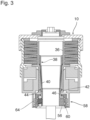
- den Bremsaktuator in einem Zustand, in dem die Hilfslösevorrichtung betätigt ist;
- Fig. 4
- den Bremsaktuator in einem Zustand, in dem die Hilfslösevorrichtung unbetätigt ist aber die Bremse noch nicht wieder betriebsbereit ist; und
- Fig. 5
- den Bremsaktuator im erneut betriebsbereiten Zustand.
- Der in
Fig. 1 gezeigte Bremsaktuator weist ein aus mehreren Teilen zusammengesetztes Gehäuse 10 auf, aus dem am inFig. 1 unteren Ende ein Kraftübertragungsorgan in der Form einer Druckstange 12 austritt, die entweder direkt oder indirekt über einen Umlenkhebel mit einem Bremsorgan einer Bremse eines Schienenfahrzeugs koppelbar ist. Das Gehäuse 10 nimmt im oberen Teil einen Kraftspeicher 14 auf, der durch eine Säule oder ein Paket übereinandergestapelter Tellerfeder 16 gebildet wird. Im unteren Teil nimmt das Gehäuse 10 einen hydraulischen Antrieb 18 auf, der eine durch einen Hauptkolben 20 und einen Hilfskolben 22 begrenzte Haupt-Druckkammer 24 aufweist. - In dem in
Fig. 1 gezeigten Zustand ist die Haupt-Druckkammer 24 mit Druck beaufschlagt, so dass der Hauptkolben 20 aufwärts gegen einen Federteller 26 gedrückt wird, an dem sich der Kraftspeicher 14 mit seinem unteren Ende abstützt. Das Tellerfederpaket des Kraftspeichers 14 wird dadurch zwischen dem Federteller 26 und einer oberen Wand des Gehäuses 10 komprimiert. Der Federteller 26 ist zugleich Teil eines Kopplungsmechanismus, mit dem die Kraft des Kraftspeichers 14 auf die Druckstange 12 übertragen werden kann. Ein weiterer Teil des Kopplungsmechanismus ist ein Nachsteller 28, der zum automatischen Nachstellen des Lüftspiels der Bremse dient und von dem hier nur ein im wesentlichen zylindrisches, sich jedoch nach unten verjüngendes Nachstellergehäuse 30 und ein aus dem Nachstellergehäuse herausragendes Ende einer Spindel 32 zu sehen ist, die einen aus dem Gehäuse 10 herausragenden Sechskantkopf 34 trägt. Der innere Aufbau und die Funktionsweise des Nachstellers 28 sind als solche bekannt und werden deshalb hier nicht näher beschrieben. - Das Nachstellergehäuse 30 ist von einer Hülse 36 umgeben, die in einem Stück mit dem Federteller 26 ausgebildet ist und sowohl nach oben als auch nach unten axial vom inneren Umfangsrand des Federtellers 26 vorspringt. Zu dem Kopplungsmechanismus gehört neben dem Federteller 26 und dem Nachsteller 28 auch eine Klauenkupplung 38, die das Nachstellergehäuse 30 ringförmig umgibt und eine lösbare formschlüssige Verbindung zwischen dem Federteller 26 und dem Nachstellergehäuse 30 herstellt. Dazu ist ein ringförmiger oberer Teil der Klauenkupplung 38 starr mit dem Nachstellergehäuse 30 verbunden, während ein unterer Teil der Klauenkupplung durch einen Kranz von elastischen Fingern 40 gebildet wird, die axial von dem ringförmigen oberen Teil ausgehen und jeweils am unteren Ende eine nach außen gekröpfte Klaue 42 tragen. In dem in
Fig 1 gezeigten Zustand greifen diese Klauen unter einen am unteren Ende der Hülse 36 gebildeten Absatz 44. - Wenn die Bremse betätigt werden soll, so wird die Haupt-Druckkammer 24 drucklos geschaltet, so dass sich der Hauptkolben 20 und der Federteller 26 unter der Kraft der Tellerfedern 16 abwärts in die in
Fig. 2 gezeigte Position bewegen. Die Kraft der Tellerfedern 16 wirkt über den Absatz 44 auf die Klauen 42, so dass auch die Klauenkupplung 38 und damit auch der Nachsteller 28 und die Druckstange 12 nach unten gezogen werden. Durch diese axiale Bewegung der Druckstange 12 wird die Bremse betätigt. Die Kraft des Kraftspeichers 14 wird über den Federteller 26, die Klauenkupplung 38, den Nachsteller 28 und die Druckstange 12 auf das Bremsorgan, beispielsweise einen Bremsbelag, übertragen, so dass der Bremsbelag fest gegen eine Bremsscheibe angedrückt wird und somit eine hohe Reibungsbremskraft erzeugt wird. Die Klauen 42 und die freien Enden der Finger 40 werden dabei durch einen von unten in den Kranz der Finger 40 eintretenden Spreizkonus 46 in einer radial nach außen ausgestellten Position gehalten, so dass die Klauen 42 nicht von dem Absatz 44 abrutschen. - In
Fig. 2 ist zu erkennen, dass sich im Vergleich zuFig. 1 der Abstand zwischen dem Hauptkolben 20 und dem Hilfskolben 22 verringert hat, da sich der Hauptkolben 20 und der Federteller 26 abwärts bewegt haben. Weiterhin erkennt man, dass sich aufgrund der Abwärtsbewegung des Nachstellers 28 ein Spalt zwischen einem Flansch 48 am oberen Ende des Nachstellergehäuses 30 und einem fest im Gehäuse 10 gehaltenen Abschlusselement 50 gebildet hat. - Wenn die Bremse wieder gelöst werden soll, so wird mit einer elektrisch angetriebenen Pumpe Hydraulikflüssigkeit in die Haupt-Druckkammer 24 gepumpt, so dass der Hauptkolben 20 entgegen der Kraft der Tellerfeder 16 wieder nach oben gedrückt wird. Das hat zur Folge, dass der Absatz 44 keine axiale Kraft mehr auf die Klauen 42 ausübt und somit die Druckstange 12 und das Bremsorgan der Bremse entlastet werden. Da der Federteller 26 durch den Hauptkolben 20 nach oben gedrückt wird, stößt die Hülse 36 mit ihrem oberen Rand an dem Flansch 48 des Nachstellergehäuses an, so dass auch der Nachsteller 28 und die Druckstange 12 wieder in die in
Fig. 1 gezeigte Position zurückgestellt werden. - Der Spreizkonus 46 ist auf Stiften 52 axial verschiebbar geführt und wird durch Federn 54, die die Stifte 52 umgeben, axial gegen die Finger 40 der Klauenkupplung 38 vorgespannt, so dass die Klauen 42 an dem Absatz 44 in Eingriff gehalten werden. Die unteren Enden der Federn 54 stützen sich an einem Ring 56 ab, der starr mit dem verjüngten unteren Ende des Nachstellergehäuses 30 verbunden ist.
- Wenn bei einem Ausfall der Energieversorgung oder bei einem Ausfall der Hydraulikpumpe die Haupt-Druckkammer 24 nicht mehr mit Druck beaufschlagt werden kann, so würde der Bremsaktuator in dem in
Fig. 2 gezeigten Zustand bleiben, und die Bremse wäre ständig aktiv, so dass das Fahrzeug nicht bewegt werden könnte. Damit auch in einem solchen Fall die Bremse gelöst werden kann, gibt es verschiedene Möglichkeiten, die Bremse von Hand zu lösen. Eine dieser Möglichkeiten besteht darin, dass mit einer von Hand betätigten Pumpe die Unterseite des Hilfskolbens 22 mit Druck beaufschlagt wird, so dass der Hilfskolben 22 gegen den Hauptkolben 20 verschoben wird und dann den Federteller 26 entgegen der Kraft der Tellerfedern 16 nach oben drückt. Dieser Vorgang ist jedoch zeitraubend, da mit der handbetätigten Pumpe ein relativ hoher hydraulischer Druck aufgebaut werden muss. Eine andere Möglichkeit besteht darin, mit Hilfe eines Werkzeugs den Sechskantkopf 34 und damit die Spindel 32 zu drehen und dadurch die axiale Position der Druckstange 12 relativ zum Nachstellergehäuse 30 zu verstellen, so dass zwar der Federteller 26 und das Nachstellergehäuse 30 in der abgesenkten Position verbleiben, die Druckstange 12 jedoch nach oben gezogen wird und somit die Bremse gelöst wird. Diese Möglichkeit hat jedoch den Nachteil, dass nach einem solchen Lösevorgang das Lüftspiel der Bremse umständlich wieder neu eingestellt werden muss, beispielsweise durch mehrmaliges Betätigen und Lösen der Bremse mit Hilfe des Hauptkolbens 20. - Erfindungsgemäß weist der hier gezeigte Bremsaktuator eine zusätzliche Hilfslösevorrichtung 58 auf, deren Aufbau nun anhand der
Fig. 2 erläutert werden soll. - Der Ring 56 steht an seinem äußeren Umfang über ein Steilgewinde mit einer Buchse 60 in Eingriff, die an ihren oberen Ende mit einem Flansch 62 einen Flansch des Spreizkonus 46 übergreift. Eine Seiltrommel 64 ist drehbar und axialfest im unteren Teil des Gehäuses 10 gelagert und steht so mit der Buchse 60 in Eingriff, dass die Buchse 60 axial verschiebbar ist, sich jedoch bei einer Drehung der Seiltrommel mit dieser Seiltrommel mitdreht. Auf die Seiltrommel ist ein hier nicht gezeigtes Zugseil aufgewickelt. Wenn von Hand, beispielsweise über einen Hebel, ein Zug auf dieses Zugseil ausgeübt wird, so werden die Seiltrommel 64 und die Buchse 60 in Drehung versetzt. Aufgrund des Steilgewindes bewegt sich dabei die Buchse 60 relativ zu dem Ring 56 nach unten, so dass der Spreizkonus 46 entgegen der Kraft der Federn 54 nach unten gezogen wird. Dadurch können die Klauen 42 nach innen schwenken und von dem Absatz 44 der Hülse 36 frei kommen, wie in
Fig. 3 gezeigt ist. Die Einwärts-Schwenkbewegung der Finger 40 kann dadurch bewirkt werden, dass diese Finger elastisch in die radial innere Position vorgespannt sind und/oder dadurch, dass der Absatz 44 und die Klauen 42 etwas angeschrägt sind. - In dem in
Fig 3 gezeigten Zustand ist der Kraftfluss zwischen dem Federteller 26 und der Klauenkupplung 38 unterbrochen, so dass der Nachsteller 28 und die Druckstange 12 nicht mehr in der Bremsbetätigungsstellung gehalten werden und somit keine Kraft mehr auf das Bremsorgan ausüben. Aufgrund einer gewissen Eigenelastizität des Bremsorgans werden sich die Druckstange 12 und der Nachsteller 28 ein Stück weit in Richtung auf die Bremslösestellung gemäßFig. 1 bewegen. - Wenn über den Seilzug kein Zug mehr auf die Seiltrommel 64 ausgeübt wird, kehrt diese unter der Wirkung einer nicht gezeigten Rückstellfeder in ihre Ausgangsstellung zurück, so dass die Buchse 60 wieder nach oben in die in
Fig. 4 gezeigte Position geschoben wird. Der Spreizkonus 46 verbleibt jedoch noch in der abgesenkten Position, da er mit seinem oberen Ende an den Klauen 42 anstößt und diese durch die nach wie vor in der abgesenkten Stellung gehaltene Hülse 36 daran gehindert werden, wieder nach außen zu schwenken. - Wenn der Antrieb 18 wieder betriebsbereit ist, kann der Hauptkolben 20 hydraulisch wieder in die angehobene Position bewegt werden, wie in
Fig, 5 gezeigt ist. Dabei werden die Tellerfedern 16 komprimiert, und der Federteller 26 und die Hülse 36 werden so weit angehoben, dass der Spreizkonus 46 unter der Kraft der Federn 54 auf die Finger 40 aufläuft und die Klauen 42 wieder nach außen drückt, so dass sie an dem Absatz 44 einrasten. Da das Lüftspiel der Bremse bei den inFig. 3 bis 5 beschriebenen Vorgängen nicht verstellt wurde, ist die Bremse dann unmittelbar wieder betriebsbereit.
Claims (7)
- Federspeicher-Bremsaktuator mit einer an ein Bremsorgan an einer Bremse koppelbaren Druckstange (12), einem Kraftspeicher (14), der dazu eingerichtet ist, über einen Kopplungsmechanismus (26, 38, 28) eine Bremskraft auf die Druckstange (12) auszuüben, einem Antrieb (18), der dazu eingerichtet ist, die Druckstange (12) entgegen der Kraft des Kraftspeichers (14) in einer Bremslösestellung zu halten, und einer Hilfslösevorrichtung (58), mit der sich die Übertragung der Bremskraft von dem Kraftspeicher (14) auf die Druckstange (12) unabhängig von dem Antrieb (18) blockieren lässt, dadurch gekennzeichnet, dass der Kopplungsmechanismus zwei Kopplungsglieder (26, 28) aufweist, die über eine Klauenkupplung (38) miteinander in Eingriff stehen, und dass die Hilfslösevorrichtung (58) ein Stellorgan (60) aufweist, das dazu eingerichtet ist, die Klauen (42) der Klauenkupplung (38) in einer Bewegungsrichtung quer zur Kraftübertragungsrichtung in eine Nichteingriffsstellung zu bringen.
- Bremsaktuator nach Anspruch 1, bei dem der Kraftspeicher (14) ein Federsystem aufweist und eines der Kopplungsglieder ein Federteller (26) ist.
- Bremsaktuator nach Anspruch 2, bei dem ein anderes der Kopplungsglieder ein Nachsteller (28) zur Einstellung des Lüftspiels der Bremse ist.
- Bremsaktuator nach Anspruch 3, bei dem die Klauenkupplung (38) einen ringförmigen Teil aufweist, der starr mit einem Nachstellergehäuse (30) des Nachstellers (28) verbunden ist und von dem axial mehrere elastische Finger (40) abgehen, die jeweils am freien Ende eine Klaue (42) tragen, und bei dem der Federteller (26) starr mit einer Hülse (36) verbunden ist, die das Nachstellergehäuse (30) und die Klauenkupplung (38) umgibt und am inneren Umfang einen Absatz (44) bildet, an dem die Klauen (42) einrasten können.
- Bremsaktuator nach Anspruch 4, bei dem die Hilfslösevorrichtung (58) einen Spreizkonus (46) aufweist, der im betriebsbereiten Zustand des Bremsaktuators die Klauen (42) an dem Absatz (44) in Eingriff hält und der durch das Stellorgan (60) relativ zu den Klauen (42) axial zurückziehbar ist, so dass er die Klauen freigibt.
- Bremsaktuator nach Anspruch 5, bei dem die Hilfslösevorrichtung (58) eine Seiltrommel (64) für ein Zugseil aufweist, die über ein Getriebe mit dem Stellorgan (60) verbunden ist.
- Bremsaktuator nach Anspruch 6, bei dem das Stellorgan eine Buchse (60) ist, die über ein Steilgewinde mit einem starr am Nachstellergehäuse (30) gehaltenen Ring (56) in Eingriff steht und einen Flansch des Spreizkonus (46) mit einem Flansch (62) übergreift und die axial verschiebbar und drehfest mit der Seiltrommel (64) verbunden ist.
Applications Claiming Priority (1)
| Application Number | Priority Date | Filing Date | Title |
|---|---|---|---|
| DE202023102323.1U DE202023102323U1 (de) | 2023-04-28 | 2023-04-28 | Federspeicher-Bremsaktuator |
Publications (2)
| Publication Number | Publication Date |
|---|---|
| EP4461610A1 EP4461610A1 (de) | 2024-11-13 |
| EP4461610B1 true EP4461610B1 (de) | 2025-05-28 |
Family
ID=90366019
Family Applications (1)
| Application Number | Title | Priority Date | Filing Date |
|---|---|---|---|
| EP24164046.5A Active EP4461610B1 (de) | 2023-04-28 | 2024-03-18 | Federspeicher-bremsaktuator |
Country Status (6)
| Country | Link |
|---|---|
| US (1) | US20240359677A1 (de) |
| EP (1) | EP4461610B1 (de) |
| CA (1) | CA3233470A1 (de) |
| DE (1) | DE202023102323U1 (de) |
| ES (1) | ES3035900T3 (de) |
| PL (1) | PL4461610T3 (de) |
Family Cites Families (5)
| Publication number | Priority date | Publication date | Assignee | Title |
|---|---|---|---|---|
| DE3113586A1 (de) | 1981-04-03 | 1982-10-28 | Knorr-Bremse GmbH, 8000 München | "mechanische loeseeinrichtung fuer federspeicherbremszylinder" |
| DE4015477A1 (de) | 1990-05-14 | 1991-11-21 | Knorr Bremse Ag | Federspeicherzylinder fuer druckluftbetaetigte fahrzeugbremsen |
| DE29708587U1 (de) | 1997-05-14 | 1998-09-10 | Hanning & Kahl GmbH & Co., 33813 Oerlinghausen | Notlösevorrichtung für Federspeicher-Bremsanlagen |
| DE19945701A1 (de) * | 1999-09-23 | 2001-04-19 | Knorr Bremse Systeme | Bremsaktuator |
| US6702072B2 (en) * | 2002-04-18 | 2004-03-09 | Westinghouse Air Brake Technologies Corporation | Brake cylinder unit |
-
2023
- 2023-04-28 DE DE202023102323.1U patent/DE202023102323U1/de active Active
-
2024
- 2024-03-18 PL PL24164046.5T patent/PL4461610T3/pl unknown
- 2024-03-18 ES ES24164046T patent/ES3035900T3/es active Active
- 2024-03-18 EP EP24164046.5A patent/EP4461610B1/de active Active
- 2024-03-27 CA CA3233470A patent/CA3233470A1/en active Pending
- 2024-04-03 US US18/625,498 patent/US20240359677A1/en active Pending
Also Published As
| Publication number | Publication date |
|---|---|
| CA3233470A1 (en) | 2025-07-08 |
| US20240359677A1 (en) | 2024-10-31 |
| EP4461610A1 (de) | 2024-11-13 |
| ES3035900T3 (en) | 2025-09-11 |
| DE202023102323U1 (de) | 2024-07-30 |
| PL4461610T3 (pl) | 2025-10-20 |
Similar Documents
| Publication | Publication Date | Title |
|---|---|---|
| DE69824578T2 (de) | Selbsttätige bremsnachstellvorrichtung | |
| DE2608502C3 (de) | Lösevorrichtung für die Unterbrechung und automatische Rückführung der Betriebsfunktion eines Federspeicherbremszylinders | |
| DE19510905A1 (de) | Reibungskupplung | |
| DE2310608C2 (de) | Nachstellvorrichtung für die gegenüberliegenden, bogenförmigen Bremsbacken einer Innenbacken-Trommelbremse | |
| DE2124117A1 (de) | Federbetätigte Bremsbetätigungsvorrichtung | |
| DE2520499A1 (de) | Bremsbetaetigungsvorrichtung fuer eine fluiddruckbetaetigte fahrzeug- radbremse | |
| DE2204354A1 (de) | Verschleißkompensierte kraftvervielfachende Kraftbremse | |
| DE2017309C3 (de) | Blockiervorrichtung für eine Fahrzeugbremse | |
| DE2438460C2 (de) | Mechanisch betätigte Scheibenbremse | |
| EP3317556B1 (de) | Nachstelleinrichtung für eine scheibenbremse | |
| DE2606499A1 (de) | Sicherheitsbetaetigungsvorrichtung fuer reibungsbremsen | |
| DE2835558A1 (de) | Fluidbrems- und kupplungseinheit | |
| DE2229237C2 (de) | Selbsttätige Nachstellvorrichtung für Teilbelagscheibenbremsen | |
| DE4405344B4 (de) | Reibungskupplung | |
| EP1436518B1 (de) | Kupplungsanordnung | |
| DE2354322A1 (de) | Selbsttaetige nachstellvorrichtung fuer fahrzeugbremsen | |
| DE3708070A1 (de) | Hydraulische bremsbetaetigungseinrichtung mit feststellbremse | |
| EP0436906A1 (de) | Betätigungsvorrichtung für eine Fahrzeugbremse, insbes. Scheibenbremse | |
| EP4461610B1 (de) | Federspeicher-bremsaktuator | |
| DE69100727T2 (de) | Fahrzeugbremsen. | |
| DE2207320A1 (de) | Kupplungsausruckvorrichtung fur ein Fahrzeug | |
| DE2263081B2 (de) | Filter mit frequenzabhängigen Übertragungseigenschaften | |
| EP0869292B1 (de) | Selbsttätige Nachstellvorrichtung für eine Trommelbremse | |
| DE4226143A1 (de) | Druckgesteuerte axial verschiebbare Nachstellvorrichtung | |
| DE69807701T2 (de) | Sicherheitsbremse für fahrzeuge |
Legal Events
| Date | Code | Title | Description |
|---|---|---|---|
| PUAI | Public reference made under article 153(3) epc to a published international application that has entered the european phase |
Free format text: ORIGINAL CODE: 0009012 |
|
| STAA | Information on the status of an ep patent application or granted ep patent |
Free format text: STATUS: THE APPLICATION HAS BEEN PUBLISHED |
|
| AK | Designated contracting states |
Kind code of ref document: A1 Designated state(s): AL AT BE BG CH CY CZ DE DK EE ES FI FR GB GR HR HU IE IS IT LI LT LU LV MC ME MK MT NL NO PL PT RO RS SE SI SK SM TR |
|
| STAA | Information on the status of an ep patent application or granted ep patent |
Free format text: STATUS: REQUEST FOR EXAMINATION WAS MADE |
|
| 17P | Request for examination filed |
Effective date: 20241121 |
|
| RBV | Designated contracting states (corrected) |
Designated state(s): AL AT BE BG CH CY CZ DE DK EE ES FI FR GB GR HR HU IE IS IT LI LT LU LV MC ME MK MT NL NO PL PT RO RS SE SI SK SM TR |
|
| GRAP | Despatch of communication of intention to grant a patent |
Free format text: ORIGINAL CODE: EPIDOSNIGR1 |
|
| STAA | Information on the status of an ep patent application or granted ep patent |
Free format text: STATUS: GRANT OF PATENT IS INTENDED |
|
| INTG | Intention to grant announced |
Effective date: 20250109 |
|
| GRAS | Grant fee paid |
Free format text: ORIGINAL CODE: EPIDOSNIGR3 |
|
| GRAA | (expected) grant |
Free format text: ORIGINAL CODE: 0009210 |
|
| STAA | Information on the status of an ep patent application or granted ep patent |
Free format text: STATUS: THE PATENT HAS BEEN GRANTED |
|
| AK | Designated contracting states |
Kind code of ref document: B1 Designated state(s): AL AT BE BG CH CY CZ DE DK EE ES FI FR GB GR HR HU IE IS IT LI LT LU LV MC ME MK MT NL NO PL PT RO RS SE SI SK SM TR |
|
| REG | Reference to a national code |
Ref country code: GB Ref legal event code: FG4D Free format text: NOT ENGLISH |
|
| REG | Reference to a national code |
Ref country code: CH Ref legal event code: EP |
|
| REG | Reference to a national code |
Ref country code: IE Ref legal event code: FG4D Free format text: LANGUAGE OF EP DOCUMENT: GERMAN Ref country code: DE Ref legal event code: R096 Ref document number: 502024000051 Country of ref document: DE |
|
| P01 | Opt-out of the competence of the unified patent court (upc) registered |
Free format text: CASE NUMBER: UPC_APP_2202_4461610/2025 Effective date: 20250801 |
|
| REG | Reference to a national code |
Ref country code: ES Ref legal event code: FG2A Ref document number: 3035900 Country of ref document: ES Kind code of ref document: T3 Effective date: 20250911 |
|
| REG | Reference to a national code |
Ref country code: NL Ref legal event code: MP Effective date: 20250528 |
|
| PG25 | Lapsed in a contracting state [announced via postgrant information from national office to epo] |
Ref country code: FI Free format text: LAPSE BECAUSE OF FAILURE TO SUBMIT A TRANSLATION OF THE DESCRIPTION OR TO PAY THE FEE WITHIN THE PRESCRIBED TIME-LIMIT Effective date: 20250528 |
|
| REG | Reference to a national code |
Ref country code: LT Ref legal event code: MG9D |
|
| PG25 | Lapsed in a contracting state [announced via postgrant information from national office to epo] |
Ref country code: GR Free format text: LAPSE BECAUSE OF FAILURE TO SUBMIT A TRANSLATION OF THE DESCRIPTION OR TO PAY THE FEE WITHIN THE PRESCRIBED TIME-LIMIT Effective date: 20250829 Ref country code: NO Free format text: LAPSE BECAUSE OF FAILURE TO SUBMIT A TRANSLATION OF THE DESCRIPTION OR TO PAY THE FEE WITHIN THE PRESCRIBED TIME-LIMIT Effective date: 20250828 |
|
| PG25 | Lapsed in a contracting state [announced via postgrant information from national office to epo] |
Ref country code: NL Free format text: LAPSE BECAUSE OF FAILURE TO SUBMIT A TRANSLATION OF THE DESCRIPTION OR TO PAY THE FEE WITHIN THE PRESCRIBED TIME-LIMIT Effective date: 20250528 |
|
| PG25 | Lapsed in a contracting state [announced via postgrant information from national office to epo] |
Ref country code: BG Free format text: LAPSE BECAUSE OF FAILURE TO SUBMIT A TRANSLATION OF THE DESCRIPTION OR TO PAY THE FEE WITHIN THE PRESCRIBED TIME-LIMIT Effective date: 20250528 |
|
| PG25 | Lapsed in a contracting state [announced via postgrant information from national office to epo] |
Ref country code: HR Free format text: LAPSE BECAUSE OF FAILURE TO SUBMIT A TRANSLATION OF THE DESCRIPTION OR TO PAY THE FEE WITHIN THE PRESCRIBED TIME-LIMIT Effective date: 20250528 |
|
| PG25 | Lapsed in a contracting state [announced via postgrant information from national office to epo] |
Ref country code: RS Free format text: LAPSE BECAUSE OF FAILURE TO SUBMIT A TRANSLATION OF THE DESCRIPTION OR TO PAY THE FEE WITHIN THE PRESCRIBED TIME-LIMIT Effective date: 20250828 |
|
| PG25 | Lapsed in a contracting state [announced via postgrant information from national office to epo] |
Ref country code: IS Free format text: LAPSE BECAUSE OF FAILURE TO SUBMIT A TRANSLATION OF THE DESCRIPTION OR TO PAY THE FEE WITHIN THE PRESCRIBED TIME-LIMIT Effective date: 20250928 |
|
| PG25 | Lapsed in a contracting state [announced via postgrant information from national office to epo] |
Ref country code: LV Free format text: LAPSE BECAUSE OF FAILURE TO SUBMIT A TRANSLATION OF THE DESCRIPTION OR TO PAY THE FEE WITHIN THE PRESCRIBED TIME-LIMIT Effective date: 20250528 |
|
| PG25 | Lapsed in a contracting state [announced via postgrant information from national office to epo] |
Ref country code: SM Free format text: LAPSE BECAUSE OF FAILURE TO SUBMIT A TRANSLATION OF THE DESCRIPTION OR TO PAY THE FEE WITHIN THE PRESCRIBED TIME-LIMIT Effective date: 20250528 Ref country code: DK Free format text: LAPSE BECAUSE OF FAILURE TO SUBMIT A TRANSLATION OF THE DESCRIPTION OR TO PAY THE FEE WITHIN THE PRESCRIBED TIME-LIMIT Effective date: 20250528 |
|
| PG25 | Lapsed in a contracting state [announced via postgrant information from national office to epo] |
Ref country code: EE Free format text: LAPSE BECAUSE OF FAILURE TO SUBMIT A TRANSLATION OF THE DESCRIPTION OR TO PAY THE FEE WITHIN THE PRESCRIBED TIME-LIMIT Effective date: 20250528 |
|
| PG25 | Lapsed in a contracting state [announced via postgrant information from national office to epo] |
Ref country code: SK Free format text: LAPSE BECAUSE OF FAILURE TO SUBMIT A TRANSLATION OF THE DESCRIPTION OR TO PAY THE FEE WITHIN THE PRESCRIBED TIME-LIMIT Effective date: 20250528 |
|
| PG25 | Lapsed in a contracting state [announced via postgrant information from national office to epo] |
Ref country code: IT Free format text: LAPSE BECAUSE OF FAILURE TO SUBMIT A TRANSLATION OF THE DESCRIPTION OR TO PAY THE FEE WITHIN THE PRESCRIBED TIME-LIMIT Effective date: 20250528 |
|
| REG | Reference to a national code |
Ref country code: DE Ref legal event code: R097 Ref document number: 502024000051 Country of ref document: DE |
|
| PLBE | No opposition filed within time limit |
Free format text: ORIGINAL CODE: 0009261 |
|
| STAA | Information on the status of an ep patent application or granted ep patent |
Free format text: STATUS: NO OPPOSITION FILED WITHIN TIME LIMIT |
|
| REG | Reference to a national code |
Ref country code: CH Ref legal event code: L10 Free format text: ST27 STATUS EVENT CODE: U-0-0-L10-L00 (AS PROVIDED BY THE NATIONAL OFFICE) Effective date: 20260409 |
|
| PGFP | Annual fee paid to national office [announced via postgrant information from national office to epo] |
Ref country code: AT Payment date: 20260301 Year of fee payment: 3 |
|
| PGFP | Annual fee paid to national office [announced via postgrant information from national office to epo] |
Ref country code: FR Payment date: 20260324 Year of fee payment: 3 |
|
| PGFP | Annual fee paid to national office [announced via postgrant information from national office to epo] |
Ref country code: CZ Payment date: 20260305 Year of fee payment: 3 |
|
| PGFP | Annual fee paid to national office [announced via postgrant information from national office to epo] |
Ref country code: PL Payment date: 20260305 Year of fee payment: 3 |