EP4459741A1 - Entladeverfahren für abfallbatterie - Google Patents
Entladeverfahren für abfallbatterie Download PDFInfo
- Publication number
- EP4459741A1 EP4459741A1 EP22916489.2A EP22916489A EP4459741A1 EP 4459741 A1 EP4459741 A1 EP 4459741A1 EP 22916489 A EP22916489 A EP 22916489A EP 4459741 A1 EP4459741 A1 EP 4459741A1
- Authority
- EP
- European Patent Office
- Prior art keywords
- waste battery
- discharge
- battery
- voltage
- waste
- Prior art date
- Legal status (The legal status is an assumption and is not a legal conclusion. Google has not performed a legal analysis and makes no representation as to the accuracy of the status listed.)
- Pending
Links
Images

Classifications
-
- H—ELECTRICITY
- H01—ELECTRIC ELEMENTS
- H01M—PROCESSES OR MEANS, e.g. BATTERIES, FOR THE DIRECT CONVERSION OF CHEMICAL ENERGY INTO ELECTRICAL ENERGY
- H01M10/00—Secondary cells; Manufacture thereof
- H01M10/54—Reclaiming serviceable parts of waste accumulators
-
- H—ELECTRICITY
- H01—ELECTRIC ELEMENTS
- H01M—PROCESSES OR MEANS, e.g. BATTERIES, FOR THE DIRECT CONVERSION OF CHEMICAL ENERGY INTO ELECTRICAL ENERGY
- H01M10/00—Secondary cells; Manufacture thereof
- H01M10/42—Methods or arrangements for servicing or maintenance of secondary cells or secondary half-cells
- H01M10/44—Methods for charging or discharging
-
- H—ELECTRICITY
- H01—ELECTRIC ELEMENTS
- H01M—PROCESSES OR MEANS, e.g. BATTERIES, FOR THE DIRECT CONVERSION OF CHEMICAL ENERGY INTO ELECTRICAL ENERGY
- H01M10/00—Secondary cells; Manufacture thereof
- H01M10/60—Heating or cooling; Temperature control
- H01M10/63—Control systems
-
- Y—GENERAL TAGGING OF NEW TECHNOLOGICAL DEVELOPMENTS; GENERAL TAGGING OF CROSS-SECTIONAL TECHNOLOGIES SPANNING OVER SEVERAL SECTIONS OF THE IPC; TECHNICAL SUBJECTS COVERED BY FORMER USPC CROSS-REFERENCE ART COLLECTIONS [XRACs] AND DIGESTS
- Y02—TECHNOLOGIES OR APPLICATIONS FOR MITIGATION OR ADAPTATION AGAINST CLIMATE CHANGE
- Y02E—REDUCTION OF GREENHOUSE GAS [GHG] EMISSIONS, RELATED TO ENERGY GENERATION, TRANSMISSION OR DISTRIBUTION
- Y02E60/00—Enabling technologies; Technologies with a potential or indirect contribution to GHG emissions mitigation
- Y02E60/10—Energy storage using batteries
-
- Y—GENERAL TAGGING OF NEW TECHNOLOGICAL DEVELOPMENTS; GENERAL TAGGING OF CROSS-SECTIONAL TECHNOLOGIES SPANNING OVER SEVERAL SECTIONS OF THE IPC; TECHNICAL SUBJECTS COVERED BY FORMER USPC CROSS-REFERENCE ART COLLECTIONS [XRACs] AND DIGESTS
- Y02—TECHNOLOGIES OR APPLICATIONS FOR MITIGATION OR ADAPTATION AGAINST CLIMATE CHANGE
- Y02W—CLIMATE CHANGE MITIGATION TECHNOLOGIES RELATED TO WASTEWATER TREATMENT OR WASTE MANAGEMENT
- Y02W30/00—Technologies for solid waste management
- Y02W30/50—Reuse, recycling or recovery technologies
- Y02W30/84—Recycling of batteries or fuel cells
Definitions
- the present invention relates to a waste battery discharge process for recycling a waste battery, and more particularly, to a process for checking stability, a state of charge, and a remaining life of the waste battery before reusing or recycling the waste battery (battery after use), and safely and cost-effectively discharging the waste battery.
- waste batteries for a vehicle which are used in an eco-friendly vehicle and are collected, are immediately disposed (for example, recovery of resources, etc.), it is expected that enormous annual disposal costs will be incurred from 2024, and disposal costs will increase explosively from 2031 onwards.
- the waste batteries for a vehicle need to be recycled to another application field, safety cannot be guaranteed due to the energy remaining in the waste batteries, i.e., the pre-charged power, and thus recycling waste batteries for a vehicle having a risk of fire or explosion as them without any guarantee is technically and socially very dangerous.
- the energy remaining in the waste battery that is, the pre-charged power needs to be lowered to a predetermined SOC or lower or fully discharged.
- a first problem to be solved by the present invention is to provide a battery discharge process for discharging pre-charged power in a waste battery before reuse or recycling of the waste battery.
- a second problem to be solved by the present invention is to provide a discharge process capable of discharging the waste battery in a cost-effective, safe, and environmentally friendly manner by replacing a conventional salt water precipitation method.
- a third problem to be solved by the present invention is to provide an optimal discharge process that takes into account the type of waste battery and the materials constituting the electrodes (anode material, cathode material, electrolyte, etc.), and design.
- the discharge in the step (S200) is discharged at a first current magnitude, and the first current magnitude is 0.2 C (C-rate) to 5.0 C (C-rate), preferably 0.5 C (C-rate) to 3.0 C (C-rate).
- the first discharge voltage in the step (S200) is 0.05 V to 3.0 V, preferably 0.1 V to 2.5 V, based on a single cell.
- the first discharge SOC in the step (S200) is 0% to 50%, preferably 0% to 30%.
- the discharge in the step (S300) is discharged at a second current magnitude, and the second current magnitude is 10% to 50% of the first current magnitude, preferably 20% to 30%.
- the second discharge voltage in the step (S300) is 0 V to 0.5 V, preferably 0 V to 0.1 V, based on a single cell.
- the constant voltage applied in step (S400) is equal to the second discharge voltage.
- the constant voltage in step (S400) is applied until a cutoff current of 0.005 to 0.5 C, or 0.01 to 0.1 C is measured.
- a method for discharging the residual energy remaining in a waste battery through a wet discharge method such as a conventional salt water precipitation method not only takes a long time and costs a lot of money, but also has problems with environmental pollution such as waste water disposal, and thus it has limitations in large-scale and large-capacity discharge.
- the waste battery discharge process according to the present invention is a dry method, which avoids the above-described conventional problems and enables discharge within a short period of time, and in which there is no need to treat waste salt water, thereby allowing the waste batteries to be recycled or reused in an environmentally friendly and cost-effective manner.
- the waste battery discharge process according to the present invention can provide a discharge process that comprehensively considers characteristics that may vary depending on battery constituent materials and design, such as battery specification information and electrode material information included in the battery.
- the waste battery discharge process according to the present invention can be used as a basic facility for storage, movement, and reuse of waste batteries, and can be expected to improve the safety in the battery reuse and recycling industry.
- first or second may be used to describe various components, but these terms should be interpreted only for the purpose of distinguishing one component from another component.
- a first component may be named a second component, and similarly, the second component may also be named a first component.
- FIG. 1 is a block diagram of a discharge system according to an embodiment of the present invention.
- a discharge system 100 includes a charge/discharge unit 110 that adjusts the current through a connection terminal 140 connected to a waste battery 200, a voltage measurement unit 120, and a memory unit 130.
- connection terminal of the connection unit 140 is electrically connected to a power terminal of the waste battery, and the connection unit 140 measures a voltage value or current value of the waste battery 200 through the connection terminal, or provides an electrical circuit for charging or discharging the waste battery.
- FIG. 2 is a flowchart for describing a process of discharging a waste battery step by step according to an embodiment of the present invention.
- a waste battery discharge process including
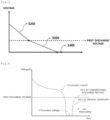
- FIG. 3 is an example of a voltage curve reflecting the waste battery discharge process according to an embodiment of the present invention.
- a method of discharging a battery uses constant current-constant voltage (CC-CV) method, which discharges the battery at a constant current until a specific voltage and then discharges at a constant voltage until a preset low current is reached, and the present invention is characterized by its detailed process.
- CC-CV constant current-constant voltage
- the waste battery referred to in the present invention refers to a waste battery for vehicles, which is used in an eco-friendly vehicle (e.g., electric vehicles, hydrogen vehicles, etc.) and is collected for various reasons (e.g., inspection, repair, expiration, accident, scrapped vehicle, etc.) and a battery to be inspected is either a battery cell, a battery module, or a battery pack.
- an eco-friendly vehicle e.g., electric vehicles, hydrogen vehicles, etc.
- a battery to be inspected is either a battery cell, a battery module, or a battery pack.
- the battery module when the waste battery is a battery module, the battery module may include N (N ⁇ 2) battery cells, a battery manufacturer's BMS installed by the battery manufacturer at the time of manufacturing the vehicle battery, and may include a vehicle case provided at the time of manufacturing the battery or installing the battery in the vehicle (however, the vehicle case can be omitted if installed in the vehicle without a separate case).
- the step (S100) of preparing the waste battery may be a step of collecting a waste battery from the eco-friendly vehicle, separating the battery manufacturer's BMS and the vehicle case (can be omitted) from the waste battery, and then preparing (or receiving) a battery module including N battery cells.
- the discharge process of a waste battery according to the present invention may include a step of specifying the specifications of the waste battery after preparing the waste battery (S110) and a step of performing an electric flow test of the waste battery (S120).
- the step of selecting the specifications of the waste battery is a step of determining a type of waste battery by considering the components that constitutes the waste battery (anode material, cathode material, electrolyte, etc.). Since a battery's capacity-voltage curve that represents the battery's discharge characteristics is determined by the anode material and the cathode material, the specifications of the waste battery must always be considered in order to set specific conditions of the discharge process, such as a first discharge voltage and a second discharge voltage, which will be described later.
- the electric flow test (S120) may include an insulation resistance measurement step (S1121), a voltage measurement step (S1122), and an electrochemical impedance spectroscopy (EIS) measurement step (S1123).
- S1121 insulation resistance measurement step
- S1122 voltage measurement step
- EIS electrochemical impedance spectroscopy
- S1123 electrochemical impedance spectroscopy
- the discharge process of a waste battery according to the present invention may further include a step of designing optimal discharge process conditions based on the results of the step of specifying the specifications of the waste battery (S110) and the electric flow inspection step (S120) (S130).
- step (S130) discharge conditions such as a first discharge voltage, a second discharge voltage, a constant voltage, a first current, a second current, and a cutoff current, which will be described later, are set.
- the step (S200) is a step of discharging the waste battery to a first discharge voltage/first discharge SOC, which is a preset voltage/SOC, of the waste battery, through the connection terminal connected to the power terminal of the waste battery.
- the step (S200) may vary depending on the characteristics of the waste battery, e.g., the type of components (electrode material) that constitutes the waste battery.
- the step (S200) is a step of discharging the waste battery through a terminal connected to the waste battery in order to lower the level of energy charged in the waste battery.
- the step (S200), which is a discharging step of the present invention is a step of discharging the waste battery to the first discharge voltage or first discharge SOC.
- the step (S200) does not fully discharge the charged energy of the waste battery, but rather discharges the battery only to the first discharge voltage or first discharge SOC.
- the first discharge voltage or first discharge SOC means a limit discharge voltage or limit discharge SOC at which the reversible capacity development of the waste battery no longer progresses.
- the step (S200) is a step of discharging the waste battery to a region of reversible capacity development
- the waste battery may be recycled/reused after the (S200) step, i.e., discharging the waste battery to the first discharge voltage or first discharge SOC. Therefore, it can also be defined as the 'reuse discharge stage'.
- the first discharge voltage or first discharge SOC can be set variably depending on the anode material and cathode material that constitutes the battery.
- the first discharge voltage considering the anode material and cathode material constituting the waste battery may be 0.05 V to 3.0 V, preferably 0.1 V to 2.5 V, based on a single cell.
- the first discharge SOC in the step (S200) is characterized in that it is 0% to 50%, preferably 0% to 30%, and more preferably 5% to 30%.
- voltage refers to the potential difference between the anode and the cathode, and is a value measured on a single cell basis, and for the battery modules or packs, a voltage standard may vary depending on the configuration of the battery.
- single cell voltage*N which is a first discharge voltage in a module or pack where N (N ⁇ 2) single cells are connected in series, may be the discharge voltage.
- the step (S200) may be a step of discharging the waste battery at a first current magnitude through the connection terminal.
- the first current magnitude may be a constant current of 0.5 C (C-rate) to 5.0 C (C-rate), preferably 0.5 C (C-rate) to 3.0 C (C-rate).
- the step (S200) may further include a step (S210) of checking balance information including a difference in charging voltage between N battery cells provided in the battery through the cell connection terminal after discharging the waste battery to the first discharge voltage or first discharge SOC (S210), and a step (S220) of performing a balance check to determine whether the difference in charging voltage between N battery cells included in the balance information matches a preset effective charging voltage balance range.
- the voltage difference between N battery cells constituting the battery module can be checked.
- the discharge process in the subsequently step (S300) can be performed more safely.
- the step (S300) is a step of discharging the waste battery through the connection terminal of the waste battery.
- the step (S300) is a step of discharging the waste battery to a designated voltage or SOC through the connection terminal of the waste battery.
- the step (S300) is a step of discharging the waste battery, which is discharged only up to the first discharge voltage or the first discharge SOC in step (S200), again once more, and is a step of discharging the waste battery once more up to a designated discharge voltage, that is, the second discharge voltage.
- the step (S300) may be a step of discharging the waste battery in a region where reversible capacity is not developed, for example, a region where SOC is 0 or less. Therefore, it can also be defined as an 'irreversible discharge stage' in the sense that the waste battery is discharged beyond a reversible capacity development voltage range of the waste battery.
- step (S300) is a step distinct from the step (S200).
- the second discharge voltage in step (S300) is a voltage with which most of the previously charged energy can be discharged, and thus may be a voltage where the energy level difference between the positive electrode and negative electrode approaches 0.
- the second discharge voltage according to the present invention may be 0 V to 0.1 V, preferably 0 V to 0.05 V, based on a single cell.
- the step (S300) may be a step of discharging the waste battery at a second current magnitude through the connection terminal.
- the second current magnitude may be discharged at a current magnitude of 10% to 50% of the first current magnitude, preferably 20% to 30% of the first current magnitude.
- the second current magnitude in step (S300) is characterized in that a current having the second current magnitude smaller than the first current magnitude is applied.
- discharging the waste battery to the first discharge voltage/SOC region and then discharging it again to the second discharge voltage is to discharge the waste battery by causing an electrochemical oxidation/reduction reaction within the waste battery.
- a strong oxidation atmosphere is formed at the cathode and a reducing atmosphere is formed at the anode.
- a fast discharge current may be applied to rapidly discharge the waste battery so that the waste battery is in a discharged state.
- rapid discharge may cause acceleration of electrolyte side reactions, which may lead to safety accidents accompanied by battery swelling and heat generation.
- the step (S400) is characterized in that, when the voltage of the waste battery reaches the second discharge voltage, a constant voltage is applied to the waste battery.
- step (S400) is defined as a 'waste discharge step'.
- the remaining lithium ions lithiated in the negative electrode material are de-lithiated by applying the constant voltage, and in the case of the positive electrode, lithium ions are inserted into the positive electrode material.
- the waste battery can be fully discharged and the energy level remaining in the waste battery can be minimized.
- the constant voltage applied in the (S400) step is a voltage where the energy level difference between the anode and the cathode is close to 0, i.e., a voltage close to 0 V.
- the constant voltage is the same voltage as the second discharge voltage and may be 0 V to 0.5 V, preferably 0 V to 0.1 V, based on a single cell.
- the constant voltage may be applied until a cut off current magnitude of 0.005 to 0.5 C, preferably 0.01 C to 0.1 C is measured.
- the cut-off current refers to a current generated according to the application of the constant voltage. As the constant voltage is continuously applied, the amount of current generated gradually decreases because it approaches full discharge. In this case, when the cutoff current magnitude is within 0.005 C to 0.5 C, preferably 0.01 C to 0.1 C, the constant voltage being applied is stopped and discharge is terminated.
- the OCV rebounding phenomenon OCV recovery phenomenon
- the voltage is restored again as the overvoltage caused by the applied current/voltage is resolved, may occur (see FIG. 4 ).
- OCV is an abbreviation for open circuit voltage. It is also called open circuit voltage, and refers to the voltage between both terminals when no load is attached to the battery. Recovery of OCV can be seen as indicating that the state inside the battery is not electrochemically stable, and may make it difficult to achieve the object of the present invention, which is to fully discharge the waste battery.
- the step (S500) is characterized in that the remaining energy is removed by artificially generating a short circuit in the waste battery.
- the remaining energy can be removed by generating an external short circuit with a resistance of 0.1 mQ to 5 ⁇ , preferably 30 mQ to 1 ⁇ .
Landscapes
- Engineering & Computer Science (AREA)
- Manufacturing & Machinery (AREA)
- Chemical & Material Sciences (AREA)
- Chemical Kinetics & Catalysis (AREA)
- Electrochemistry (AREA)
- General Chemical & Material Sciences (AREA)
- Secondary Cells (AREA)
- Automation & Control Theory (AREA)
- Processing Of Solid Wastes (AREA)
Applications Claiming Priority (2)
| Application Number | Priority Date | Filing Date | Title |
|---|---|---|---|
| KR1020210192026A KR102799542B1 (ko) | 2021-12-30 | 2021-12-30 | 폐배터리 방전 프로세스 |
| PCT/KR2022/019471 WO2023128343A1 (ko) | 2021-12-30 | 2022-12-02 | 폐배터리 방전 프로세스 |
Publications (2)
| Publication Number | Publication Date |
|---|---|
| EP4459741A1 true EP4459741A1 (de) | 2024-11-06 |
| EP4459741A4 EP4459741A4 (de) | 2025-04-16 |
Family
ID=86999502
Family Applications (1)
| Application Number | Title | Priority Date | Filing Date |
|---|---|---|---|
| EP22916489.2A Pending EP4459741A4 (de) | 2021-12-30 | 2022-12-02 | Entladeverfahren für abfallbatterie |
Country Status (6)
| Country | Link |
|---|---|
| US (1) | US20250149668A1 (de) |
| EP (1) | EP4459741A4 (de) |
| JP (1) | JP7846924B2 (de) |
| KR (2) | KR102799542B1 (de) |
| CN (1) | CN118402114A (de) |
| WO (1) | WO2023128343A1 (de) |
Families Citing this family (6)
| Publication number | Priority date | Publication date | Assignee | Title |
|---|---|---|---|---|
| PL445574A1 (pl) * | 2023-07-13 | 2025-01-20 | Artur Dworzecki | Sposób rozładowywania modułu bateryjnego dla pojazdu elektrycznego oraz element zwierający do modułu bateryjnego dla pojazdu elektrycznego |
| KR102732272B1 (ko) * | 2023-08-07 | 2024-11-19 | 에스케이에코플랜트(주) | 폐 배터리 완전 방전 방법 |
| KR102732319B1 (ko) | 2023-08-10 | 2024-11-21 | (주)에코프로머티리얼즈 | 불연성 파우더를 이용한 리튬 이온전지 발화 및 화재 방지 열처리 방전 방법 |
| KR20250087075A (ko) * | 2023-12-07 | 2025-06-16 | 주식회사 민테크 | 배터리 재활용을 위한 실시간 안전 진단 신속 완전 방전 프로세스 |
| KR102796272B1 (ko) * | 2024-11-25 | 2025-04-16 | 성일하이텍 주식회사 | 폐리튬금속전지의 리튬 재활용방법 |
| KR102846097B1 (ko) * | 2025-01-20 | 2025-08-13 | 주식회사 세레스테크놀로지 | 폐배터리 방전 장치 |
Family Cites Families (10)
| Publication number | Priority date | Publication date | Assignee | Title |
|---|---|---|---|---|
| JP2003217679A (ja) * | 2002-01-17 | 2003-07-31 | Daikin Ind Ltd | 二次電池の放電方法、蓄電池及び空気調和機 |
| JP2009508302A (ja) * | 2005-09-09 | 2009-02-26 | エイ 123 システムズ,インク. | 高い充放電率能力と小さいインピーダンス増加を有するリチウム二次電池 |
| US20150135517A1 (en) * | 2012-06-01 | 2015-05-21 | Toyota Jidosha Kabushiki Kaisha | Degradation diagnosis device for cell, degradation diagnosis method, and method for manufacturing cell |
| JP5904367B2 (ja) * | 2012-12-04 | 2016-04-13 | トヨタ自動車株式会社 | 非水電解質二次電池の製造方法 |
| KR102009636B1 (ko) * | 2013-11-29 | 2019-08-13 | 한국전지연구조합 | 셀의 성능 측정방법 |
| KR102010989B1 (ko) * | 2016-12-14 | 2019-08-14 | 주식회사 엘지화학 | 이차 전지 수명 평가 방법 및 장치 |
| KR101952104B1 (ko) | 2017-08-14 | 2019-02-26 | 주식회사 무한 | 리튬 배터리의 구성품 회수 장치 |
| KR101952105B1 (ko) | 2017-08-14 | 2019-05-08 | 주식회사 무한 | 리튬 배터리의 구성품 회수 방법 |
| JP6567014B2 (ja) * | 2017-10-05 | 2019-08-28 | 東芝環境ソリューション株式会社 | 廃棄電池の放電処理方法および廃棄電池の放電処理装置 |
| CN110854460B (zh) * | 2020-01-09 | 2020-04-14 | 长兴太湖能谷科技有限公司 | 一种电芯放电方法、电池全生命周期放电方法和系统 |
-
2021
- 2021-12-30 KR KR1020210192026A patent/KR102799542B1/ko active Active
-
2022
- 2022-12-02 WO PCT/KR2022/019471 patent/WO2023128343A1/ko not_active Ceased
- 2022-12-02 US US18/725,589 patent/US20250149668A1/en active Pending
- 2022-12-02 JP JP2024539872A patent/JP7846924B2/ja active Active
- 2022-12-02 EP EP22916489.2A patent/EP4459741A4/de active Pending
- 2022-12-02 CN CN202280083513.6A patent/CN118402114A/zh active Pending
-
2025
- 2025-04-15 KR KR1020250048546A patent/KR20250056154A/ko active Pending
Also Published As
| Publication number | Publication date |
|---|---|
| US20250149668A1 (en) | 2025-05-08 |
| KR102799542B1 (ko) | 2025-04-25 |
| JP2025501296A (ja) | 2025-01-17 |
| KR20230102136A (ko) | 2023-07-07 |
| CN118402114A (zh) | 2024-07-26 |
| JP7846924B2 (ja) | 2026-04-16 |
| WO2023128343A1 (ko) | 2023-07-06 |
| EP4459741A4 (de) | 2025-04-16 |
| KR20250056154A (ko) | 2025-04-25 |
Similar Documents
| Publication | Publication Date | Title |
|---|---|---|
| EP4459741A1 (de) | Entladeverfahren für abfallbatterie | |
| CN106154172B (zh) | 锂离子动力电池内短路程度的定量估算方法 | |
| Brand et al. | Electrical safety of commercial Li-ion cells based on NMC and NCA technology compared to LFP technology | |
| EP1271171B1 (de) | Verfahren zur Erfassung und Beseitigung des Memory-Effektes | |
| KR102557426B1 (ko) | 폐배터리 방전 프로세스 | |
| CN116250110A (zh) | 电池充电方法、控制器、电池管理系统、电池和用电装置 | |
| CN106067560A (zh) | 内短路锂离子动力电池的制备方法 | |
| KR102862044B1 (ko) | 배터리의 내부 단락을 검출하는 방법 및 장치 | |
| Spielbauer et al. | Experimental investigation of the impact of mechanical deformation on aging, safety and electrical behavior of 18650 lithium-ion battery cells | |
| KR102573783B1 (ko) | 배터리 방전 장치 및 배터리 방전 프로세스 | |
| CN101458310A (zh) | 一种电池一致性的评价方法 | |
| US12352818B2 (en) | Battery management apparatus and method | |
| US20190079140A1 (en) | Method and device for determining state of rechargeable battery | |
| CN120222570B (zh) | 电池充电倍率的确定方法、装置、电子设备及存储介质 | |
| US20250044368A1 (en) | Method for degradation diagnosis of an electrochemical cell | |
| Bacîş et al. | Research on the extension of the life cycle of high power electricity storage devices | |
| Aderemi et al. | Hybrid battery technologies with battery management system in power and energy sectors | |
| Obarcanin et al. | The Impact of Controlled Deep Discharge Start Voltage, End Voltage and Current on Voltage Recovery and Cell Temperature for Lithium Ion Battery Recycling | |
| Ahir et al. | Impact of battery cell imbalance on the voltage behavior of commercial Ni-MH EV/HEV battery modules | |
| Drgona et al. | RECOVERY PROCEDURE FOR DEEPLY DISCHARGED LiFePO 4 TRACTION BATTERY | |
| EP4660646A1 (de) | Batteriediagnosevorrichtung und -verfahren | |
| CN213340488U (zh) | 一种列车蓄电池智能监控防爆系统及电子设备 | |
| EP4369011A1 (de) | Verfahren und vorrichtung zur identifizierung eines batteriezellenkurzschlusses, bms, batteriepack, vorrichtung und medium | |
| KR20250087075A (ko) | 배터리 재활용을 위한 실시간 안전 진단 신속 완전 방전 프로세스 | |
| EP4336622A1 (de) | Gasunterdrückungsvorrichtung und -verfahren für lithium-schwefel-batterie |
Legal Events
| Date | Code | Title | Description |
|---|---|---|---|
| STAA | Information on the status of an ep patent application or granted ep patent |
Free format text: STATUS: THE INTERNATIONAL PUBLICATION HAS BEEN MADE |
|
| PUAI | Public reference made under article 153(3) epc to a published international application that has entered the european phase |
Free format text: ORIGINAL CODE: 0009012 |
|
| STAA | Information on the status of an ep patent application or granted ep patent |
Free format text: STATUS: REQUEST FOR EXAMINATION WAS MADE |
|
| 17P | Request for examination filed |
Effective date: 20240724 |
|
| AK | Designated contracting states |
Kind code of ref document: A1 Designated state(s): AL AT BE BG CH CY CZ DE DK EE ES FI FR GB GR HR HU IE IS IT LI LT LU LV MC ME MK MT NL NO PL PT RO RS SE SI SK SM TR |
|
| DAV | Request for validation of the european patent (deleted) | ||
| DAX | Request for extension of the european patent (deleted) | ||
| A4 | Supplementary search report drawn up and despatched |
Effective date: 20250319 |
|
| RIC1 | Information provided on ipc code assigned before grant |
Ipc: H01M 10/63 20140101ALI20250313BHEP Ipc: H01M 10/44 20060101ALI20250313BHEP Ipc: H01M 10/54 20060101AFI20250313BHEP |