EP4459728A1 - Sekundärbatterie mit nichtwässrigem elektrolyten - Google Patents
Sekundärbatterie mit nichtwässrigem elektrolyten Download PDFInfo
- Publication number
- EP4459728A1 EP4459728A1 EP22915462.0A EP22915462A EP4459728A1 EP 4459728 A1 EP4459728 A1 EP 4459728A1 EP 22915462 A EP22915462 A EP 22915462A EP 4459728 A1 EP4459728 A1 EP 4459728A1
- Authority
- EP
- European Patent Office
- Prior art keywords
- aqueous electrolyte
- carbon
- negative electrode
- mass
- secondary battery
- Prior art date
- Legal status (The legal status is an assumption and is not a legal conclusion. Google has not performed a legal analysis and makes no representation as to the accuracy of the status listed.)
- Pending
Links
- 239000011255 nonaqueous electrolyte Substances 0.000 title claims abstract description 180
- OKTJSMMVPCPJKN-UHFFFAOYSA-N Carbon Chemical compound [C] OKTJSMMVPCPJKN-UHFFFAOYSA-N 0.000 claims abstract description 123
- 229910052799 carbon Inorganic materials 0.000 claims abstract description 98
- 239000007773 negative electrode material Substances 0.000 claims abstract description 71
- 239000011246 composite particle Substances 0.000 claims abstract description 69
- 239000000463 material Substances 0.000 claims abstract description 63
- -1 cyclic ester compound Chemical class 0.000 claims abstract description 58
- XUIMIQQOPSSXEZ-UHFFFAOYSA-N Silicon Chemical compound [Si] XUIMIQQOPSSXEZ-UHFFFAOYSA-N 0.000 claims abstract description 28
- 229910052710 silicon Inorganic materials 0.000 claims abstract description 28
- 239000010703 silicon Substances 0.000 claims abstract description 28
- NINIDFKCEFEMDL-UHFFFAOYSA-N Sulfur Chemical compound [S] NINIDFKCEFEMDL-UHFFFAOYSA-N 0.000 claims abstract description 26
- 239000011593 sulfur Substances 0.000 claims abstract description 26
- 229910052717 sulfur Inorganic materials 0.000 claims abstract description 26
- 239000011203 carbon fibre reinforced carbon Substances 0.000 claims abstract description 25
- CREMABGTGYGIQB-UHFFFAOYSA-N carbon carbon Chemical compound C.C CREMABGTGYGIQB-UHFFFAOYSA-N 0.000 claims abstract description 23
- 229910052731 fluorine Inorganic materials 0.000 claims description 33
- VYPSYNLAJGMNEJ-UHFFFAOYSA-N Silicium dioxide Chemical compound O=[Si]=O VYPSYNLAJGMNEJ-UHFFFAOYSA-N 0.000 claims description 31
- 150000005676 cyclic carbonates Chemical class 0.000 claims description 29
- YCKRFDGAMUMZLT-UHFFFAOYSA-N Fluorine atom Chemical compound [F] YCKRFDGAMUMZLT-UHFFFAOYSA-N 0.000 claims description 28
- 239000011737 fluorine Substances 0.000 claims description 28
- SBLRHMKNNHXPHG-UHFFFAOYSA-N 4-fluoro-1,3-dioxolan-2-one Chemical compound FC1COC(=O)O1 SBLRHMKNNHXPHG-UHFFFAOYSA-N 0.000 claims description 24
- 150000001875 compounds Chemical class 0.000 claims description 23
- 125000001424 substituent group Chemical group 0.000 claims description 22
- 229910052814 silicon oxide Inorganic materials 0.000 claims description 14
- QYZLKGVUSQXAMU-UHFFFAOYSA-N penta-1,4-diene Chemical group C=CCC=C QYZLKGVUSQXAMU-UHFFFAOYSA-N 0.000 claims description 5
- 230000014759 maintenance of location Effects 0.000 description 42
- 239000002245 particle Substances 0.000 description 39
- 239000007789 gas Substances 0.000 description 37
- 239000000203 mixture Substances 0.000 description 37
- 239000011248 coating agent Substances 0.000 description 29
- 238000000576 coating method Methods 0.000 description 29
- 239000010408 film Substances 0.000 description 29
- 230000007423 decrease Effects 0.000 description 27
- 230000000694 effects Effects 0.000 description 26
- 229910002804 graphite Inorganic materials 0.000 description 24
- 239000010439 graphite Substances 0.000 description 24
- 238000003860 storage Methods 0.000 description 21
- 239000003575 carbonaceous material Substances 0.000 description 20
- 239000010410 layer Substances 0.000 description 20
- IJKVHSBPTUYDLN-UHFFFAOYSA-N dihydroxy(oxo)silane Chemical compound O[Si](O)=O IJKVHSBPTUYDLN-UHFFFAOYSA-N 0.000 description 15
- 238000007086 side reaction Methods 0.000 description 13
- HBBGRARXTFLTSG-UHFFFAOYSA-N Lithium ion Chemical compound [Li+] HBBGRARXTFLTSG-UHFFFAOYSA-N 0.000 description 12
- 229910001416 lithium ion Inorganic materials 0.000 description 12
- 230000002829 reductive effect Effects 0.000 description 12
- 239000000654 additive Substances 0.000 description 11
- 229910052744 lithium Inorganic materials 0.000 description 11
- 238000007789 sealing Methods 0.000 description 11
- 230000000996 additive effect Effects 0.000 description 10
- 239000011230 binding agent Substances 0.000 description 10
- 239000006258 conductive agent Substances 0.000 description 10
- 229920005989 resin Polymers 0.000 description 10
- 239000011347 resin Substances 0.000 description 10
- WHXSMMKQMYFTQS-UHFFFAOYSA-N Lithium Chemical compound [Li] WHXSMMKQMYFTQS-UHFFFAOYSA-N 0.000 description 9
- 125000000217 alkyl group Chemical group 0.000 description 9
- 239000003125 aqueous solvent Substances 0.000 description 9
- 239000000377 silicon dioxide Substances 0.000 description 9
- KMTRUDSVKNLOMY-UHFFFAOYSA-N Ethylene carbonate Chemical compound O=C1OCCO1 KMTRUDSVKNLOMY-UHFFFAOYSA-N 0.000 description 8
- 230000008859 change Effects 0.000 description 8
- 229910052681 coesite Inorganic materials 0.000 description 8
- 229910052906 cristobalite Inorganic materials 0.000 description 8
- 239000002612 dispersion medium Substances 0.000 description 8
- 229910052682 stishovite Inorganic materials 0.000 description 8
- 229910052905 tridymite Inorganic materials 0.000 description 8
- PXHVJJICTQNCMI-UHFFFAOYSA-N Nickel Chemical compound [Ni] PXHVJJICTQNCMI-UHFFFAOYSA-N 0.000 description 7
- 230000000052 comparative effect Effects 0.000 description 7
- 238000005259 measurement Methods 0.000 description 7
- 239000007774 positive electrode material Substances 0.000 description 7
- SECXISVLQFMRJM-UHFFFAOYSA-N N-Methylpyrrolidone Chemical compound CN1CCCC1=O SECXISVLQFMRJM-UHFFFAOYSA-N 0.000 description 6
- 229910052782 aluminium Inorganic materials 0.000 description 6
- PQYORWUWYBPJLQ-UHFFFAOYSA-N buta-1,3-diene;sulfurous acid Chemical compound C=CC=C.OS(O)=O PQYORWUWYBPJLQ-UHFFFAOYSA-N 0.000 description 6
- 239000011267 electrode slurry Substances 0.000 description 6
- 125000001153 fluoro group Chemical group F* 0.000 description 6
- 125000002768 hydroxyalkyl group Chemical group 0.000 description 6
- 229910003002 lithium salt Inorganic materials 0.000 description 6
- 159000000002 lithium salts Chemical class 0.000 description 6
- 230000009467 reduction Effects 0.000 description 6
- 239000000523 sample Substances 0.000 description 6
- 239000002210 silicon-based material Substances 0.000 description 6
- 239000011734 sodium Substances 0.000 description 6
- 229920002134 Carboxymethyl cellulose Polymers 0.000 description 5
- 229910001290 LiPF6 Inorganic materials 0.000 description 5
- 125000003545 alkoxy group Chemical group 0.000 description 5
- 238000001514 detection method Methods 0.000 description 5
- JBTWLSYIZRCDFO-UHFFFAOYSA-N ethyl methyl carbonate Chemical compound CCOC(=O)OC JBTWLSYIZRCDFO-UHFFFAOYSA-N 0.000 description 5
- 125000005843 halogen group Chemical group 0.000 description 5
- 125000004435 hydrogen atom Chemical group [H]* 0.000 description 5
- 229910052751 metal Inorganic materials 0.000 description 5
- 239000002184 metal Substances 0.000 description 5
- 150000003839 salts Chemical class 0.000 description 5
- WDXYVJKNSMILOQ-UHFFFAOYSA-N 1,3,2-dioxathiolane 2-oxide Chemical compound O=S1OCCO1 WDXYVJKNSMILOQ-UHFFFAOYSA-N 0.000 description 4
- LFQSCWFLJHTTHZ-UHFFFAOYSA-N Ethanol Chemical compound CCO LFQSCWFLJHTTHZ-UHFFFAOYSA-N 0.000 description 4
- 238000002441 X-ray diffraction Methods 0.000 description 4
- 239000011149 active material Substances 0.000 description 4
- XAGFODPZIPBFFR-UHFFFAOYSA-N aluminium Chemical compound [Al] XAGFODPZIPBFFR-UHFFFAOYSA-N 0.000 description 4
- 238000004458 analytical method Methods 0.000 description 4
- 239000001768 carboxy methyl cellulose Substances 0.000 description 4
- 235000010948 carboxy methyl cellulose Nutrition 0.000 description 4
- 239000008112 carboxymethyl-cellulose Substances 0.000 description 4
- 239000002131 composite material Substances 0.000 description 4
- 238000000354 decomposition reaction Methods 0.000 description 4
- 238000001035 drying Methods 0.000 description 4
- 238000010438 heat treatment Methods 0.000 description 4
- 125000002887 hydroxy group Chemical group [H]O* 0.000 description 4
- 239000007788 liquid Substances 0.000 description 4
- 229910052759 nickel Inorganic materials 0.000 description 4
- 229920003048 styrene butadiene rubber Polymers 0.000 description 4
- 239000002562 thickening agent Substances 0.000 description 4
- 125000000391 vinyl group Chemical group [H]C([*])=C([H])[H] 0.000 description 4
- VAYTZRYEBVHVLE-UHFFFAOYSA-N 1,3-dioxol-2-one Chemical compound O=C1OC=CO1 VAYTZRYEBVHVLE-UHFFFAOYSA-N 0.000 description 3
- 125000003903 2-propenyl group Chemical group [H]C([*])([H])C([H])=C([H])[H] 0.000 description 3
- RYGMFSIKBFXOCR-UHFFFAOYSA-N Copper Chemical compound [Cu] RYGMFSIKBFXOCR-UHFFFAOYSA-N 0.000 description 3
- XEKOWRVHYACXOJ-UHFFFAOYSA-N Ethyl acetate Chemical compound CCOC(C)=O XEKOWRVHYACXOJ-UHFFFAOYSA-N 0.000 description 3
- ZMXDDKWLCZADIW-UHFFFAOYSA-N N,N-Dimethylformamide Chemical compound CN(C)C=O ZMXDDKWLCZADIW-UHFFFAOYSA-N 0.000 description 3
- 239000004698 Polyethylene Substances 0.000 description 3
- XBDQKXXYIPTUBI-UHFFFAOYSA-M Propionate Chemical compound CCC([O-])=O XBDQKXXYIPTUBI-UHFFFAOYSA-M 0.000 description 3
- 239000002174 Styrene-butadiene Substances 0.000 description 3
- 229910052783 alkali metal Inorganic materials 0.000 description 3
- 125000004432 carbon atom Chemical group C* 0.000 description 3
- 229920002678 cellulose Polymers 0.000 description 3
- 239000001913 cellulose Substances 0.000 description 3
- 229910052801 chlorine Inorganic materials 0.000 description 3
- 125000001309 chloro group Chemical group Cl* 0.000 description 3
- 239000013078 crystal Substances 0.000 description 3
- 238000007599 discharging Methods 0.000 description 3
- 239000000835 fiber Substances 0.000 description 3
- 239000011888 foil Substances 0.000 description 3
- 239000011777 magnesium Substances 0.000 description 3
- 229910052748 manganese Inorganic materials 0.000 description 3
- 238000004519 manufacturing process Methods 0.000 description 3
- 229920000573 polyethylene Polymers 0.000 description 3
- 239000010409 thin film Substances 0.000 description 3
- 229910052723 transition metal Inorganic materials 0.000 description 3
- 150000003624 transition metals Chemical class 0.000 description 3
- XLYOFNOQVPJJNP-UHFFFAOYSA-N water Substances O XLYOFNOQVPJJNP-UHFFFAOYSA-N 0.000 description 3
- CDUWJQGFRQTJHB-UHFFFAOYSA-N 1,3,2-dioxathiole 2,2-dioxide Chemical compound O=S1(=O)OC=CO1 CDUWJQGFRQTJHB-UHFFFAOYSA-N 0.000 description 2
- BTBUEUYNUDRHOZ-UHFFFAOYSA-N Borate Chemical compound [O-]B([O-])[O-] BTBUEUYNUDRHOZ-UHFFFAOYSA-N 0.000 description 2
- 229920000049 Carbon (fiber) Polymers 0.000 description 2
- OIFBSDVPJOWBCH-UHFFFAOYSA-N Diethyl carbonate Chemical compound CCOC(=O)OCC OIFBSDVPJOWBCH-UHFFFAOYSA-N 0.000 description 2
- KIWBPDUYBMNFTB-UHFFFAOYSA-N Ethyl hydrogen sulfate Chemical compound CCOS(O)(=O)=O KIWBPDUYBMNFTB-UHFFFAOYSA-N 0.000 description 2
- 229910015746 LiNi0.88Co0.09Al0.03O2 Inorganic materials 0.000 description 2
- 238000005481 NMR spectroscopy Methods 0.000 description 2
- 229910019142 PO4 Inorganic materials 0.000 description 2
- 239000002033 PVDF binder Substances 0.000 description 2
- 239000004743 Polypropylene Substances 0.000 description 2
- WYURNTSHIVDZCO-UHFFFAOYSA-N Tetrahydrofuran Chemical compound C1CCOC1 WYURNTSHIVDZCO-UHFFFAOYSA-N 0.000 description 2
- KXKVLQRXCPHEJC-UHFFFAOYSA-N acetic acid trimethyl ester Natural products COC(C)=O KXKVLQRXCPHEJC-UHFFFAOYSA-N 0.000 description 2
- 230000032683 aging Effects 0.000 description 2
- 150000001340 alkali metals Chemical class 0.000 description 2
- 125000003342 alkenyl group Chemical group 0.000 description 2
- 230000004075 alteration Effects 0.000 description 2
- 229910003481 amorphous carbon Inorganic materials 0.000 description 2
- KGBXLFKZBHKPEV-UHFFFAOYSA-N boric acid Chemical class OB(O)O KGBXLFKZBHKPEV-UHFFFAOYSA-N 0.000 description 2
- 239000011575 calcium Substances 0.000 description 2
- 239000004917 carbon fiber Substances 0.000 description 2
- 150000004651 carbonic acid esters Chemical class 0.000 description 2
- 150000001733 carboxylic acid esters Chemical class 0.000 description 2
- 239000011294 coal tar pitch Substances 0.000 description 2
- 239000000470 constituent Substances 0.000 description 2
- 229910052802 copper Inorganic materials 0.000 description 2
- 239000010949 copper Substances 0.000 description 2
- 239000011889 copper foil Substances 0.000 description 2
- 230000001186 cumulative effect Effects 0.000 description 2
- IEJIGPNLZYLLBP-UHFFFAOYSA-N dimethyl carbonate Chemical compound COC(=O)OC IEJIGPNLZYLLBP-UHFFFAOYSA-N 0.000 description 2
- 239000008151 electrolyte solution Substances 0.000 description 2
- 238000000921 elemental analysis Methods 0.000 description 2
- 230000002708 enhancing effect Effects 0.000 description 2
- 150000002148 esters Chemical class 0.000 description 2
- FKRCODPIKNYEAC-UHFFFAOYSA-N ethyl propionate Chemical compound CCOC(=O)CC FKRCODPIKNYEAC-UHFFFAOYSA-N 0.000 description 2
- 238000011156 evaluation Methods 0.000 description 2
- 239000010419 fine particle Substances 0.000 description 2
- GAEKPEKOJKCEMS-UHFFFAOYSA-N gamma-valerolactone Chemical compound CC1CCC(=O)O1 GAEKPEKOJKCEMS-UHFFFAOYSA-N 0.000 description 2
- 229910021469 graphitizable carbon Inorganic materials 0.000 description 2
- 229910021385 hard carbon Inorganic materials 0.000 description 2
- 238000002347 injection Methods 0.000 description 2
- 239000007924 injection Substances 0.000 description 2
- 150000002500 ions Chemical class 0.000 description 2
- AMXOYNBUYSYVKV-UHFFFAOYSA-M lithium bromide Chemical compound [Li+].[Br-] AMXOYNBUYSYVKV-UHFFFAOYSA-M 0.000 description 2
- KWGKDLIKAYFUFQ-UHFFFAOYSA-M lithium chloride Chemical compound [Li+].[Cl-] KWGKDLIKAYFUFQ-UHFFFAOYSA-M 0.000 description 2
- QSZMZKBZAYQGRS-UHFFFAOYSA-N lithium;bis(trifluoromethylsulfonyl)azanide Chemical compound [Li+].FC(F)(F)S(=O)(=O)[N-]S(=O)(=O)C(F)(F)F QSZMZKBZAYQGRS-UHFFFAOYSA-N 0.000 description 2
- 238000004768 lowest unoccupied molecular orbital Methods 0.000 description 2
- 229910052749 magnesium Inorganic materials 0.000 description 2
- 239000011159 matrix material Substances 0.000 description 2
- TZIHFWKZFHZASV-UHFFFAOYSA-N methyl formate Chemical compound COC=O TZIHFWKZFHZASV-UHFFFAOYSA-N 0.000 description 2
- 125000002496 methyl group Chemical group [H]C([H])([H])* 0.000 description 2
- JZMJDSHXVKJFKW-UHFFFAOYSA-M methyl sulfate(1-) Chemical compound COS([O-])(=O)=O JZMJDSHXVKJFKW-UHFFFAOYSA-M 0.000 description 2
- 239000012046 mixed solvent Substances 0.000 description 2
- 238000002156 mixing Methods 0.000 description 2
- 238000012986 modification Methods 0.000 description 2
- 230000004048 modification Effects 0.000 description 2
- 229910021470 non-graphitizable carbon Inorganic materials 0.000 description 2
- 239000004745 nonwoven fabric Substances 0.000 description 2
- 230000000737 periodic effect Effects 0.000 description 2
- NBIIXXVUZAFLBC-UHFFFAOYSA-K phosphate Chemical compound [O-]P([O-])([O-])=O NBIIXXVUZAFLBC-UHFFFAOYSA-K 0.000 description 2
- 239000010452 phosphate Substances 0.000 description 2
- 150000003016 phosphoric acids Chemical class 0.000 description 2
- 229920001721 polyimide Polymers 0.000 description 2
- 229920001155 polypropylene Polymers 0.000 description 2
- 229920002981 polyvinylidene fluoride Polymers 0.000 description 2
- 238000002360 preparation method Methods 0.000 description 2
- RUOJZAUFBMNUDX-UHFFFAOYSA-N propylene carbonate Chemical compound CC1COC(=O)O1 RUOJZAUFBMNUDX-UHFFFAOYSA-N 0.000 description 2
- 238000010298 pulverizing process Methods 0.000 description 2
- 238000000682 scanning probe acoustic microscopy Methods 0.000 description 2
- LIVNPJMFVYWSIS-UHFFFAOYSA-N silicon monoxide Chemical compound [Si-]#[O+] LIVNPJMFVYWSIS-UHFFFAOYSA-N 0.000 description 2
- 229910052708 sodium Inorganic materials 0.000 description 2
- 159000000000 sodium salts Chemical class 0.000 description 2
- 229910021384 soft carbon Inorganic materials 0.000 description 2
- 239000007787 solid Substances 0.000 description 2
- 229910001220 stainless steel Inorganic materials 0.000 description 2
- 239000010935 stainless steel Substances 0.000 description 2
- 238000003756 stirring Methods 0.000 description 2
- 239000000126 substance Substances 0.000 description 2
- 239000002759 woven fabric Substances 0.000 description 2
- GEWWCWZGHNIUBW-UHFFFAOYSA-N 1-(4-nitrophenyl)propan-2-one Chemical compound CC(=O)CC1=CC=C([N+]([O-])=O)C=C1 GEWWCWZGHNIUBW-UHFFFAOYSA-N 0.000 description 1
- UHOPWFKONJYLCF-UHFFFAOYSA-N 2-(2-sulfanylethyl)isoindole-1,3-dione Chemical compound C1=CC=C2C(=O)N(CCS)C(=O)C2=C1 UHOPWFKONJYLCF-UHFFFAOYSA-N 0.000 description 1
- HIXDQWDOVZUNNA-UHFFFAOYSA-N 2-(3,4-dimethoxyphenyl)-5-hydroxy-7-methoxychromen-4-one Chemical compound C=1C(OC)=CC(O)=C(C(C=2)=O)C=1OC=2C1=CC=C(OC)C(OC)=C1 HIXDQWDOVZUNNA-UHFFFAOYSA-N 0.000 description 1
- MUZDXNQOSGWMJJ-UHFFFAOYSA-N 2-methylprop-2-enoic acid;prop-2-enoic acid Chemical compound OC(=O)C=C.CC(=C)C(O)=O MUZDXNQOSGWMJJ-UHFFFAOYSA-N 0.000 description 1
- 125000001494 2-propynyl group Chemical group [H]C#CC([H])([H])* 0.000 description 1
- ZTTYKFSKZIRTDP-UHFFFAOYSA-N 4,4-difluoro-1,3-dioxolan-2-one Chemical compound FC1(F)COC(=O)O1 ZTTYKFSKZIRTDP-UHFFFAOYSA-N 0.000 description 1
- DSMUTQTWFHVVGQ-UHFFFAOYSA-N 4,5-difluoro-1,3-dioxolan-2-one Chemical compound FC1OC(=O)OC1F DSMUTQTWFHVVGQ-UHFFFAOYSA-N 0.000 description 1
- RMYFSKOGEWSTQR-UHFFFAOYSA-N 4,5-difluoro-4,5-dimethyl-1,3-dioxolan-2-one Chemical compound CC1(F)OC(=O)OC1(C)F RMYFSKOGEWSTQR-UHFFFAOYSA-N 0.000 description 1
- GKZFQPGIDVGTLZ-UHFFFAOYSA-N 4-(trifluoromethyl)-1,3-dioxolan-2-one Chemical compound FC(F)(F)C1COC(=O)O1 GKZFQPGIDVGTLZ-UHFFFAOYSA-N 0.000 description 1
- BJWMSGRKJIOCNR-UHFFFAOYSA-N 4-ethenyl-1,3-dioxolan-2-one Chemical compound C=CC1COC(=O)O1 BJWMSGRKJIOCNR-UHFFFAOYSA-N 0.000 description 1
- LECKFEZRJJNBNI-UHFFFAOYSA-N 4-fluoro-5-methyl-1,3-dioxolan-2-one Chemical compound CC1OC(=O)OC1F LECKFEZRJJNBNI-UHFFFAOYSA-N 0.000 description 1
- ZCYVEMRRCGMTRW-UHFFFAOYSA-N 7553-56-2 Chemical group [I] ZCYVEMRRCGMTRW-UHFFFAOYSA-N 0.000 description 1
- 229920000178 Acrylic resin Polymers 0.000 description 1
- 239000004925 Acrylic resin Substances 0.000 description 1
- 229910000838 Al alloy Inorganic materials 0.000 description 1
- 238000007088 Archimedes method Methods 0.000 description 1
- WKBOTKDWSSQWDR-UHFFFAOYSA-N Bromine atom Chemical group [Br] WKBOTKDWSSQWDR-UHFFFAOYSA-N 0.000 description 1
- FERIUCNNQQJTOY-UHFFFAOYSA-M Butyrate Chemical compound CCCC([O-])=O FERIUCNNQQJTOY-UHFFFAOYSA-M 0.000 description 1
- OYPRJOBELJOOCE-UHFFFAOYSA-N Calcium Chemical compound [Ca] OYPRJOBELJOOCE-UHFFFAOYSA-N 0.000 description 1
- 229910000881 Cu alloy Inorganic materials 0.000 description 1
- 238000005169 Debye-Scherrer Methods 0.000 description 1
- 229910016855 F9SO2 Inorganic materials 0.000 description 1
- UFHFLCQGNIYNRP-UHFFFAOYSA-N Hydrogen Chemical compound [H][H] UFHFLCQGNIYNRP-UHFFFAOYSA-N 0.000 description 1
- DGAQECJNVWCQMB-PUAWFVPOSA-M Ilexoside XXIX Chemical compound C[C@@H]1CC[C@@]2(CC[C@@]3(C(=CC[C@H]4[C@]3(CC[C@@H]5[C@@]4(CC[C@@H](C5(C)C)OS(=O)(=O)[O-])C)C)[C@@H]2[C@]1(C)O)C)C(=O)O[C@H]6[C@@H]([C@H]([C@@H]([C@H](O6)CO)O)O)O.[Na+] DGAQECJNVWCQMB-PUAWFVPOSA-M 0.000 description 1
- 229910003253 LiB10Cl10 Inorganic materials 0.000 description 1
- 229910032387 LiCoO2 Inorganic materials 0.000 description 1
- 229910013164 LiN(FSO2)2 Inorganic materials 0.000 description 1
- 229910012265 LiPO2F2 Inorganic materials 0.000 description 1
- 229910009998 LiaCoO2 Inorganic materials 0.000 description 1
- 229910008694 LiaMn2O4 Inorganic materials 0.000 description 1
- 229910008728 LiaMnO2 Inorganic materials 0.000 description 1
- 229910014767 LiaNiO2 Inorganic materials 0.000 description 1
- FYYHWMGAXLPEAU-UHFFFAOYSA-N Magnesium Chemical compound [Mg] FYYHWMGAXLPEAU-UHFFFAOYSA-N 0.000 description 1
- RJUFJBKOKNCXHH-UHFFFAOYSA-N Methyl propionate Chemical compound CCC(=O)OC RJUFJBKOKNCXHH-UHFFFAOYSA-N 0.000 description 1
- 229910000990 Ni alloy Inorganic materials 0.000 description 1
- OAICVXFJPJFONN-UHFFFAOYSA-N Phosphorus Chemical compound [P] OAICVXFJPJFONN-UHFFFAOYSA-N 0.000 description 1
- 229920002845 Poly(methacrylic acid) Polymers 0.000 description 1
- 239000004962 Polyamide-imide Substances 0.000 description 1
- 239000004642 Polyimide Substances 0.000 description 1
- ZLMJMSJWJFRBEC-UHFFFAOYSA-N Potassium Chemical compound [K] ZLMJMSJWJFRBEC-UHFFFAOYSA-N 0.000 description 1
- 229910000676 Si alloy Inorganic materials 0.000 description 1
- 229910001128 Sn alloy Inorganic materials 0.000 description 1
- 229920002125 Sokalan® Polymers 0.000 description 1
- 229930006000 Sucrose Natural products 0.000 description 1
- CZMRCDWAGMRECN-UGDNZRGBSA-N Sucrose Chemical compound O[C@H]1[C@H](O)[C@@H](CO)O[C@@]1(CO)O[C@@H]1[C@H](O)[C@@H](O)[C@H](O)[C@@H](CO)O1 CZMRCDWAGMRECN-UGDNZRGBSA-N 0.000 description 1
- LSNNMFCWUKXFEE-UHFFFAOYSA-N Sulfurous acid Chemical class OS(O)=O LSNNMFCWUKXFEE-UHFFFAOYSA-N 0.000 description 1
- RTAQQCXQSZGOHL-UHFFFAOYSA-N Titanium Chemical compound [Ti] RTAQQCXQSZGOHL-UHFFFAOYSA-N 0.000 description 1
- NCZAACDHEJVCBX-UHFFFAOYSA-N [Si]=O.[C] Chemical compound [Si]=O.[C] NCZAACDHEJVCBX-UHFFFAOYSA-N 0.000 description 1
- 239000006230 acetylene black Substances 0.000 description 1
- 150000001408 amides Chemical class 0.000 description 1
- 150000003863 ammonium salts Chemical class 0.000 description 1
- 229910052787 antimony Inorganic materials 0.000 description 1
- 239000004760 aramid Substances 0.000 description 1
- 150000001491 aromatic compounds Chemical class 0.000 description 1
- 229920003235 aromatic polyamide Polymers 0.000 description 1
- 229910021383 artificial graphite Inorganic materials 0.000 description 1
- 229910052788 barium Inorganic materials 0.000 description 1
- DSAJWYNOEDNPEQ-UHFFFAOYSA-N barium atom Chemical compound [Ba] DSAJWYNOEDNPEQ-UHFFFAOYSA-N 0.000 description 1
- 230000005540 biological transmission Effects 0.000 description 1
- 230000015572 biosynthetic process Effects 0.000 description 1
- 229910052796 boron Inorganic materials 0.000 description 1
- 229910052791 calcium Inorganic materials 0.000 description 1
- 150000001720 carbohydrates Chemical class 0.000 description 1
- 239000006229 carbon black Substances 0.000 description 1
- 239000002041 carbon nanotube Substances 0.000 description 1
- 229920003086 cellulose ether Polymers 0.000 description 1
- 229910052804 chromium Inorganic materials 0.000 description 1
- 239000004020 conductor Substances 0.000 description 1
- 230000008602 contraction Effects 0.000 description 1
- 125000004122 cyclic group Chemical group 0.000 description 1
- HHNHBFLGXIUXCM-GFCCVEGCSA-N cyclohexylbenzene Chemical compound [CH]1CCCC[C@@H]1C1=CC=CC=C1 HHNHBFLGXIUXCM-GFCCVEGCSA-N 0.000 description 1
- 238000007323 disproportionation reaction Methods 0.000 description 1
- 238000009826 distribution Methods 0.000 description 1
- 229920001971 elastomer Polymers 0.000 description 1
- 125000005678 ethenylene group Chemical group [H]C([*:1])=C([H])[*:2] 0.000 description 1
- RTZKZFJDLAIYFH-UHFFFAOYSA-N ether Substances CCOCC RTZKZFJDLAIYFH-UHFFFAOYSA-N 0.000 description 1
- 125000005677 ethinylene group Chemical group [*:2]C#C[*:1] 0.000 description 1
- 125000001301 ethoxy group Chemical group [H]C([H])([H])C([H])([H])O* 0.000 description 1
- 229940093499 ethyl acetate Drugs 0.000 description 1
- 125000001495 ethyl group Chemical group [H]C([H])([H])C([H])([H])* 0.000 description 1
- 229920006242 ethylene acrylic acid copolymer Polymers 0.000 description 1
- 125000002534 ethynyl group Chemical group [H]C#C* 0.000 description 1
- 230000002349 favourable effect Effects 0.000 description 1
- WBJINCZRORDGAQ-UHFFFAOYSA-N formic acid ethyl ester Natural products CCOC=O WBJINCZRORDGAQ-UHFFFAOYSA-N 0.000 description 1
- 239000011245 gel electrolyte Substances 0.000 description 1
- 239000003349 gelling agent Substances 0.000 description 1
- 229910052739 hydrogen Inorganic materials 0.000 description 1
- 239000001257 hydrogen Substances 0.000 description 1
- 150000003949 imides Chemical class 0.000 description 1
- 239000011261 inert gas Substances 0.000 description 1
- 238000009413 insulation Methods 0.000 description 1
- 229910052740 iodine Inorganic materials 0.000 description 1
- 230000010220 ion permeability Effects 0.000 description 1
- 229910052742 iron Inorganic materials 0.000 description 1
- 230000002427 irreversible effect Effects 0.000 description 1
- 125000001449 isopropyl group Chemical group [H]C([H])([H])C([H])(*)C([H])([H])[H] 0.000 description 1
- 229910052745 lead Inorganic materials 0.000 description 1
- 229910001547 lithium hexafluoroantimonate(V) Inorganic materials 0.000 description 1
- 229910001540 lithium hexafluoroarsenate(V) Inorganic materials 0.000 description 1
- HSZCZNFXUDYRKD-UHFFFAOYSA-M lithium iodide Inorganic materials [Li+].[I-] HSZCZNFXUDYRKD-UHFFFAOYSA-M 0.000 description 1
- PAZHGORSDKKUPI-UHFFFAOYSA-N lithium metasilicate Chemical compound [Li+].[Li+].[O-][Si]([O-])=O PAZHGORSDKKUPI-UHFFFAOYSA-N 0.000 description 1
- RSNHXDVSISOZOB-UHFFFAOYSA-N lithium nickel Chemical compound [Li].[Ni] RSNHXDVSISOZOB-UHFFFAOYSA-N 0.000 description 1
- MHCFAGZWMAWTNR-UHFFFAOYSA-M lithium perchlorate Chemical compound [Li+].[O-]Cl(=O)(=O)=O MHCFAGZWMAWTNR-UHFFFAOYSA-M 0.000 description 1
- 229910001486 lithium perchlorate Inorganic materials 0.000 description 1
- 229910052912 lithium silicate Inorganic materials 0.000 description 1
- 229910001537 lithium tetrachloroaluminate Inorganic materials 0.000 description 1
- 229910001496 lithium tetrafluoroborate Inorganic materials 0.000 description 1
- HSFDLPWPRRSVSM-UHFFFAOYSA-M lithium;2,2,2-trifluoroacetate Chemical compound [Li+].[O-]C(=O)C(F)(F)F HSFDLPWPRRSVSM-UHFFFAOYSA-M 0.000 description 1
- ACFSQHQYDZIPRL-UHFFFAOYSA-N lithium;bis(1,1,2,2,2-pentafluoroethylsulfonyl)azanide Chemical compound [Li+].FC(F)(F)C(F)(F)S(=O)(=O)[N-]S(=O)(=O)C(F)(F)C(F)(F)F ACFSQHQYDZIPRL-UHFFFAOYSA-N 0.000 description 1
- VDVLPSWVDYJFRW-UHFFFAOYSA-N lithium;bis(fluorosulfonyl)azanide Chemical compound [Li+].FS(=O)(=O)[N-]S(F)(=O)=O VDVLPSWVDYJFRW-UHFFFAOYSA-N 0.000 description 1
- IGILRSKEFZLPKG-UHFFFAOYSA-M lithium;difluorophosphinate Chemical compound [Li+].[O-]P(F)(F)=O IGILRSKEFZLPKG-UHFFFAOYSA-M 0.000 description 1
- 230000007774 longterm Effects 0.000 description 1
- 229920003145 methacrylic acid copolymer Polymers 0.000 description 1
- 229940117841 methacrylic acid copolymer Drugs 0.000 description 1
- 238000000034 method Methods 0.000 description 1
- 125000000956 methoxy group Chemical group [H]C([H])([H])O* 0.000 description 1
- 229920000609 methyl cellulose Polymers 0.000 description 1
- 229940017219 methyl propionate Drugs 0.000 description 1
- 239000001923 methylcellulose Substances 0.000 description 1
- 235000010981 methylcellulose Nutrition 0.000 description 1
- 238000003801 milling Methods 0.000 description 1
- 238000010295 mobile communication Methods 0.000 description 1
- PYLWMHQQBFSUBP-UHFFFAOYSA-N monofluorobenzene Chemical compound FC1=CC=CC=C1 PYLWMHQQBFSUBP-UHFFFAOYSA-N 0.000 description 1
- YKYONYBAUNKHLG-UHFFFAOYSA-N n-Propyl acetate Natural products CCCOC(C)=O YKYONYBAUNKHLG-UHFFFAOYSA-N 0.000 description 1
- 125000006606 n-butoxy group Chemical group 0.000 description 1
- 125000004108 n-butyl group Chemical group [H]C([H])([H])C([H])([H])C([H])([H])C([H])([H])* 0.000 description 1
- 125000003506 n-propoxy group Chemical group [H]C([H])([H])C([H])([H])C([H])([H])O* 0.000 description 1
- 125000004123 n-propyl group Chemical group [H]C([H])([H])C([H])([H])C([H])([H])* 0.000 description 1
- 229910021382 natural graphite Inorganic materials 0.000 description 1
- 238000006864 oxidative decomposition reaction Methods 0.000 description 1
- 125000001820 oxy group Chemical group [*:1]O[*:2] 0.000 description 1
- 239000011236 particulate material Substances 0.000 description 1
- 230000002093 peripheral effect Effects 0.000 description 1
- 239000003208 petroleum Substances 0.000 description 1
- 239000011301 petroleum pitch Substances 0.000 description 1
- 239000011574 phosphorus Substances 0.000 description 1
- 229910052698 phosphorus Inorganic materials 0.000 description 1
- 229920001495 poly(sodium acrylate) polymer Polymers 0.000 description 1
- 239000004584 polyacrylic acid Substances 0.000 description 1
- 229920006122 polyamide resin Polymers 0.000 description 1
- 229920002312 polyamide-imide Polymers 0.000 description 1
- 239000009719 polyimide resin Substances 0.000 description 1
- 229920000642 polymer Polymers 0.000 description 1
- 239000005518 polymer electrolyte Substances 0.000 description 1
- 229920000098 polyolefin Polymers 0.000 description 1
- 229920005672 polyolefin resin Polymers 0.000 description 1
- 229920001343 polytetrafluoroethylene Polymers 0.000 description 1
- 239000004810 polytetrafluoroethylene Substances 0.000 description 1
- 229920002689 polyvinyl acetate Polymers 0.000 description 1
- 239000011118 polyvinyl acetate Substances 0.000 description 1
- 229920000036 polyvinylpyrrolidone Polymers 0.000 description 1
- 239000001267 polyvinylpyrrolidone Substances 0.000 description 1
- 235000013855 polyvinylpyrrolidone Nutrition 0.000 description 1
- 239000011591 potassium Substances 0.000 description 1
- 229910052700 potassium Inorganic materials 0.000 description 1
- 239000000843 powder Substances 0.000 description 1
- 238000012545 processing Methods 0.000 description 1
- 229940090181 propyl acetate Drugs 0.000 description 1
- 238000004451 qualitative analysis Methods 0.000 description 1
- 238000004445 quantitative analysis Methods 0.000 description 1
- 239000005060 rubber Substances 0.000 description 1
- 229910052706 scandium Inorganic materials 0.000 description 1
- 238000000790 scattering method Methods 0.000 description 1
- 125000002914 sec-butyl group Chemical group [H]C([H])([H])C([H])([H])C([H])(*)C([H])([H])[H] 0.000 description 1
- 150000003377 silicon compounds Chemical class 0.000 description 1
- 235000012239 silicon dioxide Nutrition 0.000 description 1
- 239000002356 single layer Substances 0.000 description 1
- NNMHYFLPFNGQFZ-UHFFFAOYSA-M sodium polyacrylate Chemical compound [Na+].[O-]C(=O)C=C NNMHYFLPFNGQFZ-UHFFFAOYSA-M 0.000 description 1
- 238000000279 solid-state nuclear magnetic resonance spectrum Methods 0.000 description 1
- 239000000243 solution Substances 0.000 description 1
- 229910052712 strontium Inorganic materials 0.000 description 1
- CIOAGBVUUVVLOB-UHFFFAOYSA-N strontium atom Chemical compound [Sr] CIOAGBVUUVVLOB-UHFFFAOYSA-N 0.000 description 1
- 239000005720 sucrose Substances 0.000 description 1
- 150000003459 sulfonic acid esters Chemical class 0.000 description 1
- 150000003467 sulfuric acid derivatives Chemical class 0.000 description 1
- 230000002195 synergetic effect Effects 0.000 description 1
- 239000011269 tar Substances 0.000 description 1
- 125000000999 tert-butyl group Chemical group [H]C([H])([H])C(*)(C([H])([H])[H])C([H])([H])[H] 0.000 description 1
- YLQBMQCUIZJEEH-UHFFFAOYSA-N tetrahydrofuran Natural products C=1C=COC=1 YLQBMQCUIZJEEH-UHFFFAOYSA-N 0.000 description 1
- 239000010936 titanium Substances 0.000 description 1
- 229910052719 titanium Inorganic materials 0.000 description 1
- NQPDZGIKBAWPEJ-UHFFFAOYSA-N valeric acid Chemical compound CCCCC(O)=O NQPDZGIKBAWPEJ-UHFFFAOYSA-N 0.000 description 1
- 229920002554 vinyl polymer Polymers 0.000 description 1
- 238000004804 winding Methods 0.000 description 1
- 229910052727 yttrium Inorganic materials 0.000 description 1
- 229910052725 zinc Inorganic materials 0.000 description 1
- 239000011701 zinc Substances 0.000 description 1
Images
Classifications
-
- H—ELECTRICITY
- H01—ELECTRIC ELEMENTS
- H01M—PROCESSES OR MEANS, e.g. BATTERIES, FOR THE DIRECT CONVERSION OF CHEMICAL ENERGY INTO ELECTRICAL ENERGY
- H01M10/00—Secondary cells; Manufacture thereof
- H01M10/05—Accumulators with non-aqueous electrolyte
- H01M10/056—Accumulators with non-aqueous electrolyte characterised by the materials used as electrolytes, e.g. mixed inorganic/organic electrolytes
- H01M10/0564—Accumulators with non-aqueous electrolyte characterised by the materials used as electrolytes, e.g. mixed inorganic/organic electrolytes the electrolyte being constituted of organic materials only
- H01M10/0566—Liquid materials
- H01M10/0567—Liquid materials characterised by the additives
-
- H—ELECTRICITY
- H01—ELECTRIC ELEMENTS
- H01M—PROCESSES OR MEANS, e.g. BATTERIES, FOR THE DIRECT CONVERSION OF CHEMICAL ENERGY INTO ELECTRICAL ENERGY
- H01M4/00—Electrodes
- H01M4/02—Electrodes composed of, or comprising, active material
- H01M4/13—Electrodes for accumulators with non-aqueous electrolyte, e.g. for lithium-accumulators; Processes of manufacture thereof
- H01M4/133—Electrodes based on carbonaceous material, e.g. graphite-intercalation compounds or CFx
-
- H—ELECTRICITY
- H01—ELECTRIC ELEMENTS
- H01M—PROCESSES OR MEANS, e.g. BATTERIES, FOR THE DIRECT CONVERSION OF CHEMICAL ENERGY INTO ELECTRICAL ENERGY
- H01M10/00—Secondary cells; Manufacture thereof
- H01M10/05—Accumulators with non-aqueous electrolyte
- H01M10/056—Accumulators with non-aqueous electrolyte characterised by the materials used as electrolytes, e.g. mixed inorganic/organic electrolytes
- H01M10/0564—Accumulators with non-aqueous electrolyte characterised by the materials used as electrolytes, e.g. mixed inorganic/organic electrolytes the electrolyte being constituted of organic materials only
- H01M10/0566—Liquid materials
- H01M10/0569—Liquid materials characterised by the solvents
-
- H—ELECTRICITY
- H01—ELECTRIC ELEMENTS
- H01M—PROCESSES OR MEANS, e.g. BATTERIES, FOR THE DIRECT CONVERSION OF CHEMICAL ENERGY INTO ELECTRICAL ENERGY
- H01M4/00—Electrodes
- H01M4/02—Electrodes composed of, or comprising, active material
- H01M4/13—Electrodes for accumulators with non-aqueous electrolyte, e.g. for lithium-accumulators; Processes of manufacture thereof
- H01M4/134—Electrodes based on metals, Si or alloys
-
- H—ELECTRICITY
- H01—ELECTRIC ELEMENTS
- H01M—PROCESSES OR MEANS, e.g. BATTERIES, FOR THE DIRECT CONVERSION OF CHEMICAL ENERGY INTO ELECTRICAL ENERGY
- H01M4/00—Electrodes
- H01M4/02—Electrodes composed of, or comprising, active material
- H01M4/36—Selection of substances as active materials, active masses, active liquids
- H01M4/362—Composites
- H01M4/364—Composites as mixtures
-
- H—ELECTRICITY
- H01—ELECTRIC ELEMENTS
- H01M—PROCESSES OR MEANS, e.g. BATTERIES, FOR THE DIRECT CONVERSION OF CHEMICAL ENERGY INTO ELECTRICAL ENERGY
- H01M4/00—Electrodes
- H01M4/02—Electrodes composed of, or comprising, active material
- H01M4/36—Selection of substances as active materials, active masses, active liquids
- H01M4/38—Selection of substances as active materials, active masses, active liquids of elements or alloys
- H01M4/386—Silicon or alloys based on silicon
-
- H—ELECTRICITY
- H01—ELECTRIC ELEMENTS
- H01M—PROCESSES OR MEANS, e.g. BATTERIES, FOR THE DIRECT CONVERSION OF CHEMICAL ENERGY INTO ELECTRICAL ENERGY
- H01M4/00—Electrodes
- H01M4/02—Electrodes composed of, or comprising, active material
- H01M4/36—Selection of substances as active materials, active masses, active liquids
- H01M4/48—Selection of substances as active materials, active masses, active liquids of inorganic oxides or hydroxides
-
- H—ELECTRICITY
- H01—ELECTRIC ELEMENTS
- H01M—PROCESSES OR MEANS, e.g. BATTERIES, FOR THE DIRECT CONVERSION OF CHEMICAL ENERGY INTO ELECTRICAL ENERGY
- H01M4/00—Electrodes
- H01M4/02—Electrodes composed of, or comprising, active material
- H01M4/36—Selection of substances as active materials, active masses, active liquids
- H01M4/58—Selection of substances as active materials, active masses, active liquids of inorganic compounds other than oxides or hydroxides, e.g. sulfides, selenides, tellurides, halogenides or LiCoFy; of polyanionic structures, e.g. phosphates, silicates or borates
- H01M4/583—Carbonaceous material, e.g. graphite-intercalation compounds or CFx
- H01M4/587—Carbonaceous material, e.g. graphite-intercalation compounds or CFx for inserting or intercalating light metals
-
- H—ELECTRICITY
- H01—ELECTRIC ELEMENTS
- H01M—PROCESSES OR MEANS, e.g. BATTERIES, FOR THE DIRECT CONVERSION OF CHEMICAL ENERGY INTO ELECTRICAL ENERGY
- H01M10/00—Secondary cells; Manufacture thereof
- H01M10/05—Accumulators with non-aqueous electrolyte
- H01M10/052—Li-accumulators
- H01M10/0525—Rocking-chair batteries, i.e. batteries with lithium insertion or intercalation in both electrodes; Lithium-ion batteries
-
- H—ELECTRICITY
- H01—ELECTRIC ELEMENTS
- H01M—PROCESSES OR MEANS, e.g. BATTERIES, FOR THE DIRECT CONVERSION OF CHEMICAL ENERGY INTO ELECTRICAL ENERGY
- H01M2300/00—Electrolytes
- H01M2300/0017—Non-aqueous electrolytes
- H01M2300/0025—Organic electrolyte
- H01M2300/0028—Organic electrolyte characterised by the solvent
- H01M2300/0034—Fluorinated solvents
-
- Y—GENERAL TAGGING OF NEW TECHNOLOGICAL DEVELOPMENTS; GENERAL TAGGING OF CROSS-SECTIONAL TECHNOLOGIES SPANNING OVER SEVERAL SECTIONS OF THE IPC; TECHNICAL SUBJECTS COVERED BY FORMER USPC CROSS-REFERENCE ART COLLECTIONS [XRACs] AND DIGESTS
- Y02—TECHNOLOGIES OR APPLICATIONS FOR MITIGATION OR ADAPTATION AGAINST CLIMATE CHANGE
- Y02E—REDUCTION OF GREENHOUSE GAS [GHG] EMISSIONS, RELATED TO ENERGY GENERATION, TRANSMISSION OR DISTRIBUTION
- Y02E60/00—Enabling technologies; Technologies with a potential or indirect contribution to GHG emissions mitigation
- Y02E60/10—Energy storage using batteries
Definitions
- the present disclosure relates to a non-aqueous electrolyte secondary battery.
- a non-aqueous electrolyte secondary battery as typified by a lithium ion secondary battery includes a positive electrode, a negative electrode, and a non-aqueous electrolyte.
- the non-aqueous electrolyte contains a solute such as a lithium salt, a non-aqueous solvent, an additive, and the like, and is mainly used in the form of a liquid.
- the negative electrode includes a negative electrode material mixture that contains a negative electrode active material.
- a material capable of electrochemically absorbing and desorbing lithium ions is used.
- As the material capable of electrochemically absorbing and desorbing lithium ions for example, a carbonaceous material, a silicon-containing material, or the like is used.
- Patent Literature 1 proposes a lithium ion secondary battery that includes a negative electrode that contains graphite and a positive electrode that contains LiCoO 2 , wherein an electrolyte solution obtained by dissolving LiPF 6 in a mixture of ethylene carbonate and ethyl methyl carbonate and further adding vinylene carbonate and 4-vinyl ethylene sulfite is used.
- Patent Literature 2 proposes a non-aqueous electrolyte secondary battery that includes: a negative electrode that contains a silicon material and a carbon material; and a positive electrode that contains LiNi 0.88 Co 0.09 Al 0.03 O 2 , wherein a non-aqueous electrolyte solution obtained by adding ethylene sulfite and vinylene carbonate to a mixed non-aqueous solvent of ethylene carbonate and dimethyl carbonate, and dissolving LiPF 6 is used.
- Silicon-containing materials undergo a large volume change during absorbing and desorbing lithium ions, as compared with carbonaceous negative electrode active materials such as graphite.
- carbon composite particles each including a carbon phase and a silicon phase dispersed in the carbon phase undergo a very large volume change because the carbon composite particles have a large discharge capacity and a high active material utilization rate. For this reason, each time charge and discharge are repeated, it is likely that the carbon composite particles are broken and new surfaces are formed. In a new surface, a side reaction with the non-aqueous electrolyte is likely to take place, and the capacity decreases during repetition of charge and discharge, as a result of which the capacity retention rate decreases, and the cycle characteristics decrease.
- the capacity retention rate decreases remarkably at a temperature (for example, a temperature higher than or equal to 40°C) higher than room temperature (for example, 20°C or more and 35°C or less).
- a temperature higher than or equal to 40°C higher than room temperature
- gas generation is more remarkable when the non-aqueous electrolyte secondary battery is stored at a temperature (for example, a temperature higher than or equal to 40°C) higher than room temperature, as compared with the case where a carbonaceous negative electrode active material such as graphite is used.
- Non-aqueous electrolyte secondary battery including: a negative electrode that includes a negative electrode active material; a separator; a positive electrode that is provided to oppose the negative electrode with the separator interposed therebetween; and a non-aqueous electrolyte, wherein
- a non-aqueous electrolyte secondary battery that includes a negative electrode that includes carbon composite particles each including a silicon phase
- the decrease in capacity when charge and discharge are repeated at a temperature higher than room temperature can be suppressed, and the amount of gas generated when the non-aqueous electrolyte secondary battery is stored at a temperature higher than room temperature can be reduced.
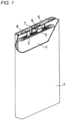
- FIG 1 Fig. 1 is a partially cutaway perspective view of a non-aqueous electrolyte secondary battery according to an embodiment of the present disclosure.
- a carbonaceous material such as graphite is typically used as a negative electrode active material.
- a silicon-containing material When a silicon-containing material is used, theoretically, it is possible to obtain a capacity higher than that obtained when a carbonaceous material is used. However, the volume change during absorbing and desorbing lithium ions is large, and it is likely that the active material particles are broken and new surfaces are formed. In a new surface, a side reaction with a non-aqueous electrolyte is likely to take place, and the capacity decreases. For this reason, even if a silicon-containing material is used, the capacity retention rate during repetition of charge and discharge decreases, and it is therefore difficult to ensure a sufficient service life.
- Non-aqueous electrolyte that contains an additive that can form a protection coating film on the negative electrode surface.
- an additive that can form a protection coating film on the negative electrode surface.
- these components undergo reductive decomposition on the negative electrode surface, and thus a protection coating film is likely to be formed.
- the protection coating film derived from any of these components has low thermal stability or low ion conductivity at a high resistance.
- the protection coating film that has low thermal stability, when the non-aqueous electrolyte secondary battery is repeatedly charged and discharged or stored for a long period of time at a temperature (for example, a temperature higher than or equal to 40°C) higher than room temperature, decomposition of the protection coating film or an increase of side reactions that take place in new surfaces is likely to occur. As a result, a large amount of gas is generated, or the capacity decreases during repetition of charge and discharge.
- a temperature for example, a temperature higher than or equal to 40°C
- a non-aqueous electrolyte secondary battery includes: a negative electrode that includes a negative electrode active material; a separator; a positive electrode that is provided to oppose the negative electrode with the separator interposed therebetween; and a non-aqueous electrolyte.
- the negative electrode active material includes 3 mass% or more of a silicon-containing material.
- the silicon-containing material includes carbon composite particles. Each of the carbon composite particles includes a carbon phase and a silicon phase dispersed in the carbon phase.
- sulfur-containing cyclic ester compound may also be referred to as "first component”.
- the silicon-containing material may also be referred to as “Si-containing material”, and the silicon phase may also be referred to as "Si phase”.
- the negative electrode includes only graphite particles as the negative electrode active material, and does not include carbon composite particles each including a Si phase
- a high capacity retention rate (for example, 90% or more) during repetition of charge and discharge can be obtained irrespective of room temperature (for example, 25°C) or a temperature (for example, 45°C) higher than room temperature.
- the negative electrode includes carbon composite particles each including a Si phase as the negative electrode active material
- the capacity retention rate during repetition of charge and discharge is low at both 25°C and 45°C.
- a negative electrode that includes carbon composite particles each including a Si phase is used in combination with a non-aqueous electrolyte that contains a first component.
- a temperature for example, 45°C
- a negative electrode that includes carbon composite particles each including a Si phase in combination with a non-aqueous electrolyte that contains a first component, it is possible to reduce the amount of gas generated when the non-aqueous electrolyte secondary battery is stored at a temperature higher than room temperature. For example, the amount of gas generated tends to increase as the battery storage temperature increases. For example, the amount of gas generated when the non-aqueous electrolyte secondary battery is stored at a temperature of 80°C for a long period of time (for example, for 40 hours or more or 60 hours or more) can be reduced significantly.
- the reason is considered to be that, due to the first component, a highly ion conductive protection coating film is formed on the negative electrode surface from an early stage, and thus side reactions on the negative electrode surface involving components contained in the non-aqueous electrolyte such as a non-aqueous solvent and an additive are reduced while ensuring a relatively high capacity.
- the silicon-containing material may further include a silicon oxide.
- the sulfur-containing cyclic ester compound may have at least one selected from the group consisting of a substituent that has the carbon-carbon unsaturated bond and the carbon-carbon unsaturated bond that constitutes a ring.
- the sulfur-containing cyclic ester compound may include at least one selected from the group consisting of a vinyl ethylene sulfite compound, an allyl ethylene sulfite compound, and a vinylene sulfate compound.
- the concentration of the sulfur-containing cyclic ester compound in the non-aqueous electrolyte may be 5 mass% or less.
- the non-aqueous electrolyte secondary battery in accordance with any one of the features (1) to (5) described above, may further contain a fluorine-containing cyclic carbonate.
- the fluorine-containing cyclic carbonate may include fluoroethylene carbonate.
- the concentration of the fluorine-containing cyclic carbonate in the non-aqueous electrolyte may be 10 mass% or less.
- the concentration of the fluorine-containing cyclic carbonate in the non-aqueous electrolyte may be 0.01 mass% or more.
- room temperature refers to a temperature of 20°C or more and 35°C or less.
- a temperature higher than room temperature refers to a temperature higher than 35°C, and may be 40°C or more.
- a capacity change (or capacity retention rate) during repetition of charge and discharge at room temperature is evaluated at 25°C as an example of the room temperature.
- a capacity change (or capacity retention rate) during repetition of charge and discharge at a temperature higher than room temperature is evaluated at 45°C as an example of the temperature higher than room temperature.
- the amount of gas generated when a non-aqueous electrolyte secondary battery is stored at a temperature higher than room temperature is evaluated for the non-aqueous electrolyte secondary battery that has been stored at a high temperature (for example, 80°C) for a long period of time (for example, for 72 hours) as an accelerated aging condition.
- the capacity retention rate during repetition of charge and discharge at 25°C tends to increase as the initial fluorine-containing cyclic carbonate concentration increases.
- the reason is considered to be that, even when new surfaces are formed as a result of the Si-containing material including the carbon composite particles being broken during charge and discharge, a protection coating film derived from the fluorine-containing cyclic carbonate is formed on the negative electrode surface, and thus side reactions are suppressed.
- the amount of gas generated during high temperature storage increases significantly as the initial fluorine-containing cyclic carbonate concentration increases.
- the protection coating film derived from the fluorine-containing cyclic carbonate has low thermal stability, and thus the protection coating film undergoes decomposition during high temperature storage, and, in addition to being converted to gas, the effect of protecting the negative electrode surface decreases, and the gas generation due to side reactions also increases.
- the capacity retention rate tends to decrease as the initial fluorine-containing cyclic carbonate concentration increases unlike the case where the non-aqueous electrolyte secondary battery is repeatedly charged and discharged at 25°C.
- the reason is considered to be that, in the case where the non-aqueous electrolyte secondary battery is repeatedly charged and discharged at 45°C, even when a protection coating film derived from the fluorine-containing cyclic carbonate is formed, the protection coating film undergoes decomposition, and thus new surfaces that are formed as a result of the carbon composite particles each including a Si phase being broken during charge and discharge are not sufficiently protected by the protection coating film, and thus side reactions increase.
- the first component used in the present disclosure has a low energy level of the lowest unoccupied molecular orbital (LUMO) that is lower than that of the fluorine-containing cyclic carbonate, and thus the first component is reduced more rapidly than the fluorine-containing cyclic carbonate and forms a protection coating film on the negative electrode surface.
- LUMO lowest unoccupied molecular orbital
- the advantageous effects obtained by using the first component are very remarkable particularly when the concentration of the fluorine-containing cyclic carbonate in the non-aqueous electrolyte is greater than 1 mass% (preferably, 1.5 mass% or more, 2 mass% or more, or 3 mass% or more), and the effect of suppressing the reduction in the capacity retention rate when charge and discharge are repeated at a temperature higher than room temperature is enhanced, and thus the amount of gas generated during high temperature storage can be reduced significantly.
- the constituent elements of the non-aqueous electrolyte secondary battery according to the present disclosure will be more specifically described one by one including the features (1) to (10) described above. At least one of the features (1) to (10) described above and at least one of the elements described below may be combined as long as there is no technical contradiction.
- the negative electrode includes a negative electrode active material.
- the negative electrode may include a negative electrode material mixture that includes at least a negative electrode active material and a negative electrode current collector that holds the negative electrode material mixture.
- the negative electrode usually includes a negative electrode material mixture in the form of a layer (hereinafter referred to as "negative electrode material mixture layer").
- the negative electrode material mixture may further include at least one selected from the group consisting of a binder and a thickener, and the like.
- the negative electrode material mixture may further include a conductive agent and the like.
- the negative electrode active material includes at least a Si-containing material.
- the Si-containing material includes at least the above-described carbon composite particles.
- the negative electrode may include, as the negative electrode active material, a material other than the Si-containing material.
- Each of the carbon composite particles included in the Si-containing material includes a carbon phase and a Si phase dispersed in the carbon phase.
- the carbon phase is electron conductive. Accordingly, even when the carbon composite particles are cracked due to expansion and contraction of the Si phase, the carbon phase is unlikely to be isolated, and it is therefore likely to maintain contact points between the carbon composite particles and their surroundings. Accordingly, the reduction in the cycle characteristics is likely to be suppressed.
- the carbon phase may be made of, for example, shapeless carbon (or in other words, amorphous carbon) or crystalline carbon.
- shapeless carbon may be, for example, hard carbon, soft carbon, or any other carbon.
- shapeless carbon generally refers to a carbonaceous material that has an average interplanar spacing d002 of the (002) plane measured using X-ray diffractometry of greater than 0.340 nm.
- crystalline carbon carbon that has a graphite-type crystal structure such as graphite may be used.
- crystalline carbon such as graphite refers to a carbonaceous material that has an average interplanar spacing d002 of the (002) plane of 0.340 nm or less (for example, 0.3354 nm or more and 0.340 nm or less).
- the content of the Si phase in the carbon composite particles is, for example, 30 mass% or more and 80 mass% or less, and may be 40 mass% or more and 70 mass% or less.
- the content of the Si phase is within the above-described range, a higher initial capacity can be obtained, and the reduction in the cycle characteristics is likely to be reduced.
- the carbon phase can easily enter into voids formed as a result of the carbon composite particles being broken, and thus the conductive paths in the negative electrode material mixture are likely to be maintained.
- the content of the carbon composite particles in the negative electrode active material may be, for example, 3 mass% or more, 4 mass% or more, or 5 mass% or more.
- the content of the carbon composite particles is within the above-described range, due to the volume change during absorbing and desorbing lithium ions, the influence of side reactions in the new surfaces is likely to appear. For this reason, the advantageous effects obtained by using the non-aqueous electrolyte that contains the first component are likely to appear remarkably. From the viewpoint of ensuring higher cycle characteristics, the content of the carbon composite particles in the negative electrode active material is, for example, 10 mass% or less.
- the carbon composite particles can be obtained by, for example, pulverizing a mixture of a carbon source and a raw silicon material into fine particles while stirring the mixture using a ball mill or the like, and then subjecting the mixture to heat treatment in an inert atmosphere.
- the carbon source that may be used include: petroleum resins such as coal tar pitch, petroleum pitch, and tar: saccharides or water soluble resins such as carboxymethyl cellulose (CMC), polyvinyl pyrrolidone, cellulose, and sucrose.
- CMC carboxymethyl cellulose
- the carbon source and the raw silicon material may be dispersed in a dispersion medium such as an alcohol. After the mixture that has undergone milling is dried, the mixture is heated at a temperature of, for example, 600°C or more and 1000°C or less in an inert gas atmosphere to carbonize the carbon source. In this way, the carbon phase is formed.
- Si-containing material other than the carbon composite particles examples include a simple substance of silicon, a silicon alloy, and a silicon compound.
- the Si-containing material may include composite particles other than the carbon composite particles.
- the composite particles include composite particles in each of which a Si phase (fine Si phase) is dispersed in a lithium ion conducting phase (matrix).
- a Si phase fine Si phase
- a lithium ion conducting phase matrix
- the lithium ion conducting phase preferably has at least one selected from the group consisting of a SiO 2 phase and a silicate phase.
- the lithium ion conducting phase may further has a carbon phase.
- the lithium ion conducting phase can form an amorphous phase.
- the configuration is not limited thereto.
- at least a portion of each of the silicate phase and the carbon phase may be a crystalline phase that includes a crystalline silicate, crystalline carbon as described in the description of the carbon composite particles, or the like.
- Specific examples of the composite particles include: composite particles each including a SiO 2 phase and a Si phase dispersed in the SiO 2 phase; and composite particles (silicate composite particles) each including a silicate phase and a Si phase dispersed in the silicate phase.
- the composite particles are not limited to the specific examples described above.
- the SiO 2 phase is an amorphous phase that includes 95 mass% or more of silicon dioxide.
- Composite particles in each of which a Si phase is dispersed in a SiO 2 phase are represented by SiO x , where x may be, for example, 0.5 ⁇ x ⁇ 2, or 0.8 ⁇ x ⁇ 1.6.
- SiO x can be obtained by, for example, subjecting silicon monoxide to heat treatment and separating into a SiO 2 phase and a fine Si phase by a disproportionation reaction. When the SiO x particles are subjected to cross-section observation using a transmission electron microscope (TEM), the Si phase dispersed in the SiO 2 phase can be confirmed.
- TEM transmission electron microscope
- the composite particles described above may also be referred to as "silicon oxide". In the case where the negative electrode active material includes a silicon oxide, a higher initial discharge capacity is easily ensured.
- the silicate phase preferably includes at least either one of an alkali metal element (a group 1 element other than hydrogen in the long-period periodic table) and a group 2 element in the long-period periodic table.
- alkali metal element include lithium (Li), potassium (K), sodium (Na), and the like.
- group 2 element include magnesium (Mg), calcium (Ca), strontium (Sr), barium (Ba), and the like.
- the lithium silicate phase may have a composition represented by the formula: Li 2y SiO 2+y (where 0 ⁇ y ⁇ 2). y may be 1/2 or 1.
- the silicate composite particles in which the Si phase is dispersed in the silicate phase can be obtained by, for example, pulverizing a mixture of a silicate and a raw silicon material into fine particles while stirring the mixture using a ball mill or the like, and then subjecting the mixture to heat treatment in an inert atmosphere.
- the content of the Si phase dispersed in the silicate phase may be 30 mass% or more and 95 mass% or less, or 35 mass% or more and 75 mass% or less of the entire silicate composite particles.
- the Si-containing material may include the carbon composite particles alone or a combination of the carbon composite particles and at least one selected from other Si-containing materials.
- the Si-containing material may include, in addition to the carbon composite particles, for example, at least one selected from the group consisting of a silicon oxide and silicate composite particles (in particular, a silicon oxide).
- the content of the silicon oxide in the negative electrode active material may be, for example, 0.1 mass% or more, 0.5 mass% or more, or 1 mass% or more. In this case, the initial discharge capacity can be further increased.
- the content of the silicon oxide in the negative electrode active material is, for example, 5 mass% or less.
- the content of the silicate composite particles in the negative electrode active material may be, for example, 0.1 mass% or more, 0.5 mass% or more, or 1 mass% or more. In this case, a higher initial discharge capacity can be ensured, and the reduction in the capacity retention rate can be further suppressed.
- the content of the silicate composite particles in the negative electrode active material is, for example, 5 mass% or less.
- the composition of the Si-containing material can be determined by, for example, obtaining a backscattered electron image of a cross section of the negative electrode material mixture layer using a field emission scanning electron microscope (FE-SEM), observing the particles of the Si-containing material, and performing elemental analysis on the particles of the Si-containing material observed.
- FE-SEM field emission scanning electron microscope
- the battery is disassembled to take out the negative electrode from the battery, and the negative electrode is cleaned with a non-aqueous solvent such as ethylene carbonate, and then dried.
- cross section processing is performed on the negative electrode material mixture layer using a cross section polisher (CP). In this way, a sample is obtained. A cross-section of the sample is captured using a FE-SEM to obtain a backscattered electron image.
- EMA electron probe micro analyzer
- AES auger electron spectroscopy
- the composition of the lithium ion conducting phase can also be determined by performing the above-described analyses.
- the composition of the carbon phase can be confirmed based on the average interplanar spacing d002 determined based on X-ray diffractometry.
- the Si-containing material is usually a particulate material.
- the Si-containing material may have an average particle size (D50) of, for example, 1 ⁇ m or more and 25 ⁇ m or less, or 4 ⁇ m or more and 15 ⁇ m or less. When the Si-containing material has an average particle size within the above-described range, a good battery performance is likely to be obtained.
- the term "average particle size (D50)” refers to a particle size (volume average particle size) at 50% cumulative volume in a particle size distribution obtained through measurement performed based on a laser diffraction scattering method.
- the average particle size of the Si-containing material may be determined from a cross-sectional sample of the negative electrode formed to obtain a FE-SEM backscattered electron image. For each of ten or more particles of the Si-containing material in the cross section, the equivalent circle diameter is determined, and the average value is defined as the average particle size.
- the term “equivalent circle diameter” refers to the diameter of a circle that has the same area as the area of a particle observed in a cross-section of the negative electrode.
- the Si phase dispersed in the carbon phase is usually composed of a plurality of crystallites.
- the crystallites of the Si phase have a crystallite size of, for example, 500 nm or less, and may be 30 nm or less.
- the lower limit value of the crystallite size of the crystallites of the Si phase is not particularly limited, but may be, for example, 5 nm or more.
- the crystallite size is calculated from a half width of a diffraction peak attributed to the Si (111) plane in an X-ray diffraction (XRD) pattern of the Si phase using the Scherrer equation.
- the content of the Si phase in the composite particles can be determined from, for example, Si-NMR.
- desirable measurement conditions for Si-NMR are shown below.
- the conductive layer includes a conductive material such as conductive carbon.
- the amount of the conductive layer that covers at least a portion of the surface of the particles of the Si-containing material is, for example, 1 part by mass or more and 10 parts by mass or less per 100 parts by mass of the total of the particles of the Si-containing material and the conductive layer.
- the particles of the Si-containing material that have the conductive layer on the surface thereof can be obtained by, for example, mixing coal tar pitch or the like with the particles of the Si-containing material, and subjecting the mixture to heat treatment in an inert atmosphere.
- the content of the Si-containing material in the negative electrode active material is 3 mass% or more, preferably 4 mass% or more, and may be 5 mass% or more.
- a high initial capacity can be obtained.
- the capacity decreases when charge and discharge are repeated, and the cycle characteristics are likely to decrease.
- the content of the Si-containing material is, for example, 15 mass% or less, and may be 10 mass% or less.
- Examples of a negative electrode active material other than the Si-containing material include at least one selected from the group consisting of a Si phase-free carbonaceous material, a simple substance of Sn, a Sn alloy, and a Sn compound (a Sn oxide or the like).
- the Si-containing material expands and contracts in volume during charge and discharge. For this reason, when the ratio of the Si-containing material in the negative electrode active material is large, a contact failure is likely to occur between the negative electrode active material and the negative electrode current collector during charge and discharge.
- a carbonaceous material expands and contracts less during charge and discharge than the Si-containing material.
- the contact state between negative electrode active material particles and the contact state between the negative electrode material mixture and the negative electrode current collector can be maintained at a more favorable level. Accordingly, by using the Si-containing material and the Si phase-free carbonaceous material in combination, excellent cycle characteristics are likely to be obtained while imparting a high capacity of the Si phase to the negative electrode.
- carbonaceous material examples include graphite, graphitizable carbon (soft carbon), and non-graphitizable carbon (hard carbon). These carbonaceous materials may be used alone or in a combination of two or more.
- the carbonaceous material listed above it is preferable to use graphite as the carbonaceous material because it has excellent charge/discharge stability and a small irreversible capacity.
- the graphite include natural graphite, artificial graphite, and graphitized mesophase carbon particles.
- Each of the graphite particles may partially include amorphous carbon, graphitizable carbon, or non-graphitizable carbon.
- the term "graphite” refers to a carbonaceous material that has a developed graphite-type crystal structure.
- the average interplanar spacing d002 of the (002) plane of the graphite determined through measurement performed based on X-ray diffractometry may be, for example, 0.340 nm or less, or 0.3354 nm or more and 0.340 nm or less.
- the crystallite size Lc (002) of the graphite may be, for example, 5 nm or more, or 5 nm or more and 200 nm or less.
- the crystallite size Lc (002) is determined through measurement performed based on, for example, the Scherrer method.
- the ratio of the total amount of the Si-containing material and the carbonaceous material (Si phase-free carbonaceous material) in the negative electrode active material is preferably 90 mass% or more, and may be 95 mass% or more or 98 mass% or more.
- the ratio of the total amount of the Si-containing material and the carbonaceous material in the negative electrode active material is 100 mass% or less.
- the negative electrode active material may be composed only of the Si-containing material and the carbonaceous material.
- the binder for example, a resin material is used.
- the binder include: fluorine resins (for example, polytetrafluoroethylene and polyvinylidene fluoride), polyolefin resins (for example, polyethylene and polypropylene), polyamide resins (for example, aramid resin), polyimide resins (for example, polyimide and polyamide imide), acrylic resins (for example, polyacrylic acid, polymethacrylic acid, an acrylic acid-methacrylic acid copolymer, an ethylene-acrylic acid copolymer, and salts thereof), vinyl resins (for example, polyvinyl acetate), and rubbery materials (for example, a styrene-butadiene copolymer rubber (SBR)).
- fluorine resins for example, polytetrafluoroethylene and polyvinylidene fluoride
- polyolefin resins for example, polyethylene and polypropylene
- polyamide resins for example, aramid resin
- Examples of the thickener include a cellulose derivative such as cellulose ether.
- Examples of the cellulose derivative include CMC, a modified form thereof, methyl cellulose, and the like.
- Examples of the modified form of CMC include salts of CMC.
- the salts include an alkali metal salt (for example, a sodium salt), an ammonium salt, and the like.
- Examples of the conductive agent include conductive fibers or conductive particles.
- Examples of the conductive fibers include carbon fibers, metal fibers, and the like.
- Examples of the carbon fibers also include carbon nanotubes (CNTs).
- Examples of the conductive particles include conductive carbon (carbon black or the like), a metal powder, and the like. These conductive agents may be used alone or in a combination of two or more.
- the negative electrode current collector is selected according to the type of non-aqueous electrolyte secondary battery.
- Examples of the negative electrode current collector include a sheet-shaped current collector.
- a metal foil or the like may also be used.
- a porous current collector may also be used. Examples of the porous current collector include a mesh, a punched sheet, and an expanded metal.
- Examples of the material of the negative electrode current collector include stainless steel, nickel, a nickel alloy, copper, and a copper alloy.
- the thickness of the negative electrode current collector is, but is not particularly limited to, for example, 1 to 50 ⁇ m, and may be 5 to 30 ⁇ m.
- the negative electrode can be formed, for example, by applying a negative electrode slurry prepared by dispersing constituent components of a negative electrode material mixture in a dispersion medium onto the surface of a negative electrode current collector, and drying the formed coating film.
- the coating film after drying may be rolled as needed.
- dispersion medium examples include water, an alcohol (for example, ethanol), an ether (for example, tetrahydrofuran), an amide (for example, dimethylformamide), N-methyl-2-pyrrolidone (NMP), and mixed solvents thereof.
- an alcohol for example, ethanol
- an ether for example, tetrahydrofuran
- an amide for example, dimethylformamide
- NMP N-methyl-2-pyrrolidone
- the positive electrode may include a positive electrode current collector and a positive electrode material mixture layer supported on a surface of the positive electrode current collector.
- the positive electrode material mixture layer can be formed by applying a positive electrode slurry prepared by dispersing a positive electrode material mixture in a dispersion medium onto the surface of the positive electrode current collector, and drying the formed coating film. The coating film after drying may be rolled as needed.
- the positive electrode material mixture includes a positive electrode active material as an essential component, and may also include a binder, a conductive agent, and the like as optional components.
- the dispersion medium can be selected from among, for example, the dispersion media listed as examples of the dispersion medium for the negative electrode.
- a composite oxide that includes lithium and a transition metal can be used as the positive electrode active material.
- the transition metal include Ni, Co, Mn, and the like.
- Li a Ni b2 M 1-b2 O 2 (where 0 ⁇ a ⁇ 1.2, 0.3 ⁇ b2 ⁇ 1, and M represents at least one selected from the group consisting of Mn, Co, and Al). From the viewpoint of achieving a high capacity, it is more preferable that 0.8 ⁇ b2 ⁇ 1 or 0.85 ⁇ b2 ⁇ 1 is satisfied.
- any of the resin materials listed as examples of the binder in the description of the negative electrode can be used.
- the conductive agent for example, it is possible to select any from the conductive agents listed as examples of the conductive agent in the description of the negative electrode.
- the conductive agent graphite may also be used.
- the shape and the thickness of the positive electrode current collector can be selected from the shapes and the thickness value range shown in the description of the negative electrode current collector.
- Examples of the material of the positive electrode current collector include stainless steel, aluminum, an aluminum alloy, and titanium.
- the positive electrode exhibits a high potential during charge, and thus oxidative decomposition is likely to occur in the positive electrode. It is considered that the first component also acts on the positive electrode and forms a protection coating film. For this reason, even when charge and discharge are repeated at a temperature higher than room temperature, even in the positive electrode, side reactions are likely to be suppressed, and a higher capacity retention rate can be ensured. In addition, the effect of reducing the amount of gas generated during high temperature storage is enhanced.
- the separator has high ion permeability, an appropriate mechanical strength, and insulation properties.
- Examples of the separator include a micro-porous thin film, a woven fabric, and a non-woven fabric.
- the separator may have a single-layer structure or a muti-layer structure.
- As the separator that has a muti-layer structure a stacked body that includes, as layers, at least two selected from a micro-porous thin film, a woven fabric, and a non-woven fabric may be used.
- As the material of the separator it is preferable to use a polyolefin (for example, polypropylene or polyethylene).
- the non-aqueous electrolyte may be in the form of a liquid, or may be in the form of a solid (for example, in a state in which the flowability is limited by a gelling agent, a polymer, or the like (a gel electrolyte, a polymer electrolyte, or the like)).
- the non-aqueous electrolyte usually contains a non-aqueous solvent and a lithium salt dissolved in the non-aqueous solvent, and also contains an additive.
- the non-aqueous electrolyte contains a first component.
- the non-aqueous electrolyte may further contain an additive other than the first component.
- non-aqueous solvent examples include a cyclic carbonic acid ester, a linear carbonic acid ester, a cyclic carboxylic acid ester, and a linear carboxylic acid ester.
- cyclic carbonic acid ester examples include propylene carbonate (PC), and ethylene carbonate (EC).
- linear carbonic acid ester examples include diethyl carbonate (DEC), ethyl methyl carbonate (EMC), dimethyl carbonate (DMC), and the like.
- examples of the cyclic carboxylic acid ester include ⁇ -butyrolactone (GBL), ⁇ -valerolactone (GVL), and the like.
- linear carboxylic acid ester examples include methyl formate, ethyl formate, propyl formate, methyl acetate (MA), ethyl acetate, propyl acetate, methyl propionate, ethyl propionate, propyl propionate, and the like.
- the non-aqueous electrolyte may contain one or a combination of two or more of the non-aqueous solvents.
- lithium salt examples include LiClO 4 , LiBF 4 , LiPF 6 , LiAlCl 4 , LiSbF 6 , LiSCN, LiCFsSOs, LiCF 3 CO 2 , LiAsF 6 , LiB 10 Cl 10 , a lithium lower aliphatic carboxylate, LiCl, LiBr, LiI, a phosphoric acid salt, a boric acid salt, and an imide salt.
- the phosphoric acid salt examples include lithium difluorophosphate (LiPO 2 F2), lithium difluorobis(oxalato)phosphate (LiDFBOP), lithium tetrafluoro(oxalato)phosphate, and the like.
- boric acid salt examples include lithium bis(oxalato)borate (LiBOB), lithium difluoro(oxalato)borate (LiDFOB), and the like.
- imide salt examples include lithium bis(fluorosulfonyl) imide (LiN(FSO 2 ) 2 ), lithium bis(trifluoromethane sulphonyl) imide (LiN(CF 3 SO 2 ) 2 ), lithium trifluoro methanesulphonyl nonafluoro butanesulphonyl imide (LiN(CF 3 SO 2 ) (C 4 F 9 SO 2 )), lithium bis(pentafluoroethane sulphonyl) imide (LiN(C 2 F 5 SO 2 ) 2 ), and the like.
- the non-aqueous electrolyte may contain one or a combination of two or more of the lithium salts.
- the concentration of the lithium salt in the non-aqueous electrolyte is, for example, 0.5 mol/L or more and 2 mol/L or less.
- the first component also encompasses salts of these esters.
- the first component has, for example, at least one selected from the group consisting of a substituent that has a carbon-carbon unsaturated bond and a carbon-carbon unsaturated bond that constitutes a ring.
- the carbon-carbon unsaturated bond may be at least one selected from the group consisting of a carbon-carbon double bond and a carbon-carbon triple bond.
- the substituent that has a carbon-carbon unsaturated bond include a vinyl group, an allyl group, an ethynyl group, and a propargyl group.
- the number of carbon atoms in the substituent is, for example, 2 or more and 6 or less, and may be 2 or more and 4 or less.
- the first component may have a vinylene group, an ethynylene group, or the like as a ring-constituting structure.
- the first component may have a substituent in the ring.
- substituents include, in addition to the substituent that has a carbon-carbon unsaturated bond, an alkyl group, a hydroxy alkyl group, an alkoxy group, a hydroxy group, a halogen atom, and the like.
- the number of carbon atoms in each of the alkyl group, the hydroxy the alkyl group, and the alkoxy group is, for example, 1 or more and 6 or less, and may be 1 or more and 4 or less, or 1 or more and 3 or less.
- the alkyl group, the hydroxy alkyl group, and the alkoxy group may be linear or branched.
- alkyl group examples include a methyl group, an ethyl group, an n-propyl group, an isopropyl group, an n-butyl group, a sec-butyl group, a tert-butyl group, and the like.
- the hydroxy alkyl group may be a hydroxy alkyl group that corresponds to the above-described alkyl group.
- the number of hydroxy groups in the hydroxy alkyl group is, for example, 1 or more and 3 or less, and preferably 1 or 2 (in particular 1).
- alkoxy group examples include a methoxy group, an ethoxy group, an n-propoxy group, an n-butoxy group, and the like.
- the halogen atom examples include a chlorine atom, a fluorine atom, and the like.
- a 5-membered sulfate ester compound As the first component, it is preferable to use a 5-membered sulfate ester compound, a 5-membered sulfite ester compound, or the like.
- a compound represented by the following formula (1a) (in other words, an ethylene sulfate compound that has a substituent that has a carbon-carbon unsaturated bond or an ethylene sulfite compound that has a substituent that has a carbon-carbon unsaturated bond), a compound represented by the following formula (1b) (in other words, a vinylene sulfate compound or a vinylene sulfite compound), or the like.
- R 1 to R 6 each independently represent a hydrogen atom or a substituent
- at least one of R 1 to R 4 has a carbon-carbon unsaturated bond
- n1 and n2 each independently represent 1 or 2.
- n1 and n2 represent the same values as n described above. In the case where n1 or n2 is 2, the compound is a sulfate ester. In the case where n1 or n2 is 1, the compound is a sulfite ester.
- the substituents represented by R 1 to R 6 correspond to the above-described substituents. Specifically, examples include a substituent that has a carbon-carbon unsaturated bond, an alkyl group, a hydroxy alkyl group, an alkoxy group, a hydroxy group, a halogen atom, and the like, those described above. At least one of R 1 to R 4 represents a substituent that has a carbon-carbon unsaturated bond. It is preferable that one of R 1 to R 4 represents a substituent that has a carbon-carbon unsaturated bond, and the remaining three represent other substituents (an alkyl group or the like) or hydrogen atoms. Two or three of R 1 to R 4 may be the same, or all of R 1 to R 4 may be different.
- an alkenyl group such as a vinyl group or an allyl group is preferable.
- the number of carbon atoms in the alkenyl group is, for example, 2 or more and 6 or less, and may be 2 or more and 4 or less.
- R 5 and R 6 may each represent a substituent that has a carbon-carbon unsaturated bond (a vinyl group, an allyl group, or the like), but R 5 and R 6 preferably represent other substituents (an alkyl group or the like) or hydrogen atoms.
- R 5 and R 6 may be the same or different.
- the first component preferably includes a vinyl ethylene sulfite compound, an allyl ethylene sulfite compound, a vinyl ethylene sulfate compound, an allyl ethylene sulfate compound, a vinylene sulfite compound, or a vinylene sulfate compound. These compounds also encompass compounds that have the above-described substituents. Among these, the first component preferably includes at least one selected from the group consisting of a vinyl ethylene sulfite compound, an allyl ethylene sulfite compound, and a vinylene sulfate compound.
- the non-aqueous electrolyte may contain one or a combination of two or more of the first components.
- the concentration of the first component in the non-aqueous electrolyte secondary battery is, for example, 5 mass% or less, and may be 2 mass% or less, 1.5 mass% or less, or 1 mass% or less.
- the concentration of the first component is a value determined for the non-aqueous electrolyte obtained from an initial non-aqueous electrolyte secondary battery.
- the first component is used to form a coating film, and thus the concentration of the first component in the non-aqueous electrolyte varies during storage period or during charge/discharge cycle period.
- the first component remains in the non-aqueous electrolyte obtained from the non-aqueous electrolyte secondary battery (preferably, the initial non-aqueous electrolyte secondary battery) at a concentration greater than or equal to the detection limit.
- concentration of the first component in the electrolyte solution may be 0.01 mass% or more, 0.1 mass% or more, 0.25 mass% or more, or 0.5 mass% or more.
- the concentration of the first component in the non-aqueous electrolyte may be greater than or equal to the detection limit and 5 mass% or less (or 2 mass% or less), greater than or equal to the detection limit and 1.5 mass% or less (or 1 mass% or less), 0.01 mass% or more and 2 mass% or less (or 1.5 mass% or less), or 0.01 mass% or more and 1 mass% or less.
- the term "initial non-aqueous electrolyte secondary battery” refers to, for example, a non-aqueous electrolyte secondary battery that has been subjected to pre-charge/discharge (and optionally aging) after assembling the non-aqueous electrolyte secondary battery.
- a commercially available non-aqueous electrolyte secondary battery may be used as the initial non-aqueous electrolyte secondary battery, and the non-aqueous electrolyte may be obtained from the battery, and subjected to analysis.
- the concentration of the first component in the non-aqueous electrolyte used to produce the non-aqueous electrolyte secondary battery may be 0.1 mass% or more, 0.2 mass% or more, 0.25 mass% or more, or 0.5 mass% or more.
- the upper limit of the concentration of the first component in the non-aqueous electrolyte used to produce the non-aqueous electrolyte secondary battery is the same as described above. These lower and upper limit values can be combined in any combination.
- the concentration of the first component in the non-aqueous electrolyte used to produce the non-aqueous electrolyte secondary battery may be, for example, 0.1 mass% or more and 5 mass% or less (or 2 mass% or less), 0.2 mass% or more and 2 mass% or less (or 1.5 mass% or less), or 0.5 mass% or more and 1.5 mass% or less (or 1 mass% or less).
- the non-aqueous electrolyte may further contain a fluorine-containing cyclic carbonate.
- fluorine-containing cyclic carbonate refers to a compound in which at least one hydrogen atom in a cyclic carbonate is substituted by a fluorine atom.
- the fluorine-containing cyclic carbonate may also be referred to as "second component".
- the non-aqueous electrolyte contains a second component
- a protection coating film derived from the second component is also formed on the negative electrode surface in addition to a protection coating film derived from the first component. Accordingly, the effect of suppressing side reactions is enhanced, and thus the effect of suppressing the decrease in capacity when charge and discharge are repeated at room temperature (for example, 25°C) is enhanced.
- the coating film derived from the second component has low thermal stability, and thus the capacity is likely to decrease when charge and discharge are repeated at a temperature (for example, 45°C) higher than room temperature. In addition, the coating film is likely to be decomposed during high temperature storage to generate a large amount of gas.
- the non-aqueous electrolyte contains a first component, even when the negative electrode includes carbon composite particles each including a Si phase, and the non-aqueous electrolyte contains a second component, it is possible to ensure a high capacity retention rate when charge and discharge are repeated at a temperature (for example, 45°C) higher than room temperature, and also suppress the amount of gas generated during high temperature storage to a low level.
- the second component includes, for example, a compound represented by the following formula (2). where R 7 to R 10 each independently represent a hydrogen atom, a methyl group, or a halogen atom, and at least one of R 7 to R 10 represents a fluorine atom.
- Examples of the halogen atom represented by R 7 to R 10 include a fluorine atom, a chlorine atom, a bromine atom, an iodine atom (in particular, a fluorine atom and a chlorine atom), and the like.
- the number of fluorine atoms in the second component may be one or more.
- the second component examples include fluorinated ethylene carbonates (for example, fluoroethylene carbonate (FEC), 1,2-difluoroethylene carbonate, and 1,1-difluoroethylene carbonate), 1-fluoropropylene carbonate, 3,3,3-trifluoropropylene carbonate, and 2,3-difluoro-2,3-butylene carbonate.
- FEC fluoroethylene carbonate
- 1,2-difluoroethylene carbonate 1,2-difluoroethylene carbonate
- 1,1-difluoroethylene carbonate 1,1-difluoroethylene carbonate
- 1-fluoropropylene carbonate 3,3,3-trifluoropropylene carbonate
- 2,3-difluoro-2,3-butylene carbonate 2,3-difluoro-2,3-butylene carbonate.
- the second component preferably includes FEC.
- the second components may be used alone or in a combination of two or more.
- the concentration of the second component in the non-aqueous electrolyte is, for example, 10 mass% or less, and may be 6 mass% or less, or 5 mass% or less.
- concentration of the second component is within the above-described range, the effect of suppressing the decrease in capacity when charge and discharge are repeated at a temperature (for example, 45°C) higher than room temperature is enhanced, the effect of reducing the amount of gas generated during high temperature storage is also enhanced.
- the concentration of the second component is a value determined for the non-aqueous electrolyte obtained from the initial non-aqueous electrolyte secondary battery.
- the second component In the non-aqueous electrolyte secondary battery, the second component is used to form a coating film, and thus the concentration of the second component in the non-aqueous electrolyte varies during storage period or during charge/discharge cycle period. For this reason, it is sufficient that the second component remains in the non-aqueous electrolyte obtained from the non-aqueous electrolyte secondary battery (preferably, the initial non-aqueous electrolyte secondary battery) at a concentration greater than or equal to the detection limit.
- the concentration of the second component in the non-aqueous electrolyte may be 0.01 mass% or more, or 0.1 mass% or more.
- the concentration of the second component in the non-aqueous electrolyte may be 0.5 mass% or more, or 1 mass% or more.
- concentration of the second component in the non-aqueous electrolyte is greater than 1 mass%, the effect of suppressing the reduction in the capacity retention rate and the effect of reducing the amount of gas generated during high temperature storage that are obtained by using the first component are remarkably exhibited.
- concentration of the second component in the non-aqueous electrolyte may be 1.5 mass% or more, 2 mass% or more, or 3 mass% or more.
- the concentration of the second component in the non-aqueous electrolyte may be, for example, greater than or equal to the detection limit and 10 mass% or less (or 5 mass% or less), 0.01 mass% or more (or 0.1 mass% or more) and 10 mass% or less, 0.5 mass% or more and 10 mass% or less (or 6 mass% or less), greater than 1 mass% and 10 mass% or less (or 6 mass% or less), 1.5 mass% or more and 10 mass% or less (or 6 mass% or less), 2 mass% or more and 6 mass% or less (or 5 mass% or less), or 3 mass% or more and 6 mass% or less (or 5 mass% or less).
- the concentration of FEC may be within the above-described range.
- the concentration of the second component in the non-aqueous electrolyte used to produce the non-aqueous electrolyte secondary battery may be 0.1 mass% or more, 0.5 mass% or more, 1 mass% or more, greater than 1 mass%, 2 mass% or more, 3 mass% or more, or 4 mass% or more.
- the upper limit of the concentration of the second component in the non-aqueous electrolyte used to produce the non-aqueous electrolyte secondary battery may be the same as described above. These lower and upper limit values can be combined in any combination.
- the concentration of the second component in the non-aqueous electrolyte used to produce the non-aqueous electrolyte secondary battery may be, for example, 0.1 mass% or more and 10 mass% or less (or 5 mass% or less), 0.5 mass% or more and 10 mass% or less (or 6 mass% or less), 1 mass% or more and 10 mass% or less (or 5 mass% or less), or 3 mass% or more and 6 mass% or less (or 5 mass% or less).
- the concentration of FEC may be within the above-described range.
- the mass ratio of the second component to the first component is, for example, 20 or less, and may be 15 or less, 10 or less, 8 or less, 5 or less, or 4 or less. With a mass ratio within the above-described range, even when the second component is used, it is possible to further suppress the decrease in capacity when charge and discharge are repeated at a temperature (for example, 45°C) higher than room temperature, and further reduce the amount of gas generated during high temperature storage.
- the mass ratio may be, for example, 0.5 or more, or 1 or more.
- the mass ratio of FEC to the first component may be within the above-described range.
- the mass ratio of the second component to the first component is a value determined for the non-aqueous electrolyte obtained from the initial non-aqueous electrolyte secondary battery.
- the mass ratio may be within the above-described range.
- the upper and lower limit values of the mass ratio can be combined in any combination.
- the mass ratio (second component/first component) may be 0.5 or more (or 1 or more) and 20 or less, 0.5 or more (or 1 or more) and 15 or less, 1 or more and 10 or less (or 8 or less), or 1 or more and 5 or less (or 4 or less).
- the non-aqueous electrolyte may contain an additive other than the first component and the second component.
- an additive it is possible to use a sulfur-containing compound other than the first component, a phosphorus-containing compound, a nitrogencontaining compound, a silicon-containing compound, or an aromatic compound (cyclohexylbenzene, fluorobenzene, or the like).
- the sulfur-containing compound may include at least one selected from the group consisting of linear sulfate esters (ethyl sulfate, methyl sulfate, and the like), linear sulfite esters, linear sulfonic acid esters, and cyclic sulfonic acid esters.
- the sulfur-containing compound also encompasses salts of these esters (ethyl sulfate, methyl sulfate, and the like).
- the non-aqueous electrolyte may contain one or a combination of two or more of the additives.
- the proportion of the first component in the entire sulfur-containing compound as the additive contained in the non-aqueous electrolyte is preferably high, and may be, for example, 75 mass% or more, or 90 mass% or more.
- the proportion of the first component in the entire sulfur-containing compound as the additive contained in the non-aqueous electrolyte is 100 mass% or less.
- the sulfur-containing compound as the additive contained in the non-aqueous electrolyte may be composed only of the first component.
- the non-aqueous electrolyte may contain a vinylene carbonate compound such as vinylene carbonate.
- a vinylene carbonate compound such as vinylene carbonate.
- the concentration of the vinylene carbonate compound in the non-aqueous electrolyte is preferably low (for example, at a concentration of 2 mass% or less).
- the non-aqueous electrolyte secondary battery may have a structure in which an electrode group formed by spirally winding a positive electrode and a negative electrode with a separator interposed therebetween is housed in an outer case together with a non-aqueous electrolyte.
- the structure of the non-aqueous electrolyte secondary battery is not limited thereto.
- the electrode group may be a stacked electrode group formed by stacking a positive electrode and a negative electrode with a separator interposed therebetween.
- the non-aqueous electrolyte secondary battery may have, for example, a cylindrical shape, a prismatic shape, a coin shape, a button shape, or a laminate shape.
- Fig. 1 is a schematic partially cutaway perspective view of a prismatic non-aqueous electrolyte secondary battery according to one embodiment of the present disclosure.
- the non-aqueous electrolyte secondary battery includes a bottomed prismatic battery case 4, and an electrode group 1 and a non-aqueous electrolyte (not shown) housed in the battery case 4.
- the electrode group 1 includes an elongated strip-shaped negative electrode, an elongated strip-shaped positive electrode, and a separator interposed between the negative electrode and the positive electrode.
- a negative electrode current collector included in the negative electrode is electrically connected to a negative electrode terminal 6 provided in a sealing plate 5 via a negative electrode lead 3.
- the negative electrode terminal 6 is insulated from the sealing plate 5 by a resin gasket 7.
- a positive electrode current collector included in the positive electrode is electrically connected to the underside of the sealing plate 5 via a positive electrode lead 2. That is, the positive electrode is electrically connected to the battery case 4 that also functions as a positive electrode terminal.
- the peripheral edge of the sealing plate 5 is fitted to an opening end portion of the battery case 4, and the fitted portion is laser welded.
- the sealing plate 5 has an injection hole for injecting the non-aqueous electrolyte, and the injection hole is closed by a sealing cap 8 after the non-aqueous electrolyte solution is injected.
- a negative electrode material mixture An appropriate amount of water was added to a negative electrode material mixture, and mixed to obtain a negative electrode slurry.
- a negative electrode material mixture a mixture of a negative electrode active material, a binder, and a conductive agent was used.
- the negative electrode active material As the negative electrode active material, components shown in Table 1 were used such that the content of each component in the entire negative electrode active material was a value (mass%) shown in Table 1. Note that the content of the negative electrode active material was calculated excluding the conductive layer.
- PAA-Na sodium polyacrylate
- CMC-Na sodium salt of CMC
- SBR sodium polyacrylate
- the content of each of PAA-Na, CMC-Na, and SBR in the negative electrode material mixture was set to 1 mass% on a dry solid basis.
- the negative electrode slurry was applied to both surfaces of a copper foil, and the coating films were dried and then rolled to form a negative electrode material mixture layer (with a thickness of 80 ⁇ m and a density of 1.6 g/cm 3 ) on each of the surfaces of the copper foil. In this way, a negative electrode was obtained.
- a positive electrode slurry 2.5 parts by mass of acetylene black, 2.5 parts by mass of polyvinylidene fluoride, and an appropriate amount of NMP were added to 95 parts by mass of a lithiumcontaining composite oxide (LiNi 0.88 Co 0.09 Al 0.03 O 2 ) and then mixed to obtain a positive electrode slurry.
- the positive electrode slurry was applied to both surfaces of an aluminum foil, and the coating films were dried and then rolled to form a positive electrode material mixture layer (with a thickness of 95 ⁇ m and a density of 3.6 g/cm 3 ) on each of the surfaces of the aluminum foil. In this way, a positive electrode was obtained.
- the concentration of LiPF 6 in the non-aqueous electrolyte was set to 1.4mol/L.
- concentration of the sulfur-containing cyclic ester in the non-aqueous electrolyte and the concentration of FEC in the non-aqueous electrolyte were set to values (mass%) shown in Table 1.
- a positive electrode lead made of aluminum was attached to an exposed portion of the positive electrode current collector of the positive electrode, and a negative electrode lead made of nickel was attached to an exposed portion of the negative electrode current collector of the negative electrode.
- the positive electrode and the negative electrode were spirally wound with a separator interposed therebetween to produce a spirally wound electrode group.
- a separator a microporous thin film made of polyethylene was used.
- the electrode group was housed in a battery case. At this time, an upper insulating plate and a lower insulating plate that were made of resin were placed on the top and the bottom of the electrode group.
- the negative electrode lead was welded to the inner bottom surface of the battery case.
- the positive electrode lead was welded to a metal sealing member serving also as a positive electrode terminal.
- the non-aqueous electrolyte in the form of a liquid was injected into the battery case, and then the opening of the battery case was sealed with the sealing member. At this time, a resin gasket was provided between the opening end portion of the battery case and the sealing member. In this way, a cylindrical non-aqueous electrolyte secondary battery (with a nominal capacity of 5000 mAh) was obtained.
- a series of operations for obtaining the discharge capacity Ci including charging, an interval, and discharging was defined as 1 cycle. This cycle was repeated 200 times, and the discharge capacity (Cc) at the 200th cycle was obtained.
- batteries E1 to E5 correspond to the batteries obtained in Examples 1 to 5, respectively, and batteries C1 to C6 correspond to the batteries obtained in Comparative Examples 1 to 6, respectively.
- the initial capacity is expressed as a relative value of the initial capacity Ci of the battery of each example, with the initial capacity Ci of the battery of Comparative Example 1 being set to 100%.
- the capacity retention rate at 25°C increases as compared with that of the case where a FEC-free non-aqueous electrolyte is used, but the capacity retention rate at 45°C decreases (compare C1 with C2 and C3). Also, the amount of gas generated during high temperature storage increases accordingly as the FEC content is increased (compare C1 with C2 and C3).
- the capacity retention rate at 45°C increases more significantly as compared with the capacity retention rate at 25°C (compare C1 with E3).
- the capacity retention rate at 45°C increases more significantly as compared with that in the case where FEC is used (compare C2 and C3 with E3).
- the amount of gas generated during high temperature storage decreases by an amount as much as 23% (compare C1 withE3).
- the initial concentration of FEC is greater than 1 mass% (for example, 1.5 mass% or more, 2 mass% or more, or 3 mass% or more)
- the advantageous effects obtained by using the first component are exhibited remarkably, and higher effects are obtained as compared with those expected from the case where each of FEC and the first component is used alone, from which it is considered that a synergetic effect is obtained by using FEC and the first component in combination (compare C1, C3, and E3 with E1).
- the capacity retention rate at 25°C and the capacity retention rate at 45°C can be improved, and the amount of gas generated during high temperature storage can be reduced significantly (compare C3 with E4).
- sulfur-containing cyclic esters in the case where ethylene sulfite that is different from the first component is used, there is little effect of improving the capacity retention rate, and the amount of gas generated during high temperature storage increases significantly (compare C3 with C4, and compare C4 with E1 and E4). For this reason, it can be said that the effect of improving the capacity retention rate at 45°C and the effect of reducing the amount of gas generated during high temperature storage obtained in Examples are unique effects that can be obtained when the first component is used.
- the behavior of the capacity retention rate at 45°C is completely different between the case where a non-aqueous electrolyte that contains the first component is used in combination and the case where a non-aqueous electrolyte that contains the first component and the second component such as FEC is used in combination. Accordingly, it can also be said that the effect of improving the capacity retention rate at 45°C produced by using the first component (or the first component and the second component) is a unique effect that can be obtained when a negative electrode active material that includes carbon composite particles each including a Si phase is used.
- the mass ratio (b/a ratio shown in the table) of the second component to the first component is preferably 20 or less, and may be 15 or less, or 10 or less.
- the non-aqueous electrolyte secondary battery according to the present disclosure is useful as a main power source for a mobile communication device, a portable electronic device, or the like.
- these are merely examples, and thus the application of the non-aqueous electrolyte secondary battery is not limited thereto.
Landscapes
- Chemical & Material Sciences (AREA)
- General Chemical & Material Sciences (AREA)
- Chemical Kinetics & Catalysis (AREA)
- Electrochemistry (AREA)
- Engineering & Computer Science (AREA)
- Inorganic Chemistry (AREA)
- Manufacturing & Machinery (AREA)
- General Physics & Mathematics (AREA)
- Condensed Matter Physics & Semiconductors (AREA)
- Physics & Mathematics (AREA)
- Composite Materials (AREA)
- Materials Engineering (AREA)
- Battery Electrode And Active Subsutance (AREA)
- Secondary Cells (AREA)
Applications Claiming Priority (2)
| Application Number | Priority Date | Filing Date | Title |
|---|---|---|---|
| JP2021212572 | 2021-12-27 | ||
| PCT/JP2022/038408 WO2023127227A1 (ja) | 2021-12-27 | 2022-10-14 | 非水電解質二次電池 |
Publications (2)
| Publication Number | Publication Date |
|---|---|
| EP4459728A1 true EP4459728A1 (de) | 2024-11-06 |
| EP4459728A4 EP4459728A4 (de) | 2025-04-30 |
Family
ID=86998572
Family Applications (1)
| Application Number | Title | Priority Date | Filing Date |
|---|---|---|---|
| EP22915462.0A Pending EP4459728A4 (de) | 2021-12-27 | 2022-10-14 | Sekundärbatterie mit nichtwässrigem elektrolyten |
Country Status (5)
| Country | Link |
|---|---|
| US (1) | US20250055033A1 (de) |
| EP (1) | EP4459728A4 (de) |
| JP (1) | JPWO2023127227A1 (de) |
| CN (1) | CN118435406A (de) |
| WO (1) | WO2023127227A1 (de) |
Families Citing this family (2)
| Publication number | Priority date | Publication date | Assignee | Title |
|---|---|---|---|---|
| JP2024022073A (ja) * | 2022-08-05 | 2024-02-16 | Muアイオニックソリューションズ株式会社 | 非水系電解液を用いた非水系電解液電池 |
| JP2024170766A (ja) * | 2023-05-29 | 2024-12-11 | プライムプラネットエナジー&ソリューションズ株式会社 | 蓄電デバイス |
Family Cites Families (6)
| Publication number | Priority date | Publication date | Assignee | Title |
|---|---|---|---|---|
| JP4016497B2 (ja) * | 1998-09-03 | 2007-12-05 | 宇部興産株式会社 | 非水電解液およびそれを用いたリチウム二次電池 |
| KR101111365B1 (ko) * | 2002-07-15 | 2012-03-09 | 우베 고산 가부시키가이샤 | 비수성 전해액 및 리튬 전지 |
| JP4056346B2 (ja) * | 2002-09-30 | 2008-03-05 | 三洋電機株式会社 | 非水電解質二次電池 |
| JP4617665B2 (ja) * | 2003-12-04 | 2011-01-26 | 三菱化学株式会社 | リチウムイオン二次電池用非水系電解液およびリチウムイオン二次電池 |
| US20230035623A1 (en) * | 2019-12-13 | 2023-02-02 | Panasonic Intellectual Property Management Co., Ltd. | Non-aqueous electrolyte secondary battery |
| JPWO2023053764A1 (de) * | 2021-09-30 | 2023-04-06 |
-
2022
- 2022-10-14 CN CN202280083869.XA patent/CN118435406A/zh active Pending
- 2022-10-14 EP EP22915462.0A patent/EP4459728A4/de active Pending
- 2022-10-14 WO PCT/JP2022/038408 patent/WO2023127227A1/ja not_active Ceased
- 2022-10-14 JP JP2023570662A patent/JPWO2023127227A1/ja active Pending
- 2022-10-14 US US18/723,960 patent/US20250055033A1/en active Pending
Also Published As
| Publication number | Publication date |
|---|---|
| CN118435406A (zh) | 2024-08-02 |
| JPWO2023127227A1 (de) | 2023-07-06 |
| WO2023127227A1 (ja) | 2023-07-06 |
| US20250055033A1 (en) | 2025-02-13 |
| EP4459728A4 (de) | 2025-04-30 |
Similar Documents
| Publication | Publication Date | Title |
|---|---|---|
| US8021787B2 (en) | High-voltage charge type nonaqueous electrolyte secondary cell | |
| US7235334B2 (en) | Electrolyte for lithium ion rechargeable battery and lithium ion rechargeable battery including the same | |
| USRE43724E1 (en) | Electrolyte for lithium ion rechargeable battery and lithium ion rechargeable battery including the same | |
| JP7499443B2 (ja) | 非水電解質二次電池 | |
| WO2020110917A1 (ja) | 二次電池および電解液 | |
| KR20100041028A (ko) | 이차전지용 비수전해액 및 이를 포함하는 이차전지 | |
| KR20200041135A (ko) | 리튬 이차전지 전해액 및 이를 포함하는 리튬 이차전지 | |
| KR102867581B1 (ko) | 질화리튬을 함유하는 고체-전해질 계면반응물층이 구비된 이차전지 | |
| US20210296646A1 (en) | Positive electrode active material and secondary battery | |
| US20230035623A1 (en) | Non-aqueous electrolyte secondary battery | |
| EP4459728A1 (de) | Sekundärbatterie mit nichtwässrigem elektrolyten | |
| EP4027429A1 (de) | Elektrolyt für eine lithiumsekundärbatterie und lithiumsekundärbatterie damit | |
| JP4424895B2 (ja) | リチウム二次電池 | |
| JP7133776B2 (ja) | 非水電解質二次電池 | |
| EP4131465A1 (de) | Sekundärbatterie mit wasserfreiem elektrolyt | |
| US20250006896A1 (en) | Non-aqueous electrolyte secondary battery | |
| EP4398360A1 (de) | Sekundärbatterie mit nichtwässrigem elektrolyten | |
| ES2974780T3 (es) | Aditivo irreversible, electrodo positivo que incluye el aditivo irreversible, y batería secundaria de litio que incluye el electrodo positivo | |
| EP4207343A1 (de) | Sekundärbatterie mit nichtwässrigem elektrolyten | |
| EP4411924A1 (de) | Sekundärbatterie mit nichtwässrigem elektrolyten | |
| KR102623096B1 (ko) | 리튬 이차 전지 | |
| KR20200101043A (ko) | 알콕시포스핀계 첨가제를 포함하는 리튬 이차전지 | |
| JP2007134047A (ja) | 非水系電解液二次電池及びそれに用いる非水系電解液二次電池用電解液 | |
| WO2024071116A1 (ja) | 二次電池用負極活物質、二次電池、および二次電池用負極活物質の製造方法 | |
| KR20240136086A (ko) | 리튬 이차전지 전해액 및 이를 포함하는 리튬 이차전지 |
Legal Events
| Date | Code | Title | Description |
|---|---|---|---|
| STAA | Information on the status of an ep patent application or granted ep patent |
Free format text: STATUS: THE INTERNATIONAL PUBLICATION HAS BEEN MADE |
|
| PUAI | Public reference made under article 153(3) epc to a published international application that has entered the european phase |
Free format text: ORIGINAL CODE: 0009012 |
|
| STAA | Information on the status of an ep patent application or granted ep patent |
Free format text: STATUS: REQUEST FOR EXAMINATION WAS MADE |
|
| 17P | Request for examination filed |
Effective date: 20240528 |
|
| AK | Designated contracting states |
Kind code of ref document: A1 Designated state(s): AL AT BE BG CH CY CZ DE DK EE ES FI FR GB GR HR HU IE IS IT LI LT LU LV MC ME MK MT NL NO PL PT RO RS SE SI SK SM TR |
|
| REG | Reference to a national code |
Ref country code: DE Ref legal event code: R079 Free format text: PREVIOUS MAIN CLASS: H01M0010052000 Ipc: H01M0004133000 |
|
| DAV | Request for validation of the european patent (deleted) | ||
| DAX | Request for extension of the european patent (deleted) | ||
| A4 | Supplementary search report drawn up and despatched |
Effective date: 20250328 |
|
| RIC1 | Information provided on ipc code assigned before grant |
Ipc: H01M 10/0569 20100101ALI20250324BHEP Ipc: H01M 10/0525 20100101ALI20250324BHEP Ipc: H01M 4/587 20100101ALI20250324BHEP Ipc: H01M 10/0567 20100101ALI20250324BHEP Ipc: H01M 4/48 20100101ALI20250324BHEP Ipc: H01M 4/38 20060101ALI20250324BHEP Ipc: H01M 4/36 20060101ALI20250324BHEP Ipc: H01M 4/134 20100101ALI20250324BHEP Ipc: H01M 4/133 20100101AFI20250324BHEP |