EP4458709A2 - Emballage de transport - Google Patents
Emballage de transport Download PDFInfo
- Publication number
- EP4458709A2 EP4458709A2 EP24169969.3A EP24169969A EP4458709A2 EP 4458709 A2 EP4458709 A2 EP 4458709A2 EP 24169969 A EP24169969 A EP 24169969A EP 4458709 A2 EP4458709 A2 EP 4458709A2
- Authority
- EP
- European Patent Office
- Prior art keywords
- packaging
- side wall
- transport packaging
- packaging according
- side walls
- Prior art date
- Legal status (The legal status is an assumption and is not a legal conclusion. Google has not performed a legal analysis and makes no representation as to the accuracy of the status listed.)
- Withdrawn
Links
Images


Classifications
-
- B—PERFORMING OPERATIONS; TRANSPORTING
- B65—CONVEYING; PACKING; STORING; HANDLING THIN OR FILAMENTARY MATERIAL
- B65D—CONTAINERS FOR STORAGE OR TRANSPORT OF ARTICLES OR MATERIALS, e.g. BAGS, BARRELS, BOTTLES, BOXES, CANS, CARTONS, CRATES, DRUMS, JARS, TANKS, HOPPERS, FORWARDING CONTAINERS; ACCESSORIES, CLOSURES, OR FITTINGS THEREFOR; PACKAGING ELEMENTS; PACKAGES
- B65D11/00—Containers having bodies formed by interconnecting or uniting two or more rigid, or substantially rigid, components made wholly or mainly of plastics material
- B65D11/18—Containers having bodies formed by interconnecting or uniting two or more rigid, or substantially rigid, components made wholly or mainly of plastics material collapsible, i.e. with walls hinged together or detachably connected
-
- B—PERFORMING OPERATIONS; TRANSPORTING
- B65—CONVEYING; PACKING; STORING; HANDLING THIN OR FILAMENTARY MATERIAL
- B65D—CONTAINERS FOR STORAGE OR TRANSPORT OF ARTICLES OR MATERIALS, e.g. BAGS, BARRELS, BOTTLES, BOXES, CANS, CARTONS, CRATES, DRUMS, JARS, TANKS, HOPPERS, FORWARDING CONTAINERS; ACCESSORIES, CLOSURES, OR FITTINGS THEREFOR; PACKAGING ELEMENTS; PACKAGES
- B65D11/00—Containers having bodies formed by interconnecting or uniting two or more rigid, or substantially rigid, components made wholly or mainly of plastics material
- B65D11/18—Containers having bodies formed by interconnecting or uniting two or more rigid, or substantially rigid, components made wholly or mainly of plastics material collapsible, i.e. with walls hinged together or detachably connected
- B65D11/1833—Containers having bodies formed by interconnecting or uniting two or more rigid, or substantially rigid, components made wholly or mainly of plastics material collapsible, i.e. with walls hinged together or detachably connected whereby all side walls are hingedly connected to the base panel
Definitions
- the invention pertains to transport packaging, specifically to reusable transport packaging for items distributed via mail or courier order.
- cardboard or corrugated packaging In mail or courier transport order, single-use cardboard or corrugated packaging is typically used, in which one or multiple products are transported. However, once the shipment is delivered, the cardboard or corrugated packaging is usually discarded as it is not reusable. Moreover, cardboard or corrugated packaging offers inadequate protection for the goods transported therein, especially in adverse weather conditions.
- the invention relates to a transport packaging designed to address the limitations of traditional single-use packaging solutions, particularly in the context of mail or courier order distribution.
- the packaging can undergo transition between a compact, folded state and an expanded, unfolded state, facilitated by a unique arrangement of hinged side walls.
- This design not only enhances the reusability of the packaging but also significantly improves its compactness when not in use, addressing both environmental concerns and storage efficiency.
- the dual-panel configuration of the side walls which allows for a seamless transition between states, coupled with the strategic pivot attachment of additional side walls to the packaging's bottom and upper parts. This configuration ensures stability and ease of operation, presenting a technical advancement in the field of transport packaging by solving the problem of waste and inefficiency associated with single-use packaging.
- the invention relates to a transport packaging comprising: a bottom part having a rectangular base and a surrounding bottom flange; an upper part having a surrounding top flange and a rectangular lid.
- the bottom part is connected to the upper part via hinged side walls.
- the first side wall includes two interconnected pivotable panels, the lower panel being pivotally connected to the bottom part and the upper panel being pivotally connected to the upper part.
- the second side wall includes two interconnected hinged panels, the lower panel being hingedly attached to the bottom part and the upper panel being hingedly attached to the upper part.
- the third side wall is pivotally attached to the upper part.
- the fourth side wall is pivotally attached to the bottom part.
- the hinged side walls are panels connected via hinges to the main body of the packaging, allowing them to move between parallel and perpendicular orientations relative to the base.
- the technical advantage of this feature is the facilitation of a smooth transition between the packaging's folded and unfolded states, enhancing usability and storage efficiency.
- the folded state refers to the condition where the side walls are collapsed parallel to the base, minimizing the packaging's volume.
- the unfolded state is when the side walls are erected perpendicular to the base, forming a container.
- the ability to switch between these states offers the significant advantage of space-saving when the packaging is not in use and robustness when it is in use.
- the pivotal attachment of the side walls is crucial for the automatic alignment of these walls during the unfolding process, simplifying the setup of the packaging and enhancing its structural integrity.
- the lid of the upper part may comprise a first flap hingedly connected to the surrounding top flange on the side of the first side wall and a second flap hingedly connected to the surrounding top flange on the side of the second side wall.
- the packaging may comprise a locking mechanism for securing the flaps in a closed position. This mechanism ensures that once closed, the packaging's contents are safeguarded against accidental opening or tampering.
- the locking mechanism may include a retractable pin located in one of the flaps and a retractable semi-rotatable bolt operatively connected to a slider positioned on the exterior of the flap, such that the pin aligns with a first slot in the fourth side wall, and the semi-rotatable bolt aligns with a second slot in the surrounding top flange.
- the locking mechanism may further include a bolt locking mechanism situated in the fourth side wall at the first slot, comprising an upwardly movable handle designed to engage with a circumferential groove at the end of the pin when in an elevated position, the handle being actuated by an electrically controlled servo mechanism.
- a bolt locking mechanism situated in the fourth side wall at the first slot, comprising an upwardly movable handle designed to engage with a circumferential groove at the end of the pin when in an elevated position, the handle being actuated by an electrically controlled servo mechanism.
- the packaging may further comprise a controller equipped with a wireless communication module for operating the servo mechanism based on signals received via the wireless communication module. This capability allows for remote operation, adding a layer of convenience and efficiency that is particularly beneficial in a logistics context.
- the packaging may further comprise at least one of an electronic display, photovoltaic panel, external power source contacts, accelerometer, and environmental sensors (temperature and/or humidity).
- the invention pertains to reusable packaging, particularly suited for the repeated transportation of various types of goods.
- the packaging's body is constructed from durable, weather-resistant plastic that can withstand mechanical damage, such as polypropylene, polyethylene, or ABS.
- the packaging is primarily designed for transporting goods and is especially useful for shipping goods sold via mail or courier order between a specialist retailer and a customer.
- This type of packaging can be considered reusable returnable packaging, where goods are transported in an unfolded configuration and the empty packaging is returned to the sender in a folded configuration.
- the packaging has a bottom part 10 and an upper part 20, connected by hinged side walls 30, 40, 50, 60.
- the bottom part 10 is formed by a rectangular base 11 with a surrounding bottom flange 12.
- the upper part 20 is formed by a rectangular lid composed of two hinged flaps 21, 22 and a surrounding top flange 23.
- the first side wall 30 and the second side wall 40 each comprise two panels: a bottom panel 31, 41 and a top panel 32, 42, which are hingedly connected parallel to the plane of the base 11.
- the bottom panels 31, 41 are hingedly connected to the bottom part 10 of the packaging (specifically, to the peripheral bottom flange 12 in its upper part), and the top panels 32, 42 are hingedly connected to the upper part 20 of the packaging (specifically, to the peripheral top flange 23 in its lower part).
- the third side wall 50 is a panel that is pivotally attached to the upper part 20.
- the third side wall 50 may have a latch at its lower edge for securing its vertical position and limiting the possibility of accidental folding of the wall.
- the fourth side wall 60 is a panel that is pivotally attached to the bottom part 10.
- the packaging can be transitioned between a folded state (shown in Fig. 4 ) and an unfolded state (shown in Fig. 3 ).
- the pivoting panels 31, 32, 41, 42 of the first and second side walls 30, 40 and the third and fourth side walls 50, 60 are positioned parallel to the base 11 to make the packaging as flat as possible.
- the third wall 50 is substantially adjacent to the lid
- the fourth wall 60 is substantially adjacent to the base
- the panels 31, 32, 41, 42 are parallel to the base within the flanges 12, 23.
- the height of the packaging in the folded state is then substantially equal to the sum of the heights of the flanges 12, 23, which protect the folded walls inside the packaging.
- the side walls 30, 40, 50, 60 are positioned perpendicular to the base 11. Because the third side wall 50 is pivotally attached to the top part 20 and the fourth side wall 60 is pivotally attached to the bottom part 10, when the packaging is unfolded, regardless of whether the packaging is positioned with the bottom part 10 upwards or downwards, one of these two walls 50, 60 automatically descends (after the two-panel side walls 30, 40 have been extended) and prevents the packaging from collapsing in on itself. Only the opposite wall needs to be manually raised. This feature makes it easy to quickly place the packaging in the unfolded state, regardless of which side it is gripped from.
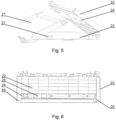
- a locking mechanism can be installed on one of the flaps 22 of the packaging lid.
- This mechanism comprises a sliding pin 24 mounted in the flap 22 and a sliding semi-turned bolt 25, the position of which is determined by a slider 26 located on the outer side of the flap 22.
- the detailed construction of the locking mechanism is shown in Fig. 6 (for clarity, the cover of the mechanism is not shown in Fig. 6 ). Moving the slider 26 to the closed position causes the pin 24 to slide into the first slot 62 located in the fourth side wall 60 and the bolt 25 to slide into the second slot 27 located in the upper peripheral flange 23. Thus, the flap is locked from both sides.
- the flaps 21, 22 are asymmetrical, meaning the surface area of one of the flaps 22 is larger than the surface area of the other flap 21.
- the larger flap 22 can overlap the smaller flap 21, so that when the slider 26 is moved to the closed position, both flaps can be effectively immobilized.
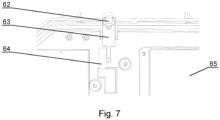
- the locking mechanism may also comprise a locking mechanism for securing the pin 24 in the first slot 62, located in the fourth sidewall 60.
- This mechanism may have a handle 63 that can move up and down, which, in its raised position, engages with a circumferential groove made in the end of the pin 24, so that the pin 24 cannot be dislodged from the slot 62.
- the handle 63 may be moved by an electrically controlled servo mechanism 64.
- closing the packaging involves the user placing one flap 22 over the other flap 21 and moving the slider 26 to the closed position, which causes the pin 24 and the bolt 25 to slide into their respective slots 62, 27.
- the user can then activate the electronically controlled servo mechanism 64 to move the handle 63 to the raised position, in order to grip the pin 24 in the slot 62 and prevent it from sliding out of the slot 62.
- the use of electrical control for the second stage which requires significantly less energy than the movement of the slider 26 and associated components, has the advantage of allowing the packaging to be effectively locked using an electronically controlled drive with low energy consumption.
- a battery-operated electronic controller 65 with a wireless communication module may be installed in the packaging, which allows a control signal to be transmitted to the controller from an external source, such as a mobile phone.
- an external source such as a mobile phone.
- the wireless communication module may be compatible with the Bluetooth and/or NFC standard.
- the Bluetooth communication module enables a connection to be established between the packaging controller and the user's mobile device. This allows, for example, the user who is the recipient of the packaging to receive any information stored in the memory of the packaging, such as values of overload, temperature, humidity, which have affected the packaging during transport.
- the packaging is equipped with a GPS module, it is possible to check the route taken by the packaging.
- details of the current location of the packaging can also be sent to the user during transport via the mobile phone network - for example, when the packaging is connected to the mobile device of the courier or other equipment at the loading bay, transport vehicle, etc.
- the NFC communication module can be used to program an electronic label to be displayed on the packaging. Furthermore, the NFC communication module may also be used to communicate with the user's mobile device.
- the packaging may also comprise an electronic display 66.
- the display may be located on the outer surface of the packaging, particularly on one of the side walls 30, 40, 50, 60 or on one of the flaps 21, 22 of the lid.
- the display may act as an electronic transport label, instead of the typical printed label that is usually glued to the cardboard packaging. It can display the information necessary for transport, such as a 2D code, barcode, address data, shipper data, etc.
- the controller 65 may comprise suitable storage and control circuitry to control the display and memory, as well as other circuitry that may be installed in the packaging.
- the packaging may also comprise contacts 67 for connection to an external power source, for example, when the packaging is at a receiving point equipped with boxes with contacts connected to an external power source and awaiting receipt by an end user.
- the packaging may also comprise a photovoltaic panel 68 for charging the power source, preferably located on the wall 60.
- the photovoltaic panel provides an extension of the battery life of the packaging. This is particularly preferred when the packaging is stored for a prolonged period of time without being able to be recharged, particularly at the end user (the recipient of the goods).
- the packaging may also comprise an accelerometer, for example, as one of the components of the controller 65.
- the accelerometer may be used to record events related to overloads acting on the packaging, which may result, for example, from dropping the packaging, throwing the packaging, rapid movement and bumping of the packaging during transport, etc. These events may be stored in the memory of the controller 65 and may be available to the end user, who, prior to receiving the packaging, for example, from a receiving point or from a courier, may check whether the packaging has been subjected to excessive external overloads during transport that may adversely affect the contents of the packaging.
- the packaging may contain a temperature sensor and a humidity sensor to measure the parameters inside the packaging.
- the cyclically recorded values from the temperature sensor and the humidity sensor are stored in memory and are available, among other things, to the end user who is the recipient of the packaging.
- the receiver of the packaging can ensure that the goods packaging has not overheated or cooled down during transport and that the packaging has not been flooded with water. This is particularly important when transporting foodstuffs or electronic products.
- Information on exceeded values from the accelerometer, temperature sensor, or humidity sensor can also be presented to the user via the display.
Landscapes
- Engineering & Computer Science (AREA)
- Mechanical Engineering (AREA)
- Rigid Containers With Two Or More Constituent Elements (AREA)
- Packages (AREA)
- Cartons (AREA)
Applications Claiming Priority (1)
| Application Number | Priority Date | Filing Date | Title |
|---|---|---|---|
| PL444398A PL247126B1 (pl) | 2023-04-13 | 2023-04-13 | Opakowanie transportowe |
Publications (2)
| Publication Number | Publication Date |
|---|---|
| EP4458709A2 true EP4458709A2 (fr) | 2024-11-06 |
| EP4458709A3 EP4458709A3 (fr) | 2025-01-08 |
Family
ID=90730309
Family Applications (1)
| Application Number | Title | Priority Date | Filing Date |
|---|---|---|---|
| EP24169969.3A Withdrawn EP4458709A3 (fr) | 2023-04-13 | 2024-04-12 | Emballage de transport |
Country Status (2)
| Country | Link |
|---|---|
| EP (1) | EP4458709A3 (fr) |
| PL (1) | PL247126B1 (fr) |
Family Cites Families (10)
| Publication number | Priority date | Publication date | Assignee | Title |
|---|---|---|---|---|
| DE4242679A1 (de) * | 1992-12-17 | 1994-06-23 | Otto Geb Kg | Zusammenklappbarer Transportbehälter als Mehrwegverpackung |
| DE9305093U1 (de) * | 1993-04-02 | 1993-05-27 | Schoeller-Plast S.A., Romont | Mehrwegverpackungssystem |
| PL347280A1 (en) * | 2001-04-24 | 2002-11-04 | Zenon Zuralski | Collapsible container with a lid |
| JP2006076637A (ja) * | 2004-09-10 | 2006-03-23 | Sanko Co Ltd | プラスチック製コンテナの蓋構造 |
| DE102004055863A1 (de) * | 2004-11-19 | 2006-05-24 | Fischerwerke Artur Fischer Gmbh & Co. Kg | Faltkasten |
| JP5265945B2 (ja) * | 2008-03-11 | 2013-08-14 | ヤマト包装技術研究所株式会社 | 運搬用容器 |
| JP2012224377A (ja) * | 2011-04-20 | 2012-11-15 | Tokan Kogyo Co Ltd | 折畳式コンテナ |
| JP7132615B2 (ja) * | 2018-03-13 | 2022-09-07 | 西田製凾株式会社 | 折畳式コンテナ |
| CN108545290A (zh) * | 2018-03-19 | 2018-09-18 | 北京农立方温室工程技术有限公司 | 一种可循环使用的充气快递箱 |
| CN112744424A (zh) * | 2021-01-11 | 2021-05-04 | 宁波触远信息科技有限公司 | 一种可重复使用的环保智能快递箱 |
-
2023
- 2023-04-13 PL PL444398A patent/PL247126B1/pl unknown
-
2024
- 2024-04-12 EP EP24169969.3A patent/EP4458709A3/fr not_active Withdrawn
Also Published As
| Publication number | Publication date |
|---|---|
| EP4458709A3 (fr) | 2025-01-08 |
| PL247126B1 (pl) | 2025-05-19 |
| PL444398A1 (pl) | 2024-10-14 |
Similar Documents
| Publication | Publication Date | Title |
|---|---|---|
| US12234057B2 (en) | Collapsible container with door | |
| US8919596B2 (en) | No-spill tackle, tool or utility box | |
| US7896184B2 (en) | Crate with collapsible wall | |
| US6868979B2 (en) | Collapsible plastic container with locking feature | |
| US20200393854A1 (en) | Parcel deploying apparatus and vehicle delivery | |
| US20110062167A1 (en) | Container | |
| US20140202590A1 (en) | Container, dispensing device, and method of dispensing goods | |
| US20220089317A1 (en) | Multiple configuration storage bin and methods of operation and manufacture thereof | |
| EP1880947A2 (fr) | Récipient, dispositif distributeur et procédé pour distribuer des denrées | |
| US20100031712A1 (en) | Collapsible Container with Locking Device | |
| CN110641828A (zh) | 一种智能快递箱 | |
| US20210015286A1 (en) | Parcel box | |
| CN201068231Y (zh) | 周转箱 | |
| KR20110112049A (ko) | 플라스틱 다단상자 | |
| KR200452223Y1 (ko) | 접이형 상자 | |
| KR101556944B1 (ko) | 파렛트 분리 및 접이식 컨테이너 | |
| US20220396411A1 (en) | Container | |
| PL247126B1 (pl) | Opakowanie transportowe | |
| US20110255949A1 (en) | Loadable container with a shelf | |
| CN211053699U (zh) | 一种仓储容量大且空间可调的机器人 | |
| CN112340181A (zh) | 一种物流用折叠式集合箱 | |
| CN218538191U (zh) | 一种具有可拼接箱体的运输机器人 | |
| JP2005280747A (ja) | 物品の収納箱 | |
| JPH1059364A (ja) | 組立式箱体 | |
| CN2541388Y (zh) | 顶部设有可开关顶盖的集装箱 |
Legal Events
| Date | Code | Title | Description |
|---|---|---|---|
| PUAI | Public reference made under article 153(3) epc to a published international application that has entered the european phase |
Free format text: ORIGINAL CODE: 0009012 |
|
| STAA | Information on the status of an ep patent application or granted ep patent |
Free format text: STATUS: THE APPLICATION HAS BEEN PUBLISHED |
|
| AK | Designated contracting states |
Kind code of ref document: A2 Designated state(s): AL AT BE BG CH CY CZ DE DK EE ES FI FR GB GR HR HU IE IS IT LI LT LU LV MC ME MK MT NL NO PL PT RO RS SE SI SK SM TR |
|
| PUAL | Search report despatched |
Free format text: ORIGINAL CODE: 0009013 |
|
| AK | Designated contracting states |
Kind code of ref document: A3 Designated state(s): AL AT BE BG CH CY CZ DE DK EE ES FI FR GB GR HR HU IE IS IT LI LT LU LV MC ME MK MT NL NO PL PT RO RS SE SI SK SM TR |
|
| RIC1 | Information provided on ipc code assigned before grant |
Ipc: B65D 6/16 20060101ALI20241204BHEP Ipc: B65D 6/18 20060101AFI20241204BHEP |
|
| STAA | Information on the status of an ep patent application or granted ep patent |
Free format text: STATUS: THE APPLICATION IS DEEMED TO BE WITHDRAWN |
|
| 18D | Application deemed to be withdrawn |
Effective date: 20250709 |