EP4458320A1 - Verzweigter stent - Google Patents
Verzweigter stent Download PDFInfo
- Publication number
- EP4458320A1 EP4458320A1 EP22914639.4A EP22914639A EP4458320A1 EP 4458320 A1 EP4458320 A1 EP 4458320A1 EP 22914639 A EP22914639 A EP 22914639A EP 4458320 A1 EP4458320 A1 EP 4458320A1
- Authority
- EP
- European Patent Office
- Prior art keywords
- stent
- segment
- fixing
- developing
- sealing
- Prior art date
- Legal status (The legal status is an assumption and is not a legal conclusion. Google has not performed a legal analysis and makes no representation as to the accuracy of the status listed.)
- Pending
Links
- 238000007789 sealing Methods 0.000 claims abstract description 95
- 230000003014 reinforcing effect Effects 0.000 claims description 13
- 238000002844 melting Methods 0.000 claims description 4
- 230000008018 melting Effects 0.000 claims description 4
- 238000003466 welding Methods 0.000 claims description 4
- 230000002792 vascular Effects 0.000 abstract description 18
- 208000001750 Endoleak Diseases 0.000 abstract description 13
- 238000001356 surgical procedure Methods 0.000 description 31
- 238000010586 diagram Methods 0.000 description 21
- 210000000709 aorta Anatomy 0.000 description 10
- 208000027418 Wounds and injury Diseases 0.000 description 6
- 208000002251 Dissecting Aneurysm Diseases 0.000 description 5
- 208000007474 aortic aneurysm Diseases 0.000 description 5
- 206010002895 aortic dissection Diseases 0.000 description 5
- 238000004873 anchoring Methods 0.000 description 4
- 238000006073 displacement reaction Methods 0.000 description 4
- 230000000694 effects Effects 0.000 description 4
- 238000002513 implantation Methods 0.000 description 4
- 230000002265 prevention Effects 0.000 description 4
- 230000003247 decreasing effect Effects 0.000 description 3
- 239000000463 material Substances 0.000 description 3
- 238000000034 method Methods 0.000 description 3
- 238000012276 Endovascular treatment Methods 0.000 description 2
- 230000036961 partial effect Effects 0.000 description 2
- BASFCYQUMIYNBI-UHFFFAOYSA-N platinum Chemical compound [Pt] BASFCYQUMIYNBI-UHFFFAOYSA-N 0.000 description 2
- 230000002829 reductive effect Effects 0.000 description 2
- 229910001285 shape-memory alloy Inorganic materials 0.000 description 2
- 238000004804 winding Methods 0.000 description 2
- 208000031226 Hyperlipidaemia Diseases 0.000 description 1
- 206010020772 Hypertension Diseases 0.000 description 1
- HZEWFHLRYVTOIW-UHFFFAOYSA-N [Ti].[Ni] Chemical compound [Ti].[Ni] HZEWFHLRYVTOIW-UHFFFAOYSA-N 0.000 description 1
- 230000002411 adverse Effects 0.000 description 1
- 230000000903 blocking effect Effects 0.000 description 1
- 230000017531 blood circulation Effects 0.000 description 1
- 210000004204 blood vessel Anatomy 0.000 description 1
- 230000006835 compression Effects 0.000 description 1
- 238000007906 compression Methods 0.000 description 1
- 230000006378 damage Effects 0.000 description 1
- 206010012601 diabetes mellitus Diseases 0.000 description 1
- 229910003460 diamond Inorganic materials 0.000 description 1
- 239000010432 diamond Substances 0.000 description 1
- 201000010099 disease Diseases 0.000 description 1
- 208000037265 diseases, disorders, signs and symptoms Diseases 0.000 description 1
- 201000001421 hyperglycemia Diseases 0.000 description 1
- 239000007943 implant Substances 0.000 description 1
- 208000014674 injury Diseases 0.000 description 1
- 230000001788 irregular Effects 0.000 description 1
- 230000000670 limiting effect Effects 0.000 description 1
- 229910001000 nickel titanium Inorganic materials 0.000 description 1
- 229910052697 platinum Inorganic materials 0.000 description 1
- 239000004810 polytetrafluoroethylene Substances 0.000 description 1
- 229920001343 polytetrafluoroethylene Polymers 0.000 description 1
- 229910052715 tantalum Inorganic materials 0.000 description 1
- GUVRBAGPIYLISA-UHFFFAOYSA-N tantalum atom Chemical compound [Ta] GUVRBAGPIYLISA-UHFFFAOYSA-N 0.000 description 1
- 238000011282 treatment Methods 0.000 description 1
- 231100000216 vascular lesion Toxicity 0.000 description 1
- 238000012800 visualization Methods 0.000 description 1
Images







Classifications
-
- A—HUMAN NECESSITIES
- A61—MEDICAL OR VETERINARY SCIENCE; HYGIENE
- A61F—FILTERS IMPLANTABLE INTO BLOOD VESSELS; PROSTHESES; DEVICES PROVIDING PATENCY TO, OR PREVENTING COLLAPSING OF, TUBULAR STRUCTURES OF THE BODY, e.g. STENTS; ORTHOPAEDIC, NURSING OR CONTRACEPTIVE DEVICES; FOMENTATION; TREATMENT OR PROTECTION OF EYES OR EARS; BANDAGES, DRESSINGS OR ABSORBENT PADS; FIRST-AID KITS
- A61F2/00—Filters implantable into blood vessels; Prostheses, i.e. artificial substitutes or replacements for parts of the body; Appliances for connecting them with the body; Devices providing patency to, or preventing collapsing of, tubular structures of the body, e.g. stents
- A61F2/02—Prostheses implantable into the body
- A61F2/04—Hollow or tubular parts of organs, e.g. bladders, tracheae, bronchi or bile ducts
- A61F2/06—Blood vessels
- A61F2/07—Stent-grafts
-
- A—HUMAN NECESSITIES
- A61—MEDICAL OR VETERINARY SCIENCE; HYGIENE
- A61F—FILTERS IMPLANTABLE INTO BLOOD VESSELS; PROSTHESES; DEVICES PROVIDING PATENCY TO, OR PREVENTING COLLAPSING OF, TUBULAR STRUCTURES OF THE BODY, e.g. STENTS; ORTHOPAEDIC, NURSING OR CONTRACEPTIVE DEVICES; FOMENTATION; TREATMENT OR PROTECTION OF EYES OR EARS; BANDAGES, DRESSINGS OR ABSORBENT PADS; FIRST-AID KITS
- A61F2/00—Filters implantable into blood vessels; Prostheses, i.e. artificial substitutes or replacements for parts of the body; Appliances for connecting them with the body; Devices providing patency to, or preventing collapsing of, tubular structures of the body, e.g. stents
- A61F2/82—Devices providing patency to, or preventing collapsing of, tubular structures of the body, e.g. stents
- A61F2/856—Single tubular stent with a side portal passage
-
- A—HUMAN NECESSITIES
- A61—MEDICAL OR VETERINARY SCIENCE; HYGIENE
- A61F—FILTERS IMPLANTABLE INTO BLOOD VESSELS; PROSTHESES; DEVICES PROVIDING PATENCY TO, OR PREVENTING COLLAPSING OF, TUBULAR STRUCTURES OF THE BODY, e.g. STENTS; ORTHOPAEDIC, NURSING OR CONTRACEPTIVE DEVICES; FOMENTATION; TREATMENT OR PROTECTION OF EYES OR EARS; BANDAGES, DRESSINGS OR ABSORBENT PADS; FIRST-AID KITS
- A61F2/00—Filters implantable into blood vessels; Prostheses, i.e. artificial substitutes or replacements for parts of the body; Appliances for connecting them with the body; Devices providing patency to, or preventing collapsing of, tubular structures of the body, e.g. stents
- A61F2/82—Devices providing patency to, or preventing collapsing of, tubular structures of the body, e.g. stents
- A61F2/86—Stents in a form characterised by the wire-like elements; Stents in the form characterised by a net-like or mesh-like structure
- A61F2/90—Stents in a form characterised by the wire-like elements; Stents in the form characterised by a net-like or mesh-like structure characterised by a net-like or mesh-like structure
-
- A—HUMAN NECESSITIES
- A61—MEDICAL OR VETERINARY SCIENCE; HYGIENE
- A61F—FILTERS IMPLANTABLE INTO BLOOD VESSELS; PROSTHESES; DEVICES PROVIDING PATENCY TO, OR PREVENTING COLLAPSING OF, TUBULAR STRUCTURES OF THE BODY, e.g. STENTS; ORTHOPAEDIC, NURSING OR CONTRACEPTIVE DEVICES; FOMENTATION; TREATMENT OR PROTECTION OF EYES OR EARS; BANDAGES, DRESSINGS OR ABSORBENT PADS; FIRST-AID KITS
- A61F2/00—Filters implantable into blood vessels; Prostheses, i.e. artificial substitutes or replacements for parts of the body; Appliances for connecting them with the body; Devices providing patency to, or preventing collapsing of, tubular structures of the body, e.g. stents
- A61F2/95—Instruments specially adapted for placement or removal of stents or stent-grafts
- A61F2/954—Instruments specially adapted for placement or removal of stents or stent-grafts for placing stents or stent-grafts in a bifurcation
-
- A—HUMAN NECESSITIES
- A61—MEDICAL OR VETERINARY SCIENCE; HYGIENE
- A61F—FILTERS IMPLANTABLE INTO BLOOD VESSELS; PROSTHESES; DEVICES PROVIDING PATENCY TO, OR PREVENTING COLLAPSING OF, TUBULAR STRUCTURES OF THE BODY, e.g. STENTS; ORTHOPAEDIC, NURSING OR CONTRACEPTIVE DEVICES; FOMENTATION; TREATMENT OR PROTECTION OF EYES OR EARS; BANDAGES, DRESSINGS OR ABSORBENT PADS; FIRST-AID KITS
- A61F2/00—Filters implantable into blood vessels; Prostheses, i.e. artificial substitutes or replacements for parts of the body; Appliances for connecting them with the body; Devices providing patency to, or preventing collapsing of, tubular structures of the body, e.g. stents
- A61F2/02—Prostheses implantable into the body
- A61F2/04—Hollow or tubular parts of organs, e.g. bladders, tracheae, bronchi or bile ducts
- A61F2/06—Blood vessels
- A61F2002/061—Blood vessels provided with means for allowing access to secondary lumens
-
- A—HUMAN NECESSITIES
- A61—MEDICAL OR VETERINARY SCIENCE; HYGIENE
- A61F—FILTERS IMPLANTABLE INTO BLOOD VESSELS; PROSTHESES; DEVICES PROVIDING PATENCY TO, OR PREVENTING COLLAPSING OF, TUBULAR STRUCTURES OF THE BODY, e.g. STENTS; ORTHOPAEDIC, NURSING OR CONTRACEPTIVE DEVICES; FOMENTATION; TREATMENT OR PROTECTION OF EYES OR EARS; BANDAGES, DRESSINGS OR ABSORBENT PADS; FIRST-AID KITS
- A61F2/00—Filters implantable into blood vessels; Prostheses, i.e. artificial substitutes or replacements for parts of the body; Appliances for connecting them with the body; Devices providing patency to, or preventing collapsing of, tubular structures of the body, e.g. stents
- A61F2/82—Devices providing patency to, or preventing collapsing of, tubular structures of the body, e.g. stents
- A61F2002/821—Ostial stents
-
- A—HUMAN NECESSITIES
- A61—MEDICAL OR VETERINARY SCIENCE; HYGIENE
- A61F—FILTERS IMPLANTABLE INTO BLOOD VESSELS; PROSTHESES; DEVICES PROVIDING PATENCY TO, OR PREVENTING COLLAPSING OF, TUBULAR STRUCTURES OF THE BODY, e.g. STENTS; ORTHOPAEDIC, NURSING OR CONTRACEPTIVE DEVICES; FOMENTATION; TREATMENT OR PROTECTION OF EYES OR EARS; BANDAGES, DRESSINGS OR ABSORBENT PADS; FIRST-AID KITS
- A61F2/00—Filters implantable into blood vessels; Prostheses, i.e. artificial substitutes or replacements for parts of the body; Appliances for connecting them with the body; Devices providing patency to, or preventing collapsing of, tubular structures of the body, e.g. stents
- A61F2/82—Devices providing patency to, or preventing collapsing of, tubular structures of the body, e.g. stents
- A61F2/848—Devices providing patency to, or preventing collapsing of, tubular structures of the body, e.g. stents having means for fixation to the vessel wall, e.g. barbs
- A61F2002/8486—Devices providing patency to, or preventing collapsing of, tubular structures of the body, e.g. stents having means for fixation to the vessel wall, e.g. barbs provided on at least one of the ends
-
- A—HUMAN NECESSITIES
- A61—MEDICAL OR VETERINARY SCIENCE; HYGIENE
- A61F—FILTERS IMPLANTABLE INTO BLOOD VESSELS; PROSTHESES; DEVICES PROVIDING PATENCY TO, OR PREVENTING COLLAPSING OF, TUBULAR STRUCTURES OF THE BODY, e.g. STENTS; ORTHOPAEDIC, NURSING OR CONTRACEPTIVE DEVICES; FOMENTATION; TREATMENT OR PROTECTION OF EYES OR EARS; BANDAGES, DRESSINGS OR ABSORBENT PADS; FIRST-AID KITS
- A61F2250/00—Special features of prostheses classified in groups A61F2/00 - A61F2/26 or A61F2/82 or A61F9/00 or A61F11/00 or subgroups thereof
- A61F2250/0058—Additional features; Implant or prostheses properties not otherwise provided for
- A61F2250/0096—Markers and sensors for detecting a position or changes of a position of an implant, e.g. RF sensors, ultrasound markers
- A61F2250/0098—Markers and sensors for detecting a position or changes of a position of an implant, e.g. RF sensors, ultrasound markers radio-opaque, e.g. radio-opaque markers
Definitions
- the embodiments relate to medical instruments, and to a branch stent.
- Aortic aneurysm and aortic dissection are currently serious diseases that endanger human life. If there is no active treatment, the aortic aneurysm and the aortic dissection will continue to increase, and finally rupture, resulting in serious complications and death. With the increasing number of patients with hypertension, hyperlipidemia and diabetes (hyperglycaemia), incidences of the aortic aneurysm and the aortic dissection are significantly increased.
- a traditional open surgery treating the aortic aneurysm and the aortic dissection features a heavy wound, a high mortality, a long surgery time, a high incidence of post-surgery complications and high difficulty of the surgery.
- endovascular treatment features a minimal injury, less post-surgery complications, a short surgery time, low difficulty of the surgery, etc.
- the endovascular treatment has gradually become a current main method for treating the aortic aneurysm and the aortic dissection.
- a skirt stent is a branch stent specially applied to reconstruction of a branch channel, and the skirt has a good endoleaks prevention effect if it is used with the main body stent in combination by special endoleaks prevention design.
- An expansion state of the skirt in the surgery directly determines the endoleaks prevention effect of the branch stent.
- An objective of the present embodiments is to solve at least the problem that the state of the skirt is difficult to be observed after a branch stent with a skirt is implanted.
- Embodiments provide a branch stent including a stent body and a skirt structure disposed on the stent body; the stent body includes a main body stent and a main body covering film disposed on the main body stent; and the skirt structure includes a sealing stent segment connected to the stent body and a fixing stent segment connected to the sealing stent segment, and the skirt structure is configured to provide with a developing structure.
- the branch stent of embodiments may be placed at a branch opening of a vascular stent, so as to establish a channel for the branch vessel; and the branch opening of the vascular stent is sealed by the sealing stent segment to prevent endoleaks.
- the fixing stent segment may be folded, and is automatically folded after being released from a delivery sheath, so as to prevent the branch stent from moving.
- the skirt structure is configured to provide with the developing structure, so that the state of the skirt structure is displayed after being released from the delivery sheath, which makes it convenient for an operator to observe.
- the fixing stent segment includes a fixing segment stent and a fixing segment covering film disposed on the fixing segment stent; and the developing structure includes a fixing developing portion disposed on the fixing segment stent and/or an end developing portion disposed on the fixing segment covering film.
- the fixing developing portion includes a plurality of fixing developing points disposed at spaced circumferential intervals on the fixing segment stent.
- each of the fixing developing point is fixed on the fixing stent segment by welding or suturing, or each of the fixing developing point is developing wire that is spirally wound on the fixing stent segment.
- the end developing portion includes a plurality of end developing points disposed at spaced circumferential intervals on the fixing segment covering film, and the end developing points are disposed at an end edge of the fixing segment covering film; or the end developing portion includes developing ring disposed at the end edge of the fixing segment covering film.
- the sealing stent segment has a conical shape
- the sealing stent segment includes a sealing segment stent and a sealing segment covering film disposed on the sealing segment stent
- the developing structure further includes a plurality of sealing developing points disposed on the sealing segment stent, and the plurality of sealing developing points are uniformly disposed on the sealing segment stent in the circumferential direction.
- the sealing segment stent is hooked to the fixing segment stent, and the sealing segment covering film is integrated with the fixing segment covering film.
- the sealing segment stent is hooked to the main body stent, and the sealing segment covering film is fixedly connected to the main body covering film by hot melting.
- wire diameters of the sealing segment stent and the fixing segment stent are both smaller than that of the main body stent.
- the main body stent includes a covered stent segment with the main body covering film and a bare stent segment barely disposed at an end of the main body stent.
- a reinforcing wire is disposed on the bare stent segment, and is wound on the bare stent segment.
- first, second, third, etc. may be used in the text to describe a number of elements, components, regions, layers, and/or sections, these elements, components, regions, layers, and/or sections should not be limited by these terms. These terms can only be used to distinguish one element, component, region, layer, or segment from another region, layer, or segment. Unless explicitly stated, terms such as “first”, “second”, and other numerical terms used in the text do not imply sequence or order.
- spatial relative relationship terms such as, “internal”, “external”, “inner side”, “outer side”, “under”, “below”, “on”, and “above”, may be used herein to describe the relationship of one element or feature relative to another element or feature as illustrated in the figures.
- These spatially relative terms are intended to encompass different orientations of the device in use or operation in addition to the orientation depicted in the figures. For example, if the device in the figures is turned over, elements described as “below” or “beneath” other elements or features would then be oriented “on” or “above” the other elements or features.
- distal refers to positions far away from a heart
- proximal refers to positions close to the heart.
- axial direction should be understood to indicate a direction in which an interventional device is pushed in and out, and a direction perpendicular to the "axial direction” is defined as the "radial direction”.
- Embodiment I provides a branch stent.
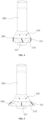
- the branch stent 100 includes a stent body 200 and a skirt structure 260 disposed on the stent body 200;
- the stent body 200 includes a main body stent 210 and a main body covering film 220 disposed on the main body stent 210, where the skirt structure 260 includes a sealing stent segment 400 connected to the stent body and a fixing stent segment 300 connected to the sealing stent segment 400, and the skirt structure 260 is provided with a developing structure 270, and the sealing stent segment 400 has a conical shape.
- the branch stent there are two main application scenarios for the branch stent with the skirt structure.
- One application scenario is a foldable branch stent for fenestration surgery, which achieves effects of sealing and anchoring by the foldable skirt structure, and the other application scenario is application of the branch stent for chimney surgery.
- the branch stent is the foldable branch stent for the fenestration surgery.
- An expansion state of a skirt directly determines the endoleaks prevention effect of the branch stent 100. If the skirt structure 260 of the branch stent 100 is not expanded well during implantation, there will be a problem of poor sealing, and even displacement of the branch stent 100.
- arranging the developing structure 270 on the skirt structure 260 achieves visualization of the skirt structure 260 during implantation of the branch stent 100, so as to assist in operation of a doctor. The doctor can observe a state of the skirt structure 260 for targeted operation, thereby reducing difficulty and duration of a surgery.
- the doctor may observe visually whether the skirt structure 260 is placed in expected place, so as to ensure that the skirt structure 260 has good sealing performance and anchoring performance after the branch stent 100 is implanted, and it may ensure smooth operation of the surgery and improve reliability of the surgery.
- a vascular stent 700 placed in an aorta 500 includes a main cavity 710 and a branch opening 720 formed in a side surface of the main cavity 710.
- the branch stent 100 in the embodiment can be placed at the branch opening 720 of the vascular stent 700, so as to establish a channel for the branch vessel 600.
- the branch opening 720 of the vascular stent 700 is sealed by the sealing stent segment 400 to prevent endoleaks.
- the fixing stent segment 300 can be folded, and is automatically folded after being released from the delivery sheath, so as to prevent the branch stent 100 from moving.
- the skirt structure 260 is provided with the developing structure 270.
- the state of the skirt structure 260 is displayed by the developing structure 270 after being released from the delivery sheath, which makes it convenient for the operator to observe, so as to assist in the operator to implant the branch stent 100.
- the vascular stent 700 used for being implanted in the aorta 500 is placed at the diseased aorta 500; then, the vascular stent 700 at a branch vessel 600 is opened to form the branch opening 720; and then, the branch stent 100 is placed at the branch opening 720 to establish a channel communicating with the branch vessel 600.
- the branch stent 100 is provided with the foldable skirt structure 260 which is divided into two segments.
- the first segment is the sealing stent segment 400 in conical shape; and the sealing stent segment 400 can seal openings in different shapes by its taper shape, so as to effectively prevent endoleaks.
- the second segment is the foldable fixing stent segment 300; and after the skirt structure 260 is released from the delivery sheath, the fixing stent segment 300 can be automatically folded backwards, so as to prevent the branch stent 100 from moving to an interior of the branch vessel 600.
- the skirt structure 260 is released first; then, the branch stent 100 is retracted as a whole, to make the skirt structure 260 fitted to an inner wall of the vascular stent 700; and then, the branch stent 100 is completely released.
- the fixing stent segment 300 includes a fixing segment stent 310 and a fixing segment covering film 320 disposed on the fixing segment stent 310.
- the developing structure 270 includes a fixing developing portion 330 disposed on the fixing segment stent 310.
- the fixing developing portion 330 includes a plurality of fixing developing points 331 disposed at spaced circumferential intervals on the fixing segment stent 310.
- the plurality of fixing developing points 331 are uniformly disposed on the fixing stent segment 310 in a circumferential direction.
- the fixing stent segment 300 is provided with three to six fixing developing points 331. If there are too few fixing developing points 331, the whole circumferential state of the skirt structure 260 may not be completely displayed. It may be understood that when there are more fixing developing points 331, there may be a more complete circumferential display of the skirt structure 260; however, it may further increase a volume of the branch stent 100, making assembly of the branched support 100 more difficult. Thus, in an embodiment, the number of the fixing developing points 331 is set to four.
- the shape of the fixing stent segment 300 is approximately cylindrical, and the fixing developing points 331 are uniformly disposed on a circumference of the skirt.
- each fixing developing point 331 is designed into an "I" shape, and four "I"-shaped fixing developing points 331 are symmetrically disposed on the fixing stent segment 300 in the circumferential direction.
- the released sealing stent segment 400 is configured to has a conical shape, and the released fixing stent segment 300 is approximately in cylindrical shape.
- One end with a smaller diameter of the sealing stent segment 400 is connected to the stent body 200, and the other end with a larger diameter of the sealing stent segment 400, which can be used for sealing the branch opening 720, is connected to the fixing stent segment 300.
- the fixing developing points 331 on the fixing stent segment 300 are observed from the side surface, the fixing developing points 331 in a middle are shown as a complete length, and the fixing developing points 331 at two ends are displayed as a state of being substantially parallel to the stent body 200.
- the fixing developing points 331 on the fixing stent segment 300 are observed from the side surface, the fixing developing points 331 in the middle show a shortened length, and the fixing developing points 331 at the two ends are inclined downward.
- the fixing developing points 331 on the fixing stent segment 300 are observed from the side surface, the fixing developing points 331 in the middle are shown as a point, and the fixing developing points 331 at the two ends are displayed to be substantially perpendicular to the stent body 200.
- the fixing developing points 331 on the fixing stent segment 300 are observed from the side surface, the fixing developing points 331 in the middle show a shortened length, and the fixing developing points 331 at the two ends are inclined upwards.
- the change state of the fixing developing points 331 of the fixing stent segment 300 has a clear change order, that is, the unfolded state, the partial folded state, the complete folded state and the over-folded state in sequence.
- the skirt structure 260 is retracted and anchored, the fixing developing points 331 of the fixing stent segment 300 are subjected to over-folding, complete folding and partial folding in sequence.
- the operator can know the folded state of the fixing stent segment 300 at any time by observing a posture change of the fixing developing points 331, so as to avoid mis-operation, or the surgery is terminated in advance before the fixing stent segment 300 has reached a preset shape. If the fixing stent segment 300 is not placed according to the preset posture, it can cause the branch stent 100 to move to an interior of the branch vessel 600 as a whole, and there is a risk of branch endoleaks. In severe cases, there may even be a risk that the branch stent 100 falls off into the branch vessel 600. Through the above solution of the present embodiment, it can be ensured that the fixing stent segment 300 is disposed in a preset posture, so as to avoid the above adverse results.
- each of the fixing developing points 331 is fixed on the fixing stent segment 300, or each of the fixing developing points 331 is a developing wire 332 spirally wound on the fixing stent segment 300.
- the fixing developing point 331 can further be in other shapes such as an "O" shape. Additionally, in an embodiment the fixing developing point 331 can be fixed on the fixing stent segment 300 by welding or suturing, or fixed on the fixing stent segment 300 by being wound with the wirelike developing wire 332.
- the fixing developing point 331 can be made of a tantalum material, a platinum material or other materials having developing performance.
- the sealing stent segment 400 includes a sealing segment stent 410 and a sealing segment covering film 420 disposed on the sealing segment stent 410.
- the developing structure 270 further includes a plurality of sealing developing points 430 disposed on the sealing segment stent 410. The number of sealing developing points 430 are uniformly disposed on the sealing segment stent 410 in the circumferential direction.
- the sealing developing points 430 are disposed on the sealing segment stent 410 for observing a posture of the sealing stent segment 400, which prevent the sealing stent segment 400 from folding driven by a sheath of a delivery device or the vascular stent 700 used for the aorta 500 when the branch stent 100 is released.
- the fold may lead to a situation where the sealing stent segment 400 cannot seal the branch opening 720, which leads to a failure of the surgery.
- the sealing segment stent 410 is partially hooked and connected to the main body stent 210, and is hooked and connected to the fixing segment stent 310; and the sealing segment covering film 420 is integrated with the fixing segment covering film 320, and is fixedly connected to the main body covering film 220 by hot melting.
- the main body stent 210 includes a plurality of main body wave coils 211 disposed in sequence; and the plurality of main body wave coils 211 are hooked and connected by adjacent main body wave coils 211.
- the main body wave coils 211 can further be disposed in a spacing manner, and connected by a stent covering film.
- the sealing segment stent 410 includes a plurality of sealing wave coils 440 connected in sequence.
- the adjacent sealing wave coils 440 are hooked and connected when the number of sealing wave coils 440 is more than one.
- the sealing stent segment 400 has a conical shape, and the end with a smaller diameter of the sealing stent segment 400 is connected to the main body stent 210.
- Sealing wave coils 440 is hooked to main body wave coils 211, which makes the sealing stent segment 400 connect to the main body stent 210.
- the fixing segment stent 310 includes a plurality of fixing wave coils 340 connected in sequence.
- the adjacent fixing wave coils are hooked and connected when the number of fixing wave coils is more than one.
- the end with a larger diameter, of the sealing stent segment 400 is connected to the fixing stent segment 300.
- Sealing wave coils 440 is hooked to fixing wave coils, which makes the sealing stent segment 400 connect to the fixing stent segment 300.
- the main body wave coils 211, the sealing wave coils 440 and the fixing wave coils are all memory alloy wires. In the present embodiment, a memory alloy nickel-titanium wire is selected.
- the sealing segment covering film 420 is integrated with the fixing segment covering film 320, and is fixedly connected to the main body covering film 220 by hot melting. In the present embodiment, all covering film structures used are PTFE films.
- wire diameters of the sealing segment stent 410 and the fixing segment stent 310 are smaller than that of the main body stent 210.
- the wire diameters of the sealing stent segment 400 and the fixing segment stent 310 are smaller than that of the main body stent 210.
- an outside diameter size of the branch stent 100 after compression is reduced, and difficulty of assembly of the branch stent 100 is lowered.
- the sealing stent segment 400 with smaller wire diameter has less radial supporting force, which means less influence is caused to an inner wall of the branch vessel 600 when the branch stent is implanted in the branch vessel 600.
- hardness of the fixing segment stent 310 with the smaller wire diameter is smaller, which is conductive to folding the fixing stent segment 300.
- the main body stent 210 includes a covered stent segment 230 with the main body covering film 220 and a bare stent segment 240 barely disposed at an end of the main body stent 210.
- a reinforcing wire 250 is disposed on the bare stent segment 240, and is wound on the bare stent segment 240.
- winding the reinforcing wire 250 on the bare stent segment 240 can strengthen friction force of the bare stent segment 240, and larger anchoring force can be obtained when the branch stent 100 is loaded into the sheath, which avoid displacement of the branch stent 100 when released from the delivery sheath.
- the displacement of the branch stent 100 may cause an inaccurate released position.
- the reinforcing wire 250 can be the developing wire having the developing performance, so that after the branch stent 100 is released, a position of the end of the branch stent 100 can be determined by observing the reinforcing wire 250 having the developing performance, so as to assist the doctor in implantation of the branch stent 100.
- the doctor can simultaneously observe the relative positions of the reinforcing wire 250 and the sealing developing points 430 disposed on the sealing stent segment 410, so as to determine whether the sealing stent segment 410 is correctly expanded. If the positions of the sealing developing points 430 relative to the reinforcing wire 250 are within a preset range, it indicates that the sealing stent segment 410 is in a correct expansion position.
- the sealing stent segment 410 is in an over-folded state.
- the sealing stent segment 410 in the over-folded state cannot effectively seal the opening of the branch stent 100, which will cause a serious medical accident. At this time, it is necessary to adjust the branch stent 100 in time.
- the reinforcing wire 250 by winding the reinforcing wire 250 on the bare stent segment 240, on one hand, anchoring force between the branch stent 100 and the delivery device can be strengthened, so as to avoid displacement of the branch stent 100 that may cause an inaccurate released position when being released from the delivery sheath.
- the reinforcing wire 250 can also be used as a position reference for the developing structure 300 to assist the doctor in judging to ensure smooth operation of the surgery.
- the branch stent 100 can be placed at the branch opening 720 of the vascular stent 700, so as to establish a channel for the branch vessel 600, and the branch opening 720 of the vascular stent 700 is sealed by the sealing stent segment 400 to prevent endoleaks.
- the fixing stent segment 300 can be folded, and is automatically folded after being released from the delivery sheath, so as to prevent the branch stent 100 from moving.
- the skirt structure 260 is provided with the developing structure 270, which displays the state of the skirt structure 260 after being released from the delivery sheath, making it convenient for the operator to observe.
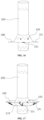
- Embodiment II provides a branch stent. As shown in FIG. 14 , similarities between embodiment II and embodiment I are no longer repeated. Embodiment II is different from embodiment I, for example, in that fixing developing points 331 can also be designed into a "V" shape, and observation and judgment are the same as those of the fixing developing points 331 in the "I" shape.
- the fixing developing points 331 on a fixing stent segment 300 are in the "V" shape, similarly, after equipment is adjusted first to make any fixing developing points 331 on opposite sides at an approximately maximum spacing, shapes of the fixing developing points 331 at two ends are observed, and then, a shape of the fixing stent segment 300 can be accurately judged.
- the fixing developing point 331 on the fixing stent segment 300 When the fixing stent segment 300 is partially unfolded, as shown in FIG. 15 , at this time, if the fixing developing points 331 on the fixing stent segment 300 are observed from the side surface, the fixing developing point 331 in the middle shows a shortened "V" shape, and the fixing developing points 331 at two ends show a "V" shape with a decreased included angle.
- the fixing developing points 331 on the fixing stent segment 300 are observed from the side surface, the fixing developing points 331 in the middle are reduced to a point, and the fixing developing points 331 at the two ends are displayed in a strip shape and are substantially perpendicular to a stent body 200.
- the fixing developing point 331 on the fixing stent segment 300 When the fixing stent segment 300 is over-folded, as shown in FIG. 17 , at this time, if the fixing developing points 331 on the fixing stent segment 300 are observed from the side surface, the fixing developing point 331 in the middle shows an inverted "V" shape, and the fixing developing points 331 at two ends show a "V" shape with a decreased included angle.
- An operator can judge a current posture of the fixing stent segment 300 by the different states of the fixing developing points 331, and know a folding state of the fixing stent segment 300 at any time, so as to facilitate subsequent operation and ensure a success rate of the surgery.
- the fixing developing points 331 can also be in any other shapes whose changes can be observed, for example, a shape of a number eight, a shape of a number zero and other structure arrangements.
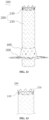
- Embodiment III provides a branch stent. As shown in FIGS. 19 and 20 , similarities between embodiment III and embodiment I are no longer repeated. Embodiment III is different from embodiment I, for example, in that a developing structure 270 includes a fixing developing portion 330 disposed on a fixing segment stent 310 and/or an end developing portion 340 disposed on a fixing segment covering film 320.
- the branch stent 100 is not only applied to a fenestration surgery, but also to a chimney surgery.
- the branch stent 100 is applied to the chimney surgery.
- a vascular stent 700 for an aorta 500 includes a main cavity 710 and a branch cavity 730 disposed on one side of the main cavity 710.
- the branch cavity 730 can be round or oval.
- the branch cavity 730 can also be in a diamond or other irregular shapes, where the branch stent 100 is disposed in the branch cavity 730, and a skirt structure 260 on the branch stent 100 mainly plays a blocking role to prevent endoleaks. Therefore, in the chimney surgery, whether the skirt structure 260 is completely expanded and adhered to a wall is a key to determine whether the surgery is successful. Therefore, sealing of the skirt structure 260 is one of important problems that a doctor cares about.
- the vascular stent 700 for the aorta 500 is first placed at the diseased aorta 500; then, the branch stent 100 is placed at an opening in a side surface of the vascular stent 700, i.e. the branch cavity 730, and a distal end of the branch stent 100 is connected to a branch vessel 600 to establish a channel, where an edge of the skirt structure 260 of the branch stent 100 needs to be roughly aligned with an edge of a covering film of the vascular stent 700 for the aorta 500.
- the skirt structure 260 is provided with the developing structure 270.
- the fixing segment stent 310 is provided with the fixing developing portion 330, or the fixing segment covering film 320 is provided with the end developing portion 340, or the fixing segment stent 310 is provided with the fixing developing portion 330, and the fixing segment covering film 320 is also provided with the end developing portion 340.
- the fixing developing portion 330 disposed at fixing segment stent 310 is close to the end edge of fixing stent segment 300, to display a position of the end edge of the fixing stent segment 300.
- the fixing developing portion 330 includes a plurality of fixing developing points 331 disposed at spaced circumferential intervals on the fixing segment stent 310.
- the plurality of fixing developing points 331 are uniformly disposed on the fixing segment stent 310 in the circumferential direction.
- the fixing developing point 331 can be fixed on the fixing segment stent 310 by welding or suturing, or fixed on the fixing segment stent 310 by being wound with the developing wire 332.
- the end developing portion 340 includes a plurality of end developing points 341 disposed at spaced circumferential intervals on the fixing segment covering film 320; and the end developing points 341 are disposed at the end edge of the fixing segment covering film 320, so as to display the position of the end edge of the fixing stent segment 300, where the end developing points 341 are sutured on the fixing segment covering film 320.
- the plurality of end developing points 341 are uniformly disposed on the edge of the fixing segment covering film 320 in the circumferential direction.
- the end developing portion 340 can further include a developing ring 342 disposed on the end edge of the fixing segment covering film 320; and the position of the end edge of the fixing stent segment 300 is displayed by the developing ring 342, where the developing ring 342 is sutured on the fixing segment covering film 320.
- the shape of the expanded skirt structure 260 is displayed by the fixing developing portion 330 on the fixing segment stent 310 and/or the end developing portion 340 disposed on the fixing segment covering film 320, so that an operator can visually see whether the skirt structure 260 seals the branch cavity 730 after the branch stent 100 is released, to assist in subsequent operation and ensure the successful operation of the surgery.
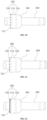
- Embodiment IV provides a branch stent 100. As shown in FIGS. 23 and 24 , similarities between embodiment IV and embodiment III are no longer repeated. Embodiment IV is different from embodiment III, for example, in that a fixing developing portion 330 includes fixing developing points 331 disposed at two sides of a fixing segment stent 310; and one or more fixing developing points 331 can be disposed at each side. Alternatively, an end developing portion 340 includes end developing points 341 disposed on two sides of a fixing segment covering film 320; and one or more end developing points 341 may be disposed at each side.
- the embodiment is suitable for an oval branch cavity 730.
- As the branch stent 100 will fit to an inner wall of the branch cavity 730 after being placed into the branch cavity 730, and maintain a same shape as the branch cavity 730, and when the branch cavity 730 is oval, a long axis edge of a cross section of the branch cavity 730 has a risk of poor sealing.
- the fixing developing portion 330 or the end developing portion 340 is used for displaying a position of the end of long axis of the skirt structure 260 after being compressed, so as to ensure that the skirt structure 260 of the branch stent 100 and the branch cavity 730 of the vascular stent 700 are sealed to avoid endoleaks.
- a circumferential angle is controlled by a delivery device, to enable developing structures 270 on two sides of the skirt structure 260 to be located at end of a long axis of an oval.
- the fixing developing portion 330 and the end developing portion 340 for displaying the position are disposed on an end edge of the fixing stent segment 300, which helps a doctor to determine a position of the branch stent 100 and ensure accurate positioning. Besides, the doctor can visually observe a deformation shape of the skirt structure 260 on an end surface, so as to judge whether the skirt structure 260 is completely expanded and adhered to a wall to ensure successful operation of the surgery.
Landscapes
- Health & Medical Sciences (AREA)
- Engineering & Computer Science (AREA)
- Biomedical Technology (AREA)
- Life Sciences & Earth Sciences (AREA)
- General Health & Medical Sciences (AREA)
- Transplantation (AREA)
- Heart & Thoracic Surgery (AREA)
- Vascular Medicine (AREA)
- Cardiology (AREA)
- Animal Behavior & Ethology (AREA)
- Oral & Maxillofacial Surgery (AREA)
- Public Health (AREA)
- Veterinary Medicine (AREA)
- Gastroenterology & Hepatology (AREA)
- Pulmonology (AREA)
- Prostheses (AREA)
- Materials For Medical Uses (AREA)
Applications Claiming Priority (2)
| Application Number | Priority Date | Filing Date | Title |
|---|---|---|---|
| CN202111664817.5A CN116407327B (zh) | 2021-12-30 | 2021-12-30 | 一种分支支架 |
| PCT/CN2022/141842 WO2023125385A1 (zh) | 2021-12-30 | 2022-12-26 | 一种分支支架 |
Publications (2)
| Publication Number | Publication Date |
|---|---|
| EP4458320A1 true EP4458320A1 (de) | 2024-11-06 |
| EP4458320A4 EP4458320A4 (de) | 2025-03-05 |
Family
ID=86997933
Family Applications (1)
| Application Number | Title | Priority Date | Filing Date |
|---|---|---|---|
| EP22914639.4A Pending EP4458320A4 (de) | 2021-12-30 | 2022-12-26 | Verzweigter stent |
Country Status (4)
| Country | Link |
|---|---|
| US (1) | US20250049594A1 (de) |
| EP (1) | EP4458320A4 (de) |
| CN (1) | CN116407327B (de) |
| WO (1) | WO2023125385A1 (de) |
Families Citing this family (3)
| Publication number | Priority date | Publication date | Assignee | Title |
|---|---|---|---|---|
| CN119970301A (zh) * | 2023-11-10 | 2025-05-13 | 先健科技(深圳)有限公司 | 一种分支支架及输送系统 |
| CN119970300A (zh) * | 2023-11-10 | 2025-05-13 | 先健科技(深圳)有限公司 | 一种分支支架及输送系统 |
| CN120227192A (zh) * | 2023-12-29 | 2025-07-01 | 先健科技(深圳)有限公司 | 覆膜支架 |
Family Cites Families (26)
| Publication number | Priority date | Publication date | Assignee | Title |
|---|---|---|---|---|
| JP4138144B2 (ja) * | 1999-03-31 | 2008-08-20 | テルモ株式会社 | 管腔内留置物 |
| US7147661B2 (en) * | 2001-12-20 | 2006-12-12 | Boston Scientific Santa Rosa Corp. | Radially expandable stent |
| US8292943B2 (en) * | 2003-09-03 | 2012-10-23 | Bolton Medical, Inc. | Stent graft with longitudinal support member |
| EP1849440A1 (de) * | 2006-04-28 | 2007-10-31 | Younes Boudjemline | Vaskuläre Stents mit verschiedenen Durchmessern |
| JP5025726B2 (ja) * | 2006-06-06 | 2012-09-12 | クック・インコーポレイテッド | 耐破砕区域を備えたステント |
| US20090030502A1 (en) * | 2007-07-26 | 2009-01-29 | Jichao Sun | Socket For Fenestrated Tubular Prosthesis |
| CN201949182U (zh) * | 2011-02-16 | 2011-08-31 | 舒畅 | 分支型主动脉支架血管系统 |
| WO2013065040A1 (en) * | 2011-10-30 | 2013-05-10 | Endospan Ltd. | Triple-collar stent-graft |
| US11007058B2 (en) * | 2013-03-15 | 2021-05-18 | Edwards Lifesciences Corporation | Valved aortic conduits |
| CN103598929B (zh) * | 2013-11-28 | 2016-04-20 | 先健科技(深圳)有限公司 | 胸主动脉覆膜支架 |
| US20170340434A1 (en) * | 2016-05-24 | 2017-11-30 | Cook Medical Technologies Llc | Device useful for localized therapeutic delivery without flow obstruction |
| CN105943199A (zh) * | 2016-05-31 | 2016-09-21 | 李晓东 | 主动脉开窗分支覆膜支架 |
| CN106109056B (zh) * | 2016-07-22 | 2018-02-13 | 有研医疗器械(北京)有限公司 | 一种多腔型覆膜支架及其使用方法 |
| CN107822739B (zh) * | 2016-09-07 | 2020-03-24 | 先健科技(深圳)有限公司 | 管腔支架及管腔支架系统 |
| JP6832111B2 (ja) * | 2016-09-30 | 2021-02-24 | 川澄化学工業株式会社 | ステントグラフト、ステントグラフトセット、及び、ステントグラフト留置装置 |
| CN107157616A (zh) * | 2017-06-22 | 2017-09-15 | 苏州卡睿知光电科技有限公司 | 一种主动脉开窗分支覆膜支架 |
| CN208464349U (zh) * | 2017-12-16 | 2019-02-05 | 北京久事神康医疗科技有限公司 | 一种颅内覆膜支架 |
| CN109984864B (zh) * | 2017-12-29 | 2020-07-17 | 先健科技(深圳)有限公司 | 用于分支血管的支架 |
| CN110623780A (zh) * | 2018-05-30 | 2019-12-31 | 杭州唯强医疗科技有限公司 | 分段式覆膜支架及其制备方法 |
| CN110613531B (zh) * | 2018-07-04 | 2022-05-03 | 黄健兵 | 一种开放手术用主动脉弓部带分支覆膜支架血管组合装置 |
| CN109498211B (zh) * | 2018-11-27 | 2021-10-19 | 深圳市先健畅通医疗有限公司 | 管腔支架 |
| CN110420079B (zh) * | 2019-06-28 | 2022-03-08 | 深圳市先健畅通医疗有限公司 | 管腔支架和管腔支架系统 |
| CN111870392A (zh) * | 2020-06-16 | 2020-11-03 | 普霖医疗科技(广州)有限公司 | 一种覆膜支架 |
| CN213722659U (zh) * | 2020-07-26 | 2021-07-20 | 海南省人民医院 | 一种主动脉弓分支覆膜支架 |
| CN112603591B (zh) * | 2020-12-01 | 2022-12-02 | 深圳市先健畅通医疗有限公司 | 覆膜支架 |
| CN214857824U (zh) * | 2021-02-06 | 2021-11-26 | 西南医科大学附属医院 | 一种用于缝合的覆膜分支支架 |
-
2021
- 2021-12-30 CN CN202111664817.5A patent/CN116407327B/zh active Active
-
2022
- 2022-12-26 US US18/721,287 patent/US20250049594A1/en active Pending
- 2022-12-26 EP EP22914639.4A patent/EP4458320A4/de active Pending
- 2022-12-26 WO PCT/CN2022/141842 patent/WO2023125385A1/zh not_active Ceased
Also Published As
| Publication number | Publication date |
|---|---|
| US20250049594A1 (en) | 2025-02-13 |
| WO2023125385A1 (zh) | 2023-07-06 |
| CN116407327A (zh) | 2023-07-11 |
| CN116407327B (zh) | 2025-12-16 |
| EP4458320A4 (de) | 2025-03-05 |
Similar Documents
| Publication | Publication Date | Title |
|---|---|---|
| EP4458320A1 (de) | Verzweigter stent | |
| ES3044111T3 (en) | Stent delivery system and method for mounting stent | |
| ES2372591T3 (es) | Sistema de colocación de endoprótesis recubierta para implantar una endoprótesis recubierta. | |
| US5207695A (en) | Aortic graft, implantation device, and method for repairing aortic aneurysm | |
| US8337546B2 (en) | Mobile external coupling for branch vessel connection | |
| CA2033195C (en) | Aortic graft and method for repairing aneurysm | |
| US8721713B2 (en) | System for implanting a replacement valve | |
| ES2729853T3 (es) | Dispositivo de captura dual para el sistema de injerto de stent | |
| ES2378518T3 (es) | Marcador fluoroscópico vascular | |
| EP3677221B1 (de) | Abgedeckter stent | |
| US11413043B2 (en) | Anchor device for vascular anastomosis | |
| US20070005127A1 (en) | Hinged tissue implant and related methods and devices for delivering such an implant | |
| US20110270379A1 (en) | Mobile External Coupling for Branch Vessel Connection | |
| CN109498210A (zh) | 管腔支架 | |
| CN117084827A (zh) | 覆膜支架及其系统和应用 | |
| US20130310927A1 (en) | Implantable Valve System | |
| CN109984861A (zh) | 可用于腹主动脉疾病介入治疗的覆膜支架 | |
| EP4037609B1 (de) | Gefässprothese | |
| CN118615057A (zh) | 一种具有移动窗的新型覆膜支架 | |
| WO2017202766A2 (en) | Flexible implants and method of use | |
| US20240115371A1 (en) | Vascular prosthesis | |
| WO2026026756A1 (zh) | 腔内植入系统 |
Legal Events
| Date | Code | Title | Description |
|---|---|---|---|
| STAA | Information on the status of an ep patent application or granted ep patent |
Free format text: STATUS: THE INTERNATIONAL PUBLICATION HAS BEEN MADE |
|
| PUAI | Public reference made under article 153(3) epc to a published international application that has entered the european phase |
Free format text: ORIGINAL CODE: 0009012 |
|
| STAA | Information on the status of an ep patent application or granted ep patent |
Free format text: STATUS: REQUEST FOR EXAMINATION WAS MADE |
|
| 17P | Request for examination filed |
Effective date: 20240620 |
|
| AK | Designated contracting states |
Kind code of ref document: A1 Designated state(s): AL AT BE BG CH CY CZ DE DK EE ES FI FR GB GR HR HU IE IS IT LI LT LU LV MC ME MK MT NL NO PL PT RO RS SE SI SK SM TR |
|
| A4 | Supplementary search report drawn up and despatched |
Effective date: 20250130 |
|
| RIC1 | Information provided on ipc code assigned before grant |
Ipc: A61F 2/90 20130101ALN20250124BHEP Ipc: A61F 2/07 20130101AFI20250124BHEP |
|
| DAV | Request for validation of the european patent (deleted) | ||
| DAX | Request for extension of the european patent (deleted) |