EP4455740A1 - Verfahren zur herstellung eines optischen elements und gehärtetes produkt - Google Patents
Verfahren zur herstellung eines optischen elements und gehärtetes produkt Download PDFInfo
- Publication number
- EP4455740A1 EP4455740A1 EP22911308.9A EP22911308A EP4455740A1 EP 4455740 A1 EP4455740 A1 EP 4455740A1 EP 22911308 A EP22911308 A EP 22911308A EP 4455740 A1 EP4455740 A1 EP 4455740A1
- Authority
- EP
- European Patent Office
- Prior art keywords
- polymerizable composition
- optical material
- mass
- prepolymer
- producing
- Prior art date
- Legal status (The legal status is an assumption and is not a legal conclusion. Google has not performed a legal analysis and makes no representation as to the accuracy of the status listed.)
- Pending
Links
Images

Classifications
-
- B—PERFORMING OPERATIONS; TRANSPORTING
- B29—WORKING OF PLASTICS; WORKING OF SUBSTANCES IN A PLASTIC STATE IN GENERAL
- B29D—PRODUCING PARTICULAR ARTICLES FROM PLASTICS OR FROM SUBSTANCES IN A PLASTIC STATE
- B29D11/00—Producing optical elements, e.g. lenses or prisms
- B29D11/00009—Production of simple or compound lenses
-
- B—PERFORMING OPERATIONS; TRANSPORTING
- B29—WORKING OF PLASTICS; WORKING OF SUBSTANCES IN A PLASTIC STATE IN GENERAL
- B29D—PRODUCING PARTICULAR ARTICLES FROM PLASTICS OR FROM SUBSTANCES IN A PLASTIC STATE
- B29D11/00—Producing optical elements, e.g. lenses or prisms
- B29D11/00009—Production of simple or compound lenses
- B29D11/0048—Moulds for lenses
- B29D11/00519—Reusable moulds
-
- B—PERFORMING OPERATIONS; TRANSPORTING
- B29—WORKING OF PLASTICS; WORKING OF SUBSTANCES IN A PLASTIC STATE IN GENERAL
- B29D—PRODUCING PARTICULAR ARTICLES FROM PLASTICS OR FROM SUBSTANCES IN A PLASTIC STATE
- B29D11/00—Producing optical elements, e.g. lenses or prisms
- B29D11/00009—Production of simple or compound lenses
- B29D11/00413—Production of simple or compound lenses made by moulding between two mould parts which are not in direct contact with one another, e.g. comprising a seal between or on the edges
-
- B—PERFORMING OPERATIONS; TRANSPORTING
- B29—WORKING OF PLASTICS; WORKING OF SUBSTANCES IN A PLASTIC STATE IN GENERAL
- B29D—PRODUCING PARTICULAR ARTICLES FROM PLASTICS OR FROM SUBSTANCES IN A PLASTIC STATE
- B29D11/00—Producing optical elements, e.g. lenses or prisms
- B29D11/00009—Production of simple or compound lenses
- B29D11/0048—Moulds for lenses
-
- C—CHEMISTRY; METALLURGY
- C08—ORGANIC MACROMOLECULAR COMPOUNDS; THEIR PREPARATION OR CHEMICAL WORKING-UP; COMPOSITIONS BASED THEREON
- C08G—MACROMOLECULAR COMPOUNDS OBTAINED OTHERWISE THAN BY REACTIONS ONLY INVOLVING UNSATURATED CARBON-TO-CARBON BONDS
- C08G18/00—Polymeric products of isocyanates or isothiocyanates
- C08G18/06—Polymeric products of isocyanates or isothiocyanates with compounds having active hydrogen
- C08G18/08—Processes
- C08G18/16—Catalysts
- C08G18/18—Catalysts containing secondary or tertiary amines or salts thereof
- C08G18/20—Heterocyclic amines; Salts thereof
- C08G18/2009—Heterocyclic amines; Salts thereof containing one heterocyclic ring
- C08G18/2018—Heterocyclic amines; Salts thereof containing one heterocyclic ring having one nitrogen atom in the ring
-
- C—CHEMISTRY; METALLURGY
- C08—ORGANIC MACROMOLECULAR COMPOUNDS; THEIR PREPARATION OR CHEMICAL WORKING-UP; COMPOSITIONS BASED THEREON
- C08G—MACROMOLECULAR COMPOUNDS OBTAINED OTHERWISE THAN BY REACTIONS ONLY INVOLVING UNSATURATED CARBON-TO-CARBON BONDS
- C08G18/00—Polymeric products of isocyanates or isothiocyanates
- C08G18/06—Polymeric products of isocyanates or isothiocyanates with compounds having active hydrogen
- C08G18/28—Polymeric products of isocyanates or isothiocyanates with compounds having active hydrogen characterised by the compounds used containing active hydrogen
- C08G18/30—Low-molecular-weight compounds
- C08G18/38—Low-molecular-weight compounds having heteroatoms other than oxygen
- C08G18/3855—Low-molecular-weight compounds having heteroatoms other than oxygen having sulfur
- C08G18/3876—Low-molecular-weight compounds having heteroatoms other than oxygen having sulfur containing mercapto groups
-
- C—CHEMISTRY; METALLURGY
- C08—ORGANIC MACROMOLECULAR COMPOUNDS; THEIR PREPARATION OR CHEMICAL WORKING-UP; COMPOSITIONS BASED THEREON
- C08G—MACROMOLECULAR COMPOUNDS OBTAINED OTHERWISE THAN BY REACTIONS ONLY INVOLVING UNSATURATED CARBON-TO-CARBON BONDS
- C08G18/00—Polymeric products of isocyanates or isothiocyanates
- C08G18/06—Polymeric products of isocyanates or isothiocyanates with compounds having active hydrogen
- C08G18/70—Polymeric products of isocyanates or isothiocyanates with compounds having active hydrogen characterised by the isocyanates or isothiocyanates used
- C08G18/72—Polyisocyanates or polyisothiocyanates
- C08G18/74—Polyisocyanates or polyisothiocyanates cyclic
- C08G18/75—Polyisocyanates or polyisothiocyanates cyclic cycloaliphatic
-
- C—CHEMISTRY; METALLURGY
- C08—ORGANIC MACROMOLECULAR COMPOUNDS; THEIR PREPARATION OR CHEMICAL WORKING-UP; COMPOSITIONS BASED THEREON
- C08G—MACROMOLECULAR COMPOUNDS OBTAINED OTHERWISE THAN BY REACTIONS ONLY INVOLVING UNSATURATED CARBON-TO-CARBON BONDS
- C08G18/00—Polymeric products of isocyanates or isothiocyanates
- C08G18/06—Polymeric products of isocyanates or isothiocyanates with compounds having active hydrogen
- C08G18/70—Polymeric products of isocyanates or isothiocyanates with compounds having active hydrogen characterised by the isocyanates or isothiocyanates used
- C08G18/72—Polyisocyanates or polyisothiocyanates
- C08G18/74—Polyisocyanates or polyisothiocyanates cyclic
- C08G18/75—Polyisocyanates or polyisothiocyanates cyclic cycloaliphatic
- C08G18/758—Polyisocyanates or polyisothiocyanates cyclic cycloaliphatic containing two or more cycloaliphatic rings
-
- G—PHYSICS
- G02—OPTICS
- G02B—OPTICAL ELEMENTS, SYSTEMS OR APPARATUS
- G02B1/00—Optical elements characterised by the material of which they are made; Optical coatings for optical elements
- G02B1/04—Optical elements characterised by the material of which they are made; Optical coatings for optical elements made of organic materials, e.g. plastics
-
- G—PHYSICS
- G02—OPTICS
- G02B—OPTICAL ELEMENTS, SYSTEMS OR APPARATUS
- G02B1/00—Optical elements characterised by the material of which they are made; Optical coatings for optical elements
- G02B1/04—Optical elements characterised by the material of which they are made; Optical coatings for optical elements made of organic materials, e.g. plastics
- G02B1/041—Lenses
-
- G—PHYSICS
- G02—OPTICS
- G02C—SPECTACLES; SUNGLASSES OR GOGGLES INSOFAR AS THEY HAVE THE SAME FEATURES AS SPECTACLES; CONTACT LENSES
- G02C7/00—Optical parts
-
- B—PERFORMING OPERATIONS; TRANSPORTING
- B29—WORKING OF PLASTICS; WORKING OF SUBSTANCES IN A PLASTIC STATE IN GENERAL
- B29C—SHAPING OR JOINING OF PLASTICS; SHAPING OF MATERIAL IN A PLASTIC STATE, NOT OTHERWISE PROVIDED FOR; AFTER-TREATMENT OF THE SHAPED PRODUCTS, e.g. REPAIRING
- B29C33/00—Moulds or cores; Details thereof or accessories therefor
- B29C33/56—Coatings, e.g. enameled or galvanised; Releasing, lubricating or separating agents
- B29C33/58—Applying the releasing agents
-
- B—PERFORMING OPERATIONS; TRANSPORTING
- B29—WORKING OF PLASTICS; WORKING OF SUBSTANCES IN A PLASTIC STATE IN GENERAL
- B29K—INDEXING SCHEME ASSOCIATED WITH SUBCLASSES B29B, B29C OR B29D, RELATING TO MOULDING MATERIALS OR TO MATERIALS FOR MOULDS, REINFORCEMENTS, FILLERS OR PREFORMED PARTS, e.g. INSERTS
- B29K2105/00—Condition, form or state of moulded material or of the material to be shaped
- B29K2105/0002—Condition, form or state of moulded material or of the material to be shaped monomers or prepolymers
-
- B—PERFORMING OPERATIONS; TRANSPORTING
- B29—WORKING OF PLASTICS; WORKING OF SUBSTANCES IN A PLASTIC STATE IN GENERAL
- B29K—INDEXING SCHEME ASSOCIATED WITH SUBCLASSES B29B, B29C OR B29D, RELATING TO MOULDING MATERIALS OR TO MATERIALS FOR MOULDS, REINFORCEMENTS, FILLERS OR PREFORMED PARTS, e.g. INSERTS
- B29K2105/00—Condition, form or state of moulded material or of the material to be shaped
- B29K2105/0005—Condition, form or state of moulded material or of the material to be shaped containing compounding ingredients
- B29K2105/0014—Catalysts
-
- B—PERFORMING OPERATIONS; TRANSPORTING
- B29—WORKING OF PLASTICS; WORKING OF SUBSTANCES IN A PLASTIC STATE IN GENERAL
- B29K—INDEXING SCHEME ASSOCIATED WITH SUBCLASSES B29B, B29C OR B29D, RELATING TO MOULDING MATERIALS OR TO MATERIALS FOR MOULDS, REINFORCEMENTS, FILLERS OR PREFORMED PARTS, e.g. INSERTS
- B29K2105/00—Condition, form or state of moulded material or of the material to be shaped
- B29K2105/0094—Condition, form or state of moulded material or of the material to be shaped having particular viscosity
-
- B—PERFORMING OPERATIONS; TRANSPORTING
- B29—WORKING OF PLASTICS; WORKING OF SUBSTANCES IN A PLASTIC STATE IN GENERAL
- B29K—INDEXING SCHEME ASSOCIATED WITH SUBCLASSES B29B, B29C OR B29D, RELATING TO MOULDING MATERIALS OR TO MATERIALS FOR MOULDS, REINFORCEMENTS, FILLERS OR PREFORMED PARTS, e.g. INSERTS
- B29K2823/00—Use of polyalkenes or derivatives thereof as mould material
- B29K2823/10—Polymers of propylene
- B29K2823/12—PP, i.e. polypropylene
-
- B—PERFORMING OPERATIONS; TRANSPORTING
- B29—WORKING OF PLASTICS; WORKING OF SUBSTANCES IN A PLASTIC STATE IN GENERAL
- B29K—INDEXING SCHEME ASSOCIATED WITH SUBCLASSES B29B, B29C OR B29D, RELATING TO MOULDING MATERIALS OR TO MATERIALS FOR MOULDS, REINFORCEMENTS, FILLERS OR PREFORMED PARTS, e.g. INSERTS
- B29K2867/00—Use of polyesters or derivatives thereof as mould material
- B29K2867/003—PET, i.e. polyethylene terephthalate
-
- B—PERFORMING OPERATIONS; TRANSPORTING
- B29—WORKING OF PLASTICS; WORKING OF SUBSTANCES IN A PLASTIC STATE IN GENERAL
- B29K—INDEXING SCHEME ASSOCIATED WITH SUBCLASSES B29B, B29C OR B29D, RELATING TO MOULDING MATERIALS OR TO MATERIALS FOR MOULDS, REINFORCEMENTS, FILLERS OR PREFORMED PARTS, e.g. INSERTS
- B29K2995/00—Properties of moulding materials, reinforcements, fillers, preformed parts or moulds
- B29K2995/0012—Properties of moulding materials, reinforcements, fillers, preformed parts or moulds having particular thermal properties
-
- B—PERFORMING OPERATIONS; TRANSPORTING
- B29—WORKING OF PLASTICS; WORKING OF SUBSTANCES IN A PLASTIC STATE IN GENERAL
- B29K—INDEXING SCHEME ASSOCIATED WITH SUBCLASSES B29B, B29C OR B29D, RELATING TO MOULDING MATERIALS OR TO MATERIALS FOR MOULDS, REINFORCEMENTS, FILLERS OR PREFORMED PARTS, e.g. INSERTS
- B29K2995/00—Properties of moulding materials, reinforcements, fillers, preformed parts or moulds
- B29K2995/0037—Other properties
- B29K2995/0046—Elastic
Definitions
- the present disclosure relates to a method of producing an optical member, and a cured product.
- Examples of methods of producing resins used in optical members for plastic lenses include the casting polymerization method, which includes injecting a polymerizable composition containing a monomer into a mold (cast) and curing the composition by heating.
- the polymerizable composition is injected into a mold (cast) and curing by heating (a polymerization reaction) is performed, and then a product is taken out of (released from) the mold and annealed, to obtain an optical member (for example, a lens or a semifinished blank).
- the curing by heating generally includes allowing a polymerization reaction to proceed for from several hours to several tens of hours while the temperature is gradually increased by heating, and, specifically, a duration of from about 20 hours to about 48 hours is generally required. It is known that a large proportion of the total production process time (for example, nine tenths the total time) is spent for the polymerization.
- Patent Literature 1 it is described that a mold to which a polymerizable composition has been charged is gradually temperature-increased from 10°C to 120°C to perform 20-hour polymerization, thereby obtaining a molded article.
- a mold into which a polymerizable composition has been charged is temperature-increased by small increments from 25°C to 120°C over a period of 16 hour, and the molded heated at 120°C for 4 hours, thereby obtaining a molded article.
- the process for production of an optical member includes performing a polymerization reaction over several hours to several tens of hours (for example, from about 20 hours to about 48 hours) while the temperature is gradually increased by heating.
- a problem to be solved by one embodiment of the present disclosure is to provide a method of producing an optical member capable of producing an optical member in a simple and convenient manner, and a cured product that is obtained in the method of producing an optical member.
- a method of producing an optical member capable of producing an optical member in a simple and convenient manner, and a cured product obtained in the method of producing an optical member are provided.
- any numerical range expressed using “to” means a range including numerical values described before and after “to” as the lower limit value and the upper limit value.
- the amount of the component in the composition described in the present specification means the total amount of the plural substances present in the composition, unless otherwise specified.
- the upper limit value or the lower limit value of one numerical range may be replaced with the upper limit value or the lower limit value of another numerical range in the stepwise description.
- the upper limit value or the lower limit value of any numerical range described in the present disclosure may also be replaced with a value described in an Example.
- step encompasses not only an independent step, but also encompasses a step that cannot be clearly distinguished from other steps, as long as the intended purpose of the step is achieved.
- a method of producing an optical member according to the present disclosure includes:
- the method is capable of producing an optical member in a simple and convenient manner.
- the method of producing an optical member according to the present disclosure does not require upper and lower molds, tapes, gaskets, and the like.
- an optical member can be produced using the method of producing an optical member according to the present disclosure.
- the "mold member” in the method of producing an optical member according to the present disclosure refers to a member that works as part of a cast (mold) for producing an optical member (for example, eyeglass lens).
- a member made of glass, metal, or resin and having a flat face or curved face for forming the optical surface (for example, a 0 C (0 curve) to 10 C (10 curve) optical surface) of an optical member to be produced can be used as the "mold member".
- a surface of the polymerizable composition placed in the space which face contacts the flat face or curved face of the mold member would be an optical surface of a cured product (namely, optical member) after the polymerizable composition is cured.
- the shape of the mold member may be a dish shape or a flat plate shape.
- the shape of a mold member for forming a 0 C optical surface may be a flat plate shape (for example, circular disc shape).
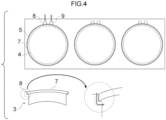
- Figure 1 is a schematic drawing for explaining an outline of the method of producing an optical member according to the present disclosure.
- a sheet 1, for example, is prepared as a material for producing a substrate 2, which includes depressed portions 3.
- the substrate 2, which includes the depressed portions 3, is produced using the sheet 1.
- the substrate 2, which includes the depressed portions 3 each including a bottom portion 4 and an opening 5, may be formed, for example, by forming the depressed portions 3 at the sheet 1 using a molding method such as press molding or vacuum molding.
- the openings 5 of the depressed portions 3 of the obtained substrate 2 are covered with mold members 7, to lid the depressed portions 3.
- the mold member 7 is held at a position between the opening 5 and the bottom portion 4.
- a space is defined that is enclosed by the inner face and the bottom portion 4 of the depressed portion 3 and the mold member 7 (first step).
- a polymerizable composition 6 is filled into the above-defined space (second step).
- a surface of the polymerizable composition 6 that contacts the mold member 7 will be an optical surface of a cured product of the polymerizable composition 6 (namely, an optical member).
- the cured product of the polymerizable composition can be obtained by polymerizing the polymerizable composition 6 in the space (third step).
- the cured product can be used as an optical member.
- the combination of the mold member and the substrate having a depressed portion in the state of enclosing the space is sometimes referred to as a "cavity".
- the first step in the present disclosure is a step of using a mold member and a substrate provided with a depressed portion including a bottom portion and an opening, and placing the mold member at the opening, to define a space between the depressed portion and the mold member.
- the opening of the depressed portion has a larger area than the area of the bottom portion.
- the substrate is provided with a depressed portion that includes a bottom portion and an opening, and the opening of the depressed portion has a larger area than the area of the bottom portion.
- the substrate is provided with a depressed portion that includes a bottom portion and an opening, and the opening of the depressed portion has a larger area than the area of the bottom portion.
- the bottom portion of the depressed portion preferably has a convex shape from the viewpoint of reducing the amount of the monomer to be used.
- the number of depressed portions provided at the substrate may be one, or two or greater, and is preferably two or greater from the viewpoint of suitability for mass production.
- the two or more depressed portions of the substrate preferably have substantially the same shape and substantially the same size. This design makes it easier to provide homogenous polymerization conditions for the two or more depressed portions, thereby facilitating production of two or more optical members excellent in outer appearance.
- the opening of the depressed portion has a larger area than the area of the bottom portion.
- the ratio (opening/bottom portion) of the area of the opening to the area of the bottom portion in the depressed portion is preferably at least 1.05, also preferably at least 1.10, also preferably at least 1.20.
- the opening/bottom portion ratio is preferably about 1.05 from the viewpoint of preventing the lens diameter of the resultant lens from being too small as compared with the mold diameter.
- the ratio (opening/bottom portion) of the area of the opening to the area of the bottom portion in the depressed portion is preferably at most 2.00, more preferably at most 1.50, still more preferably at most 1.30, from the viewpoint of ensuring that the shape of the optical member to be obtained is appropriate as product shapes.
- the area of the bottom portion and the area of the opening refer to projected areas thereof when light is incident on the depressed portion in a direction orthogonal to the substrate (specifically, a face of the substrate that is not provided with depressed portions) from the opening side toward the depressed portion.
- Figure 2 is a drawing for explaining the projected areas when light is incident on a depressed portion from the opening side.
- the area of the opening 5 is larger than the area of the bottom portion 4 in terms of the projected areas when light is incident on the depressed portion including the bottom portion 4 and the opening 5, from the opening side.
- the mold member Since the area of the opening is larger than the area of the bottom portion, the mold member is retained at a position between the opening and the bottom portion.
- the shape of the depressed portion is not particularly limited.
- the portion extending form the opening to the bottom portion may form a slope face, or a step may be provided at an intermediate position between the opening and the bottom portion.
- Figure 3 is a drawing for explaining a shape of a depressed portion in which the area of the opening is larger than the area of the bottom portion.
- a step is provided at an intermediate position between the opening and the bottom portion. This enables the mold member 7 to be fixed by the step portion, and to serve as a lid to close the depressed portion.
- the material of the substrate is not particularly limited.
- the substrate may include a resin such as polyethylene, polypropylene, an acrylic resin, polystyrene, or polyethylene terephthalate.
- a resin such as polyethylene, polypropylene, an acrylic resin, polystyrene, or polyethylene terephthalate.
- the substrate preferably includes at least one selected from the group consisting of polyethylene, polypropylene, and polyethylene terephthalate, from the viewpoint of providing a substrate having excellent elastic modulus and excellent heat resistance and in consideration of, for example, cost, versatility, and processability.
- the substrate preferably includes at least one selected from the group consisting of polyethylene and polypropylene, from the standpoint of chemical resistance (for example, chemical resistance to a thiol compound or an isocyanate compound to be used as a lens monomer).
- the elastic modulus of the substrate is preferably at least 10 MPa, more preferably at least 100 MPa, still more preferably at least 200 MPa, particularly preferably at least 250 MPa, from the viewpoint of providing an optical member having a desired shape.
- the elastic modulus of the substrate is preferably at most 10,000 MPa, more preferably at most 5,000 MPa, still more preferably at most 1,000 MPa.
- An elastic modulus of the substrate within the foregoing range provides excellent flexibility of the substrate.
- the excellent flexibility of the substrate enables an optical member obtained after curing to be easily detached from the substrate.
- the excellent flexibility of the substrate makes it easy to form a gap between the tightly contacting faces of the optical member and the substrate by bending the substrate.
- the elastic modulus is measured according to JIS T6501:2019.
- the heat distortion temperature of the substrate is preferably equal to or higher than the room temperature, and the heat distortion temperature of the substrate is more preferably at least 50°C, still more preferably at least 70°C, and particularly preferably at least 100°C, from the viewpoint of heat resistance.
- the heat distortion temperature of the substrate is preferably at most 300°C, more preferably at most 200°C, and still more preferably at most 150°C.
- a cured product may be obtained without performing heating during polymerization or with low-temperature short-time heating, as described below.
- the substrate is not required to have high heat resistance.
- a polymerizable composition can be cured even in a case in which the heat distortion temperature of the substrate is in the above-described range.
- the thickness of the substrate is preferably at least 0.2 mm, and more preferably at least 0.5 mm.
- a thickness of the substrate of at least 0.2 mm prevents the substrate from being distorted, for example, during transportation of the substrate or upon pouring of a monomer for an optical material into the depressed portion, and makes it easier to achieve a desired shape of the optical member obtained by curing of the monomer for an optical material.
- the thickness of the substrate is preferably at most 1.5 mm, and more preferably at most 1.0 mm.
- a thickness of the substrate of at most 1.5 mm improves the flexibility of the substrate, and makes it easier to take an optical member, which has been obtained by pouring a monomer for an optical material into the depressed portion and curing the monomer, out of the depressed portion.
- the heat distortion temperature is measured according to ASTM-D648-56, using a heat distortion temperature measurement apparatus.
- An external release agent may be provided on the substrate, at least on a wall surface of the depressed portion of the substrate, from the viewpoint of facilitating detachment of an optical member produced (namely, a cured product of a polymerizable composition) from the depressed portion of the substrate.
- an external release agent may be provided on (for example, applied to) a surface of the substrate before formation of the depressed portion, and then the depressed portion may be formed; alternatively, an external release agent may be provided on (for example, applied to) at least a wall surface of the depressed portion of the substrate after the depressed portion is formed on the substrate.
- the external release agent may be provided only at a region at which the depressed portion is to be formed, or may be provided on the entire surface of the substrate before formation of the depressed portion.
- the external release agent may be a fluorine-based coating agent, a silicone-based coating agent, or the like.
- the method of producing an optical member according to the present disclosure may include a preparation step of preparing a polymerizable composition that contains a monomer for an optical material.
- the preparation step may be a step of simply providing a polymerizable composition that has been produced in advance, or may be a step of producing a polymerizable composition.
- the polymerizable composition is not particularly limited as long as the polymerizable composition includes two or more different monomers for an optical material, and a polymerization catalyst.
- the polymerizable composition to be used may be a ready-made product, or may be prepared by mixing the polymerization catalyst and the at least two or more different monomers for an optical material.
- the method used for mixing is not particularly limited, and known methods may be used.
- the temperature during mixing of the above-described components is not particularly limited, and is preferably lower than or equal to 30°C, and more preferably lower than or equal to the room temperature (25°C).
- the temperature may be set to a temperature lower than 25°C, from the standpoint of the pot life of the polymerizable composition to be prepared.
- the above-described components may be heated in advance, and the additive may be dissolved in the above-described components.
- the mixing is preferably performed in a dry inert gas, in order to prevent moisture from being incorporated into the polymerizable composition.
- the preparation step is preferably a step of producing the polymerizable composition by mixing, in advance, the polymerization catalyst with some of the two or more different monomers for an optical material, and then mixing therewith the remainder of the two or more different monomers for an optical material.
- the point of time at which polymerization initiates can be tuned by performing the preparation step including the foregoing sequence. This improves, for example, handleability at the time of injecting the polymerizable composition into the space in the above-described cavity.
- the remainder of the two or more different monomers for an optical material may be mixed thereinto at one time, or may be portionwise mixed thereinto multiple times.
- Examples of specific modes of the preparation step include the following mode.
- a mixed liquid is prepared by charging some of the monomers for an optical material and an additive (for example, an internal release agent). After the mixed liquid is stirred at 25°C for 1 hour to completely dissolve the components, some of the remainder of the monomers for an optical material is charged and stirred to form a homogeneous solution. This solution is subjected to defoaming, to obtain a first mixed liquid.
- an additive for example, an internal release agent
- the first mixed liquid and the second mixed liquid are then mixed, to obtain a polymerizable composition as a homogeneous solution.
- the polymerizable composition in the present disclosure includes a monomer for an optical material.
- a cured product of the polymerizable composition can be obtained by curing the monomer for an optical material contained in the polymerizable composition.
- the polymerizable composition in the present disclosure preferably includes two or more different monomers for an optical material, and a polymerization catalyst.
- the polymerizable composition in the present disclosure includes a monomer for an optical material.
- the monomer for an optical material is not particularly limited as long as the monomer is a monomer for optics.
- the monomer for an optical material may be a monomer used for producing an optical member having any of the following properties.
- the optical member obtained using the monomer for an optical material may have a total light transmittance of 10% or more.
- the total light transmittance of the optical member can be obtained by measurement according to JIS K 7361-1 (1997).
- the optical member obtained using the monomer for an optical material has a haze (namely, total haze) of less than or equal to 10%, and may preferably have a haze of less than or equal to 1%, still more preferably less than or equal to 0.5%.
- the haze of the optical member is a value measured according to JIS-K7105 at 25°C, using a haze meter [manufactured by Tokyo Denshoku Co., Ltd., TC-HIII DPK].
- the optical member obtained using the monomer for an optical material preferably has a refractive index of higher than or equal to 1.58.
- the optical member obtained using the monomer for an optical material may have a refractive index of less than or equal to 1.80, or less than or equal to 1.75.
- the refractive index of the optical member may be measured according to JIS K7142 (2014).
- the shape of the optical member obtained using the monomer for an optical material is not particularly limited, and may be a plate shape, a circular cylindrical shape, a cuboid shape, or the like.
- the monomer for an optical material may be a polymerizable monomer that polymerizes when the after-mentioned polymerization catalyst is used.
- Specific examples thereof include an isocyanate compound, a polythiol compound containing two or more mercapto groups, a hydroxythiol compound containing one or more mercapto groups and one or more hydroxy groups, a polyol compound containing two or more hydroxy groups, an episulfide compound, and an amine compound.
- the two or more different monomers for an optical material preferably include at least one active hydrogen compound selected from the group consisting of a polythiol compound containing two or more mercapto groups, a hydroxythiol compound containing one or more mercapto groups and one or more hydroxy groups, a polyol compound containing two or more hydroxy groups, an episulfide compound, and an amine compound.
- Examples of the isocyanate compound include an aliphatic isocyanate compound, an alicyclic isocyanate compound, an aromatic isocyanate compound, and a heterocyclic isocyanate compound.
- One isocyanate compound is used singly, or two or more isocyanate compounds are mixed and used.
- the scope of the isocyanate compound may include a dimer, a trimer, and the like.
- Examples of the isocyanate compound include the exemplary compounds in WO 2011/055540 .
- isocyanate compounds that can be used include: halogen-substituted products (for example, chlorine-substituted products, bromine-substituted products, and the like), alkyl-substituted products, alkoxy-substituted products, carbodiimide-modified products, urea-modified products, and burette-modified products of the above-described compounds; prepolymer-type modified products of the above-described compounds with a nitro-substituted product, a polyhydric alcohol, or the like; and dimerization or trimerization reaction products of the above-described compounds.
- These compounds may be used singly, or a mixture of two or more thereof may be used.
- an alicyclic isocyanate compound refers to an isocyanate compound containing an alicyclic structure and optionally containing a structure other than an alicyclic structure, such as a heterocyclic structure.
- An aromatic isocyanate compound refers to an isocyanate compound that contains an aromatic structure and optionally contains any one of an aliphatic structure, an alicyclic structure, or a heterocyclic structure, or any combination thereof.
- a heterocyclic isocyanate compound refers to an isocyanate compound that contains a heterocyclic structure and that contains neither an alicyclic structure nor an aromatic structure.
- An aliphatic isocyanate compound refers to an isocyanate compound that contains none of an aromatic structure, an alicyclic structure, or a heterocyclic structure.
- the isocyanate compound in the present disclosure preferably includes at least one selected from isophorone diisocyanate, 2,5-bis(isocyanatomethyl)bicyclo-[2.2.1]-heptane, 2,6-bis(isocyanatomethyl)bicyclo-[2.2.1]-heptane, m-xylylene diisocyanate, 2,4-tolylene diisocyanate, 2,6-tolylene diisocyanate, dicyclohexylmethane diisocyanate, 1,3-bis(isocyanatomethyl)cyclohexane, 1,4-bis(isocyanatomethyl)cyclohexane, 1,6-hexamethylene diisocyanate, or 1,5-pentamethylene diisocyanate,
- Examples of the active hydrogen compound include a polythiol compound containing two or more mercapto groups, a hydroxythiol compound containing one or more mercapto groups and one or more hydroxy groups, a polyol compound containing two or more hydroxy groups, and an amine compound.
- an active hydrogen compound an oligomer of any of the above-described active hydrogen compounds, or a halogen-substituted product (for example, a chlorine-substituted product, a bromine-substituted product, or the like) of any of the above-described active hydrogen compounds may be used.
- a halogen-substituted product for example, a chlorine-substituted product, a bromine-substituted product, or the like
- the active hydrogen compound may be used singly, or in mixture of two or more kinds thereof.
- polythiol compound containing two or more mercapto groups examples include the exemplary compounds described in WO 2016/125736 .
- the polythiol compound in the present disclosure preferably includes at least one selected from 4-mercaptomethyl-1,8-dimercapto-3,6-dithiaoctane, 5,7-dimercaptomethyl-1,11-dimercapto-3,6,9-trithiaundecane, 4,7-dimercaptomethyl-1,11-dimercapto-3,6,9-trithiaundecane, 4,8-dimercaptomethyl-1,11-dimercapto-3,6,9-trithiaundecane, pentaerythritol tetrakis(3-mercaptopropionate), bis(mercaptoethyl)sulfide, pentaerythritol tetrakis(2-mercaptoacetate), 2,5-bis(mercaptomethyl)-1,4-dithiane, 1,1,3,3-tetrakis(
- Examples of the active hydrogen compound also include a polythiol compound containing three or more mercapto groups.
- the polymerizable composition in the present disclosure exhibits a peak area such that the peak area of compound (N1) is preferably at most 3.0, more preferably at most 1.5, assuming that the peak area of polythiol compound containing three or more mercapto groups is 100, from the viewpoint of ease of control of a polymerization reaction.
- the peak area of the compound (N1) is preferably at least 0.01, assuming that the peak area of polythiol compound containing three or more mercapto groups is 100, from the viewpoint of promoting a polymerization reaction.
- the peak area measured by high-performance liquid chromatography can be measured according to the method described in paragraph [0146] and the like of WO 2014/027665 .
- Examples of the thiol compound having a hydroxy group include 2-mercaptoethanol, 3-mercapto-1,2-propanediol, glycerin bis(mercaptoacetate), 4-mercaptophenol, 2,3-dimercapto-1-propanol, pentaerythritol tris(3-mercaptopropionate), and pentaerythritol tris(thioglycolate).
- 2-mercaptoethanol 3-mercapto-1,2-propanediol
- 4-mercaptophenol 2,3-dimercapto-1-propanol
- pentaerythritol tris(thioglycolate) pentaerythritol tris(thioglycolate
- polyol compound examples include one or more aliphatic or alicyclic alcohols. Specific examples thereof include a linear or branched chain aliphatic alcohol, an alicyclic alcohol, and an alcohol obtained by adding at least one selected from the group consisting of ethylene oxide, propylene oxide, and ⁇ -caprolactone to any of the foregoing alcohols. More specific examples include the compound described as exemplary compounds in WO 2016/125736 .
- the polyol compound is preferably at least one selected from ethylene glycol, diethylene glycol, triethylene glycol, propylene glycol, 1,3-propanediol, 1,2-cyclopentanediol, 1,3-cyclopentanediol, 1,2-cyclohexanediol, 1,3-cyclohexanediol, or 1,4-cyclohexanediol.
- the episulfide compound examples include an epithioethylthio compound, a chain aliphatic 2,3-epithiopropylthio compound, an alicyclic 2,3-epithiopropylthio compound, an aromatic 2,3-epithiopropylthio compound, a chain aliphatic 2,3-epithiopropyloxy compound, a cycloaliphatic 2,3-epithiopropyloxy compound, and an aromatic 2,3-epithiopropyloxy compound.
- the episulfide compound may be used singly, or may be used in mixture of two or more thereof.
- Examples of the episulfide compound include the exemplary compounds described in WO2015/137401 .
- the episulfide compound is preferably at least one selected from the group consisting of bis(2,3-epithiopropyl)sulfide, bis(2,3-epithiopropyl)disulfide, bis(1,2-epithioethyl)sulfide, bis(1,2-epithioethyl)disulfide, and bis(2,3-epithiopropylthio)methane, and is more preferably bis(2,3-epithiopropyl)disulfide.
- Examples of the amine compound include:
- the active hydrogen compound preferably includes a polythiol compound containing two or more mercapto groups, from the viewpoint of heightening the heat resistance and refractive index.
- the content of the polythiol compound containing two or more mercapto groups is preferably 60% by mass or more, more preferably 70% by mass or more, still more preferably 80% by mass or more, with respect to the total mass of the active hydrogen compound.
- the total content of 4-mercaptomethyl-1,8-dimercapto-3,6-dithiaoctane, 5,7-dimercaptomethyl-1,11-dimercapto-3,6,9-trithiaundecane, 4,7-dimercaptomethyl-1,11-dimercapto-3,6,9-trithiaundecane, 4,8-dimercaptomethyl-1,11-dimercapto-3,6,9-trithiaundecane, and pentaerythritol tetrakis(3-mercaptopropionate) is preferably 60% by mass or more, more preferably 70% by mass or more, still more preferably 80% by mass or more, with respect to the total mass of the active hydrogen compound.
- the molar ratio of the sum of hydroxy groups (OH groups) and mercapto groups (SH groups) in the active hydrogen compound molecules to isocyanato groups (NCO groups) in the isocyanate compound molecules is preferably higher than or equal to 0.8, more preferably higher than or equal to 0.85, and still more preferably higher than or equal to 0.9.
- the molar ratio of the sum of hydroxy groups (OH groups) and mercapto groups (SH groups) in the active hydrogen compound molecules to isocyanato groups (NCO groups) in the isocyanate compound molecules is preferably lower than or equal to 1.2, more preferably lower than or equal to 1.15, and still more preferably lower than or equal to 1.1.
- the polymerizable composition in the present disclosure preferably includes at least one polymerization catalyst.
- the polymerization catalyst is not particularly limited.
- a basic catalyst an organometallic catalyst, zinc carbamate, an ammonium salt, or sulfonic acid can be used as a polymerization catalyst.
- the polymerization catalyst may be used singly, or two or more polymerization catalysts may be combined, as appropriate, and used.
- the basic catalyst is, for example, an amine-based catalyst (the scope of which includes an imidazole-based catalyst).
- tertiary amine-based catalysts such as triethylenediamine, N,N-dimethylethanolamine, triethylamine, and N-ethylmorpholine, 2-methylpyrazine, pyridine, ⁇ -picoline, ⁇ -picoline, ⁇ -picoline, 2,6-lutidine, 3,5-lutidine, 2,4,6-collidine, 3-chloropyridine, N,N-diethylaniline, N,N-dimethylaniline, hexamethylene tetramine, quinoline, isoquinoline, N,N-dimethyl-p-toluidine, N,N-dimethylpiperazine, quinaldine, 4-methylmorpholine, triallylamine, trioctylamine, 1.2-dimethylimidazole, and 1-benzyl-2-methylimidazole.
- tertiary amine-based catalysts such as triethylenediamine, N,N-dimethylethanolamine, trie
- the basic catalyst is preferably an amine-based catalyst.
- amine-based catalyst examples include tertiary amine-based catalysts such as 3,5-lutidine, 2,4,6-collidine, triethylenediamine, N,N-dimethylethanolamine, triethylamine, and N-ethylmorpholine.
- the amine-based catalyst preferably includes at least one selected from 3,5-lutidine, 2,4,6-collidine, triethylenediamine, N,N-dimethylethanolamine, or N-ethylmorpholine.
- the basic catalyst includes a compound represented by the following Formula (2) and/or a compound represented by the following Formula (3).
- R 1 represents a linear alkyl group having from 1 to 20 carbon atoms, a branched alkyl group having from 3 to 20 carbon atoms, a cycloalkyl group having from 3 to 20 carbon atoms, or a halogen atom, and R 1 's, when present in plurality, may be the same as or different from each other.
- Q represents a carbon atom or a nitrogen atom, and m represents an integer of from 0 to 5.
- each of R 2 , R 3 and R 4 independently represents a linear alkyl group having from 3 to 20 carbon atoms, a branched alkyl group having from 3 to 20 carbon atoms, a cycloalkyl group having from 3 to 20 carbon atoms, an allyl group, or a hydrocarbon group having a hydroxy group.
- the pKa value of the basic catalyst is preferably at least 1, more preferably at least 3, and still more preferably at least 4.
- the pKa value of the basic catalyst is preferably at most 9, and more preferably at most 8.
- the pKa value (negative logarithmic acid dissociation constant) can be measured by, for example, (a) a method described in The Journal of Physical Chemistry vol. 68, number 6, page 1560 (1964 ) or (b) a method with an Automatic Potentiometric Titrator (for example, AT-610 (trade name)) manufactured by Kyoto Electronics Manufacturing Co., Ltd. Further, (c) the negative logarithmic acid dissociation constants described in Kagaku Binran (Chemistry Handbook) edited by The Chemical Society of Japan (revised 3rd edition, June 25, 1984, published by Maruzen Co., Ltd. ), for example, may be used.
- Kagaku Binran Choemistry Handbook
- organometallic catalyst examples include: an organotin-based catalyst; an organic acid salt of iron, nickel, zinc, or the like; an acetylacetonate complex; a catalyst composition formed of a metal carboxylate compound and a quaternary ammonium salt compound; a catalyst composition formed of a bicyclic tertiary amine compound; and a metal catalyst in which an alkoxy group, a carboxy group, or the like is coordinated to titanium or aluminum.
- the organometallic catalyst is preferably an organotin-based catalyst.
- organotin-based catalyst examples include dibutyltin dichloride (DBC), dimethyltin dichloride (DMC), dibutyltin dilaurate (DBTDL), and dibutyltin diacetate.
- DBC dibutyltin dichloride
- DMC dimethyltin dichloride
- DBTDL dibutyltin dilaurate
- dibutyltin diacetate examples include dibutyltin dichloride (DBC), dimethyltin dichloride (DMC), dibutyltin dilaurate (DBTDL), and dibutyltin diacetate.
- the organotin-based catalyst preferably includes at least one selected from dibutyltin dichloride, dimethyltin dichloride, dibutyltin dilaurate, or dibutyltin diacetate.
- the polymerization catalyst preferably includes at least one selected from the group consisting of a basic catalyst having a pKa value of from 4 to 8 and an organometallic catalyst.
- the polymerization catalyst also preferably includes at least one selected from the group consisting of an amine-based catalyst and an organotin-based catalyst.
- the polymerization catalyst preferably includes at least one selected from the group consisting of 3,5-lutidine, 2,4,6-collidine, triethylenediamine, N,N-dimethylethanolamine, N-ethylmorpholine, dibutyltin dichloride, dimethyltin dichloride, dibutyltin dilaurate, and dibutyltin diacetate.
- the content of the polymerization catalyst is preferably from 0.005 parts by mass to 2.0 parts by mass with respect to 100 parts by mass of the total amount of the two or more different monomers for an optical material.
- the content of the polymerization catalyst in the present disclosure is large, as compared with that in conventional methods of producing optical members.
- the generation of the heat of reaction in a short time enables a cured product to be obtained without carrying out heating during the polymerization or carrying out only a low-temperature short-time heating during the polymerization.
- the heat resistance of the substrate provided with the depressed portion in the present disclosure is allowed to be low.
- substrates having lower heat resistance are more flexible and more easy to bend. Therefore, the cured product obtained by the polymerization can be easily detached from the substrate.
- polymerization reaction can favorably be promoted, and, therefore, a high-quality optical member can be obtained in a short time.
- promoting the polymerization reaction can improve the mold release property when the cured product is taken out of the space in the cavity.
- the content of the polymerization catalyst with respect to 100 parts by mass of the total of the two or more different monomers for an optical material is preferably at least 0.05 parts by mass, more preferably at least 0.08 parts by mass, still more preferably at least 0.10 parts by mass, particularly preferably at least 0.13 parts by mass, and still further preferably at least 0.17 parts by mass.
- handling properties at the time of injecting the polymerizable composition into the space in the cavity can be improved, for example.
- the content of the polymerization catalyst with respect to 100 parts by mass of the total of the two or more different monomers for an optical material is preferably at most 1.8 parts by mass, more preferably at most 1.5 parts by mass, still more preferably at most 1.0 part by mass, particularly preferably at most 0.5 parts by mass, and still further preferably at most 0.3 parts by mass.
- the content of the polymerization catalyst can be appropriately set in accordance with the type of the polymerization catalyst, the types and use amounts of monomers to be used (an isocyanate compound, an active hydrogen compound, another component, and the like), and the shape of the desired molded article.
- the polymerization catalyst is preferably used at a content of at least 1.0 part by mass, more preferably used at a content of at least 1.5 parts by mass, with respect to 100 parts by mass of the two or more different monomers for an optical material.
- the polymerization catalyst is preferably used at a content of at least 0.03 parts by mass, more preferably at a content of at least 0.07 parts by mass, with respect to 100 parts by mass of the two or more different monomers for an optical material.
- the polymerization catalyst preferably satisfies the following Condition 1.
- ⁇ Ea/R is greater than or equal to ⁇ 7,100 and less than or equal to ⁇ 2,900 .
- Ea is an activation energy calculated from the reaction rate constants of the two or more different monomers for an optical material at two or more different temperatures through an Arrhenius plot
- R is the gas constant (8.314 J/mol/K).
- Ea The value of Ea is calculated by the following method.
- the value of Ea is calculated by performing
- Condition 1 Whether or not the polymerization catalyst satisfies Condition 1 is determined using the calculated Ea value.
- the polymerizable composition in the present disclosure may include any additives.
- additives examples include a photochromic compound, an internal release agent, a bluing agent, and an ultraviolet absorber.
- a photochromic compound is a compound of which molecular structure is reversibly changed by irradiation with light at a specific wavelength and of which light absorption characteristics (light absorption spectrum) changes therewith.
- Examples of the photochromic compound for use in the present disclosure include a compound of which light absorption characteristics (light absorption spectrum) changes upon receipt of light at a specific wavelength.
- the photochromic compound in the present disclosure is not particularly limited, and any compound selected from conventional known compounds that can be used for photochromic lenses may be selected and used, as appropriate.
- one compound, or two or more compounds, selected from a spiropyran-based compound, a spirooxazine-based compound, a fulgide-based compound, a naphthopyran-based compound, a bisimidazole compound, or the like may be used in accordance with the desired coloration.
- the internal release agent is, for example, an acidic phosphoric ester.
- the acidic phosphoric ester include a phosphoric monoester and a phosphoric diester, each of which may be used singly, or in mixture of two or more thereof.
- the bluing agent examples include an agent having an absorption band in the orange to yellow wavelength region from among the visible region and having a function of adjusting the hue of an optical member formed from a resin. More specifically, the bluing agent includes a substance exhibiting a blue to violet color.
- ultraviolet absorbers examples include benzophenone-based ultraviolet absorbers such as 2,2'-dihydroxy-4-methoxybenzophenone, triazine-based ultraviolet absorbers such as 2-[4-[(2-hydroxy-3-dodecyloxypropyl)oxy]-2-hydroxyphenyl]4,6-bis(2,4-dimethylphenyl)-1,3,5-triazine, and benzotriazole-based ultraviolet absorbers such as 2-(2H-benzotriazol-2-yl)-4-methylphenol and 2-(2H-benzotriazol-2-yl)-4-tert-octylphenol, and preferably include benzotriazole-based ultraviolet absorbers such as 2-(2H-benzotriazol-2-yl)-4-tert-octylphenol and 2-(5-chloro-2H-benzotriazol-2-yl)-4-methyl-6-tert-butylphenol. These ultraviolet absorbers may be used singly, or in mixture of two
- the viscosity of the polymerizable composition in the present disclosure is at least 10 mPa ⁇ s, preferably at least 40 mPa ⁇ s, more preferably at least 70 mPa ⁇ s, still more preferably at least 80 mPa ⁇ s, particularly preferably at least 100 mPa ⁇ s, still further preferably at least 120 mPa ⁇ s, as measured under the conditions of 25°C and 60 rpm with a B-type viscometer.
- the viscosity of the polymerizable composition in the present disclosure is at most 1,000 mPa s, preferably at most 700 mPa s, and more preferably at most 400 mPa s, as measured under the conditions of 25°C and 60 rpm with a B-type viscometer.
- the viscosity of the polymerizable composition in the present disclosure may be adjusted in accordance with the use in which the cured product obtained is to be used.
- the edge is narrow (namely, the injection port is narrow) (for example, from 1 mm to 3 mm), and, in consideration of this, the polymerizable composition in the present disclosure preferably has a viscosity of from 10 mPa s to 100 mPa s from the viewpoint of reducing stria.
- the edge is wide (namely, the injection port is wide) (for example, from 5 mm to 15 mm), and, in consideration of this, the polymerizable composition in the present disclosure preferably has a viscosity of from 10 mPa s to 1,000 mPa s, and more preferably from 100 mPa s to 1,000 mPa s, from the viewpoint of reducing stria.
- An increased viscosity of the polymerizable composition can reduce thermal convection caused by a temperature difference between the inside and outside of the composition upon application of heat to the composition from the outside, and can reduce striae derived from thermal convection.
- the rate of thickening during polymerization is not sufficient, and. therefore, the maximum temperature difference does not become large enough to suppress thermal convection, and the temperature cannot be rapidly increased in a short time. Furthermore, the time it takes until the polymerization is completed is also long.
- the viscosity of the entire composition can be more rapidly increased. This makes it possible to reduce thermal convection caused by a rapid temperature increase while unevenness of polymerization is reduced, and enables polymerization to be carried out in a short time.
- the polymerizable composition in the present disclosure preferably has a configuration in which the polymerizable composition includes a polymerization catalyst and two or more different monomers for an optical material, and in which the content of the polymerization catalyst is from 0.005 parts by mass to 2.0 parts by mass with respect to 100 parts by mass of the total of the two or more different monomers for an optical material, and in which the polymerizable composition has a viscosity of from 10 mPa s to 1,000 mPa s as measured under the conditions of 25°C and 60 rpm with a B-type viscometer.
- the quality of the optical member to be obtained can be maintained, and the production time of the optical member can favorably be shortened.
- the heat of reaction namely, self-generated heat
- the polymerization reaction can favorably be promoted, and a high-quality optical member can be obtained in a shorter time than that required in conventional techniques.
- a cured product can be obtained without requiring heating during polymerization or can be obtained with a low-temperature short-time heating during polymerization.
- the heat resistance of the substrate provided with the depressed portion in the present disclosure is allowed to be low.
- substrates having lower heat resistance are more flexible and are more easy to bend. Therefore, the cured product obtained by polymerization can easily be detached from the substrate.
- the polymerizable composition in the present disclosure may be a polymerizable prepolymer composition that is a composition including a monomer for an optical material, a polymerization catalyst, and a prepolymer that is a polymer of the monomer for an optical material and that contains a polymerizable functional group.
- the polymerizable prepolymer composition included in the scope of the polymerizable composition in the present disclosure preferably includes two or more different monomers for an optical material, a polymerization catalyst, and a prepolymer that is a polymer of the two or more different monomers for an optical material and that contains a polymerizable functional group.
- the prepolymer is a polymer that is a polymer of two or more different monomers for an optical material and that contains a polymerizable functional group.
- a cured product obtained by polymerizing the prepolymer and the two or more different monomers for an optical material can be used as an optical member.
- Examples of the prepolymer include a polymer obtained by polymerization in which the equivalents ratio between polymerizable functional groups of two monomers for an optical material from among all monomers for an optical material is not 1: 1, or a polymer obtained by polymerization in which the equivalents ratio between two monomers for an optical material from among all monomers for an optical material is imbalanced.
- the polymerizable functional group is a functional group that can polymerize with another polymerizable functional group, and specific examples thereof include a functional group having an active hydrogen, such as an isocyanato group or a mercapto group, as described below.
- Being polymerized at an equivalents ratio of 1:1 indicates, for example in the case of carrying out polymerization using an isocyanate compound and a polythiol compound, that the polymerization is carried out such that the isocyanato groups of the isocyanate compound and mercapto groups of the polythiol compound are in a molar ratio of 1:1.
- the polymerizable prepolymer composition in the present disclosure is preferably a composition including a polymerization catalyst and a prepolymer that is a polymer of two or more different monomers for an optical material and that contains a polymerizable functional group, and having a viscosity of from 10 mPa ⁇ s to 2,000 mPa ⁇ s as measured under the conditions of 25°C and 60 rpm with a B-type viscometer.
- the viscosity of the polymerizable prepolymer composition hardly changes over time (namely, being stable).
- the polymerizable prepolymer composition is preferably free of another component having a polymerizable functional group that tends to undergo a polymerization reaction with a polymerizable functional group contained in the prepolymer.
- the viscosity of the polymerizable prepolymer composition being stable means that the change in viscosity during storage of the polymerizable prepolymer composition at 20°C for 24 hours is 10% or less.
- the content of the polymerization catalyst is preferably from 0.1 parts by mass to 4.0 parts by mass with respect to 100 parts by mass of the total of the two or more different monomers for an optical material.
- polymerization reaction can favorably be promoted, and, therefore, a high-quality optical member can be obtained in a short time.
- promoting the polymerization reaction can improve the mold release property when the cured product is taken out of the space in the cavity.
- the content of the polymerization catalyst is preferably at least 0.15 parts by mass, and more preferably at least 0.20 parts by mass, with respect to 100 parts by mass of the total of the two or more different monomers for an optical material.
- the content of the polymerization catalyst is at most 4.0 parts by mass with respect to 100 parts by mass in total of the two or more different monomers for an optical material, handling properties at the time of injecting the polymerizable composition into the space in the cavity can be improved, for example.
- the content of the polymerization catalyst is preferably at most 3.0 parts by mass, more preferably at most 2.0 parts by mass, and still more preferably at most 1.0 part by mass, with respect to 100 parts by mass of the total of the two or more different monomers for an optical material.
- the prepolymer in the polymerizable prepolymer composition in the present disclosure contains an isocyanato group from the viewpoint of handling properties.
- a state in which only some of, rather than all of, isocyanato groups of the prepolymer molecules are polymerized is preferable. It is preferable that at least 85% by mass of isocyanato groups of the isocyanate compound molecules used in the preparation of the polymerizable prepolymer composition remain in the unpolymerized state.
- the viscosity of the polymerizable prepolymer composition can be maintained to be low in a case in which the other monomers for an optical material have high viscosity, and handling of the composition is made easier.
- the prepolymer in the polymerizable prepolymer composition in the present disclosure includes substantially no isocyanato groups.
- That the prepolymer includes substantially no isocyanato groups means a state in which almost all of isocyanate groups have been polymerized.
- the prepolymer includes substantially no isocyanato groups means that the isocyanato group content of the prepolymer is less than or equal to the detection limit when measured with an IR spectrometer.
- the prepolymer includes substantially no isocyanato groups, isocyanate groups, which have high reactivity, are substantially absent, whereby the stability of the polymerizable prepolymer composition can be enhanced.
- the preparation step in the present disclosure is a step of preparing a polymerizable prepolymer composition
- the polymerizable prepolymer composition can be prepared according to the following production method.
- the method of producing a polymerizable prepolymer composition may include:
- the method of producing a polymerizable prepolymer composition preferably includes:
- striae in the optical member to be obtained can be reduced, and the production time of the optical member can be shortened.
- the method of producing a polymerizable prepolymer composition preferably further includes, in addition to the above-described raw material preparation step and prepolymer forming step, a polymerizable prepolymer composition production step of adding at least the remaining amount of the two or more different monomers for an optical material to the mixture that contains the prepolymer, thereby obtaining a polymerizable composition that contains the two or more different monomers for an optical material, the prepolymer, and the polymerization catalyst.
- the method of producing a polymerizable prepolymer composition further includes the polymerizable prepolymer composition production step in addition to the raw material preparation step and the prepolymer forming step, striae in the optical member to be obtained can more favorably be reduced, and the production time of the optical member can more favorably be shortened.
- the content of the polymerization catalyst is preferably from 0.010 parts by mass to 2.0 parts by mass with respect to 100 parts by mass of the total of the two or more different monomers for an optical material.
- the content of the polymerization catalyst is large as compared with that in conventional methods of producing an optical member.
- heating of the polymerizable composition is not essential in the method of producing a polymerizable prepolymer composition.
- the method of producing a polymerizable prepolymer composition includes the raw material preparation step, the prepolymer forming step, and the polymerizable prepolymer composition production step, convection in the space at which polymerization reaction takes place can be reduced, thereby enabling reduction of the occurrence of striae in the cured product to be obtained.
- the storage stability of the mixture that contains the prepolymer can be maintained at a more favorable state than that in a case in which the prepolymer forming is not performed.
- the method of producing a polymerizable prepolymer composition includes a raw material preparation step of preparing a polymerization catalyst and a monomer for an optical material.
- the method of producing a polymerizable prepolymer composition preferably includes a raw material preparation step of preparing two or more different monomers for an optical material in a total amount of 100 parts by mass, and a polymerization catalyst in an amount of from 0.010 parts by mass to 2.0 parts by mass.
- the raw material preparation step it is preferable that two or more different monomers for an optical material in a total amount of 100 parts by mass, and a polymerization catalyst in an amount of from 0.010 parts by mass to 2.0 parts by mass are prepared.
- polymerization reaction can favorably be promoted, and, therefore, a high-quality optical member in which striae are reduced can be obtained in a short time.
- promoting the polymerization reaction can improve the mold release property when the cured product is taken out of the space in the cavity.
- the polymerization catalyst is preferably used in an amount of at least 0.015 parts by mass, more preferably used in an amount of at least 0.038 parts by mass, still more preferably used in an amount of at least 0.10 parts by mass, and particularly preferably used in an amount of at least 0.17 parts by mass, with respect to 100 parts by mass of the two or more different monomers for an optical material.
- the monomers for an optical material include 2,5(6)-bis(isocyanatomethyl)-bicyclo-[2.2.1]-heptane, pentaerythritol tetrakis(3-mercaptopropionate), and 4-mercaptomethyl-1,8-dimercapto-3,6-dithiaoctane, and in which the polymerization catalyst includes 3,5-lutidine, the polymerization catalyst is preferably used in an amount of at least 0.10 parts by mass, more preferably used in an amount of at least 0.17 parts by mass, with respect to 100 parts by mass of the two or more different monomers for an optical material.
- the handling properties at the time of injecting the polymerizable composition into the space in the cavity can be improved, for example.
- the polymerization catalyst is preferably used in an amount of at most 1.5 parts by mass with respect to 100 parts by mass of the two or more different monomers for an optical material.
- the polymerization catalyst may be used in an amount of at most 1.0 part by mass, may be used in an amount of at most 0.3 parts by mass, or may be used in an amount of at most 0.15 parts by mass, with respect to 100 parts by mass of the two or more different monomers for an optical material, depending on the types of the monomers for an optical material and the type of the polymerization catalyst.
- the amount of the polymerization catalyst can be appropriately set in accordance with the type of the polymerization catalyst, the types and use amounts of monomers to be used (an isocyanate compound, an active hydrogen compound, another component, and the like), and the shape of the desired molded article.
- the method of producing a polymerizable prepolymer composition includes a prepolymer forming step of mixing a part of the amount of the monomer for an optical material and at least a part of the amount of the polymerization catalyst, and allowing at least a part of the foregoing partial amount of the monomer for an optical material to polymerize, so as to obtain a prepolymer, and thereby obtain a mixture that contains the prepolymer.
- the method of producing a polymerizable prepolymer composition preferably includes a prepolymer forming step of mixing a part of the amount of the two or more different monomers for an optical material, and at least a part of the amount of the polymerization catalyst, and allowing at least a part of the foregoing partial amount of the two or more different monomers for an optical material to polymerize, so as to obtain a prepolymer, and thereby obtain a mixture that contains the prepolymer.
- the present inventors thought that the occurrence of convection due to a heterogeneous temperature distribution in the space at which polymerization reaction is performed is one of the causes of stria generation in the cured product to be obtained.
- the inventors conceive of increasing the viscosity of the polymerizable composition by means of preparing a prepolymer by polymerizing a part of the amount of the monomer for an optical material in advance, so that polymerizable composition becomes to contain the prepolymer. This enables convection in the space to be reduced.
- the temperature difference between the interior of the space and the outer circumference of the space is made less likely to occur, by preventing the self-generated heat from escaping to the outside.
- the prepolymer forming step in the method of producing a polymerizable prepolymer composition involves the entire amount of one monomer for an optical material from among the two or more different monomers for an optical material, a part of the amount of another monomer for an optical material that is different from the one monomer for an optical material, and the entire amount or a part of the amount of the polymerization catalyst, a prepolymer having an excellent pot life can be obtained.
- the mode for the part of the amount of two or more different monomers for an optical material is not particularly limited.
- a part of the amount of two or more different monomers for an optical material may refer to a part of the amount of each of the two or more different monomers for an optical material.
- a part of the amount of two or more different monomers for an optical material may refer to the entire amount of one or more monomers for an optical material, from among the two or more different monomers for an optical material.
- a part of the amount of the polymerization catalyst may be used, or the entire amount of the polymerization catalyst may be used.
- the mode of a part of the amount of the polymerization catalyst is not particularly limited, as with the case of a part of the amount of two or more different monomers for an optical material.
- a part of the amount of the polymerization catalyst may refer to a partial amount of the polymerization catalyst.
- the part of the amount of the polymerization catalyst preferably refers to a fraction of from 5 parts by mass to 80 parts by mass, more preferably from 10 parts by mass to 60 parts by mass, and still more preferably from 15 parts by mass to 50 parts by mass, in 100 parts by mass of the polymerization catalyst, from the viewpoint of ensuring a long pot life.
- the part of the amount of two or more different monomers for an optical material preferably refers to a fraction of from 5 parts by mass to 95 parts by mass, more preferably from 20 parts by mass to 80 parts by mass, and still more preferably from 30 parts by mass to 70 parts by mass, in 100 parts by mass of the two or more different monomers for an optical material.
- the prepolymer forming step according to mode a is a step of mixing a part of the amount of two or more different monomers for an optical material and the entire amount of a polymerization catalyst, to allow at least a part of the foregoing partial amount of the two or more different monomers for an optical material to polymerize, so as to obtain a prepolymer, and thereby obtain a mixture that contains the prepolymer.
- the part of the amount of the two or more different monomers for an optical material preferably includes the entire amount of one monomer for an optical material from among the two or more different monomers for an optical material, and a part of the amount of another monomer for an optical material that is different from the one monomer for an optical material.
- the prepolymer forming step according to mode b is a step of mixing a part of the amount of two or more different monomers for an optical material, and a part of the amount of a polymerization catalyst, and allowing at least a part of the foregoing partial amount of the two or more different monomers for an optical material to polymerize, so as to obtain a prepolymer, and thereby obtain a mixture that contains the prepolymer.
- the polymerizable prepolymer composition production step described below is a step of adding at least the remaining amount of the two or more different monomers for an optical material and the remaining amount of the polymerization catalyst to the mixture that contains the prepolymer, thereby obtaining a polymerizable composition that contains the two or more different monomers for an optical material, the prepolymer, and the polymerization catalyst.
- a design is preferable in which the two or more different monomers for an optical material include an isocyanate compound, and in which the part of the amount of the two or more different monomers for an optical material includes a part of the amount of the isocyanate compound, and in which the remaining amount of the two or more different monomers for an optical material includes the remaining amount of the isocyanate compound.
- the method of producing a polymerizable prepolymer composition preferably further includes a viscosity adjustment step of adjusting the viscosity of the mixture that contains the prepolymer to a viscosity of from 30 mPa ⁇ s to 2,000 mPa ⁇ s, after the prepolymer forming step but before the polymerizable prepolymer composition production step.
- the viscosity of the mixture that contains the prepolymer is in the above-described range
- the viscosity of the polymerizable composition produced in the polymerizable prepolymer composition production step can be adjusted to be within a range appropriate from the viewpoint of reducing striae in the optical member to be obtained.
- striae in the optical member to be obtained can be reduced.
- the viscosity of the mixture that contains the prepolymer is preferably from 40 mPa ⁇ s to 2,000 mPa ⁇ s, and more preferably from 50 mPa ⁇ s to 1800 mPas.
- Viscosity can be measured under the conditions of 25°C and 60 rpm (revolutions per minute) with a B-type viscometer.
- the method of adjusting the viscosity of the mixture that contains the prepolymer is not particularly limited.
- the viscosity of the mixture that contains the prepolymer may be adjusted by a method such as adding a high-viscosity compound, heating, or stirring.
- the temperature at which the mixture that contains the prepolymer is prepared is not particularly limited as long as the prepolymer can be obtained by a polymerization reaction at the temperature.
- the temperature may be from 20°C to 50°C, or may be from 25°C to 45°C.
- the stirring time in the preparation of the mixture that contains the prepolymer is not particularly limited as long as the prepolymer can be obtained by a polymerization reaction with the stirring time.
- the stirring time may be from 30 minutes to 5 hours, or may be from 1 hour to 5 hours.
- the method of preparing the mixture that contains the prepolymer may be, specifically, a method of preparing the mixture that contains the prepolymer while adjusting the viscosity by means of stirring under the conditions of 40°C and 3 hours.
- the method of producing a polymerizable prepolymer composition may include a polymerizable prepolymer composition production step of adding at least the remaining amount of the monomer for an optical material to the mixture that contains the prepolymer, thereby obtaining a polymerizable prepolymer composition that contains the monomer for an optical material, the prepolymer, and the polymerization catalyst.
- the method of producing a polymerizable prepolymer composition preferably includes a polymerizable prepolymer composition production step of adding at least the remaining amount of the two or more different monomers for an optical material to the mixture that contains the prepolymer, thereby obtaining a polymerizable prepolymer composition that contains the two or more different monomers for an optical material, the prepolymer, and the polymerization catalyst.
- the polymerizable prepolymer composition production step is a step of adding the remaining amount of the two or more different monomers for an optical material to the mixture that contains the prepolymer, thereby obtaining a polymerizable prepolymer composition that contains the two or more different monomers for an optical material, the prepolymer, and the polymerization catalyst.
- the remaining amount of the at least two or more different monomers for an optical material is added to the mixture that contains the prepolymer in the polymerizable prepolymer composition production step, the remaining amount of the two or more different monomers for an optical material may be added at one time or may be added in multiple portions.
- the remaining amount of the two or more different monomers for an optical material refers to the remainder of the amount of the two or more different monomers for an optical material other than the part of the two or more different monomers for an optical material in the prepolymer forming step.
- the remaining amount of the two or more different monomers for an optical material may refer to an amount of one or more monomers for an optical material that have a functional group capable of polymerizing with a polymerizable functional group of the prepolymer, such that the amount of functional groups capable of polymerizing with polymerizable functional groups of the prepolymer is an amount (namely, equivalent amount) capable of substantially polymerizing with all polymerizable functional groups of the prepolymer molecules.
- the remaining amount of the two or more different monomers for an optical material preferably includes the same monomer(s) as the monomer(s) for an optical material that form the prepolymer.
- the temperature during mixing of the above-described components is not particularly limited, and is preferably lower than or equal to 30°C, and more preferably lower than or equal to the room temperature (25°C).
- the temperature for mixing the above-described components there are cases in which it is preferable to set the temperature for mixing the above-described components to a temperature lower than 25°C.
- the solubility of an additive such as an internal release agent in the above-described components is not high, the above-described components may be heated in advance, and the additive may be dissolved in the above-described components.
- Examples of specific modes of the polymerizable prepolymer composition production step include the following modes.
- an additive for example, an internal release agent
- the mixed liquid is stirred at 25°C for 1 hour to completely dissolving the respective components, and then degassed, thereby obtaining a first mixed liquid.
- the remaining amount of the monomer for an optical material, and, if necessary, the remaining amount of the polymerization catalyst are stirred at 25°C for 30 minutes to cause complete dissolution, thereby obtaining a second mixed liquid.
- the first mixed liquid and the second mixed liquid are mixed and stirred, and then degassed, thereby obtaining a polymerizable composition as a homogeneous solution.
- the method of producing a polymerizable prepolymer composition may further include, in addition to the above-described raw material preparation step and prepolymer forming step:
- a mixture that contains the prepolymer obtained in the prepolymer forming step and a mixture that contains the second prepolymer obtained in the second prepolymer forming step can be obtained.
- the two or more different monomers for an optical material, the polymerization catalyst, specific modes, preferable modes, and the like in the second prepolymer forming step are respectively the same as the two or more different monomers for an optical material, the polymerization catalyst, specific modes, preferable modes, and the like in the prepolymer forming step.
- the polymerizable prepolymer composition production step is a step of adding the mixture that contains the second prepolymer to the mixture that contains the prepolymer, thereby obtaining a polymerizable composition that contains the prepolymer, the second prepolymer, and the polymerization catalyst.
- the mixture that contains the prepolymer, specific modes, preferable modes, and the like in the polymerizable prepolymer composition production step are respectively the same as specific modes, preferable modes, and the like in the above-described ⁇ Polymerizable
- the second step in the present disclosure is a step of placing, in the space, a polymerizable composition containing a monomer for an optical material, in a space.
- the substrate may have an injection port for injecting the polymerizable composition into the space
- the second step may include injecting the polymerizable composition into the space through the injection port.
- the polymerizable composition is injected from the outer circumferential face of the depressed portion into the space through the injection port.
- the second step preferably includes hermetically sealing the injection port after the polymerizable composition is injected.
- Figure 4 is a drawing for explaining the operation of injecting the polymerizable composition into the space through an injection port, as an example of the operation in the second step.
- an injection port 8 for charging the polymerizable composition is provided at a periphery of the opening of the substrate.
- a gas discharge port 9 for allowing the gas in the space to escape to the outside before curing or during curing may also be provided in addition to the injection port.
- the opening 5 of the depressed portion 3, which includes the bottom portion 4 and the opening 5, may be covered with the mold member 7 to close the depressed portion 3 with the lid, and thereafter the polymerizable composition may be injected through the injection port 8, thereby injecting the polymerizable composition into the space from the outer circumferential face of the depressed portion.
- the gas that was present in the space is discharged to the outside via a gas discharge port 9.
- the injection port 8 and the gas discharge port 9 are hermetically closed before the third step (namely, curing of the polymerizable composition) and then the third step (namely, curing of the polymerizable composition) is carried out.
- the second step may be a step of injecting the polymerizable composition into the space while the polymerizable composition is mixed again in a motionless mixer.
- the second step may be a step of injecting the polymerizable composition into the space while the polymerizable composition is mixed again using a dynamic mixer, a static mixer, or the like.
- the viscosity of the polymerizable composition may be adjusted to a value of from 10 mPa ⁇ s to 1,000 mPa as measured under the conditions of 25°C and 60 rpm with a B-type viscometer.
- the viscosity of the polymerizable composition is preferably at least 10 mPa ⁇ s, more preferably at least 40 mPa ⁇ s, still more preferably at least 70 mPa ⁇ s, particularly preferably at least 80 mPa ⁇ s, still further preferably at least 100 mPa ⁇ s, and much more preferably at least 120 mPa s.
- the viscosity of the polymerizable composition is preferably at most 1,000 mPa ⁇ s, more preferably at most 700 mPa s, and still more preferably at most 400 mPa s, from the viewpoint of maintaining favorable handling properties at the time of molding the optical member into a desired shape.
- the method used for adjusting the viscosity of the polymerizable composition is not particularly limited.
- the viscosity of the polymerizable composition may be adjusted by a method such as addition of a high-viscosity compound, heating, or stirring.
- the third step in the present disclosure is a third step of curing the monomer for an optical material in the polymerizable composition, to obtain a cured product of the polymerizable composition.
- the polymerizable composition can be polymerized, and an optical member can be produced.
- the content of the polymerization catalyst in the polymerizable composition or in the polymerizable prepolymer composition is in the above-described range (for example, when the content of the polymerization catalyst in the polymerizable composition is 0.005 parts by mass to 2.0 parts by mass with respect to 100 parts by mass of the total of the two or more different monomers for an optical material), heating of the polymerizable composition or the polymerizable prepolymer composition is not essential.
- a content of the polymerization catalyst in the polymerizable composition (including the polymerizable prepolymer composition) in the above-described range indicates that the content of the polymerization catalyst is high as compared with that in conventional methods for producing optical members.
- the heat of reaction (namely, self-generated heat) of the polymerizable composition can be generated in a short time during polymerization of the monomer for an optical material in the polymerizable composition.
- the heat of reaction can be utilized to promote the polymerization reaction of the monomer for an optical material in the polymerizable composition, so that a high-quality optical member can be obtained in a shorter time than that required in conventional techniques.
- a "stria" in the present disclosure refers to a state in which the refractive index of a particular portion is different from the normal refractive index found in the surrounding portion. This state can also be expressed as a state in which use of the optical member in a desired application would experience a disadvantage.
- a stria is a kind of defect of an optical member.
- heating of the polymerizable composition is not essential, but it is permissible to heat the polymerizable composition.
- the polymerizable composition may be left to stand still, which enables curing of the polymerizable composition utilizing the heat of polymerization reaction.
- the environment in which the third step is performed is not particularly limited. Curing may be performed by heating the cavity (namely, the above-described combination of the mold member and the substrate having a depressed portion in the state of enclosing the space) from the outside of the cavity.
- the third step is preferably a step of curing the polymerizable composition by leaving the polymerizable composition to stand still in a closed space, from the viewpoint of enabling polymerization in a short time while heightening the optical quality with respect to striae and the like.
- the closed space is, for example, an thermally insulated environment.
- the thermally insulated environment refers to an environment in which heat is trapped in the inside and in which heat conduction between the inside and the outside is suppressed.
- the environment in which heat conduction between the inside and the outside is suppressed means an environment in which heat conductivity between the inside of the closed space and the outside of the closed space is at a degree at which the polymerizable composition can be cured when left to stand still in the closed space.
- the thermally insulated environment can be made, for example, using a thermally insulating material.
- the polymerizable composition may be left to stand still in an thermally insulated container formed from an thermally insulating material, as a result of which heat is trapped in the interior of the thermally insulated container, and heat conduction between the inside and the outside can be suppressed.
- the heat conductivity of the thermally insulating material is preferably 0.50 W/mK or less, more preferably 0.10 W/mK or less, still more preferably 0.05 W/mK or less.
- the density of the thermally insulating material is preferably 10 kg/m 3 or more, more preferably 15 kg/m 3 or more, still more preferably 20 kg/m 3 or more.
- thermo insulation or “thermally insulated environment”
- heating for maintaining the thermally insulating reaction tank in a constant-temperature state is preferably performed, provided that polymerization reaction due to the heat reaction of the polymerizable composition is not interrupted, and that the polymerization reaction of the polymerizable composition is not excessively promoted by the heat supplied from the outside.
- reaction tank constant-temperature reaction tank
- the cavity is placed to stand still to be maintained at a warm temperature-maintained state or a constant temperature state, in accordance with, for example, the state of temperature increase due to the self heat generation of the monomer for an optical material. Therefore, polymerization reaction can more favorably be promoted.
- thermally insulated environment a thermally insulated reaction tank or a constant-temperature reaction tank as described above may be used, for example.
- thermally insulated polymerization under the thermally insulated environment using the thermally insulated reaction tank can be performed according to following procedure.
- An inner side surface of the vacuum container is covered with a member having thermally insulating properties/temperature maintaining properties, such as urethane foam or a cork, and the cavity to which the monomer has been injected is wrapped with a member such as a rag, if necessary. The cavity to which the monomer has been injected is then placed to stand still in the vacuum container.
- a member having thermally insulating properties/temperature maintaining properties such as urethane foam or a cork
- the third step may be a step of leaving the polymerizable composition to stand still without heating from the outside, to cure the polymerizable composition.
- heating of the polymerizable composition is not essential.
- the method of producing an optical member according to the present disclosure can reduce the economic burden since the method is capable of producing an optical member in a simple manner.
- the third step is preferably a step of leaving the polymerizable composition to stand still for from 2 hours to 10 hours, thereby curing the polymerizable composition.
- polymerization reaction is generally carried out for several hours to several tens of hours (for example, from about 20 hours to about 48 hours) while gradually raising the temperature by heating.
- optical members can be obtained due to the polymerizable composition not completely curing, or the quality of optical members is deteriorated.
- the method of producing an optical member according to the present disclosure enables production of an optical member in a short time while maintaining the quality of the optical member to be obtained.
- an optical member can be produced by allowing the polymerizable composition to stand still for at most 10 hours.
- the polymerizable composition is more preferably allowed to stand still for at most 8 hours in the third step.
- the polymerizable composition is preferably allowed to stand still for at least 2 hours, and more preferably allowed to stand still for at least 5 hours, from the viewpoint of obtaining a favorably cured optical member through a polymerization reaction.
- a microwave irradiation step of irradiating the polymerizable composition with a microwave for a predetermined time may also be included, if necessary.
- a mode of the third step is, for example, a mode that includes the following step b.
- Step b leaving the cavity to which the polymerizable composition has been injected to stand still in a closed space for a predetermined time, to perform thermally insulated polymerization.
- Polymerization conditions are not particularly limited, and are preferably adjusted, as appropriate, in accordance with the composition of the polymerizable composition, the type and use amount of the catalyst, the shape of the cavity, and the like.
- the cavity to which the polymerizable composition has been injected may be left to stand still under the thermally insulated environment for from 2 hours to 4 hours, to perform polymerization.
- a heating step may be added, if necessary, after a thermally insulated polymerization process of leaving the cavity to which the polymerizable composition has been injected to stand still under the thermally insulated environment for a certain period of time.
- step b while a step of leaving the cavity to which the polymerizable composition has been injected to stand still under the thermally insulated environment (thermally insulated polymerization) is performed, the cavity to which the polymerizable composition has been injected may be heated, continuously or intermittently, at a temperature not exceeding the self heat generation from the polymerizable composition in the thermally insulated polymerization process, or the interior of the thermally insulated reaction tank may be heated, continuously or intermittently, to maintain the environment temperature in the interior of the thermally insulated reaction tank, if necessary.
- a cured product according to the present disclosure is a cured product of the polymerizable composition in the present disclosure or the polymerizable prepolymer composition in the present disclosure.
- the cured product according to the present disclosure preferably includes at least one selected from the group consisting of an epithio resin and a thiourethane resin, and more preferably includes a thiourethane resin.
- the content of amine in the cured product according to the present disclosure is preferably at least 0.03% by mass, more preferably at least 0.05% by mass, and still more preferably at least 0.07% by mass, from the viewpoint of reducing striae.
- the content of amine in the cured product according to the present disclosure is preferably at most 2.5% by mass, more preferably at most 2.0% by mass, and still more preferably at most 1.5% by mass, from the viewpoint of improving the handling properties of the polymerizable composition.
- the content of the amine is a content of amine as measured by gas chromatograph mass spectrometry of a dichloromethane composition ultrasonically extracted after dispersing the cured product in dichloromethane.
- the amount of amine in the cured product according to the present disclosure as measured by gas chromatograph mass spectrometry is preferably from 0.03% by mass to 2.5% by mass.
- the content of tin in the cured product according to the present disclosure is preferably at least 0.05% by mass, more preferably at least 0.1% by mass, and still more preferably at least 0.2% by mass, from the viewpoint of reducing striae.
- the content of tin in the cured product according to the present disclosure is preferably at most 2.5% by mass, more preferably at most 2.0% by mass, and still more preferably at most 1.5% by mass, from the viewpoint of improving the handling properties of the polymerizable composition.
- the method used for measuring the content of amine in the cured product is as follows. 200 mg of the cured product that has been powdered by a metallic file, and 3 mL of dichloromethane are placed in a centrifuge tube (volume: 10 mL), ultrasonic extraction is conducted at room temperature for 10 minutes using a ultrasonic cleaner (US-4, manufactured by Iuchi Seieido Co., Ltd.), and centrifugation is conducted at 4,000 rpm for 10 minutes using a centrifuge (desktop small-size centrifuge 2410, manufactured by KUBOTA Corporation).
- the 10 mL of the supernatant liquid obtained is filtered, and analyzed by gas chromatograph mass spectrometry (also referred to as "GC-MS”.)
- CP-SII, 8 CB for amine 0.25 ⁇ m
- a calibration curve of the obtained value of the area value of the peak derived from amine vs the amount of amine is drawn, based on which the content of amine in the cured product is determined.
- the amine means an amine compound that can be used as a polymerization catalyst, or an amine compound derived from the amine compound.
- the cured product according to the present disclosure preferably has a degree of devitrification of less than 50, more preferably less than 35, particularly in optical applications in which transparency to light is requested.
- the degree of devitrification is measured by the following method.
- Light from a light source (for example, LUMINAR ACE LA-150A manufactured by Hayashi-Repic Co., Ltd.) is allowed to pass through the cured product in the dark.
- An image of the light that has penetrated through the cured product is imported into an image processing apparatus (for example, an image processing apparatus manufactured by Ube Information Systems, Inc.), contrast processing is performed on the imported image, the degree of the contrast of the image after processing is quantified for respective pixels, and the value obtained by calculation of the average value of the numerical values of the degree of contrast at the respective pixels is taken as the degree of devitrification.
- an image processing apparatus for example, an image processing apparatus manufactured by Ube Information Systems, Inc.
- the cured product according to the present disclosure does not have any stria having a length of 1.0 mm or more within a radius of 15 mm from the center of the cured product, and it is more preferable that the cured product does not have any stria having a length of 1.0 mm or more within a radius of 15 mm from the center of the cured product and the outside of the radius of 15 mm from the center of the cured product.
- the cured product according to the present disclosure is preferably a cured product of two or more different monomers for optics, which does not have any stria having a length of 1.0 mm or more within a radius of 15 mm from the center of the cured product, and which has at least one protruding portion that intersects with the outer circumferential face.
- the protruding portion is formed by curing of the polymerizable composition remaining at the injection port or the gas discharge port of the substrate.
- the method of producing an optical member according to the present disclosure may include, if necessary, an annealing step of performing annealing treatment of the cured polymerizable composition.
- the annealing treatment is usually performed at a temperature of from 50 to 150°C, preferably performed at a temperature of from 90 to 140°C, and more preferably performed at a temperature of from 100 to 130°C.
- the method of producing an optical member according to the present disclosure may further include other steps, as necessary.
- the optical member in the present disclosure can be used in a plastic lens, a prism, an optical fiber, an information recording substrate, a filter, a light-emitting diode, and the like.
- the optical member in the present disclosure can be suitably used in a plastic lens, and can more suitably be used in a plastic lens for eyeglasses.
- a polypropylene sheet having a size of 10 mm ⁇ 50 mm (thickness: 0.5 mm, elastic modulus: 1,000 MPa, heat distortion temperature: 80°C) was immersed in 2,5(6)-bis(isocyanatomethyl)-bicyclo-[2.2.1]-heptane [monomer for an optical material] for 24 hours, and the ratio of the increase in weight of the sheet was measured. The increase was found to be within ⁇ 1%, and no change in appearance was detected.
- a polypropylene sheet having a size of 10 mm ⁇ 50 mm (thickness: 0.5 mm, elastic modulus: 1,000 MPa, heat distortion temperature: 80°C) was immersed in 4-mercaptomethyl-1,8-dimercapto-3,6-dithiaoctane [monomer for an optical material] as a monomer for an optical material for 24 hours.
- the ratio of the increase in weight of the sheet was measured, and found to be within ⁇ 1%, and no change in appearance was detected.
- a polypropylene sheet (thickness: 0.5 mm, elastic modulus: 1,000 MPa, heat distortion temperature: 80°C) was heated to 180°C in a vacuum molding machine, and a tray as illustrated in Figure 4 (namely, a substrate provided with depressed portions 3 each including a bottom portion 4 and an opening 5) was prepared from the polypropylene sheet.
- the area of the opening of each depressed portion in the tray was 50.50 cm 2
- the area of each bottom portion in the tray was 49.00 cm 2 .
- a mixed liquid was prepared by charging 0.1 parts by mass of an internal release agent for MR manufactured by Mitsui Chemicals, Inc. [internal release agent], 1.5 parts by mass of TINUVIN329 [ultraviolet absorber], and 50.6 parts by mass of 2,5(6)-bis(isocyanatomethyl)-bicyclo-[2.2.1]-heptane [monomer for an optical material].
- the mixed liquid was stirred at 25°C for 1 hour, to cause complete dissolution.
- the mixture that contains a prepolymer was degassed at 400 Pa and 25°C for 1 hour, to obtain a first raw material composition.
- a homogeneous solution was obtained by charging 20.3 parts by mass of pentaerythritol tetrakis(3-mercaptopropionate) [monomer for an optical material] and 21.7 parts by mass of 4-mercaptomethyl-1,8-dimercapto-3,6-dithiaoctane [monomer for an optical material], and stirring the resultant mixture at 25°C for 15 minutes.
- the mixed liquid was degassed at 400 Pa and 25°C for 1 hour, to obtain a second raw material composition.
- the first raw material composition was added into a first tank, and the second raw material composition was added into a second tank.
- compositions were fed, with a gear pump, to a power mixer, and a shear force was applied to the first raw material composition and second raw material composition fed to the power mixer. Thereafter, the mixture was allowed to pass through a capsule filter having a filter rating of 3 microns (manufactured by F-Tech Inc.), to obtain a polymerizable composition.
- the polymerizable composition after passing through the filter was fed to a stirring tank, and a back pressure was applied with nitrogen.
- the polymerizable composition was stirred in a static mixer, and then filled into the cavity. Specifically, the polymerizable composition was injected into the space in the cavity (namely, the space between each depressed portion and the mold member) through the injection port 8, and then the injection port 8 and the gas discharge port 9 were hermetically closed.
- the cavity that has been filled was left to stand still in a room at 25°C for 2 hours, thereby performing polymerization. Thereafter, the cavity was heated at 120°C for 1 hour, thereby further performing polymerization.
- the cavity was allowed to naturally cool, a cured molded article was taken out of the cavity, and further subjected to annealing treatment at 120°C for 2 hours, to obtain a molded article (a lens).
- the molded article (namely, the cured product) did not have any stria having a length of 1.0 mm or more within a radius of 15 mm from the center of the cured product.
- the molded article had at least one protruding portion intersecting with the outer circumferential face.
- the content of amine in the molded article was 0.2% by mass.
- a molded article was obtained according to the same method as that used in Example 1, except that the polypropylene sheet described in Example 1 was replaced with a polyethylene terephthalate sheet (thickness: 0.5 mm, elastic modulus: 4,000 MPa, heat distortion temperature: 50°C) having a surface to which NOVEC1720 as an external release agent had been applied and dried.
- the molded article (namely, the cured product) did not have any stria having a length of 1.0 mm or more within a radius of 15 mm from the center of the cured product.
- the molded article had at least one protruding portion intersecting with the outer circumferential face.
- the content of amine in the molded article was 0.2% by mass.
- the chemical resistance test 1 and the chemical resistance test 2 described in Example 1 were performed, and the ratio of the increase in weight of the sheet was measured. The increase in weight was found to be within ⁇ 1%, and no change in appearance was detected.
Landscapes
- Health & Medical Sciences (AREA)
- Engineering & Computer Science (AREA)
- Chemical & Material Sciences (AREA)
- Physics & Mathematics (AREA)
- Ophthalmology & Optometry (AREA)
- Mechanical Engineering (AREA)
- Chemical Kinetics & Catalysis (AREA)
- Polymers & Plastics (AREA)
- Organic Chemistry (AREA)
- Medicinal Chemistry (AREA)
- Manufacturing & Machinery (AREA)
- Optics & Photonics (AREA)
- General Physics & Mathematics (AREA)
- General Health & Medical Sciences (AREA)
- Casting Or Compression Moulding Of Plastics Or The Like (AREA)
Applications Claiming Priority (2)
| Application Number | Priority Date | Filing Date | Title |
|---|---|---|---|
| JP2021211520 | 2021-12-24 | ||
| PCT/JP2022/047221 WO2023120606A1 (ja) | 2021-12-24 | 2022-12-21 | 光学部材の製造方法及び硬化物 |
Publications (2)
| Publication Number | Publication Date |
|---|---|
| EP4455740A1 true EP4455740A1 (de) | 2024-10-30 |
| EP4455740A4 EP4455740A4 (de) | 2026-04-08 |
Family
ID=86902590
Family Applications (1)
| Application Number | Title | Priority Date | Filing Date |
|---|---|---|---|
| EP22911308.9A Pending EP4455740A4 (de) | 2021-12-24 | 2022-12-21 | Verfahren zur herstellung eines optischen elements und gehärtetes produkt |
Country Status (6)
| Country | Link |
|---|---|
| US (1) | US20240399687A1 (de) |
| EP (1) | EP4455740A4 (de) |
| JP (1) | JP7611428B2 (de) |
| KR (1) | KR20240056733A (de) |
| CN (1) | CN118159876A (de) |
| WO (1) | WO2023120606A1 (de) |
Families Citing this family (2)
| Publication number | Priority date | Publication date | Assignee | Title |
|---|---|---|---|---|
| WO2025013882A1 (ja) * | 2023-07-11 | 2025-01-16 | 三井化学株式会社 | 重合性組成物、硬化物、光学材料、メガネレンズ、化合物、重合性組成物の製造方法及び樹脂 |
| CN121464165A (zh) * | 2023-07-11 | 2026-02-03 | 三井化学株式会社 | 聚合性组合物、固化物、光学材料、眼镜透镜、化合物、聚合性组合物的制造方法及树脂 |
Family Cites Families (19)
| Publication number | Priority date | Publication date | Assignee | Title |
|---|---|---|---|---|
| JP3705504B2 (ja) * | 1995-10-24 | 2005-10-12 | 株式会社アサヒオプティカル | 眼鏡用樹脂レンズの注型成形用モールド |
| JP3757692B2 (ja) * | 1999-08-06 | 2006-03-22 | コニカミノルタフォトイメージング株式会社 | プリンタ一体型デジタルカメラ |
| JP2001054059A (ja) * | 1999-08-10 | 2001-02-23 | Toshiba Corp | 静止画付きオーディオ記録媒体の再生装置 |
| JP2001278931A (ja) * | 2000-01-28 | 2001-10-10 | Mitsui Chemicals Inc | 電気・電子部品 |
| JP4787884B2 (ja) * | 2007-02-01 | 2011-10-05 | 株式会社メニコン | コンタクトレンズの製造方法 |
| JP5217549B2 (ja) * | 2008-03-24 | 2013-06-19 | 大日本印刷株式会社 | インモールドラベル方式プラスチック容器 |
| EP2497791B1 (de) | 2009-11-06 | 2020-05-13 | Mitsui Chemicals, Inc. | Verfahren zur herstellung eines internen formablösungsmittels für ein optisches material, internes formablösungsmittel für ein optisches material und polymerisierbare zusammensetzung damit |
| KR20140141723A (ko) | 2012-08-14 | 2014-12-10 | 미쓰이 가가쿠 가부시키가이샤 | 폴리티올 화합물의 제조방법, 광학 재료용 중합성 조성물 및 그 용도 |
| JP5373226B1 (ja) | 2012-08-14 | 2013-12-18 | 三井化学株式会社 | ポリチオール組成物、光学材料用重合性組成物およびその用途 |
| BR112015020050A2 (pt) | 2013-02-27 | 2017-07-18 | Mitsui Chemicals Inc | material óptico, composto para material óptico e sua utilização |
| KR101857901B1 (ko) | 2014-03-11 | 2018-05-14 | 미쯔이가가꾸가부시끼가이샤 | 광학 재료용 에피술피드 화합물의 제조 방법, 에피술피드 함유 조성물, 및 해당 조성물을 포함하는 광학 재료용 중합성 조성물 |
| JP6438976B2 (ja) | 2015-02-02 | 2018-12-19 | 三井化学株式会社 | 光学材料用重合性組成物、光学材料およびその用途 |
| US12252586B2 (en) | 2019-06-19 | 2025-03-18 | Mitsui Chemicals, Inc. | Method for setting conditions for use of polymerization catalyst, polymerization condition setting method, and method for manufacturing optical material |
| JP6864146B2 (ja) * | 2019-09-26 | 2021-04-28 | 日本碍子株式会社 | 金型、及び成形体の製造方法 |
| JP6868737B2 (ja) * | 2019-09-26 | 2021-05-12 | 日本碍子株式会社 | 金型、及び成形体の製造方法 |
| CN116874734A (zh) * | 2020-01-27 | 2023-10-13 | 三井化学株式会社 | 光学材料用聚合性组合物、光学材料用聚合性预聚物组合物、固化物及光学材料的制造方法 |
| CN113557254B (zh) * | 2020-01-27 | 2023-01-17 | 三井化学株式会社 | 光学材料用聚合性组合物、光学材料用聚合性预聚物组合物、固化物及光学材料的制造方法 |
| EP4711395A2 (de) * | 2020-03-10 | 2026-03-18 | Mitsui Chemicals, Inc. | Polymerisierbare zusammensetzung für optisches material, polymerisierbare präpolymerzusammensetzung für optisches material, gehärtetes produkt und verfahren zur herstellung von optischem material |
| WO2021240438A1 (en) * | 2020-05-29 | 2021-12-02 | Alcon Inc. | Carrier for carrying an ophthalmic lens during its treatment in a bath |
-
2022
- 2022-12-21 EP EP22911308.9A patent/EP4455740A4/de active Pending
- 2022-12-21 WO PCT/JP2022/047221 patent/WO2023120606A1/ja not_active Ceased
- 2022-12-21 JP JP2023569513A patent/JP7611428B2/ja active Active
- 2022-12-21 CN CN202280065793.8A patent/CN118159876A/zh active Pending
- 2022-12-21 US US18/697,220 patent/US20240399687A1/en active Pending
- 2022-12-21 KR KR1020247010627A patent/KR20240056733A/ko active Pending
Also Published As
| Publication number | Publication date |
|---|---|
| EP4455740A4 (de) | 2026-04-08 |
| CN118159876A (zh) | 2024-06-07 |
| US20240399687A1 (en) | 2024-12-05 |
| JP7611428B2 (ja) | 2025-01-09 |
| KR20240056733A (ko) | 2024-04-30 |
| JPWO2023120606A1 (de) | 2023-06-29 |
| WO2023120606A1 (ja) | 2023-06-29 |
Similar Documents
| Publication | Publication Date | Title |
|---|---|---|
| EP3916470B1 (de) | Polymerisierbare zusammensetzung für optisches material, polymerisierbare präpolymerzusammensetzung für optisches material, gehärtetes produkt und verfahren zur herstellung von optischem material | |
| EP3919967B1 (de) | Polymerisierbare zusammensetzung für optisches material, polymerisierbare prepolymerzusammensetzung für optisches material, gehärtetes produkt und verfahren zur herstellung von optischem material | |
| JP7780559B2 (ja) | 硬化物 | |
| EP4455740A1 (de) | Verfahren zur herstellung eines optischen elements und gehärtetes produkt | |
| JP7710639B1 (ja) | 光学材料用重合性組成物、光学材料用重合性プレポリマー組成物、硬化物及び光学材料の製造方法 | |
| EP4484110A1 (de) | Verfahren zur herstellung eines optischen elements und optisches element | |
| KR20260046500A (ko) | 광학 재료용 중합성 조성물, 광학 재료용 중합성 프리폴리머 조성물, 경화물 및 광학 재료의 제조 방법 | |
| JP2023094404A (ja) | 光学材料用重合性組成物、光学材料用重合性プレポリマー組成物、硬化物及び光学材料の製造方法 |
Legal Events
| Date | Code | Title | Description |
|---|---|---|---|
| STAA | Information on the status of an ep patent application or granted ep patent |
Free format text: STATUS: THE INTERNATIONAL PUBLICATION HAS BEEN MADE |
|
| PUAI | Public reference made under article 153(3) epc to a published international application that has entered the european phase |
Free format text: ORIGINAL CODE: 0009012 |
|
| STAA | Information on the status of an ep patent application or granted ep patent |
Free format text: STATUS: REQUEST FOR EXAMINATION WAS MADE |
|
| 17P | Request for examination filed |
Effective date: 20240424 |
|
| AK | Designated contracting states |
Kind code of ref document: A1 Designated state(s): AL AT BE BG CH CY CZ DE DK EE ES FI FR GB GR HR HU IE IS IT LI LT LU LV MC ME MK MT NL NO PL PT RO RS SE SI SK SM TR |
|
| DAV | Request for validation of the european patent (deleted) | ||
| DAX | Request for extension of the european patent (deleted) | ||
| REG | Reference to a national code |
Ref country code: DE Ref legal event code: R079 Free format text: PREVIOUS MAIN CLASS: G02B0001040000 Ipc: B29D0011000000 |
|
| RIC1 | Information provided on ipc code assigned before grant |
Ipc: B29D 11/00 20060101AFI20251210BHEP Ipc: G02B 1/04 20060101ALI20251210BHEP Ipc: G02C 7/00 20060101ALI20251210BHEP Ipc: B29C 33/58 20060101ALI20251210BHEP |
|
| A4 | Supplementary search report drawn up and despatched |
Effective date: 20260309 |
|
| RIC1 | Information provided on ipc code assigned before grant |
Ipc: B29D 11/00 20060101AFI20260303BHEP Ipc: G02B 1/04 20060101ALI20260303BHEP Ipc: G02C 7/00 20060101ALI20260303BHEP Ipc: B29C 33/58 20060101ALI20260303BHEP |