EP4450545A1 - Verfahren zur herstellung von nachexpandierbaren polycarbonat-beads und entsprechende polycarbonat-beads - Google Patents
Verfahren zur herstellung von nachexpandierbaren polycarbonat-beads und entsprechende polycarbonat-beads Download PDFInfo
- Publication number
- EP4450545A1 EP4450545A1 EP23168654.4A EP23168654A EP4450545A1 EP 4450545 A1 EP4450545 A1 EP 4450545A1 EP 23168654 A EP23168654 A EP 23168654A EP 4450545 A1 EP4450545 A1 EP 4450545A1
- Authority
- EP
- European Patent Office
- Prior art keywords
- polycarbonate
- beads
- bar
- mol
- foamed
- Prior art date
- Legal status (The legal status is an assumption and is not a legal conclusion. Google has not performed a legal analysis and makes no representation as to the accuracy of the status listed.)
- Pending
Links
Images




Classifications
-
- C—CHEMISTRY; METALLURGY
- C08—ORGANIC MACROMOLECULAR COMPOUNDS; THEIR PREPARATION OR CHEMICAL WORKING-UP; COMPOSITIONS BASED THEREON
- C08J—WORKING-UP; GENERAL PROCESSES OF COMPOUNDING; AFTER-TREATMENT NOT COVERED BY SUBCLASSES C08B, C08C, C08F, C08G or C08H
- C08J9/00—Working-up of macromolecular substances to porous or cellular articles or materials; After-treatment thereof
- C08J9/16—Making expandable particles
-
- B—PERFORMING OPERATIONS; TRANSPORTING
- B29—WORKING OF PLASTICS; WORKING OF SUBSTANCES IN A PLASTIC STATE IN GENERAL
- B29C—SHAPING OR JOINING OF PLASTICS; SHAPING OF MATERIAL IN A PLASTIC STATE, NOT OTHERWISE PROVIDED FOR; AFTER-TREATMENT OF THE SHAPED PRODUCTS, e.g. REPAIRING
- B29C44/00—Shaping by internal pressure generated in the material, e.g. swelling or foaming ; Producing porous or cellular expanded plastics articles
- B29C44/34—Auxiliary operations
- B29C44/3442—Mixing, kneading or conveying the foamable material
- B29C44/3446—Feeding the blowing agent
-
- B—PERFORMING OPERATIONS; TRANSPORTING
- B29—WORKING OF PLASTICS; WORKING OF SUBSTANCES IN A PLASTIC STATE IN GENERAL
- B29C—SHAPING OR JOINING OF PLASTICS; SHAPING OF MATERIAL IN A PLASTIC STATE, NOT OTHERWISE PROVIDED FOR; AFTER-TREATMENT OF THE SHAPED PRODUCTS, e.g. REPAIRING
- B29C44/00—Shaping by internal pressure generated in the material, e.g. swelling or foaming ; Producing porous or cellular expanded plastics articles
- B29C44/34—Auxiliary operations
- B29C44/3461—Making or treating expandable particles
-
- C—CHEMISTRY; METALLURGY
- C08—ORGANIC MACROMOLECULAR COMPOUNDS; THEIR PREPARATION OR CHEMICAL WORKING-UP; COMPOSITIONS BASED THEREON
- C08G—MACROMOLECULAR COMPOUNDS OBTAINED OTHERWISE THAN BY REACTIONS ONLY INVOLVING UNSATURATED CARBON-TO-CARBON BONDS
- C08G64/00—Macromolecular compounds obtained by reactions forming a carbonic ester link in the main chain of the macromolecule
- C08G64/42—Chemical after-treatment
-
- C—CHEMISTRY; METALLURGY
- C08—ORGANIC MACROMOLECULAR COMPOUNDS; THEIR PREPARATION OR CHEMICAL WORKING-UP; COMPOSITIONS BASED THEREON
- C08J—WORKING-UP; GENERAL PROCESSES OF COMPOUNDING; AFTER-TREATMENT NOT COVERED BY SUBCLASSES C08B, C08C, C08F, C08G or C08H
- C08J9/00—Working-up of macromolecular substances to porous or cellular articles or materials; After-treatment thereof
- C08J9/04—Working-up of macromolecular substances to porous or cellular articles or materials; After-treatment thereof using blowing gases generated by a previously added blowing agent
- C08J9/12—Working-up of macromolecular substances to porous or cellular articles or materials; After-treatment thereof using blowing gases generated by a previously added blowing agent by a physical blowing agent
- C08J9/122—Hydrogen, oxygen, CO2, nitrogen or noble gases
-
- C—CHEMISTRY; METALLURGY
- C08—ORGANIC MACROMOLECULAR COMPOUNDS; THEIR PREPARATION OR CHEMICAL WORKING-UP; COMPOSITIONS BASED THEREON
- C08J—WORKING-UP; GENERAL PROCESSES OF COMPOUNDING; AFTER-TREATMENT NOT COVERED BY SUBCLASSES C08B, C08C, C08F, C08G or C08H
- C08J9/00—Working-up of macromolecular substances to porous or cellular articles or materials; After-treatment thereof
- C08J9/22—After-treatment of expandable particles; Forming foamed products
- C08J9/228—Forming foamed products
- C08J9/232—Forming foamed products by sintering expandable particles
-
- B—PERFORMING OPERATIONS; TRANSPORTING
- B29—WORKING OF PLASTICS; WORKING OF SUBSTANCES IN A PLASTIC STATE IN GENERAL
- B29C—SHAPING OR JOINING OF PLASTICS; SHAPING OF MATERIAL IN A PLASTIC STATE, NOT OTHERWISE PROVIDED FOR; AFTER-TREATMENT OF THE SHAPED PRODUCTS, e.g. REPAIRING
- B29C44/00—Shaping by internal pressure generated in the material, e.g. swelling or foaming ; Producing porous or cellular expanded plastics articles
- B29C44/34—Auxiliary operations
- B29C44/3415—Heating or cooling
- B29C44/3426—Heating by introducing steam in the mould
-
- B—PERFORMING OPERATIONS; TRANSPORTING
- B29—WORKING OF PLASTICS; WORKING OF SUBSTANCES IN A PLASTIC STATE IN GENERAL
- B29C—SHAPING OR JOINING OF PLASTICS; SHAPING OF MATERIAL IN A PLASTIC STATE, NOT OTHERWISE PROVIDED FOR; AFTER-TREATMENT OF THE SHAPED PRODUCTS, e.g. REPAIRING
- B29C44/00—Shaping by internal pressure generated in the material, e.g. swelling or foaming ; Producing porous or cellular expanded plastics articles
- B29C44/34—Auxiliary operations
- B29C44/36—Feeding the material to be shaped
- B29C44/38—Feeding the material to be shaped into a closed space, i.e. to make articles of definite length
- B29C44/44—Feeding the material to be shaped into a closed space, i.e. to make articles of definite length in solid form
- B29C44/445—Feeding the material to be shaped into a closed space, i.e. to make articles of definite length in solid form in the form of expandable granules, particles or beads
-
- B—PERFORMING OPERATIONS; TRANSPORTING
- B29—WORKING OF PLASTICS; WORKING OF SUBSTANCES IN A PLASTIC STATE IN GENERAL
- B29K—INDEXING SCHEME ASSOCIATED WITH SUBCLASSES B29B, B29C OR B29D, RELATING TO MOULDING MATERIALS OR TO MATERIALS FOR MOULDS, REINFORCEMENTS, FILLERS OR PREFORMED PARTS, e.g. INSERTS
- B29K2069/00—Use of PC, i.e. polycarbonates or derivatives thereof, as moulding material
-
- C—CHEMISTRY; METALLURGY
- C08—ORGANIC MACROMOLECULAR COMPOUNDS; THEIR PREPARATION OR CHEMICAL WORKING-UP; COMPOSITIONS BASED THEREON
- C08J—WORKING-UP; GENERAL PROCESSES OF COMPOUNDING; AFTER-TREATMENT NOT COVERED BY SUBCLASSES C08B, C08C, C08F, C08G or C08H
- C08J2201/00—Foams characterised by the foaming process
- C08J2201/02—Foams characterised by the foaming process characterised by mechanical pre- or post-treatments
- C08J2201/03—Extrusion of the foamable blend
-
- C—CHEMISTRY; METALLURGY
- C08—ORGANIC MACROMOLECULAR COMPOUNDS; THEIR PREPARATION OR CHEMICAL WORKING-UP; COMPOSITIONS BASED THEREON
- C08J—WORKING-UP; GENERAL PROCESSES OF COMPOUNDING; AFTER-TREATMENT NOT COVERED BY SUBCLASSES C08B, C08C, C08F, C08G or C08H
- C08J2203/00—Foams characterized by the expanding agent
- C08J2203/06—CO2, N2 or noble gases
-
- C—CHEMISTRY; METALLURGY
- C08—ORGANIC MACROMOLECULAR COMPOUNDS; THEIR PREPARATION OR CHEMICAL WORKING-UP; COMPOSITIONS BASED THEREON
- C08J—WORKING-UP; GENERAL PROCESSES OF COMPOUNDING; AFTER-TREATMENT NOT COVERED BY SUBCLASSES C08B, C08C, C08F, C08G or C08H
- C08J2369/00—Characterised by the use of polycarbonates; Derivatives of polycarbonates
Definitions
- the invention relates to post-expandable polycarbonate beads (a particle foam), a manufacturing process for these polycarbonate beads as well as molded parts obtainable from the polycarbonate beads and a corresponding manufacturing process.
- Particle foams and in particular EPS, EPP and E-TPU, are becoming increasingly important.
- Today's technology now makes it possible to produce particle foams of reliable quality and to use these particle foams to produce components with advantageous properties.
- the lower bulk density compared to "simple" thermoplastics opens up new fields of application for the expanded materials, and conventional applications can be implemented with significant weight savings.
- Expanded thermoplastics are therefore an attractive material, particularly for lightweight construction applications, provided that the application-specific properties are also sufficiently good.
- Tool developments in recent years have made it possible to produce components whose surfaces have such an appearance that even visible parts made of expanded thermoplastics are a real alternative to corresponding injection-molded parts, while being significantly lighter. Due to the lower material consumption, the expanded materials are also attractive from a sustainability perspective and can also contribute to energy savings due to their generally good thermal insulation properties, for example when used as thermal insulation material or as an additional effect when used as insulation material for noise suppression.
- Particle foams made of polycarbonate have also already been described. Particle foams made of engineering thermoplastics are of interest to the automotive industry, for example, due to properties such as high temperature resistance and good fire behavior.
- EPC is a particle foam for high-temperature applications where conventional polymer foams such as EPP fail.
- DE 4100200 A1 describes a process for producing polycarbonate foam from polycarbonate, in which a transesterification catalyst in combination with aromatic polycarboxylic acids or water, optionally together with aliphatic hydroxycarboxylic acids and/or aliphatic alcohols, is added to the aromatic polycarbonate. This results in a controlled, partial degradation of the polycarbonate with the release of CO2, which serves to foam the remaining polycarbonate.
- the polycarbonate foams described in the document have densities of around 0.4 to 0.8 g/cm 3 .
- EP 2603549 A1 describes polyester foams and explicitly includes polycarbonate foams in this category, which have a low density and good processability.
- a starting polymer material is selected in which the crystallinity, reflected by the enthalpy of fusion, glass transition temperature and melting temperature are in a certain range.
- the process for producing the particle foams includes providing the appropriate starting polymer components in a molten state, mixing in a blowing agent component and, if necessary, one or more additives into the melt, the extrusion and granulation of the melt containing the blowing agent under water at increased pressure of 1 to 20 bar.
- EP 2603549 A1 also describes the basic possibility of adding chain extenders, for example, to stabilize the extrusion process by increasing the molecular weight, although no specific quantity is specified. Nor are any further requirements placed on the polymer used.
- the processing of particle foams, including polycarbonate beads, into molded parts can be carried out using several methods, e.g. variotherm (thermal by heating) or in the established hot steam process, preferably in the hot steam process.
- the particle surface is melted or softened in the steam molding machine using steam under pressure, i.e. by reaching high temperatures in the hot steam through high pressure, which leads to an interdiffusion of polymer chains between different beads and resulting cohesion of the beads.
- steam pressures of 7 to 11 bar (165.0 - 184.1 °C), particularly preferably 8 to 10 bar (170.4 - 179.9 °C) are necessary for EPC to achieve a high welding quality between the polycarbonate beads.
- the automatic molding machines already used in practice for EPP (expanded polypropylene) or EPS (expanded polystyrene) can be divided into three working areas: "low-pressure” up to 2 bar, "mid-pressure” 3 - 10 bar and "high-pressure” 11 - 20 bar.
- the "low-pressure” automatic molding machines achieve a temperature of 120 °C at a maximum steam pressure of 2 bar and are only suitable for welding EPS.
- steam molding machines the energy consumption and thus the operating costs correlate with the working pressure range, and the steam pressure determines the temperature of the steam and thus the processability of the polymer, so that the welding service providers and their automatic molding machines specialize in processing EPP in the pressure range of 3 - 6 bar, usually 3 - 4 bar.
- the task was to now also provide polycarbonate beads that can be processed into good quality molded parts using hot steam at average steam pressures in the range of 4 - 6 bar, especially those with a complex 3D molded part geometry.
- the steam pressure in the tool is preferably determined using pressure sensors in accordance with DIN 16086:2006-01.
- polycarbonate beads polycarbonate particle foams
- the polymer chains in the beads have oriented polymer chains that are aligned by shear and temperature and are frozen in this state.
- energy is supplied again, here by hot steam, the polymer chains return to the entropically more favorable state of the polymer coil with random orientation of the chains.
- T g the glass transition temperature of the aromatic polycarbonate, made possible by the chain extender, and presumably by immobilizing the branched polymer topology on the particle surface in a sheared, oriented, entropic non-equilibrium state.
- the post-expansion of the particles during welding using hot steam is made possible by relaxation of the entropically unfavorably immobilized branches/crosslinks on the particle surface of the polycarbonate beads without further post-treatment, in particular without subsequent gas loading.
- the final granulation produces foamed polycarbonate beads which, once gases have been exchanged, are free of propellant.
- the final product of the process described above is thus foamed polycarbonate beads which are free of propellant.
- the loss of the remaining propellant at the moment of granulation occurs without any further action by simply storing the beads after the process, whereby less than an hour is usually sufficient for the beads to finally be free of propellant, i.e. for a complete gas exchange to have taken place.
- the content of OH end groups is determined by 1 H-NMR spectroscopy with dichloromethane as solvent at room temperature by evaluating the ratio of the integrals of the signals at 6.68 ppm (two aromatic protons ortho to phenolic OH groups) and at 1.68 ppm (six methyl protons of the bisphenol-A unit).
- the glass transition temperature is determined according to DIN EN ISO 11357-1:2017.
- Plasticized mixture means that a polymer melt is present whose components are homogeneously distributed.
- the polymer melt can, for example, be taken directly from the polymerization reactor as freshly polymerized material or can be fed from there directly into a mixing extruder, in which chain extenders, blowing agents and, if necessary, additives are fed at various points.
- the temperature range mentioned for the plasticized mixture means the temperature range in which the melt is present from plasticization to the exit at the nozzle. It is understood that it is within the scope of the invention if, for example, a lower temperature is present in the inlet zones of the extruder.
- the number of OH groups in the aromatic polycarbonate has a significant influence on whether beads with a low density and good mechanics can be obtained in the resulting molded parts. Too many OH groups in the polycarbonate mean that the polycarbonate is too reactive, which ultimately leads to rearrangement reactions in the polycarbonate chain, a reduction in molecular weight due to the branching structure being too rapid, with the associated increase in viscosity being too rapid (too high shear input), and yellowing. Too few OH groups in the polycarbonate, however, mean that the reaction with the chain extender is insufficient or does not take place at all. However, this also means that no good particle foam with sufficient mechanics is obtained. Instead, the particle foam then has a large number of defective, collapsed cells.
- the OH end group content of the aromatic polycarbonate used in the process according to the invention is at least 350 ppm, preferably 350 ppm to 600 ppm, more preferably 380 ppm to 580 ppm, particularly preferably 400 ppm to 550 ppm, very particularly preferably 450 to 550 ppm, based on the total weight of aromatic polycarbonate used.
- the reference value here is the pure aromatic polycarbonate, not the composition based on aromatic polycarbonate.
- more than 70 wt. % SPC, based on the total weight of the aromatic polycarbonate used is preferably used, more preferably at least 80 wt. % SPC, based on the total weight of the aromatic polycarbonate used, very particularly preferably SPC is used exclusively as the aromatic polycarbonate for the production of the polycarbonate beads.
- the concentration of the chain extender is also important. Too much chain extender leads to the material being unprocessable due to the resulting high viscosity caused by the excessive molecular weight build-up of the polycarbonate. Too little chain extender does not result in a significant molecular weight build-up and thus only insufficient pressure build-up (viscosity of PC without/with insufficient CE at 300 °C is too low) and ultimately poorer mechanics of the final molded parts, whereby the reaction of the chain extender with the polycarbonate is a function of time and temperature.
- Particle foam production without cooling results in collapsed particles with a high density.
- the stabilization and solidification of the foam structure through cooling means that foam expansion is prevented too quickly.
- the high temperatures in the process make it possible to exploit the full foaming potential of the recipe under cooling by compensating for the rapid cooling/solidification.
- the pressure at the perforated plate without chain extenders is 80 - 90 bar.
- the use of chain extenders increases the pressure at the perforated plate to 140 - 180 bar, preferably 150 - 160 bar. Without appropriate chain extension and thus without the additional increase in viscosity, particle foam production is not possible under these process conditions (temperatures).
- a molar ratio in a continuous process, a throughput-related addition takes place
- 1 mol of OH end groups of the polycarbonate to 0.64 - 1.10 mol, preferably 0.71 to 1.0 mol, more preferably up to 0.96 mol, even more preferably 0.8 to 0.9 mol, in particular 0.82 to 0.90 mol of the reactive group of the chain extender is used.
- the content of OH end groups in the aromatic polycarbonate is 400 to 550 ppm, determined by 1 H-NMR spectroscopy with dichloromethane as solvent at room temperature, 0.71 to 0.96 mol of the reactive group of the chain extender are used per 1 mol of OH end groups of the polycarbonate.
- chain extender leads to a molecular weight increase of the polycarbonate to a range of 40,000 to 230,000 g/mol, preferably 50,000 to 160,000 g/mol, which results in an additional pressure build-up on the perforated plate of about 60 to 100 bar at the temperatures in which the polycarbonate in a plasticized state.
- Suitable chain extenders are generally amines, carboxyl compounds, maleic anhydride-modified compounds, epoxy-functionalized compounds, oxazolines, carbodiimides and/or functionalized polymers, for example based on acrylate and/or styrene, which have the corresponding functional group. Such compounds can be used alone or in a mixture.
- Such groups are, for example, amine functions in the amines, carboxyl functions in the carboxy compounds, anhydride functions in maleic anhydride-modified compounds, epoxy functions in epoxy-functionalized compounds or other functions that can react with the OH end groups of the polycarbonate in such a way that a chain is built up.
- Preferred chain extenders are in particular epoxy-functionalized compounds, extremely preferably epoxy-functionalized styrene-acrylic based polymers, which are offered for example by BASF SE as Joncryl additives, e.g. Joncryl ADR 4368, ADR 4400, ADR 4468.
- the amount/weight of chain extender must be adapted to the aromatic polycarbonate, so that 0.64 to 1.10 mol, preferably 0.71 to 1.0 mol, more preferably up to 0.96 mol, even more preferably 0.8 to 0.9 mol, in particular 0.82 to 0.90 mol of the reactive group of the chain extender are used per 1 mol of OH end groups of the polycarbonate.
- a chain extender with an epoxy equivalent weight of 310 g/mol e.g. with Joncryl ADR 4468, in concentrations of 0.4 - 1.2 wt. %, preferably 0.5 - 1.0 wt.
- the ranges of the reactive group ratios can be achieved.
- molecular weight ranges from 50,000 to 160,000 g/mol, preferably up to 155,000 g/mol, determined as described, are achieved.
- the process according to the invention can be a one-stage, a two-stage or even a more than two-stage extrusion process.
- the build-up reaction can be realized with a sufficient residence time through several extrusion steps.
- the residence time for several steps includes the cumulative time period, i.e. the entire time period of the polymer-chain extender mixture in the melt state in which a build-up reaction can take place, until discharge.
- the process is a two-stage process, the molecular weight of the polymer is increased in the presence of the chain extender in the first extrusion step, with polycarbonate granules being obtained as the first product.
- foaming takes place with the physical blowing agent, preferably carbon dioxide, with the result of the subsequent underwater granulation ultimately being the polycarbonate beads according to the invention.
- a minimum residence time of 4 minutes is provided.
- An upper limit is determined by the maximum processable viscosity depending on the system setup.
- the build-up reaction which is a function of Temperature and time has a maximum. Theoretically, the mixture can be allowed to react completely. This means that the viscosity is correspondingly high. At this point, systems may stop due to excessive viscosity or continue to work, thereby mechanically destroying the polymer chains again.
- a residence time of up to 15 minutes, preferably up to 420 seconds, is usually manageable without difficulty.
- the temperature of the nozzle plate is also preferably set to a temperature of T g + (130 to 150 °C) in order to prevent the nozzle from freezing due to cooling polymer melt and thus to ensure flowing polymer granulation, as well as to achieve corresponding foam expansion with the highest possible expansion potential.
- the diameter of the nozzle opening for a single-hole nozzle is preferably in the range of 0.8 to 3 mm, preferably 1.0 to 2.4 mm.
- nozzle diameters of 0.4 to 0.8 mm are preferred, particularly preferably 0.6 mm.
- Granulation takes place through a perforated plate at an outlet opening of the extruder, in which the material is extruded and then cut to length. Cutting to length is done by a cutting device, which is usually located immediately downstream of the mold through which the material is extruded.
- the granulation of the melt at the end of the process according to the invention is carried out by underwater granulation at a pressure in the water circuit which in the process according to the invention is 0 to 3.5 bar, preferably 1 to 2 bar, i.e. the underwater granulation is carried out without additional pressurization of the water or under pressure of up to 3.5 bar.
- the polycarbonate material experiences a pressure drop of 140 to 180 bar, preferably 150 - 160 bar, but not to the point of complete relief at atmospheric pressure, but to the set pressure in the water circuit up to 3.5 bar.
- the material foams up, but not as much as would actually be expected based on the amount of blowing agent present, but instead it is quenched in an entropic non-equilibrium state, which causes the subsequent expansion of the beads.
- the physical blowing agent such as carbon dioxide, inflates the polycarbonate material while the gas diffuses out of the polymer melt. After a certain time, a complete or almost complete gas exchange has taken place, so that only the normal air composition can be found in the then granulated, expanded polycarbonate, the polycarbonate beads.
- the polycarbonate beads are therefore "blowing agent-free".
- the extrusion process can be carried out in one or more stages.
- the process can be implemented in various arrangements. Important steps in the process are: melting the aromatic polycarbonate-based composition, if necessary adding nucleating agents (talc, especially nano-talc, graphite, carbon black, pigments, etc.), dosing of the blowing agent via liquid dosing (e.g. from Lewa GmbH in Germany) or compression units (high-pressure units) (e.g. from Maximator GmbH in Germany), if necessary building up pressure up to the perforated plate via e.g.
- nucleating agents talc, especially nano-talc, graphite, carbon black, pigments, etc.
- dosing of the blowing agent via liquid dosing (e.g. from Lewa GmbH in Germany) or compression units (high-pressure units) (e.g. from Maximator GmbH in Germany), if necessary building up pressure up to the perforated plate via e.g.
- a structure comprising a twin screw, a gas metering device, a melt pump, a heat exchanger, a second melt pump and an underwater granulation device is particularly preferably used to carry out the process according to the invention.
- the twin screw is further preferably used for plasticizing the composition based on aromatic polycarbonate and for mixing in the physical blowing agent and the chain extender, and the heat exchanger is used for the residence time and build-up reaction.
- the addition of the physical blowing agent to the melt, containing the aromatic polycarbonate and the chain extender that reacts during the entire process, is particularly preferably carried out in the last third of the first extrusion unit (depending on the structure).
- nucleating agents such as talc, in particular nano-talc, graphite, carbon black, pigments and etc. are preferably added in low concentrations of 0.1 to 1.0 wt. %, more preferably 0.15 to 0.5 wt. %, particularly preferably in concentrations of 0.2 to 0.3 wt. %, wherein the amounts refer to the resulting total composition of polycarbonate-based composition and chain extender.
- blowing agents commonly used for foaming thermoplastics can be used as physical blowing agents.
- Examples include propane, butane, n-pentane, iso-pentane, but also similar aliphatic hydrocarbons, aromatic hydrocarbons, alicyclic hydrocarbons, aliphatic alcohols, carbon dioxide, nitrogen, compressed air, inert gases such as argon or helium, and others.
- Air under atmospheric pressure is not considered a blowing agent in the sense of the present invention.
- compressed air is understood according to the invention as air that has a higher pressure than atmospheric pressure. Combinations of two or more of these blowing agents can also be used as physical blowing agents.
- Carbon dioxide, one or more inert gases, nitrogen, air or mixtures thereof are preferably used as physical blowing agents, since these are not only toxicologically and ecologically harmless, but also do not promote fire. Nitrogen, carbon dioxide or a mixture of these is particularly preferred, with carbon dioxide being extremely preferred.
- nitrogen is used as a physical blowing agent, preferably 0.1 to 0.5 wt.%, more preferably 0.1 to 0.3 wt.%, particularly preferably 0.15 to 0.25 wt.% and most preferably 0.15 to 0.2 wt.% nitrogen is used, based on the polymer melt including chain extender and additives (i.e. polycarbonate-based composition plus chain extender).
- carbon dioxide is used as a physical blowing agent, preferably 1.0 to 2.3 wt.%, more preferably 1.2 to 1.7 wt.%, particularly preferably 1.3 - 1.5 wt.% carbon dioxide, based on the polymer melt including chain extenders and additives, are used.
- the invention also relates to post-expandable polycarbonate beads produced by the process according to the invention.
- the invention thus relates to foamed polycarbonate beads without a blowing agent and having a weight-average molecular weight M w of the polycarbonate, determined by means of GPC measurement in dichloromethane, calibrated against bisphenol A polycarbonate standards, of 50,000 to 160,000 g/mol, characterized in that the foamed polycarbonate beads without a blowing agent are post-expandable and show a post-expansion of 20 to 60 vol.% when welded at 4 bar in a steam-based process without pretreatment of the beads, and the following applies to the foamed polycarbonate beads:
- 3000 Pa and a temperature of 240°
- the invention also relates to a process for producing molded parts, in particular those with complex 3D geometry, from the polycarbonate beads according to the invention, as well as corresponding molded parts.
- the aromatic polycarbonate contained in the blowing agent-free foamed polycarbonate beads according to the invention has a weight-average molecular weight, determined by GPC in dichloromethane, calibrated against bisphenol A polycarbonate standards, of 50,000 to 160,000 g/mol.
- the aromatic polycarbonate is the main component of the thermoplastic material from which the polycarbonate beads according to the invention, as obtained by the process according to the invention, consist.
- the starting material for the production of the beads according to the invention in the process according to the invention is aromatic polycarbonate, preferably in the form of a composition based on aromatic polycarbonate.
- aromatic polycarbonate preferably in the form of a composition based on aromatic polycarbonate.
- a ready-compounded composition is already fed to the extruder, in which the particle foam extrusion is carried out. This can be done in this way, but the various components of the aromatic polycarbonate-based composition can also be fed to the extruder via individual dosing elements.
- “Aromatic polycarbonate-based composition” is intended to mean only that the material from which the polycarbonate beads are made can be any desired sophisticated composition with appropriate polycarbonate additives if necessary.
- aromatic polycarbonate means both aromatic homopolycarbonates and aromatic copolycarbonates.
- the polycarbonates can be linear or branched in a known manner.
- the polycarbonates contained in the compositions are prepared in a known manner from dihydroxyaryl compounds, carbonic acid derivatives, optionally chain terminators and branching agents.
- Aromatic polycarbonates are produced, for example, by reacting dihydroxyaryl compounds with carbonic acid halides, preferably phosgene, and/or with aromatic dicarboxylic acid dihalides, preferably benzenedicarboxylic acid dihalides, using the interfacial process, optionally using chain terminators and optionally using trifunctional or more than trifunctional branching agents. Production is also possible using a melt polymerization process by reacting dihydroxyaryl compounds with, for example, diphenyl carbonate. According to the invention, preference is given to using polycarbonate that has been produced using the melt polymerization process, also known as the "transesterification process".
- Polycarbonate used according to the invention has 350 to 600 ppm OH end groups, whereby this information refers to the polycarbonate as such, to the polymer itself, without any additives added.
- the amount of OH end groups refers to the total polycarbonate used.
- a mixture of polycarbonate obtained by melt polymerization and that obtained by interfacial processes can also be used, as long as the concentration of the OH end groups of the polycarbonate used is within the specified range. However, it is particularly preferred to use only polycarbonate produced by melt polymerization processes.
- Dihydroxyaryl compounds suitable for the production of polycarbonates are, for example, hydroquinone, resorcinol, dihydroxydiphenyls, bis-(hydroxyphenyl)-alkanes, bis-(hydroxyphenyl)-cycloalkanes, bis-(hydroxyphenyl)-sulfides, bis-(hydroxyphenyl)-ethers, bis-(hydroxyphenyl)-ketones, bis-(hydroxyphenyl)-sulfones, bis-(hydroxyphenyl)-sulfoxides, ⁇ - ⁇ '-bis-(hydroxyphenyl)-diisopropylbenzenes, phthalimidines derived from isatin or phenolphthalein derivatives, as well as their nuclear alkylated, nuclear arylated and nuclear halogenated compounds.
- Preferred dihydroxyaryl compounds are 4,4'-dihydroxydiphenyl, 2,2-bis-(4-hydroxyphenyl)-propane (bisphenol A), 2,4-bis-(4-hydroxyphenyl)-2-methylbutane, 1,1-bis- (4-hydroxyphenyl)-p-diisopropylbenzene, 2,2-bis-(3-methyl-4-hydroxyphenyl)-propane, dimethyl-bisphenol A, bis-(3,5-dimethyl-4-hydroxyphenyl)-methane , 2,2-bis-(3,5-dimethyl-4-hydroxyphenyl)-propane, bis-(3,5-dimethyl-4-hydroxyphenyl)-sulfone, 2,4-bis-(3,5-dimethyl- 4-hydroxyphenyl)-2-methylbutane, 1,1-bis-(3,5-dimethyl-4-hydroxyphenyl)-p-diisopropylbenzene and 1,1-bis-(4-hydroxyphenyl)-3
- bisphenols are 2,2-bis-(4-hydroxyphenyl)-propane (bisphenol A), 2,2-bis-(3,5-dimethyl-4-hydroxyphenyl)-propane, 1,1-bis-(4-hydroxyphenyl)-cyclohexane, 1,1-bis-(4-hydroxyphenyl)-3,3,5-trimethylcyclohexane, 4,4'-dihydroxydiphenyl and dimethyl-bisphenol A as well as the bisphenols of the formulas (I), (II) and (III).
- dihydroxyaryl compounds are e.g. US 3 028 635 A , US 2 999 825 A , US 3 148 172 A , US 2 991 273 A , US 3 271 367 A , US 4 982 014 A and US 2 999 846 A , in DE 1 570 703 A , DE 2063 050 A , DE 2 036 052 A , DE 2 211 956 A and DE 3 832 396 A , in FR 1 561 518 A , in the monograph " H. Schnell, Chemistry and Physics of Polycarbonates, Interscience Publishers, New York 1964 " and in JP 62039/1986 A , JP 62040/1986 A and JP 105550/1986 A described.
- Suitable carbonic acid derivatives include phosgene or diphenyl carbonate.
- Suitable chain terminators that can be used in the production of polycarbonates are monophenols.
- Suitable monophenols include phenol itself, alkylphenols such as cresols, p-tert-butylphenol, isooctylphenol, cumylphenol and mixtures thereof.
- Preferred chain terminators are the phenols which are mono- or polysubstituted by C 1 - to C 30 -alkyl radicals, linear or branched, preferably unsubstituted, or by tert-butyl. Particularly preferred chain terminators are phenol, cumylphenol and/or p-tert-butylphenol.
- the amount of chain terminator to be used is preferably 0.1 to 5 mol%, based on the moles of dihydroxyaryl compounds used.
- the chain terminators can be added before, during or after the reaction with a carbonic acid derivative.
- Suitable branching agents are the tri- or more than trifunctional compounds known in polycarbonate chemistry, in particular those with three or more than three phenolic OH groups.
- Suitable branching agents are, for example, 1,3,5-tri-(4-hydroxyphenyl)-benzene, 1,1,1-tri-(4-hydroxyphenyl)-ethane, tri-(4-hydroxyphenyl)-phenylmethane, 2,4- Bis-(4-hydroxyphenylisopropyl)-phenol, 2,6-bis-(2-hydroxy-5'-methyl-benzyl)-4-methylphenol, 2-(4-hydroxyphenyl)-2-(2,4-dihydroxyphenyl) -propane, tetra-(4-hydroxyphenyl)-methane, tetra-(4-(4-hydroxyphenylisopropyl)-phenoxy)-methane and 1,4-bis-((4',4"-dihydroxytriphenyl)-methyl)-benzene and 3,3-bis-(3-methyl-4-hydroxyphenyl)-2-oxo-2,3-dihydro-indole.
- the amount of branching agents to be used optionally is preferably 0.05 mol% to 2.00 mol%, based on moles of dihydroxyaryl compounds used.
- the branching agents can either be added together with the dihydroxyaryl compounds and the chain terminators in the aqueous alkaline phase or dissolved in an organic solvent before phosgenation. In the case of the transesterification process, the branching agents are used together with the dihydroxyaryl compounds.
- Particularly preferred polycarbonates are the homopolycarbonate based on bisphenol A, the copolycarbonates based on 1,1-bis-(4-hydroxyphenyl)-3,3,5-trimethylcyclohexane and 4,4'-dihydroxydiphenyl and the copolycarbonates based on the two monomers bisphenol A and 1,1-bis-(4-hydroxyphenyl)-3,3,5-trimethylcyclohexane, as well as the dihydroxyaryl compounds of the formulas (I), (II) and (III) in which R' is each C 1 - to C 4 -alkyl, aralkyl or aryl, preferably methyl or phenyl, most preferably methyl, derived homo- or copolycarbonates, in particular with bisphenol A.
- the polycarbonate-based compositions contain bisphenol A-based polycarbonate, most preferably the polycarbonate in the polycarbonate-based compositions is bisphenol A-based homopolycarbonate.
- the siloxane block can be derived from the following structure preferred (Va) or where a in formula (IV), (V) and (VI) stands for an average number from 10 to 400, preferably 10 to 100 and particularly preferably 15 to 50.
- At least two identical or different siloxane blocks of the general formulas (IV), (V) or (VI) are linked to one another via terephthalic acid and/or isophthalic acid to form ester groups.
- V is C 3 -alkylene
- r 1
- Z is C 2 -alkylene
- R 8 and R 9 are methyl
- q 1
- W is C 3 -alkylene
- m 1
- R 5 is hydrogen or C 1 - to C 4 -alkyl, preferably hydrogen or methyl
- R 6 and R 7 each independently of one another represent C 1 - to C 4 -alkyl, preferably methyl
- o 10 to 500.
- Copolycarbonates with monomer units of formula (1a) and in particular their preparation are described in WO 2015/052106 A2 described.
- Copolycarbonates with monomer units of formula (IV) and in particular their preparation are described in WO 2015/052106 A2 described.
- one or more additives can be added to the aromatic polycarbonate, namely to the polycarbonate as it is used as the starting material in the process according to the invention.
- one or more additives can also be added to the aromatic polycarbonate in the extruder during the implementation of the process according to the invention, preferably together with the chain extender. Mixing via the side extruder is not possible in the process according to the invention if only one extrusion stage is used, since the blowing agent is present in the melt and would therefore exit via the side feed. A gas-tight side feed would, however, enable the additives to be introduced in this way. Additives can also be introduced using powder premixes or as a masterbatch.
- Liquid additives can in principle be injected at any point in the process as long as sufficient homogenization can still take place, preferably in the area of static or dynamic mixing units. Additives can also be added in a first stage and the blowing agent then in a second. Here, the additives can also be added via a side extruder.
- composition based on aromatic polycarbonate The mixture of aromatic polycarbonate, optionally blending partners and optionally additives as starting material is referred to as a "composition based on aromatic polycarbonate".
- “only” aromatic polycarbonate is used, or aromatic polycarbonate is used as a composition based on aromatic polycarbonate. If a composition based on aromatic polycarbonate is used, it preferably contains at least 70% by weight, more preferably at least 80% by weight, even more preferably at least 90% by weight, particularly preferably at least 95% by weight, very particularly preferably at least 98% by weight of aromatic polycarbonate, based on the total weight of the polycarbonate composition.
- the "composition based on aromatic polycarbonate” does not contain any blending partners for the polycarbonate, but in the process according to the invention for producing polycarbonate beads, only aromatic polycarbonate is used, apart from any additives that are customary for polycarbonate.
- Such further additives are in particular thermal stabilizers, flame retardants, antioxidants, mold release agents, anti-drip agents, such as polytetrafluoroethylene (Teflon) or SAN-encapsulated PTFE (e.g. Blendex 449), UV absorbers, IR absorbers, impact modifiers, antistatic agents, optical brighteners, fillers such as talc, light scattering agents, Transesterification inhibitors, compatibilizers, nucleating agents, colorants, pigments, e.g. titanium dioxide, carbon black, chemical blowing agents and/or additives for laser marking, in particular in the amounts customary for polycarbonate-based compositions.
- thermal stabilizers such as polytetrafluoroethylene (Teflon) or SAN-encapsulated PTFE (e.g. Blendex 449)
- UV absorbers such as polytetrafluoroethylene (Teflon) or SAN-encapsulated PTFE (e.g. Blendex 449)
- UV absorbers such
- Such additives are, for example, in EP-A 0 839 623 , WO-A 96/15102 , EP-A 0 500 496 or in the " Plastics Additives Handbook", Hans Zweifel, 5th Edition 2000, Hanser Verlag, Münch en described. These additives can be added individually or in a mixture. It goes without saying that only such additives and only in such quantities may be added if they do not have a significantly negative effect on the production of the beads according to the process according to the invention.
- the additives are preferably selected from the group of thermal stabilizers, flame retardants, antioxidants, mold release agents, colorants, pigments, anti-drip agents, UV absorbers, IR absorbers, nucleating agents, impact modifiers, antistatic agents, optical brighteners, light scattering agents, transesterification inhibitors, compatibilizers and/or additives for laser marking.
- the aromatic polycarbonate or the composition based on aromatic polycarbonate preferably has a melt volume flow rate MVR of up to 14 cm 3 /(10 min), more preferably up to 12 cm 3 /(10 min), particularly preferably from 5 cm 3 /(10 min) to 9 cm 3 /(10 min), most preferably from 5.5 cm 3 /(10 min) to 6.5 cm 3 /(10 min), determined according to ISO 1133:2012-3 (test temperature 300°C, mass 1.2 kg).
- the aromatic polycarbonate used in the process according to the invention can be one polycarbonate, but also a mixture of two or more aromatic polycarbonates, as long as the content of OH end groups of the total polycarbonate used is within the range according to the invention.
- the OH end group content is to be understood as referring to the aromatic polycarbonate, not to the composition based on aromatic polycarbonate.
- Polycarbonate that is a post-consumer or post-industrial recyclate can also be used.
- Corresponding recyclates can be fed to the extruder as granules or ground material. It is also possible to use recyclate only as part of the aromatic polycarbonate.
- the foamed polycarbonate beads according to the invention are blowing agent-free beads. Blowing agent-free means that at the time of further processing after gas exchange, there is only ambient air in the foam cells. Nevertheless, they show considerable post-expansion, for example in the hot steam diffusion welding process, since their cell walls and particle surfaces are frozen in an entropic non-equilibrium state due to underwater granulation by quenching.
- the polycarbonate beads produced by the process according to the invention have a spherical or at least approximately spherical shape.
- approximately spherical means that, if the sphere is formed by axes of equal length extending from a common origin and directed into space, is described, where the axes define the radius of the sphere in all spatial directions, for the spherical particles there is a deviation of the axis lengths from the ideal state of a sphere of up to 20%.
- the post-expanded polycarbonate beads according to the invention preferably have an average particle diameter, determined by a Camsizer according to ISO 13322-2, of 1.0 to 3.2 mm, preferably 2 to 2.6 mm, which can be adjusted by choosing a suitable perforated plate geometry, i.e. the nozzle size - hole diameter and bracket length - on the extruder, but also by the throughput, the knife speed and the composition of the melt containing the blowing agent.
- the polycarbonate beads have an open cell content of up to 20%, preferably up to 16%, more preferably up to 15%, even more preferably up to 10%, determined according to DIN EN ISO 4590:2016-12. > 80%, preferably > 84% of the cells, more preferably > 90% of the cells of a bead are intact, i.e. in these beads the individual cell structure is divided by at least three other structural elements (cells) and there are no more than two broken cell walls per individual cell.
- the polycarbonate beads therefore have intact (“closed cell”) or at least predominantly intact cells, which is why foam moldings with very uniform, flat surfaces and homogeneous welding of the beads can be produced from the polycarbonate beads.
- the particle density of the beads before post-expansion is 300 to 620 kg/m 3 .
- the phase angle of the polycarbonate beads in the Van Gurp-Palmen plot is ⁇ 78.0°, preferably 64° to ⁇ 78.0 °, more preferably 71° to ⁇ 75°, for a complex shear modulus
- 3000 Pa and a temperature of 240 °C.
- the quotient of this phase angle in the Van Gurp-Palmen plot and the weight-average molecular weight of the polycarbonate is 3.20 ⁇ 10 -4 to 1.93 ⁇ 10 -3 (° mol/g), preferably 4.5 ⁇ 10 -4 to 1.52 ⁇ 10 -3 (° mol/g).
- foam particles can be welded together variothermally (thermally by heating) or preferably in a steam molding machine.
- the particle surface is melted or softened using high-pressure steam (i.e. steam at high temperature), which leads to interdiffusion of polymer chains between different beads and resulting cohesion of the beads.
- high-pressure steam i.e. steam at high temperature
- the processing of foam beads into the finished part takes place in a molding machine in five steps: 1) Complete or partial closing of the mold, 2) Filling the mold with subsequent complete closing if necessary, 3) Welding the particles, 4) Cooling and stabilization, 5) Ejection of the molded part.
- the pressure filling method the mold is first closed, then the particles are drawn out of a container using air pressure and blown into the mold by an injector at approx. 3 bar, where they are compressed. The particles relax in the mold and fill the cavities better (corresponds to an overfill of around 10% with the crack gap method).
- the crack gap method the mold is not completely closed, but a certain gap (%) remains open.
- the mold is filled with particles so that the mold is overfilled by a certain percentage (10 - 20% by volume with EPC to date).
- the mold is then closed and the particles are compressed to the target thickness.
- a target thickness of the component for example, 20 mm
- This step is crucial to achieve a homogeneous distribution of the beads in the mold.
- the beads are fused together by hot steam that flows through the mold according to a fixed sequence. During vapor deposition, the beads form physical bonds due to the interdiffusion of polymer chains of neighboring particles.
- the air between the beads is first flushed out and the mold is preheated. Steam flows in parallel to the tool with the valves open. In the second step, the steam flows through the mold, which is called cross-steaming. During this step, the opposing steam inlet and outlet valves are open. To ensure the most homogeneous temperature distribution possible and a uniform welding quality throughout the entire part, the tool is preferably steamed from both sides.
- the molded part is cooled, which is crucial for dimensional accuracy. If the part is ejected without cooling, further expansion of the particles is possible, which leads to a deviation from the original size.
- water is sprayed onto it until a temperature of approx. 80 °C is reached. After molding and cooling, the part is finally ejected in the last step, preferably by compressed air and mechanical ejectors.
- a standard hot steam diffusion welding process can be used to produce molded parts from the foamed polycarbonate beads according to the invention without any blowing agent.
- "Standard” here means that it is an established process in machines that are already used to produce molded parts from other polymer foams using a hot steam diffusion welding process.
- This is preferably a drop-in technology for the EPP welding process, i.e. the post-expandable polycarbonate beads can be processed into molded parts on systems. that are usually used for the production of molded parts made of expanded polypropylene, whereby the process known from EPP can also be used.
- the polycarbonate beads can thus be converted into molded parts, even those with complex geometries, by filling corresponding cavities, whereby ultimately only one corresponding work step is required.
- the subsequent cutting to size which is often still necessary with extrusion foams and which creates corresponding waste through cutting, is no longer necessary.
- Polycarbonate beads are also easier to transport than the often bulky sheets of available extrusion foams
- molded parts according to the invention from post-expandable polycarbonate beads according to the invention by means of hot steam diffusion welding at an average steam pressure of 4 to 6 bar, more preferably at 4.0 to 4.5 bar, in particular at 4 bar.
- the polycarbonate beads according to the invention do not undergo any further pretreatment after their production, but are used as they were obtained by the process according to the invention, the polycarbonate beads still show a post-expansion of 20 to 60 vol. %, preferably 30 to 50 vol. %, in the hot steam diffusion welding process at 4 bar in steam, although they are free of propellant when used in the hot steam diffusion welding process.
- the molded parts according to the invention ie plates as well as those with complex 3D geometry, have a compact closed surface and show a bending strain at the maximum force of at least 5.0%, preferably of at least 5.5%, in the bending test determined in accordance with ISO 1209-2:2007, where "in accordance with” here means that the sample thickness was 10 mm, the span was 100 mm and the outer skin of the samples was removed.
- the welded plate cannot be broken by hand - regardless of the force of the tester (dimensions of the plate in these tests: 300 ⁇ 200 ⁇ 15 mm 3 ).
- the component density of corresponding molded parts is preferably 200 to 350 kg/m 3 , determined according to DIN EN ISO 845:2009-10.
- Corresponding molded parts according to the invention can be used in the automotive industry, in the transport sector, in the construction industry, in the aviation industry, in the aerospace industry, in the packaging industry and generally in lightweight construction and/or composite construction.
- Possible molded parts made from the polycarbonate beads are not only plates, but also complex, three-dimensionally shaped parts.
- Moulded parts consisting of or comprising the polycarbonate beads according to the invention are in particular visible parts in various fields of application, whereby finishing with laser textures is possible, such as dashboards or interior trim elements, soundproofing elements, foaming elements, e.g. in carpets in the footwell of cars, a core material or load-bearing foam part of composite materials, e.g. for body insulation for vehicles, especially electric vehicles, in the HVAC (heating, air conditioning, ventilation) sector as insulating material, as high-temperature insulation in industry, home and building technology or in the transport sector, insulation materials, packaging, lightweight construction elements, rotor blades of wind turbines, facade components.
- HVAC heating, air conditioning, ventilation
- PC-1 Aromatic polycarbonate based on bisphenol A with an MVR of 6 cm 3 /(10 min) (300°C/1.2 kg, ISO 1133-1:2011) and a softening temperature (VST/B 120; ISO 306:2013) of 149°C. T g , determined according to DIN EN ISO 11357-1:2017: 148°C. M w , determined as described below, approx. 30,900 g/mol. Contains 0.06% thermal stabilizer and 0.1% UV stabilizer. OH end group content, determined by 1 H NMR spectroscopy with dichloromethane as solvent at room temperature: 470 ppm. Manufactured using the melt condensation process (SPC).
- SPC melt condensation process
- PC-2 Aromatic polycarbonate based on bisphenol A with an MVR of 6 cm 3 /(10 min) (300°C/1.2 kg, ISO 1133-1:2011) and a softening temperature (VST/B 120; ISO 306:2013) of 150°C. T g , determined according to DIN EN ISO 11357-1:2017: 148°C. M w , determined as described below, approx. 30,900 g/mol at 28 kDA (MALLS). OH end group content, determined by 1 H NMR spectroscopy with dichloromethane as solvent at room temperature (as described above): 60 ppm. Manufactured using the interfacial condensation (LPC) process.
- LPC interfacial condensation
- the bending strain at the force maximum was determined based on ISO 1209-2:2007, where "based" means that the sample thickness was 10 mm, the span was 100 mm and the outer skin of the samples was removed.
- the molecular weight was determined by GPC measurement in dichloromethane, calibrated against bisphenol A polycarbonate standards, according to DIN EN ISO 16014-3:2019.
- the density of the particles was determined according to the buoyancy principle according to ASTM-D-792:2020-07, the density of the molded parts was determined according to DIN EN ISO 845:2009-10.
- Van Gurp-Palmen plot values of the phase angles.
- the foamed polycarbonate beads were dried in an oven under vacuum for at least 20 hours at 110°C. To ensure homogeneous drying, the amount in the drying container was limited so that only the bottom of the container was covered with a layer of beads.
- the samples dried in this way were pressed in a P/O/Weber PW 20 laboratory press at 200°C into a transparent, 1.6 mm thick test specimen without visible gas inclusions in a press mask with a diameter of 25 mm. The sample was then cooled to room temperature and immediately transferred to the TA Instruments ARES G2 rheometer preheated to 240°C. After 2 minutes of heating, a small normal force was briefly applied to ensure the best possible contact between the rheometer tool and the molten sample.
- the normal force was reduced to 0 as soon as the measuring gap was reduced to 1.5 mm.
- the 1.5mm thick test specimen with a diameter of 25mm was measured at 240°C under oscillatory loading with a frequency of 100 Hz up to 0.001 Hertz at a deformation of 0.4%.
- the convection oven of the rheometer was flushed with nitrogen gas to prevent the sample from reacting with oxygen. After the measurement at 240°C, the temperature in the oven was lowered to 230°C and the measurement was repeated at an elongation of 0.3%.
- the temperature was then lowered to 220°C and the measurement was repeated at an elongation of 0.2%.
- the temperature was lowered to 210°C and the measurement was repeated at an elongation of 0.12%.
- the temperature was then lowered to 205°C and the measurement was repeated at an elongation of 0.1%.
- the sample was then removed from the rheometer. A visual inspection of the sample revealed no bubbles.
- the open cell structure was determined according to DIN EN ISO 4590:2016-12.
- the cell diameter was determined by SEM (ASTM E1508-12a:2019).
- the size distribution of the beads was determined using a Camsizer.
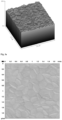
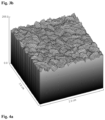
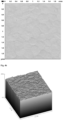
- topological images of the molded parts produced were also taken.
- the corresponding height profile was created from photographs of the molded parts using image processing software. To do this, the photo was converted into a 16-bit grayscale image and a representative area of 2 cm ⁇ 2 cm was selected. A 3D surface plot was created from this area with a maximum grit size of 1024 and a smoothing of 200 (top view) as well as a surface plot (height profile image) as a wireframe with a polygon multiplier of 100%.
- the manufacturing process breaks down with a molar reactive group ratio (OH:epoxy, each in mol) of 1:1.12 (outside the scope of the claim).
- OH:epoxy molar reactive group ratio
- the molecular weight build-up no longer takes place to a sufficient extent, so that the viscosities of the melt mixture and thus the pressures on the perforated plate are no longer sufficient for a homogeneous particle foam.
- the particles obtained have a more elongated shape and an inhomogeneity in shape and appearance (due to lower viscosity and thus changed flow properties) at higher foam densities (lower pressure drop) (Table 2).
- the particles can no longer be welded sufficiently well in the pressure range of 7 - 11 bar.
- the components have no closed surface and many sink marks/voids, which results in poorer thermal conductivity, increased stiffness, significantly reduced maximum bending strain and poorer puncture performance (Table 2 and Table 3).
- the particles produced were processed by a Teubert TVZ162/100PP molding machine (Teubert Maschinenbau GmbH, Germany) into components with a density of 200 ⁇ 10 kg/m 3 and a geometry of 300 ⁇ 200 ⁇ 15 mm 3.
- the pressure required for welding for the EPC from the concentration study for identifying the suitable material was in the range of 7 to 10 bar.
- the properties of the components were determined. Scanning electron microscopy measurements (SEM, model: JEOL JSM-6510, Borken, Germany) were carried out with graphite-sputtered samples to illustrate the morphology.
- DMA dynamic mechanical analysis
- Compression tests were carried out according to DIN EN ISO 844:2014-11 on a Zwick Z020 universal testing machine from Zwick & Roell (Ulm, Germany) on samples with a geometry of 15 ⁇ 15 ⁇ 15 mm 3 and a 10 kN load cell up to 60 % compression.
- a 3-point bending was carried out based on ISO 1209-1:2007-05 with the same universal testing machine at 10 mm/min and a load cell of 20 kN.
- the samples were skinned to eliminate the influence of the compact edge layer and the geometry was adjusted to 120 ⁇ 25 ⁇ 10 mm 3.
- the OH number of the polymers was determined by 1 H-NMR spectroscopy with dichloromethane as solvent at room temperature by evaluating the ratio of the integrals of the signals at 6.68 ppm (2 aromatic protons ortho to phenolic OH groups) and at 1.68 ppm (6 methyl protons of the bisphenol-A unit). ⁇ b>Tab.
- the starting material for further experiments should be aromatic polycarbonate which, based on the total weight of the aromatic polycarbonate, has a content of OH end groups of at least 350 ppm, determined by 1 H-NMR spectroscopy with dichloromethane as solvent at room temperature, and that such an amount of chain extender should be used that 0.64-1.10 mol of the reactive group of the chain extender is used per 1 mol of OH end groups of the polycarbonate.
- Plant setup A twin-screw extruder of type ZSK 26 MC (Coperion GmbH) with 44 D and a gas dosing station (Promix Solutions GmbH), a heat exchanger, followed by a melt pump (Maag-Germany GmbH) and an underwater granulation of type LPU (Maag-Germany GmbH) with perforated plate geometry: 2 holes with 2.4 mm hole diameter and 12.7 mm bracket length and with a knife speed of 4500 rpm (7-fold knife).
- Formulation 99.3 wt.% aromatic polycarbonate PC-1, 0.7 wt.% multifunctional chain extender CE-1, 1.3 wt.% CO2. Molar ratio of the reactive groups OH end groups of the polycarbonate: epoxy is 1 mol: 0.82 mol.
- the throughput was 20 kg/h at a set temperature in the extruder and in the heat exchanger of 285 °C.
- the extruder speed was 230 rpm.
- the melt pressure in the extruder was 64 bar.
- the melt temperature before the start-up switch was 290 °C.
- the temperature of the perforated plate was 330 °C at a melt pressure of 177 bar.
- the process water temperature was 92 °C at a water pressure of 2.5 bar.
- the residence time in the system was 400 s.
- Particles with a mean diameter of 2.4 - 2.6 mm, a particle density according to the buoyancy principle of 505 kg/m 3 , a mean cell diameter of 82 ⁇ m, an open cell content of 6%, a phase angle in the Van Gurp-Palmen plot of 72° and a quotient Q of 4.65 ⁇ 10 -4 (° ⁇ mol/g) were obtained.
- the particles were weldable at 4 bar in a "standard” hot steam diffusion welding process and, with a post-expansion of 47 vol.% (100%-(100 * density after welding/density before welding), resulted in a molded part with a component density of 270 kg/m 3 .
- the molded part has a compact, closed surface (error! Reference source could not be found.), could not be broken by hand and showed a bending strain at the force maximum of 6.4% in the bending test.
- the particles could not be welded at 4 bar in a "standard" hot steam diffusion welding process, showed no post-expansion and collapsed in the tool due to an insufficient molecular ratio of the reactive groups for a chemical build-up reaction at a residence time of 430 s.
- the resulting molded parts consisted of loosely pressed particles, had no compact closed surface (error! Reference source could not be found.) and broke due to their own weight (lowest possible load). For the bending test, a bending strain at the force maximum of 0% was specified for this material.
Landscapes
- Chemical & Material Sciences (AREA)
- Health & Medical Sciences (AREA)
- Chemical Kinetics & Catalysis (AREA)
- Medicinal Chemistry (AREA)
- Polymers & Plastics (AREA)
- Organic Chemistry (AREA)
- Engineering & Computer Science (AREA)
- Materials Engineering (AREA)
- General Chemical & Material Sciences (AREA)
- Polyesters Or Polycarbonates (AREA)
- Compositions Of Macromolecular Compounds (AREA)
Abstract
Description
- Die Erfindung betrifft nachexpandierbare Polycarbonat-Beads (einen Partikelschaum), einen Herstellungsprozess für diese Polycarbonat-Beads sowie aus den Polycarbonat-Beads erhältliche Formteile und ein entsprechendes Herstellungsverfahren.
- Partikelschäume, und hier insbesondere EPS, EPP und E-TPU, erlangen zunehmend an Bedeutung. Die heutige Technologie erlaubt es mittlerweile, Partikelschäume verlässlicher Qualität und aus diesen Partikelschäumen Bauteile mit vorteilhaften Eigenschaften herzustellen. Durch die geringere Schüttdichte gegenüber den "einfachen" Thermoplasten erschließen sich für die expandierten Materialien neue Anwendungsfelder bzw. herkömmliche Anwendungen lassen sich mit deutlichen Gewichtseinsparungen realisieren. Expandierte Thermoplasten sind somit insbesondere für Leichtbauanwendungen ein attraktives Material, sofern auch anwendungsspezifischen Eigenschaften hinreichend gut sind. Werkzeugentwicklungen in den letzten Jahren erlauben es, auch solche Bauteile herzustellen, deren Oberflächen eine solche Optik aufweisen, dass selbst Sichtteile aus expandierten Thermoplasten eine echte Alternative zu entsprechenden Spritzgussformteilen sind, während sie ein deutlich geringeres Gewicht aufweisen. Aufgrund des geringeren Materialverbrauchs sind die expandierten Materialien auch unter Nachhaltigkeitsgesichtspunkten attraktiv und können zudem aufgrund im Allgemeinen guter Wärmeisolationseigenschaften auch zu Energieeinsparungen beitragen, etwa bei der Verwendung als Wärmedämmmaterial oder als zusätzlichen Effekt bei der Verwendung als Dämmstoff zur Geräuschunterdrückung.
- Auch Partikelschäume aus Polycarbonat wurden bereits beschrieben. Partikelschäume aus technischen Thermoplasten sind beispielsweise für die Automobilindustrie wegen Eigenschaften wie einer hohen Temperaturbeständigkeit und guten Brandverhaltens von Interesse. EPC ist ein Partikelschaum für Hochtemperaturanwendungen, bei denen herkömmliche Polymerschäume wie EPP versagen.
DE 4100200 A1 beschreibt ein Verfahren zur Herstellung von Polycarbonatschaum aus Polycarbonat, bei welchem dem aromatischen Polycarbonat ein Umesterungskatalysator in Kombination mit aromatischen Polycarbonsäuren oder Wasser, ggf. zusammen mit aliphatischen Hydroxycarbonsäuren und/oder aliphatischen Alkoholen, zugesetzt wird. Es kommt dabei zu einem kontrollierten, partiellen Abbau des Polycarbonats unter Freisetzung von COz, was zum Verschäumen des restlichen Polycarbonats dient. Die in dem Dokument beschriebenen Polycarbonatschäume weisen Dichten um die 0,4 bis 0,8 g/cm3 auf. -
EP 2603549 A1 beschreibt Polyesterschäume und rechnet diesen auch explizit Polycarbonatschäume zu, die neben einer geringen Dichte eine gute Verarbeitbarkeit aufweisen. Zur Herstellung dieser Partikelschäume wird ein Ausgangspolymermaterial gewählt, bei dem Kristallinität, widergespiegelt durch die Schmelzenthalpie, Glasübergangstemperatur und Schmelztemperatur in einem bestimmten Bereich liegen. Das Verfahren zur Herstellung der Partikelschäume umfasst das Bereitstellen entsprechender Ausgangspolymerkomponenten in geschmolzenem Zustand, das Einmischen einer Treibmittelkomponente und ggf. von einem oder mehreren Additiven in die Schmelze, die Extrusion und das Granulieren der treibmittelhaltigen Schmelze unter Wasser unter erhöhtem Druck von 1 bis 20 bar.EP 2603549 A1 beschreibt auch die grundsätzliche Möglichkeit, zur Stabilisierung des Extrusionsvorganges durch Erhöhung des Molekulargewichts beispielsweise Kettenverlängerer zuzugeben, wobei keine konkrete Mengenangabe erfolgt. Auch werden dort keine weiteren Anforderungen an das eingesetzte Polymer gestellt. - Die Verarbeitung von Partikelschäumen, auch Polycarbonat-Beads, zu Formteilen kann über mehrere Verfahren, z.B. variotherm (thermisch durch Heizen) oder im etablierten Wasserheißdampf-Prozess, hier bevorzugt im Wasserheißdampf-Prozess, erfolgen. Beim Wasserheißdampf-Prozess wird im Wasserdampf-Formteilautomat die Partikeloberfläche unter Verwendung von Wasserdampf unter Druck, d.h. unter Erreichen hoher Temperaturen im Heißdampf durch hohen Druck, angeschmolzen oder erweicht, was zu einer Interdiffusion von Polymerketten zwischen verschiedenen Beads und resultierender Kohäsion der Beads führt. Für eine hohe Verschweißqualität zwischen den Polycarbonat-Beads sind für EPC bis jetzt Dampfdrücke von 7 bis 11 bar (165,0 - 184,1 °C), besonders bevorzugt 8 bis 10 bar (170,4 - 179,9 °C) notwendig. Eine gute Kohäsion zwischen den Partikeln und ein geringer Anteil an Makroporen/Zwickel, d.h. Hohlräumen zwischen Partikeln im Bauteil aufgrund schlechter Packung, sind notwendig für günstige mechanische Eigenschaften der resultierenden Formteile. Die homogene Formteilherstellung wird durch eine Überfüllung des Werkzeuges sichergestellt und ist auf simple Geometrien beschränkt. Eine Formung von komplexen 3D-Bauteilen aus Polycarbonat-Beads ist damit bis jetzt nicht möglich.
- Die bereits in der Praxis für EPP (expandiertes Polypropylen) oder EPS (expandiertes Polystyrol) eingesetzten Formteilautomaten lassen sich in drei Arbeitsbereiche einteilen: "Low-pressure" bis 2 bar, "Midpressure" 3 - 10 bar und "High-pressure" 11 - 20 bar. Die "Low-pressure" Formteilautomaten realisieren bei max. 2 bar Dampfdruck eine Temperatur von 120 °C und eignen sich nur zur Verschweißung von EPS. Bei Wasserdampf-Formteilautomaten korrelieren zum einen der Energieaufwand und damit auch die Betriebskosten mit dem Arbeitsdruckbereich, zum anderen gibt der Dampfdruck die Temperatur des Dampfes und somit die Verarbeitbarkeit des Polymers vor, sodass die Verschweiß-Dienstleister und ihre Formteilautomaten auf die Verarbeitung von EPP im Druckbereich von 3 - 6 bar, meistens 3 - 4 bar, spezialisiert sind.
- Aufgabe war es, nun auch Polycarbonat-Beads bereitzustellen, die mittels Wasserheißdampf bei mittleren Dampfdrücken im Bereich von 4 - 6 bar zu Formteilen guter Qualität verarbeitet werden können, insbesondere auch zu solchen Formteilen mit einer komplexen 3D-Formteil-Geometrie. Die Dampfdruckbestimmung im Werkzeug erfolgt bevorzugt durch Drucksensoren nach DIN 16086:2006-01.
- Überraschend wurde nun gefunden, dass Formteile, insbesondere auch 3D-Formteile, aus "Polycarbonat-Beads" (Polycarbonat-Partikelschäumen) bei mittleren Dampfdrücken von 4 bis 6 bar, insbesondere bei 4 bar (= absoluter Druck des Wasserdampfes), nur zugänglich sind, wenn ein optimales Verhältnis zwischen dem Molekulargewicht des in den Polycarbonat-Beads enthaltenen aromatischen Polycarbonats und einer verzweigten Polymertopologie durch die Temperatur und Verweilzeit-abhängige Reaktion mit einem Kettenverlängerer eingestellt wird und die Beads im entropischen nicht-Gleichgewichtszustand eingefroren werden, was durch "Abschrecken", ein abruptes Abkühlen, erfolgt. Es wird vermutet, dass die Polymerketten in den Beads, wie sie durch das erfindungsgemäße Verfahren erhalten werden, durch Scherung und Temperatur ausgerichtete, orientierte Polymerketten aufweisen, die in diesem Zustand eingefroren sind. Wenn wieder eine Energiezuführung, hier durch Heißdampf, erfolgt, kehren die Polymerketten zum entropisch günstigeren Zustand des Polymerknäuels mit zufälliger Orientierung der Ketten zurück.
- Erst durch die reaktive Partikel-Schaumextrusion bei hohen Schmelzetemperaturen T von T1 = (Tg + 110°C) bis T2 = (Tg + 170 °C) mit Tg = der Glasübergangstemperatur des aromatischem Polycarbonats, ermöglicht durch den Kettenverlängerer, und mutmaßlich durch eine Immobilisierung der verzweigten Polymertopologie an der Partikeloberfläche in einem gescherten, orientierten, entropischen Nicht-gleichgewichtszustand kann die Nachexpansion bewirkt werden. Die Nachexpansion der Partikel beim Verschweißen mittels Heißdampf wird durch Relaxation der entropisch-ungünstig immobilisierten Verzweigungen/Vernetzungen an der Partikel-Oberfläche der Polycarbonat-Beads ohne weitere Nachbehandlung, insbesondere auch ohne nachträgliche Gasbeladung ermöglicht. Unter einer "Partikel-Schaumextrusion" nach dem bisherigen Stand der Technik versteht der Fachmann einen vollständigen oder teilweisen Extrusionsprozess unter Zusatz von einem Treibgas mit abschließender Granulierung und Abkühlung zu expandierten Partikeln, im Falle von amorphen Thermoplasten bei Schmelzetemperaturen an der Düse von Tg + 10 °C bis Tg + 70 °C mit Tg = der Glasübergangstemperatur des Polymermaterials. Hierbei hat sich herausgestellt, dass sowohl der Gehalt an OH-Endgruppen des eingesetzten aromatischen Polycarbonats als auch das Mengenverhältnis aus den OH-Endgruppen und den reaktiven Gruppen des Ketternverlängerers, aber auch die Verweilzeit der reaktiven Mischung aus aromatischem Polycarbonat und Kettenverlängerer im Schmelzezustand eine wesentliche Rolle spielen.
- Gegenstand der Erfindung ist daher ein
Verfahren zur Herstellung von nachexpandierbaren geschäumten Polycarbonat-Beads mittels - a) kontinuierlicher Partikelschaumextrusion einer plastifizierten Mischung in einem Extrusionsprozess, wobei die Mischung die folgenden Komponenten enthält:
- i) aromatisches Polycarbonat, wobei das aromatische Polycarbonat, bezogen auf das Gesamtgewicht des aromatischen Polycarbonats, einen Gehalt an OH-Endgruppen von mindestens 350 ppm, bestimmt mittels 1H-NMR-Spektroskopie mit Dichlormethan als Lösungsmittel bei Raumtemperatur, aufweist, und
- ii) einen für OH-Gruppen geeigneten Kettenverlängerer,
wobei das aromatische Polycarbonat und der für OH-Gruppen geeignete Kettenverlängerer in einem solchen molaren Verhältnis eingesetzt sind, dass auf 1 mol OH-Endgruppen des Polycarbonats 0,64-1,10 mol der reaktiven Gruppe des Kettenverlängerers eingesetzt werden,
sowie - iii) ein physikalisches Treibmittel,
- bei einer Temperatur T der plastifizierten Mischung von T1 = (Tg + 110°C) bis T2 = (Tg + 170°C), wobei Tg die Glasübergangstemperatur des aromatischen Polycarbonats ist,
- wobei die Verweilzeit des aromatischen Polycarbonats und des für OH-Gruppen geeigneten Kettenverlängerers im Schmelzezustand mindestens 4 Minuten beträgt, und
- b) nachfolgender Unter-Wasser-Granulierung der Treibmittel-haltigen Schmelze bei Wassertemperaturen T3 = (Tg - 90°C) bis T4 = (Tg - 55°C) wobei Tg die Glasübergangstemperatur des aromatischen Polycarbonats ist, ohne Druckbeaufschlagung oder unter Druckbeaufschlagung des Wassers bis 3,5 bar.
- Durch die abschließende Granulierung werden geschäumte Polycarbonat-Beads erhalten, welche, nachdem Gelegenheit zum Gasaustausch war, treibmittelfrei sind. Als finales Produkt des vorbeschriebenen Verfahrens erhält man somit treibmittelfreie, geschäumte Polycarbonat-Beads. Der Verlust des im Moment der Granulierung noch enthaltenen, verbliebenen Treibmittels erfolgt ohne weiteres Zutun bereits bei einfacher Lagerung der Beads nach dem Prozess, wobei üblicherweise weniger als eine Stunde ausreichend ist, damit die Beads schließlich treibmittelfrei sind, es also zu einem vollständigen Gasaustausch gekommen ist. Es ist aber ebenso möglich, die Beads kontrolliert unter erhöhte Temperatur zu bringen, um das Treibmittel noch rascher zu entfernen. Auch eine Lagerung über mehrere Tage bei einer hohen Temperatur von 120°C wirkt sich nicht negativ auf die spätere Nachexpandierbarkeit beim Heißdampfdiffusionsschweißen aus.
- Der Gehalt an OH-Endgruppen wird mittels 1H-NMR-Spektroskopie mit Dichlormethan als Lösungsmittel bei Raumtemperatur unter Auswertung des Verhältnisses der Integrale der Signale bei 6,68 ppm (zwei aromatische Protonen ortho-ständig zu phenolischen OH-Gruppen) und bei 1,68 ppm (sechs Methylprotonen der Bisphenol-A Einheit) ermittelt.
- Die Glasübergangstemperatur wird bestimmt nach DIN EN ISO 11357-1:2017.
- "Plastifizierte Mischung" bedeutet, dass eine Polymerschmelze vorliegt, deren Bestandteile homogen verteilt sind. Die Polymerschmelze kann z.B. direkt als frisch polymerisiertes Material dem Polymerisationsreaktor entnommen oder von diesem direkt in einen Mischextruder, in dem letztlich Kettenverlängerer, Treibmittel und ggf. Additive an verschiedenen Stellen geführt werden, geleitet werden. Der genannte Temperaturbereich für die plastifizierte Mischung meint den Temperaturbereich, in dem die Schmelze ab Plastifizierung bis zum Austritt an der Düse vorliegt. Es versteht sich, dass es im Rahmen der Erfindung liegt, wenn beispielsweise in Eingangszonen des Extruders eine geringere Temperatur vorliegt. Ebenso weicht es nicht vom allgemeinen Erfindungsgedanken ab, wenn irgendwo im Extruder auch eine oder mehrere Zonen höherer Temperatur vorhanden sind, solange die Temperatur der letzten Zonen bei der Partikelschaumextrusion im genannten Bereich liegt. Bevorzugt aber findet eine Partikelschaumextrusion nur in Zonen im vorgegebenen Temperaturbereich statt.
- Soweit nicht ausdrücklich anders beschrieben, sind alle ppm-Mengen in der vorliegenden Erfindung als Gewichtsanteile zu verstehen.
- "Bis" und "bis zu" bedeutet erfindungsgemäß, dass der genannte Bereich den jeweiligen Grenzwert einschließt.
- Sowohl für die Menge der OH-Endgruppen als auch für die Konzentration an Kettenverlängerer gibt es einen Mindestwert, aber auch eine Höchstkonzentration für eine Schaumextrusion bei hohen Schmelzetemperaturen T im Extruder und an der Düse (= formgebende Auslassöffnung) von T1 = (Tg + 110 °C) bis T2 = (Tg + 170 °C), bevorzugt T von T1 = (Tg + 120 °C) bis T2 = (Tg + 160 °C), besonders bevorzugt im Bereich von T1 = (Tg + 130 °C) bis T2 = (Tg + 150 °C) zur Partikelschaumherstellung, um dabei Beads für Polycarbonatformteile mit guter Mechanik im Dichtebereich von 200 bis 350 kg/m3, bestimmt anhand Auftriebsprinzip nach DIN EN ISO 845:2009-10, zu erhalten.
- Die Zahl an OH-Gruppen des aromatischen Polycarbonats hat einen wesentlichen Einfluss darauf, ob Beads mit einer geringen Dichte und guter Mechanik der resultierenden Formteile erhalten werden können. Zu viele OH-Gruppen im Polycarbonat bedeuten eine zu hohe Reaktivität des Polycarbonats, was letztlich zu Umlagerungsreaktionen der Polycarbonatkette, einem Molekulargewichtsabbau aufgrund des zu schnellen Verzweigungsaufbaus mit damit verbundener zu rascher Viskositätserhöhung (zu hoher Schereintrag) und zu Vergilbung führt. Zu wenig OH-Gruppen im Polycarbonat führen jedoch dazu, dass die Reaktion mit dem Kettenverlängerer nicht ausreichend ist oder gar nicht erst abläuft. Dieses bedeutet jedoch ebenfalls, dass kein guter Partikelschaum mit ausreichender Mechanik erhalten wird. Vielmehr weist der Partikelschaum dann eine Vielzahl defekter, kollabierter Zellen auf.
- Der OH-Endgruppengehalt des im erfindungsgemäßen Verfahren eingesetzten aromatischen Polycarbonats beträgt erfindungsgemäß mindestens 350 ppm, bevorzugt 350 ppm bis 600 ppm, weiter bevorzugt 380 ppm bis 580 ppm, besonders bevorzugt 400 ppm bis 550 ppm, ganz besonders bevorzugt 450 bis 550 ppm, bezogen auf das Gesamtgewicht an eingesetztem aromatischem Polycarbonat. Bezugsgröße ist hierbei das reine aromatische Polycarbonat, nicht die auf aromatischem Polycarbonat basierende Zusammensetzung. Um einen solchen Endgruppengehalt zu erreichen, werden bevorzugt mehr als 70 Gew.-% SPC, bezogen auf das Gesamtgewicht des eingesetzten aromatischen Polycarbonats, eingesetzt, weiter bevorzugt mindestens 80 Gew.-% SPC, bezogen auf das Gesamtgewicht des eingesetzten aromatischen Polycarbonats, ganz besonders bevorzugt wird ausschließlich SPC als aromatisches Polycarbonat für die Herstellung der Polycarbonat-Beads eingesetzt.
- Auch die Konzentration des Kettenverlängerers ist wesentlich. Zu viel Kettenverlängerer führt aufgrund resultierender zu hoher Viskositäten bedingt durch zu starken Molekulargewichtsaufbau des Polycarbonats zu einer Nicht-Verarbeitbarkeit des Materials. Zu wenig Kettenverlängerer bewirkt keinen signifikanten Molekulargewichtsaufbau und somit einen nur unzureichenden Druckaufbau (Viskosität von PC ohne/mit unzureichend CE bei 300 °C ist zu niedrig) und letztlich eine schlechtere Mechanik der finalen Formteile, wobei die Reaktion des Kettenverlängerers mit dem Polycarbonat eine Funktion von Zeit und Temperatur ist. Der Schaumextrusionsprozess bei Bisphenol-A basiertem Homopolycarbonat erfolgt beispielsweise bevorzugt bei einer Gehäusetemperatur von TGehäuse von T1Gehäuse = Tg + 100 °C bis T2Gehäuse = Tg + 150 °C und einer Schmelzetemperatur T von ca. Tg + (110 bis 170 °C) nach Treibmitteleinmischung und -lösung. Eine Partikelschaumherstellung ohne Kühlung resultiert in kollabierten Partikeln mit hoher Dichte. Je nach Prozessführung führen die Stabilisierung und das Erstarren der Schaumstruktur über Kühlung dazu, dass die Schaumexpansion zu schnell unterbunden ist. Die hohen Temperaturen im Prozess ermöglichen, das vollständige Schäumpotential der Rezeptur unter Kühlung auszunutzen, indem das zu schnelle Abkühlen/ Erstarren kompensiert wird. Bei diesen Temperaturprofilen beträgt aber der Druck an der Lochplatte ohne Kettenverlängerer 80 - 90 bar. Der Einsatz von Kettenverlängerern erhöht den Druck an der Lochplatte auf 140 - 180 bar, bevorzugt 150 - 160 bar. Ohne entsprechende Kettenverlängerung und damit ohne die zusätzliche Viskositätserhöhung ist die Partikelschaumherstellung bei diesen Prozessbedingungen (Temperaturen) nicht möglich.
- Damit Polycarbonat-Beads mit guten Eigenschaften resultieren, hat es sich als erfindungswesentlich herausgestellt, dass ein molares Verhältnis (bei einem kontinuierlichen Verfahren erfolgt eine durchsatzbezogene Zudosierung) von 1 mol OH-Endgruppen des Polycarbonats zu 0,64 - 1,10 mol, bevorzugt 0,71 bis 1,0 mol, weiter bevorzugt bis 0,96 mol, noch weiter bevorzugt 0,8 bis 0,9 mol, insbesondere 0,82 bis 0,90 mol der reaktiven Gruppe des Kettenverlängerers eingesetzt wird.
- Vorzugsweise, sofern der Gehalt des aromatischen Polycarbonats an OH-Endgruppen 400 bis 550 ppm, bestimmt mittels 1H-NMR-Spektroskopie mit Dichlormethan als Lösungsmittel bei Raumtemperatur, beträgt, werden auf 1 mol OH-Endgruppen des Polycarbonats 0,71 bis 0,96 mol der reaktiven Gruppe des Kettenverlängerers eingesetzt.
- Es versteht sich, dass die anspruchsgemäßen Vorgaben hinsichtlich des Verhältnisses der Stoffmengen an OH-Endgruppen des Polycarbonats und der reaktiven Gruppe des Kettenverlängerers der Verfahrensführung entsprechend einzustellen ist. Bei einem kontinuierlichen Verfahren erfolgt zweckmäßigerweise eine Durchsatz-bezogene Konzentrationseinstellung (Relation mol/h : mol/h).
- Durch den Einsatz eines Kettenverlängerers kommt es zu einem Molmassenaufbau des Polycarbonats hin zu einem Bereich von 40.000 bis 230.000 g/mol, bevorzugt 50.000 bis 160.000 g/mol, womit ein zusätzlicher Druckaufbau an der Lochplatte von etwa 60 bis 100 bar bei den Temperaturen, in dem Polycarbonat in plastifiziertem Zustand vorliegt, verbunden ist. Als Kettenverlängerer sind grundsätzlich Amine, Carboxylverbindungen, Maleinsäureanhydrid-modifizierte Verbindungen, epoxyfunktionalisierte Verbindungen, Oxazoline, Carbodiimide und/oder funktionalisierte Polymere, etwa auf Acrylat- und/oder Styrolbasis, geeignet, die entsprechende funktionelle Gruppe aufweisen. Derartige Verbindungen können alleine oder im Gemisch eingesetzt werden. Solche Gruppen sind beispielsweise Aminfunktionen bei den Aminen, Carboxylfunktionen bei den Carboxyverbindungen, Anhydridfunktionen bei Maleinsäureanhydrid-modifizierten Verbindungen, Epoxyfunktionen bei epoxyfunktionalisierten Verbindungen oder auch sonstige Funktionen, die mit den OH-Endgruppen des Polycarbonats so reagieren können, dass ein Kettenaufbau erfolgt. Bevorzugt sind als Kettenverlängerer insbesondere epoxyfunktionalisierte Verbindungen, äußerst bevorzugt epoxyfunktionalisierte Styrol-Acryl basierte Polymere, welche z.B. von der BASF SE als Joncryl - Additive, z.B. Joncryl ADR 4368, ADR 4400, ADR 4468 angeboten werden. Die Menge / Einwaage an Kettenverlängerer muss dem aromatischen Polycarbonat angepasst werden, sodass auf 1 mol OH-Endgruppen des Polycarbonats 0,64 bis 1,10 mol, bevorzugt 0,71 bis 1,0 mol, weiter bevorzugt bis 0,96 mol, noch weiter bevorzugt 0,8 bis 0,9 mol, insbesondere 0,82 bis 0,90 mol der reaktiven Gruppe des Kettenverlängerers eingesetzt werden. Ausgehend beispielsweise von einem aromatischen Polycarbonat mit 350 - 600 ppm OH-Endgruppen, umgesetzt mit einem Kettenverlängerer mit einem Epoxy-Äquivalentgewicht von 310 g/mol, z.B. mit Joncryl ADR 4468, in Konzentrationen von 0,4 - 1,2 Gew.-%, bevorzugt 0,5 - 1,0 Gew.-%, besonders bevorzugt in Konzentrationen von 0,7 - 0,9 Gew.-%, wobei die Menge an Kettenverlängerer auf die resultierende Gesamtzusammensetzung (auf aromatischem Polycarbonat basierende Zusammensetzung, d.h. inkl. ggf. Blendpartner und ggf. Additive, plus Kettenverlängerer) bezogen wird, können die Bereiche der Reaktivgruppenverhältnisse erreicht werden. Durch gezieltes Einstellen des molaren Verhältnisses von 1 mol zu 0,64 bis 1,10 mol werden Molekulargewichtsbereiche von 50.000 bis 160.000 g/mol, bevorzugt bis 155.000 g/mol, bestimmt wie beschrieben, erzielt.
- Das erfindungsgemäße Verfahren kann ein einstufiges, ein zweistufiges oder auch ein mehr als zweistufiges Extrusionsverfahren sein. Dabei kann die Aufbaureaktion mit einer ausreichenden Verweilzeit durch mehrere Extrusionsschritte realisiert werden. Die Verweilzeit bei mehreren Schritten umfasst die kumulative Zeitspanne, d.h. die gesamte Zeitspanne des Polymer-Kettenverlängerer-Gemisches im Schmelzezustand, in welchem eine Aufbaureaktion stattfinden kann, bis zum Austragen.
- Sofern das Verfahren ein zweistufiges ist, erfolgt im ersten Extrusionsschritt der Molekulargewichtsaufbau des Polymers in Anwesenheit des Kettenverlängerers, wobei ein Polycarbonat-Granulat als erstes Produkt erhalten wird. Im zweiten Extrusionsschritt erfolgt das Aufschäumen mit dem physikalischen Treibmittel, vorzugsweise Kohlenstoffdioxid, wobei das Ergebnis der sich anschließenden Unterwassergranulation schließlich die erfindungsgemäßen Polycarbonat-Beads sind.
- Erfindungsgemäß ist eine Mindestverweilzeit von 4 min vorgesehen. Eine Obergrenze ergibt sich je nach Anlagensetup durch die maximal verarbeitbare Viskosität. Die Aufbaureaktion, welche eine Funktion von Temperatur und Zeit ist, hat ein Maximum. Theoretisch kann die Mischung zum kompletten Abreagieren gebracht werden. Damit ist die Viskosität entsprechend hoch. An diesem Punkt kann es sein, dass Anlagen wegen einer zu hohen Viskosität stehenbleiben oder aber weiter arbeiten und dadurch die Polymerketten mechanisch wieder zerstören. Eine Verweilzeit bis 15 min, bevorzugt bis 420 s ist üblicherweise ohne Schwierigkeiten händelbar.
- Die Extrusion der Schmelze an der Austrittsöffnung des Extruders durch eine Düsenplatte erfolgt nach Treibmitteleinmischung und -lösung in der Regel mit einer Temperatur der Schmelze T von T1 = (Tg + 110 °C) bis T2 = (Tg + 170 °C), bevorzugt von T1 = (Tg + 120 °C) bis T2 = (Tg + 160 °C), besonders bevorzugt im Bereich von T1 = (Tg + 130 °C) bis T2 = (Tg + 150 °C). Dabei wird die Temperatur der Düsenplatte zudem bevorzugt auf eine Temperatur von Tg + (130 bis 150 °C) eingestellt, um ein Einfrieren der Düse durch abkühlende Polymerschmelze zu verhindern und somit die fließende Polymergranulierung sicherzustellen, sowie eine entsprechende Schaumexpansion mit möglichst hohem Expansionspotential zu erreichen.
- Der Durchmesser der Düsenöffnung für eine Einzelloch-Düse liegt vorzugsweise im Bereich von 0,8 bis 3 mm, bevorzugt 1,0 bis 2,4 mm. Für Multi-Loch-Düsen sind Düsendurchmesser von 0,4 bis 0,8 mm bevorzugt, besonders bevorzugt von 0,6 mm.
- Das Granulieren erfolgt durch eine Lochplatte an einer Austrittsöffnung des Extruders, indem das Material extrudiert und dann abgelängt wird. Das Ablängen geschieht durch eine Schneidvorrichtung, welche üblicherweise dem Formwerkzeug, durch welches das Material extrudiert wird, unmittelbar nachgeschaltet ist.
- Die Granulierung der Schmelze zum Abschluss des erfindungsgemäßen Verfahrens erfolgt durch Unterwassergranulation bei einem Druck im Wasserkreislauf, der bei dem erfindungsgemäßen Verfahren 0 bis 3,5 bar, bevorzugt 1 bis 2 bar beträgt, d.h. die Unter-Wasser-Granulierung wird ohne zusätzliche Druckbeaufschlagung des Wassers oder unter Druckbeaufschlagung von bis zu 3,5 bar vorgenommen. Mit dem Austritt der Schmelze aus der Düse erfährt das Polycarbonat-Material einen Druckabfall von 140 bis 180 bar, bevorzugt von 150 - 160 bar, jedoch nicht bis zur vollständigen Entlastung bei Atmosphärendruck, sondern auf den eingestellten Druck im Wasserkreislaufbis zu 3,5 bar. Das Material schäumt auf, jedoch nicht so weit, wie es aufgrund der vorhandenen Treibmittelmenge eigentlich zu erwarten wäre, sondern es wird stattdessen in einem entropischen nicht-Gleichgewichtszustand abgeschreckt, der die spätere Nachexpansion der Beads bedingt. Das physikalische Treibmittel, beispielsweise Kohlenstoffdioxid, bläht das Polycarbonat-Material auf, während das Gas aus der Polymerschmelze ausdiffundiert. Nach einer gewissen Zeit hat ein vollständiger oder nahezu vollständiger Gasaustausch stattgefunden, so dass in dem dann granulierten, expandierten Polycarbonat, den Polycarbonat-Beads, nur noch die normale Luftzusammensetzung zu finden ist. Die Polycarbonat-Beads sind damit "Treibmittel-frei".
- Zur Durchführung der reaktiven Partikel-Schaumextrusion können folgende Aufbau-Anordnungen mit einer ausreichenden Verweilzeit zum Einsatz kommen, ohne darauf beschränkt zu sein:
- a) Polymerisationsreaktor/ (statischer) Extruder/ Mischer/ Gasdosierung/ Schmelzepumpe/ Granulator
- b) Extruder (Doppel/Einschnecke)/ Gasdosierung/ Granulator
- c) Extruder (Doppel/Einschnecke)/ Gasdosierung/ Statische Mischer/ Granulator
- d) Extruder (Doppel/Einschnecke)/ Gasdosierung/ Wärmetauscher/ Granulator
- e) Extruder (Doppel/Einschnecke)/ Gasdosierung/ Statische Mischer/ Wärmetauscher/ Granulator
- f) Doppelschneckenextruder/ Gasdosierung/ Einschneckenextruder/ Granulator
- g) Doppelschneckenextruder/ Gasdosierung/ Einschneckenextruder/ Schmelzepumpe/ Granulator
- h) Doppelschneckenextruder/ Gasdosierung/ Schmelzepumpe/ Wärmetauscher/ Schmelzepumpe/ Granulator.
- i) Doppelschneckenextruder/ Gasdosierung/ Wärmetauscher/ Schmelzepumpe/ Granulator.
- Der Extrusionsprozess kann ein- oder mehrstufig durchgeführt werden.
- Im Detail kann der Prozess in verschiedenen Anordnungen realisiert werden. Wichtige Schritte des Prozesses sind: Aufschmelzen der auf aromatischem Polycarbonat basierenden Zusammensetzung, ggf. Zusatz von Nukleierungsmitteln (Talk, insbesondere Nano-Talkum, Graphit, Ruß, Pigmente und etc.), Zudosierung des Treibmittels über Flüssigdosierungen (z.B. der Firma Lewa GmbH aus Deutschland) oder Verdichtungsaggregate (Hochdruckaggregate) (z.B. der Firma Maximator GmbH aus Deutschland), ggf. Druckaufbau bis zur Lochplatte über z.B. Kühlung, geeignete Lochplattengeometrie, Zugabe von reaktiven Makromonomeren oder über technische Hilfsmittel wie Breaker-Plates oder Schmelzepumpen (bevorzugt wird der Druckaufbau durch Zugabe von reaktiven Makromonomeren oder über Nutzung von technischen Hilfsmittel erreicht), und zuletzt die Abschlagung des Granulats/Beads über eine Granulierung in flüssigem Medium, Heißabschlag oder eine Unter-Gas-Granulierung, wobei auch Gasmischungen eingesetzt werden können. Zu beachten ist, dass hierbei als flüssiges Medium nicht nur das Medium Wasser eingesetzt werden kann, sondern auch ein alternatives Medium wie Glycerin oder Glycerol.
- Besonders bevorzugt wird zur Durchführung des erfindungsgemäßen Verfahrens ein Aufbau aus einer Doppelschnecke, einer Gasdosierung, einer Schmelzepumpe, einem Wärmetauscher, einer zweiten Schmelzepumpe und einer Unter-Wasser-Granulierung verwendet. Dabei wird weiter bevorzugt die Doppelschnecke zur Plastifizierung der auf aromatischem Polycarbonat basierenden Zusammensetzung und zur Einmischung des physikalischen Treibmittels sowie des Kettenverlängerers verwendet und der Wärmetauscher für die Verweilzeit und Aufbaureaktion.
- Die Zudosierung des physikalischen Treibmittels zu der Schmelze, enthaltend das aromatische Polycarbonat und den währendes des Gesamtprozesses reagierenden Kettenverlängerer, erfolgt besonders bevorzugt im letzten Drittel der ersten Extrusionseinheit (je nach Aufbau). Die Durchmischung erfolgt dabei vorzugsweise so, dass die Polymerschmelze das Treibmittel schließlich in homogener Verteilung gelöst enthält, wobei der Anteil des physikalischen Treibmittels in der Mischung für COz bevorzugt 1,0 bis 2,3 Gew.-%, weiter bevorzugt 1,2 bis 1,7 Gew.-%, besonders bevorzugt 1,3 - 1,5 Gew.-%, für N2 bevorzugt 0,1 bis 0,5 Gew.-%, weiter bevorzugt 0,1 bis 0,3 Gew.-%, besonders bevorzugt 0,15 bis 0,25 Gew.-% und ganz besonders bevorzugt 0,15 bis 0,2 Gew.-%, bezogen auf das Gesamtgewicht an Polymerschmelze (= Polycarbonat-basierte Zusammensetzung) mit Kettenverlängerer, beträgt.
- Bevorzugt werden zur Initiierung der Schaumzellbildung für eine feinere und homogenere Zellmorphologie Nukleierungsmittel wie Talk, insbesondere Nano-Talkum, Graphit, Ruß, Pigmente und etc. in geringen Konzentrationen von 0,1 bis 1,0 Gew.-%, weiter bevorzugt 0,15 bis 0,5 Gew.-%, besonders bevorzugt in Konzentrationen von 0,2 bis 0,3 Gew.-% zugesetzt, wobei sich die Mengenangaben auf die resultierende Gesamtzusammensetzung aus Polycarbonat-basierter Zusammensetzung und Kettenverlängerer beziehen.
- Als physikalisches Treibmittel können grundsätzlich alle für die Schäumung von Thermoplasten gebräuchlichen Treibmittel verwendet werden. Beispiele sind hier Propan, Butan, n-Pentan, iso-Pentan, aber auch ähnliche aliphatische Kohlenwasserstoffe, auch aromatische Kohlenwasserstoffe, alizyklische Kohlenwasserstoffe, aliphatische Alkohole, Kohlenstoffdioxid, Stickstoff, Druckluft, Inertgase wie Argon oder Helium, und weitere. "Luft" unter Atmosphärendruck gilt nicht als Treibmittel im Sinne der vorliegenden Erfindung. "Druckluft" wird erfindungsgemäß verstanden als Luft, die einen höheren Druck als Atmosphärendruck aufweist. Es können auch Kombinationen aus zwei oder mehr dieser Treibmittel als physikalisches Treibmittel eingesetzt werden. Bevorzugt werden Kohlenstoffdioxid, ein oder mehrere Inertgase, Stickstoff, Luft oder deren Mischungen als physikalische Treibmittel eingesetzt, da diese nicht nur toxikologisch und ökologisch unbedenklich sind, sondern auch nicht brandfördernd wirken. Ganz besonders bevorzugt ist Stickstoff, Kohlenstoffdioxid oder ein Gemisch aus diesen, äußerst bevorzugt Kohlenstoffdioxid.
- Sofern Stickstoff als physikalisches Treibmittel eingesetzt wird, werden bevorzugt 0,1 bis 0,5 Gew.-%, weiter bevorzugt 0,1 bis 0,3 Gew.-%, besonders bevorzugt 0,15 bis 0,25 Gew.-% und ganz besonders bevorzugt 0,15 bis 0,2 Gew.-% Stickstoff, bezogen auf die Polymerschmelze inklusive Kettenverlängerer und Additive (d.h. Polycarbonat-basierte Zusammensetzung plus Kettenverlängerer), eingesetzt.
- Sofern Kohlenstoffdioxid als physikalisches Treibmittel eingesetzt wird, werden bevorzugt 1,0 bis 2,3 Gew.-%, weiter bevorzugt 1,2 bis 1,7 Gew.-%, besonders bevorzugt 1,3 - 1,5 Gew.-% Kohlenstoffdioxid, bezogen auf die Polymerschmelze inklusive Kettenverlängerer und Additive, eingesetzt.
- Durch das erfindungsgemäße Verfahren lassen sich nachexpandierbare Polycarbonat-Beads erhalten, die aber gegenüber herkömmlichen nachexpandierbaren Beads treibmittelfrei sind. Unter einem "Bead" werden erfindungsgemäß geschäumte Granulatkörner (= Partikelschaum) verstanden, die üblicherweise eine Höchstdichte von maximal 50% des ungeschäumten Ausgangsmaterials (der auf aromatischem Polycarbonat basierenden Zusammensetzung) aufweisen. Die Anwendung von partikelverschäumtem Polycarbonat ermöglicht es, aufgrund des geringen Gewichts und der schlagzähen Eigenschaften des Materials, verbunden mit höheren Dauergebrauchstemperaturen (Beständigkeit bspw. im KTL-Lackierprozess) im Vergleich zu PP, ABS, PE oder PA6, das Gewicht einiger Fahrzeugkomponenten signifikant zu reduzieren sowie den Kraftstoffverbrauch und die CO2-Emissionen zu senken, während die mechanischen Eigenschaften auch bei höherer Temperatur erhalten bleiben. Darüber hinaus ist zu erwarten, dass die Verfügbarkeit von verschäumtem Polycarbonat eine ganze Reihe weiterer Anwendungsbereiche zu erschließen vermag, vor allem überall dort, wo Isolationsaufgaben bei höheren Temperaturen gefragt sind.
- Gegenstand der Erfindung sind außerdem nachexpandierbare Polycarbonat-Beads, hergestellt nach dem erfindungsgemäßen Verfahren. Gegenstand der Erfindung sind somit treibmittelfreie, geschäumte Polycarbonat-Beads mit einem gewichtsmittleren Molekulargewicht Mw des Polycarbonats, bestimmt mittels GPC-Messung in Dichlormethan, kalibriert gegen Bisphenol A-Polycarbonat-Standards, von 50.000 bis 160.000 g/mol, dadurch gekennzeichnet, dass die treibmittelfreien, geschäumten Polycarbonat-Beads nachexpandierbar sind und bei einer Verschweißung bei 4 bar in Wasserdampf-basierten Prozess ohne Vorbehandlung der Beads eine Nachexpansion von 20 bis 60 Vol.-% zeigen und wobei für die geschäumten Polycarbonat-Beads gilt:

δ = dem Phasenwinkel im Van-Gurp-Palmen-Plot, bestimmt bei einem komplexen Schubmodul |G∗| = 3000 Pa und einer Temperatur von 240°C, wobei δ < 78,0°, und Mw wie vorstehend beschrieben. - Gegenstand der Erfindung sind außerdem ein Verfahren zur Herstellung von Formteilen, insbesondere von solchen mit komplexer 3D-Geometrie, aus den erfindungsgemäßen Polycarbonat-Beads, sowie entsprechende Formteile.
- Das in den erfindungsgemäßen, treibmittelfreien geschäumten Polycarbonat-Beads enthaltene aromatische Polycarbonat weist ein gewichtsmittleres Molekulargewicht, bestimmt mittels GPC in Dichlormethan, kalibriert gegen Bisphenol A-Polycarbonat-Standards von 50.000 bis 160.000 g/mol auf. Das aromatische Polycarbonat ist die Hauptkomponente des thermoplastischen Materials, aus dem die erfindungsgemäßen Polycarbonat-Beads, wie sie durch das erfindungsgemäße Verfahren erhalten werden, bestehen.
- Das Ausgangsmaterial für die Herstellung der erfindungsgemäßen Beads in dem erfindungsgemäßen Verfahren ist aromatisches Polycarbonat, vorzugsweise in Form einer auf aromatischem Polycarbonat basierenden Zusammensetzung. "In Form einer auf aromatischem Polycarbonat basierenden Zusammensetzung" bedeutet erfindungsgemäß nicht, dass bereits eine fertig compoundierte Zusammensetzung dem Extruder, in dem die Partikelschaumextrusion durchgeführt wird, zuzuführen ist. Dieses kann so erfolgen, aber es können auch die verschiedenen Bestandteile der auf aromatischem Polycarbonat basierenden Zusammensetzung dem Extruder über einzelne Dosierelemente zugeführt werden. "Auf aromatischem Polycarbonat basierende Zusammensetzung" soll lediglich bedeuten, dass das Material, aus dem die Polycarbonat-Beads bestehen, eine beliebig ausgefeilte Zusammensetzung mit ggf. entsprechender Additivierung des Polycarbonats sein kann.
- Unter "aromatischem Polycarbonat" im erfindungsgemäßen Sinne werden sowohl aromatische Homopolycarbonate als auch aromatische Copolycarbonate verstanden. Dabei können die Polycarbonate in bekannter Weise linear oder verzweigt sein.
- Die Herstellung der Polycarbonate, die in den Zusammensetzungen enthalten sind, erfolgt in bekannter Weise aus Dihydroxyarylverbindungen, Kohlensäurederivaten, gegebenenfalls Kettenabbrechern und Verzweigern.
- Einzelheiten der Herstellung von Polycarbonaten sind in vielen Patentschriften seit etwa 40 Jahren niedergelegt. Beispielhaft sei hier auf Schnell, "Chemistry and Physics of Polycarbonates", Polymer Reviews, Volume 9, Interscience Publishers, New York, London, Sydney 1964, auf D. Freitag, U. Grigo, P.R. Müller, H. Nouvertné, BAYER AG, "Polycarbonates" in Encyclopedia of Polymer Science and Engineering, Volume 11, Second Edition, 1988, Seiten 648-718 und schließlich auf U. Grigo, K. Kirchner und P.R. Müller "Polycarbonate" in Becker/Braun, Kunststoff-Handbuch, Band 3/1, Polycarbonate, Polyacetale, Polyester, Celluloseester, Carl Hanser Verlag München, Wien 1992, Seiten 117 bis 299 verwiesen.
- Die Herstellung aromatischer Polycarbonate erfolgt z.B. durch Umsetzung von Dihydroxyarylverbindungen mit Kohlensäurehalogeniden, vorzugsweise Phosgen, und/oder mit aromatischen Dicaibonsäuredihalogeniden, vorzugsweise Benzoldicarbonsäuredihalogeniden, nach dem Phasengrenzflächenverfahren, gegebenenfalls unter Verwendung von Kettenabbrechern und gegebenenfalls unter Verwendung von trifunktionellen oder mehr als trifunktionellen Verzweigern. Ebenso ist eine Herstellung über ein Schmelzepolymerisationsverfahren durch Umsetzung von Dihydroxyarylverbindungen mit beispielsweise Diphenylcarbonat möglich. Erfindungsgemäß bevorzugt wird Polycarbonat eingesetzt, dass nach dem Schmelzepolymerisationsverfahren, auch "Umesterungsverfahren" genannt, hergestellt wurde. Erfindungsgemäß eingesetztes Polycarbonat weist 350 bis 600 ppm OH-Endgruppen auf, wobei sich diese Angabe auf das Polycarbonat als solches, auf das Polymer selbst, ohne ggf. zugesetzte Additive, bezieht. Die Menge der OH-Endgruppen bezieht sich auf das gesamt eingesetzte Polycarbonat. Es kann auch eine Mischung aus Polycarbonat, das mittels Schmelzepolymerisation erhalten wurde, und solchem, das mittels Grenzflächenverfahren erhalten wurde, eingesetzt werden, solange sich die Konzentration der OH-Endgruppen des eingesetzten Polycarbonats insgesamt im angegebenen Bereich bewegt. Besonders bevorzugt wird aber nur Polycarbonat, das mittels Schmelzepolymerisationsverfahren hergestellt wurde, eingesetzt.
- Für die Herstellung der Polycarbonate geeignete Dihydroxyarylverbindungen sind beispielsweise Hydrochinon, Resorcin, Dihydroxydiphenyle, Bis-(hydroxyphenyl)-alkane, Bis-(hydroxyphenyl)-cycloalkane, Bis-(hydroxyphenyl)-sulfide, Bis-(hydroxyphenyl)-ether, Bis-(hydroxyphenyl)-ketone, Bis-(hydroxyphenyl)-sulfone, Bis-(hydroxyphenyl)-sulfoxide, α-α'-Bis-(hydroxyphenyl)-diisopropylbenzole, Phthalimidine, abgeleitet von Isatin- oder Phenolphthaleinderivaten, sowie deren kernalkylierte, kernarylierte und kernhalogenierte Verbindungen.
- Bevorzugte Dihydroxyarylverbindungen sind 4,4'-Dihydroxydiphenyl, 2,2-Bis-(4-hydroxyphenyl)-propan (Bisphenol A), 2,4-Bis-(4-hydroxyphenyl)-2-methylbutan, 1,1-Bis-(4-hydroxyphenyl)-p-diisopropylben-zol, 2,2-Bis-(3-methyl-4-hydroxyphenyl)-propan, Dimethyl-Bisphenol A, Bis-(3,5-dimethyl-4-hydroxyphenyl)-methan, 2,2-Bis-(3,5-dimethyl-4-hydroxyphenyl)-propan, Bis-(3,5-dimethyl-4-hydroxyphenyl)-sulfon, 2,4-Bis-(3,5-dimethyl-4-hydroxyphenyl)-2-methylbutan, 1,1-Bis-(3,5-dimethyl-4-hydroxyphenyl)-p-diisopropylbenzol und 1,1-Bis-(4-hydroxyphenyl)-3,3,5-trimethylcyclohexan, sowie die Bisphenole (I) bis (III)

- Besonders bevorzugte Bisphenole sind 2,2-Bis-(4-hydroxyphenyl)-propan (Bisphenol A), 2,2-Bis-(3,5-dimethyl-4-hydroxyphenyl)-propan, 1,1-Bis-(4-hydroxyphenyl)-cyclohexan, 1,1-Bis-(4-hydroxyphenyl)-3,3,5-trimethylcyclohexan, 4,4'-Dihydroxydiphenyl und Dimethyl-Bisphenol A sowie die Bisphenole der Formeln (I), (II) und (III).
- Diese und weitere geeignete Dihydroxyarylverbindungen sind z.B. in
US 3 028 635 A ,US 2 999 825 A ,US 3 148 172 A ,US 2 991 273 A ,US 3 271 367 A ,US 4 982 014 A undUS 2 999 846 A , inDE 1 570 703 A ,DE 2063 050 A ,DE 2 036 052 A ,DE 2 211 956 A undDE 3 832 396 A , inFR 1 561 518 A JP 62039/1986 A JP 62040/1986 A JP 105550/1986 A - Im Fall der Homopolycarbonate wird nur eine Dihydroxyarylverbindung eingesetzt, im Fall der Copolycarbonate werden mehrere Dihydroxyarylverbindungen eingesetzt.
- Geeignete Kohlensäurederivate sind beispielsweise Phosgen oder Diphenylcarbonat.
- Geeignete Kettenabbrecher, die bei der Herstellung der Polycarbonate eingesetzt werden können, sind Monophenole. Geeignete Monophenole sind beispielsweise Phenol selbst, Alkylphenole wie Kresole, p-tert.-Butylphenol, Isooctylphenol, Cumylphenol sowie deren Mischungen.
- Bevorzugte Kettenabbrecher sind die Phenole, welche ein- oder mehrfach mit C1- bis C30-Alkylresten, linear oder verzweigt, bevorzugt unsubstituiert, oder mit tert-Butyl substituiert sind. Besonders bevorzugte Kettenabbrecher sind Phenol, Cumylphenol und/oder p-tert-Butylphenol.
- Die Menge an einzusetzendem Kettenabbrecher beträgt bevorzugt 0,1 bis 5 Mol-%, bezogen auf Mole an jeweils eingesetzten Dihydroxyarylverbindungen. Die Zugabe der Kettenabbrecher kann vor, während oder nach der Umsetzung mit einem Kohlensäurederivat erfolgen.
- Geeignete Verzweiger sind die in der Polycarbonatchemie bekannten tri- oder mehr als trifunktionellen Verbindungen, insbesondere solche mit drei oder mehr als drei phenolischen OH-Gruppen.
- Geeignete Verzweiger sind beispielsweise 1,3,5-Tri-(4-hydroxyphenyl)-benzol, 1,1,1-Tri-(4-hydroxyphenyl)-ethan, Tri-(4-hydroxyphenyl)-phenylmethan, 2,4-Bis-(4-hydroxyphenylisopropyl)-phenol, 2,6-Bis-(2-hydroxy-5'-methyl-benzyl)-4-methylphenol, 2-(4-Hydroxyphenyl)-2-(2,4-dihydroxyphenyl)-propan, Tetra-(4-hydroxyphenyl)-methan, Tetra-(4-(4-hydroxyphenylisopropyl)-phenoxy)-methan und 1,4-Bis-((4',4"-dihydroxytriphenyl)-methyl)-benzol und 3,3-Bis-(3-methyl-4-hydroxyphenyl)-2-oxo-2,3-dihydro-indol.
- Die Menge der gegebenenfalls einzusetzenden Verzweiger beträgt bevorzugt 0,05 Mol-% bis 2,00 Mol-%, bezogen auf Mole an jeweils eingesetzten Dihydroxyarylverbindungen.
- Die Verzweiger können entweder mit den Dihydroxyarylverbindungen und den Kettenabbrechern in der wässrig alkalischen Phase vorgelegt werden oder in einem organischen Lösungsmittel gelöst vor der Phosgenierung zugegeben werden. Im Fall des Umesterungsverfahrens werden die Verzweiger zusammen mit den Dihydroxyarylverbindungen eingesetzt.
- Besonders bevorzugte Polycarbonate sind das Homopolycarbonat auf Basis von Bisphenol A, die Copolycarbonate auf Basis von 1,1-Bis-(4-hydroxyphenyl)-3,3,5-trimethylcyclohexan und 4,4'-Dihydroxydiphenyl sowie die Copolycarbonate auf Basis der beiden Monomere Bisphenol A und 1,1-Bis-(4-hydroxyphenyl)-3,3,5-trimethylcyclohexan, sowie von den Dihydroxyarylverbindungen der Formeln (I), (II) und (III)

abgeleitete Homo- oder Copolycarbonate, insbesondere mit Bisphenol A. Ganz besonders bevorzugt enthalten die auf Polycarbonat basierenden Zusammensetzungen Bisphenol A basiertes Polycarbonat, äußerst bevorzugt ist das Polycarbonat in den auf Polycarbonat basierenden Zusammensetzungen Bisphenol A-basiertes Homopolycarbonat. - Bevorzugt sind auch Copolycarbonate, zu deren Herstellung Diphenole der allgemeinen Formel (1a) eingesetzt wurden:

- R5 für Wasserstoff oder C1- bis C4- Alkyl, C1- bis C3-Alkoxy, vorzugsweise für Wasserstoff; Methoxy oder Methyl, steht,
- R6, R7, R8 und R9 jeweils unabhängig voneinander für C1- bis C4-Alkyl oder C6- bis C12-Aryl, vorzugsweise für Methyl oder Phenyl stehen,
- Y für eine Einfachbindung, SOz-, -S-, -CO-, -O-, C1- bis C6-Alkylen, C2- bis C5-Alkyliden, C6- bis C12-Arylen, welches gegebenenfalls mit weiteren Heteroatome enthaltenden aromatischen Ringen kondensiert sein kann oder für einen C5- bis C6-Cycloalkylidenrest, der ein- oder mehrfach mit C1- bis C4-Alkyl substituiert sein kann, bevorzugt für eine Einfachbindung, -O-, Isopropyliden oder für einen C5- bis C6-Cycloalkylidenrest, der ein- oder mehrfach mit C1- bis C4-Alkyl substituiert sein kann, steht,
- V für Sauerstoff, C2- bis C6-Alkylen oder C3- bis C6-Alkyliden, bevorzugt für Sauerstoff oder C3-Alkylen, p, q und r jeweils unabhängig für 0 oder 1 stehen,
- wenn q = 0 ist, W für eine Einfachbindung steht, wenn q = 1 und r = 0 ist, W für Sauerstoff, C2- bis C6-Alkylen oder C3- bis C6-Alkyliden, bevorzugt für Sauerstoff oder C3-Alkylen steht,
- wenn q = 1 und r = 1 ist, W und V jeweils unabhängig für C2- bis C6-Alkylen oder C3- bis C6-Alkyliden, bevorzugt C3-Alkylen steht,
- Z für ein C1- bis C6-Alkylen, bevorzugt C2-Alkylen steht,
- o für eine durchschnittliche Anzahl von Wiederholungseinheiten von 10 bis 500, bevorzugt 10 bis 100 steht, und
- m für eine durchschnittliche Anzahl von Wiederholungseinheiten von 1 bis 10, bevorzugt 1 bis 6, weiter bevorzugt 1,5 bis 5 steht. Ebenso ist es möglich, dass Diphenole verwendet werden, in denen zwei oder mehrere Siloxanblöcke der allgemeinen Formel (1a) über Terephthalsäure und/oder Isophthalsäure miteinander unter Ausbildung von Estergruppen verknüpft sind.
- Insbesondere bevorzugt sind (Poly)Siloxane der Formeln (2) und (3)


- wobei R1 für Wasserstoff, C1- bis C4-Alkyl, vorzugsweise für Wasserstoff oder Methyl steht und insbesondere bevorzugt für Wasserstoff,
- R2 unabhängig voneinander für Aryl oder Alkyl, bevorzugt für Methyl,
- X für eine Einfachbindung, -SO2-, -CO-, -O-, -S-, C1- bis C6-Alkylen, C2- bis C5-Alkyliden oder für C6- bis C12-Arylen, welches gegebenenfalls mit weiteren Heteroatome enthaltenden aromatischen Ringen kondensiert sein kann, steht,
- X bevorzugt für eine Einfachbindung, C1- bis C5-Alkylen, C2- bis C5-Alkyliden, C5- bis C12-Cycloalkyliden, -O-, -SO- -CO-, -S-, -SO2-, besonders bevorzugt steht X für eine Einfachbindung, Isopropyliden, C5- bis C12-Cycloalkyliden oder Sauerstoff, und ganz besonders bevorzugt für Isopropyliden steht,
- n eine durchschnittliche Zahl von 10 bis 400, bevorzugt 10 und 100, insbesondere bevorzugt 15 bis 50 bedeutet und
- m für eine durchschnittliche Zahl von 1 bis 10, bevorzugt von 1 bis 6 und insbesondere bevorzugt von 1,5 bis 5 steht.
- Ebenso bevorzugt kann der Siloxanblock von folgender Struktur abgeleitet sein


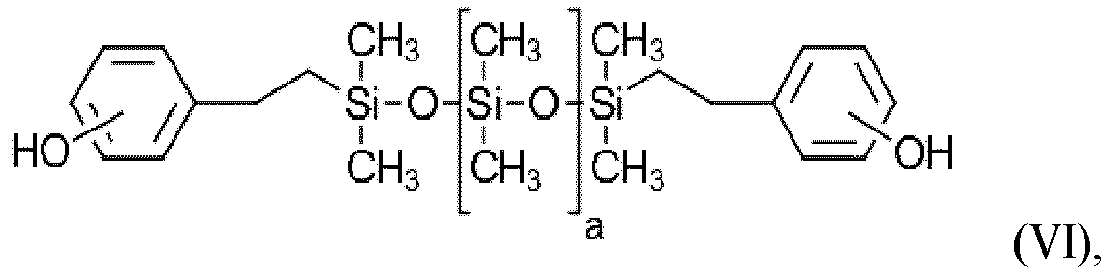
- Dabei ist es ebenso bevorzugt, dass mindestens zwei gleiche oder verschiedene der Siloxanblöcke der allgemeinen Formeln (IV), (V) oder (VI) über Terephthalsäure und/oder Isophthalsäure miteinander unter Ausbildung von Estergruppen verknüpft sind.
- Ebenso ist es bevorzugt, wenn in der Formel (1a) p = 0 ist, V für C3-Alkylen steht, r = 1 ist, Z für Cz-Alkylen steht, R8 und R9 für Methyl stehen, q = 1 ist, W für C3-Alkylen steht, m = 1 ist, R5 für Wasserstoff oder C1- bis C4-Alkyl, vorzugsweise für Wasserstoff oder Methyl, steht, R6 und R7 jeweils unabhängig voneinander für C1- bis C4-Alkyl, vorzugsweise für Methyl stehen und o für 10 bis 500 steht.
- Copolycarbonate mit Monomereinheiten der Formel (1a) und insbesondere auch deren Herstellung sind in der
WO 2015/052106 A2 beschrieben. - Copolycarbonate mit Monomereinheiten der Formel (IV) und insbesondere auch deren Herstellung sind in der
WO 2015/052106 A2 beschrieben. - Dem aromatischen Polycarbonat können grundsätzlich ein oder mehrere Additiv(e) zugesetzt sein, und zwar bereits dem Polycarbonat, wie es als Ausgangsmaterial in dem erfindungsgemäßen Verfahren eingesetzt wird. Ein oder mehrere Additive können jedoch auch erst während der Durchführung des erfindungsgemäßen Verfahrens im Extruder dem aromatischen Polycarbonat zugeführt werden, und zwar bevorzugt zusammen mit dem Kettenverlängerer. Eine Einmischung über den Seitenextruder ist im erfindungsgemäßen Verfahren nicht möglich, sofern nur eine Extrusionsstufe verwendet wird, da das Treibmittel in der Schmelze vorliegt und dementsprechend über die Seitenbeschickung austreten würde. Eine gasdichte Seitenbeschickung würde aber das Einbringen der Additive auf diese Art ermöglichen. Additive können auch mittels Pulvervormischungen oder als Masterbatch eingebracht werden. Flüssige Additive können grundsätzlich an jeder Stelle des Verfahrens injiziert werden, solange noch eine ausreichende Homogenisierung erfolgen kann, bevorzugt im Bereich statischer oder dynamischer Mischaggregate. Additive können auch in einer ersten Stufe zugegeben werden und das Treibmittel dann in einer zweiten. Hier lassen sich die Additive dann auch über einen Seitenextruder zudosieren.
- Die Mischung aus aromatischem Polycarbonat, ggf. Blendpartnern und ggf. Additiven als Startmaterial wird als "auf aromatischem Polycarbonat basierende Zusammensetzung" bezeichnet. In Verfahrensschritt a wird "nur" aromatisches Polycarbonat, oder aber aromatisches Polycarbonat als auf aromatischem Polycarbonat basierende Zusammensetzung eingesetzt. Sofern eine auf aromatischem Polycarbonat basierende Zusammensetzung eingesetzt wird, enthält diese bevorzugt mindestens 70 Gew.-%, weiter bevorzugt mindestens 80 Gew.-%, noch weiter bevorzugt mindestens 90 Gew.-%, besonders bevorzugt mindestens 95 Gew.-%, ganz besonders bevorzugt mindestens 98 Gew.-% aromatisches Polycarbonat, bezogen auf das Gesamtgewicht der Polycarbonat-Zusammensetzung. Äußerst bevorzugt enthält die "auf aromatischem Polycarbonat basierende Zusammensetzung" keine Blendpartner zu dem Polycarbonat, sondern in dem erfindungsgemäßen Verfahren zur Herstellung von Polycarbonat-Beads kommt, außer ggf. für Polycarbonat üblichen Additiven, nur aromatisches Polycarbonat zum Einsatz.
- Solche weiteren Additive, wie sie üblicherweise Polycarbonaten zugesetzt werden, sind insbesondere Thermostabilisatoren, Flammschutzmittel, Antioxidantien, Entformungsmittel, Antitropfmittel, etwa Polytetrafluorethylen (Teflon) oder SAN-gekapseltes PTFE (z.B. Blendex 449), UV-Absorber, IR-Absorber, Schlagzähmodifikatoren, Antistatika, optische Aufheller, Füllstoffe wie Talk, Lichtstreumittel, Umesterungsinhibitoren, Verträglichkeitsvermittler, Nukleierungsmittel, Farbmittel, Pigmente, z.B. Titandioxid, Ruß, chemische Treibmittel und/oder Additive zur Lasermarkierung, insbesondere in den für Polycarbonat-basierte Zusammensetzungen üblichen Mengen. Derartige Additive sind beispielsweise in
EP-A 0 839 623 ,WO-A 96/15102 EP-A 0 500 496 oder im "Plastics Additives Handbook", Hans Zweifel, 5th Edition 2000, Hanser Verlag, München beschrieben. Diese Additive können einzeln oder auch im Gemisch zugesetzt werden. Es versteht sich, dass nur solche Additive und nur in solchen Mengen zugesetzt werden dürfen, wenn sie sich nicht signifikant negativ auf die Herstellung der Beads nach dem erfindungsgemäßen Verfahren auswirken. - Bevorzugt sind die Additive ausgewählt aus der Gruppe der Thermostabilisatoren, Flammschutzmittel, Antioxidantien, Entformungsmittel, Farbmittel, Pigmente, Antitropfmittel, UV-Absorber, IR-Absorber, Nukleierungsmittel, Schlagzähmodifikatoren, Antistatika, optischen Aufheller, Lichtstreumittel, Umesterungsinhibitoren, Verträglichkeitsvermittler und/oder Additive zur Lasermarkierung.
- Das aromatische Polycarbonat bzw. die auf aromatischem Polycarbonat basierende Zusammensetzung weist bevorzugt eine Schmelzevolumenfließrate MVR von bis zu 14 cm3/(10 min), weiter bevorzugt bis zu 12 cm3/(10 min), besonders bevorzugt von 5 cm3/(10 min) bis 9 cm3/(10 min), ganz besonders bevorzugt von 5,5 cm3/(10 min) bis 6,5 cm3/(10 min), bestimmt nach ISO 1133:2012-3 (Prüftemperatur 300°C, Masse 1,2 kg), auf.
- Bei dem im erfindungsgemäßen Verfahren eingesetzten aromatischen Polycarbonat kann es sich um ein Polycarbonat, aber auch um eine Mischung aus zwei oder mehr aromatischen Polycarbonaten handeln, solange der Gehalt an OH-Endgruppen des gesamten eingesetzten Polycarbonats im erfindungsgemäßen Bereich liegt. Der OH-Endgruppengehalt ist bezogen auf das aromatische Polycarbonat zu verstehen, nicht auf die auf aromatischem Polycarbonat basierende Zusammensetzung. Es kann auch solches Polycarbonat eingesetzt werden, das ein Post Consumer oder Post Industrial Rezyklat ist. Entsprechende Rezyklate können als Granulat oder Mahlgut dem Extruder zugeführt werden. Es ist auch möglich, Rezyklat nur als einen Teil des aromatischen Polycarbonats einzusetzen.
- Die erfindungsgemäßen geschäumten Polycarbonat-Beads sind treibmittelfreie Beads. Treibmittelfrei bedeutet, dass sich in den Schaumzellen zum Zeitpunkt der Weiterverarbeitung nach dem Gasaustausch nur Umgebungsluft befindet. Gleichwohl zeigen sie eine beachtliche Nachexpansion, etwa im Heißdampf-Diffusionsschweißprozess, da ihre Zellwände und Partikeloberflächen durch die Unterwasser-Granulierung durch Abschrecken im entropischen nicht-Gleichgewichtszustand eingefroren sind.
- Die durch das erfindungsgemäße Verfahren hergestellten Polycarbonat-Beads weisen eine sphärische oder zumindest annähernd sphärische Form auf. "Annähernd sphärisch" bedeutet hierbei, dass, sofern die Kugel durch von einem gemeinsamen Ursprung ausgehende, in den Raum gerichtete Achsen gleicher Länge beschrieben wird, wobei die Achsen den Radius der Kugel in alle Raumrichtungen definieren, für die sphärischen Partikel eine Abweichung der Achsenlängen vom Idealzustand einer Kugel von bis zu 20% vorliegt.
- Die erfindungsgemäßen nachexpandieren Polycarbonat-Beads weisen bevorzugt einen mittleren Partikeldurchmesser, bestimmt durch einen Camsizer nach ISO 13322-2 von 1,0 bis 3,2 mm, bevorzugt von 2 bis 2,6 mm auf, was sich durch Wahl einer geeigneten Lochplattengeometrie, also die Düsengröße - Lochdurchmesser und Bügellänge- am Extruder, aber auch durch den Durchsatz, die Messergeschwindigkeit und die Komposition der treibmittelhaltigen Schmelze einstellen lässt.
- Die Polycarbonat-Beads weisen eine Offenzelligkeit von bis zu 20 %, bevorzugt bis zu 16 %, weiter bevorzugt bis 15 %, noch weiter bevorzugt bis zu 10%, bestimmt nach DIN EN ISO 4590:2016-12, auf. > 80 %, bevorzugt > 84 % der Zellen, weiter bevorzugt > 90 % der Zellen eines Beads sind intakt, d.h. bei diesen Beads wird die einzelne Zellstruktur von mindestens drei weiteren Strukturelementen (Zellen) geteilt und es liegen nicht mehr als zwei kaputte Zellwände pro einzelne Zelle vor. Die Polycarbonat-Beads weisen somit intakte ("geschlossenzellige") oder zumindest überwiegend intakte Zellen auf, weshalb sich aus den Polycarbonat-Beads Schaumstoff-Formteile mit sehr gleichmäßigen, ebenen Oberflächen und homogener Verschweißung der Beads herstellen lassen.
- Die Partikeldichte der Beads vor der Nachexpansion, bestimmt nach dem Auftriebsprinzip nach ASTM-D-792:2020-07, beträgt 300 bis 620 kg/m3.
- Der Phasenwinkel der Polycarbonat-Beads im Van Gurp-Palmen-Plot, bestimmt wie im Beispielteil beschrieben, beträgt bei einem komplexen Schubmodul |G∗| = 3000 Pa und einer Temperatur von 240°C < 78,0°, bevorzugt 64° bis < 78,0 °, weiter bevorzugt 71° bis < 75°.
- Für die nachexpandierbaren, treibmittelfreien, geschäumten Polycarbonat-Beads gilt, dass der Quotient aus diesem Phasenwinkel im Van-Gurp-Palmen-Plot und dem gewichtsmittleren Molekulargewicht des Polycarbonat 3,20 · 10-4 bis 1,93 · 10-3 (° mol/g), bevorzugt 4,5 · 10-4 bis 1,52 · 10-3 (° mol/g) beträgt.
- Zur Herstellung von Formteilen/Bauteilen können Schaumpartikel miteinander variotherm (thermisch durch Heizen) oder bevorzugt in einem Wasserdampf-Formteilautomat verschweißt werden. Beim Wasserdampf-Formteilautomat wird die Partikeloberfläche angeschmolzen oder erweicht unter Verwendung von Hochdruck-Wasserdampf (d.h. Wasserdampf bei hoher Temperatur), was zu einer Interdiffusion von Polymerketten zwischen verschiedenen Perlen und resultierender Kohäsion der Perlen führt. Eine gute Kohäsion zwischen den Partikeln und ein geringer Anteil an Makroporen/Zwickel, d.h. Hohlräumen zwischen Partikeln im Bauteil aufgrund schlechter Packung sind notwendig, um günstige mechanische Eigenschaften zu gewährleisten. Die Verarbeitung von Schaumperlen zum Fertigteil erfolgt in einem Formteilautomaten in fünf Schritten: 1) Vollständiges oder teilweises Schließen der Form, 2) Füllen der Form mit ggf. anschließendem vollständigem Schließen, 3) Verschweißen der Partikel, 4) Kühlung und Stabilisierung, 5) Auswerfen des Formteils. Dabei werden zwei Verfahren unterschieden: Die Crackspaltmethode und die Druckfüllmethode. Bei der Druckfüllmethode wird das Werkzeug zunächst geschlossen, dann die Partikel durch Luftdruck aus einem Behälter gezogen und von einem Injektor mit ca. 3 bar in die Form geblasen und dort komprimiert. Die Partikel entspannen sich in der Form und füllen die Kavitäten besser aus (entspricht einer Überfüllung von ungefähr 10% bei der Crackspaltmethode). Bei der Crackspaltmethode wird das Werkzeug nicht vollständig geschlossen, sondern ein gewisser Spalt (%) bleibt noch offen. Dann erfolgt die Befüllung mit Partikeln, sodass das Werkzeug zu einem gewissen %-Satz überfüllt (10 - 20 Volumen-% bei EPC bis dato) wird. Danach wird das Werkzeug geschlossen und die Partikel werden auf Zieldicke komprimiert. Bei einer Zieldicke des Bauteils von beispielsweise 20 mm wird die Werkzeugkavität zum Befüllen z.B. 4 mm weiter geöffnet (= 20 Vol.-%), mit den Polycarbonat-Beads befüllt und anschließend wird das Werkzeug auf eine Bauteildicke von 20 mm zusammengefahren. Dieser Schritt ist entscheidend, um eine homogene Verteilung der Perlen in der Form zu erreichen. Im dritten Schritt werden die Perlen durch Heißdampf, der durch die Form nach einem festen Ablauf strömt, miteinander verschmolzen. Während der Bedampfung bilden die Perlen aufgrund der Interdiffusion von Polymerketten benachbarter Partikel physikalische Verbindungen. Um eine hohe Verschweißqualität zwischen den Partikeln zu gewährleisten, sind für EPC bis dato bevorzugt 7 bis 11 bar, besonders bevorzugt 8 bis 10 bar anzuwenden. Im Dampfbasierten Verschweißprozess, bei dem keine Überfüllung erfolgt, sondern wegen der Nachexpansion der Beads eine Unterfüllung erfolgen kann, wird zuerst die Luft zwischen den Perlen ausgespült und die Form vorgewärmt. Dabei strömt Dampf parallel zum Werkzeug bei geöffneten Ventilen ein. Im zweiten Schritt durchströmt der Dampf die Form, was als Querdämpfung bezeichnet wird. Während dieses Schrittes sind die einander gegenüberliegenden Dampf-Zu- und -austrittsventile geöffnet. Um eine möglichst homogene Temperaturverteilung und eine gleichmäßige Verschweißqualität im gesamten Teil zu gewährleisten, wird das Werkzeug vorzugsweise von beiden Seiten bedampft. Abschließend wird bei geschlossenen Auslassventilen Dampf bei bestimmten Druck in die Dampfkammer geleitet, um die Oberflächenqualität durch die Bildung einer Haut zu verbessern (Autoklavbedampfung). Im vierten Schritt wird das Formteil gekühlt, was entscheidend ist für die Maßhaltigkeit. Wird das Teil ohne Kühlung ausgeworfen, ist eine weitere Ausdehnung der Partikel möglich, was zu einer Abweichung vom Originalmaß führt. Zum Abkühlen wird die Form mit Wasser besprüht, bis eine Temperatur von ca. 80 °C erreicht ist. Nach dem Formen und Abkühlen wird das Teil schließlich im letzten Schritt ausgeworfen, bevorzugt durch Druckluft und mechanische Auswerfer.
- Zur Herstellung von Formteilen aus den erfindungsgemäßen treibmittelfreien, geschäumten Polycarbonat-Beads kann vorteilhaft ein Standard-Heißdampf-Diffusionsschweißprozess genutzt werden. "Standard" bedeutet hierbei, dass es sich um ein etabliertes Verfahren in Maschinen handelt, die bereits zur Herstellung von Formteilen aus anderen Polymerschäumen mittels Heißdampf-Diffusionsschweißprozess verwendet werden. Vorzugsweise handelt es sich hierbei um eine Drop-in-Technologie für den EPP-Verschweißprozess, d.h. die nachexpandierbaren Polycarbonat-Beads können auf Anlagen zu Formteilen verarbeitet werden, die üblicherweise für die Herstellung von Formteilen aus expandiertem Polypropylen verwendet werden, wobei auch das vom EPP bekannte Verfahren genutzt werden kann. Die Polycarbonat-Beads können somit durch Befüllen entsprechender Kavitäten in Formteile, auch in solche mit komplexen Geometrien, überführt werden, wobei letztlich nur ein entsprechender Arbeitsschritt erforderlich ist. Das spätere, von Extrusionsschaumstoffen bekannte, häufig noch erforderliche Zuschneiden mit entsprechender Abfallbildung durch Verschnitt entfällt. Polycarbonat-Beads lassen sich zudem besser transportieren als die oftmals sperrigen Platten von verfügbaren Extrusionsschaumstoffen.
- Bevorzugt ist somit die Herstellung von erfindungsgemäßen Formteilen aus erfindungsgemäßen nachexpandierbaren Polycarbonat-Beads mittels Heißdampf-Diffusionsschweißen bei einem mittleren Dampfdruck von 4 bis 6 bar, weiter bevorzugt bei 4,0 bis 4,5 bar, insbesondere bei 4 bar.
- Aufgrund der sphärischen oder annähernd sphärischen Form der Beads lassen sich Formteile mit kompakter geschlossener Oberfläche erhalten.
- Sofern die erfindungsgemäßen Polycarbonat-Beads nach ihrer Herstellung keine weitere Vorbehandlung erfahren, sondern eingesetzt werden, wie sie durch das erfindungsgemäße Verfahren erhalten wurden, zeigen die Polycarbonat-Beads im Heißdampf-Diffusionsschweißprozess bei 4 bar in Wasserdampf noch eine Nachexpansion von 20 bis 60 Vol.-%, bevorzugt von 30 bis 50 Vol.-%, obwohl sie bei Einsatz im Heißdampf-Diffusionsschweißprozess treibmittelfrei sind.
- Die erfindungsgemäßen Formteile, d.h. Platten als auch solche mit komplexer 3D-Geometrie, weisen eine kompakte geschlossene Oberfläche auf und zeigen im Biegeversuch, bestimmt in Anlehnung an ISO 1209-2:2007, eine Biegedehnung am Kraftmaximum von mindestens 5,0 %, bevorzugt von mindestens 5,5 %, wobei "in Anlehnung an" an dieser Stelle bedeutet, dass die Probendicke 10 mm betrug, die Stützweite 100 mm und die Außenhaut der Proben entfernt wurde. Die verschweißte Platte lässt sich - unabhängig von der Kraft des Prüfers - nicht händisch brechen (Abmessung der Platte bei diesen Testungen: 300 × 200 × 15 mm3).
- Die Bauteildichte entsprechender Formteile beträgt bevorzugt 200 bis 350 kg/m3, bestimmt nach DIN EN ISO 845:2009-10.
- Entsprechende erfindungsgemäße Formteile können in der Automobilindustrie, im Transportwesen, in der Bauindustrie, der Luftfahrindustrie, der Raumfahrtindustrie, in der Verpackungsindustrie und generell im Leichtbau und/oder Verbundbau zur Anwendung kommen. Mögliche Formteile aus den Polycarbonat-Beads sind dabei nicht nur Platten, sondern auch komplexe, dreidimensional geformte Teile.
- Formteile bestehend aus den bzw. umfassend die erfindungsgemäßen Polycarbonat-Beads sind insbesondere Sichtteile in verschiedenen Anwendungsfeldern, wobei auch eine Veredelung mit Lasertexturen möglich ist, etwa Armaturenbretter oder Innenraumverkleidungselemente, Schallschutzelemente, Einschäumungselemente, z.B. in Teppichen des Fußraumes beim Auto, ein Kernmaterial oder tragendes Schaumstoffteil von Verbundwerkstoffen, etwa für die Karosseriedämmung für Fahrzeuge, insbesondere E-Fahrzeuge, im Bereich HVAC (Heizung, Klima, Lüftung) als Isoliermaterial, als Hochtemperaturisolierung in Industrie, der Haus- und Gebäudetechnik oder im Transportwesen, Dämm-, Isoliermaterialien, Verpackungen, Leichtbauelemente, Rotorblätter von Windkraftanlagen, Fassadenbauteile.
- PC-1: Aromatisches Polycarbonat auf Basis von Bisphenol A mit einer MVR von 6 cm3/(10 min) (300°C/1,2 kg, ISO 1133-1:2011) und einer Erweichungstemperatur (VST/B 120; ISO 306:2013) von 149°C. Tg, bestimmt nach DIN EN ISO 11357-1:2017: 148°C. Mw, bestimmt wie nachfolgend beschrieben, ca. 30.900 g/mol. Enthaltend 0,06% Thermostabilisator und 0,1% UV-Stabilisator. OH-Endgruppengehalt, bestimmt mittels 1H-NMR-Spektroskopie mit Dichlormethan als Lösungsmittel bei Raumtemperatur: 470 ppm. Hergestellt über das Verfahren der Schmelzkondensation (SPC).
- PC-2: Aromatisches Polycarbonat auf Basis von Bisphenol A mit einer MVR von 6 cm3/(10 min) (300°C/1,2 kg, ISO 1133-1:2011) und einer Erweichungstemperatur (VST/B 120; ISO 306:2013) von 150°C. Tg, bestimmt nach DIN EN ISO 11357-1:2017: 148°C. Mw, bestimmt wie nachfolgend beschrieben, ca. 30.900 g/mol bei 28 kDA (MALLS). OH-Endgruppengehalt, bestimmt mittels 1H-NMR-Spektroskopie mit Dichlormethan als Lösungsmittel bei Raumtemperatur (wie vorstehend beschrieben): 60 ppm. Hergestellt über das Verfahren der Grenzflächenkondensation (LPC).
- CE-1: Ein kommerziell erhältlicher und multifunktionaler Kettenverlängerer der BASF SE (Joncryl ADR 4468) auf Basis von Epoxy-Reaktivgruppen umfassendem Styrol-Acryl basiertem Polymer mit einem mittleren Molekulargewicht (Gelpermeationschromatographie in ortho-Dichlorbenzol bei 150 °C mit Polystyrolkalibrierung) Mw = 7.250 g/mol, einem Epoxy-Äquivalentgewicht von 310 g/mol, bestimmt nach DIN EN 1877-1:2000-12, einer Glasübergangstemperatur Tg von 59 °C und einer Zersetzungstemperatur von 350°C, bestimmt nach DIN EN ISO 11357-1:2017.
- Die Biegedehnung am Kraftmaximum wurde angelehnt an ISO 1209-2:2007 bestimmt, wobei "angelehnt" bedeutet, dass die Probendicke 10 mm betrug, die Stützweite 100 mm und die Außenhaut der Proben entfernt wurde.
- Die Molekulargewichtsbestimmung erfolgte über GPC-Messung in Dichlormethan, kalibriert gegen Bisphenol A-Polycarbonat-Standards, nach DIN EN ISO 16014-3:2019.
- Die Dichtebestimmung der Partikel erfolgte nach Auftriebsprinzip gemäß ASTM-D-792:2020-07, die Dichtebestimmung der Formteile nach DIN EN ISO 845:2009-10.
- Van Gurp-Palmen-Plot: Werte der Phasenwinkel.
- Die geschäumten Polycarbonat-Beads wurden in einem Ofen unter Vakuum für mindestens 20h bei 110°C getrocknet. Um eine homogene Trocknung sicherzustellen, wurde die Menge in dem Trocknungsbehälter so limitiert, dass nur der Boden des Behälters mit einer Schicht Beads bedeckt war. Die so getrockneten Proben wurden in einer P/O/Weber PW 20-Laborpresse bei 200°C in einen transparenten, 1,6 mm dicken Prüfkörper ohne sichtbare Gaseinschlüsse in einer Pressmaske mit einem Durchmesser von 25 mm verpresst. Anschließend wurde die Probe auf Raumtemperatur abgekühlt und umgehend in das auf 240°C vorgeheizte TA Instruments ARES G2 Rheometer überführt. Nach 2 Minuten Heizen wurde kurzzeitig eine geringe Normalkraft ausgeübt, um einen möglichst guten Kontakt zwischen dem Rheometer-Werkzeug und der geschmolzenen Probe sicherzustellen. Die Normalkraft wurde auf 0 reduziert, sobald der Messspalt auf 1,5 mm reduziert war. Das überstehende Material an der Kante, welches durch den Messstempel herausgedrückt worden war, wurde manuell entfernt. Nach 120s Temperierung wurde der 1,5 mm dicke Prüfkörper mit einen Durchmesser von 25 mm bei 240°C unter oszillatorischer Belastung mit einer Frequenz von 100 Hz bis zu 0,001 Herz bei einer Deformation von 0,4 % gemessen. Während des Probenhandlings und der Messung wurde der Konvektionsofen des Rheometers mit Stickstoffgas gespült, um eine Reaktion der Probe mit Sauerstoff zu verhindern. Nach der Messung bei 240°C wurde die Temperatur im Ofen auf230°C gesenkt und die Messung wurde bei einer Dehnung von 0,3 % wiederholt. Anschließend wurde die Temperatur auf 220°C gesenkt und die Messung wurde bei einer Dehnung von 0,2 % wiederholt. Im nächsten Schritt wurde die Temperatur auf 210°C gesenkt und die Messung bei einer Dehnung von 0,12 % wiederholt. Anschließend wurde die Temperatur auf 205°C gesenkt und die Messung bei einer Dehnung von 0,1 % wiederholt. Danach wurde die Probe aus dem Rheometer entnommen. Eine visuelle Begutachtung der Probe ließ keine Blasen erkennen.
- Die Ergebnisse der rheologischen Messungen bei verschiedenen Temperaturen, d.h. Speicher-Schermodul G', Verlust-Schermodul G" sowie Phasenwinkel δ (= arctan (G"/G')) wurden genutzt, um den sogenannten "Van Gurp-Palmen-Plot" zu erstellen, indem der gemessene Phasenwinkel δ gegen das komplexe Schubmodul

- Die Offenzelligkeit wurde nach DIN EN ISO 4590:2016-12 bestimmt.
- Der Zelldurchmesser wurde mittels REM (ASTM E1508-12a:2019) bestimmt.
- Die Größenverteilung der Beads wurde über einen Camsizer bestimmt.
- Zu den Beispielen wurden außerdem topologische Aufnahmen der hergestellten Formteile (s. Figuren) angefertigt. Das korrespondierende Höhenprofil wurde anhand von Fotoaufnahmen der Formteile mittels Image-Processing Software erstellt. Dazu wurde die Fotoaufnahme in ein 16-bit Graustufen Bild umgewandelt und ein repräsentativer Bereich von 2 cm × 2 cm ausgewählt. Von diesem Bereich wurde ein 3D-Oberflächen-Plot bei einer maximalen Grit-Größe von 1024 und einer Glättung von 200 (Draufsicht) erstellt sowie ein Oberflächenplot (Höhenprofilbild) als Wireframe mit einem Polygon Multiplier von 100%.
- Die nachfolgend beschriebenen Versuche wurden anhand des Aufbaus Doppelschneckenextruder-Gasdosierung-Einschneckenextruder-Schmelzepumpe-Unterwassergranulierung durchgeführt. Beispiel i) beschreibt eine Versuchsreihe mit sukzessiver Reduzierung der OH-Konzentration (ppm) der Polycarbonate bei konstanter Reaktivkomponente.
- i) Eine Doppelschnecke (A-Extruder) der Firma Reifenhäuser (Troisdorf, Deutschland) mit 43 D wurde mit einem Durchsatz von 35 kg/h, bei Profiltemperaturen von 100 - 160 °C (Gehäuse 1 bis 3), 240 °C (Gehäuse 4) bis 280 °C (Gehäuse 5 - 10) und einer Drehzahl von 100 rpm gefahren. Zusätzlich wurde der Kettenverlängerer 1 in fester Konzentration von 0,7 Gew.-% zugesetzt. Bei dieser Reihe wurden durch einen unterschiedlichen Anteil eines zweiten Polycarbonats das molare Reaktivgruppenverhältnis OH : Epoxy variiert, und zwar zwischen 1 : 0,82 bis 1 : 1,47 (OH : Epoxy, jeweils in mol) (Tab. 1). Die Schmelzetemperatur war in der gesamtem Anlage (Aufschmelzzone der Doppelschnecke bis Lochplatte) 10 - 20 °C höher als die Gehäusetemperatur. Die Treibmittel-Zufuhr fand über einen Maximator (Maximator GmbH, Deutschland) und/oder über eine Dosierstation (Lewa GmbH, Deutschland) an der Position 6 mit einem Gehalt von 1,3 Gew.-% COz statt. Die Druckprofile in der Doppelschnecke stiegen ab der Position 5 sukzessive von 45 bar bis zur Spitze des Extruders mit 270 bar für 100 Gew.-% SPC an. Durch Zugabe einer OH-Endgruppen armen PC-Komponente, PC-2, sind die Druckprofile zunächst geringfügig auf 275 bar bei einem Gehalt von 10% gestiegen. Eine weitere Zugabe OH-Endgruppen-armen PC-Komponente über 20 Gew.-% hinaus führte zu abfallenden Druckprofilen. Die Schmelze wurde über das Übergaberohr (290 °C) in die Einschnecke (B-Extruder) (Reifenhäuser) gefördert. Der B-Extruder wurde ebenfalls bei einer durchgehenden Gehäusetemperatur von 280 °C, einem Durchsatz von 35 kg/h und mit einer Drehzahl von 26 rpm betrieben. Die Schmelzepumpe wurde druckgeregelt bei einem Staudruck von 110 bar und einer Temperatur von 280 °C gefahren. Der Druck nach der Schmelzepumpe wurde durch den Gehalt des reaktiven Polycarbonats bestimmt und wurde durch den Fremdmatrixanteil reduziert (detailliert in Tab. 1 dargestellt). Die Anfahrweiche und die Lochplatte waren ebenfalls auf eine Temperatur von 280 °C eingestellt und die Schmelzetemperatur an der Anfahrweiche und Lochplatte lag bei Tg + 140 °C bis Tg + 150 °C. Die UWG (EUP 50) sowie die Lochplatte wurden von der Firma ECON (Econ GmbH, Österreich) hergestellt. Die Lochplatte bestand aus 5 Einzellocheinsätzen mit einem Durchmesser von 2,2 mm und einer Bügellänge 3,49 mm. Die Verweilzeit der Schmelze zwischen Einzug und Austritt belief sich auf ca. 7-10 Minuten. Nach dem Austritt wurde die Schmelze mit einem rotierenden 6-fach Messer mit 1500 rpm abgetrennt und von 70 - 80 °C kaltem Wasserkreislauf (28 m3/h) abtransportiert. Die Rundheit der Partikel nahm sukzessive ab und die Schaumdichte zu.
- Bei einer zu geringen Konzentration des Polycarbonats an OH-Endgruppen, und zwar < 350 ppm, bricht der Herstellungsprozess mit einem molaren Reaktivgruppenverhältnis (OH : Epoxy, jeweils in mol) von 1 : 1,12 (außerhalb des Anspruchsbereiches) zusammen. Der Molekulargewichtsaufbau findet dabei nicht mehr im ausreichendem Maße statt, sodass die Viskositäten des Schmelzegemisches und damit die Drücke an der Lochplatte nicht mehr für einen homogenen Partikelschaum ausreichen. Die erhaltenen Partikel weisen dabei eine länglichere Form und eine Inhomogenität in Form und Aussehen auf (bedingt durch niedrigere Viskosität und damit veränderte Fließeigenschaften) bei höheren Schaumdichten (niedrigerer Druckabfall) (Tab. 2). Die Partikel lassen sich nicht mehr hinreichend gut im Druckbereich von 7 - 11 bar verschweißen. Die Bauteile haben keine geschlossene Oberfläche und viele Einfallstellen/Hohlräume, was in schlechterer Wärmeleitfähigkeit, erhöhter Steifigkeit, deutlich reduzierter maximaler Biegedehnung und schlechterer Durchstoß-Performance resultiert (Tab. 2 und Tab. 3).
- Die hergestellten Partikel wurden durch einen Formteilautomat Teubert TVZ162/100PP (Teubert Maschinenbau GmbH, Deutschland) zu Bauteilen der Dichte 200 ± 10 kg/m3 und einer Geometrie von 300 × 200 × 15 mm3 verarbeitet. Der notwendige Druck für die Verschweißung lag für das EPC aus der Konzentrationsstudie für die Identifizierung des geeigneten Materials im Bereich von 7 bis 10 bar. Abschließend wurden die Eigenschaften der Bauteile bestimmt. Dabei wurden Rasterelektronen-Mikroskopie-Messungen (REM, Model: JEOL JSM-6510, Borken, Deutschland) mit Graphit-besputterten Proben zur Darstellung der Morphologie durchgeführt. Eine dynamisch-mechanische Analyse (DMA) wurde an einer Gabo Eplexor 500N der Firma NETZSCH GmbH, (Selb, Deutschland) im Druckmodus an 15 × 15 × 15 mm3 Proben im Temperaturbereich von -25 bis 250 °C bei einer Heizrate von 1 K/min im druckreguliertem Modus mit einer Amplitude von 5% (statisch) und 2% (dynamisch) der Probenhöhe mit einer Frequenz von 1 Hz durchgeführt. Die mechanische Charakterisierung wurde anhand von Druck-, Zug- und 3-Punktbiegung (Raumtemperatur, 80 und 110 °C) und Durchstoß-Versuchen (RT) durchgeführt. Druckversuche wurden nach der DIN EN ISO 844:2014-11 an einer Universalprüfmaschine Zwick Z020 der Firma Zwick & Roell (Ulm, Germany) an Proben mit einer Geometrie von 15 × 15 × 15 mm3 und bei einer 10 kN Kraftmessdose bis zu 60 % Kompression durchgeführt. Eine 3-Punktbiegung wurde basierend auf der ISO 1209-1:2007-05 mit gleicher Universalprüfmaschine bei 10 mm/min und einer Kraftmessdose von 20 kN durchgeführt. Die Proben wurden gehäutet, um den Einfluss der kompakten Randschicht auszublenden und die Geometrie auf 120 × 25 × 10 mm3 angepasst. Zugmessungen an den Bauteilen wurden nach der ISO 1926:2009 an einer Universalprüfmaschine Zwick Z050, (Zwick & Roell, Ulm, Deutschland) mit einer Probengeometrie von 140 (30+80+30) × 80 × 15 mm3 und einer 20 kN Kraftmessdose vorgenommen. Die Durchstoßcharakterisierung erfolgte mit einer Fallbolzen-Prüfmaschine Fractovis Plus der Firma Instron Ceast (Pianezza, Italien) mit einer Maximalenergie von 40 J und einer Durchstoßgeschwindigkeit von 4,4 m/s (angelehnt an die DIN EN ISO 6603-2:2002-04) mit einer Probengeometrie von 60 × 60 × 15 mm3. Alle mechanischen Charakterisierungen wurden bei Raumtemperatur, 80 °C und 110 °C durchgeführt, jeweils mit einem 10 min Zwischenschritt für Temperaturanpassung vor der Messung. Alle Bauteile wurden bei gleicher Dichte um die 200 kg/m3 untersucht. Wärmeleitfähigkeitsmessungen wurden an einem HFM 446 Lambda Messgerät der Firma NETZSCH (Selb, Deutschland) bei -10 °C, 10 °C, 25 °C, 50 °C und 70 °C durchgeführt.
- Die OH-Zahl der Polymere wurde mittels 1H-NMR-Spektroskopie mit Dichlormethan als Lösungsmittel bei Raumtemperatur unter Auswertung des Verhältnisses der Integrale der Signale bei 6,68 ppm (2 aromatische Protonen ortho-ständig zu phenolischen-OH Gruppen) und bei 1,68 ppm (6 Methylprotonen der Bisphenol-A Einheit) ermittelt.
Tab. 1: Detaillierte Zusammensetzungen und analytische Ergebnisse zu der Studie des molaren Verhältnisses nach Beispiel i) E*-1 E*-2 E*-3 V-4 V-5 V-6 PC1 [Gew.-%] 99,3 89,3 79,3 69,3 59,3 49,3 PC2 [Gew.-%] 0 10 20 30 40 50 Durchsatz PC1 [g/h] 34760 31280 27810 24330 20806 17380 Druck Ende A-Extruder [bar] 270 275 250 288 189 176 Druck direkt vor Lochplatte [bar] 190 184 177 170 134 122 OH-Gruppengehalt, bezogen auf das Gesamtgewicht des aromatischen Polycarbonats [ppm] 470 429 387 346 305 264 Molares Verhältnis der reaktiven OH-Gruppe (PC) zur reaktiven Gruppe des Kettenverlängerers (1: x) 0,82 0,90 1,00 1,12 1,27 1,47 Mw aus GPC [g/mol] 50180 52870 95690 93175 71691 50210 Mw aus GPC-MALLS [kDA] 158 168 206 207 139 107 Partikeldichte [kg/m3] 197 234 265 271 260 253 Mittlerer Zelldurchmesser [µm] 100 ± 47 129 ± 77 139 ± 66 193 ± 99 193 ± 11 7 206 ± 13 4 Zelldichte [Zellen/cm3] 8,88·105 4,12·105 3,48·105 1,47·105 1,33·105 1,18·105 Zellkoaleszenz Nein Nein Nein Ja Ja Ja Tab. 2: Detaillierte Kennwerte der Druckprüfungen, Biegeprüfungen und Durchstoß-Versuche für die Vergleichsstudie im Beispiel i) der EPC-Partikelschaumbauteile EPC (E*-1) EPC (V-4) Bauteildichte [kg/m3] 200 ± 10 230 ± 15 Druckmodul [MPa] 54,7 ± 5 50,9 ± 5,2 Druckfestigkeit bei 10 % Kompression [MPa] 1,61 ± 0,12 1,90 ± 0,14 EPC (E*-1) EPC (V-4) Biegemodul [MPa] 59,1 ± 11,4 86 ± 6,4 Biegefestigkeit [MPa] 2,2 ± 0,3 2,52 ± 0,30 Maximale Biegedehnung [%] 8,8 ± 1,1 5,1 ± 0,7 EPC (E*-1) EPC (V-4) Maximale Kraft [N] 1688 ± 27 936 ± 107 Durchstoßkraft [N] 844 ± 29 467 ± 53 Gesamtenergie [J] 21,2 ± 3 12,2 ± 2 Gesamtdeformation [mm] 33,9 28,4 ± 7 Notiz: Bauteil aus EPC (V-4) hat eine Schaumdichte von 230 kg/m3. Die Kennwerte sind hier original und müssten mit einen Faktor 0,85 für einfache %-uelle Normierung verrechnet werden. - Durch diese Versuche wurde festgestellt, dass als Ausgangsmaterial für weitere Versuche solches aromatische Polycarbonat dienen soll, das, bezogen auf das Gesamtgewicht des aromatischen Polycarbonats, einen Gehalt an OH-Endgruppen von mindestens 350 ppm, bestimmt mittels 1H-NMR-Spektroskopie mit Dichlormethan als Lösungsmittel bei Raumtemperatur, aufweist und dass so viel Kettenverlängerer verwendet werden sollte, dass auf 1 mol OH-Endgruppen des Polycarbonats 0,64-1,10 mol der reaktiven Gruppe des Kettenverlängerers eingesetzt werden.
- Anlagensetup : Ein Doppelschneckenextruder vom Typ ZSK 26 MC (Firma Coperion GmbH) mit 44 D und eine Gasdosierstation (Firma Promix Solutions GmbH), ein Wärmetauscher, gefolgt von einer Schmelzepumpe (Firma Maag-Germany GmbH) und einer Unter-Wasser-Granulierung vom Typ LPU (Firma Maag-Germany GmbH) mit Lochplattengeometrie: 2 Löcher mit 2,4 mm Lochdurchmesser und 12,7 mm Bügellänge und mit einer Messergeschwindigkeit 4500 upm (7-fach Messer).
- Rezeptur: 99,3 Gew.-% aromatisches Polycarbonat PC-1, 0,7 Gew.-% multifunktionaler Kettenverlängerer CE-1, 1,3 Gew.-% COz. Molares Verhältnis der reaktiven Gruppen OH-Endgruppen des Polycarbonats : Epoxy ist 1 mol : 0,82 mol.
- Prozess: Der Durchsatz war 20 kg/h bei einer eingestellten Temperatur im Extruder und im Wärmetauscher von 285 °C. Die Extruderdrehzahl war 230 upm. Der Massedruck im Extruder betrug 64 bar. Die Schmelzetemperatur vor der Anfahrweiche betrug 290 °C. Die Temperatur der Lochplatte war 330 °C bei einem Massedruck von 177 bar. Die Prozesswassertemperatur betrug 92 °C bei einem Wasserdruck von 2,5 bar. Die Verweilzeit in der Anlage betrug 400 s.
- Ergebnis: Es wurden Partikel mit einem mittleren Durchmesser von 2,4 - 2,6 mm, einer Partikeldichte nach Auftriebsprinzip von 505 kg/m3, einem mittleren Zelldurchmesser von 82 µm, einer Offenzelligkeit von 6%, einem Phasenwinkel im Van-Gurp-Palmen-Plot von 72° und einem Quotienten Q von 4,65 · 10-4 (° · mol/g) erhalten. Die Partikel waren bei 4 bar in einem "Standard" Heißdampf-Diffusionsschweißprozess verschweißbar und führten bei einer Nachexpansion von 47 Vol.-% (100 %-(100 * Dichte nach Verschweißung/Dichte vor Verschweißung) zu einem Formteil mit einer Bauteildichte von 270 kg/m3. Das Formteil hat eine kompakte geschlossene Oberfläche (Fehler! Verweisquelle konnte nicht gefunden werden.), ließ sich händisch nicht brechen und zeigte im Biegeversuch eine Biegedehnung am Kraftmaximum von 6,4%.
- Änderungen gegenüber dem erfindungsgemäßen Beispiel 1:
- Anlagensetup: Eine zusätzliche Schmelzepumpe (Firma Maag-Germany GmbH) vor dem Wärmetauscher. Die Lochplattengeometrie war 3 Löcher mit 1,8 mm Lochdurchmesser und 11 mm Bügellänge und die Messergeschwindigkeit betrug 4700 upm.
- Prozess: Die Temperatur der Lochplatte war 330 °C bei einem Massedruck von 162 bar. Die Prozesswassertemperatur betrug 91 °C bei einem Wasserdruck von 2 bar. Die Verweilzeit in der Anlage betrug 420 s.
- Ergebnis: Es wurden Partikel mit einem mittleren Durchmesser von 2,0 - 2,2 mm, einer Partikeldichte von 614 kg/m3, einem mittleren Zelldurchmesser von 54 µm, einer Offenzelligkeit von 4%, einem Phasenwinkel im Van-Gurp-Palmen-Plot von 72° und einem Quotienten Q von 8,0 · 10-4 (° · mol/g) erhalten. Die Partikel waren bei 4 bar in einem "Standard" Heißdampf-Diffusionsschweißprozess verschweißbar und führten bei einer Nachexpansion von 46 Vol.-% zu einem Formteil mit einer Bauteildichte von 330 kg/m3. Das Formteil hatte eine kompakte geschlossene Oberfläche (Fehler! Verweisquelle konnte nicht gefunden werden.), ließ sich händisch nicht brechen und zeigte im Biegeversuch eine Biegedehnung am Kraftmaximum von 5,8 %.
- Änderungen gegenüber dem erfindungsgemäßen Beispiel 1:
- Anlagensetup: Eine zusätzliche Schmelzepumpe (Firma Maag-Germany GmbH) vor dem Wärmetauscher. Die Messergeschwindigkeit war 4700 upm.
- Prozess: Die Extruderdrehzahl war 150 upm. Die Schmelzetemperatur vor der Anfahrweiche betrug 285 °C. Die Temperatur der Lochplatte war 335 °C bei einem Massedruck von 189 bar. Die Prozesswassertemperatur betrug 85 °C bei einem Wasserdruck von 1,5 bar. Die Verweilzeit in der Anlage betrug 460 s.
- Ergebnis: Es wurden Partikel mit einem mittleren Durchmesser von 2,4 - 2,6 mm, einer Partikeldichte von 485 kg/m3, einem mittleren Zelldurchmesser von 43 µm, einer Offenzelligkeit von 4%, einem Phasenwinkel von 71° und einem Quotienten Q von 9,47 · 10-4 (° · mol/g) erhalten. Die Partikel waren bei 4 bar in einem "Standard" Heißdampf-Diffusionsschweißprozess verschweißbar und führten bei einer Nachexpansion von 36 Vol.-% zu einem Formteil mit einer Bauteildichte von 310 kg/m3. Das Formteil hatte eine kompakte geschlossene Oberfläche (Fehler! Verweisquelle konnte nicht gefunden werden.), ließ sich händisch nicht brechen und zeigte im Biegeversuch (angelehnt an ISO 1209-2:2007) eine Biegedehnung am Kraftmaximum von 6,6%.
- Änderungen gegenüber dem erfindungsgemäßen Beispiel 1:
- Anlagensetup: Eine zusätzliche Schmelzepumpe (Firma Maag-Germany GmbH) vor dem Wärmetauscher. Die Messergeschwindigkeit war 4700 upm.
- Prozess: Der Durchsatz war 24 kg/h. Die Schmelzetemperatur vor der Anfahrweiche betrug 284 °C. Die Temperatur der Lochplatte war 335 °C bei einem Massedruck von 177 bar. Die Prozesswassertemperatur betrug 85 °C bei einem Wasserdruck von 1,8 bar. Die Verweilzeit in der Anlage betrug 350 s.
- Ergebnis: Es wurden Partikel mit einem mittleren Durchmesser von 2,6 - 3,2 mm, einer Partikeldichte von 425 kg/m3, einem mittleren Zelldurchmesser von 43 µm, einer Offenzelligkeit von 15%, einem Phasenwinkel von 74° und einem Quotienten Q von 1,52 · 10-3 (° · mol/g) erhalten. Die Partikel waren bei 4 bar in einem "Standard Heißdampf-Diffusionsschweißprozess verschweißbar und führten bei einer Nachexpansion von 31 Vol.-% zu einem Formteil mit einer Bauteildichte von 290 kg/m3. Das Formteil hatte eine kompakte geschlossene Oberfläche (Fehler! Verweisquelle konnte nicht gefunden werden.), ließ sich händisch nicht brechen und zeigte im Biegeversuch eine Biegedehnung am Kraftmaximum von 6,0%.
- Änderungen gegenüber dem erfindungsgemäßen Beispiel 1:
- Anlagensetup: Kein Wärmetauscher im Prozess.
- Prozess: Die Temperatur der Lochplatte war 330 °C bei einem Massedruck von 137 bar. Die Prozesswassertemperatur betrug 85 °C bei einem Wasserdruck von 3,5 bar. Die Verweilzeit in der Anlage war mit 90 s sehr kurz.
- Ergebnis: Es wurden Partikel mit einem mittleren Durchmesser von 2,6 - 2,8 mm, einer Partikeldichte von 490 kg/m3, einem mittleren Zelldurchmesser von 41 µm, einer Offenzelligkeit von 45%, einem Phasenwinkel von 79° und einem Quotienten Q außerhalb des Anspruchsbereiches von 1,95 · 10-3 (° · mol/g) erhalten. Die Partikel waren bei 4 bar in einem "Standard" Heißdampf-Diffusionsschweißprozess schlecht verschweißbartrotz einer Nachexpansion von 34 Vol.-%. Das Verhältnis von Molekulargewicht und Kettenverzweigungen lag außerhalb des optimalen Bereiches. Eine unzureichende Molmasse und nicht ausreichend Kettenverzweigungen bedeuten eine niedrige Schmelzefestigkeit und damit unzureichende Stabilisierung der Morphologie, was zu einer hohen Offenzelligkeit und schlechten Verschweißung führt. Nach diesem Beispiel resultierende Formteile bestanden aus teilweise lose zusammengepressten Partikeln mit einer Bauteildichte von 320 kg/m3. Sie hatten keine kompakte geschlossene Oberfläche (Fehler! Verweisquelle konnte nicht gefunden werden.), ließen sich händisch brechen und zeigt im Biegeversuch eine Biegedehnung am Kraftmaximum von 2,1%.
- Änderungen gegenüber dem erfindungsgemäßen Beispiel 1:
- Anlagensetup: Eine zusätzliche Schmelzepumpe (Firma Maag-Germany GmbH) vor dem Wärmetauscher. Die Lochplattengeometrie war 2 Löcher mit einem Lochdurchmesser von 2,8 mm und einer Bügellänge von 6 mm.
- Rezeptur: 99,5 Gew.-% aromatisches Polycarbonat PC-1, 0,5 Gew.-% multifunktionaler Kettenverlängerer CE-1, 1,3 Gew.-% COz. Molares Verhältnis der reaktiven Gruppen OH-Endgruppen des Polycarbonats : Epoxy ist 1 mol : 0,59 mol.
- Prozess: Der Durchsatz betrug 24 kg/h. Die Temperatur der Lochplatte war 330 °C bei einem Massedruck von 130 bar. Die Prozesswassertemperatur betrug 91 °C bei einem Wasserdruck von 2 bar. Die Verweilzeit in der Anlage betrug 430 s.
- Ergebnis: Es wurden Partikel mit einem mittleren Durchmesser von 2,4 - 2,6 mm, einer Partikeldichte von 370 kg/m3, einem mittleren Zelldurchmesser von 81 µm, einer Offenzelligkeit von 40%, einem Phasenwinkel von 84° und einem Quotienten außerhalb des Anspruchsbereiches Q von 2,71 · 10-3 (° · mol/g) erhalten.
- Die Partikel waren bei 4 bar in einem "Standard" Heißdampf-Diffusionsschweißprozess nicht verschweißbar, zeigten keine Nachexpansion und kollabierten im Werkzeug, bedingt durch ein unzureichendes molekulares Verhältnis der Reaktivgruppen für eine chemische Aufbaureaktion bei einer Verweilzeit von 430 s. Die resultierenden Formteile bestanden aus lose zusammengepressten Partikeln, hatten keine kompakte geschlossene Oberfläche (Fehler! Verweisquelle konnte nicht gefunden werden.) und brachen durch das Eigengewicht (geringste mögliche Belastung). Für den Biegeversuch wurde für dieses Material eine Biegedehnung am Kraftmaximum von 0% angegeben.
- Nachfolgend findet sich eine Übersicht (Tabelle 3) über die erhaltenen Versuchsergebnisse.
Tab. 3: Übersicht über die Formteilqualität bzw. die Bead-Eigenschaften der erfindungsgemäßen Beispiele und der Vergleichsbeispiele Eigenschaften der Beads Eigenschaften Formteil Mittlerer Partikeldurchmesser [mm] Partikeldichte [kg/m3] Offenzelligkeit [%] Mw [g/mol] δ [°] Quotient Q = δ/Mw [°·mol/g] Nachexpansion [%] Verschweißbarkeit im Standardprozess Oberfläche Bauteildichte [kg/m3] Biegedehnung am Kraftmax. [%] Erfindungsgemäßes Beispiel 1 2,4-2,6 505 6 155.000 72 4,65 · 10-4 47 ja geschlossen, Fig. 1a, 1b 270 6,4 Erfindungsgemäßes Beispiel 2 2,0-2,2 614 4 90.000 72 8,0 · 10-4 46 ja geschlossen, Fig. 2a, 2b 330 5,8 Erfindungsgemäßes Beispiel 3 2,4-2,6 485 4 75.000 71 9,47 · 10-4 36 ja geschlossen, Fig. 3a ,3b 310 6,6 Erfindungsgemäßes Beispiel 4 2,6-3,2 425 15 50.000 74 1,52 · 10-3 31 ja geschlossen, Fig. 4a ,4b 290 6,0 Vergleichsbeispiel 1 2,6-2,8 490 45 40.500 79 1,93 · 10-3 34 nein nicht geschlossen, Fig. 5a, 5b 320 2,1 Vergleichsbeispiel 2 2,4-2,6 370 40 31.000 84 2,71 · 10-3 keine nein nicht geschlossen Fig. 6a ,6b 370 0
Claims (15)
- Verfahren zur Herstellung von nachexpandierbaren geschäumten Polycarbonat-Beads mittelsa) kontinuierlicher Partikelschaumextrusion einer plastifizierten Mischung in einem Extrusionsprozess,wobei die Mischung die folgenden Komponenten enthält:i) aromatisches Polycarbonat, wobei das aromatische Polycarbonat, bezogen auf das Gesamtgewicht des aromatischen Polycarbonats, einen Gehalt an OH-Endgruppen von mindestens 350 ppm, bestimmt mittels 1H-NMR-Spektroskopie mit Dichlormethan als Lösungsmittel bei Raumtemperatur, aufweist,
undii) einen für OH-Gruppen geeigneten Kettenverlängerer,
wobei das aromatische Polycarbonat und der für OH-Gruppen geeignete Kettenverlängerer in einem solchen molaren Verhältnis eingesetzt sind, dass auf 1 mol OH-Endgruppen des Polycarbonats 0,64-1,10 mol der reaktiven Gruppe des Kettenverlängerers eingesetzt werden,
sowieiii) ein physikalisches Treibmittel,bei einer Temperatur T der plastifizierten Mischung von T1 = (Tg + 110°C) bis T2 = (Tg + 170°C), wobei Tg die Glasübergangstemperatur des aromatischen Polycarbonats ist,wobei die Verweilzeit des aromatischen Polycarbonats und des für OH-Gruppen geeigneten Kettenverlängerers im Schmelzezustand mindestens 4 Minuten beträgt, undb) nachfolgender Unter-Wasser-Granulierung der Treibmittel-haltigen Schmelze bei Wassertemperaturen T3 = (Tg - 90°C) bis T4 = (Tg - 55°C), wobei Tg die Glasübergangstemperatur des aromatischen Polycarbonats ist,
ohne Druckbeaufschlagung oder unter Druckbeaufschlagung des Wassers bis 3,5 bar. - Verfahren nach Anspruch 1, wobei die Verweilzeit der Mischung im Schmelzezustand mindestens 5,5 min beträgt.
- Verfahren nach Anspruch 1 oder 2, wobei auf 1 mol OH-Endgruppen des Polycarbonats 0,8-1,0 mol der reaktiven Gruppe des Kettenverlängerers eingesetzt werden.
- Verfahren nach einem der vorhergehenden Ansprüche, wobei die Unter-Wasser-Granulierung der Treibmittel-haltigen Schmelze unter Druckbeaufschlagung des Wassers mit 1,5 bis 2,5 bar erfolgt.
- Verfahren nach einem der vorhergehenden Ansprüche, wobei die mittleren Partikeldurchmesser der nachexpandierbaren geschäumten Polycarbonat-Beads auf 1,0 bis 3,2 mm, bevorzugt von 2 bis 2,6 mm eingestellt werden.
- Verfahren nach einem der vorhergehenden Ansprüche, wobei die durch Schritt b erhaltenen Beads vor einer Weiterverarbeitung so lange gelagert werden, bis ein vollständiger Gasaustausch stattgefunden hat.
- Treibmittelfreie, geschäumte Polycarbonat-Beadsmit einem gewichtsmittleren Molekulargewicht Mw des Polycarbonats, bestimmt mittels GPC- Messung in Dichlormethan, kalibriert gegen Bisphenol A-Polycarbonat-Standards, von 50.000 bis 160.000 g/mol, dadurch gekennzeichnet,dass die geschäumten Polycarbonat-Beads nachexpandierbar sind und bei einer Verschweißung bei 4 bar in Wasserdampf ohne Vorbehandlung der Beads eine Nachexpansion von 20 bis 60 Vol.-% zeigen undwobei für die geschäumten Polycarbonat-Beads gilt:
 Mit δ = dem Phasenwinkel im Van-Gurp-Palmen-Plot, bestimmt bei einem komplexen Schubmodul|G∗| = 3000 Pa und einer Temperatur von 240°C, wobei δ < 78,0°,
undMw wie vorstehend beschrieben. - Treibmittelfreie, geschäumte Polycarbonat-Beads nach Anspruch 7, wobei die Polycarbonat-Beads sphärisch sind oder annähernd sphärisch sind, wobei "annähernd sphärisch" hierbei bedeutet, dass, sofern die Kugel durch von einem gemeinsamen Ursprung ausgehende, in den Raum gerichtete Achsen gleicher Länge beschrieben wird, wobei die Achsen den Radius der Kugel in alle Raumrichtungen definieren, für die sphärischen Partikel eine Abweichung der Achsenlängen vom Idealzustand einer Kugel von bis zu 20% vorliegt.
- Treibmittelfreie, geschäumte Polycarbonat-Beads nach Anspruch 7 oder 8, wobei der Phasenwinkel δ im Van-Gurp-Palmen-Plot, bestimmt bei einem komplexen Schubmodul |G∗| = 3000 Pa und einer Temperatur von 240°C, 64 bis < 78,0° beträgt.
- Geschäumte Polycarbonat-Beads nach einem der Ansprüche 7 bis 9, wobei der Phasenwinkel δ im Van-Gurp-Palmen-Plot, bestimmt bei einem komplexen Schubmodul |G∗| = 3000 Pa und einer Temperatur von 240°C, < 75° beträgt.
- Geschäumte Polycarbonat-Beads nach einem der Ansprüche 7 bis 10, wobei die geschäumten Polycarbonat-Beads eine Offenzelligkeit von bis zu 20 %, bestimmt nach DIN EN ISO 4590:2016-12, aufweisen.
- Geschäumte Polycarbonat-Beads nach einem der Ansprüche 7 bis 11, wobei die Polycarbonat-Beads eine Offenzelligkeit von bis zu 15 %, bestimmt nach DIN EN ISO 4590:2016-12, aufweisen.
- Geschäumte Polycarbonat-Beads nach einem der Ansprüche 7 bis 12, wobei die Polycarbonat-Beads eine Nachexpansion von 30 bis 50 % bei einer Verschweißung bei 4 bar in Wasserdampf ohne Vorbehandlung der Beads zeigen.
- Formteile, hergestellt aus den treibmittelfreien, geschäumten Polycarbonat-Beads nach einem der Ansprüche 7 bis 13.
- Verfahren zur Herstellung von Formteilen nach Anspruch 14, wobei die Formteilherstellung mittels Wasserheißdampf bei mittleren absoluten Dampfdrücken von 4 bis 6 bar erfolgt.
Priority Applications (3)
| Application Number | Priority Date | Filing Date | Title |
|---|---|---|---|
| EP23168654.4A EP4450545A1 (de) | 2023-04-19 | 2023-04-19 | Verfahren zur herstellung von nachexpandierbaren polycarbonat-beads und entsprechende polycarbonat-beads |
| CN202480026240.0A CN121079348A (zh) | 2023-04-19 | 2024-04-18 | 生产可后膨胀的聚碳酸酯珠的方法及相应的聚碳酸酯珠 |
| PCT/EP2024/060484 WO2024218186A1 (de) | 2023-04-19 | 2024-04-18 | Verfahren zur herstellung von nachexpandierbaren polycarbonat-beads und entsprechende polycarbonat-beads |
Applications Claiming Priority (1)
| Application Number | Priority Date | Filing Date | Title |
|---|---|---|---|
| EP23168654.4A EP4450545A1 (de) | 2023-04-19 | 2023-04-19 | Verfahren zur herstellung von nachexpandierbaren polycarbonat-beads und entsprechende polycarbonat-beads |
Publications (1)
| Publication Number | Publication Date |
|---|---|
| EP4450545A1 true EP4450545A1 (de) | 2024-10-23 |
Family
ID=86095957
Family Applications (1)
| Application Number | Title | Priority Date | Filing Date |
|---|---|---|---|
| EP23168654.4A Pending EP4450545A1 (de) | 2023-04-19 | 2023-04-19 | Verfahren zur herstellung von nachexpandierbaren polycarbonat-beads und entsprechende polycarbonat-beads |
Country Status (3)
| Country | Link |
|---|---|
| EP (1) | EP4450545A1 (de) |
| CN (1) | CN121079348A (de) |
| WO (1) | WO2024218186A1 (de) |
Citations (23)
| Publication number | Priority date | Publication date | Assignee | Title |
|---|---|---|---|---|
| US2991273A (en) | 1956-07-07 | 1961-07-04 | Bayer Ag | Process for manufacture of vacuum moulded parts of high molecular weight thermoplastic polycarbonates |
| US2999846A (en) | 1956-11-30 | 1961-09-12 | Schnell Hermann | High molecular weight thermoplastic aromatic sulfoxy polycarbonates |
| US2999825A (en) | 1958-12-12 | 1961-09-12 | Gen Mills Inc | Epoxy-polyamide-ester resin reaction product |
| US3028635A (en) | 1959-04-17 | 1962-04-10 | Schlumberger Cie N | Advancing screw for gill box |
| US3148172A (en) | 1956-07-19 | 1964-09-08 | Gen Electric | Polycarbonates of dihydroxyaryl ethers |
| US3271367A (en) | 1955-03-26 | 1966-09-06 | Bayer Ag | Thermoplastic polycarbonates of dihydroxydiarylene sulfones and their preparation |
| FR1561518A (de) | 1967-03-10 | 1969-03-28 | ||
| DE1570703A1 (de) | 1964-10-07 | 1970-02-12 | Gen Electric | Hydrolytisch stabile Polycarbonate sowie Verfahren zu deren Herstellung |
| DE2036052A1 (en) | 1970-07-21 | 1972-01-27 | Milchwirtschafthche Forschungs und Untersuchungs Gesellschaft mbH, 2100 Hamburg | Working up of additives in fat and protein - contng foodstuffs |
| DE2063050A1 (de) | 1970-12-22 | 1972-07-13 | Bayer | Verseifungsbeständige Polycarbonate |
| DE2211956A1 (de) | 1972-03-11 | 1973-10-25 | Bayer Ag | Verfahren zur herstellung verseifungsstabiler blockcopolycarbonate |
| JPS6162039U (de) | 1984-09-28 | 1986-04-26 | ||
| JPS6162040U (de) | 1984-09-28 | 1986-04-26 | ||
| JPS61105550U (de) | 1984-12-18 | 1986-07-04 | ||
| DE3832396A1 (de) | 1988-08-12 | 1990-02-15 | Bayer Ag | Dihydroxydiphenylcycloalkane, ihre herstellung und ihre verwendung zur herstellung von hochmolekularen polycarbonaten |
| US4982014A (en) | 1988-08-12 | 1991-01-01 | Bayer Aktiengesellschaft | Dihydroxydiphenyl cycloalkanes, their production and their use for the production of high molecular weight polycarbonates |
| DE4100200A1 (de) | 1991-01-05 | 1992-07-09 | Bayer Ag | Verwendung von thermoplatischen polycarbonaten zum verschaeumen von thermoplastischen polycarbonaten |
| EP0500496A1 (de) | 1991-02-21 | 1992-08-26 | Ciba-Geigy Ag | Stabilisierte Polymere mit Heteroatomen in der Hauptkette |
| WO1996015102A2 (de) | 1994-11-10 | 1996-05-23 | Basf Aktiengesellschaft | 2-cyanacrylsäureester |
| EP0839623A1 (de) | 1996-10-30 | 1998-05-06 | Ciba SC Holding AG | Stabilisatorkombination für das Rotomolding-Verfahren |
| WO2012020112A1 (de) * | 2010-08-13 | 2012-02-16 | Basf Se | Expandierbare granulate auf polyesterbasis |
| WO2015052106A2 (en) | 2013-10-08 | 2015-04-16 | Bayer Materialscience Ag | Process for preparing polysiloxane-polycarbonate block cocondensates using a salt of a weak acid |
| EP3858906A1 (de) * | 2018-09-28 | 2021-08-04 | Sekisui Kasei Co., Ltd. | Expandierte teilchen und expandierter formkörper |
-
2023
- 2023-04-19 EP EP23168654.4A patent/EP4450545A1/de active Pending
-
2024
- 2024-04-18 CN CN202480026240.0A patent/CN121079348A/zh active Pending
- 2024-04-18 WO PCT/EP2024/060484 patent/WO2024218186A1/de not_active Ceased
Patent Citations (24)
| Publication number | Priority date | Publication date | Assignee | Title |
|---|---|---|---|---|
| US3271367A (en) | 1955-03-26 | 1966-09-06 | Bayer Ag | Thermoplastic polycarbonates of dihydroxydiarylene sulfones and their preparation |
| US2991273A (en) | 1956-07-07 | 1961-07-04 | Bayer Ag | Process for manufacture of vacuum moulded parts of high molecular weight thermoplastic polycarbonates |
| US3148172A (en) | 1956-07-19 | 1964-09-08 | Gen Electric | Polycarbonates of dihydroxyaryl ethers |
| US2999846A (en) | 1956-11-30 | 1961-09-12 | Schnell Hermann | High molecular weight thermoplastic aromatic sulfoxy polycarbonates |
| US2999825A (en) | 1958-12-12 | 1961-09-12 | Gen Mills Inc | Epoxy-polyamide-ester resin reaction product |
| US3028635A (en) | 1959-04-17 | 1962-04-10 | Schlumberger Cie N | Advancing screw for gill box |
| DE1570703A1 (de) | 1964-10-07 | 1970-02-12 | Gen Electric | Hydrolytisch stabile Polycarbonate sowie Verfahren zu deren Herstellung |
| FR1561518A (de) | 1967-03-10 | 1969-03-28 | ||
| DE2036052A1 (en) | 1970-07-21 | 1972-01-27 | Milchwirtschafthche Forschungs und Untersuchungs Gesellschaft mbH, 2100 Hamburg | Working up of additives in fat and protein - contng foodstuffs |
| DE2063050A1 (de) | 1970-12-22 | 1972-07-13 | Bayer | Verseifungsbeständige Polycarbonate |
| DE2211956A1 (de) | 1972-03-11 | 1973-10-25 | Bayer Ag | Verfahren zur herstellung verseifungsstabiler blockcopolycarbonate |
| JPS6162040U (de) | 1984-09-28 | 1986-04-26 | ||
| JPS6162039U (de) | 1984-09-28 | 1986-04-26 | ||
| JPS61105550U (de) | 1984-12-18 | 1986-07-04 | ||
| DE3832396A1 (de) | 1988-08-12 | 1990-02-15 | Bayer Ag | Dihydroxydiphenylcycloalkane, ihre herstellung und ihre verwendung zur herstellung von hochmolekularen polycarbonaten |
| US4982014A (en) | 1988-08-12 | 1991-01-01 | Bayer Aktiengesellschaft | Dihydroxydiphenyl cycloalkanes, their production and their use for the production of high molecular weight polycarbonates |
| DE4100200A1 (de) | 1991-01-05 | 1992-07-09 | Bayer Ag | Verwendung von thermoplatischen polycarbonaten zum verschaeumen von thermoplastischen polycarbonaten |
| EP0500496A1 (de) | 1991-02-21 | 1992-08-26 | Ciba-Geigy Ag | Stabilisierte Polymere mit Heteroatomen in der Hauptkette |
| WO1996015102A2 (de) | 1994-11-10 | 1996-05-23 | Basf Aktiengesellschaft | 2-cyanacrylsäureester |
| EP0839623A1 (de) | 1996-10-30 | 1998-05-06 | Ciba SC Holding AG | Stabilisatorkombination für das Rotomolding-Verfahren |
| WO2012020112A1 (de) * | 2010-08-13 | 2012-02-16 | Basf Se | Expandierbare granulate auf polyesterbasis |
| EP2603549A1 (de) | 2010-08-13 | 2013-06-19 | Basf Se | Expandierbare granulate auf polyesterbasis |
| WO2015052106A2 (en) | 2013-10-08 | 2015-04-16 | Bayer Materialscience Ag | Process for preparing polysiloxane-polycarbonate block cocondensates using a salt of a weak acid |
| EP3858906A1 (de) * | 2018-09-28 | 2021-08-04 | Sekisui Kasei Co., Ltd. | Expandierte teilchen und expandierter formkörper |
Non-Patent Citations (5)
| Title |
|---|
| "Plastics Additives Handbook", 2000, HANSER VERLAG |
| "Polymer Reviews", vol. 9, 1964, INTERSCIENCE PUBLISHERS, article "Chemistry and Physics of Polycarbonates" |
| D. FREITAGU. GRIGOP.R. MÜLLERH. NOUVERTNEBAYER AG: "Polycarbonates", ENCYCLOPEDIA OF POLYMER SCIENCE AND ENGINEERING, vol. 11, 1988, pages 648 - 718 |
| DER MONOGRAPHIE: "H. Schnell, Chemistry and Physics of Polycarbonates", 1964, INTERSCIENCE PUBLISHERS |
| U. GRIGOK. KIRCHNERP.R. MÜLLER: "Polycarbonate, Polyacetale, Polyester, Celluloseester", vol. 3/1, 1992, BECKER/BRAUN, KUNSTSTOFF-HANDBUCH, pages: 117 - 299 |
Also Published As
| Publication number | Publication date |
|---|---|
| CN121079348A (zh) | 2025-12-05 |
| WO2024218186A1 (de) | 2024-10-24 |
Similar Documents
| Publication | Publication Date | Title |
|---|---|---|
| EP2617771B1 (de) | Verfahren zur Herstellung von expandierbaren Polymilchsäure-haltigen Granulaten | |
| DE102015225454B4 (de) | Polyolefinharzzusammensetzung mit einem ausgezeichneten Expansionsvermögen und ausgezeichneten Eigenschaften für eine Direktmetallisierung, und spritzgegossener Artikel, hergestellt durch Schaumspritzgiessen derselben. | |
| EP3055352B1 (de) | Verfahren zur herstellung von expandierten polyester-schaumstoffpartikeln | |
| EP2288643B1 (de) | Geschäumte polyester und verfahren zu deren herstellung | |
| DE69734630T3 (de) | Silikonmodifizierte organische Polymerisate | |
| DE69934029T2 (de) | Geschäumtes polyesterharzformteil und verfahren zu dessen herstellung | |
| EP2603549B1 (de) | Expandierbare granulate auf polyesterbasis | |
| DE102011077447B4 (de) | Verfahren zur Herstellung eines Formkörpers aus einer Polymilchsäure-Kompositzusammensetzung, Formkörper und Automobilteil | |
| EP2754687A1 (de) | Verfahren zur Herstellung expandierter Polyolefinharzpartikel und expandierte Polyolefinharzpartikeln | |
| CN113652029A (zh) | 一种微发泡聚丙烯组合物及其制备方法和应用 | |
| EP3464433B1 (de) | Verfahren zur herstellung von expandierbaren polymilchsäurehaltigen granulaten | |
| EP3233992B1 (de) | Verfahren zur herstellung von expandierbaren polymilchsäure-haltigen granulaten | |
| DE102013005568B4 (de) | Verfahren zur Herstellung von Lebensmittelverpackungen und nach diesem Verfahren hergestellte Lebensmittelverpackung | |
| EP3917749B1 (de) | Verfahren zur herstellung von stärkeblends | |
| DE69914939T2 (de) | Erhöhung der schmelzviskosität von polyester | |
| US12398253B2 (en) | Polymer foam particles and process for production thereof based on polybutylene terephthalate | |
| EP4450544B1 (de) | Verfahren zur herstellung von polycarbonat-beads | |
| WO2024218186A1 (de) | Verfahren zur herstellung von nachexpandierbaren polycarbonat-beads und entsprechende polycarbonat-beads | |
| DE10000712A1 (de) | Verfahren zur Herstellung eines modifizierten thermoplastischen Polyesterharzes und seiner geschäumten Form | |
| EP3707209B1 (de) | Mineralgefüllte thermoplastische zusammensetzung mit guten mechanischen eigenschaften | |
| EP4367166B1 (de) | Zusammensetzung und verfahren zur herstellung einer transparenten thermoplastischen polycarbonat/polymethylmethacrylat-formmasse | |
| CH700050A2 (de) | Geschäumte Polyester und Verfahren zu deren Herstellung. | |
| DE69432041T2 (de) | Nukleierung der Kristallisation von Polyestern | |
| WO2024218053A1 (de) | Verfahren zur herstellung von schaumteilchen aus einer polycarbonat-formulierung | |
| WO2014001119A1 (de) | Verfahren zur herstellung von expandierbaren polymilchsäurehaltigen granulaten |
Legal Events
| Date | Code | Title | Description |
|---|---|---|---|
| PUAI | Public reference made under article 153(3) epc to a published international application that has entered the european phase |
Free format text: ORIGINAL CODE: 0009012 |
|
| STAA | Information on the status of an ep patent application or granted ep patent |
Free format text: STATUS: THE APPLICATION HAS BEEN PUBLISHED |
|
| AK | Designated contracting states |
Kind code of ref document: A1 Designated state(s): AL AT BE BG CH CY CZ DE DK EE ES FI FR GB GR HR HU IE IS IT LI LT LU LV MC ME MK MT NL NO PL PT RO RS SE SI SK SM TR |
|
| STAA | Information on the status of an ep patent application or granted ep patent |
Free format text: STATUS: REQUEST FOR EXAMINATION WAS MADE |
|
| 17P | Request for examination filed |
Effective date: 20250423 |
|
| GRAP | Despatch of communication of intention to grant a patent |
Free format text: ORIGINAL CODE: EPIDOSNIGR1 |
|
| STAA | Information on the status of an ep patent application or granted ep patent |
Free format text: STATUS: GRANT OF PATENT IS INTENDED |
|
| INTG | Intention to grant announced |
Effective date: 20251119 |
|
| GRAJ | Information related to disapproval of communication of intention to grant by the applicant or resumption of examination proceedings by the epo deleted |
Free format text: ORIGINAL CODE: EPIDOSDIGR1 |
|
| STAA | Information on the status of an ep patent application or granted ep patent |
Free format text: STATUS: REQUEST FOR EXAMINATION WAS MADE |
|
| GRAP | Despatch of communication of intention to grant a patent |
Free format text: ORIGINAL CODE: EPIDOSNIGR1 |
|
| STAA | Information on the status of an ep patent application or granted ep patent |
Free format text: STATUS: GRANT OF PATENT IS INTENDED |
|
| INTC | Intention to grant announced (deleted) | ||
| INTG | Intention to grant announced |
Effective date: 20260205 |
|
| RIN1 | Information on inventor provided before grant (corrected) |
Inventor name: NOLTE, MARIUS Inventor name: KLEIN, ANDREAS Inventor name: BRONOVA, ANNA Inventor name: MANNEL, BIRGIT Inventor name: RAPS, DANIEL Inventor name: DIJKSTRA, DIRK Inventor name: ALTSTAEDT, VOLKER Inventor name: WEINGART, NICK |