EP4367166B1 - Zusammensetzung und verfahren zur herstellung einer transparenten thermoplastischen polycarbonat/polymethylmethacrylat-formmasse - Google Patents
Zusammensetzung und verfahren zur herstellung einer transparenten thermoplastischen polycarbonat/polymethylmethacrylat-formmasse Download PDFInfo
- Publication number
- EP4367166B1 EP4367166B1 EP22732274.0A EP22732274A EP4367166B1 EP 4367166 B1 EP4367166 B1 EP 4367166B1 EP 22732274 A EP22732274 A EP 22732274A EP 4367166 B1 EP4367166 B1 EP 4367166B1
- Authority
- EP
- European Patent Office
- Prior art keywords
- component
- weight
- components
- composition
- composition according
- Prior art date
- Legal status (The legal status is an assumption and is not a legal conclusion. Google has not performed a legal analysis and makes no representation as to the accuracy of the status listed.)
- Active
Links
Classifications
-
- C—CHEMISTRY; METALLURGY
- C08—ORGANIC MACROMOLECULAR COMPOUNDS; THEIR PREPARATION OR CHEMICAL WORKING-UP; COMPOSITIONS BASED THEREON
- C08L—COMPOSITIONS OF MACROMOLECULAR COMPOUNDS
- C08L69/00—Compositions of polycarbonates; Compositions of derivatives of polycarbonates
- C08L69/005—Polyester-carbonates
-
- B—PERFORMING OPERATIONS; TRANSPORTING
- B29—WORKING OF PLASTICS; WORKING OF SUBSTANCES IN A PLASTIC STATE IN GENERAL
- B29C—SHAPING OR JOINING OF PLASTICS; SHAPING OF MATERIAL IN A PLASTIC STATE, NOT OTHERWISE PROVIDED FOR; AFTER-TREATMENT OF THE SHAPED PRODUCTS, e.g. REPAIRING
- B29C45/00—Injection moulding, i.e. forcing the required volume of moulding material through a nozzle into a closed mould; Apparatus therefor
- B29C45/0001—Injection moulding, i.e. forcing the required volume of moulding material through a nozzle into a closed mould; Apparatus therefor characterised by the choice of material
-
- C—CHEMISTRY; METALLURGY
- C08—ORGANIC MACROMOLECULAR COMPOUNDS; THEIR PREPARATION OR CHEMICAL WORKING-UP; COMPOSITIONS BASED THEREON
- C08G—MACROMOLECULAR COMPOUNDS OBTAINED OTHERWISE THAN BY REACTIONS ONLY INVOLVING UNSATURATED CARBON-TO-CARBON BONDS
- C08G81/00—Macromolecular compounds obtained by interreacting polymers in the absence of monomers, e.g. block polymers
- C08G81/02—Macromolecular compounds obtained by interreacting polymers in the absence of monomers, e.g. block polymers at least one of the polymers being obtained by reactions involving only carbon-to-carbon unsaturated bonds
- C08G81/024—Block or graft polymers containing sequences of polymers of C08C or C08F and of polymers of C08G
- C08G81/027—Block or graft polymers containing sequences of polymers of C08C or C08F and of polymers of C08G containing polyester or polycarbonate sequences
-
- C—CHEMISTRY; METALLURGY
- C08—ORGANIC MACROMOLECULAR COMPOUNDS; THEIR PREPARATION OR CHEMICAL WORKING-UP; COMPOSITIONS BASED THEREON
- C08L—COMPOSITIONS OF MACROMOLECULAR COMPOUNDS
- C08L33/00—Compositions of homopolymers or copolymers of compounds having one or more unsaturated aliphatic radicals, each having only one carbon-to-carbon double bond, and only one being terminated by only one carboxyl radical, or of salts, anhydrides, esters, amides, imides or nitriles thereof; Compositions of derivatives of such polymers
- C08L33/04—Homopolymers or copolymers of esters
- C08L33/06—Homopolymers or copolymers of esters of esters containing only carbon, hydrogen and oxygen, which oxygen atoms are present only as part of the carboxyl radical
- C08L33/062—Copolymers with monomers not covered by C08L33/06
- C08L33/068—Copolymers with monomers not covered by C08L33/06 containing glycidyl groups
-
- C—CHEMISTRY; METALLURGY
- C08—ORGANIC MACROMOLECULAR COMPOUNDS; THEIR PREPARATION OR CHEMICAL WORKING-UP; COMPOSITIONS BASED THEREON
- C08L—COMPOSITIONS OF MACROMOLECULAR COMPOUNDS
- C08L69/00—Compositions of polycarbonates; Compositions of derivatives of polycarbonates
-
- B—PERFORMING OPERATIONS; TRANSPORTING
- B29—WORKING OF PLASTICS; WORKING OF SUBSTANCES IN A PLASTIC STATE IN GENERAL
- B29K—INDEXING SCHEME ASSOCIATED WITH SUBCLASSES B29B, B29C OR B29D, RELATING TO MOULDING MATERIALS OR TO MATERIALS FOR MOULDS, REINFORCEMENTS, FILLERS OR PREFORMED PARTS, e.g. INSERTS
- B29K2069/00—Use of PC, i.e. polycarbonates or derivatives thereof, as moulding material
-
- B—PERFORMING OPERATIONS; TRANSPORTING
- B29—WORKING OF PLASTICS; WORKING OF SUBSTANCES IN A PLASTIC STATE IN GENERAL
- B29K—INDEXING SCHEME ASSOCIATED WITH SUBCLASSES B29B, B29C OR B29D, RELATING TO MOULDING MATERIALS OR TO MATERIALS FOR MOULDS, REINFORCEMENTS, FILLERS OR PREFORMED PARTS, e.g. INSERTS
- B29K2995/00—Properties of moulding materials, reinforcements, fillers, preformed parts or moulds
- B29K2995/0018—Properties of moulding materials, reinforcements, fillers, preformed parts or moulds having particular optical properties, e.g. fluorescent or phosphorescent
- B29K2995/0026—Transparent
-
- C—CHEMISTRY; METALLURGY
- C08—ORGANIC MACROMOLECULAR COMPOUNDS; THEIR PREPARATION OR CHEMICAL WORKING-UP; COMPOSITIONS BASED THEREON
- C08L—COMPOSITIONS OF MACROMOLECULAR COMPOUNDS
- C08L2201/00—Properties
- C08L2201/10—Transparent films; Clear coatings; Transparent materials
-
- C—CHEMISTRY; METALLURGY
- C08—ORGANIC MACROMOLECULAR COMPOUNDS; THEIR PREPARATION OR CHEMICAL WORKING-UP; COMPOSITIONS BASED THEREON
- C08L—COMPOSITIONS OF MACROMOLECULAR COMPOUNDS
- C08L2205/00—Polymer mixtures characterised by other features
- C08L2205/02—Polymer mixtures characterised by other features containing two or more polymers of the same C08L -group
Definitions
- the present invention relates to a polycarbonate/polymethyl methacrylate composition for producing a thermoplastic polycarbonate/polymethyl methacrylate molding compound, a process for producing the molding compound, the molding compound itself, the use of the molding compound for producing molded articles, the molded articles containing such a molding compound and a process for producing molded articles.
- thermoplastic molding compounds which are suitable for the production of molded bodies that can be illuminated by visible light, have become increasingly important in many application areas, for example in the automotive sector, the construction sector and the electronics sector, in recent years.
- phase boundaries can represent weak points with regard to mechanical stresses. These phase boundaries can lead to brittle fracture failure under (multiaxial) impact and/or fracture failure due to external stresses acting on the molded body, particularly when the molded body is in contact with certain chemicals/media such as fats or oils, which are components of food, lubricants, or cosmetic products (such as hand or sunscreen).
- certain chemicals/media such as fats or oils, which are components of food, lubricants, or cosmetic products (such as hand or sunscreen).
- PC/PMMA blends that are suitable for the production of transparent or translucent (i.e., translucent) molded bodies using a thermoplastic forming process and that exhibit an advantageous combination of scratch resistance, ductility, and stress crack resistance under the influence of chemicals.
- WO 2020/212229 A1 discloses a reactive compounding process for producing a thermoplastic molding compound using aromatic polycarbonate and another polymer containing at least one type of functional group selected from ester, epoxy, hydroxy, carboxy, and carboxylic anhydride groups, with a specific phosphonium salt being used as the catalyst.
- the application also discloses, in particular, the production of transparent thermoplastic PC/PMMA molding compounds using such a process.
- WO 2016/138246 A1 discloses transparent PC/PMMA blends containing 9.9 to 40 wt.% polycarbonate and 59.9 to 90 wt.% PMMA, which are produced by melt extrusion using 0.0025 to 0.1 wt.% of a tin catalyst.
- WO 2016/189494 A1 discloses transparent PC/PMMA blends containing 80 to 95 wt.% of a specifically specified branched polycarbonate with an end-cap content of 45% to 80% and 4.9 to 20 wt.% PMMA, which are produced in a melt extrusion by transesterification using 0.1 to 1.5 wt.% of a catalyst, preferably selected from Zn, Sn and Ag compounds.
- PC/PMMA blends of the state of the art still have insufficient light transmission for some application areas and/or a light transmission that is not sufficiently constant over the entire wavelength range of visible light.
- US$4,959,411 discloses a process for producing a block copolymer by reacting an epoxy-functionalized olefin polymer with a carboxy-functionalized polycarbonate in organic solution or by melt compounding, as well as the use of such a copolymer for compatibilizing polymer blends of polycarbonate and polyolefin with the aim of reducing their tendency to delaminate.
- thermoplastic polymethyl methacrylate-containing polycarbonate molding compound with improved light transmission, preferably with a light transmission that is largely constant over the entire wavelength range of visible light, wherein translucent moldings with a with improved scratch resistance compared to polycarbonate, which are suitable for the production of components for use in particular in fiber optic technology and lighting applications.
- compositions exhibit improved stress cracking resistance under the influence of chemicals compared to state-of-the-art PC/PMMA molding compounds, ideally also compared to pure polycarbonate.
- compositions have good ductility, preferably improved ductility compared to translucent PC/PMMA molding compounds of the prior art.
- a translucent shaped body is understood to mean a shaped body which has a transmission Y(D65, 10°) measured and calculated in accordance with DIN 5033-7 in version 2014-10 or in accordance with DIN EN ISO 11664-3 in version 2013-08 of at least 35%, preferably at least 50%, more preferably at least 65%, most preferably at least 75% at least at least one point.
- a preferred transilluminable shaped body with a transmission that is largely constant over the entire wavelength range of visible light is understood to mean a shaped body for which, at at least one point, the amount of the difference between the local wavelength-specific total transmittances measured at wavelengths of 700 nm (T 700 ) and 400 nm (T 400 ) is a maximum of 70%, preferably a maximum of 50%, particularly preferably a maximum of 30% of the value of the local transmission Y(D65, 10°).
- the corresponding wavelength-dependent total transmittances are determined according to DIN 5033-7, version 2014-10. From this, the value Y(D65, 10°) is calculated according to DIN EN ISO 11664-3, version 2013-08, using illuminant D65 and a 10° observer. In the following, this value Y(D65, 10°) is referred to as "transmission.”
- the translucent molded articles produced from the molding compound are said to have improved scratch resistance compared to pure polycarbonate, assessed by the pencil hardness, which is determined based on the Wolff-Wilborn method.
- Pure polycarbonate has a Pencil hardness of F in this test method, which means that the shaped bodies according to the invention should have at least a pencil hardness of H, preferably of at least 2H, particularly preferably of at least 3H.
- the molded articles produced should preferably have improved scratch resistance compared to pure polycarbonate and improved resistance to fats and oils and/or compositions containing fats and/or oils, such as cosmetics, hand creams and sun lotion, compared to pure polycarbonate and/or PC/PMMA compositions according to the prior art.
- the nature and amounts of components A and B are selected such that the ratio of (i) the product of the acid number of component A (in mg KOH/g) and the weight fraction of component A, based on a total of 100 parts by weight of components A and B, and (ii) the product of the epoxy equivalent of component B (in wt%) and the weight fraction of Component B, based on a total of 100 parts by weight of components A and B, is at least 15, more preferably at least 20, particularly preferably at least 25 and most preferably at least 30.
- the ratio of (i) the product of the acid number of component A (in mg KOH/g) and the weight fraction of component A, based on a total of 100 parts by weight of components A and B, and (ii) the product of the epoxy equivalent of component B (in wt. %) and the weight fraction of component B, based on a total of 100 parts by weight of components A and B, is preferably at most 200, particularly preferably at most 100 and most preferably at most 50.
- the ratio of (i) the product of the acid number of component A (in mg KOH/g) and the weight fraction of component A, based on a total of 100 parts by weight of components A and B, and (ii) the product of the epoxy equivalent of component B (in wt. %) and the weight fraction of component B, based on a total of 100 parts by weight of components A and B, is preferably in the range from 15 to 200, particularly preferably in the range from 20 to 100, further preferably in the range from 25 to 100 and most preferably in the range from 25 to 50.
- component A is covalently coupled to at least a portion of component B in a chemical reaction to form a copolymer containing blocks of components A and B.
- the weight ratio of components A and B is in the range from 90:10 to 60:40, particularly preferably in the range from 85:15 to 75:25.
- compositions contain components A and B in total in an amount of at least 75% by weight, more preferably at least 90% by weight, particularly preferably at least 95% by weight and most preferably at least 99% by weight.
- composition may contain as component C one or more polymer additives, processing aids and/or other components A and B. Contain polymers, provided that their type and quantity used do not conflict with the solution of the problem.
- This component C is used in an amount of preferably up to 25% by weight, more preferably up to 10% by weight, particularly preferably up to 5% by weight and most preferably up to 1% by weight in the compositions.
- An aromatic polycarbonate and/or an aromatic polyestercarbonate is used as component A. Mixtures of several aromatic polycarbonates and/or polyestercarbonates can also be used.
- the polycarbonate and/or polyestercarbonate according to component A contains carboxy (COOH) groups, in a preferred embodiment terminal COOH groups.
- COOH groups in component A are exclusively terminal in nature.
- the polycarbonate and/or polyestercarbonate according to component A has an acid number in the range of 0.5 to 10 mg potassium hydroxide (KOH)/g.
- the acid number of component A is 1 to 7 mg KOH/g, particularly preferably 1.3 to 5.0 mg KOH/g, most preferably 1.5 to 3.5 mg KOH/g.
- the acid number is determined in dichloromethane (DCM)/ethanol as solvent according to DIN EN ISO 2114, Method A, version 2002-6, using potentiometric titration with ethanolic KOH solution at room temperature.
- the polymer to be tested is dissolved in 50 ml of dichloromethane at a concentration of 10 g/L at room temperature. Before the potentiometric titration with 0.1 N ethanolic KOH, 5 ml of ethanol is added to the sample solution.
- the polycarbonate and/or polyestercarbonate according to component A has a weight-average molecular weight M w , measured by GPC (gel permeation chromatography) at room temperature in methylene chloride with BPA polycarbonate standard), of 10,000 to 40,000 g/mol, preferably of 15,000 to 35,000 g/mol, particularly preferably of 20,000 to 30,000 g/mol.
- this mixture has an acid number or a weight-average molecular weight M w in one of the above-mentioned ranges.
- Aromatic polycarbonates according to component A which are suitable for the invention are known from the literature or can be prepared by processes known from the literature (for the preparation of aromatic polycarbonates see, for example, Schnell, "Chemistry and Physics of Polycarbonates", Interscience Publishers, 1964 and the DE-AS 1 495 626 , DE-A 2 232 877 , DE-A 2 703 376 , DE-A 2 714 544 , DE-A 3 000 610 , DE-A 3 832 396 ).
- Aromatic polycarbonates are produced according to the component, for example, by reacting diphenols with carbonic acid halides, preferably phosgene, and/or with aromatic dicarboxylic acid dihalides, preferably benzenedicarboxylic acid dihalides, by the interfacial process, preferably using chain terminators, for example monophenols, and optionally using trifunctional or more than trifunctional branching agents, for example triphenols or tetraphenols.
- chain terminators for example monophenols
- trifunctional or more than trifunctional branching agents for example triphenols or tetraphenols.
- production via a melt polymerization process is also possible by reacting diphenols with, for example, diphenyl carbonate in the presence of a transesterification catalyst.
- the interfacial polymerization process is particularly suitable for producing the COOH-group-containing polycarbonates according to component A of the invention.
- a preferred process for the preparation of polycarbonates containing terminal COOH groups according to component A is described in US$4,853,458 B.
- carboxylic acid groups or carboxylic acid group derivatives such as monophenols containing ester, anhydride, or amide groups, are used as chain terminators in an interfacial polymerization process. After polymerization, the COOH groups are released as described below.
- the molecular weight of the polycarbonates produced in this way can be precisely adjusted within a wide range by varying the ratio of monophenolic chain terminators to diphenols.
- Alkyl, aryl, or alkylaryl esters of 4-hydroxybenzoic acid are preferably used as chain terminators containing carboxylic acid groups or carboxylic acid group derivatives.
- Alkyl esters of 4-hydroxybenzoic acid more preferably the tert-butyl ester of 4-hydroxybenzoic acid, i.e., tert-butyl 4-hydroxybenzoate, are particularly preferred as chain terminators.
- the carboxylic acid groups or carboxylic acid group derivatives The chain terminators containing COOH groups can also be used as a mixture with other monophenolic chain terminators that do not contain carboxylic acid groups or carboxylic acid group derivatives, i.e., as a chain terminator mixture.
- the ratio of chain terminator molecules containing carboxylic acid groups or carboxylic acid group derivatives to those not containing carboxylic acid groups or carboxylic acid group derivatives, as well as the conditions during the subsequent release of the COOH groups, allows the content of COOH groups in component A to be adjusted in a targeted manner over a wide range.
- Suitable chain terminators for the production of aromatic polycarbonates in the phase boundary process are, for example, phenol, p-chlorophenol, p-tert-butylphenol or 2,4,6-tribromophenol, but also long-chain alkylphenols, such as 4-[2-(2,4,4-trimethylpentyl)]-phenol, 4-(1,3-tetramethylbutyl)-phenol according to DE-A 2 842 005 or monoalkylphenol or dialkylphenols with a total of 8 to 20 carbon atoms in the alkyl substituents, such as 3,5-di-tert-butylphenol, p-iso-octylphenol, p-tert-octylphenol, p-dodecylphenol, and 2-(3,5-dimethylheptyl)phenol and 4-(3,5-dimethylheptyl)phenol, are suitable.
- these chain terminators which do not contain any carboxylic acid groups or carboxylic acid group derivatives, are used in a molar proportion, based on a total of 100 mol% of all chain terminators, of 20 to 90 mol%, particularly preferably 40 to 85 mol%, further preferably 45 to 80 mol%, particularly preferably 50 to 75 mol%.
- the terminal COOH groups (i.e., 4-hydroxybenzoic acid end groups) can be obtained from polycarbonates with 4-hydroxybenzoic acid ester end groups, for example, by end-group pyrolysis or by acid-catalyzed ester cleavage.
- the COOH end groups can be released from the tert-butyl 4-hydroxybenzoate end groups in the polycarbonate particularly easily by thermal elimination of isobutylene at temperatures above 200°C, preferably in the range of 230 to 275°C, more preferably in the range of 230 to 260°C, and particularly preferably in the range of 230 to 255°C, without significantly degenerating the polycarbonate backbone.
- temperatures above 200°C preferably in the range of 230 to 275°C, more preferably in the range of 230 to 260°C, and particularly preferably in the range of 230 to 255°C, without significantly degenerating the polycarbonate backbone.
- Preferred diphenols are hydroquinone, resorcinol, dihydroxydiphenols, bis-(hydroxyphenyl)-C 1 -C 5 -alkanes, bis-(hydroxyphenyl)-C 5 -C 6 -cycloalkanes, bis-(hydroxyphenyl) ethers, bis-(hydroxyphenyl) sulfoxides, Bis-(hydroxyphenyl) ketones, bis-(hydroxyphenyl) sulfones and ⁇ , ⁇ -bis-(hydroxyphenyl) diisopropylbenzenes as well as their nuclear-brominated and/or nuclear-chlorinated derivatives.
- diphenols are 4,4'-dihydroxydiphenyl, bisphenol A, 2,4-bis(4-hydroxyphenyl)-2-methylbutane, 1,1-bis(4-hydroxyphenyl)cyclohexane, 1,1-bis(4-hydroxyphenyl)-3,3,5-trimethylcyclohexane, 4,4'-dihydroxydiphenyl sulfide, 4,4'-dihydroxydiphenyl sulfone, and their di- and tetrabrominated or chlorinated derivatives, such as 2,2-bis(3-chloro-4-hydroxyphenyl)propane, 2,2-bis(3,5-dichloro-4-hydroxyphenyl)propane, or 2,2-bis(3,5-dibromo-4-hydroxyphenyl)propane. 2,2-bis(4-hydroxyphenyl)propane (bisphenol A) is particularly preferred.
- the diphenols can be used individually or as any mixture.
- the diphenols are known from the literature or are available by known methods.
- the proportion of bisphenol A, based on the sum of all diphenols used to produce component A, is at least 50 mol%, particularly preferably at least 75 mol%, and most preferably at least 95 mol%. Most preferably, bisphenol A is used exclusively as the diphenol in the production of component A.
- the aromatic polycarbonates can be branched in a known manner, preferably by incorporating 0.01 to 2.0 mol%, based on the sum of the diphenols used, of trifunctional or more than trifunctional compounds, for example those with three or more phenolic groups.
- linear aromatic polycarbonates more preferably linear aromatic polycarbonates based on bisphenol A, particularly preferably exclusively based on bisphenol A.
- Aromatic dicarboxylic acid dihalides for the production of aromatic polyester carbonates are preferably the diacid dichlorides of isophthalic acid, terephthalic acid, diphenyl ether-4,4'-dicarboxylic acid and naphthalene-2,6-dicarboxylic acid.
- a carbonic acid halide preferably phosgene, is also used as a bifunctional acid derivative.
- chlorocarbonic acid esters thereof and the acid chlorides of aromatic monocarboxylic acids which may optionally be substituted by C1 to C22 alkyl groups or by halogen atoms, as well as aliphatic C2 to C22 monocarboxylic acid chlorides can be considered as chain terminators for the production of aromatic polyester carbonates.
- one or more aromatic hydroxycarboxylic acids can additionally be used.
- the aromatic polyester carbonates can be linear or branched in a known manner (see DE-A 2 940 024 and DE-A 3 007 934 ), with linear polyester carbonates being preferred.
- Branching agents which can be used are, for example, trifunctional or polyfunctional carboxylic acid chlorides, such as trimesic acid trichloride, cyanuric acid trichloride, 3,3'-,4,4'-benzophenonetetracarboxylic acid tetrachloride, 1,4,5,8-naphthalenetetracarboxylic acid tetrachloride or pyromellitic acid tetrachloride, in amounts of 0.01 to 2.0 mol% based on the dicarboxylic acid dichlorides used, or trifunctional or polyfunctional phenols, such as phloroglucinol, 4,6-dimethyl-2,4,6-tri-(4-hydroxyphenyl)-hept-2-ene, 4,6-dimethyl-2,4-6-tri-(4-hydroxyphenyl)-heptane, 1,3,5-tri-(4-hydroxyphenyl)-benzene, 1,1,1-tri-(4-hydroxyphenyl)-ethan
- the proportion of carbonate structural units in the thermoplastic aromatic polyester carbonates can vary as desired.
- the proportion of carbonate groups is preferably up to 100 mol%, in particular up to 80 mol%, and particularly preferably up to 50 mol%, based on the sum of ester groups and carbonate groups. Both the ester and carbonate portions of the aromatic polyester carbonates can be present in the form of blocks or randomly distributed in the polycondensate.
- Component B is a polymethyl methacrylate copolymer containing structural units derived from glycidyl methacrylate.
- Component B can also be a mixture of several polymethyl methacrylate copolymers. These polymethyl methacrylate copolymers can also contain portions of polymethyl methacrylate polymer molecules that do not themselves contain structural units derived from glycidyl methacrylate. This is generally unavoidable due to the manufacturing process, particularly with low glycidyl methacrylate contents in the polymethyl methacrylate copolymer.
- the polymethyl methacrylate copolymers according to component B have epoxy equivalents, determined in dichloromethane as solvent at room temperature according to DIN EN 1877-1 in version 2000-12, of 0.05 to 3 wt.%, preferably of 0.1 to 1.5 wt.%, particularly preferably of 0.13 to 0.60 wt.%, most preferably of 0.15 to 0.45 wt.%.
- the polymethyl methacrylate copolymers according to component B have a weight-average molecular weight M w , determined by gel permeation chromatography at room temperature in tetrahydrofuran as solvent using a polystyrene standard, of 20,000 to 200,000 g/mol, preferably of 30,000 to 150,000 g/mol, particularly preferably 50,000 to 100,000 g/mol.
- component B is a mixture of several polymethyl methacrylate copolymers
- the previously mentioned (preferred) ranges for the epoxy content and the weight-average molecular weights M w as well as all (preferred) ranges described below apply to the corresponding mixture of the polymethyl methacrylate copolymers according to component B.
- copolymer containing structural units derived from means that the copolymer is prepared from the said monomers by copolymerization.
- Component B preferably contains 0.2 to 10 wt.%, more preferably 0.3 to 5 wt.%, particularly preferably 0.4 to 2 wt.%, most preferably 0.5 to 1.5 wt.% of structural units derived from glycidyl methacrylate.
- copolymers are preferably prepared by polymerizing methyl methacrylate in the presence of 0.2 to 10 wt.%, more preferably 0.3 to 5 wt.%, particularly preferably 0.4 to 2 wt.%, most preferably 0.5 to 1.5 wt.% of glycidyl methacrylate.
- the copolymers according to component B can contain up to 50 wt. %, preferably up to 25 wt. %, particularly preferably up to 10 wt. %, of structural units derived from further copolymerizable vinylic, preferably acrylic (i.e., containing acrylic groups) monomers.
- suitable copolymerizable acrylic monomers include methyl acrylate, ethyl acrylate, propyl acrylate, butyl acrylate, hexyl acrylate, 2-ethylhexyl acrylate, butyl methacrylate, and other compounds structurally related to these acrylates.
- component B The wt% given in this section for component B refers to component B.
- component B does not contain any structural units derived from other copolymerizable vinylic monomers.
- copolymers according to component B are thermoplastic.
- component B containing structural units derived from methyl methacrylate and glycidyl methacrylate is known to the person skilled in the art and is preferably carried out by radically initiated polymerization of the corresponding monomers, in particular by emulsion, suspension, solution or bulk polymerization.
- solution polymerization which is preferably carried out in aprotic solvents, for example optionally halogen-substituted aliphatic or aromatic hydrocarbons as solvents, conditions that at least largely prevent hydrolysis of the epoxy groups are preferably maintained.
- aprotic solvents for example optionally halogen-substituted aliphatic or aromatic hydrocarbons as solvents
- Suitable and preferred conditions for this include, for example, low contents of protic solvents such as water, alcohols, acids, or bases and working in solvents from the group of organic hydrocarbons that are inert toward epoxy groups, such as toluene, ethylbenzene, xylene, high-boiling aliphatics, chlorinated aromatic hydrocarbons such as mono-, di-, tri-, or tetrachlorobenzenes, chlorinated aliphatic hydrocarbons such as dichloromethane or chloroform, ketones such as methyl ethyl ketone, esters, or ethers.
- protic solvents such as water, alcohols, acids, or bases
- organic hydrocarbons that are inert toward epoxy groups
- chlorinated aromatic hydrocarbons such as mono-, di-, tri-, or tetrachlorobenzenes
- chlorinated aliphatic hydrocarbons such as dichloromethane or chloroform
- ketones such as
- the molecular weights of component B can be adjusted during the radical polymerization so that the weight-average molecular weight M w according to the invention results.
- one or more polymer additives, processing aids and/or further polymeric components different from components A and B can be included in the composition, preferably selected from the group consisting of flame retardants, anti-drip agents, flame retardant synergists, smoke inhibitors, lubricants and mold release agents, nucleating agents, polymeric and non-polymeric antistatic agents, conductivity additives, stabilizers (e.g. hydrolysis, heat aging and UV stabilizers as well as transesterification inhibitors), flow promoters, phase compatibilizers, impact modifiers (both with and without core-shell structure), polymeric blend partners, catalysts, fillers and reinforcing materials as well as dyes and pigments.
- flame retardants e.g. hydrolysis, heat aging and UV stabilizers as well as transesterification inhibitors
- flow promoters e.g. hydrolysis, heat aging and UV stabilizers as well as transesterification inhibitors
- phase compatibilizers e.g. hydrolysis, heat aging and UV stabilizers
- the type and amount of component C is selected in such a way that influences on the mechanical properties and transparency of the molded articles produced from the molding compositions are as small as possible, i.e. in such a way that the addition of component C does not conflict with the solution of the problem according to the invention.
- component C it is used in a maximum proportion of 25 wt.%, based on the composition. This proportion is then the sum of all polymer additives, processing aids, and polymer components other than components A and B used as component C.
- Anti-drip agents, flame retardant synergists, smoke inhibitors, lubricants and mold release agents, nucleating agents, non-polymeric antistatic agents, conductivity additives and stabilizers are preferably used in a proportion of up to 1 wt.% each, particularly preferably in a proportion of 0.05 to 1 wt.% and in total preferably in a proportion of 0.05 to 3 wt.%, based on the composition.
- flame retardants are used, they are preferably used in an amount of up to 15% by weight, particularly preferably 0.05 to 15% by weight, based on the composition.
- the proportion used is in each case preferably up to 10 wt.%, particularly preferably 0.05 to 10 wt.% and in total preferably 0.05 to 15 wt.%, based on the composition.
- the total amount used is preferably up to 18% by weight, particularly preferably 0.05 to 18% by weight, based on the composition.
- the proportion used in total of all dyes and pigments used is preferably up to 10 wt.%, particularly preferably 0.1 to 10 wt.%, based on the composition.
- inorganic pigments are used in a total amount of not more than 3 wt.%, particularly preferably not more than 1.5 wt.%, and further preferably not more than 0.5 wt.%, based in each case on the composition. In the most preferred embodiment, no inorganic pigments are used as a component of component C.
- the proportion used is preferably 3 to 10 wt.%, based on the composition.
- no fillers or reinforcing materials are used.
- At least one polymer additive is selected from the group consisting of lubricants and mold release agents, stabilizers, flow promoters, Phase compatibilizers, impact modifiers, other polymeric blend partners and dyes are used.
- pentaerythritol tetrastearate is used as a mold release agent.
- At least one member selected from the group consisting of sterically hindered phenols, organic phosphites and sulfur-based co-stabilizers is used as the stabilizer.
- At least one representative selected from the group consisting of octadecyl 3-(3,5-di-tert-butyl-4-hydroxyphenyl)propionate and tris(2,4-di-tert-butylphenyl)phosphite is used as stabilizer.
- Thermoplastic molding compounds can be produced from the compositions according to the invention.
- thermoplastic molding compositions according to the invention can be prepared, for example, by melt-mixing the respective components of the compositions at temperatures of 220°C to 320°C, preferably 230 to 300°C, particularly preferably 240 to 280°C, most preferably 250 to 270°C.
- the invention also relates to a corresponding process for producing the molding compositions according to the invention.
- the residence time of the components at the above-mentioned temperatures is preferably in the range of 15 seconds to 30 minutes, more preferably 30 seconds to 20 minutes.
- the residence time is preferably 15 seconds to 5 minutes, particularly preferably 30 seconds to 2 minutes.
- the present composition can also be degassed by applying a negative pressure.
- the absolute pressure is preferably set to a maximum of 400 mbar, more preferably to a maximum of 200 mbar, and particularly preferably to a maximum of 100 mbar.
- compositions are melt compounded or melt extruded to form molding compounds.
- This process is generally referred to as compounding or melt compounding in the context of this application.
- a molding compound is therefore understood to be the product obtained when the components of the composition are melt compounded and melt extruded. Such a molding compound is a further subject matter of the present invention.
- the mixing of the individual components of the compositions can be carried out in a known manner, both successively and simultaneously, at approximately 20°C (room temperature) and at higher temperatures. This means, for example, that some of the components can be metered entirely or partially via the main feed of an extruder, and the remaining components can be added entirely or partially via a side extruder later in the compounding process.
- the epoxy groups in the structural units derived from glycidyl methacrylate in component B are partially or completely chemically converted. This conversion can be detected and quantitatively monitored via the decrease in the epoxy equivalent, determined in dichloromethane as a solvent at room temperature according to DIN EN 1877-1 (version 12-2000). Alternatively, the conversion can be quantitatively monitored and detected using 1 H NMR spectroscopy.
- component A or a portion of component A is preferably chemically coupled to component B or a portion of component B to form a PC-PMMA copolymer.
- the COOH groups in component A react with the epoxy groups of component B.
- the copolymer resulting from the reaction of polymers A and B is a block copolymer or graft copolymer containing blocks of components A and B.
- the degradation of a copolymer containing blocks of components A and B can be monitored by the simultaneous decrease in the acid number, determined in DCM/ethanol as solvent by potentiometric titration with ethanolic KOH solution at room temperature. Detection of the reaction product is possible by 1 H NMR spectroscopy. As an alternative to the previously mentioned titration methods, NMR spectroscopy also allows quantitative monitoring of the chemical reaction.
- copolymers containing blocks of components A and B Another way to detect the formation of copolymers containing blocks of components A and B is to conduct 2D DOSY 1H NMR studies. The formation of copolymers is reflected in a reduction in the diffusion coefficient of the reaction product compared to the components in the corresponding physical polymer mixture of components A and B.
- the mixture used in step i) comprising components A, B, and optionally C has a residual moisture content determined by Karl Fischer titration of 0.01 to 0.50 wt.%, more preferably 0.07 to 0.20 wt.%, in each case based on the sum of A, B, and C. If the moisture content is too high, there is a risk of undesirably high molecular weight degradation.
- the molding compositions of the invention can be used to produce molded articles of any type. These can be produced, for example, by injection molding, extrusion, and blow molding. Another processing method is the production of molded articles by deep drawing from previously produced sheets or films.
- the molding compositions of the invention are particularly suitable for processing by extrusion, blow molding, and deep drawing processes.
- the residence time of the melt in the conveyor extruder is at least two, more preferably at least five, particularly preferably at least seven minutes.
- the residence time of the melt in the conveying extruder is 2 to 30 minutes, more preferably 5 to 20 minutes, particularly preferably 7 to 15 minutes.
- process steps (iii) and (iv) are carried out under shearing.
- This can be achieved, for example, by a high screw speed during melt conveyance in step (iii) and/or by a suitable screw configuration of the conveying screw, for example, by the use of kneading elements, as well as by a suitably narrow geometry of the melt outlet nozzle in step (iv).
- a further subject matter of the present invention thus relates to the use of a composition according to the invention or a molding composition according to the invention for producing molded articles, and also to a molded article which is obtainable from a composition according to the invention or from a molding composition according to the invention or which contains such a molding composition.
- moldings are films, profiles, housing parts of all kinds, e.g. for household appliances such as juicers, coffee machines, mixers; for office machines such as monitors, flat screens, notebooks, printers, copiers; panels, pipes, electrical installation ducts, windows, doors and other profiles for the construction sector (interior fittings and exterior applications) as well as electrical and electronic parts such as switches, plugs and sockets and components for commercial vehicles, in particular for the automotive sector.
- compositions and molding materials according to the invention are also suitable for the production of the following moldings or molded parts: interior fittings for rail vehicles, ships, aircraft, buses and other motor vehicles, body parts for motor vehicles, housings of Electrical appliances containing small transformers, housings for information processing and transmission equipment, housings and cladding for medical devices, massage devices and housings therefor, toy vehicles for children, flat wall elements, housings for safety devices, heat-insulated transport containers, molded parts for sanitary and bathroom equipment, cover grilles for ventilation openings and housings for garden tools.
- compositions and molding compounds according to the invention are particularly suitable for the production of molded articles transilluminable with light in the visible wavelength range, for example, an LED light source, for lighting and light guide applications in the automotive sector, the construction sector, and the electronics sector. They are particularly suitable for the production of transilluminable molded parts for use in automotive interiors, such as instrument panel supports or decorative panels, or in automotive body applications intended, for example, for ambient lighting or a need-based function display (for example, day/night differentiation).
- the acid number of component A1 was determined to be 1.7 mg KOH/g.
- the polymer to be investigated was dissolved in 50 ml of methylene chloride at room temperature at a concentration of 10 g/L. Before potentiometric titration with 0.1 N ethanolic KOH, 2.5 ml of ethanol was added to the sample solution.
- Component A1 was prepared in two steps. In step a), a precursor containing structural units derived from tert-butyl 4-hydroxybenzoate as end groups was prepared, and in step b), terminal carboxy groups were released by thermal end-group pyrolysis.
- bisphenol A was subjected to a polycondensation reaction with phosgene in an interfacial process in a mixture of methylene chloride and chlorobenzene as solvent in the presence of a chain terminator mixture consisting of p-tert-butylphenol and tert-butyl 4-hydroxybenzoate.
- reaction mixture was reacted in a Fink HMR040 mixing pump heated to 25°C until the phosgene was completely converted. Subsequently, 4.11 g/h of a mixture of 50 mol% p-tert-butylphenol and 50 mol% tert-butyl 4-hydroxybenzoate were added as a chain terminator, in the form of a 3 wt% solution in a solvent mixture of 50 wt% methylene chloride and 50 wt% chlorobenzene. The resulting reaction mixture was further reacted with 66.52 g/h of 32 wt% aqueous sodium hydroxide solution in a second Fink HMR040 mixing pump maintained at 25°C.
- the extruder barrel is divided into eight separately and differently heated zones.
- the three kneading zones were located at the transition between heating zones 3 and 4, in heating zone 5, and at the transition between heating zones 6 and 7.
- the raw material inlet is located in heating zone 1.
- the outlet nozzle can be heated separately.
- the housing temperatures in the housing zones and the outlet nozzle were controlled as follows: The first housing (raw material inlet zone) was not heated, zone 2 was heated to a target temperature of 70°C, zone 3 was heated to a target temperature of 160°C, and Zones 4 to 8 were heated to the same target temperature of 260°C. The die was also heated to 260°C.
- the extruder was operated at a throughput of approximately 300 g/h and a speed of 175 min -1 .
- a negative pressure of approximately 100 mbar (absolute) the isobutylene gas released in the extruder under these process conditions was continuously removed from the extruder via a vent dome in the penultimate (seventh) heating zone.
- the polycarbonate residence time in the extruder was approximately 70 s.
- Component A2 differs from component A1 only in the temperature control in process step b), i.e., in the end-group pyrolysis of the polycarbonate precursor PC-1.
- the first barrel (raw material feed zone) was not heated; zone 2 was heated to a target temperature of 70°C, zone 3 was heated to a target temperature of 190°C, and zones 4 to 8 were heated to the same target temperature of 240°C.
- the die was also heated to 240°C.
- the other process parameters were unchanged from the production of component A1. This resulted in a melt temperature of 231°C, measured using the thermocouple installed near the die outlet in the last barrel element of the extruder.
- Component A2 has an acid number of 3.0 mg KOH/g and the same molecular weight as component A1.
- Bisphenol A-based polycarbonate produced by the interfacial process, with a weight-average molecular weight Mw of 26,000 g/mol, measured at room temperature in methylene chloride as solvent against a BPA polycarbonate calibration standard. Only 4-tert-butylphenol was used as a chain terminator in the production of component A3.
- the polycarbonate contains no carboxyl groups.
- Component B1 has a weight-average molecular weight M w of 60,000 g/mol, measured by gel permeation chromatography at room temperature in tetrahydrofuran as solvent against a polystyrene calibration standard. The epoxy equivalent of component B1 was determined to be 0.32 wt.% in dichloromethane at room temperature according to DIN EN 1877-1 (version 12-2000).
- Component B2 contains no structural units derived from glycidyl methacrylate.
- Component C1 Tetrabutylphosphonium acetate acetic acid complex (Sachem Inc., Austin, USA)
- thermoplastic molding compounds were used in compounding as powders, which were produced from granules by cryogenic grinding.
- thermoplastic PC/PMMA molding compounds with the compositions shown in Table 1 were compounded on a continuous twin-screw extruder of the Process 11 type (Thermofischer Scientific, Düsseldorf, Germany) with a dispersing screw configuration with two mixing zones at a melt temperature of 260°C, a throughput of approximately 300 g/h, a rotational speed of 125 min -1 , and an absolute pressure of 100 mbar. Under these conditions, a residence time of approximately 90 s was achieved. After exiting through a die plate, the melt strand was cooled, thereby solidifying, and then granulated. For the compounding, powder mixtures of components A and B were first prepared and uniformly metered into the inlet zone of the twin-screw extruder via a volumetric metering device.
- thermoplastic molding compounds which were prepared from the compositions according to Table 1, using a laboratory thermopress of the type Polystat 200 from Servitec Maschinenservice GmbH (Wustermark, Germany) at a temperature of 260°C, a pressure of 100 bar and a pressing time of a total of 4 min.
- thermoplastic molding compounds which were produced from the compositions according to Table 1, on an injection molding machine of the type Arburg Allrounder 470 H 1000-170 from Arburg GmbH + Co KG (Loßburg, Germany) at a melt temperature of 270°C, a mold temperature of 60°C and an injection pressure of 2000 bar.
- the so-called pencil hardness was determined as a measure of scratch resistance.
- the measurement was carried out at room temperature using a TriForcePencil Model 293 scratch hardness tester from Erichsen GmbH & Co. KG (Hemer, Germany) according to the manufacturer's test specifications based on the Wolff-Wilborn method on injection-molded test panels measuring 80 mm x 80 mm x 1 mm.
- the pencils were clamped into the measuring device at an angle of 45° to the test surface and pushed across the specimen surface with a test force of 5 N.
- the test started with the hardest pencil and then successively reduced the hardness.
- the hardness of the pencil, the tip of which is the first to no longer leave a noticeable scratch in this procedure is considered to be the value characterizing the scratch resistance of the plastic surface.
- ESC behavior Stress cracking resistance under chemical influence
- the time to stress crack-induced fracture failure was determined using injection-molded test specimens measuring 80 mm x 10 mm x 4 mm, which were subjected to an external fiber strain of 2.4% using a clamping jig and completely immersed in rapeseed oil. The measurement was performed according to DIN EN ISO 22088 (2006 version).
- the transparency of the molding compounds was determined at room temperature using thermoformed circular plates with a diameter of 25 mm and a thickness of 1 mm, as well as injection-molded rectangular plates measuring 80 mm x 80 mm x 1 mm.
- the corresponding wavelength-dependent total transmittances were determined according to DIN 5033-7 (2014). From these, the value Y(D65, 10°) was calculated according to DIN EN ISO 11664-3 (2013) using illuminant D65 and a 10° observer. Furthermore, the wavelength-specific transmittances were determined at wavelengths of 700 nm (T 700 ) and 400 nm (T 400 ).
- the ductility of the molding compounds was assessed in an impact test on thermoformed round plates with a diameter of 25 mm and a thickness of 1 mm at room temperature.
- the measurements were performed using a home-made drop weight tester (drop weight 1.86 kg, support diameter 15 mm, mandrel diameter (hemispherical) 7 mm).
- the drop height of the drop weight was systematically varied, and the drop height at which the test specimen was not penetrated was assessed.
- the epoxy groups in component B were partially chemically converted. This chemical conversion of the epoxy groups was monitored and detected by 1 H NMR spectroscopy.
- the characteristic 1 H NMR multiplet signals of the protons in the unopened epoxy ring at 2.58-2.64 ppm, 2.80-2.84 ppm, and 3.15-3.22 ppm were used as the basis. Their intensity decreased during the preparation of the inventive molding compounds by compounding compared to the physical mixture of the starting components.
- compositions 1 to 6 according to the invention exhibit significantly better transmission (transparency) than moldings produced from compositions containing non-reactively modified PC and PMMA components (V8).
- composition 3 according to the invention with equal proportions of components A and B, also exhibits significantly increased pencil hardness and significantly improved chemical resistance.
- the pencil hardness and chemical resistance of composition 3 according to the invention are also considerably better than those of pure polycarbonate (V10).
- compositions 1 and 3 according to the invention are also improved compared to a reactively compounded composition with equal proportions of components A and B containing non-reactively modified polycarbonate, non-reactively modified PMMA and a transesterification catalyst, as described in WO 2020/212229 A1 was disclosed (V9). Furthermore, the ductility of compositions 1 and 3 according to the invention is considerably higher than that of V9.
- a comparison of inventive examples 2 and 4, as well as 1 and 3, shows that higher ratios of (i) the product of the acid number of component A (in mg potassium hydroxide (KOH)/g) and the weight fraction of component A, based on a total of 100 parts by weight of components A and B, and (ii) the product of the epoxy equivalent of component B (in wt. %) and the weight fraction of component B, based on a total of 100 parts by weight of components A and B, i.e. (proportion (A) x acid number (A)) / (proportion (B) x epoxy equivalent (B)), are preferred. This applies all the more the lower the content of component A in the composition (compare examples 2 and 4 with 1 and 3).
- the transmission is particularly uniform across the entire wavelength range of visible light, as can be seen from the lowest value for 100 ⁇ (T 700 -T 400 )/Y(D65.10°) of all examples. Furthermore, the ductility of this most preferred example 3 is particularly high.
Landscapes
- Chemical & Material Sciences (AREA)
- Health & Medical Sciences (AREA)
- Chemical Kinetics & Catalysis (AREA)
- Medicinal Chemistry (AREA)
- Polymers & Plastics (AREA)
- Organic Chemistry (AREA)
- Engineering & Computer Science (AREA)
- Manufacturing & Machinery (AREA)
- Mechanical Engineering (AREA)
- Compositions Of Macromolecular Compounds (AREA)
- Manufacture Of Macromolecular Shaped Articles (AREA)
- Polyesters Or Polycarbonates (AREA)
Description
- Die vorliegende Erfindung betrifft eine Polycarbonat/Polymethylmethacrylat-Zusammensetzung zur Herstellung einer thermoplastischen Polycarbonat/Polymethylmethacrylat-Formmasse, ein Verfahren zur Herstellung der Formmasse, die Formmasse selbst, die Verwendung der Formmasse zur Herstellung von Formkörpern, die Formkörper enthaltend eine solche Formmasse sowie ein Verfahren zur Herstellung von Formkörpern.
- Nicht zuletzt getrieben durch die Entwicklung der LED-Lichtquellen-Technologie und sich daraus ergebender neuer Beleuchtungs- und Funktionsintegrationskonzepte haben transparente und transluzente thermoplastische Formmassen, welche sich zur Herstellung von mittels sichtbarem Licht durchleuchtbaren Formkörpern eignen, in vielen Anwendungsbereichen, beispielsweise im Automobilbereich, im Bausektor und im Elektronikbereich, in den letzten Jahren zunehmend an Bedeutung gewonnen.
- Das Eigenschaftsprofil traditioneller transparenter thermoplastischer Polymer-Werkstoffe wie Polycarbonat (PC) und Polymethylmethacrylat (PMMA) stößt bei vielen dieser neuen Anwendungen zunehmend auf technische Grenzen. Beispielsweise wird bei durchleuchtbaren Bauteilen im Automobilinnenraum wie beispielsweise Instrumententafelträgern oder Zierblenden oder in automobilen Karosserieanwendungen, welche beispielsweise einer ambienten Beleuchtung oder bedarfsgerecht schaltbaren Funktionsanzeige dienen sollen, oft eine gegenüber PMMA verbesserte Materialduktilität sowie eine gegenüber PC verbesserte Kratzfestigkeit oder Chemikalienbeständigkeit gefordert. Für den Fachmann ist es insofern naheliegend, sich der Polymerblend-Technologie zu bedienen, um die individuellen Vorteile dieser beiden Werkstoffe (einerseits hohe Kratzfestigkeit und gute Chemikalienbeständigkeit von PMMA sowie hohe Duktilität von PC andererseits) miteinander zu kombinieren.
- Die Eigenschaften solcher PC/PMMA-Blend-Formmassen und der daraus hergestellten Formkörper lassen sich durch geeignete Wahl ihrer Zusammensetzung und Herstellbedingungen in weiten Bereichen variieren und an die Anforderungen der jeweiligen Anwendung anpassen. Dadurch lassen sich Formmassen mit einer Vielzahl von Eigenschaftsprofilen realisieren, die im Wesentlichen oft zwischen denen von reinem PC und denen von reinem PMMA liegen.
- Dieses gilt jedoch grundsätzlich nicht für die Lichttransmission (Transparenz). Da PC- und PMMA-Schmelzen nicht vollständig mischbar sind, bilden sich bei der Compoundierung von PC/PMMA-Blends in der Regel zweiphasige Morphologien aus, in denen das Polymer, welches im Überschuss eingesetzt wird, die Matrixphase bildet, in der das jeweils andere Polymer relativ fein verteilt und dadurch mit einer Vielzahl von mikroskopischen Phasengrenzflächen vorliegt. An diesen PC-PMMA-Phasengrenzflächen wird eingestrahltes Licht aufgrund der unterschiedlichen Brechungsindizes der beiden Polymere gestreut. Das Ergebnis ist eine hohe Opazität (das heißt sehr geringe Lichttransmission) der PC/PMMA-Blends verglichen mit den beiden polymeren Blendpartnern.
- Weiterhin können die Phasengrenzflächen hinsichtlich mechanischer Belastungen Schwachpunkte darstellen. Diese Phasengrenzflächen können etwa zu einem spröden Bruchversagen unter (multiaxialer) Schlageinwirkungen und/oder zum Bruchversagen bei von außen auf den Formkörper wirkenden Spannungen führen, insbesondere, wenn der Formkörper in Kontakt mit gewissen Chemikalien/Medien wie beispielsweise Fetten oder Ölen steht, welche Bestandteile von Lebensmitteln, Schmierstoffen oder kosmetischen Produkten (wie beispielsweise Hand- oder Sonnencremes) sind.
- Eine bisher unzureichend gelöste technische Herausforderung in der Werkstoffentwicklung bestand somit in der Bereitstellung von PC/PMMA-Blends, die sich über ein thermoplastisches Umformverfahren zur Herstellung von transparenten oder transluzenten (d.h. durchleuchtbaren) Formkörpern eignen und eine vorteilhafte Kombination aus Kratzfestigkeit, Duktilität und Spannungsrissbeständigkeit unter Chemikalieneinfluss aufweisen.
- Verschiedene wissenschaftliche Publikationen und Patentdokumente offenbaren, dass durch Blockcopolymere, die in-situ in einer Reaktivextrusion gebildet werden können, transparente PC/PMMA-Blends darstellbar sind.
-
WO 2020/212229 A1 offenbart ein Reaktivcompoundierungsverfahren zur Herstellung einer thermoplastischen Formmasse unter Einsatz von aromatischem Polycarbonat und einem weiteren Polymer, welches mindestens eine Art funktioneller Gruppen ausgewählt aus Ester-, Epoxy-, Hydroxy-, Carboxy- und Carbonsäureanhydrid-Gruppen enthält, wobei als Katalysator ein spezielles Phosphoniumsalz eingesetzt wird. Die Anmeldung offenbart insbesondere auch die Herstellung transparenter thermoplastischer PC/PMMA-Formmassen in einem solchen Verfahren. -
WO 2016/138246 A1 offenbart transparente PC/PMMA-Blends enthaltend 9,9 bis 40 Gew.-% Polycarbonat und 59,9 bis 90 Gew.-% PMMA, welche in einer Schmelzextrusion unter Einsatz von 0,0025 bis 0,1 Gew.-% eines Zinn-Katalysators hergestellt werden. -
WO 2016/189494 A1 offenbart transparente PC/PMMA-Blends enthaltend 80 bis 95 Gew.-% eines speziell spezifizierten verzweigten Polycarbonats mit einem End-Cap-Gehalt von 45% bis 80% und 4,9 bis 20 Gew.-% PMMA, welche in einer Schmelzextrusion durch Umesterung unter Einsatz von 0,1 bis 1,5 Gew.-% eines Katalysators, bevorzugt ausgewählt aus Zn-, Sn- und Ag-Verbindungen, hergestellt werden. - A.K. Singh, et al. "Reactive Compatibilization of Polycarbonate and Poly(methyl)methacrylate in the Presence of a Novel Transesterification Catalyst SnCl2·2H2O", J. Phys. Chem. B 2011, 115, 1601-1607 offenbart transparente PC/PMMA-Formmassen hergestellt in einem Reaktivextrusionsverfahren unter Verwendung von SnCl2·2H2O als Katalysator.
- A.K. Singh, et al. "Evidence for in situ graft copolymer formation and compatibilization of PC and PMMA during reactive extrusion processing in the presence of the novel organometallic transesterification catalyst tin(II) 2-ethylhexanoate", RSC Advances, 2012, 2, 10316-10323 offenbart transluzente PC/PMMA-Formmassen hergestellt in einem Reaktivextrusionsverfahren unter Verwendung von Zinn(II)-2-ethylhexanoat als Katalysator.
- T. Bubmann et al. "Transparent PC/PMMA Blends Via Reactive Compatibilization in a Twin-Screw Extruder" Polymers 2019, 11, 2070 offenbart, dass solche PC+PMMA-Formmassen hergestellt in Reaktivextrusionsverfahren gemäß dem zuvor zitierten Stand der Technik bedingt durch eine interpolymere Umesterungsreaktion und somit Bildung von PC-g-PMMA-Pfropfpolymeren während der Reaktivextrusion zwar transparent sind, jedoch für jegliche industrielle Anwendung unzureichende Materialduktilität aufweisen. Als Grund hierfür wird die mit der Umesterung einhergehende Molekulargewichtsreduktion des Polycarbonats aufgezeigt, welche maßgeblich auch zur Ausbildung der Transparenz in den derartig hergestellten Blends beiträgt, da sich die Mischbarkeit von PC und PMMA mit abnehmendem PC-Molekulargewicht verbessert und dadurch in den reaktivextrudierten Blends einphasige Phasenmorphologien resultieren.
- Die PC/PMMA-Blends des Standes der Technik weisen für einige Anwendungsbereiche eine noch unzureichende Lichttransmission und/oder eine nicht ausreichend über den gesamten Wellenlängenbereich des sichtbaren Lichtes konstante Lichttransmission auf.
-
US 4,959,411 offenbart ein Verfahren zur Herstellung eines Blockcopolymers durch Reaktion in organischer Lösung oder in einer Schmelzecompoundierung eines Epoxy-funktionalisierten Olefin-Polymers mit einem Carboxy-funktionalisierten Polycarbonats sowie die Verwendung eines solchen Copolymers zur Kompatibilisierung von Polymerblends aus Polycarbonat und Polyolefin mit dem Ziel der Reduktion ihrer Neigung zur Delamination. Die Herstellung von Copolymeren aus Polycarbonat und Polymethylmethacrylat sowie transparente PC/PMMA-Formmassen mit dem angestrebten Profil mechanischer Eigenschaften werden nicht offenbart. - Es war daher wünschenswert, eine Zusammensetzung zur Erzeugung einer transparenten oder transluzenten (d.h. mit Licht im sichtbaren Wellenlängenbereich durchleuchtbaren), thermoplastischen Polymethylmethacrylat-enthaltenden Polycarbonat-Formmasse mit verbesserter Lichttransmission, bevorzugt mit einer über den gesamten Wellenlängenbereich sichtbaren Lichtes weitgehend konstanten Lichttransmission, bereitzustellen, wobei sich aus der Formmasse durchleuchtbare Formkörper mit einer gegenüber Polycarbonat verbesserten Kratzfestigkeit herstellen lassen, welche sich zur Herstellung von Bauteilen zur Verwendung insbesondere in Lichtleitertechnik- und Beleuchtungsanwendungen eignen.
- Es war weiterhin wünschenswert, dass diese Zusammensetzungen eine gegenüber PC/PMMA-Formmassen des Standes der Technik, idealerweise auch gegenüber reinem Polycarbonat verbesserte Spannungsrissbeständigkeit unter Chemikalieneinfluss aufweisen.
- Weiterhin war es wünschenswert, dass diese Zusammensetzungen eine gute, bevorzugt eine gegenüber durchleuchtbaren PC/PMMA-Formmassen des Standes der Technik verbesserte Duktilität aufweisen.
- Weiterhin war die Bereitstellung eines Verfahrens wünschenswert, welches sich zur Herstellung solcher Formmassen eignet und bevorzugt in handelsüblichen und industriell etablierten Compoundierungsaggregaten wie beispielsweise Einwellenextrudern, gleichläufigen oder gegenläufigen Doppelwellenextrudern, Planetwalzenextrudern, Innenknetern oder Ko-Knetern durchgeführt werden kann.
- Weiterhin war es wünschenswert, ein einfaches Verfahren zur Herstellung von PC/PMMA-Formkörpern mit dem beschriebenen Eigenschaftsprofil bereitzustellen.
- Unter einem durchleuchtbaren Formkörper wird im Rahmen der vorliegenden Anmeldung ein solcher Formkörper verstanden, der an mindestens einer Stelle eine Transmission Y(D65, 10°) gemessen und berechnet gemäß DIN 5033-7 in der Version 2014-10 bzw. gemäß DIN EN ISO 11664-3 in der Version 2013-08 von mindestens 35%, bevorzugt mindestens 50% weiter bevorzugt mindestens 65%, am meisten bevorzugt mindestens 75% aufweist.
- Unter einem bevorzugten durchleuchtbaren Formkörper mit einer über den gesamten Wellenlängenbereich sichtbaren Lichtes weitgehend konstanten Transmission wird im Rahmen der vorliegenden Anmeldung ein solcher Formkörper verstanden, für den an mindestens einer Stelle der Betrag der Differenz der örtlichen wellenlängenspezifischen totalen Transmissionsgrade, welche bei Wellenlängen von 700 nm (T700) und 400 nm (T400) gemessen wurden, maximal 70%, bevorzugt maximal 50%, besonders bevorzugt maximal 30% des Wertes der örtlichen Transmission Y(D65, 10°) beträgt.
- Die entsprechenden wellenlängenabhängigen totalen Transmissionsgrade werden dabei nach DIN 5033-7 in der Version 2014-10 bestimmt. Daraus wird nach DIN EN ISO 11664-3 in der Version 2013-08 mit der Lichtart D65 und dem 10°-Beobachter der Wert Y(D65, 10°) berechnet. Im Folgenden wird dieser Wert Y(D65, 10°) als "Transmission" bezeichnet.
- Die aus der Formmasse hergestellten durchleuchtbaren Formkörper sollen eine gegenüber reinem Polycarbonat verbesserte Kratzfestigkeit, beurteilt anhand der Bleistifthärte, welche in Anlehnung an das Verfahren von Wolff-Wilborn ermittelt wird, aufweisen. Reines Polycarbonat weist eine Bleistifthärte von F in diesem Testverfahren auf, das heißt, dass die erfindungsgemäßen Formkörper mindestens eine Bleistifthärte von H, bevorzugt von mindestens 2H, besonders bevorzugt von mindestens 3H aufweisen sollen.
- Die hergestellten Formkörper sollen bevorzugt eine gegenüber reinem Polycarbonat verbesserte Kratzfestigkeit und eine gegenüber reinem Polycarbonat und/oder PC/PMMA-Zusammensetzungen gemäß dem Stand der Technik verbesserte Beständigkeit gegenüber Fetten und Ölen und/oder Fette und/oder Öle enthaltende Zusammensetzungen wie beispielswiese Kosmetika, Handcremes und Sonnenmilch aufweisen.
- Überraschend wurde nun gefunden, dass thermoplastische Formmassen, welche erhalten werden durch Schmelzecompoundierung einer Zusammensetzung enthaltend
- A) ein Carboxy-Gruppen enthaltendes aromatisches Polycarbonat und/oder aromatisches Polyestercarbonat, wobei das Polcarbonat eine Säurezahl im Bereich von 0,5 bis 10 mg Kaliumhydroxid (KOH)/g, bestimmt in Dichlormethan (DCM)/Ethanol als Lösungsmittel mittels potenziometrischer Titration gemäß DIN EN ISO 2114, Methode A in der Version 2002-6 mit ethanolischer KOH-Lösung bei Raumtemperatur, und ein gewichtsgemitteltes Molekulargewicht Mw, ermittelt per Gelpermeationschromatographie bei Raumtemperatur in Dichlormethan als Lösungsmittel mit einem BPA-Polycarbonat-Standard, im Bereich von 10.000 bis 40.000 g/mol aufweist und
- B) ein Polymethylmethacrylat-Copolymer enthaltend Struktureinheiten abgeleitet von Glycidylmethacrylat, wobei das Copolymer ein Epoxid-Äquivalent, bestimmt in Dichlormethan als Lösungsmittel bei Raumtemperatur gemäß DIN EN 1877-1 in der Version 2000-12, von 0,05 bis 3 Gew.-% und ein gewichtsgemitteltes Molekulargewicht Mw, ermittelt mittels Gelpermeationschromatographie bei Raumtemperatur in Tetrahydrofuran als Lösungsmittel mit einem Polystyrol-Standard, von 20.000 bis 200.000 g/mol aufweist,
- wobei das Gewichtsverhältnis der Komponenten A und Komponente B im Bereich von 95:5 bis 35:65 liegt,
- die angestrebten Eigenschaften aufweisen.
- Im Rahmen dieser Anmeldung werden die Begrifflichkeiten "Carboxy" und "Carboxyl" synonym verwendet und stehen für COOH-Gruppen.
- In bevorzugter Ausführungsform werden Natur und Mengen der Komponenten A und B so gewählt, dass das Verhältnis aus (i) dem Produkt aus Säurezahl der Komponente A (in mg KOH/g) und dem Gew.-Anteil an Komponente A, bezogen auf in Summe 100 Gew.-Teile der Komponenten A und B, und (ii) dem Produkt aus Epoxid-Äquivalent der Komponente B (in Gew.-%) und dem Gew.-Anteil an Komponente B, bezogen auf in Summe 100 Gew.-Teile der Komponenten A und B, bei mindestens 15, weiter bevorzugt bei mindestens 20, besonders bevorzugt bei mindestens 25 und am meisten bevorzugt bei mindestens 30 liegt.
- Das Verhältnis aus (i) dem Produkt aus Säurezahl der Komponente A (in mg KOH/g) und dem Gew.-Anteil an Komponente A, bezogen auf in Summe 100 Gew.-Teile der Komponenten A und B, und (ii) dem Produkt aus Epoxid-Äquivalent der Komponente B (in Gew.-%) und dem Gew.-Anteil an Komponente B, bezogen auf in Summe 100 Gew.-Teile der Komponenten A und B, liegt bevorzugt bei maximal 200, besonders bevorzugt bei maximal 100 und am meisten bevorzugt bei maximal 50.
- Das Verhältnis aus (i) dem Produkt aus Säurezahl der Komponente A (in mg KOH/g) und dem Gew.-Anteil an Komponente A, bezogen auf in Summe 100 Gew.-Teile der Komponenten A und B, und (ii) dem Produkt aus Epoxid-Äquivalent der Komponente B (in Gew.-%) und dem Gew.-Anteil an Komponente B, bezogen auf in Summe 100 Gew.-Teile der Komponenten A und B, liegt bevorzugt im Bereich von 15 bis 200, besonders bevorzugt im Bereich von 20 bis 100, weiter bevorzugt im Bereich 25 bis 100 und am meisten bevorzugt im Bereich von 25 bis 50.
- Bei der Schmelzecompoundierung wird mindestens ein Teil der Komponente A mit mindestens einem Teil der Komponente B unter Ausbildung eines Copolymers enthaltend Blöcke aus den Komponenten A und B in einer chemischen Reaktion aneinander kovalent gekoppelt.
- In bevorzugter Ausführungsform liegt das Gewichtsverhältnis der Komponenten A und B im Bereich von 90:10 bis 60:40, besonders bevorzugt im Bereich von 85:15 bis 75:25.
- In bevorzugter Ausführungsform enthalten die Zusammensetzungen die Komponenten A und B in Summe in einer Menge von mindestens 75 Gew.-%, weiter bevorzugt von mindestens 90 Gew.-%, besonders bevorzugt von mindestens 95 Gew.-% und am meisten bevorzugt von mindestens 99 Gew.-%.
- Bevorzugt sind weiterhin Zusammensetzungen, welche aus Komponenten A und B bestehen. In weiter bevorzugter Ausführungsform bestehen derartige Zusammensetzungen aus
- 35 bis 95 Gew.-%, weiter bevorzugt 60 bis 90 Gew.-%, am meisten bevorzugt 75 bis 85 Gew.-% der Komponente A und
- 5 bis 65 Gew.-%, weiter bevorzugt 10 bis 40 Gew.-%, am meisten bevorzugt 25 bis 30 Gew.-% der Komponente B.
- Die Zusammensetzung können zusätzlich zu den Komponenten A und B als Komponente C ein oder mehrere Polymeradditive, Prozesshilfsstoffe und/oder von den Komponenten A und B verschiedene Polymere enthalten, unter der Maßgabe, dass diese hinsichtlich ihrer Art und Einsatzmenge der Lösung der Aufgabe nicht entgegenstehen.
- Diese Komponente C kommt in einer Menge von bevorzugt bis zu 25 Gew.-%, weiter bevorzugt bis zu 10 Gew.-%, besonders bevorzugt bis zu 5 Gew.-% und am meisten bevorzugt bis zu 1 Gew.-% in den Zusammensetzungen zum Einsatz.
- Derartige, Komponente C enthaltende Zusammensetzungen bestehen bevorzugt aus
- 35 bis 95 Gew.-%, besonders bevorzugt 60 bis 90 Gew.-%, am meisten bevorzugt 75 bis 85 Gew.-% der Komponente A,
- 4,99 bis 64,99 Gew.-%, besonders bevorzugt 9,98 bis 39,98 Gew.-%, am meisten bevorzugt 14,9 bis 24,9 Gew.-% der Komponente B,
- 0,01 bis 10 Gew.-%, besonders bevorzugt 0,02 bis 5 Gew.-%, am meisten bevorzugt 0,1 bis 1 Gew.-% der Komponente C,
- wobei die Gew.-% der Komponenten A bis C so gewählt sind, dass sie sich zu 100 Gew.-% summieren.
- Als Komponente A kommt ein aromatisches Polycarbonat und/oder ein aromatisches Polyestercarbonat zum Einsatz. Es können auch Mischungen von mehreren aromatischen Polycarbonaten und/oder Polyestercarbonaten eingesetzt werden.
- Das Polycarbonat und/oder Polyestercarbonat gemäß Komponente A enthält Carboxy (COOH)-Gruppen, in bevorzugter Ausführungsform terminale COOH-Gruppen. In besonders bevorzugter Ausführungsform sind die COOH-Gruppen in Komponente A ausschließlich terminaler Natur.
- Das Polycarbonat und/oder Polyestercarbonat gemäß Komponente A weist eine Säurezahl im Bereich von 0,5 bis 10 mg Kaliumhydroxid (KOH)/g auf. In bevorzugter Ausführungsform beträgt die Säurezahl der Komponente A 1 bis 7 mg KOH/g, besonders bevorzugt 1,3 bis 5,0 mg KOH/g, am meisten bevorzugt 1,5 bis 3,5 mg KOH/g.
- Die Säurezahl wird bestimmt in Dichlormethan (DCM)/Ethanol als Lösungsmittel gemäß DIN EN ISO 2114, Methode A in der Version 2002-6 mittels potenziometrischer Titration mit ethanolischer KOH-Lösung bei Raumtemperatur. Das zu untersuchende Polymer wird dazu in einer Konzentration von 10 g/L in 50 ml Dichlormethan bei Raumtemperatur gelöst. Vor der potentiometischen Titration mit 0,1 N ethanolischer KOH werden der Probenlösung 5 ml Ethanol zugegeben.
- Das Polycarbonat und/oder Polyestercarbonat gemäß Komponente A weist ein gewichtsgemitteltes Molekulargewicht Mw, gemessen durch GPC (Gelpermeationschromatographie) bei Raumtemperatur in Methlylenchlorid mit BPA-Polycarbonat-Standard), von 10.000 bis 40000 g/mol, bevorzugt von 15.000 bis 35.000 g/mol, besonders bevorzugt von 20.000 bis 30.000 g/mol auf.
- Kommt als Komponente A eine Mischung mehrerer Polycarbonate mit unterschiedlicher individueller Säurezahl und/oder unterschiedlichem individuellen gewichtsgemittelten Molekulargewicht Mw zum Einsatz, so gilt, dass diese Mischung eine Säurezahl bzw. ein gewichtsgemitteltes Molekulargewicht Mw in einem der oben genannten Bereiche aufweist.
- Erfindungsgemäß geeignete aromatische Polycarbonate gemäß Komponente A sind literaturbekannt oder nach literaturbekannten Verfahren herstellbar (zur Herstellung aromatischer Polycarbonate siehe beispielsweise Schnell, "Chemistry and Physics of Polycarbonates", Interscience Publishers, 1964 sowie die
DE-AS 1 495 626 ,DE-A 2 232 877 ,DE-A 2 703 376 ,DE-A 2 714 544 ,DE-A 3 000 610 ,DE-A 3 832 396 ). - Die Herstellung aromatischer Polycarbonate gemäß Komponente erfolgt z. B. durch Umsetzung von Diphenolen mit Kohlensäurehalogeniden, vorzugsweise Phosgen und/oder mit aromatischen Dicarbonsäuredihalogeniden, vorzugsweise Benzoldicarbonsäuredihalogeniden, nach dem Phasengrenzflächenverfahren, bevorzugt unter Verwendung von Kettenabbrechern, beispielsweise Monophenolen und gegebenenfalls unter Verwendung von trifunktionellen oder mehr als trifunktionellen Verzweigern, beispielsweise Triphenolen oder Tetraphenolen. Ebenso ist grundsätzlich auch eine Herstellung über ein Schmelzepolymerisationsverfahren durch Umsetzung von Diphenolen mit beispielsweise Diphenylcarbonat in Anwesenheit eines Umesterungskatalysators möglich.
- Das Phasengrenzflächenpolymerisationsverfahren ist zur Herstellung der COOH-Gruppen enthaltenden Polycarbonate gemäß der erfindungsgemäßen Komponente A besonders geeignet.
- Ein bevorzugtes Verfahren zur Herstellung von terminalen COOH-Gruppen enthaltenden Polycarbonaten gemäß Komponente A ist in
US 4,853,458 B beschrieben. Dabei werden Carbonsäure-Gruppen oder Carbonsäuregruppen-Derivate wie beispielweise Ester-, Anhydrid- oder Amid-Gruppen enthaltende Monophenole als Kettenabbrecher in einem Phasengrenzflächenpolymerisationsverfahren eingesetzt. Nach der Polymerisation erfolgt eine Freisetzung der COOH Gruppen wie unten beschrieben. Das Molekulargewicht der so hergestellten Polycarbonate kann dabei durch Variation des Verhältnisses der monophenolischen Kettenabbrecher zu Diphenolen in weiten Bereichen zielgenau eingestellt werden. Bevorzugt als Carbonsäure-Gruppen oder Carbonsäuregruppen-Derivate enthaltende Kettenabbrecher zum Einsatz kommen dabei Alkyl-, Aryl- oder Alkylaryl-Ester der 4-Hydroxybenzoesäure. Besonders bevorzugt kommen Alkyl-Ester der 4-Hydroxybenzoesäure, weiter bevorzugt der tert-Butyl-Ester der 4-Hydroxybenzoesäure, also tert-Butyl-4-Hydroxybenzoat als Kettenabbrecher zum Einsatz. Die Carbonsäure-Gruppen oder Carbonsäuregruppen-Derivate enthaltenden Kettenabbrecher können auch als Mischung mit anderen monophenolischen Kettenabbrechern, die keine Carbonsäure-Gruppen oder Carbonsäuregruppen-Derivate enthalten, also als Kettenabbrechermischung eingesetzt werden. Durch das Verhältnis der Carbonsäure-Gruppen oder Carbonsäuregruppen-Derivate enthaltenden zu Carbonsäure-Gruppen oder Carbonsäuregruppen-Derivate nicht enthaltenden Kettenabbrecher-Molekülen sowie durch die Bedingungen bei der anschließenden Freisetzung der COOH Gruppen lässt sich der Gehalt an COOH-Gruppen in der Komponente A über breite Bereiche zielgesteuert einstellen. - Für die Herstellung der aromatischen Polycarbonate im Phasengrenzflächenverfahren geeignete Kettenabbrecher, die keine Carbonsäure-Gruppen oder Carbonsäuregruppen-Derivate enthalten, sind beispielsweise Phenol, p-Chlorphenol, p-tert.-Butylphenol oder 2,4,6-Tribromphenol, aber auch langkettige Alkylphenole, wie 4-[2-(2,4,4-Trimethylpentyl)]-phenol, 4-(1,3-Tetramethylbutyl)-phenol gemäß
DE-A 2 842 005 oder Monoalkylphenol oder Dialkylphenole mit insgesamt 8 bis 20 Kohlenstoffatomen in den Alkylsubstituenten, wie 3,5-di-tert.-Butylphenol, p-iso-Octylphenol, p-tert.-Octylphenol, p-Dodecylphenol und 2-(3,5-Dimethylheptyl)-phenol und 4-(3,5-Dimethylheptyl)-phenol geeignet. Bevorzugt sind dabei als solche Kettenabbrecher Phenol oder p-tert.-Butylphenol, am meisten bevorzugt ist p-tert.-Butylphenol. - Weiter bevorzugt werden bei der Herstellung der Polycarbonate diese Kettenabbrecher, die keine Carbonsäure-Gruppen oder Carbonsäuregruppen-Derivate enthalten, in einem molaren Anteil bezogen auf in Summe 100 mol-% aller Kettenabbrecher, von 20 bis 90 mol-%, besonders bevorzugt 40 bis 85 mol-%, weiter bevorzugt 45 bis 80 mol-%, besonders bevorzugt 50 bis 75 mol-% eingesetzt.
- Aus den Polycarbonaten mit 4-Hydroxybenzoesäureester-Endgruppen können die terminalen COOH-Gruppen (d.h. 4-Hydroxybenzoesäure-Endgruppen) beispielsweise durch Endgruppenpyrolyse oder durch sauer katalysierte Esterspaltung gewonnen werden. Bei der bevorzugten Verwendung von tert-Butyl-4-Hydroxybenzoat als Kettenabbrecher lassen sich die COOH-Endgruppen aus den tert-Butyl-4-Hydroxybenzoat-Endgruppen im Polycarbonat besonders einfach durch thermische Eliminierung von Isobutylen bei Temperaturen oberhalb von 200°C, bevorzugt im Bereich von 230 bis 275°C, weiter bevorzugt im Bereich von 230 bis 260°C, besonders bevorzugt im Bereich von 230 bis 255°C thermisch freisetzen, ohne dabei das Polycarbonat-Rückgrat maßgeblich zu degenerieren. Durch die Variation insbesondere der Temperatur bei dieser Endgruppenpyrolyse lässt sich der Anteil der COOH-Endgruppen und auch das Verhältnis zu unerwünschten Nebenprodukten steuern.
- Diphenole zur Herstellung der aromatischen Polycarbonate und/oder aromatischen Polyestercarbonate sind vorzugsweise solche der Formel (1)
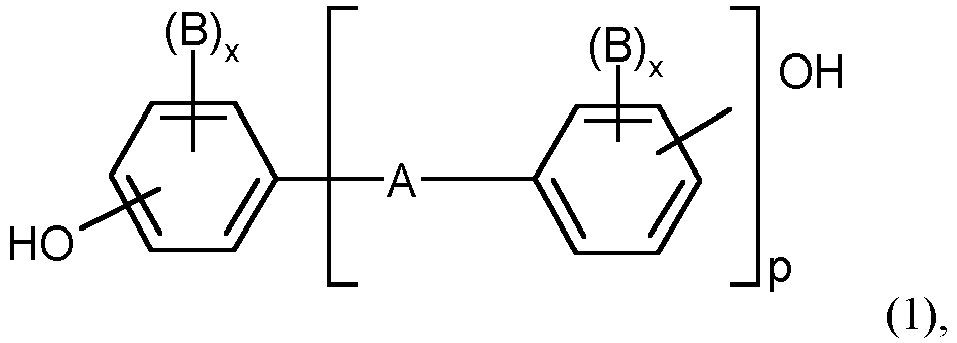
- A eine Einfachbindung, C1 bis C5-Alkylen, C2 bis C5-Alkyliden, C5 bis C6-Cycloalkyliden, -O-, - SO-, -CO-, -S-, -SO2-, C6 bis C12-Arylen, an das weitere aromatische gegebenenfalls Heteroatome enthaltende Ringe kondensiert sein können,
oder ein Rest der Formel (2) oder (3)

- B jeweils C1 bis C12-Alkyl, vorzugsweise Methyl, Halogen, vorzugsweise Chlor und/oder Brom
- x jeweils unabhängig voneinander 0, 1 oder 2,
- p 1 oder 0 sind, und
- R5 und R6 für jedes X1 individuell wählbar, unabhängig voneinander Wasserstoff oder C1 bis C6-Alkyl, vorzugsweise Wasserstoff, Methyl oder Ethyl,
- X1 Kohlenstoff und
- m eine ganze Zahl von 4 bis 7, bevorzugt 4 oder 5 bedeuten, mit der Maßgabe, dass an mindestens einem Atom X1, R5 und R6 gleichzeitig Alkyl sind.
- Bevorzugte Diphenole sind Hydrochinon, Resorcin, Dihydroxydiphenole, Bis-(hydroxyphenyl)-C1-C5-alkane, Bis-(hydroxyphenyl)-C5-C6-cycloalkane, Bis-(hydroxyphenyl)-ether, Bis-(hydroxyphenyl)-sulfoxide, Bis-(hydroxyphenyl)-ketone, Bis-(hydroxyphenyl)-sulfone und α,α-Bis-(hydroxyphenyl)-diisopropyl-benzole sowie deren kernbromierte und/oder kernchlorierte Derivate.
- Besonders bevorzugte Diphenole sind 4,4'-Dihydroxydiphenyl, Bisphenol-A, 2,4-Bis(4-hydroxyphenyl)-2-methylbutan, 1,1-Bis-(4-hydroxyphenyl)-cyclohexan, 1,1-Bis-(4-hydroxyphenyl)-3.3.5-trimethylcyclohexan, 4,4'-Dihydroxydiphenylsulfid, 4,4'-Dihydroxydiphenylsulfon sowie deren di- und tetrabromierten oder chlorierten Derivate wie beispielsweise 2,2-Bis(3-Chlor-4-hydroxyphenyl)-propan, 2,2-Bis-(3,5-dichlor-4-hydroxyphenyl)-propan oder 2,2-Bis-(3,5-dibrom-4-hydroxyphenyl)-propan. Insbesondere bevorzugt ist 2,2-Bis-(4-hydroxyphenyl)-propan (Bisphenol-A).
- Es können die Diphenole einzeln oder als beliebige Mischungen eingesetzt werden. Die Diphenole sind literaturbekannt oder nach literaturbekannten Verfahren erhältlich.
- In bevorzugter Ausführungsform beträgt der Anteil von Bisphenol-A, bezogen auf die Summe aller zur Herstellung der Komponente A verwendeten Diphenole, mindestens 50 mol-%, besonders bevorzugt mindestens 75 mol-%, am meisten bevorzugt mindestens 95 mol-%. Am stärksten bevorzugt wird bei der Herstellung der Komponente A ausschließlich Bisphenol-A als Diphenol eingesetzt.
- Die aromatischen Polycarbonate können in bekannter Weise verzweigt sein, und zwar vorzugsweise durch den Einbau von 0,01 bis 2,0 Mol%, bezogen auf die Summe der eingesetzten Diphenole, an dreifunktionellen oder mehr als dreifunktionellen Verbindungen, beispielsweise solchen mit drei und mehr phenolischen Gruppen.
- Bevorzugt werden lineare aromatische Polycarbonate, weiter bevorzugt lineare aromatische Polycarbonate auf Basis von Bisphenol-A, besonders bevorzugt ausschließlich auf Basis von Bisphenol-A eingesetzt.
- Aromatische Dicarbonsäuredihalogenide zur Herstellung von aromatischen Polyestercarbonaten sind vorzugsweise die Disäuredichloride der Isophthalsäure, Terephthalsäure, Diphenylether-4,4'-dicarbonsäure und der Naphthalin-2,6-dicarbonsäure.
- Besonders bevorzugt sind Gemische der Disäuredichloride der Isophthalsäure und der Terephthalsäure im Verhältnis zwischen 1:20 und 20:1.
- Bei der Herstellung von Polyestercarbonaten wird zusätzlich ein Kohlensäurehalogenid, vorzugsweise Phosgen, als bifunktionelles Säurederivat mit verwendet.
- Als Kettenabbrecher für die Herstellung der aromatischen Polyestercarbonate kommen außer den bereits genannten Monophenolen noch deren Chlorkohlensäureester sowie die Säurechloride von aromatischen Monocarbonsäuren, die gegebenenfalls durch C1 bis C22-Alkylgruppen oder durch Halogenatome substituiert sein können, sowie aliphatische C2 bis C22-Monocarbonsäurechloride in Betracht.
- Bei der Herstellung von aromatischen Polyestercarbonaten kann zusätzlich eine oder mehrere aromatische Hydroxycarbonsäuren eingesetzt werden.
- Die aromatischen Polyestercarbonate können sowohl linear als auch in bekannter Weise verzweigt sein (siehe dazu
DE-A 2 940 024 undDE-A 3 007 934 ), wobei lineare Polyestercarbonate bevorzugt sind. - Als Verzweigungsmittel können beispielsweise drei- oder mehrfunktionelle Carbonsäurechloride, wie Trimesinsäuretrichlorid, Cyanursäuretrichlorid, 3,3'-,4,4'-Benzophenon-tetracarbonsäuretetrachlorid, 1,4,5,8-Napthalintetracarbonsäuretetrachlorid oder Pyromellithsäuretetrachlorid, in Mengen von 0,01 bis 2,0 Mol% bezogen auf die eingesetzten Dicarbonsäuredichloride oder drei- oder mehrfunktionelle Phenole, wie Phloroglucin, 4,6-Dimethyl-2,4,6-tri-(4-hydroxyphenyl)-hept-2-en, 4,6-Dimethyl-2,4-6-tri-(4-hydroxyphenyl)-heptan, 1,3,5-Tri-(4-hydroxyphenyl)-benzol, 1,1,1-Tri-(4-hydroxyphenyl)-ethan, Tri-(4-hydroxyphenyl)-phenylmethan, 2,2-Bis[4,4-bis(4-hydroxy-phenyl)-cyclohexyl]-propan, 2,4-Bis(4-hydroxyphenyl-isopropyl)-phenol, Tetra-(4-hydroxyphenyl)-methan, 2,6-Bis(2-hydroxy-5-methyl-benzyl)-4-methyl-phenol, 2-(4-Hydroxyphenyl)-2-(2,4-dihy-droxyphenyl)-propan, Tetra-(4-[4-hydroxphenyl-isopropyl]-phenoxy)-methan, 1,4-Bis[4,4'-dihydroxytri-phenyl)-methyl]-benzol, in Mengen von 0,01 bis 2,0 Mol% bezogen auf die eingesetzten Diphenole verwendet werden. Phenolische Verzweigungsmittel können mit den Diphenolen vorgelegt werden; Säurechlorid-Verzweigungsmittel können zusammen mit den Säuredichloriden eingetragen werden.
- In den thermoplastischen, aromatischen Polyestercarbonaten kann der Anteil an Carbonatstruktureinheiten beliebig variieren. Vorzugsweise beträgt der Anteil an Carbonatgruppen bis zu 100 Mol%, insbesondere bis zu 80 Mol%, besonders bevorzugt bis zu 50 Mol%, bezogen auf die Summe an Estergruppen und Carbonatgruppen. Sowohl der Ester- als auch der Carbonatanteil der aromatischen Polyestercarbonate kann in Form von Blöcken oder statistisch verteilt im Polykondensat vorliegen.
- Am meisten bevorzugt werden als Komponente A ausschließlich lineare aromatische Polycarbonate, bevorzugt auf Basis von Bisphenol-A, besonders bevorzugt ausschließlich auf Basis von Bisphenol-A eingesetzt.
- Bei der Komponente B handelt es sich um ein Polymethylmethacrylat-Copolymer enthaltend Struktureinheiten abgeleitet von Glycidylmethacrylat.
- Bei Komponente B kann es sich auch um eine Mischung mehrerer Polymethylmethacrylat-Copolymere handeln. Diese Polymethylmethacrylat-Copolymer können auch Anteile von Polymethylmethacrylat-Polymermolekülen enthalten, die selbst keine von Glycidylmethacrylat abgeleiteten Struktureinheiten enthalten. Dieses ist insbesondere bei kleinen Glycidylmethacrylatgehalten im Polymethylmethacrylat-Copolymer herstellungsbedingt im Allgemeinen unvermeidlich.
- Die Polymethylmethacrylat-Copolymere gemäß Komponente B weisen Epoxid-Äquivalente, bestimmt in Dichlormethan als Lösungsmittel bei Raumtemperatur gemäß DIN EN 1877-1 in der Version 2000-12, von 0,05 bis 3 Gew.-%, bevorzugt von 0,1 bis 1,5 Gew.-%, besonders bevorzugt von 0,13 bis 0,60 Gew.-%, am meisten bevorzugt von 0,15 bis 0,45 Gew.-% auf.
- Die Polymethylmethacrylat-Copolymere gemäß Komponente B weisen ein gewichtsgemitteltes Molekulargewicht Mw, ermittelt mittels Gelpermeationschromatographie bei Raumtemperatur in Tetrahydrofuran als Lösungsmittel mit einem Polystyrol-Standard, von 20.000 bis 200.000 g/mol, bevorzugt von 30.000 und 150.0000 g/mol, besonders bevorzugt 50.000 bis 100.000 g/mol auf.
- Sofern es sich bei Komponente B um eine Mischung mehrere Polymethylmethacrylat-Copolymere handelt, so gelten die zuvor genannten (Vorzugs)Bereiche für den Epoxid-Gehalt und die gewichtsgemittelten Molekulargewichte Mw sowie alle im Folgenden beschriebenen (Vorzugs)Bereiche für die entsprechende Mischung der Polymethylmethacrylat-Copolymere gemäß Komponente B.
- Der Ausdruck "Copolymer enthaltend Struktureinheiten abgeleitet von" bedeutet, dass das Copolymer aus den genannten Monomeren durch Copolymerisation hergestellt wird.
- Komponente B enthält bevorzugt 0,2 bis 10 Gew.-%, weiter bevorzugt 0,3 bis 5 Gew.-%, besonders bevorzugt 0,4 bis 2 Gew.-%, am meisten bevorzugt 0,5 bis 1,5 Gew.-% an von Glycidylmethacrylat abgeleiteten Struktureinheiten.
- Diese Copolymere werden bevorzugt durch Polymerisation von Methylmethacrylat in Anwesenheit von 0,2 bis 10 Gew.-%, weiter bevorzugt 0,3 bis 5 Gew.-%, besonders bevorzugt 0,4 bis 2 Gew.-%, am meisten bevorzugt 0,5 bis 1,5 Gew.-% Glycidylmethacrylat hergestellt.
- Die Copolymere gemäß Komponente B können bis zu 50 Gew.-%, bevorzugt bis zu 25 Gew.-%, besonders bevorzugt bis zu 10 Gew.-% von weiteren copolymerisierbaren vinylischen, bevorzugt acrylischen (d.h. Acrylgruppen enthaltende) Monomeren abgeleitete Struktureinheiten enthalten. Als copolymerisierbare acrylische Monomere kommen beispielsweise in Frage Methylacrylat, Ethylacrylat, Propylacrylat, Butylacrylat, Hexylacrylat, 2-Ethylhexylacrylat, Butylmethacrylat und andere, zu diesen genannten Acrylaten strukturverwandte Verbindungen.
- Die in diesem Abschnitt über Komponente B angegebenen Gew.-% beziehen sich jeweils auf die Komponente B.
- In am stärksten bevorzugter Ausführungsform enthält Komponente B keine von weiteren copolymerisierbaren vinylischen Monomeren abgeleiteten Struktureinheiten.
- Die Copolymere gemäß Komponente B sind thermoplastisch.
- Die Herstellung der Copolymere gemäß Komponente B enthaltend Struktureinheiten abgeleitet von Methylmethacrylat und Glycidylmethacrylat ist dem Fachmann bekannt und erfolgt bevorzugt durch radikalisch initiierte Polymerisation der entsprechenden Monomere, insbesondere durch Emulsions-, Suspensions-, Lösungs- oder Massepolymerisation.
- Bei der Lösungspolymerisation, welche bevorzugt in aprotischen Lösungsmitteln, beispielsweise optional halogensubstituierten aliphatischen oder aromatischen Kohlenwasserstoffen als Lösungsmittel ausgeführt wird, sind bevorzugt solche Bedingungen einzuhalten, die eine Hydrolyse der Epoxidgruppen zumindest weitgehend vermeiden. Geeignete und bevorzugte Bedingungen hierfür sind beispielsweise niedrige Gehalte an protischen Lösungsmitteln wie Wasser, Alkoholen, Säuren oder Basen und Arbeiten in Lösungsmitteln aus der Gruppe der organischen Kohlenwasserstoffe, die gegenüber Epoxidgruppen inert sind, wie z.B. Toluol, Ethylbenzol, Xylol, hochsiedende Aliphaten, chlorierte aromatische Kohlewasserstoffe wie Mono-, Di- Tri- oder Tetrachlorbenzole, chlorierte aliphatische Kohlenwasserstoffe wie Dichlormethan oder Chloroform, Ketone wie Methylethylketon, Ester oder Ether.
- Durch Zusatz von Reglern, vor allem von Schwefelreglern, insbesondere von Mercaptanen, können die Molekulargewichte der Komponente B bei der radikalischen Polymerisation so eingestellt werden, dass das erfindungsgemäße gewichtsgemittelte Molekulargewicht Mw resultiert.
- Als Komponente C können eine oder mehrere Polymeradditive, Prozesshilfsstoffe und/oder weitere polymere Komponenten verschieden von Komponenten A und B in der Zusammensetzung enthalten sein, bevorzugt ausgewählt aus der Gruppe bestehend aus Flammschutzmitteln, Antidrippingmitteln, Flammschutzsynergisten, Rauchinhibitoren, Gleit- und Entformungsmitteln, Nukleiermitteln, polymere und nichtpolymere Antistatika, Leitfähigkeitsadditiven, Stabilisatoren (z.B. Hydrolyse-, Wärmealterungs- und UV-Stabilisatoren sowie Umesterungsinhibitoren), Fließfähigkeitspromotoren, Phasenverträglichkeitsvermittlern, Schlagzähigkeitsmodifikatoren (sowohl mit als auch ohne Kern-Schale-Struktur), polymere Blendpartnern, Katalysatoren, Füll- und Verstärkungsstoffen sowie Farbstoffen und Pigmenten.
- Die Auswahl von Art und Menge der Komponente C erfolgt so, dass Einflüsse auf mechanische Eigenschaften und Transparenz der aus den Formmassen hergestellten Formkörpern möglichst gering sind, das heißt so, dass der Zusatz der Komponente C der Lösung der erfindungsgemäßen Aufgabe nicht entgegensteht.
- Wenn die Komponente C eingesetzt wird, so wird diese in einem Anteil von maximal 25 Gew.-%, bezogen auf die Zusammensetzung, eingesetzt. Dieser Anteil ist dann die Summe aller als Komponente C eingesetzten Polymeradditive, Prozesshilfsstoffe und polymeren Komponenten verschieden von Komponenten A und B.
- Dabei werden Antidrippingmittel, Flammschutzsynergisten, Rauchinhibitoren, Gleit- und Entformungsmittel, Nukleiermittel, nichtpolymere Antistatika, Leitfähigkeitsadditive und Stabilisatoren bevorzugt jeweils in einem Anteil von bis zu 1 Gew.-%, besonders bevorzugt in einem Anteil von 0,05 bis 1 Gew.-% und in Summe bevorzugt in einem Anteil von 0,05 bis 3 Gew.-%, bezogen auf die Zusammensetzung verwendet.
- Werden Flammschutzmittel verwendet, so werden davon bevorzugt bis zu 15 Gew.-%, besonders bevorzugt 0,05 bis 15 Gew.-%, bezogen auf die Zusammensetzung, verwendet.
- Werden Fließfähigkeitspromotoren, polymere Antistatika und Phasenverträglichkeitsvermittler eingesetzt, so ist der verwendete Anteil jeweils bevorzugt bis 10 Gew.-%, besonders bevorzugt 0,05 bis 10 Gew.-% und in Summe bevorzugt 0,05 bis 15 Gew.-%, bezogen auf die Zusammensetzung.
- Werden Schlagzähmodifikatoren oder polymere Blendparter eingesetzt, so ist der verwendete Anteil in Summe bevorzugt bis zu 18 Gew.-%, besonders bevorzugt 0,05 bis 18 Gew.-%, bezogen auf die Zusammensetzung.
- Werden Farbstoffe oder Pigmente eingesetzt, so ist der verwendete Anteil in Summe aller eingesetzten Farbstoffe und Pigmente bevorzugt bis zu 10 Gew.-%, besonders bevorzugt 0,1 bis 10 Gew.-%, bezogen auf die Zusammensetzung.
- In einer bevorzugten Ausführungsform werden anorganische Pigmente mit einem Anteil von maximal in Summe 3 Gew.-%, besonders bevorzugt von maximal in Summe 1,5 Gew.-%, weiter bevorzugt von maximal 0,5 Gew.-%, jeweils bezogen auf die Zusammensetzung verwendet. In der am meisten bevorzugten Ausführungsform werden keine anorganischen Pigmente als Bestandteil der Komponente C eingesetzt.
- Werden Füll- und Verstärkungsstoffe eingesetzt, so ist der verwendete Anteil bevorzugt 3 bis 10 Gew.-%, bezogen auf die Zusammensetzung.
- In einer bevorzugten Ausführungsform werden keine Füll- und Verstärkungsstoffe eingesetzt.
- In bevorzugter Ausführungsform wird mindestens ein Polymeradditiv ausgewählt aus der Gruppe bestehend aus Gleit- und Entformungsmitteln, Stabilisatoren, Fließfähigkeitspromotoren, Phasenverträglichkeitsvermittlern, Schlagzähigkeitsmodifikatoren, weiteren polymeren Blendpartnern und Farbstoffen eingesetzt.
- In bevorzugter Ausführungsform wird als Entformungsmittel Pentaerythrittetrastearat eingesetzt.
- In bevorzugter Ausführungsform wird als Stabilisator mindestens ein Vertreter ausgewählt aus der Gruppe bestehend aus sterisch gehinderten Phenolen, organischen Phosphiten und Schwefel-basierten Co-Stabilisatoren eingesetzt.
- In besonders bevorzugter Ausführungsform wird als Stabilisator mindestens ein Vertreter ausgewählt aus der Gruppe bestehend aus Octadecyl-3-(3,5-di-tert-butyl-4-hydroxyphenyl)propionat und Tris(2,4-di-tert-butylphenyl)phosphit eingesetzt.
- Aus den erfindungsgemäßen Zusammensetzungen können thermoplastische Formmassen hergestellt werden.
- Die erfindungsgemäßen thermoplastischen Formmassen können beispielsweise hergestellt werden, indem man die jeweiligen Bestandteile der Zusammensetzungen bei Temperaturen von 220°C bis 320°C, bevorzugt 230 bis 300°C, besonders bevorzugt 240 bis 280°C, am meisten bevorzugt 250 bis 270°C miteinander in der Schmelze vermischt.
- Gegenstand der Erfindung ist auch ein entsprechendes Verfahren zur Herstellung der erfindungsgemäßen Formmassen.
- Das Verfahren umfasst die Schritte
- (i) Aufschmelzen der Bestandteile der Zusammensetzung durch Einbringen thermischer Energie und/oder mechanischer Scherung,
- (ii) Vermischen und Dispergieren der verschiedenen Komponenten der Zusammensetzung mit- bzw. ineinander,
- (iii) Verfestigen der Schmelze durch Abkühlen,
- (iv) Granulieren des verfestigten aus den Schritten (i) - (iii) resultierenden Polymerblends.
- Die Verweilzeit der Komponenten bei den oben genannten Temperaturen liegt bevorzugt in einem Bereich von 15 Sekunden bis 30 Minuten, weiter bevorzugt 30 Sekunden bis 20 Minuten. Bei Verwendung von Extrudern oder kontinuierlichen Co-Knetern als Compoundieraggregat beträgt die Verweilzeit bevorzugt 15 Sekunden bis 5 Minuten, besonders bevorzugt 30 Sekunden bis 2 Minuten.
- Nach Schritt ii) kann auch ein Entgasen der vorliegenden Zusammensetzung durch Anlegen eines Unterdrucks erfolgen. Als Absolutdruck wird bevorzugt ein Druck von maximal 400 mbar, weiter bevorzugt von maximal 200 mbar, besonders bevorzugt von maximal 100 mbar eingestellt.
- Das Vermischen kann in üblichen Aggregaten geschehen, wie beispielsweise in Einwellenextrudern, gleichläufigen oder gegenläufige Doppelwellenextrudern, Planetwalzenextrudern, Innenknetern oder kontinuierlichen oder diskontinuierlichen Co-Knetern. Darin werden die Zusammensetzungen zu Formmassen schmelzcompoundiert oder schmelzextrudiert. Dieser Prozess wird im Rahmen dieser Anmeldung allgemein als Compoundieren oder Schmelzcompoundieren bezeichnet. Unter Formmasse wird also das Produkt verstanden, das erhaltend wird, wenn die Bestandteile der Zusammensetzung schmelzcompoundiert und schmelzextrudiert werden. Eine solche Formmasse ist ein weiterer Gegenstand der vorliegenden Erfindung.
- Die Vermischung der einzelnen Bestandteile der Zusammensetzungen kann in bekannter Weise sowohl sukzessive als auch simultan erfolgen, und zwar sowohl bei etwa 20°C (Raumtemperatur) als auch bei höherer Temperatur. Das bedeutet, dass beispielsweise manche der Bestandteile vollständig oder teilweise über den Haupteinzug eines Extruders dosiert und die restlichen Bestandteile vollständig oder teilweise über einen Seitenextruder später im Compoundierverfahren zugeführt werden können.
- Bei der Durchführung des oben beschriebenen Verfahrens werden die Epoxy-Gruppen in den vom Glycidylmethacrylat abgeleiteten Struktureinheiten in Komponente B teilweise oder vollständig chemisch umgesetzt. Diese Umsetzung kann über die Abnahme des Epoxid-Äquivalents, bestimmt in Dichlormethan als Lösungsmittel bei Raumtemperatur gemäß DIN EN 1877-1 (Version 12-2000), nachgewiesen und quantitativ verfolgt werden. Alternativ kann die Umsetzung mittels 1H-NMR-spektroskopischer Untersuchungen quantitativ verfolgt und nachgewiesen werden. Dabei werden die charakteristischen 1H-NMR-Multiplet-Signale der Protonen im ungeöffneten Epoxy-Ring bei 2,58-2,64 ppm, 2,80-2,84 ppm und 3,15-3,22 ppm (gemessen in deuteriertem Chloroform CD2Cl2 als Lösungsmittel mit einem 600 MHz-Gerät der Fa. Bruker, Karlsruhe, Deutschland) zu Grunde gelegt, deren Intensität mit zunehmender Umsetzung der Epoxy-Gruppen abnimmt. Die chemischen Verschiebungen sind relativ zu Tetramethylsilan angegeben. Bei der Durchführung des oben beschriebenen Verfahrens erfolgt bevorzugt eine chemische Kopplung der Komponente A oder eines Teils der Komponente A an die Komponente B oder einen Teil der Komponente B unter Bildung eines PC-PMMA-Copolymers. Dabei reagieren im Allgemeinen die COOH-Gruppen in der Komponente A mit den Epoxy-Gruppen der Komponente B. Im Allgemeinen handelt es sich bei dem Copolymer aus der Umsetzung der Polymere A und B um ein Blockcopolymer oder Pfropfcopolymer enthaltend Blöcke aus den Komponenten A und B.
- Die chemische Reaktion der Epoxy-Gruppen in den vom Glycidylmethacrylat abgeleiteten Struktureinheiten in Komponente B mit den Carboxy-Gruppen in Komponente A unter Ausbildung eines Copolymers enthaltend Blöcke aus den Komponenten A und B lässt sich über die simultan zur Abnahme der Epoxy-Gruppen erfolgende Abnahme der Säurezahl, bestimmt in DCM/Ethanol als Lösungsmittel mittels potenziometrischer Titration mit ethanolischer KOH-Lösung bei Raumtemperatur verfolgen. Der Nachweis des Reaktionsprodukts ist über 1H-NMR-Spektroskopie möglich. Die NMR-Spektroskopie erlaubt als Alternative zu den zuvor genannten Titrationsmethoden ebenso eine quantitative Verfolgung der chemischen Reaktion. Bei Bildung von Kopplungsprodukten enthaltend Blöcke aus den Komponenten A und B erscheinen in der Regel aufgrund der Additionsverknüpfung der Carboxy-Gruppe der Komponente A an die Epoxy-Gruppe der Komponente B mehrere neue, oft sehr breite und schlecht aufgelöste Multiplett-Signale im 1H-NMR-Spektrum im Bereich zwischen 4,18-4,55 ppm. Aufgrund ihrer Breite und der in der Regel sehr geringen Konzentration der Verknüpfungsgruppen ist ein NMR-spektroskopischer Nachweis jedoch nicht immer (einfach) sicher möglich und erfordert regelmäßig eine starke Vergrößerung des entsprechenden Spektrumbereichs und die Aufnahme eines Spektrums mit einem exzellenten Signal-Rausch-Verhältnis.
- Eine weitere Möglichkeit zum Nachweis der Ausbildung von Copolymeren enthaltend Blöcke aus den Komponenten A und B besteht in der Durchführung von 2D-DOSY-1H-NMR-Untersuchungen. Hierbei äußert sich die Bildung von Copolymeren in einer Verringerung des Diffusionskoeffizienten des Reaktionsproduktes gegenüber den Komponenten in der entsprechenden physikalischen Polymermischung aus Komponenten A und B.
- Es ist weiterhin bevorzugt, dass die im Schritt i) eingesetzte Mischung enthaltend Komponenten A, B und optional C einen Restfeuchtegehalt bestimmt durch Karl-Fischer Titration von 0,01 bis 0,50 Gew.-%, weiter bevorzugt von 0,07 bis 0,20 Gew.-%, jeweils bezogen auf die Summe an A, B und C, aufweist. Bei zu hoher Feuchtigkeit besteht die Gefahr von unerwünscht hohem Molekulargewichtsabbau.
- Die erfindungsgemäßen Formmassen können zur Herstellung von Formkörpern jeder Art verwendet werden. Diese können beispielsweise durch Spritzguss, Extrusion und Blasformverfahren hergestellt werden. Eine weitere Form der Verarbeitung ist die Herstellung von Formkörpern durch Tiefziehen aus zuvor hergestellten Platten oder Folien. Besonders eignen sich die erfindungsgemäßen Formmassen zur Verarbeitung in Extrusions-, Blasform- und Tiefziehverfahren.
- Es ist auch möglich, die Bestandteile der Zusammensetzungen direkt in den Förderextruder einer Spritzgussmaschine zu dosieren, die erfindungsgemäße Formmasse dabei in dem Förderextruder herzustellen und durch entsprechenden Austrag der Formmasse in eine Spritzgussform direkt zu Formkörper zu verarbeiten (Compoundierungs- oder Reaktivcompoundierungsspritzguss).
- Ein solches Verfahren ist ein weiterer Gegenstand der vorliegenden Erfindung und umfasst die folgenden Schritte:
- (i) Dosieren der Bestandteile der erfindungsgemäßen Zusammensetzung in den Förderextruder einer Spritzgussmaschine,
- (ii) Aufschmelzen der Bestandteile der erfindungsgemäßen Zusammensetzung durch Einbringen thermischer Energie und/oder mechanischer Scherung,
- (iii) Fördern der Schmelze zur Austragsstelle des Extruders,
- (iv) Austrag der Schmelze aus dem Förderextruder in eine Spritzgussform,
- (v) Abkühlen und Verfestigen der Schmelze in der Spritzgussform unter Ausbildung eines Formkörpers,
- (vi) Entnahme des Formkörpers aus der Spritzgussform.
- In bevorzugter Ausführungsform dieses Verfahrens beträgt die Verweilzeit der Schmelze im Förderextruder mindestens zwei, weiter bevorzugt mindestens fünf, besonders bevorzugt mindestens sieben Minuten.
- In bevorzugter Ausführungsform dieses Verfahrens beträgt die Verweilzeit der Schmelze im Förderextruder 2 bis 30 Minuten, weiter bevorzugt 5 bis 20 Minuten, besonders bevorzugt 7 bis 15 Minuten.
- In bevorzugter Ausführungsform erfolgen die Verfahrensschritte (iii) und (iv) unter Scherung. Dieses kann beispielsweise erreicht werden durch eine hohe Schneckendrehzahl bei der Schmelzeförderung im Schritt (iii) und/oder durch eine geeignete Schneckenkonfiguration der Förderschnecke, beispielsweise durch den Einsatz von Knetelementen, sowie durch geeignet enge Geometrie der Schmelzeaustrittsdüse im Schritt (iv).
- Ein weiterer Gegenstand der vorliegenden Erfindung betrifft somit die Verwendung einer erfindungsgemäßen Zusammensetzung oder einer erfindungsgemäßen Formmasse zur Herstellung von Formkörpern, sowie ferner auch einen Formkörper, der aus einer erfindungsgemäßen Zusammensetzung oder aus einer erfindungsgemäßen Formmasse erhältlich ist oder eine solche Formmasse enthält.
- Beispiele für solche Formkörper sind Folien, Profile, Gehäuseteile jeder Art, z.B. für Haushaltsgeräte wie Saftpressen, Kaffeemaschinen, Mixer; für Büromaschinen wie Monitore, Flatscreens, Notebooks, Drucker, Kopierer; Platten, Rohre, Elektroinstallationskanäle, Fenster, Türen und weitere Profile für den Bausektor (Innenausbau und Außenanwendungen) sowie Elektro- und Elektronikteile wie Schalter, Stecker und Steckdosen und Bauteile für Nutzfahrzeuge, insbesondere für den Automobilbereich. Die erfindungsgemäßen Zusammensetzungen und Formmassen eignen sich auch zur Herstellung von folgenden Formkörpern oder Formteilen: Innenausbauteile für Schienenfahrzeuge, Schiffe, Flugzeuge, Busse und andere Kraftfahrzeuge, Karosserieteile für Kraftfahrzeuge, Gehäuse von Kleintransformatoren enthaltenden Elektrogeräten, Gehäuse für Geräte zur Informationsverarbeitung und Übermittlung, Gehäuse und Verkleidung von medizinischen Geräten, Massagegeräte und Gehäuse dafür, Spielfahrzeuge für Kinder, flächige Wandelemente, Gehäuse für Sicherheitseinrichtungen, wärmeisolierte Transportbehältnisse, Formteile für Sanitär- und Badausrüstungen, Abdeckgitter für Lüfteröffnungen und Gehäuse für Gartengeräte.
- Die erfindungsgemäßen Zusammensetzungen und Formmassen eignen sich aufgrund ihrer besonderen technischen Eigenschaften bevorzugt zur Herstellung von mit Licht im sichtbaren Wellenlängenbereich, beispielsweise einer LED-Lichtquelle, durchleuchtbaren Formkörpern für Beleuchtungs- und Lichtleiteranwendungen im Automobilbereich, im Bausektor und im Elektronikbereich. Insbesondere eignen sie sich zur Herstellung durchleuchtbarer Formteile für den Einsatz im Automobilinnenraum wie beispielsweise Instrumententafelträger oder Zierblenden oder in automobilen Karosserieanwendungen, welche beispielsweise einer ambienten Beleuchtung oder bedarfsgerecht schaltbaren Funktionsanzeige (beispielsweise Tag-/Nacht-Differenzierung) dienen sollen.
- Bisphenol A-basiertes Polycarbonat mit terminalen Carboxy-Gruppen und mit einem gewichtsgemittelten Molekulargewicht Mw von 26.000 g/mol und einem zahlgemittelten Molekulargewicht Mn von 15.000 g/mol, gemessen bei Raumtemperatur in Methylenchlorid als Lösungsmittel gegen einen BPA-Polycarbonat-Kalibrierungsstandard. Die Säurezahl von Komponente A1 wurde mit 1,7 mg KOH/g ermittelt. Das zu untersuchende Polymer wurde für die Säurezahlbestimmung in einer Konzentration von 10 g/L in 50 ml Methylenchlorid bei Raumtemperatur gelöst. Vor der potentiometrischen Titration mit 0,1 N ethanolischer KOH wurden der Probenlösung 2,5 ml Ethanol zugegeben.
- Die Herstellung der Komponente A1 erfolgte in zwei Schritten. In Schritt a) wurde eine Vorstufe enthaltend Struktureinheiten abgeleitet von tert.-Butyl-4-Hydroxybenzoat als Endgruppen hergestellt und in Schritt b) wurde durch thermische Endgruppenpyrolyse terminale Carboxy-Gruppen freigesetzt.
- In einem kontinuierlich betriebenen Laborreaktor wurde Bisphenol A im Grenzflächenverfahren in einem Gemisch aus Methylenchlorid und Chlorbenzol als Lösemittel in Anwesenheit einer Kettenabbrechermischung bestehend aus p-tert.-Butylphenol und tert.-Butyl-4-Hydroxybenzoat mit Phosgen zur Polykondensationsreaktion gebracht.
- Im Rahmen dieser Synthese wurden 72,2 g/h gasförmiges Phosgen in 959 g/h organischem Lösemittelgemisch aus 50 Gew.-% Methylenchlorid und 50 Gew.-% Chlorbenzol bei -7 °C gelöst. Die derart hergestellte Phosgen-Lösung wurde in Kontakt gebracht mit 907 g/h einer auf 30°C temperierten 15 Gew.-%igen wässrigen alkalischen Bisphenol A-Lösung. Dafür wurde die alkalische Bisphenol A-Lösung durch einen Edelstahlfilter mit der Porengröße 90 µm in der Phosgen-Lösung gepresst und dadurch in dieser dispergiert. In der Bisphenol A-Lösung wurden 2 mol NaOH auf 1 mol Bisphenol-A eingesetzt. Das Reaktionsgemisch wurde in einer auf 25°C temperierten Fink HMR040 Mischpumpe bis zur vollständigen Umsetzung des Phosgens abreagiert. Danach wurden 4,11 g/h eines Gemisches aus 50 mol-% p-tert.-Butylphenol und 50 mol-% tert.-Butyl-4-Hydroxybenzoat als Kettenabbrecher zudosiert, und zwar in Form einer 3 Gew.-%igen Lösung im Lösemittelgemisch aus 50 Gew.-% Methylenchlorid und 50 Gew.-% Chlorbenzol. Das so erhaltene Reaktionsgemisch wurde in einer zweiten, auf 25°C temperierten Fink HMR040 Mischpumpe mit 66,52 g/h 32 Gew.-%iger wässriger Natronlauge weiterreagiert. Es folgten zwei überflutet gefahrene, mit Strömungsbrechern ausgestattete Rührkessel mit einer Verweilzeit von jeweils 600 s, jeweils gefolgt von einer Zahnradpumpe, die sowohl der Förderung des Reaktionsgemisches als auch der weiteren Dispergierung dienen. Nach der ersten Pumpe, d.h. vor dem zweiten Rührkessel, wurde als Katalysator 0,679 g/h einer 10 Gew.%-igen Lösung von N-Ethylpiperidin in Chlorbenzol zudosiert. Am Ende der Reaktion lag der pH-Wert bei etwa 11,5. In einem Phasentrenngefäß wurde die organische von der wässrigen Phase des zweiphasigen Reaktionsgemisches getrennt und die organische Phase mit einer 0,1 Gew.-%igen wässrigen HCl-Lösung zur Entfernung des Katalysators gewaschen. Nachfolgend wurde weiterhin mit vollentsalztem Wasser zur Entfernung der Salzreste gewaschen. Die derart gewaschene Polymerlösung wurde in organischem Lösungsmittel gefällt und über Nacht im Vakuumofen bei 120 °C getrocknet.
- Die Freisetzung der COOH-Endgruppen durch thermische Endgruppenpyrolyse der gemäß dem zuvor beschriebenen Verfahren hergestellten Polcarbonat-Vorstufe PC-1 unter Abspaltung der Schutzgruppe in Form von Isobutylen-Gas erfolgte in einem kontinuierlichen Doppelwellen-Extruder vom Typ Process 11 (Thermofischer Scientific, Karlsruhe, Deutschland) mit einer Schneckenkonfiguration mit drei Mischzonen und mit einem Verhältnis an Länge zu Durchmesser (L/D) von 40. Die Schmelzetemperatur betrug 250°C, gemessen über einen düsenaustrittsnah im letzten Gehäuseelement des Extruders verbauten Thermofühler. Die Schmelzetemperatur resultierte dabei aus dem Eintrag mechanischer Energie durch die Knetelemente sowie dem Eintrag thermischer Energie durch die Beheizung des Extrudergehäuses. Das Extrudergehäuse ist in acht separat und unterschiedlich beheizbare Zonen eingeteilt. Die drei Knetzonen befanden sich im Übergang der Heizzonen 3 und 4, in der Heizzone 5 sowie im Übergang der Heizzonen 6 und 7. Der Rohstoffeinzug befindet sich in der Heizzone 1. Darüber hinaus ist die Austrittsdüse separat beheizbar. Zur Einstellung der Schmelzetemperatur wurden die Gehäusetemperaturen in den Gehäusezonen sowie die Austrittdüse wie folgt temperiert: Das erste Gehäuse (Rohstoffeinzugszone) wurde nicht beheizt, Zone 2 wurde auf eine Soll-Temperatur von 70°C beheizt, Zone 3 wurde auf eine Soll-Temperatur von 160°C beheizt und Zonen 4 bis 8 wurden auf dieselbe Soll-Temperatur von 260°C beheizt. Die Düse wurde ebenfalls auf 260°C beheizt. Der Extruder wurde mit einem Durchsatz von etwa 300 g/h und mit einer Drehzahl von 175 min-1 betrieben. Durch Anlegen eines Unterdruckes von ca. 100 mbar (absolut) wurde das im Extruder unter diesen Verfahrensbedingungen freigesetzte Isobutylen-Gas kontinuierlich über einen Entgasungsdom in der vorletzten (siebten) Heizzone aus dem Extruder abgezogen. Unter diesen Verfahrensbedingungen ergab sich eine Verweilzeit des Polycarbonat im Extruder von ca. 70 s.
- Komponente A2 unterscheidet sich von Komponente A1 lediglich in der Temperaturführung im Verfahrensschritt b), das heißt in der Endgruppenpyrolyse der Polycarbonat-Vorstufe PC-1. Das erste Gehäuse (Rohstoffeinzugszone) wurde nicht beheizt, Zone 2 wurde auf eine Soll-Temperatur von 70°C beheizt, Zone 3 wurde auf eine Soll-Temperatur von 190°C beheizt und Zonen 4 bis 8 wurden auf dieselbe Soll-Temperatur von 240°C beheizt. Die Düse wurde ebenfalls auf 240°C beheizt. Die anderen Verfahrensparameter wurden gegenüber der Herstellung der Komponente A1 nicht verändert. Dadurch resultierte eine Schmelzetemperatur von 231°C, gemessen über den düsenaustrittsnah im letzten Gehäuseelement des Extruders verbauten Thermofühler. Komponente A2 weist eine Säurezahl von 3,0 mg KOH/g und dasselbe Molekulargewicht wie Komponente A1 auf.
- Bisphenol A-basiertes Polycarbonat, hergestellt im Phasengrenzflächenverfahren, mit einem gewichtsgemittelten Molekulargewicht Mw von 26.000 g/mol, gemessen bei Raumtemperatur in Methylenchlorid als Lösungsmittel gegen einen BPA-Polycarbonat-Kalibrierungsstandard. Als Kettenabbrecher wurde bei der Herstellung der Komponente A3 ausschließlich 4-tert-Butylphenol verwendet. Das Polycarbonat enthält keine Carboxy-Gruppen.
- Statistisches Polymethylmethacrylat-Glycidylmethacrylat-Copolymerisat mit einem Gehalt an von Glycidylmethacrylat abgeleiteten Struktureinheiten von 1,0 Gew.-% hergestellt durch radikalische Polymerisation. Komponente B1 weist ein gewichtsgemitteltes Molekulargewicht Mw von 60.000 g/mol, gemessen mittels Gelpermeationschromatographie bei Raumtemperatur in Tetrahydrofuran als Lösungsmittel gegen einen Polystyrol-Kalibrierungsstandard, auf. Das Epoxid-Äquivalent von Komponente B1 wurde gemäß DIN EN 1877-1 (Version 12-2000) in Dichlormethan bei Raumtemperatur zu 0,32 Gew.-% bestimmt.
- Polymethylmethacrylat mit einem gewichtsgemittelten Molekulargewicht Mw von 58.000 g/mol, gemessen mittels Gelpermeationschromatographie bei Raumtemperatur in Tetrahydrofuran als Lösungsmittel gegen einen Polystyrol-Kalibrierungsstandard. Komponente B2 enthält keine von Glycidylmethacrylat abgeleiteten Struktureinheiten.
- Komponente C1: Tetrabutylphosphoniumacetat-Essigsäurekomplex (Sachem Inc., Austin, USA)
- Die für die Herstellung der thermoplastischen Formmassen eingesetzten Rohstoffe wurden bei der Compoundierung als Pulver eingesetzt, welche aus Granulaten mittels Kryovermahlung hergestellt wurden.
- Die thermoplastischen PC/PMMA-Formmassen aus den in Tabelle 1 dargestellten Zusammensetzungen wurden auf einem kontinuierlichen Doppelwellen-Extruder vom Typ Process 11 (Thermofischer Scientific, Karlsruhe, Deutschland) mit einer Dispergierschneckenkonfiguration mit zwei Mischzonen bei einer Schmelzetemperatur von 260°C, einem Durchsatz von etwa 300 g/h, einer Drehzahl von 125 min-1 und bei einem Absolutdruck von 100 mbar compoundiert. Unter diesen Bedingungen ergab sich eine Verweilzeit von ca. 90 s. Nach Austritt durch eine Düsenplatte wurde der Schmelzestrang abgekühlt, dadurch verfestigt und anschließend granuliert. Für die Compoundierungen wurden zunächst Pulvermischungen der Komponenten A und B hergestellt und diese gleichmäßig über einen volumetrischen Dosierer in die Einlaufzone des Doppelwellenextruders dosiert.
- Aus den thermoplastischen Formmassen, welche aus den Zusammensetzungen gemäß Tabelle 1 hergestellt wurden, wurden mittels einer Laborthermopresse vom Typ Polystat 200 der Firma Servitec Maschinenservice GmbH (Wustermark, Deutschland) bei einer Temperatur von 260°C, einem Druck von 100 bar und einer Pressdauer von insgesamt 4 min Rundplatten mit einem Durchmesser von 25 mm und einer Dicke von 1 mm hergestellt.
- Weiterhin wurden aus den thermoplastischen Formmassen, welche aus den Zusammensetzungen gemäß Tabelle 1 hergestellt wurden, auf einer Spritzgießmaschine vom Typ Arburg Allrounder 470 H 1000-170 der Fa. Arburg GmbH + Co KG (Loßburg, Deutschland) Rechteckplatten der Abmessung 80 mm x 80 mm x 1 mm sowie Prüfstäbe der Abmessung 80 mm x 10 mm x 4 mm bei einer Schmelzetemperatur von 270°C, einer Werkzeugtemperatur von 60°C und einem Einspritzdruck von 2000 bar hergestellt.
- Als Maß für die Kratzfestigkeit wurde die sogenannte Bleistifthärte ermittelt. Die Messung erfolgte bei Raumtemperatur mittels eines Ritzhärteprüfers vom Typ TriForcePencil Modell 293 der Fa. Erichsen GmbH & Co. KG (Hemer, Deutschland) gemäß Prüfvorschrift des Geräteherstellers in Anlehnung an das Verfahren von Wolff-Wilborn an den spritzgegossenen Prüfplatten der Dimension 80 mm x 80 mm x 1 mm. Die Bleistifte wurden dazu in einem zur Prüfoberfläche geneigten Winkel von 45° in die Messvorrichtung eingespannt und mit einer Prüfkraft von 5 N über die Probekörperoberfläche geschoben. Es wurde mit dem härtesten Bleistift gestartet und die Härte dann sukzessive reduziert. Die Bleistifthärte des Bleistifts, dessen Spitze bei diesem Vorgehen als erstes keinen fühlbaren Kratzer mehr hinterlässt, gilt dabei als die die Kratzfestigkeit der Kunststoffoberfläche charakterisierende Größe.
- Die Spannungsrissbeständigkeit unter Chemikalieneinfluss (ESC-Verhalten) wurde in Rapsöl bei Raumtemperatur beurteilt. Bestimmt wurde die Zeit bis zum spannungsrissinduzierten Bruchversagen ermittelt an spritzgegossenen Prüfstäben der Abmessung 80 mm x 10 mm x 4 mm, welche mittels einer Spannschablone mit einer externen Radfaserdehnung von 2,4% beaufschlagt und im Rapsöl vollständig eingetaucht waren. Die Messung erfolgte gemäß DIN EN ISO 22088 (Version von 2006).
- Die Transparenz der Formmassen wurde an thermogepressten Rundplatten mit einem Durchmesser von 25 mm und einer Dicke von 1 mm sowie an spritzgegossenen Rechteckplatten der Abmessung 80 mm x 80 mm x 1 mm bei Raumtemperatur bestimmt. Die entsprechenden wellenlängenabhängigen totalen Transmissionsgrade wurden nach DIN 5033-7 (2014) bestimmt. Daraus wurde nach DIN EN ISO 11664-3 (2013) mit der Lichtart D65 und dem 10°-Beobachter der Wert Y(D65, 10°) berechnet. Weiterhin wurden die wellenlängenspezifischen Transmissionsgrade bei Wellenlängen von 700 nm (T700) und 400 nm (T400) ermittelt.
- Die Duktilität der Formmassen wurde an thermogepressten Rundplatten mit einem Durchmesser von 25 mm und einer Dicke von 1 mm bei Raumtemperatur in einem Aufprallversuch beurteilt. Die Messungen erfolgten mit einem Eigenbau-Fallwerk (Fallmasse 1,86 kg, Auflager-Durchmesser 15 mm, Dorndurchmesser (halbkugelförmig) 7 mm). Dabei wurde die Fallhöhe der Fallmasse systematisch variiert und beurteilt, bis zu welcher Fallhöhe der Prüfkörper nicht durchstoßen wird.
- Bei der Herstellung der erfindungsgemäßen Formmassen durch Compoundierung wurden die Epoxy-Gruppen in Komponente B teilweise chemisch umgesetzt. Diese chemische Umsetzung der Epoxy-Gruppen wurde 1H-NMR-spektroskopisch verfolgt und nachgewiesen. Dabei wurden die charakteristischen 1H-NMR-Multiplet-Signale der Protonen im ungeöffneten Epoxy-Ring bei 2,58-2,64 ppm, 2,80-2,84 ppm und 3,15-3,22 ppm (gemessen bei Raumtemperatur in deuteriertem Chloroform CD2Cl2 als Lösungsmittel mit einem 600 MHz-Gerät der Fa. Bruker, Karlsruhe, Deutschland) zu Grunde gelegt. Deren Intensität nahm bei der Herstellung der erfindungsgemäßen Formmassen durch Compoundierung gegenüber der physikalischen Mischung der Ausgangskomponenten ab. Gleichzeitig entstanden im 1H-NMR-Spektrum bei dieser Umsetzung mehrere neue, sehr breite und vergleichsweise schlecht aufgelöste Multiplett-Signale im Bereich zwischen 4,18-4,55 ppm, welche der Verknüpfungsgruppe zugeordnet wird, die durch nucleophile Addition von Carboxy-Gruppen der Komponente A an Epoxy-Gruppen der Komponente B entsteht. Das Auftreten dieser neuen Signale zeigt somit, dass durch die chemische Umsetzung der Epoxy-Gruppen in Komponente B Copolymer enthaltend Blöcke aus den Komponenten A und B entstanden ist.
Tabelle 1: Zusammensetzungen und Eigenschaften der daraus hergestellten Formmassen Zusammensetzung (Gew.-Teile) 1 2 3 4 5 6 V7 V8 V9 V10 A1 80 70 A2 80 70 62 40 30 A3 80 80 100 B1 20 30 20 30 38 60 70 B2 20 20 C1 0,05 Merkmale Säurezahl von Komponente A [mg KOH/g] 1,7 1,7 3,0 3,0 3,0 3,0 3,0 0 0 0 Epoxid Äquivalente von Komponente B [Gew.-%] 0,32 0,32 0,32 0,32 0,32 0,32 0,32 0 0 - (Anteil (A) x SZ (A)) / (Anteil (B) x Epoxid-Äquivalent (B)) 21 12 38 22 15 6 4 - - - Eigenschaften Transmission Y(D65,10°) (am Pressformkörper) 82 44 83 67 71 46 30 22 32 90 Transmission Y(D65,10°) (am Spritzgussformkörper) 89 T400 (am Pressformkörper) 65 17 68 37 42 16 14 16 22 88 T700 (am Pressformkörper) 87 70 87 80 82 71 49 25 39 91 100×(T700-T400)/Y(D65,10°) (am Pressformkörper) 27 120 24 64 56 120 117 41 53 3 T400 (am Spritzgussformkörper) 87 T700 (am Spritzgussformkörper) 90 100×(T700-T400)/Y(D65,10°) (am Spritzgussformkörper) 3 Bleistifthärte 3H-4H 2H F ESC (Zeit bis Bruch in Rapsöl bei 2,4%) [h] >168 0,4 2,7 Duktilität - Prüfkörper nicht durchstoßen bis zu einer Höhe von [cm] 16 15 20 16 <1 25 - Die Daten in Tabelle 1 zeigen, dass Formkörper hergestellt aus den erfindungsgemäßen Zusammensetzungen 1 bis 6 eine deutlich bessere Transmission (Transparenz) aufweisen als Formkörper hergestellt aus Zusammensetzungen enthaltend nicht reaktiv modifiziere PC- und PMMA-Komponenten (V8). Gegenüber V8 zeigt die erfindungsgemäße Zusammensetzung 3 bei gleichen Anteilen der Komponenten A und B zudem eine deutliche erhöhte Bleistifthärte sowie eine wesentlich verbesserte Chemikalienbeständigkeit. Bleistifthärte und Chemikalienbeständigkeit der erfindungsgemäßen Zusammensetzung 3 sind ebenfalls erheblich besser als bei reinem Polycarbonat (V10).
- Die Transparenz der erfindungsgemäßen Zusammensetzungen 1 und 3 ist ebenso verbessert gegenüber einer reaktiv compoundierten Zusammensetzung mit gleichen Anteilen an Komponenten A und B enthaltend nicht reaktiv modifiziertes Polycarbonat, nicht reaktiv modifiziertes PMMA sowie einen Umesterungskatalysator, wie sie in
WO 2020/212229 A1 offenbart wurde (V9). Weiterhin ist bei den erfindungsgemäßen Zusammensetzungen 1 und 3 die Duktilität erheblich höher als bei V9. - Ein Vergleich der erfindungsgemäßen Beispiele 3 bis 6 mit dem Vergleichsbeispiel V7 zeigt, dass die angestrebte Durchleuchtbarkeit (Transmission) bei einem Gehalt an Komponente A von 30 Gew.-% nicht mehr erzielt wird.
- Ein Vergleich der erfindungsgemäßen Beispiele 3 bis 6 zeigt, dass höhere Gehalte an Komponente A bevorzugt sind.
- Ein Vergleich der erfindungsgemäßen Beispiele 2 und 4 sowie 1 und 3 zeigt, dass höhere Verhältnisse aus (i) dem Produkt aus Säurezahl der Komponente A (in mg Kaliumhydroxid (KOH)/g) und dem Gew.-Anteil an Komponente A, bezogen auf in Summe 100 Gew.-Teile der Komponenten A und B, und (ii) dem Produkt aus Epoxid-Äquivalent der Komponente B (in Gew.-%) und dem Gew.-Anteil an Komponente B, bezogen auf in Summe 100 Gew.-Teile der Komponenten A und B, das heißt (Anteil (A) x SZ (A)) / (Anteil (B) x Epoxid-Äquivalent (B)) bevorzugt sind. Das gilt umso mehr, je niedriger der Gehalt an Komponente A in der Zusammensetzung ist (vergleiche Beispiele 2 und 4 mit 1 und 3).
- Bei dem am meisten bevorzugten Beispiel 3 ist zudem die Transmission, insbesondere die Transmission von spritzgegossenen Formteilen, über den gesamten Wellenlängenbereich des sichtbaren Lichtes besonders gleichmäßig, wie sich aus dem geringsten Wert für 100×(T700-T400)/Y(D65,10°) aller Beispiele ablesen lässt. Ferner ist bei diesem am meisten bevorzugten Beispiel 3 die Duktilität besonders hoch.
Claims (15)
- Zusammensetzung enthaltendA) ein Carboxy-Gruppen enthaltendes aromatisches Polycarbonat und/oder aromatisches Polyestercarbonat, wobei das Polycarbonat eine Säurezahl im Bereich von 0,5 bis 10 mg Kaliumhydroxid/g, bestimmt in Dichlormethan/Ethanol als Lösungsmittel mittels potenziometrischer Titration gemäß DIN EN ISO 2114, Methode A in der Version 2002-06 mit ethanolischer Kaliumhydroxid-Lösung bei Raumtemperatur, und ein gewichtsgemitteltes Molekulargewicht Mw, ermittelt per Gelpermeationschromatographie bei Raumtemperatur in Dichlormethan als Lösungsmittel mit einem BPA-Polycarbonat-Standard, im Bereich von 10.000 bis 40.000 g/mol aufweist undB) ein Polymethylmethacrylat-Copolymer enthaltend Struktureinheiten abgeleitet von Glycidylmethacrylat, wobei das Copolymer ein Epoxid-Äquivalent, bestimmt in Dichlormethan als Lösungsmittel bei Raumtemperatur gemäß DIN EN 1877-1 in der Version 2000-12, von 0,05 bis 3 Gew.-% und ein gewichtsgemitteltes Molekulargewicht Mw, ermittelt mittels Gelpermeationschromatographie bei Raumtemperatur in Tetrahydrofuran als Lösungsmittel mit einem Polystyrol-Standard, von 20.000 bis 200.000 g/mol aufweist,wobei das Gewichtsverhältnis der Komponenten A und Komponente B im Bereich von 95:5 bis 35:65 liegt.
- Zusammensetzung gemäß Anspruch 1, wobei es sich bei den Carboxy-Gruppen in der Komponente A ausschließlich um terminale Carboxy-Gruppen handelt.
- Zusammensetzung gemäß Anspruch 1 oder 2, wobei das Verhältnis aus (i) dem Produkt aus Säurezahl der Komponente A in mg Kaliumhydroxid/g und dem Gew.-Anteil an Komponente A, bezogen auf in Summe 100 Gew.-Teile der Komponenten A und B, und (ii) dem Produkt aus Epoxid-Äquivalent der Komponente B in Gew.-% und dem Gew.-Anteil an Komponente B, bezogen auf in Summe 100 Gew.-Teile der Komponenten A und B, im Bereich von 15 bis 200 liegt.
- Zusammensetzung gemäß einem der vorhergehenden Ansprüche, wobei die Säurezahl der Komponente A 1,3 bis 5,0 Kaliumhydroxid/g beträgt.
- Zusammensetzung gemäß einem der vorhergehenden Ansprüche, wobei das gewichtsgemittelte Molekulargewicht Mw der Komponente A 20.000 bis 30.000 g/mol beträgt.
- Zusammensetzung gemäß einem der vorhergehenden Ansprüche, wobei die Komponente B ein Epoxid-Äquivalent von 0,13 bis 0,60 Gew.-% aufweist.
- Zusammensetzung gemäß einem der vorhergehenden Ansprüche, wobei die Komponente B ein gewichtsgemitteltes Molekulargewicht Mw von 50.000 bis 100.000 g/mol aufweist.
- Zusammensetzung gemäß einem der vorhergehenden Ansprüche, wobei die Komponente B 0,4 bis 2 Gew.-% an von Glycidylmethacrylat abgeleiteten Struktureinheiten enthält.
- Zusammensetzung gemäß einem der vorhergehenden Ansprüche bestehend aus35 bis 95 Gew.-%, der Komponente A,4,99 bis 64,99 Gew.-% der Komponente B undals Komponente C 0,01 bis 10 Gew.-% Polymeradditive, Prozesshilfsstoffe und/oder von den Komponenten A und B verschiedene Polymere,wobei die Gew.-% der Komponenten A bis C so gewählt sind, dass sie sich zu 100 Gew.-% summieren.
- Verfahren zur Herstellung einer thermoplastischen Formmasse umfassend die Schritte(i) Aufschmelzen der Bestandteile einer Zusammensetzung gemäß einer der vorhergehenden Ansprüche durch Einbringen thermischer Energie und/oder mechanischer Scherung,(ii) Vermischen und Dispergieren der verschiedenen Komponenten der Zusammensetzung mit- bzw. ineinander,(iii) Verfestigen der Schmelze durch Abkühlen,(iv) Granulieren des verfestigten aus den Schritten (i) - (iii) resultierenden Polymerblends,wobei der Schritt (ii) in einer Compoundierungsmaschine ausgewählt aus der Gruppe bestehend aus Einwellenextrudern, gleichläufigen oder gegenläufigen Doppelwellenextrudern, Planetwalzenextrudern, Innenknetern oder Co-Knetern und bei einer Temperatur der Schmelze von 230 bis 300°C erfolgt.
- Verfahren gemäß Anspruch 10, wobei in dem Prozess die Epoxy-Gruppen in den vom Glycidylmethacrylat abgeleiteten Struktureinheiten in Komponente B teilweise oder vollständig in einer chemischen Reaktion umgesetzt werden.
- Thermoplastische Formmasse erhältlich in einem Verfahren gemäß einer der Ansprüche 10 bis 11.
- Verwendung einer thermoplastischen Formmasse gemäß Anspruch 12 zur Herstellung von Formkörpern.
- Formkörper enthaltend eine thermoplastische Formmasse gemäß Anspruch 13.
- Verfahren zur Herstellung eines Formkörpers, umfassend die Schritte(i) Dosieren der Bestandteile einer Zusammensetzung gemäß einem der Ansprüche 1 bis 9 in den Förderextruder einer Spritzgussmaschine,(ii) Aufschmelzen der Bestandteile der Zusammensetzung durch Einbringen thermischer Energie und/oder mechanischer Scherung,(iii) Fördern der Schmelze zur Austragsstelle des Extruders,(iv) Austrag der Schmelze aus dem Förderextruder in eine Spritzgussform,(v) Abkühlen und Verfestigen der Schmelze in der Spritzgussform unter Ausbildung eines Formkörpers,(vi) Entnahme des Formkörpers aus der Spritzgussform.
Applications Claiming Priority (2)
| Application Number | Priority Date | Filing Date | Title |
|---|---|---|---|
| EP21183774 | 2021-07-05 | ||
| PCT/EP2022/067474 WO2023280608A1 (de) | 2021-07-05 | 2022-06-27 | Zusammensetzung und verfahren zur herstellung einer transparenten thermoplastischen polycarbonat/polymethylmethacrylat-formmasse |
Publications (2)
| Publication Number | Publication Date |
|---|---|
| EP4367166A1 EP4367166A1 (de) | 2024-05-15 |
| EP4367166B1 true EP4367166B1 (de) | 2025-06-04 |
Family
ID=76765078
Family Applications (1)
| Application Number | Title | Priority Date | Filing Date |
|---|---|---|---|
| EP22732274.0A Active EP4367166B1 (de) | 2021-07-05 | 2022-06-27 | Zusammensetzung und verfahren zur herstellung einer transparenten thermoplastischen polycarbonat/polymethylmethacrylat-formmasse |
Country Status (6)
| Country | Link |
|---|---|
| US (1) | US12195623B2 (de) |
| EP (1) | EP4367166B1 (de) |
| JP (1) | JP2024525556A (de) |
| KR (1) | KR20240028411A (de) |
| CN (1) | CN117693546A (de) |
| WO (1) | WO2023280608A1 (de) |
Families Citing this family (1)
| Publication number | Priority date | Publication date | Assignee | Title |
|---|---|---|---|---|
| EP4606841A1 (de) * | 2024-02-22 | 2025-08-27 | Covestro Deutschland AG | Blockcopolymer und verfahren zu dessen herstellung unter verwendung eines speziellen katalysators |
Family Cites Families (18)
| Publication number | Priority date | Publication date | Assignee | Title |
|---|---|---|---|---|
| DE1495626B1 (de) | 1960-03-30 | 1971-06-09 | Bayer Ag | Verfahren zum herstellen von polyestern |
| DE2232877B2 (de) | 1972-07-05 | 1980-04-10 | Werner & Pfleiderer, 7000 Stuttgart | Verfahren zur Herstellung von Polyestern |
| JPS5292295A (en) | 1976-01-29 | 1977-08-03 | Sumitomo Chem Co Ltd | Preparation of aromatic polyester |
| IT1116721B (it) | 1976-04-02 | 1986-02-10 | Allied Chem | Copolimero bisfenolo a tereftalato carbonato lavorabili in massa fusa |
| DE2842005A1 (de) | 1978-09-27 | 1980-04-10 | Bayer Ag | Polycarbonate mit alkylphenyl-endgruppen, ihre herstellung und ihre verwendung |
| JPS5594930A (en) | 1979-01-10 | 1980-07-18 | Sumitomo Chem Co Ltd | Preparation of aromatic polyester by improved bulk polymerization process |
| DE2940024A1 (de) | 1979-10-03 | 1981-04-16 | Bayer Ag, 5090 Leverkusen | Aromatische polyester, verfahren zu ihrer herstellung und ihre verwendung zur herstellung von spritzgussartikeln, folien und ueberzuegen |
| DE3007934A1 (de) | 1980-03-01 | 1981-09-17 | Bayer Ag, 5090 Leverkusen | Aromatische polyestercarbonate, verfahren zu ihrer herstellung und ihre verwendung zur herstellung von spritzgussartikeln, folien und ueberzuegen |
| US4853458A (en) | 1987-10-19 | 1989-08-01 | General Electric Company | Carboxy-functionalized polycarbonate from carboxyphenol |
| US4959411A (en) | 1987-10-19 | 1990-09-25 | General Electric Company | Preparation of copolymer from carboxy-functionalized polycarbonate and nucleophilic polymer |
| DE3844633A1 (de) | 1988-08-12 | 1990-04-19 | Bayer Ag | Dihydroxydiphenylcycloalkane, ihre herstellung und ihre verwendung zur herstellung von hochmolekularen polycarbonaten |
| JPH07258530A (ja) * | 1994-03-28 | 1995-10-09 | Kawasaki Steel Corp | 樹脂組成物及びその製造方法 |
| JP5588268B2 (ja) * | 2010-08-17 | 2014-09-10 | 出光興産株式会社 | ポリカーボネート樹脂組成物及びその成形体 |
| US8975346B2 (en) * | 2012-05-18 | 2015-03-10 | Sabic Global Technologies B.V. | Polycarbonate copolymers via controlled radical polymerization |
| EP3262097A1 (de) | 2015-02-26 | 2018-01-03 | SABIC Global Technologies B.V. | Polymermischungen mit polymethylmethacrylat und polycarbonat |
| EP3303448B1 (de) * | 2015-05-28 | 2020-02-26 | SABIC Global Technologies B.V. | Polymermischungen mit polycarbonat und polymethylmethacrylat |
| EP3725819B1 (de) | 2019-04-18 | 2021-10-13 | Covestro Deutschland AG | Verfahren zur herstellung einer polycarbonat-formmasse |
| US20240279404A1 (en) * | 2021-07-05 | 2024-08-22 | Covestro Deutschland Ag | Polycarbonate with carboxy end groups and method for preparing polycarbonate |
-
2022
- 2022-06-27 JP JP2024500206A patent/JP2024525556A/ja active Pending
- 2022-06-27 KR KR1020247000020A patent/KR20240028411A/ko active Pending
- 2022-06-27 EP EP22732274.0A patent/EP4367166B1/de active Active
- 2022-06-27 WO PCT/EP2022/067474 patent/WO2023280608A1/de not_active Ceased
- 2022-06-27 US US18/575,903 patent/US12195623B2/en active Active
- 2022-06-27 CN CN202280047815.8A patent/CN117693546A/zh active Pending
Also Published As
| Publication number | Publication date |
|---|---|
| KR20240028411A (ko) | 2024-03-05 |
| WO2023280608A1 (de) | 2023-01-12 |
| JP2024525556A (ja) | 2024-07-12 |
| CN117693546A (zh) | 2024-03-12 |
| US20240270961A1 (en) | 2024-08-15 |
| EP4367166A1 (de) | 2024-05-15 |
| US12195623B2 (en) | 2025-01-14 |
Similar Documents
| Publication | Publication Date | Title |
|---|---|---|
| EP4263709B1 (de) | Zusammensetzung und verfahren zur herstellung einer transluzenten thermoplastischen polycarbonat/polymethylmethacrylat-formmasse | |
| EP3725819B1 (de) | Verfahren zur herstellung einer polycarbonat-formmasse | |
| EP2257590B1 (de) | Schlagzähmodifizierte polycarbonat-zusammensetzungen mit einer guten kombination aus rohton, hydrolyse- und schmelzestabilität | |
| EP3046959B1 (de) | Tiefschwarze thermoplastische formmassen mit hohem glanz und deren herstellung | |
| EP3310858B1 (de) | Flammgeschütze polycarbonat-polyester-zusammensetzungen | |
| EP2593288A1 (de) | Vorrichtung und verfahren zur herstellung von produkten aus pigmenthaltigen polymermischungen | |
| EP4025580B1 (de) | Polyphosphazen und formmasse enthaltend das polyphosphazen | |
| DE112013005920B4 (de) | Polycarbonatharz, Herstellungsverfahren dafür und polycarbonatharzhaltiger Formartikel | |
| EP3365390A1 (de) | Verfahren zur herstellung von polycarbonat-formmassen mit verbesserter thermischer verarbeitungsstabilität | |
| WO2023280608A1 (de) | Zusammensetzung und verfahren zur herstellung einer transparenten thermoplastischen polycarbonat/polymethylmethacrylat-formmasse | |
| EP4367163B1 (de) | Polycarbonat mit carboxy-endgruppen und verfahren zur herstellung des polycarbonats | |
| WO2021023701A1 (de) | Verzweigte polyestersiloxane | |
| EP3143088B1 (de) | Hydrolysestabile polycarbonat-polyester-zusammensetzungen | |
| EP3728469B1 (de) | Thermoplastische zusammensetzungen mit guter stabilität | |
| EP4311838A1 (de) | Carboxy-terminiertes polycarbonat und herstellverfahren | |
| EP4177301B1 (de) | Polyphosphazen und formmasse enthaltend das polyphosphazen | |
| EP4077515B1 (de) | Verfahren zur herstellung eines masterbatches und einer formmasse mit verbesserten eigenschaften | |
| EP4606841A1 (de) | Blockcopolymer und verfahren zu dessen herstellung unter verwendung eines speziellen katalysators | |
| WO2025098864A1 (de) | Verfahren zur nachträglichen reduzierung des gehalts an freiem bisphenol-a von polycarbonat und/oder polyestercarbonat formmassen | |
| WO2024146774A1 (de) | Mineralgefüllte polycarbonat- und/oder polyestercarbonat-formmasse mit guter thermischer stabilität | |
| EP4074718A1 (de) | Stabilisatoren für polymere |
Legal Events
| Date | Code | Title | Description |
|---|---|---|---|
| STAA | Information on the status of an ep patent application or granted ep patent |
Free format text: STATUS: UNKNOWN |
|
| STAA | Information on the status of an ep patent application or granted ep patent |
Free format text: STATUS: THE INTERNATIONAL PUBLICATION HAS BEEN MADE |
|
| PUAI | Public reference made under article 153(3) epc to a published international application that has entered the european phase |
Free format text: ORIGINAL CODE: 0009012 |
|
| STAA | Information on the status of an ep patent application or granted ep patent |
Free format text: STATUS: REQUEST FOR EXAMINATION WAS MADE |
|
| 17P | Request for examination filed |
Effective date: 20240205 |
|
| AK | Designated contracting states |
Kind code of ref document: A1 Designated state(s): AL AT BE BG CH CY CZ DE DK EE ES FI FR GB GR HR HU IE IS IT LI LT LU LV MC MK MT NL NO PL PT RO RS SE SI SK SM TR |
|
| DAV | Request for validation of the european patent (deleted) | ||
| DAX | Request for extension of the european patent (deleted) | ||
| GRAP | Despatch of communication of intention to grant a patent |
Free format text: ORIGINAL CODE: EPIDOSNIGR1 |
|
| STAA | Information on the status of an ep patent application or granted ep patent |
Free format text: STATUS: GRANT OF PATENT IS INTENDED |
|
| INTG | Intention to grant announced |
Effective date: 20250117 |
|
| GRAS | Grant fee paid |
Free format text: ORIGINAL CODE: EPIDOSNIGR3 |
|
| GRAA | (expected) grant |
Free format text: ORIGINAL CODE: 0009210 |
|
| STAA | Information on the status of an ep patent application or granted ep patent |
Free format text: STATUS: THE PATENT HAS BEEN GRANTED |
|
| AK | Designated contracting states |
Kind code of ref document: B1 Designated state(s): AL AT BE BG CH CY CZ DE DK EE ES FI FR GB GR HR HU IE IS IT LI LT LU LV MC MK MT NL NO PL PT RO RS SE SI SK SM TR |
|
| REG | Reference to a national code |
Ref country code: GB Ref legal event code: FG4D Free format text: NOT ENGLISH |
|
| REG | Reference to a national code |
Ref country code: CH Ref legal event code: EP |
|
| REG | Reference to a national code |
Ref country code: DE Ref legal event code: R096 Ref document number: 502022004178 Country of ref document: DE |
|
| REG | Reference to a national code |
Ref country code: IE Ref legal event code: FG4D Free format text: LANGUAGE OF EP DOCUMENT: GERMAN |
|
| REG | Reference to a national code |
Ref country code: NL Ref legal event code: MP Effective date: 20250604 |
|
| PG25 | Lapsed in a contracting state [announced via postgrant information from national office to epo] |
Ref country code: ES Free format text: LAPSE BECAUSE OF FAILURE TO SUBMIT A TRANSLATION OF THE DESCRIPTION OR TO PAY THE FEE WITHIN THE PRESCRIBED TIME-LIMIT Effective date: 20250604 Ref country code: FI Free format text: LAPSE BECAUSE OF FAILURE TO SUBMIT A TRANSLATION OF THE DESCRIPTION OR TO PAY THE FEE WITHIN THE PRESCRIBED TIME-LIMIT Effective date: 20250604 |
|
| REG | Reference to a national code |
Ref country code: LT Ref legal event code: MG9D |
|
| PG25 | Lapsed in a contracting state [announced via postgrant information from national office to epo] |
Ref country code: NO Free format text: LAPSE BECAUSE OF FAILURE TO SUBMIT A TRANSLATION OF THE DESCRIPTION OR TO PAY THE FEE WITHIN THE PRESCRIBED TIME-LIMIT Effective date: 20250904 Ref country code: GR Free format text: LAPSE BECAUSE OF FAILURE TO SUBMIT A TRANSLATION OF THE DESCRIPTION OR TO PAY THE FEE WITHIN THE PRESCRIBED TIME-LIMIT Effective date: 20250905 |
|
| PG25 | Lapsed in a contracting state [announced via postgrant information from national office to epo] |
Ref country code: PL Free format text: LAPSE BECAUSE OF FAILURE TO SUBMIT A TRANSLATION OF THE DESCRIPTION OR TO PAY THE FEE WITHIN THE PRESCRIBED TIME-LIMIT Effective date: 20250604 |
|
| PG25 | Lapsed in a contracting state [announced via postgrant information from national office to epo] |
Ref country code: BG Free format text: LAPSE BECAUSE OF FAILURE TO SUBMIT A TRANSLATION OF THE DESCRIPTION OR TO PAY THE FEE WITHIN THE PRESCRIBED TIME-LIMIT Effective date: 20250604 |
|
| PG25 | Lapsed in a contracting state [announced via postgrant information from national office to epo] |
Ref country code: HR Free format text: LAPSE BECAUSE OF FAILURE TO SUBMIT A TRANSLATION OF THE DESCRIPTION OR TO PAY THE FEE WITHIN THE PRESCRIBED TIME-LIMIT Effective date: 20250604 |
|
| PG25 | Lapsed in a contracting state [announced via postgrant information from national office to epo] |
Ref country code: RS Free format text: LAPSE BECAUSE OF FAILURE TO SUBMIT A TRANSLATION OF THE DESCRIPTION OR TO PAY THE FEE WITHIN THE PRESCRIBED TIME-LIMIT Effective date: 20250904 |
|
| PG25 | Lapsed in a contracting state [announced via postgrant information from national office to epo] |
Ref country code: LV Free format text: LAPSE BECAUSE OF FAILURE TO SUBMIT A TRANSLATION OF THE DESCRIPTION OR TO PAY THE FEE WITHIN THE PRESCRIBED TIME-LIMIT Effective date: 20250604 |
|
| PG25 | Lapsed in a contracting state [announced via postgrant information from national office to epo] |
Ref country code: NL Free format text: LAPSE BECAUSE OF FAILURE TO SUBMIT A TRANSLATION OF THE DESCRIPTION OR TO PAY THE FEE WITHIN THE PRESCRIBED TIME-LIMIT Effective date: 20250604 |
|
| PG25 | Lapsed in a contracting state [announced via postgrant information from national office to epo] |
Ref country code: PT Free format text: LAPSE BECAUSE OF FAILURE TO SUBMIT A TRANSLATION OF THE DESCRIPTION OR TO PAY THE FEE WITHIN THE PRESCRIBED TIME-LIMIT Effective date: 20251006 |
|
| PG25 | Lapsed in a contracting state [announced via postgrant information from national office to epo] |
Ref country code: IS Free format text: LAPSE BECAUSE OF FAILURE TO SUBMIT A TRANSLATION OF THE DESCRIPTION OR TO PAY THE FEE WITHIN THE PRESCRIBED TIME-LIMIT Effective date: 20251004 |
|
| PG25 | Lapsed in a contracting state [announced via postgrant information from national office to epo] |
Ref country code: SM Free format text: LAPSE BECAUSE OF FAILURE TO SUBMIT A TRANSLATION OF THE DESCRIPTION OR TO PAY THE FEE WITHIN THE PRESCRIBED TIME-LIMIT Effective date: 20250604 |
|
| PG25 | Lapsed in a contracting state [announced via postgrant information from national office to epo] |
Ref country code: CZ Free format text: LAPSE BECAUSE OF FAILURE TO SUBMIT A TRANSLATION OF THE DESCRIPTION OR TO PAY THE FEE WITHIN THE PRESCRIBED TIME-LIMIT Effective date: 20250604 |
|
| PG25 | Lapsed in a contracting state [announced via postgrant information from national office to epo] |
Ref country code: EE Free format text: LAPSE BECAUSE OF FAILURE TO SUBMIT A TRANSLATION OF THE DESCRIPTION OR TO PAY THE FEE WITHIN THE PRESCRIBED TIME-LIMIT Effective date: 20250604 |
|
| PG25 | Lapsed in a contracting state [announced via postgrant information from national office to epo] |
Ref country code: SK Free format text: LAPSE BECAUSE OF FAILURE TO SUBMIT A TRANSLATION OF THE DESCRIPTION OR TO PAY THE FEE WITHIN THE PRESCRIBED TIME-LIMIT Effective date: 20250604 |
|
| REG | Reference to a national code |
Ref country code: CH Ref legal event code: H13 Free format text: ST27 STATUS EVENT CODE: U-0-0-H10-H13 (AS PROVIDED BY THE NATIONAL OFFICE) Effective date: 20260127 |
|
| PG25 | Lapsed in a contracting state [announced via postgrant information from national office to epo] |
Ref country code: IT Free format text: LAPSE BECAUSE OF FAILURE TO SUBMIT A TRANSLATION OF THE DESCRIPTION OR TO PAY THE FEE WITHIN THE PRESCRIBED TIME-LIMIT Effective date: 20250604 |
|
| PG25 | Lapsed in a contracting state [announced via postgrant information from national office to epo] |
Ref country code: LU Free format text: LAPSE BECAUSE OF NON-PAYMENT OF DUE FEES Effective date: 20250627 |
|
| REG | Reference to a national code |
Ref country code: BE Ref legal event code: MM Effective date: 20250630 |
|
| REG | Reference to a national code |
Ref country code: DE Ref legal event code: R097 Ref document number: 502022004178 Country of ref document: DE |
|
| PG25 | Lapsed in a contracting state [announced via postgrant information from national office to epo] |
Ref country code: RO Free format text: LAPSE BECAUSE OF FAILURE TO SUBMIT A TRANSLATION OF THE DESCRIPTION OR TO PAY THE FEE WITHIN THE PRESCRIBED TIME-LIMIT Effective date: 20250604 |
|
| PG25 | Lapsed in a contracting state [announced via postgrant information from national office to epo] |
Ref country code: MC Free format text: LAPSE BECAUSE OF FAILURE TO SUBMIT A TRANSLATION OF THE DESCRIPTION OR TO PAY THE FEE WITHIN THE PRESCRIBED TIME-LIMIT Effective date: 20250604 |
|
| PLBE | No opposition filed within time limit |
Free format text: ORIGINAL CODE: 0009261 |
|
| STAA | Information on the status of an ep patent application or granted ep patent |
Free format text: STATUS: NO OPPOSITION FILED WITHIN TIME LIMIT |
|
| PG25 | Lapsed in a contracting state [announced via postgrant information from national office to epo] |
Ref country code: IE Free format text: LAPSE BECAUSE OF NON-PAYMENT OF DUE FEES Effective date: 20250627 Ref country code: DK Free format text: LAPSE BECAUSE OF FAILURE TO SUBMIT A TRANSLATION OF THE DESCRIPTION OR TO PAY THE FEE WITHIN THE PRESCRIBED TIME-LIMIT Effective date: 20250604 |
|
| PG25 | Lapsed in a contracting state [announced via postgrant information from national office to epo] |
Ref country code: BE Free format text: LAPSE BECAUSE OF NON-PAYMENT OF DUE FEES Effective date: 20250630 |
|
| REG | Reference to a national code |
Ref country code: CH Ref legal event code: L10 Free format text: ST27 STATUS EVENT CODE: U-0-0-L10-L00 (AS PROVIDED BY THE NATIONAL OFFICE) Effective date: 20260416 |
|
| PG25 | Lapsed in a contracting state [announced via postgrant information from national office to epo] |
Ref country code: CH Free format text: LAPSE BECAUSE OF NON-PAYMENT OF DUE FEES Effective date: 20250630 |
|
| 26N | No opposition filed |
Effective date: 20260305 |
|
| PG25 | Lapsed in a contracting state [announced via postgrant information from national office to epo] |
Ref country code: LT Free format text: LAPSE BECAUSE OF FAILURE TO SUBMIT A TRANSLATION OF THE DESCRIPTION OR TO PAY THE FEE WITHIN THE PRESCRIBED TIME-LIMIT Effective date: 20250604 |
|
| PGFP | Annual fee paid to national office [announced via postgrant information from national office to epo] |
Ref country code: DE Payment date: 20260522 Year of fee payment: 5 |
|
| PGFP | Annual fee paid to national office [announced via postgrant information from national office to epo] |
Ref country code: AT Payment date: 20260714 Year of fee payment: 5 |
|
| PG25 | Lapsed in a contracting state [announced via postgrant information from national office to epo] |
Ref country code: FR Free format text: LAPSE BECAUSE OF NON-PAYMENT OF DUE FEES Effective date: 20250804 |
|
| PG25 | Lapsed in a contracting state [announced via postgrant information from national office to epo] |
Ref country code: SE Free format text: LAPSE BECAUSE OF FAILURE TO SUBMIT A TRANSLATION OF THE DESCRIPTION OR TO PAY THE FEE WITHIN THE PRESCRIBED TIME-LIMIT Effective date: 20250604 Ref country code: CY Free format text: LAPSE BECAUSE OF FAILURE TO SUBMIT A TRANSLATION OF THE DESCRIPTION OR TO PAY THE FEE WITHIN THE PRESCRIBED TIME-LIMIT Effective date: 20250604 |