EP4428112A1 - Zirkoniumoxidpulver, gesinterter zirkoniumoxidgegenstand und verfahren zur herstellung eines gesinterten zirkoniumoxidgegenstands - Google Patents
Zirkoniumoxidpulver, gesinterter zirkoniumoxidgegenstand und verfahren zur herstellung eines gesinterten zirkoniumoxidgegenstands Download PDFInfo
- Publication number
- EP4428112A1 EP4428112A1 EP23780129.5A EP23780129A EP4428112A1 EP 4428112 A1 EP4428112 A1 EP 4428112A1 EP 23780129 A EP23780129 A EP 23780129A EP 4428112 A1 EP4428112 A1 EP 4428112A1
- Authority
- EP
- European Patent Office
- Prior art keywords
- less
- zirconia
- stabilizer
- mol
- sintered body
- Prior art date
- Legal status (The legal status is an assumption and is not a legal conclusion. Google has not performed a legal analysis and makes no representation as to the accuracy of the status listed.)
- Pending
Links
Images

Classifications
-
- C—CHEMISTRY; METALLURGY
- C01—INORGANIC CHEMISTRY
- C01G—COMPOUNDS CONTAINING METALS NOT COVERED BY SUBCLASSES C01D OR C01F
- C01G25/00—Compounds of zirconium
- C01G25/02—Oxides
-
- C—CHEMISTRY; METALLURGY
- C04—CEMENTS; CONCRETE; ARTIFICIAL STONE; CERAMICS; REFRACTORIES
- C04B—LIME, MAGNESIA; SLAG; CEMENTS; COMPOSITIONS THEREOF, e.g. MORTARS, CONCRETE OR LIKE BUILDING MATERIALS; ARTIFICIAL STONE; CERAMICS; REFRACTORIES; TREATMENT OF NATURAL STONE
- C04B35/00—Shaped ceramic products characterised by their composition; Ceramics compositions; Processing powders of inorganic compounds preparatory to the manufacturing of ceramic products
- C04B35/01—Shaped ceramic products characterised by their composition; Ceramics compositions; Processing powders of inorganic compounds preparatory to the manufacturing of ceramic products based on oxide ceramics
- C04B35/48—Shaped ceramic products characterised by their composition; Ceramics compositions; Processing powders of inorganic compounds preparatory to the manufacturing of ceramic products based on oxide ceramics based on zirconium or hafnium oxides, zirconates, zircon or hafnates
- C04B35/486—Fine ceramics
-
- C—CHEMISTRY; METALLURGY
- C04—CEMENTS; CONCRETE; ARTIFICIAL STONE; CERAMICS; REFRACTORIES
- C04B—LIME, MAGNESIA; SLAG; CEMENTS; COMPOSITIONS THEREOF, e.g. MORTARS, CONCRETE OR LIKE BUILDING MATERIALS; ARTIFICIAL STONE; CERAMICS; REFRACTORIES; TREATMENT OF NATURAL STONE
- C04B35/00—Shaped ceramic products characterised by their composition; Ceramics compositions; Processing powders of inorganic compounds preparatory to the manufacturing of ceramic products
- C04B35/01—Shaped ceramic products characterised by their composition; Ceramics compositions; Processing powders of inorganic compounds preparatory to the manufacturing of ceramic products based on oxide ceramics
- C04B35/48—Shaped ceramic products characterised by their composition; Ceramics compositions; Processing powders of inorganic compounds preparatory to the manufacturing of ceramic products based on oxide ceramics based on zirconium or hafnium oxides, zirconates, zircon or hafnates
- C04B35/486—Fine ceramics
- C04B35/488—Composites
- C04B35/4885—Composites with aluminium oxide
-
- C—CHEMISTRY; METALLURGY
- C04—CEMENTS; CONCRETE; ARTIFICIAL STONE; CERAMICS; REFRACTORIES
- C04B—LIME, MAGNESIA; SLAG; CEMENTS; COMPOSITIONS THEREOF, e.g. MORTARS, CONCRETE OR LIKE BUILDING MATERIALS; ARTIFICIAL STONE; CERAMICS; REFRACTORIES; TREATMENT OF NATURAL STONE
- C04B35/00—Shaped ceramic products characterised by their composition; Ceramics compositions; Processing powders of inorganic compounds preparatory to the manufacturing of ceramic products
- C04B35/622—Forming processes; Processing powders of inorganic compounds preparatory to the manufacturing of ceramic products
- C04B35/626—Preparing or treating the powders individually or as batches ; preparing or treating macroscopic reinforcing agents for ceramic products, e.g. fibres; mechanical aspects section B
- C04B35/62605—Treating the starting powders individually or as mixtures
- C04B35/6261—Milling
- C04B35/6262—Milling of calcined, sintered clinker or ceramics
-
- C—CHEMISTRY; METALLURGY
- C04—CEMENTS; CONCRETE; ARTIFICIAL STONE; CERAMICS; REFRACTORIES
- C04B—LIME, MAGNESIA; SLAG; CEMENTS; COMPOSITIONS THEREOF, e.g. MORTARS, CONCRETE OR LIKE BUILDING MATERIALS; ARTIFICIAL STONE; CERAMICS; REFRACTORIES; TREATMENT OF NATURAL STONE
- C04B35/00—Shaped ceramic products characterised by their composition; Ceramics compositions; Processing powders of inorganic compounds preparatory to the manufacturing of ceramic products
- C04B35/622—Forming processes; Processing powders of inorganic compounds preparatory to the manufacturing of ceramic products
- C04B35/626—Preparing or treating the powders individually or as batches ; preparing or treating macroscopic reinforcing agents for ceramic products, e.g. fibres; mechanical aspects section B
- C04B35/62605—Treating the starting powders individually or as mixtures
- C04B35/62645—Thermal treatment of powders or mixtures thereof other than sintering
- C04B35/62675—Thermal treatment of powders or mixtures thereof other than sintering characterised by the treatment temperature
-
- C—CHEMISTRY; METALLURGY
- C04—CEMENTS; CONCRETE; ARTIFICIAL STONE; CERAMICS; REFRACTORIES
- C04B—LIME, MAGNESIA; SLAG; CEMENTS; COMPOSITIONS THEREOF, e.g. MORTARS, CONCRETE OR LIKE BUILDING MATERIALS; ARTIFICIAL STONE; CERAMICS; REFRACTORIES; TREATMENT OF NATURAL STONE
- C04B35/00—Shaped ceramic products characterised by their composition; Ceramics compositions; Processing powders of inorganic compounds preparatory to the manufacturing of ceramic products
- C04B35/622—Forming processes; Processing powders of inorganic compounds preparatory to the manufacturing of ceramic products
- C04B35/626—Preparing or treating the powders individually or as batches ; preparing or treating macroscopic reinforcing agents for ceramic products, e.g. fibres; mechanical aspects section B
- C04B35/62605—Treating the starting powders individually or as mixtures
- C04B35/62685—Treating the starting powders individually or as mixtures characterised by the order of addition of constituents or additives
-
- C—CHEMISTRY; METALLURGY
- C04—CEMENTS; CONCRETE; ARTIFICIAL STONE; CERAMICS; REFRACTORIES
- C04B—LIME, MAGNESIA; SLAG; CEMENTS; COMPOSITIONS THEREOF, e.g. MORTARS, CONCRETE OR LIKE BUILDING MATERIALS; ARTIFICIAL STONE; CERAMICS; REFRACTORIES; TREATMENT OF NATURAL STONE
- C04B35/00—Shaped ceramic products characterised by their composition; Ceramics compositions; Processing powders of inorganic compounds preparatory to the manufacturing of ceramic products
- C04B35/622—Forming processes; Processing powders of inorganic compounds preparatory to the manufacturing of ceramic products
- C04B35/64—Burning or sintering processes
-
- C—CHEMISTRY; METALLURGY
- C01—INORGANIC CHEMISTRY
- C01P—INDEXING SCHEME RELATING TO STRUCTURAL AND PHYSICAL ASPECTS OF SOLID INORGANIC COMPOUNDS
- C01P2002/00—Crystal-structural characteristics
- C01P2002/50—Solid solutions
- C01P2002/52—Solid solutions containing elements as dopants
-
- C—CHEMISTRY; METALLURGY
- C01—INORGANIC CHEMISTRY
- C01P—INDEXING SCHEME RELATING TO STRUCTURAL AND PHYSICAL ASPECTS OF SOLID INORGANIC COMPOUNDS
- C01P2002/00—Crystal-structural characteristics
- C01P2002/60—Compounds characterised by their crystallite size
-
- C—CHEMISTRY; METALLURGY
- C01—INORGANIC CHEMISTRY
- C01P—INDEXING SCHEME RELATING TO STRUCTURAL AND PHYSICAL ASPECTS OF SOLID INORGANIC COMPOUNDS
- C01P2004/00—Particle morphology
- C01P2004/60—Particles characterised by their size
- C01P2004/62—Submicrometer sized, i.e. from 0.1-1 micrometer
-
- C—CHEMISTRY; METALLURGY
- C01—INORGANIC CHEMISTRY
- C01P—INDEXING SCHEME RELATING TO STRUCTURAL AND PHYSICAL ASPECTS OF SOLID INORGANIC COMPOUNDS
- C01P2006/00—Physical properties of inorganic compounds
- C01P2006/12—Surface area
-
- C—CHEMISTRY; METALLURGY
- C04—CEMENTS; CONCRETE; ARTIFICIAL STONE; CERAMICS; REFRACTORIES
- C04B—LIME, MAGNESIA; SLAG; CEMENTS; COMPOSITIONS THEREOF, e.g. MORTARS, CONCRETE OR LIKE BUILDING MATERIALS; ARTIFICIAL STONE; CERAMICS; REFRACTORIES; TREATMENT OF NATURAL STONE
- C04B2235/00—Aspects relating to ceramic starting mixtures or sintered ceramic products
- C04B2235/02—Composition of constituents of the starting material or of secondary phases of the final product
- C04B2235/30—Constituents and secondary phases not being of a fibrous nature
- C04B2235/32—Metal oxides, mixed metal oxides, or oxide-forming salts thereof, e.g. carbonates, nitrates, (oxy)hydroxides, chlorides
- C04B2235/3205—Alkaline earth oxides or oxide forming salts thereof, e.g. beryllium oxide
- C04B2235/3208—Calcium oxide or oxide-forming salts thereof, e.g. lime
-
- C—CHEMISTRY; METALLURGY
- C04—CEMENTS; CONCRETE; ARTIFICIAL STONE; CERAMICS; REFRACTORIES
- C04B—LIME, MAGNESIA; SLAG; CEMENTS; COMPOSITIONS THEREOF, e.g. MORTARS, CONCRETE OR LIKE BUILDING MATERIALS; ARTIFICIAL STONE; CERAMICS; REFRACTORIES; TREATMENT OF NATURAL STONE
- C04B2235/00—Aspects relating to ceramic starting mixtures or sintered ceramic products
- C04B2235/02—Composition of constituents of the starting material or of secondary phases of the final product
- C04B2235/30—Constituents and secondary phases not being of a fibrous nature
- C04B2235/32—Metal oxides, mixed metal oxides, or oxide-forming salts thereof, e.g. carbonates, nitrates, (oxy)hydroxides, chlorides
- C04B2235/3217—Aluminum oxide or oxide forming salts thereof, e.g. bauxite, alpha-alumina
-
- C—CHEMISTRY; METALLURGY
- C04—CEMENTS; CONCRETE; ARTIFICIAL STONE; CERAMICS; REFRACTORIES
- C04B—LIME, MAGNESIA; SLAG; CEMENTS; COMPOSITIONS THEREOF, e.g. MORTARS, CONCRETE OR LIKE BUILDING MATERIALS; ARTIFICIAL STONE; CERAMICS; REFRACTORIES; TREATMENT OF NATURAL STONE
- C04B2235/00—Aspects relating to ceramic starting mixtures or sintered ceramic products
- C04B2235/02—Composition of constituents of the starting material or of secondary phases of the final product
- C04B2235/30—Constituents and secondary phases not being of a fibrous nature
- C04B2235/32—Metal oxides, mixed metal oxides, or oxide-forming salts thereof, e.g. carbonates, nitrates, (oxy)hydroxides, chlorides
- C04B2235/3224—Rare earth oxide or oxide forming salts thereof, e.g. scandium oxide
-
- C—CHEMISTRY; METALLURGY
- C04—CEMENTS; CONCRETE; ARTIFICIAL STONE; CERAMICS; REFRACTORIES
- C04B—LIME, MAGNESIA; SLAG; CEMENTS; COMPOSITIONS THEREOF, e.g. MORTARS, CONCRETE OR LIKE BUILDING MATERIALS; ARTIFICIAL STONE; CERAMICS; REFRACTORIES; TREATMENT OF NATURAL STONE
- C04B2235/00—Aspects relating to ceramic starting mixtures or sintered ceramic products
- C04B2235/02—Composition of constituents of the starting material or of secondary phases of the final product
- C04B2235/30—Constituents and secondary phases not being of a fibrous nature
- C04B2235/32—Metal oxides, mixed metal oxides, or oxide-forming salts thereof, e.g. carbonates, nitrates, (oxy)hydroxides, chlorides
- C04B2235/3224—Rare earth oxide or oxide forming salts thereof, e.g. scandium oxide
- C04B2235/3225—Yttrium oxide or oxide-forming salts thereof
-
- C—CHEMISTRY; METALLURGY
- C04—CEMENTS; CONCRETE; ARTIFICIAL STONE; CERAMICS; REFRACTORIES
- C04B—LIME, MAGNESIA; SLAG; CEMENTS; COMPOSITIONS THEREOF, e.g. MORTARS, CONCRETE OR LIKE BUILDING MATERIALS; ARTIFICIAL STONE; CERAMICS; REFRACTORIES; TREATMENT OF NATURAL STONE
- C04B2235/00—Aspects relating to ceramic starting mixtures or sintered ceramic products
- C04B2235/02—Composition of constituents of the starting material or of secondary phases of the final product
- C04B2235/30—Constituents and secondary phases not being of a fibrous nature
- C04B2235/32—Metal oxides, mixed metal oxides, or oxide-forming salts thereof, e.g. carbonates, nitrates, (oxy)hydroxides, chlorides
- C04B2235/3224—Rare earth oxide or oxide forming salts thereof, e.g. scandium oxide
- C04B2235/3227—Lanthanum oxide or oxide-forming salts thereof
-
- C—CHEMISTRY; METALLURGY
- C04—CEMENTS; CONCRETE; ARTIFICIAL STONE; CERAMICS; REFRACTORIES
- C04B—LIME, MAGNESIA; SLAG; CEMENTS; COMPOSITIONS THEREOF, e.g. MORTARS, CONCRETE OR LIKE BUILDING MATERIALS; ARTIFICIAL STONE; CERAMICS; REFRACTORIES; TREATMENT OF NATURAL STONE
- C04B2235/00—Aspects relating to ceramic starting mixtures or sintered ceramic products
- C04B2235/02—Composition of constituents of the starting material or of secondary phases of the final product
- C04B2235/30—Constituents and secondary phases not being of a fibrous nature
- C04B2235/32—Metal oxides, mixed metal oxides, or oxide-forming salts thereof, e.g. carbonates, nitrates, (oxy)hydroxides, chlorides
- C04B2235/3224—Rare earth oxide or oxide forming salts thereof, e.g. scandium oxide
- C04B2235/3229—Cerium oxides or oxide-forming salts thereof
-
- C—CHEMISTRY; METALLURGY
- C04—CEMENTS; CONCRETE; ARTIFICIAL STONE; CERAMICS; REFRACTORIES
- C04B—LIME, MAGNESIA; SLAG; CEMENTS; COMPOSITIONS THEREOF, e.g. MORTARS, CONCRETE OR LIKE BUILDING MATERIALS; ARTIFICIAL STONE; CERAMICS; REFRACTORIES; TREATMENT OF NATURAL STONE
- C04B2235/00—Aspects relating to ceramic starting mixtures or sintered ceramic products
- C04B2235/02—Composition of constituents of the starting material or of secondary phases of the final product
- C04B2235/30—Constituents and secondary phases not being of a fibrous nature
- C04B2235/32—Metal oxides, mixed metal oxides, or oxide-forming salts thereof, e.g. carbonates, nitrates, (oxy)hydroxides, chlorides
- C04B2235/3231—Refractory metal oxides, their mixed metal oxides, or oxide-forming salts thereof
- C04B2235/3244—Zirconium oxides, zirconates, hafnium oxides, hafnates, or oxide-forming salts thereof
- C04B2235/3246—Stabilised zirconias, e.g. YSZ or cerium stabilised zirconia
-
- C—CHEMISTRY; METALLURGY
- C04—CEMENTS; CONCRETE; ARTIFICIAL STONE; CERAMICS; REFRACTORIES
- C04B—LIME, MAGNESIA; SLAG; CEMENTS; COMPOSITIONS THEREOF, e.g. MORTARS, CONCRETE OR LIKE BUILDING MATERIALS; ARTIFICIAL STONE; CERAMICS; REFRACTORIES; TREATMENT OF NATURAL STONE
- C04B2235/00—Aspects relating to ceramic starting mixtures or sintered ceramic products
- C04B2235/02—Composition of constituents of the starting material or of secondary phases of the final product
- C04B2235/50—Constituents or additives of the starting mixture chosen for their shape or used because of their shape or their physical appearance
- C04B2235/54—Particle size related information
- C04B2235/5409—Particle size related information expressed by specific surface values
-
- C—CHEMISTRY; METALLURGY
- C04—CEMENTS; CONCRETE; ARTIFICIAL STONE; CERAMICS; REFRACTORIES
- C04B—LIME, MAGNESIA; SLAG; CEMENTS; COMPOSITIONS THEREOF, e.g. MORTARS, CONCRETE OR LIKE BUILDING MATERIALS; ARTIFICIAL STONE; CERAMICS; REFRACTORIES; TREATMENT OF NATURAL STONE
- C04B2235/00—Aspects relating to ceramic starting mixtures or sintered ceramic products
- C04B2235/02—Composition of constituents of the starting material or of secondary phases of the final product
- C04B2235/50—Constituents or additives of the starting mixture chosen for their shape or used because of their shape or their physical appearance
- C04B2235/54—Particle size related information
- C04B2235/5418—Particle size related information expressed by the size of the particles or aggregates thereof
- C04B2235/5445—Particle size related information expressed by the size of the particles or aggregates thereof submicron sized, i.e. from 0,1 to 1 micron
-
- C—CHEMISTRY; METALLURGY
- C04—CEMENTS; CONCRETE; ARTIFICIAL STONE; CERAMICS; REFRACTORIES
- C04B—LIME, MAGNESIA; SLAG; CEMENTS; COMPOSITIONS THEREOF, e.g. MORTARS, CONCRETE OR LIKE BUILDING MATERIALS; ARTIFICIAL STONE; CERAMICS; REFRACTORIES; TREATMENT OF NATURAL STONE
- C04B2235/00—Aspects relating to ceramic starting mixtures or sintered ceramic products
- C04B2235/02—Composition of constituents of the starting material or of secondary phases of the final product
- C04B2235/50—Constituents or additives of the starting mixture chosen for their shape or used because of their shape or their physical appearance
- C04B2235/54—Particle size related information
- C04B2235/5463—Particle size distributions
-
- C—CHEMISTRY; METALLURGY
- C04—CEMENTS; CONCRETE; ARTIFICIAL STONE; CERAMICS; REFRACTORIES
- C04B—LIME, MAGNESIA; SLAG; CEMENTS; COMPOSITIONS THEREOF, e.g. MORTARS, CONCRETE OR LIKE BUILDING MATERIALS; ARTIFICIAL STONE; CERAMICS; REFRACTORIES; TREATMENT OF NATURAL STONE
- C04B2235/00—Aspects relating to ceramic starting mixtures or sintered ceramic products
- C04B2235/60—Aspects relating to the preparation, properties or mechanical treatment of green bodies or pre-forms
- C04B2235/602—Making the green bodies or pre-forms by moulding
-
- C—CHEMISTRY; METALLURGY
- C04—CEMENTS; CONCRETE; ARTIFICIAL STONE; CERAMICS; REFRACTORIES
- C04B—LIME, MAGNESIA; SLAG; CEMENTS; COMPOSITIONS THEREOF, e.g. MORTARS, CONCRETE OR LIKE BUILDING MATERIALS; ARTIFICIAL STONE; CERAMICS; REFRACTORIES; TREATMENT OF NATURAL STONE
- C04B2235/00—Aspects relating to ceramic starting mixtures or sintered ceramic products
- C04B2235/60—Aspects relating to the preparation, properties or mechanical treatment of green bodies or pre-forms
- C04B2235/604—Pressing at temperatures other than sintering temperatures
-
- C—CHEMISTRY; METALLURGY
- C04—CEMENTS; CONCRETE; ARTIFICIAL STONE; CERAMICS; REFRACTORIES
- C04B—LIME, MAGNESIA; SLAG; CEMENTS; COMPOSITIONS THEREOF, e.g. MORTARS, CONCRETE OR LIKE BUILDING MATERIALS; ARTIFICIAL STONE; CERAMICS; REFRACTORIES; TREATMENT OF NATURAL STONE
- C04B2235/00—Aspects relating to ceramic starting mixtures or sintered ceramic products
- C04B2235/70—Aspects relating to sintered or melt-casted ceramic products
- C04B2235/74—Physical characteristics
- C04B2235/76—Crystal structural characteristics, e.g. symmetry
-
- C—CHEMISTRY; METALLURGY
- C04—CEMENTS; CONCRETE; ARTIFICIAL STONE; CERAMICS; REFRACTORIES
- C04B—LIME, MAGNESIA; SLAG; CEMENTS; COMPOSITIONS THEREOF, e.g. MORTARS, CONCRETE OR LIKE BUILDING MATERIALS; ARTIFICIAL STONE; CERAMICS; REFRACTORIES; TREATMENT OF NATURAL STONE
- C04B2235/00—Aspects relating to ceramic starting mixtures or sintered ceramic products
- C04B2235/70—Aspects relating to sintered or melt-casted ceramic products
- C04B2235/74—Physical characteristics
- C04B2235/76—Crystal structural characteristics, e.g. symmetry
- C04B2235/762—Cubic symmetry, e.g. beta-SiC
-
- C—CHEMISTRY; METALLURGY
- C04—CEMENTS; CONCRETE; ARTIFICIAL STONE; CERAMICS; REFRACTORIES
- C04B—LIME, MAGNESIA; SLAG; CEMENTS; COMPOSITIONS THEREOF, e.g. MORTARS, CONCRETE OR LIKE BUILDING MATERIALS; ARTIFICIAL STONE; CERAMICS; REFRACTORIES; TREATMENT OF NATURAL STONE
- C04B2235/00—Aspects relating to ceramic starting mixtures or sintered ceramic products
- C04B2235/70—Aspects relating to sintered or melt-casted ceramic products
- C04B2235/74—Physical characteristics
- C04B2235/76—Crystal structural characteristics, e.g. symmetry
- C04B2235/765—Tetragonal symmetry
-
- C—CHEMISTRY; METALLURGY
- C04—CEMENTS; CONCRETE; ARTIFICIAL STONE; CERAMICS; REFRACTORIES
- C04B—LIME, MAGNESIA; SLAG; CEMENTS; COMPOSITIONS THEREOF, e.g. MORTARS, CONCRETE OR LIKE BUILDING MATERIALS; ARTIFICIAL STONE; CERAMICS; REFRACTORIES; TREATMENT OF NATURAL STONE
- C04B2235/00—Aspects relating to ceramic starting mixtures or sintered ceramic products
- C04B2235/70—Aspects relating to sintered or melt-casted ceramic products
- C04B2235/74—Physical characteristics
- C04B2235/77—Density
-
- C—CHEMISTRY; METALLURGY
- C04—CEMENTS; CONCRETE; ARTIFICIAL STONE; CERAMICS; REFRACTORIES
- C04B—LIME, MAGNESIA; SLAG; CEMENTS; COMPOSITIONS THEREOF, e.g. MORTARS, CONCRETE OR LIKE BUILDING MATERIALS; ARTIFICIAL STONE; CERAMICS; REFRACTORIES; TREATMENT OF NATURAL STONE
- C04B2235/00—Aspects relating to ceramic starting mixtures or sintered ceramic products
- C04B2235/70—Aspects relating to sintered or melt-casted ceramic products
- C04B2235/74—Physical characteristics
- C04B2235/78—Grain sizes and shapes, product microstructures, e.g. acicular grains, equiaxed grains, platelet-structures
- C04B2235/781—Nanograined materials, i.e. having grain sizes below 100 nm
-
- C—CHEMISTRY; METALLURGY
- C04—CEMENTS; CONCRETE; ARTIFICIAL STONE; CERAMICS; REFRACTORIES
- C04B—LIME, MAGNESIA; SLAG; CEMENTS; COMPOSITIONS THEREOF, e.g. MORTARS, CONCRETE OR LIKE BUILDING MATERIALS; ARTIFICIAL STONE; CERAMICS; REFRACTORIES; TREATMENT OF NATURAL STONE
- C04B2235/00—Aspects relating to ceramic starting mixtures or sintered ceramic products
- C04B2235/70—Aspects relating to sintered or melt-casted ceramic products
- C04B2235/74—Physical characteristics
- C04B2235/78—Grain sizes and shapes, product microstructures, e.g. acicular grains, equiaxed grains, platelet-structures
- C04B2235/785—Submicron sized grains, i.e. from 0,1 to 1 micron
-
- C—CHEMISTRY; METALLURGY
- C04—CEMENTS; CONCRETE; ARTIFICIAL STONE; CERAMICS; REFRACTORIES
- C04B—LIME, MAGNESIA; SLAG; CEMENTS; COMPOSITIONS THEREOF, e.g. MORTARS, CONCRETE OR LIKE BUILDING MATERIALS; ARTIFICIAL STONE; CERAMICS; REFRACTORIES; TREATMENT OF NATURAL STONE
- C04B2235/00—Aspects relating to ceramic starting mixtures or sintered ceramic products
- C04B2235/70—Aspects relating to sintered or melt-casted ceramic products
- C04B2235/96—Properties of ceramic products, e.g. mechanical properties such as strength, toughness, wear resistance
-
- C—CHEMISTRY; METALLURGY
- C04—CEMENTS; CONCRETE; ARTIFICIAL STONE; CERAMICS; REFRACTORIES
- C04B—LIME, MAGNESIA; SLAG; CEMENTS; COMPOSITIONS THEREOF, e.g. MORTARS, CONCRETE OR LIKE BUILDING MATERIALS; ARTIFICIAL STONE; CERAMICS; REFRACTORIES; TREATMENT OF NATURAL STONE
- C04B2235/00—Aspects relating to ceramic starting mixtures or sintered ceramic products
- C04B2235/70—Aspects relating to sintered or melt-casted ceramic products
- C04B2235/96—Properties of ceramic products, e.g. mechanical properties such as strength, toughness, wear resistance
- C04B2235/9669—Resistance against chemicals, e.g. against molten glass or molten salts
Definitions
- the present invention relates to a zirconia powder, a zirconia sintered body, and a method for producing a zirconia sintered body.
- Zirconia is used for various purposes by taking advantage of its mechanical strength, translucency, refractive index, etc.
- zirconia is required to have higher toughness as well as high strength and hydrothermal degradation resistance.
- Patent Document 1 discloses a method for producing a zirconia sintered body in which a ZrO 2 powder with a particle diameter of 0.1 to 2.0 um containing 2 to 4 mol% of Y 2 O 3 as a stabilizer is mixed with 2 to 10 wt% of a ZrO 2 fine powder with a particle diameter of 0.05 um or less containing 2 to 4 mol% of Y 2 O 3 as a stabilizer to obtain a mixed powder, the mixed powder is then granulated, the obtained granulated powder is molded, and then the obtained molded body is preliminarily sintered to have a relative density of 96 to 98% under ordinary pressure and then subjected to hot isostatic press treatment at a temperature of 1480°C or lower (see claim 1) .
- Patent Document 1 is intended to obtain a zirconia sintered body having high toughness by utilizing a microcrack toughening mechanism. Specifically, attempts have been made to obtain a zirconia sintered body with high toughness by introducing relatively large cracks in the form of closed pores into the sintered body, performing hot isostatic press (HIP) treatment to make the closed pores smaller than fracture origins that the sintered body originally has, and forming defects that develop a microcrack toughening mechanism (see paragraph[0007]) .
- HIP hot isostatic press
- Patent Document 1 JP-A-05-070224
- Patent Document 1 has a problem that controlling the particle diameters of two types of powders is complicated and difficult.
- HIP sintering has a problem of low versatility.
- a zirconia powder comprising a stabilizer, wherein
- the present inventors have found that when only CaO is used as a stabilizer, there is a room for further improvement in terms of the fact that a sintering temperature range for obtaining a sintered body having high strength and high toughness is narrow. Specifically, the present inventors have found that when only CaO is used as a stabilizer and pressureless sintering is performed, a sintered body having high strength and high toughness cannot be obtained unless the sintering temperature is adjusted to fall within a range of 1225°C to 1275°C.
- the sintering temperature range in which a sintered body having high strength and high toughness can be obtained is referred to as "sinterable temperature range".
- the sinterable temperature range is 1225°C to 1275°C, the difference between the maximum sinterable temperature and the minimum sinterable temperature is 50°C.
- the sinterable temperature range is narrow (when the difference between the maximum sinterable temperature and the minimum sinterable temperature is about 50°C), there is a problem that temperature control during sintering is not easy.
- the temperature is different from position to position in the electric furnace, and therefore there are a high-temperature area and a low-temperature area.
- the zirconia powder in a high-temperature area (an area with a temperature exceeding the sinterable temperature) in the furnace and the zirconia powder in a low-temperature area (an area with a temperature lower than the sinterable temperature) in the furnace are not appropriately sintered, which makes it impossible to obtain a sintered body having high strength and high toughness.
- the present inventors have found that when only Y 2 O 3 is used as a stabilizer, a sintered body having high strength and high toughness can be obtained, but there is room for improvement in terms of the fact that the sintered body is slightly inferior in hydrothermal degradation resistance to sintered bodies obtained using other stabilizers.
- the present invention has been conceived in view of the above problems, and an object of the present invention is to provide a zirconia powder whose sintering temperature range for obtaining a zirconia sintered body having high strength and high toughness is wide and from which a zirconia sintered body having high hydrothermal degradation resistance can be obtained. Another object of the present invention is to provide a zirconia sintered body obtained by sintering the zirconia powder. Still another object of the present invention is to provide a method for producing the zirconia sintered body.
- the present inventors have intensively studied to achieve the above objects. As a result, the present inventors have found that the above objects can be achieved by using CaO as a first stabilizer and at least one selected from the group consisting of Y 2 O 3 , Yb 2 O 3 , Er 2 O 3 , CeO 2 , Nd 2 O 3 , La 2 O 3 , and Tb 2 O 3 as a second stabilizer and by adjusting their contents to fall within specific ranges, which has led to the completion of the present invention.
- the present invention is directed to a zirconia powder containing
- the present inventors have supposed that the reason why the sinterable temperature range is widened when the second stabilizer is contained in addition to CaO is as follows.
- a zirconia sintered body has a critical crystal grain diameter below which a tetragonal phase can be maintained at room temperature.
- the crystal grain diameter increases as the temperature during sintering increases. Therefore, when a zirconia powder is sintered at high temperature, the crystal grain diameter exceeds the critical crystal grain diameter, and therefore martensite-type phase transition from tetragonal to monoclinic phase occurs during temperature reduction to room temperature so that cracks are produced.
- Such a sintered body having cracks cannot be regarded as having high strength and high toughness. For this reason, sintering needs to be performed at a temperature at which the crystal grain diameter does not exceed the critical crystal grain diameter.
- the critical crystal grain diameter of stabilized zirconia using only CaO as a stabilizer is regarded as about 90 nm (see W. Pyda et al., Ceramics International 13 (1987) 114-118 ).
- the critical crystal grain diameter of 90 nm is smaller than critical crystal grain diameters when other stabilizers are used. Therefore, the second stabilizer capable of increasing the critical crystal grain diameter was added in addition to CaO. This makes it possible to increase the upper limit of the sinterable temperature range as compared to stabilized zirconia using only CaO. As a result, the sinterable temperature range of the zirconia powder can be widened.
- the above configuration makes it possible to achieve high strength and high toughness and maintain high hydrothermal degradation resistance because the ratio of [amount (mol%) of CaO] /[total amount (mol%) of stabilizer] is set to 50% or more to minimize the amount of the second stabilizer added.
- the total amount of the stabilizer is 2.5 mol% or more in terms of oxide, the monoclinic fraction of the resulting zirconia sintered body can be reduced, which makes it possible to prevent cracks from being produced in a zirconia sintered body obtained by sintering the zirconia powder.
- the total amount of the stabilizer is 6.5 mol% or less in terms of oxide, the fraction of a cubic phase having low mechanical characteristics (strength, toughness) can be reduced and the fraction of a tetragonal phase having high mechanical characteristics can be increased.
- the above configuration makes it possible to widen a sintering temperature range (sinterable temperature range) for obtaining a sintered body having high strength and high toughness and to provide a zirconia powder from which a sintered body having high hydrothermal degradation resistance can be obtained.
- the second stabilizer is preferably at least one selected from the group consisting of Y 2 O 3 , Yb 2 O 3 , Er 2 O 3 , Nd 2 O 3 , La 2 O 3 , and Tb 2 O 3 , and a total amount of the stabilizer in the stabilized zirconia is preferably 2.5 mol% or more and 4.5 mol% or less in terms of oxide.
- the second stabilizer is preferably CeO 2 and a total amount of the stabilizer in the stabilized zirconia is preferably 4.0 mol% or more and 6.5 mol% or less in terms of oxide.
- Al 2 O 3 is preferably contained in an amount of 3 mass% or less relative to an entire amount of the zirconia powder.
- Al 2 O 3 When contained in an amount of 3 mass% or less, Al 2 O 3 functions as a sintering aid, and therefore a relative sintered density can be increased even when sintering is performed at low temperature. Therefore, a sintered body having high strength and high toughness can be obtained even when sintering is performed at low temperature.
- the lower limit of the sinterable temperature range can be reduced so that the sinterable temperature range can further be widened.
- a relative sintered density is 98.0% or more.
- a toughness value as measured by IF method is 10 MPa ⁇ m 0.5 or more.
- a three-point bending strength is 700 MPa or more.
- a monoclinic fraction after hydrothermal treatment at 134°C and 0.3 MPa for 15 hours is 30% or less.
- the fact that the difference [(average crystal grain diameter B) - (average crystal grain diameter A)] is 50 nm or more means that the difference between the maximum sinterable temperature (temperature B) and the minimum sinterable temperature (temperature A) is large (the difference is at least 50°C). Therefore, when the difference [(average crystal grain diameter B) - (average crystal grain diameter A)] is 50 nm or more, the sinterable temperature range can be regarded as being particularly wide.
- the zirconia powder preferably has a specific surface area of 10 m 2 /g or more and 40 m 2 /g or less.
- the zirconia powder has excellent sinterability. Therefore, a relative sintered density can be increased even when sintering is performed at low temperature so that a sintered body having high strength and high toughness can be obtained.
- the specific surface area is 10 m 2 /g or more
- the lower limit of the sinterable temperature range can be reduced so that the sinterable temperature range can further be widened.
- the zirconia powder preferably has a particle diameter D 50 of 0.10 um or more and 0.80 um or less.
- the zirconia powder has excellent sinterability. Therefore, a relative sintered density can be increased even when sintering is performed at low temperature so that a sintered body having high strength and high toughness can be obtained.
- the lower limit of the sinterable temperature range can be reduced so that the sinterable temperature range can further be widened.
- the present invention is also directed to a zirconia sintered body containing
- the zirconia sintered body can be regarded as having been obtained by sintering the zirconia powder having a wide sinterable temperature range.
- the zirconia sintered body obtained by sintering the zirconia powder in the sinterable temperature range can have high strength, high toughness, and high hydrothermal degradation resistance.
- the second stabilizer is preferably at least one selected from the group consisting of Y 2 O 3 , Yb 2 O 3 , Er 2 O 3 , Nd 2 O 3 , La 2 O 3 , and Tb 2 O 3 , and a total amount of the stabilizer in the stabilized zirconia is preferably 2.5 mol% or more and 4.5 mol% or less in terms of oxide.
- the second stabilizer is preferably CeO 2 and a total amount of the stabilizer in the stabilized zirconia is preferably 4.0 mol% or more and 6.5 mol% or less in terms of oxide.
- Al 2 O 3 is preferably contained in an amount of 3 mass% or less relative to an entire amount of the zirconia sintered body.
- Al 2 O 3 functions as a sintering aid when the zirconia sintered body is obtained by sintering the zirconia powder. Therefore, the zirconia sintered body can be regarded as having been obtained by sintering the zirconia powder having a wider sinterable temperature range.
- a monoclinic fraction after hydrothermal treatment at 134°C and 0.3 MPa for 15 hours is preferably 30% or less.
- the zirconia sintered body can be regarded as having more excellent hydrothermal degradation resistance.
- a monoclinic fraction before hydrothermal treatment is preferably 7.0% or less, and a value obtained by subtracting a monoclinic fraction before hydrothermal degradation from a monoclinic fraction after hydrothermal treatment at 134°C and 0.3 MPa for 15 hours is preferably 20% or less.
- the monoclinic fraction before hydrothermal treatment is 7. 0% or less and the value obtained by subtracting a monoclinic fraction before hydrothermal degradation from a monoclinic fraction after hydrothermal treatment at 134°C and 0.3 MPa for 15 hours is 20% or less
- the monoclinic fraction after hydrothermal treatment can be regarded as being low because the monoclinic fraction before hydrothermal treatment is low and the amount of monoclinic fraction change before and after hydrothermal treatment is small. Therefore, the zirconia sintered body can be regarded as having more excellent hydrothermal degradation resistance.
- the zirconia sintered body preferably has a three-point bending strength of 700 MPa or more and 1500 MPa or less.
- the zirconia sintered body can be regarded as having higher strength.
- the zirconia sintered body preferably has a toughness value of 10 MPa ⁇ m 0.5 or more and 40 MPa ⁇ m 0.5 or less as measured by IF method.
- the zirconia sintered body can be regarded as having higher toughness.
- a monoclinic fraction after hydrothermal treatment at 400°C and 30 MPa for 5 hours is preferably 30% or less.
- the zirconia sintered body can be regarded as having more excellent hydrothermal degradation resistance.
- a monoclinic fraction before hydrothermal treatment is preferably 7.0% or less, and a value obtained by subtracting a monoclinic fraction before hydrothermal degradation from a monoclinic fraction after hydrothermal treatment at 400°C and 30 MPa for 5 hours is preferably 20% or less.
- the monoclinic fraction before hydrothermal treatment is 7.0% or less and the value obtained by subtracting a monoclinic fraction before hydrothermal degradation from a monoclinic fraction after hydrothermal treatment at 400°C and 30 MPa for 5 hours is 20% or less
- the monoclinic fraction after hydrothermal treatment can be regarded as being low because the monoclinic fraction before hydrothermal treatment is low and the amount of monoclinic fraction change before and after hydrothermal treatment is small. Therefore, the zirconia sintered body can be regarded as having more excellent hydrothermal degradation resistance.
- the present invention is also directed to a method for producing a zirconia sintered body, including:
- the zirconia powder contains the second stabilizer in addition to CaO (first stabilizer), the total amount of the stabilizer is 2.5 mol% or more and 6.5 mol% or less in terms of oxide, and the ratio of [amount (mol%) of CaO]/[total amount (mol%) of stabilizer] is 50% or more.
- the method for producing a zirconia sintered body according to the above configuration makes it possible to obtain a zirconia sintered body having high strength, high toughness, and high hydrothermal degradation resistance by sintering the zirconia powder in a wide temperature range of 1200°C or higher and 1450°C or lower for 1 hour or more and 5 hours or less.
- a zirconia powder whose sintering temperature range for obtaining a zirconia sintered body having high strength and high toughness is wide and from which a zirconia sintered body having high hydrothermal degradation resistance can be obtained. Further, it is possible to provide a zirconia sintered body obtained by sintering the zirconia powder. Further, it is possible to provide a method for producing the zirconia sintered body.
- Zirconia herein is common zirconia and contains 10 mass% or less of metal compounds including hafnia as impurities.
- the terms “comprise” and “contain” herein include the concepts of “comprise”, “contain”, “substantially consist of”, and “consist of”.
- zirconia powder of the present invention is not limited to the following example.
- the zirconia powder contains primary particles that are not aggregated and secondary particles in which primary particles are aggregated.
- the amount of primary particles that do not form secondary particles and are present in the state of unaggregated primary particles is very small and is, for example, less than 1 mass% of the entire primary particles (i.e., the total of unaggregated primary particles and primary particles aggregated and forming secondary particles) . That is, the zirconia powder may contain a very small amount of unaggregated primary particles, but most of the zirconia powder is composed of secondary particles.
- the zirconia powder according to the present embodiment contains stabilized zirconia.
- the content of the stabilized zirconia is preferably 70 mass% or more, more preferably 75 mass% or more, even more preferably 80 mass% or more, particularly preferably 85 mass% or more when the entire amount of the zirconia powder is taken as 100 mass%.
- the content of the stabilized zirconia may be 99 mass% or less, 95 mass% or less, or the like when the entire amount of the zirconia powder is taken as 100 mass%.
- the zirconia powder may be composed of only the stabilized zirconia. In this case, the content of the stabilized zirconia is 100 mass% when the entire amount of the zirconia powder is taken as 100 mass%.
- the content of the stabilized zirconia is preferably 70 mass% or more and 99 mass% or less, more preferably 75 mass% or more and 95 mass% or less when the entire amount of the zirconia powder is taken as 100 mass%.
- the stabilized zirconia contains zirconia and a stabilizer.
- the stabilizer is contained in the primary particles in the form of solid solution or the like.
- the total content of zirconia and the stabilizer in the stabilized zirconia is preferably 70 mass% or more, more preferably 80 mass% or more when the entire amount of the stabilized zirconia is taken as 100 mass%.
- the total content of zirconia and the stabilizer may be 99 mass% or less, 95 mass% or less, or the like when the entire amount of the stabilized zirconia is taken as 100 mass%.
- the total content of zirconia and the stabilizer in the stabilized zirconia is preferably 70 mass% or more and 99 mass% or less, more preferably 75 mass% or more and 95 mass% or less when the entire amount of the stabilized zirconia is taken as 100 mass%.
- the stabilized zirconia may be composed of only zirconia and a stabilizer.
- the stabilizer contains a first stabilizer and a second stabilizer.
- the first stabilizer is CaO.
- the zirconia powder contains CaO as the first stabilizer and therefore has excellent hydrothermal degradation resistance.
- the second stabilizer is at least one selected from the group consisting of Y 2 O 3 , Yb 2 O 3 , Er 2 O 3 , CeO 2 , Nd 2 O 3 , La 2 O 3 , and Tb 2 O 3 .
- Y 2 O 3 , Yb 2 O 3 , Er 2 O 3 , CeO 2 , Nd 2 O 3 , La 2 O 3 , and Tb 2 O 3 are stabilizers that can increase the critical crystal grain diameter when added to stabilized zirconia using only CaO as a stabilizer. Since the zirconia powder contains the second stabilizer in addition to CaO (first stabilizer), the sinterable temperature range can be widened.
- the second stabilizer may be selected from the viewpoint of how much critical crystal grain diameter the zirconia powder needs to have.
- the second stabilizer is preferably Y 2 O 3 , Yb 2 O 3 , or La 2 O 3 from the viewpoint that a white sintered body can be obtained.
- the second stabilizer is preferably Er 2 O 3 .
- the second stabilizer is preferably CeO 2 .
- the second stabilizer is preferably Nd 2 O 3 .
- the second stabilizer is preferably Tb 2 O 3 .
- the zirconia powder has a ratio of [amount (mol%) of CaO] / [total amount (mol%) of stabilizer] of 50% or more and 98% or less.
- a ratio of [amount (mol%) of CaO] / [total amount (mol%) of stabilizer] 50% or more and 98% or less.
- the ratio of [amount (mol%) of CaO]/[total amount (mol%) of stabilizer] is more preferably 55% or more, even more preferably 60% or more.
- the ratio of [amount (mol%) of CaO]/[total amount (mol%) of stabilizer] is more preferably 90% or less, even more preferably 80% or less.
- the ratio of [amount (mol%) of CaO]/[total amount (mol%) of stabilizer] is more preferably 55% or more and 90% or less, even more preferably 60% or more and 80% or less.
- the total amount of the stabilizer in the stabilized zirconia is 2.5 mol% or more and 6.5 mol% or less in terms of oxide. Since the total amount of the stabilizer is 2.5 mol% or more in terms of oxide, the monoclinic fraction of the resulting zirconia sintered body can be reduced, which makes it possible to prevent cracks from being produced in a zirconia sintered body obtained by sintering the zirconia powder. Further, since the total amount of the stabilizer is 6.5 mol% or less in terms of oxide, the fraction of a cubic phase having low mechanical characteristics (strength, toughness) can be reduced and the fraction of a tetragonal phase having high mechanical characteristics can be increased.
- the total amount of the stabilizer is preferably 2.7 mol% or more, more preferably 2.9 mol% or more, even more preferably 3.0 mol% or more in terms of oxide.
- the total amount of the stabilizer is preferably 6.0 mol% or less, more preferably 5.5 mol% or less, even more preferably 5.0 mol% or less, particularly preferably 4.5 mol% or less in terms of oxide.
- the total amount of the stabilizer is preferably 2.7 mol% or more and 6.0 mol% or less, more preferably 2.9 mol% or more and 5.5 mol% or less, even more preferably 3.0 mol% or more and 5.0 mol% or less, particularly preferably 3.0 mol% or more and 4.5 mol% or less in terms of oxide.
- the second stabilizer of the zirconia powder is at least one selected from the group consisting of Y 2 O 3 , Yb 2 O 3 , Er 2 O 3 , Nd 2 O 3 , La 2 O 3 , and Tb 2 O 3
- the total amount of the stabilizer in the stabilized zirconia is preferably 2.5 mol% or more and 4.5 mol% or less in terms of oxide.
- the second stabilizer is at least one selected from the group consisting of Y 2 O 3 , Yb 2 O 3 , Er 2 O 3 , Nd 2 O 3 , La 2 O 3 , and Tb 2 O 3
- the total amount of the stabilizer in the stabilized zirconia is more preferably 2.6 mol% or more, even more preferably 2.8 mol% or more in terms of oxide.
- the total amount of the stabilizer in the stabilized zirconia is more preferably 4.1 mol% or less, even more preferably 3.7 mol% or less in terms of oxide.
- the total amount of the stabilizer in the stabilized zirconia is more preferably 2.6 mol% or more and 4.1 mol% or less, even more preferably 2.8 mol% or more and 3.7 mol% or less in terms of oxide.
- Y 2 O 3 , Yb 2 O 3 , Er 2 O 3 , Nd 2 O 3 , La 2 O 3 , and Tb 2 O 3 are all trivalent elements and therefore exhibit the same behavior. That is, Y 2 O 3 , Yb 2 O 3 , Er 2 O 3 , Nd 2 O 3 , La 2 O 3 , and Tb 2 O 3 exhibit the same behavior when the amounts thereof added to the zirconia powder are the same.
- the total amount of the stabilizer in the stabilized zirconia is preferably 4.0 mol% or more and 6.5 mol% or less in terms of oxide.
- the total amount of the stabilizer in the stabilized zirconia is more preferably 4.3 mol% or more, even more preferably 4.5 mol% or more in terms of oxide.
- the total amount of the stabilizer in the stabilized zirconia is more preferably 6.3 mol% or less, even more preferably 6.0 mol% or less in terms of oxide.
- the total amount of the stabilizer in the stabilized zirconia is more preferably 4.3 mol% or more and 6.3 mol% or less, even more preferably 4.5 mol% or more and 6.0 mol% or less in terms of oxide.
- the content of zirconia in the stabilized zirconia is preferably 80 mass% or more and 99 mass% or less.
- the content of zirconia in the stabilized zirconia is more preferably 85 mass% or more, even more preferably 90 mass% or more.
- the content of zirconia in the stabilized zirconia is more preferably 98 mass% or less, even more preferably 97 mass% or less.
- the content of zirconia in the stabilized zirconia is more preferably 85 mass% or more and 98 mass% or less, even more preferably 90 mass% or more and 97 mass% or less.
- a relative sintered density is 98.0% or more.
- a toughness value as measured by IF method is 10 MPa ⁇ m 0.5 or more.
- a three-point bending strength is 700 MPa or more.
- a monoclinic fraction after hydrothermal treatment at 134°C and 0.3 MPa for 15 hours is 30% or less.
- the fact that the difference [(average crystal grain diameter B) - (average crystal grain diameter A)] is 50 nm or more means that the difference between the maximum sinterable temperature (temperature B) and the minimum sinterable temperature (temperature A) is large. Therefore, when the difference [(average crystal grain diameter B) - (average crystal grain diameter A)] is 50 nm or more, the sinterable temperature range can be regarded as being particularly wide.
- the difference [(average crystal grain diameter B) - (average crystal grain diameter A)] is more preferably 55 nm or more, even more preferably 60 nm or more.
- the difference [(average crystal grain diameter B) - (average crystal grain diameter A)] is preferably as large as possible and may be, for example, 120 nm or less or 100 nm or less.
- the difference [(average crystal grain diameter B) - (average crystal grain diameter A)] is more preferably 55 nm or more and 120 nm or less, even more preferably 60 nm or more and 100 nm or less.
- the toughness value as measured by IF method, the three-point bending strength, and the monoclinic fraction after hydrothermal treatment at 134°C and 0.3 MPa for 15 hours refer to values obtained by the methods described in Examples.
- the zirconia powder preferably has a specific surface area of 10 m 2 /g or more and 40 m 2 /g or less.
- the specific surface area is 10 m 2 /g or more
- the zirconia powder has excellent sinterability. Therefore, a relative sintered density can be increased even when sintering is performed at low temperature so that a sintered body having high strength and high toughness can be obtained.
- the specific surface area is 10 m 2 /g or more, the lower limit of the sinterable temperature range can be reduced so that the sinterable temperature range can further be widened.
- the specific surface area is more preferably 15 m 2 /g or more, even more preferably 20 m 2 /g or more.
- the specific surface area is preferably 37 m 2 /g or less, more preferably 35 m 2 /g or less, even more preferably 30 m 2 /g or less.
- the specific surface area is more preferably 15 m 2 /g or more and 37 m 2 /g or less, even more preferably 20 m 2 /g or more and 35 m 2 /g or less, particularly preferably 20 m 2 /g or more and 30 m 2 /g or less.
- the specific surface area refers to a value obtained by the method described in Examples.
- the zirconia powder preferably has a particle diameter D 50 of 0.10 um or more and 0.80 um or less.
- the particle diameter D 50 is 0.80 um or less, the zirconia powder has more excellent sinterability. Therefore, a relative sintered density can be increased even when sintering is performed at low temperature so that a sintered body having high strength and high toughness can be obtained.
- the particle diameter D 50 is 0.80 um or less, the lower limit of the sinterable temperature range can be reduced so that the sinterable temperature range can further be widened.
- the particle diameter D 50 is more preferably 0.15 um or more, even more preferably 0.20 um or more.
- the particle diameter D 50 is more preferably 0.70 um or less, even more preferably 0.60 um or less.
- the particle diameter D 50 is more preferably 0.15 um or more and 0.70 um or less, even more preferably 0.20 um or more and 0.60 um or less.
- the particle diameter D 50 refers to a value obtained by the method described in Examples.
- the particle diameter D 50 may be regarded as representing the particle diameter D 50 of the secondary particles, that is, the average particle diameter of the secondary particles.
- the crystallite diameter of the zirconia powder is preferably 10 nm or more and 60 nm or less.
- the zirconia powder has more excellent sinterability. Therefore, a relative sintered density can be increased even when sintering is performed at low temperature so that a sintered body having high strength and high toughness can be obtained.
- the lower limit of the sinterable temperature range can be reduced so that the sinterable temperature range can further be widened.
- the zirconia powder preferably has a peak top diameter of 20 nm or more and 120 nm or less in a pore volume distribution in a range of 10 nm or more and 200 nm or less in a pore distribution based on a mercury intrusion method.
- the peak top diameter is preferably 30 nm or more, more preferably 35 nm or more, even more preferably 40 nm or more, particularly preferably 45 nm or more.
- the peak top diameter is preferably 110 nm or less, more preferably 100 nm or less, even more preferably 90 nm or less, particularly preferably 80 nm or less .
- the peak top diameter is preferably 30 nm or more and 110 nm or less, more preferably 35 nm or more and 100 nm or less, even more preferably 40 nm or more and 90 nm or less, particularly preferably 45 nm or more and 80 nm or less.
- the phrase "has a peak top diameter of 20 nm or more and 120 nm or less in a pore volume distribution" as used herein means that all the peak top diameters in a range of 10 nm or more and 200 nm or less in the pore distribution are within a range of 20 nm or more and 120 nm or less.
- the zirconia powder preferably has a pore distribution width of 30 nm or more and 170 nm or less in a range of 10 nm or more and 200 nm or less in a pore distribution based on a mercury intrusion method.
- the pore distribution width is preferably 40 nm or more, more preferably 46 nm or more, even more preferably 50 nm or more, particularly preferably 60 nm or more.
- the pore distribution width is preferably 120 nm or less, more preferably 110 nm or less, even more preferably 100 nm or less, particularly preferably 95 nm or less, more particularly preferably 90 nm or less.
- the pore distribution width is preferably 40 nm or more and 120 nm or less, more preferably 46 nm or more and 110 nm or less, even more preferably 50 nm or more and 100 nm or less, particularly preferably 60 nm or more and 95 nm or less, more particularly preferably 60 nm or more and 90 nm or less.
- the pore distribution width refers to a width of a peak at which the log differential pore volume is 0.1 mL/g or more.
- the phrase "has a pore distribution width of 30 nm or more and 170 nm or less" as used herein means that when, in a graph showing a pore distribution with pore diameter as abscissa and log differential pore volume as ordinate, a point intersecting with a log differential pore volume of 0.1 mL/g for the first time as viewed from a side where the pore diameter is smaller (a point intersecting while ascending) is defined as a minimum diameter and a point intersecting with a log differential pore volume of 0.1 mL/g again (a point intersecting while descending) is defined as a maximum diameter, the difference between the maximum diameter and the minimum diameter is 30 nm or more and 170 nm or less.
- the zirconia powder preferably has a pore volume of 0.2 mL/g or more and less than 0.5 mL/g in a range of 10 nm or more and 200 nm or less in a pore distribution based on a mercury intrusion method.
- the pore volume is preferably 0.22 mL/g or more, more preferably 0.25 mL/g or more, even more preferably 0.3 mL/g or more, particularly preferably 0.33 mL/g or more, more particularly preferably 0.35 mL/g or more.
- the pore volume is preferably 0.48 mL/g or less, more preferably 0.46 mL/g or less, even more preferably 0.44 mL/g or less.
- the pore volume is preferably 0.22 mL/g or more and 0.48 mL/g or less, more preferably 0.25 mL/g or more and 0.46 mL/g or less, even more preferably 0.30 mL/g or more and 0.44 mL/g or less, particularly preferably 0.33 mL/g or more and 0.44 mL/g or less, more particularly preferably 0.35 mL/g or more and 0.44 mL/g or less.
- the peak top diameter, the pore volume, and the pore distribution width are controlled to fall within their respective numerical ranges described above, sintering can be performed at a lower temperature.
- the peak top diameter, the pore distribution width, and the pore volume refer to values obtained by the methods described in Examples.
- the zirconia powder may contain an additive.
- the additive herein refers to one to be added to and mixed with zirconia particles.
- Examples of the additive include a sintering aid and a colorant.
- the additives include one that functions only as a sintering aid, one that functions only as a colorant, and one that functions as a sintering aid and also functions as a colorant.
- the sintering aid and the colorant will be described.
- the zirconia powder preferably contains Al 2 O 3 (alumina) in an amount of 3 mass% or less relative to the entire amount of the zirconia powder.
- alumina functions as a sintering aid, and therefore a relative sintered density can be increased even when sintering is performed at low temperature. Therefore, a sintered body having high strength and high toughness can be obtained even when sintering is performed at low temperature.
- the lower limit of the sinterable temperature range can be reduced so that the sinterable temperature range can further be widened.
- the zirconia powder contains alumina
- a reduction in the toughness of a zirconia sintered body is likely to be prevented.
- the translucency of the zirconia sintered body can be improved by adjusting the content of alumina.
- the content of the Al 2 O 3 is more preferably 2.0 mass% or less, even more preferably 1.0 mass% or less from the viewpoint of allowing the Al 2 O 3 to appropriately function as a sintering aid.
- the content of the Al 2 O 3 is more preferably 0.05 mass% or more, even more preferably 0.10 mass% or more from the viewpoint of allowing the Al 2 O 3 to appropriately function as a sintering aid.
- the content of the Al 2 O 3 is more preferably 0.05 mass% or more and 2.0 mass% or less, even more preferably 0.10 mass% or more and 1.0 mass% or less.
- alumina is not limited, but an alumina powder is preferred from the viewpoint of handleability during preparation of the zirconia powder (during mixing and dispersing alumina with and in the zirconia powder) and the viewpoint of reducing residual impurities.
- the average particle diameter of primary particles of alumina is not limited and is, for example, 0.02 to 0.4 um, preferably 0.05 to 0.3 um, more preferably 0.07 to 0.2 ⁇ m.
- the zirconia powder does not always need to contain Al 2 O 3 (alumina) because the zirconia powder has a wide sinterable temperature range and the resulting sintered body has high hydrothermal degradation resistance.
- the zirconia powder may contain sinterable ceramics, a thermosetting resin, or the like for the purpose of improving characteristics such as strength.
- the zirconia powder may contain at least one selected from the group consisting of Fe, V, Mn, Co, Zn, Cu, and Ti.
- the zirconia powder contains at least one selected from the group consisting of Fe, V, Mn, Co, Zn, Cu, and Ti as a coloring element, a zirconia sintered body obtained by sintering the zirconia powder can appropriately be colored.
- the form of the coloring element is not limited, and the coloring element can be added in the form of an oxide, a chloride, or the like.
- Specific examples of a colorant containing such a coloring element include Fe 2 O 3 , V 2 O 5 , MnO 2 , CoO, ZnO, CuO, and TiO 2 .
- the colorant is preferably added to and mixed with the zirconia powder.
- the content of the colorant is preferably 0.005 mass% or more and 1 mass% or less, more preferably 0.05 mass% or more and 0.5 mass% or less when the entire amount of the zirconia powder is taken as 100 mass%.
- the content of the colorant is 0.005 mass% or more, intended coloring is easily achieved. That is, the color tone can easily be adjusted.
- V 2 O 5 When V 2 O 5 is contained as the colorant, the content thereof is preferably 0.005 mass% or more and 0.5 mass% or less, more preferably 0.01 mass% or more and 0.1 mass% or less when the entire amount of the zirconia powder is taken as 100 mass%.
- the content of the colorant is 0.005 mass% or more, intended coloring is easily achieved. That is, the color tone can easily be adjusted.
- the content thereof is preferably 0.005 mass% or more and 2 mass% or less, more preferably 0.1 mass% or more and 1.1 mass% or less when the entire amount of the zirconia powder is taken as 100 mass%.
- the content of the colorant is 0.005 mass% or more, intended coloring is easily achieved. That is, the color tone can easily be adjusted.
- the content of the colorant is preferably 0.005 mass% or more and 2 mass% or less, more preferably 0.01 mass% or more and 1.5 mass% or less when the entire amount of the zirconia powder is taken as 100 mass%.
- the content of the colorant is 0.005 mass% or more, intended coloring is easily achieved. That is, the color tone can easily be adjusted.
- the content of the colorant is preferably 0.005 mass% or more and 1 mass% or less, more preferably 0.1 mass% or more and 0.5 mass% or less when the entire amount of the zirconia powder is taken as 100 mass%.
- the content of the colorant is 0.005 mass% or more, intended coloring is easily achieved. That is, the color tone can easily be adjusted.
- the content of the colorant is preferably 0.005 mass% or more and 1 mass% or less, more preferably 0.05 mass% or more and 0.6 mass% or less when the entire amount of the zirconia powder is taken as 100 mass%.
- the content of the colorant is 0.005 mass% or more, intended coloring is easily achieved. That is, the color tone can easily be adjusted.
- the content of the colorant is preferably 0.005 mass% or more and 2 mass% or less, more preferably 0.01 mass% or more and 1 mass% or less, even more preferably 0.1 mass% or more and 0.3 mass% or less when the entire amount of the zirconia powder is taken as 100 mass%.
- the content of the colorant is 0.005 mass% or more, intended coloring is easily achieved. That is, the color tone can easily be adjusted.
- the zirconia powder preferably has a relative molding density of 43 to 51% when molded at a molding pressure of 2 t/cm 2 .
- the theoretical sintered density (denoted by ⁇ 0 ) is a value calculated by the formula (2-1) described later as a method for measuring the relative sintered density of a zirconia sintered body.
- the lower limit of the relative molding density is preferably 44.5% or more, more preferably 45% or more.
- the upper limit of the relative molding density is preferably 50.5% or less, more preferably 49.5% or less, even more preferably 48.5% or less, particularly preferably 48% or less.
- the relative molding density is preferably 44.5% or more and 50.5% or less, more preferably 45% or more and 49.5% or less, even more preferably 45% or more and 48.5% or less, particularly preferably 45% or more and 48% or less.
- the zirconia powder according to the present embodiment has been described above.
- the method for producing a zirconia powder is not limited to the following example.
- step 1 a zirconium salt solution and a sulfating agent solution as starting materials are separately heated to 95°C or higher and 100°C or lower.
- a zirconium salt to be used for preparing the zirconium salt solution may be anyone that supplies zirconium ions, and, for example, zirconium oxynitrate, zirconium oxychloride, zirconium nitrate, and the like can be used. These may be used singly or in combination of two or more of them. Among these, zirconium oxychloride is preferred in terms of its high productivity on an industrial scale.
- a solvent to be used for preparing the zirconium salt solution may be selected according to the type of zirconium salt used etc. Usually, water (pure water or ion-exchanged water, the same applies hereinafter) is preferred.
- the concentration of the zirconium salt solution is not limited, and in general, the amount of the zirconium salt contained per 1000 g of the solvent is preferably 5 to 250 g, more preferably 20 to 150 g in terms of zirconium oxide (ZrO 2 ).
- a sulfating agent may be anyone that reacts with zirconium ions to produce a sulfate (i.e., a sulfating reagent), and examples thereof include sodium sulfate, potassium sulfate, ammonium sulfate, potassium hydrogen sulfate, sodium hydrogen sulfate, potassium disulfate, sodium disulfate, and sulfur trioxide.
- the sulfating agent may be in any form such as a powder or a solution, but a solution (especially, an aqueous solution) is preferred.
- a solvent the same solvent as used for preparing the zirconium salt solution can be used.
- the acid concentration of the zirconium salt solution is preferably set to 0.1 to 2.0 N. By setting the acid concentration to fall within the above range, the aggregation state of particles constituting the zirconia powder can be controlled to be appropriate.
- the acid concentration can be adjusted by using, for example, hydrochloric acid, nitric acid, sodium hydroxide, or the like.
- the concentration of the sulfating agent (the sulfating agent solution) is not limited, and in general, the amount of the sulfating agent is preferably 5 to 250 g, particularly preferably 20 to 150 g per 1000 g of the solvent.
- Containers for preparing the zirconium salt solution and the sulfating agent solution are not limited in their materials as long as the containers each have a capacity large enough for sufficiently stirring the zirconium salt solution or the sulfating agent solution.
- the containers preferably have equipment capable of appropriately performing heating so that the temperature of each of the solutions does not fall below 95°C.
- the heating temperature of the zirconium salt solution and the sulfating agent solution is not limited as long as it is 95°C or higher and 100°C or lower, and is preferably 97°C or higher. If step 2 is performed while the temperature of the zirconium salt solution and the sulfating agent solution is kept lower than 95°C, the zirconium salt solution and the sulfating agent do not sufficiently react with each other, resulting in a lowered yield.
- step 2 the heated zirconium salt solution and the heated sulfating agent solution are brought into contact with each other in such a manner that a concentration of a mixed liquid does not change from start to end of the contact, thereby obtaining a basic zirconium sulfate-containing reaction liquid as a mixed liquid.
- a weight ratio SO 4 2- /ZrO 2 in the mixed liquid is maintained in a range of 0.3 to 0.8, and a temperature of the mixed liquid is maintained at 95°C or higher.
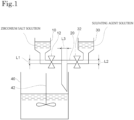
- step 2 will be described with reference to the drawings.
- Fig. 1 is a schematic diagram for illustrating the method for producing a zirconia powder according to the present embodiment.
- a container 10 is connected to one upper end (on the left side in Fig. 1 ) of a T-shaped tube 20 via a valve 12.
- a container 30 is connected to the other upper end (on the right side in Fig. 1 ) of the T-shaped tube 20 via a valve 32.
- a zirconium solution heated to 95°C or higher and 100°C or lower is stored.
- a sulfating agent solution heated to 95°C or higher and 100°C or lower is stored.
- step 2 the valve 12 is opened while the valve 32 is opened, thereby bringing the zirconium solution into contact with the sulfating agent solution.
- a mixed liquid (basic zirconium sulfate-containing reaction liquid) obtained by the contact immediately flows into an aging container 40 from the lower side of the T-shaped tube 20.
- the concentration of the reaction liquid (the concentration of the reaction liquid in the T-shaped tube 20) is prevented from changing from start to end of the contact of the zirconium solution with the sulfating agent solution.
- step 2 since the concentration change of SO 4 2- /ZrO 2 from start to end of the contact is prevented, a uniform reactant is obtained.
- step 2 the peak top diameter, the pore volume, and the pore distribution width of primary particles can be controlled. That is, the size of pores derived from interparticle spaces between primary particles in secondary particles can be reduced, the distribution of the pores can be sharpened, and the volume of the pores derived from interparticle spaces between primary particles can also be reduced.
- the weight ratio SO 4 2- /ZrO 2 in the mixed liquid in step 2 is preferably within a range of 0.3 to 0.8, more preferably 0.4 to 0.7, even more preferably 0.45 to 0.65.
- the weight ratio SO 4 2- /ZrO 2 in the mixed liquid is adjusted to 0.3 or more, the yield of basic zirconium sulfate as a reaction product can be increased.
- the weight ratio SO 4 2- /ZrO 2 in the mixed liquid is adjusted to 0.8 or less, production of a soluble salt of zirconium sulfate can be prevented, thereby preventing a reduction in the yield of basic zirconium sulfate.
- step 2 in order to maintain the temperature of the mixed liquid at 95°C or higher, it is preferable to install a heater in a tube (e.g., the T-shaped tube 20) or the like for supplying each of the solutions.
- a heater in order to maintain the temperature of the mixed liquid at 95°C or higher, it is preferable to install a heater in a tube (e.g., the T-shaped tube 20) or the like for supplying each of the solutions.
- step 2 will specifically be described.
- T-shaped tube 20 When 213 g of a 25 mass% aqueous sodium sulfate solution and 450 g of an aqueous zirconium oxychloride solution with a concentration of 16 mass% in terms of ZrO 2 are brought into contact with each other using, as the T-shaped tube 20, a T-shaped tube having a tube diameter L1 of 10 mm at one upper end (on the left side in Fig. 1 ), a tube diameter L2 of 10 mm at the other upper end (on the right side in Fig.
- the time (contact time) from the start of contact to the end of contact is preferably 30 seconds to 300 seconds, more preferably 60 seconds to 200 seconds, even more preferably 90 seconds to 150 seconds.
- step 3 the basic zirconium sulfate-containing reaction liquid obtained in step 2 is aged at 95°C or higher for 3 hours or more.
- step 3 for example, the basic zirconium sulfate-containing reaction liquid flowing into the aging container 40 is aged at 95°C or higher for 3 hours or more while being stirred with a stirrer 42.
- the upper limit of the aging time is not limited, and is, for example, 7 hours or less.
- the temperature (aging temperature) of the mixed liquid (the basic zirconium sulfate-containing reaction liquid) in step 3 is preferably 95°C or higher, more preferably 97°C or higher and 100°C or lower.
- the mixed liquid contains basic zirconium sulfate as a main component and is a basic zirconium sulfate slurry.
- a stabilizer is added to the aged basic zirconium sulfate-containing reaction liquid obtained in step 3.
- the order of addition of the stabilizer is not limited.
- the first stabilizer may first be added, followed by addition of the second stabilizer, or the second stabilizer may first be added, followed by addition of the first stabilizer, or the first stabilizer and the second stabilizer may be added at the same time.
- step 5 an alkali is added to the basic zirconium sulfate-containing reaction liquid obtained in step 4 to perform a neutralization reaction. Neutralization produces a zirconium-containing hydroxide.
- the alkali is not limited, and examples thereof include sodium hydroxide, sodium carbonate, ammonia, hydrazine, and ammonium hydrogen carbonate.
- the alkali is not limited in concentration, and one diluted with water and having a concentration of 5 to 30% is usually used.
- a method for adding the alkali there are two methods: (1) adding an alkali solution to the basic zirconium sulfate-containing reaction liquid and (2) adding the basic zirconium sulfate-containing reaction liquid to an alkali solution, but the method is not limited and either of the methods may be used.
- the slurry is filtered to obtain a zirconium-containing hydroxide.
- the zirconium-containing hydroxide is preferably washed with water such as pure water to remove impurities. If necessary, drying or the like may be performed after washing with water.
- step 6 the zirconium-containing hydroxide obtained in step 5 is subjected to thermal treatment (firing) to oxidize the zirconium-containing hydroxide, thereby obtaining a zirconia powder.
- the thermal treatment temperature (firing temperature) and the thermal treatment time (firing time) of the zirconium-containing hydroxide are not limited, but the thermal treatment is usually performed at about 600 to 1200°C for 1 hour to 10 hours.
- the firing temperature is more preferably 650°C or higher and 1100°C or lower, even more preferably 700°C or higher and 1000°C or lower.
- the firing temperature is more preferably 2 hours to 6 hours, even more preferably 2 hours to 4 hours.
- the obtained zirconia powder may be pulverized to form a slurry.
- a binder may be added in order to improve moldability.
- the binder and the zirconia powder may uniformly be mixed with a kneading machine.
- the binder is preferably an organic binder.
- the organic binder is likely to be removed from a molded body in a heating furnace filled with an oxidizing atmosphere so that a degreased body can be obtained, and therefore impurities are less likely to finally remain in a sintered body.
- organic binder examples include those that are soluble in alcohol or those that are soluble in mixed liquids of two or more selected from the group consisting of alcohols, water, aliphatic ketones, and aromatic hydrocarbons.
- the organic binder may be, for example, at least one selected from the group consisting of polyethylene glycol, glycol fatty acid ester, glycerin fatty acid ester, polyvinyl butyral, polyvinyl methyl ether, polyvinyl ethyl ether, and vinyl propionate.
- the organic binder may further contain at least one thermoplastic resin insoluble in alcohol or the mixed liquids.
- a target zirconia powder can be obtained by performing treatment such as drying or pulverization by a publicly-known method.
- the particle diameter D 50 of the zirconia powder can be controlled by the pulverization in step 7.
- a zirconia powder containing the sintering aid, the colorant, or the like can be obtained by adding it and mixing the resultant after step 6.
- step 7 When step 7 is performed, a sintering aid, a colorant, or the like may be added in step 7.
- the zirconia powder according to the present embodiment has been described above.
- a zirconia powder is prepared.
- the zirconia powder one described in the section of [Zirconia powder] can be used.
- the zirconia powder is molded to obtain a molded body (step X).
- a commercially available molding machine and cold isostatic pressing (CIP) can be employed.
- the zirconia powder may temporarily be molded by a molding machine once and then finally be molded by press molding.
- the press molding may usually be performed at a pressure in a range of 0.1 t to 3 t/cm 2 .
- the pressure is preferably 0.5 t to 2.5 t/cm 2 , more preferably 0.8 t to 2.2 t/cm 2 , even more preferably 1 t to 2 t/cm 2 .
- the molded body is sintered under conditions of 1200°C or higher and 1450°C or lower and 1 hour or more and 5 hours or less (step Y).
- the zirconia powder contains the second stabilizer in addition to CaO (first stabilizer)
- the total amount of the stabilizer is 2.5 mol% or more and 6.5 mol% or less in terms of oxide, and the ratio of [amount (mol%) of CaO]/[total amount (mol%) of stabilizer] is 50% or more
- the sintering temperature range (sinterable temperature range) for obtaining a sintered body having high strength and high toughness can be widened. Therefore, sintering may be performed in a range of 1200°C or higher and 1450°C or lower.
- the sintering temperature range is preferably as wide as possible and may be, for example, more preferably 1200°C or higher and 1300°C or lower.
- the holding time during sintering is not limited, either, and is, for example, more preferably 1 to 3 hours.
- the sintering atmosphere may be air or an oxidizing atmosphere.
- the sintering may be performed under ordinary pressure, and it is not necessary to apply pressure. However, pressure may be applied.
- the method for producing a zirconia sintered body according to the present embodiment makes it possible to obtain a zirconia sintered body having high strength, high toughness, and high hydrothermal degradation resistance by sintering the zirconia powder in a wide temperature range of 1200°C or higher and 1450°C or lower for 1 hour or more and 5 hours or less.
- zirconia sintered body according to an embodiment of the present invention will be described.
- the zirconia sintered body of the present invention is not limited to the following example.
- the zirconia sintered body according to the present embodiment contains stabilized zirconia.
- the content of the stabilized zirconia is preferably 70 mass% or more, more preferably 75 mass% or more, even more preferably 80 mass% or more, particularly preferably 85 mass% or more when the entire amount of the zirconia sintered body is taken as 100 mass%.
- the content of the stabilized zirconia may be 99 mass% or less, 95 mass% or less, or the like when the entire amount of the zirconia sintered body is taken as 100 mass%.
- the zirconia sintered body may be composed of only the stabilized zirconia. That is, the zirconia sintered body may be formed by sintering only the stabilized zirconia. In this case, the content of the stabilized zirconia is 100 mass% when the entire amount of the zirconia sintered body is taken as 100 mass%.
- the content of the stabilized zirconia is preferably 70 mass% or more and 99 mass% or less, more preferably 75 mass% or more and 95 mass% or less, even more preferably 80 mass% or more and 95 mass% or less, particularly preferably 85 mass% or more and 95 mass% or less when the entire amount of the zirconia sintered body is taken as 100 mass%.
- the zirconia sintered body contains zirconia and a stabilizer.
- the total content of zirconia and the stabilizer in the stabilized zirconia is preferably 70 mass% or more, more preferably 80 mass% or more when the entire amount of the stabilized zirconia is taken as 100 mass%.
- the total content of zirconia and the stabilizer may be 99 mass% or less, 95 mass% or less, or the like when the entire amount of the stabilized zirconia is taken as 100 mass%.
- the total content of zirconia and the stabilizer in the stabilized zirconia is preferably 70 mass% or more and 99 mass% or less, more preferably 80 mass% or more and 95 mass% or less when the entire amount of the stabilized zirconia is taken as 100 mass%.
- the stabilized zirconia may be composed of only zirconia and a stabilizer.
- the stabilizer contains a first stabilizer and a second stabilizer.
- the first stabilizer is CaO.
- the zirconia powder contains CaO as the first stabilizer and therefore has excellent hydrothermal degradation resistance.
- the second stabilizer is at least one selected from the group consisting of Y 2 O 3 , Yb 2 O 3 , Er 2 O 3 , CeO 2 , Nd 2 O 3 , La 2 O 3 , and Tb 2 O 3 . Since the zirconia sintered body contains the second stabilizer in addition to CaO (first stabilizer), the sinterable temperature range is widened.
- the second stabilizer may be selected from the viewpoint of how much critical crystal grain diameter the zirconia sintered body needs to have.
- the second stabilizer is preferably Y 2 O 3 , Yb 2 O 3 , or La 2 O 3 from the viewpoint that a white sintered body can be obtained.
- the second stabilizer is preferably Er 2 O 3 .
- the second stabilizer is preferably CeO 2 .
- the second stabilizer is preferably Nd 2 O 3 .
- the second stabilizer is preferably Tb 2 O 3 .
- the zirconia sintered body has a ratio of [amount (mol%) of CaO]/[total amount (mol%) of stabilizer] of 50% or more and 98% or less.
- a ratio of [amount (mol%) of CaO]/[total amount (mol%) of stabilizer] 50% or more and 98% or less.
- the ratio of [amount (mol%) of CaO]/[total amount (mol%) of stabilizer] is more preferably 55% or more, even more preferably 60% or more.
- the ratio of [amount (mol%) of CaO]/[total amount (mol%) of stabilizer] is more preferably 90% or less, even more preferably 80% or less.
- the ratio of [amount (mol%) of CaO]/[total amount (mol%) of stabilizer] is more preferably 55% or more and 90% or less, even more preferably 60% or more and 80% or less.
- the total amount of the stabilizer in the stabilized zirconia is 2.5 mol% or more and 6.5 mol% or less in terms of oxide. Since the total amount of the stabilizer is 2.5 mol% or more in terms of oxide, the monoclinic fraction can be reduced, which makes it possible to prevent cracks from being produced. Further, since the total amount of the stabilizer is 6.5 mol% or less in terms of oxide, the fraction of a cubic phase having low mechanical characteristics (strength, toughness) can be reduced and the fraction of a tetragonal phase having high mechanical characteristics can be increased.
- the total amount of the stabilizer is preferably 2.7 mol% or more, more preferably 2.9 mol% or more, even more preferably 3.0 mol% or more in terms of oxide.
- the total amount of the stabilizer is preferably 6.0 mol% or less, more preferably 5.5 mol% or less, even more preferably 5.0 mol% or less, particularly preferably 4.5 mol% or less in terms of oxide.
- the total amount of the stabilizer is preferably 2.7 mol% or more and 6.0 mol% or less, more preferably 2.9 mol% or more and 5.5 mol% or less, even more preferably 3.0 mol% or more and 5.0 mol% or less, particularly preferably 3.0 mol% or more and 4.5 mol% or less in terms of oxide.
- the second stabilizer of the zirconia sintered body is at least one selected from the group consisting of Y 2 O 3 , Yb 2 O 3 , Er 2 O 3 , Nd 2 O 3 , La 2 O 3 , and Tb 2 O 3
- the total amount of the stabilizer in the stabilized zirconia is preferably 2.5 mol% or more and 4.5 mol% or less in terms of oxide.
- the second stabilizer is at least one selected from the group consisting of Y 2 O 3 , Yb 2 O 3 , Er 2 O 3 , Nd 2 O 3 , La 2 O 3 , and Tb 2 O 3
- the total amount of the stabilizer in the stabilized zirconia is more preferably 2.6 mol% or more, even more preferably 2.8 mol% or more in terms of oxide.
- the total amount of the stabilizer in the stabilized zirconia is more preferably 4.1 mol% or less, even more preferably 3.7 mol% or less in terms of oxide.
- the total amount of the stabilizer in the stabilized zirconia is more preferably 2.6 mol% or more and 4.1 mol% or less, even more preferably 2.8 mol% or more and 3.7 mol% or less in terms of oxide.
- Y 2 O 3 , Yb 2 O 3 , Er 2 O 3 , Nd 2 O 3 , La 2 O 3 , and Tb 2 O 3 are all trivalent elements and therefore exhibit the same behavior. That is, Y 2 O 3 , Yb 2 O 3 , Er 2 O 3 , Nd 2 O 3 , La 2 O 3 , and Tb 2 O 3 exhibit the same behavior when the amounts thereof added to the zirconia sintered body are the same.
- the total amount of the stabilizer in the stabilized zirconia is preferably 4.0 mol% or more and 6.5 mol% or less in terms of oxide.
- the total amount of the stabilizer in the stabilized zirconia is more preferably 4.3 mol% or more, even more preferably 4.5 mol% or more in terms of oxide.
- the total amount of the stabilizer in the stabilized zirconia is more preferably 6.3 mol% or less, even more preferably 6.0 mol% or less in terms of oxide.
- the total amount of the stabilizer in the stabilized zirconia is more preferably 4.3 mol% or more and 6.3 mol% or less, even more preferably 4.5 mol% or more and 6.0 mol% or less in terms of oxide.
- the content of zirconia in the stabilized zirconia is preferably 80 mass% or more and 99 mass% or less.
- the content of zirconia in the stabilized zirconia is more preferably 85 mass% or more, even more preferably 90 mass% or more.
- the content of zirconia in the stabilized zirconia is more preferably 98 mass% or less, even more preferably 97 mass% or less.
- the content of zirconia in the stabilized zirconia is more preferably 85 mass% or more and 98 mass% or less, even more preferably 90 mass% or more and 97 mass% or less.
- the fraction of the monoclinic phase (monoclinic fraction before hydrothermal treatment) contained in the crystal phase of the zirconia sintered body is preferably 0.2% or more and 7.0% or less.
- the monoclinic fraction is more preferably 0.3% or more, even more preferably 0.5% or more.
- the monoclinic fraction is more preferably 5.0% or less, even more preferably 4.0% or less.
- the fraction of the monoclinic phase (monoclinic fraction before hydrothermal treatment) contained in the crystal phase of the zirconia sintered body is more preferably 0.3% or more and 5.0% or less, even more preferably 0.5% or more and 4.0% or less.
- the zirconia sintered body can have higher strength and higher toughness.
- the monoclinic fraction can be controlled by, for example, the content of the first stabilizer, the content of the second stabilizer, the content ratio, and the sintering temperature.
- the monoclinic fraction is determined by the method described in Examples.
- the fraction of the cubic phase (cubic fraction before hydrothermal treatment) contained in the crystal phase of the zirconia sintered body is preferably 3.0% or less.
- the fraction of the cubic phase having low mechanical characteristics (strength, toughness) can be regarded as being low.
- the zirconia sintered body contains substantially no crystal phase other than monoclinic crystal, cubic crystal, and tetragonal crystal.
- the zirconia sintered body preferably has a monoclinic fraction of 30% or less after hydrothermal treatment at 134 °C and 0.3 MPa (absolute pressure 0.3 MPa) for 15 hours.
- the monoclinic fraction after hydrothermal treatment is 30% or less, the zirconia sintered body can be regarded as having more excellent hydrothermal degradation resistance.
- the monoclinic fraction after hydrothermal treatment can be controlled by, for example, the content of the first stabilizer, the content of the second stabilizer, the content ratio, and the sintering temperature.
- the monoclinic fraction after hydrothermal treatment is more preferably 20% or less, even more preferably 10% or less.
- the monoclinic fraction after hydrothermal treatment is preferably as low as possible and is, for example, 0.5% or more or 1% or more.
- the monoclinic fraction after hydrothermal treatment is more preferably 0.5% or more and 20% or less, even more preferably 1% or more and 10% or less.
- the zirconia sintered body preferably has a monoclinic fraction before hydrothermal treatment of 7.0% or less and a value obtained by subtracting a monoclinic fraction before hydrothermal degradation from a monoclinic fraction after hydrothermal treatment at 134°C and 0.3 MPa (absolute pressure 0.3 MPa) for 15 hours of 20% or less.
- the monoclinic fraction before hydrothermal treatment is 7. 0% or less and the value obtained by subtracting a monoclinic fraction before hydrothermal degradation from a monoclinic fraction after hydrothermal treatment at 134°C and 0.3 MPa for 15 hours is 20% or less
- the monoclinic fraction after hydrothermal treatment can be regarded as being low because the monoclinic fraction before hydrothermal treatment is low and the amount of monoclinic fraction change before and after hydrothermal treatment is small. Therefore, the zirconia sintered body can be regarded as having more excellent hydrothermal degradation resistance.
- the value obtained by subtracting a monoclinic fraction before hydrothermal degradation from a monoclinic fraction after hydrothermal treatment at 134°C and 0.3 MPa for 15 hours is more preferably 15% or less, even more preferably 10% or less.
- the zirconia sintered body preferably has a monoclinic fraction of 30% or less after hydrothermal treatment at 300°C and 8 MPa (absolute pressure 8 MPa) for 5 hours.
- the monoclinic fraction after hydrothermal treatment is 30% or less, the zirconia sintered body can be regarded as having more excellent hydrothermal degradation resistance.
- the monoclinic fraction after hydrothermal treatment can be controlled by, for example, the content of the first stabilizer, the content of the second stabilizer, the content ratio, and the sintering temperature.
- the monoclinic fraction after hydrothermal treatment is more preferably 20% or less, even more preferably 15% or less.
- the monoclinic fraction after hydrothermal treatment is preferably as low as possible and is, for example, 0.5% or more or 1.0% or more.
- the monoclinic fraction after hydrothermal treatment is more preferably 0.5% or more and 20% or less, even more preferably 1.0% or more and 10% or less.
- the zirconia sintered body preferably has a monoclinic fraction of 30% or less after hydrothermal treatment at 400°C and 30 MPa (absolute pressure 30 MPa) for 5 hours.
- the monoclinic fraction after hydrothermal treatment is 30% or less, the zirconia sintered body can be regarded as having even more excellent hydrothermal degradation resistance.
- the monoclinic fraction after hydrothermal treatment can be controlled by, for example, the content of the first stabilizer, the content of the second stabilizer, the content ratio, and the sintering temperature.
- the monoclinic fraction after hydrothermal treatment is more preferably 25% or less, even more preferably 20% or less.
- the monoclinic fraction after hydrothermal treatment is preferably as low as possible and is, for example, 0.5% or more or 1.0% or more.
- the monoclinic fraction after hydrothermal treatment is more preferably 0.5% or more and 25% or less, even more preferably 1.0% or more and 20% or less.
- the zirconia sintered body preferably has a monoclinic fraction before hydrothermal treatment of 7.0% or less and a value obtained by subtracting a monoclinic fraction before hydrothermal degradation from a monoclinic fraction after hydrothermal treatment at 400°C and 30 MPa (absolute pressure 30 MPa) for 5 hours of 20% or less.
- the monoclinic fraction before hydrothermal treatment is 7. 0% or less and the value obtained by subtracting a monoclinic fraction before hydrothermal degradation from a monoclinic fraction after hydrothermal treatment at 400°C and 30 MPa (absolute pressure 30 MPa) for 5 hours is 20% or less, the monoclinic fraction after hydrothermal treatment can be regarded as being low because the monoclinic fraction before hydrothermal treatment is low and the amount of monoclinic fraction change before and after hydrothermal treatment is small. Therefore, the zirconia sintered body can be regarded as having more excellent hydrothermal degradation resistance.
- the value obtained by subtracting a monoclinic fraction before hydrothermal degradation from a monoclinic fraction after hydrothermal treatment at 400°C and 30 MPa (absolute pressure 30 MPa) for 5 hours is more preferably 15% or less, even more preferably 10% or less.
- the zirconia sintered body preferably has a three-point bending strength of 700 MPa or more and 1500 MPa or less.
- the three-point bending strength is more preferably 800 MPa or more, even more preferably 900 MPa or more.
- the three-point bending strength is preferably as high as possible and may be, for example, 1400 MPa or less or 1300 MPa or less.
- the three-point bending strength is more preferably 800 MPa or more and 1400 MPa or less, even more preferably 900 MPa or more and 1300 MPa or less.
- the zirconia sintered body can be regarded as having higher strength.
- the three-point bending strength is determined by the method described in Examples.
- the zirconia sintered body preferably has a toughness value of 10 MPa ⁇ m 0.5 or more and 40 MPa ⁇ m 0.5 or less as measured by IF method.
- the toughness value is more preferably 13 MPa ⁇ m 0.5 or more, even more preferably 15 MPa ⁇ m 0.5 or more.
- the toughness value is preferably as large as possible and may be, for example, 35 MPa ⁇ m 0.5 or less or 27 MPa ⁇ m 0.5 or less.
- the toughness value is more preferably 13 MPa ⁇ m 0.5 or more and 35 MPa ⁇ m 0.5 or less, even more preferably 15 MPa ⁇ m 0.5 or more and 27 MPa ⁇ m 0.5 or less.
- the zirconia sintered body can be regarded as having higher toughness.
- the toughness value is determined by the method described in Examples.
- the relative sintered density of the zirconia sintered body is preferably 98% or more, more preferably 98.5% or more.
- the zirconia sintered body can be regarded as having sufficiently been sintered. Further, when the relative sintered density is 98% or more, the zirconia sintered body can be regarded as having higher strength.
- the theoretical density of the another component is 5.01 g/cm 3 for Y 2 O 3 , 8.64 g/cm 3 for Er 2 O 3 , 7.22 g/cm 3 for CeO 2 , 7.24 g/cm 3 for Nd 2 O 3 , 6.51 g/cm 3 for La 2 O 3 , 7.81 g/cm 3 for Tb 2 O 3 , 9.17 g/cm 3 for Yb 2 O 3 , 5.24 g/cm 3 for Fe 2 O 3 , 5.61 g/cm 3 for ZnO, 5.03 g/cm 3 for MnO 2 , 6.10 g/cm 3 for CoO, 4.23 g/cm 3 for TiO 2 , and 6.31 g/cm 3 for CuO.
- the sintered density is measured by Archimedes method.
- the zirconia sintered body preferably contains Al 2 O 3 (alumina) in an amount of 3 mass% or less relative to the entire amount of the zirconia sintered body.
- alumina functions as a sintering aid when the zirconia sintered body is obtained by sintering the zirconia powder. Therefore, the zirconia sintered body can be regarded as having been obtained by sintering the zirconia powder having a wider sinterable temperature range.
- the content of the Al 2 O 3 is more preferably 2.0 mass% or less, even more preferably 1.0 mass% or less from the viewpoint of allowing the Al 2 O 3 to appropriately function as a sintering aid.
- the content of the Al 2 O 3 is more preferably 0.05 mass% or more, even more preferably 0.1 mass% or more from the viewpoint of allowing the Al 2 O 3 to appropriately function as a sintering aid.
- the content of the Al 2 O 3 is more preferably 0.05 mass% or more and 2.0 mass% or less, even more preferably 0.1 mass% or more and 1.0 mass% or less.
- the zirconia powder does not always need to contain Al 2 O 3 (alumina) because the zirconia powder has a wide sinterable temperature range and the resulting sintered body has high hydrothermal degradation resistance.
- the zirconia powder before sintering does not contain Al 2 O 3 (alumina)
- a zirconia sintered body obtained by sintering such a zirconia powder does not contain Al 2 O 3 (alumina).
- the zirconia sintered body may contain sinterable ceramics, a thermosetting resin, or the like for the purpose of improving characteristics such as strength.
- the form of the element is not limited, and the element can be added in the form of an oxide, a chloride, or the like.
- Specific examples of the oxide containing such an element include Fe 2 O 3 , V 2 O 5 , MnO 2 , CoO, ZnO, CuO, and TiO 2 .
- the content of the Fe 2 O 2 is preferably 0.005 mass% or more and 1 mass% or less, more preferably 0.05 mass% or more and 0.5 mass% or less when the entire amount of the zirconia powder is taken as 100 mass% .
- the content of the Fe 2 O 2 is 0.005 mass% or more, intended coloring is easily achieved. That is, the color tone can easily be adjusted.
- the content of the V 2 O 2 is preferably 0.005 mass% or more and 0.5 mass% or less, more preferably 0.01 mass% or more and 0.1 mass% or less when the entire amount of the zirconia powder is taken as 100 mass%.
- the content of the V 2 O 2 is 0.005 mass% or more, intended coloring is easily achieved. That is, the color tone can easily be adjusted.
- the content of the MnO 2 is preferably 0.005 mass% or more and 2 mass% or less, more preferably 0.1 mass% or more and 1.1 mass% or less when the entire amount of the zirconia powder is taken as 100 mass%.
- the content of the MnO 2 is 0.005 mass% or more, intended coloring is easily achieved. That is, the color tone can easily be adjusted.
- the content of the CoO is preferably 0.005 mass% or more and 2 mass% or less, more preferably 0.01 mass% or more and 1.5 mass% or less when the entire amount of the zirconia powder is taken as 100 mass%.
- the content of the CoO is 0.005 mass% or more, intended coloring is easily achieved. That is, the color tone can easily be adjusted.
- the content of the TiO 2 is preferably 0.005 mass% or more and 2 mass% or less, more preferably 0.01 mass% or more and 1 mass% or less when the entire amount of the zirconia powder is taken as 100 mass%.
- the content of the TiO 2 is 0.005 mass% or more, intended coloring is easily achieved. That is, the color tone can easily be adjusted.
- the zirconia sintered body according to the present embodiment can be obtained by pressureless sintering using the zirconia powder described above. Specifically, the zirconia sintered body according to the present embodiment can be obtained by, for example, the above-described method for producing a zirconia sintered body.
- the zirconia sintered body according to the present embodiment can be used as an industrial part, an aesthetic part, or a dental material. More specifically, the zirconia sintered body can be used for jewelry, watch parts, watch faces, artificial teeth, members for molding processing, wear resistant members, chemical resistant members, etc.
- step 3 the obtained basic zirconium sulfate-containing reaction liquid was aged by maintaining it at 95°C for 4 hours to obtain basic zirconium sulfate (step 3).
- the aged solution was cooled to room temperature, and then an aqueous yttrium chloride solution with a concentration of 10 mass% in terms of Y 2 O 3 was added so that the concentration of Y 2 O 3 was 0.1 mol%, and the resultant was uniformly mixed (step 4).
- a 25 mass% aqueous sodium hydroxide solution was added to the obtained mixed solution to neutralize the mixed solution until the pH reached 13 or higher so that a hydroxide precipitate was formed (step 6).
- the obtained hydroxide precipitate was collected by filtration and washed with water, and the resultant was dried at 105°C for 24 hours.
- the dried hydroxide was thermally treated at 950°C (firing temperature) in the air for 2 hours to obtain an unpulverized zirconia-based powder (calcia/yttria-stabilized zirconia-based powder) (step 7).
- An alumina powder having an average particle diameter of primary particles of 0.1 um was added to the obtained unpulverized calcia/yttria-stabilized zirconia-based powder in an amount of 0.25 mass% relative to the calcia/yttria-stabilized zirconia-based powder, and the resultant was pulverized and mixed for 40 hours with a wet ball mill using water as a dispersion medium.
- the pulverization was performed using ⁇ 5-mm zirconia beads.
- a zirconia slurry obtained after the pulverization was dried at 110°C to obtain a zirconia powder according to Example 1.
- Example 6 Zirconia powders according to Example 2 to Example 7, Example 16, and Comparative Example 1 to Comparative Example 2 were obtained in the same manner as in Example 1 except that the amount of the aqueous calcium chloride solution added was changed so that the amount of CaO added was as shown in Table 1, the amount of the aqueous yttrium chloride solution added was changed so that the amount of Y 2 O 3 added was as shown in Table 1, and the amount of the alumina powder added was changed as shown in Table 1. It should be noted that in Example 6, a zirconia powder according to Example 6 was obtained by further changing the firing temperature of the hydroxide from 950°C to 1100°C in addition to the above changes.
- a zirconia powder according to Example 8 was obtained in the same manner as in Example 1 except that the amount of the aqueous calcium chloride solution added was changed so that the amount of CaO added was as shown in Table 1, and an aqueous erbium chloride solution with a concentration of 10 mass% in terms of Er 2 O 3 was added so that the concentration of Er 2 O 3 was 1.0 mol% instead of adding the aqueous yttrium chloride solution.
- a zirconia powder according to Example 9 was obtained in the same manner as in Example 1 except that an aqueous cerium chloride solution with a concentration of 10 mass% in terms of CeO 2 was added so that the concentration of CeO 2 was 0.5 mol% instead of adding the aqueous yttrium chloride solution.
- a zirconia powder according to Example 10 was obtained in the same manner as in Example 1 except that the amount of the aqueous calcium chloride solution added was changed so that the amount of CaO added was as shown in Table 1, and an aqueous cerium chloride solution with a concentration of 10 mass% in terms of CeO 2 was added so that the concentration of CeO 2 was 2.5 mol% instead of adding the aqueous yttrium chloride solution.
- a zirconia powder according to Example 11 was obtained in the same manner as in Example 1 except that the amount of the aqueous calcium chloride solution added was changed so that the amount of CaO added was as shown in Table 1, and an aqueous neodymium chloride solution with a concentration of 10 mass% in terms of Nd 2 O 3 was added so that the concentration of Nd 2 O 3 was 0.6 mol% instead of adding the aqueous yttrium chloride solution.
- a zirconia powder according to Example 12 was obtained in the same manner as in Example 1 except that the amount of the aqueous calcium chloride solution added was changed so that the amount of CaO added was as shown in Table 1, and an aqueous lanthanum chloride solution with a concentration of 10 mass% in terms of La 2 O 3 was added so that the concentration of La 2 O 3 was 0.6 mol% instead of adding the aqueous yttrium chloride solution.
- a zirconia powder according to Example 13 was obtained in the same manner as in Example 1 except that the amount of the aqueous calcium chloride solution added was changed so that the amount of CaO added was as shown in Table 1, and an aqueous terbium chloride solution with a concentration of 10 mass% in terms of Tb 2 O 3 was added so that the concentration of Tb 2 O 3 was 0.4 mol% instead of adding the aqueous yttrium chloride solution.
- a zirconia powder according to Example 14 was obtained in the same manner as in Example 1 except that the amount of the aqueous calcium chloride solution added was changed so that the amount of CaO added was as shown in Table 1, and an aqueous ytterbium chloride solution with a concentration of 10 mass% in terms of Yb 2 O 3 was added so that the concentration of Yb 2 O 3 was 0.9 mol% instead of adding the aqueous yttrium chloride solution.
- a zirconia powder according to Example 15 was obtained in the same manner as in Example 1 except that the amount of the aqueous calcium chloride solution added was changed so that the amount of CaO added was as shown in Table 1, an aqueous yttrium chloride solution with a concentration of 10 mass% in terms of Y 2 O 3 was added so that the concentration of Y 2 O 3 was 0.5 mol%, and an aqueous erbium chloride solution with a concentration of 10 mass% in terms of Er 2 O 3 was further added so that the concentration of Er 2 O 3 was 0.3 mol%.
- a zirconia powder according to Example 17 was obtained in the same manner as in Example 1 except that the amount of the aqueous calcium chloride solution added was changed so that the amount of CaO added was as shown in Table 1, and an aqueous erbium chloride solution with a concentration of 10 mass% in terms of Er 2 O 3 was added so that the concentration of Er 2 O 3 was 0.8 mol% instead of adding the aqueous yttrium chloride solution.
- a zirconia powder according to Example 18 was obtained in the same manner as in Example 1 except that the amount of the aqueous calcium chloride solution added was changed so that the amount of CaO added was as shown in Table 1, and an aqueous ytterbium chloride solution with a concentration of 10 mass% in terms of Yb 2 O 3 was added so that the concentration of Yb 2 O 3 was 0.6 mol% instead of adding the aqueous yttrium chloride solution.
- the specific surface area of the zirconia powder of each of Examples and Comparative Examples was measured by BET method using a specific surface area meter ("Macsorb” manufactured by Mountec Co., Ltd.). The results are shown in Table 2.
- the pore distribution of the zirconia powder of each of Examples and Comparative Examples was obtained by a mercury intrusion method using a pore distribution measuring device ("Autopore IV9500" manufactured by Micromeritics). The measurement conditions were set as follows.
- Measuring device Pore distribution measuring device
- the pore distribution width refers to a width of a peak at which the log differential pore volume is 0.1 mL/g or more.
- composition (in terms of oxides) of the zirconia powder of each of Examples and Comparative Examples was analyzed using ICP-AES ("ULTIMA-2" manufactured by HORIBA). The results are shown in Table 1.
- the zirconia powder of each of Examples and Comparative Examples was molded at a molding pressure of 2 t/cm 2 . Then, the molded bodies were sintered by heating under atmospheric pressure for 2 hours. The sintering temperatures were as shown in Table 3 or Table 4.
- the SEM observation image of sample of the sintered body obtained by scanning electron microscopy was used to determine an average crystal grain diameter.
- the sample for SEM observation was prepared in accordance with JIS R 1633.
- the number of crystal grains per visual field of the SEM observation image was set to 150 or more.
- a rectangle of any size was drawn in the SEM observation image, and the number of grains present on the sides and diagonal lines of the rectangle was counted.
- the length of each of the sides of the rectangle was set to be equal to or more than 80% of the visual field.
- the ratio between the vertical and horizontal lengths of the rectangle was set to 1.47 : 1 (horizontal length: vertical length).
- the average crystal grain diameter was calculated from the numbers of grains and the lengths of four sides and diagonal lines of the rectangle.
- X, x1, x2, Y, y1, y2, D, d1, and d2 in the formula are as follows.
- the sintered body sample was pretreated by mirror polishing and then by thermal etching.
- the mirror polishing was performed by grinding the surface of the sintered body with a surface grinder and then polishing it with a mirror polishing device while changing the average particle diameter of diamond abrasive grains used in the order of 9 um, 6 ⁇ m, and 3 ⁇ m.
- a minimum sintering temperature (temperature A) at which the following ⁇ Characteristic 1>, ⁇ Characteristic 2>, ⁇ Characteristic 3>, and ⁇ Characteristic 4> were satisfied and a maximum sintering temperature (temperature B) at which the following ⁇ Characteristic 1>, ⁇ Characteristic 2>, ⁇ Characteristic 3>, and ⁇ Characteristic 4> were satisfied were determined.
- ⁇ Characteristic 1>, ⁇ Characteristic 2>, ⁇ Characteristic 3>, and ⁇ Characteristic 4> were measured by the same methods as described later with reference to the relative sintered density, toughness value, three-point bending strength, and monoclinic fraction after hydrothermal treatment at 134°C and 0.3 MPa for 15 hours of a zirconia sintered body.
- a relative sintered density is 98.0% or more.
- a toughness value as measured by IF method is 10 MPa ⁇ m 0.5 or more.
- a three-point bending strength is 700 MPa or more.
- a monoclinic fraction after hydrothermal treatment at 134°C and 0.3 MPa (absolute pressure 0.3 MPa) for 15 hours is 30% or less.
- Example 1 when the sintering temperature was 1250°C, the relative sintered density was 99.7%, the toughness value was 17 MPa ⁇ m 0.5 , the three-point bending strength was 800 MPa, and the monoclinic fraction after hydrothermal treatment at 134°C and 0.3 MPa for 15 hours was 0.6%, and therefore a sintering temperature of 1250°C was determined as the temperature A. Further, in Example 1, when the sintering temperature was 1325°C, ⁇ Characteristic 1>, ⁇ Characteristic 2>, ⁇ Characteristic 3>, and ⁇ Characteristic 4> were satisfied, and therefore a sintering temperature of 1325°C was determined as the temperature B.
- Example 2 the difference between an average crystal grain diameter B when sintering was performed at the temperature B and an average crystal grain diameter A when sintering was performed at the temperature A [(average crystal grain diameter B) - (average crystal grain diameter A)] was determined.
- the results are shown in Table 2.
- Example 1 the difference between an average crystal grain diameter A (122 nm) when sintering was performed at the temperature B (1325°C) and an average crystal grain diameter A (66 nm) when sintering was performed at the temperature A (1250°C) [(average crystal grain diameter B) - (average crystal grain diameter A)] was 56 nm.
- Example 2 the temperature A was determined as 1200°C and the temperature B was determined as 1325°C.
- Example 3 the temperature A was determined as 1200°C and the temperature B was determined as 1350°C.
- Example 4 the temperature A was determined as 1200°C and the temperature B was determined as 1350°C.
- Example 5 the temperature A was determined as 1200°C and the temperature B was determined as 1350°C.
- Example 6 the temperature A was determined as 1250°C and the temperature B was determined as 1375°C.
- Example 7 the temperature A was determined as 1250°C and the temperature B was determined as 1400°C.
- Example 8 the temperature A was determined as 1250°C and the temperature B was determined as 1350°C.
- Example 9 the temperature A was determined as 1200°C and the temperature B was determined as 1325°C.
- Example 10 the temperature A was determined as 1200°C and the temperature B was determined as 1350°C.
- Example 11 the temperature A was determined as 1200°C and the temperature B was determined as 1350°C.
- Example 12 the temperature A was determined as 1200°C and the temperature B was determined as 1350°C.
- Example 13 the temperature A was determined as 1200°C and the temperature B was determined as 1350°C.
- Example 14 the temperature A was determined as 1200°C and the temperature B was determined as 1350°C.
- Example 15 the temperature A was determined as 1200°C and the temperature B was determined as 1350°C.
- Example 16 the temperature A was determined as 1200°C and the temperature B was determined as 1350°C.
- Example 17 the temperature A was determined as 1200°C and the temperature B was determined as 1350°C.
- Example 18 the temperature A was determined as 1200°C and the temperature B was determined as 1350°C.
- the temperature A was determined as 1225°C and the temperature B was determined as 1275°C.
- the difference [(average crystal grain diameter B) - (average crystal grain diameter A)] was 24 nm.
- the temperature A was determined as 1250°C and the temperature B was determined as 1300°C.
- the difference [(average crystal grain diameter B) - (average crystal grain diameter A)] was 32 nm.
- Example 1 since the relative sintered density is 99.7% when the sintering temperature is 1250°C, the temperature at which the relative sintered density is actually 98% is lower than a sintering temperature of 1250°C.
- Example 1 since the toughness value is 17 MPa ⁇ m 0.5 when the sintering temperature is 1250°C, the temperature at which the toughness value is actually 10 MPa ⁇ m 0.5 or more is lower than a sintering temperature of 1250°C.
- Example 1 since the three-point bending strength is 800 MPa when the sintering temperature is 1250°C, the temperature at which the three-point bending strength is actually 700 MPa or more is lower than a sintering temperature of 1250°C.
- Example 1 the temperature A is actually lower than 1250°C. However, this measurement is performed to the extent that it is possible to confirm whether or not the difference [(average crystal grain diameter B) - (average crystal grain diameter A)] is 50 nm or more.
- Example 1 1250°C is regarded as the temperature A (minimum sintering temperature at which ⁇ Characteristic 1>, ⁇ Characteristic 2>, ⁇ Characteristic 3>, and ⁇ Characteristic 4> are satisfied) for convenience of experiment.
- Comparative Example 1 the temperature A is actually higher than 1200°C.
- 1200°C is regarded as the temperature A (minimum sintering temperature at which ⁇ Characteristic 1>, ⁇ Characteristic 2>, ⁇ Characteristic 3>, and ⁇ Characteristic 4> are satisfied) for convenience of experiment.
- molded bodies were obtained from the zirconia powders of Examples and Comparative Examples by cold isostatic pressing (CIP).
- the molding pressure was set to 2 t/cm 2 .
- the zirconia sintered bodies of each of Examples and Comparative Examples were mirror-polished, and the fraction of the monoclinic phase (before hydrothermal degradation) contained in the crystal phase was determined.
- the mirror polishing was performed by grinding the surface of the sintered body with a surface grinder and then polishing it with a mirror polishing device while changing the average particle diameter of diamond abrasive grains used in the order of 9 um, 6 ⁇ m, and 3 um.
- Tables 3 and 4 It should be noted that although not shown in Table 3 and Table 4, in all the Examples, the cubic fraction was 3% or less.
- the X-ray diffraction spectrum of each of the zirconia sintered bodies was obtained using an X-ray diffractometer ("RINT2500" manufactured by Rigaku Corporation). The measurement conditions were set as follows.
- Im(111) is the diffraction intensity of (111) in the monoclinic phase
- IIm(11-1) is the diffraction intensity of (11-1) in the monoclinic phase.
- It(101) is the diffraction intensity of (101) in the tetragonal phase
- It (220) is the diffraction intensity of (220) in the tetragonal phase
- It(004) is the diffraction intensity of (004) in the tetragonal phase.
- Ic(004) is the diffraction intensity of (004) in the cubic phase and Ic(111) is the diffraction intensity of (111) in the cubic phase.
- the cubic phase may be distorted depending on the amount of the stabilizer added and the type of production method used, which may cause a peak position to shift. However, in the present Examples, a peak between (004) and (220) in the tetragonal phase was calculated as the peak of the cubic phase.
- each of the zirconia sintered bodies of each of Examples and Comparative Examples was subjected to hydrothermal treatment at 134°C and an absolute pressure of 0.3 MPa (in an underwater environment) for 15 hours. Then, the fraction of the monoclinic phase contained in the crystal phase of the zirconia sintered body after hydrothermal treatment was determined. The monoclinic fraction of the zirconia sintered body after hydrothermal treatment was determined in the same manner as described in the section of [Fraction of monoclinic phase contained as crystal phase in zirconia powder]. The results are shown in Tables 3 and 4.
- each of the zirconia sintered bodies of each of Examples 2 to 4, 9 to 13, and 17 to 18 and Comparative Example 2 was subjected to hydrothermal treatment at 300°C and an absolute pressure of 8 MPa (in an underwater environment) for 5 hours. Then, the fraction of the monoclinic phase contained in the crystal phase of the zirconia sintered body after hydrothermal treatment was determined. The monoclinic fraction of the zirconia sintered body after hydrothermal treatment was determined in the same manner as described in the section of [Fraction of monoclinic phase contained as crystal phase in zirconia powder] . The results are shown in Table 5.
- each of the zirconia sintered bodies of each of Examples 2 to 4, 9 to 13, and 17 to 18 and Comparative Example 2 was subjected to hydrothermal treatment at 400°C and an absolute pressure of 30 MPa (in an underwater environment) for 5 hours. Then, the fraction of the monoclinic phase contained in the crystal phase of the zirconia sintered body after hydrothermal treatment was determined. The monoclinic fraction of the zirconia sintered body after hydrothermal treatment was determined in the same manner as described in the section of [Fraction of monoclinic phase contained as crystal phase in zirconia powder] . The results are shown in Table 5.
- the measurement of toughness based on IF method was performed by a method in accordance with JIS R 1607 (Testing methods for fracture toughness of fine ceramics at room temperature) using a load of 30 kgf (294.2 N). Seven quadrangular indentations formed by a Vickers hardness tester were selected to determine toughness values, and the average of five toughness values excluding the minimum and maximum values was defined as a toughness value. It should be noted that indentations from which no crack was extended were not used for measurement, and rectangular indentations having four tips from which cracks were extended were used.
- Kc, Hv, a, c, and E mean the following.
- the indentation lengths along the X and Y axes and the crack lengths along the X and Y axes for determining a and c are as shown in Fig. 2 .
- F and d mean the following.
- the X-axis indentation length and the Y-axis indentation length for determining d are as shown in Fig. 2 .
- 210 GPa which is known as a Young's modulus of common yttria-stabilized zirconia, was used.
- the theoretical density of the another component is 5.01 g/cm 3 for Y 2 O 3 , 8.64 g/cm 3 for Er 2 O 3 , 7.22 g/cm 3 for CeO 2 , 7.24 g/cm 3 for Nd 2 O 3 , 6.51 g/cm 3 for La 2 O 3 , 7.81 g/cm 3 for Tb 2 O 3 , 9.17 g/cm 3 for Yb 2 O 3 , 5.24 g/cm 3 for Fe 2 O 3 , 5.61 g/cm 3 for ZnO, 5.03 g/cm 3 for MnO 2 , 6.10 g/cm 3 for CoO, 4.23 g/cm 3 for TiO 2 , and 6.31 g/cm 3 for CuO.
- the sintered density was measured by Archimedes method.
- Relative molding density (%) (molding density/theoretical sintered density) ⁇ 100
- the theoretical sintered density (denoted by ⁇ 0 ) is a value calculated by the above formula (2-1).
- Stabilizer Sintering aid Total amount of stabilizer CaO/total amount of stabilizer CaO Y 2 O 3 Er 2 O 3 CeO 2 Nd 2 O 3 La 2 O 3 Tb 2 O 3 Yb 2 O 3 Al 2 O 3 mol% % mol % mol% mol% mol% mol % mass%
- Example 1 4.1 97.6 4.0 0.1 - - - - - - - 0.25
- Example 2 4.0 92.5 3.7 0.3 - - - - - - - - 0.25
- Example 14 2.9 69.0 2.0 - - - - - - - 0.9 0.25
- Example 15 2.9 72.4 2.1 0.5 0.3 - - - - - 0.25
- Example 16 3.0 70.0 2.1 0.9 - - - - - 1.50
- Example 17 4.0 80.0 3.2 - 0.8 - - - - - 0.25
- Example 18 3.8 84.2 3.2 - - - - - - - - - 0.6 0.25 Comparative Example 1 4.1 100.0 4.1 - - - - - - - - - - 0.25 Comparative Example 2 2.6 38 .
- Molded body Sintered body Relative molding density Molding pressure Sintering time Sintering temperature Relative density Average crystal grain diameter Monoclinic fraction before hydrothermal treatment
- Monoclinic fraction after hydrothermal treatment at 134°C and 0.3 MPa for 15 hours Change in monoclinic fraction before and after hydrothermal treatment at 134°C and 0.3 MPa for 15 hours
- Example 1 45 . 4 2 2 1250 99.7 66 0.6 0.6 0.0 800 17 45 . 4 2 2 1300 99.8 80 1.9 2.0 0.1 800 20 45 . 4 2 2 1325 99.7 122 4.8 4 .
- Example 2 45.7 2 2 1200 98.4 58 0.5 0.7 0.2 900 10 45.7 2 2 1250 99.8 66 0.6 0.8 0.2 850 22 45.7 2 2 1300 99.9 80 1. 4 3.0 1.6 850 19 45.7 2 2 1325 99.8 128 3.2 4.0 0.8 850 15
- Example 3 45.5 2 2 1200 98.8 55 0.9 0.5 0.1 900 16 95.5 2 2 1250 99.8 66 0.5 0.8 0.3 900 27 95.5 2 2 1300 99.8 92 1.1 3.0 1.9 900 19 95.5 2 2 1325 99.7 120 2.3 5.0 2.7 900 19 45.5 2 2 1350 99.7 133 4.9 22.8 17.9 900 15
- Example 4 46 46.
- Molded body Sintered body Relative molding density Molding pressure Sintering time Sintering temperature Relative density Average crystal grain diameter Monoclinic fraction before hydrothermal treatment
- Monoclinic fraction after hydrothermal treatment at 134°C and 0.3 MPa for 15 hours Change in monoclinic fraction before and after hydrothermal treatment at 134°C and 0.3 MPa for 15 hours
Landscapes
- Chemical & Material Sciences (AREA)
- Engineering & Computer Science (AREA)
- Ceramic Engineering (AREA)
- Organic Chemistry (AREA)
- Manufacturing & Machinery (AREA)
- Materials Engineering (AREA)
- Structural Engineering (AREA)
- Inorganic Chemistry (AREA)
- Composite Materials (AREA)
- Physics & Mathematics (AREA)
- Thermal Sciences (AREA)
- Compositions Of Oxide Ceramics (AREA)
Applications Claiming Priority (2)
| Application Number | Priority Date | Filing Date | Title |
|---|---|---|---|
| JP2022058612 | 2022-03-31 | ||
| PCT/JP2023/011743 WO2023190119A1 (ja) | 2022-03-31 | 2023-03-24 | ジルコニア粉末、ジルコニア焼結体、及び、ジルコニア焼結体の製造方法 |
Publications (2)
| Publication Number | Publication Date |
|---|---|
| EP4428112A1 true EP4428112A1 (de) | 2024-09-11 |
| EP4428112A4 EP4428112A4 (de) | 2025-11-05 |
Family
ID=88201369
Family Applications (1)
| Application Number | Title | Priority Date | Filing Date |
|---|---|---|---|
| EP23780129.5A Pending EP4428112A4 (de) | 2022-03-31 | 2023-03-24 | Zirkoniumoxidpulver, gesinterter zirkoniumoxidgegenstand und verfahren zur herstellung eines gesinterten zirkoniumoxidgegenstands |
Country Status (5)
| Country | Link |
|---|---|
| US (1) | US20250051178A1 (de) |
| EP (1) | EP4428112A4 (de) |
| JP (1) | JP7756794B2 (de) |
| CN (1) | CN118891238A (de) |
| WO (1) | WO2023190119A1 (de) |
Families Citing this family (2)
| Publication number | Priority date | Publication date | Assignee | Title |
|---|---|---|---|---|
| JP7848958B1 (ja) | 2024-09-27 | 2026-04-21 | 国立大学法人 東京大学 | 焼結体及びその製造方法 |
| JP7631611B1 (ja) * | 2024-10-17 | 2025-02-18 | 第一稀元素化学工業株式会社 | ジルコニア焼結体、及び、ジルコニア焼結体の製造方法 |
Family Cites Families (11)
| Publication number | Priority date | Publication date | Assignee | Title |
|---|---|---|---|---|
| US4619817A (en) * | 1985-03-27 | 1986-10-28 | Battelle Memorial Institute | Hydrothermal method for producing stabilized zirconia |
| JPS6278113A (ja) * | 1985-10-02 | 1987-04-10 | Kawasaki Steel Corp | 安定化ジルコニア粉末の製造方法 |
| JP2762495B2 (ja) * | 1988-12-12 | 1998-06-04 | 東ソー株式会社 | 耐食性および耐熱水性に優れたジルコニア焼結体 |
| JP2791441B2 (ja) * | 1989-11-16 | 1998-08-27 | 住友大阪セメント株式会社 | ジルコニア微粉末およびジルコニア焼結体 |
| JPH0570224A (ja) | 1991-02-25 | 1993-03-23 | Sumitomo Cement Co Ltd | ジルコニア焼結体の製造方法及びジルコニア焼結体 |
| JP3214048B2 (ja) * | 1992-03-09 | 2001-10-02 | 東ソー株式会社 | ジルコニア焼結体及びその製造方法 |
| JPH10194831A (ja) * | 1997-01-07 | 1998-07-28 | Toshiba Ceramics Co Ltd | ジルコニア−黒鉛質耐火物 |
| JP5356639B2 (ja) * | 2005-03-04 | 2013-12-04 | 東ソー株式会社 | ジルコニア微粉末及びその製造方法 |
| JP6218617B2 (ja) * | 2014-01-20 | 2017-10-25 | 株式会社ニッカトー | 歯科用ジルコニア質焼結体、クラウン用フレーム、ブリッジ用フレーム |
| JP7268455B2 (ja) | 2019-04-03 | 2023-05-08 | 日本電信電話株式会社 | 光ファイバ表示システム及び光ファイバ切替方法 |
| CN114599765B (zh) * | 2020-01-27 | 2024-03-08 | 第一稀元素化学工业株式会社 | 稳定氧化锆烧结体及氧化锆粉末 |
-
2023
- 2023-03-24 EP EP23780129.5A patent/EP4428112A4/de active Pending
- 2023-03-24 US US18/716,779 patent/US20250051178A1/en active Pending
- 2023-03-24 JP JP2024512326A patent/JP7756794B2/ja active Active
- 2023-03-24 WO PCT/JP2023/011743 patent/WO2023190119A1/ja not_active Ceased
- 2023-03-24 CN CN202380027846.1A patent/CN118891238A/zh active Pending
Also Published As
| Publication number | Publication date |
|---|---|
| CN118891238A (zh) | 2024-11-01 |
| WO2023190119A1 (ja) | 2023-10-05 |
| US20250051178A1 (en) | 2025-02-13 |
| JPWO2023190119A1 (de) | 2023-10-05 |
| JP7756794B2 (ja) | 2025-10-20 |
| EP4428112A4 (de) | 2025-11-05 |
Similar Documents
| Publication | Publication Date | Title |
|---|---|---|
| EP4039648B1 (de) | Zirkoniumoxidpulver, zirkoniumoxidsinterkörper und verfahren zur herstellung zirkoniumoxidsinterkörper | |
| EP3345883B1 (de) | Roter zirkonoxidsinterkörper und verfahren zur herstellung davon | |
| EP4428112A1 (de) | Zirkoniumoxidpulver, gesinterter zirkoniumoxidgegenstand und verfahren zur herstellung eines gesinterten zirkoniumoxidgegenstands | |
| EP2520555A1 (de) | Verfahren zur herstellung eines keramikmaterials aus zirkonkorund-verbund, granulatpulver aus zirkonkorund-verbund und zirkonkügelchen | |
| US20250257012A1 (en) | Zirconia sintered body | |
| EP3960721A1 (de) | Sinterkörper, pulver und verfahren zur herstellung davon | |
| EP3831798A1 (de) | Schwarzer sinterkörper und verfahren zur herstellung davon | |
| EP4428111A1 (de) | Zirkoniumoxid-sinterkörper, zirkoniumoxidpulver und verfahren zur herstellung eines zirkoniumoxid-sinterkörpers | |
| EP4470991A1 (de) | Pulver und herstellungsverfahren dafür | |
| EP4488232A1 (de) | Sinterkörper, verfahren zur herstellung eines sinterkörpers, pulver und vorgesinterter körper | |
| EP4592269A1 (de) | Zirkonoxidzusammensetzung und verfahren zur herstellung davon | |
| EP4140966A1 (de) | Sinterkörper und verfahren zur herstellung davon | |
| Abbas et al. | Structural properties of zirconia doped with some oxides | |
| EP4023601A1 (de) | Stabilisierter zirkoniumdioxidsinterkörper und zirkoniumoxidpulver | |
| EP4039647A1 (de) | Zirkoniumoxidpulver, zirkoniumoxid-sinterkörper und verfahren zum produzieren von zirkoniumoxid-sinterkörpern | |
| EP4382504A1 (de) | Pulverzusammensetzung, kalzinierter körper, sinterkörper und verfahren zur herstellung davon | |
| EP4563548A1 (de) | Silberhaltiger zirkoniumoxid-sinterkörper, silberhaltiges stabilisiertes zirkoniumoxidpulver, verfahren zur herstellung von silberhaltigem stabilisiertem zirkoniumoxidpulver und verfahren zur herstellung eines silberhaltigen zirkoniumoxid-sinterkörpers | |
| EP3388406A1 (de) | Keramischer sinterkörper | |
| US12612338B2 (en) | Zirconia powder, zirconia sintered body, and method for producing zirconia sintered body | |
| JP7631611B1 (ja) | ジルコニア焼結体、及び、ジルコニア焼結体の製造方法 | |
| WO2025070294A1 (ja) | ジルコニア焼結体、ジルコニア焼結体の製造方法、及び、ジルコニア粉末 | |
| JP7607117B2 (ja) | セラミック焼結体およびセラミック粉末 | |
| JP2026071480A (ja) | ジルコニア焼結体、及び、ジルコニア焼結体の製造方法 | |
| EP4628450A1 (de) | Pulver |
Legal Events
| Date | Code | Title | Description |
|---|---|---|---|
| STAA | Information on the status of an ep patent application or granted ep patent |
Free format text: STATUS: THE INTERNATIONAL PUBLICATION HAS BEEN MADE |
|
| PUAI | Public reference made under article 153(3) epc to a published international application that has entered the european phase |
Free format text: ORIGINAL CODE: 0009012 |
|
| STAA | Information on the status of an ep patent application or granted ep patent |
Free format text: STATUS: REQUEST FOR EXAMINATION WAS MADE |
|
| 17P | Request for examination filed |
Effective date: 20240605 |
|
| AK | Designated contracting states |
Kind code of ref document: A1 Designated state(s): AL AT BE BG CH CY CZ DE DK EE ES FI FR GB GR HR HU IE IS IT LI LT LU LV MC ME MK MT NL NO PL PT RO RS SE SI SK SM TR |
|
| DAV | Request for validation of the european patent (deleted) | ||
| DAX | Request for extension of the european patent (deleted) | ||
| A4 | Supplementary search report drawn up and despatched |
Effective date: 20251007 |
|
| RIC1 | Information provided on ipc code assigned before grant |
Ipc: C04B 35/486 20060101AFI20250930BHEP Ipc: C01G 25/02 20060101ALI20250930BHEP Ipc: C04B 35/488 20060101ALI20250930BHEP Ipc: C04B 35/626 20060101ALI20250930BHEP Ipc: C04B 35/64 20060101ALI20250930BHEP |