EP4424704A2 - Multiplex-biomarker zur verwendung bei der beurteilung des akkumulationszustands von amyloid b im gehirn und analyseverfahren für besagte beurteilung - Google Patents
Multiplex-biomarker zur verwendung bei der beurteilung des akkumulationszustands von amyloid b im gehirn und analyseverfahren für besagte beurteilung Download PDFInfo
- Publication number
- EP4424704A2 EP4424704A2 EP24183330.0A EP24183330A EP4424704A2 EP 4424704 A2 EP4424704 A2 EP 4424704A2 EP 24183330 A EP24183330 A EP 24183330A EP 4424704 A2 EP4424704 A2 EP 4424704A2
- Authority
- EP
- European Patent Office
- Prior art keywords
- app669
- level
- seq
- pib
- cerebral
- Prior art date
- Legal status (The legal status is an assumption and is not a legal conclusion. Google has not performed a legal analysis and makes no representation as to the accuracy of the status listed.)
- Pending
Links
Images











Classifications
-
- G—PHYSICS
- G01—MEASURING; TESTING
- G01N—INVESTIGATING OR ANALYSING MATERIALS BY DETERMINING THEIR CHEMICAL OR PHYSICAL PROPERTIES
- G01N33/00—Investigating or analysing materials by specific methods not covered by groups G01N1/00 - G01N31/00
- G01N33/48—Biological material, e.g. blood, urine; Haemocytometers
- G01N33/50—Chemical analysis of biological material, e.g. blood, urine; Testing involving biospecific ligand binding methods; Immunological testing
- G01N33/68—Chemical analysis of biological material, e.g. blood, urine; Testing involving biospecific ligand binding methods; Immunological testing involving proteins, peptides or amino acids
- G01N33/6893—Chemical analysis of biological material, e.g. blood, urine; Testing involving biospecific ligand binding methods; Immunological testing involving proteins, peptides or amino acids related to diseases not provided for elsewhere
- G01N33/6896—Neurological disorders, e.g. Alzheimer's disease
-
- G—PHYSICS
- G01—MEASURING; TESTING
- G01N—INVESTIGATING OR ANALYSING MATERIALS BY DETERMINING THEIR CHEMICAL OR PHYSICAL PROPERTIES
- G01N33/00—Investigating or analysing materials by specific methods not covered by groups G01N1/00 - G01N31/00
- G01N33/48—Biological material, e.g. blood, urine; Haemocytometers
- G01N33/50—Chemical analysis of biological material, e.g. blood, urine; Testing involving biospecific ligand binding methods; Immunological testing
- G01N33/68—Chemical analysis of biological material, e.g. blood, urine; Testing involving biospecific ligand binding methods; Immunological testing involving proteins, peptides or amino acids
-
- A—HUMAN NECESSITIES
- A61—MEDICAL OR VETERINARY SCIENCE; HYGIENE
- A61P—SPECIFIC THERAPEUTIC ACTIVITY OF CHEMICAL COMPOUNDS OR MEDICINAL PREPARATIONS
- A61P25/00—Drugs for disorders of the nervous system
- A61P25/28—Drugs for disorders of the nervous system for treating neurodegenerative disorders of the central nervous system, e.g. nootropic agents, cognition enhancers, drugs for treating Alzheimer's disease or other forms of dementia
-
- C—CHEMISTRY; METALLURGY
- C07—ORGANIC CHEMISTRY
- C07K—PEPTIDES
- C07K14/00—Peptides having more than 20 amino acids; Gastrins; Somatostatins; Melanotropins; Derivatives thereof
- C07K14/435—Peptides having more than 20 amino acids; Gastrins; Somatostatins; Melanotropins; Derivatives thereof from animals; from humans
- C07K14/46—Peptides having more than 20 amino acids; Gastrins; Somatostatins; Melanotropins; Derivatives thereof from animals; from humans from vertebrates
- C07K14/47—Peptides having more than 20 amino acids; Gastrins; Somatostatins; Melanotropins; Derivatives thereof from animals; from humans from vertebrates from mammals
-
- G—PHYSICS
- G01—MEASURING; TESTING
- G01N—INVESTIGATING OR ANALYSING MATERIALS BY DETERMINING THEIR CHEMICAL OR PHYSICAL PROPERTIES
- G01N2333/00—Assays involving biological materials from specific organisms or of a specific nature
- G01N2333/435—Assays involving biological materials from specific organisms or of a specific nature from animals; from humans
- G01N2333/46—Assays involving biological materials from specific organisms or of a specific nature from animals; from humans from vertebrates
- G01N2333/47—Assays involving proteins of known structure or function as defined in the subgroups
- G01N2333/4701—Details
- G01N2333/4709—Amyloid plaque core protein
-
- G—PHYSICS
- G01—MEASURING; TESTING
- G01N—INVESTIGATING OR ANALYSING MATERIALS BY DETERMINING THEIR CHEMICAL OR PHYSICAL PROPERTIES
- G01N2800/00—Detection or diagnosis of diseases
- G01N2800/50—Determining the risk of developing a disease
-
- G—PHYSICS
- G01—MEASURING; TESTING
- G01N—INVESTIGATING OR ANALYSING MATERIALS BY DETERMINING THEIR CHEMICAL OR PHYSICAL PROPERTIES
- G01N2800/00—Detection or diagnosis of diseases
- G01N2800/52—Predicting or monitoring the response to treatment, e.g. for selection of therapy based on assay results in personalised medicine; Prognosis
-
- G—PHYSICS
- G01—MEASURING; TESTING
- G01N—INVESTIGATING OR ANALYSING MATERIALS BY DETERMINING THEIR CHEMICAL OR PHYSICAL PROPERTIES
- G01N2800/00—Detection or diagnosis of diseases
- G01N2800/56—Staging of a disease; Further complications associated with the disease
-
- G—PHYSICS
- G01—MEASURING; TESTING
- G01N—INVESTIGATING OR ANALYSING MATERIALS BY DETERMINING THEIR CHEMICAL OR PHYSICAL PROPERTIES
- G01N2800/00—Detection or diagnosis of diseases
- G01N2800/60—Complex ways of combining multiple protein biomarkers for diagnosis
Definitions
- the present invention pertains to the brain neuroscience field and the clinical medicine field, and relates to a multiplex surrogate biomarker for evaluating a cerebral amyloid ⁇ peptide (A ⁇ ) accumulation state, and a method for analysis thereof. More specifically, the present invention relates to a multiplex surrogate biomarker for evaluating a cerebral A ⁇ accumulation state using, as an index, a level of A ⁇ and A ⁇ -like peptides generated by cleavage of amyloid precursor protein (APP) in a living body-derived sample, and a method for analysis thereof.
- APP amyloid precursor protein
- the biomarker of the present invention is a marker to be used for, for example, presymptomatic diagnosis, screening for subjects of developing preventive intervention (pre-emptive therapeutic drug administration etc.) and evaluation of drug efficacy of therapeutic drugs and prophylactic drugs regarding Alzheimer's disease.
- Alzheimer's disease is a principal cause of dementia, and occupies 50 to 60% of the entire dementia.
- the number of patients suffering from dementia was more than or equal to 24 million in the world in 2001, and is estimated to reach 81 million in 2040 (Non-Patent Document 1) .
- a ⁇ amyloid ⁇
- a ⁇ is produced as a result of proteolysis of amyloid precursor protein (APP) which is a single-pass transmembrane protein by ⁇ -secretase and ⁇ -secretase.
- APP amyloid precursor protein
- a ⁇ mainly consists of 40 residues (A ⁇ 1-40) and 42 residues (A ⁇ 1-42) and migrates into cerebrospinal fluid (CSF) and blood. Further, in recent years, existence of A ⁇ -like peptides having lengths different from those of A ⁇ 1-40 and A ⁇ 1-42 in CSF or plasma has been reported (Non-Patent Documents 2, 3).
- Amyloid accumulation is considered as the earliest event among pathophysiological changes occurring in brain in the case of AD, and recent studies have revealed that amyloid accumulation in brain starts 10 years or more before onset of clinical symptoms. Therefore, it is important to exactly detect the amyloid accumulation in brain for enabling early diagnosis of AD.
- amyloid PET and CSF A ⁇ examination are known as a method for detecting amyloid accumulation.
- the amyloid PET is a method of visualizing A ⁇ deposits by using a ligand molecule that specifically binds with A ⁇ , and an example of the amyloid PET includes PiB-PET using Pittsburgh compound-B (PiB).
- PET examination requires massive equipment, and thus an examination fee to perform one examination is high.
- PET examination is invasive due to radiation exposure, and is not suited for a screening method of AD.
- a decrease in concentration of A ⁇ 1-42 in CSF or a decrease in concentration ratio of A ⁇ 1-42/A ⁇ 1-40, and an increase in total tau value or phosphorylation tau value are reported to be a useful marker (Patent Document 1: JP-A-2010-19864 , Non-Patent Document 4).
- collection of CSF is also highly invasive, and is not suited as a screening method of AD. Therefore, a blood examination that has low invasiveness and is low in cost is desired for the screening.
- Non-Patent Document 4 the potentiality of concentration of A ⁇ 1-42 existing in blood as an Alzheimer's disease diagnostic marker is expected, and many researchers have reported the relationship between blood A ⁇ 1-42 concentration and Alzheimer's disease development; however, consistent results have not been obtained.
- Non-Patent Document 5 indicates that the ratio of APP669-711/A ⁇ 1-42 has a strong correlation with a PiB accumulation degree obtained by PiB-PET. Further, the results of ROC analysis between a PiB positive group and a PiB negative group indicate that the ratio of APP669-711/A ⁇ 1-42 is a marker capable of accurately distinguishing between a PiB positive person and a PiB negative person.
- Patent Document 2 JP-A-2013-63976 discloses a monoclonal antibody that does not recognize a soluble A ⁇ monomer, but specifically binds only to a soluble A ⁇ oligomer, and also discloses a diagnostic method of Alzheimer's disease using the antibody.
- Paragraph [0104] of the publication discloses a method in which when the ratio of A ⁇ oligomer to A ⁇ monomer in a sample of a subject is higher than that of a normal healthy person, the subject is determined as being a candidate for Alzheimer's disease.
- Patent Document 3 JP-T-2014-520529 discloses a method for diagnosing Alzheimer's disease by combining a plurality of miRNA levels in a sample obtained from an object.
- Amyloid-PET is effective for detecting A ⁇ accumulation, it requires high examination cost and long time for executing the examination, and thus is not a diagnostic method that allows for a majority of elderly people to easily undergo the examination. Therefore, a simplified analytical method capable of detecting increase in A ⁇ accumulation before exteriorization of clinical symptoms has been demanded.
- an examination method using a biomarker existing in blood or cerebrospinal fluid (CSF) as an index is an effective method capable of conveniently detecting the development and progression of a disease on the molecular level.
- CSF cerebrospinal fluid
- Non-Patent Document 5 the ratio of APP669-711/A ⁇ 1-42 was reported as a promising blood marker that reflects a cerebral amyloid accumulation state. While cerebral amyloid accumulation can be determined with high sensitivity by the ratio of APP669-711/A ⁇ 1-42, a method that enables more accurate discrimination is demanded.
- An object of the present invention is to provide a biomarker for evaluating a cerebral A ⁇ accumulation state using amyloid precursor protein (APP) -derived A ⁇ and A ⁇ -like peptides in a living body-derived sample as an index, and a method for analysis thereof.
- an object of the present invention is to provide a biomarker for evaluating a cerebral A ⁇ accumulation state using amyloid precursor protein (APP)-derived A ⁇ and A ⁇ -like peptides in a blood sample as an index, and a method for analysis thereof.
- APP amyloid precursor protein
- an object of the present invention is to provide a marker to be used for, for example, presymptomatic diagnosis, screening for subjects of developing preventive intervention (pre-emptive therapeutic drug administration etc.) and evaluation of drug efficacy of therapeutic drugs and prophylactic drugs regarding Alzheimer's disease, and a method for analysis thereof.
- the present inventors have completed the present invention by calculating a numerical value by a combination of two or more ratios selected from the group consisting of three ratios, A ⁇ 1-39/A ⁇ 1-42, A ⁇ 1-40/A ⁇ 1-42, and APP669-711/A ⁇ 1-42, regarding A ⁇ and A ⁇ -like peptides derived from APP in a living body sample, through a mathematical technique.
- a ⁇ is used as an abbreviation of an amyloid ⁇ peptide. That is, “A ⁇ ” includes A ⁇ 1-40 and A ⁇ 1-42.
- a peptide other than the A ⁇ generated by cleavage of amyloid precursor protein (APP) may be referred to as an A ⁇ -like peptide.
- a ⁇ and an A ⁇ -like peptides that are generated by cleavage of amyloid precursor protein (APP) may be referred to as "APP-derived peptide”.
- the present invention includes the following aspects.
- a marker for determining a cerebral A ⁇ accumulation state comprising a mathematically obtained composite variable of at least two ratios selected from the group consisting of:
- the marker according to the above (1) wherein the living body-derived sample is selected from the group consisting of blood, cerebrospinal fluid, urine, feces, and body secreting fluid (e.g., saliva, tear, sweat, nasal mucosal exudate, and sputum).
- body secreting fluid e.g., saliva, tear, sweat, nasal mucosal exudate, and sputum.
- An analytical method for determining a cerebral A ⁇ accumulation state comprising: a measurement step of subjecting a living body-derived sample derived from a test subject to detection of a marker containing:
- An analytical method for determining efficacy of a medical intervention regarding a cerebral A ⁇ accumulation state comprising: conducting examination, each of before and after a medical intervention performed for a test subject, the examination.including: a measurement step of subjecting a living body-derived sample derived from the test subject to detection of a marker containing:
- the medical intervention is efficacious regarding a cerebral A ⁇ accumulation state when the composite variable of the test subject after the medical intervention is smaller than the composite variable of the test subject before the medical intervention.
- An analytical method for predicting progression of symptoms in future or predicting a risk of development of dementia regarding a cerebral A ⁇ accumulation state comprising: conducting examination once or a plurality of times over time for a test subject, the examination including: a measurement step of subjecting a living body-derived sample derived from the test subject to detection of a marker containing:
- the examination including the aforementioned respective steps is conducted only once, it is possible to predict progression of symptoms of Alzheimer's disease in the future or to predict a risk of development of dementia from the value of the composite variable. Further, in the case where the examination including the aforementioned respective steps is conducted a plurality of times over time, it is possible to predict progression of symptoms of Alzheimer's disease in the future or to predict a risk of development of dementia with higher accuracy from the values of the composite variable.
- the living body-derived sample is selected from the group consisting of blood, cerebrospinal fluid, urine, feces, and body secreting fluid (e.g., saliva, tear, sweat, nasal mucosal exudate, and sputum).
- body secreting fluid e.g., saliva, tear, sweat, nasal mucosal exudate, and sputum.
- the term "level of marker” basically means a concentration, but may be other units applied correspondingly to concentration by a person skilled in the art.
- the term "test subject” includes human, and mammals other than human (rat, dog, cat etc.).
- the living body-derived sample is disposed of rather than being returned to the test subject (for example, subject) from which the biological sample is derived.
- the medical intervention includes administration of a therapeutic drug or a prophylactic drug, dietetic therapy, exercise therapy, learning therapy, surgical operation and the like.
- the present invention provides a marker for determining a cerebral A ⁇ accumulation state, including a combination of at least two ratios selected from the group consisting of:
- a ⁇ 1-39/A ⁇ 1-42, A ⁇ 1-40/A ⁇ 1-42, and APP669-711/A ⁇ 1-42 it is possible to estimate a cerebral A ⁇ accumulation state with higher accuracy, as compared with the case where each of the three ratios is used singly.
- the composite variable using a mathematical technique can be obtained by combining at least two ratios selected from the group consisting of A ⁇ 1-39/A ⁇ 1-42, A ⁇ 1-40/A ⁇ 1-42, and APP669-711/A ⁇ 1-42 with a weighting estimated from a statistical view, or with an equivalent weighting, and a cerebral A ⁇ accumulation state can be estimated more accurately from each of the ratios.
- the present invention is applicable to detection of not only the advanced stage of Alzheimer' s disease in which cerebral A ⁇ is excessively accumulated and a cognitive functional disorder has appeared, but also a mild cognitive impairment (MCI) which is an early stage of the advanced stage of Alzheimer's disease, and further a preclinical stage of Alzheimer's disease in which cerebral A ⁇ is excessively accumulated but a cognitive functional disorder has not been appeared.
- MCI mild cognitive impairment
- the living body-derived sample not only blood, but also cerebrospinal fluid (CSF), urine, faces, and body secreting fluid (e.g., saliva, tear, sweat, nasal mucosal exudate, and sputum) can be used. Therefore, in the stage where the preventive method and the pre-emptive therapeutic method for Alzheimer ' s disease have established, analysis of a cerebral A ⁇ accumulation state for a person having normal cognitive function in a general medical examination, a complete physical examination and the like is effective for presymptomatic diagnosis of Alzheimer's disease.
- CSF cerebrospinal fluid
- the present invention By applying the present invention before and after a medical intervention performed for the test subject, it is possible to evaluate the drug efficacy of a therapeutic drug or a prophylactic drug for Alzheimer's disease, or to evaluate the efficacy of other treatment. Also, the present invention is useful for follow-up of a patient suffering from Alzheimer's disease.
- the test subject includes human, and mammals other than human (rat, dog, cat etc.) .
- mammals other than human rat, dog, cat etc.
- the description will be made mainly for the case of human, but the same applies to mammals other than human.
- the subject may be any individuals including a person expected to be a normal healthy person regardless of past clinical history.
- a cerebral A ⁇ accumulation state can be determined in a general medical examination, or a complete physical examination, preferably by a blood test, and the method is particularly effective for early detection/diagnosis of Alzheimer's disease.
- the method of the present invention can be used as a determination material for diagnosing Alzheimer's disease more accurately from the view point of a fundamental view such as the presence or absence of a cerebral amyloid lesion.
- the marker of the present invention can be detected and analyzed in a living body-derived sample of a subject. Therefore, in the method of the present invention, a level of a marker in a living body-derived sample of a subject is analyzed.
- the living body-derived sample can be selected from blood, cerebrospinal fluid (CSF), urine, faces, body secreting fluid (e.g., saliva, tear, sweat, nasal mucosal exudate, and sputum) and the like.
- CSF cerebrospinal fluid
- body secreting fluid e.g., saliva, tear, sweat, nasal mucosal exudate, and sputum
- blood is preferred for diagnosis and presymptomatic diagnosis of Alzheimer's disease in a general medical examination, a complete physical examination or the like.
- the blood sample is a sample that is directly subjected to a measurement step of expression level of a marker, and includes whole blood, plasma, serum and the like.
- the blood sample can be prepared by appropriately treating whole blood collected from a test subject.
- the treatment performed in the case of preparing a blood sample from collected whole blood is not particularly limited, and any treatment that is clinically acceptable, such as centrifugal separation may be performed.
- the blood sample subjected to the measurement step may be appropriately stored at a low temperature such as freezing in the intermediate stage of the preparation step or in the post stage of the preparation step.
- the living body-derived sample such as a blood sample is disposed of rather than being returned to the subject from which it is derived.
- the marker of the present invention comprises a composite variable using a mathematical technique from at least two ratios selected from the group consisting of:
- Amyloid precursor protein is a single-pass transmembrane protein and is composed of 770 amino acid residues.
- Amyloid precursor protein (APP) is proteolyzed by ⁇ secretase and ⁇ secretase, and an amyloid ⁇ peptide (A ⁇ ) is produced by the proteolysis.
- APP672-713 and A ⁇ 1-42 indicate the same peptide (SEQ ID NO.: 3).
- APP672-711 and A ⁇ 1-40 indicate the same peptide (SEQ ID NO.: 2).
- a method for analysis of the marker of the present invention includes:
- level of marker basically means a concentration, but may be other units applied correspondingly to concentration by a person skilled in the art, for example, a detected ion intensity in the mass spectrometry.
- the marker in the living body-derived sample is analyzed by comparing the composite variable derived from a measurement value (measurement composite variable) and the composite variable derived from a standard value (standard composite variable).
- measurement composite variable measurement composite variable
- standard composite variable standard composite variable
- a composite variable that is derived from a measurement value for a person determined as negative for cerebral A ⁇ accumulation by a PiB-PET image can be used.
- a standard composite variable established for a normal person who is negative for cerebral A ⁇ accumulation by a PiB-PET image can be used.
- a marker is measured, preferably, by a test based on biological molecule specific affinity.
- the test based on biological molecule specific affinity is a method well known to a person skilled in the art and is not particularly limited, but is preferably an immunoassay.
- Specific examples of the immunoassay include competitive and non-competitive assays such as western blotting, radioimmunoassay, ELISA (Enzyme-Linked ImmunoSorbent Assay) (sandwich immunoassay, competitive assay, and direct binding assay are included), immunoprecipitation, precipitation reaction, immunodiffusion, immunoagglutination measurement, complement-binding reaction analysis, immunoradiometric assay, fluorescence immunoassay, and protein A immunoassay.
- an antibody that binds to the marker in a living body-derived sample is detected.
- the measurement of the marker may be performed by using an immunoglobulin having an antigen binding site capable of recognizing an amyloid precursor protein (APP)-derived peptide, or an antibody-immobilizing carrier prepared by using an immunoglobulin fragment having an antigen binding site capable of recognizing an amyloid precursor protein (APP)-derived peptide.
- an antibody-immobilizing carrier prepared by using an immunoglobulin fragment having an antigen binding site capable of recognizing an amyloid precursor protein (APP)-derived peptide.
- a peptide in the sample can be detected by a mass spectrometer (Immunoprecipitation-Mass Spectrometry: IP-MS).
- consecutive immunoprecipitation may be conducted, and then a peptide in the sample may be detected by a mass spectrometer (cIP-MS) .
- cIP-MS mass spectrometer
- a ⁇ 1-39/A ⁇ 1-42, A ⁇ 1-40/A ⁇ 1-42, and APP669-711/A ⁇ 1-42 it is possible to estimate a cerebral A ⁇ accumulation state with higher accuracy, as compared with the case where each of the three ratios is used singly.
- the composite variable using a mathematical technique can be obtained by combining at least two ratios selected from the group consisting of A ⁇ 1-39/A ⁇ 1-42, A ⁇ 1-40/A ⁇ 1-42, and APP669-711/A ⁇ 1-42 with a weighting estimated from a statistical view, or with an equivalent weighting, and a cerebral A ⁇ accumulation state can be estimated more accurately from each of the ratios.
- a composite variable is calculated by discriminant analysis, multiple regression analysis, principal components regression analysis, partial least square, or logistic regression. This can be a combined composite variable.
- the ratios are normalized, and then a mean value or a total value of the at least two ratios normalized is derived, and the derived mean value or total value is given as a composite variable of the at least two ratios. More specifically, for at least two ratios selected from the three ratios, normalization based on all cases of the test subject is conducted, or normalization based on the control group (PiB-group: a group determined as being negative for cerebral A ⁇ accumulation by a PiB-PET image) is conducted, and then a mean value of the at least two ratios normalized (z-score) is calculated, and this may be a combined composite variable.
- a mean value or a total value of the at least two ratios normalized is derived, and the derived mean value or total value is given as a composite variable of the at least two ratios.
- the amount of a matter indicated by % is based on weight when the matter is solid, and based on volume when the matter is liquid unless otherwise indicated.
- Plasma samples (76 specimens) of cases classified into groups of PiB- and PiB+ were prepared at National Center for Geriatrics and Gerontology.
- PiB-PET images of the brains of the subjects were acquired.
- the PiB accumulation amount of the cerebral cortex is larger than or equivalent to the non-specific PiB accumulation amount of the white matter, the subject was determined as positive.
- the subject was determined as negative.
- the cognitive impairment was determined in conformity with the NIA-AA criteria published in 2011.
- PiB accumulation mean value (mcSUVR: mean cortical Standard Uptake Value Ratio) cortical PiB accumulation was quantified, and an accumulation ratio of cerebrum based on cerebellum was determined. However, in PiB-, there were two cases of missing values.
- Clone 6E10 (available from Covance) of an anti-A ⁇ antibody (IgG) recognizing 3-8 residues of amyloid ⁇ protein (A ⁇ ) as an epitope was prepared.
- an anti-A ⁇ antibody IgG
- about 3.3 ⁇ 10 8 magnetic beads Dynabeads (registered trademark) M-270 Epoxy
- an immobilizing buffer 0.1 M phosphate buffer containing 1 M ammonium sulfate (pH 7.4)
- a first IP reaction buffer (0.2% (w/v) DDM, 0.2% (w/v) NTM, 800 mM GlcNAc, 100 mM Tris-HCl, 300 mM NaCl, pH 7. 4) containing 10 pM stable isotope labeled A ⁇ 1-38 (SIL-A ⁇ 1-38) was mixed, and then the mixture was allowed to stand for 5 to 30 minutes on ice.
- SIL-A ⁇ 1-38 in which carbon atoms in Phe and Ile are substituted by 13 C was used as an internal standard for standardization of signal intensity of a mass spectrum.
- the plasma was mixed with anti-A ⁇ IgG immobilizing beads, and shaken for 1 hour on ice.
- the antibody beads were washed three times with 100 ⁇ L of a first IP washing buffer (0.1% DDM, 0.1% NTM, 50 mM Tris-HCl (pH 7.4), 150 mM NaCl), and washed twice with 50 ⁇ L of a 50 mM ammonium acetate buffer, and then A ⁇ and A ⁇ -like peptides (namely, APP-derived peptides) bound to the antibody beads were eluted with a first IP eluent (50 mM Glycine buffer containing 0.1% DDM (pH 2.8)).
- a first IP washing buffer (0.1% DDM, 0.1% NTM, 50 mM Tris-HCl (pH 7.4), 150 mM NaCl
- a ⁇ and A ⁇ -like peptides namely, APP-derived peptides
- the obtained eluate was mixed with a second IP reaction buffer (0.2% (w/v) DDM, 800 mM GlcNAc, 300 mM Tris-HCl, 300 mM NaCl, pH 7.4), to obtain a first purified solution.
- a second IP reaction buffer (0.2% (w/v) DDM, 800 mM GlcNAc, 300 mM Tris-HCl, 300 mM NaCl, pH 7.4
- the obtained first purified solution was mixed with another anti-A ⁇ antibody immobilizing beads, and shaken for 1 hour on ice.
- the anti-A ⁇ antibody immobilizing beads were washed five times with 50 ⁇ L of a second washing buffer (0.1% DDM, 50 mM Tris-HCl (pH 7.4), 150 mM NaCl), washed twice with 50 ⁇ L of a 50 mM ammonium acetate buffer, and washed once with 30 ⁇ L of H 2 O, and then A ⁇ and A ⁇ -like peptides (APP-derived peptides) bound to the antibody beads were eluted with 5 ⁇ L of a second IP eluent (70% (v/v) acetonitrile containing 5 mM hydrochloric acid) . In this manner, a second purified solution was obtained. The second purified solution was subjected to mass spectrometry.
- ⁇ -cyano-4-hydroxycinnamic acid (CHCA) was used as a matrix for Linear TOF.
- a matrix solution was prepared by dissolving 1 mg of CHCA in 1 mL of 70% (v/v) acetonitrile.
- MDPNA methanediphosphonic acid
- 0.5 ⁇ L of the resultant mixture was dropped on a ⁇ Focus MALDI plate TM 900 ⁇ m (Hudson Surface Technology, Inc., Fort Lee, NJ) and dried and solidified.
- Mass spectrum data was acquired by Linear TOF in a positive ion mode by using AXIMA Performance (Shimadzu/KRATOS,
- a criterion of a detection limit of a peak was an S/N ratio of 3 or more.
- An m/z value of Linear TOF was indicted by an average mass of a peak.
- An m/z value was calibrated by using human angiotensin II and human ACTH fragment 18-39, bovine insulin oxidized beta-chain, and bovine insulin as external standards.
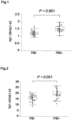
- Fig. 1 is a box-and-whisker plot showing comparison between the group PiB- and the group PiB+ for A ⁇ 1-39/A ⁇ 1-42.
- Fig. 2 is a box-and-whisker plot showing comparison between the group PiB- and the group PiB+ for A ⁇ 1-40/A ⁇ 1-42.
- Fig. 3 is a box-and-whisker plot showing comparison between the group PiB- and the group PiB+ for APP669-711/A ⁇ 1-42.
- the range indicated by the box in each group represents the intensity ratio contribution range (quartile range) of the samples whose intensity ratio is rated between 25 to 75% of all specimens
- the horizontal lines shown above and below the box respectively indicate the maximum value and the minimum value of the samples within the range from the upper end and the lower end of the box to 1.5 times the quartile range
- the horizontal bar in the box indicates the median of the intensity ratio.
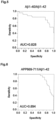
- ROC analysis of the group PiB+ versus the group PiB- was conducted with PiB+ as positive ( Figs. 4 , 5, 6 ).
- the AUC was 0.8 or more for any marker, and this reveals that the markers are capable of discrimination between the group PiB- and the group PiB+ with high accuracy.
- Fig. 4 is an ROC curve for A ⁇ 1-39/A ⁇ 1-42.
- Fig. 5 is an ROC curve for A ⁇ 1-40/A ⁇ 1-42.
- Fig. 6 is an ROC curve for APP669-711/A ⁇ 1-42.
- a ⁇ 1-39/A ⁇ 1-42, A ⁇ 1-40/A ⁇ 1-42, and APP669-711/A ⁇ 1-42 have the potential to be an index that is useful for determination of a cerebral amyloid accumulation state.
- a ⁇ 1-39/A ⁇ 1-42 showed the most excellent determination performance.
- Fig. 7 is a scatter diagram for A ⁇ 1-39/A ⁇ 1-42, in which the horizontal axis represents PiB accumulation mean value (mcSUVR) and the vertical axis represents A ⁇ 1-39/A ⁇ 1-42 ratio.
- Fig. 8 is a scatter diagram for A ⁇ 1-40/A ⁇ 1-42, in which the horizontal axis represents PiB accumulation mean value (mcSUVR) and the vertical axis represents A ⁇ 1-40/A ⁇ 1-42 ratio.
- Fig. 9 is a scatter diagram for APP669-711/A ⁇ 1-42, in which the horizontal axis represents PiB accumulation mean value (mcSUVR) and the vertical axis represents APP669-711/A ⁇ 1-42 ratio.
- Discriminant analysis was conducted by using combinations of two markers, A ⁇ 1-39/A ⁇ 1-42 and A ⁇ 1-40/A ⁇ 1-42, A ⁇ 1-39/A ⁇ 1-42 and APP669-711/A ⁇ 1-42, and A ⁇ 1-40/A ⁇ 1-42 and APP669-711/A ⁇ 1-42, and a combination of three markers A ⁇ 1-39/A ⁇ 1-42, A ⁇ 1-40/A ⁇ 1-42 and APP669-711/A ⁇ 1-42, and discriminant function z in each combination was obtained.
- a discriminant score was calculated from marker values to be combined by using discriminant function z.
- a discriminant score was calculated from marker values to be combined by using discriminant function z, and then subsequent statistical analysis was conducted.
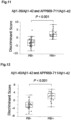
- Fig. 10 is a box-and-whisker plot showing comparison between the group PiB- and the group PiB+ for a combination of two markers: A ⁇ 1-39/A ⁇ 1-42 and A ⁇ 1-40/A ⁇ 1-42.
- Fig. 11 is a box-and-whisker plot showing comparison between the group PiB- and the group PiB+ for a combination of two markers: A ⁇ 1-39/A ⁇ 1-42 and APP669-711/A ⁇ 1-42.
- Fig. 12 is a box-and-whisker plot showing comparison between the group PiB- and the group PiB+ for a combination of two markers: A ⁇ 1-40/ A ⁇ 1-42 and APP669-711/A ⁇ 1-42.
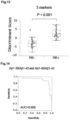
- 13 is a box-and-whisker plot showing comparison between the group PiB- and the group PiB+ for a combination of three markers: A ⁇ 1-39/A ⁇ 1-42, A ⁇ 1-40/A ⁇ 1-42 and APP669-711/A ⁇ 1-42.
- Fig. 14 is an ROC curve for a combination of two markers: A ⁇ 1-39/A ⁇ 1-42 and A ⁇ 1-40/A ⁇ 1-42.
- Fig. 15 is an ROC curve for a combination of two markers: A ⁇ 1-39/A ⁇ 1-42 and APP669-711/A ⁇ 1-42.
- Fig. 16 is an ROC curve for a combination of two markers: A ⁇ 1-40/A ⁇ 1-42 and APP669-711/A ⁇ 1-42.
- Fig. 17 is an ROC curve for a combination of three markers: A ⁇ 1-39/A ⁇ 1-42, A ⁇ 1-40/A ⁇ 1-42 and APP669-711/A ⁇ 1-42.
- the discriminant score > 0 is discriminated as PiB+, and the discriminant score ⁇ 0 is discriminated as PiB-. That is, Sensitivity, Specificity, and Accuracy in each combination when the cut-off value is set at 0 are shown in Table 2 (Numbers: 11, 12, 13, 14) . All the combinations showed Accuracy that is higher than that by a single marker. That is, by combining markers, the probability of exact determination was improved. In the present analysis, the combination of three markers showed the highest Accuracy. In Table 2, Numbers 11 to 14 show the results obtained by conducting discriminant analysis by using each marker value, and using a discriminant score of combined markers for analysis. [Table 2] Combination of Markers No.
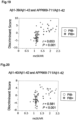
- Fig. 18 is a scatter diagram for a combination of two markers: A ⁇ 1-39/A ⁇ 1-42 and A ⁇ 1-40/A ⁇ 1-42, in which the horizontal axis represents PiB accumulation mean value (mcSUVR) and the vertical axis represents discriminant score of a combination of A ⁇ 1-39/A ⁇ 1-42 and A ⁇ 1-40/A ⁇ 1-42.
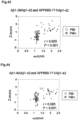
- Fig. 19 is a scatter diagram for a combination of two markers: A ⁇ 1-39/A ⁇ 1-42 and APP669-711/A ⁇ 1-42, in which the horizontal axis represents PiB accumulation mean value (mcSUVR) and the vertical axis represents discriminant score of a combination of A ⁇ 1-39/A ⁇ 1-42 and APP669-711/A ⁇ 1-42.
- Fig. 18 is a scatter diagram for a combination of two markers: A ⁇ 1-39/A ⁇ 1-42 and A ⁇ 1-40/A ⁇ 1-42, in which the horizontal axis represents PiB accumulation mean value (mcSUVR) and the vertical axis represents discriminant score of a
- FIG. 20 is a scatter diagram for a combination of two markers: A ⁇ 1-40/ A ⁇ 1-42 and APP669-711/A ⁇ 1-42, in which the horizontal axis represents PiB accumulation mean value (mcSUVR) and the vertical axis represents discriminant score of a combination of two markers: A ⁇ 1-40/ A ⁇ 1-42 and APP669-711/A ⁇ 1-42.
- mcSUVR PiB accumulation mean value
- 21 is a scatter diagram for a combination of three markers: A ⁇ 1-39/A ⁇ 1-42, A ⁇ 1-40/A ⁇ 1-42 and APP669-711/A ⁇ 1-42, in which the horizontal axis represents PiB accumulation mean value (mcSUVR) and the vertical axis represents discriminant score of a combination of A ⁇ 1-39/A ⁇ 1-42, A ⁇ 1-40/A ⁇ 1-42 and APP669-711/A ⁇ 1-42.
- the horizontal axis represents PiB accumulation mean value (mcSUVR) and the vertical axis represents discriminant score of a combination of A ⁇ 1-39/A ⁇ 1-42, A ⁇ 1-40/A ⁇ 1-42 and APP669-711/A ⁇ 1-42.
- the combined value is greatly influenced by a marker having a larger value if the values are directly averaged or summed.
- normalization was conducted for each of A ⁇ 1-39/A ⁇ 1-42, A ⁇ 1-40/A ⁇ 1-42, and APP669-711/A ⁇ 1-42 based on distribution of all the 76 cases. Normalization was conducted by calculating mean value (X) and standard deviation (s) of marker values of all the 76 cases, and converting marker value (x i ) of each sample into z-score (z i ) according to the following formula.
- z i x i ⁇ X / S
- Fig. 22 is a box-and-whisker plot showing comparison between the group PiB- and the group PiB+ for a combination of two markers: A ⁇ 1-39/A ⁇ 1-42 and A ⁇ 1-40/A ⁇ 1-42.
- Fig. 23 is a box-and-whisker plot showing comparison between the group PiB- and the group PiB+ for a combination of two markers: A ⁇ 1-39/A ⁇ 1-42 and APP669-711/A ⁇ 1-42.
- Fig. 24 is a box-and-whisker plot showing comparison between the group PiB- and the group PiB+ for a combination of two markers: A ⁇ 1-40/ A ⁇ 1-42 and APP669-711/A ⁇ 1-42.
- 25 is a box-and-whisker plot showing comparison between the group PiB- and the group PiB+ for a combination of three markers: A ⁇ 1-39/A ⁇ 1-42, A ⁇ 1-40/A ⁇ 1-42 and APP669-711/A ⁇ 1-42.
- Fig. 26 is an ROC curve for a combination of two markers: A ⁇ 1-39/A ⁇ 1-42 and A ⁇ 1-40/A ⁇ 1-42.
- Fig. 27 is an ROC curve for a combination of two markers: A ⁇ 1-39/A ⁇ 1-42 and APP669-711/A ⁇ 1-42.
- Fig. 28 is an ROC curve for a combination of two markers: A ⁇ 1-40/A ⁇ 1-42 and APP669-711/A ⁇ 1-42.
- Fig. 29 is an ROC curve for a combination of three markers : A ⁇ 1-39/A ⁇ 1-42, A ⁇ 1-40/A ⁇ 1-42 and APP669-711/A ⁇ 1-42.
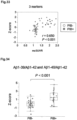
- Fig. 30 is a scatter diagram for a combination of two markers: A ⁇ 1-39/A ⁇ 1-42 and A ⁇ 1-40/A ⁇ 1-42, in which the horizontal axis represents PiB accumulation mean value (mcSUVR) and the vertical axis represents z-score of a combination of A ⁇ 1-39/A ⁇ 1-42 and A ⁇ 1-40/A ⁇ 1-42.
- Fig. 31 is a scatter diagram for a combination of two markers: A ⁇ 1-39/A ⁇ 1-42 and APP669-711/A ⁇ 1-42, in which the horizontal axis represents PiB accumulation mean value (mcSUVR) and the vertical axis represents z-score of a combination of A ⁇ 1-39/A ⁇ 1-42 and APP669-711/Apl-42.
- Fig. 32 is a scatter diagram for a combination of two markers: A ⁇ 1-40/A ⁇ 1-42 and APP669-711/A ⁇ 1-42, in which the horizontal axis represents PiB accumulation mean value (mcSUVR) and the vertical axis represents z-score of a combination of A ⁇ 1-40/A ⁇ 1-42 and APP669-711/A ⁇ 1-42.
- mcSUVR PiB accumulation mean value
- Fig. 32 is a scatter diagram for a combination of two markers: A ⁇ 1-40/A ⁇ 1-42 and APP669-711/A ⁇ 1-42, in which the horizontal axis represents PiB accumulation mean value (mcSUVR) and the vertical axis represents z-score of a combination of A ⁇ 1-40/A ⁇ 1-42 and APP669-711/A ⁇ 1-42.
- mcSUVR PiB accumulation mean value
- 33 is a scatter diagram for a combination of three markers: A ⁇ 1-39/A ⁇ 1-42, A ⁇ 1-40/A ⁇ 1-42 and APP669-711/A ⁇ 1-42, in which the horizontal axis represents PiB accumulation mean value (mcSUVR) and the vertical axis represents z-score of a combination of A ⁇ 1-39/A ⁇ 1-42, A ⁇ 1-40/A ⁇ 1-42 and APP669-711/A ⁇ 1-42.
- the horizontal axis represents PiB accumulation mean value (mcSUVR)
- the vertical axis represents z-score of a combination of A ⁇ 1-39/A ⁇ 1-42, A ⁇ 1-40/A ⁇ 1-42 and APP669-711/A ⁇ 1-42.
- Fig. 34 is a box-and-whisker plot showing comparison between the group PiB- and the group PiB+ for a combination of two markers: A ⁇ 1-39/A ⁇ 1-42 and A ⁇ 1-40/A ⁇ 1-42.
- Fig. 35 is a box-and-whisker plot showing comparison between the group PiB- and the group PiB+ for a combination of two markers: A ⁇ 1-39/A ⁇ 1-42 and APP669-711/A ⁇ 1-42.
- Fig. 36 is a box-and-whisker plot showing comparison between the group PiB- and the group PiB+ for a combination of two markers: A ⁇ 1-40/ A ⁇ 1-42 and APP669-711/A ⁇ 1-42.
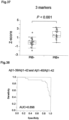
- 37 is a box-and-whisker plot showing comparison between the group PiB- and the group PiB+ for a combination of three markers: A ⁇ 1-39/A ⁇ 1-42, A ⁇ 1-40/A ⁇ 1-42 and APP669-711/A ⁇ 1-42.
- Fig. 38 is an ROC curve for a combination of two markers: A ⁇ 1-39/A ⁇ 1-42 and A ⁇ 1-40/A ⁇ 1-42.
- Fig. 39 is an ROC curve for a combination of two markers: A ⁇ 1-39/A ⁇ 1-42 and APP669-711/A ⁇ 1-42.
- Fig. 40 is an ROC curve for a combination of two markers: A ⁇ 1-40/A ⁇ 1-42 and APP669-711/A ⁇ 1-42.
- Fig. 41 is an ROC curve for a combination of three markers: A ⁇ 1-39/A ⁇ 1-42, A ⁇ 1-40/A ⁇ 1-42 and APP669-711/A ⁇ 1-42.
- Fig. 42 is a scatter diagram for a combination of two markers: A ⁇ 1-39/A ⁇ 1-42 and A ⁇ 1-40/A ⁇ 1-42, in which the horizontal axis represents PiB accumulation mean value (mcSUVR) and the vertical axis represents z-score of a combination of A ⁇ 1-39/A ⁇ 1-42 and A ⁇ 1-40/A ⁇ 1-42.
- Fig. 43 is a scatter diagram for a combination of two markers: A ⁇ 1-39/A ⁇ 1-42 and APP669-711/Apl-42, in which the horizontal axis represents PiB accumulation mean value (mcSUVR) and the vertical axis represents z-score of a combination of A ⁇ 1-39/A ⁇ 1-42 and APP669-711/A ⁇ 1-42.
- Fig. 44 is a scatter diagram for a combination of two.markers: A ⁇ 1-40/A ⁇ 1-42 and APP669-711/A ⁇ 1-42, in which the horizontal axis represents PiB accumulation mean value (mcSUVR) and the vertical axis represents z-score of a combination of two markers: A ⁇ 1-40/A ⁇ 1-42 and APP669-711/A ⁇ 1-42.
- mcSUVR PiB accumulation mean value
- 45 is a scatter diagram for a combination of three markers: A ⁇ 1-39/A ⁇ 1-42, A ⁇ 1-40/A ⁇ 1-42 and APP669-711/A ⁇ 1-42, in which the horizontal axis represents PiB accumulation mean value (mcSUVR) and the vertical axis represents z-score of a combination of A ⁇ 1-39/A ⁇ 1-42, A ⁇ 1-40/A ⁇ 1-42 and APP669-711/A ⁇ 1-42.
- the horizontal axis represents PiB accumulation mean value (mcSUVR) and the vertical axis represents z-score of a combination of A ⁇ 1-39/A ⁇ 1-42, A ⁇ 1-40/A ⁇ 1-42 and APP669-711/A ⁇ 1-42.
- the combined marker of the present invention is useful as a blood marker for determining a cerebral A ⁇ accumulation state. This also has indicated the applicability to assist diagnosis of Alzheimer's disease and to presymptomatically diagnose Alzheimer's disease.
- the present invention relates to the following items:
Landscapes
- Life Sciences & Earth Sciences (AREA)
- Health & Medical Sciences (AREA)
- Engineering & Computer Science (AREA)
- Biomedical Technology (AREA)
- Hematology (AREA)
- Chemical & Material Sciences (AREA)
- Urology & Nephrology (AREA)
- Molecular Biology (AREA)
- Immunology (AREA)
- Proteomics, Peptides & Aminoacids (AREA)
- Biochemistry (AREA)
- Microbiology (AREA)
- Biotechnology (AREA)
- Pathology (AREA)
- General Physics & Mathematics (AREA)
- Food Science & Technology (AREA)
- Medicinal Chemistry (AREA)
- Physics & Mathematics (AREA)
- Analytical Chemistry (AREA)
- Cell Biology (AREA)
- General Health & Medical Sciences (AREA)
- Neurology (AREA)
- Neurosurgery (AREA)
- Investigating Or Analysing Biological Materials (AREA)
Applications Claiming Priority (4)
| Application Number | Priority Date | Filing Date | Title |
|---|---|---|---|
| JP2015183372 | 2015-09-16 | ||
| PCT/JP2016/076706 WO2017047529A1 (ja) | 2015-09-16 | 2016-09-09 | 脳内のアミロイドβ蓄積状態を評価するマルチプレックスバイオマーカー及びその分析方法 |
| EP19192797.9A EP3598137B1 (de) | 2015-09-16 | 2016-09-09 | Multiplex-biomarker zur verwendung in der beurteilung des zustands der anhäufung von amyloid b im gehirn und analyseverfahren für besagte beurteilung |
| EP16846400.6A EP3351939B1 (de) | 2015-09-16 | 2016-09-09 | Multiplex-biomarker zur verwendung in der beurteilung des zustands der anhäufung von amyloid b im gehirn und analyseverfahren für besagte beurteilung |
Related Parent Applications (3)
| Application Number | Title | Priority Date | Filing Date |
|---|---|---|---|
| EP19192797.9A Division EP3598137B1 (de) | 2015-09-16 | 2016-09-09 | Multiplex-biomarker zur verwendung in der beurteilung des zustands der anhäufung von amyloid b im gehirn und analyseverfahren für besagte beurteilung |
| EP19192797.9A Division-Into EP3598137B1 (de) | 2015-09-16 | 2016-09-09 | Multiplex-biomarker zur verwendung in der beurteilung des zustands der anhäufung von amyloid b im gehirn und analyseverfahren für besagte beurteilung |
| EP16846400.6A Division EP3351939B1 (de) | 2015-09-16 | 2016-09-09 | Multiplex-biomarker zur verwendung in der beurteilung des zustands der anhäufung von amyloid b im gehirn und analyseverfahren für besagte beurteilung |
Publications (2)
| Publication Number | Publication Date |
|---|---|
| EP4424704A2 true EP4424704A2 (de) | 2024-09-04 |
| EP4424704A3 EP4424704A3 (de) | 2024-12-25 |
Family
ID=58288754
Family Applications (3)
| Application Number | Title | Priority Date | Filing Date |
|---|---|---|---|
| EP19192797.9A Active EP3598137B1 (de) | 2015-09-16 | 2016-09-09 | Multiplex-biomarker zur verwendung in der beurteilung des zustands der anhäufung von amyloid b im gehirn und analyseverfahren für besagte beurteilung |
| EP16846400.6A Active EP3351939B1 (de) | 2015-09-16 | 2016-09-09 | Multiplex-biomarker zur verwendung in der beurteilung des zustands der anhäufung von amyloid b im gehirn und analyseverfahren für besagte beurteilung |
| EP24183330.0A Pending EP4424704A3 (de) | 2015-09-16 | 2016-09-09 | Multiplex-biomarker zur verwendung bei der beurteilung des akkumulationszustands von amyloid b im gehirn und analyseverfahren für besagte beurteilung |
Family Applications Before (2)
| Application Number | Title | Priority Date | Filing Date |
|---|---|---|---|
| EP19192797.9A Active EP3598137B1 (de) | 2015-09-16 | 2016-09-09 | Multiplex-biomarker zur verwendung in der beurteilung des zustands der anhäufung von amyloid b im gehirn und analyseverfahren für besagte beurteilung |
| EP16846400.6A Active EP3351939B1 (de) | 2015-09-16 | 2016-09-09 | Multiplex-biomarker zur verwendung in der beurteilung des zustands der anhäufung von amyloid b im gehirn und analyseverfahren für besagte beurteilung |
Country Status (6)
| Country | Link |
|---|---|
| US (1) | US11268965B2 (de) |
| EP (3) | EP3598137B1 (de) |
| JP (1) | JP6467512B2 (de) |
| CN (1) | CN108027376B (de) |
| AU (2) | AU2016322342B2 (de) |
| WO (1) | WO2017047529A1 (de) |
Families Citing this family (18)
| Publication number | Priority date | Publication date | Assignee | Title |
|---|---|---|---|---|
| EP3633372A4 (de) * | 2017-05-31 | 2021-03-24 | Public University Corporation Nagoya City University | Biomarker für morbus alzheimer |
| JP7434144B2 (ja) * | 2018-02-27 | 2024-02-20 | 株式会社島津製作所 | APP669-xのN末端を特異的に認識する抗体、及び免疫測定法 |
| WO2019167128A1 (ja) * | 2018-02-27 | 2019-09-06 | 株式会社 島津製作所 | サンドイッチ型免疫測定法 |
| EP3932942A4 (de) | 2019-03-01 | 2022-12-07 | Shimadzu Corporation | Verfahren und kit zum messen von app669-711 |
| US20220155325A1 (en) * | 2019-03-06 | 2022-05-19 | Industry-University Cooperation Foundation Hanyang University Erica Campus | Method for diagnosing alzheimer's disease using silver nanogap shell |
| WO2020217865A1 (ja) * | 2019-04-26 | 2020-10-29 | 株式会社島津製作所 | Adamts4のapp切断活性制御物質のスクリーニング方法 |
| JP7334781B2 (ja) * | 2019-06-28 | 2023-08-29 | 株式会社島津製作所 | アミロイドβの脳内蓄積状態評価方法及び評価装置 |
| US20220268789A1 (en) | 2019-07-05 | 2022-08-25 | Shimadzu Corporation | Monoclonal antibody against amyloid beta, and method for measuring amyloid beta-related peptide using said antibody |
| WO2021009074A1 (en) | 2019-07-12 | 2021-01-21 | Adx Neurosciences Nv | Novel markers as early predictors of alzheimer's pathology |
| EP4195237A4 (de) | 2020-08-07 | 2024-10-02 | Shimadzu Corporation | Verfahren zur korrektur von maschinenunterschieden für massenspektrometrievorrichtungen |
| US20240112898A1 (en) | 2021-02-22 | 2024-04-04 | Shimadzu Corporation | Calibrant for use in mass spectrometer and method for producing same |
| WO2022181273A1 (ja) | 2021-02-25 | 2022-09-01 | 株式会社 島津製作所 | ペプチド測定における品質管理用標準溶液、及びペプチド測定の品質管理 |
| JP7718483B2 (ja) | 2021-05-14 | 2025-08-05 | 株式会社島津製作所 | ニューログラニン関連ペプチドの分析方法 |
| CN117677845A (zh) | 2021-07-21 | 2024-03-08 | 株式会社岛津制作所 | 阿尔茨海默病模型小鼠的Aβ生物标志物及其分析方法 |
| WO2023136043A1 (ja) | 2022-01-13 | 2023-07-20 | 株式会社島津製作所 | ニューログラニン関連ペプチドの分析方法 |
| US20250334583A1 (en) | 2022-05-24 | 2025-10-30 | Shimadzu Corporation | Method for preparing sample solution containing neurogranin-related peptide and method for analyzing neurogranin-related peptide |
| EP4679097A1 (de) | 2023-03-03 | 2026-01-14 | Shimadzu Corporation | Verfahren zur schätzung neurodegenerativer zustände im gehirn |
| EP4679096A1 (de) | 2023-03-03 | 2026-01-14 | Shimadzu Corporation | Biomarker und verfahren zur schätzung neurodegenerativer zustände im gehirn |
Citations (3)
| Publication number | Priority date | Publication date | Assignee | Title |
|---|---|---|---|---|
| JP2010019864A (ja) | 1998-07-03 | 2010-01-28 | Innogenetics Nv | 神経変性の分別診断 |
| JP2013063976A (ja) | 2008-02-08 | 2013-04-11 | Immunas Pharma Inc | Aβオリゴマーに特異的に結合する抗体およびその利用 |
| JP2014520529A (ja) | 2011-06-27 | 2014-08-25 | エーザイ・アール・アンド・ディー・マネジメント株式会社 | アルツハイマー病を示すマイクロrnaバイオマーカー |
Family Cites Families (7)
| Publication number | Priority date | Publication date | Assignee | Title |
|---|---|---|---|---|
| US20040014142A1 (en) | 1998-07-03 | 2004-01-22 | Innogenetics N.V. | Differential diagnosis of neurodegeneration |
| WO2008058760A1 (en) | 2006-11-17 | 2008-05-22 | Friedrich-Alexander-Universität Erlangen-Nürnberg | Method of differentially diagnosing dementias |
| WO2011064225A1 (en) * | 2009-11-24 | 2011-06-03 | Probiodrug Ag | Novel diagnostic method for the diagnosis of alzheimer's disease or mild cgnitive impairment |
| WO2011063453A1 (en) * | 2009-11-24 | 2011-06-03 | Commonweath Scientific And Industrial Research Organisation | Methods, kits and reagents for diagnosing, aiding diagnosis and/or monitoring progression of a neurological disorder |
| BR112014014960A2 (pt) * | 2011-12-19 | 2017-06-13 | Univ Washington | métodos para o diagnóstico da doença de alzheimer |
| WO2015111430A1 (ja) * | 2014-01-21 | 2015-07-30 | 株式会社 島津製作所 | App切断型ペプチドの測定方法 |
| EP4040157A1 (de) * | 2014-05-22 | 2022-08-10 | Shimadzu Corporation | Surrogatbiomarker zur beurteilung der intrazerebralen amyloid-beta-peptid-akkumulation und verfahren zur analyse davon |
-
2016
- 2016-09-09 EP EP19192797.9A patent/EP3598137B1/de active Active
- 2016-09-09 US US15/752,498 patent/US11268965B2/en active Active
- 2016-09-09 CN CN201680053338.0A patent/CN108027376B/zh active Active
- 2016-09-09 AU AU2016322342A patent/AU2016322342B2/en active Active
- 2016-09-09 EP EP16846400.6A patent/EP3351939B1/de active Active
- 2016-09-09 EP EP24183330.0A patent/EP4424704A3/de active Pending
- 2016-09-09 JP JP2017539881A patent/JP6467512B2/ja active Active
- 2016-09-09 WO PCT/JP2016/076706 patent/WO2017047529A1/ja not_active Ceased
-
2019
- 2019-07-12 AU AU2019205010A patent/AU2019205010B2/en active Active
Patent Citations (3)
| Publication number | Priority date | Publication date | Assignee | Title |
|---|---|---|---|---|
| JP2010019864A (ja) | 1998-07-03 | 2010-01-28 | Innogenetics Nv | 神経変性の分別診断 |
| JP2013063976A (ja) | 2008-02-08 | 2013-04-11 | Immunas Pharma Inc | Aβオリゴマーに特異的に結合する抗体およびその利用 |
| JP2014520529A (ja) | 2011-06-27 | 2014-08-25 | エーザイ・アール・アンド・ディー・マネジメント株式会社 | アルツハイマー病を示すマイクロrnaバイオマーカー |
Non-Patent Citations (5)
| Title |
|---|
| BLENNOW KDE LEON MJZETTERBERG H.: "Alzheimer's disease", LANCET, vol. 368, no. 9533, 29 July 2006 (2006-07-29), pages 387 - 403 |
| HAMPEL HSHEN YWALSH DMAISEN PSHAW LMZETTERBERG HTROJANOWSKI JQBLENNOW K: "Biological markers of amyloid beta-related mechanisms in Alzheimer's disease", EXP NEUROL., vol. 223, no. 2, June 2010 (2010-06-01), pages 334 - 46, XP027038373 |
| KANEKO N, YAMAMOTO R, SATO TA, TANAKA K: "Identification and quantification of amyloid beta-related peptides in human plasma using matrix-assisted laser desorption/ionization time-of-flight mass spectrometry ", PROC JPN ACAD SER B PHYS BIOL SCI., vol. 90, no. 3, 2014, pages 104 - 17 |
| KANEKO NNAKAMURA AWASHIMI YKATO TSAKURAI TARAHATA YBUNDO MTAKEDA ANIIDA SITO K: "Novel plasma biomarker surrogating cerebral amyloid deposition", PROC JPN ACAD SER B PHYS BIOL SCI., vol. 90, no. 9, 2014, pages 353 - 64, XP055238351, DOI: 10.2183/pjab.90.353 |
| PORTELIUS EWESTMAN-BRINKMALM AZETTERBERG HBLENNOW K: "Determination of beta-amyloid peptide signatures in cerebrospinal fluid using immunoprecipitation-mass spectrometry", J PROTEOME RES, vol. 5, no. 4, April 2006 (2006-04-01), pages 1010 - 6, XP002550741, DOI: 10.1021/pr050475v |
Also Published As
| Publication number | Publication date |
|---|---|
| EP3598137A1 (de) | 2020-01-22 |
| AU2016322342B2 (en) | 2019-07-25 |
| EP4424704A3 (de) | 2024-12-25 |
| AU2016322342A1 (en) | 2018-04-26 |
| WO2017047529A1 (ja) | 2017-03-23 |
| AU2019205010A1 (en) | 2019-08-01 |
| EP3598137B1 (de) | 2025-04-16 |
| EP3351939A1 (de) | 2018-07-25 |
| CN108027376A (zh) | 2018-05-11 |
| JP6467512B2 (ja) | 2019-02-13 |
| EP3351939B1 (de) | 2020-11-04 |
| US11268965B2 (en) | 2022-03-08 |
| EP3351939A4 (de) | 2019-02-06 |
| US20180238909A1 (en) | 2018-08-23 |
| AU2019205010B2 (en) | 2022-03-10 |
| CN108027376B (zh) | 2021-04-02 |
| JPWO2017047529A1 (ja) | 2018-05-31 |
Similar Documents
| Publication | Publication Date | Title |
|---|---|---|
| EP3351939B1 (de) | Multiplex-biomarker zur verwendung in der beurteilung des zustands der anhäufung von amyloid b im gehirn und analyseverfahren für besagte beurteilung | |
| AU2021201434B2 (en) | Surrogate biomarker for evaluating intracerebral amyloid beta peptide accumulation and method for analysis thereof | |
| US20120238476A1 (en) | Alzheimer's disease diagnostic panels and methods for their use | |
| US20080171394A1 (en) | Method For Diagnosing Multiple Sclerosis | |
| JP7457300B2 (ja) | 神経変性疾患の診断用ペプチドマーカー | |
| JP2015108515A (ja) | 大腸癌の診断のための検査方法 | |
| JP2024117521A (ja) | 膵臓がんの検出方法 | |
| WO2024185667A1 (ja) | 脳の神経変性状態の推定方法 | |
| JP2018163071A (ja) | 関節リウマチに関するペプチドマーカー | |
| WO2024185666A1 (ja) | バイオマーカーおよび脳の神経変性状態の推定方法 | |
| CN117677845A (zh) | 阿尔茨海默病模型小鼠的Aβ生物标志物及其分析方法 | |
| JP2022068788A (ja) | 軽度認知障害における酸化ストレスの評価 | |
| Ding | The Use of Tissue and Serum ‘Omics’ Methods To Characterize Disease |
Legal Events
| Date | Code | Title | Description |
|---|---|---|---|
| PUAI | Public reference made under article 153(3) epc to a published international application that has entered the european phase |
Free format text: ORIGINAL CODE: 0009012 |
|
| STAA | Information on the status of an ep patent application or granted ep patent |
Free format text: STATUS: REQUEST FOR EXAMINATION WAS MADE |
|
| 17P | Request for examination filed |
Effective date: 20240627 |
|
| AC | Divisional application: reference to earlier application |
Ref document number: 3351939 Country of ref document: EP Kind code of ref document: P Ref document number: 3598137 Country of ref document: EP Kind code of ref document: P |
|
| AK | Designated contracting states |
Kind code of ref document: A2 Designated state(s): AL AT BE BG CH CY CZ DE DK EE ES FI FR GB GR HR HU IE IS IT LI LT LU LV MC MK MT NL NO PL PT RO RS SE SI SK SM TR |
|
| REG | Reference to a national code |
Ref country code: DE Ref legal event code: R079 Free format text: PREVIOUS MAIN CLASS: C07K0014470000 Ipc: G01N0033680000 |
|
| PUAL | Search report despatched |
Free format text: ORIGINAL CODE: 0009013 |
|
| AK | Designated contracting states |
Kind code of ref document: A3 Designated state(s): AL AT BE BG CH CY CZ DE DK EE ES FI FR GB GR HR HU IE IS IT LI LT LU LV MC MK MT NL NO PL PT RO RS SE SI SK SM TR |
|
| RIC1 | Information provided on ipc code assigned before grant |
Ipc: C07K 14/47 20060101ALI20241119BHEP Ipc: G01N 33/68 20060101AFI20241119BHEP |