EP4421082A1 - Polypeptid und anwendung davon als cck-rezeptor-agonist/-antagonist - Google Patents
Polypeptid und anwendung davon als cck-rezeptor-agonist/-antagonist Download PDFInfo
- Publication number
- EP4421082A1 EP4421082A1 EP22882338.1A EP22882338A EP4421082A1 EP 4421082 A1 EP4421082 A1 EP 4421082A1 EP 22882338 A EP22882338 A EP 22882338A EP 4421082 A1 EP4421082 A1 EP 4421082A1
- Authority
- EP
- European Patent Office
- Prior art keywords
- trp
- phe
- asp
- met
- group
- Prior art date
- Legal status (The legal status is an assumption and is not a legal conclusion. Google has not performed a legal analysis and makes no representation as to the accuracy of the status listed.)
- Pending
Links
Images


Classifications
-
- A—HUMAN NECESSITIES
- A61—MEDICAL OR VETERINARY SCIENCE; HYGIENE
- A61K—PREPARATIONS FOR MEDICAL, DENTAL OR TOILETRY PURPOSES
- A61K38/00—Medicinal preparations containing peptides
- A61K38/04—Peptides having up to 20 amino acids in a fully defined sequence; Derivatives thereof
- A61K38/07—Tetrapeptides
-
- A—HUMAN NECESSITIES
- A61—MEDICAL OR VETERINARY SCIENCE; HYGIENE
- A61P—SPECIFIC THERAPEUTIC ACTIVITY OF CHEMICAL COMPOUNDS OR MEDICINAL PREPARATIONS
- A61P1/00—Drugs for disorders of the alimentary tract or the digestive system
-
- A—HUMAN NECESSITIES
- A61—MEDICAL OR VETERINARY SCIENCE; HYGIENE
- A61P—SPECIFIC THERAPEUTIC ACTIVITY OF CHEMICAL COMPOUNDS OR MEDICINAL PREPARATIONS
- A61P25/00—Drugs for disorders of the nervous system
- A61P25/08—Antiepileptics; Anticonvulsants
-
- A—HUMAN NECESSITIES
- A61—MEDICAL OR VETERINARY SCIENCE; HYGIENE
- A61P—SPECIFIC THERAPEUTIC ACTIVITY OF CHEMICAL COMPOUNDS OR MEDICINAL PREPARATIONS
- A61P25/00—Drugs for disorders of the nervous system
- A61P25/14—Drugs for disorders of the nervous system for treating abnormal movements, e.g. chorea, dyskinesia
-
- A—HUMAN NECESSITIES
- A61—MEDICAL OR VETERINARY SCIENCE; HYGIENE
- A61P—SPECIFIC THERAPEUTIC ACTIVITY OF CHEMICAL COMPOUNDS OR MEDICINAL PREPARATIONS
- A61P25/00—Drugs for disorders of the nervous system
- A61P25/14—Drugs for disorders of the nervous system for treating abnormal movements, e.g. chorea, dyskinesia
- A61P25/16—Anti-Parkinson drugs
-
- A—HUMAN NECESSITIES
- A61—MEDICAL OR VETERINARY SCIENCE; HYGIENE
- A61P—SPECIFIC THERAPEUTIC ACTIVITY OF CHEMICAL COMPOUNDS OR MEDICINAL PREPARATIONS
- A61P25/00—Drugs for disorders of the nervous system
- A61P25/24—Antidepressants
-
- A—HUMAN NECESSITIES
- A61—MEDICAL OR VETERINARY SCIENCE; HYGIENE
- A61P—SPECIFIC THERAPEUTIC ACTIVITY OF CHEMICAL COMPOUNDS OR MEDICINAL PREPARATIONS
- A61P25/00—Drugs for disorders of the nervous system
- A61P25/28—Drugs for disorders of the nervous system for treating neurodegenerative disorders of the central nervous system, e.g. nootropic agents, cognition enhancers, drugs for treating Alzheimer's disease or other forms of dementia
-
- A—HUMAN NECESSITIES
- A61—MEDICAL OR VETERINARY SCIENCE; HYGIENE
- A61P—SPECIFIC THERAPEUTIC ACTIVITY OF CHEMICAL COMPOUNDS OR MEDICINAL PREPARATIONS
- A61P3/00—Drugs for disorders of the metabolism
- A61P3/04—Anorexiants; Antiobesity agents
-
- A—HUMAN NECESSITIES
- A61—MEDICAL OR VETERINARY SCIENCE; HYGIENE
- A61P—SPECIFIC THERAPEUTIC ACTIVITY OF CHEMICAL COMPOUNDS OR MEDICINAL PREPARATIONS
- A61P35/00—Antineoplastic agents
-
- C—CHEMISTRY; METALLURGY
- C07—ORGANIC CHEMISTRY
- C07K—PEPTIDES
- C07K14/00—Peptides having more than 20 amino acids; Gastrins; Somatostatins; Melanotropins; Derivatives thereof
- C07K14/001—Peptides having more than 20 amino acids; Gastrins; Somatostatins; Melanotropins; Derivatives thereof by chemical synthesis
-
- C—CHEMISTRY; METALLURGY
- C07—ORGANIC CHEMISTRY
- C07K—PEPTIDES
- C07K5/00—Peptides containing up to four amino acids in a fully defined sequence; Derivatives thereof
- C07K5/04—Peptides containing up to four amino acids in a fully defined sequence; Derivatives thereof containing only normal peptide links
- C07K5/06—Dipeptides
- C07K5/06104—Dipeptides with the first amino acid being acidic
- C07K5/06113—Asp- or Asn-amino acid
-
- C—CHEMISTRY; METALLURGY
- C07—ORGANIC CHEMISTRY
- C07K—PEPTIDES
- C07K5/00—Peptides containing up to four amino acids in a fully defined sequence; Derivatives thereof
- C07K5/04—Peptides containing up to four amino acids in a fully defined sequence; Derivatives thereof containing only normal peptide links
- C07K5/08—Tripeptides
- C07K5/0802—Tripeptides with the first amino acid being neutral
- C07K5/0804—Tripeptides with the first amino acid being neutral and aliphatic
-
- C—CHEMISTRY; METALLURGY
- C07—ORGANIC CHEMISTRY
- C07K—PEPTIDES
- C07K5/00—Peptides containing up to four amino acids in a fully defined sequence; Derivatives thereof
- C07K5/04—Peptides containing up to four amino acids in a fully defined sequence; Derivatives thereof containing only normal peptide links
- C07K5/08—Tripeptides
- C07K5/0802—Tripeptides with the first amino acid being neutral
- C07K5/0804—Tripeptides with the first amino acid being neutral and aliphatic
- C07K5/081—Tripeptides with the first amino acid being neutral and aliphatic the side chain containing O or S as heteroatoms, e.g. Cys, Ser
-
- C—CHEMISTRY; METALLURGY
- C07—ORGANIC CHEMISTRY
- C07K—PEPTIDES
- C07K5/00—Peptides containing up to four amino acids in a fully defined sequence; Derivatives thereof
- C07K5/04—Peptides containing up to four amino acids in a fully defined sequence; Derivatives thereof containing only normal peptide links
- C07K5/10—Tetrapeptides
- C07K5/1002—Tetrapeptides with the first amino acid being neutral
- C07K5/1005—Tetrapeptides with the first amino acid being neutral and aliphatic
-
- C—CHEMISTRY; METALLURGY
- C07—ORGANIC CHEMISTRY
- C07K—PEPTIDES
- C07K5/00—Peptides containing up to four amino acids in a fully defined sequence; Derivatives thereof
- C07K5/04—Peptides containing up to four amino acids in a fully defined sequence; Derivatives thereof containing only normal peptide links
- C07K5/10—Tetrapeptides
- C07K5/1002—Tetrapeptides with the first amino acid being neutral
- C07K5/1005—Tetrapeptides with the first amino acid being neutral and aliphatic
- C07K5/1008—Tetrapeptides with the first amino acid being neutral and aliphatic the side chain containing 0 or 1 carbon atoms, i.e. Gly, Ala
-
- C—CHEMISTRY; METALLURGY
- C07—ORGANIC CHEMISTRY
- C07K—PEPTIDES
- C07K5/00—Peptides containing up to four amino acids in a fully defined sequence; Derivatives thereof
- C07K5/04—Peptides containing up to four amino acids in a fully defined sequence; Derivatives thereof containing only normal peptide links
- C07K5/10—Tetrapeptides
- C07K5/1002—Tetrapeptides with the first amino acid being neutral
- C07K5/1005—Tetrapeptides with the first amino acid being neutral and aliphatic
- C07K5/101—Tetrapeptides with the first amino acid being neutral and aliphatic the side chain containing 2 to 4 carbon atoms, e.g. Val, Ile, Leu
-
- C—CHEMISTRY; METALLURGY
- C07—ORGANIC CHEMISTRY
- C07K—PEPTIDES
- C07K5/00—Peptides containing up to four amino acids in a fully defined sequence; Derivatives thereof
- C07K5/04—Peptides containing up to four amino acids in a fully defined sequence; Derivatives thereof containing only normal peptide links
- C07K5/10—Tetrapeptides
- C07K5/1002—Tetrapeptides with the first amino acid being neutral
- C07K5/1005—Tetrapeptides with the first amino acid being neutral and aliphatic
- C07K5/1013—Tetrapeptides with the first amino acid being neutral and aliphatic the side chain containing O or S as heteroatoms, e.g. Cys, Ser
-
- C—CHEMISTRY; METALLURGY
- C07—ORGANIC CHEMISTRY
- C07K—PEPTIDES
- C07K5/00—Peptides containing up to four amino acids in a fully defined sequence; Derivatives thereof
- C07K5/04—Peptides containing up to four amino acids in a fully defined sequence; Derivatives thereof containing only normal peptide links
- C07K5/10—Tetrapeptides
- C07K5/1002—Tetrapeptides with the first amino acid being neutral
- C07K5/1016—Tetrapeptides with the first amino acid being neutral and aromatic or cycloaliphatic
-
- C—CHEMISTRY; METALLURGY
- C07—ORGANIC CHEMISTRY
- C07K—PEPTIDES
- C07K5/00—Peptides containing up to four amino acids in a fully defined sequence; Derivatives thereof
- C07K5/04—Peptides containing up to four amino acids in a fully defined sequence; Derivatives thereof containing only normal peptide links
- C07K5/10—Tetrapeptides
- C07K5/1021—Tetrapeptides with the first amino acid being acidic
-
- C—CHEMISTRY; METALLURGY
- C07—ORGANIC CHEMISTRY
- C07K—PEPTIDES
- C07K5/00—Peptides containing up to four amino acids in a fully defined sequence; Derivatives thereof
- C07K5/04—Peptides containing up to four amino acids in a fully defined sequence; Derivatives thereof containing only normal peptide links
- C07K5/10—Tetrapeptides
- C07K5/1024—Tetrapeptides with the first amino acid being heterocyclic
-
- C—CHEMISTRY; METALLURGY
- C07—ORGANIC CHEMISTRY
- C07K—PEPTIDES
- C07K7/00—Peptides having 5 to 20 amino acids in a fully defined sequence; Derivatives thereof
- C07K7/04—Linear peptides containing only normal peptide links
- C07K7/06—Linear peptides containing only normal peptide links having 5 to 11 amino acids
-
- C—CHEMISTRY; METALLURGY
- C07—ORGANIC CHEMISTRY
- C07K—PEPTIDES
- C07K7/00—Peptides having 5 to 20 amino acids in a fully defined sequence; Derivatives thereof
- C07K7/50—Cyclic peptides containing at least one abnormal peptide link
- C07K7/52—Cyclic peptides containing at least one abnormal peptide link with only normal peptide links in the ring
-
- A—HUMAN NECESSITIES
- A61—MEDICAL OR VETERINARY SCIENCE; HYGIENE
- A61K—PREPARATIONS FOR MEDICAL, DENTAL OR TOILETRY PURPOSES
- A61K38/00—Medicinal preparations containing peptides
Definitions
- the present invention relates to the field of chemical and pharmaceutical technologies, in particular to a polypeptide and its use as a CCK receptor agonist/antagonist.
- Cholecystokinin is a humoral regulator synthesized and secreted by duodenal and jejunal cells and is a polypeptide consisting of 33 amino acids. It is widely distributed in the brain, especially in the cortex, striatum, hippocampus, cerebral pretectum, diaphragm, and hypothalamus, and is also secreted peripherally through the small intestine, playing an important role as a neurotransmitter or neuromodulator.
- CCK coexists with dopamine. It plays an important role in the mechanism involving acetylcholine, ⁇ -aminobutyric acid, serotonin, opiates, growth hormone suppression, substance P and ion channels. Taking CCK can cause physiological changes, ptosis, hypothermia, hyperglycemia and stubbornness, and some behavioral changes, lack of exercise, decreased aggressiveness, lack of pain, impact on learning knowledge, changes in sexual behavior and satiety when eating.
- CCK receptors belong to G protein-coupled receptors and are widely distributed in vivo.
- CCK receptors include two subtypes based on their affinity for endogenous ligands, namely CCK-A and CCK-B receptors. Two subtypes have been identified in both peripheral and central nervous systems.
- CCK receptor agonists and antagonists can be used to treat diet, obesity, gallbladder cancer, pancreatic cancer, epilepsy, depression, and digestive disorders caused by excess gastric acid.
- amnesia and dementia has not been reported.
- the existing peptide CCK receptor agonists and antagonists have a short half-life and cannot have a long-term effect in vivo by oral administration or injection, so the pharmaceutical significance is not much. Therefore, the development of new CCK receptor agonists will have great application significance for the treatment of related diseases.
- the present invention provides a polypeptide and its use as a CCK receptor agonist/antagonist.
- the polypeptide has a high agonistic/antagonistic activity on CCK receptors.
- the polypeptide according to the present invention has a longer half-life and duration of efficacy in vivo, and produces an improvement on the spatial memory deficiency of memory-deficient senile mice, and Alzheimer's mice.
- the present invention provides a polypeptide having a structure shown in Formula I or its stereoisomer, prodrug, pharmaceutically acceptable solvate or salt: wherein: X is an amide bond or a single bond; is or so that the amino acid at the corresponding position is a D-type or L-type amino acid;
- R 1 is selected from the group consisting of the following structures:
- R 2 is selected from the group consisting of the following structures:
- R 3 is selected from the group consisting of the following structures:
- R 4 is selected from the group consisting of the following structures:
- R I , R II , R III and R IV are independently selected from the group consisting of halogen, nitro, C 1 -C 4 alkyl, azido and cyano.
- polypeptide has a structure shown in Formula II:
- R 1 is selected from the group consisting of the following structures:
- R 2 is selected from the group consisting of the following structures:
- R 3 is selected from the group consisting of the following structures:
- R 4 is selected from the group consisting of the following structures:
- R 5 is selected from the group consisting of H and CH 3 .
- the polypeptide has a structure shown in Formula III or IV: wherein R I , R II , R III and R IV are independently selected from the group consisting of halogen, nitro, C 1 -C 4 alkyl, azido N 3 and cyano, and R V is a carbon or sulfur atom.
- R I , R II , R III and R IV are independently selected from the group consisting of H, F, Cl, Br, I, CN, N 3 , Me or NO 2 .
- polypeptide provided by the present invention has any of the structures in Table 1.
- the polypeptide has a structure shown in Compounds 1-4: (1) Ac-(D-Trp)-Met-Asp-Phe(3-Br)-NH 2
- the polypeptide of the present invention is prepared by condensation reaction using amino acids and modified amino acids as raw materials.
- the present invention has no special limitation on synthesis methods, and solid phase or liquid phase synthesis can be used.
- the present invention has no special limitation on particular steps of condensation reaction and reagents used, which are commonly used or well-known in the art.
- the present invention relates to a pharmaceutical composition, comprising the polypeptide described in the present invention, a pharmaceutically acceptable salt, stereoisomer or prodrug molecule thereof, and pharmaceutically acceptable excipients.
- “Pharmaceutically acceptable excipients” may include pharmaceutically acceptable carriers, diluents, preservatives, solubilizers, stabilizers, disintegrants, adhesives, lubricants, wetting agents, emulsifiers, sweeteners, colorants, flavoring agents, salts, buffers, coating agents and antioxidants. Those skilled in the art know suitable excipients and techniques for formulating pharmaceutical compositions.
- the present invention also relates to the use of the polypeptides of any structure shown in Formula I, II, III or IV as a CCK receptor agonist or antagonist, or in the preparation of a medicament for treating or preventing CCK receptor-related diseases.
- the CCK receptor-related diseases include at least one of amnesia, dementia, epilepsy, depression, obesity, gallbladder cancer, pancreatic cancer, and diseases of the digestive system.
- amnesia includes anterograde amnesia and retrograde amnesia
- dementia includes Alzheimer's disease (senile dementia), frontotemporal dementia, Parkinson's disease, Prion disease (Creutzfeldt-Jakob disease), Lewy body dementia, Huntington's disease, etc.
- "Treating or preventing" amnesia or dementia includes, in particular, but is not limited to, improving or partially improving amnesia, improving the learning process, improving memory ability, preventing or reversing amnesia episodes, improving or preventing amnesia or dementia complications, such as anxiety, depression, irritability, loss of interest, social withdrawal, etc.
- the administration of the polypeptide having a structure of Formula I to a subject may significantly improve the subject's learning ability and improve the subject's memory deficiency, and has a long-term effect.
- an effective amount usually means an amount sufficient to produce a therapeutically desired outcome, where the exact nature of the outcome varies according to the specific condition being treated.
- the polypeptide of the present invention having a structure of Formula I may be included in a composition, especially a pharmaceutical composition, in an effective amount, i.e., an amount suitable for the treatment or prevention of amnesia or dementia of the subject, especially a mammal.
- the subject may be a human or an animal, in particular the subject is a mammal, preferably a human. Therefore, the subject is preferably a human with amnesia or dementia.
- the effective amount of the polypeptide of the present invention having a structure of Formula I may depend on the species, weight, age and individual conditions of the subject, and may be determined by standard methods such as laboratory animals.
- Predisposing factors for amnesia or dementia can include, but are not limited to, any type of injury or trauma to central nervous system (CNS), including degenerative and non-degenerative diseases of central nervous system, the degenerative diseases such as Alzheimer's disease, frontotemporal dementia, Prion disease (Creutzfeldt-Jakob disease), Lewy body dementia, Parkinson's disease, Huntington's disease, etc., and the non-degenerative diseases such as vascular dementia, space-occupying lesions (tumors, chronic subdural hematomas, chronic brain abscesses), infections (meningoencephalitis, neurosyphilis, AIDS dementia, Prion disease), traumatic dementia of the brain, normal intracranial pressure hydrocephalus, endocrine metabolism disorders, poisoning, hypoxia and paraneoplastic syndromes, etc..
- CNS central nervous system
- polypeptides according to the present invention having a structure of Formula I may be administered orally, by injection, rectally, locally, parenterally, percutaneously, or by inhalation to the subject.
- the polypeptide having a structure of Formula I is administered to the subject by injection.
- injection includes intraperitoneal, intravenous, intramuscular, subcutaneous, and intradermal administration.
- the polypeptide of the present invention has a longer in vivo half-life, and a longer duration of efficacy.
- the polypeptide produces a significant improvement on memory of senile and memory-deficient mouse models, and thus has a great application potential.
- the present invention provides a polypeptide and its use as a CCK receptor agonist/antagonist.
- Those skilled in the art may refer to the disclosure of the present application to appropriately improve the process parameters.
- all similar substitutions and modifications are obvious to those skilled in the art, and they are considered to be included in the present invention.
- the methods and uses of the present invention have been described by preferable embodiments, and those skilled in the art can obviously modify or appropriately change and combine the methods and uses herein without departing from the disclosure, spirit and scope of the present invention to realize and apply the present invention.
- the materials used in the present invention are all commercially available products and can be purchased in the market.
- Example 1 The relationship between the structure of the polypeptide compound of the present invention and the agonistic activity of the CCK receptor
- polypeptide analogue compounds are generated by condensation reaction, and the activity of polypeptides is determined according to the following process, and the structure and activity are shown in Table 1.
- the compound stock solution was subjected to 200-fold dilution with HHBS buffer to form a 5 ⁇ working solution.
- CCK8 was firstly added to the HHBS buffer to a final concentration of 50 nM, and then the compound was diluted 200-fold with the obtained HHBS buffer into a 5 ⁇ working solution.
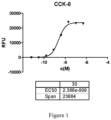
- CCK8 as a positive control, was considered to have the strongest agonistic activity, and its high-concentration effect was the saturated state of cells.
- concentration effect curve of CCK8 was analyzed, and the concentration where its agonistic effect reaches 90% saturation, that is, EC 90 was calculated as about 10 nM, so the concentration of CCK8 in the antagonist screening method was set to 10 nM.
- the agonism/antagonism EC 50 of the compound can be obtained by plotting the fitting curve with the agonism/antagonism percentage as Y-axis and the concentration of the compound as X-axis.
- Table 1 Structures and activities of polypeptides No. Sequence Structure EC50 (M) agonist EC50 (M) antagonis t Agonis tic Activit y (%) at 10 ⁇ M %Act-Ave @ 50 nM %Act-Ave @ InM HT-1 Phe-Asp-Met-Trp-COOH >10 ⁇ M N.A. N.A. N.A. N.A.
- HT-6 Ac-Phe-Asp-Met-D-Trp-NH2 >10 ⁇ M N.A. N.A. N.A. N.A.
- HT-7 D-Phe-D-Asp-D-Met-D-Trp-COOH >10 ⁇ M N.A. N.A. N.A. N.A.
- HT-8 Ac-D-Phe-D-Asp-D-Met-D-Trp-NH2 >10 ⁇ M N.A. N.A. N.A. N.A. HT-9 Trp-Met-Asp-Phe-NH2 1.94E-08 >50 ⁇ M N.A.
- HT-34 D-Trp-Met-Asp-Phe(4-Br)-NH2 3.69E-07 2.25E-06 98.24 N.A. N.A.
- HT-35 D-Trp-Met-Asp-Phe(4-C1I)-NH2 1.80E-07 7.55E-07 109.16 N.A. N.A.
- HT-36 D-Trp-Met-Asp-Phe(4-F)-NH2 8.88E-08 8.76E-07 -3.55 N.A. N.A.
- HT-37 D-Trp-Met-Asp-Phe(4-I)-NH2 8.64E-07 1.22E-06 52.04 N.A.
- N.A. 17.23 N.A. N.A. HT-49 D-Trp-Met(O)-Asp-Phe(4-CN)-NH2 N.A. N.A. 1.03 N.A. N.A. HT-50 D-Trp-Met(O)-Asp-Phe(4-NO2)-NH2 N.A. N.A. 11.85 N.A. N.A. HT-51 D-Trp-Met(O)-Asp-Phe(4-Br)-NH2 N.A. N.A. 17.18 N.A. N.A. HT-52 D-Trp-Met(O)-Asp-Phe(4-Cl)-NH2 N.A. N.A.
- HT-56 D-Trp-Met(O)-Asp-Phe(3,5-DiF)-NH2 N.A. N.A. 43.98 N.A. N.A.
- HT-57 D-Trp-Met(O)-Asp-Phe(3,4,5-TriF)-NH2 6.79E-06 N.A. 56.81 N.A. N.A.
- HT-58 D-Trp-Met(O2)-Asp-Phe(2-NO2)-NH2 N.A. N.A. 23.63 N.A. N.A.
- HT-59 D-Trp-Met(O2)-Asp-Phe(2-F)-NH2 N.A.
- N.A. HT-67 D-Trp-Met(O2)-Asp-Phe(4-NO2)-NH2 N.A. N.A. -1.49 N.A. N.A. HT-68 D-Trp-Met(O2)-Asp-Phe(4-Br)-NH2 N.A. N.A. 15.61 N.A. N.A. HT-69 D-Trp-Met(O2)-Asp-Phe(4-Cl)-NH2 N.A. N.A. 20.02 N.A. N.A. HT-70 D-Trp-Met(O2)-Asp-Phe(4-F)-NH2 1.14E-05 N.A.
- N.A. HT-85 D-Trp-Met-Asp(Ome)-Phe(4-Br)-NH2 N.A. N.A. 7.32 N.A. N.A. HT-86 D-Trp-Met-Asp(Ome)-Phe(4-Cl)-NH2 N.A. N.A. -0.94 N.A. N.A. HT-87 D-Trp-Met-Asp(Ome)-Phe(4-F)-NH2 N.A. 9.98E-06 28.73 N.A. N.A. HT-88 D-Trp-Met-Asp(Ome)-Phe(4-I)-NH2 N.A. N.A.
- HT-106 D-Trp-Met-Asp(EDAN S)-Phe(3,5-DiCl)-NH2 N.A. N.A. 3.74 N.A. N.A.
- HT-107 D-Trp-Met-Asp(EDAN S)-Phe(3,5-DiF)-NH2 N.A. N.A. 4.54 N.A. N.A.
- HT-108 D-Trp-Met-Asp(EDAN S)-Phe(3,4,5-TriF)-NH2 N.A. N.A. 2.27 N.A. N.A.
- HT-109 D-Trp-Met(O)-Asp(Ome)-Phe(2-NO2)-NH2 N.A.
- HT-116 D-Trp-Met(O)-Asp(Ome)-Phe(4-N3)-NH2 N.A. N.A. 10.90 N.A. N.A.
- HT-117 D-Trp-Met(O)-Asp(Ome)-Phe(4-CN)-NH2 N.A. N.A. 9.81 N.A. N.A.
- HT-118 D-Trp-Met(O)-Asp(Ome)-Phe(4-NO2)-NH2 N.A. N.A. 0.13 N.A. N.A.
- HT-119 D-Trp-Met(O)-Asp(Ome)-Phe(4-Br)-NH2 N.A.
- HT-133 D-Trp-Met(O2)-Asp(Ome)-Phe(4-N3)-NH2 N.A. N.A. 8.66 N.A. N.A. HT-134 D-Trp-Met(O2)-Asp(Ome)-Phe(4-CN)-NH2 N.A. N.A. 11.25 N.A. N.A. HT-135 D-Trp-Met(O2)-Asp(Ome)-Phe(4-NO2)-NH2 N.A. N.A. 11.52 N.A. N.A. HT-136 D-Trp-Met(O2)-Asp(Ome)-Phe(4-Br)-NH2 N.A.
- HT-140 D-Trp-Met(O2)-Asp(Ome)-Phe(3,5-DiCl)-NH2 N.A. N.A. 10.66 N.A. N.A.
- HT-141 D-Trp-Met(O2)-Asp(Ome)-Phe(3,5-DiF)-NH2 N.A. N.A. 5.60 N.A. N.A.
- HT-146 D-Trp-Met(O)-Asp(EDAN S)-Phe(3-F)-NH2 N.A. N.A. 3.97 N.A. N.A.
- HT-147 D-Trp-Met(O)-Asp(EDAN S)-Phe(3-1)-NH2 N.A. N.A. 5.29 N.A. N.A.
- HT-148 D-Trp-Met(O)-Asp(EDAN S)-Phe(3-Br)-NH2 N.A. N.A. 0.77 N.A. N.A.
- HT-158 D-Trp-Met(O)-Asp(EDAN S)-Phe(3,5-DiF)-NH2 N.A. N.A. -12.29 N.A. N.A.
- HT-159 D-Trp-Met(O)-Asp(EDAN S)-Phe(3,4,5-TriF)-NH2 N.A. N.A. 4.93 N.A. N.A.
- HT-160 D-Trp-Met(O2)-Asp(EDAN S)-Phe(2-NO2)-NH2 N.A. N.A. 10.11 N.A. N.A.
- HT-161 D-Trp-Met(O2)-Asp(EDAN S)-Phe(2-F)-NH2 N.A. N.A. 4.67 N.A. N.A.
- HT-162 D-Trp-Met(O2)-Asp(EDAN S)-Phe(3-Cl)-NH2 N.A. N.A. -3.89 N.A. N.A.
- HT-163 D-Trp-Met(O2)-Asp(EDAN S)-Phe(3-F)-NH2 N.A. N.A. 2.64 N.A. N.A.
- HT-203 (Pal)-Gly-D-Trp-Nle-Asp-Phe(3-Br)-NH2 3.60E-08 1.59E-06 N.A. N.A. N.A.
- HT-204 (Hexadecan edioic acid)-D-Trp-Nle-Asp-Phe(3-Br)-NH2 4.98E-08 2.65E-06 N.A. N.A. N.A.
- HT-205 (Hexadecan edioic acid)-Gly-D-Trp-Nle-Asp-Phe(3-Br)-NH2 1.56E-07 5.88E-07 N.A. N.A. N.A.
- HT-206 Ac-Asp-Tyr-Met-Gly-NH2 >10 ⁇ M >10 ⁇ M N.A. N.A. N.A.
- HT-207 Ac-Tyr-Met-Gly-Trp-NH2 >10 ⁇ M >10 ⁇ M N.A. N.A. N.A.
- HT-208 Ac-Asp-Tyr(SO3H)-Met-Gly-NH2 >10 ⁇ M >10 ⁇ M N.A. N.A. N.A.
- HT-209 Ac-Tyr(SO3H)-Met-Gly-Trp-NH2 >10 ⁇ M 2.15E-06 N.A. N.A. N.A.
- HT-210 Ac-Met-Gly-Trp-Met-NH2 3.98E-07 6.45E-06 N.A. N.A. N.A.
- HT-211 Ac-Gly-Trp-Met-Asp-NH2 >10 ⁇ M >10 ⁇ M N.A. N.A. N.A.
- HT-212 Ac-Nle-Gly-Trp-Met-NH2 >10 ⁇ M >10 ⁇ M N.A. N.A. N.A.
- HT-213 Ac-Nle-Gly-Trp-Nle-NH2 5.33E-07 4.92E-06 N.A. N.A. N.A.
- HT-214 Ac-Gly-Trp-Nle-Asp-NH2 >10 ⁇ M >10 ⁇ M N.A. N.A. N.A.
- HT-215 Ac-Gly-Trp-Nle-Asp-Phe(3-Br)-NH2 ⁇ 0.1 nm 2.37E-07 N.A. N.A. N.A.
- HT-216 Ac-Asp-Tyr(SO3H)-Met-Gly-Trp-NH2 5.88E-07 1.44E-06 N.A. N.A. N.A.
- HT-220 Ac-Thr-Lys-His-Arg-Arg-Lys-Gly-Ser-His-Gly-Leu-Glu-D-Trp-Met-Asp-Phe(3-Br)-NH2 8.39E-06 2.88E-06 N.A. N.A. N.A. HT-221 Biotin-D-Trp(Boc)-(N-Me-Nle)-Asp-Phe(3-Br)-NH2 >10 ⁇ M >10 ⁇ M N.A. N.A. N.A.
- HT-225 Ac-D-Trp-Nle-Asp-Trp-NH2 3.32E-08 4.75E-07 N.A. N.A. N.A.
- HT-226 Ac-D-Trp-Nle-Asp-(5-HTP)-NH2 1.42E-05 >10 ⁇ M N.A. N.A. N.A.
- HT-227 Ac-(5-HTP)-Nle-Asp-Phe(3-Br)-NH2 2.20E-08 3.40E-06 N.A. N.A. N.A.
- HT-228 Ac-D-Trp-Nle-Asp-(1-Me-Trp)-NH2 2.62E-07 3.07E-06 N.A. N.A. N.A.
- HT-229 Ac-D-Trp-Nle-Asp-(2-Me-Trp)-NH2 8.20E-06 >10 ⁇ M N.A. N.A. N.A.
- HT-230 Ac-(1-Me-Trp)-Nle-Asp-Phe(3-Br)-NH2 1-Me-W:1-Me-Trp/Nle: norleucine 1.92E-09 5.75E-08 N.A. N.A. N.A.
- HT-231 Ac-(2-Me-Trp)-Nle-Asp-Phe(3-Br)-NH2 2.52E-07 1.43E-06 N.A. N.A. N.A.
- HT-232 Ac- (1-Me-Trp) -Nle-Asp-(1-Me-Trp)-NH2 3.76E-07 3.28E-06 N.A. N.A. N.A.
- HT-233 Ac- (1-Me-Trp) -Nle-Asp-(2-Me-Trp)-NH2 >10 ⁇ M 3.65E-06 N.A. N.A. N.A.
- HT-234 Ac-(2-Me-Trp)-Nle-Asp-(1-Me-Trp)-NH2 5.46E-06 4.00E-06 N.A. N.A. N.A.
- HT-235 Ac-(2-Me-Trp)-Nle-Asp-(2-Me-Trp)-NH2 >10 ⁇ M >10 ⁇ M N.A. N.A. N.A.
- HT-236 Ac-Phe(3-Br)-Nle-Asp-Phe(3-Br)-NH2 9.77E-08 3.57E-07 N.A. N.A. N.A.
- HT-237 Ac-Phe(3-Br)-Nle-Glu-Phe(3-Br)-NH2 >10 ⁇ M >10 ⁇ M N.A. N.A. N.A.
- HT-238 Ac-D-Trp-Nle-Glu-Phe(3-Br)-NH2 3.44E-08 2.82E-05 N.A. N.A.
- HT-239 Ac-D-Trp-Nle-Glu-(5-HTP)-NH2 >10 ⁇ M >10 ⁇ M N.A. N.A.
- HT-240 Ac-(5-HTP)-Nle-Glu-Phe(3-Br)-NH2 5.27E-07 >10 ⁇ M N.A.
- HT-244 Ac-(2-Me-Trp)-Nle-Glu-Phe(3-Br)-NH2 7.32E-06 1.36E-06 N.A. N.A. N.A.
- HT-245 Ac- (1-Me-Trp) -Nle-Glu- (1-Me-Trp)-NH2 >10 ⁇ M 1.76E-06 N.A. N.A. N.A.
- HT-246 Ac- (1-Me-Trp) -Nle-Glu- (2-Me-Trp)-NH2 >10 ⁇ M 2.13E-06 N.A. N.A. N.A.
- HT-247 Ac-(2-Me-Trp)-Nle-Glu- (1-Me-Trp)-NH2 1.90E-06 6.20E-07 N.A. N.A. N.A.
- HT-248 Ac-(2-Me-Trp)-Nle-Glu- (2-Me-Trp)-NH2 3.31E-08 4.70E-07 N.A. N.A. N.A.
- HT-249 Fmoc-(N-Me-D-Trp)-Nle-Asp-Phe(3-Br)-NH2 2.263E-09 4.55E-06 N.A. N.A. N.A.
- HT-259 Ac-D-Trp-Oa-Asp-Phe(3-Br)-NH2 Oa: 2-aminooctan oic acid 2.29E-09 5.92E-08 N.A. N.A. N.A.
- HT-260 Ac-D-Trp-Na-Asp-Phe(3-Br)-NH2 1.60E-07 2.74E-06 N.A. N.A. N.A.
- HT-261 Ac-D-Trp-Da-Asp-Phe(3-Br)-NH2 3.62E-07 3.82E-06 N.A. N.A. N.A.
- HT-262 Ac-(2-Me-Trp)-Nle-Aa-Phe(3-Br)-NH2 1.18E-06 >10 ⁇ M N.A. N.A. N.A.
- HT-263 Ac-Oa-Nle-Glu-Phe(3-Br)-NH2 6.45E-05 >10 ⁇ M N.A. N.A. N.A.
- HT-264 Ac-Na-Nle-Glu-Phe(3-Br)-NH2 1.10E-05 >10 ⁇ M N.A. N.A. N.A.
- HT-265 Ac-Da-Nle-Glu-Phe(3-Br)-NH2 Da: 2-aminodecan oic acid 1.30E-05 >10 ⁇ M N.A. N.A. N.A.
- HT-266 Ac-Ha-Nle-Oa-Phe(3-Br)-NH2 4.02E-08 1.29E-06 N.A. N.A. N.A.
- HT-267 Ac-D-Trp-Met-Asp-Phe(3-Br)-NH2 1.13E-10 2.38E-08 N.A. N.A. N.A.
- HT-269 Ac-(N-Me-Trp)-Nle-Asp-Phe(3-Br)-NH2 N.A. N.A. N.A. 33.52 0.05 HT-270 Ac-D-Trp-Nle-Aa-Phe(3-Br)-NH2 N.A. N.A. N.A. 80.85 -0.03 HT-271 Ac-Trp-Nle-Aa-Phe(3-Br)-NH2 N.A.
- the first amino acid tryptophan may be of D-type or L-type, but the activity of L-type is stronger, and the amino acids at positions 2-4 are methionine/n-leucine, aspartic acid and phenylalanine, respectively.
- the amino acids at positions 2-4 are L-type amino acids, which is necessary for the activity of polypeptide analogues.
- the activity of compound is better when R 2 is a side chain of n-leucine, and R 4 is a side chain of 3-bromophenylalanine.
- R 7 is an acetyl group, the compounds such as HT-177 and HT-267 are more active.
- the above three polypeptides were dissolved in a solution of 5% DMSO and 95% secondary deionized water, respectively, and injected into the tail vein of KM mice at a dose of 1 mg/kg, respectively.
- whole blood 100 ⁇ L was taken from the orbital vein at different time points and the whole blood sample was collected in a heparinized tube.
- the plasma component was immediately separated by centrifugation and the corresponding concentrations were analyzed by LC/MS/MS. Table 2 HT-267 I.V.
- the space exploration experiment was to remove the platform at 24 hours after the positioning navigation experiment, and then put the mice into the pool, record their swimming tracks within one minute, investigate the memory of the mice on the original platform, and calculate the proportion of exploration duration of the mice in the quadrant where the original platform was located (target quadrant).
- Senile wild-type mice were tested for their spatial memory ability using the Morris water maze experiment, and given the CCK4 (HT-9) treatment.
- Figure 3A in the positioning navigation experiment, after several days of training, the evasion latency of the administration group was shorter than that of the control group, indicating that the administration group showed better learning ability than the control group.
- Figure 3B was track diagrams of the two groups of mice in the space exploration experiment, and the administration group showed more spatial exploration tracks at the original position of the platform, indicating that the mice had better memory backtracking ability to the platform position. This experiment showed that CCK4 produced an improvement on spatial memory deficiency in senile mice.
- Alzheimer's mice were housed under standard conditions with free access to food and water.
- Our Morris water maze experiment for testing Alzheimer's mice mainly included two parts: positioning navigation experiment and space exploration experiment.
- the positioning navigation experiment lasted for 8-10 days, and the mice were put into the water four times a day from four entry points facing the pool wall, and the time they spent in finding the hidden platform under the water surface (evasion latency) was recorded.
- the space exploration experiment was to remove the platform after the positioning navigation experiment, and then put the mice into the pool, record their swimming tracks within one minute, investigate the memory of the mice on the original platform, and calculate the proportion of exploration duration of the mice in the quadrant where the original platform was located (target quadrant).
- Alzheimer's mice were confirmed to have memory deficiency in the Morris water maze experiment, showing not only a longer evasion latency for positioning the hidden platform in the positioning navigation experiment, but also a worse memory backtracking ability in the space exploration experiment.
- Figure 4A As shown in Figure 4A , after 10 days of training, the evasion latency of the CCK4 administration group was shorter than that of the control group under the same operation, indicating that the administration group showed better learning ability than the control group.
- Figure 4B was track heat maps of the two groups of mice in the space exploration experiment, and in the lower map the CCK4 administration group showed more spatial exploration tracks at the original position of the platform, indicating that the mice had a better memory backtracking ability to the platform position.
- Figure 4C compared the proportion of exploration duration in the target quadrant between the two groups of mice, and the CCK4 administration group was significantly higher than the control group.
- Figure 4E was track heat maps of the two groups of mice in the space exploration experiment, and in the lower map the HT-267 administration group showed more spatial exploration tracks at the original position of the platform, indicating that the mice had a better memory backtracking ability to the platform position.
- Figure 4F compared the proportion of exploration duration in the target quadrant between the two groups of mice, and the HT-267 administration group was significantly higher than the control group. Comparing Figure 4F with Figure 4C , it can be seen that the HT-267 administration group performed slightly better than the CCK4 administration group, and considering that HT-267 had fewer treatment times and fewer treatment days than CCK4, we believed that HT-267 had a better efficacy than CCK4.
- mice We randomized memory-deficient mice into six groups, with the first group given intraperitoneal injection of the CCK4 solution, the second group given intraperitoneal injection of the solvent of CCK4 solution as a control, the third group given intraperitoneal injection of the compound HT-267 solution, the fourth group given intraperitoneal injection of the compound HT-177 solution, the fifth group given intraperitoneal injection of the compound HT-178 solution, and the sixth group given intraperitoneal injection of the solvent of compound solution as a control.
- the treatment and training methods of the first and the second groups were the same as those of the first and second groups in Example 5, that is, four times of treatment a day, four times of training a day, for a total of 10 days of training.
- the treatment and training methods of the third to sixth groups were the same as the third and fourth groups in Example 5, that is, one treatment a day, four times of training a day, for a total of 8 days of training.
- the spatial memory ability of mice was tested in the same way for each group.
- Figure 5A compared the proportion of exploration duration of each group of mice in the target quadrant in the space exploration experiment, and it can be seen from Figure 5A that the proportion of exploration duration in the CCK4 treatment group was significantly higher than that in the control group, indicating that CCK4 produced an improvement on the spatial memory deficiency of memory-deficient mice. It can be seen from Figure 5B that the proportion of exploration duration in the HT-267, HT-177 and HT-178 treatment groups was significantly higher than that in the control group, indicating that compounds HT-267, HT-177 and HT-178 produced an improvement on spatial memory deficiency in memory-deficient mice, and the HT-267 treatment group had the best effect.
- the new object recognition experiment is a highly validated method of cognitive memory, designed by Ennaceur & Delacour (1988) based on the exploration characteristics of rodents to new environments, and this model evaluates the memory function of the tested animal based on the length of time that the animal spends in exploring familiar objects it has seen in the environment and new objects it has not seen. If the tested animal does not forget the familiar objects seen in the environment, it will spend more time exploring new objects that it has not seen; If the familiar objects that have been seen are forgotten, the animal should spend essentially the same amount of time exploring new objects in the environment and familiar objects it has seen.
- the experiment is usually divided into three stages: 1. Adaptation period: let the animal be familiar with the experimental environment, and no objects are placed in the experimental box; 2.
- Familiarization period place two identical objects in the experimental box and let the mice explore freely for 10 minutes; 3. Test period: put a new object in the experimental box to replace one of the old objects, and the positions of the objects remain unchanged.
- the exploration of mice was recorded with video, and the time spent in exploring the old and new objects by mice was analyzed, and the proportion of time spent in exploring the new object by mice in the test period accounting for the total time for exploring the objects was calculated, that is, the recognition index of new objects.
- Alzheimer's mice were housed under standard conditions with free access to food and water. Alzheimer's mice were shown to have memory deficiency in the new object recognition experiment and reduced ability to recognize new objects.
- mice We randomized memory-deficient mice into four groups, with one group given intraperitoneal injection of the solvent of drug as the control group, administration group 1 given intraperitoneal injection of the compound HT-267 solution, administration group 2 given intraperitoneal injection of the compound HT-177 solution, and administration group 3 given intraperitoneal injection of the compound HT-178 solution.
- Figure 7 compared the recognition index of new objects between four groups of mice during the test period, and it can be seen from Figure 7 that the recognition index of new objects in the three administration groups was significantly higher than that of the control group.
- LTP Long-term potentiation
Landscapes
- Health & Medical Sciences (AREA)
- Chemical & Material Sciences (AREA)
- Organic Chemistry (AREA)
- Life Sciences & Earth Sciences (AREA)
- General Health & Medical Sciences (AREA)
- Medicinal Chemistry (AREA)
- Engineering & Computer Science (AREA)
- Bioinformatics & Cheminformatics (AREA)
- Animal Behavior & Ethology (AREA)
- Pharmacology & Pharmacy (AREA)
- Public Health (AREA)
- Veterinary Medicine (AREA)
- Chemical Kinetics & Catalysis (AREA)
- General Chemical & Material Sciences (AREA)
- Proteomics, Peptides & Aminoacids (AREA)
- Nuclear Medicine, Radiotherapy & Molecular Imaging (AREA)
- Molecular Biology (AREA)
- Genetics & Genomics (AREA)
- Biophysics (AREA)
- Biochemistry (AREA)
- Neurosurgery (AREA)
- Biomedical Technology (AREA)
- Neurology (AREA)
- Pain & Pain Management (AREA)
- Psychiatry (AREA)
- Child & Adolescent Psychology (AREA)
- Diabetes (AREA)
- Hematology (AREA)
- Obesity (AREA)
- Hospice & Palliative Care (AREA)
- Gastroenterology & Hepatology (AREA)
- Psychology (AREA)
- Epidemiology (AREA)
- Immunology (AREA)
- Medicines That Contain Protein Lipid Enzymes And Other Medicines (AREA)
- Peptides Or Proteins (AREA)
- Pharmaceuticals Containing Other Organic And Inorganic Compounds (AREA)
- Acyclic And Carbocyclic Compounds In Medicinal Compositions (AREA)
Applications Claiming Priority (2)
| Application Number | Priority Date | Filing Date | Title |
|---|---|---|---|
| CN202111222161.1A CN113929737B (zh) | 2021-10-20 | 2021-10-20 | 一种多肽及其作为cck受体激动剂/拮抗剂的应用 |
| PCT/CN2022/102744 WO2023065716A1 (zh) | 2021-10-20 | 2022-06-30 | 一种多肽及其作为cck受体激动剂/拮抗剂的应用 |
Publications (2)
| Publication Number | Publication Date |
|---|---|
| EP4421082A1 true EP4421082A1 (de) | 2024-08-28 |
| EP4421082A4 EP4421082A4 (de) | 2026-04-29 |
Family
ID=79280840
Family Applications (1)
| Application Number | Title | Priority Date | Filing Date |
|---|---|---|---|
| EP22882338.1A Pending EP4421082A4 (de) | 2021-10-20 | 2022-06-30 | Polypeptid und anwendung davon als cck-rezeptor-agonist/-antagonist |
Country Status (9)
| Country | Link |
|---|---|
| US (1) | US20240415918A1 (de) |
| EP (1) | EP4421082A4 (de) |
| JP (1) | JP7745858B2 (de) |
| KR (1) | KR102902210B1 (de) |
| CN (1) | CN113929737B (de) |
| AU (1) | AU2022370113B2 (de) |
| CA (1) | CA3224247A1 (de) |
| WO (1) | WO2023065716A1 (de) |
| ZA (1) | ZA202402706B (de) |
Families Citing this family (1)
| Publication number | Priority date | Publication date | Assignee | Title |
|---|---|---|---|---|
| CN113929737B (zh) * | 2021-10-20 | 2024-07-23 | 中国科学院香港创新研究院再生医学与健康创新中心 | 一种多肽及其作为cck受体激动剂/拮抗剂的应用 |
Family Cites Families (23)
| Publication number | Priority date | Publication date | Assignee | Title |
|---|---|---|---|---|
| GB1042487A (en) * | 1964-06-25 | 1966-09-14 | Ici Ltd | Polypeptide derivatives |
| GB1063728A (en) * | 1965-04-12 | 1967-03-30 | Ici Ltd | Amide derivatives |
| US3705140A (en) * | 1967-10-05 | 1972-12-05 | Luigi Bernardi | Peptides related to the c-terminal sequence of cck-pz and caerulein |
| HU175152B (hu) * | 1976-12-30 | 1980-05-28 | Richter Gedeon Vegyeszet | Sposob poluchenija peptidov s gastrin-aktivnost'ju, soderzhahhikh amino-oksi-kisloty |
| WO1992019253A1 (en) * | 1991-04-24 | 1992-11-12 | Warner-Lambert Company | CCK ANALOGS CONTAINING α-SUBSTITUTED AMINO ACIDS |
| US5739106A (en) * | 1995-06-07 | 1998-04-14 | Rink; Timothy J. | Appetite regulating compositions |
| US7365047B1 (en) * | 1999-09-28 | 2008-04-29 | The Regents Of The University Of California | Use of pentagastrin to inhibit gastric acid secretion or as a diuretic |
| TW200503747A (en) * | 2003-04-22 | 2005-02-01 | Avanir Pharmaceuticals | Peptide mediators of reverse cholesterol transport for the treatment of hypercholesterolemia |
| NZ579621A (en) * | 2004-02-11 | 2011-03-31 | Amylin Pharmaceuticals Inc | Hybrid polypeptides with selectable properties |
| EP2021015A2 (de) * | 2006-04-28 | 2009-02-11 | The Administrators Of The Tulane Educational Fund | Ghrelin/ghrp/ghsr-antagonisten und ihre verwendung |
| US8796215B2 (en) * | 2007-03-16 | 2014-08-05 | Research Foundation For Mental Hygiene, Inc. | Neurotrophic peptides |
| EP2268657B1 (de) * | 2008-03-19 | 2012-08-08 | The Henry M. Jackson Foundation for the Advancement of Military Medicine, Inc. | Mit histidin verwandte verbindungen zur identifizierung und blockierung von amyloid-beta-ionenkanälen |
| US8883721B2 (en) * | 2009-05-12 | 2014-11-11 | Mcgill University | Methods of inhibiting the ghrelin/growth hormone secretatogue receptor pathway and uses thereof |
| GB0918579D0 (en) * | 2009-10-22 | 2009-12-09 | Imp Innovations Ltd | Gadd45beta targeting agents |
| JP2015508406A (ja) * | 2012-01-03 | 2015-03-19 | ルーイ・ジェイ・ユ | N−アシルペプチド誘導体およびそれらの使用 |
| RU2537560C2 (ru) * | 2013-04-25 | 2015-01-10 | Общество с ограниченной ответственностью "Научно-производственная фирма "ВЕРТА" | Тетрапептид и средство, обладающее церебропротекторной и антиамнестической активностями (варианты) |
| EP2870972A1 (de) * | 2013-11-06 | 2015-05-13 | Paul Scherrer Institut | Minigastrinanalog, insbesondere zur Verwendung bei der positiven CCK2-Rezeptor-Tumordiagnose und/oder -behandlung |
| CN104013953A (zh) * | 2014-06-24 | 2014-09-03 | 罗浩铭 | 具有治疗老年性痴呆及改善学习记忆新用途的14肽化合物 |
| WO2017005765A1 (en) * | 2015-07-06 | 2017-01-12 | Novo Nordisk A/S | Novel peptides and peptide derivatives and uses thereof |
| CN109069572A (zh) * | 2015-12-31 | 2018-12-21 | 康德生物医疗技术公司 | 包含肽的治疗性组合物和其用途 |
| CN107629111B (zh) * | 2017-10-26 | 2021-06-04 | 陕西慧康生物科技有限责任公司 | 一种乙酰基四肽-2的液相合成方法 |
| CN111773386A (zh) * | 2019-04-03 | 2020-10-16 | 中国科学院深圳先进技术研究院 | 阿尔兹海默症治疗靶点 |
| CN113929737B (zh) * | 2021-10-20 | 2024-07-23 | 中国科学院香港创新研究院再生医学与健康创新中心 | 一种多肽及其作为cck受体激动剂/拮抗剂的应用 |
-
2021
- 2021-10-20 CN CN202111222161.1A patent/CN113929737B/zh active Active
-
2022
- 2022-06-30 CA CA3224247A patent/CA3224247A1/en active Pending
- 2022-06-30 EP EP22882338.1A patent/EP4421082A4/de active Pending
- 2022-06-30 KR KR1020247016670A patent/KR102902210B1/ko active Active
- 2022-06-30 US US18/702,790 patent/US20240415918A1/en active Pending
- 2022-06-30 WO PCT/CN2022/102744 patent/WO2023065716A1/zh not_active Ceased
- 2022-06-30 AU AU2022370113A patent/AU2022370113B2/en active Active
- 2022-06-30 JP JP2024547806A patent/JP7745858B2/ja active Active
-
2024
- 2024-04-08 ZA ZA2024/02706A patent/ZA202402706B/en unknown
Also Published As
| Publication number | Publication date |
|---|---|
| CA3224247A1 (en) | 2023-04-27 |
| CN113929737B (zh) | 2024-07-23 |
| ZA202402706B (en) | 2024-10-30 |
| JP2024541119A (ja) | 2024-11-06 |
| EP4421082A4 (de) | 2026-04-29 |
| AU2022370113B2 (en) | 2025-08-07 |
| KR102902210B1 (ko) | 2025-12-18 |
| US20240415918A1 (en) | 2024-12-19 |
| JP7745858B2 (ja) | 2025-09-30 |
| KR20240090590A (ko) | 2024-06-21 |
| AU2022370113A1 (en) | 2024-04-11 |
| WO2023065716A1 (zh) | 2023-04-27 |
| CN113929737A (zh) | 2022-01-14 |
Similar Documents
| Publication | Publication Date | Title |
|---|---|---|
| US12070458B2 (en) | Therapeutic agent composition and method of use, for treatment of mild congnitive impairment, depression, and psychological disorders | |
| Sass et al. | NK2R control of energy expenditure and feeding to treat metabolic diseases | |
| WO2018027892A1 (en) | Amino pyrimidine ssao inhibitors | |
| JP2000507828A (ja) | アルツハイマー病の診断および治療法 | |
| EP4421082A1 (de) | Polypeptid und anwendung davon als cck-rezeptor-agonist/-antagonist | |
| WO2014004934A2 (en) | Compositions and methods of treating alzheimer's disease | |
| ES2894801T3 (es) | Agente para prevenir y/o tratar la enfermedad de Alzheimer | |
| RU2362579C1 (ru) | Фармацевтическая композиция на основе пептида, обладающего противоопухолевым действием | |
| EP3568138B1 (de) | Zusammensetzungen und verfahren zur behandlung von myelinbedingten und entzündungsbedingten erkrankungen oder störungen | |
| US20210024518A1 (en) | Therapeutic compound and use in therapy | |
| US8071556B2 (en) | Peptide substance revealing a stress protective effect, pharmaceutical composition on its base, and the method of its application | |
| EP4393501A1 (de) | Tricyclisches polypeptidkonjugiertes arzneimittel und verwendung davon | |
| RS67283B1 (sr) | Kombinovana terapija sa acetil-leucinom i miglustatom za lečenje bolesti lizozomskog skladištenja | |
| US9687460B2 (en) | Autoimmune-induced glutamatergic receptor dysfunction methods and treatments | |
| EP2070549A1 (de) | Therapeutisches mittel zur beschleunigung der wirbelsäulennervenreparatur mit desacyl-ghrelin oder einem derivat davon als wirkstoff | |
| AU2013262578B2 (en) | Fluorinated derivatives of 4-aminopyridine | |
| WO2017131097A1 (ja) | アダマンタン誘導体およびその使用 | |
| EP2647386B1 (de) | Lissenzephalie-therapeutikum | |
| TWI640542B (zh) | 血管加壓素-2受器促效劑 | |
| US10364242B2 (en) | Modulation of N-acylethanolamine-hydrolysing acid amidase (NAAA) for disease treatment | |
| EP4062974B1 (de) | Pharmazeutische zusammensetzung zur vorbeugung oder behandlung von krebs | |
| JP2025040825A (ja) | 間質性肺炎を予防又は治療するための医薬及び医薬組成物 | |
| US20070238671A1 (en) | Isopeptide Gap Junction Modulators |
Legal Events
| Date | Code | Title | Description |
|---|---|---|---|
| STAA | Information on the status of an ep patent application or granted ep patent |
Free format text: STATUS: THE INTERNATIONAL PUBLICATION HAS BEEN MADE |
|
| PUAI | Public reference made under article 153(3) epc to a published international application that has entered the european phase |
Free format text: ORIGINAL CODE: 0009012 |
|
| STAA | Information on the status of an ep patent application or granted ep patent |
Free format text: STATUS: REQUEST FOR EXAMINATION WAS MADE |
|
| 17P | Request for examination filed |
Effective date: 20240328 |
|
| AK | Designated contracting states |
Kind code of ref document: A1 Designated state(s): AL AT BE BG CH CY CZ DE DK EE ES FI FR GB GR HR HU IE IS IT LI LT LU LV MC MK MT NL NO PL PT RO RS SE SI SK SM TR |
|
| DAV | Request for validation of the european patent (deleted) | ||
| DAX | Request for extension of the european patent (deleted) | ||
| RAP3 | Party data changed (applicant data changed or rights of an application transferred) |
Owner name: CITY UNIVERSITY OF HONG KONG Owner name: CENTRE FOR REGENERATIVE MEDICINE AND HEALTH,HONG KONG INSTITUTE OF SCIENCE & INNOVATION,CHINESE ACADEMY OF SCIENCES |
|
| RIC1 | Information provided on ipc code assigned before grant |
Ipc: C07K 5/117 20060101AFI20251124BHEP Ipc: A61K 38/07 20060101ALI20251124BHEP Ipc: A61P 25/28 20060101ALI20251124BHEP Ipc: A61P 25/16 20060101ALI20251124BHEP Ipc: C07K 5/072 20060101ALI20251124BHEP Ipc: C07K 5/083 20060101ALI20251124BHEP Ipc: C07K 5/103 20060101ALI20251124BHEP Ipc: C07K 5/107 20060101ALI20251124BHEP Ipc: C07K 5/113 20060101ALI20251124BHEP Ipc: C07K 7/06 20060101ALI20251124BHEP Ipc: C07K 7/64 20060101ALI20251124BHEP Ipc: C07K 9/00 20060101ALI20251124BHEP Ipc: C07K 14/00 20060101ALI20251124BHEP Ipc: A61K 38/00 20060101ALI20251124BHEP Ipc: A61P 25/08 20060101ALI20251124BHEP Ipc: A61P 3/04 20060101ALI20251124BHEP |
|
| A4 | Supplementary search report drawn up and despatched |
Effective date: 20260331 |
|
| RIC1 | Information provided on ipc code assigned before grant |
Ipc: C07K 5/117 20060101AFI20260325BHEP Ipc: A61K 38/07 20060101ALI20260325BHEP Ipc: A61P 25/28 20060101ALI20260325BHEP Ipc: A61P 25/16 20060101ALI20260325BHEP Ipc: C07K 5/072 20060101ALI20260325BHEP Ipc: C07K 5/083 20060101ALI20260325BHEP Ipc: C07K 5/103 20060101ALI20260325BHEP Ipc: C07K 5/107 20060101ALI20260325BHEP Ipc: C07K 5/113 20060101ALI20260325BHEP Ipc: C07K 7/06 20060101ALI20260325BHEP Ipc: C07K 7/64 20060101ALI20260325BHEP Ipc: C07K 9/00 20060101ALI20260325BHEP Ipc: C07K 14/00 20060101ALI20260325BHEP Ipc: A61K 38/00 20060101ALI20260325BHEP Ipc: A61P 25/08 20060101ALI20260325BHEP Ipc: A61P 3/04 20060101ALI20260325BHEP Ipc: C07K 7/52 20060101ALI20260325BHEP |