EP4418352A1 - Elektrodenvorlithiierungsverfahren, vorlithiierte elektrode für lithiumsekundärbatterie und elektrodenvorlithiierungsvorrichtung - Google Patents
Elektrodenvorlithiierungsverfahren, vorlithiierte elektrode für lithiumsekundärbatterie und elektrodenvorlithiierungsvorrichtung Download PDFInfo
- Publication number
- EP4418352A1 EP4418352A1 EP23799741.6A EP23799741A EP4418352A1 EP 4418352 A1 EP4418352 A1 EP 4418352A1 EP 23799741 A EP23799741 A EP 23799741A EP 4418352 A1 EP4418352 A1 EP 4418352A1
- Authority
- EP
- European Patent Office
- Prior art keywords
- electrode
- layer
- active material
- intermediate layer
- lithium metal
- Prior art date
- Legal status (The legal status is an assumption and is not a legal conclusion. Google has not performed a legal analysis and makes no representation as to the accuracy of the status listed.)
- Pending
Links
Images

Classifications
-
- H—ELECTRICITY
- H01—ELECTRIC ELEMENTS
- H01M—PROCESSES OR MEANS, e.g. BATTERIES, FOR THE DIRECT CONVERSION OF CHEMICAL ENERGY INTO ELECTRICAL ENERGY
- H01M4/00—Electrodes
- H01M4/02—Electrodes composed of, or comprising, active material
- H01M4/36—Selection of substances as active materials, active masses, active liquids
- H01M4/58—Selection of substances as active materials, active masses, active liquids of inorganic compounds other than oxides or hydroxides, e.g. sulfides, selenides, tellurides, halogenides or LiCoFy; of polyanionic structures, e.g. phosphates, silicates or borates
- H01M4/583—Carbonaceous material, e.g. graphite-intercalation compounds or CFx
- H01M4/587—Carbonaceous material, e.g. graphite-intercalation compounds or CFx for inserting or intercalating light metals
-
- H—ELECTRICITY
- H01—ELECTRIC ELEMENTS
- H01M—PROCESSES OR MEANS, e.g. BATTERIES, FOR THE DIRECT CONVERSION OF CHEMICAL ENERGY INTO ELECTRICAL ENERGY
- H01M10/00—Secondary cells; Manufacture thereof
- H01M10/04—Construction or manufacture in general
- H01M10/0404—Machines for assembling batteries
-
- H—ELECTRICITY
- H01—ELECTRIC ELEMENTS
- H01M—PROCESSES OR MEANS, e.g. BATTERIES, FOR THE DIRECT CONVERSION OF CHEMICAL ENERGY INTO ELECTRICAL ENERGY
- H01M10/00—Secondary cells; Manufacture thereof
- H01M10/05—Accumulators with non-aqueous electrolyte
- H01M10/052—Li-accumulators
-
- H—ELECTRICITY
- H01—ELECTRIC ELEMENTS
- H01M—PROCESSES OR MEANS, e.g. BATTERIES, FOR THE DIRECT CONVERSION OF CHEMICAL ENERGY INTO ELECTRICAL ENERGY
- H01M10/00—Secondary cells; Manufacture thereof
- H01M10/05—Accumulators with non-aqueous electrolyte
- H01M10/052—Li-accumulators
- H01M10/0525—Rocking-chair batteries, i.e. batteries with lithium insertion or intercalation in both electrodes; Lithium-ion batteries
-
- H—ELECTRICITY
- H01—ELECTRIC ELEMENTS
- H01M—PROCESSES OR MEANS, e.g. BATTERIES, FOR THE DIRECT CONVERSION OF CHEMICAL ENERGY INTO ELECTRICAL ENERGY
- H01M4/00—Electrodes
- H01M4/02—Electrodes composed of, or comprising, active material
- H01M4/04—Processes of manufacture in general
- H01M4/0402—Methods of deposition of the material
- H01M4/0404—Methods of deposition of the material by coating on electrode collectors
-
- H—ELECTRICITY
- H01—ELECTRIC ELEMENTS
- H01M—PROCESSES OR MEANS, e.g. BATTERIES, FOR THE DIRECT CONVERSION OF CHEMICAL ENERGY INTO ELECTRICAL ENERGY
- H01M4/00—Electrodes
- H01M4/02—Electrodes composed of, or comprising, active material
- H01M4/04—Processes of manufacture in general
- H01M4/043—Processes of manufacture in general involving compressing or compaction
-
- H—ELECTRICITY
- H01—ELECTRIC ELEMENTS
- H01M—PROCESSES OR MEANS, e.g. BATTERIES, FOR THE DIRECT CONVERSION OF CHEMICAL ENERGY INTO ELECTRICAL ENERGY
- H01M4/00—Electrodes
- H01M4/02—Electrodes composed of, or comprising, active material
- H01M4/04—Processes of manufacture in general
- H01M4/0438—Processes of manufacture in general by electrochemical processing
- H01M4/044—Activating, forming or electrochemical attack of the supporting material
- H01M4/0445—Forming after manufacture of the electrode, e.g. first charge, cycling
-
- H—ELECTRICITY
- H01—ELECTRIC ELEMENTS
- H01M—PROCESSES OR MEANS, e.g. BATTERIES, FOR THE DIRECT CONVERSION OF CHEMICAL ENERGY INTO ELECTRICAL ENERGY
- H01M4/00—Electrodes
- H01M4/02—Electrodes composed of, or comprising, active material
- H01M4/04—Processes of manufacture in general
- H01M4/0438—Processes of manufacture in general by electrochemical processing
- H01M4/0459—Electrochemical doping, intercalation, occlusion or alloying
-
- H—ELECTRICITY
- H01—ELECTRIC ELEMENTS
- H01M—PROCESSES OR MEANS, e.g. BATTERIES, FOR THE DIRECT CONVERSION OF CHEMICAL ENERGY INTO ELECTRICAL ENERGY
- H01M4/00—Electrodes
- H01M4/02—Electrodes composed of, or comprising, active material
- H01M4/13—Electrodes for accumulators with non-aqueous electrolyte, e.g. for lithium-accumulators; Processes of manufacture thereof
- H01M4/131—Electrodes based on mixed oxides or hydroxides, or on mixtures of oxides or hydroxides, e.g. LiCoOx
-
- H—ELECTRICITY
- H01—ELECTRIC ELEMENTS
- H01M—PROCESSES OR MEANS, e.g. BATTERIES, FOR THE DIRECT CONVERSION OF CHEMICAL ENERGY INTO ELECTRICAL ENERGY
- H01M4/00—Electrodes
- H01M4/02—Electrodes composed of, or comprising, active material
- H01M4/13—Electrodes for accumulators with non-aqueous electrolyte, e.g. for lithium-accumulators; Processes of manufacture thereof
- H01M4/134—Electrodes based on metals, Si or alloys
-
- H—ELECTRICITY
- H01—ELECTRIC ELEMENTS
- H01M—PROCESSES OR MEANS, e.g. BATTERIES, FOR THE DIRECT CONVERSION OF CHEMICAL ENERGY INTO ELECTRICAL ENERGY
- H01M4/00—Electrodes
- H01M4/02—Electrodes composed of, or comprising, active material
- H01M4/13—Electrodes for accumulators with non-aqueous electrolyte, e.g. for lithium-accumulators; Processes of manufacture thereof
- H01M4/139—Processes of manufacture
- H01M4/1391—Processes of manufacture of electrodes based on mixed oxides or hydroxides, or on mixtures of oxides or hydroxides, e.g. LiCoOx
-
- H—ELECTRICITY
- H01—ELECTRIC ELEMENTS
- H01M—PROCESSES OR MEANS, e.g. BATTERIES, FOR THE DIRECT CONVERSION OF CHEMICAL ENERGY INTO ELECTRICAL ENERGY
- H01M4/00—Electrodes
- H01M4/02—Electrodes composed of, or comprising, active material
- H01M4/13—Electrodes for accumulators with non-aqueous electrolyte, e.g. for lithium-accumulators; Processes of manufacture thereof
- H01M4/139—Processes of manufacture
- H01M4/1395—Processes of manufacture of electrodes based on metals, Si or alloys
-
- H—ELECTRICITY
- H01—ELECTRIC ELEMENTS
- H01M—PROCESSES OR MEANS, e.g. BATTERIES, FOR THE DIRECT CONVERSION OF CHEMICAL ENERGY INTO ELECTRICAL ENERGY
- H01M4/00—Electrodes
- H01M4/02—Electrodes composed of, or comprising, active material
- H01M4/36—Selection of substances as active materials, active masses, active liquids
- H01M4/38—Selection of substances as active materials, active masses, active liquids of elements or alloys
- H01M4/386—Silicon or alloys based on silicon
-
- H—ELECTRICITY
- H01—ELECTRIC ELEMENTS
- H01M—PROCESSES OR MEANS, e.g. BATTERIES, FOR THE DIRECT CONVERSION OF CHEMICAL ENERGY INTO ELECTRICAL ENERGY
- H01M4/00—Electrodes
- H01M4/02—Electrodes composed of, or comprising, active material
- H01M4/36—Selection of substances as active materials, active masses, active liquids
- H01M4/48—Selection of substances as active materials, active masses, active liquids of inorganic oxides or hydroxides
- H01M4/483—Selection of substances as active materials, active masses, active liquids of inorganic oxides or hydroxides for non-aqueous cells
-
- H—ELECTRICITY
- H01—ELECTRIC ELEMENTS
- H01M—PROCESSES OR MEANS, e.g. BATTERIES, FOR THE DIRECT CONVERSION OF CHEMICAL ENERGY INTO ELECTRICAL ENERGY
- H01M4/00—Electrodes
- H01M4/02—Electrodes composed of, or comprising, active material
- H01M4/36—Selection of substances as active materials, active masses, active liquids
- H01M4/48—Selection of substances as active materials, active masses, active liquids of inorganic oxides or hydroxides
- H01M4/50—Selection of substances as active materials, active masses, active liquids of inorganic oxides or hydroxides of manganese
- H01M4/505—Selection of substances as active materials, active masses, active liquids of inorganic oxides or hydroxides of manganese of mixed oxides or hydroxides containing manganese for inserting or intercalating light metals, e.g. LiMn2O4 or LiMn2OxFy
-
- H—ELECTRICITY
- H01—ELECTRIC ELEMENTS
- H01M—PROCESSES OR MEANS, e.g. BATTERIES, FOR THE DIRECT CONVERSION OF CHEMICAL ENERGY INTO ELECTRICAL ENERGY
- H01M4/00—Electrodes
- H01M4/02—Electrodes composed of, or comprising, active material
- H01M4/36—Selection of substances as active materials, active masses, active liquids
- H01M4/48—Selection of substances as active materials, active masses, active liquids of inorganic oxides or hydroxides
- H01M4/52—Selection of substances as active materials, active masses, active liquids of inorganic oxides or hydroxides of nickel, cobalt or iron
- H01M4/525—Selection of substances as active materials, active masses, active liquids of inorganic oxides or hydroxides of nickel, cobalt or iron of mixed oxides or hydroxides containing iron, cobalt or nickel for inserting or intercalating light metals, e.g. LiNiO2, LiCoO2 or LiCoOxFy
-
- H—ELECTRICITY
- H01—ELECTRIC ELEMENTS
- H01M—PROCESSES OR MEANS, e.g. BATTERIES, FOR THE DIRECT CONVERSION OF CHEMICAL ENERGY INTO ELECTRICAL ENERGY
- H01M4/00—Electrodes
- H01M4/02—Electrodes composed of, or comprising, active material
- H01M4/36—Selection of substances as active materials, active masses, active liquids
- H01M4/58—Selection of substances as active materials, active masses, active liquids of inorganic compounds other than oxides or hydroxides, e.g. sulfides, selenides, tellurides, halogenides or LiCoFy; of polyanionic structures, e.g. phosphates, silicates or borates
- H01M4/5825—Oxygenated metallic salts or polyanionic structures, e.g. borates, phosphates, silicates, olivines
-
- H—ELECTRICITY
- H01—ELECTRIC ELEMENTS
- H01M—PROCESSES OR MEANS, e.g. BATTERIES, FOR THE DIRECT CONVERSION OF CHEMICAL ENERGY INTO ELECTRICAL ENERGY
- H01M4/00—Electrodes
- H01M4/02—Electrodes composed of, or comprising, active material
- H01M2004/026—Electrodes composed of, or comprising, active material characterised by the polarity
- H01M2004/027—Negative electrodes
-
- Y—GENERAL TAGGING OF NEW TECHNOLOGICAL DEVELOPMENTS; GENERAL TAGGING OF CROSS-SECTIONAL TECHNOLOGIES SPANNING OVER SEVERAL SECTIONS OF THE IPC; TECHNICAL SUBJECTS COVERED BY FORMER USPC CROSS-REFERENCE ART COLLECTIONS [XRACs] AND DIGESTS
- Y02—TECHNOLOGIES OR APPLICATIONS FOR MITIGATION OR ADAPTATION AGAINST CLIMATE CHANGE
- Y02E—REDUCTION OF GREENHOUSE GAS [GHG] EMISSIONS, RELATED TO ENERGY GENERATION, TRANSMISSION OR DISTRIBUTION
- Y02E60/00—Enabling technologies; Technologies with a potential or indirect contribution to GHG emissions mitigation
- Y02E60/10—Energy storage using batteries
Definitions
- the present application relates to an electrode pre-lithiation method, a pre-lithiated electrode for a lithium secondary battery, and an electrode pre-lithiation apparatus.
- a secondary battery is a representative example of an electrochemical device that utilizes such electrochemical energy, and the range of use thereof tends to be gradually expanding.
- lithium secondary batteries having high energy density and voltage, long cycle life, and low self-discharging rate have been commercialized and widely used.
- research is being actively conducted on a method for manufacturing a high-density electrode having a higher energy density per unit volume as an electrode for such a high-capacity lithium secondary battery.
- a secondary battery in general, includes a positive electrode, an electrode, an electrolyte solution, and a separator.
- the electrode includes an electrode active material for intercalating and deintercalating lithium ions to and from the positive electrode, and a silicon-based particle having a high discharge capacity may be used as the electrode active material.
- a carbon material such as graphite is used for an electrode of a lithium secondary battery, but the theoretical capacity density of carbon is 372 mAh/g (833 mAh/cm 3 ). Therefore, in order to improve the energy density of the electrode, silicon (Si), tin (Sn), and oxides and alloys thereof, which are alloyed with lithium, are considered as electrode materials. Among them, silicon-based materials have attracted attention due to their low cost and high capacity (4200 mAh/g).
- the silicon has a problem in that volume change (shrinkage or expansion) occurs during the intercalation/deintercalation of lithium ions, resulting in deterioration of mechanical stability, and as a result, cycle characteristics are impaired. Therefore, it is necessary to develop a material having structural stability, which is excellent in stability when used as an active material of an electrochemical device, and capable of ensuring cycle characteristics.
- known is a pre-lithiation method of a silicon electrode including a silicon-based electrode active material.
- known methods include a method of manufacturing an electrode after lithiation by a physicochemical method such as electrolytic plating, lithium metal transfer, and lithium metal deposition, a method of electrochemically pre-lithiating an electrode, and the like.
- the physicochemical method of the related art involves a possibility of danger, such as fire and explosion, due to environmental factors that the method should be performed at high temperatures.
- the electrochemical method of the related art cannot uniformly control the initial irreversible capacity and increases production cost.
- the present application relates to an electrode pre-lithiation method, a pre-lithiated electrode for a lithium secondary battery, and an electrode pre-lithiation apparatus.
- An exemplary embodiment of the present specification provides an electrode pre-lithiation method including: preparing an electrode having an electrode active material layer coated on at least one surface of an electrode current collector layer; transferring an intermediate layer of an intermediate layer laminate onto the electrode active material layer by performing lamination such that the intermediate layer comes into contact with the electrode active material layer, wherein the intermediate layer laminate comprises a first base layer, a first release layer, and the intermediate layer, which are sequentially stacked; removing the first base layer and the first release layer after transferring the intermediate layer; transferring a lithium metal layer of a lithium metal layer laminate onto the intermediate layer of the electrode active material layer to which the intermediate layer has been transferred by performing lamination such that the lithium metal layer comes into contact with the intermediate layer, wherein the lithium metal layer laminate comprises a second base layer, a second release layer, and the lithium metal layer, which are sequentially stacked; and removing the second base layer after transferring the lithium metal layer laminate.
- Another exemplary embodiment provides an electrode for a lithium secondary battery pre-lithiated according to the electrode pre-lithiation method of the present application.
- an electrode pre-lithiation apparatus including: an electrode extraction unit configured to extract an electrode having electrode active material layers coated on both surfaces of an electrode current collector layer; an intermediate layer transfer unit configured to laminate an intermediate layer laminate on each of the electrode active material layers provided on both surfaces of the electrode, wherein the intermediate layer laminate comprises a first base layer, a first release layer, and the intermediate layer, which are sequentially stacked; a lithium metal layer transfer unit configured to laminate a lithium metal layer laminate on each of the intermediate layers of the electrode active material layers to which the intermediate layers have been transferred, wherein the lithium metal layer laminate comprises a second base layer, a second release layer, and the lithium metal layer, which are sequentially stacked; and an electrode collection unit.
- the electrode pre-lithiation method is to manufacture a pre-lithiated electrode according to the two transfer processes. Specifically, in order to minimize a non-uniform pre-lithiation aspect during the manufacture of a pre-lithiated electrode and to suppress lithium loss due to a side reaction during an electrode pre-lithiation process, the method includes transferring the intermediate layer to the top of the electrode active material layer, so that the lithium metal does not come into direct contact with the electrode active material layer and the pre-lithiation rate can be controlled.
- the intermediate layer is formed not by a wet on dry process of coating an intermediate layer composition on top of the electrode active material layer but by a dry on dry process of transferring the intermediate layer laminate having the intermediate layer to the top of the electrode active material layer. Accordingly, the problem of increasing the electrode resistance due to filling or blocking of electrode pores by infiltration of the intermediate layer composition into pores of the electrode active material layer, which is a problem that may occur when the wet on dry process is used, is solved. This constitutes the main feature of the present invention.
- the intermediate layer is formed through the dry on dry process as described above, it can be simultaneously transferred to the top of the electrode active material layers provided on both surfaces of the electrode current collector layer.
- it is difficult to simultaneously coat the intermediate layer on both surfaces, thereby causing bending or distortion of the electrode.
- the intermediate layers are formed on both surfaces at the same time by the dry on dry process, so it is possible to solve the problems described above and to improve the economics of the process itself.
- the intermediate layers for controlling the pre-lithiation rate are formed on both surfaces of the electrode active material layer at the same time through the dry on dry process, so that distortion or bending of the electrode can be prevented.
- the infiltration of the intermediate layer composition into the pores of the electrode active material layer is prevented, so that a more excellent pre-lithiated electrode is manufactured.
- the electrode pre-lithiation apparatus includes two R2R processes in order to apply the two transfer processes as described above.
- the electrode pre-lithiation apparatus includes the electrode extraction unit, the intermediate layer transfer unit, the lithium metal layer transfer unit, and the electrode collection unit, and the two R2R processes are performed twice in the intermediate layer transfer unit and the lithium metal layer transfer unit, respectively.
- 'p to q' means a range of 'p or more and q or less'.
- the “specific surface area” is measured by the BET method, and specifically, is calculated from a nitrogen gas adsorption amount at a liquid nitrogen temperature (77K) by using BELSORP-mino II available from BEL Japan, Inc. That is, in the present application, the BET specific surface area may refer to the specific surface area measured by the above measurement method.
- Dn means an average particle diameter, and means a particle diameter at the n% point in the cumulative distribution of the number of particles according to the particle diameter. That is, D50 is a particle diameter at the 50% point in the cumulative distribution of the number of particles according to the particle diameter, D90 is a particle diameter at the 90% point in the cumulative distribution of the number of particles according to the particle diameter, and D10 is a particle diameter at the 10% point in the cumulative distribution of the number of particles according to the particle diameter. Meanwhile, the average particle diameter may be measured using a laser diffraction method.
- the resultant dispersion is introduced into a commercially available laser diffraction particle size measurement apparatus (for example, Microtrac S3500) in which a difference in a diffraction pattern according to the particle size is measured, when a laser beam passes through particles, and then a particle size distribution is calculated.
- a laser diffraction particle size measurement apparatus for example, Microtrac S3500
- a polymer includes a certain monomer as a monomer unit
- the description "a polymer includes a certain monomer as a monomer unit” means that the monomer participates in a polymerization reaction and is included as a repeating unit in the polymer.
- this is interpreted as the same as that the polymer includes a monomer as a monomer unit.
- a weight-average molecular weight (Mw) and a number-average molecular weight (Mn) are polystyrene converted molecular weights measured by gel permeation chromatography (GPC) while employing, as a standard material, a monodispersed polystyrene polymer (standard sample) having various degrees of polymerization commercially available for measuring a molecular weight.
- GPC gel permeation chromatography
- a molecular weight refers to a weight-average molecular weight unless particularly described otherwise.
- An exemplary embodiment of the present specification provides an electrode pre-lithiation method including: preparing an electrode having an electrode active material layer coated on at least one surface of an electrode current collector layer; transferring an intermediate layer of an intermediate layer laminate onto the electrode active material layer by performing lamination such that the intermediate layer comes into contact with the electrode active material layer, wherein the intermediate layer laminate comprises a first base layer, a first release layer, and the intermediate layer, which are sequentially stacked; removing the first base layer and the first release layer after transferring the intermediate layer; transferring a lithium metal layer of a lithium metal layer laminate onto the intermediate layer of the electrode active material layer to which the intermediate layer has been transferred by performing lamination such that the lithium metal layer comes into contact with the intermediate layer, wherein the lithium metal layer laminate comprises a second base layer, a second release layer, and the lithium metal layer, which are sequentially stacked; and removing the second base layer after transferring the lithium metal layer laminate; and pre-lithiating the electrode active material layers.
- FIG. 1 shows an electrode pre-lithiation method according to an exemplary embodiment of the present application.
- FIG. 1 shows that an electrode active material layer 20 is formed on one surface of an electrode current collector layer 10.
- FIG. 1 briefly shows the electrode active material layer 20 formed on one surface of the electrode active material layers 20 formed on both surfaces of the electrode current collector layer 10. That is, the electrode active material layer 20 is applied to each of both surfaces of the electrode current collector layer 10, and other pre-lithiation methods may be the same.
- the electrode pre-lithiation method is to manufacture a pre-lithiated electrode according to the two transfer processes. Specifically, in order to minimize a non-uniform pre-lithiation aspect during the manufacture of a pre-lithiated electrode and to suppress lithium loss due to a side reaction during an electrode pre-lithiation process, the method includes transferring the intermediate layer to the top of the electrode active material layer, so that the lithium metal does not come into direct contact with the electrode active material layer and the pre-lithiation rate can be controlled.
- the intermediate layer is formed by a dry on dry process, which is a main feature of the present invention.
- the electrode pre-lithiation method includes preparing an electrode having an electrode active material layer coated on at least one surface of an electrode current collector layer.
- an electrode may be prepared by coating an electrode slurry containing an electrode composition described later on at least one surface of an electrode current collector layer.
- the electrode slurry may include an electrode active material layer composition, and a slurry solvent.
- a solid content of the electrode slurry may satisfy a range of 5% or more and 80% or less.
- the solid content of the electrode slurry may satisfy a range of 5% or more and 80% or less, preferably 10% or more and 75% or less, and more preferably 20% or more and 70% or less.
- the solid content of the electrode slurry may refer to a content of an electrode active material layer composition included in the electrode slurry, and may refer to a content of the electrode active material composition on the basis of 100 parts by weight of the electrode slurry.
- the viscosity is appropriate during formation of the electrode active material layer, so that particle aggregation of the electrode active material layer composition is minimized to efficiently form the electrode active material layer.
- the slurry solvent is not limited thereto as long as it can dissolve the electrode active material layer composition, and specifically, NMP or distilled water may be used.
- An electrode according to an exemplary embodiment of the present application may be formed by coating and drying the electrode slurry on the electrode current collector layer.
- the slurry solvent in the electrode slurry may be dried.
- an electrode active material layer may be coated on at least one surface of the electrode current collector layer by drying the slurry solvent through the drying step.
- the electrode current collector layer generally has a thickness of 1 um to 100 um.
- Such an electrode current collector layer is not particularly limited as long as it has high conductivity without causing a chemical change in the battery.
- copper, stainless steel, aluminum, nickel, titanium, fired carbon, copper or stainless steel each surface-treated with carbon, nickel, titanium, silver, or the like, an aluminum-cadmium alloy, or the like may be used.
- the electrode current collector layer may have microscopic irregularities formed on a surface to enhance a coupling force of the electrode active material, and may be used in various forms such as a film, a sheet, a foil, a net, a porous body, a foamed body, or a non-woven fabric body.
- the electrode current collector layer may have a thickness of 1 um or greater and 100 um or less, and the electrode active material layer may have a thickness of 20 um or greater and 500 um or less.
- the thicknesses may be variously modified depending on a type and use of the electrode used, and is not limited thereto.
- the electrode active material layer may include a negative electrode active material; an electrode conductive material; and an electrode binder.
- the configuration in which the electrode active material layer includes a negative electrode active material; an electrode conductive material; and an electrode binder may mean including an electrode active material layer composition including a silicon-based active material, an electrode conductive material, and an electrode binder.
- the silicon-based active material may include a metal impurity, and in this case, the metal impurity is an impurity that may be generated during purification of the silicon-based active material, and a content thereof may be 1 part by weight or less on the basis of 100 parts by weight of the silicon-based active material.
- pure silicon (Si) may be particularly used as the silicon-based active material.
- An average particle diameter (D50) of the active material of the present invention may be 100 nm to 20 ⁇ m, specifically 500 nm to 15 ⁇ m, and more specifically 1 um to 10 um.
- D50 average particle diameter
- a specific surface area of the particles is within a suitable range, so that a viscosity of the electrode slurry is formed within an appropriate range. Accordingly, the particles constituting the electrode slurry are smoothly dispersed.
- the size of the active material has a value equal to or greater than the lower limit value of the range, a contact area between the active material particles and the conductive material is excellent due to the composite made of the conductive material and the binder in the electrode slurry, so that a sustaining possibility of the conductive network increases, thereby increasing the capacity retention rate.
- the average particle diameter satisfies the above range, excessively large active material particles are excluded, so that a surface of the electrode is formed smooth. Accordingly, a current density non-uniformity phenomenon during charging and discharging can be prevented.
- the active material generally has a characteristic BET surface area.
- the BET surface area of the active material is preferably 0.01 to 150.0 m 2 /g, more preferably 0.1 to 100.0 m 2 /g, particularly preferably 0.2 to 80.0 m 2 /g, and most preferably 0.2 to 18.0 m 2 /g.
- the BET surface area is measured in accordance with DIN 66131 (using nitrogen).
- the active material may be included in an amount of 60 parts by weight or more on the basis of 100 parts by weight of the electrode active material layer composition.
- the active material may be included in an amount of 60 parts by weight or more, preferably 65 parts by weight or more, and more preferably 70 parts by weight or more, and 95 parts by weight or less, preferably 90 parts by weight or less, and more preferably 80 parts by weight or less on the basis of 100 parts by weight of the electrode active material layer composition.
- the electrode active material layer composition according to the present application uses a conductive material and a binder that can control the volume expansion rate during charging and discharging even when the silicon-based active material having a significantly high capacity is used in the above range. Accordingly, even when the silicon-based active material is included within the above range, the electrode active material layer composition does not degrade performance of the electrode and has excellent output characteristics in charging and discharging.
- the active material may have a non-spherical shape and its sphericity (circularity) is, for example, 0.9 or less, for example, 0.7 to 0.9, for example 0.8 to 0.9, and for example 0.85 to 0.9.
- Equation 1 the sphericity (circularity) is determined by Equation 1 below, in which A is an area and P is a boundary line. 4 ⁇ A / P 2
- the electrode conductive material may include one or more selected from the group consisting of a particulate conductive material, a linear conductive material, and a planar conductive material.
- the particulate conductive material may be used so as to improve conductivity of the electrode, and preferably has conductivity without inducing chemical change.
- the conductive material may be at least one species selected from the group consisting of natural graphite, artificial graphite, carbon black, acetylene black, Ketjen black, channel black, furnace black, lamp black, thermal black, conductive fiber, fluorocarbon, aluminum powder, nickel powder, zinc oxide, potassium titanate, titanium oxide, and a polyphenylene derivative, and preferably may include carbon black in terms of high conductivity and excellent dispersibility.
- the particulate conductive material may have a BET specific surface area of 40 m 2 /g or greater and 70 m 2 /g or less, preferably 45 m 2 /g or greater and 65 m 2 /g or less, and more preferably 50 m 2 /g or greater and 60 m 2 /g or less.
- a particle diameter of the particulate conductive material may be 10 nm to 100 nm, preferably 20 nm to 90 nm, and more preferably 20 nm to 60 nm.
- the conductive material may include a planar conductive material.
- the planar conductive material can improve conductivity by increasing surface contact between silicon particles in the electrode and at the same time suppress the disconnection of the conductive path due to the volume expansion, and may be expressed as a plate-like conductive material or a bulk-type conductive material.
- the planar conductive material may include at least one selected from the group consisting of plate-like graphite, graphene, graphene oxide, and graphite flake, and preferably may be plate-like graphite.
- the average particle diameter (D50) of the planar conductive material may be 2 um to 7 um, specifically 3 um to 6 ⁇ m, and more specifically 4 um to 5 um.
- D50 the average particle diameter of the planar conductive material
- an electrode composition in which the planar conductive material has D10 of 0.5 um or greater and 1.5 um or less, D50 of 2.5 um or greater and 3.5 um or less and D90 of 7.0 um or greater and 15.0 um or less.
- planar conductive material for the planar conductive material, a planar conductive material with a high specific surface area having a high BET specific surface area or a planar conductive material with a low specific surface area may be used.
- planar conductive material for the planar conductive material, a planar conductive material with a high specific surface area or a planar conductive material with a low specific surface area may be used without limitation.
- the planar conductive material according to the present application can be affected to some extent in the electrode performance by the dispersion effect, so that a planar conductive material with a low specific surface area that does not cause a problem in dispersion is used particularly preferably.
- the planar conductive material may have a BET specific surface area of 1 m 2 /g or greater.
- the planar conductive material may have a BET specific surface area of 1 m 2 /g or greater and 500 m 2 /g or less, preferably 5 m 2 /g or greater and 300 m 2 /g or less, and more preferably 5 m 2 /g or greater and 250 m 2 /g or less.
- the planar conductive material is a planar conductive material with a high specific surface area, and the BET specific surface area may satisfy a range of 50 m 2 /g or greater and 500 m 2 /g or less, preferably 80 m 2 /g or greater and 300 m 2 /g or less, and more preferably 100 m 2 /g or greater and 300 m 2 /g or less.
- the planar conductive material is a planar conductive material with a low specific surface area
- the BET specific surface area may satisfy a range of 1 m 2 /g or greater and 40 m 2 /g or less, preferably 5 m 2 /g or greater and 30 m 2 /g or less, and more preferably 5 m 2 /g or greater and 25 m 2 /g or less.
- Other conductive materials may include linear conductive materials such as carbon nanotubes.
- the carbon nanotubes may be bundle-type carbon nanotubes.
- the bundle-type carbon nanotubes may include a plurality of carbon nanotube units.
- the term 'bundle type' herein refers to, unless otherwise specified, a bundle or rope-shaped secondary shape in which a plurality of carbon nanotube units are aligned side by side in such an orientation that longitudinal axes of the carbon nanotube units are substantially the same, or are entangled.
- the carbon nanotube unit has a graphite sheet having a cylindrical shape with a nano-sized diameter, and has an sp2 bonding structure.
- the characteristics of a conductor or a semiconductor may be exhibited depending on the rolled angle and structure of the graphite sheet.
- the bundle-type carbon nanotubes can be more uniformly dispersed during the manufacture of the electrode, and can form more smoothly a conductive network in the electrode to improve the conductivity of the electrode.
- the electrode conductive material may be included in an amount of 10 parts by weight or more and 40 parts by weight or less on the basis of 100 parts by weight of the electrode active material layer composition.
- the electrode conductive material may be included in an amount of 10 parts by weight or more and 40 parts by weight or less, preferably 10 parts by weight or more and 30 parts by weight or less, and more preferably 10 parts by weight or more and 20 parts by weight or less on the basis of 100 parts by weight of the electrode active material layer composition.
- the electrode binder may include at least one selected from the group consisting of polyvinylidenefluoride-hexafluoropropylene copolymer (PVDF-co-HFP), polyvinylidenefluoride, polyacrylonitrile, polymethylmethacrylate, polyvinyl alcohol, carboxymethylcellulose (CMC), starch, hydroxypropylcellulose, regenerated cellulose, polyvinylpyrrolidone, tetrafluoroethylene, polyethylene, polypropylene, polyacrylic acid, ethylene-propylene-diene monomer (EPDM), sulfonated EPDM, styrene butadiene rubber (SBR), fluoro rubber, poly acrylic acid, and the above-mentioned materials in which a hydrogen is substituted with Li, Na, Ca, etc., and may also include various copolymers thereof.
- PVDF-co-HFP polyvinylidenefluoride-hexafluoropropylene copolymer
- the electrode binder serves to hold the active material and the conductive material in order to prevent distortion and structural deformation of the electrode structure in volume expansion and relaxation of the silicon-based active material. All of the general binders that satisfy such roles can be applied. Specifically, an aqueous binder may be used, and more specifically, a PAM-based binder may be used. A thickener may be included along with the binder, and CMC may be specifically used as the thickener.
- the electrode pre-lithiation method includes transferring, onto the electrode active material layer provided on at least one surface of the electrode, an intermediate layer of an intermediate layer laminate, in which a first base layer, a first release layer, and the intermediate layer are sequentially stacked, by performing lamination such that the intermediate layer comes into contact with the electrode active material layer, and removing the first base layer and the first release layer after transferring the intermediate layer.
- an intermediate layer laminate 200 in which a first base layer 40, a first release layer 30 and an intermediate layer 35 are sequentially stacked, is on top of the electrode active material layer 20.
- a lamination process is performed such that the intermediate layer 35 and the electrode active material layer 20 come into contact with each other.
- the first base layer 40 and the first release layer 30 are removed, and thus, it can be seen that the intermediate layer 35 is formed on top of the electrode active material layer 20.
- the intermediate layer laminate may include a structure in which a first base layer, a first release layer, and an intermediate layer are sequentially stacked.
- the first base layer may be one or more selected from the group consisting of polyethylene terephthalate (PET), polyimide (PI), poly(methylmethacrylate)(PMMA), polypropylene, polyethylene and polycarbonate.
- PET polyethylene terephthalate
- PI polyimide
- PMMA poly(methylmethacrylate)
- Ppropylene polyethylene and polycarbonate.
- a thickness of the first base layer may be 1 um or greater and 300 um or less, and may satisfy a range of 5 um or greater and 200 ⁇ m or less, or 10 ⁇ m or greater and 100 ⁇ m or less.
- a first release layer is further included on a surface in contact with the first base layer and the intermediate layer of the intermediate layer laminate in order to improve the peelability of the intermediate layer and to secure the transferability to the top of the electrode active material layer.
- the first base layer may have a first release layer formed on at least one surface, or may have first release layers formed on both surfaces.
- the first release layer makes it possible to prevent a reverse peeling problem that the intermediate layer is transferred onto the first base layer during a winding process for transferring the deposited intermediate layer onto the electrode active material layer, and also makes it possible to easily separate the first base layer after transferring the intermediate layer onto the electrode active material layer.
- the first release layer may include one or more selected from the group consisting of silicon-modified polyester in which a silicon chain is graft-linked to a polyester main chain, Si, melamine, and fluorine.
- the first release layer may be formed by a coating method.
- the coating method may be a method selected from the group consisting of dip coating, spray coating, spin coating, die coating, gravure coating, micro-gravure coating, comma coating, and roll coating, but is not limited thereto. That is, various coating methods that can be used to form a coating layer in the art can be used.
- the electrode pre-lithiation method in which the intermediate layer includes an intermediate layer composition and the intermediate layer composition includes one or more selected from the group consisting of a polymer, an inorganic material, an active material, and a conductive material.
- the polymer may be an amorphous thermoplastic polymer, for example, poly(methyl methacrylate) (PMMA), polystyrene (PS), polyvinyl chloride (PVC), polycarbonate (PC), or ABS (Acrylonitrile Butadiene Styrene) resin may be used, and preferably, poly(methyl methacrylate) (PMMA), which is an acrylic polymer, may be used.
- PMMA poly(methyl methacrylate)
- PS polystyrene
- PC polycarbonate
- ABS Adiene Styrene
- the use of the polymer according to an exemplary embodiment of the present application as the intermediate layer composition can improve lithium transfer performance by imparting adhesiveness.
- the intermediate layer when the intermediate layer is made of only polymer without a conductive material or the like, the intermediate layer acts as a barrier layer between lithium and an electrode, thereby suppressing pre-lithiation of an electrode.
- pre-lithiation occurs as the intermediate layer is dissolved in an electrolyte after injection of the electrolyte and thus the electrode and lithium come into contact with each other. Therefore, when the intermediate layer is made of only polymer, the polymer has characteristics of dissolving in the electrolyte and minimizing induction of a side reaction during a battery operation.
- the polymer may be included in an amount of 80 parts by weight or more and 100 parts by weight or less on the basis of 100 parts by weight of a total of the intermediate layer composition.
- the polymer When the polymer is included in an amount of 100 parts by weight on the basis of 100 parts by weight of the total intermediate layer composition, it has a characteristic of a barrier layer against a pre-lithiation reaction in a dry state.
- a conductive material or the like When a conductive material or the like is also included, the electrode pre-lithiation is possible through the intermediate layer in a dry state, and a pre-lithiation rate increases as a content of the conductive material or the like increases.
- the inorganic material may be silica (SiO 2 ), alumina (Al 2 O 3 ), tungsten oxide (WO 3 ), vanadium oxide (V 2 O 5 ) or the like.
- the active material may be LiMO 2 (M: including at least one of Ni, Mn, and Co), which is a lithium metal oxide, or the like.
- examples of the active material may include graphite, soft carbon, hard carbon, and the like.
- the description of the active material and the conductive material may be applied to the description of the electrode active material and the electrode conductive material described above.
- the conductive material may be a particulate conductive material or a linear conductive material, and both the particulate conductive material and the linear conductive material may be used together.
- the conductive material may preferably include one or more selected from the group consisting of carbon black, a single-walled carbon nanotube (SWCNT) and a multi-walled carbon nanotube (MWCNT), but is not limited thereto.
- SWCNT single-walled carbon nanotube
- MWCNT multi-walled carbon nanotube
- the conductive material may include, as a first conductive material, any one selected from the group consisting of carbon black, a single-walled carbon nanotube (SWCNT) and a multi-walled carbon nanotube (MWCNT), and may include another one as a second conductive material, but is not limited thereto.
- the intermediate layer composition may include a polymer or a first conductive material: a second conductive material in a weight ratio of 100: 0 to 60: 40, and preferably 100: 0 to 80: 20.
- the conductive material exceeds 40 parts by weight on the basis of 100 parts by weight of the total intermediate layer composition, there is a disadvantage in that the manufacturing difficulty and manufacturing cost of the intermediate layer laminate increase.
- An intermediate layer having the composition described above is formed on top of the electrode active material layer, so that the intermediate layer can serve as a buffer layer capable of preventing rapid pre-lithiation by preventing direct contact of lithium metal with the top of the electrode active material layer. That is, the intermediate layer according to the present application can play roles in preventing direct contact between lithium metal and the electrode active material layer, controlling a rate of pre-lithiation to enable pre-lithiation to proceed uniformly in the electrode active material layer, and suppressing a side reaction associated with rapid pre-lithiation to reduce lithium loss.
- the electrode pre-lithiation method in which a thickness of the intermediate layer is 200 um or less.
- the thickness of the intermediate layer may satisfy a range of 100 um or less, 75 um or less, and preferably 50 um or less, and 100 nm or greater, and preferably 300 nm or greater.
- the thickness of the intermediate layer may satisfy a range of 10 um or less, 5 um or less, and preferably 1 um or less, and 100 nm or greater, and preferably 300 nm or greater.
- the intermediate layer can be easily formed on top of the first base layer and the first release layer, and the transfer can be easily performed from the intermediate layer to the electrode.
- the intermediate layer can appropriately control the pre-lithiation rate by serving as an appropriate resistor for lithium ions during pre-lithiation, and can minimize its role as an electrode resistor even if it remains on top of the electrode active material layer after cell assembly.
- the intermediate layer composition is coated on top of the first release layer, dried, and then transferred to the top of the electrode active material layer again.
- the electrode pre-lithiation method in which the transferring of the intermediate layer includes a dry on dry process.
- the intermediate layer is formed not by a wet on dry process of coating the intermediate layer composition on top of the electrode active material layer but by a dry on dry process of transferring the intermediate layer laminate having the intermediate layer to the top of the electrode active material layer.
- the wet on dry process may refer to a process of applying and coating a coating layer composition on top of a dried layer, and the dry on dry process may refer to a process of transferring a dried layer itself to the top of a dried layer.
- the intermediate layer according to an exemplary embodiment of the present application solves the problem of increasing electrode resistance due to filling or blocking of electrode pores by infiltration of the intermediate layer composition into pores of the electrode active material layer, which is a problem that may occur when the wet on dry process is used. This constitutes the main feature of the present invention.
- the intermediate layer composition that is a fluid composition when applied and coated on top of the electrode active material layer in which pores are formed, a phenomenon occurs in which the intermediate layer composition infiltrates into the pores of the electrode active material layer due to fluidity and capillarity, resulting in the above problem.
- the intermediate layer according to the present application is formed on top of the electrode active material layer by a transfer method, resulting in solving the above problem.
- the intermediate layer is formed through the dry on dry process as described above, it can be simultaneously transferred to the top of the electrode active material layers provided on both surfaces of the electrode current collector layer.
- it is difficult to simultaneously coat the intermediate layer on both surfaces, thereby causing bending or distortion of the electrode.
- the intermediate layers are formed on both surfaces at the same time by the dry on dry process, so it is possible to solve the problems described above and to improve the economics of the process itself.
- the electrode pre-lithiation method in which a first adhesive force of a contact surface of the intermediate layer and the first release layer is 10 gf/inch or higher and 150 gf/inch or lower.
- the first adhesive force may satisfy a range of 10 gf/inch or higher and 150 gf/inch or lower, specifically 15 gf/inch or higher and 100 gf/inch or lower, and more specifically 20 gf/inch or higher and 100 gf/inch or lower.
- the first adhesive force may be measured by a peel tester (AR-2000), a first release layer (Nitto31B), and a rubber roller (2kg) equipment.
- the first release layer is attached to one surface of the intermediate layer, and is then attached by reciprocating once a rubber roller to form a structure in which the first release layer and the intermediate layer are stacked, and the structure is stored at room temperature for 24 hours. Thereafter, the force was measured while peeling off the first release layer with a width of 25 mm, and in this case, the peeling speed was 300 mm/min. and the peeling angle was 180°.
- the intermediate layer can be easily transferred to the top of the electrode active material layer, the intermediate layer laminate can be easily manufactured, and reverse transfer to the first base layer can also be prevented.
- a surface roughness (S a ) of the intermediate layer is as low as 1/5 or lower than a surface roughness (S a ) of the electrode active material layer.
- the surface roughness (S a ) of the intermediate layer refers to a surface roughness of a surface in contact with the lithium metal layer, and an average value is taken after 10 measurements per sample by using a CLSM (Confocal Laser Scanning Microscope) instrument, specifically the Olympus OLS 5100 with a magnification of 50 times and a scanning area of 260 ⁇ m x 260um.
- CLSM Confocal Laser Scanning Microscope
- the electrode active material layer including the active material has a surface roughness (S a ) within a range of about 0.4 um to 0.7 um, which is very high, as compared with a surface roughness of the lithium metal layer of 0.04 um to 0.06 um.
- the intermediate layer having the surface roughness described above may be included.
- the surface roughness of the intermediate layer according to the present application is designed to be 1/5 or lower than the surface roughness (S a ) of the electrode active material layer, so lithium metal can be more uniformly transferred to the top of the electrode active material layer.
- the electrode pre-lithiation method may include removing the first base layer and the first release layer after transferring the intermediate layer. That is, the first base layer and the first release layer serve as a transfer laminate for facilitating transfer of the intermediate layer onto the electrode active material layer, and also correspond to a laminate for performing a dry on dry process.
- the electrode pre-lithiation method includes transferring, onto the intermediate layer of the electrode active material layer to which the intermediate layer has been transferred, a lithium metal layer of a lithium metal layer laminate, in which a second base layer, a second release layer, and the lithium metal layer are sequentially stacked, by performing lamination such that the lithium metal layer comes into contact with the intermediate layer; and removing the second base layer after transferring the lithium metal layer laminate.
- the electrode pre-lithiation method may further include pre-lithiating the electrode active material layer in at least one of the transferring a lithium metal layer, the removing the second base layer after transferring the lithium metal layer laminate, or stages between the transferring of the lithium metal layer and the removing of the second base layer. That is, the pre-lithiation of the electrode active material layer may be performed at any stage after transferring the lithium metal layer to the top of the intermediate layer of the electrode active material layer to which the intermediate layer has been transferred.
- a lithium metal layer laminate 300 in which a second base layer 41, a second release layer 31 and a lithium metal layer 36 are sequentially stacked, is laminated on top of the electrode in which the intermediate layer 35 is formed on top of the electrode active material layer 20. Thereafter, it can be seen that the second base layer 41 is removed, and a structure in which the electrode current collector layer 10, the electrode active material layer 20, the intermediate layer 35, the lithium metal layer 36, and the second release layer 31 are sequentially stacked is formed.
- the lithium metal layer laminate may include a structure in which a second base layer, a second release layer, and a lithium metal layer are sequentially stacked.
- the second base layer may be one or more selected from the group consisting of polyethylene terephthalate (PET), polyimide (PI), poly(methylmethacrylate)(PMMA), polypropylene, polyethylene and polycarbonate.
- PET polyethylene terephthalate
- PI polyimide
- PMMA poly(methylmethacrylate)
- Ppropylene polyethylene and polycarbonate.
- the description of the above-described first base layer may be applied to the second base layer in the same manner.
- the description of the above-described first release layer may be applied to the second release layer in the same manner.
- the deposition method for depositing the lithium metal layer on the second base layer having the second release layer formed thereon may be selected from evaporation deposition, chemical vapor deposition (CVD) and physical vapor deposition, but is not limited thereto, and various deposition methods that are used in the art may be used.
- the transfer process may be performed by roll pressing of applying a load of 10 kgf to 500 kgf to the electrode in which the lithium metal layer laminate is stacked. Thereafter, a process of removing the second base layer is included. Upon removal, as the second release layer according to the present application is included, direct contact between the lithium metal layer and the air can be prevented to protect the lithium metal layer.
- a thickness of the lithium metal layer may be 1 um or greater and 10 um or less, and preferably may satisfy a range of 3 um or greater and 10 um or less.
- the thickness of the lithium metal layer satisfies the above range, the transfer of the lithium metal layer to the electrode active material layer can occur efficiently and the reverse transfer can be prevented.
- the intermediate layer prevents the lithium metal layer from directly contacting the electrode active material layer, thereby delaying the progress of the pre-lithiation process.
- the intermediate layer according to the present application is first transferred to the top of the lithium metal layer, which is then laminated to the electrode active material layer, the intermediate layer and the lithium metal layer are simultaneously laminated to the electrode active material layer, unlike the present application, so that pre-lithiation proceeds at the same time and it may be difficult to derive uniform contact conditions on top of the electrode.
- the electrode pre-lithiation method includes pre-lithiating the electrode active material layer.
- the pre-lithiating may mean a stage from a time when pre-lithiation occurs (the pre-lithiation may proceed after the lithium metal layer is transferred to the top of the electrode active material layer on which the intermediate layer has been formed) to a time when the lithium metal layer disappears visually and the pre-lithiation is completed.
- the pre-lithiating of the electrode may be performed at a temperature condition of 60°C to 80°C under pressurization conditions of 5 kgf/cm 2 to 20 kgf/cm 2 .
- a completion time of pre-lithiation may satisfy a range of 1 hour to 24 hours.
- the intermediate layer is formed on top of the electrode active material layer according to the present application, so rapid pre-lithiation can be prevented, and pre-lithiation can proceed more uniformly by satisfying the pre-lithiation completion time as described above.
- composition of the intermediate layer is made of a polymer
- pre-lithiation is suppressed in a dry state, and pre-lithiation may occur after injection of an electrolyte during battery assembly.
- Another exemplary embodiment of the present application provides an electrode for a lithium secondary battery pre-lithiated according to the electrode pre-lithiation method of the present application.
- An exemplary embodiment of the present application provides a lithium secondary battery including an electrode pre-lithiated according to the present application; a separator located between the electrode and the counter electrode; and an electrolyte.
- the electrode active material layer may include a positive electrode active material, an electrode conductive material, and an electrode binder.
- the configuration in which the electrode active material layer includes a positive electrode active material, an electrode conductive material, and an electrode binder may mean including a positive electrode active material layer composition including a positive electrode active material, an electrode conductive material, and an electrode binder.
- the positive electrode when the electrode is a positive electrode, the positive electrode may be formed on a positive electrode current collector, and may include a positive electrode active material layer including the positive electrode active material.
- the positive electrode current collector is not particularly limited as long as it has conductivity without causing a chemical change in the battery.
- stainless steel, aluminum, nickel, titanium, fired carbon, aluminum or stainless steel each surface treated with carbon, nickel, titanium, silver, or the like, or the like may be used.
- the positive electrode current collector may typically have a thickness of 3 to 500 um, and a surface of the current collector may be formed with microscopic irregularities to enhance adhesive force of the positive electrode active material.
- the positive electrode current collector layer may be used in various forms such as a film, a sheet, a foil, a net, a porous body, a foamed body, and a non-woven fabric body.
- the positive electrode active material layer composition may be a positive electrode active material that is typically used.
- the positive electrode active material may be a layered compound such as a lithium cobalt oxide (LiCoO 2 ) and a lithium nickel oxide (LiNiO 2 ), or a compound substituted with one or more transition metals; a lithium iron oxide such as LiFe 3 O 4 ; a lithium manganese oxide such as Chemical Formula Li 1+c1 Mn 2-c1 O 4 (0 ⁇ c1 ⁇ 0.33), LiMnO 3 , LiMn 2 O 3 and LiMnO 2 ; a lithium copper oxide (Li 2 CuO 2 ); a vanadium oxide such as LiV 3 O 8 , V 2 O 5 and Cu 2 V 2 O 7 ; Ni-site type lithium nickel oxide represented by chemical formula LiNi 2-c2 M c2 O 2 (where M is at least one selected from the group consisting of Co, Mn, Al, Cu, Fe, Mg, B, and Ga, and satisfies 0.01 ⁇
- the electrode active material layer may include a positive electrode active material; an electrode conductive material; and an electrode binder.
- the positive electrode active material layer may include a positive electrode conductive material and a positive electrode binder together with the positive electrode active material described above.
- the positive electrode conductive material is used to impart conductivity to the electrode, and can be used without particular limitation as long as the positive electrode conductive material has electronic conductivity without causing a chemical change in a battery.
- Specific examples may include graphite such as natural graphite and artificial graphite; a carbon-based material such as carbon black, acetylene black, Ketjen black, channel black, furnace black, lamp black, thermal black and carbon fiber; metal powders or metal fibers such as copper, nickel, aluminum and silver; a conductive whisker such as zinc oxide and potassium titanate; a conductive metal oxide such as titanium oxide; or a conductive polymer such as polyphenylene derivative, or the like, and any one thereof or a mixture of two or more thereof may be used.
- the positive electrode binder serves to improve bonding between particles of the positive electrode active material and adhesion between the positive electrode active material and the positive electrode current collector.
- Specific examples may include polyvinylidene fluoride (PVDF), vinylidene fluoride-hexafluoropropylene copolymer (PVDF-co-HFP), polyvinyl alcohol, polyacrylonitrile, carboxymethylcellulose (CMC), starch, hydroxypropylcellulose, regenerated cellulose, polyvinylpyrrolidone, tetrafluoroethylene, polyethylene, polypropylene, ethylene-propylene-diene polymer (EPDM), sulfonated-EPDM, styrene butadiene rubber (SBR), fluoro rubber, or various copolymers thereof, and the like, and any one thereof or a mixture of two or more thereof may be used.
- PVDF polyvinylidene fluoride
- PVDF-co-HFP vinylidene fluoride-he
- the separator serves to separate the electrode and the positive electrode and to provide a movement path of lithium ions
- any separator may be used as the separator without particular limitation as long as it is typically used in a secondary battery, and particularly, a separator having high moisture-retention ability for an electrolyte solution as well as a low resistance to the movement of electrolyte ions may be preferably used.
- a porous polymer film for example, a porous polymer film manufactured from a polyolefin-based polymer, such as an ethylene homopolymer, a propylene homopolymer, an ethylene/butene copolymer, an ethylene/hexene copolymer, and an ethylene/methacrylate copolymer, or a laminated structure having two or more layers thereof may be used.
- a typical porous non-woven fabric for example, a non-woven fabric formed of high melting point glass fibers, polyethylene terephthalate fibers, or the like may be used.
- a coated separator including a ceramic component, or a polymer material may be used to secure heat resistance or mechanical strength, and the separator having a single layer or multilayer structure may be selectively used.
- the electrolyte solution may include an organic liquid electrolyte solution, an inorganic liquid electrolyte, a solid polymer electrolyte, a gel-type polymer electrolyte solution, a solid inorganic electrolyte solution, or a molten-type inorganic electrolyte solution that may be used in the manufacturing of the lithium secondary battery, but is not limited thereto.
- the electrolyte solution may include a non-aqueous organic solvent and a metal salt.
- an aprotic organic solvent such as N-methyl-2-pyrrolidinone, propylene carbonate, ethylene carbonate, butylene carbonate, dimethyl carbonate, diethyl carbonate, gamma-butyrolactone, 1,2-dimetoxy ethane, tetrahydrofuran, 2-methyltetrahydrofuran, dimethyl sulfoxide, 1,3-dioxolane, formamide, dimethylformamide, dioxolane, acetonitrile, nitromethane, methyl formate, methyl acetate, phosphoric acid triester, trimethoxy methane, dioxolane derivative, sulfolane, methyl sulfolane, 1,3-dimethyl-2-imidazolidinone, propylene carbonate derivative, tetrahydrofuran derivative, ether, methyl propionate, or ethyl propionate may be used.
- an aprotic organic solvent such as N-methyl-2
- ethylene carbonate and propylene carbonate which are cyclic carbonates
- a linear carbonate with low viscosity and low permittivity such as dimethyl carbonate or diethyl carbonate
- an electrolyte having high electric conductivity may be prepared, and therefore, may be more preferably used.
- a lithium salt may be used as the metal salt, and the lithium salt is a material that is readily soluble in the non-aqueous electrolyte solution, in which, for example, one or more species selected from the group consisting of F - , Cl - , I - , NO 3 - , N(CN) 2 - , BF 4 - , ClO 4 - , PF 6 - , (CF 3 ) 2 PF 4 - , (CF 3 ) 3 PF 3 - , (CF 3 ) 4 PF 2 - , (CF 3 ) 5 PF - , (CF 3 ) 6 P - , CF 3 SO 3 - , CF 3 CF 2 SO 3 - , (CF 3 SO 2 ) 2 N - , (FSO 2 ) 2 N - , CF 3 CF 2 (CF 3 ) 2 CO - , (CF 3 SO 2 ) 2 CH - , (SF 5 ) 3 C - ,
- One or more additives for example, a haloalkylene carbonate-based compound such as difluoroethylene carbonate, pyridine, triethylphosphite, triethanolamine, cyclic ether, ethylenediamine, n-glyme, hexaphosphoric triamide, a nitrobenzene derivative, sulfur, a quinone imine dye, N-substituted oxazolidinone, N,N-substituted imidazolidine, ethylene glycol dialkyl ether, an ammonium salt, pyrrole, 2-methoxy ethanol, or aluminum trichloride, may be further included in the electrolyte solution for the purpose of improving lifetime characteristics of the battery, suppressing a decrease in battery capacity, improving discharge capacity of the battery, and the like, in addition to the above-described electrolyte solution components.
- a haloalkylene carbonate-based compound such as difluoroethylene carbonate, pyridine, triethy
- An exemplary embodiment of the present invention provides a battery module including the lithium secondary battery as a unit cell, and a battery pack including the same. Since the battery module and the battery pack include the secondary battery having high capacity, high-rate capability, and high cycle characteristics, the battery module and the battery pack may be used as a power source of a medium to large sized device selected from the group consisting of an electric vehicle, a hybrid electric vehicle, a plug-in hybrid electric vehicle, and a power storage system.
- An exemplary embodiment of the present application provides an electrode pre-lithiation apparatus including: an electrode extraction unit configured to extract an electrode having electrode active material layers coated on both surfaces of an electrode current collector layer; an intermediate layer transfer unit configured to laminate an intermediate layer laminate, in which a first base layer, a first release layer, and an intermediate layer are sequentially stacked, on each of the electrode active material layers provided on both surfaces of the electrode; a lithium metal layer transfer unit configured to laminate a lithium metal layer laminate, in which a second base layer, a second release layer, and a lithium metal layer are sequentially stacked, on each of the intermediate layers of the electrode active material layers to which the intermediate layers have been transferred; and an electrode collection unit.
- the electrode pre-lithiation apparatus in which the intermediate layer transfer unit includes an intermediate layer laminate collection unit configured to collect the first base layer and the first release layer, and the lithium metal layer transfer unit includes a lithium metal layer laminate collection unit configured to collect the second base layer.
- the electrode pre-lithiation apparatus includes two R2R processes in order to apply the two transfer processes as described above.
- the electrode pre-lithiation apparatus includes the electrode extraction unit, the intermediate layer transfer unit, the lithium metal layer transfer unit, and the electrode collection unit, and the two R2R processes are performed twice in the intermediate layer transfer unit and the lithium metal layer transfer unit, respectively.
- FIG. 2 shows an electrode pre-lithiation apparatus according to an exemplary embodiment of the present application.
- the apparatus includes an electrode extraction unit 1a including an electrode roll having electrode active material layers coated on both surfaces of an electrode current collector layer, and an electrode is extracted from the electrode extraction unit. Then, the electrode passes through an intermediate layer transfer unit 1b, in which the intermediate layers can be transferred to both surfaces of the electrode active material layers.
- the intermediate layer transfer unit 1b may include an intermediate layer laminate laminating unit 2a and an intermediate layer laminate removing unit (2b). It can be seen that R2R lamination is performed once in the intermediate layer laminate laminating unit. Then, the electrode passes through the lithium metal layer transfer unit 1c, in which the lithium metal layer is transferred to the top of the intermediate layer.
- the lithium metal layer transfer unit 1c includes a lithium metal layer laminate laminating unit 2c and a lithium metal layer laminate removing unit 2d.
- R2R lamination proceeds in the lithium metal layer laminate laminating unit.
- the electrode is collected by an electrode collection unit (1d).
- the electrode pre-lithiation apparatus corresponds to an apparatus having a feature that two R2R processes are performed in which the intermediate layer is transferred by a dry on dry process and the lithium metal layer is transferred.
- a positive electrode slurry was manufactured by setting the solid content ratios of positive electrode material (NCMA): conductive material (MWCNT): binder (PVDF-HFP) of a positive electrode to 96 wt%: 2 wt%: 2 wt% and using NMP as a solvent.
- the electrode slurry was coated on both surfaces of an aluminum current collector (thickness: 15 um) such that the capacity per area based on the coating on the single surface was 4.2 mAh/cm 2 , dried in a vacuum oven at 130°C for 12 hours, and subjected to roll pressing to manufacture an electrode coated with an electrode active material layer on both surfaces.
- Table 1 below shows the composition and thickness of the intermediate layer laminate.
- the intermediate layer laminate is in the form of a PET film base coated with an adhesive acrylic polymer, and the intermediate layer laminate was prepared by varying the thicknesses of the PET film and the intermediate layer.
- Intermediate layer laminate Base film/thickness Intermediate layer composition/thickness A PET/75 um Adhesive acrylic polymer/50 um B PET/35 um Adhesive acrylic polymer/10 um
- the lithium deposited film has a structure in which a release layer made of an acrylic polymer having a thickness of 500 nm is coated on a PET base having a thickness of 25 um and a lithium layer having a thickness of 6.2 um is deposited on the release layer by thermal evaporation.
- a release layer made of an acrylic polymer having a thickness of 500 nm is coated on a PET base having a thickness of 25 um and a lithium layer having a thickness of 6.2 um is deposited on the release layer by thermal evaporation.
- the base film (PET) and the release layer were removed to manufacture an electrode to which the intermediate layer was transferred.
- the intermediate layer was peeled off at the interface between the release layer and the intermediate layer and transferred to the electrode.
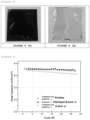
- the base layer (PET) of the lithium deposited film was removed to manufacture a multi-layered (release layer/lithium layer/intermediate layer/electrode layer) electrode where the lithium layer/release layer were transferred (dry on dry method) (refer to FIG. 3 ).
- a multi-layered electrode where the intermediate layer and the lithium layer (including the release layer) were sequentially transferred was manufactured in the same manner as in Example 1 except that the intermediate layer B was used instead of the intermediate layer A in Example 1 (refer to FIG. 4 ).
- Example 1 an electrode where the intermediate layer (A or B) and the lithium metal layer were not transferred was named a pristine electrode (Comparative Example 1).
- An electrode was manufactured in the same manner as in Example 1 except that the intermediate layer (A or B) was not formed on top of the electrode active material layer but the lithium metal layer was directly transferred to the top of the electrode active material layers provided on both surfaces of the electrode current collector layer in Example 1.
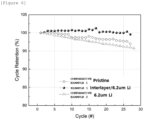
- Coin half-cells were manufactured with the electrodes manufactured by the methods in Example 1 and Comparative Examples 1 and 2, and initial charge/discharge capacities and cycle performance thereof were evaluated, and the results are shown in Table 3 below and FIG. 5 .
- the electrolyte used to manufacture the coin half-cell was 1M LiPF 6 in EC/EMC (30:70 vol %), and a 150 um thick lithium metal foil was used as a counter electrode.
- the C-rate was set to 0.1C, charging was performed under the upper limit voltage of 4.3V, CCCV condition and cut-off current of 0.005C, and discharging was performed under the lower limit voltage of 3.0V and CC condition.
- the electrode according to Example 1 in which the electrode including the lithium metal layer was manufactured by a sequential transfer process, has a significantly higher initial charge capacity than those of the electrodes manufactured according to Comparative Examples 1 and 2.
- the method according to Example 1 includes the process of transferring the intermediate layer to the top of the electrode active material layer in order to solve a surface active material cracking problem with respect to the high-capacity positive electrode active material, so that lithium metal does not directly contact the electrode active material layer. Therefore, it could be seen that rapid pre-lithiation of the active material could be prevented.
- Example 1 As the intermediate layer was formed by the dry on dry process as described above, unlike the wet on dry process, the lithium metal layer could be simultaneously transferred to the top of the electrode active material layers provided on both surfaces of the electrode current collector layer.
- the intermediate layer could appropriately control the pre-lithiation rate, and could minimize its role as an electrode resistor even if it remains on top of the electrode active material layer after cell assembly.
- Comparative Example 2 In the case of Comparative Example 2, the intermediate layer was not formed, and the lithium metal layer was directly transferred to the top of the electrode. In the case where the process proceeds as in Comparative Example 2, it was confirmed that the cracking phenomenon of the active material particle on the electrode surface side due to the rapid electrode pre-lithiation lowered the cycle performance, as compared with Example 1 (refer to FIG. 6 ).
Landscapes
- Chemical & Material Sciences (AREA)
- Chemical Kinetics & Catalysis (AREA)
- Electrochemistry (AREA)
- General Chemical & Material Sciences (AREA)
- Engineering & Computer Science (AREA)
- Manufacturing & Machinery (AREA)
- Materials Engineering (AREA)
- Inorganic Chemistry (AREA)
- Crystallography & Structural Chemistry (AREA)
- Battery Electrode And Active Subsutance (AREA)
Applications Claiming Priority (2)
| Application Number | Priority Date | Filing Date | Title |
|---|---|---|---|
| KR20220055970 | 2022-05-06 | ||
| PCT/KR2023/006207 WO2023214860A1 (ko) | 2022-05-06 | 2023-05-08 | 전극 전리튬화 방법, 전리튬화된 리튬 이차 전지용 전극 및 전극 전리튬화 장치 |
Publications (2)
| Publication Number | Publication Date |
|---|---|
| EP4418352A1 true EP4418352A1 (de) | 2024-08-21 |
| EP4418352A4 EP4418352A4 (de) | 2025-08-27 |
Family
ID=88646748
Family Applications (1)
| Application Number | Title | Priority Date | Filing Date |
|---|---|---|---|
| EP23799741.6A Pending EP4418352A4 (de) | 2022-05-06 | 2023-05-08 | Elektrodenvorlithiierungsverfahren, vorlithiierte elektrode für lithiumsekundärbatterie und elektrodenvorlithiierungsvorrichtung |
Country Status (5)
| Country | Link |
|---|---|
| EP (1) | EP4418352A4 (de) |
| JP (1) | JP2024540562A (de) |
| KR (1) | KR20230156664A (de) |
| CN (1) | CN118302874A (de) |
| WO (1) | WO2023214860A1 (de) |
Families Citing this family (1)
| Publication number | Priority date | Publication date | Assignee | Title |
|---|---|---|---|---|
| WO2026071654A1 (ko) * | 2024-09-25 | 2026-04-02 | 주식회사 엘지에너지솔루션 | 리튬 이차 전지용 전극의 제조 방법, 이로부터 제조된 리튬 이차 전지용 전극, 이를 포함하는 리튬 이차 전지 및 전리튬화용 전사 적층체 |
Family Cites Families (16)
| Publication number | Priority date | Publication date | Assignee | Title |
|---|---|---|---|---|
| JP5008180B2 (ja) * | 2006-02-13 | 2012-08-22 | 日立マクセルエナジー株式会社 | 非水二次電池 |
| JP5151188B2 (ja) * | 2006-03-09 | 2013-02-27 | パナソニック株式会社 | 転写用フィルム、およびそれを用いて形成された電気化学素子用の極板ならびにリチウム二次電池 |
| JP5252386B2 (ja) | 2007-09-25 | 2013-07-31 | 学校法人東京理科大学 | リチウムイオン電池用負極 |
| KR101984727B1 (ko) * | 2016-11-21 | 2019-05-31 | 주식회사 엘지화학 | 전극 및 이를 포함하는 리튬 이차 전지 |
| KR102140127B1 (ko) * | 2017-04-25 | 2020-07-31 | 주식회사 엘지화학 | 리튬 이차전지용 음극, 이의 제조방법 및 이것을 포함하는 리튬 이차전지 |
| JP6926654B2 (ja) * | 2017-05-11 | 2021-08-25 | 株式会社豊田自動織機 | リチウムドープ負極の製造方法 |
| KR102264691B1 (ko) * | 2017-08-11 | 2021-06-15 | (주)엘지에너지솔루션 | 리튬금속과 무기물 복합층을 이용한 전리튬화 |
| US11450855B2 (en) * | 2018-01-26 | 2022-09-20 | Lg Energy Solution, Ltd. | Negative electrode for lithium secondary battery and lithium ion secondary battery including the same |
| KR102459678B1 (ko) * | 2018-10-31 | 2022-10-28 | 주식회사 엘지에너지솔루션 | 리튬 이차 전지용 음극, 이를 포함하는 리튬 이차 전지 및 이의 제조방법 |
| JP7443378B2 (ja) * | 2019-01-15 | 2024-03-05 | テスラ・インコーポレーテッド | プレリチウム化エネルギー貯蔵デバイスのための組成物及び方法 |
| CN110010844B (zh) * | 2019-03-25 | 2022-04-12 | 合肥国轩高科动力能源有限公司 | 一种预锂负极的分级式压延成型方法 |
| KR102658723B1 (ko) * | 2019-09-06 | 2024-04-19 | 주식회사 엘지에너지솔루션 | 리튬 이차전지용 음극의 제조방법 |
| CN110828778B (zh) * | 2019-10-30 | 2022-04-12 | 复阳固态储能科技(溧阳)有限公司 | 一种三明治结构预锂化负极及锂离子电池 |
| EP4016669B1 (de) * | 2020-07-21 | 2025-09-10 | Lg Energy Solution, Ltd. | Negative elektrode für lithium-sekundärbatterie mit eingeführter lithierungsverzögerungsschicht und verfahren zum herstellen derselben |
| KR102900648B1 (ko) * | 2020-08-28 | 2025-12-15 | 주식회사 엘지에너지솔루션 | 음극의 전리튬화 방법 |
| KR102543690B1 (ko) | 2020-10-27 | 2023-06-13 | 연세대학교 산학협력단 | 사전 정보 학습 기반 영상 업스케일링 장치 및 방법 |
-
2023
- 2023-05-08 CN CN202380014683.3A patent/CN118302874A/zh active Pending
- 2023-05-08 EP EP23799741.6A patent/EP4418352A4/de active Pending
- 2023-05-08 JP JP2024529672A patent/JP2024540562A/ja active Pending
- 2023-05-08 WO PCT/KR2023/006207 patent/WO2023214860A1/ko not_active Ceased
- 2023-05-08 KR KR1020230059061A patent/KR20230156664A/ko active Pending
Also Published As
| Publication number | Publication date |
|---|---|
| CN118302874A (zh) | 2024-07-05 |
| JP2024540562A (ja) | 2024-10-31 |
| EP4418352A4 (de) | 2025-08-27 |
| WO2023214860A1 (ko) | 2023-11-09 |
| KR20230156664A (ko) | 2023-11-14 |
Similar Documents
| Publication | Publication Date | Title |
|---|---|---|
| EP4369434A1 (de) | Verfahren zur prälithiierung einer elektrode für eine lithiumsekundärbatterie, elektrodenzwischenverbindung und lithiumsekundärbatterie mit elektrode | |
| EP4322250A1 (de) | Prälithiierungsverfahren für negativelektrode für lithiumsekundärbatterie, negativelektrode für lithiumsekundärbatterie und lithiumsekundärbatterie mit negativelektrode | |
| EP4379842A1 (de) | Transferlaminat, verfahren zur herstellung einer anode für eine lithiumsekundärbatterie, anode für eine lithiumsekundärbatterie und lithiumsekundärbatterie mit der anode | |
| EP4333102A1 (de) | Anode für lithiumsekundärbatterie, herstellungsverfahren für anode für lithiumsekundärbatterie und lithiumsekundärbatterie mit anode | |
| EP4372841A1 (de) | Transferlaminat, verfahren zur prälithiierung einer elektrode für lithiumsekundärbatterie und lithiumsekundärbatterie mit elektrode | |
| EP4340060A1 (de) | Anodenzusammensetzung, anode für lithiumsekundärbatterie und lithiumsekundärbatterie mit anode | |
| CN117337495A (zh) | 用于锂二次电池的负极、制造锂二次电池的方法以及锂二次电池 | |
| EP4418352A1 (de) | Elektrodenvorlithiierungsverfahren, vorlithiierte elektrode für lithiumsekundärbatterie und elektrodenvorlithiierungsvorrichtung | |
| EP4418395A1 (de) | Verfahren zur herstellung einer elektrodenanordnung, elektrodenanordnung und lithiumsekundärbatterie damit | |
| EP4451367A1 (de) | Negativelektrode für lithiumsekundärbatterie, verfahren zur herstellung einer negativelektrode für lithiumsekundärbatterie und lithiumsekundärbatterie mit negativelektrode | |
| EP4542674A1 (de) | Negativelektrode für lithiumsekundärbatterie und lithiumsekundärbatterie mit negativelektrode | |
| EP4439705A1 (de) | Negativelektrode für lithiumsekundärbatterie, verfahren zur herstellung einer negativelektrode für lithiumsekundärbatterie und lithiumsekundärbatterie mit negativelektrode | |
| US20250055020A1 (en) | Lithium secondary battery anode, method for manufacturing lithium secondary battery anode, and lithium secondary battery comprising anode | |
| EP4418354A1 (de) | Verfahren zur herstellung einer elektrode für eine lithiumsekundärbatterie und lithiumsekundärbatterie mit der elektrode | |
| EP4542675A1 (de) | Verfahren zur herstellung einer elektrode für eine lithiumsekundärbatterie, übertragungsstapel und lithiumsekundärbatterie mit der elektrode | |
| EP4447146A1 (de) | Negativelektrode für lithiumsekundärbatterie und lithiumsekundärbatterie mit negativelektrode | |
| EP4439704A1 (de) | Lithiumsekundärbatterieanode, verfahren zur herstellung der lithiumsekundärbatterieanode und lithiumsekundärbatterie mit der anode | |
| EP4539152A1 (de) | Transferlaminat, verfahren zur herstellung eines transferlaminats, verfahren zur herstellung einer elektrode für eine lithiumsekundärbatterie und lithiumsekundärbatterie | |
| JP7834898B2 (ja) | リチウム二次電池の充放電方法 | |
| US20260074190A1 (en) | Negative electrode for lithium secondary battery, method for manufacturing negative electrode for lithium secondary battery, and lithium secondary battery comprising negative electrode | |
| EP4539143A1 (de) | Lithiumsekundärbatterieanode mit muster und lithiumsekundärbatterie mit anode | |
| EP4539145A1 (de) | Lithiumsekundärbatterie | |
| US20250070146A1 (en) | Negative electrode for lithium secondary battery, and lithium secondary battery comprising negative electrode | |
| US20250149569A1 (en) | Anode active material, method for preparing anode active material, anode composition, lithium secondary battery anode comprising same, and lithium secondary battery comprising anode | |
| US20250054960A1 (en) | Negative electrode for lithium secondary battery, method for manufacturing negative electrode for lithium secondary battery, and lithium secondary battery comprising negative electrode |
Legal Events
| Date | Code | Title | Description |
|---|---|---|---|
| STAA | Information on the status of an ep patent application or granted ep patent |
Free format text: STATUS: THE INTERNATIONAL PUBLICATION HAS BEEN MADE |
|
| PUAI | Public reference made under article 153(3) epc to a published international application that has entered the european phase |
Free format text: ORIGINAL CODE: 0009012 |
|
| STAA | Information on the status of an ep patent application or granted ep patent |
Free format text: STATUS: REQUEST FOR EXAMINATION WAS MADE |
|
| 17P | Request for examination filed |
Effective date: 20240516 |
|
| AK | Designated contracting states |
Kind code of ref document: A1 Designated state(s): AL AT BE BG CH CY CZ DE DK EE ES FI FR GB GR HR HU IE IS IT LI LT LU LV MC ME MK MT NL NO PL PT RO RS SE SI SK SM TR |
|
| DAV | Request for validation of the european patent (deleted) | ||
| DAX | Request for extension of the european patent (deleted) | ||
| A4 | Supplementary search report drawn up and despatched |
Effective date: 20250725 |
|
| RIC1 | Information provided on ipc code assigned before grant |
Ipc: H01M 4/1391 20100101AFI20250721BHEP Ipc: H01M 4/1395 20100101ALI20250721BHEP Ipc: H01M 4/131 20100101ALI20250721BHEP Ipc: H01M 4/134 20100101ALI20250721BHEP Ipc: H01M 4/04 20060101ALI20250721BHEP Ipc: H01M 4/48 20100101ALI20250721BHEP Ipc: H01M 4/38 20060101ALI20250721BHEP Ipc: H01M 10/052 20100101ALI20250721BHEP Ipc: H01M 4/02 20060101ALI20250721BHEP Ipc: H01M 4/505 20100101ALI20250721BHEP Ipc: H01M 4/525 20100101ALI20250721BHEP Ipc: H01M 4/58 20100101ALI20250721BHEP Ipc: H01M 4/587 20100101ALI20250721BHEP Ipc: H01M 10/04 20060101ALI20250721BHEP Ipc: H01M 10/0525 20100101ALI20250721BHEP |