EP4406522A1 - Zusammenklappbarer rollstuhl - Google Patents
Zusammenklappbarer rollstuhl Download PDFInfo
- Publication number
- EP4406522A1 EP4406522A1 EP22952209.9A EP22952209A EP4406522A1 EP 4406522 A1 EP4406522 A1 EP 4406522A1 EP 22952209 A EP22952209 A EP 22952209A EP 4406522 A1 EP4406522 A1 EP 4406522A1
- Authority
- EP
- European Patent Office
- Prior art keywords
- bracket
- support frame
- seat
- connecting rod
- backrest
- Prior art date
- Legal status (The legal status is an assumption and is not a legal conclusion. Google has not performed a legal analysis and makes no representation as to the accuracy of the status listed.)
- Pending
Links
Images


Classifications
-
- A—HUMAN NECESSITIES
- A61—MEDICAL OR VETERINARY SCIENCE; HYGIENE
- A61G—TRANSPORT, PERSONAL CONVEYANCES, OR ACCOMMODATION SPECIALLY ADAPTED FOR PATIENTS OR DISABLED PERSONS; OPERATING TABLES OR CHAIRS; CHAIRS FOR DENTISTRY; FUNERAL DEVICES
- A61G5/00—Chairs or personal conveyances specially adapted for patients or disabled persons, e.g. wheelchairs
- A61G5/08—Chairs or personal conveyances specially adapted for patients or disabled persons, e.g. wheelchairs foldable
- A61G5/0866—Chairs or personal conveyances specially adapted for patients or disabled persons, e.g. wheelchairs foldable folding down backrest, e.g. where the backrest folds down onto the seat support
-
- A—HUMAN NECESSITIES
- A61—MEDICAL OR VETERINARY SCIENCE; HYGIENE
- A61G—TRANSPORT, PERSONAL CONVEYANCES, OR ACCOMMODATION SPECIALLY ADAPTED FOR PATIENTS OR DISABLED PERSONS; OPERATING TABLES OR CHAIRS; CHAIRS FOR DENTISTRY; FUNERAL DEVICES
- A61G5/00—Chairs or personal conveyances specially adapted for patients or disabled persons, e.g. wheelchairs
- A61G5/08—Chairs or personal conveyances specially adapted for patients or disabled persons, e.g. wheelchairs foldable
- A61G5/0808—Chairs or personal conveyances specially adapted for patients or disabled persons, e.g. wheelchairs foldable characterised by a particular folding direction
-
- A—HUMAN NECESSITIES
- A61—MEDICAL OR VETERINARY SCIENCE; HYGIENE
- A61G—TRANSPORT, PERSONAL CONVEYANCES, OR ACCOMMODATION SPECIALLY ADAPTED FOR PATIENTS OR DISABLED PERSONS; OPERATING TABLES OR CHAIRS; CHAIRS FOR DENTISTRY; FUNERAL DEVICES
- A61G5/00—Chairs or personal conveyances specially adapted for patients or disabled persons, e.g. wheelchairs
- A61G5/08—Chairs or personal conveyances specially adapted for patients or disabled persons, e.g. wheelchairs foldable
- A61G5/0808—Chairs or personal conveyances specially adapted for patients or disabled persons, e.g. wheelchairs foldable characterised by a particular folding direction
- A61G5/085—Chairs or personal conveyances specially adapted for patients or disabled persons, e.g. wheelchairs foldable characterised by a particular folding direction folding up and down, e.g. reducing or expanding the overall height of the wheelchair
-
- A—HUMAN NECESSITIES
- A61—MEDICAL OR VETERINARY SCIENCE; HYGIENE
- A61G—TRANSPORT, PERSONAL CONVEYANCES, OR ACCOMMODATION SPECIALLY ADAPTED FOR PATIENTS OR DISABLED PERSONS; OPERATING TABLES OR CHAIRS; CHAIRS FOR DENTISTRY; FUNERAL DEVICES
- A61G5/00—Chairs or personal conveyances specially adapted for patients or disabled persons, e.g. wheelchairs
- A61G5/08—Chairs or personal conveyances specially adapted for patients or disabled persons, e.g. wheelchairs foldable
- A61G5/0883—Chairs or personal conveyances specially adapted for patients or disabled persons, e.g. wheelchairs foldable having locking means for maintaining a folded or unfolded condition
-
- A—HUMAN NECESSITIES
- A61—MEDICAL OR VETERINARY SCIENCE; HYGIENE
- A61G—TRANSPORT, PERSONAL CONVEYANCES, OR ACCOMMODATION SPECIALLY ADAPTED FOR PATIENTS OR DISABLED PERSONS; OPERATING TABLES OR CHAIRS; CHAIRS FOR DENTISTRY; FUNERAL DEVICES
- A61G5/00—Chairs or personal conveyances specially adapted for patients or disabled persons, e.g. wheelchairs
- A61G5/10—Parts, details or accessories
- A61G5/1043—Cushions specially adapted for wheelchairs
- A61G5/1048—Cushions specially adapted for wheelchairs for the back-rest
-
- A—HUMAN NECESSITIES
- A61—MEDICAL OR VETERINARY SCIENCE; HYGIENE
- A61G—TRANSPORT, PERSONAL CONVEYANCES, OR ACCOMMODATION SPECIALLY ADAPTED FOR PATIENTS OR DISABLED PERSONS; OPERATING TABLES OR CHAIRS; CHAIRS FOR DENTISTRY; FUNERAL DEVICES
- A61G5/00—Chairs or personal conveyances specially adapted for patients or disabled persons, e.g. wheelchairs
- A61G5/10—Parts, details or accessories
- A61G5/1051—Arrangements for steering
-
- A—HUMAN NECESSITIES
- A61—MEDICAL OR VETERINARY SCIENCE; HYGIENE
- A61G—TRANSPORT, PERSONAL CONVEYANCES, OR ACCOMMODATION SPECIALLY ADAPTED FOR PATIENTS OR DISABLED PERSONS; OPERATING TABLES OR CHAIRS; CHAIRS FOR DENTISTRY; FUNERAL DEVICES
- A61G5/00—Chairs or personal conveyances specially adapted for patients or disabled persons, e.g. wheelchairs
- A61G5/10—Parts, details or accessories
- A61G5/1089—Anti-tip devices
-
- A—HUMAN NECESSITIES
- A61—MEDICAL OR VETERINARY SCIENCE; HYGIENE
- A61G—TRANSPORT, PERSONAL CONVEYANCES, OR ACCOMMODATION SPECIALLY ADAPTED FOR PATIENTS OR DISABLED PERSONS; OPERATING TABLES OR CHAIRS; CHAIRS FOR DENTISTRY; FUNERAL DEVICES
- A61G5/00—Chairs or personal conveyances specially adapted for patients or disabled persons, e.g. wheelchairs
- A61G5/10—Parts, details or accessories
- A61G5/12—Rests specially adapted therefor, e.g. for the head or the feet
- A61G5/122—Rests specially adapted therefor, e.g. for the head or the feet for the back
-
- A—HUMAN NECESSITIES
- A61—MEDICAL OR VETERINARY SCIENCE; HYGIENE
- A61G—TRANSPORT, PERSONAL CONVEYANCES, OR ACCOMMODATION SPECIALLY ADAPTED FOR PATIENTS OR DISABLED PERSONS; OPERATING TABLES OR CHAIRS; CHAIRS FOR DENTISTRY; FUNERAL DEVICES
- A61G5/00—Chairs or personal conveyances specially adapted for patients or disabled persons, e.g. wheelchairs
- A61G5/10—Parts, details or accessories
- A61G5/12—Rests specially adapted therefor, e.g. for the head or the feet
- A61G5/125—Rests specially adapted therefor, e.g. for the head or the feet for arms
-
- A—HUMAN NECESSITIES
- A61—MEDICAL OR VETERINARY SCIENCE; HYGIENE
- A61G—TRANSPORT, PERSONAL CONVEYANCES, OR ACCOMMODATION SPECIALLY ADAPTED FOR PATIENTS OR DISABLED PERSONS; OPERATING TABLES OR CHAIRS; CHAIRS FOR DENTISTRY; FUNERAL DEVICES
- A61G5/00—Chairs or personal conveyances specially adapted for patients or disabled persons, e.g. wheelchairs
- A61G5/10—Parts, details or accessories
- A61G5/12—Rests specially adapted therefor, e.g. for the head or the feet
- A61G5/128—Rests specially adapted therefor, e.g. for the head or the feet for feet
Definitions
- the present application relates to the technical field of medical instruments, and more specifically, to a collapsible wheelchair.
- Collapsible wheelchairs are means of transportation for special populations such as the disabled, the elderly and infirm, and medical and clinical rehabilitation patients.
- the collapsible wheelchairs are widely used since they are foldable, easy to carry and have small space occupation.
- the existing collapsible wheelchair includes a front support frame, a backrest bracket, a rear support frame, a bracket connecting rod, a seat bracket, and a seat connecting rod.
- the front support frame, the backrest bracket, the rear support frame, and the bracket connecting rod are hinged together to form a first connecting rod mechanism which is foldable and deformable, so as to achieve the folding of the front support frame, the backrest bracket, and the rear support frame.
- the front support frame, the seat connecting rod, the seat bracket and the backrest bracket as mentioned above form a second connecting rod mechanism which is foldable and deformable.
- the second connecting rod mechanism can move accordingly, thereby realizing that the seat bracket can be folded accordingly during the folding and unfolding process of the collapsible wheelchair.
- the folding space between the backrest bracket and the seat bracket of the collapsible wheelchair mentioned above is small, and the backrest cushion and/or the seat cushion need to be removed at the time of folding, making the folding process cumbersome and resulting in poor user experience.
- the objective of the present application is to provide a collapsible wheelchair, capable of solving the problem that the collapsible wheelchair is easy to tilt after folding, and improving the user experience.
- the embodiment of the present application provides a collapsible wheelchair including a front support frame, a backrest bracket, a rear support frame, a bracket connecting rod, a seat bracket and a seat connecting rod; where the front support frame, the backrest bracket, the rear support frame and the bracket connecting rod are hinged with each other to form a first connecting rod mechanism; the seat connecting rod is hinged with the front support frame and the seat bracket respectively; and the front support frame, the backrest bracket, the seat bracket and the seat connecting rod form a second connecting rod mechanism; a hinge point of the backrest bracket and the seat bracket is located above a central plane of the seat bracket.
- the backrest bracket is provided with a first installation portion configured to install a backrest cushion, and the first installation portion is inclined backwards along a first direction.
- a vertical distance between the pivot point g and the central plane of the seat bracket is X
- a vertical distance between the pivot point g and a central plane of the first installation portion is Y
- X and Y satisfy that 60mm ⁇ X+Y ⁇ 110mm.
- the seat bracket is obliquely arranged relative to a support plane of a wheel set supporting the collapsible wheelchair, and an end of the seat bracket away from the pivot point g is inclined upwards; the seat bracket is configured such that the seat bracket is rotatable counterclockwise when the first installation portion rotates counterclockwise to fold the collapsible wheelchair; and when the collapsible wheelchair is in a folded state, the central plane of the seat bracket is parallel to the support plane.
- an angle range of a back inclination angle of the first installation portion is 5° ⁇ 20°; an angle range of an inclination angle of the seat bracket is 2° ⁇ 8°.
- the collapsible wheelchair includes front wheels, rear wheels and a support wheel; the front wheels are installed on the front support frame, and the rear wheels are installed on the rear support frame;
- the bracket connecting rod includes a main body section and an extension section, where the main body section is arranged between the rear support frame and the front support frame, and the extension section is arranged laterally of the rear support frame; the extension section is obliquely arranged downwards, and an included angle between the extension section and the main body section is an obtuse angle;
- the support wheel is arranged at one end of the extension section away from the main body section, and the support wheel is configured such that when the collapsible wheelchair is in a folded state, both the support wheel and the rear wheels abut against the support plane.
- the collapsible wheelchair further includes a locking hook mechanism;
- the locking hook mechanism includes a linkage rod and at least one locking hook, and the locking hook is arranged at an end of the linkage rod;
- the locking hook is rotatably connected to the backrest bracket, and a torsion spring is arranged between the locking hook and the backrest bracket, and the torsion spring is configured to provide a locking force to the locking hook;
- the rear support frame is provided with a retaining pin matched with the locking hook, and the locking hook is provided with a limiting groove matched with the retaining pin, and the locking hook is clamped to the retaining pin through the limiting groove.
- the locking hook mechanism includes two locking hooks, and the two locking hooks are symmetrically arranged at either ends of the linkage rod; the locking hook is provided with a wrench, and the backrest bracket is provided with a positioning protrusion, and the wrench is configured such that when the wrench abuts against the positioning protrusion, the limiting groove of the locking hook is clamped to the retaining pin.
- the collapsible wheelchair provided in the embodiments of the present application has the following advantages.
- a hinge point between the backrest bracket and the seat bracket is located above the central plane of the seat bracket, so that there is a large folding space between the backrest bracket and the seat bracket. Therefore, when folding the collapsible wheelchair, there will be no interference between the backrest bracket and the seat bracket, and there is no need to dismantle the backrest cushion installed on the backrest bracket and/or the seat cushion installed on the seat bracket in advance.
- the backrest bracket and the seat bracket of the collapsible wheelchair have, formed therebetween, a hinge point which is located below the central plane of the seat bracket, thereby resulting in a necessity to remove the seat cushion and/or the backrest cushion of the collapsible wheelchair in advance, for the collapsible wheelchair in the embodiment of the present application, there is no need to dismantle the backrest cushion and/or the seat cushion in advance at the time of folding, thereby simplifying the folding process and improving the user experience.
- the collapsible wheelchair includes a foldable and deformable first connecting rod mechanism formed by a front support frame, a backrest bracket, a rear support frame and a bracket connecting rod which are hinged together and a foldable and deformable second connecting rod mechanism formed by the front support frame, a seat connecting rod, a seat bracket and the backrest bracket; when the first connecting rod mechanism moves, the second connecting rod mechanism can move accordingly, thereby realizing that the seat bracket can be folded accordingly during the folding and unfolding process of the collapsible wheelchair.
- a hinge point formed by the above-mentioned seat bracket and backrest bracket is located below the seat bracket, and the folding space between the backrest bracket and the seat bracket is relatively small. If the backrest cushion installed on the backrest bracket and/or the seat cushion installed on the seat bracket are not removed in advance, the backrest bracket and the seat bracket will interfere during folding, which prevents the collapsible wheelchair from being folded. Therefore, before folding the collapsible wheelchair, the backrest cushion and/or the seat cushion need to be removed in advance.
- the embodiment of the present embodiment provides a collapsible wheelchair.
- the hinge point between the backrest bracket and the seat bracket is positioned above the central plane of the seat bracket, so that the folding space between the backrest bracket and the seat bracket is relatively large. Therefore, when folding the collapsible wheelchair, there will be no interference between the backrest bracket and the seat bracket, and there is no need to remove the backrest cushion installed on the backrest bracket and/or the seat cushion installed on the seat bracket in advance. As such, the folding process is simplified and the user experience is improved.
- the lines shown in the schematic diagrams of the mechanisms involved in the embodiments of the present application are projections of the central plane of each specific structure in the frontal direction.
- the first direction involved in the present application is indicated by the arrow shown in FIG. 5 , the first direction represents the front-rear direction of the entire collapsible wheelchair.
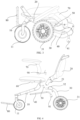
- the collapsible wheelchair provided by an embodiment of the present application includes a front support frame 10, a backrest bracket 20, an armrest 70, front wheels 11, rear wheels 31, a rear support frame 30, a bracket connecting rod 40, a seat bracket 60, a seat connecting rod 50, and a footrest 80; where the front support frame 10, the backrest bracket 20, the rear support frame 30, and the bracket connecting rod 40 are hinged together, forming a first connecting rod mechanism which is foldable and deformable.
- the front support frame 10, the backrest bracket 20, the seat bracket 60, and the seat connecting rod 50 are hinged together, forming a second connecting rod mechanism which is foldable and deformable, and the second connecting rod mechanism is linked with the first connecting rod mechanism to achieve the follower folding or unfolding of the seat bracket 60 during an unfolding process or a folding process of the whole collapsible wheelchair.
- the armrests 70 on either sides of the backrest bracket 20 can rotate relative to the backrest bracket 20.
- the armrest 70 can be rotatably connected to the backrest bracket 20, or the armrest 70 can be rotatably connected to the front support frame 10, and the front support frame 10 can be rotatably connected to the backrest bracket 20.
- a user When folding the wheelchair up and down, a user can lift the armrest 70 upwards for the convenience of seating; and when the user is seating in the collapsible wheelchair, the armrest 70 can provide support for the user, to improve the user experience.
- the collapsible wheelchair is typically provided with a wheel set configured to support the collapsible wheelchair and drive the movement of the collapsible wheelchair.
- the wheel set includes the front wheels 11 and the rear wheels 31, and when the collapsible wheelchair is in a folded state, the front wheels 11 and the rear wheels 31 can come into contact with the ground and a horizontal support plane is formed, and the support plane supports the entire collapsible wheelchair.
- the front support frame 10, which is also referred to as a front wheel bracket is configured to install the front wheels 11.
- the footrest 80 is also installed at the front end of the front support frame 10 to provide foot support for the user.
- the rear support frame 30, which is also referred to as a rear wheel bracket, is configured to install the rear wheels 31.
- the backrest bracket 20 includes a first installation portion 22 and a second installation portion 23, and the first installation portion 22 is configured to install a backrest cushion of the collapsible wheelchair.
- the second installation portion 23 is configured for connection with the front support frame 10, the seat bracket 60, and the rear support frame 30, and an end of the front support frame 10 away from the front wheels 11 and an end of the rear support frame 30 away from the rear wheels 31 are respectively rotatably connected to the second installation portion 23 of the backrest bracket 20, and can rotate relative to the backrest bracket 20.
- the bracket connecting rod 40 is arranged between the rear support frame 30 and the front support frame 10.
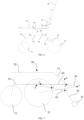
- the two ends of the bracket connecting rod 40 are respectively hinged with the rear support frame 30 and the front support frame 10. That is, the front support frame 10, the backrest bracket 20, the rear support frame 30, and the bracket connecting rod 40 are rotatably connected with each other to form pivot points a, b, c, and d, so that a first connecting rod mechanism which is foldable and deformable is formed, to achieve the folding of the front support frame 10, the rear support frame 30, and the backrest bracket 20 of the collapsible wheelchair.
- the backrest bracket 20 and the rear support frame 30 are mutually limited and supported, thereby forming a stable triangular structure of the pivot points a, c, and d.
- the above-mentioned seat connecting rod 50 is configured to connect the seat bracket 60 and the front support frame 10.
- One end of the seat connecting rod 50 is hinged with the seat bracket 60, and the other end of the seat connecting rod 50 is hinged with the front support frame 10. That is, the front support frame 10, the seat connecting rod 50, the seat bracket 60, and the backrest bracket 20 are hinged with each other to form pivot points e, f, g and a, so that a second connecting rod mechanism which is foldable and deformable is formed, to achieve the follower folding of the seat bracket 60 during the folding and unfolding process of the entire collapsible wheelchair.
- the pivot point g formed by the backrest bracket 20 and the seat bracket 60 is located above a central plane of the seat bracket 60. This arrangement allows for a relatively large folding space between the backrest bracket 20 and the seat bracket 60. Therefore, when folding the collapsible wheelchair, there will be no interference between the backrest bracket 20 and the seat bracket 60, and there is no need to dismantle the backrest cushion installed on the backrest bracket 20 and/or the seat cushion installed on the seat bracket 60 in advance.
- the backrest bracket and the seat bracket have, formed therebetween, a hinge point which is located below the central plane of the seat bracket, resulting in a necessity to remove the seat cushion and/or the backrest cushion of the folding seat in advance at the time of folding, for the collapsible wheelchair in the embodiment of the present application, there is no need to dismantle the backrest cushion and/or the seat cushion in advance at the time of folding, thereby simplifying the folding process and improving the user experience.
- the front support frame 10, the backrest bracket 20, the rear support frame 30 and the bracket connecting rod 40 of the first connecting rod mechanism mentioned above are sequentially hinged to form pivot points a, b, c, and d.
- the end of the front support frame 10 away from the front wheels 11 is hinged with the second installation portion 23 of the backrest bracket 20 to form the pivot point a
- the second installation portion 23 of the backrest bracket 20 is hinged with the end of the rear support frame 30 away from the rear wheels 31 to form the pivot point b
- the two ends of the bracket connecting rod 40 are respectively hinged with the rear support frame 30 and the front support frame 10 to form the pivot points c and d
- the front support frame 10 the seat connecting rod 50, the seat bracket 60, and the backrest bracket 20 are sequentially connected to form pivot points e, f, g, and a, and the pivot point g is located above the central plane of the seat bracket 60.
- the seat connecting rod 50 is configured to connect the front support frame 10 and the seat bracket 60.
- One end of the seat connecting rod 50 is hinged with the front support frame 10 to form the pivot point e
- the other end of the seat connecting rod 50 is hinged with the seat bracket 60 to form the pivot point f.
- An end of the seat bracket 60 away from the pivot point f is hinged with the second installation portion 23 of the backrest bracket 20 to form the pivot point g, the pivot point g being located above the central plane of the seat bracket 60; and the second installation portion 23 of the backrest bracket 20 is also hinged with the front support frame 10 to form the pivot point a.
- the pivot points in the first and second connecting rod mechanisms mentioned above in the embodiments of the present application meet the distance relationship mentioned above, not only realizing the follower folding of the seat bracket 60 during the folding and unfolding process of the entire collapsible wheelchair when the first connecting rod mechanism moves, but also realizing that when the collapsible wheelchair is in the folded state, the backrest bracket 20 can rotate to a horizontal state and remain parallel to the support plane supporting the collapsible wheelchair. Therefore, the folded collapsible wheelchair is integrally in a horizontal state and relatively flat, so the folded collapsible wheelchair is stable in terms of its gravity center and not easy to tilt, thereby improving the user experience.
- a vertical distance of the pivot point g relative to the central plane of the seat bracket 60 is X
- a vertical distance of the pivot point g relative to a central plane of the first installation portion 22 is Y
- X and Y meet that 60 mm ⁇ x+y ⁇ 110 mm.
- a value range of X is 10 mm ⁇ X ⁇ 50 mm
- a value range of Y is 50 mm ⁇ Y ⁇ 60 mm.
- the backrest bracket 20 and the seat bracket 60 can accommodate the seat cushion and the backrest cushion, avoiding the interference between the backrest bracket 20 and the seat bracket 60 during the folding process.
- folding the collapsible wheelchair there is no need to dismantle the seat cushion before folding, which improves the user experience.
- the seat bracket 60 is inclined relative to the support plane as a whole.
- a first end of the seat bracket 60 is a free end, and a second end of the seat bracket 60 is hinged with the second installation portion 23 of the backrest bracket 20 to form the pivot point g, and the pivot point g is located above the central plane of the seat bracket 60.
- a rear inclination angle of the first installation portion 22 of the backrest bracket 20 is ⁇ , and a value range for ⁇ is 5° to 20°.
- the second end of the seat bracket 60 is set diagonally upwards relative to a horizontal support plane, and the formed elevation angle is ⁇ , and a value range for ⁇ is 2° to 8°.
- the backrest bracket 20 When folding the collapsible wheelchair, the backrest bracket 20 is rotated counterclockwise, and then the seat bracket 60 can follow therewith to rotate clockwise.
- the seat bracket 60 When the backrest bracket 20 rotates counterclockwise by 90° + ⁇ °, the seat bracket 60 can rotate counterclockwise by the angle ⁇ , and the central plane of the seat bracket 60 is parallel to the horizontal support plane. That is, the central plane of the seat bracket 60 can be parallel to the central plane of the backrest bracket 20, both of which are in a horizontal state.
- the rear inclination angle of the first installation portion 22 of the backrest bracket 20 is 16°
- the elevation angle of the seat bracket 60 relative to the support plane is 4°.
- the backrest bracket 20 rotates counterclockwise by 16°
- the seat bracket 60 can rotate counterclockwise by 4°
- the central plane of the seat bracket 60 can be parallel to the central plane of the backrest bracket 20, both of which are parallel to the horizontal support plane.
- the backrest bracket 20 can fit snugly with the seat bracket 60, further enabling that when a collapsible wheelchair is in the folded state, it is integrally flatter, its gravity center is more stable, and it is less prone to tipping over, thereby enhancing the user experience.
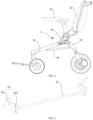
- the wheel set of the collapsible wheelchair in the embodiment of the present application not only includes front wheels 11 and rear wheels 31, but also includes a support wheel 41 installed on the bracket connecting rod 40.
- the bracket connecting rod 40 is arranged between the front support frame 10 and the rear support frame 30, and the bracket connecting rod 40 includes a main body section 42 and an extension section 43.
- the main body section 42 is located between the front support frame 10 and the rear support frame 30, and the main body section 42 is hinged with the front support frame 10 to form the pivot point d, and the main body section 42 is hinged with the rear support frame 30 to form the pivot point c.
- the extension section 43 and the main body section 42 form an integrated structure, and an angle formed between the extension section 43 and the main body section 42 is an obtuse angle.
- the extension section 43 is arranged on an outer side of the rear support frame 30 and extends diagonally downwards along the rear support frame 30. One end of the extension section 43 extends to the pivot point c, the other end of the extension section 43 is configured to install the support wheel 41, and the support wheel 41 can rotate relative to the bracket connecting rod 40.
- the support wheel 41 when the collapsible wheelchair is in the folded state, the support wheel 41 can come into contact with the ground, thus the rear wheels 31, the support wheel 41 and the ground form a stable support plane, thereby improving the stability of the collapsible wheelchair in the folded state and preventing it from tipping over.
- the angle between the main body section 42 and the extension section 43 is obtuse (>90°).
- the support wheel 41 is close to a tail portion of a wheelchair body (constraining a margin distance between an end point of the extension section 43 and the tail portion of the wheelchair body), making it convenient for the wheelchair to be towed in the folded state, and a towing handle is located at the front wheel bracket or the footrest.
- the collapsible wheelchair can be arranged upright, using a structure near the pivot point b and the support wheel 41 as a support plane.
- the first and second locking hooks mentioned above can rotate synchronously. When the user operates the wrench 921 of any one locking hook 92, the locking and unlocking between the backrest bracket 20 and the rear support frame 30 can be completed, which can improve the user experience.
- the backrest bracket 20 and the rear support frame 30 have a locking structure.
- the backrest bracket 20 and the rear support frame 30 are mutually limited and supported by the locking structure, thereby forming a stable triangular structure of the pivot points a, c, and d.
- the locking structure is formed between the backrest bracket 20 and the rear support frame 30.
- the locking structure includes a first locking surface 21 and a second locking surface 32.
- a position of the backrest bracket 20 near the rear support frame 30 is provided with a concavity to form the first locking surface 21, that is, the surface on which the concavity is formed forms the first locking surface 21.
- An end of the rear support frame 30 near the backrest bracket 20 is provided with a protrusion, the protrusion is matched with the concavity and has a second locking surface 32 that is matched with the first locking surface 21.
- the protrusion can be embedded into the concavity, and the first locking surface 21 abuts against and fits snugly with the second locking surface 32, thereby achieving the positon limiting and support between the backrest bracket 20 and the rear support frame 30, preventing the backrest bracket 20 and the rear support frame 30 from rotating about the pivot point b in a face-to-face direction.
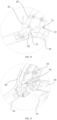
- the collapsible wheelchair provided by an embodiment of the present application further includes a locking hook mechanism 90 including a linkage rod 91 and at least one locking hook 92.
- the linkage rod 91 runs through a lower part of the seat bracket 60, and an end of the linkage rod 91 is fixed with a locking hook 92 which is rotatably connected to the backrest bracket 20.
- the rear support frame 30 is provided with a retaining pin 33 matched with the locking hook 92.
- the locking hook 92 has a limiting groove 922 matched with the retaining pin 33. This limiting groove 922 can be engaged with the retaining pin 33.
- a torsion spring 93 which is configured to provide a locking force to the locking hook 92, is also provided between the rear support frame 30 and the locking hook 92, so as to keep the locking hook 92 on the backrest bracket 20.
- the backrest bracket and the rear support frame 30 are limited and supported through the locking structure, preventing the backrest bracket 20 and the rear support frame 30 from rotating about the pivot point b in the face-to-face direction.
- the backrest bracket 20 and the rear support frame 30 are completely constrained against each other.
- a stable triangular structure with the pivot points a, c, and d is formed in the first connecting rod mechanism.
- the locking hook mechanism 90 provided by an embodiment of the present application includes a first locking hook and a second locking hook.
- the first locking hook and the second locking hook are symmetrically arranged at either ends of the linkage rod 91, and the first locking hook and the second locking hook are symmetrical components.
- the first locking hook as an example, the specific structure thereof will be described.
- the first locking hook includes a wrench 921 which is configured to apply a pressure to the first locking hook, to overcome a torsion force of the torsion spring 93, so that the first locking hook rotates relative to the backrest bracket 20. For example, if the wrench 921 is pressed down so that the first locking hook is rotated clockwise, the first locking hook will detach from the retaining pin 33, thereby releasing the position limiting between the rear support frame 30 and the backrest bracket 20, to fold the collapsible wheelchair.
- a position of the backrest bracket 20 near the first locking hook is provided with a positioning protrusion which can be abutted against a bottom portion of the wrench 921.
- the torsion spring 93 provides an outward supporting force for the first locking hook to rotate counterclockwise.
- first and second locking hooks mentioned above can rotate synchronously.
- the wrench 921 of any one locking hook 92 the locking and unlocking between the backrest bracket 20 and the rear support frame 30 can be completed, which can improve the user experience.
Landscapes
- Health & Medical Sciences (AREA)
- Life Sciences & Earth Sciences (AREA)
- Animal Behavior & Ethology (AREA)
- General Health & Medical Sciences (AREA)
- Public Health (AREA)
- Veterinary Medicine (AREA)
- Handcart (AREA)
- Chairs For Special Purposes, Such As Reclining Chairs (AREA)
Applications Claiming Priority (1)
| Application Number | Priority Date | Filing Date | Title |
|---|---|---|---|
| PCT/CN2022/107693 WO2024020742A1 (zh) | 2022-07-25 | 2022-07-25 | 折叠轮椅 |
Publications (2)
| Publication Number | Publication Date |
|---|---|
| EP4406522A1 true EP4406522A1 (de) | 2024-07-31 |
| EP4406522A4 EP4406522A4 (de) | 2025-02-26 |
Family
ID=84169232
Family Applications (1)
| Application Number | Title | Priority Date | Filing Date |
|---|---|---|---|
| EP22952209.9A Pending EP4406522A4 (de) | 2022-07-25 | 2022-07-25 | Zusammenklappbarer rollstuhl |
Country Status (4)
| Country | Link |
|---|---|
| US (1) | US20240293275A1 (de) |
| EP (1) | EP4406522A4 (de) |
| CN (2) | CN115413235A (de) |
| WO (1) | WO2024020742A1 (de) |
Families Citing this family (13)
| Publication number | Priority date | Publication date | Assignee | Title |
|---|---|---|---|---|
| CN115461026B (zh) * | 2022-07-25 | 2025-06-27 | 上海邦邦机器人有限公司 | 折叠轮椅 |
| AU2023341998A1 (en) * | 2022-09-16 | 2025-04-03 | Altimate Medical Holdings, Inc. | Shower/commode wheeled chair |
| USD1083692S1 (en) * | 2023-06-26 | 2025-07-15 | Shanghai Bangbang Robotics Co., Ltd | Wheelchair |
| CN220714193U (zh) * | 2023-07-24 | 2024-04-05 | 上海邦邦机器人有限公司 | 折叠轮椅 |
| CN116999257A (zh) * | 2023-07-25 | 2023-11-07 | 中山小神童创新科技有限公司 | 一种电动轮椅 |
| USD1069656S1 (en) * | 2023-08-11 | 2025-04-08 | Shanghai Bangbang Robotics Co., Ltd | Electric wheelchair |
| CN117297890A (zh) * | 2023-09-07 | 2023-12-29 | 伊凯科技(浙江)有限公司 | 一种可折叠轮椅 |
| WO2025082264A1 (zh) * | 2023-10-20 | 2025-04-24 | 上海邦邦机器人有限公司 | 轮椅骨架及轮椅 |
| CN118021546A (zh) * | 2023-12-31 | 2024-05-14 | 浙江大学 | 折叠轮椅 |
| USD1101629S1 (en) * | 2024-06-06 | 2025-11-11 | Zhejiang Innuovo Rehabilitation Devices Co., Ltd | Electric wheelchair |
| USD1110203S1 (en) * | 2024-08-20 | 2026-01-27 | Zhejiang Mateside Medical Devices Technology Co., Ltd. | Rolling walker |
| CN119868069A (zh) * | 2025-03-20 | 2025-04-25 | 浙江迈德斯特医疗器械科技有限公司 | 一种折叠轮椅 |
| CN119857027A (zh) * | 2025-03-20 | 2025-04-22 | 浙江迈德斯特医疗器械科技有限公司 | 一种折叠轮椅 |
Family Cites Families (17)
| Publication number | Priority date | Publication date | Assignee | Title |
|---|---|---|---|---|
| US5605345A (en) * | 1993-10-21 | 1997-02-25 | Brookefield Hunter Incorporated | Wheeled apparatus for use as walker and wheelchair |
| CN105167928B (zh) * | 2015-10-18 | 2018-02-09 | 东莞威信运动用品有限公司 | 自动折叠电动轮椅车 |
| CN105769464A (zh) * | 2016-03-25 | 2016-07-20 | 白瑞平 | 可折叠式轮椅及便携式移动装置 |
| CN106074028B (zh) * | 2016-07-11 | 2018-03-20 | 浙江英洛华康复器材有限公司 | 可折叠电动轮椅 |
| KR101859404B1 (ko) * | 2016-11-09 | 2018-05-18 | 오봉석 | 접이식 전동 휠체어 |
| CN206630790U (zh) * | 2016-12-21 | 2017-11-14 | 南京金百合医疗器械有限公司 | 一种靠背一推折叠电动轮椅 |
| CN107049639B (zh) * | 2017-05-16 | 2019-06-18 | 东莞威信运动用品有限公司 | 轮椅折叠支架 |
| CN208989415U (zh) * | 2017-08-18 | 2019-06-18 | 康动健康管理(深圳)有限公司 | 折叠自锁结构和折叠自锁框架以及折叠轮椅 |
| DE202017006531U1 (de) * | 2017-12-20 | 2018-04-12 | Nanjing Jin Bai He Medical Apparatus Co., Ltd. | Elektrischer Rollstuhl, der durch Schieben der Rückenlehne einklappbar ist |
| CN207860015U (zh) * | 2017-12-22 | 2018-09-14 | 上汽通用五菱汽车股份有限公司 | 一种坐垫和靠背可折叠汽车座椅装置 |
| CN109199721A (zh) * | 2018-09-29 | 2019-01-15 | 浙江爱司米电气有限公司 | 一种一键折叠式助行机器人 |
| CN209091918U (zh) * | 2018-10-16 | 2019-07-12 | 常熟市平方轮椅有限公司 | 折叠式电动轮椅车的锁定装置 |
| CN110179602B (zh) * | 2019-05-10 | 2024-08-16 | 南京康尼智能技术有限公司 | 可折叠轮椅 |
| CN212816829U (zh) * | 2020-04-02 | 2021-03-30 | 上海威之群机电制品有限公司 | 一种轻型便捷的电动折叠轮椅 |
| CN111671584B (zh) * | 2020-06-02 | 2024-06-14 | 浙江爱司米电气有限公司 | 一种可折叠轮椅 |
| CN214318344U (zh) * | 2020-12-28 | 2021-10-01 | 金华卓骏车业有限公司 | 一种自动折叠轮椅 |
| CN214549884U (zh) * | 2021-02-05 | 2021-11-02 | 浙江恒丰电器集团有限公司 | 自动折叠电动轮椅 |
-
2022
- 2022-07-25 WO PCT/CN2022/107693 patent/WO2024020742A1/zh not_active Ceased
- 2022-07-25 CN CN202280002585.3A patent/CN115413235A/zh active Pending
- 2022-07-25 EP EP22952209.9A patent/EP4406522A4/de active Pending
-
2023
- 2023-04-10 CN CN202310376646.9A patent/CN116549228A/zh active Pending
-
2024
- 2024-05-09 US US18/659,893 patent/US20240293275A1/en active Pending
Also Published As
| Publication number | Publication date |
|---|---|
| EP4406522A4 (de) | 2025-02-26 |
| CN116549228A (zh) | 2023-08-08 |
| US20240293275A1 (en) | 2024-09-05 |
| WO2024020742A1 (zh) | 2024-02-01 |
| CN115413235A (zh) | 2022-11-29 |
Similar Documents
| Publication | Publication Date | Title |
|---|---|---|
| EP4406522A1 (de) | Zusammenklappbarer rollstuhl | |
| CN111212777B (zh) | 婴童车座椅和婴童车系统 | |
| JPS62502176A (ja) | 折り畳み可能車椅子のシャ−シ | |
| CN106074028A (zh) | 可折叠电动轮椅 | |
| WO2021242954A1 (en) | Patient transport apparatus having caster assembly biasing mechanisms | |
| FR3064556A1 (fr) | Fauteuil pour passager de vehicule comportant une configuration repos | |
| CN114104070A (zh) | 双人儿童推车 | |
| CN115461026A (zh) | 折叠轮椅 | |
| CN115350011A (zh) | 折叠轮椅 | |
| CN217320619U (zh) | 一种靠背扶手联动折叠座椅及代步车 | |
| US20200289350A1 (en) | Fold, Recline, And Tilt Mechanisms For A Personal Mobility Vehicle | |
| CN214386840U (zh) | 座椅翻转锁定机构 | |
| FR2965716A1 (fr) | Fauteuil roulant equipe d'au moins un accoudoir | |
| JP4606446B2 (ja) | 車いす用車体フレーム | |
| JP2613566B2 (ja) | リクライニング式車いす | |
| CN211750573U (zh) | 轮椅折叠架和轮椅 | |
| CN220608208U (zh) | 一种折叠坐便椅 | |
| JPH0617629Y2 (ja) | 座席用シートクッションのための駆動機構 | |
| JP4140934B2 (ja) | 車椅子 | |
| CN216702060U (zh) | 折叠摇椅 | |
| CN114681222A (zh) | 轮椅助行器 | |
| CN118267251B (zh) | 一种高靠背可折叠坐式马桶轮椅 | |
| CN223008736U (zh) | 一种单电机零重力休闲椅 | |
| CN218186003U (zh) | 双电机驱动滑轨式伸展装置 | |
| CN214524009U (zh) | 儿童推车 |
Legal Events
| Date | Code | Title | Description |
|---|---|---|---|
| STAA | Information on the status of an ep patent application or granted ep patent |
Free format text: STATUS: THE INTERNATIONAL PUBLICATION HAS BEEN MADE |
|
| PUAI | Public reference made under article 153(3) epc to a published international application that has entered the european phase |
Free format text: ORIGINAL CODE: 0009012 |
|
| STAA | Information on the status of an ep patent application or granted ep patent |
Free format text: STATUS: REQUEST FOR EXAMINATION WAS MADE |
|
| 17P | Request for examination filed |
Effective date: 20240426 |
|
| AK | Designated contracting states |
Kind code of ref document: A1 Designated state(s): AL AT BE BG CH CY CZ DE DK EE ES FI FR GB GR HR HU IE IS IT LI LT LU LV MC MK MT NL NO PL PT RO RS SE SI SK SM TR |
|
| A4 | Supplementary search report drawn up and despatched |
Effective date: 20250128 |
|
| RIC1 | Information provided on ipc code assigned before grant |
Ipc: A61G 5/08 20060101ALI20250122BHEP Ipc: A61G 5/10 20060101AFI20250122BHEP |
|
| DAV | Request for validation of the european patent (deleted) | ||
| DAX | Request for extension of the european patent (deleted) | ||
| GRAP | Despatch of communication of intention to grant a patent |
Free format text: ORIGINAL CODE: EPIDOSNIGR1 |
|
| STAA | Information on the status of an ep patent application or granted ep patent |
Free format text: STATUS: GRANT OF PATENT IS INTENDED |
|
| INTG | Intention to grant announced |
Effective date: 20251223 |