EP4403732A1 - Gleitschienenmechanismus - Google Patents
Gleitschienenmechanismus Download PDFInfo
- Publication number
- EP4403732A1 EP4403732A1 EP23184137.0A EP23184137A EP4403732A1 EP 4403732 A1 EP4403732 A1 EP 4403732A1 EP 23184137 A EP23184137 A EP 23184137A EP 4403732 A1 EP4403732 A1 EP 4403732A1
- Authority
- EP
- European Patent Office
- Prior art keywords
- rail
- slide rail
- assembly
- rail assembly
- slide
- Prior art date
- Legal status (The legal status is an assumption and is not a legal conclusion. Google has not performed a legal analysis and makes no representation as to the accuracy of the status listed.)
- Granted
Links
Images






Classifications
-
- E—FIXED CONSTRUCTIONS
- E05—LOCKS; KEYS; WINDOW OR DOOR FITTINGS; SAFES
- E05B—LOCKS; ACCESSORIES THEREFOR; HANDCUFFS
- E05B65/00—Locks or fastenings for special use
- E05B65/46—Locks or fastenings for special use for drawers
- E05B65/462—Locks or fastenings for special use for drawers for two or more drawers
- E05B65/463—Drawer interlock or anti-tilt mechanisms, i.e. when one drawer is open, at least one of the remaining drawers is locked
- E05B65/464—Drawer interlock or anti-tilt mechanisms, i.e. when one drawer is open, at least one of the remaining drawers is locked comprising two or more lock elements aligned in end-to-end abutting relation
-
- A—HUMAN NECESSITIES
- A47—FURNITURE; DOMESTIC ARTICLES OR APPLIANCES; COFFEE MILLS; SPICE MILLS; SUCTION CLEANERS IN GENERAL
- A47B—TABLES; DESKS; OFFICE FURNITURE; CABINETS; DRAWERS; GENERAL DETAILS OF FURNITURE
- A47B88/00—Drawers for tables, cabinets or like furniture; Guides for drawers
- A47B88/40—Sliding drawers; Slides or guides therefor
- A47B88/44—Sequencing or synchronisation of drawer slides or functional units
- A47B88/447—Simultaneous movement of rails within drawer slides, i.e. with a coordination of movement with all rail elements moving at the same time
-
- A—HUMAN NECESSITIES
- A47—FURNITURE; DOMESTIC ARTICLES OR APPLIANCES; COFFEE MILLS; SPICE MILLS; SUCTION CLEANERS IN GENERAL
- A47B—TABLES; DESKS; OFFICE FURNITURE; CABINETS; DRAWERS; GENERAL DETAILS OF FURNITURE
- A47B88/00—Drawers for tables, cabinets or like furniture; Guides for drawers
- A47B88/40—Sliding drawers; Slides or guides therefor
- A47B88/44—Sequencing or synchronisation of drawer slides or functional units
- A47B88/443—Successive movement of rails within drawer slides, i.e. at least one rail element is not moving during the movement of other elements
-
- A—HUMAN NECESSITIES
- A47—FURNITURE; DOMESTIC ARTICLES OR APPLIANCES; COFFEE MILLS; SPICE MILLS; SUCTION CLEANERS IN GENERAL
- A47B—TABLES; DESKS; OFFICE FURNITURE; CABINETS; DRAWERS; GENERAL DETAILS OF FURNITURE
- A47B88/00—Drawers for tables, cabinets or like furniture; Guides for drawers
- A47B88/90—Constructional details of drawers
- A47B88/919—Accessories or additional elements for drawers, e.g. drawer lighting
-
- A—HUMAN NECESSITIES
- A47—FURNITURE; DOMESTIC ARTICLES OR APPLIANCES; COFFEE MILLS; SPICE MILLS; SUCTION CLEANERS IN GENERAL
- A47B—TABLES; DESKS; OFFICE FURNITURE; CABINETS; DRAWERS; GENERAL DETAILS OF FURNITURE
- A47B2210/00—General construction of drawers, guides and guide devices
- A47B2210/0002—Guide construction for drawers
- A47B2210/0051—Guide position
- A47B2210/0059—Guide located at the side of the drawer
Definitions
- the present invention relates to a slide rail system according to the pre-characterizing clauses of claim 1.
- U.S. Patent No. US 7,520,576B2 discloses an anti-tilt linkage mechanism that is applied for a vertical cabinet with several movable drawers.
- the vertical cabinet includes a file cabinet body, telescopic slide rails and two or more drawers.
- the telescopic slide rails are installed on the inner wall of the file cabinet body.
- the drawers are vertically installed inside the file cabinet body via the telescopic slide rails; when one drawer is pulled open, the other drawers cannot be pulled out from the file cabinet body.
- the linkage mechanism of the foresaid patent is only suitable for two or more slide rails (or the related drawers) that are installed in a vertical manner. Design of a linkage product of satisfying market competition and different operation demands is an important issue in the institutional design industry.
- the present invention aims at providing a slide rail system for solving above drawbacks.
- the claimed slide rail mechanism is configured to a cabinet, and the cabinet has a wall with a first side and a second side opposite to each other.
- the slide rail mechanism includes a first slide rail assembly, a second slide rail assembly and a working member.
- the first slide rail assembly is arranged on the first side of the wall.
- the first slide rail assembly includes a first rail and a second rail, and the second rail is shifted with respect to the first rail in a longitudinal direction.
- the second slide rail assembly is arranged on the second side of the wall.
- the second slide rail assembly includes a third rail and a fourth rail. The fourth rail is shifted with respect to the third rail in the longitudinal direction.
- the working member is movably mounted on the wall.
- the second rail is configured to move back into the first rail of the first slide rail assembly
- the fourth rail is configured to move back into the third rail of the second slide rail assembly.
- furniture 20 can include a cabinet 22, and the cabinet 22 can have a plurality of drawers; for example, the cabinet 22 can at least include a first drawer 24a and a second drawer 24b, and may preferably further include a third drawer 24c and a fourth drawer 24d.
- the plurality of drawers can be accommodated inside the cabinet 22.
- the first drawer 24a and the second drawer 24b can be set as a first transverse row (or can be defined as a first lateral row).
- the third drawer 24c and the fourth drawer 24d can be set as a second transverse row (or can be defined as a second lateral row).
- the first drawer 24a and the third drawer 24c can be set as a first upright row.
- the second drawer 24b and the fourth drawer 24d can be set as a second upright row.
- the cabinet 22 can include a slide rail mechanism, and the slide rail mechanism can include a plurality of slide rail assemblies, such as a first slide rail assembly 26, a second slide rail assembly 28, a third slide rail assembly 30 and a fourth slide rail assembly 32 respectively configured to hold the first drawer 24a, the second drawer 24b, the third drawer 24c and the fourth drawer 24d.
- Each of the first slide rail assembly 26, the second slide rail assembly 28, the third slide rail assembly 30 and the fourth slide rail assembly 32 can include at least two slide rails capable of being shifted with respect to each other in a longitudinal direction.
- the longitudinal direction can be defined as X-axis direction, or can be interpreted as a lengthwise direction or a shifting direction of the slide rail;
- a transverse direction can be defined as Y-axis direction, or can be interpreted as a lateral direction of the slide rail;
- a vertical direction can be defined as Z-axis direction, or can be interpreted as a height direction of the slide rail.
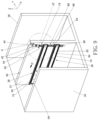
- first slide rail assembly 26, the second slide rail assembly 28, the third slide rail assembly 30 and the fourth slide rail assembly 32 can be designed as a pair of two slide rails and respectively mounted on the left side and the right side of the corresponding drawer; however, parts of the foresaid pair of two slide rails, such as the first slide rail assembly 26, the second slide rail assembly 28, the third slide rail assembly 30 and the fourth slide rail assembly 32, are shown in FIG. 2 and FIG. 3 for easy understanding of the embodiment.
- the cabinet 22 can include a plurality of walls, such as first lateral wall 34, a second lateral wall 36, and a middle wall (which is named as the wall 38 in the following description).
- the wall 38 can be located between the first lateral wall 34 and the second lateral wall 36.
- the cabinet 22 can have a first space K1 located between the first lateral wall 34 and the wall 38 and configured to accommodate the first drawer 24a and the third drawer 24c, and further have a second space K2 located between the second lateral wall 36 and the wall 38 and configured to accommodate the second drawer 24b and the fourth drawer 24d.
- the wall 38 can have a first side S 1 and a second side S2 opposite to each other.
- the slide rail mechanism can further include a working member 40 movably mounted on the wall 38.
- the working member 40 can be connected to the wall 38 via a connection member 42; connection between the working member 40 and the wall 38 is not limited to the foresaid embodiment and depends on a design demand.
- the working member 40 may be connected to the wall 38 via any rotatable or pivotable structural members.
- the working member 40 can be preferably located on the top of the wall 38 of the cabinet 22 and near to the front end of the cabinet 22; position of the working member 40 is not limited to the foresaid embodiment and depends on the design demand.
- the working member 40 can include a first portion 44 and a second portion 46, and preferably further include a middle portion 48.
- the middle portion 48 can be connected between the first portion 44 and the second portion 46, and be arranged across the wall 38 in the transverse direction.
- the first portion 44 and the second portion 46 can be respectively bent from two opposite sides of the middle portion 48, such as bending from the sides of the middle portion 48 to ninety degrees.
- An actual value of the included angle between the middle portion 48 and each of the first portion 44 and the second portion 46 can depend on the design demand.
- the first portion 44 of the working member 40 can have a first guiding surface 50, and the second portion 46 of the working member 40 can have a second guiding surface 52 (which can be shown in FIG. 4 ).
- the working member 40 can have a first end 40a (such as the front end) and a second end 40b (such as the rear end).
- the first end 40a of the first portion 44 of the working member 40 can have a first height H1.
- the second end 40b of the first portion 44 of the working member 40 can have a second height H2.
- the second height H2 can be greater than the first height H1.
- the first guiding surface 50 can be formed due to height difference between the first height H1 and the second height H2.
- the first end 40a of the second portion 46 of the working member 40 can have a third height H3, and the second end 40b of the second portion 46 of the working member 40 can have a fourth height H4.
- the second guiding surface 52 can be formed due to height difference between the third height H3 and the fourth height H4.
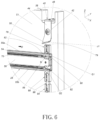
- the first slide rail assembly 26 and the third slide rail assembly 30 can be arranged on the first side S1 of the wall 38, which means the first slide rail assembly 26 and the third slide rail assembly 30 are arranged on the same side of the wall 38 (which can be shown in FIG. 5 and FIG. 6 ).
- the second slide rail assembly 28 and the fourth slide rail assembly 32 can be arranged on the second side S2 of the wall 38 (which can be shown in FIG. 7 and FIG. 8 ).
- first slide rail assembly 26 can include a first rail 54 and a second rail 56.
- the second rail 56 can be shifted with respect to the first rail 54 in the longitudinal direction (which can be shown in FIG. 5 and FIG. 6 ).
- the second slide rail assembly 28 can include a third rail 58 and a fourth rail 60.
- the fourth rail 60 can be shifted with respect to the third rail 58 in the longitudinal direction (which can be shown in FIG. 7 and FIG. 8 ).
- a predefined height can be existed between the third slide rail assembly 30 and the first slide rail assembly 26, such as the Z-axis direction shown in FIG. 5 .
- the third slide rail assembly 30 can include a fifth rail 62 and a sixth rail 64, and the sixth rail 64 can be shifted with respect to the fifth rail 62 in the longitudinal direction (which can be shown in FIG. 5 ).
- the fourth slide rail assembly 32 can include a seventh rail 66 and an eighth rail 68. The eighth rail 68 can be shifted with respect to the seventh rail 66 in the longitudinal direction (which can be shown in FIG. 7 ).
- the first rail 54 of the first slide rail assembly 26 and the fifth rail 62 of the third slide rail assembly 30 can be mounted on (such as in a fixed manner) the first side S1 of the wall 38 (which can be shown in FIG. 5 and FIG. 6 ).
- the third rail 58 of the second slide rail assembly 28 and the seventh rail 66 of the fourth slide rail assembly 32 can be mounted on (such as in the fixed manner) the second side S2 of the wall 38 in the fixed manner (which can be shown in FIG. 7 and FIG. 8 ).
- each of the first slide rail assembly 26, the second slide rail assembly 28, the third slide rail assembly 30 and the fourth slide rail assembly 32 can include a middle rail.
- the middle rail 70 of the first slide rail assembly 26 can be movably mounted between the first rail 54 and the second rail 56
- the middle rail 72 of the second slide rail assembly 28 can be movably mounted between the third rail 58 and the fourth rail 60
- the middle rail 74 of the third slide rail assembly 30 can be movably mounted between the fifth rail 62 and the sixth rail 64
- the middle rail 76 of the fourth slide rail assembly 32 can be movably mounted between the seventh rail 66 and the eighth rail 68.
- the second rail 56 of the first slide rail assembly 26, the fourth rail 60 of the second slide rail assembly 28, the sixth rail 64 of the third slide rail assembly 30 and the eighth rail 68 of the fourth slide rail assembly 32 can be respectively configured to hold the first drawer 24a, the second drawer 24b, the third drawer 24c and the fourth drawer 24d as mentioned above.
- the second rail 56 can be moved back into the first rail 54 of the first slide rail assembly 26, and the fourth rail 60 can be moved back into the third rail 58 of the second slide rail assembly 28.
- the sixth rail 64 can be moved back into the fifth rail 62 of the third slide rail assembly 30, and the eighth rail 68 can be moved back into the seventh rail 66 of the fourth slide rail assembly 32.
- the second rail 56 when the second rail 56 is shifted with respect to the first rail 54 of the first slide rail assembly 26 from a retracted position (such as the embodiment shown in FIG. 5 and FIG. 6 ) in an actuation direction D, the second rail 56 can drive the working member 40 to switch from a first mode J1 (such as the embodiment shown in FIG. 5 to FIG. 8 ) to a second mode J2 (such as the embodiment shown in FIG. 9 to FIG.
- the first slide rail assembly 26 can further include first driving member 78 movably mounted on the first rail 54 (such as the embodiment shown in FIG. 5 and FIG. 6 or the embodiment shown in FIG. 9 and FIG. 10 ).
- the first rail 54 can include a first wall 55a (such as an upper wall) and a second wall 55b (such as lower wall).
- the first wall 55a can have a first hole Q1 where through the first driving member 78 is passed.
- the first driving member 78 of the first slide rail assembly 26 can include at least one first guiding structure 79 (which can be shown in FIG. 6 or FIG. 10 ), and the at least one first guiding structure 79 can be an arc surface or an inclined surface.
- the second slide rail assembly 28 can further include a first driving member 80 movably mounted on the third rail 58 (such as the embodiment shown in FIG. 7 and FIG. 8 or the embodiment shown in FIG. 11 and FIG. 12 ).
- the first driving member 80 of the second slide rail assembly 28 can include at least one first guiding structure 81 (which can be shown in FIG. 8 or FIG. 12 ), and the at least one first guiding structure 81 can be the arc surface or the inclined surface.
- the second rail 56 can drive the first driving member 78 of the first slide rail assembly 26 to abut against the first portion 44 of the working member 40 (which can be shown in FIG. 6 and FIG. 10 ), so as to switch the working member 40 from the first mode J1 (which can be shown in FIG. 6 ) to the second mode J2 (which can be shown in FIG. 10 ); therefore, the first driving member 80 of the second slide rail assembly 28 can be blocked by the second portion 46 of the working member 40 (which can be shown in FIG. 11 and FIG.
- the fourth rail 60 can be blocked by the first driving member 80 of the second slide rail assembly 28, so as to prevent the fourth rail 60 of the second slide rail assembly 28 from being shifted with respect to the third rail 58 in the actuation direction D (which can be shown in FIG. 11 and FIG. 12 ).
- the second rail 56 can include a first driving feature 82, and the first driving feature 82 can include a guiding portion 84 (which can be shown in FIG. 6 and FIG. 10 ), and the fourth rail 60 can include a first driving feature 86 (which can be shown in FIG. 8 and FIG. 12 );
- the first portion 44 of the working member 40 can be located on the first side S1 of the wall 38 (such as the embodiment shown in FIG. 5 and FIG. 6 or the embodiment shown in FIG. 9 and FIG. 10 ), and the second portion 46 of the working member 40 can be located on the second side S2 of the wall 38 (such as the embodiment shown in FIG. 7 and FIG. 8 or the embodiment shown in FIG. 11 and FIG. 12 ).
- the first driving feature 82 (or the related guiding portion 84) of the second rail 56 can drive the first driving member 78 of the first slide rail assembly 26 (which can be shown in FIG. 10 ), and the first guiding structure 79 of the first driving member 78 of the first slide rail assembly 26 can abut against the first guiding surface 50 of the first portion 44 of the working member 40 (which can be shown in FIG. 10 ), so as to switch the working member 40 from the first mode J1 (which can be shown in FIG. 5 to FIG. 8 ) to the second mode J2 (which can be shown in FIG. 9 to FIG.
- the first driving member 80 of the second slide rail assembly 28 can be blocked by the second guiding surface 52 of the second portion 46 of the working member 40 (which can be shown in FIG. 11 and FIG. 12 ), and the first driving feature 86 of the fourth rail 60 can be blocked by the first driving member 80 of the second slide rail assembly 28 (which can be shown in FIG. 12 ), so as to prevent the fourth rail 60 of the second slide rail assembly 28 from being shifted with respect to the third rail 58 in the actuation direction D (which can be shown in FIG. 11 and FIG. 12 ).
- the first slide rail assembly 26 can further include a second driving member 88 movably mounted on the first rail 54; for example, the second wall 55b of the first rail 54 can have a second hole Q2 where through the second driving member 88 is passed.
- the first driving member 78 and the second driving member 88 of the first slide rail assembly 26 can respectively include a first constraining portion 90 and a second constraining portion 92.
- the first constraining portion 90 can abut against an inner surface of the first wall 55a of the first rail 54, and the second constraining portion 92 can abut against an inner surface of the second wall 55b of the first rail 54, so that the first driving member 78 and the second driving member 88 of the first slide rail assembly 26 can be moved with respect to the first rail 54 to an extreme position (which can be shown in FIG. 9 and FIG. 10 ).
- the third slide rail assembly 30 can further include a first driving member 94 movably mounted on the fifth rail 62.
- Structural configuration of the first driving member 94 and the fifth rail 62 of the third slide rail assembly 30 can be substantially the same as structural configuration of the first driving member 78 and the first rail 54 of the first slide rail assembly 26, and a detailed description is omitted herein for simplicity.
- a rod member 96 can be arranged between the second driving member 88 of the first slide rail assembly 26 and the first driving member 94 of the third slide rail assembly 30 (which can be shown in FIG. 9 and FIG. 10 ); for example, the rod member 96 can be connected between the second driving member 88 of the first slide rail assembly 26 and the first driving member 94 of the third slide rail assembly 30.
- the slide rail mechanism of the present application can utilize a linkage mechanism to block the sixth rail 64 and therefore to prevent the sixth rail 64 of the third slide rail assembly 30 from being shifted with respect to the fifth rail 62 in the actuation direction D.
- a configuration direction of the linkage mechanism can be substantially the same as a height direction H of the wall 38.
- the linkage mechanism can include the second driving member 88 of the first slide rail assembly 26, the first driving member 94 of the third slide rail assembly 30, and the rod member 96.
- the second driving member 88 of the first slide rail assembly 26 can be blocked by the second rail 56 (or the middle rail 70) of the first slide rail assembly 26, so that the second driving member 88 of the first slide rail assembly 26 cannot be moved in the height direction H, and a first driving feature 98 of the sixth rail 64 can be blocked by the first driving member 94 of the third slide rail assembly 30, so as to prevent the sixth rail 64 of the third slide rail assembly 30 from being shifted with respect to the fifth rail 62 in the actuation direction D (which can be shown in FIG. 9 and FIG. 10 ).
- the structural configuration of the first driving feature 98 of the sixth rail 64 can be substantially the same as the structural configuration of the first driving feature 82 of the first rail 56, or substantially the same as the structural configuration of the first driving feature 86 of the fourth rail 60, and the detailed description is omitted herein for simplicity.
- the slide rail mechanism in the embodiment of the present application can provide following features:
Landscapes
- Drawers Of Furniture (AREA)
- Seats For Vehicles (AREA)
Applications Claiming Priority (1)
| Application Number | Priority Date | Filing Date | Title |
|---|---|---|---|
| TW112103213A TWI834485B (zh) | 2023-01-19 | 2023-01-19 | 滑軌機構 |
Publications (2)
| Publication Number | Publication Date |
|---|---|
| EP4403732A1 true EP4403732A1 (de) | 2024-07-24 |
| EP4403732B1 EP4403732B1 (de) | 2025-09-17 |
Family
ID=87196201
Family Applications (1)
| Application Number | Title | Priority Date | Filing Date |
|---|---|---|---|
| EP23184137.0A Active EP4403732B1 (de) | 2023-01-19 | 2023-07-07 | Gleitschienenmechanismus |
Country Status (4)
| Country | Link |
|---|---|
| US (1) | US12318000B2 (de) |
| EP (1) | EP4403732B1 (de) |
| JP (1) | JP7471494B1 (de) |
| TW (1) | TWI834485B (de) |
Families Citing this family (1)
| Publication number | Priority date | Publication date | Assignee | Title |
|---|---|---|---|---|
| CN220889859U (zh) * | 2023-08-28 | 2024-05-03 | 昆山湖华金属制品有限公司 | 用于多层式抽屉家具的连环锁机构 |
Citations (7)
| Publication number | Priority date | Publication date | Assignee | Title |
|---|---|---|---|---|
| JPS4985341U (de) * | 1972-11-02 | 1974-07-24 | ||
| DE2548373A1 (de) * | 1975-10-01 | 1977-04-07 | Schaerer Soehne Ag Muensingen | Arretiervorrichtung fuer in einem gestell nebeneinander angeordnete auszuege |
| JPS5438866A (en) * | 1977-08-29 | 1979-03-24 | Nippon Filing Seizo Kk | Product housing shelf |
| JPH06154053A (ja) * | 1992-11-19 | 1994-06-03 | Nec Eng Ltd | 同時引き出し防止機構 |
| JP2000291307A (ja) * | 1999-04-01 | 2000-10-17 | Kyoei Ind Co Ltd | 多列抽出しの同時引き出し防止装置 |
| US7520576B2 (en) | 2002-08-21 | 2009-04-21 | Compx International Inc. | Anti-tip interlocking linkage mechanism for vertical cabinets |
| US20100148648A1 (en) * | 2008-12-15 | 2010-06-17 | Bush Industries, Inc. | Anti-Tip System For Adjacent Drawers |
Family Cites Families (18)
| Publication number | Priority date | Publication date | Assignee | Title |
|---|---|---|---|---|
| US4303288A (en) * | 1980-05-30 | 1981-12-01 | The Columbus Show Case Company | Drawer locking apparatus for merchandise cabinets |
| JPH07298938A (ja) | 1994-05-09 | 1995-11-14 | Oki Electric Ind Co Ltd | ユニット同時引き出し防止機構 |
| ATE225453T1 (de) | 1996-07-12 | 2002-10-15 | Accuride Int Inc | Verriegelungssystem mit stangenverschluss für schubladen |
| US6296332B1 (en) | 1996-07-12 | 2001-10-02 | Accuride International, Inc. | File interlock system and mechanism |
| US5931548A (en) * | 1997-02-18 | 1999-08-03 | Steelcase Inc. | Drawer interlock to non-interlock conversion device |
| JP2000282736A (ja) | 1999-03-29 | 2000-10-10 | Kokuyo Co Ltd | 引出しのロック装置 |
| GB2380516B (en) * | 2001-10-05 | 2005-07-27 | Accuride Int Ltd | Rear interlock |
| TWM284291U (en) * | 2005-08-15 | 2006-01-01 | Nan Juen Int Co Ltd | Inter-locking, braking, wedging device of drawer |
| US7144092B1 (en) * | 2006-01-11 | 2006-12-05 | Ting-Wei Chang | Arresting apparatus of multilayer drawers |
| US20080061663A1 (en) * | 2006-09-08 | 2008-03-13 | Tsung-Che Wu | Drawer slide module structure |
| TWI297596B (en) * | 2006-09-21 | 2008-06-11 | Sun Chain Metal Industry Co Ltd | Interlocking device for a drawer guideway |
| US7823992B2 (en) | 2007-12-19 | 2010-11-02 | King Slide Works Co., Ltd. | Drawer interlock mechanism |
| US8109527B2 (en) * | 2008-02-21 | 2012-02-07 | Rubbermaid, Inc. | Medical cart and keyboard tray |
| TWI598026B (zh) * | 2015-09-18 | 2017-09-01 | King Slide Works Co Ltd | 具有連環鎖裝置的滑軌總成 |
| US9788653B1 (en) * | 2017-06-05 | 2017-10-17 | James W. Lazenby | Method and apparatus for a transparent kitchen cabinet |
| JP2019132104A (ja) | 2018-02-02 | 2019-08-08 | 株式会社オカムラ | 什器 |
| CN112386025B (zh) * | 2019-08-19 | 2023-04-18 | 川湖科技股份有限公司 | 滑轨总成 |
| US20210230913A1 (en) * | 2020-01-27 | 2021-07-29 | Tiffin Metal Products Co. | Compartment locking system |
-
2023
- 2023-01-19 TW TW112103213A patent/TWI834485B/zh active
- 2023-05-16 US US18/198,267 patent/US12318000B2/en active Active
- 2023-06-06 JP JP2023093347A patent/JP7471494B1/ja active Active
- 2023-07-07 EP EP23184137.0A patent/EP4403732B1/de active Active
Patent Citations (7)
| Publication number | Priority date | Publication date | Assignee | Title |
|---|---|---|---|---|
| JPS4985341U (de) * | 1972-11-02 | 1974-07-24 | ||
| DE2548373A1 (de) * | 1975-10-01 | 1977-04-07 | Schaerer Soehne Ag Muensingen | Arretiervorrichtung fuer in einem gestell nebeneinander angeordnete auszuege |
| JPS5438866A (en) * | 1977-08-29 | 1979-03-24 | Nippon Filing Seizo Kk | Product housing shelf |
| JPH06154053A (ja) * | 1992-11-19 | 1994-06-03 | Nec Eng Ltd | 同時引き出し防止機構 |
| JP2000291307A (ja) * | 1999-04-01 | 2000-10-17 | Kyoei Ind Co Ltd | 多列抽出しの同時引き出し防止装置 |
| US7520576B2 (en) | 2002-08-21 | 2009-04-21 | Compx International Inc. | Anti-tip interlocking linkage mechanism for vertical cabinets |
| US20100148648A1 (en) * | 2008-12-15 | 2010-06-17 | Bush Industries, Inc. | Anti-Tip System For Adjacent Drawers |
Also Published As
| Publication number | Publication date |
|---|---|
| JP7471494B1 (ja) | 2024-04-19 |
| US20240245212A1 (en) | 2024-07-25 |
| TWI834485B (zh) | 2024-03-01 |
| JP2024102787A (ja) | 2024-07-31 |
| EP4403732B1 (de) | 2025-09-17 |
| TW202430082A (zh) | 2024-08-01 |
| US12318000B2 (en) | 2025-06-03 |
Similar Documents
| Publication | Publication Date | Title |
|---|---|---|
| EP4477823A1 (de) | Verriegelungskit und zugehörige möbelanordnung | |
| EP4403732B1 (de) | Gleitschienenmechanismus | |
| US12203292B2 (en) | Slide rail mechanism | |
| EP4570126A1 (de) | Gleitschienenanordnung | |
| EP4501174B1 (de) | Gleitschienenanordnung | |
| EP4417088A1 (de) | Gleitschienenmechanismus | |
| EP4461160B1 (de) | Möbelanordnung | |
| EP4403733A1 (de) | Gleitschienenmechanismus | |
| JP7592952B2 (ja) | スライドレール機構 | |
| EP4581983B1 (de) | Gleitschienenmechanismus | |
| CN118452646A (zh) | 滑轨机构 | |
| US12628950B2 (en) | Slide rail assembly | |
| EP4523567A1 (de) | Gleitschienenanordnung | |
| EP4736711A1 (de) | Gleitschienenanordnung | |
| EP3804565A1 (de) | Schrank und gleitschienenbausatz dafür | |
| CN106820676A (zh) | 安装机构 | |
| CN120240808A (zh) | 滑轨机构 | |
| JP2026085216A (ja) | スライドレール機構 |
Legal Events
| Date | Code | Title | Description |
|---|---|---|---|
| PUAI | Public reference made under article 153(3) epc to a published international application that has entered the european phase |
Free format text: ORIGINAL CODE: 0009012 |
|
| STAA | Information on the status of an ep patent application or granted ep patent |
Free format text: STATUS: THE APPLICATION HAS BEEN PUBLISHED |
|
| STAA | Information on the status of an ep patent application or granted ep patent |
Free format text: STATUS: REQUEST FOR EXAMINATION WAS MADE |
|
| AK | Designated contracting states |
Kind code of ref document: A1 Designated state(s): AL AT BE BG CH CY CZ DE DK EE ES FI FR GB GR HR HU IE IS IT LI LT LU LV MC ME MK MT NL NO PL PT RO RS SE SI SK SM TR |
|
| 17P | Request for examination filed |
Effective date: 20240714 |
|
| RBV | Designated contracting states (corrected) |
Designated state(s): AL AT BE BG CH CY CZ DE DK EE ES FI FR GB GR HR HU IE IS IT LI LT LU LV MC ME MK MT NL NO PL PT RO RS SE SI SK SM TR |
|
| RIC1 | Information provided on ipc code assigned before grant |
Ipc: A47B 88/40 20170101ALI20250403BHEP Ipc: E05B 65/464 20170101AFI20250403BHEP |
|
| GRAP | Despatch of communication of intention to grant a patent |
Free format text: ORIGINAL CODE: EPIDOSNIGR1 |
|
| STAA | Information on the status of an ep patent application or granted ep patent |
Free format text: STATUS: GRANT OF PATENT IS INTENDED |
|
| INTG | Intention to grant announced |
Effective date: 20250509 |
|
| GRAS | Grant fee paid |
Free format text: ORIGINAL CODE: EPIDOSNIGR3 |
|
| GRAA | (expected) grant |
Free format text: ORIGINAL CODE: 0009210 |
|
| STAA | Information on the status of an ep patent application or granted ep patent |
Free format text: STATUS: THE PATENT HAS BEEN GRANTED |
|
| AK | Designated contracting states |
Kind code of ref document: B1 Designated state(s): AL AT BE BG CH CY CZ DE DK EE ES FI FR GB GR HR HU IE IS IT LI LT LU LV MC ME MK MT NL NO PL PT RO RS SE SI SK SM TR |
|
| REG | Reference to a national code |
Ref country code: GB Ref legal event code: FG4D |
|
| REG | Reference to a national code |
Ref country code: CH Ref legal event code: EP |
|
| REG | Reference to a national code |
Ref country code: DE Ref legal event code: R096 Ref document number: 602023006717 Country of ref document: DE |
|
| REG | Reference to a national code |
Ref country code: IE Ref legal event code: FG4D |
|
| PG25 | Lapsed in a contracting state [announced via postgrant information from national office to epo] |
Ref country code: NO Free format text: LAPSE BECAUSE OF FAILURE TO SUBMIT A TRANSLATION OF THE DESCRIPTION OR TO PAY THE FEE WITHIN THE PRESCRIBED TIME-LIMIT Effective date: 20251217 |
|
| REG | Reference to a national code |
Ref country code: LT Ref legal event code: MG9D |
|
| PG25 | Lapsed in a contracting state [announced via postgrant information from national office to epo] |
Ref country code: FI Free format text: LAPSE BECAUSE OF FAILURE TO SUBMIT A TRANSLATION OF THE DESCRIPTION OR TO PAY THE FEE WITHIN THE PRESCRIBED TIME-LIMIT Effective date: 20250917 |
|
| PG25 | Lapsed in a contracting state [announced via postgrant information from national office to epo] |
Ref country code: HR Free format text: LAPSE BECAUSE OF FAILURE TO SUBMIT A TRANSLATION OF THE DESCRIPTION OR TO PAY THE FEE WITHIN THE PRESCRIBED TIME-LIMIT Effective date: 20250917 |
|
| PG25 | Lapsed in a contracting state [announced via postgrant information from national office to epo] |
Ref country code: GR Free format text: LAPSE BECAUSE OF FAILURE TO SUBMIT A TRANSLATION OF THE DESCRIPTION OR TO PAY THE FEE WITHIN THE PRESCRIBED TIME-LIMIT Effective date: 20251218 |
|
| PG25 | Lapsed in a contracting state [announced via postgrant information from national office to epo] |
Ref country code: SE Free format text: LAPSE BECAUSE OF FAILURE TO SUBMIT A TRANSLATION OF THE DESCRIPTION OR TO PAY THE FEE WITHIN THE PRESCRIBED TIME-LIMIT Effective date: 20250917 |
|
| REG | Reference to a national code |
Ref country code: NL Ref legal event code: MP Effective date: 20250917 |
|
| PG25 | Lapsed in a contracting state [announced via postgrant information from national office to epo] |
Ref country code: LV Free format text: LAPSE BECAUSE OF FAILURE TO SUBMIT A TRANSLATION OF THE DESCRIPTION OR TO PAY THE FEE WITHIN THE PRESCRIBED TIME-LIMIT Effective date: 20250917 |
|
| PG25 | Lapsed in a contracting state [announced via postgrant information from national office to epo] |
Ref country code: BG Free format text: LAPSE BECAUSE OF FAILURE TO SUBMIT A TRANSLATION OF THE DESCRIPTION OR TO PAY THE FEE WITHIN THE PRESCRIBED TIME-LIMIT Effective date: 20250917 |
|
| PG25 | Lapsed in a contracting state [announced via postgrant information from national office to epo] |
Ref country code: RS Free format text: LAPSE BECAUSE OF FAILURE TO SUBMIT A TRANSLATION OF THE DESCRIPTION OR TO PAY THE FEE WITHIN THE PRESCRIBED TIME-LIMIT Effective date: 20251217 |
|
| PG25 | Lapsed in a contracting state [announced via postgrant information from national office to epo] |
Ref country code: NL Free format text: LAPSE BECAUSE OF FAILURE TO SUBMIT A TRANSLATION OF THE DESCRIPTION OR TO PAY THE FEE WITHIN THE PRESCRIBED TIME-LIMIT Effective date: 20250917 |
|
| REG | Reference to a national code |
Ref country code: AT Ref legal event code: MK05 Ref document number: 1838400 Country of ref document: AT Kind code of ref document: T Effective date: 20250917 |
|
| PG25 | Lapsed in a contracting state [announced via postgrant information from national office to epo] |
Ref country code: SM Free format text: LAPSE BECAUSE OF FAILURE TO SUBMIT A TRANSLATION OF THE DESCRIPTION OR TO PAY THE FEE WITHIN THE PRESCRIBED TIME-LIMIT Effective date: 20250917 |
|
| PG25 | Lapsed in a contracting state [announced via postgrant information from national office to epo] |
Ref country code: ES Free format text: LAPSE BECAUSE OF FAILURE TO SUBMIT A TRANSLATION OF THE DESCRIPTION OR TO PAY THE FEE WITHIN THE PRESCRIBED TIME-LIMIT Effective date: 20250917 |
|
| PG25 | Lapsed in a contracting state [announced via postgrant information from national office to epo] |
Ref country code: AT Free format text: LAPSE BECAUSE OF FAILURE TO SUBMIT A TRANSLATION OF THE DESCRIPTION OR TO PAY THE FEE WITHIN THE PRESCRIBED TIME-LIMIT Effective date: 20250917 |
|
| PG25 | Lapsed in a contracting state [announced via postgrant information from national office to epo] |
Ref country code: IT Free format text: LAPSE BECAUSE OF FAILURE TO SUBMIT A TRANSLATION OF THE DESCRIPTION OR TO PAY THE FEE WITHIN THE PRESCRIBED TIME-LIMIT Effective date: 20250917 |
|
| PG25 | Lapsed in a contracting state [announced via postgrant information from national office to epo] |
Ref country code: IS Free format text: LAPSE BECAUSE OF FAILURE TO SUBMIT A TRANSLATION OF THE DESCRIPTION OR TO PAY THE FEE WITHIN THE PRESCRIBED TIME-LIMIT Effective date: 20260117 |
|
| PG25 | Lapsed in a contracting state [announced via postgrant information from national office to epo] |
Ref country code: CZ Free format text: LAPSE BECAUSE OF FAILURE TO SUBMIT A TRANSLATION OF THE DESCRIPTION OR TO PAY THE FEE WITHIN THE PRESCRIBED TIME-LIMIT Effective date: 20250917 Ref country code: PT Free format text: LAPSE BECAUSE OF FAILURE TO SUBMIT A TRANSLATION OF THE DESCRIPTION OR TO PAY THE FEE WITHIN THE PRESCRIBED TIME-LIMIT Effective date: 20260119 |
|
| PG25 | Lapsed in a contracting state [announced via postgrant information from national office to epo] |
Ref country code: PL Free format text: LAPSE BECAUSE OF FAILURE TO SUBMIT A TRANSLATION OF THE DESCRIPTION OR TO PAY THE FEE WITHIN THE PRESCRIBED TIME-LIMIT Effective date: 20250917 |
|
| PG25 | Lapsed in a contracting state [announced via postgrant information from national office to epo] |
Ref country code: EE Free format text: LAPSE BECAUSE OF FAILURE TO SUBMIT A TRANSLATION OF THE DESCRIPTION OR TO PAY THE FEE WITHIN THE PRESCRIBED TIME-LIMIT Effective date: 20250917 Ref country code: SK Free format text: LAPSE BECAUSE OF FAILURE TO SUBMIT A TRANSLATION OF THE DESCRIPTION OR TO PAY THE FEE WITHIN THE PRESCRIBED TIME-LIMIT Effective date: 20250917 |