EP4581983A1 - Gleitschienenmechanismus - Google Patents
Gleitschienenmechanismus Download PDFInfo
- Publication number
- EP4581983A1 EP4581983A1 EP24200753.2A EP24200753A EP4581983A1 EP 4581983 A1 EP4581983 A1 EP 4581983A1 EP 24200753 A EP24200753 A EP 24200753A EP 4581983 A1 EP4581983 A1 EP 4581983A1
- Authority
- EP
- European Patent Office
- Prior art keywords
- rail
- carried object
- locking member
- slide rail
- predetermined
- Prior art date
- Legal status (The legal status is an assumption and is not a legal conclusion. Google has not performed a legal analysis and makes no representation as to the accuracy of the status listed.)
- Pending
Links
Images




Classifications
-
- A—HUMAN NECESSITIES
- A47—FURNITURE; DOMESTIC ARTICLES OR APPLIANCES; COFFEE MILLS; SPICE MILLS; SUCTION CLEANERS IN GENERAL
- A47B—TABLES; DESKS; OFFICE FURNITURE; CABINETS; DRAWERS; GENERAL DETAILS OF FURNITURE
- A47B88/00—Drawers for tables, cabinets or like furniture; Guides for drawers
- A47B88/50—Safety devices or the like for drawers
- A47B88/57—Safety devices or the like for drawers preventing complete withdrawal of the drawer
-
- A—HUMAN NECESSITIES
- A47—FURNITURE; DOMESTIC ARTICLES OR APPLIANCES; COFFEE MILLS; SPICE MILLS; SUCTION CLEANERS IN GENERAL
- A47B—TABLES; DESKS; OFFICE FURNITURE; CABINETS; DRAWERS; GENERAL DETAILS OF FURNITURE
- A47B88/00—Drawers for tables, cabinets or like furniture; Guides for drawers
- A47B88/50—Safety devices or the like for drawers
-
- A—HUMAN NECESSITIES
- A47—FURNITURE; DOMESTIC ARTICLES OR APPLIANCES; COFFEE MILLS; SPICE MILLS; SUCTION CLEANERS IN GENERAL
- A47B—TABLES; DESKS; OFFICE FURNITURE; CABINETS; DRAWERS; GENERAL DETAILS OF FURNITURE
- A47B88/00—Drawers for tables, cabinets or like furniture; Guides for drawers
- A47B88/70—Coupled drawers
- A47B88/75—Coupled drawers the secondary drawer being in or above the primary drawer
-
- E—FIXED CONSTRUCTIONS
- E05—LOCKS; KEYS; WINDOW OR DOOR FITTINGS; SAFES
- E05B—LOCKS; ACCESSORIES THEREFOR; HANDCUFFS
- E05B65/00—Locks or fastenings for special use
- E05B65/46—Locks or fastenings for special use for drawers
- E05B65/462—Locks or fastenings for special use for drawers for two or more drawers
- E05B65/463—Drawer interlock or anti-tilt mechanisms, i.e. when one drawer is open, at least one of the remaining drawers is locked
-
- A—HUMAN NECESSITIES
- A47—FURNITURE; DOMESTIC ARTICLES OR APPLIANCES; COFFEE MILLS; SPICE MILLS; SUCTION CLEANERS IN GENERAL
- A47B—TABLES; DESKS; OFFICE FURNITURE; CABINETS; DRAWERS; GENERAL DETAILS OF FURNITURE
- A47B2210/00—General construction of drawers, guides and guide devices
- A47B2210/0002—Guide construction for drawers
- A47B2210/0064—Guide sequencing or synchronisation
-
- A—HUMAN NECESSITIES
- A47—FURNITURE; DOMESTIC ARTICLES OR APPLIANCES; COFFEE MILLS; SPICE MILLS; SUCTION CLEANERS IN GENERAL
- A47B—TABLES; DESKS; OFFICE FURNITURE; CABINETS; DRAWERS; GENERAL DETAILS OF FURNITURE
- A47B2210/00—General construction of drawers, guides and guide devices
- A47B2210/07—Drawers with sliding trays
-
- A—HUMAN NECESSITIES
- A47—FURNITURE; DOMESTIC ARTICLES OR APPLIANCES; COFFEE MILLS; SPICE MILLS; SUCTION CLEANERS IN GENERAL
- A47B—TABLES; DESKS; OFFICE FURNITURE; CABINETS; DRAWERS; GENERAL DETAILS OF FURNITURE
- A47B88/00—Drawers for tables, cabinets or like furniture; Guides for drawers
- A47B88/40—Sliding drawers; Slides or guides therefor
- A47B88/49—Sliding drawers; Slides or guides therefor with double extensible guides or parts
Definitions
- the present invention is related to a slide rail mechanism.
- US patent number US 4,925,257 discloses a piece of furniture having a cabinet with two drawers. Each drawer is slidable relative to the cabinet between an open position and a closed position.
- the piece of furniture comprises a lock bar mounted to the cabinet and configured to be moved between a first position and a second position.
- the lock bar is configured to interact with a cooperating means mounted to the drawer for preventing the two drawers from being simultaneously moved from the closed position to the open position.
- US patent number US 6,722,749 B1 discloses a drawer open position controller comprising a ramp, a blocking device and a locking member arranged on the cabinet.
- a follower drives the locking member to move, such that other drawers are blocked through the ramp and the blocking device, and can only be pulled out a certain distance .
- the aforementioned patents respectively disclose a piece of furniture capable of preventing two drawers from being simultaneously opened, and a drawer open position controller capable of preventing, when a first drawer has been opened, other drawers from being fully opened.
- a drawer open position controller capable of preventing, when a first drawer has been opened, other drawers from being fully opened.
- the present invention aims at providing a slide rail mechanism.
- the slide rail mechanism comprises a first carried object, a first slide rail assembly, a second slide rail assembly and a locking member.
- the first slide rail assembly comprises a first rail and a second rail longitudinally movable relative to the first rail.
- the first rail is configured to be mounted to the rack, and the second rail is configured to carry the first carried object.
- the second slide rail assembly is arranged on the first carried object.
- the second slide rail assembly comprises a third rail and a fourth rail longitudinally movable relative to the third rail.
- the third rail is configured to be mounted to the first carried object, and the fourth rail is configured to carry a second carried object.
- the locking member is movably mounted to the first carried object.
- the first rail is arranged with an auxiliary feature, and the locking member is arranged with a predetermined part and a locking part.
- the auxiliary feature is configured to support the predetermined part to position the locking member at a first predetermined position, such that the locking part of the locking member is not configured to prevent the fourth rail from being moved along an opening direction, in order to allow the second carried object to be moved relative to the first carried object along the opening direction.
- the locking member is moved from the first predetermined position to a second predetermined position, such that the locking part of the locking member is configured to prevent the fourth rail from being moved along the opening direction, in order to limit a moving distance of the second carried object relative to the first carried object along the opening direction.
- a slide rail mechanism is applicable to a rack 22 according to an embodiment of the present invention.
- the slide rail mechanism comprises a first slide rail assembly 24, a second slide rail assembly 26 and a first carried object 28.
- the first slide rail assembly 24 is configured to support the first carried object 28.
- the first carried object 28 can be an outer casing.
- the second slide rail assembly 26 is arranged on the first carried object 28.
- the second slide rail assembly 26 is arranged at an inner side of the first carried object 28 (the outer casing), and the second slide rail assembly 26 is configured to support a second carried object 30.
- the first carried object 28 is formed with a predetermined space 32 for accommodating the second carried object 30.
- the slide rail mechanism further comprises a locking member 34 movably mounted on the first carried object 28.
- the first slide rail assembly 24 comprises a first rail 36 and a second rail 38 longitudinally movable relative to the first rail 36.
- the first slide rail assembly 24 further comprises a first middle rail 40 movably mounted between the first rail 36 and the second rail 38.
- the X axis is a longitudinal direction (or a length direction or moving direction of the slide rail)
- the Y axis is a transverse direction (or a lateral direction of the slide rail)
- the Z axis is a vertical direction (or a height direction of the slide rail) .
- the first rail 36 is configured to be mounted to the rack 22, and the second rail 38 is configured to carry the first carried object 28.
- the locking member 34 can be a linkage rod, and a moving direction of the locking member 34 is a height direction of the first carried object 28 (such as the Z-axis direction).
- the first rail 36 is arranged with a first auxiliary feature 42.
- the first rail 36 is further arranged with a second auxiliary feature 44 (as shown in FIG. 3 ).
- the first slide rail assembly 24 further comprises a bracket 46.
- the first rail 36 is mounted to the rack 22 through the bracket 46.
- the bracket 46 is connected (such as fixedly connected) to the first rail 36 and can be seen as a portion of the first rail 36.
- the first auxiliary feature 42 and the second auxiliary feature 44 are arranged on the bracket 46 on the first rail 36.
- the bracket 46 has a first end part 46a and a second end part 46b opposite to each other, such as a front end part and a rear end part.
- the first auxiliary feature 42 and the second auxiliary feature 44 are arranged adjacent to the first end part 46a of the bracket 46, but the present invention is not limited thereto.
- first auxiliary feature 42 and the second auxiliary feature 44 are protrusions, and the first auxiliary feature 42 and the second auxiliary feature 44 are spaced apart from each other by a longitudinal distance along the longitudinal direction.
- the first auxiliary feature 42 and the second auxiliary feature 44 respectively have a first guiding section G1 and a second guiding section G2 corresponding to each other.
- Each of the first guiding section G1 and the second guiding section G2 has an inclined surface or an arc surface, but the present invention is not limited thereto.
- the first carried object 28 comprises a plurality of walls.
- the first carried object 28 comprises a predetermined wall 48 (or a side wall).
- the predetermined wall 48 has a first side L1 and a second side L2 opposite to each other, such as an outer side and an inner side, but the present invention is not limited thereto.
- the first side L1 of the predetermined wall 48 is connected to the second rail 38, and the predetermined space 32 is formed adjacent to the second side L2.
- the locking member 34 is arranged with a predetermined part 50 and a locking part 52.
- the locking member 34 is movably mounted to the second side L2 of the predetermined wall 48 of the first carried object 28.
- An extension section 50a of the predetermined part 50 of the locking member 34 is configured to penetrate through the predetermined wall 48 to extend to the first side L1 (as shown in FIG. 2 ).
- the predetermined wall 48 is formed with a limiting structure 54, such as an oval hole (as shown in FIG. 2 ), but the present invention is not limited thereto.
- the extension section 50a of the predetermined part 50 is inserted into the limiting structure 54 of the predetermined wall 48, such that the locking member 34 is movable relative to the first carried object 28 within a limited range.
- the second slide rail assembly 26 comprises a third rail 56 and a fourth rail 58 longitudinally movable relative to the third rail 56.
- the third rail 56 is configured to be mounted to the second side L2 of the predetermined wall 48 of the first carried object 28, and the fourth rail 58 is configured to carry the second carried object 30.
- the third rail 56 has a first side L1' and a second side L2' opposite to each other, such as an outer side and an inner side, but the present invention is not limited thereto.
- the first side L1' of the third rail 56 is connected to the second side L2 of the first carried object 28, and the second side L2' of the third rail 56 is adjacent to the fourth rail 58.
- the third rail 56 is formed with an auxiliary space 60 (such as a through hole) communicating the first side L1' and the second side L2' of the third rail 56.
- the auxiliary space 60 is configured to allow the locking part 52 of the locking member 34 to pass through the third rail 56 from the first side L1' of the third rail 56 to the second side L2' of the third rail 56.
- the second slide rail assembly 26 further comprises a second middle rail 62 movably mounted between the third rail 56 and the fourth rail 58, and the second middle rail 62 has a blocking feature 64 configured to interact with the locking part 52 of the locking member 34.
- the blocking feature 64 is a protrusion, but the present invention is not limited thereto.
- the first carried object 28 is mounted with a plurality of second slide rail assemblies 26.
- the second slide rail assemblies 26 have substantially identical structural configuration.
- the fourth rail 58 of each of the second slide rail assemblies 26 is configured to carry the respective second carried object 30.
- the locking part 52 of the locking member 34 passes through the auxiliary space 60 of the third rail 56 to be adjacent to the fourth rail 58 (and the second middle rail 62).
- the first auxiliary feature 42 is configured to support the predetermined part 50 (the extension section 50a of the predetermined part 50), such that the locking member 34 is positioned at a first predetermined position K1.
- the locking part 52 of the locking member 34 is not aligned with the blocking feature 64 of the second middle rail 62 along the longitudinal direction.
- a vertical position of the locking part 52 of the locking member 34 along the vertical direction does not correspond to a vertical position of the blocking feature 64 of the second middle rail 62 along the vertical direction (a transverse position of the locking part 52 of the locking member 34 along the transverse direction corresponds to a transverse position of the blocking feature 64 of the second middle rail 62 along the transverse direction).
- the locking part 52 of the locking member 34 and the blocking feature 64 of the second middle rail 62 are spaced apart from each other by a predetermined longitudinal distance M along the longitudinal direction (as shown in FIG. 5 ).
- the first auxiliary feature 42 no longer supports the predetermined part 50, such that the locking member 34 is moved from the first predetermined position K1 along a predetermined height direction H (as shown in FIG. 5 ) to a second predetermined position K2 (as shown in FIG. 7 and FIG. 8 ) .
- the locking part 52 of the locking member 34 is configured to prevent the fourth rail 58 from being moved along the opening direction D1 in order to limit a moving distance of the second carried object 30 relative to the first carried object 28 along the opening direction D1.
- the locking part 52 of the locking member 34 is configured to block a moving path of the blocking feature 64 of the second middle rail 62 along the opening direction D1, in order to prevent the fourth rail 58 from being moved along the opening direction D1.
- the locking member 34 is located at the second predetermined position K2
- the locking part 52 of the locking member 34 is aligned with the blocking feature 64 of the second middle rail 62 along the longitudinal direction.
- the second middle rail 62 is configured to indirectly prevent the fourth rail 58 from being moved along the opening direction D1 (for example, a synchronization mechanism is provided between the second middle rail 62 and the fourth rail 58), in order to limit the moving distance of the second carried object 30 relative to the first carried object 28 along the opening direction D1.
- the second slide rail assembly 26 only comprises the third rail 56 and the fourth rail 58 (that is, the second slide rail assembly 26 does not comprise the second middle rail 62), and the fourth rail 58 is configured to carry the second carried object 30 and has a blocking feature.
- the locking part 52 of the locking member 34 is aligned with the blocking feature of the fourth rail 58 along the longitudinal direction (a vertical position of the locking part 52 of the locking member 34 along the vertical direction corresponds to a vertical position of the blocking feature of the fourth rail 58 along the vertical direction, and a transverse position of the locking part 52 of the locking member 34 along the transverse direction corresponds to a transverse position of the blocking feature of the fourth rail 58 along the transverse direction), such that the locking member 34 is configured to directly block a moving path of the fourth rail 58 along the opening direction D1, in order to limit the moving distance of the second carried object 30 relative to the first carried object 28 along the opening direction D1.
- the second guiding section G2 of the second auxiliary feature 44 is configured to contact and guide the predetermined part 50 (the extension section 50a of the predetermined part 50) of the locking member 34 to move the locking member 34 from the first predetermined position K1 (as shown in the FIG. 5 ) to the second predetermined position K2 (as shown in FIG. 7 and FIG. 8 ) .
- the locking member 34 can also be moved down to the second predetermined position K2 due to gravity.
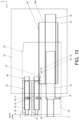
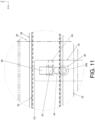
- the locking part 52 of the locking member 34 and the blocking feature 64 of the second middle rail 62 are aligned with each other along the longitudinal direction to block each other (as shown in FIG. 10 and FIG. 11 ), so as to indirectly prevent the fourth rail 58 from being moved along the opening direction D1, in order to limit the moving distance of the second carried object 30 relative to the first carried object 28 along the opening direction D1.
- the second carried object 30 is movable relative to the first carried object 28 from a predetermined retracted position R' (as shown in FIG. 9 ) along the opening direction D1, and only can be pulled out relative to the first carried object 28 by a predetermined extension distance Q (as shown in FIG. 10 ).
- the second carried object 30 is configured to be prevented from being moved relative to the first carried object 28 from the predetermined retracted position R' along the opening direction D1. In other words, the second carried object 30 cannot be fully opened relative to the first carried object 28.
- the first guiding section G1 of the first auxiliary feature 42 is configured to contact and guide the predetermined part 50 (the extension section 50a of the predetermined part 50) of the locking member 34 to move the locking member 34 from the second predetermined position K2 (as shown in the FIG. 9 and FIG. 10 ) to the first predetermined position K1 (as shown in FIG. 5 and FIG. 6 ).
- the first auxiliary feature 42 is configured to support the predetermined part 50 to position the locking member 34 at the first predetermined position K1, such that the locking part 52 of the locking member 34 is not aligned with the blocking feature 64 of the second middle rail 62 along the longitudinal direction. Therefore, the locking part 52 of the locking member 34 is not configured to prevent the fourth rail 58 from being moved along the opening direction D1, in order to allow the second carried object 30 to be moved relative to the first carried object 28 from the predetermined retracted position R' (as shown in FIG. 9 ) along the opening direction D1 to a predetermined extended position, such as a fully extended position E' (as shown in FIG. 12 ).
- the slide rail mechanism according to the embodiments of the present invention has the following technical features:
Landscapes
- Drawers Of Furniture (AREA)
- Warehouses Or Storage Devices (AREA)
- Automatic Analysis And Handling Materials Therefor (AREA)
Applications Claiming Priority (1)
| Application Number | Priority Date | Filing Date | Title |
|---|---|---|---|
| TW113100400A TWI870191B (zh) | 2024-01-03 | 2024-01-03 | 滑軌機構 |
Publications (1)
| Publication Number | Publication Date |
|---|---|
| EP4581983A1 true EP4581983A1 (de) | 2025-07-09 |
Family
ID=92816643
Family Applications (1)
| Application Number | Title | Priority Date | Filing Date |
|---|---|---|---|
| EP24200753.2A Pending EP4581983A1 (de) | 2024-01-03 | 2024-09-17 | Gleitschienenmechanismus |
Country Status (4)
| Country | Link |
|---|---|
| US (1) | US20250213040A1 (de) |
| EP (1) | EP4581983A1 (de) |
| JP (1) | JP2025106183A (de) |
| TW (1) | TWI870191B (de) |
Citations (4)
| Publication number | Priority date | Publication date | Assignee | Title |
|---|---|---|---|---|
| US4925257A (en) | 1988-12-27 | 1990-05-15 | Timberline Supply Ltd. | Safety lock system for cabinet with multiple drawers |
| US6722749B1 (en) | 2001-08-14 | 2004-04-20 | Snap-On Technologies, Inc. | Drawer open position controller |
| US20120187816A1 (en) * | 2011-01-21 | 2012-07-26 | King Slide Works Co., Ltd. | Interlock device for slide assembly |
| US10750863B2 (en) * | 2017-07-20 | 2020-08-25 | Black Pearl Woodworks LLC | Drawer system having primary and concealed drawers |
Family Cites Families (5)
| Publication number | Priority date | Publication date | Assignee | Title |
|---|---|---|---|---|
| JP4456251B2 (ja) * | 2000-10-02 | 2010-04-28 | クリナップ株式会社 | 厨房家具の収納構造 |
| JP2009022543A (ja) * | 2007-07-20 | 2009-02-05 | Okamura Corp | 多段式キャビネット |
| TWI598026B (zh) * | 2015-09-18 | 2017-09-01 | King Slide Works Co Ltd | 具有連環鎖裝置的滑軌總成 |
| JP6881849B2 (ja) * | 2019-03-11 | 2021-06-02 | Necプラットフォームズ株式会社 | 電子機器支持フレーム及び電子機器におけるケーブル支持方法 |
| JP7501912B2 (ja) * | 2021-02-18 | 2024-06-18 | 野村ユニソン株式会社 | キャビネット及び引出しのロック機構 |
-
2024
- 2024-01-03 TW TW113100400A patent/TWI870191B/zh active
- 2024-09-03 US US18/823,444 patent/US20250213040A1/en active Pending
- 2024-09-17 EP EP24200753.2A patent/EP4581983A1/de active Pending
- 2024-09-26 JP JP2024166840A patent/JP2025106183A/ja active Pending
Patent Citations (4)
| Publication number | Priority date | Publication date | Assignee | Title |
|---|---|---|---|---|
| US4925257A (en) | 1988-12-27 | 1990-05-15 | Timberline Supply Ltd. | Safety lock system for cabinet with multiple drawers |
| US6722749B1 (en) | 2001-08-14 | 2004-04-20 | Snap-On Technologies, Inc. | Drawer open position controller |
| US20120187816A1 (en) * | 2011-01-21 | 2012-07-26 | King Slide Works Co., Ltd. | Interlock device for slide assembly |
| US10750863B2 (en) * | 2017-07-20 | 2020-08-25 | Black Pearl Woodworks LLC | Drawer system having primary and concealed drawers |
Also Published As
| Publication number | Publication date |
|---|---|
| TWI870191B (zh) | 2025-01-11 |
| US20250213040A1 (en) | 2025-07-03 |
| TW202527855A (zh) | 2025-07-16 |
| JP2025106183A (ja) | 2025-07-15 |
Similar Documents
| Publication | Publication Date | Title |
|---|---|---|
| US5772294A (en) | Multi-drawer cabinet having a drawer lock-out mechanism | |
| US7249814B2 (en) | Slide rail | |
| JP3987160B2 (ja) | インターロックアセンブリー | |
| US12345075B2 (en) | Furniture assembly and interlock kit thereof | |
| EP4581983A1 (de) | Gleitschienenmechanismus | |
| EP4401519A1 (de) | Gleitschienenmechanismus | |
| EP3531872B1 (de) | Möbel | |
| US6634726B1 (en) | Multiple drawer cabinet allowing one drawer opened at a time | |
| EP4403732A1 (de) | Gleitschienenmechanismus | |
| EP4570126A1 (de) | Gleitschienenanordnung | |
| US12203292B2 (en) | Slide rail mechanism | |
| EP4403733A1 (de) | Gleitschienenmechanismus | |
| GB2063355A (en) | Interlocking drawers | |
| EP4461160A1 (de) | Möbelanordnung | |
| EP4420560A1 (de) | Gleitschienenmechanismus | |
| EP4321053A1 (de) | Schienenanordnung | |
| US12467285B2 (en) | Pull-out locking device for drawers | |
| CN120240808A (zh) | 滑轨机构 | |
| EP4401521A1 (de) | Gleitschienenanordnung | |
| EP4616761B1 (de) | Gleitschienenmechanismus | |
| EP4647568A1 (de) | Verstellvorrichtung und zugehöriger gleitschienenmechanismus | |
| CN118452646A (zh) | 滑轨机构 | |
| CN120282733A (zh) | 延伸导轨 | |
| MXPA97005264A (en) | Interlocking system for archiver based on varil |
Legal Events
| Date | Code | Title | Description |
|---|---|---|---|
| PUAI | Public reference made under article 153(3) epc to a published international application that has entered the european phase |
Free format text: ORIGINAL CODE: 0009012 |
|
| STAA | Information on the status of an ep patent application or granted ep patent |
Free format text: STATUS: REQUEST FOR EXAMINATION WAS MADE |
|
| 17P | Request for examination filed |
Effective date: 20250415 |
|
| AK | Designated contracting states |
Kind code of ref document: A1 Designated state(s): AL AT BE BG CH CY CZ DE DK EE ES FI FR GB GR HR HU IE IS IT LI LT LU LV MC ME MK MT NL NO PL PT RO RS SE SI SK SM TR |
|
| GRAP | Despatch of communication of intention to grant a patent |
Free format text: ORIGINAL CODE: EPIDOSNIGR1 |
|
| STAA | Information on the status of an ep patent application or granted ep patent |
Free format text: STATUS: GRANT OF PATENT IS INTENDED |
|
| INTG | Intention to grant announced |
Effective date: 20251201 |
|
| GRAS | Grant fee paid |
Free format text: ORIGINAL CODE: EPIDOSNIGR3 |
|
| GRAA | (expected) grant |
Free format text: ORIGINAL CODE: 0009210 |
|
| STAA | Information on the status of an ep patent application or granted ep patent |
Free format text: STATUS: THE PATENT HAS BEEN GRANTED |