EP4400296A2 - Verfahren zur herstellung eines schuhs und durch dieses verfahren erhältlicher schuh - Google Patents
Verfahren zur herstellung eines schuhs und durch dieses verfahren erhältlicher schuh Download PDFInfo
- Publication number
- EP4400296A2 EP4400296A2 EP24178821.5A EP24178821A EP4400296A2 EP 4400296 A2 EP4400296 A2 EP 4400296A2 EP 24178821 A EP24178821 A EP 24178821A EP 4400296 A2 EP4400296 A2 EP 4400296A2
- Authority
- EP
- European Patent Office
- Prior art keywords
- liner
- main
- shoe
- auxiliary
- outsole
- Prior art date
- Legal status (The legal status is an assumption and is not a legal conclusion. Google has not performed a legal analysis and makes no representation as to the accuracy of the status listed.)
- Pending
Links
Images




Classifications
-
- A—HUMAN NECESSITIES
- A43—FOOTWEAR
- A43B—CHARACTERISTIC FEATURES OF FOOTWEAR; PARTS OF FOOTWEAR
- A43B13/00—Soles; Sole-and-heel integral units
- A43B13/14—Soles; Sole-and-heel integral units characterised by the constructive form
- A43B13/22—Soles made slip-preventing or wear-resisting, e.g. by impregnation or spreading a wear-resisting layer
- A43B13/223—Profiled soles
-
- A—HUMAN NECESSITIES
- A43—FOOTWEAR
- A43B—CHARACTERISTIC FEATURES OF FOOTWEAR; PARTS OF FOOTWEAR
- A43B23/00—Uppers; Boot legs; Stiffeners; Other single parts of footwear
- A43B23/02—Uppers; Boot legs
- A43B23/0205—Uppers; Boot legs characterised by the material
- A43B23/024—Different layers of the same material
-
- A—HUMAN NECESSITIES
- A43—FOOTWEAR
- A43B—CHARACTERISTIC FEATURES OF FOOTWEAR; PARTS OF FOOTWEAR
- A43B23/00—Uppers; Boot legs; Stiffeners; Other single parts of footwear
- A43B23/02—Uppers; Boot legs
- A43B23/04—Uppers made of one piece; Uppers with inserted gussets
- A43B23/042—Uppers made of one piece
-
- A—HUMAN NECESSITIES
- A43—FOOTWEAR
- A43B—CHARACTERISTIC FEATURES OF FOOTWEAR; PARTS OF FOOTWEAR
- A43B5/00—Footwear for sporting purposes
- A43B5/02—Football boots or shoes, i.e. for soccer, football or rugby
-
- B—PERFORMING OPERATIONS; TRANSPORTING
- B29—WORKING OF PLASTICS; WORKING OF SUBSTANCES IN A PLASTIC STATE IN GENERAL
- B29D—PRODUCING PARTICULAR ARTICLES FROM PLASTICS OR FROM SUBSTANCES IN A PLASTIC STATE
- B29D35/00—Producing footwear
- B29D35/06—Producing footwear having soles or heels formed and joined on to preformed uppers using a moulding technique, e.g. by injection moulding, pressing and vulcanising
-
- B—PERFORMING OPERATIONS; TRANSPORTING
- B29—WORKING OF PLASTICS; WORKING OF SUBSTANCES IN A PLASTIC STATE IN GENERAL
- B29D—PRODUCING PARTICULAR ARTICLES FROM PLASTICS OR FROM SUBSTANCES IN A PLASTIC STATE
- B29D35/00—Producing footwear
- B29D35/12—Producing parts thereof, e.g. soles, heels, uppers, by a moulding technique
- B29D35/126—Uppers
-
- B—PERFORMING OPERATIONS; TRANSPORTING
- B29—WORKING OF PLASTICS; WORKING OF SUBSTANCES IN A PLASTIC STATE IN GENERAL
- B29D—PRODUCING PARTICULAR ARTICLES FROM PLASTICS OR FROM SUBSTANCES IN A PLASTIC STATE
- B29D35/00—Producing footwear
- B29D35/12—Producing parts thereof, e.g. soles, heels, uppers, by a moulding technique
- B29D35/128—Moulds or apparatus therefor
-
- B—PERFORMING OPERATIONS; TRANSPORTING
- B29—WORKING OF PLASTICS; WORKING OF SUBSTANCES IN A PLASTIC STATE IN GENERAL
- B29D—PRODUCING PARTICULAR ARTICLES FROM PLASTICS OR FROM SUBSTANCES IN A PLASTIC STATE
- B29D35/00—Producing footwear
- B29D35/12—Producing parts thereof, e.g. soles, heels, uppers, by a moulding technique
- B29D35/14—Multilayered parts
- B29D35/146—Uppers
Definitions
- the present invention relates to the technical field of manufacturing processes for a shoe component or a shoe.
- the present invention also relates to shoes obtained by the implementation of said manufacturing processes.
- EP 2 815 668 A1 relates to a method of manufacturing a shoe comprising a first step of manufacturing the molded upper during which a rigid core in the shape of a foot is covered by an upper element then placed in a mold. A resin is then injected into said mold in a mask covering all or part of the rod. The upper thus prepared is then placed in a mold for the manufacture of the outsole by injecting a resin directly onto the underside of the upper. This process makes it possible to manufacture and assemble the upper and sole of a shoe in a simplified manner without sewing.
- WO 2014/130598 A2 relates to a method of manufacturing the upper of a shoe comprising the arrangement of an upper on a rigid perforated core placed on a plate.
- a waterproof deformable membrane is placed on the rod placed on the core, then the membrane is pressed against the rod and therefore the core under the effect of the suction of air through the perforations of the core.
- the core is heated so that the rod possibly adheres to another element that is at least partly hot-melt. This process makes it possible to manufacture an upper while avoiding seams but it is not suitable for attaching a sole to the upper at the same time.
- FR 3 007 317 A1 relates to a method of manufacturing an upper of a shoe comprising the arrangement of an upper on a rigid core, then a waterproof membrane on the upper, the assembly being placed in an enclosure in which a vacuum is carried out in order to press the membrane on the core and therefore the rod.
- the preceding processes seek to reduce the number of steps necessary in the construction of a shoe, in particular by eliminating sewing steps consisting of attaching the upper to a sole.
- the soles are traditionally in the state of the art secured to the uppers using an assembly called Strobel during which the different sole elements (inner sole, midsole and outsole in particular ) are stuck.
- the sole-upper assembly has poor resistance to delamination, the sole tending to separate from the stem.
- This disadvantage is amplified when the sole is subjected to forces tending to separate it from the upper. This phenomenon is observed in particular when the sole includes projections on its lower face engaging with the ground, for example for shoes for playing football or hiking.
- the present invention proposes a shoe whose manufacturing process allows a very significant saving of time and labor.
- the present invention proposes a shoe having an aesthetic rendering different from shoes obtained by strobel assembly, lighter, consuming less materials for its manufacture, thus reducing its environmental impact, in particular by avoiding the use of patterning of the uppers, and having a sole wear resistant to abrasion and ensuring cushioning performance.
- the present invention provides a shoe which is easier to put on, has an improved, comfortable feel, and improved resistance to delamination of the outsole.
- the first auxiliary liner is melted, at least partially or entirely, and thus makes it possible to improve the resistance to delamination between the outsole and the first main liner since it covers their junction.
- first auxiliary liner being in a textile part, it is possible to select the arrangement of the hot-melt threads, its shape in relation to the areas of the first main liner to be covered, in particular according to the technical reinforcement/flexibility and aesthetic effects sought.
- a textile part in the form of a slipper at least partially or entirely hot-melt, facilitates its correct placement on the first main slipper, which is placed on a preform.
- the first main liner and/or the first auxiliary liner and/or the second main liner (described below) and/or the second auxiliary liner (described below) and/or the additional sock is/are each, an envelope comprising a sole part (intended to come under the wearer's foot), a lateral part (intended to come into contact with the lateral side of the wearer's foot), a medial part (intended to come into contact with contact with the medial side of the wearer's foot), a front part in the extension of the medial, lateral and sole parts (intended to cover the front of the foot), and a rear part in the extension of the medial, lateral and sole parts sole (intended to cover the back of the foot).
- the envelope preferably delimits an internal volume intended to receive the wearer's foot.
- said envelope is in a unitary textile piece.
- unitary textile part we understand that the sole, lateral, medial, front and rear parts are in the same textile part obtained at the outlet of a textile loom.
- the shaping of an envelope of the textile part can be obtained on the textile loom, for example by knitting on the knitting loom, or using sewing. In the latter case, the free edges of the part are assembled but no insert is added to finish the part other than to reinforce the joining edges.
- the textile piece may comprise a first background pattern (for example linked to the stitch pattern or the weave weave) and at least one second pattern (also linked to the stitch pattern or the weave weave) different from the first pattern (distinguishable visually and/or to the touch and/or according to flexibility and/or according to thickness).
- a first background pattern for example linked to the stitch pattern or the weave weave
- at least one second pattern also linked to the stitch pattern or the weave weave
- the textile part comprises at the level of the opening of the (first/second) liner (main/auxiliary), or even the opening of the additional sock (defined below), for the insertion of the foot, a zone in form of closed or open collar, in a stitch pattern of the rib type n This area thus forms a flexible border facilitating the insertion of the foot.
- first main shoe and/or the first auxiliary shoe and/or the second main shoe (described below) and/or the second auxiliary shoe (described below), is/are each, in a unitary knitted or woven textile piece.
- the first main liner and/or the first auxiliary liner and/or the second main liner (described below) and/or the second auxiliary liner (described below) and/or the additional sock is/are each, in a textile piece obtained by the mechanical manipulation of a set of threads, in particular on a knitting or weaving loom.
- the knitting machine can be a circular knitting machine, preferably of small diameter, or a rectilinear knitting machine, preferably with reduced needle bed length.
- the textile piece can be a piece knitted with picked stitches or with thrown stitches, in particular non-running, but is preferably in a knitted piece with picked stitches (the stitches are formed in the direction of the weft, and not in the direction of the columns as that this is the case for a knitted piece with chain stitches).
- the textile part(s) in which one or more slippers according to the invention are formed may/may each comprise, indifferently in one or more parts chosen from the part of sole, the medial part, the lateral part, the forefoot part, and the rear part, a textile layer or at least two superimposed textile layers, in particular substantially co-extensive.
- the at least two textile layers is/are of unitary textile construction with the textile part comprising them.
- said textile part comprises threads chosen from multi-filament threads, mono-filament threads, and fiber spun threads, more particularly the threads may be of the same color or be in different colors.
- the monofilament yarns preferably have a diameter greater than 0.01 mm and less than or equal to 5 mm, more preferably greater than or equal to 0.1 mm and less than or equal to 2 mm.
- the multi-filament yarns and/or spun fiber yarns preferably have a count greater than or equal to 10 dtex and less than or equal to 1,000 dtex, more preferably greater than or equal to 30 dtex and less than or equal to 500 dtex.
- Multi-filament yarns can be textured yarns FDY (Full Drawn Yarn), DTY (Draw Textured Yarn) or POY (Partially Oriented Yarn), or a mixture of these.
- the wires may be hot-melt, at least in part or entirely, or not be hot-melt.
- the hot-melt wires may be wires comprising at least two components, in particular of the two-component type, a first component having a melting temperature less than or equal to the heating temperature Tc, and a second component having a melting or degradation temperature data higher than the heating temperature Tc.
- the hot-melt yarns may be single-component yarns whose melting temperature is less than or equal to the heating temperature Tc.
- the first and/or second auxiliary liner(s) may comprise (or consist of) one or more single-component and/or two-component hot-melt yarns, with possibly non-hot-melt yarns (defined below).
- the first and/or second auxiliary liner(s) is/are made up of (at least) several single-component hot-melt yarns, in particular whose density is between 300 dtex and 900 dtex (limits included), more particularly between 400 dtex and 800 dtex (limits included), in particular of the order of 600 dtex.
- the first and/or second main liner(s) and/or the additional liner may comprise (or consist of) one or more non-hot melt yarns, possibly mixed with one or more single-component and/or two-component hot-melt wires.
- the first component can be chosen from polyurethanes, in particular thermoplastic polyurethanes, polyamides, such as polyamide 6 or 66, polyolefins, such as polypropylene (PP) or polyethylene (PE), preferably from polyurethanes.
- polyurethanes in particular thermoplastic polyurethanes, polyamides, such as polyamide 6 or 66, polyolefins, such as polypropylene (PP) or polyethylene (PE), preferably from polyurethanes.
- the first component may be colored or colorless and/or opaque or transparent.
- the second component can be chosen from polyolefins, such as high-density polyethylene, polyamides, such as polyamide 4-6, polyesters, such as polyethylene terephthalate.
- polyolefins such as high-density polyethylene
- polyamides such as polyamide 4-6
- polyesters such as polyethylene terephthalate.
- the two-component wires can be of the core-coat type, the core being formed of the second component and the coat being formed of the first component.
- the multi-filament yarns and/or mono-filament yarns and/or spun yarns, in particular non-hot melt or whose overall melting or overall degradation temperature is greater than the heating temperature Tc, are chosen from a first list of compounds synthetics: polyesters, in particular polyethylene terephthalate; polyamides, such as PA 6, PA 66, PA 4-6, PA 12; polyolefins, such as polypropylene, polyethylene, PEEK, PEUHMW (very high molecular weight polyethylene); aramids, in particular meta-aramid or para-aramid or a mixture of the latter; vinyl acetates; polyacrylics, such as polyacrylonitrile; elastomers; elastanes, or a mixture thereof; and/or a second list of compounds, in particular natural compounds or those derived from regenerated natural materials: cotton, viscose, linen, sisal, wool, jute, silk, hemp, and/or a third list of inorganic compounds: carbon, mineral fiber
- the first main liner and/or the second main liner each comprises a zone (of unitary textile construction with the textile covering) in the shape of a C or an O surrounding all or part of the opening insertion of the foot and/or an instep zone extending from the insertion opening of the foot towards the front of the foot comprising at least one elastic thread, in particular made of elastane.
- This arrangement gives flexibility to the upper and makes it easier to insert the foot and then maintain it.
- Elastic thread in the present text means any thread whose elongation at break is greater than or equal to 200%, in particular greater than or equal to 300%, in particular greater than or equal to 400%.
- the elastic thread preferably comprises an elastic core, in particular made of elastane, and possibly one or more covering threads, in particular in the first list cited above. Elongation can be measured using ASTM D 1578-93(2016)
- the first main liner and/or the second main liner comprise multi-filament yarns whose density is between 300 dtex and 600 dtex, in particular in polyethylene terephthalate, in particular 468 dtex for 204 filaments.
- the first main slipper and/or the second main slipper each comprises a first set of knitted loop stitches, each of which is formed by at least two threads, in particular two or three threads, and a second set of loop knit stitches , each of which is formed by a single thread, preferably the threads of the first and second sets have similar titles (dtex).
- the first set of stitches and/or the second set of meshes can/can be arranged indifferently in one of the following parts of the textile envelope: the medial part, the lateral part, the rear part, the front part and possibly the sole part.
- the first set of meshes forms a first region whose thickness (mm) is greater than the thickness of the second region formed by the second set of meshes.
- the outsole comprises opposite internal and external faces, the internal face being oriented towards the sole part of the first main liner, and the external face being oriented outside the shoe so as to come directly into contact, at least in part, with the ground.
- the sole part of the first main liner comprises opposite internal and external faces, the internal face opening into the interior volume of the first main liner intended to receive the foot, and the external face is arranged against the internal face of the sole. 'wear.
- the sole part of the first main liner comprises at least 30% by mass, in particular at least 40% by mass, more particularly at least 50% by mass, relative to the total mass of the part of sole of the first main slipper, of hot-melt yarns, in particular whose highest melting temperature is less than or equal to the heating temperature Tc.
- the sole part of the first main liner is made up entirely of hot-melt yarns, in particular whose highest melting temperature is less than or equal to the heating temperature Tc, so that following step vi), the first main liner no longer includes part of the sole
- the melted material of the sole part of the first main liner adheres to the outsole, and reinforces the connection of the first main liner, in particular along the perimeter of the medial, lateral, front and rear parts to the internal face of the sole. 'wear.
- the outsole can be glued and/or sewn to the sole part of the first main liner or, and preferably, extruded and (over)molded, or injected ((over)molded), or obtained by additive manufacturing, on the sole part of the first main shoe.
- the outsole When the outsole is glued and/or sewn, it is preferably a molded part or a three-dimensional textile part, for example comprising internal and external textile layers connected together by connecting threads.
- the outsole preferably comprises a set of projections projecting from its external face (and therefore intended to come into contact with the ground), for example crampons.
- the outsole may comprise at least one projection, possibly a set of projections, projecting from its internal face (and therefore into the internal volume receiving the foot), for example at the level of the heel region and/or the forefoot region.
- the projection(s) has/have a cushioning function and/or securing member(s) configured to cooperate with complementary securing member(s) that the shoe comprises .
- the outsole may be made of one or more material(s) chosen from: polyurethanes, in particular thermoplastics, thermoplastic elastomers, silicones, natural or synthetic rubbers, such as ethylene vinyl acetate (EVA), for example styrene butadiene rubber, EPDM (ethylene-propylene-diene monomer) rubbers, polyamides, or their mixture.
- EVA ethylene vinyl acetate
- EPDM ethylene-propylene-diene monomer
- the material(s) composing it is/are chosen so as to be suitable for the implementation of this technique, in particular is/are thermoplastic(s).
- the projection(s) projecting from the internal face and/or the external face of the outsole is/are also in the material(s) chosen from those cited above entering in the composition of the outsole.
- Additive manufacturing is understood in this text to mean any three-dimensional manufacturing technique for a part, in particular an outsole, consisting of depositing a composition comprising at least one material (in particular chosen from those cited above). before, in particular in the molten state) on a support (in particular the sole part of the first main liner) in successive layers.
- Additive manufacturing preferably includes 3D printing and/or any sintering technique that can be implemented for the manufacture of an outsole and/or any so-called vacuum casting technique.
- the material(s) that can be used in the manufacture of the outsole is/are chosen from the list cited above but also from polyesters, such as polyactic acid and its derivatives, ABS (acrylonitrile styrene butadiene), thermoplastic polyurethanes, polyamides, and photo-crosslinkable resins.
- polyesters such as polyactic acid and its derivatives, ABS (acrylonitrile styrene butadiene), thermoplastic polyurethanes, polyamides, and photo-crosslinkable resins.
- the preform preferably has the shape of a foot.
- the heating in step (vi) uses a heating system, in particular by infrared or by induction or using electric heating resistance(s). , arranged inside and/or outside the preform.
- the assembly arranged on the preform can also be, alternatively or complementary, subjected to an applied heating source, in particular greater than or equal to Tc, externally to the assembly arranged on the preform .
- Said heating source can be arranged in an enclosure, at least partially closed, heated, in particular to a temperature greater than or equal to Tc or arranged in a counter-mold configured so as to be complementary to the preform, and in particular to receive the set of step (vi).
- step (vi) the assembly arranged on the preform is placed, at least partly in a counter-mold.
- the counter-mold, cooperating with the preform can be in two or three parts.
- the counter-mold may include one or more heating source(s) (infra-red or others), in particular whose heating temperature is greater than or equal to Tc.
- the internal face of the counter-mold in contact with the assembly may comprise one or more smooth region(s) and/or comprise one or more engraved region(s) allowing relief patterns to be assigned. following the total or partial fusion of the first auxiliary shoe and/or the second auxiliary shoe.
- a smooth region of the counter-mold forms a shiny region on the surface of the thermoformed assembly and therefore of the rod as opposed to an engraved region making it possible to obtain a raised and/or matte surface.
- the preform can be a rigid part or a flexible envelope, in particular waterproof, configured to be inflated.
- the method according to the invention comprises inflation means making it possible to inflate the flexible envelope and press it against the internal walls of the first main liner.
- the assembly is then sandwiched between the inflatable envelope and the counter-mold.
- the counter-mold cooperating with the preform comprises a base surface defining a base volume corresponding to a determined foot shape and one or more regions projecting from the base surface into said volume and/or in withdrawal of the base surface, in particular outside said volume.
- the assembly is thermoformed according to a basic volume corresponding to the determined shape of a foot for a given size.
- the regions set back from the base volume allow the shaped assembly to have a greater thickness than in the regions projecting into the base volume.
- the preform when it is in a flexible envelope can comprise projections whose free ends are pointed so that during step (vi) the latter penetrate at least partially into the thickness of the assembly , in particular in the internal face of the assembly, in particular formed of the internal face of the first main shoe, towards possibly the external face of the assembly, in particular formed of the external face of the first or second auxiliary shoe.
- these projections come to rest against the internal face of the assembly subjected to heat, thus generating micro-perforations thus producing an assembly allowing air to pass through and therefore breathable.
- the size of the ends of the projections can be determined so that the assembly is permeable to air but impermeable to water.
- the technique for shaping the rod resulting from the implementation of the assembly according to the process of the invention is a function of the desired heating precision, the composition of the assembly and therefore the desired (aesthetic) result. .
- the assembly obtained in step (vii) preferably forms the upper of the shoe.
- One or more additional elements in particular reinforcing elements, for example a buttress or a hard end, can be added to the assembly.
- the first auxiliary slipper is in a unitary textile piece, in particular knitted.
- This arrangement improves the productivity of the process since it is not necessary to join different components together for the manufacture of a rod.
- thermofusible part of the first auxiliary liner represents at least 50%, more preferably at least 80%, by mass of the total mass of said first auxiliary shoe, preferably at least 90%, in particular at least 95%, more particularly at least 99% or approximately 100% by mass of the total mass of the first auxiliary shoe (in this case the entirety of the liner is hot melt).
- the first auxiliary shoe is completely fused to the first main shoe.
- the hot-melt part may correspond to one or more zone(s) distributed on the first auxiliary liner, in particular distributed in one or more parts chosen from the sole parts, before , rear, lateral and medial.
- the hot-melt part or the entirety of the first fused auxiliary liner flows in the thickness of the first main liner and forms a film on all or part of the latter.
- the outsole comprises on its external face at least one projection projecting from the latter, and the sole part of the first auxiliary liner comprises at least one zone adapted to receive, at least in part, said projection.
- Said projection can be a crampon or even all or part of the heel. Said at least one projection projecting from the external face of the outsole naturally comes directly into contact with the ground.
- said suitable zone is a pocket of unitary textile construction with the first auxiliary liner or, preferably, a through opening (that is to say extends from its internal face to its external face), in particular of unitary textile construction with the first auxiliary liner.
- the sole part of the first auxiliary liner comprises an opening assembly, in particular greater than or equal to 2, in particular between 5 and 12.
- the outsole comprises on its external face a set of projections, in particular crampons for playing football or hiking for example, projecting from the latter.
- the projections in particular the crampons, are housed in the pockets or project through said through openings.
- the projection(s), in particular the said crampon(s), projecting from the external face of the outsole is/are intended in operation to come into direct contact with the ground.
- said adapted zone is a pocket, and the outsole provided with its projections is placed against the internal face of the sole part of the first main shoe. In this case, the outsole is not overmolded on the sole part of the first main liner.
- said at least one projection comprises a lower face configured to come into contact with the ground.
- a second main liner is placed on the first main liner, which makes it possible to improve tear resistance and strengthen the upper. It is also possible to differentiate the first main slipper from the second main slipper (in particular according to the threads, the stitch pattern, the thickness, and this according to the different parts of the foot which may have different dimensions) and therefore to increase the variants of possible stems.
- Said at least one projection projects from the external face of the outsole.
- the rear part of the second main shoe has a height greater than the height of the rear part of the first main shoe
- This second main liner is attached in whole or in part to the first main liner, and possibly to the outsole.
- the second main liner covers said junction zone between the outsole and the first main liner, the resistance to delamination is further improved.
- the second main liner is secured to the first main liner via the first auxiliary liner during its at least partial fusion.
- the first main shoe comprises a first region
- the second main shoe comprises a second region, the first region having a thickness (e1) different from the thickness (e2) of the second region, in particular e1 is less than e2.
- the rearfoot part, the lateral part and the medial part, of the first main liner and/or the second main liner each comprise a first region having a greater thickness e3 (mm). at the thickness e4 (mm) of a second region adjacent to the first region, in particular the first regions improve the support of the foot.
- the sole part of the first main liner has a thickness e5 (mm) (in at least one region) less than the thickness (in at least one region) of at least one of the lateral parts , medial, forefoot or rearfoot of said first auxiliary liner.
- this arrangement improves the adhesion of the sole part of the second main liner with the outsole during at least partial fusion of the first auxiliary liner.
- the sole portion of the first main liner has a thickness (in at least one region) greater than the thickness (in at least one region) of the sole portion of the second main liner.
- this arrangement promotes the solidification of the outsole when it is overmolded on the sole part as well as resistance to delamination.
- the forefoot part, the lateral part and the medial part, of the first main liner and/or the second main liner each comprise a third region having a thickness e7 (mm) greater than the thickness e8 (mm) of a fourth region adjacent to the third region, in particular the third regions improve resistance to wear and protect the foot during contact with the ball for example.
- said adapted zone of the second main liner is a pocket of unitary textile construction with the second main liner or, preferably, a through opening, in particular of unitary textile construction with the second main liner.
- the projections in particular the crampons, are housed in the pockets or project through the openings of the second main liner, and in particular through the openings of the first auxiliary liner.
- the second auxiliary liner also makes it possible to mechanically reinforce the upper, to improve its resistance to abrasion and its rigidity, and this in a localized manner while preserving a certain flexibility since the fusible material is provided via two separate layers (the first and second auxiliary slippers).
- the second auxiliary liner also improves resistance to delamination between the outsole and the first main liner.
- the second auxiliary liner is in a unitary textile piece, in particular knitted.
- the hot-melt part of the second auxiliary liner represents at least 50%, more preferably at least 80%, by mass of the total mass of said second auxiliary liner, preferably at least 90%, in particular at least 95% , more particularly at least 99% or approximately 100% by mass of the total mass of the second auxiliary shoe.
- This adapted zone of the second auxiliary liner is similar to said adapted zone of the first auxiliary liner so that the description of the latter applies to said adapted zone of the second auxiliary liner.
- the sole part of the first main liner and/or the sole part of the first auxiliary liner, and/or the sole part of the second main liner each comprises a hot melt region whose melting temperature is lower or equal to the heating temperature Tc, said hot-melt region(s) being oriented facing the outsole.
- the hot melt region(s) facilitate adhesion of the sole portion of the liner to the outsole.
- the sole part of the first main liner comprises opposite internal and external layers, the external layer being oriented facing the outsole, the external layer comprises said hot-melt region, and the internal layer, in particular oriented facing the internal volume of the first main liner, comprises at least one non-hot melt region, in particular said non-hot melt region comprises one or several elastic threads, more particularly whose melting or decomposition temperature is greater than Tc.
- the outer layer promotes adhesion with the outsole while the inner layer provides flexibility and comfort since it comes into contact with the user's foot.
- the sole part of the second main liner comprises opposite internal and external layers, the internal layer being oriented facing the outsole, the internal layer comprises said hot-melt region, and the external layer, in particular oriented towards the outside of the shoe, in particular towards the first auxiliary liner, comprises at least one non-hot melt region, in particular said non-hot melt region comprises one or more elastic threads, more particularly whose melting or decomposition temperature is higher at Tc.
- the hot melt region forms at least 30%, preferably at least 40%, more preferably at least 50%, by mass of the total mass of the internal or external layer of the sole part of the liner. including.
- the non-hot melt region forms at least 30%, preferably at least 40%, more preferably at least 50%, by mass of the total mass of the internal or external layer of the sole part of the liner understanding it.
- the hot-melt region forms the entirety of the internal or external layer of the sole part of the liner comprising it.
- the non-hot melt region forms the entirety of the internal or external layer of the sole part of the liner comprising it.
- the through opening(s), and/or the pocket(s), are formed by at least one of the means chosen from the following means: during the textile construction of the first auxiliary liner and/or the second main liner and/or the second auxiliary shoe; by stamping; by fusion, in particular during step vi); and by a combination of at least two of said means.
- At least one of the slippers chosen from the list consisting of: the first main slipper, the first auxiliary slipper, the second main slipper, and the second auxiliary slipper, in particular the first auxiliary slipper comprises a region of instep having left and right edges and in addition a detachable temporary textile piece of unitary textile construction with said at least one chosen liner, said detachable temporary textile piece comprising left and right edges in connection, in particular secured, respectively with the left and right edges of said instep region, in particular via at least a plurality of breakable connection zones.
- the temporary detachable textile piece helps position the slippers in relation to each other, in particular keeping the left and right edges of the instep region sufficiently close together during step vi).
- This temporary textile piece advantageously ensures the reproducibility of the positioning of the slippers between them when they are superimposed.
- step vi the temporary textile piece is separated from the shoe, in particular by cutting the breakable connection zones.
- the detachable temporary textile part may comprise one or more elastic thread(s) so as to be elastic in at least one direction, for example in the direction of the columns of stitches and/or in the direction of the rows of stitches.
- the temporary textile part is preferably made of one or more material(s) whose melting and/or decomposition temperature(s) is/are higher than Tc, in particular so as not to be thermally melted at the end of step vi).
- the temporary textile part may include non-elastic threads.
- the first main shoe and/or the second main shoe comprises less than 60%, preferably less than 50%, more preferably less than 30%, preferably less than 10%, more preferably less than 5% , and/or at least 10%, by mass of its/their total mass(es) of one or more hot-melt compound(s), in particular whose melting temperature(s) is/are lower (s) or equal to Tc.
- the first main liner and/or the second main liner does not comprise one or more hot melt compound(s).
- the first main liner is in a unitary textile piece also comprising an additional liner, and the first main liner and the additional liner are joined together at their foot insertion openings.
- the additional liner is folded into the first main liner (that is to say inside the interior volume of the latter) after step (vi) so as to form a comfort sock .
- the additional liner is folded over the first main liner, and forms the first auxiliary liner or the second main liner or the second auxiliary liner.
- the first main slipper is of unitary textile construction with one of the aforementioned slippers, in particular by being connected at the level of their introduction openings.
- the outsole comprises several projections projecting from its external face, in particular said projections are crampons.
- the first main shoe, and possibly the second main shoe, and/or the additional shoe comprises at least 80% (preferably substantially 100%) by mass of their mass(es). total(s) of one or more material(s) whose melting or degradation temperature(s) is/are greater than Tc.
- the sole part of the first main liner in particular the internal face of the sole part of the first main liner, comprises at least a first region of unitary textile construction with the first main liner, and the step securing (iii) of the outsole comprises a step of injection or extrusion (over)molding of the outsole on the sole part of the first main liner configured so as to fill the first region and form a first attachment member and/or a shock-absorbing element.
- the first region may be disposed at the heel area or the forefoot area of the sole portion of the first main liner.
- the damping element can be configured to also form a first attachment member.
- the additional sock comprises a first complementary attachment member configured to cooperate, in a removable manner in particular, with the first attachment member for their connection.
- the first complementary attachment member is arranged on the heel area of the sole part of the additional sock.
- the method comprises an injection or extrusion molding step during which at least one reinforcement is injected or extruded, molded, on the first main liner and/or on the second main liner.
- the assembly comprises a first region near the foot insertion opening extending towards the forefoot part in which the first main liner and the second main liner are superimposed and substantially not joined together.
- Said hot-melt coating covers at least partly the first main liner, the outsole, and the junction between the latter, in particular at least partly the external face of the outsole.
- the outsole comprises one or more projections, in particular studs projecting from its external face
- the sole part of the first auxiliary liner comprises one or more zone(s) adapted to receive each, at least in part, a projection
- said shoe comprises a rear reinforcing element of unitary textile construction with the first main liner or the first auxiliary liner, or even the second main or auxiliary liner, said rear reinforcing element comprising molten hot-melt threads, in particular is made entirely of melted hot-melt wires.
- the rear reinforcing element opens into the internal volume for receiving the foot of the first main liner.
- the posterior reinforcing element extends at least partially in the rear, lateral and medial parts of the first main liner.
- the main reinforcement element has an open C shape on the front part of the first main shoe.
- the main reinforcing element is preferably a textile housing, in particular a textile pocket, in particular projecting from the insertion zone of the foot of the first main liner.
- the shoe comprises an elastically deformable element, in particular a foam, placed in the textile housing of the main reinforcing element.
- the elastically deformable element is reversibly deformable, that is to say it can be deformed and/or compressed and recover its initial shape substantially without residual deformation, or with a residual deformation less than 5% compared to its initial dimensions.
- the elastically deformable element comprises rear, lateral and medial portions.
- the thickness of the rear portion (for example of the order of 1 cm) of the elastically deformable element decreases towards the medial and lateral parts.
- the rear part, and in particular the lateral and medial parts, of the first main liner is/are arranged, at least partially, between the posterior reinforcing element, and the rear part, and in particular the lateral and medial parts , from the first auxiliary slipper.
- the rear reinforcing element is manufactured during knitting or weaving of the first main slipper.
- the posterior reinforcing element comprises at least one opening, in particular at least two openings, allowing access to its interior volume to place the elastically deformable element there.
- the elastically deformable element has a melting or decomposition temperature greater than Tc.
- the posterior reinforcing element opens into the internal volume receiving the foot of the shoe, and the posterior reinforcing element forms a housing delimiting an interior volume receiving an elastically deformable element.
- the outsole comprises studs projecting from its external face, and the sole part of the first auxiliary liner comprises holes through which the studs project.
- the shoe comprises a second main liner arranged, at least in part, on the first main liner, the first auxiliary liner and the outsole, the first main liner is in a textile part and comprises in its part d the forefoot, in particular the instep area, at least one lacing loop of unitary textile construction with the textile part of the first main liner.
- the second main liner comprises in its forefoot portion at least one lacing opening configured to allow the passage of the lacing loop through the lacing opening so as to project outside the opening of the cage.
- the shoe comprises a second main liner in a textile piece arranged, at least in part, on the first main liner, the first auxiliary liner and the outsole, and the second main liner comprises in its region of forefoot at least one lacing loop of unitary textile construction with the textile piece forming the second main liner.
- the lacing loop is delimited by two openings, in particular of unitary textile construction, in particular knitted, arranged in the forefoot part of the first and/or second main liner(s). .
- the lacing loop is in particular equivalent to the knitted bridge described below with reference to the exemplary embodiments.
- first and/or second main liner(s) comprise first and second sets of through-lace lacing openings.
- Each first and second set of through lacing openings comprises several, for example between three and six, sets of two openings, the two openings of each set being separated by a knitted portion forming first and second bridges.
- the first bridges and the second bridges are substantially aligned by sets of openings in a transverse direction T substantially perpendicular to the longitudinal axis L of the first/second main shoe(s).
- the lacing loop is formed by a wefted knitted thread, said loop projecting from the external face of the forefoot portion of the first main liner.
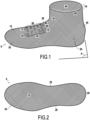
- the first main slipper 5 represented on the figures 1 and 2 comprises a sole part 10, a forefoot part 15, a lateral part 20, a medial part 25 and a rear part 30.
- the first main liner 5 is in particular in a unitary knitted textile envelope 35, in particular with mesh picked, having an internal volume 40 configured to receive the user's foot.
- the rear 30, lateral 20, medial 25 and forefoot 15 parts project vertically from the plane P comprising the sole part 10.
- the lateral 20 and medial 25 parts are arranged between and in connection with the rear parts 30 and forefoot 15.
- the forefoot portion 15 includes in the instep area 18 first and second sets of lacing through openings 45, 50.
- Each first and second set of lacing through openings 45, 50 includes five sets of two openings 55 , 60 , the two openings 57 , 58 ; 67 , 68 of each set 55 , 60 being separated by a knitted portion forming first and second bridges 70 , 75.
- the first bridges 70 and the second bridges 75 are substantially aligned by sets of openings 55 , 60 in a transverse direction T substantially perpendicular to the longitudinal axis L of the first main shoe 15.
- the forefoot part 15 also comprises in the instep area 18 , a set of through ventilation openings 80 , in particular arranged between the two sets of through lacing openings 45 , 50.
- set of ventilation openings 80 is arranged in a zone of the first main liner 15 substantially centered between the medial 25 and lateral parts 20.
- the set of ventilation openings 80 comprises for example ten through openings.
- the first main slipper 5 represented at the figure 1 comprises at the region for the introduction of the foot 16 , a zone in the form of a closed collar 90 , in a mesh pattern of the rib type n 5, for example 1x1, or 1x2 ribs.
- This zone 90 thus forms a flexible and elastic border facilitating the insertion of the foot.
- the first main liner 5 is secured to an outsole 100 comprising a set of studs 105 , in particular arranged for the practice of football, projecting from its external face 101.
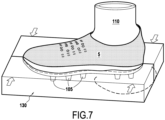
- the first main shoe 5 is placed on a rigid preform 110 in the shape of a foot. It is possible to arrange a lace in the first and second sets of through-lace lacing openings 45 , 50 in order to facilitate the positioning and plating of the first liner main 5 on the preform 110. Then, the sole part 10 of the first main slipper 5 is placed in a counter-mold 130 (in one or two parts) so that the external face of the sole part 10 projects into the interior volume of the counter-mold into which a polymer composition is injected for the manufacture of the outsole 100. The preform 110 is removed from the mold, the first main liner 5 and the outsole 100 comprising studs 105 are thus united (see Figure 4 ).
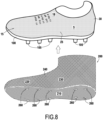
- a first auxiliary liner 200 in a textile part of which at least part or all of which is hot melt and has a melting temperature T1 (°C) is placed on the first main liner 5 and the outsole 100 so to cover, at least in part, the first main liner 5, the outsole 100, and the junction 150 between the first main liner 5 and the outsole 100.
- the first auxiliary liner 200 comprises sole parts 210 , forefoot 220, medial 230, lateral 240 and rear 250, of which the forefoot 220, medial 230, lateral 240 and rear 250 parts are found in whole or in part respectively against the forefoot parts , medial, lateral and rear of the first main liner 5.
- the sole part 210 of the first auxiliary liner 200 comprises a set of zones adapted 260 to receive the crampons 105, said zones 260 are in particular through openings from which the crampons 105 project
- the first auxiliary liner 200 is in a fully meltable textile piece having a melting temperature T1.
- the assembly forming the upper 280 comprising the first main shoe 5 and the first auxiliary shoe 200, is subjected to a heating temperature Tc greater than or equal to the temperature T1 so as to obtain complete fusion of the first auxiliary shoe 200
- a heating system is arranged inside the preform 110.
- the shoe 300 obtained, shown in part in transverse section.
- Figure 3 has improved delamination resistance between the outsole 100 and the first main liner 5 since the junction 150 is covered with a polymer film 400 revealing in relief the textile appearance of the first main liner 5. It is also possible , in a complementary manner, to arrange the assembly forming a rod 280 in a mold whose internal face is engraved so as to impart one or more determined pattern(s) to the polymer film 400 according to the regions of the assembly forming upper 280 of shoe 300.
- the first main slipper 5 is in a knitted textile envelope with stitches picked in three dimensions at the outlet of a circular or rectilinear, in particular rectilinear, knitting machine.
- the first main slipper 5 is knitted with multi-filament polyethylene terephthalate yarns of 500 dtex for approximately 204 filaments.
- the mass of the first main shoe 5 is between 100 g/m 2 and 250 g/m 2 , in particular of the order of 170 g/m 2 .
- the first auxiliary slipper 200 is in a textile piece knitted with picked stitches (in three dimensions) on a circular knitting machine from single-component monofilament yarns, in particular polyurethane, whose diameter is between 0.10 mm and 2 mm, in particular of the order of 1 mm.
- the first auxiliary liner 200 may include zones whose density of threads varies so as to create zones having a thickness greater than those of other zones and therefore ultimately a film 400 having zones of greater thickness.
- the mass of the first auxiliary liner 200 is between 30g/m 2 and 200 g/m 2 , in particular of the order of 50g/m 2 .
- the outsole 100 including the studs 105 , has a mass of between 100 g/m 2 and 400 g/m 2 .
- the final mass of the shoe 300 finally depends on the size of the shoe, it is in particular between 200 and 250 g/m 2 (including the laces), particularly for a European size 43.
- the outsole 100 is in this example made of an elastomeric material, in particular TPU.
- FIG. 5 represents in section another example of shoe 500 according to the invention.
- the shoe 500 comprises a first main liner 600 preferably whose melting or decomposition temperature is higher than the temperature Tc, a first auxiliary liner 700 preferably fully hot-melt (T1 lower than Tc), a second main liner 800 preferably whose the melting or decomposition temperature is higher than the temperature Tc, a second auxiliary liner 900 preferably fully hot-melt (T2 lower than Tc) and an outsole 550 comprising studs 560.
- the first and second main liners 600 , 800 and the first and second auxiliary liners 700 , 900 each comprise rear, sole, forefoot, medial and lateral portions.
- the outsole 550 is preferably overmolded, in particular by injection as described with reference to figures 7 And 8 , on the external face 615 of the sole part 610 of the first main liner 600.
- the sole parts of the first and second auxiliary liners 700 , 900 and of the second main liner each comprise a set of zones adapted to receive the studs 560, in particular through openings through which the studs project.
- junction 580 between the outsole 550 and the first main liner 600 is thus completely covered by two layers of polymer films from the first and second auxiliary liners 700 , 900 and the textile envelope of the second main liner 800, thus further improving the resistance to delamination.
- the first main liner 600 comprises in this specific example first and second sets of through openings to form lacing loops similar to those 45 , 50 supported by the first main liner 5 (by virtue of their structures and their placements) but does not include no ventilation openings 80.
- the second main liner 800 includes ventilation openings similar to those 80 of the first main liner 5 (by their structures and their placement).
- the second main liner 800 also includes said first and second set of through openings to form lacing loops, which first and second sets are then not present on the first main liner 600.
- the second main liner 800, the second auxiliary liner 900, and the first auxiliary liner each comprise in their forefoot region at least one lacing opening, in particular two sets of openings lacing arranged on either side of the instep area and arranged to cooperate with the lacing loops of the first main liner so as to project through the lacing openings.
- a 990 lace is passed through the lacing openings, as seen on the Figure 6 .
- the junction 580 between the outsole 550 and the first main liner 600 is invisible.
- the outsole 550 is not visible.
- the first and second main slippers 600 , 800 may be identical or different.
- the first and second auxiliary slippers 700 , 900 may be identical or different, and in particular similar to the first auxiliary slipper 200.
- FIG. 9 represents a shoe 301, which is a variant of the shoe 300, in which the first main liner 51 comprises a first region 52, in particular forming a housing, knitted integrally with the latter 51 and projecting from the internal face 12 of the sole part 11 in the interior volume 53 of the first main liner 51.
- the injected polymer composition intended to form the outsole 102 flows into the knitted housing 52 and fills said housing 52 thus forming a damping element and/or an attachment member.
- the first main liner 51 may comprise a first knitted region 52 disposed in the heel region of the sole part 11 and/or a first knitted region 52 disposed in the forefoot region of the sole part 11. Said member attachment can cooperate with a complementary attachment member supported by an insole for example for their removable attachment.
- FIG. 10 represents a first main liner 1000 in connection with an additional liner 1100 at their respective insertion openings 1010, 1110 of the foot.
- the first main liner 1000 is shown attached to the outsole 1050 provided with studs 1055.
- the additional liner 1100 can thus be folded into the interior volume 1020 of the first main liner 1000 and thus forms a welcome liner.
- the additional liner 1100 can also serve as a first or second auxiliary liner or even as a second main liner within the meaning of the present invention. In the latter, it is necessary to have a first auxiliary shoe between the first main shoe 1000 and the second main shoe formed by the additional shoe 1100.
- the 1200 shoe shown on the Figure 11 comprises a detachable temporary textile part 1210 of unitary textile construction with the first auxiliary liner 1230, which is completely melted and thus forms a thermofused external covering at least partially covering a second main liner 1220.
- the temporary part 1210 is not hot melt, and therefore as visible on the Figure 11 after step vi).
- the second main liner 1220 comprises an instep region 1240 having left edges 1250 and right 1260.
- the temporary detachable textile part 1210 in particular knitted, comprises left edges 1270 and right 1280 in connection, in particular secured, respectively with the left 1250 and right 1260 edges of said instep region 1240, in particular via at least a plurality of breakable connection zones 1290, in particular textile connection loops, in particular knitted.
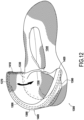
- FIG. 12 represents a variant of the first main liner according to the invention making it possible to form a posterior reinforcing element.
- the first main shoe 1300 represented alone at the Figure 12 and before its assembly with other slippers, thus comprises a rear reinforcing element 1400 of unitary textile construction with the first main slipper 1300 , and consisting partially or entirely, preferably entirely, of hot-melt threads whose temperature(s) melting temperature is/are lower than Tc.
- the textile rear reinforcing element 1400 is completely or partially melted.
- the posterior reinforcing element 1400 is shown on the Figure 12 before its folding into the internal volume 1350 for receiving the foot of the first main liner 1300.
- the rear reinforcing element 1400 is folded in the direction of the arrow shown in Figure 12 so as to end up on the finished shoe as if opening directly into the internal volume receiving the foot of the shoe.
- the rear reinforcing element 1400 is manufactured during the knitting or weaving of the first main liner 1300.
- the rear reinforcing element 1400 extends at least partially in the rear 1360 , lateral 1370 and medial 1380 parts of the first main liner 1300.
- the main reinforcing element 1300 has an open C shape on the front part 1340 of the first main liner 1300.
- the main reinforcing element 1400 is preferably a textile housing, in particular a textile pocket, in particular projecting from the insertion zone of the foot 1330 of the first main liner 1300.
- the shoe comprises an elastically deformable element 1500, in particular a foam, placed in the interior volume of the textile housing of the posterior reinforcing element 1400.
- the elastically deformable element can be deformed and/or compressed and recover its initial shape substantially without residual deformation, or with a residual deformation of less than 5% relative to its initial dimensions.
- the elastically deformable element comprises rear, lateral and medial portions.
- the posterior reinforcing element 1400 preferably comprises at least one opening 1410 , in particular at least two openings 1410,1420, allowing access to its interior volume to place the elastically deformable element 1500 there.
- the posterior reinforcing element 1400 undergoes step vi) in a folded state against, at least partially, the rear, lateral and medial parts of the first main liner 1300 , so that it finds itself secured by gluing to these parts of the first main shoe 1300.
- the openings 1410 and 1420 are then closed by the melted hot-melt wires.
- the elastically deformable element is thus perfectly maintained in the housing of the posterior reinforcing element 1400.
Landscapes
- Engineering & Computer Science (AREA)
- Mechanical Engineering (AREA)
- Chemical & Material Sciences (AREA)
- Materials Engineering (AREA)
- Health & Medical Sciences (AREA)
- General Health & Medical Sciences (AREA)
- Physical Education & Sports Medicine (AREA)
- Footwear And Its Accessory, Manufacturing Method And Apparatuses (AREA)
- Knitting Of Fabric (AREA)
Applications Claiming Priority (3)
| Application Number | Priority Date | Filing Date | Title |
|---|---|---|---|
| FR1855042A FR3082103B1 (fr) | 2018-06-08 | 2018-06-08 | Procede de fabrication d'une chaussure, et chaussure susceptible d'etre obtenue par ledit procede |
| EP19791304.9A EP3801102B1 (de) | 2018-06-08 | 2019-06-07 | Verfahren zur herstellung eines schuhs und nach diesem verfahren erhältlicher schuh |
| PCT/FR2019/051390 WO2019234374A1 (fr) | 2018-06-08 | 2019-06-07 | Procede de fabrication d'une chaussure, et chaussure susceptible d'etre obtenue par ledit procede |
Related Parent Applications (1)
| Application Number | Title | Priority Date | Filing Date |
|---|---|---|---|
| EP19791304.9A Division EP3801102B1 (de) | 2018-06-08 | 2019-06-07 | Verfahren zur herstellung eines schuhs und nach diesem verfahren erhältlicher schuh |
Publications (2)
| Publication Number | Publication Date |
|---|---|
| EP4400296A2 true EP4400296A2 (de) | 2024-07-17 |
| EP4400296A3 EP4400296A3 (de) | 2024-10-02 |
Family
ID=63407413
Family Applications (2)
| Application Number | Title | Priority Date | Filing Date |
|---|---|---|---|
| EP24178821.5A Pending EP4400296A3 (de) | 2018-06-08 | 2019-06-07 | Verfahren zur herstellung eines schuhs und durch dieses verfahren erhältlicher schuh |
| EP19791304.9A Active EP3801102B1 (de) | 2018-06-08 | 2019-06-07 | Verfahren zur herstellung eines schuhs und nach diesem verfahren erhältlicher schuh |
Family Applications After (1)
| Application Number | Title | Priority Date | Filing Date |
|---|---|---|---|
| EP19791304.9A Active EP3801102B1 (de) | 2018-06-08 | 2019-06-07 | Verfahren zur herstellung eines schuhs und nach diesem verfahren erhältlicher schuh |
Country Status (7)
| Country | Link |
|---|---|
| US (1) | US11553759B2 (de) |
| EP (2) | EP4400296A3 (de) |
| CN (1) | CN112638191B (de) |
| ES (1) | ES2984219T3 (de) |
| FR (1) | FR3082103B1 (de) |
| PL (1) | PL3801102T3 (de) |
| WO (1) | WO2019234374A1 (de) |
Families Citing this family (14)
| Publication number | Priority date | Publication date | Assignee | Title |
|---|---|---|---|---|
| US11439206B2 (en) * | 2019-12-17 | 2022-09-13 | Under Armour, Inc. | Method of making an article of footwear with braided upper |
| IT202000001459A1 (it) * | 2020-01-24 | 2021-07-24 | Trere Innovation S R L | Struttura e procedimento di realizzazione di una scarpa con tomaia in maglia. |
| FR3107437B1 (fr) | 2020-02-25 | 2022-04-29 | Decathlon Sa | Procédé de fabrication d’une structure de semelle comprenant un élément de semelle textile intégralement ou en partie thermofondu, et article chaussant comprenant une telle structure de semelle. |
| FR3107436B1 (fr) | 2020-02-25 | 2022-03-04 | Decathlon Sa | Article chaussant comprenant un élément textile principal comprenant un chausson textile principal et au moins une première partie textile additionnelle, et procédé de fabrication d’un tel article chaussant |
| JP2022127292A (ja) * | 2021-02-19 | 2022-08-31 | 株式会社アシックス | 靴 |
| JP7568539B2 (ja) * | 2021-02-19 | 2024-10-16 | 株式会社アシックス | 靴の製造方法 |
| FR3133979B1 (fr) | 2022-03-29 | 2025-06-27 | Decathlon Sa | Article chaussant, et procédé de fabrication d’un tel article chaussant |
| FR3133978B1 (fr) | 2022-03-29 | 2025-03-21 | Decathlon Sa | Semelage, article chaussant comprenant un tel semelage, et procédés de fabrication dudit semelage et dudit article chaussant |
| FR3133977B1 (fr) | 2022-03-29 | 2024-07-19 | Decathlon Sa | Article chaussant, et procédé de fabrication d’un tel article chaussant |
| US20240197032A1 (en) | 2022-12-15 | 2024-06-20 | Nike, Inc. | Recyclable footwear article |
| FR3145310A1 (fr) * | 2023-01-26 | 2024-08-02 | Decathlon | Pneu dont la bande de roulement est formée entièrement ou en partie d’un matériau composite de construction moulée unitaire |
| FR3162343A1 (fr) | 2024-05-22 | 2025-11-28 | Decathlon | Article chaussant pour la pratique de l’escalade, et procédé de fabrication d’un article chaussant pour la pratique de l’escalade. |
| FR3162345A1 (fr) | 2024-05-22 | 2025-11-28 | Decathlon | Procédé de fabrication d’un article chaussant, en particulier pour la pratique d’un sport, et article chaussant susceptible d’être obtenu par ledit procédé de fabrication, en particulier pour la pratique d’un sport. |
| JP2025187414A (ja) * | 2024-06-13 | 2025-12-25 | 株式会社アシックス | シューズ |
Citations (3)
| Publication number | Priority date | Publication date | Assignee | Title |
|---|---|---|---|---|
| WO2014130598A2 (en) | 2013-02-22 | 2014-08-28 | Nike International Ltd. | Bottom-down last for 3d forming |
| EP2815668A1 (de) | 2012-02-17 | 2014-12-24 | ASICS Corporation | Schuh und herstellungsverfahren dafür |
| FR3007317A1 (fr) | 2013-06-25 | 2014-12-26 | Salomon Sas | Procede de fabrication d'un objet creux |
Family Cites Families (117)
| Publication number | Priority date | Publication date | Assignee | Title |
|---|---|---|---|---|
| US2538673A (en) | 1949-07-19 | 1951-01-16 | Donahue Paul Ansley | Footwear |
| US2740143A (en) | 1950-05-10 | 1956-04-03 | Superga Societa Per Azioni | Apparatus for applying rubber soles to articles of rubber footwear |
| GB1223285A (en) | 1967-08-29 | 1971-02-24 | Onitsuka Co | Improvements in shoes |
| IT990148B (it) | 1972-09-21 | 1975-06-20 | Olivier Guille Et Fils Sa Ets | Capo di vestiario e relativo proce dimento di produzione |
| DE2701359A1 (de) | 1976-03-12 | 1977-09-15 | James R Hanrahan | Verfahren zur herstellung von fussbekleidung |
| US4317292A (en) | 1979-12-04 | 1982-03-02 | Florence Melton | Slipper sock and method of manufacture |
| AU1977192A (en) | 1991-06-17 | 1993-01-12 | Puma Aktiengesellschaft Rudolf Dassler Sport | Method of producing a shaped shoe part from a strip of fabric, and a shaped shoe part produced by this method |
| US5617585A (en) | 1995-07-13 | 1997-04-08 | Fons; Roger D. | Rubber soled slipper sock |
| US6308438B1 (en) | 1999-11-15 | 2001-10-30 | James L. Throneburg | Slipper sock moccasin and method of making same |
| US20030089000A1 (en) | 2001-11-14 | 2003-05-15 | Tony Tseng | Shoe and shoe upper |
| US20030126762A1 (en) | 2002-01-10 | 2003-07-10 | Tony Tseng | Three-dimensional spatial shoe vamp |
| DE60303447D1 (de) | 2002-06-12 | 2006-04-13 | Claudio Moscato | Verfahren zur herstellung von einem schuh mit einer pu zwischensohle und damit angeordneter kunststoff laufsohle und durch dieses verfahren hergestellter schuh |
| JP4505212B2 (ja) | 2003-01-10 | 2010-07-21 | 美津濃株式会社 | シューズ及びこれに用いるダブルラッセル経編地 |
| GB2408190A (en) | 2003-10-29 | 2005-05-25 | Marc Gibson Collinson | Footwear liners |
| US7347011B2 (en) | 2004-03-03 | 2008-03-25 | Nike, Inc. | Article of footwear having a textile upper |
| GB0407584D0 (en) | 2004-04-05 | 2004-05-05 | Collinson Marc G | Sock-like footwear with padded sole and method for making the same |
| US7836608B2 (en) | 2004-12-06 | 2010-11-23 | Nike, Inc. | Article of footwear formed of multiple links |
| US7849609B2 (en) * | 2006-03-31 | 2010-12-14 | Nike, Inc. | Interior and upper members for articles of footwear and other foot-receiving devices |
| US8225530B2 (en) | 2006-11-10 | 2012-07-24 | Nike, Inc. | Article of footwear having a flat knit upper construction or other upper construction |
| US7774956B2 (en) | 2006-11-10 | 2010-08-17 | Nike, Inc. | Article of footwear having a flat knit upper construction or other upper construction |
| US7788827B2 (en) | 2007-03-06 | 2010-09-07 | Nike, Inc. | Article of footwear with mesh on outsole and insert |
| JP5610490B2 (ja) | 2008-09-26 | 2014-10-22 | ナイキ イノベイト シーブイ | フラット成形靴アッパーを有する靴 |
| US8490299B2 (en) | 2008-12-18 | 2013-07-23 | Nike, Inc. | Article of footwear having an upper incorporating a knitted component |
| ES2346393B1 (es) | 2009-03-26 | 2011-09-14 | Adrian Hernandez Hernandez | Procedimiento de fabricacion de calzado. |
| US8321984B2 (en) | 2009-10-21 | 2012-12-04 | Nike, Inc. | Composite shoe upper and method of making same |
| US8839532B2 (en) | 2011-03-15 | 2014-09-23 | Nike, Inc. | Article of footwear incorporating a knitted component |
| US8800172B2 (en) | 2011-04-04 | 2014-08-12 | Nike, Inc. | Article of footwear having a knit upper with a polymer layer |
| US9365960B2 (en) | 2011-04-20 | 2016-06-14 | Nike, Inc. | Sock with zones of varying layers |
| EP2751321A4 (de) | 2011-08-30 | 2015-04-29 | Nike Innovate Cv | Zubehör für einen gewebten textilstoff |
| WO2013050629A1 (es) | 2011-10-05 | 2013-04-11 | Simplicity Works Europe, S.L. | Procedimiento de fabricación de calzado |
| CN104185431B (zh) | 2012-01-02 | 2017-02-22 | 全星有限合伙公司 | 包括具有网材料的鞋面的鞋类物品 |
| BR112014017690A8 (pt) | 2012-01-20 | 2017-07-11 | Shima Seiki Mfg | Calçado e método de fazer malha para tecido de malha |
| US9510636B2 (en) | 2012-02-20 | 2016-12-06 | Nike, Inc. | Article of footwear incorporating a knitted component with an integral knit tongue |
| US20130255103A1 (en) | 2012-04-03 | 2013-10-03 | Nike, Inc. | Apparel And Other Products Incorporating A Thermoplastic Polymer Material |
| DE102012206062B4 (de) | 2012-04-13 | 2019-09-12 | Adidas Ag | Schuhoberteil |
| CN103653542B (zh) * | 2012-09-25 | 2015-07-29 | 总成实业股份有限公司 | 立体鞋面的织造方法 |
| US20140130373A1 (en) * | 2012-11-15 | 2014-05-15 | Nike, Inc. | Article Of Footwear Incorporating A Knitted Component |
| US9498023B2 (en) | 2012-11-20 | 2016-11-22 | Nike, Inc. | Footwear upper incorporating a knitted component with sock and tongue portions |
| US10182617B2 (en) | 2012-11-20 | 2019-01-22 | Nike, Inc. | Footwear upper incorporating a knitted component with collar and throat portions |
| US9861160B2 (en) | 2012-11-30 | 2018-01-09 | Nike, Inc. | Article of footwear incorporating a knitted component |
| EP2742820B1 (de) | 2012-12-14 | 2015-03-18 | W.L. Gore & Associates GmbH | Monofilamentschuhfutter |
| FR2999881B1 (fr) | 2012-12-21 | 2015-06-12 | Salomon Sas | Article chaussant a structure simplifiee |
| JP5980409B2 (ja) | 2013-02-25 | 2016-08-31 | 株式会社島精機製作所 | シューズアッパーの編成方法 |
| FR3002551B1 (fr) | 2013-02-26 | 2015-08-14 | Anton Percy Spielmann | Procede de tricotage d'un element chaussant et element chaussant obtenu par un tel procede. |
| US9545128B2 (en) | 2013-03-04 | 2017-01-17 | Nike, Inc. | Article of footwear incorporating a knitted component with tensile strand |
| US9848672B2 (en) | 2013-03-04 | 2017-12-26 | Nike, Inc. | Article of footwear incorporating a knitted component with integrally knit contoured portion |
| DE102013207163B4 (de) | 2013-04-19 | 2022-09-22 | Adidas Ag | Schuhoberteil |
| DE102013207155B4 (de) | 2013-04-19 | 2020-04-23 | Adidas Ag | Schuhoberteil |
| US10306946B2 (en) | 2013-05-14 | 2019-06-04 | Nike, Inc. | Article of footwear having heel portion with knitted component |
| US9439475B2 (en) | 2013-06-21 | 2016-09-13 | Shima Seiki Mfg., Ltd. | Method for producing shoe upper and shoe upper |
| DE102013107800A1 (de) | 2013-07-22 | 2015-01-22 | Visiotex GmbH | Herstellung eines Schuhs mit einem Schaft aus einem dreidimensional geformten Gestrick |
| DE102013107803A1 (de) | 2013-07-22 | 2015-01-22 | Visiotex GmbH | Elastischer Schuh |
| US9611571B2 (en) | 2013-08-23 | 2017-04-04 | Shima Seiki Mfg., Ltd. | Shoe upper and method for producing shoe upper |
| JP5597784B1 (ja) | 2013-10-15 | 2014-10-01 | 有限会社Itoi生活文化研究所 | 織物 |
| US9723890B2 (en) | 2013-11-22 | 2017-08-08 | Nike, Inc. | Article of footwear incorporating a knitted component with body and heel portions |
| FR3014120B1 (fr) | 2013-11-29 | 2016-05-13 | Chamatex | Procede d'obtention d'un tissu technique sectorise multifonctionnel, utilisable directement pour fabriquer divers articles ou produits finis |
| WO2015117145A1 (en) | 2014-02-03 | 2015-08-06 | The University Of Chicago | Compositions and methods for quantitative assesment of dna-protein complex density |
| US9072335B1 (en) | 2014-02-03 | 2015-07-07 | Nike, Inc. | Knitted component for an article of footwear including a full monofilament upper |
| US20150230550A1 (en) | 2014-02-14 | 2015-08-20 | W. L. Gore & Associates, Gmbh | Methods for Forming Seamless Conformable Booties and Waterproof Breathable Socks |
| US20150230563A1 (en) | 2014-02-14 | 2015-08-20 | W. L. Gore & Associates, Gmbh | Methods for Forming Seamless Shoe Inserts |
| US20150230541A1 (en) | 2014-02-14 | 2015-08-20 | W. L. Gore & Associates, Gmbh | Conformable Booties, Shoe Inserts, and Footwear Assemblies Made Therewith, and Waterproof Breathable Socks |
| US20150230554A1 (en) | 2014-02-14 | 2015-08-20 | W. L. Gore & Associates, Gmbh | Conformable Booties, Shoe Inserts, and Waterproof Breathable Socks Containing an Integrally Joined Interface |
| US10182619B2 (en) | 2014-02-21 | 2019-01-22 | Nike, Inc. | Article of footwear incorporating a woven or non-woven textile with durable water repellant properties |
| KR101500624B1 (ko) | 2014-03-20 | 2015-03-12 | 강방석 | 원단조직을 이용한 고무 몰딩방법 |
| KR101437472B1 (ko) | 2014-04-15 | 2014-11-04 | 송수복 | 신발 갑피, 그 제조방법 및 이를 이용한 신발 |
| KR101604121B1 (ko) | 2014-04-29 | 2016-03-16 | (주)아셈스 | 접착성 원단이 피복된 미드솔 |
| CN103919331A (zh) | 2014-04-30 | 2014-07-16 | 福建省莆田市双驰科技有限公司 | 一种制作鞋的方法 |
| TW201607448A (zh) | 2014-06-30 | 2016-03-01 | 島精機製作所股份有限公司 | 鞋面 |
| CN106686999B (zh) | 2014-07-10 | 2019-03-15 | 内聚系统有限公司 | 衣物及其它织物制品的粘合制造方法 |
| FR3024022B1 (fr) * | 2014-07-22 | 2017-04-28 | Salomon Sas | Article chaussant a structure amelioree |
| CN203986311U (zh) | 2014-08-12 | 2014-12-10 | 新尚领(福建)服饰科技有限公司 | 一种具有鞋带环线结构的横编针织鞋面及运动鞋 |
| KR101604122B1 (ko) | 2014-08-12 | 2016-03-16 | (주)아셈스 | 환편으로 직조된 접착성 원단 |
| US9903054B2 (en) | 2014-08-27 | 2018-02-27 | Nike, Inc. | Knitted component having tensile strand for adjusting auxetic portion |
| US20160058099A1 (en) | 2014-08-29 | 2016-03-03 | Nike, Inc. | Article of Footwear Incorporating a Knitted Component with Monofilament Areas in Body and Heel Portions |
| US9301567B2 (en) | 2014-08-29 | 2016-04-05 | Nike, Inc. | Article of footwear incorporating a knitted component with monofilament areas |
| BE1022599B1 (nl) | 2014-10-16 | 2016-06-14 | Lyval Cvba | Integraalschoen en werkwijze voor het vervaardigen daarvan |
| TWM493278U (zh) | 2014-10-21 | 2015-01-11 | Deertex Inc | 具有透氣耐磨梭織鞋面之鞋類組件 |
| US9668544B2 (en) | 2014-12-10 | 2017-06-06 | Nike, Inc. | Last system for articles with braided components |
| TW201632094A (zh) | 2014-12-25 | 2016-09-16 | 島精機製作所股份有限公司 | 鞋之編織方法、鞋之製造方法、及鞋 |
| FR3031015B1 (fr) | 2014-12-31 | 2017-04-28 | Salomon Sas | Procede de fabrication d'un article chaussant |
| EP3244763B1 (de) | 2015-01-16 | 2025-03-05 | NIKE Innovate C.V. | Gestrickte komponente mit stollenelement |
| US9848673B2 (en) | 2015-01-16 | 2017-12-26 | Nike, Inc. | Vacuum formed knit sole system for an article of footwear incorporating a knitted component |
| US9775401B2 (en) * | 2015-01-16 | 2017-10-03 | Nike, Inc. | Sole system for an article of footwear incorporating a knitted component with a one-piece knit outsole |
| US9820530B2 (en) | 2015-01-16 | 2017-11-21 | Nike, Inc. | Knit article of footwear with customized midsole and customized cleat arrangement |
| US10568383B2 (en) | 2015-01-16 | 2020-02-25 | Nike, Inc. | Sole system for an article of footwear incorporating a knitted component with a one-piece knit outsole and a tensile element |
| DE102015204268B4 (de) | 2015-03-10 | 2025-11-27 | Adidas Ag | Sohlen für Sportschuhe, sowie deren Herstellung |
| EP3545784B1 (de) | 2015-03-31 | 2024-08-28 | adidas AG | Schuhoberteil für sportschuhe |
| FR3034292B1 (fr) * | 2015-03-31 | 2018-01-12 | Salomon Sas | Article chaussant a structure etanche |
| WO2016208982A1 (ko) | 2015-06-25 | 2016-12-29 | (주)아셈스 | 환편으로 직조된 접착성 원단 및 이를 이용한 입체 문양 형성방법 |
| CN106702648A (zh) | 2015-09-01 | 2017-05-24 | 丁守企业股份有限公司 | 多层织物结构、多层立体织物的制造方法及其结构 |
| US10721997B2 (en) | 2015-09-11 | 2020-07-28 | Nike, Inc. | Method of manufacturing article of footwear with graduated projections |
| US9888742B2 (en) | 2015-09-11 | 2018-02-13 | Nike, Inc. | Article of footwear with knitted component having plurality of graduated projections |
| DE102015219636B4 (de) * | 2015-10-09 | 2023-11-23 | Adidas Ag | Herstellungsverfahren zum Beschichten eines Gewebes mit einer dreidimensionalen Form |
| EP3378620A4 (de) | 2015-11-20 | 2019-01-23 | Simplicity Works Europe S.L. | Verfahren zur herstellung von dreidimensionalen gegenständen mit einer flexiblen wand |
| KR101634333B1 (ko) | 2015-11-27 | 2016-06-28 | (주)아셈스 | 횡편 자카드 방식으로 직조된 접착성 원단을 이용한 표면 몰딩 방법 |
| WO2017127441A1 (en) | 2016-01-19 | 2017-07-27 | Lyke Christopher J | Footwear with embroidery transition between materials |
| CN205529503U (zh) | 2016-01-26 | 2016-08-31 | 丁守企业股份有限公司 | 立体防水透气织物结构 |
| MX2018009971A (es) | 2016-02-16 | 2019-03-28 | Nike Innovate Cv | Forro impermeabilizado para un articulo de calzado. |
| EP3563713B1 (de) | 2016-05-16 | 2022-08-24 | adidas AG | Strukturiertes dreidimensional geformtes schuhwerk |
| US11324282B2 (en) | 2016-05-16 | 2022-05-10 | Adidas Ag | Three-dimensionally thermo-molded footwear |
| CN106108237B (zh) | 2016-07-05 | 2017-09-29 | 晋江市池店镇娇鹏贸易有限公司 | 一种耐弯曲的鞋底材料 |
| WO2018009414A1 (en) | 2016-07-06 | 2018-01-11 | Nike Innovate C.V. | Article with multiple layers and method of manufacture |
| MX2019000830A (es) | 2016-07-21 | 2019-07-04 | Nike Innovate Cv | Articulo de calzado con multiples capas, sistemas de retencion para un articulo de calzado, y metodos de fabricacion. |
| WO2018089704A1 (en) | 2016-11-09 | 2018-05-17 | Nike Innovate C. V. | Textiles and articles, and processes for making the same |
| CN106666911A (zh) | 2017-02-20 | 2017-05-17 | 晋江市达亿经编织造有限公司 | 一种编织鞋体、制造方法及编织鞋 |
| TWI667965B (zh) | 2017-03-10 | 2019-08-11 | 薩摩亞商紘織國際有限公司 | Method for manufacturing integrally formed shoe blank |
| CN114847582B (zh) * | 2017-05-05 | 2025-05-06 | 耐克创新有限合伙公司 | 具有两种或更多种材料组合物的用于鞋类物品的针织部件 |
| CN110691530B (zh) * | 2017-05-30 | 2022-03-01 | 耐克创新有限合伙公司 | 用于编结的鞋类的机械锁鞋底结构 |
| CN107348601B (zh) | 2017-08-08 | 2023-04-21 | 信泰(福建)科技有限公司 | 一种具有织带的针织一体鞋及其编织工艺 |
| CN207041027U (zh) | 2017-08-08 | 2018-02-27 | 信泰(福建)科技有限公司 | 一种具有织带的针织一体鞋 |
| WO2019081767A1 (de) | 2017-10-27 | 2019-05-02 | Jomo Thermomolding Gmbh & Co. Kg | Verfahren zur herstellung eines schuhs mit einem über ein thermoformungsverfahren erzeugten dreidimensionalen (3d) schaft und einem daraus gefertigten schuh |
| DE102017223743B4 (de) | 2017-12-22 | 2025-07-10 | Adidas Ag | Verfahren zur Herstellung einer Sportartikelkomponente |
| DE102017223746B4 (de) | 2017-12-22 | 2024-03-14 | Adidas Ag | Rundstrick-Schuhoberteil |
| DE102018200453A1 (de) | 2018-01-12 | 2019-07-18 | Adidas Ag | Speziell-gestalteter Schuh oder speziell-gestaltete Bekleidung |
| WO2019234274A1 (es) | 2018-06-04 | 2019-12-12 | Servicio Andaluz De Salud | Modelo predictivo para predecir el desarrollo de diabetes mellitus tipo 2 usando miarns |
| US11020922B2 (en) | 2018-07-27 | 2021-06-01 | Adidas Ag | Footwear with padding and midsole structures and the method of making the same |
| US11109641B2 (en) * | 2019-03-22 | 2021-09-07 | Nike, Inc. | Article of footwear having a skin layer between a knitted component and a sole structure |
-
2018
- 2018-06-08 FR FR1855042A patent/FR3082103B1/fr active Active
-
2019
- 2019-06-07 EP EP24178821.5A patent/EP4400296A3/de active Pending
- 2019-06-07 US US16/972,093 patent/US11553759B2/en active Active
- 2019-06-07 CN CN201980053815.7A patent/CN112638191B/zh active Active
- 2019-06-07 PL PL19791304.9T patent/PL3801102T3/pl unknown
- 2019-06-07 WO PCT/FR2019/051390 patent/WO2019234374A1/fr not_active Ceased
- 2019-06-07 EP EP19791304.9A patent/EP3801102B1/de active Active
- 2019-06-07 ES ES19791304T patent/ES2984219T3/es active Active
Patent Citations (3)
| Publication number | Priority date | Publication date | Assignee | Title |
|---|---|---|---|---|
| EP2815668A1 (de) | 2012-02-17 | 2014-12-24 | ASICS Corporation | Schuh und herstellungsverfahren dafür |
| WO2014130598A2 (en) | 2013-02-22 | 2014-08-28 | Nike International Ltd. | Bottom-down last for 3d forming |
| FR3007317A1 (fr) | 2013-06-25 | 2014-12-26 | Salomon Sas | Procede de fabrication d'un objet creux |
Also Published As
| Publication number | Publication date |
|---|---|
| EP3801102A1 (de) | 2021-04-14 |
| FR3082103B1 (fr) | 2020-08-28 |
| CN112638191A (zh) | 2021-04-09 |
| WO2019234374A1 (fr) | 2019-12-12 |
| CN112638191B (zh) | 2024-05-28 |
| EP3801102B1 (de) | 2024-06-12 |
| PL3801102T3 (pl) | 2024-09-30 |
| FR3082103A1 (fr) | 2019-12-13 |
| EP3801102C0 (de) | 2024-06-12 |
| US20210219659A1 (en) | 2021-07-22 |
| ES2984219T3 (es) | 2024-10-29 |
| US11553759B2 (en) | 2023-01-17 |
| EP4400296A3 (de) | 2024-10-02 |
Similar Documents
| Publication | Publication Date | Title |
|---|---|---|
| EP3801102B1 (de) | Verfahren zur herstellung eines schuhs und nach diesem verfahren erhältlicher schuh | |
| EP4110127B1 (de) | Verfahren zur herstellung einer sohlenstruktur mit vollständig oder teilweise warmgeformten textilen sohlenelement und schuhwerk mit solch einer sohlenstruktur | |
| CN106037143A (zh) | 运动鞋的鞋底 | |
| EP4110130B1 (de) | Textiler schuhartikel und herstellungsverfahren | |
| EP3998895B1 (de) | Verfahren zur herstellung eines schuhartikels | |
| WO2023186896A1 (fr) | Article chaussant, et procede de fabrication d'un tel article chaussant | |
| EP4498855A1 (de) | Schuhartikel und verfahren zur herstellung solch eines schuhartikels | |
| EP3999328B1 (de) | Verfahren zur herstellung eines schuhwerkes | |
| FR3133008A1 (fr) | Chaussure, en particulier chaussure de sport, et procédé de fabrication d’une telle chaussure de sport | |
| EP4369978A1 (de) | Sohlenelement, schuhwerkartikel mit solch einem sohlenelement und verfahren zur herstellung solch eines sohlenelements und solch eines schuhwerkartikels | |
| EP1421866B1 (de) | Verfahren zur Herstellung eines Teils eines Sportschuhes | |
| EP4499396A1 (de) | Bodenanordnung, schuhwerkartikel mit solch einer bodenanordnung und verfahren zur herstellung der bodenanordnung und des schuhwerkartikels | |
| EP3998894B1 (de) | Verfahren zur herstellung eines schuhwerks | |
| FR3162343A1 (fr) | Article chaussant pour la pratique de l’escalade, et procédé de fabrication d’un article chaussant pour la pratique de l’escalade. | |
| WO2025242694A1 (fr) | Procede de fabrication d'un article chaussant, en particulier pour la pratique d'un sport, et article chaussant susceptible d'etre obtenu par ledit procede de fabrication | |
| JP2001009930A (ja) | ストーム巻き射出成形靴およびその製造方法 |
Legal Events
| Date | Code | Title | Description |
|---|---|---|---|
| PUAI | Public reference made under article 153(3) epc to a published international application that has entered the european phase |
Free format text: ORIGINAL CODE: 0009012 |
|
| STAA | Information on the status of an ep patent application or granted ep patent |
Free format text: STATUS: THE APPLICATION HAS BEEN PUBLISHED |
|
| AC | Divisional application: reference to earlier application |
Ref document number: 3801102 Country of ref document: EP Kind code of ref document: P |
|
| AK | Designated contracting states |
Kind code of ref document: A2 Designated state(s): AL AT BE BG CH CY CZ DE DK EE ES FI FR GB GR HR HU IE IS IT LI LT LU LV MC MK MT NL NO PL PT RO RS SE SI SK SM TR |
|
| REG | Reference to a national code |
Ref country code: DE Ref legal event code: R079 Free format text: PREVIOUS MAIN CLASS: B29D0035140000 Ipc: A43B0005020000 Ref country code: DE Ref legal event code: R079 Ref document number: 602019081988 Country of ref document: DE Free format text: PREVIOUS MAIN CLASS: B29D0035140000 Ipc: A43B0005020000 |
|
| PUAL | Search report despatched |
Free format text: ORIGINAL CODE: 0009013 |
|
| AK | Designated contracting states |
Kind code of ref document: A3 Designated state(s): AL AT BE BG CH CY CZ DE DK EE ES FI FR GB GR HR HU IE IS IT LI LT LU LV MC MK MT NL NO PL PT RO RS SE SI SK SM TR |
|
| RIC1 | Information provided on ipc code assigned before grant |
Ipc: B29D 35/14 20100101ALI20240829BHEP Ipc: B29D 35/12 20100101ALI20240829BHEP Ipc: A43B 1/04 20220101ALI20240829BHEP Ipc: A43B 23/02 20060101ALI20240829BHEP Ipc: A43B 23/04 20060101ALI20240829BHEP Ipc: A43B 5/02 20060101AFI20240829BHEP |
|
| STAA | Information on the status of an ep patent application or granted ep patent |
Free format text: STATUS: REQUEST FOR EXAMINATION WAS MADE |
|
| 17P | Request for examination filed |
Effective date: 20250328 |
|
| GRAP | Despatch of communication of intention to grant a patent |
Free format text: ORIGINAL CODE: EPIDOSNIGR1 |
|
| STAA | Information on the status of an ep patent application or granted ep patent |
Free format text: STATUS: GRANT OF PATENT IS INTENDED |
|
| INTG | Intention to grant announced |
Effective date: 20250919 |
|
| GRAS | Grant fee paid |
Free format text: ORIGINAL CODE: EPIDOSNIGR3 |
|
| GRAA | (expected) grant |
Free format text: ORIGINAL CODE: 0009210 |
|
| STAA | Information on the status of an ep patent application or granted ep patent |
Free format text: STATUS: THE PATENT HAS BEEN GRANTED |