EP4393348B1 - Gleitschienenanordnung - Google Patents
Gleitschienenanordnung Download PDFInfo
- Publication number
- EP4393348B1 EP4393348B1 EP23178095.8A EP23178095A EP4393348B1 EP 4393348 B1 EP4393348 B1 EP 4393348B1 EP 23178095 A EP23178095 A EP 23178095A EP 4393348 B1 EP4393348 B1 EP 4393348B1
- Authority
- EP
- European Patent Office
- Prior art keywords
- rail
- working member
- state
- feature
- relative
- Prior art date
- Legal status (The legal status is an assumption and is not a legal conclusion. Google has not performed a legal analysis and makes no representation as to the accuracy of the status listed.)
- Active
Links
Images






Classifications
-
- A—HUMAN NECESSITIES
- A47—FURNITURE; DOMESTIC ARTICLES OR APPLIANCES; COFFEE MILLS; SPICE MILLS; SUCTION CLEANERS IN GENERAL
- A47B—TABLES; DESKS; OFFICE FURNITURE; CABINETS; DRAWERS; GENERAL DETAILS OF FURNITURE
- A47B88/00—Drawers for tables, cabinets or like furniture; Guides for drawers
- A47B88/40—Sliding drawers; Slides or guides therefor
- A47B88/44—Sequencing or synchronisation of drawer slides or functional units
- A47B88/45—Synchronisation of cooperating drawer slides, i.e. with a coordination of the rail movement of different drawer slides
-
- A—HUMAN NECESSITIES
- A47—FURNITURE; DOMESTIC ARTICLES OR APPLIANCES; COFFEE MILLS; SPICE MILLS; SUCTION CLEANERS IN GENERAL
- A47B—TABLES; DESKS; OFFICE FURNITURE; CABINETS; DRAWERS; GENERAL DETAILS OF FURNITURE
- A47B88/00—Drawers for tables, cabinets or like furniture; Guides for drawers
- A47B88/40—Sliding drawers; Slides or guides therefor
- A47B88/44—Sequencing or synchronisation of drawer slides or functional units
- A47B88/443—Successive movement of rails within drawer slides, i.e. at least one rail element is not moving during the movement of other elements
-
- A—HUMAN NECESSITIES
- A47—FURNITURE; DOMESTIC ARTICLES OR APPLIANCES; COFFEE MILLS; SPICE MILLS; SUCTION CLEANERS IN GENERAL
- A47B—TABLES; DESKS; OFFICE FURNITURE; CABINETS; DRAWERS; GENERAL DETAILS OF FURNITURE
- A47B88/00—Drawers for tables, cabinets or like furniture; Guides for drawers
- A47B88/40—Sliding drawers; Slides or guides therefor
- A47B88/49—Sliding drawers; Slides or guides therefor with double extensible guides or parts
-
- A—HUMAN NECESSITIES
- A47—FURNITURE; DOMESTIC ARTICLES OR APPLIANCES; COFFEE MILLS; SPICE MILLS; SUCTION CLEANERS IN GENERAL
- A47B—TABLES; DESKS; OFFICE FURNITURE; CABINETS; DRAWERS; GENERAL DETAILS OF FURNITURE
- A47B88/00—Drawers for tables, cabinets or like furniture; Guides for drawers
- A47B88/50—Safety devices or the like for drawers
- A47B88/57—Safety devices or the like for drawers preventing complete withdrawal of the drawer
-
- F—MECHANICAL ENGINEERING; LIGHTING; HEATING; WEAPONS; BLASTING
- F16—ENGINEERING ELEMENTS AND UNITS; GENERAL MEASURES FOR PRODUCING AND MAINTAINING EFFECTIVE FUNCTIONING OF MACHINES OR INSTALLATIONS; THERMAL INSULATION IN GENERAL
- F16C—SHAFTS; FLEXIBLE SHAFTS; ELEMENTS OR CRANKSHAFT MECHANISMS; ROTARY BODIES OTHER THAN GEARING ELEMENTS; BEARINGS
- F16C29/00—Bearings for parts moving only linearly
- F16C29/02—Sliding-contact bearings
-
- H—ELECTRICITY
- H05—ELECTRIC TECHNIQUES NOT OTHERWISE PROVIDED FOR
- H05K—PRINTED CIRCUITS; CASINGS OR CONSTRUCTIONAL DETAILS OF ELECTRIC APPARATUS; MANUFACTURE OF ASSEMBLAGES OF ELECTRICAL COMPONENTS
- H05K7/00—Constructional details common to different types of electric apparatus
- H05K7/14—Mounting supporting structure in casing or on frame or rack
- H05K7/1485—Servers; Data center rooms, e.g. 19-inch computer racks
- H05K7/1488—Cabinets therefor, e.g. chassis or racks or mechanical interfaces between blades and support structures
- H05K7/1489—Cabinets therefor, e.g. chassis or racks or mechanical interfaces between blades and support structures characterized by the mounting of blades therein, e.g. brackets, rails, trays
-
- A—HUMAN NECESSITIES
- A47—FURNITURE; DOMESTIC ARTICLES OR APPLIANCES; COFFEE MILLS; SPICE MILLS; SUCTION CLEANERS IN GENERAL
- A47B—TABLES; DESKS; OFFICE FURNITURE; CABINETS; DRAWERS; GENERAL DETAILS OF FURNITURE
- A47B2210/00—General construction of drawers, guides and guide devices
- A47B2210/0002—Guide construction for drawers
- A47B2210/0016—Telescopic drawer slide latch device
Definitions
- the present invention relates to a slide rail assembly according to the pre-characterizing clause of claim 1.
- U.S. Patent Publication No. 2022/0240673 A1 discloses a slide rail assembly including a first rail, a second rail, a third rail and a blocking mechanism.
- the blocking mechanism can prevent the second rail from leaving away from the second extended position, so as to reduce an overall length of the slide rail assembly for facilitating detachment of the third rail from the second rail in a limited environment.
- U.S. Patent Publication No. 2022/0240673 A1 is incompatible with a slide rail assembly having four or more rails. To meet different requirements, it becomes an important topic to provide a slide rail assembly having at least four rails and suitable for use in a limited environment.
- U.S. Patent Publication No. 2013/259410 A1 it discloses a slide assembly including an inner slide segment, an outer slide segment and an intermediate slide segment between the inner slide segment and the outer slide segment.
- the outer slide segment is constructed from a bent piece of material having a substantially uniform wall thickness.
- the outer slide segment is formed to have a wall portion, an upper portion and a lower portion. Each of the upper portion and lower portion include two layers of the piece of material.
- a mounting assembly for a slide assembly includes at least one bracket having a first pin and a second pin movable relative to the first pin. The second pin can surround and slide upon the first pin and can be biased to a first position and movable to a second position relative to the first pin.
- U.S. Patent No. 10,791,833 B2 it discloses a slide rail assembly including a first rail, a second rail, a mounting member, a third rail, a fourth rail and a synchronizing member.
- the first rail includes a disengaging feature.
- the third rail and the fourth rail are arranged on two side of the mounting member, and the synchronizing member is arranged on the mounting member.
- the third rail is movable relative to the first rail and the second rail is movable relative to the fourth rail.
- the present invention aims at providing a slide rail assembly having at least four rails and suitable for use in a limited environment.
- the claimed slide rail assembly includes a supporting frame, a first rail, a second rail, a third rail, a first working member and a second working member.
- a blocking structure and a positioning structure are arranged on the supporting frame.
- the first rail is movable relative to the supporting frame.
- a blocking feature and a positioning feature are arranged on the first rail.
- the second rail is movable relative to the first rail.
- the third rail is movable relative to the second rail, and the second rail is movably mounted between the first rail and the third rail.
- the first working member is movably mounted on the first rail and switchable between a first state and a second state relative to the first rail.
- the second working member is movably mounted on the first rail and switchable between a third state and a fourth state relative to the first rail.
- the blocking structure blocks the first working member in the first state for preventing the first rail from moving along a retracting direction from the first predetermined position.
- the second working member in the third state engages with the positioning structure for preventing the first rail from moving along an opening direction from the second predetermined position.
- the third rail is configured to support the second working member, such that the second working member is retained in the fourth state and does not engage with the positioning structure for allowing the first rail to move along the opening direction from the second predetermined position.
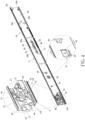
- a slide rail assembly 20 can be a multi-section rail assembly.
- the slide rail assembly 20 can be a four-section rail assembly.
- the slide rail assembly 20 includes a supporting frame 22, a first rail 24, a second rail 26 and a third rail 28.
- the second rail 26 is movably mounted between the first rail 24 and the third rail 28.
- the first rail 24 can be an outer rail.
- the second rail 26 can be a middle rail.
- the third rail 28 can be an inner rail.
- the supporting frame 22 can be a fourth rail, which is used as a reinforced rail or a fixed rail.
- the supporting frame 22, the first rail 24, the second rail 26 and the third rail 28 can move relative to one another longitudinally.
- the slide rail assembly 20 When the slide rail assembly 20 is in an extended state, e.g., a fully extended state, the first rail 24 is located at a first predetermined position M1 relative to the supporting frame 22, the second rail 26 is located at a first extended position E1 relative to the first rail 24, and the third rail 28 is located at an opened position K relative to the second rail 26.
- the slide rail assembly can be a five-section rail assembly which includes an additional rail movably mounted on the supporting frame or the third rail.
- a longitudinal direction of the rail i.e., a length direction or a moving direction of rail
- a transverse direction of the rail i.e., a lateral direction of the rail
- a vertical direction of the rail i.e., a height direction of the rail, can be parallel to a Z axis.
- the supporting frame 22 includes a first wall 30a, a second wall 30b and a longitudinal wall 32 connected between the first wall 30a and the second wall 30b of the supporting frame 22.
- the first wall 30a, the second wall 30b and the longitudinal wall 32 of the supporting frame 22 cooperatively define a supporting channel 34 of the supporting frame 22.
- the supporting channel 34 is configured to at least partially accommodate the first rail 24.
- the supporting frame 22 further includes a front portion 22a and a rear portion 22b.
- a blocking structure 36 and a positioning structure 38 are arranged on the supporting frame 22.
- the supporting frame 22 further includes a front restraining feature 40 and a rear restraining feature 42.
- the front restraining feature 40 and the rear restraining feature 42 are configured to restrain a travel distance of the first rail 24.
- the front restraining feature 40 and the rear restraining feature 42 can be protruding walls or protruding portions.
- the present invention is not limited thereto.
- the blocking structure 36 and the positioning structure 38 are located between the front restraining feature 40 and the rear restraining feature 42.
- the front restraining feature 40, the blocking structure 36, the positioning structure 38 and the rear restraining feature 42 can be sequentially arranged on the longitudinal wall 32 of the supporting frame 22 from front to rear.
- the slide rail assembly 20 further includes an auxiliary resilient seat 44 arranged on the supporting frame 22.
- the auxiliary resilient seat 44 includes a first fixing portion 46a, a second fixing portion 46b and a middle portion 48.
- the first fixing portion 46a and the second fixing portion 46b are connected to the longitudinal wall 32 of the supporting frame 22.
- the middle portion 48 is located between the first fixing portion 46a and the second fixing portion 46b.
- the middle portion 48 includes the blocking structure 36, a longitudinal section 50 and a guiding section 52.
- the longitudinal section 50 is located between the blocking structure 36 and the guiding section 52.
- the blocking structure 36 can be a blocking wall or an erecting wall
- the guiding section 52 can be an inclined surface or an arc surface.
- the present invention is not limited thereto.
- the positioning feature 38 can be formed in a column shape or a protrusion.
- the present invention is not limited thereto.
- the first rail 24 is at least partially movably mounted inside the supporting channel 34 of the supporting frame 22 and movable relative to the supporting frame 22.
- the first rail 24 includes a first wall 54a, a second wall 54b and a longitudinal wall 56 connected between the first wall 54a and the second wall 54b of the first rail 24.
- the first wall 54a, the second wall 54b and the longitudinal wall 56 of the first rail 24 cooperatively define a first channel 58 of the first rail 24.
- the first channel 58 is configured to at least partially accommodate the second rail 26.
- the first rail 24 further includes a front portion 24a and a rear portion 24b.
- the first rail 24 further includes a first side L1 and a second side L2 opposite to the first side L1.
- the first side L1 of the first rail 24 is located adjacent to the supporting frame 22.
- the second side L2 of the first rail 24 is located adjacent to the second rail 26.
- a blocking feature 60 and a positioning feature 62 are arranged on the first rail 24.
- a positioning member 61 can be arranged on the first rail 24 and connected, e.g., fixedly connected, to the first side L1 of the first rail 24.
- the positioning member 61 can include the positioning feature 62.
- the positioning feature 62 can extend from the first side L1 of the first rail 24 to the second side L2 of the first rail 24 through an auxiliary hole 63 on the first rail 24.
- the positioning feature can be a protrusion arranged on the second side of the first rail.
- the slide rail assembly 20 further includes a first working member 64 and a second working member 66.
- the first working member 64 is movably mounted on the first rail 24 and switchable between a first state S1 and a second state S2 relative to the first rail 24.
- the second working member 66 is movably mounted on the first rail 24 and switchable between a third state S3 and a fourth state S4 relative to the first rail 24.
- the first working member 64 and the second working member 66 can be respectively pivotally connected to the longitudinal wall 56 of the first rail 24 by a first pivoting member 68 and a second pivoting member 70 and located at the second side L2 of the first rail 24.
- the present invention is not limited to this embodiment.
- the first rail 24 further includes an opening 69 communicated with the first side L1 and the second side L2 of the first rail 24.
- the first working member 64 includes a blocking portion 71 extending to the first side L1 of the first rail 24 through the opening 69.
- the blocking portion 71 is configured to cooperate with the blocking structure 36 of the supporting frame 22.
- the second working member 66 includes a positioning portion 73 configured to cooperate with the positioning structure 38 of the supporting frame 22.
- the positioning portion 73 can be an engaging hook.
- the present invention is not limited thereto.
- the first working member 64 further includes a releasing portion 75 configured to cooperate with the second rail 26.
- the slide rail assembly 20 further includes a first resilient member 72 and a second resilient member 74 respectively configured to provide resilient forces to the first working member 64 and the second working member 66 to drive the first working member 64 and the second working member 66 to move to the first state S1 and the third state S3 relative to the first rail 24.
- a first auxiliary feature 76 and a supporting feature 78 are arranged on the first rail 24.
- the blocking feature 60, the positioning feature 62, the first auxiliary feature 76, the first working member 64 and the second working member 66 are sequentially arranged on the longitudinal wall 56 of the first rail 24 from front to rear.
- the first rail 24 further includes a front restraining portion 80 and a rear restraining portion respectively configured to cooperate with the front restraining feature 40 and the rear restraining feature 42 of the supporting frame 22 for restraining a travel distance of the first rail 24 relative to the supporting frame 22.
- the front restraining portion 80 can be a protruding block located on the first side S1 of the first rail 24 and facing toward the longitudinal wall 32 of the supporting frame 22, and the front restraining portion 80 can stretch into a longitudinal space 82 of the longitudinal wall 32 of the supporting frame 22, e.g., a longitudinal slot of the longitudinal wall 32 of the supporting frame 22, so as to be located at a position corresponding to the front restraining feature 40.
- the rear restraining portion can be the rear portion 24b.
- the present invention is not limited to this embodiment.
- the slide rail assembly 20 further includes a resilient seat 84 arranged on the first rail 24.
- the resilient seat 84 includes a first connecting portion 86a, a second connecting portion 86b and a supporting structure 88.
- the first connecting portion 86a and the second connecting portion 86b are connected to the longitudinal wall 56 of the first rail 24.
- the supporting structure 88 is located between the first connecting portion 86a and the second connecting portion 86b.
- the supporting structure 88 includes the blocking feature 60, a longitudinal portion 90 and a guiding portion 92.
- the longitudinal portion 90 is located between the blocking feature 60 and the guiding portion 92.
- the blocking feature 60 can be a blocking wall or an erecting wall
- the guiding portion 92 can be an inclined surface or an arc surface.
- the present invention is not limited thereto.
- the second rail 26 is movable relative to the first rail 24.
- the second rail 26 includes a first wall 94a, a second wall 94b and a longitudinal wall 96 connected between the first wall 94a and the second wall 94b of the second rail 26.
- the first wall 94a, the second wall 94b and the longitudinal wall 96 of the second rail 26 cooperatively define a second channel 98 of the second rail 26.
- the second channel 98 is configured to at least partially accommodate the third rail 28.
- the second rail 26 further includes a front portion 26a and a rear portion 26b.
- the second rail 26 further includes a first side L1 and a second side L2 opposite to the first side L1.
- the first side L1 of the second rail 26 is located adjacent to the first rail 24.
- the second side L2 of the second rail 26 is located adjacent to the third rail 28.
- the slide rail assembly 20 further includes a third working member 100 and a fourth working member 102.
- the third working member 100 is movably mounted on the second rail 26 and switchable between a fifth state S5 and a sixth state S6 relative to the second rail 26.
- the fourth working member 102 is movably mounted on the second rail 26 and switchable between a seventh state S7 and an eighth state S8 relative to the second rail 26.
- the third working member 100 and the fourth working member 102 can be respectively pivotally connected to the longitudinal wall 96 of the second rail 26 by a first shaft 104 and a second shaft 106 and located at the second side L2 of the second rail 26.
- the present invention is not limited to this embodiment.
- the slide rail assembly 20 further includes a first resilient feature 105 and a second resilient feature 107 respectively configured to provide resilient forces to the third working member 100 and the fourth working member 102 for driving the third working member 100 and the fourth working member 102 to move to the fifth state S5 and the seventh state S7 relative to the second rail 26.
- the second rail 26 further includes at least one hole arranged on the longitudinal wall 96 of the second rail 26 and communicated with the first side L1 and the second side L2 of the second rail 26.
- the second rail 26 can include a first hole H1 and a second hole H2.
- the third working member 100 includes a first blocking section 108 stretching into the first hole H1.
- the first blocking section 108 faces toward the longitudinal wall 56 of the first rail 24 and is configured to cooperate with the blocking feature 60 or the positioning feature 62 of the first rail 24.
- the fourth working member 102 includes a second blocking section 110 stretching into the second hole H2.
- the second blocking section 110 faces toward the longitudinal wall 56 of the first rail 24 and is configured to cooperate with the positioning feature 62 of the first rail 24.
- the present invention is not limited to this embodiment.
- the slide rail assembly 20 further includes an operating member 112 movably mounted on the second rail 26 and configured to operate one of the third working member 100 and the fourth working member 102.
- the operating member 112 is mounted on the longitudinal wall 96 of the second rail 26 and located at the first side L1 of the second rail 26.
- the operating member 112 includes an operating portion 114, a driving portion 116 and an extending portion 118 connected between the operating portion 114 and the driving portion 116.
- the operating portion 114 is connected to a front end 118a of the extending portion 118.
- the operating portion 114 is located adjacent to the front portion 26a of the second rail 26.
- the driving portion 116 is connected to a rear end 118b of the extending portion 118.
- the driving portion 116 is located adjacent to the rear portion 26b of the second rail 26.
- the third working member 100 and the fourth working member 102 are located adjacent to the rear portion 26b of the second rail 26.
- the second rail 26 further includes a third hole H3 arranged on the longitudinal wall 96 of the second rail 26.
- the driving portion 116 of the operating member 112 extends from the first side L1 to the second side L2 of the second rail 26 through the third hole H3 and is located adjacent to the third working member 100.
- the second rail 26 further includes a fourth hole H4 arranged on the longitudinal wall 96 of the second rail 26.
- the operating portion 114 of the operating member 112 is exposed on the second side L2 of the second rail 26 via the fourth hole H4.
- the second rail 26 and the operating member 112 have corresponding restraining features cooperating with each other for restraining a travel distance of the operating member 112 relative to the second rail 26.
- at least one elongated hole 120 can be arranged on the extending portion 118 of the operating member 112.
- the second rail 26 can further include at least one connecting member 122 connected to the longitudinal wall 96 of the second rail 26 and passing through a portion of the at least one elongated hole 120.
- the second rail 26 can further include at least one extending hole 111.
- At least one connecting section 113 can be arranged on the extending portion 118 of the operating member 112 and passes through a portion of the at least one extending hole 111.
- the travel distance of the operating member 112 relative to the second rail 26 can be restrained by a cooperation of the at least one elongated hole 120 and the at least one connecting member 122 and a cooperation of the at least one extending hole 111 and the at least one connecting section 113.
- the present invention is not limited to this embodiment.
- a second auxiliary feature 123 is arranged on the operating member 112 and configured to cooperate with the first auxiliary feature 76 of the first rail 24.
- the first auxiliary feature 76 and the second auxiliary feature 123 can be protrusions.
- the present invention is not limited thereto.
- the second auxiliary feature 123 is arranged adjacent to the rear end 118b of the extending portion 118 of the operating member 112, and the second auxiliary feature 123 and the driving portion 116 are located at two opposite sides of the extending portion 118 of the operating member 112.
- the third working member 100 and the fourth working member 102 are respectively in the fifth state S3 and the seventh state S7 relative to the second rail 26.
- the third working member 100 further includes an abutting portion 124 and an actuating portion 126.
- the first shaft 104 is located between the abutting portion 124 and the actuating portion 126.
- the abutting portion 124 is located at a position corresponding to the driving portion 116 of the operating member 112 and for abutting against the driving portion 116 of the operating member 112.
- the first blocking section 108 is located adjacent to the actuating portion 126.
- the first blocking section 108 extends to the first side L1 of the second rail 26.
- the first resilient feature 105 is configured to provide the resilient force to the third working member 100 for retaining the third working member 100 in the fifth state S5.
- the fourth working member 102 includes an abutting section 128 and an actuating section 130.
- the second shaft 106 is located between the abutting section 128 and the actuating section 130.
- the second blocking section 110 is located adjacent to the abutting section 128.
- the second blocking section 110 extends to the first side L1 of the second rail 26.
- the second resilient feature 107 is configured to provide the resilient force to the fourth working member 102 for retaining the fourth working member 102 in the seventh state S7.
- the user can apply a force F onto the operating member 112, e.g., the operating portion 114 of the operating member 112, to drive the operating member 112 to move relative to the second rail 26 from the first operated position P1 to a second operated position P2.
- the operating member 112 drives the third working member 100 to move, e.g., pivot, relative to the second rail 26 from the fifth state S5 as shown in FIG. 5 and FIG. 6 to the sixth state S6 as shown in FIG. 7 and FIG. 8 by an abutment of the driving portion 116 and the abutting portion 124 of the third working member 100.
- the third working member 100 moves from the fifth state S5 as shown in FIG.
- the third working member 100 drives the fourth working member 102 to move, e.g., pivot, relative to the second rail 26 from the seventh state S7 as shown in FIG. 5 and FIG. 6 to the eighth state S8 as shown in FIG. 7 and FIG. 8 by an abutment of the actuating portion 126 and the abutting section 128 of the fourth working member 102.
- the third working member 100 and the fourth working member 102 are configured to move synchronously, and the third working member 100 and the fourth working member 102 are respectively configured to be driven by the operating member 112 and the third working member 100.
- the present invention is not limited to this embodiment.
- the third working member and the fourth working member are configured to move synchronously, and the third working member and the fourth working member are respectively configured to be driven by the fourth working member and the operating member.
- the third working member and the fourth working member are configured to move synchronously, and the third working member and the fourth working member are configured to be driven by two driving portions of the operating member respectively.
- the slide rail assembly further includes an auxiliary operating member, and the third working member and the fourth working member are configured to be driven by the operating member and the auxiliary operating member respectively and to move asynchronously.
- the third working member 100 and the fourth working member 102 are respectively retained in the sixth state S6 and the eighth state S8 by an abutment of the operating member 112 and the third working member 100 and an abutment of the third working member 100 and the fourth working member 102.
- the slide rail assembly 20 is used in a limited environment and located in the extended state.
- the first rail 24 is located at the first predetermined position M1 relative to the supporting frame 22
- the second rail 26 is located at the first extended position E1 relative to the first rail 24
- the third rail 28 is located at the opened position K1 relative to the second rail 26.
- the slide rail assembly 20 has a first length J1
- a front portion 28a of the third rail 28 is spaced apart from an object 132, e.g., a door or an obstruction, by a first distance X1.
- the first distance X1 is too short to detach the third rail 28 from the second rail 26, e.g., the second channel 98 of the second rail 26, along an opening direction D1.
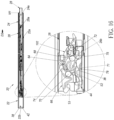
- the blocking structure 36 of the supporting frame 22 blocks the blocking portion 71 of the first working member 64 in the first state S1 for preventing the first rail 24 from moving along a retracting direction D2 from the first predetermined position M1.
- the operating member 112 is located at the first operated position P1, similarly to FIG. 5 and FIG. 6 .
- the blocking feature 60 of the first rail 24 blocks the first blocking section 108 of the third working member 100 in the fifth state S5 for preventing the second rail 26 from moving along the retracting direction D2 from the first extended position E1, and the second blocking section 110 of the fourth working member 102 is located adjacent to the guiding portion 92 of the resilient seat 84 of the first rail 24.
- the first blocking section 108 of the third working member 100 and the second blocking section 110 of the fourth working member 102 are located at positions where the first blocking section 108 of the third working member 100 and the second blocking section 110 of the fourth working member 102 are aligned with the positioning feature 62 of the first rail 24 along the retracting direction D2 or the opening direction D1.
- the operating member 112 drives the third working member 100 by the driving portion 116 to move from the fifth state S5 to the sixth state S6, such that the blocking feature 60 cannot block the first blocking section 108 of the third working member 100 in the sixth state S6 for allowing the second rail 26 to move relative to the first rail 24 along the retracting direction D2 from the first extended position E1.
- the third working member 100 and the fourth working member 102 are respectively retained in the sixth state S6 and the eighth state S8, such that the first resilient feature 105 and the second resilient feature 107 are resiliently deformed to generate the resilient forces, similarly to FIG. 7 .
- the first blocking section 108 of the third working member 100 and the second blocking section 110 of the fourth working member 102 are dislocated from the positions where the first blocking section 108 of the third working member 100 and the second blocking section 110 of the fourth working member 102 are aligned with the positioning feature 62 of the first rail 24 along the retracting direction D2 or the opening direction D1.
- the second rail 26 is located at the first extended position E1 relative to the first rail 24, the second auxiliary feature 123 of the operating member 112 is separated away from the first auxiliary feature 76 of the first rail 24 by a distance.
- the first blocking section 108 of the third working member 100 and the second blocking section 110 of the fourth working member 102 can pass over the positioning feature 62 of the first rail 24 along the retracting direction D2 to allow the second rail 26 to move to the predetermined retracted position without any interference because the first blocking section 108 of the third working member 100 and the second blocking section 110 of the fourth working member 102 are dislocated from the positions where the first blocking section 108 of the third working member 100 and the second blocking section 110 of the fourth working member 102 are aligned with the positioning feature 62 of the first rail 24 along the retracting direction D2 or the opening direction D1.
- the positioning feature 62 includes a front portion 62a and a rear portion 62b.
- One of the first blocking section 108 of the third working member 100 and the rear portion 62b of the positioning feature 62 includes a guiding feature 109.
- the guiding feature 109 can be an inclined surface or an arc surface.
- the first blocking section 108 can include the guiding feature 109.
- the present invention is not limited to this embodiment.
- the second rail 26 is movable relative to the first rail 24 along the opening direction D1 from the predetermined retracted position as shown in FIG. 11 to a second extended position E2 as shown in FIG. 12 .
- the first blocking section 108 of the third working member 100 and the rear portion 62b of the positioning feature 62 can abut against each other, and the third working member 100 can be driven to move from the fifth state S5 to the sixth state S6 for facilitating the first blocking section 108 of the third working member 100 to pass over the rear portion 62b of the positioning feature 62 along the opening direction D1 due to the guiding feature 109 of the first blocking section 108 of the third working member 100.
- the third working member 100 drives the fourth working member 102 to move from the seventh state S7 to the eighth state S8, such that the first resilient feature 105 and the second resilient feature 107 are resiliently deformed and generate the resilient forces. Therefore, the first resilient feature 105 and the second resilient feature 107 respectively can drive the third working member 100 and the fourth working member 102 to move to the fifth state S5 and the seventh state S7 when the second rail 26 moves to the second extended position E2 relative to the first rail 24. Besides, when the second rail 26 is located at the second extended position E2 as shown in FIG.
- the second blocking section 110 of the fourth working member 102 in the seventh state S7 and the first blocking section 108 of the third working member 100 in the fifth state S5 are respectively located at positions corresponding to the two portions of the positioning feature 62, e.g., the rear portion 62b and the front portion 62a, so as to provide a blocking effect or an engaging effect for preventing the second rail 26 from moving relative to the first rail 24 along the opening direction D1 or the retracting direction D2 from the second extended position E2.
- the slide rail assembly 20 has a second length J2 less than the first length J1, such that the front portion 28a of the third rail 28 is spaced apart from the object 132 by a second distance X2 greater than the first distance X1, which facilitates detachment of the third rail 28 from the second rail 26, e.g., the second channel 98 of the second rail 26, along the opening direction D1.
- the user can apply the force F onto the operating member 112 to drive the operating member 112 to move from the first operated position P1 as shown in FIG. 12 to the second operated position P2 as shown in FIG. 13 , so as to drive the third working member 100 to move from the fifth state S5 to the sixth state S6 and to drive the fourth working member 102 to move from the seventh state S7 to the eighth state S8.
- the third working member 100 and the fourth working member 102 move to the sixth state S6 and the eighth state S8 respectively, the third working member 100 and the fourth working member 102 are respectively dislocated from the positions corresponding to the two portions of the positioning feature 62, e.g., the rear portion 62b and the front portion 62a, for allowing the second rail 26 to move relative to the first rail 24 along the opening direction D1 or the retracting direction D2 from the second extended position E2.
- the first auxiliary feature 76 and the second auxiliary feature 123 abut against each other for driving the operating member 112 to move along the opening direction D1 from the second operated position P2 as shown in FIG. 13 to the first operated position P1 as shown in FIG. 14 , such that the third working member 100 is driven by the first resilient feature 105 to move from the sixth state S6 as shown in FIG. 13 to the fifth state S5 as shown in FIG. 14 , and the fourth working member 102 is driven by the second resilient feature 107 to move from the eighth state S8 as shown in FIG. 13 to the seventh state S7 as shown in FIG. 14 .
- one of the first auxiliary feature 76 and the second auxiliary feature 123 can include another guiding surface, e.g., an inclined surface or an arc surface, facing toward the other one of the first auxiliary feature 76 and the second auxiliary feature 123 to facilitate the second auxiliary feature 123 to pass over the first auxiliary feature 76 along the retracting direction D2 when the second rail 26 moves relative to the first rail 24 along the retracting direction D2.
- another guiding surface e.g., an inclined surface or an arc surface
- the second rail 26 can be moved along the retracting direction D2 from the second extended position E2 to abut against the releasing portion 75 of the first working member 64 by the rear portion 26b for driving the first working member 64 to move from the first state S1 as shown in FIG. 15 to the second state S2 as shown in FIG. 16 , such that the blocking structure 36 of the supporting frame 22 does not block the blocking portion 71 of the first working member in the second state S2 for allowing the first rail 24 to move along the retracting direction D2 from the first predetermined position M1 to a second predetermined position M2.
- the second working member 66 e.g., the positioning portion 73 of the second working member 66, in the third state S3 can engage with the positioning structure 38 of the supporting frame 22 for retaining the first rail 24 at the second predetermined position M2, so as to prevent the first rail 24 from moving along the opening direction D1 or the retracting direction D2 from the second predetermined position M2.
- the slide rail assembly 20 When the first rail 24 is located at the second predetermined position M2, the slide rail assembly 20 has a third length J3 less than the second length J2, such that the front portion 28a of the third rail 28 is spaced apart from the object 132 by a third distance X3 greater than the second distance X2, which further facilitates detachment of the third rail 28 from the second rail 26, e.g., the second channel 98 of the second rail 26, along the opening direction D1.
- the third rail 28 includes a first wall 29a, a second wall 29b and a longitudinal wall 31 connected between the first wall 29a and the second wall 29b of the third rail 28.
- the third rail 28 is movable relative to the first rail 24 along the retracting direction D2 to a retracted position R.
- a portion of the third rail 28, e.g., the rear portion 28 of the third rail 28 can abut against an auxiliary portion 134, which is shown in FIG.
- the second wall 29b of the third rail 28 supports the second working member 66 for retaining the second working member 66 in the fourth state S4, such that the positioning portion 73 of the second working member 66 is not engaged with the positioning structure 38 of the supporting frame 22 for allowing the first rail 24 to move along the opening direction D1 from the second predetermined position M2.
- the supporting feature 78 of the first rail 24 is configured to support a portion of the second wall 29b of the third rail 28 adjacent to a rear rail section of the third rail 28 for enhancing a structural strength of the slide rail assembly 20.
- the third rail 28 further includes a first synchronizing feature 136 and a second synchronizing feature 138.
- the first synchronizing feature 136 of the third rail 28 can abut against a first corresponding feature 140 of the first working member 64 for driving the third rail 28 and the first rail 24 to move synchronously along the opening direction D1 until the first rail 24 moves to the first predetermined position M1.
- the second synchronizing feature 138 of the third rail 28 can abut against a second corresponding feature 142 of the third working member 100 for driving the third rail 28 and the second rail 26 to be moved synchronously along the opening direction D1 until the second rail 26 moves to the first extended position E1.
Landscapes
- Engineering & Computer Science (AREA)
- General Engineering & Computer Science (AREA)
- Mechanical Engineering (AREA)
- Computer Hardware Design (AREA)
- Microelectronics & Electronic Packaging (AREA)
- Seats For Vehicles (AREA)
- Drawers Of Furniture (AREA)
- Bearings For Parts Moving Linearly (AREA)
Claims (14)
- Gleitschienenaufbau (20), welcher umfasst:einen Tragrahmen (22);eine erste Schiene (24), die relativ zu dem Tragrahmen (22) beweglich ist;eine zweite Schiene (26), die relativ zu der ersten Schiene (24) beweglich ist;eine dritte Schiene (28), die relativ zur zweiten Schiene (26) beweglich ist, und worin die zweite Schiene (26) beweglich zwischen der ersten Schiene (24) und der dritten Schiene (28) angebracht ist;eine Blockierstruktur (36), die auf dem Tragrahmen (22) angeordnet ist;eine Anordnungsstruktur (38), die am Tragrahmen (22) angeordnet ist;ein Blockiermerkmal (60), das an der ersten Schiene (24) angeordnet ist;ein Anordnungsmerkmal (62), das an der ersten Schiene (24) angeordnet ist;ein erstes Arbeitselement (64), das beweglich an der ersten Schiene (24) angebracht und relativ zu der ersten Schiene (24) zwischen einem ersten Zustand (S1) und einem zweiten Zustand (S2) umschaltbar ist; undein zweites Arbeitselement (66), das beweglich an der ersten Schiene (24) angebracht ist und relativ zu der erste Schiene (24) zwischen einem dritten Zustand (S3) und einem vierten Zustand (S4) umschaltbar ist;dadurch gekennzeichnet, dass:wenn sich die erste Schiene (24) in einer ersten bestimmten Position (M1) relativ zu dem Tragrahmen (22) befindet, die Blockierstruktur (36) das erste Arbeitselement (64) in dem ersten Zustand (S1) blockiert, um zu verhindern, dass sich die erste Schiene (24) entlang einer Einfahrrichtung (D2) aus der ersten bestimmten Position (M1) bewegt;wenn sich die erste Schiene (24) in einer zweiten bestimmten Position (M2) relativ zu dem Tragrahmen (22) befindet, das zweite Arbeitselement (66) in dem dritten Zustand (S3) mit der Anordnungsstruktur (38) in Eingriff steht, um zu verhindern, dass sich die erste Schiene (24) entlang einer Öffnungsrichtung (D1) aus der zweiten bestimmten Position (M2) bewegt;wenn sich die erste Schiene (24) in der zweiten bestimmten Position (M2) relativ zu dem Tragrahmen (22) befindet und sich die dritte Schiene (28) in einer zurückgezogenen Position (R) relativ zu der ersten Schiene (24) befindet, die dritte Schiene (28) ausgestaltet ist, das zweite Arbeitselement (66) zu tragen, so dass das zweite Arbeitselement (66) in dem vierten Zustand (S4) gehalten wird und nicht mit der Anordnungsstruktur (38) in Eingriff kommt, um zu ermöglichen, dass sich die erste Schiene (24) entlang der Öffnungsrichtung (D1) von der zweiten bestimmten Position (M2) bewegt.
- Gleitschienenaufbau (20) nach Anspruch 1, dadurch gekennzeichnet, dass das erste Arbeitselement (64) und das zweite Arbeitselement (66) schwenkbar mit der ersten Schiene (24) verbunden sind und der Gleitschienenaufbau (20) ferner ein erstes federndes Element (72) und ein zweites federndes Element (74) umfasst, die ausgestaltet sind, federnde Kräfte auf das erste Arbeitselement (64) und das zweite Arbeitselement (66) auszuüben.
- Gleitschienenaufbau (20) nach einem der Ansprüche 1 bis 2, dadurch gekennzeichnet, dass, wenn sich die erste Schiene (24) in der ersten bestimmten Position (M1) relativ zum Tragrahmen (22) befindet und sich das erste Arbeitselement (64) vom ersten Zustand (S1) in den zweiten Zustand (S2) bewegt, die Blockierstruktur (36) das erste Arbeitselement (64) im zweiten Zustand (S2) nicht blockiert, damit sich die erste Schiene (24) entlang der Einfahrrichtung (D2) von der ersten bestimmten Position (M1) in die zweite bestimmte Position (M2) bewegen kann.
- Gleitschienenaufbau (20) nach einem der Ansprüche 1 bis 3, dadurch gekennzeichnet, dass ein Stützmerkmal (78) an der ersten Schiene (24) angeordnet ist, und das Stützmerkmal (78) ausgestaltet ist, die dritte Schiene (28) zu stützen, wenn sich die dritte Schiene (28) in der zurückgezogenen Position (R) relativ zur ersten Schiene (24) befindet.
- Gleitschienenaufbau (20) nach einem der Ansprüche 1 bis 4, dadurch gekennzeichnet, dass die dritte Schiene (28) ein Synchronisierungsmerkmal (136) umfasst, und das Synchronisierungsmerkmal (136) an dem ersten Arbeitselement (64) anliegt, um zu ermöglichen, dass sich die dritte Schiene (28) und die erste Schiene (24) während einer Bewegung der dritten Schiene (28) aus der zurückgezogenen Position (R) synchron entlang der Öffnungsrichtung (D1) bewegen.
- Gleitschienenaufbau (20) nach einem der Ansprüche 1 bis 5, gekennzeichnet durch ein drittes Arbeitselement (100) und ein viertes Arbeitselement (102), worin das dritte Arbeitselement (100) an der zweiten Schiene (26) beweglich gelagert ist und zwischen einem fünften Zustand (S5) und einem sechsten Zustand (S6) relativ zur zweiten Schiene (26) umschaltbar ist, worin das vierte Arbeitselement (102) an der zweiten Schiene (26) beweglich gelagert ist und relativ zur zweiten Schiene (26) zwischen einem siebten Zustand (S7) und einem achten Zustand (S8) umschaltbar ist, und wenn sich die zweite Schiene (26) in einer ersten ausgefahrenen Position (E1) relativ zu der ersten Schiene (24) befindet, das Blockiermerkmal (60) das dritte Arbeitselement (100) in dem fünften Zustand (S5) blockiert, um zu verhindern, dass sich die zweite Schiene (26) aus der ersten ausgefahrenen Position (E1) entlang der Einfahrrichtung (D2) bewegt.
- Gleitschienenaufbau (20) nach Anspruch 6, dadurch gekennzeichnet, dass, wenn sich die zweite Schiene (26) in einer zweiten ausgefahrenen Position (E2) relativ zu der ersten Schiene (24) befindet und das dritte Arbeitselement (100) und das vierte Arbeitselement (102) sich in dem fünften Zustand (S5) bzw. dem siebten Zustand (S7) befinden, das vierte Arbeitselement (102) und das dritte Arbeitselement (100) entsprechend an Positionen angeordnet sind, die zwei Abschnitten des Anordnungsmerkmals (62) entsprechen, um zu verhindern, dass sich die zweite Schiene (26) aus der zweiten ausgefahrenen Position (E2) entlang der Öffnungsrichtung (D1) oder der Einfahrrichtung (D2) bewegt.
- Gleitschienenaufbau (20) nach Anspruch 7, dadurch gekennzeichnet, dass der Gleitschienenaufbau (20) eine erste Länge (J1) aufweist, wenn sich die zweite Schiene (26) in der ersten ausgefahrenen Position (E1) befindet, der Gleitschienenaufbau (20) eine zweite Länge (J2) aufweist, die kleiner ist als die erste Länge (J1), wenn sich die zweite Schiene (26) in der zweiten ausgefahrenen Position (E2) befindet, und der Gleitschienenaufbau (20) eine dritte Länge (J3) aufweist, die kleiner ist als die zweite Länge (J2), wenn sich die erste Schiene (24) in der zweiten bestimmten Position (M2) befindet.
- Gleitschienenaufbau (20) nach einem der Ansprüche 6 bis 8, ferner gekennzeichnet durch ein Betätigungselement (112), das beweglich an der zweiten Schiene (26) angebracht und ausgestaltet ist, entweder das dritte Arbeitselement (100) oder das vierte Arbeitselement (102) zu betätigen.
- Gleitschienenaufbau (20) nach Anspruch 9, dadurch gekennzeichnet, dass das dritte Arbeitselement (100) angetrieben wird, um sich von dem fünften Zustand (S5) in den sechsten Zustand (S6) zu bewegen, um in dem sechsten Zustand (S6) durch das Betätigungselement (112) gehalten zu werden, das betriebsmäßig von einer ersten Betätigungsposition (P1) in eine zweite Betätigungsposition (P2) bewegt wird, so dass das Blockiermerkmal (60) das dritte Arbeitselement (100) in dem sechsten Zustand (S6) nicht blockiert, um zu ermöglichen, dass sich die zweite Schiene (26) entlang der Einfahrrichtung (D2) von der ersten ausgefahrenen Position (E1) bewegt, und das dritte Arbeitselement (100) das vierte Arbeitselement (102) antreibt, sich in den achten Zustand (S8) zu bewegen, wenn sich das dritte Arbeitselement (100) von dem fünften Zustand (S5) in den sechsten Zustand (S6) bewegt.
- Gleitschienenaufbau (20) nach Anspruch 10, dadurch gekennzeichnet, dass, wenn sich die zweite Schiene (26) aus der ersten ausgefahrenen Position (E1) entlang der Einfahrrichtung (D2) bewegt und sich das dritte Arbeitselement (100) und das vierte Arbeitselement (102) im sechsten Zustand (S6) bzw. im achten Zustand (S8) befinden, das dritte Arbeitselement (100) und das vierte Arbeitselement (102) das Anordnungsmerkmal (62) entlang der Einfahrrichtung (D2) überfahren, wenn sich die zweite Schiene (26) entlang der Einfahrrichtung (D2) über eine bestimmte Strecke bewegt, ein erstes Hilfsmerkmal (76) an der ersten Schiene (24) an ein zweites Hilfsmerkmal (123) an dem Betätigungselement (112) anstößt, um das Betätigungselement (112) anzutreiben, sich von der zweiten Betätigungsposition (P2) in die erste Betätigungsposition (P1) zu bewegen, so dass das dritte Arbeitselement (100) und das vierte Arbeitselement (102) durch ein zweites elastisches Merkmal (107) in den fünften Zustand (S5) bzw. den siebten Zustand (S7) bewegt werden.
- Gleitschienenaufbau (20) nach Anspruch 9, dadurch gekennzeichnet, dass, wenn sich die zweite Schiene (26) in der zweiten ausgefahrenen Position (E2) relativ zur ersten Schiene (24) befindet, das dritte Arbeitselement (100) und das vierte Arbeitselement (102) durch das Betätigungselement (112) angetrieben werden, das betriebsmäßig von einer ersten Betätigungsposition (P1) in eine zweite Betätigungsposition (P2) bewegt wird, sich in den sechsten Zustand (S6) bzw. den achten Zustand (S8) zu bewegen, so dass das vierte Arbeitselement (102) und das dritte Arbeitselement (100) jeweils aus den Positionen, die den beiden Abschnitten des Anordnungsmerkmals (62) entsprechen, verschoben werden, um zu ermöglichen, dass sich die zweite Schiene (26) entlang der Öffnungsrichtung (D1) oder der Einfahrrichtung (D2) aus der zweiten ausgefahrenen Position (E2) bewegt.
- Gleitschienenaufbau (20) nach einem der Ansprüche 6 bis 12, dadurch gekennzeichnet, dass das dritte Arbeitselement (100) und das vierte Arbeitselement (102) schwenkbar an der zweiten Schiene (26) befestigt sind.
- Gleitschienenaufbau (20) nach einem der Ansprüche 1 bis 13, dadurch gekennzeichnet, dass der Tragrahmen (22) einen Stützkanal (34) aufweist, die erste Schiene (24) zumindest teilweise beweglich in dem Stützkanal (34) gelagert ist und das erste Arbeitselement (64) durch die zweite Schiene (26) aus dem ersten Zustand (S1) in den zweiten Zustand (S2) bewegt wird.
Applications Claiming Priority (1)
| Application Number | Priority Date | Filing Date | Title |
|---|---|---|---|
| TW111150803A TWI861654B (zh) | 2022-12-28 | 2022-12-28 | 滑軌總成 |
Publications (2)
| Publication Number | Publication Date |
|---|---|
| EP4393348A1 EP4393348A1 (de) | 2024-07-03 |
| EP4393348B1 true EP4393348B1 (de) | 2025-05-21 |
Family
ID=86732701
Family Applications (1)
| Application Number | Title | Priority Date | Filing Date |
|---|---|---|---|
| EP23178095.8A Active EP4393348B1 (de) | 2022-12-28 | 2023-06-07 | Gleitschienenanordnung |
Country Status (4)
| Country | Link |
|---|---|
| US (1) | US12127671B2 (de) |
| EP (1) | EP4393348B1 (de) |
| JP (1) | JP7450787B1 (de) |
| TW (1) | TWI861654B (de) |
Families Citing this family (1)
| Publication number | Priority date | Publication date | Assignee | Title |
|---|---|---|---|---|
| TWI856904B (zh) * | 2023-12-25 | 2024-09-21 | 川湖科技股份有限公司 | 滑軌總成 |
Family Cites Families (22)
| Publication number | Priority date | Publication date | Assignee | Title |
|---|---|---|---|---|
| US9670956B2 (en) | 2012-04-03 | 2017-06-06 | Jonathan Manufacturing Corporation | Compact slide assemblies |
| TWI568382B (zh) * | 2016-01-22 | 2017-02-01 | 川湖科技股份有限公司 | 滑軌總成及其操作方法 |
| CN107960763B (zh) * | 2016-10-18 | 2020-01-14 | 川湖科技股份有限公司 | 滑轨总成 |
| TWI629027B (zh) * | 2017-03-20 | 2018-07-11 | 川湖科技股份有限公司 | 用於滑軌總成的同步系統 |
| TWI665983B (zh) | 2017-04-12 | 2019-07-21 | 川湖科技股份有限公司 | 滑軌總成 |
| TWI616166B (zh) * | 2017-04-12 | 2018-03-01 | 川湖科技股份有限公司 | 滑軌總成 |
| CN108720377B (zh) * | 2017-04-19 | 2019-08-27 | 川湖科技股份有限公司 | 滑轨总成 |
| US10674821B2 (en) * | 2017-12-28 | 2020-06-09 | King Slide Works Co., Ltd | Slide rail assembly |
| CN110392503B (zh) | 2018-04-16 | 2020-11-03 | 鸿富锦精密电子(天津)有限公司 | 滑轨装置 |
| TWI687178B (zh) * | 2018-05-07 | 2020-03-11 | 川湖科技股份有限公司 | 滑軌總成及其滑軌套件 |
| TWI676439B (zh) | 2018-11-23 | 2019-11-11 | 川湖科技股份有限公司 | 滑軌總成 |
| TWI684396B (zh) | 2019-02-25 | 2020-02-01 | 川湖科技股份有限公司 | 滑軌機構及其支撐總成 |
| TWI700057B (zh) * | 2019-06-12 | 2020-08-01 | 川湖科技股份有限公司 | 滑軌總成及其操作方法 |
| CN112089231B (zh) | 2019-06-17 | 2022-08-12 | 川湖科技股份有限公司 | 滑轨总成及其操作方法 |
| TWI704888B (zh) * | 2019-07-12 | 2020-09-21 | 川湖科技股份有限公司 | 滑軌總成 |
| TWI706751B (zh) | 2019-08-14 | 2020-10-11 | 川湖科技股份有限公司 | 滑軌總成 |
| TWI704887B (zh) | 2019-09-26 | 2020-09-21 | 川湖科技股份有限公司 | 滑軌總成 |
| TWI704889B (zh) * | 2019-10-28 | 2020-09-21 | 川湖科技股份有限公司 | 滑軌總成 |
| CN112971407B (zh) * | 2019-12-18 | 2023-09-22 | 川湖科技股份有限公司 | 滑轨总成 |
| TWI733625B (zh) | 2020-11-24 | 2021-07-11 | 川湖科技股份有限公司 | 滑軌總成 |
| TWI737555B (zh) | 2020-12-22 | 2021-08-21 | 川湖科技股份有限公司 | 滑軌總成及其滑軌套件 |
| TWI738613B (zh) | 2021-02-01 | 2021-09-01 | 川湖科技股份有限公司 | 滑軌總成 |
-
2022
- 2022-12-28 TW TW111150803A patent/TWI861654B/zh active
-
2023
- 2023-05-16 US US18/197,733 patent/US12127671B2/en active Active
- 2023-06-07 EP EP23178095.8A patent/EP4393348B1/de active Active
- 2023-06-19 JP JP2023100222A patent/JP7450787B1/ja active Active
Also Published As
| Publication number | Publication date |
|---|---|
| JP2024095497A (ja) | 2024-07-10 |
| US20240215720A1 (en) | 2024-07-04 |
| EP4393348A1 (de) | 2024-07-03 |
| US12127671B2 (en) | 2024-10-29 |
| JP7450787B1 (ja) | 2024-03-15 |
| TWI861654B (zh) | 2024-11-11 |
| TW202425879A (zh) | 2024-07-01 |
Similar Documents
| Publication | Publication Date | Title |
|---|---|---|
| EP4393349B1 (de) | Gleitschienenanordnung | |
| EP4393348B1 (de) | Gleitschienenanordnung | |
| EP3609304B1 (de) | Gleitschienenmechanismus und haltevorrichtung dafür | |
| US20160016533A1 (en) | Hinge arrangement for a bonnet and a bonnet arrangement | |
| JP2002211497A (ja) | 降下可能な荷物室を備えた荷物棚、特に飛行機の客室用の荷物棚 | |
| EP4501174B1 (de) | Gleitschienenanordnung | |
| ITMI981921A1 (it) | Sportello in particolare per un velivolo per passeggeri | |
| EP4477823A1 (de) | Verriegelungskit und zugehörige möbelanordnung | |
| JP7471494B1 (ja) | スライドレール機構 | |
| EP4461160B1 (de) | Möbelanordnung | |
| EP3561208B1 (de) | Türöffnungsvorrichtung, insbesondere für öffentliche verkehrsmittel | |
| CA2533249A1 (en) | Method and apparatus for locking a container | |
| US12203292B2 (en) | Slide rail mechanism | |
| EP4417088A1 (de) | Gleitschienenmechanismus | |
| US7581777B2 (en) | Header latch assembly for convertible tops | |
| EP4616761B1 (de) | Gleitschienenmechanismus | |
| EP4648558A1 (de) | Gestellmontagekit | |
| JP7758827B1 (ja) | スライドレール組立体 | |
| EP4480344B1 (de) | Gleitschienenanordnung | |
| EP2551429A2 (de) | Antipaniköffnungsvorrichtung mit Schieberiegel | |
| EP3524763A1 (de) | Sekundäre rückhaltevorrichtung für zweiflüglige türen | |
| CN219769610U (zh) | 翻转门装置及作业机械 | |
| CN120119838A (zh) | 一种抗冲击闭锁 | |
| CN118283982A (zh) | 滑轨总成 | |
| EP4672880A1 (de) | Stützanordnung und verfahren zur montage der besagten stützanordnung auf einem gestell |
Legal Events
| Date | Code | Title | Description |
|---|---|---|---|
| PUAI | Public reference made under article 153(3) epc to a published international application that has entered the european phase |
Free format text: ORIGINAL CODE: 0009012 |
|
| STAA | Information on the status of an ep patent application or granted ep patent |
Free format text: STATUS: THE APPLICATION HAS BEEN PUBLISHED |
|
| STAA | Information on the status of an ep patent application or granted ep patent |
Free format text: STATUS: REQUEST FOR EXAMINATION WAS MADE |
|
| AK | Designated contracting states |
Kind code of ref document: A1 Designated state(s): AL AT BE BG CH CY CZ DE DK EE ES FI FR GB GR HR HU IE IS IT LI LT LU LV MC ME MK MT NL NO PL PT RO RS SE SI SK SM TR |
|
| 17P | Request for examination filed |
Effective date: 20240604 |
|
| RBV | Designated contracting states (corrected) |
Designated state(s): AL AT BE BG CH CY CZ DE DK EE ES FI FR GB GR HR HU IE IS IT LI LT LU LV MC ME MK MT NL NO PL PT RO RS SE SI SK SM TR |
|
| GRAP | Despatch of communication of intention to grant a patent |
Free format text: ORIGINAL CODE: EPIDOSNIGR1 |
|
| STAA | Information on the status of an ep patent application or granted ep patent |
Free format text: STATUS: GRANT OF PATENT IS INTENDED |
|
| INTG | Intention to grant announced |
Effective date: 20250127 |
|
| GRAS | Grant fee paid |
Free format text: ORIGINAL CODE: EPIDOSNIGR3 |
|
| GRAA | (expected) grant |
Free format text: ORIGINAL CODE: 0009210 |
|
| STAA | Information on the status of an ep patent application or granted ep patent |
Free format text: STATUS: THE PATENT HAS BEEN GRANTED |
|
| AK | Designated contracting states |
Kind code of ref document: B1 Designated state(s): AL AT BE BG CH CY CZ DE DK EE ES FI FR GB GR HR HU IE IS IT LI LT LU LV MC ME MK MT NL NO PL PT RO RS SE SI SK SM TR |
|
| REG | Reference to a national code |
Ref country code: GB Ref legal event code: FG4D |
|
| REG | Reference to a national code |
Ref country code: CH Ref legal event code: EP |
|
| REG | Reference to a national code |
Ref country code: DE Ref legal event code: R096 Ref document number: 602023003571 Country of ref document: DE |
|
| REG | Reference to a national code |
Ref country code: IE Ref legal event code: FG4D |
|
| PGFP | Annual fee paid to national office [announced via postgrant information from national office to epo] |
Ref country code: DE Payment date: 20250526 Year of fee payment: 3 |
|
| PGFP | Annual fee paid to national office [announced via postgrant information from national office to epo] |
Ref country code: AT Payment date: 20250721 Year of fee payment: 3 |
|
| REG | Reference to a national code |
Ref country code: NL Ref legal event code: MP Effective date: 20250521 |
|
| PG25 | Lapsed in a contracting state [announced via postgrant information from national office to epo] |
Ref country code: FI Free format text: LAPSE BECAUSE OF FAILURE TO SUBMIT A TRANSLATION OF THE DESCRIPTION OR TO PAY THE FEE WITHIN THE PRESCRIBED TIME-LIMIT Effective date: 20250521 Ref country code: ES Free format text: LAPSE BECAUSE OF FAILURE TO SUBMIT A TRANSLATION OF THE DESCRIPTION OR TO PAY THE FEE WITHIN THE PRESCRIBED TIME-LIMIT Effective date: 20250521 Ref country code: PT Free format text: LAPSE BECAUSE OF FAILURE TO SUBMIT A TRANSLATION OF THE DESCRIPTION OR TO PAY THE FEE WITHIN THE PRESCRIBED TIME-LIMIT Effective date: 20250922 |
|
| REG | Reference to a national code |
Ref country code: LT Ref legal event code: MG9D |
|
| PG25 | Lapsed in a contracting state [announced via postgrant information from national office to epo] |
Ref country code: NO Free format text: LAPSE BECAUSE OF FAILURE TO SUBMIT A TRANSLATION OF THE DESCRIPTION OR TO PAY THE FEE WITHIN THE PRESCRIBED TIME-LIMIT Effective date: 20250821 Ref country code: GR Free format text: LAPSE BECAUSE OF FAILURE TO SUBMIT A TRANSLATION OF THE DESCRIPTION OR TO PAY THE FEE WITHIN THE PRESCRIBED TIME-LIMIT Effective date: 20250822 |
|
| PG25 | Lapsed in a contracting state [announced via postgrant information from national office to epo] |
Ref country code: PL Free format text: LAPSE BECAUSE OF FAILURE TO SUBMIT A TRANSLATION OF THE DESCRIPTION OR TO PAY THE FEE WITHIN THE PRESCRIBED TIME-LIMIT Effective date: 20250521 Ref country code: NL Free format text: LAPSE BECAUSE OF FAILURE TO SUBMIT A TRANSLATION OF THE DESCRIPTION OR TO PAY THE FEE WITHIN THE PRESCRIBED TIME-LIMIT Effective date: 20250521 |
|
| PG25 | Lapsed in a contracting state [announced via postgrant information from national office to epo] |
Ref country code: BG Free format text: LAPSE BECAUSE OF FAILURE TO SUBMIT A TRANSLATION OF THE DESCRIPTION OR TO PAY THE FEE WITHIN THE PRESCRIBED TIME-LIMIT Effective date: 20250521 |
|
| PG25 | Lapsed in a contracting state [announced via postgrant information from national office to epo] |
Ref country code: HR Free format text: LAPSE BECAUSE OF FAILURE TO SUBMIT A TRANSLATION OF THE DESCRIPTION OR TO PAY THE FEE WITHIN THE PRESCRIBED TIME-LIMIT Effective date: 20250521 |
|
| PG25 | Lapsed in a contracting state [announced via postgrant information from national office to epo] |
Ref country code: RS Free format text: LAPSE BECAUSE OF FAILURE TO SUBMIT A TRANSLATION OF THE DESCRIPTION OR TO PAY THE FEE WITHIN THE PRESCRIBED TIME-LIMIT Effective date: 20250821 |
|
| PGFP | Annual fee paid to national office [announced via postgrant information from national office to epo] |
Ref country code: IE Payment date: 20250704 Year of fee payment: 3 |
|
| PG25 | Lapsed in a contracting state [announced via postgrant information from national office to epo] |
Ref country code: IS Free format text: LAPSE BECAUSE OF FAILURE TO SUBMIT A TRANSLATION OF THE DESCRIPTION OR TO PAY THE FEE WITHIN THE PRESCRIBED TIME-LIMIT Effective date: 20250921 |
|
| PG25 | Lapsed in a contracting state [announced via postgrant information from national office to epo] |
Ref country code: LV Free format text: LAPSE BECAUSE OF FAILURE TO SUBMIT A TRANSLATION OF THE DESCRIPTION OR TO PAY THE FEE WITHIN THE PRESCRIBED TIME-LIMIT Effective date: 20250521 |
|
| REG | Reference to a national code |
Ref country code: AT Ref legal event code: MK05 Ref document number: 1796019 Country of ref document: AT Kind code of ref document: T Effective date: 20250521 |
|
| PG25 | Lapsed in a contracting state [announced via postgrant information from national office to epo] |
Ref country code: DK Free format text: LAPSE BECAUSE OF FAILURE TO SUBMIT A TRANSLATION OF THE DESCRIPTION OR TO PAY THE FEE WITHIN THE PRESCRIBED TIME-LIMIT Effective date: 20250521 Ref country code: AT Free format text: LAPSE BECAUSE OF FAILURE TO SUBMIT A TRANSLATION OF THE DESCRIPTION OR TO PAY THE FEE WITHIN THE PRESCRIBED TIME-LIMIT Effective date: 20250521 Ref country code: SM Free format text: LAPSE BECAUSE OF FAILURE TO SUBMIT A TRANSLATION OF THE DESCRIPTION OR TO PAY THE FEE WITHIN THE PRESCRIBED TIME-LIMIT Effective date: 20250521 |
|
| PG25 | Lapsed in a contracting state [announced via postgrant information from national office to epo] |
Ref country code: CZ Free format text: LAPSE BECAUSE OF FAILURE TO SUBMIT A TRANSLATION OF THE DESCRIPTION OR TO PAY THE FEE WITHIN THE PRESCRIBED TIME-LIMIT Effective date: 20250521 |
|
| PG25 | Lapsed in a contracting state [announced via postgrant information from national office to epo] |
Ref country code: EE Free format text: LAPSE BECAUSE OF FAILURE TO SUBMIT A TRANSLATION OF THE DESCRIPTION OR TO PAY THE FEE WITHIN THE PRESCRIBED TIME-LIMIT Effective date: 20250521 |
|
| PG25 | Lapsed in a contracting state [announced via postgrant information from national office to epo] |
Ref country code: SK Free format text: LAPSE BECAUSE OF FAILURE TO SUBMIT A TRANSLATION OF THE DESCRIPTION OR TO PAY THE FEE WITHIN THE PRESCRIBED TIME-LIMIT Effective date: 20250521 |
|
| PG25 | Lapsed in a contracting state [announced via postgrant information from national office to epo] |
Ref country code: IT Free format text: LAPSE BECAUSE OF FAILURE TO SUBMIT A TRANSLATION OF THE DESCRIPTION OR TO PAY THE FEE WITHIN THE PRESCRIBED TIME-LIMIT Effective date: 20250521 |