EP4383393A2 - Organisch-anorganischer verbundelektrolyt und herstellungsverfahren dafür und batterie - Google Patents
Organisch-anorganischer verbundelektrolyt und herstellungsverfahren dafür und batterie Download PDFInfo
- Publication number
- EP4383393A2 EP4383393A2 EP23214838.7A EP23214838A EP4383393A2 EP 4383393 A2 EP4383393 A2 EP 4383393A2 EP 23214838 A EP23214838 A EP 23214838A EP 4383393 A2 EP4383393 A2 EP 4383393A2
- Authority
- EP
- European Patent Office
- Prior art keywords
- organic
- inorganic composite
- composite electrolyte
- negatively charged
- groups
- Prior art date
- Legal status (The legal status is an assumption and is not a legal conclusion. Google has not performed a legal analysis and makes no representation as to the accuracy of the status listed.)
- Pending
Links
- 239000003792 electrolyte Substances 0.000 title claims abstract description 44
- 239000002131 composite material Substances 0.000 title claims abstract description 35
- 238000002360 preparation method Methods 0.000 title description 6
- 150000002500 ions Chemical group 0.000 claims abstract description 32
- -1 salt anions Chemical class 0.000 claims abstract description 32
- 150000001768 cations Chemical class 0.000 claims abstract description 23
- 229910052751 metal Inorganic materials 0.000 claims abstract description 15
- 239000002184 metal Substances 0.000 claims abstract description 15
- 229920000620 organic polymer Polymers 0.000 claims abstract description 12
- 238000000034 method Methods 0.000 claims description 22
- 150000001875 compounds Chemical class 0.000 claims description 19
- SQGYOTSLMSWVJD-UHFFFAOYSA-N silver(1+) nitrate Chemical compound [Ag+].[O-]N(=O)=O SQGYOTSLMSWVJD-UHFFFAOYSA-N 0.000 claims description 18
- WHXSMMKQMYFTQS-UHFFFAOYSA-N Lithium Chemical compound [Li] WHXSMMKQMYFTQS-UHFFFAOYSA-N 0.000 claims description 15
- 229910052744 lithium Inorganic materials 0.000 claims description 15
- RTZKZFJDLAIYFH-UHFFFAOYSA-N Diethyl ether Chemical compound CCOCC RTZKZFJDLAIYFH-UHFFFAOYSA-N 0.000 claims description 14
- 239000003795 chemical substances by application Substances 0.000 claims description 12
- 238000002156 mixing Methods 0.000 claims description 11
- 238000004768 lowest unoccupied molecular orbital Methods 0.000 claims description 9
- NBIIXXVUZAFLBC-UHFFFAOYSA-N Phosphoric acid Chemical compound OP(O)(O)=O NBIIXXVUZAFLBC-UHFFFAOYSA-N 0.000 claims description 8
- INHCSSUBVCNVSK-UHFFFAOYSA-L lithium sulfate Chemical compound [Li+].[Li+].[O-]S([O-])(=O)=O INHCSSUBVCNVSK-UHFFFAOYSA-L 0.000 claims description 8
- FGIUAXJPYTZDNR-UHFFFAOYSA-N potassium nitrate Chemical compound [K+].[O-][N+]([O-])=O FGIUAXJPYTZDNR-UHFFFAOYSA-N 0.000 claims description 8
- 150000002825 nitriles Chemical class 0.000 claims description 7
- 150000003457 sulfones Chemical class 0.000 claims description 7
- WEVYAHXRMPXWCK-UHFFFAOYSA-N Acetonitrile Chemical compound CC#N WEVYAHXRMPXWCK-UHFFFAOYSA-N 0.000 claims description 6
- XTHFKEDIFFGKHM-UHFFFAOYSA-N Dimethoxyethane Chemical group COCCOC XTHFKEDIFFGKHM-UHFFFAOYSA-N 0.000 claims description 6
- 229910017048 AsF6 Inorganic materials 0.000 claims description 4
- 229910005143 FSO2 Inorganic materials 0.000 claims description 4
- UBQYURCVBFRUQT-UHFFFAOYSA-N N-benzoyl-Ferrioxamine B Chemical compound CC(=O)N(O)CCCCCNC(=O)CCC(=O)N(O)CCCCCNC(=O)CCC(=O)N(O)CCCCCN UBQYURCVBFRUQT-UHFFFAOYSA-N 0.000 claims description 4
- GRYLNZFGIOXLOG-UHFFFAOYSA-N Nitric acid Chemical compound O[N+]([O-])=O GRYLNZFGIOXLOG-UHFFFAOYSA-N 0.000 claims description 4
- 229910000147 aluminium phosphate Inorganic materials 0.000 claims description 4
- 229910001914 chlorine tetroxide Inorganic materials 0.000 claims description 4
- SBZXBUIDTXKZTM-UHFFFAOYSA-N diglyme Chemical compound COCCOCCOC SBZXBUIDTXKZTM-UHFFFAOYSA-N 0.000 claims description 4
- WBZKQQHYRPRKNJ-UHFFFAOYSA-L disulfite Chemical compound [O-]S(=O)S([O-])(=O)=O WBZKQQHYRPRKNJ-UHFFFAOYSA-L 0.000 claims description 4
- 229910001386 lithium phosphate Inorganic materials 0.000 claims description 4
- 229910017604 nitric acid Inorganic materials 0.000 claims description 4
- VLTRZXGMWDSKGL-UHFFFAOYSA-M perchlorate Chemical compound [O-]Cl(=O)(=O)=O VLTRZXGMWDSKGL-UHFFFAOYSA-M 0.000 claims description 4
- 229910000161 silver phosphate Inorganic materials 0.000 claims description 4
- HXJUTPCZVOIRIF-UHFFFAOYSA-N sulfolane Chemical compound O=S1(=O)CCCC1 HXJUTPCZVOIRIF-UHFFFAOYSA-N 0.000 claims description 4
- TWQULNDIKKJZPH-UHFFFAOYSA-K trilithium;phosphate Chemical compound [Li+].[Li+].[Li+].[O-]P([O-])([O-])=O TWQULNDIKKJZPH-UHFFFAOYSA-K 0.000 claims description 4
- YBJCDTIWNDBNTM-UHFFFAOYSA-N 1-methylsulfonylethane Chemical compound CCS(C)(=O)=O YBJCDTIWNDBNTM-UHFFFAOYSA-N 0.000 claims description 3
- BTGRAWJCKBQKAO-UHFFFAOYSA-N adiponitrile Chemical compound N#CCCCCC#N BTGRAWJCKBQKAO-UHFFFAOYSA-N 0.000 claims description 3
- ZTOMUSMDRMJOTH-UHFFFAOYSA-N glutaronitrile Chemical compound N#CCCCC#N ZTOMUSMDRMJOTH-UHFFFAOYSA-N 0.000 claims description 3
- IAHFWCOBPZCAEA-UHFFFAOYSA-N succinonitrile Chemical compound N#CCCC#N IAHFWCOBPZCAEA-UHFFFAOYSA-N 0.000 claims description 3
- YFNKIDBQEZZDLK-UHFFFAOYSA-N triglyme Chemical compound COCCOCCOCCOC YFNKIDBQEZZDLK-UHFFFAOYSA-N 0.000 claims description 3
- XLYOFNOQVPJJNP-UHFFFAOYSA-N water Substances O XLYOFNOQVPJJNP-UHFFFAOYSA-N 0.000 claims description 3
- 229910001416 lithium ion Inorganic materials 0.000 description 12
- 210000001787 dendrite Anatomy 0.000 description 7
- FKNQFGJONOIPTF-UHFFFAOYSA-N Sodium cation Chemical compound [Na+] FKNQFGJONOIPTF-UHFFFAOYSA-N 0.000 description 6
- 230000015572 biosynthetic process Effects 0.000 description 6
- 238000004519 manufacturing process Methods 0.000 description 6
- 229910001415 sodium ion Inorganic materials 0.000 description 6
- 239000003446 ligand Substances 0.000 description 5
- 238000007086 side reaction Methods 0.000 description 5
- RYGMFSIKBFXOCR-UHFFFAOYSA-N Copper Chemical compound [Cu] RYGMFSIKBFXOCR-UHFFFAOYSA-N 0.000 description 4
- 239000011889 copper foil Substances 0.000 description 4
- 230000001351 cycling effect Effects 0.000 description 4
- 238000010586 diagram Methods 0.000 description 4
- 239000002608 ionic liquid Substances 0.000 description 4
- 239000002808 molecular sieve Substances 0.000 description 4
- 230000008569 process Effects 0.000 description 4
- 150000003839 salts Chemical class 0.000 description 4
- URGAHOPLAPQHLN-UHFFFAOYSA-N sodium aluminosilicate Chemical compound [Na+].[Al+3].[O-][Si]([O-])=O.[O-][Si]([O-])=O URGAHOPLAPQHLN-UHFFFAOYSA-N 0.000 description 4
- ZUHZGEOKBKGPSW-UHFFFAOYSA-N tetraglyme Chemical compound COCCOCCOCCOCCOC ZUHZGEOKBKGPSW-UHFFFAOYSA-N 0.000 description 4
- HBBGRARXTFLTSG-UHFFFAOYSA-N Lithium ion Chemical compound [Li+] HBBGRARXTFLTSG-UHFFFAOYSA-N 0.000 description 3
- 239000002253 acid Substances 0.000 description 3
- 238000006243 chemical reaction Methods 0.000 description 3
- 230000008021 deposition Effects 0.000 description 3
- 238000009792 diffusion process Methods 0.000 description 3
- VAYTZRYEBVHVLE-UHFFFAOYSA-N 1,3-dioxol-2-one Chemical compound O=C1OC=CO1 VAYTZRYEBVHVLE-UHFFFAOYSA-N 0.000 description 2
- 239000000654 additive Substances 0.000 description 2
- 238000005054 agglomeration Methods 0.000 description 2
- 230000002776 aggregation Effects 0.000 description 2
- 229910052782 aluminium Inorganic materials 0.000 description 2
- XAGFODPZIPBFFR-UHFFFAOYSA-N aluminium Chemical compound [Al] XAGFODPZIPBFFR-UHFFFAOYSA-N 0.000 description 2
- 239000010406 cathode material Substances 0.000 description 2
- 238000004090 dissolution Methods 0.000 description 2
- 229910052742 iron Inorganic materials 0.000 description 2
- 230000000670 limiting effect Effects 0.000 description 2
- IGILRSKEFZLPKG-UHFFFAOYSA-M lithium;difluorophosphinate Chemical compound [Li+].[O-]P(F)(F)=O IGILRSKEFZLPKG-UHFFFAOYSA-M 0.000 description 2
- 229910052748 manganese Inorganic materials 0.000 description 2
- 239000000203 mixture Substances 0.000 description 2
- 229910052759 nickel Inorganic materials 0.000 description 2
- 125000000962 organic group Chemical group 0.000 description 2
- 238000004064 recycling Methods 0.000 description 2
- 230000000452 restraining effect Effects 0.000 description 2
- 239000007787 solid Substances 0.000 description 2
- 239000003381 stabilizer Substances 0.000 description 2
- KDYFGRWQOYBRFD-UHFFFAOYSA-L succinate(2-) Chemical compound [O-]C(=O)CCC([O-])=O KDYFGRWQOYBRFD-UHFFFAOYSA-L 0.000 description 2
- ZPFAVCIQZKRBGF-UHFFFAOYSA-N 1,3,2-dioxathiolane 2,2-dioxide Chemical compound O=S1(=O)OCCO1 ZPFAVCIQZKRBGF-UHFFFAOYSA-N 0.000 description 1
- 239000004215 Carbon black (E152) Substances 0.000 description 1
- BVKZGUZCCUSVTD-UHFFFAOYSA-L Carbonate Chemical compound [O-]C([O-])=O BVKZGUZCCUSVTD-UHFFFAOYSA-L 0.000 description 1
- DGAQECJNVWCQMB-PUAWFVPOSA-M Ilexoside XXIX Chemical compound C[C@@H]1CC[C@@]2(CC[C@@]3(C(=CC[C@H]4[C@]3(CC[C@@H]5[C@@]4(CC[C@@H](C5(C)C)OS(=O)(=O)[O-])C)C)[C@@H]2[C@]1(C)O)C)C(=O)O[C@H]6[C@@H]([C@H]([C@@H]([C@H](O6)CO)O)O)O.[Na+] DGAQECJNVWCQMB-PUAWFVPOSA-M 0.000 description 1
- FYYHWMGAXLPEAU-UHFFFAOYSA-N Magnesium Chemical compound [Mg] FYYHWMGAXLPEAU-UHFFFAOYSA-N 0.000 description 1
- 230000002378 acidificating effect Effects 0.000 description 1
- 238000001994 activation Methods 0.000 description 1
- 230000002411 adverse Effects 0.000 description 1
- 125000000217 alkyl group Chemical group 0.000 description 1
- 230000004075 alteration Effects 0.000 description 1
- 150000001450 anions Chemical class 0.000 description 1
- 239000011230 binding agent Substances 0.000 description 1
- 230000015556 catabolic process Effects 0.000 description 1
- 125000002091 cationic group Chemical group 0.000 description 1
- 239000006258 conductive agent Substances 0.000 description 1
- 238000010276 construction Methods 0.000 description 1
- 230000001276 controlling effect Effects 0.000 description 1
- 238000005260 corrosion Methods 0.000 description 1
- 230000007797 corrosion Effects 0.000 description 1
- 238000000354 decomposition reaction Methods 0.000 description 1
- 238000006731 degradation reaction Methods 0.000 description 1
- 230000003292 diminished effect Effects 0.000 description 1
- 238000007599 discharging Methods 0.000 description 1
- 230000000694 effects Effects 0.000 description 1
- 238000005868 electrolysis reaction Methods 0.000 description 1
- 238000005516 engineering process Methods 0.000 description 1
- 230000002708 enhancing effect Effects 0.000 description 1
- 239000011888 foil Substances 0.000 description 1
- 125000000524 functional group Chemical group 0.000 description 1
- 230000020169 heat generation Effects 0.000 description 1
- 229930195733 hydrocarbon Natural products 0.000 description 1
- 150000002430 hydrocarbons Chemical class 0.000 description 1
- 150000002460 imidazoles Chemical class 0.000 description 1
- 230000002401 inhibitory effect Effects 0.000 description 1
- 238000009413 insulation Methods 0.000 description 1
- 230000016507 interphase Effects 0.000 description 1
- 239000007788 liquid Substances 0.000 description 1
- 239000011777 magnesium Substances 0.000 description 1
- 229910052749 magnesium Inorganic materials 0.000 description 1
- 229910021645 metal ion Inorganic materials 0.000 description 1
- 150000002894 organic compounds Chemical class 0.000 description 1
- 238000006864 oxidative decomposition reaction Methods 0.000 description 1
- 230000000750 progressive effect Effects 0.000 description 1
- 150000003222 pyridines Chemical class 0.000 description 1
- 150000003242 quaternary ammonium salts Chemical class 0.000 description 1
- 239000000376 reactant Substances 0.000 description 1
- 230000001105 regulatory effect Effects 0.000 description 1
- 230000000630 rising effect Effects 0.000 description 1
- 229910052708 sodium Inorganic materials 0.000 description 1
- 239000011734 sodium Substances 0.000 description 1
- 239000007784 solid electrolyte Substances 0.000 description 1
- 239000002904 solvent Substances 0.000 description 1
- 230000000087 stabilizing effect Effects 0.000 description 1
- 239000000126 substance Substances 0.000 description 1
- 230000009466 transformation Effects 0.000 description 1
- 238000001291 vacuum drying Methods 0.000 description 1
Images


Classifications
-
- H—ELECTRICITY
- H01—ELECTRIC ELEMENTS
- H01M—PROCESSES OR MEANS, e.g. BATTERIES, FOR THE DIRECT CONVERSION OF CHEMICAL ENERGY INTO ELECTRICAL ENERGY
- H01M10/00—Secondary cells; Manufacture thereof
- H01M10/05—Accumulators with non-aqueous electrolyte
- H01M10/056—Accumulators with non-aqueous electrolyte characterised by the materials used as electrolytes, e.g. mixed inorganic/organic electrolytes
- H01M10/0564—Accumulators with non-aqueous electrolyte characterised by the materials used as electrolytes, e.g. mixed inorganic/organic electrolytes the electrolyte being constituted of organic materials only
- H01M10/0565—Polymeric materials, e.g. gel-type or solid-type
-
- H—ELECTRICITY
- H01—ELECTRIC ELEMENTS
- H01M—PROCESSES OR MEANS, e.g. BATTERIES, FOR THE DIRECT CONVERSION OF CHEMICAL ENERGY INTO ELECTRICAL ENERGY
- H01M10/00—Secondary cells; Manufacture thereof
- H01M10/05—Accumulators with non-aqueous electrolyte
- H01M10/056—Accumulators with non-aqueous electrolyte characterised by the materials used as electrolytes, e.g. mixed inorganic/organic electrolytes
-
- H—ELECTRICITY
- H01—ELECTRIC ELEMENTS
- H01M—PROCESSES OR MEANS, e.g. BATTERIES, FOR THE DIRECT CONVERSION OF CHEMICAL ENERGY INTO ELECTRICAL ENERGY
- H01M10/00—Secondary cells; Manufacture thereof
- H01M10/05—Accumulators with non-aqueous electrolyte
- H01M10/052—Li-accumulators
- H01M10/0525—Rocking-chair batteries, i.e. batteries with lithium insertion or intercalation in both electrodes; Lithium-ion batteries
-
- H—ELECTRICITY
- H01—ELECTRIC ELEMENTS
- H01M—PROCESSES OR MEANS, e.g. BATTERIES, FOR THE DIRECT CONVERSION OF CHEMICAL ENERGY INTO ELECTRICAL ENERGY
- H01M10/00—Secondary cells; Manufacture thereof
- H01M10/05—Accumulators with non-aqueous electrolyte
- H01M10/054—Accumulators with insertion or intercalation of metals other than lithium, e.g. with magnesium or aluminium
-
- H—ELECTRICITY
- H01—ELECTRIC ELEMENTS
- H01M—PROCESSES OR MEANS, e.g. BATTERIES, FOR THE DIRECT CONVERSION OF CHEMICAL ENERGY INTO ELECTRICAL ENERGY
- H01M10/00—Secondary cells; Manufacture thereof
- H01M10/05—Accumulators with non-aqueous electrolyte
- H01M10/056—Accumulators with non-aqueous electrolyte characterised by the materials used as electrolytes, e.g. mixed inorganic/organic electrolytes
- H01M10/0561—Accumulators with non-aqueous electrolyte characterised by the materials used as electrolytes, e.g. mixed inorganic/organic electrolytes the electrolyte being constituted of inorganic materials only
- H01M10/0562—Solid materials
-
- H—ELECTRICITY
- H01—ELECTRIC ELEMENTS
- H01M—PROCESSES OR MEANS, e.g. BATTERIES, FOR THE DIRECT CONVERSION OF CHEMICAL ENERGY INTO ELECTRICAL ENERGY
- H01M10/00—Secondary cells; Manufacture thereof
- H01M10/05—Accumulators with non-aqueous electrolyte
- H01M10/056—Accumulators with non-aqueous electrolyte characterised by the materials used as electrolytes, e.g. mixed inorganic/organic electrolytes
- H01M10/0564—Accumulators with non-aqueous electrolyte characterised by the materials used as electrolytes, e.g. mixed inorganic/organic electrolytes the electrolyte being constituted of organic materials only
- H01M10/0566—Liquid materials
- H01M10/0567—Liquid materials characterised by the additives
-
- H—ELECTRICITY
- H01—ELECTRIC ELEMENTS
- H01M—PROCESSES OR MEANS, e.g. BATTERIES, FOR THE DIRECT CONVERSION OF CHEMICAL ENERGY INTO ELECTRICAL ENERGY
- H01M10/00—Secondary cells; Manufacture thereof
- H01M10/05—Accumulators with non-aqueous electrolyte
- H01M10/056—Accumulators with non-aqueous electrolyte characterised by the materials used as electrolytes, e.g. mixed inorganic/organic electrolytes
- H01M10/0564—Accumulators with non-aqueous electrolyte characterised by the materials used as electrolytes, e.g. mixed inorganic/organic electrolytes the electrolyte being constituted of organic materials only
- H01M10/0566—Liquid materials
- H01M10/0568—Liquid materials characterised by the solutes
-
- H—ELECTRICITY
- H01—ELECTRIC ELEMENTS
- H01M—PROCESSES OR MEANS, e.g. BATTERIES, FOR THE DIRECT CONVERSION OF CHEMICAL ENERGY INTO ELECTRICAL ENERGY
- H01M10/00—Secondary cells; Manufacture thereof
- H01M10/05—Accumulators with non-aqueous electrolyte
- H01M10/052—Li-accumulators
-
- H—ELECTRICITY
- H01—ELECTRIC ELEMENTS
- H01M—PROCESSES OR MEANS, e.g. BATTERIES, FOR THE DIRECT CONVERSION OF CHEMICAL ENERGY INTO ELECTRICAL ENERGY
- H01M2300/00—Electrolytes
- H01M2300/0085—Immobilising or gelification of electrolyte
-
- Y—GENERAL TAGGING OF NEW TECHNOLOGICAL DEVELOPMENTS; GENERAL TAGGING OF CROSS-SECTIONAL TECHNOLOGIES SPANNING OVER SEVERAL SECTIONS OF THE IPC; TECHNICAL SUBJECTS COVERED BY FORMER USPC CROSS-REFERENCE ART COLLECTIONS [XRACs] AND DIGESTS
- Y02—TECHNOLOGIES OR APPLICATIONS FOR MITIGATION OR ADAPTATION AGAINST CLIMATE CHANGE
- Y02E—REDUCTION OF GREENHOUSE GAS [GHG] EMISSIONS, RELATED TO ENERGY GENERATION, TRANSMISSION OR DISTRIBUTION
- Y02E60/00—Enabling technologies; Technologies with a potential or indirect contribution to GHG emissions mitigation
- Y02E60/10—Energy storage using batteries
Definitions
- the disclosure relates to an organic-inorganic composite electrolyte, a preparation method of the organic-inorganic composite electrolyte, and a battery using the organic-inorganic composite electrolyte.
- An ideal electrolyte whether solid, gel, or colloidal, must fulfill several criteria. It should exhibit high stability under both electrochemical and chemical conditions, minimize side reactions, demonstrate high ionic conductivity coupled with excellent electronic insulation, and effectively inhibit electrolysis during cycling. This is crucial in preventing the formation of lithium dendrites and countering the decay that occurs throughout the process.
- Ionic liquid (IL) electrolytes such as imidazoles, possess low viscosity and high ionic conductivity. However, they exhibit a drawback-a narrow electrochemical window and an inability to form a stable Stoke radius (Stoke Radius) with cations (Li + , Na + , K + , Mg 2+ , Al 3+ ). Quaternary ammonium salts offer the flexibility to adjust hydrophilicity or hydrophobicity. Nevertheless, their high viscosity hampers ion diffusion rates, while their low ionic conductivity impacts performance rates. Pyridines feature a broad electrochemical window and high ionic conductivity, yet suffer from high viscosity. Apart from their high cost, the application of ionic liquids presents challenges such as the complexities in doping, mixing various ionic liquids, and intricate process conditions, which often lead to counter-effects and prevent direct blending.
- outside refers to a region that is beyond the outermost confines of a physical object.
- inside indicates that at least a portion of a region is partially contained within a boundary formed by the object.
- substantially is defined to essentially conforming to the particular dimension, shape or other word that substantially modifies, such that the component need not be exact.
- substantially cylindrical means that the object resembles a cylinder, but can have one or more deviations from a true cylinder.
- comprising means “including, but not necessarily limited to”; it specifically indicates open-ended inclusion or membership in a so-described combination, group, series and the like. It should be noted that references to “an” or “one” embodiment in this disclosure are not necessarily to the same embodiment, and such references mean at least one.
- Embodiments of the present disclosure provide an organic-inorganic composite electrolyte.
- the organic-inorganic composite electrolyte is formed by reacting at least one ether, at least one nitrile and at least one sulfone with salts and a negatively charged ion agent.
- the ether is at least one selected from the group consisting of ethylene glycol dimethyl ether, diethylene glycol dimethyl ether, triethylene glycol dimethyl ether and tetraethylene glycol dimethyl ether.
- the nitrile is at least one selected from the group consisting of acetonitrile, succinonitrile, adiponitrile and glutaronitrile.
- the sulfone is at least one of sulfolane, sulfone fluoride, succinate, and ethyl methyl sulfone.
- the salts contain at least one anion of ClO 4 - , AsF 6 - , PF 6 - , TFSI (N(CF 3 SO 2 ) 2 - ), FSI(N(FSO 2 ) 2 - ), BOB(B(C 2 O 4 ) 2 - ), and DFOB(B(C 2 O 4 ) 2 - ), and contain at least one of the cation of Li + , Na + , K + , Mg 2+ , and Al 3+ .
- the negatively charged ion agent is at least one selected from HNO 3 , KNO 3 , AgNO 3 , C 2 N 4 O 6 , lithium difluorodioxalate, phosphoric acid, Ag 3 PO 4 , Li 3 PO 4 , Li 2 SO 4 , Li 2 SO 3 , and lithium metabisulfite.
- the reactants used to form the organic-inorganic composite electrolyte are not limited thereto, as long as they include at least one ether, at least one nitrile, and at least one sulfone, salts, and a negatively charged ion agent.
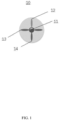
- FIG. 1 is a schematic format diagram of the ligand (interface model) of the organic-inorganic composite electrolyte 10.
- the organic-inorganic composite electrolyte 10 includes a plurality of metal cations 11, a plurality of organic polymer chains or groups 12, a plurality of negatively charged ion groups 13 and a plurality of salt anions 14. Among them, at least part of the metal cations 11 are simultaneously combined with the negatively charged ion groups 13, the organic polymer chains 12 and the salt anions 14 through covalent bonds.
- the salt anions 14 are ClO 4 - , AsF 6 - , PF 6 - , TFSI (N(CF 3 SO 2 ) 2 - ), FSI(N(FSO 2 ) 2 - ), BOB(B(C 2 O 4 ) 2 - ), DFOB(B(C 2 O 4 ) 2 - ).
- the metal cation 11 is at least one of Li + , Na + , K + , Mg 2+ , and Al 3+ .
- the negatively charged ion group 13 is at least one of HNO 3 , KNO 3 , AgNO 3 , C 2 N 4 O 6 , lithium difluorodioxalate, phosphoric acid, Ag 3 PO 4 , Li 3 PO 4 , Li 2 SO 4 , Li 2 SO 3 , and lithium metabisulfite.
- metal cations aren't strictly bound simultaneously to the negatively charged ion group, the organic polymer chain or group, and the salt anion. Instead, these metal cations may selectively combine with either the negatively charged ion group and the organic polymer chain or group, or with the organic polymer chain or group and the salt anion.
- Salt anions facilitate ionic conductivity, while negatively charged coordination ion agents act as surface stabilizers.
- Organic molecular compounds are structured to support the Stokes radius, enabling the diffusion of cations (Li + , Na + , K + , Mg 2+ , Al 3+ ) in the environment, thereby facilitating electron movement to complete charge and discharge cycles. Additionally, the introduced organic molecular compounds can adsorb as a film at the cathode interface, restraining the dissolution of metal ions like Fe, Ni, Co, Mn, etc., and preventing metal dendrite formation on the separator at the negative electrode.
- Metal cations form covalent bonds with salt anions and negatively charged ion groups, while organic polymers aid the diffusion of metal cations by offering Stokes radii support for these cations. Consequently, the depiction mentioned above represents a dynamic, spherical transformation.
- the covalent bond strength between the core metal cation and the negatively charged ions is marginally weaker than that between the metal cation and the salt anion. This characteristic allows it to capture H + during the charge and discharge cycles, restraining adverse battery reactions, and stabilizing the charging and discharging cycles.
- the organic-inorganic composite electrolyte in this embodiment serves as a high-voltage, high-safety composite electrolyte. Beyond its application in conventional wound and soft-packed lithium-ion secondary batteries, it extends its suitability to batteries that do not incorporate anode electrodes.
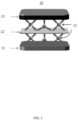
- an embodiment of the present disclosure provides a battery 20 without anode.
- the battery 20 comprises a positive electrode 21, a negative electrode 22, a separator 23 disposed between the positive electrode 21 and the negative electrode 22, and an organic-inorganic composite electrolyte 10.
- the positive electrode 21 is NCM811
- the negative electrode 22 is copper foil
- the electrolyte is the organic-inorganic composite electrolyte of the above embodiment.
- some of the lithium ions are concurrently bonded to the negatively charged ion group, the organic polymer chain or group, and the salt anion through covalent bonds. Meanwhile, another fraction of the lithium ions selectively forms bonds with only one or two of the negatively charged coordination ion groups, the organic polymer chains, or the salt anions at any given time.
- the battery is not limited to a battery without anode, and can also be other batteries.
- the negatively charged ion groups and salt anions in the organic-inorganic composite electrolyte form an inorganic SEI layer, which is thin, dense, and flat. Consequently, there is no formation of dendrites on the copper foil.
- Post 200 cycles there is an absence of lithium metal agglomeration on the surface, indicating the absence of lithium dendrite agglomerations. Simultaneously, it does not induce corrosion at the current collector end and avoids substantial gas production.
- FIG. 4 for the electrical test results of the anode-less battery, the anode-less battery has high volumetric energy density, simple manufacturing process and low battery recycling cost.
- the embodiment of the present disclosure provides a method for preparing an organic-inorganic composite electrolyte.
- the preparation method includes the following steps:
- step S1 a combination of compounds such as ethylene glycol dimethyl ether, diethylene glycol dimethyl ether, triethylene glycol dimethyl ether, tetraethylene glycol dimethyl ether, etc.; dinitrile, adiponitrile, glutaronitrile, etc.; sulfolane, sulfone fluoride, succinate, ethyl methyl sulfone, etc.; are mixed to create an organic molecular compound.
- This organic molecular compound comprises lowest unoccupied molecular orbital (LUMO) organic molecular groups. It's crucial to consider the LUMO organic molecular groups in the conduction band for this organic molecular compound.
- LUMO lowest unoccupied molecular orbital
- the energy level difference between Li + and the organic molecule is minimal, the high energy level of LUMO organic molecular groups may result in easy electron loss, thereby affecting stability.
- the organic groups present in at least one ether, at least one nitrile, or at least one sulfone constitute the LUMO organic molecular groups. Therefore, the organic groups within the organic molecular compound represent LUMO organic molecular groups.
- step S1 to prevent reactions during the process, the utilization of molecular sieves is essential to eliminate water, while a moisture analyzer is employed to monitor and maintain the moisture content below 10 ppm.
- a moisture analyzer is employed to monitor and maintain the moisture content below 10 ppm.
- step S1 one embodiment involves mixing diethylene glycol dimethyl ether, succinonitrile, and sulfolane in a volume ratio of 1:1:1 to create an organic molecular compound.
- the salt anions contains at least one of ClO 4 - , AsF 6 - , PF 6 - , TFSI (N(CF 3 SO 2 ) 2 - ), FSI(N(FSO 2 ) 2 - ), BOB(B(C 2 O 4 ) 2 - ), and DFOB(B(C 2 O 4 ) 2 - ).
- the salt cations contains at least one of cations Li + , Na + , K + , Mg 2+ , and Al 3+ .
- the concentration of salt cations ranges between of 1 ⁇ 10 mol/L. To prevent the generation of free acid and maintain ligand stability, the salt is kept at a temperature range of 0 ⁇ 8°C. Molecular sieves are utilized to remove water (0.1 ppm).
- PF 6 - , TFSI (N(CF 3 SO 2 ) 2 - ) and Li + are mixed into organic molecular compounds.
- concentration of Li + is ranged from 1.1 to 1.2 mol/L, and the temperature is controlled at about 2 °C.
- the negatively charged coordination ion agent employed for coordination includes at least one of HNO 3 , KNO 3 , AgNO 3 , C 2 N 4 O 6 , lithium difluorodioxalate, phosphoric acid, Ag 3 PO 4 , Li 3 PO 4 , Li 2 SO 4 , Li 2 SO 3 , and lithium metabisulfite.
- the weight ratio of low LUMO organic molecular groups in the organic molecular compound to the negatively charged coordination ion agent used for coordination ranges between 0.001 to 0.100. To prevent excessive free acid generation from heat release, the temperature must be maintained within a range of 0 to 8°C.
- the negatively charged coordination ion agent added for coordination is AgNO 3 .
- a weight ratio of organic molecular groups to AgNO 3 is 0.05: 1, and the temperature is controlled at about 1°C.
- the functional groups within the organic compounds must have the capability to establish a composite electrolyte with the negatively charged ion agent.
- the negatively charged coordination ion group in conjunction with the salt anion, constitutes an inorganic SEI.
- This SEI serves to hinder the decomposition of electrolyte side reactions, minimize lithium deposition overpotential, and suppress dendrite formation on the surface.
- the capture of H + via negatively charged ions functions to impede the generation of CO 2 , H 2 , CH 4 , and C 2 H 4 .
- the preparation method outlined for the organic-inorganic composite electrolyte in this embodiment directly involves blending the ligands using molecular sieves while regulating the ligand temperature within the range of 0 to 8 °C. This method effectively prevents degradation of salt anions and the formation of free acid through negative reactions (H + ).
- the preparation technique for the organic-inorganic composite electrolyte in this embodiment offers a straightforward process, ensuring ease of control and suitability for industrial-scale production. Moreover, only the use of molecular sieves is required for blending, allowing the resulting electrolyte post-blending to exist in liquid, colloidal, or condensed states.
- Embodiments of the present disclosure introduce a method for preparing a battery utilizing an organic-inorganic composite electrolyte.
- the preparation method encompasses the following steps: dissolving cathode material, conductive agent, and binder in a solvent, comprising a mass percentage of 88:1:11, to yield a mixture, controlling the solid content at 50%. Subsequently, applying the resulting mixture onto an aluminum foil current collector, followed by vacuum drying, yields a cathode electrode sheet.
- plan the negative electrode to be 1.1 to 1.05 times the size of the copper foil current collector.
- Batteries utilizing organic-inorganic composite electrolytes in the embodiments of the present disclosure demonstrate high volumetric energy density, feature uncomplicated manufacturing processes, and incur low battery recycling costs.
Landscapes
- Chemical & Material Sciences (AREA)
- Engineering & Computer Science (AREA)
- General Chemical & Material Sciences (AREA)
- Manufacturing & Machinery (AREA)
- Chemical Kinetics & Catalysis (AREA)
- Electrochemistry (AREA)
- Inorganic Chemistry (AREA)
- Physics & Mathematics (AREA)
- Condensed Matter Physics & Semiconductors (AREA)
- General Physics & Mathematics (AREA)
- Materials Engineering (AREA)
- Dispersion Chemistry (AREA)
- Secondary Cells (AREA)
Applications Claiming Priority (1)
| Application Number | Priority Date | Filing Date | Title |
|---|---|---|---|
| CN202211578579.0A CN118173862A (zh) | 2022-12-09 | 2022-12-09 | 有机-无机复合电解质及其制备方法以及电池 |
Publications (2)
| Publication Number | Publication Date |
|---|---|
| EP4383393A2 true EP4383393A2 (de) | 2024-06-12 |
| EP4383393A3 EP4383393A3 (de) | 2024-10-02 |
Family
ID=89121634
Family Applications (1)
| Application Number | Title | Priority Date | Filing Date |
|---|---|---|---|
| EP23214838.7A Pending EP4383393A3 (de) | 2022-12-09 | 2023-12-07 | Organisch-anorganischer verbundelektrolyt und herstellungsverfahren dafür und batterie |
Country Status (3)
| Country | Link |
|---|---|
| US (1) | US20240194945A1 (de) |
| EP (1) | EP4383393A3 (de) |
| CN (1) | CN118173862A (de) |
Family Cites Families (1)
| Publication number | Priority date | Publication date | Assignee | Title |
|---|---|---|---|---|
| JP2021068621A (ja) * | 2019-10-24 | 2021-04-30 | 積水化学工業株式会社 | 固体電池、固体電池の正極活物質層製造用組成物、および固体電池の正極活物質層の製造方法 |
-
2022
- 2022-12-09 CN CN202211578579.0A patent/CN118173862A/zh active Pending
-
2023
- 2023-12-06 US US18/530,652 patent/US20240194945A1/en active Pending
- 2023-12-07 EP EP23214838.7A patent/EP4383393A3/de active Pending
Also Published As
| Publication number | Publication date |
|---|---|
| US20240194945A1 (en) | 2024-06-13 |
| EP4383393A3 (de) | 2024-10-02 |
| CN118173862A (zh) | 2024-06-11 |
Similar Documents
| Publication | Publication Date | Title |
|---|---|---|
| Zhang et al. | Toward high-energy-density aqueous zinc–iodine batteries: multielectron pathways | |
| Guo et al. | Opportunities and challenges of zinc anodes in rechargeable aqueous batteries | |
| Xu et al. | Roadmap on ionic liquid electrolytes for energy storage devices | |
| Zhang et al. | Pursuit of reversible Zn electrochemistry: a time-honored challenge towards low-cost and green energy storage | |
| JP5498965B2 (ja) | ゲル電解質を有する電気化学電池の製造方法 | |
| KR101503879B1 (ko) | 마그네슘 하이브리드 전지 및 이의 제조 방법 | |
| US8546023B2 (en) | Secondary battery comprising ternary eutectic mixtures and preparation method thereof | |
| EP1702374B1 (de) | Ionische flüssigkeitsmodifizierte kathode und elektrochemische einrichtung damit | |
| KR100970918B1 (ko) | 이온성 액체 및 탈수 방법, 및 전기 이중층 커패시터, 및2차 전지 | |
| JP5157107B2 (ja) | 非水電解質電池 | |
| US11133523B2 (en) | Aqueous electrolytes with protonic ionic liquid and batteries using the electrolyte | |
| KR20160100948A (ko) | 용융염 전지, 충방전 방법 및 충방전 시스템 | |
| CN109873207A (zh) | 一种高安全性电解液及其制备方法和应用 | |
| EP3547435B1 (de) | Elektrolytlösung für lithium-schwefel-batterie und lithium-schwefel-batterie damit | |
| KR20200143269A (ko) | 리튬 이차전지용 전해액 조성물 및 이를 포함하는 리튬 이차전지 | |
| US20230402648A1 (en) | Solid-state electrolyte and preparation method thereof, and secondary battery | |
| Tu et al. | Solvation and interfacial chemistry in ionic liquid based electrolytes toward rechargeable lithium-metal batteries | |
| US11870072B2 (en) | Secondary battery, battery pack, vehicle, and stationary power supply | |
| EP4383393A2 (de) | Organisch-anorganischer verbundelektrolyt und herstellungsverfahren dafür und batterie | |
| CN1860639A (zh) | 含有用于提高锂离子电池容量的添加剂的非水系电解液和使用其的锂离子电池 | |
| Wang et al. | Development of metal-organic framework materials as solid-state polymer electrolytes for lithium-metal batteries: A review | |
| CN111261930B (zh) | 一种铝离子电池固体电解质溶液与电池 | |
| JP5062505B2 (ja) | 非水電解質電池 | |
| TWI846198B (zh) | 有機-無機複合電解質及其製備方法以及電池 | |
| Wu et al. | Boroxine crystalline covalent organic frameworks based single-ion quasi-solid-state conductor in lithium-ion battery |
Legal Events
| Date | Code | Title | Description |
|---|---|---|---|
| PUAI | Public reference made under article 153(3) epc to a published international application that has entered the european phase |
Free format text: ORIGINAL CODE: 0009012 |
|
| STAA | Information on the status of an ep patent application or granted ep patent |
Free format text: STATUS: THE APPLICATION HAS BEEN PUBLISHED |
|
| AK | Designated contracting states |
Kind code of ref document: A2 Designated state(s): AL AT BE BG CH CY CZ DE DK EE ES FI FR GB GR HR HU IE IS IT LI LT LU LV MC ME MK MT NL NO PL PT RO RS SE SI SK SM TR |
|
| RIC1 | Information provided on ipc code assigned before grant |
Ipc: H01M 10/0562 20100101AFI20240607BHEP |
|
| PUAL | Search report despatched |
Free format text: ORIGINAL CODE: 0009013 |
|
| AK | Designated contracting states |
Kind code of ref document: A3 Designated state(s): AL AT BE BG CH CY CZ DE DK EE ES FI FR GB GR HR HU IE IS IT LI LT LU LV MC ME MK MT NL NO PL PT RO RS SE SI SK SM TR |
|
| RIC1 | Information provided on ipc code assigned before grant |
Ipc: H01M 10/0562 20100101AFI20240827BHEP |
|
| STAA | Information on the status of an ep patent application or granted ep patent |
Free format text: STATUS: REQUEST FOR EXAMINATION WAS MADE |
|
| 17P | Request for examination filed |
Effective date: 20250325 |