EP4374818A1 - Verfahren zum herstellen einer dentalen restauration - Google Patents
Verfahren zum herstellen einer dentalen restauration Download PDFInfo
- Publication number
- EP4374818A1 EP4374818A1 EP22209984.8A EP22209984A EP4374818A1 EP 4374818 A1 EP4374818 A1 EP 4374818A1 EP 22209984 A EP22209984 A EP 22209984A EP 4374818 A1 EP4374818 A1 EP 4374818A1
- Authority
- EP
- European Patent Office
- Prior art keywords
- dental restoration
- pressure distribution
- manufacturing
- oral mucosa
- spatial region
- Prior art date
- Legal status (The legal status is an assumption and is not a legal conclusion. Google has not performed a legal analysis and makes no representation as to the accuracy of the status listed.)
- Granted
Links
Images




Classifications
-
- A—HUMAN NECESSITIES
- A61—MEDICAL OR VETERINARY SCIENCE; HYGIENE
- A61C—DENTISTRY; APPARATUS OR METHODS FOR ORAL OR DENTAL HYGIENE
- A61C13/00—Dental prostheses; Making same
- A61C13/0003—Making bridge-work, inlays, implants or the like
- A61C13/0004—Computer-assisted sizing or machining of dental prostheses
-
- A—HUMAN NECESSITIES
- A61—MEDICAL OR VETERINARY SCIENCE; HYGIENE
- A61C—DENTISTRY; APPARATUS OR METHODS FOR ORAL OR DENTAL HYGIENE
- A61C13/00—Dental prostheses; Making same
- A61C13/0003—Making bridge-work, inlays, implants or the like
- A61C13/0006—Production methods
- A61C13/0019—Production methods using three dimensional printing
-
- A—HUMAN NECESSITIES
- A61—MEDICAL OR VETERINARY SCIENCE; HYGIENE
- A61C—DENTISTRY; APPARATUS OR METHODS FOR ORAL OR DENTAL HYGIENE
- A61C13/00—Dental prostheses; Making same
- A61C13/0003—Making bridge-work, inlays, implants or the like
- A61C13/0006—Production methods
-
- A—HUMAN NECESSITIES
- A61—MEDICAL OR VETERINARY SCIENCE; HYGIENE
- A61C—DENTISTRY; APPARATUS OR METHODS FOR ORAL OR DENTAL HYGIENE
- A61C13/00—Dental prostheses; Making same
- A61C13/08—Artificial teeth; Making same
-
- A—HUMAN NECESSITIES
- A61—MEDICAL OR VETERINARY SCIENCE; HYGIENE
- A61C—DENTISTRY; APPARATUS OR METHODS FOR ORAL OR DENTAL HYGIENE
- A61C5/00—Filling or capping teeth
- A61C5/70—Tooth crowns; Making thereof
- A61C5/77—Methods or devices for making crowns
-
- A—HUMAN NECESSITIES
- A61—MEDICAL OR VETERINARY SCIENCE; HYGIENE
- A61K—PREPARATIONS FOR MEDICAL, DENTAL OR TOILETRY PURPOSES
- A61K6/00—Preparations for dentistry
- A61K6/80—Preparations for artificial teeth, for filling teeth or for capping teeth
-
- B—PERFORMING OPERATIONS; TRANSPORTING
- B33—ADDITIVE MANUFACTURING TECHNOLOGY
- B33Y—ADDITIVE MANUFACTURING, i.e. MANUFACTURING OF THREE-DIMENSIONAL [3D] OBJECTS BY ADDITIVE DEPOSITION, ADDITIVE AGGLOMERATION OR ADDITIVE LAYERING, e.g. BY 3D PRINTING, STEREOLITHOGRAPHY OR SELECTIVE LASER SINTERING
- B33Y10/00—Processes of additive manufacturing
-
- B—PERFORMING OPERATIONS; TRANSPORTING
- B33—ADDITIVE MANUFACTURING TECHNOLOGY
- B33Y—ADDITIVE MANUFACTURING, i.e. MANUFACTURING OF THREE-DIMENSIONAL [3D] OBJECTS BY ADDITIVE DEPOSITION, ADDITIVE AGGLOMERATION OR ADDITIVE LAYERING, e.g. BY 3D PRINTING, STEREOLITHOGRAPHY OR SELECTIVE LASER SINTERING
- B33Y50/00—Data acquisition or data processing for additive manufacturing
- B33Y50/02—Data acquisition or data processing for additive manufacturing for controlling or regulating additive manufacturing processes
-
- B—PERFORMING OPERATIONS; TRANSPORTING
- B33—ADDITIVE MANUFACTURING TECHNOLOGY
- B33Y—ADDITIVE MANUFACTURING, i.e. MANUFACTURING OF THREE-DIMENSIONAL [3D] OBJECTS BY ADDITIVE DEPOSITION, ADDITIVE AGGLOMERATION OR ADDITIVE LAYERING, e.g. BY 3D PRINTING, STEREOLITHOGRAPHY OR SELECTIVE LASER SINTERING
- B33Y80/00—Products made by additive manufacturing
-
- G—PHYSICS
- G06—COMPUTING OR CALCULATING; COUNTING
- G06T—IMAGE DATA PROCESSING OR GENERATION, IN GENERAL
- G06T7/00—Image analysis
- G06T7/10—Segmentation; Edge detection
- G06T7/11—Region-based segmentation
-
- G—PHYSICS
- G06—COMPUTING OR CALCULATING; COUNTING
- G06T—IMAGE DATA PROCESSING OR GENERATION, IN GENERAL
- G06T7/00—Image analysis
- G06T7/90—Determination of colour characteristics
-
- B—PERFORMING OPERATIONS; TRANSPORTING
- B33—ADDITIVE MANUFACTURING TECHNOLOGY
- B33Y—ADDITIVE MANUFACTURING, i.e. MANUFACTURING OF THREE-DIMENSIONAL [3D] OBJECTS BY ADDITIVE DEPOSITION, ADDITIVE AGGLOMERATION OR ADDITIVE LAYERING, e.g. BY 3D PRINTING, STEREOLITHOGRAPHY OR SELECTIVE LASER SINTERING
- B33Y70/00—Materials specially adapted for additive manufacturing
-
- G—PHYSICS
- G06—COMPUTING OR CALCULATING; COUNTING
- G06T—IMAGE DATA PROCESSING OR GENERATION, IN GENERAL
- G06T2200/00—Indexing scheme for image data processing or generation, in general
- G06T2200/08—Indexing scheme for image data processing or generation, in general involving all processing steps from image acquisition to 3D model generation
Definitions
- the present invention relates to a method for producing a dental restoration and a manufacturing device for producing a dental restoration.
- the technical problem is solved by a method for producing a dental restoration, comprising the steps of calculating a pressure distribution on the oral mucosa through the dental restoration on the basis of a three-dimensional data set of the dental restoration and a three-dimensional data set of the oral mucosa; and determining a spatial region for an elastic production material within the dental restoration on the basis of the calculated Pressure distribution.
- the spatial area forms a sub-volume of the dental restoration.
- a manufacturing material for the spatial area is determined based on the pressure distribution.
- the manufacturing material can be selected from a plurality of manufacturing materials. This achieves the technical advantage, for example, that not only an extension of the spatial area but also a manufacturing material can be determined based on the pressure distribution. This allows the wearing comfort of the dental restoration to be further improved.
- the pressure distribution is calculated using a finite element method. This achieves the technical advantage, for example, that the pressure distribution can be calculated quickly with high accuracy.
- the pressure distribution is calculated when a predetermined force is applied to the dental restoration.
- the predetermined force is determined by a bite sensor. This allows, for example, the technical The advantage is that realistic forces and points of attack are used when calculating the pressure distribution.
- a pressure distribution on the dental restoration is calculated from the pressure distribution on the oral mucosa. This achieves the technical advantage, for example, that the spatial area within the dental restoration can be precisely adjusted.
- a thickness of the spatial area is proportional to the pressure distribution on the dental restoration. This achieves the technical advantage, for example, that the spatial area can be calculated in a simple manner.
- the manufacturing material in the spatial area has a lower modulus of elasticity than the manufacturing material outside the spatial area. This achieves the technical advantage, for example, that the wearing comfort of the dental restoration can be increased.
- the dental restoration is produced using a three-dimensional printing process. This achieves the technical advantage that the dental restoration can be produced in a simple manner.
- the three-dimensional printing process uses a free-jet material application. This enables, for example, The technical advantage achieved is that the production of the dental restoration is further improved.
- the technical problem is solved by a manufacturing device for producing a dental restoration, with a calculation device for calculating a pressure distribution on the oral mucosa through the dental restoration on the basis of a three-dimensional data set of the dental restoration and a three-dimensional data set of the oral mucosa; and a determination device for determining a spatial region for an elastic manufacturing material within the dental restoration on the basis of the calculated pressure distribution.
- the calculation device is designed to calculate the pressure distribution using a finite element method. This also achieves the technical advantage that the pressure distribution can be calculated quickly with high accuracy.
- the determining device is designed to determine a thickness of the spatial region proportional to the pressure distribution on a dental restoration.
- the manufacturing device is designed to use a manufacturing material with a lower modulus of elasticity within the spatial region than outside the spatial region.
- the manufacturing device comprises a 3D printer. This achieves the technical advantage, for example, that the dental restoration can be manufactured in a simple manner.
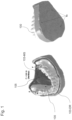
- Fig.1 shows a perspective view of a dental restoration 100 within an oral cavity.
- the dental restoration 100 is, for example, a partial or full denture that sits at least partially on an oral mucosa 105 and is in contact with it.
- the shape of the dental restoration 100 is specified in a three-dimensional data set 103-DR. This can additionally include color data or data about the manufacturing material to be used for the dental restoration 100.
- the shape of the patient's oral mucosa 105 is also stored in a three-dimensional data set 103-MS. Different forces F are exerted on the dental restoration when it is worn, for example when chewing food.
- Fig.2 shows a pressure distribution 101 on the oral mucosa 105 through the dental restoration 100.
- the pressure distribution 101 is calculated from the three-dimensional data set 103-DR of the dental restoration 100 and the three-dimensional data set 103-MS of the oral mucosa 105.
- FEM finite element method
- the calculations take into account both the mechanical material properties of the oral mucosa and the prosthesis.
- a non-linear material model is used to describe the mechanical properties of the oral mucosa.
- the material behavior of the prosthesis material can be assumed to be linearly elastic.
- the pressure distribution can be calculated using a FEM-based contact algorithm.
- On the oral mucosa 105 there are areas in which the dental restoration 100 exerts a low pressure on the oral mucosa 105 and areas in which the dental restoration 100 exerts a high pressure on the oral mucosa 105.
- the occlusal surface of the dental restoration 100 can be taken into account during a chewing process.
- different chewing processes can be simulated depending on a location and a type of food in order to obtain a pressure distribution 101 of a contact pressure of the dental restoration 100 on the oral mucosa 105.
- a case can be selected in which the most unfavorable forces (worst case scenario) occur. This leads to a maximum peak contact pressure on the oral mucosa 105.
- the simulated local peak contact pressure can then be minimized by elastic manufacturing materials 109 of the dental restoration 100 that have a lower elastic modulus than the manufacturing materials 113 of the remaining dental restoration 100.
- a thickness of the manufacturing material 109 with the lower elastic modulus can be optimized in order to keep a peak contact pressure below a pressure pain threshold.
- the Shore hardness (scale A) of the manufacturing material 109 is, for example, in a range between 35 and 60 (ISO 7619-1).
- the tensile strength is, for example, between 5.5 and 8.5 N/mm 2 (ISO 37 Type 4).
- the elastic manufacturing material 109 for the spatial region 107 is, for example, an elastomer such as silicone.
- the manufacturing material 113 for the dental restoration 100 is, for example, an unfilled or filled methyl methacrylate (MMA) and typically has a hardness in the range between 41.63 ⁇ 2.03 and 34.62 ⁇ 2.1 (Vickers hardness).
- a bending strength (MPa) is, for example, between 86.63 ⁇ 1.0 and 69.15 ⁇ 0.88.
- An impact strength (KJ/m 2 ) is, for example, between 6.32 ⁇ 0.50 and 2.44 ⁇ 0.31.
- the manufacturing material 109 for the spatial region 107 is softer or more elastic than the manufacturing material 113 for the dental restoration 100.
- Fig.3 shows a cross-sectional view through the dental restoration 100 and the oral mucosa 105.
- an optimization algorithm can be used that pushes the peak contact pressure of the dental restoration 100 below the patient's pressure pain threshold.
- the three-dimensional data set 103-DR of the dental restoration 100 is used in combination with the three-dimensional data set 103-MS of the oral mucosa 105.
- a pressure distribution 101 on the oral mucosa 105 is calculated under the predetermined forces.
- a thickness t(x,y,z) of a spatial region 107 of the elastic manufacturing material 109 is optimized such that a pressure distribution P(x,y,z) that is as uniform as possible is exerted on the oral mucosa 105.
- a three-dimensional distribution of an elastic manufacturing material 109 is derived from the simulated pressure distribution P(x,y,z) on the oral mucosa 105. This process can be repeated iteratively several times, for example until a peak contact pressure of the pressure distribution 101 is below a predetermined value.
- the algorithm can be executed on a computer on which a program for carrying out the method is stored.
- the computer comprises a processor with which instructions for executing the algorithm are processed and a digital memory in which the three-dimensional data sets 103 of the oral mucosa 105 and the dental restoration 100 are stored.
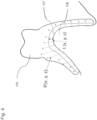
- Fig.4 shows another cross-sectional view through the dental restoration 100 and the oral mucosa 105.
- the pressure distribution 101 on the surface is given by force vectors per unit area, where the force vectors originate from the vertices and are ideally perpendicular to the surface or vertex.
- the local thickness of the elastic manufacturing material 109 on the basal surface of the prosthesis base is calculated by applying a constant conversion factor to each force vector.
- a new internal surface is created by defining new vertices at the end of each newly calculated vector.
- a spatial region 109 can be calculated whose local thickness depends on the pressure distribution 111 of the dental restoration 100. Together with the outer basal surface, where the force vectors are applied to the vertices, the newly created internal surface creates a sub-volume of the dental restoration.
- the elastic manufacturing material 109 is arranged in the spatial region 107 of the sub-volume. The shape and position of the spatial region 107 can be integrated into the three-dimensional data set 103-DR of the dental restoration 100.
- a Boolean operation is applied by which the newly created spatial area is subtracted from the volume of the original dental restoration 100.
- the Material types are assigned to the separate spatial areas depending on their elastic modulus.
- the calculation of the spatial region for the elastic manufacturing material 109 can also be calculated in another way. For example, as soon as a value of the pressure distribution 101 is above a predetermined value, a spatial region 107 with a predetermined thickness can be provided.
- Fig.6 shows a block diagram of a method for producing the dental restoration 100.
- step S101 the pressure distribution 101 on the oral mucosa 105 through the dental restoration 100 is calculated on the basis of a three-dimensional data set 103-DS of the dental restoration 100 and a three-dimensional data set 103-MS of the oral mucosa 105.
- step S102 a spatial region 107 for the elastic production material 109 within the dental restoration 100 is determined on the basis of the calculated pressure distribution 101.
- the dental restoration 100 is produced with the elastic production material 109.
- an additive manufacturing process can preferably be used in which a selective material application of different materials is possible (extrusion, free jet process, inkjet), wherein the different materials have different elastic moduli.
- the hard and solid manufacturing material of the dental restoration 100 can be, for example, methyl methacrylate (MMA) and the elastic manufacturing material 109 can be a light-curable medical silicone.
- MMA methyl methacrylate
- the elastic manufacturing material 109 can be a light-curable medical silicone.
- the procedure increases the wearing comfort of the dental restoration, taking into account the individual anatomy of a patient. Pain or discomfort due to inhomogeneous pressure distribution on the dental restoration 100 can be minimized. Long-term residual ridge resorption can be prevented. In addition, better long-term wearing comfort is achieved due to the elastic material in contact with the oral mucosa, which effectively allows anatomical development of the oral mucosa.
- All method steps can be implemented by devices suitable for carrying out the respective method step. All functions performed by material features can be a method step of a method.
Landscapes
- Health & Medical Sciences (AREA)
- Engineering & Computer Science (AREA)
- Oral & Maxillofacial Surgery (AREA)
- Veterinary Medicine (AREA)
- Animal Behavior & Ethology (AREA)
- Public Health (AREA)
- General Health & Medical Sciences (AREA)
- Epidemiology (AREA)
- Life Sciences & Earth Sciences (AREA)
- Dentistry (AREA)
- Manufacturing & Machinery (AREA)
- Chemical & Material Sciences (AREA)
- Materials Engineering (AREA)
- Physics & Mathematics (AREA)
- Theoretical Computer Science (AREA)
- General Physics & Mathematics (AREA)
- Computer Vision & Pattern Recognition (AREA)
- Plastic & Reconstructive Surgery (AREA)
- Dental Prosthetics (AREA)
- Dental Tools And Instruments Or Auxiliary Dental Instruments (AREA)
Abstract
Description
- Die vorliegende Erfindung betrifft ein Verfahren zum Herstellen einer dentalen Restauration und eine Herstellungsvorrichtung zum Herstellen einer dentalen Restauration.
- Die gegenwärtige Herstellung von Prothesen ist ein arbeitsintensiver Prozess. Besonders die Optimierung der Prothesengeometrie, um den größtmöglichen Tragekomfort zu erreichen, erfordert oft zahlreiche Arztbesuche.
- Es ist die technische Aufgabe der vorliegenden Erfindung, den Tragekomfort einer dentalen Restauration zu erhöhen und Schmerzen und Beschwerden beim Tragen der dentalen Restauration zu vermindern.
- Diese technische Aufgabe wird durch Gegenstände nach den unabhängigen Ansprüchen gelöst. Technisch vorteilhafte Ausführungsformen sind Gegenstand der abhängigen Ansprüche, der Beschreibung und der Zeichnungen.
- Gemäß einem ersten Aspekt wird die technische Aufgabe durch ein Verfahren zum Herstellen einer dentalen Restauration gelöst, mit den Schritten eines Berechnens einer Druckverteilung auf die Mundschleimhaut durch die dentale Restauration auf Basis eines dreidimensionalen Datensatzes der dentalen Restauration und eines dreidimensionalen Datensatzes der Mundschleimhaut; und eines Bestimmens eines räumlichen Bereiches für ein elastisches Herstellungsmaterial innerhalb der dentalen Restauration auf Basis der berechneten Druckverteilung. Der räumliche Bereich bildet ein Untervolumen der dentalen Restauration. Durch das Verfahren wird der technische Vorteil erreicht, dass der Tragekomfort der dentalen Restauration verbessert wird. Zudem kann eine langfristige Restkammresorption der dentalen Restauration verhindert werden.
- In einer technisch vorteilhaften Ausführungsform des Verfahrens wird ein Herstellungsmaterial für den räumlichen Bereich auf Basis der Druckverteilung bestimmt. Das Herstellungsmaterial kann aus einer Mehrzahl von Herstellungsmaterialien ausgewählt werden. Dadurch wird beispielsweise der technische Vorteil erreicht, dass nicht nur eine Ausdehnung des räumlichen Bereichs, sondern auch ein Herstellungsmaterial auf Basis der Druckverteilung festgelegt werden kann. Dadurch lässt sich der Tragekomfort der dentalen Restauration nochmals verbessern.
- In einer weiteren technisch vorteilhaften Ausführungsform des Verfahrens wird die Druckverteilung mittels einer Finite-Elemente-Methode berechnet. Dadurch wird beispielsweise der technische Vorteil erreicht, dass sich die Druckverteilung auf schnelle Weise mit hoher Genauigkeit berechnen lässt.
- In einer weiteren technisch vorteilhaften Ausführungsform des Verfahrens wird die Druckverteilung bei Vorliegen einer vorgegebenen Kraft auf die dentale Restauration berechnet. Dadurch wird beispielsweise der technische Vorteil erreicht, dass auftretende Kräfte bei der Berechnung der Druckverteilung berücksichtigt werden können und bei der Gestaltung des räumlichen Bereichs berücksichtigt werden.
- In einer weiteren technisch vorteilhaften Ausführungsform des Verfahrens wird die vorgegebene Kraft durch einen Aufbiss-Sensor ermittelt. Dadurch wird beispielsweise der technische Vorteil erreicht, dass realistische Kräfte und Angriffspunkte bei der Berechnung der Druckverteilung verwendet werden.
- In einer weiteren technisch vorteilhaften Ausführungsform des Verfahrens wird aus der Druckverteilung auf die Mundschleimhaut eine Druckverteilung auf die dentale Restauration berechnet. Dadurch wird beispielsweise der technische Vorteil erreicht, dass sich der räumliche Bereich innerhalb der dentalen Restauration genau anpassen lässt.
- In einer weiteren technisch vorteilhaften Ausführungsform des Verfahrens ist eine Dicke des räumlichen Bereichs proportional zur Druckverteilung auf die dentale Restauration. Dadurch wird beispielsweise der technische Vorteil erreicht, dass sich der räumliche Bereich auf einfache Weise berechnen lässt.
- In einer weiteren technisch vorteilhaften Ausführungsform des Verfahrens weist das Herstellungsmaterial in dem räumlichen Bereich ein niedrigeres Elastizitätsmodul als das Herstellungsmaterial außerhalb des räumlichen Bereichs auf. Dadurch wird beispielsweise der technische Vorteil erreicht, dass der Tragekomfort der dentalen Restauration gesteigert werden kann.
- In einer weiteren technisch vorteilhaften Ausführungsform des Verfahrens wird das Herstellen der dentalen Restauration mittels eines dreidimensionalen Druckverfahrens durchgeführt. Dadurch wird beispielsweise der technische Vorteil erreicht, dass sich die dentale Restauration auf eine einfache Weise herstellen lässt.
- In einer weiteren technisch vorteilhaften Ausführungsform des Verfahrens verwendet das dreidimensionale Druckverfahren einen Freistrahl-Materialauftrag. Dadurch wird beispielsweise der technische Vorteil erreicht, dass die Herstellung der dentalen Restauration nochmals verbessert wird.
- Gemäß einem zweiten Aspekt wird die technische Aufgabe durch ein eine Herstellungsvorrichtung zum Herstellen einer dentalen Restauration gelöst, mit einer Berechnungsvorrichtung zum Berechnen einer Druckverteilung auf die Mundschleimhaut durch die dentale Restauration auf Basis eines dreidimensionalen Datensatzes der dentalen Restauration und eines dreidimensionalen Datensatzes der Mundschleimhaut; und einer Bestimmungsvorrichtung zum Bestimmen eines räumlichen Bereiches für ein elastisches Herstellungsmaterial innerhalb der dentalen Restauration auf Basis der berechneten Druckverteilung.
- In einer technisch vorteilhaften Ausführungsform der Herstellungsvorrichtung ist die Berechnungsvorrichtung ausgebildet, die Druckverteilung mittels einer Finite-Elemente-Methode zu berechnen. Dadurch wird beispielsweise ebenfalls der technische Vorteil erreicht, dass sich die Druckverteilung auf schnelle Weise mit hoher Genauigkeit berechnen lässt.
- In einer weiteren technisch vorteilhaften Ausführungsform der Herstellungsvorrichtung ist die Bestimmungsvorrichtung ausgebildet, eine Dicke des räumlichen Bereichs proportional zur Druckverteilung auf eine dentale Restauration zu bestimmen.
- In einer weiteren technisch vorteilhaften Ausführungsform der Herstellungsvorrichtung ist die Herstellungsvorrichtung ausgebildet, innerhalb des räumlichen Bereiches ein Herstellungsmaterial mit einem niedrigeren Elastizitätsmodul als außerhalb des räumlichen Bereichs zu verwenden.
- In einer weiteren technisch vorteilhaften Ausführungsform der Herstellungsvorrichtung umfasst das Herstellungsgerät einen 3D-Drucker. Dadurch wird beispielsweise der technische Vorteil erreicht, dass sich die dentale Restauration auf einfache Weise herstellen lässt.
- Ausführungsbeispiele der Erfindung sind in den Zeichnungen dargestellt und werden im Folgenden näher beschrieben.
- Es zeigen:
- Fig. 1
- eine perspektivische Ansicht einer dentalen Restauration innerhalb eines Mundraums;
- Fig. 2
- eine Druckverteilung auf einer Mundschleimhaut;
- Fig. 3
- eine Querschnittsansicht durch die dentale Restauration und die Mundschleimhaut;
- Fig. 4
- eine weitere Querschnittsansicht durch die dentale Restauration und die Mundschleimhaut;
- Fig. 5
- eine schematische Ansicht einer Herstellungsvorrichtung zum Herstellen einer dentalen Restauration; und
- Fig. 6
- ein Blockdiagramm eines Verfahrens zum Herstellen der dentalen Restauration.
-
Fig. 1 zeigt eine perspektivische Ansicht einer dentalen Restauration 100 innerhalb eines Mundraums. Die dentale Restauration 100 ist beispielsweise eine Teil- oder Vollprothese, die zumindest teilweise auf einer Mundschleimhaut 105 aufsitzt und mit dieser in Kontakt steht. - Die Form der dentalen Restauration 100 ist in einem dreidimensionalen Datensatz 103-DR angegeben. Dieser kann zusätzlich Farbdaten oder Daten über das zu verwendende Herstellungsmaterial der Dentalen Restauration 100 umfassen. Die Form der Mundschleimhaut 105 des Patienten ist ebenfalls in einem dreidimensionalen Datensatz 103-MS gespeichert. Auf die dentale Restauration werden beim Tragen unterschiedliche Kräfte F ausgeübt, wie beispielsweis beim Kauen von Nahrung.
-
Fig. 2 zeigt eine Druckverteilung 101 auf der Mundschleimhaut 105 durch die dentale Restauration 100. Die Druckverteilung 101 wird aus dem dreidimensionalen Datensatz 103-DR der dentalen Restauration 100 und dem dreidimensionalen Datensatz 103-MS der Mundschleimhaut 105 berechnet. Zu diesem Zweck kann ein Finite-Elemente-Verfahren (FEM) durchgeführt werden, um die Druckverteilung 101 eines Kontakts der dentalen Restauration 100 auf der Mundschleimhaut 105 zu simulieren. Die Berechnungen berücksichtigen sowohl die mechanische Materialeigenschaften des Mundschleimhautes als auch der Prothese. Eine nicht lineare Material Modell kommt für die Beschreibung der mechanischen Eigenschaften des Mundschleimhautes im Einsatz. Andererseits kann das Materialverhalten von der Prothese Material als linearelastisch angenommen werden. Darüber hinaus muss für die Kontaktstelle zwischen Prothese und Mundschleimhaut geometrische nicht Linearitäten berücksichtigt werden. Durch die vollständige Beschreibung der mechanischen Eigenschaften von jeweiligen Materialen, können mit Hilfe von einem FEM basierten Kontaktalgorithmus die Druckverteilung berechnet werden. Auf der Mundschleimhaut 105 existieren Bereiche, in denen die dentale Restauration 100 einen geringen Druck auf die Mundschleimhaut 105 ausübt und Bereiche, in denen die dentale Restauration 100 einen hohen Druck auf die Mundschleimhaut 105 ausübt - Bei der Simulation der Druckverteilung 101 kann die okklusale Oberfläche der dentalen Restauration 100 während eines Kauprozesses berücksichtigt werden. Hierzu können unterschiedliche Kauprozesse in Abhängigkeit einer Stelle und einer Art der Nahrung simuliert werden, um eine Druckverteilung 101 eines Kontaktdrucks der dentalen Restauration 100 auf der Mundschleimhaut 105 zu erhalten. Für die Optimierung der dentalen Restauration 100 kann ein Fall ausgewählt werden, bei dem die ungünstigsten Kräfte (Worst Case Scenario) auftreten. Dies führt zu einem maximalen Spitzenkontaktdruck auf die Mundschleimhaut 105.
- Der simulierte lokale Spitzenkontaktdruck kann dann durch elastische Herstellungsmaterialien 109 der dentalen Restauration 100 minimiert werden, die ein geringes Elastizitätsmodul aufweisen als die Herstellungsmaterialien 113 der übrigen dentalen Restauration 100. Durch die Simulation kann eine Dicke des Herstellungsmaterials 109 mit dem niedrigeren Elastizitätsmodul optimiert werden, um einen Spitzenkontaktdruck unterhalb von einer Druckschmerzgrenze zu halten. Die Shore-Härte (Skala A) des Herstellungsmaterials 109 liegt beispielsweise in einem Bereich zwischen 35 und 60 (ISO 7619-1). Die Zugfestigkeit beträgt beispielsweise zwischen 5.5 und 8.5 N/mm2 (ISO 37 Type 4).
- Das elastische Herstellungsmaterial 109 für den räumlichen Bereich 107 ist beispielsweise ein Elastomer, wie Silikon. Das Herstellungsmaterial 113 für die dentale Restauration 100 ist beispielsweise ein ungefülltes oder gefülltes Methylmethacrylat (MMA) und weist typischerweise eine Härte auf im Bereich zwischen 41.63 ± 2.03 und 34.62 ± 2.1 auf (Vickers-Härte). Eine Biegefestigkeit (MPa) liegt beispielsweise zwischen 86.63 ± 1.0 und 69.15 ± 0.88. Eine Schlagfestigkeit (KJ/m2) liegt beispielsweise zwischen 6.32 ± 0.50 und 2.44 ± 0.31.
- Das Herstellungsmaterial 109 für den für den räumlichen Bereich 107 ist weicher oder elastischer als das Herstellungsmaterial 113 für die dentale Restauration 100.
-
Fig. 3 zeigt eine Querschnittsansicht durch die dentale Restauration 100 und die Mundschleimhaut 105. Nach der der Definition von vorgegebenen Kräften auf die dentale Restauration 100 kann ein Optimierungsalgorithmus verwendet werden, der den Spitzenkontaktdruck der dentalen Restauration 100 unter die Druckschmerzgrenze des Patienten drückt. Dabei wird der dreidimensionale Datensatz 103-DR der dentalen Restauration 100 in Kombination mit dem dreidimensionalen Datensatz 103-MS der Mundschleimhaut 105 verwendet. Zunächst wird unter den vorgegebenen Kräften eine Druckverteilung 101 auf der Mundschleimhaut 105 berechnet. - Dabei wird eine Dicke t(x,y,z) eines räumlichen Bereichs 107 des elastischen Herstellungsmaterial 109 so optimiert, dass eine möglichst gleichförmige Druckverteilung P(x,y,z) auf die Mundschleimhaut 105 ausgeübt wird. Unter der Annahme einer anfänglichen monolithischen oder homogenen Materialverteilung in der Basis der dentalen Prothese 100 wird eine dreidimensionale Verteilung eines elastischen Herstellungsmaterials 109 durch die simulierte Druckverteilung P(x,y,z) auf die Mundschleimhaut 105 abgeleitet. Diese Verfahren kann mehrere Male iterativ wiederholt werden, beispielsweise solange bis ein Spitzenkontaktdruck der Druckverteilung 101 unter einem vorgegebenen Wert liegt.
- Die Ausführung des Algorithmus kann auf einem Computer erfolgen, auf dem ein Programm zum Ausführen des Verfahrens gespeichert ist. Der Computer umfasst hierzu einen Prozessor, mit dem Befehle zur Ausführung des Algorithmus verarbeitet werden und einen digitalen Speicher, in dem die dreidimensionalen Datensätze 103 der Mundschleimhaut 105 und der dentalen Restauration 100 gespeichert sind.
-
Fig. 4 zeigt eine weitere Querschnittsansicht durch die dentale Restauration 100 und die Mundschleimhaut 105. Die Druckverteilung 101 auf der Oberfläche wird durch Kraftvektoren je Flächeneinheit angegeben, bei der die Kraftvektoren von den Vertices ausgehen und im Idealfall senkrecht auf der Fläche oder dem Vertex stehen. Die lokale Dicke des elastischen Herstellungsmaterials 109 an der basalen Fläche der Prothesenbasis wird durch Anwenden eines konstanten Umrechnungsfaktors auf jeden Kraftvektor berechnet. - Auf diese Weise wird eine neue interne Fläche durch ein Definieren neuer Vertices am Ende jedes neuberechneten Vektors erzeugt. Auf diese Weise kann ein räumlicher Bereich 109 berechnet werden, dessen lokale Dicke von der Druckverteilung 111 der dentalen Restauration 100 abhängt. Zusammen mit der äußeren basalen Oberfläche, an der die Kraftvektoren an den Vertices anstehen, erzeugt die neu erzeugte interne Fläche ein Untervolumen der dentalen Restauration. In dem räumlichen Bereich 107 des Untervolumens wird das elastische Herstellungsmaterial 109 angeordnet. Die Form und die Position des räumlichen Bereichs 107 kann in den dreidimensionalen Datensatz 103-DR der dentalen Restauration 100 integriert werden.
- Um eine Überschneidung oder Überlappung des ursprünglichen Basisvolumens und dem neu erzeugten räumlichen Bereich 109 für das elastische Herstellungsmaterial 109 der dentalen Restauration 100 zu vermeiden, wird eine Boolesche Operation angewendet, durch die der neu erzeugte räumliche Bereich von dem Volumen der ursprünglichen dentalen Restauration 100 abgezogen wird. In der Druck-CAM-Software werden die Materialtypen in Abhängigkeit ihres Elastizitätsmoduls zu den getrennten räumlichen Bereichen zugewiesen.
- Im Allgemeinen kann die Berechnung des räumlichen Bereichs für das elastische Herstellungsmaterial 109 auch auf andere Weise berechnet werden. Beispielsweise kann auch sobald ein Wert der Druckverteilung 101 über einem vorgegebenen Wert liegt, ein räumlicher Bereich 107 mit einer vorgegebenen Dicke vorgesehen sein.
-
Fig. 6 zeigt ein Blockdiagramm eines Verfahrens zum Herstellen der dentalen Restauration 100. Im Schritt S101 wird die Druckverteilung 101 auf die Mundschleimhaut 105 durch die dentale Restauration 100 auf Basis eines dreidimensionalen Datensatzes 103-DS der dentalen Restauration 100 und eines dreidimensionalen Datensatzes 103-MS der Mundschleimhaut 105 berechnet. Anschließend wird in Schritt S102 ein räumlicher Bereich 107 für das elastische Herstellungsmaterial 109 innerhalb der dentalen Restauration 100 auf Basis der berechneten Druckverteilung 101 bestimmt. Anschließend wird die dentale Restauration 100 mit dem elastischen Herstellungsmaterial 109 hergestellt. - Um die unterschiedlichen Herstellungsmaterialien 109 an unterschiedlichen Stellen innerhalb des dreidimensionalen Modells anzuordnen, kann bevorzugt ein additives Fertigungsverfahren, bei dem ein selektiver Materialauftrag unterschiedlicher Materialien möglich ist (Extrusion, Freistrahl-Verfahren, Inkjet), verwendet werden, wobei die unterschiedliche Materialien verschiedene Elastizitätsmodule aufweisen.
- Das harte und feste Herstellungsmaterial der dentalen Restauration 100 kann beispielsweise Methylmethacrylat (MMA) sein und das elastische Herstellungsmaterial 109 kann ein lichthärtbares medizinisches Silikon sein. Durch ein hartes und ein weiches herstellungsmaterial innerhalb des Systems, kann auch ein dazwischenliegendes Elastizitätsmodul durch Mischen der beiden Herstellungsmaterialien in einem bestimmten Verhältnis erreicht werden.
- Durch das Verfahren wird der Tragekomfort der dentalen Restauration unter Berücksichtigung der individuellen Anatomie eines Patienten erhöht. Ein Schmerz oder Beschwerden aufgrund inhomogener Druckverteilungen an der dentalen Restauration 100 kann minimiert werden. Eine langfristige Restkammresorption kann verhindert werden. Zudem wird ein besserer Langzeittragekomfort aufgrund des elastischen Materials in Kontakt mit der Mundschleimhaut erreicht werden, das eine anatomische Entwicklung der Mundschleimhaut effektiv zulässt.
- Alle in Verbindung mit einzelnen Ausführungsformen der Erfindung erläuterten und gezeigten Merkmale können in unterschiedlicher Kombination in dem erfindungsgemäßen Gegenstand vorgesehen sein, um gleichzeitig deren vorteilhafte Wirkungen zu realisieren.
- Alle Verfahrensschritte können durch Vorrichtungen implementiert werden, die zum Ausführen des jeweiligen Verfahrensschrittes geeignet sind. Alle Funktionen, die von gegenständlichen Merkmalen ausgeführt werden, können ein Verfahrensschritt eines Verfahrens sein.
- Der Schutzbereich der vorliegenden Erfindung ist durch die Ansprüche gegeben und wird durch die in der Beschreibung erläuterten oder den Figuren gezeigten Merkmale nicht beschränkt.
-
- 100
- Dentale Restauration
- 101
- Druckverteilung
- 103
- Datensatz
- 105
- Mundschleimhaut
- 107
- räumlicher Bereich
- 109
- Herstellungsmaterial
- 111
- Druckverteilung
- 113
- Herstellungsmaterial
Claims (15)
- Verfahren zum Herstellen einer dentalen Restauration (100), mit den Schritten:- Berechnen (S101) einer Druckverteilung (101) auf die Mundschleimhaut (105) durch die dentale Restauration (100) auf Basis eines dreidimensionalen Datensatzes (103-DS) der dentalen Restauration (100) und eines dreidimensionalen Datensatzes (103-MS) der Mundschleimhaut (105); und- Bestimmen (S102) eines räumlichen Bereiches (107) für ein elastisches Herstellungsmaterial (109) innerhalb der dentalen Restauration (100) auf Basis der berechneten Druckverteilung (101).
- Verfahren nach Anspruch 1, wobei ein Herstellungsmaterial für den räumlichen Bereich (107) auf Basis der Druckverteilung (101) bestimmt wird.
- Verfahren nach einem der vorangehenden Ansprüche, wobei die Druckverteilung (101) mittels einer Finite-Elemente-Methode berechnet wird.
- Verfahren nach einem der vorangehenden Ansprüche, wobei die Druckverteilung (101) bei Vorliegen einer vorgegebenen Kraft auf die dentale Restauration (100) berechnet wird.
- Verfahren nach Anspruch 4, wobei die vorgegebene Kraft durch einen Aufbiss-Sensor ermittelt wird.
- Verfahren nach einem der vorangehenden Ansprüche, wobei aus der Druckverteilung (101) auf die Mundschleimhaut (105) eine Druckverteilung (111) auf die dentale Restauration (100) berechnet wird.
- Verfahren nach Anspruch 6, wobei eine Dicke des räumlichen Bereichs (107) proportional zur Druckverteilung (111) auf die dentale Restauration (100) ist.
- Verfahren nach einem der vorangehenden Ansprüche, wobei das Herstellungsmaterial (109) in dem räumlichen Bereich (107) ein niedrigeres Elastizitätsmodul als das Herstellungsmaterial (113) außerhalb des räumlichen Bereichs (107) aufweist.
- Verfahren nach einem der vorangehenden Ansprüche, wobei das Herstellen der dentalen Restauration (100) mittels eines dreidimensionalen Druckverfahrens durchgeführt wird.
- Verfahren nach Anspruch 9, wobei das dreidimensionale Druckverfahren einen Freistrahl-Materialauftrag verwendet.
- Herstellungsvorrichtung (200) zum Herstellen einer dentalen Restauration (100), mit:- einer Berechnungsvorrichtung (201) zum Berechnen einer Druckverteilung (101) auf die Mundschleimhaut (105) durch die dentale Restauration (100) auf Basis eines dreidimensionalen Datensatzes (103-DS) der dentalen Restauration (100) und eines dreidimensionalen Datensatzes (103-MS) der Mundschleimhaut (105); und- einer Bestimmungsvorrichtung (203) zum Bestimmen eines räumlichen Bereiches (107) für ein elastisches Herstellungsmaterial (109) innerhalb der dentalen Restauration (100) auf Basis des bestimmten Druckverteilung (101).
- Herstellungsvorrichtung (200) nach Anspruch 11, wobei die Berechnungsvorrichtung (201) ausgebildet ist, die Druckverteilung (101) mittels einer Finite-Elemente-Methode zu berechnen.
- Herstellungsvorrichtung (200) nach einem der Ansprüche 11 oder 12, wobei die Bestimmungsvorrichtung (203) ausgebildet ist, eine Dicke des räumlichen Bereichs (107) proportional zur Druckverteilung (111) auf eine dentale Restauration (100) zu bestimmen.
- Herstellungsvorrichtung (200) nach einem der Ansprüche 10 bis 13, wobei Herstellungsvorrichtung (200) ausgebildet ist, innerhalb des räumlichen Bereiches (107) ein Herstellungsmaterial (109) mit einem niedrigeren Elastizitätsmodul als außerhalb des räumlichen Bereichs (107) zu verwenden.
- Herstellungsvorrichtung (200) nach einem der Ansprüche 11 bis 14, wobei die Herstellungsvorrichtung (200) einen 3D-Drucker umfasst.
Priority Applications (6)
| Application Number | Priority Date | Filing Date | Title |
|---|---|---|---|
| ES22209984T ES3026573T3 (en) | 2022-11-28 | 2022-11-28 | Method for producing a dental restoration |
| EP22209984.8A EP4374818B1 (de) | 2022-11-28 | 2022-11-28 | Verfahren zum herstellen einer dentalen restauration |
| JP2023183728A JP7866535B2 (ja) | 2022-11-28 | 2023-10-26 | 歯科補綴物を製造する方法 |
| CN202311432597.2A CN118078473A (zh) | 2022-11-28 | 2023-10-31 | 制造牙科修复体的方法及其制造设备 |
| KR1020230166906A KR20240080146A (ko) | 2022-11-28 | 2023-11-27 | 치과용 수복물의 제조 방법 |
| US18/520,280 US12605236B2 (en) | 2022-11-28 | 2023-11-27 | Method of producing a dental restoration |
Applications Claiming Priority (1)
| Application Number | Priority Date | Filing Date | Title |
|---|---|---|---|
| EP22209984.8A EP4374818B1 (de) | 2022-11-28 | 2022-11-28 | Verfahren zum herstellen einer dentalen restauration |
Publications (2)
| Publication Number | Publication Date |
|---|---|
| EP4374818A1 true EP4374818A1 (de) | 2024-05-29 |
| EP4374818B1 EP4374818B1 (de) | 2025-04-09 |
Family
ID=84363705
Family Applications (1)
| Application Number | Title | Priority Date | Filing Date |
|---|---|---|---|
| EP22209984.8A Active EP4374818B1 (de) | 2022-11-28 | 2022-11-28 | Verfahren zum herstellen einer dentalen restauration |
Country Status (6)
| Country | Link |
|---|---|
| US (1) | US12605236B2 (de) |
| EP (1) | EP4374818B1 (de) |
| JP (1) | JP7866535B2 (de) |
| KR (1) | KR20240080146A (de) |
| CN (1) | CN118078473A (de) |
| ES (1) | ES3026573T3 (de) |
Families Citing this family (1)
| Publication number | Priority date | Publication date | Assignee | Title |
|---|---|---|---|---|
| ES3075891T3 (en) * | 2023-10-27 | 2026-08-10 | Ivoclar Vivadent Ag | Method for determining an interior of a denture base, method for manufacturing a denture base, device for processing data, computer program and computer-readable medium |
Citations (2)
| Publication number | Priority date | Publication date | Assignee | Title |
|---|---|---|---|---|
| US20110276159A1 (en) * | 2010-05-05 | 2011-11-10 | Hankookin, LLC | Computer-aided Fabrication Of A Removable Dental Prosthesis |
| US20180333235A1 (en) * | 2015-02-23 | 2018-11-22 | Osstemimplant Co., Ltd. | Method for designing dental prosthesis, apparatus therefor, and recording medium having same recorded thereon |
Family Cites Families (9)
| Publication number | Priority date | Publication date | Assignee | Title |
|---|---|---|---|---|
| JP3318364B2 (ja) * | 1992-09-01 | 2002-08-26 | 株式会社ユニスン | 有床義歯の作成方法およびそれに用いる組合せトレー |
| JPH07328042A (ja) * | 1994-06-01 | 1995-12-19 | Yamato:Kk | 義歯及びその製造方法 |
| JP3732474B2 (ja) * | 2000-06-28 | 2006-01-05 | 喜美男 儀間 | 義歯の固定構造とその製作方法 |
| JP2006163625A (ja) | 2004-12-03 | 2006-06-22 | Osaka Univ | 有限要素解析方法、有限要素解析装置、及びコンピュータプログラム |
| PL237370B1 (pl) | 2016-04-28 | 2021-04-06 | Frydrychewicz Artur Af Praktyka Stomatologiczna | Implanty bioniczne i sposoby ich wytwarzania |
| CN106037967B (zh) * | 2016-06-29 | 2017-10-17 | 南京医科大学附属口腔医院 | 基于3d打印技术的即刻全口义齿或半口义齿的制作方法 |
| BR102020011004A2 (pt) | 2020-06-01 | 2021-12-14 | M3 Health Indústria E Comércio De Produtos Médicos, Odontológicos E Correlatos S.A. | Implantes e parafusos osseointegráveis com superfície estruturalmente porosa, processo para preparação dos ditos implantes e parafusos e usos dos ditos implantes |
| US11787120B2 (en) | 2020-11-09 | 2023-10-17 | General Electric Company | Systems and method for predicting distortion of green body parts during sintering |
| CN113397743A (zh) * | 2021-06-04 | 2021-09-17 | 珠海市三通陶齿有限公司 | 一种牙支持式可摘局部义齿制作方法 |
-
2022
- 2022-11-28 ES ES22209984T patent/ES3026573T3/es active Active
- 2022-11-28 EP EP22209984.8A patent/EP4374818B1/de active Active
-
2023
- 2023-10-26 JP JP2023183728A patent/JP7866535B2/ja active Active
- 2023-10-31 CN CN202311432597.2A patent/CN118078473A/zh active Pending
- 2023-11-27 KR KR1020230166906A patent/KR20240080146A/ko active Pending
- 2023-11-27 US US18/520,280 patent/US12605236B2/en active Active
Patent Citations (2)
| Publication number | Priority date | Publication date | Assignee | Title |
|---|---|---|---|---|
| US20110276159A1 (en) * | 2010-05-05 | 2011-11-10 | Hankookin, LLC | Computer-aided Fabrication Of A Removable Dental Prosthesis |
| US20180333235A1 (en) * | 2015-02-23 | 2018-11-22 | Osstemimplant Co., Ltd. | Method for designing dental prosthesis, apparatus therefor, and recording medium having same recorded thereon |
Also Published As
| Publication number | Publication date |
|---|---|
| JP7866535B2 (ja) | 2026-05-27 |
| EP4374818B1 (de) | 2025-04-09 |
| ES3026573T3 (en) | 2025-06-11 |
| JP2024077599A (ja) | 2024-06-07 |
| KR20240080146A (ko) | 2024-06-05 |
| US12605236B2 (en) | 2026-04-21 |
| CN118078473A (zh) | 2024-05-28 |
| US20240299144A1 (en) | 2024-09-12 |
Similar Documents
| Publication | Publication Date | Title |
|---|---|---|
| DE69936923T2 (de) | Digitale modellierung der verformung von gingivalgewebe während zahnmedizinischer behandlung | |
| EP2673747B1 (de) | Verfahren und analysesystem zur geometrischen analyse von scandaten oraler strukturen | |
| DE102007033989B4 (de) | Verfahren zur herstellung eines aligners mit einem computerimplementierten verfahren für die automatische konstruktion einer okklusionsebene und computerisiertes system | |
| DE69832534T2 (de) | Verfahren und vorrichtung zur auswahl von orthodontischen vorrichtungen | |
| EP3705080B1 (de) | Computerimplementiertes modellieren eines patientenindividuellen zahnersatzteils | |
| DE60320498T2 (de) | Vorrichtung zur orthodonischen Korrektur | |
| EP3697336B1 (de) | Verfahren zur ermittlung und visualisierung von zahnstellungen unter einwirkung von beisskräften | |
| EP0425714A1 (de) | Verfahren zur Herstellung einer Implantat-Gelenkprothese | |
| DE19642247C1 (de) | Verfahren zur Herstellung eines Zahnersatzteils | |
| WO2004044787A2 (de) | Verfahren zur herstellung von zahnersatzteilen oder zahnrestaurationen unter verwendung elktronischer zahndarstellungen | |
| DE102018210258A1 (de) | Verfahren zur Konstruktion eines dentalen Bauteils | |
| DE102013211200A1 (de) | Scanbarer Löffel zur Herstellung einer Dentalprothese | |
| DE102019201115A1 (de) | Digitale Zahnreihendatenbank | |
| EP4374818B1 (de) | Verfahren zum herstellen einer dentalen restauration | |
| EP2104464A1 (de) | Verfahren zur rekonstruktion von zähnen | |
| DE4025728A1 (de) | Verfahren zur herstellung einer zahnprothese mit einer mit einer dateneingabeeinheit versehenen fraeseinrichtung | |
| WO2024165572A1 (de) | Verfahren und analysesystem zur erstellung eines digitalen 3d-modells des gebisses eines patienten | |
| EP3383312B1 (de) | Verfahren zur anpassung von prothesenzähnen | |
| EP3709928B1 (de) | Verfahren zum virtuellen modellieren eines zahnbogens | |
| DE102019126111A1 (de) | Verfahren, Computerprogrammprodukt und Simulationssystem zur Erstellung und Ausgabe eines dreidimensionalen Modells eines Gebisses | |
| DE102019109781A1 (de) | Verfahren zum Erstellen von Fertigungsdaten und Computerprogramm sowie Verfahren zur Fertigung einer orthopädietechnischen Einrichtung | |
| WO2026002597A1 (de) | Verfahren zum bestimmen eines innenaufbaus einer dentalprothesenbasis mit wenigstens einer blutgefässnachbildung | |
| DE102019003296B4 (de) | Verfahren zur Herstellung einer Dentalschiene und Verfahren zur Herstellung eines Dentalschienensystems | |
| DE102009043048B4 (de) | Gebisshalterung, Anordnung von Einzelzahnmodellen und Gebisshalterung und Verfahren zur vereinfachten Übertragung einer virtuellen Zahnstellung in ein reales Gebissmodell | |
| DE102013211623B4 (de) | Verfahren zur Bestimmung einer Beißkraft |
Legal Events
| Date | Code | Title | Description |
|---|---|---|---|
| PUAI | Public reference made under article 153(3) epc to a published international application that has entered the european phase |
Free format text: ORIGINAL CODE: 0009012 |
|
| STAA | Information on the status of an ep patent application or granted ep patent |
Free format text: STATUS: THE APPLICATION HAS BEEN PUBLISHED |
|
| AK | Designated contracting states |
Kind code of ref document: A1 Designated state(s): AL AT BE BG CH CY CZ DE DK EE ES FI FR GB GR HR HU IE IS IT LI LT LU LV MC ME MK MT NL NO PL PT RO RS SE SI SK SM TR |
|
| STAA | Information on the status of an ep patent application or granted ep patent |
Free format text: STATUS: REQUEST FOR EXAMINATION WAS MADE |
|
| 17P | Request for examination filed |
Effective date: 20240906 |
|
| RBV | Designated contracting states (corrected) |
Designated state(s): AL AT BE BG CH CY CZ DE DK EE ES FI FR GB GR HR HU IE IS IT LI LT LU LV MC ME MK MT NL NO PL PT RO RS SE SI SK SM TR |
|
| GRAP | Despatch of communication of intention to grant a patent |
Free format text: ORIGINAL CODE: EPIDOSNIGR1 |
|
| STAA | Information on the status of an ep patent application or granted ep patent |
Free format text: STATUS: GRANT OF PATENT IS INTENDED |
|
| INTG | Intention to grant announced |
Effective date: 20241030 |
|
| GRAS | Grant fee paid |
Free format text: ORIGINAL CODE: EPIDOSNIGR3 |
|
| GRAA | (expected) grant |
Free format text: ORIGINAL CODE: 0009210 |
|
| STAA | Information on the status of an ep patent application or granted ep patent |
Free format text: STATUS: THE PATENT HAS BEEN GRANTED |
|
| AK | Designated contracting states |
Kind code of ref document: B1 Designated state(s): AL AT BE BG CH CY CZ DE DK EE ES FI FR GB GR HR HU IE IS IT LI LT LU LV MC ME MK MT NL NO PL PT RO RS SE SI SK SM TR |
|
| REG | Reference to a national code |
Ref country code: GB Ref legal event code: FG4D Free format text: NOT ENGLISH |
|
| REG | Reference to a national code |
Ref country code: CH Ref legal event code: EP |
|
| REG | Reference to a national code |
Ref country code: DE Ref legal event code: R096 Ref document number: 502022003500 Country of ref document: DE |
|
| REG | Reference to a national code |
Ref country code: IE Ref legal event code: FG4D Free format text: LANGUAGE OF EP DOCUMENT: GERMAN |
|
| REG | Reference to a national code |
Ref country code: NL Ref legal event code: FP |
|
| P01 | Opt-out of the competence of the unified patent court (upc) registered |
Free format text: CASE NUMBER: APP_18877/2025 Effective date: 20250417 |
|
| REG | Reference to a national code |
Ref country code: ES Ref legal event code: FG2A Ref document number: 3026573 Country of ref document: ES Kind code of ref document: T3 Effective date: 20250611 |
|
| PG25 | Lapsed in a contracting state [announced via postgrant information from national office to epo] |
Ref country code: FI Free format text: LAPSE BECAUSE OF FAILURE TO SUBMIT A TRANSLATION OF THE DESCRIPTION OR TO PAY THE FEE WITHIN THE PRESCRIBED TIME-LIMIT Effective date: 20250409 Ref country code: PT Free format text: LAPSE BECAUSE OF FAILURE TO SUBMIT A TRANSLATION OF THE DESCRIPTION OR TO PAY THE FEE WITHIN THE PRESCRIBED TIME-LIMIT Effective date: 20250811 |
|
| REG | Reference to a national code |
Ref country code: LT Ref legal event code: MG9D |
|
| PG25 | Lapsed in a contracting state [announced via postgrant information from national office to epo] |
Ref country code: NO Free format text: LAPSE BECAUSE OF FAILURE TO SUBMIT A TRANSLATION OF THE DESCRIPTION OR TO PAY THE FEE WITHIN THE PRESCRIBED TIME-LIMIT Effective date: 20250709 Ref country code: GR Free format text: LAPSE BECAUSE OF FAILURE TO SUBMIT A TRANSLATION OF THE DESCRIPTION OR TO PAY THE FEE WITHIN THE PRESCRIBED TIME-LIMIT Effective date: 20250710 |
|
| PG25 | Lapsed in a contracting state [announced via postgrant information from national office to epo] |
Ref country code: PL Free format text: LAPSE BECAUSE OF FAILURE TO SUBMIT A TRANSLATION OF THE DESCRIPTION OR TO PAY THE FEE WITHIN THE PRESCRIBED TIME-LIMIT Effective date: 20250409 |
|
| PG25 | Lapsed in a contracting state [announced via postgrant information from national office to epo] |
Ref country code: BG Free format text: LAPSE BECAUSE OF FAILURE TO SUBMIT A TRANSLATION OF THE DESCRIPTION OR TO PAY THE FEE WITHIN THE PRESCRIBED TIME-LIMIT Effective date: 20250409 |
|
| PG25 | Lapsed in a contracting state [announced via postgrant information from national office to epo] |
Ref country code: HR Free format text: LAPSE BECAUSE OF FAILURE TO SUBMIT A TRANSLATION OF THE DESCRIPTION OR TO PAY THE FEE WITHIN THE PRESCRIBED TIME-LIMIT Effective date: 20250409 |
|
| PG25 | Lapsed in a contracting state [announced via postgrant information from national office to epo] |
Ref country code: RS Free format text: LAPSE BECAUSE OF FAILURE TO SUBMIT A TRANSLATION OF THE DESCRIPTION OR TO PAY THE FEE WITHIN THE PRESCRIBED TIME-LIMIT Effective date: 20250709 |
|
| PG25 | Lapsed in a contracting state [announced via postgrant information from national office to epo] |
Ref country code: IS Free format text: LAPSE BECAUSE OF FAILURE TO SUBMIT A TRANSLATION OF THE DESCRIPTION OR TO PAY THE FEE WITHIN THE PRESCRIBED TIME-LIMIT Effective date: 20250809 |
|
| PG25 | Lapsed in a contracting state [announced via postgrant information from national office to epo] |
Ref country code: LV Free format text: LAPSE BECAUSE OF FAILURE TO SUBMIT A TRANSLATION OF THE DESCRIPTION OR TO PAY THE FEE WITHIN THE PRESCRIBED TIME-LIMIT Effective date: 20250409 |
|
| PGFP | Annual fee paid to national office [announced via postgrant information from national office to epo] |
Ref country code: NL Payment date: 20251118 Year of fee payment: 4 |
|
| REG | Reference to a national code |
Ref country code: CH Ref legal event code: U11 Free format text: ST27 STATUS EVENT CODE: U-0-0-U10-U11 (AS PROVIDED BY THE NATIONAL OFFICE) Effective date: 20251218 |
|
| PGFP | Annual fee paid to national office [announced via postgrant information from national office to epo] |
Ref country code: DE Payment date: 20251118 Year of fee payment: 4 |
|
| REG | Reference to a national code |
Ref country code: DE Ref legal event code: R097 Ref document number: 502022003500 Country of ref document: DE |
|
| PG25 | Lapsed in a contracting state [announced via postgrant information from national office to epo] |
Ref country code: SM Free format text: LAPSE BECAUSE OF FAILURE TO SUBMIT A TRANSLATION OF THE DESCRIPTION OR TO PAY THE FEE WITHIN THE PRESCRIBED TIME-LIMIT Effective date: 20250409 Ref country code: DK Free format text: LAPSE BECAUSE OF FAILURE TO SUBMIT A TRANSLATION OF THE DESCRIPTION OR TO PAY THE FEE WITHIN THE PRESCRIBED TIME-LIMIT Effective date: 20250409 |
|
| PGFP | Annual fee paid to national office [announced via postgrant information from national office to epo] |
Ref country code: AT Payment date: 20260113 Year of fee payment: 4 |
|
| PGFP | Annual fee paid to national office [announced via postgrant information from national office to epo] |
Ref country code: IT Payment date: 20251201 Year of fee payment: 4 |
|
| PGFP | Annual fee paid to national office [announced via postgrant information from national office to epo] |
Ref country code: FR Payment date: 20251126 Year of fee payment: 4 |
|
| PGFP | Annual fee paid to national office [announced via postgrant information from national office to epo] |
Ref country code: CH Payment date: 20251218 Year of fee payment: 4 |
|
| PG25 | Lapsed in a contracting state [announced via postgrant information from national office to epo] |
Ref country code: CZ Free format text: LAPSE BECAUSE OF FAILURE TO SUBMIT A TRANSLATION OF THE DESCRIPTION OR TO PAY THE FEE WITHIN THE PRESCRIBED TIME-LIMIT Effective date: 20250409 |
|
| PG25 | Lapsed in a contracting state [announced via postgrant information from national office to epo] |
Ref country code: EE Free format text: LAPSE BECAUSE OF FAILURE TO SUBMIT A TRANSLATION OF THE DESCRIPTION OR TO PAY THE FEE WITHIN THE PRESCRIBED TIME-LIMIT Effective date: 20250409 |
|
| PG25 | Lapsed in a contracting state [announced via postgrant information from national office to epo] |
Ref country code: SK Free format text: LAPSE BECAUSE OF FAILURE TO SUBMIT A TRANSLATION OF THE DESCRIPTION OR TO PAY THE FEE WITHIN THE PRESCRIBED TIME-LIMIT Effective date: 20250409 |
|
| PGFP | Annual fee paid to national office [announced via postgrant information from national office to epo] |
Ref country code: ES Payment date: 20251208 Year of fee payment: 4 |
|
| PLBE | No opposition filed within time limit |
Free format text: ORIGINAL CODE: 0009261 |
|
| STAA | Information on the status of an ep patent application or granted ep patent |
Free format text: STATUS: NO OPPOSITION FILED WITHIN TIME LIMIT |
|
| REG | Reference to a national code |
Ref country code: CH Ref legal event code: L10 Free format text: ST27 STATUS EVENT CODE: U-0-0-L10-L00 (AS PROVIDED BY THE NATIONAL OFFICE) Effective date: 20260218 |
|
| PG25 | Lapsed in a contracting state [announced via postgrant information from national office to epo] |
Ref country code: RO Free format text: LAPSE BECAUSE OF FAILURE TO SUBMIT A TRANSLATION OF THE DESCRIPTION OR TO PAY THE FEE WITHIN THE PRESCRIBED TIME-LIMIT Effective date: 20250409 |
|
| 26N | No opposition filed |
Effective date: 20260112 |
|
| PG25 | Lapsed in a contracting state [announced via postgrant information from national office to epo] |
Ref country code: LT Free format text: LAPSE BECAUSE OF FAILURE TO SUBMIT A TRANSLATION OF THE DESCRIPTION OR TO PAY THE FEE WITHIN THE PRESCRIBED TIME-LIMIT Effective date: 20250409 |
|
| PG25 | Lapsed in a contracting state [announced via postgrant information from national office to epo] |
Ref country code: MC Free format text: LAPSE BECAUSE OF FAILURE TO SUBMIT A TRANSLATION OF THE DESCRIPTION OR TO PAY THE FEE WITHIN THE PRESCRIBED TIME-LIMIT Effective date: 20250409 |
|
| PG25 | Lapsed in a contracting state [announced via postgrant information from national office to epo] |
Ref country code: LU Free format text: LAPSE BECAUSE OF NON-PAYMENT OF DUE FEES Effective date: 20251128 |
|
| PG25 | Lapsed in a contracting state [announced via postgrant information from national office to epo] |
Ref country code: SE Free format text: LAPSE BECAUSE OF FAILURE TO SUBMIT A TRANSLATION OF THE DESCRIPTION OR TO PAY THE FEE WITHIN THE PRESCRIBED TIME-LIMIT Effective date: 20250409 |