EP4365584A1 - Ionensensor, verfahren zur herstellung eines ionensensors und verfahren zur ionenmessung - Google Patents
Ionensensor, verfahren zur herstellung eines ionensensors und verfahren zur ionenmessung Download PDFInfo
- Publication number
- EP4365584A1 EP4365584A1 EP22832541.1A EP22832541A EP4365584A1 EP 4365584 A1 EP4365584 A1 EP 4365584A1 EP 22832541 A EP22832541 A EP 22832541A EP 4365584 A1 EP4365584 A1 EP 4365584A1
- Authority
- EP
- European Patent Office
- Prior art keywords
- ion
- solid layer
- electrode
- conductive ceramic
- internal solid
- Prior art date
- Legal status (The legal status is an assumption and is not a legal conclusion. Google has not performed a legal analysis and makes no representation as to the accuracy of the status listed.)
- Pending
Links
Images


Classifications
-
- G—PHYSICS
- G01—MEASURING; TESTING
- G01N—INVESTIGATING OR ANALYSING MATERIALS BY DETERMINING THEIR CHEMICAL OR PHYSICAL PROPERTIES
- G01N27/00—Investigating or analysing materials by the use of electric, electrochemical, or magnetic means
- G01N27/26—Investigating or analysing materials by the use of electric, electrochemical, or magnetic means by investigating electrochemical variables; by using electrolysis or electrophoresis
- G01N27/28—Electrolytic cell components
- G01N27/30—Electrodes, e.g. test electrodes; Half-cells
- G01N27/333—Ion-selective electrodes or membranes
- G01N27/3335—Ion-selective electrodes or membranes the membrane containing at least one organic component
-
- G—PHYSICS
- G01—MEASURING; TESTING
- G01N—INVESTIGATING OR ANALYSING MATERIALS BY DETERMINING THEIR CHEMICAL OR PHYSICAL PROPERTIES
- G01N27/00—Investigating or analysing materials by the use of electric, electrochemical, or magnetic means
- G01N27/26—Investigating or analysing materials by the use of electric, electrochemical, or magnetic means by investigating electrochemical variables; by using electrolysis or electrophoresis
- G01N27/28—Electrolytic cell components
- G01N27/30—Electrodes, e.g. test electrodes; Half-cells
- G01N27/301—Reference electrodes
Definitions
- the present invention relates to an ion sensor, a method for manufacturing an ion sensor, and a method for measuring ions.
- Ion sensors that measure ions by potentiometry are known.
- Ion sensors include an ion selective electrode, which is the working electrode, and a reference electrode, both of which have long been used with internal liquids.
- a reference electrode with a concentrated KCI (Potassium Chloride) solution of saturated concentration or about 3 Mol/L as an internal liquid in contact with an Ag/AgCI electrode is often used as a reference electrode.
- Internal liquid-based ion sensors using an internal liquid contain a high concentration of ion electrolyte to prevent the concentration of the internal liquid from changing. For this reason, maintenance process of ion sensor may be complicated due to problems such as contamination of the sample solution and clogging due to crystallization in the liquid-filled area.
- the structure becomes complicated, making it unsuitable for mass production.
- all-solid-state ion sensors that do not use internal liquid for either the ion selective electrode or the reference electrode are known.
- all-solid-state ion sensors are suitable for mass production because they do not use an internal liquid, they have the problem of large potential variations among ion sensors. If the potential variation among ion sensors is large, it becomes necessary to pre-calibrate the sensors with a calibration liquid before use.
- ACS Appl. Nano Mater. 2018, 1, 293-301 Non-patent literature 1 is an example of a related art.
- Non-patent literature 1 discloses an all-solid-state ion sensor using CIM (Colloidally imprinted mesoporous) carbon as the internal solid layer.
- the ion sensor of Non-Patent Document 1 uses [Co III (C 9 ,C 9 -bipy) 3 ] (tris (pentafluorophenyl) borane) 2 , [Co III (C 9 ,C 9 -bipy) 3 ] (tris (pentafluorophenyl) borane) 3 , or potassium- tetracyanoquinodimethane complex salt in the electrode.
- the present invention provides an ion sensor, a method for manufacturing an ion sensor, and a method for measuring ions, in which the variation in potential is reduced.
- an ion selective electrode including a first internal solid layer containing a first insertion material and a first ion conductive ceramic, an ion selective membrane disposed on the first internal solid layer, a second insertion material and a second ion, a reference electrode including a second internal solid layer containing a second insertion material and a second ion conductive ceramic, and an ion liquid containing membrane disposed on the second internal solid layer, and an insulator on which the ion selective electrode and the reference electrode are disposed, and a method for manufacturing the ion sensor and a method for measuring ions may solve the above problems.
- the method of manufacturing the ion sensor and the method of measuring ions may solve the above-mentioned problems.
- an ion sensor it is possible to provide an ion sensor, a method for manufacturing an ion sensor, and a method for measuring ions with reduced potential variation.
- the present invention relates to an ion sensor (herein referred to as the "ion sensor of the present invention") includes an ion selective electrode including a first internal solid layer containing a first insertion material and a first ion conductive ceramic, an ion selective membrane disposed on the first internal solid layer, a reference electrode including a second internal solid layer containing a second insertion material and a second ion conductive ceramic and an ion liquid containing membrane disposed on the second internal solid layer, and an insulator on which the ion selective electrode and the reference electrode are disposed.
- an ion selective electrode including a first internal solid layer containing a first insertion material and a first ion conductive ceramic, an ion selective membrane disposed on the first internal solid layer, a reference electrode including a second internal solid layer containing a second insertion material and a second ion conductive ceramic and an ion liquid containing membrane disposed on the second internal solid layer, and an insulator on which the ion selective electrode and
- first insulating material and the “second insulating material” may be collectively referred to as the "insulating material.
- the "first ion conductive ceramic” and “second ion conductive ceramic” are sometimes collectively referred to as “ion conductive ceramic,” and the “first internal solid layer” and “second internal solid layer” are sometimes collectively referred to as "internal solid layers.
- first insulating material and the “second insulating material” may be the same or different.
- first ion conductive ceramic and the “second ion conductive ceramic” may be the same or different.
- first internal solid layer and the “second internal solid layer” may be the same or different.
- the internal solid layer is a layer containing an insertion material and ion conductive ceramic.
- Insertion materials are not restricted as long as they are materials that may be used for ion sensor electrodes.
- As an incertion material one that may suitably insert (insertion) and remove measured ions within the structure by electrochemical reaction (ion electron conductor) may be used.
- the measurement ions are not restricted, but may include, for example, potassium ions, sodium ions, lithium ions, calcium ions, magnesium ions, etc., preferably potassium ions, sodium ions, lithium ions, etc., particularly preferably potassium ions.
- the insertion material is preferably an inorganic insertion material.
- Inorganic insertion materials are not restricted as long as they are inorganic materials that may be used for the electrodes of ion sensors.
- insertion materials include, for example, metal oxides, oxygen redox materials, Prussian blue analogues, and the like. These may be selected as appropriate for the measured ions.
- Metal oxides for example, M x MnO 2 , M x NiO 2 , M x CoO 2 , M x Ni 0.5 Mn 0.5 O 2 , M x FeO 2 , M 2/3 Fe 1/3 Mn 2/3 O 2 , M x Ni 1/3 Co 1/3 Mn 1/3 O 2 , M x Ni 0.5 Ti 0.5 O 2 , M x VO 2 , M x CrO 2 , M x FePO 4 (in formula, M is each independently and Na or K, and x represents any positive number) and others.
- M x MnO 2 is more preferred, and Na x MnOz is especially preferred.
- x may usually be 0 ⁇ x ⁇ 1. It may be preferable that x is 0.15-0.66, more preferably 0.2-0.5, more preferably 0.22-0.28, 0.30-0.36, or 0.41-0.47, especially preferably 0.245-0.255, 0.325-0. 335, or 0.435-0.445.
- the crystal structure of the metal oxide is not restricted as long as it may be used as an electrode for ion sensors.
- the crystal structures include, for example, a rectangular crystal structure, a tetragonal crystal structure, a tetragonal crystal structure, a hexagonal crystal structure, a cubic crystal structure, a triclinic crystal structure, a monoclinic crystal structure, and the like, of which the rectangular crystal structure is preferred.
- Oxygen redox materials are materials that may utilize redox reactions of oxide ions as well as transition metals, and are not limited in this respect. Specific examples of oxygen redox materials include Na 2 Mn 3 O 7 , Na 2/3 Mg 0.28 Mn 0.72 O 2 , Na 2 RuO 3 , Na 1.3 Nb 0.3 Mn 0.4 O 2 , Na 0.2 Li 0.2 Mn 0.8 O 2 etc.
- Prussian blue analogues are structures in which cyano groups cross-link transition metal ions, and are not limited in this respect.
- Prussian blue analogues specifically include, for example, Na 2 Mn [Fe(CN) 6 ], Na y CO [Fe(CN) 6 ] 0.90 ⁇ 2.9H 2 O (in the formula, y indicates any positive number) K-FeHCF (potassium iron hexacyanoferrate), K-NiHCF (potassium nickel hexacyanoferrate K-CuHCF (potassium copper hexacyanoferrate), Na-NiHCF (sodium nickel hexacyanoferrate), Ca-NiHCF (calcium nickel hexacyanoferrate), etc.
- the form of the insertion material is not limited, but the insertion material is preferably particles.
- the particles of the insertion material may be of any shape, for example, scaly, columnar, spherical, ellipsoidal, etc.
- the average particle size of the particles of the insertion material is preferably from 1 to 20 ⁇ m, more preferably from 2 to 15 ⁇ m, and even more preferably from 5 to 12 ⁇ m, from the viewpoint of enhancing adhesion with the ion conductive ceramic and performance as an electrode of the ion sensor.
- the average particle size may be measured by a laser diffraction/scattering particle size distribution analyzer.
- the material and shape of the insertion material may be one type alone or a combination of two or more types.
- the content of the insertion material is, for example, 20 to 70 parts by mass, preferably 25 to 65 parts by mass, more preferably 30 to 60 parts by mass for 100 parts by mass of the internal solid layer.
- Ion conductive ceramic is not limited as long as they are solids capable of conducting ions. Ion conductive ceramic may be used that are capable of conducting measured ions.
- Ion conductive ceramic includes, for example, potassium ion conductive ceramic, sodium ion conductive ceramic, lithium ion conductive ceramic, calcium conductive ceramic, magnesium conductive ceramic, sodium ion conductive ceramic, lithium ion conductive ceramic, etc., especially potassium ion conductive ceramic.
- Ion conductive ceramic may be selected according to the ion being measured.
- Specific examples of ion conductive ceramic include oxide-based solid electrolytes such as ⁇ "alumina, ⁇ alumina, perovskite-type oxides, NASICON-type oxides, garnet-type oxides, etc., sulfide-based solid electrolytes, stabilized zirconia, and ion exchangers.
- the ion exchanger is not restricted as long as it is a substance that exhibits ion exchange phenomena. Examples include zeolite (zeolite may contain internal cations such as Na ions, K ions, and H ions), ion exchange resin acid, etc.
- ion conductive ceramic ⁇ " alumina, ⁇ alumina, zeolite, etc. are particularly preferred from the viewpoint of high water stability and suitable use as electrodes for ion sensors.
- ⁇ "/ ⁇ alumina contains a layered structure consisting of an ion conducting layer and spinel blocks, and the migration of ions (measured ions) occurs within the ion conducting layer.
- ⁇ " alumina and ⁇ alumina differ in their crystal structures, and the ⁇ " alumina has a higher sodium ion content in the crystal structure and relatively higher ionic conductivity.
- ⁇ "/ ⁇ alumina is preferably Na- ⁇ "/ ⁇ alumina to which sodium ions can conduct.
- the form of the ion conductive ceramic is not restricted, but they are preferably particles. Particles of ion conductive ceramic may be of any shape, for example, scaly, columnar, spherical, or ellipsoidal.
- the average particle size of the particles of ion conductive ceramic is preferably 0.02 to 3 ⁇ m, more preferably 0.1 to 1 ⁇ m, and more preferably 0.15 to 0.5 ⁇ m.
- the average particle size of the ion conductive ceramic particles is preferably 0.02 to 7 ⁇ m, more preferably 0.05 to 5 ⁇ m, and even more preferably 0.1 to 3 ⁇ m in the present invention from the same viewpoint.
- the average particle size may be measured by a laser diffraction/scattering particle size distribution analyzer.
- the average particle size of the ion conductive ceramic should be smaller than the average particle size of the insertion material.
- the average particle size of the ion conductive ceramic relative to the average particle size of the insertion material is, for example, 0.001 to 0.3, preferably 0.005 to 0.1, more preferably 0.01 to 0.05.
- the average particle size of the ion conductive ceramic relative to the average particle size of the insertion material is for example 0.001-0.7, preferably 0.005-0.6, more preferably 0.01-0.05.
- the ion conductive ceramic material and shape may be a single type or a combination of two or more types.
- the ion conductive ceramic content is, for example, 15 to 70 parts by mass, preferably 20 to 65 parts by mass, more preferably 25 to 60 parts by mass, with respect to 100 parts by mass of the internal solid layer.
- the mass ratio of the insertion material to the ion conductive ceramic (insertion material: ion conductive ceramic) in the internal solid layer is for example 5:1 to 1:5, preferably 2:1 to 1:2, more preferably 1.5:1 to 1:1.5, even more preferably 1.2:1 to 1:1.2 and even more preferably 1.1:1 to 1:1.1.
- the internal solid layer preferably contains a conductive agent. This improves the conductivity of the internal solid layer, improves the buffering effect against volume changes due to the entry and exit of ions, and improves the reproducibility of measurements.
- the conductive agent is not limited, but may include, for example, carbon materials such as carbon black, acetylene black, Ketjen black, carbon nanotubes, graphene, carbon powder, and graphite powder, conductive fibers such as metal fibers, metal powders such as carbon fluoride, aluminum conductive whiskers such as zinc oxide and potassium titanate, conductive metal oxides such as titanium oxide, organic conductive materials such as phenylene derivatives and graphene derivatives, etc. may be used. Among these, carbon materials are preferably used.
- the component and shape of the conductive agent may be one type alone or a combination of two or more types.
- the conductive agent content is, for example, 0.1 to 20 parts by mass, preferably 1 to 15 parts by mass, more preferably 2 to 10 parts by mass, with respect to 100 parts by mass of the internal solid layer.
- the mass ratio of the insertion material to the conductive agent (insertion material: conductive agent) in the internal solid layer is, for example, 20:1 to 1:1, preferably 15:1 to 3:1, more preferably 10:1 to 6:1.
- the mass ratio of ion conductive ceramic to conductive agent (ion conductive ceramic: conductive agent) in the internal solid layer is, for example, 20:1 to 1:1, preferably 15:1 to 3:1, more preferably 10:1 to 6:1.
- the internal solid layer preferably contains a binding agent. This allows each component in the internal solid layer to be more firmly bound together.
- the binding agent is not particularly limited, but may include, for example, polyvinylidene fluoride, polyvinylpyrrolidone, polytetrafluoroethylene, polyethylene, polypropylene, aramid resin, polyamide, polyimide, polyamideimide, polyacrylonitrile, polyacrylic acid, Polyacrylic acid, polyacrylic acid methyl ester, polyacrylic acid ethyl ester, polyacrylic acid hexyl ester, polymethacrylic acid, polymethacrylic acid methyl ester, polymethacrylic acid ethyl ester, polymethacrylic acid hexyl ester, acrylic emulsion, polyvinyl acetate, Polyvinyl acetate, polyvinyl pyrrolidone, polyether, polyethersulfone, hexafluoropropylene, styrene-butadiene rubber, carboxymethylcellulose, and other polymers, as well as similar compounds having the same backbone as these poly
- polyvinylidene fluoride preferably (a) polyvinylidene fluoride, (b) mixtures containing styrene butadiene latex and carboxymethyl cellulose, (c) mixtures containing polyamide, polyimide, and carbodiimide, (d) polytetrafluoroethylene, (e) acrylic emulsions, etc., and more preferably polyvinylidene fluoride.
- the components of the binding agent may be a single type or a combination of two or more types.
- the content of the binding agent is, for example, 0.1 to 20 parts by mass, preferably 1 to 15 parts by mass, more preferably 2 to 10 parts by mass, with respect to 100 parts by mass of the internal solid layer.
- the mass ratio of the insertion material to the binding agent (insertion material: binding agent) in the internal solid layer is for example 20:1 to 1:1, preferably 15:1 to 3:1, more preferably 10:1 to 6:1.
- the mass ratio of ion conductive ceramic to sorbent (ion conductive ceramic: sorbent) in the internal solid layer is, for example, 20:1 to 1:1, preferably 15:1 to 3:1, more preferably 10:1 to 6:1.
- the internal solid layer may contain other components other than those mentioned above.
- Other components include, for example, MnCOs , Na 2 CO 3 , Al 2 O 3 , etc.
- the total content of the insertion material and ion conductive ceramic in the internal solid layer is, for example, 70 to 100 parts by mass, preferably 80 to 100 parts by mass, more Preferably 90-100 parts by mass, more preferably 95-100 parts by mass, and even more preferably 99-100 parts by mass.
- each component is preferably in a mixed state.
- the layer structure of the internal solid layer is not restricted.
- the internal solid layer may be a monolayer structure consisting of one layer of a single composition, or a multilayer structure consisting of multiple layers of the same or different compositions from each other.
- the thickness is, for example, from 1 to 200 ⁇ m. From the viewpoint of manufacturing efficiency, manufacturing cost, etc., the thickness is preferably 1 to 100 ⁇ m, more preferably 1 to 50 ⁇ m, and even more preferably 1 to 20 ⁇ m.
- the ingredients blended in the preparation of the first internal solid layer are the same as those blended in the preparation of the second internal solid layer.
- the percentage content of each component in the first internal solid layer is, for example, 50-200%, preferably 60-180%, more preferably 70-140%, more preferably 80-120%, with respect to the percentage content of the corresponding component in the second internal solid layer 100%, and within these ranges But preferably from 90 to 110%, more preferably from 95 to 105%, more preferably from 98 to 102%, and especially from 99 to 101%.
- the composition of the first internal solid layer and the composition of the second internal solid layer be substantially the same.
- substantially the same composition indicates that the compositions are the same except for trace components such as impurities and residual solvents.
- the composition of the first internal solid layer and the second internal solid layer are made using the same mixed composition, it may be said that the composition of the obtained first internal solid layer and the composition of the second internal solid layer are substantially the same.
- the ion selective electrode includes the first internal solid layer and an ion selective membrane.
- the ion selective membrane contains an ion selective substance.
- Ionophores Conventional known ionophores or synthetic substances may be widely used as ion selective substances.
- the ion selective substance may be selected according to the ion to be measured.
- Ionophores are suitable as ion selective substances.
- Ionophores include valinomycin, monensin, rhodopsin, nonactin, monactin, ionomycin, gramicidin A, nigericin, CCCP (carbonyl cyanide-m-chlorophenylhydrazone), FCCP (carbonyl cyanide-p trifluoromethoxyphenylhydrazone), and others.
- Synthetic substances include crown ethers (a group of macrocyclic polyethers) and even acyclic nonylphenoxy polyethanes.
- the ion selective substance may be a single substance or a combination of two or more substances.
- Ion selective substances specifically include DD16C5, Bis-12Crown-4, 12-Crown-4, 15-Crown-5, 18-Crown-6, Carex-Allenes, etc.
- Ion selective membranes typically contain a binder resin.
- Binder resins are not particularly limited. Specific examples of the binder resin include polyvinyl chloride, polyvinylidene chloride, polyacrylonitrile, polyurethane, polyvinyl acetate, silicon elastomer, polyvinyl alcohol, cellulose ester, polycarbonate, vinyl chloride / vinyl acetate copolymer, vinyl chloride / vinyl acetate / vinyl alcohol copolymer, vinyl chloride / vinylidene chloride copolymer and the like.
- the components of the binder resin may be one type alone or a combination of two or more.
- the ion selective membrane preferably contains a plasticizer.
- the plasticizer enhances the flexibility of the ion selective membrane, and thus, for example, prevents cracking of the ion selective membrane.
- the plasticizer is not limited, but includes, for example, TEHP (tris (2-ethylhexyl) phosphate), NPOE (2-nitrophenyl octyl ether), DOP (dioctyl phthalate), DOS (dioctyl sebacate), DBE (dibasic acid esters), BA (butyl acrylate), etc. DOS (dioctyl sebacate), DBE (dibasic acid esters), BA (butyl acrylate), etc.
- the plasticizer may be one type alone or a combination of two or more types.
- the ion selective membrane preferably contains an anion exclusion agent.
- the anion excluder may be selected according to the measured ion.
- Anion excluders include, for example, sodium tetrakis (4-chlorophenyl) borate (Na-TCPB), potassium tetrakis (4-chlorophenyl)borate (K-TCPB), sodium tetrakis [3,5-bis (trifluoromethyl) phenyl] borate (Na-TFPB), tetrakis Potassium tetrakis [3,5-bis (trifluoromethyl) phenyl] borate (K-TFPB), potassium tetraphenylborate (K-TPB), sodium tetraphenylborate (Na-TPB), tetrakis [3,5-bis (1,1,3,3,3-hexafluoro-2-methoxy-2 propyl) phenyl] sodium borate and other tetraphenylbor
- the content of the above components is not particularly limited as long as the ion selective membrane may function.
- the content per 100 mass parts of the ion selective membrane is, for example, 1 to 10 parts by mass of ion selective material, 15 to 45 parts by mass of binder resin, 50 to 80 parts by mass of plasticizer, and 0.1 to 5 parts by mass of anion exclusion agent.
- the layer structure of the ion selective membrane is not limited.
- the ion selective membrane may be a monolayer structure consisting of one layer of a single composition, or a bilayer structure consisting of multiple layers of the same or different compositions from each other.
- the thickness is, for example, 50-300 ⁇ m.
- the use of the ion selective membrane is not particularly limited, e.g., as a cation selective membrane for sodium ions, potassium ions, etc.
- the ion selective membranes are placed on the internal solid layer.
- the ion selective membrane is placed directly on the internal solid layer.
- a schematic diagram of an ion selective electrode is shown in FIG. 10 .
- the ion selective electrode D has a two-layer structure, in which the ion selective membrane C1 is placed directly on the internal solid layer A.
- the ion selective electrode D it is preferable to arrange the ion selective film C1 so that it also covers the sides of the internal solid layer A, for example, and to provide side walls so that the internal solid layer A is not exposed.
- the reference electrode includes a second internal solid layer and an ionic liquid containing membrane.
- the ionic liquid is not limited, for example, the cation is at least one or more of imidazolium cation, pyridinium cation, piperidinium cation, pyrrolidinium cation, quaternary ammonium cation, phosphonium cation or alzonium cation and the anion is [R 1 SO 2 NSO R 2 2 ] - (R 1 and R 2 are each a perfluoroalkyl group of 1 to 5 carbons), borate ion containing fluorine and tetravalent boron, bis(2-ethylhexyl) sulfosuccinate, AlCl 4 - , Al 3 Cl 7 - , NO 3 - , BF 4 - , PF 6 - , CH 3 COO - , CF 3 COO - , CF 3 SO 3 - , (CF 3 SO 2 ) 2 N - , (CF 3 SO 2 ) 3 C
- the ionic liquid containing membrane is preferably a gel membrane containing an ionic liquid.
- the hydrophobic ionic liquid may be gelated using a polymer compound, although the method of gelation of the hydrophobic ionic liquid is not particularly limited.
- polymeric compounds include, for example, vinylidene fluoride-hexafluoropropylene copolymer, polymethyl methacrylate, polyethyl methacrylate, polyacrylonitrile, polybutyl acrylate, polyvinyl pyridine, organic electrolyte oligomer (main chain Polyvinyl chloride and other synthetic rubbers are examples.
- a crosslinking agent may be used together with the polymer, such as a gelling agent containing a crosslinking agent having multiple fluoroalkylated sulfonylamide groups and a polymer compound having groups capable of forming onium salts with the crosslinking agent.
- a plasticizer may also be used together with the polymer.
- polyvinyl chloride may be mixed with a plasticizer and dried to form a gel.
- the plasticizer may be the same as the above plasticizers used for ion selective membranes.
- the amount of the above components is not limited as long as the ionic liquid containing membrane may function.
- the content per 100 parts by mass of the ionic liquid containing membrane is, for example, 1-15 parts by mass of the ionic liquid, 15-45 parts by mass of the polymeric compound, and 50-80 parts by mass of the plasticizer.
- the content of the ionic liquid to 100 parts by mass of the ionic liquid containing membrane is preferably 1 to 10 parts by mass, more preferably 1 to 6 parts by mass, from the viewpoint of suppressing elution of the ionic liquid and further reducing its effect on ion measurements.
- the layer structure of the ionic liquid containing membrane is not limited.
- the layer may be a monolayer structure consisting of one layer of a single composition or a multilayer structure consisting of multiple layers of the same or different compositions from each other.
- the ionic liquid containing membrane is disposed on the internal solid layer.
- the ionic liquid containing membrane is placed directly on the internal solid layer.
- a reference electrode is shown in FIG. 11 .
- the reference electrode E has a two-layer structure, in which the ionic liquid containing membrane C2 is placed directly on the internal solid layer A.
- the ionic liquid containing film C2 it is preferable to arrange the ionic liquid containing film C2 so that it also covers the sides of the internal solid layer A, for example, and to provide side walls on the sides, so that the internal solid layer A is not exposed.
- the ion selective electrode and the reference electrode may function as electrodes as long as the conductive material is contained in the internal solid layer. From the viewpoint of enhancing or imparting functionality as an electrode, it is preferred that the ion selective and reference electrodes contain an electrode material.
- the electrode material is not particularly limited as long as it contains a conductive material.
- conductive materials include metals such as platinum, gold, silver, copper, palladium, chromium, aluminum, nickel, etc., carbon, substances containing at least one of these metals and/or carbon (such as alloys), and metal halides such as chlorides of these metals.
- platinum, gold, silver, palladium, aluminum, nickel, carbon, etc. are preferably mentioned.
- the conductive material may be one type alone or a combination of two or more types.
- the amount of conductive material is, for example, 70 to 100 parts by mass, preferably 85 to 100 parts by mass, more preferably 95 to 100 parts by mass to 100 parts by mass of the electrode material.
- the shape of the electrode material is not limited, but may be usually flat.
- the layer structure of the electrode material is not particularly restricted.
- the electrode material may have a monolayer structure consisting of one layer of a single composition, or a multilayer structure consisting of multiple layers of the same or different compositions from each other.
- the thickness is, for example, 1 to 10 ⁇ m. From the viewpoint of manufacturing efficiency, manufacturing cost, etc., the thickness is preferably 1 to 5 ⁇ m.
- the electrode ion selective electrode, reference electrode
- an internal solid layer is usually disposed directly on the electrode material or via other layers.
- the internal solid layer is preferably placed directly on the electrode material.
- An ion selective electrode when including the electrode material is shown in FIG. 12 .
- the ion selective electrode D has a three-layer structure, comprising an internal solid layer A directly on the electrode material B and an ion selective membrane C1 directly on the surface of the internal solid layer A opposite to the electrode material B.
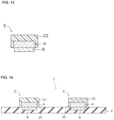
- the reference electrode when including the electrode material is shown in FIG. 13 . In FIG.
- the reference electrode E has a three-layer structure, consisting of an internal solid layer A directly on the electrode material B and an ionic liquid containing membrane C2 directly on the surface of the internal solid layer A opposite to the electrode material B.
- the internal solid layer A it is preferable to arrange the internal solid layer A so that the electrode material is not exposed, for example, so that the internal solid layer A also covers the side of the electrode material B, and a side wall is provided.
- the ion sensor of the present invention may be an all-solid-state ion sensor that does not use an internal liquid for either the ion selective electrode or the reference electrode.
- the ion sensor of the present invention includes an ion selective electrode, a reference electrode, and an insulator.
- the insulator is not limited as long as it contains an insulating material that does not affect the conductivity of the electrode.
- insulating materials include polyvinyl alcohol, polyester resins such as polyethylene terephthalate, polybutylene terephthalate, polyethylene naphthalate, polybutylene naphthalate, polyimide, glass epoxy resin, fiber base materials such as glass, ceramic, paper, etc.
- the ion selective electrode and the reference electrode are arranged on an insulator.
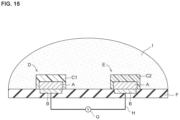
- a schematic cross-sectional view of the ion sensor of the present invention is shown in Fig. 14 .
- the ion selective electrode D and the reference electrode E are arranged on the insulator F.
- the distance between the ion selective electrode and the reference electrode i.e., the shortest distance between the end of the ion selective electrode and the end of the reference electrode.
- the distance between the end Z1 of the ion selective electrode and the end Z2 of the reference electrode E. is preferably 2 mm or more from the viewpoint of further suppressing the potential change in the ion measurement.
- the distance is more preferably 3 mm or more, even more preferably 4 mm or more, and even more preferably 5 mm or more.
- the upper limit of the distance should be such that less of the same specimen may be in contact with both the ion selective and reference electrodes simultaneously, and in this regard, for example, 20 mm, 15 mm, 10 mm, 8 mm, or 6 mm.
- the ion selective electrode and the reference electrode should be located on the same side of the insulator.
- the ion selective electrode D and the reference electrode E are located on the same side of the insulator F.
- the ion sensor of the present invention may have a single ion selective electrode, or it may have two or more ion selective electrodes (e.g., 2-5).
- the ion sensor of the present invention may also have a single reference electrode, or it may have two or more reference electrodes (e.g., 2-5).
- the ion sensor of the present invention may preferably be used as a potassium ion sensor. While hyperkalemic patients are likely to experience fluctuations in the electrical activity of the heart to the extent that abnormalities appear in the electrocardiogram and possibly fatal arrhythmias due to actions that increase blood potassium, such as excessive consumption of a high-potassium diet, medication, dialysis, etc. without a high blood potassium level cause an excessive medication, dialysis, etc. without high blood potassium levels may cause an excessive drop in blood potassium, which may lead to paralysis, muscle spasms, and in some cases, death.
- the ion sensor of the present invention is an ion sensor with reduced potential variation and less need for calibration (it may also be calibration free), so it may be used for measurements by hyperkalemia patients (usually a complicated and specialized task such as calibration is difficult). It is particularly suitable as a potassium ion sensor.
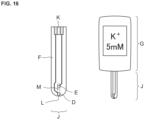
- FIG. 16 shows an example of the use of the ion sensor J of the present invention.
- ion concentration may be measured.
- ion concentration may be measured.
- the ion sensor J may be disposed of after measurement as a disposable ion sensor.
- the present invention comprises the process of forming an ion selective electrode on an insulator, comprising: a first internal solid layer containing a first insertion material and a first ion conductive ceramic, and an ion selective membrane; and the method for manufacturing an ion sensor, comprising: forming a reference electrode including a second internal solid layer containing a second insert material and a second ion conductive ceramic and an ionic liquid containing membrane on an insulator.
- the method of forming the electrode is not particularly restricted.
- the electrode may be produced by a method including forming an internal solid layer containing an insulating material and ion conductive ceramic on an insulator (or on an electrode material formed on an insulator), and forming an ion selective film/ion liquid containing film on the internal solid layer.
- the method of forming the internal solid layer is not particularly limited.
- the internal solid layer may be formed by depositing and drying a composition containing an insertion material and ion conductive ceramic (preferably in a mixed state) on an insulator (or on electrode material formed on an insulator).
- Electrostatic coating, dispensing, screen printing, sputtering, evaporation, hot pressing, etc. may be employed as the deposition method, but electrostatic coating is preferred from the viewpoint that it may improve the adhesion between the insulating material and ion conductive ceramic.
- compositions containing each component of the layer may be formed by depositing and drying a film on the internal solid layer.
- the present invention is a method for measuring ions using the ion sensor of the present invention, comprising the steps of bringing a specimen into contact with an ion selective electrode and a reference electrode, and measuring the potential between the ion selective electrode and the reference electrode (in this specification, the "method for measuring ions” (may be referred to herein as "the measurement method of the present invention")
- the specimen is an object to be measured for ions and may be a liquid, semi-solid, or the like, with no particular restrictions as long as it may contain ions.
- the specimen may be, for example, body fluid or a substance that retains body fluid. Examples of body fluids include whole blood, serum, plasma, transit blood, saliva, urine, tissue fluid, sweat, tears, saliva, etc. Other examples of specimens include, for example, food and drink.
- the potential may be measured according to or in accordance with known methods. For example, as shown in FIG. 15 , a potentiometer G may be placed between the ion selective electrode D and the reference electrode E via a conductor H to measure the potential. The potential is measured with the specimen I in contact with the ion selective electrode D and the reference electrode E. Based on the measurements obtained, the ion concentration in specimen I may be calculated.
- the process of bringing the specimen into contact may include supplying the specimen onto the ion sensor.
- the specimen be allowed to flow from the position where the ion selective electrode is located toward the position where the reference electrode is located, in order to deter the ionic liquid from contacting the ion selective electrode and to further reduce the potential change in the ion measurement.
- the specimen is first brought into contact with the ion selective electrode, and then the flow of the specimen from the ion selective electrode toward the reference electrode may bring the specimen into contact with the reference electrode as well.
- the power of the flow of the specimen is not restricted as long as it does not significantly affect the potential measurement, e.g., capillary action, gravity, etc.
- the measurement method of the present invention using it is particularly suitable for monitoring and measuring blood potassium levels by hyperkalemia patients themselves.
- the method of measurement is particularly suitable for the monitoring of blood potassium levels by hyperkalemia patients themselves.
- Example 1 Structure and fabrication method of ion sensor
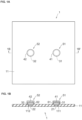
- FIG. 1A shows a plan view of the ion sensor obtained in Example 1
- FIG. 1B shows a cross-sectional view of the ion sensor along the 1B-1 B' line in FIG. 1A
- the ion sensor 1 has an ion selective electrode 52 and a reference electrode 51 disposed at opposite positions of recesses 112 and 111, respectively, formed on the same side of the alumina substrate 11, which is an insulator.
- the ion selective electrode 52 has a structure in which the platinum electrode 22, the internal solid layer 32, and the ion selective membrane 42 are arranged on the alumina substrate 11, in order from closer to the alumina substrate 11.
- the reference electrode 51 has a structure in which the platinum electrode 21, the internal solid layer 31, and the ionic liquid containing membrane 41 are arranged on the alumina substrate 11, in order from the one nearest to the alumina substrate 11.
- the platinum electrodes 21 and 22 are embedded in recesses 111 and 112 and have a circular diameter of 1.7 mm ( ⁇ 1.7 mm) in top view.
- Ion selective membrane 42 is disposed on alumina substrate 11 to cover the top and sides of internal solid layer 32.
- the ionic liquid containing membrane 41 is disposed on the alumina substrate 11 so as to cover the top and sides of the internal solid layer 31.
- the distance between the inner end 62 of the ion selective electrode 52 and the inner end 61 of the reference electrode 51 is 5.6 mm.
- the total thickness of the internal solid layer 32 (about 15 ⁇ m thick) and the ion selective membrane 42 (about 15 ⁇ m thick) is about 30 ⁇ m
- the total thickness of the internal solid layer 31 (about 15 ⁇ m thick) and the ionic liquid-containing membrane 41 (about 15 ⁇ m thick) is about 30 ⁇ m.
- Insertion material Na 0.33 MnO 2 (tetragonal crystal structure, average grain size 8.9 ⁇ m, scaly)
- ion conductive ceramic ⁇ " alumina: Na 2 Al 10.6 O 15.9 , average grain size 0.26 ⁇ m
- conductive agent acetylene black
- binding agent polyvinylidene fluoride
- the prepared materials are laminated on each of the platinum electrode 21 and platinum electrode 22 on the alumina substrate 11 by electrostatic application, in which the materials are applied to the target by electrostatic force, and then completely dried in a vacuum drying oven to prepare the internal solid layer 31 and the internal solid layer 32.
- ionophore valinomycin
- plasticizer tris (2-ethylhexyl)phosphate
- anion eliminating agent potassium tetrakis (4-chlorophenyl)borate
- a binder resin polyvinyl chloride
- ionic liquid [TBMOEP + ][C 1 C 1 N - ]: tributyl (2-methoxyethyl) phosphonium bis (trifluoromethanesulfonyl) imide
- plasticizer tris (2-ethylhexyl) phosphate
- polymer compound for gelation A tetrahydrofuran solution containing 32 mass parts of polyvinyl chloride (polyvinyl chloride) is layered and dried to form an ionic liquid containing membrane 41 as an ionic liquid containing membrane to obtain a reference electrode 51.
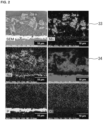
- the cross-sectional morphology of the reference electrode 51 is analyzed by field emission scanning electron microscopy (FE-SEM, S-4800, Hitachi High-Technologies Corporation) and energy dispersive X-ray spectroscopy (EDS, XFlash 6130, Bruker AXS).
- FE-SEM field emission scanning electron microscopy
- EDS energy dispersive X-ray spectroscopy
- FIG. 2 A scanning electron microscope (SEM) image of the reference electrode 51 and an elemental distribution diagram using an energy dispersive X-ray spectrometer (EDS) of the SEM image are shown in FIG. 2 .
- the insertion material 33 Na 0.33 MnO 2 , shows the elemental distribution of Mn and Na
- the ion conductive ceramic 34, ⁇ " alumina shows the elemental distribution of Al and Na
- the plasticizer tris (2-ethylhexyl) phosphate shows the elemental distribution of P
- the polymer compound for gelation polychlorinated Comparing the elemental distribution of Mn and Al, it may be seen that Al (i.e. ion conductive ceramic 34) is distributed around the Mn distribution area (i.e.
- ion conductive ceramic 34 covers the area around the insertion material 33.
- the plasticizer due to the exchange of Na + between the insertion material 33 and the ion conductive ceramic 34, the plasticizer must be between the insertion material 33 as in the ion selective electrode 52, but in the elemental distribution of P and CI, P and Cl are relatively uniformly distributed in the elemental distribution of P and Cl The fact that the plasticizer and the polymeric compound for gelation entered the gaps between the 33 insertion materials as designed was confirmed.
- Example 2 Potential difference measurement with ion sensor 1
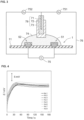
- the open circuit potential of each of the ion selective electrode 52 and reference electrode 51 of ion sensor 1 was measured for 3 minutes against the Ag/AgCI reference electrode 78 (saturated KCI, double junction NaCl 140 mmol dm -3 ), as shown in FIG. 3 .
- the ion selective electrode 52 and the reference electrode 51 are connected via potentiometer 75, and the potentials between the ion selective electrode 52 and the Ag/AgCI reference electrode 78 and between the reference electrode 51 and the Ag/AgCI reference electrode 78 were also connected via potentiometers 752 and 751.
- the potential (E) between the ion selective electrode 52 and the reference electrode 51 is calculated by subtracting the potential of the reference electrode 51 (E R ) from the potential of the ion selective electrode 52 (Ew), where E R and Ew are respectively the Ag /AgCI reference electrode 78 and were measured between the two electrodes.
- sample solution was dropped onto the sensor in a dry state without prior conditioning (the process of bringing the electrode into contact with a solution containing the ion to be measured (potassium ion) for a certain period of time), and the average values of 50 to 60, 110 to 120, and 170 to 180 seconds are measured for 1, 2, and 3 minutes, respectively.
- the sample solutions for KCI measurements contains KCl 1, 10, 100 mmol dm -3 and NaCl electrolytes of 140 mmol dm -3 .
- serum standard solutions JCTCM 130-4) Low (L), Middle (M), and High (H) are obtained, and samples of other concentration levels are prepared by mixing L and M or M and H.
- Table 1 shows the concentration of each ion in the serum samples.
- Table 1 ION CONCENTRATION / mmol dm -3 K + Na + Cl - SERUM SAMPLES 3.37 124.5 89.5 3.91 133.0 97.9 4.37 140.4 105.1 4.93 147.9 112.8 5.42 154.4 119.4
- the potentiometric response of eight reference electrodes 51 (each of which was independently fabricated using the same method) measured using 10 mmol dm -3 KCI and 140 mmol dm -3 NaCl solutions and an Ag/AgCI reference electrode78 is shown in FIG. 4 . From the potential response waveform, the response time was about 45 s ( Fig. 4 ). The reproducibility of the standard potential (E°) between the eight sensors was very good with a standard deviation of ⁇ 0.6 mV at 1 min, ⁇ 0.7 mV at 2 min, and ⁇ 0.6 mV at 3 min (Table 2).
- Example 3 Potential difference measurement with ion sensor2
- ion sensor 1 Example 1
- ion sensor 2 FIG. 5
- the open circuit potential of the ion selective electrode of each of ion sensor 1 and ion sensor 2 was measured for 3 minutes against the Ag/AgCI reference electrode 78 in the same manner as in Example 2 ( FIG. 3 ) to obtain a calibration curve and evaluate whether parameters such as slope, standard potential, selectivity (Kpot K + ,Na + ) differ between the two.
- Table 4 shows the mean values and standard deviations of 1) slope, 2) standard potential, and 3) selectivity coefficients obtained separately for the two types of ion sensors (mean ⁇ standard deviation) for three measurements each of ion sensor 2 without reference electrode 51 and ion sensor 1 with reference electrode 51.
- the K+ concentrations of the sample solutions were 1, 10, and 100 mmol dm 3 for KCI solutions containing 140 mmol dm 3 of NaCl, and the three solutions were measured by dropping three different solutions on one sensor in order from the lowest concentration.
- Example 4 Potential difference measurement with ion sensors3
- Ion Sensor 1 (Example 1) may be used as a disposable sensor for calibration free measurements
- KCI solutions were measured once with one Ion Sensor 1 (Example 1) and calibration curves were obtained.
- Three ion sensor 1s were used for each solution, for a total of 15 ion sensor 1s. These 15 ion sensors 1 were independently fabricated by the same method.
- the calibration curve of the ion selective electrode 52 relative to the reference electrode 51 during the measurement of KCI solution is shown in FIG. 6A
- Non-patent literature discloses a potential variation (standard deviation) of 4.3 mV when KCI solution was measured without electrode conditioning (electrode immersed in 1 mM KCI solution for 24 hours) using an all solid-state ion sensor ( FIG. 6(c) (1)). Note that when the KCI solution was measured after conditioning (electrode immersed in 1 mM KCI solution for 24 hours), the potential variation (standard deviation) was 14 mV, indicating a larger variation. In addition, the variation of potential (standard deviation) allowed in the case of potassium ion measurement in the U.S. Federal regulation, 42 CFR ⁇ 493.931 - Routine chemistry, is 2.3 mV ( FIG. 6(c) (2)).
- ion sensor 1 Example 1
- Example 1 The performance of ion sensor 1 (Example 1) was tested with a series of serum samples of blood with different concentrations of K + , Na + , Cl - as shown in Table 1.
- the calibration curve of ion sensor 1 for the serum samples is shown in FIG. 7(a) .
- the same ion sensor 1 as in Example 1 was used to measure the relationship between the potential value E of the ion selective electrode 52 and the reference electrode 51.
- the slope of the response to serum specimen was 51.7 mV/decade, which was not significantly different from the slope of the response observed in the range of KCl 1-10 mmol dm -3 of 51.2 mV/decade.
- Non-patent literature reported a potential variation (standard deviation) of 4.4 mV when 10% serum was measured without electrode conditioning (electrode immersed in 1 mM KCI solution for 24 hours) using an all solid-state ion sensor ((1) shown in FIG. 7C ).
- the variation in potential (standard deviation) is 19 mV, indicating that the variation is widened.
- the variation of potential (standard deviation) allowed in the case of potassium ion measurement in the U.S. federal regulation, 42 CFR ⁇ 493.931 - Routine chemistry is 2.3 mV ((2) shown in FIG. 7C ).
- the standard deviation of the potential in this case (0.2-2.2 mV) is below the permissible value in the US federal regulation, 42 CFR ⁇ 493.931 - Routine chemistry, and is also very good values, lower than the standard deviation of conventional technology for all solid-state ion sensors as shown in FIG. 7B .
- Example 6 Potential difference measurement with potassium ion sensor 5
- Measurement is performed in the system shown in Fig. 8 , using ion sensor 3 (Example 6), in which an ion liquid containing membrane of 70 mass% ionic liquid 43 was further laminated on the ionic liquid containing membrane 41 of ion sensor 1 (Example 1). Specifically, a reference electrode 51 and an Ag/AgCI reference electrode 78 were connected via a potentiometer 75, and the potential was measured.
- FIG. 9 shows the 3-minute potential change ⁇ E (potential difference relative to the measured value after 1 minute) when the measured solution flowed from the reference electrode 51 side with the ionic liquid containing membrane 41 stacked to the ion selective electrode 52 side (Case 1) and when the measured solution flowed from the ion selective electrode 52 side to the reference electrode 51 side (Case 2).
- ⁇ E potential difference relative to the measured value after 1 minute
- an ion sensor As a supplementary note, an ion sensor, a method for manufacturing an ion sensor, and a method for measuring ions. according to one or more embodiments are summarized.
- An ion sensor comprising:
- the first ion conductive ceramic and the second ion conductive ceramic comprise potassium ion conductive ceramic, sodium ion conductive ceramic, or lithium ion conductive ceramic.
- the first ion conductive ceramic and the second ion conductive ceramic comprise ⁇ " alumina or ⁇ alumina.
- the first and second insertion materials comprise metal oxides, oxygen redox materials, or Prussian blue analogues.
- the first and second insertion materials comprise ion electron conductors.
- the first insertion material and the second insertion material comprise ion electron conductors for potassium ions, sodium ions, or lithium ions.
- the first insertion material and the second insertion material comprise a metal oxide.
- the metal oxide comprises M x MnOz (M denotes Na or K and x denotes any positive number).
- the x is between 0.2 and 0.5.
- the ion selective electrode and the reference electrode comprise an electrode material.
- the first insertion material, the second insertion material, the first ion conductive ceramic and the second ion conductive ceramic comprise particles.
- an average particle size of the first ion conductive ceramic is smaller than the average particle size of the first insertion material, and an average particle size of the second ion conductive ceramic is smaller than the average particle size of the second insertion material.
- a mass ratio of the first insertion material to the first ion conductive ceramic and a mass ratio of the second insertion material to the second ion conductive ceramic is 2:1 to 1:2.
- the first internal solid layer and the second internal solid layer comprise a binding agent and a conductive agent.
- the binding agent comprises one of:
- the conductive agent comprises carbon black, acetylene black, Ketjen black, carbon nanotubes, graphene, carbon powder, or graphite powder.
- the ion selective membrane comprises ionophores.
- the ionic liquid containing membrane comprises a gel membrane that comprises an ionic liquid.
- a composition of the first internal solid layer and a composition of the second internal solid layer are substantially the same.
- the ion selective electrode and the reference electrode are arranged on a same side of the insulator.
- a method of manufacturing an ion sensor comprising:
- the forming the first internal solid layer and the second internal solid layer comprises electrostatic application.
- a method of measuring ion ions using the ion sensor above including
- the contacting the specimen with the ion selective electrode and the reference electrode comprises supplying the specimen onto the ion sensor.
- the contacting the specimen with the ion selective electrode and the reference electrode comprises allowing the specimen to flow from a position where the ion selective electrode is arranged to a position where the reference electrode is arranged.
Landscapes
- Chemical & Material Sciences (AREA)
- Life Sciences & Earth Sciences (AREA)
- Health & Medical Sciences (AREA)
- Physics & Mathematics (AREA)
- Chemical Kinetics & Catalysis (AREA)
- Electrochemistry (AREA)
- Molecular Biology (AREA)
- Analytical Chemistry (AREA)
- Biochemistry (AREA)
- General Health & Medical Sciences (AREA)
- General Physics & Mathematics (AREA)
- Immunology (AREA)
- Pathology (AREA)
- Measurement Of The Respiration, Hearing Ability, Form, And Blood Characteristics Of Living Organisms (AREA)
- Investigating Or Analyzing Materials By The Use Of Electric Means (AREA)
Applications Claiming Priority (2)
| Application Number | Priority Date | Filing Date | Title |
|---|---|---|---|
| JP2021111142A JP7685381B2 (ja) | 2021-07-02 | 2021-07-02 | イオンセンサ、イオンセンサの製造方法及びイオンの測定方法 |
| PCT/JP2022/015516 WO2023276380A1 (ja) | 2021-07-02 | 2022-03-29 | イオンセンサ、イオンセンサの製造方法及びイオンの測定方法 |
Publications (2)
| Publication Number | Publication Date |
|---|---|
| EP4365584A1 true EP4365584A1 (de) | 2024-05-08 |
| EP4365584A4 EP4365584A4 (de) | 2025-06-18 |
Family
ID=84692658
Family Applications (1)
| Application Number | Title | Priority Date | Filing Date |
|---|---|---|---|
| EP22832541.1A Pending EP4365584A4 (de) | 2021-07-02 | 2022-03-29 | Ionensensor, verfahren zur herstellung eines ionensensors und verfahren zur ionenmessung |
Country Status (5)
| Country | Link |
|---|---|
| US (1) | US12399145B2 (de) |
| EP (1) | EP4365584A4 (de) |
| JP (1) | JP7685381B2 (de) |
| CN (1) | CN117642626A (de) |
| WO (1) | WO2023276380A1 (de) |
Families Citing this family (2)
| Publication number | Priority date | Publication date | Assignee | Title |
|---|---|---|---|---|
| JP7825922B2 (ja) | 2022-02-28 | 2026-03-09 | シスメックス株式会社 | 参照電極、電極、及びこれらを備えるセンサ |
| WO2025225326A1 (ja) * | 2024-04-26 | 2025-10-30 | 株式会社村田製作所 | イオンセンサ用電極部材、イオンセンサ、及び媒体中のイオンの分析方法 |
Family Cites Families (18)
| Publication number | Priority date | Publication date | Assignee | Title |
|---|---|---|---|---|
| JP2698808B2 (ja) | 1990-05-14 | 1998-01-19 | 日本特殊陶業株式会社 | イオンセンサ |
| JPH09178690A (ja) * | 1995-12-26 | 1997-07-11 | Ngk Spark Plug Co Ltd | イオンセンサ及びイオン濃度測定方法 |
| US20020038762A1 (en) * | 2000-10-02 | 2002-04-04 | Advanced Monitoring Systems Ltd. | Solid-state ion selective electrodes and methods of producing the same |
| CN101523201B (zh) * | 2006-09-13 | 2016-08-24 | 株式会社堀场制作所 | 离子液体覆盖参比电极及使用其的电化学测定装置 |
| ES2310476B1 (es) * | 2007-05-29 | 2009-11-17 | Universitat Rovira I Virgili | Electrodos selectivos de iones de contacto solido basados en nanotubos de carbono. |
| JP5356337B2 (ja) | 2010-08-27 | 2013-12-04 | 株式会社堀場製作所 | 参照電極 |
| JP5356336B2 (ja) | 2010-08-27 | 2013-12-04 | 株式会社堀場製作所 | 参照電極 |
| US8608917B2 (en) * | 2010-08-27 | 2013-12-17 | Horiba, Ltd. | Reference electrode |
| EP3734264A1 (de) | 2012-12-27 | 2020-11-04 | Parker Hannifin Corporation | Ph-meter |
| US9874539B2 (en) | 2014-05-23 | 2018-01-23 | Regents Of The University Of Minnesota | Ion-selective electrodes and reference electrodes with a solid contact having mesoporous carbon |
| JP2017532571A (ja) * | 2014-10-29 | 2017-11-02 | フェーズ2 マイクロテクノロジーズ, インコーポレイテッド | ポリマー電極膜 |
| EP3351931B1 (de) | 2015-09-14 | 2025-10-08 | Hitachi High-Tech Corporation | Ionenselektive elektrode und verfahren zur herstellung derer |
| US11307165B2 (en) | 2016-07-21 | 2022-04-19 | Regents Of The University Of Minnesota | Electrochemical sensors with a chemically attached molecular redox buffer |
| JP2018018578A (ja) | 2016-07-25 | 2018-02-01 | 日本電気硝子株式会社 | 固体電解質粉末、並びにそれを用いてなる電極合材及び全固体ナトリウムイオン二次電池 |
| US20180128770A1 (en) | 2016-09-13 | 2018-05-10 | Erno Lindner | Superhydrophobic solid contact ion-selective electrodes |
| DE102018128895A1 (de) * | 2017-12-19 | 2019-06-19 | Endress+Hauser Conducta Gmbh+Co. Kg | Bezugselektrode und Verfahren zur Herstellung einer Bezugselektrode |
| JP7628508B2 (ja) * | 2020-01-10 | 2025-02-10 | シスメックス株式会社 | 電極、電極の製造方法、イオンセンサ、生体内成分測定装置及び生体内成分測定方法 |
| JP7825922B2 (ja) * | 2022-02-28 | 2026-03-09 | シスメックス株式会社 | 参照電極、電極、及びこれらを備えるセンサ |
-
2021
- 2021-07-02 JP JP2021111142A patent/JP7685381B2/ja active Active
-
2022
- 2022-03-29 EP EP22832541.1A patent/EP4365584A4/de active Pending
- 2022-03-29 CN CN202280046173.XA patent/CN117642626A/zh active Pending
- 2022-03-29 WO PCT/JP2022/015516 patent/WO2023276380A1/ja not_active Ceased
-
2023
- 2023-12-27 US US18/397,620 patent/US12399145B2/en active Active
Also Published As
| Publication number | Publication date |
|---|---|
| JP2023007958A (ja) | 2023-01-19 |
| WO2023276380A1 (ja) | 2023-01-05 |
| CN117642626A (zh) | 2024-03-01 |
| US12399145B2 (en) | 2025-08-26 |
| JP7685381B2 (ja) | 2025-05-29 |
| US20240230580A9 (en) | 2024-07-11 |
| EP4365584A4 (de) | 2025-06-18 |
| US20240133838A1 (en) | 2024-04-25 |
Similar Documents
| Publication | Publication Date | Title |
|---|---|---|
| EP4089406B1 (de) | Ionensensor | |
| US12399145B2 (en) | Ion sensor, ion sensor manufacturing method, and ion measurement method | |
| DE2722617C2 (de) | Ionenselektive Elektrode und Verwendung derselben | |
| EP4235163B1 (de) | Sensor enthaltend eine referenzelektrode | |
| WO2009090094A1 (de) | Gassensor mit mikroporöser elektrolytschicht | |
| JP2003525450A (ja) | 固体状態参照系を持つ電極デバイス | |
| Paczosa-Bator et al. | Platinum nanoparticles intermediate layer in solid-state selective electrodes | |
| EP0345052B1 (de) | Selektive Fluoridionen-Elektroden auf der Grundlage super-ionenleitender ternären Zusammensetzungen und Verfahren zu ihrer Herstellung | |
| EP4141432B1 (de) | Ionensensor und verfahren zum messen von ionen | |
| Manjakkal et al. | The effect of sheet resistivity and storage conditions on sensitivity of RuO2 based pH sensors | |
| JP3186363B2 (ja) | イオン電極 | |
| CN211122645U (zh) | 一种固态参比电极及多参数集成的电化学传感器 | |
| DE19631530C2 (de) | Ionenselektiver Sensor | |
| JP2935768B2 (ja) | イオン電極 | |
| WO2025070527A1 (ja) | リチウムイオン濃度センサー用のリチウムイオン選択感応体およびリチウムイオン濃度センサー | |
| WO2026013182A2 (en) | Membrane for reference electrode | |
| Zhang et al. | Multiplex Sensor for Ion Sensing Based on Printed Circuit Board | |
| JPH01262459A (ja) | イオン電極 | |
| Szwagierczak et al. | Sensing mechanism of RuO2–SnO2 thick film pH sensors studied by potentiometric method and electrochemical impedance spectroscopy |
Legal Events
| Date | Code | Title | Description |
|---|---|---|---|
| STAA | Information on the status of an ep patent application or granted ep patent |
Free format text: STATUS: THE INTERNATIONAL PUBLICATION HAS BEEN MADE |
|
| PUAI | Public reference made under article 153(3) epc to a published international application that has entered the european phase |
Free format text: ORIGINAL CODE: 0009012 |
|
| STAA | Information on the status of an ep patent application or granted ep patent |
Free format text: STATUS: REQUEST FOR EXAMINATION WAS MADE |
|
| 17P | Request for examination filed |
Effective date: 20231221 |
|
| AK | Designated contracting states |
Kind code of ref document: A1 Designated state(s): AL AT BE BG CH CY CZ DE DK EE ES FI FR GB GR HR HU IE IS IT LI LT LU LV MC MK MT NL NO PL PT RO RS SE SI SK SM TR |
|
| DAV | Request for validation of the european patent (deleted) | ||
| DAX | Request for extension of the european patent (deleted) | ||
| A4 | Supplementary search report drawn up and despatched |
Effective date: 20250516 |
|
| RIC1 | Information provided on ipc code assigned before grant |
Ipc: G01N 27/416 20060101ALI20250512BHEP Ipc: G01N 27/333 20060101ALI20250512BHEP Ipc: G01N 27/30 20060101AFI20250512BHEP |