EP4364029B1 - Hybrides suchsystem für anpassbare medien - Google Patents
Hybrides suchsystem für anpassbare medien Download PDFInfo
- Publication number
- EP4364029B1 EP4364029B1 EP22748199.1A EP22748199A EP4364029B1 EP 4364029 B1 EP4364029 B1 EP 4364029B1 EP 22748199 A EP22748199 A EP 22748199A EP 4364029 B1 EP4364029 B1 EP 4364029B1
- Authority
- EP
- European Patent Office
- Prior art keywords
- item
- media content
- text
- content items
- condition
- Prior art date
- Legal status (The legal status is an assumption and is not a legal conclusion. Google has not performed a legal analysis and makes no representation as to the accuracy of the status listed.)
- Active
Links
Images




Classifications
-
- G—PHYSICS
- G06—COMPUTING OR CALCULATING; COUNTING
- G06F—ELECTRIC DIGITAL DATA PROCESSING
- G06F40/00—Handling natural language data
- G06F40/10—Text processing
- G06F40/166—Editing, e.g. inserting or deleting
- G06F40/169—Annotation, e.g. comment data or footnotes
-
- G—PHYSICS
- G06—COMPUTING OR CALCULATING; COUNTING
- G06F—ELECTRIC DIGITAL DATA PROCESSING
- G06F16/00—Information retrieval; Database structures therefor; File system structures therefor
- G06F16/40—Information retrieval; Database structures therefor; File system structures therefor of multimedia data, e.g. slideshows comprising image and additional audio data
- G06F16/41—Indexing; Data structures therefor; Storage structures
-
- G—PHYSICS
- G06—COMPUTING OR CALCULATING; COUNTING
- G06F—ELECTRIC DIGITAL DATA PROCESSING
- G06F3/00—Input arrangements for transferring data to be processed into a form capable of being handled by the computer; Output arrangements for transferring data from processing unit to output unit, e.g. interface arrangements
- G06F3/01—Input arrangements or combined input and output arrangements for interaction between user and computer
- G06F3/048—Interaction techniques based on graphical user interfaces [GUI]
- G06F3/0481—Interaction techniques based on graphical user interfaces [GUI] based on specific properties of the displayed interaction object or a metaphor-based environment, e.g. interaction with desktop elements like windows or icons, or assisted by a cursor's changing behaviour or appearance
- G06F3/0482—Interaction with lists of selectable items, e.g. menus
-
- G—PHYSICS
- G06—COMPUTING OR CALCULATING; COUNTING
- G06F—ELECTRIC DIGITAL DATA PROCESSING
- G06F40/00—Handling natural language data
- G06F40/10—Text processing
- G06F40/103—Formatting, i.e. changing of presentation of documents
- G06F40/109—Font handling; Temporal or kinetic typography
-
- G—PHYSICS
- G06—COMPUTING OR CALCULATING; COUNTING
- G06F—ELECTRIC DIGITAL DATA PROCESSING
- G06F40/00—Handling natural language data
- G06F40/20—Natural language analysis
- G06F40/279—Recognition of textual entities
- G06F40/289—Phrasal analysis, e.g. finite state techniques or chunking
- G06F40/295—Named entity recognition
-
- G—PHYSICS
- G06—COMPUTING OR CALCULATING; COUNTING
- G06F—ELECTRIC DIGITAL DATA PROCESSING
- G06F40/00—Handling natural language data
- G06F40/30—Semantic analysis
-
- G—PHYSICS
- G06—COMPUTING OR CALCULATING; COUNTING
- G06Q—INFORMATION AND COMMUNICATION TECHNOLOGY [ICT] SPECIALLY ADAPTED FOR ADMINISTRATIVE, COMMERCIAL, FINANCIAL, MANAGERIAL OR SUPERVISORY PURPOSES; SYSTEMS OR METHODS SPECIALLY ADAPTED FOR ADMINISTRATIVE, COMMERCIAL, FINANCIAL, MANAGERIAL OR SUPERVISORY PURPOSES, NOT OTHERWISE PROVIDED FOR
- G06Q10/00—Administration; Management
- G06Q10/40—Business processes related to social networking or social networking services
-
- G—PHYSICS
- G06—COMPUTING OR CALCULATING; COUNTING
- G06T—IMAGE DATA PROCESSING OR GENERATION, IN GENERAL
- G06T11/00—Two-dimensional [2D] image generation
- G06T11/60—Creating or editing images; Combining images with text
Definitions
- the present disclosure relates generally to creating and manipulating digital content.
- media content items such as electronic images, animations, or videos with each other.
- These media content items are typically uniquely personalized, and thus, reflect a demand to encourage electronic visual communication on a global scale.
- EP 1549031 A1 describes an apparatus and method for transmitting a text message in a wireless terminal.
- the avatar is personalized by incorporating the input text in the form of that split option and presented on a display device as a selection choice for the user.
- the augmentation system 206 is configured to provide access to AR components that can be implemented using a programming language suitable for app development, such as, e.g., JavaScript or Java and that are identified in the messaging server system by respective AR component identifiers.
- An AR component may include or reference various image processing operations corresponding to an image modification, filter, media overlay, transformation, and the like. These image processing operations can provide an interactive experience of a real-world environment, where objects, surfaces, backgrounds, lighting etc., captured by a digital image sensor or a camera, are enhanced by computer-generated perceptual information.
- an AR component comprises the collection of data, parameters, and other assets needed to apply a selected augmented reality experience to an image or a video feed.
- augmented reality functionality that may be provided by an AR component include detection of objects (e.g. faces, hands, bodies, cats, dogs, surfaces, objects, etc.), tracking of such objects as they leave, enter, and move around the field of view in video frames, and the modification or transformation of such objects as they are tracked.
- objects e.g. faces, hands, bodies, cats, dogs, surfaces, objects, etc.
- tracking of such objects may be used. For example, some embodiments may involve generating a 3D mesh model of the object or objects, and using transformations and animated textures of the model within the video to achieve the transformation.
- tracking of points on an object may be used to place an image or texture, which may be two dimensional or three dimensional, at the tracked position.
- neural network analysis of video frames may be used to place images, models, or textures in content (e.g. images or frames of video).
- AR component data thus refers to both to the images, models, and textures used to create transformations in content, as well as to additional modeling and analysis information needed to achieve such transformations with object detection, tracking, and placement.
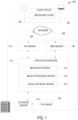
- the entity graph 306 stores information regarding relationships and associations between entities. Such relationships may be social, professional (e.g., work at a common corporation or organization) interested-based or activity-based, merely for example. With reference to the functionality provided by the AR component, the entity graph 306 stores information that can be used, in cases where the AR component is configured to permit using a portrait image of a user other than that of the user controlling the associated client device for modifying the target media content object, to determine a further profile that is connected to the profile representing the user controlling the associated client device. As mentioned above, the portrait image of a user may be stored in a user profile representing the user in the messaging system.
- the profile data 308 stores multiple types of profile data about a particular entity.
- the profile data 308 may be selectively used and presented to other users of the messaging system 100, based on privacy settings specified by a particular entity.
- the profile data 308 includes, for example, a user name, telephone number, address, settings (e.g., notification and privacy settings), as well as a user-selected avatar representation (or collection of such avatar representations).
- a particular user may then selectively include one or more of these avatar representations within the content of messages communicated via the messaging system 100, and on map interfaces displayed by messaging clients 104 to other users.
- the collection of avatar representations may include "status avatars," which present a graphical representation of a status or activity that the user may select to communicate at a particular time.
- the database 120 also stores augmentation data in an augmentation table 310.
- the augmentation data is associated with and applied to videos (for which data is stored in a video table 314) and images (for which data is stored in an image table 316).
- the augmentation data is used by various AR components, including the AR component.
- An example of augmentation data is augmented reality (AR) tools that can be used in AR components to effectuate image transformations.
- Image transformations include real-time modifications, which modify an image (e.g., a video frame) as it is captured using a digital image sensor of a client device 102. The modified image is displayed on a screen of the client device 102 with the modifications.
- a story table 312 stores data regarding collections of messages and associated image, video, or audio data, which are compiled into a collection (e.g., a story or a gallery). The creation of a particular collection may be initiated by a particular user (e.g., each user for which a record is maintained in the entity table 304). A user may create a "personal story" in the form of a collection of content that has been created and sent/broadcast by that user. To this end, the user interface of the messaging client 104 may include an icon that is user-selectable to enable a sending user to add specific content to his or her personal story. In some examples, the story table 312 stores one or more images or videos that were created using a viewfinder ring flash.
- the video table 314 stores video data that, in one example, is associated with messages for which records are maintained within the message table 302.
- the image table 316 stores image data, which may be associated with messages for which message data is stored in the entity table 304.
- the image table 316 stores customizable overlays, such as, for example, customizable avatars.
- the entity table 304 may associate various augmentations from the augmentation table 310 with various images and videos stored in the image table 316 and the video table 314.
- FIG. 5 is a schematic diagram illustrating an access-limiting process 500, in terms of which access to content (e.g., an ephemeral message 502, and associated multimedia payload of data) or a content collection (e.g., an ephemeral message group 504) may be time-limited (e.g., made ephemeral).
- the content of an ephemeral message 502, in some examples, includes an image or a video that was created using a viewfinder ring flash.
- the message duration parameter 506 and the message receiver identifier 424 are shown to be inputs to a message timer 512, which is responsible for determining the amount of time that the ephemeral message 502 is shown to a particular receiving user identified by the message receiver identifier 424. In particular, the ephemeral message 502 will only be shown to the relevant receiving user for a time period determined by the value of the message duration parameter 506.
- the message timer 512 is shown to provide output to a more generalized ephemeral timer system 202, which is responsible for the overall timing of display of content (e.g., an ephemeral message 502) to a receiving user.
- the ephemeral message 502 is shown in FIG. 5 to be included within an ephemeral message group 504 (e.g., a collection of messages in a personal story, or an event story).
- the ephemeral message group 504 has an associated group duration parameter 508, a value of which determines a time duration for which the ephemeral message group 504 is presented and accessible to users of the messaging system 100.
- the group duration parameter 508, for example, may be the duration of a music concert, where the ephemeral message group 504 is a collection of content pertaining to that concert.
- a user may specify the value for the group duration parameter 508 when performing the setup and creation of the ephemeral message group 504.
- each ephemeral message 502 within the ephemeral message group 504 has an associated group participation parameter 510, a value of which determines the duration of time for which the ephemeral message 502 will be accessible within the context of the ephemeral message group 504. Accordingly, a particular ephemeral message group 504 may "expire” and become inaccessible within the context of the ephemeral message group 504, prior to the ephemeral message group 504 itself expiring in terms of the group duration parameter 508.
- the group duration parameter 508, group participation parameter 510, and message receiver identifier 424 each provide input to a group timer 514, which operationally determines, firstly, whether a particular ephemeral message 502 of the ephemeral message group 504 will be displayed to a particular receiving user and, if so, for how long. Note that the ephemeral message group 504 is also aware of the identity of the particular receiving user as a result of the message receiver identifier 424.
- the group timer 514 operationally controls the overall lifespan of an associated ephemeral message group 504, as well as an individual ephemeral message 502 included in the ephemeral message group 504.
- each and every ephemeral message 502 within the ephemeral message group 504 remains viewable and accessible for a time period specified by the group duration parameter 508.
- a certain ephemeral message 502 may expire, within the context of ephemeral message group 504, based on a group participation parameter 510.
- the ephemeral timer system 202 may furthermore operationally remove a particular ephemeral message 502 from the ephemeral message group 504 based on a determination that it has exceeded an associated group participation parameter 510. For example, when a sending user has established a group participation parameter 510 of 24 hours from posting, the ephemeral timer system 202 will remove the relevant ephemeral message 502 from the ephemeral message group 504 after the specified 24 hours.
- the ephemeral timer system 202 also operates to remove an ephemeral message group 504 when either the group participation parameter 510 for each and every ephemeral message 502 within the ephemeral message group 504 has expired, or when the ephemeral message group 504 itself has expired in terms of the group duration parameter 508.
- the ephemeral timer system 202 determines that the message duration parameter 506 for a particular ephemeral message 502 has expired, the ephemeral timer system 202 causes the messaging client 104 to no longer display an indicium (e.g., an icon or textual identification) associated with the ephemeral message 502.
- an indicium e.g., an icon or textual identification
- FIG. 6 illustrates a flowchart for a hybrid search process 600, in accordance with some examples. While certain operations of the process 600 may be described as being performed by certain devices, in different examples, different devices or a combination of devices may perform these operations. For example, operations described below may be performed by the client device 102 or in combination with a server-side computing device (e.g., the message messaging server system 108), or a third-party server computing device.
- a server-side computing device e.g., the message messaging server system 108
- a third-party server computing device e.g., the message messaging server system 108
- the method commences, at operation 610, with accessing text input, which may be provided by a user.
- the text input is associated with a character count.
- Operation 620 comprises identifying, each item from the media content items stored in a database, as fit, unfit or uncertain with respect to the text input. Identifying a media content item as uncertain indicates that the item is suitable to fit the character count of a first size (the smallest size, for example) and not suitable to fit the character count of a second size (a larger size).
- each customizable media content item is associated with CCCs comprising a first condition, a second condition and a third condition.
- the value of the first condition is the minimum threshold
- the value of the second condition is the uncertain threshold (that indicates the maximum number of characters that can be presented as a line of text, if the line is completely filled with the largest character)
- the value of the third condition is the maximum threshold (that indicates the maximum number of characters that can be included in a line of text, if the line is completely filled with the smallest character).
- identifying a media content item as fit with respect to input text comprises determining that the character count of the input text is greater than a value associated with the first condition and less than a value associated with the third condition.
- Identifying a media content items as unfit comprises determining that the character count of the input text is greater than a value associated with the third condition.
- Identifying a media content items as uncertain comprises determining that the character count of the input text is greater than a value associated with the second condition and less than a value associated with the third condition.
- Operation 630 comprises applying text fit logic to the text input with respect to each media content item identified as uncertain, in order to clarify the uncertainty and identify the respective item as either fit or unfit. Applying the text fit logic comprises evaluating glyph characteristics of individual characters with respect to a customizable media content item.
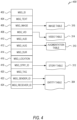
- a customizable media content item may be suitable for incorporating one or more lines of text and can be stored as associated with a data structure, which includes the identifier for the avatar, a value indicating the number of lines of text that can be incorporated into the avatar (a line count), and respective CCCs associated with each line a set of line count text rendering conditions.
- Each member in the set of line count text rendering conditions comprises a first condition, a second condition and a third condition.
- the input text is used to generate split options, where each option comprises the text input being split into one or more lines.
- a customizable media content item is identified as fit with respect to the text input if it is determined that it can incorporate at least one of the split options.
- a customizable media content item is identified as unfit with respect to the text input if it is determined that that it can incorporate none of the split options, based on the CCCs associated with the customizable media content item.
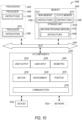
- Fig. 10 is a diagrammatic representation of the machine 1000 within which instructions 1008 (e.g., software, a program, an application, an applet, an app, or other executable code) for causing the machine 1000 to perform any one or more of the methodologies discussed herein may be executed.
- the instructions 1008 may cause the machine 1000 to execute any one or more of the methods described herein.
- the instructions 1008 transform the general, non-programmed machine 1000 into a particular machine 1000 programmed to carry out the described and illustrated functions in the manner described.
- the machine 1000 may operate as a standalone device or may be coupled (e.g., networked) to other machines.
- the machine 1000 may operate in the capacity of a server machine or a client machine in a server-client network environment, or as a peer machine in a peer-to-peer (or distributed) network environment.
- the machine 1000 may comprise, but not be limited to, a server computer, a client computer, a personal computer (PC), a tablet computer, a laptop computer, a netbook, a set-top box (STB), a personal digital assistant (PDA), an entertainment media system, a cellular telephone, a smartphone, a mobile device, a wearable device (e.g., a smartwatch), a smart home device (e.g., a smart appliance), other smart devices, a web appliance, a network router, a network switch, a network bridge, or any machine capable of executing the instructions 1008, sequentially or otherwise, that specify actions to be taken by the machine 1000.
- PC personal computer
- PDA personal digital assistant
- machine 1000 may comprise the client device 102 or any one of a number of server devices forming part of the messaging server system 108.
- the machine 1000 may also comprise both client and server systems, with certain operations of a particular method or algorithm being performed on the server-side and with certain operations of the particular method or algorithm being performed on the client-side.
- the machine 1000 may include processors 1002, memory 1004, and input/output I/O components 1038, which may be configured to communicate with each other via a bus 1040.
- the processors 1002 e.g., a Central Processing Unit (CPU), a Reduced Instruction Set Computing (RISC) Processor, a Complex Instruction Set Computing (CISC) Processor, a Graphics Processing Unit (GPU), a Digital Signal Processor (DSP), an Application Specific Integrated Circuit (ASIC), a Radio-Frequency Integrated Circuit (RFIC), another processor, or any suitable combination thereof
- the processors 1002 may include, for example, a processor 1006 and a processor 1010 that execute the instructions 1008.
- processor is intended to include multi-core processors that may comprise two or more independent processors (sometimes referred to as "cores") that may execute instructions contemporaneously.
- Fig. 10 shows multiple processors 1002
- the machine 1000 may include a single processor with a single-core, a single processor with multiple cores (e.g., a multi-core processor), multiple processors with a single core, multiple processors with multiples cores, or any combination thereof.
- the memory 1004 includes a main memory 1012, a static memory 1014, and a storage unit 1016, both accessible to the processors 1002 via the bus 1040.
- the main memory 1004, the static memory 1014, and storage unit 1016 store the instructions 1008 embodying any one or more of the methodologies or functions described herein.
- the instructions 1008 may also reside, completely or partially, within the main memory 1012, within the static memory 1014, within machine-readable medium 1018 within the storage unit 1016, within at least one of the processors 1002 (e.g., within the Processor's cache memory), or any suitable combination thereof, during execution thereof by the machine 1000.
- the I/O components 1038 may include a wide variety of components to receive input, provide output, produce output, transmit information, exchange information, capture measurements, and so on.
- the specific I/O components 1038 that are included in a particular machine will depend on the type of machine. For example, portable machines such as mobile phones may include a touch input device or other such input mechanisms, while a headless server machine will likely not include such a touch input device. It will be appreciated that the I/O components 1038 may include many other components that are not shown in Fig. 10 .
- the I/O components 1038 may include user output components 1024 and user input components 1026.
- the user output components 1024 may include visual components (e.g., a display such as a plasma display panel (PDP), a light-emitting diode (LED) display, a liquid crystal display (LCD), a projector, or a cathode ray tube (CRT)), acoustic components (e.g., speakers), haptic components (e.g., a vibratory motor, resistance mechanisms), other signal generators, and so forth.
- visual components e.g., a display such as a plasma display panel (PDP), a light-emitting diode (LED) display, a liquid crystal display (LCD), a projector, or a cathode ray tube (CRT)
- acoustic components e.g., speakers
- haptic components e.g., a vibratory motor, resistance mechanisms
- the user input components1026 may include alphanumeric input components (e.g., a keyboard, a touch screen configured to receive alphanumeric input, a photo-optical keyboard, or other alphanumeric input components), point-based input components (e.g., a mouse, a touchpad, a trackball, a joystick, a motion sensor, or another pointing instrument), tactile input components (e.g., a physical button, a touch screen that provides location and force of touches or touch gestures, or other tactile input components), audio input components (e.g., a microphone), and the like.
- alphanumeric input components e.g., a keyboard, a touch screen configured to receive alphanumeric input, a photo-optical keyboard, or other alphanumeric input components
- point-based input components e.g., a mouse, a touchpad, a trackball, a joystick, a motion sensor, or another pointing instrument
- tactile input components e.g., a physical button,
- the I/O components 1038 may include biometric components 1028, motion components 1030, environmental components 1032, or position components 1034, among a wide array of other components.
- the biometric components 1028 include components to detect expressions (e.g., hand expressions, facial expressions, vocal expressions, body gestures, or eye-tracking), measure biosignals (e.g., blood pressure, heart rate, body temperature, perspiration, or brain waves), identify a person (e.g., voice identification, retinal identification, facial identification, fingerprint identification, or electroencephalogram-based identification), and the like.
- the motion components 1030 include acceleration sensor components (e.g., accelerometer), gravitation sensor components, rotation sensor components (e.g., gyroscope).
- the environmental components 1032 include, for example, one or more cameras (with still image/photograph and video capabilities), illumination sensor components (e.g., photometer), temperature sensor components (e.g., one or more thermometers that detect ambient temperature), humidity sensor components, pressure sensor components (e.g., barometer), acoustic sensor components (e.g., one or more microphones that detect background noise), proximity sensor components (e.g., infrared sensors that detect nearby objects), gas sensors (e.g., gas detection sensors to detection concentrations of hazardous gases for safety or to measure pollutants in the atmosphere), or other components that may provide indications, measurements, or signals corresponding to a surrounding physical environment.
- illumination sensor components e.g., photometer
- temperature sensor components e.g., one or more thermometers that detect ambient temperature
- humidity sensor components e.g., pressure sensor components (e.g., barometer)
- acoustic sensor components e.g., one or more microphones that detect background noise
- proximity sensor components e.
- the client device 102 may have a camera system comprising, for example, front facing cameras on a front surface of the client device 102 and rear cameras on a rear surface of the client device 102.
- the front facing cameras may, for example, be used to capture still images and video of a user of the client device 102 (e.g., "selfies"), which may then be augmented with augmentation data (e.g., filters) described above.
- augmentation data e.g., filters
- the front facing camera is used with a viewfinder ring flash described herein
- the user has the ability to use augmented reality face filters in low light conditions, even in complete darkness, as the viewfinder ring flash illuminates the user's face without obscuring the output of the digital image sensor.
- the rear cameras may, for example, be used to capture still images and videos in a more traditional camera mode, with these images similarly being augmented with augmentation data.
- the client device 102 may also include a 360° camera for capturing 360° photographs and videos.
- the camera system of a client device 102 may include dual rear cameras (e.g., a primary camera as well as a depth-sensing camera), or even triple, quad or penta rear camera configurations on the front and rear sides of the client device 102.
- These multiple cameras systems may include a wide camera, an ultra-wide camera, a telephoto camera, a macro camera and a depth sensor, for example.
- the position components 1034 include location sensor components (e.g., a GPS receiver component), altitude sensor components (e.g., altimeters or barometers that detect air pressure from which altitude may be derived), orientation sensor components (e.g., magnetometers), and the like.
- location sensor components e.g., a GPS receiver component
- altitude sensor components e.g., altimeters or barometers that detect air pressure from which altitude may be derived
- orientation sensor components e.g., magnetometers
- the communication components 636 may detect identifiers or include components operable to detect identifiers.
- the communication components 636 may include Radio Frequency Identification (RFID) tag reader components, NFC smart tag detection components, optical reader components (e.g., an optical sensor to detect one-dimensional bar codes such as Universal Product Code (UPC) bar code, multi-dimensional bar codes such as Quick Response (QR) code, Aztec code, Data Matrix, Dataglyph, MaxiCode, PDF410, Ultra Code, UCC RSS-2D bar code, and other optical codes), or acoustic detection components (e.g., microphones to identify tagged audio signals).
- RFID Radio Frequency Identification
- NFC smart tag detection components e.g., an optical sensor to detect one-dimensional bar codes such as Universal Product Code (UPC) bar code, multi-dimensional bar codes such as Quick Response (QR) code, Aztec code, Data Matrix, Dataglyph, MaxiCode, PDF410, Ultra Code, UCC RSS-2D bar code, and other optical codes
- RFID Radio Frequency
- IP Internet Protocol
- Wi-Fi ® Wireless Fidelity
- NFC beacon a variety of information may be derived via the communication components 1036, such as location via Internet Protocol (IP) geolocation, location via Wi-Fi ® signal triangulation, location via detecting an NFC beacon signal that may indicate a particular location, and so forth.
- IP Internet Protocol
- the various memories may store one or more sets of instructions and data structures (e.g., software) embodying or used by any one or more of the methodologies or functions described herein. These instructions (e.g., the instructions 1008), when executed by processors 1002, cause various operations to implement the disclosed examples.
- the instructions 1008 may be transmitted or received over the network 1020, using a transmission medium, via a network interface device (e.g., a network interface component included in the communication components 1036) and using any one of several well-known transfer protocols (e.g., hypertext transfer protocol (HTTP)). Similarly, the instructions 1008 may be transmitted or received using a transmission medium via a coupling (e.g., a peer-to-peer coupling) to the devices 1022.
- a network interface device e.g., a network interface component included in the communication components 1036
- HTTP hypertext transfer protocol
- the instructions 1008 may be transmitted or received using a transmission medium via a coupling (e.g., a peer-to-peer coupling) to the devices 1022.
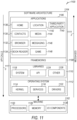
- FIG. 11 is a block diagram 1100 illustrating a software architecture 1104, which can be installed on any one or more of the devices described herein.
- the software architecture 1104 is supported by hardware such as a machine 1102 that includes processors 1120, memory 1126, and I/O components 1138.
- the software architecture 1104 can be conceptualized as a stack of layers, where each layer provides a particular functionality.
- the software architecture 1104 includes layers such as an operating system 1112, libraries 1110, frameworks 1108, and applications 1106.
- the applications 1106 invoke API calls 11110 through the software stack and receive messages 11112 in response to the API calls 11110.
- the operating system 1112 manages hardware resources and provides common services.
- the operating system 1112 includes, for example, a kernel 1114, services 1116, and drivers 1122.
- the kernel 1114 acts as an abstraction layer between the hardware and the other software layers.
- the kernel 1114 provides memory management, processor management (e.g., scheduling), component management, networking, and security settings, among other functionality.
- the services 1116 can provide other common services for the other software layers.
- the drivers 1122 are responsible for controlling or interfacing with the underlying hardware.
- the drivers 1122 can include display drivers, camera drivers, BLUETOOTH ® or BLUETOOTH ® Low Energy drivers, flash memory drivers, serial communication drivers (e.g., USB drivers), WI-FI ® drivers, audio drivers, power management drivers, and so forth.
- the libraries 1110 provide a common low-level infrastructure used by the applications 1106.
- the libraries 1110 can include system libraries 1118 (e.g., C standard library) that provide functions such as memory allocation functions, string manipulation functions, mathematic functions, and the like.
- the libraries 1110 can include API libraries 1124 such as media libraries (e.g., libraries to support presentation and manipulation of various media formats such as Moving Picture Experts Group-4 (MPEG4), Advanced Video Coding (H.264 or AVC), Moving Picture Experts Group Layer-3 (MP3), Advanced Audio Coding (AAC), Adaptive Multi-Rate (AMR) audio codec, Joint Photographic Experts Group (JPEG or JPG), or Portable Network Graphics (PNG)), graphics libraries (e.g., an OpenGL framework used to render in two dimensions (2D) and three dimensions (3D) in a graphic content on a display), database libraries (e.g., SQLite to provide various relational database functions), web libraries (e.g., WebKit to provide web browsing functionality), and the like.
- the frameworks 1108 provide a common high-level infrastructure that is used by the applications 1106.
- the frameworks 1108 provide various graphical user interface (GUI) functions, high-level resource management, and high-level location services.
- GUI graphical user interface
- the frameworks 1108 can provide a broad spectrum of other APIs that can be used by the applications 1106, some of which may be specific to a particular operating system or platform.
- the applications 1106 may include a home application 1136, a contacts application 1130, a browser application 1132, a book reader application 1134, a location application 1142, a media application 1144, a messaging application 1146, a game application 1148, and a broad assortment of other applications such as a third-party application 1140.
- the applications 1106 are programs that execute functions defined in the programs.
- Various programming languages can be employed to create one or more of the applications 1106, structured in a variety of manners, such as object-oriented programming languages (e.g., Objective-C, Java, or C++) or procedural programming languages (e.g., C or assembly language).
- the third-party application 1140 may be mobile software running on a mobile operating system such as IOS TM , ANDROID TM , WINDOWS ® Phone, or another mobile operating system.
- the third-party application 1140 can invoke the API calls 11110 provided by the operating system 1112 to facilitate functionality described herein.
- Carrier signal refers to any intangible medium that is capable of storing, encoding, or carrying instructions for execution by the machine, and includes digital or analog communications signals or other intangible media to facilitate communication of such instructions. Instructions may be transmitted or received over a network using a transmission medium via a network interface device.
- Client device refers to any machine that interfaces to a communications network to obtain resources from one or more server systems or other client devices.
- a client device may be, but is not limited to, a mobile phone, desktop computer, laptop, portable digital assistants (PDAs), smartphones, tablets, ultrabooks, netbooks, laptops, multi-processor systems, microprocessor-based or programmable consumer electronics, game consoles, set-top boxes, or any other communication device that a user may use to access a network.
- PDAs portable digital assistants
- smartphones tablets, ultrabooks, netbooks, laptops, multi-processor systems, microprocessor-based or programmable consumer electronics, game consoles, set-top boxes, or any other communication device that a user may use to access a network.
- a network or a portion of a network may include a wireless or cellular network and the coupling may be a Code Division Multiple Access (CDMA) connection, a Global System for Mobile communications (GSM) connection, or other types of cellular or wireless coupling.
- CDMA Code Division Multiple Access
- GSM Global System for Mobile communications
- one or more computer systems may be configured by software (e.g., an application or application portion) as a hardware component that operates to perform certain operations as described herein.
- software e.g., an application or application portion
- a hardware component may also be implemented mechanically, electronically, or any suitable combination thereof.
- a hardware component may include dedicated circuitry or logic that is permanently configured to perform certain operations.
- a hardware component may be a special-purpose processor, such as a field-programmable gate array (FPGA) or an application specific integrated circuit (ASIC).
- FPGA field-programmable gate array
- ASIC application specific integrated circuit
- the phrase "hardware component”(or “hardware-implemented component”) should be understood to encompass a tangible entity, be that an entity that is physically constructed, permanently configured (e.g., hardwired), or temporarily configured (e.g., programmed) to operate in a certain manner or to perform certain operations described herein.
- hardware components are temporarily configured (e.g., programmed)
- each of the hardware components need not be configured or instantiated at any one instance in time.
- a hardware component comprises a general-purpose processor configured by software to become a special-purpose processor
- the general-purpose processor may be configured as respectively different special-purpose processors (e.g., comprising different hardware components) at different times.
- Hardware components can provide information to, and receive information from, other hardware components. Accordingly, the described hardware components may be regarded as being communicatively coupled. Where multiple hardware components exist contemporaneously, communications may be achieved through signal transmission (e.g., over appropriate circuits and buses) between or among two or more of the hardware components. In embodiments in which multiple hardware components are configured or instantiated at different times, communications between such hardware components may be achieved, for example, through the storage and retrieval of information in memory structures to which the multiple hardware components have access.
- one hardware component may perform an operation and store the output of that operation in a memory device to which it is communicatively coupled. A further hardware component may then, at a later time, access the memory device to retrieve and process the stored output. Hardware components may also initiate communications with input or output devices, and can operate on a resource (e.g., a collection of information).
- a resource e.g., a collection of information.
- the various operations of example methods described herein may be performed, at least partially, by one or more processors that are temporarily configured (e.g., by software) or permanently configured to perform the relevant operations. Whether temporarily or permanently configured, such processors may constitute processor-implemented components that operate to perform one or more operations or functions described herein.
- processor-implemented component refers to a hardware component implemented using one or more processors.
- the methods described herein may be at least partially processor-implemented, with a particular processor or processors being an example of hardware. For example, at least some of the operations of a method may be performed by one or more processors or processor-implemented components.
- the one or more processors may also operate to support performance of the relevant operations in a "cloud computing" environment or as a "software as a service” (SaaS).
- the operations may be performed by a group of computers (as examples of machines including processors), with these operations being accessible via a network (e.g., the Internet) and via one or more appropriate interfaces (e.g., an API).
- the performance of certain of the operations may be distributed among the processors, not only residing within a single machine, but deployed across a number of machines.
- the processors or processor-implemented components may be located in a single geographic location (e.g., within a home environment, an office environment, or a server farm). In other example embodiments, the processors or processor-implemented components may be distributed across a number of geographic locations.
- Computer-readable storage medium refers to both machine-storage media and transmission media. Thus, the terms include both storage devices/media and carrier waves/modulated data signals.
- machine-readable medium “computer-readable medium” and “device-readable medium” mean the same thing and may be used interchangeably in this disclosure.
- Machine storage medium refers to a single or multiple storage devices and media (e.g., a centralized or distributed database, and associated caches and servers) that store executable instructions, routines and data.
- the term shall accordingly be taken to include, but not be limited to, solid-state memories, and optical and magnetic media, including memory internal or external to processors.
- machine-storage media include non-volatile memory, including by way of example semiconductor memory devices, e.g., erasable programmable read-only memory (EPROM), electrically erasable programmable read-only memory (EEPROM), FPGA, and flash memory devices; magnetic disks such as internal hard disks and removable disks; magneto-optical disks; and CD-ROM and DVD-ROM disks
- semiconductor memory devices e.g., erasable programmable read-only memory (EPROM), electrically erasable programmable read-only memory (EEPROM), FPGA, and flash memory devices
- magnetic disks such as internal hard disks and removable disks
- magneto-optical disks magneto-optical disks
- CD-ROM and DVD-ROM disks CD-ROM and DVD-ROM disks
- machine-storage medium means the same thing and may be used interchangeably in this disclosure.
- the terms “machine-storage media,” “computer-storage media,” and “device-storage media” specifically exclude carrier waves
- Non-transitory computer-readable storage medium refers to a tangible medium that is capable of storing, encoding, or carrying the instructions for execution by a machine.
Landscapes
- Engineering & Computer Science (AREA)
- Theoretical Computer Science (AREA)
- Physics & Mathematics (AREA)
- General Physics & Mathematics (AREA)
- General Engineering & Computer Science (AREA)
- Health & Medical Sciences (AREA)
- Artificial Intelligence (AREA)
- Audiology, Speech & Language Pathology (AREA)
- Computational Linguistics (AREA)
- General Health & Medical Sciences (AREA)
- Business, Economics & Management (AREA)
- Human Computer Interaction (AREA)
- Economics (AREA)
- Entrepreneurship & Innovation (AREA)
- Human Resources & Organizations (AREA)
- Marketing (AREA)
- Operations Research (AREA)
- Quality & Reliability (AREA)
- Strategic Management (AREA)
- Tourism & Hospitality (AREA)
- General Business, Economics & Management (AREA)
- Software Systems (AREA)
- Multimedia (AREA)
- Data Mining & Analysis (AREA)
- Databases & Information Systems (AREA)
- Information Transfer Between Computers (AREA)
- Information Retrieval, Db Structures And Fs Structures Therefor (AREA)
Claims (15)
- Verfahren, das Folgendes umfasst:Speichern von Medieninhaltselementen in einer Datenbank;Zugreifen (610) auf eine Texteingabe, die einer Zeichenzahl zugeordnet ist;Identifizieren (620) jedes Elements aus den Medieninhaltselementen als passend, nicht passend oder unsicher in Bezug auf die Texteingabe, wobei ein Element, das als unsicher identifiziert wird, anzeigt, dass das Element geeignet ist, in die Zeichenzahl von Zeichen einer ersten Größe zu passen, und nicht geeignet ist, in die Zeichenzahl von Zeichen einer zweiten Größe zu passen;Anwenden (630) von Textanpassungslogik auf die Texteingabe in Bezug auf jedes als unsicher identifizierte Element, um das Element entweder als passend oder nicht passend zu identifizieren;Erzeugen (640) von personalisierten Medieninhaltselementen durch Einbeziehen der Texteingabe in jedes der als passend identifizierten Medieninhaltselemente; undErzeugen (650) einer Elementauswahl-Benutzerschnittstelle, wobei die Elementauswahl-Benutzerschnittstelle ein oder mehrere Elemente aus den personalisierten Medieninhaltselementen enthält.
- Verfahren nach Anspruch 1, wobei:jedes Element aus den Medieninhaltselementen einer ersten Bedingung, einer zweiten Bedingung und einer dritten Bedingung zugeordnet ist; unddas Identifizieren (620) eines Elements aus den Medieninhaltselementen als passend das Bestimmen umfasst, dass die Zeichenzahl größer oder gleich einem Wert ist, der der ersten Bedingung zugeordnet ist, und kleiner oder gleich einem Wert ist, der der zweiten Bedingung zugeordnet ist.
- Verfahren nach Anspruch 2, wobei das Identifizieren (620) eines Elements aus den Medieninhaltselementen als nicht passend das Bestimmen umfasst, dass die Zeichenzahl größer als ein Wert ist, der der dritten Bedingung zugeordnet ist.
- Verfahren nach Anspruch 2, wobei das Identifizieren (620) eines Elements aus den Medieninhaltselementen als unsicher das Bestimmen umfasst, dass die Zeichenzahl größer als ein Wert ist, der der zweiten Bedingung zugeordnet ist, und kleiner als ein Wert ist, der der dritten Bedingung zugeordnet ist.
- Verfahren nach Anspruch 4, wobei das Anwenden (630) der Textanpassungslogik das Auswerten jeweiliger Glyphenmerkmale einzelner Zeichen in der Texteingabe umfasst.
- Verfahren nach Anspruch 1, wobei jedes Element aus den Medieninhaltselementen zur Aufnahme einer oder mehrerer Textzeilen geeignet ist und einer Zeilenzahl und einem Satz von Zeilenzahl-Textwiedergabebedingungen zugeordnet ist, wobei jedes Mitglied in dem Satz von Zeilenzahl-Textwiedergabebedingungen eine erste Bedingung, eine zweite Bedingung und eine dritte Bedingung umfasst, wobei das Verfahren Folgendes umfasst:Erzeugen einer Vielzahl von aufgeteilten Optionen basierend auf der Texteingabe, wobei jede Option aus der Vielzahl von aufgeteilten Optionen die Texteingabe umfasst, die in eine oder mehrere Zeilen aufgeteilt ist; undIdentifizieren eines ersten Elements aus den Medieninhaltselementen als passend als Reaktion auf das Bestimmen, dass mindestens eine aus der Vielzahl von Aufteilungsoptionen für die Einfügung in das erste Element geeignet ist, basierend auf dem Satz von Zeilenzahl-Textwiedergabebedingungen, die dem ersten Element zugeordnet sind.
- Verfahren nach Anspruch 6, das Folgendes umfasst: Identifizieren eines zweiten Elements aus den Medieninhaltselementen als nicht passend als Reaktion auf das Bestimmen, dass keine aus der Vielzahl von Aufteilungsoptionen für die Einfügung in das erste Element geeignet ist, basierend auf dem Satz von Zeilenzahl-Textwiedergabebedingungen, die dem zweiten Element zugeordnet sind.
- Verfahren nach Anspruch 6, das in Bezug auf ein drittes Element aus den Medieninhaltselementen Folgendes umfasst:Bestimmen, dass für keine aus der Vielzahl der aufgeteilten Optionen eine Übereinstimmung in Bezug auf die zweite Bedingung aus dem Satz der Zeilenzahl-Textwiedergabebedingungen, die dem dritten Element zugeordnet sind, vorliegt;Bestimmen, dass eine unsichere Option aus der Vielzahl von aufgeteilten Optionen eine Übereinstimmung in Bezug auf die dritte Bedingung ist;Auswerten der jeweiligen Glyphenmerkmale einzelner Zeichen in der unsicheren Option; undIdentifizieren des dritten Elements als passend in Bezug auf die unsichere Option als Reaktion auf ein Ergebnis der Auswertung.
- Verfahren nach Anspruch 1, das Folgendes umfasst:Veranlassen der Darstellung der Benutzerschnittstelle für die Elementauswahl auf einer Anzeigevorrichtung;Empfangen eines Hinweises auf ein ausgewähltes Element aus den personalisierten Medieninhaltselementen in der Elementauswahl-Benutzerschnittstelle; undEnthalten des ausgewählten Elements in einer Kontext-Benutzerschnittstelle.
- Verfahren nach Anspruch 9, wobei die Kontext-Benutzerschnittstelle eine Chat-Messaging-Benutzerschnittstelle oder eine Bildbearbeitungs-Benutzerschnittstelle ist.
- System, das umfasst:einen oder mehrere Prozessoren (1002); undein nicht-flüchtiges computerlesbares Speichermedium, das Anweisungen umfasst, die, wenn sie von dem einen oder den mehreren Prozessoren (1002) ausgeführt werden, den einen oder die mehreren Prozessoren (1002) veranlassen, Operationen durchzuführen, die Folgendes umfassen:Speichern von Medieninhaltselementen in einer Datenbank;Zugreifen (610) auf eine Texteingabe, die einer Zeichenzahl zugeordnet ist;Identifizieren (620) jedes Elements aus den Medieninhaltselementen als passend, nicht passend oder unsicher in Bezug auf die Texteingabe, wobei ein Element, das als unsicher identifiziert wird, anzeigt, dass das Element geeignet ist, in die Zeichenzahl von Zeichen einer ersten Größe zu passen, und nicht geeignet ist, in die Zeichenzahl von Zeichen einer zweiten Größe zu passen;Anwenden (630) von Textanpassungslogik auf die Texteingabe in Bezug auf jedes als unsicher identifizierte Element, um das Element entweder als passend oder nicht passend zu identifizieren;Erzeugen (640) von personalisierten Medieninhaltselementen durch Einbeziehen der Texteingabe in jedes der als passend identifizierten Medieninhaltselemente; undErzeugen (650) einer Elementauswahl-Benutzerschnittstelle, wobei die Elementauswahl-Benutzerschnittstelle ein oder mehrere Elemente aus den personalisierten Medieninhaltselementen enthält.
- System nach Anspruch 11, wobei:jedes Element aus den Medieninhaltselementen einer ersten Bedingung, einer zweiten Bedingung und einer dritten Bedingung zugeordnet ist; unddas Identifizieren (620) eines Elements aus den Medieninhaltselementen als passend das Bestimmen umfasst, dass die Zeichenzahl größer oder gleich einem Wert ist, der der ersten Bedingung zugeordnet ist, und kleiner oder gleich einem Wert ist, der der zweiten Bedingung zugeordnet ist.
- System nach Anspruch 12, wobei das Identifizieren (620) eines Elements aus den Medieninhaltselementen als nicht passend das Bestimmen umfasst, dass die Zeichenzahl größer als ein Wert ist, der der dritten Bedingung zugeordnet ist.
- System nach Anspruch 12, wobei das Identifizieren (620) eines Elements aus den Medieninhaltselementen als unsicher das Bestimmen umfasst, dass die Zeichenzahl größer als ein Wert ist, der der zweiten Bedingung zugeordnet ist, und kleiner als ein Wert ist, der der dritten Bedingung zugeordnet ist.
- System nach Anspruch 14, wobei das Anwenden (630) der Textanpassungslogik das Auswerten jeweiliger Glyphenmerkmale einzelner Zeichen in der Texteingabe umfasst.
Priority Applications (1)
| Application Number | Priority Date | Filing Date | Title |
|---|---|---|---|
| EP25180487.8A EP4586135A3 (de) | 2021-06-30 | 2022-06-29 | Hybrides suchsystem für anpassbare medien |
Applications Claiming Priority (3)
| Application Number | Priority Date | Filing Date | Title |
|---|---|---|---|
| US202163217030P | 2021-06-30 | 2021-06-30 | |
| US17/447,121 US11941227B2 (en) | 2021-06-30 | 2021-09-08 | Hybrid search system for customizable media |
| PCT/US2022/073265 WO2023279028A1 (en) | 2021-06-30 | 2022-06-29 | Hybrid search system for customizable media |
Related Child Applications (2)
| Application Number | Title | Priority Date | Filing Date |
|---|---|---|---|
| EP25180487.8A Division EP4586135A3 (de) | 2021-06-30 | 2022-06-29 | Hybrides suchsystem für anpassbare medien |
| EP25180487.8A Division-Into EP4586135A3 (de) | 2021-06-30 | 2022-06-29 | Hybrides suchsystem für anpassbare medien |
Publications (2)
| Publication Number | Publication Date |
|---|---|
| EP4364029A1 EP4364029A1 (de) | 2024-05-08 |
| EP4364029B1 true EP4364029B1 (de) | 2025-07-09 |
Family
ID=82742711
Family Applications (2)
| Application Number | Title | Priority Date | Filing Date |
|---|---|---|---|
| EP22748199.1A Active EP4364029B1 (de) | 2021-06-30 | 2022-06-29 | Hybrides suchsystem für anpassbare medien |
| EP25180487.8A Pending EP4586135A3 (de) | 2021-06-30 | 2022-06-29 | Hybrides suchsystem für anpassbare medien |
Family Applications After (1)
| Application Number | Title | Priority Date | Filing Date |
|---|---|---|---|
| EP25180487.8A Pending EP4586135A3 (de) | 2021-06-30 | 2022-06-29 | Hybrides suchsystem für anpassbare medien |
Country Status (4)
| Country | Link |
|---|---|
| US (2) | US11941227B2 (de) |
| EP (2) | EP4364029B1 (de) |
| KR (1) | KR20240025018A (de) |
| WO (1) | WO2023279028A1 (de) |
Families Citing this family (5)
| Publication number | Priority date | Publication date | Assignee | Title |
|---|---|---|---|---|
| US12165243B2 (en) | 2021-03-30 | 2024-12-10 | Snap Inc. | Customizable avatar modification system |
| WO2022213088A1 (en) | 2021-03-31 | 2022-10-06 | Snap Inc. | Customizable avatar generation system |
| US11941227B2 (en) | 2021-06-30 | 2024-03-26 | Snap Inc. | Hybrid search system for customizable media |
| US12309108B2 (en) * | 2022-08-10 | 2025-05-20 | Yahoo Assets Llc | Method and system for supplementing messages with contextual content |
| JP7549312B2 (ja) * | 2022-12-21 | 2024-09-11 | グリー株式会社 | 情報処理システム、情報処理方法、及びプログラム |
Family Cites Families (249)
| Publication number | Priority date | Publication date | Assignee | Title |
|---|---|---|---|---|
| US4686649A (en) * | 1981-05-29 | 1987-08-11 | International Business Machines Corporation | Word processor with alternative formatted and unformatted display modes |
| US7859551B2 (en) | 1993-10-15 | 2010-12-28 | Bulman Richard L | Object customization and presentation system |
| JP3809194B2 (ja) * | 1993-11-19 | 2006-08-16 | ブラザー工業株式会社 | テープ印刷装置 |
| US5689585A (en) * | 1995-04-28 | 1997-11-18 | Xerox Corporation | Method for aligning a text image to a transcription of the image |
| US5880731A (en) | 1995-12-14 | 1999-03-09 | Microsoft Corporation | Use of avatars with automatic gesturing and bounded interaction in on-line chat session |
| US6023270A (en) | 1997-11-17 | 2000-02-08 | International Business Machines Corporation | Delivery of objects in a virtual world using a descriptive container |
| WO1999046697A1 (fr) | 1998-03-11 | 1999-09-16 | Yasuo Nishizawa | Interverrouillage par http d'un outil accessoire agent a applications integrees sur serveur web |
| US20020067362A1 (en) | 1998-11-06 | 2002-06-06 | Agostino Nocera Luciano Pasquale | Method and system generating an avatar animation transform using a neutral face image |
| US6223165B1 (en) | 1999-03-22 | 2001-04-24 | Keen.Com, Incorporated | Method and apparatus to connect consumer to expert |
| US6772195B1 (en) | 1999-10-29 | 2004-08-03 | Electronic Arts, Inc. | Chat clusters for a virtual world application |
| WO2001057689A1 (en) * | 2000-02-03 | 2001-08-09 | Xmpie Inc. | A system and method for creating customized documents for cross media publishing |
| JP2001230801A (ja) | 2000-02-14 | 2001-08-24 | Sony Corp | 通信システムとその方法、通信サービスサーバおよび通信端末装置 |
| US6922685B2 (en) | 2000-05-22 | 2005-07-26 | Mci, Inc. | Method and system for managing partitioned data resources |
| US20010049596A1 (en) | 2000-05-30 | 2001-12-06 | Adam Lavine | Text to animation process |
| US20050206610A1 (en) | 2000-09-29 | 2005-09-22 | Gary Gerard Cordelli | Computer-"reflected" (avatar) mirror |
| US8117281B2 (en) | 2006-11-02 | 2012-02-14 | Addnclick, Inc. | Using internet content as a means to establish live social networks by linking internet users to each other who are simultaneously engaged in the same and/or similar content |
| US6910186B2 (en) | 2000-12-08 | 2005-06-21 | Kyunam Kim | Graphic chatting with organizational avatars |
| US7925703B2 (en) | 2000-12-26 | 2011-04-12 | Numedeon, Inc. | Graphical interactive interface for immersive online communities |
| EP1495447A1 (de) | 2002-03-26 | 2005-01-12 | KIM, So-Woon | System und verfahren zur 3-dimensions-simulation von brillen |
| KR100493525B1 (ko) | 2002-05-03 | 2005-06-07 | 안현기 | 아바타 메일 제공시스템 및 방법 |
| US8495503B2 (en) | 2002-06-27 | 2013-07-23 | International Business Machines Corporation | Indicating the context of a communication |
| US7212309B1 (en) * | 2002-08-30 | 2007-05-01 | Microsoft Corporation | Best fit printing |
| US7636755B2 (en) | 2002-11-21 | 2009-12-22 | Aol Llc | Multiple avatar personalities |
| US20040179039A1 (en) | 2003-03-03 | 2004-09-16 | Blattner Patrick D. | Using avatars to communicate |
| US20070113181A1 (en) | 2003-03-03 | 2007-05-17 | Blattner Patrick D | Using avatars to communicate real-time information |
| US20070168863A1 (en) | 2003-03-03 | 2007-07-19 | Aol Llc | Interacting avatars in an instant messaging communication session |
| KR20040091331A (ko) | 2003-04-21 | 2004-10-28 | 홍지선 | 자연어처리기술을 이용하여 입력된 문자메시지와 그 문장내용에 상응하는 아바타 표현 방법 및 시스템 |
| KR100762629B1 (ko) | 2003-08-26 | 2007-10-01 | 삼성전자주식회사 | 휴대단말기의 백업서비스 처리방법 |
| JP2005202909A (ja) | 2003-12-16 | 2005-07-28 | Kyoto Univ | アバター制御システム |
| KR100720133B1 (ko) | 2003-12-27 | 2007-05-18 | 삼성전자주식회사 | 휴대단말기의 문자 메시지 처리 방법 |
| JP4194501B2 (ja) * | 2004-01-30 | 2008-12-10 | キヤノン株式会社 | 文書処理方法、文書処理装置及び文書処理プログラム |
| US7555717B2 (en) | 2004-04-30 | 2009-06-30 | Samsung Electronics Co., Ltd. | Method for displaying screen image on mobile terminal |
| US8121338B2 (en) * | 2004-07-07 | 2012-02-21 | Directsmile Gmbh | Process for generating images with realistic text insertion |
| US7707498B2 (en) * | 2004-09-30 | 2010-04-27 | Microsoft Corporation | Specific type content manager in an electronic document |
| US7342587B2 (en) | 2004-10-12 | 2008-03-11 | Imvu, Inc. | Computer-implemented system and method for home page customization and e-commerce support |
| US7468729B1 (en) | 2004-12-21 | 2008-12-23 | Aol Llc, A Delaware Limited Liability Company | Using an avatar to generate user profile information |
| US7512537B2 (en) | 2005-03-22 | 2009-03-31 | Microsoft Corporation | NLP tool to dynamically create movies/animated scenes |
| KR100714192B1 (ko) | 2005-04-08 | 2007-05-02 | 엔에이치엔(주) | 노출 부위가 가변되는 아바타 제공 시스템 및 그 방법 |
| US20060294465A1 (en) | 2005-06-22 | 2006-12-28 | Comverse, Inc. | Method and system for creating and distributing mobile avatars |
| KR20070002637A (ko) | 2005-06-30 | 2007-01-05 | 엘지전자 주식회사 | 아바타 영상부를 갖는 리모트 모니터 장치 |
| US8963926B2 (en) | 2006-07-11 | 2015-02-24 | Pandoodle Corporation | User customized animated video and method for making the same |
| US7775885B2 (en) | 2005-10-14 | 2010-08-17 | Leviathan Entertainment, Llc | Event-driven alteration of avatars |
| BRPI0620945B1 (pt) | 2005-12-31 | 2018-11-27 | Tencent Tech Shenzhen Co Ltd | método de exibição de um avatar 3-d e sistema de exibição de um avatar 3-d |
| US20070176921A1 (en) | 2006-01-27 | 2007-08-02 | Koji Iwasaki | System of developing urban landscape by using electronic data |
| WO2007093813A1 (en) | 2006-02-16 | 2007-08-23 | Weeworld Limited | Portable account information |
| US20070234205A1 (en) * | 2006-03-29 | 2007-10-04 | Avery Dennison Corporation | Defining virtual shapes to position text and graphics |
| WO2007130693A2 (en) | 2006-05-07 | 2007-11-15 | Sony Computer Entertainment Inc. | Methods and systems for processing an interchange of real time effects during video communication |
| WO2007134402A1 (en) | 2006-05-24 | 2007-11-29 | Mor(F) Dynamics Pty Ltd | Instant messaging system |
| US20100278453A1 (en) * | 2006-09-15 | 2010-11-04 | King Martin T | Capture and display of annotations in paper and electronic documents |
| JP4830763B2 (ja) * | 2006-09-29 | 2011-12-07 | 富士ゼロックス株式会社 | 画像処理システムおよび画像処理プログラム |
| US20080158222A1 (en) | 2006-12-29 | 2008-07-03 | Motorola, Inc. | Apparatus and Methods for Selecting and Customizing Avatars for Interactive Kiosks |
| US8504926B2 (en) | 2007-01-17 | 2013-08-06 | Lupus Labs Ug | Model based avatars for virtual presence |
| GB0703974D0 (en) | 2007-03-01 | 2007-04-11 | Sony Comp Entertainment Europe | Entertainment device |
| GB2447094B (en) | 2007-03-01 | 2010-03-10 | Sony Comp Entertainment Europe | Entertainment device and method |
| EP2140341B1 (de) | 2007-04-26 | 2012-04-25 | Ford Global Technologies, LLC | Emotives beratungssystem und verfahren |
| CN101071457B (zh) | 2007-04-28 | 2010-05-26 | 腾讯科技(深圳)有限公司 | 一种网络游戏中改变角色形象的方法、装置以及服务器 |
| US8572203B1 (en) * | 2007-05-10 | 2013-10-29 | United Services Automobile Association (Usaa) | Systems and methods for personalized customer messages |
| WO2008141125A1 (en) | 2007-05-10 | 2008-11-20 | The Trustees Of Columbia University In The City Of New York | Methods and systems for creating speech-enabled avatars |
| US8130219B2 (en) | 2007-06-11 | 2012-03-06 | Autodesk, Inc. | Metadata for avatar generation in virtual environments |
| GB2450757A (en) | 2007-07-06 | 2009-01-07 | Sony Comp Entertainment Europe | Avatar customisation, transmission and reception |
| US20090016617A1 (en) | 2007-07-13 | 2009-01-15 | Samsung Electronics Co., Ltd. | Sender dependent messaging viewer |
| US8726194B2 (en) | 2007-07-27 | 2014-05-13 | Qualcomm Incorporated | Item selection using enhanced control |
| US8146005B2 (en) | 2007-08-07 | 2012-03-27 | International Business Machines Corporation | Creating a customized avatar that reflects a user's distinguishable attributes |
| US20090055484A1 (en) | 2007-08-20 | 2009-02-26 | Thanh Vuong | System and method for representation of electronic mail users using avatars |
| US20090070688A1 (en) | 2007-09-07 | 2009-03-12 | Motorola, Inc. | Method and apparatus for managing interactions |
| US8924250B2 (en) | 2007-09-13 | 2014-12-30 | International Business Machines Corporation | Advertising in virtual environments based on crowd statistics |
| WO2009046342A1 (en) | 2007-10-04 | 2009-04-09 | Playspan, Inc. | Apparatus and method for virtual world item searching |
| US20090106672A1 (en) | 2007-10-18 | 2009-04-23 | Sony Ericsson Mobile Communications Ab | Virtual world avatar activity governed by person's real life activity |
| US8892999B2 (en) | 2007-11-30 | 2014-11-18 | Nike, Inc. | Interactive avatar for social network services |
| US8151191B2 (en) | 2007-12-07 | 2012-04-03 | International Business Machines Corporation | Managing objectionable material in 3D immersive virtual worlds |
| US20090158170A1 (en) | 2007-12-14 | 2009-06-18 | Rajesh Narayanan | Automatic profile-based avatar generation |
| US20090177976A1 (en) | 2008-01-09 | 2009-07-09 | Bokor Brian R | Managing and presenting avatar mood effects in a virtual world |
| US8495505B2 (en) | 2008-01-10 | 2013-07-23 | International Business Machines Corporation | Perspective based tagging and visualization of avatars in a virtual world |
| WO2009101153A2 (en) | 2008-02-13 | 2009-08-20 | Ubisoft Entertainment S.A. | Live-action image capture |
| CN101978374A (zh) | 2008-03-03 | 2011-02-16 | 耐克国际有限公司 | 交互式运动设备系统 |
| US9744466B2 (en) | 2008-03-13 | 2017-08-29 | Mattel, Inc. | Widgetized avatar and a method and system of creating and using same |
| US8832552B2 (en) | 2008-04-03 | 2014-09-09 | Nokia Corporation | Automated selection of avatar characteristics for groups |
| US20090265604A1 (en) | 2008-04-21 | 2009-10-22 | Microsoft Corporation | Graphical representation of social network vitality |
| US20090300525A1 (en) | 2008-05-27 | 2009-12-03 | Jolliff Maria Elena Romera | Method and system for automatically updating avatar to indicate user's status |
| EP2293855A1 (de) | 2008-06-02 | 2011-03-16 | Nike International Ltd. | System und verfahren zur erzeugung eines avatars |
| US20090303984A1 (en) | 2008-06-09 | 2009-12-10 | Clark Jason T | System and method for private conversation in a public space of a virtual world |
| US8095878B2 (en) | 2008-06-23 | 2012-01-10 | International Business Machines Corporation | Method for spell check based upon target and presence of avatars within a virtual environment |
| US8839327B2 (en) | 2008-06-25 | 2014-09-16 | At&T Intellectual Property Ii, Lp | Method and apparatus for presenting media programs |
| WO2010000300A1 (en) | 2008-06-30 | 2010-01-07 | Accenture Global Services Gmbh | Gaming system |
| US20120246585A9 (en) | 2008-07-14 | 2012-09-27 | Microsoft Corporation | System for editing an avatar |
| WO2010014633A1 (en) | 2008-07-28 | 2010-02-04 | Breakthrough Performancetech, Llc | Systems and methods for computerized interactive skill training |
| US8384719B2 (en) | 2008-08-01 | 2013-02-26 | Microsoft Corporation | Avatar items and animations |
| US8832201B2 (en) | 2008-08-18 | 2014-09-09 | International Business Machines Corporation | Method, system and program product for providing selective enhanced privacy and control features to one or more portions of an electronic message |
| US8108774B2 (en) | 2008-09-26 | 2012-01-31 | International Business Machines Corporation | Avatar appearance transformation in a virtual universe |
| US8648865B2 (en) | 2008-09-26 | 2014-02-11 | International Business Machines Corporation | Variable rendering of virtual universe avatars |
| US8869197B2 (en) | 2008-10-01 | 2014-10-21 | At&T Intellectual Property I, Lp | Presentation of an avatar in a media communication system |
| US8683354B2 (en) | 2008-10-16 | 2014-03-25 | At&T Intellectual Property I, L.P. | System and method for distributing an avatar |
| US20100115426A1 (en) | 2008-11-05 | 2010-05-06 | Yahoo! Inc. | Avatar environments |
| US8745152B2 (en) | 2008-11-06 | 2014-06-03 | Disney Enterprises, Inc. | System and method for server-side avatar pre-rendering |
| US8458601B2 (en) | 2008-12-04 | 2013-06-04 | International Business Machines Corporation | System and method for item inquiry and information presentation via standard communication paths |
| US8581911B2 (en) | 2008-12-04 | 2013-11-12 | Intific, Inc. | Training system and methods for dynamically injecting expression information into an animated facial mesh |
| US8831383B2 (en) | 2008-12-09 | 2014-09-09 | Xerox Corporation | Enhanced techniques for visual image alignment of a multi-layered document composition |
| US20100162149A1 (en) | 2008-12-24 | 2010-06-24 | At&T Intellectual Property I, L.P. | Systems and Methods to Provide Location Information |
| US9105014B2 (en) | 2009-02-03 | 2015-08-11 | International Business Machines Corporation | Interactive avatar in messaging environment |
| KR101558553B1 (ko) | 2009-02-18 | 2015-10-08 | 삼성전자 주식회사 | 아바타 얼굴 표정 제어장치 |
| US20100227682A1 (en) | 2009-03-04 | 2010-09-09 | Microsoft Corporation | Awarding of avatar items in video game environment |
| JP5219928B2 (ja) * | 2009-06-03 | 2013-06-26 | キヤノン株式会社 | 編集装置及び編集方法、プログラム |
| US20110093780A1 (en) | 2009-10-16 | 2011-04-21 | Microsoft Corporation | Advertising avatar |
| KR20110070056A (ko) | 2009-12-18 | 2011-06-24 | 한국전자통신연구원 | 사용자 맞춤형 고품질 3d 아바타 생성 방법 및 그 장치 |
| TWI434227B (zh) | 2009-12-29 | 2014-04-11 | Ind Tech Res Inst | 動畫產生系統及方法 |
| US8484158B2 (en) | 2010-02-01 | 2013-07-09 | International Business Machines Corporation | Managing information about avatars across virtual worlds |
| US20110239136A1 (en) | 2010-03-10 | 2011-09-29 | Oddmobb, Inc. | Instantiating widgets into a virtual social venue |
| US9086776B2 (en) | 2010-03-29 | 2015-07-21 | Microsoft Technology Licensing, Llc | Modifying avatar attributes |
| TWI439960B (zh) | 2010-04-07 | 2014-06-01 | 蘋果公司 | 虛擬使用者編輯環境 |
| WO2021220058A1 (en) * | 2020-05-01 | 2021-11-04 | Monday.com Ltd. | Digital processing systems and methods for enhanced collaborative workflow and networking systems, methods, and devices |
| US8694899B2 (en) | 2010-06-01 | 2014-04-08 | Apple Inc. | Avatars reflecting user states |
| US8692830B2 (en) | 2010-06-01 | 2014-04-08 | Apple Inc. | Automatic avatar creation |
| US20110313756A1 (en) * | 2010-06-21 | 2011-12-22 | Connor Robert A | Text sizer (TM) |
| US8564621B2 (en) | 2010-08-11 | 2013-10-22 | International Business Machines Corporation | Replicating changes between corresponding objects |
| JP2012065263A (ja) | 2010-09-17 | 2012-03-29 | Olympus Imaging Corp | 撮影機器 |
| US9294717B2 (en) | 2010-10-13 | 2016-03-22 | At&T Intellectual Property I, L.P. | System and method to enable layered video messaging |
| KR101514327B1 (ko) | 2010-11-04 | 2015-04-22 | 한국전자통신연구원 | 얼굴 아바타 생성 장치 및 방법 |
| US20120124458A1 (en) | 2010-11-17 | 2012-05-17 | Nazareno Brier Cruzada | Social networking website & web-based system for collecting & presenting real-time user generated information on parties & events. |
| US20120130717A1 (en) | 2010-11-19 | 2012-05-24 | Microsoft Corporation | Real-time Animation for an Expressive Avatar |
| KR20120059994A (ko) | 2010-12-01 | 2012-06-11 | 삼성전자주식회사 | 표정 제어점을 이용한 아바타 제어 장치 및 방법 |
| KR101445263B1 (ko) | 2010-12-22 | 2014-09-30 | 주식회사 케이티 | 맞춤형 콘텐츠 제공 시스템 및 방법 |
| US9990114B1 (en) * | 2010-12-23 | 2018-06-05 | Oracle International Corporation | Customizable publication via multiple outlets |
| US9245259B2 (en) * | 2011-01-14 | 2016-01-26 | Apple Inc. | Presenting E-mail on a touch device |
| US9614807B2 (en) * | 2011-02-23 | 2017-04-04 | Bottlenose, Inc. | System and method for analyzing messages in a network or across networks |
| US9839844B2 (en) | 2011-03-01 | 2017-12-12 | Disney Enterprises, Inc. | Sprite strip renderer |
| WO2012126135A1 (en) | 2011-03-21 | 2012-09-27 | Intel Corporation | Method of augmented makeover with 3d face modeling and landmark alignment |
| US9330483B2 (en) | 2011-04-11 | 2016-05-03 | Intel Corporation | Avatar facial expression techniques |
| US20130103760A1 (en) | 2011-04-11 | 2013-04-25 | Robert K. Golding | Location-sensitive virtual identity system, apparatus, method and computer-readable medium |
| US8989786B2 (en) | 2011-04-21 | 2015-03-24 | Walking Thumbs, Llc | System and method for graphical expression during text messaging communications |
| US9241184B2 (en) | 2011-06-01 | 2016-01-19 | At&T Intellectual Property I, L.P. | Clothing visualization |
| WO2013020248A1 (en) | 2011-08-09 | 2013-02-14 | Intel Corporation | Image-based multi-view 3d face generation |
| KR20130022434A (ko) | 2011-08-22 | 2013-03-07 | (주)아이디피쉬 | 통신단말장치의 감정 컨텐츠 서비스 장치 및 방법, 이를 위한 감정 인지 장치 및 방법, 이를 이용한 감정 컨텐츠를 생성하고 정합하는 장치 및 방법 |
| US20130249948A1 (en) | 2011-08-26 | 2013-09-26 | Reincloud Corporation | Providing interactive travel content at a display device |
| US8559980B2 (en) | 2011-09-02 | 2013-10-15 | John J. Pujol | Method and system for integrated messaging and location services |
| US8890926B2 (en) | 2011-11-02 | 2014-11-18 | Microsoft Corporation | Automatic identification and representation of most relevant people in meetings |
| US9782680B2 (en) | 2011-12-09 | 2017-10-10 | Futurewei Technologies, Inc. | Persistent customized social media environment |
| CN104115503A (zh) | 2011-12-29 | 2014-10-22 | 英特尔公司 | 使用化身的通信 |
| US20130298084A1 (en) * | 2012-01-27 | 2013-11-07 | Bottlenose, Inc. | Targeted advertising based on trending of aggregated personalized information streams |
| US8810513B2 (en) | 2012-02-02 | 2014-08-19 | Kodak Alaris Inc. | Method for controlling interactive display system |
| EP2823512B1 (de) | 2012-03-07 | 2016-10-05 | Crocus Technology Inc. | Magnetische logikeinheiten zur messung einer magnetischen feldrichtung |
| US20130257877A1 (en) | 2012-03-30 | 2013-10-03 | Videx, Inc. | Systems and Methods for Generating an Interactive Avatar Model |
| US9402057B2 (en) | 2012-04-02 | 2016-07-26 | Argela Yazilim ve Bilisim Teknolojileri San. ve Tic. A.S. | Interactive avatars for telecommunication systems |
| CN104170358B (zh) | 2012-04-09 | 2016-05-11 | 英特尔公司 | 用于化身管理和选择的系统和方法 |
| US10155168B2 (en) | 2012-05-08 | 2018-12-18 | Snap Inc. | System and method for adaptable avatars |
| JP5497931B2 (ja) | 2012-05-30 | 2014-05-21 | 株式会社コナミデジタルエンタテインメント | アプリケーション装置、アプリケーション装置の制御方法、及びプログラム |
| AU2013206649A1 (en) | 2012-07-05 | 2014-01-23 | Aristocrat Technologies Australia Pty Limited | A gaming system and a method of gaming |
| US20140125678A1 (en) | 2012-07-11 | 2014-05-08 | GeriJoy Inc. | Virtual Companion |
| US10116598B2 (en) | 2012-08-15 | 2018-10-30 | Imvu, Inc. | System and method for increasing clarity and expressiveness in network communications |
| US20150206349A1 (en) | 2012-08-22 | 2015-07-23 | Goldrun Corporation | Augmented reality virtual content platform apparatuses, methods and systems |
| US9461876B2 (en) | 2012-08-29 | 2016-10-04 | Loci | System and method for fuzzy concept mapping, voting ontology crowd sourcing, and technology prediction |
| US9936165B2 (en) | 2012-09-06 | 2018-04-03 | Intel Corporation | System and method for avatar creation and synchronization |
| US9314692B2 (en) | 2012-09-21 | 2016-04-19 | Luxand, Inc. | Method of creating avatar from user submitted image |
| US9746990B2 (en) | 2012-09-28 | 2017-08-29 | Intel Corporation | Selectively augmenting communications transmitted by a communication device |
| US9501942B2 (en) | 2012-10-09 | 2016-11-22 | Kc Holdings I | Personalized avatar responsive to user physical state and context |
| US20140129343A1 (en) | 2012-11-08 | 2014-05-08 | Microsoft Corporation | Dynamic targeted advertising avatar |
| US9256860B2 (en) | 2012-12-07 | 2016-02-09 | International Business Machines Corporation | Tracking participation in a shared media session |
| US9990373B2 (en) | 2013-02-06 | 2018-06-05 | John A. Fortkort | Creation and geospatial placement of avatars based on real-world interactions |
| CN104995662B (zh) | 2013-03-20 | 2020-08-11 | 英特尔公司 | 用于管理化身的设备和方法以及用于动画化化身的设备 |
| WO2014153689A1 (en) | 2013-03-29 | 2014-10-02 | Intel Corporation | Avatar animation, social networking and touch screen applications |
| US8913088B2 (en) * | 2013-04-15 | 2014-12-16 | Google Inc. | Adjusting displayed content length as a function of map scale |
| CN105190700A (zh) | 2013-06-04 | 2015-12-23 | 英特尔公司 | 基于化身的视频编码 |
| US9378576B2 (en) | 2013-06-07 | 2016-06-28 | Faceshift Ag | Online modeling for real-time facial animation |
| US9639969B1 (en) | 2013-07-25 | 2017-05-02 | Overlay Studio, Inc. | Collaborative design |
| US9177410B2 (en) | 2013-08-09 | 2015-11-03 | Ayla Mandel | System and method for creating avatars or animated sequences using human body features extracted from a still image |
| US9456170B1 (en) * | 2013-10-08 | 2016-09-27 | 3Play Media, Inc. | Automated caption positioning systems and methods |
| US9706040B2 (en) | 2013-10-31 | 2017-07-11 | Udayakumar Kadirvel | System and method for facilitating communication via interaction with an avatar |
| US9508197B2 (en) | 2013-11-01 | 2016-11-29 | Microsoft Technology Licensing, Llc | Generating an avatar from real time image data |
| US20150127753A1 (en) | 2013-11-04 | 2015-05-07 | Meemo, Llc | Word Recognition and Ideograph or In-App Advertising System |
| WO2015070416A1 (en) | 2013-11-14 | 2015-05-21 | Intel Corporation | Mechanism for facilitating dynamic simulation of avatars corresponding to changing user performances as detected at computing devices |
| US20150172246A1 (en) | 2013-12-13 | 2015-06-18 | Piragash Velummylum | Stickers for electronic messaging cards |
| US9361510B2 (en) | 2013-12-13 | 2016-06-07 | Intel Corporation | Efficient facial landmark tracking using online shape regression method |
| US9881403B2 (en) | 2014-02-21 | 2018-01-30 | Colorvision International, Inc. | Portable electronic device with a creative artworks picture application |
| US10444938B1 (en) | 2014-02-26 | 2019-10-15 | Symantec Corporation | Systems and methods for customizing user icons |
| US9544257B2 (en) | 2014-04-04 | 2017-01-10 | Blackberry Limited | System and method for conducting private messaging |
| US9503845B2 (en) | 2014-04-17 | 2016-11-22 | Paypal, Inc. | Image customization to enhance transaction experience |
| WO2015164951A1 (en) | 2014-05-01 | 2015-11-05 | Abbas Mohamad | Methods and systems relating to personalized evolving avatars |
| US10049477B1 (en) | 2014-06-27 | 2018-08-14 | Google Llc | Computer-assisted text and visual styling for images |
| US20160134840A1 (en) | 2014-07-28 | 2016-05-12 | Alexa Margaret McCulloch | Avatar-Mediated Telepresence Systems with Enhanced Filtering |
| US9507506B2 (en) * | 2014-11-13 | 2016-11-29 | Interactive Memories, Inc. | Automatic target box in methods and systems for editing content-rich layouts in media-based projects |
| WO2016070354A1 (en) | 2014-11-05 | 2016-05-12 | Intel Corporation | Avatar video apparatus and method |
| US10924444B2 (en) * | 2014-12-02 | 2021-02-16 | Facebook, Inc. | Device, method, and graphical user interface for managing customer relationships using a lightweight messaging platform |
| WO2016090605A1 (en) | 2014-12-11 | 2016-06-16 | Intel Corporation | Avatar selection mechanism |
| JP6462386B2 (ja) | 2015-02-05 | 2019-01-30 | 任天堂株式会社 | プログラム、通信端末及び表示方法 |
| US10812429B2 (en) | 2015-04-03 | 2020-10-20 | Glu Mobile Inc. | Systems and methods for message communication |
| KR102450865B1 (ko) | 2015-04-07 | 2022-10-06 | 인텔 코포레이션 | 아바타 키보드 |
| US20180077095A1 (en) | 2015-09-14 | 2018-03-15 | X Development Llc | Augmentation of Communications with Emotional Data |
| US20170087473A1 (en) | 2015-09-29 | 2017-03-30 | Sportsworld, Inc. | Virtual environments for managing and interacting with virtual sports leagues |
| US20170118145A1 (en) | 2015-10-21 | 2017-04-27 | Futurefly Ltd. | Method of using emoji to control and enrich 3d chat environments |
| WO2017101094A1 (en) | 2015-12-18 | 2017-06-22 | Intel Corporation | Avatar animation system |
| US20170199855A1 (en) | 2016-01-11 | 2017-07-13 | BuilderFish, LLC | System and method for providing a time-based presentation of a user-navigable project model |
| CN105791692B (zh) | 2016-03-14 | 2020-04-07 | 腾讯科技(深圳)有限公司 | 一种信息处理方法、终端及存储介质 |
| US9911073B1 (en) | 2016-03-18 | 2018-03-06 | Snap Inc. | Facial patterns for optical barcodes |
| US20170312634A1 (en) | 2016-04-28 | 2017-11-02 | Uraniom | System and method for personalized avatar generation, especially for computer games |
| EP4113268B1 (de) | 2016-05-18 | 2024-04-17 | Apple Inc. | Vorrichtungen, verfahren und grafische benutzeroberflächen zur nachrichtenübermittlung |
| US11320982B2 (en) | 2016-05-18 | 2022-05-03 | Apple Inc. | Devices, methods, and graphical user interfaces for messaging |
| US10559111B2 (en) | 2016-06-23 | 2020-02-11 | LoomAi, Inc. | Systems and methods for generating computer ready animation models of a human head from captured data images |
| US10657701B2 (en) | 2016-06-30 | 2020-05-19 | Sony Interactive Entertainment Inc. | Dynamic entering and leaving of virtual-reality environments navigated by different HMD users |
| US10360708B2 (en) | 2016-06-30 | 2019-07-23 | Snap Inc. | Avatar based ideogram generation |
| US10855632B2 (en) | 2016-07-19 | 2020-12-01 | Snap Inc. | Displaying customized electronic messaging graphics |
| US10573048B2 (en) | 2016-07-25 | 2020-02-25 | Oath Inc. | Emotional reaction sharing |
| US20180047200A1 (en) | 2016-08-11 | 2018-02-15 | Jibjab Media Inc. | Combining user images and computer-generated illustrations to produce personalized animated digital avatars |
| CN110109592B (zh) | 2016-09-23 | 2022-09-23 | 苹果公司 | 头像创建和编辑 |
| US10432559B2 (en) | 2016-10-24 | 2019-10-01 | Snap Inc. | Generating and displaying customized avatars in electronic messages |
| US10242503B2 (en) | 2017-01-09 | 2019-03-26 | Snap Inc. | Surface aware lens |
| US10242477B1 (en) | 2017-01-16 | 2019-03-26 | Snap Inc. | Coded vision system |
| US10454857B1 (en) * | 2017-01-23 | 2019-10-22 | Snap Inc. | Customized digital avatar accessories |
| US10802683B1 (en) * | 2017-02-16 | 2020-10-13 | Cisco Technology, Inc. | Method, system and computer program product for changing avatars in a communication application display |
| US11893647B2 (en) | 2017-04-27 | 2024-02-06 | Snap Inc. | Location-based virtual avatars |
| US10949872B2 (en) | 2017-04-28 | 2021-03-16 | Snap Inc. | Methods and systems for server generation of interactive advertising with content collections |
| US10455259B2 (en) * | 2017-08-23 | 2019-10-22 | Intel Corporation | Enhanced text rendering and readability in images |
| US9980100B1 (en) | 2017-08-31 | 2018-05-22 | Snap Inc. | Device location based on machine learning classifications |
| CN109598775B (zh) | 2017-09-30 | 2023-03-31 | 腾讯科技(深圳)有限公司 | 一种动态图像合成方法、装置、终端和存储介质 |
| US20190114037A1 (en) * | 2017-10-17 | 2019-04-18 | Blend Systems, Inc. | Systems and methods for distributing customized avatars responsive to events |
| US10657695B2 (en) | 2017-10-30 | 2020-05-19 | Snap Inc. | Animated chat presence |
| US10664150B2 (en) * | 2017-11-06 | 2020-05-26 | Whatsapp Inc. | Providing group messaging thread highlights |
| US10586369B1 (en) | 2018-01-31 | 2020-03-10 | Amazon Technologies, Inc. | Using dialog and contextual data of a virtual reality environment to create metadata to drive avatar animation |
| US11334376B2 (en) | 2018-02-13 | 2022-05-17 | Samsung Electronics Co., Ltd. | Emotion-aw are reactive interface |
| KR20190101832A (ko) | 2018-02-23 | 2019-09-02 | 삼성전자주식회사 | 전자 장치 및 아바타 기반의 커스텀 객체 운용 방법 |
| JP7031389B2 (ja) * | 2018-03-13 | 2022-03-08 | 富士フイルムビジネスイノベーション株式会社 | 情報処理装置及びプログラム |
| US10607065B2 (en) | 2018-05-03 | 2020-03-31 | Adobe Inc. | Generation of parameterized avatars |
| US11722764B2 (en) | 2018-05-07 | 2023-08-08 | Apple Inc. | Creative camera |
| US10375313B1 (en) | 2018-05-07 | 2019-08-06 | Apple Inc. | Creative camera |
| DK179874B1 (en) | 2018-05-07 | 2019-08-13 | Apple Inc. | USER INTERFACE FOR AVATAR CREATION |
| US11681432B2 (en) | 2018-05-10 | 2023-06-20 | Honor Device Co., Ltd. | Method and terminal for displaying input method virtual keyboard |
| US10269164B1 (en) | 2018-05-30 | 2019-04-23 | Whatsapp Inc. | Creating custom stickers for use on a messaging system |
| WO2019245578A1 (en) | 2018-06-22 | 2019-12-26 | Virtual Album Technologies Llc | Multi-modal virtual experiences of distributed content |
| US10762121B2 (en) | 2018-06-28 | 2020-09-01 | Snap Inc. | Content sharing platform profile generation |
| KR102530264B1 (ko) | 2018-08-08 | 2023-05-09 | 삼성전자 주식회사 | 아바타에 대응하는 속성에 따른 아이템을 제공하는 방법 및 장치 |
| US10990246B1 (en) | 2018-10-31 | 2021-04-27 | Amazon Technologies, Inc. | Techniques for generating digital content |
| US11307732B1 (en) * | 2019-02-18 | 2022-04-19 | Pro Quick Draw LLC | Integrated method and system for creation of a diagram compilation book and exporting the book for use as content in a visual presentation tool |
| US10838599B2 (en) | 2019-02-25 | 2020-11-17 | Snap Inc. | Custom media overlay system |
| US11202131B2 (en) | 2019-03-10 | 2021-12-14 | Vidubly Ltd | Maintaining original volume changes of a character in revoiced media stream |
| DK201970531A1 (en) | 2019-05-06 | 2021-07-09 | Apple Inc | Avatar integration with multiple applications |
| US11188190B2 (en) | 2019-06-28 | 2021-11-30 | Snap Inc. | Generating animation overlays in a communication session |
| US11321559B2 (en) | 2019-10-17 | 2022-05-03 | Adobe Inc. | Document structure identification using post-processing error correction |
| US11095584B2 (en) | 2019-10-25 | 2021-08-17 | Facebook, Inc. | Generating content to be shared between users |
| CN110782510B (zh) | 2019-10-25 | 2024-06-11 | 北京达佳互联信息技术有限公司 | 一种贴纸生成方法及装置 |
| US11128586B2 (en) | 2019-12-09 | 2021-09-21 | Snap Inc. | Context sensitive avatar captions |
| EP3905108B1 (de) * | 2020-04-29 | 2025-11-05 | Onfido Ltd | Skalierbare, flexible und robuste vorlagenbasierte datenextraktionspipeline |
| US20210375023A1 (en) | 2020-06-01 | 2021-12-02 | Nvidia Corporation | Content animation using one or more neural networks |
| WO2021247026A1 (en) | 2020-06-04 | 2021-12-09 | Google Llc | Visual asset development using a generative adversarial network |
| KR20220032444A (ko) | 2020-09-07 | 2022-03-15 | 김밀알 | 맞춤형 이모티콘 제작 시스템 |
| US11562488B2 (en) * | 2020-10-15 | 2023-01-24 | Adobe Inc. | Image content snapping guidelines |
| US11501477B2 (en) | 2021-03-22 | 2022-11-15 | Adobe Inc. | Customizing font bounding boxes for variable fonts |
| US12165243B2 (en) | 2021-03-30 | 2024-12-10 | Snap Inc. | Customizable avatar modification system |
| WO2022213088A1 (en) | 2021-03-31 | 2022-10-06 | Snap Inc. | Customizable avatar generation system |
| CN117597690B (zh) | 2021-06-30 | 2024-11-22 | 斯纳普公司 | 用于可定制媒体的混合搜索系统 |
| US11941227B2 (en) | 2021-06-30 | 2024-03-26 | Snap Inc. | Hybrid search system for customizable media |
| US12260508B2 (en) | 2022-03-07 | 2025-03-25 | Meta Platforms Technologies, Llc | Providing context-aware avatar editing within an extended-reality environment |
-
2021
- 2021-09-08 US US17/447,121 patent/US11941227B2/en active Active
-
2022
- 2022-06-29 WO PCT/US2022/073265 patent/WO2023279028A1/en not_active Ceased
- 2022-06-29 KR KR1020247003214A patent/KR20240025018A/ko active Pending
- 2022-06-29 EP EP22748199.1A patent/EP4364029B1/de active Active
- 2022-06-29 EP EP25180487.8A patent/EP4586135A3/de active Pending
-
2023
- 2023-09-21 US US18/371,391 patent/US12299256B2/en active Active
Also Published As
| Publication number | Publication date |
|---|---|
| US11941227B2 (en) | 2024-03-26 |
| WO2023279028A1 (en) | 2023-01-05 |
| US20240012537A1 (en) | 2024-01-11 |
| KR20240025018A (ko) | 2024-02-26 |
| EP4586135A2 (de) | 2025-07-16 |
| EP4586135A3 (de) | 2025-10-01 |
| EP4364029A1 (de) | 2024-05-08 |
| US20230004260A1 (en) | 2023-01-05 |
| US12299256B2 (en) | 2025-05-13 |
Similar Documents
| Publication | Publication Date | Title |
|---|---|---|
| US12165243B2 (en) | Customizable avatar modification system | |
| US11347932B2 (en) | Decoupling website service from presentation layer | |
| EP4364029B1 (de) | Hybrides suchsystem für anpassbare medien | |
| WO2021237088A1 (en) | Featured content collection interface | |
| US12079295B2 (en) | Vehicle recognition system | |
| US20240012930A1 (en) | Obscuring elements based on user input | |
| US12455917B2 (en) | Location-based timeline media content system | |
| US20240244157A1 (en) | Real time video editing | |
| WO2022072678A1 (en) | Media content transmission and management | |
| US12614293B2 (en) | Monocular world meshing | |
| US20250080483A1 (en) | Media gallery sharing and management | |
| EP4272406B1 (de) | Körper-ui für komponenten der erweiterten realität |
Legal Events
| Date | Code | Title | Description |
|---|---|---|---|
| STAA | Information on the status of an ep patent application or granted ep patent |
Free format text: STATUS: UNKNOWN |
|
| STAA | Information on the status of an ep patent application or granted ep patent |
Free format text: STATUS: THE INTERNATIONAL PUBLICATION HAS BEEN MADE |
|
| PUAI | Public reference made under article 153(3) epc to a published international application that has entered the european phase |
Free format text: ORIGINAL CODE: 0009012 |
|
| STAA | Information on the status of an ep patent application or granted ep patent |
Free format text: STATUS: REQUEST FOR EXAMINATION WAS MADE |
|
| 17P | Request for examination filed |
Effective date: 20240130 |
|
| AK | Designated contracting states |
Kind code of ref document: A1 Designated state(s): AL AT BE BG CH CY CZ DE DK EE ES FI FR GB GR HR HU IE IS IT LI LT LU LV MC MK MT NL NO PL PT RO RS SE SI SK SM TR |
|
| DAV | Request for validation of the european patent (deleted) | ||
| DAX | Request for extension of the european patent (deleted) | ||
| GRAP | Despatch of communication of intention to grant a patent |
Free format text: ORIGINAL CODE: EPIDOSNIGR1 |
|
| STAA | Information on the status of an ep patent application or granted ep patent |
Free format text: STATUS: GRANT OF PATENT IS INTENDED |
|
| INTG | Intention to grant announced |
Effective date: 20250205 |
|
| P01 | Opt-out of the competence of the unified patent court (upc) registered |
Free format text: CASE NUMBER: APP_12252/2025 Effective date: 20250313 |
|
| GRAS | Grant fee paid |
Free format text: ORIGINAL CODE: EPIDOSNIGR3 |
|
| GRAA | (expected) grant |
Free format text: ORIGINAL CODE: 0009210 |
|
| STAA | Information on the status of an ep patent application or granted ep patent |
Free format text: STATUS: THE PATENT HAS BEEN GRANTED |
|
| AK | Designated contracting states |
Kind code of ref document: B1 Designated state(s): AL AT BE BG CH CY CZ DE DK EE ES FI FR GB GR HR HU IE IS IT LI LT LU LV MC MK MT NL NO PL PT RO RS SE SI SK SM TR |
|
| REG | Reference to a national code |
Ref country code: GB Ref legal event code: FG4D |
|
| REG | Reference to a national code |
Ref country code: CH Ref legal event code: EP |
|
| REG | Reference to a national code |
Ref country code: IE Ref legal event code: FG4D |
|
| REG | Reference to a national code |
Ref country code: DE Ref legal event code: R096 Ref document number: 602022017380 Country of ref document: DE |
|
| REG | Reference to a national code |
Ref country code: NL Ref legal event code: FP |
|
| PG25 | Lapsed in a contracting state [announced via postgrant information from national office to epo] |
Ref country code: PT Free format text: LAPSE BECAUSE OF FAILURE TO SUBMIT A TRANSLATION OF THE DESCRIPTION OR TO PAY THE FEE WITHIN THE PRESCRIBED TIME-LIMIT Effective date: 20251110 |
|
| REG | Reference to a national code |
Ref country code: AT Ref legal event code: MK05 Ref document number: 1812519 Country of ref document: AT Kind code of ref document: T Effective date: 20250709 |
|
| PG25 | Lapsed in a contracting state [announced via postgrant information from national office to epo] |
Ref country code: IS Free format text: LAPSE BECAUSE OF FAILURE TO SUBMIT A TRANSLATION OF THE DESCRIPTION OR TO PAY THE FEE WITHIN THE PRESCRIBED TIME-LIMIT Effective date: 20251109 |
|
| PG25 | Lapsed in a contracting state [announced via postgrant information from national office to epo] |
Ref country code: NO Free format text: LAPSE BECAUSE OF FAILURE TO SUBMIT A TRANSLATION OF THE DESCRIPTION OR TO PAY THE FEE WITHIN THE PRESCRIBED TIME-LIMIT Effective date: 20251009 |
|
| REG | Reference to a national code |
Ref country code: LT Ref legal event code: MG9D |
|
| PG25 | Lapsed in a contracting state [announced via postgrant information from national office to epo] |
Ref country code: AT Free format text: LAPSE BECAUSE OF FAILURE TO SUBMIT A TRANSLATION OF THE DESCRIPTION OR TO PAY THE FEE WITHIN THE PRESCRIBED TIME-LIMIT Effective date: 20250709 |
|
| PG25 | Lapsed in a contracting state [announced via postgrant information from national office to epo] |
Ref country code: FI Free format text: LAPSE BECAUSE OF FAILURE TO SUBMIT A TRANSLATION OF THE DESCRIPTION OR TO PAY THE FEE WITHIN THE PRESCRIBED TIME-LIMIT Effective date: 20250709 |
|
| PG25 | Lapsed in a contracting state [announced via postgrant information from national office to epo] |
Ref country code: HR Free format text: LAPSE BECAUSE OF FAILURE TO SUBMIT A TRANSLATION OF THE DESCRIPTION OR TO PAY THE FEE WITHIN THE PRESCRIBED TIME-LIMIT Effective date: 20250709 |
|
| PG25 | Lapsed in a contracting state [announced via postgrant information from national office to epo] |
Ref country code: GR Free format text: LAPSE BECAUSE OF FAILURE TO SUBMIT A TRANSLATION OF THE DESCRIPTION OR TO PAY THE FEE WITHIN THE PRESCRIBED TIME-LIMIT Effective date: 20251010 |
|
| PG25 | Lapsed in a contracting state [announced via postgrant information from national office to epo] |
Ref country code: SE Free format text: LAPSE BECAUSE OF FAILURE TO SUBMIT A TRANSLATION OF THE DESCRIPTION OR TO PAY THE FEE WITHIN THE PRESCRIBED TIME-LIMIT Effective date: 20250709 |
|
| PG25 | Lapsed in a contracting state [announced via postgrant information from national office to epo] |
Ref country code: LV Free format text: LAPSE BECAUSE OF FAILURE TO SUBMIT A TRANSLATION OF THE DESCRIPTION OR TO PAY THE FEE WITHIN THE PRESCRIBED TIME-LIMIT Effective date: 20250709 |
|
| PG25 | Lapsed in a contracting state [announced via postgrant information from national office to epo] |
Ref country code: PL Free format text: LAPSE BECAUSE OF FAILURE TO SUBMIT A TRANSLATION OF THE DESCRIPTION OR TO PAY THE FEE WITHIN THE PRESCRIBED TIME-LIMIT Effective date: 20250709 Ref country code: BG Free format text: LAPSE BECAUSE OF FAILURE TO SUBMIT A TRANSLATION OF THE DESCRIPTION OR TO PAY THE FEE WITHIN THE PRESCRIBED TIME-LIMIT Effective date: 20250709 |
|
| PG25 | Lapsed in a contracting state [announced via postgrant information from national office to epo] |
Ref country code: RS Free format text: LAPSE BECAUSE OF FAILURE TO SUBMIT A TRANSLATION OF THE DESCRIPTION OR TO PAY THE FEE WITHIN THE PRESCRIBED TIME-LIMIT Effective date: 20251009 |
|
| PG25 | Lapsed in a contracting state [announced via postgrant information from national office to epo] |
Ref country code: ES Free format text: LAPSE BECAUSE OF FAILURE TO SUBMIT A TRANSLATION OF THE DESCRIPTION OR TO PAY THE FEE WITHIN THE PRESCRIBED TIME-LIMIT Effective date: 20250709 |
|
| PG25 | Lapsed in a contracting state [announced via postgrant information from national office to epo] |
Ref country code: SM Free format text: LAPSE BECAUSE OF FAILURE TO SUBMIT A TRANSLATION OF THE DESCRIPTION OR TO PAY THE FEE WITHIN THE PRESCRIBED TIME-LIMIT Effective date: 20250709 |
|
| PG25 | Lapsed in a contracting state [announced via postgrant information from national office to epo] |
Ref country code: DK Free format text: LAPSE BECAUSE OF FAILURE TO SUBMIT A TRANSLATION OF THE DESCRIPTION OR TO PAY THE FEE WITHIN THE PRESCRIBED TIME-LIMIT Effective date: 20250709 |
|
| PG25 | Lapsed in a contracting state [announced via postgrant information from national office to epo] |
Ref country code: IT Free format text: LAPSE BECAUSE OF FAILURE TO SUBMIT A TRANSLATION OF THE DESCRIPTION OR TO PAY THE FEE WITHIN THE PRESCRIBED TIME-LIMIT Effective date: 20250709 |
|
| PG25 | Lapsed in a contracting state [announced via postgrant information from national office to epo] |
Ref country code: CZ Free format text: LAPSE BECAUSE OF FAILURE TO SUBMIT A TRANSLATION OF THE DESCRIPTION OR TO PAY THE FEE WITHIN THE PRESCRIBED TIME-LIMIT Effective date: 20250709 |
|
| PG25 | Lapsed in a contracting state [announced via postgrant information from national office to epo] |
Ref country code: EE Free format text: LAPSE BECAUSE OF FAILURE TO SUBMIT A TRANSLATION OF THE DESCRIPTION OR TO PAY THE FEE WITHIN THE PRESCRIBED TIME-LIMIT Effective date: 20250709 Ref country code: SK Free format text: LAPSE BECAUSE OF FAILURE TO SUBMIT A TRANSLATION OF THE DESCRIPTION OR TO PAY THE FEE WITHIN THE PRESCRIBED TIME-LIMIT Effective date: 20250709 |