EP4338835B1 - Organozinn-trägerkatalysator und herstellungsverfahren für saccharose-6-carboxylat - Google Patents
Organozinn-trägerkatalysator und herstellungsverfahren für saccharose-6-carboxylat Download PDFInfo
- Publication number
- EP4338835B1 EP4338835B1 EP21942417.3A EP21942417A EP4338835B1 EP 4338835 B1 EP4338835 B1 EP 4338835B1 EP 21942417 A EP21942417 A EP 21942417A EP 4338835 B1 EP4338835 B1 EP 4338835B1
- Authority
- EP
- European Patent Office
- Prior art keywords
- sucrose
- organotin
- group
- organotin catalyst
- supported
- Prior art date
- Legal status (The legal status is an assumption and is not a legal conclusion. Google has not performed a legal analysis and makes no representation as to the accuracy of the status listed.)
- Active
Links
Images

Classifications
-
- B—PERFORMING OPERATIONS; TRANSPORTING
- B01—PHYSICAL OR CHEMICAL PROCESSES OR APPARATUS IN GENERAL
- B01J—CHEMICAL OR PHYSICAL PROCESSES, e.g. CATALYSIS OR COLLOID CHEMISTRY; THEIR RELEVANT APPARATUS
- B01J31/00—Catalysts comprising hydrides, coordination complexes or organic compounds
- B01J31/02—Catalysts comprising hydrides, coordination complexes or organic compounds containing organic compounds or metal hydrides
-
- C—CHEMISTRY; METALLURGY
- C07—ORGANIC CHEMISTRY
- C07F—ACYCLIC, CARBOCYCLIC OR HETEROCYCLIC COMPOUNDS CONTAINING ELEMENTS OTHER THAN CARBON, HYDROGEN, HALOGEN, OXYGEN, NITROGEN, SULFUR, SELENIUM OR TELLURIUM
- C07F7/00—Compounds containing elements of Groups 4 or 14 of the Periodic Table
- C07F7/22—Tin compounds
- C07F7/2224—Compounds having one or more tin-oxygen linkages
-
- B—PERFORMING OPERATIONS; TRANSPORTING
- B01—PHYSICAL OR CHEMICAL PROCESSES OR APPARATUS IN GENERAL
- B01J—CHEMICAL OR PHYSICAL PROCESSES, e.g. CATALYSIS OR COLLOID CHEMISTRY; THEIR RELEVANT APPARATUS
- B01J31/00—Catalysts comprising hydrides, coordination complexes or organic compounds
- B01J31/02—Catalysts comprising hydrides, coordination complexes or organic compounds containing organic compounds or metal hydrides
- B01J31/12—Catalysts comprising hydrides, coordination complexes or organic compounds containing organic compounds or metal hydrides containing organo-metallic compounds or metal hydrides
- B01J31/123—Organometallic polymers, e.g. comprising C-Si bonds in the main chain or in subunits grafted to the main chain
-
- B—PERFORMING OPERATIONS; TRANSPORTING
- B01—PHYSICAL OR CHEMICAL PROCESSES OR APPARATUS IN GENERAL
- B01J—CHEMICAL OR PHYSICAL PROCESSES, e.g. CATALYSIS OR COLLOID CHEMISTRY; THEIR RELEVANT APPARATUS
- B01J37/00—Processes, in general, for preparing catalysts; Processes, in general, for activation of catalysts
- B01J37/02—Impregnation, coating or precipitation
- B01J37/0215—Coating
- B01J37/0217—Pretreatment of the substrate before coating
-
- B—PERFORMING OPERATIONS; TRANSPORTING
- B01—PHYSICAL OR CHEMICAL PROCESSES OR APPARATUS IN GENERAL
- B01J—CHEMICAL OR PHYSICAL PROCESSES, e.g. CATALYSIS OR COLLOID CHEMISTRY; THEIR RELEVANT APPARATUS
- B01J37/00—Processes, in general, for preparing catalysts; Processes, in general, for activation of catalysts
- B01J37/02—Impregnation, coating or precipitation
- B01J37/0215—Coating
- B01J37/0219—Coating the coating containing organic compounds
-
- B—PERFORMING OPERATIONS; TRANSPORTING
- B01—PHYSICAL OR CHEMICAL PROCESSES OR APPARATUS IN GENERAL
- B01J—CHEMICAL OR PHYSICAL PROCESSES, e.g. CATALYSIS OR COLLOID CHEMISTRY; THEIR RELEVANT APPARATUS
- B01J37/00—Processes, in general, for preparing catalysts; Processes, in general, for activation of catalysts
- B01J37/02—Impregnation, coating or precipitation
- B01J37/0215—Coating
- B01J37/0221—Coating of particles
-
- B—PERFORMING OPERATIONS; TRANSPORTING
- B01—PHYSICAL OR CHEMICAL PROCESSES OR APPARATUS IN GENERAL
- B01J—CHEMICAL OR PHYSICAL PROCESSES, e.g. CATALYSIS OR COLLOID CHEMISTRY; THEIR RELEVANT APPARATUS
- B01J37/00—Processes, in general, for preparing catalysts; Processes, in general, for activation of catalysts
- B01J37/02—Impregnation, coating or precipitation
- B01J37/0215—Coating
- B01J37/0228—Coating in several steps
-
- C—CHEMISTRY; METALLURGY
- C07—ORGANIC CHEMISTRY
- C07H—SUGARS; DERIVATIVES THEREOF; NUCLEOSIDES; NUCLEOTIDES; NUCLEIC ACIDS
- C07H1/00—Processes for the preparation of sugar derivatives
-
- C—CHEMISTRY; METALLURGY
- C07—ORGANIC CHEMISTRY
- C07H—SUGARS; DERIVATIVES THEREOF; NUCLEOSIDES; NUCLEOTIDES; NUCLEIC ACIDS
- C07H1/00—Processes for the preparation of sugar derivatives
- C07H1/06—Separation; Purification
-
- C—CHEMISTRY; METALLURGY
- C07—ORGANIC CHEMISTRY
- C07H—SUGARS; DERIVATIVES THEREOF; NUCLEOSIDES; NUCLEOTIDES; NUCLEIC ACIDS
- C07H13/00—Compounds containing saccharide radicals esterified by carbonic acid or derivatives thereof, or by organic acids, e.g. phosphonic acids
- C07H13/02—Compounds containing saccharide radicals esterified by carbonic acid or derivatives thereof, or by organic acids, e.g. phosphonic acids by carboxylic acids
- C07H13/04—Compounds containing saccharide radicals esterified by carbonic acid or derivatives thereof, or by organic acids, e.g. phosphonic acids by carboxylic acids having the esterifying carboxyl radicals attached to acyclic carbon atoms
-
- C—CHEMISTRY; METALLURGY
- C07—ORGANIC CHEMISTRY
- C07H—SUGARS; DERIVATIVES THEREOF; NUCLEOSIDES; NUCLEOTIDES; NUCLEIC ACIDS
- C07H13/00—Compounds containing saccharide radicals esterified by carbonic acid or derivatives thereof, or by organic acids, e.g. phosphonic acids
- C07H13/02—Compounds containing saccharide radicals esterified by carbonic acid or derivatives thereof, or by organic acids, e.g. phosphonic acids by carboxylic acids
- C07H13/04—Compounds containing saccharide radicals esterified by carbonic acid or derivatives thereof, or by organic acids, e.g. phosphonic acids by carboxylic acids having the esterifying carboxyl radicals attached to acyclic carbon atoms
- C07H13/06—Fatty acids
-
- C—CHEMISTRY; METALLURGY
- C07—ORGANIC CHEMISTRY
- C07H—SUGARS; DERIVATIVES THEREOF; NUCLEOSIDES; NUCLEOTIDES; NUCLEIC ACIDS
- C07H13/00—Compounds containing saccharide radicals esterified by carbonic acid or derivatives thereof, or by organic acids, e.g. phosphonic acids
- C07H13/02—Compounds containing saccharide radicals esterified by carbonic acid or derivatives thereof, or by organic acids, e.g. phosphonic acids by carboxylic acids
- C07H13/08—Compounds containing saccharide radicals esterified by carbonic acid or derivatives thereof, or by organic acids, e.g. phosphonic acids by carboxylic acids having the esterifying carboxyl radicals directly attached to carbocyclic rings
-
- B—PERFORMING OPERATIONS; TRANSPORTING
- B01—PHYSICAL OR CHEMICAL PROCESSES OR APPARATUS IN GENERAL
- B01J—CHEMICAL OR PHYSICAL PROCESSES, e.g. CATALYSIS OR COLLOID CHEMISTRY; THEIR RELEVANT APPARATUS
- B01J21/00—Catalysts comprising the elements, oxides, or hydroxides of magnesium, boron, aluminium, carbon, silicon, titanium, zirconium, or hafnium
- B01J21/02—Boron or aluminium; Oxides or hydroxides thereof
- B01J21/04—Alumina
-
- B—PERFORMING OPERATIONS; TRANSPORTING
- B01—PHYSICAL OR CHEMICAL PROCESSES OR APPARATUS IN GENERAL
- B01J—CHEMICAL OR PHYSICAL PROCESSES, e.g. CATALYSIS OR COLLOID CHEMISTRY; THEIR RELEVANT APPARATUS
- B01J21/00—Catalysts comprising the elements, oxides, or hydroxides of magnesium, boron, aluminium, carbon, silicon, titanium, zirconium, or hafnium
- B01J21/06—Silicon, titanium, zirconium or hafnium; Oxides or hydroxides thereof
- B01J21/063—Titanium; Oxides or hydroxides thereof
-
- B—PERFORMING OPERATIONS; TRANSPORTING
- B01—PHYSICAL OR CHEMICAL PROCESSES OR APPARATUS IN GENERAL
- B01J—CHEMICAL OR PHYSICAL PROCESSES, e.g. CATALYSIS OR COLLOID CHEMISTRY; THEIR RELEVANT APPARATUS
- B01J21/00—Catalysts comprising the elements, oxides, or hydroxides of magnesium, boron, aluminium, carbon, silicon, titanium, zirconium, or hafnium
- B01J21/06—Silicon, titanium, zirconium or hafnium; Oxides or hydroxides thereof
- B01J21/08—Silica
-
- B—PERFORMING OPERATIONS; TRANSPORTING
- B01—PHYSICAL OR CHEMICAL PROCESSES OR APPARATUS IN GENERAL
- B01J—CHEMICAL OR PHYSICAL PROCESSES, e.g. CATALYSIS OR COLLOID CHEMISTRY; THEIR RELEVANT APPARATUS
- B01J21/00—Catalysts comprising the elements, oxides, or hydroxides of magnesium, boron, aluminium, carbon, silicon, titanium, zirconium, or hafnium
- B01J21/18—Carbon
-
- B—PERFORMING OPERATIONS; TRANSPORTING
- B01—PHYSICAL OR CHEMICAL PROCESSES OR APPARATUS IN GENERAL
- B01J—CHEMICAL OR PHYSICAL PROCESSES, e.g. CATALYSIS OR COLLOID CHEMISTRY; THEIR RELEVANT APPARATUS
- B01J2231/00—Catalytic reactions performed with catalysts classified in B01J31/00
- B01J2231/40—Substitution reactions at carbon centres, e.g. C-C or C-X, i.e. carbon-hetero atom, cross-coupling, C-H activation or ring-opening reactions
- B01J2231/49—Esterification or transesterification
-
- B—PERFORMING OPERATIONS; TRANSPORTING
- B01—PHYSICAL OR CHEMICAL PROCESSES OR APPARATUS IN GENERAL
- B01J—CHEMICAL OR PHYSICAL PROCESSES, e.g. CATALYSIS OR COLLOID CHEMISTRY; THEIR RELEVANT APPARATUS
- B01J2231/00—Catalytic reactions performed with catalysts classified in B01J31/00
- B01J2231/70—Oxidation reactions, e.g. epoxidation, (di)hydroxylation, dehydrogenation and analogues
-
- B—PERFORMING OPERATIONS; TRANSPORTING
- B01—PHYSICAL OR CHEMICAL PROCESSES OR APPARATUS IN GENERAL
- B01J—CHEMICAL OR PHYSICAL PROCESSES, e.g. CATALYSIS OR COLLOID CHEMISTRY; THEIR RELEVANT APPARATUS
- B01J2531/00—Additional information regarding catalytic systems classified in B01J31/00
- B01J2531/40—Complexes comprising metals of Group IV (IVA or IVB) as the central metal
- B01J2531/42—Tin
-
- B—PERFORMING OPERATIONS; TRANSPORTING
- B01—PHYSICAL OR CHEMICAL PROCESSES OR APPARATUS IN GENERAL
- B01J—CHEMICAL OR PHYSICAL PROCESSES, e.g. CATALYSIS OR COLLOID CHEMISTRY; THEIR RELEVANT APPARATUS
- B01J31/00—Catalysts comprising hydrides, coordination complexes or organic compounds
- B01J31/02—Catalysts comprising hydrides, coordination complexes or organic compounds containing organic compounds or metal hydrides
- B01J31/12—Catalysts comprising hydrides, coordination complexes or organic compounds containing organic compounds or metal hydrides containing organo-metallic compounds or metal hydrides
- B01J31/122—Metal aryl or alkyl compounds
-
- C—CHEMISTRY; METALLURGY
- C07—ORGANIC CHEMISTRY
- C07B—GENERAL METHODS OF ORGANIC CHEMISTRY; APPARATUS THEREFOR
- C07B2200/00—Indexing scheme relating to specific properties of organic compounds
- C07B2200/11—Compounds covalently bound to a solid support
Definitions
- the present disclosure relates to the technical field of chemical manufacturing, and in particular, to a supported organotin catalyst and a preparation method for sucrose-6-carboxylate.
- Sucrose-6-acetate is a key intermediate for synthesizing sucralose by a monoester method, and at present, there are mainly three methods for the production process of sucrose-6-acetate: the first is an orthoacetate method, in which sucrose-6-acetate is generated by acetylation at 4-or 6-position first and then transposition from the 4-position to the 6-position; the second is an organotin method, in which sucrose is first reacted with an organotin compound catalyst to generate a sucrose organotin ester, and then reacted with an acylating agent to produce sucrose-6-acetate; and the third is an enzymatic catalysis method, in which sucrose-6-acetate is generated by acetylation at 6-site making use of the catalytic performance of an active enzyme.
- the organotin monoester method has the advantages of simple process, mild conditions, high yield, catalyst circulation, and less three wastes, thus becoming the main production process currently.
- the atom R comprises one of silicon, oxygen, nitrogen, sulfur and phosphorus
- the inorganic carrier comprises one or more of silicon dioxide, titanium dioxide, activated carbon and aluminum oxide, preferably silicon dioxide; and the inorganic carrier is prepared from a porous structure raw material having a specific surface area greater than 10 m 2 /g, preferably greater than 30 m 2 /g, and most preferably greater than 100 m 2 /g.
- organotin functional group and the inorganic carrier are coupled in the following manner:
- the supported organotin catalyst is prepared by coupling an organotin functional group to an inorganic support, that is, by means of a certain manner, loading a specific organotin functional group onto the surface of an inorganic carrier by using a coupling atom on the inorganic carrier to form a solid catalyst having an organotin functional surface, these organotin functional surfaces being capable of catalyzing the reaction for sucrose-6-carboxylate, and because of the presence of the inorganic carrier, the supported organotin catalyst can conveniently participate in the reaction and be separated, recovered and reused with the reaction mother liquor.
- the coupling structure of the organotin functional group is as follows: wherein, R is an atom of the inorganic carrier coupled to the organotin functional group; n is the number of carbon atoms of a carbon chain; R 1 , R 2 , and R 3 are groups on the tin atom, wherein at least one and at most two of the groups R 1 , R 2 , and R 3 are(is) hydrocarbyl, and the remainder(s) is (are) selected from one or two of an oxygen atom, a hydroxyl group, a hydrocarbyloxy group, and an acetoxy group.
- one of the groups R 1 , R 2 , and R 3 is a hydrocarbyl group
- the supported organotin catalyst according to the embodiment of the present application can simplify the production process, achieve higher automated operation, reduce energy consumption and water consumption, reduce operating costs, and facilitate to realize a large-scale industrial production purpose.
- the loading of the organotin functional groups on the inorganic carrier involved may be performed by a person skilled in the art with reference to the prior art.
- the coupling between the organotin functional group and the inorganic carrier is achieved by selecting the following manner: An organotin molecule having an organosiloxane or chlorosilane structure is applied to the surface of silicon dioxide to form an organotin catalyst with a silicon coupling atom.
- a carrier having a silicon oxide surface (which may be silicon oxide, or other carriers coated with silicon oxide) is prepared as a suspension by using a solvent, and then an organotin molecule having an organosiloxane or chlorosilane structure is added to the suspension for a heat preservation reaction, so that covalent linkage is formed between the organosiloxane or the chlorosilane structure and the surface of the silicon oxide, thereby obtaining a solid catalyst loaded with an organotin functional group.
- a halogenated or hydroxyl organotin molecule is applied to the surface of an carrier having a hydroxyl structure to form an organotin catalyst with an oxygen coupling atom.
- sucrose-6-acetate and sucrose-6-benzoate can be used as intermediates for the synthesis of the sweetener sucralose, while other various sucrose-6-carboxylates can be used as synthetic intermediates for food additives, chemical products, and other reactions.
- the supported organotin catalyst of the present application is efficiently recovered by filtration after being used, so that the water addition amount is significantly reduced, distillation for dehydration are not needed, the decomposition and side reactions of carbohydrate substances in the product system in the distillation process are avoided, the process is also simplified, and the water consumption and energy consumption are reduced.
- White carbon blackwith a high specific surface area (with a specific surface area of 200-450 m 2 /g) was taken, subjected to surface activation (hydrogen peroxide + sulfuric acid treatments) to form a hydrophilic surface, and dried for later use.
- the activated white carbon black (100 g) was taken and suspended in 1000 mL of toluene, and stirred under the protection of high purity nitrogen.
- ⁇ -trimethoxysilyldodecyl butyl tin oxide (20 g) was taken, dissolved in 100 mL of toluene, slowly added dropwise into the activated white carbon black suspension, reacted at 30-40 °C for 12 hours, evaporated under reduced pressure and dissolved to obtain 120 g of a supported organotin catalyst coupling by silicon atoms.
- the prepared supported organotin catalyst with acetoxy converted was used as a catalyst, 70 g of sucrose and 300 mL of DMF were added, and heated to 80°C. It was dehydrated using negative pressure, with a negative pressure of 101kPa and a temperature 70°C, anhydrous DMF was continuously supplemented until the water content in the distilled DMF solvent was 100 ppm or less, and it took about 2 hours.
- Macroporous activated carbon (with a specific surface of about 1000 m 2 /g) was taken and subjected to surface activation (hydrogen peroxide treatment) to form a hydrophilic surface, a layer of titanium dioxide with 10 nm thickness was coated on the surface of the activated carbon using a tetrabutyl titanate method, and it was centrifuged, washed and dried for later use.
- the activated carbon coated with titanium dioxide (100 g) was taken, suspended in 1000 mL of toluene, and stirred under the protection of high purity nitrogen.
- the white carbon black optimized by hydroxyl on the surface (100 g) was taken, suspended in 1000 mL of toluene, and 2g of sodium metal was added for activation; 20 g of ⁇ -chlorohexyl dibutyl tin oxide was taken, dissolved in 100 mL of toluene, slowly added dropwise into the activated white carbon black suspension, reactd at 100-110°C for 12 hours, centrifuged for separation, washed with toluene and dried to obtain about 120 g of a supported organotin catalyst coupling by oxygen atoms.
- the prepared supported organotin catalyst coupling by oxygen atoms was used as a catalyst, added with 70g of sucrose and 300mL of DMF, and heated to 80°C to be dissolved into a solution. It was dehydrated using negative pressure, with a negative pressure of 95 kPa and a temperature of 75°C, anhydrous DMF was continuously supplemented until the water content in the distilled DMF solvent was 100 ppm or less, and it took about 4 hours.
Landscapes
- Chemical & Material Sciences (AREA)
- Organic Chemistry (AREA)
- Engineering & Computer Science (AREA)
- Health & Medical Sciences (AREA)
- Biochemistry (AREA)
- Biotechnology (AREA)
- General Health & Medical Sciences (AREA)
- Genetics & Genomics (AREA)
- Molecular Biology (AREA)
- Life Sciences & Earth Sciences (AREA)
- Materials Engineering (AREA)
- Chemical Kinetics & Catalysis (AREA)
- Catalysts (AREA)
- Low-Molecular Organic Synthesis Reactions Using Catalysts (AREA)
Claims (12)
- Gestützter Organotin-Katalysator, wobei der unterstützte Organotin-Katalysator durch Koppeln einer Organotin-Funktionsgruppe an einen anorganischen Träger vorbereitet wird, und die Koppelstruktur der Organotin-Funktionsgruppe wie folgt ist:
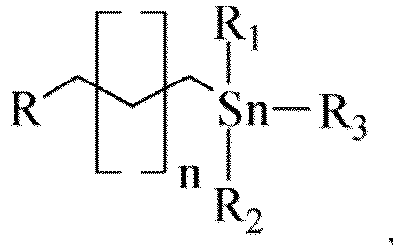 wobei R ein Atom des anorganischen Trägers ist, das mit der Organotin-Funktionsgruppe gekoppelt ist;n ist die Anzahl der Kohlenstoffatome einer Kohlenstoffkette; R1, R2 und R3 sind Gruppen auf dem Zinnatom, wobei mindestens ein und höchstens zwei der Gruppen R1, R2 und R3 Hydrocarbyl sind(ist), und der/die Rest(e) aus einem oder zwei Sauerstoffatomen, einer Hydroxylgruppe, einer Hydrocarbyloxygruppe und einer Acetoxygruppe ausgewählt ist/sind.
 - Unterstützter Organotin-Katalysator nach Anspruch 1, wobei das Atom R eines der Elemente Silizium, Sauerstoff, Stickstoff, Schwefel und Phosphor umfasst;die Anzahl der Kohlenstoffatome der Kohlenstoffkette n größer oder gleich 2 ist;die Hydrocarbylgruppe eine lineare oder verzweigte Alkylgruppe, eine Cycloalkylgruppe, eine Arylgruppe oder eine Aralkylgruppe, vorzugsweise eine lineare oder verzweigte Alkylgruppe, und vorzugsweise eine n-Butylgruppe ist; und die Hydrocarbyloxygruppe eine Alkoxygruppe oder eine Phenoxygruppe, vorzugsweise eine Methoxygruppe, eine Ethoxygruppe, eine n-Propoxygruppe, eine n-Butoxygruppe, eine n-Pentyloxygruppe oder eine n-Hexyloxygruppe und vorzugsweise eine Methoxygruppe ist.
- Unterstützter Organotin-Katalysator nach Anspruch 1, wobei der anorganische Träger einen oder mehrere der Elemente Siliziumdioxid, Titandioxid, Aktivkohle und Aluminiumoxid, vorzugsweise Siliziumdioxid, umfasst; und der anorganische Träger aus einem Rohmaterial mit poröser Struktur hergestellt ist, und der anorganische Träger eine spezifische Oberfläche von mehr als 10 m2/g, vorzugsweise von mehr als 30 m2/g und besonders vorzugsweise von mehr als 100 m2/g aufweist.
- Gestützter Organotin-Katalysator nach Anspruch 1, wobei in dem unterstützten Organotin-Katalysator das Gewichtsverhältnis der geladenen Organotin-Funktionsgruppe zum anorganischen Träger 1 ppm -40 %, vorzugsweise 1000 ppm -10 % beträgt.
- Unterstützter Organotin-Katalysator nach Anspruch 1, wobei die Organotin-Funktionsgruppe und der anorganische Träger wie folgt gekoppelt sind:Bilden eines Organotin-Katalysators mit einem Siliziumkopplungsatom durch Aufbringen eines Organotin-Moleküls mit einer Organosiloxan- oder Chlorosilanstruktur auf die Oberfläche von Siliziumdioxid;alternativ das Bilden eines Organotin-Katalysators mit einem Stickstoffkopplungsatom durch Aufbringen eines halogenierten Organotin-Moleküls auf die Oberfläche eines anorganischen Trägers mit einer Aminostruktur;alternativ das Bilden eines Organotin-Katalysators mit einem Sauerstoffkopplungsatom durch Aufbringen eines halogenierten oder Hydroxylorganotin-Moleküls auf die Oberfläche eines Trägers mit einer Hydroxylstruktur;alternativ das Bilden eines Organotin-Katalysators mit einem Schwefelkopplungsatom durch Aufbringen eines halogenierten oder Hydroxylorganotin-Moleküls auf die Oberfläche eines Trägers mit einer Sulfhydrylstruktur;oder alternativ das Bilden eines Organotinkatalysators mit einem Phosphorkopplungsatom durch Aufbringen eines Organotin-Moleküls mit einer Phosphorstruktur auf die Oberfläche eines Aluminiumoxidträgers.
- Zubereitungsverfahren für Saccharose-6-Carboxylat, wobei das Verfahren umfasst:einen polaren Auflösungsschritt: Erhitzen und Auflösen von Saccharose in einem polaren aprotischen Lösungsmittel, um eine Saccharoselösung zu erhalten;einen katalytischen Reaktionsschritt: Hinzufügen des unterstützten Organotin-Katalysators nach Anspruch 1 zur Saccharoselösung für eine Suspensionsreaktion;einen Dehydrierungsbehandlungsschritt: Dehydrieren der reagierten Lösung, um eine Suspension zu erhalten, die eine Saccharose-Organotinester-Verbindung enthält; undeinen Acylierungsreaktionsschritt: Kühlen der Suspension der Saccharose-Organotinester-Verbindung zur Reaktion mit einem Acylierungsmittel aus Karboxylanhydrid, um Saccharose-6-Carboxylat zu erhalten.
- Zubereitungsverfahren für Saccharose-6-Carboxylat nach Anspruch 6, wobei im Schritt der polaren Auflösung das verwendete polare aprotische Lösungsmittel aus Dimethylsulfoxid, N-Methylpyrrolidon, N, N-Dimethylacetamid, Hexamethylphosphoramid und N, N-Dimethylformamid, vorzugsweise N, N-Dimethylformamid ausgewählt wird.
- Zubereitungsverfahren für Saccharose-6-Carboxylat nach Anspruch 6, wobei in dem Schritt der polaren Auflösung das Verhältnis der Volumennutzung des polaren aprotischen Lösungsmittels zur Masse der Saccharose 2-50 L/kg, vorzugsweise 4-20 L/kg und ganz vorzugsweise 6-10 L/kg beträgt.
- Zubereitungsverfahren für Saccharose-6-Carboxylat nach Anspruch 6, wobei in dem katalytischen Reaktionsschritt die Menge des unterstützten Organotin-Katalysators entsprechend dem Gehalt der Organotin-Funktionsgruppe berechnet wird und die Menge des unterstützten Organotin-Katalysators 0,01-2 molare Äquivalente auf Basis von Saccharose, vorzugsweise 0,1-0,5 molare Äquivalente, beträgt.
- Zubereitungsverfahren für Saccharose-6-Carboxylat nach Anspruch 6, wobei im Dehydrierungsbehandlungsschritt ein apolares azeotropes Lösungsmittel-Dehydrierungsverfahren für die Dehydrierungsbehandlung verwendet wird, wobei das verwendete apolare Lösungsmittel aus Cyclohexan, Hexan, n-Heptan, Isooctan, Benzol, Toluol, Chloroform, Kohlenstofftetrachlorid, Ethylacetat und Methylacetat, vorzugsweise Cyclohexan, Hexan und n-Heptan und besonders vorzugsweise Cyclohexan ausgewählt wird; und das Verhältnis der Zugabemenge des apolaren Lösungsmittels zum Gehalt des polaren aprotischen Lösungsmittels weniger als 30 %, vorzugsweise weniger als 20 % und besonders vorzugsweise weniger als 15 % beträgt;
oder ein Einzellösemitteldestillationsverfahren für die Dehydrierungsbehandlung verwendet wird, und die Destillationstemperatur 40-100 °C, vorzugsweise 60-80 °C beträgt; der Betriebsdruck 0,01 kPa -100 kPa, vorzugsweise 0,5 kPa-90 kPa beträgt; und die Destillationszeit 1 Minute bis 12 Stunden, vorzugsweise 10 Minuten bis 2 Stunden beträgt. - Zubereitungsverfahren für Saccharose-6-Carboxylat nach Anspruch 6, wobei im Acylierungsreaktionsschritt das verwendete Acylierungsmittel Karboxylanhydrid Folgendes umfasst: Essiganhydrid, Butyranhydrid, Benzoeanhydrid, Stearylanhydrid oder Laurinanhydrid, und das erhaltene Saccharose-6-Carboxylat jeweils Saccharose-6-Acetat, Saccharose-6-Butyrat, Saccharose-6-Benzoat, Saccharose-6-Fettsäureester und Saccharose-6-Laurat beträgt; die Acylationsreaktionstemperatur 0-50 °C, vorzugsweise 5-20 °C beträgt; und die Zugabemenge des Karboxylanhydrid-Acylierungsmittels das 0,6-3,0-Fache der Saccharosemasse, vorzugsweise das 0,8-1,5-Fache, beträgt.
- Zubereitungsverfahren für Saccharose-6-Carboxylat nach Anspruch 6, wobei das Verfahren ferner umfasst:
einen Acylierungsabschreckschritt: nach der Acylierungsreaktion das Hinzufügen von Wasser zum Abschrecken des Karboxylanhydrid-Acylierungsmittels, wobei die Zugabemenge Wasser 30 % oder weniger des Gesamtvolumens der abgeschreckten Lösung, vorzugsweise 15 % oder weniger, beträgt, und das Filtern und Rückgewinnen des unterstützten Organotin-Katalysators nach dem Hinzufügen von Wasser.
Applications Claiming Priority (1)
| Application Number | Priority Date | Filing Date | Title |
|---|---|---|---|
| PCT/CN2021/096969 WO2022246846A1 (zh) | 2021-05-28 | 2021-05-28 | 一种负载型有机锡催化剂及一种蔗糖-6-羧酸酯制备方法 |
Publications (4)
| Publication Number | Publication Date |
|---|---|
| EP4338835A4 EP4338835A4 (de) | 2024-03-20 |
| EP4338835A1 EP4338835A1 (de) | 2024-03-20 |
| EP4338835B1 true EP4338835B1 (de) | 2025-04-09 |
| EP4338835C0 EP4338835C0 (de) | 2025-04-09 |
Family
ID=78427361
Family Applications (1)
| Application Number | Title | Priority Date | Filing Date |
|---|---|---|---|
| EP21942417.3A Active EP4338835B1 (de) | 2021-05-28 | 2021-05-28 | Organozinn-trägerkatalysator und herstellungsverfahren für saccharose-6-carboxylat |
Country Status (4)
| Country | Link |
|---|---|
| US (1) | US20240109059A1 (de) |
| EP (1) | EP4338835B1 (de) |
| CN (1) | CN113646082A (de) |
| WO (1) | WO2022246846A1 (de) |
Family Cites Families (9)
| Publication number | Priority date | Publication date | Assignee | Title |
|---|---|---|---|---|
| CA2245326C (en) * | 1997-09-29 | 2005-04-05 | Elf Atochem North America, Inc. | Heterogeneous organotin catalysts |
| JP2005097293A (ja) * | 2003-09-01 | 2005-04-14 | Mitsubishi Rayon Co Ltd | 有機スズシラン化合物 |
| DE602004002851T2 (de) * | 2004-05-19 | 2007-04-19 | Chemtura Organometallics Gmbh | Heterogene Organozinn-Katalysatoren |
| CN100420695C (zh) * | 2007-02-02 | 2008-09-24 | 上海迪赛诺医药发展有限公司 | 制备三氯蔗糖的方法 |
| CN104098617A (zh) * | 2013-04-08 | 2014-10-15 | 南京工业大学 | 一种蔗糖-6-乙酸酯的制备方法 |
| CN107308984A (zh) * | 2016-04-27 | 2017-11-03 | 中国科学院成都有机化学有限公司 | 一种用于碳酸二甲酯与苯酚酯交换的氧化硅固载有机锡催化剂及制备方法 |
| CN112218874A (zh) * | 2020-09-10 | 2021-01-12 | 安徽金禾实业股份有限公司 | 一种蔗糖-6-酯的制备方法 |
| MX2023005902A (es) * | 2020-12-31 | 2023-06-06 | Anhui Jinhe Ind Co Ltd | Compuesto organico de monoesta?o y metodo de preparacion y uso del mismo. |
| EP4205845B1 (de) * | 2021-03-24 | 2024-07-03 | Anhui Jinhe Industrial Co., Ltd. | Trägerkatalysator und syntheseverfahren für saccharose-6-ester |
-
2021
- 2021-05-28 WO PCT/CN2021/096969 patent/WO2022246846A1/zh not_active Ceased
- 2021-05-28 CN CN202180001389.XA patent/CN113646082A/zh active Pending
- 2021-05-28 EP EP21942417.3A patent/EP4338835B1/de active Active
-
2023
- 2023-11-24 US US18/518,805 patent/US20240109059A1/en active Pending
Also Published As
| Publication number | Publication date |
|---|---|
| EP4338835A1 (de) | 2024-03-20 |
| WO2022246846A1 (zh) | 2022-12-01 |
| CN113646082A (zh) | 2021-11-12 |
| EP4338835C0 (de) | 2025-04-09 |
| US20240109059A1 (en) | 2024-04-04 |
Similar Documents
| Publication | Publication Date | Title |
|---|---|---|
| CN104148110B (zh) | 一种用于烃类氧化的固载催化剂的制备方法和应用 | |
| CN101508741B (zh) | 碳酸二甲酯和β-环糊精合成甲基化-β-环糊精的工艺 | |
| CN1176094C (zh) | 一种三氯蔗糖的合成方法 | |
| EP4338835B1 (de) | Organozinn-trägerkatalysator und herstellungsverfahren für saccharose-6-carboxylat | |
| CN109836397A (zh) | 一种生物缓冲剂—吗啉基丙烷磺酸(mops)的制备方法 | |
| JPH04270297A (ja) | 触媒を使用するスクロース−6−エステル化方法 | |
| CN103864859B (zh) | 一种三氯蔗糖的制备方法 | |
| EP4205845B1 (de) | Trägerkatalysator und syntheseverfahren für saccharose-6-ester | |
| WO2025055972A1 (zh) | 一种酶法催化合成三氯蔗糖的方法 | |
| CN106881150A (zh) | 一种负载化4‑(n,n‑二甲基)氨基吡啶催化剂的制备方法 | |
| CN102584750A (zh) | 一种采用反应萃取耦合技术均相降解纤维素制备5-羟甲基糠醛的方法 | |
| CN113979852A (zh) | 氯化锌熔盐水合物低温常压催化纤维素制备乳酸的方法 | |
| KR20080020570A (ko) | 수크로오스-6-에스테르를 제조하는 방법 | |
| CN114507165B (zh) | 固体酸催化合成4,4′-二氯二苯砜的方法 | |
| JP2004507555A (ja) | 高α含量を有する二糖類及び三糖類C6〜C12脂肪酸エステルの製造方法及びそれによって得られる物質 | |
| WO2008116359A1 (fr) | Procédé de préparation du sucrose-6-ester | |
| ITRM980172A1 (it) | Catalizzatori per l'ossidazione selettiva di alcoli precedimento per produrli e procedimento di ossidazione di alcoli | |
| CN118005506B (zh) | 一种均苯三甲酰氯的制备方法 | |
| CN104788508B (zh) | 一种基于离子液体的脂肪酸糖酯的合成方法 | |
| CN114345382B (zh) | 一种生物炭共价固载磷酸催化剂及其制备方法和应用 | |
| CN115178290B (zh) | 一种核壳结构ZSM-5@mSiO2-SO3H催化剂及其制备和催化玉米芯制备糠醛的方法 | |
| CN102320916A (zh) | 一种固载化相转移催化剂制备二碘甲烷的方法 | |
| JPH0615503B2 (ja) | イソプロペニルアセテ−トの製造方法 | |
| CN119327382A (zh) | 一种用于二氨基顺丁烯二腈粗品提纯的系统及工艺 | |
| CN102031278B (zh) | 一种在有机相中酶催化合成海藻糖不饱和脂肪酸二酯的方法 |
Legal Events
| Date | Code | Title | Description |
|---|---|---|---|
| STAA | Information on the status of an ep patent application or granted ep patent |
Free format text: STATUS: THE INTERNATIONAL PUBLICATION HAS BEEN MADE |
|
| PUAI | Public reference made under article 153(3) epc to a published international application that has entered the european phase |
Free format text: ORIGINAL CODE: 0009012 |
|
| STAA | Information on the status of an ep patent application or granted ep patent |
Free format text: STATUS: REQUEST FOR EXAMINATION WAS MADE |
|
| 17P | Request for examination filed |
Effective date: 20231214 |
|
| A4 | Supplementary search report drawn up and despatched |
Effective date: 20240213 |
|
| AK | Designated contracting states |
Kind code of ref document: A1 Designated state(s): AL AT BE BG CH CY CZ DE DK EE ES FI FR GB GR HR HU IE IS IT LI LT LU LV MC MK MT NL NO PL PT RO RS SE SI SK SM TR |
|
| DAV | Request for validation of the european patent (deleted) | ||
| DAX | Request for extension of the european patent (deleted) | ||
| GRAP | Despatch of communication of intention to grant a patent |
Free format text: ORIGINAL CODE: EPIDOSNIGR1 |
|
| STAA | Information on the status of an ep patent application or granted ep patent |
Free format text: STATUS: GRANT OF PATENT IS INTENDED |
|
| INTG | Intention to grant announced |
Effective date: 20241104 |
|
| GRAS | Grant fee paid |
Free format text: ORIGINAL CODE: EPIDOSNIGR3 |
|
| GRAA | (expected) grant |
Free format text: ORIGINAL CODE: 0009210 |
|
| STAA | Information on the status of an ep patent application or granted ep patent |
Free format text: STATUS: THE PATENT HAS BEEN GRANTED |
|
| AK | Designated contracting states |
Kind code of ref document: B1 Designated state(s): AL AT BE BG CH CY CZ DE DK EE ES FI FR GB GR HR HU IE IS IT LI LT LU LV MC MK MT NL NO PL PT RO RS SE SI SK SM TR |
|
| REG | Reference to a national code |
Ref country code: GB Ref legal event code: FG4D |
|
| REG | Reference to a national code |
Ref country code: CH Ref legal event code: EP |
|
| REG | Reference to a national code |
Ref country code: DE Ref legal event code: R096 Ref document number: 602021029088 Country of ref document: DE |
|
| REG | Reference to a national code |
Ref country code: IE Ref legal event code: FG4D |
|
| U01 | Request for unitary effect filed |
Effective date: 20250506 |
|
| U07 | Unitary effect registered |
Designated state(s): AT BE BG DE DK EE FI FR IT LT LU LV MT NL PT RO SE SI Effective date: 20250512 |
|
| U20 | Renewal fee for the european patent with unitary effect paid |
Year of fee payment: 5 Effective date: 20250515 |
|
| PGFP | Annual fee paid to national office [announced via postgrant information from national office to epo] |
Ref country code: GB Payment date: 20250522 Year of fee payment: 5 |
|
| PG25 | Lapsed in a contracting state [announced via postgrant information from national office to epo] |
Ref country code: ES Free format text: LAPSE BECAUSE OF FAILURE TO SUBMIT A TRANSLATION OF THE DESCRIPTION OR TO PAY THE FEE WITHIN THE PRESCRIBED TIME-LIMIT Effective date: 20250409 |
|
| PG25 | Lapsed in a contracting state [announced via postgrant information from national office to epo] |
Ref country code: NO Free format text: LAPSE BECAUSE OF FAILURE TO SUBMIT A TRANSLATION OF THE DESCRIPTION OR TO PAY THE FEE WITHIN THE PRESCRIBED TIME-LIMIT Effective date: 20250709 Ref country code: GR Free format text: LAPSE BECAUSE OF FAILURE TO SUBMIT A TRANSLATION OF THE DESCRIPTION OR TO PAY THE FEE WITHIN THE PRESCRIBED TIME-LIMIT Effective date: 20250710 |
|
| PG25 | Lapsed in a contracting state [announced via postgrant information from national office to epo] |
Ref country code: PL Free format text: LAPSE BECAUSE OF FAILURE TO SUBMIT A TRANSLATION OF THE DESCRIPTION OR TO PAY THE FEE WITHIN THE PRESCRIBED TIME-LIMIT Effective date: 20250409 |
|
| PG25 | Lapsed in a contracting state [announced via postgrant information from national office to epo] |
Ref country code: HR Free format text: LAPSE BECAUSE OF FAILURE TO SUBMIT A TRANSLATION OF THE DESCRIPTION OR TO PAY THE FEE WITHIN THE PRESCRIBED TIME-LIMIT Effective date: 20250409 |
|
| PG25 | Lapsed in a contracting state [announced via postgrant information from national office to epo] |
Ref country code: RS Free format text: LAPSE BECAUSE OF FAILURE TO SUBMIT A TRANSLATION OF THE DESCRIPTION OR TO PAY THE FEE WITHIN THE PRESCRIBED TIME-LIMIT Effective date: 20250709 |
|
| PG25 | Lapsed in a contracting state [announced via postgrant information from national office to epo] |
Ref country code: IS Free format text: LAPSE BECAUSE OF FAILURE TO SUBMIT A TRANSLATION OF THE DESCRIPTION OR TO PAY THE FEE WITHIN THE PRESCRIBED TIME-LIMIT Effective date: 20250809 |
|
| U1N | Appointed representative for the unitary patent procedure changed after the registration of the unitary effect |
Representative=s name: SANTARELLI; FR |
|
| REG | Reference to a national code |
Ref country code: CH Ref legal event code: H13 Free format text: ST27 STATUS EVENT CODE: U-0-0-H10-H13 (AS PROVIDED BY THE NATIONAL OFFICE) Effective date: 20251223 |
|
| PG25 | Lapsed in a contracting state [announced via postgrant information from national office to epo] |
Ref country code: SM Free format text: LAPSE BECAUSE OF FAILURE TO SUBMIT A TRANSLATION OF THE DESCRIPTION OR TO PAY THE FEE WITHIN THE PRESCRIBED TIME-LIMIT Effective date: 20250409 |
|
| PG25 | Lapsed in a contracting state [announced via postgrant information from national office to epo] |
Ref country code: CH Free format text: LAPSE BECAUSE OF NON-PAYMENT OF DUE FEES Effective date: 20250531 |
|
| PG25 | Lapsed in a contracting state [announced via postgrant information from national office to epo] |
Ref country code: CZ Free format text: LAPSE BECAUSE OF FAILURE TO SUBMIT A TRANSLATION OF THE DESCRIPTION OR TO PAY THE FEE WITHIN THE PRESCRIBED TIME-LIMIT Effective date: 20250409 |
|
| PG25 | Lapsed in a contracting state [announced via postgrant information from national office to epo] |
Ref country code: SK Free format text: LAPSE BECAUSE OF FAILURE TO SUBMIT A TRANSLATION OF THE DESCRIPTION OR TO PAY THE FEE WITHIN THE PRESCRIBED TIME-LIMIT Effective date: 20250409 |
|
| PG25 | Lapsed in a contracting state [announced via postgrant information from national office to epo] |
Ref country code: MC Free format text: LAPSE BECAUSE OF FAILURE TO SUBMIT A TRANSLATION OF THE DESCRIPTION OR TO PAY THE FEE WITHIN THE PRESCRIBED TIME-LIMIT Effective date: 20250409 |
|
| PLBE | No opposition filed within time limit |
Free format text: ORIGINAL CODE: 0009261 |
|
| STAA | Information on the status of an ep patent application or granted ep patent |
Free format text: STATUS: NO OPPOSITION FILED WITHIN TIME LIMIT |
|
| REG | Reference to a national code |
Ref country code: CH Ref legal event code: L10 Free format text: ST27 STATUS EVENT CODE: U-0-0-L10-L00 (AS PROVIDED BY THE NATIONAL OFFICE) Effective date: 20260218 |
|
| 26N | No opposition filed |
Effective date: 20260112 |
|
| PG25 | Lapsed in a contracting state [announced via postgrant information from national office to epo] |
Ref country code: IE Free format text: LAPSE BECAUSE OF NON-PAYMENT OF DUE FEES Effective date: 20250528 |