EP4335441B1 - Pharmazeutische zusammensetzung zur prävention, linderung oder behandlung von krebs mit 2,6-dichlor-4-(4-(4-hydroxycyclohexylamino)-7h-pyrrolo[2,3-d!pyrimidin-5-yl)phenol als wirkstoff - Google Patents
Pharmazeutische zusammensetzung zur prävention, linderung oder behandlung von krebs mit 2,6-dichlor-4-(4-(4-hydroxycyclohexylamino)-7h-pyrrolo[2,3-d!pyrimidin-5-yl)phenol als wirkstoff Download PDFInfo
- Publication number
- EP4335441B1 EP4335441B1 EP22799097.5A EP22799097A EP4335441B1 EP 4335441 B1 EP4335441 B1 EP 4335441B1 EP 22799097 A EP22799097 A EP 22799097A EP 4335441 B1 EP4335441 B1 EP 4335441B1
- Authority
- EP
- European Patent Office
- Prior art keywords
- cancer
- preventing
- pharmaceutical composition
- present
- compound
- Prior art date
- Legal status (The legal status is an assumption and is not a legal conclusion. Google has not performed a legal analysis and makes no representation as to the accuracy of the status listed.)
- Active
Links
Images







Classifications
-
- A—HUMAN NECESSITIES
- A23—FOODS OR FOODSTUFFS; TREATMENT THEREOF, NOT COVERED BY OTHER CLASSES
- A23L—FOODS, FOODSTUFFS OR NON-ALCOHOLIC BEVERAGES, NOT OTHERWISE PROVIDED FOR; PREPARATION OR TREATMENT THEREOF
- A23L33/00—Modifying nutritive qualities of foods; Dietetic products; Preparation or treatment thereof
- A23L33/10—Modifying nutritive qualities of foods; Dietetic products; Preparation or treatment thereof using additives
-
- A—HUMAN NECESSITIES
- A61—MEDICAL OR VETERINARY SCIENCE; HYGIENE
- A61K—PREPARATIONS FOR MEDICAL, DENTAL OR TOILETRY PURPOSES
- A61K31/00—Medicinal preparations containing organic active ingredients
- A61K31/33—Heterocyclic compounds
- A61K31/335—Heterocyclic compounds having oxygen as the only ring hetero atom, e.g. fungichromin
- A61K31/365—Lactones
-
- A—HUMAN NECESSITIES
- A61—MEDICAL OR VETERINARY SCIENCE; HYGIENE
- A61K—PREPARATIONS FOR MEDICAL, DENTAL OR TOILETRY PURPOSES
- A61K31/00—Medicinal preparations containing organic active ingredients
- A61K31/33—Heterocyclic compounds
- A61K31/395—Heterocyclic compounds having nitrogen as a ring hetero atom, e.g. guanethidine or rifamycins
- A61K31/435—Heterocyclic compounds having nitrogen as a ring hetero atom, e.g. guanethidine or rifamycins having six-membered rings with one nitrogen as the only ring hetero atom
- A61K31/44—Non condensed pyridines; Hydrogenated derivatives thereof
-
- A—HUMAN NECESSITIES
- A61—MEDICAL OR VETERINARY SCIENCE; HYGIENE
- A61K—PREPARATIONS FOR MEDICAL, DENTAL OR TOILETRY PURPOSES
- A61K31/00—Medicinal preparations containing organic active ingredients
- A61K31/33—Heterocyclic compounds
- A61K31/395—Heterocyclic compounds having nitrogen as a ring hetero atom, e.g. guanethidine or rifamycins
- A61K31/495—Heterocyclic compounds having nitrogen as a ring hetero atom, e.g. guanethidine or rifamycins having six-membered rings with two or more nitrogen atoms as the only ring heteroatoms, e.g. piperazine or tetrazines
- A61K31/505—Pyrimidines; Hydrogenated pyrimidines, e.g. trimethoprim
- A61K31/519—Pyrimidines; Hydrogenated pyrimidines, e.g. trimethoprim ortho- or peri-condensed with heterocyclic rings
-
- A—HUMAN NECESSITIES
- A61—MEDICAL OR VETERINARY SCIENCE; HYGIENE
- A61K—PREPARATIONS FOR MEDICAL, DENTAL OR TOILETRY PURPOSES
- A61K33/00—Medicinal preparations containing inorganic active ingredients
- A61K33/24—Heavy metals; Compounds thereof
- A61K33/243—Platinum; Compounds thereof
-
- A—HUMAN NECESSITIES
- A61—MEDICAL OR VETERINARY SCIENCE; HYGIENE
- A61K—PREPARATIONS FOR MEDICAL, DENTAL OR TOILETRY PURPOSES
- A61K45/00—Medicinal preparations containing active ingredients not provided for in groups A61K31/00 - A61K41/00
- A61K45/06—Mixtures of active ingredients without chemical characterisation, e.g. antiphlogistics and cardiaca
-
- A—HUMAN NECESSITIES
- A61—MEDICAL OR VETERINARY SCIENCE; HYGIENE
- A61P—SPECIFIC THERAPEUTIC ACTIVITY OF CHEMICAL COMPOUNDS OR MEDICINAL PREPARATIONS
- A61P35/00—Antineoplastic agents
-
- A—HUMAN NECESSITIES
- A23—FOODS OR FOODSTUFFS; TREATMENT THEREOF, NOT COVERED BY OTHER CLASSES
- A23V—INDEXING SCHEME RELATING TO FOODS, FOODSTUFFS OR NON-ALCOHOLIC BEVERAGES AND LACTIC OR PROPIONIC ACID BACTERIA USED IN FOODSTUFFS OR FOOD PREPARATION
- A23V2002/00—Food compositions, function of food ingredients or processes for food or foodstuffs
-
- A—HUMAN NECESSITIES
- A23—FOODS OR FOODSTUFFS; TREATMENT THEREOF, NOT COVERED BY OTHER CLASSES
- A23V—INDEXING SCHEME RELATING TO FOODS, FOODSTUFFS OR NON-ALCOHOLIC BEVERAGES AND LACTIC OR PROPIONIC ACID BACTERIA USED IN FOODSTUFFS OR FOOD PREPARATION
- A23V2200/00—Function of food ingredients
- A23V2200/30—Foods, ingredients or supplements having a functional effect on health
- A23V2200/308—Foods, ingredients or supplements having a functional effect on health having an effect on cancer prevention
-
- A—HUMAN NECESSITIES
- A23—FOODS OR FOODSTUFFS; TREATMENT THEREOF, NOT COVERED BY OTHER CLASSES
- A23V—INDEXING SCHEME RELATING TO FOODS, FOODSTUFFS OR NON-ALCOHOLIC BEVERAGES AND LACTIC OR PROPIONIC ACID BACTERIA USED IN FOODSTUFFS OR FOOD PREPARATION
- A23V2250/00—Food ingredients
- A23V2250/30—Other Organic compounds
-
- A—HUMAN NECESSITIES
- A61—MEDICAL OR VETERINARY SCIENCE; HYGIENE
- A61K—PREPARATIONS FOR MEDICAL, DENTAL OR TOILETRY PURPOSES
- A61K2300/00—Mixtures or combinations of active ingredients, wherein at least one active ingredient is fully defined in groups A61K31/00 - A61K41/00
Definitions
- the present invention relates to a pharmaceutical composition for preventing or treating cancer, containing 2,6-dichloro-4-(4-(4-hydroxycyclohexylamino)-7H-pyrrolo[2,3-D]pyrimidin-5-yl)phenol as an active ingredient.
- the breast cancer market is known to be a field with unmet medical needs that lack high anticancer effectiveness and safety.
- TNBC triple-negative breast cancer
- Landman et. al described the use of larotrectinib as an option for therapy in cancers with TNBC ( Clinical Breast Cancer, June 2018, Vol. 18, No. 3, e267-70 ).
- HER2' human epidermal growth factor receptor 2
- HER2 receptor, estrogen receptor, and progesterone receptor are all negative, so it does not respond to existing anticancer drugs. Accordingly, a new targeted treatment that can treat safely and efficiently is urgently needed.
- the present inventors have studied using various cancer cell lines and completed the pharmaceutical composition of the present invention, which can be used as a safe and effective anticancer drug.
- the present document describes a method for treating cancer, comprising a step of administering to a subject in need thereof. Any references to methods of treatment in this description are to be interpreted as references to the compounds, pharmaceutical compositions or medicaments of the present invention for use in those.
- the present invention provides a pharmaceutical composition for use in preventing or treating cancer comprising a compound represented by formula 1 described herein, a stereoisomer thereof, a solvate thereof, a hydrate thereof, or a pharmaceutically acceptable salt thereof as an active ingredient.
- the present invention provides a health functional food composition for use in preventing or ameliorating cancer comprising a compound represented by formula 1 described herein as an active ingredient.
- the present invention provides a pharmaceutical kit for use in preventing or treating cancer comprising a first component containing a pharmaceutically effective amount of an anticancer agent; and a second component containing a compound represented by formula 1 described herein, a stereoisomer thereof, a solvate thereof, a hydrate thereof, or a pharmaceutically acceptable salt thereof as an active ingredient.
- the present invention provides a combination of radiation and anticancer agents for use in preventing or treating cancer.
- the present document describes a method for treating cancer, comprising a step of administering a compound represented by formula 1 described herein to a subject in need thereof.
- the present invention provides a compound represented by formula 1 described herein for use in the prevention or treatment of cancer.
- Example 1 of present invention inhibits the formation of mammospheres in a breast cancer cell line and, when compared to anticancer drugs sorafenib and etoposide, which are topoisomerase inhibitors widely used in lung cancer, ovarian cancer, colon cancer, melanoma and the like, exhibits remarkable effects greater than or equal to those of the anticancer drugs sorafenib and etoposide.
- the compound of Example 1 exhibits synergistic anticancer effects when combined with radiotherapy or other anticancer drugs in a breast cancer cell line and a liver cancer cell line, and thus can be developed as an anticancer drug or a food exhibiting excellent effects in the treatment of cancer.
- the present invention provides a pharmaceutical composition for use in preventing or treating cancer comprising a compound represented by formula 1 below, a stereoisomer thereof, a solvate thereof, a hydrate thereof, or a pharmaceutically acceptable salt thereof as an active ingredient.
- the compound represented by formula 1 above can be (trans)-2,6-dichloro-4-(4-(4-hydroxycyclohexylamino)-7H-pyrrolo[2,3-D]pyrimidin-5-yl)phenol.
- the pharmaceutical composition can be used in combination treatment with radiation or anticancer agents.
- the anticancer agent can be at least one selected from the group consisting of cisplatin, sorafenib, OKN-007, gefitinib, doxorubicin, vinblastine, taxol, etoposide, 5-FU, and ifosfamide.
- the pharmaceutical composition can enhance immunity.
- Experimental Example 9 immune cell changes in the tumor microenvironment were evaluated. As a result, it was confirmed that when the compound of Example 1 was administered alone or in combination with radiation, the proportion of CD8 positive T cells was increased, M1 TAM was increased, and M2 TAM was decreased.
- the term "pharmaceutically acceptable salt” refers to salts commonly used in the pharmaceutical industry, for example, inorganic ionic salt made from calcium, potassium, sodium and magnesium; inorganic acid salts made from hydrochloric acid, nitric acid, phosphoric acid, bromic acid, iodic acid, perchloric acid, and sulfuric acid; organic acid salts made from acetic acid, trifluoroacetic, citric acid, maleic acid, succinic acid, oxalic acid, benzoic acid, tartaric acid, fumaric acid, mandelic acid, propionic acid, lactic acid, glycolic acid, gluconic acid, galacturonic acid, glutamic acid, glutaric acid, glucuronic acid, aspartic acid, ascorbic acid, carbonic acid, vanillic acid, hydroiodic acid, etc.; sulfonic acid salts made from methanesulfonic acid, ethanesulfonic acid, benzenesul
- the term "isomer” refers to a compound of the present invention or a salt thereof that has the same chemical formula or molecular formula but is structurally or sterically different.
- the isomer includes structural isomers such as tautomers and stereoisomers, and stereoisomers include both R or S isomers with asymmetric carbon centers (optical isomers, enantiomers) and geometric isomers (trans, cis).
- all stereoisomers of the compound represented by formula 1 and mixtures thereof are also included in the scope of the present invention.
- the term "hydrate” refers to a compound represented by formula 1 above and water bound by non-covalent intermolecular forces, and may include a stoichiometric or non-stoichiometric amount of water. Specifically, the hydrate may contain water in a ratio of about 0.25 mole to about 10 mole based on 1 mole of the active ingredient, and more specifically may contain about 0.5 mole, about 1 mole, about 1.5 mole, about 2 mole, about 2.5 mole, about 3 mole, about 5 mole, etc.
- the term "solvate” refers to a compound represented by formula 1 above and a solvent other than water bound by non-covalent intermolecular forces, and may include a stoichiometric or non-stoichiometric amount of water.
- Preferred solvents are volatile, non-toxic, and can be administered to humans in trace amounts.
- the solvate may contain water in a ratio of about 0.25 mole to about 10 mole based on 1 mole of the active ingredient, and more specifically may contain about 0.5 mole, about 1 mole, about 1.5 mole, about 2 mole, about 3 mole, about 5 mole, etc.
- the term "about” refers to a numerical value that is ⁇ 10% of the preceding value.
- the term "comprising as an active ingredient” means containing in a dosage range that brings the effect of preventing, ameliorating, or treating cancer, and the dosage range may vary depending on the severity and formulation, and the number of applications may also vary depending on the age, weight, and physical constitution of the subject.
- the compound represented by formula 1 in the pharmaceutical composition of the present invention, is included, for example, in an amount of 0.001 mg/kg or more, preferably 0.1 mg/kg or more, more preferably 10 mg/kg or more, more preferably 100 mg/kg or more, more preferably 250 mg/kg or more, and most preferably 0.1 g/kg or more.
- the quantitative upper limit of the compounds represented by formula 1 included in the pharmaceutical composition of the present invention may be selected by those skilled in the art within an appropriate range.
- the pharmaceutical composition according to the present invention may comprise an effective amount of the compound represented by formula 1 alone or may include one or more pharmaceutically acceptable carriers, excipients or diluents.
- the pharmaceutically acceptable carrier, excipient, or diluent refers to a substance that is physiologically acceptable and does not typically cause gastrointestinal upset, allergic reactions such as dizziness, or similar reactions when administered to humans.
- the carriers, excipients and diluents include lactose, dextrose, sucrose, sorbitol, mannitol, xylitol, erythritol, maltitol, starch, acacia gum, alginate, gelatin, calcium phosphate, calcium silicate, cellulose, methyl cellulose, polyvinylpyrrolidone, water, methylhydroxybenzoate, propylhydroxybenzoate, talc, magnesium stearate, and mineral oil, but not always limited thereto.
- fillers, anticoagulants, lubricants, wetting agents, fragrances, emulsifiers and preservatives may be additionally included.
- the pharmaceutical composition of the present invention can be formulated using the methods known in the art to provide rapid, sustained or delayed release of the active ingredient after administration to a subject.
- the pharmaceutical composition can be formulated in the form of an oral preparation, an injectable preparation, or an external preparation.
- the oral preparation can be selected from the group consisting of tablets, pills, powders, granules, capsules, suspensions, solutions, emulsions, syrups and freeze-dried preparations, but not always limited thereto.
- the external preparation can be selected from the group consisting of creams, gels, ointments, emulsions, suspensions, sprays, and transdermal patches, but not always limited thereto.
- the pharmaceutical composition of the present invention can be administered through various routes, including oral administration, transdermal administration, subcutaneous administration, intravenous administration, or intramuscular administration.
- the term “amelioration” refers to alleviation, prevention, or treatment of cancer symptoms by administering, ingesting, or applying the pharmaceutical composition or food composition of the present invention to a subject suffering from cancer.
- prevention refers to inhibiting or blocking cancer symptoms by administering, ingesting, or applying the pharmaceutical composition or food composition of the present invention to a subject not suffering from cancer.
- treatment refers to complete cure of cancer symptoms as well as partial cure, improvement, and alleviation of cancer symptoms as a result of administering the pharmaceutical composition of the present invention to a subject suffering from cancer.
- the term 'subject' refers to any animal, including humans, which has already developed or may develop cancer.
- the pharmaceutical composition of the present invention is administered in a pharmaceutically effective amount.
- the term "pharmaceutically effective amount” means an amount sufficient to treat a disease with a reasonable benefit/risk ratio applicable to medical treatment or improvement.
- the effective dose level depends on the factors including subject type and severity, age, gender, drug activity, sensitivity to drug, time of administration, administration route and excretion rate, duration of treatment, concomitant drugs, and other factors well known in the medical field.
- the term "administration” means to provide a substance to a subject or patient by any appropriate method.
- the substance can be administered parenterally (e.g., intravenous injection, subcutaneous injection, intraperitoneal injection, or topical injection) or administered orally according to the desired method.
- the dosage range varies depending on the patient's weight, age, gender, health condition, diet, administration time, administration method, excretion rate, and severity of the disease.
- parenteral administration refers to a method of administration subcutaneously, intramuscularly, intravenously, or intraperitoneally using a tube, excluding oral administration.
- oral administration refers to an administration method of injecting an agent for ameliorating pathological symptoms into the mouth.
- sterilized suspensions, liquids, water-insoluble excipients, suspensions, emulsions, eye drops, ophthalmic ointments, syrups, suppositories external preparations such as aerosols and sterilized injections can be prepared by the conventional method, and preferably pharmaceutical compositions of creams, gels, patches, sprays, ointments, plasters, lotions, liniments, ophthalmic ointments, eye drops, pastes or cataplasms can be prepared, but not always limited thereto.
- Water-insoluble excipients and suspensions can contain, in addition to the active compound or compounds, propylene glycol, polyethylene glycol, vegetable oil like olive oil, injectable ester like ethylolate, etc.
- Suppositories can contain, in addition to the active compound or compounds, witepsol, macrogol, tween 61, cacao butter, laurin butter, glycerogelatin, etc.
- the cancer can be anyone selected from the group consisting of lung cancer, non-small cell lung cancer (NSCL), bronchial alveolar cell lung cancer, ovarian cancer, colorectal cancer, melanoma, stomach cancer, gastrointestinal cancer, liver cancer, bone cancer, pancreatic cancer, skin cancer, head and neck cancer, skin or eye melanoma, uterine cancer, rectal cancer, colon cancer, breast cancer, uterine sarcoma, fallopian tube carcinoma, endometrial carcinoma, cervical carcinoma, vaginal carcinoma, vulvar carcinoma, esophageal cancer, laryngeal cancer, small intestine cancer, thyroid cancer, parathyroid cancer, soft tissue sarcoma, urethral cancer, penile cancer, prostate cancer, multiple myeloma, and chronic or acute leukemia, and preferably the cancer can be liver cancer, lung cancer, ovarian cancer, colorectal cancer, melanoma, or breast cancer.
- NCL non-small cell lung cancer
- the present invention provides a health functional food composition for use in preventing or ameliorating cancer comprising a compound represented by formula 1 below, a stereoisomer thereof, a solvate thereof, a hydrate thereof, or a pharmaceutically acceptable salt thereof as an active ingredient.
- the food composition according to the present invention can be formulated in the same way as the pharmaceutical composition and used as a functional food or added to various foods.
- Food to which the food composition of the present invention can be added is exemplified by beverages, alcoholic beverages, confectionery, diet bars, dairy products, meat, chocolate, pizza, ramen, other noodles, gum, ice cream, and hangover relievers (drinks, low-viscosity gel type, pills, tablets, capsules, etc.), vitamin complexes, health supplements, etc.
- the food composition of the present invention may include a compound represented by formula 1, a pharmaceutically acceptable salt thereof, a hydrate thereof, or a solvate thereof as an active ingredient, as well as ingredients commonly added during food production, for example, proteins, carbohydrates, fats, nutrients, seasonings and flavoring agents.
- examples of the above-mentioned carbohydrates include monosaccharides such as glucose, fructose, etc.; disaccharides such as maltose, sucrose, oligosaccharides, etc.; and polysaccharides such as common sugars including dextrin and cyclodextrin, and sugar alcohols such as xylitol, sorbitol, and erythritol.
- Natural sweetening agents can be included as a sweetening agent.
- synthetic sweetening agents sacharin, aspartame, etc.
- the food composition of the invention may additionally include citric acid, high fructose corn syrup, sugar, glucose, acetic acid, malic acid, fruit juice, and various plant extracts in addition to a compound represented by formula 1 or 2, a pharmaceutically acceptable salt thereof, a hydrate thereof or a solvate thereof.
- the present invention provides a health functional food or health supplement food containing the food composition comprising a compound represented by formula 1, a pharmaceutically acceptable salt thereof, a hydrate thereof, or a solvate thereof as an active ingredient.
- the term "health functional food or health supplement food” refers to a food manufactured and processed using raw materials or ingredients that have functional properties useful to the human body in accordance with the Act on Health Functional Food.
- the term "functional" food refers to a food consumed for the purpose of obtaining useful health effects such as regulating nutrients for the structure and function of the human body or physiological effects.
- the functional food is a food product prepared by adding a compound represented by formula 1, a pharmaceutically acceptable salt thereof, a hydrate thereof, or a solvate thereof to food materials such as beverages, teas, spices, gum, and confectionery, or by encapsulating, powdering, or suspending.
- the above functional food has specific health effects when consumed, but unlike general drugs, it has the advantage of not having any side effects that may occur when taking the drug for a long time because it is manufactured using food as a raw material.
- the health functional food or health supplement food of the present invention obtained in this way is very useful because it can be taken on a daily basis.
- the amount of a compound represented by formula 1, a pharmaceutically acceptable salt thereof, a hydrate thereof, or a solvate thereof in such a health functional food or health supplement food cannot be uniformly prescribed because it depends on the type of the health functional food being targeted, but it can be added in a range that does not impair the original taste of the food, and is generally in the range of 0.01 to 50 wt%, preferably 0.1 to 20 wt% of the target food.
- the health functional food or health supplement food in the form of pills, granules, tablets, or capsules it is usually added in the range of 0.1 to 100 wt%, preferably 0.5 to 80 wt%.
- the health functional food or health supplement food of the present invention may be in the form of a pill, tablet, capsule, or beverage.
- the food composition of the present invention can contain a conventional food additive.
- the suitability as a 'food additive' is determined by the standards and criteria for the item in question in accordance with the general rules and general test methods for food additives approved by the Ministry of Food and Drug Safety, unless otherwise specified.
- the items listed in the "Korean Food Additives Code” include, for example, chemical compounds such as ketones, glycine, potassium citrate, nicotinic acid, and cinnamic acid; natural additives such as persimmon color, licorice extract, crystalline cellulose, sorghum color, and guar gum; and mixed preparations such as sodium L-glutamate preparations, alkali agents for noodles, preservative formulations, and tar color formulations.
- chemical compounds such as ketones, glycine, potassium citrate, nicotinic acid, and cinnamic acid
- natural additives such as persimmon color, licorice extract, crystalline cellulose, sorghum color, and guar gum
- mixed preparations such as sodium L-glutamate preparations, alkali agents for noodles, preservative formulations, and tar color formulations.
- the food composition of the present invention can be prepared and processed in the form of tablets, capsules, powders, granules, liquids, pills, and the like, for the purpose of preventing and/or ameliorating cancer.
- the health functional food in tablet form can be prepared by granulating a mixture of a food composition comprising a compound represented by formula 1, a pharmaceutically acceptable salt thereof, a hydrate thereof, or a solvate thereof as an active ingredient, an excipient, a binder, a disintegrant, and other additives in a conventional manner, and then compression molding the mixture with a lubricant or the like, or directly compression molding the mixture.
- the health functional food in tablet form can contain a flavors enhancer or the like as needed, and can also be coated with a suitable coating agent as needed.
- hard capsules can be prepared by filling conventional hard capsules with a mixture of a food composition comprising a compound represented by formula 1, a pharmaceutically acceptable salt thereof, a hydrate thereof, or a solvate thereof as an active ingredient, and additives such as excipients, or a granularity thereof or a coated granularity thereof.
- Soft capsules can be prepared by filling a mixture of a food composition comprising a compound represented by formula 1, a pharmaceutically acceptable salt thereof, a hydrate thereof, or a solvate thereof as an active ingredient, and additives such as excipients into a capsule base such as gelatin.
- the soft capsules can contain plasticizers such as glycerin or sorbitol, colorants, preservatives, etc., if necessary.
- the health functional food in pill form can be prepared by molding a mixture of a food composition comprising a compound represented by formula 1, a pharmaceutically acceptable salt thereof, a hydrate thereof, or a solvate thereof as an active ingredient, an excipient, a binder, a disintegrant, and the like in any suitable manner, and if necessary, it can be coated with white sugar or another suitable coating agent, or coated with starch, talc, or other suitable substances.
- the health functional food in granule form can be prepared by using a mixture of a food composition comprising a compound represented by formula 1, a pharmaceutically acceptable salt thereof, a hydrate thereof, or a solvate thereof as an active ingredient, an excipient, a binder, a disintegrant, and the like in any suitable manner, and if necessary, it can contain flavoring agents, flavors enhancers, etc.
- a particle size test was conducted using No. 12 (1680 ⁇ m), No. 14 (1410 ⁇ m), and No. 45 (350 ⁇ m) sieves, the entire amount of health functional food in granule form passed through the No. 12 sieve, less than 5.0% of the total amount remained in the No. 14 sieve, and less than 15.0% of the total amount passed through the No. 45 sieve.
- the present invention provides a pharmaceutical kit for use in preventing or treating cancer comprising a first component containing a pharmaceutically effective amount of an anticancer agent; and a second component containing a compound represented by formula 1 below, a stereoisomer thereof, a solvate thereof, a hydrate thereof, or a pharmaceutically acceptable salt thereof as an active ingredient.
- the compound represented by formula 1 above can be (trans)-2,6-dichloro-4-(4-(4-hydroxycyclohexylamino)-7H-pyrrolo[2,3-D]pyrimidin-5-yl)phenol.
- the cancer can be anyone selected from the group consisting of lung cancer, non-small cell lung cancer (NSCL), bronchial alveolar cell lung cancer, ovarian cancer, colorectal cancer, melanoma, stomach cancer, gastrointestinal cancer, liver cancer, bone cancer, pancreatic cancer, skin cancer, head and neck cancer, skin or eye melanoma, uterine cancer, rectal cancer, colon cancer, breast cancer, uterine sarcoma, fallopian tube carcinoma, endometrial carcinoma, cervical carcinoma, vaginal carcinoma, vulvar carcinoma, esophageal cancer, laryngeal cancer, small intestine cancer, thyroid cancer, parathyroid cancer, soft tissue sarcoma, urethral cancer, penile cancer, prostate cancer, multiple myeloma, and chronic or acute leukemia.
- NCL non-small cell lung cancer
- bronchial alveolar cell lung cancer ovarian cancer
- colorectal cancer melanoma
- stomach cancer gastrointestinal cancer
- liver cancer bone cancer
- the anticancer agent can be at least one selected from the group consisting of cisplatin, sorafenib, OKN-007, gefitinib, doxorubicin, vinblastine, taxol, etoposide, 5-FU, and ifosfamide.
- the present document describes provides a method for preventing or treating cancer, comprising a step of administering a compound represented by formula 1 described herein, a stereoisomer thereof, a solvate thereof, a hydrate thereof, or a pharmaceutically acceptable salt thereof to a subject in need thereof.
- the present document describes a method for preventing or treating cancer, comprising a step of co-administering a compound represented by formula 1 described herein, a stereoisomer thereof, a solvate thereof, a hydrate thereof, or a pharmaceutically acceptable salt thereof and radiation or anticancer agent to a subject in need thereof.
- the present invention provides a use of a compound represented by formula 1 described herein, a stereoisomer thereof, a solvate thereof, a hydrate thereof, or a pharmaceutically acceptable salt thereof for the preparation of a medicament for use in the prevention or treatment of cancer.
- the present invention provides a use of a compound represented by formula 1 described herein, a stereoisomer thereof, a solvate thereof, a hydrate thereof, or a pharmaceutically acceptable salt thereof and radiation or anticancer agent, which are administered in combination, for the preparation of a medicament for use in the prevention or treatment of cancer.
- MDA-MB-231 cells a TNBC cell line
- TNBC cell line a TNBC cell line
- the medium used for cell culture was RPMI-1640 supplemented with 10% FBS.
- Tumors were induced by subcutaneously injecting 5x10 6 /head/100 ⁇ l of MDA-MB-231 cells into the right neck of BALB/c-nude mice (5 mice each in control and administration groups), and the experiment was performed when the tumor size reached 200 mm 3 .
- Example 1 The compound of Example 1, the active ingredient of the pharmaceutical composition of the present invention, was administered once by intravenous injection at concentrations of 5, 10, and 20 mg/kg (T4, T5, and T6) and then euthanized using CO 2 , and the resulting tumor tissues from the control and administration groups were taken and subjected to Western blotting. Proteins were isolated from the tumor tissues and the results of Western blotting were confirmed using BRD4, c-myc, PD-L1, and Actin antibodies, respectively.
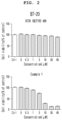
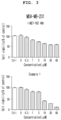
- the cell viability assay was performed as follows. BT20, a human-derived breast cancer cell line, and MDA-MB-231, a TNBC cell line, were each seeded in 96-well plates at the density of 5 ⁇ 10 3 cells/well and cultured for 24 hours. Then, I-bet 762 and the compound of Example 1 were treated thereto at different concentrations and cultured for 48 hours. At the end of the culture, 100 ⁇ l of WST-8 solution was added to each well of the plate, and the absorbance was measured with a microplate reader using a 450 nm optical filter to measure the formazan produced by the reducing factors in living cells.
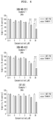
- Figure 4 shows the cell viability of MDA-MB-231, MDA-MB-453, and BT-20 after 24 hours of treatment with the compound of Example 1. As shown in Figure 4 , it was confirmed that the cell viability was suppressed not only in general breast cancer cell lines, but also in TNBC cell lines dose dependently.
- the active ingredient of the pharmaceutical composition of the present invention on breast cancer cell viability, an experiment was performed using 80 female 5-week-old xenograft Balb/c nude mice, which were approximately 8 weeks old at the start of administration.
- mice lacks T cells, the immune cells, were selected as an animal model suitable for transplanting human cancer cells.
- animals within ⁇ 20% of the total average body weight were selected, and tumor growth was checked twice a week on the surface, and the size of the tumor was measured with a vernier caliper for 3 weeks.
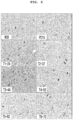
- the cells were shrunk and divided (blebs) and that empty space (hollow) surrounded the periphery.
- the eosinophilicity of the cytoplasm was increased, and the nucleus was small, concentrated or fragmented, and was observed to be phagocytosed by surrounding cells.
- the number was higher in the T4, T5, and T6 groups treated with the compound of Example 1, the active ingredient of the pharmaceutical composition of the present invention, compared to NC (Negative Control) dose dependently, confirming that the compound of Example 1 of the present invention had a tumor suppressive effect by increasing apoptosis of cancer cells.
- the central area was cut out, a paraffin block was prepared through a general tissue processing process, and the tissue was sectioned at 3 ⁇ m thickness using a microtome. Then, the sections were stained with hematoxylin and eosin, and cell necrosis areas were observed.
- Example 1 Whether the compound of Example 1, the active ingredient of the pharmaceutical composition of the present invention, has a growth inhibitory effect on cancer cell lines other than TNBC was confirmed.
- the WST-8 assay to check the cell viability of HepG2 and Hep3B was performed as follows. HepG2 and Hep3B were each seeded in 96-well plates at the density of 5 ⁇ 103 cells/well and cultured for 24 hours. Then, Sorafenib and OPT-0139 were diluted stepwise at a twofold concentration and then treated to the plates at different concentrations, followed by culture for 24, 48, and 72 hours. 100 ⁇ l of WST-8 solution was added to each well of the plate, and the absorbance was measured with a microplate reader using a 450 nm optical filter to measure the formazan produced by the reducing factors in living cells.
- the cells that were not treated with Sorafenib and the compound of Example 1 showed a dark orange color, and the cells treated with Sorafenib and the compound of Example 1 showed a light pink color, which is the color of the culture medium of the cell line. Therefore, the number of living cells could be measured by measuring absorbance.
- the clonogenic assay was performed as follows. HepG2 and Hep3B were each seeded in 12-well plates at the density of 3 ⁇ 10 3 cells/well and cultured for 24 hours. Then, Sorafenib and the compound of Example 1 were treated thereto at 2.5 and 5 ⁇ M each and cultured for 10 days. Upon completion of the culture, the cells were washed with PBS, fixed with 37% formaldehyde, and stained with 0.01% crystal violet. After staining, the cells were washed with distilled water and the colonies of stained cells were photographed.
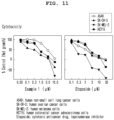
- Example 1 The cytotoxicity of the compound of Example 1 against various cancer cell lines was evaluated through a process similar to the evaluation of liver cancer cell line inhibition described above.
- Etoposide sold as an anticancer agent, was used as a control group drug.
- Figure 11 is a set of graphs showing the results of confirming the toxicity of the compound of Example 1 of the present invention to various cancer cell lines.
- the compound of Example 1 according to the present invention showed excellent toxicity to the cancer cell lines A549, SK-OV-3, SK-MEL-2, and HCT15 dose dependently, and thus it can be effectively used as an active ingredient in anticancer agents.
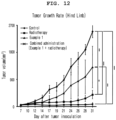
- 4T1 murine triple negative breast cancer cells (6x10 5 cells) were injected into the hind limbs of 6-week-old immune-competent BALB/c mice. Seven days after injection, after confirming consistent tumor growth, 10 mice from each group were selected and used in subsequent experiments.
- the experimental groups consisted of a control group (no treatment), a radiotherapy group, a group treated with the compound of Example 1, and a group treated with a combination of the compound of Example 1 and radiotherapy. Each treatment was carried out for 31 days after tumor implantation.
- Radiation treatment was performed using electron beams, and a total of 24 Gy was irradiated three times, once every two days for one week (Days 10, 12, and 14) (8 Gy x 3).
- the compound of Example 1 was administered intravenously at a dose of 10 mg/kg once every 2 or 3 days (Days 10, 12, 14, 17, 19, and 21) for a total of 6 times over 2 weeks.
- the compound of Example 1 was administered after confirming that the mice had recovered from anesthesia 4 hours after radiation therapy.
- volume mm 3 length mm ⁇ width mm 2 ⁇ 0.5
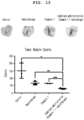
- mice were prepared in the same manner as in Experimental Example 7, and the lungs of the mice were removed on the 31st day after tumor injection, and the results of observing lung metastasis are shown in Figure 13 .
- the administration of the compound of Example 1 alone significantly reduced metastasis compared to the control group.
- the combined administration of the compound of Example 1 and radiation significantly (P ⁇ 0.05) reduced lung metastases compared to each administration alone.
- the tumor tissues from each mouse were subjected to single cell isolation, followed by flow cytometric analysis (FACS) to confirm the immunomodulatory effect.
- FACS flow cytometric analysis
- the spleen and tumor of the mouse were extracted 31 days after tumor cell injection in the same manner as in Experimental Example 7.
- the tumor tissue was excised, it was mechanically processed by fine chopping using a sterilized razor blade, and then treated with DNase (0.1 mg/ml) and collagenase (1 mg/ml), respectively, and reacted at 36°C for 30 minutes to obtain a single cell suspension.
- DNase 0.1 mg/ml
- collagenase 1 mg/ml
- CD+ T cells are known to be cytotoxic T cells that can destroy tumor cells.
- the proportion of CD8+ T cells was increased when the compound of Example 1 was administered alone.
- the proportion of CD8+ T cells was significantly increased compared to each administration alone.
- M1 TAM which has an antitumor effect
- M2 TAM which has an immunosuppressive effect
- BET Bromodomain and extraterminal domain
- BRD4 one of the BET family members, is commonly found in hematologic tumors and solid tumors. Therefore, in addition to the effect of downregulating oncogenes, BRD4 inhibitors inhibit tumor growth by directly suppressing the proliferation of tumor cells.
- the hypoxia-inducible factor-1 ⁇ (HIF-1 ⁇ ) protein is a key factor that regulates tumor cell division, angiogenesis, invasion, and metastasis in the tumor microenvironment.
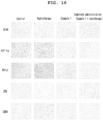
- the tumor cells isolated in Experimental Example 9 were subjected to immunocytochemistry (IHC) analysis to evaluate the changes in protein expression in the tumor microenvironment according to the treatment method.
- IHC immunocytochemistry
- tumor tissue was extracted, fixed in 4% paraformaldehyde, and embedded in paraffin to create blocks.
- the paraffin block containing the tissue was sliced transversely to a thickness of 4 ⁇ m and attached to a slide. Paraffin was removed from the tissue attached to the slide using xylene and ethanol, and endogenous peroxidase was removed from the tissue by immersing the slide in a solution of 3% H 2 O 2 in methanol for 10 minutes at room temperature. Then, for antigen retrieval, the slide was placed in 0.01 M sodium citrate buffer (pH 6.0) and boiled. In order to eliminate non-specific binding, FcR on the cell surface was blocked using 5% normal goat serum.
- the stained tissue was observed under an Axioskop40 optical microscope (Carl Zeiss) at 40 ⁇ magnification, and the images were saved using AxioVision4.7 software.
- the expression level was measured through the area of the stained region in the photograph using Image J software (NIH, Bethesda). Average density values were calculated from at least three slides per sample.
- Brd4 expression was significantly (P ⁇ 0.001) reduced by treatment with the compound of Example 1, and HIF-1 ⁇ expression, known to be associated with Brd4, was also significantly (P ⁇ 0.05) reduced in the tumor tissue.
- the compound of Example 1 significantly (P ⁇ 0.01) decreased the expression of PD-L1, which is expressed by cancer cells to induce immune evasion.
- Human ovarian cancer cell lines (SKOV-3 and OVCAR-3) were treated with control (no treatment), 0.1 ⁇ M of the compound of Example 1, 1 ⁇ M of cisplatin, and 0.1 ⁇ M of the compound of Example 1 / 1 ⁇ M of cisplatin, and the cell viability of SKOV-3 and OVCAR-3 was confirmed.
- the results are shown in Figure 18 .
- Human liver cancer cell lines (SK Hep1 and Huh-7) were treated with control (no treatment), 0.1 ⁇ M of the compound of Example 1, 1 ⁇ M of sorafenib, and 0.1 ⁇ M of the compound of Example 1 / 1 ⁇ M of sorafenib, and the cell viability of SK Hep1 and Huh-7 was confirmed. The results are shown in Figure 19 .
- Example 1 inhibits the formation of mammospheres in a breast cancer cell line and, when compared to anticancer drugs sorafenib and etoposide, which are topoisomerase inhibitors widely used in lung cancer, ovarian cancer, colon cancer, melanoma and the like, exhibits remarkable effects greater than or equal to those of the anticancer drugs sorafenib and etoposide.
- Example 1 exhibits synergistic anticancer effects when combined with radiotherapy or other anticancer drugs in a breast cancer cell line and a liver cancer cell line, and thus can be developed as an anticancer drug or a food exhibiting excellent effects in the treatment of cancer.
Landscapes
- Health & Medical Sciences (AREA)
- Life Sciences & Earth Sciences (AREA)
- Chemical & Material Sciences (AREA)
- Medicinal Chemistry (AREA)
- Pharmacology & Pharmacy (AREA)
- Animal Behavior & Ethology (AREA)
- General Health & Medical Sciences (AREA)
- Public Health (AREA)
- Veterinary Medicine (AREA)
- Epidemiology (AREA)
- General Chemical & Material Sciences (AREA)
- Organic Chemistry (AREA)
- Chemical Kinetics & Catalysis (AREA)
- Nuclear Medicine, Radiotherapy & Molecular Imaging (AREA)
- Polymers & Plastics (AREA)
- Mycology (AREA)
- Nutrition Science (AREA)
- Engineering & Computer Science (AREA)
- Food Science & Technology (AREA)
- Inorganic Chemistry (AREA)
- Pharmaceuticals Containing Other Organic And Inorganic Compounds (AREA)
- Medicines Containing Antibodies Or Antigens For Use As Internal Diagnostic Agents (AREA)
- Coloring Foods And Improving Nutritive Qualities (AREA)
- Nitrogen Condensed Heterocyclic Rings (AREA)
- Pyridine Compounds (AREA)
- Saccharide Compounds (AREA)
- Nitrogen And Oxygen Or Sulfur-Condensed Heterocyclic Ring Systems (AREA)
Claims (12)
- Pharmazeutische Zusammensetzung zur Verwendung bei der Prävention oder Behandlung von Krebs, umfassend eine Verbindung, die durch die folgende Formel 1 dargestellt ist, ein Stereoisomer davon, ein Solvat davon, ein Hydrat davon oder ein pharmazeutisch unbedenkliches Salz davon als einen Wirkstoff:
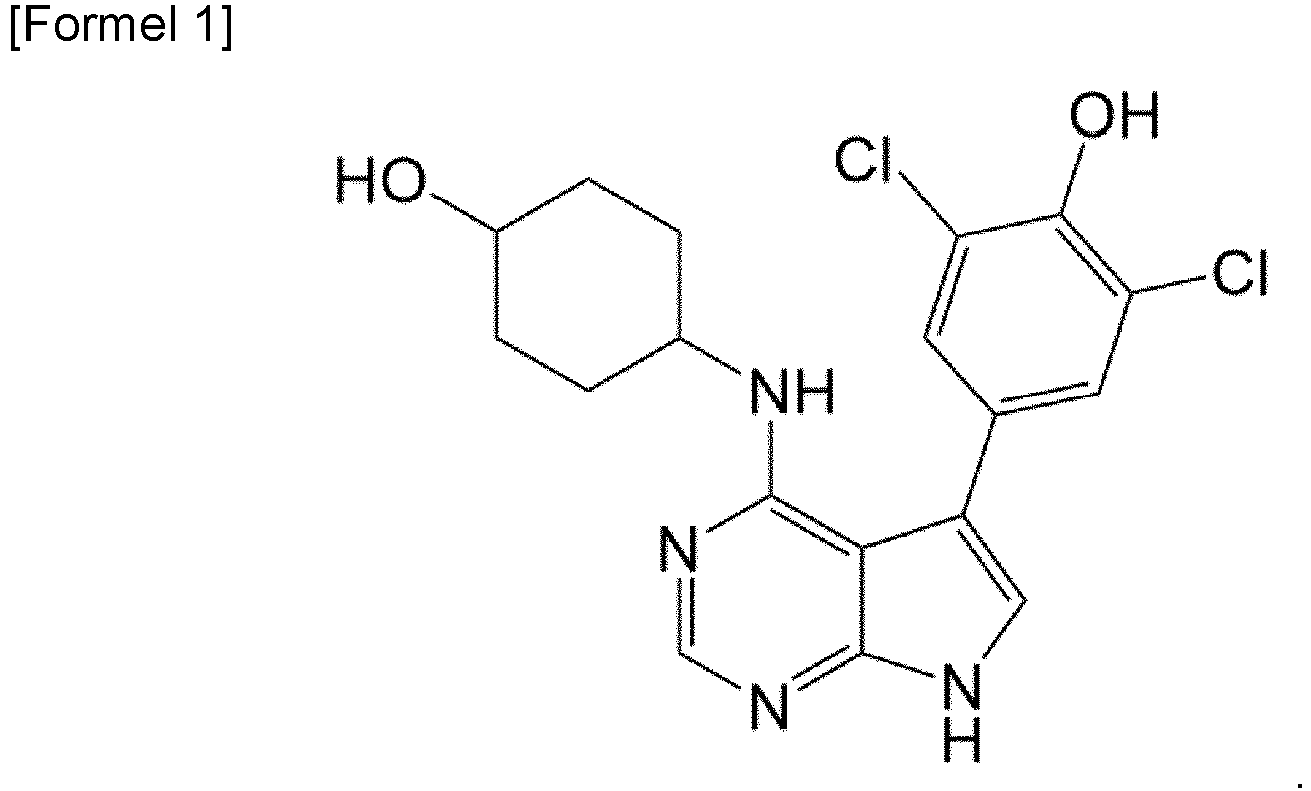
- Pharmazeutische Zusammensetzung zur Verwendung bei der Prävention oder Behandlung von Krebs nach Anspruch 1, wobei die Verbindung, die durch die obige Formel 1 dargestellt ist, (Trans)-2,6-Dichlor-4-(4-(4-Hydroxycyclohexylamino)-7H-pyrrolo[2,3-D]pyrimidin-5-yl)phenol ist.
- Pharmazeutische Zusammensetzung zur Verwendung bei der Prävention oder Behandlung von Krebs nach Anspruch 1, wobei der Krebs ein beliebiger ist, der aus der Gruppe bestehend aus Lungenkrebs, nicht-kleinzelligem Lungenkrebs (NSLC), bronchioloalveolärem Karzinom, Eierstockkrebs, kolorektalem Karzinom, Melanom, Magenkrebs, Magen- und Darmkrebs, Leberkrebs, Knochenkrebs, Bauchspeicheldrüsenkrebs, Hautkrebs, Kopf- und Halskrebs, Haut- oder Augenmelanom, Gebärmutterkrebs, Rektalkrebs, Darmkrebs, Brustkrebs, Gebärmuttersarkom, Eileiterkarzinom, Endometriumkarzinom, Gebärmutterhalskarzinom, Vaginalkarzinom, Vulvakarzinom, Speiseröhrenkrebs, Kehlkopfkrebs, Dünndarmkrebs, Schilddrüsenkrebs, Nebenschilddrüsenkrebs, Weichteilsarkom, Harnröhrenkrebs, Peniskarzinom, Prostatakrebs, multiplem Myelom und chronischer oder akuter Leukämie ausgewählt ist.
- Pharmazeutische Zusammensetzung zur Verwendung bei der Prävention oder Behandlung von Krebs nach Anspruch 3, wobei der Krebs Brustkrebs oder Leberkrebs ist.
- Pharmazeutische Zusammensetzung zur Verwendung bei der Prävention oder Behandlung von Krebs nach Anspruch 1, wobei die pharmazeutische Zusammensetzung zur kombinierten Behandlung mit Strahlung oder gegen Krebs wirkenden Mitteln verwendet wird.
- Pharmazeutische Zusammensetzung zur Verwendung bei der Prävention oder Behandlung von Krebs nach Anspruch 5, wobei das gegen Krebs wirkende Mittel mindestens eines ist, das aus der Gruppe bestehend aus Cisplatin, Sorafenib, OKN-007 (Oklahoma Nitrone-007), Gefitinib, Doxorubicin, Vinblastin, Taxol, Etoposid, 5-FU (5-Fluoruracil) und Ifosfamid ausgewählt ist.
- Pharmazeutische Zusammensetzung zur Verwendung bei der Prävention oder Behandlung von Krebs nach Anspruch 1, wobei die pharmazeutische Zusammensetzung die Immunität verstärkt.
- Gesundheitsfunktionale Lebensmittelzusammensetzung zur Verwendung bei der Prävention oder Linderung von Krebs, umfassend eine Verbindung, die durch die folgende Formel 1 dargestellt ist, ein Stereoisomer davon, ein Solvat davon, ein Hydrat davon oder ein pharmazeutisch unbedenkliches Salz davon als einen Wirkstoff:


- Pharmazeutisches Kit zur Verwendung bei der Prävention oder Behandlung von Krebs, umfassend eine erste Komponente, die eine pharmazeutisch wirksame Menge eines gegen Krebs wirkenden Mittels enthält; und eine zweite Komponente, die eine Verbindung, die durch die folgende Formel 1 dargestellt ist, ein Stereoisomer davon, ein Solvat davon, ein Hydrat davon oder ein pharmazeutisch unbedenkliches Salz davon als einen Wirkstoff enthält:
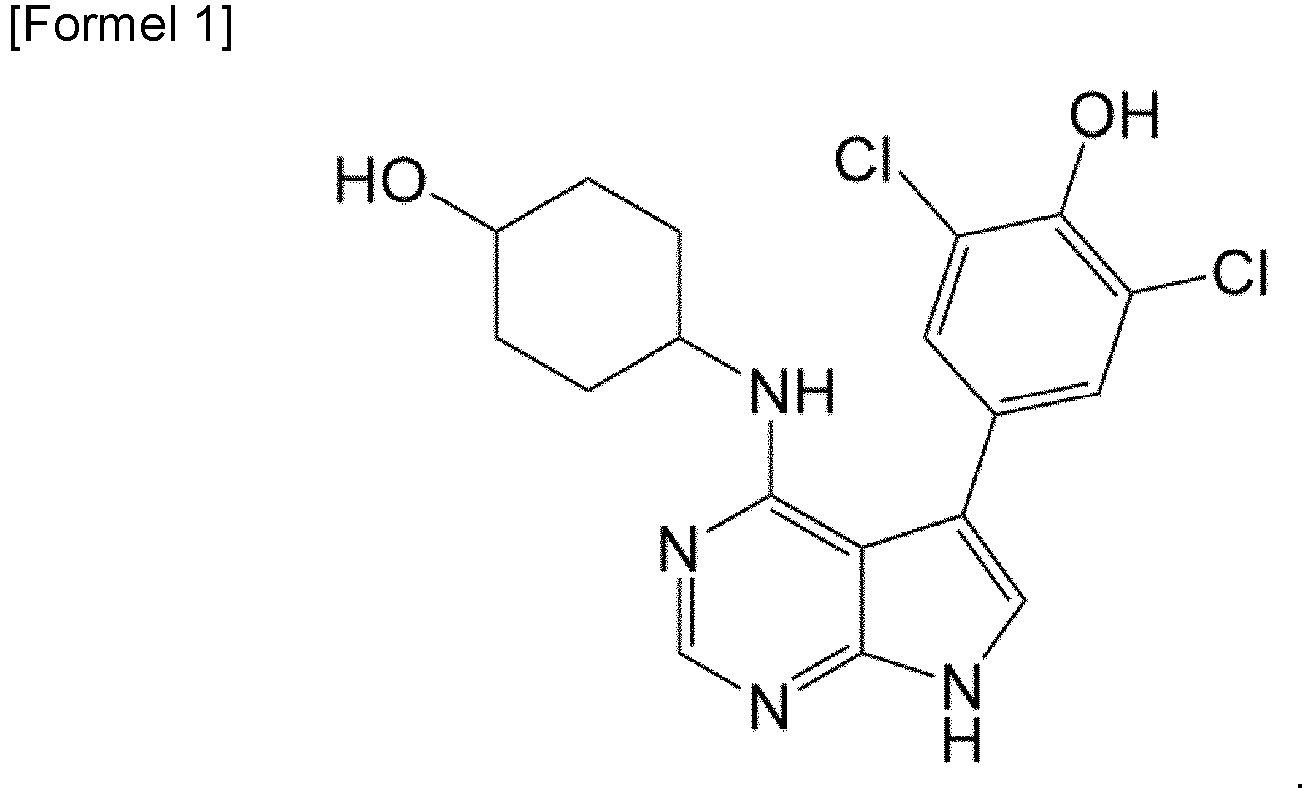
- Pharmazeutisches Kit zur Verwendung bei der Prävention oder Behandlung von Krebs nach Anspruch 9, wobei die Verbindung, die durch die obige Formel 1 dargestellt ist, (Trans)-2,6-Dichlor-4-(4-(4-Hydroxycyclohexylamino)-7H-pyrrolo[2,3-D]pyrimidin-5-yl)phenol ist.
- Pharmazeutisches Kit zur Verwendung bei der Prävention oder Behandlung von Krebs nach Anspruch 9, wobei der Krebs ein beliebiger ist, der aus der Gruppe bestehend aus Lungenkrebs, nicht-kleinzelligem Lungenkrebs (NSLC), bronchioloalveolärem Karzinom, Eierstockkrebs, kolorektalem Karzinom, Melanom, Magenkrebs, Magen- und Darmkrebs, Leberkrebs, Knochenkrebs, Bauchspeicheldrüsenkrebs, Hautkrebs, Kopf- und Halskrebs, Haut- oder Augenmelanom, Gebärmutterkrebs, Rektalkrebs, Darmkrebs, Brustkrebs, Gebärmuttersarkom, Eileiterkarzinom, Endometriumkarzinom, Gebärmutterhalskarzinom, Vaginalkarzinom, Vulvakarzinom, Speiseröhrenkrebs, Kehlkopfkrebs, Dünndarmkrebs, Schilddrüsenkrebs, Nebenschilddrüsenkrebs, Weichteilsarkom, Harnröhrenkrebs, Peniskarzinom, Prostatakrebs, multiplem Myelom und chronischer oder akuter Leukämie ausgewählt ist.
- Pharmazeutisches Kit zur Verwendung bei der Prävention oder Behandlung von Krebs nach Anspruch 9, wobei das gegen Krebs wirkende Mittel mindestens eines ist, das aus der Gruppe bestehend aus Cisplatin, Sorafenib, OKN-007 (Oklahoma Nitrone-007), Gefitinib, Doxorubicin, Vinblastin, Taxol, Etoposid, 5-FU (5-Fluoruracil) und Ifosfamid ausgewählt ist.
Applications Claiming Priority (2)
| Application Number | Priority Date | Filing Date | Title |
|---|---|---|---|
| KR20210056988 | 2021-05-03 | ||
| PCT/KR2022/006339 WO2022235054A1 (ko) | 2021-05-03 | 2022-05-03 | 2,6-디클로로-4-(4-(4-하이드록시사이클로헥실아미노)-7h-피롤로[2,3-d]피리미딘-5-일)페놀을 유효성분으로 포함하는 암의 예방, 개선 또는 치료용 약학적 조성물 |
Publications (4)
| Publication Number | Publication Date |
|---|---|
| EP4335441A1 EP4335441A1 (de) | 2024-03-13 |
| EP4335441A4 EP4335441A4 (de) | 2024-10-16 |
| EP4335441B1 true EP4335441B1 (de) | 2025-05-28 |
| EP4335441C0 EP4335441C0 (de) | 2025-05-28 |
Family
ID=83932860
Family Applications (1)
| Application Number | Title | Priority Date | Filing Date |
|---|---|---|---|
| EP22799097.5A Active EP4335441B1 (de) | 2021-05-03 | 2022-05-03 | Pharmazeutische zusammensetzung zur prävention, linderung oder behandlung von krebs mit 2,6-dichlor-4-(4-(4-hydroxycyclohexylamino)-7h-pyrrolo[2,3-d!pyrimidin-5-yl)phenol als wirkstoff |
Country Status (6)
| Country | Link |
|---|---|
| US (1) | US20240207271A1 (de) |
| EP (1) | EP4335441B1 (de) |
| JP (2) | JP2024516700A (de) |
| KR (1) | KR102582916B1 (de) |
| CN (1) | CN117355305A (de) |
| WO (1) | WO2022235054A1 (de) |
Family Cites Families (6)
| Publication number | Priority date | Publication date | Assignee | Title |
|---|---|---|---|---|
| ATE384062T1 (de) * | 1996-08-23 | 2008-02-15 | Novartis Pharma Gmbh | Substituierte pyrrolopyrimidine und verfahren zu ihrer herstellung |
| US7514435B2 (en) * | 2005-11-18 | 2009-04-07 | Bristol-Myers Squibb Company | Pyrrolotriazine kinase inhibitors |
| WO2008089307A2 (en) * | 2007-01-18 | 2008-07-24 | Lexicon Pharmaceuticals, Inc. | Delta 5 desaturase inhibitors for the treatment of pain, inflammation and cancer |
| CN105188704B (zh) * | 2013-01-16 | 2017-09-19 | 西格诺药品有限公司 | 被取代的吡咯并嘧啶化合物、其组合物和使用其的治疗方法 |
| ES2896943T3 (es) * | 2016-10-28 | 2022-02-28 | Chia Tai Tianqing Pharmaceutical Group Co Ltd | Compuesto de amino pirazolopirimidina usado como inhibidor de receptores con actividad tirosina quinasa de factores neurotróficos |
| KR102129114B1 (ko) * | 2018-07-26 | 2020-07-02 | 주식회사 온코파마텍 | TrkA 저해 활성을 갖는 화합물 및 이를 유효성분으로 함유하는 통증의 예방 또는 치료용 약학적 조성물 |
-
2022
- 2022-05-03 EP EP22799097.5A patent/EP4335441B1/de active Active
- 2022-05-03 CN CN202280032922.3A patent/CN117355305A/zh active Pending
- 2022-05-03 KR KR1020220054797A patent/KR102582916B1/ko active Active
- 2022-05-03 WO PCT/KR2022/006339 patent/WO2022235054A1/ko not_active Ceased
- 2022-05-03 US US18/288,896 patent/US20240207271A1/en active Pending
- 2022-05-03 JP JP2023567917A patent/JP2024516700A/ja active Pending
-
2025
- 2025-10-09 JP JP2025170691A patent/JP2026009136A/ja active Pending
Also Published As
| Publication number | Publication date |
|---|---|
| US20240207271A1 (en) | 2024-06-27 |
| CN117355305A (zh) | 2024-01-05 |
| WO2022235054A1 (ko) | 2022-11-10 |
| JP2026009136A (ja) | 2026-01-19 |
| KR102582916B1 (ko) | 2023-09-26 |
| EP4335441A1 (de) | 2024-03-13 |
| JP2024516700A (ja) | 2024-04-16 |
| EP4335441A4 (de) | 2024-10-16 |
| KR20220150223A (ko) | 2022-11-10 |
| EP4335441C0 (de) | 2025-05-28 |
Similar Documents
| Publication | Publication Date | Title |
|---|---|---|
| US20200113855A1 (en) | Pharmaceutical composition for treating cancer comprising lactate metal salt | |
| KR101388635B1 (ko) | 다프난 다이터페노이드(Daphnane diterpenoid)계 물질의 상피세포 성장인자 수용체(EGFR) 저해제인 제피티닙(Gefitnib) 내성 인간 폐암 세포에 유용한 항암제 | |
| KR20190091222A (ko) | 칼슘 채널 억제제 또는 이의 약학적으로 허용가능한 염을 유효성분으로 함유하는 암의 예방 또는 치료용 약학적 조성물 | |
| EP4335441B1 (de) | Pharmazeutische zusammensetzung zur prävention, linderung oder behandlung von krebs mit 2,6-dichlor-4-(4-(4-hydroxycyclohexylamino)-7h-pyrrolo[2,3-d!pyrimidin-5-yl)phenol als wirkstoff | |
| CN109071437B (zh) | 新型吲哚衍生物和包含其的抗癌组合物 | |
| KR101924801B1 (ko) | 트리아졸로피리딘계 유도체를 유효성분으로 함유하는 암 예방 또는 치료용 조성물 | |
| EP4335849A1 (de) | Pharmazeutische zusammensetzung zur prävention, linderung oder behandlung von krebs | |
| JP2017534578A (ja) | ジペノサイド(gypenoside)lxxvを含む、子宮頸癌の予防又は治療用組成物 | |
| KR20180106645A (ko) | 6-티오구아닌을 유효성분으로 함유하는 췌장암에 대한 젬시타빈의 항암작용 상승제 조성물 | |
| KR20190070844A (ko) | 마늘 추출 분획물로부터 분리된 화합물을 유효성분으로 함유하는 근육관련 질환 치료 및 예방용 조성물 | |
| KR102043454B1 (ko) | 글리오톡신을 유효성분으로 함유하는 항암제 내성 폐암의 예방, 개선 또는 치료용 조성물 | |
| KR102776801B1 (ko) | 플라본 유도체를 이용한 항암 조성물 | |
| KR101787954B1 (ko) | 프로토파낙사디올류 진세노사이드 화합물을 포함하는 교모세포종 치료 및 전이 억제용 약학 조성물 | |
| KR101996184B1 (ko) | 마늘 추출 분획물을 유효성분으로 함유하는 항암보조 치료제 | |
| CN117355529A (zh) | 用于预防、改善或治疗癌症的药物组合物 | |
| JP5985062B2 (ja) | アルトカルプス・アルティリスの果実、葉、若しくは幹の抽出物、又はそれらの画分を有効成分として含有するがんの予防又は治療のための組成物 | |
| KR20180129038A (ko) | 신선초 추출물로부터 분리된 화합물을 함유하는 근육관련 질환의 예방 및 치료용 조성물 | |
| JP2025177165A (ja) | アントラサイクリン系抗癌剤により誘発される心毒性を予防及び/又は治療するための組成物 | |
| CN120435289A (zh) | 源自非酒精性脂肪肝炎的肝细胞癌的预防剂或治疗剂 | |
| KR20170057474A (ko) | 프로토파낙사디올류 진세노사이드 화합물을 포함하는 교모세포종 치료 및 전이 억제용 약학 조성물 |
Legal Events
| Date | Code | Title | Description |
|---|---|---|---|
| STAA | Information on the status of an ep patent application or granted ep patent |
Free format text: STATUS: THE INTERNATIONAL PUBLICATION HAS BEEN MADE |
|
| PUAI | Public reference made under article 153(3) epc to a published international application that has entered the european phase |
Free format text: ORIGINAL CODE: 0009012 |
|
| STAA | Information on the status of an ep patent application or granted ep patent |
Free format text: STATUS: REQUEST FOR EXAMINATION WAS MADE |
|
| 17P | Request for examination filed |
Effective date: 20231103 |
|
| AK | Designated contracting states |
Kind code of ref document: A1 Designated state(s): AL AT BE BG CH CY CZ DE DK EE ES FI FR GB GR HR HU IE IS IT LI LT LU LV MC MK MT NL NO PL PT RO RS SE SI SK SM TR |
|
| DAV | Request for validation of the european patent (deleted) | ||
| DAX | Request for extension of the european patent (deleted) | ||
| A4 | Supplementary search report drawn up and despatched |
Effective date: 20240916 |
|
| RIC1 | Information provided on ipc code assigned before grant |
Ipc: A23L 33/10 20160101ALI20240910BHEP Ipc: A61P 35/00 20060101ALI20240910BHEP Ipc: A61K 31/519 20060101AFI20240910BHEP |
|
| REG | Reference to a national code |
Ref country code: DE Ref legal event code: R079 Free format text: PREVIOUS MAIN CLASS: A61K0031519000 Ipc: A61K0031440000 Ref country code: DE Ref legal event code: R079 Ref document number: 602022015277 Country of ref document: DE Free format text: PREVIOUS MAIN CLASS: A61K0031519000 Ipc: A61K0031440000 |
|
| GRAP | Despatch of communication of intention to grant a patent |
Free format text: ORIGINAL CODE: EPIDOSNIGR1 |
|
| STAA | Information on the status of an ep patent application or granted ep patent |
Free format text: STATUS: GRANT OF PATENT IS INTENDED |
|
| RIC1 | Information provided on ipc code assigned before grant |
Ipc: A61K 45/06 20060101ALI20250128BHEP Ipc: A61K 33/243 20190101ALI20250128BHEP Ipc: A23L 33/10 20160101ALI20250128BHEP Ipc: A61P 35/00 20060101ALI20250128BHEP Ipc: A61K 31/519 20060101ALI20250128BHEP Ipc: A61K 31/44 20060101AFI20250128BHEP |
|
| INTG | Intention to grant announced |
Effective date: 20250214 |
|
| RIN1 | Information on inventor provided before grant (corrected) |
Inventor name: JANG, BONG KEUN |
|
| GRAS | Grant fee paid |
Free format text: ORIGINAL CODE: EPIDOSNIGR3 |
|
| GRAA | (expected) grant |
Free format text: ORIGINAL CODE: 0009210 |
|
| STAA | Information on the status of an ep patent application or granted ep patent |
Free format text: STATUS: THE PATENT HAS BEEN GRANTED |
|
| AK | Designated contracting states |
Kind code of ref document: B1 Designated state(s): AL AT BE BG CH CY CZ DE DK EE ES FI FR GB GR HR HU IE IS IT LI LT LU LV MC MK MT NL NO PL PT RO RS SE SI SK SM TR |
|
| REG | Reference to a national code |
Ref country code: GB Ref legal event code: FG4D |
|
| REG | Reference to a national code |
Ref country code: CH Ref legal event code: EP |
|
| REG | Reference to a national code |
Ref country code: DE Ref legal event code: R096 Ref document number: 602022015277 Country of ref document: DE |
|
| REG | Reference to a national code |
Ref country code: IE Ref legal event code: FG4D |
|
| U01 | Request for unitary effect filed |
Effective date: 20250528 |
|
| U07 | Unitary effect registered |
Designated state(s): AT BE BG DE DK EE FI FR IT LT LU LV MT NL PT RO SE SI Effective date: 20250605 |
|
| PG25 | Lapsed in a contracting state [announced via postgrant information from national office to epo] |
Ref country code: ES Free format text: LAPSE BECAUSE OF FAILURE TO SUBMIT A TRANSLATION OF THE DESCRIPTION OR TO PAY THE FEE WITHIN THE PRESCRIBED TIME-LIMIT Effective date: 20250528 |
|
| PG25 | Lapsed in a contracting state [announced via postgrant information from national office to epo] |
Ref country code: GR Free format text: LAPSE BECAUSE OF FAILURE TO SUBMIT A TRANSLATION OF THE DESCRIPTION OR TO PAY THE FEE WITHIN THE PRESCRIBED TIME-LIMIT Effective date: 20250829 Ref country code: NO Free format text: LAPSE BECAUSE OF FAILURE TO SUBMIT A TRANSLATION OF THE DESCRIPTION OR TO PAY THE FEE WITHIN THE PRESCRIBED TIME-LIMIT Effective date: 20250828 |
|
| PG25 | Lapsed in a contracting state [announced via postgrant information from national office to epo] |
Ref country code: PL Free format text: LAPSE BECAUSE OF FAILURE TO SUBMIT A TRANSLATION OF THE DESCRIPTION OR TO PAY THE FEE WITHIN THE PRESCRIBED TIME-LIMIT Effective date: 20250528 |
|
| PG25 | Lapsed in a contracting state [announced via postgrant information from national office to epo] |
Ref country code: HR Free format text: LAPSE BECAUSE OF FAILURE TO SUBMIT A TRANSLATION OF THE DESCRIPTION OR TO PAY THE FEE WITHIN THE PRESCRIBED TIME-LIMIT Effective date: 20250528 |
|
| PG25 | Lapsed in a contracting state [announced via postgrant information from national office to epo] |
Ref country code: RS Free format text: LAPSE BECAUSE OF FAILURE TO SUBMIT A TRANSLATION OF THE DESCRIPTION OR TO PAY THE FEE WITHIN THE PRESCRIBED TIME-LIMIT Effective date: 20250828 |
|
| PG25 | Lapsed in a contracting state [announced via postgrant information from national office to epo] |
Ref country code: IS Free format text: LAPSE BECAUSE OF FAILURE TO SUBMIT A TRANSLATION OF THE DESCRIPTION OR TO PAY THE FEE WITHIN THE PRESCRIBED TIME-LIMIT Effective date: 20250928 |
|
| PG25 | Lapsed in a contracting state [announced via postgrant information from national office to epo] |
Ref country code: SM Free format text: LAPSE BECAUSE OF FAILURE TO SUBMIT A TRANSLATION OF THE DESCRIPTION OR TO PAY THE FEE WITHIN THE PRESCRIBED TIME-LIMIT Effective date: 20250528 |
|
| PG25 | Lapsed in a contracting state [announced via postgrant information from national office to epo] |
Ref country code: CZ Free format text: LAPSE BECAUSE OF FAILURE TO SUBMIT A TRANSLATION OF THE DESCRIPTION OR TO PAY THE FEE WITHIN THE PRESCRIBED TIME-LIMIT Effective date: 20250528 |
|
| PG25 | Lapsed in a contracting state [announced via postgrant information from national office to epo] |
Ref country code: SK Free format text: LAPSE BECAUSE OF FAILURE TO SUBMIT A TRANSLATION OF THE DESCRIPTION OR TO PAY THE FEE WITHIN THE PRESCRIBED TIME-LIMIT Effective date: 20250528 |