EP4331925A1 - Fahrsteuerungsvorrichtung - Google Patents
Fahrsteuerungsvorrichtung Download PDFInfo
- Publication number
- EP4331925A1 EP4331925A1 EP23191969.7A EP23191969A EP4331925A1 EP 4331925 A1 EP4331925 A1 EP 4331925A1 EP 23191969 A EP23191969 A EP 23191969A EP 4331925 A1 EP4331925 A1 EP 4331925A1
- Authority
- EP
- European Patent Office
- Prior art keywords
- speed
- control
- target
- vehicle
- deceleration
- Prior art date
- Legal status (The legal status is an assumption and is not a legal conclusion. Google has not performed a legal analysis and makes no representation as to the accuracy of the status listed.)
- Pending
Links
Images


Classifications
-
- B—PERFORMING OPERATIONS; TRANSPORTING
- B60—VEHICLES IN GENERAL
- B60T—VEHICLE BRAKE CONTROL SYSTEMS OR PARTS THEREOF; BRAKE CONTROL SYSTEMS OR PARTS THEREOF, IN GENERAL; ARRANGEMENT OF BRAKING ELEMENTS ON VEHICLES IN GENERAL; PORTABLE DEVICES FOR PREVENTING UNWANTED MOVEMENT OF VEHICLES; VEHICLE MODIFICATIONS TO FACILITATE COOLING OF BRAKES
- B60T7/00—Brake-action initiating means
- B60T7/12—Brake-action initiating means for automatic initiation; for initiation not subject to will of driver or passenger
-
- B—PERFORMING OPERATIONS; TRANSPORTING
- B60—VEHICLES IN GENERAL
- B60K—ARRANGEMENT OR MOUNTING OF PROPULSION UNITS OR OF TRANSMISSIONS IN VEHICLES; ARRANGEMENT OR MOUNTING OF PLURAL DIVERSE PRIME-MOVERS IN VEHICLES; AUXILIARY DRIVES FOR VEHICLES; INSTRUMENTATION OR DASHBOARDS FOR VEHICLES; ARRANGEMENTS IN CONNECTION WITH COOLING, AIR INTAKE, GAS EXHAUST OR FUEL SUPPLY OF PROPULSION UNITS IN VEHICLES
- B60K31/00—Vehicle fittings, acting on a single sub-unit only, for automatically controlling vehicle speed, i.e. preventing speed from exceeding an arbitrarily established velocity or maintaining speed at a particular velocity, as selected by the vehicle operator
-
- B—PERFORMING OPERATIONS; TRANSPORTING
- B60—VEHICLES IN GENERAL
- B60T—VEHICLE BRAKE CONTROL SYSTEMS OR PARTS THEREOF; BRAKE CONTROL SYSTEMS OR PARTS THEREOF, IN GENERAL; ARRANGEMENT OF BRAKING ELEMENTS ON VEHICLES IN GENERAL; PORTABLE DEVICES FOR PREVENTING UNWANTED MOVEMENT OF VEHICLES; VEHICLE MODIFICATIONS TO FACILITATE COOLING OF BRAKES
- B60T8/00—Arrangements for adjusting wheel-braking force to meet varying vehicular or ground-surface conditions, e.g. limiting or varying distribution of braking force
- B60T8/17—Using electrical or electronic regulation means to control braking
- B60T8/1701—Braking or traction control means specially adapted for particular types of vehicles
- B60T8/1706—Braking or traction control means specially adapted for particular types of vehicles for single-track vehicles, e.g. motorcycles
-
- B—PERFORMING OPERATIONS; TRANSPORTING
- B60—VEHICLES IN GENERAL
- B60T—VEHICLE BRAKE CONTROL SYSTEMS OR PARTS THEREOF; BRAKE CONTROL SYSTEMS OR PARTS THEREOF, IN GENERAL; ARRANGEMENT OF BRAKING ELEMENTS ON VEHICLES IN GENERAL; PORTABLE DEVICES FOR PREVENTING UNWANTED MOVEMENT OF VEHICLES; VEHICLE MODIFICATIONS TO FACILITATE COOLING OF BRAKES
- B60T8/00—Arrangements for adjusting wheel-braking force to meet varying vehicular or ground-surface conditions, e.g. limiting or varying distribution of braking force
- B60T8/17—Using electrical or electronic regulation means to control braking
- B60T8/175—Brake regulation specially adapted to prevent excessive wheel spin during vehicle acceleration, e.g. for traction control
-
- B—PERFORMING OPERATIONS; TRANSPORTING
- B60—VEHICLES IN GENERAL
- B60T—VEHICLE BRAKE CONTROL SYSTEMS OR PARTS THEREOF; BRAKE CONTROL SYSTEMS OR PARTS THEREOF, IN GENERAL; ARRANGEMENT OF BRAKING ELEMENTS ON VEHICLES IN GENERAL; PORTABLE DEVICES FOR PREVENTING UNWANTED MOVEMENT OF VEHICLES; VEHICLE MODIFICATIONS TO FACILITATE COOLING OF BRAKES
- B60T8/00—Arrangements for adjusting wheel-braking force to meet varying vehicular or ground-surface conditions, e.g. limiting or varying distribution of braking force
- B60T8/17—Using electrical or electronic regulation means to control braking
- B60T8/1755—Brake regulation specially adapted to control the stability of the vehicle, e.g. taking into account yaw rate or transverse acceleration in a curve
-
- B—PERFORMING OPERATIONS; TRANSPORTING
- B60—VEHICLES IN GENERAL
- B60T—VEHICLE BRAKE CONTROL SYSTEMS OR PARTS THEREOF; BRAKE CONTROL SYSTEMS OR PARTS THEREOF, IN GENERAL; ARRANGEMENT OF BRAKING ELEMENTS ON VEHICLES IN GENERAL; PORTABLE DEVICES FOR PREVENTING UNWANTED MOVEMENT OF VEHICLES; VEHICLE MODIFICATIONS TO FACILITATE COOLING OF BRAKES
- B60T8/00—Arrangements for adjusting wheel-braking force to meet varying vehicular or ground-surface conditions, e.g. limiting or varying distribution of braking force
- B60T8/32—Arrangements for adjusting wheel-braking force to meet varying vehicular or ground-surface conditions, e.g. limiting or varying distribution of braking force responsive to a speed condition, e.g. acceleration or deceleration
- B60T8/321—Arrangements for adjusting wheel-braking force to meet varying vehicular or ground-surface conditions, e.g. limiting or varying distribution of braking force responsive to a speed condition, e.g. acceleration or deceleration deceleration
- B60T8/3225—Systems specially adapted for single-track vehicles, e.g. motorcycles
-
- B—PERFORMING OPERATIONS; TRANSPORTING
- B60—VEHICLES IN GENERAL
- B60W—CONJOINT CONTROL OF VEHICLE SUB-UNITS OF DIFFERENT TYPE OR DIFFERENT FUNCTION; CONTROL SYSTEMS SPECIALLY ADAPTED FOR HYBRID VEHICLES; ROAD VEHICLE DRIVE CONTROL SYSTEMS FOR PURPOSES NOT RELATED TO THE CONTROL OF A PARTICULAR SUB-UNIT
- B60W30/00—Purposes of road vehicle drive control systems not related to the control of a particular sub-unit, e.g. of systems using conjoint control of vehicle sub-units
- B60W30/02—Control of vehicle driving stability
-
- B—PERFORMING OPERATIONS; TRANSPORTING
- B60—VEHICLES IN GENERAL
- B60W—CONJOINT CONTROL OF VEHICLE SUB-UNITS OF DIFFERENT TYPE OR DIFFERENT FUNCTION; CONTROL SYSTEMS SPECIALLY ADAPTED FOR HYBRID VEHICLES; ROAD VEHICLE DRIVE CONTROL SYSTEMS FOR PURPOSES NOT RELATED TO THE CONTROL OF A PARTICULAR SUB-UNIT
- B60W30/00—Purposes of road vehicle drive control systems not related to the control of a particular sub-unit, e.g. of systems using conjoint control of vehicle sub-units
- B60W30/14—Adaptive cruise control
- B60W30/143—Speed control
- B60W30/146—Speed limiting
-
- B—PERFORMING OPERATIONS; TRANSPORTING
- B62—LAND VEHICLES FOR TRAVELLING OTHERWISE THAN ON RAILS
- B62J—CYCLE SADDLES OR SEATS; AUXILIARY DEVICES OR ACCESSORIES SPECIALLY ADAPTED TO CYCLES AND NOT OTHERWISE PROVIDED FOR, e.g. ARTICLE CARRIERS OR CYCLE PROTECTORS
- B62J45/00—Electrical equipment arrangements specially adapted for use as accessories on cycles, not otherwise provided for
- B62J45/40—Sensor arrangements; Mounting thereof
- B62J45/41—Sensor arrangements; Mounting thereof characterised by the type of sensor
- B62J45/412—Speed sensors
-
- B—PERFORMING OPERATIONS; TRANSPORTING
- B60—VEHICLES IN GENERAL
- B60K—ARRANGEMENT OR MOUNTING OF PROPULSION UNITS OR OF TRANSMISSIONS IN VEHICLES; ARRANGEMENT OR MOUNTING OF PLURAL DIVERSE PRIME-MOVERS IN VEHICLES; AUXILIARY DRIVES FOR VEHICLES; INSTRUMENTATION OR DASHBOARDS FOR VEHICLES; ARRANGEMENTS IN CONNECTION WITH COOLING, AIR INTAKE, GAS EXHAUST OR FUEL SUPPLY OF PROPULSION UNITS IN VEHICLES
- B60K31/00—Vehicle fittings, acting on a single sub-unit only, for automatically controlling vehicle speed, i.e. preventing speed from exceeding an arbitrarily established velocity or maintaining speed at a particular velocity, as selected by the vehicle operator
- B60K2031/0091—Speed limiters or speed cutters
-
- B—PERFORMING OPERATIONS; TRANSPORTING
- B60—VEHICLES IN GENERAL
- B60T—VEHICLE BRAKE CONTROL SYSTEMS OR PARTS THEREOF; BRAKE CONTROL SYSTEMS OR PARTS THEREOF, IN GENERAL; ARRANGEMENT OF BRAKING ELEMENTS ON VEHICLES IN GENERAL; PORTABLE DEVICES FOR PREVENTING UNWANTED MOVEMENT OF VEHICLES; VEHICLE MODIFICATIONS TO FACILITATE COOLING OF BRAKES
- B60T2230/00—Monitoring, detecting special vehicle behaviour; Counteracting thereof
- B60T2230/03—Overturn, rollover
-
- B—PERFORMING OPERATIONS; TRANSPORTING
- B60—VEHICLES IN GENERAL
- B60T—VEHICLE BRAKE CONTROL SYSTEMS OR PARTS THEREOF; BRAKE CONTROL SYSTEMS OR PARTS THEREOF, IN GENERAL; ARRANGEMENT OF BRAKING ELEMENTS ON VEHICLES IN GENERAL; PORTABLE DEVICES FOR PREVENTING UNWANTED MOVEMENT OF VEHICLES; VEHICLE MODIFICATIONS TO FACILITATE COOLING OF BRAKES
- B60T2230/00—Monitoring, detecting special vehicle behaviour; Counteracting thereof
- B60T2230/06—Tractor-trailer swaying
-
- B—PERFORMING OPERATIONS; TRANSPORTING
- B60—VEHICLES IN GENERAL
- B60W—CONJOINT CONTROL OF VEHICLE SUB-UNITS OF DIFFERENT TYPE OR DIFFERENT FUNCTION; CONTROL SYSTEMS SPECIALLY ADAPTED FOR HYBRID VEHICLES; ROAD VEHICLE DRIVE CONTROL SYSTEMS FOR PURPOSES NOT RELATED TO THE CONTROL OF A PARTICULAR SUB-UNIT
- B60W30/00—Purposes of road vehicle drive control systems not related to the control of a particular sub-unit, e.g. of systems using conjoint control of vehicle sub-units
- B60W30/02—Control of vehicle driving stability
- B60W30/04—Control of vehicle driving stability related to roll-over prevention
- B60W2030/043—Control of vehicle driving stability related to roll-over prevention about the roll axis
-
- B—PERFORMING OPERATIONS; TRANSPORTING
- B60—VEHICLES IN GENERAL
- B60W—CONJOINT CONTROL OF VEHICLE SUB-UNITS OF DIFFERENT TYPE OR DIFFERENT FUNCTION; CONTROL SYSTEMS SPECIALLY ADAPTED FOR HYBRID VEHICLES; ROAD VEHICLE DRIVE CONTROL SYSTEMS FOR PURPOSES NOT RELATED TO THE CONTROL OF A PARTICULAR SUB-UNIT
- B60W2300/00—Indexing codes relating to the type of vehicle
- B60W2300/36—Cycles; Motorcycles; Scooters
-
- B—PERFORMING OPERATIONS; TRANSPORTING
- B60—VEHICLES IN GENERAL
- B60W—CONJOINT CONTROL OF VEHICLE SUB-UNITS OF DIFFERENT TYPE OR DIFFERENT FUNCTION; CONTROL SYSTEMS SPECIALLY ADAPTED FOR HYBRID VEHICLES; ROAD VEHICLE DRIVE CONTROL SYSTEMS FOR PURPOSES NOT RELATED TO THE CONTROL OF A PARTICULAR SUB-UNIT
- B60W2510/00—Input parameters relating to a particular sub-units
- B60W2510/06—Combustion engines, Gas turbines
- B60W2510/0604—Throttle position
-
- B—PERFORMING OPERATIONS; TRANSPORTING
- B60—VEHICLES IN GENERAL
- B60W—CONJOINT CONTROL OF VEHICLE SUB-UNITS OF DIFFERENT TYPE OR DIFFERENT FUNCTION; CONTROL SYSTEMS SPECIALLY ADAPTED FOR HYBRID VEHICLES; ROAD VEHICLE DRIVE CONTROL SYSTEMS FOR PURPOSES NOT RELATED TO THE CONTROL OF A PARTICULAR SUB-UNIT
- B60W2520/00—Input parameters relating to overall vehicle dynamics
- B60W2520/10—Longitudinal speed
-
- B—PERFORMING OPERATIONS; TRANSPORTING
- B60—VEHICLES IN GENERAL
- B60W—CONJOINT CONTROL OF VEHICLE SUB-UNITS OF DIFFERENT TYPE OR DIFFERENT FUNCTION; CONTROL SYSTEMS SPECIALLY ADAPTED FOR HYBRID VEHICLES; ROAD VEHICLE DRIVE CONTROL SYSTEMS FOR PURPOSES NOT RELATED TO THE CONTROL OF A PARTICULAR SUB-UNIT
- B60W2520/00—Input parameters relating to overall vehicle dynamics
- B60W2520/14—Yaw
-
- B—PERFORMING OPERATIONS; TRANSPORTING
- B60—VEHICLES IN GENERAL
- B60W—CONJOINT CONTROL OF VEHICLE SUB-UNITS OF DIFFERENT TYPE OR DIFFERENT FUNCTION; CONTROL SYSTEMS SPECIALLY ADAPTED FOR HYBRID VEHICLES; ROAD VEHICLE DRIVE CONTROL SYSTEMS FOR PURPOSES NOT RELATED TO THE CONTROL OF A PARTICULAR SUB-UNIT
- B60W2520/00—Input parameters relating to overall vehicle dynamics
- B60W2520/18—Roll
-
- B—PERFORMING OPERATIONS; TRANSPORTING
- B60—VEHICLES IN GENERAL
- B60W—CONJOINT CONTROL OF VEHICLE SUB-UNITS OF DIFFERENT TYPE OR DIFFERENT FUNCTION; CONTROL SYSTEMS SPECIALLY ADAPTED FOR HYBRID VEHICLES; ROAD VEHICLE DRIVE CONTROL SYSTEMS FOR PURPOSES NOT RELATED TO THE CONTROL OF A PARTICULAR SUB-UNIT
- B60W2540/00—Input parameters relating to occupants
- B60W2540/10—Accelerator pedal position
-
- B—PERFORMING OPERATIONS; TRANSPORTING
- B60—VEHICLES IN GENERAL
- B60W—CONJOINT CONTROL OF VEHICLE SUB-UNITS OF DIFFERENT TYPE OR DIFFERENT FUNCTION; CONTROL SYSTEMS SPECIALLY ADAPTED FOR HYBRID VEHICLES; ROAD VEHICLE DRIVE CONTROL SYSTEMS FOR PURPOSES NOT RELATED TO THE CONTROL OF A PARTICULAR SUB-UNIT
- B60W2710/00—Output or target parameters relating to a particular sub-units
- B60W2710/06—Combustion engines, Gas turbines
- B60W2710/0605—Throttle position
-
- B—PERFORMING OPERATIONS; TRANSPORTING
- B60—VEHICLES IN GENERAL
- B60W—CONJOINT CONTROL OF VEHICLE SUB-UNITS OF DIFFERENT TYPE OR DIFFERENT FUNCTION; CONTROL SYSTEMS SPECIALLY ADAPTED FOR HYBRID VEHICLES; ROAD VEHICLE DRIVE CONTROL SYSTEMS FOR PURPOSES NOT RELATED TO THE CONTROL OF A PARTICULAR SUB-UNIT
- B60W2720/00—Output or target parameters relating to overall vehicle dynamics
- B60W2720/10—Longitudinal speed
- B60W2720/106—Longitudinal acceleration
-
- B—PERFORMING OPERATIONS; TRANSPORTING
- B60—VEHICLES IN GENERAL
- B60Y—INDEXING SCHEME RELATING TO ASPECTS CROSS-CUTTING VEHICLE TECHNOLOGY
- B60Y2200/00—Type of vehicle
- B60Y2200/10—Road Vehicles
- B60Y2200/12—Motorcycles, Trikes; Quads; Scooters
-
- B—PERFORMING OPERATIONS; TRANSPORTING
- B62—LAND VEHICLES FOR TRAVELLING OTHERWISE THAN ON RAILS
- B62J—CYCLE SADDLES OR SEATS; AUXILIARY DEVICES OR ACCESSORIES SPECIALLY ADAPTED TO CYCLES AND NOT OTHERWISE PROVIDED FOR, e.g. ARTICLE CARRIERS OR CYCLE PROTECTORS
- B62J45/00—Electrical equipment arrangements specially adapted for use as accessories on cycles, not otherwise provided for
- B62J45/40—Sensor arrangements; Mounting thereof
- B62J45/41—Sensor arrangements; Mounting thereof characterised by the type of sensor
- B62J45/415—Inclination sensors
- B62J45/4151—Inclination sensors for sensing lateral inclination of the cycle
Definitions
- the present invention relates to a travel control device that controls traveling of a straddle-type vehicle.
- a vehicle body and a steering may vibrate at a frequency of approximately 1 Hz to 10 Hz.
- This phenomenon is generally called a weave phenomenon or a wobble phenomenon. More specifically, the weave phenomenon is a phenomenon in which vibrations in a direction of coupled yaw and roll occur in a straddle-type vehicle when the straddle-type vehicle is traveling straight at medium to high speed.
- the wobble phenomenon is a phenomenon in which a steering shaft of a steering of a straddle-type vehicle vibrates when the straddle-type vehicle is traveling straight at medium to high speed.
- a frequency of the vibration in the weave phenomenon is approximately 1 Hz to 4 Hz, and a frequency of the vibration in the wobble phenomenon is approximately 5 Hz to 10 Hz. Both the weave phenomenon and the wobble phenomenon are factors that lower a straight traveling stability of the straddle-type vehicle.
- a concept including the vibration in the weave phenomenon and the vibration in the wobble phenomenon will be referred to as "wobble".
- Patent Literature 1 describes a caster angle variable device for a two-wheeled vehicle that increases a caster angle to improve maneuverability of the vehicle when a vehicle speed and a vibration state reach or exceed a certain level.
- the caster angle variable device for a two-wheeled vehicle includes an actuator that displaces a front wheel fork of the two-wheeled vehicle to change the caster angle.
- Patent Literature 1 JPH05-270472A
- the present invention has been made in view of the above problem, for example, and an object of the present invention is to provide a travel control device for a straddle-type vehicle which can avoid an increase in a size or weight of the straddle-type vehicle, and prevent wobble and prevent lowering of a straight traveling stability during medium-to-high-speed traveling.
- the present invention relates to a travel control device for controlling traveling of a straddle-type vehicle, including: a control device; a vehicle speed detector configured to detect a traveling speed of the straddle-type vehicle; and a vibration detector configured to detect a detection target vibration which is a vibration in a yaw direction or roll direction of the straddle-type vehicle and has a frequency within a reference frequency range,
- the control device includes: a deceleration device configured to perform a deceleration control to decelerate the traveling speed of the straddle-type vehicle if the traveling speed of the straddle-type vehicle detected by the vehicle speed detector exceeds a control start reference speed and an amplitude of the detection target vibration detected by the vibration detector exceeds a control start reference amplitude; and a deceleration stop device configured to stop the deceleration control if the traveling speed of the straddle-type vehicle detected by the vehicle speed detector becomes equal to or less than a target limited speed after the deceler
- an increase in a size or weight of a straddle-type vehicle can be avoided, wobble can be prevented, and lowering in a straight traveling stability during medium-to-high-speed traveling can be prevented.
- a travel control device is a device that controls traveling of a straddle-type vehicle, and includes a control device, a vehicle speed detector configured to detect a traveling speed of the vehicle, and a vibration detector configured to detect a detection target vibration which is a vibration in a yaw direction or roll direction of the vehicle and has a frequency within a reference frequency range.
- the control device includes a deceleration device and a deceleration stop device.
- the deceleration device performs a deceleration control to decelerate the traveling speed of the vehicle if the traveling speed of the vehicle detected by the vehicle speed detector exceeds a control start reference speed and an amplitude of the detection target vibration detected by the vibration detector exceeds a control start reference amplitude.
- the deceleration stop device stops the deceleration control if the traveling speed of the vehicle detected by the vehicle speed detector becomes equal to or less than a target limited speed after the deceleration control is started by the deceleration device.
- occurrence of wobble in the vehicle can be detected with high accuracy by determining whether the traveling speed of the vehicle exceeds the control start reference speed and whether the amplitude of the detection target vibration exceeds the control start reference amplitude.
- the deceleration control is performed to decelerate the traveling speed of the vehicle, so that the wobble occurring in the vehicle can be prevented. Accordingly, it is possible to prevent lowering in a straight traveling stability of the vehicle when the vehicle is traveling at medium to high speed.
- the travel control device can prevent the wobble by decelerating the traveling speed of the vehicle, and thus, it is not necessary to add a mechanical device or structure to the vehicle, such as mounting a caster angle variable device on the vehicle, in order to prevent the wobble. Therefore, an increase in a size or weight of the straddle-type vehicle is avoided and the wobble can be prevented.
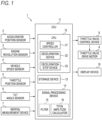
- Fig. 1 shows a travel control device 1 according to a first embodiment of the present invention.
- the travel control device 1 is a device that controls traveling of a straddle-type vehicle such as a motorcycle (hereinafter, referred to as the "vehicle"), and is provided in the vehicle.
- the vehicle in the present embodiment is provided with an engine (internal combustion engine) as a power source for traveling, and adopts an electronically controlled fuel injection system that electronically controls a fuel injection valve to control fuel injection, and adopts an electronically controlled throttle that electronically controls a throttle opening degree based on an accelerator opening degree and the like.
- an engine internal combustion engine
- the travel control device 1 includes an accelerator position sensor 2, an engine revolution sensor 3, a vehicle speed sensor 4, a throttle position sensor 5, a tilt angle sensor 6, an inertial measurement device 7, a throttle valve drive motor 8, a throttle valve control device 9, a display device 10, and an electronic control unit (ECU) 11.
- ECU electronice control unit
- the accelerator position sensor 2 is a sensor that detects an accelerator opening degree.
- the engine revolution sensor 3 is a sensor that detects an engine revolution speed.
- the vehicle speed sensor 4 is a sensor that detects a traveling speed of the vehicle.
- the throttle position sensor 5 is a sensor that detects a throttle opening degree.
- the tilt angle sensor 6 is a sensor that detects a tilt angle in a left-right direction of the vehicle with respect to a horizontal, that is, a bank angle.
- the inertial measurement device 7 is a device that detects a translational motion (acceleration) and a rotational motion (angular velocity) along each of three axes in a three-dimensional space.
- the inertial measurement device 7 includes an acceleration sensor that detects accelerations of the vehicle in a front-rear direction, the left-right direction, and an up-down direction, and a gyro or angular velocity sensor that detects angular velocities (yaw angular velocity, roll angular velocity, and pitch angular velocity) about axes in the front-rear direction, the left-right direction, and the up-down direction of the vehicle.
- the inertial measurement device 7 is used to detect wobble as described later, but the inertial measurement device 7 can also be used to detect the bank angle of the vehicle.
- the throttle valve drive motor 8 is a motor that drives a throttle valve.
- the throttle valve control device 9 is a device that controls the throttle valve drive motor 8.
- the display device 10 is a lamp or display provided on a meter of the vehicle.
- the ECU 11 is a device that electrically and electronically controls the vehicle, and includes a central processing unit (CPU) 12, a storage device 13, and a signal processing device 14.
- the CPU 12 functions as a speed controller 21, a deceleration device 22, and a deceleration stop device 23, which will be described later, by reading and executing a program stored in the storage device 13, for example.
- the storage device 13 is a storage device that stores programs, data, and the like.
- the signal processing device 14 includes a filter 15 and a total amplitude calculator 16.
- the filter 15 is, for example, a low-pass filter or band-pass filter formed by a digital circuit.
- the total amplitude calculator 16 is a circuit or device that calculates a total amplitude of an alternating current signal.
- the accelerator position sensor 2 is a specific example of an "accelerator opening degree detector"
- the vehicle speed sensor 4 is a specific example of the “vehicle speed detector”.
- the inertial measurement device 7 and the signal processing device 14 are specific examples of the "vibration detector”.
- the throttle valve drive motor 8 and the throttle valve control device 9 are specific examples of the "throttle valve drive device”.
- the ECU 11 is a specific example of the "control device”.
- the travel control device 1 has a function of quickly removing or reducing the wobble when the wobble occurs in the vehicle. In order to implement this function, the inertial measurement device 7 and the signal processing device 14 detect the wobble.
- the term "wobble” refers to a concept including a vibration in a weave phenomenon and a vibration in a wobble phenomenon.
- the vibration in the weave phenomenon is a vibration in a direction where yaw and roll are coupled, and this point is the same as the vibration in the wobble phenomenon.
- the wobble can be recognized by detecting a vibration in a yaw direction or roll direction of the vehicle.
- the wobble is recognized by detecting the vibration of the vehicle in the yaw direction.
- the inertial measurement device 7 detects periodic changes in the yaw angular velocity of the vehicle, that is, the vibration of the vehicle in the yaw direction, and outputs a detection signal indicating the vibration of the vehicle in the yaw direction to the signal processing device 14.
- the wobble is a vibration having a frequency of approximately 1 Hz to 10 Hz. That is, a frequency of the vibration in the weave phenomenon is approximately 1 Hz to 4 Hz, and the frequency of the vibration in the wobble phenomenon is approximately 5 Hz to 10 Hz, and thus, a frequency range of the wobble can be considered to be a range from 1 Hz, which is a lowest frequency of the vibration in the weave phenomenon, to 10 Hz, which is a highest frequency of the vibration in the wobble phenomenon.
- the filter 15 of the signal processing device 14 performs the extraction process. That is, the filter 15 of the signal processing device 14 extracts the vibration having a frequency within a reference frequency range from the detection signal output from the inertial measurement device 7.
- the reference frequency range is set to approximately 1 Hz to 10 Hz.
- the frequency of the wobble is approximately 1 Hz to 10 Hz, but strictly speaking, the frequency of the wobble is slightly different for each vehicle type or individual vehicle. Therefore, it is preferable to predict or measure the frequency of the wobble for each vehicle type or individual vehicle and adjust the reference frequency range accordingly for each vehicle type or individual vehicle.
- the wobble is a vibration having an amplitude that lowers a straight traveling stability of the vehicle.
- the travel control device 1 uses, as one of determination criteria for the occurrence of the wobble, a matter that the amplitude of the vibration (hereinafter, referred to as "detection target vibration") of the vehicle in the yaw direction with a frequency within the reference frequency range increases to an extent that the straight traveling stability of the vehicle is lowered.
- the deceleration device 22 of the travel control device 1 determines whether the number of times that a total amplitude of the detection target vibration continuously exceeds a control start reference total amplitude reaches a control start reference number of times.
- the total amplitude calculator 16 of the signal processing device 14 calculates the total amplitude of the detection target vibration. That is, the signal output from the inertial measurement device 7 and passing through the filter 15 is a signal indicating the detection target vibration. This signal is input from the filter 15 to the total amplitude calculator 16. The total amplitude calculator 16 calculates a total amplitude of the signal indicating the detection target vibration as the total amplitude of the detection target vibration.
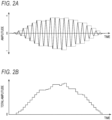
- Fig. 2A shows the signal output from the inertial measurement device 7 and passing through the filter 15, that is, the signal indicating the detection target vibration.
- Fig. 2B shows the signal output from the total amplitude calculator 16, that is, the signal indicating the total amplitude of the detection target vibration.
- the total amplitude calculator 16 detects a plus side peak of the signal indicating the detection target vibration, and stores a plus side peak value.
- the total amplitude calculator 16 updates memory of the plus side peak value each time the total amplitude calculator 16 detects the plus side peak.
- the total amplitude calculator 16 detects a minus side peak of the signal indicating the detection target vibration, and stores a minus side peak value.
- the total amplitude calculator 16 updates memory of the minus side peak value each time the total amplitude calculator 16 detects the minus side peak.
- Dashed lines in Fig. 2A show a locus of the plus side peak value which is stored and updated each time the plus side peak of the signal indicating the detection target vibration is detected and a locus of the minus side peak value which is stored and updated each time the minus side peak of the signal indicating the detection target vibration is detected.
- the total amplitude calculator 16 calculates a difference between the plus side peak value and the minus side peak value of the signal indicating the detection target vibration, that is, the total amplitude of the signal indicating the detection target vibration in each of a timing of updating the plus side peak value of the signal indicating the detection target vibration and a timing of updating the minus side peak value of the signal indicating the detection target vibration. For example, when the signal indicating the detection target vibration in Fig. 2A is input to the total amplitude calculator 16, the signal indicating the total amplitude of the detection target vibration in Fig. 2B is output from the total amplitude calculator 16.
- the travel control device 1 When the wobble occurs in the vehicle, the travel control device 1 performs the deceleration control to decelerate the traveling speed of the vehicle to remove or reduce the wobble. Before describing the deceleration control, a normal control on the traveling speed of the vehicle performed by the travel control device 1 will be described. Hereinafter, the normal control on the traveling speed of the vehicle performed by the travel control device 1 will be referred to as "normal speed control". The normal speed control is performed, while the vehicle is traveling and neither deceleration control nor speed recovery control is being performed.
- the normal speed control is performed by the speed controller 21 of the travel control device 1.
- the speed controller 21 sets a target unlimited opening degree corresponding to the accelerator opening degree detected by the accelerator position sensor 2 as a target throttle opening degree.
- the target unlimited opening degree is basically determined by the accelerator opening degree and the engine revolution speed.
- the storage device 13 stores a throttle opening degree control map that describes a correspondence between the accelerator opening degree, the engine revolution speed, and the throttle opening degree.
- the speed controller 21 uses the accelerator opening degree detected by the accelerator position sensor 2, the engine revolution speed detected by the engine revolution sensor 3, and the throttle opening degree control map to determine the target unlimited opening degree, and sets the determined target unlimited opening degree as the target throttle opening degree.
- the target throttle opening degree is output from the ECU 11 to the throttle valve control device 9.
- the throttle valve control device 9 controls the throttle valve drive motor 8 to drive the throttle valve such that the throttle opening degree coincides with the target throttle opening degree output from the ECU 11. Accordingly, while the normal speed control is being performed, the throttle opening degree changes to follow the accelerator opening degree, and as a result, the traveling speed of the vehicle changes to follow the accelerator opening degree.
- the travel control device 1 When the wobble occurs in the vehicle, the travel control device 1 performs the deceleration control to decelerate the traveling speed of the vehicle to remove or reduce the wobble.
- the deceleration control is performed by the deceleration device 22 of the travel control device 1.
- the deceleration device 22 determines whether the traveling speed of the vehicle detected by the vehicle speed sensor 4 exceeds a control start reference speed. The deceleration device 22 determines whether the number of times that the total amplitude of the detection target vibration detected by the inertial measurement device 7 and the signal processing device 14 continuously exceeds the control start reference total amplitude reaches the control start reference number of times. The deceleration device 22 determines whether an absolute value of the bank angle of the vehicle detected by the tilt angle sensor 6 or the inertial measurement device 7 is equal to or less than a reference bank angle.
- the deceleration device 22 performs the deceleration control if the traveling speed of the vehicle exceeds the control start reference speed, the number of times that the total amplitude of the detection target vibration continuously exceeds the control start reference total amplitude reaches the control start reference number of times, and the absolute value of the bank angle of the vehicle is equal to or less than the reference bank angle.
- the control start reference speed is set in consideration of a lower limit of the traveling speed at which the wobble may occur in a straddle-type vehicle.
- the wobble differs depending on a size or specific structure of the straddle-type vehicle, but in many straddle-type vehicles, the wobble occurs when the traveling speed exceeds 100 km/h to 130 km/h.
- the control start reference speed is set in consideration of distinguishing the wobble from other vibrations that occur when the straddle-type vehicle travels, such as vibrations due to a low-speed shimmy phenomenon.
- the low-speed shimmy phenomenon varies depending on the size or type of the straddle-type vehicle, but generally occurs in a low-speed region where the traveling speed of the straddle-type vehicle is 30 km/h or more and less than 100 km/h.
- the control start reference speed predicts or measures a lower limit of the traveling speed at which the wobble is likely to occur for each vehicle type or individual vehicle and may be set to a different value for each vehicle type or individual vehicle. In the present embodiment, the control start reference speed is set to 120 km/h, for example.
- control start reference total amplitude is preferably set to a value corresponding to the total amplitude of the detection target vibration at an initial stage when the wobble occurs in the vehicle.
- control start reference total amplitude is preferably set to a value corresponding to the total amplitude of the detection target vibration when the yaw angular velocity of the vehicle is, for example, 0.26 rad/s to 0.33 rad/s.
- the control start reference total amplitude may also be set to a different value for each vehicle type or individual vehicle.
- the control start reference total amplitude is set to a value corresponding to the total amplitude of the detection target vibration when the yaw angular velocity of the vehicle is 0.29 rad/s, for example.
- the control start reference number of times is set in consideration of distinguishing between the wobble that is the continuous vibration and the single impact applied to a vehicle or a vibration that instantly converges after occurrence, such as impact or vibration due to a sudden steering operation, or impact or vibration due to kickback. It is preferable to set the control start reference number of times to about 3 to 5 times.
- the control start reference number of times may also be set to a different value for each vehicle type or individual vehicle. In the present embodiment, the control start reference number of times is set to 4 times, for example.
- the reference bank angle is set, for example, to a lower limit of the absolute value of the bank angle of the vehicle when the vehicle is turning, in order to recognize that the vehicle is turning.
- the deceleration control is not performed when the vehicle is turning.
- the deceleration device 22 performs control to gradually decrease an opening degree value set as the target throttle opening degree from the throttle opening degree when the vehicle speed exceeds the control start reference speed to a target limited opening degree for setting the traveling speed of the vehicle to the target limited speed.
- the target limited speed is set to a target limited speed initial value at the start of the deceleration control, but may be changed during execution of the deceleration control.
- the change in the target limited speed will be described later, and the target limited speed initial value will be described here.
- the target limited speed initial value is set to a speed at which the wobble occurring in the straddle-type vehicle can be definitely removed, or the wobble occurring in the straddle-type vehicle can be definitely reduced to the extent that the straight traveling stability of the vehicle is not lowered.
- the speed at which the wobble occurring in the vehicle can be definitely removed, or the wobble occurring in the vehicle can be definitely reduced to the extent that the straight traveling stability of the vehicle is not lowered may vary for each vehicle type or individual vehicle.
- the target limited speed initial value set for the vehicle is preferably set to a value equal to or less than the control start reference speed set for the vehicle, and more preferably set to a value less than the control start reference speed set for the vehicle.
- the target limited speed initial value is set to 100 km/h.
- the target limited speed initial value is stored in the storage device 13. Details of the deceleration control, such as a method of determining the target limited opening degree, will be described later.
- the throttle valve control device 9 also controls the throttle valve drive motor 8 to drive the throttle valve such that the throttle opening degree coincides with the target throttle opening degree output from the ECU 11 as during the normal speed control.
- the deceleration device 22 since the deceleration device 22 gradually decreases the opening degree value set as the target throttle opening degree from the throttle opening degree when the vehicle speed exceeds the control start reference speed toward the target limited opening degree, even if the accelerator opening degree increases due to an accelerator operation by the driver of the vehicle, the throttle opening degree gradually decreases regardless of the increase in the accelerator opening degree. As a result, the traveling speed of the vehicle gradually decreases.
- K1, K2, K3, K4, K5, and K6 in Fig. 3 respectively show the total amplitude of the detection target vibration, the traveling speed, the target limited speed, the absolute value of the bank angle, the target unlimited opening degree corresponding to the accelerator opening degree, and the target throttle opening degree in a period during which the deceleration control is started, then the deceleration control is stopped, and then the speed recovery control is performed.
- Fig. 3 shows the total amplitude of the detection target vibration, the traveling speed, the target limited speed, the absolute value of the bank angle, the target unlimited opening degree corresponding to the accelerator opening degree, and the target throttle opening degree in a period during which the deceleration control is started, then the deceleration control is stopped, and then the speed recovery control is performed.
- the traveling speed K2 exceeds a control start reference speed C
- the number of times that the total amplitude of the detection target vibration K 1 continuously exceeds a control start reference total amplitude A reaches 4 times which is the control start reference number of times
- the absolute value of the bank angle K4 is equal to or less than a reference bank angle F.
- the deceleration control is started by the deceleration device 22 and the control of the traveling speed is shifted from the normal speed control to the deceleration control.
- the target throttle opening degree K6 gradually decreases toward a target limited opening degree G for setting the traveling speed as the target limited speed by the deceleration control.
- the target unlimited opening degree K5 corresponding to the accelerator opening degree is decreased by the accelerator operation by the driver of the vehicle, but a degree of decrease is much smaller than a degree of decrease in the target throttle opening degree K6. That is, from the time t1 to the time t3, the target throttle opening degree changes due to the deceleration control, and the target throttle opening degree during this period does not follow the accelerator opening degree. As a result of the deceleration control, the traveling speed K2 decreases from the time t1 to the time t3.
- the deceleration stop device 23 of the travel control device 1 stops the deceleration control if the traveling speed of the vehicle detected by the vehicle speed sensor 4 becomes equal to or less than the target limited speed after the deceleration control is started by the deceleration device 22.
- the target limited speed initial value is set as the target limited speed.
- the deceleration stop device 23 determines whether the number of times that the total amplitude of the detection target vibration continuously becomes equal to or less than a control stop reference total amplitude exceeds a control stop reference number of times. Before the traveling speed of the vehicle becomes equal to or less than the target limited speed (target limited speed initial value), if the number of times that the total amplitude of the detection target vibration continuously becomes equal to or less than the control stop reference total amplitude exceeds the control stop reference number of times, a speed that is less than the traveling speed of the vehicle at that time by a predetermined allowance set amount is calculated as a target limited speed candidate value.
- the deceleration stop device 23 changes a setting of the target limited speed from the target limited speed initial value to the target limited speed candidate value if the target limited speed candidate value is greater than the target limited speed initial value, and maintains a state where the target limited speed initial value is set as the target limited speed if the target limited speed candidate value is equal to or less than the target limited speed initial value.
- An object of changing the setting of the target limited speed from the target limited speed initial value to the target limited speed candidate value if the target limited speed candidate value is greater than the target limited speed initial value is to prevent inconvenience that before the traveling speed of the vehicle reaches the target limited speed initial value, when the wobble occurring in the vehicle disappears, or when the wobble occurring in the vehicle decreases to the extent that the straight traveling stability of the vehicle is not lowered, by stopping the deceleration control without waiting for the traveling speed of the vehicle to reach the target limited speed initial value, the deceleration control continues even though the wobble occurring in the vehicle is removed or sufficiently reduced.
- control stop reference total amplitude is set to a value corresponding to the total amplitude of the detection target vibration at which the wobble is considered to disappear or to decrease to the extent that the wobble does not lower the straight traveling stability of the vehicle.
- the control stop reference total amplitude is set to a value less than the control start reference total amplitude.
- the control stop reference total amplitude is preferably set to a value corresponding to the total amplitude of the detection target vibration when the yaw angular velocity of the vehicle is, for example, 0.18 rad/s to 0.25 rad/s.
- the control stop reference total amplitude may also be set to a different value for each vehicle type or individual vehicle.
- the control stop reference total amplitude is set to a value corresponding to the total amplitude of the detection target vibration when the yaw angular velocity of the vehicle is 0.22 rad/s, for example.
- the traveling speed of the vehicle at the time when the total amplitude of the detection target vibration becomes equal to or less than the control stop reference total amplitude after the deceleration control is started is used to calculate the target limited speed candidate value, and an object of this operation is to use, to calculate the target limited speed candidate value, the traveling speed of the vehicle when the wobble definitely disappears or definitely decreases to the extent that the wobble does not lower the straight traveling stability of the vehicle.
- the traveling speed of the vehicle when the wobble is momentarily canceled in this way is used to calculate the target limited speed candidate value, there is a possibility that the deceleration control is stopped before the wobble is removed or reduced by the deceleration control.
- the traveling speed of the vehicle at the time when the number of times that the total amplitude of the detection target vibration continuously becomes equal to or less than the control stop reference total amplitude exceeds the control stop reference number of times is used to calculate the target limited speed candidate value.
- control stop reference number of times it is preferable to set the control stop reference number of times to the number of times capable of guaranteeing that the wobble definitely disappears, or that the wobble definitely decreases to the extent that the wobble does not lower the straight traveling stability of the vehicle, specifically about 2 to 5 times.
- the control stop reference number of times is set to 3 times, for example.
- the speed that is less than the traveling speed of the vehicle by the predetermined allowance set amount at the time when the number of times that the total amplitude of the detection target vibration continuously becomes equal to or less than the control stop reference total amplitude exceeds the control stop reference number of times after the deceleration control is started is calculated as the target limited speed candidate value, and an object of this operation is to stop the deceleration control after the wobble definitely disappears, or after the wobble definitely decreases to the extent that the straight traveling stability of the vehicle is not lowered.
- the wobble disappears once at a certain traveling speed, but then occurs again when the v speed decreases slightly. Therefore, if the traveling speed of the vehicle at the time when the number of times that the total amplitude of the detection target vibration continuously becomes equal to or less than the control stop reference total amplitude exceeds the control stop reference number of times is calculated as the target limited speed candidate value, and the target limited speed candidate value is set as the target limited speed, the wobble may occur again immediately after the deceleration control is stopped.
- the speed that is less than the traveling speed of the vehicle by a predetermined allowance set amount at the time when the number of times that the total amplitude of the detection target vibration continuously becomes equal to or less than the control stop reference total amplitude exceeds the control stop reference number of times is calculated as the target limited speed candidate value.
- the allowance set amount is an allowance value for setting the target limited speed candidate value to a speed at which the once-disappearing wobble will not occur again, specifically, 3 km/h to 10 km/h.
- the allowance set amount is set to 5 km/h.
- a reason for maintaining the state where the target limited speed initial value is set as the target limited speed if the target limited speed candidate value is equal to or less than the target limited speed initial value is that if the target limited speed candidate value becomes equal to or less than the target limited speed initial value, compared to a case of changing the setting of the target limited speed from the target limited speed initial value to the target limited speed candidate value, the deceleration control can be stopped more early while the wobble occurring in the vehicle is definitely removed or reduced in the case of maintaining the state where the target limited speed initial value is set as the target limited speed.
- the speed that is less than the traveling speed K2 of the vehicle at the time t2 by the predetermined allowance set amount is calculated as a target limited speed candidate value E, and the target limited speed candidate value E is greater than the target limited speed initial value D, and thus, the setting of the target limited speed K3 is changed from the target limited speed initial value D to the target limited speed candidate value E.
- the traveling speed K2 reaches the target limited speed K3 changed to the target limited speed candidate value E, and thus, at the time t3, the deceleration control is stopped even though the traveling speed K2 of the vehicle is higher than the target limited speed initial value D.
- the deceleration stop device 23 returns the target limited speed from the target limited speed candidate value to the target limited speed initial value immediately after stopping the deceleration control. This is a reason why the target limited speed K3 returns from the target limited speed candidate value E to the target limited speed initial value D immediately after the deceleration control is stopped at the time t3 in Fig. 3 .
- the deceleration stop device 23 performs the speed recovery control to gradually increase the opening degree value set as the target throttle opening degree from the throttle opening degree at the time when the deceleration control is stopped to the target unlimited opening degree corresponding to the accelerator opening degree at the time when the deceleration control is stopped.
- the throttle valve control device 9 also controls the throttle valve drive motor 8 to drive the throttle valve such that the throttle opening degree coincides with the target throttle opening degree output from the ECU 11 as during the normal speed control. Accordingly, during the speed recovery control, even if the driver of the vehicle maintains a constant accelerator opening degree, the throttle opening degree gradually increases and the traveling speed of the vehicle gradually increases.
- the target unlimited opening degree K5 corresponding to the accelerator opening degree at the time t3 is greater than the target throttle opening degree K6 at the time t3. Since the throttle opening degree follows the target throttle opening degree under the control of the throttle valve control device 9, the target throttle opening degree K6 at the time t3 can be identified with the throttle opening degree at the time t3. Then, the target unlimited opening degree K5 corresponding to the accelerator opening degree at the time t3 is greater than the throttle opening degree. Therefore, the speed recovery control is started at the time t3. Due to the speed recovery control, the target throttle opening degree K6 gradually increases from the time t3, and along therewith, the traveling speed K2 gradually increases from the time t3.
- the target throttle opening degree K6 After the target throttle opening degree K6 is gradually increased by the speed recovery control, at a time t4, the target throttle opening degree K6 matches the target unlimited opening degree K5 corresponding to the accelerator opening degree. At the time t4, the speed recovery control is stopped, and the traveling speed control is shifted from the speed recovery control to the normal speed control.
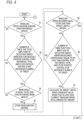
- Fig. 4 shows a specific flow of a process in the travel control device 1.
- the deceleration device 22 determines whether the traveling speed of the vehicle detected by the vehicle speed sensor 4 exceeds the control start reference speed (step S1).
- step S 1 If the traveling speed of the vehicle detected by the vehicle speed sensor 4 exceeds the control start reference speed (step S 1: YES), the deceleration device 22 determines whether the number of times that the total amplitude of the detection target vibration detected by the inertial measurement device 7 and the signal processing device 14 continuously exceeds the control start reference total amplitude reaches the control start reference number of times (step S2).
- step S2 If the number of times that the total amplitude of the detection target vibration detected by the inertial measurement device 7 and the signal processing device 14 continuously exceeds the control start reference total amplitude reaches the control start reference number of times (step S2: YES), the deceleration device 22 determines whether the absolute value of the bank angle of the vehicle detected by the tilt angle sensor 6 or the inertial measurement device 7 is equal to or less than the reference bank angle (step S3).
- step S4 If the absolute value of the bank angle of the vehicle detected by the tilt angle sensor 6 or the inertial measurement device 7 is equal to or less than the reference bank angle (step S3: YES), the speed controller 21 starts the deceleration control (step S4).
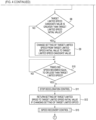
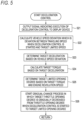
- Fig. 5 shows a flow of a process at the start of the deceleration control performed in step S4.
- the deceleration device 22 outputs the signal indicating the execution of the deceleration control to the display device 10 to notify the driver of the vehicle that the deceleration control is being executed (step S21). For example, if the display device 10 is a lamp provided on a meter of the vehicle, the lamp lights or blinks based on the signal indicating the execution of the deceleration control.
- the display device 10 is a display provided on the meter of the vehicle, a mark, an icon, an image, a character string, or the like indicating the execution of the deceleration control is displayed on the display based on the signal indicating the execution of the deceleration control.
- the deceleration device 22 calculates a vehicle speed deviation, which is a deviation between the traveling speed of the vehicle detected by the vehicle speed sensor 4 when the deceleration control is started and the target limited speed (step S22).
- the target limited speed is set to the target limited speed initial value. Therefore, the vehicle speed deviation is the deviation between the traveling speed of the vehicle when the deceleration control is started and the target limited speed initial value.
- the deceleration device 22 determines a target deceleration for reducing the traveling speed of the vehicle by the vehicle speed deviation based on the vehicle speed deviation (step S23).
- the storage device 13 stores a lookup table describing a correspondence between the vehicle speed deviation and the target deceleration.
- the deceleration device 22 determines the target deceleration using the vehicle speed deviation calculated in step S22 and the above lookup table.
- the deceleration device 22 calculates a target torque which is a target value of a torque of a crankshaft for reducing, by engine braking, the traveling speed of the vehicle by the vehicle speed deviation (step S24). For example, the deceleration device 22 calculates a target load from the target deceleration determined in step S23, a vehicle weight, a traveling resistance estimated value, and the like, and calculates the target torque from the calculated target load, a tire diameter, a reduction ratio of a power transmission mechanism of the vehicle, and the like.
- the deceleration device 22 determines the target limited opening degree based on the target torque calculated in step S24 and the engine revolution speed detected by the engine revolution sensor 3 when the deceleration control is started (step S25).
- the storage device 13 stores an engine control map that describes a correspondence between the throttle opening degree, the engine revolution speed, and the torque of the crankshaft.
- the deceleration device 22 determines the target limited opening degree using the target torque calculated in step S24, the detected engine revolution speed, and the engine control map.
- the deceleration device 22 starts a gradual-change process in which the target throttle opening degree is gradually decreased from the throttle opening degree detected by the throttle position sensor 5 when the deceleration control is started to the target limited opening degree (step S26).
- step S1 if the traveling speed of the vehicle detected by the vehicle speed sensor 4 does not exceed the control start reference speed (step S1: NO), if the number of times that the total amplitude of the detection target vibration detected by the inertial measurement device 7 and the signal processing device 14 continuously exceeds the control start reference total amplitude does not reach the control start reference number of times (step S2: NO), or if the absolute value of the bank angle of the vehicle detected by the tilt angle sensor 6 or the inertial measurement device 7 is not equal to or less than the reference bank angle (step S3: NO), the deceleration control is not started, and the process returns to step S1.
- the deceleration stop device 23 determines whether the traveling speed of the vehicle detected by the vehicle speed sensor 4 at current becomes equal to or less than the target limited speed (step S5).
- step S6 determines whether the traveling speed of the vehicle detected by the vehicle speed sensor 4 is not equal to or less than the target limited speed (step S5: NO). If the traveling speed of the vehicle detected by the vehicle speed sensor 4 is not equal to or less than the target limited speed (step S5: NO), then the deceleration stop device 23 determines whether the number of times that the amplitude of the detection target vibration becomes continuously equal to or less than the control stop reference total amplitude exceeds the control stop reference number of times (step S6).
- step S6 NO
- the process returns to step S5.
- the deceleration stop device 23 repeats the determinations of steps S5 and S6 until the traveling speed of the vehicle becomes equal to or less than the target limited speed, or the amplitude of the detection target vibration continuously becomes equal to or less than the control stop reference total amplitude.
- the gradual-change process see step S26 in Fig. 5 ) in the deceleration control proceeds.
- the target throttle opening degree gradually decreases toward the target limited opening degree, and accordingly, the throttle opening degree gradually decreases toward the target limited opening degree, and along therewith, the traveling speed of the vehicle gradually decreases toward the target limited speed.
- step S6 the deceleration stop device 23 calculates, as the target limited speed candidate value, the speed that is less than the traveling speed of the vehicle detected by the vehicle speed sensor 4 at current by the allowance set amount (step S7).
- the deceleration stop device 23 determines whether the target limited speed candidate value calculated in step S7 is greater than the target limited speed initial value (step S8).
- step S7 If the target limited speed candidate value calculated in step S7 is greater than the target limited speed initial value (step S8: YES), the deceleration stop device 23 changes the setting of the target limited speed from the target limited speed initial value to the target limited speed candidate value (step S9).
- step S8: NO the target limited speed initial value calculated in step S7 is equal to or less than the target limited speed initial value (step S8: NO)
- step S8: NO the deceleration stop device 23 does not perform the process of changing the setting of the target limited speed from the target limited speed initial value to the target limited speed candidate value. As a result, the state where the target limited speed initial value is set as the target limited speed is maintained.
- the deceleration stop device 23 determines whether the traveling speed of the vehicle detected by the vehicle speed sensor 4 at current becomes equal to or less than the target limited speed (step S10).
- step S10 If the traveling speed of the vehicle detected by the vehicle speed sensor 4 is not equal to or less than the target limited speed (step S10: NO), the deceleration stop device 23 repeats the determination of step S10 until the traveling speed of the vehicle becomes equal to or less than the target limited speed. During this time, the gradual-change process (see step S26 in Fig. 5 ) in the deceleration control proceeds. As a result, the target throttle opening degree gradually decreases toward the target limited opening degree, and accordingly, the throttle opening degree gradually decreases toward the target limited opening degree, and along therewith, the traveling speed of the vehicle gradually decreases.
- step S10 If the traveling speed of the vehicle detected by the vehicle speed sensor 4 becomes equal to or less than the target limited speed (step S10: YES), the deceleration stop device 23 stops the deceleration control (S 11). Specifically, the deceleration stop device 23 stops the gradual-change process in step S26 in Fig. 5 .
- the deceleration stop device 23 also stops the deceleration control.
- the case where the traveling speed of the vehicle detected by the vehicle speed sensor 4 becomes equal to or less than the target limited speed in step S5 is a case where the traveling speed of the vehicle becomes equal to or less than the target limited speed initial value before the number of times that the amplitude of the detection target vibration continuously becomes equal to or less than the control stop reference total amplitude exceeds the control stop reference number of times.
- the target limited speed initial value is set to a speed at which the wobble occurring in the straddle-type vehicle can be definitely removed, or the wobble occurring in the straddle-type vehicle can be definitely reduced to the extent that the straight traveling stability of the vehicle is not lowered
- the control stop reference total amplitude is set to a value corresponding to the total amplitude of the detection target vibration at which the wobble is considered to disappear or to decrease to the extent that the wobble does not lower the straight traveling stability of the vehicle. Therefore, it is difficult for the traveling speed of the vehicle to become equal to or less than the target limited speed initial value before the number of times that the amplitude of the detection target vibration continuously becomes equal to or less than the control stop reference total amplitude exceeds the control stop reference number of times.
- the vehicle decelerates within a short period of time, such as by applying the wheel brakes by the driver of the vehicle. That is, since the frequency of the wobble is low, a wobble period is long (for example, if the frequency of the wobble is 1 Hz, the wobble period is 1 second). Therefore, for example, when the driver of the vehicle applies the wheel brake immediately after the start of the deceleration control, before the number of times that the amplitude of the detection target vibration continuously becomes equal to or less than the control stop reference total amplitude exceeds the control stop reference number of times, the traveling speed of the vehicle may become equal to or less than the target limited speed initial value.
- the wobble disappears or decreases to the extent that straight traveling performance of the vehicle is not lowered when the traveling speed of the vehicle becomes equal to or less than the target limited speed initial value.
- the vehicle shakes due to, for example, undulations on a road, and a frequency of the shaking accidentally coincides with the frequency of the wobble.
- the traveling speed of the vehicle may become equal to or less than the target limited speed initial value.
- step S9 If the deceleration stop device 23 executes the process of changing the setting of the target limited speed from the target limited speed initial value to the target limited speed candidate value (step S9), immediately after the deceleration control is stopped, the setting of the target limited speed is returned from the target limited speed candidate value to the target limited speed initial value (step S12).
- the deceleration stop device 23 performs the speed recovery control (step S13).
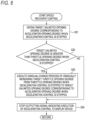
- Fig. 6 shows a flow of the speed recovery control performed in step S 13.
- the deceleration stop device 23 obtains the target unlimited opening degree corresponding to the accelerator opening degree detected by the accelerator position sensor 2 when the deceleration control is stopped (step S31).
- the deceleration stop device 23 determines whether the target unlimited opening degree obtained in step S31 is greater than the throttle opening degree detected by the throttle position sensor 5 when the deceleration control is stopped (step S32).
- step S31 If the target unlimited opening degree obtained in step S31 is greater than the throttle opening degree detected by the throttle position sensor 5 when the deceleration control is stopped (step S32: YES), the deceleration stop device 23 executes a gradual-change process of gradually increasing the target throttle opening degree from the throttle opening degree when the deceleration control is stopped to the target unlimited opening degree corresponding to the accelerator opening degree when the deceleration control is stopped (step S33). As a result of the gradual-change process, the throttle opening degree gradually increases toward the target unlimited opening degree corresponding to the accelerator opening degree when the deceleration control is stopped, and the traveling speed of the vehicle gradually increases accordingly.
- step S32 NO
- the deceleration stop device 23 does not perform the gradual-change process in step S33.
- step S33 After the gradual-change process in step S33 ends, or after it is determined in step S32 that the gradual-change process in step S33 is not performed, the deceleration stop device 23 stops outputting the signal indicating the execution of the deceleration control to the display device 10 (step S34). Accordingly, the lamp indicating the execution of the deceleration control is turned off, or the mark or the like indicating the execution of the deceleration control disappears from the display.
- step S1 in Fig. 4 the control on the traveling speed of the vehicle shifts to the normal speed control.
- the travel control device 1 performs the deceleration control to decelerate the traveling speed of the vehicle. Accordingly, the wobble can be prevented, and lowering in the straight traveling stability of the vehicle can be prevented when the vehicle is traveling at medium to high speed of approximately 100 km/h or more, for example.
- the travel control device 1 can prevent the wobble by decelerating the traveling speed of the vehicle, and thus, it is not necessary to add a mechanical device or structure to the vehicle, such as mounting a caster angle variable device on the vehicle, in order to prevent the wobble. Therefore, an increase in a size or weight of the straddle-type vehicle is avoided and the wobble can be prevented.
- three conditions are that the traveling speed of the vehicle exceeds the control start reference speed, the number of times that the total amplitude of the detection target vibration continuously exceeds the control start reference total amplitude reaches the control start reference number of times, and the bank angle of the vehicle is equal to or less than the reference bank angle, and if the three conditions are satisfied, it is recognized that the wobble occurs in the vehicle, and the deceleration control is performed. Accordingly, it is possible to recognize with high accuracy that the wobble occurs in the vehicle, and it is possible to appropriately perform the deceleration control.
- the travel control device 1 stops the deceleration control if the traveling speed of the vehicle becomes equal to or less than the target limited speed after the deceleration control is started.
- the target limited speed initial value which is a predetermined speed equal to or less than the control start reference speed
- the travel control device 1 calculates, as the target limited speed candidate value, the speed that is less than the traveling speed of the vehicle by the predetermined amount at the time when the number of times that the total amplitude of the detection target vibration continuously becomes equal to or less than the control stop reference total amplitude reaches the control stop reference number of times, changes the setting of the target limited speed from the target limited speed initial value to the target limited speed candidate value if the target limited speed candidate value is greater than the target limited speed initial value, and maintains the state where the target limited speed initial value is set as the target limited speed if the target limited speed candidate value is equal to or less than the target limited speed initial value
- the deceleration control can be quickly stopped when the wobble occurring in the vehicle disappears or decreases to the extent that the straight traveling stability of the vehicle is not lowered. Accordingly, by continuing the deceleration control even though the wobble disappears, or the wobble decreases to the extent that the straight traveling stability of the vehicle is not lowered, it is possible to prevent the vehicle from unnecessarily decelerating, and to prevent the driver of the vehicle from wasting an opportunity to accelerate the vehicle by operating the accelerator.
- the travel control device 1 uses the traveling speed of the vehicle at the time when the number of times that the total amplitude of the detection target vibration continuously becomes equal to or less than the control stop reference total amplitude exceeds the control stop reference number of times to calculate the target limited speed candidate value. Accordingly, the traveling speed of the vehicle when the wobble definitely disappears or definitely decreases to the extent that the wobble does not lower the straight traveling stability of the vehicle can be used to calculate the target limited speed candidate value.
- the deceleration control stops before the wobble is removed or sufficiently reduced by the deceleration control. According to the present embodiment, the above matter can be prevented.
- the travel control device 1 calculates, as the target limited speed candidate value, the speed that is less than the traveling speed of the vehicle by the allowance set amount at the time when the number of times that the total amplitude of the detection target vibration continuously becomes equal to or less than the control stop reference total amplitude exceeds the control stop reference number of times. Accordingly, it is possible to prevent the deceleration control from stopping before the wobble disappears or before the wobble decreases to the extent that the straight traveling stability of the vehicle is not lowered.
- the travel control device 1 performs the speed recovery control to gradually increase the opening degree value set as the target throttle opening degree from the throttle opening degree at the time when the deceleration control is stopped to the target unlimited opening degree corresponding to the accelerator opening degree at the time when the deceleration control is stopped. Accordingly, even if the throttle opening degree becomes significantly less than the target unlimited opening degree corresponding to the accelerator opening degree due to the deceleration control, it is possible to prevent the sudden acceleration of the vehicle when the deceleration control is stopped.
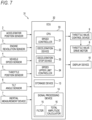
- Fig. 7 shows a travel control device 31 according to a second embodiment of the present invention.
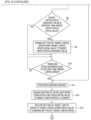
- Fig. 8 shows a flow of a process in the travel control device 31.
- constituent elements of the travel control device 31 according to the second embodiment shown in Fig. 7 the constituent elements that are the same as the constituent elements of the travel control device 1 according to the first embodiment are denoted by the same reference numerals as those of the constituent elements of the travel control device 1 according to the first embodiment shown in Fig. 1 , and descriptions thereof are omitted.
- the travel control device 31 includes a speed upper limit controller 34. That is, a CPU 33 included in an ECU 32 of the travel control device 31 functions as the speed upper limit controller 34 by reading and executing a program stored in the storage device 13, for example.
- the speed upper limit controller 34 limits the traveling speed of the vehicle to an upper limit speed or less. That is, the speed upper limit controller 34 is a speed limiter in the vehicle.
- a predetermined upper limit speed initial value is set as the upper limit speed before the deceleration control is performed for a first time in the vehicle.
- a deceleration stop device 35 in the travel control device 31 changes a setting of the upper limit speed from the upper limit speed initial value to the target limited speed (step S41 in Fig. 8 ). Accordingly, after the deceleration control is performed, the upper limit speed becomes the target limited speed. Specifically, in the process of the travel control device 31, if step S9 is not executed and the state where the target limited speed initial value is set as the target limited speed is maintained, the upper limit speed becomes the target limited speed initial value.
- step S9 In the process of the travel control device 31, if step S9 is executed and the setting of the target limited speed is changed from the target limited speed initial value to the target limited speed candidate value is maintained, the upper limit speed becomes the target limited speed candidate value.
- the deceleration stop device 35 does not perform the speed recovery control.
- the speed upper limit controller 34 limits the traveling speed of the vehicle to the target limited speed initial value or less or to the target limited speed candidate value or less. Accordingly, the wobble will not occur in the vehicle in the future. However, since the traveling speed of the vehicle is limited to the target limited speed initial value or the target limited speed candidate value or less, it is conceivable that the driver of the vehicle may feel inconvenient in driving the vehicle.
- the upper limit speed becomes the target limited speed initial value or the target limited speed candidate value
- the vehicle is inspected in a short period of time to find out the cause of the wobble, and it is desirable to repair the vehicle to eliminate the cause. For example, when an inspector or repairer of the vehicle resets or initializes the ECU 11, the upper limit speed returns to the upper limit speed initial value.
- the deceleration stop device 35 does not stop outputting the signal indicating the execution of the deceleration control to the display device 10 after the deceleration control is stopped. Accordingly, the state where the lamp indicating the execution of the deceleration control is lit or blinking, or a state where a mark indicating the execution of the deceleration control is displayed in the display continues, and thus, the driver of the vehicle can know that the traveling speed of the vehicle is limited to the target limited speed initial value or less or the target limited speed candidate value or less (upper limit speed of the vehicle less than normal).
- the deceleration stop device 23 calculates, as the target limited speed candidate value, the speed that is less than the traveling speed of the vehicle by the predetermined amount at the time when the number of times that the total amplitude of the detection target vibration continuously becomes equal to or less than the control stop reference total amplitude reaches the control stop reference number of times, but the present invention does not limited thereto.
- the speed that is less than the traveling speed of the vehicle by the predetermined amount at the time when the total amplitude of the detection target vibration becomes equal to or less than the control stop reference total amplitude may be calculated as the target limited speed candidate value.
- the deceleration stop device 23 if the setting of the target limited speed is changed from the target limited speed initial value to the target limited speed candidate value, the deceleration stop device 23 returns the setting of the target limited speed to the target limited speed initial value after the deceleration control is stopped, but if the setting of the target limited speed is changed from the target limited speed initial value to the target limited speed candidate value, the deceleration stop device 23 may not return the setting of the target limited speed to the target limited speed initial value after the deceleration control is stopped.
- the setting of the target limited speed may always be the target limited speed initial value.
- the deceleration device 22 performs the deceleration control if the traveling speed of the vehicle exceeds the control start reference speed and the number of times that the total amplitude of the detection target vibration exceeds the control start reference total amplitude continuously reaches the control start reference number of times, and may not perform the deceleration control if the traveling speed of the vehicle exceeds the control start reference speed and the total amplitude of the detection target vibration exceeds the control start reference total amplitude.
- condition that the bank angle of the vehicle is equal to or less than the reference bank angle may be removed from the conditions for the deceleration device 22 to perform the deceleration control.
- a condition that the vehicle is accelerating may be added to the conditions for the deceleration device 22 to perform the deceleration control.
- the wobble is detected based on the vibration of the vehicle in the yaw direction, but the present invention is not limited thereto, and the wobble may be detected based on a vibration of the vehicle in the roll direction, or vibrations in the yaw direction and roll direction.
- the deceleration control or speed recovery control if the driver of the vehicle decelerates the vehicle significantly, the deceleration control or speed recovery control may be stopped immediately. It is possible to recognize that the driver of the vehicle operates the accelerator to significantly decelerate the vehicle, for example, by detecting the accelerator opening degree with the accelerator position sensor 2.
- the present invention can also be applied to a straddle-type vehicle other than motorcycles.
- the present invention can also be applied to a straddle-type vehicle having a power source other than an engine (internal combustion engine) as a power source for traveling.
- the present invention can be appropriately changed without departing from the gist or concept of the invention which can be read from the claims and the entire description, and a travel control device accompanied with such a change is also included in the technical concept of the present invention.
Landscapes
- Engineering & Computer Science (AREA)
- Mechanical Engineering (AREA)
- Transportation (AREA)
- Chemical & Material Sciences (AREA)
- Combustion & Propulsion (AREA)
- Automation & Control Theory (AREA)
- Control Of Vehicle Engines Or Engines For Specific Uses (AREA)
- Control Of Driving Devices And Active Controlling Of Vehicle (AREA)
- Control Of Throttle Valves Provided In The Intake System Or In The Exhaust System (AREA)
Applications Claiming Priority (1)
| Application Number | Priority Date | Filing Date | Title |
|---|---|---|---|
| JP2022131996A JP2024029632A (ja) | 2022-08-22 | 2022-08-22 | 走行制御装置 |
Publications (1)
| Publication Number | Publication Date |
|---|---|
| EP4331925A1 true EP4331925A1 (de) | 2024-03-06 |
Family
ID=87762714
Family Applications (1)
| Application Number | Title | Priority Date | Filing Date |
|---|---|---|---|
| EP23191969.7A Pending EP4331925A1 (de) | 2022-08-22 | 2023-08-17 | Fahrsteuerungsvorrichtung |
Country Status (3)
| Country | Link |
|---|---|
| US (1) | US12491764B2 (de) |
| EP (1) | EP4331925A1 (de) |
| JP (1) | JP2024029632A (de) |
Families Citing this family (1)
| Publication number | Priority date | Publication date | Assignee | Title |
|---|---|---|---|---|
| JP2024029632A (ja) * | 2022-08-22 | 2024-03-06 | スズキ株式会社 | 走行制御装置 |
Citations (2)
| Publication number | Priority date | Publication date | Assignee | Title |
|---|---|---|---|---|
| WO2017200835A1 (en) * | 2016-05-15 | 2017-11-23 | Mechanical Simulation Corporation | A system and method to stabilize motorcycles |
| DE102018207289A1 (de) * | 2017-08-23 | 2019-02-28 | Robert Bosch Gmbh | Verhaltenssteuervorrichtung und Verhaltenssteuermethode |
Family Cites Families (16)
| Publication number | Priority date | Publication date | Assignee | Title |
|---|---|---|---|---|
| JP3200771B2 (ja) * | 1992-03-04 | 2001-08-20 | ヤマハ発動機株式会社 | 自動二輪車の前後輪操舵装置 |
| JPH05270472A (ja) | 1992-03-24 | 1993-10-19 | Suzuki Motor Corp | 二輪車用キャスタ角可変装置 |
| US7275607B2 (en) * | 1999-06-04 | 2007-10-02 | Deka Products Limited Partnership | Control of a personal transporter based on user position |
| JP4543910B2 (ja) * | 2004-01-29 | 2010-09-15 | トヨタ自動車株式会社 | 車輌の減速度制御装置 |
| DE102008007139A1 (de) * | 2007-02-02 | 2008-08-28 | Continental Teves Ag & Co. Ohg | Dämpfung von Pendelbewegungen einer Fahrzeugkarosserie |
| JP2009154713A (ja) * | 2007-12-26 | 2009-07-16 | Yamaha Motor Co Ltd | 鞍乗型車両用の制御装置および鞍乗型車両 |
| JP5387778B2 (ja) * | 2010-09-03 | 2014-01-15 | トヨタ自動車株式会社 | 車両の駆動制御装置 |
| JP6160860B2 (ja) * | 2013-06-11 | 2017-07-12 | 株式会社ジェイテクト | 電動パワーステアリング装置 |
| JP6764476B2 (ja) * | 2015-06-19 | 2020-09-30 | ブルブレーク エス.アール.エル.Blubrake S.R.L. | 触覚フィードバックによる自転車運転者のためのブレーキアシストシステム |
| JP6607229B2 (ja) * | 2017-05-11 | 2019-11-20 | トヨタ自動車株式会社 | 車両姿勢制御装置 |
| KR20190105215A (ko) * | 2019-08-23 | 2019-09-16 | 엘지전자 주식회사 | 자율 주행 차량 및 그 제어 방법 |
| JP7014760B2 (ja) * | 2019-09-30 | 2022-02-01 | 本田技研工業株式会社 | 鞍乗り型車両の操舵アシスト装置 |
| KR20220165574A (ko) * | 2021-06-08 | 2022-12-15 | 현대자동차주식회사 | 차량용 진동 생성 장치 및 방법 |
| US12043256B2 (en) * | 2022-06-07 | 2024-07-23 | GM Global Technology Operations LLC | Systems and methods for detection and mitigation of crosswind effects |
| JP2024029632A (ja) * | 2022-08-22 | 2024-03-06 | スズキ株式会社 | 走行制御装置 |
| CN117681838A (zh) * | 2023-12-07 | 2024-03-12 | 中航通飞华南飞机工业有限公司 | 一种飞机防振刹车控制系统及方法 |
-
2022
- 2022-08-22 JP JP2022131996A patent/JP2024029632A/ja active Pending
-
2023
- 2023-08-04 US US18/365,572 patent/US12491764B2/en active Active
- 2023-08-17 EP EP23191969.7A patent/EP4331925A1/de active Pending
Patent Citations (2)
| Publication number | Priority date | Publication date | Assignee | Title |
|---|---|---|---|---|
| WO2017200835A1 (en) * | 2016-05-15 | 2017-11-23 | Mechanical Simulation Corporation | A system and method to stabilize motorcycles |
| DE102018207289A1 (de) * | 2017-08-23 | 2019-02-28 | Robert Bosch Gmbh | Verhaltenssteuervorrichtung und Verhaltenssteuermethode |
Also Published As
| Publication number | Publication date |
|---|---|
| JP2024029632A (ja) | 2024-03-06 |
| US12491764B2 (en) | 2025-12-09 |
| US20240059144A1 (en) | 2024-02-22 |
Similar Documents
| Publication | Publication Date | Title |
|---|---|---|
| JP5873143B2 (ja) | 鞍乗り型車両 | |
| CN101624016B (zh) | 车辆速度控制装置及方法 | |
| EP2993333B1 (de) | Antriebskraftsteuerungssystem und Sattelfahrzeug | |
| US10821970B2 (en) | Method for automatically adjusting the speed of a motorcycle during a turning maneuver | |
| CN111846045B (zh) | 用于警告摩托车驾驶员的方法以及实现这种方法的骑乘辅助控制器和摩托车 | |
| US12565285B2 (en) | Electrically propelled two-wheeled vehicle and method for adjusting a drive torque of an electrically propelled two-wheeled vehicle | |
| JP2012519110A (ja) | 自動車特に自動二輪車の安定化方法 | |
| US20120179304A1 (en) | Determination apparatus for determining erroneous application of accelerator rather than brake | |
| JP2020175830A (ja) | 制御装置及び制御方法 | |
| JPWO2020217133A1 (ja) | 制御装置及び制御方法 | |
| EP4331925A1 (de) | Fahrsteuerungsvorrichtung | |
| JP6667305B2 (ja) | 液圧センサオフセット補正方法及び車両用制御装置 | |
| JPH11351864A (ja) | 道路勾配推定装置 | |
| CN108116412B (zh) | 牵引力控制系统及其控制方法 | |
| JP7615869B2 (ja) | 鞍乗型車両の走行制御装置 | |
| JP2020111189A (ja) | リーン車両の制御装置及び転倒予測方法 | |
| JP7041106B2 (ja) | 鞍乗型車両及び車速推定装置 | |
| JP2017226263A (ja) | 路面勾配推定装置及び路面勾配推定方法 | |
| JP7719873B2 (ja) | 挙動制御装置、リーン車両、及び挙動制御方法 | |
| EP4549275B1 (de) | Steuergerät und steuerungsverfahren | |
| EP4108535A1 (de) | Verarbeitungsvorrichtung, motorrad und verarbeitungsverfahren | |
| JP7816978B2 (ja) | グリップ掌握状態判定装置、判定方法、および該判定装置を備えるシステム。 | |
| JP7561211B2 (ja) | モータサイクルの動作を制御する制御装置及び制御方法 | |
| JP6124063B2 (ja) | 車両用加速度算出装置 | |
| JP2012254754A (ja) | 走行制御装置 |
Legal Events
| Date | Code | Title | Description |
|---|---|---|---|
| PUAI | Public reference made under article 153(3) epc to a published international application that has entered the european phase |
Free format text: ORIGINAL CODE: 0009012 |
|
| STAA | Information on the status of an ep patent application or granted ep patent |
Free format text: STATUS: REQUEST FOR EXAMINATION WAS MADE |
|
| 17P | Request for examination filed |
Effective date: 20230817 |
|
| AK | Designated contracting states |
Kind code of ref document: A1 Designated state(s): AL AT BE BG CH CY CZ DE DK EE ES FI FR GB GR HR HU IE IS IT LI LT LU LV MC ME MK MT NL NO PL PT RO RS SE SI SK SM TR |