EP4326786B1 - Neues polymer und verfahren zu seiner herstellung - Google Patents
Neues polymer und verfahren zu seiner herstellung Download PDFInfo
- Publication number
- EP4326786B1 EP4326786B1 EP23735012.9A EP23735012A EP4326786B1 EP 4326786 B1 EP4326786 B1 EP 4326786B1 EP 23735012 A EP23735012 A EP 23735012A EP 4326786 B1 EP4326786 B1 EP 4326786B1
- Authority
- EP
- European Patent Office
- Prior art keywords
- monomer
- water
- dialdehyde
- polymer
- compound
- Prior art date
- Legal status (The legal status is an assumption and is not a legal conclusion. Google has not performed a legal analysis and makes no representation as to the accuracy of the status listed.)
- Active
Links
Classifications
-
- C—CHEMISTRY; METALLURGY
- C08—ORGANIC MACROMOLECULAR COMPOUNDS; THEIR PREPARATION OR CHEMICAL WORKING-UP; COMPOSITIONS BASED THEREON
- C08F—MACROMOLECULAR COMPOUNDS OBTAINED BY REACTIONS ONLY INVOLVING CARBON-TO-CARBON UNSATURATED BONDS
- C08F8/00—Chemical modification by after-treatment
- C08F8/28—Condensation with aldehydes or ketones
-
- C—CHEMISTRY; METALLURGY
- C08—ORGANIC MACROMOLECULAR COMPOUNDS; THEIR PREPARATION OR CHEMICAL WORKING-UP; COMPOSITIONS BASED THEREON
- C08F—MACROMOLECULAR COMPOUNDS OBTAINED BY REACTIONS ONLY INVOLVING CARBON-TO-CARBON UNSATURATED BONDS
- C08F220/00—Copolymers of compounds having one or more unsaturated aliphatic radicals, each having only one carbon-to-carbon double bond, and only one being terminated by only one carboxyl radical or a salt, anhydride ester, amide, imide or nitrile thereof
- C08F220/02—Monocarboxylic acids having less than ten carbon atoms; Derivatives thereof
- C08F220/52—Amides or imides
- C08F220/54—Amides, e.g. N,N-dimethylacrylamide or N-isopropylacrylamide
- C08F220/56—Acrylamide; Methacrylamide
-
- C—CHEMISTRY; METALLURGY
- C08—ORGANIC MACROMOLECULAR COMPOUNDS; THEIR PREPARATION OR CHEMICAL WORKING-UP; COMPOSITIONS BASED THEREON
- C08F—MACROMOLECULAR COMPOUNDS OBTAINED BY REACTIONS ONLY INVOLVING CARBON-TO-CARBON UNSATURATED BONDS
- C08F228/00—Copolymers of compounds having one or more unsaturated aliphatic radicals, each having only one carbon-to-carbon double bond, and at least one being terminated by a bond to sulfur or by a heterocyclic ring containing sulfur
- C08F228/02—Copolymers of compounds having one or more unsaturated aliphatic radicals, each having only one carbon-to-carbon double bond, and at least one being terminated by a bond to sulfur or by a heterocyclic ring containing sulfur by a bond to sulfur
-
- C—CHEMISTRY; METALLURGY
- C08—ORGANIC MACROMOLECULAR COMPOUNDS; THEIR PREPARATION OR CHEMICAL WORKING-UP; COMPOSITIONS BASED THEREON
- C08F—MACROMOLECULAR COMPOUNDS OBTAINED BY REACTIONS ONLY INVOLVING CARBON-TO-CARBON UNSATURATED BONDS
- C08F285/00—Macromolecular compounds obtained by polymerising monomers on to preformed graft polymers
-
- D—TEXTILES; PAPER
- D21—PAPER-MAKING; PRODUCTION OF CELLULOSE
- D21H—PULP COMPOSITIONS; PREPARATION THEREOF NOT COVERED BY SUBCLASSES D21C OR D21D; IMPREGNATING OR COATING OF PAPER; TREATMENT OF FINISHED PAPER NOT COVERED BY CLASS B31 OR SUBCLASS D21G; PAPER NOT OTHERWISE PROVIDED FOR
- D21H17/00—Non-fibrous material added to the pulp, characterised by its constitution; Paper-impregnating material characterised by its constitution
- D21H17/20—Macromolecular organic compounds
- D21H17/33—Synthetic macromolecular compounds
- D21H17/34—Synthetic macromolecular compounds obtained by reactions only involving carbon-to-carbon unsaturated bonds
- D21H17/37—Polymers of unsaturated acids or derivatives thereof, e.g. polyacrylates
-
- D—TEXTILES; PAPER
- D21—PAPER-MAKING; PRODUCTION OF CELLULOSE
- D21H—PULP COMPOSITIONS; PREPARATION THEREOF NOT COVERED BY SUBCLASSES D21C OR D21D; IMPREGNATING OR COATING OF PAPER; TREATMENT OF FINISHED PAPER NOT COVERED BY CLASS B31 OR SUBCLASS D21G; PAPER NOT OTHERWISE PROVIDED FOR
- D21H19/00—Coated paper; Coating material
- D21H19/10—Coatings without pigments
- D21H19/14—Coatings without pigments applied in a form other than the aqueous solution defined in group D21H19/12
- D21H19/20—Coatings without pigments applied in a form other than the aqueous solution defined in group D21H19/12 comprising macromolecular compounds obtained by reactions only involving carbon-to-carbon unsaturated bonds
-
- D—TEXTILES; PAPER
- D21—PAPER-MAKING; PRODUCTION OF CELLULOSE
- D21H—PULP COMPOSITIONS; PREPARATION THEREOF NOT COVERED BY SUBCLASSES D21C OR D21D; IMPREGNATING OR COATING OF PAPER; TREATMENT OF FINISHED PAPER NOT COVERED BY CLASS B31 OR SUBCLASS D21G; PAPER NOT OTHERWISE PROVIDED FOR
- D21H21/00—Non-fibrous material added to the pulp, characterised by its function, form or properties; Paper-impregnating or coating material, characterised by its function, form or properties
- D21H21/14—Non-fibrous material added to the pulp, characterised by its function, form or properties; Paper-impregnating or coating material, characterised by its function, form or properties characterised by function or properties in or on the paper
- D21H21/18—Reinforcing agents
-
- D—TEXTILES; PAPER
- D21—PAPER-MAKING; PRODUCTION OF CELLULOSE
- D21H—PULP COMPOSITIONS; PREPARATION THEREOF NOT COVERED BY SUBCLASSES D21C OR D21D; IMPREGNATING OR COATING OF PAPER; TREATMENT OF FINISHED PAPER NOT COVERED BY CLASS B31 OR SUBCLASS D21G; PAPER NOT OTHERWISE PROVIDED FOR
- D21H27/00—Special paper not otherwise provided for, e.g. made by multi-step processes
- D21H27/10—Packing paper
Definitions
- This invention relates to a novel water-soluble dialdehyde-functionalized (advantageously glyoxal-functionalized) polymer, the preparation method and use thereof, in particular for application in the field of paper or cardboard manufacturing.
- the paper industry is in constant search for improvements of its manufacturing processes for paper, cardboard or the like, in particular with regard to costs reduction, yield, productivity and even the end-product properties.
- Water-soluble dialdehyde-functionalized polyacrylamides are widely used in paper manufacturing processes, in particular to improve the dry strength of these papers. These water-soluble polyacrylamides are mainly made from non-ionic, cationic, anionic or amphoteric polymers, called base polymers, on which a dialdehyde is reacted with.
- the Applicant's document FR2987375 describes an improved paper manufacturing process involving a base copolymer containing a polyfunctional compound incorporated during the polymerization of the base copolymer monomers, and its reaction with a dialdehyde, the incorporation of a polyfunctional compound allows improvement of the dry strength and the drainage performances of the paper.
- Document US20170247489 describes a paper preparation process using a terpolymer obtained by copolymerizing a base polymer with glyoxal, the base polymer being obtained by copolymerizing a primary amide-containing monomer and a cationic monomer.
- Document US 10,730,989 relates to a process for preparing a papermaking (meth)acrylamide copolymer-based additive.
- dialdehydation process in particular glyoxalation
- glyoxalation has two main problems.
- dialdehyde-functionalized polyacrylamide products in particular glyoxal-functionalized
- dialdehyde especially glyoxal
- polyacrylamides contain relatively small quantities of ionic monomers, generally less than about 5 mol percent, which limits the contribution of the ionic charge of these polymers.
- the second problem relates to the acid treatment used to stop the reaction between the dialdehyde and the base polymer, which is associated with a significant drop in the viscosity of the aqueous polymer solution.
- the polymers thus obtained show reduced application performances.
- the Applicant has, surprisingly, discovered that the synthesis of a polymer according to a particular method allows increasing its molecular weight without impacting its viscosity. It seems that this increase of the base polymer molecular weight gives the paper improved applicative performances in terms of dry strength, compared to existing prior art solutions, while improving drainage, thus making possible an increase in the paper machine speed, therefore, a productivity improvement.
- the use of the polymers that result from the invention is part of a general principle of product performance improvement and, more particularly, of the dry strength and drainage properties.
- the better performances of the polymers according to the invention make it possible to reduce the quantity of product required to the application, which therefore involves a reduction of greenhouse gas emissions such as carbon dioxide associated with the manufacture and the use of synthetic polymers.
- This invention relates to a water-soluble dialdehyde-functionalized polymer comprising:
- This water-soluble dialdehyde-functionalized polymer is obtained according to the following steps:
- the monomer A is only cationic or only anionic. This is not a mixture of cationic and anionic monomers.
- the water-soluble dialdehyde-functionalized polymer does not comprise a cationic monomer.
- the water-soluble dialdehyde-functionalized polymer does not comprise an anionic monomer, with the exception of compound I.
- This invention also relates to the preparation method for this water-soluble dialdehyde-functionalized polymer (advantageously glyoxalated).
- This invention also relates to a paper or cardboard manufacturing process implementing this water-soluble dialdehyde-functionalized polymer (advantageously glyoxalated).
- This invention also relates to the use of this water-soluble dialdehyde-functionalized polymer (advantageously glyoxal-functionalized) in the recovery of hydrocarbons (oil and/or gas); in the drilling or cementing of wells (in particular, hydrocarbon wells); in the stimulation of hydrocarbon wells (oil and/or gas), for example, in the hydraulic fracturing, conformance, diversion; in open, closed or semi-closed circuit water processing; in the treatment of fermentation musts; in the treatment of sludges; in construction; in lumber treatment; in the treatment of hydraulic composition (concrete, cement, mortar and aggregates); in the mining industry; in the formulation of cosmetic products; in the formulation of detergents; in textile manufacturing; in the geothermal sector; in the manufacture of sanitary napkins; or in agriculture.
- this water-soluble dialdehyde-functionalized polymer advantageously glyoxal-functionalized
- the invention also relates to the use of the polymer according to the invention as a flocculant, coagulant, binding agent, fixing agent, viscosity-reducing agent, thickening agent, absorption agent, friction-reducing agent, drainage agent, charge-retaining agent, dehydrating agent, conditioning agent, stabilizing agent, fixing agent, film-forming agent, sizing agent, superplasticizer agent, clay inhibitor or dispersant.
- Polymer is used to designate a copolymer prepared using at least two different monomers, with at least one monomer A (cationic or anionic) and at least one non-ionic monomer B and a structuring system comprising at least one compound I and at least one compound II.
- it may comprise at least one zwitterionic monomer and/or one hydrophobic monomer and/or a cross-linking agent and/or a transfer agent.
- Water-soluble polymer means a polymer that yields an aqueous solution without insoluble particles when it is dissolved under stirring at 25°C and with a concentration of 10 g.l -1 in deionized water.
- the first and second gradient polymers are prepolymers.
- X and/or Y designates “X”, or “Y”, or "X and Y”.
- the water-soluble base polymer obtained according to the method of the invention before it has undergone the reaction with the dialdehyde (advantageously glyoxal) according to step g), is called the base polymer.
- This invention relates to a water-soluble dialdehyde-functionalized polymer (advantageously glyoxalated) characterized by the obtention method thereof.
- the water-soluble dialdehyde-functionalized polymer (advantageously glyoxalated) according to the invention comprises (is advantageously constituted of):
- Monomer A is only cationic or only anionic. This is not a mixture of cationic and anionic monomers.
- the water-soluble dialdehyde-functionalized polymer does not comprise a cationic monomer.
- the water-soluble dialdehyde-functionalized polymer does not comprise an anionic monomer, with the exception of compound I.
- the water-soluble dialdehyde-functionalized polymer (advantageously glyoxalated) according to the invention is a synthetic polymer. It may comprise one or more cationic monomers, or one or more anionic monomers (designated "monomer(s) A").
- the cationic monomer(s) A may be selected, in particular, from vinylic-type monomers, preferably from acrylamide, acrylic, allylic or maleic, having an ammonium function, advantageously quaternary ammonium.
- vinylic-type monomers preferably from acrylamide, acrylic, allylic or maleic, having an ammonium function, advantageously quaternary ammonium.
- DMAEMA dimethylaminoethyl methacrylate
- DDADMAC diallyldimethylammonium chloride
- ATAC acrylamido propyltrimethyl ammonium chloride
- MATAC methacrylamido propyltrimethyl ammonium chloride
- MATAC methacrylamido propyltrimethyl ammonium chloride
- MATAC methacrylamido propyltrimethyl ammonium chloride
- MATAC methacrylamido propyltrimethyl ammonium chloride
- MATAC methacrylamido propyltrimethyl
- the water-soluble dialdehyde-functionalized polymer advantageously comprises between 1 and 60 mol% of cationic monomer(s) A, preferably between 3 and 40 mol%, more preferably between 4 and 30 mol%; the remaining monomer(s) constituting the water-soluble dialdehyde-funtionalized polymer to reach 100 mol% are chosen from monomer B and/or monomer C, preferably from monomer B.
- anionic monomer(s) A may be selected from a large group. These monomers may have a vinylic function, in particular acrylic, maleic, fumaric, malonic, itaconic or allyllic. They may also contain a carboxylate, phosphonate, phosphate, sulfonate or another group with anionic charge.
- Preferred monomers belonging to this class are, for example, acrylic acid, methacrylic acid, itaconic acid, crotonic acid, maleic acid, fumaric acid, acrylamido undecanoic acid, 3-acrylamido 3-methylbutanoic acid, maleic anhydride, 2-acrylamido-2-methylpropane sulfonic acid (ATBS), vinylsulfonic acid, vinylphosphonic acid, 2- sulfoethylmethacrylate, sulfopropylmethacrylate, sulfopropylacrylate, allylphosphonic acid, sulfonic styrene acid, 2-acrylamido-2-disulfonic methylpropane acid, salts and mixtures thereof.
- it is acrylic acid or itaconic acid, even more preferably, acrylic acid.
- the anionic monomer(s) may be salified.
- the salification of the acid functions of the water-soluble dialdehyde-functionalized polymer can be partial or total.
- the salified form advantageously corresponds to alkali metal salts (Li, Na, K%), to alkaline earth metal salts (Ca, Mg%) or to ammonium salts (for example, the ammonium ion or a tertiary ammonium).
- the preferred salts are sodium salts.
- the salification can be carried out before or after the polymerization.
- the water-soluble dialdehyde-functionalized anionic polymer advantageously comprises between 1 and 99 mol% of anionic monomer(s) A, preferably between 2 and 70 mol%, more preferably between 3 and 50 mol% and even more preferably between 5 and 35 mol%.
- the remaining monomer(s) constituting the water-soluble dialdehyde-funtionalized polymer to reach 100 mol% are chosen from monomer B and/or monomer C, preferably from monomer B.
- the anionic monomer A is 2-acrylamido-2-methylpropane sulfonic acid (ATBS)
- ATBS 2-acrylamido-2-methylpropane sulfonic acid
- the hydrated form is a particular form of ATBS which can be obtained by controlled crystallization of the ATBS monomer.
- Document US 10,759,746 describes this hydrated form of ATBS.
- monomer A is preferably a cationic monomer.
- the water-soluble dialdehyde-functionalized polymer may comprise one or more non-ionic monomers (referred to as "monomer(s) B").
- non-ionic monomers B may be selected, in particular, from the group comprising the water-soluble vinylic monomers.
- Preferred monomers belonging to this class are, for example, acrylamide, acrylonitrile, methacrylamide and mixtures thereof. Preferably, this is acrylamide.
- the water-soluble dialdehyde-functionalized polymer advantageously comprises between 40 and 99 mol% of non-ionic monomers B, preferably between 30 and 98 mol%, more preferably between 60 and 97 mol%, and even more preferably between 70 and 96 mol%.
- the water-soluble dialdehyde-functionalized polymer may comprise one or more zwitterionic monomers, or hydrophobic monomers (referred to as "monomer(s) C").
- a zwitterionic monomer is an ionic monomer with a zero overall charge. Indeed, a zwitterionic monomer has an identical cationic charge number and anionic charge number.
- the zwitterionic monomer(s) that can be used in the context of the invention can be selected, notably from the derivatives of a vinyl type motif, notably acrylamide, acrylic, allylic or maleic.
- this monomer comprises an amine or quaternary ammonium function and a carboxylic (or carboxylate), a sulfonic (or sulfonate) or a phosphoric (or phosphate) acid-type function.
- the zwitterionic monomer(s) may be selected from: dimethylaminoethyl acrylate derivatives, such as, 2-((2-9 (acryloyloxy)ethyl)dimethylammonio) ethane-1-sulfonate, may be in particular mentioned but are not limitative, 3 - ((2- (acryloyloxy) ethyl) dimethylammonio) propane-1-sulfonate, 4 - ((2- (acryloyloxy) ethyl) dimethylammonio) butane-1-sulfonate, [2-(acryloyloxy) ethyl] (dimethylammonio) acetate, derivatives of dimethylaminoethyl methacrylate such as 2 - ((2- (methacryloyloxy) ethyl) dimethylammonio) ethane-1-sulfonate, 3 - ((2-(methacryloyloxy) ethy
- the water-soluble dialdehyde-functionalized polymer according to the invention advantageously comprises between 0.001 and 30 mol% of zwitterionic monomers, preferably between 0.01 and 20 mol%, more preferably between 0.1 and 15 mol%.
- the hydrophobic monomer(s) C may be selected from the groups consisting of esters of (meth)acrylic acid having a C 4 -C 30 alkyl chain, arylalkyl (alkyl in C 4 -C 30 , aryl in C 4 -C 30 ), propoxylated, ethoxylated, or ethoxylated and propoxylated; derivatives of (meth)acrylamide presenting an alkyl chain in C 1 -C 3 , propoxylated arylalkyl (alkyl in C 4 -C 30 , aryl in C 4 -C 30 ), ethoxylated, ethoxylated and propoxylated, or dialkyl (alkyl in C 4 -C 30 ); alkyl aryl sulfonates (alkyl in C 4 -C 30 , aryl in C 4 -C 30 ), or by mono- or di- substituted amides of (meth)acrylamide presenting
- the water-soluble dialdehyde-functionalized polymer (advantageously glyoxalated) generally comprises less than 1 mol% of hydrophobic monomers C. It can be free of hydrophobic monomer C.
- the water-soluble dialdehyde-functionalized polymer (advantageously glyoxalated) according to the invention comprises one or more hydrophobic monomers C, they are present in such a quantity that the polymer remains water-soluble.
- the quantities of the different monomers will be adjusted by the person skilled in the art so as not to exceed 100 mol% during the preparation of the water-soluble dialdehyde-functionalized polymer (advantageously glyoxalated).
- the monomers A and B represent 100 mol% of the monomers of water-soluble dialdehyde-functionalized polymer (advantageously glyoxalated).
- the structuring system of the water-soluble dialdehyde-functionalized polymer (advantageously glyoxalated) comprises:
- the compound I is selected from: allylsulfonic acid, methallysulfonic acid, disulfonic ally acid, disulfonic methallyl acid, salts and mixtures thereof.
- this is methallysulfonic acid, for example, sodium methallylsulfonate.
- the salified form advantageously corresponds to the alkali metal salts (Li, Na, K%), to alkaline earth metal salts (Ca, Mg%) or to ammonium salts (for example, the ammonium ion or a tertiary ammonium).
- the preferred salts are the sodium salts.
- the water-soluble dialdehyde-functionalized polymer advantageously comprises between 500 and 50,000 ppm of compound I based on to the total weight of the monomers A and B (+ optionally monomer C) of the water-soluble dialdehyde-functionalized polymer, preferably between 1,000 and 20,000 ppm, more preferably between 2,000 and 10,000 ppm.
- the compound II used in the context of the invention is of formula (1):
- the compound II is advantageously selected from: N,N-dimethylacrylamide, N,N-dethylacrylamide, N,N-isopropylacrylamide, N-methylolacrylamide and the mixtures thereof. Preferably, it is N,N-dimethylacrylamide.
- the water-soluble dialdehyde-functionalized polymer according to the invention advantageously comprises between 500 and 50,000 ppm of compound II based on to the total weight of monomers A and B (+ optionally monomer C) of the water-soluble dialdehyde-functionalized polymer, preferably between 1,000 and 20,000 ppm, more preferably between 2,000 and 10,000 ppm.
- the mass ratio between compound I and compound II is advantageously comprised between 0.01 and 100, preferably between 0.1 and 10.
- the quantity of compound I is greater than the quantity of compound II.
- the mass ratio between compound I and compound II is advantageously greater than 1 and less than or equal to 100, preferably greater than 1 and less than or equal to 10.
- the water-soluble dialdehyde-functionalized polymer may further comprise at least one crosslinker.
- This crosslinker can be selected from polyethylene unsaturated monomers (having a minimum of two unsaturated functions), such as, for example, vinylic functions, notably allylic, acrylic, or from the monomers having at least two epoxy functions.
- polyethylene unsaturated monomers having a minimum of two unsaturated functions
- vinylic functions notably allylic, acrylic
- monomers having at least two epoxy functions such as, for example, vinylic functions, notably allylic, acrylic
- methylene bis acrylamide (MBA) triallyamine, tetraallylammonium chloride, 1,2 dihydroxyethylene bis-(N-acrylamide) and mixtures thereof
- MCA methylene bis acrylamide
- the quantity of crosslinker in the water-soluble dialdehyde-functionalized polymer is advantageously comprised between 5 and 5,000 ppm, based on to the total weight of monomers A and B (+ optionally, monomer C) of the water-soluble dialdehyde-functionalized polymer, more preferably between 50 and 3,000 ppm.
- the water-soluble dialdehyde-functionalized polymer does not comprise a crosslinker.
- the water-soluble dialdehyde-functionalized polymer (advantageously glyoxalated) according to the invention may also comprise at least one transfer agent, for example, selected from methanol, isopropyl alcohol, sodium hypophosphite, 2-mercaptoethanol and mixtures thereof.
- transfer agents include xanthate, dithiocarbonate, dithiocarbamate and trithiocarbonate types, and mixtures thereof, preferably it is sodium hypophosphite.
- the quantity of transfer agent in the water-soluble dialdehyde-functionalized polymer is advantageously comprised between 10 and 10,000 ppm, based on to the total weight of monomers A and B (+ optionally, monomer C) of the water-soluble dialdehyde-functionalized polymer, more preferably between 50 and 5,000 ppm.
- the water-soluble dialdehyde-functionalized polymer does not comprise a transfer agent.
- the base polymer has a weight average molecular weight advantageously comprised between 1,000,000 and 25,000,000 daltons, preferably between 2,000,000 and 15,000,000 daltons, more preferably between 2,000,000 and 10,000,000 daltons, for instance between 3,000,000 and 10,000,000 daltons. This is the weight average molecular weight.
- the weight average molecular weight is preferably measured by gel permeation chromatography coupled to a Malls detector.
- the base polymer is advantageously obtained and used in liquid form.
- the viscosity of the solution comprising the base polymer is advantageously comprised between 1,000 and 50,000 cps, preferably between 2,000 and 20,000 cps, for instance between 5,000 and 20,000 cps.
- the water-soluble dialdehyde-functionalized polymer (advantageously glyoxalated) is prepared using monomers of at least partially renewable and non-fossil origin.
- the terms “of renewable and non-fossil origin” designate the origin of a chemical compound issuing from biomass or synthetic gas (syngas), namely, one that is the result of one or more chemical transformations performed on one or more raw materials of natural, and non-fossil, origin.
- biomass or synthetic gas syngas
- bio-sourced or “bio-resourced” can also be used to characterize the renewable and non-fossil origin of a chemical compound.
- the renewable and non-fossil origin of a compound includes renewable and non-fossil raw materials coming from the circular economy, and which have been previously recycled, one or more times, during a recycling process of material coming from biomass, such as, for example, material coming from polymer depolymerization or from the transformation of pyrolysis oil.
- "at least partially of renewable and non-fossil origin” means a content of bio-sourced carbon comprised between 5% by weight and 100% by weight based on to the total carbon weight of said compound, preferably at least 30%, more preferably at least 50%, even more preferably at least 70%, more preferably at least 90% and even more preferably, at least 100% bio-sourced carbon.
- the standard ASTM D6866-21, method B is used to characterize the bio-sourced nature of a chemical compound, and to determine the bio-sourced content of said compound.
- the value is expressed in percent by weight of bio-sourced carbon based on to the total weight of carbon in said compound.
- the base polymer and the water-soluble dialdehyde-functionalized polymer (advantageously glyoxalated) according to the invention are gradient polymers.
- Polymers with a gradient structure are polymers composed of at least two monomers in which the change in monomer composition is gradual, unlike the block polymers, which undergo an abrupt change in composition, and unlike random polymers, which do not have a continuous change in composition.
- the gradient polymer due to the gradual change in composition over the length of the polymer chain, less inter-chain and intra-chain repulsion is observed.
- the gradient can be formed by a spontaneous or forced gradient.
- Spontaneous gradient polymerization is due to a difference in the monomer reactivity.
- Forced gradient polymerization involves varying the monomer composition introduced throughout the polymerization time.
- a forced method comprises (1) the introduction of a first fraction of monomers into a reactor, (2) the addition of at least one additional monomer fraction advantageously different from the first and (3) the polymerization of the monomers introduced into the reactor.
- the polymerization of the monomers is initiated with the introduction of the first fraction.
- the addition of the additional monomer fraction may be done in parallel with the introduction of the first fraction of monomers into the reactor (the introduction of fractions can, therefore, begin and end at the same time).
- the beginning of the first monomer feed (first fraction) into the reactor may precede the beginning of the addition of a second monomer fraction.
- a first and a second fraction can be introduced simultaneously, but the time taken to add the second fraction can be longer than the time taken to add the first fraction into the reactor. This embodiment is also applicable to methods with at least 3 monomer fractions.
- the water-soluble dialdehyde-functionalized polymer (advantageously glyoxalated) obtained is formed by the sequential addition of monomers, that is, it is preferably a forced gradient.
- the method according to the invention comprises a first fraction (F1) and at least two additional fractions (F2 and F3). At least one of fractions F1, F2 and F3 of the method is different from the other fractions. Preferably, fractions F1, F2 and F3 are different.
- different fraction we mean a fraction composed of different monomers (ratio and/or nature of the monomers) and/or of compounds I and II (ratio and/or nature of compounds I and II).
- the sequential polymerization method of the water-soluble dialdehyde-functionalized polymer comprises the following steps:
- This method may comprise the addition of additional fractions, but none after step g) of dialdehyde reaction.
- the improved performances of polymers obtained according to the method of the invention may be due to the fact that the polymerization is carried out in sequentially and continuously, that is, without interruption.
- a first fraction of monomers can be poured (in a flow form) and polymerizes to form a first gradient polymer PG1 which continues to polymerize with the fraction F2 to form the gradient polymer PG2 which itself continues to polymerize with the fraction F3 in order to obtain, at the end of polymerization, the base polymer.
- At least one of fractions F1, F2 and F3 is different from the other fractions.
- fractions F 1, F2 and F3 are different.
- the polymerization can be stopped after PO1 and/or PO2 and continued in a different localization.
- the fraction F X+1 (X 1 or 2) added to the gradient polymer PGx formed during the previous step(s), polymerizes and interacts with PGx to form PG X+1 and the process continues at the following step to eventually obtain the base polymer.
- Step g) is carried out on the base polymer once the polymerization is complete, consecutively to the end of polymerization or at another time (later). Preferably, it is carried out consecutively. In other words, the base polymer used for step g) no longer continues to polymerize. However, it undergoes a post-treatment which modifies its chemical structure.
- Step g) is advantageously carried out in a different reactor from the polymerization as it requires the dilution of the solution comprising the base polymer. The dilution of the base polymer is advantageously carried out in water.
- the total sum of molar percentages of the monomers of the different fractions is equal to the total sum of the molar percentages of the monomers of the water-soluble dialdehyde-functionalized polymer (advantageously glyoxalated).
- Step a) formation of a solution (S1) comprising a first fraction (F1)
- the solution S1 is typically composed of:
- the solvent is advantageously water, or a solvent in which the monomers and the base polymer are soluble.
- the solvent is water.
- the polymerization initiators used can be any compounds that dissociate into radicals under polymerization conditions, for example: organic peroxides, hydroperoxides, hydrogen peroxide, persulfates, azo compounds and redox pairs.
- organic peroxides for example: organic peroxides, hydroperoxides, hydrogen peroxide, persulfates, azo compounds and redox pairs.
- water-soluble initiators is preferred.
- mixtures of various polymerization initiators for example, mixtures of redox catalysts and of azo compounds.
- they are persulfates.
- the solution S1 is formed by mixing the solvent, the initiator and fraction F1 in a polymerization tank.
- fraction F1 may be added at once, in several additions or poured (in a flow form), i.e., progressively and continuously (for example dropwise) to the solvent/initiator mixture.
- fraction F1 is added at once in the polymerization tank.
- the initiator and fraction F1 are poured (in a flow form) to a polymerization tank comprising the solvent. They can be added separately, or mixed beforehand. Preferably, they are added separately.
- the initiator is added continuously throughout the polymerization process.
- the initiator is advantageously added in parallel with the different fractions, during the different polymerization steps and during the possible aging steps of the different gradient polymers (PG1 and PG2) and of the base polymer.
- the duration of the initiator pouring is comprised between 50 minutes and 560 minutes, preferably between 130 minutes and 430 minutes.
- Advantageously fraction F1 comprises between 10 and 45% by weight of monomer (A and/or B, + optionally C) based on to the total weight of monomer (A+ B + optionally C) of the water-soluble dialdehyde-functionalized polymer, preferably between 15 and 40% by weight.
- Fraction F1 advantageously comprises between 0 and 65 mol% of monomers A (advantageously cationic), preferably between 5 and 55 mol%, based on to the total number of moles of monomers in fraction F1.
- Fraction F1 advantageously comprises between 35 and 100 mol% of non-ionic monomers B, preferably between 45 and 95%, based on to the total number of moles of monomers in fraction F1.
- Fraction F1 advantageously comprises between 250 and 30,000 ppm of compound I based on to the total weight of monomers A and B (+ optionally monomer C) of the water-soluble dialdehyde-functionalized polymer (advantageously glyoxalated), preferably between 500 and 10,000 ppm, more preferably between 1,000 and 7,000 ppm.
- Fraction F1 advantageously comprises between 250 and 30,000 ppm of compound II based on to the total weight of monomers A and B (+ optionally monomer C) of the water-soluble dialdehyde-functionalized polymer (advantageously glyoxalated), preferably between 500 and 10,000 ppm, more preferably between 1,000 and 5,000 ppm.
- the different monomers and compounds included in fraction F1 are advantageously added in the form of solutions.
- These solutions can be added separately or in mixture to the polymer tank, at once, in several additions or poured (in a flow form), i.e., dropwise, in order to form the solution S1.
- the addition is made as a mixture and at once.
- the pouring advantageously lasts between 10 minutes and 80 minutes, preferably between 40 minutes and 70 minutes.
- fraction F1 is prepared in the reactor (polymerization tank) before the addition of initiator.
- fraction F1 contains at least one monomer A, at least one monomer B, at least one compound I and at least one compound II.
- Step b) polymerization of fraction F1 to form a first gradient polymer (PG1)
- the atmosphere in the polymerization tank can be replaced by an inert gas such as, for example, nitrogen or argon.
- Polymerization PO1 is generally a radical polymerization.
- Polymerization initiators can be used, in particular initiators that dissociate into radicals under polymerization conditions.
- Polymerization PO1 is generally initiated at a temperature comprised between 70 and 90°C, preferably between 75 and 85°C, the polymerization temperature is then controlled using cooling means so as not to exceed 95°C.
- Polymerization PO1 typically lasts between 10 and 80 minutes, preferably, between 40 minutes and 70 minutes.
- Advantageously polymerization advantageously starts when the first monomers, the solvent and the initiator are in contact, in other words, the duration of polymerization PO1 advantageously corresponds to the duration of the pouring of fraction F1.
- the gradient polymer PG1 is left to age between 5 minutes and 60 minutes, preferably between 10 minutes and 30 minutes.
- left to age means that the temperature of the medium is maintained between 80 and 90°C after the end of the polymerization in order to enable an increase in viscosity through polymer internal branching phenomena. This definition of aging applies to all the steps of the polymerization method.
- Advantageously fraction F2 comprises between 30 and 80% by weight of monomer (A and/or B, + optionally C) based on to the total weight of monomer (A+ B, + optionally C) of the water-soluble dialdehyde-functionalized polymer (advantageously glyoxalated), preferably between 40 and 70% weight.
- Fraction F2 advantageously comprises between 0 and 50 mol% of monomers A (advantageously cationic), preferably between 0 and 40 mol%, based on to the total number of moles of monomers in fraction F2.
- Fraction F2 advantageously comprises between 0 and 100 mol% of non-ionic monomers B, preferably between 60 and 100 mol%, based on to the total number of moles of monomers in fraction F2.
- Fraction F2 advantageously comprises between 250 and 30,000 ppm of compound I based on to the total weight of A and monomers A and B (+ optionally monomer C) of the water-soluble dialdehyde-functionalized polymer (advantageously glyoxalated), preferably between 500 and 10,000 ppm, more preferably between 1,000 and 5,000 ppm.
- Fraction F2 advantageously comprises between 250 and 30,000 ppm of compound II in relation to the total weight of A and B monomers (+ optionally, C monomer) of the water-soluble dialdehyde-functionalized polymer (advantageously glyoxalated), preferably between 500 and 10,000 ppm, more preferably between 1,000 and 5,000 ppm.
- the different monomers and compounds included in fraction F2 are advantageously added in the form of solutions. These solutions can be added separately or in mixture into the polymer tank, at once, in several additions or poured (in a flow form). Preferably, the addition is made as a mixture and poured (in a flow form).
- the pouring advantageously lasts between 10 minutes and 100 minutes, preferably between 30 minutes and 90 minutes.
- fraction F2 in a flow form (for example dropwise) allows controlling the exothermicity of the reaction that may otherwise be too high even when using a cooler.
- fraction F2 contains at least one monomer A, at least one monomer B, at least one compound I and at least one compound II.
- Polymerization PO2 is carried out as a continuation of the polymerization PO1; it is performed under the same time and temperature conditions (advantageously 70 to 90°C).
- Polymerization PO2 advantageously lasts between 10 minutes and 100 minutes, preferably between 30 and 90 minutes.
- Polymerization PO2 starts with the addition of the first monomers of fraction F2.
- duration of polymerization PO2 corresponds to the duration of the pouring of fraction F2.
- the gradient polymer PG2 is left to age between 5 minutes and 60 min, preferably between 10 minutes and 30 min.
- Advantageously fraction F3 comprises between 5 and 40% by weight of monomer (A and/or B, + optionally C) based on to the total weight of monomer (A+ B + optionally C) of the water-soluble dialdehyde-functionalized polymer (advantageously glyoxalated), preferably between 10 and 30% by weight.
- Fraction F3 advantageously comprises between 0 and 50 mol% of monomers A (advantageously cationic), preferably between 0 and 35 mol%, based on to the total number of moles of monomers in fraction F3.
- Fraction F3 advantageously comprises between 50 and 100 mol% of non-ionic monomers B, preferably between 65 and 100 mol%, based on to the total number of moles of monomers in fraction F3.
- Fraction F3 advantageously comprises between 0 and 10,000 ppm of compound I based on to the total weight of monomers A and B (+ optionally monomer C) of the water-soluble dialdehyde-functionalized polymer (advantageously glyoxalated), preferably between 10 and 5000 ppm, more preferably between 20 and 1,000 ppm.
- Fraction F3 advantageously comprises between 0 and 10,000 ppm of compound II based on to the total weight of monomers A and B (+ optionally monomer C) of the water-soluble dialdehyde-functionalized polymer (advantageously glyoxalated), preferably between 0 and 1,000 ppm.
- the different monomers and compounds included in fraction F3 are advantageously added in the form of solutions. These solutions can be added separately or in mixture into the polymer tank, at once, in several additions or poured (in a flow form), i.e. dropwise. Preferably, the addition is made in mixture and poured (in a flow form).
- fraction F3 When fraction F3 is poured (in a flow form), the pouring lasts, advantageously between 10 minutes and 100 minutes, preferably between 30 minutes and 90 minutes.
- fraction F3 in a flow form (for example dropwise) allows controlling the exothermicity of the reaction that may otherwise be too high even when using a cooler.
- fraction F3 contains at least one monomer B and at least one compound I.
- the amount of compound I in fraction F3 is less than 500 ppm, preferably less than 300 ppm, preferably less than 200 ppm and even more preferably less than 100 ppm.
- Step f) polymerization of fraction F3 on PG2 to form a water-soluble dialdehyde-functionalized polymer
- Polymerization PO3 is performed as a continuation of the polymerization PO2; it is performed under the same time and temperature conditions as PO2 (advantageously 70 to 90°C for 10 to 100 minutes, preferably between 30 and 90 minutes).
- Polymerization PO3 starts with the addition of the first monomers of fraction F3.
- duration of polymerization PO3 corresponds to the duration of the pouring of fraction F3.
- the base polymer is left to age between 5 minutes and 60 minutes, preferably between 10 minutes and 30 minutes, before the elimination of the residual monomers.
- the reaction is stopped by the addition of an excess of initiator and/or of water; this step is used to eliminate the possible residual monomers present in the solution comprising the base polymer.
- the method according to the invention can also comprise additional steps and is not limited to the steps described above.
- the polymerization method according to the invention can comprise the addition of additional fractions constituting the base polymer.
- the base polymer is left to age between 10 minutes and 100 minutes after step f) of polymerization PO3 and prior to step g), preferably between 30 minutes and 90 minutes.
- the aging is carried out after the last polymerization step and before step g).
- a crosslinker and/or transfer agent is added during at least one of the steps described above.
- the crosslinker is added in fraction F1 and/or in fraction F2.
- crosslinker When a crosslinker is added, it is advantageously selected from the crosslinkers cited above.
- the quantity thereof is advantageously between 5 and 5,000 ppm based on to the total weight of the water-soluble dialdehyde-functionalized polymer (advantageously glyoxalated) (monomers A, B and optionally C), preferably between 50 and 3,000 ppm.
- the transfer agent is added in fraction F1 and/or in fraction F2.
- a transfer agent When a transfer agent is added, it is advantageously selected from the transfer agents cited above.
- the quantity thereof is advantageously comprised between 10 and 10,000 ppm based on to the total weight of the water-soluble dialdehyde-functionalized polymer (advantageously glyoxalated) (monomers A, B and optionally C), preferably between 50 and 5,000 ppm.
- dialdehyde-functionalization reaction comprises at least the following successive steps:
- the amount of base polymer in the diluted solution (SD1) is comprised between 1 and 15 % by weight, preferably between 2 and 13%.
- the dilution is advantageously carried out in water.
- the dialdehyde, added at step g3) is selected from the group comprising: glyoxal, glutaraldehyde, furane-dialdehyde, adipaldehyde, succinaldehyde, dialdehyde starch, 2,2-dimethoxyacetaldehyde, diepoxy compounds and the mixtures thereof.
- this is glyoxal.
- the mass concentration in dialdehyde is comprised between 5 and 30% based on to the total weight of monomers A and B (optionally C), preferably between 10 and 25 %, more preferably, between 15 and 20%.
- step g3) is carried out at a temperature comprised between 19 and 26°C in a reactor under stirring.
- the pH at the beginning of the addition of the dialdehyde is maintained to between 10 and 11, for example, with a 10% by weight of a soda solution in water.
- the reaction between the dialdehyde and the base polymer at step g3) is followed by an increase in the viscosity of the aqueous solution.
- the pH is adjusted to at least 8 at the end of step g3), for example, with a 10% by weight soda solution of in water, maintaining the pH through all of step g3).
- the diluted solution (SD2) is directly used and injected into paper pulp.
- Step g3) advantageously lasts between 2 minutes and 90 minutes, preferably, between 5 and 75 minutes.
- step g4) may be carried out.
- Step g4) is preferably carried out at a temperature comprised between 19 and 26°C in a reactor, preferably under stirring, by the addition of acid, for example, of concentrated sulfuric acid.
- step g4) or g3) the water-soluble dialdehyde-functionalized polymer (advantageously glyoxalated) is obtained.
- step g) comprises a step g5) comprising the addition of at least one dialdehyde to the solution obtained in step g4).
- dialdehyde is selected from the group previously described, preferably, it is the same as in step g3).
- the mass concentration in dialdehyde added at step g3) and g5) is comprised between 5 and 30% based on to the total weight of monomers A and B (optionally C), preferably between 10 and 25%, more preferably, between 15 and 20%.
- the mass concentration added at step g3) is the same as the mass concentration added at step g5).
- a micro-cellulose compound is reacted with the water-soluble dialdehyde-functionalized polymer (advantageously glyoxalated).
- micro-cellulose/water-soluble dialdehyde-functionalized polymer mixture can then be added as an additive to the paper pulp in place of the water-soluble dialdehyde-functionalized polymer (alone) according to the invention in all of the particular embodiments previously described.
- micro-cellulose compound is selected from nano-fibrillated cellulose, micro-fibrillated cellulose, nano-crystalline cellulose, nano cellulose.
- micro-cellulose compound preferably between 10% and 100% by weight of the micro-cellulose compound are added to the water-soluble dialdehyde-functionalized polymer (advantageously glyoxalated), based on to the weight of the water-soluble dialdehyde-functionalized polymer (advantageously glyoxalated), preferably between 10 and 50%.
- the water-soluble dialdehyde-functionalized polymer of the invention can be used in solid form.
- the solid form is obtained, among other ways, by methods consisting of drying the solution of step g).
- the technical principles of solid/liquid isolation are those of drying by atomization or spraying (which consists of creating a cloud of fine droplets in a hot gaseous current for a controlled period of time), of drum drying, fluidized bed dryers...
- This invention also relates to a paper or cardboard manufacturing method comprising (1) the addition of a water-soluble dialdehyde-functionalized polymer (advantageously glyoxalated) according to the invention to an aqueous suspension of fibers and (2) the formation of a sheet of paper or cardboard.
- the invention relates to the use of a water-soluble dialdehyde-functionalized polymer (advantageously glyoxalated) in a papermaking method.
- the water-soluble dialdehyde-functionalized polymer (advantageously glyoxalated) is added in the papermaking process, before or after the formation of the sheet of paper, cardboard or the like.
- putting the cellulose material in contact with the polymer of the invention can be done in different ways and in particular according to the typical methods known to the person skilled in the art.
- the water-soluble dialdehyde-functionalized polymer (advantageously glyoxalated) can be added to the cellulose material in the form of a diluted or undiluted aqueous solution. It can be applied by an impregnation technique or it can be added directly to the fibrous suspension at any point of the method for producing paper where dry strength agents are usually introduced.
- the polymer according to the invention can be introduced into the thick stock or into the thin stock. It can be added at the mixing pump, before the headbox or filter sieve. Preferably, the polymer is introduced before the headbox.
- the polymer according to the invention is industrially injected into the fibrous suspension, i.e., before its dilution by the pulp water (thick stock).
- the consistency of the pulp is on the order of 1 to 5% by weight of the cellulose fibers.
- the papermaking method according to the invention can be implemented with any type of paper pulp, such as, for example, virgin fiber pulp (Kraft, Bisulfite), recycled fibers, de-inked pulps, mechanical and thermo-mechanical pulps.
- virgin fiber pulp Kraft, Bisulfite
- recycled fibers de-inked pulps
- mechanical and thermo-mechanical pulps any type of paper pulp, such as, for example, virgin fiber pulp (Kraft, Bisulfite), recycled fibers, de-inked pulps, mechanical and thermo-mechanical pulps.
- the water-soluble dialdehyde-functionalized polymer (advantageously glyoxalated) is advantageously added before the formation of the sheet, directly into the fibrous suspension.
- the papermaking method according to the invention may also include the addition of other additives and/or polymers, according to needs; by way of example and not as limitations, we can cite: biocides, coagulants, retention agents, flocculants, starch...
- the present invention also relates to the use of this water-soluble dialdehyde-functionalized polymer (advantageously glyoxalated) in the recovery of hydrocarbons (oil and/or gas); in the drilling or cementing of wells; in the stimulation of hydrocarbon wells (oil and/or gas), for example, in the hydraulic fracturing, conformance, diversion; in open, closed or semi-closed circuit water processing; in the treatment of fermentation musts; in the treatment of sludges; in construction; in lumber treatment; in the treatment of hydraulic composition (concrete, cement, mortar and aggregates); in the mining industry; in the formulation of cosmetic products; in the formulation of detergents; in textile manufacturing; in the geothermal sector; in the manufacture of sanitary napkins; or in agriculture.
- this water-soluble dialdehyde-functionalized polymer advantageously glyoxalated
- the present invention also relates to the use of the water-soluble dialdehyde-functionalized polymer (advantageously glyoxalated) as a flocculant, coagulant, binding agent, fixing agent, viscosity-reducing agent, thickening agent, absorption agent, friction-reducing agent, drainage agent, charge-retaining agent, dehydrating agent, conditioning agent, stabilizing agent, fixing agent, film-forming agent, sizing agent, superplasticizer agent, clay inhibitor or dispersant.
- the water-soluble dialdehyde-functionalized polymer advantageousously glyoxalated
- Gel permeation chromatography is a method that allows separation of the macromolecules according to their hydrodynamic volume; it is coupled to a Malls detector, making it possible to measure the diffusion of the light at multiple angles.
- the synthetized polymers are analyzed under the following conditions:
- the viscosity is measured using a Brookfield viscometer, at 25°C, with a Brookfield LVI module, speed 60 rpm.
- a first fraction F1 is introduced in the reactor, comprising 140 g of water, 89.3 g of acrylamide (50% by weight in water), 16.7 g of diallydimethyl ammonium chloride (64% by weight in water), 1 g of citric acid, 0.5 g of dimethylacrylamide and 0.87 g of methallyl sodium sulfonate.
- the medium is heated and maintained at a temperature between 79 and 81°C using a water bath.
- An addition of 0.05 g of sodium persulfate makes it possible to initiate this starter and to start the polymerization of the monomers (PO1) in order to form a first gradient polymer PG1.
- the pouring starts: an initiator is added (44 g of SPS at 0.33% by weight in water) over 130 minutes and, simultaneously, a second fraction F2, consisting of 24.3 g of water, 178.6 g of acrylamide (50% by weight in water), 16.7 g of DADMAC (64% by weight in water), 0.5 g of dimethylacrylamide and 0.41 g of methallyl sodium sulfonate, over 50 minutes.
- the gradient polymer PG2 is allowed to age for 10 minutes (polymerization PO2 to form the gradient polymer PG2 takes place during the pouring of fraction F2 and during aging).
- fraction F3 consisting of 115.6 g of water, 89.3 g of acrylamide (50% by weight in water), 0.01 g of methallyl sodium sulfonate, is poured over 60 minutes.
- the polymer is allowed to age for 10 minutes (polymerization PO3 to form the polymer takes place during the pouring of fraction F3 and during aging).
- the solution comprising the base polymer 1 ( P1 ) has a pH of 3.5, an active matter of 20% by weight, a viscosity of 4,100 cps and a molecular weight obtained by GPC- Malls of 4,300,000 Da.
- polymer 1-A The protocol for the preparation of polymer 1-A is reproduced by varying the quantity of glyoxal added, polymer 1-B (P1-B) according to the invention is obtained.
- the composition is summarized in table 2.
- the protocol for the preparation of polymer 1 is reproduced by varying the composition of the different fractions, in order to make the base polymers 2 ( P2 ) and 3 ( P3 ) according to the invention.
- the compositions of the different fractions used to obtain these base polymers are summarized in table 1a.
- This polymer is prepared in one sequence.
- Polymer 5 (CE2) is obtained according to example 4 of document FR2987375 .
- Polymer 6 is obtained according to example 12 of document FR2987375 .
- the polymer 7 (CE4) is prepared according to the same protocol as for the polymer 1 but in 2 sequences only.
- the compositions of the different fractions of the polymerization process to prepare the base polymers 1-3 according to the invention ( P1 to P3) and the comparative base polymers examples (CE1 to CE4) are summarized in Table 1a.
- the monomer content, described in each fraction represents the molar weight percentage of the AMD (or DADMAC) monomer relative to the total molar weight of the corresponding monomer in the total fractions.
- the sum of the percentages of AMD monomer, for example, in the three fractions equals 100%.
- Table 1b physicochemical properties of base polymers P1 to P3 according to the invention and comparative examples CE1 to CE4.
- Molar ratio of the monomer(s) in the base polymer mol%)
- Viscosity cps
- Molecular weight Mw Da) P1 (INV) AMD/DADMAC 95/5 4 100 4 300 000 P2 (INV) AMD/DADMAC 85/15 4 900 4 190000 P3 (INV) AMD/DADMAC 70/30 3 500 2 650 000 P4 (CE1) AMD/DADMAC 95/5 4 100 429 000 P5 (CE2) AMD/DADMAC 85/15 3 700 440 000 P6 (CE3) AMD/DADMAC 70/30 4 500 610 000 P7 (CE4) AMD/DADMAC 95/5 4020 515 000
- Table 2 describes the viscosity and the composition of the glyoxalated polymers 1 to 3 according to the invention (P1-A to P3-B) and comparative glyoxalated polymers CE1-A to CE4-B
- Table 2 Results of viscosity of glyoxalated polymers of the invention P1-A to P3-B and comparative examples CE1-A to CE4-B.
- the wet pulp used in all of the application examples is obtained by disintegration of the dry pulp in order to obtain a final aqueous mass concentration of 1%.
- This is a pH neutral pulp with 100% recycled cardboard fibers.
- the DDA Dynamic Drainage Analyzer
- the pressure under the fabric is recorded as a function of time.
- air passes through it which causes a slope break on the curve representing the pressure under the fabric as a function of time
- the time, expressed in seconds, related to this slope break on the curve corresponds to the drainage time. The shorter the time, the better the vacuum drainage is.
- the quantity of pulp necessary is sampled in order to ultimately obtain a sheet representing a basis weight of 80 g.m -2 .
- the wet pulp is introduced into the dynamic hand sheet former tank is kept under stirring. Different compounds are injected into this pulp, according to a pre-defined sequence. In general, there is a contact time of 30 to 45 seconds between additions of polymer.
- Paper hand sheets are made with an automatic dynamic hand sheet former: a blotter and a forming fabric are placed in the tank of the dynamic hand sheet former before starting the rotation of the tank at 1000 rotations per minute -1 and building the water wall.
- the treated pulp is distributed on the water wall to form the fibrous mat on the forming fabric.
- the fibrous mat is recovered, pressed under a press that delivers 4 bars, then dried at 117 °C.
- the obtained sheet is packaged for one night in a room with controlled humidity and temperature (50% relative humidity and 23 °C). The dry resistance properties of all of the sheets obtained by this procedure are then measured.
- Bursting strength is measured with a Messmer Buchel M 405 burst tester according to the TAPPI T403 om-02 standard.
- the quantity of the polymer added is expressed in kg of active polymer per ton of dry fiber. Trials at 1.5 kg/t were conducted and are summarized in table 3. The results are expressed as a percentage of increase compared to a blank (no polymer).
- Table 3 Comparison of the drainage and dry strength performances of the glyoxalated polymers 1 to 3 (P1-A to P3-B) according to the invention (INV) and of comparative examples polymers 4 to 6 (CE1-A to CE4-B) Glyoxalated polymer concentration (mol%) Percentage of increase Burst (%) Percentage of increase DBL (%) Percentage of increase DDA (%) P1-A (INV) 2 21,1 16,5 12,8 P1-B (INV) 5 16,6 13,9 11,9 P2-A (INV) 2 31,1 21,6 16,0 P2-B (INV) 5 25,1 18,6 14,7 P3-A (INV) 2 39,3 24,7 19,6 P3-B (INV) 5 33,8 21,6
- the polymers of the invention present drainage performances (DDA) and mechanical characteristics (Burst; DBL; rupture in the dry state) that are improved in relation to a polymer prepared according to a conventional method (CE1-A and CE1-B), or a polymer of the prior art (CE2-A to CE4-B).
Landscapes
- Chemical & Material Sciences (AREA)
- Chemical Kinetics & Catalysis (AREA)
- Health & Medical Sciences (AREA)
- Medicinal Chemistry (AREA)
- Polymers & Plastics (AREA)
- Organic Chemistry (AREA)
- General Chemical & Material Sciences (AREA)
- Addition Polymer Or Copolymer, Post-Treatments, Or Chemical Modifications (AREA)
- Phenolic Resins Or Amino Resins (AREA)
- Paper (AREA)
- Macromolecular Compounds Obtained By Forming Nitrogen-Containing Linkages In General (AREA)
- Cosmetics (AREA)
- Detergent Compositions (AREA)
- Graft Or Block Polymers (AREA)
- Treatments For Attaching Organic Compounds To Fibrous Goods (AREA)
Claims (15)
- Wasserlösliches, dialdehyd-funktionalisiertes Polymer, das Folgendes umfasst:- mindestens ein Monomer A: kationisch oder anionisch;- mindestens ein Monomer B: nicht-ionisch;- mindestens ein strukturierendes System, bestehend aus:(i) mindestens einer Verbindung I, ausgewählt aus: Allylsulfonsäure, Methallylsulfonsäure, Allyldisulfonsäure, Methallyldisulfonsäure, deren Salzen und Gemischen;(ii) mindestens einer Verbindung II der Formel (1), die sich von dem mindestens einen Monomer B unterscheidet:
 wobei R1 und R2, unabhängig voneinander, ein Wasserstoffatom oder eine Methylgruppe, eine Ethylgruppe, eine Isopropylgruppe oder eine CH2-OH-Gruppe ist;R1 und R2 nicht beide ein Wasserstoffatom sind;das genannte Polymer kein anderes anionisches Monomer als die Verbindung I aufweist;das genannte Polymer in folgenden Schritten erhalten wird:a) Bildung einer Lösung (S1), die mindestens eine erste Fraktion (F1) umfasst, die (1) mindestens ein Monomer ausgewählt aus den Monomeren A und B und (2) mindestens eine Verbindung ausgewählt aus den Verbindungen I und II enthält;b) Polymerisation 1 (PO1) der Fraktion F1 zur Bildung einer Lösung eines ersten Gradientenpolymers (PG1);c) Zugabe einer zweiten Fraktion (F2), die (1) mindestens ein Monomer, ausgewählt aus den Monomeren A und B, und (2) mindestens eine Verbindung, ausgewählt aus den Verbindungen I und II, enthält, zu der PG1 enthaltenden Lösung;d) Polymerisation 2 (PO2) der Fraktion F2 auf PG1, um eine Lösung eines zweiten Gradientenpolymers (PG2) zu bilden;e) Zugabe einer dritten Fraktion (F3), die (1) mindestens ein Monomer, ausgewählt aus den Monomeren A und B, und (2) mindestens eine Verbindung, ausgewählt aus den Verbindungen I und II, enthält, zu der PG2 enthaltenden Lösung;f) Polymerisation 3 (PO3) der Fraktion F3 auf PG2, um eine Lösung zu bilden, die ein Basispolymer enthält;g) Verdünnung der Lösung, die das Basispolymer enthält, und Reaktion zwischen mindestens einem Dialdehyd und dem Basispolymer, um ein wasserlösliches dialdehyd-funktionalisiertes Polymer zu erhalten;mindestens eine der Fraktionen F1, F2 oder F3 enthält mindestens ein Monomer A, mindestens eine der Fraktionen F1, F2 oder F3 enthält mindestens ein Monomer B, mindestens eine der Fraktionen F1, F2 oder F3 enthält mindestens eine Verbindung I undmindestens eine der Fraktionen F1, F2 oder F3 enthält mindestens eine Verbindung II.wobei sich das Monomer A von einer Mischung aus kationischem Monomer und anionischem Monomer unterscheidet,wenn das Monomer A anionisch ist, enthält das wasserlösliche, dialdehydfunktionalisierte Polymer kein kationisches Monomer,wenn das Monomer A kationisch ist, enthält das wasserlösliche, dialdehydfunktionalisierte Polymer kein anionisches Monomer, mit Ausnahme der Verbindung I.
 - Wasserlösliches, dialdehyd-funktionalisiertes Polymer nach Anspruch 1, dadurch gekennzeichnet, dass sich mindestens eine der Fraktionen F1, F2 oder F3 von den anderen Fraktionen unterscheidet.
- Wasserlösliches dialdehyd-funktionalisiertes Polymer nach Anspruch 1 oder 2, dadurch gekennzeichnet, dass das mindestens eine Monomer A kationisch ist.
- Wasserlösliches, dialdehyd-funktionalisiertes Polymer nach einem der Ansprüche 1 bis 3, dadurch gekennzeichnet, dass das mindestens eine Monomer A ausgewählt ist aus quaternisiertem Dimethylaminoethylacrylat, quaternisiertem Dimethylaminoethylmethacrylat, Diallyldimethylammoniumchlorid, Propyltrimethylammoniumacrylamidchlorid, Propyltrimethylmethacrylamid-Ammomiumchlorid und deren Mischungen, und dass der Dialdehyd ausgewählt ist aus der Gruppe bestehend aus Glyoxal, Glutaraldehyd, Furandialdehyd, Adipaldehyd, Succinaldehyd, Dialdehydstärke, 2,2-Dimethoxyethanal, Diepoxyverbindungen und deren Mischungen.
- Wasserlösliches dialdehyd-funktionalisiertes Polymer nach Anspruch 1 oder 2, dadurch gekennzeichnet, dass das mindestens eine nichtionische Monomer B ausgewählt ist aus Acrylamid, Acrylnitril, Methacrylamid und dass es sich beim Dialdehyd um Glyoxal handelt.
- Wasserlösliches dialdehyd-funktionalisiertes Polymer nach einem der vorhergehenden Ansprüche, dadurch gekennzeichnet, daß es zwischen 500 und 50.000 ppm der Verbindung I, bezogen auf das Gesamtgewicht der Monomere A und B, enthält;
und dass es zwischen 500 und 50.000 ppm der Verbindung II, bezogen auf das Gesamtgewicht der Monomere A und B, enthält. - Wasserlösliches dialdehyd-funktionalisiertes Polymer nach einem der vorhergehenden Ansprüche, dadurch gekennzeichnet, daß die Verbindung II ausgewählt ist aus: N,N-Dimethylacrylamid, N,N-Diethylacrylamid, N,N-Isopropylacrylamid, N-Methylolacrylamid und deren Mischungen.
- Verfahren zur sequentiellen Herstellung eines wasserlöslichen, dialdehyd-funktionalisierten Polymers, das aus folgenden Schritten besteht:a) Bildung einer Lösung (S1), die mindestens eine erste Fraktion (F1) umfasst, die (1) mindestens ein Monomer ausgewählt aus den Monomeren A und B und (2) mindestens eine Verbindung ausgewählt aus den Verbindungen I und II enthält; wobei das mindestens eine Monomer A ein kationisches Monomer oder ein anionisches Monomer ist;das mindestens eine Monomer B ein nicht-ionisches Monomer ist;die mindestens eine Verbindung I ausgewählt ist aus: Allylsulfonsäure, Methallylsulfonsäure, Allyldisulfonsäure, Methallyldisulfonsäure, deren Salzen und Gemischen;die mindestens eine Verbindung II die Formel (1) hat, die sich mindestens vom Monomer B unterscheidet:
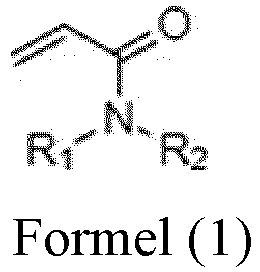 wobei es sich bei R1 und R2, unabhängig voneinander, um ein Wasserstoffatom oder eine Methylgruppe, eine Ethylgruppe, eine Isopropylgruppe oder eine CH2-OH-Gruppe handelt;R1 und R2 nicht beide ein Wasserstoffatom sind;b) Polymerisation 1 (PO1) einer Fraktion F1 zur Bildung einer Lösung eines ersten Gradientenpolymers (PG1);c) Zugabe einer zweiten Fraktion (F2), die (1) mindestens ein Monomer, ausgewählt aus den Monomeren A und B, und (2) mindestens eine Verbindung, ausgewählt aus den Verbindungen I und II, enthält, zu der PG1 enthaltenden Lösung;d) Polymerisation 2 (PO2) der Fraktion F2 auf PG1, um eine Lösung eines zweiten Gradientenpolymers (PG2) zu bilden;e) Zugabe einer dritten Fraktion (F3), die (1) mindestens ein Monomer, ausgewählt aus den Monomeren A und B, und (2) mindestens eine Verbindung, ausgewählt aus den Verbindungen I und II, enthält, zu der PG2 enthaltenden Lösung;f) Polymerisation 3 (PO3) der Fraktion F3 auf PG2, um eine Lösung zu bilden, die ein Basispolymer enthält;g) Verdünnung der Lösung, die das Basispolymer enthält, und Reaktion zwischen mindestens einem Dialdehyd und dem Basispolymer, um ein wasserlösliches Dialdehydpolymer zu erhalten;mindestens eine der Fraktionen Fl, F2 oder F3 enthält mindestens ein Monomer A, mindestens eine der Fraktionen Fl, F2 oder F3 enthält mindestens ein Monomer B, mindestens eine der Fraktionen Fl, F2 oder F3 enthält mindestens eine Verbindung I undmindestens eine der Fraktionen Fl, F2 oder F3 enthält mindestens eine Verbindung II,wobei sich das Monomer A von einer Mischung aus kationischem Monomer und anionischem Monomer unterscheidet,wenn das Monomer A anionisch ist, enthält das wasserlösliche, dialdehydfunktionalisierte Polymer kein kationisches Monomer,wenn das Monomer A kationisch ist, enthält das wasserlösliche, dialdehydfunktionalisierte Polymer kein anionisches Monomer, mit Ausnahme der Verbindung I.
 - Verfahren nach Anspruch 8, dadurch gekennzeichnet, dass sich mindestens eine der Fraktionen Fl, F2 oder F3 von den anderen Fraktionen unterscheidet.
- Verfahren nach Anspruch 8 oder 9, dadurch gekennzeichnet, dass ein Initiator während des gesamten Polymerisationsprozesses kontinuierlich zugegeben wird und dass es sich beim Dialdehyd um Glyoxal handelt.
- Verfahren nach einem der Ansprüche 8 bis 10, dadurch gekennzeichnet, dass das Verfahren nach dem Schritt f) der Polymerisation (PO3) einen Schritt der Alterung von 10 Minuten bis 100 Minuten umfasst.
- Verfahren nach einem der Ansprüche 8 bis 11, dadurch gekennzeichnet, dass die Dialdehydreaktion mindestens folgende Schritte umfasst:g1) Verdünnung der Lösung, die das Basispolymer enthält, um eine verdünnte Lösung des Basispolymers (SD1) zu erhalten;g2) gegebenenfalls Einstellung des pH-Werts von SD1 auf mindestens 10;g3) Zugabe von mindestens einem Dialdehyd zu der in Schritt g1) oder g2) erhaltenen Lösung, um eine verdünnte Lösung (SD2) zu bilden;g4) gegebenenfalls Säuerung der in Schritt g3) erhaltenen Lösung auf einen pH-Wert zwischen 2 und 4, um eine verdünnte Lösung (SD3) zu erhalten.
- Verfahren zur Herstellung von Papier oder Pappe, das aus der Zugabe eines wasserlöslichen, dialdehyd-funktionalisierten Polymers nach einem der Ansprüche 1 bis 7 in eine wässrige Faserlösung und der Bildung eines Blattes Papier oder Pappe besteht.
- Verwendung des wasserlöslichen, dialdehyd-funktionalisierten Polymers nach einem der Ansprüche 1 bis 7 bei der Rückgewinnung von Kohlenwasserstoffen, beim Bohren oder Zementieren von Bohrlöchern, bei der Stimulierung von Kohlenwasserstoff-Bohrlöchern, bei der Wasseraufbereitung im offenen Kreislauf, bei der Behandlung von Gärungsmaische, bei der Aufbereitung von Schlämmen, im Bausektor, bei der Holzverarbeitung, bei der Aufbereitung einer hydraulischen Zusammensetzung, im Bergbau, bei der Formulierung von kosmetischen Produkten, bei der Formulierung von Waschmitteln, bei der Textilherstellung, im Geothermie-Sektor, bei der Herstellung von Damenbinden oder in der Landwirtschaft.
- Verwendung des wasserlöslichen, dialdehyd-funktionalisierten Polymers nach einem der Ansprüche 1 bis 7 als Flockungsmittel, Koagulationsmittel, Bindemittel, Fixiermittel, Viskositätsverringerungsmittel, Verdickungsmittel, Absorptionsmittel, reibungsminderndes Mittel, Drainagemittel, Retentionsmittel, Entwässerungsmittel, Konditionierungsmittel, Stabilisierungsmittel, Fixiermittel, Filmbildner, Leimungsmittel, Fließmittel, Toninhibitor oder Dispergiermittel.
Applications Claiming Priority (2)
| Application Number | Priority Date | Filing Date | Title |
|---|---|---|---|
| FR2206322A FR3137093B1 (fr) | 2022-06-24 | 2022-06-24 | Polymère hydrosoluble et son procédé de préparation |
| PCT/EP2023/067191 WO2023247783A1 (en) | 2022-06-24 | 2023-06-23 | New polymer and its preparation method |
Publications (3)
| Publication Number | Publication Date |
|---|---|
| EP4326786A1 EP4326786A1 (de) | 2024-02-28 |
| EP4326786B1 true EP4326786B1 (de) | 2024-07-31 |
| EP4326786C0 EP4326786C0 (de) | 2024-07-31 |
Family
ID=83280480
Family Applications (1)
| Application Number | Title | Priority Date | Filing Date |
|---|---|---|---|
| EP23735012.9A Active EP4326786B1 (de) | 2022-06-24 | 2023-06-23 | Neues polymer und verfahren zu seiner herstellung |
Country Status (9)
| Country | Link |
|---|---|
| US (1) | US12421330B2 (de) |
| EP (1) | EP4326786B1 (de) |
| JP (1) | JP7833056B2 (de) |
| KR (1) | KR102890187B1 (de) |
| CN (1) | CN119452003A (de) |
| ES (1) | ES2994800T3 (de) |
| FR (1) | FR3137093B1 (de) |
| MX (1) | MX2024015272A (de) |
| WO (1) | WO2023247783A1 (de) |
Family Cites Families (19)
| Publication number | Priority date | Publication date | Assignee | Title |
|---|---|---|---|---|
| JPS5831199A (ja) * | 1981-08-17 | 1983-02-23 | デイツク・ハ−キユレス株式会社 | 紙力増強用組成物 |
| US4605702A (en) * | 1984-06-27 | 1986-08-12 | American Cyanamid Company | Temporary wet strength resin |
| JPH11228641A (ja) * | 1997-11-28 | 1999-08-24 | Mitsui Chem Inc | 新規な重合体およびその用途 |
| JP2000129590A (ja) * | 1998-10-20 | 2000-05-09 | Mitsui Chemicals Inc | アニオン性アクリルアミド重合体、及びその用途 |
| JP4288541B2 (ja) * | 1999-03-23 | 2009-07-01 | 荒川化学工業株式会社 | 紙の製造方法 |
| US7641766B2 (en) * | 2004-01-26 | 2010-01-05 | Nalco Company | Method of using aldehyde-functionalized polymers to enhance paper machine dewatering |
| EP1828480B1 (de) | 2004-12-21 | 2014-05-21 | Hercules Incorporated | Reaktive kationische harze zur verwendung als trockene und feuchte festigungsmittel in sulfitionenhaltigen systemen zur papierherstellung |
| JP2007056416A (ja) * | 2005-08-26 | 2007-03-08 | Kindai Kagaku Kogyo Kk | ロジンエマルションサイズ剤用分散剤 |
| JP4924895B2 (ja) * | 2006-06-28 | 2012-04-25 | 荒川化学工業株式会社 | 製紙用表面サイズ剤 |
| JP2011178818A (ja) * | 2010-02-26 | 2011-09-15 | Mt Aquapolymer Inc | 水溶性高分子架橋剤、それを用いて製造される水溶性重合体、およびこれらの製造方法 |
| FR2987375A1 (fr) | 2012-02-27 | 2013-08-30 | Snf Sas | Nouveau procede de fabrication de papier mettant en oeuvre un copolymere base ayant reagi avec un aldehyde comme agent de resistance a sec, de retention, d'egouttage et de machinabilite |
| KR102063409B1 (ko) * | 2015-12-25 | 2020-01-07 | 세이코 피엠씨 가부시키가이샤 | 폴리아크릴아미드계 제지용 첨가제 및 그의 제조 방법, 및 종이의 제조 방법 |
| CA3014062A1 (en) * | 2016-02-26 | 2017-08-31 | Buckman Laboratories International, Inc. | Glyoxalated polyacrylamide terpolymer, base copolymer thereof, compositions containing same, uses in papermaking and products thereof |
| FR3064004B1 (fr) | 2017-03-20 | 2019-03-29 | S.P.C.M. Sa | Forme cristalline hydratee de l'acide 2-acrylamido-2-methylpropane sulfonique |
| KR102303725B1 (ko) * | 2017-03-28 | 2021-09-17 | 아라까와 가가꾸 고교 가부시끼가이샤 | 열가교형 리튬이온 전지용 슬러리 및 그 제조방법, 리튬이온 전지용 전극, 리튬이온 전지용 세퍼레이터, 리튬이온 전지용 세퍼레이터/전극적층체, 및 리튬이온 전지 |
| PT3647492T (pt) * | 2017-06-28 | 2022-11-23 | Harima Chemicals Inc | Método de produção de polímero aditivo à base de (met)acrilamida no fabrico de papel e polímero aditivo à base de (met)acrilamida no fabrico de papel |
| CN109722125B (zh) * | 2017-10-30 | 2022-04-29 | 荒川化学工业株式会社 | 水性预涂金属涂料用树脂 |
| CN109400821B (zh) * | 2018-11-02 | 2021-02-02 | 四川同舟化工科技有限公司 | 一种具有减水功能的混凝土抗泌水抑制剂及其制备方法 |
| FR3104578B1 (fr) | 2019-12-16 | 2022-07-15 | S N F Sa | Nouveaux monomeres sulfobetaine, procede de preparation et leurs utilisations |
-
2022
- 2022-06-24 FR FR2206322A patent/FR3137093B1/fr active Active
-
2023
- 2023-06-23 ES ES23735012T patent/ES2994800T3/es active Active
- 2023-06-23 EP EP23735012.9A patent/EP4326786B1/de active Active
- 2023-06-23 KR KR1020247042589A patent/KR102890187B1/ko active Active
- 2023-06-23 WO PCT/EP2023/067191 patent/WO2023247783A1/en not_active Ceased
- 2023-06-23 CN CN202380046122.1A patent/CN119452003A/zh active Pending
- 2023-06-23 US US18/873,218 patent/US12421330B2/en active Active
- 2023-06-23 JP JP2024572449A patent/JP7833056B2/ja active Active
-
2024
- 2024-12-09 MX MX2024015272A patent/MX2024015272A/es unknown
Also Published As
| Publication number | Publication date |
|---|---|
| JP2025523757A (ja) | 2025-07-25 |
| MX2024015272A (es) | 2025-02-10 |
| EP4326786A1 (de) | 2024-02-28 |
| ES2994800T3 (en) | 2025-01-31 |
| US20250171568A1 (en) | 2025-05-29 |
| WO2023247783A1 (en) | 2023-12-28 |
| FR3137093A1 (fr) | 2023-12-29 |
| JP7833056B2 (ja) | 2026-03-18 |
| CA3258809A1 (en) | 2023-12-28 |
| CN119452003A (zh) | 2025-02-14 |
| KR20250026195A (ko) | 2025-02-25 |
| US12421330B2 (en) | 2025-09-23 |
| FR3137093B1 (fr) | 2024-06-14 |
| KR102890187B1 (ko) | 2025-11-24 |
| EP4326786C0 (de) | 2024-07-31 |
Similar Documents
| Publication | Publication Date | Title |
|---|---|---|
| CA3243132A1 (en) | PAPER MANUFACTURING ADDITIVE COMPOSITIONS | |
| EP4326786B1 (de) | Neues polymer und verfahren zu seiner herstellung | |
| CA3258809C (en) | New polymer and its preparation method | |
| EP4326785B1 (de) | Neues polymer und verfahren zu seiner herstellung | |
| CA3258488C (en) | Polyvinylamine polymer and preparation method | |
| JP7767657B2 (ja) | 新規のポリマー及びその調製方法 | |
| EP4493606B1 (de) | Polymer und verfahren zu seiner herstellung | |
| AU2003230523B8 (en) | Process for preparing a polymer dispersion | |
| BR112024025505B1 (pt) | Polímero funcionalizado com dialdeído solúvel em água, métodos para preparar sequencialmente um polímero funcionalizado com dialdeído solúvel em água e para fabricar papel ou papelão, e, uso do polímero funcionalizado com dialdeído solúvel em água | |
| BR112024025507B1 (pt) | Polímero de polivinilamina, métodos de preparação sequencial de um polímero de polivinilamina e de fabricação de papel ou papelão, e, uso do polímero de polivinilamina | |
| BR112024024375B1 (pt) | Polímero hidrossolúvel aniônico, métodos para preparação sequencial de um polímero hidrossolúvel aniônico e para produção de papel papelão, e, uso do polímero hidrossolúvel aniônico |
Legal Events
| Date | Code | Title | Description |
|---|---|---|---|
| STAA | Information on the status of an ep patent application or granted ep patent |
Free format text: STATUS: UNKNOWN |
|
| STAA | Information on the status of an ep patent application or granted ep patent |
Free format text: STATUS: THE INTERNATIONAL PUBLICATION HAS BEEN MADE |
|
| PUAI | Public reference made under article 153(3) epc to a published international application that has entered the european phase |
Free format text: ORIGINAL CODE: 0009012 |
|
| STAA | Information on the status of an ep patent application or granted ep patent |
Free format text: STATUS: REQUEST FOR EXAMINATION WAS MADE |
|
| 17P | Request for examination filed |
Effective date: 20231123 |
|
| AK | Designated contracting states |
Kind code of ref document: A1 Designated state(s): AL AT BE BG CH CY CZ DE DK EE ES FI FR GB GR HR HU IE IS IT LI LT LU LV MC ME MK MT NL NO PL PT RO RS SE SI SK SM TR |
|
| GRAP | Despatch of communication of intention to grant a patent |
Free format text: ORIGINAL CODE: EPIDOSNIGR1 |
|
| STAA | Information on the status of an ep patent application or granted ep patent |
Free format text: STATUS: GRANT OF PATENT IS INTENDED |
|
| DAV | Request for validation of the european patent (deleted) | ||
| DAX | Request for extension of the european patent (deleted) | ||
| INTG | Intention to grant announced |
Effective date: 20240423 |
|
| GRAS | Grant fee paid |
Free format text: ORIGINAL CODE: EPIDOSNIGR3 |
|
| GRAA | (expected) grant |
Free format text: ORIGINAL CODE: 0009210 |
|
| STAA | Information on the status of an ep patent application or granted ep patent |
Free format text: STATUS: THE PATENT HAS BEEN GRANTED |
|
| AK | Designated contracting states |
Kind code of ref document: B1 Designated state(s): AL AT BE BG CH CY CZ DE DK EE ES FI FR GB GR HR HU IE IS IT LI LT LU LV MC ME MK MT NL NO PL PT RO RS SE SI SK SM TR |
|
| REG | Reference to a national code |
Ref country code: CH Ref legal event code: EP Ref country code: GB Ref legal event code: FG4D |
|
| REG | Reference to a national code |
Ref country code: DE Ref legal event code: R096 Ref document number: 602023000314 Country of ref document: DE |
|
| REG | Reference to a national code |
Ref country code: IE Ref legal event code: FG4D |
|
| U01 | Request for unitary effect filed |
Effective date: 20240814 |
|
| U07 | Unitary effect registered |
Designated state(s): AT BE BG DE DK EE FI FR IT LT LU LV MT NL PT RO SE SI Effective date: 20240902 |
|
| PG25 | Lapsed in a contracting state [announced via postgrant information from national office to epo] |
Ref country code: NO Free format text: LAPSE BECAUSE OF FAILURE TO SUBMIT A TRANSLATION OF THE DESCRIPTION OR TO PAY THE FEE WITHIN THE PRESCRIBED TIME-LIMIT Effective date: 20241031 |
|
| PG25 | Lapsed in a contracting state [announced via postgrant information from national office to epo] |
Ref country code: GR Free format text: LAPSE BECAUSE OF FAILURE TO SUBMIT A TRANSLATION OF THE DESCRIPTION OR TO PAY THE FEE WITHIN THE PRESCRIBED TIME-LIMIT Effective date: 20241101 Ref country code: PL Free format text: LAPSE BECAUSE OF FAILURE TO SUBMIT A TRANSLATION OF THE DESCRIPTION OR TO PAY THE FEE WITHIN THE PRESCRIBED TIME-LIMIT Effective date: 20240731 |
|
| PG25 | Lapsed in a contracting state [announced via postgrant information from national office to epo] |
Ref country code: IS Free format text: LAPSE BECAUSE OF FAILURE TO SUBMIT A TRANSLATION OF THE DESCRIPTION OR TO PAY THE FEE WITHIN THE PRESCRIBED TIME-LIMIT Effective date: 20241130 |
|
| PG25 | Lapsed in a contracting state [announced via postgrant information from national office to epo] |
Ref country code: HR Free format text: LAPSE BECAUSE OF FAILURE TO SUBMIT A TRANSLATION OF THE DESCRIPTION OR TO PAY THE FEE WITHIN THE PRESCRIBED TIME-LIMIT Effective date: 20240731 |
|
| PG25 | Lapsed in a contracting state [announced via postgrant information from national office to epo] |
Ref country code: RS Free format text: LAPSE BECAUSE OF FAILURE TO SUBMIT A TRANSLATION OF THE DESCRIPTION OR TO PAY THE FEE WITHIN THE PRESCRIBED TIME-LIMIT Effective date: 20241031 |
|
| PG25 | Lapsed in a contracting state [announced via postgrant information from national office to epo] |
Ref country code: RS Free format text: LAPSE BECAUSE OF FAILURE TO SUBMIT A TRANSLATION OF THE DESCRIPTION OR TO PAY THE FEE WITHIN THE PRESCRIBED TIME-LIMIT Effective date: 20241031 Ref country code: PL Free format text: LAPSE BECAUSE OF FAILURE TO SUBMIT A TRANSLATION OF THE DESCRIPTION OR TO PAY THE FEE WITHIN THE PRESCRIBED TIME-LIMIT Effective date: 20240731 Ref country code: NO Free format text: LAPSE BECAUSE OF FAILURE TO SUBMIT A TRANSLATION OF THE DESCRIPTION OR TO PAY THE FEE WITHIN THE PRESCRIBED TIME-LIMIT Effective date: 20241031 Ref country code: IS Free format text: LAPSE BECAUSE OF FAILURE TO SUBMIT A TRANSLATION OF THE DESCRIPTION OR TO PAY THE FEE WITHIN THE PRESCRIBED TIME-LIMIT Effective date: 20241130 Ref country code: HR Free format text: LAPSE BECAUSE OF FAILURE TO SUBMIT A TRANSLATION OF THE DESCRIPTION OR TO PAY THE FEE WITHIN THE PRESCRIBED TIME-LIMIT Effective date: 20240731 Ref country code: GR Free format text: LAPSE BECAUSE OF FAILURE TO SUBMIT A TRANSLATION OF THE DESCRIPTION OR TO PAY THE FEE WITHIN THE PRESCRIBED TIME-LIMIT Effective date: 20241101 |
|
| REG | Reference to a national code |
Ref country code: ES Ref legal event code: FG2A Ref document number: 2994800 Country of ref document: ES Kind code of ref document: T3 Effective date: 20250131 |
|
| PG25 | Lapsed in a contracting state [announced via postgrant information from national office to epo] |
Ref country code: SM Free format text: LAPSE BECAUSE OF FAILURE TO SUBMIT A TRANSLATION OF THE DESCRIPTION OR TO PAY THE FEE WITHIN THE PRESCRIBED TIME-LIMIT Effective date: 20240731 |
|
| PG25 | Lapsed in a contracting state [announced via postgrant information from national office to epo] |
Ref country code: CZ Free format text: LAPSE BECAUSE OF FAILURE TO SUBMIT A TRANSLATION OF THE DESCRIPTION OR TO PAY THE FEE WITHIN THE PRESCRIBED TIME-LIMIT Effective date: 20240731 |
|
| PG25 | Lapsed in a contracting state [announced via postgrant information from national office to epo] |
Ref country code: SK Free format text: LAPSE BECAUSE OF FAILURE TO SUBMIT A TRANSLATION OF THE DESCRIPTION OR TO PAY THE FEE WITHIN THE PRESCRIBED TIME-LIMIT Effective date: 20240731 |
|
| PLBE | No opposition filed within time limit |
Free format text: ORIGINAL CODE: 0009261 |
|
| STAA | Information on the status of an ep patent application or granted ep patent |
Free format text: STATUS: NO OPPOSITION FILED WITHIN TIME LIMIT |
|
| 26N | No opposition filed |
Effective date: 20250501 |
|
| PGFP | Annual fee paid to national office [announced via postgrant information from national office to epo] |
Ref country code: TR Payment date: 20250613 Year of fee payment: 3 |
|
| U20 | Renewal fee for the european patent with unitary effect paid |
Year of fee payment: 3 Effective date: 20250630 |
|
| PGFP | Annual fee paid to national office [announced via postgrant information from national office to epo] |
Ref country code: ES Payment date: 20250710 Year of fee payment: 3 |
|
| PG25 | Lapsed in a contracting state [announced via postgrant information from national office to epo] |
Ref country code: MC Free format text: LAPSE BECAUSE OF FAILURE TO SUBMIT A TRANSLATION OF THE DESCRIPTION OR TO PAY THE FEE WITHIN THE PRESCRIBED TIME-LIMIT Effective date: 20240731 |
|
| PG25 | Lapsed in a contracting state [announced via postgrant information from national office to epo] |
Ref country code: IE Free format text: LAPSE BECAUSE OF NON-PAYMENT OF DUE FEES Effective date: 20250623 |