EP4326684B1 - Enamel paste compositions, enamel coated products, and methods of manufacturing the same - Google Patents
Enamel paste compositions, enamel coated products, and methods of manufacturing the same Download PDFInfo
- Publication number
- EP4326684B1 EP4326684B1 EP22719042.8A EP22719042A EP4326684B1 EP 4326684 B1 EP4326684 B1 EP 4326684B1 EP 22719042 A EP22719042 A EP 22719042A EP 4326684 B1 EP4326684 B1 EP 4326684B1
- Authority
- EP
- European Patent Office
- Prior art keywords
- enamel
- paste
- thin
- micrometres
- glass
- Prior art date
- Legal status (The legal status is an assumption and is not a legal conclusion. Google has not performed a legal analysis and makes no representation as to the accuracy of the status listed.)
- Active
Links
Images


Classifications
-
- C—CHEMISTRY; METALLURGY
- C03—GLASS; MINERAL OR SLAG WOOL
- C03C—CHEMICAL COMPOSITION OF GLASSES, GLAZES OR VITREOUS ENAMELS; SURFACE TREATMENT OF GLASS; SURFACE TREATMENT OF FIBRES OR FILAMENTS MADE FROM GLASS, MINERALS OR SLAGS; JOINING GLASS TO GLASS OR OTHER MATERIALS
- C03C10/00—Devitrified glass ceramics, i.e. glass ceramics having a crystalline phase dispersed in a glassy phase and constituting at least 50% by weight of the total composition
- C03C10/0054—Devitrified glass ceramics, i.e. glass ceramics having a crystalline phase dispersed in a glassy phase and constituting at least 50% by weight of the total composition containing PbO, SnO2, B2O3
-
- C—CHEMISTRY; METALLURGY
- C03—GLASS; MINERAL OR SLAG WOOL
- C03C—CHEMICAL COMPOSITION OF GLASSES, GLAZES OR VITREOUS ENAMELS; SURFACE TREATMENT OF GLASS; SURFACE TREATMENT OF FIBRES OR FILAMENTS MADE FROM GLASS, MINERALS OR SLAGS; JOINING GLASS TO GLASS OR OTHER MATERIALS
- C03C17/00—Surface treatment of glass, not in the form of fibres or filaments, by coating
- C03C17/02—Surface treatment of glass, not in the form of fibres or filaments, by coating with glass
- C03C17/04—Surface treatment of glass, not in the form of fibres or filaments, by coating with glass by fritting glass powder
-
- C—CHEMISTRY; METALLURGY
- C03—GLASS; MINERAL OR SLAG WOOL
- C03C—CHEMICAL COMPOSITION OF GLASSES, GLAZES OR VITREOUS ENAMELS; SURFACE TREATMENT OF GLASS; SURFACE TREATMENT OF FIBRES OR FILAMENTS MADE FROM GLASS, MINERALS OR SLAGS; JOINING GLASS TO GLASS OR OTHER MATERIALS
- C03C17/00—Surface treatment of glass, not in the form of fibres or filaments, by coating
- C03C17/34—Surface treatment of glass, not in the form of fibres or filaments, by coating with at least two coatings having different compositions
- C03C17/36—Surface treatment of glass, not in the form of fibres or filaments, by coating with at least two coatings having different compositions at least one coating being a metal
- C03C17/3602—Surface treatment of glass, not in the form of fibres or filaments, by coating with at least two coatings having different compositions at least one coating being a metal the metal being present as a layer
-
- C—CHEMISTRY; METALLURGY
- C03—GLASS; MINERAL OR SLAG WOOL
- C03C—CHEMICAL COMPOSITION OF GLASSES, GLAZES OR VITREOUS ENAMELS; SURFACE TREATMENT OF GLASS; SURFACE TREATMENT OF FIBRES OR FILAMENTS MADE FROM GLASS, MINERALS OR SLAGS; JOINING GLASS TO GLASS OR OTHER MATERIALS
- C03C17/00—Surface treatment of glass, not in the form of fibres or filaments, by coating
- C03C17/34—Surface treatment of glass, not in the form of fibres or filaments, by coating with at least two coatings having different compositions
- C03C17/36—Surface treatment of glass, not in the form of fibres or filaments, by coating with at least two coatings having different compositions at least one coating being a metal
- C03C17/3602—Surface treatment of glass, not in the form of fibres or filaments, by coating with at least two coatings having different compositions at least one coating being a metal the metal being present as a layer
- C03C17/3668—Surface treatment of glass, not in the form of fibres or filaments, by coating with at least two coatings having different compositions at least one coating being a metal the metal being present as a layer the multilayer coating having electrical properties
- C03C17/3673—Surface treatment of glass, not in the form of fibres or filaments, by coating with at least two coatings having different compositions at least one coating being a metal the metal being present as a layer the multilayer coating having electrical properties specially adapted for use in heating devices for rear window of vehicles
-
- C—CHEMISTRY; METALLURGY
- C03—GLASS; MINERAL OR SLAG WOOL
- C03C—CHEMICAL COMPOSITION OF GLASSES, GLAZES OR VITREOUS ENAMELS; SURFACE TREATMENT OF GLASS; SURFACE TREATMENT OF FIBRES OR FILAMENTS MADE FROM GLASS, MINERALS OR SLAGS; JOINING GLASS TO GLASS OR OTHER MATERIALS
- C03C17/00—Surface treatment of glass, not in the form of fibres or filaments, by coating
- C03C17/34—Surface treatment of glass, not in the form of fibres or filaments, by coating with at least two coatings having different compositions
- C03C17/36—Surface treatment of glass, not in the form of fibres or filaments, by coating with at least two coatings having different compositions at least one coating being a metal
- C03C17/3602—Surface treatment of glass, not in the form of fibres or filaments, by coating with at least two coatings having different compositions at least one coating being a metal the metal being present as a layer
- C03C17/3681—Surface treatment of glass, not in the form of fibres or filaments, by coating with at least two coatings having different compositions at least one coating being a metal the metal being present as a layer the multilayer coating being used in glazing, e.g. windows or windscreens
-
- C—CHEMISTRY; METALLURGY
- C03—GLASS; MINERAL OR SLAG WOOL
- C03C—CHEMICAL COMPOSITION OF GLASSES, GLAZES OR VITREOUS ENAMELS; SURFACE TREATMENT OF GLASS; SURFACE TREATMENT OF FIBRES OR FILAMENTS MADE FROM GLASS, MINERALS OR SLAGS; JOINING GLASS TO GLASS OR OTHER MATERIALS
- C03C3/00—Glass compositions
- C03C3/04—Glass compositions containing silica
- C03C3/076—Glass compositions containing silica with 40% to 90% silica, by weight
- C03C3/078—Glass compositions containing silica with 40% to 90% silica, by weight containing an oxide of a divalent metal, e.g. an oxide of zinc
-
- C—CHEMISTRY; METALLURGY
- C03—GLASS; MINERAL OR SLAG WOOL
- C03C—CHEMICAL COMPOSITION OF GLASSES, GLAZES OR VITREOUS ENAMELS; SURFACE TREATMENT OF GLASS; SURFACE TREATMENT OF FIBRES OR FILAMENTS MADE FROM GLASS, MINERALS OR SLAGS; JOINING GLASS TO GLASS OR OTHER MATERIALS
- C03C3/00—Glass compositions
- C03C3/04—Glass compositions containing silica
- C03C3/076—Glass compositions containing silica with 40% to 90% silica, by weight
- C03C3/089—Glass compositions containing silica with 40% to 90% silica, by weight containing boron
-
- C—CHEMISTRY; METALLURGY
- C03—GLASS; MINERAL OR SLAG WOOL
- C03C—CHEMICAL COMPOSITION OF GLASSES, GLAZES OR VITREOUS ENAMELS; SURFACE TREATMENT OF GLASS; SURFACE TREATMENT OF FIBRES OR FILAMENTS MADE FROM GLASS, MINERALS OR SLAGS; JOINING GLASS TO GLASS OR OTHER MATERIALS
- C03C3/00—Glass compositions
- C03C3/04—Glass compositions containing silica
- C03C3/076—Glass compositions containing silica with 40% to 90% silica, by weight
- C03C3/089—Glass compositions containing silica with 40% to 90% silica, by weight containing boron
- C03C3/091—Glass compositions containing silica with 40% to 90% silica, by weight containing boron containing aluminium
-
- C—CHEMISTRY; METALLURGY
- C03—GLASS; MINERAL OR SLAG WOOL
- C03C—CHEMICAL COMPOSITION OF GLASSES, GLAZES OR VITREOUS ENAMELS; SURFACE TREATMENT OF GLASS; SURFACE TREATMENT OF FIBRES OR FILAMENTS MADE FROM GLASS, MINERALS OR SLAGS; JOINING GLASS TO GLASS OR OTHER MATERIALS
- C03C8/00—Enamels; Glazes; Fusion seal compositions being frit compositions having non-frit additions
- C03C8/14—Glass frit mixtures having non-frit additions, e.g. opacifiers, colorants, mill-additions
-
- C—CHEMISTRY; METALLURGY
- C03—GLASS; MINERAL OR SLAG WOOL
- C03C—CHEMICAL COMPOSITION OF GLASSES, GLAZES OR VITREOUS ENAMELS; SURFACE TREATMENT OF GLASS; SURFACE TREATMENT OF FIBRES OR FILAMENTS MADE FROM GLASS, MINERALS OR SLAGS; JOINING GLASS TO GLASS OR OTHER MATERIALS
- C03C8/00—Enamels; Glazes; Fusion seal compositions being frit compositions having non-frit additions
- C03C8/22—Enamels; Glazes; Fusion seal compositions being frit compositions having non-frit additions containing two or more distinct frits having different compositions
-
- H—ELECTRICITY
- H05—ELECTRIC TECHNIQUES NOT OTHERWISE PROVIDED FOR
- H05B—ELECTRIC HEATING; ELECTRIC LIGHT SOURCES NOT OTHERWISE PROVIDED FOR; CIRCUIT ARRANGEMENTS FOR ELECTRIC LIGHT SOURCES, IN GENERAL
- H05B3/00—Ohmic-resistance heating
- H05B3/84—Heating arrangements specially adapted for transparent or reflecting areas, e.g. for demisting or de-icing windows, mirrors or vehicle windshields
-
- C—CHEMISTRY; METALLURGY
- C03—GLASS; MINERAL OR SLAG WOOL
- C03C—CHEMICAL COMPOSITION OF GLASSES, GLAZES OR VITREOUS ENAMELS; SURFACE TREATMENT OF GLASS; SURFACE TREATMENT OF FIBRES OR FILAMENTS MADE FROM GLASS, MINERALS OR SLAGS; JOINING GLASS TO GLASS OR OTHER MATERIALS
- C03C2217/00—Coatings on glass
- C03C2217/40—Coatings comprising at least one inhomogeneous layer
- C03C2217/43—Coatings comprising at least one inhomogeneous layer consisting of a dispersed phase in a continuous phase
- C03C2217/44—Coatings comprising at least one inhomogeneous layer consisting of a dispersed phase in a continuous phase characterized by the composition of the continuous phase
- C03C2217/45—Inorganic continuous phases
- C03C2217/452—Glass
-
- C—CHEMISTRY; METALLURGY
- C03—GLASS; MINERAL OR SLAG WOOL
- C03C—CHEMICAL COMPOSITION OF GLASSES, GLAZES OR VITREOUS ENAMELS; SURFACE TREATMENT OF GLASS; SURFACE TREATMENT OF FIBRES OR FILAMENTS MADE FROM GLASS, MINERALS OR SLAGS; JOINING GLASS TO GLASS OR OTHER MATERIALS
- C03C2217/00—Coatings on glass
- C03C2217/40—Coatings comprising at least one inhomogeneous layer
- C03C2217/43—Coatings comprising at least one inhomogeneous layer consisting of a dispersed phase in a continuous phase
- C03C2217/46—Coatings comprising at least one inhomogeneous layer consisting of a dispersed phase in a continuous phase characterized by the dispersed phase
- C03C2217/48—Coatings comprising at least one inhomogeneous layer consisting of a dispersed phase in a continuous phase characterized by the dispersed phase having a specific function
- C03C2217/485—Pigments
-
- H—ELECTRICITY
- H05—ELECTRIC TECHNIQUES NOT OTHERWISE PROVIDED FOR
- H05B—ELECTRIC HEATING; ELECTRIC LIGHT SOURCES NOT OTHERWISE PROVIDED FOR; CIRCUIT ARRANGEMENTS FOR ELECTRIC LIGHT SOURCES, IN GENERAL
- H05B2203/00—Aspects relating to Ohmic resistive heating covered by group H05B3/00
- H05B2203/013—Heaters using resistive films or coatings
Definitions
- the present specification relates to enamel paste compositions, enamel coated products, and methods of manufacturing the same.
- a primary function is to shield the glue that holds the glass components in place from ultraviolet radiation which would otherwise decompose the glue.
- a secondary function is to cover up electrical circuits, wires, and connectors that ensure functionality of electrical or electronic components attached to, or embedded into, the glass component and ensure a clean aesthetic appearance.
- Enamels typically comprise glass frit and pigment in an organic carrier medium.
- the enamels are applied as a paste or ink in a screen printing or ink jet process to a flat glass substrate and are subsequently fired at high temperatures, during which the organic carrier medium of the paste or ink burns off and the enamel fuses together and establishes a bond to the substrate.
- the firing process also softens the substrate which can be formed into the final shape by a bending process during the firing process.
- a two-step firing process to form an enamel layer, the process comprising: (i) a first "pre-firing" heating step, at a temperature below the melting temperature of the glass frit in the enamel paste, in order to remove organic carrier medium components of the enamel paste, thus forming a dry, pre-fired layer; and (ii) a second "firing" heating step at a temperature above the melting point of the glass frit in the enamel paste to fuse the enamel.
- the substrate can be formed into the final shape by a bending process.
- the enamel formulation will typically comprise a metallic, electrically conductive powder (e.g. silver powder), glass frit, and an organic carrier medium.
- conductive enamel pastes can be applied in addition to the obscuration enamel pastes and fired in the same process to form a glass component which comprises both electrical components (e.g. antennae and/or heating elements) and obscuration enamel, with the obscuration enamel arranged to obscure electrical connections (e.g. bus bars) to the electrical components.
- Such functional thin films have also been applied to glass components using, for example, a vapour deposition process.
- Such functional thin films are of a nanometre scale thickness and can function, for example, as heating elements (substituting the more conventional screen or inkjet printed conductive silver-enamel heater lines) and/or IR reflective elements.
- US20170135160 (granted as US10455645B2 ) describes an example of a method for fabricating a motor vehicle glass panel comprising a system of thin, sputtered conductive layers for heating the glass panel.
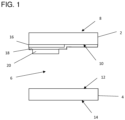
- the glass panel configuration described in US20170135160 is shown in Figure 1 and comprises two glass sheets 2, 4 united by an interlayer sheet 6.
- glass sheet 2 forms the outer glass sheet of the glass panel while glass sheet 4 forms the inner glass sheet.
- the sides of the glass sheets in a motor vehicle glass panel are conventionally numbered from the outside towards the inside.
- the outer side 8 of outer glass sheet 2 is conventionally designated side 1
- the inner side 10 of outer glass sheet 2 is conventionally designated side 2
- the side 12 of the inner glass sheet 4 which faces the outer glass sheet 2 is conventionally designated side 3
- the interior side 14 of inner glass sheet 4 is conventionally designated side 4.
- an enamel layer 16 is formed on side 2 of the outer glass sheet.
- a thin coating 18 is formed over the enamel layer 16 and over uncoated portions of side 2 of the outer glass sheet.
- the thin coating is a system of heated conductive layers formed by cathode sputtering and comprising an assembly of metal layers and of dielectric layers, the assembly exhibiting a thickness which may be 0.1 micrometres or less.
- US20170135160 discloses that the system can be fired in a two-step firing process including a first pre-firing step to remove organic carrier medium and a second firing step at higher temperature to melt and fuse the glass frit, bending being performed during the second firing step of the firing process to form the shaped glass article.
- US20170135160 discloses a problem with the configuration illustrated in Figure 1 and described above. Namely, US20170135160 identifies that the power delivered to the busbars is not completely transmitted to the conductive layers and this results in a loss of power, adversely affecting heating performance of the glass panel. US20170135160 identifies that this problem is at least partially caused by surface roughness of the enamel layer adversely affecting the overlying conductive coating and the connection of the bus bar to the conductive coating over the enamel layer. As such, US20170135160 describes that the surface roughness R a of the enamel layer should be no greater than 0.5 micrometres and preferably no greater than 0.1 micrometres.
- Several methods are described for reducing the roughness of the enamel layer including: (i) use of an enamel composition comprising glass frit and pigment, wherein the mean particle size of the pigment, and optionally the glass frit, is not greater than 5 micrometres; (ii) screen printing the enamel paste using a printing screen which has a low surface roughness coating surface; (iii) varying the surface tension and viscosity in the enamel paste layer applied to provide a smoothing effect; and (iv) inkjet printing the enamel rather than using screen printing.
- US20170135160 describes that the composition of the enamel paste is not specific to the application. It is disclosed that for enamel layers produced by screen printing, the mean roughness R a was 0.69 micrometres (i.e. too rough, being above the 0.5 micrometre threshold). For the layers applied by an inkjet technique, the roughness obtained was substantially reduced and a mean roughness of the order of 0.14 micrometres was obtained using an enamel composition produced by Johnson-Matthey (JM1L6027).
- the present invention is directed to an improved enamel paste composition specifically tailored for use in a method such as that described in US20170135160 .
- WO2005/073140 A1 discloses glass composition suitable for forming a frit comprises SiO 2 , B 2 O 3 , ZnO and TiO 2 , together with minor amounts of other components.
- EP 1 298 099 A1 discloses a ceramic color composition which comprises, as a solid powder, 50 to 90 wt.% of a mixture containing 5 to 95 parts by weight of a first lead-free glass powder comprising at least SiO 2 , ZnO, and B 2 O 3 as glass components, and 5 to 95 parts by weight of a second lead-free glass powder comprising at least SiO 2 , Bi 2 O 3 , and B 2 O 3 as glass components, 10 to 40 wt.% of an inorganic pigment, and 0 to 10 wt.% of an inorganic filler.
- EP 0 505 892 A1 discloses glass frits, a process for their manufacture and use in enamel barrier layers for stopping silver migration.
- US20170135160 indicates that the composition of the enamel paste is not specific for use with thin functional coatings beyond the characteristics of the particle size of the glass frit and pigment and the viscosity of the enamel paste provided by the organic carrier medium. US20170135160 does not give any information about the types of glass frit used in the enamel beyond the use of a commercially available enamel composition from Johnson Matthey. Furthermore, there is no indication that the chemical composition of the glass frit will have any effect on the surface roughness of the enamel and the subsequent effect on the thin functional coating deposited thereon. Rather, US20170135160 indicates that a smoother enamel surface can be achieved by using small particle size pigment in the enamel composition and also suggests modifications to the printing process used to deposit the enamel.
- the improved enamel paste formulation comprises a composition which has the following characteristics:
- the chemical composition of the glass frit component of the enamel paste has an impact on the quality of a thin coating deposited thereon and the resultant coated glass article.
- the glass frit must be tailored to have a low firing temperature and a high crystallization temperature to yield a low roughness surface enamel layer and avoid damage of the thin functional coating, both during deposition of the thin functional coating and also during further processing of the coated glass article, i.e. heating and bending of the coated glass article.
- the enamel must also have good silver hiding and UV blocking properties, which are affected by the type of glass frit and the firing temperature as well as the pigment.
- the present specification thus provides an enamel paste composition tailored for application of thin functional coatings thereon.
- the enamel paste comprises:
- the zinc silicate frit brings silver hiding properties to the enamel.
- the bismuth silicate frit allows the enamel to be processed at low temperature and develops a smooth surface at a low firing temperature.
- the frits also have a high crystallization temperature. As such, a combination of the two frits provides a low firing temperature smooth surface, silver hiding properties over a large range of temperature, and a high crystallization temperature.
- the bismuth silicate glass frit has the following composition (expressed as oxide components: Component Mol% SiO 2 45 - 55 Bi 2 O 3 15 - 25 B 2 O 3 10 - 20 Li 2 O 2 - 10 Al 2 O 3 0 - 5 ZrO 2 0 - 5 K 2 O 0 - 1 MgO 0 - 1 CaO 0 - 1
- the zinc silicate glass frit has the following composition: Component Mol% SiO 2 45 - 55 ZnO 20 - 30 Li 2 O 1 - 10 S 1 - 10 B 2 O 3 0 - 10 Na 2 O 0 - 10 F 0 - 10 MnO 0 - 10 CaO 0 - 1 Fe 2 O 3 0 - 1 MgO 0 - 1
- the pigment is optionally a CuCr black pigment.
- the present specification also provides for the use of the enamel paste to fabricate a coated glass article comprising a glass substrate, an enamel layer disposed on the glass substrate, and a thin coating having a thickness of no greater than 0.5, 0.4, 0.3, 0.2 or 0.1 micrometres disposed on the enamel layer.
- the enamel paste is tailored for a method of fabricating a coated glass article, including, but not limited to, the type of coated glass articles described in US20170135160 .
- the method comprises:
- the paste composition as previously described can be used in the method.
- the firing temperature T 1 and the bending temperature T 2 may differ.
- the formulation of the enamel paste can be modified to ensure that it has a firing temperature lower than T 1 and a crystallization temperature higher than T 2 in order to ensure that a thin film coating disposed on the enamel is not damaged during processing, while also achieving the colour characteristics and/or silver hiding characteristics required for an end application after processing at T 2 .
- the method of this specification is not limited to the specific enamel paste composition tailored for an end application having a specifically defined T 1 and T 2 .
- the enamel layer has a surface roughness R a of nc more than 1, 0.7, 0.5, or 0.3 micrometres and/or a roughness R z of no more than 5, 4, 3, 2, or 1 micrometre. Furthermore, for obscuration applications, the enamel layer advantageously has an L-value of no more than 5, 4.5, 4, or 3.5.
- the thin coating can be deposited via a vacuum deposition process such as a cathode sputtering process as is the case for the application described in US20170135160 .
- the thin coating may be deposited over at least a portion of the glass substrate in addition to being deposited over at least a portion of the enamel layer.
- the thin coating can be electrically conductive, optionally comprising a plurality of sub-layers (e.g. 2 or 3 silver sub-layers), and at least one electrical connector can be deposited on the thin coating over the enamel layer.
- enamel pastes of the present invention have been developed for applications such as described in US20170135160 , it is envisaged that enamel pastes according to the present specification will be useful for other functional thin film coatings on glass substrates including electrical, optical, and thermal functional coatings.
- the glass panel configuration described in US20170135160 is shown in Figure 1 and comprises two glass sheets 2, 4 united by an interlayer sheet 6.
- the outer side 8 of outer glass sheet 2 is conventionally designated side 1
- the inner side 10 of outer glass sheet 2 is conventionally designated side 2
- the side 12 of the inner glass sheet 4 which faces the outer glass sheet 2 is conventionally designated side 3
- the interior side 14 of inner glass sheet 4 is conventionally designated side 4.
- An enamel layer 16 is formed on side 2 of the outer glass sheet.
- a thin coating 18 is formed over the enamel layer 16 and over un-enamelled portions of side 2 of the outer glass sheet.
- An electrical bus bar 20 is formed on the thin coating 18 over the enamel layer 16.
- the glass sheets 2, 4 are fired and shaped and then laminated with the interlayer sheet 6 to form the glass panel.
- the present invention is not limited to this configuration.
- the enamel layer and thin coating could be applied to a different side of such a laminated glass panel or may be applied to a glass panel comprising a single glass sheet.
- Figure 2 shows a flow diagram of the steps involved in providing the outer coated glass sheet 2 of the automotive glass panel configuration shown in Figure 1 .
- the method comprises: depositing enamel paste on side 2 of the outer glass sheet; firing at a temperature T 1 °C; applying a thin layer coating over the enamel and over un-enamelled portions of the outer glass sheet; applying silver bus bars on the thin layer coating over the enamelled portions of the outer glass sheet; and bending the coated glass sheet at a temperature T 2 °C.
- Figures 3(a) and 3(b) show flow diagrams illustrating that following the method of Figure 2 leads to damage of the thin film coating during processing unless the firing (melting) temperature of the enamel paste composition is lower than the firing temperature T 1 and the crystallization temperature of the enamel paste composition is higher than the bending temperature T 2 .
- Figure 3(a) shows that if the enamel paste is initially fired at a temperature T 1 which is below the firing/melting temperature of the glass frit, which is the case in a standard pre-firing step designed to merely remove organic carrier medium rather than melt and fuse the glass frit, then a rough surface results which can lead to a damaged thin film coated when deposited onto such a surface using, for example, a vapour deposition technique.
- Figure 3(b) shows that even if the enamel paste is initially fired at a temperature T 1 which is above the firing/melting temperature of the glass frit to provide a smooth surface on which to deposit a thin film coating, the thin film coating can be subsequently damaged during bending of the coated glass sheet if the bending temperature T 2 is above the crystallization temperature of the glass enamel.
- Figures 3(a) and 3(b) illustrate that the glass frit in the enamel composition must have both a firing/fusing/melting temperature lower than T 1 to produce a low surface roughness after firing at T 1 and a crystallization temperature higher than T 2 in order to ensure that the thin film coating is deposited in an undamaged form and remains in an undamaged form during processing (bending) at T 2 .
- the resultant enamel must meet the functional characteristics required for the application.
- the enamel in the automotive glass panel application of Figure 1 , the enamel must have good optical characteristic and good silver hiding properties to: (i) shield glue/adhesive from UV decomposition; and (ii) mask the silver bus bars disposed behind the enamel. These characteristics are dependent on the chemical composition of the glass frit and also on the final firing/bending temperature T 2 used to process the enamel coated glass sheet.
- the enamel paste composition must be tailored to meet a plurality of requirements including a firing/fusing/melting temperature lower than T 1 , a crystallization temperature higher than T 2 , and also meet the optical characteristics and silver hiding properties required for the end application after processing at T 2 .
- the enamel must also be chemically and structurally resistant to the thin film coating and vapour deposition method of fabricating the thin film coating over the enamel. Furthermore, for automotive applications it is required that the enamel is acid resistant (0,1N H 2 SO 4 for 4 hours at 80°C) and that the coated glass sheet meets a minimum mechanical strength specification.
- the present specification provides an enamel paste composition which meets all the aforementioned requirements for an enamel suitable to be used in combination with thin functional coatings, such as self-heated or IR reflective coatings.
- the enamel paste comprises: (1) a bismuth silicate glass frit; (2) a zinc silicate glass frit; (3) a pigment; and (4) an organic carrier. Details of an example for the two frit compositions in terms of equivalent oxides are provided below.
- the pigment can be an automotive back pigment such as a CuCr black pigment.
- the frits and pigment are milled to a desired particle size distribution of D90 ⁇ 15 micrometres and mixed with an organic carrier formulation to create a paste with a viscosity between 5 and 150 Pa.s -1 at a shear rate 100 s -1 .
- An example of the paste formulation is provided in the table below: Intermediates Description Ratio (wt%) Frit 1 Pb/Cd/Bi free Zn/S/Li frit 25.6 Frit 2 Pb/Cd free Li/Bi/Si frit 38.4 Pigment Black pigment 21.4 Organic Media Solvent/Thinner/Thixotropic agent 14.6
- the novelty of this paste formulation lies in the subtle mix of properties brought to the enamel to fit the process of producing a self-heated laminated motor vehicle glass panel.
- Self-heated windshields are relatively new products that have been brought to the market in the past 5 years at the time of writing, and the present specification enables an improvement in performance for such self-heated windshields.
- key characteristics of the enamel paste formulation include: (i) low firing temperature; (ii) smooth surface after firing; (iii) good silver hiding properties; and (iv) high crystallization temperature.
- the zinc silicate frit brings silver hiding properties to the enamel.
- the bismuth silicate frit allows the enamel to be processed at low temperature and develops a smooth surface at a low firing temperature. Both frits have a high crystallization temperature.
- the combination of the two frits thus provides a low firing temperature smooth surface, silver hiding properties over a large range of temperatures, and a high crystallization temperature to avoid crystallization during bending of the coated glass sheet.
- This combination of features enables a nanometre scale silver coating to be applied over the enamel and subsequently subjected to a bending procedure without damaging the coating.
- the enamel paste composition provides an enamel layer after firing at T2 which has good optical and silver hiding characteristics.
- Figure 4 shows the colour development characteristics of an enamel layer formed using the enamel paste composition in terms of its L-value vs firing temperature, the enamel being formulated to have a low L-value at the final firing (bending) temperature T 2 of the coated glass manufacturing method without crystallization.
- Figure 5 shows the silver hiding characteristics of an enamel layer formed using the enamel paste composition in terms of its dE value vs firing temperature, the enamel being formulated to have a low dEvalue (good silver hiding) at the final firing (bending) temperature T 2 of the coated glass manufacturing method without crystallization.
- the resulting paste can thus be used to build an improved laminated motor vehicle glass panel.
- the enamel paste is deposited on a glass substrate, typically a soda-lime glass, dried at a given temperature and fired in order to obtain a smooth enamel surface.
- a thin multilayer silver coating is deposited over the glass sheet and the enamel, to form either a resistive heating element or an IR reflective barrier, after which bus bars are deposited over the enamel contacting the thin coating.
- the coated glass sheet is then heated and bent to form a shaped windshield component.
- the specific paste composition as described above has been tailored for a specific windshield manufacturing process having specific T 1 and T 2 temperatures.
- the firing temperature T 1 and the bending temperature T 2 may differ.
- the formulation of the enamel paste can be modified to ensure that it has a firing temperature lower than T 1 and a crystallization temperature higher than T 2 in order to ensure that a thin film coating disposed on the enamel is not damaged during processing, while also achieving the colour characteristics required for an end application after processing at T 2 .
- the method of this specification is not limited to the specific enamel paste composition tailored for an end application having a specifically defined T 1 and T 2 .
- any modified paste has a firing temperature lower than T 1 , a crystallization temperature higher than T 2 in order to ensure that a thin film coating disposed on the enamel is not damaged during processing, and also that it achieves the desired optical characteristics required for an end application after processing at T 2 .
- Variants of the example described herein can achieve functional modifications for such end applications.
Landscapes
- Chemical & Material Sciences (AREA)
- Engineering & Computer Science (AREA)
- Materials Engineering (AREA)
- Chemical Kinetics & Catalysis (AREA)
- General Chemical & Material Sciences (AREA)
- Geochemistry & Mineralogy (AREA)
- Life Sciences & Earth Sciences (AREA)
- Organic Chemistry (AREA)
- Ceramic Engineering (AREA)
- Crystallography & Structural Chemistry (AREA)
- Dispersion Chemistry (AREA)
- Glass Compositions (AREA)
- Surface Treatment Of Glass (AREA)
Applications Claiming Priority (2)
| Application Number | Priority Date | Filing Date | Title |
|---|---|---|---|
| GB2105702.1A GB2605998A (en) | 2021-04-21 | 2021-04-21 | Enamel paste compositions, enamel coated products, and methods of manufacturing the same |
| PCT/NL2022/050205 WO2022225391A1 (en) | 2021-04-21 | 2022-04-14 | Enamel paste compositions, enamel coated products, and methods of manufacturing the same |
Publications (2)
| Publication Number | Publication Date |
|---|---|
| EP4326684A1 EP4326684A1 (en) | 2024-02-28 |
| EP4326684B1 true EP4326684B1 (en) | 2025-06-04 |
Family
ID=76377803
Family Applications (1)
| Application Number | Title | Priority Date | Filing Date |
|---|---|---|---|
| EP22719042.8A Active EP4326684B1 (en) | 2021-04-21 | 2022-04-14 | Enamel paste compositions, enamel coated products, and methods of manufacturing the same |
Country Status (8)
| Country | Link |
|---|---|
| US (1) | US20240368027A1 (https=) |
| EP (1) | EP4326684B1 (https=) |
| JP (1) | JP2024515695A (https=) |
| KR (1) | KR20230173715A (https=) |
| CN (1) | CN117279871A (https=) |
| GB (1) | GB2605998A (https=) |
| MX (1) | MX2023012493A (https=) |
| WO (1) | WO2022225391A1 (https=) |
Families Citing this family (2)
| Publication number | Priority date | Publication date | Assignee | Title |
|---|---|---|---|---|
| NL2034204B1 (en) * | 2023-02-22 | 2024-09-05 | Fenzi Agt Netherlands B V | Enamel paste, method of forming an enamel coating, enamel coated substrate and use thereof |
| FR3160917A1 (fr) | 2024-04-05 | 2025-10-10 | Saint Gobain Glass France | Procédé d’obtention d’un vitrage |
Family Cites Families (8)
| Publication number | Priority date | Publication date | Assignee | Title |
|---|---|---|---|---|
| FR2674519B1 (fr) * | 1991-03-25 | 1994-07-29 | Degussa Prod Ceramiques | Frittes de verre, procede de leur fabrication et utilisation dans des couches d'arret d'email pour stopper la migration de l'argent. |
| US5783507A (en) * | 1997-01-16 | 1998-07-21 | Cerdec Corporation | Partially crystallizing lead-free enamel composition for automobile glass |
| FR2796063B1 (fr) * | 1999-07-08 | 2001-08-17 | Saint Gobain Vitrage | Nouvelle composition d'email noir, recyclable, comprenant du zinc, procede de fabrication et produits emailles obtenus |
| JP4556004B2 (ja) * | 2000-06-29 | 2010-10-06 | 奥野製薬工業株式会社 | セラミックカラー組成物及び板ガラスの曲げ加工方法 |
| GB0401918D0 (en) * | 2004-01-30 | 2004-03-03 | Johnson Matthey Plc | Improved glass compositions |
| JP2006282467A (ja) * | 2005-04-01 | 2006-10-19 | Sumitomo Metal Mining Co Ltd | ガラス組成物およびガラスペースト組成物 |
| US20100009836A1 (en) * | 2008-07-10 | 2010-01-14 | Ferro Corporation | Zinc Containing Glasses And Enamels |
| EP2955976A1 (fr) * | 2014-06-12 | 2015-12-16 | AGC Glass Europe | Vitrage chauffant |
-
2021
- 2021-04-21 GB GB2105702.1A patent/GB2605998A/en not_active Withdrawn
-
2022
- 2022-04-14 MX MX2023012493A patent/MX2023012493A/es unknown
- 2022-04-14 JP JP2023564467A patent/JP2024515695A/ja active Pending
- 2022-04-14 KR KR1020237040073A patent/KR20230173715A/ko active Pending
- 2022-04-14 US US18/288,022 patent/US20240368027A1/en active Pending
- 2022-04-14 CN CN202280029765.0A patent/CN117279871A/zh active Pending
- 2022-04-14 EP EP22719042.8A patent/EP4326684B1/en active Active
- 2022-04-14 WO PCT/NL2022/050205 patent/WO2022225391A1/en not_active Ceased
Also Published As
| Publication number | Publication date |
|---|---|
| CN117279871A (zh) | 2023-12-22 |
| GB2605998A (en) | 2022-10-26 |
| MX2023012493A (es) | 2023-12-07 |
| WO2022225391A1 (en) | 2022-10-27 |
| EP4326684A1 (en) | 2024-02-28 |
| GB202105702D0 (en) | 2021-06-02 |
| JP2024515695A (ja) | 2024-04-10 |
| KR20230173715A (ko) | 2023-12-27 |
| US20240368027A1 (en) | 2024-11-07 |
Similar Documents
| Publication | Publication Date | Title |
|---|---|---|
| EP2368859B1 (en) | Durable glass enamel composition | |
| US6105394A (en) | Glass enamel for automotive applications | |
| EP1361199B1 (en) | Lead-free low-melting glass | |
| JP2002020140A (ja) | セラミックカラー組成物及び板ガラスの曲げ加工方法 | |
| EP4326684B1 (en) | Enamel paste compositions, enamel coated products, and methods of manufacturing the same | |
| JPH057801B2 (https=) | ||
| EP0603830B1 (en) | Ceramic color composition and method of forming ceramic color film on glass plate using same | |
| EP0547154B1 (en) | Crystallizing enamel composition and method of using the same | |
| CN108621754B (zh) | 具有通过无铅焊料焊接的电连接器的车辆用窗玻璃 | |
| JP2002012445A (ja) | 低融点ガラス | |
| KR100483010B1 (ko) | 유리기판에사용하는에나멜조성물,유리기판에에나멜을코팅하기위한공정,에나멜조성물을제조하기위한공정및창유리 | |
| EP1503964B1 (en) | Durable glass enamel composition | |
| US7161117B2 (en) | Window glass for vehicles equipped with a conductor and its production process | |
| KR100895226B1 (ko) | 전극 피복용 유리, 플라즈마 디스플레이 패널 전면 기판 및플라즈마 디스플레이 패널 배면 기판 | |
| KR102655096B1 (ko) | 코팅 물품 및 이의 제조 방법 | |
| EP1460046A1 (en) | Glass substrate with colored film, particle-containing solution for forming colored film and method for producing glass substrate with colored film | |
| JP2004269322A (ja) | セラミックカラー組成物、セラミックカラーペースト、セラミックカラー層付きガラス板の製造方法 | |
| EP4737407A1 (en) | Low melting crystallizing enamel for low emissivity coated glass substrate | |
| WO2026093581A1 (en) | Low melting crystallizing enamel for low emissivity coated glass substrate | |
| CN119654298A (zh) | 玻璃物品 | |
| JPH04325441A (ja) | セラミックカラー組成物及びそれを使用した板ガラスの製造方法 | |
| JPH08133784A (ja) | セラミックカラー組成物及びそれを使用する曲面ガラスの製造方法 |
Legal Events
| Date | Code | Title | Description |
|---|---|---|---|
| STAA | Information on the status of an ep patent application or granted ep patent |
Free format text: STATUS: UNKNOWN |
|
| STAA | Information on the status of an ep patent application or granted ep patent |
Free format text: STATUS: THE INTERNATIONAL PUBLICATION HAS BEEN MADE |
|
| PUAI | Public reference made under article 153(3) epc to a published international application that has entered the european phase |
Free format text: ORIGINAL CODE: 0009012 |
|
| STAA | Information on the status of an ep patent application or granted ep patent |
Free format text: STATUS: REQUEST FOR EXAMINATION WAS MADE |
|
| 17P | Request for examination filed |
Effective date: 20231013 |
|
| AK | Designated contracting states |
Kind code of ref document: A1 Designated state(s): AL AT BE BG CH CY CZ DE DK EE ES FI FR GB GR HR HU IE IS IT LI LT LU LV MC MK MT NL NO PL PT RO RS SE SI SK SM TR |
|
| DAV | Request for validation of the european patent (deleted) | ||
| DAX | Request for extension of the european patent (deleted) | ||
| GRAP | Despatch of communication of intention to grant a patent |
Free format text: ORIGINAL CODE: EPIDOSNIGR1 |
|
| STAA | Information on the status of an ep patent application or granted ep patent |
Free format text: STATUS: GRANT OF PATENT IS INTENDED |
|
| INTG | Intention to grant announced |
Effective date: 20241203 |
|
| GRAJ | Information related to disapproval of communication of intention to grant by the applicant or resumption of examination proceedings by the epo deleted |
Free format text: ORIGINAL CODE: EPIDOSDIGR1 |
|
| STAA | Information on the status of an ep patent application or granted ep patent |
Free format text: STATUS: REQUEST FOR EXAMINATION WAS MADE |
|
| INTC | Intention to grant announced (deleted) | ||
| GRAP | Despatch of communication of intention to grant a patent |
Free format text: ORIGINAL CODE: EPIDOSNIGR1 |
|
| STAA | Information on the status of an ep patent application or granted ep patent |
Free format text: STATUS: GRANT OF PATENT IS INTENDED |
|
| GRAS | Grant fee paid |
Free format text: ORIGINAL CODE: EPIDOSNIGR3 |
|
| GRAA | (expected) grant |
Free format text: ORIGINAL CODE: 0009210 |
|
| STAA | Information on the status of an ep patent application or granted ep patent |
Free format text: STATUS: THE PATENT HAS BEEN GRANTED |
|
| INTG | Intention to grant announced |
Effective date: 20250422 |
|
| AK | Designated contracting states |
Kind code of ref document: B1 Designated state(s): AL AT BE BG CH CY CZ DE DK EE ES FI FR GB GR HR HU IE IS IT LI LT LU LV MC MK MT NL NO PL PT RO RS SE SI SK SM TR |
|
| REG | Reference to a national code |
Ref country code: GB Ref legal event code: FG4D |
|
| REG | Reference to a national code |
Ref country code: CH Ref legal event code: EP |
|
| REG | Reference to a national code |
Ref country code: DE Ref legal event code: R096 Ref document number: 602022015504 Country of ref document: DE |
|
| REG | Reference to a national code |
Ref country code: IE Ref legal event code: FG4D |
|
| P01 | Opt-out of the competence of the unified patent court (upc) registered |
Free format text: CASE NUMBER: APP_26226/2025 Effective date: 20250603 |
|
| REG | Reference to a national code |
Ref country code: NL Ref legal event code: FP |
|
| PG25 | Lapsed in a contracting state [announced via postgrant information from national office to epo] |
Ref country code: FI Free format text: LAPSE BECAUSE OF FAILURE TO SUBMIT A TRANSLATION OF THE DESCRIPTION OR TO PAY THE FEE WITHIN THE PRESCRIBED TIME-LIMIT Effective date: 20250604 Ref country code: ES Free format text: LAPSE BECAUSE OF FAILURE TO SUBMIT A TRANSLATION OF THE DESCRIPTION OR TO PAY THE FEE WITHIN THE PRESCRIBED TIME-LIMIT Effective date: 20250604 |
|
| REG | Reference to a national code |
Ref country code: LT Ref legal event code: MG9D |
|
| PG25 | Lapsed in a contracting state [announced via postgrant information from national office to epo] |
Ref country code: GR Free format text: LAPSE BECAUSE OF FAILURE TO SUBMIT A TRANSLATION OF THE DESCRIPTION OR TO PAY THE FEE WITHIN THE PRESCRIBED TIME-LIMIT Effective date: 20250905 Ref country code: NO Free format text: LAPSE BECAUSE OF FAILURE TO SUBMIT A TRANSLATION OF THE DESCRIPTION OR TO PAY THE FEE WITHIN THE PRESCRIBED TIME-LIMIT Effective date: 20250904 |
|
| PG25 | Lapsed in a contracting state [announced via postgrant information from national office to epo] |
Ref country code: PL Free format text: LAPSE BECAUSE OF FAILURE TO SUBMIT A TRANSLATION OF THE DESCRIPTION OR TO PAY THE FEE WITHIN THE PRESCRIBED TIME-LIMIT Effective date: 20250604 |
|
| PG25 | Lapsed in a contracting state [announced via postgrant information from national office to epo] |
Ref country code: BG Free format text: LAPSE BECAUSE OF FAILURE TO SUBMIT A TRANSLATION OF THE DESCRIPTION OR TO PAY THE FEE WITHIN THE PRESCRIBED TIME-LIMIT Effective date: 20250604 |
|
| PG25 | Lapsed in a contracting state [announced via postgrant information from national office to epo] |
Ref country code: HR Free format text: LAPSE BECAUSE OF FAILURE TO SUBMIT A TRANSLATION OF THE DESCRIPTION OR TO PAY THE FEE WITHIN THE PRESCRIBED TIME-LIMIT Effective date: 20250604 |
|
| PG25 | Lapsed in a contracting state [announced via postgrant information from national office to epo] |
Ref country code: RS Free format text: LAPSE BECAUSE OF FAILURE TO SUBMIT A TRANSLATION OF THE DESCRIPTION OR TO PAY THE FEE WITHIN THE PRESCRIBED TIME-LIMIT Effective date: 20250904 |
|
| PG25 | Lapsed in a contracting state [announced via postgrant information from national office to epo] |
Ref country code: LV Free format text: LAPSE BECAUSE OF FAILURE TO SUBMIT A TRANSLATION OF THE DESCRIPTION OR TO PAY THE FEE WITHIN THE PRESCRIBED TIME-LIMIT Effective date: 20250604 |
|
| PG25 | Lapsed in a contracting state [announced via postgrant information from national office to epo] |
Ref country code: PT Free format text: LAPSE BECAUSE OF FAILURE TO SUBMIT A TRANSLATION OF THE DESCRIPTION OR TO PAY THE FEE WITHIN THE PRESCRIBED TIME-LIMIT Effective date: 20251006 |
|
| REG | Reference to a national code |
Ref country code: AT Ref legal event code: MK05 Ref document number: 1800245 Country of ref document: AT Kind code of ref document: T Effective date: 20250604 |
|
| PG25 | Lapsed in a contracting state [announced via postgrant information from national office to epo] |
Ref country code: IS Free format text: LAPSE BECAUSE OF FAILURE TO SUBMIT A TRANSLATION OF THE DESCRIPTION OR TO PAY THE FEE WITHIN THE PRESCRIBED TIME-LIMIT Effective date: 20251004 |
|
| PG25 | Lapsed in a contracting state [announced via postgrant information from national office to epo] |
Ref country code: AT Free format text: LAPSE BECAUSE OF FAILURE TO SUBMIT A TRANSLATION OF THE DESCRIPTION OR TO PAY THE FEE WITHIN THE PRESCRIBED TIME-LIMIT Effective date: 20250604 Ref country code: SM Free format text: LAPSE BECAUSE OF FAILURE TO SUBMIT A TRANSLATION OF THE DESCRIPTION OR TO PAY THE FEE WITHIN THE PRESCRIBED TIME-LIMIT Effective date: 20250604 |
|
| PG25 | Lapsed in a contracting state [announced via postgrant information from national office to epo] |
Ref country code: CZ Free format text: LAPSE BECAUSE OF FAILURE TO SUBMIT A TRANSLATION OF THE DESCRIPTION OR TO PAY THE FEE WITHIN THE PRESCRIBED TIME-LIMIT Effective date: 20250604 |
|
| PG25 | Lapsed in a contracting state [announced via postgrant information from national office to epo] |
Ref country code: EE Free format text: LAPSE BECAUSE OF FAILURE TO SUBMIT A TRANSLATION OF THE DESCRIPTION OR TO PAY THE FEE WITHIN THE PRESCRIBED TIME-LIMIT Effective date: 20250604 |
|
| PG25 | Lapsed in a contracting state [announced via postgrant information from national office to epo] |
Ref country code: SK Free format text: LAPSE BECAUSE OF FAILURE TO SUBMIT A TRANSLATION OF THE DESCRIPTION OR TO PAY THE FEE WITHIN THE PRESCRIBED TIME-LIMIT Effective date: 20250604 |
|
| PG25 | Lapsed in a contracting state [announced via postgrant information from national office to epo] |
Ref country code: IT Free format text: LAPSE BECAUSE OF FAILURE TO SUBMIT A TRANSLATION OF THE DESCRIPTION OR TO PAY THE FEE WITHIN THE PRESCRIBED TIME-LIMIT Effective date: 20250604 |
|
| REG | Reference to a national code |
Ref country code: DE Ref legal event code: R097 Ref document number: 602022015504 Country of ref document: DE |
|
| PLBE | No opposition filed within time limit |
Free format text: ORIGINAL CODE: 0009261 |
|
| STAA | Information on the status of an ep patent application or granted ep patent |
Free format text: STATUS: NO OPPOSITION FILED WITHIN TIME LIMIT |
|
| PG25 | Lapsed in a contracting state [announced via postgrant information from national office to epo] |
Ref country code: DK Free format text: LAPSE BECAUSE OF FAILURE TO SUBMIT A TRANSLATION OF THE DESCRIPTION OR TO PAY THE FEE WITHIN THE PRESCRIBED TIME-LIMIT Effective date: 20250604 |
|
| REG | Reference to a national code |
Ref country code: CH Ref legal event code: L10 Free format text: ST27 STATUS EVENT CODE: U-0-0-L10-L00 (AS PROVIDED BY THE NATIONAL OFFICE) Effective date: 20260416 |