EP4299818A1 - Kleidungsbehandlungsvorrichtung und verfahren zur steuerung der kleidungsbehandlungsvorrichtung - Google Patents
Kleidungsbehandlungsvorrichtung und verfahren zur steuerung der kleidungsbehandlungsvorrichtung Download PDFInfo
- Publication number
- EP4299818A1 EP4299818A1 EP22760035.0A EP22760035A EP4299818A1 EP 4299818 A1 EP4299818 A1 EP 4299818A1 EP 22760035 A EP22760035 A EP 22760035A EP 4299818 A1 EP4299818 A1 EP 4299818A1
- Authority
- EP
- European Patent Office
- Prior art keywords
- laundry
- amount
- option
- course
- controller
- Prior art date
- Legal status (The legal status is an assumption and is not a legal conclusion. Google has not performed a legal analysis and makes no representation as to the accuracy of the status listed.)
- Pending
Links
Images










Classifications
-
- D—TEXTILES; PAPER
- D06—TREATMENT OF TEXTILES OR THE LIKE; LAUNDERING; FLEXIBLE MATERIALS NOT OTHERWISE PROVIDED FOR
- D06F—LAUNDERING, DRYING, IRONING, PRESSING OR FOLDING TEXTILE ARTICLES
- D06F34/00—Details of control systems for washing machines, washer-dryers or laundry dryers
- D06F34/06—Timing arrangements
-
- D—TEXTILES; PAPER
- D06—TREATMENT OF TEXTILES OR THE LIKE; LAUNDERING; FLEXIBLE MATERIALS NOT OTHERWISE PROVIDED FOR
- D06F—LAUNDERING, DRYING, IRONING, PRESSING OR FOLDING TEXTILE ARTICLES
- D06F23/00—Washing machines with receptacles, e.g. perforated, having a rotary movement, e.g. oscillatory movement, the receptacle serving both for washing and for centrifugally separating water from the laundry
- D06F23/02—Washing machines with receptacles, e.g. perforated, having a rotary movement, e.g. oscillatory movement, the receptacle serving both for washing and for centrifugally separating water from the laundry and rotating or oscillating about a horizontal axis
-
- D—TEXTILES; PAPER
- D06—TREATMENT OF TEXTILES OR THE LIKE; LAUNDERING; FLEXIBLE MATERIALS NOT OTHERWISE PROVIDED FOR
- D06F—LAUNDERING, DRYING, IRONING, PRESSING OR FOLDING TEXTILE ARTICLES
- D06F34/00—Details of control systems for washing machines, washer-dryers or laundry dryers
- D06F34/10—Power supply arrangements, e.g. stand-by circuits
-
- D—TEXTILES; PAPER
- D06—TREATMENT OF TEXTILES OR THE LIKE; LAUNDERING; FLEXIBLE MATERIALS NOT OTHERWISE PROVIDED FOR
- D06F—LAUNDERING, DRYING, IRONING, PRESSING OR FOLDING TEXTILE ARTICLES
- D06F34/00—Details of control systems for washing machines, washer-dryers or laundry dryers
- D06F34/14—Arrangements for detecting or measuring specific parameters
- D06F34/18—Condition of the laundry, e.g. nature or weight
-
- D—TEXTILES; PAPER
- D06—TREATMENT OF TEXTILES OR THE LIKE; LAUNDERING; FLEXIBLE MATERIALS NOT OTHERWISE PROVIDED FOR
- D06F—LAUNDERING, DRYING, IRONING, PRESSING OR FOLDING TEXTILE ARTICLES
- D06F34/00—Details of control systems for washing machines, washer-dryers or laundry dryers
- D06F34/14—Arrangements for detecting or measuring specific parameters
- D06F34/20—Parameters relating to constructional components, e.g. door sensors
-
- D—TEXTILES; PAPER
- D06—TREATMENT OF TEXTILES OR THE LIKE; LAUNDERING; FLEXIBLE MATERIALS NOT OTHERWISE PROVIDED FOR
- D06F—LAUNDERING, DRYING, IRONING, PRESSING OR FOLDING TEXTILE ARTICLES
- D06F34/00—Details of control systems for washing machines, washer-dryers or laundry dryers
- D06F34/28—Arrangements for program selection, e.g. control panels therefor; Arrangements for indicating program parameters, e.g. the selected program or its progress
-
- D—TEXTILES; PAPER
- D06—TREATMENT OF TEXTILES OR THE LIKE; LAUNDERING; FLEXIBLE MATERIALS NOT OTHERWISE PROVIDED FOR
- D06F—LAUNDERING, DRYING, IRONING, PRESSING OR FOLDING TEXTILE ARTICLES
- D06F2101/00—User input for the control of domestic laundry washing machines, washer-dryers or laundry dryers
- D06F2101/20—Operation modes, e.g. delicate laundry washing programs, service modes or refreshment cycles
-
- D—TEXTILES; PAPER
- D06—TREATMENT OF TEXTILES OR THE LIKE; LAUNDERING; FLEXIBLE MATERIALS NOT OTHERWISE PROVIDED FOR
- D06F—LAUNDERING, DRYING, IRONING, PRESSING OR FOLDING TEXTILE ARTICLES
- D06F2103/00—Parameters monitored or detected for the control of domestic laundry washing machines, washer-dryers or laundry dryers
- D06F2103/02—Characteristics of laundry or load
- D06F2103/04—Quantity, e.g. weight or variation of weight
-
- D—TEXTILES; PAPER
- D06—TREATMENT OF TEXTILES OR THE LIKE; LAUNDERING; FLEXIBLE MATERIALS NOT OTHERWISE PROVIDED FOR
- D06F—LAUNDERING, DRYING, IRONING, PRESSING OR FOLDING TEXTILE ARTICLES
- D06F2103/00—Parameters monitored or detected for the control of domestic laundry washing machines, washer-dryers or laundry dryers
- D06F2103/38—Time, e.g. duration
-
- D—TEXTILES; PAPER
- D06—TREATMENT OF TEXTILES OR THE LIKE; LAUNDERING; FLEXIBLE MATERIALS NOT OTHERWISE PROVIDED FOR
- D06F—LAUNDERING, DRYING, IRONING, PRESSING OR FOLDING TEXTILE ARTICLES
- D06F2103/00—Parameters monitored or detected for the control of domestic laundry washing machines, washer-dryers or laundry dryers
- D06F2103/40—Opening or locking status of doors
-
- D—TEXTILES; PAPER
- D06—TREATMENT OF TEXTILES OR THE LIKE; LAUNDERING; FLEXIBLE MATERIALS NOT OTHERWISE PROVIDED FOR
- D06F—LAUNDERING, DRYING, IRONING, PRESSING OR FOLDING TEXTILE ARTICLES
- D06F2105/00—Systems or parameters controlled or affected by the control systems of washing machines, washer-dryers or laundry dryers
- D06F2105/02—Water supply
-
- D—TEXTILES; PAPER
- D06—TREATMENT OF TEXTILES OR THE LIKE; LAUNDERING; FLEXIBLE MATERIALS NOT OTHERWISE PROVIDED FOR
- D06F—LAUNDERING, DRYING, IRONING, PRESSING OR FOLDING TEXTILE ARTICLES
- D06F2105/00—Systems or parameters controlled or affected by the control systems of washing machines, washer-dryers or laundry dryers
- D06F2105/44—Opening, closing or locking of doors
-
- D—TEXTILES; PAPER
- D06—TREATMENT OF TEXTILES OR THE LIKE; LAUNDERING; FLEXIBLE MATERIALS NOT OTHERWISE PROVIDED FOR
- D06F—LAUNDERING, DRYING, IRONING, PRESSING OR FOLDING TEXTILE ARTICLES
- D06F2105/00—Systems or parameters controlled or affected by the control systems of washing machines, washer-dryers or laundry dryers
- D06F2105/46—Drum speed; Actuation of motors, e.g. starting or interrupting
-
- D—TEXTILES; PAPER
- D06—TREATMENT OF TEXTILES OR THE LIKE; LAUNDERING; FLEXIBLE MATERIALS NOT OTHERWISE PROVIDED FOR
- D06F—LAUNDERING, DRYING, IRONING, PRESSING OR FOLDING TEXTILE ARTICLES
- D06F2105/00—Systems or parameters controlled or affected by the control systems of washing machines, washer-dryers or laundry dryers
- D06F2105/56—Remaining operation time; Remaining operational cycles
-
- D—TEXTILES; PAPER
- D06—TREATMENT OF TEXTILES OR THE LIKE; LAUNDERING; FLEXIBLE MATERIALS NOT OTHERWISE PROVIDED FOR
- D06F—LAUNDERING, DRYING, IRONING, PRESSING OR FOLDING TEXTILE ARTICLES
- D06F2105/00—Systems or parameters controlled or affected by the control systems of washing machines, washer-dryers or laundry dryers
- D06F2105/58—Indications or alarms to the control system or to the user
-
- D—TEXTILES; PAPER
- D06—TREATMENT OF TEXTILES OR THE LIKE; LAUNDERING; FLEXIBLE MATERIALS NOT OTHERWISE PROVIDED FOR
- D06F—LAUNDERING, DRYING, IRONING, PRESSING OR FOLDING TEXTILE ARTICLES
- D06F33/00—Control of operations performed in washing machines or washer-dryers
- D06F33/30—Control of washing machines characterised by the purpose or target of the control
- D06F33/44—Control of the operating time, e.g. reduction of overall operating time
Definitions
- the present disclosure relates to a laundry treating apparatus and control method thereof.
- Such a laundry treating apparatus includes a course or option (collectively also referred to as a course or courses) for washing or drying laundry, and an execution time of the course or option is calculated based on the amount of laundry. For example, when the laundry amount is large, the execution time may be set to be relatively long. When the laundry amount is small, the execution time may be set to be relatively small.
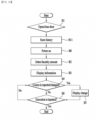
- FIG. 1 shows a control method for performing a course or option of a laundry treating apparatus of related art.
- Korean Patent Publication No. 10-2009-0077097 Korean Patent Publication No. 10-2008-0102611 , etc.
- FIG. 1(a) shows a control method of performing a course or option by a laundry treating apparatus of the related art.
- a laundry treating apparatus of the related art may include a power supplying step S1 of supplying power to the laundry treating apparatus by inputting a power button (on), a selecting step S2 of selecting an appropriate course or option from a control panel of the laundry treating apparatus, and a starting step S3 of inputting an execution button for executing the course or option.
- the laundry treating apparatus of the related art is provided as a front load type washer having an opening provided to a front side of a cabinet to put laundry therethrough, if the starting step S3 is performed, a door locking step S4 of fixing the opening to the cabinet may be performed.
- the laundry treating apparatus of the related art performs a laundry amount detecting step S5 of detecting a laundry amount through a current value applied while a laundry received drum and the like is rotated.
- a controller of the laundry treating apparatus of the related art performs a time displaying step S6 of displaying an estimated execution time of the selected course or option to a user and an executing step S7 of executing the course or option automatically.
- the laundry amount detecting step S5 and the time displaying step S6 of the laundry treating apparatus of the related art are performed after the starting step S3 of executing the course or option by the user. Therefore, there is a problem that the user is forced to input an execution of the course or option while failing to receive information on the laundry amount or the estimated execution time.
- the execution time displayed in the time displaying step S6 fails to fit user's current intention or situation, there is a problem that the laundry treating apparatus of the related art does not allow for the user to take active measures such as adding or reducing laundry.
- the laundry treating apparatus of the related art has a problem that the course or option cannot be canceled or changed unless active measures such as arbitrarily turning off the power of the washer are taken to change the selected course or option even if the execution time of the selected course or option does not fit the intention.
- FIG. 1(b) shows a rotational state of a drum when a laundry treating apparatus of the related art senses a laundry amount.
- the laundry treating apparatus of the related art calculates the weight of the laundry L by measuring a current value applied to or outputted from the drive portion that rotates the drum D while rotating the drum in the direction I.
- the laundry treating apparatus of the related art rotates the drum D to detect the laundry amount
- the laundry L paced on a floor surface of the drum is lifted and then falls in direction II by gravity within the drum D so as to be separated from an inner wall of the drum.
- the laundry treating apparatus of the related art has a limitation in that a current value, which is applied or outputted while continuously rotating the drum D one or more times in the direction I, should be aligned in order to detect an accurate weight of the laundry L.
- the laundry treating apparatus of the related art has a problem that the time for sensing the laundry amount inevitably requires more time than the time for continuously rotating the drum.
- the laundry treating apparatus of the related art since the time required for the laundry amount detecting step S5 is set to be relatively long, the laundry treating apparatus of the related art has a problem that the time displaying step S6 for displaying the execution time of the course or option may not be quickly guided to the user.
- the laundry treating apparatus of the related art has a problem that a user is fundamentally prohibited from utilizing information on a laundry amount of laundry or an estimated execution time.
- One technical task of the present disclosure is to provide a laundry treating apparatus capable of detecting an amount of laundry prior to performing a course or option set for the laundry treating apparatus.
- Another technical task of the present disclosure is to provide a laundry treating apparatus capable of immediately informing a user of an estimated execution time of a course or option prior to performing the course or option.
- Another technical task of the present disclosure is to provide a laundry treating apparatus for allowing a user to change a course or option immediately when an estimated execution time of the course or option fails to fit a situation.
- Another technical task of the present disclosure is to provide a laundry treating apparatus for providing a degree of freedom to enable a user to change a course or option by checking an estimated execution time prior to performing the course or option of the laundry treating apparatus.
- Another technical task of the present disclosure is to provide a laundry treating apparatus capable of checking an executing an appropriate course or option while checking an amount of laundry or an estimated execution time.
- Another technical task of the present disclosure is to provide a laundry treating apparatus capable of indicating an amount of laundry immediately (e.g., within 1 second).
- Further technical task of the present disclosure is to provide a laundry treating apparatus capable of immediately detecting and indicating a laundry amount when a power of the laundry treating apparatus is supplied or opening/closing of a door is completed.
- Another further technical task of the present disclosure is to provide a laundry treating apparatus capable of immediately detecting and indicating a laundry amount when a course or option is selected.
- the control panel may include a display portion displaying an estimated time of one course or option of the courses or options and an execution portion of receiving the input of the command for executing the one course or option of the courses or options.
- the display portion may display the estimated time of the prescribed course or option before the execution portion is inputted.
- the apparatus may further include a controller calculating the estimated time of the course or option by detecting an amount of the laundry and forwarding the calculated estimated time to the display portion .
- the controller may detect the amount of the laundry before the execution portion is inputted.
- the controller may detect the amount of the laundry by controlling the drive portion .
- the control panel may further include a power portion of receiving an input of a command for supplying power to the water supply portion , the drive portion and the drain portion . Based on inputting the power portion , the controller may detect the amount of the laundry before the execution portion is inputted.
- the cabinet may further include an opening for putting the laundry and a door coupled to the cabinet to open/close the opening. Based on failing to detect the amount of the laundry, the controller may wait until detecting opening/closing of the door.
- the controller may additionally detect the amount of the laundry.
- the controller may detect the amount of the laundry before the execution portion is inputted.
- the controller may detect the amount of the laundry before the execution portion is inputted.
- the apparatus may further include a storage portion storing an opening/closing history of the door. If the power portion is inputted and the history exists in the storage portion , the controller may detect the amount of the laundry before the execute portion is in putted.
- the controller may wait until re-detecting the opening/closing of the door.
- the controller may additionally detect the amount of the laundry.
- the control panel may further include a selection portion of receiving the input of the command for selecting one course or option of the courses or options, and based on inputting the selection portion , the controller may detect the amount of the laundry before the execution portion is inputted.
- the controller may detect the amount of the laundry before the execution portion is inputted.
- the controller may detect the amount of the laundry before the execution portion is inputted.
- the cabinet may include an opening for putting the laundry, a door coupled to the cabinet to open/close the opening, and a lock portion coupling the door and the cabinet together
- the controller may re-calculate the estimated time of the course or option in a manner of activating the lock portion , temporarily activating the water supply portion , and then additionally detecting the amount of the laundry.
- the controller may be configured to detect an amount of the laundry by controlling the drive portion Based on being supplied with power, the controller may be configured to detect an amount of the laundry.
- the display portion may be controlled to display the amount of the laundry.
- the controller may be configured to perform a course or option by activating one or more of the water supply portion , the drain portion , or the drive portion .
- the controller may be configured to detect the amount before performing the course or option.
- the controller may be configured to detect the amount of the laundry before the lock portion locks the door.
- the present disclosure provides that an amount of laundry can be detected prior to performing a course or option set for a laundry treating apparatus.
- the present disclosure can immediately inform a user of an estimated execution time of a course or option prior to performing the course or option.
- the present disclosure provides that a user is allowed to change a course or option immediately when an estimated execution time of the course or option fails to fit a situation.
- the present disclosure provides a degree of freedom to enable a user to change a course or option while checking an estimated execution time prior to performing the course or option of the laundry treating apparatus.
- the present disclosure provides that an appropriate course or option is changed and executed while an amount of laundry or an estimated execution time is changed.
- the present disclosure provides that an amount of laundry can be indicated immediately (e.g., within 1 second).
- the present disclosure provides that a laundry amount is immediately detected and indicated when a power of a laundry treating apparatus is supplied or opening/closing of a door is completed.
- the present disclosure provides that a laundry amount is immediately detected and indicated when a course or option is selected.
- the present disclosure provides that a laundry amount can be detected prior to executing a course or option.
- the present disclosure provides that a laundry amount can be detected prior to performing locking of a door.
- the present disclosure provides that a detergent corresponding to the laundry amount can be supplied prior to performing locking of a door.
- the present disclosure has an effect that a detergent corresponding to the laundry amount can be supplied prior to executing a course or option.
- FIG. 2 shows an implementation of a laundry treating apparatus of the present disclosure.
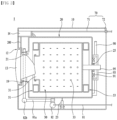
- FIG. 3 shows an inner structure of a laundry treating apparatus of the present disclosure.
- positive and negative directions of the x-axis are defined as front and rear directions of a laundry treating apparatus, respectively, and positive and negative directions of the z-axis are defined as top and bottom directions of the laundry treating apparatus.
- a positive direction of the y-axis is defined as a right direction of the laundry treating apparatus, and a negative direction of the y-axis is defined as a left direction of the laundry treating apparatus.
- a laundry treating apparatus 1 of the present disclosure may include a cabinet 10 forming an exterior and a laundry receiving part 20' provided within the cabinet 10 to receive laundry therein.
- the cabinet 10 forms the exterior of the laundry treating apparatus 1 and may include an opening 12 through which laundry may be put or withdrawn and a door 13 opening/closing the opening 12.
- the door 13 is rotatably coupled to a front side of the cabinet 10, and the opening 12 may be opened/closed depending on turning the door 13.
- FIG. 2 exemplarily illustrates a laundry treating apparatus of a front load type, in which the opening 12 and the door 13 are formed on the front side of the cabinet 10.
- the present disclosure may include a laundry treating apparatus of a top load type, in which the opening 12 and the door 13 are formed on a top side of the cabinet 10.
- the lock part includes a solenoid, a direct fastening means or the like and may be configured to enable the door 13 to lock the opening 12.
- a detergent box 14 detachably received in the cabinet to receive a detergent or fabric softener therein and a control panel 16 configured to input an activation command to the laundry treating apparatus or display a status of the laundry treating apparatus may be provided to the front side of the cabinet 10.
- the detergent box 14 and the control panel 16 may be disposed above the opening 12 to be easily gripped or touched by a user.
- the detergent box 14 is configured to be withdrawable in a front direction and may store a powder or liquid detergent therein.
- the detergent box 14 may be a drawer type.
- the control panel 16 may be provided to one side of the detergent box 14, and may include an input portion 18 to receive an input of an activation command including a washing course and option information related to washing from a user and a display portion 17 to display the inputted information and a washing progress status.
- the input portion 18 may be a button type or a rotary knob type and may be provided as a touch panel.
- the display portion 17 may include a display portion having liquid crystals and a speaker outputting sound. Yet, the display portion 17 may be configured in any shape capable of displaying the status of the laundry treating apparatus 1, and may be integrally provided with the input portion 18.
- control panel 16 may be provided with a controller P to control the laundry treating apparatus 1.
- the controller may control the electronic parts of the laundry treating apparatus 1 described later by being supplied with power from an external power source.
- each load portion e.g., a drive portion, a water supply valve, a communication module, etc.
- each load portion e.g., a drive portion, a water supply valve, a communication module, etc.
- the tub 20 is provided within the cabinet 10, and may define a space for storing wash water therein.
- the tub may have a cylindrical shape.
- the tub 20 may include a tub entrance 21 through which laundry is put or withdrawn and a tub support part 23 fixing the tub 20 to an inside of the cabinet 10.
- the tub entrance 21 may communicate with the entrance 12.
- the tub support part 23 is provided under the tub 20 and may attenuate the vibration generated from the tub 20.
- the tub support part may include a damper, a spring, etc.
- the tub 20 may further include a water level sensor 90 measuring a water level in the tub.
- the water level sensor 90 may include an extension pipe extended from a bottom end of the tube to an upper side, a diaphragm provided to seal a top end of the extension pipe, and a sensor detecting a frequency of the diaphragm.
- the laundry treating apparatus 1 of the present disclosure may further include a vibration sensor 92 detecting vibrations within the tub 20.
- the vibrations sensor 92 is configured to detect at least one of the vibrations on x-, y- and z-axes and may deliver a state of an inside of the tub to the controller.
- a gasket 19 may be further provided between the entrance (also referred to as opening) 12 of the cabinet 10 and the tub entrance 21 of the tub 20, a gasket 19 may be further provided.
- the gasket 19 restricts the wash water in the tub 20 from leaking to the cabinet 10 and may also restrict the vibration generated from the tub 20 from being delivered to the cabinet 10.
- the gasket may include an elastic member.
- a plurality of perforated holes 33 communicating with the tub 20 may be formed in an inner circumferential surface of the drum 30.
- the wash water received in the tub 20 may be supplied into the drum 30 through the perforated holes 33, and the wash water in the drum 30 may be discharged to the tub 20 through the perforated holes 33.
- the laundry treating apparatus 1 of the present disclosure may include a drive portion coupled to the tub 20 to rotate the drum 30, a water supply portion 70 supplying wash water into the tub 20, and a drain portion 80 discharging the wash water of the tub 20 externally.
- the drain portion 80 may include a drain pipe 81 communicating with the tub 20, and may further include a drain pump 82 connected to the drain pipe to provide a power for draining water to the tub 20.
- circulation flow path and the circulation pump described above are the components necessary for a case of spraying the wash water stored in the tub, it may not exclude a case of spraying the wash water into the drum through a spray water supply flow path connected to a water supply source outside the cabinet.
- the wash water may be sprayed into the drum during a filtration motion and a squeeze motion.
- the laundry treating apparatus 1 of the present disclosure may further include balancers 51 and 53 to attenuate the vibration generated from the drum 30.
- the balancers 51 and 53 may remove or reduce the eccentricity of the drum 30, which is generated as laundry is unequally distributed within the drum 30. Namely, the balancers 51 and 53 are moved to specific positions under the control of the microcomputer, thereby attenuating the unbalance of the drum 30.
- the balancer may be provided to each of front and rear sides of the drum 30 or may be provided to either the front side or the rear side of the drum 30.
- the balancer may include a front balancer 51 and a rear balancer 53 provided to the front side and the rear side of the drum 30, respectively.
- the balancers may include ball balancers, liquid balancers, etc.
- the drive portion 9 is provided to an outside of the tub 20, and may be connected to the drum 30 in a manner of being coupled to or penetrating a backside of the tub 20.
- the drive portion 9 is fixed to the backside of the tub 20, and may convert electric energy into mechanical energy. Namely, the drive portion 9 may rotate the drum 30 by an external current being supplied to the drive portion 9.
- the drive portion 9 may include a stator 91 generating a magnetic field, a rotor 93 rotated by the magnetic field within the stator 91, and a rotation shaft connecting the drum 30 and the rotor 93 together by penetrating the backside of the tub 20.
- the drive portion may include a Bush-Less Direct Current (BLDC) motor.
- the stator 41 may include a coil and the rotor 93 may include a permanent magnet.
- a rotation shaft bearing 25 rotatably supporting the rotation shaft 95 may be further provided to the backside of the tub 20.
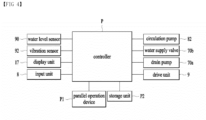
- FIG. 4 shows the configuration of the controller controlling the load of the present disclosure.
- the controller P is provided to a control panel and the like and may be configured to perform a washing course and an option by receiving an input of a command for activating the laundry treating apparatus through the input portion 18. Namely, the controller P may be configured to control the water supply valve 72, the drain pump 82 and the drive portion 9 using water level information detected by the water level sensor 90 while performing the determined washing course and option.
- controller P may provide a current status of the laundry treating apparatus through the display portion 17, and may be provided to detect the vibration of the drum through a vibration sensor 92 or a current value applied to the drive portion 9.
- the controller P may further include a parallel operation device P1 capable of receiving and processing a signal value of the vibration sensor 92, a current value applied to the drive portion 40, an RPM of the drum 30, etc.
- controller P may further include a storage portion P2 capable of storing a data value processed by the parallel operation device, an algorithm for operating the parallel operation device P1, and various electric signals inputted to the parallel operation device P1.
- the controller P of the present disclosure may implement an artificial neural network learning logic for generating an artificial neural network with the parallel operation device P1 and the storage portion P2.
- the artificial neural network may be used to derive one coherent result value by combining and analyzing a plurality of factors.
- a single input value can only derive a single output value.
- the laundry treating apparatus of the present disclosure can utilize two or more signals through the parallel operation device P1 and therefore can obtain necessary information more accurately than using a single information.
- a plurality of courses or options for operating the laundry treating apparatus may be pre-stored in the storage portion P2.
- a plurality of the courses or options may include a combination of an operational method, an operational sequence, and an operational strength for operating the water supply valve 72, the drive portion 9 and the drain pump 82 to perform a washing cycle, a rinsing cycle, and a dewatering cycle.
- data of matching a current value applied to or outputted from the drive portion 9 to a laundry amount, a laundry texture or the like may be stored as a table and the like.
- an estimated time of a plurality of the courses or options corresponding to the amount of laundry may be stored as data.
- an appropriate detergent amount necessary to perform each course or option corresponding to an amount of laundry may be pre-stored as data.
- the detergent amount may include one or more of a wash detergent, a softener, and a bleach.
- the controller P may control each of the components of the laundry treating apparatus using various algorithms and data stored in the storage portion P2.
- the controller P may calculate one or more of an execution time and a necessary detergent amount for a course or option for performing a washing of the laundry .
- FIG. 5 shows one implementation of the control panel 16 provided to the laundry treating apparatus 1 of the present disclosure.
- the display portion 17 may be provided as a display panel only, but the input portion 18 may be provided as a physical button that is inputtable separately.
- the control panel 16 may include a power portion 120 receiving an input of a command for supplying a power to the laundry treating apparatus 1.
- a power may be supplied to the control panel 16, and the controller P including the drive portion 9 may be supplied with the power all.
- the input portion 18 may further include a selection portion for selecting or changing the washing course or option.
- the selection portion 140 and 160 may include a course selection portion 140 configured to receive an input of selecting one of courses of performing a series of washing processes including washing, rinsing and dewatering cycles of the laundry treating apparatus 1 and an option selection portion 160 configured to receive an input of selecting one of options for adjusting strength and level of the course.
- the course may be classified into a first course including washing methods of removing foreign substances of general laundry or a set thereof, a second course including washing methods of sterilizing the laundry or a set thereof, and a third course including methods of removing foreign substances in consideration of texture of the laundry and a set thereof.
- the option may be classified into a first option of adjusting a washing strength in the selected course, a second option of adjusting the number of rinsing, a third option of adjusting a dewatering strength, and a fourth option of determining a water temperature of a tub receiving laundry and water therein.
- Adjusting the washing strength and the dewatering strength may mean adjusting an rpm of the drum, a rotation direction change cycle of the drum and the like in the washing cycle and the dewatering cycle.
- the first course is the classification of a general course of washing laundry, it may be referred to as a daily course.
- the second course is the classification of a course for sterilization, it may be referred to as a sanitary course.
- the third course is the classification of a course in consideration of laundry texture, laundry amount and the like, it may be referred to as a customized course.
- the course selection portion 140 may be configured to select a course set or selected sequentially if inputted repeatedly.
- the course selection portion 140 may include a first course selection portion 141 configured to select one from the first course, a second course selection portion 142 configured to select one from the second course, and a third course selection portion 143 configured to select one from the third course.
- the option selection portion 160 may be configured to select a course set or displayed sequentially by being repeatedly inputted like the course selection portion 140.
- the option selection portion 160 may include a first option selection portion 161 adjusting a washing strength in the selected course, a second option selection portion 162 adjusting the number of rinsing, a third option selection portion 163 adjusting a dewatering strength, and a fourth option selection portion 164 adjusting a water temperature of the tub receiving laundry and water therein.
- the option selection portion 160 may be configured to select a desired option by inputting each option selection portion sequentially.
- the display portion 130 may include a liquid crystal display, and may include a light-reflecting lamp, a sound-emitting speaker, etc.
- the display portion 130 may include a first display portion 131 displaying a course selected from the course selection portion 140 and a second display portion 132 displaying an option selected from the option selection portion 160.
- the first display portion 131 may be configured to display the selected course. For example, a portion corresponding to the selected course may be turned on or a name of the course may be represented on the display portion .
- the second display portion 132 may be configured to display the selected option. For example, a portion corresponding to the selected option may be turned on or a name of the option may be represented on the display portion .
- the first display portion 131 may be configured such that, when the course selection portion 140 receives an input, a corresponding course is turned on, or such that when the course selection portion 140 receives an input, a corresponding course is displayed on an LCD or a sound is emitted.
- the first display portion 131 may include a display panel or a lamp that emits light next to a text that describes the course contents.
- the general course is sequentially turned on in order so as to have a corresponding course recognized by the user.
- a course sequentially corresponding to the sanitary course is turned on in order.
- a course sequentially corresponding to the customized course may be turned on in order.
- the second display portion 132 may be configured such that when the option selection portion 160 receives an input, a corresponding option is turned on, or such than when the option selection portion 160 receives an input, a corresponding option is displayed on an LCD or a sound is emitted.
- the second display portion 132 may include a display panel or a lamp that emits light next to a text that describes the option contents.
- the option selection portion 160 As the option selection portion 160 is repeatedly clicked or touched, the first to fourth options may be turned on sequentially. Thus, a user may select a desired option.
- the option selection portion 160 may further include a switch or a touch zone capable of performing an additional function on the laundry treating apparatus 1 as well as the Wash, Rinse, Dewater, and Water temperature.
- the option selection portion 160 may further include a steam adjustment portion 160a adding an option of supplying steam into the laundry treating apparatus 1, a reservation portion 160b of pre-determining an operation time of the laundry treating apparatus 1, an additional setting portion 160d clicked to add laundry during an operation of the laundry treating apparatus 1, a turbo portion 160e forming a strong water current by instantly raising a drum rpm of the laundry treating apparatus 1, a turbo dry portion 160f adding an option of supplying strong hot air, a wind dry portion 160g adding an option of supplying warm or cool air other than hot air, and a time dry portion 160h adding an option of performing natural drying by rotating only a drum at a predetermined speed.
- a steam adjustment portion 160a adding an option of supplying steam into the laundry treating apparatus 1
- an additional setting portion 160d clicked to add laundry during an operation of the laundry treating apparatus 1 a turbo portion 160e forming a strong water current by instantly raising a drum rpm of the laundry treating apparatus 1
- the second display portion 132 may include a display portion capable of displaying status information of the laundry treating apparatus 1 except for a process for inputting a course or option in case that a drying or washing cycle is in progress, that a reservation setting is performed, or that a drying or washing cycle ends, despite displaying details of an option of a course at the moment of determining the course or option.
- the display portion 17 may further include a third display portion 133 displaying an execution time estimated when a plurality of the courses or options are performed.
- the third display portion 133 may display an execution time of the course or option according to an amount of the laundry to a user.
- control panel 16 may be provided in any form as long as it may include the input portion 18 receiving an input of a command to drive the laundry treating apparatus and the display portion 17 displaying the status of the laundry treating apparatus.
- a user may set a desired course or option by inputting the course selection portion 140 or the option selection portion 160.
- a standard course or a standard option may be preset.
- reference values of the standard washing course and Wash/Rinse/Dewater/Water temperature may be determined as standards.
- a user may select a desired course or option by inputting the course selection portion 140 and the option selection portion 160, and may desire to perform a standard course or option set as a reference as it is.
- the user may select a prescribed course of option by inputting the course selection portion 140 and the option selection portion 160, or may select the standard course or option by not inputting the course selection portion 140 and the option selection portion 160.
- the control panel 16 may include an execution portion 170 receiving an input of a command to execute the selected course or option or the preset standard course or option.
- the controller P may lock the door 13 not to be separated from the cabinet 10.
- a detection portion detecting whether the door 13 is located to the cabinet 10 may be installed in at least one of the door 13 and the cabinet 10, and the detection portion may be controlled by the controller P.
- An execution time of a standard course or option or a course or option selected by a user may be displayed on the third display portion 133.
- the display portion 17 may be configured to indicate detergent amounts necessary to perform a plurality of the courses or options.
- the execution time of the course or option may vary depending on an amount of laundry.
- the detergent amount to perform a plurality of the courses or options may vary depending on the amount of the laundry.
- the controller P may display at least one of the execution time of the course or option and the detergent amount necessary for the course or option on the display portion 17.
- the laundry treating apparatus of the present disclosure may first detect an amount of the laundry before inputting the execution portion 170 and then display the estimated time of the selected course or option and the necessary detergent amount on the display portion 17.
- controller P of the laundry treating apparatus of the present disclosure may be configured to detect the amount of the laundry before the execution portion 170 is inputted.
- the controller P may calculate the amount of the laundry through a current value applied to or outputted from the drive portion 9 over controlling the drive portion 9, and may display an estimated execution time of the selected course or option to a user even before inputting the execution portion 170.
- the user may be immediately informed on the estimated execution time of the course or option before the selected course or option is executed. If the estimated execution time fails to meet a situation or a user's schedule, the user may be guided to select other courses or options.
- the user may immediately change the course or option initially selected by the user into a course or option appropriate for a situation of the user.
- a user may change a course or option while checking estimated execution times of several courses or options in advance before executing a selected course or option.
- a user may check a necessary detergent amount appropriate for laundry in a current status of a course or option selected from a plurality of courses or options and then put an appropriate amount of detergent.
- control panel 16 of the laundry treating apparatus of the present disclosure may further include a time adjustment portion 200 capable of changing an execution time of the executed course or option.
- the time adjustment portion 200 may be configured in a manner of selecting the course or option and then inputting some buttons of the option selection portion 160, or may be provided as a separate button in the control panel 16.
- time adjustment portion 200 when the time adjustment portion 200 is provided as a separate button, a user may input the time adjustment portion 200 and then extend or reduce an estimated execution time of the selected course or option.
- an execution time may be adjusted by inputting the option button of Dewater (third option selection portion ) 163 and the option button of Water temperature (fourth option selection portion ) 164.
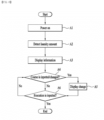
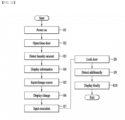
- FIG. 6 shows one implementation of a control method of detecting an amount of laundry before inputting the execution portion 170.
- the water supply portion 70, the drive portion 9, the drain portion 80 and the like may be provided with power and the controller P may be provided with power as well.
- the controller P may be configured to detect at least one of the laundry amount and the laundry texture.
- a prerequisite condition for detecting at least one of the laundry amount and the laundry texture may include an input of the power portion 120.
- the controller P may immediately detect the amount of the laundry.
- the controller P may calculate an estimated time for executing a specific course or option according to the laundry amount.
- the controller P may recognize in a manner of matching the estimated time corresponding to the laundry amount in the storage portion P2.
- a detergent amount necessary for the laundry amount to execute a course or option may be organized as data.
- the controller P may calculate a detergent amount necessary to perform washing on the laundry according to the course or option in the storage portion P2.
- the laundry treating apparatus of the present disclosure may perform a power supplying step A1 of supplying a power by inputting the power portion 120 of the laundry treating apparatus and a laundry amount detecting step A2 of detecting an amount of laundry received in the drum 30 based on performing the power supplying step A1.
- the laundry amount detecting step A2 may detect a texture of the laundry.
- the laundry amount detecting step may detect one or more of a laundry weight and a laundry texture, it may be regarded as a laundry state detecting step.
- the texture of the laundry may be calculated if one or more of a moisture content, a laundry volume and a laundry amount are inputted to the controller.
- an information displaying step A3 of displaying at least one of the amount of the laundry, an estimated execution time of a course or option of performing washing of the laundry, and a detergent amount necessary for the course or option on the display portion 17 may be performed.
- an execution time corresponding to a preset standard course or option matched to the amount of the laundry may be displayed.
- a user may check the laundry amount and the execution time of the preset course or option, which are displayed in the information displaying step A3, and then compare them with a schedule of the user, and may check a detergent amount.
- the user may input the execution portion 170.
- the controller P may perform an execution inputting step A6 of detecting that the execution portion 170 is inputted.
- the controller P locks the door 13 to the cabinet 10 by controlling the lock portion , thereby preventing the door 13 from being open arbitrarily.
- the controller P may perform one or more of a washing cycle, a rinsing cycle and a dewatering cycle according to the settings of the course or option. After the execution inputting step A6, a procedure for detecting an amount of laundry may be skipped. Therefore, a total washing time may be prevented from being delayed.
- a course setting step A4 of receiving an input of the course selection portion 140 or the option selection portion 160 may be further performed.
- the user may check the amount of the laundry through the course setting step S4 and then input the course selection portion 140 or the option selection portion 160. After confirming the execution time, the user may change the course or option by inputting the course selection portion 140 or the option selection portion 160.
- the controller P may perform a change displaying step A5 of recalculating an estimated execution time or a detergent amount of a changed course or option corresponding to the amount of the laundry and then forwarding it to the display portion 17.
- one or more of the estimated execution time of the changed course or option and the changed detergent amount may be displayed on the display portion 17.
- the user may input the execution portion 170. If the estimated execution time or the detergent amount is not appropriate, the user may re-input the course selection portion 140 or the option selection portion 160.
- the controller P may perform an execution inputting step A6. If detecting the input of the course selection portion 140 or the option selection portion 160, the controller P may re-perform the course setting step A4 and the change displaying step A5.
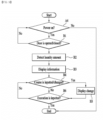
- FIG. 7 shows an extended implementation of the control method of FIG. 6 .
- the laundry treating apparatus of the present disclosure may perform a power inputting step A1 of supplying power to one or more of the controller P, the drive portion 9, the water supply portion 70, the drain portion 80, and the control panel 16.
- the laundry treating apparatus may perform a laundry amount detecting step A2 of detecting an amount of laundry.
- a laundry detecting step A2-1 of detecting whether the laundry is received in the drum 30 may be performed together. If the laundry is in the drum 30 in the laundry detecting step A2-1, the aforementioned control method may be performed.
- the controller P may perform a door open/close detecting step A2-2 of waiting until the door 13 is open and closed. Namely, the controller P may wait until detecting the open/close of the door if failing to detect the amount of the laundry.
- the controller P may additionally detect an amount of the laundry by re-performing the laundry amount detecting step A2.
- the laundry treating apparatus of the present disclosure may immediately detect a laundry amount in a state that the laundry is received in the drum 30 before the input of the power portion 120. Yet, if the laundry is not received in the drum 30 before the input of the power portion 120, the laundry treating apparatus of the present disclosure may detect the amount of the laundry in a manner of waiting until the laundry is put into the drum 30.
- the laundry treating apparatus of the present disclosure may detect the amount of the laundry before the input of the execution portion 170 and then forward informations such as an execution time of a course or option, a necessary detergent amount and the like to a user.
- FIG. 8 shows another control method of detecting a laundry amount before an input of the execution portion 170 of the laundry treating apparatus of the present disclosure.
- the controller P may be configured to detect an amount of laundry before the execution portion 170 is selected, if opening/closing of the door 13 is detected. Namely, a condition for detecting the amount of the laundry may include the opening/closing of the door 13.
- the controller P may perform an execution inputting step B6 by detecting whether a user inputs the execution portion 170, or may perform a course setting step B4 and a change displaying step B5 by detecting whether the user changes a course or option.
- the information displaying step B3, the course setting step B4, the change displaying step B5, and the execution inputting step B6 may be the same as the aforementioned implementation.
- the door 13 is open/closed, it may mean that it is highly probable that the laundry is already put in the drum 30. In addition, if the door 13 is opened/closed, it may mean that an amount of the laundry is increased/decreased in the drum 30.
- the laundry treating apparatus of the present disclosure may immediately detect the amount of the laundry and then inform the user of the laundry amount itself, an estimated execution time of a course or option (or a changed execution time), and a necessary detergent amount (or a changed detergent amount).
- FIG. 9 shows an extended implementation of FIG. 8 .
- the laundry treating apparatus of the present disclosure may further perform a power inputting step B0 of detecting whether a power is inputted before the opening/closing step B1.
- the controller P is supplied with power so as to detect whether the door 13 is opened/closed.
- the controller may perform a laundry amount detecting step B2 if detecting that the door 13 is opened and closed.
- the controller P may perform the laundry amount detecting step B2 of detecting an amount of the laundry and an information displaying step B3 of displaying one or more of the amount of the laundry, an execution time of a preset course or option, and a necessary detergent amount according to the detected laundry amount.
- the controller P may perform an execution inputting step B6 by detecting whether a user inputs the execution portion 170, or may perform a course setting step B4 and a change displaying step B5 by detecting whether the user changes a course or option.
- the information displaying step B3, the course setting step B4, the change displaying step B5, and the execution inputting step B6 may be the same as the aforementioned implementation.
- the laundry treating apparatus of the present disclosure may immediately detect the amount of the laundry and then inform the user of the laundry amount itself, an estimated execution time of a course or option (or a changed execution time), and a necessary detergent amount (or a changed detergent amount).
- FIG. 10 shows another extended implementation of FIG. 8 .
- the laundry treating apparatus of the present disclosure may be configured to enable the storage portion P2 to store an opening/closing history of the door 13. Namely, regarding the laundry treating apparatus of the present disclosure, although the power portion 120 is not selected, as power is supplied to the control panel 16 or the storage portion P2 via a standby power, a history of opening and closing the door 13 may be stored.
- the laundry treating apparatus of the present disclosure may perform a history storing step B 1 1 of saving an opened/closed history of the door 13 to the storage portion P2.
- the controller P may perform a laundry amount detecting step B2.
- the controller P may perform a laundry amount detecting step B2 of detecting an amount of the laundry and an information displaying step B3 of displaying one or more of the amount of the laundry, an execution time of a preset course or option, and a necessary detergent amount according to the detected laundry amount.
- the controller P may perform an execution inputting step B6 by detecting whether a user inputs the execution portion 170, or may perform a course setting step B4 and a change displaying step B5 by detecting whether the user changes a course or option.
- the information displaying step B3, the course setting step B4, the change displaying step B5, and the execution inputting step B6 may be the same as the aforementioned implementation.
- the laundry treating apparatus of the present disclosure may detect an amount of the laundry. Accordingly, the laundry treating apparatus of the present disclosure may help a user in selecting an optimal course or option or an optimal detergent amount before inputting the execution portion 170.
- FIG. 11 shows another extended implementation of FIG. 8 .
- the laundry treating apparatus of the present disclosure may perform a laundry amount detecting step B2.
- the controller P may perform a laundry detecting step B2-1 of detecting whether the laundry is received in the drum 30 together. If the laundry is in the drum 30 in the laundry detecting step B2-1, the aforementioned control method may be performed as it is.
- the controller P may perform a door opening/closing detecting step B2-2 of waiting until the door 13 is opened and closed. Namely, if failing to detect the amount of the laundry, the controller P may wait until detecting the opening/closing of the door.
- the controller P may additionally detect the amount of the laundry by performing the laundry amount detecting step B2 again.
- the laundry treating apparatus of the present disclosure may detect the amount of the laundry. Therefore, an estimated execution time or a necessary detergent amount of a course or option to be selected by a user may be quickly provided before the execution portion 170 is inputted.
- the laundry treating apparatus of the present disclosure may detect an amount of the laundry by waiting until laundry is put in the drum 30.
- the opening/closing of the door 13 is a prerequisite condition for detection of the amount of the laundry, the laundry amount may be accurately detected after the timing of having the laundry received in the drum 30.
- the laundry treating apparatus of the present disclosure detects an amount of the laundry before inputting the execution portion 170, thereby providing a user with informations such as an execution time of a course or option, a necessary detergent amount for the course or option, and the like.
- FIG. 12 shows an additional control method of detecting a laundry amount before the execution portion 170 is selected.
- the laundry treating apparatus of the present disclosure may be configured to detect an amount of laundry when a user selects a desired course or option from a plurality of courses or options.
- An estimated execution time necessary for a user or a necessary detergent amount may include an execution time or a detergent amount of a course or option selected by the user. Therefore, when a user selects a course or option, the laundry treating apparatus of the present disclosure may be configured to provide an estimated execution time or detergent amount corresponding to the selected course or option.
- a time point for a user to input the course selection portion 140 and the option selection portion 160 is after the power portion 120 is inputted, and highly likely, after laundry is put in the drum 30 via opening/closing the door 13.
- an estimated execution time or a detergent amount according to an amount of laundry is provided to a user after a time point when the course selection portion 140 and the option selection portion 160 are inputted, an estimated execution time or a detergent amount may be accurately provided to the user irrespective of whether the user is a person who has a habit of putting laundry in the drum 30 and then inputting the power portion 120 or a person who inputs the power portion 120 first and puts laundry into the drum 30.
- the laundry treating apparatus of the present disclosure may perform a course inputting step C1 of detecting that the course selection portion 140 or the option selection portion 160 is inputted.
- the controller P may perform a laundry amount detecting step C2 of detecting an amount of laundry.
- the controller P may perform an information displaying step C3 of displaying at least one of the amount of the laundry, an estimated execution time of a selected course or option corresponding to the amount of the laundry, and a detergent amount for performing the course or option on the display portion 17.
- the controller P may perform an execution inputting step C6 of detecting whether a user inputs the execution portion 170, or may perform a course setting step C4 and a change displaying step C5 by detecting whether the user changes a course or option.
- the information displaying step C3, the course setting step C4, the change displaying step C5, and the execution inputting step C6 may be the same as the aforementioned implementation.
- FIG. 13 shows an additional implementation of a method of controlling a laundry treating apparatus of the present disclosure.
- the laundry treating apparatus of the present disclosure may be configured to additionally detect a laundry amount even after performing a course or option according to an input to the execution portion 170 after laundry amount detection.
- the laundry treating apparatus of the present disclosure may check whether an amount of laundry is too large to perform the course or option or whether an estimated laundry amount or a detergent amount is excessively represented as the laundry is excessively weighed due to a hydrated state of the laundry (i.e., wet laundry).
- the laundry treating apparatus of the present disclosure not only quickly detects an amount of laundry, but also accurately detects a state of the laundry even afterwards, thereby making adjustment to perform an optimal course or option.
- the laundry treating apparatus of the present disclosure may perform a power inputting step E1 of supplying power by inputting the power portion 120, an opening/closing step E2 of detecting opening/closing of the door 13, a laundry amount detecting step E3 of detecting an amount of laundry if detecting the input to the power portion 120 and the opening/closing of the door 13, and an information displaying step E4 of displaying an execution time or a necessary detergent amount of a course or option corresponding to the amount of the laundry.
- a course setting step E5 of setting a desired course or option by inputting one or more of the course selection portion 140 and the option selection portion 160 by a user a change displaying step E6 of displaying an execution time or a necessary detergent amount of the changed course or option may be performed.
- an execution inputting step E7 of performing the course or option by inputting the execution portion 170 may be performed.
- the door 13 may be locked to the cabinet 10.
- the laundry treating apparatus of the present disclosure may perform an additional detecting step E9 of additionally checking a state of the laundry when there is no risk of water, detergent, or laundry being discharged through the door 13.
- a control method corresponding thereto may be modified, and the modified control method may be provided to the user.
- the controller P may display guidance on stopping performing a course or option and withdrawing some of the laundry on the display portion 17 in the final displaying step E10.
- the controller P may modify and display the estimated execution time or a remaining time or the necessary detergent amount on the display portion 17 in the final displaying step E10.
- the controller P may re-calculate an estimated time of the course or option by additionally detecting an amount of the laundry.
- FIG. 14 shows a control method of detecting whether the laundry is wet or dry in the additional detecting step E9 by the laundry treating apparatus of the present disclosure.
- the laundry treating apparatus of the present disclosure may perform a water supplying step E91 of opening the water supply valve 72 and a wet laundry detecting step E91 of detecting whether the laundry was initially wet during or at the end of the water supplying step E91.
- the water supplying step E91 may supply water enough to perform the course or option.
- the water supplying step E91 may include supplying a small amount of water enough to be contained in the laundry only.
- the water supplying step E91 may include supplying water enough not to raise a water level only.
- the controller P may determine that the laundry is not dry laundry but wet laundry containing a certain amount of moisture.
- the controller P drives the lock portion , temporarily drives the water supply 70, and additionally detects an amount of the laundry, thereby re-calculating an estimated time of the course or option.
- the laundry amount detecting step may be performed to start a course or option before supplying water to the tub 20 or to detect a dewatered laundry amount to perform a dewatering cycle after draining the water from the tub 20.
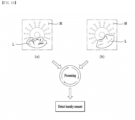
- FIG. 15 shows a control method of detecting whether laundry is wet laundry or dry laundry in the additional detecting step E9.
- the laundry treating apparatus of the present disclosure may perform a rotating step E9A of obtaining a state of the laundry by rotating the drum based on performing the additional detecting step E9 and a wet laundry detecting step e9B of detecting whether the laundry was initially wet laundry during or at the end of the rotating step E9A.
- the rotating step E9A may include a step of rotating the drum continuously to make one or more revolutions.
- the controller P may detect whether the laundry is wet laundry using a current value applied to or outputted from the drive portion 9.
- FIG. 15(b) shows differences when the laundry in the drum 30 is wet laundry or dry laundry.
- the left drawing shows a case that the laundry is dry laundry such as dry towel and the like
- the right drawing shows a case that the laundry is wet laundry such as wet towel and the like.
- a current value of the drive portion 9 for rotating the drum 30 may not be significantly different.
- the contact force of the wet laundry is greater than that of the dry laundry and thus it is well clustered together, so a large amount of laundry may simultaneously fall into the inner wall of the drum every time the drum makes one revolution.
- a vibration value of the wet laundry may be detected to be greater than that of the dry laundry.
- the controller P may detect that the laundry is wet laundry.
- an actual weight of the laundry may be less by the amount of water absorbed by the laundry than the weight of the laundry detected in the laundry amount detecting step E3.
- the controller P may calculate a weight obtained by removing an amount of moisture from the weight of the laundry, or may calculate the weight of the laundry at a washing level capable of performing washing.
- the controller P may change an execution time or a detergent amount of the course or option by estimating the weight of the laundry that is dry laundry and then display it in the final displaying step E10.
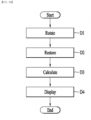
- FIG. 16 shows a method of controlling laundry amount detection in a laundry treating apparatus of the present disclosure.
- the laundry treating apparatus of the present disclosure may perform a laundry amount detecting step of detecting an amount of laundry before an input of the execution portion 170.
- the laundry amount detecting step described below may be performed in the aforementioned laundry amount detecting step.
- the laundry amount detecting step may include a rotating step D1 of rotating the drum and a calculating step D3 of calculating a weight of laundry by measuring a first current value applied to or outputted in the rotating step.
- the laundry treating apparatus of the present disclosure may rotate the drum 30 less than one revolution in the rotating step D1. Accordingly, the laundry treating apparatus of the present disclosure may detect an amount of the laundry before rotating the drum 30 at one revolution.
- the laundry amount detecting step may be terminated within 1 second. Accordingly, before determining that a user inputs the power portion 120, opens/closes the door 13, or selects the course or option and inputs the execution portion 170, one or more of an amount of the laundry and an estimated execution time and detergent amount based on the laundry amount may be displayed on the display portion 17.
- the user may select or change a course or option while checking the estimated execution time and the detergent amount, and input to the execution portion 170.
- the laundry treating apparatus of the present disclosure may quickly detect an amount of laundry before finally determining to perform a course or option selected by a user, thereby providing an estimated execution time or a detergent amount.
- a user may be prevented from waiting for a long time to check an estimated execution time and an appropriate detergent amount of a course or option selected by the user. As a result, washing delay can be prevented.
- the rotating step D1 is terminated before the drum 30 makes one revolution.
- a restoring step D2 of returning the drum 30 to a original position may be performed.
- the calculating step D3 may be performed when the rotating step D1 is being performed or when the rotation step D1 is terminated, and may be performed when both the rotating step D1 and the restoring step D2 are performed.
- the laundry amount detecting step may further include a displaying step D4 of displaying the amount of the laundry on the display portion 17 when the calculating step D3 is terminated.
- the amount of the laundry may be displayed only, an estimated execution time of a specific course or option corresponding to the laundry amount may be displayed, or a required detergent amount necessary to perform the course or option may be displayed.
- the laundry amount detecting step may be performed before an input of the execution portion 170, or may be identically performed in an additional detecting step and the like performed after the execution portion 170 has been inputted.
- the same laundry amount detecting step may be performed in each of a dry laundry amount detecting step to perform a washing cycle and a wet laundry amount detecting step to perform a dewatering cycle.
- the laundry amount detecting step may be performed in a step of checking whether laundry is wet laundry or dry laundry.
- FIG. 17 shows an aspect of laundry amount detection in a laundry treating apparatus of the present disclosure.
- a laundry may be disposed on a floor surface of the drum 30 by its own weight.
- the drum 30 may rotate right before making one revolution.
- the drum 30 may be rotated up to or less than an angle at which the laundry is separated from an inner wall of the drum or the disposition is varied. Accordingly, while the position of the laundry in the drum 30 is varied, unnecessary loads or impacts may be restricted from being transmitted to the drive portion 9. Accordingly, the controller P may accurately calculate the load of the laundry through a current value applied to or output from the drive portion 9.
- the drum in the rotating step D1, may be rotated in a range of 0° to 90° or less.
- the drum 30 rotates in a range of 10 degrees to 45 degrees or less.
- FIG. 18 shows a laundry amount detection calculating method of a laundry treating apparatus of the present disclosure.
- the controller P may rotate the drum 30 less than one revolution through the rotating step D 1.
- the controller P may calculate (process) an amount of the laundry by measuring a current value applied to or outputted from the drive portion 9 in the rotating step D 1.
- Te is a torque value applied to the drive portion 9 and corresponds to 'I (current value) ⁇ K (drive portion constant)'. That is, since the drive portion constant k is an eigenvalue of the drive portion 9 itself, the controller P may calculate a torque value applied to the drive portion 9 when detecting the current value I.
- Bw is a friction torque, and when the drum 30 rotates, B becomes very small, so it may be ignored.
- the controller p may detect an angular acceleration when rotating the drum in the rotating step d1.
- the angular acceleration may also be directly calculated through a current value applied to the drive portion 9.
- both the torque value Te applied to the drive portion 9 and the angular acceleration dw/dt may be calculated, and thus an inertial moment J may be calculated.
- the laundry treating apparatus of the present disclosure may immediately detect the amount of the laundry by grasping the inertial moment J.
- FIG. 19 shows a process for calculating a laundry amount with an inertia moment in a laundry treating apparatus of the present disclosure.
- data for describing association between the inertia moment and the laundry amount may be stored.
- the weight of the laundry is obtained, it is able to detect an inertia moment generated when the laundry is rotated in the drum 30. If the inertia moment is obtained, it is able to detect the weight of the laundry.
- the controller P detects the inertia moment as 55000 in the calculating step D3, when the drum 30 is rotated counterclockwise, an amount of the laundry may be confirmed as 2kg. When the drum 30 is rotated clockwise, the amount of the laundry may be confirmed as 3kg.
- the controller p may immediately detect the amount of the laundry through data obtained by arranging the inertial moment and the weight of the laundry stored in the storage portion p2 based on a diameter of the drum 30, a rotation direction of the drum 30 and the like.
- the controller P may detect the amount of the laundry by detecting only a current value applied or output in the rotating step D 1. That is, the calculating step D3 may be performed during the rotating step D1 or at the moment when the rotating step D1 is terminated.
- the rotating step D1 and the calculating step D3 may be completely performed before the position of the drum 30 is restored to the original position. That is, the calculating step D3 may already be terminated before the restoring step D2 is terminated.
- the rotating step D1 and the calculating step D3 may be entirely performed within 0.3 to 1 second, and the laundry amount detecting step itself may be performed within 0.3 to 1 second.
- the controller P may detect the laundry amount in an instant so that a user hardly feels the time for detecting the laundry amount and provide an execution time of a selected course or option.
- the controller P may calculate and display an execution time or detergent amount of a course or option corresponding to the laundry amount almost at the same time.
- the rotating step D1, the calculating step D3, and the displaying step D4 may be entirely performed before the position of the drum is restored.
- the rotating step D1, the calculating step D3, and the displaying step D4 may be entirely performed within 0.3 to 1 second.
- the related art laundry treating apparatus detects a laundry amount after a course or option has been executed, a user cannot recognize the amount of the laundry until the course or option is selected and executed.
- the related art laundry treating apparatus rotates a drum at least one rotation or more when detecting a laundry amount, it is unable to quickly perform laundry amount detection, and thus the laundry amount is displayed relatively late even after execution of a course or option.
- a user in case of the related art laundry treating apparatus, a user usually leaves the laundry treating apparatus without waiting until detecting a laundry amount after executing a course or option, thereby failing to check an execution time or end time of the course or option.
- laundry treating apparatus Accordingly, the user often has to visit the laundry treating apparatus to check the end of the course or option.
- laundry is left in the drum for a long time even after the course or option is terminated, causing wrinkles in the clothes, or in severe cases, decomposition of the laundry may occur.
- the related art laundry treating apparatus performs the locking of a door when a course or option is executed, a user cannot adjust a laundry amount thereafter.
- a laundry treating apparatus of the present disclosure may detect and display a laundry amount before execution of a course or option.
- a user may recognize a laundry amount before executing a course or option and input a detergent in consideration of an appropriate detergent amount corresponding thereto. For example, a user may check a detergent amount corresponding to a laundry amount displayed on a detergent container, and may put the checked detergent into the laundry treating apparatus.
- the laundry treating apparatus of the present disclosure can save a detergent, solve the problem of excessive detergent remaining in the laundry after the end of a course, and prevent environmental pollution.
- the laundry treating apparatus of the present disclosure detects a laundry amount by rotating a drum less than one revolution, even if the laundry amount is detected before execution of a course or option, it does not cause washing delay and the like or inconvenience to a user.
- a laundry amount is detected and displayed within 3 seconds, so that a washing delay is not caused.
- the laundry treating apparatus of the present disclosure may detect a laundry amount before executing a course or option and display an estimated time or an end time of the course or option corresponding to the laundry amount.
- a user may recognize an estimated time or an end time of each course or option.
- the user may select a course or option suitable for a current schedule.
- a user may recognize an estimated time or end time of a course or option before executing the course or option. Therefore, since the user checks the estimated time or the end time and then executes the course or option, it is possible to reduce the trouble of checking the laundry treating apparatus until the end of the course or option. Furthermore, since the user can recognize the end time of the course or the option, it is possible to restrict laundry from being left inside a drum after the end of the course.
- the laundry treating apparatus of the present disclosure does not lock the door before executing a course or option, a laundry amount is detected and displayed before the door is locked. Accordingly, a user may further put or withdraw laundry by checking the displayed laundry amount.
- the laundry treating apparatus of the present disclosure quickly detects a laundry amount, and thus displays the laundry amount or an estimated execution time before executing a course or option or locking a door, thereby deriving the aforementioned remarkable effects.
Landscapes
- Engineering & Computer Science (AREA)
- Textile Engineering (AREA)
- Control Of Washing Machine And Dryer (AREA)
- Display Devices Of Pinball Game Machines (AREA)
- Slot Machines And Peripheral Devices (AREA)
Applications Claiming Priority (2)
| Application Number | Priority Date | Filing Date | Title |
|---|---|---|---|
| KR1020210024379A KR20220120366A (ko) | 2021-02-23 | 2021-02-23 | 의류처리장치 및 의류처리장치의 제어방법 |
| PCT/KR2022/002637 WO2022182119A1 (ko) | 2021-02-23 | 2022-02-23 | 의류처리장치 및 의류처리장치의 제어방법 |
Publications (2)
| Publication Number | Publication Date |
|---|---|
| EP4299818A1 true EP4299818A1 (de) | 2024-01-03 |
| EP4299818A4 EP4299818A4 (de) | 2025-01-15 |
Family
ID=83049467
Family Applications (1)
| Application Number | Title | Priority Date | Filing Date |
|---|---|---|---|
| EP22760035.0A Pending EP4299818A4 (de) | 2021-02-23 | 2022-02-23 | Kleidungsbehandlungsvorrichtung und verfahren zur steuerung der kleidungsbehandlungsvorrichtung |
Country Status (6)
| Country | Link |
|---|---|
| US (1) | US20240141577A1 (de) |
| EP (1) | EP4299818A4 (de) |
| KR (1) | KR20220120366A (de) |
| CN (1) | CN116867939A (de) |
| AU (1) | AU2022226033B2 (de) |
| WO (1) | WO2022182119A1 (de) |
Families Citing this family (3)
| Publication number | Priority date | Publication date | Assignee | Title |
|---|---|---|---|---|
| KR102892367B1 (ko) * | 2022-09-26 | 2025-12-01 | 엘지전자 주식회사 | 의류처리장치의 제어방법 |
| EP4575065A4 (de) * | 2022-09-26 | 2025-11-05 | Lg Electronics Inc | Verfahren zur steuerung einer kleidungsverarbeitungsvorrichtung |
| KR102771870B1 (ko) * | 2022-09-26 | 2025-02-26 | 엘지전자 주식회사 | 의류처리장치와 의류처리장치의 제어방법 |
Family Cites Families (14)
| Publication number | Priority date | Publication date | Assignee | Title |
|---|---|---|---|---|
| JP3038096B2 (ja) * | 1993-02-15 | 2000-05-08 | シャープ株式会社 | 洗濯機 |
| TW470801B (en) * | 1999-03-31 | 2002-01-01 | Toshiba Corp | Drum type washing machine |
| KR100692582B1 (ko) * | 2006-03-24 | 2007-03-14 | 주식회사 대우일렉트로닉스 | 드럼 세탁기 및 드럼 세탁기 건조방법 |
| KR101287535B1 (ko) | 2007-05-21 | 2013-07-19 | 삼성전자주식회사 | 세탁기 및 그 포량감지방법 |
| KR101375714B1 (ko) | 2008-01-10 | 2014-03-19 | 삼성전자주식회사 | 드럼세탁기의 포량감지방법 |
| KR100988625B1 (ko) * | 2008-05-26 | 2010-10-18 | 엘지전자 주식회사 | 세탁물 처리기기 및 세탁물 처리기기의 제어방법 |
| KR101594362B1 (ko) * | 2009-05-04 | 2016-02-16 | 엘지전자 주식회사 | 세탁장치 및 제어방법 |
| KR20110045388A (ko) * | 2009-10-26 | 2011-05-04 | 엘지전자 주식회사 | 세탁기 제어 장치 및 제어 방법 |
| KR20130011537A (ko) * | 2011-07-22 | 2013-01-30 | 엘지전자 주식회사 | 세탁장치 |
| US20130312202A1 (en) * | 2011-08-15 | 2013-11-28 | Whirlpool Corporation | Method for real time determination during loading of volumetric load size in a laundry treating appliance |
| KR102254888B1 (ko) * | 2014-08-01 | 2021-05-24 | 엘지전자 주식회사 | 의류처리장치 및 그 제어방법 |
| KR102471484B1 (ko) * | 2015-08-17 | 2022-11-28 | 삼성전자주식회사 | 세탁기 및 그 제어방법 |
| EP3257996B1 (de) * | 2016-06-13 | 2019-08-07 | Electrolux Appliances Aktiebolag | Verfahren zum betreiben einer wäschebehandlungsvorrichtung und wäschebehandlungsvorrichtung |
| KR102522052B1 (ko) * | 2018-08-23 | 2023-04-18 | 엘지전자 주식회사 | 세탁기의 제어방법 |
-
2021
- 2021-02-23 KR KR1020210024379A patent/KR20220120366A/ko active Pending
-
2022
- 2022-02-23 US US18/278,559 patent/US20240141577A1/en active Pending
- 2022-02-23 WO PCT/KR2022/002637 patent/WO2022182119A1/ko not_active Ceased
- 2022-02-23 EP EP22760035.0A patent/EP4299818A4/de active Pending
- 2022-02-23 AU AU2022226033A patent/AU2022226033B2/en active Active
- 2022-02-23 CN CN202280016703.6A patent/CN116867939A/zh active Pending
Also Published As
| Publication number | Publication date |
|---|---|
| CN116867939A (zh) | 2023-10-10 |
| WO2022182119A1 (ko) | 2022-09-01 |
| KR20220120366A (ko) | 2022-08-30 |
| US20240141577A1 (en) | 2024-05-02 |
| EP4299818A4 (de) | 2025-01-15 |
| AU2022226033B2 (en) | 2025-07-03 |
| AU2022226033A1 (en) | 2023-10-12 |
Similar Documents
| Publication | Publication Date | Title |
|---|---|---|
| EP4299817A1 (de) | Kleidungsverarbeitungsvorrichtung und steuerungsverfahren für kleidungsverarbeitungsvorrichtung | |
| EP4299818A1 (de) | Kleidungsbehandlungsvorrichtung und verfahren zur steuerung der kleidungsbehandlungsvorrichtung | |
| EP3133202B1 (de) | Zusatzwaschmaschine | |
| CN101617077B (zh) | 复合洗衣机及其控制方法 | |
| EP4299816A1 (de) | Kleiderbehandlungsvorrichtung und steuerungsverfahren für die kleiderbehandlungsvorrichtung | |
| WO2012114716A1 (ja) | ドラム式洗濯機 | |
| JP2018000856A (ja) | 洗濯機 | |
| JP2012170684A (ja) | ドラム式洗濯機 | |
| US11441254B2 (en) | Washing machine and method for controlling the same | |
| KR20130139118A (ko) | 세탁장치 및 그 제어방법 | |
| JP2012170685A (ja) | ドラム式洗濯機 | |
| JP2016214735A (ja) | 洗濯機 | |
| US20220145510A1 (en) | Washing machine appliance and method of determining the remaining moisture content of a load of clothes | |
| JP3123993B2 (ja) | 洗濯機 | |
| US20260085461A1 (en) | Method of sensing load imbalances and water entrainment in a washing machine appliance | |
| KR102818741B1 (ko) | 의류처리장치와 의류처리장치의 제어방법 | |
| KR102709017B1 (ko) | 의류처리장치와 의류처리장치의 제어방법 | |
| EP4461865A1 (de) | Waschmaschine und verfahren zur steuerung der waschmaschine | |
| US12163266B2 (en) | Laundry treatment appliance and method of using the same according to individual laundry load weights | |
| US20250333896A1 (en) | Method of sensing load imbalances in a washing machine appliance | |
| JP2025126941A (ja) | ドラム式洗濯機 | |
| KR20250017367A (ko) | 의류처리장치 및 의류처리장치의 제어방법 | |
| JP2895949B2 (ja) | 洗濯機 | |
| CN121532548A (zh) | 衣物处理装置及衣物处理装置的控制方法 |
Legal Events
| Date | Code | Title | Description |
|---|---|---|---|
| STAA | Information on the status of an ep patent application or granted ep patent |
Free format text: STATUS: THE INTERNATIONAL PUBLICATION HAS BEEN MADE |
|
| PUAI | Public reference made under article 153(3) epc to a published international application that has entered the european phase |
Free format text: ORIGINAL CODE: 0009012 |
|
| STAA | Information on the status of an ep patent application or granted ep patent |
Free format text: STATUS: REQUEST FOR EXAMINATION WAS MADE |
|
| 17P | Request for examination filed |
Effective date: 20230923 |
|
| AK | Designated contracting states |
Kind code of ref document: A1 Designated state(s): AL AT BE BG CH CY CZ DE DK EE ES FI FR GB GR HR HU IE IS IT LI LT LU LV MC MK MT NL NO PL PT RO RS SE SI SK SM TR |
|
| DAV | Request for validation of the european patent (deleted) | ||
| DAX | Request for extension of the european patent (deleted) | ||
| REG | Reference to a national code |
Ref country code: DE Ref legal event code: R079 Free format text: PREVIOUS MAIN CLASS: D06F0034060000 Ipc: D06F0034280000 |
|
| A4 | Supplementary search report drawn up and despatched |
Effective date: 20241218 |
|
| RIC1 | Information provided on ipc code assigned before grant |
Ipc: D06F 105/58 20200101ALN20241212BHEP Ipc: D06F 105/56 20200101ALN20241212BHEP Ipc: D06F 103/04 20200101ALN20241212BHEP Ipc: D06F 101/20 20200101ALN20241212BHEP Ipc: D06F 33/44 20200101ALN20241212BHEP Ipc: D06F 34/28 20200101AFI20241212BHEP |