EP4299684B1 - Fäulnisverhindernde beschichtungszusammensetzung und beschichtungsfilm - Google Patents
Fäulnisverhindernde beschichtungszusammensetzung und beschichtungsfilm Download PDFInfo
- Publication number
- EP4299684B1 EP4299684B1 EP21940756.6A EP21940756A EP4299684B1 EP 4299684 B1 EP4299684 B1 EP 4299684B1 EP 21940756 A EP21940756 A EP 21940756A EP 4299684 B1 EP4299684 B1 EP 4299684B1
- Authority
- EP
- European Patent Office
- Prior art keywords
- equal
- hydrolyzable resin
- antifouling
- resin
- less
- Prior art date
- Legal status (The legal status is an assumption and is not a legal conclusion. Google has not performed a legal analysis and makes no representation as to the accuracy of the status listed.)
- Active
Links
Images


Classifications
-
- C—CHEMISTRY; METALLURGY
- C08—ORGANIC MACROMOLECULAR COMPOUNDS; THEIR PREPARATION OR CHEMICAL WORKING-UP; COMPOSITIONS BASED THEREON
- C08F—MACROMOLECULAR COMPOUNDS OBTAINED BY REACTIONS ONLY INVOLVING CARBON-TO-CARBON UNSATURATED BONDS
- C08F220/00—Copolymers of compounds having one or more unsaturated aliphatic radicals, each having only one carbon-to-carbon double bond, and only one being terminated by only one carboxyl radical or a salt, anhydride ester, amide, imide or nitrile thereof
- C08F220/02—Monocarboxylic acids having less than ten carbon atoms; Derivatives thereof
- C08F220/10—Esters
- C08F220/12—Esters of monohydric alcohols or phenols
- C08F220/14—Methyl esters, e.g. methyl (meth)acrylate
-
- C—CHEMISTRY; METALLURGY
- C08—ORGANIC MACROMOLECULAR COMPOUNDS; THEIR PREPARATION OR CHEMICAL WORKING-UP; COMPOSITIONS BASED THEREON
- C08F—MACROMOLECULAR COMPOUNDS OBTAINED BY REACTIONS ONLY INVOLVING CARBON-TO-CARBON UNSATURATED BONDS
- C08F230/00—Copolymers of compounds having one or more unsaturated aliphatic radicals, each having only one carbon-to-carbon double bond, and containing phosphorus, selenium, tellurium or a metal
- C08F230/04—Copolymers of compounds having one or more unsaturated aliphatic radicals, each having only one carbon-to-carbon double bond, and containing phosphorus, selenium, tellurium or a metal containing a metal
- C08F230/08—Copolymers of compounds having one or more unsaturated aliphatic radicals, each having only one carbon-to-carbon double bond, and containing phosphorus, selenium, tellurium or a metal containing a metal containing silicon
-
- C—CHEMISTRY; METALLURGY
- C09—DYES; PAINTS; POLISHES; NATURAL RESINS; ADHESIVES; COMPOSITIONS NOT OTHERWISE PROVIDED FOR; APPLICATIONS OF MATERIALS NOT OTHERWISE PROVIDED FOR
- C09D—COATING COMPOSITIONS, e.g. PAINTS, VARNISHES OR LACQUERS; FILLING PASTES; CHEMICAL PAINT OR INK REMOVERS; INKS; CORRECTING FLUIDS; WOODSTAINS; PASTES OR SOLIDS FOR COLOURING OR PRINTING; USE OF MATERIALS THEREFOR
- C09D133/00—Coating compositions based on homopolymers or copolymers of compounds having one or more unsaturated aliphatic radicals, each having only one carbon-to-carbon double bond, and at least one being terminated by only one carboxyl radical, or of salts, anhydrides, esters, amides, imides, or nitriles thereof; Coating compositions based on derivatives of such polymers
- C09D133/04—Homopolymers or copolymers of esters
- C09D133/06—Homopolymers or copolymers of esters of esters containing only carbon, hydrogen and oxygen, the oxygen atom being present only as part of the carboxyl radical
- C09D133/062—Copolymers with monomers not covered by C09D133/06
-
- C—CHEMISTRY; METALLURGY
- C09—DYES; PAINTS; POLISHES; NATURAL RESINS; ADHESIVES; COMPOSITIONS NOT OTHERWISE PROVIDED FOR; APPLICATIONS OF MATERIALS NOT OTHERWISE PROVIDED FOR
- C09D—COATING COMPOSITIONS, e.g. PAINTS, VARNISHES OR LACQUERS; FILLING PASTES; CHEMICAL PAINT OR INK REMOVERS; INKS; CORRECTING FLUIDS; WOODSTAINS; PASTES OR SOLIDS FOR COLOURING OR PRINTING; USE OF MATERIALS THEREFOR
- C09D133/00—Coating compositions based on homopolymers or copolymers of compounds having one or more unsaturated aliphatic radicals, each having only one carbon-to-carbon double bond, and at least one being terminated by only one carboxyl radical, or of salts, anhydrides, esters, amides, imides, or nitriles thereof; Coating compositions based on derivatives of such polymers
- C09D133/04—Homopolymers or copolymers of esters
- C09D133/14—Homopolymers or copolymers of esters of esters containing halogen, nitrogen, sulfur or oxygen atoms in addition to the carboxy oxygen
-
- C—CHEMISTRY; METALLURGY
- C09—DYES; PAINTS; POLISHES; NATURAL RESINS; ADHESIVES; COMPOSITIONS NOT OTHERWISE PROVIDED FOR; APPLICATIONS OF MATERIALS NOT OTHERWISE PROVIDED FOR
- C09D—COATING COMPOSITIONS, e.g. PAINTS, VARNISHES OR LACQUERS; FILLING PASTES; CHEMICAL PAINT OR INK REMOVERS; INKS; CORRECTING FLUIDS; WOODSTAINS; PASTES OR SOLIDS FOR COLOURING OR PRINTING; USE OF MATERIALS THEREFOR
- C09D143/00—Coating compositions based on homopolymers or copolymers of compounds having one or more unsaturated aliphatic radicals, each having only one carbon-to-carbon double bond, and containing boron, silicon, phosphorus, selenium, tellurium, or a metal; Coating compositions based on derivatives of such polymers
- C09D143/04—Homopolymers or copolymers of monomers containing silicon
-
- C—CHEMISTRY; METALLURGY
- C09—DYES; PAINTS; POLISHES; NATURAL RESINS; ADHESIVES; COMPOSITIONS NOT OTHERWISE PROVIDED FOR; APPLICATIONS OF MATERIALS NOT OTHERWISE PROVIDED FOR
- C09D—COATING COMPOSITIONS, e.g. PAINTS, VARNISHES OR LACQUERS; FILLING PASTES; CHEMICAL PAINT OR INK REMOVERS; INKS; CORRECTING FLUIDS; WOODSTAINS; PASTES OR SOLIDS FOR COLOURING OR PRINTING; USE OF MATERIALS THEREFOR
- C09D5/00—Coating compositions, e.g. paints, varnishes or lacquers, characterised by their physical nature or the effects produced; Filling pastes
- C09D5/16—Antifouling paints; Underwater paints
- C09D5/1606—Antifouling paints; Underwater paints characterised by the anti-fouling agent
- C09D5/1612—Non-macromolecular compounds
- C09D5/1618—Non-macromolecular compounds inorganic
-
- C—CHEMISTRY; METALLURGY
- C09—DYES; PAINTS; POLISHES; NATURAL RESINS; ADHESIVES; COMPOSITIONS NOT OTHERWISE PROVIDED FOR; APPLICATIONS OF MATERIALS NOT OTHERWISE PROVIDED FOR
- C09D—COATING COMPOSITIONS, e.g. PAINTS, VARNISHES OR LACQUERS; FILLING PASTES; CHEMICAL PAINT OR INK REMOVERS; INKS; CORRECTING FLUIDS; WOODSTAINS; PASTES OR SOLIDS FOR COLOURING OR PRINTING; USE OF MATERIALS THEREFOR
- C09D5/00—Coating compositions, e.g. paints, varnishes or lacquers, characterised by their physical nature or the effects produced; Filling pastes
- C09D5/16—Antifouling paints; Underwater paints
- C09D5/1606—Antifouling paints; Underwater paints characterised by the anti-fouling agent
- C09D5/1612—Non-macromolecular compounds
- C09D5/1625—Non-macromolecular compounds organic
-
- C—CHEMISTRY; METALLURGY
- C09—DYES; PAINTS; POLISHES; NATURAL RESINS; ADHESIVES; COMPOSITIONS NOT OTHERWISE PROVIDED FOR; APPLICATIONS OF MATERIALS NOT OTHERWISE PROVIDED FOR
- C09D—COATING COMPOSITIONS, e.g. PAINTS, VARNISHES OR LACQUERS; FILLING PASTES; CHEMICAL PAINT OR INK REMOVERS; INKS; CORRECTING FLUIDS; WOODSTAINS; PASTES OR SOLIDS FOR COLOURING OR PRINTING; USE OF MATERIALS THEREFOR
- C09D5/00—Coating compositions, e.g. paints, varnishes or lacquers, characterised by their physical nature or the effects produced; Filling pastes
- C09D5/16—Antifouling paints; Underwater paints
- C09D5/1606—Antifouling paints; Underwater paints characterised by the anti-fouling agent
- C09D5/1637—Macromolecular compounds
- C09D5/165—Macromolecular compounds containing hydrolysable groups
-
- C—CHEMISTRY; METALLURGY
- C09—DYES; PAINTS; POLISHES; NATURAL RESINS; ADHESIVES; COMPOSITIONS NOT OTHERWISE PROVIDED FOR; APPLICATIONS OF MATERIALS NOT OTHERWISE PROVIDED FOR
- C09D—COATING COMPOSITIONS, e.g. PAINTS, VARNISHES OR LACQUERS; FILLING PASTES; CHEMICAL PAINT OR INK REMOVERS; INKS; CORRECTING FLUIDS; WOODSTAINS; PASTES OR SOLIDS FOR COLOURING OR PRINTING; USE OF MATERIALS THEREFOR
- C09D5/00—Coating compositions, e.g. paints, varnishes or lacquers, characterised by their physical nature or the effects produced; Filling pastes
- C09D5/16—Antifouling paints; Underwater paints
- C09D5/1656—Antifouling paints; Underwater paints characterised by the film-forming substance
- C09D5/1662—Synthetic film-forming substance
- C09D5/1668—Vinyl-type polymers
-
- C—CHEMISTRY; METALLURGY
- C09—DYES; PAINTS; POLISHES; NATURAL RESINS; ADHESIVES; COMPOSITIONS NOT OTHERWISE PROVIDED FOR; APPLICATIONS OF MATERIALS NOT OTHERWISE PROVIDED FOR
- C09D—COATING COMPOSITIONS, e.g. PAINTS, VARNISHES OR LACQUERS; FILLING PASTES; CHEMICAL PAINT OR INK REMOVERS; INKS; CORRECTING FLUIDS; WOODSTAINS; PASTES OR SOLIDS FOR COLOURING OR PRINTING; USE OF MATERIALS THEREFOR
- C09D5/00—Coating compositions, e.g. paints, varnishes or lacquers, characterised by their physical nature or the effects produced; Filling pastes
- C09D5/16—Antifouling paints; Underwater paints
- C09D5/1687—Use of special additives
Definitions
- the present invention relates to an antifouling coating composition and a coating film.
- the present invention also relates to a ship, an underwater structure, and the like having the coating film.
- Aquatic organisms such as barnacles, mussels, and algae, are likely to adhere to underwater structures, ships, fishing nets, and the like. Due to such adhesion of organisms, efficient operation is hindered in a ship or the like, which causes problems such as waste of fuel. In addition, fish nets and the like have problems such as clogging and shortening of service life. Therefore, in order to prevent adhesion of aquatic organisms, it has been conventionally carried out to form an antifouling coating film by applying an antifouling coating composition to the surface.
- antifouling coating compositions examples include an antifouling coating composition containing a triorganosilyl group-containing hydrolyzable resin (binder resin) and an antifouling agent (e.g., WO 2020/235516 (PTL 1)). Since the surface of an antifouling coating film formed of this antifouling coating composition is always renewed as the triorganosilyl group is gradually hydrolyzed in water, the antifouling coating film can exhibit antifouling performance over a long term.
- a triorganosilyl group-containing hydrolyzable resin binder resin
- an antifouling agent e.g., WO 2020/235516 (PTL 1)
- PTL2 discloses a polymer comprising (a1) silyl ester group(s) and (a2) quaternary ammonium group(s) and/or quaternary phosphonium group(s), said quaternary ammonium groups and/or quaternary phosphonium groups being neutralised by counter-ions, wherein the counter-ions consist of the conjugate base of an acid having an aliphatic, aromatic, or alkaryl hydrocarbyl group.
- PTL3 discloses an antifouling paint composition which comprises (a) a non-hydrolyzable polymer having a film-forming property and a Young's modulus of from 0.01 to 10 MPa at 25 °C., in its unvalcanized state, (b) a solid antifouling substance, and (c) a dispersing medium or a solvent.
- PTL4 discloses a binder for an antifouling coating composition
- a binder for an antifouling coating composition comprising: (A) a (meth)acrylate copolymer having a Tg of 0°C or less comprising as comonomers: i) at least one (meth)acrylate; ii) 0.70-8.6% by weight of at least one carboxylic acid-containing comonomer, based on the total weight of copolymer (A); wherein monomers (i) and (ii) together represent at least 80% by weight of the monomers present in copolymer (A); and (B) a cyclic monocarboxylic acid such as rosin or a derivative thereof (such as a salt thereof).
- PTL5 discloses an antifouling coating composition having improved polishing property and consisting essentially of (a) a film-forming synthetic resin, (b) a solvent in which the synthetic resin is soluble or dispersible, and (c) crosslinked polymer microparticles having a mean diameter of about 0.01 to 50 microns and carrying an antifouling agent with them, the polymer microparticles being insoluble in the solution of said synthetic resin in said solvent and uniformly dispersed therein and either of said (a) or (c) being of hydrolyzable nature.
- PTL6 discloses an antifouling paint which after application to a surface forms a self-polishing, antifouling coating, characterized in that the paint contains a binder which comprises polymers A, B and C as follows : A) a copolymer, B) a homo-or copolymer in which the repeating units correspond to one ore more types of ethylenically unsaturated monomers; the polymer of B) being incompatible with the polymer of A); and also other desired paint components; and optionally C) a homo- or copolymer in which the repeating units correspond to one or more types of ethylenically unsaturated monomers.
- a binder which comprises polymers A, B and C as follows : A) a copolymer, B) a homo-or copolymer in which the repeating units correspond to one ore more types of ethylenically unsaturated monomers; the polymer of B) being incompatible with the polymer of A); and also other desired paint components
- the present invention provides the following antifouling coating composition, coating film, ship, and underwater structure as defined in the appended claims.
- An antifouling coating composition containing a hydrolyzable resin and an antifouling agent and being able to exhibit high antifouling performance for a long term can be provided.
- a coating film formed from the antifouling coating composition, and a ship and an underwater structure having the coating film can be provided.
- An antifouling coating composition according to the present invention contains a hydrolyzable resin (A), a first non-hydrolyzable resin (B), a second non-hydrolyzable resin (C), and an antifouling agent (D).
- hydrolyzable resin (A), first non-hydrolyzable resin (B), and second non-hydrolyzable resin (C) is a polymer compound, that is, a polymer in which monomers are polymerized.
- the "hydrolyzable resin” refers to a resin having at least one hydrolyzable group selected from the group consisting of a group represented by formula (1), a group represented by formula (2), and a group represented by formula (3).
- the "non-hydrolyzable resin” refers to a resin that does not have a group represented by formula (1), a group represented by formula (2), and a group represented by formula (3).
- An antifouling coating film formed from the antifouling coating composition containing hydrolyzable resin (A) exhibits antifouling performance because a hydrolyzable group of hydrolyzable resin (A) is gradually hydrolyzed in water to renew a surface of the coating film, and accordingly, an antifouling component derived from antifouling agent (D) is released into water.
- the antifouling coating composition In a conventional antifouling coating composition containing a hydrolyzable resin and an antifouling agent, in order to impart high antifouling performance to an antifouling coating film formed therefrom, the antifouling coating composition has been required to be designed such that a consumption rate of the antifouling coating film in water is relatively high. In this case, however, the antifouling coating film cannot maintain antifouling performance for a long term. This is because the antifouling coating film disappears early.
- a property of a coating film exhibiting high antifouling performance over a long term is also referred to as a "long-term antifouling property" of the coating film.
- the antifouling coating composition according to the present invention contains predetermined first non-hydrolyzable resin (B) and predetermined second non-hydrolyzable resin (C) in addition to hydrolyzable resin (A) and antifouling agent (D), the antifouling component derived from antifouling agent (D) can be efficiently released from the antifouling coating film into water.
- the antifouling coating film according to the present invention can exhibit high antifouling performance even when the coating film has a low consumption rate while being immersed in water. That is, according to the present invention, both a low consumption rate (long-term antifouling property) of the coating film and high antifouling performance can be achieved.
- the antifouling coating composition contains one or more hydrolyzable resins (A).
- Hydrolyzable resin (A) has at least one hydrolyzable group selected from the group consisting of a group represented by formula (1), a group represented by formula (2), and a group represented by formula (3).
- R 1 , R 2 , and R 3 each independently represent a C1 to C6 hydrocarbon group.
- M represents a divalent metal atom
- R 4 represents an organic acid residue or an alcohol residue.
- M represents a divalent metal atom.
- Hydrolyzable resin (A) is not particularly limited, but a (meth)acrylic resin having a hydrolyzable group can be suitably used.
- the hydrolyzable group may be arranged in a side chain of a polymer of the (meth)acrylic resin.
- the "(meth)acrylic resin” means a resin whose at least a part is composed of a constituent unit derived from (meth)acrylic acid or a derivative thereof (one example is (meth)acrylic acid ester).
- the derivative of the (meth)acrylic acid also includes a (meth)acrylic acid metal salt.
- (meth)acrylic means at least one selected from methacrylic and acrylic.
- the "(meth)acryloyl” means at least one selected from methacryloyl and acryloyl.
- the "(meth)acrylic monomer” means a polymerizable monomer having a (meth)acryloyl group or a (meth)acryloyloxy group.
- hydrolyzable resin (A) examples include:
- Hydrolyzable resin (A) may contain one or more resins selected from hydrolyzable resins (A1) to (A3).
- hydrolyzable resin (A) preferably contains hydrolyzable resin (A1) or hydrolyzable resin (A2), and more preferably is hydrolyzable resin (A1) or hydrolyzable resin (A2).
- hydrolyzable resin (A1) examples include a copolymer of a polymerizable monomer (a1) having a group represented by formula (1) and another polymerizable monomer (a2) copolymerizable with polymerizable monomer (a1).
- the copolymer may be a random copolymer.
- Polymerizable monomer (a1) and polymerizable monomer (a2) may each be used alone or in combination of two or more.
- Hydrolyzable resin (A1) can be obtained by copolymerizing polymerizable monomer (a1) and polymerizable monomer (a2) in the presence of a radical polymerization initiator.
- Polymerizable monomer (a1) and polymerizable monomer (a2) are preferably (meth)acrylic monomers.
- polymerizable monomer (a1) examples include a radically polymerizable (meth)acrylic monomer represented by formula (4).
- R 1 , R 2 , and R 3 each independently represent a C1 to C6 hydrocarbon group.
- R 5 represents a hydrogen atom or a methyl group.
- Examples of the (meth)acrylic monomer represented by formula (4) include trimethylsilyl (meth)acrylate, triethylsilyl (meth)acrylate, tri-n-propylsilyl (meth)acrylate, triisopropylsilyl (meth)acrylate, diisopropyl-sec-butylsilyl (meth)acrylate, diisopropylisobutylsilyl (meth)acrylate, diisopropyl-tert-butylsilyl (meth)acrylate, diisopropylhexylsilyl (meth)acrylate, diisopropylphenylsilyl (meth)acrylate, isopropyl-di-sec-butylsilyl (meth)acrylate, isopropyldiisobutylsilyl (meth)acrylate, isopropyl di-tert-butylsilyl (meth)acrylate, isoprop
- the (meth)acrylic monomers represented by formula (4) may be used alone or in combination of two or more.
- R 1 , R 2 , and R 3 in formula (1) and formula (4) each independently is preferably a C1 to C6 alkyl group, more preferably a C1 to C4 alkyl group, and still more preferably a C3 or C4 alkyl group.
- Polymerizable monomer (a1) may be a monomer other than the (meth)acrylic monomer represented by formula (4).
- the monomer other than the (meth)acrylic monomer represented by formula (4) may be used alone or in combination of two or more.
- the (meth)acrylic monomer represented by formula (4) and other monomers may be used in combination.
- Polymerizable monomer (a1) preferably includes the (meth)acrylic monomer represented by formula (4).
- Examples of the monomer other than the (meth)acrylic monomer represented by formula (4) include maleic acid diester having a group represented by formula (1). Also, as to R 1 , R 2 , and R 3 in the group represented by formula (1) that the maleic acid diester has, the above description of formula (1) is cited.
- maleic acid diester examples include bis(triisopropylsilyl)maleate, triisopropylsilyl methyl maleate, triisopropylsilyl ethyl maleate, triisopropylsilyl n-butyl maleate, triisopropylsilyl sec-butyl maleate, triisopropylsilyl isobutyl maleate, triisopropylsilyl tert-butyl maleate, triisopropylsilyl n-pentyl maleate, triisopropylsilyl isopentyl maleate (triisopropylsilyl isoamyl maleate), and triisopropylsilyl cyclohexyl maleate.
- Examples of polymerizable monomer (a2) include:
- a content of the constituent unit derived from polymerizable monomer (a1) in hydrolyzable resin (A1) is preferably greater than or equal to 20 mass%, more preferably greater than or equal to 30 mass%, still more preferably greater than or equal to 40 mass%, and may be greater than or equal to 50 mass% or 60 mass%, based on 100 mass% of hydrolyzable resin (A1), from the viewpoint of enhancing the antifouling performance of the antifouling coating film.
- the content is preferably less than or equal to 80 mass%, more preferably less than or equal to 75 mass%, still more preferably less than or equal to 70 mass%, and yet still more preferably less than or equal to 65 mass%, based on 100 mass% of hydrolyzable resin (A1), from the viewpoint of achieving both a low consumption rate of a coating film and high antifouling performance.
- the rest of hydrolyzable resin (A1) is a constituent unit derived from polymerizable monomer (a2).
- hydrolyzable resin (A2) examples include copolymers of polymerizable monomer (a1) having a group represented by formula (1), polymerizable monomer (a3) having a group represented by formula (2) and/or polymerizable monomer (a4) having a group represented by formula (3), and another polymerizable monomer (a2) copolymerizable with these polymerizable monomers.
- the copolymer may be a random copolymer.
- Polymerizable monomers (a1) to (a4) may each be used alone or in combination of two or more.
- Hydrolyzable resin (A2) can be obtained by, for example, copolymerizing polymerizable monomer (a1), polymerizable monomer(s) (a3) and/or (a4), and polymerizable monomer (a2) in the presence of a radical polymerization initiator.
- polymerizable monomers (a1) and (a2) the above description of hydrolyzable resin (A1) is cited.
- Polymerizable monomers (a1) to (a4) are preferably (meth)acrylic monomers.
- Examples of polymerizable monomer (a3) include a radically polymerizable (meth)acrylic monomer represented by formula (5).
- hydrolyzable resin (A2) having a group represented by formula (2) is obtained.
- M represents a divalent metal atom
- R 4 represents an organic acid residue or an alcohol residue
- R 6 represents a hydrogen atom or a methyl group.
- Examples of polymerizable monomer (a4) include a radically polymerizable (meth)acrylic monomer represented by formula (6).
- hydrolyzable resin (A2) having a group represented by formula (3) is obtained.
- the group represented by formula (3) is a cross-linking group crosslinking polymer main chains.
- M represents a divalent metal atom
- R 7 and R 8 each independently represent a hydrogen atom or a methyl group.
- Examples of the divalent metal atom M in formulae (2), (3), (5), and (6) include Mg, Zn, and Cu, and Zn or Cu is preferable.
- R 4 in formulae (2) and (5) is preferably an organic acid residue.
- Examples of an organic acid forming the organic acid residue in R 4 include monobasic organic acids, such as acetic acid, monochloroacetic acid, monofluoroacetic acid, propionic acid, caproic acid, caprylic acid, 2-ethylhexyl acid, capric acid, versatic acid, isostearic acid, palmitic acid, cresotic acid, oleic acid, elaidic acid, linoleic acid, linolenic acid, stearolic acid, ricinoleic acid, ricinoelaidic acid, brassidic acid, erucic acid, ⁇ -naphthoic acid, ⁇ -naphthoic acid, benzoic acid, 2,4,5-trichlorophenoxyacetic acid, 2,4-dichlorophenoxyacetic acid, quinoline carboxylic acid, nitrobenzoic acid, nitronaphthalenecarboxylic acid, and pulvinic acid.
- an antifouling coating film that causes no cracks nor peeling for a long term tends to be formed.
- Examples of other organic acids that form the organic acid residues include monobasic cyclic organic acids other than aromatic organic acids.
- monobasic cyclic organic acids include: organic acids having a cycloalkyl group, such as naphthenic acid; resin acids, such as tricyclic resin acids; and salts thereof.
- Examples of the tricyclic resin acids include monobasic acids having a diterpene hydrocarbon skeleton.
- Examples of the monobasic acids having a diterpene hydrocarbon skeleton include compounds having an abietane, pimarane, isopimarane, or labdane skeleton. More concretely, the examples include abietic acid, neoabietic acid, dehydroabietic acid, hydrogenated abietic acid, parastrinic acid, pimaric acid, isopimaric acid, levopimaric acid, dextropimaric acid, sandaracopimaric acid, and salts thereof. Among them, abietic acid, hydrogenated abietic acid, and salts thereof are preferable from the viewpoint of the antifouling property and the like of the coating film.
- the monobasic cyclic organic acid does not need to be highly purified, and, for example, pine resin, pine resin acid, or the like can also be used.
- Examples of such things include rosins, hydrogenated rosins, disproportionated rosins, and naphthenic acid.
- the rosins include gum rosin, wood rosin, tall oil rosin, and the like. Rosins, hydrogenated rosins, and disproportionated rosins are preferable from the viewpoints of being inexpensive and easily available, being excellent in handleability, and easily exhibiting a long-term antifouling property.
- the acid value of the monobasic cyclic organic acid is preferably greater than or equal to 100 mgKOH/g and less than or equal to 220 mgKOH/g, more preferably greater than or equal to 120 mgKOH/g and less than or equal to 190 mgKOH/g, and still more preferably greater than or equal to 140 mgKOH/g and less than or equal to 185 mgKOH/g.
- the organic acid residue of the monomer represented by formula (5) may be formed of one organic acid or may be formed of two or more organic acids.
- Examples of the method for producing a monomer having an organic acid residue as R 4 include a method for reacting, in an organic solvent containing an alcohol-based compound, an inorganic metal compound, a carboxyl group-containing radically polymerizable monomer such as (meth)acrylic acid, and a non-polymerizable organic acid (organic acid constituting the organic acid residue).
- the constituent unit derived from the (meth)acrylic monomer represented by formula (5) can also be formed by a method for reacting a resin obtained by polymerizing a monomer composition containing a carboxyl group-containing radically polymerizable monomer such as (meth)acrylic acid, a metal compound, and a non-polymerizable organic acid (organic acid constituting the organic acid residue).
- magnesium acrylate [(CH 2 CHCOO) 2 Mg]
- zinc acrylate [(CH 2 CHCOO) 2 Zn]
- Examples of the method for producing the (meth)acrylic monomer represented by formula (6) include a method for reacting a polymerizable unsaturated organic acid, such as (meth)acrylic acid, and a metal compound with water in an organic solvent containing an alcohol-based compound.
- the content of water in the reactants is preferably adjusted to greater than or equal to 0.01 mass% and less than or equal to 30 mass%.
- hydrolyzable resin (A1) As to the content of the constituent unit derived from polymerizable monomer (a1) in hydrolyzable resin (A2), the above description of hydrolyzable resin (A1) is cited.
- the total content of the constituent units derived from polymerizable monomers (a3) and (a4) in hydrolyzable resin (A2) is preferably greater than or equal to 1 mass%, more preferably greater than or equal to 2 mass%, and still more preferably greater than or equal to 4 mass%, and may be greater than or equal to 6 mass%, based on 100 mass% of hydrolyzable resin (A2), from the viewpoint of enhancing the antifouling performance of the antifouling coating film.
- the content is preferably less than or equal to 30 mass%, more preferably less than or equal to 25 mass%, and still more preferably less than or equal to 20 mass%, based on 100 mass% of hydrolyzable resin (A2), from the viewpoint of achieving both a low consumption rate of a coating film and high antifouling performance.
- the content of the constituent unit derived from polymerizable monomer (a2) in hydrolyzable resin (A2) is usually greater than or equal to 0.1 mass% and less than or equal to 90 mass%, preferably greater than or equal to 5 mass% and less than or equal to 80 mass%, and still more preferably greater than or equal to 10 mass% and less than or equal to 70 mass%, based on 100 mass% of hydrolyzable resin (A2).
- hydrolyzable resin (A3) examples include copolymers of polymerizable monomer (a3) having a group represented by formula (2) and/or polymerizable monomer (a4) having a group represented by formula (3), and another polymerizable monomer (a2) copolymerizable with these polymerizable monomers.
- the copolymer may be a random copolymer.
- Polymerizable monomers (a2) to (a4) may be used alone or in combination of two or more.
- Hydrolyzable resin (A3) can be obtained by, for example, copolymerizing polymerizable monomer(s) (a3) and/or (a4), and polymerizable monomer (a2) in the presence of a radical polymerization initiator.
- polymerizable monomers (a2) to (a4) the above description of hydrolyzable resin (A1) or (A2) is cited.
- Polymerizable monomers (a2) to (a4) are preferably (meth)acrylic monomers.
- the total content of the constituent units derived from polymerizable monomers (a3) and (a4) in hydrolyzable resin (A3) is preferably greater than or equal to 1 mass%, more preferably greater than or equal to 2 mass%, and still more preferably greater than or equal to 4 mass%, and may be greater than or equal to 6 mass%, based on 100 mass% of hydrolyzable resin (A3), from the viewpoint of enhancing the antifouling performance of the antifouling coating film.
- the content is preferably less than or equal to 30 mass%, more preferably less than or equal to 25 mass%, and still more preferably less than or equal to 20 mass%, based on 100 mass% of hydrolyzable resin (A3), from the viewpoint of achieving both a low consumption rate of a coating film and high antifouling performance.
- the rest is a constituent unit derived from polymerizable monomer (a2).
- a weight average molecular weight (Mw) of hydrolyzable resin (A) is usually greater than or equal to 2,000 and less than or equal to 300,000, preferably greater than or equal to 5,000 and less than or equal to 100,000, and more preferably greater than or equal to 10,000 and less than or equal to 80,000.
- Mw is a weight average molecular weight in terms of polystyrene measured by gel permeation chromatography (GPC).
- hydrolyzable resin (A) (when the antifouling coating composition contains two or more kinds of hydrolyzable resins (A), each of them) preferably has a glass transition temperature Tg A in the range of greater than or equal to 10°C and less than or equal to 80°C, and a solubility parameter SP A in the range of greater than or equal to 8.5 and less than or equal to 9.7.
- Glass transition temperature Tg A of hydrolyzable resin (A) is in the range of more preferably greater than or equal to 20°C and less than or equal to 80°C, still more preferably greater than or equal to 30°C and less than or equal to 80°C, yet still more preferably greater than or equal to 40°C and less than or equal to 80°C, particularly preferably greater than or equal to 45°C and less than or equal to 80°C, and most preferably greater than or equal to 45°C and less than or equal to 78°C.
- Solubility parameter SP A of hydrolyzable resin (A) is in the range of more preferably greater than or equal to 8.55 and less than or equal to 9.7, still more preferably greater than or equal to 8.60 and less than or equal to 9.65, yet still more preferably greater than or equal to 8.60 and less than or equal to 9.60, and particularly preferably greater than or equal to 8.70 and less than or equal to 9.50.
- the glass transition temperature is a temperature measured using a differential scanning calorimeter (DSC) in accordance with JIS K 7121.
- the solubility parameter is a measure of solubility. A larger SP value indicates a higher polarity, while a smaller SP value indicates a lower polarity.
- solubility parameter SP of a resin can be measured by the following method (Reference: SUH, CLARKE, J. P. S. A -1, 5, 1671 to 1681 (1967)).
- a high-SP poor solvent (ion-exchanged water) is gradually added dropwise to the diluted solution, and the point at which turbidity occurs in the diluted solution is defined as a dropping amount of the high-SP poor solvent.
- the SP value can be calculated from the dropping amount of each of the poor solvents until the turbidity point is reached, by a publicly known calculation method described in the above reference and the like.
- Glass transition temperature Tg A and solubility parameter SP A of hydrolyzable resin (A) can be controlled by adjusting the types and contents of the monomers forming hydrolyzable resin (A). Tg A can also be estimated or approximated from the glass transition temperatures of the monomers forming hydrolyzable resin (A).
- SP A tends to increase.
- SP A tends to decrease.
- the content of hydrolyzable resin (A) in the antifouling coating composition is preferably greater than or equal to 10 mass% and less than or equal to 90 mass%, more preferably greater than or equal to 20 mass% and less than or equal to 80 mass%, still more preferably greater than or equal to 30 mass% and less than or equal to 70 mass%, yet still more preferably greater than or equal to 40 mass% and less than or equal to 65 mass%, and particularly preferably greater than or equal to 45 mass% and less than or equal to 65 mass%, based on 100 mass% of the total amount of hydrolyzable resin (A), first non-hydrolyzable resin (B), and second non-hydrolyzable resin (C) contained in the antifouling coating composition.
- the antifouling coating composition contains first non-hydrolyzable resin (B) and second non-hydrolyzable resin (C) in addition to hydrolyzable resin (A).
- the glass transition temperature of first non-hydrolyzable resin (B) is greater than the glass transition temperature of second non-hydrolyzable resin (C).
- the antifouling coating composition may contain two or more kinds of first non-hydrolyzable resins (B), and may contain two or more kinds of second non-hydrolyzable resins (C). The meaning of the "non-hydrolyzable resin" is as described above.
- First non-hydrolyzable resin (B) and second non-hydrolyzable resin (C) are preferably (meth)acrylic resins.
- first non-hydrolyzable resin (B) and second non-hydrolyzable resin (C) satisfy the following expressions [1] to [5]: Tg B ⁇ Tg C ⁇ 60 ° C SP B ⁇ 9.5 SP C ⁇ 9.5 SP B ⁇ SP C ⁇ 1.0 40 ° C ⁇ Tg B ⁇ 80 ° C
- the antifouling coating composition according to the present invention containing first non-hydrolyzable resin (B) and second non-hydrolyzable resin (C) satisfying the expressions [1] to [5] in addition to hydrolyzable resin (A), can form an antifouling coating film achieving both a low consumption rate of a coating film and high antifouling performance.
- the difference (Tg B - Tg C ) between Tg B and Tg C is preferably greater than or equal to 70°C, more preferably greater than or equal to 80°C, and still more preferably greater than or equal to 90°C, and may be greater than or equal to 100°C.
- the difference is usually less than or equal to 150°C, and may be less than or equal to 140°C, less than or equal to 130°C, or less than or equal to 120°C.
- Tg B is greater than or equal to 40°C and less than or equal to 80°C, preferably greater than or equal to 45°C and less than or equal to 75°C, more preferably greater than or equal to 50°C and less than or equal to 70°C, and still more preferably greater than or equal to 50°C and less than or equal to 65°C.
- Tgc is preferably greater than or equal to -50°C and less than or equal to -20°C, more preferably greater than or equal to -50°C and less than or equal to -25°C, still more preferably greater than or equal to -50°C and less than or equal to-30°C, and yet still more preferably greater than or equal to -45°C and less than or equal to -35°C.
- Both SP B and SP C are greater than or equal to 9.5 (expressions [2] and [3]).
- the magnitude relationship between SP B and SPc is not particularly limited as long as expression [4] is satisfied.
- SPc is greater than SP B .
- SP B is greater than SPc.
- SP B - SP C is preferably less than or equal to 0.8, more preferably less than or equal to 0.6, still more preferably less than or equal to 0.4, and yet still more preferably less than or equal to 0.3.
- SP B is preferably greater than or equal to 9.6 and less than or equal to 10.3, more preferably greater than or equal to 9.6 and less than or equal to 10.2, and still more preferably greater than or equal to 9.7 and less than or equal to 10.1.
- SP C is preferably greater than or equal to 9.8 and less than or equal to 10.6, more preferably greater than or equal to 9.8 and less than or equal to 10.5, and still more preferably greater than or equal to 9.9 and less than or equal to 10.4.
- Tg B , SP B , Tg C , and SP C can be controlled by adjusting the types and contents of the monomers forming the resin.
- Tg B and Tg C can also be estimated or approximated from the glass transition temperatures of the monomers.
- SP B and SPc tend to increase.
- First non-hydrolyzable resin (B) is not particularly limited as long as it satisfies the expressions [1], [2], [4], and [5].
- Examples thereof include a (meth)acrylic resin formed from one kind or two or more kinds selected from the monomer group described above as the examples of polymerizable monomer (a2).
- Specific examples of first non-hydrolyzable resin (B) include: "DIANAL BR-106" manufactured by Mitsubishi Chemical Corporation; "ETERAC 7123-X-50" (BALBIS) manufactured by BALBIS Co., Ltd.; "PARALOID B66” manufactured by The Dow Chemical Company; and "DEGALAN 64/12N” manufactured by Evonik Degussa Japan Co., Ltd., all of which are trade names.
- Second non-hydrolyzable resin (C) is not particularly limited as long as it satisfies the expressions [1], [3], and [4].
- Examples thereof include a (meth)acrylic resin formed from one kind or two or more kinds selected from the monomer group described above as the examples of polymerizable monomer (a2).
- Specific examples of second non-hydrolyzable resin (C) include "Lutonal A25" manufactured by BASF.
- Second non-hydrolyzable resin (C) is not limited to the (meth)acrylic resin, and examples thereof also include polyvinyl alkyl ether.
- the weight average molecular weights (Mw) of first non-hydrolyzable resin (B) and second non-hydrolyzable resin (C) are each usually greater than or equal to 2,000 and less than or equal to 300,000, preferably greater than or equal to 5,000 and less than or equal to 100,000, and more preferably greater than or equal to 10,000 and less than or equal to 80,000. Having an Mw of greater than or equal to 2,000 can be advantageous in achieving both a low consumption rate of a coating film and high antifouling performance. When the Mw is less than or equal to 300,000, these resins tend to be easily and uniformly dispersed in the antifouling coating composition.
- the content of first non-hydrolyzable resin (B) in the antifouling coating composition is preferably greater than or equal to 2 mass% and less than or equal to 50 mass%, more preferably greater than or equal to 3 mass% and less than or equal to 40 mass%, still more preferably greater than or equal to 5 mass% and less than or equal to 35 mass%, yet still more preferably greater than or equal to 5 mass% and less than or equal to 30 mass%, and particularly preferably greater than or equal to 5 mass% and less than or equal to 25 mass%, based on 100 mass% of the total amount of hydrolyzable resin (A), first non-hydrolyzable resin (B), and second non-hydrolyzable resin (C) contained in the antifouling coating composition.
- the content of second non-hydrolyzable resin (C) in the antifouling coating composition is preferably greater than or equal to 2 mass% and less than or equal to 50 mass%, more preferably greater than or equal to 5 mass% and less than or equal to 45 mass%, still more preferably greater than or equal to 10 mass% and less than or equal to 40 mass%, yet still more preferably greater than or equal to 15 mass% and less than or equal to 35 mass%, and particularly preferably greater than or equal to 20 mass% and less than or equal to 35 mass%, based on 100 mass% of the total amount of hydrolyzable resin (A), first non-hydrolyzable resin (B), and second non-hydrolyzable resin (C) contained in the antifouling coating composition.
- the content ratio ((B)/(A)) of first non-hydrolyzable resin (B) to hydrolyzable resin (A) in the antifouling coating composition is preferably greater than or equal to 0.02 and less than or equal to 1, more preferably greater than or equal to 0.05 and less than or equal to 0.8, still more preferably greater than or equal to 0.1 and less than or equal to 0.6, and yet still more preferably greater than or equal to 0.1 and less than or equal to 0.5 in terms of mass ratio.
- the content ratio ((C)/(A)) of second non-hydrolyzable resin (C) to hydrolyzable resin (A) in the antifouling coating composition is preferably greater than or equal to 0.01 and less than or equal to 1, more preferably greater than or equal to 0.02 and less than or equal to 0.9, still more preferably greater than or equal to 0.05 and less than or equal to 0.8, and yet still more preferably greater than or equal to 0.05 and less than or equal to 0.65, and may be greater than or equal to 0.1, greater than or equal to 0.2, or greater than or equal to 0.3, and may be less than or equal to 0.6 in terms of mass ratio.
- the content ratio ((B)/(C)) of first non-hydrolyzable resin (B) to second non-hydrolyzable resin (C) in antifouling coating composition is preferably greater than or equal to 0.05 and less than or equal to 9, more preferably greater than or equal to 0.1 and less than or equal to 6, still more preferably greater than or equal to 0.2 and less than or equal to 2, yet still more preferably greater than or equal to 0.2 and less than or equal to 1.5, and particularly preferably greater than or equal to 0.2 and less than or equal to 1 in terms of mass ratio.
- the total amount of hydrolyzable resin (A), first non-hydrolyzable resin (B), and second non-hydrolyzable resin (C) contained in the antifouling coating composition is preferably greater than or equal to 5 mass% and less than or equal to 40 mass%, and more preferably greater than or equal to 10 mass% and less than or equal to 20 mass%, based on 100 mass% of the solid content contained in the antifouling coating composition.
- the solid content contained in the antifouling coating composition refers to the total of components other than the solvent contained in the antifouling coating composition.
- the antifouling coating composition contains one or more antifouling agents (D).
- Antifouling agent (D) is not particularly limited, and publicly known antifouling agents can be used. Examples thereof include antifouling agents such as inorganic compounds, metal-containing organic compounds, and metal-free organic compounds.
- antifouling agent (D) examples include cuprous oxide; manganese ethylene-bis-dithiocarbamate; zinc dimethyldithiocarbamate; 2-methylthio-4-t-butylamino-6-cyclopropylamino-s-triazine; 2,4,5,6-tetrachloroisophthalonitrile; N,N-dimethyl dichlorophenyl urea; zinc ethylene-bis-dithiocarbamate; copper rhodanide (copper(I) thiocyanate); 4,5-dichloro-2-n-octyl-4-isothiazolin-3-one (4,5-dichloro-2-n-octyl-3(2H) isothiazolone); N-(fluorodichloromethylthio)phthalimide; N,N'-dimethyl-N'-phenyl-(N-fluorodichloromethylthio)sulfamide; 2-pyridinethiol-1-oxid
- the content of antifouling agent (D) in the antifouling coating composition is usually greater than or equal to 0.3 parts by mass and less than or equal to 550 parts by mass, preferably greater than or equal to 1 part by mass and less than or equal to 500 parts by mass, more preferably greater than or equal to 5 parts by mass and less than or equal to 300 parts by mass, still more preferably greater than or equal to 5 parts by mass and less than or equal to 200 parts by mass, and yet still more preferably greater than or equal to 10 parts by mass and less than or equal to 150 parts by mass, based on 100 parts by mass of hydrolyzable resin (A).
- the coating film tends not to exhibit antifouling performance. If the content of the antifouling agent (D) is excessively small, the coating film tends not to exhibit antifouling performance. If the content of the antifouling agent is excessively large, the coating film may cause defects such as cracks and peeling.
- the antifouling coating composition may contain a rosin compound (E). Since rosin compound (E) is not a resin (a polymer that is a polymerization product of a monomer), it does not belong to hydrolyzable resin (A), first non-hydrolyzable resin (B), and second non-hydrolyzable resin (C). When the antifouling coating composition contains rosin compound (E), the antifouling performance of the coating film tends to be enhanced.
- rosin compound (E) is not a resin (a polymer that is a polymerization product of a monomer
- Rosin compound (E) refers to a rosin or a rosin derivative.
- the rosin derivative include hydrogenated rosin, disproportionated rosin, maleated rosin, formylated rosin, and polymerized rosin.
- the content of rosin compound (E) is preferably greater than or equal to 1 part by mass and less than or equal to 50 parts by mass, more preferably greater than or equal to 2 parts by mass and less than or equal to 40 parts by mass, and still more preferably greater than or equal to 5 parts by mass and less than or equal to 35 parts by mass, based on 100 parts by mass of the total amount of hydrolyzable resin (A), first non-hydrolyzable resin (B), and second non-hydrolyzable resin (C) contained in the antifouling coating composition.
- the antifouling coating composition may contain other components other than those described above.
- the other components include a coating film consumption adjusting agent, a pigment, a plasticizer, a solvent, a water binder, an anti-sagging agent, a color separation inhibitor, an anti-settling agent, an antifoaming agent, an ultraviolet absorber, a surface adjusting agent, a viscosity modifier, a leveling agent, and a dispersant (e.g., colloidal silica).
- the pigment examples include: extender pigments, such as precipitated barium, talc, clay, chalk, silica white, alumina white, bentonite, calcium carbonate, magnesium carbonate, silicic acid, silicic acid salts, aluminum oxide hydrate, and calcium sulfate; and color pigments, such as titanium oxide, zirconium oxide, basic lead sulfate, tin oxide, carbon black, white lead, graphite, zinc sulfide, zinc oxide (flowers of zinc), chrome oxide, yellow nickel titanium, yellow chromium titanium, yellow iron oxide, red iron oxide, black iron oxide, azo-based red and yellow pigments, chrome yellow, phthalocyanine green, phthalocyanine blue, ultramarine blue, and quinacridone.
- extender pigments such as precipitated barium, talc, clay, chalk, silica white, alumina white, bentonite, calcium carbonate, magnesium carbonate, silicic acid, silicic acid salts, aluminum oxide hydrate, and calcium
- the pigments may be used alone or in combination of two or more.
- plasticizer examples include: phthalic acid ester plasticizers, such as dioctyl phthalate (DOP), dimethyl phthalate, dicyclohexyl phthalate, and diisodecyl phthalate (DIDP); aliphatic dibasic acid ester plasticizers, such as isobutyl adipate and dibutyl sebacate; glycol ester plasticizers, such as diethylene glycol dibenzoate and pentaerythritol alkyl ester; phosphoric acid ester plasticizers, such as tricresyl phosphoric acid (tricresyl phosphate), triaryl phosphoric acid (triaryl phosphate), and trichloroethyl phosphoric acid; epoxy plasticizers, such as epoxy soybean oil and octyl epoxystearate; organic tin plasticizers, such as dioctyltin laurate and dibutyltin laurate; trioctyl trimer
- the plasticizer may be used alone or in combination of two or more.
- the solvent examples include: hydrocarbons, such as toluene, xylene, ethylbenzene, cyclopentane, octane, heptane, cyclohexane, and white spirit; ethers, such as dioxane, tetrahydrofuran, ethylene glycol monomethyl ether, ethylene glycol monoethyl ether, ethylene glycol monobutyl ether, ethylene glycol dibutyl ether, diethylene glycol monomethyl ether, and diethylene glycol monoethyl ether; esters, such as butyl acetate, propyl acetate, benzyl acetate, ethylene glycol monomethyl ether acetate, and ethylene glycol monoethyl ether acetate; ketones, such as ethyl isobutyl ketone and methyl isobutyl ketone; and alcohols, such as n-butanol and propyl alcohol.
- the solvent may be used alone or in combination of two or more.
- the antifouling coating composition can be prepared by mixing predetermined components and other components to be added as necessary using a mixer, such as a ball mill, a pebble mill, a roll mill, a sand grind mill, or a disper.
- a mixer such as a ball mill, a pebble mill, a roll mill, a sand grind mill, or a disper.
- hydrolyzable resin (A), first non-hydrolyzable resin (B), and second non-hydrolyzable resin (C) may be mixed in a solution state.
- the coating film according to the present invention is an antifouling coating film formed from the antifouling coating composition according to the present invention.
- the antifouling coating film according to the present invention can achieve both a low consumption rate (long-term antifouling property) of a coating film and high antifouling performance.
- the antifouling coating film can be formed by applying the antifouling coating composition to the surface of a target object in accordance with an ordinary method and then removing the solvent by volatilization at ordinary temperature or with heating as needed.
- the thickness of the antifouling coating film is, for example, greater than or equal to 50 ⁇ m and less than or equal to 500 ⁇ m, and preferably greater than or equal to 100 ⁇ m and less than or equal to 400 ⁇ m.
- the method for applying the antifouling coating composition is not particularly limited, and examples thereof include methods such as an immersion method, a spray method, brush coating, roller, electrostatic coating, and electrodeposition coating.
- the target object is not particularly limited, and examples thereof include ships; various fishing nets including those for aquaculture, and other fishing gears; port facilities; booms; water intake facilities, such as power plants; piping, such as cooling water conduits; bridges; buoys; industrial water facilities; and underwater structures, such as submarine bases.
- the target object is preferably a ship or an underwater structure.
- the mixture was then incubated for four hours, and 33 g of xylene was added to the mixture.
- the resulting mixture was cooled to obtain a solution containing a hydrolyzable resin.
- the solutions containing hydrolyzable resins A1 to A10 are each also referred to as "resin solutions A1 to A10.”
- Glass transition temperature Tg was measured using a differential scanning calorimeter (DSC) in accordance with JIS K 7121.
- DSC differential scanning calorimeter
- X-DSC7000 manufactured by SII Nanotechnology Inc. was used.
- Solubility parameter was determined by the method described above.
- Weight average molecular weight Mw of the resin is a weight average molecular weight in terms of polystyrene measured by GPC. Measurement conditions were set as described below.
- Solid content 100 ⁇ (total mass of raw materials used for preparation of resin solution excluding solvent)/(mass of resin solution obtained)
- the mixture was then incubated for four hours, and 66 g of xylene was added to the mixture.
- the resulting mixture was cooled to obtain a solution containing a non-hydrolyzable resin.
- the solutions containing non-hydrolyzable resins B1 to B7 are each also referred to as "resin solutions B1 to B7.”
- non-hydrolyzable resins B8 to B10 are each also referred to as resins B8 to B10.
- Glass transition temperature Tg B solubility parameter SP B
- the measurement methods are the same as in the above (i) to (iii).
- the solid contents (nominal values) of non-hydrolyzable resins B8 to B10 are shown in Table 2.
- the mixture was then incubated for four hours, and 33 g of xylene was added to the mixture.
- the resulting mixture was cooled to obtain a solution containing a non-hydrolyzable resin.
- the solutions containing non-hydrolyzable resins C1 to C8 are each also referred to as "resin solutions C1 to C8.”
- a commercially available resin was prepared as a second non-hydrolyzable resin C9 (also referred to as a resin C9).
- a commercially available resin was prepared as a second non-hydrolyzable resin C10 (also referred to as a resin C10).
- Glass transition temperature Tg C and solubility parameter SP C of each of non-hydrolyzable resins C9 and C10 were measured. The results are shown in Table 3. The measurement methods are the same as in the above (i) and (ii).
- the solid contents (nominal values) of non-hydrolyzable resins C9 and C10 are shown in Table 3.
- Antifouling agent D1 Cuprous oxide (manufactured by FURUKAWA CHEMICALS Co., Ltd.)
- Antifouling agent D2 Copper pyrithione ("Copper Omadine” manufactured by Arch Chemicals Inc.)
- Antifouling agent D3 Medetomidine (“Selektope” manufactured by I-TECH AB)
- Antifouling agent D4 4,5-Dichloro-2-n-octyl-4-isothiazoline-3-one (4,5-dichloro-2-n-octyl-3(2H)-isothiazolone) ("SeaNine 211" manufactured by Rohm and Haas)
- Other component F1 Xylene (7)
- Other component F2 Titanium oxide pigment ("TI-PURER-900
- the obtained antifouling coating composition was applied to a blasted plate previously coated with an anti-corrosive paint such that the dry coating thickness was 300 ⁇ m.
- the plate was left to stand in a room for two days and two nights for drying to obtain a test plate having an antifouling coating film.
- This test plate was attached to a side surface of a cylinder having a diameter of 750 mm and a length of 1200 mm, and continuously rotated in seawater at a circumferential speed of 15 knots for days and nights to perform a coating film consumption test of measuring changes over time in consumption amount (cumulative decrement [ ⁇ m] in coating film thickness) of the coating film of the test plate.
- the results are shown in Tables 4 to 10.
- the obtained antifouling coating composition was applied to a blasted plate previously coated with an anti-corrosive paint such that the dry coating thickness was 300 ⁇ m.
- the plate was left to stand in a room for two days and two nights for drying to obtain a test plate having an antifouling coating film.
- a water passage 10 made of metal shown in Figs. 1 and 2 was prepared.
- Water passage 10 has a groove having a width of 450 mm and a depth of 200 mm.
- a test plate 20 produced above was placed on the bottom surface of the groove with the antifouling coating film facing up.
- Water passage 10 on which test plate 20 was placed was placed indoors exposed to sunlight in the Marine Seafront Research Center of NIPPON PAINT MARINE COATINGS Co., Ltd. in Tamano, Okayama.
- Water passage 10 was arranged along the north-south direction in order to maximize the time when sunlight strikes test plate 20 ( Fig. 1 ).
- Natural seawater continuously drawn up from the Seto Inland Sea was continuously flowed into water passage 10.
- a flow direction 30 of the natural seawater was from the north to the south.
- the water level of the natural seawater flowing in water passage 10 was changed from 40 mm to 200 mm every 12 hours to simulate the natural tide levels.
- the flow velocity of the natural seawater flowing in water passage 10 was set to, in accordance with the water level, from about 30 cm/sec (when the water level was lowest) to about 10 cm/sec (when the water level was highest).
- a test of continuously flowing the natural seawater into water passage 10 was performed for 12 months, and the attachment area of marine organisms was determined and evaluated according to the following criteria.
- the evaluation results at 6 months and 12 months in the test are shown in Table 4 to 10.
- the evaluation result is preferably greater than or equal to 3.
- the evaluation result is preferably greater than or equal to C.
- the obtained antifouling coating composition was applied to a blasted plate previously coated with an anti-corrosive paint such that the dry coating thickness was 300 ⁇ m.
- the plate was left to stand in a room for two days and two nights for drying to obtain a test plate having an antifouling coating film.
- the obtained test plate was fixed to a raft installed in Aioi Bay, Ako City, Hyogo Prefecture.
- the test plate was fixed at about 15 cm above the sea using the frame of the raft. By fixing the test plate at about 15 cm above the sea, the antifouling coating film is repeatedly brought into contact and non-contact with seawater by waves.
- Score 6 Peeling is observed on both sides and at an intersection of scratch, and the area of defected parts is 5 to 15% of the entire square area.
- Score 4 The width of peeling due to scratch is large, and the area of defect parts is greater than or equal to 15% and less than or equal to 35% of the entire square area.
- Score 2 The width of peeling due to scratch is larger than that of score 4, and the area of defected parts is greater than or equal to 35% and less than or equal to 65% of the entire square area.
- Score 0 The area of peeling is greater than or equal to 65% of the entire square area.
- the obtained antifouling coating composition was applied to a blasted plate (size: 150 ⁇ 70 ⁇ 3.2 mm) previously coated with an anti-corrosive paint with airless spray such that the dry coating thickness was 160 ⁇ m, and the plate was dried at 23°C for 1 day to form a coating film.
- the above operation was repeated 2 times to produce a test plate having an antifouling coating film with a dry thickness of 320 ⁇ m.
- the obtained test plate was dried at 23°C for another 7 days.
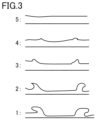
- Fig. 3 is cross-sectional views each schematically showing a coating film state corresponding to each evaluation criterion. The evaluation result is preferably greater than or equal to 3.
Landscapes
- Chemical & Material Sciences (AREA)
- Organic Chemistry (AREA)
- Life Sciences & Earth Sciences (AREA)
- Engineering & Computer Science (AREA)
- Materials Engineering (AREA)
- Wood Science & Technology (AREA)
- Medicinal Chemistry (AREA)
- Health & Medical Sciences (AREA)
- Chemical Kinetics & Catalysis (AREA)
- Polymers & Plastics (AREA)
- Inorganic Chemistry (AREA)
- Paints Or Removers (AREA)
- Building Environments (AREA)
Claims (11)
- Eine fäulnisverhindernde Beschichtungszusammensetzung, umfassend ein hydrolisierbares Harz (A), ein erstes nicht-hydrolisierbares Harz (B), ein zweites nicht-hydrolisierbares Harz (C), und ein fäulnisverhinderndes Mittel (D), wobei das hydrolisierbare Harz (A) ein Harz mit mindestens einer hydrolisierbaren Gruppe, ausgewählt aus der Gruppe bestehend aus einer Gruppe dargestellt durch Formel (1), einer Gruppe dargestellt durch Formel (2) und einer Gruppe dargestellt durch Formel (3), ist:
 wobei R1, R2, und R3 jeweils unabhängig eine C1-C6-Kohlenwasserstoffgruppe darstellen,
 wobei M ein zweiwertiges Metallatom darstellt, und R4 einen Rest einer organischen Säure oder einen Alkoholrest darstellt,
 wobei M ein zweiwertiges Metallatom darstellt,das erste nicht-hydrolisierbare Harz (B) und das zweite nicht-hydrolisierbare Harz (C) jeweils ein Harz sind, dass weder eine Gruppe dargestellt durch Formel (1), noch eine Gruppe dargestellt durch Formel (2) oder eine Gruppe dargestellt durch Formel (3) aufweist,eine Glasübergangstemperatur TgB in °C und ein Löslichkeitsparameter SPB des ersten nicht-hydrolisierbaren Harzes (B) und eine Glasübergangstemperatur TgC in °C und ein Löslichkeitsparameter SPC des zweiten nicht-hydrolisierbaren Harzes (C) die folgenden Ausdrücke [1] bis [5] erfüllen:


 und
und
- Die fäulnisverhindernde Beschichtungszusammensetzung gemäß Anspruch 1, wobei der SPB in einem Bereich von größer als oder gleich 9,6 und kleiner als oder gleich 10,3 liegt.
- Die fäulnisverhindernde Beschichtungszusammensetzung gemäß Anspruch 1, wobei die TgC in einem Bereich von größer als oder gleich -50°C und kleiner als oder gleich -20°C liegt und der SPC in einem Bereich von größer als oder gleich 9,8 und kleiner als oder gleich 10,6 liegt.
- Die fäulnisverhindernde Beschichtungszusammensetzung gemäß Anspruch 1, wobei das hydrolisierbare Harz (A) eine Glasübergangstemperatur TgA in einem Bereich von größer als oder gleich 10°C und kleiner als oder gleich 80°C, und einen Löslichkeitsparameter SPA in einem Bereich von größer als oder gleich 8,5 und kleiner als oder gleich 9,7 aufweist.
- Die fäulnisverhindernde Beschichtungszusammensetzung gemäß Anspruch 1, ferner umfassend eine Kolophoniumverbindung (E).
- Die fäulnisverhindernde Beschichtungszusammensetzung gemäß Anspruch 1, wobei ein Gehaltsverhältnis des ersten nicht-hydrolisierbaren Harzes (B) zum hydrolisierbaren Harz (A) größer als oder gleich 0,1 und kleiner als oder gleich 0,45, bezogen auf das Massenverhältnis, ist.
- Die fäulnisverhindernde Beschichtungszusammensetzung gemäß Anspruch 1, wobei ein Gehaltsverhältnis des zweiten nicht-hydrolisierbaren Harzes (C) zum hydrolisierbaren Harz (A) größer als oder gleich 0,05 und kleiner als oder gleich 0,65, bezogen auf das Massenverhältnis, ist.
- Die fäulnisverhindernde Beschichtungszusammensetzung gemäß Anspruch 1, wobei ein Gehalt des fäulnisverhindernden Mittels (D) größer als oder gleich 0,3 Massenteile und kleiner als oder gleich 550 Massenteile, bezogen auf 100 Massenteile des hydrolisierbaren Harzes (A), ist.
- Ein Beschichtungsfilm, welcher aus der fäulnisverhindernden Beschichtungszusammensetzung gemäß einem der Ansprüche 1 bis 8 gebildet ist.
- Ein Schiff, umfassend den Beschichtungsfilm gemäß Anspruch 9.
- Ein Unterwassergebilde, umfassend den Beschichtungsfilm gemäß Anspruch 9.
Applications Claiming Priority (1)
| Application Number | Priority Date | Filing Date | Title |
|---|---|---|---|
| PCT/JP2021/018986 WO2022244140A1 (ja) | 2021-05-19 | 2021-05-19 | 防汚塗料組成物及び塗膜 |
Publications (3)
| Publication Number | Publication Date |
|---|---|
| EP4299684A1 EP4299684A1 (de) | 2024-01-03 |
| EP4299684A4 EP4299684A4 (de) | 2024-03-27 |
| EP4299684B1 true EP4299684B1 (de) | 2025-03-05 |
Family
ID=83603787
Family Applications (1)
| Application Number | Title | Priority Date | Filing Date |
|---|---|---|---|
| EP21940756.6A Active EP4299684B1 (de) | 2021-05-19 | 2021-05-19 | Fäulnisverhindernde beschichtungszusammensetzung und beschichtungsfilm |
Country Status (7)
| Country | Link |
|---|---|
| US (1) | US11472967B1 (de) |
| EP (1) | EP4299684B1 (de) |
| JP (1) | JP7175405B1 (de) |
| KR (1) | KR102704292B1 (de) |
| CN (1) | CN117480220B (de) |
| DK (1) | DK4299684T3 (de) |
| WO (1) | WO2022244140A1 (de) |
Families Citing this family (1)
| Publication number | Priority date | Publication date | Assignee | Title |
|---|---|---|---|---|
| WO2026057350A1 (en) | 2024-09-11 | 2026-03-19 | Akzo Nobel Coatings International B.V. | Antifouling coating compositions |
Citations (1)
| Publication number | Priority date | Publication date | Assignee | Title |
|---|---|---|---|---|
| EP3212680B1 (de) * | 2014-10-28 | 2018-09-05 | Akzo Nobel Coatings International B.V. | Fäulnisverhindernde beschichtungszusammensetzung und silylester und quaternäre ammonium/phosphonium enthaltenden polymere |
Family Cites Families (14)
| Publication number | Priority date | Publication date | Assignee | Title |
|---|---|---|---|---|
| ES8800975A1 (es) * | 1985-04-18 | 1987-12-01 | Nippon Paint Co Ltd | Un procedimiento para la preparacion de una composicion recubridora antiincrustante de propiedades pulidoras mejoradas. |
| DE69711372D1 (de) * | 1996-05-22 | 2002-05-02 | Hempels Skibsfarve Fab J C | Fäulnisverhindernder anstrich |
| JP5189717B2 (ja) | 1999-10-04 | 2013-04-24 | 中国塗料株式会社 | 防汚塗料組成物、この防汚塗料組成物から形成されている塗膜および該防汚塗料組成物を用いた防汚方法並びに該塗膜で被覆された船体または水中構造物 |
| EP1165705A1 (de) * | 2000-01-26 | 2002-01-02 | Asahi Glass Company Ltd. | Anwuchsverhindernde üuberzugszusammensetzung und damit beschichtetes produkt |
| NO20020846L (no) | 2002-02-21 | 2003-08-22 | Jotun As | Selvpolerende begroingshindrende maling |
| PL2128208T3 (pl) | 2007-02-27 | 2012-12-31 | Nitto Kasei Co Ltd | Impregnacyjna kompozycja powłokowa, sposób wytwarzania kompozycji, impregnacyjna powłoka powlekająca utworzona z zastosowaniem kompozycji, powleczony powłoką powlekającą przedmiot na jego powierzchni i sposób impregnacyjnego działania dla wytworzenia powłoki powlekającej |
| EP2489711B1 (de) * | 2009-10-13 | 2016-11-30 | Nippon Paint Marine Coatings Co., Ltd. | Anwuchsverhindernde beschichtungszusammensetzung, anwuchsverhindernder film, verbundfilm und in-wasser-struktur |
| JP6775225B2 (ja) * | 2015-05-14 | 2020-10-28 | 国立大学法人山形大学 | 医療用具用材料及びそれを用いてなる医療用具 |
| KR20170049392A (ko) * | 2015-10-27 | 2017-05-10 | 간사이 페인트 가부시키가이샤 | 오염방지 도료조성물, 및 그 도막을 가지는 도장물품 |
| JP6851159B2 (ja) * | 2015-10-27 | 2021-03-31 | 関西ペイント株式会社 | 防汚塗料組成物、及びその塗膜を有する塗装物品 |
| GB201718899D0 (en) * | 2017-11-15 | 2017-12-27 | Jotun As | Antifouling coating composition |
| JP6647654B1 (ja) * | 2018-04-12 | 2020-02-14 | 日東化成株式会社 | 防汚塗料組成物 |
| JP7111364B2 (ja) | 2019-05-22 | 2022-08-02 | 日東化成株式会社 | 複層防汚塗膜、該塗膜を表面に有する塗装物 |
| JP7254669B2 (ja) * | 2019-09-20 | 2023-04-10 | リンテック株式会社 | ワーク加工用シートおよび半導体装置の製法方法 |
-
2021
- 2021-05-19 JP JP2021564956A patent/JP7175405B1/ja active Active
- 2021-05-19 US US17/607,158 patent/US11472967B1/en active Active
- 2021-05-19 EP EP21940756.6A patent/EP4299684B1/de active Active
- 2021-05-19 DK DK21940756.6T patent/DK4299684T3/da active
- 2021-05-19 CN CN202180097840.2A patent/CN117480220B/zh active Active
- 2021-05-19 WO PCT/JP2021/018986 patent/WO2022244140A1/ja not_active Ceased
- 2021-05-19 KR KR1020237035043A patent/KR102704292B1/ko active Active
Patent Citations (1)
| Publication number | Priority date | Publication date | Assignee | Title |
|---|---|---|---|---|
| EP3212680B1 (de) * | 2014-10-28 | 2018-09-05 | Akzo Nobel Coatings International B.V. | Fäulnisverhindernde beschichtungszusammensetzung und silylester und quaternäre ammonium/phosphonium enthaltenden polymere |
Also Published As
| Publication number | Publication date |
|---|---|
| CN117480220B (zh) | 2024-10-18 |
| JP7175405B1 (ja) | 2022-11-18 |
| CN117480220A (zh) | 2024-01-30 |
| DK4299684T3 (da) | 2025-03-24 |
| JPWO2022244140A1 (de) | 2022-11-24 |
| EP4299684A4 (de) | 2024-03-27 |
| WO2022244140A1 (ja) | 2022-11-24 |
| KR20230157434A (ko) | 2023-11-16 |
| KR102704292B1 (ko) | 2024-09-09 |
| EP4299684A1 (de) | 2024-01-03 |
| US11472967B1 (en) | 2022-10-18 |
Similar Documents
| Publication | Publication Date | Title |
|---|---|---|
| US9845395B2 (en) | Antifouling coating composition, antifouling film, composite film, and in-water structure | |
| US8597795B2 (en) | Antifouling coating composition, antifouling film, composite film, and in-water structure | |
| US9695324B2 (en) | Method of forming antifouling coating film | |
| US7390843B2 (en) | Antifouling coating | |
| KR102174555B1 (ko) | 공중합체 및 그것을 포함하는 방오도료 조성물 | |
| EP4299684B1 (de) | Fäulnisverhindernde beschichtungszusammensetzung und beschichtungsfilm | |
| US12516218B2 (en) | Coating composition and coating film | |
| US11905432B2 (en) | Coating composition and coating film | |
| JP7684733B2 (ja) | 防汚塗料組成物及び防汚塗膜 | |
| EP4502089A1 (de) | Fäulnisverhindernde anstrichzusammensetzung und fäulnisverhindernder anstrichfilm | |
| HK1142918A (en) | Antifouling paint composition, antifouling coating film, and vessels and underwater structures |
Legal Events
| Date | Code | Title | Description |
|---|---|---|---|
| STAA | Information on the status of an ep patent application or granted ep patent |
Free format text: STATUS: THE INTERNATIONAL PUBLICATION HAS BEEN MADE |
|
| PUAI | Public reference made under article 153(3) epc to a published international application that has entered the european phase |
Free format text: ORIGINAL CODE: 0009012 |
|
| STAA | Information on the status of an ep patent application or granted ep patent |
Free format text: STATUS: REQUEST FOR EXAMINATION WAS MADE |
|
| 17P | Request for examination filed |
Effective date: 20230930 |
|
| AK | Designated contracting states |
Kind code of ref document: A1 Designated state(s): AL AT BE BG CH CY CZ DE DK EE ES FI FR GB GR HR HU IE IS IT LI LT LU LV MC MK MT NL NO PL PT RO RS SE SI SK SM TR |
|
| A4 | Supplementary search report drawn up and despatched |
Effective date: 20240222 |
|
| RIC1 | Information provided on ipc code assigned before grant |
Ipc: C09D 201/00 20060101ALI20240216BHEP Ipc: C09D 143/04 20060101ALI20240216BHEP Ipc: C09D 133/06 20060101ALI20240216BHEP Ipc: C09D 5/16 20060101AFI20240216BHEP |
|
| STAA | Information on the status of an ep patent application or granted ep patent |
Free format text: STATUS: EXAMINATION IS IN PROGRESS |
|
| 17Q | First examination report despatched |
Effective date: 20240611 |
|
| DAV | Request for validation of the european patent (deleted) | ||
| DAX | Request for extension of the european patent (deleted) | ||
| GRAP | Despatch of communication of intention to grant a patent |
Free format text: ORIGINAL CODE: EPIDOSNIGR1 |
|
| STAA | Information on the status of an ep patent application or granted ep patent |
Free format text: STATUS: GRANT OF PATENT IS INTENDED |
|
| INTG | Intention to grant announced |
Effective date: 20240927 |
|
| GRAS | Grant fee paid |
Free format text: ORIGINAL CODE: EPIDOSNIGR3 |
|
| GRAA | (expected) grant |
Free format text: ORIGINAL CODE: 0009210 |
|
| STAA | Information on the status of an ep patent application or granted ep patent |
Free format text: STATUS: THE PATENT HAS BEEN GRANTED |
|
| P01 | Opt-out of the competence of the unified patent court (upc) registered |
Free format text: CASE NUMBER: APP_3252/2025 Effective date: 20250121 |
|
| AK | Designated contracting states |
Kind code of ref document: B1 Designated state(s): AL AT BE BG CH CY CZ DE DK EE ES FI FR GB GR HR HU IE IS IT LI LT LU LV MC MK MT NL NO PL PT RO RS SE SI SK SM TR |
|
| REG | Reference to a national code |
Ref country code: GB Ref legal event code: FG4D |
|
| REG | Reference to a national code |
Ref country code: CH Ref legal event code: EP |
|
| REG | Reference to a national code |
Ref country code: DE Ref legal event code: R096 Ref document number: 602021027350 Country of ref document: DE |
|
| REG | Reference to a national code |
Ref country code: DK Ref legal event code: T3 Effective date: 20250320 |
|
| REG | Reference to a national code |
Ref country code: IE Ref legal event code: FG4D |
|
| REG | Reference to a national code |
Ref country code: NL Ref legal event code: FP |
|
| PGFP | Annual fee paid to national office [announced via postgrant information from national office to epo] |
Ref country code: NL Payment date: 20250526 Year of fee payment: 5 |
|
| PG25 | Lapsed in a contracting state [announced via postgrant information from national office to epo] |
Ref country code: RS Free format text: LAPSE BECAUSE OF FAILURE TO SUBMIT A TRANSLATION OF THE DESCRIPTION OR TO PAY THE FEE WITHIN THE PRESCRIBED TIME-LIMIT Effective date: 20250605 |
|
| PG25 | Lapsed in a contracting state [announced via postgrant information from national office to epo] |
Ref country code: FI Free format text: LAPSE BECAUSE OF FAILURE TO SUBMIT A TRANSLATION OF THE DESCRIPTION OR TO PAY THE FEE WITHIN THE PRESCRIBED TIME-LIMIT Effective date: 20250305 |
|
| PGFP | Annual fee paid to national office [announced via postgrant information from national office to epo] |
Ref country code: DE Payment date: 20250530 Year of fee payment: 5 |
|
| PG25 | Lapsed in a contracting state [announced via postgrant information from national office to epo] |
Ref country code: ES Free format text: LAPSE BECAUSE OF FAILURE TO SUBMIT A TRANSLATION OF THE DESCRIPTION OR TO PAY THE FEE WITHIN THE PRESCRIBED TIME-LIMIT Effective date: 20250305 |
|
| PGFP | Annual fee paid to national office [announced via postgrant information from national office to epo] |
Ref country code: DK Payment date: 20250526 Year of fee payment: 5 |
|
| REG | Reference to a national code |
Ref country code: LT Ref legal event code: MG9D |
|
| PGFP | Annual fee paid to national office [announced via postgrant information from national office to epo] |
Ref country code: NO Payment date: 20250521 Year of fee payment: 5 |
|
| PG25 | Lapsed in a contracting state [announced via postgrant information from national office to epo] |
Ref country code: HR Free format text: LAPSE BECAUSE OF FAILURE TO SUBMIT A TRANSLATION OF THE DESCRIPTION OR TO PAY THE FEE WITHIN THE PRESCRIBED TIME-LIMIT Effective date: 20250305 |
|
| PG25 | Lapsed in a contracting state [announced via postgrant information from national office to epo] |
Ref country code: LV Free format text: LAPSE BECAUSE OF FAILURE TO SUBMIT A TRANSLATION OF THE DESCRIPTION OR TO PAY THE FEE WITHIN THE PRESCRIBED TIME-LIMIT Effective date: 20250305 |
|
| PG25 | Lapsed in a contracting state [announced via postgrant information from national office to epo] |
Ref country code: GR Free format text: LAPSE BECAUSE OF FAILURE TO SUBMIT A TRANSLATION OF THE DESCRIPTION OR TO PAY THE FEE WITHIN THE PRESCRIBED TIME-LIMIT Effective date: 20250606 Ref country code: BG Free format text: LAPSE BECAUSE OF FAILURE TO SUBMIT A TRANSLATION OF THE DESCRIPTION OR TO PAY THE FEE WITHIN THE PRESCRIBED TIME-LIMIT Effective date: 20250305 |
|
| PGFP | Annual fee paid to national office [announced via postgrant information from national office to epo] |
Ref country code: TR Payment date: 20250429 Year of fee payment: 5 |
|
| REG | Reference to a national code |
Ref country code: AT Ref legal event code: MK05 Ref document number: 1772942 Country of ref document: AT Kind code of ref document: T Effective date: 20250305 |
|
| PG25 | Lapsed in a contracting state [announced via postgrant information from national office to epo] |
Ref country code: SE Free format text: LAPSE BECAUSE OF FAILURE TO SUBMIT A TRANSLATION OF THE DESCRIPTION OR TO PAY THE FEE WITHIN THE PRESCRIBED TIME-LIMIT Effective date: 20250305 |
|
| PG25 | Lapsed in a contracting state [announced via postgrant information from national office to epo] |
Ref country code: SM Free format text: LAPSE BECAUSE OF FAILURE TO SUBMIT A TRANSLATION OF THE DESCRIPTION OR TO PAY THE FEE WITHIN THE PRESCRIBED TIME-LIMIT Effective date: 20250305 |
|
| PG25 | Lapsed in a contracting state [announced via postgrant information from national office to epo] |
Ref country code: PT Free format text: LAPSE BECAUSE OF FAILURE TO SUBMIT A TRANSLATION OF THE DESCRIPTION OR TO PAY THE FEE WITHIN THE PRESCRIBED TIME-LIMIT Effective date: 20250707 |
|
| PG25 | Lapsed in a contracting state [announced via postgrant information from national office to epo] |
Ref country code: IT Free format text: LAPSE BECAUSE OF FAILURE TO SUBMIT A TRANSLATION OF THE DESCRIPTION OR TO PAY THE FEE WITHIN THE PRESCRIBED TIME-LIMIT Effective date: 20250305 Ref country code: PL Free format text: LAPSE BECAUSE OF FAILURE TO SUBMIT A TRANSLATION OF THE DESCRIPTION OR TO PAY THE FEE WITHIN THE PRESCRIBED TIME-LIMIT Effective date: 20250305 |
|
| PG25 | Lapsed in a contracting state [announced via postgrant information from national office to epo] |
Ref country code: AT Free format text: LAPSE BECAUSE OF FAILURE TO SUBMIT A TRANSLATION OF THE DESCRIPTION OR TO PAY THE FEE WITHIN THE PRESCRIBED TIME-LIMIT Effective date: 20250305 |
|
| PG25 | Lapsed in a contracting state [announced via postgrant information from national office to epo] |
Ref country code: EE Free format text: LAPSE BECAUSE OF FAILURE TO SUBMIT A TRANSLATION OF THE DESCRIPTION OR TO PAY THE FEE WITHIN THE PRESCRIBED TIME-LIMIT Effective date: 20250305 Ref country code: CZ Free format text: LAPSE BECAUSE OF FAILURE TO SUBMIT A TRANSLATION OF THE DESCRIPTION OR TO PAY THE FEE WITHIN THE PRESCRIBED TIME-LIMIT Effective date: 20250305 |
|
| PG25 | Lapsed in a contracting state [announced via postgrant information from national office to epo] |
Ref country code: RO Free format text: LAPSE BECAUSE OF FAILURE TO SUBMIT A TRANSLATION OF THE DESCRIPTION OR TO PAY THE FEE WITHIN THE PRESCRIBED TIME-LIMIT Effective date: 20250305 |
|
| PG25 | Lapsed in a contracting state [announced via postgrant information from national office to epo] |
Ref country code: SK Free format text: LAPSE BECAUSE OF FAILURE TO SUBMIT A TRANSLATION OF THE DESCRIPTION OR TO PAY THE FEE WITHIN THE PRESCRIBED TIME-LIMIT Effective date: 20250305 |
|
| PG25 | Lapsed in a contracting state [announced via postgrant information from national office to epo] |
Ref country code: IS Free format text: LAPSE BECAUSE OF FAILURE TO SUBMIT A TRANSLATION OF THE DESCRIPTION OR TO PAY THE FEE WITHIN THE PRESCRIBED TIME-LIMIT Effective date: 20250705 |
|
| REG | Reference to a national code |
Ref country code: DE Ref legal event code: R097 Ref document number: 602021027350 Country of ref document: DE |
|
| REG | Reference to a national code |
Ref country code: CH Ref legal event code: H13 Free format text: ST27 STATUS EVENT CODE: U-0-0-H10-H13 (AS PROVIDED BY THE NATIONAL OFFICE) Effective date: 20251223 |
|
| PLBE | No opposition filed within time limit |
Free format text: ORIGINAL CODE: 0009261 |
|
| STAA | Information on the status of an ep patent application or granted ep patent |
Free format text: STATUS: NO OPPOSITION FILED WITHIN TIME LIMIT |
|
| REG | Reference to a national code |
Ref country code: CH Ref legal event code: L10 Free format text: ST27 STATUS EVENT CODE: U-0-0-L10-L00 (AS PROVIDED BY THE NATIONAL OFFICE) Effective date: 20260114 |
|
| PG25 | Lapsed in a contracting state [announced via postgrant information from national office to epo] |
Ref country code: LU Free format text: LAPSE BECAUSE OF NON-PAYMENT OF DUE FEES Effective date: 20250519 |
|
| PG25 | Lapsed in a contracting state [announced via postgrant information from national office to epo] |
Ref country code: CH Free format text: LAPSE BECAUSE OF NON-PAYMENT OF DUE FEES Effective date: 20250531 |
|
| REG | Reference to a national code |
Ref country code: BE Ref legal event code: MM Effective date: 20250531 |
|
| PG25 | Lapsed in a contracting state [announced via postgrant information from national office to epo] |
Ref country code: MC Free format text: LAPSE BECAUSE OF FAILURE TO SUBMIT A TRANSLATION OF THE DESCRIPTION OR TO PAY THE FEE WITHIN THE PRESCRIBED TIME-LIMIT Effective date: 20250305 |
|
| 26N | No opposition filed |
Effective date: 20251208 |
|
| PGFP | Annual fee paid to national office [announced via postgrant information from national office to epo] |
Ref country code: GB Payment date: 20260331 Year of fee payment: 6 |
|
| PG25 | Lapsed in a contracting state [announced via postgrant information from national office to epo] |
Ref country code: IE Free format text: LAPSE BECAUSE OF NON-PAYMENT OF DUE FEES Effective date: 20250519 |
|
| PG25 | Lapsed in a contracting state [announced via postgrant information from national office to epo] |
Ref country code: BE Free format text: LAPSE BECAUSE OF NON-PAYMENT OF DUE FEES Effective date: 20250531 |
|
| PG25 | Lapsed in a contracting state [announced via postgrant information from national office to epo] |
Ref country code: FR Free format text: LAPSE BECAUSE OF NON-PAYMENT OF DUE FEES Effective date: 20250531 |