EP4297566B1 - Käfig zum schutz von schalentieren vor raubtieren - Google Patents
Käfig zum schutz von schalentieren vor raubtieren Download PDFInfo
- Publication number
- EP4297566B1 EP4297566B1 EP22710678.8A EP22710678A EP4297566B1 EP 4297566 B1 EP4297566 B1 EP 4297566B1 EP 22710678 A EP22710678 A EP 22710678A EP 4297566 B1 EP4297566 B1 EP 4297566B1
- Authority
- EP
- European Patent Office
- Prior art keywords
- cage
- hollow body
- protective cage
- support
- shellfish
- Prior art date
- Legal status (The legal status is an assumption and is not a legal conclusion. Google has not performed a legal analysis and makes no representation as to the accuracy of the status listed.)
- Active
Links
Images



Classifications
-
- A—HUMAN NECESSITIES
- A01—AGRICULTURE; FORESTRY; ANIMAL HUSBANDRY; HUNTING; TRAPPING; FISHING
- A01K—ANIMAL HUSBANDRY; AVICULTURE; APICULTURE; PISCICULTURE; FISHING; REARING OR BREEDING ANIMALS, NOT OTHERWISE PROVIDED FOR; NEW BREEDS OF ANIMALS
- A01K61/00—Culture of aquatic animals
- A01K61/50—Culture of aquatic animals of shellfish
- A01K61/54—Culture of aquatic animals of shellfish of bivalves, e.g. oysters or mussels
-
- A—HUMAN NECESSITIES
- A01—AGRICULTURE; FORESTRY; ANIMAL HUSBANDRY; HUNTING; TRAPPING; FISHING
- A01K—ANIMAL HUSBANDRY; AVICULTURE; APICULTURE; PISCICULTURE; FISHING; REARING OR BREEDING ANIMALS, NOT OTHERWISE PROVIDED FOR; NEW BREEDS OF ANIMALS
- A01K73/00—Drawn nets
- A01K73/12—Nets held vertically in the water, e.g. seines
-
- Y—GENERAL TAGGING OF NEW TECHNOLOGICAL DEVELOPMENTS; GENERAL TAGGING OF CROSS-SECTIONAL TECHNOLOGIES SPANNING OVER SEVERAL SECTIONS OF THE IPC; TECHNICAL SUBJECTS COVERED BY FORMER USPC CROSS-REFERENCE ART COLLECTIONS [XRACs] AND DIGESTS
- Y02—TECHNOLOGIES OR APPLICATIONS FOR MITIGATION OR ADAPTATION AGAINST CLIMATE CHANGE
- Y02A—TECHNOLOGIES FOR ADAPTATION TO CLIMATE CHANGE
- Y02A40/00—Adaptation technologies in agriculture, forestry, livestock or agroalimentary production
- Y02A40/80—Adaptation technologies in agriculture, forestry, livestock or agroalimentary production in fisheries management
- Y02A40/81—Aquaculture, e.g. of fish
Definitions
- the invention is in the field of shellfish cultivation, and more particularly mussel farming.
- the present invention relates to a cage for protecting against shellfish predators, configured to be placed on a support for farming shellfish, in particular mussels.
- a pile A is planted vertically or substantially vertically on the seabed B and a rope C, on which the mussel spat D (i.e. the juveniles) has developed, is wound in a spiral around the pile.
- This rope C is then fixed at its two ends, on the upper part of the pile and on the lower part of the pile, at a certain distance from the bottom B.
- a flexible net E in the shape of a sock is currently used as a means of protection against predators. It is threaded around the stake and the spat coil and is pressed against the mussels, following the shape of the coil.
- a device F In addition, to protect the mussels from crab attacks, a device F, known as a "Tahitian", is placed around the base of pile A, at the level of the space between bottom B and the lower end of rope C.
- This device F consists of a strip of flexible plastic material, cut so as to form a fringe at its lower part. Its purpose is to prevent the crabs from progressing along pile A.
- Soft nets F are unfortunately fragile and therefore not very durable. They can break and are therefore a source of pollution for the marine environment. They must be renewed regularly, for example annually, which is expensive. They require a lot of manpower to install and must be cleaned regularly to remain effective.
- the invention therefore aims to solve the aforementioned problems and in particular to propose a protection device which is effective against predators, solid, shock-resistant and which is simple and quick to install and remove.
- the invention relates to a cage for protection against shellfish predators, configured to be placed on a shellfish farming support, such as a stake, a rope or a line, these shellfish being in particular mussels.
- the cage made of semi-rigid material and whose mesh prevents access by predators is maintained in position relative to the breeding stake.
- the protective cage 1 is intended to be installed on a support for breeding shellfish, in particular mussels.
- This breeding support is referenced A.
- This breeding support is for example a stake as shown in the figure 1 and in the remainder of the description it will be described as such.
- Such a stake or "bouchot” generally has a diameter of between 10 cm and 20 cm, preferably 15 cm.
- this breeding support could also be a rope or line, which is either suspended vertically or arranged horizontally or substantially horizontally between two posts.
- ropes or lines have a diameter of the order of 30 mm to 40 mm.
- the protective cage 1 according to the invention comprises a body 2 and two closing devices 3 for this body 2.
- Body 2 is a hollow and elongated sleeve, with a longitudinal axis X-X'. It is formed of a lattice structure delimiting openings 20. This openwork structure thus allows the passage of water flows, loaded with nutrients, towards the shellfish raised on pile A.
- Body 2 is made of semi-rigid plastic, as will be described later.
- the openings 20 are preferably meshes.
- These 20 meshes are sized to prevent the predatory action of predators, including ducks, gulls, sea bream and other fish.
- preventing the predatory action of predators is meant the fact of being able to prevent them from accessing the shellfish by passing in particular their head, beak or mouth through the meshes.
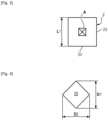
- the 20 meshes can for example be square or diamond shaped.
- one of the diagonals D1 of the mesh has a length of between 14 mm and 40 mm, preferably between 20 mm and 30 mm, more preferably of the order of 25 mm and the other diagonal D2 has a length of between 14 mm and 40 mm, preferably between 20 mm and 30 mm, more preferably of the order of 25 mm. If the mesh is square, the two diagonals are of the same lengths.
- this body 2 is open at its two ends.
- the body 2 has an upper end 21 and an opposite lower end 22, the terms “upper” and “lower” being to be taken into consideration in relation to the normal position of use of the cage, which is that shown in the figure 2 .
- the body 2 has a square cross-section with four side walls 23. This shape makes it possible to limit the deformation of the body in the event of an impact, for example by a boat.
- Body 2 could thus have a circular section.
- the closing device 3 is a cover intended to cover the two ends 21, 22 of the body 2.
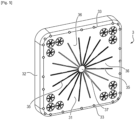
- the cover 3 has a shape corresponding to that of the cross-section of the body 2, in order to be able to close the end of the body 2 on which it is placed. In the exemplary embodiment shown in the figures 2 And 4 , this cover 3 is square.
- This cover 3 has a square plate 31, bordered by a peripheral rim 32.
- the plate 31 is provided with a plurality of through holes 33, advantageously arranged all around its periphery, these holes 33 allowing the introduction of links 34 for fixing the cover 3 on the ends 21, 22 of the body 2. These links 34 pass for example in the meshes 20, (see figure 6 ).
- this cover 3 (in particular the plate 31) is provided with a plurality of cutouts 35 which extend radially from its center. These cutouts 35, preferably rectilinear, thus delimit between them tabs 36.
- the cover 3 can have a central opening 37 of small dimensions at the point of intersection of the different cutouts 35.
- the plate 31 When the cover 3 is fixed to the end of the body 2, the plate 31 extends perpendicular or substantially perpendicular to the side walls 23 and its center is located on the axis X-X'.
- the cover 3 is also made of semi-rigid plastic material. The combination of the use of this material with the shape of the cutouts 35 makes the tabs 36 deformable while retaining a certain rigidity.
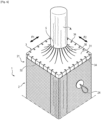
- FIG. 6 illustrates the protective cage 1 when it is inserted on the pile A by sliding vertically from top to bottom.
- the tabs 36 bend and move outwards due to the presence of the pile A and remain pressed over at least part of their length against the circumference of the latter. By moving apart, these tabs 36 delimit an opening 5 for the passage of the pile A.
- the tabs 36 which are both deformable but made of a semi-rigid material limit or even prevent the transverse movements of the cage 2 relative to the pile, these transverse movements being represented by the arrows F1 and F2 in figure 6 .
- the walls 23 of cage 2 remain at a distance from the mussels placed on pile A, since cage 1 is centered, which also helps to keep predators at a distance.
- the width L1 of a side wall 23 is sufficient so that, once the cage 1 is placed on the pile A, the different side walls 23 of the cage 1 do not touch the mussels, even when they have reached their adult size. This distancing of the walls of the cage 1 from the mussels further reinforces the protective action of the cage against predators.
- the width L1 of a side wall 23 is between 35 cm and 45 cm, preferably equal to 40 cm.
- the height H1 of the body 2 is preferably adapted to the average height of the shellfish farms wrapped around the pile A.
- H1 is preferably between 3m and 4m.
- the cage 1 has one or more handling handles 24, fixed for example on the body 2, (only one handle being visible on the figure 6 ).
- a handle can for example be a textile strap.
- the protective cage 1 comprises a body 2' and the device for closing the body 2' is no longer a cover 3 but flaps.
- body 2' which are common to body 2 bear the same references increased by the prime sign and will not be described in detail again.
- the body 2' comprises an upper end 21', a lower end 22', meshes 20', side walls 23' and one or more handles 24'.
- the upper end 21' and/or the lower end 22' of the hollow body 2' is (are) provided with cutouts forming flaps 25', for example four flaps 25'.
- the flaps 25' are folded towards the inside of the body 2' (towards its central axis X-X') and are held in the folded position by one or more links 4.
- the link 4 may have two strands 40 which are each fixed at one of their first ends on the body 2' and the other two ends of which meet and are fixed on a coupling element 41.
- This coupling element 41 in the form of an elongated bar may be engaged in a loop 42 fixed on the face of the body 2' opposite that on which the first ends of the strands 40 are fixed. The flaps 25' are thus held in the folded position.
- the flaps 25' are sized and configured so that once folded, they provide between them a central opening 26' allowing the passage of the pile A and so that their free ends 27' (their edges) are in contact with the pile A.
- the lateral movements (arrows F1 and F2) of the cage 1 relative to this pile A are limited, or even prevented.
- This end 27' can also possibly be folded back slightly (like a tab 36) so that the flap 25' is pressed against the pile A, over part of its length (taken from the wall 23' to the free end 27').
- the presence of the closing device positioned at the lower part of the body 2, 2' advantageously allows the recovery of mussels that have become detached from the rope C on which they were initially fixed.
- This same lower closing device makes it possible to dispense with the use of the Tahitian F of the prior art, since it also prevents access by crabs.
- the semi-rigid plastic material used for the manufacture of the body 2, 2' and the covers 3 is a shape memory material.
- this material allows the body 2, 2' of the cage 1 to be preformed hot on a template to give it its section, in particular its square section, and allows it to be folded flat by bringing one of its edges closer to the diametrically opposite edge. This allows for reduced storage space.
- the semi-rigid nature of the material gives it both sufficient stiffness for the installation of the cage and sufficient flexibility to withstand sea shocks without being destroyed.
- this material is a thermoplastic polymer, more preferably high-density polyethylene.
- This type of material has the advantage of having very good mechanical resistance, very good UV resistance, being insensitive to the marine environment, being virtually unbreakable, resistant to shocks and abrasion even when cold.
- the tabs 26 or the flaps 25' constitute positioning elements of the cage which act as spacers between the walls 23 of the body 2, 2' of the cage and the breeding support A due to the rigidity provided by the semi-rigid material.
- these positioning elements 26 or 25' because they retain a certain flexibility provided by the semi-rigid material, can deform more or less to allow the cage 1 to be placed and removed on the breeding support A and adapt to the different dimensions of the breeding supports A, depending on whether these are stakes, ropes or lines.
Landscapes
- Life Sciences & Earth Sciences (AREA)
- Environmental Sciences (AREA)
- Animal Husbandry (AREA)
- Biodiversity & Conservation Biology (AREA)
- Marine Sciences & Fisheries (AREA)
- Zoology (AREA)
- Farming Of Fish And Shellfish (AREA)
- Catching Or Destruction (AREA)
Claims (9)
- Käfig (1) zum Schutz vor Räubern von Schalentieren, der ausgelegt ist, um auf einem Träger zur Aufzucht von Schalentieren wie ein Pfahl, ein Seil oder einer Langline angeordnet zu sein, wobei diese Schalentiere insbesondere Muscheln sind, dadurch gekennzeichnet, dass er umfasst:- einen länglichen Hohlkörper (2, 2') mit Gitterstruktur, die Öffnungen wie Maschen (20, 20') begrenzt, deren Abmessungen ausgelegt sind, um die Raubhandlung der Raubtiere zu verhindern, wobei dieser Hohlkörper (2, 2') an seinen beiden gegenüberliegenden Enden, die jeweils als unteres Ende (22, 22') und oberes Ende (21, 21') bezeichnet werden, offen ist, und- zwei Verschlussvorrichtungen (3, 25') des Hohlkörpers (2, 2'), wobei eine der beiden Verschlussvorrichtungen am unteren Ende (22, 22') des Körpers und die andere Vorrichtung am oberen Ende (21, 21') des Körpers befestigt ist,wobei jede Verschlussvorrichtung (3, 25') ausgelegt ist, um das Ende des Hohlkörpers (2, 2') zumindest teilweise zu verschließen und gleichzeitig eine Öffnung (5, 26') aufweist, die den Durchgang des Aufzuchtträgers durch diese Verschlussvorrichtung erlaubt, und ausgelegt ist, um die Zentrierung des Hohlkörpers (2, 2') in Bezug auf diesen Aufzuchtträger und die Aufrechterhaltung dieser Zentrierung zu ermöglichen,wobei der Hohlkörper (2, 2') und die beiden Verschlussvorrichtungen (3, 25') aus halbstarrem Kunststoffmaterial hergestellt sind,wobei der Käfig dadurch gekennzeichnet ist, dass mindestens eine dieser Verschlussvorrichtungen einen Deckel (3) umfasst, der mit Ausschnitten (35) versehen ist, die sich ab seinem Zentrum derart radial erstrecken, dass sie eine Vielzahl verformbarer Zungen (36) bilden, wobei sich diese Zungen (36) verformen können, um den Durchgang des Aufzuchtträgers zu erlauben und um sich über mindestens einen Teil ihrer Länge an diesen anlegen zu können, um die Zentrierung des Hohlkörpers (2) in Bezug auf den Aufzuchtträger und die Aufrechterhaltung dieser Zentrierung zu gewährleisten.
- Schutzkäfig (1) nach Anspruch 1, dadurch gekennzeichnet, dass der Deckel (3) eine Platte (31) umfasst, die an ihrem Umfang mit einer Vielzahl von Öffnungen (33) versehen ist, die den Durchgang von Befestigungsbändern (34) des Deckels am unteren Ende (22) und/oder am oberen Ende (21) des Körpers (2) gestatten.
- Schutzkäfig (1) nach Anspruch 1 oder 2, dadurch gekennzeichnet, dass das obere Ende und/oder das untere Ende des Hohlkörpers mit Ausschnitten versehen ist oder sind, die Klappen (25') bilden, und dass die Verschlussvorrichtung aus diesen Klappen (25') gebildet ist, die zum Inneren des Körpers (2') hin umgeschlagen sind und durch Bänder (4) in umgeschlagener Position gehalten werden, wobei die Klappen (25') derart dimensioniert und ausgelegt sind, dass sie, wenn sie umgeschlagen sind, zwischen sich eine Öffnung (26') bilden, die den Durchgang des Aufzuchtträgers erlaubt, und dass ihre freien Enden (27') mit diesem Aufzuchtträger in Kontakt sind, um die Zentrierung des Hohlkörpers in Bezug auf den Aufzuchtträger zu gewährleisten.
- Schutzkäfig (1) nach einem der vorhergehenden Ansprüche, dadurch gekennzeichnet, dass der Hohlkörper (2, 2') einen quadratischen Querschnitt hat und vier Seitenwände (23, 23') aufweist.
- Schutzkäfig (1) nach Anspruch 4, dadurch gekennzeichnet, dass jede Seitenwand (23, 23') eine Breite zwischen 35 cm und 45 cm, vorzugsweise von gleich 40 cm, aufweist.
- Schutzkäfig (1) nach einem der vorhergehenden Ansprüche, dadurch gekennzeichnet, dass die Maschen (20, 20') des Körpers (2, 2') rautenförmig oder quadratisch sind, wobei eine der Diagonalen (D1) eine Länge zwischen 14 mm und 40 mm aufweist und die andere Diagonale (D2) eine Länge zwischen 14 mm und 40 mm aufweist.
- Schutzkäfig (1) nach einem der vorhergehenden Ansprüche, dadurch gekennzeichnet, dass er mit mindestens einem Haltegriff (24, 24') versehen ist.
- Schutzkäfig (1) nach einem der vorhergehenden Ansprüche, dadurch gekennzeichnet, dass das halbstarre Kunststoffmaterial ein Material mit Formgedächtnis ist.
- Schutzkäfig (1) nach einem der vorhergehenden Ansprüche, dadurch gekennzeichnet, dass das halbstarre Kunststoffmaterial hochdichtes Polyethylen ist.
Applications Claiming Priority (2)
| Application Number | Priority Date | Filing Date | Title |
|---|---|---|---|
| FR2101750A FR3119966B1 (fr) | 2021-02-23 | 2021-02-23 | Cage anti-prédateurs |
| PCT/FR2022/050319 WO2022180336A1 (fr) | 2021-02-23 | 2022-02-22 | Cage anti-predateurs de coquillages |
Publications (2)
| Publication Number | Publication Date |
|---|---|
| EP4297566A1 EP4297566A1 (de) | 2024-01-03 |
| EP4297566B1 true EP4297566B1 (de) | 2025-02-26 |
Family
ID=76034717
Family Applications (1)
| Application Number | Title | Priority Date | Filing Date |
|---|---|---|---|
| EP22710678.8A Active EP4297566B1 (de) | 2021-02-23 | 2022-02-22 | Käfig zum schutz von schalentieren vor raubtieren |
Country Status (3)
| Country | Link |
|---|---|
| EP (1) | EP4297566B1 (de) |
| FR (1) | FR3119966B1 (de) |
| WO (1) | WO2022180336A1 (de) |
Families Citing this family (2)
| Publication number | Priority date | Publication date | Assignee | Title |
|---|---|---|---|---|
| CN115474568A (zh) * | 2022-10-26 | 2022-12-16 | 山东省淡水渔业研究院(山东省淡水渔业监测中心) | 一种河蟹圈围防护布置设备及其方法 |
| CN117502316A (zh) * | 2023-11-13 | 2024-02-06 | 内江师范学院 | 一种水产养殖用寄生虫处理设备及方法 |
Family Cites Families (4)
| Publication number | Priority date | Publication date | Assignee | Title |
|---|---|---|---|---|
| FR2589323A1 (fr) * | 1985-11-04 | 1987-05-07 | Gilbert Jacques | Procede d'obtention de naissain de coquillages et support pour la mise en oeuvre de ce procede |
| CA2504390C (en) * | 2005-04-12 | 2008-01-29 | Odyssey Shellfish Ltd. | Shellfish production system |
| FR2944948A1 (fr) * | 2009-04-29 | 2010-11-05 | Filt | Filet tubulaire utilise en mytiliculture pour l'accrochage des moules |
| FR2945410A1 (fr) * | 2009-05-12 | 2010-11-19 | Christian Bruno Rene Georges | Dispositif de protection des bivalves contre des predateurs et procede de mise en place d'un dispositif |
-
2021
- 2021-02-23 FR FR2101750A patent/FR3119966B1/fr active Active
-
2022
- 2022-02-22 WO PCT/FR2022/050319 patent/WO2022180336A1/fr not_active Ceased
- 2022-02-22 EP EP22710678.8A patent/EP4297566B1/de active Active
Also Published As
| Publication number | Publication date |
|---|---|
| WO2022180336A1 (fr) | 2022-09-01 |
| FR3119966A1 (fr) | 2022-08-26 |
| FR3119966B1 (fr) | 2023-07-14 |
| EP4297566A1 (de) | 2024-01-03 |
Similar Documents
| Publication | Publication Date | Title |
|---|---|---|
| EP4297566B1 (de) | Käfig zum schutz von schalentieren vor raubtieren | |
| EP0682863B1 (de) | Vorrichtung zum Züchten von Muscheln, insbesondere von Austern | |
| CA2448830C (fr) | Litiere a etages multiples pour chats ou autres animaux domestiques | |
| EP2796040B1 (de) | Insektenfalle mit Verbindungsmitteln | |
| EP2796039B1 (de) | Insektenfalle mit Gelenkschaft | |
| EP2633753B1 (de) | Verpackung aus einem biologisch abbaubarem Material für den Transport, Schutz und Pflanzvorgang von Pflanzen | |
| EP0012062A1 (de) | Behälter zum Aufbewahren von Spinnerködern | |
| FR2945410A1 (fr) | Dispositif de protection des bivalves contre des predateurs et procede de mise en place d'un dispositif | |
| FR3118887A1 (fr) | Dispositif d’entrainement au plaquage rugby | |
| EP2437638B1 (de) | Behälterformende verpackungsvorrichtung | |
| EP3116310B1 (de) | Vorrichtung zum schutz gegen terrestrische gastropoden | |
| CA2496701C (fr) | Dispositif pour la presentation et la conservation de bouquets de fleurs | |
| FR3011441A1 (fr) | Dispositif de protection des moules,contre les predateurs, ensemble de mytiliculture integrant au moins un tel dispositif | |
| FR3121326A1 (fr) | Dispositif d’ecartement et/ou de fixation d’une gaine, ou filet, de protection autour d’un support vertical de culture de coquillages | |
| EP1441584B1 (de) | Kasten zum stauen und/oder zum fertigmachen von langleinen | |
| FR3138755A1 (fr) | Dispositif de protection de plants | |
| FR2612364A1 (fr) | Procede et dispositif de protection contre le gel de plants et/ou d'arbres, notamment des arbres fruitiers comme les kiwis | |
| FR2964827A1 (fr) | Dispositif pour la reception et la mise en place d'une corde a moules sur un pieu mytilicole, et procede correspondant | |
| FR2897237A1 (fr) | Dispositif de protection, vis a vis des predateurs, des coquillages eleves sur un support, bivalves notamment tels que moules | |
| FR2973647A1 (fr) | Support d'oeufs d'insectes destine a la lutte contre les ravageurs des plantes | |
| EP1809147B1 (de) | Vorrichtung zur präsentation von blumensträussen | |
| FR2852199A1 (fr) | Dispositif et procede pour l'elevage en mer de mollusques tels que des moules | |
| FR2721478A1 (fr) | Dispositif et procédé destinés à protéger des couchots utilisés en mytiliculture. | |
| FR2613186A1 (fr) | Dispositif capteur de naissain | |
| FR2929490A1 (fr) | Dispositif d'elevage de mollusques de type lenterne japonaise |
Legal Events
| Date | Code | Title | Description |
|---|---|---|---|
| STAA | Information on the status of an ep patent application or granted ep patent |
Free format text: STATUS: UNKNOWN |
|
| STAA | Information on the status of an ep patent application or granted ep patent |
Free format text: STATUS: THE INTERNATIONAL PUBLICATION HAS BEEN MADE |
|
| PUAI | Public reference made under article 153(3) epc to a published international application that has entered the european phase |
Free format text: ORIGINAL CODE: 0009012 |
|
| STAA | Information on the status of an ep patent application or granted ep patent |
Free format text: STATUS: REQUEST FOR EXAMINATION WAS MADE |
|
| 17P | Request for examination filed |
Effective date: 20230905 |
|
| AK | Designated contracting states |
Kind code of ref document: A1 Designated state(s): AL AT BE BG CH CY CZ DE DK EE ES FI FR GB GR HR HU IE IS IT LI LT LU LV MC MK MT NL NO PL PT RO RS SE SI SK SM TR |
|
| DAX | Request for extension of the european patent (deleted) | ||
| RAV | Requested validation state of the european patent: fee paid |
Extension state: MA Effective date: 20230905 |
|
| GRAP | Despatch of communication of intention to grant a patent |
Free format text: ORIGINAL CODE: EPIDOSNIGR1 |
|
| STAA | Information on the status of an ep patent application or granted ep patent |
Free format text: STATUS: GRANT OF PATENT IS INTENDED |
|
| INTG | Intention to grant announced |
Effective date: 20240918 |
|
| GRAS | Grant fee paid |
Free format text: ORIGINAL CODE: EPIDOSNIGR3 |
|
| GRAA | (expected) grant |
Free format text: ORIGINAL CODE: 0009210 |
|
| STAA | Information on the status of an ep patent application or granted ep patent |
Free format text: STATUS: THE PATENT HAS BEEN GRANTED |
|
| P01 | Opt-out of the competence of the unified patent court (upc) registered |
Free format text: CASE NUMBER: APP_2156/2025 Effective date: 20250113 |
|
| AK | Designated contracting states |
Kind code of ref document: B1 Designated state(s): AL AT BE BG CH CY CZ DE DK EE ES FI FR GB GR HR HU IE IS IT LI LT LU LV MC MK MT NL NO PL PT RO RS SE SI SK SM TR |
|
| REG | Reference to a national code |
Ref country code: GB Ref legal event code: FG4D Free format text: NOT ENGLISH |
|
| REG | Reference to a national code |
Ref country code: CH Ref legal event code: EP |
|
| REG | Reference to a national code |
Ref country code: DE Ref legal event code: R096 Ref document number: 602022011137 Country of ref document: DE |
|
| REG | Reference to a national code |
Ref country code: IE Ref legal event code: FG4D Free format text: LANGUAGE OF EP DOCUMENT: FRENCH |
|
| REG | Reference to a national code |
Ref country code: NL Ref legal event code: MP Effective date: 20250226 |
|
| PG25 | Lapsed in a contracting state [announced via postgrant information from national office to epo] |
Ref country code: RS Free format text: LAPSE BECAUSE OF FAILURE TO SUBMIT A TRANSLATION OF THE DESCRIPTION OR TO PAY THE FEE WITHIN THE PRESCRIBED TIME-LIMIT Effective date: 20250526 |
|
| PG25 | Lapsed in a contracting state [announced via postgrant information from national office to epo] |
Ref country code: FI Free format text: LAPSE BECAUSE OF FAILURE TO SUBMIT A TRANSLATION OF THE DESCRIPTION OR TO PAY THE FEE WITHIN THE PRESCRIBED TIME-LIMIT Effective date: 20250226 |
|
| PG25 | Lapsed in a contracting state [announced via postgrant information from national office to epo] |
Ref country code: PL Free format text: LAPSE BECAUSE OF FAILURE TO SUBMIT A TRANSLATION OF THE DESCRIPTION OR TO PAY THE FEE WITHIN THE PRESCRIBED TIME-LIMIT Effective date: 20250226 |
|
| PG25 | Lapsed in a contracting state [announced via postgrant information from national office to epo] |
Ref country code: ES Free format text: LAPSE BECAUSE OF FAILURE TO SUBMIT A TRANSLATION OF THE DESCRIPTION OR TO PAY THE FEE WITHIN THE PRESCRIBED TIME-LIMIT Effective date: 20250226 |
|
| REG | Reference to a national code |
Ref country code: LT Ref legal event code: MG9D |
|
| PG25 | Lapsed in a contracting state [announced via postgrant information from national office to epo] |
Ref country code: IS Free format text: LAPSE BECAUSE OF FAILURE TO SUBMIT A TRANSLATION OF THE DESCRIPTION OR TO PAY THE FEE WITHIN THE PRESCRIBED TIME-LIMIT Effective date: 20250626 Ref country code: NO Free format text: LAPSE BECAUSE OF FAILURE TO SUBMIT A TRANSLATION OF THE DESCRIPTION OR TO PAY THE FEE WITHIN THE PRESCRIBED TIME-LIMIT Effective date: 20250526 |
|
| PG25 | Lapsed in a contracting state [announced via postgrant information from national office to epo] |
Ref country code: NL Free format text: LAPSE BECAUSE OF FAILURE TO SUBMIT A TRANSLATION OF THE DESCRIPTION OR TO PAY THE FEE WITHIN THE PRESCRIBED TIME-LIMIT Effective date: 20250226 |
|
| PG25 | Lapsed in a contracting state [announced via postgrant information from national office to epo] |
Ref country code: HR Free format text: LAPSE BECAUSE OF FAILURE TO SUBMIT A TRANSLATION OF THE DESCRIPTION OR TO PAY THE FEE WITHIN THE PRESCRIBED TIME-LIMIT Effective date: 20250226 |
|
| PG25 | Lapsed in a contracting state [announced via postgrant information from national office to epo] |
Ref country code: PT Free format text: LAPSE BECAUSE OF FAILURE TO SUBMIT A TRANSLATION OF THE DESCRIPTION OR TO PAY THE FEE WITHIN THE PRESCRIBED TIME-LIMIT Effective date: 20250626 Ref country code: LV Free format text: LAPSE BECAUSE OF FAILURE TO SUBMIT A TRANSLATION OF THE DESCRIPTION OR TO PAY THE FEE WITHIN THE PRESCRIBED TIME-LIMIT Effective date: 20250226 |
|
| PG25 | Lapsed in a contracting state [announced via postgrant information from national office to epo] |
Ref country code: GR Free format text: LAPSE BECAUSE OF FAILURE TO SUBMIT A TRANSLATION OF THE DESCRIPTION OR TO PAY THE FEE WITHIN THE PRESCRIBED TIME-LIMIT Effective date: 20250527 Ref country code: BG Free format text: LAPSE BECAUSE OF FAILURE TO SUBMIT A TRANSLATION OF THE DESCRIPTION OR TO PAY THE FEE WITHIN THE PRESCRIBED TIME-LIMIT Effective date: 20250226 |
|
| REG | Reference to a national code |
Ref country code: AT Ref legal event code: MK05 Ref document number: 1769702 Country of ref document: AT Kind code of ref document: T Effective date: 20250226 |
|
| PG25 | Lapsed in a contracting state [announced via postgrant information from national office to epo] |
Ref country code: SE Free format text: LAPSE BECAUSE OF FAILURE TO SUBMIT A TRANSLATION OF THE DESCRIPTION OR TO PAY THE FEE WITHIN THE PRESCRIBED TIME-LIMIT Effective date: 20250226 |
|
| PG25 | Lapsed in a contracting state [announced via postgrant information from national office to epo] |
Ref country code: SM Free format text: LAPSE BECAUSE OF FAILURE TO SUBMIT A TRANSLATION OF THE DESCRIPTION OR TO PAY THE FEE WITHIN THE PRESCRIBED TIME-LIMIT Effective date: 20250226 |
|
| PG25 | Lapsed in a contracting state [announced via postgrant information from national office to epo] |
Ref country code: DK Free format text: LAPSE BECAUSE OF FAILURE TO SUBMIT A TRANSLATION OF THE DESCRIPTION OR TO PAY THE FEE WITHIN THE PRESCRIBED TIME-LIMIT Effective date: 20250226 |
|
| PG25 | Lapsed in a contracting state [announced via postgrant information from national office to epo] |
Ref country code: IT Free format text: LAPSE BECAUSE OF FAILURE TO SUBMIT A TRANSLATION OF THE DESCRIPTION OR TO PAY THE FEE WITHIN THE PRESCRIBED TIME-LIMIT Effective date: 20250226 |
|
| PG25 | Lapsed in a contracting state [announced via postgrant information from national office to epo] |
Ref country code: AT Free format text: LAPSE BECAUSE OF FAILURE TO SUBMIT A TRANSLATION OF THE DESCRIPTION OR TO PAY THE FEE WITHIN THE PRESCRIBED TIME-LIMIT Effective date: 20250226 |
|
| PG25 | Lapsed in a contracting state [announced via postgrant information from national office to epo] |
Ref country code: EE Free format text: LAPSE BECAUSE OF FAILURE TO SUBMIT A TRANSLATION OF THE DESCRIPTION OR TO PAY THE FEE WITHIN THE PRESCRIBED TIME-LIMIT Effective date: 20250226 Ref country code: CZ Free format text: LAPSE BECAUSE OF FAILURE TO SUBMIT A TRANSLATION OF THE DESCRIPTION OR TO PAY THE FEE WITHIN THE PRESCRIBED TIME-LIMIT Effective date: 20250226 |
|
| PG25 | Lapsed in a contracting state [announced via postgrant information from national office to epo] |
Ref country code: RO Free format text: LAPSE BECAUSE OF FAILURE TO SUBMIT A TRANSLATION OF THE DESCRIPTION OR TO PAY THE FEE WITHIN THE PRESCRIBED TIME-LIMIT Effective date: 20250226 |
|
| PG25 | Lapsed in a contracting state [announced via postgrant information from national office to epo] |
Ref country code: SK Free format text: LAPSE BECAUSE OF FAILURE TO SUBMIT A TRANSLATION OF THE DESCRIPTION OR TO PAY THE FEE WITHIN THE PRESCRIBED TIME-LIMIT Effective date: 20250226 |
|
| REG | Reference to a national code |
Ref country code: DE Ref legal event code: R097 Ref document number: 602022011137 Country of ref document: DE |
|
| PLBE | No opposition filed within time limit |
Free format text: ORIGINAL CODE: 0009261 |
|
| STAA | Information on the status of an ep patent application or granted ep patent |
Free format text: STATUS: NO OPPOSITION FILED WITHIN TIME LIMIT |
|
| 26N | No opposition filed |
Effective date: 20251127 |
|
| VS25 | Lapsed in a validation state [announced via postgrant information from nat. office to epo] |
Ref country code: MA Free format text: LAPSE BECAUSE OF FAILURE TO SUBMIT A TRANSLATION OF THE DESCRIPTION OR TO PAY THE FEE WITHIN THE PRESCRIBED TIME-LIMIT Effective date: 20250226 |
|
| PGFP | Annual fee paid to national office [announced via postgrant information from national office to epo] |
Ref country code: FR Payment date: 20260114 Year of fee payment: 5 |