EP4288490B1 - Polycarbonat-polyester zusammensetzung, formmasse und formkörper mit guter schlagzähigkeit und hoher thermischer belastbarkeit - Google Patents
Polycarbonat-polyester zusammensetzung, formmasse und formkörper mit guter schlagzähigkeit und hoher thermischer belastbarkeit Download PDFInfo
- Publication number
- EP4288490B1 EP4288490B1 EP22703606.8A EP22703606A EP4288490B1 EP 4288490 B1 EP4288490 B1 EP 4288490B1 EP 22703606 A EP22703606 A EP 22703606A EP 4288490 B1 EP4288490 B1 EP 4288490B1
- Authority
- EP
- European Patent Office
- Prior art keywords
- component
- composition according
- composition
- bis
- weight
- Prior art date
- Legal status (The legal status is an assumption and is not a legal conclusion. Google has not performed a legal analysis and makes no representation as to the accuracy of the status listed.)
- Active
Links
Classifications
-
- C—CHEMISTRY; METALLURGY
- C08—ORGANIC MACROMOLECULAR COMPOUNDS; THEIR PREPARATION OR CHEMICAL WORKING-UP; COMPOSITIONS BASED THEREON
- C08L—COMPOSITIONS OF MACROMOLECULAR COMPOUNDS
- C08L69/00—Compositions of polycarbonates; Compositions of derivatives of polycarbonates
-
- C—CHEMISTRY; METALLURGY
- C08—ORGANIC MACROMOLECULAR COMPOUNDS; THEIR PREPARATION OR CHEMICAL WORKING-UP; COMPOSITIONS BASED THEREON
- C08K—Use of inorganic or non-macromolecular organic substances as compounding ingredients
- C08K3/00—Use of inorganic substances as compounding ingredients
- C08K3/32—Phosphorus-containing compounds
-
- C—CHEMISTRY; METALLURGY
- C08—ORGANIC MACROMOLECULAR COMPOUNDS; THEIR PREPARATION OR CHEMICAL WORKING-UP; COMPOSITIONS BASED THEREON
- C08K—Use of inorganic or non-macromolecular organic substances as compounding ingredients
- C08K5/00—Use of organic ingredients
- C08K5/04—Oxygen-containing compounds
- C08K5/13—Phenols; Phenolates
-
- C—CHEMISTRY; METALLURGY
- C08—ORGANIC MACROMOLECULAR COMPOUNDS; THEIR PREPARATION OR CHEMICAL WORKING-UP; COMPOSITIONS BASED THEREON
- C08K—Use of inorganic or non-macromolecular organic substances as compounding ingredients
- C08K5/00—Use of organic ingredients
- C08K5/04—Oxygen-containing compounds
- C08K5/13—Phenols; Phenolates
- C08K5/134—Phenols containing ester groups
-
- C—CHEMISTRY; METALLURGY
- C08—ORGANIC MACROMOLECULAR COMPOUNDS; THEIR PREPARATION OR CHEMICAL WORKING-UP; COMPOSITIONS BASED THEREON
- C08K—Use of inorganic or non-macromolecular organic substances as compounding ingredients
- C08K5/00—Use of organic ingredients
- C08K5/49—Phosphorus-containing compounds
- C08K5/51—Phosphorus bound to oxygen
- C08K5/52—Phosphorus bound to oxygen only
- C08K5/524—Esters of phosphorous acids, e.g. of H3PO3
-
- C—CHEMISTRY; METALLURGY
- C08—ORGANIC MACROMOLECULAR COMPOUNDS; THEIR PREPARATION OR CHEMICAL WORKING-UP; COMPOSITIONS BASED THEREON
- C08K—Use of inorganic or non-macromolecular organic substances as compounding ingredients
- C08K5/00—Use of organic ingredients
- C08K5/49—Phosphorus-containing compounds
- C08K5/51—Phosphorus bound to oxygen
- C08K5/53—Phosphorus bound to oxygen bound to oxygen and to carbon only
- C08K5/5393—Phosphonous compounds, e.g. R—P(OR')2
-
- C—CHEMISTRY; METALLURGY
- C08—ORGANIC MACROMOLECULAR COMPOUNDS; THEIR PREPARATION OR CHEMICAL WORKING-UP; COMPOSITIONS BASED THEREON
- C08L—COMPOSITIONS OF MACROMOLECULAR COMPOUNDS
- C08L67/00—Compositions of polyesters obtained by reactions forming a carboxylic ester link in the main chain; Compositions of derivatives of such polymers
- C08L67/02—Polyesters derived from dicarboxylic acids and dihydroxy compounds
Definitions
- the present invention relates to a composition based on polycarbonate and polyester for producing a thermoplastic molding compound, the molding compound itself, the use of the composition or molding compound for producing molded articles and the molded articles themselves.
- Thermoplastic molding compounds containing polycarbonate and/or polyester carbonate as well as polyester have been known for a long time.
- the components made from the molding compounds must withstand higher temperatures and also have good mechanical properties such as high toughness under impact loads.
- the heat resistance or toughness of the molded bodies can be reduced. Morphological properties can also be changed, i.e. the crystallization and melting behavior of the polyester can be disturbed and the glass transition temperature of the polycarbonate can be shifted to lower values.
- rapid crystallization has a positive effect on demolding behavior during injection molding and thus reduces cycle times, making component production more efficient. Undisturbed crystallization is also beneficial for resistance to aggressive media.
- WO 85/02622 discloses polycarbonate-polyester compositions stabilized against yellowing with phosphorus-based acids.
- DE 2414849 A1 discloses blends of polycarbonate and polyester that are protected against discoloration with phosphorus compounds.
- EP 0417421 A1 discloses sterically hindered esters of phosphorous acid as stabilizers for polycarbonate-polyalkylene terephthalate compositions.
- EP 3608358 A1 discloses compositions containing polycarbonate, polyalkylene terephthalate, a mineral filler and phosphorous acid as a stabilizer.
- US 4088709 A discloses a composition consisting of a mixture of polytetramethylene terephthalate, bisphenol A polycarbonate and selected phosphorus compounds and is characterized by good mechanical properties.
- DE 2402367 discloses a polycarbonate composition stabilized against thermal degradation by using a small amount of a phosphite, which may be either a diaryl hydrogen phosphite, a dialkyl hydrogen phosphite or an alkylaryl hydrogen phosphite or mixtures thereof, as a stabilizer.
- a phosphite which may be either a diaryl hydrogen phosphite, a dialkyl hydrogen phosphite or an alkylaryl hydrogen phosphite or mixtures thereof, as a stabilizer.
- EP 0604074 A1 discloses blend compositions of two polyesters, which may also contain polycarbonate and in which the melt viscosity can be stabilized with certain phosphorus-containing additives.
- EP 0114288 A2 discloses that thermoplastic compositions of a polyester and/or polycarbonate resin, an acrylic core-shell impact modifier and a stabilizer package are provided by an improved process in which the impact modifier and stabilizer components are first premixed and the premix is then mixed with the polyester and/or polycarbonate. The resulting blend composition retains good properties even without the use of high amounts of the stabilizers.
- EP 0604080 discloses a composition comprising polybutylene terephthalate or polyethylene terephthalate or mixtures of polybutylene terephthalate and polyethylene terephthalate, polycarbonate, inorganic filler, a stabilizer and optionally a styrene rubber impact modifier.
- thermoplastic molding compound It was desirable to provide a composition for producing a thermoplastic molding compound, wherein the molding compound is suitable for producing molded articles with improved impact strength.
- the heat resistance of the molded bodies only decreases slightly, even if the molded bodies are produced under unfavorable processing conditions such as very high temperatures and/or very long residence times.
- the aim is therefore to ensure that the heat resistance is only influenced as little as possible by the processing conditions, thereby improving the reproducibility of this property.
- the transition temperatures mentioned above i.e. the crystallization temperature of the polyester, the melting temperature of the polyester and the glass transition temperature of the polycarbonate, are as high as possible, thus achieving good phase separation.
- the composition optionally contains as component F at least one mineral filler based on talc and also optionally as component G at least one additive selected from the group consisting of lubricants and mold release agents, flame retardants, flame retardant synergists, conductivity additives, UV/light protectants, nucleating agents, hydrolysis inhibitors, scratch resistance improving additives, IR absorbents, optical brighteners, fluorescent additives, impact modifiers, dyes and pigments as well as fillers and reinforcing agents other than component F.
- additives selected from the group consisting of lubricants and mold release agents, flame retardants, flame retardant synergists, conductivity additives, UV/light protectants, nucleating agents, hydrolysis inhibitors, scratch resistance improving additives, IR absorbents, optical brighteners, fluorescent additives, impact modifiers, dyes and pigments as well as fillers and reinforcing agents other than component F.
- the composition consists of 90 wt.%, more preferably 95 wt.% and particularly preferably 100 wt.% of components A to G.
- Aromatic polycarbonates and/or aromatic polyester carbonates according to component A which are suitable according to the invention are known from the literature or can be prepared by processes known from the literature (for the preparation of aromatic polycarbonates see, for example, Schnell, “Chemistry and Physics of Polycarbonates,” Interscience Publishers, 1964 as well as the DE-AS 1 495 626 , DE-A 2 232 877 , DE-A 2 703 376 , DE-A 2 714 544 , DE-A 3 000 610 , DE-A 3 832 396 ; for the production of aromatic polyester carbonates, e.g. DE-A 3 007 934 ).
- Aromatic polycarbonates are produced, for example, by reacting diphenols with carbonic acid halides, preferably phosgene and/or with aromatic dicarboxylic acid dihalides, preferably benzenedicarboxylic acid dihalides, by the interfacial process, optionally using chain terminators, for example monophenols and optionally using trifunctional or more than trifunctional branching agents, for example triphenols or tetraphenols. Production via a melt polymerization process by reacting diphenols with, for example, diphenyl carbonate is also possible.
- Preferred diphenols are hydroquinone, resorcinol, dihydroxydiphenols, bis-(hydroxyphenyl)-C 1 -C 5 -alkanes, bis-(hydroxyphenyl)-C 5 -C 6 -cycloalkanes, bis-(hydroxyphenyl) ethers, bis-(hydroxyphenyl) sulfoxides, bis-(hydroxyphenyl) ketones, bis-(hydroxyphenyl) sulfones and ⁇ , ⁇ ,-bis-(hydroxyphenyl)-diisopropylbenzenes and their nuclear-brominated and/or nuclear-chlorinated derivatives.
- diphenols are 4,4'-dihydroxydiphenyl, bisphenol-A, 2,4-bis(4-hydroxyphenyl)-2-methylbutane, 1,1-bis(4-hydroxyphenyl)cyclohexane, 1,1-bis(4-hydroxyphenyl)-3,3,5-trimethylcyclohexane, 4,4'-dihydroxydiphenyl sulfide, 4,4'-dihydroxydiphenyl sulfone and their di- and tetrabrominated or chlorinated derivatives such as, for example, 2,2-bis(3-chloro-4-hydroxyphenyl)propane, 2,2-bis(3,5-dichloro-4-hydroxyphenyl)propane or 2,2-bis(3,5-dibromo-4-hydroxyphenyl)propane. 2,2-bis(4-hydroxyphenyl)propane (bisphenol-A) is particularly preferred.
- the diphenols can be used individually or as any mixture.
- the diphenols are known from the literature or are obtainable using processes known from the literature.
- Chain terminators suitable for the production of thermoplastic aromatic polycarbonates are, for example, phenol, p-chlorophenol, p-tert-butylphenol or 2,4,6-tribromophenol, but also long-chain alkylphenols such as 4-[2-(2,4,4-trimethylpentyl)]-phenol, 4-(1,3-tetramethylbutyl)-phenol according to DE-A 2 842 005 or monoalkylphenol or dialkylphenols with a total of 8 to 20 carbon atoms in the alkyl substituents, such as 3,5-di-tert-butylphenol, p-iso-octylphenol, p-tert-octylphenol, p-dodecylphenol and 2-(3,5-dimethylheptyl)phenol and 4-(3,5-dimethylheptyl)phenol.
- the amount of chain terminators to be used is generally between 0.5 mol% and 10 mol%, based on the m
- thermoplastic, aromatic polycarbonates have average molecular weights (weight average M w , measured by GPC (gel permeation chromatography) with polycarbonate standard based on bisphenol A) of 20 to 40 kg/mol, preferably 20 to 32 kg/mol, particularly preferably 22 to 28 kg/mol.
- the preferred ranges achieve a particularly advantageous balance of mechanical and rheological properties in the compositions according to the invention.
- thermoplastic, aromatic polycarbonates can be branched in a known manner, preferably by incorporating 0.05 to 2.0 mol%, based on the sum of the diphenols used, of trifunctional or more than trifunctional compounds, for example those with three or more phenolic groups.
- Both homopolycarbonates and copolycarbonates are suitable.
- copolycarbonates according to the invention according to component A 1 to 25% by weight, preferably 2.5 to 25% by weight, based on the total amount of diphenols to be used, of polydiorganosiloxanes with hydroxyaryloxy end groups can also be used. These are known ( US 3,419,634 ) and can be produced by processes known from the literature. Also suitable are polydiorganosiloxane-containing copolycarbonates; the production of polydiorganosiloxane-containing copolycarbonates is described, for example, in DE-A 3 334 782 described.
- Aromatic dicarboxylic acid dihalides for the preparation of aromatic polyester carbonates are preferably the diacid dichlorides of isophthalic acid, terephthalic acid, diphenyl ether-4,4'-dicarboxylic acid and naphthalene-2,6-dicarboxylic acid.
- a carbonic acid halide preferably phosgene, is additionally used as a bifunctional acid derivative.
- chain terminators which can be used for the production of aromatic polyester carbonates include their chlorocarbonic acid esters and the acid chlorides of aromatic monocarboxylic acids, which may optionally be substituted by C 1 to C 22 alkyl groups or by halogen atoms, as well as aliphatic C 2 to C 22 monocarboxylic acid chlorides.
- the amount of chain terminators is 0.1 to 10 mol% in each case, based on moles of diphenol in the case of phenolic chain terminators and on moles of dicarboxylic acid dichloride in the case of monocarboxylic acid chloride chain terminators.
- one or more aromatic hydroxycarboxylic acids can additionally be used.
- the aromatic polyester carbonates can be either linear or branched in a known manner (see DE-A 2 940 024 and DE-A 3 007 934 ), with linear polyester carbonates being preferred.
- Branching agents which can be used are, for example, trifunctional or polyfunctional carboxylic acid chlorides, such as trimesic acid trichloride, cyanuric acid trichloride, 3,3'-,4,4'-benzophenonetetracarboxylic acid tetrachloride, 1,4,5,8-naphthalenetetracarboxylic acid tetrachloride or pyromellitic acid tetrachloride, in amounts of 0.01 to 1.0 mol% (based on dicarboxylic acid dichlorides used) or trifunctional or polyfunctional phenols, such as phloroglucinol, 4,6-dimethyl-2,4,6-tri-(4-hydroxyphenyl)-hept-2-ene, 4,6-dimethyl-2,4-6-tri-(4-hydroxyphenyl)-heptane, 1,3,5-tri-(4-hydroxyphenyl)-benzene, 1,1,1-tri-(4-hydroxyphenyl)-ethan
- the proportion of carbonate structural units can vary as desired.
- the proportion of carbonate groups is preferably up to 100 mol%, in particular up to 80 mol%, particularly preferably up to 50 mol%, based on the sum of ester groups and carbonate groups.
- Both the ester and the carbonate portion of the aromatic polyester carbonates can be present in the form of blocks or randomly distributed in the polycondensate.
- thermoplastic, aromatic polycarbonates and polyester carbonates can be used alone or in any mixture.
- Polycarbonate based on bisphenol A is preferably used as component A.
- the proportion of component A in the composition is preferably 40 to 80 wt.%, more preferably 45 to 75 wt.%, particularly preferably 50 to 66 wt.%.
- a polyester or a mixture of polyesters is used as component B.
- the polyesters can be reaction products of aromatic, aliphatic or cycloaliphatic dicarboxylic acids with aliphatic, cycloaliphatic or araliphatic diols.
- Diols used in the production of the polyesters according to the invention are, for example, ethylene glycol, 1,4-butanediol, 1,3-propanediol, tetramethylcyclobutanediol, isosorbitol, 2-ethyl-1,3-propanediol, neopentyl glycol, 1,5-pentanediol, 1,6-hexanediol, 1,4-cyclohexane dimethanol, 3-ethyl-2,4-pentanediol, 2-methyl-2,4-pentanediol, 2,2,4-trimethyl-1,3-pentanediol, 2-ethyl-1,3-hexanediol, 2,2-diethyl-1,3-propanediol, 2,5-hexanediol, 1,4-di-( ⁇ -hydroxyethoxy)benzene, 2,2-bis-
- Cyclohexanedicarboxylic acid can be used as a cycloaliphatic carboxylic acid.
- a suitable polyester derived from this acid contains as a diol component Cyclohexanedimethanol and is referred to as PCCD.
- a process for producing such a polyester is described, for example, in US 6455564 B1 described.
- the polyester according to component D is preferably a polyalkylene terephthalate.
- these are reaction products of terephthalic acid or its reactive derivatives, such as dimethyl esters or anhydrides, and aliphatic, cycloaliphatic or araliphatic diols, as well as mixtures of these reaction products.
- the polyalkylene terephthalates therefore contain structural units derived from terephthalic acid and aliphatic, cycloaliphatic or araliphatic diols.
- Polyalkylene terephthalates in the sense of the present invention also include polyesters which, in addition to terephthalic acid residues, contain other aromatic, aliphatic or cycloaliphatic dicarboxylic acids in proportions of up to 50 mol %, preferably up to 25 mol %.
- aromatic or cycloaliphatic dicarboxylic acids with 8 to 14 carbon atoms or aliphatic dicarboxylic acids with 4 to 12 carbon atoms such as phthalic acid, isophthalic acid, naphthalene-2,6-dicarboxylic acid, 4,4'-diphenyldicarboxylic acid, succinic acid, adipic acid and cyclohexanedicarboxylic acid.
- terephthalic acid and isophthalic acid are used.
- Diols used in the preparation of the polyalkylene terephthalates according to the invention are, for example, ethylene glycol, butanediol-1,4, propanediol-1,3, tetramethylcyclobutanediol, isosorbitol, 2-ethylpropanediol-1,3, neopentyl glycol, pentanediol-1,5, hexanediol-1,6, cyclohexane-dimethanol-1,4, 3-ethylpentanediol-2,4, 2-methylpentanediol-2,4, 2,2,4-trimethylpentanediol-1,3, 2-ethylhexanediol-1,3, 2,2-diethylpropanediol-1,3, hexanediol-2,5, 1,4-di-( ⁇ -hydroxyethoxy)-benzene, 2,2-bis-(4-hydroxycyclo
- polyalkylene terephthalates include PET, PBT, PETG, PCTG, PEICT, PCT or PTT.
- Preferred polyalkylene terephthalates contain at least 80% by weight, preferably at least 90% by weight, based on the dicarboxylic acid component, of terephthalic acid residues and at least 80% by weight, preferably at least 90% by weight, based on the diol component, of ethylene glycol and/or butanediol-1,4-residues.
- component B comprises polyalkylene terephthalates consisting solely of terephthalic acid and its reactive derivatives (e.g. its dialkyl esters) and ethylene glycol and/or 1,4-butanediol, and mixtures of these polyalkylene terephthalates.
- the polyalkylene terephthalates can be prepared by incorporating relatively small amounts of 3- or 4-hydric alcohols or 3- or 4-basic carboxylic acids, e.g. DE-A 1 900 270 and US-PS 3 692 744
- preferred branching agents are trimesic acid, trimellitic acid, trimethylolethane and propane and pentaerythritol.
- polyalkylene terephthalates which have been prepared solely from terephthalic acid and its reactive derivatives (e.g. its dialkyl esters) and ethylene glycol and/or 1,4-butanediol, and mixtures of these polyalkylene terephthalates.
- polyethylene terephthalate polybutylene terephthalate or mixtures of these polyesters are used as component B.
- Polyethylene terephthalate is most preferably used.
- the polyalkylene terephthalates preferably used preferably have an intrinsic viscosity of 0.52 dl/g to 0.95 dl/g, particularly preferably 0.56 dl/g to 0.80 dl/g, very particularly preferably 0.58 dl/g to 0.68 dl/g.
- the specific viscosity in dichloroacetic acid is first measured in the Ubbelohde viscometer at a concentration of 1 wt.% at 25°C in accordance with DIN 53728-3.
- the determined intrinsic viscosity is then calculated from the measured specific viscosity x 0.0006907 + 0.063096 (x means a multiplication).
- the polyalkylene terephthalates can be produced by known methods (see, for example, Kunststoff-Handbuch, Volume VIII, p. 695 ff., Carl-Hanser-Verlag, Kunststoff 1973).
- the proportion of component B in the composition is preferably 15 to 45 wt.%, more preferably 18 to 40, particularly preferably 20 to 35 wt.%.
- composition contains phosphorous acid H 3 PO 3 as component C.
- the phosphorous acid can be used as a solid or as an aqueous solution. It is preferred to use it as a solid. In the compositions according to the invention, this results in a Improvement in the stability of the polymer components used during compounding and thus an improvement in the mechanical properties of the composition is achieved. In addition, dosing into the compounding unit is easier than with an aqueous acid solution and the risk of possible corrosion of the machine parts is significantly reduced.
- Component C can also be bound to an organic or inorganic adsorber or absorber and used in this form.
- component C is premixed with the adsorber or absorber until a free-flowing powder is formed.
- These absorbers or adsorbers are preferably finely divided and/or porous materials with a large external and/or internal surface.
- These materials are preferably thermally inert inorganic materials such as oxides or mixed oxides, silicates, silica, sulfides, nitrides of metals or transition metals.
- these are finely divided and/or microporous silicas or silicon oxides or silicates of natural or synthetic origin.
- the phosphorous acid in the form of a masterbatch based on polycarbonate or polyester.
- Masterbatch means that the phosphorous acid is premixed with the thermoplastic (polycarbonate or polyester) in a higher quantity than the planned use concentration in the composition. This mixture is then added to the composition in an appropriate quantity so that the desired acid concentration is achieved in the composition.
- the proportion of component C in the composition is preferably 0.005 to 0.1 wt.%, more preferably 0.008 to 0.06 wt.%, particularly preferably 0.01 to 0.05 wt.%.
- composition contains a phosphonite as component D. Mixtures of several such components can also be used.
- the radicals are preferably substituted by C 1 - C 8 alkyl, branched C 1 - C 8 alkyl, or cumyl, where the substituents may be the same or different.
- radicals are aryl radicals, they are preferably substituted in positions 2 and 4 or 2, 4 and 6. Tert-butyl substituents are particularly preferred in these positions.
- Polynuclear phosphonites are those that carry several phosphonite groups within one molecule, i.e. simply organically substituted phosphorus atoms, which in turn carry two organically substituted oxygen atoms.
- the substance according to structure (5) is used as component D.
- component D in addition to structure (5), other isomeric structures may also be present, with structure (5) being the main component.
- the compound (5) is CAS: 119345-01-6 classified and commercially available under the name Irgafos TM P-EPQ from BASF (Germany).
- the proportion of component D in the composition is preferably 0.05 to 1 wt.%, more preferably 0.08 to 0.8 wt.%, particularly preferably 0.1 to 0.3 wt.%.
- composition contains a sterically hindered phenol as component E. Mixtures of several such components can also be used.
- component E is selected from at least one compound according to structures (8) and (9).
- connection (8) is CAS: 6683-19-8 classified and commercially available under the name Irganox TM 10 10 from BASF (Germany).
- connection (9) is CAS: 2082-79-3 classified and commercially available under the name Irganox TM 1076 from BASF (Germany).
- the proportion of component E in the composition is preferably 0.05 to 1 wt.%, more preferably 0.08 to 0.8 wt.%, particularly preferably 0.1 to 0.3 wt.%.
- thermoplastic molding compound can optionally contain at least one mineral filler based on talc as a reinforcing material.
- a mineral filler based on talc is the sole reinforcing material.
- particulate fillers that the person skilled in the art associates with talc or talcum are suitable as mineral fillers based on talc within the meaning of the invention. Likewise, all particulate fillers that are commercially available and whose product descriptions contain the terms talc or talcum as characterizing features are also suitable.
- mineral fillers which have a talc content according to DIN 55920 of greater than 50% by weight, preferably greater than 80% by weight, particularly preferably greater than 95% by weight and especially preferably greater than 98% by weight, based on the total mass of filler.
- Talc is a naturally occurring or synthetically produced talc.
- Pure talc has the chemical composition 3 MgO 4 SiO2 ⁇ H 2 O and thus an MgO content of 31.9 wt.%, an SiO 2 content of 63.4 wt.% and a chemically bound water content of 4.8 wt.%, each based on the talc. It is a silicate with a layered structure.
- Naturally occurring talc materials generally do not have the ideal composition listed above, as they are contaminated by partial replacement of magnesium by other elements, by partial replacement of silicon, e.g. by aluminum and/or by intergrowths with other minerals such as dolomite, magnesite and chlorite.
- Particularly preferred types of talc used as component F are characterized by a particularly high purity, characterized by a MgO content of 28 to 35 wt.%, preferably 30 to 33 wt.%, particularly preferably 30.5 to 32 wt.% and a SiO2 content of 55 to 65% by weight, preferably 58 to 64% by weight, particularly preferably 60 to 62.5% by weight, each based on the talc.
- the particularly preferred talc types are further characterized by an Al 2 O 3 content of less than 5 wt.%, particularly preferably less than 1 wt.%, in particular less than 0.7 wt.%, in each case based on the talc.
- the mineral fillers based on talc to be used according to the invention preferably have an upper particle or grain size d 95 of less than 10 ⁇ m, preferably less than 7 ⁇ m, particularly preferably less than 6 ⁇ m and especially preferably less than 4.5 ⁇ m.
- the d 95 and d 50 values of the fillers are determined after sedimentation analysis with SEDIGRAPH D 5 000 in accordance with ISO 13317-3.
- the mineral fillers based on talc can optionally be surface-treated to achieve better coupling to the polymer matrix.
- they can be equipped with an adhesion promoter system based on functionalized silanes.
- the average aspect ratio (diameter to thickness) of the particulate fillers is preferably in the range 1 to 100, particularly preferably 2 to 25 and especially preferably 5 to 25, determined from electron micrographs of ultra-thin sections of the finished products and measuring a representative amount (approx. 50) of filler particles.
- the particulate fillers may have a smaller d 95 or d 50 value in the molding compound or molded article than the fillers originally used.
- the proportion of component F in the composition is preferably 0 to 25 wt.%, more preferably 0 to 20 wt.%, particularly preferably 5 to 20 wt.%.
- the composition may contain commercially available polymer additives as component G.
- additives such as internal and external lubricants and mold release agents (e.g. pentaerythritol tetrastearate, montan wax or polyethylene wax), flame retardants, flame retardant synergists, conductivity additives (e.g. conductive carbon black or carbon nanotubes), UV/light protection agents, nucleating agents (e.g. sodium phenylphosphinate, aluminum oxide, silicon dioxide, salts of aromatic carboxylic acids), hydrolysis protection agents, scratch resistance improving additives (e.g.
- silicone oils silicone oils
- IR absorbents IR absorbents
- optical brighteners fluorescent additives
- impact modifiers impact modifiers (with or without core-shell structure)
- other polymer blend partners as well as dyes and pigments (e.g. titanium dioxide, ultramarine blue, iron oxide, carbon black, phthalocyanines, quinacridones, perylenes, nigrosine and anthraquinones) and fillers and reinforcing agents (different from component F), or mixtures.
- dyes and pigments e.g. titanium dioxide, ultramarine blue, iron oxide, carbon black, phthalocyanines, quinacridones, perylenes, nigrosine and anthraquinones
- fillers and reinforcing agents different from component F
- the further reinforcing material is preferably selected from the group consisting of mica, silicate, quartz, titanium dioxide, kaolin, amorphous silica, magnesium carbonate, chalk, feldspar, barium sulfate, glass beads, ceramic beads, wollastonite and glass fibers.
- compositions according to the invention preferably contain at least one mold release agent, preferably pentaerythritol tetrastearate.
- the composition contains as component G at least one additive selected from the group comprising lubricants and mold release agents, UV/light protection agents, antistatic agents, dyes, pigments and fillers and reinforcing agents (different from component F).
- the additives can be used alone or in mixtures or in the form of masterbatches.
- the composition is free of further fillers and reinforcing materials other than component F.
- the composition is free of rubber-modified graft polymers.
- the composition is free of vinyl (co)polymers, in particular SAN (styrene-acrylonitrile).
- the composition is free of phosphorus-based flame retardants.
- Free of a component means that less than 0.5% by weight, preferably less than 0.1% by weight, particularly preferably 0% by weight of this component is contained in the composition.
- the proportion of component G in the composition is preferably 0 to 20 wt.%, more preferably 0.1 to 15 wt.%, particularly preferably 0.2 to 10 wt.%.
- Thermoplastic molding materials can be produced from the compositions according to the invention.
- the thermoplastic molding materials according to the invention can be produced, for example, by mixing the respective components of the compositions in a known manner and melt compounding and melt extruding them at temperatures of preferably 200°C to 320°C, particularly preferably 240°C to 310°C, very particularly preferably 260°C to 300°C in conventional units such as internal kneaders, extruders and twin-shaft screws. This process is generally referred to as compounding in the context of this application.
- molding compound is therefore understood to mean the product that is obtained when the components of the composition are melt compounded and melt extruded.
- the individual components of the compositions can be mixed in a known manner both successively and simultaneously, both at around 20°C (room temperature) and at a higher temperature. This means that, for example, some of the components can be dosed via the main feed of an extruder and the remaining components can be added later in the compounding process via a side extruder.
- the molding compositions according to the invention can be used to produce molded articles and semi-finished products of any kind. These can be produced, for example, by injection molding, extrusion and blow molding processes. Another form of processing is the production of molded articles by deep drawing from previously produced sheets or films.
- the molding compositions according to the invention are particularly suitable for processing in extrusion, blow molding and deep drawing processes.
- Examples of semi-finished products include plates.
- compositions directly into an injection molding machine or an extrusion unit and process them into molded articles.
- moldings which can be produced from the compositions and molding materials according to the invention are films, profiles, housing parts of all kinds, for office machines such as monitors, flat screens, notebooks, printers, copiers; panels, pipes, electrical installation ducts, windows, doors and other profiles for the construction sector as well as electrical and electronic parts such as switches, plugs and sockets and components for vehicles, in particular for the automotive sector.
- compositions and molding compounds according to the invention are also suitable for producing the following molded bodies or molded parts: interior fittings for rail vehicles, ships, aircraft, buses and other motor vehicles, body parts for motor vehicles, housings of electrical devices containing small transformers, housings for devices for information processing and transmission, housings and cladding for medical devices, massage devices and housings therefor, toy vehicles for children, flat wall elements, housings for safety devices, heat-insulated transport containers, molded parts for sanitary and bathroom equipment, cover grilles for ventilation openings and housings for garden tools.
- the present invention further relates to molded articles produced from the above-mentioned compositions, preferably flat molded parts such as panels and body parts such as mirror housings, fenders, spoilers, hoods, etc.
- the moldings can be small or large and used for external or internal applications. Large moldings are preferably produced for vehicle construction, in particular the automotive sector. In particular, exterior body parts such as fenders, tailgates, hoods, bumpers, loading areas, covers for loading areas, car roofs or other bodywork attachments can be manufactured from the molding compounds according to the invention.
- Molded bodies or semi-finished products made from the molding compounds/compositions according to the invention can also be in combination with other materials such as metal or plastic. After any painting of, for example, exterior body parts, layers of paint can be found directly on the molding compounds according to the invention and/or on the materials used in the combination.
- the molding compounds according to the invention or the molded parts/semi-finished products made from the molding compounds according to the invention can be used in combination with other materials or themselves for the production of finished parts such as, for example, exterior body parts using conventional techniques for connecting and assembling several components or parts such as, for example, coextrusion, film back-injection, overmolding of inserts, gluing, welding, screwing or clamping.
- Linear polycarbonate based on bisphenol A with a molecular weight of 24 kg/mol (weight average M w , measured by GPC (gel permeation chromatography) with polycarbonate standard based on bisphenol A).
- Linear polycarbonate based on bisphenol A with a molecular weight of 28 kg/mol (weight average M w , measured by GPC (gel permeation chromatography) with polycarbonate standard based on bisphenol A).
- Polyethylene terephthalate e.g. PET from Invista, Germany
- the specific viscosity is measured in dichloroacetic acid in a concentration of 1 wt.% at 25°C.
- Polyethylene terephthalate e.g. PET from Invista, Germany
- the specific viscosity is measured in dichloroacetic acid in a concentration of 1 wt.% at 25°C.
- Dimeric phosphonite according to structure (5), tetrakis(2,4-di-tert-butylphenyl)-1,1-biphenyl-4,4'-diylbisphosphonite, Irgafos TM P-EPQ, BASF (Germany)
- Component D-2 (comparison):
- Phosphite stabilizer according to structure (10), Irgafos TM 168, tris(2,4-di-tert-butyl-phenyl)-phosphite); BASF (Germany)
- Sterically hindered phenol according to structure (8), Irganox TM 1010, pentaerythritol tetrakis(3-(3,5-di-tert-butyl-4-hydroxyphenyl)propionate), BASF (Germany)
- Talc with a mean particle diameter dso of 1.2 ⁇ m and a d 95 of 3.5 ⁇ m measured by Sedigraph and with an Al 2 O 3 content of 0.5 wt.%, Jetfine TM 3CA from Imerys Talc (Austria)
- Pentaerythritol tetrastearate as mold release agent, Cognis Oleochemicals GmbH (Germany)
- Montanic acid ester wax (Licowax TM E) as a lubricant/mould release agent
- the molding compositions according to the invention containing components A to E are produced on a ZSK25 twin-screw extruder from Coperion, Werner and Pfleiderer (Germany) at melt temperatures of 270°C.
- the granules resulting from the respective compounding were processed into test specimens on an injection molding machine (e.g. Arburg) at a melt temperature of 270°C and a mold temperature of 70°C.
- an injection molding machine e.g. Arburg
- the heat resistance was measured according to DIN ISO 306 (Vicat softening temperature, method B with 50 N load and a heating rate of 120 K/h, version of 2013) on a test bar with dimensions 80x10x4 mm, molded on one side, manufactured at 270°C and a residence time of 43 s.
- a Vicat softening temperature was also measured on test bars that were manufactured at 300°C with a residence time of 129 s.
- the difference Delta Vicat Vicat (test bar 270°C, 43 s residence time) - Vicat (test bar 300 °C, 129 s residence time) is given in each case as a measure of the thermal resilience.
- the impact strength is determined according to ISO 180/1U (version of 1982) at room temperature (23°C) by a 10-fold determination on test bars measuring 80 mm ⁇ 10 mm ⁇ 4 mm.
- the glass transition temperature of the polycarbonate (T g PC), the melting temperature of the polyester (T m PET) and the crystallization temperature of the polyester (T c PET) were determined using differential scanning calorimetry (DSC) according to ISO 11357-3:2018: Determination of temperature and enthalpy of melting and crystallization using a Mettler DSC 3+ device. The measurement was carried out in a temperature range from -40 ° C to 320 ° C with a heating rate of 10 K / min in a nitrogen atmosphere (50 ml N 2 /min). Heating and cooling were carried out several times. T g was determined as the midpoint of the glass transition during the second heating and the first cooling. T m was determined as the peak temperature during the second heating and T c as the peak temperature during the first cooling.
- Crystallization temperature can no longer be determined by DSC measurement component (parts by weight) V6 V7 V8 V9 V10 V11 A-1 61.2 61.2 61.2 60.7 61.4 61.4 B-1 22.5 22.5 22.5 23.0 22.6 22.6 C-1 0.010 0.025 0.050 0.025 0.05 C-2 0.025 D-1 0.1 D-2 0.1 0.1 0.1 E-1 0.2 0.2 0.2 0.2 F 15.0 15.0 15.0 15.0 15.0 15.0 15.0 15.0 G-1 0.36 0.36 0.36 0.36 0.36 0.36 0.36 G-2 0.2 0.2 0.2 0.2 0.2 G-3 0.45 0.45 0.45 0.45 0.45 0.45 0.45 0.45 Characteristics Unit Delta Vicat °C 4 2 2 3 2 2 2 Izod impact strength 23°C kJ/m 2 67 65 66 67 74 58 T g PC (DSC) 2.
- Table 1 shows that the compositions according to the invention containing components C, D and E enable the production of molded articles with a slight reduction in heat resistance after high thermal stress (Delta Vicat) in conjunction with improved impact strength. Furthermore, the DSC investigations show that for the components polycarbonate and polyester, the respective transition temperatures are at a high level both after repeated heating and after repeated cooling, and it can therefore be assumed that the phase separation and phase stability are well maintained.
- component C is not used (V1), the heat resistance drops significantly under high thermal stress and the polycarbonate and polyester components are mixed in an undesirable way. Even an increased addition of component D cannot compensate for the lack of component C.
- a phosphite is used instead of a phosphonite as component D (V6, V7 and V8), the toughness in particular is not at the desired level.
- component C (V9) If an acidic phosphate salt is used as component C (V9), the toughness is also reduced and the transition temperatures are lowered.
Landscapes
- Chemical & Material Sciences (AREA)
- Health & Medical Sciences (AREA)
- Chemical Kinetics & Catalysis (AREA)
- Medicinal Chemistry (AREA)
- Polymers & Plastics (AREA)
- Organic Chemistry (AREA)
- Compositions Of Macromolecular Compounds (AREA)
Description
- Die vorliegende Erfindung betrifft eine Zusammensetzung auf Basis von Polycarbonat und Polyester zur Erzeugung einer thermoplastischen Formmasse, die Formmasse selbst, die Verwendung der Zusammensetzung oder Formmasse zur Herstellung von Formkörpern und die Formkörper selbst.
- Thermoplastische Formmassen enthaltend Polycarbonat und /oder Polyestercarbonat sowie Polyester sind seit langem bekannt.
- Sie finden Anwendungen für Bauteile in zahlreichen Industriesegmenten, insbesondere im Automobilbau. Durch Variation der Bestandteile hinsichtlich Art und Menge sowie der Zugabe von weiteren Additiven und polymeren Blendpartnern lassen sich die Eigenschaftsprofile in weiten Bereichen an die Anforderungen der jeweiligen Anwendungen anpassen.
- Für viele solcher Anwendungen müssen die aus den Formmassen hergestellten Bauteile höhere Temperaturen aushalten und außerdem gute mechanische Eigenschaften wie etwa hohe Zähigkeit bei Schlagbelastung aufweisen.
- Bei der Herstellung der Polycarbonat-Polyester Formmassen in der Schmelzecompoundierung und/oder bei der Verarbeitung der Formmassen z.B. im Spritzgussverfahren kommt es häufig zu unerwünschten Umesterungsreaktionen zwischen Polycarbonat und Polyester. Solche Reaktionen treten besonders bei ungünstigen Bedingungen wie hohen Temperaturen, langen Verweilzeiten sowie bei hohen mechanischen Belastungen bei der Schmelzecompoundierung oder im Spritzguss auf.
- In der Folge können wichtige Eigenschaften beeinträchtigt werden. So können die Wärmeformbeständigkeit oder Zähigkeit der Formkörper reduziert sein. Außerdem können morphologische Eigenschaften verändert, also das Kristallisations- und Schmelzeverhalten des Polyesters gestört und die Glasübergangstemperatur des Polycarbonats zu niedrigen Werten verschoben sein. Eine schnelle Kristallisation wirkt sich aber günstig auf das Entformungsverhalten bei der Spritzgussverarbeitung aus und verringert damit die Zykluszeiten, so dass die Bauteilherstellung effizienter wird. Weiterhin ist eine ungestörte Kristallisation vorteilhaft für die Beständigkeit gegenüber aggressiven Medien.
- Es ist daher anstrebenswert, die Formmassen aus Polycarbonat und Polyester mit einer Additivierung zur Stabilisierung zu versehen.. Dazu finden sich im Stand der Technik zahlreiche Dokumente.
-
WO 85/02622 -
DE 2414849 A1 offenbart Mischungen aus Polycarbonat und Polyester, die mit Phosphorverbindungen gegen Verfärbung geschützt sind. -
EP 0417421 A1 offenbart sterisch gehinderte Ester der phosphorigen Säure als Stabilisierungsmittel für Polycarbonat-Polyalkylenterephthalat-Zusammensetzungen. -
EP 3608358 A1 offenbart Zusammensetzungen enthaltend Polycarbonat, Polyalkylenterephthalat, einen mineralischen Füllstoff und phosphorige Säure als Stabilisator. -
US 4088709 A offenbart eine Zusammensetzung, die aus einem Gemisch aus Polytetramethylenterephthalat, Bisphenol A-Polycarbonat und ausgewählten Phosphorverbindungen besteht und sich durch gute mechanische Eigenschaften auszeichnet. -
DE 2402367 offenbart eine Polycarbonatzusammensetzung, die gegen Wärmeabbau stabilisiert ist, indem eine geringe Menge eines Phosphits, das entweder ein Diarylhydrogenphosphit, ein Dialkylhydrogenphosphit oder ein Alkylarylhydrogenphosphit oder Gemische davon sein kann, als Stabilisator verwendet wird. -
EP 0604074 A1 offenbart Blendzusammensetzungen aus zwei Polyestern, die auch Polycarbonat enthalten können und bei denen die Schmelzeviskosität mit bestimmten Phosphorhaltigen Additiven stabilisiert werden kann. -
EP 0114288 A2 offenbart, dass thermoplastische Zusammensetzungen aus einem Polyester- und / oder Polycarbonatharz, einem Acrylkern-Schale-Schlagzähmodifikator und einem Stabilisatorpaket durch ein verbessertes Verfahren bereitgestellt werden, bei dem die Schlagzähmodifikator- und Stabilisatorkomponenten zuerst vorgemischt werden und die Vormischung dann mit dem Polyester und / oder Polycarbonat gemischt wird. Die resultierende Mischungszusammensetzung behält auch ohne die Verwendung hoher Mengen der Stabilisatoren gute Eigenschaften bei. -
EP 0604080 offenbart eine Zusammensetzung, die Polybutylenterepthalat oder Polyethylenterephthalat oder Mischungen aus Polybutylenterephthalat und Polyethylenterephthalat, Polycarbonat, anorganischen Füllstoff, einem Stabilisator und gegebenenfalls einem Styrolkautschuk-Schlagzähmodifikator umfasst. - Auch wenn die Stabilisierung von Polycarbonat/Polyester Zusammensetzungen in vielen Dokumenten beschrieben ist, bestand weiterhin Bedarf nach Verbesserungen.
- Es war wünschenswert, eine Zusammensetzung zur Erzeugung einer thermoplastischen Formmasse bereitzustellen, bei der die Formmasse sich zur Herstellung von Formkörpern mit verbesserter Schlagzähigkeit eignet.
- Weiterhin war es wünschenswert, dass sich die Wärmeformbeständigkeit der Formkörper nur wenig verringert, auch wenn die Formkörper unter ungünstigen Verarbeitungsbedingungen wie sehr hoher Temperatur und/oder sehr langer Verweilzeit hergestellt werden. Es soll also erreicht werden, dass die Wärmeformbeständigkeit von den Verarbeitungsbedingungen nur in möglichst geringer Weise beeinflusst wird und dadurch die Reproduzierbarkeit dieser Eigenschaft verbessert wird. Weiterhin war es wünschenswert, dass die oben genannten Übergangstemperaturen, also die Kristallisationstemperatur des Polyesters, die Schmelztemperatur des Polyesters sowie die Glasübergangstemperatur des Polycarbonats bei möglichst hohen Werten liegen und damit eine gute Phasenseparation erreicht wird.
- Überraschend wurde nun gefunden, dass eine Zusammensetzung zur Erzeugung einer thermoplastischen Formmasse, wobei die Zusammensetzung die folgenden Bestandteile enthält oder hieraus besteht:
- A) mindestens ein Polymer ausgewählt aus der Gruppe bestehend aus Polycarbonat und Polyestercarbonat,
- B) mindestens ein Polyester,
- C) Phosphorige Säure,
- D) mindestens ein Phosphonit,
- E) mindestens ein sterisch gehindertes Phenol.
- Die Zusammensetzung enthält als Komponente F optional mindestens einen mineralischen Füllstoff auf Basis von Talk und ebenso optional als Komponente G mindestens ein Additiv ausgewählt aus der Gruppe bestehend aus Gleit- und Entformungsmitteln, Flammschutzmitteln, Flammschutzsynergisten, Leitfähigkeitsadditiven, UV/Licht-Schutzmitteln, Nukleierungsmitteln, Hydrolyseschutzmitteln, kratzfestigkeitsverbessernden Additiven, IR-Absorbentien, optischen Aufhellern, fluoreszierenden Additiven, Schlagzähmodifikatoren, Farbstoffen und Pigmenten sowie von Komponente F verschiedenen Füll- und Verstärkungsstoffen.
- In einer bevorzugten Ausführungsform enthält die Zusammensetzung
- 40 bis 80 Gew.-%, weiter bevorzugt 45 bis 75 Gew.-%, besonders bevorzugt 50 bis 66 Gew.-% der Komponente A,
- 15 bis 45 Gew.-%, weiter bevorzugt 18 bis 40, besonders bevorzugt 20 bis 35 Gew.-% der Komponente B,
- 0,005 bis 0,1 Gew.-%, weiter bevorzugt 0,008 bis 0,06 Gew.-%, besonders bevorzugt 0,01 bis 0,05 der Komponente C,
- 0,05 bis 1 Gew.-%, weiter bevorzugt 0,08 bis 0,8 Gew.-%, besonders bevorzugt 0,1 bis 0,3 Gew.-% der Komponente D,
- 0,05 bis 1 Gew.-%, weiter bevorzugt 0,08 bis 0,8 Gew.-%, besonders bevorzugt 0,1 bis 0,3 Gew.-% der Komponente E,
- 0 bis 25 Gew.-%, weiter bevorzugt 0 bis 20 Gew.-%, besonders bevorzugt 5 bis 20 Gew.-% der Komponente F und
- 0 bis 20 Gew.-%, weiter bevorzugt 0,1 bis 15 Gew.-%, besonders bevorzugt 0,2 bis 10 Gew.-% der Komponente G.
- Alle Angaben zu Gew.-% beziehen sich, soweit nicht anders angegeben, auf die gesamte Zusammensetzung.
- In einer bevorzugten Ausführungsform besteht die Zusammensetzung zu 90 Gew.-%, weiter bevorzugt zu 95 Gew.-% und besonders bevorzugt zu 100 Gew.-% aus den Komponenten A bis G.
- Die einzelnen oben genannten Vorzugsbereiche unterschiedlicher Komponenten und die bevorzugten Ausführungsformen sind frei miteinander kombinierbar.
- Erfindungsgemäß geeignete aromatische Polycarbonate und/oder aromatische Polyestercarbonate gemäß Komponente A sind literaturbekannt oder nach literaturbekannten Verfahren herstellbar (zur Herstellung aromatischer Polycarbonate siehe beispielsweise Schnell, "Chemistry and Physics of Polycarbonates", Interscience Publishers, 1964 sowie die
DE-AS 1 495 626 ,DE-A 2 232 877 ,DE-A 2 703 376 ,DE-A 2 714 544 ,DE-A 3 000 610 ,DE-A 3 832 396 ; zur Herstellung aromatischer Polyestercarbonate, z. B.DE-A 3 007 934 ). - Die Herstellung aromatischer Polycarbonate erfolgt z. B. durch Umsetzung von Diphenolen mit Kohlensäurehalogeniden, vorzugsweise Phosgen und/oder mit aromatischen Dicarbonsäuredihalogeniden, vorzugsweise Benzoldicarbonsäuredihalogeniden, nach dem Phasengrenzflächenverfahren, gegebenenfalls unter Verwendung von Kettenabbrechern, beispielsweise Monophenolen und gegebenenfalls unter Verwendung von trifunktionellen oder mehr als trifunktionellen Verzweigern, beispielsweise Triphenolen oder Tetraphenolen. Ebenso ist eine Herstellung über ein Schmelzepolymerisationsverfahren durch Umsetzung von Diphenolen mit beispielsweise Diphenylcarbonat möglich.
- Diphenole zur Herstellung der aromatischen Polycarbonate und/oder aromatischen Polyestercarbonate sind vorzugsweise solche der Formel (1)

- A eine Einfachbindung, C1 bis Cs-Alkylen, C2 bis Cs-Alkyliden, C5 bis C6-Cycloalkyliden, -O-, -SO-, -CO-, -S-, -SOz-, C6 bis C12-Arylen, an das weitere aromatische gegebenenfalls Heteroatome enthaltende Ringe kondensiert sein können,
oder ein Rest der Formel (2) oder (3)

- B jeweils C1 bis C12-Alkyl, vorzugsweise Methyl, Halogen, vorzugsweise Chlor und/oder Brom
- x jeweils unabhängig voneinander 0, 1 oder 2,
- p 1 oder 0 sind, und
- R5 und R6 für jedes X1 individuell wählbar, unabhängig voneinander Wasserstoff oder C1 bis C6-Alkyl, vorzugsweise Wasserstoff, Methyl oder Ethyl,
- X1 Kohlenstoff und
- m eine ganze Zahl von 4 bis 7, bevorzugt 4 oder 5 bedeuten, mit der Maßgabe, dass an mindestens einem Atom X1, R5 und R6 gleichzeitig Alkyl sind.
- Bevorzugte Diphenole sind Hydrochinon, Resorcin, Dihydroxydiphenole, Bis-(hydroxyphenyl)-C1-C5-alkane, Bis-(hydroxyphenyl)-C5-C6-cycloalkane, Bis-(hydroxyphenyl)-ether, Bis-(hydroxyphenyl)-sulfoxide, Bis-(hydroxyphenyl)-ketone, Bis-(hydroxyphenyl)-sulfone und α,α,-Bis-(hydroxyphenyl)-diisopropyl-benzole sowie deren kernbromierte und/oder kernchlorierte Derivate.
- Besonders bevorzugte Diphenole sind 4,4'-Dihydroxydiphenyl, Bisphenol-A, 2,4-Bis(4-hydroxyphenyl)-2-methylbutan, 1,1-Bis-(4-hydroxyphenyl)-cyclohexan, 1,1-Bis-(4-hydroxyphenyl)-3.3.5-trimethylcyclohexan, 4,4'-Dihydroxydiphenylsulfid, 4,4'-Dihydroxydiphenylsulfon sowie deren di- und tetrabromierten oder chlorierten Derivate wie beispielsweise 2,2-Bis(3-Chlor-4-hydroxyphenyl)-propan, 2,2-Bis-(3,5-dichlor-4-hydroxyphenyl)-propan oder 2,2-Bis-(3,5-dibrom-4-hydroxyphenyl)-propan. Insbesondere bevorzugt ist 2,2-Bis-(4-hydroxyphenyl)-propan (Bisphenol-A).
- Es können die Diphenole einzeln oder als beliebige Mischungen eingesetzt werden. Die Diphenole sind literaturbekannt oder nach literaturbekannten Verfahren erhältlich.
- Für die Herstellung der thermoplastischen, aromatischen Polycarbonate geeignete Kettenabbrecher sind beispielsweise Phenol, p-Chlorphenol, p-tert.-Butylphenol oder 2,4,6-Tribromphenol, aber auch langkettige Alkylphenole, wie 4-[2-(2,4,4-Trimethylpentyl)]-phenol, 4-(1,3-Tetramethylbutyl)-phenol gemäß
DE-A 2 842 005 oder Monoalkylphenol oder Dialkylphenole mit insgesamt 8 bis 20 Kohlenstoffatomen in den Alkylsubstituenten, wie 3,5-di-tert.-Butylphenol, p-iso-Octylphenol, p-tert.-Octylphenol, p-Dodecylphenol und 2-(3,5-Dimethylheptyl)-phenol und 4-(3,5-Dimethylheptyl)-phenol. Die Menge an einzusetzenden Kettenabbrechern beträgt im allgemeinen zwischen 0,5 Mol%, und 10 Mol%, bezogen auf die Molsumme der jeweils eingesetzten Diphenole. - Die thermoplastischen, aromatischen Polycarbonate haben mittlere Molekulargewichte (Gewichtsmittel Mw, gemessen durch GPC (Gelpermeationschromatographie) mit Polycarbonatstandard auf Basis Bisphenol A) von 20 bis 40 kg/mol, vorzugsweise 20 bis 32 kg/mol, besonders bevorzugt 22 bis 28 kg/mol. Durch die bevorzugten Bereiche wird in den erfindungsgemäßen Zusammensetzungen eine besonders vorteilhafte Balance aus mechanischen und rheologischen Eigenschaften erreicht.
- Die thermoplastischen, aromatischen Polycarbonate können in bekannter Weise verzweigt sein, und zwar vorzugsweise durch den Einbau von 0,05 bis 2,0 Mol%, bezogen auf die Summe der eingesetzten Diphenole, an dreifunktionellen oder mehr als dreifunktionellen Verbindungen, beispielsweise solchen mit drei und mehr phenolischen Gruppen. Bevorzugt werden lineare Polycarbonate, weiter bevorzugt auf Basis von Bisphenol-A, eingesetzt.
- Geeignet sind sowohl Homopolycarbonate als auch Copolycarbonate. Zur Herstellung erfindungsgemäßer Copolycarbonate gemäß Komponente A können auch 1 bis 25 Gew.%, vorzugsweise 2,5 bis 25 Gew.%, bezogen auf die Gesamtmenge an einzusetzenden Diphenolen, Polydiorganosiloxane mit Hydroxyaryloxy-Endgruppen eingesetzt werden. Diese sind bekannt (
US 3 419 634 ) und nach literaturbekannten Verfahren herstellbar. Ebenfalls geeignet sind Polydiorganosiloxanhaltige Copolycarbonate; die Herstellung der Polydiorganosiloxanhaltiger Copolycarbonate ist beispielsweise in derDE-A 3 334 782 beschrieben. - Aromatische Dicarbonsäuredihalogenide zur Herstellung von aromatischen Polyestercarbonaten sind vorzugsweise die Disäuredichloride der Isophthalsäure, Terephthalsäure, Diphenylether-4,4'-dicarbonsäure und der Naphthalin-2,6-dicarbonsäure.
- Besonders bevorzugt sind Gemische der Disäuredichloride der Isophthalsäure und der Terephthalsäure im Verhältnis zwischen 1:20 und 20:1.
- Bei der Herstellung von Polyestercarbonaten wird zusätzlich ein Kohlensäurehalogenid, vorzugsweise Phosgen, als bifunktionelles Säurederivat mit verwendet.
- Als Kettenabbrecher für die Herstellung der aromatischen Polyestercarbonate kommen außer den bereits genannten Monophenolen noch deren Chlorkohlensäureester sowie die Säurechloride von aromatischen Monocarbonsäuren, die gegebenenfalls durch C1 bis C22-Alkylgruppen oder durch Halogenatome substituiert sein können, sowie aliphatische C2 bis C22-Monocarbonsäurechloride in Betracht.
- Die Menge an Kettenabbrechern beträgt jeweils 0,1 bis 10 Mol%, bezogen im Falle der phenolischen Kettenabbrecher auf Mol Diphenol und im Falle von Monocarbonsäurechlorid-Kettenabbrecher auf Mol Dicarbonsäuredichlorid.
- Bei der Herstellung von aromatischen Polyestercarbonaten kann zusätzlich eine oder mehrere aromatische Hydroxycarbonsäure eingesetzt werden.
- Die aromatischen Polyestercarbonate können sowohl linear als auch in bekannter Weise verzweigt sein (siehe dazu
DE-A 2 940 024 undDE-A 3 007 934 ), wobei lineare Polyestercabonate bevorzugt sind. - Als Verzweigungsmittel können beispielsweise drei- oder mehrfunktionelle Carbonsäurechloride, wie Trimesinsäuretrichlorid, Cyanursäuretrichlorid, 3,3'-,4,4'-Benzophenon-tetracarbonsäuretetrachlorid, 1,4,5,8-Napthalintetracarbon-säuretetrachlorid oder Pyromellithsäuretetrachlorid, in Mengen von 0,01 bis 1,0 Mol% (bezogen auf eingesetzte Dicarbonsäuredichloride) oder drei- oder mehrfunktionelle Phenole, wie Phloroglucin, 4,6-Dimethyl-2,4,6-tri-(4-hydroxyphenyl)-hept-2-en, 4,6-Dimethyl-2,4-6-tri-(4-hydroxyphenyl)-heptan, 1,3,5-Tri-(4-hydroxyphenyl)-benzol, 1,1,1-Tri-(4-hydroxyphenyl)-ethan, Tri-(4-hydroxyphenyl)-phenylmethan, 2,2-Bis[4,4-bis(4-hydroxy-phenyl)-cyclohexyl]-propan, 2,4-Bis(4-hydroxyphenyl-isopropyl)-phenol, Tetra-(4-hydroxyphenyl)-methan, 2,6-Bis(2-hydroxy-5-methyl-benzyl)-4-methyl-phenol, 2-(4-Hydroxyphenyl)-2-(2,4-dihydroxyphenyl)-propan, Tetra-(4-[4-hydroxyphenyl-isopropyl]-phenoxy)-methan, 1,4-Bis[4,4'-dihydroxytri-phenyl)-methyl]-benzol, in Mengen von 0,01 bis 1,0 Mol% bezogen auf eingesetzte Diphenole verwendet werden. Phenolische Verzweigungsmittel können mit den Diphenolen vorgelegt werden; Säurechlorid-Verzweigungsmittel können zusammen mit den Säuredichloriden eingetragen werden.
- In den thermoplastischen, aromatischen Polyestercarbonaten kann der Anteil an Carbonatstruktureinheiten beliebig variieren. Vorzugsweise beträgt der Anteil an Carbonatgruppen bis zu 100 Mol%, insbesondere bis zu 80 Mol%, besonders bevorzugt bis zu 50 Mol%, bezogen auf die Summe an Estergruppen und Carbonatgruppen. Sowohl der Ester- als auch der Carbonatanteil der aromatischen Polyestercarbonate kann in Form von Blöcken oder statistisch verteilt im Polykondensat vorliegen.
- Die thermoplastischen, aromatischen Polycarbonate und Polyestercarbonate können allein oder im beliebigen Gemisch eingesetzt werden.
- Bevorzugt wird als Komponente A Polycarbonat auf Basis von Bisphenol A eingesetzt.
- Der Anteil der Komponente A in der Zusammensetzung beträgt bevorzugt 40 bis 80 Gew.-%, weiter bevorzugt 45 bis 75 Gew.-%, besonders bevorzugt 50 bis 66 Gew.-%.
- Erfindungsgemäß wird als Komponente B ein Polyester oder eine Mischung von Polyestern eingesetzt.
- Die Polyester können Reaktionsprodukte von aromatischen, aliphatischen oder cycloaliphatischen Dicarbonsäuren mit aliphatischen, cycloaliphatischen oder araliphatischen Diolen sein.
- Als Diole werden bei der Herstellung der erfindungsgemäßen Polyester beispielsweise Ethylenglykol, Butandiol-1,4 Propandiol-1,3, Tetramethylcyclobutandiol, Isosorbit, 2-Ethylpropandiol-1,3, Neopentylglykol, Pentandiol-1,5, Hexandiol-1,6, Cyclohexan-dimethanol-1,4, 3-Ethylpentandiol-2,4, 2-Methylpentandiol-2,4, 2,2,4-Trimethylpentandiol-1,3, 2-Ethylhexandiol-1,3, 2,2-Diethylpropandiol-1,3, Hexandiol-2,5, 1,4-Di-(β-hydroxyethoxy)-benzol, 2,2-Bis-(4-hydroxycyclohexyl)-propan, 2,4-Dihydroxy-1,1,3,3-tetramethyl-cyclobutan, 2,2-Bis-(4-β-hydroxyethoxy-phenyl)-propan, 2,2-Bis-(4-hydroxypropoxyphenyl)-propan und deren Mischungen eingesetzt (
DE-A 2 407 674 ,2 407 776 ,2 715 932 ). - Als cylcoaliphatische Carbonsäure kann beispielsweise Cyclohexandicarbonsäure eingesetzt werden. Ein geeigneter von dieser Säure abgeleiteter Polyester enthält als Diolkomponente Cyclohexandimethanol und wird als PCCD bezeichnet. Ein Verfahren zur Herstellung eines solchen Polyesters ist beispielsweise in
US 6455564 B1 beschrieben. - Bevorzugt handelt es sich bei dem Polyester gemäß Komponente D um ein Polyalkylenterephthalat.
- Es handelt sich hierbei in bevorzugter Ausführungsform um Reaktionsprodukte aus Terephthalsäure oder ihren reaktionsfähigen Derivaten, wie Dimethylestern oder Anhydriden, und aliphatischen, cycloaliphatischen oder araliphatischen Diolen sowie Mischungen dieser Reaktionsprodukte.
- Die Polyalkylenterephthalate enthalten also Struktureinheiten abgeleitet von Terephthalsäure und aliphatischen, cycloaliphatischen oder araliphatischen Diolen.
- Unter Polyalkylenterephthalate im Sinne der vorliegenden Erfindung sind auch solche Polyester zu verstehen, die neben Terephthalsäureresten anteilig weitere aromatische, aliphatische oder cycloaliphatische Dicarbonsäuren mit bis zu 50 mol-%, vorzugsweise mit bis zu 25 mol-% enthalten. Dies können z.B. aromatische oder cycloaliphatische Dicarbonsäuren mit 8 bis 14 C-Atomen oder aliphatischer Dicarbonsäuren mit 4 bis 12 C-Atomen enthalten, wie z.B. Phthalsäure, Isophthalsäure, Naphthalin-2,6-dicarbonsäure, 4,4'-Diphenyldicarbonsäure, Bernsteinsäure, Adipinsäure, und Cyclohexandicarbonsäure.
- Bevorzugt werden nur Terephthalsäure und Isophthalsäure eingesetzt.
- Als Diole werden bei der Herstellung der erfindungsgemäßen Polyalkylenterephthalate beispielsweise Ethylenglykol, Butandiol-1,4 Propandiol-1,3, Tetramethylcyclobutandiol, Isosorbit, 2-Ethylpropandiol-1,3, Neopentylglykol, Pentandiol-1,5, Hexandiol-1,6, Cyclohexan-dimethanol-1,4, 3-Ethylpentandiol-2,4, 2-Methylpentandiol-2,4, 2,2,4-Trimethylpentandiol-1,3, 2-Ethylhexandiol-1,3, 2,2-Diethylpropandiol-1,3, Hexandiol-2,5, 1,4-Di-(β-hydroxyethoxy)-benzol, 2,2-Bis-(4-hydroxycyclohexyl)-propan, 2,4-Dihydroxy-1,1,3,3-tetramethyl-cyclobutan, 2,2-Bis-(4-β-hydroxyethoxy-phenyl)-propan, 2,2-Bis-(4-hydroxypropoxyphenyl)-propan und deren Mischungen eingesetzt (
DE-A 2 407 674 ,2 407 776 ,2 715 932 ). - Übliche Bezeichnungen dieser Polyalkylenterephthalate sind z.B. PET, PBT, PETG, PCTG, PEICT, PCT oder PTT.
- Bevorzugte Polyalkylenterephthalate enthalten mindestens 80 Gew.-%, vorzugsweise mindestens 90 Gew.-%, bezogen auf die Dicarbonsäurekomponente Terephthalsäurereste und mindestens 80 Gew.-%, vorzugsweise mindestens 90 Gew-%, bezogen auf die Diolkomponente Ethylenglykol- und/oder Butandiol-1,4-Reste.
- In einer bevorzugten Ausführungsform werden als Komponente B Polyalkylenterephthalate, die allein aus Terephthalsäure und deren reaktionsfähigen Derivaten (z.B. deren Dialkylestern) und Ethylenglykol und/oder Butandiol-1,4 hergestellt worden sind, und Mischungen dieser Polyalkylenterephthalate eingesetzt.
- Die Polyalkylenterephthalate können durch Einbau relativ kleiner Mengen 3- oder 4-wertiger Alkohole oder 3- oder 4-basischer Carbonsäuren, z.B. gemäß
DE-A 1 900 270 undUS-PS 3 692 744 , verzweigt werden. Beispiele bevorzugter Verzweigungsmittel sind Trimesinsäure, Trimellithsäure, Trimethylolethan und -propan und Pentaerythrit. - Besonders bevorzugt sind Polyalkylenterephthalate, die allein aus Terephthalsäure und deren reaktionsfähigen Derivaten (z.B. deren Dialkylestern) und Ethylenglykol und/oder Butandiol-1,4 hergestellt worden sind, und Mischungen dieser Polyalkylenterephthalate.
- In einer besonders bevorzugten Ausführungsform werden als Komponente B Polyethylenterephthalat, Polybutylenterephthalat oder Mischungen dieser Polyester eingesetzt. Am meisten bevorzugt wird Polyethylenterephthalat eingesetzt.
- Die vorzugsweise verwendeten Polyalkylenterephthalate besitzen bevorzugt eine intrinsische Viskosität von 0,52 dl/g bis 0,95 dl/g, besonders bevorzugt 0,56 dl/g bis 0,80 dl/g, ganz besonders bevorzugt 0,58 dl/g bis 0,68 dl/g. Zur Bestimmung der intrinsischen Viskosität wird im Ubbelohde-Viskosimeter zunächst die spezifische Viskosität in Dichloressigsäure gemessen in einer Konzentration von 1 Gew.-% bei 25°C gemäß DIN 53728-3.
- Die ermittelte intrinsische Viskosität wird dann berechnet aus der gemessenen spezifischen Viskosität x 0,0006907 + 0,063096 (x bedeutet eine Multiplikation).
- Durch die Polyalkylenterephthalate mit der bevorzugten intrinsischen Viskosität wird in den erfindungsgemäßen Zusammensetzungen eine vorteilhafte Balance aus mechanischen und rheologischen Eigenschaften erreicht.
- Die Polyalkylenterephthalate lassen sich nach bekannten Methoden herstellen (s. z.B. Kunststoff-Handbuch, Band VIII, S. 695 ff., Carl-Hanser-Verlag, München 1973).
- Der Anteil der Komponente B in der Zusammensetzung beträgt bevorzugt 15 bis 45 Gew.-%, weiter bevorzugt 18 bis 40, besonders bevorzugt 20 bis 35 Gew.-%.
- Die Zusammensetzung enthält als Komponente C Phosphorige Säure H3PO3.
- Eine weitere Bezeichnung ist Phosphonsäure. Im Weiteren wird lediglich der Begriff Phosphorige Säure verwendet.
- Die phosphorige Säure kann als Feststoff oder als wässrige Lösung verwendet werden. Bevorzugt ist der Einsatz als Feststoff. In den erfindungsgemäßen Zusammensetzungen wird dadurch eine Verbesserung der Stabilität der eingesetzten Polymerkomponenten während der Compoundierung und damit eine Verbesserung der mechanischen Eigenschaften der Zusammensetzung erreicht. Außerdem ist gegenüber einer wässrigen Säurelösung die Dosierung in das Compoundierungsaggregat erleichtert und es reduziert sich zusätzlich das Risiko einer möglichen Korrosion der Maschinenteile deutlich.
- Die Komponente C kann auch an einem organischen oder anorganischen Adsorber oder Absorber gebunden und in dieser Form eingesetzt werden. Dazu wird beispielsweise vor der Compoundierung der Zusammensetzung die Komponente C mit dem Adsorber oder Absorber vorgemischt, bis ein rieselfähiges Pulver entsteht. Bei diesen Absorbern oder Adsorbern handelt es sich bevorzugt um feinteilige und/oder poröse Materialien mit großer äußerer und/oder innerer Oberfläche.
- Bevorzugt handelt es sich bei diesen Materialien um thermisch inerte anorganische Materialien wie beispielsweise Oxide oder Mischoxide, Silikate, Silika, Sulfide, Nitride von Metallen beziehungsweise Übergangsmetallen. In einer besonders bevorzugten Ausführungsform handelt es sich dabei um feinteilige und/oder mikroporöse Kieselsäuren beziehungsweise Siliziumoxide oder Silikate natürlichen oder synthetischen Ursprungs.
- Es ist weiterhin möglich, dass die phosphorige Säure in Form eines Masterbatches auf Basis Polycarbonat oder Polyester eingesetzt wird. Masterbatch bedeutet, dass die phosphorige Säure in gegenüber der geplanten Einsatzkonzentration in der Zusammensetzung höherer Menge mit dem Thermoplasten (Polycarbonat oder Polyester) vorgemischt wird. Diese Mischung wird dann der Zusammensetzung in einer entsprechenden Menge zugegeben, so dass die gewünschte Säurekonzentration in der Zusammensetzung erreicht wird.
- Der Anteil der Komponente C in der Zusammensetzung beträgt bevorzugt 0,005 bis 0,1 Gew.-%, weiter bevorzugt 0,008 bis 0,06 Gew.-%, besonders bevorzugt 0,01 bis 0,05 Gew.-%.
- Die Zusammensetzung enthält als Komponente D ein Phosphonit. Es können auch Mischungen mehrerer solcher Komponenten eingesetzt werden.
- Phosphonite leiten sich von der Phosphonigen Säure HP(OH)2 ab und haben die folgende allgemeine Struktur (4)
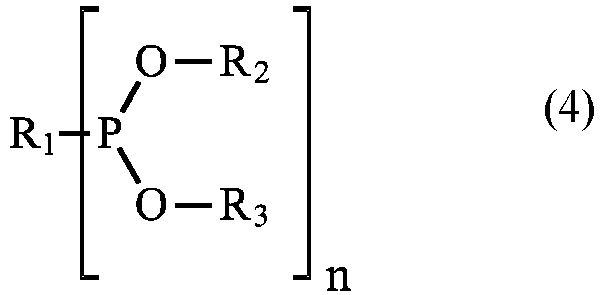
- n für 1, 2, 3 oder 4 steht,
- Ri, R2 und R3 unabhängig voneinander C1- C60-Alkyl, C6 - C12-Aryl und C5 - C12 Cycloalkyl und Wasserstoff bedeuten können, wobei die genannten Reste jeweils durch Aryl, Alkyl, Aryloxy, Alkyloxy, Heteroatome und/oder Heterocyclen substituiert sein können, wobei R2 und R3 nicht gleichzeitig Wasserstoff sein können.
- Bevorzugt sind die Reste mit C1 - C8-Alkyl, verzweigtem C1 - Cs-Alkyl, oder Cumyl substituiert, wobei die Substituenten gleich oder verschieden sein können.
- Handelt es sich bei den Resten um Arylreste, so sind diese bevorzugt in den Positionen 2 und 4 oder 2, 4 und 6 substituiert. Ganz besonders bevorzugt sind tert-Butylsubstituenten in diesen Positionen.
- Bei den Phosphoniten kann es sich um einkernige (n=1) oder mehrkernige (n= 2, 3 oder 4), aliphatisch, cycloaliphatisch und/oder aromatisch substituierte Phosphonite handeln.
- Unter "mehrkernigen" Phosphoniten werden solche verstanden, die innerhalb eines Moleküls mehrere Phosphonitgruppen tragen, also einfach organisch substituierte Phosphoratome, die wiederum zwei organisch substituierte Sauerstoffatome tragen.
- Alternative Bezeichnungen für die Struktur (4) sind "Hypophosphorigsäure-ester" oder auch "Phosphonigsäure-ester".
- Insbesondere bevorzugt als Komponente D wird die Substanz gemäß Struktur (5) eingesetzt.

- In Komponente D) können neben der Struktur (5) auch weitere davon isomere Strukturen vorhanden sein, wobei die Struktur (5) die Hauptkomponente darstellt.
- Die Verbindung (5) ist als CAS: 119345-01-6 klassifiziert und kommerziell unter dem Namen Irgafos™ P-EPQ der Firma BASF (Deutschland) verfügbar.
- Der Anteil der Komponente D in der Zusammensetzung beträgt bevorzugt 0,05 bis 1 Gew.-%, weiter bevorzugt 0,08 bis 0,8 Gew.-%, besonders bevorzugt 0,1 bis 0,3 Gew.-%.
- Die Zusammensetzung enthält als Komponente E ein sterisch gehindertes Phenol. Auch Mischungen mehrerer solcher Komponenten können eingesetzt werden.
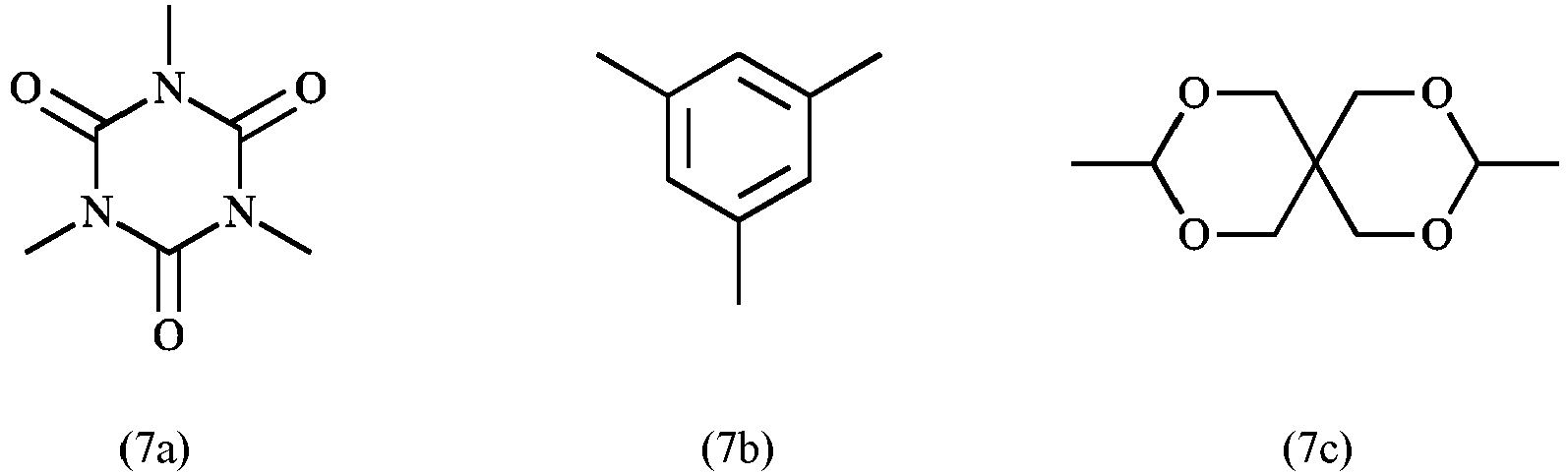
- Bevorzugt handelt es sich dabei um eine Verbindung der allgemeinen Struktur (6a) oder (6b)


- R1, R2 und R3 jeweils unabhängig voneinander für C1- bis C4-Alkyl oder Wasserstoff stehen
- X für eine direkte Bindung oder einen organischen Rest mit C1- bis C60- steht und der organische Rest Sauerstoff und/oder Stickstoff enthalten kann.
- R4 für eine direkte Bindung, Kohlenstoff, Ci-Cs Alkyl, Aryl oder eine Struktur gemäß Formel (7a) (7b) oder (7c) steht.
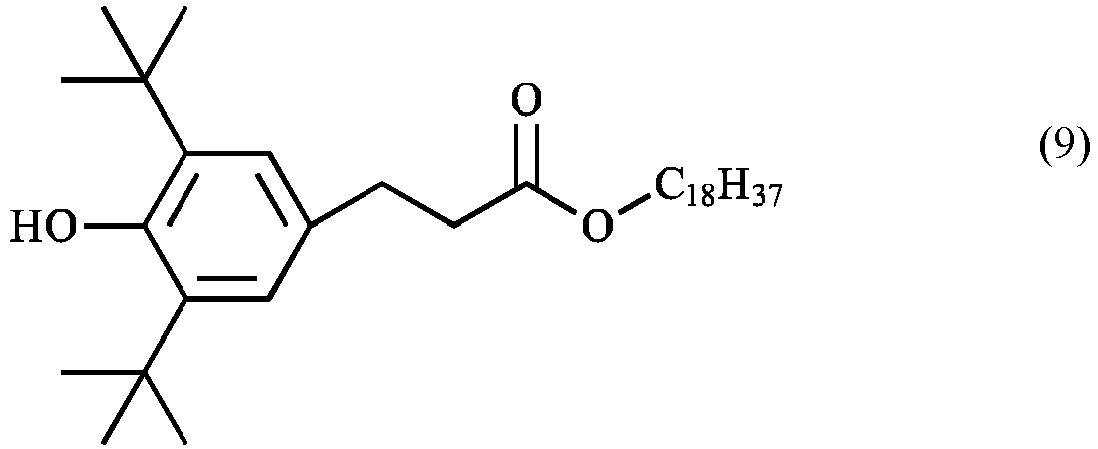
- Besonders bevorzugt ist die Komponente E ausgewählt aus mindestens einer Verbindung gemäß den Strukturen (8) und (9).
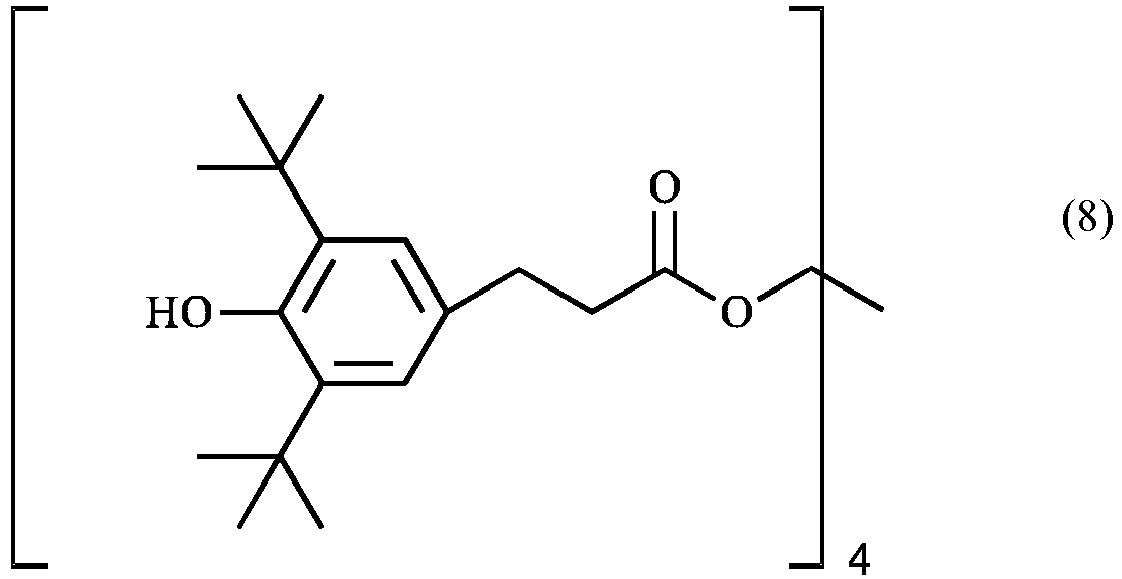
- Die Verbindung (8) ist als CAS: 6683-19-8 klassifiziert und kommerziell unter dem Namen Irganox™ 10 10 der Firma BASF( Deutschland) verfügbar.
- Die Verbindung (9) ist als CAS: 2082-79-3 klassifiziert und kommerziell unter dem Namen Irganox™ 1076 der Firma BASF( Deutschland) verfügbar.
- Der Anteil der Komponente E in der Zusammensetzung beträgt bevorzugt 0,05 bis 1 Gew.-%, weiter bevorzugt 0,08 bis 0,8 Gew.-%, besonders bevorzugt 0,1 bis 0,3 Gew.-%.
- Als Komponente F kann die thermoplastischen Formmasse optional mindestens einen mineralischen Füllstoff auf Basis von Talk als Verstärkungsstoff enthalten.
- In bevorzugter Ausführungsform ist ein mineralischer Füllstoff auf Basis von Talk alleiniger Verstärkungsstoff.
- Als mineralische Füllstoffe auf Basis von Talk im Sinne der Erfindung kommen alle teilchenförmigen Füllstoffe infrage, die der Fachmann mit Talk bzw. Talkum verbindet. Ebenfalls kommen alle teilchenförmigen Füllstoffe, die kommerziell angeboten werden und deren Produktbeschreibungen als charakterisierende Merkmale die Begriffe Talk bzw. Talkum enthalten, in Frage.
- Bevorzugt sind mineralische Füllstoffe, die einen Gehalt an Talk nach DIN 55920 von größer 50 Gew.-%, bevorzugt größer 80 Gew.-%, besonders bevorzugt größer 95 Gew.-% und insbesondere bevorzugt größer 98 Gew.-%, bezogen auf die Gesamtmasse an Füllstoff aufweisen.
- Unter Talk wird ein natürlich vorkommender oder synthetisch hergestellter Talk verstanden.
- Reiner Talk hat die chemische Zusammensetzung 3 MgO 4 SiOz · H2O und somit einen MgO-Gehalt von 31,9 Gew.-%, einen SiO2-Gehalt von 63,4 Gew.-% und einen Gehalt an chemisch gebundenem Wasser von 4,8 Gew.-%, jeweils bezogen auf den Talk. Es handelt sich um ein Silikat mit Schichtstruktur.
- Natürlich vorkommende Talkmaterialien besitzen im allgemeinen nicht die oben aufgeführte Idealzusammensetzung, da sie durch partiellen Austausch des Magnesiums durch andere Elemente, durch partiellen Austausch von Silizium, durch z.B. Aluminium und/oder durch Verwachsungen mit anderen Mineralien wie z.B. Dolomit, Magnesit und Chlorit verunreinigt sind.
- Besonders bevorzugte als Komponente F zum Einsatz kommende Talksorten zeichnen sich aus durch eine besonders hohe Reinheit, gekennzeichnet durch einen MgO-Gehalt von 28 bis 35 Gew.-%, bevorzugt 30 bis 33 Gew.-%, besonders bevorzugt 30,5 bis 32 Gew.-% und einen SiOz-Gehalt von 55 bis 65 Gew.-%, bevorzugt 58 bis 64 Gew.-%, besonders bevorzugt 60 bis 62,5 Gew.-%, jeweils bezogen auf den Talk.
- Die besonders bevorzugten Talktypen zeichnen sich des Weiteren durch einen Al2O3-Gehalt von kleiner als 5 Gew.-%, besonders bevorzugt kleiner als 1 Gew.-%, insbesondere kleiner als 0,7 Gew.-%, jeweils bezogen auf den Talk, aus.
- Vorteilhaft und insofern bevorzugt ist insbesondere auch der Einsatz des erfindungsgemäßen Talkes in Form von feinvermahlenen Typen mit einer mittleren Teilchengröße d50 von 0,1 bis 20 µm, bevorzugt 0,2 bis 10 µm, weiter bevorzugt 0,5 bis 5 µm, noch weiter bevorzugt 0,7 bis 2,5 µm, und besonders bevorzugt 1,0 bis 2,0 µm.
- Die erfindungsgemäß einzusetzenden mineralischen Füllstoffe auf Basis von Talk haben bevorzugt eine obere Teilchen- bzw. Korngröße d95 kleiner 10 µm, bevorzugt kleiner 7 µm, besonders bevorzugt kleiner 6 µm und insbesondere bevorzugt kleiner 4,5 µm. Die d95- und dso-Werte von den Füllstoffen werden nach Sedimentationsanalyse mit SEDIGRAPH D 5 000 nach ISO 13317-3 bestimmt.
- Die mineralischen Füllstoffe auf Basis von Talk können optional oberflächenbehandelt sein, um eine bessere Ankopplung an die Polymermatrix zu erzielen. Sie können beispielsweise mit einem Haftvermittlersystem auf Basis funktionalisierter Silane ausgerüstet sein.
- Das mittlere Aspektverhältnis (Durchmesser zu Dicke) der teilchenförmigen Füllstoffe liegt bevorzugt im Bereich 1 bis 100, besonders bevorzugt 2 bis 25 und insbesondere bevorzugt 5 bis 25, bestimmt an elektronenmikroskopischen Aufnahmen von Ultradünnschnitten der fertigen Produkte und Ausmessen einer repräsentativen Menge (ca. 50) von Füllstoffpartikeln.
- Die teilchenförmigen Füllstoffe können bedingt durch die Verarbeitung zur Formmasse bzw. zu Formkörpern in der Formmasse bzw. im Formkörper einen kleineren d95- bzw. dso-Wert aufweisen, als die ursprünglich eingesetzten Füllstoffe.
- Der Anteil der Komponente F in der Zusammensetzung beträgt bevorzugt 0 bis 25 Gew.-%, weiter bevorzugt 0 bis 20 Gew.-%, besonders bevorzugt 5 bis 20 Gew.-%.
- Die Zusammensetzung kann als Komponente G handelsübliche Polymeradditive enthalten.
- Als handelsübliche Polymeradditive gemäß Komponente E kommen Additive wie beispielsweise interne und externe Gleit- und Entformungsmittel (beispielsweise Pentaerythrittetrastearat, Montanwachs oder Polyethylenwax), Flammschutzmittel, Flammschutzsynergisten, Leitfähigkeitsadditive (beispielsweise Leitruß oder Carbon Nanotubes), UV/Licht-Schutzmittel, Nukleierungsmittel (z.B. Natriumphenylphosphinat, Aluminiumoxid, Siliziumdioxid, Salze aromatischer Carbonsäuren), Hydrolyseschutzmittel, kratzfestigkeitsverbessernde Additive (beispielsweise Silikonöle), IR-Absorbentien, optische Aufheller, fluoreszierende Additive, Schlagzähmodifikatoren (mit oder ohne Kern-Schale Struktur), weitere polymere Blendpartner, sowie Farbstoffe und Pigmente (beispielsweise Titandioxid, Ultramarinblau, Eisenoxid, Ruß, Phthalocyanine, Chinacridone, Perylene, Nigrosin und Anthrachinone) und Füll- und Verstärkungsstoffe (verschieden von Komponente F), oder aber Mischungen mehrerer der genannten Additive in Frage.
- Der weitere Verstärkungsstoff ist bevorzugt ausgewählt aus der Gruppe bestehend aus Glimmer, Silikat, Quarz, Titandioxid, Kaolin, amorphe Kieselsäuren, Magnesiumcarbonat, Kreide, Feldspat, Bariumsulfat, Glaskugeln, Keramikkugeln, Wollastonit und Glasfasern.
- Die erfindungsgemäßen Zusammensetzungen enthalten bevorzugt mindestens ein Entformungsmittel, vorzugsweise Pentaerythrittetrastearat.
- In einer bevorzugten Ausführungsform enthält die Zusammensetzung als Komponente G mindestens einen Zusatzstoff ausgewählt aus der Gruppe, die, Gleit- und Entformungsmittel, UV/Licht-Schutzmittel, Antistatika, Farbstoffe, Pigmente und Füll- und Verstärkungsstoffe (verschieden von Komponente F) umfasst.
- Die Additive können alleine oder in Mischung bzw. in Form von Masterbatchen eingesetzt werden.
- In einer bevorzugten Ausführungsform ist die Zusammensetzung frei von weiteren, von Komponente F verschiedenen Füll- und Verstärkungsstoffen.
- In einer bevorzugten Ausführungsform ist die Zusammensetzung frei von kautschukmodifizierten Pfropfpolymerisaten.
- In einer bevorzugten Ausführungsform ist die Zusammensetzung frei von Vinyl(Co)-polymerisaten, insbesondere SAN (Styrol-Acrylnitril).
- In einer bevorzugten Ausführungsform ist die Zusammensetzung frei von phosphorbasierten Flammschutzmitteln.
- Frei von einer Komponente bedeutet, dass weniger als 0,5 Gew.-%, bevorzugt weniger als 0,1 Gew.-%, insbesondere bevorzugt 0 Gew.-% dieser Komponente in der Zusammensetzung enthalten sind.
- Der Anteil der Komponente G in der Zusammensetzung beträgt bevorzugt 0 bis 20 Gew.-%, weiter bevorzugt 0,1 bis 15 Gew.-%, besonders bevorzugt 0,2 bis 10 Gew.-%.
- Aus den erfindungsgemäßen Zusammensetzungen können thermoplastische Formmassen hergestellt werden. Die erfindungsgemäßen thermoplastischen Formmassen können beispielsweise hergestellt werden, indem man die jeweiligen Bestandteile der Zusammensetzungen in bekannter Weise vermischt und bei Temperaturen von bevorzugt 200°C bis 320°C, besonders bevorzugt bei 240 bis 310°C, ganz besonders bevorzugt bei 260°C bis 300°C in üblichen Aggregaten wie beispielsweise Innenknetern, Extrudern und Doppelwellenschnecken schmelzcompoundiert und schmelzextrudiert. Dieser Prozess wird im Rahmen dieser Anmeldung allgemein als Compoundieren bezeichnet.
- Unter Formmasse wird also das Produkt verstanden, das erhaltend wird, wenn die Bestandteile der Zusammensetzung schmelzcompoundiert und schmelzextrudiert werden.
- Die Vermischung der einzelnen Bestandteile der Zusammensetzungen kann in bekannter Weise sowohl sukzessive als auch simultan erfolgen, und zwar sowohl bei etwa 20°C (Raumtemperatur) als auch bei höherer Temperatur. Das bedeutet, dass beispielsweise manche der Bestandteile über den Haupteinzug eines Extruders dosiert und die restlichen Bestandteile über einen Seitenextruder später im Compoundierverfahren zugeführt werden können.
- Die erfindungsgemäßen Formmassen können zur Herstellung von Formkörpern und Halbzeugen jeder Art verwendet werden. Diese können beispielsweise durch Spritzguss, Extrusion und Blasformverfahren hergestellt werden. Eine weitere Form der Verarbeitung ist die Herstellung von Formkörpern durch Tiefziehen aus zuvor hergestellten Platten oder Folien. Besonders eignen sich die erfindungsgemäßen Formmassen zur Verarbeitung in Extrusions-, Blasform- und Tiefziehverfahren.
- Als Beispiele für Halbzeuge seien Platten genannt.
- Es ist auch möglich, die Bestandteile der Zusammensetzungen direkt in eine Spritzgussmaschine oder in ein Extrusionsaggregat zu dosieren und zu Formkörper zu verarbeiten.
- Beispiele für solche Formkörper, die aus den erfindungsgemäßen Zusammensetzungen und Formmassen hergestellt werden können, sind Folien, Profile, Gehäuseteile jeder Art, für Büromaschinen wie Monitore, Flatscreens, Notebooks, Drucker, Kopierer; Platten, Rohre, Elektroinstallationskanäle, Fenster, Türen und weitere Profile für den Bausektor sowie Elektro- und Elektronikteile wie Schalter, Stecker und Steckdosen und Bauteile für Fahrzeuge, insbesondere für den Automobilbereich. Die erfindungsgemäßen Zusammensetzungen und Formmassen eignen sich auch zur Herstellung von folgenden Formkörpern oder Formteilen: Innenausbauteile für Schienenfahrzeuge, Schiffe, Flugzeuge, Busse und andere Kraftfahrzeuge, Karosserieteile für Kraftfahrzeuge, Gehäuse von Kleintransformatoren enthaltenden Elektrogeräten, Gehäuse für Geräte zur Informationsverarbeitung und -Übermittlung, Gehäuse und Verkleidung von medizinischen Geräten, Massagegeräte und Gehäuse dafür, Spielfahrzeuge für Kinder, flächige Wandelemente, Gehäuse für Sicherheitseinrichtungen, wärmeisolierte Transportbehältnisse, Formteile für Sanitär- und Badausrüstungen, Abdeckgitter für Lüfteröffnungen und Gehäuse für Gartengeräte.
- Die vorliegende Erfindung betrifft weiterhin aus den oben genannten Zusammensetzungen hergestellte Formkörper, vorzugsweise flächige Formteile wie Platten und Karosserieteile wie Spiegelgehäuse, Kotflügel, Spoiler, Hauben, etc.
- Die Formkörper können klein- oder großteilig sein und für Außen- oder Innenanwendungen eingesetzt werden. Bevorzugt werden großteilige Formteile für den Fahrzeugbau, insbesondere den Automobilsektor hergestellt. Insbesondere können aus den erfindungsgemäßen Formmassen Karosserieaußenteile wie z.B. Kotflügel, Heckklappen, Motorhauben, Stoßstangen, Ladeflächen, Abdeckungen für Ladeflächen, Autodächer oder andere Karosserieanbauteile gefertigt werden.
- Formkörper bzw. Halbzeuge aus den erfindungsgemäßen Formmassen/Zusammensetzungen können sich auch im Verbund mit weiteren Werkstoffen wie z.B. Metall oder Kunststoff befinden. Nach einer eventuellen Lackierung von z.B. Karosserieaußenteilen können sich Lackschichten direkt auf den erfindungsgemäßen Formmassen und/oder auf den im Verbund eingesetzten Werkstoffen befinden. Die erfindungsgemäßen Formmassen bzw. die Formteile/Halbzeuge aus den erfindungsgemäßen Formmassen können durch übliche Techniken des Verbinden und Zusammenfügen mehrerer Komponenten oder Teile wie z.B. Coextrusion, Folienhinterspritzen, Umspritzen von Einlegeteilen, Kleben, Verschweißen, Verschrauben oder Klammern im Verbund mit anderen Werkststoffen oder sich selbst für die Herstellung von Fertigteilen wie z.B. Karosserieaußenteilen eingesetzt werden.
- Nachfolgend werden weitere Ausführungsformen 1 bis 40 der vorliegenden Erfindung beschrieben:
- 1. Zusammensetzung zur Erzeugung einer thermoplastischen Formmasse, wobei die Zusammensetzung die folgenden Bestandteile enthält:
- A) mindestens ein Polymer ausgewählt aus der Gruppe bestehend aus Polycarbonat und Polyestercarbonat,
- B) mindestens ein Polyester,
- C) phosphorige Säure,
- D) mindestens ein Phosphonit,
- E) mindestens ein sterisch gehindertes Phenol.
- 2. Zusammensetzung gemäß Ausführungsform 1, dadurch gekennzeichnet, dass die Komponente A ein aromatisches Polycarbonat ist und ein gewichtsgemitteltes Molekulargewicht Mw bestimmt durch Gelpermeationschromatographie in Methlylenchlorid mit Polycarbonat auf Basis von Bisphenol A als Standard von 22 bis 28 kg/mol aufweist.
- 3. Zusammensetzung gemäß Ausführungsform 1 oder 2, dadurch gekennzeichnet, dass Komponente A ein aromatisches Polycarbonat auf Basis von Bisphenol A ist.
- 4. Zusammensetzung gemäß einer der vorherigen Ausführungsformen, dadurch gekennzeichnet, dass die Komponente B Struktureinheiten abgeleitet von Terephthalsäure und bis zu 50 Mol.-% Struktureinheiten von Phthalsäure, Isophthalsäure, Naphthalin-2,6-dicarbonsäure, 4,4'-Diphenyldicarbonsäure, Bernsteinsäure, Adipinsäure, und Cyclohexandicarbonsäure enthält.
- 5. Zusammensetzung gemäß einer der vorherigen Ausführungsformen, dadurch gekennzeichnet, dass die Komponente B keine Struktureinheiten von einer anderen Säure außer Terephthalsäure und Isophthalsäure enthält.
- 6. Zusammensetzung gemäß einer der vorherigen Ausführungsformen, dadurch gekennzeichnet, dass die Komponente B keine Struktureinheiten von einer anderen Säure außer Terephthalsäure enthält.
- 7. Zusammensetzung gemäß einer der vorherigen Ausführungsformen, dadurch gekennzeichnet, dass die Komponente B Struktureinheiten abgeleitet von Ethylenglykol, Butdandiol-1,4, Propandiol, Cyclohexan-dimethanol 1,4, Tetramethylcyclobutandiol und Isosorbit enthält.
- 8. Zusammensetzung gemäß einer der vorherigen Ausführungsformen, dadurch gekennzeichnet, dass Komponente B ausgewählt ist aus der Gruppe bestehend aus Polyethylenterephthalaten und Polybutylenterephthalaten.
- 9. Zusammensetzung gemäß einer der vorherigen Ausführungsformen, dadurch gekennzeichnet, dass als Komponente B ein Polyethylenterephthalat mit einer intrinsischen Viskosität von 0,52 dl/g bis 0,95 dl/g eingesetzt wird.
- 10. Zusammensetzung gemäß einer der vorherigen Ausführungsformen, dadurch gekennzeichnet, dass als Komponente B ein Polyethylenterephthalat mit einer intrinsischen Viskosität von 0,56 dl/g bis 0,80 dl/g eingesetzt wird.
- 11. Zusammensetzung gemäß einer der vorherigen Ausführungsformen, dadurch gekennzeichnet, dass als Komponente B ein Polyethylenterephthalat mit einer intrinsischen Viskosität von 0,58 dl/g bis 0,68 dl/g eingesetzt wird.
- 12. Zusammensetzung gemäß einer der vorhergehenden Ausführungsformen, enthaltend
- 40 bis 80 Gew.-% der Komponente A,
- 15 bis 45 Gew.-% der Komponente B,
- 0,005 bis 0,1 Gew.-% der Komponente C,
- 0,05 bis 1 Gew.-% der Komponente D,
- 0,05 bis 1 Gew.-% der Komponente E,
- F) 0 bis 25 Gew.-% eines mineralischen Füllstoffs auf Basis von Talk und
- G) 0 bis 20 Gew.-% mindestens eines Additivs ausgewählt aus der Gruppe bestehend aus Gleit- und Entformungsmitteln, Flammschutzmitteln, Flammschutzsynergisten, Leitfähigkeitsadditiven, UV/Licht-Schutzmitteln, Nukleierungsmitteln, Hydrolyseschutzmitteln, kratzfestigkeitsverbessernden Additiven, IR-Absorbentien, optischen Aufhellern, fluoreszierenden Additiven, Schlagzähmodifikatoren, Farbstoffen und Pigmenten sowie von Komponente F verschiedenen Füll- und Verstärkungsstoffen.
- 13. Zusammensetzung gemäß einer der vorhergehenden Ausführungsformen, dadurch gekennzeichnet, dass der Anteil der Komponente A in der Zusammensetzung 40 bis 80 Gew.-%, weiter bevorzugt 45 bis 75 Gew.-%, besonders bevorzugt 50 bis 66 Gew.-% beträgt.
- 15. Zusammensetzung gemäß einer der vorhergehenden Ausführungsformen, dadurch gekennzeichnet, dass der Anteil der Komponente B in der Zusammensetzung 15 bis 45 Gew.-%, weiter bevorzugt 18 bis 40, besonders bevorzugt 20 bis 35 Gew.-% beträgt.
- 15. Zusammensetzung gemäß einer der vorhergehenden Ausführungsformen, dadurch gekennzeichnet, dass der Anteil der Komponente C in der Zusammensetzung 0,005 bis 0,1 Gew.-%, weiter bevorzugt 0,008 bis 0,06 Gew.-%, besonders bevorzugt 0,01 bis 0,05 Gew.-% beträgt.
- 16. Zusammensetzung gemäß einer der vorhergehenden Ausführungsformen, dadurch gekennzeichnet, dass der Anteil der Komponente D in der Zusammensetzung 0,05 bis 1 Gew.-%, weiter bevorzugt 0,08 bis 0,8 Gew.-%, besonders bevorzugt 0,1 bis 0,3 Gew.-% beträgt.
- 17. Zusammensetzung gemäß einer der vorhergehenden Ausführungsformen, dadurch gekennzeichnet, dass der Anteil der Komponente E in der Zusammensetzung 0,05 bis 1 Gew.-%, bevorzugt 0,08 bis 0,8 Gew.-%, weiter bevorzugt 0,1 bis 0,3 Gew.-% beträgt.
- 18. Zusammensetzung gemäß einer der vorhergehenden Ausführungsformen, dadurch gekennzeichnet, dass der Anteil der Komponente F in der Zusammensetzung 0 bis 25 Gew.-%, weiter bevorzugt 0 bis 20 Gew.-%, besonders bevorzugt 5 bis 20 Gew.-% beträgt.
- 19. Zusammensetzung gemäß einer der vorhergehenden Ausführungsformen, dadurch gekennzeichnet, dass der Anteil der Komponente G in der Zusammensetzung 0 bis 20 Gew.-%, weiter bevorzugt 0,1 bis 15 Gew.-%, besonders bevorzugt 0,2 bis 10 Gew.-% beträgt.
- 20. Zusammensetzung gemäß einer der vorhergehenden Ausführungsformen, enthaltend
- 50 bis 66 Gew.-% der Komponente A,
- 20 bis 35 Gew.-% der Komponente B,
- 0,01 bis 0,05 Gew.-% der Komponente C,
- 0,1 bis 0,3 Gew.-% der Komponente D,
- 0,1 bis 0,3 Gew.-% der Komponente E,
- 5 bis 20 Gew.-% der Komponente F und
- 0,2 bis 10 Gew.-% der Komponente G.
- 21. Zusammensetzung gemäß einer der vorhergehenden Ausführungsformen, dadurch gekennzeichnet, dass Komponente C als Feststoff eingesetzt wird.
- 22. Zusammensetzung gemäß einer der vorherigen Ausführungsformen, dadurch gekennzeichnet, dass Komponente C an einem organischen oder anorganischen Adsorber oder Absorber gebunden eingesetzt wird.
- 23. Zusammensetzung gemäß Ausführungsform 20, dadurch gekennzeichnet, dass Komponente C auf Silika gebunden eingesetzt wird.
- 24. Zusammensetzung gemäß einer der vorhergehenden Ausführungsformen, dadurch gekennzeichnet, dass als Komponente D die Verbindung gemäß Struktur (5) eingesetzt wird.

- 25. Zusammensetzung gemäß einer der vorhergehenden Ausführungsformen, dadurch gekennzeichnet, dass Komponente E ausgewählt ist aus mindestens einer Verbindung gemäß den Strukturen (8) und (9)


- 26. Zusammensetzung gemäß einer der vorherigen Ausführungsformen, dadurch gekennzeichnet, dass als Komponente F ein Talk mit einem Al2O3-Gehalt von weniger als 0,7 Gew.-% eingesetzt wird
- 27. Zusammensetzung gemäß einer der vorhergehenden Ausführungsformen, dadurch gekennzeichnet, dass die Komponente F eine obere Korngröße d95 kleiner 6 µm aufweist.
- 28. Zusammensetzung gemäß einer der vorhergehenden Ausführungsformen enthaltend keine von Komponente F verschiedene Füll- und Verstärkungsstoffe.
- 29. Zusammensetzung gemäß einer der vorherigen Ausführungsformen, dadurch gekennzeichnet, dass die Zusammensetzung frei ist von kautschukmodifizierten Pfropfpolymerisaten.
- 30. Zusammensetzung gemäß einer der vorherigen Ausführungsformen, dadurch gekennzeichnet, dass die Zusammensetzung frei ist von Vinyl(Co)-polymerisaten.
- 31. Zusammensetzung gemäß einer der vorherigen Ausführungsformen, dadurch gekennzeichnet, dass die Zusammensetzung frei ist von Styrol-Acrylnitril Copolymeren.
- 32. Zusammensetzung gemäß einer der vorherigen Ausführungsformen, dadurch gekennzeichnet, dass die Zusammensetzung frei ist von phosphorbasierten Flammschutzmitteln.
- 33. Zusammensetzung gemäß einer der vorherigen Ausführungsformen, dadurch gekennzeichnet, dass die Zusammensetzung frei ist von Carbonfasern.
- 34. Zusammensetzung gemäß einer der vorhergehenden Ausführungsformen bestehend zu 90 Gew.-% aus den Komponenten A bis G.
- 35. Zusammensetzung gemäß einer der vorhergehenden Ausführungsformen bestehend zu 95 Gew.-% aus den Komponenten A bis G.
- 36. Zusammensetzung gemäß einer der vorhergehenden Ausführungsformen bestehend aus den Komponenten A bis G.
- 37. Verfahren zur Herstellung einer Formmasse, dadurch gekennzeichnet, dass die Bestandteile einer Zusammensetzung nach einer der Ausführungsformen 1 bis 36 bei einer Temperatur von 200 bis 320 °C miteinander vermischt und anschließend abgekühlt und granuliert werden.
- 38. Formmasse, erhältlich nach einem Verfahren nach Ausführungsform 37.
- 39. Verwendung einer Zusammensetzung nach einer der Ausführungsformen 1 bis 36 oder einer Formmasse nach Ausführungsform 37 zur Herstellung von Formkörpern.
- 40. Formkörper, erhältlich aus einer Zusammensetzung nach einer der Ausführungsformen 1 bis 36 oder aus einer Formmasse nach Ausführungsform 38.
- Lineares Polycarbonat auf Basis Bisphenol-A mit einem Molekulargewicht von 24 kg/mol (Gewichtsmittel Mw, gemessen durch GPC (Gelpermeationschromatographie) mit Polycarbonatstandard auf Basis Bisphenol A).
- Lineares Polycarbonat auf Basis Bisphenol-A mit einem Molekulargewicht von 28 kg/mol (Gewichtsmittel Mw, gemessen durch GPC (Gelpermeationschromatographie) mit Polycarbonatstandard auf Basis Bisphenol A).
- Polyethylenterephthalat (z.B. PET der Fa. Invista, Deutschland) mit einer intrinsischen Viskosität von 0,623 dl/g. Die spezifische Viskosität wird gemessen in Dichloressigsäure in einer Konzentration von 1 Gew.-% bei 25°C. Die intrinsische Viskosität wird aus der spezifischen Viskosität gemäß nachstehender Formel berechnet.

- Polyethylenterephthalat (z.B. PET der Fa. Invista, Deutschland) mit einer intrinsischen Viskosität von 0,664 dl/g. Die spezifische Viskosität wird gemessen in Dichloressigsäure in einer Konzentration von 1 Gew.-% bei 25°C. Die intrinsische Viskosität wird aus der spezifischen Viskosität gemäß nachstehender Formel berechnet.

- Phosphorige Säure H3PO3 als Feststoff, Sigma-Aldrich Chemie GmbH (Deutschland)
- Zn (H2PO4)2, Budit™ T21, Budenheim (Deutschland)
- Dimeres Phosphonit gemäß Struktur (5), Tetrakis(2,4-di-tert-butylphenyl)-1,1-biphenyl-4,4'-diylbisphosphonit, Irgafos™ P-EPQ, BASF (Deutschland)

- Phosphitstabilisator gemäß Struktur (10), Irgafos™ 168, Tris(2,4-di-tert-butyl-phenyl)-phosphit); BASF (Deutschland)

- Sterisch gehindertes Phenol gemäß Struktur (8), Irganox™ 1010, Pentaerythritol tetrakis(3-(3,5-di-tert-butyl-4-hydroxyphenyl)propionat), BASF (Deutschland)

- Sterisch gehindertes Phenol gemäß Struktur (9), Irganox™ 1076, Octadecyl-3-[3,5-di-tert-butyl-4-hydroxyphenyl]propionat], BASF (Deutschland)

- Talk mit einem mittleren Partikeldurchmesser dso von 1,2 µm und einem d95 von 3,5 µm gemessen mittels Sedigraph und mit einem Al2O3-Gehalt von 0,5 Gew.-%, Jetfine™ 3CA der Firma Imerys Talc (Österreich)
- Pentaerythrittetrastearat als Entformungsmittel, Cognis Oleochemicals GmbH (Deutschland)
- Montansäureesterwachs (Licowax™ E) als Gleit-/Entformungsmittel
- Ruß, Black Pearls™ 800, Cabot
- Die erfindungsgemäßen Formmassen, enthaltend die Komponenten A bis E werden hergestellt auf einem Doppelwellenextruder ZSK25 der Fa. Coperion, Werner und Pfleiderer (Deutschland) bei Schmelzetemperaturen von 270°C.
- Die aus der jeweiligen Compoundierung resultierenden Granulate wurden auf einer Spritzgussmaschine (z. B. Fa. Arburg) bei einer Schmelzetemperatur von 270°C und einer Werkzeugtemperatur von 70°C zu Probekörpern verarbeitet.
- Die Wärmeformbeständigkeit wurde gemessen gemäß DIN ISO 306 (Vicat-Erweichungstemperatur, Verfahren B mit 50 N Belastung und einer Heizrate von 120 K/h, Version von 2013) an einem einseitig angespritzten Prüfstab der Dimension 80x10x4 mm, hergestellt bei 270°C und einer Verweilzeit von 43 s. Weiterhin wurde eine Vicat-Erweichungstemperatur gemessen an Prüfstäben, die bei 300°C mit einer Verweilzeit von 129 s hergestellt wurden. Angegeben ist jeweils die Differenz Delta Vicat = Vicat (Prüfkörper 270°C, 43 s Verweilzeit) - Vicat (Prüfkörper 300 °C, 129 s Verweilzeit) als Maß für die thermische Belastbarkeit.
- Die Bestimmung der Schlagzähigkeit erfolgt gemäß ISO 180/1U (Version von 1982) bei Raumtemperatur (23°C) durch eine 10-fach-Bestimmung an Prüfstäben der Abmessung 80 mm × 10 mm × 4 mm.
- Die Glasübergangstemperatur des Polycarbonats (Tg PC), die Schmelztemperatur des Polyesters (Tm PET) sowie die Kristallisationstemperatur des Polyesters (Tc PET) wurden mittels Differential Scanning Calorimetry (DSC) nach ISO 11357-3:2018 : Determination of temperature and enthalpy of melting and crystallization mit einem Mettler DSC 3+ Gerät bestimmt. Die Messung fand in einem Temperaturbereich von -40°C bis 320 °C mit einer Heizrate von 10 K/min in Stickstoffatmosphäre (50 ml N2/min) statt. Dabei wurde mehrfach aufgeheizt und abgekühlt. Tg wurde jeweils als Mittelpunkt des Glasüberganges beim zweiten Aufheizen und beim ersten Abkühlen ermittelt. Tm wurde als Peaktemperatur beim zweiten Aufheizen und Tc als Peaktemperatur beim ersten Abkühlen ermittelt.
- Konnte die Schmelztemperatur des Polyesters (Tm PET) und/oder die Kristallisationstemperatur des Polyesters (Tc PET) aufgrund von instabilem Phasenverhalten / thermischer Schädigung des untersuchten Materials nicht ermittelt werden, so ist dies mit "nicht messbar" gekennzeichnet.
- Die folgenden Beispiele dienen der weiteren Erläuterung der Erfindung.
Tabelle 1 Komponente (Gewichtsteile) V1 V2 3 4 5 A-1 61,2 61,1 60,7 60,7 60,7 B-1 22,5 22,5 23,0 23,0 23,0 C-1 0,010 0,025 0,050 C-2 D-1 0,1 0,2 0,1 0,1 0,1 D-2 E-1 0,2 0,2 0,2 0,2 0,2 F 15,0 15,0 15,0 15,0 15,0 G-1 0,36 0,36 0,36 0,36 0,36 G-2 0,2 0,2 0,2 0,2 0,2 G-3 0,45 0,45 0,45 0,45 0,45 Eigenschaften Einheit Delta Vicat °C 16 12 2 1 1 Izod Schlagzähigkeit 23°C kJ/m2 82 77 80 77 74 Tg PC (DSC) 2. Aufheizen °C 115 114 139 140 139 Tm PET (DSC) 2. Aufheizen °C n.m.* n.m.* 251 251 251 Tc PET (DSC) 1. Abkühlen °C n.m.** n.m.** 217 215 215 Tg PC (DSC) 1. Abkühlen °C 112 113 136 137 135 * n.m. = nicht messbar, d.h. Schmelztemperatur mittels DSC Messung nicht mehr bestimmbar
** n.m. = nicht messbar, d.h. Kristallisationstemperatur mittels DSC Messung nicht mehr bestimmbarTabelle 1-Fortsetzung Komponente (Gewichtsteile) V6 V7 V8 V9 V10 V11 A-1 61,2 61,2 61,2 60,7 61,4 61,4 B-1 22,5 22,5 22,5 23,0 22,6 22,6 C-1 0,010 0,025 0,050 0,025 0,05 C-2 0,025 D-1 0,1 D-2 0,1 0,1 0,1 E-1 0,2 0,2 0,2 0,2 F 15,0 15,0 15,0 15,0 15,0 15,0 G-1 0,36 0,36 0,36 0,36 0,36 0,36 G-2 0,2 0,2 0,2 0,2 0,2 0,2 G-3 0,45 0,45 0,45 0,45 0,45 0,45 Eigenschaften Einheit Delta Vicat °C 4 2 2 3 2 2 Izod Schlagzähigkeit 23°C kJ/m2 67 65 66 67 74 58 Tg PC (DSC) 2. Aufheizen °C 123 134 137 135 134 138 Tm PET (DSC) 2. Aufheizen °C 238 244 251 244 245 251 Tc PET (DSC) 1. Abkühlen °C 207 206 218 203 209 214 Tg PC (DSC) 1. Abkühlen °C 119 131 134 135 134 134 * n.m. = nicht messbar, d.h. Schmelztemperatur mittels DSC Messung nicht mehr bestimmbar
** n.m. = nicht messbar, d.h. Kristallisationstemperatur mittels DSC Messung nicht mehr bestimmbarTabelle 2 Komponente (Gewichtsteile) V12 V13 14 A-2 69,8 69,9 69,8 B-2 29,5 29,6 29,5 C 0,02 0,02 D-1 0,2 0,2 E-2 0,2 0,2 0,2 G-1 0,36 0,36 0,36 Eigenschaften Einheit Delta Vicat °C 9 8 7 Izod Schlagzähigkeit 23°C kJ/m2 n.g. n.g. n.g. Tg PC (DSC) 2. Aufheizen °C 132 134 139 Tm PET (DSC) 2. Aufheizen °C 246 252 254 Tc PET (DSC) 1. Abkühlen °C **n.m. 192 198 Tg PC (DSC) 1. Abkühlen °C 131 134 136 n.g. = nicht gebrochen
** n.m. = nicht messbar, d.h. Kristallisationstemperatur mittels DSC Messung nicht mehr bestimmbar - Aus Tabelle 1 geht hervor, dass die erfindungsgemäßen Zusammensetzungen enthaltend die Komponenten C, D und E die Herstellung von Formkörpern mit einer geringen Reduzierung der Wärmeformbeständigkeit nach hoher thermischer Belastung (Delta Vicat) in Verbindung mit verbesserter Schlagzähigkeit ermöglichen. Weiterhin zeigen die DSC Untersuchungen, dass bei den Komponenten Polycarbonat und Polyester sowohl beim mehrfachen Aufheizen als auch bei wiederholter Abkühlung die jeweiligen Übergangstemperaturen auf hohem Niveau sind und daher von einem guten Erhalt der Phasenseparation und Phasenstabilität ausgegangen werden kann.
- Wird die Komponente C nicht eingesetzt (V1), so sinkt die Wärmeformbeständigkeit bei hoher thermischer Belastung deutlich und die Komponenten Polycarbonat und Polyester sind in unerwünschter Weise vermischt. Auch durch eine erhöhte Zugabe der Komponente D kann das Fehlen der Komponente C nicht ausgeglichen werden.
- Wird als Komponente D kein Phosphonit, sondern ein Phosphit eingesetzt (V6, V7 und V8), so ist insbesondere die Zähigkeit nicht auf dem gewünschten Niveau.
- Wird als Komponente C ein saures Phosphatsalz eingesetzt werden (V9), so ist die Zähigkeit ebenfalls reduziert und die Übergangstemperaturen sind erniedrigt.
- Wird nur die erfindungsgemäße Komponente C eingesetzt, aber die Komponenten D und E fehlen, so ist bei gleicher Menge an Komponente C die Übergangstemperaturen erniedrigt (Bs.4 gegenüber V10). Dies lässt sich nicht durch eine höhere Menge der Komponente C ausgleichen, weil dann die Schlagzähigkeit deutlich abnimmt (V12).
- Die Vorteile der Kombination der Komponenten C, D und E zeigt sich auch in Zusammensetzungen ohne mineralischen Füllstoff (Tabelle 2).
Claims (15)
- Zusammensetzung zur Erzeugung einer thermoplastischen Formmasse, wobei die Zusammensetzung die folgenden Bestandteile enthält:A) mindestens ein Polymer ausgewählt aus der Gruppe bestehend aus Polycarbonat und Polyestercarbonat,B) mindestens ein Polyester,C) phosphorige Säure,D) mindestens ein Phosphonit,E) mindestens ein sterisch gehindertes Phenol.
- Zusammensetzung gemäß Anspruch 1, dadurch gekennzeichnet, dass die Komponente A ein aromatisches Polycarbonat ist und ein gewichtsgemitteltes Molekulargewicht Mw bestimmt durch Gelpermeationschromatographie in Methlylenchlorid mit Polycarbonat auf Basis von Bisphenol A als Standard von 22 bis 28 kg/mol aufweist.
- Zusammensetzung gemäß Anspruch 1 oder 2, dadurch gekennzeichnet, dass Komponente B ausgewählt ist aus der Gruppe bestehend aus Polyethylenterephthalaten und Polybutylenterephthalaten.
- Zusammensetzung gemäß Anspruch 3, dadurch gekennzeichnet, dass als Komponente B ein Polyethylenterephthalat mit einer intrinsischen Viskosität von 0,58 dl/g bis 0,68 dl/g eingesetzt wird, wobei die intrinsische Viskosität mittels dem in der Beschreibung angegebenen Verfahren ermittelt wird.
- Zusammensetzung gemäß einem der vorhergehenden Ansprüche, enthaltend40 bis 80 Gew.-% der Komponente A,15 bis 45 Gew.-% der Komponente B,0,005 bis 0,1 Gew.-% der Komponente C,0,05 bis 1 Gew.-% der Komponente D,0,05 bis 1 Gew.-% der Komponente E,F) 0 bis 25 Gew.-% eines mineralischen Füllstoffs auf Basis von Talk undG) 0 bis 20 Gew.-% mindestens eines Additivs ausgewählt aus der Gruppe bestehend aus Gleit- und Entformungsmitteln, Flammschutzmitteln, Flammschutzsynergisten, Leitfähigkeitsadditiven, UV/Licht-Schutzmitteln, Nukleierungsmitteln, Hydrolyseschutzmitteln, kratzfestigkeitsverbessernden Additiven, IR-Absorbentien, optischen Aufhellern, fluoreszierenden Additiven, Schlagzähmodifikatoren, Farbstoffen und Pigmenten sowie von Komponente F verschiedenen Füll- und Verstärkungsstoffen.
- Zusammensetzung gemäß einer der vorherigen Ansprüche, dadurch gekennzeichnet, dass Komponente C als Feststoff eingesetzt wird.
- Zusammensetzung gemäß einem der vorhergehenden Ansprüche, dadurch gekennzeichnet, dass der Anteil der Komponente C in der Zusammensetzung 0,01 bis 0,05 Gew.-% beträgt.
- Zusammensetzung gemäß einem der vorhergehenden Ansprüche, dadurch gekennzeichnet, dass als Komponente D die Verbindung gemäß Struktur (5) eingesetzt wird.

- Zusammensetzung gemäß einem der vorhergehenden Ansprüche, dadurch gekennzeichnet, dass die Komponente F eine obere Korngröße d95 kleiner 6 µm aufweist.
- Zusammensetzung gemäß einem der vorherigen Ansprüche enthaltend keine von Komponente F verschiedene Füll- und Verstärkungsstoffe.
- Zusammensetzung gemäß einem der vorherigen Ansprüche bestehend aus den Komponenten A bis G.
- Verfahren zur Herstellung einer Formmasse, dadurch gekennzeichnet, dass die Bestandteile einer Zusammensetzung nach einem der Ansprüche 1 bis 11 bei einer Temperatur von 200 bis 320 °C miteinander vermischt und anschließend abgekühlt und granuliert werden.
- Formmasse, erhältlich nach einem Verfahren nach Anspruch 12.
- Verwendung einer Zusammensetzung nach einem der Ansprüche 1 bis 11 oder einer Formmasse nach Anspruch 13 zur Herstellung von Formkörpern.
- Formkörper, erhältlich aus einer Zusammensetzung nach einem der Ansprüche 1 bis 11 oder aus einer Formmasse nach Anspruch 13.
Applications Claiming Priority (2)
| Application Number | Priority Date | Filing Date | Title |
|---|---|---|---|
| EP21155830.9A EP4039746A1 (de) | 2021-02-08 | 2021-02-08 | Polycarbonat-polyester zusammensetzung, formmasse und formkörper mit guter schlagzähigkeit und hoher thermischer belastbarkeit |
| PCT/EP2022/052279 WO2022167395A1 (de) | 2021-02-08 | 2022-02-01 | Polycarbonat-polyester zusammensetzung, formmasse und formkörper mit guter schlagzähigkeit und hoher thermischer belastbarkeit |
Publications (2)
| Publication Number | Publication Date |
|---|---|
| EP4288490A1 EP4288490A1 (de) | 2023-12-13 |
| EP4288490B1 true EP4288490B1 (de) | 2025-01-15 |
Family
ID=74561812
Family Applications (2)
| Application Number | Title | Priority Date | Filing Date |
|---|---|---|---|
| EP21155830.9A Withdrawn EP4039746A1 (de) | 2021-02-08 | 2021-02-08 | Polycarbonat-polyester zusammensetzung, formmasse und formkörper mit guter schlagzähigkeit und hoher thermischer belastbarkeit |
| EP22703606.8A Active EP4288490B1 (de) | 2021-02-08 | 2022-02-01 | Polycarbonat-polyester zusammensetzung, formmasse und formkörper mit guter schlagzähigkeit und hoher thermischer belastbarkeit |
Family Applications Before (1)
| Application Number | Title | Priority Date | Filing Date |
|---|---|---|---|
| EP21155830.9A Withdrawn EP4039746A1 (de) | 2021-02-08 | 2021-02-08 | Polycarbonat-polyester zusammensetzung, formmasse und formkörper mit guter schlagzähigkeit und hoher thermischer belastbarkeit |
Country Status (6)
| Country | Link |
|---|---|
| US (1) | US20240052158A1 (de) |
| EP (2) | EP4039746A1 (de) |
| JP (1) | JP2024507473A (de) |
| KR (1) | KR20230142721A (de) |
| CN (1) | CN116829648A (de) |
| WO (1) | WO2022167395A1 (de) |
Family Cites Families (31)
| Publication number | Priority date | Publication date | Assignee | Title |
|---|---|---|---|---|
| DE1495626B1 (de) | 1960-03-30 | 1971-06-09 | Bayer Ag | Verfahren zum herstellen von polyestern |
| US3419634A (en) | 1966-01-03 | 1968-12-31 | Gen Electric | Organopolysiloxane polycarbonate block copolymers |
| FR1580834A (de) | 1968-01-04 | 1969-09-12 | ||
| DE2232877B2 (de) | 1972-07-05 | 1980-04-10 | Werner & Pfleiderer, 7000 Stuttgart | Verfahren zur Herstellung von Polyestern |
| DE2402367A1 (de) | 1973-01-23 | 1974-07-25 | Gen Electric | Hitzestabilisiertes polycarbonatharz |
| US3953539A (en) | 1973-03-28 | 1976-04-27 | Teijin Ltd. | Aromatic polyester resin composition having inhibited coloration and method for inhibiting coloration |
| JPS5039599B2 (de) | 1973-03-30 | 1975-12-18 | ||
| DE2407776A1 (de) | 1974-02-19 | 1975-09-04 | Licentia Gmbh | Schaltung zur regelung der betriebsspannung fuer die transistor-zeilenendstufe eines fernsehempfaengers |
| US4123473A (en) * | 1975-10-23 | 1978-10-31 | Allied Chemical Corporation | Transparent sheets and containers formed from polycarbonate-polyester blends and formation thereof |
| JPS5292295A (en) | 1976-01-29 | 1977-08-03 | Sumitomo Chem Co Ltd | Preparation of aromatic polyester |
| IT1116721B (it) | 1976-04-02 | 1986-02-10 | Allied Chem | Copolimero bisfenolo a tereftalato carbonato lavorabili in massa fusa |
| DE2715932A1 (de) | 1977-04-09 | 1978-10-19 | Bayer Ag | Schnellkristallisierende poly(aethylen/alkylen)-terephthalate |
| US4088709A (en) | 1977-07-01 | 1978-05-09 | Eastman Kodak Company | Phosphorus stabilized-polyester-polycarbonate molding compositions |
| DE2842005A1 (de) | 1978-09-27 | 1980-04-10 | Bayer Ag | Polycarbonate mit alkylphenyl-endgruppen, ihre herstellung und ihre verwendung |
| JPS5594930A (en) | 1979-01-10 | 1980-07-18 | Sumitomo Chem Co Ltd | Preparation of aromatic polyester by improved bulk polymerization process |
| DE2940024A1 (de) | 1979-10-03 | 1981-04-16 | Bayer Ag, 5090 Leverkusen | Aromatische polyester, verfahren zu ihrer herstellung und ihre verwendung zur herstellung von spritzgussartikeln, folien und ueberzuegen |
| DE3007934A1 (de) | 1980-03-01 | 1981-09-17 | Bayer Ag, 5090 Leverkusen | Aromatische polyestercarbonate, verfahren zu ihrer herstellung und ihre verwendung zur herstellung von spritzgussartikeln, folien und ueberzuegen |
| EP0114288B1 (de) | 1982-12-28 | 1989-10-04 | General Electric Company | Additivkonzentrat für Polyesterzusammensetzungen und Verfahren der Zugabe |
| DE3334782A1 (de) | 1983-04-19 | 1984-10-25 | Bayer Ag, 5090 Leverkusen | Verfahren zur herstellung von polydiorganosiloxanen mit hydroxyaryloxy-endgruppen |
| EP0167564A1 (de) | 1983-12-14 | 1986-01-15 | General Electric Company | Farbstabilisierte polycarbonat-polyester-zusammensetzungen und stabilisierungsverfahren |
| DE3445570A1 (de) * | 1984-12-14 | 1986-06-19 | Basf Ag, 6700 Ludwigshafen | Selbstverloeschende thermoplastische polyesterformmassen |
| DE3832396A1 (de) | 1988-08-12 | 1990-02-15 | Bayer Ag | Dihydroxydiphenylcycloalkane, ihre herstellung und ihre verwendung zur herstellung von hochmolekularen polycarbonaten |
| NL8902312A (nl) | 1989-09-15 | 1991-04-02 | Gen Electric | Met fosforigzuurverbinding gestabiliseerd mengsel van a een polycarbonaat en/of polyestercarbonaat en b een polyalkyleentereftalaat. |
| US5441997A (en) | 1992-12-22 | 1995-08-15 | General Electric Company | High density polyester-polycarbonate molding composition |
| CA2103420A1 (en) | 1992-12-22 | 1994-06-23 | Eileen B. Walsh | Stabilization of low molecular weight polybutylene terephthalate/polyester blends with phosphorus compounds |
| US6455564B1 (en) | 1999-01-06 | 2002-09-24 | Pharmacia & Upjohn Company | Method of treating sexual disturbances |
| US20060270767A1 (en) * | 2005-05-26 | 2006-11-30 | Van Gisbergen Josephus Gerardu | Mineral filled polyester polycarbonate composition |
| DE102007052968A1 (de) * | 2007-11-07 | 2009-05-14 | Bayer Materialscience Ag | Verfahren zur Herstellung von Polycarbonat nach dem Schmelzeumesterungsverfahren |
| EP3365390B1 (de) * | 2015-10-23 | 2020-06-17 | Covestro Deutschland AG | Verfahren zur herstellung von polycarbonat-formmassen mit verbesserter thermischer verarbeitungsstabilität |
| EP3608358B1 (de) | 2018-08-09 | 2021-03-10 | Covestro Intellectual Property GmbH & Co. KG | Mineralgefüllte polycarbonat-polyalkylenterephthalat-zusammensetzung, formmasse und formkörper mit guter schlagzähigkeit |
| CN109666278A (zh) * | 2018-12-19 | 2019-04-23 | 东莞市旺品实业有限公司 | 一种耐应力开裂的pc材料及其制备方法 |
-
2021
- 2021-02-08 EP EP21155830.9A patent/EP4039746A1/de not_active Withdrawn
-
2022
- 2022-02-01 WO PCT/EP2022/052279 patent/WO2022167395A1/de not_active Ceased
- 2022-02-01 JP JP2023547571A patent/JP2024507473A/ja active Pending
- 2022-02-01 CN CN202280013975.0A patent/CN116829648A/zh active Pending
- 2022-02-01 KR KR1020237026523A patent/KR20230142721A/ko active Pending
- 2022-02-01 EP EP22703606.8A patent/EP4288490B1/de active Active
- 2022-02-01 US US18/262,754 patent/US20240052158A1/en not_active Abandoned
Also Published As
| Publication number | Publication date |
|---|---|
| CN116829648A (zh) | 2023-09-29 |
| US20240052158A1 (en) | 2024-02-15 |
| EP4288490A1 (de) | 2023-12-13 |
| EP4039746A1 (de) | 2022-08-10 |
| WO2022167395A1 (de) | 2022-08-11 |
| JP2024507473A (ja) | 2024-02-20 |
| KR20230142721A (ko) | 2023-10-11 |
Similar Documents
| Publication | Publication Date | Title |
|---|---|---|
| EP1355987B1 (de) | Flammwidrige; mineralverstärkte polycarbonatzusammensetzungen mit hoher bindenahtfestigkeit | |
| EP1998951B1 (de) | Flammgeschützte schlagzähmodifizierte polycarbonat-zusammensetzungen | |
| EP1490436B1 (de) | Schlagzähmodifizierte polycarbonat-zusammensetzung, enthaltend kalzinierten talk | |
| EP1351965B1 (de) | Phosphorhaltiges flammschutzmittel und flammwidrige thermoplastische formmassen | |
| EP2225322B1 (de) | Flammgeschützte schlagzähmodifizierte polycarbonat-zusammensetzungen | |
| EP1399512B1 (de) | Schlagzähmodifizierte polymer-zusammensetzung | |
| DE10152317A1 (de) | Mineralverstärkte schlagzähmodifizierte Polycarbonat-Blends | |
| EP3487934B1 (de) | Kratzfeste polycarbonat-zusammensetzungen mit guter thermischer stabilität | |
| EP2928949B1 (de) | Flammgeschützte polycarbonatformmassen iv | |
| DE102010041388A1 (de) | Flammgeschützte schlagzähmodifizierte Batteriegehäuse auf Polycarbonatbasis II | |
| EP3697847A1 (de) | Flammwidrige, füllstoff-verstärkte polycarbonat-zusammensetzung mit geringem bisphenol-a gehalt | |
| EP4025580A1 (de) | Polyphosphazen und formmasse enthaltend das polyphosphazen | |
| EP1355988A1 (de) | Polycarbonat-zusammensetzungen mit reduziertem eisengehalt | |
| EP1966296B1 (de) | Polycarbonat-formmassen | |
| EP4288490B1 (de) | Polycarbonat-polyester zusammensetzung, formmasse und formkörper mit guter schlagzähigkeit und hoher thermischer belastbarkeit | |
| EP3608358B1 (de) | Mineralgefüllte polycarbonat-polyalkylenterephthalat-zusammensetzung, formmasse und formkörper mit guter schlagzähigkeit | |
| WO2024022964A1 (de) | Mineralgefüllte polycarbonat-blend-formmasse mit niedrigem bpa-gehalt und verfahren zu ihrer herstellung | |
| EP3044263B1 (de) | Dimensionsstabile polycarbonat-polyalkylenterephthalat-formmassen | |
| EP2225327B1 (de) | Flammgeschützte schlagzähmodifizierte polycarbonat-zusammensetzungen | |
| EP2791234B1 (de) | Flammgeschützte polyalkylenterephthalat/polycarbonat-zusammensetzungen | |
| EP3356461B1 (de) | Polycarbonat-zusammensetzungen mit verbesserter stabilisierung |
Legal Events
| Date | Code | Title | Description |
|---|---|---|---|
| STAA | Information on the status of an ep patent application or granted ep patent |
Free format text: STATUS: UNKNOWN |
|
| STAA | Information on the status of an ep patent application or granted ep patent |
Free format text: STATUS: THE INTERNATIONAL PUBLICATION HAS BEEN MADE |
|
| PUAI | Public reference made under article 153(3) epc to a published international application that has entered the european phase |
Free format text: ORIGINAL CODE: 0009012 |
|
| STAA | Information on the status of an ep patent application or granted ep patent |
Free format text: STATUS: REQUEST FOR EXAMINATION WAS MADE |
|
| 17P | Request for examination filed |
Effective date: 20230908 |
|
| AK | Designated contracting states |
Kind code of ref document: A1 Designated state(s): AL AT BE BG CH CY CZ DE DK EE ES FI FR GB GR HR HU IE IS IT LI LT LU LV MC MK MT NL NO PL PT RO RS SE SI SK SM TR |
|
| DAV | Request for validation of the european patent (deleted) | ||
| DAX | Request for extension of the european patent (deleted) | ||
| GRAP | Despatch of communication of intention to grant a patent |
Free format text: ORIGINAL CODE: EPIDOSNIGR1 |
|
| STAA | Information on the status of an ep patent application or granted ep patent |
Free format text: STATUS: GRANT OF PATENT IS INTENDED |
|
| INTG | Intention to grant announced |
Effective date: 20240911 |
|
| GRAS | Grant fee paid |
Free format text: ORIGINAL CODE: EPIDOSNIGR3 |
|
| GRAA | (expected) grant |
Free format text: ORIGINAL CODE: 0009210 |
|
| STAA | Information on the status of an ep patent application or granted ep patent |
Free format text: STATUS: THE PATENT HAS BEEN GRANTED |
|
| AK | Designated contracting states |
Kind code of ref document: B1 Designated state(s): AL AT BE BG CH CY CZ DE DK EE ES FI FR GB GR HR HU IE IS IT LI LT LU LV MC MK MT NL NO PL PT RO RS SE SI SK SM TR |
|
| REG | Reference to a national code |
Ref country code: CH Ref legal event code: EP Ref country code: GB Ref legal event code: FG4D Free format text: NOT ENGLISH |
|
| REG | Reference to a national code |
Ref country code: DE Ref legal event code: R096 Ref document number: 502022002647 Country of ref document: DE |
|
| REG | Reference to a national code |
Ref country code: IE Ref legal event code: FG4D Free format text: LANGUAGE OF EP DOCUMENT: GERMAN |
|
| PGFP | Annual fee paid to national office [announced via postgrant information from national office to epo] |
Ref country code: DE Payment date: 20250121 Year of fee payment: 4 |
|
| PGFP | Annual fee paid to national office [announced via postgrant information from national office to epo] |
Ref country code: AT Payment date: 20250417 Year of fee payment: 4 |
|
| PGFP | Annual fee paid to national office [announced via postgrant information from national office to epo] |
Ref country code: IT Payment date: 20250228 Year of fee payment: 4 |
|
| REG | Reference to a national code |
Ref country code: NL Ref legal event code: MP Effective date: 20250115 |
|
| PG25 | Lapsed in a contracting state [announced via postgrant information from national office to epo] |
Ref country code: NL Free format text: LAPSE BECAUSE OF FAILURE TO SUBMIT A TRANSLATION OF THE DESCRIPTION OR TO PAY THE FEE WITHIN THE PRESCRIBED TIME-LIMIT Effective date: 20250115 |
|
| PG25 | Lapsed in a contracting state [announced via postgrant information from national office to epo] |
Ref country code: RS Free format text: LAPSE BECAUSE OF FAILURE TO SUBMIT A TRANSLATION OF THE DESCRIPTION OR TO PAY THE FEE WITHIN THE PRESCRIBED TIME-LIMIT Effective date: 20250415 |
|
| PG25 | Lapsed in a contracting state [announced via postgrant information from national office to epo] |
Ref country code: FI Free format text: LAPSE BECAUSE OF FAILURE TO SUBMIT A TRANSLATION OF THE DESCRIPTION OR TO PAY THE FEE WITHIN THE PRESCRIBED TIME-LIMIT Effective date: 20250115 |
|
| PG25 | Lapsed in a contracting state [announced via postgrant information from national office to epo] |
Ref country code: PL Free format text: LAPSE BECAUSE OF FAILURE TO SUBMIT A TRANSLATION OF THE DESCRIPTION OR TO PAY THE FEE WITHIN THE PRESCRIBED TIME-LIMIT Effective date: 20250115 |
|
| PG25 | Lapsed in a contracting state [announced via postgrant information from national office to epo] |
Ref country code: ES Free format text: LAPSE BECAUSE OF FAILURE TO SUBMIT A TRANSLATION OF THE DESCRIPTION OR TO PAY THE FEE WITHIN THE PRESCRIBED TIME-LIMIT Effective date: 20250115 |
|
| REG | Reference to a national code |
Ref country code: LT Ref legal event code: MG9D |
|
| PG25 | Lapsed in a contracting state [announced via postgrant information from national office to epo] |
Ref country code: IS Free format text: LAPSE BECAUSE OF FAILURE TO SUBMIT A TRANSLATION OF THE DESCRIPTION OR TO PAY THE FEE WITHIN THE PRESCRIBED TIME-LIMIT Effective date: 20250515 Ref country code: NO Free format text: LAPSE BECAUSE OF FAILURE TO SUBMIT A TRANSLATION OF THE DESCRIPTION OR TO PAY THE FEE WITHIN THE PRESCRIBED TIME-LIMIT Effective date: 20250415 |
|
| PG25 | Lapsed in a contracting state [announced via postgrant information from national office to epo] |
Ref country code: HR Free format text: LAPSE BECAUSE OF FAILURE TO SUBMIT A TRANSLATION OF THE DESCRIPTION OR TO PAY THE FEE WITHIN THE PRESCRIBED TIME-LIMIT Effective date: 20250115 |
|
| PG25 | Lapsed in a contracting state [announced via postgrant information from national office to epo] |
Ref country code: PT Free format text: LAPSE BECAUSE OF FAILURE TO SUBMIT A TRANSLATION OF THE DESCRIPTION OR TO PAY THE FEE WITHIN THE PRESCRIBED TIME-LIMIT Effective date: 20250515 Ref country code: LV Free format text: LAPSE BECAUSE OF FAILURE TO SUBMIT A TRANSLATION OF THE DESCRIPTION OR TO PAY THE FEE WITHIN THE PRESCRIBED TIME-LIMIT Effective date: 20250115 |
|
| PG25 | Lapsed in a contracting state [announced via postgrant information from national office to epo] |
Ref country code: GR Free format text: LAPSE BECAUSE OF FAILURE TO SUBMIT A TRANSLATION OF THE DESCRIPTION OR TO PAY THE FEE WITHIN THE PRESCRIBED TIME-LIMIT Effective date: 20250416 Ref country code: BG Free format text: LAPSE BECAUSE OF FAILURE TO SUBMIT A TRANSLATION OF THE DESCRIPTION OR TO PAY THE FEE WITHIN THE PRESCRIBED TIME-LIMIT Effective date: 20250115 |
|
| PG25 | Lapsed in a contracting state [announced via postgrant information from national office to epo] |
Ref country code: SE Free format text: LAPSE BECAUSE OF FAILURE TO SUBMIT A TRANSLATION OF THE DESCRIPTION OR TO PAY THE FEE WITHIN THE PRESCRIBED TIME-LIMIT Effective date: 20250115 |
|
| REG | Reference to a national code |
Ref country code: CH Ref legal event code: PL |
|
| PG25 | Lapsed in a contracting state [announced via postgrant information from national office to epo] |
Ref country code: SM Free format text: LAPSE BECAUSE OF FAILURE TO SUBMIT A TRANSLATION OF THE DESCRIPTION OR TO PAY THE FEE WITHIN THE PRESCRIBED TIME-LIMIT Effective date: 20250115 |
|
| PG25 | Lapsed in a contracting state [announced via postgrant information from national office to epo] |
Ref country code: DK Free format text: LAPSE BECAUSE OF FAILURE TO SUBMIT A TRANSLATION OF THE DESCRIPTION OR TO PAY THE FEE WITHIN THE PRESCRIBED TIME-LIMIT Effective date: 20250115 |
|
| PG25 | Lapsed in a contracting state [announced via postgrant information from national office to epo] |
Ref country code: MC Free format text: LAPSE BECAUSE OF FAILURE TO SUBMIT A TRANSLATION OF THE DESCRIPTION OR TO PAY THE FEE WITHIN THE PRESCRIBED TIME-LIMIT Effective date: 20250115 |
|
| PG25 | Lapsed in a contracting state [announced via postgrant information from national office to epo] |
Ref country code: LU Free format text: LAPSE BECAUSE OF NON-PAYMENT OF DUE FEES Effective date: 20250201 |
|
| REG | Reference to a national code |
Ref country code: DE Ref legal event code: R097 Ref document number: 502022002647 Country of ref document: DE |
|
| PG25 | Lapsed in a contracting state [announced via postgrant information from national office to epo] |
Ref country code: CH Free format text: LAPSE BECAUSE OF NON-PAYMENT OF DUE FEES Effective date: 20250228 |
|
| PG25 | Lapsed in a contracting state [announced via postgrant information from national office to epo] |
Ref country code: EE Free format text: LAPSE BECAUSE OF FAILURE TO SUBMIT A TRANSLATION OF THE DESCRIPTION OR TO PAY THE FEE WITHIN THE PRESCRIBED TIME-LIMIT Effective date: 20250115 Ref country code: CZ Free format text: LAPSE BECAUSE OF FAILURE TO SUBMIT A TRANSLATION OF THE DESCRIPTION OR TO PAY THE FEE WITHIN THE PRESCRIBED TIME-LIMIT Effective date: 20250115 |
|
| PG25 | Lapsed in a contracting state [announced via postgrant information from national office to epo] |
Ref country code: RO Free format text: LAPSE BECAUSE OF FAILURE TO SUBMIT A TRANSLATION OF THE DESCRIPTION OR TO PAY THE FEE WITHIN THE PRESCRIBED TIME-LIMIT Effective date: 20250115 |
|
| PG25 | Lapsed in a contracting state [announced via postgrant information from national office to epo] |
Ref country code: SK Free format text: LAPSE BECAUSE OF FAILURE TO SUBMIT A TRANSLATION OF THE DESCRIPTION OR TO PAY THE FEE WITHIN THE PRESCRIBED TIME-LIMIT Effective date: 20250115 |
|
| PLBE | No opposition filed within time limit |
Free format text: ORIGINAL CODE: 0009261 |
|
| STAA | Information on the status of an ep patent application or granted ep patent |
Free format text: STATUS: NO OPPOSITION FILED WITHIN TIME LIMIT |