EP4275506B1 - Austragsabschnitt zum austrag wurstförmiger produkte - Google Patents
Austragsabschnitt zum austrag wurstförmiger produkte Download PDFInfo
- Publication number
- EP4275506B1 EP4275506B1 EP22173086.4A EP22173086A EP4275506B1 EP 4275506 B1 EP4275506 B1 EP 4275506B1 EP 22173086 A EP22173086 A EP 22173086A EP 4275506 B1 EP4275506 B1 EP 4275506B1
- Authority
- EP
- European Patent Office
- Prior art keywords
- attachment
- unit
- discharge section
- guide unit
- catching
- Prior art date
- Legal status (The legal status is an assumption and is not a legal conclusion. Google has not performed a legal analysis and makes no representation as to the accuracy of the status listed.)
- Active
Links
Images




Classifications
-
- A—HUMAN NECESSITIES
- A22—BUTCHERING; MEAT TREATMENT; PROCESSING POULTRY OR FISH
- A22C—PROCESSING MEAT, POULTRY, OR FISH
- A22C15/00—Apparatus for hanging-up meat or sausages
- A22C15/001—Specially adapted for hanging or conveying several sausages or strips of meat
- A22C15/002—Loops, hooks, cords for suspending single sausages; apparatus for making or conveying loops for sausages
-
- A—HUMAN NECESSITIES
- A22—BUTCHERING; MEAT TREATMENT; PROCESSING POULTRY OR FISH
- A22C—PROCESSING MEAT, POULTRY, OR FISH
- A22C11/00—Sausage making ; Apparatus for handling or conveying sausage products during manufacture
- A22C11/12—Apparatus for tying sausage skins ; Clipping sausage skins
- A22C11/125—Apparatus for tying sausage skins ; Clipping sausage skins by clipping; Removal of clips
-
- A—HUMAN NECESSITIES
- A22—BUTCHERING; MEAT TREATMENT; PROCESSING POULTRY OR FISH
- A22C—PROCESSING MEAT, POULTRY, OR FISH
- A22C11/00—Sausage making ; Apparatus for handling or conveying sausage products during manufacture
-
- A—HUMAN NECESSITIES
- A22—BUTCHERING; MEAT TREATMENT; PROCESSING POULTRY OR FISH
- A22C—PROCESSING MEAT, POULTRY, OR FISH
- A22C11/00—Sausage making ; Apparatus for handling or conveying sausage products during manufacture
- A22C11/12—Apparatus for tying sausage skins ; Clipping sausage skins
- A22C11/127—Forming a suspension loop
-
- A—HUMAN NECESSITIES
- A22—BUTCHERING; MEAT TREATMENT; PROCESSING POULTRY OR FISH
- A22C—PROCESSING MEAT, POULTRY, OR FISH
- A22C15/00—Apparatus for hanging-up meat or sausages
- A22C15/001—Specially adapted for hanging or conveying several sausages or strips of meat
Definitions
- the invention relates to a discharge section for a discharge of products with at least one suspension element. Furthermore, the invention relates to a discharge apparatus comprising the discharge section.
- the invention may be used in the technical field of meat processing and, in particular, in the technical field of fabrication of sausages, for example, using an automated production line.
- An automated production line for producing sausage-shaped products often comprises a clipping machine for producing the sausage-shaped products, a discharge device for discharging the sausage-shaped products out of the clipping machine and a feeding device for feeding a rod-like element into a loading position in which the sausage-shaped products are transferred onto the rod-like element.
- suspension loops attached to the sausage-shaped products may be grabbed by a transfer device, which takes the sausage-shaped products from the discharge device and transfer it to the rod-like element.
- An exemplary automated production line is described in EP 1 897 446 A2 .
- a filling unit is employed for filling a filling material via a filling tube into a tubular or bag-shaped packaging casing.
- a clipping machine is used for portioning and closing the sausages using closure means, like clips.
- closure means like clips.
- single-clippers and double-clippers are known.
- double-clipper two closures are set simultaneously to close one sausage and to start the next yet unfilled packaging unit.
- a knife then cuts through the packaging casing between the two clips and the next packaging unit is ready to be filled.
- a flexible suspension element such as a suspension loop is generally attached to a sausage.
- a flexible suspension element can be used for transporting the sausages and for stringing the sausages on a rod for further processing such as boiling or smoking.
- an automated production line generally comprises a discharge apparatus for removing the produced sausages from the clipping machine and for transporting the sausages to the rod.
- a discharge apparatus generally comprises a discharge section as described inter alia in EP 2 103 221 A1 .
- the transport device implementing a discharge section as described therein has a screw conveyor for transporting sausage products hanging on loops.
- the transport device comprises a first screw conveyor section and a drive means for the first screw conveyor section. The drive torque is transferred to the screw conveyor section via the outer circumferential area of the first screw conveyor section.
- the transport device further comprises a first support assembly for the first screw conveyor section.
- the transport device has a second screw conveyor section, which immediately adjoins the first screw conveyor section in the direction of transport.
- the first and the second screw conveyor sections are provided as hollow shafts. The right-hand end of the second screw conveyor section is inserted into the left-hand end of the first screw conveyor section.
- the invention is based on the objective of providing an improved discharge section, in particular, for a discharge apparatus that is to be used as part of an automated production line for the fabrication of sausage-shaped products or the like.
- the discharge section in particular, shall enable a more accurate alignment with respect to other machines such as a clipping machine. Thereby, with the discharge section it shall be possible to facilitate a handling of the products, e.g., as provided by a clipping machine.
- a discharge section is proposed for a discharge of products with at least one suspension element, in particular, for sausage-shaped products, along the discharge section.
- the discharge section comprises a catcher unit and a guide unit.
- the transfer of the sausage-shaped product generally starts with the discharge of the sausage-shaped product from, e.g., a clipping machine, with the discharge apparatus.
- the suspension element is generally attached to the sausage-shaped product just below a catching end of a discharge section of the discharge apparatus.
- the sausage-shaped product is then lifted up to guide the suspension element over the catching end. Thereby, the suspension element is caught and threaded by the discharge section to be transported to a rod.
- the discharge section With the discharge section according to the invention it is possible to achieve an alignment of the discharge section's catching end relative to a reference position with comparatively high accuracy.
- the discharge section it is not necessary to move a complete discharge apparatus for alignment purposes but to perform the alignment solely with the discharge section itself.
- This may have the advantage, that an alignment with respect to a reference position, e.g., a position where the catching end shall catch suspension elements of provided products, is facilitated and may also be implemented faster and with higher accuracy.
- the catcher unit and the guide unit are releasably attached to each other by means of an attachment mechanism.
- the catcher unit and the guide unit are thus separate elements.
- the attachment mechanism With the attachment mechanism, the catcher unit and the guide unit can be fixed to each other to literally form a single piece.
- the attachment can be loosened to detach the catcher unit from the guide unit.
- the attachment mechanism can be employed by losing the attachment, bringing the catching end in the desired position relative to the guide unit and then closing again the attachment between catcher unit and the guide unit. It is thus the attachment mechanism enabling a flexible and releasable connection between the catcher unit and the guide unit that allows an accurate and comparatively easy way of adjusting the catching end's relative position.
- the discharge section is particularly suitable for a discharge of products such as sausages or the like that contain a flowable filling material in a tubular or bag-shaped packaging casing and a suspension element, like a suspension loop or a suspension hook.
- the filling material can be sausage meat, sealing material, granular material or the like.
- the catcher unit preferably, comprises a catching needle and a widening member for widening a diameter of the product's at least one suspension element. Widening the diameter particularly refers to a widening in a lateral direction that is perpendicular to a transport direction along the discharge section. With the widening member, an opening of the suspension element may be increased by bringing the suspension element in a more circular or drop-like shape.
- the catching needle preferably, is attached to the widening member with its one end. The other end is the catching needle's free end and forms the catching end of the catcher unit. Alternatively, the catching needle may be a catching pin or the like.
- the catching needle or the catching pin is configured to enable a catching and threading of the suspension element and the widening member is configured to continuously widen the opening formed by the suspension element.
- the widening member can be cone-shaped with its flat base pointing towards the guide unit and with its apex pointing towards the catching end. Thereby, when the suspension element moves from the catching needle to the guide unit, its opening becomes steadily widened by the cone-shaped widening member.
- the flat base of the widening member can have the same or at least a similar diameter as the guide unit such that the widening member provides a smooth and rather continuous transfer of the suspension element from the catcher unit to the guide unit.
- the catching needle or catching pin may be releasably connected to the widening member to further facilitate an alignment of the catching end's relative position. For example, for aligning the catching end, the attachment between catching needle or pin and the widening member may be released. The widening member may then be translated or rotated independently of the catching needle or pin. It may be further more beneficial if the attachment of the catching needle or catching pin to the widening member also is configured to provide means for adjusting the position of the catching end relative to the widening member.
- the means for attaching the catching needle to the widening member may be configured comparable to the attachment mechanism that is configured for attaching the catcher unit to the guide unit, i.e., the means for attaching the catching needle to the widening member may also comprise an attachment pin, an attachment hole and an attachment member as described before.
- the attachment between the catching needle or catching pin and the widening member is configured to enable a translation or rotation of the catching end relative to the widening member, in particular, relative to an axial direction of the widening member.
- Such an attachment may be used for fine-tuning the relative position of the catching end.
- the attachment mechanism is configured to enable an adjustment of the catching end's relative position parallel to an axial direction of the guide unit. Accordingly, with the attachment mechanism it shall be possible to move the catching end further away from the guide unit or to move the catching end towards the guide unit.
- the guide unit itself may stand still relative to, e.g., a clipping machine or the like, and only the catching end is moved towards or away from a reference position, e.g., a catching position for catching suspension elements.
- the attachment mechanism is configured to provide an adjustment of the catching end within a predefined distance range of distances between catching end and the guide unit.
- the attachment mechanism is configured for allowing a rotation of the catching end relative to the guide unit, e.g., around a guide unit's longitudinal axis, for adjusting a relative position of the catching end.
- the attachment mechanism is configured to enable an adjustment of the catching end's position in a continuous manner.
- the attachment mechanism is configured to enable an adjustment of the catching end's position in a continuous manner.
- the attachment mechanism may be configured to enable an adjustment of the catching end's position in several discrete steps. This way, an improved control for the adjustment of the catching end's relative position may be achieved. In particular, an adjustment of the catching end's position in several discrete steps facilitates a return to a previous position after a relative position of the catching end has been changed.
- the attachment mechanism comprises an attachment pin formed as part of the guide unit and an attachment hole configured for receiving the attachment pin and being formed as part of the catcher unit.
- the attachment mechanism may comprises an attachment pin formed as part of the catcher unit and an attachment hole configured for receiving the attachment pin may be formed in the guide unit.
- the attachment pin is positioned in the attachment hole for releasably attaching the catcher unit and the guide unit to each other. With the attachment pin and the attachment hole, a push-in connection may be achieved. With the attachment pin and the attachment hole, the relative position of the catching end may be adjusted within a predefined range of distances parallel to an axial direction of the guide unit. The predefined range of distances may be defined by the lengths of the attachment pin and the attachment hole, e.g., by the maximum length the attachment pin can be moved and still fixed inside the attachment hole.
- the attachment pin can be moved inside the attachment hole, a relative position of the catching end may be adjusted in a comparatively easy manner by adjusting a length of the attachment pin inside the attachment hole.
- the attachment hole in particular, is configured complementary to the pin, e.g., in terms of cross-section and/or length.
- the guide unit and the catcher unit may have some overlapping area that allows moving the attachment pin inside the attachment hole without forming a gap between the catcher unit and the guide unit. Thereby, the suspension element can be transferred from the catcher unit to the guide unit without being stopped on its way along the discharge section, e.g., by a gap or a step formed at the transition from the catcher unit to the guide unit.
- the attachment pin may have circular cross-section or a polygonal cross-section and the attachment hole preferably has a cross-section that is complementary to the pin's cross-section.
- a circular cross-section has the advantage that the attachment pin can be freely translated and rotated inside the attachment hole. It is therefore possible to adjust the catching end's relative position relatively freely.
- a polygonal cross-section enables a translation of the attachment pin inside the attachment hole but prevents the attachment pin from being freely rotated. A relative position of the catching end can thus be adjusted in a controlled manner in a direction parallel to an axial direction of the guide unit.
- the attachment pin may be removed completely from the attachment hole and inserted again at a rotated position. Thereby, it is possible to effectively rotate the attachment pin in several discrete steps.
- the attachment pin comprises an external thread and the attachment hole comprises an internal thread such that the catcher unit and the guide unit are attached to each other by screwing in the attachment pin into the attachment hole.
- the external thread can also be present in a certain section of the pin, only, such that the remaining part of the attachment pin may used for fixation of the attachment pin inside the attachment hole.
- the external thread of the attachment pin and/or the internal thread of the attachment hole may also be implemented as a self-locking thread.
- the relative position of the catching end may be adjusted by rotating the threaded attachment pin inside the threaded attachment hole.
- a catching needle or catching pin is releasably connected to a widening member such that while rotating the widening member relative to the guide unit, the catching needle or catching pin may not be rotated but may be held in a stationary position.
- the attachment mechanism may also comprise at least two attachment holes.
- the at least two attachment holes may each have a different attachment hole depth.
- the at least two attachment holes may thus be configured such that the attachment pin can be inserted into each of the at least two attachment holes with a different maximum length. This allows an adjustment of the catching end's relative position in at least two steps.
- the depth of the at least two attachment holes may also be chosen such that they are associated with preferred relative positions of the catching end. It is then possible to bring the relative position of the catching end in one of the preferred relative positions by inserting the attachment pin in the respective attachment hole. Thereby, it is possible to store and remember the preferred relative position by means of the depth of the respective attachment hole.
- the at least two attachment holes can be arranged on a circle at a distance to a central axis pointing along an axial direction of the guide unit or the catcher unit.
- the attachment mechanism may also comprise several pins that are arranged complementary to the arrangement of the attachment holes.
- the pins may have the same lengths or may have different lengths to enable an attachment of the guide unit and the catcher unit at various different predefined configurations translating to several different relative positions of the catching end.
- the attachment mechanism comprises an attachment member that is configured for fixation of the attachment pin inside the attachment hole.
- the attachment member may be a screw, a clamp, a pin, a hook or the like.
- the attachment pin may comprise a complementary structure such as a recess that is configured for receiving the attachment member.
- the attachment member may be configured for fixation of the attachment pin inside the attachment hole and may be configured to be released for enabling a movement of the attachment pin inside the attachment hole for adjusting the relative position of the catching end. When the relative position of the catching end has been adjusted, the attachment member may be used for fixation of the attachment pin in the new position.
- the attachment member may be a threaded attachment member accommodated in a fixation thread configured to enable traction of the attachment pin housed in the attachment hole for fixing the attachment pin inside the attachment hole.
- the fixation thread may be part of the catcher unit and preferably ends at the attachment hole.
- the threaded attachment member may then be screwed into the fixation thread and may extend into the attachment hole. If the attachment pin is arranged inside the attachment hole, the threaded attachment member may contact the attachment pin and enable traction of the attachment pin to prevent the attachment pin from being moved inside the attachment hole.
- the attachment pin may also comprise one or more recesses on its outer surface that are configured such that the threaded attachment member may extend into a respective one of the recesses.
- the discharge section may further comprise a guiding member that is configured for guiding the product along at least a part of the length of the guide unit.
- the guiding member may be implemented as a wire-shaped or tubular structure having a comparatively smaller diameter that is guided parallel to the guide unit at a predefined distance.
- the guiding member may be used for guiding the product at its suspension element at a distance from the guide unit. In particular, the guiding member may reduce rocking of the product on its suspension element while the product is passed along the catcher unit and/or the guide unit.
- the guiding member may be mounted to the catcher unit at a mounting position by means of a mounting mechanism that may be configured to enable adjustment of a mounting position within a predefined mounting range.
- the mounting mechanism may be configured to choose the mounting position out of several possible mounting positions within the predefined mounting range.
- the mounting position may be chosen according to an adjusted relative position of the catching end relative to the guide unit.
- the mounting positon preferably fits to the relative position of the catching end such that when adjusting the relative position of the catching end, the mounting position likewise may be adjusted to fit the new relative position of the catching end.
- the elongated mounting hole preferably, is arranged to define the mounting range in a direction that is substantially parallel to an axial direction of the guide unit. If the catcher unit is moved away from the guide unit or towards the guide unit, e.g., by moving an attachment pin inside an attachment hole, the mounting position of the guide means may be selected accordingly to fit the respective new relative position of the catching end.
- the discharge section may further comprise at least one support unit arranged and configured to rotatably support the guide unit.
- the support unit preferably, comprises three support rollers arranged uniformly around the circumference of the guide unit.
- the support rollers may be arranged with respect to the guide unit in such a way that the product may be guided along the guide unit at its suspension element passing by the respective support unit.
- one of the support rollers has a section with teeth running around the circumference of this support roller, which perform the function of a pinion.
- the guide unit and, in particular, a hollow shaft of the guide unit preferably, has teeth running around the circumference of the guide unit, which also fulfil the function of a pinion.
- the support unit and the guide unit may be arranged relative to one another in such a way that the two pinions mesh with one another so that torque can be transmitted between them.
- the support roller with pinion may, for example, be driven by a drive, for example, by means of a gear drive or a belt drive in order to set the guide unit in rotation.
- the invention also relates to a discharge apparatus that is configured for a discharge of products with at least one suspension element, in particular, for sausage-shaped products, preferably out of a clipping machine that is configured for placing and closing clips on the product.
- the discharge apparatus preferably, comprises the discharge section as described above.
- the discharge apparatus may further comprise a driving member for rotating a hollow shaft of the guide unit in order to transport a product at its suspension element along the guide unit.
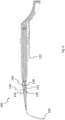
- Figs. 1 to 8 show different views of a discharge section 100 for a discharge of sausage-shaped products.
- Discharge section 100 may be part of a discharge apparatus (not shown in Figs. 1 to 8 ). It is a particular advantage of discharge section 100 that a position of a catching end 102 can be adjusted for facilitating an alignment of catching end 102 relative to a reference position, e.g., a catching position for catching a suspension element of a sausage-shaped product.
- Fig. 9 shows a discharge apparatus having discharge section 100 together with a clipping machine (only gathering means of the clipping machine are shown in Fig. 9 ).
- Fig. 9 shows how catching end 102 of discharge section 100 can be aligned relative to a feeding unit for feeding flexible suspension elements 184, like loops, to the clipping machine for being attached to sausage-shaped products by means of closure means, like closing clips.
- Catcher unit 106 comprises a catching needle 108 having a free end that forms catching end 102 of discharge device 100.
- Catching needle 108 has a bent shape suitable for catching a suspension element such as a suspension loop attached to a product, e.g., a sausage or the like, and for guiding the suspension element to a widening member 110 that is attached to the catching needle's other end 112.
- Widening member 110 has a cone shape with its apex being attached to end 112 of catching needle 108 opposite to its free end 102.
- the widening member's diameter continuously increases starting from its apex towards guide unit 104. If a flexible suspension element is transferred from catching needle 108 to widening member 110, the opening formed by the respective suspension member is continuously enlarged while moving along widening member 110.
- the opening formed by said suspension element substantially corresponds to the shape of guide unit 104.
- the sausage-shaped product may lie on a conveyor belt and is transported parallel to catcher unit 106 with its suspension element being threaded onto catching needle 108.
- Guide unit 104 may then take over the transporting function for transporting the product along discharge section 100.
- Fig. 2 shows discharge section 100 in a longitudinal sectional view.
- hollow shaft 114 is rotatably arranged on a bolt 132 by means of ball bearings 134 arranged at both ends of bolt 132.
- Hollow shaft 114 can be driven by a driving means such as an electric motor while bolt 132 stays stationary.
- some elevations 118 of thread groove winding 116 are equipped with teeth for implementing a pinion as mentioned above.
- bolt 132 On its one end 135, bolt 132 is attached to transfer unit 120.
- bolt 132 is formed into an attachment pin 138 that protrudes beyond or further than hollow shaft 114 and has a smaller diameter than the rest of bolt 132.
- Mounting mechanism 126 for mounting guiding member 122 to widening member 110 comprises an elongated mounting hole 144 formed in widening member 110 at which guiding member 122 is attached by means of a mounting screw 146 screwed into an internal thread 148 of guiding member 122.
- Mounting mechanism 126 allows a movement of attachment pin 138 inside attachment hole 142 along an axial direction of guide unit 104.
- guiding member 122 may be mounted to widening member 110 using mounting screw 146.
- hollow shaft 114 may be rotated for transporting a suspension element attached to a product along discharge section 100.
- Mounting screw 146 can be screwed into a mounting thread formed in guiding member 122 for fastening guiding member 122 at widening member 110.
- the mounting position at widening member 110 may be selected in dependence on the adjusted position of catching end 102 of catcher unit 106 relative to guide unit 104. Accordingly, if catching end 102 is moved further away from guide unit 104, mounting screw 146 moves closer to that side of elongated mounting hole 144 that is closer to guide unit 104. Yet, if catching end 102 is moved closer to guide unit 104, mounting screw 146 moves closer to that side of elongated mounting hole 144 that is closer to catching end 102. Elongated mounting 144 thereby likewise defines an attachment range in which catching end 102 may be moved relative to guide unit 104 for adjusting the catching end's relative position.
- Fig. 6 shows discharge section 100 in a longitudinal sectional view in which elongated mounting hole 144 of mounting mechanism 126 can be seen.
- elongated mounting hole 144 extends through widening member 110 such that guiding member 122 can contact the elongated mounting hole from one side and guiding member 122 can be mounted to widening member 110 by screwing in mounting screw 146 from the opposite side.
- mounting screw 146 as well as attachment mechanism 140 formed by attachment pin 138, attachment hole 142 and attachment member 152 have to be loosened to be able to move attachment pin 138 inside attachment hole 144.
- Fig. 7 shows mounting mechanism 126 in more detail in a longitudinal sectional view focussing on the transition from catcher unit 106 to guide unit 104.
- Mounting screw 146 is guided through elongated mounting hole 146 and screwed into mounting thread 148 for fastening guiding member 122 to widening member 110.
- Mounting hole 146 is located in a recessed part 154 of widening member 110 such that elongated mounting hole 144 can be accessed from both sides.
- bolt 132 with attachment pin 138 is visible.
- Attachment pin 138 is arranged inside attachment hole 142. Since mounting mechanism 126 is closed to mount guiding member 122 to widening member 110, attachment pin 138 cannot be moved inside attachment hole 142 irrespective of whether attachment pin 138 is fixed inside attachment hole 142 with an attachment member 152.
- widening member 110 can be moved further towards guide unit 104. Thereby, hollow shaft 114 moves further into widening member 110 with its tapered end part. Catching end 102 then moves further towards guide unit 104.
- Fig. 8 shows discharge section 100 held by a first support unit 156 and a second support unit 158.
- first support unit 156 and second support unit 158 are arranged to rotatably support guide unit 104.
- only first support unit 156 may be present.
- first support unit 156 may be located rather in the middle part of guide unit 104.
- First support unit 156 comprises three support rollers 160, 162 of which two support rollers 160 are arranged symmetrically below hollow shaft 114. Both support rollers 160 below hollow shaft 114 are arranged to enable an uninterrupted transport path for the products hanging on suspension elements like loops or hooks or the like along hollow shaft 114. In particular, when hanging at hollow shaft 114, the products pass between both support rollers 160.
- Hollow shaft 114 has thread groove winding 116 arranged on its outer surface for transporting suspension elements in the grooves along discharge section 100.
- elevations 118 of thread groove winding 116 in the area of first support unit 156 comprise teeth to implement a pinion.
- Third support roller 162 likewise has a teeth-like structure 164 to implement a pinion the meshes pinion 118 of hollow shaft 114.
- Third support roller 164 further comprises a drive pinion 166 that serves for receiving a torque from a drive that may be part of a discharge apparatus comprising discharge section 100.
- driving drive pinion 166 e.g., with an electric motor
- third support roller 162 starts rotating and thereby transmits the drive torque to hollow shaft 114 via teeth-like structure 164.
- Hollow shaft 114 then rotates around bolt 132, which, in turn, stays stationary. After being transported along the length of guide unit 104, the products hanging on their suspension element are provided to transfer unit 120 that may deliver the products to rods for further processing of the products.
- Second support unit 158 also comprises three support rollers 168, 170 that are arranged for supporting guide unit 104 and for allowing hollow shaft 114 to rotate. In contrast to first support unit 156, second support unit 158 has no support roller for transmitting a torque to hollow shaft 114. Second support unit 158 therefore merely provides support to hollow shaft 114.
- Discharge section 100 further comprises catcher unit 106 that is releasably attached to guide unit 104 by means of attachment mechanism 140.
- Catcher unit 106 comprises cone-shaped widening member 110 and catching needle 108.
- the catching needle's free end forms catching end 102 of discharge section 100 and serves for catching and threading suspension elements attached to products provided, e.g., by a clipping machine.
- attachment mechanism 140 may be loosened to allow moving catcher unit 106 along an axial direction of guide unit 104 relative to guide unit 104. Thereby, catching end 102 can be moved away from guide unit 104 or closer to guide unit 104.
- Discharge section 100 comprises a further guiding means 172 is attached to widening member 110 on its one end 174. Further guiding means 172 is guided substantially parallel to guide unit 104 and ends approximately at after second support unit 158. Further guiding means' other end 176 is a free end. Further guiding means 172 thus supports a suspension element during the transition from catcher unit 106 to guide unit 104. This is also the location at which the product typically changes its position from a horizontal position when lying on a conveying belt to a hanging position after falling off the convoying belt. Further guiding means 172 thus particularly provides additional stability in the situation where the product turns into a hanging position which may result in a larger degree of rocking.
- Fig. 9 shows catching needle 108 of discharge device 100 in conjunction with a feeding unit 180 of a clipping machine 182 for feeding flexible suspension elements 184, like loops, for being attached to sausage-shaped products.
- the filling material is inserted into a tubular or bag-shaped packaging casing.
- the sausages are portioned and closed on both sides with clips.
- a suspension element is usually inserted into the second clip, usually a loop, and attached to the sausage product with that second clip.
- the sausage products are transported out of the clipping machine with a discharge apparatus to storage rods for further processing, e.g. for boiling or smoking.
- suspension elements or loops 184 are subsequently arranged in regular intervals and are aligned at least approximately perpendicular to conveying direction C.
- Belt B is guided around positioning device 196 in a manner as to rest at least on the upper surface of positioning device 196 between the first and second end 198, 200.
- Belt B is moved in conveying direction C as to stepwise slide across the upper surface of positioning device 196, thereby placing a loop 184 in a position below the catching end 102.
- positioning device 196 comprises a drive 202 coupled to second end 200 of positioning device 196 by an axis 204.
- Drive 202 which is a pivot drive, comprises a pivot lever 206 coupled at one end to pivot axis 204 and at the second end to a drive element 208, which, in the present embodiment, is a piston or cylinder drive element.
- Positioning device 196 may be reversibly pivoted between an upper and a lower position, wherein, in the upper position, positioning device 196 is disposed closer to catching end 102 and, in the lower position, positioning device 196 is moved away from catching end 102. In the upper position, loop 184 is positioned closer to catching end 102 to assure a save catching of loop 184. In the lower position of positioning device 196, belt B together with loops 184 may be moved forward without being engaged by catching needle 108.
- Clipping machine 182 further comprises an optional discharge device 210 including an engagement element 212 having a first end 214 facing clipping machine 182 and a second end 216 facing away from clipping machine 182 and a drive (not shown) for moving engagement element 212.
- Engagement element 212 is formed by a flat and at least approximately rectangular element which may be made of metal or plastic.
Landscapes
- Life Sciences & Earth Sciences (AREA)
- Engineering & Computer Science (AREA)
- Wood Science & Technology (AREA)
- Zoology (AREA)
- Food Science & Technology (AREA)
- Feeding Of Articles To Conveyors (AREA)
- Meat, Egg Or Seafood Products (AREA)
Claims (15)
- Austragssektion (100) für einen Austrag von Produkten mit wenigstens einem Aufhängeelement (184), insbesondere von wurstförmigen Produkten, entlang der Austragssektion (100), wobei die Austragssektion (100) eine Fangeinheit (106) und eine Führungseinheit (104) umfasst, wobei- die Fangeinheit (106) ein Fangende (102) umfasst und dazu konfiguriert ist, wenigstens ein Aufhängeelement (184) des Produkts mit dem Fangende (102) zu fangen, und- die Führungseinheit (104) dazu konfiguriert ist, das wenigstens eine Aufhängeelement (184) des Produkts von der Fangeinheit (106) aufzunehmen und das Produkt an seinem wenigstens einen Aufhängeelement (184) entlang der Austragssektion (100) zu transportieren,dadurch gekennzeichnet, dass
die Fangeinheit (106) und die Führungseinheit (104) mittels eines Befestigungsmechanismus (140) lösbar aneinander befestigt sind, wobei der Befestigungsmechanismus (140) dazu konfiguriert ist, eine Einstellung einer Position des Fangendes (102) der Fangeinheit relativ zu der Führungseinheit (104) zu ermöglichen. - Austragssektion (100) nach Anspruch 1, wobei der Befestigungsmechanismus (140) dazu konfiguriert ist, eine Einstellung der relativen Position des Fangendes parallel zu einer Axialrichtung der Führungseinheit (104) zu ermöglichen.
- Austragssektion (100) nach Anspruch 1 oder 2, wobei der Befestigungsmechanismus (140) dazu konfiguriert ist, eine kontinuierliche Einstellung der Position des Fangendes zu ermöglichen.
- Austragssektion (100) nach Anspruch 1 oder 2, wobei der Befestigungsmechanismus (140) dazu konfiguriert ist, eine Einstellung der Position des Fangendes in mehreren diskreten Schritten zu ermöglichen.
- Austragssektion (100) nach wenigstens einem der vorangehenden Ansprüche, wobei der Befestigungsmechanismus (140) einen Befestigungsstift (138) umfasst, der als Teil der Führungseinheit (104) ausgebildet ist, und ein Befestigungsloch (142), das zur Aufnahme des Befestigungsstifts (138) konfiguriert ist und in der Fangeinheit (106) ausgebildet ist, oder wobei der Befestigungsmechanismus (140) einen Befestigungsstift (138) umfasst, der als Teil der Fangeinheit (106) ausgebildet ist, und ein Befestigungsloch, das zur Aufnahme des Befestigungsstifts (138) konfiguriert ist und in der Führungseinheit (104) ausgebildet ist, und wobei der Befestigungsstift (138) in dem Befestigungsloch (142) positioniert ist, um die Fangeinheit (106) und die Führungseinheit (104) aneinander zu befestigen.
- Austragssektion (100) nach wenigstens einem der vorangehenden Ansprüche, wobei der Befestigungsstift (138) einen kreisförmigen Querschnitt oder einen polygonalen Querschnitt aufweist und das Befestigungsloch (142) einen Querschnitt aufweist, der komplementär zum Querschnitt des Stiftes ist.
- Austragssektion (100) nach wenigstens einem der vorangehenden Ansprüche, wobei der Befestigungsstift (138) ein Außengewinde umfasst und das Befestigungsloch (142) ein Innengewinde umfasst, so dass die Fangeinheit (106) und die Führungseinheit (104) durch Einschrauben des Befestigungsstifts (138) in das Befestigungsloch (142) aneinander befestigt werden.
- Austragssektion (100) nach wenigstens einem der vorangehenden Ansprüche, wobei der Befestigungsmechanismus (140) wenigstens zwei Befestigungslöcher (142) mit unterschiedlichen Befestigungslochtiefen umfasst, die so konfiguriert sind, dass der Befestigungsstift (138) in jedes der wenigstens zwei Befestigungslöcher (142) mit einer unterschiedlichen maximalen Länge eingeführt werden kann.
- Austragssektion (100) nach wenigstens einem der vorangehenden Ansprüche, wobei der Anbringungsmechanismus (140) ein Anbringungselement (152) umfasst, das zur Befestigung des Anbringungsstifts (138) innerhalb des Befestigungslochs (142) konfiguriert ist.
- Austragssektion (100) nach Anspruch 9, wobei das Anbringungselement (152) ein mit einem Gewinde versehenes Anbringungselement ist, das in einem Anbringungsgewinde (150) aufgenommen ist, das so konfiguriert ist, dass es ein Ziehen des im Befestigungsloch (142) untergebrachten Anbringungsstifts (138) ermöglicht, um den Anbringungsstift (138) im Befestigungsloch (142) zu befestigen.
- Austragssektion (100) nach wenigstens einem der vorangehenden Ansprüche, wobei die Führungseinheit (104) einen Bolzen (132) und einen auf dem Bolzen (132) drehbar angeordneten hohlen Schaft (114) umfasst, wobei der Befestigungsstift (138) oder das Befestigungsloch (142) als Teil des Bolzens (132) ausgebildet ist.
- Austragssektion (100) nach Anspruch 11, wobei der Befestigungsstift (138) einen Durchmesser aufweist, der sich vom Durchmesser des restlichen Bolzens (Bolzen) unterscheidet.
- Austragssektion (100) nach wenigstens einem der vorangehenden Ansprüche, die ferner ein Führungselement (122) umfasst, das zum Führen des Produkts entlang wenigstens eines Teils der Länge der Führungseinheit (104) konfiguriert ist, wobei das Führungselement (122) an der Fangeinheit (106) in einer Montageposition mittels eines Montagemechanismus (126) montiert ist, der dazu konfiguriert ist, die Einstellung einer Montageposition innerhalb eines vordefinierten Montagebereichs zu ermöglichen.
- Austragssektion (100) nach Anspruch 13, wobei der Montagemechanismus (126) ein als Teil der Fangeinheit (106) ausgebildetes Montageloch (144) umfasst, das dazu konfiguriert ist, die Montage des Führungselements (122) an mehreren Montagepositionen zu ermöglichen.
- Austragsvorrichtung, die für einen Austrag von Produkten mit wenigstens einem Aufhängeelement (184), insbesondere von wurstförmigen Produkten, vorzugsweise aus einer Clipmaschine konfiguriert ist, die zum Aufsetzen und Verschließen von Clips an dem Produkt konfiguriert ist, wobei die Austragsvorrichtung die Austragssektion (100) wenigstens eines der vorangehenden Ansprüche umfasst.
Priority Applications (3)
| Application Number | Priority Date | Filing Date | Title |
|---|---|---|---|
| EP22173086.4A EP4275506B1 (de) | 2022-05-12 | 2022-05-12 | Austragsabschnitt zum austrag wurstförmiger produkte |
| ES22173086T ES3032952T3 (en) | 2022-05-12 | 2022-05-12 | Discharge section for a discharge of sausage-shaped products |
| US18/196,212 US20230363399A1 (en) | 2022-05-12 | 2023-05-11 | Discharge Section for a Discharge of Sausage-Shaped Products |
Applications Claiming Priority (1)
| Application Number | Priority Date | Filing Date | Title |
|---|---|---|---|
| EP22173086.4A EP4275506B1 (de) | 2022-05-12 | 2022-05-12 | Austragsabschnitt zum austrag wurstförmiger produkte |
Publications (2)
| Publication Number | Publication Date |
|---|---|
| EP4275506A1 EP4275506A1 (de) | 2023-11-15 |
| EP4275506B1 true EP4275506B1 (de) | 2025-04-16 |
Family
ID=81648557
Family Applications (1)
| Application Number | Title | Priority Date | Filing Date |
|---|---|---|---|
| EP22173086.4A Active EP4275506B1 (de) | 2022-05-12 | 2022-05-12 | Austragsabschnitt zum austrag wurstförmiger produkte |
Country Status (3)
| Country | Link |
|---|---|
| US (1) | US20230363399A1 (de) |
| EP (1) | EP4275506B1 (de) |
| ES (1) | ES3032952T3 (de) |
Family Cites Families (7)
| Publication number | Priority date | Publication date | Assignee | Title |
|---|---|---|---|---|
| DE10332330B3 (de) * | 2003-07-16 | 2005-05-12 | Poly-Clip System Gmbh & Co. Kg | Vorrichtung zum Aufnehmen und Führen von Schlaufen |
| DE10332329A1 (de) * | 2003-07-16 | 2005-02-24 | Poly-Clip System Gmbh & Co. Kg | Transportvorrichtung zum Transportieren von an Schlaufen hängenden Gegenständen |
| DE102006041829A1 (de) | 2006-09-06 | 2008-03-27 | Poly-Clip System Gmbh & Co Kg | Fertigungslinie zur Herstellung wurstförmiger Produkte |
| DE102008015266A1 (de) | 2008-03-20 | 2010-12-02 | Poly-Clip System Gmbh & Co. Kg | Förderschneckenabschnitte |
| DE102009011723A1 (de) * | 2009-03-04 | 2010-09-09 | Poly-Clip System Gmbh & Co. Kg | Zuführvorrichtung für Aufhängeelemente |
| EP2977339B1 (de) * | 2014-07-25 | 2018-10-17 | Poly-clip System GmbH & Co. KG | Führungsvorrichtung mit separatem axialem und radialem Träger |
| EP3732983B1 (de) * | 2019-04-29 | 2022-12-07 | Poly-clip System GmbH & Co. KG | Indexiervorrichtung |
-
2022
- 2022-05-12 EP EP22173086.4A patent/EP4275506B1/de active Active
- 2022-05-12 ES ES22173086T patent/ES3032952T3/es active Active
-
2023
- 2023-05-11 US US18/196,212 patent/US20230363399A1/en active Pending
Also Published As
| Publication number | Publication date |
|---|---|
| ES3032952T3 (en) | 2025-07-29 |
| US20230363399A1 (en) | 2023-11-16 |
| EP4275506A1 (de) | 2023-11-15 |
Similar Documents
| Publication | Publication Date | Title |
|---|---|---|
| EP2241187B1 (de) | Beschickungsmaschine für eine Fertigungslinie zur Herstellung wurstförmiger Produkte | |
| JPS5991833A (ja) | 巻き掛けたソ−セ−ジ連鎖を一時引取り手段から自動的に送り出す装置 | |
| DE3635412A1 (de) | Verfahren und vorrichtung zum transportieren und zufuehren von wurstketten oder dergleichen | |
| EP1402097B1 (de) | Verfahren zum eintragen von schussfäden und fadenliefervorrichtung | |
| DE3843553A1 (de) | Garnlieferaggregat eines spulautomaten | |
| DE2610315B2 (de) | Aufhängevorrichtung für Würste | |
| EP4275506B1 (de) | Austragsabschnitt zum austrag wurstförmiger produkte | |
| IE922649A1 (en) | Sausage encasing machine having an improved looper horn | |
| DE102009011723A1 (de) | Zuführvorrichtung für Aufhängeelemente | |
| US9314035B2 (en) | Apparatus for filling tubular casings | |
| US7828638B2 (en) | Screw conveyor sections | |
| BR102012003373A2 (pt) | Máquina de fixação e método de controle para produtos embutidos de forma solta | |
| EP1498034B1 (de) | Vorrichtung zum Aufnehmen und Führen von Schlaufen | |
| EP2752118A1 (de) | Transportanordnung mit Trennvorrichtung | |
| EP2572585B1 (de) | Transportvorrichtung mit Sternrädern | |
| NL8601052A (nl) | Omhuld product en werkwijze en inrichting voor het omhullen daarvan. | |
| NO171092B (no) | Apparat for stapping av et stappbart produkt | |
| EP1964475B1 (de) | Vorrichtung zur Befestigung einer Aufhängeschlaufe | |
| US7204747B2 (en) | Device and method for filling sausage sleeves with paste filling material | |
| DE60307128T2 (de) | Vorrichtung und verfahren zur zuführung von gegenständen zu einem empfangsbereich | |
| NL8901051A (nl) | Omhuld product en werkwijze en inrichting voor het omhullen daarvan. | |
| EP3732979A1 (de) | Clipmaschine mit verbesserter entladevorrichtung | |
| US20250194611A1 (en) | Method and device for providing cased portions of pasty food mass | |
| US6843713B1 (en) | Method and means for encasing sausage | |
| JPH0221781B2 (de) |
Legal Events
| Date | Code | Title | Description |
|---|---|---|---|
| PUAI | Public reference made under article 153(3) epc to a published international application that has entered the european phase |
Free format text: ORIGINAL CODE: 0009012 |
|
| STAA | Information on the status of an ep patent application or granted ep patent |
Free format text: STATUS: THE APPLICATION HAS BEEN PUBLISHED |
|
| AK | Designated contracting states |
Kind code of ref document: A1 Designated state(s): AL AT BE BG CH CY CZ DE DK EE ES FI FR GB GR HR HU IE IS IT LI LT LU LV MC MK MT NL NO PL PT RO RS SE SI SK SM TR |
|
| STAA | Information on the status of an ep patent application or granted ep patent |
Free format text: STATUS: REQUEST FOR EXAMINATION WAS MADE |
|
| 17P | Request for examination filed |
Effective date: 20240314 |
|
| RBV | Designated contracting states (corrected) |
Designated state(s): AL AT BE BG CH CY CZ DE DK EE ES FI FR GB GR HR HU IE IS IT LI LT LU LV MC MK MT NL NO PL PT RO RS SE SI SK SM TR |
|
| GRAP | Despatch of communication of intention to grant a patent |
Free format text: ORIGINAL CODE: EPIDOSNIGR1 |
|
| STAA | Information on the status of an ep patent application or granted ep patent |
Free format text: STATUS: GRANT OF PATENT IS INTENDED |
|
| INTG | Intention to grant announced |
Effective date: 20241010 |
|
| GRAJ | Information related to disapproval of communication of intention to grant by the applicant or resumption of examination proceedings by the epo deleted |
Free format text: ORIGINAL CODE: EPIDOSDIGR1 |
|
| STAA | Information on the status of an ep patent application or granted ep patent |
Free format text: STATUS: REQUEST FOR EXAMINATION WAS MADE |
|
| GRAP | Despatch of communication of intention to grant a patent |
Free format text: ORIGINAL CODE: EPIDOSNIGR1 |
|
| STAA | Information on the status of an ep patent application or granted ep patent |
Free format text: STATUS: GRANT OF PATENT IS INTENDED |
|
| INTC | Intention to grant announced (deleted) | ||
| P01 | Opt-out of the competence of the unified patent court (upc) registered |
Free format text: CASE NUMBER: APP_2641/2025 Effective date: 20250116 |
|
| GRAS | Grant fee paid |
Free format text: ORIGINAL CODE: EPIDOSNIGR3 |
|
| GRAA | (expected) grant |
Free format text: ORIGINAL CODE: 0009210 |
|
| STAA | Information on the status of an ep patent application or granted ep patent |
Free format text: STATUS: THE PATENT HAS BEEN GRANTED |
|
| INTG | Intention to grant announced |
Effective date: 20250218 |
|
| AK | Designated contracting states |
Kind code of ref document: B1 Designated state(s): AL AT BE BG CH CY CZ DE DK EE ES FI FR GB GR HR HU IE IS IT LI LT LU LV MC MK MT NL NO PL PT RO RS SE SI SK SM TR |
|
| REG | Reference to a national code |
Ref country code: GB Ref legal event code: FG4D |
|
| REG | Reference to a national code |
Ref country code: CH Ref legal event code: EP Ref country code: DE Ref legal event code: R096 Ref document number: 602022013113 Country of ref document: DE |
|
| REG | Reference to a national code |
Ref country code: IE Ref legal event code: FG4D |
|
| PGFP | Annual fee paid to national office [announced via postgrant information from national office to epo] |
Ref country code: DE Payment date: 20250606 Year of fee payment: 4 |
|
| PGFP | Annual fee paid to national office [announced via postgrant information from national office to epo] |
Ref country code: AT Payment date: 20250721 Year of fee payment: 4 |
|
| REG | Reference to a national code |
Ref country code: ES Ref legal event code: FG2A Ref document number: 3032952 Country of ref document: ES Kind code of ref document: T3 Effective date: 20250729 |
|
| REG | Reference to a national code |
Ref country code: NL Ref legal event code: MP Effective date: 20250416 |
|
| PG25 | Lapsed in a contracting state [announced via postgrant information from national office to epo] |
Ref country code: NL Free format text: LAPSE BECAUSE OF FAILURE TO SUBMIT A TRANSLATION OF THE DESCRIPTION OR TO PAY THE FEE WITHIN THE PRESCRIBED TIME-LIMIT Effective date: 20250416 |
|
| REG | Reference to a national code |
Ref country code: AT Ref legal event code: MK05 Ref document number: 1784857 Country of ref document: AT Kind code of ref document: T Effective date: 20250416 |
|
| PG25 | Lapsed in a contracting state [announced via postgrant information from national office to epo] |
Ref country code: FI Free format text: LAPSE BECAUSE OF FAILURE TO SUBMIT A TRANSLATION OF THE DESCRIPTION OR TO PAY THE FEE WITHIN THE PRESCRIBED TIME-LIMIT Effective date: 20250416 Ref country code: PT Free format text: LAPSE BECAUSE OF FAILURE TO SUBMIT A TRANSLATION OF THE DESCRIPTION OR TO PAY THE FEE WITHIN THE PRESCRIBED TIME-LIMIT Effective date: 20250818 |
|
| PGFP | Annual fee paid to national office [announced via postgrant information from national office to epo] |
Ref country code: ES Payment date: 20250704 Year of fee payment: 4 |
|
| REG | Reference to a national code |
Ref country code: LT Ref legal event code: MG9D |
|
| PG25 | Lapsed in a contracting state [announced via postgrant information from national office to epo] |
Ref country code: NO Free format text: LAPSE BECAUSE OF FAILURE TO SUBMIT A TRANSLATION OF THE DESCRIPTION OR TO PAY THE FEE WITHIN THE PRESCRIBED TIME-LIMIT Effective date: 20250716 Ref country code: GR Free format text: LAPSE BECAUSE OF FAILURE TO SUBMIT A TRANSLATION OF THE DESCRIPTION OR TO PAY THE FEE WITHIN THE PRESCRIBED TIME-LIMIT Effective date: 20250717 |
|
| PG25 | Lapsed in a contracting state [announced via postgrant information from national office to epo] |
Ref country code: PL Free format text: LAPSE BECAUSE OF FAILURE TO SUBMIT A TRANSLATION OF THE DESCRIPTION OR TO PAY THE FEE WITHIN THE PRESCRIBED TIME-LIMIT Effective date: 20250416 |
|
| PGFP | Annual fee paid to national office [announced via postgrant information from national office to epo] |
Ref country code: IT Payment date: 20250531 Year of fee payment: 4 |
|
| PG25 | Lapsed in a contracting state [announced via postgrant information from national office to epo] |
Ref country code: BG Free format text: LAPSE BECAUSE OF FAILURE TO SUBMIT A TRANSLATION OF THE DESCRIPTION OR TO PAY THE FEE WITHIN THE PRESCRIBED TIME-LIMIT Effective date: 20250416 |
|
| PG25 | Lapsed in a contracting state [announced via postgrant information from national office to epo] |
Ref country code: HR Free format text: LAPSE BECAUSE OF FAILURE TO SUBMIT A TRANSLATION OF THE DESCRIPTION OR TO PAY THE FEE WITHIN THE PRESCRIBED TIME-LIMIT Effective date: 20250416 Ref country code: AT Free format text: LAPSE BECAUSE OF FAILURE TO SUBMIT A TRANSLATION OF THE DESCRIPTION OR TO PAY THE FEE WITHIN THE PRESCRIBED TIME-LIMIT Effective date: 20250416 |
|
| PG25 | Lapsed in a contracting state [announced via postgrant information from national office to epo] |
Ref country code: RS Free format text: LAPSE BECAUSE OF FAILURE TO SUBMIT A TRANSLATION OF THE DESCRIPTION OR TO PAY THE FEE WITHIN THE PRESCRIBED TIME-LIMIT Effective date: 20250716 |
|
| PG25 | Lapsed in a contracting state [announced via postgrant information from national office to epo] |
Ref country code: IS Free format text: LAPSE BECAUSE OF FAILURE TO SUBMIT A TRANSLATION OF THE DESCRIPTION OR TO PAY THE FEE WITHIN THE PRESCRIBED TIME-LIMIT Effective date: 20250816 |
|
| PG25 | Lapsed in a contracting state [announced via postgrant information from national office to epo] |
Ref country code: LV Free format text: LAPSE BECAUSE OF FAILURE TO SUBMIT A TRANSLATION OF THE DESCRIPTION OR TO PAY THE FEE WITHIN THE PRESCRIBED TIME-LIMIT Effective date: 20250416 |
|
| REG | Reference to a national code |
Ref country code: CH Ref legal event code: H13 Free format text: ST27 STATUS EVENT CODE: U-0-0-H10-H13 (AS PROVIDED BY THE NATIONAL OFFICE) Effective date: 20251223 |
|
| PG25 | Lapsed in a contracting state [announced via postgrant information from national office to epo] |
Ref country code: DK Free format text: LAPSE BECAUSE OF FAILURE TO SUBMIT A TRANSLATION OF THE DESCRIPTION OR TO PAY THE FEE WITHIN THE PRESCRIBED TIME-LIMIT Effective date: 20250416 Ref country code: SM Free format text: LAPSE BECAUSE OF FAILURE TO SUBMIT A TRANSLATION OF THE DESCRIPTION OR TO PAY THE FEE WITHIN THE PRESCRIBED TIME-LIMIT Effective date: 20250416 |
|
| PG25 | Lapsed in a contracting state [announced via postgrant information from national office to epo] |
Ref country code: LU Free format text: LAPSE BECAUSE OF NON-PAYMENT OF DUE FEES Effective date: 20250512 |
|
| PG25 | Lapsed in a contracting state [announced via postgrant information from national office to epo] |
Ref country code: CH Free format text: LAPSE BECAUSE OF NON-PAYMENT OF DUE FEES Effective date: 20250531 |
|
| REG | Reference to a national code |
Ref country code: DE Ref legal event code: R097 Ref document number: 602022013113 Country of ref document: DE |
|
| PG25 | Lapsed in a contracting state [announced via postgrant information from national office to epo] |
Ref country code: CZ Free format text: LAPSE BECAUSE OF FAILURE TO SUBMIT A TRANSLATION OF THE DESCRIPTION OR TO PAY THE FEE WITHIN THE PRESCRIBED TIME-LIMIT Effective date: 20250416 |
|
| PG25 | Lapsed in a contracting state [announced via postgrant information from national office to epo] |
Ref country code: EE Free format text: LAPSE BECAUSE OF FAILURE TO SUBMIT A TRANSLATION OF THE DESCRIPTION OR TO PAY THE FEE WITHIN THE PRESCRIBED TIME-LIMIT Effective date: 20250416 |
|
| PG25 | Lapsed in a contracting state [announced via postgrant information from national office to epo] |
Ref country code: SK Free format text: LAPSE BECAUSE OF FAILURE TO SUBMIT A TRANSLATION OF THE DESCRIPTION OR TO PAY THE FEE WITHIN THE PRESCRIBED TIME-LIMIT Effective date: 20250416 |
|
| REG | Reference to a national code |
Ref country code: BE Ref legal event code: MM Effective date: 20250531 |
|
| PG25 | Lapsed in a contracting state [announced via postgrant information from national office to epo] |
Ref country code: MC Free format text: LAPSE BECAUSE OF FAILURE TO SUBMIT A TRANSLATION OF THE DESCRIPTION OR TO PAY THE FEE WITHIN THE PRESCRIBED TIME-LIMIT Effective date: 20250416 |
|
| PLBE | No opposition filed within time limit |
Free format text: ORIGINAL CODE: 0009261 |
|
| STAA | Information on the status of an ep patent application or granted ep patent |
Free format text: STATUS: NO OPPOSITION FILED WITHIN TIME LIMIT |
|
| REG | Reference to a national code |
Ref country code: CH Ref legal event code: L10 Free format text: ST27 STATUS EVENT CODE: U-0-0-L10-L00 (AS PROVIDED BY THE NATIONAL OFFICE) Effective date: 20260225 |
|
| PG25 | Lapsed in a contracting state [announced via postgrant information from national office to epo] |
Ref country code: RO Free format text: LAPSE BECAUSE OF FAILURE TO SUBMIT A TRANSLATION OF THE DESCRIPTION OR TO PAY THE FEE WITHIN THE PRESCRIBED TIME-LIMIT Effective date: 20250416 |
|
| 26N | No opposition filed |
Effective date: 20260119 |
|
| PG25 | Lapsed in a contracting state [announced via postgrant information from national office to epo] |
Ref country code: IE Free format text: LAPSE BECAUSE OF NON-PAYMENT OF DUE FEES Effective date: 20250512 |
|
| PG25 | Lapsed in a contracting state [announced via postgrant information from national office to epo] |
Ref country code: BE Free format text: LAPSE BECAUSE OF NON-PAYMENT OF DUE FEES Effective date: 20250531 |
|
| PG25 | Lapsed in a contracting state [announced via postgrant information from national office to epo] |
Ref country code: FR Free format text: LAPSE BECAUSE OF NON-PAYMENT OF DUE FEES Effective date: 20250616 |