EP4273499A1 - Vorrichtung zum setzen von markierungen - Google Patents
Vorrichtung zum setzen von markierungen Download PDFInfo
- Publication number
- EP4273499A1 EP4273499A1 EP23169161.9A EP23169161A EP4273499A1 EP 4273499 A1 EP4273499 A1 EP 4273499A1 EP 23169161 A EP23169161 A EP 23169161A EP 4273499 A1 EP4273499 A1 EP 4273499A1
- Authority
- EP
- European Patent Office
- Prior art keywords
- displacement element
- marking
- alignment axis
- reflector
- contact
- Prior art date
- Legal status (The legal status is an assumption and is not a legal conclusion. Google has not performed a legal analysis and makes no representation as to the accuracy of the status listed.)
- Pending
Links
Images




Classifications
-
- G—PHYSICS
- G02—OPTICS
- G02B—OPTICAL ELEMENTS, SYSTEMS OR APPARATUS
- G02B7/00—Mountings, adjusting means, or light-tight connections, for optical elements
- G02B7/18—Mountings, adjusting means, or light-tight connections, for optical elements for prisms; for mirrors
- G02B7/1805—Mountings, adjusting means, or light-tight connections, for optical elements for prisms; for mirrors for prisms
-
- G—PHYSICS
- G01—MEASURING; TESTING
- G01C—MEASURING DISTANCES, LEVELS OR BEARINGS; SURVEYING; NAVIGATION; GYROSCOPIC INSTRUMENTS; PHOTOGRAMMETRY OR VIDEOGRAMMETRY
- G01C15/00—Surveying instruments or accessories not provided for in groups G01C1/00 - G01C13/00
- G01C15/02—Means for marking measuring points
-
- G—PHYSICS
- G01—MEASURING; TESTING
- G01C—MEASURING DISTANCES, LEVELS OR BEARINGS; SURVEYING; NAVIGATION; GYROSCOPIC INSTRUMENTS; PHOTOGRAMMETRY OR VIDEOGRAMMETRY
- G01C15/00—Surveying instruments or accessories not provided for in groups G01C1/00 - G01C13/00
- G01C15/002—Active optical surveying means
-
- G—PHYSICS
- G02—OPTICS
- G02B—OPTICAL ELEMENTS, SYSTEMS OR APPARATUS
- G02B5/00—Optical elements other than lenses
- G02B5/12—Reflex reflectors
- G02B5/122—Reflex reflectors cube corner, trihedral or triple reflector type
Definitions
- the invention relates to a device for setting markings on components.
- measuring devices such as lasers, scanners and total stations are regularly used to transfer construction data, for example of a building, relative to reference points on a site or property.
- construction data for example of a building
- the exact positions of individual components of the structure in the terrain can be determined and marked before the structure is constructed.
- Relevant positions on components can also be determined and marked during construction, for example positions of pipe passages, recesses in concrete parts or hanging positions for components or operating equipment. This process of determining position and setting markers is also known as staking out.
- reflectors can be used in particular, which are aligned on components in relation to the total station so that they are in the desired position or indicate it.
- the position can then be marked on the component.
- the aim is to reduce measurement errors and thus obtain accurate markings while at the same time reducing the time required for position determination and subsequent marking.
- a device for setting markings on components in particular with the aid of a total station, comprises a contact part for placing on the component, a displacement element which is displaceably arranged in the contact part between a first and a second position, and a reflector which is connected to the displacement element connected is.
- the system part includes at least one continuous marking hole that defines a marking point.
- the marking point lies in particular on the component when the device is placed on the component.
- the marking point and the reflector are arranged along an alignment axis when the displacement element is in the first position, and the marking hole is accessible when the displacement element is in the second position.
- the device according to the invention is also referred to as a setting aid.
- the reflector in particular comprises a reflection element, such as a reflex target or a prism, in particular a retroreflecting triple prism, which reflect an optical signal from the total station back to the total station. This allows distance measurement and position determination of the reflection element relative to the total station.
- a reflection element such as a reflex target or a prism, in particular a retroreflecting triple prism, which reflect an optical signal from the total station back to the total station. This allows distance measurement and position determination of the reflection element relative to the total station.
- the device placed on the component can be aligned on the component using the total station.
- the displacement element can then be moved into the other position in order to make the marking hole accessible. It is then possible to place a mark on the component through the marking hole, for example with a pen, without having to move the device. This makes it possible to set markings on components precisely and easily.
- the alignment axis is orthogonal to a plane defined by the system part.
- the plane is defined in particular by a flat contact side that can be placed on the component. This enables particularly precise alignment of the device.
- the system part comprises a further marking hole which defines a further marking point.
- the further marking hole is accessible when the sliding element is in the first position. Furthermore, the further marking hole is not accessible when the displacement element is in the second position. Switching between the first and second positions of the displacement element thus releases either the marking hole or the further marking hole (and the corresponding marking points) while the other marking hole is covered by the displacement element. This makes it possible to set markings particularly quickly by using the marking holes alternately.
- the further marking point and the reflector are arranged along a further alignment axis, if this is the case Displacement element is in the second position.
- the further alignment axis is preferably orthogonal to the plane of the system part. This reduces errors in device alignment.
- the reflector comprises a reflection element that retroreflects a light beam
- the distance between the marking point and the center of the reflection element along the alignment axis is a predetermined distance.
- the distance between the marking holes, in particular the marking points preferably corresponds to the predetermined distance. This makes it possible to take into account the distance between the position of the reflection element determined with the aid of the total station and the respective marking point in order to align the marking point more precisely with the desired position to be marked.
- the system part preferably has a substantially rectangular base area. This enables a particularly compact design.
- the contact part is preferably designed in such a way that the distance from the marking point of the marking hole to three of the sides of the base surface of the contact part is a further predetermined distance. This allows additional markings to be set in relation to the marking hole.
- the predetermined distance is equal to the further predetermined distance. This simplifies the operation of the device since the distances used are all the same.
- the predetermined distance and the further predetermined distance can be 50 mm.
- the system part comprises markings, each along a line from the marking point of the marking hole one of the sides of the system part are arranged. This enables easy orientation and alignment of the device.
- the displacement element is rotatable about the alignment axis at least in the first position or the second position.
- the reflection element also rotates about the alignment axis.
- the displacement element preferably comprises at least one ball pressure piece.
- the ball piece includes, for example, a press sleeve with an integrated spring and a rotatable ball elastically mounted on the spring.
- the displacement element comprises 2 ball pressure pieces or 4 ball pressure pieces. This allows the displacement element to be moved and/or rotated particularly easily.
- the contact part comprises at least one contact plate which, on the side facing the displacement element, comprises a groove in which the ball pressure piece can be guided, preferably the groove is arranged in a circle around the alignment axis.
- the displacement element can be guided when rotating the displacement element about the alignment axis when the displacement element is in the first or second positions.
- the displacement element snaps securely into the first or second position.
- the contact plate comprises, on the side facing the displacement element, at least one latching recess into which the ball pressure piece engages when the displacement element is in the first or second position.
- the abutment plate includes eight latching recesses arranged along the groove about the alignment axis; so can the sliding element can be locked at different angles when turning.
- the displacement element comprises at least one receiving projection onto which an alignment element can be pushed.
- the alignment element comprises at least one spirit level, which allows precise alignment for aligning the device, in particular the reflection element.
- the system part comprises a rubber element on the side facing away from the displacement element. This prevents slipping on the component when the device is placed on the component.
- the system part preferably comprises magnets. These enable the pinning aid to be reversibly attached to ferromagnetic components.
- the device preferably comprises an edge part which is detachably arranged on the contact part, one side of the edge part forming a plane which intersects the plane defined by the contact part, in particular by the contact side, at a right angle and the alignment axis lies in the plane of the edge part .
- This enables the device to be placed precisely on an edge of the component, in particular an edge of the component that results from two areas of the component that are at an angle of 90° to one another.
- the contact part and the edge part can each be placed on one of the areas so that the marking point rests on the edge of the component. This means that the position of the edge of the component can be checked using the device and the total station or a mark can be set along the edge of the component.
- Figure 1 is a perspective view of a marking device 100.
- Figure 2 is a side view of the device 100.
- the device 100 includes a contact part 102, which can be placed with a contact side 104 on a component (not shown) in order to set a mark on the component.
- the system side 104 is preferably designed to be flat.
- the system part 102 includes a first marking hole 106 and a second marking hole 108, which is shown in the illustration Figure 1 is covered by a displacement element 110 and is therefore not visible.
- the first and second marking holes 106, 108 each form through holes in the contact part 102, so that the component on which the device 100 rests is accessible through the marking holes 106, 108.
- the displacement element 110 is in Figures 1 and 2 shown in a first position.
- the displacement element 110 is slidably connected to the system part 102.
- the displacement element 110 is displaceably arranged in the contact part 102 between the first position and a second position.
- the arrow P1 indicates the direction to move the displacement element 110 from the first to the second position.
- the displacement element 110 is in the second position, the first marking hole 106 is covered by the displacement element 110 and the second marking hole 108 is accessible.
- the displacement element 110 is rotatably arranged in the system part 102.
- the displacement element 110 is connected to a reflector 112.
- the reflector includes a reflection element 114, which can be a prism, in particular a retroreflective triple prism. Alternatively, the reflection element 114 be a reflective film.
- the reflector can also be referred to as a reflection target.
- the reflection element 114 is preferably arranged tiltably in the reflector.
- the reflector 112 in particular the reflection element 114, is arranged so that it intersects a first alignment axis 116.
- a center point of the reflection element 114 intersects the alignment axis 116.
- the alignment axis 116 continues to lie perpendicular to a plane defined by the contact side 104. This plane of the contact side 104 or the contact side 104 is cut by the alignment axis 116 in a marking point defined by the second marking hole 108.
- the marking point is located at the location of the component that is accessible through the marking hole 108 when the device 100 is in contact with the component and where a mark can be placed.
- Another alignment axis 118 intersects the first marking hole 106 and the reflection element 114 when the translation element 110 is in the second position, as described for the first position and the second marking hole 108. Furthermore, the alignment axes 116, 118 intersect a tilt axis of the reflection element 114.
- the displacement element 110 is arranged in its first position and in its second position in such a way that reflection element 114 intersects either the alignment axis 116 or the further alignment axis 118.
- the center of the reflection element 114 intersects the respective alignment axis 116, 118.
- the reflection element 114 can be one emitted by a total station Reflect light pulse to the total station. This allows the distance between the total station and the reflection element 114 to be determined. Furthermore, the angle of the light pulse emitted by the total station can be included; The total station can thus determine the exact position of the reflection element relative to the total station in a manner known per se. Furthermore, the total station can determine its own position relative to reference points.
- the reflection element 114 can be calibrated into positions of components or in positions on components using the total station.
- the device 100 can be placed in such a way that the marking point defined by the first or second marking hole 106, 108 lies at the respective relevant position.
- the relevant position is accessible through the first or second marking hole 106, 108.
- the respective marking point and the relevant position are at least essentially identical.
- a mark can be set at the position on the component through the first or second marking hole 106, 108.
- the contact side 104 of the contact part 102 of the device 100 is placed against the component and marked, for example with a pen, through the first or second marking hole 106, 108.
- the displacement element 110 can be displaced between the first position and the second position.
- the device 100 in particular the reflection element 114, as described, aligned with the component using the total station, so that the second marking hole 108 is at least partially congruent with the relevant position.
- the displacement element 110 can be displaced into the second position and the relevant position can be marked through the second marking hole 108. The same procedure can be followed if the displacement element 110 is initially in the second position.
- one or more dragonflies 120 can be mounted on the displacement element 110.
- the vials 120 can either be pushed onto an optional projection 122 of the displacement element 110 or with the aid of an adapter 124, which can be inserted into an optional opening 126 of the displacement element 110 in order to firmly connect the vials 120 to the displacement element 110.
- the levels 120 are particularly suitable for ensuring or checking a correct alignment of the device 100 in space, in particular on the component.
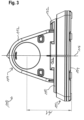
- Figure 3 is another side view of the device 100. Compared to the side view in Figure 2 the device 100 is rotated 90° to the left.
- the center of the reflection element 114 has a distance A1 from the component, in particular from the marking point on the component defined by the second marking hole 108, along the alignment axis 116.
- the distance A1 is predetermined and preferably 50 mm. The same applies to the first marking hole 106 when the displacement element 110 is in its second position. Since the distance A1 is predetermined, i.e. known, the distance A1 can be taken into account when determining the position using the total station. Since the position of the marking point is only determined indirectly by the position of the reflection element 114, the position of the marking point can be deduced from the position of the reflection element 114 using the specific distance A1 and thus be compensated.
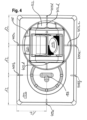
- Figure 4 is a top view of the device 100.
- the system part 102 has a substantially rectangular base area. Furthermore, the system part 102 has marking lines 400a-400f, which point at right angles from an outer edge of the system part 102 to one of the marking holes 106, 108.
- the marking lines 400a-400f are arranged evenly on the system part 102, so that the marking lines 400a-400f are each at a distance A2 from the nearest parallel marking line 400a-400f and/or the nearest parallel edge of the system part 102.
- the distance A2 is predetermined and in particular equal to the distance A1.
- the distance A2 is preferably 50 mm. This enables easy handling of the device 100, for example if further points are to be marked with the predetermined dimension starting from the marking point.
- the displacement element 110 can include marking lines 402a-402d, which can be brought at least partially in pairs into a line with a part of the marking lines 400a-400f in the first and second positions of the displacement element 110.
- the first marking hole 106 like the second marking hole 108, has a T-shape.
- the marker point is defined by the intersection of the T shape.
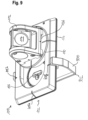
- Figure 5 shows a device 500 with the system part 102 and a reflector 504.
- the reflector 504 includes a reflection element 506.
- the reflection element 506 can reflect light pulses back around its entire side. A center point of the reflection element 506 may also intersect the alignment axes 116, 118 as already described.
- Figures 6 and 7 are exploded drawings of the device 100.
- the view of the Figure 6 corresponds to the side view of the Figure 2 and the view of the Figure 7 corresponds to the side view of the Figure 3 .
- the abutment part 102 comprises a abutment plate 600 and a cover plate 602, which are connected to one another by means of connecting elements 604 (only one is marked with the reference numeral 604), for example a plurality of screws.
- the displacement element 110 comprises two parts 606, 608, of which a first part 606 is guided in the contact part 102 and a second part 608, which is connected to the first part 606.
- the reflector 112 can be connected to the displacement element 110, in particular the second part 608, that is, the reflector 112 can be reversibly connected.
- the reflector 504 can alternatively and alternately be connected to the displacement element 110.
- the contact plate 600 includes on the contact side 104 elastic elements 610 (only one is marked with the reference number 610), which in particular prevent slipping when the device 100 is placed on the component.
- the elastic elements 610 may be, for example, a variety of rubber elements.
- the displacement element 110 comprises a plurality of ball pressure pieces 612 on a side facing the contact plate 600.
- the ball pressure pieces 612 include, for example, a press sleeve with an integrated spring and a rotatable ball elastically mounted on the spring.
- the ball pressure pieces 612 are used in connection with Figure 8 explained in more detail.
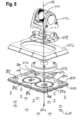
- Figure 8 is an exploded perspective drawing of the device 100.
- the view of the Figure 8 corresponds to the perspective view of the Figure 1 .
- the system part 102 can have magnets 800 include, so that the device 100 can be held reversibly on a ferromagnetic component using magnetic force. In particular, slipping can be avoided in this way.
- the contact plate 600 includes two grooves 802. Locking recesses 804 are provided along the grooves.
- the grooves 802 are circular depressions in the contact plate 600, the latching recesses 804 are in turn local depressions in the grooves 802.
- the latching recesses 804 are arranged at even intervals along the grooves 802.
- the ball pressure pieces 612 are arranged in the displacement element 110 so that they are in engagement with one of the grooves 802 in the first and second positions of the displacement element 110.
- the rotatable balls of the ball pressure pieces 612 engage with the respective groove 802.
- the displacement element 110 is held securely in the respective first or second position and unwanted slipping is prevented.
- the elastically mounted balls are pressed into the sleeve of the ball pressure piece 612 when leaving one groove 802 and moved along the contact plate 600 in order to come into engagement with this groove 802 when the other groove 802 is reached.
- the displacement element 110 is arranged in the contact part 102 so that it can rotate about the alignment axes 116, 118 at least in the first and second positions.
- the ball pressure pieces 612 move along the respective groove 802 and lock into the respective position when the ball pressure pieces 612 engage with the locking recesses 804. In this way, the displacement element 110 with the reflector 112, 504 can be securely held in different positions about the alignment axes 116, 118.
- Figure 9 is a perspective view of the device 100 with an edge portion 900.
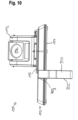
- Figure 10 is a corresponding side view.
- the edge part 900 is detachably connected to the contact part 102.
- the edge part 900 is arranged so that it forms a 90 ° angle with the abutment part 102.
- the contact side 104 of the contact part 102 and a contact side 902 of the edge part 900 form a 90° angle.
- the contact side 902 of the edge part 900 lies in a plane in which the further alignment axis 118 lies.
- the alignment axis 118 lies exactly on the edge of the component. This makes it particularly easy to place a mark on the edge of the component or to check an existing edge for its exact position.
- the edge part 900 is preferably arranged so that marking lines 400b, 400f lie in the plane of the contact side 902 of the edge part 900.
- edge part 900 can alternatively be aligned with the alignment axis 116.
Landscapes
- Physics & Mathematics (AREA)
- General Physics & Mathematics (AREA)
- Engineering & Computer Science (AREA)
- Radar, Positioning & Navigation (AREA)
- Remote Sensing (AREA)
- Optics & Photonics (AREA)
- Length Measuring Devices By Optical Means (AREA)
- Conveying And Assembling Of Building Elements In Situ (AREA)
- A Measuring Device Byusing Mechanical Method (AREA)
Abstract
Description
- Die Erfindung betrifft eine Vorrichtung zum Setzen von Markieren an Bauteilen.
- Bei der Baustellenvermessung kommen regelmäßig Messgeräte wie beispielsweise Laser, Scanner und Totalstationen zum Einsatz, um Konstruktionsdaten, beispielsweise eines Bauwerks, relativ zu Bezugspunkten auf ein Gelände oder Grundstück zu übertragen. Beispielsweise können so vor Erstellung des Bauwerks die genauen Positionen einzelner Bauteile des Bauwerks im Gelände bestimmt und markiert werden. Auch können so im Verlauf des Baus relevante Positionen an Bauteilen bestimmt und markiert werden, beispielsweise Positionen von Rohrdurchlässe, Aussparungen in Betonteilen oder Aufhängepositionen für Bauelemente oder Betriebsgeräte. Dieser Vorgang der Positionsbestimmung und Markierungssetzung wird auch als Abstecken bezeichnet.
- Um die Positionen mit Hilfe des Messgerätes aufzufinden können insbesondere Reflektoren genutzt werden, die in Bezug zu der Totalstation auf Bauteilen so ausgerichtet werden, dass sie sich in der gesuchten Position befinden oder diese anzeigen. Anschließend kann die Position auf dem Bauteil markiert werden. Dabei gilt es Messfehler zu verringern und so genaue Markierungen zu erhalten und gleichzeitig den Zeitaufwand für die Positionsbestimmung und anschließende Markierung zu reduzieren.
- Es ist daher eine Aufgabe der Erfindung, eine Vorrichtung zum Setzen von Markierungen an Bauteilen anzugeben, die einfach zu bedienen sind und eine genaue Positionsbestimmung und Markierung ermöglichen.
- Diese Aufgabe wird durch den Gegenstand des unabhängigen Anspruchs gelöst. Vorteilhafte Weiterbildungen sind in den abhängigen Ansprüchen angegeben.
- Eine Vorrichtung zum Setzen von Markierungen an Bauteilen, insbesondere mit Hilfe einer Totalstation, umfasst ein Anlageteil zum Anlegen an das Bauteil, ein Verschiebeelement, das in dem Anlageteil zwischen einer ersten und einer zweiten Position verschiebbar angeordnet ist, und einem Reflektor, der mit dem Verschiebeelement verbunden ist. Der Anlageteil umfasst zumindest ein durchgehendes Markierungsloch, das einen Markierungspunkt definiert. Der Markierungspunkt liegt insbesondere auf dem Bauteil, wenn die Vorrichtung an dem Bauteil angelegt ist. Weiterhin sind der Markierungspunkt und der Reflektor entlang einer Ausrichtungsachse angeordnet, wenn das Verschiebeelement in der ersten Position ist, und das Markierungsloch zugänglich ist, wenn das Verschiebeelement in der zweiten Position ist. Die erfindungsgemäße Vorrichtung wird auch als Absteckhilfe bezeichnet.
- Der Reflektor umfasst insbesondere ein Reflektionselement, wie eine Reflexzielmarke oder ein Prisma, insbesondere ein retroflektierendes Tripel-Prisma, welche ein optisches Signal der Totalstation zurück zur Totalstation reflektieren. Dies erlaubt eine Distanzmessung und Positionsbestimmung des Reflektionselements relativ zur Totalstation.
- Die an das Bauteil angelegte Vorrichtung kann mit Hilfe der Totalstation auf dem Bauteil ausgerichtet werden. Dabei wird die Position des Reflektors, insbesondere des Reflektionselements, relativ zur Totalstation ermittelt und anhand von Konstruktionsdaten an eine gewünschte, zu markierende Position geführt. Das Verschiebeelement kann dann in die jeweils andere Position verschoben werden um das Markierungsloch zugänglich zu machen. So ist es dann möglich eine Markierung auf dem Bauteil durch das Markierungsloch hindurch zu setzen, beispielsweise mit einem Stift, ohne die Vorrichtung bewegen zu müssen. Dadurch ist es möglich genau und einfach Markierungen auf Bauteilen zu setzen.
- Ebenso ist es möglich mit Hilfe der Vorrichtung und der Totalstation die Position bereits gesetzter Markierungen nachträglich zu kontrollieren.
- Vorzugsweise ist die Ausrichtungsachse orthogonal zu einer durch das Anlageteil definierten Ebene. Die Ebene wird insbesondere durch eine an dem Bauteil anlegbaren planen Anlageseite definiert. Dies ermöglicht eine besonders genaue Ausrichtung der Vorrichtung.
- Besonders bevorzugt ist, dass der Anlageteil ein weiteres Markierungsloch umfasst, das einen weiteren Markierungspunkt definiert. Das weitere Markierungsloch ist zugänglich, wenn das Verschiebeelement in der ersten Position ist. Weiterhin ist das weitere Markierungsloch nicht zugänglich, wenn in das Verschiebeelement in der zweiten Position ist. Das Wechseln zwischen der ersten und zweiten Position des Verschiebeelements gibt somit entweder das Markierungsloch oder das weitere Markierungsloch (und die entsprechenden Markierungspunkte) frei während das jeweils andere Markierungsloch durch das Verschiebeelement verdeckt ist. Dies ermöglicht es, Markierungen besonders schnelle zu setzen, indem die Markierungslöcher abwechselnd benutzt werden.
- In einer bevorzugten Ausführungsform sind der weitere Markierungspunkt und der Reflektor entlang einer weiteren Ausrichtungsachse angeordnet, wenn sich das Verschiebeelement in der zweiten Position befindet. Die weitere Ausrichtungsachse ist dabei vorzugsweise orthogonal zur Ebene des Anlageteils. Dies reduziert Fehler bei der Ausrichtung der Vorrichtung.
- Vorzugsweise umfasst der Reflektor ein Reflektionselement, das einen Lichtstrahl retroflektiert, und der Abstand zwischen dem Markierungspunkt und dem Mittelpunkt des Reflektionselements entlang der Ausrichtungsachse ein vorbestimmter Abstand ist. Weiterhin entspricht der Abstand zwischen den Markierungslöchern, insbesondere den Markierungspunkten, vorzugsweise dem vorbestimmten Abstand. Dies ermöglicht es den Abstand zwischen der mit Hilfe der Totalstation bestimmten Position des Reflektionselements und dem jeweiligen Markierungspunkt zu berücksichtigen, um den Markierungspunkt genauer auf die gewünschte, zu markierende Position auszurichten.
- Vorzugsweise hat das Anlageteil eine im Wesentlichen rechteckige Grundfläche. Dies ermöglicht eine besonders kompakte Bauweise.
- Vorzugsweise ist das Anlageteil so ausgebildet, dass der Abstand von dem Markierungspunkt des Markierungslochs zu drei der Seiten der Grundfläche des Anlageteils jeweils ein weiterer vorbestimmter Abstand ist. Das ermöglicht das Setzen von weiteren Markierungen mit Bezug zum Markierungsloch.
- Besonders bevorzugt ist es, wenn der vorbestimmte Abstand gleich dem weiteren vorbestimmten Abstand ist. Das vereinfacht die Bedienung der Vorrichtung, da die verwendeten Abstände alle gleich sind. Insbesondere kann der vorbestimmte Abstand und der weitere vorbestimmte Abstand 50 mm sein.
- In einer bevorzugten Ausführungsform umfasst das Anlageteil Markierungen, die jeweils entlang einer Linie von dem Markierungspunkt des Markierungslochs zu einer der Seiten des Anlageteils angeordnet sind. Das ermöglicht eine einfache Orientierung und Ausrichtung der Vorrichtung.
- Bevorzugt ist es, dass das Verschiebeelement zumindest in der ersten Position oder der zweiten Position um die Ausrichtungsachse drehbar ist. Beim Drehen des Verschiebeelements dreht sich ebenso das Reflektionselement um die Ausrichtungsachse. Dadurch ist der Reflektor, insbesondere das Reflektionselement, einfach in Richtung der Totalstation ausrichtbar.
- Vorzugsweise umfasst das Verschiebeelement zumindest ein Kugeldruckstück. Das Kugelstück umfasst beispielsweise eine Presshülse mit integrierter Feder und einer an der Feder elastisch gelagerten, rotierbaren Kugel. Besonders vorzugsweise umfasst das Verschiebeelement 2 Kugeldruckstücke oder 4 Kugeldruckstücke. Das ermöglicht ein besonders einfaches Verschieben und/oder Drehen des Verschiebeelements.
- Besonders bevorzugt ist es, wenn das Anlageteil zumindest eine Anlageplatte umfasst, die auf der dem Verschiebeelement zugewandten Seite eine Rille umfasst, in der das Kugeldruckstück führbar ist, vorzugsweise ist die Rille kreisförmig um die Ausrichtungsachse angeordnet. Insbesondere ist das Verschiebeelement so beim Drehen des Verschiebeelements um die Ausrichtungsachse führbar, wenn das Verschiebelement in der ersten oder der zweiten Positionen ist. Insbesondere rastet das Verschiebeelement so sicher in der ersten oder der zweiten Position ein.
- Vorzugsweise umfasst die Anlageplatte auf der dem Verschiebeelement zugewandten Seite zumindest eine Einrastaussparung, in die das Kugeldruckstück einrastet, wenn sich das Verschiebeelement in der ersten oder der zweiten Position befindet. Besonders vorzugsweise umfasst die Anlageplatte acht Einrastaussparungen, die entlang der Rille um die Ausrichtungsachse angeordnet sind; so kann das Verschiebeelement beim Drehen in verschiedenen Winkel eingerastet werden.
- Vorzugsweise umfasst das Verschiebeelement zumindest einen Aufnahmevorsprung, an den ein Ausrichtungselement aufschiebbar ist. Beispielsweise umfasst das Ausrichtungselement zumindest eine Libelle, die zum Ausrichten der Vorrichtung, insbesondere des Reflektionselement eine genaue Ausrichtung erlaubt.
- Vorzugsweise umfasst das Anlageteil auf der dem Verschiebeelement abgewandten Seite Gummielement. Dies verhindert verrutschen auf dem Bauteil, wenn die Vorrichtung an das Bauteil angelegt ist.
- Vorzugsweise umfasst das Anlageteil Magneten. Diese ermöglichen ein reversibles Befestigen der Absteckhilfe an ferromagnetischen Bauteilen.
- Vorzugsweise umfasst die Vorrichtung ein Kantenteil, das an dem Anlageteil lösbar angeordnet ist, wobei eine Seite des Kantenteils eine Ebene bildet, die die durch das Anlageteil, insbesondere durch die Anlageseite, definierte Ebene im rechten Winkel schneidet und die Ausrichtungsachse in der Ebene des Kantenteils liegt. Dies ermöglicht das exakte Anlegen der Vorrichtung an eine Kante des Bauteils, insbesondere eine Kante des Bauteils die sich durch zwei im Winkel von 90° zueinanderstehenden Bereiche des Bauteils ergibt. Das Anlageteil und das Kantenteil können dazu an jeweils einen der Bereiche angelegt werden, so dass der Markierungspunkt an der Kante des Bauteils anliegt. Dadurch kann mit Hilfe der Vorrichtung und der Totalstation die Position der Kante des Bauteils überprüft werden kann oder eine Markierung entlang der Kante des Bauteils gesetzt werden.
- Weitere Merkmale und Vorteile ergeben sich aus der folgenden Beschreibung, die beispielhafte Ausführungsformen in Verbindung mit den beigefügten Figuren näher erläutert.
- Es zeigen:
- Figur 1
- eine perspektivische Ansicht einer Vorrichtung zum Setzen von Markierungen,
- Figur 2
- eine Seitenansicht der Vorrichtung,
- Figur 3
- eine weitere Seitenansicht der Vorrichtung,
- Figur 4
- eine Draufsicht der Vorrichtung,
- Figur 5
- eine zweite Ausführungsform der Vorrichtung,
- Figur 6
- eine Explosionszeichnung der Vorrichtung nach
Figur 1 , - Figur 7
- eine weitere Explosionszeichnung der Vorrichtung nach
Figur 1 , - Figur 8
- ist eine perspektivische Explosionszeichnung der Vorrichtung nach
Figur 1 , - Fig. 9
- ist eine perspektivische Ansicht der Vorrichtung mit einem Kantenteil, und
- Fig. 10
- ist eine Seitenansicht der Vorrichtung nach
Figur 9 . -
Figur 1 ist eine perspektivische Ansicht einer Vorrichtung 100 zum Setzen von Markierungen.Figur 2 ist eine Seitenansicht der Vorrichtung 100. Die Vorrichtung 100 umfasst ein Anlageteil 102, das mit einer Anlageseite 104 an ein Bauteil (nicht dargestellt) angelegt werden kann, um auf dem Bauteil eine Markierung zu setzen. Vorzugsweise ist die Anlageseite 104 plan ausgeführt. Weiterhin umfasst das Anlageteil 102 ein erstes Markierungsloch 106 und ein zweites Markierungsloch 108, das in der Darstellung nachFigur 1 durch ein Verschiebeelement 110 verdeckt ist und deswegen nicht sichtbar ist. Das erste und zweite Markierungsloch 106, 108 bilden jeweils durchgehende Löcher in dem Anlageteil 102, so dass das Bauteil an dem die Vorrichtung 100 anliegt durch die Markierungslöcher 106, 108 hindurch zugänglich ist. - Das Verschiebeelement 110 ist in
Figuren 1 und2 in einer ersten Position dargestellt. Das Verschiebeelement 110 ist mit dem Anlageteil 102 verschiebbar verbunden. Insbesondere ist das Verschiebeelement 110 in dem Anlageteil 102 zwischen der ersten Position und einer zweiten Position verschiebbar angeordnet. Der Pfeil P1 zeigt beispielsweise die Richtung an, um das Verschiebeelement 110 von der ersten in die zweite Position zu verschieben. Wenn das Verschiebeelement 110 in der zweiten Position ist, wird das erste Markierungsloch 106 von dem Verschiebeelement 110 verdeckt und das zweite Markierungsloch 108 ist zugänglich. So kann durch Verschieben des Verschiebeelements 110 wahlweise das erste Markierungsloch 106 oder das zweite Markierungsloch 108 zugänglich sein bzw. zugänglich gemacht werden. Weiterhin ist das Verschiebeelement 110 drehbar in dem Anlageteil 102 angeordnet. - Das Verschiebeelement 110 ist mit einem Reflektor 112 verbunden. Der Reflektor umfasst ein Reflektionselement 114, das ein Prisma sein kann, insbesondere ein retroreflektierendes Tripel-Prisma. Alternativ kann das Reflektionselement 114 eine reflektierende Folie sein. Der Reflektor kann auch als Reflektionszielmarke bezeichnet werden. Das Reflektionselement 114 ist vorzugsweise kippbar in dem Reflektor angeordnet.
- In der gezeigten ersten Position des Verschiebeelements 110 ist der Reflektor 112, insbesondere das Reflektionselement 114, so angeordnet, dass er eine erste Ausrichtungsachse 116 schneidet. Insbesondere schneidet ein Mittelpunkt des Reflektionselements 114 die Ausrichtungsachse 116. Die Ausrichtungsachse 116 liegt weiterhin senkrecht zu einer durch die Anlageseite 104 definierten Ebene. Diese Ebene der Anlageseite 104 bzw. die Anlageseite 104 wird durch die Ausrichtungsachse 116 in einem durch das zweite Markierungsloch 108 definierten Markierungspunkt geschnitten. Der Markierungspunkt befindet sich an der Stelle des Bauteils, der durch das Markierungsloch 108 zugänglich ist, wenn die Vorrichtung 100 an dem Bauteil anliegt und an dem eine Markierung gesetzt werden kann.
- Eine weitere Ausrichtungsachse 118 schneidet das erste Markierungsloch 106 und das Reflektionselement 114, wenn das Verschiebeelement 110 in der zweiten Position ist, wie für die erste Position und das zweite Markierungsloch 108 beschrieben. Weiterhin schneiden die Ausrichtungsachsen 116, 118 eine Kippachse des Reflektionselements 114.
- Somit ist das Verschiebeelement 110 ist in seiner ersten Position und in seiner zweiten Position jeweils so angeordnet, dass Reflektionselement 114 entweder die Ausrichtungsachse 116 bzw. die weitere Ausrichtungsachse 118 schneidet. Insbesondere schneidet der Mittelpunkt des Reflektionselements 114 die jeweilige Ausrichtungsachse 116, 118.
- Im Folgenden wird die Funktionsweise der Vorrichtung 100 näher erläutert. Das Reflektionselement 114 kann einen durch eine Totalstation ausgesendeten Lichtimpuls zur Totalstation reflektieren. Das erlaubt es, die Entfernung zwischen der Totalstation und dem Reflektionselement 114 zu ermitteln. Weiterhin kann der Winkel des von der Totalstation ausgesendeten Lichtimpulses einbezogen werden; die Totalstation kann so in an sich bekannter Weise die genaue Position des Reflektionselement relativ zu der Totalstation ermitteln. Weiterhin kann die Totalstation ihre eigene Position relativ zu Bezugspunkten ermitteln.
- Anhand von Konstruktionsdaten, die die Position von Bauteilen eines Bauwerks in Bezug auf die Bezugspunkte umfassen, kann das Reflektionselement 114, und damit auch die Vorrichtung 100, mit Hilfe der Totalstation in Positionen von Bauteilen oder in Positionen an Bauteilen eingemessen werden. Insbesondere kann dadurch die Vorrichtung 100 so platziert werden, dass der durch das erste oder zweite Markierungsloch 106, 108 definierte Markierungspunkt auf der jeweiligen relevanten Position liegt.
- Das heißt, beim Anlegen der Vorrichtung 100 an das Bauteil und Einmessen in die entsprechende relevante Position ist die relevante Position durch das erste oder das zweite Markierungsloch 106, 108 hindurch zugänglich. Dabei ist der jeweilige Markierungspunkt und die relevante Position zumindest im Wesentlichen denkungsgleich. So kann durch das erste oder zweite Markierungsloch 106, 108 eine Markierung an der Position an dem Bauteil gesetzt werden. In anderen Worten, zum Setzen einer Markierung an dem Bauteil mit Hilfe der Vorrichtung 100 wird die Anlageseite 104 des Anlageteils 102 der Vorrichtung 100 an das Bauteil angelegt und durch das erste oder zweite Markierungsloch 106, 108 hindurch beispielsweise mit einem Stift markiert.
- Beim Setzen der Markierung ist weiterhin vorteilhaft, dass das Verschiebeelement 110 zwischen der ersten Position und der zweiten Position verschiebbar ist. Wenn das Verschiebeelement 110 in seiner ersten Position ist, wird die Vorrichtung 100, insbesondere das Reflektionselement 114, wie beschrieben mit Hilfe der Totalstation an dem Bauteil ausgerichtet, so dass das zweite Markierungsloch 108 mit der relevanten Position zumindest teilweise deckungsgleich ist. Anschließend kann das Verschiebeelement 110 in die zweite Position verschoben werden und die relevante Position kann durch das zweite Markierungsloch 108 hindurch markiert werden. Genauso kann verfahren werden, wenn das Verschiebeelement 110 zunächst in der zweiten Position ist.
- Zusätzlich kann an das Verschiebeelement 110 eine oder mehrere Libellen 120 montiert werden. Die Libellen 120 können entweder auf einen optionalen Vorsprung 122 des Verschiebeelements 110 geschoben werden oder mit Hilfe eines Adapters 124, der in eine optionale Öffnung 126 des Verschiebeelements 110 eingeschoben werden kann, um die Libellen 120 fest mit dem Verschiebeelement 110 zu verbinden. Die Libellen 120 sind insbesondere dazu geeignet, eine korrekte Ausrichtung der Vorrichtung 100 im Raum, insbesondere an dem Bauteil zu gewährleisten oder zu überprüfen.
-
Figur 3 ist eine weitere Seitenansicht der Vorrichtung 100. Im Vergleich zu der Seitenansicht inFigur 2 ist die Vorrichtung 100 um 90° nach links gedreht. Der Mittelpunkt des Reflektionselements 114 hat einen Abstand A1 von dem Bauteil, insbesondere von dem durch das zweite Markierungsloch 108 definierten Markierungspunkt auf dem Bauteil, entlang der Ausrichtungsachse 116. Der Abstand A1 ist vorbestimmt und vorzugsweise 50 mm. Gleiches gilt entsprechend für das erste Markierungsloch 106, wenn das Verschiebeelement 110 in seiner zweiten Position ist. Da der Abstand A1 vorbestimmt, also bekannt ist, kann der Abstand A1 bei der Positionsbestimmung mit Hilfe der Totalstation berücksichtigt werden. Da die Positionsbestimmung des Markierungspunkts nur mittelbar durch die Position des Reflektionselements 114 erfolgt, kann mit Hilfe des konkreten Abstands A1 von der Position des Reflektionselements 114 auf die Position des Markierungspunkts geschlossen werden und so kompensiert werden. -
Figur 4 ist eine Draufsicht der Vorrichtung 100. Das Anlageteil 102 hat eine im Wesentlichen rechteckige Grundfläche. Weiterhin hat das Anlageteil 102 Markierungslinien 400a-400f, die rechtwinklig jeweils von einer äußeren Kante des Anlageteils 102 zu einem der Markierungslöcher 106, 108 zeigen. Die Markierungslinien 400a-400f sind gleichmäßig auf dem Anlageteil 102 angeordnet, so dass die Markierungslinien 400a-400f jeweils von der nächstliegenden parallelen Markierungslinie 400a-400f und/oder der nächstliegenden parallelen Kante des Anlageteils 102 einen Abstand A2 haben. Der Abstand A2 ist vorbestimmt und insbesondere gleich zu dem Abstand A1. Vorzugsweise beträgt der Abstand A2 50 mm. Dies ermöglicht eine einfache Handhabung der Vorrichtung 100, beispielsweise wenn ausgehend von dem Markierungspunkt weitere Punkte mit dem vorbestimmten Maß markiert werden sollen. - Zusätzlich kann das Verschiebeelement 110 Markierungslinien 402a-402d umfassen, die in der ersten und in der zweiten Position des Verschiebeelements 110 zumindest teilweise jeweils paarweise in eine Linie mit einem Teil der Markierungslinien 400a-400f gebracht werden können.
- Das erste Markierungsloch 106 hat, ebenso wie das zweite Markierungsloch 108, eine T-Form. Der Markierungspunkt wird durch die Kreuzung der T-Form definiert.
-
Figur 5 zeigt eine Vorrichtung 500 mit dem Anlageteil 102 und einen Reflektor 504. - Der Reflektor 504 umfasst ein Reflektionselement 506. Das Reflektionselement 506 kann Lichtimpulse um seine ganze Seite zurückreflektieren. Ein Mittelpunkt des Reflektionselements 506 kann ebenso die Ausrichtungsachsen 116, 118 schneiden wie bereits beschrieben.
-
Figuren 6 und7 sind Explosionszeichnungen der Vorrichtung 100. Die Ansicht derFigur 6 entspricht der seitlichen Ansicht derFigur 2 und die Ansicht derFigur 7 entspricht der seitlichen Ansicht derFigur 3 . - Das Anlageteil 102 umfasst eine Anlageplatte 600 und eine Deckplatte 602, die mit Hilfe von Verbindungselementen 604 (nur eines ist mit dem Bezugszeichen 604 markiert), beispielsweise einer Vielzahl von Schrauben, miteinander verbunden sind. Das Verschiebeelement 110 umfasst zwei Teile 606, 608 von denen ein erster Teil 606 in dem Anlageteil 102 geführt wird und ein zweiter Teil 608, der mit dem ersten Teil 606 verbunden ist. Der Reflektor 112 ist mit dem Verschiebeelement 110, insbesondere dem zweiten Teil 608 verbindbar, das heißt, der Reflektor 112 ist reversibel verbindbar. Beispielsweise kann alternativ und wechselnd auch der Reflektor 504 mit dem Verschiebeelement 110 verbunden werden.
- Die Anlageplatte 600 umfasst auf der Anlageseite 104 elastische Elemente 610 (nur eines ist mit dem Bezugszeichen 610 markiert), die insbesondere ein Verrutschen verhindern, wenn die Vorrichtung 100 an dem Bauteil angelegt ist. Die elastischen Elemente 610 können beispielsweise eine Vielzahl von Gummielementen sein.
- Das Verschiebeelement 110 umfasst an einer der Anlageplatte 600 zugewandten Seite mehrere Kugeldruckstücke 612. Die Kugeldruckstücke 612 umfassen beispielsweise eine Presshülse mit integrierter Feder und eine an der Feder elastisch gelagerten, rotierbaren Kugel. Die Kugeldruckstücke 612 werden in Zusammenhang mit
Figur 8 näher erläutert. -
Figur 8 ist eine perspektivische Explosionszeichnung der Vorrichtung 100. Die Ansicht derFigur 8 entspricht der perspektivischen Ansicht derFigur 1 . - Zusätzlich zu den elastischen Elementen 610 kann der Anlageteil 102 Magneten 800 umfassen, so dass die Vorrichtung 100 reversibel mit Hilfe von Magnetkraft an einem ferromagnetischen Bauteil gehalten werden kann. Insbesondere kann so auch ein Verrutschen vermieden werden.
- Weiterhin umfasst die Anlageplatte 600 zwei Rillen 802. Entlang der Rillen sind Einrastaussparungen 804 vorgesehen. Die Rillen 802 sind kreisförmige Vertiefungen in der Anlageplatte 600, die Einrastaussparungen 804 sind wiederrum lokale Vertiefungen in den Rillen 802. Die Einrastaussparungen 804 sind mit gleichmäßigen Abständen entlang der Rillen 802 angeordnet. In einem zusammengebauten Zustand der Vorrichtung 100 sind die Kugeldruckstücke 612 so in dem Verschiebeelement 110 angeordnet, dass sie in der ersten und der zweiten Position des Verschiebeelements 110 mit einer der Rillen 802 in Eingriff sind. Insbesondere sind die rotierbaren Kugeln der Kugeldruckstücke 612 mit der jeweiligen Rille 802 in Eingriff. Dadurch wird das Verschiebeelement 110 sicher in der jeweiligen ersten oder zweiten Position gehalten und ein ungewolltes Verrutschen wird verhindert. Beim Verschieben des Verschiebeelements 110 werden die elastisch gelagerten Kugeln beim Verlassen der einen Rille 802 in die Hülse des Kugeldruckstücks 612 gedrückt und entlang des Anlageplatte 600 verschoben um beim Erreichen der jeweils anderen Rille 802 in Eingriff mit dieser Rille 802 zu kommen.
- Das Verschiebeelement 110 ist in dem Anlageteil 102 zumindest in der ersten und zweiten Position um die Ausrichtungsachsen 116, 118 drehbar angeordnet. Dabei bewegen sich die Kugeldruckstücke 612 entlang der jeweiligen Rille 802 und rasten bei einem Eingriff der Kugeldruckstücke 612 mit den Einrastaussparungen 804 in der jeweiligen Stellung ein. So kann das Verschiebeelement 110 mit dem Reflektor 112, 504 sicher in verschiedenen Stellungen um die Ausrichtungsachsen 116,, 118 gehalten werden.
-
Figur 9 ist eine perspektivische Ansicht der Vorrichtung 100 mit einem Kantenteil 900.Figur 10 ist eine entsprechende Seitenansicht. Das Kantenteil 900 ist mit dem Anlageteil 102 lösbar verbunden. Vorzugsweise ist das Kantenteil 900 so angeordnet, dass es einen 90° Winkel mit dem Anlageteil 102 bildet. Insbesondere bilden die Anlageseite 104 des Anlageteils 102 und eine Anlageseite 902 des Kantenteils 900 einen 90° Winkel. Weiterhin liegt die Anlageseite 902 des Kantenteils 900 in einer Ebene, in der die weitere Ausrichtungsachse 118 liegt. So liegt bei der Anlage der Anlageseiten 104, 902 an eine Kante eines Bauteils die Ausrichtungsachse 118 genau an der Kante des Bauteils. Dadurch kann besonders einfach eine Markierung an der Kante des Bauteils gesetzt werden bzw. eine bestehende Kante auf ihre genaue Position hin überprüft werden. - Vorzugsweise ist das Kantenteil 900 so angeordnet, dass Markierungslinien 400b, 400f in der Ebene der Anlageseite 902 des Kantenteils 900 liegen.
- Weiterhin kann das Kantenteil 900 alternativ auf die Ausrichtungsachse 116 ausgerichtet sein.
- Gleiche oder gleichwirkende Elemente sind in allen Figuren mit denselben Bezugszeichen bezeichnet.
-
- 100, 500
- Vorrichtung zum Setzen von Markierungen
- 102
- Anlageteil
- 104
- Anlageseite des Anlageteils
- 106,108
- Markierungsloch
- 110
- Verschiebeelement
- 112,504
- Reflektor
- 114,506
- Reflektionselement
- 116, 118
- Ausrichtungsachse
- 120
- Libelle
- 122
- Vorsprung
- 124
- Adapter für Libelle
- 126
- Öffnung für Adapter
- 400a, 400b, 400c, 400d, 400e, 400f
- Markierungslinie des Anlageteils
- 402a, 402b, 402c, 402d
- Markierungslinie des Verschiebeelements
- 600
- Anlageplatte
- 602
- Deckplatte
- 604
- Verbindungselement
- 606
- Erster Teil des Verschiebeelements
- 608
- Zweiter Teil des Verschiebeelements
- 610
- Elastisches Element
- 612
- Kugeldruckstück
- 800
- Magnet
- 802
- Rille
- 804
- Einrastaussparung
- 900
- Kantenteil
- 902
- Anlageseite des Kantenteils
Claims (15)
- Vorrichtung (100, 500) zum Setzen von Markierungen an Bauteilen, miteinem Anlageteil (102) zum Anlegen an das Bauteil,einem Verschiebeelement (110), das an dem Anlageteil (102) zwischen einer ersten und einer zweiten Position verschiebbar angeordnet ist, undeinem Reflektor (112, 504), der mit dem Verschiebeelement (110) verbunden ist,wobei das Anlageteil (102) zumindest ein durchgehendes Markierungsloch (106, 108) umfasst, das einen Markierungspunkt definiert,wobei der Markierungspunkt und der Reflektor (112, 504) entlang einer Ausrichtungsachse (116, 118) angeordnet sind, wenn das Verschiebeelement (110) in der ersten Position ist, undwobei das Markierungsloch (106, 108) zugänglich ist, wenn das Verschiebeelement (110) in der zweiten Position ist.
- Vorrichtung nach Anspruch 1, wobei die Ausrichtungsachse (116, 118) orthogonal zu einer durch das Anlageteil (102) definierten Ebene ist.
- Vorrichtung nach einem der vorhergehenden Ansprüche, wobei der Anlageteil (102) ein weiteres Markierungsloch (106, 108) umfasst, das einen weiteren Markierungspunkt definiert.
- Vorrichtung nach Anspruch 3, wobei der weitere Markierungspunkt und der Reflektor (112, 504) entlang einer weiteren Ausrichtungsachse (116, 118) angeordnet sind, wenn sich das Verschiebeelement (110) in der zweiten Position befindet.
- Vorrichtung nach einem der vorhergehenden Ansprüche, wobei der Reflektor (112, 504) ein Reflektionselement (114, 506) umfasst und der Abstand zwischen dem Markierungspunkt und dem Mittelpunkt des Reflektionselements (114, 506) entlang der Ausrichtungsachse (116, 118) ein vorbestimmter Abstand ist.
- Vorrichtung nach einem der vorhergehenden Ansprüche, wobei das Anlageteil (102) eine im Wesentlichen rechteckige Grundfläche hat.
- Vorrichtung nach Anspruch 6, wobei das Anlageteil so ausgebildet ist, dass der Abstand von dem Markierungspunkt des Markierungslochs (106, 108) zu drei der Seiten der Grundfläche des Anlageteils (102) jeweils ein weiterer vorbestimmter Abstand ist.
- Vorrichtung nach Anspruch 7, wobei der vorbestimmte Abstand gleich dem weiteren vorbestimmten Abstand ist.
- Vorrichtung nach einem der vorhergehenden Ansprüche, wobei das Anlageteil (102) Markierungen (400a-400f) umfasst, die jeweils entlang einer Linie von dem Markierungspunkt des Markierungslochs (106, 108) zu einer der Seiten des Anlageteils (102) angeordnet sind.
- Vorrichtung nach einem der vorhergehenden Ansprüche, wobei das Verschiebeelement (110) zumindest in der ersten Position oder der zweiten Position um die Ausrichtungsachse (116, 118) drehbar ist.
- Vorrichtung nach einem der vorhergehenden Ansprüche, wobei das Verschiebeelement (110) zumindest ein Kugeldruckstück (612) umfasst.
- Vorrichtung nach Anspruch 11, wobei das Anlageteil (102) zumindest eine Anlageplatte (600) umfasst, die auf der dem Verschiebeelement (110) zugewandten Seite eine Rille (802) umfasst, in der das Kugeldruckstück (612) führbar ist, vorzugsweise ist die Rille (802) kreisförmig um die Ausrichtungsachse (116, 118) angeordnet.
- Vorrichtung nach einem der Ansprüche 11 oder 12, wobei die Anlageplatte (600) auf der dem Verschiebeelement (110) zugewandten Seite zumindest eine Einrastaussparung (804) umfasst, in die das Kugeldruckstück (612) einrastet, wenn sich das Verschiebeelement (110) in der ersten oder der zweiten Position befindet.
- Vorrichtung nach einem der vorhergehenden Ansprüche, wobei das Verschiebeelement (110) zumindest einen Aufnahmevorsprung (122) umfasst, an den ein Ausrichtungselement (120) aufschiebbar ist.
- Vorrichtung nach einem der vorhergehenden Ansprüche, mit einem Kantenteil (900), das an dem Anlageteil (102) lösbar angeordnet ist, wobei eine Seite (902) des Kantenteils (900) eine Ebene bildet, die die durch das Anlageteil (102) definierte Ebene im rechten Winkel schneidet und die Ausrichtungsachse (116, 118) in der Ebene des Kantenteils (900) liegt.
Applications Claiming Priority (1)
| Application Number | Priority Date | Filing Date | Title |
|---|---|---|---|
| DE202022102499.5U DE202022102499U1 (de) | 2022-05-06 | 2022-05-06 | Vorrichtung zum Setzen von Markierungen |
Publications (1)
| Publication Number | Publication Date |
|---|---|
| EP4273499A1 true EP4273499A1 (de) | 2023-11-08 |
Family
ID=82116175
Family Applications (1)
| Application Number | Title | Priority Date | Filing Date |
|---|---|---|---|
| EP23169161.9A Pending EP4273499A1 (de) | 2022-05-06 | 2023-04-21 | Vorrichtung zum setzen von markierungen |
Country Status (3)
| Country | Link |
|---|---|
| US (1) | US20230358997A1 (de) |
| EP (1) | EP4273499A1 (de) |
| DE (1) | DE202022102499U1 (de) |
Families Citing this family (2)
| Publication number | Priority date | Publication date | Assignee | Title |
|---|---|---|---|---|
| USD1044534S1 (en) * | 2022-07-26 | 2024-10-01 | Georg Rothbucher | Surveying instrument accessory |
| US12422257B1 (en) * | 2023-03-15 | 2025-09-23 | Amazon Technologies, Inc. | Fiducial alignment device |
Citations (2)
| Publication number | Priority date | Publication date | Assignee | Title |
|---|---|---|---|---|
| US20170205229A1 (en) * | 2016-01-18 | 2017-07-20 | Topcon Corporation | Surveying Instrument |
| WO2019015970A1 (en) * | 2017-07-18 | 2019-01-24 | Compagnie Generale Des Etablissements Michelin | APPARATUS AND METHOD FOR HIDDEN POINT MEASUREMENT |
Family Cites Families (13)
| Publication number | Priority date | Publication date | Assignee | Title |
|---|---|---|---|---|
| US3736058A (en) * | 1971-04-15 | 1973-05-29 | J M Iadarola | Rotating reflector level rod |
| JPS5834066U (ja) * | 1981-08-31 | 1983-03-05 | 株式会社トプコン | 光波距離計用反射鏡装置 |
| US4519674A (en) * | 1983-03-10 | 1985-05-28 | Buckley Galen L | Retro-reflective prism assembly |
| US4875291A (en) * | 1987-03-20 | 1989-10-24 | Omni Optical Products, Inc. | Rotating reflector prism and target |
| US5311222A (en) * | 1988-09-14 | 1994-05-10 | Pyramid Optical | Prism assembly |
| US5231539A (en) * | 1992-01-27 | 1993-07-27 | Norita Precision, Inc. | Nodal-point adjusting retroreflector prism and method |
| US5392521A (en) * | 1993-06-10 | 1995-02-28 | Allen; Michael P. | Surveyor's prism target |
| JP3569426B2 (ja) * | 1997-12-05 | 2004-09-22 | ペンタックス株式会社 | 測量用反射部材 |
| US7886450B1 (en) * | 2009-01-04 | 2011-02-15 | Joseph Fiano | Elevated laser beam positioning device |
| US8712721B2 (en) * | 2010-07-08 | 2014-04-29 | Shayne Hamel | Adjustable high precision surveying device |
| DE202013101577U1 (de) * | 2013-04-12 | 2014-07-14 | Georg Rothbucher | Absteckmarker |
| US11781866B1 (en) * | 2021-05-15 | 2023-10-10 | Point Data, Inc. | Alignment system |
| DE202021102669U1 (de) * | 2021-05-17 | 2021-05-27 | Georg Rothbucher | Vorrichtung zur Markierung eines Vermessungsobjektes |
-
2022
- 2022-05-06 DE DE202022102499.5U patent/DE202022102499U1/de active Active
-
2023
- 2023-04-21 EP EP23169161.9A patent/EP4273499A1/de active Pending
- 2023-05-02 US US18/310,946 patent/US20230358997A1/en active Pending
Patent Citations (2)
| Publication number | Priority date | Publication date | Assignee | Title |
|---|---|---|---|---|
| US20170205229A1 (en) * | 2016-01-18 | 2017-07-20 | Topcon Corporation | Surveying Instrument |
| WO2019015970A1 (en) * | 2017-07-18 | 2019-01-24 | Compagnie Generale Des Etablissements Michelin | APPARATUS AND METHOD FOR HIDDEN POINT MEASUREMENT |
Also Published As
| Publication number | Publication date |
|---|---|
| US20230358997A1 (en) | 2023-11-09 |
| DE202022102499U1 (de) | 2022-06-08 |
Similar Documents
| Publication | Publication Date | Title |
|---|---|---|
| EP4273499A1 (de) | Vorrichtung zum setzen von markierungen | |
| DE60319016T2 (de) | Überwachungssystem und verfahren zu dessen verwendung | |
| DE3626471C2 (de) | Vorrichtung zur Positionierung eines Körpers | |
| EP0149429B1 (de) | Einrichtung zur Halterung eines Gegenstandes in einer gewünschten räumlichen Lage | |
| DE2927042A1 (de) | Einrichtung mit veraenderbarer maske fuer eine beleuchtungseinrichtung | |
| CH688290A5 (de) | Wasserwaage. | |
| EP2641117A2 (de) | Patronenaufnahme und verfahren zur herstellung der patronenaufnahme | |
| DE19506312A1 (de) | Vorrichtung zum Ausrichten optoelektronischer Sensoren | |
| DE4114284C2 (de) | Vorrichtung zum Behandeln oder Bearbeiten eines Werkstückes, insbesondere einer Schaltkarte | |
| DE4041723A1 (de) | Verfahren und vorrichtung zur bestimmung der position eines messpunktes relativ zu einem bezugspunkt | |
| DE4132655A1 (de) | Vorrichtung zum positionieren eines objektes, beispielsweise eines werkstueckes | |
| DE3049100C2 (de) | ||
| DE4302509A1 (en) | Testing characteristics of high density circuit board - using matrix of test electrodes identical to board electrodes with precision alignment to obtain maximum inter-electrode conductivity | |
| WO1999046561A1 (de) | Wasserwaage | |
| DE102020204536A1 (de) | Laservorrichtung und Verfahren zum Einstellen einer Laservorrichtung | |
| DE2034571A1 (de) | Winkelmeßgerat | |
| DE202006014797U1 (de) | Panoramakörper | |
| DE69816967T2 (de) | Positionnierungsvorrichtung mit h-antrieb | |
| EP1310765B1 (de) | Markierungselement zum Vermessen von Bauwerken | |
| EP0653048A1 (de) | Verfahren zur lagebestimmung eines positionierkörpers relativ zu einem bezugskörper und vorrichtung zur durchführung des verfahrens. | |
| WO2020144186A1 (de) | Optisches system sowie verfahren zur herstellung eines optischen systems | |
| DE2248535B2 (de) | Tisch zum pruefteilauflegen in geraeten zur kontrolle linearer groessen | |
| DD222431B1 (de) | Haltevorrichtung fuer mikroskopobjekttraeger | |
| DE853520C (de) | Messeinrichtung | |
| DE4304991C1 (de) | Vorrichtung zur Vermessung der Lage und Orientierung von großflächigen Werkstücken |
Legal Events
| Date | Code | Title | Description |
|---|---|---|---|
| PUAI | Public reference made under article 153(3) epc to a published international application that has entered the european phase |
Free format text: ORIGINAL CODE: 0009012 |
|
| STAA | Information on the status of an ep patent application or granted ep patent |
Free format text: STATUS: THE APPLICATION HAS BEEN PUBLISHED |
|
| AK | Designated contracting states |
Kind code of ref document: A1 Designated state(s): AL AT BE BG CH CY CZ DE DK EE ES FI FR GB GR HR HU IE IS IT LI LT LU LV MC ME MK MT NL NO PL PT RO RS SE SI SK SM TR |
|
| STAA | Information on the status of an ep patent application or granted ep patent |
Free format text: STATUS: REQUEST FOR EXAMINATION WAS MADE |
|
| 17P | Request for examination filed |
Effective date: 20240503 |
|
| RBV | Designated contracting states (corrected) |
Designated state(s): AL AT BE BG CH CY CZ DE DK EE ES FI FR GB GR HR HU IE IS IT LI LT LU LV MC ME MK MT NL NO PL PT RO RS SE SI SK SM TR |
|
| STAA | Information on the status of an ep patent application or granted ep patent |
Free format text: STATUS: EXAMINATION IS IN PROGRESS |
|
| 17Q | First examination report despatched |
Effective date: 20250417 |