EP4258314A2 - Schutzschalter und schutzschaltverfahren - Google Patents
Schutzschalter und schutzschaltverfahren Download PDFInfo
- Publication number
- EP4258314A2 EP4258314A2 EP23195006.4A EP23195006A EP4258314A2 EP 4258314 A2 EP4258314 A2 EP 4258314A2 EP 23195006 A EP23195006 A EP 23195006A EP 4258314 A2 EP4258314 A2 EP 4258314A2
- Authority
- EP
- European Patent Office
- Prior art keywords
- grid
- arc
- circuit breaker
- insulating portion
- contact
- Prior art date
- Legal status (The legal status is an assumption and is not a legal conclusion. Google has not performed a legal analysis and makes no representation as to the accuracy of the status listed.)
- Pending
Links
Images



Classifications
-
- H—ELECTRICITY
- H01—ELECTRIC ELEMENTS
- H01H—ELECTRIC SWITCHES; RELAYS; SELECTORS; EMERGENCY PROTECTIVE DEVICES
- H01H73/00—Protective overload circuit-breaking switches in which excess current opens the contacts by automatic release of mechanical energy stored by previous operation of a hand reset mechanism
- H01H73/02—Details
- H01H73/18—Means for extinguishing or suppressing arc
-
- H—ELECTRICITY
- H01—ELECTRIC ELEMENTS
- H01H—ELECTRIC SWITCHES; RELAYS; SELECTORS; EMERGENCY PROTECTIVE DEVICES
- H01H9/00—Details of switching devices, not covered by groups H01H1/00 - H01H7/00
- H01H9/30—Means for extinguishing or preventing arc between current-carrying parts
- H01H9/34—Stationary parts for restricting or subdividing the arc, e.g. barrier plate
- H01H9/36—Metal parts
-
- H—ELECTRICITY
- H01—ELECTRIC ELEMENTS
- H01H—ELECTRIC SWITCHES; RELAYS; SELECTORS; EMERGENCY PROTECTIVE DEVICES
- H01H9/00—Details of switching devices, not covered by groups H01H1/00 - H01H7/00
- H01H9/30—Means for extinguishing or preventing arc between current-carrying parts
- H01H9/34—Stationary parts for restricting or subdividing the arc, e.g. barrier plate
- H01H9/36—Metal parts
- H01H2009/365—Metal parts using U-shaped plates
-
- H—ELECTRICITY
- H01—ELECTRIC ELEMENTS
- H01H—ELECTRIC SWITCHES; RELAYS; SELECTORS; EMERGENCY PROTECTIVE DEVICES
- H01H9/00—Details of switching devices, not covered by groups H01H1/00 - H01H7/00
- H01H9/30—Means for extinguishing or preventing arc between current-carrying parts
- H01H9/46—Means for extinguishing or preventing arc between current-carrying parts using arcing horns
Definitions
- the present invention relates to a circuit breaker and a circuit breaking method, which include an arc chute arranged with grids.
- Patent document 1 discloses a circuit breaker in which a notched portion is provided at an arc approach portion of a grid to generate electromagnetic force that draws the arc into the grid by the action of biasing magnetic flux.
- Patent Document 1 JP-A-2006-12540
- the present invention has been made to solve the aforementioned problem, and an object of the present invention is to provide a circuit breaker and a circuit breaking method, which improve breaking performance by suppressing the return of the arc to the contact sides and maintaining a high arc voltage.
- circuit breaker and a circuit breaking method as defined in the independent claims are provided. Further embodiments of the claimed invention are defined in the dependent claims. Although the claimed invention is only defined by the claims, the below embodiments, examples, and aspects are present for aiding in understanding the background and advantages of the claimed invention.
- a circuit breaker includes: a fixed member having a fixed contact; a movable member having a movable contact that is connected to and disconnected from the fixed contact; and an arc chute arranged with a plurality of laminated grids, each of which has a notch portion into which an arc generated between the fixed contact and the movable contact is drawn and an insulating portion which is adjacent to a peak portion of the notch portion and is extended in a width direction.
- a circuit breaking method is a circuit breaking method of a circuit breaker in which an arc generated between contact is interrupted by at least one grid to extinguish the arc, the circuit breaking method comprising the steps of: drawing the arc generated between the contact into a state where the arc generates arc discharge s at mutually different positions of the grid and flows through the grid; and bypassing currents flowing the grid between those generated arc discharges by an insulating portion provided between those mutually different positions of the grid to extinguish the arc.
- the plurality of laminated grids are arranged in the arc chute, whereby it becomes possible to suppress the return of the arc to the contact sides and to improve breaking performance. Furthermore, according to the circuit breaking method of the present invention, the currents flowing between the arcs in which arc discharges are generated at the mutually different positions of the grid are made to bypass by the insulating portion, whereby it becomes possible to suppress the return of the arc to the contact sides and to improve breaking performance.
- FIG. 1 is a schematic configuration diagram showing a circuit breaker according to Embodiment 1 of the present invention.
- a circuit breaker 100 includes: a fixed member 1 having a fixed contact 1a; a movable member 2 having a movable contact 2a; a fixed member side arc horn 3 electrically connected to the fixed member 1; a movable member side arc horn 4 electrically connected to the movable member 2; and an arc chute 7 arranged with a plurality of grids 5 that interrupt an arc 10 and a plurality of support plates 6 that support the grids 5.
- the circuit breaker 100 is arranged with an upper conductor 11 and a lower conductor 12 below the arc chute 7.
- the upper conductor 11 and the lower conductor 12 are electrically connected to the fixed member 1 and the movable member 2, respectively.
- the fixed contact 1a is connected to and disconnected from the movable contact 2a, thereby energizing and breaking current between the upper conductor 11 and the lower conductor 12.
- An tripping device 13 connected to the lower conductor 12 detects overcurrent in breaking current and a latch 14 that holds the movable member 2 in energizing is released, whereby the movable member 2 is rotated in a direction away from the fixed member 1 to open the fixed contact 1a and the movable contact 2a. Furthermore, when the opened state is brought to the energizing state shown in FIG. 1 , an actuator 15 coupled to the movable member 2 drives the movable member 2 to a position where the movable contact 2a comes in contact with the fixed contact 1a.
- the fixed member side arc horn 3 is provided on an upper portion of the fixed member 1; and the movable member side arc horn 4 is provided on an upper portion of the movable member 2, the fixed member side arc horn 3 and the movable member side arc horn 4 being for guiding the arc 10 generated between the fixed contact 1a and the movable contact 2a (hereinafter, referred to as both contact 1a, 2a) to the arc chute 7.
- Each one end of the fixed member side arc horn 3 and the movable member side arc horn 4 is arranged adjacent to both contact 1a, 2a, respectively; and each other end thereof is provided in an extended manner so as to separate from each other.
- the arc chute 7 has the grid 5 formed of conductive plate-shaped metal and the insulating support plate 6 that supports the grid 5.
- the plurality of laminated grids 5 and support plates 6 are arranged with a predetermined distance on an upper portion of the fixed member side arc horn 3 and the movable member side arc horn 4.
- the support plate 6 is arranged on the bottom surface of the grid 5 to support the grid 5 and to prevent the arc 10 from jumping out to both contact 1a, 2a sides and from causing bridging.
- a top surface plate 8 is arranged on the uppermost tier of the grids 5. The top surface plate 8 prevents arc gas 20 generated by the heat of the arc 10 from leaking above the arc chute 7.
- An exhaust port 16 (not shown in the drawing) which is for discharging the arc gas 20 to the outside of the circuit breaker 100 is provided on both sides of the arc chute 7.
- FIG. 2 is a schematic configuration diagram showing an example of the grid of the circuit breaker according to Embodiment 1 of the present invention.
- the grid 5 has a notch portion 51 formed on one end portion and an insulating portion 52 which is adjacent to a peak portion 51a of the notch portion 51 and is extended in a width direction.
- a direction toward the notch portion 51 and a direction toward a top portion 53 opposite to the notch portion 51 are referred to as a length direction and a direction perpendicular to the length direction is referred to as a width direction.
- the insulating portion 52 is, for example, a slit-shaped through hole.
- the shape of the notch portion 51 is a V-shape, a U-shape, a rectangular shape, or the like.
- FIG. 3 is a schematic configuration diagram showing the grid and the support plate of the circuit breaker according to Embodiment 1 of the present invention.
- two grids 5 are arranged on the support plate 6 so that the notch portions 51 face to each other.
- the support plate 6 is formed with an opening portion 61 in the center thereof and the insulating portion 52 of the grid 5 is arranged so as to overlap on the opening portion 61 of the support plate 6.
- the support plate 6 is provided so that the center of the opening portion 61 is located at both contact 1a, 2a when seen from the upper side of FIG. 1 . That is, the grids 5 are arranged so that the notch portions 51 are directed toward both contacts 1a, 2a.
- the support plate 6 and the top surface plate 8 are formed of thermosetting resin such as unsaturated polyester resin and melamine resin and may be formed of ceramics such as alumina and zirconia as other material.
- FIG. 4 is a typical view showing an arc of the circuit breaker according to Embodiment 1 of the present invention.
- the circuit breaker 100 is opened the contacts by separating the movable member 2 from the fixed member 1 to generate the arc 10 between the fixed contact 1a and the movable contact 2a.
- the generated arc 10 is commutated to the fixed member side arc horn 3 or the movable member side arc horn 4 arranged on the upper portion of both contact 1a, 2a.
- the commutated arc 10 is guided to the arc chute 7 by electromagnetic force that is exerted by magnetic flux produced by current flowing through the fixed member side arc horn 3 or the movable member side arc horn 4 (hereinafter, referred to as both arc horns 3, 4).
- FIG. 5 is a typical view showing the action of the arc in the arc chute of the circuit breaker according to Embodiment 1 of the present invention.
- FIG. 5(a) is a top view of the grid; and
- FIG. 5(b) is a perspective view of the grid.
- electromagnetic force F exerts on the arc 10 by biasing magnetic flux ⁇ that passes through the grid 5 and the arc 10 is drawn into the notch portion 51 of the grid 5 in the arc chute 7.
- the arc 10 is driven toward the notch portion 51 of the grid 5 to come in contact with the grid 5.
- the arc 10 flows through in the thickness direction of the grid 5 and is interrupted by the plurality of grids 5 arranged in lamination.
- FIG. 6 is a typical view showing the action of the arc in the grid of the circuit breaker according to Embodiment 1 of the present invention.
- FIG. 6(a) is a perspective view of the grid; and
- FIG. 6(b) is a sectional view taken along the line A-A' of the grid.
- the arc 10 flowing through in the thickness direction of the grid 5 generates arc discharges at different positions of the plate surface of the grid 5 due to differences of time from generation between both contacts 1a, 2a to arrival at the plate surface of the grid 5, generation places of arc discharge on the grid 5, and the like. As shown in FIG.
- the arc 10c traces a current path that flows from the arc 10b on the top portion 53 side to the arc 10a on the notch portion 51 side, bypassing the insulating portion 52.
- FIG. 7 is a typical view for explaining the action of a grid according to Embodiment 1 of the present invention.
- FIG. 7 (a) is a perspective view of the grid; and
- FIG. 7(b) is a sectional view taken along the line B-B' of the grid.
- electromagnetic repulsive force P exerts between the arc 10c flowing straight from the top portion 53 side toward the notch portion 51 side along the plate surface of the grid 5 and the arcs 10a, 10b flowing through in the thickness direction of the grid 5.
- the arc 10a on the notch portion 51 side is drawn back to both contact 1a, 2a sides by the electromagnetic repulsive force P.
- FIG. 8 is a typical view showing a flow of arc gas according to Embodiment 1 of the present invention.
- the arc gas 20 generated at both contacts 1a, 2a flows from the opening portion 61 of the support plate 6 to a mutual gap 5d between the grids 5 arranged in lamination and is discharged from the exhaust port 16 arranged on both sides of the arc chute 7 to the outside of the circuit breaker 100.
- the insulating portion 52 of the grid 5 is the through hole, the arc gas 20 generated at both arc horns 3, 4 flows passing through in the thickness direction of the grid 5 via the insulating portion 52.
- the arc gas 20 flows from the insulating portion 52 to the gap 5d between the grids 5 and is discharged from the exhaust port 16 to the outside of the circuit breaker 100.
- the arc 10 interrupted by the grids 5 is driven to the top portion 53 side in the opposite direction to both contact 1a, 2a sides by the gas flow of the arc gas 20.
- the insulating portion 52 of the grid 5 is the through hole, whereby in addition to the arc gas 20 generated between both contact 1a, 2a, the arc gas 20 generated at both arc horns 3, 4 can be efficiently sent to the gap 5d between the grids 5.
- This can drive the arc 10 to the top portion 53 side in the opposite direction to both contact 1a, 2a sides and can improve breaking performance.
- the circuit breaker 100 includes the arc chute 7 arranged with the plurality of laminated grids 5, each of which has the insulating portion 52 extended in the width direction, whereby the electromagnetic repulsive force, which is directed toward both contact 1a, 2a sides and exerts on the arc 10 generated sandwiching the insulating portion 52, can be suppressed.
- This interrupts the arc 10 by the grids 5, can maintain a state where an arc voltage is elevated, and can improve breaking performance.
- the insulating portion 52 is the through hole, whereby the arc gas 20 is efficiently sent to the gap 5d between the grids 5, the arc 10 can be driven to the top portion 53 side in the opposite direction to both contact 1a, 2a sides, and the breaking performance can be improved.
- FIG. 9 is other example of the grid of the circuit breaker according to Embodiment 1 of the present invention.
- the width W52 of the insulating portion 52 is preferable to be brought close to the width W5 of the grid 5. This can lengthen distance in which current flowing along the plate surface of the grid 5 bypasses the insulating portion 52 without going straight in the length direction of the grid 5.
- the length of the side L52 of the insulating portion 52 in the length direction of the grid 5 is preferable to be lengthened in a range where the arc 10 flowing through in the thickness direction of the grid 5 can be driven to the top portion 53 side, sandwiching the insulating portion 52.
- the insulating portion 52 of the grid 5 is the through hole, the length of the side L52 of the insulating portion 52 is lengthened and the area of the surface of the grid 5 of the insulating portion 52 is increased, whereby the inflow area of the arc gas 20 can be increased and driving in the opposite direction to both contact 1a, 2a sides of the arc 10 can be expedited utilizing the gas flow.
- the position of the insulating portion 52 of the grid 5 is preferable to be provided adjacent to the peak portion 51a of the notch portion 51.
- the insulating portion 52 is provided to the notch portion 51 side than a midpoint of a line segment connecting the peak portion 51a of the notch portion 51 and the top portion 53 opposite to the peak portion 51a. This can further suppress the return of the arc 10 remained in the vicinity of the peak portion 51a of the notch portion 51.
- FIG. 10 is a schematic configuration diagram showing an example of a grid of a circuit breaker according to Embodiment 2 of the present invention.
- Two insulating portions 52 of a grid 5 are formed with a predetermined distance spaced in a length direction.
- the number of insulating portions 52 of the grid 5 may be further increased to three or four.
- the number of the insulating portions 52 is increased, whereby electromagnetic repulsive force, which is directed toward both contact 1a, 2a sides and exerts on an arc 10 generated sandwiching the insulating portion 52, can be suppressed; and when the insulating portion 52 is a through hole, the inflow area of arc gas 20 can be increased and driving in the opposite direction to both contact 1a, 2a sides of the arc 10 can be expedited utilizing a gas flow.
- FIG. 11 is a schematic configuration diagram showing an example of a grid of a circuit breaker according to Embodiment 3 of the present invention.
- An insulating portion 52 of a grid 5 is formed so as to be connected with a notch portion 51.
- the insulating portion 52 is a through hole and a slit 51b is provided between the notch portion 51 and the insulating portion 52, whereby the notch portion 51 and the insulating portion 52 can be communicated with each other. This can suppress electromagnetic repulsive force, which is directed toward both contact 1a, 2a sides and exerts on an arc 10 generated sandwiching the insulating portion 52, and processing of the insulating portion 52 of the grid 5 becomes easy.
- FIG. 12 is a schematic configuration diagram showing an example of a grid of a circuit breaker according to Embodiment 4 of the present invention.
- a grid 5 is segmented in a length direction to be electrically connected.
- the grid 5 is segmented into a divided grid 5a on the top portion 53 side and a divided grid 5b on the notch portion 51 side; and the divided grids 5a, 5b are electrically connected with a predetermined distance spaced from each other using connection portions 5c.
- the connection portion 5c is, for example, a electric wire, a connecting pin, a rivet, or the like.
- the divided grids 5a, 5b may be connected by welding.
- the distance between the divided grid 5a and the divided grid 5b functions as an insulating portion 52; and similarly, electromagnetic repulsive force, which is directed toward both contact 1a, 2a sides and exerts on an arc 10, can be suppressed. Further, the width W52 and the length L52 of the insulating portion 52 can be suitably adjusted and therefore the distance between the divided grids 5a, 5b and the connection position can be easily changed according to an arc discharge generation point of arc discharge.
- FIG. 13 is a schematic configuration diagram showing an example of a grid of a circuit breaker according to Embodiment 5 of the present invention.
- An insulating portion 52 of a grid 5 is formed in a T-shape.
- the insulating portion 52 is formed by a portion extended in a width direction and a portion extended from the center position thereof toward a top portion 53.
- the insulating portion 52 is formed in the T-shape, whereby a distance in which current flowing along the plate surface of the grid 5 bypasses the insulating portion 52 without going straight in a length direction can be lengthened and electromagnetic repulsive force directed toward both contact 1a, 2a sides can be suppressed.
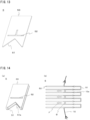
- FIG. 14 is a schematic configuration diagram showing an example of a grid of a circuit breaker according to Embodiment 6 of the present invention.
- FIG. 14(a) is a perspective view of the grid; and
- FIG. 14(b) is a side view in which a plurality of the grids are laminated.
- a grid 5 has a shape folded back in a U-shape in a length direction. As shown in FIG. 14 (a), the grid 5 folded back in the U-shape is provided with a notch portion 51 in a folded end portion and is provided with an insulating portion 52 that is made adjacent to a peak portion 51a of the notch portion 51. Furthermore, as shown in FIG.
- an arc 10 flowing through the grid 5 in a thickness direction forms an arc 10c that flows along the plate surface of the grid 5.
- the arc 10c traces a current path that flows from an arc discharge generation point of the arc 10 to the top portion 53 side via the folded end portion.
- the arc 10c forms magnetic flux ⁇ in a direction orthogonal with respect to the thickness direction of the grid 5.
- Electromagnetic force F which is driven by the magnetic flux ⁇ to the top portion 53 side in the opposite direction to both contact 1a, 2a sides, exerts on the arc 10 flowing in the thickness direction in the direction orthogonal with respect to the thickness direction of the grid 5.
- the grid 5 folded back in the U-shape is provided with the insulating portion 52 extended in the width direction, whereby electromagnetic repulsive force, which is directed toward both contact 1a, 2a sides and exerts on the arc 10 generated sandwiching the insulating portion 52, can be suppressed, and driving of the arc 10 in the opposite direction to both contact 1a, 2a sides can be expedited by the electromagnetic force F.
- FIG. 15 is a schematic configuration diagram showing a grid of a circuit breaker according to Embodiment 7 of the present invention.
- An insulating portion 52 of a grid 5 is formed in a V-shape along a notch portion 51.
- the grid 5 has a peak portion 52a of the insulating portion 52 adjacent to a peak portion 51a of the notch portion 51; and the insulating portion 52 has leg portions 521, 522 each extending from the peak portion 52a toward each side formed by the notch portion 51 and a top portion 53, the leg portions 521, 522 being coupled to form the V-shape.
- an arc 10c flowing along the plate surface of the grid 5 is generated by arcs 10a, 10b flowing through in a thickness direction.
- the arc 10c flows from the top portion 53 side to the notch portion 51 side and flows bypassing from the notch portion 51 side to the top portion 53 side along the V-shape of the insulating portion 52.
- Electromagnetic repulsive force Q exerts between the arc 10c directed toward the top portion 53 side from the notch portion 51 side of the grid 5 and the arc 10a on the notch portion 51 side sandwiching the insulating portion 52.
- the arc 10a on the notch portion 51 side is exerted by the electromagnetic repulsive force Q and is driven to the top portion 53 in the opposite direction to both contact 1a, 2a sides.
- the insulating portion 52 extended in the width direction of the grid 5 is provided, whereby the electromagnetic repulsive force, which is directed toward both contact 1a, 2a sides and exerts on the arc 10 generated sandwiching the insulating portion 5, can be suppressed;
- the insulating portion 52 is the V-shape, whereby the electromagnetic repulsive force Q directed toward the top portion 53 in the opposite direction to both contact 1a, 2a sides can exert on the arc 10a in which the arc 10 generates on the notch portion 51 side sandwiching the insulating portion 52; and therefore, breaking performance can be further improved.
- FIG. 16 is a schematic configuration diagram showing an example of a grid of a circuit breaker according to Embodiment 8 of the present invention.
- An insulating portion 52 of a grid 5 is formed of solid insulation material.
- the insulation material for example, thermosetting resin such as unsaturated polyester resin and melamine resin can be used.
- the insulating portion 52 may be formed of ceramics such as alumina and zirconia, as other material.
- insulating portion 52 of the grid 5 is formed of the insulation material, whereby electromagnetic repulsive force, which is directed toward both contact 1a, 2a sides and exerts on an arc 10 generated sandwiching the insulating portion 52, and the arc 10 can be prevented from passing through the insulating portion 52 and causing bridging.
- FIG. 17 is a top view showing the schematic configuration of a grid and a support plate of a circuit breaker according to Embodiment 9 of the present invention.
- the width W52 of an insulating portion 52 of a grid 5 is formed so as to be equal to or longer than the width W61 of an opening portion 61 of a support plate 6.
- the width W52 of the insulating portion 52 of the grid 5 is formed so as to be equal to or longer than the width W61 of the opening portion 61 of the support plate 6, whereby a current path, in which an arc 10c flowing along the plate surface of the grid 5 bypasses the insulating portion 52, is blocked. That is, the current path, which flows on the plate surface of the grid 5 from the top portion 53 side to the notch portion 51 side or from the notch portion 51 side to the top portion 53 side, is blocked and electromagnetic repulsive force, which is directed toward both contact 1a, 2a sides and exerts on an arc 10, is not generated. This suppresses the return of the arc 10 to both contact 1a, 2a sides from a state where the arc 10 is interrupted by the grids 5 and breaking performance can be improved.
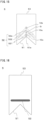
- FIG. 18 is a schematic configuration diagram of a circuit breaker according to Embodiment 10 of the present invention.
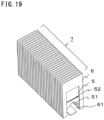
- FIG. 19 is a perspective view showing the schematic configuration of an arc chute of the circuit breaker according to Embodiment 10 of the present invention.
- the grids 5 are arranged in lamination from the lower side to the upper side of the arc chute 7; whereas, in this embodiment, grids 5 are arranged in parallel along the movable direction of a movable member 2.
- the grid 5 has a notch portion 51 formed on one end portion and an insulating portion 52 extended in a width direction.
- the notch portion 51 is arranged on both contact 1a, 2a sides of a fixed contact 1a and a movable contact 2a and a top portion 53 opposite to the notch portion 51 is arranged so as to face the upper side of the arc chute 7.
- a support plate 6 is provided on the plate surface of each grid 5 and an opening portion 61 is arranged so as to face both contact 1a, 2a sides.
- An exhaust port 16 which is for discharging arc gas 20 is provided on the upper side of the arc chute 7.
- This interrupts the arc 10 by the grids 5, can maintain a state where an arc voltage is elevated, and can improve breaking performance.
- the grid 5 is arranged so that the notch portion 51 faces the both contact 1a, 2a sides and the top portion 53 opposite to the notch portion 51 faces the upper side of the arc chute 7 provided with the exhaust port 16, whereby the arc gas 20 generated between both contact 1a, 2a can be efficiently sent to a gap 5d between the grids 5.
- the present invention may suitably combine a plurality of constituent elements disclosed in Embodiment 1 to 10 without departing from the spirit or scope of the present invention.
Landscapes
- Arc-Extinguishing Devices That Are Switches (AREA)
- Breakers (AREA)
Applications Claiming Priority (3)
| Application Number | Priority Date | Filing Date | Title |
|---|---|---|---|
| JP2018016138 | 2018-02-01 | ||
| PCT/JP2018/029414 WO2019150613A1 (ja) | 2018-02-01 | 2018-08-06 | 回路遮断器及び回路遮断方法 |
| EP18904243.5A EP3748666B1 (de) | 2018-02-01 | 2018-08-06 | Schutzschalter und schutzschaltverfahren |
Related Parent Applications (2)
| Application Number | Title | Priority Date | Filing Date |
|---|---|---|---|
| EP18904243.5A Division EP3748666B1 (de) | 2018-02-01 | 2018-08-06 | Schutzschalter und schutzschaltverfahren |
| EP18904243.5A Division-Into EP3748666B1 (de) | 2018-02-01 | 2018-08-06 | Schutzschalter und schutzschaltverfahren |
Publications (2)
| Publication Number | Publication Date |
|---|---|
| EP4258314A2 true EP4258314A2 (de) | 2023-10-11 |
| EP4258314A3 EP4258314A3 (de) | 2024-01-17 |
Family
ID=67479628
Family Applications (2)
| Application Number | Title | Priority Date | Filing Date |
|---|---|---|---|
| EP23195006.4A Pending EP4258314A3 (de) | 2018-02-01 | 2018-08-06 | Schutzschalter und schutzschalterverfahren |
| EP18904243.5A Active EP3748666B1 (de) | 2018-02-01 | 2018-08-06 | Schutzschalter und schutzschaltverfahren |
Family Applications After (1)
| Application Number | Title | Priority Date | Filing Date |
|---|---|---|---|
| EP18904243.5A Active EP3748666B1 (de) | 2018-02-01 | 2018-08-06 | Schutzschalter und schutzschaltverfahren |
Country Status (2)
| Country | Link |
|---|---|
| EP (2) | EP4258314A3 (de) |
| WO (1) | WO2019150613A1 (de) |
Citations (1)
| Publication number | Priority date | Publication date | Assignee | Title |
|---|---|---|---|---|
| JP2006012540A (ja) | 2004-06-24 | 2006-01-12 | Hitachi Ltd | 回路遮断器 |
Family Cites Families (10)
| Publication number | Priority date | Publication date | Assignee | Title |
|---|---|---|---|---|
| NL86694C (de) * | 1951-05-03 | |||
| CH594976A5 (de) * | 1976-05-07 | 1978-01-31 | Bbc Brown Boveri & Cie | |
| JPS5489278A (en) * | 1977-12-27 | 1979-07-16 | Mitsubishi Electric Corp | Arc extinguishing apparatus |
| JPS59113946U (ja) * | 1983-01-20 | 1984-08-01 | 三菱電機株式会社 | 開閉器 |
| KR910001537B1 (ko) * | 1987-04-21 | 1991-03-15 | 미쓰비시전기 주식회사 | 회로차단기 |
| CH681933A5 (en) * | 1991-03-14 | 1993-06-15 | Secheron Sa | Electrical switch with arc-quenching system - has plate of magnetic material with coupled plate of insulation having cut-away section near to arcing point |
| JP3896322B2 (ja) * | 2002-10-31 | 2007-03-22 | エナジーサポート株式会社 | 消弧装置 |
| JP2015032376A (ja) * | 2013-07-31 | 2015-02-16 | 富士電機機器制御株式会社 | 回路遮断器 |
| US9153399B2 (en) * | 2013-11-15 | 2015-10-06 | Eaton Corporation | ARC baffling device |
| CN107068456B (zh) * | 2017-07-01 | 2018-04-24 | 龚柱 | 灭弧栅片和包含该灭弧栅片的灭弧装置及包含该灭弧装置的开关 |
-
2018
- 2018-08-06 EP EP23195006.4A patent/EP4258314A3/de active Pending
- 2018-08-06 EP EP18904243.5A patent/EP3748666B1/de active Active
- 2018-08-06 WO PCT/JP2018/029414 patent/WO2019150613A1/ja not_active Ceased
Patent Citations (1)
| Publication number | Priority date | Publication date | Assignee | Title |
|---|---|---|---|---|
| JP2006012540A (ja) | 2004-06-24 | 2006-01-12 | Hitachi Ltd | 回路遮断器 |
Also Published As
| Publication number | Publication date |
|---|---|
| EP3748666A4 (de) | 2021-06-30 |
| WO2019150613A1 (ja) | 2019-08-08 |
| EP4258314A3 (de) | 2024-01-17 |
| EP3748666A1 (de) | 2020-12-09 |
| EP3748666B1 (de) | 2023-10-11 |
Similar Documents
| Publication | Publication Date | Title |
|---|---|---|
| JP6516078B1 (ja) | 回路遮断器及び回路遮断方法 | |
| EP3149755B1 (de) | Elektrische schaltung, lichtbogenkammeranordnung und sperrelement dafür | |
| EP2561534B1 (de) | Schutzschalter mit verbesserten lichtbogen-löschfähigkeiten | |
| EP1388154B1 (de) | Elektrische schaltvorrichtung mit einer einen überstehenden langgestreckten schenkel aufweisenden lichtbogenlaufschiene | |
| KR200460487Y1 (ko) | 소호부를 갖는 배선용 차단기 | |
| CN101625934A (zh) | 电路断路器 | |
| JP2010251299A (ja) | 回路遮断器 | |
| CN101243529B (zh) | 机电回路断路器及阻断所述机电回路断路器中的电流的方法 | |
| EP3748666B1 (de) | Schutzschalter und schutzschaltverfahren | |
| HK40096535A (en) | Circuit breaker and circuit breaking method | |
| HK40035091A (en) | Circuit breaker and circuit breaking method | |
| HK40035091B (en) | Circuit breaker and circuit breaking method | |
| CN102237230B (zh) | 用于监控电路的双断路保护开关 | |
| CN100356493C (zh) | 电力开关器 | |
| JP6966002B2 (ja) | 回路遮断器 | |
| KR20210133637A (ko) | 아크 소호용 그리드 및 이를 포함하는 아크 소호용 그리드 어셈블리 | |
| JP3647536B2 (ja) | 開閉器 | |
| CN221176018U (zh) | 灭弧组件及接触器 | |
| CN103117197B (zh) | 用于电磁开关装置的灭弧室装置 | |
| JP7580990B2 (ja) | 回路遮断器 | |
| JP7330385B2 (ja) | 直流遮断器 | |
| CN121399713A (zh) | 开关设备板 | |
| KR20250006533A (ko) | 그리드, 아크 소호장치 및 차단기 | |
| CN116844894A (zh) | 电器开关的灭弧系统及电器开关 | |
| CN106030752A (zh) | 开关装置 |
Legal Events
| Date | Code | Title | Description |
|---|---|---|---|
| PUAI | Public reference made under article 153(3) epc to a published international application that has entered the european phase |
Free format text: ORIGINAL CODE: 0009012 |
|
| STAA | Information on the status of an ep patent application or granted ep patent |
Free format text: STATUS: REQUEST FOR EXAMINATION WAS MADE |
|
| 17P | Request for examination filed |
Effective date: 20230904 |
|
| AC | Divisional application: reference to earlier application |
Ref document number: 3748666 Country of ref document: EP Kind code of ref document: P |
|
| AK | Designated contracting states |
Kind code of ref document: A2 Designated state(s): AL AT BE BG CH CY CZ DE DK EE ES FI FR GB GR HR HU IE IS IT LI LT LU LV MC MK MT NL NO PL PT RO RS SE SI SK SM TR |
|
| REG | Reference to a national code |
Ref country code: DE Ref legal event code: R079 Free format text: PREVIOUS MAIN CLASS: H01H0033100000 Ipc: H01H0073180000 |
|
| PUAL | Search report despatched |
Free format text: ORIGINAL CODE: 0009013 |
|
| AK | Designated contracting states |
Kind code of ref document: A3 Designated state(s): AL AT BE BG CH CY CZ DE DK EE ES FI FR GB GR HR HU IE IS IT LI LT LU LV MC MK MT NL NO PL PT RO RS SE SI SK SM TR |
|
| RIC1 | Information provided on ipc code assigned before grant |
Ipc: H01H 33/10 20060101ALI20231208BHEP Ipc: H01H 9/36 20060101ALI20231208BHEP Ipc: H01H 73/18 20060101AFI20231208BHEP |
|
| REG | Reference to a national code |
Ref country code: HK Ref legal event code: DE Ref document number: 40096535 Country of ref document: HK |
|
| STAA | Information on the status of an ep patent application or granted ep patent |
Free format text: STATUS: EXAMINATION IS IN PROGRESS |
|
| 17Q | First examination report despatched |
Effective date: 20251010 |