EP4254550B1 - Negativelektrodenaktivmaterial für sekundärbatterien mit wasserfreiem elektrolyt und sekundärbatterie mit wasserfreiem elektrolyt - Google Patents
Negativelektrodenaktivmaterial für sekundärbatterien mit wasserfreiem elektrolyt und sekundärbatterie mit wasserfreiem elektrolyt Download PDFInfo
- Publication number
- EP4254550B1 EP4254550B1 EP21897477.2A EP21897477A EP4254550B1 EP 4254550 B1 EP4254550 B1 EP 4254550B1 EP 21897477 A EP21897477 A EP 21897477A EP 4254550 B1 EP4254550 B1 EP 4254550B1
- Authority
- EP
- European Patent Office
- Prior art keywords
- phase
- negative electrode
- silicon
- composite particles
- electrolyte secondary
- Prior art date
- Legal status (The legal status is an assumption and is not a legal conclusion. Google has not performed a legal analysis and makes no representation as to the accuracy of the status listed.)
- Active
Links
Images
Classifications
-
- H—ELECTRICITY
- H01—ELECTRIC ELEMENTS
- H01M—PROCESSES OR MEANS, e.g. BATTERIES, FOR THE DIRECT CONVERSION OF CHEMICAL ENERGY INTO ELECTRICAL ENERGY
- H01M4/00—Electrodes
- H01M4/02—Electrodes composed of, or comprising, active material
- H01M4/36—Selection of substances as active materials, active masses, active liquids
- H01M4/362—Composites
- H01M4/364—Composites as mixtures
-
- H—ELECTRICITY
- H01—ELECTRIC ELEMENTS
- H01M—PROCESSES OR MEANS, e.g. BATTERIES, FOR THE DIRECT CONVERSION OF CHEMICAL ENERGY INTO ELECTRICAL ENERGY
- H01M10/00—Secondary cells; Manufacture thereof
- H01M10/05—Accumulators with non-aqueous electrolyte
- H01M10/052—Li-accumulators
- H01M10/0525—Rocking-chair batteries, i.e. batteries with lithium insertion or intercalation in both electrodes; Lithium-ion batteries
-
- H—ELECTRICITY
- H01—ELECTRIC ELEMENTS
- H01M—PROCESSES OR MEANS, e.g. BATTERIES, FOR THE DIRECT CONVERSION OF CHEMICAL ENERGY INTO ELECTRICAL ENERGY
- H01M4/00—Electrodes
- H01M4/02—Electrodes composed of, or comprising, active material
- H01M4/36—Selection of substances as active materials, active masses, active liquids
- H01M4/48—Selection of substances as active materials, active masses, active liquids of inorganic oxides or hydroxides
-
- H—ELECTRICITY
- H01—ELECTRIC ELEMENTS
- H01M—PROCESSES OR MEANS, e.g. BATTERIES, FOR THE DIRECT CONVERSION OF CHEMICAL ENERGY INTO ELECTRICAL ENERGY
- H01M4/00—Electrodes
- H01M4/02—Electrodes composed of, or comprising, active material
- H01M4/36—Selection of substances as active materials, active masses, active liquids
- H01M4/58—Selection of substances as active materials, active masses, active liquids of inorganic compounds other than oxides or hydroxides, e.g. sulfides, selenides, tellurides, halogenides or LiCoFy; of polyanionic structures, e.g. phosphates, silicates or borates
- H01M4/5825—Oxygenated metallic salts or polyanionic structures, e.g. borates, phosphates, silicates, olivines
-
- H—ELECTRICITY
- H01—ELECTRIC ELEMENTS
- H01M—PROCESSES OR MEANS, e.g. BATTERIES, FOR THE DIRECT CONVERSION OF CHEMICAL ENERGY INTO ELECTRICAL ENERGY
- H01M4/00—Electrodes
- H01M4/02—Electrodes composed of, or comprising, active material
- H01M2004/021—Physical characteristics, e.g. porosity, surface area
-
- H—ELECTRICITY
- H01—ELECTRIC ELEMENTS
- H01M—PROCESSES OR MEANS, e.g. BATTERIES, FOR THE DIRECT CONVERSION OF CHEMICAL ENERGY INTO ELECTRICAL ENERGY
- H01M4/00—Electrodes
- H01M4/02—Electrodes composed of, or comprising, active material
- H01M2004/026—Electrodes composed of, or comprising, active material characterised by the polarity
- H01M2004/027—Negative electrodes
-
- Y—GENERAL TAGGING OF NEW TECHNOLOGICAL DEVELOPMENTS; GENERAL TAGGING OF CROSS-SECTIONAL TECHNOLOGIES SPANNING OVER SEVERAL SECTIONS OF THE IPC; TECHNICAL SUBJECTS COVERED BY FORMER USPC CROSS-REFERENCE ART COLLECTIONS [XRACs] AND DIGESTS
- Y02—TECHNOLOGIES OR APPLICATIONS FOR MITIGATION OR ADAPTATION AGAINST CLIMATE CHANGE
- Y02E—REDUCTION OF GREENHOUSE GAS [GHG] EMISSIONS, RELATED TO ENERGY GENERATION, TRANSMISSION OR DISTRIBUTION
- Y02E60/00—Enabling technologies; Technologies with a potential or indirect contribution to GHG emissions mitigation
- Y02E60/10—Energy storage using batteries
Definitions
- the present invention mainly relates to an improvement of a negative electrode active material for a non-aqueous electrolyte secondary battery.
- Non-aqueous electrolyte secondary batteries because of their high voltage and high energy density have been expected as promising power sources for small consumer applications, power storage devices, and electric cars.
- a material containing silicon (Si) that forms an alloy with lithium has been expected to be utilized as a negative electrode active material having a high theoretical capacity density.
- a material containing silicon due to its large irreversible capacity, has a disadvantage in that the initial charge-discharge efficiency is low.
- various techniques have been proposed for introducing lithium in an amount corresponding to the irreversible capacity, into a material containing silicon. Specifically, it has been proposed to use composite particles containing a lithium silicate phase and silicon particles (fine silicon phase) dispersed in the lithium silicate phase. The silicon particles contribute to the charge-discharge reaction (reversible absorption and release of lithium).
- Patent Literature 1 proposes dispersing at least one element Q selected from the group consisting of a rare earth element and an alkaline earth element in the lithium silicate phase of the composite particles.
- Patent Literature 2 discloses a negative electrode material for lithium ion batteries that contains a composite including crystalline silicon dioxide containing specific components and crystalline silicon.
- the silicon phase greatly expands and contracts along with absorption and release of lithium during charge and discharge, and a large stress is generated in the silicate phase present around the silicon phase, tending to cause cracking in the silicate phase. Accordingly, a side reaction due to the contact between a newly exposed surface formed by cracking of the silicate phase and the non-aqueous electrolyte is facilitated, and the cycle characteristics tend to deteriorate.
- the element Q provides some degree of hardness to the silicate phase, but the suppression of cracking in the silicate phase is still insufficient.
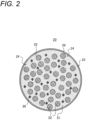
- a negative electrode active material for a non-aqueous electrolyte secondary battery including: composite particles containing a lithium silicate phase, a silicon phase dispersed in the lithium silicate phase, and a crystalline phase of silicon dioxide dispersed in the lithium silicate phase, wherein the crystalline phase of silicon dioxide contains ⁇ -cristobalite and quartz, and the lithium silicate phase contains at least one element selected from the group consisting of sodium, potassium, magnesium, barium, zirconium, niobium, a lanthanide element, tantalum, vanadium, titanium, phosphorus, bismuth, zinc, tin, lead, antimony, cobalt, fluorine, tungsten, aluminum, and boron
- Yet another aspect of the present invention relates to a non-aqueous electrolyte secondary battery, including: a positive electrode; a negative electrode; and an electrolyte, wherein the negative electrode includes the above-described negative electrode active material for a non-aqueous electrolyte secondary battery.
- the lithium silicate phase may be amorphous, and may be highly crystalline.
- the lithium silicate phase with a lower crystallinity is more flexible, can more readily follow the expansion and contraction of the silicon phase, and is less likely to crack. Even when the crystallinity of the lithium silicate phase is high, the lithium silicate phase can have an improved flexibility due to the inclusion of ⁇ -cristobalite in the SiO 2 crystal, and become less likely to crack.
- the lanthanoid element can improve the charge-discharge efficiency in the early stage of charge-discharge cycles.
- the lanthanoid element more preferably includes La.
- the proportion of La in the total lanthanoid elements is preferably 90 atom% or more and 100 atom% or less.
- the element M may be forming a compound.
- the compound may be, for example, a silicate of the element M, or an oxide of the element M, depending on the kind of the element M.
- the content of the element M is, for example, 1 mol% or more and 40 mol% or less, relative to the total amount of the elements other than oxygen.
- the contents of Li, Si, and the element M in the silicate phase can be measured, for example, by analyzing a cross section of the negative electrode mixture layer.
- the battery in a fully discharged state is disassembled, to take out the negative electrode, and the negative electrode is washed with anhydrous ethyl methyl carbonate or dimethyl carbonate, to remove the non-aqueous electrolyte component, and dried.
- This is followed by processing with a cross section polisher (CP) to obtain a cross section of the negative electrode mixture layer.
- a scanning electron microscope (SEM) is used to observe the cross section of the negative electrode mixture layer.
- the content of each element can be then determined by any of the following methods. From the content of each element, the composition of the silicate phase can be calculated.
- 10 composite particles having a maximum diameter of 5 ⁇ m or more are randomly selected, to perform an elemental mapping analysis by energy dispersive X-ray (EDX) on each particle.
- the area occupied by the target element is calculated using an image analysis software.
- the observation magnification is desirably 2000 to 20,000 times.
- the measured values of the area occupied by the predetermined element contained in the 10 particles are averaged. From the obtained average value, the content of the target element can be calculated.
- Desirable cross-sectional SEM-EDX analysis measurement conditions are shown below.
- 10 composite particles having a maximum diameter of 5 ⁇ m or more are randomly selected, to perform a qualitative/quantitative analysis on each particle using an Auger electron spectroscopy (AES) analyzer (e.g., JAMP-9510F, available from JEOL Corporation).
- AES Auger electron spectroscopy
- the measurement conditions may be set, for example, the acceleration voltage to be 10 kV, the beam current to be 10 nA, and the analysis region to be 20 ⁇ m ⁇ .
- the contents of a predetermined element contained in the 10 particles are averaged, to determine its content.
- the EDX and AES analyses are performed within 1 ⁇ m or more inward from the peripheral edge of the cross section of the composite particle.
- a sample of the composite particles is completely dissolved in a heated acid solution (a mixed acid of hydrofluoric acid, nitric acid, and sulfuric acid), and the residue of dissolution, carbon, is removed by filtration. Then, the obtained filtrate is analyzed by inductively coupled plasma emission spectroscopy (ICP), to measure a spectral intensity of each element. Subsequently, using a commercially available standard solution of the element, a calibration curve is drawn, from which the content of each element in the composite particles is calculated.
- ICP inductively coupled plasma emission spectroscopy
- EPMA electron microanalyzer
- LA-ICP-MS laser ablation ICP mass analysis
- XPS X-ray photoelectron spectroscopy
- the contents of B, Na, K, and Al in the composite particles can be quantitatively analyzed in accordance with JIS R3105 (1995) (method for chemical analysis of borosilicate glass).
- the carbon content in the composite particles may be measured using a carbon/sulfur analyzer (e.g., EMIA-520 available from HORIBA, Ltd.).
- EMIA-520 available from HORIBA, Ltd.
- a sample is weighed out on a magnetic board, to which an auxiliary agent is added.
- the sample is inserted into a combustion furnace (carrier gas: oxygen) heated to 1350 °C.
- carrier gas oxygen
- the amount of carbon dioxide gas generated during combustion is detected by infrared absorption spectroscopy.
- a calibration curve is obtained using carbon steel (carbon content: 0.49%) available from Bureau of Analysed Samples. Ltd., from which a carbon content in the sample is determined (a high-frequency induction heating furnace combustion and infrared absorption method).
- the oxygen content in the composite particles may be measured using an oxygen/nitrogen/hydrogen analyzer (e.g., EGMA-830, available from HORIBA, Ltd.).
- EGMA-830 available from HORIBA, Ltd.
- a sample is placed in a Ni capsule, which is put together with Sn pellets and Ni pellets serving as a flux, into a carbon crucible heated at a power of 5.75 kW, to detect a released carbon monoxide gas. From a calibration curve obtained using a standard sample Y 2 O 3 , an oxygen content in the sample is determined (an inert gas melting and non-dispersive infrared absorption method).
- a silicate phase, a silicon phase, and a SiO 2 phase are present.
- the Si content obtained by the above method is the sum of the amount of Si constituting the silicon phase, the amount of Si in the silicate phase, and the amount of Si in the SiO 2 phase.
- the amount of Si constituting the silicon phase can be separately determined by Si-NMR.
- the amount of Si in the SiO 2 phase can also be separately determined by Si-NMR. Therefore, by using Si-NMR, the amount of Si constituting the silicon phase, the amount of Si in the SiO 2 phase, and the amount of Si in the silicate phase can be distinguished and determined.
- a mixture containing a silicate phase whose Si content is already-known, a silicon phase, and a SiO 2 phase in a predetermined ratio is used.
- the content of the SiO 2 phase in the composite particles, as measured by Si-NMR, is, for example, less than 50% by mass, and may be 10 mass% or more and 40 mass% or less.
- the crystallite size of the silicon phase is more preferably 20 nm or less. In this case, the expansion and the contraction of the silicon phase can be easily made uniform, the stress generated in the composite particles tend to be relaxed, and the cycle characteristics tend to be improved.
- the first step includes: for example, a step 1a of mixing silicon dioxide, a lithium compound, and, as needed, a compound containing an element M, to obtain a mixture; and a step 1b of baking the mixture, to obtain a raw material silicate.
- the baking in the step 1b is performed, for example, in an oxidizing atmosphere.
- the baking temperature in the step 1b is preferably 400 °C or higher and 1200 °C or lower, more preferably 800 °C or higher and 1100 °C or lower.
- the crystallinity of the SiO 2 phase can be easily improved, and the composite material can be easily heated to a temperature at which ⁇ -cristobalite is formed together with quartz.
- the crystallite size of the silicon phase in the finally obtained composite particles can be less than 10 nm (or 2 nm or more and 10 nm or less).
- the average particle diameter of the raw material silicon means a particle diameter (volume average particle diameter) at 50% cumulative volume in a particle size distribution measured by a laser diffraction scattering method.
- At least part of the surface of the composite particles may be covered with a conductive material, to form a conductive layer.
- the conductive material is preferably electrochemically stable, and is preferably a conductive carbon material.
- Examples of the method of covering the surface of the composite particles with a conductive carbon material include: a CVD method using a hydrocarbon gas, such as acetylene and methane, as a raw material; and a method in which coal pitch, petroleum pitch, phenolic resin, or the like is mixed with the composite particles and heated, to be carbonized. Alternatively, carbon black may be allowed to adhere to the surface of the composite particles.
- the carbon material examples include graphite, graphitizable carbon (soft carbon), and non-graphitizable carbon (hard carbon).
- graphite in terms of its excellent stability during charge and discharge and small irreversible capacity.
- the graphite means a material having a graphite-like crystal structure, examples of which include natural graphite, artificial graphite, and graphitized mesophase carbon particles.
- the carbon material may be used singly or in combination of two or more kinds.
- the binder may be a resin material, examples of which include: fluorocarbon resin, such as polytetrafluoroethylene and polyvinylidene fluoride (PVDF); polyolefin resin, such as polyethylene and polypropylene; polyamide resin, such as aramid resin; polyimide resin, such as polyimide and polyamide-imide; acrylic resin, such as polyacrylic acid, methyl polyacrylate, and ethylene-acrylic acid copolymer; vinyl resin, such as polyacrylonitrile and polyvinyl acetate; polyvinyl pyrrolidone; polyether sulfone; and a rubbery material, such as styrene-butadiene copolymer rubber (SBR).
- the binder may be used singly or in combination of two or more kinds.
- the conductive agent examples include: carbons, such as acetylene black; conductive fibers, such as carbon fibers and metal fibers; fluorinated carbon; metal powders, such as aluminum; conductive whiskers, such as zinc oxide and potassium titanate; conductive metal oxides, such as titanium oxide; and organic conductive materials, such as phenylene derivatives.
- the conductive agent may be used singly or in combination of two or more kinds.
- the thickener examples include: cellulose derivatives (e.g., cellulose ethers), such as carboxymethyl cellulose (CMC) and modified products thereof (including salts such as Na salts), and methyl cellulose; saponificated products of polymers having vinyl acetate units, such as polyvinyl alcohol; and polyethers (e.g., polyalkylene oxide, such as polyethylene oxide).
- CMC carboxymethyl cellulose
- the thickener may be used singly or in combination of two or more kinds.
- dispersion medium examples include: water; alcohols, such as ethanol; ethers, such as tetrahydrofuran; amides, such as dimethylformamide; N-methyl-2-pyrrolidone (NMP); and a mixed solvent of these.
- the positive electrode may include a positive electrode current collector, and a positive electrode mixture layer supported on a surface of the positive electrode current collector.
- the positive electrode mixture layer can be formed by applying a positive electrode slurry of a positive electrode mixture dispersed in a dispersion medium, onto a surface of the positive electrode current collector, followed by drying. The dry applied film may be rolled as needed.
- the positive electrode mixture layer may be formed on a surface on one side or both sides of the positive electrode current collector.
- the positive electrode mixture contains a positive electrode active material as an essential component, and can contain a binder, a conductive agent, and the like as optional components.
- the dispersion medium of the positive electrode slurry may be NMP or the like.
- the positive electrode active material may be, for example, a lithium-containing composite oxide.
- a lithium-containing composite oxide examples thereof include Li a CoO 2 , Li a NiO 2 , Li a MnO 2 , Li a Co b Ni 1-b O 2 , Li a Co b Me 1-b O c , Li a Ni 1-b Me b O c , Li a Mn 2 O 4 , Li a Mn 2-b Me b O 4 , LiMePO 4 , and Li 2 MePO 4 F, where Me is at least one selected from the group consisting of Na, Mg, Sc, Y, Mn, Fe, Co, Ni, Cu, Zn, Al, Cr, Pb, Sb, and B.
- a 0 to 1.2
- b 0 to 0.9
- c 2.0 to 2.3.
- the value a representing the molar ratio of lithium is subjected to increase and decrease during charge and discharge.
- non-aqueous solvent examples include cyclic carbonic acid esters, chain carbonic acid esters, cyclic carboxylic acid esters, and chain carboxylic acid esters.
- the cyclic carbonic acid esters are exemplified by propylene carbonate (PC) and ethylene carbonate (EC).
- the chain carbonic acid esters are exemplified by diethyl carbonate (DEC), ethyl methyl carbonate (EMC), and dimethyl carbonate (DMC).
- DEC diethyl carbonate
- EMC ethyl methyl carbonate
- DMC dimethyl carbonate
- the cyclic carboxylic acid esters are exemplified by ⁇ -butyrolactone (GBL) and ⁇ -valerolactone (GVL).
- the imides include lithium bisfluorosulfonyl imide (LiN(FSO 2 ) 2 ), lithium bis(trifluoromethanesulfonyl)imide (LiN(CF 3 SO 2 ) 2 ), lithium trifluoromethanesulfonyl nonafluorobutanesulfonyl imide (LiN(CF 3 SO 2 )(C 4 F 9 SO 2 )), and lithium bis(pentafluoroethanesulfonyl)imide (LiN(C 2 F 5 SO 2 ) 2 ).
- LiPF 6 LiPF 6 .
- the lithium salt may be used singly or in combination of two or more kinds.
- the separator is excellent in ion permeability and has moderate mechanical strength and electrically insulating properties.
- the separator may be, for example, a microporous thin film, a woven fabric, or a nonwoven fabric.
- the separator is preferably made of, for example, polyolefin, such as polypropylene or polyethylene.
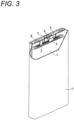
- the battery includes a bottomed prismatic battery case 4, and an electrode group 1 and a non-aqueous electrolyte housed in the battery case 4.
- the electrode group 1 has a long negative electrode, a long positive electrode, and a separator interposed therebetween and preventing them from directly contacting with each other.
- the negative electrode current collector of the negative electrode is electrically connected, via a negative electrode lead 3, to a negative electrode terminal 6 provided at a sealing plate 5.
- the negative electrode terminal 6 is electrically insulated from the sealing plate 5 by a resin gasket 7.
- the positive electrode current collector of the positive electrode is electrically connected, via a positive electrode lead 2, to the back side of the sealing plate 5. In other words, the positive electrode is electrically connected to the battery case 4 serving as a positive electrode terminal.
- the sealing plate 5 is fitted at its periphery to the opening end of the battery case 4, and the fitted portion is laser-welded.
- the injection port for non-aqueous electrolyte is provided in the sealing plate 5 and is closed with a
- the mixture was allowed to melt at 1500 °C for 5 hours in an inert gas atmosphere.
- the melt was passed between metal rolls and formed into flakes, to give a lithium silicate composite oxide containing Li, Si, Al, and La.
- the resultant lithium silicate composite oxide was pulverized to have an average particle diameter of 10 ⁇ m, and thus, a raw material silicate was obtained.
- the raw material silicate (average particle diameter: 10 ⁇ m) and a raw material silicon were mixed in a mass ratio of 40:60.
- the raw material silicon use here was a fine powder of silicon (3N, average particle diameter: 100 nm).
- the mixture was placed in a pot (made of SUS, volume: 500 mL) of a planetary ball mill (P-5, available from Fritsch Co., Ltd.), together with 24 SUS balls (diameter: 20 mm). In the pot with the lid closed, the mixture was pulverized at 200 rpm for 25 hours in an inert atmosphere.
- the pulverized material (composite material) was heated in an inert atmosphere while being compressed with a hot press machine, to obtain a sintered body.
- the temperature of heating the pulverized material was set to 600 °C
- the pressure applied to the pulverized material was set to 190 Ma
- the heating (compression) time was set to 4 hours.
- the sintered body was then crushed, and passed through a 40- ⁇ m mesh, to give composite particles.
- the composite particles were mixed with coal pitch (MCP250, available from JFE Chemical Corporation). The mixture was baked at 800 °C for 5 hours in an inert atmosphere, to cover the surface of the composite particles with a conductive carbon, to form a conductive layer. The covering amount of the conductive layer was set to 5 mass%, relative to the total mass of the composite particles and the conductive layer. Then, using a sieve, composite particles a1 (secondary particles) with an average particle diameter of 5 ⁇ m having a conductive layer were obtained.
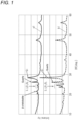
- the composite particles a1 were subjected to XRD measurement.
- An XRD pattern of the composite particles a1 is shown in FIG 1 .
- peaks belonging to Si, SiO 2 , and Li 2 Si 2 O 5 were confirmed.
- a ratio I A /I B of an intensity I A of the peak attributed to ⁇ -cristobalite to an intensity I B of the peak attributed to quartz was 0.3.
- the crystallite size of the silicon phase was determined by the already-described method. The crystallite size of the silicon phase was 8 nm.
- the composite particles and graphite were mixed in a mass ratio of 5:95, and used as a negative electrode active material.
- a negative electrode mixture containing the negative electrode active material a Na salt of CMC, and SBR in a mass ratio of 97.5:1:1.5, water was added, and stirred, to prepare a negative electrode slurry.
- the negative electrode slurry was applied onto a surface of a copper foil, and the applied film was dried, and then rolled, to produce a negative electrode with a negative electrode mixture layer having a density of 1.5 g/cm 3 formed on both sides of the copper foil.
- a positive electrode mixture containing lithium cobaltate, acetylene black, and PVDF in a mass ratio of 95:2.5:2.5 NMP was added, and stirred, to prepare a positive electrode slurry.
- the positive electrode slurry was applied onto a surface of an aluminum foil, and the applied film was dried, and then rolled, to produce a positive electrode with a positive electrode mixture layer having a density of 3.6 g/cm 3 formed on both sides of the aluminum foil.
- the electrode group was inserted into an outer body made of aluminum laminated film and dried under vacuum at 105 °C for 2 hours. Then, the non-aqueous electrolyte was injected, and the opening of the outer body was sealed. A battery A1 of Example 1 was thus fabricated.
Landscapes
- Chemical & Material Sciences (AREA)
- Chemical Kinetics & Catalysis (AREA)
- Electrochemistry (AREA)
- General Chemical & Material Sciences (AREA)
- Inorganic Chemistry (AREA)
- Engineering & Computer Science (AREA)
- Crystallography & Structural Chemistry (AREA)
- Composite Materials (AREA)
- Materials Engineering (AREA)
- Manufacturing & Machinery (AREA)
- Battery Electrode And Active Subsutance (AREA)
Claims (7)
- Negativelektroden-Aktivmaterial für eine Sekundärbatterie mit wasserfreiem Elektrolyt, umfassend:Verbundpartikel (20), enthaltendeine Lithiumsilikatphase (21),eine Siliziumphase (22), die in der Lithiumsilikatphase (21) dispergiert ist, undeine kristalline Phase (28) von Siliziumdioxid, die in der Lithiumsilikatphase (21) dispergiert ist, wobeidie kristalline Phase (28) von Siliziumdioxid β-Cristobalit und Quarz enthält, unddie Siliziumphase (22) eine Kristallitgröße von 10 nm oder kleiner aufweist.
- Negativelektroden-Aktivmaterial für eine Sekundärbatterie mit wasserfreiem Elektrolyt nach Anspruch 1, wobeiin einem Röntgenbeugungsmuster der Verbundpartikel (20), das durch Röntgendiffraktometrie erhalten wird,eine Spitze, die β-Cristobalit zugeordnet wird, um 2θ = 21,6° auftritt, undeine Spitze, die Quarz zugeordnet wird, um 2θ = 26,3° auftritt.
- Negativelektroden-Aktivmaterial für eine Sekundärbatterie mit wasserfreiem Elektrolyt nach Anspruch 2, wobei in dem Röntgenbeugungsmuster der Verbundpartikel (20) ein Verhältnis IA/IB einer Stärke IA der Spitze, die dem β-Cristobalit zugeordnet wird, zu einer Stärke IB der Spitze, die dem Quarz zugeordnet wird, 0,1 oder höher ist.
- Negativelektroden-Aktivmaterial für eine Sekundärbatterie mit wasserfreiem Elektrolyt nach einem der Ansprüche 1 bis 3, wobei die Lithiumsilikatphase (21) Li2Si2O5 enthält.
- Negativelektroden-Aktivmaterial für eine Sekundärbatterie mit wasserfreiem Elektrolyt nach einem der Ansprüche 1 bis 4, wobei die Lithiumsilikatphase (21) mindestens ein Element enthält, das ausgewählt ist aus der Gruppe, die besteht aus Natrium, Kalium, Magnesium, Barium, Zirkonium, Niob, einem Lanthanoid, Tantal, Vanadium, Titan, Phosphor, Wismut, Zink, Zinn, Blei, Antimon, Kobalt, Fluor, Wolfram, Aluminium und Bor.
- Negativelektroden-Aktivmaterial für eine Sekundärbatterie mit wasserfreiem Elektrolyt, umfassend:Verbundpartikel (20), enthaltendeine Lithiumsilikatphase (21),eine Siliziumphase (22), die in der Lithiumsilikatphase (21) dispergiert ist, undeine kristalline Phase (28) von Siliziumdioxid, die in der Lithiumsilikatphase (21) dispergiert ist, wobeidie kristalline Phase (28) von Siliziumdioxid β-Cristobalit und Quarz enthält, unddie Lithiumsilikatphase (21) mindestens ein Element enthält, das ausgewählt ist aus der Gruppe, die besteht aus Natrium, Kalium, Magnesium, Barium, Zirkonium, Niob, einem Lanthanoid, Tantal, Vanadium, Titan, Phosphor, Wismut, Zink, Zinn, Blei, Antimon, Kobalt, Fluor, Wolfram, Aluminium und Bor.
- Sekundärbatterie mit wasserfreiem Elektrolyt, umfassend:eine Positivelektrode; eine Negativelektrode; und einen Elektrolyten, wobeidie Negativelektrode das Negativelektroden-Aktivmaterial für eine Sekundärbatterie mit wasserfreiem Elektrolyt nach einem der Ansprüche 1 bis 6 umfasst.
Applications Claiming Priority (2)
| Application Number | Priority Date | Filing Date | Title |
|---|---|---|---|
| JP2020199051 | 2020-11-30 | ||
| PCT/JP2021/034841 WO2022113499A1 (ja) | 2020-11-30 | 2021-09-22 | 非水電解質二次電池用負極活物質および非水電解質二次電池 |
Publications (3)
| Publication Number | Publication Date |
|---|---|
| EP4254550A1 EP4254550A1 (de) | 2023-10-04 |
| EP4254550A4 EP4254550A4 (de) | 2024-05-22 |
| EP4254550B1 true EP4254550B1 (de) | 2025-06-25 |
Family
ID=81755493
Family Applications (1)
| Application Number | Title | Priority Date | Filing Date |
|---|---|---|---|
| EP21897477.2A Active EP4254550B1 (de) | 2020-11-30 | 2021-09-22 | Negativelektrodenaktivmaterial für sekundärbatterien mit wasserfreiem elektrolyt und sekundärbatterie mit wasserfreiem elektrolyt |
Country Status (5)
| Country | Link |
|---|---|
| US (1) | US20230411618A1 (de) |
| EP (1) | EP4254550B1 (de) |
| JP (1) | JP7756325B2 (de) |
| CN (1) | CN116457955B (de) |
| WO (1) | WO2022113499A1 (de) |
Families Citing this family (1)
| Publication number | Priority date | Publication date | Assignee | Title |
|---|---|---|---|---|
| WO2023171580A1 (ja) * | 2022-03-09 | 2023-09-14 | パナソニックエナジー株式会社 | 二次電池用負極活物質および二次電池 |
Family Cites Families (12)
| Publication number | Priority date | Publication date | Assignee | Title |
|---|---|---|---|---|
| TW200724506A (en) * | 2005-10-07 | 2007-07-01 | Ohara Kk | Inorganic composition |
| JP2014107013A (ja) * | 2012-11-22 | 2014-06-09 | Dow Corning Toray Co Ltd | ケイ素含有複合材料 |
| WO2016009590A1 (ja) | 2014-07-15 | 2016-01-21 | 信越化学工業株式会社 | 非水電解質二次電池用負極材及び負極活物質粒子の製造方法 |
| JP6833511B2 (ja) * | 2014-09-03 | 2021-02-24 | 三洋電機株式会社 | 非水電解質二次電池用負極活物質及び非水電解質二次電池 |
| WO2018101072A1 (ja) * | 2016-11-30 | 2018-06-07 | パナソニックIpマネジメント株式会社 | 負極材料および非水電解質二次電池 |
| WO2018179969A1 (ja) | 2017-03-29 | 2018-10-04 | パナソニックIpマネジメント株式会社 | 非水電解質二次電池用負極材料および非水電解質二次電池 |
| WO2019130787A1 (ja) * | 2017-12-28 | 2019-07-04 | パナソニックIpマネジメント株式会社 | 非水電解質二次電池用負極活物質 |
| WO2019151026A1 (ja) * | 2018-01-30 | 2019-08-08 | パナソニックIpマネジメント株式会社 | 二次電池用負極活物質及び二次電池 |
| JP7098144B2 (ja) | 2018-06-20 | 2022-07-11 | 株式会社ダイネンマテリアル | リチウムイオン電池用負極材料、リチウムイオン電池用負極及びリチウムイオン電池 |
| US12381209B2 (en) * | 2018-10-18 | 2025-08-05 | Panasonic Intellectual Property Management Co., Ltd. | Negative electrode active material for nonaqueous electrolyte secondary battery, negative electrode, and nonaqueous electrolyte secondary battery |
| JP7156921B2 (ja) * | 2018-11-28 | 2022-10-19 | 信越化学工業株式会社 | 負極活物質及びその製造方法 |
| JP2020187988A (ja) * | 2019-05-17 | 2020-11-19 | 昭和電工マテリアルズ株式会社 | リチウムイオン二次電池用負極材の製造方法、リチウムイオン二次電池用負極材、リチウムイオン二次電池用負極、及びリチウムイオン二次電池 |
-
2021
- 2021-09-22 EP EP21897477.2A patent/EP4254550B1/de active Active
- 2021-09-22 US US18/037,419 patent/US20230411618A1/en active Pending
- 2021-09-22 CN CN202180077021.1A patent/CN116457955B/zh active Active
- 2021-09-22 WO PCT/JP2021/034841 patent/WO2022113499A1/ja not_active Ceased
- 2021-09-22 JP JP2022565085A patent/JP7756325B2/ja active Active
Also Published As
| Publication number | Publication date |
|---|---|
| CN116457955B (zh) | 2025-12-23 |
| JPWO2022113499A1 (de) | 2022-06-02 |
| WO2022113499A1 (ja) | 2022-06-02 |
| EP4254550A4 (de) | 2024-05-22 |
| US20230411618A1 (en) | 2023-12-21 |
| CN116457955A (zh) | 2023-07-18 |
| JP7756325B2 (ja) | 2025-10-20 |
| EP4254550A1 (de) | 2023-10-04 |
Similar Documents
| Publication | Publication Date | Title |
|---|---|---|
| EP4254551B1 (de) | Negativelektrodenmaterial für eine sekundärbatterie mit wasserfreiem elektrolyt und sekundärbatterie mit wasserfreiem elektrolyt | |
| EP4206133B1 (de) | Negativelektrodenmaterial für eine sekundärbatterie mit wasserfreiem elektrolyt und sekundärbatterie mit wasserfreiem elektrolyt | |
| EP4131490B1 (de) | Sekundärbatterie | |
| EP4159677A1 (de) | Negativelektrodenaktivmaterial für sekundärbatterien und sekundärbatterie | |
| EP4007013B1 (de) | Negativelektrodenmaterial für sekundärbatterie mit wasserfreiem elektrolyt und sekundärbatterie mit wasserfreiem elektrolyt | |
| US12506141B2 (en) | Negative electrode active material for secondary batteries, and secondary battery using same | |
| EP4082968A1 (de) | Negativelektrodenaktivmaterial für eine sekundärbatterie und sekundärbatterie | |
| EP4254550B1 (de) | Negativelektrodenaktivmaterial für sekundärbatterien mit wasserfreiem elektrolyt und sekundärbatterie mit wasserfreiem elektrolyt | |
| EP4024509B1 (de) | Negative elektrode für sekundärbatterie und sekundärbatterie mit wasserfreiem elektrolyt | |
| US20230078415A1 (en) | Negative electrode active material for secondary batteries, and secondary battery | |
| EP4550457A1 (de) | Negativelektrodenmaterial für sekundärbatterie und sekundärbatterie | |
| US20250201831A1 (en) | Negative electrode active material for secondary batteries, and secondary battery | |
| EP4160738A1 (de) | Negativelektrodenaktivsubstanz für sekundärbatterie und sekundärbatterie | |
| JP7756342B2 (ja) | 非水電解質二次電池用の複合粒子および非水電解質二次電池 | |
| EP4379860B1 (de) | Negativelektrodenaktivmaterial für sekundärbatterien und sekundärbatterie | |
| EP4583205A1 (de) | Negativelektrodenaktivmaterial für sekundärbatterien und sekundärbatterie |
Legal Events
| Date | Code | Title | Description |
|---|---|---|---|
| STAA | Information on the status of an ep patent application or granted ep patent |
Free format text: STATUS: THE INTERNATIONAL PUBLICATION HAS BEEN MADE |
|
| PUAI | Public reference made under article 153(3) epc to a published international application that has entered the european phase |
Free format text: ORIGINAL CODE: 0009012 |
|
| STAA | Information on the status of an ep patent application or granted ep patent |
Free format text: STATUS: REQUEST FOR EXAMINATION WAS MADE |
|
| 17P | Request for examination filed |
Effective date: 20230516 |
|
| AK | Designated contracting states |
Kind code of ref document: A1 Designated state(s): AL AT BE BG CH CY CZ DE DK EE ES FI FR GB GR HR HU IE IS IT LI LT LU LV MC MK MT NL NO PL PT RO RS SE SI SK SM TR |
|
| DAV | Request for validation of the european patent (deleted) | ||
| DAX | Request for extension of the european patent (deleted) | ||
| A4 | Supplementary search report drawn up and despatched |
Effective date: 20240418 |
|
| RIC1 | Information provided on ipc code assigned before grant |
Ipc: H01M 4/48 20100101ALI20240415BHEP Ipc: H01M 4/36 20060101AFI20240415BHEP |
|
| GRAP | Despatch of communication of intention to grant a patent |
Free format text: ORIGINAL CODE: EPIDOSNIGR1 |
|
| STAA | Information on the status of an ep patent application or granted ep patent |
Free format text: STATUS: GRANT OF PATENT IS INTENDED |
|
| INTG | Intention to grant announced |
Effective date: 20250306 |
|
| GRAS | Grant fee paid |
Free format text: ORIGINAL CODE: EPIDOSNIGR3 |
|
| GRAA | (expected) grant |
Free format text: ORIGINAL CODE: 0009210 |
|
| STAA | Information on the status of an ep patent application or granted ep patent |
Free format text: STATUS: THE PATENT HAS BEEN GRANTED |
|
| P01 | Opt-out of the competence of the unified patent court (upc) registered |
Free format text: CASE NUMBER: APP_18906/2025 Effective date: 20250417 |
|
| AK | Designated contracting states |
Kind code of ref document: B1 Designated state(s): AL AT BE BG CH CY CZ DE DK EE ES FI FR GB GR HR HU IE IS IT LI LT LU LV MC MK MT NL NO PL PT RO RS SE SI SK SM TR |
|
| REG | Reference to a national code |
Ref country code: GB Ref legal event code: FG4D |
|
| REG | Reference to a national code |
Ref country code: CH Ref legal event code: EP |
|
| REG | Reference to a national code |
Ref country code: CH Ref legal event code: EP |
|
| REG | Reference to a national code |
Ref country code: IE Ref legal event code: FG4D |
|
| REG | Reference to a national code |
Ref country code: DE Ref legal event code: R096 Ref document number: 602021033087 Country of ref document: DE |
|
| REG | Reference to a national code |
Ref country code: SE Ref legal event code: TRGR |
|
| PG25 | Lapsed in a contracting state [announced via postgrant information from national office to epo] |
Ref country code: FI Free format text: LAPSE BECAUSE OF FAILURE TO SUBMIT A TRANSLATION OF THE DESCRIPTION OR TO PAY THE FEE WITHIN THE PRESCRIBED TIME-LIMIT Effective date: 20250625 |
|
| PGFP | Annual fee paid to national office [announced via postgrant information from national office to epo] |
Ref country code: DE Payment date: 20250919 Year of fee payment: 5 |
|
| REG | Reference to a national code |
Ref country code: LT Ref legal event code: MG9D |
|
| PG25 | Lapsed in a contracting state [announced via postgrant information from national office to epo] |
Ref country code: GR Free format text: LAPSE BECAUSE OF FAILURE TO SUBMIT A TRANSLATION OF THE DESCRIPTION OR TO PAY THE FEE WITHIN THE PRESCRIBED TIME-LIMIT Effective date: 20250926 Ref country code: NO Free format text: LAPSE BECAUSE OF FAILURE TO SUBMIT A TRANSLATION OF THE DESCRIPTION OR TO PAY THE FEE WITHIN THE PRESCRIBED TIME-LIMIT Effective date: 20250925 |
|
| PG25 | Lapsed in a contracting state [announced via postgrant information from national office to epo] |
Ref country code: BG Free format text: LAPSE BECAUSE OF FAILURE TO SUBMIT A TRANSLATION OF THE DESCRIPTION OR TO PAY THE FEE WITHIN THE PRESCRIBED TIME-LIMIT Effective date: 20250625 |
|
| PGFP | Annual fee paid to national office [announced via postgrant information from national office to epo] |
Ref country code: GB Payment date: 20250919 Year of fee payment: 5 |
|
| PG25 | Lapsed in a contracting state [announced via postgrant information from national office to epo] |
Ref country code: HR Free format text: LAPSE BECAUSE OF FAILURE TO SUBMIT A TRANSLATION OF THE DESCRIPTION OR TO PAY THE FEE WITHIN THE PRESCRIBED TIME-LIMIT Effective date: 20250625 |
|
| PGFP | Annual fee paid to national office [announced via postgrant information from national office to epo] |
Ref country code: AT Payment date: 20251020 Year of fee payment: 5 Ref country code: FR Payment date: 20250922 Year of fee payment: 5 |
|
| PGFP | Annual fee paid to national office [announced via postgrant information from national office to epo] |
Ref country code: SE Payment date: 20250918 Year of fee payment: 5 |
|
| PG25 | Lapsed in a contracting state [announced via postgrant information from national office to epo] |
Ref country code: RS Free format text: LAPSE BECAUSE OF FAILURE TO SUBMIT A TRANSLATION OF THE DESCRIPTION OR TO PAY THE FEE WITHIN THE PRESCRIBED TIME-LIMIT Effective date: 20250925 |
|
| PG25 | Lapsed in a contracting state [announced via postgrant information from national office to epo] |
Ref country code: LV Free format text: LAPSE BECAUSE OF FAILURE TO SUBMIT A TRANSLATION OF THE DESCRIPTION OR TO PAY THE FEE WITHIN THE PRESCRIBED TIME-LIMIT Effective date: 20250625 |
|
| REG | Reference to a national code |
Ref country code: NL Ref legal event code: MP Effective date: 20250625 |
|
| PG25 | Lapsed in a contracting state [announced via postgrant information from national office to epo] |
Ref country code: NL Free format text: LAPSE BECAUSE OF FAILURE TO SUBMIT A TRANSLATION OF THE DESCRIPTION OR TO PAY THE FEE WITHIN THE PRESCRIBED TIME-LIMIT Effective date: 20250625 |
|
| PG25 | Lapsed in a contracting state [announced via postgrant information from national office to epo] |
Ref country code: PT Free format text: LAPSE BECAUSE OF FAILURE TO SUBMIT A TRANSLATION OF THE DESCRIPTION OR TO PAY THE FEE WITHIN THE PRESCRIBED TIME-LIMIT Effective date: 20251027 |
|
| REG | Reference to a national code |
Ref country code: AT Ref legal event code: MK05 Ref document number: 1807511 Country of ref document: AT Kind code of ref document: T Effective date: 20250625 |
|
| PG25 | Lapsed in a contracting state [announced via postgrant information from national office to epo] |
Ref country code: IS Free format text: LAPSE BECAUSE OF FAILURE TO SUBMIT A TRANSLATION OF THE DESCRIPTION OR TO PAY THE FEE WITHIN THE PRESCRIBED TIME-LIMIT Effective date: 20251025 |
|
| PG25 | Lapsed in a contracting state [announced via postgrant information from national office to epo] |
Ref country code: SM Free format text: LAPSE BECAUSE OF FAILURE TO SUBMIT A TRANSLATION OF THE DESCRIPTION OR TO PAY THE FEE WITHIN THE PRESCRIBED TIME-LIMIT Effective date: 20250625 Ref country code: AT Free format text: LAPSE BECAUSE OF FAILURE TO SUBMIT A TRANSLATION OF THE DESCRIPTION OR TO PAY THE FEE WITHIN THE PRESCRIBED TIME-LIMIT Effective date: 20250625 |
|
| PG25 | Lapsed in a contracting state [announced via postgrant information from national office to epo] |
Ref country code: CZ Free format text: LAPSE BECAUSE OF FAILURE TO SUBMIT A TRANSLATION OF THE DESCRIPTION OR TO PAY THE FEE WITHIN THE PRESCRIBED TIME-LIMIT Effective date: 20250625 |
|
| PG25 | Lapsed in a contracting state [announced via postgrant information from national office to epo] |
Ref country code: PL Free format text: LAPSE BECAUSE OF FAILURE TO SUBMIT A TRANSLATION OF THE DESCRIPTION OR TO PAY THE FEE WITHIN THE PRESCRIBED TIME-LIMIT Effective date: 20250625 |
|
| PG25 | Lapsed in a contracting state [announced via postgrant information from national office to epo] |
Ref country code: EE Free format text: LAPSE BECAUSE OF FAILURE TO SUBMIT A TRANSLATION OF THE DESCRIPTION OR TO PAY THE FEE WITHIN THE PRESCRIBED TIME-LIMIT Effective date: 20250625 |
|
| PG25 | Lapsed in a contracting state [announced via postgrant information from national office to epo] |
Ref country code: SK Free format text: LAPSE BECAUSE OF FAILURE TO SUBMIT A TRANSLATION OF THE DESCRIPTION OR TO PAY THE FEE WITHIN THE PRESCRIBED TIME-LIMIT Effective date: 20250625 |
|
| PG25 | Lapsed in a contracting state [announced via postgrant information from national office to epo] |
Ref country code: ES Free format text: LAPSE BECAUSE OF FAILURE TO SUBMIT A TRANSLATION OF THE DESCRIPTION OR TO PAY THE FEE WITHIN THE PRESCRIBED TIME-LIMIT Effective date: 20250625 |
|
| PG25 | Lapsed in a contracting state [announced via postgrant information from national office to epo] |
Ref country code: RO Free format text: LAPSE BECAUSE OF FAILURE TO SUBMIT A TRANSLATION OF THE DESCRIPTION OR TO PAY THE FEE WITHIN THE PRESCRIBED TIME-LIMIT Effective date: 20250625 |