EP4252002B1 - Ein wiederverwendbares testgerät - Google Patents
Ein wiederverwendbares testgerät Download PDFInfo
- Publication number
- EP4252002B1 EP4252002B1 EP22744154.0A EP22744154A EP4252002B1 EP 4252002 B1 EP4252002 B1 EP 4252002B1 EP 22744154 A EP22744154 A EP 22744154A EP 4252002 B1 EP4252002 B1 EP 4252002B1
- Authority
- EP
- European Patent Office
- Prior art keywords
- reusable
- test device
- analyte
- sensor unit
- wick
- Prior art date
- Legal status (The legal status is an assumption and is not a legal conclusion. Google has not performed a legal analysis and makes no representation as to the accuracy of the status listed.)
- Active
Links
Images



Classifications
-
- G—PHYSICS
- G01—MEASURING; TESTING
- G01N—INVESTIGATING OR ANALYSING MATERIALS BY DETERMINING THEIR CHEMICAL OR PHYSICAL PROPERTIES
- G01N33/00—Investigating or analysing materials by specific methods not covered by groups G01N1/00 - G01N31/00
- G01N33/48—Biological material, e.g. blood, urine; Haemocytometers
- G01N33/50—Chemical analysis of biological material, e.g. blood, urine; Testing involving biospecific ligand binding methods; Immunological testing
- G01N33/68—Chemical analysis of biological material, e.g. blood, urine; Testing involving biospecific ligand binding methods; Immunological testing involving proteins, peptides or amino acids
- G01N33/689—Chemical analysis of biological material, e.g. blood, urine; Testing involving biospecific ligand binding methods; Immunological testing involving proteins, peptides or amino acids related to pregnancy or the gonads
-
- G—PHYSICS
- G01—MEASURING; TESTING
- G01N—INVESTIGATING OR ANALYSING MATERIALS BY DETERMINING THEIR CHEMICAL OR PHYSICAL PROPERTIES
- G01N33/00—Investigating or analysing materials by specific methods not covered by groups G01N1/00 - G01N31/00
- G01N33/48—Biological material, e.g. blood, urine; Haemocytometers
- G01N33/50—Chemical analysis of biological material, e.g. blood, urine; Testing involving biospecific ligand binding methods; Immunological testing
- G01N33/53—Immunoassay; Biospecific binding assay; Materials therefor
- G01N33/543—Immunoassay; Biospecific binding assay; Materials therefor with an insoluble carrier for immobilising immunochemicals
- G01N33/54366—Apparatus specially adapted for solid-phase testing
- G01N33/54373—Apparatus specially adapted for solid-phase testing involving physiochemical end-point determination, e.g. wave-guides, FETS, gratings
- G01N33/5438—Electrodes
-
- G—PHYSICS
- G01—MEASURING; TESTING
- G01N—INVESTIGATING OR ANALYSING MATERIALS BY DETERMINING THEIR CHEMICAL OR PHYSICAL PROPERTIES
- G01N27/00—Investigating or analysing materials by the use of electric, electrochemical, or magnetic means
- G01N27/26—Investigating or analysing materials by the use of electric, electrochemical, or magnetic means by investigating electrochemical variables; by using electrolysis or electrophoresis
- G01N27/28—Electrolytic cell components
- G01N27/30—Electrodes, e.g. test electrodes; Half-cells
- G01N27/327—Biochemical electrodes, e.g. electrical or mechanical details for in vitro measurements
- G01N27/3275—Sensing specific biomolecules, e.g. nucleic acid strands, based on an electrode surface reaction
-
- G—PHYSICS
- G01—MEASURING; TESTING
- G01N—INVESTIGATING OR ANALYSING MATERIALS BY DETERMINING THEIR CHEMICAL OR PHYSICAL PROPERTIES
- G01N33/00—Investigating or analysing materials by specific methods not covered by groups G01N1/00 - G01N31/00
- G01N33/48—Biological material, e.g. blood, urine; Haemocytometers
- G01N33/483—Physical analysis of biological material
- G01N33/487—Physical analysis of biological material of liquid biological material
- G01N33/493—Physical analysis of biological material of liquid biological material urine
-
- G—PHYSICS
- G01—MEASURING; TESTING
- G01N—INVESTIGATING OR ANALYSING MATERIALS BY DETERMINING THEIR CHEMICAL OR PHYSICAL PROPERTIES
- G01N33/00—Investigating or analysing materials by specific methods not covered by groups G01N1/00 - G01N31/00
- G01N33/48—Biological material, e.g. blood, urine; Haemocytometers
- G01N33/50—Chemical analysis of biological material, e.g. blood, urine; Testing involving biospecific ligand binding methods; Immunological testing
- G01N33/74—Chemical analysis of biological material, e.g. blood, urine; Testing involving biospecific ligand binding methods; Immunological testing involving hormones or other non-cytokine intercellular protein regulatory factors such as growth factors, including receptors to hormones and growth factors
- G01N33/743—Steroid hormones
-
- G—PHYSICS
- G01—MEASURING; TESTING
- G01N—INVESTIGATING OR ANALYSING MATERIALS BY DETERMINING THEIR CHEMICAL OR PHYSICAL PROPERTIES
- G01N33/00—Investigating or analysing materials by specific methods not covered by groups G01N1/00 - G01N31/00
- G01N33/48—Biological material, e.g. blood, urine; Haemocytometers
- G01N33/50—Chemical analysis of biological material, e.g. blood, urine; Testing involving biospecific ligand binding methods; Immunological testing
- G01N33/74—Chemical analysis of biological material, e.g. blood, urine; Testing involving biospecific ligand binding methods; Immunological testing involving hormones or other non-cytokine intercellular protein regulatory factors such as growth factors, including receptors to hormones and growth factors
- G01N33/76—Human chorionic gonadotropin including luteinising hormone, follicle stimulating hormone, thyroid stimulating hormone or their receptors
-
- G—PHYSICS
- G01—MEASURING; TESTING
- G01N—INVESTIGATING OR ANALYSING MATERIALS BY DETERMINING THEIR CHEMICAL OR PHYSICAL PROPERTIES
- G01N2333/00—Assays involving biological materials from specific organisms or of a specific nature
- G01N2333/435—Assays involving biological materials from specific organisms or of a specific nature from animals; from humans
- G01N2333/575—Hormones
- G01N2333/59—Follicle-stimulating hormone [FSH]; Chorionic gonadotropins, e.g. HCG; Luteinising hormone [LH]; Thyroid-stimulating hormone [TSH]
-
- G—PHYSICS
- G01—MEASURING; TESTING
- G01N—INVESTIGATING OR ANALYSING MATERIALS BY DETERMINING THEIR CHEMICAL OR PHYSICAL PROPERTIES
- G01N2600/00—Assays involving molecular imprinted polymers/polymers created around a molecular template
Definitions
- the present invention relates to a reusable test device comprising molecular imprinted polymers (MIPs), a method for testing the presence of an analyte in a fluid, and use of the reusable test device for pregnancy testing.
- MIPs molecular imprinted polymers
- An immunoassay (IA) test is a biochemical test which is able to detect and locate the presence of a macromolecule or a small molecule, referred to as an "analyte".
- the analyte can be a number of items that come from the human body. Normally, an immunoassay measures the presence or concentration of an analyte in a solution through the use of an antibody.
- An example of an immunoassay test is a pregnancy test.
- the pregnancy marker human chorionic gonadotropin (hCG) is detected.
- hCG is a hormone that is expressed by placental trophoblasts during pregnancy and comprises ⁇ and ⁇ -subunits (hCG ⁇ & hCG ⁇ ) which both may be used as pregnancy markers.
- beta hCG to alpha hCG and beta hCG to hCG may be higher in early gestation, and a reversal of the beta hCG to alpha hCG ratio at 12-13 weeks gestation.
- LFA Lateral Flow Assay
- LFIA Lateral Flow Immunochromatographic Assay
- Such tests typically comprise a paper-based platform for the detection of hCG target analytes in liquid samples, as well as a plastic casing surrounding the paper. The sample is placed on the paper and allowed to flow along a solid porous matrix by capillary action.
- these pregnancy tests comprise an antibody that binds the hCG target analyte.
- WO 2013/033541 discloses a sensor for the detection of a waterborne target molecule comprising a molecularly imprinted polymer film, and MIP powders for removal of waterborne target molecules through the use of, for example, a flow cell.
- the methods involve using the target molecule in the preparation of the MIP films and powders. When the target molecule is removed, it leaves behind an MIP with cavities that are complementary in shape and functionality to the target molecule. The MIP thereby created can bind target molecules in those cavities.
- An object of the inventive concept is to mitigate the above problems, and to provide a reusable test device that can be re-used upon removal of the analyte from the binding moiety.
- a further object is to provide a reusable test device with improved shelf life, and thus more environmentally friendly, than prior art solutions.
- Still a further object is to provide an improved method which enables repeated tests for the presence of an analyte in a fluid.
- a reusable test device comprising:
- the wick is detachably connected to the reusable sensor unit, and the reusable sensor unit may be detachably connected to the rechargeable electronic unit.
- MIPs Molecularly Imprinted Polymers
- the reusable test device may therefore have a reusable sensor unit that contains no antibodies.
- the test device may have a reusable sensor unit which contains no other binding moieties than MIP.
- the use of MIPs is favorable because it may increase the structural integrity, so when the reusable sensor unit is regenerated after a binding event the binding affinity and selectivity may remain mostly unchanged, allowing for that reusable sensor to be reused.
- the test device may additionally have the capacity to retain a shelf life in the order of many years, as well as the capability to be regenerated with a wash treatment.
- MIPs are made by allowing functional and cross-linking monomers of plastic materials, such as methacrylic and styrene, to interact with a templating ligand to create low-energy interactions.
- plastic materials such as methacrylic and styrene
- the molecule of interest is entrapped within the polymer either by a non-covalent, self-assembling approach, or by a reversible, covalent approach.
- the template molecule is washed out.
- the resultant imprint of the template is maintained in the rigid polymer and possesses a steric (size, shape) and chemical (special arrangement of complementary functionality) memory for the template.
- the MIPs may be able to bind the template, i.e. the analyte, with a specificity similar to that of an antigen-antibody interaction. Identical or similar to the analyte (target molecule) to detect.
- the MIP may have a better binding strength if the MIP is a ridged structure. However, a rigid structure could make the regeneration of the MIP difficult.
- the choice of monomer units will create the intermolecular interactions between the MIP and the target used, thus creating some specificity to sticking to the target.
- the crosslinker will allow for the structure shape to allow that target molecule, i.e. analyte, to enter the polymer. This often described as a lock and key scenario where the MIP has to have the right charge and shape to accept the key of the target molecule to allow just that molecule to successfully bind and no other.
- the dynamic range of the test device may depend on the number of active sites (MIPs) on layer (7) and the binding strength between the MIP and the analyte. Intermolecular interactions between the MIP and the analyte are stronger when there are lots of these interactions going on.
- MIPs active sites
- the at least one analyte is referred to the target molecule which the MIP is adapted to bind.
- the at least one analyte may comprise a hormone, the hormone being selected from the group consisting of estrogen, progesterone, luteinizing hormone (LH), and human chorionic gonadotropin (hCG), such as hyperglycosylated human chorionic gonadotropin (hCG-H), in particular beta human chorionic gonadotropin ( ⁇ -hCG).
- the at least one type of molecular imprinted polymer may be adapted to bind hCG.
- fluid refers to any liquid.
- the fluid may comprise a body fluid, such as saliva, blood, and urine, preferably urine.
- the test device may have the form of a bench top or small handheld unit, making it portable and easy to use and transport.
- the reusable test device is used for pregnancy testing.
- pregnancy tests normally hormone beta human chorionic gonadotropin ( ⁇ -hCG) is detected.
- the reusable test device may be used for fertility testing, in vitro fertilization, multiple children testing, or predicting miscarriage, as hCG levels that do not follow the normal trend of doubling or tripling every day could lead to an issue with the pregnancy.
- the LH-level is important for determining a good time for implantation in in vitro fertilization (IVF), low levels of LH could lead to low success rates for implantation. High levels of LH could be an indication of polycystic ovary syndrome, which is a common cause of infertility issue.
- the MIP layer of the reusable sensor unit may comprise two or more types of MIPs, such as three or four types of MIPs.
- the MIP layer may comprise a first type of MIPs adapted to bind a first analyte, and a second type of MIPs, adapted to bind the first analyte and/or a second analyte. This may be beneficial since the test device may have a higher accuracy.
- the reusable test device may further comprise a third type of MIPs adapted to bind any of the first, second and/or a third analyte.
- the first analyte may be hCG and the second analyte glycosylated hCG or progesterone.
- the first type of molecular imprinted polymer may be adapted to bind hCG
- the second type of molecular imprinted polymer may be adapted to bind glycosylated hCG or progesterone.
- the wick may, however, be a disposable wick. Hence, the wick may be the only disposable item of the test device.
- the wick may for example be a paper strip.
- the wick is primarily to collect the fluid. However, the wick may also have a delivering function.
- the wick may be adapted to deliver fixed concentrations of salts and/or electroactive material to layer (7).
- the wick may comprise a buffer solution, such as phosphate, Tris, or citrate based buffer.
- concentration of such buffer solution may be from 0.1 mM to 100 mM, such as 0.5 to 75 nM.
- the MIP layer and the electrode layer may together form a single layer.
- the MIP layer and the electrode layer may together form an integral layer, e.g. through polymerization, absorption, or co-incorporation into a polymer surface or paste.
- the measurement process for the reusable test device may be electrical, electrochemical, optical, and/or plasmonic, as will be described below.
- An electrochemically based measurement method may be accomplished by the monomer units making up the MIP being electroactive. A binding event of the analyte will then disrupt the electrochemistry or electroactivity of the MIP polymer structure in a measurable way. Alternatively, a physical property associated with the presence of an analyte in the MIP may be a change in the resistance of the MIP layer with or without the analyte bound.
- An optical based measurement method may be accomplished by a colored monomer unit being added into the MIP polymer structure.
- a colored monomer unit being added into the MIP polymer structure.
- a surface plasmon resonance (SPR) measurement method may be accomplished by a resonance frequency being passed through the MIP layer, causing vibrations due to electrical oscillation. This vibration may be measured and if the mass of the MIP layer changes (due to the analyte binding in the MIP) the oscillation frequency or amplitude is disrupted as a result in a measurable way.
- SPR surface plasmon resonance
- a method for testing the presence of an analyte in a fluid comprises the steps:
- the step of collecting is preferably performed with the wick connected to the reusable sensor unit, and with the reusable sensor unit connected to the rechargeable electronic unit, in an assembled state.
- the step of washing may be performed by a washing medium comprising a liquid.
- the washing medium may comprise a liquid, such as tap water, e.g. hot tap water, or an aqueous based liquid comprising a surfactant and or a salt.
- a liquid such as tap water, e.g. hot tap water, or an aqueous based liquid comprising a surfactant and or a salt.
- the washing step may be performed by the user herself or by nursing staff.
- a container with washing medium may be provided to the user together with the test device.
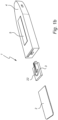
- Figs. 1a and 1b show a reusable test device 1 that comprises a wick 2, a reusable sensor unit 3, and a rechargeable electronic unit 4.
- the reusable test device further comprises an electronic display 5.
- the reusable test device 1 is illustrated in an assembled state and in Fig. 1b the reusable test device 1 is illustrated in a disassembled state.
- the reusable sensor unit 3 is regenerable upon cleansing, which means that the reusable test device 1 may be utilized a plurality of times, such as 10-20 times.
- the wick 2 which preferably is disposable, is adapted to collect a fluid to be analyzed.
- the fluid may be a liquid and may comprise a body fluid, such as saliva, blood, and urine.
- the wick 2 is provided on top of the sensor unit 3 which enables the analyte 10 to be forced into the sensor unit 3 by means of gravity.
- the wick 2 may be attached to the reusable sensor unit 3 by means of snap attachment.
- the wick 2 may consist essentially of cellulose, but may also comprise thermoplastics.
- the wick 2 may for example be a paper strip.
- the wick 2 may also be adapted to deliver fixed concentrations of salts and/or electroactive material to electrode layer 7.
- the wick 2 may thus comprise a buffer solution, such as phosphate, Tris, citrate, or other buffering solutions (see Table 1).
- the concentration of the buffer solution may be from 0.1 to 100 mM.
- the wick 2 may not only be adapted to collect a fluid, it may also be adapted to deliver a buffer solution comprising key chemicals to stabilize different levels of salt concentrations in the fluid. In particular, this may be beneficial when the fluid is urine since urine fluctuates in its salt concentration depending on which time of the day it is collected. From an electroanalytical point of view, it may therefore be advantageous to standardize the urine.
- electroanalytical measurements may suffer from the concentration of ions being too low which results in the curves, e.g. responsive measurement curves to the binding event, either changes in elevator activity or plasmonic function, being very small.
- the wick 2 may be provided with the buffer solution contained, or with the buffer solution separate in a container for e.g. dipping.
- the reusable sensor unit 3 comprises at least two layers; the electrode layer 7 and the MIP layer 8.
- MIP layer 8 serves as a measurement layer and comprises at least one type of MIPs adapted to bind at least one analyte 10 present in the fluid. This means, the MIPs have a binding affinity for the analyte 10 and functions as a binding moiety for the analyte 10.
- the reusable sensor unit 3 may not contain any other binding moieties than MIPs. Thus, the sensor unit 3 may not contain any antibodies.
- the analyte 10 of interest may be a hormone, such as a hormone selected from the group consisting of estrogen, progesterone, luteinizing hormone (LH), and human chorionic gonadotropin (hCG), such as hyperglycosylated human chorionic gonadotropin (hCG-H), in particular beta human chorionic gonadotropin ( ⁇ -hCG)
- a hormone such as a hormone selected from the group consisting of estrogen, progesterone, luteinizing hormone (LH), and human chorionic gonadotropin (hCG), such as hyperglycosylated human chorionic gonadotropin (hCG-H), in particular beta human chorionic gonadotropin ( ⁇ -hCG)
- the MIP layer 8 may comprise two or more types of MIPs, such as three or four types of MIPs. When the MIP layer 8 comprises two or more types of MIPs, each type of MIPs may be adapted to bind the same analyte 10 and/or a different analyte 10.
- the test device 1 may thus comprise a first type of MIPs adapted to bind a first analyte 10, and a second type of MIPs, adapted to bind the first analyte 10 and/or a second analyte 10.
- the first analyte 10 may be beta human chorionic gonadotropin ( ⁇ -hCG).
- the first type of MIPs may hereby be adapted to bind hCG and the second type of MIPs may be adapted to bind glycosylated hCG.
- MIPs adapted for diagnostic applications are preferably nanoparticles or nanogels produced by precipitation, emulsion or graft polymerization, and thin film materials that exhibit more homogenous binding sites due to the spatial restrictions imposed by the limited film thickness or microgel radius.
- Disperse phase imprinting is the preferred method for high yielding synthesis of epitope imprinted nanoparticles targeting hCG.
- Epitope imprinting relies on the identification of solvent exposed proteotypic epitopes that can serve as templates to generate protein specific MIPs.
- preferred epitopes are linear solvent exposed, either C- or N- terminal sequences, or internal conformationally defined loop structures.
- the epitopes should be free from post-translational modifications and generate sufficient affinity and specificity for the target hormone i.e. allowing detection in the range 10 pM - 1 ⁇ M and absence of crossreactivity with lutenizing hormone (LH).
- Possible epitopes used to generate MIPs are given in Table 2.
- the MIP layer 8 is preferably provided adjacent and on top of the electrode layer 7. However, the MIP layer 8 could instead be provided besides the electrode layer 7.
- the electrode layer 7 may comprise at least one electrode 22, such as two or three electrodes 22.
- the at least one electrode 22 in the electrode layer 7 may be embedded in the electrode layer 7 or provided on a surface of the electrode layer 7.
- the distance between the electrodes 22 may be from 1 ⁇ m to 5 mm.
- the analyte 10 When the fluid contains an analyte 10 to which the MIP has an affinity, the analyte 10 is bound to the MIP and a binding event has occurred. This binding event may result in a change in physical properties which is measurable. resistance which is measurable.
- the functionality may, for example, depend upon detecting differences in the resistivity of MIP layer 8 as a function of the adsorption of the analyte 10, i.e. the target molecule. Alternatively, the functionality may, for example, depend upon detecting differences in mass change.
- the measurement process for the reusable diagnostic may be electrical, electrochemical, optical or plasmonic.
- the rechargeable electronic unit 4 is adapted to read out results from the reusable sensor unit 3.
- the rechargeable electronic unit 4 may comprise a digital display, which may be used to tell the user if all analyte 10 has been washed away or not.
- the rechargeable electronic unit 4 may comprise a connecting port for charging of data transfer.
- the connecting port may be a USB port.
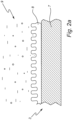
- Fig. 2a illustrates a layer of MIPs and a free ion solution. Without any analyte 10 bound to the MIPs the ions solution 9 can move in and out of the MIP matrix freely.
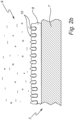
- Fig. 2b the target analyte 10 is bound into the MIP cleft whereby resistance to the MIP layer 8 is created. This will prevent the movement of free ions 9 resulting in a drop in signal.
- Fig. 3 illustrates an exemplary process flow chart of a method for testing the presence of an analyte 10 in a fluid.
- step S1 a reusable test device 1, as illustrated in Fig 1a and b , is provided.
- the reusable test device 1 may, in step S1, be provided in an assembled state, wherein the wick 2 is connected to the reusable sensor unit 3 which in turn is connected to the rechargeable electronic unit 4.
- step S2 a fluid is collected by the wick 2.
- the fluid is then, in step S3, analyzed with the wick 2 attached to the reusable sensor unit 3 and the rechargeable electronic unit 4.
- step S5 the test device 1 is washed, step S5, with at least one washing and/or regeneration medium, as exemplified in Table 1.
- the reusable sensor unit 3 is removed from the rechargeable electronic unit 4 prior to wash, thus allowing only the reusable sensor unit 3 to be washed.
- the reusable sensor unit 3 may then be reused up to 30 times, such as up to 20 times, or from 10 to 20 times.
- the wick 2 is not connected to the reusable sensor unit 3 when the sample is collected. In such embodiment, the wick is connected to the reusable sensor unit 3 prior to analyze in step S3.
- the reusable sensor unit 3 or the test device 1 may be washed by a washing and/or regeneration medium comprising a liquid.
- the washing medium may for example comprise water which may or may not contain a surfactant and/or salts and be adjusted to different temperatures (see examples in Table 1).
- the SV and PQ epitopes were then coupled through EDC/DMAP chemistry through their N-terminal modifications.
- the monomer composition was adopted from the previously introduced nanogel imprinting protocol by Hoshino et al ( Y. Hoshino, T. Kodama, Y. Okahata and K. J. Shea, J. Am. Chem. Soc. 2008, 130, 15242-15243 ).
- a prepolymerization mixture was prepared by dissolving NIPAM (39 mg, 344.64 ⁇ mol), BIS (2 mg, 12.97 ⁇ mol), TBAm (33 mg, 259.47 ⁇ mol dissolved in 1 mL ethanol), AA (2.2 ⁇ L, 31.92 ⁇ mol), APMA (5.80mg, 33.00 ⁇ mol) and 2.6 mg of N-fluoresceinylacrylamide in water (50 mL) in a 250 mL round bottom flask. The solution was degassed under vacuum and sonicated for 10 minutes.
- peptide modified magnetic nanoparticles (magNP-SV or magNP-PQ) (50mg) dispersed in deionized water (10mL) was added into the flask.
- the flask was then sealed with a septum and purged with nitrogen for 20 minutes.
- the polymerization was then initiated by injecting a solution composed of APS (30 mg, 130 ⁇ mol) and TEMED (30 ⁇ L) in 1 ml deionized water under nitrogen atmosphere.
- the reaction solution was stirred on an orbital shaker at room temperature for 12 hours.
- the particles were then collected by magnet and washed with deionized water (10 x 20 mL) at room temperature until a clear solution was obtained.
- Example 2 Displacement assay proving binding specificity for hCGbeta 66-80.
- SV, PQ or hCG were then injected onto the MIP-modified chips and analysis performed using PBS at pH 7.4.
- the MIP-NGs were injected onto the chip with immobilized peptide.
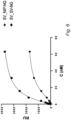
- Example of resulting binding curves is seen in Fig. 6 .
- Fig. 5 shows a corresponding experiment using the micro-gravimetric QCM technique.
- Regeneration of the sensor surface after a sensing experiment as described in Example 3 was performed by repeated rinsing of the sensor with the respective buffer at the indicated temperatures followed by repeated rinsing in deionized water.
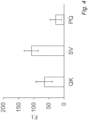
- Fig. 4 illustrates displacement of FITC-doped SV-imprinted MIP nanogel (SV-NG) bound to SV-modified magnetic nanoparticles (SV-magNP) upon addition of different peptides (SV (SEQ ID NO:1): SIRI,PGCPRGVNPVV; PQ (SEQ ID NO:2): PGPSDTPILPQ; QK (SEQ ID NO:3): QKSLSLSPGK).
- SV SEQ ID NO:1: SIRI,PGCPRGVNPVV
- PQ SEQ ID NO:2: PGPSDTPILPQ
- QK SEQ ID NO:3: QKSLSLSPGK
- Fig. 5 illustrates quartz crystal microbalance (QCM) frequency change during addition of SV-NG to an SV-modified sensor chip.
- Fig. 6 illustrates change in SPR response units (RUs) upon addition of an SV-NG and a nonimprinted NG (NIP-NG) to an SV modified sensor chip.
- Table 1 Examples of sensor regeneration conditions Sensor regeneration conditions Concentration pH/Temperature Rinsing buffers 1 Glycine buffer (GB) 10 mM 2.2 2 Sodium acetate (SA) 100 mM 5.0 3 Sodium bicarbonate (SB) 100 mM 9.2 4 TWEEN 20 0.005 % - 5 SDS 0.1 % - 6 Denaturing buffer (DB) 100 mM 10.0 7 EtOH:H 2 O b 70/30 - 8 EtOH:0.1M NaOH 70/30 - Thermal regeneration 9 EtOH:H 2 O 70/30 60°C 10 EtOH:H 2 O 70/30 5°C a) Regeneration of the sensor surface is performed by repeated rinsing of the sensor with the respective buffer at the indicated temperatures followed by repeated
Landscapes
- Health & Medical Sciences (AREA)
- Life Sciences & Earth Sciences (AREA)
- Engineering & Computer Science (AREA)
- Molecular Biology (AREA)
- Immunology (AREA)
- Chemical & Material Sciences (AREA)
- Biomedical Technology (AREA)
- Urology & Nephrology (AREA)
- Hematology (AREA)
- Physics & Mathematics (AREA)
- General Health & Medical Sciences (AREA)
- Pathology (AREA)
- General Physics & Mathematics (AREA)
- Biochemistry (AREA)
- Analytical Chemistry (AREA)
- Food Science & Technology (AREA)
- Medicinal Chemistry (AREA)
- Cell Biology (AREA)
- Microbiology (AREA)
- Biotechnology (AREA)
- Endocrinology (AREA)
- Reproductive Health (AREA)
- Proteomics, Peptides & Aminoacids (AREA)
- Pregnancy & Childbirth (AREA)
- Gynecology & Obstetrics (AREA)
- Spectroscopy & Molecular Physics (AREA)
- Chemical Kinetics & Catalysis (AREA)
- Electrochemistry (AREA)
- Biophysics (AREA)
- Investigating Or Analysing Biological Materials (AREA)
- Sampling And Sample Adjustment (AREA)
- Apparatus Associated With Microorganisms And Enzymes (AREA)
Claims (15)
- Wiederverwendbares Testgerät (1), umfassend:a) einen Docht (2), der dazu angepasst ist, ein zu analysierendes Fluid zu sammeln;b) eine wiederverwendbare Sensoreinheit (3), umfassend:eine MIP-Schicht (8), die mindestens einen Typ von molekularen geprägten Polymeren (MIPs) umfasst, die dazu angepasst sind, mindestens einen in dem Fluid vorhandenen Analyten (10) zu binden;eine Elektrodenschicht (7), die mindestens eine Elektrode (22) umfasst, wobei die wiederverwendbare Sensoreinheit (3) beim Reinigen regenerierbar ist, undc) eine wiederaufladbare Elektronikeinheit (4), die dazu angepasst ist, Ergebnisse aus der wiederverwendbaren Sensoreinheit (3) auszulesen;wobei der Docht (2) lösbar mit der wiederverwendbaren Sensoreinheit (3) verbunden ist.
- Wiederverwendbares Testgerät (1) nach Anspruch 1, wobei der mindestens eine Analyt ein Hormon umfasst, wobei das Hormon aus der Gruppe ausgewählt ist, die aus Östrogen, Progesteron, luteinisierendem Hormon (LH) und humanem Choriongonadotropin (hCG), wie hyperglykosyliertem humanem Choriongonadotropin (hCG-H), insbesondere humanem beta-Choriongonadotropin (β-hCG) besteht.
- Wiederverwendbares Testgerät (1) nach Anspruch 1 oder 2, wobei die MIP-Schicht (8) zwei oder mehr Arten von molekularen geprägten Polymeren umfasst, wie drei oder vier Arten von molekularen geprägten Polymeren.
- Wiederverwendbare Testvorrichtung (1) nach Anspruch 3, wobei die MIP-Schicht (8) einen ersten Typ von molekularen geprägten Polymeren umfasst, die dazu angepasst sind, einen ersten Analyten zu binden, und einen zweiten Typ von molekularen geprägten Polymeren, die dazu angepasst sind, den ersten Analyten und/oder einen zweiten Analyten zu binden.
- Wiederverwendbares Testgerät (1) nach einem der Ansprüche 1 bis 4, wobei der mindestens eine Typ von molekularen imprägnierten Polymeren ferner einen dritten Typ von molekularen imprägnierten Polymeren umfasst, der dazu angepasst ist, einen des ersten, des zweiten und/oder eines dritten Analyten zu binden.
- Wiederverwendbares Testgerät (1) nach einem der Ansprüche 1 bis 5, wobei der erste Analyt hCG ist und der zweite Analyt glykosyliertes hCG oder Progesteron ist.
- Wiederverwendbares Testgerät (1) nach einem der Ansprüche 1 bis 6, wobei das Fluid eine Körperflüssigkeit, wie Speichel, Blut und Urin, bevorzugt Urin, umfasst.
- Wiederverwendbares Testgerät (1) nach einem der Ansprüche 1 bis 7, wobei der Docht (2) eine Pufferlösung, wie etwa Puffer auf Phosphat-, Tris- oder Citrat-Basis, umfasst, wobei eine Konzentration der Pufferlösung von 0,1 mM bis 100 mM, wie etwa 1 mM bis 75 mM, beträgt.
- Wiederverwendbares Testgerät (1) nach einem der Ansprüche 1 bis 8, wobei eine physikalische Eigenschaft, die mit der Anwesenheit eines Analyten in dem MIP assoziiert ist, eine Änderung des Widerstands der MIP-Schicht (8) mit oder ohne den Analyten gebunden ist.
- Wiederverwendbares Testgerät (1) nach einem der Ansprüche 1 bis 9, wobei die MIP-Schicht (8) und die Elektrodenschicht (7) zusammen eine integrale Schicht bilden.
- Wiederverwendbares Testgerät (1) nach einem der Ansprüche 1 bis 10, wobei die wiederverwendbare Sensoreinheit (3) lösbar mit der wiederaufladbaren Elektronikeinheit (4) verbunden ist.
- Verwendung des wiederverwendbaren Testgeräts (1) nach einem der Ansprüche 1 bis 11 für Schwangerschaftstests.
- Verfahren zum Testen der Anwesenheit eines Analyten in einem Fluid, wobei das Verfahren die Schritte umfasst:Bereitstellen (S1) eines wiederverwendbaren Testgeräts (1) nach Anspruch 1;Sammeln (S2) eines Fluids auf dem Docht (2);Analysieren (S3) des Fluids auf dem Docht (2);Entfernen (S4) des Dochts von der wiederverwendbaren Sensoreinheit (3), undWaschen (S5) der wiederverwendbaren Sensoreinheit (3) mit mindestens einem Waschmedium, um gebundene Analyten (10) von den molekularen geprägten Polymeren zu entfernen, wobei die Schritte S1 bis S5 wiederholt werden können.
- Verfahren nach Anspruch 13, wobei der Schritt des Sammelns mit dem Docht (2) mit der wiederverwendbaren Sensoreinheit (3) verbunden und mit der wiederverwendbaren Sensoreinheit (3) mit der wiederaufladbaren Elektronikeinheit (4) verbunden in einem zusammengebauten Zustand durchgeführt wird.
- Verwendung des Verfahrens nach einem der Ansprüche 13 bis 14 für Schwangerschaftstests.
Applications Claiming Priority (2)
| Application Number | Priority Date | Filing Date | Title |
|---|---|---|---|
| SE2150868A SE545028C2 (en) | 2021-07-02 | 2021-07-02 | A reusable test device |
| PCT/EP2022/068337 WO2023275389A1 (en) | 2021-07-02 | 2022-07-01 | A reusable test device |
Publications (3)
| Publication Number | Publication Date |
|---|---|
| EP4252002A1 EP4252002A1 (de) | 2023-10-04 |
| EP4252002C0 EP4252002C0 (de) | 2024-03-20 |
| EP4252002B1 true EP4252002B1 (de) | 2024-03-20 |
Family
ID=82611293
Family Applications (1)
| Application Number | Title | Priority Date | Filing Date |
|---|---|---|---|
| EP22744154.0A Active EP4252002B1 (de) | 2021-07-02 | 2022-07-01 | Ein wiederverwendbares testgerät |
Country Status (8)
| Country | Link |
|---|---|
| US (1) | US20240329040A1 (de) |
| EP (1) | EP4252002B1 (de) |
| JP (1) | JP2024526273A (de) |
| AU (1) | AU2022301525A1 (de) |
| CA (1) | CA3223267A1 (de) |
| SE (1) | SE545028C2 (de) |
| WO (1) | WO2023275389A1 (de) |
| ZA (1) | ZA202400123B (de) |
Family Cites Families (5)
| Publication number | Priority date | Publication date | Assignee | Title |
|---|---|---|---|---|
| US20020102717A1 (en) * | 2000-12-09 | 2002-08-01 | Hadeed Erika Lynn | Refillable, reusable pregnancy test |
| US7867780B2 (en) * | 2004-03-30 | 2011-01-11 | Whatman, Inc. | Lateral flow format, materials and methods |
| US20090110601A1 (en) * | 2006-07-09 | 2009-04-30 | Raphael Levi | Molecularly imprinted polymers for detection in lateral flow devices |
| WO2013033541A1 (en) | 2011-08-31 | 2013-03-07 | The Trustees Of Dartmouth College | Molecularly imprinted polymer for detecting waterborne target molecules and improving water quality |
| US9846137B2 (en) * | 2016-02-09 | 2017-12-19 | The Florida International University Board Of Trustess | Sensors for the detection of analytes |
-
2021
- 2021-07-02 SE SE2150868A patent/SE545028C2/en unknown
-
2022
- 2022-07-01 JP JP2023580966A patent/JP2024526273A/ja active Pending
- 2022-07-01 US US18/575,484 patent/US20240329040A1/en active Pending
- 2022-07-01 CA CA3223267A patent/CA3223267A1/en active Pending
- 2022-07-01 WO PCT/EP2022/068337 patent/WO2023275389A1/en not_active Ceased
- 2022-07-01 AU AU2022301525A patent/AU2022301525A1/en not_active Abandoned
- 2022-07-01 EP EP22744154.0A patent/EP4252002B1/de active Active
-
2024
- 2024-01-02 ZA ZA2024/00123A patent/ZA202400123B/en unknown
Also Published As
| Publication number | Publication date |
|---|---|
| AU2022301525A1 (en) | 2024-01-25 |
| AU2022301525A9 (en) | 2024-02-22 |
| EP4252002C0 (de) | 2024-03-20 |
| US20240329040A1 (en) | 2024-10-03 |
| JP2024526273A (ja) | 2024-07-17 |
| ZA202400123B (en) | 2025-06-25 |
| WO2023275389A1 (en) | 2023-01-05 |
| CA3223267A1 (en) | 2023-01-05 |
| EP4252002A1 (de) | 2023-10-04 |
| SE2150868A1 (en) | 2023-01-03 |
| SE545028C2 (en) | 2023-03-07 |
Similar Documents
| Publication | Publication Date | Title |
|---|---|---|
| US7179659B2 (en) | Sensor surfaces for detecting analytes and methods of use | |
| EP1049808B1 (de) | Test zur bestimmung von kraftdiskriminierung | |
| US6511854B1 (en) | Regenerable biosensor using total internal reflection fluorescence with electrochemical control | |
| KR20140143140A (ko) | 피분석물을 검출 및 측정하기 위한 방법 및 장치 | |
| JPH10513551A (ja) | 被検体の磁気緩和測定での検出のための方法及び化合物並びにそれらの使用 | |
| JPH03502244A (ja) | 試験方法およびそのための試薬キツト | |
| US20160334400A1 (en) | Sol composition for sol-gel biochip to immobilize probe on substrate without surface treatment and method and screening thereof | |
| CA2434512A1 (en) | Marker for inflammatory conditions | |
| CN113252903B (zh) | 一种用于现场检测的磁性荧光微球免疫层析试剂盒及其制作方法与检测方法 | |
| JP5401724B2 (ja) | 被覆磁性微粒子を用いたバイオセンシング方法及び該方法に用いるバイオセンシング装置 | |
| CN101566636B (zh) | 一种定量检测血液中甲胎蛋白的磁性免疫层析试纸条的制备方法 | |
| JP2015127694A (ja) | ワンチップアッセイにおける内部補正方法、及び当該方法を利用する被検物質の測定方法。 | |
| CN101957369A (zh) | 用于免疫测定的增强标记缀合物 | |
| US20240329040A1 (en) | A reusable test device | |
| CN1177401A (zh) | 利用剩磁测量进行分析物检测的方法和复合物及其应用 | |
| CA2100683A1 (en) | Scanning probe microscopy immunoassay | |
| CN110398590A (zh) | 传感芯片及应用 | |
| CN112505319A (zh) | 一种待检标志物免疫定量检测装置、检测方法及用途 | |
| JPH11248706A (ja) | 非特異的吸着防止剤 | |
| CN112480244A (zh) | 一种抗过敏性纳米抗体组合物、抗体测定方法及喷雾剂 | |
| JP2006030155A (ja) | 分光法を用いたプレートアッセイ | |
| CN117723750A (zh) | 基于链霉亲和素-生物素反应的动态光散射免疫检测方法 | |
| CN218481404U (zh) | 一种基于流式荧光技术的同步检测吗啡和冰毒的试剂盒 | |
| Guo et al. | Development of a low density colorimetric protein array for cardiac troponin I detection | |
| CN102914520A (zh) | 检测结核的表面等离子共振生物传感器,制备方法及其应用 |
Legal Events
| Date | Code | Title | Description |
|---|---|---|---|
| STAA | Information on the status of an ep patent application or granted ep patent |
Free format text: STATUS: UNKNOWN |
|
| STAA | Information on the status of an ep patent application or granted ep patent |
Free format text: STATUS: THE INTERNATIONAL PUBLICATION HAS BEEN MADE |
|
| PUAI | Public reference made under article 153(3) epc to a published international application that has entered the european phase |
Free format text: ORIGINAL CODE: 0009012 |
|
| STAA | Information on the status of an ep patent application or granted ep patent |
Free format text: STATUS: REQUEST FOR EXAMINATION WAS MADE |
|
| GRAP | Despatch of communication of intention to grant a patent |
Free format text: ORIGINAL CODE: EPIDOSNIGR1 |
|
| STAA | Information on the status of an ep patent application or granted ep patent |
Free format text: STATUS: GRANT OF PATENT IS INTENDED |
|
| 17P | Request for examination filed |
Effective date: 20230626 |
|
| AK | Designated contracting states |
Kind code of ref document: A1 Designated state(s): AL AT BE BG CH CY CZ DE DK EE ES FI FR GB GR HR HU IE IS IT LI LT LU LV MC MK MT NL NO PL PT RO RS SE SI SK SM TR |
|
| INTG | Intention to grant announced |
Effective date: 20230919 |
|
| GRAS | Grant fee paid |
Free format text: ORIGINAL CODE: EPIDOSNIGR3 |
|
| GRAA | (expected) grant |
Free format text: ORIGINAL CODE: 0009210 |
|
| STAA | Information on the status of an ep patent application or granted ep patent |
Free format text: STATUS: THE PATENT HAS BEEN GRANTED |
|
| AK | Designated contracting states |
Kind code of ref document: B1 Designated state(s): AL AT BE BG CH CY CZ DE DK EE ES FI FR GB GR HR HU IE IS IT LI LT LU LV MC MK MT NL NO PL PT RO RS SE SI SK SM TR |
|
| DAV | Request for validation of the european patent (deleted) | ||
| DAX | Request for extension of the european patent (deleted) | ||
| REG | Reference to a national code |
Ref country code: GB Ref legal event code: FG4D |
|
| REG | Reference to a national code |
Ref country code: CH Ref legal event code: EP |
|
| REG | Reference to a national code |
Ref country code: IE Ref legal event code: FG4D |
|
| REG | Reference to a national code |
Ref country code: DE Ref legal event code: R096 Ref document number: 602022002469 Country of ref document: DE |
|
| U01 | Request for unitary effect filed |
Effective date: 20240416 |
|
| U07 | Unitary effect registered |
Designated state(s): AT BE BG DE DK EE FI FR IT LT LU LV MT NL PT SE SI Effective date: 20240422 |
|
| PG25 | Lapsed in a contracting state [announced via postgrant information from national office to epo] |
Ref country code: GR Free format text: LAPSE BECAUSE OF FAILURE TO SUBMIT A TRANSLATION OF THE DESCRIPTION OR TO PAY THE FEE WITHIN THE PRESCRIBED TIME-LIMIT Effective date: 20240621 |
|
| PG25 | Lapsed in a contracting state [announced via postgrant information from national office to epo] |
Ref country code: RS Free format text: LAPSE BECAUSE OF FAILURE TO SUBMIT A TRANSLATION OF THE DESCRIPTION OR TO PAY THE FEE WITHIN THE PRESCRIBED TIME-LIMIT Effective date: 20240620 Ref country code: HR Free format text: LAPSE BECAUSE OF FAILURE TO SUBMIT A TRANSLATION OF THE DESCRIPTION OR TO PAY THE FEE WITHIN THE PRESCRIBED TIME-LIMIT Effective date: 20240320 |
|
| PG25 | Lapsed in a contracting state [announced via postgrant information from national office to epo] |
Ref country code: RS Free format text: LAPSE BECAUSE OF FAILURE TO SUBMIT A TRANSLATION OF THE DESCRIPTION OR TO PAY THE FEE WITHIN THE PRESCRIBED TIME-LIMIT Effective date: 20240620 Ref country code: NO Free format text: LAPSE BECAUSE OF FAILURE TO SUBMIT A TRANSLATION OF THE DESCRIPTION OR TO PAY THE FEE WITHIN THE PRESCRIBED TIME-LIMIT Effective date: 20240620 Ref country code: HR Free format text: LAPSE BECAUSE OF FAILURE TO SUBMIT A TRANSLATION OF THE DESCRIPTION OR TO PAY THE FEE WITHIN THE PRESCRIBED TIME-LIMIT Effective date: 20240320 Ref country code: GR Free format text: LAPSE BECAUSE OF FAILURE TO SUBMIT A TRANSLATION OF THE DESCRIPTION OR TO PAY THE FEE WITHIN THE PRESCRIBED TIME-LIMIT Effective date: 20240621 |
|
| U20 | Renewal fee for the european patent with unitary effect paid |
Year of fee payment: 3 Effective date: 20240709 |
|
| PG25 | Lapsed in a contracting state [announced via postgrant information from national office to epo] |
Ref country code: IS Free format text: LAPSE BECAUSE OF FAILURE TO SUBMIT A TRANSLATION OF THE DESCRIPTION OR TO PAY THE FEE WITHIN THE PRESCRIBED TIME-LIMIT Effective date: 20240720 |
|
| PG25 | Lapsed in a contracting state [announced via postgrant information from national office to epo] |
Ref country code: SM Free format text: LAPSE BECAUSE OF FAILURE TO SUBMIT A TRANSLATION OF THE DESCRIPTION OR TO PAY THE FEE WITHIN THE PRESCRIBED TIME-LIMIT Effective date: 20240320 |
|
| PG25 | Lapsed in a contracting state [announced via postgrant information from national office to epo] |
Ref country code: ES Free format text: LAPSE BECAUSE OF FAILURE TO SUBMIT A TRANSLATION OF THE DESCRIPTION OR TO PAY THE FEE WITHIN THE PRESCRIBED TIME-LIMIT Effective date: 20240320 |
|
| PG25 | Lapsed in a contracting state [announced via postgrant information from national office to epo] |
Ref country code: CZ Free format text: LAPSE BECAUSE OF FAILURE TO SUBMIT A TRANSLATION OF THE DESCRIPTION OR TO PAY THE FEE WITHIN THE PRESCRIBED TIME-LIMIT Effective date: 20240320 |
|
| PG25 | Lapsed in a contracting state [announced via postgrant information from national office to epo] |
Ref country code: PL Free format text: LAPSE BECAUSE OF FAILURE TO SUBMIT A TRANSLATION OF THE DESCRIPTION OR TO PAY THE FEE WITHIN THE PRESCRIBED TIME-LIMIT Effective date: 20240320 |
|
| PG25 | Lapsed in a contracting state [announced via postgrant information from national office to epo] |
Ref country code: SK Free format text: LAPSE BECAUSE OF FAILURE TO SUBMIT A TRANSLATION OF THE DESCRIPTION OR TO PAY THE FEE WITHIN THE PRESCRIBED TIME-LIMIT Effective date: 20240320 |
|
| PG25 | Lapsed in a contracting state [announced via postgrant information from national office to epo] |
Ref country code: SM Free format text: LAPSE BECAUSE OF FAILURE TO SUBMIT A TRANSLATION OF THE DESCRIPTION OR TO PAY THE FEE WITHIN THE PRESCRIBED TIME-LIMIT Effective date: 20240320 Ref country code: SK Free format text: LAPSE BECAUSE OF FAILURE TO SUBMIT A TRANSLATION OF THE DESCRIPTION OR TO PAY THE FEE WITHIN THE PRESCRIBED TIME-LIMIT Effective date: 20240320 Ref country code: RO Free format text: LAPSE BECAUSE OF FAILURE TO SUBMIT A TRANSLATION OF THE DESCRIPTION OR TO PAY THE FEE WITHIN THE PRESCRIBED TIME-LIMIT Effective date: 20240320 Ref country code: PL Free format text: LAPSE BECAUSE OF FAILURE TO SUBMIT A TRANSLATION OF THE DESCRIPTION OR TO PAY THE FEE WITHIN THE PRESCRIBED TIME-LIMIT Effective date: 20240320 Ref country code: IS Free format text: LAPSE BECAUSE OF FAILURE TO SUBMIT A TRANSLATION OF THE DESCRIPTION OR TO PAY THE FEE WITHIN THE PRESCRIBED TIME-LIMIT Effective date: 20240720 Ref country code: ES Free format text: LAPSE BECAUSE OF FAILURE TO SUBMIT A TRANSLATION OF THE DESCRIPTION OR TO PAY THE FEE WITHIN THE PRESCRIBED TIME-LIMIT Effective date: 20240320 Ref country code: CZ Free format text: LAPSE BECAUSE OF FAILURE TO SUBMIT A TRANSLATION OF THE DESCRIPTION OR TO PAY THE FEE WITHIN THE PRESCRIBED TIME-LIMIT Effective date: 20240320 |
|
| REG | Reference to a national code |
Ref country code: DE Ref legal event code: R097 Ref document number: 602022002469 Country of ref document: DE |
|
| PLBE | No opposition filed within time limit |
Free format text: ORIGINAL CODE: 0009261 |
|
| STAA | Information on the status of an ep patent application or granted ep patent |
Free format text: STATUS: NO OPPOSITION FILED WITHIN TIME LIMIT |
|
| PG25 | Lapsed in a contracting state [announced via postgrant information from national office to epo] |
Ref country code: MC Free format text: LAPSE BECAUSE OF FAILURE TO SUBMIT A TRANSLATION OF THE DESCRIPTION OR TO PAY THE FEE WITHIN THE PRESCRIBED TIME-LIMIT Effective date: 20240320 |
|
| 26N | No opposition filed |
Effective date: 20241223 |
|
| PG25 | Lapsed in a contracting state [announced via postgrant information from national office to epo] |
Ref country code: IE Free format text: LAPSE BECAUSE OF NON-PAYMENT OF DUE FEES Effective date: 20240701 |
|
| U20 | Renewal fee for the european patent with unitary effect paid |
Year of fee payment: 4 Effective date: 20250708 |
|
| PG25 | Lapsed in a contracting state [announced via postgrant information from national office to epo] |
Ref country code: CY Free format text: LAPSE BECAUSE OF FAILURE TO SUBMIT A TRANSLATION OF THE DESCRIPTION OR TO PAY THE FEE WITHIN THE PRESCRIBED TIME-LIMIT; INVALID AB INITIO Effective date: 20220701 |
|
| REG | Reference to a national code |
Ref country code: CH Ref legal event code: H13 Free format text: ST27 STATUS EVENT CODE: U-0-0-H10-H13 (AS PROVIDED BY THE NATIONAL OFFICE) Effective date: 20260224 |
|
| PG25 | Lapsed in a contracting state [announced via postgrant information from national office to epo] |
Ref country code: HU Free format text: LAPSE BECAUSE OF FAILURE TO SUBMIT A TRANSLATION OF THE DESCRIPTION OR TO PAY THE FEE WITHIN THE PRESCRIBED TIME-LIMIT; INVALID AB INITIO Effective date: 20220701 |
|
| PG25 | Lapsed in a contracting state [announced via postgrant information from national office to epo] |
Ref country code: CH Free format text: LAPSE BECAUSE OF NON-PAYMENT OF DUE FEES Effective date: 20250731 |
|
| PG25 | Lapsed in a contracting state [announced via postgrant information from national office to epo] |
Ref country code: TR Free format text: LAPSE BECAUSE OF FAILURE TO SUBMIT A TRANSLATION OF THE DESCRIPTION OR TO PAY THE FEE WITHIN THE PRESCRIBED TIME-LIMIT Effective date: 20240320 |
|
| PG25 | Lapsed in a contracting state [announced via postgrant information from national office to epo] |
Ref country code: CH Free format text: THE PATENT HAS BEEN ANNULLED BY A DECISION OF A NATIONAL AUTHORITY Effective date: 20250731 |